
Falls Church City Zoning Code
ARTICLE V
- SUPPLEMENTARY REGULATIONS
DIVISION 3. - RESERVED[7]
Editor's note— Ord. No. 1872, adopted Mar. 12, 2012, deleted div. 3, §§ 48-1024—48-1027, entitled "Inoperable Vehicles", which derived from: Code 1973, § 81-61; Code 1982, §§ 38-32(a)—(i); and Ord. No. 1154, adopted Aug. 11, 1986.
DIVISION 6. - HEIGHT, LOT, YARD, AND TREE REGULATIONS[8]
Editor's note—Ord. No. 2108, § 2, adopted March 9, 2026, amended the title of Div. 6 to read as herein set out. The former Div. 6 was entitled "Height, Lot and Yard Regulations."
Sec. 48-867.- Regulations concerning specified conditional uses.
Part 1:
Notwithstanding the authority of the board of zoning appeals to approve special use permits pursuant to subsection 48-172, city council shall have final authority for the following conditional use applications and may approve conditions on such uses:
(1)
Drive-through and drive-through facilities;
(2)
Assisted living facilities;
(3)
Residential uses in the T-1 district exceeding the residential density maximum of section 48-393;
(4)
Developments in a T-1 district with adjusted height, front yard setback or lot coverage as regulated in section 48-1101;
(5)
Commercial uses exceeding 4,000 square feet on properties with frontage along Park Avenue.
Such uses shall comply with the following regulations and with any other conditions stipulated pursuant to section 48-172:
(1)
Residential uses in the T-1 district exceeding the residential density maximum of section 48-393 or with reduced height, lot and yard regulation of section 48-1101. In addition to any requirements found elsewhere in this chapter, special use permits for residential uses exceeding the maximum density regulation of section 48-393 or height, lot and yard regulations of section 48-1101 may be approved by city council provided the projects are on sites not larger than one acre and council finds that the project:
a.
Complies with goals stated in the comprehensive plan and the applicable small area plan, including but not limited to recommendations for building design and site design;
b.
Enlarges the city tax base;
c.
Promotes housing diversity and expansion that meets current and future needs of the city;
d.
Promotes environmental stewardship, including, but not limited to, provision of electric vehicle charging spaces, reduced energy use, solar-ready infrastructure, and/or reduced greenhouse gas emissions;
e.
Height and architecture provide a harmonious transition between lower intensity residential areas and higher intensity commercial and mixed-use areas, incorporate the city's urban design and streetscape standards, support the city's urban forestry goals, and consider adjacent and nearby buildings;
f.
Considers the inclusion of any historically designated structures already on the site.
(2)
Drive-thru and drive-through facilities: in addition to the requirements found elsewhere in this chapter, special use permits for drive-thru and drive-through facilities issued by the city council after the effective date of this section shall be subject to the following conditions, processed as described below, be subject to the following considerations:
a.
Required conditions: Drive-through or drive-through facilities shall be subject to the following conditions:
1.
The minimum lot area for a building with a drive-through window shall be no less than one acre (43,560 square feet), with a minimum street frontage of not less than 200 feet.
2.
A drive-through business window, service area, or vehicle stacking lane shall not be located within a required front, side or rear yard setback area. Where such a vehicle stacking lane, including the required buffer for the lane, abuts a residential zoning district or park, the window, service area, or vehicular stacking lane shall be set back at least 50 feet from the property boundary abutting the residential district or park.
3.
A drive-through window or menu board shall not be located on the front of any building, nor on the side of a building which faces a public street. Menu boards or other informational boards shall face away from public rights-of-way.
4.
Drive-through lanes shall be delineated from drive aisles and parking areas with striping, curbing, landscaping, and/or the use of alternative paving material. Where pedestrian areas will intersect with a drive-through lane, crosswalks shall be provided with striping and/or alternative paving material.
5.
A by-pass lane shall be provided adjacent to the drive-through lane or lanes, with a minimum width of ten feet. No drive-through window or ATM shall be located on a by-pass lane.
6.
Driveway curb cut. The distance between a public street intersection and a curb cut providing access to or from a parcel with a drive-through shall be a minimum of 150 feet.
7.
Noise abatement. Plans shall include provisions for noise buffers to adjacent properties. A two-way speaker or phone may be used at the window or menu board provided it does not violate the provisions of the noise ordinances of the city.
8.
Drive-through lanes shall be buffered against adjacent land uses according to the landscape buffering requirements specified elsewhere in this chapter.
9.
No portion of a drive aisle nor any of the standing spaces required for a drive-through, shall be covered by a roof, overhang, canopy, building or structure within 25 feet of an intersection with any of the following:
i.
Public right-of-way;
ii.
A pedestrian walkway;
iii.
A drive aisle.
b.
Review process: Applications for drive-throughs or drive-through shall be reviewed as follows:
1.
Initial application requirements. All applications for use permits for a drive-thru or drive-through facilities shall include a comprehensive written statement from the applicant describing the proposed use, giving all pertinent data, including specifically:
i.
Type of operation.
ii.
Hours of operation.
iii.
Estimated number of patrons by a.m./p.m. peak periods and daily.
iv.
Proposed number of employees by shift.
v.
Architectural and landscaping and signage plans.
vi.
Litter control and recycling plans.
vii.
A traffic study, addressing the following:
(A)
Nature of the product or service offered.
(B)
Method by which the order is processed or service provided.
(C)
Time required serving typical customer.
(D)
Peak demand hours a.m./p.m.
(E)
Existing and projected road capacity and traffic conditions.
(F)
Trip generation by use type.
(G)
Pass-by patronage or capture rate.
(H)
Proposed internal and external flow.
viii.
Any other appropriate public safety or site specific factors.
2.
Waiver of initial application requirements for use permits for drive-thru and drive-through facilities. The planning director, in consultation with the zoning administrator, city engineer and the building official, may waive any application submission requirement found in subsection 48-867(4)e. of this section, if deemed not necessary for adequate review of the application. The planning director shall inform the planning commission of waivers granted. The planning director, planning commission and city council may require any additional submission requirements which they deem necessary to permit an adequate review of the application.
3.
The planning commission, after receiving the recommendations of the architectural advisory board, shall review the application and require such revisions or conditions it deems necessary in order to satisfy the intent of this section. The planning commission shall then recommend approval or denial of the application and submit its recommendation to the city council.
i.
The planning commission may recommend and the city council may approve that the conditions set forth in subsections (2)a.1—11 of this section, be waived or reduced if they are found to be unnecessary in order to satisfy the intent of this section.
ii.
Drive-thru or drive-through facilities that are substantially contained within a multistory building. The planning commission may recommend and the city council may decide that the conditions set forth in subsections (2)a.1—11 of this section, may be waived or reduced to the extent the conditions are satisfied by the site plan for the multistory building in which the drive-through is contained. The intent of this subsection is to anticipate circumstances where the multistory building, by the nature of its construction and site plan, has the impact of satisfying the conditions of subsections (2)a.1—11 of this section.
4.
City council shall, after consideration of the recommendation of the planning commission, have final authority on the application. In deciding to approve or deny the application, city council may require such revisions or conditions it deems necessary to satisfy the intent of this section.
5.
A special use permit for a drive-thru or drive-through facility may be authorized and issued for either a limited or an indefinite period of time, subject in any case to lapse if not implemented within one year from the date of approval by the city council, except as provided in subsections (2)b.6. and 7. of this section, and shall be revocable by the city council upon formal request of the planning director or planning commission at any time for failure to adhere to the applicable conditions. Before revoking any such permit, however, the city council shall conduct a public hearing to receive and review such reports of staff and boards and commissions as it may require, and after giving the grantee at least ten days' written notice of the time and place of such hearing.
6.
Any special use permit for a drive-thru or drive-through facility which has not been implemented within one year of issuance shall lapse and become void except as provided in subsection (2)b.7 of this subsection. A special use permit for a drive-thru or drive-through facility shall be deemed to have been implemented when substantial construction is started, if it related to construction of a building or facility, or when the certificate of occupancy is issued, if it related to a use involving no construction.
7.
The planning director may, upon written application by the grantee, authorize one extension, for a period not to exceed 12 months, of a permit that has not been implemented within the initial one-year period, provided that the failure to implement has been due to causes beyond the control of the grantee and provided that the application for the extension is made within 90 days before the expiration of the initial one-year period of validity.
8.
Renewal and or amendment of drive-through permits approved by the board of zoning appeals. Special use permits for a drive-thru or drive-through facility that were issued by the board of zoning appeals prior to the adoption of this section shall be considered conforming uses and shall be permitted to continue, subject to the conditions specified in the permit, if any. Applications for the renewal and/or amendment of such permits shall be made to the planning commission as provided for in this section, with the following exception: The conditions found in subsections (2)a.1—11 shall not apply to permits that originated with the board of zoning appeals, provided those permits are found to comply with the operational conditions contained in the permit approval. Amendments of permits that predate this section and that would not otherwise require a site plan may be approved by the planning director. The planning director may also request a review of the amendment by the planning commission in order to determine if the contemplated amendment complies with the intent of this section.
9.
Special use permits for a drive-through are nontransferable. Unless specifically provided for by the conditions of a permit approved by the city council, or by the board of zoning appeals in the case of permits predating the adoption of this section, a special use permit for a drive-through shall only be valid for the applicant for whom it was approved and cannot be transferred to a new occupant, nor shall a permit for one use be applied to another use, such as from a bank to a restaurant.
c.
Required considerations: Council shall consider the following when considering applications for conditional drive-through uses.
1.
The plan for a drive-thru or drive-through facility shall be carefully evaluated to ensure that it poses no adverse effect on an R district. This evaluation shall include, but is not limited to, noise, traffic volume and lighting;
2.
Conformity to the master plan;
3.
Potential adverse effect on nearby neighborhoods and uses;
4.
Pedestrian safety and circulation impacts, with special concern for other uses in the vicinity, such as a school, place of worship, auditorium, theater or other places of assembly;
5.
Compatibility of architectural style with surrounding uses in form, materials, colors, scale, etc. In shopping centers an architectural style consistent with those established in the center;
6.
Adequate spacing in the area between the drive-through window and the public right-of-way;
7.
Appropriate hours of operation and impact on surrounding uses, with particular emphasis on effects on residential districts;
8.
Appropriate designation of any pedestrian access way;
9.
Traffic circulation pattern for safe ingress and egress, as well as separation of uses;
10.
Clear delineation of drive-through aisles through the use of paving materials, pavement markings, and/or landscaping;
11.
Noise impact associated with, but not limited to, exterior speakers;
12.
Compliance with the Clean Air Act, and regional and local air pollution standards;
13.
Adequacy of landscaping and screening of vehicle use areas; and
14.
Other factors affecting the health, safety, and general welfare of the community, with particular emphasis on nearby residential neighborhoods.
An application for a special use permit shall be reviewed with due regard to the nature and condition of all adjacent uses and structures, and the probable effect upon them of the proposed use. The review shall also take into account the proposed special characteristics, design, method of operation, effect on traffic conditions, or any other aspects of the particular use or structure. If the planning commission or city council should find, after hearing and considering the reports of the planning staff and the architectural advisory board, that the proposed establishment or use will not adversely affect the peace, health or safety of persons residing or working in the neighborhood, nor be detrimental to the public welfare or injurious to property or improvements in the neighborhood, but will be in accordance with the general purpose and objectives of the land use plan and other parts of the official master plan, and of this chapter, the city council may authorize the issuance, by the planning director, of a special use permit. In those instances where the planning commission or city council find that the proposed use may be likely to have an adverse effect as above, the application shall be reviewed to determine whether such effect can be avoided by the imposition of any special requirements or conditions with respect to location, construction, equipment, maintenance or operation, in addition to those expressly stipulated in this chapter for the particular use. If such determination is in the negative, the permit shall be denied. If such determination is in the affirmative, the planning commission may recommend and the city council may authorize the issuance of a special use permit and shall stipulate the requirements or conditions. Further, the planning commission or city council may require that the conditions be indicated on an approved copy of the plans attached to the permit, or shall be recorded by such other method as may be appropriate. The planning commission may recommend and the city council may require satisfactory evidence and guarantee or bond that the conditions stipulated will be and will continue to be complied with.
Part 2:
Conditional uses specified in this section shall comply with the following regulations and with any other conditions stipulated by the board of zoning appeals, pursuant to subsection 48-172:
(1)
Private clubs, lodges and recreational or community facilities, none of which shall be of a commercial nature: Such facilities shall be owned by a nonprofit organization and operated on a nonprofit basis. Such uses shall be screened appropriately to preserve the character of surrounding uses.
a.
A swimming pool, including the apron, filtering and pumping equipment, and any buildings, shall be at least 75 feet from the nearest property line and at least 125 feet from any existing dwelling on an adjoining property; except that where the lot upon which it is located abuts land in a commercial or industrial district, the pool may be constructed not less than 25 feet from the nearest property line of such land in a commercial or industrial district. Such pool shall have direct access to a collector street or higher functional classification street.
b.
Noise levels shall be within those stipulated in chapter 14, article III, pertaining to noise.
c.
Provisions for concessions for the serving of food, refreshments or entertainment for club members and guests may be permitted, in conformance with health department and alcoholic board of control regulations.
(2)
Hospitals for human care, rest homes, nursing homes, convalescent homes, orphanages, or similar residential institutions, provided such use will not constitute a nuisance because of traffic, noise, number of patients or persons being cared for, or the type of physical activity; that said use will not adversely affect the present character or future development of the surrounding residential community.
(3)
Four to six story apartments in the R-M district: Multifamily dwellings over three stories in height, in accordance with the following supplemental regulations:
a.
The minimum lot area shall be 2½ acres.
b.
The minimum lot area per dwelling shall be as shown in this subsection:
c.
The minimum yard requirements set forth in subsection 48-365(3) shall apply and, in addition, a building containing multifamily dwellings shall be set back from every street and lot line, a distance of not less than one foot for each foot of height in excess of 35 feet.
d.
All buildings, including accessory structures, shall not cover in the aggregate more than 25 percent of the lot area and, together with all vehicular parking areas, loading areas and driveways, shall not cover in the aggregate more than 50 percent of the lot area.
e.
The minimum lot width shall be 100 feet.
f.
The maximum building height shall not exceed six stories or 75 feet, whichever is the lesser.
g.
Lawn and planting areas shall be designed by a landscape architect registered in the state.
(Code 1982, § 38-37; Ord. No. 987, 11-9-1981; Ord. No. 1477, 5-9-1994; Ord. No. 1865, 8-8-2011; Ord. No. 1908, 10-28-2013; Ord. No. 2068, 9-26-2023)
Sec. 48-868. - Temporary stands or sales facility.
(a)
A temporary stand or sales facility shall be permitted only within the B-1, B-2, and M-1 districts, except, subject to all other provisions of this chapter, nonprofit, fraternal, service, religious, civic, quasigovernmental or other charitable organizations may operate a temporary stand or sales facility in any district provided the placement of such stand shall not create a public nuisance. The zoning administrator may require of such applicants reasonable precautions to this end.
(b)
A temporary stand or sales facility for the sale of Christmas trees, food, furniture, paintings, produce, flowers or other items for retail sale may be located on a lot where a permanent structure is located, after obtaining a permit from the zoning administrator, and where the use of such stand is under the control of the business conducted in the permanent structure, subject to the conditions of subsections (c)(1) through (4) of this section.
(c)
An applicant for a temporary stand of sales facility on a vacant lot may be issued a permit upon meeting the following conditions:
(1)
No temporary stand or sales facility shall be permitted unless a plan is submitted to the zoning administrator showing adequate parking facilities, the size and shape of the temporary stand or sales facility, its position on the lot, safe methods of ingress and egress from the public street, the items to be sold, and any other matter affecting the public health, safety and welfare.
(2)
The zoning administrator shall provide forms for an application and for a permit for a temporary stand or sales facility. The public works department shall review each application, and any building or other permits required for the temporary stand or sales facility shall be obtained prior to issuance of the permit by the zoning administrator. A fee shall be collected by the city treasurer with each application for a permit in an amount established by the city council.
(3)
No temporary stand or sales facility shall be permitted for more than a total of 30 days on any one property within any one calendar year.
(4)
Any permission to locate a temporary stand or sales facility under this section shall be revoked, in the event the operator fails to comply with any provision of law or condition set forth by these regulations.
(5)
A bond shall be required in the amount established by the public works director, conditioned on the removal of any structure at the termination of the time allowed in the permit, and the restoration of the property to its condition prior to the placement of the temporary stand or sales facility.
It shall be the duty of the director of public works to remove all physical evidence of the activity within five days after the termination of the permit, if not removed by the applicant, and the costs incurred and such other costs as may be a condition of the said bond shall be charged against such bond.
(Code 1973, § 81-68; Code 1982, § 38-36; Ord. No. 1114, 7-8-1985)
Sec. 48-869. - Mobile food service.
(a)
The intent of this section shall be to allow certain for-profit sales stands and mobile vendors subject to conditions herein and to establish exemptions for certain civic and nonprofit uses.
(b)
Mobile food service. For purposes of this section, a mobile food service vendor shall be a for-profit retail use that is operated from a vehicle, cart, push cart or similar conveyance from which food and incidental items are sold for immediate consumption, whether prepared on-site or not, and that is not otherwise defined herein as a temporary stand. Examples include mobile vending of meals, desserts and similar perishable food items. Applications for mobile food service vending shall be evaluated in the same manner as a commercial occupancy permit as provided for elsewhere in this chapter, and shall not operate until an occupancy permit and applicable building and health department approvals have been issued. The following conditions shall also apply to mobile food service vendors:
(1)
Except as provided herein, mobile food vending is restricted to the B-1, B-2, B-3, O-D and M-1 districts, and shall not park, stand or otherwise occupy a public right-of-way.
a.
Conditional use of an R district for mobile vending: Mobile food service vendor vehicles may operate on a public street in an R district provided they stop only to conduct transactions, are stopped for no more than five minutes in any single neighborhood, do not block vehicle or pedestrian traffic and do not create a nuisance due to noise or litter.
(2)
No permit shall be issued without the written consent of the property owner on whose property the mobile food service is to be operated. Such consent shall be attached to the original application.
(3)
The operation of a mobile food service shall not cause the host property to be in violation of any city Code provision, including, but not limited to, parking, pedestrian and traffic movement, litter and noise.
(4)
An application for a mobile food service vendor may be referred by the zoning administrator to the planning director, building official, chief of police, fire marshal or other city official who may require the imposition of reasonable conditions on the application in order to ensure compliance with the city Code.
(5)
Each occupancy permit issued to a mobile food service vendor shall entitle the holder to operate one vehicle within the City of Falls Church as provided herein. The permit shall be valid for one year from the date of issuance, and shall not be transferable to another individual or vehicle. Each vehicle shall require a separate occupancy permit. The limitations of subsection 48-868(c)(3) shall not apply to mobile food service.
(6)
No mobile service vending vehicle shall operate on any one property for more than three hours per day.
(7)
The city manager may exempt certain uses such as civic sponsored events, farmers markets, festivals and similar functions from the permitting and location restrictions of this section, and may impose such reasonable conditions as are necessary to satisfy the intent of this chapter.
(Ord. No. 1912, 12-9-2013)
Sec. 48-1053.- Vehicular entrances and exits.
(a)
No automobile filling station, public garage, or automobile repair shop shall have a vehicular entrance or exit within 400 feet along the same side of a street and in the same block, of the premises of any school, public playground, church, hospital, public library, or institution for children or dependents, except where such use is accessory to such property; and no part of any such automobile filling station, garage, or shop shall be within 100 feet of any of the said public, semipublic, or institutional buildings or properties.
(b)
On all corner lots, all vehicular entrances to or exits from any automobile filling station, or public garage or automobile repair shop, and curb openings shall be set back a minimum of 25 feet from the corner property lines extended or from the established right-of-way lines, as specified in section 48-1102, whichever is the greater. All curb openings, whether on a corner lot or not, shall not exceed 40 feet in width at the curbline and 30 feet at the property line. There shall be a minimum of 40 feet measured along the curbline between any two successive driveways.
(Code 1973, § 81-62; Code 1982, § 38-33(a), (c); Ord. No. 1477, 5-9-1994)
Sec. 48-1054. - Restrictions for oil draining pits and other such appliances.
No automobile filling station or public garage shall be permitted where any oil draining pit or visible appliance for any such purpose, other than filling caps, is located within 12 feet of any street lot line or within 25 feet of an R district, except where such appliance or pit is within a building.
(Code 1973, § 81-62; Code 1982, § 38-33(b); Ord. No. 1477, 5-9-1994)
Sec. 48-1055. - Regulation of drive-through facilities.
Drive-through facilities shall be regulated in accordance with subsection 48-867(4).
(Code 1973, § 81-62; Code 1982, § 38-33(d); Ord. No. 1477, 5-9-1994)
Sec. 48-1079.- Intent.
The intent of the MUR, mixed-use redevelopment in this division is to promote parcel consolidation resulting in mixed-use redevelopment projects that are viable for the longterm in areas designated with the MUR symbol on the city comprehensive plan future land use plan map in a creative, physically and functionally integrated, innovative, and well-designed manner. This development shall be in conformance with the desired character expressed within the comprehensive plan, and shall allow for greater flexibility than many of the traditional zoning controls related to land use, density, setbacks, parking, other design elements, and the timing and sequencing of the development approval process. Furthermore, it is the intent of the mixed-use redevelopment (MUR) to:
(1)
Attract new development that will generate jobs and create positive net revenues for the city.
(2)
Create a mixture of office, retail, recreational, hotel, and residential uses within a single structure or within multiple, but physically and functionally integrated and related structures and open spaces, as recommended by the comprehensive plan, while protecting the residential character of surrounding neighborhoods.
(3)
Provide an alternative for more efficient utilization of the city's land resources, resulting in multistory buildings, smaller networks of utilities, structured or underground parking, shared stormwater management and roads, greater opportunities for useable public and private open space, and reduced needs for automotive travel with retail and employment centers located near housing.
(4)
Encourage harmonious and coordinated development of sites, considering the existing natural features, pedestrian and vehicular circulation, and compatibility with the surrounding residential and commercial properties.
(5)
Encourage the application of professional planning and creative design techniques to achieve an overall coordinated development, eliminating the negative impacts of piecemeal development.
(6)
Encourage development that is of excellent design and architecture.
(Code 1982, § 38-34(a)(1); Ord. No. 1636, 3-8-1999; Ord. No. 1670, 3-13-2000; Ord. No. 1671, 4-10-2000)
Sec. 48-1080. - General requirements.
(a)
Evidence of control and future development potential. All property to be developed within a MUR shall be a single parcel of land and shall not be subdivided, except in accordance with chapter 38, pertaining to subdivisions. Upon approval of a MUR site plan, any building permit, subdivision plat, subsequent site plans or amendment, or any other application for development shall be in substantial conformance with the approved site plan. Any such subsequent application will be reviewed on the basis that it will not:
(1)
Impair the ability of the project to be developed, as approved;
(2)
Jeopardize approved pedestrian, vehicular, or utility connections on the property;
(3)
Adversely affect the practicality or cost of maintaining common or shared facilities on the property;
(4)
Change the ability of reduced parking spacing under shared parking to meet needs; or
(5)
Fragment the property in a manner to negate the intent of consolidation of parcels, as stated in section 48-1079.
(b)
Minimum project area. The site area for all MUR applications must be at least 2½ contiguous acres.
(c)
Affordable dwelling units. All residential units are subject to the provisions of article VII of this chapter.
(d)
Parking requirements. Parking requirements shall be met in accordance with individual use requirements, as described in division 2 of this article, or may take advantage of a shared parking or reduced parking approach described in the text and table of this subsection (d). Landscaping requirements for parking areas in section 48-940 do not apply to MUR applications. For MUR application landscaping requirements, see subsections (f) through (h) of this section. Applicants may choose one of the following shared parking or reduced parking options:
(1)
Specific use parking reductions. Applicants may request from the designated agent, during the site plan process, a consideration for a reduction in the parking requirements of division 2 of this article for a specific use, if verifiable data is produced that supports a reduction in parking and loading spaces.
(2)
Parking reductions for use of alternative modes of transportation. Applicants may request from the designated agent, during the site plan process, a consideration for a reduction in the parking requirements of division 2 of this article of up to 20 percent for reduced parking demands due to the use of or incentives for the use of modes of transportation other than single-occupancy vehicles, such as carpooling, metro shuttle buses, proximity to metro, or contribution to city transit services. Verifiable data must be produced that supports a reduction in parking for these purposes.
(3)
Shared parking. Shared parking for developments containing a mix of uses.
a.
When any land and/or buildings are contiguous to one another, and are used for two or more purposes, the number of parking spaces shall be computed by multiplying the minimum requirements in division 2 of this article by the appropriate percentage as shown in the following parking credit schedule for each of the five time periods. The number of parking spaces required for the mixed-use development is then determined by adding the results in each column. The column total that generates the highest number of parking spaces becomes the parking requirement.
Shared Parking Requirements by Time Period
b.
The following conditions shall apply to any parking facility for a development containing a mix of uses:
1.
The mixed-use property and mixed-use shared parking facility must be owned by the same developer/owner or must be the subject of a recorded shared parking agreement made between current and future owners of the properties involved and shall convey with the land. Any such agreements must also contain a provision for parking facility maintenance. Any changes to the agreement must be approved by the planning commission. There cannot be greater than 500 linear feet, measured along the most appropriate walking route between the shared parking facility and the entrance to the establishments being served. Shared parking facilities located on a separate lot from the establishments being served must meet the requirements of division 2 of this article.
2.
Parking for the handicapped spaces may not be shared or included in any shared parking calculation.
3.
All shared parking spaces must be available for common use by all participants in the shared parking agreement. No reserved spaces may be part of the shared parking agreement.
4.
The planning staff shall determine at the time of site plan approval that shared parking is possible and appropriate at the location proposed. Particular attention is needed to ensure that sufficient and convenient shortterm parking will be available to commercial establishments during the weekday daytime period. The shared parking spaces must be located in the most convenient and visible area of the parking facility nearest the establishment being served.
5.
All subsequent changes in use require a new occupancy permit and proof that sufficient parking will be available. The table in subsection (d)(3)a of this section determines a minimum number of spaces required to receive occupancy permits.
6.
The requirements described in the table in subsection (d)(3)a of this section apply to all proposed uses for any one phase of development in addition to the ultimate buildout for the development.
7.
A parking facility, for the purposes of this section, is defined as a surface parking lot or group of lots, a parking structure, or a garage.
(4)
Surface parking. Surface parking shall not occupy more than 25 percent of the gross site area. Parking at grade that is covered as the first level of a parking structure does not count within this 25 percent requirement. If development of a project will be phased, in accordance with section 48-1139, such that structured parking will not be built within the first phase and surface parking will occupy more than 25 percent of the gross site area, the applicant must show the ultimate plan for buildout of the site with a maximum of 25 percent of the gross site area dedicated to surface parking. A conditional use permit is required for any surface parking facilities that occupy greater than 25 percent of the gross site area, during any phase of the development project. This conditional use permit shall place a time limit on the temporary allowance for greater than 25 percent surface parking. In addition, the applicant must comply with the general design standards in subsection (f) of this section and parking design and landscaping standards in subsections (f) through (h) of this section.
(e)
Setback requirements. Development shall comply with a minimum project area perimeter-building setback of 14 feet from the face of the curb or if there is no curb, from the property line, and a maximum project area perimeter-building setback of 20 feet. In addition, in MUR 1 areas, residential townhouses shall be set back no less than 20 feet from the face of the curb. The 14-foot minimum setback requirement does not apply when the perimeter of a MUR project adjoins an R district, in which case the setback shall be no less than 20 feet. No setback regulations between the interior uses apply to MUR applications. Two exceptions apply to the 20-foot maximum setback condition. When either of the following conditions exist, there will be no maximum setback requirements:
(1)
Public open spaces are created on the perimeter that serves the uses adjoining it.
(2)
Ancillary parking facilities are created on the perimeter that is bounded on three sides by retail space.
(f)
General design requirements. Pursuant to the city Charter, section 17.10, all development in MUR areas must be in accordance with the design and appearance standards as set forth in the city's community appearance plan. These community appearance plan standards are designed to promote developments of excellent design and architecture that create a main street-type appearance on Broad and Washington Streets, and that are compatible with the surrounding area. In addition, the following design standards must be met:
(1)
Buildings that front on Broad Street and Washington Street shall contain the following pedestrian-friendly features:
a.
Direct access to pedestrian ways serving the use and to adjacent public streets.
b.
Provision of seating, landscaping, lighting, and artistic or architectural embellishments on building facades and in public open spaces.
c.
Architectural details in building facades that break up large blank walls.
d.
Large first floor display windows that provide visual access into buildings for pedestrians and drivers.
(2)
Wherever possible, parking and loading spaces shall be located to the rear of structures and shall be screened, in accordance with the requirements of this division.
(3)
When parking areas are permitted to front on Broad Street, Washington Street, or Maple Avenue, decorative pavement materials, such as brick pavers or cobblestones, or textured pavement, shall be integrated with standard asphalt or concrete pavement treatments.
(4)
Structures shall be designed and constructed to include features, such as: facade setbacks and recesses for purposes of plazas, arcades, open space, and streetscape features or furniture; different architectural treatment of ground-level areas; canopies and awnings for functional purposes and visual interest, balconies, terraces, and yards for use and visual interest; wall materials that reflect materials in the nearby street frontage; facade offsets, pitched and varied rooflines, textured materials, and like devices to visually lessen the bulk of buildings that are greater in bulk than generally permitted in the zoning district.
(5)
The visual impact of structured parking facilities should be reduced through design and topography.
(6)
If residential townhouses or apartments are permitted and constructed within MUR application areas, they shall be physically and functionally integrated within the overall development, such that there are pedestrian connections to the remainder of the development and such that any buffers do not physically impede these connections.
(g)
Streetscape improvement requirements. Streetscape improvements, that are consistent with the design shown in the city's adopted streetscape plan, shall be provided along all frontages on public streets for which streetscape plans have been adopted. Landscaping within setback areas should be compatible with, if not an extension of, the streetscape treatments in the public right-of-way. Landscaped areas within the streetscape shall not count towards the landscaping and open space requirements of subsection (h) of this section.
(h)
Landscaping and open space requirements.Section 48-940 does not apply to MUR applications. The remainder of division 2 of this article is applicable.
(1)
All MUR site plan applications must contain a landscaping plan. A minimum of 15 percent of the gross site area must be landscaped open space. The term "landscaped open space" is defined in section 48-2. This 15 percent may include up to five feet of landscaped perimeter setback areas. A five-foot landscaped open space area, as defined in section 48-2, must be included on all MUR application area perimeter streets as part of the 14- to 20-foot required perimeter setback. MUR application area perimeters that are not bounded by street frontage and abut properties outside of the MUR application area must comply with the site screening requirements of this section. Five percent of the interior of all surface parking facilities must be landscaped. The internal area of a parking facility is defined by the perimeter of the curbs or edge of paving. This five percent of interior surface parking areas may also be included within the 15 percent gross site area requirement. Structured parking facilities must include a minimum of two percent of landscaped area on the top decks, with the remaining three percent to be planted adjacent to the ground level of the parking structure. Rear townhouse yards cannot be applied to the 15 percent landscaped open space requirement. The following standards also apply to the 15 percent gross site area landscaped open space requirements:
a.
The five percent landscaping requirement for the interior of surface parking areas must be in the form of islands which must include a mixture of shade trees, shrubs, groundcover, and perennials to maximize shade potential and visual buffers. Each island must contain a minimum of one canopy tree and 150 square feet.
b.
Best management practices shall be employed in establishing stormwater management techniques, as described in the Falls Church Watershed Management Plan, section 4.0.
c.
The two percent landscaping requirement for the top decks of structured parking facilities should include three-foot perimeter planters at certain locations and corner planters with shade trees. The majority of the remaining three percent of landscaping adjacent to the ground level of the structure should be comprised of evergreen screening with the capacity to grow to a minimum of eight feet in height.
d.
Landscaping within the required perimeter setback area shall include street-type shade trees, measuring from two to 2½ inches in caliper, planted at intervals of 30 to 40 feet. In addition, a combination of large shrubs, small shrubs, and groundcover (not to include turf grass) arranged formally or informally, that will cover the entire area at maturity, shall be required. Groundcover shall not comprise more than 15 percent of the site screen area. Large shrubs shall measure at least 30 inches in height at the time of planting and reach a minimum mature height of 3½ feet. Small shrubs shall measure at least 18 inches in height at the time of planting and reach a maximum of 3½ feet at maturity. Enough large shrubs must be planted to maintain a visual buffer the length of the setback area, if a MUR area perimeter is adjacent to an adjoining property and is not separated by a street, subsection (h)(2) of this section will govern the requirements for that section of the perimeter.
e.
All plant materials must be inspected by the city arborist prior to planting and shall meet the city's approved plant list and commercial site planting requirements. Installation may be spot checked by the city arborist.
f.
Landscaped open space shall be consolidated into useable areas when possible.
(2)
Site screening is required between adjoining uses and development not separated by a street at a MUR application area perimeter. All MUR site plan applications must adhere to the following site screening requirements to provide a visual buffer between adjoining uses. These requirements apply only to perimeter boundaries of any MUR application and not to district separations that are interior to a MUR application area. Site screening requirements vary depending on the intensity of both the district in which a use is proposed and its neighboring district.
a.
Site screening requirement A. A ten-foot wide landscaped planting strip shall include street-type shade trees, measuring from two to 2½ inches in caliper, planted at intervals of 30 to 40 feet. In addition, a combination of large shrubs, small shrubs, and groundcover (not to include turf grass), arranged formally or informally, that will cover the entire area at maturity shall be required. Groundcover shall not comprise more than 15 percent of the site screen area. Large shrubs shall measure at least 30 inches in height at the time of planting and reach a minimum mature height of 3½ feet. Small shrubs shall measure at least 18 inches in height at the time of planting and reach a maximum of 3½ feet at maturity. Enough large shrubs must be planted to maintain a visual buffer the length of the site screen area. All species must be approved by the city arborist.
b.
Site screening requirement B. A ten-foot wide landscaped planting strip shall include street-type shade trees, measuring from two to 2½ inches in caliper, planted at intervals of 30 to 40 feet. In addition, a combination of large shrubs, small shrubs, and groundcover (not to include turf grass), arranged formally or informally, that will cover the entire area at maturity shall be required. Groundcover shall not comprise more than 15 percent of the site screen area. Large shrubs shall measure at least 30 inches in height at the time of planting and reach a minimum mature height of 3½ feet. Small shrubs shall measure at least 18 inches in height at the time of planting and reach a maximum of 3½ feet at maturity. Enough large shrubs must be planted to maintain a visual buffer the length of the site screen area. In addition to this vegetation, a screening element of at least six feet in height must be created to consist of either a masonry wall, a combined three foot high earthen berm with the required landscaping located atop the berm, or a solid wood fence. All species must be approved by the city arborist.
c.
Site screening requirement C.
1.
A seven-foot-wide landscaped planting strip shall include evergreen trees planted at intervals of six to ten feet, measuring a minimum of six feet in height at the time of planting and reaching a minimum height of 12 feet at maturity. In addition to this vegetation, a screening element of at least six feet in height must be created to consist of either a masonry wall or a solid wood fence. All species must be approved by the city arborist.
2.
Requirements A, B, and C are standards for the size and site screening area and the density and type of landscaping/planting. The developer may substitute a higher site screening requirement, requirement C being higher than B, and B being higher than A. In certain situations, as designated in the table in this subsection, either site screening requirement B or C may be used. Existing trees and other vegetation may be used for site screening, if they are healthy and are approved as part of the landscaping plan by the city arborist. All site screening required by this section must be installed prior to the occupancy of the use. Where compliance with this regulation is not possible because of seasonal planting limitations, the city arborist shall grant an appropriate delay.
(i)
MUR application requirements and procedures in addition to division 7 of this article, pertaining to site plan requirement, are as follows:
(1)
Requirements. In addition to the site plan application requirements in division 7 of this article, a complete MUR application shall include the following:
a.
A statement of how the proposed development will be consistent with the city comprehensive plan and its future land use plan map.
b.
A statement of how the proposed development will be consistent with article VII of this chapter pertaining to affordable dwelling units.
c.
A statement of how the proposed development will be consistent with the design and appearance standards as set forth in the city's community appearance plan.
d.
A table including the total number of square feet of floor area that will be dedicated to specific permitted uses as required by section 48-1081.
e.
A statement of the floor area ratio of the project as a whole, and number of townhouse units per acre, if applicable.
f.
A statement of number of parking spaces, and if utilized, an explanation of how shared parking reduction formulas in subsections (d)(1) through (3) of this section are being applied.
g.
Location of and gross number of square feet of each area to be counted as landscaped open space in meeting the 15 percent requirement of subsection (h) of this section.
h.
Location of public uses such as schools, parks, playgrounds, and other useable open space, if any are proposed.
i.
A statement of the expected schedule of development.
j.
A fiscal impact assessment of the proposed project, including the number of projected school age children. All projected costs and revenues associated with the proposed development must be stated in both average and marginal terms.
k.
An analysis of traffic impacts associated with the development proposal.
l.
A three-dimensional massing model of the proposed development. This may be submitted as a hand drawing or computer-aided drawing.
m.
A statement of all anticipated off-site improvements, such as roads, sewer and drainage facilities, or other public improvements, necessary to construct the proposed development, as well as other amenities.
(2)
Procedure.
a.
All MUR applications will be processed as described in division 7 of this article. The planning director will initially review the conceptual plan and application based on the established MUR criteria. Following this review, there shall be a pre-site plan filing concept meeting with the planning commission, staff and applicant to provide comments prior to significant site plan engineering and formal site plan filing under division 7 of this article;
b.
MUR applicants may apply for phased site plan review per section 48-1139. It is preferred that the commercial components of approved MUR site plans be constructed prior to or simultaneous with the residential components; however, any one of the following options is allowed for the phasing of the residential component of MUR projects:
1.
Option 1. No more than 50 percent of the building permits for residential units displayed on an approved MUR site plan may be granted prior to an approved footer inspection for all new commercial construction displayed on that approved site plan;
2.
Option 2. One hundred percent of building permits for residential units displayed on an approved MUR site plan may be granted prior to an approved footer inspection for all new commercial construction displayed on that approved site plan, if a letter of credit or bond is posted in the amount of 25 percent of the cost constructing all new commercial structures and parking facilities displayed on the approved site plan;
c.
Option 3. One hundred percent of building permits for residential units displayed on an approved MUR site plan may be granted following the completion and satisfactory inspection of all site preparation requirements including site preparation; earthwork; utility services; drainage/containment; foundation/load bearing elements; tunneling, boring and jacking; and bases, ballasts, pavements, and appurtenances, for the entire MUR application site as displayed on the approved site plan and subdivision. In addition, the posting of a letter of credit or bond in the amount of the cost of constructing all of the parking facilities displayed on the approved site plan is required for the use of this option; or
d.
Option 4. Application for any phasing options other than those listed above may be made to the city council, which may, in its discretion, and following consideration by council of the recommendation of the planning commission, grant a construction phasing permit that shall meet the public purposes expressed in this division, pertaining to MUR. For purposes of this option, the planning commission shall report its recommendation to the city council within 45 days of the date of referral of the applicant's complete application the planning commission. Notwithstanding any other provision, this option 4, shall not become effective until such time as the council adopts appropriate standards for the implementation and administration of this option.
The preexisting commercial structures within a MUR application area shall not be basis for receiving residential building permits prior to the footer inspections for all commercial structures shown on the approved site plan.
(Code 1982, § 38-34(a)(2); Ord. No. 1636, 3-8-1999; Ord. No. 1670, 3-13-2000; Ord. No. 1671, 4-10-2000; Ord. No. 2104, 12-8-2025)
Sec. 48-1081. - Specific site plan requirements for MUR options 1, 2 and 3.
(a)
Mixed-use redevelopment (MUR) option 1. All of the following sections apply to the mixed-use redevelopment (MUR) project option 1, in addition to those described in section 48-1080.
(1)
Where permitted. The MUR option 1 may be utilized only where the MUR 1, symbol appears on the future land use plan map of the comprehensive plan within the R-M, T-1, T-2, B-1, B-3, or M-1 zoning districts.
(2)
MUR option 1 permitted uses. All of the uses listed in sections 48-362, 48-393, 48-423, 48-453, 48-521, and 48-546 are permitted. Apartment structures, indoor commercial recreation uses, and senior assisted living facilities are permitted within MUR option 1 applications when overall site densities do not exceed the maximum allowed floor area ratio listed in this section. Residential townhouse structures are also permitted within MUR option 1 applications at a maximum density of 12 units per acre, if maximum site floor area ratio requirements are not exceeded. The following additional requirements apply to townhouses within MUR 1 areas:
a.
Design and appearance standards for townhouses within the city's community appearance plan must be followed.
b.
Once constructed, townhouses must comply with the permitted uses listed within article IV, division 5.
c.
Townhouses are not allowed to front on Broad or Washington Street.
d.
Townhouses must not exceed 35 feet in height.
e.
There shall be at least four but no more than eight townhouse dwellings continuously connected.
f.
Generally, no more than two abutting townhouses shall have the same front yard setbacks and abutting townhouses shall not have a common roofline.
g.
No individual townhouse shall have a driveway opening directly onto an existing public street.
h.
End unit townhouse exteriors shall be wrapped with a consistent material and finish on all three exterior sides.
(3)
Ratio requirements. MUR option 1 ratio of use requirements are as follows:
a.
Applications for development within all MUR option 1 areas must meet each of the following tests for gross square footage:
1.
For every 1,000 square feet of residential space, a minimum of 2,000 square feet of office space, 1 2,000 square feet of retail space, 2, 3 2,000 square feet of hotel space; or a total of 2,000 square feet of a combination of these uses must also be constructed.
2.
For every 1,000 square feet of office space, 1 a minimum of 100 square feet of retail space must also be constructed. 2, 3
3.
For every 1,000 square feet of retail space, 2, 3 a minimum of 500 square feet of office 1 500 square feet of residential space; 500 square feet of hotel space; or 500 square feet of the combination of these uses must also be constructed.
4.
For every 1,000 square feet of hotel space, a minimum of 50 square feet of retail space 2, 3 must also be constructed.
Note—For gross amounts of square feet not equal to a multiple of 1,000 the numbers will be rounded down at and below 500 and rounded up above 500.
Footnotes:
1 Applicable office space is referenced in sections 48-453(5), 48-453(6), 48-486(3), 48-486(b)(5), 48-521(6), 48-546(3), and 48-546(4).
2 Applicable retail and service establishments are referenced in sections 48-453(16), 48-486(13), and 48-521(16).
3 This retail space shall be organized to promote first floor pedestrian interest.
b.
The square footage requirements outlined in this section apply specifically to the property defined in the MUR option 1 application, and shall not include any existing surrounding uses. Structures that exist on the interior of MUR application areas may be included in the above square footage requirements if substantially redeveloped to satisfy MUR criteria. When the square footage of preexisting commercial structures is used to satisfy the MUR 1 ratio of use requirements of this subsection (a)(3) of this section, these square feet must be included in the aggregate square footage of all structures shown in the site plan application and meet the ratio of use requirements for the square footage of all structures shown in the site plan application. All other requirements of this division 5, except for setback and building height requirements, apply to existing commercial structures within MUR application areas. The above requirements pertain to the gross square feet of structural floor area, excluding parking structures.
(4)
Allowed density and building heights for MUR option 1 applications. To encourage parcel consolidation, developments of greater than 2½ acres will receive a two percent density bonus for each additional acre. The following table describes maximum density and building height requirements:
(5)
Conditions applying to MUR option 1 applications.
a.
All MUR option 1 applications shall comply with the minimum and maximum FAR and other provisions in the table in subsection (a) of this section. These figures are also stated in article V, division 6 of this chapter, pertaining to height, lot and yard regulations. Parking structures may be excluded from the FAR calculations; however above-grade parking structures must comply with height requirements.
b.
All MUR option 1 applications are subject to the following building heights: Within the MUR 1 option, the areas defined by the curbs of West Broad Street or South Maple Avenue and 200 feet beyond those curbs, which are not otherwise restricted, there is a maximum building height of 75 feet, except when the MUR application area adjoins an R (R-1A, R-1B, R-C, R-TH, R-M) district and the 200 feet area reaches within or beyond 150 feet of the R district boundary line. Only in that case, is a building height of 75 feet allowed from the curbs of West Broad Street or South Maple Avenue and up to a distance that is a minimum of 150 feet from the adjoining R district boundary line. Outside of these areas all MUR option 1 applications are subject to the height limitations defined in article V, division 6 of this chapter for each of the applicable underlying zoning districts and intended uses. See the diagram in this section.
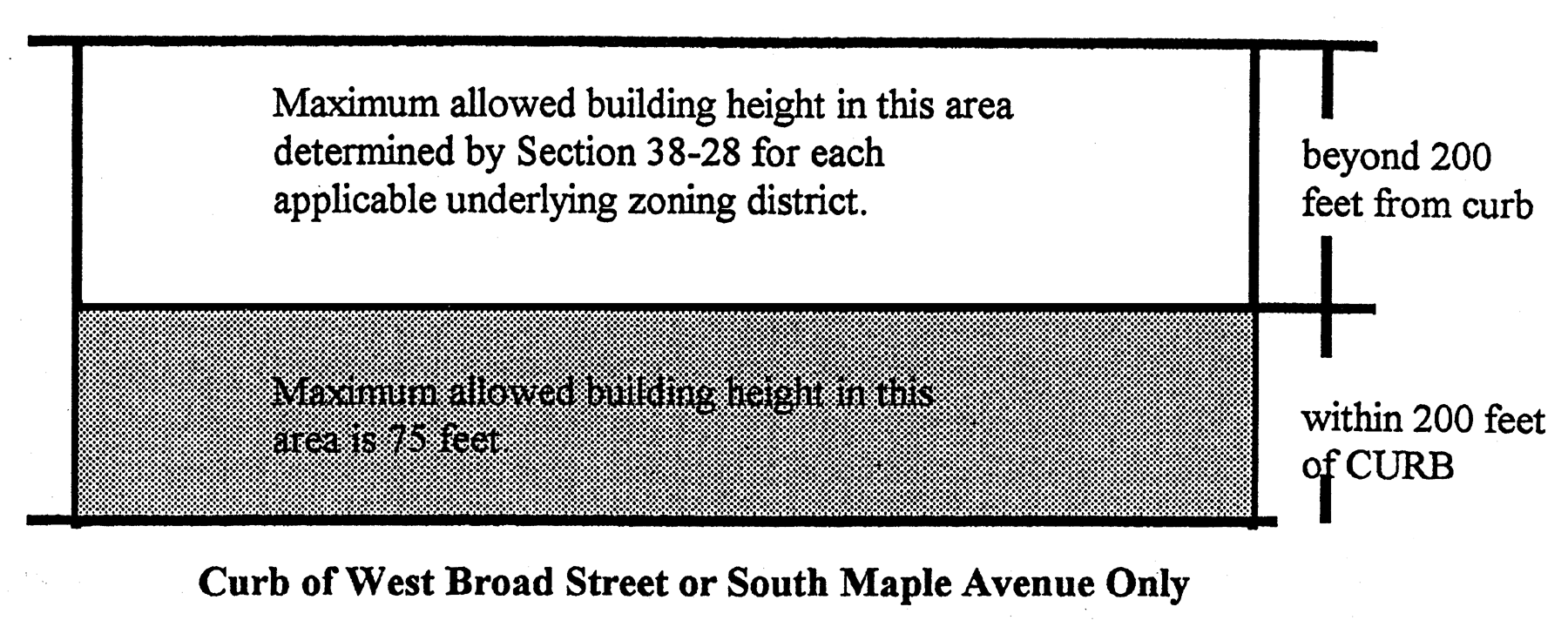
Example of an MUR 1 application that does not adjoin an R district
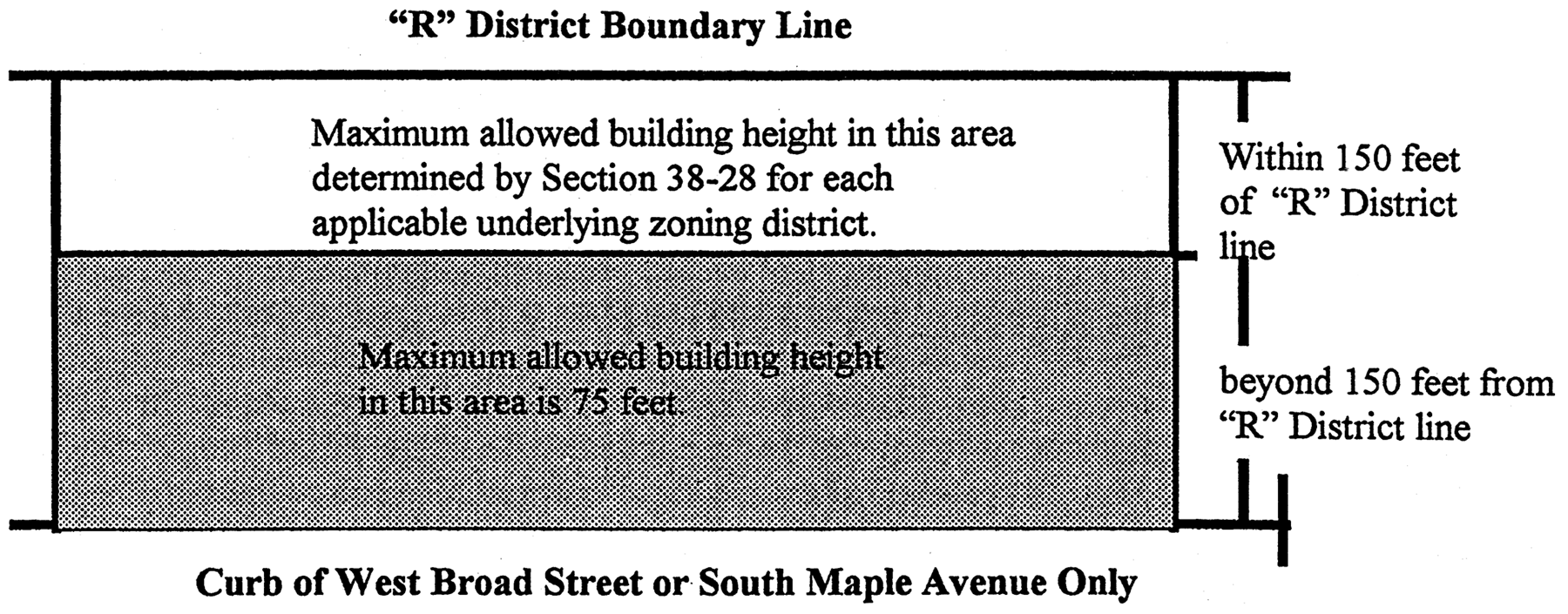
Example of an MUR 1 application adjoining R district area and in which case the 200 feet area shown above reaches within or beyond 150 feet of the R district boundary line.
c.
All structures that are within 80 feet of Park Avenue and Ellison Street shall be of similar character to structures across the street from them.
(b)
Mixed-use redevelopment (MUR) option 2. All of the following sections apply to the mixed-use redevelopment (MUR) option 2, in addition to those described in section 48-1080.
(1)
Where permitted. The MUR option 2 may be utilized only where the MUR 2 symbol appears on the future land use plan map of the comprehensive plan within the B-2 zoning district.
(2)
MUR option 2 permitted uses. All of the uses listed in section 48-486 are permitted. In addition indoor commercial recreation uses are also permitted within all MUR option 2 applications.
(3)
MUR option 2 ratio of use requirements.
a.
Applications for development within all MUR option 2 areas must meet each of the following tests for gross square footage:
1.
For every 1,000 square feet of residential space, a minimum of 4,000 square feet of office space, 1 4,000 square feet of retail space, 2, 3 4,000 square feet of hotel space; or a total of 4,000 square feet of a combination of these uses must also be constructed.
2.
For every 1,000 square feet of office space, 1 a minimum of 75 square feet of retail space 2, 3 must also be constructed.
3.
For every 1,000 square feet of retail space, 2, 3 a minimum of 500 square feet of office, 1 500 square feet of residential space; 500 square feet of hotel space; or 500 square feet of the combination of these uses must also be constructed.
4.
For every 1,000 square feet of hotel space, a minimum of 50 square feet of retail space 2, 3 must also be constructed.
Note—For gross amounts of square feet not equal to a multiple of 1,000 the number will be rounded down at and below 500 and rounded up above 500.
Footnotes:
1 Applicable office space is referenced in sections 48-453(5), 48-453(6), 48-486(3), 48-486(5), 48-521(6), 48-546(3), and 48-546(4).
2 Applicable retail and service establishments are referenced in sections 48-453(16), 48-486(13), and 48-522(16).
3 This retail space shall be organized to promote first floor pedestrian interest.
b.
The square footage requirements in this section apply specifically to the property defined in the MUR option 2 application, and shall not include any existing surrounding uses. Structures that exist on the interior of MUR application areas may be included in the above square footage requirements if substantially redeveloped to satisfy MUR criteria. When the square footage of preexisting commercial structures is used to satisfy the MUR 1 ratio of use requirements in subsection (a)(3)a of this section, these square feet must be included in the aggregate square footage of all structures shown in the site plan application and meet the ratio of use requirements for the square footage of all structures shown in the site plan application. All other requirements of this division, except for setback and building height requirements, apply to existing commercial structures within MUR application areas. The above requirements pertain to the gross square feet of structural floor area, excluding parking structures.
(4)
Allowed density and building heights for MUR option 2 applications. To encourage parcel consolidation, developments of greater than 2½ acres will receive a three percent density bonus for each additional acre. The following table describes maximum density and building height requirements:
(5)
Conditions applying to MUR option 2 applications.
a.
All MUR option 2 applications shall comply with the minimum and maximum FAR and other provisions in the above table. These figures are also stated in article VI, division 6 of this chapter, pertaining to height lot and yard regulations. Parking structures may be excluded from FAR calculations; however above-grade parking structures must comply with height requirements.
b.
All MUR option 2 applications are subject to an 87-foot maximum height limitation.
(c)
Mixed-use redevelopment (MUR) option 3. All of the following sections apply to the mixed-use redevelopment (MUR) option 3 in addition to those described in section 48-1079.
(1)
Where permitted. The MUR option 3 may be utilized only where the MUR 3 symbol appears on the future land use plan map of the comprehensive plan within the B-3 and M-1 zoning districts.
(2)
MUR option 3 permitted uses. All of the uses listed in sections 48-521 and 48-546 are permitted. In addition, apartment structures, indoor commercial recreation uses, and senior assisted living facilities are also permitted within all MUR option 3 applications.
(3)
MUR option 3 ratio of use requirements.
a.
Applications for development within all MUR option 3 areas must meet each of the following tests for gross square footage:
1.
For every 1,000 square feet of residential space, a minimum of 3,000 square feet of office space 1 ; 3,000 square feet of retail space, 2, 3 3,000 square feet of hotel space; or a total of 3,000 square feet of a combination of these uses must also be constructed.
2.
For every 1,000 square feet of office space 1 , a minimum of 100 square feet of retail space 2, 3 must also be constructed.
3.
For every 1,000 square feet of retail space 2, 3 , a minimum of 500 square feet of office 1 ; 500 square feet of residential space; 500 square feet of hotel space; or 500 square feet of the combination of these uses must also be constructed.
4.
For every 1,000 square feet of hotel space, a minimum of 50 square feet of retail space 2, 3 must also be constructed.
Note—For gross amounts of square feet not equal to a multiple of 1,000 the numbers will be rounded down at and below 500 and rounded up above 500.
Footnotes:
1 Applicable office space is referenced in sections 48-453(5), 48-453(6), 48-486(3), 48-486(5), 48-521(6), 48-546(3), and 48-546(4).
2 Applicable retail and service establishments are referenced in sections 48-453(16), 48-486(13), and 48-521(16).
3 This retail space shall be organized to promote first floor pedestrian interest.
b.
The above square footage requirements apply specifically to the property defined in the MUR option 3 application, and shall not include any existing surrounding uses. Structures that exist on the interior of MUR application areas may be included in the above square footage requirements if substantially redeveloped to satisfy MUR criteria. When the square footage of preexisting commercial structures is used to satisfy the MUR 1 ratio of use requirements in subsection (a)(3)a of this section, these square feet must be included in the aggregate square footage of all structures shown in the site plan application and meet the ratio of use requirements for the square footage of all structures shown in the site plan application. All other requirements of this division, except for setback and building height requirements, apply to existing commercial structures within MUR application areas. The above requirements pertain to the gross square feet of structural floor area, excluding parking structures.
(4)
Allowed density and building heights for MUR option 3 applications. To encourage parcel consolidation, developments comprised of greater than 2½ acres will receive a three percent density bonus for each additional acre. The following table describes maximum density and building height requirements:
(5)
Conditions applying to MUR option 3 applications.
a.
All MUR option 3 applications shall comply with the minimum and maximum FAR and other provisions in the above table. These figures are also stated in article VI, division 6 of this chapter, pertaining to height, lot and yard regulations. Parking structures may be excluded from FAR calculations, however above-grade parking structures must comply with height requirements.
b.
All MUR option 3 applications are subject to an 87-foot maximum height limitation.
c.
Public open spaces are encouraged in these areas as either small internal parks or plazas or external spaces with access to West Broad Street.
d.
All buildings that front on Broad Street and not otherwise restricted, shall be subject to an angle of bulk plane of 17.5 degrees. See diagram below.
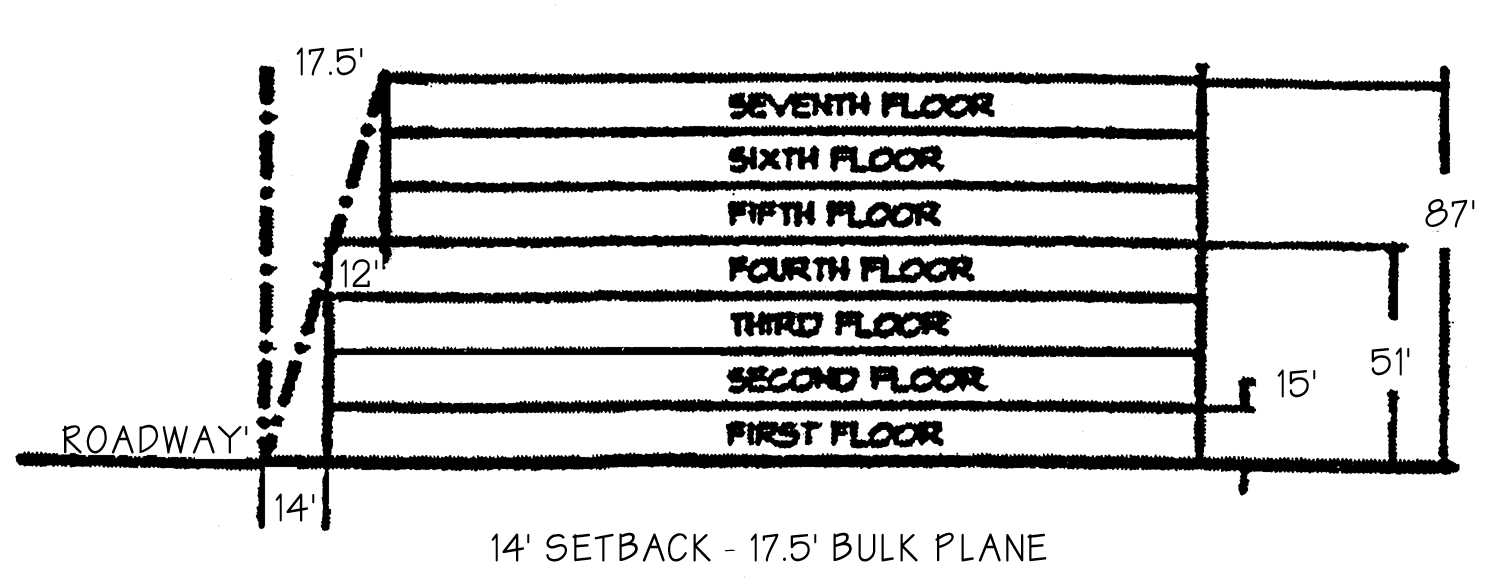
e.
The upper stories of a building of maximum permitted height must be set back farther than the maximum building setbacks described in section 48-1080(e).
(Code 1982, § 38-34(b); Ord. No. 1636, 3-8-1999; Ord. No. 1670, 3-13-2000; Ord. No. 1671, 4-10-2000)
Sec. 48-1101.- General requirements.
The building height, lot size, yard, and tree regulations indicated in this division shall be observed unless otherwise specified for particular uses or situations elsewhere in this chapter. With respect to regulations on maximum height, the maximum building height shall be the lesser of the specified number of stories or the specified number of feet.
(Code 1973, § 81-54; Code 1982, § 38-28(a); Ord. No. 586; Ord. No. 866; Ord. No. 880; Ord. No. 898; Ord. No. 908; Ord. No. 924; Ord. No. 987, 11-9-1981; Ord. No. 999, 2-22-1982; Ord. No. 1081, 9-10-1984; Ord. No. 1167, 11-24-1986; Ord. No. 1209, 1-25-1988; Ord. No. 1244, 12-12-1988; Ord. No. 1277, § 4, 10-10-1989; Ord. No. 1382, 11-25-1991; Ord. No. 1429, 2-8-1993; Ord. No. 1578, 5-12-1997; Ord. No. 1636, 3-8-1999; Ord. No. 1695, 3-26-2001; Ord. No. 1766, 9-13-2004; Ord. No. 1799, 12-12-2006; Ord. No. 1909, 10-28-2013; Ord. No. 2068, 9-26-2023; Ord. No. 2068(Corr.), 9-26-2023; Ord. No. 2071, 12-11-2023; Ord. No. 2104, 12-8-2025; Ord. No. 2108, § 2, 3-9-2026)
Sec. 48-1102. - Additional requirements, exceptions and modifications.
(a)
Structures permitted above height limit.
(1)
Radio or transmission towers or masts, or necessary industrial, utility or public service structures and monuments, spires, belfries, steeples, flagpoles, commercial and public utility wireless masts, water tanks and silos may exceed the height limit in the zoning district no more than 25 feet.
(2)
Fire or parapet walls shall not exceed four feet above the height of the building.
(3)
Penthouses or roof structures for the housing of elevators, stairways, tanks, ventilating fans or similar equipment required to operate and maintain the building, skylights, towers or similar roof structures shall not exceed a maximum of 20 feet above the height of the building and shall be concealed either by a parapet wall or by exterior architectural material of the same type and quality as that used in the exterior walls of the building.
(4)
Chimneys and smokestacks which are an integral part of a penthouse may exceed the height of the building by no more than 24 feet.
(5)
No penthouse, roof structure or any other enclosure above the height limit shall be used for any purpose other than to service the principal building; provided no penthouse roof structure or any other enclosure above the height limit shall be allowed for the purpose of providing habitable floorspace for permitted or accessory uses.
(b)
Substandard lots.
(1)
Any lot of official record as of February 14, 1944, or any lot of a subdivision approved by the city from February 14, 1944, to the effective date of the ordinance from which this division is derived, which does not meet the lot size requirements for the district in which it is located, may be used for a one-family dwelling, provided:
a.
It is in an R district; and
b.
It cannot reasonably be combined with other property to meet the minimum size requirements. Contiguous substandard lots shall be considered combined for the purposes of administering all zoning regulations as of August 1, 2013, if one home straddled or touched the contiguous lots as of that date, and that home used both substandard lots for setback purposes. The limitations of this subsection shall not apply to substandard lots for which all of the following are true on or before August 1, 2014:
1.
The substandard lots have been placed in separate ownership and Arlington County land recordation of such has been completed and presented to staff.
2.
A complete grading plan meeting all the requirements of the City of Falls Church Code for the subject lots has been applied for and accepted by the city for review.
3.
A demolition permit for the house has been applied for and demolition has been completed under that permit within six months of issuance.
(2)
If the requirements of subsections (b)(1)a and b of this section are met, then:
a.
A substandard lot's side yard may be reduced to not less than 20 percent of the lot width, but not to less than 7½ feet in any case.
b.
A substandard lot's rear yard may be reduced to not less than 30 percent of the lot depth but not less than 20 feet in any case.
c.
The substandard lot building height shall be determined as a ratio of actual lot area to the required lot area, multiplied by the maximum allowable height in the underlying zoning district. However, the substandard lot building height shall not be required to be less than 25 feet.
(c)
Front yards. In any R district, the minimum front yard for new construction, new buildings, and new additions to existing residential structures, except for corner lots in R-1A and R-1B districts, shall be the average of the nearest front yards on either side, or if there be a building on one side only, then it shall be the same as the front yard for that building; provided, no front yard shall be less than 30 feet in an R-1A district and 25 feet in an R-1B district, and that no front yard need be more than 50 feet. For corner lots in R-1A and R-1B districts, the average setback requirement shall apply only to the front yard on which an existing or proposed front door of a residential structure faces. Except for vacant corner lots, the average setback requirement shall apply only to the front yard on which a front door will face. For those corner lots on which the front door does not clearly face either front yard (residence sited on diagonal) averaging shall not be required.
(d)
Measurement of yards. The minimum front yard depths shall be measured from the existing street right-of-way line as shown in Illustration 2 of section 48-2, Definitions, except where a street is designated for widening or extension by the official major thoroughfare plan, the measurement shall be taken from the future right-of-way line, or as specifically noted in this chapter. In determining the location of such future right-of-way line, it shall be assumed that the street is to be widened equally on both sides of the centerline to the full width designated by the official major thoroughfare plan, unless there is an attested copy of an officially adopted detailed plan on-file with the planning commission for such street widening, extension, or location, in which case the latter shall control. In no case shall any street in an R or T district be considered, for the purposes of this division, as having a right-of-way less than 50 feet wide, nor in any other district less than 60 feet wide. Each yard shall be measured horizontally to the nearest point of the building or nearest line of the use area, except for allowable projections.
(e)
Buildings and projections in yards. Except for accessory dwellings, as regulated in section 48-1223, the following buildings, uses and architectural features may occupy or project into required yards as indicated:
(1)
Minimum front or rear yard.
a.
Cornices, eaves, or other architectural features: two feet, six inches.
b.
Uncovered stairs or fire escapes: four feet, six inches.
c.
Terraces, steps, uncovered porches and landings: six feet.
d.
Bay windows and balconies occupying not more than one-third of the wall length: three feet.
(2)
Side yard. The same projections named in subsection (e)(1) of this section may project the same distances into a minimum side yard provided no such projection may exceed three feet. Any permitted use other than a building may occupy any part of a minimum side yard.
(3)
Minimum rear yard, except residential developments requiring site plans. Any permitted use or accessory structure not over 1½ story or 12 feet in height and accessory dwellings, such buildings occupying in the aggregate not more than 30 percent of the minimum rear yard area, or up to 50 percent where such buildings include an accessory dwelling, shall be located not less than five feet from the principal building, not less than ten feet from all street and alley lines and not less than three feet from all other lot lines, notwithstanding any regulation or standard included in article V, division 12. Accessory uses, other than buildings, may occupy all or any part of a required rear yard.
(4)
Front yard in the R-1A or R-1B district only. In addition to the projections as set forth in subsection (e)(1) of this section, a deck or unenclosed porch, may project up to eight feet into the required front yard; an enclosed portico or porch, not more than eight feet in width, may not project more than eight feet into the required front yard.
(f)
Attached accessory buildings. A private garage or other accessory structure that does not house a dwelling may be attached to the principal building, if made structurally a part thereof or may be attached by a covered passageway not less than ten feet wide. Such accessory structure may not occupy any part of a required front or side yard.
(g)
Awnings and canopies projecting into front yards and public rights-of-way. In a B, M, or O-D district, an awning or canopy may project a maximum of five feet from a building facade into a minimum front yard, provided the following conditions are met:
(1)
Such an awning or canopy may also project into the public right-of-way; provided the public works director approves such installation, and provided in the event a public works project needs to be performed, that the structure shall be temporarily removed at no cost to the city. Prior to the issuance of a building permit, the owner of the property shall enter into an agreement with surety in the form of a bond, in an amount determined by the director of public works, to cover the costs of possible removal of the structure and to ensure the awning or canopy shall be kept in proper and safe condition at all times.
(2)
If a sign or logo is to be placed on an awning or canopy, the provisions of article VI of this chapter, pertaining to signs, shall apply.
(3)
An awning or canopy shall not extend over a tree well or planting strip or extend closer than eight feet to a street curb.
(4)
The design, color and placement of an awning or canopy shall be in harmony with the building to which it is attached and with adjacent buildings, businesses, signs, awnings and canopies.
(h)
The following criteria shall apply to any fence, wall or topographic feature, provided that in all cases no such fence, wall or feature shall conflict with the visibility requirements found in section 48-1103 and shall not be located in a public right-of-way:
(1)
In any front yard, height shall not exceed four feet.
(2)
In any side or rear yard, and in yards abutting a public park, trail or unopened rights-of-way, height shall not exceed seven feet.
(3)
When enclosing a playground, park, schoolyard or similar recreational facility, height shall not exceed ten feet in any yard.
(4)
Existing fences on historic properties may be repaired or replaced to a height matching the existing fence or seven feet, whichever is lower.
(5)
The limitations of this section shall not be deemed to prohibit any necessary retaining wall or natural topographic feature. Ornamental features such as post caps or finials shall not count towards fence height. Fences enclosing a pool shall be subject to the requirements of the state building code. For purposes of this section, trees, shrubs and other plantings shall not constitute a fence or wall.
(i)
Buffer strips. In a B or M district where the property abuts an R district, there shall be provided a buffer strip having the minimum specifications set forth in division 8 of this article, subject to the provisions governing minimum vision, section 48-1103.
(j)
Utility installations.
(1)
All utility pedestals, transformers, switchgear, air conditioning equipment and concrete foundation pads associated with underground installation, connection and distribution shall be placed, at or below grade level, at least three feet from the side or rear lot lines. Placement shall not be in yards abutting streets. Each apparatus shall be effectively screened from pedestrian view by shrubbery or architectural material compatible with the exterior of the principal structure. If such apparatus is air handling with exhaust or blower, it shall be so located as not to vent toward immediately contiguous property.
(2)
Prior to the erection, installation or placement of foundation for any of the apparatus referred to in subsection (j)(1) of this section, an application for a permit shall be filed with the zoning administrator accompanied by plans and elevations drawn to scale. Such drawings, submitted in duplicate, shall depict the specific location in relation to the principal structure, property lines, height, type and octave frequency in cycles per second of all apparatus whether above or below grade level. The data submitted in compliance hereto shall not be deemed sufficient to fulfill the requirements of chapter 6, but are in addition thereto.
(3)
Upon certification by the zoning administrator, or its designee, of the proper location of a foundation pad, the division of inspections shall issue a permit as described in chapter 6.
(Code 1973, § 81-54; Code 1982, § 38-28(b); Ord. No. 586; Ord. No. 866; Ord. No. 880; Ord. No. 898; Ord. No. 908; Ord. No. 924; Ord. No. 987, 11-9-1981; Ord. No. 999, 2-22-1982; Ord. No. 1081, 9-10-1984; Ord. No. 1167, 11-24-1986; Ord. No. 1209, 1-25-1988; Ord. No. 1244, 12-12-1988; Ord. No. 1277, § 4, 10-10-1989; Ord. No. 1382, 11-25-1991; Ord. No. 1429, 2-8-1993; Ord. No. 1578, 5-12-1997; Ord. No. 1636, 3-8-1999; Ord. No. 1695, 3-26-2001; Ord. No. 1766, 9-13-2004; Ord. No. 1799, 12-12-2006; Ord. No. 1872, 3-12-2012; Ord. No. 1902, 7-22-2013; Ord. No. 2071, 12-11-2023; Ord. No. 2088, 4-14-2025)
Sec. 48-1103. - Corner lots, minimum vision.
(a)
On corner lots in all zoning districts there shall be no obstructions to vision between a height of 3½ feet and ten feet above the elevation of the established curb, or, if no curb exists, above the established elevation of the centerline of the intersecting streets. The plane of unimpeded vision shall be within a triangular area bounded by the established street lines and a diagonal straight line connecting points along the street lines, or their projections, each point of which is the following distance from the point of intersection of such established street lines or their projections:
(1)
For corner lots having an interior angle of 90 degrees, 25 feet;
(2)
For corner lots having an interior angle of between 91 degrees and 140 degrees, 25 feet minus two feet for each 20 degrees or fraction thereof by which the angle exceeds 90 degrees;
(3)
For corner lots having an interior angle of less than 90 degrees, 25 feet plus two feet for each 20 degrees or fraction thereof by which the angle is less than 90 degrees.
(b)
Columns, sign posts and utility poles, owned by the city, state or public utility corporations and tree trunks which do not exceed one foot square or three feet in circumference natural topography, and buildings existing at the time of the adoption of the ordinance from which this section is derived shall not be considered obstructions to vision within the meaning of this subsection.
(c)
The provisions of this section shall be minimum requirements. In the interest of public safety, the zoning administrator, acting in concert with the director of public works and chief of police, may determine that due to street configuration, slope of land, or other natural or permanent obstructions to vision at or near a given intersection whether or not protected by mechanical signalization or other traffic controls, more stringent requirements must be met. Such a determination, when stated in writing by the zoning administrator setting forth the more stringent requirements and duly made known to any affected property owner, shall have the same force and effect of law as if incorporated formally into the provisions of this section. Any property owner affected by the more stringent requirements imposed by the zoning administrator may appeal such determination to the board of zoning appeals, in accordance with the provisions of subsection 48-173(b).
(Code 1973, § 81-54; Code 1982, § 38-28(c); Ord. No. 586; Ord. No. 866; Ord. No. 880; Ord. No. 898; Ord. No. 908; Ord. No. 924; Ord. No. 987, 11-9-1981; Ord. No. 999, 2-22-1982; Ord. No. 1081, 9-10-1984; Ord. No. 1167, 11-24-1986; Ord. No. 1209, 1-25-1988; Ord. No. 1244, 12-12-1988; Ord. No. 1277, § 4, 10-10-1989; Ord. No. 1382, 11-25-1991; Ord. No. 1429, 2-8-1993; Ord. No. 1578, 5-12-1997; Ord. No. 1636, 3-8-1999; Ord. No. 1695, 3-26-2001; Ord. No. 1766, 9-13-2004; Ord. No. 1799, 12-12-2006)
Sec. 48-1104. - Reserved.
Editor's note— Ord. No. 2106, adopted Jan. 27, 2026, deleted § 48-1104 entitled "Conditional uses permitted by special use permit," which derived from: Code 1973, § 81-54; Code 1982, § 38-28(d); Ord. No. 586; Ord. No. 866; Ord. No. 880; Ord. No. 898; Ord. No. 908; Ord. No. 924; Ord. No. 987, adopted Nov. 9, 1981; Ord. No. 999, adopted Feb. 22, 1982; Ord. No. 1081, adopted Sept. 10, 1984; Ord. No. 1167, adopted Nov. 24, 1986; Ord. No. 1209, adopted Jan. 25, 1988; Ord. No. 1244, adopted Dec. 12, 1988; Ord. No. 1277, § 4, adopted Oct. 10, 1989; Ord. No. 1382, adopted Nov. 25, 1991; Ord. No. 1429, adopted Feb. 8, 1993; Ord. No. 1578, adopted May 12, 1997; Ord. No. 1636, adopted March 8, 1999; Ord. No. 1695, adopted March 26, 2001; Ord. No. 1766, adopted Sept. 13, 2004; and Ord. No. 1799, Dec. 12, 2006.
Sec. 48-1105. - Accessory uses permitted.
Permitted accessory uses are as follows:
(1)
Private gardens.
(2)
Outdoor lighting as permitted in chapter 14, article V, pertaining to outdoor lighting.
(3)
Private off-street parking as permitted in article V, division 2 of this chapter.
(4)
Private swimming pools and tennis courts.
(5)
Playgrounds.
(6)
Fences, decks, terraces, greenhouses, storage buildings, canopies and similar uses and structures.
(Code 1973, § 81-54; Code 1982, § 38-28(e); Ord. No. 586; Ord. No. 866; Ord. No. 880; Ord. No. 898; Ord. No. 908; Ord. No. 924; Ord. No. 987, 11-9-1981; Ord. No. 999, 2-22-1982; Ord. No. 1081, 9-10-1984; Ord. No. 1167, 11-24-1986; Ord. No. 1209, 1-25-1988; Ord. No. 1244, 12-12-1988; Ord. No. 1277, § 4, 10-10-1989; Ord. No. 1382, 11-25-1991; Ord. No. 1429, 2-8-1993; Ord. No. 1578, 5-12-1997; Ord. No. 1636, 3-8-1999; Ord. No. 1695, 3-26-2001; Ord. No. 1766, 9-13-2004; Ord. No. 1799, 12-12-2006)
Sec. 48-1106. - Tree canopy requirements in non-residential zoning districts.
(a)
Purpose.
(1)
It is the purpose of the city to preserve and increase tree canopy in its non-residential zoning districts. For the purpose of this Code section, "non-residential districts" are identified as the following: B-1, B-2, B-3, O-D, M, and, when non-residential uses are established, the T-1 and T-2 zoning districts. This section requires that when any development activity requiring a site plan occurs within one of the aforementioned districts, a minimum tree canopy shall be established as set forth in the table located at city Code section 48-1101.
(2)
Increasing the non-residential tree canopy within the city will provide important aesthetic, social, and economic benefits to the city's residents and businesses, and will contribute to the responsible management of vital atmospheric, water, soil, and ecological resources.
(b)
Administration. The city arborist shall verify compliance with this section as part of the city's site plan review process and, together with the director of community planning and economic development, shall adopt administrative rules for the implementation of this section as part of the city's Urban Forestry and Site Plan Guide. The administrative rules shall:
(1)
Identify tree species that are eligible to receive credit for minimum tree canopy requirements;
(2)
Identify tree species that are ineligible to receive credit for minimum tree canopy requirements;
(3)
Identify tree planting and protection requirements, pursuant to industry standards; and
(4)
Identify the 20-year canopy coverage assigned to each tree species eligible to receive canopy credit.
(c)
When the non-residential tree canopy requirement is triggered. Any activity in the non-residential districts requiring a site plan under section 48-1134 of the city Code shall demonstrate compliance with the minimum tree canopy requirements set forth in this Code section, prior to site plan approval.
(d)
A site plan must include a landscape plan that demonstrates tree canopy requirements.
(1)
As part of a site plan submission, the applicant must include a landscape plan that demonstrates compliance with the non-residential tree canopy requirements set forth in this section. The landscape plan must demonstrate that the on-site trees shall establish a tree canopy satisfying the minimum tree canopy coverage requirement set forth in section 48-1101 when measured at 20 years from the date of site plan approval. Only trees whose trunks are located within the property boundary line may be counted toward the minimum required tree canopy.
(2)
The landscape plan shall, in addition to any landscape plan requirements located elsewhere in the zoning code, graphically delineate:
a.
A preliminary vegetative survey of all existing vegetation on the site including trees measuring at least two inches in diameter at breast height (DBH) and shrubs that are greater than five feet in height. A chart shall be provided showing common and botanical name, size, condition, life expectancy, and required preservation measures of all woody vegetation. All trees shall be identified by an International Society of Arboriculture (ISA) Certified Arborist or Landscape Architect. Include the ISA certified arborist's certification number or landscape architect on the plan.
b.
An existing vegetation preservation plan that shows land-disturbing and any other activities during the construction process that could negatively impact vegetation. Locations of tree preservation fencing, root pruning and other required tree preservation measures shall be shown on the plan. Locations of the critical root zone (CRZ) of any vegetation shown on the plan or on adjacent properties, including city rights-of-way (street trees), where the CRZ extends onto the site.
c.
A landscape revegetation plan that shall illustrate the locations of any required vegetation. This applies on lots where the ten percent minimum tree canopy cover cannot be met through preserving existing tree canopy. A chart shall be provided showing common and botanical name, size, quantity, root condition and tree canopy coverage provided by each tree. The City of Falls Church "Tree Planting Specifications and Details" shall be included on the plan.
d.
Tree canopy coverage calculations pre- and post-development shall be shown on the plan in chart form. Canopy coverage is the area beneath the drip line of the trees on the lot. For on-site trees if the canopy extends into a neighboring property credit for that portion of the canopy may also be taken. Canopy coverage from the following types of vegetation cannot be included in the calculations:
1.
Vegetation that is not preserved in accordance with the landscape conservation plan.
2.
Vegetation that is not desirable and has a life expectancy less than ten years.
3.
Vegetation that is included in the "Vegetation Not Recommended to Plant or Preserve" list.
4.
Vegetation that is not native to the Mid-Atlantic region.
(3)
The landscape plan shall identify the projected 20-year canopy of each tree proposed to be planted on the site. The projected 20-year canopy shall be taken from the city's "Urban Forestry Site Plan Guide."
(e)
Permitted tree species. The city's "Urban Forestry Site Plan Guide" shall include a list of trees that may be counted toward the planting and canopy requirements established under this section.
(f)
Trees that are ineligible for tree canopy credit. In addition to the foregoing, a tree may not be counted toward the projected tree canopy when:
(1)
More than 30 percent of the tree's critical root zone will be impacted by construction activities, including, but not limited to, trenching, grading, digging, cutting, or filling of soil, etc.; or
(2)
It is determined by the city's arborist that the tree is in "fair" to "poor" condition, or is reasonably predicted to be in "fair" to "poor" condition in 20 years. The city's arborist will make this determination using the most recent edition of the Guide for Plant Appraisal, published by the International Society of Arboriculture; or
(3)
It is determined by the city's arborist that the tree is undesirable or invasive vegetation, as advised by the Virginia Department of Conservation and Recreation (DCR) and the Virginia Native Plant Society (VNPS).
(g)
Tree preservation is preferred to new plantings; bonus for tree preservation.
(1)
The non-residential minimum tree canopy coverage requirements set forth at the table in section 48-1101 may be satisfied through tree preservation, tree planting, or a combination of both. However, when existing trees meet standards of health, condition, and suitability, and when it is feasible to preserve those trees within the framework of permissible uses, densities, design standards, and construction practices, then all efforts shall first be made to meet the tree canopy requirement through the preservation of existing trees.
(2)
To qualify for canopy credit, a preserved tree must be native to the Mid-Atlantic region and exceed five feet in height at the time the landscape plan is submitted. Further, the city arborist must determine that the preserved tree meets professional standards for health, condition, and suitability.
(3)
Preservation bonus. When a qualified tree is preserved it will receive a 25 percent canopy bonus. This means that the city will increase by 25 percent the amount of canopy that would otherwise be allocated to the preserved tree. For example, a tree that is identified on the city's "Urban Forestry Site Plan Guide" as having 100 square feet canopy at 20 years of age would be given credit for 125 square feet of canopy.
(4)
Any portion of the tree canopy requirement that cannot first be met through the preservation of trees as provided for in this section, shall be provided through tree planting.
(h)
Hardship relief and tree canopy fund.
(1)
When the strict application of the tree canopy requirements would result in unnecessary or unreasonable hardship to the developer, as determined by and in the discretion of the city's designated agent, then the city's designated agent may grant a reduction in the required tree canopy, but only to the extent necessary to offset the hardship. A hardship cannot be financial in nature. The designated agent shall consider whether any of the following conditions exist when determining whether a hardship exists:
a.
The strict application of the tree canopy requirements would cause irresolvable conflicts with other more important site development requirements, design standards, or comprehensive planning goals.
b.
The size of the site is such that, after allowing for reasonable commercial use of the property, the site lacks sufficient space for the required tree canopy.
c.
The full canopy requirement would cause unavoidable conflicts with underground or overhead utilities.
d.
The full canopy requirement is likely to cause damage to public infrastructure.
(2)
When a tree canopy reduction is granted due to a hardship, the applicant who submitted the site plan must pay a fee to compensate for the lack of required on-site tree canopy. The fee will be set forth in the city's adopted fee schedule as the "cash in lieu of canopy" fee. If no such fee is included in the city's adopted fee schedule, then the applicant shall pay the equivalent of $2,000.00 in 2026 dollars for every 250 square feet of canopy that is not provided on-site. The fee will be imposed in 250 square foot increments; any canopy shortage exceeding an increment of 250 will result in a new whole fee being imposed. For example, if the canopy shortage is 200 square feet and the fee is $2,000.00 per 250 square feet, then the fee for that shortage would be $2,000.00 in 2026 dollars; if the shortage were 300 square feet, the fee would be $4,000.00 in 2026 dollars.
(Ord. No. 2108, § 3, 3-9-2026)
Sec. 48-1134.- When required.
(a)
A site plan shall be required for:
(1)
The construction, development or redevelopment of a structure, paved area, wall, or drainage facility on public or private property when such sitework:
a.
Significantly affects pedestrian, vehicular or drainage facilities;
b.
Reduces or eliminates any site feature which is required by this chapter; or
c.
Involves structural additions of more than 25 square feet of floor area.
(2)
The conversion to condominiums or cooperatives of residential or commercial structures.
(3)
The conversion of residential structures and uses to nonresidential structures and uses, except as provided for in this section.
(4)
City-owned facilities, except below ground water and sewer facilities located outside the city, prior to submittal to the approving authority of the jurisdiction in which the facility is located.
(5)
Any disturbance of land greater than or equal to 2,500 square feet or any development or redevelopment in a resource protection area as defined in section 35-2.
(6)
Drive-thru or drive-through facility as defined in section 48-2 and as regulated by section 48-867 when:
a.
The application is for a new permit or for a permit that is not otherwise transferable from the permit holder to a second party.
b.
The application is for the renewal of an expired or expiring permit.
c.
The application is for the renewal of a permit that has been revoked.
d.
The application is not already part of a larger site plan.
(b)
Except within resource protection areas where all construction will be subject to section 35-12 and applicable site plan requirements, a site plan is not required for: (i) the construction of one-family or two-family detached dwellings and their accessory structures in the R-1A and R-1B districts; (ii) exclusively residential development occurring in the T-1 district on a lot that is 6,000 square feet in area or less; (iii) the construction of patios or open porches which are accessory to existing residential uses in any district; or (iv) the following uses when permitted in the R-1A, R-1B or T-1 districts by special use permit: accessory dwelling units, group homes, major home occupations, antennas, transmitters, or prenatal and infant care counseling centers; provided, however, that no such special use permit shall be granted without the approval of the building inspector and fire marshal.
(Code 1973, § 81-56; Code 1982, § 38-29(a); Ord. No. 595; Ord. No. 640; Ord. No. 704; Ord. No. 881; Ord. No. 1042, 3-28-1983; Ord. No. 1058, 8-8-1983; Ord. No. 1072, 5-29-1984; Ord. No. 1118, 9-9-1985; Ord. No. 1237, 9-12-1988; Ord. No. 1263, 5-22-1989; Ord. No. 1277, § 5, 10-10-1989; Ord. No. 1332, 11-12-1990; Ord. No. 1335, 11-12-1990; Ord. No. 1636, 3-8-1999; Ord. No. 1865, 8-8-2011; Ord. No. 2068, 9-26-2023; Ord. No. 2120, 7-13-2026)
Sec. 48-1135. - Preliminary survey documents.
As the first step in the site plan process, the applicant shall provide an accurate survey of existing features on and around the site, including at least the following:
(1)
A site drawing to scale locating all existing trees on the site that measure at least two inches in diameter at 4½ feet above grade, which shall identify each tree by size (diameter at 4½ feet above grade), species, and condition as determined by a licensed and/or certified arborist, or a similar professional approval by the city manager.
(2)
A map identifying the location of existing buildings, existing and proposed public and private easements, underground facilities, and any floodplain or Chesapeake Bay preservation area district, if applicable.
(3)
The information required in subsections (1) and (2) of this section shall be reviewed by city staff within two weeks of submission by the applicant and a copy shall be provided to the urban forestry commission. Shortly after review, the staff will meet with the applicant to discuss any impediments to development, or conditions disclosed on the maps, which, in the staff's opinion, could complicate or delay consideration of a site plan. Any deficiencies in the preliminary plans will be raised at that time, and a deadline established for submission of revised or amended plans, if necessary. No development site plan may be received until preliminary plans required by this subsection have been submitted.
(4)
See zoning code section 48-1106 for tree canopy requirements in non-residential zoning districts, and in the T-1 and T-2 zoning districts.
(Code 1973, § 81-56; Code 1982, § 38-29(b); Ord. No. 595; Ord. No. 640; Ord. No. 704; Ord. No. 881; Ord. No. 1042, 3-28-1983; Ord. No. 1058, 8-8-1983; Ord. No. 1072, 5-29-1984; Ord. No. 1118, 9-9-1985; Ord. No. 1237, 9-12-1988; Ord. No. 1263, 5-22-1989; Ord. No. 1277, § 5, 10-10-1989; Ord. No. 1332, 11-12-1990; Ord. No. 1335, 11-12-1990; Ord. No. 1636, 3-8-1999; Ord. No. 2001, § 2, 9-23-2019; Ord. No. 2108, § 4, 3-9-2026)
Sec. 48-1136. - Board and departmental actions required prior to designated agent consideration.
(a)
All site plans shall be referred for review to the departments of planning, public works and public utilities, including the building inspector, fire marshal, arborist and zoning administrator. When appropriate, site plans shall also be referred for review to other agencies, such as the health department, police department and the state department of transportation.
(b)
Each such agency shall review plans for compliance with applicable laws and standards and shall report in writing to the designated agent.
(c)
Prior to final consideration by the designated agent, the planning commission shall review, in an advisory capacity, all site plans based upon the zoning code provisions included in section 48-1137, section 48-1140, and section 48-1141 and shall report its findings to the designated agent. However, the designated agent shall meet the statutory deadlines for review of each site plan regardless of whether the planning commission has had an opportunity to review the site plan or to report its findings.
(d)
The architectural advisory board shall review, in an advisory capacity, all site plans prior to final consideration by the designated agent and shall report its recommendations, annotations, and stipulations to the designated agent and zoning administrator. The architectural advisory board review shall address:
(1)
Architectural design;
(2)
Texture, color and materials of construction;
(3)
Scale of development;
(4)
Aesthetic and spatial relationship of development;
(5)
Landscaping configuration; and
(6)
Location of signs and exterior lighting.
(e)
The historical commission shall review, in an advisory capacity, proposed names of developments or redevelopment on or contiguous to any designated historical site in the city, as listed in the Architectural Inventory of 1969, as amended. Conflict in project naming may be further reviewed by the planning commission, and ultimately resolved by the designated agent.
(Code 1973, § 81-56; Code 1982, § 38-29(c); Ord. No. 595; Ord. No. 640; Ord. No. 704; Ord. No. 881; Ord. No. 1042, 3-28-1983; Ord. No. 1058, 8-8-1983; Ord. No. 1072, 5-29-1984; Ord. No. 1118, 9-9-1985; Ord. No. 1237, 9-12-1988; Ord. No. 1263, 5-22-1989; Ord. No. 1277, § 5, 10-10-1989; Ord. No. 1332, 11-12-1990; Ord. No. 1335, 11-12-1990; Ord. No. 1636, 3-8-1999; Ord. No. 2104, 12-8-2025)
Sec. 48-1137. - Required information.
Site plans shall be prepared and certified by an engineer, architect, landscape architect and/or land surveyor duly authorized by the state to practice. The city may require certification of plans or plan elements by professionals in particular disciplines when deemed necessary. The name, address and certification of such persons preparing the plan shall be included on the face of the plan. A site plan shall be prepared at a scale of one inch equals 50 feet or larger, and a vicinity map showing the location of the tract shall be included, at a scale of not less than one inch equals 2,000 feet. Any site plans submitted according to this chapter shall contain the following information:
(1)
Boundary of the entire tract by courses and distances with reference to true meridian and/or scaled coordinates in accordance with the National Geodetic Survey.
(2)
Area of the tract.
(3)
Zone of the tract.
(4)
Name and address of the present record owner of the tract and a statement that the owner or contract owner joins in the site plan and agrees to be bound by all site plan requirements. If any person represents the owner, the owner must provide a statement of that person's authority.
(5)
Subdivision plat, when applicable. If a site plan covers more than one lot or parcel, a subdivision plat which binds the properties to the uses shown on the site plan shall be made part of the plan submittal. Approval and recordation of such plat shall be a condition of approval of the site plan.
(6)
Owner, zoning district and present use of all contiguous property.
(7)
Existing widths and master plan widths of streets adjoining the tract (right-of-way and pavement widths).
(8)
Where a private street or drive is proposed, the site plan and plat shall state clearly that the street or drive is private, that it is to be privately maintained, and that no city refuse collection, snow plowing or maintenance will be provided on such private streets or drives. Easements for public street maintenance shall not be accepted. Public maintenance and other services shall be provided only on public streets.
(9)
Location of existing and proposed edge of pavement or curbs.
(10)
Location of existing and proposed easements, both public and private and underground facilities.
(11)
Location of existing and proposed buildings and their dimensions.
(12)
Floor area and use of existing and proposed buildings.
(13)
Height of buildings in feet and in number of floors.
(14)
A schedule showing compliance with the off-street parking and loading requirements of article V, division 2 of this chapter.
(15)
The location and dimensions, vertical clearance and the type of surfacing of off-street parking, loading and standing spaces and aisles, in accordance with article V, division 2 of this chapter.
(16)
The location and dimensions of bicycle storage areas.
(17)
Location of existing and proposed poles, fire hydrants, retaining walls, pump islands, signs, doorways, window wells, guy wires or other structures in relation to automobile parking or maneuvering of pedestrian traffic.
(18)
Travel lanes for firefighting equipment shall be designated as "Fire Lanes" where necessary to prevent obstruction by unattended vehicles.
(19)
Location, if applicable, of any floodplain district.
(20)
Location, type and size of vehicular entrances and driveways.
(21)
Location and type of existing and proposed curbs and curb cuts.
(22)
Location and width of existing and proposed sidewalks and other pedestrian areas.
(23)
Location, type and height of existing and proposed fences and walls.
(24)
A separate landscape plan which satisfies the requirements of subsection 44-109(a), and other applicable provisions of chapter 44.
(25)
Topography, existing and proposed at an interval not greater than two feet, indicating areas of major grading and slopes to be maintained.
(26)
Disposition of stormwater drainage and detention systems indicating pipe sizes, types and grades, including all calculations.
(27)
Existing and proposed sanitary sewerage facilities, indicating pipe size, types and grades and where connection is to be made to the city system, including all calculations.
(28)
All artificial outdoor light sources and accompanying structural supports, indicating all details required as regulated by chapter 14.
(29)
Location of trash storage and type of enclosures and screening.
(30)
Location of existing and proposed utility apparatus associated with aboveground and underground installation, connection and distribution as approved by the respective utility corporations.
(31)
Building elevations to scale, showing all sides of buildings, building materials, opening details, roofing materials, dimensions, and other miscellaneous architectural features.
(32)
Delineation of resource protection areas and resource management areas pursuant to chapter 35, article 10, pertaining to the Chesapeake Bay preservation area overlay district (CBPA).
(Code 1973, § 81-56; Code 1982, § 38-29(d); Ord. No. 595; Ord. No. 640; Ord. No. 704; Ord. No. 881; Ord. No. 1042, 3-28-1983; Ord. No. 1058, 8-8-1983; Ord. No. 1072, 5-29-1984; Ord. No. 1118, 9-9-1985; Ord. No. 1237, 9-12-1988; Ord. No. 1263, 5-22-1989; Ord. No. 1277, § 5, 10-10-1989; Ord. No. 1332, 11-12-1990; Ord. No. 1335, 11-12-1990; Ord. No. 1636, 3-8-1999; Ord. No. 2120, 7-13-2026)
Sec. 48-1138. - Waiver or modification of site plan requirements.
The designated agent may modify or waive any particular requirement under section 48-1137 in any case in which the designated agent finds any of the following:
(1)
The requirement is unreasonable under the particular circumstances, because of the scope and limited size of the project;
(2)
The applicant has provided a clear and compelling justification for the modification of the requirement demonstrating that the modification is necessary and reasonable;
(3)
The essential objectives of this division can be achieved in the absence of the particular requirement; or
(4)
Waiver or modification of the requirement would not be substantially detrimental to the health, safety, and general welfare of the community.
(Code 1973, § 81-56; Code 1982, § 38-29(e); Ord. No. 595; Ord. No. 640; Ord. No. 704; Ord. No. 881; Ord. No. 1042, 3-28-1983; Ord. No. 1058, 8-8-1983; Ord. No. 1072, 5-29-1984; Ord. No. 1118, 9-9-1985; Ord. No. 1237, 9-12-1988; Ord. No. 1263, 5-22-1989; Ord. No. 1277, § 5, 10-10-1989; Ord. No. 1332, 11-12-1990; Ord. No. 1335, 11-12-1990; Ord. No. 1636, 3-8-1999; Ord. No. 2104, 12-8-2025)
Sec. 48-1139. - Phased development.
A portion of an approved site plan may be released for development and may be issued building and development permits if it is designated as phased development on the approved site plan on which the balance of the site is shown as subsequent phases. Each phase of the plan shall comply with all provisions of this chapter.
(Code 1973, § 81-56; Code 1982, § 38-29(f); Ord. No. 595; Ord. No. 640; Ord. No. 704; Ord. No. 881; Ord. No. 1042, 3-28-1983; Ord. No. 1058, 8-8-1983; Ord. No. 1072, 5-29-1984; Ord. No. 1118, 9-9-1985; Ord. No. 1237, 9-12-1988; Ord. No. 1263, 5-22-1989; Ord. No. 1277, § 5, 10-10-1989; Ord. No. 1332, 11-12-1990; Ord. No. 1335, 11-12-1990; Ord. No. 1636, 3-8-1999)
Sec. 48-1140. - Other requirements.
To further the purposes of this chapter and to ensure public safety and general welfare, the designated agent, departments, divisions and agencies charged with the responsibility for the review and approval of site plans may require the following in addition to improvements required elsewhere in this chapter:
(1)
Pedestrian walkways and streetscape improvements consistent with the most recently approved city streetscape standards policy within the site and to adjacent sites.
(2)
Connection, wherever possible, of walkways and driveways to similar facilities in adjacent developments.
(3)
Easement necessary for public facilities to be publicly maintained, clearly defining the purpose intended for each easement.
(4)
Dedication of right-of-way for streets and sidewalks, and the construction thereon, in accordance with the master plan, except where site plans involve structural additions of less than 1,500 square feet of floor area, and where the new development will not impact on the public transportation system in a measurable way. Density, coverage and other calculations shall be based on the lot area remaining after such dedications, unless this chapter specifies in a particular case that gross site area is to be utilized for such calculations.
(5)
Adequate signs to prohibit parking along travel lanes or driveways.
(6)
Preservation of as many live trees as practical and consistent with section 35-10.
(7)
Provision for appropriate shade trees along street right-of-way and sidewalks and in pedestrian and parking areas.
(Code 1973, § 81-56; Code 1982, § 38-29(g); Ord. No. 595; Ord. No. 640; Ord. No. 704; Ord. No. 881; Ord. No. 1042, 3-28-1983; Ord. No. 1058, 8-8-1983; Ord. No. 1072, 5-29-1984; Ord. No. 1118, 9-9-1985; Ord. No. 1237, 9-12-1988; Ord. No. 1263, 5-22-1989; Ord. No. 1277, § 5, 10-10-1989; Ord. No. 1332, 11-12-1990; Ord. No. 1335, 11-12-1990; Ord. No. 1636, 3-8-1999; Ord. No. 2068, 9-26-2023; Ord. No. 2104, 12-8-2025; Ord. No. 2120, 7-13-2026)
Sec. 48-1141. - Required considerations.
In determining whether the final site plan should be approved, the designated agent shall consider applicable city ordinances, the recommendations from participating agencies, staff and advisory boards, and the plan's impact on the general safety and public welfare, including:
(1)
Consistency with the city comprehensive plan and its future land use plan map.
(2)
Potential impact on existing and proposed public utilities.
(3)
Potential impact on existing and approved uses on adjacent property.
(4)
Emergency vehicle access; separation of pedestrian and vehicular traffic; location of ingress and egress; sight distances.
(5)
Special topographic features.
(6)
Proximity to any storm drainage facility and floodplain.
(7)
Adequacy of shielding of open or enclosed parking through the use of decorative walls, fences, screenings, plantings and earthworks.
(8)
Adequacy of landscaping.
(9)
Proximity to structures or sites listed in the official register of protected structures and sites. On sites containing, contiguous to, or facing structures on the official register, the designated agent shall consider the following criteria:
a.
The scale of new buildings and their components shall be compatible with the adjacent designated structure(s). Building components include such elements as windows, doors, eaves, parapets and porches. Scale concerns the way the mass of a building is divided into components and the relation between the size of components, the size of the building and the size of people.
b.
When more than one building is proposed, there shall be harmony of the buildings in texture, lines, rhythms, mass and materials.
c.
The selection of materials shall be based on the suitability to the type of building and to the design for which they are used, as well as for harmony with adjoining buildings.
d.
The size of buildings (height, area covered, percent of lot covered, mass) shall be compatible with nearby designated structures to the extent that such compatibility is reasonable for the zoning district and uses permitted.
e.
Screening between buildings shall be provided when the new building is a markedly different style from the designated building.
f.
Landscaping shall be compatible with that of adjacent properties.
g.
The extent to which the applicant would suffer economic hardship shall be considered.
For the purposes described in this section, the term "facing" shall mean being across a street or alley from a parcel with a designated structure, including being diagonally across from a corner parcel with a designated structure.
"Contiguous" shall mean that the site has a common border with the side of a parcel having a designated structure.
(10)
Impact on water quality pursuant to section 35-10, pertaining to the Chesapeake Bay preservation area overlay district.
(Code 1973, § 81-56; Code 1982, § 38-29(h); Ord. No. 595; Ord. No. 640; Ord. No. 704; Ord. No. 881; Ord. No. 1042, 3-28-1983; Ord. No. 1058, 8-8-1983; Ord. No. 1072, 5-29-1984; Ord. No. 1118, 9-9-1985; Ord. No. 1237, 9-12-1988; Ord. No. 1263, 5-22-1989; Ord. No. 1277, § 5, 10-10-1989; Ord. No. 1332, 11-12-1990; Ord. No. 1335, 11-12-1990; Ord. No. 1636, 3-8-1999; Ord. No. 2104, 12-8-2025; Ord. No. 2120, 7-13-2026)
Sec. 48-1142. - Approval by the designated agent.
(a)
Approval by the designated agent shall be required for all site plans, after compliance with all recommendations and stipulations required herein.
(b)
When the designated agent deems a proposed siting is not in the public interest, within the criteria set forth in section 48-1141, or when the applicant has not effectively addressed previously provided review comments or code requirements, the designated agent shall deny the site plan.
(c)
Denial by the designated agent of a site plan may be appealed to the circuit court.
(d)
Following approval by the designated agent, copies of the final site plan showing annotations by the architectural advisory board and staff, as well as any special use permits and/or variances granted by the board of zoning appeals, with any conditions and/or stipulations set forth by the designated agent in connection therewith, shall be submitted to community planning and economic development services for approval and release prior to the issuance of building or development permits.
(e)
Notwithstanding any provisions in this chapter to the contrary, the designated agent is authorized to accommodate and permit by administrative site plan amendment the location of limited improvements to existing single-family attached or detached homes in site planned communities, provided such features are not explicitly prohibited in the approved site plan for the community. Limited improvements include decks, porches and patios and similar features which are deemed to result in only minor effect on the character of established residential communities subject to site plan approval.
In reviewing applications for administrative site plan amendments, the designated agent shall consider the standards set forth in section 48-1141 and may request changes to ensure the proposal complies with zoning ordinance standards and satisfies the following procedural requirements:
(1)
The property owner shall submit an application to the designated agent requesting an administrative site plan amendment and shall provide all information deemed necessary to consider such an application. At the time of submission, the applicant shall pay a fee in accordance with the city's adopted fee schedule;
(2)
The applicant shall provide notice, by certified mail, to the homeowners' association in the community to which the subject property belongs and to owners of each property abutting to or across the street from the subject property, informing them that a request for an administrative site plan amendment has been submitted and will be considered by the designated agent. If the property abutting to or across the street from the subject property is of condominium ownership, then notification sent to the condominium association shall be sufficient to satisfy this provision;
(3)
For applications concerning properties located in communities with homeowners' association architectural review processes, the applicant shall submit evidence of approval of the subject amendment provided by the applicable homeowners' association. For properties without homeowners' association architectural review processes, the applicant shall submit a notarized affidavit stating that an architectural review process does not exist in the subject community;
(4)
The proposed improvement shall be located no closer than half the distance to the rear lot line, except that it may be permitted five feet from any rear property line if such rear property line is contiguous to common open space within the site planned development. The proposed structure may be no closer than one foot to a side lot line (for attached single-family dwellings) or shall be consistent with the community's established detached single-family home side setbacks if available;
(5)
The designated agent may impose conditions on approval as deemed necessary in the public interest to secure compliance with the considerations in this section;
(6)
If the designated agent does not approve an administrative site plan amendment, the applicant may file an appeal with the circuit court for consideration of a site plan amendment.
(Code 1973, § 81-56; Code 1982, § 38-29(i); Ord. No. 595; Ord. No. 640; Ord. No. 704; Ord. No. 881; Ord. No. 1042, 3-28-1983; Ord. No. 1058, 8-8-1983; Ord. No. 1072, 5-29-1984; Ord. No. 1118, 9-9-1985; Ord. No. 1237, 9-12-1988; Ord. No. 1263, 5-22-1989; Ord. No. 1277, § 5, 10-10-1989; Ord. No. 1332, 11-12-1990; Ord. No. 1335, 11-12-1990; Ord. No. 1636, 3-8-1999; Ord. No. 1840, 2-22-2010; Ord. No. 2104, 12-8-2025)
Sec. 48-1143. - Bonds.
(a)
Bond for public improvements.
(1)
Prior to the issuance of building or development permits, there shall be executed by the owner or developer an agreement to construct required physical improvements located within public rights-of-way or easements connected to any public facility, together with a bond with surety or condition acceptable to the city in the amount of the estimated cost of the required physical improvement, as determined by the director of public works.
(2)
The aforesaid agreement and bond or condition shall be provided to ensure completion of all work within the time to be determined by the director of public works, which time may be extended by the city manager upon written application by the owner or developer, signed, by all parties (including sureties) to the original agreement. The adequacy, conditions, and acceptability of any bond shall be determined by the city manager. In any case where the city manager has rejected any such agreement or bond, the owner or developer shall have the right to have such determination made by the city council; provided the owner or developer has paid to the city a fee for the examination and approval of site plans and inspection of all required improvements shown on such plans. Such fee shall be determined by the city council as provided in section 48-1150.
(3)
Upon satisfactory completion of the installation of the required improvements, the owner shall receive a certificate of approval from the public works department upon application for such certificate. Such certificate of approval will authorize the release of any bond which may have been furnished for the guarantee of satisfactory installation of such improvements or parts thereof, provided that the as-built site plan required by section 48-1145 has been approved.
(b)
Bond for landscape elements. There shall be a bond to ensure the planting and maintenance of all plants and trees shown on the plan for landscaping. Prior to the issuance of building or development permits, the owner or agent shall deposit a cash bond in an interest-bearing escrow account upon which the city may draw under the conditions set out in this section in an amount equal to the total replacement cost of all newly installed plants and trees. Deposit of such funds shall be in a qualified security or insured savings account and any interest earned shall be credited to the owner or his agent.
(1)
Time, amount of bond fixed and standard for fixing amount. The replacement cost of the plants and trees shall be fixed as of the time the approved plan for landscaping is released by the city staff and shall be based upon the most current Guide for Establishing Values of Trees and Other Plants, prepared by the Council of Tree and Landscape Appraisers.
(2)
Other forms of security allowed. In the event the amount of the bond is fixed in excess of $2,000.00, a surety bond, letter of credit, certified check or other similar form may be provided in lieu of cash bond for the amount in excess of $2,000.00, if the particular form is approved by the city attorney.
(3)
Procedure for administration and term of bond. The owner or agent shall notify the city arborist three days prior to the installation of the plants and trees shown on the plan for landscape. The arborist shall inspect the plant and tree material and the method of installation. The arborist shall have the authority to require that healthy stock be planted and that the installation be done in a manner permitted by the most recent edition of American Standard for Nursery Stock, published by the American Association of Nurserymen. The arborist shall certify in writing when the installation of all new plants and trees shown on the plan for landscaping has been completed in an acceptable manner, based on the standards in this section. The bond for the site may be apportioned if the property is being developed in phases or discrete parts. The term of the bond shall be one year from the date on which the arborist certified that installation was complete. The arborist shall inspect the site during the one-year period and, if the plants or trees are not in good health, the arborist may require corrective measures or replacement, if the plant or tree cannot be saved. At the end of the one-year period, the owner may apply to the arborist for a discharge of the unobligated or unexpended portion of the bond. Prior to such discharge the arborist shall make a final inspection and shall require the replacement of any plants or trees not in good health based upon the standards set out in the American Standard for Nursery Stock. The unobligated or unexpended portion of the bond shall be discharged upon the arborist's certification that the replacement has been made.
(4)
Responsibilities of the owner. If the owner or his agent refuses to comply with the requirements of the arborist, the city may at its option, have the work performed by others or by its own forces. In either case all costs incurred by the city shall be reimbursed from the bond or other funds being held. In the event the owner or his agent has sold all or a portion of the real estate subject to the approved site plan, the original owner or agent shall continue to be responsible for plants and trees located in common areas and on individual fee-simple lots. If the new owner of a single-family residential property refuses to permit the original owner or the arborist to make the required inspection, repairs or replacements, the original owner shall be considered as having complied with this section.
In addition to the requirements in this subsection (b) of this section, a tree preservation and maintenance agreement and bond shall also be required if the site plan shows any existing trees which are to be protected, in accordance with section chapter 44, article II, division 5, prior to the issuance of building or development permits.
(Code 1973, § 81-56; Code 1982, § 38-29(j); Ord. No. 595; Ord. No. 640; Ord. No. 704; Ord. No. 881; Ord. No. 1042, 3-28-1983; Ord. No. 1058, 8-8-1983; Ord. No. 1072, 5-29-1984; Ord. No. 1118, 9-9-1985; Ord. No. 1237, 9-12-1988; Ord. No. 1263, 5-22-1989; Ord. No. 1277, § 5, 10-10-1989; Ord. No. 1332, 11-12-1990; Ord. No. 1335, 11-12-1990; Ord. No. 1636, 3-8-1999)
Sec. 48-1144. - Inspection and supervision during installation.
(a)
Unless specified elsewhere in this chapter, the construction standards for all off-site improvements and on-site improvements required by this article shall conform to the city design and construction standards. The public works department shall approve the plans and specifications for all required improvements and shall inspect the construction of such improvements to ensure conformity.
(b)
Inspections during the installation of the off-site improvements and required on-site improvements shall be made by the department responsible for such improvements, as required to certify compliance with the approved site plan and applicable city standards.
(c)
The owner shall notify the director of public works in writing three days prior to the beginning of all street or storm sewer work shown to be constructed on the site plan.
(d)
The owner shall provide adequate supervision on-site during the installation of all required improvements and have a responsible superintendent or foreman together with one set of approved plans, profiles and specifications available at the site at all times when work is being performed.
(e)
The installation of improvements as required in this article shall in no case serve to bind the city to accept such improvements for the maintenance, repair or operation, but such acceptance shall be subject to the existing regulations concerning the acceptance of each type of improvement.
(f)
Any proposed changes or revisions during the execution of or subsequent to implementation of an existing previously approved site plan shall be subject to additional review and approval.
(Code 1973, § 81-56; Code 1982, § 38-29(k); Ord. No. 595; Ord. No. 640; Ord. No. 704; Ord. No. 881; Ord. No. 1042, 3-28-1983; Ord. No. 1058, 8-8-1983; Ord. No. 1072, 5-29-1984; Ord. No. 1118, 9-9-1985; Ord. No. 1237, 9-12-1988; Ord. No. 1263, 5-22-1989; Ord. No. 1277, § 5, 10-10-1989; Ord. No. 1332, 11-12-1990; Ord. No. 1335, 11-12-1990; Ord. No. 1636, 3-8-1999)
Sec. 48-1145. - As-built site plans.
(a)
Prior to occupancy of any building and upon satisfactory completion of all structures and required improvements, the developer shall submit to the department of public works the required number of copies of an as-built site plan certified by an engineer or surveyor. An as-built site plan may be submitted for a portion of a site, provided it constitutes a logical entity.
(b)
The reviewing department (planning, public works, and public utilities) shall review and approve the as-built site plan as being in conformance with the approved site plan. If an owner's association is involved as described by section 48-1147, the city attorney shall certify to the acceptability of the covenants prior to final approval of the as-built site plan.
(Code 1973, § 81-56; Code 1982, § 38-29(l); Ord. No. 595; Ord. No. 640; Ord. No. 704; Ord. No. 881; Ord. No. 1042, 3-28-1983; Ord. No. 1058, 8-8-1983; Ord. No. 1072, 5-29-1984; Ord. No. 1118, 9-9-1985; Ord. No. 1237, 9-12-1988; Ord. No. 1263, 5-22-1989; Ord. No. 1277, § 5, 10-10-1989; Ord. No. 1332, 11-12-1990; Ord. No. 1335, 11-12-1990; Ord. No. 1636, 3-8-1999)
Sec. 48-1146. - Compliance with site prior to issuance of a certificate of occupancy.
A certificate of occupancy shall be issued for a completed structure if the development conforms in all respects to the site plan, as demonstrated by an approved as-built site plan. The public works department shall not issue any occupancy permit until the appropriate as-built site plan has been approved, except as set forth as follows:
(1)
If a structure or several structures on a site have been given final approval by the building inspector, a certificate of occupancy may be granted for such structure or structures prior to completion of all site work; provided that the incomplete elements of the site work do not constitute a hazard or inconvenience to the city, the adjacent properties or the occupants and users of the site or structure, and provided that the floor area to be occupied does not constitute more than 80 percent of the floor area shown on the site plan.
(2)
A certificate of occupancy may be granted for 100 percent occupancy under the conditions set forth in subsection (1) of this section, provided a cash completion bond acceptable to the director of public works is submitted and approved in an amount sufficient to cover the costs of completing the site work in accordance with the approved site plan.
(Code 1973, § 81-56; Code 1982, § 38-29(m); Ord. No. 595; Ord. No. 640; Ord. No. 704; Ord. No. 881; Ord. No. 1042, 3-28-1983; Ord. No. 1058, 8-8-1983; Ord. No. 1072, 5-29-1984; Ord. No. 1118, 9-9-1985; Ord. No. 1237, 9-12-1988; Ord. No. 1263, 5-22-1989; Ord. No. 1277, § 5, 10-10-1989; Ord. No. 1332, 11-12-1990; Ord. No. 1335, 11-12-1990; Ord. No. 1636, 3-8-1999)
Sec. 48-1147. - Owner's associations.
In the instance where development involves condominiums and cooperatives or other similar forms of ownership, either through conversion of an existing structure or through new construction, provision shall be made for the preservation and continuity of all common areas as follows:
(1)
Adequate measures as certified in form and content by the city attorney must be provided, through deed restrictions or other legally binding arrangements; that ownership of the common area shall be vested in an association of all of the owners; that it shall remain as common areas in perpetuity, with suitable restrictions upon its use; and that the necessary funds shall continue to be provided by the owners in perpetuity to cover suitable maintenance of the lawns, trees, shrubs, pools, parking area, roads and lighting and for the collection of garbage and other trash.
(2)
The scheme of general development detailed on the approved site plan shall be protected by covenants running with the land as certified in form and content by the city attorney. Such covenants shall vest in the first grantee and inure to the benefit of his heirs, successors or assigns, each of whom shall be specifically eligible to membership in an association of all the owners. Such association should address and control matters of common interest including aesthetics and integrity of the common scheme, provided:
a.
It is not intended, however, that the creation of such association shall provide a means of overriding the desire of any unit owner to insist upon perpetuation of the scheme of general development.
b.
Such scheme of general development may be modified by decree of a court where such modification is consonant with modifications in the provisions of this section.
(3)
It is specifically intended that such covenants are for the benefit not only of the owners but for the city as well, and the city may bring suit to enforce such covenants to maintain and perpetuate the common scheme as depicted on the approved site plan.
(Code 1973, § 81-56; Code 1982, § 38-29(n); Ord. No. 595; Ord. No. 640; Ord. No. 704; Ord. No. 881; Ord. No. 1042, 3-28-1983; Ord. No. 1058, 8-8-1983; Ord. No. 1072, 5-29-1984; Ord. No. 1118, 9-9-1985; Ord. No. 1237, 9-12-1988; Ord. No. 1263, 5-22-1989; Ord. No. 1277, § 5, 10-10-1989; Ord. No. 1332, 11-12-1990; Ord. No. 1335, 11-12-1990; Ord. No. 1636, 3-8-1999)
Sec. 48-1148. - Expiration of site plan approval.
Approval by the designated agent of a site plan submitted under the provisions of this division shall expire one year after the date of such approval, if building or other construction permits have not been obtained for construction in accordance therewith. A single one-year extension may be granted upon written request by the applicant prior to expiration. Extension shall require approval by both the planning director and director of public works and may involve changes based upon new requirements not in force when the plan was first approved. Action by the planning director and director of public works shall be taken no later than 30 days after the expiration date. If, at any time following this validity period, the required building or other construction permits lapse or become void, the site plan shall be null and void. If, in the case of phased development, no building or other construction permit has been obtained for a second or subsequent phase within one year after approval of the as-built plan for the previous phase, or if such permits lapse or become void, the site plan for the remaining phases shall become null and void.
(Code 1973, § 81-56; Code 1982, § 38-29(o); Ord. No. 595; Ord. No. 640; Ord. No. 704; Ord. No. 881; Ord. No. 1042, 3-28-1983; Ord. No. 1058, 8-8-1983; Ord. No. 1072, 5-29-1984; Ord. No. 1118, 9-9-1985; Ord. No. 1237, 9-12-1988; Ord. No. 1263, 5-22-1989; Ord. No. 1277, § 5, 10-10-1989; Ord. No. 1332, 11-12-1990; Ord. No. 1335, 11-12-1990; Ord. No. 1636, 3-8-1999; Ord. No. 2104, 12-8-2025)
Sec. 48-1149. - Maintenance of landscaped areas.
The owner, tenant and their agent, if any, shall be jointly and severally responsible for the maintenance of all landscaped areas not in the public right-of-way. Such areas shall be maintained in accordance with the approved site plan and so as to present a healthy and orderly appearance free from refuse and debris. Changes to the approved landscape plan shall require the approval of the city arborist. All plant life shall be replaced if, in the opinion of the city arborist, it dies or is seriously damaged or is removed. If the owner, tenant and/or agent, if any, fails to maintain landscaped areas as required, the city may, after due notice, enter upon the property and perform the required maintenance, the costs of which shall be charged to the owner. Payment for such costs may be accomplished by means of a lien on the property or by utilizing bonds, notes and/or cash held by the city for such purposes, as well as by any other legal or equitable remedy; provided this section does not apply to the type of plantings in private yards maintained and utilized by single families. In residential areas, this section applies to common open space.
(Code 1973, § 81-56; Code 1982, § 38-29(p); Ord. No. 595; Ord. No. 640; Ord. No. 704; Ord. No. 881; Ord. No. 1042, 3-28-1983; Ord. No. 1058, 8-8-1983; Ord. No. 1072, 5-29-1984; Ord. No. 1118, 9-9-1985; Ord. No. 1237, 9-12-1988; Ord. No. 1263, 5-22-1989; Ord. No. 1277, § 5, 10-10-1989; Ord. No. 1332, 11-12-1990; Ord. No. 1335, 11-12-1990; Ord. No. 1636, 3-8-1999)
Sec. 48-1150. - Miscellaneous.
(a)
For site plans involving mixed-use development, the designated agent shall ensure that all reviews are completed and that action is taken within the time frame provided by statute.
(b)
The city council, by resolution, shall establish, and change from time to time, a schedule of fees for the examination and approval of site plans and for inspection of all required improvements included in such plans. Such fee shall be payable to the city treasurer.
(c)
The designated agent shall establish reasonable procedures relating to the processing of site plans, requirements as to the number of copies of plans needed for review, and other matters of a procedural nature.
(Code 1973, § 81-56; Code 1982, § 38-29(q); Ord. No. 595; Ord. No. 640; Ord. No. 704; Ord. No. 881; Ord. No. 1042, 3-28-1983; Ord. No. 1058, 8-8-1983; Ord. No. 1072, 5-29-1984; Ord. No. 1118, 9-9-1985; Ord. No. 1237, 9-12-1988; Ord. No. 1263, 5-22-1989; Ord. No. 1277, § 5, 10-10-1989; Ord. No. 1332, 11-12-1990; Ord. No. 1335, 11-12-1990; Ord. No. 1636, 3-8-1999; Ord. No. 2104, 12-8-2025)
Sec. 48-1179.- Intent and objectives.
The intent of this division is to preserve existing healthy vegetation and create new landscaping areas in areas that are being developed or redeveloped in commercial and residential areas. Natural vegetation and landscape plantings are an important community asset as they provide environmental benefits, enhance community character, and add to property values. Definitions within this section shall be consistent with section 35-10, pertaining to the Chesapeake Bay preservation area. The objectives set forth in this division include the following:
(1)
Preserve and enhance the longevity of vegetation in residential and commercial areas throughout the city;
(2)
Reduce soil erosion and stormwater runoff and protect water quality by minimizing removal of existing vegetation;
(3)
Enhance the appearance and preserve the character of the surrounding properties and public rights-of-way;
(4)
Improve the environment for pedestrians along streets and within parking lots and other pedestrian areas;
(5)
Conserve energy and moderate solar radiation through the use of shade tree plantings in parking lots and streets;
(6)
Visually integrate developments into the existing landscape and minimize potential conflicts between abutting developments, and ensure that a natural vegetative area of appropriate size and density is located between zoning districts; and
(7)
Improve the quality of vegetation selection through the implementation of landscape standards and specifications.
(Code 1982, § 38-30(a); Ord. No. 1766, 9-13-2004; Ord. No. 2120, 7-13-2026)
Sec. 48-1180. - Tree canopy coverage required for single-family residential development.
(a)
It is the intent of this section to regulate existing and replacement trees and/or shrubs to provide tree canopy coverage on developing and/or redeveloping residential lots zoned R1-A, low density residential and R1-B, medium density residential.
(b)
Trees designated by the city as historic, specimen, street, park, memorial and other public trees shall be regulated pursuant to chapter 44, article II, pertaining to trees and shrubs.
(c)
All developments, redevelopments, and/or land-disturbing activities that are located in R1-A and R1-B zones that will disturb greater than or equal to 2,500 square feet of land shall provide for the preservation and/or planting of trees on the lot to the extent that, at a maturity of ten years, the minimum lot coverage of the tree canopy shall be 20 percent.
(d)
Tree canopy coverage includes all areas within a lot's property lines beneath the dripline of vegetation. Calculation of the tree canopy coverage shall be the sum total of the existing vegetation and replacement vegetation.
(1)
Preserved tree canopy coverage vegetation shall include the dripline beneath trees that measure no less than two inches in diameter at breast height (DBH) six inches above ground level and shrubs that measure no less than five feet in height.
(2)
Replacement tree canopy coverage shall be as calculated by the most recent standards for tree canopy coverage by the Virginia Nursery and Landscape Association. Vegetation that is not included in this list may be substituted for vegetation of similar growth rate, type and form.
(e)
Existing vegetation that shall be credited towards the required tree canopy coverage includes:
(1)
Existing or relocated trees and/or shrubs that have been preserved in accordance with a landscape conservation plan, pursuant to section 35-10, pertaining to Chesapeake Bay preservation area overlay district.
(2)
Canopy coverage from existing trees and/or shrubs shall be multiplied by 1.25 to determine the total tree canopy from preserved trees and shrubs. This is to encourage the preservation of existing vegetation and to recognize the additional environmental benefits that mature trees provide.
(f)
Existing vegetation that shall not be credited towards the required tree canopy coverage include:
(1)
Trees with a rating of fair to poor and with a life expectancy less than ten years, as calculated by the city arborist using the most recent edition of the Guide for Plant Appraisal, published by the International Society of Arboriculture.
(2)
Undesirable and/or invasive vegetation, as published by the Virginia Department of Conservation and Recreation (DCR) and the Virginia Native Plant Society (VNPS).
(g)
Replacement vegetation is required on lots that do not meet the minimum tree canopy coverage requirements either through the preservation of existing vegetation or due to the absence of tree canopy coverage present at the time of development or redevelopment.
(1)
Replacement vegetation should be chosen from the Recommended List of Trees and Shrubs to Plant in the City of Falls Church.
(2)
Substitute vegetation may be considered, provided it does not negatively impact native plant communities, cause damage to nearby structures and infrastructure, or possess inherent physiological traits that cause such trees to structurally fail.
(3)
Size, planting and installation specifications of the required replacement vegetation shall be pursuant to this section.
(h)
In addition to the quantity of the replacement vegetation, its quality shall be encouraged through providing tree canopy coverage credit. Credit shall be given for the following types of vegetation that are selected and planted on the lot so that it improves the overall health and condition of the urban tree canopy and provides for additional environmental benefits.
(1)
A best management practice (BMP) credit of 25 percent of the tree canopy of the individual tree shall be given for those trees that are used in rain gardens, bio-retention areas or other vegetative best management practices.
(2)
An energy conservation credit of 25 percent of the tree canopy of the individual tree shall be given for those types of trees that are an approved species for energy conservation. Trees shall be located 20 to 35 feet from the edge of a building and shade its western, southwestern or northern exposure from 2:30 p.m. to 7:30 p.m. from May through September.
(3)
A species diversity credit of an additional ten percent shall be given for the use of not more than 20 percent of the trees to be of the same species.
(4)
A utility line compatibility credit of the average of the listed shade trees shall be given for trees that are an approved species that do not conflict with overhead utility lines. This credit applies when site constraints do not allow for the planting of shade trees elsewhere on the lot.
(i)
Installation and bonding requirements of replacement vegetation shall be regulated pursuant to article V, division 7 of this chapter, pertaining to site plans.
(j)
Where areas to be preserved (as designated on an approved landscape conservation plan) are encroached upon, the city arborist may require the replacement of any vegetation damaged or destroyed. The size, species and quantity of these replacements shall be determined by the city arborist based on the value of the vegetation removed as calculated by the latest formula published by the International Society of Arboriculture.
(k)
Modifications to the tree canopy coverage requirement in this section may be permitted when in the professional opinion of the city arborist, a lot's unique physical constraints will not allow for the planting of the replacement vegetation. Only in these cases, the city arborist may allow a cash contribution to the tree canopy coverage fund or off-site mitigation fund whereby a portion of a lot's tree canopy coverage requirements may be met from off-site mitigation planting or replanting at locations at the direction of the city arborist.
(l)
The tree canopy coverage fund or off-site mitigation fund shall be established for the deposit of cash contributions and mitigation fees, when necessary, and administered by the city arborist. This fund shall be utilized to plant trees on public and/or private properties within the city boundaries.
(1)
Requests for tree plantings on private property shall be prioritized based on the lot's location in the sub-watershed, existing tree canopy coverage and other site conditions that would improve the urban tree canopy. The commitment of the homeowner to provide long-term care for the planting shall be required.
(2)
Tree plantings shall be contracted out yearly and documentation provided to the urban forestry commission and/or other interested parties as to the fund's administration, and the locations and types of trees planted.
(Code 1982, § 38-30(b); Ord. No. 1766, 9-13-2004; Ord. No. 2001, § 2, 9-23-2019; Ord. No. 2120, 7-13-2026)
Sec. 48-1181. - Commercial, multifamily and mixed-use development perimeter parking lot landscaping.
The perimeter around off-street parking lots, newly constructed and/or existing, shall be landscaped in accordance with this section whenever a site plan is required for the property upon which it is located. The area shall be landscaped with a combination of trees, shrubs, fences, and walls and/or berms of sufficient height and density. The purpose of the landscaping is to screen the parking or other vehicular use area from public streets and/or abutting properties; to provide street and/or shade trees; and to provide an attractive appearance in keeping with the city's character.
(1)
Perimeter parking lot landscaping adjacent to public streets.
a.
Perimeter parking lot landscaping shall be provided between an off-street parking area or other vehicular use area and any adjacent public street. If the area is screened by an intervening structure such as a building, screening is not required.
b.
A solid landscaped planting strip that is at least 3½ feet in height and ten feet in width shall be provided. This strip shall contain a minimum of 25 small shrubs and four canopy trees per 100 linear feet. See table 4 in section 48-1185 for minimum vegetation size requirements.
c.
In cases where substantial grading results in a parking lot lower in elevation than the adjacent right-of-way, the resulting embankment should be planted with the required vegetation.
(2)
Perimeter parking lot landscaping adjacent to abutting properties.
a.
Nonresidential zoned properties.
1.
A solid landscaped planting strip that is at least 3½ feet in height and at least ten feet in width shall be provided. This strip shall contain a minimum of 25 small shrubs and four canopy trees per 100 linear feet. See table 4 in section 48-1185 for minimum vegetation size requirements.
2.
Where the required landscaped strip abuts an existing hedge, wall or other durable barrier on the abutting property, the existing barrier may partially satisfy the landscape requirements of this subsection, provided that the existing hedge, wall or other durable barrier meets the screening height is attractive in appearance and the required trees have adequate space to grow.
b.
Residential zoned properties. A solid landscaped planting strip that is at least five feet in height and at least ten feet in width shall be provided. This strip shall contain a minimum of 25 large shrubs and four canopy trees per 100 linear feet. See table 4 in section 48-1185 for minimum vegetation size requirements.
(Code 1982, § 38-30(c); Ord. No. 1766, 9-13-2004)
Sec. 48-1182. - Commercial, multifamily and mixed-use development interior parking lot landscaping.
(a)
Interior parking lot landscaping shall apply to all parking lots that are 3,420 square feet in size and/or whenever a site plan is required for the property upon which it is located. Interior parking lot areas shall be located and landscaped in such a manner as to divide and break up the expanse of pavement and to provide for safe movement of vehicles and pedestrians. Furthermore, parking lots shall be adequately constructed to support shade trees, which reduce the negative environmental impacts of impervious surface area and improve the aesthetics of parking lots.
(b)
Parking lot areas shall contain a minimum of five percent interior landscaping in addition to any required perimeter landscaping. Trees located in a required perimeter landscape planting strip shall not be credited toward the interior parking lot landscaping requirements. The five percent interior parking lot landscaping requirement calculations shall be clearly labeled and vegetation included in the calculations shown on the landscape plan.
(1)
One planting island of a minimum area of 162 square feet shall be provided for every 3,240 square feet of parking lot area. Each planting island shall contain a minimum of one shade tree per 162 square feet, shrubs and/or groundcover throughout the entire area of the planting island.
(2)
Required trees shall be located in islands or medians, between rows of parking spaces, and/or at the end of parking bays. Every parking space shall be located no more than 90 feet from an interior parking lot tree.
(3)
Planting islands shall be a minimum inside dimension of nine feet by 18 feet in area, underlain by soil (not base course material) prepared to a minimum depth of 24 inches. Alternatively, structural soil or irrigation may be used to aid in the sustainability of the vegetation.
(Code 1982, § 38-30(d); Ord. No. 1766, 9-13-2004)
Sec. 48-1183. - Required buffer strips between zoning districts.
Buffers between different adjacent zoning districts shall apply to all sites whenever a site plan is required for the property upon which it is located. These requirements do not apply to perimeter boundaries that are within the same zoning district. The purpose of the buffer is to visually integrate developments into the existing landscape, buffer lower density districts, and buffer and screen commercial uses, and ensure that a vegetative area of appropriate size and density is located between zoning districts.
(1)
Buffers shall be continuous pervious planting areas with adequate space to support vegetation both above and below ground. No parking, drive aisles, and utilities shall be permitted in the buffer.
(2)
The five buffer types are described in this subsection and are summarized in table 1. The matrix to determine the appropriate category to use, depending on the property's zoning district and the surrounding property's zoning district, follows in table 2. A property may abut more than one zoning district; in that case, a different requirement would apply to each side of the property.
a.
Buffer A: A ten-foot-wide landscape planting strip with a minimum of 25 small shrubs and four canopy trees per 100 linear feet.
b.
Buffer B: A ten-foot-wide landscape planting strip with a minimum of 25 small shrubs and four canopy trees per 100 linear feet. In addition to this vegetation, a screening element at least six feet in height must be created to consist of either a masonry wall, a combined three-foot-high earthen berm with the required landscaping located atop the berm, or a solid wood fence.
c.
Buffer C: A seven-foot-wide landscape planting strip with a minimum of 12 evergreen trees per 100 linear feet. In addition to this vegetation, a screening element at least six feet in height must be created to consist of either a masonry wall or a solid wood fence.
d.
Buffer D: A 20-foot-wide landscape planting strip with a minimum of 25 small shrubs, 25 large shrubs, 12 evergreen trees and four canopy trees per 100 linear feet.
e.
Buffer E: A 15-foot-wide landscape planting strip with a minimum of 25 large shrubs and four canopy trees per 100 linear feet. In addition to this vegetation, a screening element at least six feet in height must be created to consist of either a masonry wall, a combined three-foot-high earthen berm with the required landscaping located atop the berm, or a solid wood fence.
Table 1. Buffer Type and Vegetation Planting Density
(3)
Buffers A, B, C, D, and E are minimum standards for the size and density of the vegetation in the buffer areas. The developer may substitute a more intense buffer type, for example, requirement B being higher than A. In certain situations, as shown in the Table 2, choices for buffer types are given.
(4)
Existing topographic conditions, such as embankments or berms, may be substituted for part or all of the required buffer area at the discretion of the city arborist. The minimum visual effect shall be equal to or exceed that of the required buffer. The height of the berm shall be measured from the grade of the adjacent property.
(5)
Existing trees and other vegetation may be used for buffers if they are healthy and are approved as part of the landscaping plan by the city arborist. The minimum quantities and/or visual effect of the existing vegetation shall be equal to or exceed that of the required landscape planting strip.
Table 2. Required Buffer Category by Proposed and Adjacent Zoning Districts*
(Code 1982, § 38-30(e); Ord. No. 1766, 9-13-2004)
Sec. 48-1184. - Design criteria.
(a)
Preparation. Landscape plans shall be prepared by a landscape architect, landscape designer, certified arborist or Virginia Certified Nurseryman (VCN).
(1)
Vegetation should be chosen from the Recommended List of Trees and Shrubs to Plant in the City of Falls Church. The applicant may propose the use of vegetation or designs that fulfill the intent of this section, with the approval of the city arborist.
(2)
Required vegetation in screening landscape planting strips, landscaping in interior parking lot areas and buffers shall be distributed over their entire lengths and widths.
(3)
Vegetation may be arranged symmetrically (formal) or asymmetrically (informal) and shall be grouped to form plant clusters. Informal groupings that reflect the natural character of the region are encouraged.
(b)
Diversity and variety. To increase the diversity of the age and species in the urban forest, consideration shall be given to save mature trees and to plant trees on sites where the tree population is over maturing. Also, to allow for a variety of interest in form, color and height to reduce the opportunity for pest and disease population increase, the following chart shall be used to select the appropriate number of species:
Table 3. Plant Diversity Chart
(c)
Location, dimension and spacing. The location, dimension and spacing of required plantings shall be adequate for their proper growth and maintenance, taking into consideration the sizes of such plantings at maturity and the present and future environmental requirements, such as wind, soil, moisture and sunlight.
(d)
City parkland or other ecologically sensitive areas. Where the required plantings abut city parkland or other ecologically sensitive areas, vegetation shall be noninvasive and be selected from indigenous trees, shrubs and perennials. This is to restrict the introduction of invasive plant species; vegetation shall be determined by the city arborist.
(e)
Foundation plantings. To soften the edge of the building in the landscape, a five-foot-wide planting area may be required in instances where the proposed building is not abutting the public right-of-way, sidewalks or parking lot. Vegetation should achieve a minimum of 3½ feet to five feet in height.
(f)
Street trees. Street trees shall be required when they abut or lie within a proposed subdivision or development and/or redevelopment along all proposed public and private streets.
(1)
Where there is no public right-of-way, a perpetual easement for street tree planting and maintenance may be requested of the developer and recorded on the development plan.
(2)
Trees placed in the public right-of-way shall become the responsibility of the city to maintain and replace.
(3)
Tree canopy coverage provided by street trees planted in conjunction with residentially zoned R1-A or R1-B lots may be credited towards the lot's minimum canopy coverage requirements.
(g)
Off-street parking structures. Off-street parking structures shall conform to all applicable provisions of article V, division 6 of this chapter, pertaining to yard requirements. Landscaping shall be provided and maintained in all yards. Suitable facades shall be provided as part of the structure. Landscaping requirements shall not apply to parking spaces within such structures. A wall at least 3½ feet in height shall surround any parking which is on top of a structure, and suitable plantings shall be provided to buffer the view of such parking from nearby properties and rights-of-way.
(h)
Landscape borders. All landscaped areas adjacent to any vehicular travel way, parking space or other vehicular use area shall be bordered by a six-inch concrete header curb. Wheel stops or other appropriate devices may be substituted when the department of public works determines that such alternative devices are needed for drainage purposes.
(i)
Sight distance for landscaping adjacent to points of access. Plantings shall be selected and located so they do not contribute to conditions that may be hazardous to public safety. Such locations include, but are not limited to, public street rights-of-way, underground and aboveground utilities.
(j)
Accessway interacting with public right-of way. When an accessway intersects a public right-of-way, all landscaping within the triangular areas described in this subsection shall provide unobstructed horizontal visibility between three feet and six feet above pavement level. Tree trunks may be permitted in these areas provided they do not constitute a traffic hazard. The triangular areas referred to in this subsection are formed by each side of the accessway and public right-of-way line, with each side being ten feet in length from the point of intersection, and the third side being a line connecting the ends of the two other sides.
(k)
Landscaping adjustments after installation. In the event that the landscaping materials approved by the designated agent cannot be installed due to unavailability, or if the installed varieties fail, substitute materials may be installed, provided they are approved by the city arborist.
(l)
Exceptions. The designated agent may waive ormodify the requirements of this division where adjacent properties are developed under a unified site plan or where the strict interpretation of these provisions would reduce the usable area of a site to a point that would preclude a reasonable use. In such instances, special landscaping and/or architectural techniques may be required in lieu of the requirements of this division. The designated agent may also attach conditions to any such waiver or modification to ensure that the results of the waiver of modification shall be in accord with the purposes and intent of this section. The designated agent may modify landscape requirements included in sections 48-1181, 48-1182, and 48-1183 associated with a site plan application when one or more of the following findings are met:
(1)
The site's topography, soil, vegetation or other conditions are such that full compliance is impossible or impractical;
(2)
Space limitations due to the site being on an unusually shaped lot or the current site makes compliance impossible or impractical, or otherwise justify the modification;
(3)
Proposed change of use on the subject site increases the required buffer between it and an adjacent district, as regulated in section 48-1183, more than it is feasible to provide;
(4)
Safety considerations or the presence of public utilities make the modification necessary; or
(5)
Alternative compliance measures are determined to be equal or better than those included in sections 48-1181, 48-1182, and 48-1183, in terms of quality, effectiveness, durability, hardiness and ability to fulfill the design standards in the respective sections.
The designated agent may also attach conditions to any such modification to ensure that the results of the requested modification be in accordance with the purposes and intent of this section. Any such conditions shall mitigate the impacts of the modification and be roughly proportional to such impacts. A letter of justification for the requested modification shall be submitted to the designated agent with an accompanying landscape plan. Any granted modification shall be limited to the subject project site under consideration and shall not establish precedents for acceptance in other situations.
(Code 1982, § 38-30(f); Ord. No. 1766, 9-13-2004; Ord. No. 2071, 12-11-2023; Ord. No. 2104, 12-8-2025)
Sec. 48-1185. - Bonding, installation, specifications and maintenance of vegetation.
The following shall apply to all vegetation or transplanted vegetation as required under this section. All vegetation shall meet the minimum standards for health, form, and root condition, as outlined in the latest edition of American Standard for Nursery Stock, published by the American Association of Nurserymen (AAN).
(1)
Installation under inspection of city arborist. Installation and bonding requirements of vegetation shall be regulated pursuant to section 48-1143. All installation of the vegetation shall be carried out under the inspection of the city arborist. Installation may be spot checked by the city arborist.
Table 4. Vegetation and Minimum Size Chart
(2)
Vegetation substitutions. Due to seasonal planting issues or a lack of plant availability, approved landscape plans may require minor revisions. Minor revisions to planting plans may be approved by the city arborist, if there is no reduction in the quantity or significant change in size or location of vegetation and the new vegetation has the same general design characteristics (approved species, mature height, crown spread) as the vegetation being replaced.
(3)
Responsibility of property owner for maintenance. It shall be the ultimate responsibility of successive property owners to ensure that the required vegetation is properly maintained in compliance with the approved site plan in perpetuity. Dead or diseased plant material shall be removed or treated promptly by the property owner and replaced within 180 days.
(4)
Maintenance guidelines. Maintenance guidelines for the plantings are encouraged, to be published by the planting plan designer, to be used by grounds maintenance personnel to ensure that the design's buffering and screening concepts are continued. The City of Falls Church Landscape Maintenance Guidelines shall be adhered to at a minimum and shall be shown on all landscape plans.
(5)
Safety. All sight triangles shall remain clear, and any plant material that could endanger safety, such as, unstable limbs shall be removed and the plant material replaced, if necessary. It shall be the responsibility of the property owner to maintain all plantings and architectural elements to ensure a safe environment.
(6)
Plan approval. Plans submitted only for landscaping additions or deductions shall be considered by the designated agent following recommendations from the city arborist and the architectural advisory board, as part of the site plan process. Applicants are required to consult with the city arborist in advance of plan preparation in order to determine what trees, shrubs and other landscape materials are preferred.
(7)
Review of landscaping guidelines, planting design, materials. Specific landscaping guidelines, planting design, and materials shall be reviewed by the city arborist and by the designated agent during the site plan review process and shall be in accordance with the guidelines established by the city.
(8)
Vegetation installed prior to occupancy; exception. All vegetation required by this section, except vegetation on single-family residential lots as detailed in section 48-1180, must be installed prior to the occupancy of the site. Where compliance with this regulation is not possible because of seasonal planting limitations, the city arborist shall grant an appropriate delay.
(Code 1982, § 38-30(g); Ord. No. 1766, 9-13-2004; Ord. No. 2104, 12-8-2025)
Sec. 48-1204.- Application.
(a)
This division shall govern the erection or construction of all antennas and associated equipment necessary for its operation, such as mounting hardware, poles, mast, cables, conduit, and protective enclosures, whether located on the ground, a building, or another structure.
(b)
Whenever the height or other restrictions of this division conflict with other restrictions of this Code, the restrictions set out in this division shall govern.
(Code 1982, § 38-40(a); Ord. No. 1138, 5-12-1986; Ord. No. 2106, 1-27-2026)
Sec. 48-1205. - Purpose and intent.
The purpose of this division is to further the health, safety and welfare of the citizens of the city. More specifically, the council finds that the uncontrolled proliferation of certain receive-only antennas is likely and this will adversely affect the health, safety, general welfare and aesthetic concerns of the city. Among other things, reasonable controls contribute to the good appearance of the city, stabilize and even increase property values, ensure the safety of the owner and others, and, in general, contribute to the preservation of a pleasant community in which to work and live. The city hereby determines that the bulk and visual impact of antennas create aesthetic problems making it appropriate to have some special limitations as to size and placement. However, this division shall be construed and administered so as not unduly to hamper reasonably satisfactory reception of broadcast and telecommunication signals.
(Code 1982, § 38-40(b); Ord. No. 1138, 5-12-1986; Ord. No. 2106, 1-27-2026)
Sec. 48-1206. - Location.
(a)
No antenna may be placed in the front yard of any lot in the city.
(b)
A ground-mounted antenna may be placed on a lot only in the rear yard.
(c)
An antenna may be placed only in the rear yard of a lot; provided, however, if the applicant can demonstrate to the reasonable satisfaction of the board of zoning appeals that signal cannot be obtained from a rear yard location, the board of zoning appeals shall permit the antenna to be located in the side yard, and if such a signal cannot be obtained in either yard, the board of zoning appeals shall permit the antenna to be located on the roof of any main or accessory building on the lot.
(d)
All ground-mounted antennas shall be located no less than five feet from any lot line.
(e)
No ground-mounted antenna may be erected over a public utility easement.
(Code 1982, § 38-40(c); Ord. No. 1138, 5-12-1986; Ord. No. 2106, 1-27-2026)
Sec. 48-1207. - Size and number.
(a)
No ground-mounted antenna may exceed ten feet in height, as measured from the ground to the highest point of the antenna.
(b)
No roof-mounted antenna may extend above the roofline more than three feet, unless it is to be installed on multistory buildings of four or more stories, in which case the antenna may not exceed ten feet in height above the level of the roof upon which it is placed.
(c)
The diameter of antennas shall not exceed 12 feet.
(d)
No lot in an R district shall have, at any one time, more than one antenna. No lot in any other district shall have more than three antennas.
(Code 1982, § 38-40(d); Ord. No. 1138, 5-12-1986; Ord. No. 2106, 1-27-2026)
Sec. 48-1208. - Special use permit required.
No antenna may be erected on any lot without obtaining a special use permit.
(Code 1982, § 38-40(e); Ord. No. 1138, 5-12-1986; Ord. No. 2106, 1-27-2026)
Sec. 48-1209. - Color, landscaping, etc.
(a)
The color of any ground-mounted antenna shall be dark brown, black or forest green. Any other antenna shall be of a color that blends into its surroundings. The board of zoning appeals may require that an antenna be of the mesh design.
(b)
All ground-mounted antennas shall be landscaped so as to screen them from ground level view of persons on streets and surrounding lots. Said screening is not required to be so complete that it interferes with the reception of the antenna. The screening materials shall be of the evergreen type. The screening shall be planted as required by the special use permit within 30 days of the placement of the antenna on the lot.
(c)
All roof-mounted antennas exceeding three feet above the roofline shall be concealed from ground level view either by a parapet wall or by exterior architectural material of the same type and quality as that used in the exterior walls of the building.
(d)
All antennas shall be grounded against direct lightning strike.
(e)
All antennas shall be erected in a secure, wind-resistant manner.
(f)
All wiring necessary for the use of the antenna between any ground-mounted antenna and a building or between the buildings on which the antenna is located and any other building on the lot shall be buried underground.
(Code 1982, § 38-40(f); Ord. No. 1138, 5-12-1986; Ord. No. 2106, 1-27-2026)
Sec. 48-1210.- Declaration of policy.
Within the city, it is acknowledged that there are some uses, often referred to as adult uses, which because of their nature can have a negative impact on nearby property, particularly when several of them are concentrated under certain circumstances or located in direct proximity to a residential neighborhood, thereby having a deleterious effect upon the adjacent areas. Special regulation of these uses is necessary to ensure that these adverse effects will not contribute to the blighting or downgrading of the surrounding neighborhoods. These special regulations are itemized in this division. The primary control or regulation is for the purpose of preventing the concentration or location of adult uses in a manner that would create such adverse effects. The definition of adult uses is found in section 8-702.
(Ord. No. 1846, 6-28-2010)
Sec. 48-1211. - Definitions.
For the purposes of this division, certain words and phrases shall have the meanings assigned to them in section 8-702 of this Code, except in those situations where the context clearly indicates a different meaning. The term "person" shall mean any individual, firm, partnership, corporation, company, association, or joint stock association.
(Ord. No. 1846, 6-28-2010)
Sec. 48-1212. - Special use permit required for adult uses.
A special use permit is necessary for the establishment of an adult use, as defined in section 8-702, in any of the zoning districts where the use is permitted. Special use permits required for adult uses may be approved only by the city council. A special use permit for an adult use may be issued by the city council after finding that the location, size, design, and operating characteristics of the proposed adult use will be compatible with and will not adversely affect or be materially detrimental to the neighboring uses.
(Ord. No. 1846, 6-28-2010)
Sec. 48-1213. - Location and extent of adult uses.
The following restrictions apply to the location and extent of adult uses in the city:
(1)
Except pursuant to subsection (5) below, no special use permit shall authorize an adult use less than 500 feet from any residential district or planned development district boundary.
(2)
Except pursuant to subsection (5) below, no special use permit shall authorize an adult use less than 500 feet from any single- or multiple-family dwelling; church or other place of worship; public park; public or private elementary, intermediate, or high school; public library; day care center; nursing home; hotel or motel.
(3)
Except pursuant to subsection (5) below, all off-street parking spaces serving such adult uses shall be located at least 500 feet from the nearest residential district boundary; any single- or multiple-family dwelling; church or other place of worship; public park; public or private elementary, intermediate, or high school; public library; day care center; or nursing home.
(4)
Except pursuant to subsection (5) below, no two such adult uses shall be located within 1,000 feet of each other.
(5)
City council may waive the locational provisions in subsections (1), (2), (3) and (4) above under certain circumstances, if the following findings are made:
a.
That the proposed use will not be contrary to the public interest or be injurious to nearby properties, and that the spirit and intent of this division will be observed;
b.
That the establishment of an additional adult use in the area will not conflict with any council adopted objectives, plans or programs for the area;
c.
That the establishment of an additional adult use will not be contrary or detrimental to any program of neighborhood conservation or renewal in adjacent residential areas; and
d.
That all applicable regulations of the ordinance and special conditions attached to the special use permit will be observed.
For the purposes of subsections (1) through (4) above, distances shall be measured on a straight line: (1) from the structure containing the adult use to the nearest point of property named in subsections (1) through (4) above; or (2) between the structure containing the adult use and the structure containing any other adult use.
(Ord. No. 1846, 6-28-2010)
Sec. 48-1214. - Signage.
Signs or attention-getting devices for the business shall not contain any words or graphics depicting, describing or relating to specified sexual activities or specified anatomical areas, as defined in subsections 8-702 of this Code. The signage shall otherwise comply with the provisions set forth in article VI, Signs, of this chapter.
(Ord. No. 1846, 6-28-2010)
Sec. 48-1215. - Hours of operation.
Adult uses shall not begin service to the public or any outside activity before 6:00 a.m. Hours of operation for any adult movie theater, adult entertainment establishment, or adult nightclub shall not extend after 2:00 a.m. Hours of operation for any adult bookstore, adult video store, or adult store shall not extend after 12:00 midnight.
(Ord. No. 1846, 6-28-2010)
Sec. 48-1216. - Location of adult merchandise within the adult use.
Adult merchandise shall be located in a separate room or other area inaccessible to persons under 18 years of age.
(Ord. No. 1846, 6-28-2010)
Sec. 48-1217. - Laws and ordinances governing obscenity applicable.
Nothing in this article shall be construed to permit uses in violation of the laws governing obscenity and public nudity found in the city Code, Code of Virginia and United States Code.
(Ord. No. 1846, 6-28-2010)
Sec. 48-1218. - Severability and conflict.
(a)
Should any portion or portions of this division be declared unconstitutional or invalid by a valid decree or order of a court of competent jurisdiction, such unconstitutionality or invalidity shall not affect the validity of this division in its entirety or of any part thereof other than that portion or portions of the division declared to be invalid.
(b)
To the extent any provision of this division may conflict with any other provision in the Code of the City of Falls Church, Virginia, existing on the effective date of the ordinance establishing this division [June 28, 2010], then this division shall prevail.
(Ord. No. 1846, 6-28-2010)
Sec. 48-1219.- Intent.
The intent of this division shall be to allow for outdoor dining uses, subject to limitations as provided herein and elsewhere in this chapter and as otherwise provided under applicable law. In the event of any conflict between the provisions of this division and any other provision of this Code, this division shall be controlling.
(Ord. No. 2059, 3-27-2023)
Sec. 48-1220. - Definitions.
For the purposes of this division, certain words and phrases shall have the meanings assigned to them in section 48-2 of this Code, except in those situations where the context clearly indicates a different meaning.
(Ord. No. 2059, 3-27-2023)
Sec. 48-1221. - Standards for zoning administrator approval.
The zoning administrator may approve outdoor dining uses following review by the zoning administrator, building official, and other applicable city agencies, for adherence to federal, state and local codes and regulations, subject to the following conditions:
(1)
The zoning administrator may require inspections of the proposed outdoor dining use during initial review, and subsequently on a complaint basis or if it is believed for any reason that use standards and/or imposed conditions are not being met.
(2)
The zoning administrator may approve reductions in required parking to accommodate a proposed outdoor dining use, on a case by case basis. The zoning administrator, in considering whether or not to approve reductions in required parking for a particular outdoor dining use, will rely on: expected parking demands, both with or without the proposed outdoor dining use; the burden the proposed outdoor dining use may impose on nearby public or shared parking; the record of parking complaints by adjacent business(es); and/or the burden on city parking enforcement.
(3)
The zoning administrator may attach such conditions to any approval of a proposed outdoor dining use in the interest of safety, health, accessibility, and noise, as reasonably determined by the zoning administrator in consultation with other city agencies as appropriate.
(4)
The zoning administrator may revoke any approval issued pursuant to this division at any time for failure to comply with applicable provisions of this Code, including, but not limited to, this division and any conditions imposed in connection with any approval issued hereunder, or for failure at all times to comply with applicable provisions of local, state and federal laws and regulations.
(Ord. No. 2059, 3-27-2023)
Sec. 48-1222.- Intent.
Accessory dwellings are intended to provide additional options for meeting the housing needs of the community. They are intended to be subordinate to primary dwellings in square footage and exterior dimensions, thereby maintaining the visual character of existing neighborhoods and providing for a variety of housing sizes.
(Ord. No. 2088, 4-14-2025)
Sec. 48-1223. - Standards.
The following standards shall apply for all accessory dwelling uses:
(1)
No accessory dwelling may be constructed unless a residential building permit has been issued specifically for the accessory dwelling.
(2)
No accessory dwelling may be occupied until a certificate of occupancy specifically for the accessory dwelling has been issued.
(3)
The owner of the property shall maintain the property as their primary residence at the time the permit and certificate required by subsections (1) and (2), above, are issued except for new construction where the principal dwelling and accessory dwelling are built together at that time.
(4)
No more than four persons shall occupy the accessory dwelling.
(5)
Accessory dwellings shall not be permitted to be used as short-term rentals, as defined in the Code of Virginia, § 15.2-983, as amended.
(6)
Gross floor area:
a.
For accessory dwellings wholly within a basement, the accessory dwelling shall not exceed the gross floor area of the basement.
b.
For all other accessory dwellings, the gross floor area shall exceed neither:
1.
One thousand square feet or 50 percent of the principal dwelling gross floor area, whichever is less, when the principal dwelling gross floor area is over 1,400 square-feet.
2.
Seven hundred square feet when the principal dwelling gross floor area is 1,400 square-feet or less.
(7)
Parking requirements for accessory dwellings shall be as specified and regulated in section 48-1004.
(8)
Height, setback, and separation requirements for detached accessory dwellings:
a.
Maximum height shall not exceed any of the following:
1.
The height of the principal dwelling.
2.
Twenty feet.
3.
One and one-half stories.
4.
For accessory dwellings located on substandard lots, the height shall be determined as a ratio of actual lot area to the required lot area, multiplied by the maximum allowable height in the underlying zoning district. However, the substandard lot accessory dwelling height shall not be required to be less than 15 feet.
b.
Detached accessory dwellings up to 15 feet or one story in height must be set back eight feet from rear and side lot lines unless the board of zoning appeals grants a special use permit that reduces the rear and side setbacks to no less than five feet each. The board of zoning appeals shall consider and may set conditions on such applications as described in section 48-172. All other detached accessory dwellings must be set back at least ten feet from rear and side lot lines.
c.
A detached accessory dwelling's nearest wall to the primary dwelling shall be no less than five feet away.
d.
Detached accessory dwellings shall not be located in a front yard, nor closer to any street than the principal dwelling.
e.
For corner lots, a detached accessory dwelling shall be set back no less than five feet from an abutting rear yard and no less than ten feet from an abutting front yard or side yard.
(9)
No building projections shall be permitted in setback areas except for cornices and eaves, up to two feet and six inches.
(10)
Any portion of a detached accessory dwelling above one story that contains windows that are not clerestory must be set back at least ten feet from any property line.
(11)
Accessory dwellings shall comply with underlying zoning requirements regulating lot coverage, in addition to those included in subsection 48-1102(e)(3).
(12)
Attached or interior accessory dwellings must comply with the setback requirements of the associated principal dwelling.
(13)
Existing accessory structures. Accessory structures constructed prior to January 1, 2024 that do not comply with the standards in section 48-1223 or other lot sizes, setback and building height requirements can be occupied as an accessory dwelling subject to a special use permit granted by the board of zoning appeals. Such structures may not be extended. The board of zoning appeals shall consider and may set conditions on such applications as described in section 48-172.
(Ord. No. 2088, 4-14-2025)
Sec. 48-898. - Intent.
(a)
It is the purpose and intent of this division to provide for the public safety, welfare and convenience, and to stimulate orderly and harmonious growth in all districts by means of regulation of off-street parking; to provide that the streets of the city shall be devoted solely to the purpose of the conveyance of pedestrian, bicycle and vehicular traffic and shall not be used for the purposes of vehicular parking or storage; and to ensure on-site off-street facility locations in such a manner as to encourage the most aesthetic and efficient use of land areas and to provide for the greatest accessibility for those who live, work and trade in the city.
(b)
In all districts off-street parking shall be in connection with and accessory to each and every use, and, unless prescribed by this chapter, such required off-street parking shall be sited on the same premises as the principal use.
(Code 1973, § 81-60; Code 1982, § 38-31(a); Ord. No. 619; Ord. No. 790; Ord. No. 804; Ord. No. 811; Ord. No. 924; Ord. No. 960, 2-23-1981; Ord. No. 999, 2-22-1982; Ord. No. 1021, 8-9-1982; Ord. No. 1039, 2-28-1983; Ord. No. 1051, 6-13-1983; Ord. No. 1081, 9-10-1984; Ord. No. 1083, 9-24-1984; Ord. No. 1139, 5-27-1986; Ord. No. 1188, 5-26-1987; Ord. No. 1203, 10-13-1987; Ord. No. 1227, 6-13-1988; Ord. No. 1263, 5-22-1989; Ord. No. 1277, § 6, 10-10-1989; Ord. No. 1382, 11-25-1991; Ord. No. 1477, 5-9-1994; Ord. No. 1590, 10-14-1997; Ord. No. 1636, 3-8-1999; Ord. No. 1766, 9-13-2004; Ord. No. 1946, 2-8-2016)
Sec. 48-930. - Applicability.
Municipal parking facilities, private garages or commercial garages and all other parking facilities constructed, used or maintained as a principal or accessory use shall be subject to the restrictions and general regulations of this division, in addition to any special regulations imposed thereon by other provisions of this Code.
(Code 1973, § 81-60; Code 1982, § 38-31(b)(1); Ord. No. 619; Ord. No. 790; Ord. No. 804; Ord. No. 811; Ord. No. 924; Ord. No. 960, 2-23-1981; Ord. No. 999, 2-22-1982; Ord. No. 1021, 8-9-1982; Ord. No. 1039, 2-28-1983; Ord. No. 1051, 6-13-1983; Ord. No. 1081, 9-10-1984; Ord. No. 1083, 9-24-1984; Ord. No. 1139, 5-27-1986; Ord. No. 1188, 5-26-1987; Ord. No. 1203, 10-13-1987; Ord. No. 1227, 6-13-1988; Ord. No. 1263, 5-22-1989; Ord. No. 1277, § 6, 10-10-1989; Ord. No. 1382, 11-25-1991; Ord. No. 1477, 5-9-1994; Ord. No. 1590, 10-14-1997; Ord. No. 1636, 3-8-1999; Ord. No. 1766, 9-13-2004)
Sec. 48-931. - Single-family residences excepted.
The various provisions of this division, with the exception of the specific use requirements in sections 48-898, 48-932 through 48-935, 48-938, 48-939 and 48-941(2), shall not apply to residential spaces and aisles provided accessory to and on the same property as any single-family residence or townhouse for the exclusive use of the residents of that property; provided, further, that such accessory residential parking spaces comply with the following requirements:
(1)
No more than four vehicles are to be parked on any one property.
(2)
No more than one vehicle with an open or enclosed bed for hauling service, and designed to carry, handle, transport and/or move goods or perform services in commerce, industry or trade, but not including passenger cars, station wagons, or similar types and sizes of vehicles that are designed to haul passengers, as provided by subsection 48-237(1), shall be parked on any one property, and when so parked such vehicle must be within a fully enclosed private garage.
(3)
No vehicle parking shall be permitted in any front yard in a single-family detached residence or townhouse; nor shall any vehicle parking space be provided for any single-family detached residence or townhouse in a front yard, except in designated driveway areas.
(4)
No front yard of any single-family detached residence or townhouse shall be paved wholly or partially, except for a paved driveway not to exceed 14 feet in width. This subsection shall not be interpreted to prohibit circular driveways or other driveway patterns which are designed to provide access to private garages and/or doorways.
(5)
Whenever the occupant of a single-family residence is granted a special use permit for a major home occupation, accessory dwelling unit, group home, or prenatal and infant care counseling center, the number of parking spaces provided shall be as set forth in this division or article IV, division 2 of this chapter, unless changed by the conditions set forth in the special use permit.
Other than as set forth in subsection (5) of this section, whenever a residence, single-family or multifamily structure is converted to any nonresidential use or experiences a density increase through the partitioning into additional dwelling units, including the addition of an accessory dwelling, or whenever a residential use is converted into a transient residential use, the use shall immediately conform to all applicable provisions of this division. Prior to conversion or issuance of a certificate of occupancy, a site plan shall be approved if required by division 7 of this article V.
(Code 1973, § 81-60; Code 1982, § 38-31(b)(2); Ord. No. 619; Ord. No. 790; Ord. No. 804; Ord. No. 811; Ord. No. 924; Ord. No. 960, 2-23-1981; Ord. No. 999, 2-22-1982; Ord. No. 1021, 8-9-1982; Ord. No. 1039, 2-28-1983; Ord. No. 1051, 6-13-1983; Ord. No. 1081, 9-10-1984; Ord. No. 1083, 9-24-1984; Ord. No. 1139, 5-27-1986; Ord. No. 1188, 5-26-1987; Ord. No. 1203, 10-13-1987; Ord. No. 1227, 6-13-1988; Ord. No. 1263, 5-22-1989; Ord. No. 1277, § 6, 10-10-1989; Ord. No. 1382, 11-25-1991; Ord. No. 1477, 5-9-1994; Ord. No. 1590, 10-14-1997; Ord. No. 1636, 3-8-1999; Ord. No. 1766, 9-13-2004; Ord. No. 2088, 4-14-2025)
Sec. 48-932. - Demarcated spaces.
All spaces and means of ingress and egress shall be laid out on the parking surface with paint or plastic striping which shall provide a permanent delineation between spaces, aisles and surrounding structures and land. Parking space delineation shall be periodically restored to maintain a clear definition of individual parking spaces.
(Code 1973, § 81-60; Code 1982, § 38-31(b)(3); Ord. No. 619; Ord. No. 790; Ord. No. 804; Ord. No. 811; Ord. No. 924; Ord. No. 960, 2-23-1981; Ord. No. 999, 2-22-1982; Ord. No. 1021, 8-9-1982; Ord. No. 1039, 2-28-1983; Ord. No. 1051, 6-13-1983; Ord. No. 1081, 9-10-1984; Ord. No. 1083, 9-24-1984; Ord. No. 1139, 5-27-1986; Ord. No. 1188, 5-26-1987; Ord. No. 1203, 10-13-1987; Ord. No. 1227, 6-13-1988; Ord. No. 1263, 5-22-1989; Ord. No. 1277, § 6, 10-10-1989; Ord. No. 1382, 11-25-1991; Ord. No. 1477, 5-9-1994; Ord. No. 1590, 10-14-1997; Ord. No. 1636, 3-8-1999; Ord. No. 1766, 9-13-2004; Ord. No. 1946, 2-8-2016)
Sec. 48-933. - Dimensions of off-street parking spaces, aisles and ramps.
(a)
All off-street parking spaces and adjacent aisles provided in compliance with the requirements of this division shall at least conform to the following minimum dimensions:
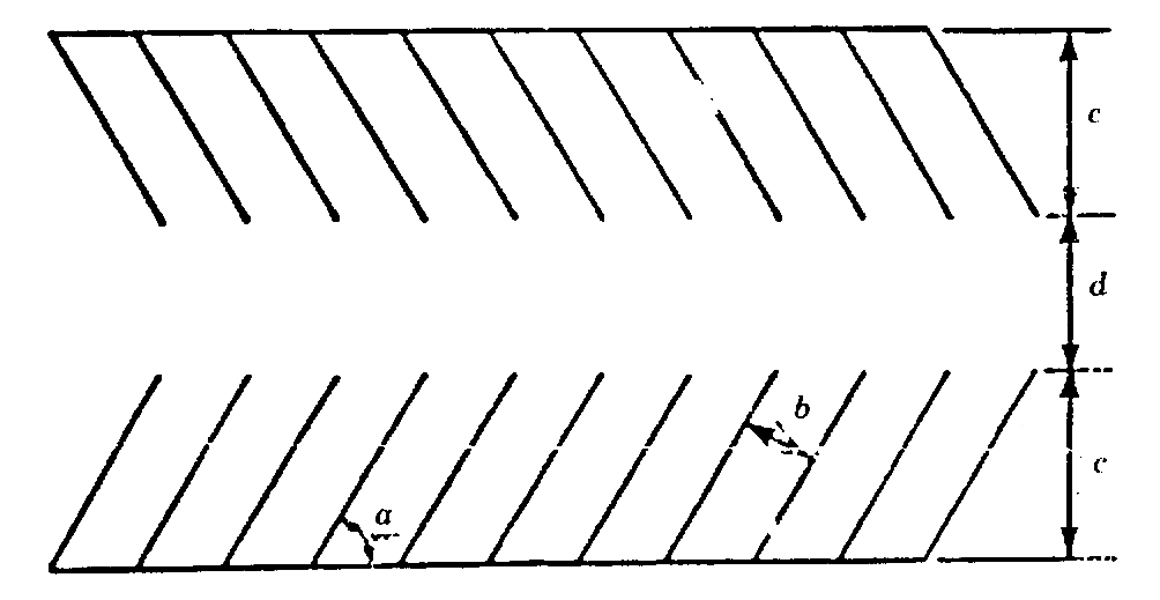
Table 1
Minimum Dimensions for Standard Parking Spaces and Adjacent Aisles
(b)
All off-street parking spaces, aisles and ramps shall conform to the following specifications:
(1)
Aisles providing access to off-street parking areas but not immediately adjacent to or providing direct access to an off-street parking space shall be at least 22 feet in width if designated for two-way traffic, and at least 16 feet in width if designated for one-way traffic. Aisles providing access to any off-street loading space shall be a minimum of 22 feet in width.
(2)
No back-out onto a public street shall be permitted except for detached one-family and townhouse dwellings. All parking areas shall have adequate maneuvering space to allow safe vehicular entrance and exit.
(3)
Aisles, ramps, turnarounds and curbs shall be designed to provide for convenient and safe maneuvering of vehicles using the facility. Turning aisles or ramps with two-way traffic shall have radii and aisle widths sufficient for two cars to pass on the turn. Minimum requirements to meet this standard shall be determined by the director of engineering and construction division.
(4)
No portion of a circular ramp may be considered as an aisle for cars in adjacent parking spaces.
(5)
Ramp design in multilevel garages shall provide for slopes mild enough to ensure driver visibility of the pavement at all times.
(6)
There shall be a minimum vertical clearance free of all obstructions to a height of seven feet for all portions of any off-street parking facility.
(7)
The stall width, length and height clearance of required parking spaces shall not be encroached upon by columns, utilities, bollards or other similar structures on any surface parking lot or in structure or underground parking. Parking spaces for which there is an encroachment into the stall width, length or height clearance shall not be counted toward minimum parking requirements.
(8)
When required parking spaces are provided within a structure, no part of a column shall be located within three feet back from the aisle edge of the parking space.
(Code 1973, § 81-60; Code 1982, § 38-31(b)(4); Ord. No. 619; Ord. No. 790; Ord. No. 804; Ord. No. 811; Ord. No. 924; Ord. No. 960, 2-23-1981; Ord. No. 999, 2-22-1982; Ord. No. 1021, 8-9-1982; Ord. No. 1039, 2-28-1983; Ord. No. 1051, 6-13-1983; Ord. No. 1081, 9-10-1984; Ord. No. 1083, 9-24-1984; Ord. No. 1139, 5-27-1986; Ord. No. 1188, 5-26-1987; Ord. No. 1203, 10-13-1987; Ord. No. 1227, 6-13-1988; Ord. No. 1263, 5-22-1989; Ord. No. 1277, § 6, 10-10-1989; Ord. No. 1382, 11-25-1991; Ord. No. 1477, 5-9-1994; Ord. No. 1590, 10-14-1997; Ord. No. 1636, 3-8-1999; Ord. No. 1766, 9-13-2004; Ord. No. 1946, 2-8-2016)
Sec. 48-934. - Off-street loading space.
All off-street loading spaces provided in compliance with the requirements of this section shall be at least ten feet in width and 30 feet in length. All off-street loading spaces shall conform to the following additional specifications:
(1)
There shall be a minimum vertical clearance free of all obstructions to a height of 15 feet for all portions of any off-street loading space. No obstruction shall project into this minimum clearance.
(2)
There shall be no obstruction within or near the bounds of any required off-street loading space which would interfere with the normal availability and use thereof, or the access between the loading space and the premises to which it is accessory.
(3)
No vehicle, trailer or equipment of any nature shall continuously occupy any off-street loading space for more than two consecutive working days nor shall any vehicle, trailer, equipment or material of any nature occupy any required off-street loading space except while in the process of being loaded onto or unloaded from a mode of transportation.
(Code 1973, § 81-60; Code 1982, § 38-31(b)(5); Ord. No. 619; Ord. No. 790; Ord. No. 804; Ord. No. 811; Ord. No. 924; Ord. No. 960, 2-23-1981; Ord. No. 999, 2-22-1982; Ord. No. 1021, 8-9-1982; Ord. No. 1039, 2-28-1983; Ord. No. 1051, 6-13-1983; Ord. No. 1081, 9-10-1984; Ord. No. 1083, 9-24-1984; Ord. No. 1139, 5-27-1986; Ord. No. 1188, 5-26-1987; Ord. No. 1203, 10-13-1987; Ord. No. 1227, 6-13-1988; Ord. No. 1263, 5-22-1989; Ord. No. 1277, § 6, 10-10-1989; Ord. No. 1382, 11-25-1991; Ord. No. 1477, 5-9-1994; Ord. No. 1590, 10-14-1997; Ord. No. 1636, 3-8-1999; Ord. No. 1766, 9-13-2004)
Sec. 48-935. - Standing spaces.
Standing spaces, as defined in section 48-2, shall be provided for all uses oriented for the use of motor vehicle operators and for all drive-through facilities and standing spaces shall conform to the following standards:
(1)
No standing space may occupy any portion of an aisle, driveway or entrance necessary for access to required off-street parking or loading spaces.
(2)
Standing spaces shall be a minimum of eight feet in width and 20 feet in length.
(3)
Standing spaces may not be used to satisfy the off-street parking or loading requirements of this division.
(4)
Standing spaces may be provided in the form of a queue in the primary access aisle leading to a drive-in facility, in which instance such an aisle shall be of a minimum width of 12 feet.
(5)
A drive-in window shall not project more than one foot into an aisle.
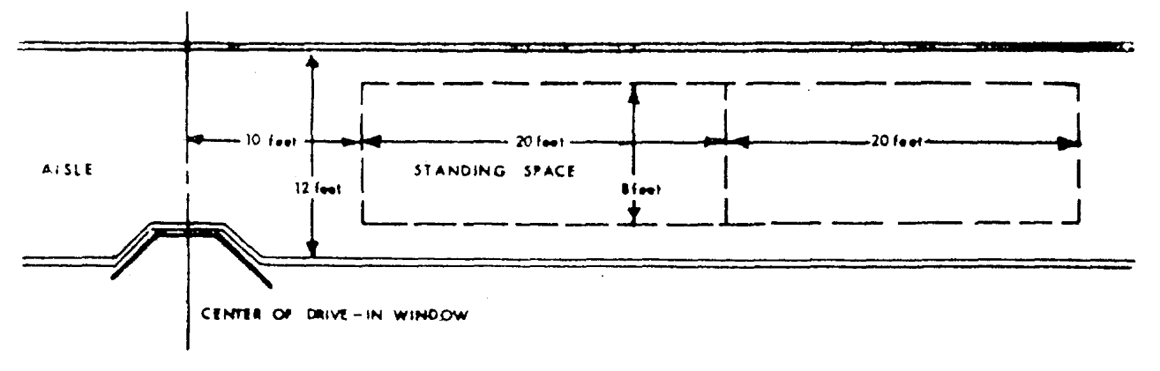
(Code 1973, § 81-60; Code 1982, § 38-31(b)(6); Ord. No. 619; Ord. No. 790; Ord. No. 804; Ord. No. 811; Ord. No. 924; Ord. No. 960, 2-23-1981; Ord. No. 999, 2-22-1982; Ord. No. 1021, 8-9-1982; Ord. No. 1039, 2-28-1983; Ord. No. 1051, 6-13-1983; Ord. No. 1081, 9-10-1984; Ord. No. 1083, 9-24-1984; Ord. No. 1139, 5-27-1986; Ord. No. 1188, 5-26-1987; Ord. No. 1203, 10-13-1987; Ord. No. 1227, 6-13-1988; Ord. No. 1263, 5-22-1989; Ord. No. 1277, § 6, 10-10-1989; Ord. No. 1382, 11-25-1991; Ord. No. 1477, 5-9-1994; Ord. No. 1590, 10-14-1997; Ord. No. 1636, 3-8-1999; Ord. No. 1766, 9-13-2004)
Sec. 48-936. - Joint and off-site parking.
(a)
Whenever a parking facility is jointly used by two or more uses, as prescribed by subdivision III of this division, or whenever a use provides off-street parking in excess of the requirements of this division, that portion of such off-street parking facility located nearest the primary entrance or entrances of any such use for which the parking is required shall be considered the required off-street parking and shall in no way be encumbered.
(b)
No portion of any required off-street parking area, whether on-site or off-site shall be more than 500 feet, as measured along the shortest safe and unobstructed pedestrian path, from a principal entrance to the structure to which it is accessory.
(c)
Whenever off-site parking is provided, the off-street parking area immediately adjacent to the principal use shall be reserved for the exclusive use of clients, customers, patrons or patients, or tenants if the principal use includes residential uses. The area furthest from the principal use, but within 500 feet of a principal entrance, shall be reserved for the exclusive use of employees.
(d)
All off-street parking spaces provided in satisfaction of the provisions of this division shall be conveniently usable without causing undue hazard to pedestrian or vehicular traffic, traffic congestion or interference with the safe and convenient access to other provided off-street parking spaces and shall provide for safe and convenient ingress and egress from the public streets.
(e)
When required by the provisions of this division, off-street loading spaces shall be provided immediately adjacent to loading docks, bays, doorways or other means of egress or ingress into the principal building, structure or use to which they are accessory.
(Code 1973, § 81-60; Code 1982, § 38-31(b)(7); Ord. No. 619; Ord. No. 790; Ord. No. 804; Ord. No. 811; Ord. No. 924; Ord. No. 960, 2-23-1981; Ord. No. 999, 2-22-1982; Ord. No. 1021, 8-9-1982; Ord. No. 1039, 2-28-1983; Ord. No. 1051, 6-13-1983; Ord. No. 1081, 9-10-1984; Ord. No. 1083, 9-24-1984; Ord. No. 1139, 5-27-1986; Ord. No. 1188, 5-26-1987; Ord. No. 1203, 10-13-1987; Ord. No. 1227, 6-13-1988; Ord. No. 1263, 5-22-1989; Ord. No. 1277, § 6, 10-10-1989; Ord. No. 1382, 11-25-1991; Ord. No. 1477, 5-9-1994; Ord. No. 1590, 10-14-1997; Ord. No. 1636, 3-8-1999; Ord. No. 1766, 9-13-2004; Ord. No. 1946, 2-8-2016)
Sec. 48-937. - Handicap parking.
Off-street parking spaces and related access aisles and accessibility routes for handicapped persons shall be provided in accordance with the Virginia Uniform Statewide Building Code (VUSBC), as amended and the Americans with Disabilities Act (ADA) of 1990, including any reference to specifications. The number of parking spaces for handicapped persons shall be included in the total required spaces. Each such parking space shall be identified by an above-grade sign which meets the requirements of the director of public works.
(Code 1973, § 81-60; Code 1982, § 38-31(b)(8); Ord. No. 619; Ord. No. 790; Ord. No. 804; Ord. No. 811; Ord. No. 924; Ord. No. 960, 2-23-1981; Ord. No. 999, 2-22-1982; Ord. No. 1021, 8-9-1982; Ord. No. 1039, 2-28-1983; Ord. No. 1051, 6-13-1983; Ord. No. 1081, 9-10-1984; Ord. No. 1083, 9-24-1984; Ord. No. 1139, 5-27-1986; Ord. No. 1188, 5-26-1987; Ord. No. 1203, 10-13-1987; Ord. No. 1227, 6-13-1988; Ord. No. 1263, 5-22-1989; Ord. No. 1277, § 6, 10-10-1989; Ord. No. 1382, 11-25-1991; Ord. No. 1477, 5-9-1994; Ord. No. 1590, 10-14-1997; Ord. No. 1636, 3-8-1999; Ord. No. 1766, 9-13-2004; Ord. No. 1946, 2-8-2016)
Sec. 48-938. - Entrances.
(a)
Vehicular entrances to off-street parking areas shall conform to standards established in the Virginia Department of Transportation's Road and Bridge Standards. Vehicular entrances to off-street parking areas shall be no less than 22 feet in width, if providing access to any aisle for use by two-way traffic; nor less than 12 feet in width, if providing access to an aisle restricted to one-way traffic.
(b)
The number of vehicular entrances to off-street parking and loading areas shall be limited to those required for reasonable access to that use and shall be located with due consideration for safety, traffic circulation and impact on adjacent properties.
(c)
All vehicular entrances and exits to off-street parking and loading areas shall be set back at least 25 feet from the point of tangency of the curb at any intersecting street or projected right-of-way lines shown on the official major thoroughfare plan, whichever is the greater.
(d)
There shall be no vehicular entrance or exit to commercial or business off-street parking or loading areas within 100 feet of an R district unless the planning commission finds that there is no other feasible location, considering public safety and adequate vehicular circulation.
(Code 1973, § 81-60; Code 1982, § 38-31(b)(9); Ord. No. 619; Ord. No. 790; Ord. No. 804; Ord. No. 811; Ord. No. 924; Ord. No. 960, 2-23-1981; Ord. No. 999, 2-22-1982; Ord. No. 1021, 8-9-1982; Ord. No. 1039, 2-28-1983; Ord. No. 1051, 6-13-1983; Ord. No. 1081, 9-10-1984; Ord. No. 1083, 9-24-1984; Ord. No. 1139, 5-27-1986; Ord. No. 1188, 5-26-1987; Ord. No. 1203, 10-13-1987; Ord. No. 1227, 6-13-1988; Ord. No. 1263, 5-22-1989; Ord. No. 1277, § 6, 10-10-1989; Ord. No. 1382, 11-25-1991; Ord. No. 1477, 5-9-1994; Ord. No. 1590, 10-14-1997; Ord. No. 1636, 3-8-1999; Ord. No. 1766, 9-13-2004)
State Law reference— Ramps must comply with state standards, Code of Virginia, § 15.2-2021.
Sec. 48-939. - Occupancy of required yards.
In commercial and transitional districts, off-street parking and loading areas or structures may not occupy any required yard. In residential districts, off-street parking and loading areas or structures may occupy any required rear or side yard but shall not occupy any portion of any required front yard.
(1)
No portion of any required off-street parking or loading space shall occupy or use any public street, right-of-way, alley or property, except by expressed permission of the city council.
(2)
Whenever the bulk of a building requires on-site parking greater than that which may be provided at surface level, such additional parking shall be provided in a parking structure of a design and materials compatible with the principal habitable building or within the principal habitable building.
(3)
Underground parking may occupy the total area of any property; however, when constructed beneath any required front, side or rear yard, such required yards shall be restored and planted or landscaped in accordance with the specifications of the city arborist.
(Code 1973, § 81-60; Code 1982, § 38-31(b)(10); Ord. No. 619; Ord. No. 790; Ord. No. 804; Ord. No. 811; Ord. No. 924; Ord. No. 960, 2-23-1981; Ord. No. 999, 2-22-1982; Ord. No. 1021, 8-9-1982; Ord. No. 1039, 2-28-1983; Ord. No. 1051, 6-13-1983; Ord. No. 1081, 9-10-1984; Ord. No. 1083, 9-24-1984; Ord. No. 1139, 5-27-1986; Ord. No. 1188, 5-26-1987; Ord. No. 1203, 10-13-1987; Ord. No. 1227, 6-13-1988; Ord. No. 1263, 5-22-1989; Ord. No. 1277, § 6, 10-10-1989; Ord. No. 1382, 11-25-1991; Ord. No. 1477, 5-9-1994; Ord. No. 1590, 10-14-1997; Ord. No. 1636, 3-8-1999; Ord. No. 1766, 9-13-2004; Ord. No. 1946, 2-8-2016)
Sec. 48-940. - Accessory structures and incidental provisions.
(a)
Requirements. Accessory structures may be provided for use of vehicle attendants or patrons. Such structures shall be subject to the same yard requirements as the parking or vehicle use areas to which they are accessory. Such structures shall be of permanent construction and designed to be compatible with other structures on the site. Entrance controls shall not be located so as to cause waiting vehicles to stand on a public street. Accessory equipment such as trash containers, air conditioning units and electrical transformers may be located within the required landscaped areas, provided they are appropriately screened.
(b)
Lighting. All lighting equipment used in illumination of off-street parking and vehicle use areas shall conform to the appropriate provisions of chapter 14, article V, pertaining to outdoor lighting, and shall be confined to the limits of the parking area unless otherwise permitted.
(c)
Paving. All off-street parking and vehicle use areas provided in satisfaction of the requirements of this division shall be paved with materials that meet city specifications and may include pervious materials.
(Code 1973, § 81-60; Code 1982, § 38-31(b)(11); Ord. No. 619; Ord. No. 790; Ord. No. 804; Ord. No. 811; Ord. No. 924; Ord. No. 960, 2-23-1981; Ord. No. 999, 2-22-1982; Ord. No. 1021, 8-9-1982; Ord. No. 1039, 2-28-1983; Ord. No. 1051, 6-13-1983; Ord. No. 1081, 9-10-1984; Ord. No. 1083, 9-24-1984; Ord. No. 1139, 5-27-1986; Ord. No. 1188, 5-26-1987; Ord. No. 1203, 10-13-1987; Ord. No. 1227, 6-13-1988; Ord. No. 1263, 5-22-1989; Ord. No. 1277, § 6, 10-10-1989; Ord. No. 1382, 11-25-1991; Ord. No. 1477, 5-9-1994; Ord. No. 1590, 10-14-1997; Ord. No. 1636, 3-8-1999; Ord. No. 1766, 9-13-2004; Ord. No. 1946, 2-8-2016)
Sec. 48-941. - Use of parking spaces.
Except as otherwise provided by this division, off-street parking spaces required herein shall be occupied only by motor vehicles owned by occupants, employees, patrons or visitors of the property, but not by vehicles stored or displayed for sale or hire or for any other purpose which is classed by this chapter as a principal use.
(1)
Up to five or not more than ten percent, whichever is less, of required off-street parking spaces may be converted to bicycle parking, moveable storage containers, electric vehicle charging stations, car share spaces, motorcycle parking spaces and the like, subject to approval by the zoning administrator. The zoning administrator may approve such applications to convert spaces where they are accompanied by a description of the proposed use of the converted parking spaces, justification for the conversion and a plan depicting the spaces proposed to be converted, and the zoning administrator finds that the spaces are not needed for off-street parking for the use of the property and that they are reasonably likely to be used for the purpose of the conversion.
(2)
Except for emergencies where it is impractical to move a vehicle, no automobile repairs or service shall be conducted on or in any off-street parking or loading area.
(3)
No trailers or vehicle accessories of any description or type shall occupy any off-street parking or loading space, except as follows:
a.
House trailers, utility trailers, boat trailers and other non-motorized vehicles, or any vehicle which depends on another for locomotion, may be stored in an off-street parking or loading space, provided it remains attached to the primary vehicle upon which it is dependent, and is parked in such a manner as not to interfere with the required access to any other required space.
b.
Cargo trailers may be detached from the traction vehicle upon which they are dependent, and may occupy required off-street loading spaces only while being loaded or unloaded.
c.
Neither a trailer, nor other vehicle or combination of vehicles having a combined overall length in excess of 35 feet shall be parked or stored in any R or T district, or on any public street or alley; except, that one house trailer, utility trailer or boat trailer, not exceeding 4,500 pounds gross weight, may be parked or stored in an enclosed private garage or in the rear yard of the property of its owner; provided the wheels or other transporting devices shall not be removed except for temporary repair.
d.
Trailers occupying any off-street parking or loading space shall not be connected to any utility service or to the ground or to another structure in any manner that would prevent their ready removal; except when necessary for the preservation of cargo, trailers may be connected to electric lines or other facilities while being unloaded or awaiting unloading.
e.
Trailers shall not be occupied for living or for business purposes, in any district of the city; except, that contractors may park or temporarily store equipment trailers and office trailers when necessary to the construction or improvement of a structure; provided such trailers are located on the same site as such construction or improvement, and provided, further, that they are removed promptly at the completion of such construction or improvement and prior to the issuance of a certificate of occupancy.
(Code 1973, § 81-60; Code 1982, § 38-31(b)(12); Ord. No. 619; Ord. No. 790; Ord. No. 804; Ord. No. 811; Ord. No. 924; Ord. No. 960, 2-23-1981; Ord. No. 999, 2-22-1982; Ord. No. 1021, 8-9-1982; Ord. No. 1039, 2-28-1983; Ord. No. 1051, 6-13-1983; Ord. No. 1081, 9-10-1984; Ord. No. 1083, 9-24-1984; Ord. No. 1139, 5-27-1986; Ord. No. 1188, 5-26-1987; Ord. No. 1203, 10-13-1987; Ord. No. 1227, 6-13-1988; Ord. No. 1263, 5-22-1989; Ord. No. 1277, § 6, 10-10-1989; Ord. No. 1382, 11-25-1991; Ord. No. 1477, 5-9-1994; Ord. No. 1590, 10-14-1997; Ord. No. 1636, 3-8-1999; Ord. No. 1766, 9-13-2004; Ord. No. 1946, 2-8-2016)
Sec. 48-969. - Parking requirements.
Minimum parking requirements may be reduced or modified through reductions in the amount of required parking (section 48-970), shared parking arrangements (section 48-971), and off-site parking agreements (section 48-972), subject to approval by the designated agent as part of a site plan application. The designated agent may modify the requirements of this subsection where adjacent properties are developed under a unified site plan or where the strict interpretation of these provisions would reduce the usable area of a site to a point that would preclude a reasonable use. The designated agent may also attach conditions to any such waiver or modification to assure that the results of the waiver of modification shall be in accord with the purposes and intent of this subsection.
(Ord. No. 1946, 2-8-2016; Ord. No. 2104, 12-8-2025)
Sec. 48-970. - Reduction in required parking.
(a)
Applicants for site plans and special exception approvals may request a reduction in required parking and loading requirements (Table 3) subject to submission and approval of a transportation demand management (TDM) plan. The TDM must be submitted at the time the site plan or special exception application is filed and may include a variety of measures including, but not limited to, dedicated carpool and vanpool spaces, bike share stations and/or contributions toward bike share stations, shuttle service from Metro, transit subsidies, transit information kiosk, and the like. The TDM plan should provide sufficient information to justify the level of parking reduction requested. Applicants shall provide monitoring reports at one, three and five years following occupancy to assess the TDM plan implementation.
(b)
The applicant, building owner, their successor or assigns will be responsible for implementing the TDM over the life of the building(s) and taking corrective action as needed to manage on-site parking demand.
(c)
After a project is approved using the parking reductions of this section, the city manager shall monitor the residential districts adjacent to the project to determine if vehicular parking remains reasonably available for the residents of such district, and if there is a determination that such parking availability has been adversely impacted, to proactively work with the residents of such district to implement residential parking restrictions as appropriate.
(Ord. No. 1946, 2-8-2016; Ord. No. 2104, 12-8-2025)
Sec. 48-971. - Shared parking requirements.
Off-street parking or loading facilities and driveways or aisles for two or more structures or uses are permitted, provided that all applicable provisions of this division and the following specifications are complied with:
(1)
Wherever uses are mixed or combined within a structure or on a premises, or collective parking is provided for two or more uses or structures, the total requirements for off-street parking or loading facilities shall be the sum for the various uses or structures computed separately, except as provided below in subsection a.
a.
The following conditions shall apply to any parking facility for a development containing a mix of uses:
1.
The mixed-use property and the mixed-use shared parking facility must be owned by the same developer/owner or must be the subject of a recorded shared parking agreement made between current and future owners of the properties involved and that conveys with the land. Any such agreements must also contain a provision for parking facility maintenance. Any changes to the agreement must be approved by the designated agent.
2.
The distance between the shared parking facility and the entrance to the establishments being served shall not exceed 500 feet as measured along the shortest safe and unobstructed pedestrian path. Shared parking facilities located on a separate lot from the establishments being served must meet the requirements of subsections 48-936(b) and (c).
3.
Parking spaces for handicapped or disabled persons may not be included in any shared parking calculation.
4.
All shared parking spaces must be available for use by all participants in the shared parking agreement. No reserved spaces may be part of the shared parking agreement.
5.
The planning director shall determine at the time of site plan review that shared parking on the site can meet the total required in Table 2. Particular attention is needed to assure that sufficient and convenient short-term parking will be available to commercial establishments during the weekday daytime period. The shared parking spaces must be located in the most convenient and visible area of the parking facility nearest the establishments being served.
6.
All subsequent changes in use(s) require a new occupancy permit and proof that sufficient parking will be available to meet the required parking as determined by applying Table 2. Table 2 determines the minimum number of spaces required to receive occupancy permits.
7.
The requirements of Table 2 apply to all proposed uses for any one phase of development in addition to the ultimate buildout of the development.
b.
Calculation of shared parking. Structures or developments that contain a mix of uses on the same parcel may reduce the amount of required off-street parking in accordance with the following methodology:
1.
Determine the minimum automobile parking requirements in accordance with Table 2 for each use as if it were a separate use.
2.
Multiply each amount of parking by the corresponding percentages for each of the five time periods set forth in Table 2.
3.
Calculate the total amount of required parking for each time period.
4.
Select the time period total with the highest value as the required minimum number of off-street parking spaces for the site.
5.
It shall be the responsibility of the applicant to perform any studies or site evaluations as necessary to determine the acceptable number of spaces. No modification in parking ratios, as set forth in the table in section 48-1004, shall be granted without approval of the planning commission.
Table 2
Parking Requirements by Time Period
* Rental rooms only. Other uses in hotel figured separately.
(Code 1973, § 81-60; Code 1982, § 38-31(c)(1); Ord. No. 619; Ord. No. 790; Ord. No. 804; Ord. No. 811; Ord. No. 924; Ord. No. 960, 2-23-1981; Ord. No. 999, 2-22-1982; Ord. No. 1021, 8-9-1982; Ord. No. 1039, 2-28-1983; Ord. No. 1051, 6-13-1983; Ord. No. 1081, 9-10-1984; Ord. No. 1083, 9-24-1984; Ord. No. 1139, 5-27-1986; Ord. No. 1188, 5-26-1987; Ord. No. 1203, 10-13-1987; Ord. No. 1227, 6-13-1988; Ord. No. 1263, 5-22-1989; Ord. No. 1277, § 6, 10-10-1989; Ord. No. 1382, 11-25-1991; Ord. No. 1477, 5-9-1994; Ord. No. 1590, 10-14-1997; Ord. No. 1636, 3-8-1999; Ord. No. 1766, 9-13-2004; Ord. No. 1946, 2-8-2016; Ord. No. 2104, 12-8-2025)
Sec. 48-972. - Off-site parking requirements.
(a)
In all districts off-street parking may be provided off site within 500 feet, as measured along the shortest safe and unobstructed pedestrian path, from a principal entrance to the structure to which it is accessory, subject to the requirements of section 48-936(b) and (c).
(b)
When any off-site parking is met through contract agreement or lease between two or more parties, one copy of the agreement, subject to the requirements established in this section, must be on file with the zoning administrator. The agreement shall contain, among other items required by the negotiating parties, the following:
(1)
The name, address and status of each of the parties to the negotiation, including a certification of competence to enter into the specified agreement.
(2)
The term of validity. In new construction, the term of validity of an agreement for the use of off-street parking facilities to fulfill the requirements of this division shall be at least ten years or, in the case of the parking being provided for a specific tenant, the term of the lease, whichever is greater. In redevelopment or renovation scenarios or in the case that the lessee of the facility is also a tenant or lessee of the principal structure or premises to which the parking shall be accessory, the term of validity of the agreement may coincide with the full period of validity of the lease for use of the principal structure.
(3)
A plat depicting the parking facilities or any portion thereof for which agreement has been negotiated. This plat shall be drawn to scale and shall show accurately:
a.
The precise location of the parking facility involved in the agreement.
b.
The location and description of the principal uses and affected properties of all the parties entering into the agreement, including dimensions of distances between each use and the parking facility.
c.
The location and size of all parking spaces, access aisles, driveways, entrances and exits, upon which agreement has been reached regarding usage.
d.
Such other information as is required by the general regulations of this division.
(4)
The plat submitted in compliance with subsection (b)(3) of this section shall be in addition to, and shall not be deemed to satisfy the requirements of division 7 of this article, pertaining to the site plan.
(c)
A notarized copy of any agreement required by this section shall be submitted to the zoning administrator prior to the issuance of a certificate of occupancy for the use for which such parking is required. Copies of the agreement shall be forwarded to the department of public works and the department of planning and development for approval. Once copies of any such agreement are approved and the facilities described thereon certified to comply with all applicable provisions of this Code, the zoning administrator shall credit such additional parking facilities toward the off-street parking requirements of the principal use to which it is, by agreement, assigned and shall simultaneously annotate the certificate of occupancy to reflect such a conditional nature.
(d)
If the validity of any agreement submitted in compliance with this section lapses, expires or for any reason becomes null and void, the certificate of occupancy issued under the consideration of this section shall be suspended effective the date of such lapse, expiration or voiding. Unless additional agreements are made whereby the requirements of this section are satisfied within 60 days of such suspension of the certificate of occupancy, the use for which the certificate of occupancy was issued shall cease and shall not resume until such time as all requirements of this section are once again satisfied.
(e)
Acceptance of any agreement involving the use of off-street parking facilities shall not obligate the city to enforce the provisions of such agreement, nor shall it render the city liable for any damages, injury or loss resulting from the implementation of the various provisions of such agreements.
(f)
It is the obligation of the lessee or party granted the use of any off-street parking or loading facilities or entrances or driveways under the terms of any agreement complying with the provisions of this section to negotiate the renewal of any such agreement prior to their expiration, and to provide copies of such new and/or supplemental agreements in the form and manner specified by this section.
(g)
All copies of any agreement relating to the use of any off-street parking facility required by this section shall be notarized in the manner prescribed by the state code.
(Code 1973, § 81-60; Code 1982, § 38-31(c)(2); Ord. No. 619; Ord. No. 790; Ord. No. 804; Ord. No. 811; Ord. No. 924; Ord. No. 960, 2-23-1981; Ord. No. 999, 2-22-1982; Ord. No. 1021, 8-9-1982; Ord. No. 1039, 2-28-1983; Ord. No. 1051, 6-13-1983; Ord. No. 1081, 9-10-1984; Ord. No. 1083, 9-24-1984; Ord. No. 1139, 5-27-1986; Ord. No. 1188, 5-26-1987; Ord. No. 1203, 10-13-1987; Ord. No. 1227, 6-13-1988; Ord. No. 1263, 5-22-1989; Ord. No. 1277, § 6, 10-10-1989; Ord. No. 1382, 11-25-1991; Ord. No. 1477, 5-9-1994; Ord. No. 1590, 10-14-1997; Ord. No. 1636, 3-8-1999; Ord. No. 1766, 9-13-2004; Ord. No. 1946, 2-8-2016)
Sec. 48-1003. - Requirements.
(a)
Parking, loading, unloading and maneuvering space for service vehicles must be provided for every building, structure or use that receives or distributes materials or merchandise by vehicular mode.
(b)
Nonresidential uses applying for a certificate of occupancy business use permit shall be exempt from the first 1,200 square feet of contributing floor area when calculating off-street parking requirements, provided:
(1)
The building that the nonresidential use will occupy is not subject to an existing off-site parking agreement or a recorded site plan with an approved transportation demand management (TDM) plan or parking management plan (PMP).
(2)
The use space is not eligible to be parked as a shopping center, as defined in section 48-1238.
(3)
The use's off-street parking requirements are calculated as a percentage of floor area, site area, or customer use space, as listed in Table 3 of section 48-1004.
(4)
The building that the nonresidential use will occupy does not exceed 20,000 square feet in gross floor area.
(c)
Where no specific requirement is stated for a use, or where existing parking is nonconforming, the zoning administrator shall determine an alternate minimum parking requirement based on the most similar prescribed use (as determined by the zoning administrator based upon the factors below) and/or existing site conditions. In such instances the applicant shall provide the following information:
(1)
Type of uses;
(2)
Number of employees;
(3)
Building design capacity;
(4)
Square feet of sales area and service area;
(5)
Parking spaces proposed on-site;
(6)
Parking spaces provided elsewhere;
(7)
Hours of operation;
(8)
Proximity to Metro and/or other transit;
(9)
Other information as required by the zoning administrator.
(d)
When units of measurement determining the number of required parking spaces result in the requirement of a fractional space, one additional parking space shall be required.
(e)
Temporary uses, including temporary stands permitted under section 48-868 shall be subject to the requirements applicable to the most similar permanent use.
(Code 1973, § 81-60; Code 1982, § 38-31(d)(1); Ord. No. 619; Ord. No. 790; Ord. No. 804; Ord. No. 811; Ord. No. 924; Ord. No. 960, 2-23-1981; Ord. No. 999, 2-22-1982; Ord. No. 1021, 8-9-1982; Ord. No. 1039, 2-28-1983; Ord. No. 1051, 6-13-1983; Ord. No. 1081, 9-10-1984; Ord. No. 1083, 9-24-1984; Ord. No. 1139, 5-27-1986; Ord. No. 1188, 5-26-1987; Ord. No. 1203, 10-13-1987; Ord. No. 1227, 6-13-1988; Ord. No. 1263, 5-22-1989; Ord. No. 1277, § 6, 10-10-1989; Ord. No. 1382, 11-25-1991; Ord. No. 1477, 5-9-1994; Ord. No. 1590, 10-14-1997; Ord. No. 1636, 3-8-1999; Ord. No. 1766, 9-13-2004; Ord. No. 1946, 2-8-2016; Ord. No. 2083, 10-28-2024)
Sec. 48-1004. - Table of use types.
In all districts off-street parking areas, off-street loading areas and standing spaces shall be provided in connection with, accessory to, and on the same premises as, each and every use, including municipal facilities, in the amount specified within this section in Table 3. Bicycle parking shall be provided for office, retail, multifamily and hotel development projects for employees and visitors/customers on private property as specified below in Tables 4 and 5.
(1)
Bicycle parking requirements apply to both special exception projects and by-right projects when site plans are required under section 48-1134.
(2)
Bicycle parking requirements are applied to each use separately.
(3)
Office, residential and hotel bicycle storage facilities must be visible from an elevator, a visitor/customer entrance, or installed in an area within the garage that will be seen by a parking attendant, security guard or property manager. Retail bicycle parking locations shall be installed at highly visible exterior locations within 50 feet of the primary building entrances unless there are physical obstructions that cannot be changed or moved to accommodate the bicycle parking within the 50-foot distance, as determined by the director of development services. In the case where an obstruction cannot be moved or changed, signs directing cyclists to the bicycle parking will be required at the entrance(s). No bicycle parking facilities shall encroach on the public right-of-way unless approved or any required fire egress.
Table 3
Parking Requirements by Use
Table 4
Bicycle Parking Requirements
Table 5
Bicycle Storage Requirements
Class 1 storage = locked storage room or cage;
Class 2 = protected or covered bicycle parking;
Class 3 = light security for visitors
(Code 1973, § 81-60; Code 1982, § 38-31(d)(2); Ord. No. 619; Ord. No. 790; Ord. No. 804; Ord. No. 811; Ord. No. 924; Ord. No. 960, 2-23-1981; Ord. No. 999, 2-22-1982; Ord. No. 1021, 8-9-1982; Ord. No. 1039, 2-28-1983; Ord. No. 1051, 6-13-1983; Ord. No. 1081, 9-10-1984; Ord. No. 1083, 9-24-1984; Ord. No. 1139, 5-27-1986; Ord. No. 1188, 5-26-1987; Ord. No. 1203, 10-13-1987; Ord. No. 1227, 6-13-1988; Ord. No. 1263, 5-22-1989; Ord. No. 1277, § 6, 10-10-1989; Ord. No. 1382, 11-25-1991; Ord. No. 1477, 5-9-1994; Ord. No. 1590, 10-14-1997; Ord. No. 1636, 3-8-1999; Ord. No. 1766, 9-13-2004; Ord. No. 1946, 2-8-2016; Ord. No. 2059, 3-27-2023; Ord. No. 2068, 9-26-2023; Ord. No. 2088, 4-14-2025)
Sec. 48-1005. - Nonconforming uses.
(a)
Created. Uses which do not conform to all applicable requirements of this chapter shall, upon the effective date of the ordinance from which this division is derived, become nonconforming. No use which is made nonconforming by virtue of the adoption of the ordinance from which this division is derived shall be expanded, extended or enlarged in any way that would increase the off-street parking requirement unless and until such increased requirement is satisfied.
(b)
Uses made nonconforming by governmental action.
(1)
No use which, prior to the effective date of the ordinance from which this division is derived, had or by subsequent future action of the federal, state or city governments shall have any portion of its required off-street parking or loading area condemned, confiscated or acquired by any means by any governmental authority, shall by virtue of such action become nonconforming.
(2)
All uses which remain conforming by virtue of the provisions of this subsection (b), although providing off-street parking or loading space insufficient to satisfy the requirements of this division, shall be allowed to expand or enlarge upon provisions of such additional off-street parking or loading space as may be required for the expansion or enlargement alone.
(3)
Whenever a use, described by this subsection (b), is combined with other properties and through such combination satisfies all applicable provisions of this division, it may no longer have recourse to the special immunities of this subsection (b).
(Code 1973, § 81-60; Code 1982, § 38-31(e); Ord. No. 619; Ord. No. 790; Ord. No. 804; Ord. No. 811; Ord. No. 924; Ord. No. 960, 2-23-1981; Ord. No. 999, 2-22-1982; Ord. No. 1021, 8-9-1982; Ord. No. 1039, 2-28-1983; Ord. No. 1051, 6-13-1983; Ord. No. 1081, 9-10-1984; Ord. No. 1083, 9-24-1984; Ord. No. 1139, 5-27-1986; Ord. No. 1188, 5-26-1987; Ord. No. 1203, 10-13-1987; Ord. No. 1227, 6-13-1988; Ord. No. 1263, 5-22-1989; Ord. No. 1277, § 6, 10-10-1989; Ord. No. 1382, 11-25-1991; Ord. No. 1477, 5-9-1994; Ord. No. 1590, 10-14-1997; Ord. No. 1636, 3-8-1999; Ord. No. 1766, 9-13-2004; Ord. No. 1946, 2-8-2016)

