
Fellsmere City Zoning Code
ARTICLE XI
LANDSCAPING
Sec. 11.1.- Applicability.
The landscaping requirements of this article shall apply to all non-residential uses, including all requested changes in use (except for those uses interior to a common shopping center or similar multi-user building or structure, provided that no additional parking is required), regardless of site plan status; mobile home parks and subdivisions; subdivisions approved through the site plan or planned development process; recreational vehicle parks: and multiple-family residential uses. Detached single-family (including individual mobile homes not located in a mobile home park), two-family, and three-family residences, not a part of a larger site planned community or development must only comply only with sections 11.7, 11.8, 11.9, 11.10, 11.11 and 11.12. Agricultural uses shall only be required to comply with sections 11.2, 11.3, 11.4, 11.5, 11.7 and 11.9 unless such use is adjacent to a residential zoning district in which an agricultural use shall also provide a 25-foot wide Type "A" buffer.
(Ord. No. 2011-02, § 3(Exh. A), 7-7-2011; Ord. No. 2017-07, § 3(Exh. A), 3-16-2017)
Sec. 11.2. - General requirements.
A.
Unlawful activity. It shall be unlawful for any person to establish, remove or alter landscape, including irrigation and fertilization, contrary to the provisions of this article. The lack of maintenance of landscape installed pursuant to an approved landscape plan shall also be a violation subject to penalties provide by law. The provisions of this article may be enforced through appropriate code enforcement action or by suit for prohibitory or mandatory injunctive relief, or by any other lawful remedy existing at law or in equity for the enforcement of municipal ordinances.
B.
Landscape plan required. A landscape plan showing proposed landscape design shall be submitted for review and approval by the city manager, or designee, with all applications for a final development permit. Landscape plans shall include and indicate the following:
1.
Location, type and size of all existing trees to be preserved or removed;
2.
Location of all structures, including, but not limited to, freestanding signs, parking areas, drives, vehicular use areas and other improvements to remain or proposed for installation on the property;
3.
Location of utilities, easements and adjacent rights-of-way;
4.
Location and description of existing native plant communities to remain undisturbed, as applicable;
5.
Location, type, size, and quantity of all proposed landscape materials;
6.
Plant list including botanical and common name and quantity of all proposed landscape materials;
7.
General notes including mulching requirements, fertilization, and installation details, and such other information as needed;
8.
All property lines and dimensions of the property; and
9.
Tabulations which clearly show relevant statistical information necessary to evaluate compliance with provisions of this article. This shall include, but not be limited to, required buffers, vehicular use landscaping/screening, non-vehicular landscaping, drought tolerance and such other information as needed.
The city manager may waive plan requirements set forth in part B.1 through B.9 above for projects where such information is not applicable or pertinent for determination of compliance with the regulations contained herein.
All landscapes shall be designed to use water efficiently and follow Florida-friendly landscape principles. The most current versions of Florida Yards & Neighborhoods Handbook, the Water Management Districts' Waterwise Florida Landscapes, Xeric Landscaping with Florida Native Plants by the Association of Florida Native Nurseries, the Florida Green Industries Best Management Practices for Protection of Water Resources in Florida, and Water Right: Conserving our Water, Preserving our Environment published by the International Turf Producers Foundation shall guide landscape designs.
C.
Irrigation plan required. In conjunction with a landscape plan, an irrigation plan shall be required if irrigation is to be installed. Such plan shall indicate use of a low-volume irrigation system designed specifically for the proposed landscape installation, delineate planting zones if applicable, and clearly illustrate compliance with section 11.8 of this article and chapter 30, article IV of the Code of Ordinances. In such cases an irrigation plan must be provided at time of building permit.
D.
Certificate of occupancy.
1.
Certificate of occupancy. No final certificate of occupancy shall be given or issued to the owner or his agent until all conditions of this article have been met and the appropriate city official has given an approval. However, temporary power may be issued in those instances where all improvements on a site, except landscaping have been completed, where power is required for the irrigation system, and where the developer of the project certifies in writing that the required landscaping for the project will be installed as depicted on the plan and provides a timetable for installation of the landscaping. Failure to fulfill the proposed timetable shall be grounds for immediate and summary revocation of the temporary power allowance.
2.
Landscape certification. The completed landscape installation shall be certified by the installer. The certification is required before issuance of the certification of occupancy or its equivalent. The certification shall indicate that plants were installed as specified in the landscape design documents, that an irrigation audit has been performed where irrigation has been provided, and that the audit confirmed that the system functions properly.
(Ord. No. 2011-02, § 3(Exh. A), 7-7-2011; Ord. No. 2017-07, § 3(Exh. A), 3-16-2017)
Sec. 11.3. - Landscape materials requirements standards.
A.
Quality. Plant materials used in conformance with the provisions of this article shall conform at the time of delivery to the Standards for Florida No. 1 or better, as given in the most current edition of "Florida Grades and Standards for Nursery Plants" Part I and Part II, State of Florida, Department of Agriculture, Tallahassee, or equal thereto. Florida No. 2 may be substituted upon the approval of the community development director. Grass sod shall be clean and free of weeds and noxious pests or diseases. Grass seeds shall be delivered to the job site in bags with Florida Department of Agriculture tags attached, indicating the seed grower's compliance with the department's quality control program. Plant materials which are known to be intolerant of paving environments, or whose physical characteristics may be injurious to the public, shall not be specified for use.
Plant selection for landscaped areas shall be based on the plant's adaptability to the existing conditions present at the site and shall consider the appropriate United States Department of Agriculture hardiness zone (Zone 9B for the City of Fellsmere), soil type and moisture conditions, exposure to sun, and mature plant size. Plants selected must be suited to withstand the soil and physical growing conditions found in the microclimate of each location. Plants prohibited by Florida Department of Agriculture and Consumer Services rule, Chapter 5B-57 F.A.C., shall not be used for landscaping purposes. Controlled plants named in Chapter 5B-57, F.A.C., may only be used as allowed by following the procedures listed within Chapter 5B-57, F.A.C.
B.
Drought tolerance requirements. A minimum of 50 percent of total cumulative landscape plant material used to meet the provisions of this article shall be "moderately" or "very" drought tolerant as classified and listed in the most recent edition of the "South Florida Water Management Districts Xeriscape Plant Guide" or a comparable publication. Existing native plant species preserved on-site may be considered as credit toward the drought tolerance percentage requirement.
C.
Trees.
1.
Canopy trees. Canopy trees shall be species having an average mature spread of crown of greater than 15 feet and ultimate maximum height in excess of 30 feet (under local climatic conditions) and having a trunk(s) with over five feet of clear wood. "Clear wood" refers to that portion of the trunk between the ground and the lowest lateral limbs.
2.
Understory trees. Understory trees shall be a species having an average mature spread of crown ranging from eight to 15 feet and ultimate maximum height in excess of 15 feet. Clusters of understory trees can be used as a canopy tree provided that a minimum of two understory trees are clustered to equal one canopy tree.
3.
Palm trees. Palm trees shall have a minimum six feet clear trunk. Clusters of palms can be used as a canopy tree provided that a minimum of three palms are clustered to equal one canopy tree. However, the three to one clustering requirement may be reduced or eliminated by the city manager or his designee for palms with large canopies such as Canary Island date palms.
4.
Trees having an average mature spread of crown less than 15 feet may be substituted by grouping the same so as to create the equivalent of a 15-foot crown spread.
5.
Palm clusters shall be considered trees. Palms, if used, shall consist of no more than 50 percent of the total new tree requirement regardless of whether said palms are existing on the site or are relocated on the same site.
6.
Tree sizes:
a)
Required canopy trees shall be a minimum of 12 feet in height and have a caliper of two and one-half inches at four and one-half feet above the ground and a minimum six-foot spread when installed. Height shall be determined by the average end of all branches not the tallest branch or two.
b)
Where a building over 25 feet in height is proposed to be located within 50 feet of a perimeter property line, all canopy trees within required buffers located between the building and a site perimeter shall be a minimum of 14 feet in height and a three-inch diameter at four and one-half feet above the ground and a minimum seven-foot spread at planting. Where a building over 25 feet in height is proposed more than 50 feet from a perimeter, the canopy tree height requirements of 6.a) above, shall apply to canopy trees within the buffer.
c)
Required understory trees shall be a minimum of six feet overall in height and one and one-half-inch diameter at six inches above grade, at the time of planting. Multi-trunk trees shall have a one-inch caliper for all trunks at six inches above grade.
7.
The number of different species of trees, other than palms, shall be as follows:
8
At least 50 percent of all new required trees shall be of a native species.
9.
All trees shall be planted a minimum of five feet from buildings, infrastructure, utilities and public works. Trees of a species whose roots are known to cause damage to public works or easements shall not be planted closer than 20 feet to such public works, unless the tree root system is contained by use of an approved root barrier system.
10.
The possession, planting or installation of any plants prohibited by the Florida Department of Agriculture and Consumer Services rule, Chapter 5B-57 F.A.C. is prohibited in the City of Fellsmere. Controlled plants named in Chapter 5B-57 F.A.C. may not be possessed, planted, installed, or used except as allowed by Chapter 5B-57 F.A.C. Where such species already exist, their removal shall be a condition of any final development order.
11.
Street trees shall be chosen from the species listed in table 11.B below.
The spacing of street trees will be in accordance with the species size classes listed above. and no trees may be planted closer together than the following:
Palms: 15 feet if uniformly spaced or 7.5 feet if clustered.
Understory: 25 feet if uniformly spaced of 12.5 feet if clustered.
Canopy: 50 feet if uniformly spaced or 25 feet if clustered.
Alternate tree spacing may be approved for special plantings designed by a licensed landscape architect.
D.
Shrubs and hedges. Shrubs shall be a minimum of 12 inches in height when measured immediately after planting. Hedges, where required, shall be planted and maintained so as to form a continuous, solid screen within a maximum of two years after time of planting.
E.
Vines. Vines shall be a minimum of 12 inches in height directly after planting and may be used in conjunction with fences, screens or walls to meet physical barrier requirements as specified.
F.
Ground covers. Ground covers (not including sod grass) shall be planted in such a manner as to present a finished appearance and 75 percent coverage within one year after planting.
G.
Grass. Grass areas may be sodded, plugged, sprigged or seeded, except that solid sod shall be used in swales or other areas subject to erosion. Seed, where used, shall be of a variety that will produce coverage within 90 days from sowing; where other than solid sod, grass seed or grass sprigging is used, nurse grass seed shall be sown for immediate effect and protection until coverage is otherwise achieved. When necessary, a reseeding program shall be implemented to produce complete coverage within one year.
(Ord. No. 2011-02, § 3(Exh. A), 7-7-2011; Ord. No. 2017-07, § 3(Exh. A), 3-16-2017)
Sec. 11.4. - Perimeter buffer requirements.
A.
Screening and buffer yard requirements. A perimeter buffer is a continuous landscaped strip of land located along the perimeter of a lot or parcel that serves as a buffer between incompatible uses and zoning districts, as an attractive boundary of the parcel or use, or as both a buffer and attractive boundary. Existing native vegetation and upland native plant communities as described in article XIII, environmental standards-upland protection, may be utilized to meet buffer requirements.
B.
Required screening of abutting residential and nonresidential uses. In order to maintain stability of residential areas, nonresidential development within or abutting residential districts and multiple-family development abutting single-family residential districts shall provide a wall, fence, landscaped earth berm, planted vegetation, or utilize existing vegetation, or any combination thereof so as to comply with the requirements of this article.
C.
Applicability of buffers. Any one of the following types of buffers may be required during the site plan review process for the purpose of minimizing the impact of potentially objectionable areas such as parking lots, major thoroughfares, unsightly rear entrances, utility or maintenance structures, solid waste disposal facilities, loading facilities, swimming pools and active recreational areas. Screening may also be required where land uses of different intensities are located in close proximity to each other.
D.
Description of screening types. Two basic types of buffers are hereby established: Type "A", opaque buffer and type "B", semi-opaque buffer. All plant materials utilized to meet the requirements of this section must comply with the landscape materials requirements provided in section 11.3.
1.
Type "A" opaque buffer. An opaque buffer is intended to completely exclude all visual contact between uses. The type "A" buffer shall be completely opaque from the ground up to a height of at least six feet with large trees utilized as intermittent visual obstructions from the opaque portion to a mature height of at least 20 feet. The opaque buffer may be composed of a wall, fence, landscaped earth berm, planted vegetation, existing vegetation, or any combination thereof which maintains a completely opaque screen of at least six feet in height at time of certificate of occupancy or its equivalent. Compliance of planted vegetation buffers or natural vegetation will be judged on the basis of the average height and density of foliage of the subject species at the time of planting or field observation of existing vegetation. The six-foot opaque portion of the buffer must be opaque in all seasons of the year. In addition to the opaque portion of the buffer, a two-tier landscape strip comprised of differing height ground cover (other than sod) and/or shrubs shall be installed along the outside of the buffer to create a visually appealing buffer.
2.
Type "B" semi-opaque buffer. The semi-opaque buffer is intended to partially block visual contact between uses. The type "B" buffer shall be completely opaque from the ground to a height of at least three feet with large trees utilized as intermittent visual obstructions from the opaque portion to a mature height of at least 16 feet. The semi-opaque buffer may be composed of a wall, fence, landscaped earth berm, planted vegetation, existing vegetation or any combination thereof which maintains a completely opaque buffer of at least three feet at time of certificate of occupancy or its equivalent. Compliance of planted vegetative buffers or natural vegetation will be judged on the basis of average mature height and density of foliage of the subject species or field observation of existing vegetation. The visual screen may be waived for all or portions of the buffer length as part of the final site plan approval. In addition to the opaque portion of the buffer, a two-tier landscape strip comprised of differing height ground cover (other than sod) and/or shrubs shall be installed along the outside of the buffer to create a visually appealing buffer.
E.
General standards for screening and buffer yards. In addition to the landscape requirements where the provisions of this article require screening or buffering, the following standards shall apply:
1.
Minimum landscaped buffer strip required. A minimum landscaped buffer strip not less than 15 feet in width for a type "A" buffer and ten feet in width for a type "B" buffer shall be provided in conjunction with all screening required herein. The buffer strip may be contained within required setbacks. Each buffer strip shall be landscaped with ground cover (preferably native species) in addition to the required screening materials and trees. The landscape buffer strip shall contain no structures, parking or vehicular use areas or solid waste dumpsters. Stormwater management facilities shall be considered on a case by case basis as part of the final site plan approval. Above ground utilities and signs may be located within the buffer as long as the intent of the buffer is maintained and required spacing to such utilities is maintained.
2.
Tree plantings required as visual intermittent obstructions. All screen types ("A" or "B") shall include one canopy tree for each 30 lineal feet and one understory tree for each 25 lineal feet or fraction thereof of screen length unless otherwise provided within. Such trees shall satisfy the requirements for intermittent visual obstructions for all types of screens. The above trees are in addition to the trees required for open space and vehicular use areas. All trees required by this provision shall be planted in the buffer strip and comply with the landscape materials requirements provided in section 11.3. As part of the final site plan approval, the city may direct at its sole discretion placement of buffer trees within adjacent city-owned right-of-way to implement a street tree planting program. All such trees shall remain the maintenance responsibility of the development, and a maintenance agreement shall be executed with the city to allow for their perpetual maintenance. Trees shall be planted to maximize screening effect.
3.
Grading of berms. Whenever berms are utilized, they shall be constructed with a grade not to exceed one foot vertical to three feet horizontal (1:3 slope) with a three-foot wide flat top for plantings. If berms are used in satisfying the screening and buffering requirements, they shall be landscaped with plant material, preferably native, to achieve the required heights.
4.
Quality and maintenance of plant materials. All plant materials utilized to fulfill the requirements of this section shall be cold tolerant and shall meet criteria of this article. Synthetic or artificial material in the form of trees or shrubs shall not be used in lieu of plant requirements in this section. Artificial material in the form of vines, groundcover, or turf may only be used upon the approval of the city council. If approved, artificial material shall maintain a lively appearance and if color fade or other deterioration of the material occurs over time, the property owner shall be obligated to replace said material.
5.
Credit towards other required landscaping. Where the landscaping provided under this section meets the requirements of other provisions of this article, such landscaping may be credited toward fulfilling those requirements, with the exception of any required recreational open space or as otherwise set forth herein.
6.
Front yards, visibility triangles. The above standards notwithstanding, no screening shall be required which conflicts with front yard fence or wall height limitations or required visibility triangles.
7.
Required opaque features shall consist of a solid masonry wall, fence, earthen berm, vegetation or combination thereof. Landscaping is required along both sides of a wall unless otherwise approved by the city council. The city council may allow a buffer width reduction when a solid masonry wall or fence is provided.
8.
Required opaque features shall be measured from the finished floor elevation of the proposed structure(s) or elevation of the adjacent driveway, parking, or right-of-way, whichever is higher. This requirement can be modified by the city council based upon grade differences and the relationship between the height and mass of the proposed building and its setback from the property line. The maximum required height of an opaque feature shall be eight feet above the site grade where the feature is located except for screening required in conjunction with outdoor storage.
9.
Hedge or shrub material within buffers may be reduced by the city council when a six-foot wall or fence is provided within the buffer, if the remaining amount of required shrub material and at least 50 percent of required understory tree material are planted between the project site perimeter and the wall or fence. Alternative planting locations may be approved by the city council.
F.
Sizes of buffer types.
1.
The landscape buffer width and degree of vegetation required depends on the nature of the adjoining uses and right-of-way (thoroughfares). The following landscape buffer widths requirements shall apply:
a)
Where a single family residential use abuts a multifamily residential use, a minimum ten-foot type B buffer shall be required;
b)
Where a professional office abuts a residential use, a minimum ten-foot type B buffer shall be required;
c)
Where a commercial use abuts a residential use, a minimum 15-foot type A buffer shall be required;
d)
Where an industrial use abuts a commercial use, a minimum ten-foot type B buffer shall be required;
e)
Where an industrial use abuts a residential use, minimum 25-foot type A buffer with an opaque feature shall be required;
f)
Where a residential subdivision abuts an existing or proposed arterial or collector street, a minimum 25-foot type A landscape buffer shall be required; and
g)
Where the side or rear of a nonresidential or agricultural use abuts an existing or proposed arterial or collector street, a minimum ten-foot type B landscape buffer shall be required.
2.
Nonresidential, agricultural, and multifamily development and residential subdivisions shall install street trees along all street frontages in accordance with the city's tree planting program. Credit toward tree planting requirements of this article may be granted by city council at their sole discretion.
3.
The presence of a local road right-of-way between the uses set forth in subsection 1. above, shall not be grounds for a reduction in the size and type of buffer as set forth herein.
G.
Timing of buffer installation. The timing of the installation of required buffers shall be as set forth below.
1.
When a proposed project is required to provide a buffer pursuant to section 11.4.F.1.a) through e), and the adjacent property is developed, the proposed use shall install 100 percent of the required buffer prior to the release of the initial certificate of occupancy. However, if an existing buffer meeting at least 50 percent of the width and planting requirements of the required buffer has been previously provided in conjunction with the adjacent development, then the proposed use is required to install 50 percent of the required buffer in terms of width and planting requirements. The landscape materials shall be placed to maximize buffer screening taking into consideration the location of the existing buffer material on the adjacent property.
2.
When a proposed project is required to provide a buffer pursuant to section 11.4.F.1.a) through e), and the adjacent property lies within the Town of Fellsmere according to the plat thereof recorded in Plat Book 2, Pages 2 and 3, Public Records of St. Lucie County, now lying in Indian River County, the proposed use shall install 100 percent of the required buffer in terms of width and planting material prior to the release of the initial certificate of occupancy. However, if an existing buffer meeting at least 50 percent of the width and planting requirements of the required buffer has been previously provided in conjunction with the adjacent development, then the proposed use is required to install 50 percent of the required buffer in terms of width and planting requirements. The landscape materials shall be placed to maximize buffer screening taking into consideration the location of the existing buffer material on the adjacent property.
3.
When a proposed project is required to provide a buffer pursuant to section 11.4.F.1.a) through e), and the adjacent property is vacant not otherwise meeting the requirements of subsection 2. above, the proposed use shall install 50 percent of the required buffer in terms of width and planting material prior to the release of the initial certificate of occupancy. The landscape materials shall be placed to maximize buffer screening taking into consideration the location of the proposed uses. The balance of the buffer will be provided in conjunction with the development of the adjacent vacant land.
H.
Perimeter landscaping relating to abutting properties.
1.
On the site of a building or structure or open lot use providing an off-street parking or vehicular use area; where such areas will not be entirely screened visually by any intervening building or structure from abutting property, that portion of such area not so screened shall be provided with a two-tier hedge or hedge and ground cover combination or other durable landscape barrier maintained with one tier not less than two feet in height to form a continuous screen between the off-street parking or vehicular use area and such abutting property within one year of installation. Nonliving barriers shall not exceed four feet in height unless otherwise approved by the city council.
2.
Such landscaped barrier shall be located between the common lot line and the off-street parking or vehicular use area and shall be planted in a planting strip no less than ten feet in width.
3.
In addition, one canopy tree shall be provided for each 30 lineal feet of such landscape barrier or fractional part thereof.
4.
Such trees shall be located between the common lot line and the off-street parking or vehicular use area.
5.
Each such tree shall be planted in at least 100 square feet of planting area with a minimum dimension of at least ten feet.
6.
Each such planting area shall be landscaped with grass, ground cover or other landscape material, excluding paving, in addition to the required tree and the landscape requirements of section H.1 above.
7.
The provisions of this subsection shall not be applicable in the following situations:
a)
Along those portions of the property that are opposite the service area of a building or other structure located on the abutting property.
b)
Where the subject property and abutting property are zoned or used for nonresidential uses, the two-tier hedge provision with this planting area as prescribed in this subsection may be waived by the approval authority.
c)
When a nonresidential property is adjacent to vacant land within a nonresidential zoning district, the parking buffer width and required trees may be reduced up to 50 percent at the sole discretion of the city.
d)
When an agricultural property is adjacent to vacant land within an agricultural zoning district, the parking buffer width and required trees may be reduced up to 50 percent at the sole discretion of the city.
(Ord. No. 2011-02, § 3(Exh. A), 7-7-2011; Ord. No. 2017-07, § 3(Exh. A), 3-16-2017)
Sec. 11.5. - Open space, vehicular use area and parking landscape requirements.
A.
Interior landscaping for off-street parking. For off-street parking or vehicular use (driving aisles, driveways, parking spaces, loading areas), areas equal to at least ten percent of the total paved area (driving aisles, driveways, parking spaces, loading areas) shall be provided with interior landscaping. Please see graphic at end of this article illustrating how this requirement is calculated.
B.
Separate landscape area. Each separate, required landscaped area shall contain a minimum of 200 square feet with minimum dimensions of at least ten feet in areas where a tree is planted, and shall include at least one tree having a clear trunk of at least five feet, with the remaining area adequately landscaped with shrubs, ground cover or other authorized landscaping material not to exceed three feet in height.
1.
To preserve adequate sight distance, end islands at intersection of internal driveways shall be designed and maintained to preserve a visual "clear window" for the area between three feet and seven feet above the adjacent parking lot grade.
2.
The total number of trees shall not be less than one for each 600 square feet of fraction thereof of required interior landscaped area. Such landscaped areas shall be located in such a manner as to divide and break up the expanse of paving.
3.
When, upon the request of the developer and in the opinion of the city manager or designee, the size of interior landscape areas and placing of all required interior trees would create an impractical landscape effect, a portion of the required interior trees may be placed along the perimeter of the parking or vehicular use area to satisfy this requirement and/or the size of interior landscape areas may be reduced by up to 50 percent.
4.
The area to be counted for interior landscaping requirements shall be graphically depicted on landscape plans by cross-hatching or other graphic means.
(Ord. No. 2011-02, § 3(Exh. A), 7-7-2011; Ord. No. 2017-07, § 3(Exh. A), 3-16-2017)
Sec. 11.6. - Open space area landscaping requirements.
A.
General landscaping treatment. All non-vehicular open spaces including common green space required by article XV on any site proposed for development in all zoning districts shall conform to the minimum landscaping requirements herein provided. Perimeter buffers shall be excluded from this requirement.
1.
Grass, ground cover, shrubs, native plant areas and other landscaping materials shall be used to treat all ground not covered by building, paving or other structures.
B.
Trees required.
1.
Trees shall be planted in the non-vehicular open space (excluding required buffers and perimeter strips) to meet the following requirements:
a)
Residential zoning districts and mobile home residential zoning districts requiring site plan approval: a minimum of one tree per each 3,000 square feet of non-vehicular open space or fraction thereof;
b)
Commercial zoning districts: A minimum of one tree per each 4,000 square feet of non-vehicular open space or fraction thereof;
c)
Industrial zoning districts: Open space trees shall be provided as set forth below.
(Ord. No. 2011-02, § 3(Exh. A), 7-7-2011; Ord. No. 2017-07, § 3(Exh. A), 3-16-2017)
Sec. 11.7. - Supplemental landscape requirements.
A.
All trees planted adjacent to or within a right-of-way shall be planted within the following minimum planting areas and maximum spacing:
1.
Canopy species shall be planted with a minimum width of ten feet in the planting strip and 100 square feet of planting area and spaced no farther than 50 feet on center.
2.
Midstory trees shall be planted with a minimum width of six feet in the planting strip and 36 square feet of planting area and spaced no farther than 25 feet on center.
3.
Understory trees and palms shall be planted with a minimum width of three feet in the planting strip and nine square feet of planting area and spaced no farther than five feet on center.
4.
Tree spacing may be clustered as part of a specific landscape design when design by a licensed landscape architect and approved by the city.
B.
Durable barriers of nonliving material, such as walls and fences, not otherwise provided as an opaque buffer screen, shall be landscaped with one shrub or vine at each ten feet thereof abutting such barrier, but need not be spaced ten feet apart.
C.
Shrubs or vines shall be planted along the street side of a barrier unless they are of sufficient height at the time of planting to be readily visible over the top of such barrier.
D.
Necessary access ways from the public right-of-way through all such landscaping areas shall be permitted to service the parking, and such access ways may be subtracted from the lineal dimension used to determine the number of trees required.
E.
All landscape plans submitted hereunder shall conform to the minimum sight distance standards established within the FDOT index 546. The requirement may be modified by the city engineer for roadways and points of access internal to a project
F.
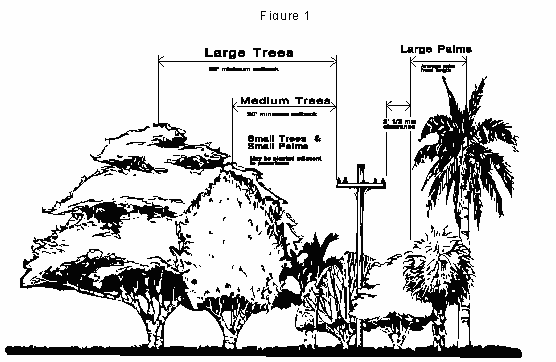
Landscaping adjacent to electrical transmission or distribution lines shall conform to Florida Power and Light's (FPL) "Right Tree Right Place Guidelines". The TRC may require cross section diagrams depicting how the proposed landscaping complies with this requirement. See figure (1) below. Required canopy trees within buffers impacted by overhead utility lines may be converted to understory or palm trees.
G.
Tree preservation and removal.
1.
Governmental and agricultural projects shall be exempt from the tree preservation requirements of this section.
2.
All proposed development, including work within private rights-of-way, shall be required to submit a tree survey as part of any development application. The survey shall be by a licensed surveyor unless otherwise approved by the community development director. For single-family homes on a lot of record, the survey may be in the form of a sketch plan showing all hardwood trees six inches or greater in diameter at breast height (DBH) on their building permit application and may be prepared by the home owner or home owner's representative. For multifamily or nonresidential development, the tree survey or inventory shall depict all hardwood trees that have achieved a trunk diameter of six inches at four and one-half feet above grade, excluding all palm trees, softwood trees, dead or diseased trees, and trees that pose a threat to utilities and structures.
3.
Hardwood trees less than six inches, softwood trees, palms and dead or diseased trees may be removed with no required mitigation.
4.
Hardwood trees six inches or greater shall be preserved to extent feasible, and if unable to be retained, the owner shall replace hardwood trees, based upon total DBH removed, with an equivalent amount of trees, based upon total DBH provided, of similar species.
a)
Before making a final decision on the feasibility of retention, the owner shall consider the feasibility of relocating proposed buildings and other improvements within the development site boundaries to accommodate desirable trees.
b)
Each tree designated for retention shall have a critical protection zone (CPZ) established around its perimeter which shall be protected by fencing erected before the onset of site development and left in place until project completion. The CPZ shall include an area around the tree equal to at least 60 percent of the tree's critical root zone (CRZ). The CRZ is a circular area with a radius of one foot for every one inch of tree DBH. The final CPZ shall have a radius of at least 40 percent of the CRZ on all sides.
c)
Where trees to be retained are located in groups or clumps, the CPZ shall be determined based on the CPZ's of the trees on the perimeter of the group.
5.
Trees provided as mitigation shall be in addition to all trees required by other parts of this Article but may be installed at 12 feet in overall height with a minimum two and one-half-inch caliper.
6.
In lieu of providing mitigation trees, the applicant may elect to pay for each tree removed by the inch of each tree's DBH removed. This fee shall be set by resolution of the city council. The applicant may also elect to provide a combination of on site mitigation and payment. An individual single family lot created prior to December 17, 1956 may elect to pay a reduced fee per inch of DBH for each tree removed if they desire not to replace with an equivalent amount of DBH. This reduced fee shall be set by resolution of the city council.
7.
Prior to removal of any tree, a tree permit shall be obtained from the community development department. Applications for tree removal permits shall contain a survey or sketch as set forth in subsection 1 above; the site plan or sketch required for development approval if the tree is being removed as part of a development proposal; a proposed mitigation plan, which may include a mitigation payment as set forth above; and an application fee as set by resolution of the city council. The permit application shall be reviewed to determine whether the proposal requires mitigation as set forth herein or is otherwise exempt from mitigation and to determine whether the proposal will maintain compliance with the landscape requirements of the Code. The review of the permit application shall be completed within ten days of receipt of a permit application and any applicable fees, not counting the day of receipt and not counting any Saturday, Sunday, or legal holiday which falls between the first or the tenth day after the date of receipt.
H.
Unless other regulations require a larger separation, no street tree shall be planted closer than three feet to a curb or sidewalk.
I.
A minimum nine feet overhead clearance shall be maintained from the grade of all pedestrian ways to the lowest overhead branch of any tree.
(Ord. No. 2011-02, § 3(Exh. A), 7-7-2011; Ord. No. 2016-03, § 3(Exh. A), 2-18-2016; Ord. No. 2017-07, § 3(Exh. A), 3-16-2017)
Sec. 11.8. - Irrigation requirements.
A.
Optional irrigation. Underground irrigation systems are not required for any development subject to the provisions of this article. If an irrigation system is installed, it shall meet the requirements of this section. New construction which does not require any supplemental landscaping or contain cultivated landscape areas shall be exempt from this provision.
B.
Irrigation system design. A new or substantially replaced irrigation system shall be designed and constructed in accordance with the technical standards contained in Appendix F of the Florida State Building Code and the Florida Irrigation Society's (FIS) January 1, 2002, or most current edition of Standards and Specifications for Irrigation Systems for any features not treated in Appendix F. An irrigation system plan certified by an irrigation design professional shall be provided prior to issuance of a permit. Plans shall be clearly readable, to reasonable scale, show the entire site to be irrigated, and include all improvements and equipment specifications.
1.
Landscape demand.
a)
Irrigation of existing and undisturbed vegetation shall not be required.
b)
Irrigation of reestablished native vegetative communities shall be required for a minimum of one year after initial installation. Once the landscape materials have been firmly established, the irrigation system may be abandoned.
c)
Cultivated landscape areas shall be watered with an underground irrigation system designed to provide 100 percent coverage on a day when winds are no more than five miles an hour. Cultivated landscape areas shall include all areas not described in paragraphs a) and b) above.
2.
Required system features.
a)
All landscape irrigation system shall be low-volume irrigation systems.
b)
All underground irrigation systems shall be regulated by an automatic timer or controller.
c)
The design of systems shall include sprinkler heads and devices appropriate for the landscape material to be irrigated. Overhead or spray irrigation may be used only for turfgrass and other ground covers that normally have a mature or maintained height no greater than one foot. Trees, shrubs, and other plants may be irrigated only with low volume irrigation at the base of the plant. Permanent in-ground overhead or spray irrigation shall be limited to 70 percent of the landscapable area on a site. Lower percentages may be required in the development review process as part of the approval criteria for developments to be awarded additional density, or for specific large scale development approval such as developments of regional impact. The remainder of the landscapable area on a site may be irrigated with a drip or other low volume irrigation system.
d)
Low trajectory heads or low-volume water distributing devices shall be used to irrigate confined areas in order to prevent overspray onto impervious areas.
e)
Whenever practical, irrigation systems shall be designed to place high water demand areas, such as lawns, on separate zones from those areas with reduced water requirements.
f)
Automatically controlled irrigation systems shall be operated by an irrigation controller that is capable of irrigating high requirement areas on a different schedule from low water requirement areas, provided that separate zones exist as described in e. above.
g)
Irrigation systems shall be designed so that, to the greatest extent practical, water being applied to impervious areas is eliminated.
h)
In accordance with F.S. § 373.62(1), devices, such as soil moisture sensors, evapotranspiration-based controllers or rain sensors, shall be required on automatic irrigation systems to prevent irrigation during periods of sufficient moisture. Any person who purchases, installs or operates an automatic landscape irrigation system on their property must properly install, maintain, and operate, in accordance with manufacturer specifications, technology that inhibits or interrupts operation of the system during periods of sufficient moisture.
3.
Effluent reuse.
a)
All new landscape irrigation systems shall be required and all existing irrigation systems shall be encouraged to connect to wastewater effluent lines when determined to be available. The reuse of wastewater effluent in such cases shall be required. All newly installed in-ground irrigation systems connected to a reclaimed water supply shall be equipped with meters at the time of installation to measure water usage.
b)
All new landscape irrigation systems shall be designed for ultimate connection to proposed wastewater effluent lines.
c)
Major site plans, subdivisions and planned developments shall include transmission and distribution lines for nonpotable water, such as reclaimed water, storm water, or surface water for landscape irrigation if a supply of such water is available or is anticipated to become available to the area. The lines shall be installed prior to construction.
C.
Irrigation installers.
1.
All contractors performing work on irrigation systems within the incorporated area of Fellsmere shall be licensed or registered under F.S. Ch. 489, or hold a municipally-issued business tax certificate that permits work on irrigation systems.
2.
In accordance with F.S. § 373.62(2), a licensed contractor who installs or performs work on an automatic landscape irrigation system must test for the correct operation of each inhibiting or interrupting device or switch on the system. If such devices are not installed, or are not functioning properly, the contractor must install new devices or repair the existing ones and insure that each is operating properly before completing other work on the system.
3.
In accordance with F.S. § 373.62(3)(a) and (b), a licensed contractor performing work on an automatic landscape irrigation system shall report systems that are not in compliance with F.S. § 373.62, to the (appropriate city/county authority). Failure of a contractor to report noncompliant systems within five business days is punishable by fines as specified in the violations and penalties section of this ordinance. A system that is repaired by the contractor is brought into compliance and need not be reported.
4.
In accordance with F.S. § 373.62(3)(b), regular maintenance and replacement of worn or broken moisture sensing equipment, such as soil moisture or rain sensors, is not a violation of F.S. § 373.62, or this ordinance if such repairs are made within 30 days from the time noncompliance is noted.
(Ord. No. 2011-02, § 3(Exh. A), 7-7-2011)
Sec. 11.9. - Landscape installation and maintenance requirements.
A.
Installation.
1.
All landscaping shall be installed in a sound workmanlike manner and according to accepted good planting procedures with the quality of plant materials as herein described. Prior to or at the time a certificate of occupancy inspection is requested, the project landscape architect or landscape contractor shall certify in writing the date he or she last inspected the landscape installation and that all installed landscape material meets the quality requirements of this Code. All elements of landscaping, exclusive of plant material, shall be installed so as to meet all other applicable ordinances and code requirements. No final certificates of occupancy or similar authorization will be issued unless the landscaping meets the requirements provided in this Code.
2.
Security to guarantee installation. Required landscape materials can be guaranteed for future installation at the sole discretion of the city council. When required landscape materials are guaranteed for future installation, the city council shall set a time frame by which required landscaping must be installed. The security for future (post C.O.) must be posted with the city in the amount of 115 percent of the contract installation price. Alternatively, in lieu of a security, the city council may approve landscape for future installation as part of temporary CO conditions or as conditions of approval subject to code enforcement actions for failure to comply.
3.
Mulches with a minimum depth of two inches shall be used in all planting beds.
B.
Maintenance.
1.
The owner or his agent shall maintain all landscaping depicted on the approved plan in good condition, so as to present a healthy, neat and orderly appearance, free from weeds, refuse and debris, and with the quantity and variety required by this article for the duration of use of the site. Completed project sites shall be reviewed periodically by the city staff for compliance with these provisions, and any violations shall be presented to the code enforcement special master.
2.
Native plant areas used for landscaping purposes may be left in their natural condition, providing they are maintained so as not to create a health or safety hazard. These areas may also be excluded from the water supply requirements, providing they are in a healthy condition upon issuance of a final certificate of occupancy. All approved "native plant areas" shall be required to maintain the site free of any nuisance exotic plant species.
3.
Mature trees shall not be "hat racked" or otherwise pruned to reduce the canopy to less than the minimum 15-foot spread, except for the removal of dead or diseased wood. Trees severely damaged by storms or other natural causes, or trees under utility wires or other obstructions where other pruning practices are impractical may be exempted from this requirement at the determination of the city tree board. When mature trees are "hat racked" without an exemption granted from the city tree board, such violations shall be presented to the code enforcement special master as a noncorrectable violation and the violator shall be required to mitigate for the loss of the tree pursuant to section 11.7.G.
4.
Landscape maintenance shall be performed in accordance with the Florida Green Industries Best Management Practices for Protection of Water Resources in Florida, the University of Florida Cooperative Extension Service and with the Florida Yards and Neighborhoods Handbook.
5.
Every property owner of any tree overhanging any street or sidewalk within the city shall prune the branches so that branches shall not obstruct the light from any street lamp or obstruct the view of any street intersection and so that there shall be a clear space of nine feet above the surface of the street or sidewalk. The city shall have the right to prune any tree or shrub overhanging public property when it interferes with the proper spread of light from a street light or interferes with visibility of any traffic control device or sign or reduces the overhead separation from a street or sidewalk to less than nine feet.
6.
Every property owner within the city shall remove any dead or diseased trees on private property when such tree constitutes a hazard to life and property or harbors insects or disease which constitutes a threat to other trees within the city or which constitute a menace to the safety of the public. Failure to remove such trees upon written notification from the city granting at least 20 days to remove such tree may be enforced through code enforcement.
7.
All stumps of any trees on public or private property shall be removed below the surface of the ground so that the top of the stump shall not project above the surface of the ground. Stumps at least three feet in height and used as public art may remain so long as their location does constitute a threat or hazard to the public.
8.
The city shall have the right to plant, prune, maintain and remove trees, plants and shrubs within the lines of all streets, alleys, avenues, lanes, squares and public grounds as may be necessary to ensure public safety or to preserve or enhance the symmetry and beauty of such public grounds.
9.
The owner of any parcel, lot or tract of land that has been previously cleared, whether developed or not, shall be responsible for mowing the grass within any adjoining right-of-way to the edge of the developed roadway, alleyways excepted, and maintain such grass at a height of less than 12 inches.
10.
Parking perimeter hedges shall be maintained at a height between four and six feet.
C.
Replacement of required landscaping.
1.
Required landscaping that has died or has been removed shall be replaced by material which is equivalent to the size that the material should have attained from the time of project C.O. (certificate of occupancy), as follows:
a)
From zero to 18 months after project C.O., landscape materials may be replaced at the sizes indicated on the approved site plan.
b)
More than 18 months after project C.O., replacement shrubs shall be a minimum of 24 inches in height, replacement canopy trees shall be a minimum of 16 feet in height and four inches in diameter at four and one-half feet above grade, and replacement understory trees shall be a minimum of eight feet tall with a two-inch diameter at one-half feet above grade.
(Ord. No. 2011-02, § 3(Exh. A), 7-7-2011; Ord. No. 2017-07, § 3(Exh. A), 3-16-2017)
Sec. 11.10. - Landscaping requirements for residential structures of three or fewer units.
A.
Any new residential structure containing one, two, or three units must either retain and protect or plant one tree for every 2,500 square feet of the subject lot or parcel of land, up to a maximum planting of 17 trees per lot or parcel. Existing trees preserved on site may be credited toward this requirement at the rate of four inches of trunk diameter at four and one-half feet above grade equalling one required tree.
B.
Planted canopy trees shall be of a size, quality and type as specified in section 11.3 of this article. The owner of the lot shall be required to maintain the canopy trees in viable condition.
C.
The following trees are approved for use to meet the residential lot canopy tree requirement of this section. Other canopy tree species may be used subject to city staff approval:
•
Live oak (Quercus virginiana)
•
Laurel oak (Quercus hemisphaerica)
•
Diamond-leaf oak (Quercus laurifolia)
•
Red maple (Acer rubrum)
•
American holly (Ilex opaca)
•
Southern magnolia (Magnolia grandiflora)
•
Sweet gum (Liquidambar styraciflua)
•
Sycamore (Platanus occidentalis)
•
Seagrape (Coccoloba uvifera)
•
Red mulberry (Morus rubra)
•
Slash pine (Pinus elliottii)
(Ord. No. 2011-02, § 3(Exh. A), 7-7-2011; Ord. No. 2017-07, § 3(Exh. A), 3-16-2017)
Sec. 11.11. - Fertilizing requirements.
A.
Timing of fertilizer application. No applicator shall apply fertilizers containing nitrogen and/or phosphorus to turf and/or landscape plants during the prohibited application period or to soils with standing water or soils in which water is released upon walking upon the surface of the soil. Prohibited application period means the time period between June 1 and September 30 or the time period during which a flood watch or warning, or a tropical storm watch or warning, or a hurricane watch or warning is in effect for any portion of the City of Fellsmere issued by the National Weather Service, or if heavy rain is likely.
B.
Fertilizer free zones. Fertilizer shall not be applied within ten feet of any pond, stream, watercourse, lake, canal, or wetland as defined by the Florida Department of Environmental Protection (Chapter 62-340, Florida Administrative Code) or from the top of a seawall. If more stringent regulations from permitting agencies or private restrictions apply, this provision does not relieve the requirement to adhere to the more stringent regulations. Newly planted turf and/or landscape plants may be fertilized in this zone only for a 60-day period beginning 30 days after planting if need to allow the plants to become well established. Caution shall be used to prevent direct deposition of nutrients into the water.
C.
Low maintenance zones. A voluntary ten-foot low maintenance zone is strongly recommended, but not mandated, from any pond, stream, water course, lake, wetland or from the top of a seawall. A swale/berm system is recommended for installation at the landward edge of this low maintenance zone to capture and filter runoff. If more stringent regulations from permitting agencies or private restrictions apply, this provision does not relieve the requirement to adhere to the more stringent regulations. Notwithstanding the voluntary nature of the above sentences, no mowed or cut vegetative material may be deposited or left remaining in this zone or deposited in the water. Care should be taken to prevent the over-spray of aquatic weed products in this zone.
D.
Fertilizer content and application rates.
1.
No fertilizer containing phosphorous shall be applied to turf or landscape plants in the city unless a soil or plant tissue deficiency is verified by a University of Florida, Institute of Food and Agriculture Sciences, approved testing methodology. In the case that a deficiency has been verified, the application of a fertilizer containing phosphorous shall be in accordance with the rates and directions for the Central Region of Florida as provided by Rule 5E-1.003(2), Florida Administrative Code. Deficiency verification shall be no more than two years old. However, recent application of compost, manure, or top soil shall warrant more recent testing to verify current deficiencies.
2.
The nitrogen content of fertilizer applied to turf or landscape plants within the city shall contain at least 50 percent slow release nitrogen per guaranteed analysis label.
3.
Fertilizer content and application rates shall be governed for all other uses as set forth below.
a)
Fertilizers applied to turf and/or landscape plants within the city shall be formulated and applied in accordance with requirements and directions provided by Rule 5E-1.003(2), Florida Administrative Code, Labeling Requirements For Urban Turf Fertilizers.
b)
Fertilizer containing nitrogen or phosphorus shall not be applied before seeding or sodding a site, and shall not be applied for the first 30 days after seeding or sodding, except when hydro-seeding for temporary or permanent erosion control in an emergency situation (wildfire, etc.), or in accordance with the stormwater pollution prevention plan for that site.
E.
Application practices.
1.
Spreader deflector shields are required when fertilizing via rotary (broadcast) spreaders. Deflectors must be positioned such that fertilizer granules are deflected away from all impervious surfaces, fertilizer-free zones and water bodies, including wetlands.
2.
Fertilizer shall not be applied, spilled, or otherwise deposited on any impervious surfaces.
3.
Any fertilizer applied, spilled, or deposited, either intentionally or accidentally, on any impervious surface shall be immediately and completely removed to the greatest extent practicable.
4.
Fertilizer released on an impervious surface must be immediately contained and either legally applied to turf or any other legal site, or returned to the original or other appropriate container.
5.
In no case shall fertilizer be washed, swept, or blown off impervious surfaces into stormwater drains, ditches, conveyances, or water bodies.
F.
Management of grass clippings and vegetative matter. In no case shall grass clippings, vegetative material, and/or vegetative debris be washed, swept, or blown off into stormwater drains, ditches, conveyances, water bodies, wetlands, or sidewalks or roadways. Any material that is accidentally so deposited shall be immediately removed to the maximum extent practicable.
G.
Exemptions. The provisions set forth above in this ordinance [article] shall not apply to:
1.
Bona fide farm operations as defined in the Florida Right to Farm Act, F.S. § 823.14;
2.
Other properties not subject to or covered under the Florida Right to Farm Act that have pastures used for grazing livestock;
3.
Any lands used for bona fide scientific research, including, but not limited to, research on the effects of fertilizer use on urban stormwater, water quality, agronomics, or horticulture;
4.
Golf courses when landscaping is performed within the provisions of the Florida Department of Environmental Protection document, "Best Management Practices for the Enhancement of Environmental Quality on Florida Golf Courses," these provisions shall be followed when applying fertilizer to golf course practice and play areas;
5.
Athletic fields at public parks and school facilities that apply the concepts and principles embodied in the Florida Green BMPs, while maintaining the health and function of their specialized turf areas;
6.
Vegetable gardens owned by individual property owners or a community, and trees grown for their edible fruit.
H.
Training.
1.
All commercial and institutional applicators of fertilizer within the City of Fellsmere shall abide by and successfully complete the six-hour training program in the "Florida-friendly Best Management Practices for Protection of Water Resources by the Green Industries" offered by the Florida Department of Environmental Protection through the University of Florida Extension "Florida-Friendly Landscapes" program, or an approved equivalent.
2.
Private, noncommercial applicators are encouraged to follow the recommendations of the University of Florida IFAS Florida Yards and Neighborhoods program when applying fertilizers.
3.
Persons with statewide FDACS commercial fertilizer certification cannot be required to submit to additional local testing after obtaining the FDACS certificate.
I.
Licensing of commercial applicators.
1.
Prior to January 2014, all commercial applicators of fertilizer within the City of Fellsmere shall abide by and successfully complete training and continuing education requirements in the "Florida-friendly Best Management Practices for Protection of Water Resources by the Green Industries", offered by the Florida Department of Environmental Protection through the University of Florida IFAS "Florida Friendly Landscapes" program, or an approved equivalent program, prior to obtaining a City of Fellsmere Local Business Tax Certificate for any category of occupation which may apply any fertilizer to turf and/or landscape plants. Commercial fertilizer applicators shall provide proof of completion of the program to the community development department within 180 days of the effective date of this ordinance [article].
2.
After December 2013, all commercial applicators of fertilizer within the City of Fellsmere shall have and carry in their possession at all times when applying fertilizer, evidence of certification by the Florida Department of Agriculture and Consumer Services as a commercial fertilizer applicator per 5E-14.117(18) F.A.C.
3.
All businesses applying fertilizer to turf and/or landscape plants (including, but not limited to, residential lawns, golf courses, commercial properties, and multifamily and condominium properties) must ensure that at least one employee has a "Florida-friendly Best Management Practices for Protection of Water Resources by the Green Industries" training certificate prior to the business owner obtaining a local business tax certificate. Owners for any category of occupation which may apply any fertilizer to turf and/or landscape plants shall provide proof of completion of the program to the community development department.
(Ord. No. 2011-02, § 3(Exh. A), 7-7-2011; Ord. No. 2017-07, § 3(Exh. A), 3-16-2017)
Sec. 11.12. - Soil amendment.
A.
Purpose. The provisions of this section are intended to enhance soil water storage capacity, improve conditions for plant growth and reduce water runoff.
B.
Definitions. The following words, terms and phrases, when used in this section, shall have the meanings ascribed to them in this section:
Soil amendments shall mean compost material regulated by the Florida Department of Environmental Protection (FDEP) for distribution to the general public.
Top soil shall mean a friable mixture of sand, silt and clay particles, each within the following limits:
Top soil shall have an organic matter content of greater than five percent and a pH between 6.0 and 8.0, and shall be free from noxious weeds and roots, salts, clay lumps, any nonsoil materials such as rock, concrete, brick chips, or building materials, foreign matter, and any chemical, biological or radiological contaminants.
C.
Regulations.
1.
Except as otherwise provided below, the holder of any building or development permit shall, as a condition of the issuance of a certificate of occupancy or final inspection, prepare any area in which any plant materials, including, but not limited to, grass, seed, flowers, shrubs or trees, are expected or intended to be installed, prior to installation of any plant materials in that area, as follows:
a)
The soil in such areas shall be thoroughly loosened to a depth of not less than six inches; and
b)
Soil amendments shall be thoroughly incorporated into the soil of such areas to a depth of at least six inches by tilling, discing or other suitable method, at a rate of at least four cubic yards of soil amendment per 1,000 square feet of area to be planted. Alternatively, at least four inches of loose top soil may been placed on the area after completion of construction activity on top of not less than four inches of loosened subgrade soils or documentation of the content and quality of the existing soil may be provided that demonstrates that the existing soil meets the definition of top soil in section B.
c)
Documentation of the content and quantity of the soil amendments and top soil placed in an area, prepared by the commercial source of the material or a qualified soils testing laboratory, shall be submitted in connection with the certification required in subsection 2. below.
2.
Prior to the issuance of any certificate of occupancy, the prospective recipient of such certificate of occupancy or final inspection shall submit written certification to the community development director that all planted areas, or areas to be planted, have been thoroughly loosened and the soil amended, consistent with the requirements set forth in this section.
3.
In the event that the community development director determines that compliance with this section is rendered unreasonably difficult by weather or seasonal conditions, the community development director may temporarily suspend the application of this requirement, contingent upon the provision by the prospective recipient of such arrangements, guaranties or assurances as the community development director determines to be adequate to ensure compliance.
4.
The community development director or city manager may inspect any property in order to determine compliance with the requirements of this section as a condition of issuance of any certificate of occupancy or final inspection.
5.
Payment of any administrative fee established by resolution of the city council for the purpose of recovering the costs of administering and enforcing the requirements of this section shall be required as a condition of issuance of any building permit or development order, excluding any building permit or development order where it can be shown that no areas within the project limits will be disturbed by construction activities and planted with vegetation.
(Ord. No. 2017-07, § 3(Exh. A), 3-16-2017)

