
Fellsmere City Zoning Code
ARTICLE VII
DESIGN STANDARDS
Sec. 7.0.- General.
Design standards are necessary in order to maintain compatibility with existing or proposed uses, community appearance and to protect the health, safety and welfare of the general public.
Sec. 7.1. - Excavation and fill.
A.
Purpose. In order to prevent public nuisances, safety hazards and damage to public and private property in the excavation and/or filling of land, and in order to protect the environment, including the quality and quantity of ground and surface waters, it is necessary to regulate excavation and fill activities, including mining in the City of Fellsmere. As used herein excavation shall include clearing and mining.
B.
Prohibited activities. Fill and excavation activities, including clearing and mining activities, are prohibited in the city limits of Fellsmere, except for such activity as specifically authorized in this section. It shall be unlawful for any persons, association, corporation or other entity to clear, fill, excavate or conduct mining activities on any real property in the city, except as provided in this section. All such authorized activity shall be required to obtain an excavation and/or fill permit, except for the exempted activity in paragraph C. of this section. It shall be unlawful for any fill, excavation, clearing or mining activity to be started without first obtaining a permit from St. John's River Water Management District Office, if applicable, and such permit shall be filed with the city. It shall also be unlawful for any fill, excavation, clearing or mining activity governed by a city permit issued in accordance with this section to occur contrary to the conditions of such permit.
C.
Exemptions. The following activities shall be exempted from the permitting requirements of this section except as specifically indicated.
1.
Agricultural use projects, including agricultural drainage canals, and irrigation work incidental to agricultural operations and stock watering ponds, provided that:
a.
No excavated material is removed from the subject property;
b.
No fill material is hauled to the subject property;
c.
No fill or excavation shall take place within 25 feet of the property line; however, a ditch or canal may be excavated or filled within 25 feet of or along the property line, if written approval is obtained from affected adjacent property owners; and
d.
Wetlands are protected from the fill and/or excavation activity, in accordance with the provisions of this Code.
2.
Earth moving in conjunction with the installation of a utility, wherein the area of excavation is to be back filled.
3.
Construction of state, federal, or local public roads and public works within the limits of public property.
4.
The excavation of graves.
5.
Any activity regulated by the Florida Electrical Power Plant Siting Act and the Transmission Line Siting Act (F.S. Ch. 403, Pt. II) but only to the extent that the provisions of this section are preempted by said Acts. Maintenance activities undertaken by a public utility as defined in F.S. § 366.02, as amended, with regard to existing electrical power plants, their reservoirs and other related facilities.
6.
Routine maintenance dredging of ponds, lakes canals or drainage ditches.
7.
Excavation or fill associated with construction of a single family home or installation of a mobile home on a lot of record where such excavation or fill is conducted after receipt of the appropriate building permit or mobile home installation permit and such excavation and fill is in compliance with all requirements of such permit(s).
8.
A pond on a single-family residential lot, provided that:
a.
A pond permit is obtained from the city, the fee is paid as established by resolution and a $1,500.00 cash bond is posted before excavation begins. The form of this bond shall be provided by the city. Such form shall provide the manner in which noncompliance with the provisions of the permit or this section shall be remedied and shall provide for the principal (applicant) to reimburse the city for costs, including attorneys' fees incurred in enforcing its rights under the bond.
b.
No excavated material is removed from the subject property.
c.
No fill material shall be hauled to the subject property.
d.
No excavation or fill shall take place within 25 feet of the property line; however, said setback may be reduced to 15 feet if written approval is obtained from affected adjacent property owners and submitted with the pond permit application.
e.
The total surface area of the pond is not greater than one-half acre in size or 35 percent of the lot, whichever is more restrictive.
f.
Pond depth does not exceed 12 feet and the side slopes shall not be greater than one foot vertical to four feet horizontal to a depth of four feet below water elevation.
g.
If it is demonstrated that the pond excavation is the minimum necessary to satisfy the intended use of fill on-site, as applicable.
h.
The $1,500.00 cash bond will be returned upon verification by city staff that the above criteria have been satisfied.
D.
Excavation incidental to development of land.
1.
Requirements. Excavation and/or fill is authorized when it is only incidental to the development of a subdivision, nonresidential development, or construction of a single family or mobile home residence on a lot of record subject to the following provisions:
a.
A proposed subdivision must have preliminary plat and improvement plan approval;
b.
A nonresidential development must have final site plan and improvement plan approval;
c.
Excavation must be done in conjunction with the site development of the subdivision or nonresidential development as approved by the preliminary plat or final site plan, as applicable.
d.
A single family or mobile home lot of record may obtain an excavation and fill permit prior to approval of a building permit or mobile home installation permit.
e.
The amount of fill to be removed shall remain on-site to the extent possible. The quantity of excess fill produced by project construction and proposed to be hauled off-site shall be the minimum amount necessary to comply with water management or environmental requirements, or recommendations from jurisdictional agencies.
2.
Excavation and fill permit required. An excavation and fill permit shall be required. Conditions may be placed on the approval of the permit. Permit applications shall be made to the community development director. Excavation and fill activities that do not utilize off-premise haul roads shall be approved in the same manner as the approval of the required preliminary plat or final site plan, as applicable. Excavation and fill activities that utilize off-premise haul roads shall be reviewed by the city planning and zoning commission for recommendation to the city council, and each submittal shall be required to include the following, which shall also be requirements for any excavation or fill within the city.
a.
A site plan application sufficient to demonstrate compliance with all requirements of this Code.
b.
A plan view and cross-section of the excavation and/or fill areas.
c.
The amount of excavated material to be removed.
d.
That the quantity of excess excavated material produced by project construction and proposed to be hauled off-site and/or the quantity of deficit fill material required by project construction and proposed to be hauled from off-site.
e.
Excavation and/or fill activities shall be limited to six months unless extended by the city council or city manager, as applicable, for a maximum period of up to six months.
f.
Method of excavation and/or fill.
g.
Hours of operation.
h.
Safety/security plan.
i.
A reclamation-site plan (restoration plan) including final grades of the site and planting plan shall be provided demonstrating compliance with the landscape requirements of the approved preliminary plat or final site plan as applicable. For a single family or mobile home lot of record, the planting plan shall at a minimum provide for sod or seed of the disturbed areas and compliance with the tree mitigation requirements of the Land Development Code. Side slopes shall not be greater than one foot vertical to four feet horizontal. Where excavation results in the construction of a permanent water body, said slope shall extend to at least four feet below the control water elevation and one foot vertical to two feet horizontal thereafter, and a 15-foot wide maintenance access easement shall be established for each 500 feet of shoreline. The easement shall extend from below the control water elevation to a public or private road right-of-way. The site shall be restored in accordance with the approved restoration plan. Such restoration shall be completed, and shall then be inspected and approved by city staff within six months of the end of the approved time frame for the excavation and/or fill operation.
(1)
The city does not allow hauling of excavated materials or proposed fill materials along city streets except for the placement of fill associated with single family and mobile home lots of record.
(2)
In accordance with safety and security considerations, for excavations, permanent project boundary corners shall be provided with intermediate stakes at a minimum of 200 feet, and all limits of excavation shall be staked, marked and maintained with visible flags in the field in accordance with approved plans for the permit.
i.
Appropriate warning and "No Trespass" signs shall be posted at each entrance to the project property and at other strategic locations around the project with specific reference to the dangers present.
(3)
If the project property is adjacent to a residentially zoned area, the perimeter of the site abutting such an area shall include a 50-foot buffer yard that is at a minimum 75 percent opaque, and a security fence that meets the requirements of the city fence ordinance. Where no occupied dwellings exist in the designated residential area for a distance of 1,000 feet or more from the property line, the permittee may petition the city council for a review and waiver of the fence requirement, however, no reduction of the required buffer yard will be permitted.
(4)
On-site excavation and fill operations adjacent to residential zoning districts shall be restricted to operate only between the hours of 7:00 a.m. to 5:00 p.m. Monday through Friday.
(5)
Operators performing the actual excavation activity shall hold either a specialty license as an excavation contractor, or a state general contractor's license.
(6)
No excavation shall occur within 50 feet of a projected right-of-way line of an existing or proposed public road, easement or right-of-way nor within 50 feet of the outer perimeter of the project property.
(7)
Any crusher, mixing plant, bin, tank or any other structure directly involved in the excavation process shall not be allowed.
(8)
The permittee shall maintain a copy of the excavation and/or fill permit on the permitted property during the entire permit period. Said permit shall be visible at a location designated during the application process.
(9)
Excavation shall be prohibited within 2,000 feet of a public water supply well.
(10)
Failure to remain in compliance with any of the requirements of this section or any other specific requirement of the permit shall constitute grounds for immediate suspension of the permit and all excavation and/or fill activity shall be suspended until such violation(s) are brought into compliance. Failure to correct the violation(s) within five working days after notice shall result in immediate termination of the excavation and/or fill permit.
3.
Duration of permit, report and completion.
a.
An excavation and/or fill permit shall expire six months from the date of issuance. The permit may be extended for up to six months, if the applicant has demonstrated compliance with all city requirements for the initial six months, filed a progress report, paid an extension fee equal to one-half of the original permit fee and extended the term of the bond.
b.
A progress report shall be filed with an application to extend an excavation and/or fill permit for up to six months. The progress report shall be prepared by a surveyor or engineer registered in the State of Florida. The report shall include the following:
(1)
A description of the land excavated and/or filled.
(2)
A description of the land to be excavated and/or filled during the extension period.
(3)
The total number of cubic yards removed from the site and/or hauled to the site.
(4)
Verify compliance with the conditions contained in this section and any special conditions placed on the approval of the excavation permit.
c.
For all permitted projects, except fill permits associated with single family or mobile home lots of record, a written completion report and a record drawing by a surveyor or engineer registered in the State of Florida shall be provided to the city at the completion of the permitted project, or upon expiration of the excavation permit, whichever shall first occur. The record drawing shall contain sufficient information to indicate that all of the requirements of this section and any special conditions placed on the approval of the excavation and/or fill permit have been satisfied, and it shall include cross-sections of the excavations and/or fill areas and a plan drawing which locates the extent of the excavation and/or fill with dimensions to all property lines. If the applicant fails to timely provide the required written completion report and/or record drawing, the city shall have the report and/or record drawing prepared and assess the cost to the applicant. The city may elect to deduct this cost from the compliance and/or restoration bond, or the city may precede directly against the applicant for reimbursement of this cost, plus its court costs and attorneys' fees.
d.
If created, the resultant water body must be monitored to insure that siltation and eutrophication is inhibited, and that there will be no significant adverse off-site effect on ground water quality or ground water levels.
e.
No permit shall be issued under this section if a violation of this section is existing on the subject property, nor shall any permits be issued to any person who is currently in violation of this section. This section is not intended to prohibit the issuance of a permit to correct any existing violation.
E.
Ownership of property.
1.
An excavation and/or fill permit shall only be issued to the owner of the land upon which the excavation, fill or mining activity is being conducted. Upon the sale or transfer of all or any part of the land upon which the excavation and/or fill activities are being undertaken, the new owner shall file an application for an excavation and/or fill permit for the remainder of the term of the original permit, within 30 days of the date of such sale or transfer.
F.
Requirement of security.
1.
Compliance and restoration security shall be posted to ensure that the site is developed, operated, and restored in conformance with the approved excavation and/or fill permit of this section. Fill permits associated with single family or mobile home lots of record are not required to post compliance security or restoration security. The compliance security shall be assessed as a penalty for violations of the approved permit and this section. The restoration security is to provide funds to restore the site. The security shall be either cash or a letter of credit. No other type of security may be used. All security agreements shall be on forms provided by the city, such forms shall provide the manner in which noncompliance with the provisions of the permit or this section shall be remedied, and shall provide that the principal (applicant) shall reimburse the city for costs, including attorneys' fees incurred in enforcing its rights under the security. The financial institution providing a letter of credit shall be subject to approval by the city council. The term of the security shall extend 120 days beyond the date the excavation and/or fill activity is to be completed and the site restored.
2.
The compliance security shall be set by resolution of the city council. The restoration security shall be set by resolution of the city council.
3.
If the development is being platted in phases and the excavation and/or fill activity in one phase has been completed in conformance with the approved excavation and/or fill permit, and in conformance with this section, the compliance and restoration security may be transferred to the next phase under the approved permit. More than one phase at a time may be excavated and/or filled concurrently; however, each phase shall be fully covered by security.
4.
Upon a finding of noncompliance with this section or the approved excavation and/or fill permit or reclamation site plan; the city shall notify the permit holder in writing of the noncompliance and the pending forfeiture of the compliance and/or restoration security. This notice shall also include notice of the appeal process.
5.
The compliance security shall be forfeited for violating the requirements of this section and/or the conditions of the approved excavation and/or fill permit including, but not limited to, failure to provide any required report in a timely manner, failure to confine hauling to approved hauling routes, operating in violation of the safety/security plan, excavating and/or filling within required setbacks, excavating and/or filling of additional phases prior to restoration of the previous phase, failure to reclaim the site according to the approved plan and activity not consistent with permits issued by other jurisdictional agencies. Upon appeal by the applicant, the city council may, upon findings of fact, determine that the violation did not occur or was insignificant and may return all or part of the compliance security.
6.
The restoration security shall be forfeited for violating the conditions of the reclamation-site plan (restoration plan) approval including, but not limited to, excavation or fill abandonment prior to restoration, restoration not completed with the approved time frame, and restoration activity not consistent with permits issued by other jurisdictional agencies. The city shall use the funds to restore the site in conformance with the approved restoration plan. Any funds remaining after the completion of the work shall be returned to the applicant owning the property.
7.
Any person receiving written notice of suspension of a permit and security forfeiture may within 15 days following the date of such notice enter an appeal in writing, to the city council. Such appeal shall state the location of the property, the date of the notice of violations, and the grounds or basis of the appeal. The city council, after holding a hearing on this appeal, may continue the suspension, modify the suspension, revoke the operating permit, call for forfeiture of any security, or reverse the decision of staff.
G.
Permit fee. The applicant for an excavation and/or fill permit shall be required to pay a fee with the application in an amount to be established by resolution of the city council. In addition to the fee established by resolution, the applicant shall pay the actual cost (review fee) incurred by the city to have the application reviewed by professionals in the field, including attorneys' fees. This review fee shall be paid to the city before a permit is issued.
H.
Violation. In addition to the use of the compliance and restoration security to ensure that the site is developed, operated and restored in accordance with the approved excavation and/or fill permit and this section, any violations of the provisions of the approved excavation and/or fill permit or this section for excavations and/or fill conducted in support of a subdivision or site plan shall be subject to a minimum fine of $250.00 per day by code enforcement. Any violations of the provisions of the approved excavation and/or fill permit or this section for excavations and/or fill conducted in support of a single family lot of record shall be subject to a minimum fine of $25.00 per day by code enforcement.
(Ord. No. 2014-02, § 3(Exh. A), 6-5-2014)
Sec. 7.2. - Off-street parking and internal circulation requirements.
A.
Purpose. The purpose of this section is to set forth parking and loading facility requirements in proportion to the parking demand for each use in order to ensure functionally adequate, efficient, aesthetically pleasing and secure off-street parking and loading facilities, and to provide for on-street parking in certain circumstances. The regulations and design standards of this section are intended to ensure the usefulness of parking and loading facilities, protect the public safety and mitigate potential adverse land use impacts.
B.
Existing uses. Buildings or structures existing as of the adoption date of this Code may be modernized, altered, or repaired without providing additional off-street parking or loading facilities, provided there is no increase in floor area or capacity and no change of use. Every new use of a building or land established after the adoption date of this Code shall comply with the requirements of this section.
Upon a determination by the city manager, or designee, that inadequate on-site parking in an existing use causes a recurring traffic hazard or a nuisance off-site, the owner shall increase the number of parking spaces or decrease the need for parking spaces by limiting the amount, kind, or intensity of use. Existing parking and loading spaces shall not be used for storage or other purposes that make them unavailable for parking.
C.
Redevelopment. Building permits and certificates of occupancy may be issued for remodeling or structural alterations in existing developments without requiring compliance with the provisions of this section, provided that such redevelopment does not result in an increase in the number of required parking and loading spaces.
D.
Changes in use or intensity of use. The number of parking and loading spaces required by this section may be reduced when the use of a building is changed or reduced to a use or floor area for which fewer parking or loading spaces are required. When the use is changed to a use for which more parking or loading spaces are required, the number of spaces shall be increased to comply with the off-street parking schedule and design standards unless the improvements will not increase the value of the development by more than 50 percent of its assessed value. Off-street parking requirements may be met through the use of shared or remote parking areas as described elsewhere in this section.
E.
Nonconforming uses. When repairs and alterations are to be made in a building occupied by a nonconforming use, all off-street parking requirements contained in this Code shall be complied with if the cost of repairs and alterations exceed 50 percent of its assessed value.
F.
Requirement for all weather surface for all required off-street parking and vehicular use areas. All required off-street parking spaces, access aisles, vehicular use and off-street loading areas constructed, expanded or altered after the adoption date of this Code, shall be constructed with an all weather surface meeting the requirements of the City of Fellsmere.
G.
Required off-street parking. The following off-street parking shall be provided for the uses described in Table 7A.
H.
Types and location of parking.
1.
Except for single-family residential dwellings and two-unit (duplex) projects, all parking access shall be designed so as to prevent the need to back directly onto a local public road right-of-way.
2.
No required parking space shall be used for vehicle storage or other uses which interferes with normal off-street parking needs.
3.
Parking shall not be permitted which blocks emergency vehicles on either public or private roads.
4.
The types of parking that shall be permitted in satisfaction of a development's or area of redevelopment's parking requirements shall include but not be limited to self-park, valet parking, tandem parking, and mechanical or robotic parking. The design and operation of the proposed parking type must be compatible with and appropriate for the type [of] parking proposed. Valet parking and tandem parking, except for single-family and duplex uses, must be the subject of a parking agreement which keeps in effect the proposed operation of the parking facility, or revokes the use if the proposed parking operation is suspended. Valet parked areas may utilize nine feet by 20 feet spaces, incorporating tandem parking and gain relief from landscaping requirements in those portions of the area not visible to the public.
5.
The location and design of parking facilities must be compatible with the level of convenience required by the land use, and may be addressed in the following ways.
a.
All or a portion of the required parking may be provided on-site.
b.
A portion of the required parking may be provided off-site within a 750-foot walk, measured between the center of the off-site parking facility and the pedestrian entrance of the primary facility on the primary parcel (having along the entire walk length full pedestrian features including sidewalks, shade trees, and street and driveway crosswalks), said off-site parcel being suitably zoned for parking as determined elsewhere in this Code, and subject to a parking agreement which keeps in effect the relationship between the two properties, or provides for a suitable alternative in the event the parking site becomes unavailable, or revokes the primary use if the parking site becomes unavailable.
c.
The parking facility must be located in such a manner that the parking facility or facility's access driveway(s) do not unnecessarily sever one land use from the next or create large breaks between segments of pedestrian walkways.
I.
Dimensional standards and general design criteria.
1.
The minimum dimensions for standard parking spaces shall be as delineated in Table A. Table A also sets the required minimum aisle widths and module widths.
Notes:
Parking stalls shall be measured from the edge of the one pavement to the top of the stall on the same angle as stripe. The width of the stalls shall be measured from the center of a stripe to the center of the next stripe. The measurement shall be taken perpendicular to the stripes.
Up to two feet of stall depth may consist of open, two landscaped area when stalls are designed to have bumpers overhang into landscaped areas. Landscape materials shall not conflict with the overhang area, nor shall the overhang area conflict with adequate provisions for meeting landscaping requirements. The landscape area comprising a portion of the stall depth shall not be credited toward satisfying any minimum landscape area or open space requirement.
A minimum aisle width of 26 feet is required for three two-way traffic; 16 feet is required for one-way traffic.
2.
All parking areas shall be designed in conjunction with the interior site circulation pattern to promote orderly flow of all traffic without encroachment of vehicles into pedestrian areas, landscape areas, or other traffic circulation areas. This shall be accomplished by use of any one or combination, of the following methods: mountable or nonmountable curbing; landscape islands; tire stops of concrete or recycled materials sold for the purpose of use as tire stops; other barriers of metal, or permanent materials approved by the city engineer for the intended use.
3.
The following regulations shall apply to the design of parking areas and specific parking spaces.
a.
Vehicles shall not encroach upon landscape or pedestrian areas. Such areas shall be protected by curbing, tire stops, or the equivalent. Wheel stops for stalls adjacent to uncurbed landscaped strips shall be located two and one-half feet from the front end of the stall to prevent encroachment into required landscaped areas. Where a nonmountable curb is used in a landscape area, site designs may be approved that allow for up to two feet of vehicle overhang into a nonrequired landscape area if such overhang would not interfere with the health or growing room of the required landscaping material.
b.
The site parking and traffic circulation design shall provide circulation drives as needed, which shall be protected from encroachment by or conflict with parked vehicles to provide necessary and orderly traffic flow. To accomplish this, the parking and circulation plan may include various design features, including. curbing, tire stops or the equivalent, special pavement markings, signage, periodic placement of barriers, increased protected landscape islands, and other improvements; however, each parking stall shall be provided with a tire stop, except as provided in subsection 3.a. above.
c.
No more than 15 parking spaces shall be permitted in a continuous row without being interrupted by a minimum landscape area of 180 square feet for single row parking or 360 square feet for double row parking.
d.
An ornamental fence, wall or opaque vegetative screening with a minimum height of six feet shall be placed between the parking area and the required yards and on the rear lot line, with only such openings as may be required for vehicular and pedestrian access, when the parking is adjacent to dissimilar uses.
e.
All lighting shall be shielded and directed away from residential units and adjacent roadways.
f.
All uses which are required to provide three or more off-street parking spaces shall have entry and exit way driving aisles. Vehicular access to adjoining minor residential streets generally shall not be permitted when adequate access is available to collector streets or major thoroughfares and when adequate access for emergency vehicles can otherwise be provided. Traffic direction markers shall be installed at all intersections as designated by the city manager or designee. Drives and maneuvering areas shall provide proper turning radii to permit convenient maneuvering of cars and service vehicles into and out of each parking lot area, parking space and loading space. No parking or loading space shall interfere with access to any other parking or loading space, or with any pedestrian walkway.
g.
Exclusive access drive. Commercial sites having 50,000 square feet of gross floor area or more shall provide for an exclusive access drive (not including service drives) at the primary entrance of the development and at all points of ingress and egress located on a collector or arterial roadway. Said drive shall be used for providing access to all parking aisles and shall not directly access individual parking spaces.
h.
Parking areas shall have no driveway aisle(s) or parking aisles that dead end without the ability to circulate into another direction shall have a backing apron which shall have a minimum depth of five feet. This five-foot wide backing apron shall not encroach into any required landscaping area.
i.
Lighting fixtures in parking areas shall not exceed 15 feet in height.
j.
No door or pedestrian entrance at ground level shall open directly upon any driveway or access aisle unless the doorway or pedestrian entrance is at least three feet from the driveway or access aisle.
k.
Vehicle queuing areas.
(1)
Adequate vehicle storage areas shall be provided at all drive-through and access regulating facilities. A vehicle queuing area is to be a minimum of ten feet by 20 feet. Minimum vertical clearance of 14 feet shall be required unless provisions for an unrestricted pass area are made.
(2)
No vehicle queuing area may block any other parking stall, access aisle, driveway or off-street parking facility.
(3)
All vehicle queuing measurements shall commence from the drive-through service window. In the case where two service windows are provided, the measurement shall commence at the first window from which services are provided.
(4)
Each vehicle queuing lane shall be clearly defined and designed so as not to conflict or interfere with other traffic using the site. A bypass lane with a minimum width of 12 feet shall be provided if a one-way traffic flow is used in the parking lot. The bypass lane shall be clearly designated and distinct from the queuing area.
(5)
The following table identifies the minimum amount of vehicle storage space that must be provided with all drive-through facilities.
J.
Computation of parking spaces. In computing the number of required parking spaces, the following rules shall govern.
1.
"Floor area" means the gross floor area of a particular use.
2.
Where fractional spaces result, the number of spaces required shall be construed to be the next whole number.
3.
The parking requirement for any use not specified shall be as that required for a use of a similar nature as recognized herein, or where not recognized herein, shall be based on Indian River County criteria and approved by the city council.
4.
In the case of mixed uses, the parking spaces shall be equal to 85 percent of the total of the several uses computed separately.
5.
Whenever a building or use is enlarged in floor area, number of employees, number of dwelling units, seating capacity or in any other manner so as to create a need for a greater number of parking spaces than that existing such spaces shall be provided in accordance with this section. Any parking deficiency shall be brought into conformity concurrently with the enlargement of change of use.
6.
Any parking area to be used by the general public shall provide suitable marked parking spaces for handicapped persons. The number, design and location of these spaces shall be consistent with the requirements of Sections (ADA) 553 Part II, Accessibility by Handicapped Persons, Florida Statutes, or succeeding provisions.
K.
On-street parking.
1.
On-street parking shall be permitted within any planned development project and the OTD zoning district subject to site plan approval by the city council, unless in the judgment of the city manager or designee or the chief of police for the City of Fellsmere that the on-street parking poses a safety hazard. On-street parking shall also be permitted in conjunction with any other nonresidential or mixed use development project located in the area bound by Broadway Street, Oregon Street, Willow Street and Michigan Street and the area bound by Broadway Street, California Street and CR 512 subject to site plan approval by the city council by conditional use or planned development, unless in the judgment of the city manager or designee, the chief of police for the City of Fellsmere, or Indian River County for applicable county roads that the on-street parking poses a safety hazard.
2.
The minimum dimensions for marked on-street parking spaces shall be eight feet by 23 feet.
3.
Where on street parking is proposed, a minimum, unobstructed travel way width of 20 feet (two-way traffic) and 16 feet (one-way traffic) shall be maintained, unless otherwise specifically approved by the city council.
4.
On-street parking shall be permitted on local streets as defined in this Code except for local streets lying between Oregon Street and Michigan Street to the east of Broadway Street; between California Street and Pennsylvania Street west of Broadway Street and east of Oleander; and between Colorado Street and California Street along Oleander Street and Myrtle Street, unless in the judgment of the city manager or designee or the chief of police for the City of Fellsmere, that the on-street parking poses a safety hazard.
5.
Any parking, standing or loading that partially or fully blocks or inhibits even temporarily pedestrian or bicycle movement along designated sidewalks or paths is prohibited except where specifically permitted as determined by the city manager or designee and the chief of police for the City of Fellsmere and posted by approved city signage.
L.
Combined properties used for off-street parking. Two or more owners or operators of buildings, structures, or uses requiring off-street parking facilities may make collective provision for such facilities, provided that the total of such parking spaces when combined or used together shall not be less than the sum of the requirements computed separately.
M.
Shared off-street parking areas. Where, in the determination of the city manager or designee, the required number of spaces is excessive for a specific building or facility requiring site plan approval, and the owner of the property has submitted to the city manager or designee an enforceable restriction of use, approved by the city attorney, the city council may authorize the use of shared parking facilities effectively reducing the number of required parking spaces.
In approving a shared use parking agreement, the city council may prescribe appropriate conditions including, but not limited to, a requirement that the applicant for the shared use parking agreement enter into a written agreement with the city that includes, but is not limited to:
1.
The location and description of parking areas designated and reserved for shared parking, if relevant, and each specific commitment put forward in the parking adjustment application and during any public hearings on the matter.
2.
A requirement that the applicant consistently adhere to the executed agreement, with enforcement by all parties and the city.
3.
A requirement that the overall effect of the rate adjustment does not in any way result in undesirable overflow parking, nor otherwise adversely impact the character and integrity of the surrounding area.
4.
A requirement that failure in any regard will nullify the agreement and the applicant will be required to provide for the full parking requirement.
A shared use parking agreement, once approved by the city council shall be recorded in the office of the Clerk of the Circuit Court for Indian River County and shall be binding upon all parties, including any successors or assigns.
N.
Provision of reserved parking areas. Where, in the determination of the city council, the required number of required parking and loading spaces is excessive for a specific use, the owner or agent may substitute landscaping in lieu of paving provided said areas are reserved for future parking and loading should the city find those spaces are needed, and further provided:
a.
The owner of the land upon which such parking is being reserved shall enter into a written agreement with the city, approved by the city attorney, which may include a schematic portrayal as to how the required parking and loading areas can be provided, to be filed with the Clerk of the Circuit Court of Indian River County, with enforcement running to the city ensuring that the reserved parking and loading area shall never be encroached upon, used, sold, leased, or conveyed, for any purpose except in conjunction with the building or use which the reserved parking area serves so long as the off-street parking facilities are required.
b.
The owner of the land upon which such reserved parking and loading area is located agrees to bear the expense of recording the agreement which shall bind his heirs, successors, or assigns.
c.
The written agreement shall be voided by the city if the reserved parking and loading area is converted to usable parking area or if the reserved parking area is no longer required.
d.
No handicapped parking areas may be included within a reserved parking area.
O.
Parking of commercial vehicles. Off-street parking facilities supplied by the owner or operator under the requirements of this section shall not be used by commercial vehicles owned, operated, or used in the business of such owner or operator during his regular hours of business, unless additional parking spaces are made for these commercial vehicles.
(Ord. No. 2011-02, § 3(Exh. A), 7-7-2011)
Sec. 7.3. - Off-street loading requirements.
A.
Off-street loading requirements. Off-street loading space shall be provided and maintained as follows:
1.
For all commercial and industrial development:
Size of Building Number of Spaces
0 to 14,999 square feet .....0*
15,000 to 24,999 square feet .....1
25,000 to 59,999 square feet .....2
60,000 to 119,999 square feet .....3
120,000 to 199,999 square feet .....4
200,000 to 299,999 square feet .....5
For each additional 90,000 square feet over 300,000 square feet or major fraction thereof, one space.
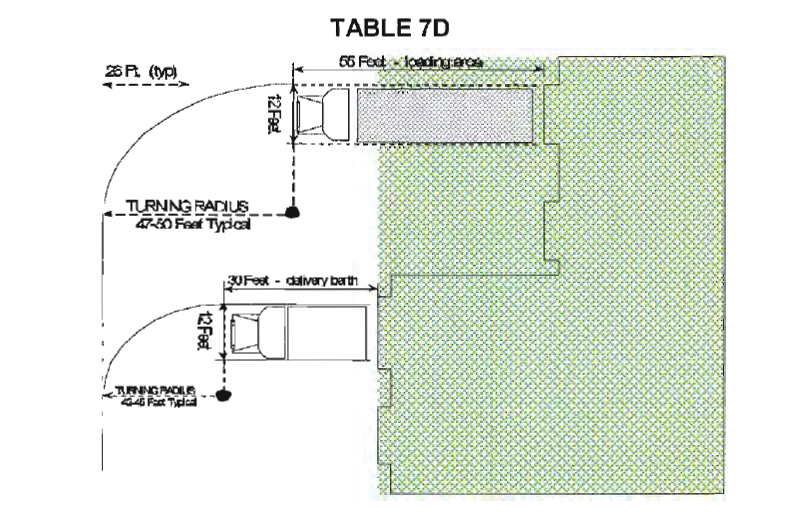
* For those buildings less than 14,999 square feet, one delivery space shall be required. This space shall have a minimum dimension of 12 feet × 30 feet and shall be placed in such a manner as to comply with the intent of this section. (See Figure 7D.)
2.
For each auditorium, convention hall, exhibition hall, museum, motel, hotel, office building, sports arena, stadium, hospital, sanitarium, welfare institution, or similar use having an aggregate floor area of:
Size of Building Number of Spaces
Over 10,000 square feet, but less than 40,000 square feet .....1
For each added 60,000 square feet or major fraction thereof .....1
For any use not specifically mentioned, the requirements for off-street loading facilities to which the unmentioned use is most similar shall apply. Such determination shall be made by the city manager or designee.
B.
Location of required loading spaces. Loading spaces shall be located on the same lot as the building or structure to which they are accessory. No loading shall be located in a required front yard.
C.
Designation and use. Each required loading space shall be designated as such and shall be used only for loading purposes.
D.
Design and maintenance.
1.
An off-street loading space shall be an area at grade level at least 12 feet by 55 feet long with a 14-foot vertical clearance.
2.
Each loading space shall be accessible from the interior of the building it serves without crossing or entering any other required off-street loading space, off-street parking space, or circulation area. Such loading spaces shall be arranged for convenient and safe ingress and egress by motor truck and trailer.
3.
All loading spaces shall be paved.
Sec. 7.4. - Fences and walls.
A.
Purpose. The purpose of this division is to regulate the location and character of dry-stack retaining walls 16 inches or less in height, fences, walls, and pool enclosures to ensure compatible relationships between abutting properties, provide for public safety, and foster an attractive community appearance. This section does not apply to fences placed on lands with a bona fide agriculture tax exemption per Florida Statute.
B.
Permit required. A building permit shall be required to construct, relocate or replace any portion of a wall. A fence permit shall be required to construct, relocate, or replace more than 24 feet of permanent dry-stack retaining wall 16 inches or less in height or fence within a 12-month period. For existing dry-stack retaining walls 16 inches or less in height or fencing, replacement of more than 50 percent within a 12-month period shall require a permit. No permit shall be required to repair any dry-stack retaining wall 16 inches or less in height or fence in the same location. It shall be unlawful for any person to construct, relocate or replace a dry-stack retaining wall 16 inches or less in height or fence or wall as set forth herein without first obtaining a validly issued permit from the city and paying the appropriate fee as set by resolution of the city council. No dry-stack retaining wall 16 inches or less in height or fence or wall permit shall be issued unless in compliance with the regulations set forth herein. To obtain a permit authorized by this section, the property owner shall submit to the city manager or designee or such other office as may be designated by the city, a completed application form.
C.
Permit application review.
1.
All permits for wall systems shall be issued by the building official in conformance with the Florida Building Code.
2.
An applicant for a dry-stack retaining wall 16 inches or less in height or fence permit shall deliver a permit application to the community development director or designee. At the discretion of the applicant, work may commence for a dry-stack retaining wall 16 inches or less in height or fence upon submittal of an application subject to the applicant agreeing, in writing upon a form provided by the city, to remove and/or revise any installed component of the work subsequently found not in compliance with the Code.
3.
The permit application shall be reviewed for a determination of whether the proposal meets the applicable requirements of this article and any applicable zoning law or building regulation. within ten days of receipt of a permit application and any applicable fees, not counting the day of receipt and not counting any Saturday, Sunday, or legal holiday which falls between the first or the tenth day after the date of receipt.
4.
The community development director or designee shall approve, approve with conditions (meaning legal conditions existing in the city's Code such as dimensional requirements), or deny the permit application and shall state the reason(s) for any denial in writing and on the application. In the event no decision is rendered within ten days following submission of the fence permit, the application shall be deemed approved.
5.
At the discretion of the applicant, in lieu of inspections for a dry-stack retaining wall 16 inches or less in height or fence, a self-certification may be provided, in writing upon a form provided by the city, attesting to the work being in compliance with the Code and specific permit conditions and agreeing to remove and/or revise any installed component of the work subsequently found not in compliance with the Code.
D.
Time limit. Any permit issued for a dry-stack retaining wall 16 inches or less in height or fence or wall shall expire automatically within six months if an inspection has not been passed by the city or a self-certification as set forth in part C.5 above has not been submitted to the city. Permits may be extended upon request for up to six months.
E.
Violations. If the work under any permit authorized by this section is proceeding in violation of the Florida Building Code, this article, any other ordinance or resolution of the city, or should it be found that there has been any false statement or misrepresentation of a material fact in the application or plans on which the permit was based, code enforcement action shall be initiated.
F.
Setback, height, and construction of fences and walls.
1.
Fences or walls may be erected in front of the outside corners of a house, provided they are not any higher than four feet, with a maximum opaqueness of 30 percent so the police and/or pedestrians can see through. A wall must have the same color and facade texture as the house.
2.
Fences or wall shall not exceed six feet in height above the finished grade of the property, with the following exceptions:
a.
If two homes with a common property line have a difference between the finished floor elevations, the height of the fence or wall between the properties may be increased one inch for every inch of difference between such elevations, to a maximum increase of 12 inches. No fence or wall shall exceed seven feet in height. Adequate data must be provided to the community development director or designee to confirm the difference between finished floor elevations.
b.
Tennis courts may have regulation-height fences, with a maximum opaqueness of 30 percent.
c.
Chain link fencing is prohibited within the city, except as follows:
(1)
In the original town of Fellsmere according to the plat thereof recorded in Plat Book 2, Pages 2 and 3, Public Records of St. Lucie County, now lying in Indian River County or within the limits of the plats of the Hall, Carter & James Subdivision according to the plats thereof recorded in Plat Book 3, Page 31 and Plat Book 2, Page 98, Public Records of St. Lucie County, now lying in Indian River County or within the limits of the plat of the Lincoln Park Subdivision according to the plat thereof recorded in Plat Book 1, Page 60, Public Records of Indian River County;
(2)
When permitted by the city council during site plan review;
(3)
As otherwise stated in this section.
3.
No barbed wire or metal sheeting nor agricultural fencing shall be allowed in the City of Fellsmere except as otherwise provided for herein.
a.
When approved by the city council during site plan review, barbed wire or agricultural fencing may be used within industrial or public/institutional zoned lands.
b.
Barbed wire or agricultural fencing may be used within agricultural areas or agriculturally zoned lands and within lands designated Villages of Fellsmere on the future land use map as part of Countryside development.
c.
Agricultural fences comprised of square formed wire fencing set on wood posts and otherwise meeting the height and opacity requirements of the Code is allowed in the original town of Fellsmere according to the plat thereof recorded in Plat Book 2, Pages 2 and 3, Public Records of St. Lucie County, now lying in Indian River County or within the limits of the plats of the Hall, Carter & James Subdivision according to the plats thereof recorded in Plat Book 3, Page 31 and Plat Book 2, Page 98, Public Records of St. Lucie County, now lying in Indian River County or within the limits of the plat of the Lincoln Park Subdivision according to the plat thereof recorded in Plat Book 1, Page 60, Public Records of Indian River County.
4.
For a wooden fence, the posts and stringers shall face the interior of the fenced property and the exterior side of the fence shall be painted a neutral color unless constructed of pressure treated or weather resistant material.
G.
Wall systems.
1.
Masonry walls or other decorative wall systems may be used for fencing.
2.
Except for decorative masonry block walls, all masonry block walls shall have painted stucco, brick veneer, or other finished masonry surface on both sides.
3.
Columns within a block wall may be up to one foot taller than the wall provided the column width does not exceed 30 inches with a minimum spacing of 20 feet except for offsets in the wall less than 20 feet in which the column spacing shall be the maximum possible for the safe design of the wall offset.
H.
[Within industrial or REAC districts.] Within the industrial or REAC zoning districts, fences or walls may be up to eight feet in height and vinyl coated chain link fencing may be used if approved by the city council during site plan review.
I.
[Separation between districts.] Where separation is required between nonresidential and residentially zoned lands, either by code or the city council, the developer of the nonresidential property shall be required to construct the wall or fence. These provisions may be waived in instances where the city council determines that pedestrian connectivity is desirable between commercial and residential districts.
1.
If a property is subsequently rezoned to residential, the wall shall be provided by the developer of the rezoned property.
2.
The wall separating nonresidential (commercial or industrial properties) and residential properties may be a maximum of eight feet in height.
J.
Swimming pool and spa fences.
1.
An outdoor swimming pool or spa deeper than 24 inches shall be completely surrounded by a fence, pool enclosure, or masonry wall at least four feet in height and constructed so that a four-inch-diameter sphere cannot pass through any opening.
2.
All pedestrian-access gates or doors in the fence, enclosure, or wall shall be equipped with a self-closing and self-latching device, but the door of any dwelling which forms a part of the enclosure need not be so equipped. Any gate wider than six feet must be locked in the closed position when not in use.
3.
During construction, all unattended pools shall be enclosed with a temporary fence at least four feet in height. Such temporary fences can be utilized for a maximum of 90 days after the permit is issued. After 90 days, a temporary fence shall be replaced with a permanent fence.
4.
Fences required by this section shall be maintained in good condition for safety reasons. Any repairs to these fences shall be completed within 24 hours of notification by the administrative official.
5.
Refer to the Florida Building Code for additional requirements.
K.
Dangerous fences. Electric fences and fences with broken glass, spikes, or other sharp points that may cause injury are prohibited.
L.
Nonconforming fences. Fences or walls that do not meet the requirements of this section at the date of adoption of this Code may be replaced provided the nonconformity is not increased.
(Ord. No. 2011-02, § 3(Exh. A), 7-7-2011; Ord. No. 2017-04, § 3(Exh. A), 3-16-2017; Ord. No. 2022-07, § 2(Exh. A), 3-17-2022)
Sec. 7.5. - Docks and piers.
A.
Applicability. New residential developments may be constructed around lakes or a series of lakes.
B.
Generally.
1.
Structures shall not extend into the water more than 20 feet or 20 percent of the owner's property width, measured at mean high water.
2.
Every portion of the structure shall be set back at least 20 feet from the water side property line.
3.
Except as provided in paragraph 7. below, no structure shall be higher than three feet above mean high water. Maximum height of mooring piles shall be ten feet above mean high water.
4.
No untreated wood shall be allowed. Concrete is the preferred construction material.
5.
Tires shall not be affixed as fenders.
6.
Structures must permit the clear flow and cleansing action of the water.
7.
Structures over water may be covered with a roof as long as the following restrictions are met:
a.
Maximum roof area shall be 600 square feet, including overhang;
b.
Maximum roof height shall be 15 feet above mean high water;
c.
Structure shall be open on all sides; and
d.
Construction above the roofline (i.e., sitting areas, sunbathing areas, etc.) shall be prohibited.
C.
Permits. Before a building permit is issued by the city, copies of all permits required by other government agencies must be furnished.
D.
Maintenance. All docks, piers, mooring piles, and boat lifts, shall be maintained so as to prevent them from becoming deteriorated, structurally unsound, unsafe, hazardous to navigation, or otherwise not in compliance with applicable provisions of this Code.
Sec. 7.6. - Swimming pools and spas.
A.
Location. Swimming pool and spa tanks, decks, and enclosures:
1.
Shall not be constructed in any front yard, except that a property on a corner lot may have a pool in the front yard facing the secondary street if the yard is enclosed with a six-foot opaque fence.
2.
Shall have minimum setbacks of five feet from the rear and side property lines and ten feet from a canal, shoreline or bulkhead. The contractor shall be responsible for ensuring that said structures comply with minimum setback requirements and do not encroach upon any easement of record. Whenever any of said structures is within 24 inches of an easement or setback, the contractor shall submit a sealed survey from a registered surveyor showing the structure location after forms are in place and before a steel inspection. If the contractor certifies that the structure is not within 24 inches of an easement or setback and the city manager or designee does not concur, a sealed survey from a registered surveyor shall be submitted.
B.
Height of above-ground pools. In addition to complying with the foregoing requirements, a swimming pool designed to be installed above ground and its associated deck shall be a maximum of four feet above the floor elevation.
C.
Sediment collection during construction. A 55-gallon barrel with an open top and no holes in the side or bottom shall be used when pumping water into public or private rights-of-way, and the contractor shall empty the barrel before the sand reaches the top of the barrel. The city manager or designee is authorized to stop construction at any time that this procedure is not followed. Pool construction sand and debris which is deposited into any rights-of-way, including the storm drain invert which collects the pumped water, shall be cleaned up as needed and before each inspection.
D.
Pumping of water during construction. The pumping of water during construction or refinishing of a swimming pool or spa shall not exceed seven consecutive days for each phase of construction, except for causes such as unusual rainy weather, large amounts of underground water, or circumstances beyond the contractor's control. In any event, the contractor shall seek authorization from the city manager or designee to pump water for more than seven consecutive days.
E.
Pumping of water. The pumping of water except for construction shall be discharged on the pool owner's property and not into the street, lake or canal.
Sec. 7.7. - Driveways, parking pads, patios and decks.
A.
Permit required. It shall be unlawful for any person to construct, alter or relocate a driveway, parking pad, patio or deck without first obtaining a validly issued permit from the city and paying the appropriate fee as set by resolution of the city council. No driveway, parking pad, patio or deck permit shall be issued unless in compliance with the regulations set forth herein. To obtain a driveway, parking pad, patio or deck permit, the property owner shall submit to the community development director or designee or such other office as may be designated by the city, a completed application form provided by the city. The application shall be reviewed for a determination of whether the proposed driveway, parking pad, patio or deck meets the applicable requirements of the Florida Building Code, if applicable, this article and any applicable zoning law.
B.
Permit application review. An applicant shall deliver a permit application to the community development director or designee. The permit application shall be reviewed for a determination of whether the proposal meets the applicable requirements of the Florida Building Code, if applicable, this article and any applicable zoning law. The review of the permit application shall be completed within 20 days of receipt of a permit application and any applicable fees, not counting the day of receipt and not counting any Saturday, Sunday, or legal holiday which falls between the first or the 20th day after the date of receipt. The community development director or designee shall approve, approve with conditions (meaning legal conditions existing in the city's Code such as dimensional requirements), or deny the permit application and shall state the reason(s) for any denial in writing and on the application. If denied because of failure to decide upon the application within the deadline set forth, the community development director or designee shall upon request, refund any applicable fee to the person who paid the fee. In the event no decision is rendered within 20 days following submission, the application shall be deemed denied and the applicant may appeal to the board of adjustment.
C.
Time limit. Any permit for a driveway, parking pad, patio or deck shall expire automatically within six months if an inspection has not been passed by the city. An extension may be granted upon request for up to six months.
D.
Violations. If the work under any driveway, parking pad, patio or deck permit is proceeding in violation of the Florida Building Code, this article, any other ordinance or resolution of the city, or should it be found that there has been any false statement or misrepresentation of a material fact in the application or plans on which the permit was based, code enforcement action shall be initiated.
D.
Driveways, parking pads, patios and decks. Driveways, parking pads, patios and decks shall be set back at least five feet from the side and rear property lines but shall not encroach into any easement of record. Said structures shall also be set back at least ten feet from any canal, shoreline or bulkhead, except that a plastic or pressure-treated wood deck along a canal or lake may be built to the rear lot line if the following conditions are met:
1.
The deck flooring is constructed with nominal two-inch-thick boards, which shall be spaced approximately one-eighth inch apart.
2.
The deck does not exceed the height of the finished floor level of the principal structure or 30 inches above the finished grade or bulkhead cap, whichever is lower.
3.
Where decking will be installed over lawns and yard areas which drain toward a body of water, soil-erosion protection shall be installed under the decking to prevent erosion and discharge of the underlying soils into the water body from overland flow of water or rainfall, one of the following methods of stabilization shall be constructed:
a.
A cellular soil-confinement system with minimum height or thickness of cells to be one and one-half inches. In-place soils or other granular material shall be used to fill the cells and anchor the confinement system into the ground. All installations shall be in accordance with the manufacturer's instructions and guidelines.
b.
Permeable geotextile fabric covered with a six-inch to 12-inch blanket of gravel or stone. The perimeter of the geotextile fabric shall be anchored into the underlying soils in accordance with the manufacturer's instructions and guidelines.
c.
Other systems and methods if it can be shown to the city manager or designee that their use will not allow soil erosion greater than the methods in (a) and (b) above.
4.
On any nonresidential lots, development's access shall be governed through site plan and building permit or other permitting process.
E.
Driveways at rights-of-way.
1.
All lots within the city shall conform to the following driveway requirements, as applicable:
a.
Except for single-family and duplex lots, a minimum of one driveway per lot shall be permitted for properties with up to 200 feet of street frontage, and an additional driveway shall be permitted for each additional 200 feet. Driveways shall be located at least 50 feet apart measured from the closest driveway edge at the right-of-way line, and at least 50 feet from the nearest street intersection measured from its nearest right-of-way line. No driveway or curb cut shall be permitted on the radii of any intersection. During the site plan review process, the city council may increase the above distances for public health, safety and welfare purposes.
b.
For all single-family and duplex lots, no driveway or curb cut shall be located in any side easement or within 35 feet of any intersection, measured from the closest edge of the driveway to the closest edge of pavement of the intersecting side street. Side easements may be used for corner lots; for side facing garages; or when it is appropriate to the type of development. The total aggregate width of all driveways on said lots shall not exceed 36 feet.
c.
Except for single-family and duplex lots, driveways shall be at least 15 feet wide for one-way traffic and 24 feet wide for two-way traffic, measured at the right-of-way line.
d.
All driveways, except for single-family and duplex lots, shall be constructed of concrete, paving, paver blocks, gravel or similar materials with a minimum of 15 feet in width from the street to the garage or required parking stall. For all single-family and duplex lots all driveways may be constructed of concrete, paving, paver blocks, gravel or similar materials with a minimum of ten feet in width from the street to the garage or required parking stall.
e.
Sharing of common driveway. Adjacent developments may share a common driveway, provided that appropriate easements are granted between adjacent property owners in a form acceptable to the city attorney.
F.
Tennis courts. The purpose of these provisions is to provide an opportunity for development of tennis and similar recreational courts as accessory uses in residential districts, to protect the integrity of neighboring residential areas, and to mitigate any deleterious impacts on proximate properties. Tennis courts and similar recreational courts may be developed as accessory uses in planned residential districts or on lots greater than one acre in size, when such courts are located on the same lot as the main residential use subject to the provisions of this section.
1.
Tennis court fencing requirements.
a.
Fences up to ten feet in height, as measured from the finished grade outside the court, shall be permitted, when located behind the required setback areas.
b.
For court fencing located at least 25 feet from all property lines, a fence height of 12 feet shall be allowed.
c.
All portions of fencing exceeding six feet in height shall be of an open mesh such as chain link. Such chain link shall be decorative green or black.
d.
Windscreens and similar devices shall be prohibited above the six-foot height.
2.
Landscaping and screening. All courts visible from the public streets shall be screened by landscaping. Landscaping shall be submitted to the community development director or designee for approval and must indicate plants of sufficient height and density to screen the court.
3.
Artificial illumination. Artificial illumination of tennis courts shall be subject to a conditional use permit.
G.
Reduced setbacks. For existing developed properties with side yard setbacks of less than 15 feet but greater than ten feet, the driveway setback may be reduced to one foot subject to the following conditions:
1.
The property is located within the limits of the original plat of the Town of Fellsmere according to the plat thereof recorded in Plat Book 2, Pages 2 and 3, Public Records of St. Lucie County, now lying in Indian River County or within the limits of the plats of the Hall, Carter & James Subdivision according to the plats thereof recorded in Plat Book 3, Page 31 and Plat Book 2, Page 98, Public Records of St. Lucie County, now lying in Indian River County or within the limits of the plat of the Lincoln Park Subdivision according to the plat thereof recorded in Plat Book 1, Page 60, Public Records of Indian River County;
2.
The property is an existing single-family home, duplex or mobile home;
3.
Stormwater runoff shall be directed to the street or alley without discharging such stormwater onto adjacent properties; and
4.
The reduced driveway setback shall only be permitted in locations where it is not feasible to obtain the standard required five-foot setback due to the location of the existing single-family home, duplex or mobile home and shall be transitioned to the standard five-foot setback as soon as possible beyond the constraining structure.
H.
Final inspections. Prior to approval of a final inspection related to a driveway, parking pad, patio or deck, the applicant shall have removed all excess materials and construction items related to the project, returned the site to a neat and orderly appearance, and stabilized all exposed dirt from erosion by means of sod, mulch, and/or seeding.
(Ord. No. 2011-02, § 3(Exh. A), 7-7-2011; Ord. No. 2017-04, § 3(Exh. A), 3-16-2017; Ord. No. 2022-07, § 2(Exh. A), 3-17-2022)
Sec. 7.8. - Dish and other antennae.
A.
Dish antennae.
1.
Dish antennae which do not exceed 18 inches in diameter shall be exempt from regulation by the city.
2.
Dish antennae exceeding 18 inches in diameter shall be permitted in the city subject to the following special conditions. Such antennae:
a.
Shall be considered a structure requiring a building permit from the city prior to installation. Before the permit may be issued, the applicant shall provide the city manager or designee with two sets of structural drawings signed and sealed by a licensed architect or engineer.
b.
Shall be limited to one per principal structure.
c.
Shall be made of optically nonreflective material, with a maximum diameter of five feet, and a maximum height of eight feet in any position.
d.
Shall not be placed in any front or side yard and shall not encroach into any easement or setback. If adhering to this restriction hinders reception, the permittee may request an exception to this requirement by demonstrating the hindered reception to the city manager or designee and requesting an alternative location. If the city manager or designee deems the proposed location to be unsafe, the city manager or designee shall reject the location.
e.
Shall not be mounted on the roof of any structure in single-family residential zoning districts. In all other zoning districts, roof-mounted dish antennae shall be allowed on any structure higher than two stories, provided that the antenna does not exceed four feet in diameter.
B.
Other antennae.
1.
In the REAC or IR zoning districts, no other roof mounted antennae which do not exceed six feet in dimension and/or do not extend higher than five feet above the highest point of the roof shall be exempt from regulation by the city.
C.
Prohibition. Except as authorized in this section, all other antennae are prohibited, unless subject to regulations as a telecommunications tower as provided in section 7.17.
D.
Nonconforming antennae. Any lawfully-installed dish or other antenna that is made nonconforming by this section shall be made conforming when the antenna is replaced or relocated.
Sec. 7.9. - Sidewalks, bicycle facilities and multi-use paths.
A.
General intent and applicability.
1.
Intent. It is the intent that the standards and specifications herein shall apply to the development of public and private sidewalks, multi-use paths, and bicycle facilities constructed and reconstructed within developments in the city.
2.
Applicability. As a condition of the issuance of a development permit or building permit, as applicable, for any construction project, the city shall require the developer to construct a sidewalk, multi-use path, and/or bicycle facility as set forth herein along the development project street frontage(s) at the time of development.
3.
Alternative compliance. At the sole discretion of the city, the city may allow the owner or developer to make a cash payment to the city in lieu of constructing the sidewalk, multi-use path, and/or bicycle facility. The cash payment shall be equivalent to the estimated cost of providing the sidewalk, multi-use path, and/or bicycle facility as set by resolution and any additional costs as determined by the city manager or designee including administration, design, and contingency costs. In such cases, the city shall retain the cash payment in a "Fellsmere Sidewalk Fund" for use in designing, constructing or maintaining sidewalks, multi-use paths or bike facilities throughout the city on public lands or private lands in support of a public project with consent of the owner. At the sole discretion of the city, sidewalk funds may also be used for infrastructure items needed to support general access such as, but not limited to, drainage and roadway modifications needed to support a planned or future sidewalk, multi-use path or bike facility.
B.
Definitions.
1.
Bicycle facility. Includes improvements constructed or provided to accommodate bicycle traffic and parking. Bicycle facilities may include bikeways, bicycle lanes within the street, paved shoulders, wide curb lanes, multi-use paths which are a minimum of eight feet in width, trails where bicycling is permitted, bicycle racks and lockers, and other facilities and markings intended to designate areas available for exclusive use or shared use for bicyclists.
2.
Bikeway (bicycle way). A facility within the street, within the street right-of-way, or within a separate right-of-way or easement improved for use by bicyclists.
3.
Multi-use path. A physical course or improvement, a minimum of eight feet in width, provided within a right-of-way or access easement used for mixed pedestrian, bicycle or other nonmotorized travel.
4.
Right-of-way. A strip of land dedicated, deeded, used, or to be used for a street, alley, walkway, pedway, boulevard, utility installations, drainage facility, access for ingress or egress, or other purpose by the public, certain designated individuals, or governing bodies. Includes Murphy Deed Reservations.
5.
Sidewalk. Improved hard surface way constructed within rights-of-way, along exclusive easements, or on private property, dedicated to public use, intended to be used for pedestrian traffic, from which motor vehicles are excluded and designed to provide access to adjacent roads and lots. Crosswalks shall be included as a required sidewalk.
C.
Sidewalk/multi-use path design standards. All development, including subdivisions, shall provide sidewalks adjacent to the roadway on which the development fronts and a bicycle facility adjacent to the roadway or separate multi-use path easement or right-of-way on which the development fronts as reflected in the comprehensive plan for future bicycle facilities. Sidewalks shall also be provided on both sides of all arterial and collector roadways unless otherwise provided in this Code or in the Fellsmere Comprehensive Plan.
1.
Location of sidewalks and multi-use paths. All sidewalks and multi-use paths shall be placed within a right-of-way. Whenever this is not possible, sidewalks and multi-use paths shall be provided through creation of access easements. Separate access rights-of-way not within existing street rights-of-way or easements shall not be less than ten feet wide for sidewalks and 16 feet wide for multi-use paths.
2.
Required sidewalk and multi-use path widths. All sidewalks, except those along Broadway, S. Carolina and C.R. 512, shall be at least five feet in width or at least six feet in width when located along the back of the curb along arterial and collector streets or within parking areas with vehicular overhangs. Sidewalks in residential areas shall be located a minimum of five feet from the edge of roadway along collector and local streets. The sidewalk shall be free of all obstructions and compliant with applicable state and federal accessibility standards. Along Broadway, sidewalks shall be a minimum of ten feet in width. Along S. Carolina and C.R. 512, sidewalks shall be a minimum of eight feet in width. Bi-directional multi-use paths and bicycle ways not located adjacent to streets shall be at least eight feet wide. These facilities shall be paved and provide a two-foot clear zone with no obstructions such as poles, trees, guywires, etc., on either side of the facility. These types of facilities are encouraged to provide circulation to schools, parks, shopping centers, other transportation facilities, other community facilities, and within designated greenways. Crosswalks shall be included as a required sidewalk.
3.
Distance of sidewalks from street right-of-way. All sidewalks must be placed six inches in the street right-of-way from the lot line, unless a variation therefrom is permitted by the city's engineer for extenuating circumstances.
4.
Standards for construction of outside edge of sidewalk. All sidewalks must be constructed so that the cross-slope of the sidewalk from the inside (side next to the lot) to the outside (side next to the street) shall not exceed two percent. The outside, or curb side, of every sidewalk shall extend at least four inches into the ground.
5.
Tamping subgrades. All subgrades of sidewalks shall be tamped until the ground upon which the sidewalk is to be constructed is solid and hard.
6.
Minimum uniform thickness. All sidewalks constructed in the city must have a uniform thickness of not less than four inches when constructed of concrete or six inches at driveway crossings.
7.
Concrete construction, expansion joint required. All sidewalks shall be constructed of concrete and shall have expansion joints as appropriate for the class of concrete used. Alternative surfaces meeting the requirements of the Americans with Disabilities Act, 42 USC section 12101 et seq. may be approved by the city manager.
8.
Finish of surface. The surface of sidewalks shall be finished smoothly, but with a finish that will not be slick. Appropriate detectable warning devices shall be required at entrances to crosswalks.
9.
Gates opening onto sidewalk. No gate shall open onto or stand onto any sidewalk in the city.
D.
Subdivision sidewalks. The owner of a property proposed for subdivision shall be responsible for constructing the sidewalks in common areas, including tracts, and such sidewalks shall be installed prior to the final inspection of the subdivision improvements for the issuance of a certificate of completion. The owner/developer of other types of development shall complete all required sidewalks prior to final inspection of site improvements for the issuance of a certificate of completion.
E.
Connections at intersections required. Each sidewalk shall extend to a curb cut at all street intersections which provide access connections to the pedestrian way or sidewalk from the street. All access connections shall provide ADA handicapped accessible ramps consistent with requirements to implement the Americans with Disabilities Act, 42 USC section 12101 et seq. All sidewalks within subdivisions shall be constructed in accordance with the provisions set forth herein.
F.
Bicycle lane design standards. Bicycle ways shall be provided within the curb lane of arterial and collector streets unless otherwise approved by the city engineer and shall be no less than five feet in width measured from the face of the curb or edge of the road when no curb is present towards the centerline of the road. Such facilities shall be marked and signed by the contractor/developer in accordance with the Florida Department of Transportation adopted standards in effect on the date of construction plan approval.
G.
Connection to transit stops required. All development must provide, to and from designated transit station stops, sidewalks which provide interconnected routes to the public and private pedestrian way system. Where such transit station stops are located, additional sidewalk width may be required to provide for the construction of a shelter/bench and provide adequate width for anticipated pedestrian volumes and users.
(Ord. No. 2011-02, § 3(Exh. A), 7-7-2011; Ord. No. 2016-02, § 3(Exh. A), 2-18-2016; Ord. No. 2017-04, § 3(Exh. A), 3-16-2017)
Sec. 7.10. - Maintenance generally.
A.
The exterior of every structure shall be maintained in good repair, in a safe and sanitary condition, and free of deterioration, broken glass, loose shingles, crumbling stone or brick, excessive chipping or peeling paint, broken stucco, and other damaged building materials and components.
B.
Paved areas shall be maintained in good repair, free of potholes and other deterioration.
C.
The entire premises shall be maintained so as not to constitute blight or detract from the general appearance of any nearby properties.
Sec. 7.11. - Roofs.
A.
Roof overhang. A minimum of two feet of roof overhang is required on all single-family residential construction.
B.
Roof pitch. In all single- and two-family districts, minimum roof pitch for the primary structure shall be three vertical in 12 horizontal. No mansard roofs shall be allowed within 250 feet of CR 512 or anywhere within the Old Town area, unless approved by the city council during the development plan review phase.
C.
Roof coverings. In all residential zoning districts all roof coverings shall be tile, composition (dimensional) shingle or metal roofs.
D.
Exception to height requirement. Chimneys, television and radio towers and antennae, steeples, cooling towers, elevators, parapets, and other necessary mechanical appurtenances, cupolas and ornamental towers and spires are exempt from the height limitation up to a maximum of five feet in order to encourage architectural features and enhancements; however, this additional five feet shall not apply to any building approved for 65 feet in height.
Sec. 7.12. - Drainage.
All single-family and two-family new construction on platted lots of record created prior to December 17, 1956 shall direct all surface water to the street and adjacent drainage conveyance system. All other development shall only be approved in conjunction with an approved surface water runoff management system permitted by the St. John's River Water Management District or the city engineer as applicable.
(Ord. No. 2011-02, § 3(Exh. A), 7-7-2011)
Sec. 7.13. - Lighting.
A.
All lights shall be directed, oriented, and shielded to prevent light trespass or glare onto adjacent properties, onto public rights-of-way, and/or driveway areas.
B.
The candlepower of all lights shall not exceed the candlepower requirements of this chapter. A photometric analysis shall accompany all applications for installation of exterior lighting.
C.
Exterior lighting shall be turned off during daylight hours. As used herein, "daylight hours" means the hours between sunrise (dawn) and sunset.
D.
The following types of lighting are prohibited:
1.
Beacon and flood lights, except when required by the Federal Aviation Agency or approved as part of a special event permit by the city council.
2.
Exterior neon lighting.
3.
Lights which are intended or may be construed to be traffic signs, signals, or warnings.
4.
Lighting structures or strip lighting that follows the form of the building, parts of the building, or building elements are prohibited.
5.
Neon lighting, fiber optics or similar systems, which exceed six square feet in area, and where the neon tube, fiber optic or similar system is visible from the outside. Neon lighting, fiber optics and similar systems shall not be used for outlining the building including the windows.
6.
Back lighting of transparent or translucent architectural elements as well as illuminated or back lit awnings, fascias and roof-mounted elements.
7.
Holographic display signs.
8.
Signs which may be confused with the lights of emergency or road-equipment vehicles.
E.
All outdoor lighting shall comply with the following additional requirements:
(Ord. No. 2017-04, § 3(Exh. A), 3-16-2017)
Sec. 7.14. - Underground utilities.
A.
Except for single-family or duplex development on platted lots of record created prior to December 17, 1956, all new development shall be required to place all new utilities underground at the owner's expense. This will include any new above ground utilities and poles that are not on the site for the proposed development.
B.
All multi-family or nonresidential redevelopment, additions, expansions, renovations, or remodeling that is valued in excess of 50 percent of the building's value as shown on the tax assessment roll at the time of redevelopment, addition, expansion, renovation, or remodeling of the property shall be required to place all utilities underground at the owner's expense. This will include any new above ground utilities and poles that are not on the site for the proposed or existing development.
C.
All new multi-family or nonresidential utility services and all upgrading of existing utilities that require any new above ground utilities or poles shall be required to place all said new utilities underground at the owner's expense. This will include any new above ground utilities and poles that are not on the site for the proposed or existing development.
(Ord. No. 2011-02, § 3(Exh. A), 7-7-2011)
Sec. 7.15. - Site work and earthwork for utilities.
A.
Applicability. The work covered by this section consists of all operations in connection with excavation and trenching for utilities, including dewatering, shoring, bracing, backfilling, compacting, protective slabs, restoration of surfaces (paved or otherwise) and disposal of surplus materials when installing utility lines (gas, electric, telephone, sewer and television cable, etc.) within the rights-of-way of the city.
B.
Trench excavation generally; maintenance period. All trench excavations shall be of sufficient size to permit proper laying and jointing of the utilities. The amount of trench to be open at any one time shall be limited at the discretion of the city, to minimize public inconvenience and damage to life or property, provide trench crossings as necessary to accommodate public travel, and permit convenient access at all times. The excavated materials shall be deposited neatly at the sides of the trench in such a manner as to least inconvenience traffic. Should any trench settle below grade during a period of one year after the work is performed, the utility owner shall promptly correct the settlement with placement of appropriate material to the satisfaction of the city and at no cost to the city.
C.
Protection of underground pipes, conduits, etc.; liability for damage. Any pipes, conduits, wires, mains, footings or other underground structures encountered in trenching shall be carefully protected from injury or displacement. Any damage thereto shall be fully, promptly and properly repaired to the satisfaction of the city and the owner thereof.
D.
Cutting of pavement. When excavations are to be made in paved surfaces, the pavement shall be cut by means of pneumatic or other suitable tools to provide a clean, uniform edge with minimum disturbance of remaining pavement.
E.
Testing. In order to ensure that all backfilling and pavement repair are accomplished in a manner which is likely to ensure against future failures, a series of testing requirements are defined in this section. The requirements for testing may be waived for a period up to one year, or for a specific project. Such a waiver may be granted by the city manager or designee where in his opinion the utility has demonstrated by past performance a capability and willingness to comply with the requirements of this section. This waiver may be withdrawn or renewed at the discretion of the city manager or designee. In reaching a decision to grant or withdraw a waiver, the city manager or designee should be guided by advice from the city engineer.
F.
Backfill.
1.
Material. Material for backfill around and over the utility shall be carefully selected from the excavated material or from other sources as may be required. Such materials shall be granular and shall be free from organic matter debris. The material shall be compacted by rolling, tamping or flooding, and proper allowance shall be made for settlement.
2.
Unpaved areas. After any section has been successfully completed, the trench shall be carefully backfilled with selected earth, free of any wood, paper, glass, metal or organic matter. Backfill shall be placed in appropriate lifts and be compacted by tamping, flooding or some other method acceptable to the city to a minimum of 95 percent of maximum density as determined by AASHTO, Method T 180.
3.
Paved areas. Backfilling of trenches under roadways and areas to be paved shall be placed in six-inch maximum layers after filling one foot above the utility. Each layer shall be compacted to a minimum density of 98 percent of maximum density as determined by AASHTO, Method T 180.
4.
Tests. In order that all parties concerned may be assured that the compaction requirements set out in this subsection have been successfully met, the following test shall be performed by a licensed engineering testing laboratory and submitted by the utility owner at no cost to the city:
G.
Pavement repair.
1.
Generally. Existing pavement removed, disturbed or destroyed by the construction work shall be repaired or replaced by methods and materials which will provide a finished pavement at least equal in all respects to the pavement existing before construction commenced. Base material shall be placed upon completion of backfilling and the street or alley then opened to traffic. The new base shall be the same material and thickness or equal to the original base. Until the final wearing surfacing material is placed, the surface of the base shall be maintained in a smooth riding condition.
2.
Patching pavement.
a)
Backfilling. Backfilling of trenches under roadways and areas to be paved shall be placed in layers after filling one foot above the utility. Each layer shall be compacted to a minimum density of 98 percent of maximum density as per AASHTO, Method T 180.
b)
Removal of curbs. Concrete curbs shall not be disturbed when it is practical to tunnel underneath. Where tunneling is not possible, the curb shall be removed to the nearest joint and replaced with identical sections.
c)
Pavement repair standards.
1)
The minimum pavement repair shall consist of the following:
i)
Subbase. The subbase shall be an eight-inch compacted thickness of material with a Florida Bearing Value of 50 psi, compacted to a minimum of 100 percent of maximum density as per AASHTO T 180, Method A.
ii)
Base for trenches wider than eight feet. The base shall be six-inch compacted limerock or approved cemented coquina, compacted to 100 percent maximum density as per AASHTO T 180, Method A, and rolled and shaped to a proper contour, for trenches wider than eight feet.
iii)
Base for trenches narrower than eight feet. A four-inch layer of 3,000 pounds per square inch concrete shall be installed for trenches narrower than eight feet.
iv)
Prime coat. The base shall be primed with a minimum of 0.2 gallons per square yard of RC-1S and sanded as required.
v)
Surface. The surface shall be a one-inch compacted thickness of plant mix, state department of transportation hot mix type 11, modified to 2,300 pounds Hubbard-Field Stability. The surface shall be finished to the proper grade and cross section to match the original pavement.
2)
Where the pavement removed is superior to the minimum specifications as set forth in this subsection, the patch shall be equal to the pavement removed.
3)
For all flexible type pavements, the existing pavement shall be cut back vertically and horizontally a minimum of one foot beyond any area where the base was disturbed in a straight line, and the edge of the existing pavement and base shall be painted with RC-1S or RC-3.
4)
For all rigid pavements (concrete) the pavement shall be first cut with a saw and then broken out so as to leave a straight edge a minimum of a one-foot distance beyond any area where the base was disturbed.
5)
Should any pavement repairs fail or settle during the one-year maintenance period, the utility owner shall promptly repair or replace such pavement to the satisfaction of the city and at no cost to the city.
6)
In order that all parties concerned may be assured that the requirements set out in this subsection have been successfully met, the following tests shall be performed by a licensed engineering testing laboratory and submitted by the utility owner at no cost to the city:
i)
Stability and gradation of asphalt: One per 2,000 square feet or one per day of installation of asphalt.
ii)
In-place density tests of base and subbase: One per 2,000 square feet or one per patch per six inches of depth.
iii)
Florida Bearing Values of subbase: One per 2,000 square feet or one per patch per eight inches of depth.
d.
Pavement repair procedures. To maintain good and efficient traffic on public roads, the contractor shall comply with the following procedures:
1)
Backfilling shall be completed immediately after installation of the utility.
2)
The surface grade of the backfilled material shall be maintained to the proper grade and cross section.
3)
Within one week after backfill is installed, the subgrade and base material must be installed to final grade.
4)
The utility owner must prime the surface of the base or keep it dampened and to proper grade, to reduce dusting.
5)
The utility owner must maintain the base to proper grade.
6)
The utility owner must recut and reshape material and apply primer and place the final wearing surface as soon as practicable.
e.
Resurfacing streets. Where streets are to be resurfaced instead of patched, the base shall be finished to fit the existing crown and a one-inch surface course applied as outlined in subsection G.2. of this section.
f.
Stabilized streets and alleys. Where limerock, clay, shell or other forms of street and alley stabilization exist, the top one foot shall be separately removed for the width of the trench and kept separate from the general excavation. Additional stabilizing material meeting the approval of the city shall be added as required to restore the street or alley to not less than its original condition.
g.
Sidewalk, curb and driveway repairs. Where existing concrete sidewalks, curbs or driveways are damaged or destroyed in the performance of this work, they shall be repaired so as to provide a finished repair at least equal in all respects to the existing structures prior to construction.
h.
Lines installed parallel to pavement. Where utility lines run parallel to pavement, it will be incumbent upon the utility owner to prevent damage to the adjacent curbing and pavement by sheeting or shoring.
Sec. 7.16. - Protection of historically significant buildings.
A.
Purpose and intent. It is the intent of this section to assure that sites locally designated as historically significant or as an undesignated historic structure will be protected from demolition or substantial alteration such as would be detrimental to the character of the city and its cultural heritage thus protecting the public interest in historic sites from adverse activities, construction, destruction and other impacts and preventing the unnecessary removal of historic structures or archaeological artifacts. Furthermore, it is the intent of this section to strengthen the economy of the city by stabilizing and improving property values in historic areas, combating urban decay through rehabilitation and revitalization, and providing attractions to residents, tourists and visitors, to provide a stimulus to business and industry and a mechanism to preserve the beauty and historic past of the city. The purpose of these regulations is to provide for a review of any permit request which would affect those sites located in the city and identified in the Land Development Code as deemed to be historically significant or an undesignated historic structure.
B.
Local list of historically significant sites or undesignated historic structures. The list of historically significant sites and undesignated historic structures is to be kept by the community development director. Placement of other buildings on the list of historically significant sites or undesignated historic structures may be initiated by the city council or the owner and added to the list following public hearings before the city council and amendment to the Land Development Code. At least once every ten years the city council shall initiate a review of all structures within the city that were originally constructed at least 50 years prior to the year in which the update is conducted for the purpose of determining which structures to add to the local list of undesignated historic structures or historically significant sites and which structures should be removed. The city council shall utilize the expertise of professionals in the fields of history, architectural history, planning, archaeology, or other historic-preservation-related disciplines such as urban planning, American studies, American civilization, cultural geography or cultural anthropology to offer recommendations and supportive findings regarding the criteria to be designated as a historically significant site or an undesignated historic structure.
1.
Criteria. Consistent with the criteria established by the National Register of Historic Places, designation as historically significant places, buildings, structures, landscape features, archaeological sites and other improvements as individual sites or districts that are significant in Fellsmere's history, architecture or culture and possess integrity of location, design, setting, materials, workmanship or association shall meet one or more of the following criteria:
a)
(Significant event.) Are associated with events that have made significant contributions to the pattern of history in the community, Fellsmere, Indian River County, the state or the nation; or
b)
(Significant person.) Are associated with the lives of persons significant in Fellsmere's past; or
c)
(Architectural significance.) Embodies the distinctive characteristics of an architectural type, period, style or method of construction; or the work of a prominent designer or builder; or contains elements of design, detail, materials, or craftsmanship of outstanding quality; or that represents a significant innovation or adaptation to the Florida environment; or represents a distinguishable entity whose components may lack individual distinction; or
d)
(Archaeological significance.) Have yielded, or are likely to yield information in history or prehistory; or
e)
(Aesthetic significance.) Is a part of or related to a landscape, park, environmental feature or other distinctive area, and should be developed or preserved according to a plan based upon a historic, cultural, or architectural motif; or because of its prominent or special location, contrast of siting, age, or scale is an easily identifiable visual feature of a neighborhood or the city and contributes to the distinctive quality of such neighborhood or the city.
The placement of a historical marker endorsed by the Florida Division of Historical Resources shall by itself qualify a site to be designated as historically significant.
2.
Criteria considerations. Ordinarily cemeteries, birth places, or graves of historical figures, properties owned by religious institutions or used for religious purposes, structures which have been moved from their original locations, reconstructed historic buildings, properties primarily commemorative in nature and properties that have achieved significance within the past 50 years shall not be considered eligible for designation as historically significant. However, such properties will qualify if they fall within the following categories:
a)
A building or structure removed from its original location but which is significant primarily for architectural value, or which is the surviving structure most importantly associated with a historic person or event; or
b)
A birthplace or grave of a historical figure of outstanding importance if there is no appropriate site or building directly associated with his or her productive life; or
c)
A cemetery which derives its primary significance from graves of persons of transcendent importance, from age, from distinctive design features, or from association with historic events; or
d)
A reconstructed building when accurately executed in a suitable environment and presented in a dignified manner as part of a restoration master plan and no other building or structure with the same association has survived; or
e)
A property primarily commemorative in intent if design, age, tradition, or symbolic value has invested it with its own exceptional significance; or
f)
A property achieving significance within the past 50 years if it is of exceptional importance based on National Register of Historic Places criteria; or
g)
A religious property deriving primary significance from architectural or artistic distinction or historical importance.
3.
Historically significant sites. The following sites have been determined to be historically significant to the City of Fellsmere:
a)
107 N. Broadway Street, Fellsmere Inn.
b)
63 N. Cypress Street, Marian Fell Library, 1915.
c)
56 N. Broadway Street, Fellsmere Community Center (Old Bank Building).
d)
39 N. Broadway Street, Fellsmere Historical Church.
e)
44 N. Broadway Street, Fellsmere Estates Building.
f)
12 N. Hickory Street, Fellsmere Community Bible Church.
g)
22 S. Orange Street, Fellsmere Municipal Building (Old Elementary School).
h)
130 N. Broadway Street.
i)
102 N. Broadway Street.
j)
94 N. Broadway Street.
k)
46 N. Broadway Street.
4.
Undesignated historic structures. All structures initially constructed 50 years or more prior to the year in which the city council initiates an update to the list of historic structures shall be determined to be undesignated historic structures. The structures that qualify as undesignated historic structures are contained in the Historic Properties Survey of Fellsmere, Florida dated September 1995, or most recent edition, excluding those structures identified in subsection (3) above.
C.
Effect of placement on local list of historically significant sites. The structures placed on the local list of historically significant sites shall be deemed historically significant and entitled to modified enforcement of the Florida Building Code. Demolition, alteration, relocation or construction activities may only take place after receipt of a special certification granted by the city council as provided below. The U.S. Secretary of the Interior's Standards for the Treatment of Historic Properties are hereby adopted as the standards by which applications for any special certification are to be measured and evaluated. In adopting these guidelines, it is the intent of this chapter to promote the proper maintenance, restoration, preservation, rehabilitation, or reconstruction appropriate to the property, and compatible contemporary designs, which are harmonious with the exterior architectural and landscape features of neighboring buildings, sites and streetscapes.
1.
If the work constitutes ordinary maintenance, the work may be done without special certification. Ordinary maintenance is defined as work which does not require a construction permit and that is done to repair damage or to prevent deterioration or decay of a building or structure or part thereof as nearly as practicable to its condition prior to the damage, deterioration or decay.
2.
If the work is not ordinary maintenance as defined above, but will result in the original appearance, special certification may be issued by city council for the city. Original appearance is defined as that appearance (except for color) which, to the satisfaction of city council closely resembles the appearance of either:
a)
The feature on the building as it was originally built or was likely to have been built, or
b)
The feature on the building as it presently exists so long as the present appearance is appropriate, in the opinion of city council, to the style and materials of the building.
3.
If the work is not ordinary maintenance and will not result in the original appearance, special certification must be obtained from city council before the work may be done.
4.
The following are regulated work items:
a)
Installation of all metal awnings or metal canopies.
b)
Installation of all decks above the first floor level and/or on the front of the structure.
c)
Installation of an exterior door or door frame, or the in-fill of an existing exterior door opening.
d)
Installation or removal of any exterior wall, including the enclosure of any porch or other outdoor area with any material other than insect screening.
e)
The installation or relocation of wood, chain link, masonry, or wrought iron fencing.
f)
The installation or removal of all fire escapes, exterior stairs or ramps for the handicapped.
g)
Painting unpainted masonry including stone, brick, terra-cotta and concrete.
h)
Installation or removal of railings or other wood, wrought iron or mason detailing.
i)
Abrasive cleaning of exterior walls.
j)
Installation of new roofing materials, or removal of existing roofing materials.
k)
Installation or removal of security grills, except that in no case shall permission to install such grills be completely denied.
l)
Installation of new exterior siding materials, or removal of exterior siding materials.
m)
Installation or removal of exterior skylights.
n)
Installation of exterior screen windows or exterior screen doors.
o)
Installation of an exterior window or window frame or the in-fill of an existing exterior window opening.
p)
A special certification must be obtained from the city council to demolish or relocate a building, structure or object on the local list of historically significant sites or undesignated historic structures.
5.
The city council shall utilize the expertise of professionals in the fields of history, architectural history, planning, archaeology, or other historic-preservation-related disciplines such as urban planning, American studies, American civilization, cultural geography or cultural anthropology to obtain recommendations and supportive findings as to the consistency of the proposed alteration, relocation or construction activities to the criteria contained herein.
D.
Demolition of historic sites.
1.
Whenever a property owner clearly demonstrates that a building or structure on a historically significant site or an undesignated historic structure has been condemned by the chief building official of the city such building or structure may be demolished if a report from a licensed engineer or architect with experience in rehabilitation states that the building is structurally unsound and unsuitable for rehabilitation.
2.
Whenever an applicant seeks a certificate for the purpose of demolition of a noncondemned, contributing building, structure or appurtenance upon a historically significant site or a noncondemned, building, structure or appurtenance upon an undesignated historic structure, the applicant must satisfactorily demonstrate to the city that no reasonable alternative, such as relocation, to demolition can be found.
a)
The applicant shall submit a conceptual site plan with the application for special certification to demolish the structure and shall first have completed a pre-application meeting with the city on the proposed development program for the site.
b)
A requests for special certification to demolish a structure that is not processed concurrent with an application for final site plan approval shall be considered only upon condition that approval, if granted, will be conditioned on subsequent, future, site plan approvala being approved by city council regardless of how such approval is otherwise authorized by code.
3.
No decision of the city council shall result in undue economic hardship for the property owner. The city council shall have authority to determine the existence of such hardship in accordance with subsection G., below.
4.
The city's refusal to grant a certificate of appropriateness for the purpose of demolition will be supported within 30 calendar days by a written statement describing the public interest that the city council seeks to preserve.
5.
The city may grant a certificate of appropriateness for demolition which may provide for a delayed effective date of up to six months from the date of the city's action. The effective date of the certificate will be determined by the city based on the relative significance of the structure and the probable time required to arrange a possible alternative to demolition. In general, the city may delay the demolition of designated historic sites and contributing buildings within historic districts for up to six months. A longer timeframe may be agreed upon between the city and the applicant.
6.
During the demolition delay period, the city may take such steps, as it deems necessary to preserve the structure concerned. Such steps may include, but not be limited to, consultation with community groups, public agencies, and interested citizens, recommendations for acquisition of property by public or private bodies or agencies, and exploration of the possibility of moving one or more structures or other features.
7.
During the demolition delay period, the applicant shall authorize and make available access to the property by city staff and consultants or contractors.
8.
In connection with any certificate of appropriateness for demolition of buildings or structures as defined in this Code, the city will encourage the owner, to salvage and preserve specified classes of building materials, architectural details and ornaments, fixtures, and the like for reuse in the restoration of other historic properties. The city council may require that a qualified historic preservation consultant record the architectural details for archival purposes prior to demolition. The recording may include, but will not be limited to, photographs, documents and scaled architectural drawings.
9.
The city will consider these guidelines in evaluating applications for a certificate of appropriateness for demolition of buildings or structures on a designated historically significant site or undesignated historic structures or within designated historic districts:
a)
Is the structure of such interest or quality that it would reasonably fulfill criteria for designation for listing on the national register?
b)
Is the structure of such design, craftsmanship or material that it could be reproduced only with great difficulty and/or economically unviable expense?
c)
Is the structure one of the last remaining examples of its kind in the city or designated historic district?
d)
Would retaining the structure promote the general welfare of the city by providing an opportunity to study local history, architecture and design, or by developing an understanding of the importance and value of a particular culture and heritage?
e)
Are there plans for reuse of the property if the proposed demolition is carried out, and what effect will those plans have on the character of the surrounding area?
f)
Does the building or structure contribute significantly to the historic character of the historic district or to the overall ensemble of buildings in the general vicinity?
g)
Has the building or structure been determined to be structurally unsound and unsuitable for rehabilitation by a qualified engineer or architect?
10.
Notice of application for demolition shall be posted on the premises of the site, building or structure proposed for demolition in a location and manner clearly visible from the street. Such notice will be posted within five working days of receipt of the application for special certification by the city.
E.
Procedure for obtaining a special certification. A person wishing to obtain special certification shall file an application with the city manager or designee, along with supporting documentation, pay all fees as established by resolution and costs, and schedule a pre-application conference with the city manager and/or his/her designee. Further documentation may be required at that time. Upon receipt of all required submittals, the city manager or designee shall place the application on the agenda of a regularly scheduled meeting of the city council for public hearing, allowing for notification. Written notice of the time and place of the meeting shall be sent to the applicant and all persons or organizations filing written requests with the city manager or designee, and one advertised notice must be placed in a newspaper of general circulation at least 15 days, but not more than 30 days prior to the meeting at which the application is to be heard. At the time of the meeting of the city council, the city council shall take one of the following actions:
a)
Grant the special certification.
b)
Grant the special certification with modifications and conditions.
c)
Deny the special certification.
No work for which a special certification is required may be undertaken unless the special certification is conspicuously posted on the property where the work is to be performed.
F.
Effect of placement on local list of undesignated historic structures. All properties listed within the Historic Properties Survey of Fellsmere, Florida dated September 1995, or most recent edition, not otherwise located on the local list of historically significant sites in subsection B.3., above, that are the subject of a request for a demolition permit, final site plan, planned development rezoning, or conditional use permit shall be subject to the requirements of subsection E., above.
G.
Undue economic hardship.
1.
Undue economic hardship may only be considered after a property has been designated a historically significant site or an undesignated historic structure and after an application for approval to alter or demolish a building or structure has been denied by the city council. In any instance where there is a claim of undue economic hardship, the owner may submit, by affidavit, to the city within ten days after the public hearing where an application was denied, the following information:
a)
For all property:
1)
The amount paid for the property, the date of purchase and the party from whom purchased;
2)
The assessed value of the land and improvements thereon, according to the two most recent assessments by the Indian River County Property Appraiser;
3)
Real estate taxes for the previous two years;
4)
Annual debt service, if any, for the previous two years;
5)
All appraisals obtained within the previous two years by the owner or applicant in connection with the purchase, financing or ownership of the property;
6)
Any listing of the property for sale or rent, price asked and offers received, if any;
7)
Any consideration by the owner as to profitable adaptive uses for the property.
b)
For income producing property:
1)
Annual gross income from the property for the previous two years;
2)
The assessed value of the land and improvements thereon, according to the two most recent assessments by the Indian River County Property Appraiser;
3)
Annual cash flow, if any, for the previous two years; and
4)
Itemized operating and maintenance expenses for the previous two years.
c)
The city may require that an applicant furnish such additional information that they believe to be relevant in the determination of undue economic hardship and may provide, in appropriate instances, that such additional information be furnished under seal, subject to Florida's Public Records Act.
d)
In the event that any of the required information is not reasonably available to the property owner and cannot be obtained by the property owner, the property owner shall file with his/her/their affidavit a statement of the information which cannot be obtained and the reasons why such information cannot be reasonably obtained. Where such unobtainable information concerns required financial information, the property owner will submit a statement describing estimates which will be as accurate as are feasible.
2.
Upon receipt of an affidavit requesting a determination of undue economic hardship, the city shall conduct a public meeting as set forth in subsection D., above and may maintain their original denial or revise with or without conditions.
H.
Appeals. Any final action by the city council made in accordance with the provisions of this section may be appealed to the circuit court, in the Nineteenth Judicial Circuit in and for Indian River County within 30 days after rendition of the decision of the city council. Review shall be governed by the Florida Rules of Appellate Procedures. Such appeal shall not be a hearing de novo but shall be limited to appellate review of the record created before the city council.
I.
Enforcement and penalties.
1.
Violation of any of the provisions of this section is subject to enforcement through the powers of the special master.
2.
The city may obtain judicial relief to restrain, prohibit or otherwise respond to any violation of this section.
3.
Any person(s) who is found to be in violation of any provision of this section shall be subject to a fine as set forth in the Code of Ordinances, section 2-179.
(Ord. No. 2014-02, § 3(Exh. A), 6-5-2014; Ord. No. 2017-04, § 3(Exh. A), 3-16-2017)
Sec. 7.17. - Telecommunications towers and antennas.
A.
Purpose and intent. The intent of this section is to provide standards and regulations for the location of telecommunications towers and antennas in the City of Fellsmere. These regulations and requirements are adopted with the intent and purpose of:
•
Protecting the health, safety, and welfare of the public;
•
Encouraging users of towers and antennas to design, construct and locate them so that the adverse impact on the community is minimal;
•
Promoting and strongly encouraging shared use (collocation) of towers and antenna support structures as a primary option rather than construction of single-use towers;
•
Avoiding potential damage to property caused by antennas and towers by ensuring such structures are soundly and carefully designed, constructed, modified and maintained;
•
Enhancing the ability of the providers of telecommunication services to provide such services to the community quickly, effectively and efficiently.
All applicants for a conditional use for telecommunication towers shall have the burden of demonstrating that the proposed placement of telecommunication towers and antennas is consistent with the preservation of the aesthetics of the community.
B.
Definitions. For the purpose of this section the following terms, phrases, words and their derivatives shall have the meaning given herein. When not inconsistent with the context, words used in the present tense include the future, words in the plural include the singular, and words in the singular include the plural.
1.
Antenna. Any exterior apparatus designed to transmit or receive communications as authorized by the FCC. The term "antenna" shall not include satellite earth stations used to receive direct-to-home satellite services as defined in 47 U.S.C. § 303(v). An array of antennas, installed at one time and designed as a single, integrated system, shall be considered as a single antenna.
2.
Antenna support structure. Any building or other structure other than a tower, which can be used for the location of an antenna. An antenna support structure shall be referred to as a "utilized antenna support structure" if it is or has been used for the location of an antenna.
3.
Camouflaged antenna and/or tower. A wireless communications antenna and/or tower designed to unobtrusively blend into the existing surroundings and be disguised to not have the appearance of a wireless communications antenna and/or tower. Camouflaged antennas and/or towers on buildings must be disguised to appear as an accessory structure that is normally associated with the principal use occupying the property. Camouflaged antennas and/or towers must be disguised to blend in with other facilities on the property or existing vegetation, such as a tower constructed in the form and shape of a tree to be part of a forested area, or an antenna and/or tower constructed to be a component of a bell, clock or water tower on sites with compatible buildings or a component of a church steeple on sites with churches. Surface finish, paint and/or markings alone are insufficient to qualify for a determination as a camouflaged antenna and/or tower.
4.
Collocation. The process of locating two or more antennas on an existing or proposed tower or antenna support structure.
5.
Engineer. Any engineer licensed by the State of Florida. Radio-frequency engineers do not have to be licensed by the state if their qualifications include specific experience or employment in the telecommunications industry in a professional technical capacity.
6.
Modify. Modify shall include all structural changes to a tower other than routine maintenance, including, without limitation, structural modifications, rebuilding, or relocating on the same parcel. Modify does not include adding additional or different antennas, or deleting or removing antennas.
a.
Structural changes shall be subject to the requirements concerning "modified towers" or "modification to towers" if:
(1)
They are made to accommodate collocation; and
(2)
After the changes, the tower will not exceed 40 feet over the tower's originally approved height.
b.
If the structural changes do not meet the requirements of the preceding subparagraph, they shall be subject to the requirements of this section concerning "new towers" or the "construction of towers".
7.
Tower or monopole tower. A tower consisting of a single pole or spine self-supported by a permanent foundation, and constructed without guy wires and ground anchors. The term "tower" shall not include the singular use as a amateur radio operator's equipment, as licensed by the FCC, or antenna support structures and/or towers which are less than 40 feet in height and are used only to support antennas which receive, but do not transmit television signals.
8.
Tower clustering. The location of two or more towers on a parcel of property.
C.
Location priority. It is recognized that different wireless telecommunication services and providers have distinct geographical areas in which they must be located to provide their service, but it is also recognized that there is usually some flexibility in the type of antenna and type of support structure on which the antenna is to be located. Therefore, all antennas and towers subject to this section shall to the extent possible be located in accordance with the following prioritization of types of facilities and sites:
1.
Antennas on existing towers.
2.
Antennas on existing Antenna Support Structures.
3.
Antennas on modified or reconstructed towers designed to accommodate the collocation of additional carriers.
4.
New construction and new towers.
D.
Conditional use. No person shall erect or modify an antenna or an antenna support structure, construct a new tower, or modify an existing tower without first obtaining conditional use approval pursuant to this section. The city council, or body designated to hear and decide conditional use requests, is under no obligation to approve a conditional use application unless and until the applicant meets their burden of demonstrating that the proposed use will not adversely affect the public interest, the proposed use is consistent with the comprehensive plan and the proposed use is compatible with the land use in the surrounding area. The city council's or designee's determination shall be based on substantial and competent evidence, documentation and testimony received at the public hearing, including, but not limited to, the recommendation of the planning and zoning commission, information and recommendation of city's representatives/consultants, information from the applicant and any party in support or opposition, or their respective representatives. In addition, the city council or designee shall consider the following factors in determining whether to grant conditional use approval. The city council may waive or reduce the burden on the applicant of one or more of these criteria if the council concludes that the goals of this section are better served thereby.
1.
Height of the proposed tower; surrounding topography; surrounding tree coverage and foliage; nature of uses on adjacent and nearby properties; proposed ingress and egress; and availability of suitable existing towers and other structures as set forth in this section.
2.
Proximity of the tower to residential structures and residential subdivision boundaries, including the amount of the tower that can be viewed from surrounding residential zones in conjunction and its proximity (distance) to the residential zone, mitigation landscaping, existing character of surrounding area, or other visual options proposed by the applicant.
3.
Proximity of the tower to public and private airports, including but not limited to the effect on the airport traffic pattern and visual and instrument approaches, orientation to the runway heading and type and volume of aircraft traffic operating at the airport.
4.
Design of the tower, with particular reference to design characteristics that have the effect of reducing or eliminating visual obtrusiveness, including the extent to which the tower is designed and located to be compatible with the nature and character of other land uses and/or with the environment within which the tower proposes to locate, the tower may be placed, designed or camouflaged to assist the mitigating the overall aesthetic impact of a tower.
5.
Surrounding topography, tree coverage, and foliage.
6.
Proposed ingress and egress.
7.
No tower shall be permitted unless the applicant demonstrates to the reasonable satisfaction of the city council that no existing tower or antenna structure can accommodate the applicant's proposed antenna. Evidence submitted to demonstrate that no existing tower or antenna support structure can accommodate the applicant's proposed antenna must be submitted with the application and may consist of any of the following:
a.
No existing tower or antenna support structures are located within the geographic area required to meet applicant's engineering requirements.
b.
Existing towers or antenna support structures are not of sufficient height to meet applicant's engineering requirements.
c.
Existing towers or antenna support structures do not have sufficient structural strength to support applicant's proposed antenna and related equipment.
d.
The applicant's proposed antenna would cause electromagnetic interference with the antenna on the existing towers or antenna support structure, or the antenna on the existing towers or antenna support structures would cause interference with the applicant's proposed antenna.
e.
The fees, costs, or contractual provisions required by the owner in order to share an existing tower or antenna support structure or to adapt an existing tower or antenna support structure for sharing are unreasonable. Costs exceeding new tower development are presumed to be unreasonable.
f.
The applicant demonstrates that there are other limiting factors that render existing towers and antenna support structures unsuitable.
E.
Development standards. The following development standards shall govern the application, consideration and issuance of conditional use approval. The applicant shall comply with the following conditions:
1.
Setbacks and location requirements. The following matrix, showing separation requirements shall apply to all towers. For those towers which do not abut residentially zoned or used lands, government used or zoned lands or public road rights-of-way, the towers shall be setback from the property lines a distance equal to one foot for every two feet of tower height or the fall radius, whichever is less, but in no case shall the setback be less than 50 feet. Additional setbacks may be required as a condition of approval, to satisfy safety and aesthetic concerns. All towers shall be setback 50 feet from all overhead utility lines.
2.
Setbacks from parent property lines. Tower setbacks shall be measured from the base of the tower to the property lines of the parent parcel. The tower owner shall provide a lease or deed or recorded fall zone easement covering the certified fall radius, and all towers shall be located on a parcel in such a manner that in the event of collapse, the tower structure shall be contained within the confines of the property lines of the parent parcel. The fall radius of the tower shall be determined and certified by a Florida Licensed Engineer.
3.
Location requirements relative to off-site uses and zoning. Towers shall meet the locational requirements set forth in the table below from adjacent and surrounding properties of the parent tract.
TOWER LOCATIONAL REQUIREMENTS
4.
Collocation. All new towers shall be designed and constructed to allow collocation of a minimum of two antennas. The tower owner/operator shall submit executed collocation agreements or binding letters of intent for each collocation as support for granting approval to locate the tower, if any. Collocation agreements or binding letters of intent shall be in a form acceptable to the city attorney that shall provide that each of the additional users will be utilizing the tower upon its completion.
5.
Tower clustering. Tower clustering is prohibited.
6.
Landscaping and buffers. Landscaping of tower electrical control equipment facilities/structures and compound shall be required. A planting area a minimum of four feet wide, around the outside perimeter of the fence around the tower compound shall be established. The area shall be planted with a hedge of native or ornamental evergreen shrubs at least 30 inches in height at planting and capable of growing to at least 40 inches in height within the first growing season. Plants shall be mulched using two inches of material. A drip or low volume/pressure irrigation system or other alternative means of insuring hearty growth of vegetation shall be utilized. These plant materials shall be designed and placed to effectively screen the view of the tower compound from adjacent property. Ornamental trees may be included in the design to achieve this goal. Landscape buffering on the parent parcel shall be installed along the portion of the parent parcel boundaries between the tower and off-site residentially zoned property as necessary to buffer residential property when vegetative buffers are nonexistent or provide insufficient screening. Plant materials shall be designed and placed to screen the view of the tower compound. Ornamental trees may be included in the design to achieve this goal. Existing mature tree growth and natural landforms on the property shall be protected and preserved to the maximum extent possible. New trees shall be a minimum of two inches D.B.H. and shall be container grown. Shrubs shall be a minimum of 18—24 inches in height and shall be in a three-gallon container. Plants shall be mulched using two inches of material. All plant material shall be guaranteed for two years following final inspection and approval. The city council may require a greater buffer where appropriate or waive or modify any or all of these requirements if the goals of this section would be better served thereby.
7.
Lighting. Towers shall not be artificially lighted except as required by the Federal Aviation Administration or other applicable authority. If lighting is required, the city shall review the available lighting alternatives and approve the design that will cause the least disturbance to the surrounding views, including but not limited to installation of bottom shielding on all lights.
8.
Color. Towers shall either maintain a galvanized steel finish, or concrete, or be painted a color so as to reduce visual obtrusiveness, subject to any applicable standards of the FAA, except for camouflaged towers. The wiring conduit and coaxial cable shall be designed or painted to reduce visual obtrusiveness.
9.
Buildings. At the tower site, the design of the building and related structures shall, to the extent possible, use materials, colors, textures, screening, and landscaping that will blend the tower facilities to the natural setting and built environment. Outdoor storage is not permitted at a tower site.
10.
Antenna. If an antenna is installed on a structure other than a tower, the antenna and supporting electrical and mechanical equipment must be of a color that is identical to, or closely compatible with, the color of the supporting structure so as to make the antenna and related equipment as visually unobtrusive as possible.
11.
Signage. No signage shall be allowed on any tower, except as required for public safety purposes, or by the Federal Communication Commission (FCC).
12.
Security fencing. Towers shall be enclosed by security fencing not less than six feet in height and shall also be equipped with an appropriate anti-climbing device; provided however, that the city council may waive such requirements, as it deems appropriate. The use of barbed wire is prohibited.
13.
Inventory on existing sites. In order to encourage collocation of facilities, the city shall maintain a current map of all existing towers and all antenna support structures on which an antenna has been located. To prepare and maintain such a map, at the time of its first application after the effective date of this ordinance, each applicant for an antenna and/or new tower shall provide the city an update of the inventory of the communications company's existing towers and antennas and approved towers that are either within the City of Fellsmere or within one-quarter mile of the border thereof, including municipal boundaries, including specific information about the location (including longitude, latitude and global positioning system location), height, and design of each tower. The city may share such information with other applicants applying for conditional use approval under this ordinance or other organizations seeking to locate towers or antennas within the jurisdiction of the city council, provided however, that the city is not, by sharing such information, in any way representing or warranting that such sites are available or suitable.
14.
Federal requirements. All towers must meet or exceed current standards and regulations of the FAA, the FCC, and any other agency of the federal government with the authority to regulate towers and antennas. If, upon inspection, the city council concludes that a tower fails to comply with such codes and standards and constitutes a danger to persons or property, then upon notice being provided to the owner of the tower, the owner shall have 30 days to bring such tower in compliance with such standards. If the owner fails to bring such tower in compliance within said 30 days, the city council may remove such tower at the expense of the tower owner and/or landowner.
15.
Building codes; safety standards. To endure the structural integrity of towers, the owner of a tower constructed after the effective date of this ordinance shall ensure that it is constructed and maintained in compliance with EIA/TIA 222-E Standard, as published by the Electronic Industries Association, as amended from time to time. If, upon inspection, the city council concludes that a tower fails to comply with such codes and standards and constitutes a danger to persons or property, then upon notice being provided to the owner of the tower, the owner shall have 30 days to bring such tower into compliance with such standards. If the owner fails to bring such tower into compliance within the said 30 days, the city council may remove such tower at the expense of the tower owner and/or landowner.
16.
Public notice. For purposes of this subsection, the conditional use application for a tower shall require a public notice to be given at least 15 days prior to the first scheduled public hearing to all owners of property that are located within 500 feet of the perimeter of the parent parcel upon which the proposed communication tower is located. Owners of private and public airports within a two mile radius of the proposed site shall also receive notification.
F.
Application. An applicant requesting approval for a new tower, or approval to modify an existing tower, or approval for a new antenna on an antenna support structure or a tower shall include the following:
1.
Information required. Each applicant requesting conditional use approval shall submit a complete application as set forth herein, including a scaled site plan and a scaled elevation view and other supporting drawings, calculation, and other documentation, signed and sealed by appropriate licensed professionals showing the location (including longitude, latitude and global positioning system location) and dimensions of all improvements, including information concerning topography, radio frequency coverage, geographical area required to meet applicant's engineering requirements (applicant's search ring), tower height requirements, setbacks, drives, parking, fencing, landscaping, adjacent uses, and other information deemed by the city council to be necessary to access compliance with this section. Any information of an engineering nature that the applicant submits, whether civil, mechanical, or electrical shall be certified by a licensed professional engineer. The required site plan shall comply with the city's general site plan requirements. The community development director shall provide a checklist of items required for the site plan. The site plan shall also include the criteria pursuant to this subsection.
2.
The height of the proposed or modified tower or antenna support structure (including the antenna).
3.
For new or modified towers the location of the proposed tower, antenna support structure placed upon an aerial photograph possessing a scale of not more than one inch equals 660 feet, indicating all adjacent land uses within a radius of 1,000 feet from all property lines of the proposed tower location site. For approval to modify an existing tower, written documentation that the modified tower can accommodate collocation and will not exceed 40 feet over the tower's existing height. For a new antenna on an antenna support structure or tower, a description of the tower, antenna and antenna support structure with technical data concerning its design.
4.
For new towers only, the names, addresses and telephone numbers of all owners of the proposed tower and the location of other towers or usable antenna support structures within one-half mile radius of the proposed new tower site, and within the geographical area required to meet applicant's engineering requirements (applicant's search ring), including property zones and property that is owned by a government entity within one mile radius of the proposed site.
5.
For new towers only, written approval or a statement of no objection from the FCC, FAA and other state and federal government agencies that regulate towers. In addition, all applications for new towers within a two-mile radius of a public or private airport shall demonstrate that the tower location will not interfere or obstruct the flight path of the airport.
6.
For new towers only, written documentation demonstrating that the applicant made diligent efforts for permission to collocate on existing or approved towers, or usable antenna support structures or locate on government owned property located within the applicant's search ring and within a one-mile radius of the proposed site.
7.
A description of the tower, or antenna and antenna support structure with technical reasons concerning its design.
8.
For new and replacement towers only, written documentation from a qualified radio frequency engineer that the construction and placement of the tower will not interfere with public safety communication and the usual and customary transmission or reception of radio, television, or other communication service.
9.
Written technical evidence from an engineer(s) that the proposed antenna tower or structure meets the structural requirements standards as defined in this section. The applicant is required to submit the necessary building plans to the building department.
10.
For new towers only, if volatile, flammable, explosive or hazardous material (such as LP gas, propane, gasoline, natural gas, corrosive or other dangerous chemicals) except standard battery back up systems typically used in telecommunication industry, are present on the site or in proximity thereto, written technical evidence from a qualified engineer(s) acceptable to the fire marshal and the building official that such material is properly stored consistent with applicable codes and does not pose an unreasonable risk of explosion, fire or other danger to life or property.
11.
For new towers only, 20 copies of the final written report of all experts which the applicant will rely upon to support its application. The applicant may supplement such reports during the public hearing process to address additional issues raised at the public hearings.
12.
Payment of all application fees, as well as other fees and charges assessed by the City of Fellsmere (e.g. fees for building permits, site plan review, etc.). The applicant shall pay any reasonable additional costs incurred by the City of Fellsmere in processing the application including, without limitation, compensation for engineers (including radio frequency engineers) or other technical consultants retained by the City of Fellsmere.
G.
Abandonment of communication towers.
1.
Compelling public interest. The city council finds and declares that, notwithstanding the national public policy of ensuring that the wireless industry and its evolving new technologies are accommodated notwithstanding the undesirable effects that communication towers may have on the aesthetics of communities and neighborhoods, there is a compelling public interest in ensuring that communication towers are promptly removed once they are no longer being used. Further, the city council finds that there is substantial risk that towers may cease being used in large numbers if there is a concentration or consolidation of competitors within the industry or if even newer technologies arise, obviating the need for towers.
2.
Abandonment. In the event the use of any communication tower has been discontinued for a period of 180 consecutive days, the tower shall be deemed abandoned. Determination of the date of abandonment shall be made by the city, who shall have the right to request documentation and/or affidavits from the communication tower owner/operator regarding the issue of tower usage. Failure or refusal for any reason by the owner/operator to respond within 20 days to such a request shall constitute prima facie evidence that the communication tower has been abandoned. Upon a determination of abandonment and notice thereof to the owner/operator, the owner/operator of the tower shall have an additional 60 days within which to: (1) reactivate the use of the tower or transfer the tower to another owner/operator who makes actual use of the tower within said 60-day period, or (2) remove the tower. At the earliest of 181 days from the date of abandonment without reactivation or upon completion of removal, any approval for the tower will automatically expire.
3.
Duty to remove abandoned towers. Notwithstanding the provision of paragraph (2), upon abandonment of a communication tower as determined under paragraph (2) by the city and the failure or refusal by the owner/operator of the tower to either reactivate the tower or dismantle and remove it as required by paragraph (2), the following persons or entities (the "responsible parties") shall have the duty jointly and severally to remove the abandoned tower:
a.
The owner of the abandoned tower (and, if different, the operator of the abandoned tower);
b.
The owner of the land upon which the abandoned tower is located;
c.
The lessee, if any, of the land upon which the abandoned tower is located;
d.
The sublessee or sublessee(s), if any, of the land upon which the abandoned tower is located;
e.
Any communication service provider who or which by ceasing to utilize the tower, or otherwise failing to operate any of its transmitters or antennas on the tower for which it leased space or purchased the right to space on the tower for its transmitters or antennas, and such ceasing or failure to utilize the tower in fact caused the tower to become abandoned;
f.
Any persons to whom or entity to which there has been transferred or assigned any license issued by the Federal Communication Commission and under which the tower owner/operator operated the tower;
g.
Any person or entity which has purchased all or a substantial portion of the assets of the tower owner/operator;
h.
Any entity which has merged with, or which has arisen or resulted from a merger with, the tower owner/operator;
i.
Any person or entity which has acquired the owner or the operator of the abandoned tower;
j.
Any parent or subsidiary of any of the foregoing which happens to be a corporation;
k.
Any managing partner of any of the foregoing which happens to be a limited partnership; and
l.
Any partner of any of the foregoing which happens to be a general partnership.
The abandoned tower shall be removed on or before the 60th day after receipt by the responsible party or parties of a notice from the city ordering its removal. The duty imposed by this paragraph shall supersede and otherwise override any conflicting provision of any contract, agreement, lease, sublease, license, franchise or other instrument entered into or issued on or after September 1, 2001.
H.
Towers allowed as conditional uses in the following zoning district classifications. Due to the size limitation of the City of Fellsmere, the configurations and land constraints of the city, towers are only allowed in the public and institutional lands zoning district and then only on lands owned by the city.
1.
Any tower, regardless of height, must be approved as a conditional use in the following district:
a.
PIN - Public and Institutional Lands, but only allowed on lands owned by the city.
2.
Modification of any tower site shall require conditional use approval.
I.
Exceptions and applicability. Except as provided below, these provisions shall apply throughout the corporate limits of the City of Fellsmere and no communication tower or antenna shall be permitted except in compliance with these provisions:
1.
Any television antenna belonging to a private individual, used exclusively to receive television signals and serving a single user.
2.
Any communication tower or antenna that is owned and operated by a federally licensed amateur radio operator or is used exclusively for "receive only" antennas.
3.
Any communication antenna which is not attached to a communication tower or building which is accessory to any commercial, industrial, institutional, governmental or public utility structure provided that:
a.
The communication antenna does not exceed 20 feet above the highest point of the structure or the height limitation for the district, whichever is greater. This shall include ground-mounted satellite dish antennas which shall be regulated as accessory structures.
b.
The communication antenna complies with all applicable FCC and FAA regulations; and
c.
The communication antenna complies with applicable building codes.
J.
City-owned or governmental lands. The city may authorize the use of city property pursuant to the city's charter and codes for telecommunication facilities. Telecommunication facilities and telecommunication support structures shall only be located on public property.
K.
Structural requirements. All towers must be designed and certified by an engineer, licensed in the state of Florida, to be structurally sound and, at a minimum, in conformance with the city's building code, and any other standards outlined in this section.
L.
Tower separation requirements. All towers shall be separated from any other existing or proposed tower by a minimum of 3,000 feet, unless the towers are determined to be necessary to meet the needs of the local government, as determined by the city council of the City of Fellsmere. The applicant must show, by aerial photo or other tower inventory map, the location of all towers within 3,000 feet of their proposed tower.
M.
Method of determining tower height. Measurement of tower height for the purpose of determining compliance with all requirements of this section shall be taken from grade and shall include the tower structure itself and the base pad. Height shall be the vertical distance from the grade to the top of the tower structure, and shall include all appurtenances and antennas.
N.
Access. All parcels upon which towers are located must provide access to at least one parking space on the same site on which the tower is constructed.
O.
Certifications and inspections. All tower owners shall submit a certification regarding the structural integrity of the tower every five years from the date of permit issuance. The owner may be required by the city to submit more frequent certifications should there be reason to believe that the structural and electrical integrity of the tower has been jeopardized. The city or its agents shall have authority to enter onto the property upon which a tower is located, between the inspections and certifications required herein, to inspect the tower for purpose of determining whether it complies with the standard building code and all other construction standards provided by the city's code, federal and state law. The city reserves the right to conduct such inspection at any time upon reasonable notice to the tower owner. All expenses related to such inspections by the city shall be borne by the tower owner.
Sec. 7.18. - Watering restrictions.
A.
Intent and purpose. It is the intent and purpose of this ordinance to implement procedures that promote water conservation through the more efficient use of landscape irrigation.
B.
Definitions. For the purpose of this section the following terms, phrases, words and their derivatives shall have the meaning given herein. When not inconsistent with the context, words used in the present tense include the future, words in the plural include the singular, and words in the singular include the plural.
1.
Address. The house number of a physical location of a specific property. This includes "rural route" numbers but excludes post office box numbers. If a lot number in a mobile home park or similar community is used by the U.S. Postal Service to determine a delivery location, the lot number shall be the property's address. An "even numbered address" means an address ending in the numbers 0, 2, 4, 6, 8 or the letters A—M. An "odd numbered address" means an address ending in the numbers 1, 3, 5, 7, 9 or the letters N—Z.
2.
District. The St. Johns River Water Management District.
3.
Person. Any person, firm, partnership, association, corporation, company, or organization of any kind.
4.
Landscape irrigation. The outside watering of plants in a landscape such as shrubbery, trees, lawns, grass, ground covers, plants, vines, gardens and other such flora that are situated in such diverse locations as residential areas, cemeteries, public, commercial, and industrial establishments, and public medians and rights-of-way. "Landscape irrigation" does not include golf course greens, tees, fairways, primary roughs, and vegetation associated with intensive recreational areas such as, but not limited to, playgrounds, and football, baseball and soccer fields.
C.
Landscape irrigation schedule.
1.
Landscape irrigation at odd numbered addresses must only occur on Wednesday and Saturday and must not occur between 10:00 a.m. and 4:00 p.m. daily.
2.
Landscape irrigation at even numbered addresses or no address must only occur on Thursday and Sunday and must not occur between 10:00 a.m. and 4:00 p.m. daily.
D.
Exceptions to landscape irrigation schedule. Landscape irrigation shall be subject to the following irrigation schedule exceptions:
1.
Irrigation using a micro-irrigation system is allowed anytime.
2.
Irrigation of new landscape is allowed at any time of day on any day for the initial 30 days and every other day for the next 30 days for a total of one 60-day period, provided that the irrigation is limited to the minimum amount necessary for such landscape establishment.
3.
Watering in of chemicals, including insecticides, pesticides, fertilizers, fungicides, and herbicides when required by law, the manufacturer, or best management practices is allowed anytime within 24 hours of application.
4.
Irrigation systems may be operated anytime for maintenance and repair purposes not to exceed ten minutes per hour per zone. All new systems are to be installed with a rain sensor automatic shut off switch.
5.
Irrigation using a hand-held hose equipped with an automatic shut-off nozzle is allowed anytime.
6.
Discharge of water from a water-to-air air-conditioning unit or other water- dependent cooling system is not limited.
7.
The use of water from a reclaimed water system is allowed anytime. For the purpose of this paragraph, a reclaimed water system includes systems in which the primary source is reclaimed water, which may or may not be supplemented from another source during peak demand periods.
8.
The use of recycled water from wet detention treatment ponds for irrigation is allowed anytime provided the ponds are not augmented from any ground or off-site surface water, or public supply sources.
E.
Variance from specific day of the week limitations. A variance from the Section 4. Landscape Irrigation Schedule above may be granted if strict application of that schedule would lead to unreasonable or unfair results in particular instances, provided that the applicant demonstrates with particularity that compliance with the schedule will result in a substantial economic, health or other hardship on the applicant requesting the variance or those served by the applicant. Where a contiguous property is divided into different zones, a variance may be granted hereunder so that each zone may be irrigated on different days than other zones of the property. However, no single zone may be irrigated more than two days a week.
F.
Application of this section. The provisions of this section shall apply to each person located within the district.
G.
Enforcement officials. Law enforcement officials and code enforcement officers having jurisdiction in the area governed by this ordinance are hereby authorized to enforce the provisions of this section. In addition, the city manager may also delegate enforcement responsibility for this ordinance to agencies and department of the city government.
H.
Penalties. Violation of any provision of this section shall be subject to the following penalties:
1.
First violation: Written warning.
2.
Second violation: $50.00.
3.
Subsequent violations: Fine not to exceed $500.00.
Each day in violation of this ordinance shall constitute a separate offense. Enforcement officials shall provide violators with no more than one written warning. In addition to the civil sanctions contained herein, the City of Fellsmere may take any other appropriate legal action, including, but not limited to, injunctive action to enforce the provisions of this section.
Sec. 7.19. - Standards for road rights-of-way.
A.
The minimum road rights-of-way for streets are as follows.
B.
All development shall be required to donate and convey, at no expense to the city, a minimum of one-half of any right-of-way deficit for city streets or alleyways based upon the right of way standards of this Code. No right-of-way donation and conveyance shall be required for development of a single-family home on a previously platted lot.
C.
All streets shall be paved and meet AASHTO specifications. The city may approve alternative paving standards such as, but not including, asphalt, concrete, pavers, geo-grid filled cells, or other alternative methods, considering the recommendation of the planning board and city engineer. The pattern of streets shall provide for the continuation of existing or proposed streets from adjoining areas. Extensions of existing public roads may be required to provide adequate access and circulation, and/or to mitigate against the negative impacts of developments having lengthy dead-ended streets or closed street systems.
D.
Access improvements shall be provided to a development (ingress/egress, turning and accelerations lanes) as determined to be necessary as a result of traffic generated by the development.
(Ord. No. 2011-02, § 3(Exh. A), 7-7-2011)
Sec. 7.20. - Wellfield protection.
A.
Purpose and intent. The purpose and intent of this division is to protect the health and welfare of the residents and visitors of the City of Fellsmere by providing criteria for regulating deleterious substances and contaminants, and by regulating the design, location and operation of development and activities which may impair existing and future public potable water supply wells.
B.
Definitions. For the purposes of this section, the following terms are defined:
Aquifer: A groundwater-bearing geologic formation or formations that are saturated and permeable enough to yield significant quantities of water.
CERCLA: The Comprehensive Environmental Response, Compensation and Liability Act of 1980, as amended.
CFR: The Code of Federal Regulations.
DEP: The Florida Department of Environmental Protection.
Development order: Any order granting, denying or granting with conditions an application for a development permit.
EPA: The United States Environmental Protection Agency.
F.A.C.: The Florida Administrative Code.
F.S.: The Florida Statutes.
Groundwater: Water that fills all the unblocked voids of underlying material below the natural ground surface, which is the upper limit of saturation, or water which is held in the unsaturated zone by capillarity.
Nonresidential activity: Any activity which occurs in any building, structure, or open area which is not used primarily as a private residence or dwelling.
Person: Any natural person, individual, public or private corporation, firm, association, joint venture, partnership, municipality, governmental agency, political subdivision, public officer or any other entity whatsoever or any combination of such, jointly or severally.
Petroleum product: Includes fuels (gasoline, diesel fuel, kerosene, and mixtures of these products), lubricating oils, motor oils (new and used), hydraulic fluids and other similar petroleum products.
Protection zone: That area surrounding a public potable water supply well that is protected by the provisions of this section.
Public potable water supply well: Wells withdrawing potable water from the surficial aquifer, either government-owned or investor-owned, which provide potable water, for a fee, and are located in specific geographic areas within the City of Fellsmere.
Regulated area: That area within the zones of protection surrounding each public potable water supply well.
Regulated substances:
1.
Substances which are classified as one or more of the following:
a.
A priority toxic pollutant and hazardous substance by EPA (40 CFR 122.21).
b.
A hazardous substance by EPA under CERCLA (40 CFR 302).
c.
An extremely hazardous substance by EPA (40 CFR 355, appendices A and B).
d.
A hazardous waste (40 CFR part 261, subpart D) and hazardous constituents (40 CFR appendixes VIII).
e.
A degradation product which is toxic and includes petroleum-based products.
f.
A restricted use pesticide pursuant to F.S. Ch. 487, as set forth in F.A.C. Chapters 5E-2 and 5E-9, and having the following physical characteristics:
(1)
Prone to be persistent in the environment; or
(2)
Water-soluble or prone to pass downward through surface soils, to enter into and mix with groundwater, and transported by the movement of groundwater.
Lists of these substances shall be maintained by the utilities department and shall be on file with the community development department.
2.
Regulated substances shall include, but are not limited to, those as set forth in the list of generic substances in Table "7-E" entitled "Public Water Supply Well Generic Substance List," and which shall be maintained by the city utilities department and shall be on file with the community development department.
Retail sales activities: An establishment that is licensed for retail sales and that store or handles consumer products that contain regulated substances, for resale in their original unopened containers.
Secondary containment: A level of containment that is external to and substantially separate from the primary containment, which will prevent the contained material from being discharged and will allow for leak detection capability between the two levels of containment.
SJRWMD: The St. John's River Water Management District.
Well: A hole sunk into the earth for the distinct purpose of reaching a supply of potable water for drinking.
Wellhead protection area: An area designated by the Florida DEP consisting of a 500-foot radial setback distance around a potable water supply well where ground water is provided the most stringent protection measures to protect the ground water source for a potable water well and includes the surface and subsurface area surrounding the well.
C.
Applicability. This section shall apply to all incorporated areas within the City of Fellsmere. The provisions shall set restrictions, constraints and prohibitions to protect existing and future public potable water supply wells from degradation by contamination from deleterious substances. The effective date of this section is July 14, 2008.
D.
Regulated area maps.
1.
Regulated area maps shall illustrate existing and future public potable water supply wells and their zones of protection and shall be reviewed and, if necessary, updated annually to include any amendments, additions, or deletions which are adopted by the Fellsmere City Council. Any entity that operates a well protected by this section shall assist the city in preparing the regulated area maps by delivering to the city a surveyed location sketch of each well and corresponding protection zone. Every development approval package that contains a site for a public potable water supply well shall include a resolution adding the well site to the city's regulated area maps. These maps shall be maintained by the utilities department and shall be on file with the community development department.
2.
The boundaries of the wellfield protection areas reflect the best hydrogeologic information available as of the date of the map. Where these bounds are in doubt or in dispute, the burden of proof shall be upon the owner(s) of the land in question to show where the boundaries should be properly located. At the request of the owner(s), the City may engage a professional geologist, hydrogeologist, engineer, or other qualified expert trained and experienced in hydrogeology to determine more accurately the location and extent of an aquifer or recharge area, and may charge the owner(s) for the entire cost of the investigation.
E.
Regulated areas. The regulated areas comprise three zones, Protection Zone 1, Protection Zone 2, and Protection Zone 3. The size of the regulated areas is provided by resolution of the city council.
F.
Prohibited activities within regulated areas.
1.
Activities prohibited by Florida D.E.P. Activities specifically prohibited by the DEP within the 500-foot wellhead protection area and those of shorter radius are identified in Table 7-F "Prohibited Activities Within Wellhead Protection Area". The prohibited activities shall apply to every application for a rezoning, conditional use, site plan, subdivision plat, local business tax permit, change of occupancy, administrative permit, development order, certificate of occupancy, or building permit. Table 7-F shall be maintained by the utilities department, as modified from time to time by the DEP, and shall be on file with the community development department.
2.
Regulated substances. Nonresidential activities, other than retail sales and offices as allowed by sections 7.20 H.1. and H.2., which store, handle, produce or use any regulated substance within Protection Zone 1 shall be prohibited if its quantities are greater than those listed in section 7.20 I.8.
3.
Nonresidential use of regulated substances. If a nonresidential activity proposes to contain, use, handle or store regulated substances and is located partially within a protection zone, then the entire activity shall be governed by the restrictions applicable to that zone or to the more restrictive zone, if multiple zones are covered.
4.
New wells. No new wells shall be constructed within 200 feet of an existing or proposed public potable water supply well, except for the following purposes:
a.
Wells constructed by a public utility for water production or groundwater monitoring;
b.
Wells constructed to replace existing wells to meet additional standards;
c.
Wells or test borings required as part of an approved contamination assessment plan where contamination exists or is suspected; or
d.
Wells or test borings required as part of an approved remedial action plan to prevent further groundwater contamination; and
e.
Serves individual household residence.
5.
Negative water supply impacts. No development shall be approved that negatively impacts a public potable water well. Impacts shall include potential supply limitations by excessive drawdown, saltwater contamination, or other quality problems.
G.
Requirements within regulated areas.
1.
Protection zone 1. All nonresidential activities, other than office and retail sales uses, containing regulated substances shall be subject to the following requirements except as exempted by section 7.20 I.
a.
Inventory. Prepare and record an inventory of regulated substances.
b.
Containment of regulated substances. Leak proof trays under containers, floor curbing or other containment systems providing secondary liquid containment shall be installed for all regulated substances in liquid form (at room temperature) or subject to rainfall. The containment shall be of adequate size and construction to handle all spills, leaks, overflows, and rainfall until appropriate action can be taken. The specific design and selection of materials shall be sufficient to preclude any regulated substance loss to the external environment. Containment systems shall be sheltered so that the intrusion of rainfall is prevented. Rather than sheltering, the owner/operator may choose to provide adequate and appropriate liquid collection methods after approval of the design by the city utility department. These requirements shall apply to all areas of use, production, and handling, to all storage areas, to loading and off-loading areas, and to aboveground and underground storage areas. A generic list of secondary containers shall be provided. The list is to be provided by resolution of the city council. Containers that require construction or containers beyond the scope of the generic list shall warrant certification by a professional engineer.
c.
Emergency collection devices.
(1)
Vacuum suction devices, absorbent scavenger materials or other devices shall be present on-site or available within two hours (one hour in zone 1) by contract with a cleanup company in sufficient magnitude or capacity to control and collect the existing total quantity of regulated substances. Employees shall be trained to use the equipment. The equipment shall be inspected and tested on a regular basis to assure that it is in working order. The presence of such emergency collection devices shall be indicated in the operating permit application for existing activities.
(2)
If emergency devices are to remain on-site, then a generic list of emergency collection device(s) shall be provided to the city. The list shall be as approved by resolution of the city council. Devices that are beyond the scope of the generic list shall warrant certification by a professional engineer registered in the State of Florida. The professional engineer shall certify that the emergency collection devices are sufficient to control and collect the existing total quantity of regulated substances. Certification shall be provided to the city utility department upon applying for an operating permit. The owner shall provide an affidavit stating that the emergency collection devices shall remain on-site.
d.
Emergency plan. An emergency plan shall be prepared and filed with the operating permit application indicating the procedures that will be followed if a regulated substance is spilled. The plan is to control and collect all such spilled material in such a manner as to prevent as much spillage as possible from reaching any storm or sanitary drains or the ground.
e.
Regular maintenance of containment and emergency equipment. Regular maintenance procedures shall be established for the quarterly in-house inspection, testing and maintenance of containment and emergency equipment. Such procedure shall be in writing, a regular checklist and schedule of maintenance shall be established, and a log shall be kept of inspections and maintenance. Such logs and records shall be kept up-to-date and available for inspection by the city utility department.
f.
Inspection.
(1)
A responsible person designated by the permittee who stores, handles, uses or produces the regulated substances shall check, every day of operation, for breakage or leakage of any container holding the regulated substances. Electronic sensing devices may be employed as part of the inspection process, provided the sensing system is checked daily for malfunctions.
(2)
The manner of daily inspection shall not necessarily require physical inspection of each container provided the location of the containers can be inspected to a degree that reasonably assures the city utility department that breakage or leakage can be detected by the inspection. Monitoring records shall be kept and made available to the city utility department at all reasonable times for examination.
g.
Reporting spills.
(1)
Any spill in excess or equal to the threshold limits (see section 7.20 I.8.) of a regulated substance shall be reported by telephone to the city utility department within 24 hours of discovery of the spill. Cleanup shall commence immediately upon discovery of the spill.
(2)
If the property is being leased, within 24 hours of discovery of the spill a certified letter shall be sent to the landowner, informing the owner of the spill, with a copy sent to the city utility department.
(3)
A full written report including the steps taken to contain and clean up the spill shall be submitted to the city utility department within 15 days of discovery of the spill. A section of the report shall also include a prevention plan that is approved by the city utility department to reduce the recurrence of another spill.
h.
Monitoring for regulated substances in groundwater monitoring wells.
(1)
When required by this paragraph, groundwater monitoring well(s) shall be provided at the expense of the permittee. The criteria to determine which nonresidential activity shall install monitoring wells shall be provided by resolution of the city council. Except for existing wells found by the city utility department to be adequate for this provision, the required well or wells shall be installed by a state-licensed water well contractor. A leak detection system is acceptable for double-walled tanks that are consistent with the Florida Department of Environmental Protection's regulations. Samples shall be taken by the state-certified laboratory doing the analyses, or its authorized representative following standard chain of custody procedures. If the city utility department determines that a monitoring well(s) are required by city resolution for a new installation, then a proposed nonresidential activity shall have the well(s) in place at the time the certificate of occupancy is issued.
(2)
Analytical reports shall be prepared, at the expense of the permittee, by a state-certified laboratory of the quantity present in each monitoring well of the regulated substances listed in the activity's operating permit and shall be filed at least annually, or more often, as determined by the city utility department, based upon site conditions and operations. Samples shall be taken by the state-certified laboratory doing the analyses, or its authorized representative following standard chain of custody procedures.
i.
Disposal manifest required. The permittee shall maintain a disposal manifest(s) which, at a minimum, provides the name and quantity of any regulated substance disposed of by the permittee, the method and place of disposal, and the name of the person or firm who transported the regulated substance to its ultimate place of disposal. Upon request, the permittee shall make the disposal manifest available to the city utility department.
j.
Alterations and expansion.
(1)
The city utility department shall be notified in writing prior to expansion, alteration or modification of an activity holding an operating permit. Such expansion, alteration, or modification may result from increased square footage of production or storage capacity, or increased quantities of regulated substances, or changes in types of regulated substances beyond those square footages, quantities, and types upon which the permit was issued.
(2)
Excluded from notification prior to alteration or modification are changes in types of regulated substances used in laboratory or laboratories designated as such in the valid permit that do not exceed the nonaggregate limits in section 7.20 I.8. (quantities less than threshold limits) and that are within the generic substances listed in said permit based upon the generic substance list attached hereto and incorporated herein as Table 7-E.
(3)
Should a facility add new regulated substances that individually are below the nonaggregate limits, it shall notify the city utility department an annual basis of the types and quantities of such substances added and the location of the use, handling, storage, and production of said substances. If the total quantity of such additions exceed the total limit, then notification is required. Any such expansion, alteration or modification shall be in strict conformity with this division.
(4)
Except as provided herein, any existing operating permit shall be amended to reflect the introduction of any new regulated substances resulting from the change. The reported introduction of any new regulated substance shall not prevent the revocation or revision of any existing operating permit.
(5)
If the city utility department thinks such introduction substantially or materially modifies, alters or affects the conditions upon which the existing operating permit was granted or the ability to remain qualified as a general exemption, then the city utility department shall notify the permittee in writing within 60 days of receipt of the permittee's notice. The notification shall state that the city utility department proposes to revoke or revise the permit. Also, it shall state the grounds which the existing operating permit was granted or the ability to remain qualified as a general exemption, if applicable, or to continue to satisfy any conditions that have been imposed as part of a special exemption, if applicable. The city Utility Department shall notify the permittee in writing that the permit will be revised or revoked within 60 days of receipt of the permittee's notice.
k.
Reconstruction after catastrophe.
(1)
Any expansions or modifications or alterations shall be in conformance with section 7.20 G.1.j. above.
2.
Protection zone 2. Those persons in Zone 2 who store, handle, use or produce any regulated substance may continue or propose to do so in concurrence with the provisions and exemptions set forth in this section. They shall be subject to the requirements as listed above under section 7.20 G.1.
3.
Protection zone 3. The effective date for those activities involving the storage, handling, production or use of regulated substances in Protection Zone 3 which are in existence shall be April 15, 2010. Any new activity established after the effective date of this section, unless specifically exempted, shall be subject to the following requirements:
a.
Inventory. Prepare and record an inventory of regulated substances.
b.
Emergency collection devices.
(1)
Vacuum suction devices, absorbent scavenger materials or other devices shall be present on-site or available within two hours (one hour in zone 1) by contract with a cleanup company in sufficient magnitude or capacity to control and collect the existing total quantity of regulated substances. To the degree feasible, emergency containers shall be present and of such capacity to hold the total quantity of regulated substances and the absorbent material. Employees shall be trained to use the equipment. The equipment shall be inspected and tested on a regular basis to assure that it is in working order. The presence of such emergency collection devices shall be indicated in the operating permit application for existing activities.
(2)
If emergency devices are to remain on-site, then a generic list of emergency collection device(s) shall be provided to the city. The list shall be as approved by resolution of the city council. Devices that are beyond the scope of the list shall warrant certification by a professional engineer registered in the State of Florida. The professional engineer shall certify that the emergency collection devices are sufficient to control and collect the existing total quantity of regulated substances. Certification shall be provided to the city utility department upon applying for an operating permit. The owner shall provide an affidavit stating that the emergency collection devices shall remain on-site.
c.
Reporting spills.
(1)
Any spill in excess or equal to the threshold limits (see section 7.20 I.8.) of a regulated substance shall be reported by telephone to the city utility department within 24 hours of discovery of the spill. Cleanup shall commence immediately upon discovery of the spill.
(2)
If the property is being leased, within 24 hours of discovery of the spill a certified letter shall be sent to the landowner, informing the owner of the spill, with a copy sent to the city utility department.
(3)
A full written report including the steps taken to contain and clean up the spill shall be submitted to the city utility department within 15 days of discovery of the spill. A section of the report shall also include a prevention plan that is approved by the city utility department to reduce the recurrence of another spill.
H.
Office and retail sales uses.
1.
Retail sales activities. Retail sales establishments in any regulated areas that store and handle regulated substances for resale in their original unopened containers shall be subject to the requirements as listed for Protection Zone 1, sections 7.20 G.1.a., c. and g.
2.
Offices. Offices in any regulated areas that use regulated substances for the daily operation of the business shall be subject to the requirements as listed for Protection Zone 1, sections 7.20 G.1.a., c. and g.
I.
Exemptions. The following shall be exempt from the requirements of this section to the extent indicated:
1.
Previous approvals. Development projects that filed a completed application for a development permit before the effective date of this section, and are in compliance with the timetable and all terms of the development approval order, shall be exempt from the prohibition based on the quantities of regulated substances set forth in section F.2. Such activity shall be subject to all other requirements of this section.
2.
Transfer of ownership. A new owner of an existing nonresidential activity whose intent is to operate the same business activity shall be exempt from the prohibition based on the quantities of regulated substances set forth in section F.2. Such activity shall be subject to all other requirements of this section.
3.
Continuous transit. The transportation of any regulated substance, provided that the transporting vehicle is passing or moving through Protection Zones 1 and 2 and the vehicle is not used for storage of regulated substances within those zones. This exemption includes the use of regulated substances in vehicle and lawn maintenance equipment provided that the regulated substance is necessary for the proper functioning of the vehicle or equipment.
4.
Vehicular fuel and lubricant use. The use of any regulated substance solely as operating or hydraulic fuel in a vehicle or lawn maintenance equipment, or as a lubricant provided that it is necessary for the proper functioning of the vehicle or equipment.
5.
Pesticides, herbicides, fungicides and rodenticides. The application of substances used as pesticides, herbicides, fungicides and rodenticides in recreation, agriculture, pest control and aquatic weed control activities shall be exempt from the provisions of this division provided that:
a.
The property owner of a nonresidential activity shall register all services to the city utility department that apply pesticides, insecticides, fungicides and herbicides within Protection Zone 1. The licensed applicator spraying within Protection Zone 1 shall register residential and nonresidential areas that are sprayed within Protection Zone 1 on a quarterly basis. A quarterly report shall indicate the name of the substance sprayed, the location, and the approximate quantity of substance used in the application. This requirement does not apply to indoor applications. Licensed applicators shall obtain a wellfield protection operating permit.
b.
Chemicals shall not be stored within Protection Zone 1.
c.
In all regulated areas the application is in strict conformity with the use requirement as set forth in the EPA substances' registries, as indicated on the containers in which the substances are sold.
d.
In all regulated areas the application is in strict conformity with the requirements as set forth in F.S. chs. 482 and 487 and F.A.C. Chapters 5E-2 and 5E-9. This exemption only applies to the application of pesticides, herbicides, fungicides and rodenticides.
e.
Excess application is not exempt. Manufacturer's instructions or recommendations are not to be exceeded.
f.
The quantity of pesticide handled by the operator and present in Protection Zones 1 and 2 does not exceed 1,000 gallons of formulation at any one time.
6.
Fertilizers. The use of fertilizers containing any form of nitrogen, provided that the application of the fertilizer is in accordance with manufacturer's directions or in accordance with the recommendations of the county agricultural extension agent.
7.
Water plants/potable water facilities. Potable water utility activities (e.g., well construction and water treatment) that are directly related to and required for the provision of potable water service shall be exempt from this section. Maintenance and refueling of utility vehicles are not exempt.
8.
Quantities less than threshold limits. Any nonresidential activity that uses, handles, produces or stores the following quantities of regulated substances shall be allowed if all three criteria are met:
a.
The total sum of all quantities of any one regulated substance for any one nonresidential activity at a given facility, building or property at any one time does not exceed six gallons where said substance is a liquid, or 25 pounds where said substance is a solid. If the reportable quantity under EPA 40 CFR 302.4 regulations is lower (a smaller quantity is considered hazardous, toxic, etc.), then only the lower quantity will be allowed.
b.
The total sum of all regulated substances for any one nonresidential activity at one facility, building or property at any one time does not exceed 100 gallons, if said substances are liquids, or 500 pounds where said substances are solids, and the total sum of all quantities of any one regulated substance does not exceed the reference limits in subparagraph 1. above.
c.
Where regulated substances are dissolved in or mixed with other nonregulated substances, the total volume of the mixture present shall be used to determine compliance with this division, unless it can be documented that the mixture itself does not have hazardous and toxic substance characteristics as defined herein.
J.
Wellfield protection permits.
1.
Permits required.
a.
Wellfield protection permits. This subsection provides the requirements and procedures for the issuance of permits in accordance with this section.
b.
An application shall satisfy the requirements of the applicable protection zone to receive a permit. If the applicant fails to satisfy these requirements or has three citations under this section, then the city utility department may revoke the permit. If the prior history of the applicant's operation demonstrates an inability to comply with the requirements of the applicable zone, then the applicant shall not receive a permit.
c.
A single application shall be made for each use (occupant) in a multi-occupied facility. The owner of a multi-occupied facility shall require all occupants to be in compliance with this section. The owner of a multi-occupied facility is required to obtain a wellfield protection operating permit, subject to the requirements as listed in section 7.20 G.1.j.
d.
A Wellfield protection operating permit shall remain valid for one year for Protection Zone 1, two years for Protection Zone 2, and three years for Protection Zone 3, provided the permittee is in compliance with the terms and conditions of the permit.
e.
A Wellfield protection operating permit shall be renewed annually for Protection Zone 1, and every two years for Protection Zone 2, and every three years for Protection Zone 3. Applications for renewal of permit shall be made at least 90 days prior to the permit expiration date.
2.
Types of permits required. The applicant shall obtain all applicable permits, including:
a.
Wellfield protection operating permit. Any activity coming under this regulation in Protection Zone 1 shall apply for a wellfield protection operating permit within 90 days of the effective date of this section. Any activity in Protection Zone 2 shall apply for a permit within one year of the effective date of this section. Any activity in Protection Zone 3 shall apply for a permit within three years after the effective date of this section. Permit application shall be made to the city utility department on the forms provided. Upon receipt of a permit application, the application shall be reviewed, a site inspection conducted (if necessary), and either an: approved permit, denied permit, or request for additional information shall be provided to the applicant within 60 days.
b.
Construction permit. Any activity that requires constructing secondary containment or installation of any other structural elements shall obtain a construction permit from the city building department. The applicant shall provide assurances (i.e., engineering certification, manufacturer's recommendations, etc.) to the city utility department that the new facility has been designed, installed and is working properly. A wellfield protection operating permit shall not be issued until the applicant demonstrates that the construction is operating properly.
c.
Closure permit. When any activity coming under this regulation is to be permanently terminated, the permittee shall obtain a closure permit from the city utility department confirming that all regulated substances are to be or have been removed.
3.
Permit applications.
a.
Wellfield protection operating permit. Copies of reports to any other agency containing substantially similar information to that required hereunder shall constitute satisfaction of reporting required hereunder. The applicant shall submit a copy of the report to the city utility department. All applications shall provide the following information:
(1)
A list of the regulated substances stored, handled, used or produced in the activity being permitted, including their quantities.
(2)
A detailed description of the nonresidential activities that involve the storage, handling, use or production of the regulated substances. The description shall indicate the unit quantity in which the substances are contained or manipulated and the square footage of the facility in which the activity is situated. If applicable, a professional engineer, registered and licensed in the State of Florida, shall certify that construction has been completed in a technically acceptable manner.
(3)
A description of the inventory record that will be instituted to comply with the restrictions required for Protection Zones 1, 2 and 3 as set forth by this section.
(4)
A description of the emergency collection devices owned or contracted for cleanup.
(5)
A description of the containment, the emergency collection containers, and the emergency plan that will be employed to comply with the restrictions required for Protection Zones 1 and 2 as set forth above. For Protection Zone 3, this particular documentation will be required only with an application for a new wellfield protection operating permit following any spillage.
(6)
A description of the daily monitoring records that will be instituted to comply with the restrictions for Protection Zones 1 and 2.
(7)
A description of the proper and adequate regular maintenance of containment will be required for Protection Zones 1 and 2. For Protection Zone 3, this particular documentation will be required only with an application for a new wellfield protection operating permit following any spillage.
(8)
A description of the proper and adequate regular maintenance of emergency equipment that will be required for Protection Zones 1, 2 and 3.
(9)
If applicable, a description of the groundwater monitoring wells that have been or will be installed, other pertinent well construction information, or leak detection systems for double-walled tanks, and the arrangements that have been made or that will be made for certified analyses for specified regulated substances.
(10)
Existing nonresidential activities shall have 12 months to install structural requirements as identified in the permit. Proposed nonresidential activities shall have structural requirements in place to qualify for the certificate of occupancy.
b.
Wellfield protection closure permit. All applications shall provide the following information:
(1)
A schedule of events to complete the closure of an activity that does store or did store, handle, use, or produce regulated substances. As a minimum, the following actions shall be addressed:
(a)
Disposition of all regulated substances and contaminated containers.
(b)
Cleanup of the activity and environs to preclude leaching of unacceptable levels of residual regulated substances into the aquifer.
(c)
Certification by a professional engineer, registered and licensed in the State of Florida, that disposal and cleanup have been completed in a technically acceptable manner. The requirement for certification by a professional engineer may be waived if the applicant provides evidence to the county utility department's technical division that all of the following items are applicable:
(i)
The entire operation is maintained inside the building(s) of the facility.
(ii)
The approved method of removing operating waste is not by septic tank, sewer mains, or floor drains.
(iii)
There is no evidence of spills permeating floors or environs.
(iv)
There are no outstanding past notices of violation from any regulatory agency concerned with hazardous, industrial or special waste.
(v)
There is no evidence of past contamination in the public drinking water well(s) associated with the facility in Zone 1.
(vi)
The applicant shall provide a sworn statement that disposal and cleanup have been completed in a technically acceptable manner.
(d)
Liability of closure shall run with the land.
(2)
Permit conditions. The permit conditions shall be such as to comply with all the prohibitions and restrictions as set forth in this section.
4.
Fee schedule. The fees are provided by resolution of the city council. All applicants within the protection zones shall pay the fees for the wellfield protection permits.
a.
Operating permit fee. All applicants for a wellfield protection operating permit shall pay a nonrefundable operating fee. The operating fee shall be paid prior to acceptance of the permit application for review.
b.
Operating permit renewal fee. All applicants that have an existing operating permit shall pay a fee for the annual renewal.
c.
Construction permit fee. All applicants that are required to construct secondary containment shall pay a fee for a construction permit.
d.
Closure permit fee. All applicants that close an activity that stores or did store, handle, use, or produce regulated substances are required to pay a fee for a closure permit.
e.
Permit transfer fee. A fee shall be required for transfer of an operating permit or closure permit to defray the cost of processing the transfer. Application for transfer of permit is to be made within 60 days of transfer of ownership of the activity.
5.
Revocation or revision of the permit.
a.
Revocation. Any permit or exemption issued under the provisions of this section shall not become vested in the permittee. The city utility department may revoke any issued permit by first issuing a written notice of intent to revoke if it finds that the permit holder:
(1)
Has failed or refused to comply with any of the provisions of this division, including but not limited to permit conditions; or
(2)
Has submitted false or inaccurate information in the operating permit application; or
(3)
Has failed to submit operational reports or other information required by this division; or
(4)
Has refused lawful inspection; or
(5)
Is subject to revocation under other paragraphs (alterations and expansions, spills).
b.
Excess spillage. A permittee's permit for Protection Zone 3 shall be revised to be in accordance with the requirements listed in Protection Zone 1, sections 7.20 G.1.a. through j., if any spillage is in excess or equal to the threshold limit (section 7.20 I.8.) of a regulated substance.
c.
Revision. The city utility department may revise any permit as set forth above or by first issuing a written notice of intent to revise.
d.
Spills.
(1)
A spill in excess or equal to the threshold limit (section 7.20 I.8.) of a regulated substance that is not reported in accordance with section 7.20 G.1.g. may result in revocation or revision of the permit. Within 30 days of a spill detected in Protection Zone 1, 2, or 3, the city utility department shall review for possible revocation or revision of the permit.
(2)
Upon such review, the city utility department may issue a notice of intent to revoke or revise such permit subject to the provisions set forth above, or elect not to issue such notice. In consideration of whether to revoke or revise the permit, the city utility department may consider the intentional nature or degree of negligence, if any, associated with this spill and the extent to which containment or cleanup is possible, the nature, number and frequency of previous spills by the permittee and the potential degree of harm to the groundwater and surrounding wells due to the spill.
e.
Notice.
(1)
For any revocation or revision of an existing wellfield protection operating permit, the city utility department shall issue a notice of intent to revoke or revise the permit which shall state that the city utility department intends to revoke or revise the operating permit. Said notice shall be sent certified mail return receipt requested, or hand delivered.
(2)
The written notice of intent to revoke or revise shall contain the following information:
(a)
The name and address of the permittee, if any, and property owner, if different.
(b)
A description of the facility that is the subject of the proposed revocation or revision.
(c)
Location of the spill, if any.
(d)
Give a concise explanation and specific reasons for the proposed revocation or revision.
(e)
A statement stating "Failure to file a petition with the City Clerk within 20 days after the date upon which permittee receives written notice of the intent to revoke or revise shall render the proposed revocation or revision final and in full force and effect."
(3)
Failure of a permittee to file a petition as set forth above shall render the proposed revocation or revision final and in full force and effect. Nothing in this section shall preclude or be deemed a condition precedent to the city utility department seeking a temporary or permanent injunction.
6.
Reconstruction after catastrophe. Reconstruction of any portion of a structure or building in which there is any land use or activity subject to the provisions of this section, which structure is damaged by fire, vandalism, riot, flood, explosion, collapse, wind, war or other catastrophe, shall be in strict conformity with this section.
7.
Permitting notification. Within 90 days of the receipt of written notice from the city utility department, all owners of existing land uses or activities regulated by this section that use, handle, store, or produce regulated substances shall file an application for an operating permit. Any owner of such land use or activity that fails to apply for an operating permit shall file for a closure permit within 90 days of the receipt of written notice from the city utility department. Said closure permit application shall be prepared and signed by a professional engineer registered and licensed in the State of Florida. Within 30 days of receipt of said notice, the owner shall file with the city utility department proof of retention of said engineer. If application is made for an operating permit, such permit shall be issued or denied within 60 days of the filing of the completed application. If the application for an operating permit is denied, then the activity shall cease within 12 months of the denial and an application for a closure permit shall be filed with the city utility department within 90 days of the denial of the operating permit.
K.
Restrictions on new activity permits and licenses.
1.
Every application for a rezoning, conditional use, site plan, subdivision plat, local business tax permit, change of occupancy, administrative permit, development order, certificate of occupancy, or building permit shall indicate whether or not the property, or any portion thereof, lies within a protection zone. If this information is not provided, the applicant shall be informed of this section, if located within a protection zone and instructed to apply for an appropriate wellfield protection permit(s) at the city utility department.
2.
Every application which involves property located wholly or partially within a protection zone shall be reviewed by the city utility department. The city utility department shall then issue a notice as to whether or not the proposed use or activity meets the requirements of this section.
3.
No request for a rezoning, conditional use, site plan, subdivision plat, development order, certificate of occupancy, building permit, change of occupancy, administrative permit or local business tax permit for any activity regulated by this section shall be granted that is contrary to the restrictions and provisions provided in this section. Any development order, local business tax permit or any other permit or license issued in violation of this section shall not confer any right or privilege on the grantee, and such invalid permit or licenses will not vest any rights.
L.
Protection of future wells. The prohibitions and restrictions set forth in this section and any regulations promulgated pursuant hereto shall apply to all existing and any future public potable water supply well sites adopted by the city council by resolution. A protected future well is permitted by the SJRWMD. If a permit has not been obtained from the SJRWMD, then the following criteria must be met:
1.
The proposed well site is included in a water use application with the SJRWMD;
2.
The SJRWMD application is not over three years old;
3.
A notification has been placed in the newspaper;
4.
Adjacent landowners within the corresponding protection zone have been contacted;
5.
A DEP water construction permit has been received for site approval.
M.
Enforcement.
1.
In addition to the enforcement procedures set forth in article XX, Violations, Remedies and Penalties, of this Code, the following enforcement action may be taken by the city:
a.
The city is hereby authorized and empowered to make inspections at reasonable hours of all land uses or activities regulated by this section within wellfield protection zones in order to determine if applicable provisions of this section are being followed.
b.
Any person subject to this section shall be liable for any damage caused by a regulated substance present on or emanating from the person's property, for all costs of removal or remedial action incurred by the city, and damages for injury to, destruction of, or loss of natural resources, including all costs of assessing such injury, destruction or loss resulting from the release or threatened release of a regulated substance and reasonable attorneys' fees and costs. Such removal or remedial action by the city shall include, but is not limited to, the prevention of further contamination of groundwater, monitoring, containment and cleanup or disposal of regulated substances resulting from the spilling, leaking, pumping, pouring, emitting or dumping of any regulated substance or material that creates an emergency hazardous situation or is expected to create an emergency hazardous situation.
TABLE 7-E
PUBLIC WATER SUPPLY WELL GENERIC SUBSTANCE LIST
TABLE 7-F
PROHIBITED ACTIVITIES WITHIN WELLHEAD PROTECTION AREA
(a) = Unless otherwise regulated or permitted by department rule.
(Ord. No. 08-09, § 3(Exh. A), 5-15-2008)
Sec. 7.22. - Open space.
All residential subdivisions with a density of more than one and one-half units per acre shall provide, in separate tracts, a minimum of ten percent of the total project site area as common green space, conservation or recreation space. In lieu of providing the land to meet the ten percent common green space requirement, the developer may request the city council to accept a payment into the city's recreation trust fund in an amount equivalent to the value of the land necessary to comply with this requirement. If the city council, in its sole discretion, accepts the cash payment in lieu of land, the amount of the payment shall be the value of the land as determined by an MAI appraisal based on the proposed use/density of the final end product. The city shall hire the appraiser and be reimbursed for this cost by the developer. Recreation tracts shall be located, designed, constructed, maintained and operated in such a manner that minimizes adverse noise and lighting impacts on adjacent or nearby residents. Conservation and wetland areas may be credited toward this requirement. Required buffers are not to be included in this calculation. Stormwater retention/detention areas may be included in this calculation subject to the following conditions. All stormwater treatment facilities included as part of the open space requirement, shall be either:
A.
Permanent water bodies improved with gazebos, overlooks, elevated boardwalks or pathways, docks or piers, and a littoral zone; or
B.
Permanent dry retention or detention areas designed in accordance with the University of Florida guidelines for low impact design.
For permanent water bodies, the slope of the planted littoral zone shall be no steeper than one foot vertical to ten feet horizontal to a distance of ten feet waterward of the designated planted littoral zone area. Excluding the planted littoral zones, slopes shall not exceed 5:1 horizontal to the water control elevation, 4:1 to a depth of six feet and 2:1 thereafter. A upland buffer extending ten feet landward of the littoral zones shall also be provided and shall include at least one appropriate tree species for every 750 square feet of upland buffer. The littoral zone shall be maintained around all sides so as not to harbor mosquitoes, insects or rodents. The upland buffer and littoral zone may be clustered.
(Ord. No. 2017-04, § 3(Exh. A), 3-16-2017)

