
Fitzgerald City Zoning Code
SECTION 3
- GENERAL PROVISIONS
3-1.- Interpretation and application.
In interpreting and applying this ordinance, the requirements contained herein are declared to be the minimum requirements necessary to carry out the purpose of this ordinance. Except as hereinafter provided, this ordinance shall not be deemed to interfere with, abrogate, annul, or otherwise affect in any manner whatsoever any easements, covenants, or otherwise agreements between parties. Whenever the provisions of this ordinance impose greater restrictions upon the use of land or buildings, or upon the height of buildings, or require a larger percentage of a lot to be left unoccupied than the provisions of other ordinances, rules, regulations or permits, or any easements, covenants or other agreements between parties, then the provisions of this ordinance shall govern.
3-2. - Zoning affects all land and buildings.
No buildings, structures, or land shall be used or occupied; and no building, structure, or part thereof shall be erected, constructed, reconstructed, moved, enlarged, or structurally altered unless in conformity with the requirements of this ordinance.
3-3. - Every use must be upon a lot.
No building or structure may be erected or use established unless upon a lot as defined by this ordinance except as provided in section 3-21 or section 9-2.
3-4. - Only one principal building per lot.
Except as herein provided, (see section 9-2 and section 9-3), there shall be no more than one (1) principal building or structure upon any lot in any residential district.
3-5. - Open space not to be encroached upon.
No open space shall be encroached upon or reduced in any manner except in conformity to the yard, setback, off-street parking space requirements, and such other requirements dictated by this ordinance for the district in which such building is located. Shrubbery, driveways, retaining walls, fences, curbs, and planted buffer strips shall be interpreted not to be encroachments of yards. (See section 3-24.)
3-6. - Required open space may not be used by another building.
No part of any yard, other open space, or off-street parking or loading space required in connection with any building, structure, or use by this ordinance shall be considered to be part of a required yard, or other open space, or off-street parking or loading space for any other building, structure, or use except as provided in section 7-6.
3-7. - Fences and fencing.
Except as provided in section 3-21, no lot existing at the time or passage of this ordinance shall be reduced, divided, or changed so as to produce a tract of land which does not comply with the minimum dimension or area requirements of this ordinance for the district in which it is located unless (1) such reduction is necessary to provide land that is needed and accepted for public use or (2) such reduction, division or change is to such a lot that contained two (2) dwellings at the time of the passage of this ordinance and has been used for such residential purposes since said time and that such reduction, division or change is made so as to create separate lots each containing a single dwelling thereon to be used for residential purposes, such reduction, division or change shall be granted at the discretion of the zoning administrator.
(Ord. No. 19-1537, § 1, 5-13-19)
3-8. - Encroachment on public rights-of-way.
No building, structure, service area, or required off-street parking and loading facility, except driveways, shall be permitted to encroach on public rights-of-way.
3-9. - Location of accessory buildings or uses.
Accessory buildings on residential lots shall only be located within the rear yard of said lots, shall be located no closer than ten (10) feet from the principal building on said lot, and no closer than five (5) feet from any lot line. In the case of a through lot, the zoning administrator shall determine in his discretion which shall be considered the rear yard for the purposes of this subsection, and the front-yard setback requirement for principal buildings on the street that abuts the rear yard of such through lot shall be the rear yard setback requirement for the accessory building. In residential districts, an accessory building that is attached to the principal building by a breezeway or other connector shall conform to all of the setback requirements for the principal building. Accessory buildings on nonresidential lots shall comply with the front, side and rear yard requirements established for the zoning district in which such accessory buildings are located.
3-9.1
Accessory building on separate lot: An accessory building may be permitted, as a special exception by the zoning board of appeals, on a separate lot from the lot of the principal building provided that: (a) the lot upon which the accessory building is to be located shall be within four hundred (400) feet of the principal use; and (b) all requirements, including use restrictions, established for the zoning district in which such accessory building is to be located shall be complied with; and (c) any structure or building erected shall meet the requirements of the Fitzgerald Building Code and shall be approved by the building inspector. In addition to the above requirements, the board of appeals may require design features such as buffer strips, screening, etc., as may be found necessary to protect the purposes of this ordinance.
3-9.2
Swimming pools: Swimming pools accessory to residences or commercial uses shall be enclosed by a steel mesh security fence or other substantial building material affording equal or better access control. Said fence shall have a minimum height of four (4) feet.
3-9.3
Separation from principal use: Any accessory building of more than eight (8) feet in height shall be located at least ten (10) feet from the principal building.
3-9.4
Maximum square footage of accessory buildings: The aggregate square footage of all accessory buildings on a lot in a residential district shall not exceed twenty-five (25) percent of the aggregate square footage of the principal building on said lot; provided, that a variance from this requirement may be granted by the zoning board of appeals for accessory buildings on a lot of more than one (1) acre in area.
3-9.5
Construction materials for and style of accessory buildings: An accessory building in a residential district shall be constructed with materials and in a style that are common to and consistent with the principal building on said lot and with principal buildings in the surrounding neighborhood.
3-9.6
Maximum height of accessory buildings: The maximum height of an accessory building on a lot in a residential district shall not exceed fifteen (15) feet.
3-9.7
Mobile structures as accessory buildings prohibited: No mobile structure that as originally constructed or subsequently modified is or was equipped with a receiver tongue and a metal transport frame shall be used as an accessory building on a lot in a residential district.
3-9.8
Uses of accessory buildings: An accessory building in a residential district shall only be used for uses that are incidental to the use of the principal building on the lot, and shall not be separately rented, leased or otherwise employed.
3-9.9
Enforcement and appeals: It shall be the responsibility of the zoning administrator to enforce the provisions of this ordinance relating to accessory buildings, and all decisions by the zoning administrator with respect to the same shall be in writing. Any person adversely affected by such a decision shall have the right to appeal the same to the zoning board of appeals.
(Ord. No. 02-1294, § 1, 2, 5-13-02)
3-10. - Every lot shall abut a street.
No building shall be erected on a lot which does not abut an open public street.
3-11. - Lots with multiple frontage.
In the case of a corner lot, side yard setback requirements from the centerline of the street right-of-way shall equal to seventy-five (75) percent of that required for the front yard setback for the respective zoning district. On a corner lot where the main entrance into a residence is facing a side yard, it shall be permissible for purposes of this ordinance to interpret the residence to be fronting on the street other than that street which said entrance faces, and side and rear yard requirements may be provided accordingly. If a building is constructed on a through lot having frontage on two (2) or more roads not at an intersection, a setback from each road shall be provided equal to the front yard requirement for the district in which the lot is located.
3-12. - Visibility at intersections.
On corner lots within all zoning districts, except the D-C zoning district, no fence, shrubbery or other obstruction to the traffic sight vision, except utility poles or light or sign standards, shall exceed a height of three (3) feet within a triangular area formed by the intersection of the right-of-way lines of two (2) streets or a street intersection with a railroad right-of-way line, and a diagonal line which intersects the right-of-way lines at two (2) points, each twenty (20) feet distance from the intersection of the right-of-way lines, or, in the case of a rounded corner, from the point of intersection of their tangents; provided, however, signs, lights, or similar objects which are totally located at least twelve (12) feet above the finished grade shall be permitted. (See following illustration.)
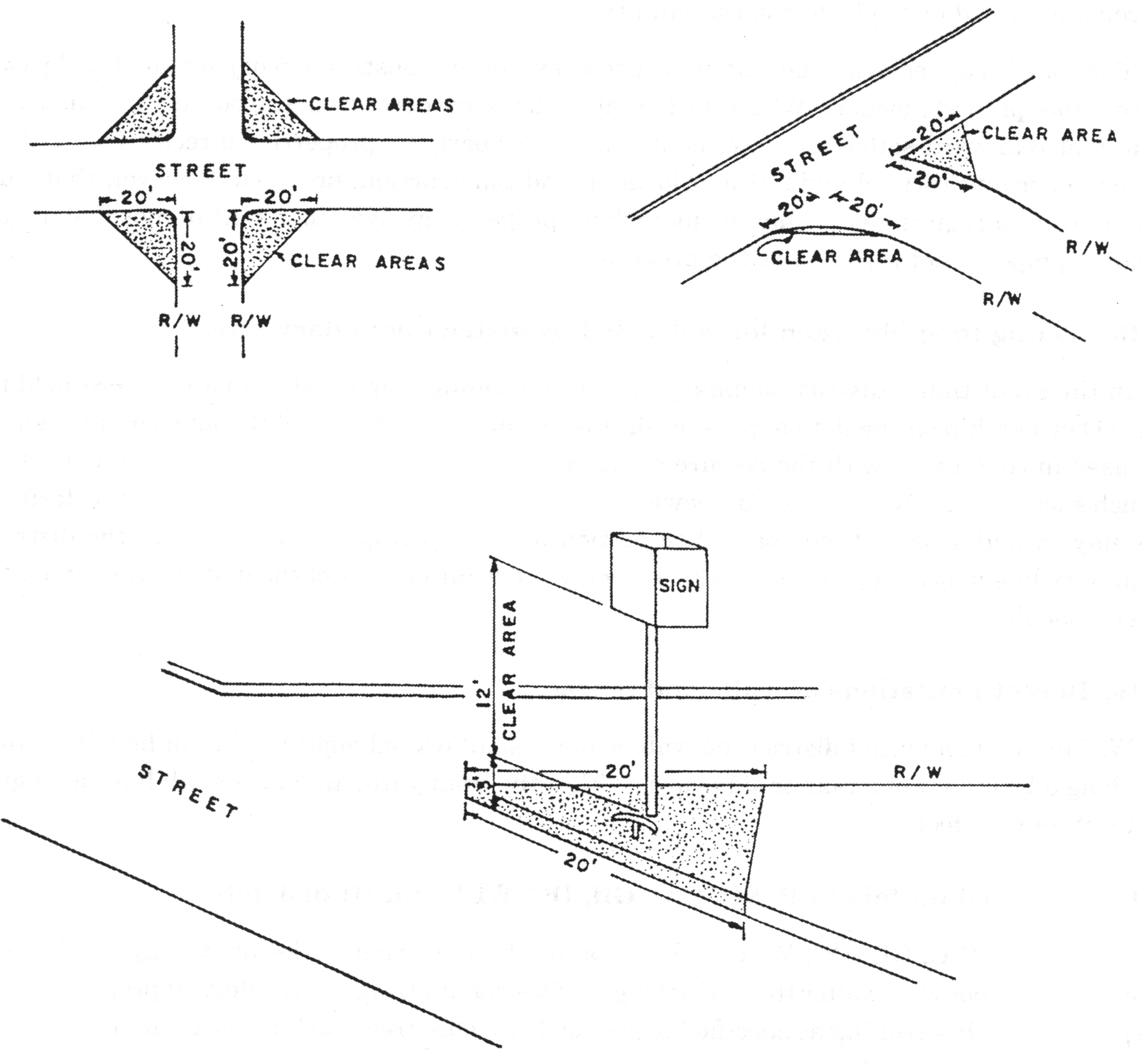
Visibility at Intersections
3-13. - Uses prohibited.
If either a use or class of use is not specifically indicated as being permitted in a district, either as a matter of right, or as a special exception, then such use, class of use, or structures for such uses, shall be prohibited in such district.
3-14. - Fall-out and/or storm shelters.
Fall-out and/or storm shelters are permitted as principal or accessory uses in any district, subject to the yard requirements of the district. Shelters shall be maintained so as not to become a hazard or blight to the community.
The board of appeals may permit, as a special exception, construction of joint shelters by two (2) or more property owners. Where such joint shelters are permitted, the board may waive the side and rear yard setback requirements on the property or properties directly involved in order to permit practical and efficient location and construction; provided, however, that side and rear yard requirements shall be met where property involved in a joint proposal abuts or adjoins property not included in the proposal.
3-15. - Zoning to apply when lot is divided by district boundary line.
In the event that a district boundary line on the zoning map divides a lot of record held in one (1) ownership on the date of passage of this ordinance, each part of the lot so divided shall be used in conformity with the requirements established by this ordinance for the district in which such parcel is located; except, however, that if the property owner of such a lot so desires, he may extend a use allowed on either portion of said lot fifty (50) feet beyond the district boundary line in accordance with setbacks and yard requirements of the district into which he is encroaching.
3-16. - Fences and fencing.
(a)
It shall be unlawful to possess, construct or maintain on private property zoned R-6, R-9, R-15, and/or R-20 any non-decorative fence or gate in any portion of the front yard, as defined in section 2-47 hereinbefore of any property.
(b)
Non-decorative fence shall be defined as: chain link, palisade or privacy board, wire, and/or agricultural wire.
(c)
Agricultural wire fence is prohibited in all areas of residential zones unless screened by decorative fence.
(d)
Non-conforming fences in existence prior to the effective date of this article may remain, but may not be replaced by non-conforming installations.
(e)
No fence or wall in areas zoned residential shall exceed eight (8) feet in height within or along the boundary of a rear or side yard, as defined in section 2-47 hereinbefore.
(f)
No fence or wall in areas zoned residential shall exceed four (4) feet in height within the front yard, as defined in section 2-47 hereinbefore.
(g)
All fence installations require a permit as set forth in section 11 hereinafter.
(h)
Permitting official may require inspection of proposed fence location and graphic representation of proposed fence prior to issuing permit.
(i)
Permitting official may require survey at property owner's expense, to establish that no encroachment of public property occurs.
(j)
Any person who shall violate or authorize or direct another to violate the provisions of this section shall be guilty of a violation of this section and upon conviction thereof shall be punished as prescribed by this Code for the violation of city ordinances. Each day in which such a violation shall continue shall constitute a separate offense and violation.
(Ord. No. 15-1462, § 1, 4-13-15)
3-17. - Required buffers in P, NC, C-C, GB, DC, WLI, and HI districts.
In a P, NC, C-C, GB, DC, WLI, and HI zoning district, where a lot abuts any residential district, a six-foot wide buffer the entire length of the lot abutting the residential property shall be provided with screening as specified in section 3-19. Off-street parking associated with such uses shall be governed by this same provision.
3-18. - Screening of service areas within one hundred fifty feet of public street.
Any service area, loading area, refuse, or storage area between a principal building and a public street being visible from said street and lying within one hundred fifty (150) feet of said street shall be screened from view from the public street as specified in section 3-19.
3-19. - Screening required.
Wherever screening is required by this ordinance, a durable masonry wall, or fence and hedge of sufficient opacity to provide a visual blind, designed to be compatible with the character of adjoining properties, shall be provided and maintained by the owner or his successors and assigns. Such fences and walls shall be at least six (6) feet in height, but no greater than eight (8) feet in height, measured from the ground along the common lot line of the adjoining properties. Hedges or comparable natural plantings shall be of such variety that an average height of at least six (6) feet could be expected by normal growth within no later than three (3) years from the time of planting. The owner/developer shall install the screening prior to issuance of the certificate of occupancy. Occupancy will not be allowed until the screening is completed as a part of the normal development requirements.
3-20. - Side and rear yards not required next to railroad.
Within any nonresidential district, side yards and rear yards shall not be required adjacent to railroad rights-of-way.
3-21. - Substandard lots of record.
Any lot of record existing at the time of the adoption of this ordinance which has an area or a width which is less than that required by this ordinance may be used as a building site for a structure or use permitted in that zone; provided, however, that the same yard, setback, open space, and other dimensional requirements are met that would be required for a standard lot, except as stipulated in section 3-25.
3-22. - Permitted modification of setback requirement.
When a building is proposed on a lot and when on either or both lots which adjoin such lot at the street right-of-way line there exists a principal building which does not conform to the setback requirements of this ordinance, the required setback for such building shall be as follows: (1) where only one (1) said adjoining lot contains a principal building with a nonconforming setback the setback shall be the computed average of (a) the normal setback requirement with (b) the nonconforming setback, or (2) where both adjoining lots contain a principal building each with a nonconforming setback, the minimum setback shall be the computed average of the two (2) nonconforming setbacks.
3-23. - Structures permitted above the height limit.
The height limits of this ordinance shall not apply to a church spire, belfry, cupola, dome, or ornamental tower not intended for human occupancy, monument, water tower, observation tower, transmission tower, chimney, smoke stack, conveyor, flag pole, radio or television tower, mast or aerial, parapet wall not extending more than four (4) feet above the roof line of the building, and necessary mechanical appurtenances.
3-24. - Permitted encroachments of yards and setbacks.
Architectural features such as cornices, eaves, steps, gutters, and fire escapes may project not more than three (3) feet beyond any required setback line, except where such projections would obstruct driveways which are or may be used for access for service and/or emergency vehicles; provided, however, that in the case of automobile service stations, motels, and similar uses which serve the motoring public, canopies shall be allowed over a driveway or walkways within the front yard not to extend from the principal building to a point any closer than fifteen (15) feet from the street right-of-way line.
3-25. - Modification of sideyard requirements.
When a lot of record has a width less than the frontage required in the district in which it is located, then the zoning administrator shall be authorized to reduce the side yard requirements for such lot; provided, however, that there shall not be less than a six-foot side yard.
3-26. - Zoning of annexed area.
Areas annexed to the City of Fitzgerald subsequent to the adoption of this ordinance shall be subject to this ordinance as is all land area currently located in the corporate limits of the city. It is required that the annexation petition be accompanied by the petitioner's request for the city to assign a zoning designation to the property to be annexed and consideration of such property for initial City of Fitzgerald zoning designation shall be subject to the normal amendatory requirements of this ordinance, including the normal public hearing requirements. (See section 13-2.4.)
3-27. - Certain residential uses in certain business districts.
Single-family, duplex and triplex residential uses shall be allowed as a use by right in CC, GB, and DC districts; provided, that only structures existing on the effective date of this ordinance, and as the same may thereafter be maintained, renovated, remodeled or enlarged, may be used for such residential purposes. No new structures for such purposes shall be constructed in such districts.
3-28. - Residential solar electrical systems.
(a)
Definitions.
(1)
Residential solar electrical system: A system consisting of solar panels and related equipment (e.g., heat exchanger, pipes, inverter, wiring, storage) that collects solar radiation and transfers it as heat to a carrier fluid for on-site use in hot water heating or space heating and cooling, or that collects solar energy and converts it into electricity for direct on-site use and transfer of excess electricity to an electric utility grid on located on a sited with a residential zoning designation (R-20, R-15, R-9, R-6, R-6-M, MHP, M-R, etc.). Solar panels and equipment are typically mounted on the roof(s) of principal or accessory structure, but may be mounted on other parts of structures, or on the ground.
(b)
General.
(1)
Residential solar electrical systems are permitted as an accessory use in/on all properties with a residential zoning designation (as set forth hereinbefore) in order to promote clean, sustainable and renewable energy resources. The intent of this section is to establish general guidelines for the location of said residential solar electrical systems and their components, to prevent off-site nuisances including unreasonable visual interference, light glare, and heat which may have a negative effect on the surrounding properties.
(2)
No residential solar electrical system may be installed without first obtaining a building permit for such installation.
(3)
All residential solar electrical systems must comply with all applicable city and state building codes/ordinances, all electrical code requirements, and all applicable industry standards.
(4)
Property owners of residential solar electrical systems are solely responsible for negotiating with other property owners for any desired solar easements to protect/gain access to sunlight. Any such easement must be recorded in the Office of the Clerk of the Superior Court of Ben Hill County, Georgia.
(5)
No portion of any solar electrical system shall be positioned so as to reflect sunlight onto neighboring property, public streets or sidewalks, including onto any neighboring structure.
(6)
All solar panel components of any solar electrical system shall be constructed of non-reflective materials, or shall be treated with an anti-reflective material/coating.
(7)
All solar electrical systems proposed to be connected to the local utility power grid shall adhere to all applicable electrical codes and state statutes.
(8)
All solar electrical systems shall be maintained in good working order.
(c)
Regulation of roof mounted solar electrical systems.
(1)
Roof mounted solar electrical systems may be mounted on principal and accessory structures.
(2)
All applicable setback regulations and requirements apply to roof mounted solar electrical systems.
(3)
Roof mounted installations must be building integrated (part of the actual roof) or flush mounted with the roof unless good cause is shown by the property owner that the angle of the roof is not an appropriate angle to obtain maximum solar exposure. Final determination of such appropriateness shall be in the sole discretion of the city designated building inspector or code enforcement officer. No portion of any installation shall extend beyond the perimeter of the roof eaves.
(4)
No portion of the roof mounted solar electrical system shall extend higher than the peak of a sloped roof or portion thereof or higher than five (5) feet from the top of a flat roof.
(5)
All components of a roof mounted solar electrical system shall be installed in the most inconspicuous location on the roof so as not to be seen from the street, if possible, and remain functional.
(6)
Only building integrated and/or flush mounted solar components may be installed on street facing portions of a primary structure.
(7)
All roof mounted solar electrical system installations shall have a clear perimeter between all components of said system and the roofline to ensure emergency access and egress on the roof and to provide smoke ventilation opportunities.
(d)
Regulation of freestanding solar electrical systems.
(1)
Freestanding solar electrical systems may not be placed in street facing locations.
(2)
All applicable set back regulations and requirements apply to freestanding solar electrical systems.
(3)
All applicable accessory structure regulations and requirements apply to freestanding solar electrical systems.
(4)
No component of a freestanding solar electrical system shall extend more than ten (10) feet above the existing grade.
(5)
All electrical wires and connections on freestanding solar electrical systems shall be located underground.
(6)
All freestanding solar electrical systems visible from a residential property shall require a visual buffer. If the visual buffer utilizes natural vegetation or plantings, such buffer shall be of a size and thickness sufficient to provide visual and lighting barrier between any component of the freestanding solar electrical system and said neighboring residential property within twelve (12) months of installation of the freestanding solar electrical system. All other visual barriers shall be in place at the time of installation. All city rules, regulations, and code apply to said visual barrier.
(Ord. No. 20-1555, § 1, 6-8-20)

