
Flower Mound City Zoning Code
ARTICLE III
- DISTRICT REGULATIONS
DIVISION 3. - A, AGRICULTURAL DISTRICT, CONSERVATION DISTRICT, AND RURAL DEVELOPMENT[3]
Editor's note— Ord. No. 40-02, § 1, adopted July 15, 2002, amended the title of div. 3 to read as set out herein. The former title read "A Agricultural District and Conservation Development".
Cross reference— Animals, ch. 6.
DIVISION 12. - O OFFICE DISTRICT[4]
Cross reference— Businesses, ch. 18.
DIVISION 13. - R-1 RETAIL DISTRICT-1[5]
Cross reference— Businesses, ch. 18.
DIVISION 14. - R-2 RETAIL DISTRICT-2[6]
Cross reference— Businesses, ch. 18.
DIVISION 15. - C-1 COMMERCIAL DISTRICT-1[7]
Cross reference— Businesses, ch. 18.
DIVISION 16. - C-2 COMMERCIAL DISTRICT-2[8]
Cross reference— Businesses, ch. 18.
DIVISION 17. - I-1 INDUSTRIAL DISTRICT-1[9]
Cross reference— Businesses, ch. 18.
DIVISION 18. - I-2 INDUSTRIAL DISTRICT-2[10]
Cross reference— Businesses, ch. 18.
DIVISION 19. - WR WATER RECREATION DISTRICT[11]
Cross reference— Parks and recreation, ch. 54.
DIVISION 20. - REC RECREATIONAL DISTRICT[12]
Cross reference— Parks and recreation, ch. 54.
DIVISION 21. - PD PLANNED DEVELOPMENT DISTRICT[13]
Editor's note— Ord. No. 65-13, § 2, adopted Dec. 16, 2013, amended Div. 21 in its entirety, in effect repealing and reenacting said division to read as set out herein. The former Div. 21, §§ 98-811—98-821, pertained to similar subject matter and derived from ch. 12, § 3.26(a)—(k) of the 1989 Code; Ord. No. 27-99, § 1, adopted April 5, 1999; Ord. No. 75-99, § 2(3.05), adopted Dec. 6, 1999; Ord. No. 14-00, § 9, adopted Feb. 17, 2000; Ord. No. 08-01, § 14, adopted Feb. 5, 2001; Ord. No. 09-01, § 5, adopted Feb. 5, 2001; Ord. No. 48-03, § 8, adopted Aug. 18, 2003; Ord. No. 49-01, § 8, adopted July 16, 2001; Ord. No. 48-03, § 8, adopted Aug. 18, 2003; Ord. No. 76-03, § 21, adopted Nov. 3, 2003; Ord. No. 62-04, § 9, adopted July 19, 2004; Ord. No. 72-05, § 7, adopted Sept. 6, 2005; Ord. No. 02-07, § 15, adopted Jan. 18, 2007; Ord. No. 80-07, § 13, adopted Oct. 1, 2007; Ord. No. 06-12, § 33, adopted Feb. 20, 2012; and Ord. No. 15-13, § 4, adopted April 1, 2013.
Cross reference— Businesses, ch. 18.
DIVISION 22. - CC CAMPUS COMMERCIAL DISTRICT[14]
Cross reference— Businesses, ch. 18.
DIVISION 23. - CI CAMPUS INDUSTRIAL DISTRICT[15]
Cross reference— Businesses, ch. 18.
APPENDIX A - Street Design Standards for Mixed Use
The following street cross sections have been established as meeting the town's standards for mixed use projects:
1. Arterial Boulevard
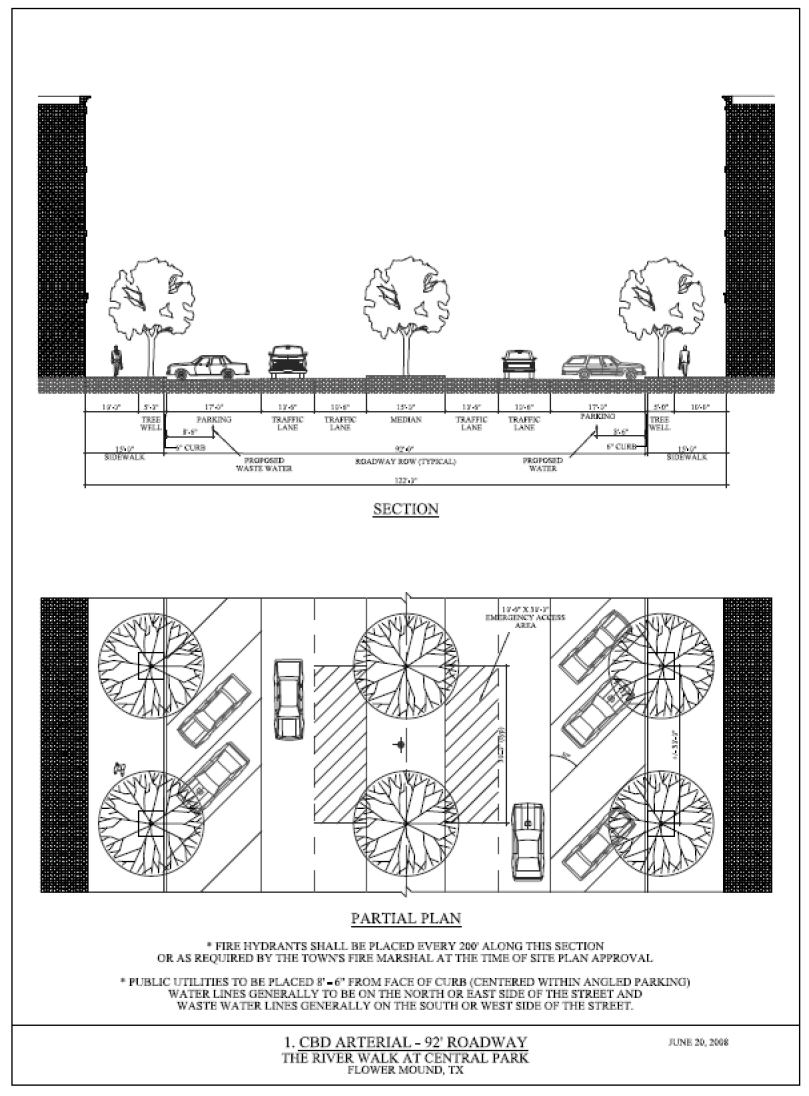
2. Collector 59'
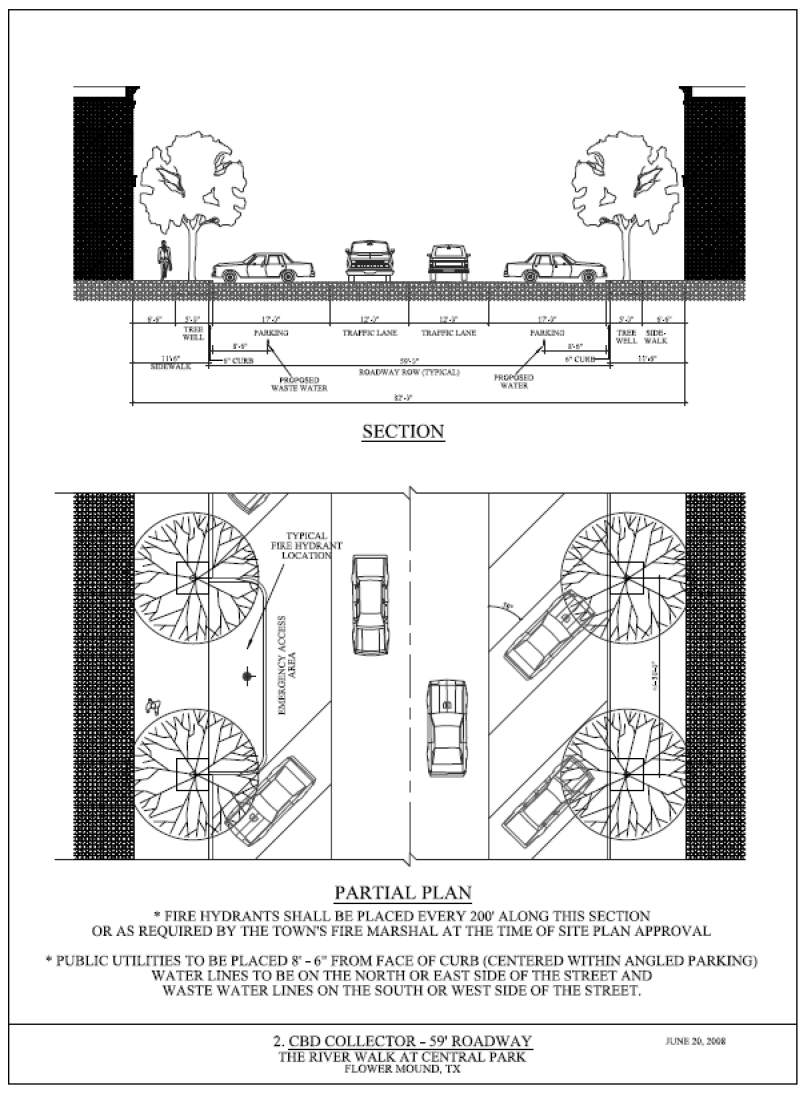
3. Collector 41'
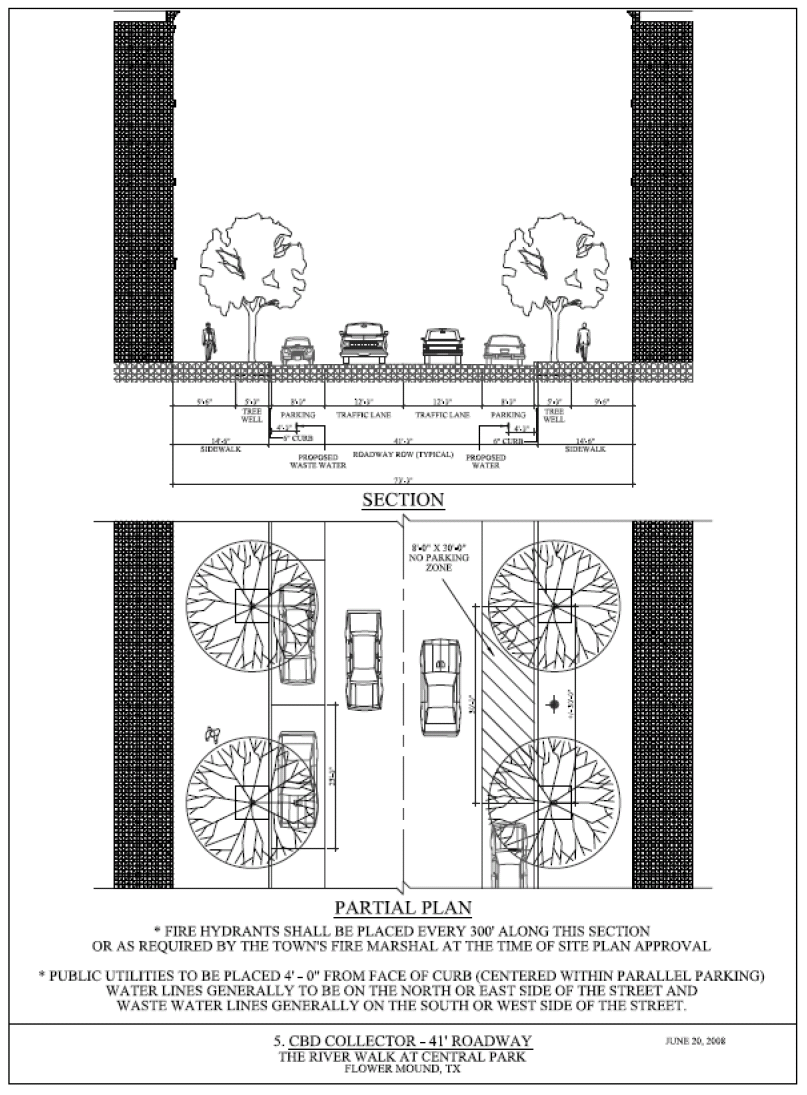
4. Local 37'
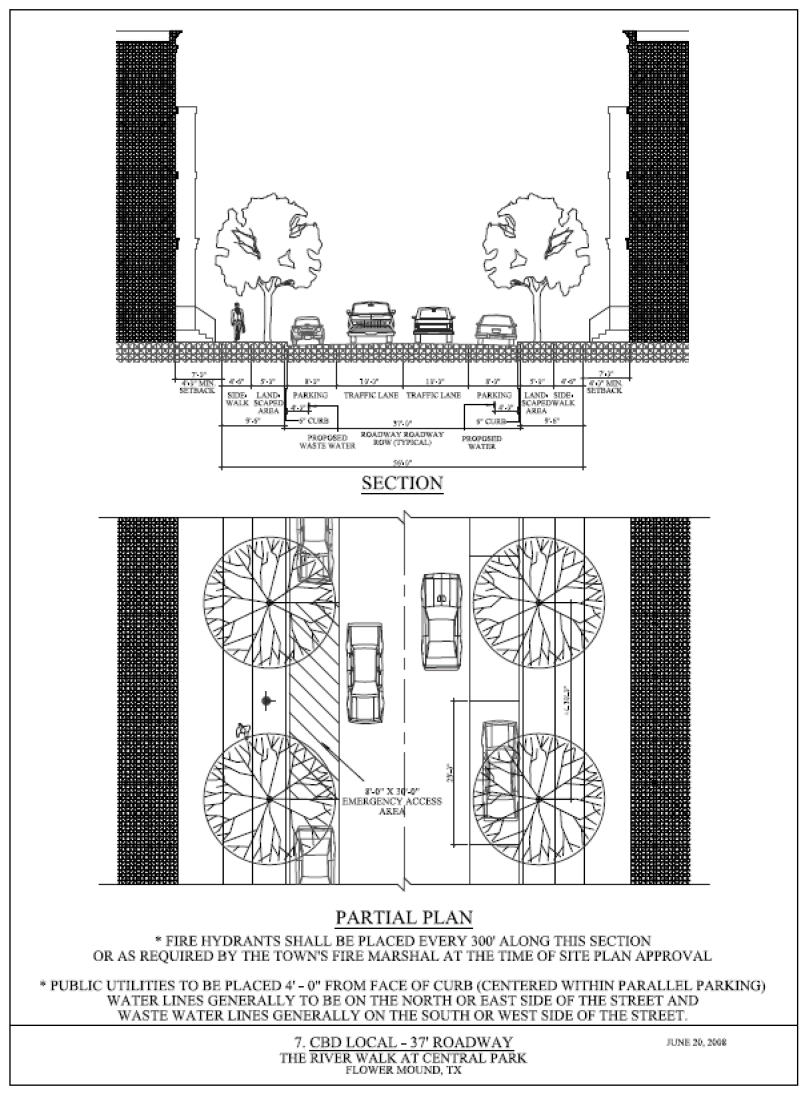
5. Local 30'
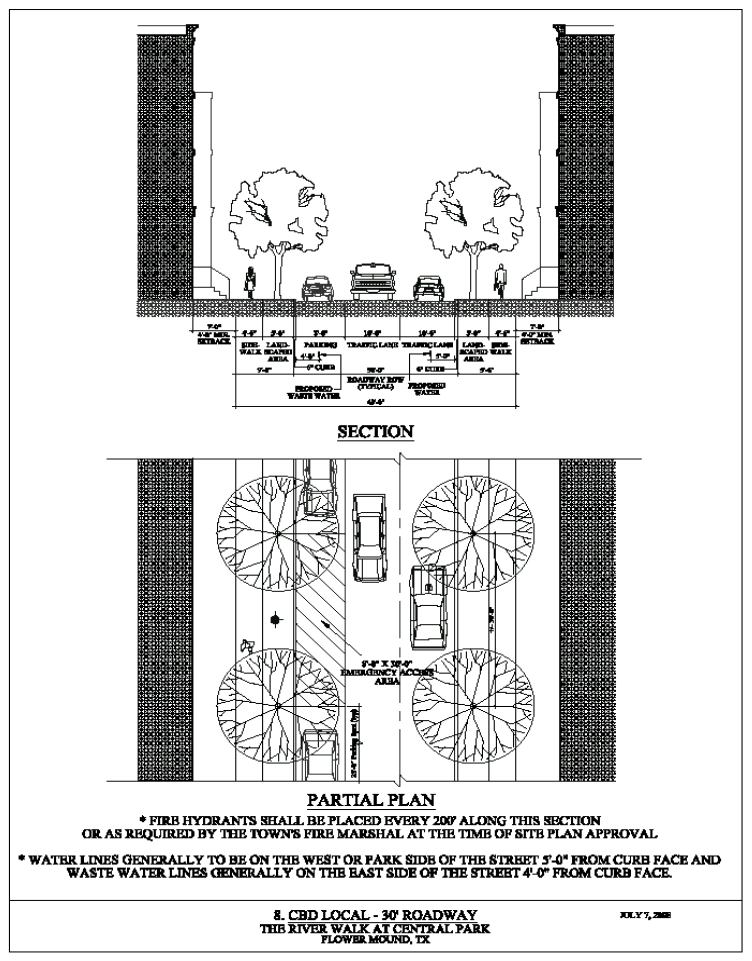
6. Alley
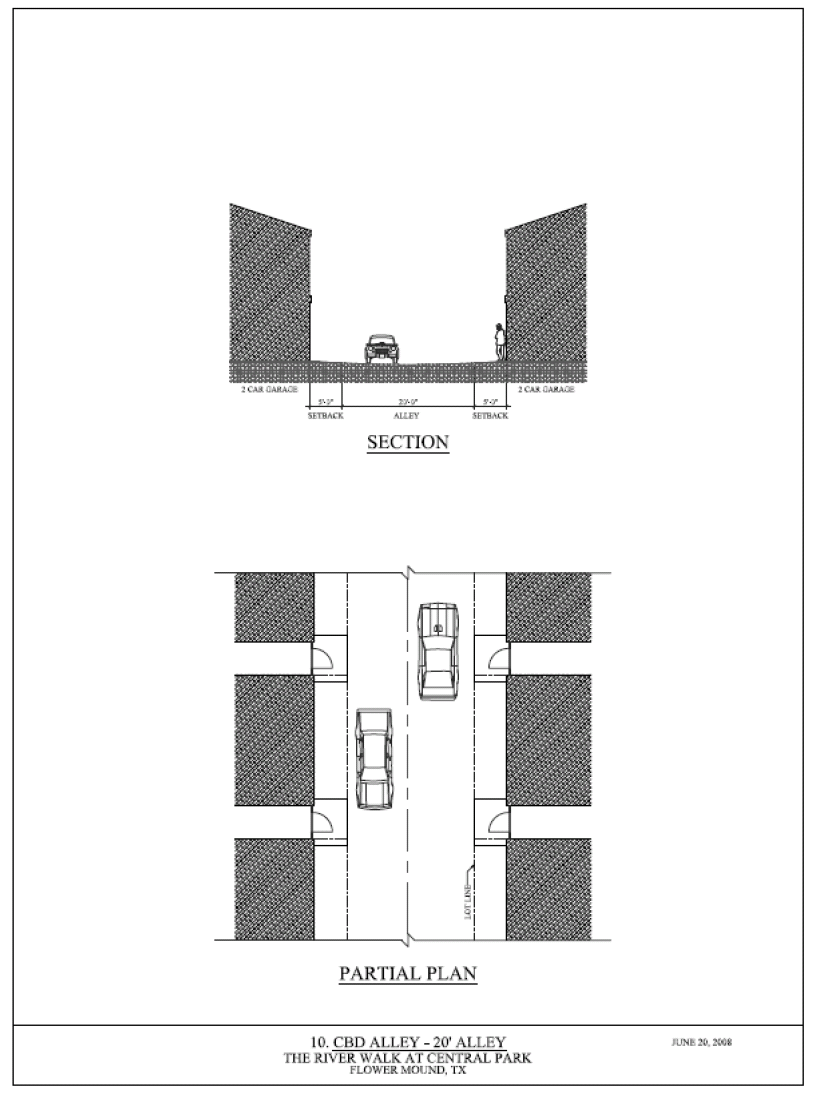
(Ord. No. 62-08, § 2, 10-6-2008)
Sec. 98-231.- Districts established.
In order to implement the comprehensive master plan and the other purposes and provisions of subpart B of this Code, the town is hereby divided into 22 zoning districts. The regulations as set out in this article are uniform throughout each district. The districts established in this article shall be known as:
(Code 1989, ch. 12, § 3.02; Ord. No. 32-00, § 1, 4-3-2000)
Sec. 98-232. - Zoning map.
(a)
Adoption. The boundaries of the zoning districts set out in this article are delineated upon the zoning map of the town. Such map is adopted as a part of this article as fully as if the map were set forth in this section in detail.
(b)
Amendment. No changes or amendments to the district boundaries shown on the official zoning map shall be made except in compliance and conformity with all procedures set forth in article IV of chapter 78 of this Code, comprehensive master plan, zoning map and text amendments. If, in accordance with these procedures, changes or amendments are made to district boundaries, such changes or amendments shall be made promptly after official adoption of the change or amendment as provided for in this article. The town manager shall be responsible for the physical updating and amendment of the official zoning map.
(c)
Replacement. If the official zoning map becomes damaged, destroyed, lost or difficult to interpret because of the nature or number of changes and additions, the town council may adopt a new official zoning map that shall supersede the prior map. The new official zoning map may correct drafting and clerical errors or omissions in the prior official zoning map, but no such corrections shall have the effect of amending this chapter or any subsequent amendment thereto without a duly noticed public hearing as provided in this article. Unless the prior official zoning map has been lost or totally destroyed, the prior map or any significant parts of the map remaining shall be preserved, together with all available records pertaining to its adoption or amendment.
(d)
Interpretation of district boundaries. The district boundary lines shown on the zoning map are usually along streets, alleys, property lines or extensions. Where uncertainty exists as to the boundaries of districts, as shown on the official zoning map, the following rules shall apply:
(1)
Boundaries indicated as approximately following streets, highways or alleys shall be construed to follow the centerline of such street, highway or alley.
(2)
Boundaries indicated as approximately following platted lot lines shall be construed as following such lines.
(3)
Boundaries indicated as approximately following town limits shall be construed as following town limits.
(4)
Boundaries indicated as following railroad lines shall be construed to be the centerline of the right-of-way or, if no centerline is established, the boundary shall be interpreted to be midway between the right-of-way lines.
(5)
Boundaries indicated as following the shoreline of lakes shall be construed to follow such shoreline and in the event of change in the shoreline, shall be construed as moving with the actual shoreline.
(6)
Boundaries indicated as approximately following the centerlines of streams drainageways or other bodies of water shall be construed to follow such centerlines, and, in the event of change in the centerlines of the streams, drainageways or other bodies of water, shall be construed as moving with such centerlines.
(7)
Boundaries indicated as parallel to or extensions of features indicated in subsections (d)(1)—(d)(6) of this section shall be so construed. Distances not specifically indicated on the original zoning map shall be determined from the graphic scale on the map.
(8)
Whenever any street, alley or other public way is vacated by official action of the town council, or whenever street or alley area is franchised for building purposes, the zoning district line adjoining each side of such street, alley or other public way shall be automatically extended to the centerline of such vacated street, alley or way, and all area so involved shall then and henceforth be subject to all regulations of the extended districts.
(9)
Where physical features of the ground are at variance with information shown on the official zoning map, or when there arises a question as to how or whether a parcel of property is zoned, and such question cannot be resolved by the application of subsections (d)(1) through (d)(8) of this section, the property shall be considered as classified IH interim holding district.
(Code 1989, ch. 12, § 3.03)
Sec. 98-233. - Zoning of annexed territory.
All territory hereafter annexed to the town shall be classified as IH interim holding district, until different zoning is established by the town council of the town. The procedure for establishing different zoning on annexed territory shall conform to the procedure established by this chapter for zoning amendments.
(Code 1989, ch. 12, § 3.04; Ord. No. 71-00, § 1, 10-16-2000)
Sec. 98-251.- Purpose and intent.
(a)
The IH interim holding district is to be used as a classification for land that is annexed into the town. The town may initiate proceedings on its own motion rezone or reclassify newly annexed territory with a different zoning classification, as appropriate.
(b)
Land may remain in the IH interim holding district under the conditions of this subsection. In such cases, the use of land shall be permanently restricted to those uses prescribed in this section, until such time as the property is determined to be suitable for development and is zoned to a different zoning classification.
(1)
This IH district may be used as a reserve area in which future growth of the town might occur. It is suitable for areas where development is premature because of a lack of adequate utilities, capacity or service, or where the ultimate land use has not been determined.
(2)
This IH district may be used to protect and provide open space buffers around those areas that are unsuitable for development because of physical constraints, such as flooding, that pose potential health, environmental or safety hazards.
(Code 1989, ch. 12, § 3.07(a))
Sec. 98-252. - Permitted uses.
For the purpose of this section, a tract of record or lot previously existing before annexation into the town and designated as IH interim holding district may be developed in accordance with the provisions of division 3 of article III of this chapter, A agricultural district and conservation development, provided that the tract of record or lot upon which the proposed development is to occur is not required to be subdivided or otherwise altered.
(Ord. No. 71-00, § 5, 10-16-2000)
Sec. 98-271.- Purpose and intent.
The A agricultural district is designed primarily for agricultural uses and for single-family detached development. It is intended for areas designated as "rural residential" land use or within the "Cross Timbers Conservation Development District" area on the land use map of the comprehensive master plan, as amended. In addition to the use and area regulations of this division, development in the A agricultural district must be in compliance with all other applicable provisions of this chapter.
(Code 1989, ch. 12, § 3.08(a); Ord. No. 11-00, § 2, 2-17-2000; Ord. No. 54-22, § 2, 11-7-2022)
Sec. 98-272. - Permitted uses.
The following uses shall be permitted in the A agricultural district, subject to compliance with any applicable conditions and all other provisions of this chapter:
Accessory use, general, subject to section 98-972
Building material yard and construction office, town
College or university
Community center, public
Convent or monastery
Country club, private, subject to section 98-978
Crop agriculture
Day camp for children
Day care home
Dwelling, single-family detached
Fire station/public safety
Food truck, accessory, subject to section 98-991
Fruit and vegetable stand, subject to section 98-981
Garage sale, subject to section 98-982
Golf course, public
Greenhouse, wholesale
Home occupation, subject to section 98-984
Keeping of livestock or poultry, subject to section 98-985
Local utility line
Model home/early release home, subject to section 98-1000
Park or playground, public
Public building, shop or yard
Railroad track
Recreation center, public
Religious assembly/institution or rectory
School, elementary or secondary
Sewage pump station
Small wind energy system (lots five acres or more), subject to section 98-1001
Solar panel systems, subject to section 98-1002
Stadium or playfield, public
Swimming pool, private, subject to section 98-996
Swimming pool, public
Telephone equipment station
Water well, storage or pump station
(Code 1989, ch. 12, § 3.08(b); Ord. No. 11-00, § 2, 2-17-2000; Ord. No. 08-01, § 4, 2-5-2001; Ord. No. 03-11, § 2, 1-21-2011; Ord. No. 17-21, § 8, 4-5-2021; Ord. No. 13-24, § 8, 4-1-2024)
Sec. 98-273. - Specific uses.
The following uses shall be permitted in the A agricultural district only upon approval of a specific use permit by the town council in accordance with the procedures and standards of section 90-186 of this Code, specific use permits:
Accessory dwelling, subject to section 98-983
Airport or landing field
Amusement and recreation (indoors), subject to section 98-973
Amusement and recreation (outdoors)
Animal control facility
Animal exhibition
Boat storage and service
Boutique vendor market, outdoor, subject to section 98-1006
Caretaker or guard residence, subject to section 98-975
Cemetery or mausoleum
Communication tower, commercial, subject to section 98-977
Day care center
Dude ranch
Dump or sanitary landfill area
Electrical energy generating plant
Electrical line/substation, high voltage, subject to section 98-979
Exhibition area or fairgrounds
Farmers' market, subject to section 98-980
Fraternal club or lodge
Golf course, private
Heliport
Helistop
Hospital
Institution, drug or psychiatric treatment
Kennel (In enclosed building only), subject to section 98-986
Kennel (with outside runs or pens), subject to section 98-986
Livestock auction or feed lot
Marina
Mining and quarrying
Museum, library or art gallery, public
Petroleum storage/collection facilities
Private franchise utility (not listed)
Private shop, yard or building
Railroad team track
Rodeo grounds
School, commercial trade
Sewage treatment plant
Small wind energy system (lots less than five acres), subject to section 98-1001
Stable, commercial boarding or rental, subject to section 98-995
Swimming pool, commercial (outdoors)
Transmission pipeline, subject to section 98-997
Veterinary hospital (inside pens), subject to section 98-998
Veterinary hospital (outside pens), subject to section 98-999
(Code 1989, ch. 12, § 3.08(c); Ord. No. 11-00, § 2, 2-17-2000; Ord. No. 08-01, § 4, 2-5-2001; Ord. No. 02-07, § 3, 1-18-2007; Ord. No. 80-07, § 3, 10-1-2007; Ord. No. 05-10, § 3, 1-21-2010; Ord. No. 03-11, § 2, 1-21-2011; Ord. No. 33-11, § 3, 7-18-2011; Ord. No. 17-21, § 8, 4-5-2021)
Sec. 98-274. - Temporary uses.
The following uses shall be permitted in the A agricultural district only upon approval of a temporary use permit in accordance with the procedures and standards of section 78-87 of this Code, temporary use permits:
Asphalt/concrete batch plant, temporary, subject to section 98-974
Carnival or circus, temporary, subject to section 98-976
Field office, temporary
Government office/classroom, temporary, subject to section 98-1005
Sales trailer, temporary, subject to section 98-993
Sales, temporary or seasonal, subject to section 98-992
Temporary special event, subject to section 98-976
(Code 1989, ch. 12, § 3.08(a); Ord. No. 11-00, § 2, 2-17-2000; Ord. No. 76-03, § 3, 11-3-2003; Ord. No. 08-20, § 5, 4-20-2020; Ord. No. 17-21, § 8, 4-5-2021)
Editor's note— Ord. No. 17-21, § 8, adopted April 5, 2021, amended and renumbered former § 98-275 as § 98-274.
Sec. 98-275. - Maximum dimensions.
(a)
Maximum lot coverage. The maximum lot coverage in the A agricultural district shall be 25 percent for all uses, subject to section 98-1029.
(b)
Maximum floor area ratio. There shall be no maximum floor area requirement in the A agricultural district.
(c)
Maximum height. The maximum height of the buildings and the structures in the A agricultural district shall be three stories or 35 feet for all uses, subject to section 98-1031.
(Code 1989, ch. 12, § 3.08(k)—(m); Ord. No. 11-00, § 2, 2-17-2000; Ord. No. 17-21, § 8, 4-5-2021)
Editor's note— Ord. No. 17-21, § 8, adopted April 5, 2021, amended and renumbered former § 98-274 as § 98-275.
Sec. 98-276. - Minimum dimensions.
(a)
Minimum lot area per dwelling. The minimum lot area per dwelling unit for residence uses in the A agricultural district shall be two acres or 87,120 square feet, unless otherwise provided by section 98-277.
(b)
Minimum lot width. The minimum lot width for residential uses in the A agricultural district shall be 200 feet, unless otherwise provided by section 98-277, subject to section 98-1024.
(c)
Minimum floor area per unit. The minimum floor area per dwelling unit in the A agricultural district shall be 1,800 square feet, subject to section 98-1025.
(d)
Minimum front yard. The minimum front yard for all uses in the A agricultural district shall be 40 feet, subject to section 98-1026.
(e)
Minimum side yard. The minimum side yard in the A agricultural district shall be 25 feet for residential uses, and 25 feet for nonresidential uses, subject to section 98-1027.
(f)
Minimum rear yard. The minimum rear yard in the A agricultural district shall be 20 feet, subject to section 98-1028.
(Code 1989, ch. 12, § 3.08(e)—(j); Ord. No. 11-00, § 2, 2-17-2000; Ord. No. 54-22, § 3, 11-7-2022)
Sec. 98-277. - Conservation development option and standards.
(a)
Purpose and definition. The following standards and conditions shall apply to any proposed conservation development in the A agricultural district as part of a planned development application, and its associated uses. The term "conservation development" means a residential development project in which dwelling units are constructed on smaller lots than otherwise permitted by the A agricultural district, for the purpose of preserving open space or natural lands as an integral component of the development.
(b)
Development standards. This subsection describes standards related to lot size, lot width, and project density.
(1)
Project density. The maximum allowable residential density for a conservation development project shall be one unit per two acres.
(2)
Minimum land area per dwelling unit. The minimum land area per dwelling unit for residential uses shall be 0.75 acres or 32,670 square feet.
a.
Lot size variety. No less than 25 percent of the proposed lots in a development must be at least one acre or 43,560 square feet in size.
(3)
Minimum lot width. The minimum lot width for residential uses shall be 150 feet, subject to section 98-1024.
(4)
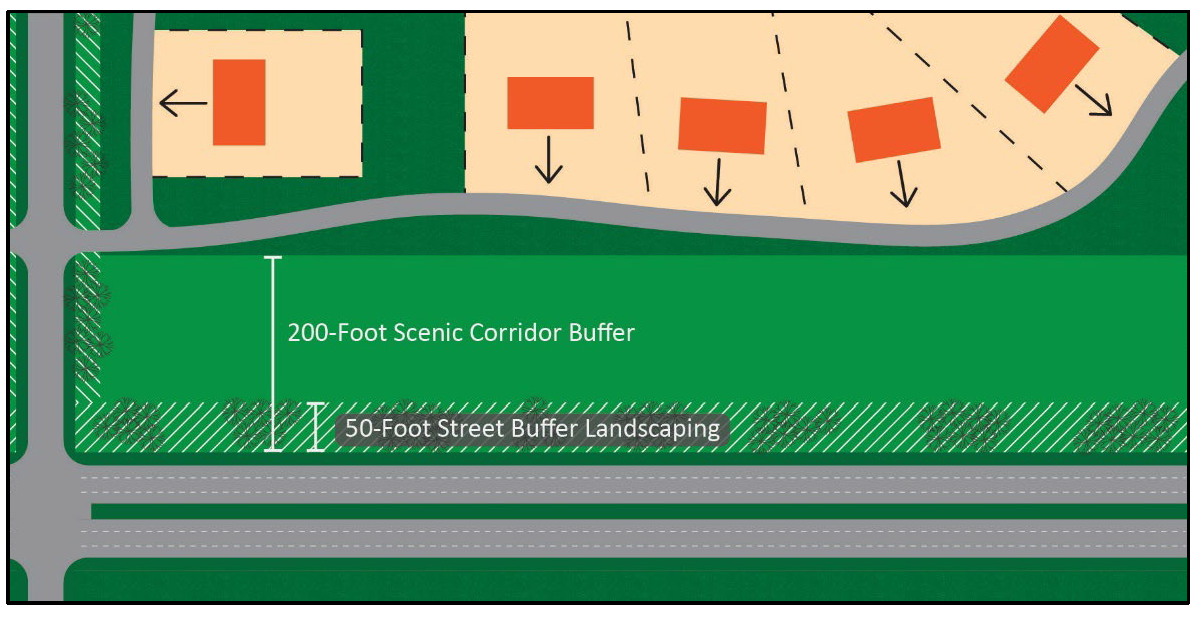
Street buffer yard. Development must comply with sections 82-241 and 94-62.
a.
Trees. The number of trees required must comply with section 82-242; the placement of trees must comply with section 94-62.
(5)
Scenic corridor buffer. A 200-foot scenic corridor buffer is required along the scenic roadway. The required street buffer yard may be used to partially satisfy this requirement.
(6)
Illustration.
(c)
Open space standards. This subsection describes standards for dedication of land for and improvement of public and private open space for conservation development projects.
(1)
Preservation of natural features.
a.
Preservation of the following areas shall be prioritized and counted toward fulfillment of open space requirements.
i.
Development must be designed and sited to preserve and protect the 100-year floodplain, consistent with applicable provisions of this chapter.
ii.
Significant stands of native trees and any other areas of substantial vegetation should be preserved and protected from alteration or destruction. The establishment of new vegetative communities is encouraged.
iii.
All other significant natural features should be preserved and, where necessary, protected by setbacks from development.
b.
Minimum project open space. Applications for a conservation development must propose an appropriate percentage of open space based on the character of natural features of the site. In no instance shall the percentage be less than 45 percent of the gross project area.
c.
Open space dedication. In meeting requirements for open space, the developer must dedicate land or convey open space using one of the following methods.
i.
Conservation easement. Land must be held within a conservation easement by a qualified nonprofit entity or organization that manages open space, such as a land trust, or other qualified entity, pursuant to section 170(h) of the Internal Revenue Code, as amended.
ii.
Homeowners' association. Conserved land conveyed as open space must be platted into an x-lot and be maintained by the homeowner's association.
iii.
Dedicated to governmental entity. Land proposed to be used as parkland must be approved and accepted by the town.
d.
Open space design and improvements. The design and improvements of open space shall be in accordance with the following standards. These standards may be supplemented by administrative guidelines.
i.
For land to be considered open space, the following must be met.
1.
Minimum area. Must be equal to or greater than 15,000 square feet or one percent of the project's gross area, whichever is greater.
2.
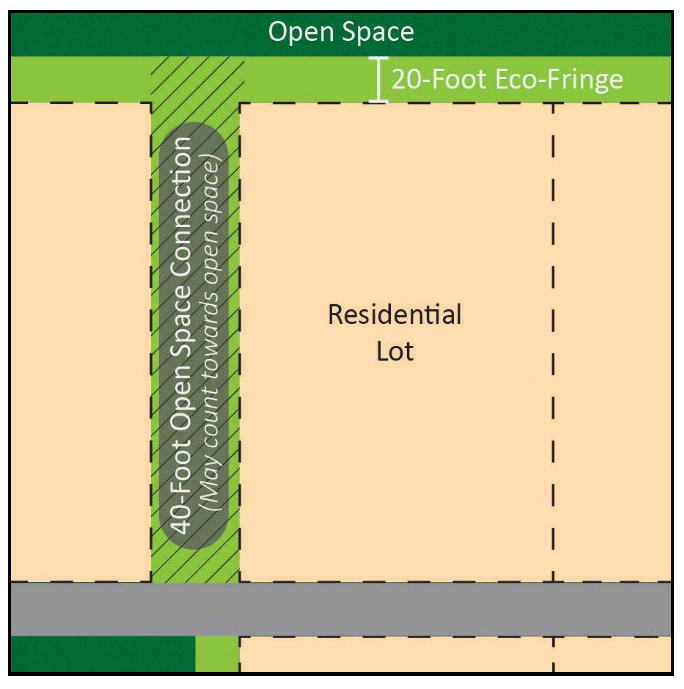
Minimum width. Must not have a width or length less than 40 feet.
3.
Utility easements. Utility easements shall be counted toward open space if a trail and/or appropriate amenity is proposed, or if vegetation within the utility easement is native and not required to be manicured.
ii.
Open spaces in a conservation development must be linked to any existing and planned public open space and conserved areas to provide an overall open space system within the Cross Timbers Conservation Development District.
1.
Eco-fringe buffers, required by subsection f. below, meeting the minimum width standard used to satisfy this requirement may count toward meeting the open space requirement.
2.
Open spaces divided by necessary roadways, as determined by the town manager or their designee, shall be considered linked for the purpose of this subsection.
iii.
Open spaces shall be arranged to maximize reasonable access, equity, and utilization for all residential lots within the proposed development.
e.
Trees. Trees planted within open space areas associated with a conservation development must only include trees denoted as appropriate from section 94-68 of this Code.
f.
Parks. Parks may be proposed and approved as part of a conservation development.
i.
Active parks. Such parks must be limited to an area no greater than the minimum parkland area required by section 90-443.
1.
Permitted parks. Examples of appropriate active parks include fishing piers and neighborhood playgrounds.
2.
Restricted parks. Playing fields, motorized vehicle trails, and campgrounds are not permitted.
ii.
Passive parks. Passive parks such as walking, running, and equestrian trails shall be permitted as identified on the town's master plan, and throughout the development as appropriate. Such trails should be planned to minimize disturbances to environmentally sensitive areas.
g.
Eco-fringe buffer. An eco-fringe buffer extending at least 20 feet from all exterior side and rear residential property lines adjacent to open spaces is required.
i.
The eco-fringe buffer shall not count toward meeting open space requirements, unless otherwise provided by subsection d. above.
ii.
Maintenance for eco-fringe buffers must be documented within the required open space management plan, subject to subsection h. of this section below.
iii.
Illustration.
(d)
Project design.
(1)
The intent of the following regulations is to encourage outstanding project design for conservation development projects. The following standards will be used to evaluate project design:
a.
The arrangement of all uses and improvements should reflect the natural capabilities and limitations of the site, as well as the characteristics and limitations of adjacent property.
b.
Development must be compatible with the immediate environment of the site and neighborhood relative to existing adjacent residential densities unless otherwise buffered in an acceptable manner; scale, bulk, and building height; historical character; and disposition and orientation of buildings on the lot.
c.
Buildings, roadways, open space, and landscaping must be:
i.
Designed and arranged to produce an efficient, functionally organized, and cohesive development;
ii.
In favorable relationship to the existing natural topography, bodies of water, exposure to sunlight and wind, and view corridors; and
iii.
Designed and arranged to maximize the opportunity for privacy by the residents of the project and surrounding areas.
d.
Building sites must be located to minimize their impact on view corridors.
i.
To protect the integrity of the view corridors and the scenic corridor buffer, homes closest to the scenic roadway or a country roadway should face toward either roadway so that the rear side of homes is not visible.
(e)
Outdoor lighting. New residential subdivisions with five or more buildable lots within the Cross Timbers Conservation Development District must comply with the following outdoor lighting standards.
(1)
Applicability. The following standards do not apply to lighting on residential lots.
(2)
New public outdoor lighting, including street lighting, must make use of timers, dimmers, motion sensors, or other adaptive controls, and must be substantially dimmed or extinguished by 11:00 p.m., unless public safety concerns demand otherwise, as determined by town council.
(3)
Lighting for public and private outdoor facilities must be shielded such that no light-emitting part of fixtures is visible from any other property.
(4)
Outdoor lighting fixtures using lamps or bulbs, regardless of the number of bulbs and level of initial lamp lumens, must not exceed 3,000 kelvins and meet the following:
a.
If the initial lamp lumens are equal to or greater than 1,500, the fixture must be fully shielded. No shielding is required for fixtures with initial lamp lumens less than 1,500.
b.
Outdoor lighting fixtures must be sufficiently shielded and aimed such that spillage of light onto adjacent properties is minimized and glare from the light emitting and/or reflecting parts of a luminaire is not visible from an adjacent property.
c.
Sag-lens, drop-lens, searchlights, beacons, laser sources, and mercury vapor fixtures are prohibited.
d.
Outdoor uplighting is prohibited, except in cases where the fixture is shielded by a roof overhang or similar structural shield that will not cause light to extend beyond the structural shield.
(5)
A developer shall only be exempt from subsections 98-277(e)(2) and/or 98-277(e)(4) if the town manager, or their designee, received a signed letter from the utility provider stating no current street light product meets either or both aforementioned lighting standard.
(f)
Subdivision entry and signage. Applications for a conservation development must include design standards for subdivision entries and signage. The design should include elements of wood, stone or rock, and integrate fencing complying with section 98-1143(b).
(1)
Maximum height. Subdivision entries shall not exceed 12 feet in height.
(2)
Maximum sign face. Subdivision entry sign faces shall not exceed 60 square feet.
(3)
Exception. The town council may grant an exception to the subdivision entry and signage standards contained in this subsection, provided that the proposed modification conforms with the vision of the CTCDD area plan.
(g)
Scenic roadway and country roadway fencing. Fencing along the scenic roadway and country roadways must comply with section 98-1143(b).
(h)
Open space management plan. An open space management plan must accompany all zoning applications for a conservation development and be reviewed yearly by the environmental conservation commission. The plan must include the following:
(1)
Conceptual landscaping associated with the applicant's zoning application that complies with the town's concept landscape plan requirements.
(2)
Location, description, and size of all open spaces.
(3)
Location and description of natural features listed in section 90-449(f) as well as any such features identified in the environmentally sensitive area survey required by the town's SMARTGrowth program.
(4)
Location and preliminary design details of all proposed open space amenities.
(5)
A summary of the perpetual maintenance proposed for each open space area, which must be feasible and appropriate.
(6)
Phasing and location of the open space associated with the overall development and the open space associated with, and integral to, specific bona fide agricultural buildings.
(i)
Enhanced public notification. The approval of a planned development application for a conservation development is required to complete the following:
(1)
An initial meeting must be coordinated by the property owner, or their designee, with all interested parties prior to submitting a planned development application.
a.
The property owner or their designee must present plans to adjacent property owners, and homeowner associations of adjacent properties, for comment and input.
(2)
A second meeting with interested parties must be held prior to the planning and zoning commission public hearing to ensure the agenda item will reflect any consensus reached by the group.
(j)
Alternative proposals and variation from requirements. The performance standards for conservation development projects contained in this section are considered to be the minimum standards necessary for approval. It is recognized, however, that project size, location, and design may necessitate a different arrangement or distribution of open space or buffers than are envisioned in the regulations of this section, and that different amenities than those specified in this section may become valuable options. Consequently, an applicant for a conservation development project may submit an alternative proposal with corresponding variations in the standards applicable to such a development, which alternative shall be evaluated and action taken thereon in accordance with the procedures contained in this chapter; provided, however, that the following limitations apply:
(1)
No variations will be granted from the allowed residential densities for conservation development projects.
(2)
The alternative proposal and variations requested shall achieve the same basic objectives as the particular standards that are to be varied.
(3)
Where the proposal seeks to vary project size limitations, the alternative design shall be evaluated in accordance with standards applicable to larger projects.
(k)
Conservation development incentives. Conservation development will be considered for conservation incentives commensurate with the quality and character of the open or natural lands to be placed within a conservation easement or otherwise conserved and the extent to which the conserved land contributes to the preservation of the Cross Timbers Conservation Development District's country character, including its open, natural, scenic, and ecological values.
(1)
Incentives will be considered on a project-by-project basis and will be approved by the town council only after community input and public hearing. Such incentives may include, but are not limited to:
a.
Permit fee waivers,
b.
Up to and including 50 percent reduction in park land dedication requirements.
(l)
The purpose of this criterion is to protect the open lands, natural landscapes and ecological resources that create and define the town's unique community character and that are essential to the accomplishment of community character, quality of life, and economic development objectives.
(Code 1989, ch. 12, § 3.08(n); Ord. No. 11-00, § 2, 2-17-2000; Ord. No. 104-07, § 4, 12-17-2007; Ord. No. 54-22, § 4, 11-7-2022; Ord. No. 13-24, § 8, 4-1-2024)
Sec. 98-278. - Rural development option and standards.
(1)
Purpose and definition. The purpose of this section is to provide for single-family detached development on lots of five acres or greater, which reflects the country atmosphere and natural environment of Flower Mound, as permitted under the existing agricultural zoning. This may include specialized types of development, such as equestrian-oriented developments. To encourage "rural development," incentives may be considered based on the proposed development and the preservation of open space and natural lands within the development. Subdivisions designated for "rural development" and which receive incentives, shall not be subdivided further without approval by the town. The following standards, and all conditions necessary to ensure compliance therewith, shall apply to any rural developments of one (1) five acre lot or more, in any area zoned A, agricultural district, and to all uses in that district, when approved pursuant to the rural development procedures set forth herein.
(2)
Minimum lot area per dwelling unit. The minimum lot area per dwelling unit for a rural development project shall be five acres exclusive of all rights-of-way or easements for streets and alleys; land dedicated for public use; or park land and buffer areas, unless otherwise stated in these regulations.
(3)
Fencing. Perimeter fencing shall be in compliance with the town's urban design plan component of the master plan relative to scenic roads, country roads, rural landscape intersections, and scenic corridors and vistas. Wood stockade and masonry perimeter fencing shall be prohibited.
(4)
Preservation of natural features.
(a)
All significant natural features, as defined in the open space plan and master plan, shall be preserved within the "rural development," where necessary.
(b)
Development shall be designed and sited to preserve and protect the 100-year floodplain, consistent with applicable provisions of this chapter.
(c)
All environmentally sensitive areas as identified by an environmental survey, which areas include upland habitat, riparian habitat, stream buffers, waters of the state, prairie habitat, and developed and undeveloped floodplain, shall be protected by inclusion in an environmental protection plan as required by the land development code.
(5)
Alternative proposals and variation from requirements. The performance standards for rural development projects contained in this section are considered to be the minimum standards necessary for approval. It is recognized, however, that project size, location and design may necessitate a different arrangement and that different amenities than those specified herein may become valuable options. Consequently, an applicant for a rural development project may submit an alternative proposal with corresponding variations in the standards applicable to such a development, which alternative shall be evaluated and action taken thereon in accordance with the procedures contained in this chapter; provided, however, that the following limitations apply:
(a)
No variations will be granted from the allowed minimum lot size for rural development projects.
(b)
The alternative proposal and variations requested shall achieve the same basic objectives as the particular standards.
(c)
Where the proposal seeks to vary project size dimensional standards, the alternative design shall be evaluated in accordance with standards applicable to larger projects.
(6)
Rural development incentives. Rural development will be considered for incentives commensurate with the quality and character of the proposed development as it relates to the preservation of open or natural lands, including its open, natural, scenic and ecological values. Incentives will be considered on a project-by-project basis and will be approved by the town council only after community input and public hearing, except that expedited development review shall be approved administratively. Such incentives may include but are not limited to: expedited development review, permit fee waivers, reduced street infrastructure requirements, as reflected in the town's thoroughfare plan, up to and including 50 percent reduction in park land dedication requirements, and reduction of monetary assessments relative to agricultural rollback taxes. The purpose of this criterion is to preserve the open lands, natural landscapes and ecological resources that create and define Flower Mound's unique community character and which are essential to the accomplishment of community character, quality of life and economic development objectives.
(Ord. No. 40-02, § 2, 7-15-2002)
Sec. 98-301.- Purpose and intent.
The SF-E, single-family estate district is designed primarily for single-family detached development on lots of one acre or larger. It is intended for application in areas designated "estate density" on the land use map of the master plan, as amended, and/or any areas zoned SF-E, single-family estate district. In addition to the use and area regulations of this section, development in the SF-E, single-family estate district shall be in compliance with all other applicable provisions of this chapter.
(Ord. No. 39-02, § 2(3.09(a)), 7-15-2002)
Sec. 98-302. - Permitted uses.
The following uses shall be permitted in the SF-E, single-family estate district, subject to compliance with any applicable conditions and all other provisions of this chapter.
Accessory use, general, subject to section 98-972
Building material yard and construction office, town
Community center, public
Convent or monastery
Country club, private, subject to section 98-978
Crop agriculture
Day care home
Dwelling, single-family detached
Fire station/public safety
Garage sale, subject to section 98-982
Golf course, public
Home occupation, subject to section 98-984
Keeping of livestock or poultry, subject to section 98-985
Local utility line
Model home/early release home, subject to section 98-1000
Park or playground, public
Public building, shop or yard
Railroad track
Recreation center, public
Religious assembly/institution or rectory
School, elementary or secondary
Sewage pump station
Solar panel systems, subject to section 98-1002
Swimming pool, private, subject to section 98-996
Swimming pool, public
Telephone equipment station
Water well, storage or pump station
(Ord. No. 39-02, § 2(3.09(b)), 7-15-2002; Ord. No. 17-21, § 8, 4-5-2021; Ord. No. 13-24, § 8, 4-1-2024)
Sec. 98-303. - Specific uses.
The following uses shall be permitted in the SF-E, single-family estate district only upon approval of a specific use permit by the town council in accordance with the procedures and standards of section 90-186, specific use permits.
Accessory dwelling, subject to section 98-983
Cemetery or mausoleum
College or university
Communication tower, commercial, subject to section 98-977
Day camp for children
Day care center
Electrical line/substation, high voltage, subject to section 98-979
Hospital
Museum, library or art gallery, public
Private franchise utility (not listed)
Stadium or playfield, public
Transmission pipeline, subject to section 98-997
(Ord. No. 39-02, § 2(3.09(c)), 7-15-2002; Ord. No. 17-21, § 8, 4-5-2021)
Sec. 98-304. - Temporary uses.
The following uses shall be permitted in the SF-E, Single-family Estate District only upon approval of a temporary use permit in accordance with the procedures and standards of section 6.14, Temporary use permits.
Asphalt/concrete batch plant, temporary, subject to section 98-974
Field office, temporary
Government office/classroom, temporary, subject to section 98-1005
Sales trailer, temporary, subject to section 98-993
Temporary special event, subject to section 98-976
(Ord. No. 39-02, § 2(3.09(d)), 7-15-2002; Ord. No. 76-04, § 4, 11-3-2003; Ord. No. 08-20, § 5, 4-20-2020; Ord. No. 17-21, § 8, 4-5-2021)
Sec. 98-305. - Minimum dimensions.
(a)
Minimum lot area per dwelling. The minimum lot area per dwelling unit in the SF-E, single-family estate district shall be one acre or 43,560 square feet, subject to section 98-1023.
(b)
Minimum lot width. The minimum lot width for residential uses in the SF-E, single-family estate district shall be 150 feet, subject to section 98-1024.
(c)
Minimum floor area per unit. The minimum floor area per dwelling unit in the SF-E, single-family estate district shall be 2,400 square feet, subject to section 98-1025.
(d)
Minimum front yard. The minimum front yard for all uses in the SF-E, single-family estate district shall be 40 feet, subject to section 98-1026.
(e)
Minimum side yard. The minimum side yard in the SF-E, single-family estate district shall be twenty feet (20') for all uses, subject to section 98-1027.
(f)
Minimum rear yard. The minimum rear yard in the SF-E, single-family estate district shall be 20 feet, subject to section 98-1027.
(Ord. No. 39-02, § 2(3.09(e)—(j)), 7-15-2002)
Sec. 98-306. - Maximum dimensions.
(a)
Maximum lot coverage. The maximum lot coverage in the SF-E, single-family estate district shall be 25 percent for all uses, subject to section 98-129.
(b)
Maximum floor area ratio. There shall be no maximum floor area requirement in the SF-E, single-family estate district.
(c)
Maximum height. The maximum height of buildings and structures in the SF-E, single-family estate district shall be three stories or 35 feet for all uses, subject to section 98-1031.
(Ord. No. 39-02, § 2(3.09(k)—(m)), 7-15-2002)
Sec. 98-307. - Conservation development option and standards.
(1)
Purpose and definition. The provisions of this section implement the goals and policies of the master plan concerning residential densities in areas zoned SF-E, single-family estate district. The following standards, and all conditions necessary to ensure compliance therewith, shall apply to any conservation developments in any areas zoned SF-E, single-family estate district, and to all uses in that district, when approved pursuant to the conservation development procedures set forth herein. "conservation development" means a residential development project in which dwelling units are clustered on smaller lots than otherwise would be allowed within tracts of land zoned SF-E, single-family estate district, for the purpose of preserving open or natural lands as an integral component of the development. Conserved lands shall be placed in a conservation easement. A "conservation easement" is defined as a voluntary and permanent deed restriction that limits the development and/or subdivision of property for the purposes of protecting conservation values in the land. The easement is a recorded restriction, applies to and binds all subsequent owners, and may be held by either (1) a nonprofit entity or organization that manages open space, such as a land trust or other qualified entity, pursuant to section 170(h) of the Internal Revenue Code, as amended, or (2) a governmental entity.
(2)
[Minimum requirements.]
The minimum lot area shall be exclusive of all rights-of-way or easements for streets and alleys; land dedicated for public use; or open space, floodplain, park land and buffer areas, unless otherwise stated in these regulations.
(3)
Open space standards. This subsection describes standards for dedication of land for and improvement of public and private open space for conservation development projects:
(a)
Preservation of natural features.
1.
All significant natural features, as defined in the open space plan and master plan, shall be preserved and, where necessary, protected by setbacks from development.
2.
Development shall be designed and sited to preserve and protect the 100-year floodplain, consistent with applicable provisions of this chapter.
3.
Significant stands of native trees and any other areas of substantial vegetation shall be preserved and protected from alteration or destruction, unless a mitigation plan is approved in conjunction with the concept or development plan for the project, which proposes replacement of the trees or vegetation to be removed with equivalent vegetation or vegetation which is better suited to existing natural conditions. The establishment of new vegetative communities is encouraged.
4.
Preservation of such areas shall be counted toward fulfillment of open space requirements subject to the following limitations:
a.
Floodplain areas. Adjacent floodplain land may be included as project open space in conservation of developments; however, no credits for open space shall be given for land lying in the floodway.
b.
Other areas. Significant stands of vegetation must be incorporated in areas to be dedicated to common open space, so as to prevent fragmentation, in order to be counted toward project open space.
(b)
Open space dedication. In meeting requirements for open space, the developer must dedicate land or convey open space to be held in a conservation easement by (1) a qualified nonprofit entity or organization that manages open space, such as a land trust, or other qualified entity, pursuant to section 170(h) of the Internal Revenue Code, as amended, and as may be approved and accepted by the town or (2) a governmental entity.
(c)
Open space allocation in phased projects. In a phased conservation development project, all open space shall be conserved in a conservation easement in conjunction with the development of the first phase of the project.
(d)
Open space design and improvements. The design and improvements of open space shall be in accordance with the following standards. These standards may be supplemented by administrative guidelines.
1.
Open space areas in a conservation development shall be linked to existing and planned open space or conserved areas to provide an overall open space system wherever possible.
2.
Where feasible, and where compatible with and depending upon the values and uses of the conserved land, open space areas shall be arranged so as to maximize areas and utilization by residents of the conservation development project.
(4)
Project design.
(a)
It is the intent of these regulations to encourage outstanding project design for conservation development projects in order to implement the policies contained in the town's master plan. The town recognizes that project design is an important and variable element in implementing master plan policies relating to conservation developments and overall community objectives. It is the town's intent to promulgate administrative guidelines to illustrate preferred design methods. It is acknowledged that other design alternatives may be superior for a particular project. The following standards will be used to evaluate project design:
1.
The arrangement of all uses and improvements should reflect the natural capabilities and limitations of the site as well as the characteristics and limitations of adjacent property.
2.
Development must be compatible with the immediate environment of the site and neighborhood relative to existing adjacent residential densities unless otherwise buffered in an acceptable manner; scale, bulk and building height; historical character; and disposition and orientation of buildings on the lot.
3.
Buildings, roadways, open space, and landscaping must be designed and arranged to produce an efficient, functionally organized and cohesive development.
4.
Buildings, roadways, open space and landscaping must be in favorable relationship to the existing natural topography, water bodies and water courses, exposure to sunlight and wind, and view corridors and scenic vistas.
5.
Buildings, roadways, open space and landscaping must be designed and arranged to maximize the opportunity for privacy by the residents of the project and surrounding areas.
6.
Building sites must be located to minimize their impact on view corridors and scenic vistas.
(b)
For any conservation development project submitted to the town for approval, a development agreement shall be entered into between the town and the developer of the conservation development project. The development agreement shall set forth specific development standards and other applicable conditions for the conservation development project; however, no development standard or other applicable condition shall be less restrictive than those contained in this subsection of chapter. Said development agreement shall be subject to town council approval and may be filed in the deed records of Denton County, Texas.
(5)
Alternative proposals and variation from requirements. The performance standards for conservation development projects contained in this subsection are considered to be the minimum standards necessary for approval. It is recognized, however, that project size, location and design may necessitate a different arrangement or distribution of open space or buffers than are envisioned in these regulations, and that different amenities than those specified herein may become valuable options. Consequently, an applicant for a conservation development project may submit an alternative proposal with corresponding variations in the standards applicable to such a development, which alternative shall be evaluated and action taken thereon in accordance with the procedures contained in this chapter; provided, however, that the following limitations apply:
(a)
The alternative proposal and variations requested shall achieve the same basic objectives as the particular standards, which are to be varied.
(b)
Where the proposal seeks to vary project size limitations, the alternative design shall be evaluated in accordance with standards applicable to larger projects.
(6)
Conservation development incentives. Conservation development will be considered for conservation incentives commensurate with the quality and character of the open or natural lands to be placed within a conservation easement or otherwise conserved and the extent to which the conserved land contributes to the preservation of open or natural lands, significant stands of native trees and any other areas of substantial vegetation, and scenic and ecological values. Incentives will be considered on a project-by-project basis and will be approved by the town council only after community input and public hearing, except that expedited development review shall be approved administratively. Such incentives may include but are not limited to: expedited development review, permit fee waivers, reduced street infrastructure requirements, as reflected in the town's thoroughfare plan, reduction in park land dedication requirements of not more than the percentage of land set aside for a conservation easement, and reduction of monetary assessments relative to agricultural rollback taxes. The purpose of this criterion is to protect the open lands, natural landscapes and ecological resources that create and define Flower Mound's unique community character and which are essential to the accomplishments of community character, quality of life and economic development objectives.
(7)
No increase in density. No residential application or project shall be approved that increases residential density beyond the density allowed in the master plan.
(Ord. No. 39-02, § 2(3.09(n)(1)—(7)), 7-15-2002)
Sec. 98-331.- Purpose and intent.
The SF-30 single-family district-30 is designed primarily for single-family detached development on lots of about one-third acre or larger. It is intended for application in areas designated "low density" on the land use map of the comprehensive master plan. In addition to the use and area regulations of this division, development in the SF-30 single-family district-30 shall be in compliance with all other applicable provisions of this chapter.
(Code 1989, ch. 12, § 3.10(a))
Sec. 98-332. - Permitted uses.
The following uses shall be permitted in the SF-30 single-family district-30, subject to compliance with any applicable conditions and all other provisions of this chapter.
Accessory use, general, subject to section 98-972
Building material yard and construction office, town
Community center, public
Day care home
Dwelling, single-family detached
Fire station/public safety
Garage sale, subject to section 98-982
Golf course, public
Home occupation, subject to section 98-984
Local utility line
Model home/early release home, subject to section 98-1000
Park or playground, public
Public building, shop or yard
Railroad track
Recreation center, public
Religious assembly/institution or rectory
School, elementary or secondary
Sewage pump station
Solar panel systems, subject to section 98-1002
Swimming pool, private, subject to section 98-996
Swimming pool, public
Telephone equipment station
Water well, storage or pump station
(Code 1989, ch. 12, § 3.10(b); Ord. No. 08-01, § 6, 2-5-2001; Ord. No. 17-21, § 8, 4-5-2021; Ord. No. 13-24, § 8, 4-1-2024)
Sec. 98-333. - Specific uses.
The following uses shall be permitted in the SF-30 single-family district-30 only upon approval of a specific use permit by the town council in accordance with the procedures and standards of section 90-186, specific use permits:
Cemetery or mausoleum
College or university
Communication tower, commercial, subject to 98-977
Convent or monastery
Country club, private, subject to 98-978
Day care center
Electrical line/substation, high voltage, subject to section 98-979
Hospital
Museum, library or art gallery, public
Private franchise utility (not listed)
Stadium or playfield, public
Transmission pipeline, subject to section 98-997
(Code 1989, ch. 12, § 3.10(c))
Sec. 98-334. - Temporary uses.
The following uses shall be permitted in the SF-30 single-family district-30 only upon approval of a temporary use permit in accordance with the procedures and standards of 78-87 of this Code, temporary use permits:
Asphalt/concrete batch plant, temporary, subject to section 98-974
Field office, temporary
Government office/classroom, temporary, subject to section 98-1005
Sales trailer, temporary, subject to section 98-993
Temporary special event, subject to section 98-976
(Code 1989, ch. 12, § 3.10(d); Ord. No. 76-03, § 5, 11-3-2003; Ord. No. 08-20, § 5, 4-20-2020; Ord. No. 17-21, § 8, 4-5-2021)
Sec. 98-335. - Minimum dimensions.
(a)
Minimum lot area per dwelling. The minimum lot area per dwelling unit in the SF-30 single-family district-30 shall be 30,000 square feet, subject to section 98-1023.
(b)
Minimum lot width. The minimum lot width for residential uses in the SF-30 single-family district-30 shall be 100 feet, subject to section 98-1024.
(c)
Minimum floor area per unit. The minimum floor area per dwelling unit in the SF-30 single-family district-30 shall be 2,100 square feet, subject to section 98-1025.
(d)
Minimum front yard. The minimum front yard for all uses in the SF-30 single-family district-30 shall be 25 feet, subject to section 98-1026.
(e)
Minimum side yard. The minimum side yard in the SF-30 single-family district-30 shall be 15 feet for all uses, subject to section 98-1027.
(f)
Minimum rear yard. The minimum rear yard in the SF-30 single-family district-30 shall be 30 feet, subject to section 98-1028.
(Code 1989, ch. 12, § 3.10(e)—(j))
Sec. 98-336. - Maximum dimensions.
(a)
Maximum lot coverage. The maximum lot coverage in the SF-30 single-family district-30 shall be 35 percent for all uses, subject to section 98-1029.
(b)
Maximum floor area ratio. There shall be no maximum floor area requirement in the SF-30 single-family district-30.
(c)
Maximum height. The maximum height of buildings and structures in the SF-30 single-family district-30 shall be three stories or 35 feet for all uses, subject to section 98-1031.
(Code 1989, ch. 12, § 3.10(k)—(m))
Sec. 98-361.- Purpose and intent.
The SF-15 single-family district-15 is designed primarily for single-family detached development on lots of about one-third acre or larger. It is intended for application in areas designated "low density" on the land use map of the comprehensive master plan. In addition to the use and area regulations of this division, development in the SF-15 single-family district-15 shall be in compliance with all other applicable provisions of this chapter.
(Code 1989, ch. 12, § 3.11(a))
Sec. 98-362. - Permitted uses.
The following uses shall be permitted in the SF-15 single-family district-15, subject to compliance with any applicable conditions and all other provisions of this chapter:
Accessory use, general, subject to section 98-972
Building material yard and construction office, town
Community center, public
Day care home
Dwelling, single-family detached
Fire station/public safety
Garage sale, subject to section 98-982
Golf course, public
Home occupation, subject to section 98-984
Local utility line
Model home/early release home, subject to section 98-1000
Park or playground, public
Public building, shop or yard
Railroad track
Recreation center, public
Religious assembly/institution or rectory
School, elementary or secondary
Sewage pump station
Solar panel systems, subject to section 98-1002
Swimming pool, private, subject to section 98-996
Swimming pool, public
Telephone equipment station
Water well, storage or pump station
(Code 1989, ch. 12, § 3.11(b); Ord. No. 08-01, §7, 2-5-2001; Ord. No. 17-21, § 8, 4-5-2021; Ord. No. 13-24, § 8, 4-1-2024)
Sec. 98-363. - Specific uses.
The following uses shall be permitted in the SF-15 single-family district-15 only upon approval of a specific use permit by the town council in accordance with the procedures and standards of section 90-186, specific use permits:
Cemetery or mausoleum
College or university
Communication tower, commercial, subject to 98-977
Convent or monastery
Country club, private, subject to 98-978
Day care center
Electrical line substation, high voltage, subject to section 98-979
Hospital
Museum, library or art gallery, public
Private franchise utility (not listed)
Stadium or playfield, public
Transmission pipeline, subject to section 98-997
(Code 1989, ch. 12, § 3.11(c))
Sec. 98-364. - Temporary uses.
The following uses shall be permitted in the SF-15 single-family district-15 only upon approval of a temporary use permit in accordance with the procedures and standards of 78-87 of this Code, temporary use permits:
Asphalt/concrete batch plant, temporary, subject to section 98-974
Field office, temporary
Government office/classroom, temporary, subject to section 98-1005
Sales trailer, temporary, subject to section 98-993
Temporary special event, subject to section 98-976
(Code 1989, ch. 12, § 3.11(d); Ord. No. 76-03, § 6, 11-3-2003; Ord. No. 08-20, § 5, 4-20-2020; Ord. No. 17-21, § 8, 4-5-2021)
Sec. 98-365. - Minimum and maximum dimensions.
(a)
Minimum lot area per dwelling. The minimum lot area per dwelling unit in the SF-15 single-family district-15 shall be 15,000 square feet, subject to section 98-1023.
(b)
Minimum lot width. The minimum lot width for residential uses in the SF-15 single-family district-15 shall be 80 feet, subject to section 98-1024.
(c)
Minimum floor area per unit. The minimum floor area per dwelling unit in the SF-15 single-family district-15 shall be 1,800 square feet, subject to section 98-1025.
(d)
Minimum front yard. The minimum front yard for all uses in the SF-15 single-family district-15 shall be 25 feet, subject to section 98-1026.
(e)
Minimum side yard. The minimum side yard in the SF-15 single-family district-15 shall be 12 feet for all uses, subject to section 98-1027.
(f)
Minimum rear yard. The minimum rear yard in the SF-15 single-family district-15 shall be 30 feet, subject to section 98-1028.
(g)
Maximum lot coverage. The maximum lot coverage in the SF-15 single-family district-15 shall be 35 percent for all uses, subject to section 98-1029.
(h)
Maximum floor area ratio. There shall be no maximum floor area requirement in the SF-15 single-family district-15.
(i)
Maximum height. The maximum height of buildings and structures in the SF-15 single-family district-15 shall be three stories or 35 feet for all uses, subject to section 98-1031.
(Code 1989, ch. 12, § 3.11(e)—(m))
Sec. 98-391.- Purpose and intent.
The SF-10 single-family district-10 is designed primarily for single-family detached development on lots of one-quarter acre or larger. It is intended for application in areas designated "medium density" on the land use map of the comprehensive master plan. In addition to the use and area regulations of this division, development in the SF-10 single-family district-10 shall be in compliance with all other applicable provisions of this chapter.
(Code 1989, ch. 12, § 3.12(a))
Sec. 98-392. - Permitted uses.
The following uses shall be permitted in the SF-10 single-family district-10, subject to compliance with any applicable conditions and all other provisions of this chapter:
Accessory use, general, subject to section 98-972
Building material yard and construction office, town
Community center, public
Day care home
Dwelling, single-family detached
Fire station/public safety
Garage sale, subject to section 98-982
Golf course, public
Home occupation, subject to section 98-984
Local utility line
Model home/early release home, subject to section 98-1000
Park or playground, public
Public building, shop or yard
Railroad track
Recreation center, public
Religious assembly/institution or rectory
School, elementary or secondary
Sewage pump station
Solar panel systems, subject to section 98-1002
Swimming pool, private, subject to section 98-996
Swimming pool, public
Telephone equipment station
Water well, storage or pump station
(Code 1989, ch. 12, § 3.12(b); Ord. No. 08-01, § 8, 2-5-2001; Ord. No. 17-21, § 8, 4-5-2021; Ord. No. 13-24, § 8, 4-1-2024)
Sec. 98-393. - Specific uses.
The following uses shall be permitted in the SF-10 single-family district-10 only upon approval of a specific use permit by the town council in accordance with the procedures and standards of section 90-186, specific use permits:
Cemetery or mausoleum
College or university
Communication tower, commercial, subject to 98-977
Convent or monastery
Country club, private, subject to 98-978
Day care center
Electrical line/substation, high voltage, subject to section 98-979
Hospital
Museum, library or art gallery, public
Private franchise utility (not listed)
Stadium or playfield, public
Transmission pipeline, subject to section 98-997
(Code 1989, ch. 12, § 3.12(c))
Sec. 98-394. - Temporary uses.
The following uses shall be permitted in the SF-10 single-family district-10 only upon approval of a temporary use permit in accordance with the procedures and standards of 78-87 of this Code, temporary use permits:
Asphalt/concrete batch plant, temporary, subject to section 98-974
Field office, temporary
Government office/classroom, temporary, subject to section 98-1005
Sales trailer, temporary, subject to section 98-993
Temporary special event, subject to section 98-976
(Code 1989, ch. 12, § 3.12(d); Ord. No. 76-03, § 7, 11-3-2003; Ord. No. 08-20, § 5, 4-20-2020; Ord. No. 17-21, § 8, 4-5-2021)
Sec. 98-395. - Minimum and maximum dimensions.
(a)
Minimum lot area per dwelling. The minimum lot area per dwelling unit in the SF-10 single-family district-10 shall be 10,000 square feet, subject to section 98-1023.
(b)
Minimum lot width. The minimum lot width for residential uses in the SF-10 single-family district-10 shall be 70 feet, subject to section 98-1024.
(c)
Minimum floor area per unit. The minimum floor area per dwelling unit in the SF-10 single-family district-10 shall be 1,800 square feet, subject to section 98-1025.
(d)
Minimum front yard. The minimum front yard for all uses in the SF-10 single-family district-10 shall be 25 feet, subject to section 98-1026.
(e)
Minimum side yard. The minimum side yard in the SF-10 single-family district-10 shall be ten feet for all uses, subject to section 98-1027.
(f)
Minimum rear yard. The minimum rear yard in the SF-10 single-family district-10 shall be 25 feet, subject to section 98-1028.
(g)
Maximum lot coverage. The maximum lot coverage in the SF-10 single-family district-10 shall be 40 percent for all uses, subject to section 98-1029.
(h)
Maximum floor area ratio. There shall be no maximum floor area requirement in the SF-10 single-family district-10.
(i)
Maximum height. The maximum height of buildings and structures in the SF-10 single-family district-10 shall be three stories or 35 feet for all uses, subject to section 98-1031.
(Code 1989, ch. 12, § 3.12(e)—(m))
Sec. 98-421.- Purpose and intent.
The SF-A single-family attached district is designed primarily for townhouse development at densities of five dwelling units per net acre or greater. It is intended for application in areas designated "high density" on the land use map of the comprehensive master plan. In addition to the use and area regulations of this division, development in the SF-A single-family attached district shall be in compliance with all other applicable provisions of this chapter.
(Code 1989, ch. 12, § 3.13(a))
Sec. 98-422. - Permitted uses.
The following uses shall be permitted in the SF-A single-family attached district, subject to compliance with any applicable conditions and all other provisions of this chapter:
Accessory use, general, subject to section 98-972
Building material yard and construction office, town
Community center, public
Convent or monastery
Day care home
Dwelling, single-family attached
Fire station/public safety
Garage sale, subject to section 98-982
Golf course, public
Home occupation, subject to section 98-984
Local utility line
Model home/early release home, subject to section 98-1000
Park or playground, public
Public building, shop or yard
Railroad track
Recreation center, public
Religious assembly/institution or rectory
School, elementary or secondary
Sewage pump station
Solar panel systems, subject to section 98-1002
Swimming pool, private, subject to section 98-996
Swimming pool, public
Telephone equipment station
Water well, storage or pump station
(Code 1989, ch. 12, § 3.13(b); Ord. No. 08-01, § 9, 2-5-2001; Ord. No. 17-21, § 8, 4-5-2021; Ord. No. 13-24, § 8, 4-1-2024; Ord. No. 04-26, § 6, 3-2-2026)
Sec. 98-423. - Specific uses.
The following uses shall be permitted in the SF-A single-family attached district only upon approval of a specific use permit by the town council in accordance with the procedures and standards of section 90-186, specific use permits:
Cemetery or mausoleum
College or university
Communication tower, commercial, subject to 98-977
Country club, private, subject to section 98-978
Day care center
Electrical line/substation, high voltage, subject to section 98-979
Hospital
Museum, library or art gallery, public
Private franchise utility (not listed)
Stadium or playfield, public
Transmission pipeline, subject to section 98-997
(Code 1989, ch. 12, § 3.13(c))
Sec. 98-424. - Temporary uses.
The following uses shall be permitted in the SF-A single-family attached district only upon approval of a temporary use permit in accordance with the procedures and standards of 78-87 of this Code, temporary use permits:
Asphalt/concrete batch plant, temporary, subject to section 98-974
Field office, temporary
Government office/classroom, temporary, subject to section 98-1005
Sales trailer, temporary, subject to section 98-993
Temporary special event, subject to section 98-976
(Code 1989, ch. 12, § 3.13(d); Ord. No. 76-03, § 8, 11-3-2003; Ord. No. 08-20, § 5, 4-20-2020; Ord. No. 17-21, § 8, 4-5-2021)
Sec. 98-425. - Minimum and maximum dimensions.
(a)
Minimum lot area per dwelling. The minimum lot area per dwelling unit in the SF-A single-family attached district shall be 5,000 square feet, subject to section 98-1023.
(b)
Minimum lot width. The minimum lot width for residential uses in the SF-A single-family attached district shall be 20 feet, subject to section 98-1024.
(c)
Minimum floor area per unit. The minimum floor area per dwelling unit in the SF-A single-family attached district shall be 1,100 square feet, subject to section 98-1025.
(d)
Minimum front yard. The minimum front yard for all uses in the SF-A single-family attached district shall be 25 feet, subject to section 98-1026.
(e)
Minimum side yard. The minimum side yard in the SF-A single-family attached district shall be as follows, subject to section 98-1027:
(1)
No side yard shall be required for single-family attached dwellings, provided that no building complex shall exceed 300 feet in length and provided that a minimum side yard of five feet shall be provided at the end of building complexes to maintain a minimum ten-foot separation between buildings.
(2)
The minimum side yard for all other uses shall be eight feet.
(f)
Minimum rear yard. The minimum rear yard in the SF-A single-family attached district shall be ten feet for residential uses and 20 feet for nonresidential uses, subject to section 98-1028.
(g)
Maximum lot coverage. The maximum lot coverage in the SF-A single-family attached district shall be 40 percent for all uses, subject to section 98-1029.
(h)
Maximum floor area ratio. There shall be no maximum floor area requirement in the SF-A single-family attached district.
(i)
Maximum height. The maximum height of buildings and structures in the SF-A single-family attached district shall be three stories or 35 feet for all uses, subject to section 98-1031.
(Code 1989, ch. 12, § 3.13(e)—(m))
Sec. 98-431.- Purpose and intent.
The SF-5 single-family residential district is designed primarily for single-family detached development on lots that are a minimum of 5,000 square feet in area. It is intended for areas designated as "high density single-family detached" on the land use map of the comprehensive master plan. In addition to the use and area regulations of this division, development in the SF-5 single-family residential district shall be in compliance with all other applicable provisions of this chapter.
(Ord. No. 17-08, § 2, 2-18-2008; Ord. No. 21-11, § 2, 5-16-2011; Ord. No. 23-12, § 2, 7-17-12; Ord. No. 13-24, § 8, 4-1-2024)
Sec. 98-432. - Permitted uses.
The following uses shall be permitted in the SF-5 single-family district-5, subject to compliance with any applicable conditions and all other provisions of this chapter:
Accessory use, general, subject to section 98-972
Building material yard and construction office, town
Community center, public
Day care home
Dwelling, single-family detached
Fire station/public safety
Garage sale, subject to section 98-982
Golf course, public
Home occupation, subject to section 98-984
Local utility line
Model home/early release home, subject to section 98-1000
Park or playground, public
Public building, shop or yard
Railroad track
Recreation center, public
Religious assembly/institution or rectory
School, elementary or secondary
Sewage pump station
Solar panel systems, subject to section 98-1002
Swimming pool, private, subject to section 98-996
Swimming pool, public
Telephone equipment station
Water well, storage or pump station
(Ord. No. 17-08, § 2, 2-18-2008; Ord. No. 17-21, § 8, 4-5-2021; Ord. No. 13-24, § 8, 4-1-2024)
Sec. 98-433. - Specific uses.
The following uses shall be permitted in the SF-5 single family district-5 only upon approval of a specific use permit by the town council in accordance with the procedures and standards of section 90-186, specific use permits:
Cemetery or mausoleum
College or university
Communication tower, commercial, subject to section 98-977
Convent or monastery
Country club, private, subject to section 98-978
Day care center
Electrical line/substation, high voltage, subject to section 98-979
Museum, library or art gallery, public
Private franchise utility (not listed)
Stadium or playfield, public
Transmission pipeline, subject to section 98-997
(Ord. No. 17-08, § 2, 2-18-2008; Ord. No. 17-21, § 8, 4-5-2021)
Sec. 98-434. - Temporary uses.
The following uses shall be permitted in the SF-5 single family district-5 only upon approval of a temporary use permit in accordance with the procedures and standards of 78-87 of this Code, temporary use permits:
Asphalt/concrete batch plant, temporary, subject to section 98-974
Field office, temporary
Government office/classroom, temporary, subject to section 98-1005
Sales trailer, temporary, subject to section 98-993
Temporary special event, subject to section 98-976
(Ord. No. 17-08, § 2, 2-18-2008; Ord. No. 08-20, § 5, 4-20-2020; Ord. No. 17-21, § 8, 4-5-2021)
Sec. 98-435. - Minimum and maximum dimensions.
(a)
Minimum lot area per dwelling. The minimum lot area per dwelling unit in the SF-5 single family residential district shall be 5,000 square feet, subject to section 98-1023.
(b)
Minimum lot width. The minimum lot width for residential uses in the SF-5 single family residential district shall be 50 feet, subject to section 98-1024.
(c)
Minimum floor area per unit. The minimum floor area per dwelling unit in the SF-5 single family residential district shall be 1,500 square feet, subject to section 98-1025.
(d)
Minimum front yard. The minimum front yard for all uses in the SF-5 single family residential district shall be 20 feet, subject to section 98-1026.
(e)
Minimum side yard. The minimum side yard for residential uses in the SF-5 single family residential district shall be five feet, subject to section 98-1027.
(f)
Minimum rear yard. The minimum rear yard in the SF-5 single family residential district shall be 20 feet, subject to section 98-1028.
(g)
Maximum lot coverage. The maximum lot coverage in the SF-5 single family residential district shall be 55 percent, subject to section 98-1029, except that the 50 percent limitation set forth in section 98-1029(b) does not apply to single family detached dwellings.
(h)
Maximum floor area ratio. There shall be no maximum floor area requirement in the SF-5 single family residential district.
(i)
Maximum height. The maximum height of buildings and structures in the SF-5 single family residential district shall be three stories or 35 feet, subject to section 98-1031.
(Ord. No. 17-08, § 2, 2-18-2008)
Sec. 98-451.- Purpose and intent.
The 2F duplex district is designed primarily for duplex development at densities of five dwelling units per net acre or greater. It is intended for application in areas designated "high density" on the land use map of the comprehensive master plan. In addition to the use and area regulations of this division, development in the 2F duplex district shall be in compliance with all other applicable provisions of this chapter.
(Code 1989, ch. 12, § 3.14(a))
Sec. 98-452. - Permitted uses.
The following uses shall be permitted in the 2F duplex district, subject to compliance with any applicable conditions and all other provisions of this chapter:
Accessory use, general, subject to section 98-972
Building material yard and construction office, town
Community center, public
Convent or monastery
Day care home
Dwelling, duplex
Fire station/public safety
Garage sale, subject to section 98-982
Golf course, public
Home occupation, subject to section 98-984
Local utility line
Model home/early release home, subject to section 98-1000
Park or playground, public
Public building, shop or yard
Railroad track
Recreation center, public
Religious assembly/institution or rectory
School, elementary or secondary
Sewage pump station
Swimming pool, private, subject to section 98-996
Swimming pool, public
Telephone equipment station
Water well, storage or pump station
(Code 1989, ch. 12, § 3.14(b); Ord. No. 08-01, § 10, 2-5-2001; Ord. No. 17-21, § 8, 4-5-2021; Ord. No. 13-24, § 8, 4-1-2024; Ord. No. 04-26, § 6, 3-2-2026)
Sec. 98-453. - Specific uses.
The following uses shall be permitted in the 2F duplex district only upon approval of a specific use permit by the town council in accordance with the procedures and standards of section 90-186, specific use permits:
Cemetery or mausoleum
College or university
Communication tower, commercial, subject to 98-977
Country club, private, subject to 98-978
Day care center
Electrical line/substation, high voltage, subject to section 98-979
Hospital
Museum, library or art gallery, public
Private franchise utility (not listed)
Stadium or playfield, public
Transmission pipeline, subject to section 98-997
(Code 1989, ch. 12, § 3.14(c))
Sec. 98-454. - Temporary uses.
The following uses shall be permitted in the 2F duplex district only upon approval of a temporary use permit in accordance with the procedures and standards of 78-87 of this Code, temporary use permits:
Asphalt/concrete batch plant, temporary, subject to section 98-974
Field office, temporary
Government office/classroom, temporary, subject to section 98-1005
Sales trailer, temporary, subject to section 98-993
Temporary special event, subject to section 98-976
(Code 1989, ch. 12, § 3.14(d); Ord. No. 76-03, § 9, 11-3-2003; Ord. No. 08-20, § 5, 4-20-2020; Ord. No. 17-21, § 8, 4-5-2021)
Sec. 98-455. - Minimum and maximum dimensions.
(a)
Minimum lot area per dwelling. The minimum lot area per dwelling unit in the 2F duplex district shall be 5,000 square feet per duplex dwelling unit, subject to section 98-1023.
(b)
Minimum lot width. The minimum lot width for residential uses in the 2F duplex district shall be 60 feet, subject to section 98-1024.
(c)
Minimum floor area per unit. The minimum floor area per dwelling unit in the 2F duplex district shall be 1,100 square feet, subject to section 98-1025.
(d)
Minimum front yard. The minimum front yard for all uses in the 2F duplex district shall be 25 feet, subject to section 98-1026.
(e)
Minimum side yard. The minimum side yard in the 2F duplex district shall be eight feet for all uses, subject to section 98-1027.
(f)
Minimum rear yard. The minimum rear yard in the 2F duplex district shall be ten feet for residential uses and 20 feet for nonresidential uses, subject to section 98-1028.
(g)
Maximum lot coverage. The maximum lot coverage in the 2F duplex district shall be 40 percent for all uses, subject to section 98-1029.
(h)
Maximum floor area ratio. There shall be no maximum floor area requirement in the 2F duplex district.
(i)
Maximum height. The maximum height of buildings and structures in the 2F duplex district shall be three stories or 35 feet for all uses, subject to section 98-1031.
(Code 1989, ch. 12, § 3.14(e)—(m))
Sec. 98-481.- Purpose and intent.
The MF multifamily district is designed primarily to accommodate multifamily housing types at densities of five dwelling units per net acre or greater. It is intended for application in areas designated "high density" on the land use map of the comprehensive master plan. In addition to the use and area regulations of this division, development in the MF multifamily district shall be in compliance with all other, applicable provisions of this chapter. Rezoning to this classification will not generally be considered unless submitted as a planned development in accordance with section 98-811, et seq. of this Code.
(Code 1989, ch. 12, § 3.15(a); Ord. No. 99-07, § 2, 12-3-2007)
Sec. 98-482. - Permitted uses.
The following uses shall be permitted in the MF multifamily district, subject to compliance with any applicable conditions and all other provisions of this chapter:
Accessory use, general, subject to section 98-972
Boardinghouse or rooming house
Building material yard and construction office, town
Community center, public
Convent or monastery
Day care home
Dwelling, multifamily
Fire station/public safety
Garage sale, subject to section 98-982
Golf course, public
Home occupation, subject to section 98-984
Local utility line
Model home/early release home, subject to section 98-1000
Park or playground, public
Public building, shop or yard
Railroad track
Recreation center, public
Religious assembly/institution or rectory
School, elementary or secondary
Sewage pump station
Swimming pool, private, subject to section 98-996
Swimming pool, public
Telephone equipment station
Water well, storage or pump station
(Code 1989, ch. 12, § 3.15(b); Ord. No. 08-01, § 11, 2-5-2001; Ord. No. 17-21, § 8, 4-5-2021; Ord. No. 13-24, § 8, 4-1-2024; Ord. No. 04-26, § 6, 3-2-2026)
Sec. 98-483. - Specific uses.
The following uses shall be permitted in the MF multifamily district only upon approval of a specific use permit by the town council in accordance with the procedures and standards of section 90-186, specific use permits:
Cemetery or mausoleum
College or university
Communication tower, commercial, subject to 98-977
Country club, private, subject to 98-978
Day care center
Electrical line/substation, high voltage, subject to section 98-979
Hospital
Museum, library or art gallery, public
Nursing or congregate care facility
Private franchise utility (not listed)
Stadium or playfield, public
Transmission pipeline, subject to section 98-997
(Code 1989, ch. 12, § 3.15(c))
Sec. 98-484. - Temporary uses.
The following uses shall be permitted in the MF multifamily district only upon approval of a temporary use permit in accordance with the procedures and standards of 78-87 of this Code, temporary use permits:
Asphalt/concrete batch plant, temporary, subject to section 98-974
Field office, temporary
Government office/classroom, temporary, subject to section 98-1005
Sales trailer, temporary, subject to section 98-993
Temporary special event, subject to section 98-976
(Code 1989, ch. 12, § 3.15(d); Ord. No. 76-03, § 10, 11-3-2003; Ord. No. 08-20, § 5, 4-20-2020; Ord. No. 17-21, § 8, 4-5-2021)
Sec. 98-485. - Minimum and maximum dimensions.
(a)
Minimum lot area per dwelling. The minimum lot area per dwelling unit in the MF multifamily district shall be 2,800 square feet, subject to section 98-1023.
(b)
Minimum lot width. The minimum lot width for residential uses in the MF multifamily district shall be 60 feet, subject to section 98-1024.
(c)
Minimum floor area per unit. The minimum floor area per dwelling unit in the MF multifamily district shall be 700 square feet, subject to section 98-1025.
(d)
Minimum front yard. The minimum front yard for all uses in the MF multifamily district shall be 25 feet, subject to section 98-1026.
(e)
Minimum side yard. The minimum side yard for residential uses in the MF multifamily district shall be as follows, subject to section 98-1027:
(1)
Ten feet for multifamily dwellings; and
(2)
Eight feet for all other uses.
(f)
Minimum rear yard. The minimum rear yard in the MF multifamily district for all uses shall be 20 feet, subject to section 98-1028.
(g)
Maximum lot coverage. The maximum lot coverage in the MF multifamily district shall be 40 percent for all uses, subject to section 98-1029.
(h)
Maximum floor area ratio. There shall be no maximum floor area requirement in the MF multifamily district.
(i)
Maximum height. The maximum height of buildings and structures in the MF multifamily district shall be three stories or 35 feet for all uses, subject to section 98-1031.
(Code 1989, ch. 12, § 3.15(e)—(m); Ord. No. 13-24, § 8, 4-1-2024)
Sec. 98-511.- Purpose and intent.
The MH mobile home district is designed primarily to accommodate mobile home parks and mobile home subdivisions. It is intended for application in areas designated "high density" on the land use map of the comprehensive master plan. In addition to the use and area regulations of this division, development in the MH mobile home district shall be in compliance with all other applicable provisions of this chapter.
(Code 1989, ch. 12, § 3.16(a))
Sec. 98-512. - Permitted uses.
The following uses shall be permitted in the MH mobile home district, subject to compliance with any applicable conditions and all other provisions of this chapter:
Accessory use, general, subject to section 98-972
Building material yard and construction office, town
Community center, public
Convent or monastery
Day care home
Dwelling, mobile home, subject to section 98-987
Fire station/public safety
Garage sale, subject to section 98-982
Golf course, public
Home occupation, subject to section 98-984
Local utility line
Mobile home park, subject to section 98-987
Model home/early release home, subject to section 98-1000
Park or playground, public
Public building, shop or yard
Railroad track
Recreation center, public
Religious assembly/institution or rectory
School, elementary or secondary
Sewage pump station
Swimming pool, private, subject to section 98-996
Swimming pool, public
Telephone equipment station
Water well, storage or pump station
(Code 1989, ch. 12, § 3.16(b); Ord. No. 08-01, § 12, 2-5-2001; Ord. No. 49-01, § 2, 7-16-2001; Ord. No. 17-21, § 8, 4-5-2021; Ord. No. 13-24, § 8, 4-1-2024; Ord. No. 04-26, § 6, 3-2-2026)
Sec. 98-513. - Specific uses.
The following uses shall be permitted in the MH mobile home district only upon approval of a specific use permit by the town council in accordance with the procedures and standards of section 90-186, specific use permits:
Cemetery or mausoleum
College or university
Communication tower, commercial, subject to 98-977
Country club, private, subject to section 98-978
Day care center
Electrical line/substation, high voltage, subject to section 98-979
Hospital
Museum, library or art gallery, public
Private franchise utility (not listed)
Transmission pipeline, subject to section 98-997
(Code 1989, ch. 12, § 3.16(c); Ord. No. 49-01, § 2, 7-16-2001)
Sec. 98-514. - Temporary uses.
The following uses shall be permitted in the MH mobile home district only upon approval of a temporary use permit in accordance with the procedures and standards of 78-87 of this Code, temporary use permits:
Asphalt/concrete batch plant, temporary, subject to section 98-974
Field office, temporary
Government office/classroom, temporary, subject to section 98-1005
Sales trailer, temporary, subject to section 98-993
Temporary special event, subject to section 98-976
(Code 1989, ch. 12, § 3.16(d); Ord. No. 76-03, § 11, 11-3-2003; Ord. No. 08-20, § 5, 4-20-2020; Ord. No. 17-21, § 8, 4-5-2021)
Sec. 98-515. - Minimum and maximum dimensions.
(a)
Minimum lot area per dwelling. The minimum lot area per dwelling unit in the MH mobile home district shall be 7,500 square feet, subject to section 98-1023.
(b)
Minimum lot width. The minimum lot width for residential uses in the MH mobile home district shall be 60 feet, subject to section 98-1024.
(c)
Minimum floor area per unit. There shall be no minimum floor area per dwelling unit requirement in the MH mobile home district.
(d)
Minimum front yard. The minimum front yard for all uses in the MH mobile home district shall be 25 feet, subject to section 98-1026.
(e)
Minimum side yard. The minimum side yard in the MH mobile home district shall be ten feet for mobile home dwellings, with no minimum requirement for nonresidential uses, subject to section 98-1027.
(f)
Minimum rear yard. The minimum rear yard in the MH mobile home district shall be ten feet for residential uses and 20 feet for nonresidential uses, subject to section 98-1028.
(g)
Maximum lot coverage. The maximum lot coverage in the MH mobile home district shall be 30 percent for all uses, subject to section 98-1029.
(h)
Maximum floor area ratio. There shall be no maximum floor area requirement in the MH mobile home district.
(i)
Maximum height. The maximum height of buildings and structures in the MH mobile home district shall be two stories for all uses, subject to section 98-1031.
(Code 1989, ch. 12, § 3.16(e)—(m))
Sec. 98-541.- Purpose and intent.
The O office district is designed primarily to accommodate office and service uses ranging from garden office developments for small professional practices to larger, multistory facilities for large tenants. It is intended for application in areas designated "office" on the land use map of the comprehensive master plan. In addition to the use and area regulations of this division, development in the O office district shall be in compliance with all other applicable provisions of this chapter.
(Code 1989, ch. 12, § 3.17(a))
Sec. 98-542. - Permitted uses.
The following uses shall be permitted in the O office district, subject to compliance with any applicable conditions and all other provisions of this chapter:
Accessory retail/service uses
Accessory use, general, subject to section 98-972
Art supply store
Bank or savings and loan
Book or stationary store or newsstand
Building material yard and construction office, town
Cleaning/laundry shop with pickup station
College or university
Community center, public
Custom personal service
Fire station/public safety
Florist
Golf course, public
Local utility line
Mailing and shipping service
Office, general business and professional
Office, medical and dental
Off-site parking lot, accessory
Off-site parking structure, accessory
Optical sales
Park or playground, public
Parking lot, commercial
Personal improvement services
Public building, shop or yard
Railroad track
Religious assembly/institution or rectory
Restaurant, general
School, business
School, elementary or secondary
Sewage pump station
Solar panel systems, subject to section 98-1002
Swimming pool, public
Telephone equipment station
Travel bureau or consultant
(Code 1989, ch. 12, § 3.17(b); Ord. No. 75-99, § 2(3.05), 12-6-1999; Ord. No. 02-07, § 4, 1-18-2007; Ord. No. 06-12, § 25, 2-20-2012; Ord. No. 17-21, § 8, 4-5-2021; Ord. No. 13-24, § 8, 4-1-2024)
Sec. 98-543. - Specific uses.
The following uses shall be permitted in the O office district only upon approval of a specific use permit by the town council in accordance with the procedures and standards of section 90-186, specific use permits:
Amusement and recreation (indoors), subject to section 98-973
Bus station or terminal
Cemetery or mausoleum
Cleaning/laundry shop with pickup station
Communication tower, commercial, subject to section 98-977
Dancing, drama, or music school or studio
Day care center
Drugstore or pharmacy
Electrical line/substation, high voltage, subject to section 98-979
Extended stay hotel, subject to section 98-1004
Food truck, accessory, subject to section 98-991
Fraternal club or lodge
Health club or athletic club
Helistop
Hospital
Hotel or motel, subject to section 98-1003
Institution, drug or psychiatric treatment
Laboratory, medical and dental
Laboratory, scientific and research
Mortuary or funeral home
Museum, library or art gallery, public
Nursing or congregate care facility
Office, medical and dental extended care
Private franchise utility (not listed)
Studio, television or radio
Theater
Transmission pipeline (98-997)
Veterinary hospital (inside pens), subject to section 98-998
Water well, storage or pump station
(Code 1989, ch. 12, § 3.17(c); Ord. No. 75-99, § 2(3.05), 12-6-1999; Ord. No. 02-07, § 5, 1-18-2007; Ord. No. 80-07, § 4, 10-1-2007; Ord. No. 06-12, § 26, 2-20-2012; Ord. No. 61-19, § 4, 10-7-2019; Ord. No. 17-21, § 8, 4-5-2021; Ord. No. 13-24, § 8, 4-1-2024)
Sec. 98-544. - Temporary uses.
The following uses shall be permitted in the O office district only upon approval of a temporary use permit in accordance with the procedures and standards of 78-87 of this Code, temporary use permits:
Asphalt/concrete batch plant, temporary, subject to section 98-974
Building material yard and construction office
Field office, temporary
Government office/classroom, temporary, subject to section 98-1005
Sales, temporary or seasonal, subject to section 98-992
Temporary special event, subject to section 98-976
(Code 1989, ch. 12, § 3.17(d); Ord. No. 76-03, § 12, 11-3-2003; Ord. No. 08-20, § 5, 4-20-2020; Ord. No. 17-21, § 8, 4-5-2021)
Sec. 98-545. - Minimum and maximum dimensions.
(a)
Minimum lot area per dwelling. There shall be no minimum lot area per dwelling unit requirement in the O office district.
(b)
Minimum lot width. There shall be no minimum lot width requirement in the O office district.
(c)
Minimum floor area per unit. There shall be no minimum floor area per dwelling unit requirement in the O office district.
(d)
Minimum front yard. There shall be no minimum front yard requirement in the O office district, subject to section 98-1026.
(e)
Minimum side yard. There shall be no minimum side yard requirement in the O office district, subject to section 98-1027.
(f)
Minimum rear yard. The minimum rear yard in the O office district shall be 15 feet for all uses, subject to section 98-1028.
(g)
Maximum lot coverage. The maximum lot coverage in the O office district shall be 50 percent for all uses, subject to section 98-1029.
(h)
Maximum floor area ratio. The maximum floor area ratio for all uses in the O office district shall be 1:1.
(i)
Maximum height. The maximum height of buildings and structures in the O office district shall be three stories or 35 feet for all uses, subject to section 98-1031.
(Code 1989, ch. 12, § 3.17(e)—(m))
Sec. 98-571.- Purpose and intent.
The R-1 retail district-1 is designed primarily to accommodate neighborhood oriented business; uses. It is intended for application in areas designated "retail" on the land use map of the comprehensive master plan. In addition to the use and area regulations of this division, development in the R-1 retail district-1 shall be in compliance with all other applicable provisions of this chapter.
(Code 1989, ch. 12, § 3.18(a))
Sec. 98-572. - Permitted uses.
The following uses shall be permitted in the R-1 retail district-1, subject to compliance with any applicable conditions and all other provisions of this chapter:
Accessory retail/service uses
Accessory use, general, subject to section 98-972
Alcoholic beverage establishment, subject to section 98-1009
Antique shop
Art gallery or handicraft sales
Art supply store
Bakery or confectionery shop, retail
Bank or savings and loan
Book or stationary store or newsstand
Boutique vendor market, indoor, subject to section 98-1006
Building material yard and construction office, town
Cleaning/laundry shop with pickup station
Community center, public
Custom personal service
Dancing, drama, or music school or studio
Drugstore or pharmacy
Fire station/public safety
Florist
Laboratory, medical and dental
Laundry, self-service
Local utility line
Mailing and shipping service
Office, general business and professional
Office, medical and dental
Off-site parking lot, accessory
Off-site parking structure, accessory
Optical sales
Park or playground, public
Parking lot, commercial
Personal improvement services
Public building, shop or yard
Railroad track
Religious assembly/institution or rectory
Restaurant, general
Retail general (indoors)
Retail, large tenant (between 25,000 and 49,999 square feet), existing construction, subject to section 98-1010
Sewage pump station
Solar panel systems, subject to section 98-1002
Swimming pool, public
Telephone equipment station
Travel bureau or consultant
(Code 1989, ch. 12, § 3.18(b); Ord. No. 14-00, § 3, 2-17-2000; Ord. No. 75-99, § 2(3.05), 12-6-1999; Ord. No. 02-07, § 6, 1-18-2007; Ord. No. 17-21, § 8, 4-5-2021; Ord. No. 13-24, § 8, 4-1-2024)
Sec. 98-573. - Specific uses.
The following uses shall be permitted in the R-1 retail district-1 only upon approval of a specific use permit by the town council in accordance with the procedures and standards of section 90-186, specific use permits:
Alcoholic beverage establishment with production area greater than 6,000 square feet, subject to section 98-1009
Amusement and recreation (indoors), subject to section 98-973
Assembly hall
Boutique vendor market, outdoor, subject to section 98-1006
Cemetery or mausoleum
Cleaning/laundry shop with onsite plant
Communication tower, commercial, subject to section 98-977
Day care center
Electrical line/substation, high voltage, subject to section 98-979
Food truck, accessory, subject to section 98-991
Health club or athletic club
Hospital
Laboratory, scientific and research
Mortuary or funeral home
Museum, library or art gallery, public
Office, medical and dental extended care
Private franchise utility (not listed)
Restaurant, fast food
Retail, large tenant (between 25,000 and 49,999 square feet), new construction, subject to section 98-1010
Secondhand store
Transmission pipeline, subject to section 98-997
Veterinary hospital (inside pens), subject to section 98-998
Water well, storage or pump station
(Code 1989, ch. 12, § 3.18(c); Ord. No. 14-00, § 3, 2-17-2000; Ord. No. 49-01, § 3, 7-16-2001; Ord. No. 48-03, § 4, 8-18-2003; Ord. No. 75-99, § 2(3.05), 12-6-1999; Ord. No. 02-07, § 7, 1-18-2007; Ord. No. 80-07, § 5, 10-1-2007; Ord. No. 06-12, § 27, 2-20-2012; Ord. No. 17-21, § 8, 4-5-2021; Ord. No. 13-24, § 8, 4-1-2024)
Sec. 98-574. - Temporary uses.
The following uses shall be permitted in the R-1 retail district-1 only upon approval of a temporary use permit in accordance with the procedures and standards of 78-87 of this Code, temporary use permits:
Asphalt/concrete batch plant, temporary, subject to section 98-974
Building material yard and construction office
Carnival or circus, temporary, subject to section 98-976
Field office, temporary
Government office/classroom, temporary, subject to section 98-1005
Refreshment stand, subject to section 98-991
Sales, temporary or seasonal, subject to section 98-992
Temporary special event, subject to section 98-976
(Code 1989, ch. 12, § 3.18(d); Ord. No. 76-03, § 13, 11-3-2003; Ord. No. 08-20, § 5, 4-20-2020; Ord. No. 17-21, § 8, 4-5-2021)
Sec. 98-575. - Minimum and maximum dimensions.
(a)
Minimum lot area per dwelling. There shall be no minimum lot area per dwelling unit requirement in the R-1 retail district-1.
(b)
Minimum lot width. There shall be no minimum lot width requirement in the R-1 retail district-1.
(c)
Minimum floor area per unit. There shall be no minimum floor area per dwelling unit requirement in the R-1 retail district-1.
(d)
Minimum front yard. There shall be no minimum front yard requirement in the R-1 retail district-1, subject to section 98-1026.
(e)
Minimum side yard. There shall be no minimum side yard requirement in the R-1 retail district-1, subject to section 98-1027.
(f)
Minimum rear yard. The minimum rear yard in the R-1 retail district-1 shall be 15 feet for all uses, subject to section 98-1028.
(g)
Maximum lot coverage. The maximum lot coverage in the R-1 retail district-1 shall be 50 percent for all uses, subject to section 98-1029.
(h)
Maximum floor area ratio. There shall be no maximum floor area ratio requirement in the R-1 retail district-1.
(i)
Maximum height. The maximum height of buildings and structures in the R-1 retail district-1 shall be two stories or 35 feet for all uses, subject to section 98-1031.
(Code 1989, ch. 12, § 3.18(e)—(m); Ord. No. 14-00, § 3, 2-17-2000)
Sec. 98-601.- Purpose and intent.
The R-2 retail district-2 is designed primarily to accommodate neighborhood and community oriented business uses. It is intended for application in areas designated "retail" on the land use map of the comprehensive master plan. In addition to the use and area regulations of this division, development in the R-2 retail district-2 shall be in compliance with all other applicable provisions of this chapter.
(Code 1989, ch. 12, § 3.19(a))
Sec. 98-602. - Permitted uses.
The following uses shall be permitted in the R-2 retail district-2, subject to compliance with any applicable conditions and all other provisions of this chapter:
Accessory retail/service uses
Accessory use, general, subject to section 98-972
Alcoholic beverage establishment, subject to section 98-1009
Antique shop
Art gallery or handicraft sales
Art supply store
Auto parts and accessory sales (indoors)
Bait and sporting goods sales
Bakery or confectionery shop, retail
Bank or savings and loan
Book or stationary store or newsstand
Boutique vendor market, indoor, subject to section 98-1006
Building material yard and construction office, town
Cleaning/laundry shop with pickup station
College or university
Community center, public
Convenience store
Custom personal service
Dancing, drama, or music school or studio
Drugstore or pharmacy
Fire station/public safety
Florist
Food truck, accessory, subject to section 98-991
Fraternal club or lodge
Hardware store
Health club or athletic club
Laboratory, medical and dental
Laboratory, scientific and research
Laundry, self-service
Local utility line
Mailing and shipping service
Mortuary or funeral home
Office, general business and professional
Office, medical and dental
Off-site parking lot, accessory
Off-site parking structure, accessory
Optical sales
Park or playground, public
Parking lot, commercial
Personal improvement services
Pet store, subject to section 98-988
Plant nursery or garden shop
Public building, shop or yard
Railroad track
Religious assembly/institution or rectory
Repair services, limited
Restaurant, fast food
Restaurant, general
Retail general (indoors)
Retail, large tenant (between 25,000 and 49,999 square feet), existing construction, subject to section 98-1010
Retail, large tenant (between 50,000 and 74,999 square feet), existing construction, subject to section 98-1010
Secondhand store
Sewage pump station
Solar panel systems, subject to section 98-1002
Telephone equipment station
Theater
Travel bureau or consultant
(Code 1989, ch. 12, § 3.19(b); Ord. No. 14-00, § 4, 2-17-2000; Ord. No. 50-00, § 2(3.19(b)), 7-17-2000; Ord. No. 75-99, § 2(3.05), 12-6-1999; Ord. No. 02-07, § 8, 1-18-2007; Ord. No. 06-12, § 28, 2-20-2012; Ord. No. 17-21, § 8, 4-5-2021; Ord. No. 13-24, § 8, 4-1-2024)
Sec. 98-603. - Specific uses.
The following uses shall be permitted in the R-2 retail district-2 only upon approval of a specific use permit by the town council in accordance with the procedures and standards of section 90-186, specific use permits:
Alcoholic beverage establishment with production area greater than 6,000 square feet, subject to section 98-1009
Amusement and recreation (indoors), subject to section 98-973
Animal control facility
Assembly hall
Auto service center
Boutique vendor market, outdoor, subject to section 98-1006
Car wash, automatic
Car wash, full service
Car wash, self-service
Cemetery or mausoleum
Cleaning/laundry shop with onsite plant
Communication tower, commercial, subject to section 98-977
Convenience store with gasoline sales
Day care center
Electrical line/substation, high voltage, subject to section 98-979
Hospital
Hotel or motel, subject to section 98-1003
Kennel (In enclosed building only), subject to section 98-986
Motor vehicle fuel service station
Museum, library or art gallery, public
Office, medical and dental extended care
Private franchise utility (not listed)
Retail, large tenant (between 25,000 and 49,999 square feet), new construction, subject to section 98-1010
Retail, large tenant (between 50,000 and 74,999 square feet), new construction, subject to section 98-1010
Swimming pool, public
Transmission pipeline, subject to section 98-997
Veterinary hospital (inside pens), subject to section 98-998
Water well, storage or pump station
(Code 1989, ch. 12, § 3.19(c); Ord. No. 27-99, § 1, 4-5-1999; Ord. No. 14-00, § 4, 2-17-2000; Ord. No. 50-00, § 2(3.19(c)), 7-17-2000; Ord. No. 48-03, § 5, 8-18-2003; Ord. No. 72-05, § 3, 9-6-2005; Ord. No. 75-99, § 2(3.05), 12-6-1999; Ord. No. 02-07, § 9, 1-18-2007; Ord. No. 80-07, § 6, 10-1-2007; Ord. No. 17-21, § 8, 4-5-2021; Ord. No. 13-24, § 8, 4-1-2024)
Sec. 98-604. - Temporary uses.
The following uses shall be permitted in the R-2 retail district-2 only upon approval of a temporary use permit in accordance with the procedures and standards of 78-87 of this Code, temporary use permits:
Asphalt/concrete batch plant, temporary, subject to section 98-974
Building material yard and construction office
Carnival or circus, temporary, subject to section 98-976
Field office, temporary
Government office/classroom, temporary, subject to section 98-1005
Refreshment stand, subject to section 98-991
Sales, temporary or seasonal, subject to section 98-992
Temporary special event, subject to section 98-976
(Code 1989, ch. 12, § 3.19(d); Ord. No. 76-03, § 14, 11-3-2003; Ord. No. 08-20, § 5, 4-20-2020; Ord. No. 17-21, § 8, 4-5-2021)
Sec. 98-605. - Minimum and maximum dimensions.
(a)
Minimum lot area per dwelling. There shall be no minimum lot area per dwelling unit requirement in the R-2 retail district-2.
(b)
Minimum lot width. There shall be no minimum lot width requirement in the R-2 retail district-2.
(c)
Minimum floor area per unit. There shall be no minimum floor area per dwelling unit requirement in the R-2 retail district-2.
(d)
Minimum front yard. There shall be no minimum front yard requirement in the R-2 retail district-2, subject to section 98-1026.
(e)
Minimum side yard. There shall be no minimum side yard requirement in the R-2 retail district-2, subject to section 98-1027.
(f)
Minimum rear yard. The minimum rear yard in the R-2 retail district-2 shall be 15 feet for all uses, subject to section 98-1028.
(g)
Maximum lot coverage. The maximum lot coverage in the R-2 retail district-2 shall be 50 percent for all uses, subject to section 98-1029.
(h)
Maximum floor area ratio. There shall be no maximum floor area ratio requirement in the R-2 retail district-2.
(i)
Maximum height. The maximum height of buildings and structures in the R-2 retail district-2 shall be two stories or 35 feet for all uses, subject to section 98-1031.
(Code 1989, ch. 12, § 3.19(e)—(m); Ord. No. 14-00, § 4, 2-17-2000)
Sec. 98-631.- Purpose and intent.
The C-1 commercial district-1 is designed primarily to accommodate a wide variety of office and retail uses, as well as some repair/service and light industrial uses, including highway-oriented businesses. It is intended for application in areas designated "retail" and "commercial/industrial" on the land use map of the comprehensive master plan. In addition to the use and area regulations of this division, development in the C-1 commercial district-1 shall be in compliance with all other applicable provisions of this chapter.
(Code 1989, ch. 12, § 3.20(a))
Sec. 98-632. - Permitted uses.
The following uses shall be permitted in the C-1 commercial district-1, subject to compliance with any applicable conditions and all other provisions of this chapter:
Accessory retail/service uses
Accessory use, general, subject to section 98-972
Alcoholic beverage establishment, subject to section 98-1009
Animal control facility
Antique shop
Art gallery or handicraft sales
Art supply store
Auto parts and accessory sales (indoors)
Bait and sporting goods sales
Bakery or confectionery shop, retail
Bank or savings and loan
Book or stationary store or newsstand
Boutique vendor market, indoor, subject to section 98-1006
Building material yard and construction office, town
Cabinet and upholstery shop
Cleaning/laundry shop with onsite plant
Cleaning/laundry shop with pickup station
College or university
Community center, public
Convenience store
Custom personal service
Dancing, drama, or music school or studio
Drugstore or pharmacy
Fire station/public safety
Florist
Food truck, accessory, subject to section 98-991
Fraternal club or lodge
Golf course, public
Hardware store
Health club or athletic club
Kennel (In enclosed building only), subject to section 98-986
Laboratory, medical and dental
Laboratory, scientific and research
Laundry, self-service
Lithographic or print shop
Local utility line
Mailing and shipping service
Mortuary or funeral home
Museum, library or art gallery, public
Office, general business and professional
Office, medical and dental
Office, medical and dental extended care
Off-site parking lot, accessory
Off-site parking structure, accessory
Optical sales
Park or playground, public
Parking lot, commercial
Parking structure, commercial
Personal improvement services
Pet store, subject to section 98-988
Plant nursery or garden shop
Public building, shop or yard
Railroad track
Recreation center, public
Religious assembly/institution or rectory
Repair services, limited
Restaurant, fast food
Restaurant, general
Retail general (indoors)
Retail, large tenant (between 25,000 and 49,999 square feet), subject to section 98-1010
Retail, large tenant (between 50,000 and 74,999 square feet), subject to section 98-1010
Retail, large tenant (between 75,000 and 99,999 square feet), existing construction, subject to section 98-1010
School, business
School, elementary or secondary
Secondhand store
Sewage pump station
Solar panel systems, subject to section 98-1002
Swimming pool, commercial (outdoors)
Swimming pool, public
Telephone equipment station
Theater
Travel bureau or consultant
Veterinary hospital (inside pens), subject to section 98-998
(Code 1989, ch. 12, § 3.20(b); Ord. No. 14-00, § 5, 2-17-2000; Ord. No. 49-01, § 4, 7-16-2001; Ord. No. 27-99, § 1(3.05), 4-5-1999; Ord. No. 75-99, § 2(3.05), 12-6-1999; Ord. No. 02-07, § 10, 1-18-2007; Ord. No. 17-21, § 8, 4-5-2021; Ord. No. 13-24, § 8, 4-1-2024)
Sec. 98-633. - Specific uses.
The following uses shall be permitted in the C-1 commercial district-1 only upon approval of a specific use permit by the town council in accordance with the procedures and standards of section 90-186, specific use permits:
Alcoholic beverage establishment with production area greater than 6,000 square feet, subject to section 98-1009
Amusement and recreation (indoors), subject to section 98-973
Amusement and recreation (outdoors)
Assembly hall
Auto leasing or rental
Auto service center
Boutique vendor market, outdoor, subject to section 98-1006
Car wash, automatic
Car wash, full service
Car wash, self-service
CBD store, subject to section 98-1011
Cemetery or mausoleum
Communication tower, commercial, subject to section 98-977
Convenience store with gasoline sales
Day camp for children
Day care center
Electrical energy generating plant
Electrical line/substation, high voltage, subject to section 98-979
Exhibition area or fairgrounds
Feed store
Hospital
Institution, drug or psychiatric treatment
Mini-warehouse
Motor vehicle fuel service station
Nursing or congregate care facility
Private franchise utility (not listed)
Recycling drop-off center, subject to section 98-990
Retail, large tenant (between 75,000 and 99,999 square feet), new construction, subject to section 98-1010
School, commercial trade
Smoking related business, subject to section 98-1008
Stadium or playfield, public
Studio, television or radio
Transmission pipeline, subject to section 98-997
Water well, storage or pump station
(Code 1989, ch. 12, § 3.20(c); Ord. No. 14-00, § 5, 2-17-2000; Ord. No. 49-01, § 4, 7-16-2001; Ord. No. 48-03, § 6, 8-18-2003; Ord. No. 72-05, § 4, 9-6-2005; Ord. No. 06-12, § 29, 2-20-2012; Ord. No. 17-21, § 8, 4-5-2021; Ord. No. 13-24, § 8, 4-1-2024)
Sec. 98-634. - Temporary uses.
The following uses shall be permitted in the C-1 commercial district-1 only upon approval of a temporary use permit in accordance with the procedures and standards of 78-87 of this Code, temporary use permits:
Asphalt/concrete batch plant, temporary, subject to section 98-974
Building material yard and construction office
Carnival or circus, temporary, subject to section 98-976
Field office, temporary
Government office/classroom, temporary, subject to section 98-1005
Refreshment stand, subject to section 98-991
Sales, temporary or seasonal, subject to section 98-992
Temporary special event, subject to section 98-976
(Code 1989, ch. 12, § 3.20(d); Ord. No. 76-03, § 15, 11-3-2003; Ord. No. 08-20, § 5, 4-20-2020; Ord. No. 17-21, § 8, 4-5-2021)
Sec. 98-635. - Minimum and maximum dimensions.
(a)
Minimum lot area per dwelling. There shall be no minimum lot area per dwelling unit requirement in the C-1 commercial district-1.
(b)
Minimum lot width. There shall be no minimum lot width requirement in the C-1 commercial district-1.
(c)
Minimum floor area per unit. There shall be no minimum floor area per dwelling unit requirement in the C-1 commercial district-1.
(d)
Minimum front yard. There shall be no minimum front yard requirement in the C-1 commercial district-1, subject to section 98-1026.
(e)
Minimum side yard. There shall be no minimum side yard requirement in the C-1 commercial district-1, subject to section 98-1027.
(f)
Minimum rear yard. The minimum rear yard in the C-1 commercial district-1 shall be 15 feet for all uses, subject to section 98-1028.
(g)
Maximum lot coverage. The maximum lot coverage in the C-1 commercial district-1 shall be 50 percent for all uses, subject to section 98-1029.
(h)
Maximum floor area ratio. The maximum floor area ratio in the C-1 commercial district-1 shall be 1:1.
(i)
Maximum height. The maximum height of buildings and structures in the C-1 commercial district-1 shall be three stories or 35 feet for all uses, subject to section 98-1031.
(Code 1989, ch. 12, § 3.20(e)—(m))
Sec. 98-661.- Purpose and intent.
The C-2 commercial district-2 is designed primarily to accommodate a wide variety of office, retail, repair/service and light industrial uses, including highway-oriented businesses. It is intended for application in areas designated "commercial/industrial" on the land use map of the comprehensive master plan. In addition to the use and area regulations of this division, development in the C-2 commercial district-2 shall be in compliance with all other applicable provisions of this chapter.
(Code 1989, ch. 12, § 3.21(a))
Sec. 98-662. - Permitted uses.
The following uses shall be permitted in the C-2 commercial district-2, subject to compliance with any applicable conditions and all other provisions of this chapter:
Accessory retail/service uses
Accessory use, general, subject to section 98-972
Alcoholic beverage establishment, subject to section 98-1009
Amusement and recreation (indoors), subject to section 98-973
Amusement and recreation (outdoors)
Animal control facility
Antique shop
Art gallery or handicraft sales
Art supply store
Auto leasing or rental
Auto parts and accessory sales (indoors)
Auto service center
Bait and sporting goods sales
Bakery or confectionery shop, retail
Bakery or confectionery, wholesale
Bank or savings and loan
Book or stationary store or newsstand
Boutique vendor market, indoor, subject to section 98-1006
Boutique vendor market, outdoor, subject to section 98-1006
Building material sales or storage (indoors)
Building material yard and construction office, town
Bus station or terminal
Cabinet and upholstery shop
Car sales, new or used
Car wash, automatic
Car wash, full service
Cleaning, dyeing or laundry plant
Cleaning/laundry shop with onsite plant
Cleaning/laundry shop with pickup station
College or university
Community center, public
Convenience store
Convent or monastery
Custom personal service
Dancing, drama, or music school or studio
Drugstore or pharmacy
Feed store
Fire station/public safety
Florist
Food processing
Food truck, accessory, subject to section 98-991
Fraternal club or lodge
Golf course, public
Greenhouse, wholesale
Hardware store
Health club or athletic club
Hotel or motel, subject to section 98-1003
Kennel (In enclosed building only), subject to section 98-986
Laboratory, medical and dental
Laboratory, scientific and research
Laundry, self-service
Lithographic or print shop
Local utility line
Mailing and shipping service
Maintenance service
Mortuary or funeral home
Motor vehicle fuel service station
Museum, library or art gallery, public
Office, general business and professional
Office, medical and dental
Office, medical and dental extended care
Off-site parking lot, accessory
Off-site parking structure, accessory
Optical sales
Park or playground, public
Parking lot, commercial
Parking structure, commercial
Personal improvement services
Pet store, subject to section 98-988
Plant nursery or garden shop
Public building, shop or yard
Railroad track
Recreation center, public
Religious assembly/institution or rectory
Repair services, limited
Restaurant, fast food
Restaurant, general
Retail general (indoors)
Retail, large tenant (between 25,000 and 49,999 square feet), subject to section 98-1010
Retail, large tenant (between 50,000 and 74,999 square feet), subject to section 98-1010
Retail, large tenant (between 75,000 and 99,999 square feet), subject to section 98-1010
Retail, large tenant (100,000 square feet or more), existing construction, subject to section 98-1010
School, business
School, elementary or secondary
Secondhand store
Sewage pump station
Solar panel systems, subject to section 98-1002
Swimming pool, commercial (outdoors)
Swimming pool, public
Telephone equipment station
Theater
Tool rental (domestic equipment)
Travel bureau or consultant
Vehicle and equipment sales or rental
Veterinary hospital (inside pens), subject to section 98-998
(Code 1989, ch. 12, § 3.21(b); Ord. No. 27-99, § 1, 4-5-1999; Ord. No. 14-00, § 6, 2-17-2001; Ord. No. 49-01, § 5, 7-16-2001; Ord. No. 75-99, § 2(3.05), 12-6-1999; Ord. No. 02-07, § 11, 1-18-2007; Ord. No. 17-21, § 8, 4-5-2021; Ord. No. 13-24, § 8, 4-1-2024)
Sec. 98-663. - Specific uses.
The following uses shall be permitted in the C-2 commercial district-2 only upon approval of a specific use permit by the town council in accordance with the procedures and standards of section 90-186, specific use permits:
Alcoholic beverage establishment with production area greater than 6,000 square feet, subject to section 98-1009
Assembly hall
Car wash, self-service
Caretaker or guard residence, subject to section 98-975
CBD store, subject to section 98-1011
Cemetery or mausoleum
Communication tower, commercial, subject to section 98-977
Convenience store with gasoline sales
Day camp for children
Day care center
Electrical energy generating plant
Electrical line/substation, high voltage, subject to section 98-979
Exhibition area or fairgrounds
Extended stay hotel, subject to section 98-1004
Helistop
Hospital
Institution, drug or psychiatric treatment
Mini-warehouse
Nursing or congregate care facility
Office—showroom/warehouse
Private franchise utility (not listed)
Recycling drop-off center, subject to section 98-990
Retail, general (outdoors)
Retail, large tenant (100,000 square feet or more), new construction, subject to section 98-1010
School, commercial trade
Smoking related business, subject to section 98-1008
Stadium or playfield, public
Studio, television or radio
Transmission pipeline, subject to section 98-997
Water well, storage or pump station
(Code 1989, ch. 12, § 3.21(c); Ord. No. 14-00, § 6, 2-17-2000; Ord. No. 09-01, § 2, 2-5-2001; Ord. No. 49-01, § 5, 7-16-2001; Ord. No. 48-03, § 7, 8-18-2003; Ord. No. 72-05, § 5, 9-6-2005; Ord. No. 80-07, § 8, 10-1-2007; Ord. No. 06-12, § 30, 2-20-2012; Ord. No. 61-19, § 4, 10-7-2019; Ord. No. 17-21, § 8, 4-5-2021; Ord. No. 13-24, § 8, 4-1-2024)
Sec. 98-664. - Temporary uses.
The following uses shall be permitted in the C-2 commercial district-2 only upon approval of a temporary use permit in accordance with the procedures and standards of 78-87 of this Code, temporary use permits:
Asphalt/concrete batch plant, temporary, subject to section 98-974
Building material yard and construction office
Carnival or circus, temporary, subject to section 98-976
Field office, temporary
Government office/classroom, temporary, subject to section 98-1005
Refreshment stand, subject to section 98-991
Sales, temporary or seasonal, subject to section 98-992
Temporary special event, subject to section 98-976
(Code 1989, ch. 12, § 3.21(d); Ord. No. 76-03, § 16, 11-3-2003; Ord. No. 08-20, § 5, 4-20-2020; Ord. No. 17-21, § 8, 4-5-2021)
Sec. 98-665. - Minimum and maximum dimensions.
(a)
Minimum lot area per dwelling. There shall be no minimum lot area per dwelling unit requirement in the C-2 commercial district-2.
(b)
Minimum lot width. There shall be no minimum lot width requirement in the C-2 commercial district-2.
(c)
Minimum floor area per unit. There shall be no minimum floor area per dwelling unit requirement in the C-2 commercial district-2.
(d)
Minimum front yard. There shall be no minimum front yard requirement in the C-2 commercial district-2, subject to section 98-1026.
(e)
Minimum side yard. There shall be no minimum side yard requirement in the C-2 commercial district-2, subject to section 98-1027.
(f)
Minimum rear yard. The minimum rear yard in the C-2 commercial district-2 shall be 15 feet for all uses, subject to section 98-1028.
(g)
Maximum lot coverage. The maximum lot coverage in the C-2 commercial district-2 shall be 50 percent for all uses, subject to section 98-1029.
(h)
Maximum floor area ratio. The maximum floor area ratio in the C-2 commercial district-2 shall be 1:1.
(i)
Maximum height. The maximum height of buildings and structures in the C-2 commercial district-2 shall be three stories or 35 feet for all uses, subject to section 98-1031.
(Code 1989, ch. 12, § 3.21(e)—(m))
Sec. 98-691.- Purpose and intent.
The I-1 industrial district-1 is designed primarily to accommodate a wide variety of repair/service and light industrial uses. It is intended for application in areas designated "commercial/industrial" on the land use map of the comprehensive master plan. In addition to the use and area regulations of this division, development in the I-1 industrial district-1 shall be in compliance with all other applicable provisions of this chapter.
(Code 1989, ch. 12, § 3.22(a))
Sec. 98-692. - Permitted uses.
The following uses shall be permitted in the I-1 industrial district-1, subject to compliance with any applicable conditions and all other provisions of this chapter:
Accessory retail/service uses
Accessory use, general, subject to section 98-972
Alcoholic beverage establishment with production area greater than 6,000 square feet, subject to section 98-1009
Alternative financial establishment, subject to section 98-1007
Amusement and recreation (indoors), subject to section 98-973
Amusement and recreation (outdoors)
Animal control facility
Auto leasing or rental
Auto painting or body shop
Auto parts and accessory sales (indoors)
Auto parts and accessory sales (outdoor display)
Auto service center
Auto storage or auction
Bait and sporting goods sales
Bakery or confectionery, wholesale
Bank or savings and loan
Boat storage and service
Bottling works
Building material sales or storage (indoors)
Building material yard and construction office, town
Bus station or terminal
Cabinet and upholstery shop
Car sales, new or used
Car wash, automatic
Car wash, full service
CBD store, subject to section 98-1011
Cleaning, dyeing or laundry plant
Cleaning/laundry shop with onsite plant
Cleaning/laundry shop with pickup station
College or university
Community center, public
Convent or monastery
Country club, private, subject to section 98-978
Feed store
Fire station/public safety
Florist
Food processing
Fraternal club or lodge
Golf course, public
Greenhouse, wholesale
Hardware store
Hospital
Hotel or motel, subject to section 98-1003
Kennel (In enclosed building only), subject to section 98-986
Kennel (with outside runs or pens), subject to section 98-986
Laboratory, medical and dental
Laboratory, scientific and research
Lithographic or print shop
Local utility line
Mailing and shipping service
Maintenance service
Manufacturing, light
Motor vehicle fuel service station
Museum, library or art gallery, public
Office, general business and professional
Office—showroom/warehouse
Off-site parking lot, accessory
Off-site parking structure, accessory
Park or playground, public
Parking lot, commercial
Parking structure, commercial
Personal improvement services
Plant nursery or garden shop
Public building, shop or yard
Railroad freight or passenger station
Railroad team track
Railroad track
Recreation center, public
Religious assembly/institution or rectory
Repair services, limited
Restaurant, fast food
Restaurant, general
Retail, large tenant (between 25,000 and 49,999 square feet), subject to section 98-1010
Retail, large tenant (between 50,000 and 74,999 square feet), subject to section 98-1010
Retail, large tenant (between 75,000 and 99,999 square feet), subject to section 98-1010
Retail, large tenant (100,000 square feet or more), existing construction, subject to section 98-1010
School, business
School, elementary or secondary
Sewage pump station
Solar panel systems, subject to section 98-1002
Swimming pool, commercial (outdoors)
Swimming pool, public
Telephone equipment station
Theater
Tool rental (domestic equipment)
Vehicle and equipment sales or rental
Veterinary hospital (inside pens), subject to section 98-998
Veterinary hospital (outside pens), subject to section 98-999
Warehousing and wholesale, general
(Code 1989, ch. 12, § 3.22(b); Ord. No. 75-99, § 2(3.05), 12-6-1999; Ord. No. 14-00, § 7, 2-17-2000; Ord. No. 09-01, § 3, 2-5-2001; Ord. No. 49-01, § 6, 7-16-2001; Ord. No. 02-07, § 12, 1-18-2007; Ord. No. 17-21, § 8, 4-5-2021; Ord. No. 13-24, § 8, 4-1-2024)
Sec. 98-693. - Specific uses.
The following uses shall be permitted in the I-1 industrial district-1 only upon approval of a specific use permit by the town council in accordance with the procedures and standards of section 90-186, specific use permits:
Alcoholic beverage establishment, subject to section 98-1009
Boutique vendor market, indoor, subject to section 98-1006
Building material sales or storage (outdoors)
Car wash, self-service
Caretaker or guard residence, subject to section 98-975
Cemetery or mausoleum
Communication tower, commercial, subject to section 98-977
Day camp for children
Day care center
Electrical energy generating plant
Electrical line/substation, high voltage, subject to section 98-979
Exhibition area or fairgrounds
Extended stay hotel, subject to section 98-1004
Food truck, accessory, subject to section 98-991
Golf course, private
Heliport
Helistop
Institution, drug or psychiatric treatment
Laboratory, manufacturing
Marina
Mini-warehouse
Nursing or congregate care facility
Parking lot, trucks or trailers (transport)
Private franchise utility (not listed)
Private shop, yard or building
Recycling drop-off center, subject to section 98-990
Repair services, general
Retail, general (outdoors)
Retail, large tenant (100,000 square feet or more), new construction, subject to section 98-1010
Rodeo grounds
School, commercial trade
Sewage treatment plant
Sexually oriented business, subject to section 98-994
Stadium or playfield, public
Studio, television or radio
Theater, drive-in
Tire retreading or recapping
Transmission pipeline, subject to section 98-997
Water well, storage or pump station
(Code 1989, ch. 12, § 3.22(c); Ord. No. 14-00, § 7, 2-17-2000; Ord. No. 49-01, § 6, 7-16-2001; Ord. No. 72-05, § 6, 9-6-2005; Ord. No. 80-07, § 9, 10-1-2007; Ord. No. 06-12, § 31, 2-20-2012; Ord. No. 61-19, § 4, 10-7-2019; Ord. No. 17-21, § 8, 4-5-2021; Ord. No. 13-24, § 8, 4-1-2024)
Sec. 98-694. - Temporary uses.
The following uses shall be permitted in the I-1 industrial district-1 only upon approval of a temporary use permit in accordance with the procedures and standards of 78-87 of this Code, temporary use permits:
Asphalt/concrete batch plant, temporary, subject to section 98-974
Building material yard and construction office
Carnival or circus, temporary, subject to section 98-976
Field office, temporary
Government office/classroom, temporary, subject to section 98-1005
Sales, temporary or seasonal, subject to section 98-992
Temporary special event, subject to section 98-976
(Code 1989, ch. 12, § 3.22(d); Ord. No. 76-03, § 17, 11-3-2003; Ord. No. 08-20, § 5, 4-20-2020; Ord. No. 17-21, § 8, 4-5-2021)
Sec. 98-695. - Minimum and maximum dimensions.
(a)
Minimum lot area per dwelling. There shall be no minimum lot area per dwelling unit requirement in the I-1 industrial district-1.
(b)
Minimum lot width. There shall be no minimum lot width requirement in the I-1 industrial district-1.
(c)
Minimum floor area per unit. There shall be no minimum floor area per dwelling unit requirement in the I-1 industrial district-1.
(d)
Minimum front yard. There shall be no minimum front yard requirement in the I-1 industrial district-1, subject to section 98-1026.
(e)
Minimum side yard. There shall be no minimum side yard requirement in the I-1 industrial district-1, subject to section 98-1027.
(f)
Minimum rear yard. The minimum rear yard in the I-1 industrial district-1 shall be 15 feet for all uses, subject to section 98-1028.
(g)
Maximum lot coverage. The maximum lot coverage in the I-1 industrial district-1 shall be as follows, subject to section 98-1029:
(1)
The maximum lot coverage in the I-1 industrial district-1, for lots containing up to five acres in area shall be 55 percent for all uses, subject to section 98-1029.
(2)
The maximum lot coverage in the I-1 industrial district-1, for lots containing five acres or more in area shall be 50 percent for all uses, subject to section 98-1029.
(h)
Maximum floor area ratio. The maximum floor area ratio in the I-1 industrial district-1 shall be 1:1.
(i)
Maximum height. The maximum height of buildings and structures in the I-1 industrial district-1 shall be three stories or 35 feet for all uses, subject to section 98-1031.
(Code 1989, ch. 12, § 3.22(e)—(m))
Sec. 98-721.- Purpose and intent.
The I-2 industrial district-2 is designed primarily to accommodate a wide variety of repair/service and light industrial uses. It is intended for application in areas designated "commercial/industrial" on the land use map of the comprehensive master plan. In addition to the use and area regulations of this division, development in the I-2 industrial district-2 shall be in compliance with all other applicable provisions of this chapter.
(Code 1989, ch. 12, § 3.23(a))
Sec. 98-722. - Permitted uses.
The following uses shall be permitted in the I-2 industrial district-2, subject to compliance with any applicable conditions and all other provisions of this chapter:
Alcoholic beverage establishment with production area greater than 6,000 square feet, subject to section 98-1009
Accessory retail/service uses
Accessory use, general, subject to section 98-972
Airport or landing field
Animal control facility
Auto painting or body shop
Auto service center
Auto storage or auction
Bakery or confectionery, wholesale
Boat storage and service
Bottling works
Building material sales or storage (indoors)
Building material sales or storage (outdoors)
Building material yard and construction office, town
Bus station or terminal
Cabinet and upholstery shop
Car wash, automatic
Car wash, full service
Cleaning/laundry shop with pickup station
Cleaning/laundry shop with onsite plant
College or university
Convent or monastery
Country club, private, subject to section 98-978
Exhibition area or fairgrounds
Feed store
Fire station/public safety
Florist
Food processing
Fraternal club or lodge
Golf course, public
Greenhouse, wholesale
Hospital
Hotel or motel, subject to section 98-1003
Kennel (In enclosed building only), subject to section 98-986
Kennel (with outside runs or pens), subject to section 98-986
Laboratory, medical and dental
Laboratory, scientific and research
Lithographic or print shop
Local utility line
Mailing and shipping service
Maintenance service
Manufacturing, general
Manufacturing, light
Mini-warehouse
Motor vehicle fuel service station
Office, general business and professional
Office—showroom/warehouse
Off-site parking lot, accessory
Off-site parking structure, accessory
Park or playground, public
Parking lot, commercial
Parking lot, trucks or trailers (transport)
Parking structure, commercial
Personal improvement services
Private shop, yard or building
Public building, shop or yard
Railroad freight or passenger station
Railroad team track
Railroad track
Religious assembly/institution or rectory
Repair services, general
Restaurant, general
Retail, large tenant (between 25,000 and 49,999 square feet), subject to section 98-1010
Retail, large tenant (between 50,000 and 74,999 square feet), subject to section 98-1010
Retail, large tenant (between 75,000 and 99,999 square feet), subject to section 98-1010
Retail, large tenant (100,000 square feet or more), existing construction, subject to section 98-1010
School, commercial trade
Sewage pump station
Sewage treatment plant
Solar panel systems, subject to section 98-1002
Stadium or playfield, public
Swimming pool, public
Telephone equipment station
Theater, drive-in
Tire retreading or recapping
Vehicle and equipment sales or rental
Veterinary hospital (inside pens), subject to section 98-998
Veterinary hospital (outside pens), subject to section 98-999
Warehousing and wholesale, general
Welding or machine shop
(Code 1989, ch. 12, § 3.23(b); Ord. No. 14-00, § 8, 2-17-2000; Ord. No. 09-01, § 4, 2-5-2001; Ord. No. 49-01, § 7, 7-16-2001; Ord. No. 75-99, § 2(3.05), 12-6-1999; Ord. No. 02-07, § 13, 1-18-2007; Ord. No. 17-21, § 8, 4-5-2021; Ord. No. 13-24, § 8, 4-1-2024)
Sec. 98-723. - Specific uses.
The following uses shall be permitted in the I-2 industrial district-2 only upon approval of a specific use permit by the town council in accordance with the procedures and standards of section 90-186, specific use permits:
Alcoholic beverage establishment, subject to section 98-1009
Asphalt/concrete batching plant (permanent)
Boutique vendor market, indoor, subject to section 98-1006
Car wash, self-service
Caretaker or guard residence, subject to section 98-975
Cemetery or mausoleum
Communication tower, commercial, subject to section 98-977
Day camp for children
Day care center
Drag strip or commercial racing
Dump or sanitary landfill area
Electrical energy generating plant
Electrical line/substation, high voltage, subject to section 98-979
Extended stay hotel, subject to section 98-1004
Food truck, accessory, subject to section 98-991
Golf course, private
Heliport
Helistop
Laboratory, manufacturing
Livestock auction or feed lot
Manufacturing, hazardous/objectionable
Marina
Mining and quarrying
Museum, library or art gallery, public
Petroleum storage/collection facilities
Private franchise utility (not listed)
Recycling drop-off center, subject to section 98-990
Retail, general (outdoors)
Retail, large tenant (100,000 square feet or more), new construction, subject to section 98-1010
Rodeo grounds
Sexually oriented business, subject to section 98-994
Shooting range, commercial
Studio, television or radio
Transmission pipeline, subject to section 98-997
Water well, storage or pump station
Wrecking or salvage yard
(Code 1989, ch. 12, § 3.23(c); Ord. No. 14-00, § 8, 2-17-2000; Ord. No. 49-01, § 7, 7-16-2001; Ord. No. 80-07, § 10, 10-1-2007; Ord. No. 06-12, § 32, 2-20-2012; Ord. No. 61-19, § 4, 10-7-2019; Ord. No. 17-21, § 8, 4-5-2021; Ord. No. 13-24, § 8, 4-1-2024)
Sec. 98-724. - Temporary uses.
The following uses shall be permitted in the I-2 industrial district-2 only upon approval of a temporary use permit in accordance with the procedures and standards of 78-87 of this Code, temporary use permits:
Asphalt/concrete batch plant, temporary, subject to section 98-974
Building material yard and construction office
Carnival or circus, temporary, subject to section 98-976
Field office, temporary
Government office/classroom, temporary, subject to section 98-1005
Sales, temporary or seasonal, subject to section 98-992
Temporary special event, subject to section 98-976
(Code 1989, ch. 12, § 3.23(d); Ord. No. 76-03, § 18, 11-3-2003; Ord. No. 08-20, § 5, 4-20-2020; Ord. No. 17-21, § 8, 4-5-2021)
Sec. 98-725. - Minimum and maximum dimensions.
(a)
Minimum lot area per dwelling. There shall be no minimum lot area per dwelling unit requirement in the I-2 industrial district-2.
(b)
Minimum lot width. There shall be no minimum lot width requirement in the I-2 industrial district-2.
(c)
Minimum floor area per unit. There shall be no minimum floor area per dwelling unit requirement in the I-2 industrial district-2.
(d)
Minimum front yard. There shall be no minimum front yard requirement in the I-2 industrial district-2, subject to section 98-1026.
(e)
Minimum side yard. There shall be no minimum side yard requirement in the I-2 industrial district-2, subject to section 98-1027.
(f)
Minimum rear yard. The minimum rear yard in the I-2 industrial district-2 shall be 15 feet for all uses, subject to section 98-1028.
(g)
Maximum lot coverage. The maximum lot coverage in the I-2 industrial district-2 shall be as follows, subject to section 98-1029:
(1)
The maximum lot coverage in the I-2 industrial district-2, for lots containing up to five acres in area, shall be 55 percent for all uses, subject to section 98-1029.
(2)
The maximum lot coverage in the I-2 industrial district-2, for lots containing five acres or more in area, shall be 50 percent for all uses, subject to section 98-1029.
(h)
Maximum floor area ratio. The maximum floor area ratio in the I-2 industrial district-2 shall be 1:1.
(i)
Maximum height. The maximum height of buildings and structures in the I-2 industrial district-2 shall be three stories or 35 feet for all uses, subject to section 98-1031.
(Code 1989, ch. 12, § 3.23(e)—(m))
Sec. 98-751.- Purpose and intent.
The WR water recreation district is designed primarily to accommodate uses related to the water recreational opportunities along the shore of Lake Grapevine. It is intended for application in areas designated "Corps of Engineers" on the land use map of the comprehensive master plan. In addition to the use and area regulations of this division, development in the WR water recreation district shall be in compliance with all other applicable provisions of this chapter.
(Code 1989, ch. 12, § 3.24(a))
Sec. 98-752. - Permitted uses.
The following uses shall be permitted in the WR water recreation district, subject to compliance with any applicable conditions and all other provisions of this chapter:
Accessory use, general, subject to section 98-972
Alcoholic beverage establishment, subject to section 98-1009
Amusement and recreation (indoors), subject to section 98-973
Amusement and recreation (outdoors)
Bait and sporting goods sales
Boat storage and service
Book or stationary store or newsstand
Building material yard and construction office, town
Bus station or terminal
Car wash, automatic
Car wash, full service
Community center, public
Convenience store
Country club, private, subject to section 98-978
Crop agriculture
Custom personal service
Day camp for children
Drugstore or pharmacy
Fire station/public safety
Golf course, public
Hospital
Hotel or motel, subject to section 98-1003
Local utility line
Marina
Motor vehicle fuel service station
Museum, library or art gallery, public
Nursing or congregate care facility
Off-site parking lot, accessory
Park or playground, public
Personal improvement services
Public building, shop or yard
Railroad track
Recreation center, public
Religious assembly/institution or rectory
Restaurant, general
Sewage pump station
Solar panel systems, subject to section 98-1002
Swimming pool, private, subject to section 98-996
Swimming pool, public
Telephone equipment station
Theater
Travel bureau or consultant
Water well, storage or pump station
(Code 1989, ch. 12, § 3.24(b); Ord. No. 08-01, § 13, 2-5-2001; Ord. No. 02-07, § 14, 1-18-2007; Ord. No. 17-21, § 8, 4-5-2021; Ord. No. 13-24, § 8, 4-1-2024; Ord. No. 04-26, § 6, 3-2-2026)
Sec. 98-753. - Specific uses.
The following uses shall be permitted in the WR water recreation district only upon approval of a specific use permit by the town council in accordance with the procedures and standards of section 90-186, specific use permits:
Alcoholic beverage establishment with production area greater than 6,000 square feet, subject to section 98-1009
Car wash, self-service
Caretaker or guard residence, subject to section 98-975
Cemetery or mausoleum
Communication tower, commercial, subject to section 98-977
Convenience store with gasoline sales
Electrical line/substation, high voltage, subject to section 98-979
Exhibition area or fairgrounds
Extended stay hotel, subject to section 98-1004
Fraternal club or lodge
Golf course, private
Helistop
Off-site parking structure, accessory
Private franchise utility (not listed)
Sewage treatment plant
Stadium or playfield, public
Swimming pool, commercial (outdoors)
Transmission pipeline, subject to section 98-997
(Code 1989, ch. 12, § 3.24(c) ; Ord. No. 80-07, § 11, 10-1-2007; Ord. No. 61-19, § 4, 10-7-2019; Ord. No. 17-21, § 8, 4-5-2021; Ord. No. 13-24, § 8, 4-1-2024)
Sec. 98-754. - Temporary uses.
The following uses shall be permitted in the WR water recreation district only upon approval of a temporary use permit in accordance with the procedures and standards of 78-87 of this Code, temporary use permits:
Asphalt/concrete batch plant, temporary, subject to section 98-974
Field office, temporary
Government office/classroom, temporary, subject to section 98-1005
Refreshment stand, subject to section 98-991
Sales, temporary or seasonal, subject to section 98-992
Sales trailer, temporary, subject to section 98-993
Temporary special event, subject to section 98-976
(Code 1989, ch. 12, § 3.24(d); Ord. No. 76-03, § 19, 11-3-2003; Ord. No. 08-20, § 5, 4-20-2020; Ord. No. 17-21, § 8, 4-5-2021)
Sec. 98-755. - Minimum and maximum dimensions.
(a)
Minimum lot area. There shall be no minimum lot area requirement in the WR water recreation district.
(b)
Minimum lot width. There shall be no minimum lot width for requirement in WR water recreation district.
(c)
Minimum floor area. There shall be no minimum floor area requirement in the WR water recreation district subject to section 98-1025.
(d)
Minimum front yard. There shall be no minimum front yard requirement in the WR water recreation district subject to section 98-1026.
(e)
Minimum side yard. There shall be minimum side yard requirement in the WR water recreation district subject to section 98-1027.
(f)
Minimum rear yard. The minimum rear yard in the WR water recreation district shall be 15 feet for all uses, subject to section 98-1028.
(g)
Maximum lot coverage. The maximum lot coverage in the WR water recreation district shall be 40 percent for all uses, subject to section 98-1029.
(h)
Maximum floor area ratio. There shall be no maximum floor area ratio requirement in the WR water recreation district.
(i)
Maximum height. The maximum height of buildings and structures in the WR water recreation district shall be three stories or 35 feet for all uses, subject to section 98-1031.
(Code 1989, ch. 12, § 3.24(e)—(m); Ord. No. 04-26, § 6, 3-2-2026)
Sec. 98-781.- Purpose and intent.
The REC recreational district is designed primarily to accommodate public and private recreational uses. It is intended for application in areas designated for nonresidential use on the land use map of the comprehensive master plan. In addition to the use and area regulations of this division, development in the REC recreational district shall be in compliance with all other applicable provisions of this chapter.
(Code 1989, ch. 12, § 3.25(a))
Sec. 98-782. - Permitted uses.
The following uses shall be permitted in the REC recreational district, subject to compliance with any applicable conditions and all other provisions of this chapter:
Accessory use, general, subject to section 98-972
Airport or landing field
Alcoholic beverage establishment, subject to section 98-1009
Alcoholic beverage establishment with production area greater than 6,000 square feet, subject to section 98-1009
Amusement and recreation (indoors), subject to section 98-973
Amusement and recreation (outdoors)
Boutique vendor market, indoor, subject to section 98-1006
Boutique vendor market, outdoor, subject to section 98-1006
Building material yard and construction office, town
Day camp for children
Dude ranch
Farmers' market, subject to section 98-980
Fire station/public safety
Food truck, accessory, subject to section 98-991
Hospital
Local utility line
Off-site parking lot, accessory
Public building, shop or yard
Railroad track
Restaurant, general
Sewage pump station
Sewage treatment plant
Solar panel systems, subject to section 98-1002
Swimming pool, commercial (outdoors)
Swimming pool, public
Telephone equipment station
Water well, storage or pump station
(Code 1989, ch. 12, § 3.25(b); Ord. No. 17-21, § 8, 4-5-2021; Ord. No. 13-24, § 8, 4-1-2024)
Sec. 98-783. - Specific uses.
The following uses shall be permitted in the REC recreational district only upon approval of a specific use permit by the town council in accordance with the procedures and standards of section 90-186, specific use permits:
Bait and sporting goods sales
Boat storage and service
Caretaker or guard residence, subject to section 98-975
Cemetery or mausoleum
Communication tower, commercial, subject to section 98-977
Country club, private, subject to section 98-978
Electrical energy generating plant
Electrical line/substation, high voltage, subject to section 98-979
Exhibition area or fairgrounds
Extended stay hotel, subject to section 98-1004
Golf course, public
Heliport
Hotel or motel, subject to section 98-1003
Marina
Museum, library or art gallery, public
Off-site parking structure, accessory
Personal improvement services
Petroleum storage/collection facilities
Private franchise utility (not listed)
Railroad team track
Rodeo grounds
Shooting range, commercial
Stable, commercial boarding or rental, subject to section 98-995
Theater
Theater, drive-in
Transmission pipeline, subject to section 98-997
(Code 1989, ch. 12, § 3.25(c) ; Ord. No. 80-07, § 12, 10-1-2007; Ord. No. 61-19, § 4, 10-7-2019; Ord. No. 17-21, § 8, 4-5-2021; Ord. No. 13-24, § 8, 4-1-2024)
Sec. 98-784. - Temporary uses.
The following uses shall be permitted in the REC recreational district only upon approval of a temporary use permit in accordance with the procedures and standards of 78-87 of this Code, temporary use permits:
Asphalt/concrete batch plant, temporary, subject to section 98-974
Field office, temporary
Government office/classroom, temporary, subject to section 98-1005
Refreshment stand, subject to section 98-991
Sales, temporary or seasonal, subject to section 98-992
Temporary special event, subject to section 98-976
(Code 1989, ch. 12, § 3.25(d); Ord. No. 76-03, § 20, 111-3-2003; Ord. No. 08-20, § 5, 4-20-2020; Ord. No. 17-21, § 8, 4-5-2021)
Sec. 98-785. - Minimum and maximum dimensions.
(a)
Minimum lot area per dwelling. There shall be no minimum lot area per dwelling unit requirement in the REC recreational district.
(b)
Minimum lot width. There shall be no minimum lot width requirement in the REC recreational district.
(c)
Minimum floor area per unit. There shall be no minimum floor area per dwelling unit requirement in the REC recreational district.
(d)
Minimum front yard. There shall be no minimum front yard requirement in the REC recreational district, subject to section 98-1026.
(e)
Minimum side yard. There shall be no minimum side yard requirement in the REC recreational district, subject to section 98-1027.
(f)
Minimum rear yard. The minimum rear yard in the REC recreational district shall be 15 feet for all uses, subject to section 98-1028.
(g)
Maximum lot coverage. The maximum lot coverage in the REC recreational district shall be 50 percent for all uses, subject to section 98-1029.
(h)
Maximum floor area ratio. There shall be no maximum floor area ratio requirement in the REC recreational district.
(i)
Maximum height. The maximum height of buildings and structures in the REC recreational district shall be three stories or 35 feet for all uses, subject to section 98-1031.
(Code 1989, ch. 12, § 3.25(e)—(m))
Sec. 98-811.- Purpose and intent.
The PD planned development district (PD) is designed to permit flexibility and encourage a more creative, efficient and aesthetically desirable design and placement of buildings, open spaces and circulation patterns by allowing a mixture or combination of uses and to best utilize special site features such as topography, size and shape. A planned development district may be used to permit new or innovative concepts in land utilization not permitted by other zoning districts in this Code. While greater flexibility is given to allow special conditions or restrictions that would not otherwise allow the development to occur, the requirements established herein ensure against the misuse of such increased flexibility. It is intended for application in all land use designations on the land use map of the master plan, provided that the uses and development standards proposed are consistent with the stated goals of the town's master plan.
(Ord. No. 65-13, § 2, 12-16-2013)
Sec. 98-812. - Approval process.
Every planned development district approved under the provisions of this chapter shall follow the procedure for, and be considered, an amendment to the zoning map. The application for a planned development district shall comply with the zoning amendment procedure for a change in zoning district classification. An applicant for a planned development district shall specify the base zoning district to be applied, the proposed use or combination of uses, proposed development regulations including all requested deviations from the base zoning district and any other requirements of this Code, and be accompanied by a concept plan(s). The concept plan(s) shall be attached to and made a part of the ordinance establishing the planned development district.
(Ord. No. 65-13, § 2, 12-16-2013)
Sec. 98-813. - Criteria for approval.
In approving the planned development district, the town council may impose conditions relative to the quality and standards of development. Based upon the concept plan, the planning and zoning commission and town council shall determine whether the PD district should be established, taking into account the following criteria:
(1)
The proposed planned development district is consistent with the town's, vision, goals, objectives, and policies adopted in the master plan;
(2)
Proposed uses and project design are compatible with existing and planned adjoining uses and the character of the neighborhood in which the project is located;
(3)
Adequate public facilities required to be installed by the developer will be provided in a timely manner to support each phase of the development in accordance with the SMARTGrowth program;
(4)
Proposed uses and development standards are consistent with the purposes of the base zoning district, where applicable; and
(5)
The proposed phasing of development is consistent with the overall growth and development of the town.
(Ord. No. 65-13, § 2, 12-16-2013)
Sec. 98-814. - Submittal requirements.
(a)
Overview of requirements. In establishing a planned development district in accordance with this division, the town shall require a zoning exhibit of the development, plans, drawings, standards, and any other appropriate supportive information requested by the town manager or his designee that demonstrates compliance with the criteria for approval listed above.
(b)
Application required. In submitting an application for the PD, the applicable submittal requirements are contained in the development application for a PD as may be updated from time to time. The town's development review committee (DRC) shall review the application for completeness and compliance with the town's master plan and all applicable ordinances and regulations.
(Ord. No. 65-13, § 2, 12-16-2013)
Sec. 98-815. - Park dedication and park development fees.
The park land dedication and park development fee requirements set forth in division VIII of article 6, chapter 90 shall apply and exclusively govern PD planned development zoning districts. This division 21 of article III, chapter 98 does not authorize park land dedication or park development fee standards that deviate from the requirements of division VIII of article 6, chapter 90.
(Ord. No. 13-19, § 6, 4-15-2019)
Sec. 98-841.- Purpose and intent.
The CC campus commercial district is designed primarily to accommodate a variety of large scale campus commercial developments such as corporate offices, office parks, hotels, resorts and similar uses in a planned campus setting. Retail, restaurant, hotel and similar uses serving the campus commercial uses could be appropriate if they are planned as integral elements of the developments. In addition to the use and area regulations of this division, development in the CC campus commercial district shall be in compliance with all other applicable provisions of this chapter.
(Code 1989, ch. 12, § 3.27; Ord. No. 32-00, § 4(3.27(a)), 4-3-2000)
Sec. 98-842. - Permitted uses.
The following uses shall be permitted in the CC campus commercial district, subject to compliance with any applicable conditions and all other provisions of this chapter:
Accessory retail/service uses
Accessory use, general, subject to section 98-972
Alcoholic beverage establishment, subject to section 98-1009
Amusement and recreation (indoors), subject to section 98-973
Art gallery or handicraft sales
Art supply store
Bakery or confectionery shop, retail
Bank or savings and loan
Book or stationary store or newsstand
Building material yard and construction office
Cleaning/laundry shop with pickup station
College or university
Community center, public
Custom personal service
Dancing, drama, or music school or studio
Fire station/public safety
Florist
Food truck, accessory, subject to section 98-991
Heliport
Helistop
Hotel or motel, subject to section 98-1003
Laboratory, medical and dental
Laboratory, scientific and research
Lithographic or print shop
Local utility line
Mailing and shipping service
Museum, library or art gallery, public
Office, general business and professional
Office, medical and dental
Office, medical and dental extended care
Off-site parking lot, accessory
Off-site parking structure, accessory
Optical sales
Park or playground, public
Parking lot, commercial
Parking structure, commercial
Personal improvement services
Public building, shop or yard
Railroad track
Recreation center, public
Restaurant, general
Retail general (indoors)
Retail, large tenant (between 25,000 and 49,999 square feet), existing construction, subject to section 98-1010
Retail, large tenant (between 50,000 and 74,999 square feet), existing construction, subject to section 98-1010
Retail, large tenant (between 75,000 and 99,999 square feet), existing construction, subject to section 98-1010
Retail, large tenant (100,000 square feet or more), existing construction, subject to section 98-1010
School, business
Sewage pump station
Solar panel systems, subject to section 98-1002
Studio, television or radio
Swimming pool, commercial (outdoors)
Telephone equipment station
Theater
Travel bureau or consultant
(Code 1989, ch. 12, § 3.27; Ord. No. 32-00, § 4(3.27(b)), 4-3-2000; Ord. No. 17-21, § 8, 4-5-2021; Ord. No. 13-24, § 8, 4-1-2024)
Sec. 98-843. - Specific uses.
The following uses shall be permitted in the CC campus commercial district only upon approval of a specific use permit by the town council in accordance with the procedures and standards of section 90-186, specific use permits:
Alcoholic beverage establishment with production area greater than 6,000 square feet, subject to section 98-1009
Amusement and recreation (outdoors)
Boutique vendor market, indoor, subject to section 98-1006
Boutique vendor market, outdoor, subject to section 98-1006
Car wash, automatic
Car wash, full service
Communication tower, commercial, subject to section 98-977
Convenience store
Convenience store with gasoline sales
Day care center
Drugstore or pharmacy
Electrical energy generating plant
Electrical line/substation, high voltage, subject to section 98-979
Extended stay hotel, subject to section 98-1004
Health club or athletic club
Hospital
Institution, drug or psychiatric treatment
Office—showroom/warehouse
Private franchise utility (not listed)
Recycling drop-off center, subject to section 98-990
Restaurant, fast food
Retail, large tenant (between 25,000 and 49,999 square feet), new construction, subject to section 98-1010
Retail, large tenant (between 50,000 and 74,999 square feet), new construction, subject to section 98-1010
Retail, large tenant (between 75,000 and 99,999 square feet), new construction, subject to section 98-1010
Retail, large tenant (100,000 square feet or more), new construction, subject to section 98-1010
School, commercial trade
Secondhand store
Transmission pipeline, subject to section 98-997
Water well, storage or pump station
(Code 1989, ch. 12, § 3.27; Ord. No. 32-00, § 4(3.27(c)), 4-3-2000; Ord. No. 80-07, § 14, 10-1-2007; Ord. No. 61-19, § 4, 10-7-2019; Ord. No. 17-21, § 8, 4-5-2021; Ord. No. 13-24, § 8, 4-1-2024)
Sec. 98-844. - Temporary uses.
The following uses shall be permitted in the CC campus commercial district only upon approval of a temporary use permit in accordance with the procedures and standards of 78-87 of this Code, temporary use permits:
Asphalt/concrete batch plant, temporary, subject to section 98-974
Building material yard and construction office
Field office, temporary
Government office/classroom, temporary, subject to section 98-1005
Temporary special event, subject to section 98-976
(Code 1989, ch. 12, § 3.27; Ord. No. 32-00, § 4(3.27(d)), 4-3-2000; Ord. No. 48-03, § 7, 8-18-2003; Ord. No. 76-03, § 22, 11-3-2003; Ord. No. 08-20, § 5, 4-20-2020; Ord. No. 17-21, § 8, 4-5-2021)
Sec. 98-845. - Minimum and maximum dimensions.
(a)
Minimum lot area. There shall be no minimum lot area requirement in the CC campus commercial district.
(b)
Minimum lot width. There shall be no minimum lot width requirement in the CC campus commercial district.
(c)
Minimum floor area per unit. There shall be no minimum floor area per dwelling unit requirement in the CC campus commercial district.
(d)
Minimum front yard. There shall be no minimum front yard requirement in the CC campus commercial district, subject to section 98-1026.
(e)
Minimum side yard. There shall be no minimum side yard requirement in the CC campus commercial district, subject to section 98-1027.
(f)
Minimum rear yard. The minimum rear yard in the CC campus commercial district shall be 15 feet for all uses, subject to section 98-1028.
(g)
Maximum lot coverage. The maximum building lot coverage in the CC campus commercial district shall be 50 percent for all uses, subject to section 98-1029.
(h)
Maximum floor area ratio. The maximum floor area ratio in the CC campus commercial district shall be 1:1.
(i)
Maximum height. The maximum height of buildings and structures in the CC campus commercial district shall be ten stories above grade or 120 feet for all uses, subject to section 98-1031 and meet compatibility setback requirements subject to section 82-303 of this Code.
(Code 1989, ch. 12, § 3.27; Ord. No. 32-00, § 4(3.27(e)—(m)), 4-3-2000; Ord. No. 11-25, § 7, 3-3-2025)
Sec. 98-846. - Compliance with area plan components.
All development in the CC campus commercial district shall be in compliance with the components outlined in the area plans for the Lakeside Business District or the Denton Creek district. For development within the Lakeside Business District Area Plan, campus commercial means a mixture of uses which includes corporate offices, office parks, hotels, commercial, similar uses, and may include limited residential development. To ensure the appropriate mixture of uses is provided within the campus commercial district, residential development will only be allowed as part of a planned development meeting the criteria outlined below.
(1)
Residential development criteria. Residential development shall comply with the following standards:
a.
Residential uses shall be limited to 25 percent of the overall building square footage in any new planned development in the campus commercial district. The remaining 75 percent of building square footage shall pertain to non-residential uses. For the purposes of this section, a residential use shall include any building area used primarily for the purpose of leasing or selling residential dwelling units within the planned development as well as any building area not open to the general public and intended for the exclusive use of residents of the residential space and their guests, such as a gym or other indoor recreational area.
b.
A phasing plan outlining the percentage mix of residential and non-residential development that will be built in each phase must be submitted with the zoning application, noting the restriction that only the final phase can be comprised of exclusively residential development.
c.
Buildings used for residential development are limited to a maximum of four stories in height to ensure that residential buildings do not dominate the skyline in an area intended primarily for non-residential use.
d.
Central core or "wrapped" parking structures surrounded on two or more sides with residential units, are required for multi-family uses. No more than 20 percent of the required parking for multi-family uses shall be provided as surface parking.
(2)
Parking structures for non-residential uses. Parking structures designated to meet non-residential parking requirements may count toward the percentage of non-residential building square footage, provided they meet the following standards:
a.
Utilize a unified design theme tying the parking structure to other nearby structures within the development.
b.
Incorporate architectural screens or other techniques to mitigate any adverse visual effects of the parking garage to pedestrians and adjacent properties.
c.
Provide space to satisfy at least 80 percent of the required parking of the use(s) identified on the proposed concept plan.
d.
Are greater than two stories.
(3)
Open space. The provision of adequate and appropriate open space areas shall be integral to all planned developments in the campus commercial district incorporating residential uses. To ensure this is provided, open space shall comply with the following standards:
a.
The minimum requirement for open space in these types of projects is five percent of the gross area of the site, which shall be dedicated open space and shall be included in the zoning change/development plan application.
b.
The identified open space can also be used to meet parkland dedication requirements, as outlined in chapter 90. However, if payment of cash in lieu of dedication is selected, the five percent open space requirement would remain, as the open space requirement stands on its own and should not be considered a substitution for, nor a requirement in addition to, the language already noted in chapter 90.
c.
Any open space provided in excess of five percent may be eligible for density bonus provisions as outlined below. Required landscaping, buffers, and detention/retention areas are not counted toward the open space requirement.
(4)
Bonus provisions.
a.
An applicant may apply for a residential density bonus of up to ten percent to equal a maximum of 35 percent of the overall building square footage. In order to be considered for bonus provisions, the applicant shall provide a list and conceptual design of amenities/design elements on the required concept plan, proposed residential and non-residential (if known) uses and/or tenants for identified buildings, and elevations highlighting proposed building designs.
b.
The planning and zoning commission shall make a recommendation to the town council on the requested bonus package. The town council shall make the final decision on the appropriateness of the amenity/design package for the bonus requested, and may grant all, some, or none of the allowable bonus based on the amenity/design package.
(5)
Considerations toward achieving a residential density bonus:
a.
Focus and design based on placemaking that incorporates the following elements:
1.
Use of pedestrian scale design elements including sidewalks/walkways/trails with appropriately scaled shade, planters, and seating along streets and building facades.
2.
Use of pedestrian linkages throughout the development.
3.
Incorporation of public spaces and art.
b.
The quality of open space provided, as determined by the following:
1.
The percent increase in open space over the base requirement.
2.
The extent to which access has been provided to and emphasis has been placed on preservation of existing wooded areas, view sheds, water bodies, topography, and stream corridors in a natural and continuous state.
3.
The extent to which a range of open spaces have been provided to be contiguous with existing open spaces and to invite passive recreation uses from plazas and squares to playgrounds, parks, and environmental preserves.
c.
The percentage of the ground floor building area occupied as nonresidential use only.
d.
Use of parking structures to meet parking requirements, with particular emphasis placed on those that:
1.
Incorporate pedestrian-oriented uses at street level.
2.
Minimize street frontage.
e.
The seamless blending of residential and non-residential spaces, such as restaurants and retail, while incorporating appropriate transitions between uses of varying intensity.
f.
The type, design, and desirability of non-residential uses/tenants and buildings.
g.
Impact of site specific conditions such as grades, vegetation, and automobile and pedestrian access.
(6)
Effective date. The regulations contained within this section 98-848 only affect development applications filed after April 15, 2019.
(Code 1989, ch. 12, § 3.27; Ord. No. 32-00, § 4(3.27(p), 4-3-2000; Ord. No. 14-19, § 1, 4-15-2019; Ord. No. 51-22, § 12, 10-17-2022)
Editor's note— Ord. No. 51-22, § 12, adopted October 17, 2022, repealed §§ 98-846, 98-847, which pertained to landscaping standards and tree planting standards respectively, and derived from Code 1989, ch. 12, § 3.27; Ord. No. 32-00, § 4(3.27(n), (o)), adopted April 3, 2000. Subsequently, Ord. No. 51-22, § 12, adopted October 17, 2022, renumbered the former § 98-848 as § 98-846 as set out herein. The historical notation has been retained with the amended provisions for reference purposes.
Sec. 98-871.- Purpose and intent.
The CI campus industrial district is designed primarily to accommodate a variety of light industrial developments such as industrial parks, clean manufacturing, office/showrooms and similar uses in a planned campus setting. Retail, restaurant, hotel and similar uses serving the commercial/industrial uses could be appropriate, if they are planned as integral elements of the developments. In addition to the use and area regulations of this section, development in the CI campus industrial district shall be in compliance with all other applicable provisions of this chapter.
(Code 1989, ch. 12, § 3.28; Ord. No. 32-00, § 4(3.28(a)), 4-3-2000)
Sec. 98-872. - Permitted uses.
The following uses shall be permitted in the CI campus industrial district, subject to compliance with any applicable conditions and all other provisions of this chapter:
Accessory retail/service uses
Accessory use, general, subject to section 98-972
Alcoholic beverage establishment with production area greater than 6,000 square feet, subject to section 98-1009
Amusement and recreation (indoors), subject to section 98-973
Amusement and recreation (outdoors)
Bakery or confectionery, wholesale
Bank or savings and loan
Bottling works
Building material sales or storage (indoors)
Building material yard and construction office, town
Bus station or terminal
Cabinet and upholstery shop
Cleaning, dyeing or laundry plant
Cleaning/laundry shop with pickup station
College or university
Community center, public
Fire station/public safety
Florist
Food processing
Heliport
Helistop
Hospital
Hotel or motel, subject to section 98-1003
Laboratory, medical and dental
Laboratory, scientific and research
Lithographic or print shop
Local utility line
Mailing and shipping service
Maintenance service
Manufacturing, light
Museum, library or art gallery, public
Office, general business and professional
Office, medical and dental extended care
Office—showroom/warehouse
Off-site parking lot, accessory
Off-site parking structure, accessory
Park or playground, public
Parking lot, commercial
Parking structure, commercial
Personal improvement services
Public building, shop or yard
Railroad freight or passenger station
Railroad team track
Railroad track
Restaurant, general
Retail, large tenant (between 25,000 and 49,999 square feet), subject to section 98-1010
Retail, large tenant (between 50,000 and 74,999 square feet), subject to section 98-1010
Retail, large tenant (between 75,000 and 99,999 square feet), existing construction, subject to section 98-1010
Retail, large tenant (100,000 square feet or more), existing construction, subject to section 98-1010
School, business
School, commercial trade
Sewage pump station
Solar panel systems, subject to section 98-1002
Studio, television or radio
Swimming pool, commercial (outdoors)
Telephone equipment station
Theater
Tool rental (domestic equipment)
Warehousing and wholesale, general
(Code 1989, ch. 12, § 3.28; Ord. No. 32-00, § 4(3.28(b)), 4-3-2000; Ord. No. 17-21, § 8, 4-5-2021; Ord. No. 13-24, § 8, 4-1-2024)
Sec. 98-873. - Specific uses.
The following uses shall be permitted in the CI campus industrial district only upon approval of a specific use permit by the town council in accordance with the procedures and standards of section 90-186, specific use permits:
Alcoholic beverage establishment, subject to section 98-1009
Boutique vendor market, indoor, subject to section 98-1006
Car wash, automatic
Communication tower, commercial, subject to section 98-977
Day care center
Electrical energy generating plant
Electrical line/substation, high voltage, subject to section 98-979
Extended stay hotel, subject to section 98-1004
Food truck, accessory, subject to section 98-991
Health club or athletic club
Institution, drug or psychiatric treatment
Parking lot, trucks or trailers (transport)
Private franchise utility (not listed)
Private shop, yard or building
Recycling drop-off center, subject to section 98-990
Repair services, general
Restaurant, fast food
Retail, large tenant (between 75,000 and 99,999 square feet), new construction, subject to section 98-1010
Retail, large tenant (100,000 square feet or more), new construction, subject to section 98-1010
Sewage treatment plant
Transmission pipeline, subject to section 98-997
Water well, storage or pump station
(Code 1989, ch. 12, § 3.28; Ord. No. 32-00, § 4(3.28(c)), 4-3-2000; Ord. No. 75-03, § 2, 1-3-2003; Ord. No. 80-07, § 15, 10-1-2007; Ord. No. 06-12, § 34, 2-20-2012; Ord. No. 61-19, § 4, 10-7-2019; Ord. No. 17-21, § 8, 4-5-2021; Ord. No. 13-24, § 8, 4-1-2024)
Sec. 98-874. - Temporary uses.
The following uses shall be permitted in the CI campus industrial district only upon approval of a temporary use permit in accordance with the procedures and standards of section 78-87 of this Code, temporary use permits:
Asphalt/concrete batch plant, temporary, subject to section 98-974
Building material yard and construction office
Field office, temporary
Government office/classroom, temporary, subject to section 98-1005
Temporary special event, subject to section 98-976
(Code 1989, ch. 12, § 3.28; Ord. No. 32-00, § 4(3.28(d)), 4-3-2000; Ord. No. 76-03, § 23, 11-3-2003; Ord. No. 08-20, § 5, 4-20-2020; Ord. No. 17-21, § 8, 4-5-2021)
Sec. 98-875. - Minimum and maximum dimensions.
(a)
Minimum lot area. There shall be no minimum lot area requirement in the CI campus industrial district.
(b)
Minimum lot width. There shall be no minimum lot width requirement in the CI campus industrial district.
(c)
Minimum floor area per unit. There shall be no minimum floor area per dwelling unit requirement in the CI campus industrial district.
(d)
Minimum front yard. There shall be no minimum front yard requirement in the CI campus industrial district, subject to section 98-1026.
(e)
Minimum side yard. There shall be no minimum side yard requirement in the CI campus industrial district, subject to section 98-1027.
(f)
Minimum rear yard. The minimum rear yard in the CI campus industrial district shall be 15 feet for all uses, subject to section 98-1028.
(g)
Maximum lot coverage. The maximum building lot coverage in the CI campus industrial district shall be 50 percent for all uses, subject to section 98-1029.
(h)
Maximum floor area ratio. The maximum floor area ratio in the CI campus industrial district shall be 1:1.
(i)
Maximum height. The maximum height of buildings and structures in the CI campus industrial district shall be three stories or 45 feet for all uses, subject to section 98-1031.
(Code 1989, ch. 12, § 3.28; Ord. No. 32-00, § 4(3.28(e)—(m)), 4-3-2000; Ord. No. 11-25, § 7, 3-3-2025)
Sec. 98-876. - Compliance with area plan components.
All development in the CI campus industrial district shall be in compliance with the components outlined in the area plans for the Lakeside Business District or the Denton Creek district.
(Code 1989, ch. 12, § 3.28; Ord. No. 32-00, § 4(3.28(p)), 4-3-2000; Ord. No. 51-22, § 12, 10-17-2022)
Editor's note— Ord. No. 51-22, § 12, adopted October 17, 2022, repealed §§ 98-876, 98-877, which pertained to landscaping standards and tree planting standards respectively, and derived from Code 1989, ch. 12, § 3.28; Ord. No. 32-00, § 4(3.28(n), (o)), adopted April 3, 2000. Subsequently, Ord. No. 51-22, § 12, adopted October 17, 2022, renumbered the former § 98-878 as § 98-876 as set out herein. The historical notation has been retained with the amended provisions for reference purposes.
Sec. 98-890.- General description and purpose.
The CBD central business district is designed primarily to permit the implementation of new or innovative concepts in land use through highly coordinated and integrated development projects that can not be achieved under conventional zoning approaches. Procedures are established herein to insure appropriate use of CBD zoning. The CBD designation shall be used only to carry out specific goals of the Master Plan 2001, and more specifically to create a downtown district that contains the following elements in such quantities, intensities, mixes and relation one to the other as determined appropriate by the town council, after public hearing upon proper notice thereof and recommendation from the planning and zoning commission:
(1)
A mixture of commercial, residential, civic and institutional uses in close proximity;
(2)
Neighborhoods with a mixture of uses, including retail and residential uses, and a variety of housing types;
(3)
An interconnected network of streets and sidewalks that are safe, designed for pedestrians and which encourage walking and provide a variety of routes for local vehicular and pedestrian traffic;
(4)
High quality public space (open space, parks, plazas, streets and sidewalks) that organize the district and function as gathering places for the neighborhoods and the town;
(5)
Integrated parks and trails;
(6)
Vertical mixing of uses within the same building or group of buildings;
(7)
Regulations focused on size, scale and location of buildings, rather than on uses, and conceptual guidelines for the design of buildings, so that buildings integrate well with the neighborhoods and the district develops cohesively;
(8)
Sensitivity to existing adjacent uses.
(Ord. No. 45-08, § 2, 8-4-2008)
Sec. 98-891. - District requirements.
The zoning ordinance establishing a CBD on a particular land area shall contain the development standards applicable to the development and such development standards shall conform to and with subpart B, Land Development Regulations, and Master Plan 2001, both as amended. Any development standards not in conformance with subpart B, Land Development Regulations, shall be specifically referenced in the zoning ordinance establishing the CBD and shall be subject to the approval or disapproval of the town council.
In establishing zoning in accordance with this division, the town council shall require conceptual plans and development standards for the development, which shall be approved and filed as part of the ordinance establishing the CBD prior to the issuance of any building permit in the zoning district. Such required conceptual plans and development standards shall, at a minimum, address applicable comprehensive master plan features and shall comply with the requirements enumerated in article IV of chapter 78 of this Code, comprehensive master plan, zoning map and text amendments. Additional requirements may include, but are not necessarily limited to, the following:
(1)
Purpose of intent. A statement of purpose and intent describing how the proposed development will be in compliance with the CBD requirements contained within this division.
(2)
Phasing plan. A conceptual phasing plan for the development setting out a preliminary estimate of the timing of development within the CBD.
(3)
Uses and units. The permitted use(s), including, for residential uses, the total number of dwelling units proposed.
(4)
Specific use permit information. Designation of the uses, if any, that will require an SUP.
(5)
Access points. Proposed access to the development from existing streets and the number of access points requested.
(6)
Street plan. A conceptual plan for the location of all streets (public or private) existing in, or to be constructed or relocated for, the development and conceptual street sections.
(7)
Topography. A scaled drawing of the property showing major geographical features such as creeks, ditches, wetlands, lakes and other prominent topographic features (USGS or regional planning council maps and tax maps may be used).
(8)
Tree information. General location of major tree stands and large trees and an estimated calculation of the tree canopy coverage immediately before and immediately after development.
(9)
Landscape plan. Conceptual landscape plan, including buffers, transitions and screenings and the phasing of tree canopy replacement.
(10)
Buildings. A conceptual plan for the location, size, scale and number of stories of proposed building(s) and a conceptual plan for the location of residential uses.
(11)
Building plan. Conceptual design standards for structures within the development.
(12)
Parking. A conceptual parking plan (including self-parking structures, automated parking structures, surface lots and onstreet parking) with approximate number of spaces, basic traffic flow and proposed circulation patterns including proposed pedestrian and trail network connections.
(13)
Loading. Proposed standards for and location of loading zones.
(14)
Refuse areas. Proposed standards for screening refuse collection areas.
(15)
Signage. Conceptual plan for signage.
(16)
Flood plain. If the topography of the development includes floodplain that will be reshaped or changed from its natural state in strict compliance to all applicable local, state and federal regulations, rules, laws, statutes and ordinances, a conceptual plan for same, including a statement identifying the existence and general location and elevation of the floodplain.
(17)
Drainage. Plan for drainage, including any anticipated temporary drainage facilities and the proposed final storm water management facilities.
(18)
Survey. A survey, certified by a registered professional land surveyor, showing property boundary lines, location and dimensions of all proposed and existing easements, indicating volume and page numbers, both onsite and offsite, roadways, rail lines and public rights-of-way crossing and adjacent to the subject property; ownership of adjacent property; and the boundaries of subdistricts within the CBD, if any.
(19)
Other. The town council may require other development standards considered necessary for the development, including but not limited to standards to create a reasonable transition to and protection of adjacent property.
(Ord. No. 45-08, § 2, 8-4-2008)
Sec. 98-892. - Approval and conditions.
Every central business district approved under the provisions of this chapter shall follow the procedure for and be considered an amendment to the zoning map. In approving the central business district, the town council may impose conditions relative to the standards of development, and such conditions shall be complied with before a certificate of occupancy is issued for the use of the land or any structure that is part of the central business district, and such conditions shall not be construed as conditions precedent to the approval of the zoning amendment, but shall be construed as conditions precedent to the granting of a certificate of occupancy. All central business districts approved in accordance with the provisions of this chapter shall be referenced on the zoning map, and a list of such category of uses permitted therein shall be maintained by the executive director of development services.
(Ord. No. 45-08, § 2, 8-4-2008)
Sec. 98-893. - SMARTGrowth analysis.
The SMARTGrowth analysis required by the SMARTGrowth program, sections 98-31, et seq., of this chapter, shall not be applicable to the CBD central business district or any application for or approval of zoning for a central business district development.
(Ord. No. 45-08, § 2, 8-4-2008)
Sec. 98-896.- Purpose and intent.
The purpose and intent of the mixed use zoning district (MU) is to implement the mixed use land use category guidelines established in the town's master plan. the MU is intended to:
(1)
Allow a mixture of complementary land uses that include housing, retail, offices, commercial services, and civic uses to create economic vitality;
(2)
Emphasize vehicular and pedestrian connectivity to adjacent opportunities land uses that balances neighborhood integrity with the transportation benefits of connectivity, market demand for development and regional access;
(3)
Establish a high level of development standards to create development of exemplary and enduring quality and design;
(4)
Encourage the development of vertical and horizontal mixed-use areas that are safe, comfortable and attractive to pedestrians while protecting significant environmentally sensitive areas;
(5)
Provide flexibility in the siting and design of new developments and redevelopment to anticipate changes in the marketplace while establishing human-scaled residential and nonresidential buildings;
(6)
Leverage any significant environmental features on the site and treat them as "features" and not constraints;
(7)
Create a variety of connected community gathering places and entertainment opportunities of differing scales and character to make walking easy from one place to another;
(8)
Include a range of residential options that reflect changing lifestyles while balancing market demand and community preferences;
(9)
Provide appropriate transitions to protect any existing adjacent neighborhoods and to promote sustained value; and
(10)
Encourage efficient uses of land by facilitating compact development and minimizing the amount of land that is needed for surface parking.
(Ord. No. 62-08, § 2, 10-6-2008)
Sec. 98-897. - Relationship to the town's master plan.
The MU implements the following goals of the town's master plan:
Allow for mixed use development in selected areas as an option.
Residential land uses within a "village" mixed use setting should be allowed in this district to accompany campus commercial. All development must be of exemplary and enduring quality and design. All development should promote Lakeside and other similar areas as unique and highly desirable destinations.
(Ord. No. 62-08, § 2, 10-6-2008)
Sec. 98-898. - Applicability and location.
The MU shall be applicable to all properties that are designated as "mixed use" in the Town of Flower Mound's Land Use Plan.
(Ord. No. 62-08, § 2, 10-6-2008)
Sec. 98-899. - Definitions.
The following definitions shall apply to uses and category of uses listed in the MU schedule of uses and to other terms used in this section only. For terms not specifically defined under this section, shall apply.
Buffer areas along creeks and flood plains. These are areas of land parallel to each side of existing creeks and flood plains, set aside to protect riparian vegetation and filter waterborne pollutants.
Building step-back. Building step-back is the setting back of the front building facade away from the street at a specific floor or height in order to maintain a consistent street wall.
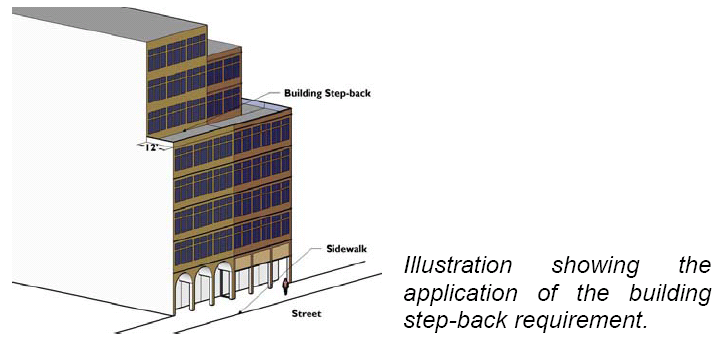
Business associations and professional membership organizations. These establishments promote the business interests of their members, or of their profession as a whole, including chambers of commerce. They may conduct research on new products and services, develop market statistics, sponsor quality and certification standards, lobby public officials, or publish newsletters, books, or periodicals for distribution to their members.
Business, professional, and technical uses. Establishments in this category perform professional, scientific, and technical services for others. Such services require a high degree of expertise and training. Uses in this category include offices for health care, administrative, professional consulting, professional services, and business support services.
Cafeteria or limited service restaurant. These establishments provide food services where patrons order or select items and pay before eating. Food and drink may be consumed on premises, taken out, or delivered to customers' location. Some establishments in this subcategory may provide food services in combination with selling alcoholic beverages. This subcategory includes cafeterias, which use cafeteria-style serving equipment, a refrigerated area, and self-service beverage dispensing equipment, and which display food and drink items in a continuous cafeteria line.
Civic uses. These are uses that are related to nonprofit organizations dedicated to arts, culture, education, and government functions.
Concept plan. A concept plan is a plan that is intended to illustrate the general development pattern proposed and meets the requirements of subsection 98-904(b)(2) of this chapter.
Conservation easement. A conservation easement is a voluntary and permanent, legally binding, conveyance of a surface easement on, about and across the property with deed restrictions that limit development of the property for the purpose of protecting and preserving a portion of the town's environmentally sensitive and natural resources, including agricultural and ranching areas. The landowner retains title to the property and the easement applies to all subsequent owners. The easement must be held by a qualifying party approved by the town.
Continuous planters. Continuous planters are tree wells between the vehicle lane/parking lane and the sidewalk. These planters run parallel along the sidewalk with a few breaks for pedestrian access from the parking lane to the sidewalk. The planters may be used for street trees and other landscaping including shrubs and ground cover to soften the edge of the pavement.
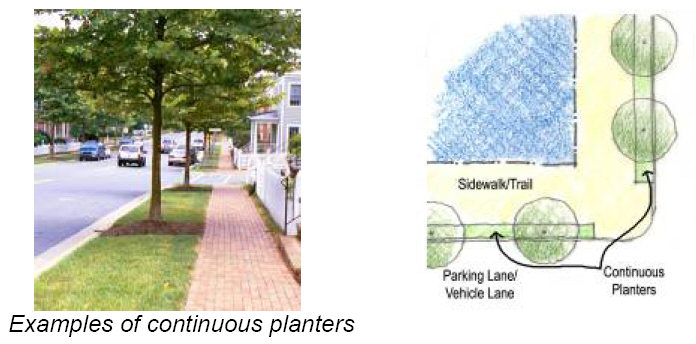
Courtyard. A courtyard is an unoccupied space, open to the sky, which is bounded on two or more sides by the exterior walls of the building or by two or more exterior walls, lot lines or yards. Courtyards may be totally enclosed on all sides by the exterior walls of a building.
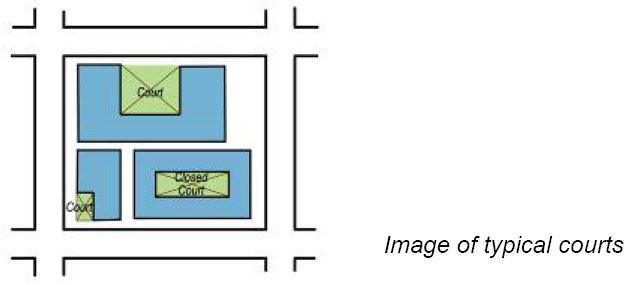
Environmental preserve. An environmental preserve is natural open space reserved for land that is under permanent conservation. It consists of areas in the flood plain, woodlands to be preserved, creeks, water bodies, steep grades, and other environmentally sensitive lands. Activities in the environmental preserve shall be limited to nature trails, paths, and equestrian trails. If significant lake access is available, canoe put-ins or other passive water recreation activities may be permitted. The size of an environmental preserve may vary depending upon the environmental element being preserved. Environmental preserves may also be in or part of conservation easements.
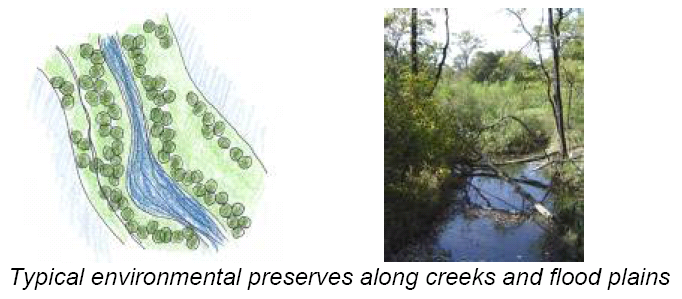
Facade. Facade(s) is the exterior face of the building fronting or oriented toward a street or roadway, excluding alleyways.
Full-service hotels. Full-service hotel establishments are buildings with habitable rooms or suites which are reserved for temporary lodging for guests who rent rooms or suites on a daily basis, and with:
(1)
A minimum area of 250 square feet in each guest room;
(2)
Either (a) a full service restaurant with full kitchen facilities providing service to the general public or (b) a kitchen on the premises in which meals are prepared by the management or a concessionaire of the management for room service delivery;
(3)
On-site staff required seven days a week, 24 hours per day; and
(4)
A minimum of 1,000 square feet of meeting or conference room space.
Full-service restaurant. Full-service restaurants provide food services to patrons who order and are served (i.e. waiter/waitress service) while seated indoors or outdoors and pay after eating. They may provide this service in combination with selling alcoholic beverages, providing takeout services, or presenting live non-theatrical entertainment.
Green. A green is an open space available for unstructured recreation. A green may be defined by landscaping rather than buildings. Its landscape consists of land and trees in a natural arrangement, requiring minimal maintenance. The size of a green shall range from one acre to ten acres.
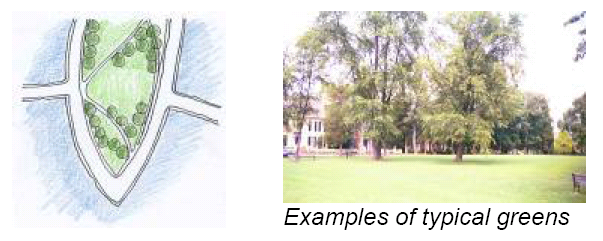
Horizontal mixed use. Horizontal mixed use is the location of different land uses, including commercial, retail, office, residential, public, and other uses in proximity to one another in separate buildings but in the same development or block.
Human scale or pedestrian scale. Human scale is the proportional relationship of a particular building structure, or streetscape element to the human form and function. Human scale relates the size and/or height of a structure to the height and mass of a pedestrian traveling along the sidewalk or street adjacent to that structure.
Landscape concept plan. A landscape concept plan is a series of drawings that includes design direction and general schematics for all proposed public and private landscaping. Drawings do not have to detail every element but provide images that convey the important landscape design themes.
Land use plan. The land use plan is a component element of the town's master plan. The land use plan, as amended, serves as the community's blueprint for future development by providing guidelines for the appropriate location, concentration, and intensity of future development by land use categories.
Live-work unit. A live-work unit is a dwelling unit that is also used for work purposes, provided that the 'work' component is restricted to the uses of professional office, artist's workshop, studio, or other similar uses and is located on the street level. The 'live' component may be located on the street level (behind the work component) or any other level of the building.
Master plan. The Town of Flower Mound Master Plan, as amended, consisting of multiple elements, as adopted by the town council.
Mixed use development. Mixed use development is any development that proposes either vertical mixed use or horizontal mixed use in the same development of one or multiple buildings.
Mixed use core. Mixed use core is a component area of a MU and is intended to be the area of highest intensity of land uses and buildings within the overall mixed use development. The mixed use core may include retail, entertainment, office, institutional, arts, and other uses. Residential uses may be included if they are located in upper floors of mixed use buildings.
Mixed use transition. Mixed use transition is a component area of a MU and is intended to be an area of transition from the mixed use core or neighborhood to any adjoining conditions and uses. Based on site-specific adjacency conditions, a mixed use transition zone may be classified as one of the following:
(1)
Neighborhood transition zone. The area between an existing residential neighborhood and a mixed use core or neighborhood.
(2)
Major roadway transition zone. The area between the mixed use core or neighborhood and a major roadway corridor.
(3)
Environmental transition zone. The area between the mixed use core or neighborhood and a major environmental feature.
Mixed use neighborhood. A mixed use neighborhood is a component area of a MU with predominantly residential uses and open spaces. A mixed use neighborhood may also contain small-scaled civic uses and nonresidential uses at key locations.
Park. A park is a natural preserve available mainly for unstructured recreation. Any structured recreation shall be limited to less than ten percent of the park. A park is usually independent of surrounding building frontages. Its landscape consists of natural paths, trails, meadows, woodlands, and open shelters. Its size shall range from five to ten acres.
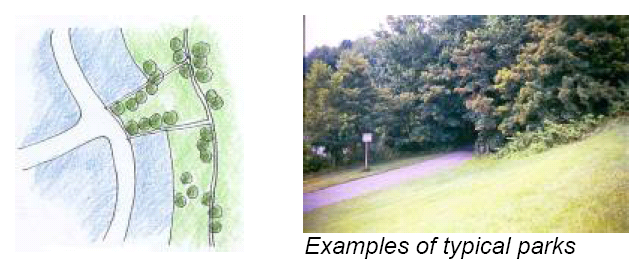
Parks and trails plan. The parks and trails plan is a component element of the town's master plan that establishes a comprehensive parks and trail system for the community.
Personal services. This is a category for limited personal service establishments which offer a range of personal services that include clothing alterations, shoe repair, dry cleaners, laundry, health and beauty spas, tanning and nail salons, hair care, etc., and related personal services. This category shall not include tattoo parlors or pawnshops.
Plaza. A plaza is an open space available for civic purposes and limited commercial activities. A plaza is spatially defined by buildings and its landscape shall consist primarily of pavement with trees being optional. Plazas are to be located in the mixed use core or transition areas and shall be under a one-fourth acre in size. Plazas can be wider sidewalks or extensions of sidewalks for the purpose of providing outdoor seating for restaurants and cafes.
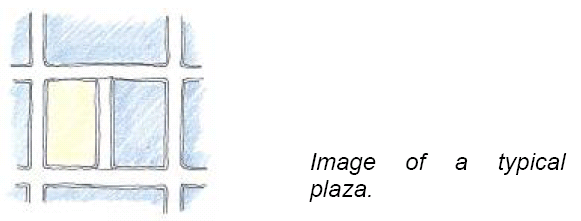
Primary or principal building. The primary building on a lot is also known as the principal building and is the largest building on any lot that has more than one building.
Primary entrance. The primary entrance is the main or principal pedestrian entrance of all buildings (except outbuildings). The primary entrance is the entrance designed for access by pedestrians from the sidewalk, or street if a sidewalk is not present. This is the principle principal architectural entrance even though day-to-day residential access may be via a secondary entrance associated with a garage, driveway or other vehicular use area.
Primary street. A primary street is a street that provides the main point(s) of access from an arterial or collector roadway to the mixed use district's interior street network.
Public buildings. Public buildings are buildings used for active government or related functions, including public administration (executive and judicial), courts, libraries, community centers, and public safety functions.
Public realm. The public realm is the area from building facade to building facade. This includes the street, sidewalks and pedestrian amenities, any landscaping strips or medians, parks, common yards, etc.
Public street, type A. Type A public streets are the primary pedestrian-oriented streets and require a higher quality design environment and minimal accommodation of auto-oriented ancillary uses (driveways and parking) with respect to streetscape and building design.
Public street, type B. Type B public streets form the secondary street network providing access to pedestrian oriented streets (type A streets) and may accommodate automobile access to properties and uses.
Regulating plan. A plan for adoption of zoning and a conceptual plan that establishes the location of streets, blocks, lots, component districts, streetscape standards, and other development standards, subject to changes within such plan pursuant to the terms of this chapter.
Residential loft. Residential loft is typically a residential unit designed to commercial standards (with high ceilings, open plans, and large windows) located above street level commercial space.
Retail sales or service. Retail establishments form the final step in the distribution of merchandise. They are organized to sell in small quantities to many customers. Establishments in stores operate as fixed point-of-sale locations, which are designed to attract walk-in customers. Retail establishments often have displays of merchandise and sell to the general public for personal or household consumption, though they may also serve businesses and institutions. Some establishments may further provide after-sales services, such as repair and installation. Included in this category are durable consumer goods sales and service, consumer goods, other grocery, food, specialty food, beverage, dairy, etc, and health and personal services.
Single-family residential, detached dwelling unit. A single-family detached residential unit is a freestanding building on an individual lot or tract of land intended for occupancy by one family.
Single-family residential, attached dwelling unit. A single-family attached residential unit is a building on an individual lot or tract of land intended for occupancy by one family that shares one or more common walls with similar adjacent units, also on individual lots such as townhomes, condominiums or brownstones.
Square. A square is generally a geometrically symmetrical open space of andhalf; to two acres, available for unstructured recreation and civic purposes. A square is spatially defined by streets and buildings, at least on three sides. Its landscape consists of paths, lawns, and trees, all formally arranged.
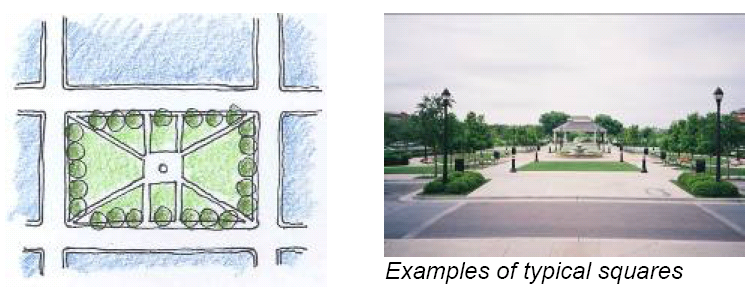
Snack or nonalcoholic bar. These establishments prepare and serve specialty snacks, such as ice cream, frozen yogurt, cookies, or popcorn, or serve nonalcoholic beverages, such as coffee, juices, or sodas for consumption on or near the premises. These establishments may carry and sell a combination of snack, nonalcoholic beverage, and other related products (e.g., coffee beans, mugs, and coffee makers) but generally promote and sell a unique food or beverage item.
Street tree. A street tree is a tree or group of trees that line the edge of a street or roadway and includes trees inside and outside the street right-of-way.
Streetscape treatments. Streetscape treatments include all improvements in a right-of-way and adjacent to it that create an attractive and safe pedestrian environment. Treatments shall include street trees, street light standards, street furniture, and trash receptacles. Streetscape treatments may also include a range of provisions features such as paving materials, street/pedestrian/wayfinding signs, media boxes, parking meters, utility boxes, seating, public art/water features, bike racks, bollards, information kiosks, etc., and similar features.
Thoroughfare plan. The thoroughfare plan is a component of the town's master plan. The thoroughfare plan, as amended, serves as the community's blueprint for the town's future transportation network based on the future land use allocation and intensity.
Vertical mixed use. Vertical mixed use is a building or structure in which at least one of the upper floors of a commercial building has residential uses (live-work units or lofts) with a mixture of retail or office uses at the other levels of the building or structure, or office uses above ground floor retail uses.
(Ord. No. 62-08, § 2, 10-6-2008)
Sec. 98-900. - General district standards.
(a)
Generally. A mixed use zoning district shall consist of a minimum of two of the following three distinct components designated in the ordinance creating the district: a mixed use core, mixed use neighborhood, and mixed use transition. Land uses in the district shall be established based upon the overall character and design of the district. All MU's shall contain appropriately designed and scaled open spaces to preserve existing wooded areas, stream corridors and views, and invite passive recreational activities. All MU's shall contain appropriate transitions to adjacent land uses.
(b)
Mixed use core area. The mixed use core area shall be the primary location of the highest intensity commercial uses including retail uses and offices for business, professional and technical uses. Residential uses in the mixed use core area shall be limited to upper floors of any building and as specified under [section 98-901], table 1, Schedule of Uses.
(c)
Mixed use neighborhood. The mixed use neighborhood is a component area of the MU that is predominantly residential in nature. Limited retail and civic uses may be located at key points within the neighborhood. The location of the mixed use neighborhood shall be determined based upon the overall character and design of the proposed district and the following criteria:
(1)
The mixed use neighborhood component, if incorporated into the MU, is to be located between the mixed use core and any mixed use transitions;
(2)
The mixed use neighborhood shall be well integrated with proposed open space and other civic uses to create a sense of place;
(3)
The mixed use neighborhood shall also be integrated with proposed mixed use core and mixed use transitions in a manner that provides internal automobile and pedestrian access; and
(4)
Uses in the mixed use neighborhood shall be to the density and scale that is appropriate based on the context and character of the proposed district.
(d)
Mixed use transition. The mixed use transition component is the area that forms the transition between the mixed use core or mixed use neighborhood to adjoining conditions. Based on site-specific adjacency conditions, a mixed use transition zone may be one or more of the following:
(1)
Neighborhood transition zone. The neighborhood transition zone shall include residential uses that are of compatible scale and density to the immediately adjacent existing neighborhoods.
(2)
Major roadway transition zone. A major roadway corridor is either an arterial roadway or state highway. This transition area shall be the only appropriate location for more automobile- oriented commercial uses due to the adjacency and access along the roadway while transitioning to a pedestrian-oriented development towards the interior of the site. A major roadway transition may include transitions from a rail road right-of way or corridor.
(3)
Environmental transition zone. The environmental feature may be a creek, water body, significant grades, or tree stands. In particular, the environmental transition zone shall consider appropriate buffers and edge conditions to the specific environmental resource in order to maximize its intrinsic value to the overall mixed use development as a focal point.
(e)
Open space. The open space component shall be integrated into the overall design of the mixed use zoning district.
(1)
The type, scale, location, and design of the open space component shall depend on the context and location of the other components of the MU.
(2)
Squares, parks, greens, and environmental preserves are encouraged in all components. Plazas may serve as open spaces and shall only be appropriate in the mixed use core.
(Ord. No. 62-08, § 2, 10-6-2008)
Sec. 98-901. - Schedule of uses.
(a)
Uses within the MU shall be in accordance with the following schedule of uses.
P = Permitted (All development standards in [section 98-902] apply)
P/C = Permitted only where identified in the MU concept plan approved by town council and based on specific criteria under [subsection 98-901(d)].
NP = Not Permitted
SUP = Permitted with a Specific Use Permit (Standards in section 90-186 shall apply)
A = Permitted as an accessory use (Standards in section 98-1032 shall apply unless the applicant proposes alternative standards for accessory uses and structures subject to town council approval.)
NA = Not Applicable
MU-C = Mixed Use Core
N = Mixed Use Neighborhood
MU-T = Mixed Use Transition
MU-T: NG = Mixed Use Transition—Neighborhood
MU-T: EN = Mixed Use Transition—Environmental
MU-T: MR = Mixed Use Transition—Major Roadway
(b)
The percentages allocated to each land use as recommended in the paragraph entitled "land use mix," as set forth in the mixed use land use category in the master plan, are guidelines for the applicant and the town to determine the appropriate percentage of acreage devoted to each land use. The town council may vary percentages within the limits indicated based upon site specific conditions in the ordinance establishing the district.
(c)
Any use not specifically listed in table 1 is prohibited.
(d)
Use criteria. All uses listed as P/C in table 1 shall be specifically designated in the concept plan for the mixed use zoning district and shall also meet the following standards in table 2:
(Ord. No. 62-08, § 2, 10-6-2008; Ord. No. 04-26, § 6, 3-2-2026)
Sec. 98-902. - Development standards.
(a)
Standards in the MU are intended to facilitate the development of unique and pedestrian-friendly environments. To this end, design and development standards are intended to be tailored to create such an environment. In order to provide flexibility in use with prescription of the building form, all applicable development standards for each development project in the MU, including listing any applicable sections of Subpart B, Land Development Regulations that the particular development project may be exempt from, shall be established via the ordinance rezoning the property. If there are any conflicts between standards in table 3 below and any other standards in Subpart B, Land Development Regulations, then the standards in table 3 below shall prevail.
(b)
Accessory uses—Sec. 98-1032. Accessory buildings shall apply unless other standards are proposed by the applicant and approved by town council.
(c)
The following standards shall apply to development in the mixed use zoning district. Most standards have a numerical range and few have a specific numerical value. Due to the inapplicability of one development standard across all mixed use districts and to encourage a diversity of development proposals, the developer shall propose the standards indicated as "flexible" or "permitted/flexible" on the following table for the proposed development at the time of concept plan application submittal (see [subsection 98-904(b)(2)]) for concept plan submittal requirements in the MU district).
(Ord. No. 62-08, § 2, 10-6-2008; Ord. No. 13-19, § 4, 4-15-2019)
Sec. 98-903. - Performance and design standards.
(a)
General layout standards.
(1)
The proposed district shall contain a network of connected streets and walkways that provide a variety of transportation routes and disperse traffic. Streets shall be designed to create a pleasant walking environment with on-street parking and streetscape treatments.
(2)
The proposed district shall contain designated sites for civic, institutional, or religious buildings. Buildings such as schools, libraries, meeting halls, places of worship, and day care facilities shall occupy prominent places in the MU and be planned in coordination with open spaces.
(3)
The proposed district shall contain many separate and human-scaled buildings:
a.
The lots and a variety of buildings shall generate a cohesive pattern that allows streets to be civic places.
b.
Building heights shall vary, with two to four story structures typical in the neighborhood and one to two story structures in neighborhood transition area. Buildings in the mixed use core and environmental transition areas shall help define the sidewalk.
c.
Driveway sizes and locations shall minimize the impact of the automobile on the public realm and shall be located along type B streets.
(b)
Building orientation.
(1)
Primary building facades for all nonresidential and mixed use buildings shall be oriented to a type A street or shall be oriented toward a focal point such as a landscaped street, plaza, similar formal open space or an environmental feature.
(2)
Primary buildings shall have a minimum of 50 percent of their building facade oriented along a type B street, arterial, highway frontage, or collector streets and a minimum of 75 percent of their building facade oriented along type A streets (with the exception of alleyways) (see illustration below).
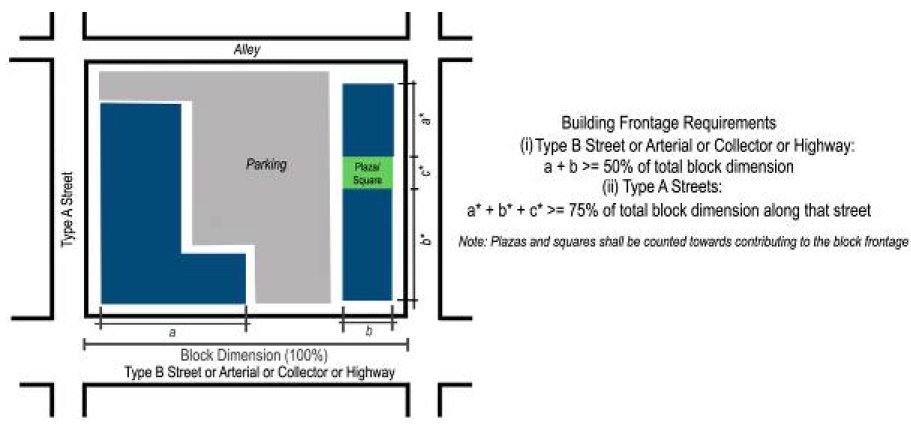
(c)
Building entrances.
(1)
Primary facades along type A streets shall contain the main entrance of any principal building.
(2)
All principal buildings in the MU located on a type A street serving the development shall also have doors, windows, and other architectural features facing that street. Nonresidential or mixed use corner buildings shall have at least one customer entrance facing each street or a corner entrance instead of two entrances.
(d)
Building facade standards.
(1)
The minimum ground floor height as measured from the finished sidewalk to the second floor for all vertical mixed use, commercial, and live-work buildings shall be 15 feet. The minimum finished floor height for all upper floors of vertical mixed use, commercial, and live-work buildings shall be ten feet. The minimum floor to floor height for all other buildings shall be ten feet.
(2)
The ground floor elevation of all residential buildings (attached, detached, and stacked) shall be raised a minimum of two feet above the finished level of the public sidewalk/trail in front of the residential structures.
(3)
All development shall provide ground floor windows on the building facade facing and adjacent to a street (with the exception of alleys) or facing onto a park, plaza, or other civic space. The required area of windows and doors on each street facade fronting a type A street, park, square, green, plaza, or other civic space as a percentage of that facade shall be established in table 4. The required area of windows and doors on all other street facades (type B streets with the exception of alleys) may be reduced by 25 percent of the corresponding requirement along a type A street facade. The facade area shall be measured between three feet and nine feet above each finished floor.
(4)
Darkly tinted windows and mirrored windows that block two-way visibility shall not be permitted.
(5)
All vertical mixed use and nonresidential buildings shall have door openings spaced at no greater than 50 feet on the ground floor along all type A streets, plazas, squares, or other civic spaces within the mixed use core zone.
(e)
Architectural design standards.
(1)
To ensure compatibility of building types and to relate new buildings to the building traditions of the region, architectural design shall be regulated, governed, and enforced through architectural design standards proposed by the applicant. The applicant shall submit the proposed standards as a part of the concept plan application for all development in the MU. The planning and zoning commission shall make a recommendation and is subject to the approval of the town council at the time of concept plan.
(2)
Architectural design standards for a proposed MU shall:
a.
Provide standards to ensure that the development is of enduring and exemplary quality and design;
b.
Specify the materials and configurations permitted for walls, roofs, openings, street furniture, and other elements;
c.
Be based on traditional building precedents from the region;
d.
Include the following:
1.
Architectural compatibility among structures within the neighborhood;
2.
Human scale design;
3.
Pedestrian use of the entire district;
4.
Relationship to the street, to surrounding buildings, and to adjoining land uses; and
5.
Special architectural treatment of gateways/civic buildings.
(3)
All building frontages along public and private streets (with the exception of alleys) shall break any flat, monolithic facades by including architectural elements such as bay windows, recessed entrances, or other articulations so as to provide pedestrian interest along the street level facade including discernible and architecturally appropriate features such as, but not limited to, porches, cornices, bases, fenestration, fluted masonry, bays, recesses, arcades, display windows, unique entry areas, plazas, courts, or other treatments to create visual interest, community character, and promote a sense of pedestrian scale. Expanses of blank walls exceeding 25 continuous feet are prohibited along all type A streets and 40 continuous feet along all other streets except alleys.
(4)
All buildings in the MU zoning district shall be constructed with exterior building materials and finishes of a quality to convey an impression of permanence and durability. Materials such as masonry, stucco, stone, terra cotta, ceramic tiles, and similar durable architectural materials are allowed and shall be approved with the concept plan for the district.
(5)
Nonresidential buildings and sites shall be organized to group the utilitarian functions away from the public view of any street (with the exception of alleys). Delivery and loading operations, HVAC equipment, trash compacting and collection, and other utility and service functions shall be incorporated into the overall design of the buildings and landscaping. The visual and acoustic impacts of all mechanical, electrical, and communications equipments (ground and roof-mounted) shall not be visible from adjacent properties and public streets, and screening materials and landscape screens shall be architecturally compatible with and similar to the building materials of the principal structures on the lot.
(f)
Location and design of off-street parking.
(1)
The applicant shall provide standards for the quantity of off-street parking proposed in the district based on an analysis of the parking demand for the mix of uses proposed and availability of on-street parking in the district. section 82-74 shall be used as a guide to establish the amount of parking required for uses proposed in the MU if the applicant does not specifically provide alternative standards. The town council may establish the alternative parking standards proposed by the applicant in the ordinance establishing the district.
(2)
Off-street parking for all uses located along type A streets shall be limited to 25 percent or less of the block frontage and 50 percent or less on type B streets, arterial, collector, and highway frontage streets (see corresponding building frontage requirement).
(3)
Any off-street surface parking area located adjacent to a street or a residential use shall be screened in the form of a landscape fence which is at least four feet in height.
(4)
A surface parking lot may not be adjacent to a street intersection or square, or occupy a lot that terminates a street vista.
(5)
Shared parking facilities are encouraged for nonresidential uses in the MU.
(6)
Bicycle parking shall be provided for nonresidential uses, especially for schools, parks, trails, and other recreational facilities. Bicycle parking shall be provided at a rate of five percent of all off-street automobile parking spaces provided for nonresidential and mixed uses in the district. Bicycle parking may be shared between uses and shall be centrally located, easily accessible, and visible from streets or parking lots. They may be located between the roadway and the building facades as long as their location does not impede pedestrian walkways.
(7)
Any offstreet parking provided for residential uses shall be located in such a manner as to minimize the impact of garages and driveways along the residential street. All residential lots that are less than 60 feet in width shall have off-street parking and/or garages accessed from alleys. All lots 60 feet and wider may have front loaded garages (pull-through garages), but in no case shall the width of the garage exceed 30 percent of the front facade width of the entire building. In addition, the garage shall be set back at least three feet from the front facade of the home.
(g)
Civic/open space standards.
(1)
The provision of adequate and appropriate civic/open space areas shall be integral to all development in the district. The minimum requirement for civic/open space in the district is five percent of the gross area of the site which shall be dedicated open space and shall be included in the zoning change/development plan application for a proposed MU. Any open space provided in excess of five percent may be eligible for bonus provisions as outlined in subsection (h).
(2)
The civic/open space provided shall be appropriately designed and scaled in each of the district components.
(3)
The following criteria shall be used to evaluate the merits of proposed civic/open spaces in the MU:
a.
The extent to which environmental elements preserved are considered as "features" or "focal points" and integrated into and prominently located as "front yards" in the development; adding value to the development;
b.
The extent to which emphasis has been placed on preservation of existing wooded areas, view sheds, water bodies, topography, and stream corridors in a natural and contiguous state;
c.
The extent to which pedestrian connectivity in the form of sidewalks, natural walking paths along stream and creek corridors has been addressed; and
d.
The extent to which a range of open spaces have been provided to be contiguous with existing open spaces and to invite passive recreational uses from plazas and squares to playgrounds, parks and environmental preserves, appropriately organized within the respective MU component.
(4)
Open spaces may be in the form of pocket parks, children's play areas, squares, linear greens, and environmental preserves. Active sports fields and structured recreational activities shall be limited to less than ten percent of any parks located in the district.
(h)
Landscaping standards.
(1)
The purpose of landscaping in the MU is to enhance pedestrian and open space areas, to help delineate active areas from passive areas, to provide a screening buffer between pedestrians and vehicular circulation, utility functions, and incompatible adjacent developments.
(2)
The applicant shall submit a landscape concept plan in conjunction with the zoning change and concept plan application. The landscape concept plan establishes the design direction and general schematics for all proposed landscaping including all aspects of the public realm such as street trees, plant/tree palette, streetscape treatments, pavement details, front yards, and medians; proposals for required parking lot landscaping, screening, design concepts for all open spaces, and lighting.
(3)
Proposed landscaping shall meet the following standards:
a.
Be pedestrian oriented.
b.
Designed in such a way to not create a security or physical hazard to pedestrians, bicyclists or motorists.
c.
Enhance or complement the architectural design of the mixed-use development.
d.
Provide visual interest year-round. Utilize water conservation methods and drought tolerant planting where possible.
e.
Shall be provided between parking lots and all adjacent sidewalks.
f.
Meet the standards for maintenance in section 82-246.
g.
Propose a plant/tree palette that mostly includes native species.
(i)
Bonus provisions.
(1)
Development in the MU core and environmental transition zones shall be eligible for specific height and density bonuses as provided in this section.
(2)
The applicant shall provide a list and conceptual design of amenities/design elements with minimum performance standards in conjunction with specific blocks or building sites for increased heights and intensities on the required concept plan for the MU.
(3)
The planning and zoning commission shall make a recommendation to the town council on the proposed bonus package and the town council shall make the final decision on the appropriateness of the amenity/design package for the bonuses requested.
(4)
Criteria for evaluating height bonuses in the mixed use core and environmental transition zones:
a.
The following minimum standards shall apply to all buildings that exceed the height limitations within the core and environmental transition zones:
1.
Distance requirement of 1,200 feet from any existing adjacent neighborhood as measured from the closest property line of any platted residential subdivision not entitled under the MU;
2.
A minimum increase in open space of three percent over the base requirement;
3.
A minimum 12-foot building step back from the front facade at the 6th story, provided that the front facade faces and is located on a public street, and
4.
A minimum of 50 percent of the ground floor building area built and occupied as a nonresidential use only. In the event the building that exceeds permitted height limitations is part of a functionally related complex of buildings, the ground floor nonresidential use requirement may be transferred to a different building or floor within the complex.
b.
In addition to the above standards, the planning and zoning commission and town council shall take into consideration the following criteria in evaluating height bonuses in the MU:
1.
Visual impacts of the buildings on adjacent neighborhoods and roadways;
2.
Impact of site specific conditions such as grades, vegetation, automobile and pedestrian access;
3.
Design considerations such as:
i.
The extent to which the architectural design of the mid-to high rise buildings are appropriately integrated with the overall context of the mixed use zoning district including terminating important vistas and creating community landmarks;
ii.
The extent to which transitions have been considered to adjoining buildings and neighborhoods; and
iii.
The extent to which amenities such as plazas, square, and other civic spaces are integrated with the building design.
(Ord. No. 62-08, § 2, 10-6-2008; Ord. No. 51-22, § 12, 10-17-2022)
Sec. 98-904. - Applications and development review process.
(a)
Applications for rezoning.
(1)
An applicant requesting a rezoning to the MU shall submit a concept plan that meets the requirements of this chapter and includes the informational requirements for a zoning change and development plan.
(2)
All mixed use developments will be reviewed for compliance with the town's regulations. The analysis will be prepared by a planning firm designated by the town to be included as part of submittals for approval of a comprehensive plan amendment, zoning amendment, development plan, and/or site plan.
(3)
The applicants of the proposed development shall pay to the town a fee to cover the expense of the mixed use development analysis. The fee determination will be made by the town after review of the complexity, size and location of the proposed development.
(4)
The town's development review committee (DRC) shall review the application for completeness and compliance with the town master plan and all applicable ordinances and forward the application to the planning and zoning commission.
(5)
The planning and zoning commission shall make a recommendation on the rezoning request and the town council may approve any such proposal, together with any conditions, requirements or limitations thereon which the planning and zoning commission or town council deems appropriate. The concept plan shall be approved as part of the ordinance establishing the mixed use zoning district.
(b)
Plan review process.
(1)
Overview of review process. Development of land in the MU includes two steps and plat approval. The first step is the rezoning and concept plan review and approval phase. The second step is site plan review and approval required by the planning and zoning commission for all nonresidential and mixed use development. A building permit for a single-family detached dwelling unit may be obtained after approval of the record plat provided that the proposed structure meets the standards as established by the council approved concept plan.
(2)
The concept plan. The concept plan is intended to illustrate the general development pattern of the district consistent with the purpose and intent of the district.
a.
The applicant shall submit a concept plan for the entire property for which the rezoning is sought. A concept plan in the district is not intended to be a detailed proposal; rather, it shall illustrate the general location of land uses, street layout, treatment of transition areas to adjacent uses and any other appropriate information required by decision makers. The concept plan in the district shall illustrate the proposed general design direction of the site with dimensional guidelines that provide adequate information about the design intent, intensity, and phasing of the proposed district.
b.
The application shall:
1.
Demonstrate compliance with the district's purpose and standards and the town's master plan, as amended;
2.
Include a map(s) meeting all the informational requirements for a zoning change in section 78-201, and a regulating plan meeting the standards of this section including:
i.
Delineation of the MU components proposed in the development;
ii.
The layout of proposed mandatory blocks and streets and conceptual bikeways and pedestrian paths;
iii.
The location and acreage of civic/open space areas and whether each will be privately owned, a common area for residents only or dedicated to public use;
iv.
The location, area, and percentages of nonresidential (retail, office), residential, civic, and civic/open space uses with flexibility factors;
v.
The approximate scale and placement of buildings; and
vi.
The general parking location and standards (surface and structured);
3.
Include a report in the form of text, statistical information, tables, guidelines, and graphics that includes:
i.
A statement of the purpose and intent of the proposed district;
ii.
A description of the mix of land uses and the factors which ensure compatibility both within the development site, with adjacent land uses, and compliance with the recommendations town's master plan;
iii.
A parking demand analysis for the mix of uses proposed to support the on-street and off-street parking to be provided in the development, especially if the applicant is not using section 82-74 as a guide;
iv.
Statistical information including:
A.
Gross acreage of the site, and net acreage of the site excluding jurisdictional wetlands, regulatory floodplains, and slopes over 20 percent;
B.
The amount of land devoted to civic/open space, both in acres and as a percentage of the gross acreage of the site;
C.
The amount of land devoted to different land uses, both in acres and as a percentage of the gross acreage of the site;
D.
A plan for pedestrian, bicycle, and vehicular circulation describing the general design capacity of the system as well as access points to community wide network;
E.
A daily and peak hour trip generation and directional distribution report by use unless the town engineer finds that the traffic to be generated by the proposed district does not warrant the preparation and submission of a study;
F.
The maximum allowable building coverage, density, and height by each component area; and
G.
The minimum and maximum building setbacks by component area.
v.
Street design standards, with typical cross-sections and street classifications including the delineation of type A and type B streets for the proposed district (or for each phase, if it is to be developed by phases) specifying minimum pavement width, right-of-way width, presence of curbs, on-street parking, street trees, bikeways and sidewalks (if different than recommended under appendix A);
vi.
Development standards for the proposed district (or for each phase, if it is to be developed by phases) specifying standards for all the "flexible" elements by each MU component area in the form of a table;
vii.
Conceptual architectural standards for the proposed district (or for each phase, if it is to be developed by phases) identifying the design theme and specifying predominant materials and building configurations using renderings, character sketches, and conceptual elevations;
viii.
A landscape concept plan that includes: the design direction and general schematics for all proposed landscaping including all aspects of the public realm such as street trees, streetscape treatments, pavement details, front yards, and medians; proposals for required parking lot landscaping, screening, design concepts for all open spaces, lighting, and any other information required by town council;
ix.
A nonbinding schedule for the district (or for each phase, if it is to be developed by phases), which shall show generally how the applicant will complete the project containing the following information:
A.
The proposed order of construction by section delineated on the concept plan;
B.
The proposed schedule for construction of improvements to the civic/open space areas;
C.
The proposed schedule for the installation of required public or utilities improvements and the dedication of public rights-of-way, easements and properties; and
D.
The proposed land use mix of residential and nonresidential development by phase.
c.
The applicant may request that the executive director of development services waive any of the foregoing requirements of the application and concept plan that are not applicable to the review of a specific development or defer them to the site plan approval stage. However, if any requirement is deferred to the site plan approval stage, it shall be approved by the town council upon a recommendation from the planning and zoning commission.
(3)
Site plan. A site plan approved by the planning and zoning commission shall be required before building permits can be issued for all multiple-residential, nonresidential and mixed use buildings unless the application is subject to a deferred application requirement in which case the site plan shall be approved by the town council after a recommendation from the planning and zoning commission. Applications for site plans shall be submitted only after the town council has approved a concept plan for that area incorporated by the site plan.
a.
The planning and zoning shall make a decision on a site plan only after receiving a recommendation of the development review committee.
b.
In addition to information required in Subpart B, Land Development Regulations, chapter 82, article II. site plans, an application for site plan approval shall include:
1.
Any special standards for signage that provide a design palette addressing the location, lighting, colors, and materials for all signage in the district;
2.
Specific parking layout, parking count, and parking lot landscaping
3.
Detailed landscaping plan meeting the requirements of section 82-214.
4.
Building elevations including materials, configurations of all building elements such as roofs, walls, doors, windows, and other features.
c.
A building permit for any lot with a single-family detached dwelling may be approved after concept plan, preliminary plat, and record plat approval and filing at the county clerk's office and only if the design of the proposed residential use meets the approved development plan standards.
(Ord. No. 62-08, § 2, 10-6-2008; Ord. No. 50-09, § 2, 12-7-2009)
Sec. 98-905. - Modifications.
(a)
Mixed use standards. The town council may approve modifications to any of the standards in the MU after a recommendation by the planning and zoning commission based on unique site conditions and development context at the time of the application. In granting a modification, the town council may impose any conditions that it deems necessary or desirable to protect the public interest and implement the goals of the town's master plan with respect to mixed use. However, an applicant may submit to the zoning board of adjustment a request for a variance and the board may grant variances to any specifically established standards approved by the town council in the ordinance establishing the particular MU. All such requests will be subject to the standards imposed upon the zoning board of adjustment in section 78-85 of this Code.
(b)
Park land dedication and park development fees requirements. The park land dedication and park development fee requirements set forth in division VIII of article 6, chapter 90 shall apply and exclusively govern MU mixed use zoning districts. This division 25 of article III, chapter 98 does not authorize park land dedication or park development fee standards that deviate from the requirements of division VIII of article 6, chapter 90.
(c)
Tree preservation.
(1)
General. In mixed use development projects, tree removal and mitigation shall comply with chapter 94, "trees," and be evaluated in regard to the district as a whole based on the tree survey, unless provided herein.
(2)
Tree removal.
a.
Undergrowth and unprotected trees. A property-owner/developer may, in its discretion, remove understory growth, including but not limited to vines, shrubs, briars and bushes, and trees that are three caliper inches or less in diameter, however neither protected nor specimen trees as shown on the tree survey shall be removed without the submittal and approval by the town of a tree removal permit.
(Ord. No. 62-08, § 2, 10-6-2008; Ord. No. 49-12, § 2, 10-1-2012; Ord. No. 13-19, § 5, 4-15-2019; Ord. No. 13-24, § 8, 4-1-2024)
Sec. 98-906. - Amendments to approved plans or regulations established in an MU ordinance.
(a)
The concept plan shall establish an overall vision for the proposed development within the framework of flexible design standards as established by the applicant in conjunction with the zoning application. Any changes to the concept plan that are beyond the range of flexibility provided in the ordinance establishing the specific district shall be considered as major changes to an approved MU and shall be reviewed by staff and subject to planning and zoning commission recommendation and town council approval. The executive director of development services may approve minor changes to and deviations from an approved site plan with the applicant's written justification for such changes. Minor changes may be approved administratively by the executive director and a revised concept plan shall be filed with the town. Any changes shall be reviewed cumulatively from the last town council approved concept plan. Major changes to an approved MU shall include any of the following:
(1)
Any change in area of a component zone in excess of 20 percent greater or less than approved in a concept plan.
(2)
Deletion or addition of a component zone or change in location of a component zone relative to any other component zones or adjacent properties.
(3)
Elimination or change in an external connection (automobile or pedestrian) that negatively impacts any adjacent properties.
(4)
A ten percent or greater reduction in the gross amount of open space that was approved in a concept plan.
(5)
A change that results in a 30 percent or greater transfer of open space between any of the component zones as compared to the approved concept plan.
(6)
Any changes to the development standards that were approved with the ordinance creating the MU district.
(7)
Any increases or reductions in the land use mix proposed in any phase of the development that was approved as part of the original MU concept plan.
(b)
If the proposed change is major as defined by subsection (a) above or conflicts with regulations specified within the ordinance establishing the MU, it shall be processed as an amendment to the zoning ordinance, and must be approved by the town council after a recommendation from the planning and zoning commission.
(c)
If the town receives an application to rezone only a portion of the property within an MU established by ordinance, the town may consider the request for rezoning that portion and is not required to rezone the remainder of the property. However, the zoning change requested shall be evaluated based on the purpose, intent, and context of the proposed changes.
(Ord. No. 62-08, § 2, 10-6-2008)

