
Flower Mound City Zoning Code
ARTICLE IV
- SUPPLEMENTARY DISTRICT REGULATIONS
DIVISION 5. - FLOODPLAIN[16]
Cross reference— Environment, ch. 34.
DIVISION 8. - EXTERIOR BUILDING MATERIAL[17]
Cross reference— Buildings and building regulations, ch. 14.
Sec. 98-911.- Reserved.
Editor's note— Ord. No. 36-15, § 2, adopted June 15, 2015, repealed § 98-911, which pertained to sale, serving or storage of alcoholic beverages for on-premises consumption, and derived from Ord. No. 7-84, § 2, adopted Feb. 13, 1984.
Sec. 98-1020.- Illustrations.
(a)
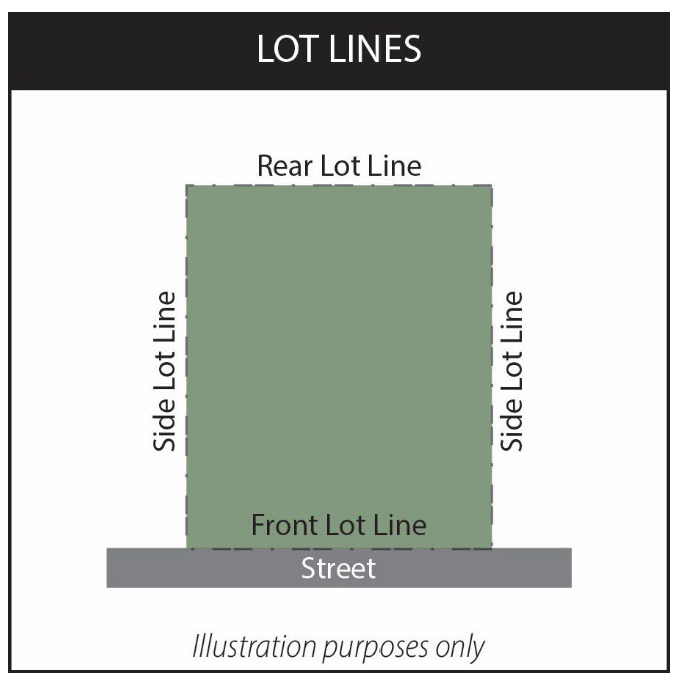
Lot lines.
(b)
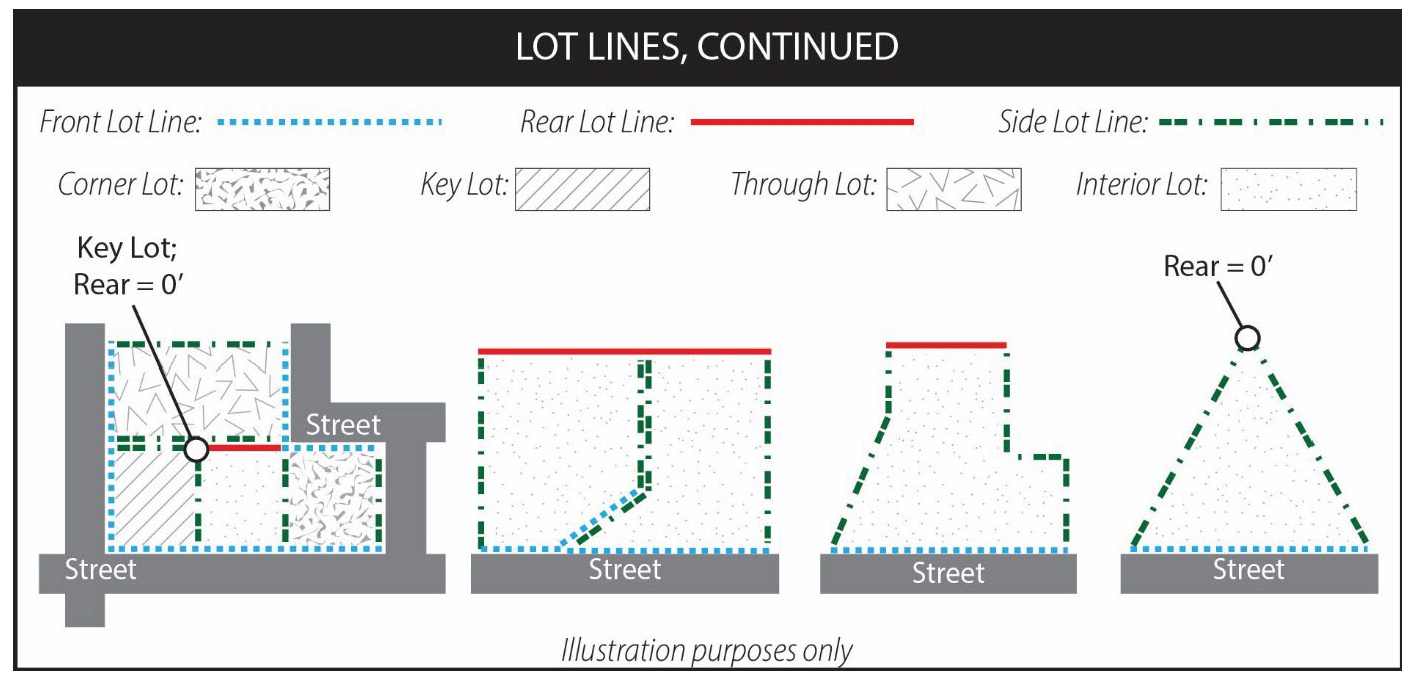
Lot lines, continued.
(c)
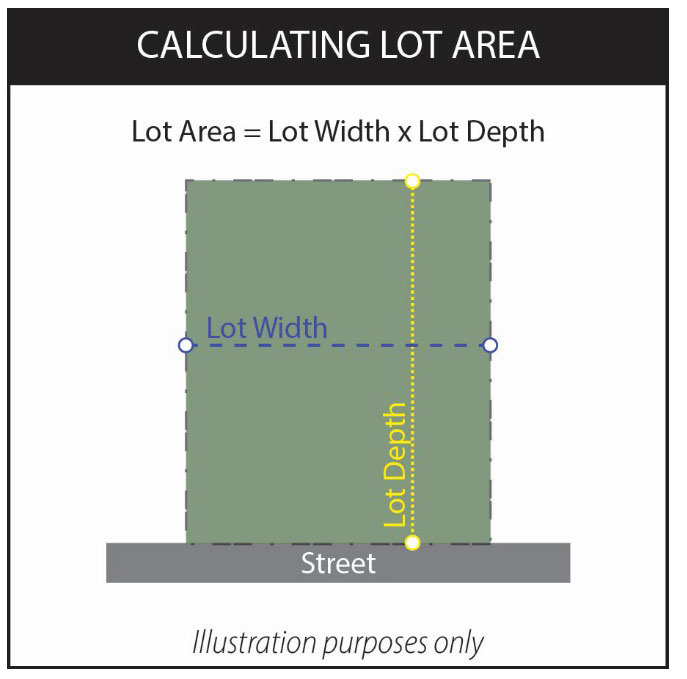
Calculating lot area.
(d)
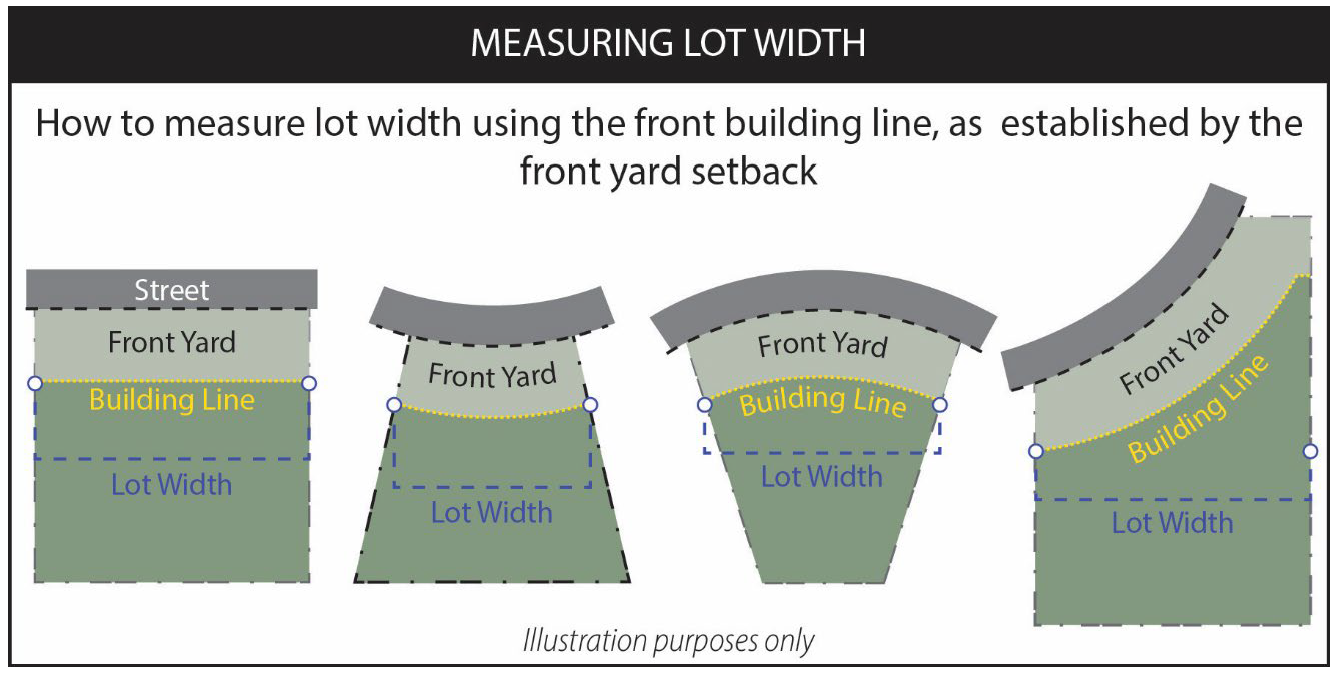
Measuring lot width.
(e)
Yard measurements.
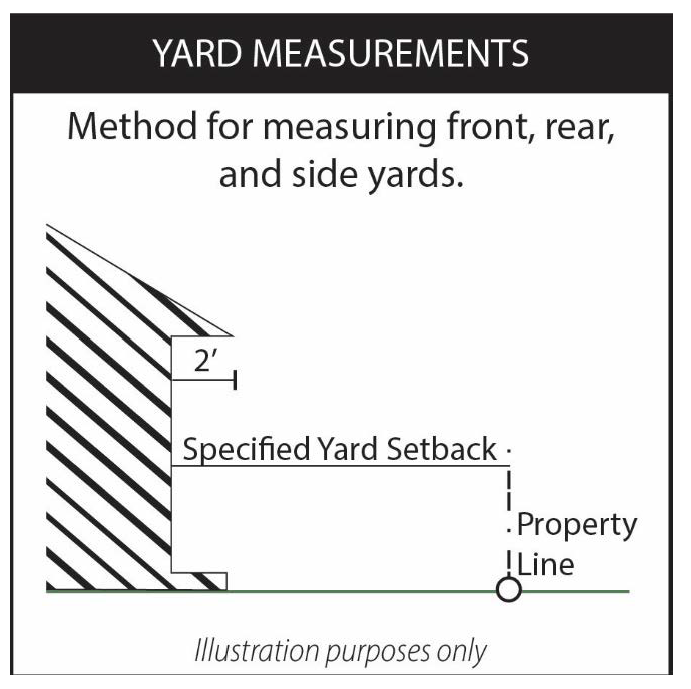
(f)
Measuring building height.
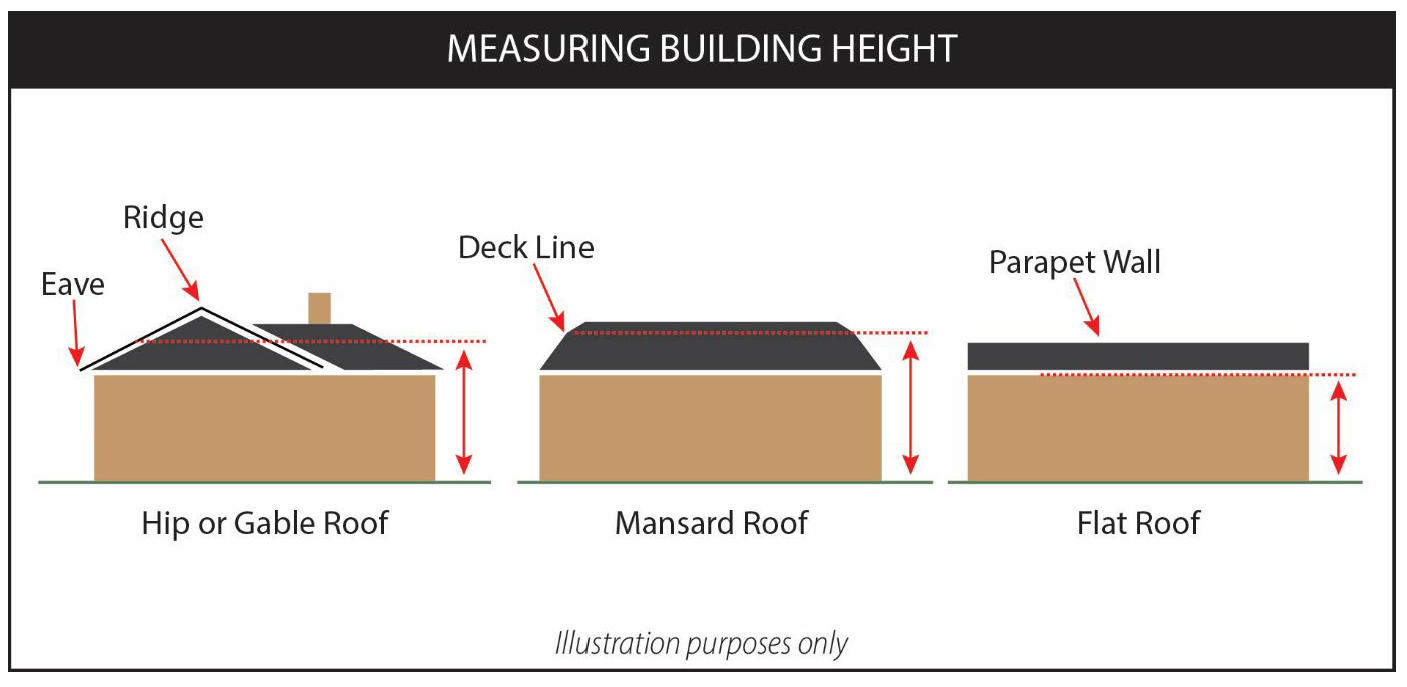
(g)
Floor area ratio.
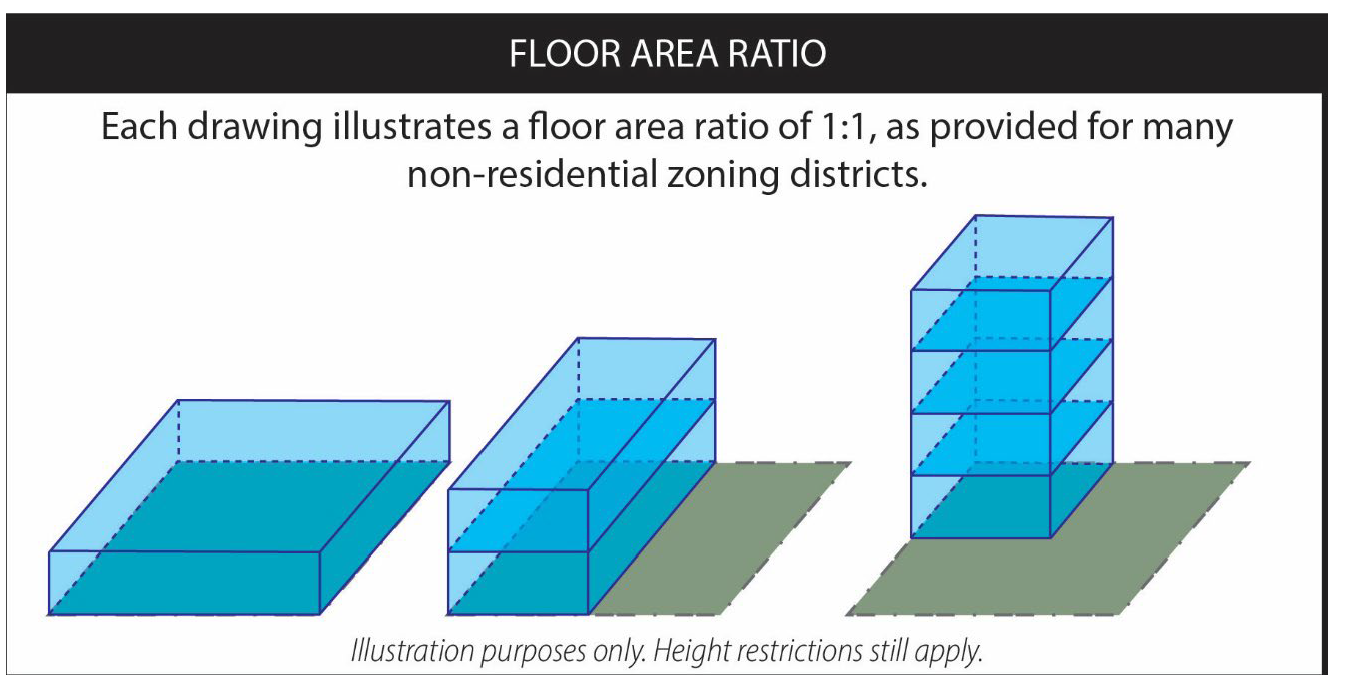
(h)
Interior, through, corner, and key lots.
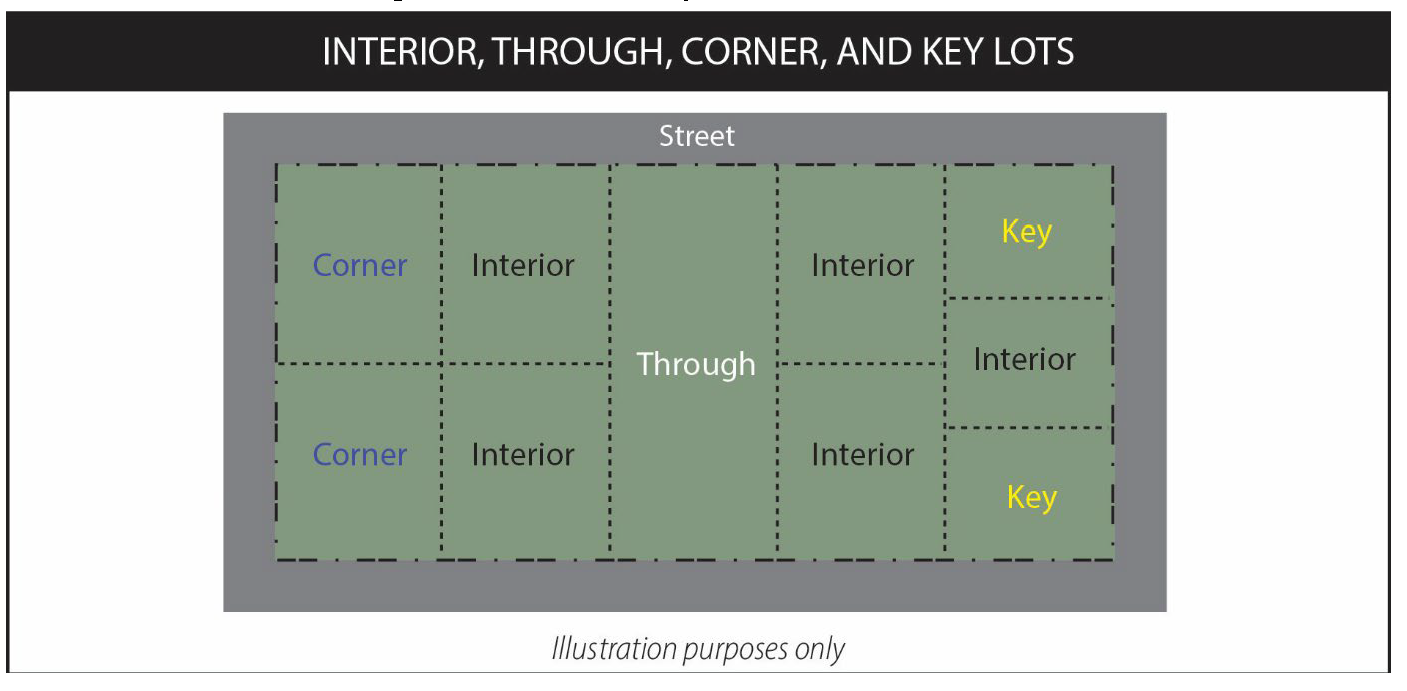
(i)
Apply front, rear, and side yard setbacks.
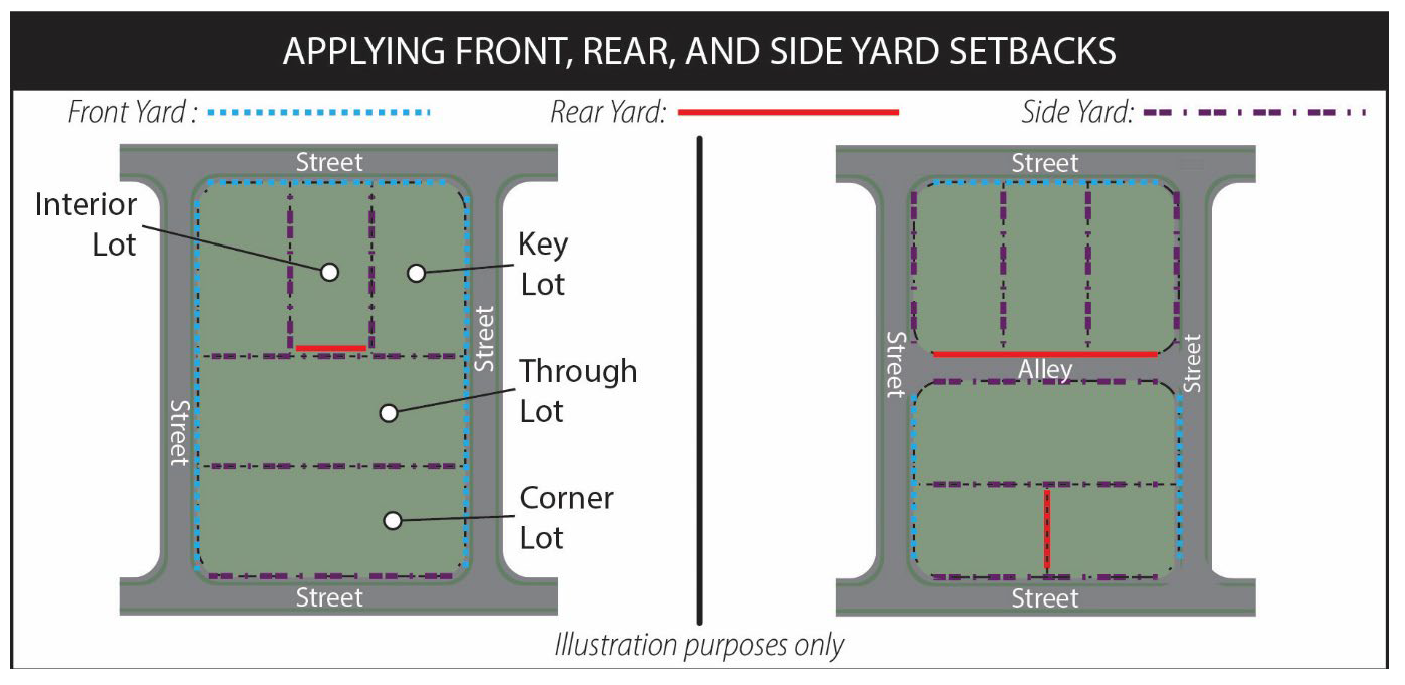
(Ord. No. 13-24, § 10, 4-1-2024)
Sec. 98-1021. - Schedule of residential dimensional regulations.
The residential dimensional regulations schedule included in this section summarizes the regulations of this chapter with regard to minimum lot size, minimum yards, maximum lot coverage, minimum floor area per dwelling unit and maximum building height of residential uses in the various zoning districts. For standards in the planned development district, see division 21 of article III of this chapter. The standards shown in the following schedule may be modified by additional provisions contained in this division or in the individual district regulations. In the event of any conflict between the text of this chapter and the schedule of residential dimensional regulations, the text shall control.
RESIDENTIAL DIMENSIONAL REGULATIONS
+ The minimum side and rear yard in the MF multifamily district for all uses shall be subject to section 98-485.
* The uses allowed in the CBD shall conform to this development standard save and except to the extent, only, that the zoning ordinance establishing a CBD on a particular land area specifically provides a different development standard approved by the town council. A list of specific development standards that have been altered by such a zoning ordinance shall be maintained by the executive director of development services for each CBD approved by the town council.
** The maximum lot coverage in the SF-5 single family residential district shall be 55 percent, subject to section 98-1029, except that the 50 percent limitation set forth in subsection 98-1029(b) does not apply to single-family detached dwellings.
(Code 1989, ch. 12, § 3.06(a); Ord. No. 17-08, § 4, 2-18-2008; Ord. No. 45-08, § 4, 8-4-2008; Ord. No. 13-24, § 10, 4-1-2024)
Sec. 98-1022. - Schedule of nonresidential dimensional regulations.
The nonresidential dimensional regulations schedule in this section summarizes the regulations of this chapter with regard to minimum yards, maximum lot coverage, maximum floor area ratio and maximum building height of nonresidential uses in the various zoning districts. For standards in the planned development district, see division 21 of article III of this chapter. The standards shown in the following schedule may be modified by additional provisions contained in this division or in the individual district regulations. In the event of any conflict between the text of this chapter and the schedule of nonresidential dimensional regulations, the text shall control.
NONRESIDENTIAL DIMENSIONAL REGULATIONS
+ The minimum side and rear yard in the MF multifamily district for all uses shall be subject to section 98-485.
** The maximum lot coverage in the SF-5 single family residential district shall be 55 percent, subject to section 98-1029, except that the 50 percent limitation set forth in section 98-1029(b) does not apply to single family detached dwellings.
† The uses allowed in the CBD shall conform to this development standard save and except to the extent, only, that the zoning ordinance establishing a CBD on a particular land area specifically provides a different development standard approved by the town council. A list of specific development standards that have been altered by such a zoning ordinance shal be maintained by the executive director of development services for each CBD approved by the town council.
* Subject to buffering requirements as outlined in division 5 of article V of chapter 82 of this Code.
** For lots containing up to five acres in area, the maximum lot coverage shall be 55 percent. For lots containing five acres or more in area, the maximum lot coverage shall be 50 percent.
*** Sixty-foot front yard along major thoroughfares. Along all other roadways, subject to section 98-1026.
(Code 1989, ch. 12, § 3.06(b); Ord. No. 32-00, § 3(3.05), 4-3-2000; Ord. No. 17-08, § 5, 2-18-2008; Ord. No. 45-08, § 4, 8-4-2008; Ord. No. 13-24, § 10, 4-1-2024)
_____
Sec. 98-1023. - Minimum lot area per dwelling unit.
(a)
Generally. Residential uses shall comply with the minimum lot area per dwelling unit standards contained in the district regulations and summarized in the residential dimensional regulations schedule, as may be modified by additional provisions in the district regulations, in this section or elsewhere in this chapter.
(b)
On-site sewage facilities. Undeveloped areas master planned or classified as rural density have been so master planned or classified in response to several conditions that affect development in the area:
(1)
Provision of two acres or larger residential lot sizes, which are considered the minimum necessary for individual septic systems, to avoid the cost burden to the town of maintaining lift stations and force mains;
(2)
Minimization of increases in surface stormwater runoff into the already strained drainage channels, which are to remain in a natural condition;
(3)
Minimization of increases in traffic volumes on the existing and planned network of predominantly two-lane roads; and
(4)
Preservation of the rural, natural aesthetic qualities of the western part of the town, which provide value and amenity for the entire community.
(c)
Density. No on-site sewage facilities shall be allowed on tracts of land or lots more than one dwelling unit per two acre density, unless documented extenuating circumstances justify consideration by the town of smaller lot sizes.
(Code 1989, ch. 12, § 3.06(c))
Sec. 98-1024. - Minimum lot width.
(a)
Generally. Lots used for residential uses shall comply with the minimum lot width standards contained in the district regulations and summarized in the residential dimensional regulations schedule, as may be modified by additional provisions in the district regulations, in this section or elsewhere in this chapter.
(b)
Measurement. Lot width shall be measured as the distance between the side lot lines measured along the front building line. In the case of a lot having more than one required front yard, the lot width shall be measured along the building line associated with the shortest front lot line.
(c)
Cul-de-sacs. Notwithstanding any other provisions of this chapter, lots fronting on a cul-de-sac shall have a minimum front street line of 40 feet and a minimum lot width of 75 feet at the building line, provided that this subsection shall not apply in the PD planned development district, and that in the SF-10 single-family district-10, lots fronting on a cul-de-sac shall have a minimum front street line of 40 feet and a minimum lot width of 70 feet at the building line.
(Code 1989, ch. 12, § 3.06(d))
Sec. 98-1025. - Minimum floor area per dwelling unit.
(a)
Generally. Residential uses shall comply with the minimum floor area per dwelling unit standards contained in the district regulations and summarized in the residential dimensional regulations schedule, as may be modified by additional provisions in the district regulations, in this section or elsewhere in this chapter.
(b)
Measurement. The floor area of a dwelling, for the purpose of these minimum floor area per dwelling unit requirements, refers to the total of the horizontal area of each floor, measured from the outside face of the building walls and excluding garages, carports, cellars and accessory buildings.
(Code 1989, ch. 12, § 3.06(e))
Sec. 98-1026. - Minimum front yard setback.
(a)
Generally. The location of buildings shall comply with the minimum front yard setback standards contained in the district regulations and summarized in the residential and nonresidential dimensional regulations schedules, as may be modified by additional provisions in the district regulations, in this section or elsewhere in this chapter.
(b)
Permitted obstructions. Every part of a required front yard shall be open and unobstructed, except for the ordinary projections of window sills, belt courses, cornices and other architectural features of the main building, projecting no more than 12 inches into the required front yard. Roof eaves and roof extensions of the main building or a porch without posts or columns may project into the required front yard for a distance of no more than two feet, and subsurface structures, platforms or slabs may project into the front yard to a height no greater than 30 inches above the average grade of the yard.
(c)
Corner lots. For lots with frontage on two intersecting streets, a front yard shall be provided along the shorter of the two street lines; provided, however, that, on key lots in residential districts platted after January 9, 1975, both street exposures shall be treated as front yards.
(d)
Through lots. Where lots have double frontage, frontage on two parallel or approximately parallel streets, a required front yard shall be provided on both streets, unless a building line for accessory buildings has been established along one frontage on the plat or by the ordinance establishing a planned development district, in which event only one required front yard shall be observed.
(e)
Plat building lines. Where a building line has been established by a plat approved by the town or by an ordinance establishing a planned development district, and such line requires a greater or lesser front yard setback than is prescribed by this chapter for the district in which the building line is located, the required front yard shall comply with the building line so established by such ordinance or plat, provided that no such front yard setback shall be less than ten feet.
(f)
Special regulations for residential districts. In all residential zoning districts, including agricultural, the following building setbacks from street lines shall be required:
(1)
On minor arterials, a minimum 35 foot front yard setback shall be required.
(2)
On major arterials, the minimum front yard setback shall be 60 feet.
(3)
Notwithstanding the foregoing, during the platting process, the town council may authorize exception to these special front yard requirements in instances where there exists right-of-way widths in excess of 150 feet, irregular or jogged right-of-way lines, or other such special circumstances.
(g)
Special regulations for nonresidential districts. In the nonresidential districts, the following building setbacks from street lines shall be required:
(1)
On major arterials, a minimum 60-foot front yard shall be required.
(2)
On all other streets and roads, one of the following shall be provided, except that a combination of the two setback options may be allowed if approved by the planning and zoning commission on a site plan:
a.
A minimum 30-foot front yard with no parking allowed in the minimum front yard; or
b.
A 60-foot front yard.
(h)
Gas pump islands. Motor vehicle fuel dispenser islands, including any roof or canopy over such islands, may not be located closer than 25 feet to the front property line.
(i)
Accessory buildings. No accessory building shall be located within the required front yard in any district.
(Code 1989, ch. 12, § 3.06(f))
Sec. 98-1027. - Minimum side yard setback.
(a)
Generally. The location of buildings shall comply with the minimum side yard setback standards contained in the district regulations and summarized in the residential and nonresidential dimensional regulations schedules, as may be modified by additional provisions in the district regulations, in this section or elsewhere in this chapter.
(b)
Permitted obstructions. Every put of a required side yard shall be open and unobstructed, except for accessory buildings as permitted in subsection (c) of this section and the ordinary projections of window sills, belt courses, cornices and other architectural features of the main building projecting no more than 12 inches into the required side yard. Roof eaves of the main building shall project no more than two feet into the required side yard.
(c)
Accessory buildings. Detached accessory buildings may be located within a required side yard, subject to section 98-1032, accessory buildings.
(d)
Garage or carport. Where a garage or carport is designed and constructed to be entered from a side street, such garage or carport shall be set back from the side street a minimum distance of 20 feet from the right-of-way line and shall not encroach over a sidewalk so as not to interfere with the use of the street by other vehicles or persons.
(e)
Special regulations for residential districts. In all residential zoning districts, including agricultural, the following building setbacks from street lines shall be required:
(1)
On minor arterials, a minimum 35-foot side yard setback.
(2)
On major arterials, a minimum 60-foot side yard setback.
(3)
Notwithstanding the foregoing, during the platting process, the town council may authorize exceptions to these special side yard requirements in instances where there exists irregular or jogged right-of-way lines, or other such special circumstances.
(4)
Notwithstanding the foregoing, side yard setbacks must be equivalent to a rear yard setback when abutting a rear yard of a platted residence, unless an exception is approved by town council.
(f)
Residential compatibility standards. The location of buildings shall comply with division 4, "residential compatibility standards," contained within this Code.
(Code 1989, ch. 12, § 3.06(g); Ord. No. 13-24, § 10, 4-1-2024)
Sec. 98-1028. - Minimum rear yard setback.
(a)
Generally. The location of buildings shall comply with the minimum rear yard setback standards contained in the district regulations and summarized in the residential and nonresidential dimensional regulations schedules, as may be modified by additional provisions in the district regulations, in this section or elsewhere in this chapter.
(b)
Permitted obstructions. Every part of a required rear yard shall be open and unobstructed to the sky from a point 30 inches above the general ground level of the graded lot, except for accessory buildings as permitted herein and the ordinary projections of window sills, belt courses, cornices and roof overhangs and other architectural features of the main building projecting no more than two feet into the required rear yard.
(c)
Nonresidential buildings. No rear yard shall be required for nonresidential buildings if an alley is located adjacent to the rear lot line. In the I or in a PD-I district where rail lines exist at the rear of lots or tracts occupied by industrial or commercial buildings, the buildings may be located for direct service by rail transportation.
(d)
Accessory buildings. Detached accessory buildings may be located within a required rear yard, subject to section 98-1032, accessory buildings.
(e)
Garage or carport. Where a garage or carport is designed and constructed to be entered from an alley, such garage or carport shall be set back from the alley a minimum distance of 20 feet so as not to interfere with the use of the alley by other vehicles or persons.
(f)
Special regulations for residential districts. In all residential zoning districts, including agricultural, the following building setbacks from street lines shall be required:
(1)
On minor arterials, a minimum 35-foot rear yard setback.
(2)
On major arterials, a minimum 60-foot rear yard setback.
(3)
Notwithstanding the foregoing, during the platting process, the town council may authorize exceptions to these special rear yard requirements in instances where there exists irregular or jogged right-of-way lines, or other such special circumstances.
(g)
Residential compatibility standards. The location of buildings shall comply with division 4, "residential compatibility standards," contained within this Code.
(Code 1989, ch. 12, § 3.06(h); Ord. No. 13-24, § 10, 4-1-2024)
Sec. 98-1029. - Maximum lot coverage.
(a)
Generally. The size of buildings shall comply with the maximum lot coverage standards contained in the district regulations and summarized in the residential and nonresidential dimensional regulations schedules, as may be modified by additional provisions in the district regulations, in this section or elsewhere in this chapter.
(b)
Measurement. Lot coverage refers to the percentage of the lot area covered by the foundation or first floor of the main and all accessory buildings. In all districts permitting residential structures, the main residential building and all accessory buildings shall not cover more than 50 percent of that portion of the lot lying to the rear of a line joining the mid-point on one side lot line with the mid-point of the opposite side lot line.
(Code 1989, ch. 12, § 3.06(i))
Sec. 98-1030. - Maximum floor area ratio.
(a)
Generally. The size of buildings shall comply with the maximum floor area ratio (FAR) standards contained in the district regulations and summarized in the residential and nonresidential dimensional regulations schedules, as may be modified by additional provisions in the district regulations, in this section or elsewhere in this chapter.
(b)
Measurement. Floor area refers to the total of the horizontal area of each floor, measured from the outside face of the building walls. Floor area ratio (FAR) refers to the ratio of the total floor area of the main and all accessory buildings on a lot to the area of the lot.
(Code 1989, ch. 12, § 3.06(j))
Sec. 98-1031. - Maximum height.
(a)
Generally. The height of buildings and structures shall comply with the maximum height standards contained in the district regulations and summarized in the residential and nonresidential dimensional regulations schedules, as may be modified by additional provisions in the district regulations, in this section or elsewhere in this chapter.
(b)
Measurement. Height refers to the vertical distance of a building or structure measured from the average established grade at the street line or from the average natural front yard ground level, whichever is higher. Height may be measured in either feet or number of stories. Where the district regulations establish height standards in both feet and number of stories, buildings and structures shall comply with both standards as follows:
(1)
Height, when measured in feet, shall be measured to the highest point of the roof surface if a flat surface, the deck line of mansard roofs or the mean height level between eaves and ridges for hip and gable roofs. If the street grade has not been officially established, the average front yard shall be used for a base level.
(2)
Height, when measured in stories, shall not include cellars or basements where more than one-half of the height of the story is below average grade.
(c)
Permitted exceptions. The calculation of building height shall exclude chimneys, cooling towers, elevator bulkheads, penthouses, tanks, water towers, radio towers, ornamental cupolas, domes or spires, and parapet walls not exceeding ten feet in height
(d)
Additional height. Additional height above that permitted by district regulations may be granted by the planning and zoning commission at the time of site plan approval, and the planning and zoning commission may require that the front, side and rear yards be increased above the minimum requirements to mitigate the impacts of such increased height.
(e)
Other height restrictions. In addition to the district regulations, the height of buildings may be further restricted by section 82-303 of this Code, compatibility setback.
(Code 1989, ch. 12, § 3.06(k))
Sec. 98-1032. - Accessory buildings.
(a)
Generally. Attached accessory buildings shall conform to the regulations applicable to the main building to which they are attached.
(1)
Number; area. Except in A agricultural zoning districts, no more than two accessory buildings may be placed on any residential lot. The combined floor area of all accessory buildings shall not exceed 750 square feet or 25 percent of the floor area of the primary structure, whichever is less, except for SF-E single-family estate zoning districts, in which the combined floor area of all accessory buildings shall not exceed 1,500 square feet. In no case shall the combined area of the primary structure and accessory buildings exceed the maximum percentage of lot coverage allowed for the zoning district in which the structures are located. Accessory dwellings are not subject to these regulations and shall be governed by other provisions of this chapter.
(2)
Barns, stables, and riding arenas. In SF-E single-family estate and A agricultural zoning districts, barns and/or stables directly associated with the support of a bona fide agricultural use of the property and/or riding arenas, shall be limited in area to that allowed by the building code for their use and construction type, but in no case shall the combined floor area of the primary use and all accessory buildings exceed the maximum percentage of lot coverage allowed for in an A or SF-E zoning district. In SF-E and A zoning districts, barns, stables, and/or riding arenas shall be limited to a height of not more than 20 feet to the top of the roof. Such barns, stables, and/or riding arenas shall not be located within 50 feet of any property line.
(3)
Location. Accessory buildings must be located at least five feet from any other building or structure on the property.
(4)
Walls abutting property line. When accessory buildings are constructed less than five feet from any property line, no windows, doors or other penetrations of the exterior wall shall be allowed in the wall abutting that property line.
(5)
Attached accessory building. An attached accessory building, also known as an addition to the main building, must comply with all regulations applicable to the main building to which it is attached.
(b)
Setback requirements.
(1)
Detached accessory buildings less than 120 square feet shall be subject to the following regulations, in addition to any applicable regulations of this Code.
a.
Generally.
1.
No accessory building shall be located within any easement.
2.
No accessory building may be placed so as to negatively impact drainage on any adjacent lot by diversion or impoundment of stormwater flows.
b.
Front. Accessory buildings shall not be located closer to the front property line than the primary building or the front yard setback requirement for that zoning district, whichever is greater.
c.
Side. Accessory buildings shall be set back a minimum of three feet from the side property line. When accessory buildings are placed on corner lots adjacent to an exterior side yard setback, the accessory building shall be required to adhere to the exterior side yard setback established for the primary structure.
d.
Rear. There need be no rear setback for accessory buildings where lots abut an alley. Where lots do not abut an alley, the rear setback shall be a minimum of three feet.
e.
Height. Accessory buildings shall be limited to a height of not more than 14 feet to the top of the roof.
f.
Permit. No building permit shall be required.
(2)
Detached accessory buildings 120 square feet or larger shall be subject to the following regulations, in addition to any applicable regulations of this Code.
a.
Generally.
1.
No accessory building shall be located within any easement.
2.
No accessory building may be placed so as to negatively impact drainage on any adjacent lot by diversion or impoundment of stormwater flows.
b.
Front. Accessory buildings shall not be located closer to the front property line than the primary building or the front yard setback requirement for that zoning district, whichever is greater.
c.
Side. Accessory buildings shall be set back a minimum of three feet from an interior side property line. When accessory buildings are placed on corner lots adjacent to an exterior side yard setback, the accessory building shall be required to adhere to the exterior side yard setback established for the primary structure. When accessory buildings are constructed less than five feet from a side property line, no windows, doors or other penetrations of the exterior wall shall be allowed in the wall abutting the side property line. Where a garage or carport is designed to be entered from a side street, the structure shall be set back not less than 20 feet from the exterior side property line.
d.
Rear. There need be no rear setback for accessory buildings where lots abut an alley. Where lots do not abut an alley, the rear setback shall be a minimum of three feet. Where a garage or carport is designed and constructed to be entered from an alley or street at the rear of a lot, such garage or carport shall be set back not less than 20 feet from the rear property line.
(c)
Roof.
(1)
The minimum roof slope shall be 3 to 12.
Exception. Metal carports and engineered metal buildings.
(2)
The color and materials of the roof of the accessory building must closely resemble the color and materials of the roof of the main building.
(d)
Exterior walls.
(1)
Accessory buildings 300 square feet and less in area may use exterior grade wood siding.
(2)
Accessory buildings over 300 feet in area must have exterior walls that are at least the same masonry content required of the main structure. The masonry used on the accessory building shall closely resemble the masonry used on the main building.
(e)
Height. Accessory buildings shall be limited to a height of not more than 14 feet to the top of the roof.
Exception. Accessory building located in SF-E single-family estates and A agricultural shall be no more than 20 feet to the peak of the roof.
(f)
Permit. A building permit shall be required.
(Ord. No. 19-01, § 1, 3-5-2001; Ord. No. 17-21, § 16, 4-5-2021; Ord. No. 42-21, § 14, 10-4-2021)
Sec. 98-1033. - Mailboxes.
(a)
Along streets and roadways with less than 24 feet of improved driving surface, mailboxes serving single-family residences shall not be placed closer than 12 feet from the centerline of the improved surface. An all-weather driving surface of asphalt, concrete crushed stone, or other material as approved by the town engineer shall be placed so as to provide access to the mailbox. Maintenance of the mailbox and driving surface shall be the sole responsibility of the property owner. A light reflective device shall be affixed to each side of the supporting structure of the mailbox which faces in the direction of traffic.
(b)
Along streets and roadway with 24 feet or more of improved driving surface, mailboxes serving single-family residences may be placed adjacent to the roadway or at the back of the curb.
(c)
A building permit shall not be required; however, the location of the mailbox must be approved by the town manager or authorized representative prior to construction of the mailbox.
(Code 1989, ch. 12, § 3.06(m))
Sec. 98-1051.- Applicability of division provisions.
All uses in any district of the town shall conform in operation, location and construction to the performance standards specified in this division for noise, odorous matter, toxic and noxious matter, glare, smoke, particulate matter and other air contaminants, fire and explosive or hazardous matter, vibration and open storage.
(Code 1989, ch. 12, § 5.09(a))
Sec. 98-1052. - Noise.
Noise shall be subject to the regulations found in article III, "noise control," chapter 34, "environment," of subpart A, general ordinances, of this Code.
(Code 1989, ch. 12, § 5.09(b); Ord. No. 04-26, § 7, 3-2-2026)
Cross reference— Noise control, § 34-131 et seq.
Sec. 98-1053. - Smoke and particulate matter.
(a)
Opacity limit. No operation or use in any district shall cause, create or allow the emission for more than three minutes in any one hour of air contaminants, which at the emission point or with the bounds of the property are:
(1)
As dark or darker in shade as that designated as No. 2 on the Ringelmann Chart, as published by the United States Bureau of Mines Information Circular 7118, or in violation of the standards specified by the Texas Air Control Board Regulations for the Control of Air Pollution, as published by the state department of health, or as such regulations may be amended.
(2)
Of such opacity as to obscure an observer's view to a degree equal to or greater than does smoke or contaminants in the standard prescribed in subsection (a)(1) of this section.
(b)
Exception to opacity limit. When the presence of uncombined water is the only reason for failure to comply with subsection (a) of this section, or when such contaminants are emitted inside a building that prevents their escape into the outside atmosphere, the standards in subsection (a) of this section shall not apply.
(c)
Open storage and processing. Open storage and open processing operations (including on-site transportation movements that are the source of wind or airborne dust or other particulate matter, and processes involving dust or other particulate air contaminant generating equipment such as used in paint spraying, grain handling, sand or gravel processing or storage or sand blasting) shall be so conducted that dust and other particulate matter so generated are not transported across the bounding property line of the tract on which the use is located in concentrations exceeding four grains per 1,000 cubic feet of air.
(Code 1989, ch. 12, § 5.09(c))
Cross reference— Fire prevention and protection, ch. 38.
Sec. 98-1054. - Odorous matter.
(a)
Odor threshold. No use shall be located or operated in any district that involves the emission of odorous matter from a source of operation where the odorous matter exceeds the odor threshold at the bounding property line or any point beyond the tract on which such use or operation is located. The odor threshold shall be the concentration of odorous matter in the atmosphere necessary to be perceptible to the olfactory nerve of a normal person.
(b)
Measurement. The odor threshold as set forth in subsection (a) of this section shall be determined by observation by a person. In any case, where uncertainty may arise or where the operator or owner of an odor emitting use may disagree with the enforcing officer or where specific measurement of odor concentration is required, the method and procedures as specified by American Society for Testing Materials, A.S.T.M.D. 1391-57, entitled "Standard Method for Measurement of Odor in Atmospheres" shall be used, and a copy of A.S.T.M.D. 1391-57 is hereby incorporated into this section by reference.
(Code 1989, ch. 12, § 5.09(d))
Cross reference— Environment, ch. 34.
Sec. 98-1055. - Fire and explosive hazard material.
(a)
Explosives. No use involving the manufacture or storage of compounds or products that decompose by detonation shall be permitted in any district except that chlorates, nitrates, perchlorates, phosphorus, and similar substances and compounds in small quantities for use by industry, school laboratories, druggists or wholesalers may be permitted when approved by the town manager and the fire chief of the town as not presenting a fire or explosion hazard.
(b)
Flammables. No storage and use of all flammable liquids and materials such as pyroxylin plastics, nitrocellulose film, solvents and petroleum products shall be permitted only when such storage or use conforms to the fire code of the town.
(Code 1989, ch. 12, § 5.09(e))
Cross reference— Environment, ch. 34; fire prevention and protection, ch. 38.
Sec. 98-1056. - Toxic and noxious matter.
No operation or use in any district shall emit a concentration across the bounding property line of the tract on which such operation or use is located of toxic or noxious matter that will exceed ten percent of the concentration (exposure) considered as the threshold limit for an industrial worker as such standards are set forth by the state department of health in Threshold Limit Values Occupational Health Regulation No. 3, a copy of which is hereby incorporated by reference into this section and is on file in the office of the town building official.
(Code 1989, ch. 12, § 5.09(f))
Cross reference— Environment, ch. 34.
Sec. 98-1057. - Vibration.
No operation or use in any district shall at any time create earthborne vibration that, when measured at the bounding property line of the source of operation, exceed the limit of displacement set forth in the following table in the frequency ranges specified:
(Code 1989, ch. 12, § 5.09(g))
Sec. 98-1058. - Open storage.
No open storage of materials or commodities shall be permitted in any district except as an accessory use to a main use located in a building in an I, or PD industrial district. No open storage operation shall be located in front of a main building. No wrecking, junk or salvage yard shall be permitted as a storage use in any district.
(Code 1989, ch. 12, § 5.09(h); Ord. No. 40-97, § 1, 7-21-1997)
Sec. 98-1081.- Floodplain prefix to district designation.
To provide for the appropriate use of land that has a history of inundation or is determined to be subject to flood hazard as a result of studies by the U.S. Army Corps of Engineers ("Corps"), Federal Emergency Management Association ("FEMA") or other competent authority, and to promote the health, safety and general welfare and provide protection from flooding, portions of certain zoning districts are designated with a Floodplain (FP) prefix of "FP." Notwithstanding any such floodplain district designation or other state or federal regulated floodplain designation, the planning and zoning commission and/or the town council may require that, excepting construction associated with public infrastructure crossings or stormwater detention in FEMA fully developed floodplain, the one percent chance floodplain must be kept in its natural state and that no construction, construction-related activity, structure or use shall be allowed therein.
(Code 1989, ch. 12, § 5.10; Ord. No. 104-07, § 5, 12-17-2007; Ord. No. 15-13, § 5, 4-1-2013; Ord. No. 44-14, § 4, 8-4-2014)
Sec. 98-1141.- Generally.
In any residential district or along the common boundary between any residential or nonresidential district where a wall, fence or screening separation is erected or where a screening wall or fence is required by ordinance, the standards for height and design contained in this division shall be observed.
(Code 1989, ch. 12, § 5.06)
Sec. 98-1142. - Fence height and visibility.
(a)
Except in A, agricultural district and key lots as defined by this code, no fence or wall within a required front yard shall exceed four feet in height above the adjacent grade.
(b)
In the A, agricultural district no solid fence or wall within a required front yard shall exceed four feet in height above the adjacent grade; however, notwithstanding the foregoing, barbed wire or metal/wire livestock fencing not exceeding five feet in height above the adjacent grade shall be permitted within a required front yard.
(c)
No fence or wall erected within a required side or rear yard shall exceed eight feet in height above the adjacent grade.
(d)
Fences and walls shall be erected in accordance with the requirements of section 82-161 of this Code, clear visibility standards.
(e)
No fence or wall within the established front yard for key lots shall exceed four feet in height above the adjacent grade. Fences constructed within the additional required front yard shall not exceed eight feet in height, but must be setback a minimum of ten feet from the property line. Fences constructed within the first ten feet of the additional required front yard shall not exceed four feet in height.
(f)
Notice required. Upon the filing of an application to amend the zoning on a lot, tract of land, or property, and before second round project review comments are provided to the applicant, the owner/developer/applicant must send notices by certified mail to adjacent residential property owners under the following circumstances:
(1)
Newly proposed residential development containing four or more buildable lots, and
(2)
Proposes to construct new fencing along shared property lines with existing residential property owners.
Notices must contain details regarding any proposed new fencing, including location, height, materials, and the applicant/developer's contact information. Such notices shall be sent using forms prepared by the town.
(g)
Exception. Town council may grant an exception for maximum fence height or fencing materials for individual lots in situations where a new subdivision perimeter fence caused compatibility concerns with an existing residential fence due to topography and/or location.
(Code 1989, ch. 12, § 5.06(a)—(e); Ord. No. 03-01, § 1, 1-4-2001; Ord. No. 06-12, § 38, 2-20-2012; Ord. No. 67-19, § 4, 12-16-2019; Ord. No. 13-24, § 12, 4-1-2024)
Editor's note— Ord. No. 67-19, § 4, adopted Dec. 16, 2019, changed the title of § 98-1142 from "Front yard fence height and visibility" to read as herein set out.
Sec. 98-1143. - Perimeter and open space walls and fences.
(a)
Generally. The following standards shall apply to development not contained within the Cross Timbers Conservation Development District (CTCDD).
(1)
Subdivision perimeter fences and walls constructed adjacent and parallel to the rights-of-way of arterial and collector streets shall consist of masonry, stone, wrought-iron or tubular steel, or a combination of such materials. The fences and walls shall be a minimum of six feet in height and shall have masonry or stone columns measuring a minimum of 24 inches by 24 inches, with monolithic tops, and shall be placed a maximum of 40 feet apart on center. Vertical or horizontal spacing of members of wrought-iron or tubular steel fencing and their attachment to any column shall not allow passage of a four-inch sphere. Wrought-iron and tubular steel fencing shall be used in conjunction with, and further provide for, approved plantings from section 82-277 of this Code, "Screening plant selection list," placed three feet on center adjacent to all wrought-iron and tubular steel fencing. Such perimeter fencing shall be located within a three-foot wide fence easement dedicated to the mandatory homeowners' association for perpetual maintenance by such association. Parallel privacy fences of wood or other construction shall not be allowed between the perimeter fencing and parallel foundation lines on adjacent or contiguous lots. Notwithstanding the foregoing, wrought-iron or tubular steel fencing of a minimum of four feet in height may be allowed at the open end of cul-de-sacs and between parallel streets, provided that such fencing complies with all of the requirements contained in this section other than height.
(2)
Fences constructed adjacent and parallel to dedicated park, trail, or open space areas shall consist of wrought-iron or tubular steel. Such fences shall be a minimum of four feet in height and shall be of consistent color throughout a development. Vertical or horizontal spacing of members of wrought-iron or tubular steel fencing shall not allow passage of a four-inch sphere. Parallel privacy screening of masonry construction, not exceeding 50 percent of the lot width, shall be allowed between the wrought-iron or tubular steel fencing and parallel foundation lines on abutting lots. Approved plantings from section 82-276, screening plant selection list, shall be placed three feet on center along the entire length of that side of the masonry screening facing the wrought-iron or tubular steel fencing. Such masonry screening shall be located a minimum distance of ten feet from the wrought-iron or tubular steel fencing. Fences of wood shall not be allowed between such perimeter fencing and parallel foundation lines on adjacent or contiguous lots.
a.
In the event a trail is located within a landscape buffer adjacent or parallel to an arterial or collector street, the subdivision perimeter fencing must comply with subsection (a), above, or otherwise required.
(3)
Property owners replacing existing masonry walls in neighborhoods where HOAs were not established and/or designated to provide ongoing fence/wall maintenance and that have no applicable planned development standards, shall either match original construction materials or meet the perimeter fence standards established in section 14-542 of the town's Code.
(b)
Scenic roadway and country roadway fencing. New fencing along the scenic roadway and country roadways within the CTCDD must be multi-railed or pipe-styled and either white, black, dark green, or an earth-tone in color. Wood stockade and masonry perimeter fencing is prohibited. However, masonry columns may be used sparingly.
(Code 1989, ch. 12, § 5.06(a)—(e); Ord. No. 03-01, § 1, 1-4-2001; Ord. No. 06-12, § 38, 2-20-2012; Ord. No. 67-19, § 5, 12-16-2019; Ord. No. 54-22, § 5, 11-7-2022; Ord. No. 13-24, § 12, 4-1-2024)
Sec. 98-1161.- Compliance with division provisions.
The exterior wall surface of nonresidential buildings shall comply with the standards of this division and the intent of the urban design plan contained in the town's master plan.
(Code 1989, ch. 12, § 5.07; Ord. No. 42-23, § 1, 10-2-2023)
Sec. 98-1162. - Exterior wall construction for residential districts; exceptions.
Exterior wall construction for residential dwelling units in all residential districts, except A agricultural and SF-E single-family estate, shall conform to the following restrictions and requirements:
(1)
Exterior wall construction on each story or floor of every single-family or multifamily residential dwelling unit shall consist of 100 percent masonry construction, exclusive of the following:
a.
Windows, doors, dormers and gables over the entrance of an extended garage.
b.
Any rear wall area cantilevered 12 or more inches from the wood frame wall.
c.
Any side wall area cantilevered 12 or more inches from the wood frame wall; provided, however, that such cantilevered side wall area shall not exceed 35 percent of the total exterior wall area of the side wall from which it is cantilevered.
d.
Any rear multistory straight wall with an exterior surface construction that is in excess of 70 percent glass or windows.
e.
Any wall area above a first floor roof where the exterior masonry veneer cannot directly bear upon the foundation (for example, wall area above a shed roof or an attached garage).
(2)
The exterior area or sides of chimney flues on exterior walls that are visible from the street shall be enclosed in 100 percent masonry veneer construction, except that chimney flues not visible from the street may be enclosed by materials approved by the building code for exterior exposure and in compliance with the flue manufacturer's recommendation.
(3)
Notwithstanding the foregoing, any exterior wall of any residential dwelling unit facing a street or thoroughfare, public park area or school yard shall consist of 100 percent masonry construction, exclusive only of windows, doors, dormers and gables over the entrance of an extended garage.
(4)
The masonry restrictions and requirements established in subsections (1)a—c of this section shall not apply to an existing planned development for which other specific masonry construction restrictions and requirements have been adopted prior to September 1, 1992, or to any planned development or subdivision, or phase of a planned development or subdivision, for which a record plat has been filed and recorded and a building permit has been issued for construction therein prior to September 1, 1992.
(5)
In all residential districts except A and SF-E, all exterior walls and roofs shall be constructed of materials having an Underwriter's Laboratory Class B or Uniform Building Code Class 2 "stoned fired" retardant rating or better.
(Code 1989, ch. 12, § 5.07(a))
Sec. 98-1163. - Exterior wall construction for nonresidential buildings.
Exterior wall construction for any building constructed within a nonresidential zoning district or for a nonresidential use type within a residential zoning district, including within a multi-family district, must comply with the following regulations:
(1)
Franchise architecture. Franchise architecture is prohibited for all retail and commercial buildings or structures, unless the town council approves a meritorious design exception. Franchise architecture is defined as the design and construction of buildings for which the tenants and/or uses are readily recognizable solely by the buildings' architectural elevations, colors, materials, other architectural elements, and/or the arrangement thereof.
(2)
Unified design theme. A grouping of buildings (three or more) must have a unified design theme for all buildings within the development. This design theme may be unique to the development, but must maintain a standard of high-quality construction and respect the contextual setting of other developments, nature, and history within its district.
a.
Accessory buildings and parking structures must incorporate the design theme of the primary buildings within the development.
(3)
Urban design plan. Nonresidential buildings and associated accessory buildings shall comply with the "urban design plan" component of the town's master plan.
(4)
Parking garages.
a.
Stairwells. Stairwells necessary for a parking garage must be located in the interior of the structure and comply with building and fire code standards for ingress and egress points.
b.
Outdoor lighting. Parking structures must comply with division 6 — outdoor lighting, of this chapter.
(5)
Roofs and pitch. Roofs of nonresidential buildings 15,000 square feet or less must reflect hip and/or gable styles with a slope between 6:12 and 9:12, unless town council approves a waiver to the requirement, upon recommendation from the planning and zoning commission. Such requests are most appropriate in areas that are not adjacent to residences, are part of large-scale development, and provide architectural detail to soften the appearance of large, tall, vertical walls.
(6)
Exception. A meritorious design exception to the requirements of this section may be approved by the town council by the affirmative vote of a simple majority of all members of the town council.
(Code 1989, ch. 12, § 5.07(b); Ord. No. 42-23, § 1, 10-2-2023)
Editor's note— Ord. No. 42-23, § 1, adopted October 2, 2023, amended the title of § 98-1163 to read as herein set out. The former § 98-1163 title pertained to exterior wall construction in R-1, R-2, O, A or SF-E districts; exceptions.
Sec. 98-1164. - Reserved.
Editor's note— Ord. No. 42-23, § 1, adopted October 2, 2023, repealed § 98-1164, which pertained to exterior wall construction in C-1, C-2, I-1 and I-2 districts and derived from Code 1989, ch. 12, § 5.07(c), adopted 1989.
Sec. 98-951. - Use regulations generally.
Land and buildings in each district may be used for any of the principal or accessory land uses authorized in the regulations set forth for that district in division 2 of article III of this chapter, IH interim holding district, through division 23 of article III of this chapter, CI campus industrial district, but no land shall hereafter be used, and no building or structure, shall hereafter be occupied, used, erected, altered, removed, placed, demolished or converted that is arranged or designed to be used or used for other than those uses specified for the district in which it is located, other than accessory uses incidental to a permitted principal use and complying with the provisions of section 98-972, accessory use, general.
(Code 1989, ch. 12, § 3.05(a); Ord. No. 71-00, § 2, 10-16-2000)
Sec. 98-952. - Use classification.
(a)
Purpose and intent. The use regulations of the zoning districts are based on the use classification system of this section. The purpose of the provisions of this section is to classify uses of land into a number of specially defined land use categories on the basis of common functional characteristics and similar compatibility with other uses, thereby providing a basis for regulation of uses in accordance with criteria that are directly relevant to the public interest. The provisions of this section shall apply throughout this chapter.
(b)
Classification of principal uses. The use categories listed in the use regulations schedule in subsection (c) of this section shall be considered to be principal uses, with the exception of uses listed in the "accessory and temporary uses" category. A single lot, other than a lot used for residential dwelling purposes, may contain more than one principal use, or a single use that has the characteristics of more than one use category, unless otherwise prohibited by the provisions of this chapter. All existing and proposed uses shall be classified into the use category that most closely portrays the overall nature of such activity. Any use that cannot be so classified shall not be permitted in any district.
(c)
Schedule of use regulations. The following use regulations schedule summarizes the use regulations of the districts. In the event of any conflict between the use regulations schedule and the text of the zoning district regulations, the text shall control. Uses that were established prior to the adoption of this chapter or its predecessors, but that are now inconsistent with the requirements of this chapter, shall be permitted if such uses meet the requirements of article V, chapter 78 of this Code, nonconformities, for a valid nonconforming use. The use regulations schedule shall be interpreted as follows:
(1)
Permitted uses. Uses identified in a particular district column with a "P" shall be permitted in such district, subject to compliance with all applicable conditions and provisions of this chapter.
(2)
Specific uses. Uses identified in a particular district column with an "S" shall be permitted in such district only upon approval of a specific use permit by the town council in accordance with the procedures and standards of section 98-953, specific use permits.
(3)
Temporary uses. Uses identified in a particular district column with a "T" shall be permitted in such district only upon approval of a temporary use permit in accordance with the procedures and standards of [section] 78-87 of this Code, temporary use permits.
(4)
Not permitted. Uses not identified in a particular district column with a "P," "S" or "T" are not allowed in such district, unless otherwise expressly permitted in this chapter.
(5)
Use conditions. Numbers occurring in parenthesis after the names of selected use categories refer to conditions applicable to such use and set forth in subdivision III of this division, special use conditions.
(6)
Circumstantial specific uses. Uses identified in a particular district column with a "P/S" shall require a specific use permit in accordance with the procedures and standards of the relevant section from subdivision III, special use conditions, of this division.
SCHEDULE OF USE REGULATIONS
* The uses allowed in the CBD are specified in the zoning ordinance as approved and adopted by the town council, establishing a CBD on a particular land use area and such zoning ordinance shall specify what uses are permitted uses, what uses are specific uses requiring a specific use permit, and what uses are temporary uses. A list of such category of uses shall be maintained by the executive director of development services for each CBD approved by the town council.
(d)
Reserved.
(Code 1989, ch. 12, § 3.05(b), (c); Ord. No. 27-99, § 1, 4-5-1999; Ord. No. 75-99, § 2(3.05), 12-6-1999; Ord. No. 14-00, § 2, 2-17-2000; Ord. No. 32-00, § 2(3.05), 4-3-2000; Ord. No. 50-00, § 1, 7-17-2000; Ord. No. 08-01, § 1, 2-5-2001; Ord. No. 09-01, § 1, 2-5-2001; Ord. No. 49-01, § 1, 7-16-2001; Ord. No. 48-03, § 9, 8-18-2003; Ord. No. 75-03, § 2, 11-3-2003; Ord. No. 76-03, § 24, 11-3-2003; Ord. No. 72-05, § 8, 9-6-2005; Ord. No. 02-07, §§ 2(Exh. 1), 16, 1-18-2007; Ord. No. 47-07, § 2(Exh. 1), 6-18-2007; Ord. No. 80-07, § 17, 10-1-2007; Ord. No. 17-08, § 3, 2-18-2008; Ord. No. 45-08, § 3, 8-4-2008; Ord. No. 05-10, § 4, 1-21-2010 Ord. No. 33-11, § 4, 7-18-2011; Ord. No. 06-12, § 35, 2-20-2012; Ord. No. 61-19, § 5, 10-7-2019; Ord. No. 08-20, § 6, 4-20-2020; Ord. No. 17-21, §§ 9—11, 4-5-2021; Ord. No. 13-24, § 9, 4-1-2024; Ord. No. 04-26, § 7, 3-2-2026)
Sec. 98-953. - Specific use permits.
(a)
Applicability. No building permit shall be issued in any zoning district for any use for which a specific use permit is required under this subpart B until a specific use permit has been approved according to the requirements of this section.
(b)
Submittal requirements. Any person having a proprietary interest in any property within the corporate limits of the town requesting approval of a specific use permit shall file an application with the town. The completed application shall include the following information:
(1)
A clear description of the proposed use.
(2)
A drawing, at a scale of not less than one inch to 200 feet, indicating the following:
a.
Existing zoning district classifications;
b.
Proposed zoning district classifications in a format that identifies boundaries between different zoning districts;
c.
Comprehensive master plan features, whether on-site or proposed, from any and all of the following elements: land use plan, urban design plan, parks and open space plan, trail network, and/or thoroughfare plan;
d.
The location of high voltage electrical lines, transmission pipelines and associated easements.
(3)
A vicinity map indicating the general location of the subject property.
(4)
A metes and bounds description of the subject property typewritten on an 8 ½-inch by 11-inch sheet of paper.
(5)
An 8 ½-inch by 11-inch photomatte (PMT) reduction of the above drawings.
(6)
A filing fee shall be submitted with every application in accordance with the fee schedule found in appendix A of this Code. In addition, a site plan review fee shall be submitted with every application requesting a specific use permit that requires a site plan in accordance with the fee schedule found in appendix A of this Code.
(7)
A site plan drawing meeting the requirements identified in section 82-33. Such site plan shall be attached as an exhibit to the specific use permit. Development of the site shall be in accordance with the approved site plan.
(c)
Issuance. The town council, after public hearing and proper notice to all parties affected and after public hearing and recommendation by the planning and zoning commission, may authorize the issuance of specific use permits for the uses indicated in the use regulations of the zoning district of the property for which the specific use permit is requested.
(d)
Plans, information, operating data and evaluation. The planning and zoning commission, in considering and determining its recommendations to the town council on any request for a specific use permit, may require from the applicant plans, information, operating data and expert evaluation concerning the location, function and characteristics of any building or use proposed.
(e)
Imposition of development standards and safeguards. The town council may, in the interest of the public welfare and to ensure compliance with this section, establish conditions of operation, location, arrangement and construction of any use for which a permit is authorized. In authorizing the location of any use listed as requiring a specific use permit, the town council may impose such development standards and safeguards as the conditions and location indicate important to the welfare and protection of adjacent property from noise, vibration, dust, dirt, smoke, fumes, gas, odor, explosion, glare, offensive view or other undesirable or hazardous conditions.
(f)
Reference of permit to zoning district map. All specific use permits approved in accordance with the provisions of this article shall be referenced on the zoning district map and a file containing all documents relevant to the application and disposition of such specific use permit shall be maintained by the town.
(Ord. No. 06-12, § 21, 2-20-2012)
Sec. 98-954. - Expiration or automatic renewal of SUPs.
(a)
Except for uses where a mandatory expiration and automatic renewal option is otherwise required, a specific use permit granted in accordance with section 98-953 may include an expiration date or a provision providing eligibility for automatic renewal upon submission of a complete application package with automatic renewal requirements.
(b)
Failure to timely file a complete renewal application will render a specific use permit ineligible for automatic renewal. The town council may, however, reinstate a SUP's eligibility for future automatic renewals as part of a new SUP ordinance or ordinance amendment.
(c)
Automatic renewal does not result in an amendment to the SUP ordinance. An applicant seeking to change the SUP conditions or to otherwise amend the SUP ordinance must submit a new SUP application, as outlined in section 98-953. As part of the application for automatic renewal, the property owner shall state that all existing SUP conditions have been complied with, and that no changes to the conditions or other SUP ordinance provisions are being requested.
(d)
Upon the filing of a complete application for automatic renewal, the director of development services, shall send written notice to all owners of real property lying within 200 feet of the area governed by the SUP. The notice must state that the SUP is eligible for automatic renewal and may be automatically renewed without further notice.
(e)
If the owners of 20 percent or more of the land within 200 feet of the area governed by the SUP file a written protest against the automatic renewal in accordance with section 78-154, the application shall be forwarded to the planning and zoning commission for consideration, as outlined in section 78-154. In addition, if the director of development services determines that the conditions of the SUP have not been met, the director of development services may forward the application to the planning and zoning commission for consideration, as outlined in section 78-154.
(f)
If forwarded for consideration, the planning and zoning commission shall make a recommendation to town council regarding the proposed renewal based on staff reports, field inspections, and the evidence presented at its public hearing.
(g)
If forwarded for consideration, town council may: repeal the SUP's eligibility for automatic renewal; supplement, remove, or amend any of the conditions or provisions of the subject SUP ordinance; or take no action and allow the SUP to automatically renew. No renewal or expiration of a SUP may occur while the application is pending consideration.
(h)
This subsection does not impair the ability of the town council to call a public hearing on its own motion for the purpose of passing an amending ordinance to repeal a SUP's eligibility for automatic renewal, or to supplement, remove, or amend any of the conditions or other provisions in a SUP ordinance.
(Ord. No. 61-19, § 3, 10-7-2019)
Sec. 98-971. - Application of subdivision provisions.
The conditions in this subdivision apply to the listed uses when referenced in the use regulations of a particular zoning district, division 2 of article III, IH interim holding district through division 23 of article III CI campus industrial district.
(Ord. No. 71-00, § 3, 10-16-2000)
Cross reference— Subdivisions, ch. 90.
Sec. 98-972. - Accessory use, general.
Accessory uses not elsewhere specifically provided for in this chapter shall be permitted, subject to the following conditions:
(1)
Such accessory uses shall be limited to those customarily associated with and appropriate, incidental and subordinate to the principal use.
(2)
Such accessory uses shall be located on the same lot or tract as the associated principal use.
(3)
Such accessory uses shall be controlled in the same manner as the associated principal use, except as otherwise expressly provided in this chapter.
(Code 1989, ch. 12, § 3.05(d)(1))
Sec. 98-973. - Amusement, commercial (indoor).
An indoor commercial amusement enterprise shall be wholly enclosed in a building that is treated acoustically so that noise generated by the enterprise is not perceptible at the bounding property line.
(Code 1989, ch. 12, § 3.05(d)(2))
Cross reference— Businesses, ch. 18.
Sec. 98-974. - Asphalt or concrete batching plant (temporary).
A temporary asphalt or concrete batching plant permit may be approved by the town manager, subject to the conditions of this section. Any exceptions to the following conditions shall require approval of the town council:
(1)
The batching plant site shall comply with all applicable provisions of town, state and federal laws.
(2)
The batch plant shall not be located within 600 feet of an inhabited residence.
(3)
Hours of operation will be limited to Monday through Friday, 7:00 a.m. to 7:00 p.m. and Saturday, 9:00 a.m. to 5:00 p.m. Aggregate trucks shall be prohibited from hauling to or from the site on Saturday.
(4)
The batch plant permit shall be valid for a three-month period.
(5)
No portion of the batch plant or its operation shall be located on a public or private street, or on land dedicated to the town for parks and open space.
(6)
The batch plant shall only furnish concrete, asphalt, or both, to the specific project for which the temporary permit is issued. The placement of a temporary batching plant for a private project is restricted to the site of the project.
(7)
The temporary plant shall be operated in a manner that eliminates unnecessary dust, noise and odor (as illustrated by, but not limited to, covering trucks, hoppers, chutes, loading and unloading devices and mixing operations, and maintaining driveways and parking areas free of dust).
(8)
The site must be clear of all equipment, material and debris upon completion of the project.
(9)
All public improvements that are damaged during the operation of the temporary batching plant must be repaired or replaced within 30 days of completion of the project.
(10)
Upon expiration of the temporary permit and cessation of activities, the town manager and permittee shall walk the site to verify compliance with these special conditions.
(Code 1989, ch. 12, § 3.05(d)(3))
Cross reference— Businesses, ch. 18.
Sec. 98-975. - Caretaker or guard residence.
A caretaker or guard residence shall contain a minimum floor area of 1,450 square feet.
(Code 1989, ch. 12, § 3.05(d)(4))
Cross reference— Businesses, ch. 18.
Sec. 98-976. - Carnival, circus, or special event (temporary).
A temporary use permit for a carnival, circus, or special event may be issued by the town manager, or his or her duly appointed representative subject to the following conditions:
(1)
A legible and complete application for a permit shall be made at least 15 business days prior to the date such temporary carnival, circus, or special event shall commence operation.
a.
If a legible and complete application for a permit under this section is submitted less than 15 business days prior to the commencement date of any such event the applicant, specifically including nonprofit organizations, shall pay a late submittal fee in the amount of $100.00 per day for each day or part of a day less than 15 business days before the event that the submittal is made.
b.
A legible and complete application for a permit under this section that is submitted less than three business days prior to the commencement date of any such event shall be subject to the foregoing late submittal fee. In addition the town makes no assurances that the review of the permit application and the issuance of the permit will be complete for any such application prior to the planned date of the event. Further, it shall be a violation of this section to commence operation of a temporary carnival, circus, or special event without first receiving a temporary event permit.
c.
A permit pursuant to this section shall be granted or denied by the town manager or his or her duly appointed representative within 15 business days after submission to the town of a legible and complete permit application.
d.
A maximum of six special event permits may be issued per year to the same address, property owner, and/or business owner.
(2)
The application for a permit shall be submitted to the community services department, and shall contain the following information in order to be considered complete:
a.
Name, address, and telephone number of person, organization, or company conducting the event.
b.
Date or dates of the carnival, circus, or special event.
c.
Name of any and all food vendors participating in the event including, but not limited to, the types of foods and beverages to be offered to the public and the manner in which said foods and beverages are packaged, prepared and served.
d.
A legible site plan drawn to scale and/or with dimensional detail showing the location, size, number and configuration in detail of the different component parts of the temporary carnival, circus, or special event including, but not limited to, the following:
1.
All shows;
2.
Concessions;
3.
Amusements (specifically including, but not limited to, inflatable slides and jump houses) or rides;
4.
Businesses;
5.
Signs, including balloons or inflatable devices, that are visible from the public right-of way;
6.
Entrances and exits;
7.
Parking area;
8.
Sanitary facilities;
9.
Loudspeakers or sound-amplification devices (together with an indication regarding their directional orientation);
10.
Any other pertinent information.
e.
A written lease or agreement from the owner of such property granting the applicant permission to operate a temporary carnival, circus, or special event on said property during the dates of the proposed application. The written lease or agreement must be signed by the owner of such property and be properly notarized.
f.
The approximate number of persons who are anticipated to attend and, if applicable, the number and types of animals and vehicles that will constitute such event.
g.
Proof of public liability insurance with minimum combined limits of $1,000,000.00.
(3)
The temporary carnival, circus, or special event shall be set up and operated in accordance with and pursuant to the approved site plan and any conditions imposed by the permit. Before any modifications, revisions or deletions are made that conflict with the approved site plan including, but not limited to, the addition or removal of signs, concessions vendors, amusements and rides an amended site plan shall be submitted for review and approval three business days prior to commencement or continuation of the event in accordance with and pursuant to the amended site plan. Resubmittals or revised site plans shall be limited to one change per event. Not withstanding the timely submittal of the amended site plan the carnival, circus or special event shall not be authorized to operate in accordance with and pursuant to said amended site plan until such time as the amended site plan is approved. The amended site plan shall be approved or disapproved no later than three business days after submittal. An additional plan review fee shall be paid, as provided in the fee schedule found in appendix A of this Code, for the one allowed amended revised site plan at the time of submittal for review.
A submittal, including a submittal for an amended site plan, shall not be reviewed until it is complete. An amended site plan shall be submitted together with all information, detail and supporting documentation as is required for the initial submission to obtain a permit. In addition, the submission of an amended site plan shall be accompanied by the appropriate fee. Failure to pay the fee or the omission of any component required for an original submittal may result in the delay, denial or revocation of the requested permit and/or amended site plan.
(4)
Exception. A sidewalk sale or a religious or educational program, presentation or fund-raising event that is contained entirely upon or entirely within the confines of private property and does not require the temporary use of or closing off of public streets, fire lanes or public property; that lasts or runs for no more than eight hours on any one day and is limited to a total of four consecutive days in any calendar month; and, which is planned, presented, performed, offered or sponsored by and for the sole benefit of a nonprofit entity ("exempt event") shall not be required to obtain a special event permit. The fact that an event or gathering is held on Lewisville Independent School District ("LISD") property does not, in and of itself, make the event or gathering an exempt event. However, any event or gathering that is a component of, and which is specifically related to, the educational mission, programming and curriculum of LISD including LISD sponsored extracurricular activities in an exempt event.
(5)
Safe and orderly movement of normal traffic shall not be substantially interrupted. The town may require the permit holder to provide additional signage for traffic control and safety-related issues, as deemed necessary by staff. If any circus, carnival, or special event is located adjacent to or abutting a TXDOT-controlled road, a TXDOT sign permit must be obtained and signs must be in place before the event starts. (The specific requirement for TXDOT signs may be waived if staff determines that sufficient traffic control measures are already in place.)
(6)
The temporary carnival, circus or special event shall not impede the movement of fire fighting equipment, ambulances or any other emergency vehicle.
(7)
Waste from nondomestic animals shall be removed daily from the premises which are the subject of the site plan. Animals shall be kept at least 300 feet away from any residence or commercial establishment during nonoperating hours of such event.
(8)
The application shall be reviewed and approved or disapproved by the building official, police department, fire department and environmental health services as well as the town manager, or his or her duly appointed representative for traffic control, security, fire and other health and safety related issues.
(9)
Any person or entity that seeks a permit for an event shall be required to pay all costs and expenses including, but not limited to, labor and overtime costs as well as materials, gasoline and equipment rental or usage incurred by the town to provide onsite police protection for the race and its participants as well as any costs and expenses incurred by the town to erect and take down warning signs, cones and barricades along and about the course to be traveled by the race participants. The town may require that the person or entity seeking a permit or to whom a permit is issued post a cash bond or deposit with the town against which the town may recover all such costs and expenses. Failure to post such a cash deposit or bond may result in the denial of the permit application or revocation of a previously issued permit. Events that are sponsored entirely, or in part, by the town may, in the sole discretion of the town, be excepted from the requirement to post a cash deposit or bond for such town-sponsored event. In the event that security precautions for the event are materially different than those contained in the permit application or in the event public safety is or may be compromised, then such concerns shall first be communicated by a town representative to the permit holder or designee of t he permit holder in an effort to expeditiously to resolve any such public safety concerns. In the event such public safety concerns are not adequately addressed, the town manager or his or her duly appointed representative may revoke the permit.
(10)
Only one race or rally upon and across the roads, streets and thoroughfares of the town shall be allowed per day unless otherwise approved by the town. Dates for such races or rallies shall be assigned by the police department and maintained in the office of the community services department. If two or more such race or rally events are planned for the same date, the special event permit will be awarded first to a race or rally event that is sponsored entirely by the town. In all other circumstances, the special event permit shall be awarded to the race or rally event that first submits a fully completed permit application for the date in question.
(11)
The permit will be valid for a maximum period of five days. If the permit is issued in conjunction with a seasonal sales permit, this permit shall last for no more than 31 days and will expire the same day as the seasonal sales permit expires.
(12)
All signs for a special event must conform with the following provisions regarding signage, rather than and instead of chapter 86 "Signs", of this Code. An event shall be allowed only onpremise signs meeting the following provisions:
a.
One primary event identification sign no greater than 32 square feet in size and ten feet in height measured from average ground level fronting on or facing the public right-of-way that is visible and/or legible from the public right-of-way; and
b.
Two secondary signs no greater than ten square feet in size and six feet in height measured from average ground level that do not front on or face the public right-of-way and are not legible from the public roadway; and
c.
One five square-foot entrance sign and one five square-foot exit sign no greater than three feet in height measured from average ground level at each point of ingress and egress on the subject property; and
d.
Temporary directional or informational signs that shall be no greater than five square feet in area and three feet in height measured from average ground level, within 25 feet of the base of said sign, to the highest point of the sign. The temporary directional or interior signs permitted by this section include, but are not limited to, signs that provide directional assistance to parking areas, and identify one-way drives, concessions areas, amusements or rides or exhibitions. This provision is not intended to prohibit or exclude signs placed over or above doorways, concessions, amusements, rides or exhibitions if such signs are not visible or legible from the public right-of-way. No signs permitted under this subparagraph shall be visible from the public right-of-way. All signs permitted by this subparagraph shall be for interior use only.
e.
All signs, excluding the five square-foot entrance and five square-foot exit signs, shall be set back at least 20 feet from the public right-of-way. The five square-foot entrance and five square-foot exit signs shall not be located within the public right-of-way.
f.
Internal and external illumination of special event signs shall be prohibited.
g.
The following balloons or inflatable devices excluding inflatable slides and inflatable jump houses, which excluded inflatable devices are considered amusements, shall be allowed:
1.
One balloon or inflatable device up to a height not to exceed 35 feet measured from average ground level, within 25 feet of the base of said balloon or inflatable device, to the highest point of the balloon or inflatable device shall be permitted or allowed onpremise during the temporary carnival, circus or special event provided that it meets the requirements of subsection f. below.
2.
All other balloons or inflatable devices shall not exceed a height of 20 feet measured from average ground level, within 25 feet of the base of said balloon or inflatable device, to the highest point of the balloon or inflatable device shall be permitted or allowed onpremise during the temporary carnival, circus or special event provided that it meets the requirements of subsection f. below.
h.
All balloons and inflatable devices on the premises, which are identified as being allowed in subsection e. above, shall be spaced no closer than 20 feet from closest edge to closest edge of another balloon or inflatable device. In addition said balloons and inflatable devices shall be further constrained by the following requirements:
1.
Balloons or inflatable devices may be internally illuminated only. External illumination shall be prohibited.
2.
No portion of any balloon or inflatable device shall be located in, on, over, or above any public right-of-way.
3.
No words which are legible from the right-of-way shall be allowed or permitted on any face or side of any balloon or inflatable device regulated by this section.
(13)
Portable, moving, or vehicular signs including, but not limited to, signs attached to trailers such as hay rides, shall be prohibited.
(14)
Signs displayed on and/or held by a person shall be prohibited.
(15)
It shall be unlawful for any person to "hawk" or waive patrons into a carnival, circus or special event.
(16)
A carnival, circus, or special event permit may be denied if:
a.
A special event permit has been granted for another special event at the same place and time; or
b.
The proposed special event will unreasonably disrupt the orderly flow of traffic and no reasonable means of rerouting traffic or otherwise meeting traffic needs is available; or
c.
The application is incomplete; or
d.
The applicant fails to comply with or the proposed special event will violate a town code or other applicable law, unless the prohibited conduct or activity would be allowed under this section; or
e.
The applicant makes a false statement of material fact on an application for a special event permit; or
f.
The applicant, or the operator of the event (the "event operator"), or the owner of the premises on which the event is planned (the "property owner") has had a special event permit revoked within the preceding 12 months or the applicant, event operator or property owner have individually or collectively entered a plea of guilty and/or been convicted of two or more violations of a condition or a provision of a special event permit or of this section within the preceding 11 months; or
g.
The proposed special event would unduly burden town services, and pose a risk to the public health, safety and welfare.
(17)
a.
The town may revoke a carnival, circus, or special event permit if:
1.
The applicant fails to comply with or the carnival, circus, or special event is in violation of a condition or a provision of the permit or the site plan and any amended site plan, an ordinance of the town, or any other applicable law; or
2.
The permit holder made a false statement of material fact on an application for a carnival, circus, or special event permit; or
3.
The carnival, circus, or special event unduly burdens town services or unreasonably disrupts the public order and poses a risk to the public health, safety and welfare.
b.
The applicant, event operator, and/or the property owner shall immediately, upon receiving notice that the town has revoked the carnival, circus, or special event permit, cause the event to cease operations and close and shut down all component parts of the event. At or about the same time, the applicant, event operator, and/or the property owner shall ask or direct all customers, visitors and patrons to leave the premises on which the event is being held.
c.
The applicant, event operator, and/or the property owner may appeal the revocation of the carnival, circus, or special event permit to the town manager by filing a written request for appeal of said revocation with the town secretary's office, the town manager's office and the department that revoked said permit within three calendar days after the permit was revoked.
d.
The written request for appeal shall identify the contact person for the carnival, circus, or special event and provide the contact person's telephone number, e-mail address and fax number to assist in scheduling a hearing on said appeal. The written request for appeal shall also state in detail what actions have been or will be taken to guarantee that the conditions which gave rise to the revocation will not recur.
e.
Such an appeal shall not stay the revocation of the permit or authorize the continued or renewed operation of the carnival, circus, or special event.
f.
The revocation appeal hearing shall, to the extent reasonably practicable, be scheduled to occur within three business days after receipt of the written request for appeal. The appeal shall be heard by the town manager or the town manager's duly authorized representative (referred to collectively as the "town manager"). The applicant, event operator, or property owner may present information regarding the revocation and the actions that have been taken or will be enacted to prevent a recurrence of the conditions that led to the permit revocation. Town staff shall also be allowed to present information regarding the revocation and opine regarding the continued or renewed operation of the carnival, circus, or special event with the additional conditions proposed by the applicant, event operator, or property owner.
g.
The town manager shall uphold the revocation or overrule the revocation. The town manager may also overrule the revocation and impose such additional conditions on the continued or renewed operation of the carnival, circus, or special event as the town manager deems prudent to avoid a recurrence of the conditions that led to the permit revocation. If the town manager overrules the permit revocation, the operation of the carnival, circus, or special event may be renewed or continued provided that any and all additional conditions for operation are enacted and observed.
h.
Any aggrieved party may appeal the town manager's determination to the board of adjustment in the manner provided for appeals of an administrative official's decision. The carni-val, circus, or special event may be renewed or continued during the pendency of an appeal to the board of adjustment if and only if the town manager overrules the permit revocation and provided that any and all additional conditions for operation imposed by the town manager are enacted and observed.
(18)
The granting of a special event permit does not relieve the applicant, event operator or property owner from complying with all other provisions of the town's Code of Ordinances (e.g. tent permits, building permits, electrical permits, food establishment and handling permits). All other permits and licenses required by code or other law for specific activities conducted in conjunction with or as a part of the carnival, circus, or special event must be applied for separately in a form satisfactory to the town.
(19)
A person commits an offense if he/she:
a.
Commences or conducts a carnival, circus, or special event without the appropriate permits or fails to comply with any requirement or condition of a permit or this ordinance; or
b.
Participates in a carnival, circus, or special event for which a permit has not been granted, or for which a permit has been suspended or revoked; or
c.
Sets up or operates the carnival, circus, or special event in a manner inconsistent with the approved site plan or any subsequently approved amended site plan.
(Code 1989, ch. 12, § 3.05(d)(5); Ord. No. 14-03, § 4, 3-3-2003; Ord. No. 53-06, § 3, 9-5-2006; Ord. No. 50-08, § 2, 8-18-2008)
Sec. 98-977. - Communication tower, commercial.
A commercial communication tower shall comply with the following standards:
(1)
Height. The height of commercial communication towers shall be measured from the average grade of the ground adjacent to the base to the highest point on the structure. If located on a building, the height of the tower shall include the height of the building. Commercial communication towers shall not be subject to the height regulations of the district in which they are located, provided that they shall not encroach into or through any established public or private airport approach path as established by the Federal Aviation Administration.
(2)
Setbacks. The principal support structure of all commercial communication towers shall conform to the minimum setback standards of the district in which the use is located. In addition, the following setback standards shall apply to all commercial communication towers:
a.
Commercial communication towers shall be located so as to provide a minimum distance from the tower to all property lines equal to 20 percent of the height of the tower.
b.
Commercial communication towers shall be set back a minimum of 50 feet from any existing or planned street right-of-way line.
c.
Commercial communication towers shall be set back a minimum of 50 feet from any property line adjacent to a residential district.
(3)
Residential districts. When a commercial communication tower is proposed in or adjacent to a residential district, it shall be demonstrated that existing or approved commercial communication towers within the proposed service area cannot accommodate the equipment planned to be located on the proposed commercial communications tower. Factors to be considered in evaluating the practicality of sitting a tower would include structural capacity, RF interference, geographic service area requirements, and cost (if fees and costs for sharing would exceed the cost of the new tower).
(4)
Anchor location. Commercial communication tower peripheral supports and guy anchors may be located within required yard setbacks, provided that they shall be located entirely within the boundaries of the property on which the tower is located and shall be located no closer than five feet from any property line and no closer than 20 feet from a property line if the tower is adjacent to a single-family residential district or residential uses. All commercial communication tower supports and peripheral anchors shall be set back a minimum of 50 feet from any existing or planned street right-of-way line.
(5)
Location of accessory structures. All structures accessory to a commercial communication tower, other than peripheral guy anchors, shall conform to the setback standards for the district in which the use is located.
(6)
Fencing. A solid fence or wall of brick, stone, or approved masonry construction not less than eight feet in height from finished grade for the purpose of concealing grounded mechanical equipment shall be constructed around each commercial communication tower and around each guy anchor, if used. Access to the tower shall be through a locked gate. Barbed wire shall be used along the top of the fence or wall if it is necessary to preclude unauthorized access to the tower.
(7)
High voltage signs. If high voltage is necessary for the operation of the commercial communication tower and, it is present in a ground grid or in the tower, signs located every 20 feet and attached to the fence or wall shall display in large bold letters the following: "HIGH VOLTAGE - DANGER."
(8)
Landscaping and screening. Commercial communication towers shall comply with the screening requirements of section 82-301 of this Code, "Residential compatibility standards," for the purpose of concealing grounded mechanical equipment subject to the following provisions:
a.
The landscape screen or wall shall be placed around the perimeter of the tower and any accessory structures, including guy anchors, provided that the screening requirement shall be waived when the base of the tower is not visible from adjacent lots or rights-of-way. Landscaping shall be placed on the outside of fences.
b.
The requirements of section 82-303 of this Code, "Compatibility setback," shall not apply to commercial communication towers.
(9)
Additional uses permitted on lot. Commercial communication towers may be located on lots containing another principal use, and may occupy a leased parcel on a lot meeting the minimum lot size requirement of the district in which it is located. Towers and their associated equipment shall be separated from other structures on the lot by a minimum distance of 50 feet.
(10)
Aircraft hazard. Commercial communication towers shall not encroach into or through any established public or private airport approach path as established by the Federal Aviation Administration.
(11)
Shared use. To encourage shared use, all applicants for commercial communication towers shall issue and advertise for a two-week period a request for information (RFI) to obtain information from potential lessors.
(12)
Removal of obsolete facilities. All obsolete or unused commercial communication towers shall be removed within 12 months of cessation of use.
(13)
Radiation standards. A commercial communication tower shall comply with current Federal Communications Commission standards for nonionizing electromagnetic radiation (NIER).
(Code 1989, ch. 12, § 3.05(d)(6): Ord. No. 51-22, § 13, 10-17-2022)
Sec. 98-978. - Country club, private.
A private country club with a golf course shall only be permitted on a site with 50 acres or more. A private country club without a golf course shall only be permitted on a site with 20 acres or more. Such a club may contain adjunct facilities such as private club, dining room, swimming pool, tennis courts and similar recreational or service facilities.
(Code 1989, ch. 12, § 3.05(d)(7))
Cross reference— Businesses, ch. 18.
Sec. 98-979. - Electrical line/substation, high voltage.
(a)
No residential building or school facility shall be constructed within 100 feet of the edge of the right-of-way or easement for a high voltage electrical transmission line.
(b)
No building located within an O office district zoned tract of land or any allowable use permitted thereunder, regardless of zoning district, shall be located within 50 feet of the edge of the right-of-way or easement for a high voltage electrical transmission line.
(c)
Except as otherwise provided in subsection (b) of this section, no nonresidential building shall be located within the right-of-way or easement for a high voltage electrical transmission line.
(Code 1989, ch. 12, § 3.05(d)(8))
Sec. 98-980. - Farmers' market.
(a)
All farmers' markets shall be located in covered spaces providing shelter for vendors and shall provide for adequate off-street parking. No more than 49 percent of the display area shall be devoted to the sale of nonfood articles. All vendors shall abide by the provisions of applicable town ordinances and regulations and applicable state laws and regulations related to farmers' markets, including Texas Administrative Code, Title 25, Chapter 229, Subchapter FF.
(b)
A farmers' market may be permitted by the town to operate on any property owned by the town notwithstanding the district regulations applicable to said property.
(Code 1989, ch. 12, § 3.05(d)(9); Ord. No. 18-16, § 2, 3-21-2016; Ord. No. 17-21, § 8, 4-5-2021)
Cross reference— Businesses, ch. 18.
Sec. 98-981. - Fruit and vegetable stand.
Sales items at a fruit and vegetable stand shall be limited to produce grown on the premises.
(Code 1989, ch. 12, § 3.05(d)(10))
Cross reference— Businesses, ch. 18.
Sec. 98-982. - Garage sale.
A garage sale shall be subject to the following conditions:
(1)
A garage sale shall only be permitted as a temporary accessory use to a single-family detached, duplex or single-family attached dwelling.
(2)
An individual garage sale shall not exceed three consecutive days.
(3)
The number of garage sales shall be limited to two per year per household.
(Code 1989, ch. 12, § 3.05(d)(11))
Sec. 98-983. - Accessory dwelling.
The issuance of permits for construction and occupancy of an accessory dwelling shall be subject to compliance with the following conditions:
(1)
The accessory dwelling shall be located on the same lot/tract as the existing primary dwelling and located in a separate structure.
(2)
An accessory dwelling shall not be located on any lot/tract of less than two acres.
(3)
No more than one accessory dwelling per tract or lot shall be allowed.
(4)
Accessory dwellings shall not be used as rental units, including short-term rentals.
(5)
The accessory dwelling shall be serviced by the same utility meter as the primary dwelling, and the building materials and architecture will be similar to or in concert with the primary dwelling.
(6)
The habitable floor area of the accessory dwelling shall not exceed 50 percent of the habitable floor area of the primary dwelling. The maximum habitable floor area shall not exceed 2,000 square feet.
(7)
An accessory dwelling shall conform to the same side and rear yard setbacks as provided for the primary dwelling in the zoning district in which it is located.
(8)
The front building line for an accessory dwelling shall be behind the primary structure at a point not closer than ten feet from the rear wall line of the primary dwelling.
(9)
In no case shall the combined area of the primary dwelling, accessory dwelling and/or other accessory buildings exceed the maximum percentage of lot coverage allowed for the zoning district in which the structures are located.
(Ord. No. 08-01, § 3, 2-5-2001; Ord. No. 11-25, § 8, 3-3-2025)
Sec. 98-984. - Home occupation.
A home occupation shall be permitted as an accessory use, subject to compliance with the following conditions:
(1)
A home occupation shall be permitted only when it is an accessory use to a legally established residential use.
(2)
A home occupation shall not involve any external structural alteration of the main building.
(3)
A home occupation shall be operated by the owner or tenant of the primary dwelling.
(4)
No outdoor storage of materials, goods, supplies, vehicles, or equipment shall be allowed, in order to ensure compatibility with residential use.
(5)
A person who engages in a home occupation shall not place an advertisement, sign, or display on or off the premises.
(6)
A home occupation shall operate in a manner in which none of its activities are visible from a street or neighboring properties.
(7)
A home occupation may include the sale of lawful products or the provision of lawful services on the premises, provided that compliance is maintained with all other conditions specified in this Code, in addition to other applicable federal, state, and local laws.
(8)
A home occupation shall not generate on-street parking or a substantial increase in traffic, and it shall produce no offensive noise, vibration, smoke, electrical interference, dim odors, or heat in excess of those normally found in residential areas. No toxic, explosive, flammable, combustible, corrosive, radioactive, or other hazardous materials shall be used or stored on the site for business purposes.
(9)
A home occupation shall be compatible with the residential use of the property where the business is located. Uses that are not compatible with residential uses include, but are not limited to, the physical or medical treatment of persons or animals, beauty shops, dance studios, carpenter shops, electrical shops, massage establishments, plumber shops, heating and air conditioning shops, radio shops, auto repairing or painting, furniture repairing, sign painting, or other similar activities and uses, as well as any home-based business that sells alcohol or illegal drugs, is a structured sober living home, or is a sexually oriented business as defined by the Texas Local Government Code.
(Code 1989, ch. 12, § 3.05(d)(13); Ord. No. 04-26, § 7, 3-2-2026)
Cross reference— Businesses, ch. 18.
Sec. 98-985. - Keeping animals.
Livestock or poultry shall be kept as provided in chapter 6 of this Code. Stables, barns, poultry coops or other buildings for the housing of livestock or poultry shall not be located within 50 feet of any property line.
(Code 1989, ch. 12, § 3.05(d)(14))
Cross reference— Animals, ch. 6; businesses, ch. 18.
Sec. 98-986. - Kennel.
No kennel shall be located within 50 feet of any property line, unless it is completely enclosed and soundproofed so that no noise from the kennel is audible at any bounding property line.
(Code 1989, ch. 12, § 3.05(d)(15))
Cross reference— Businesses, ch. 18.
Sec. 98-987. - Mobile home park or dwelling.
Mobile home parks and mobile home dwellings within a mobile home subdivision shall be subject to the following requirements:
(1)
Mobile home parks and mobile home subdivisions with density exceeding one dwelling unit per two acres shall connect to the sanitary sewer system of the town. Existing mobile home parks or mobile home subdivisions shall not be enlarged, expanded or additional mobile homes permitted unless the same shall be connected to the sanitary sewer system of the town.
(2)
Exterior boundaries of mobile home parks shall be developed with a masonry wall constructed of brick, stone or other approved material having a minimum height of six feet and designed in an irregular or undulating pattern to create an attractive border. The land between the wall and the public street improvements shall be landscaped with street trees and other landscaping materials and shall be maintained by the owner of the mobile home park.
(3)
Notwithstanding any other provision of this chapter, mobile home sites in mobile home parks and mobile home lots within mobile home subdivisions shall be developed according to the dimensional regulations for mobile home dwellings set forth in division 11 of article III of this chapter, MH mobile home district regulations, except as such standards may be modified by conditions imposed by the town council in a planned development district.
(Code 1989, ch. 12, § 3.05(d)(16))
Sec. 98-988. - Pet store.
A pet store shall be wholly enclosed in a building that is treated acoustically so that noise generated by the enterprise is not perceptible at the bounding property line.
(Code 1989, ch. 12, § 3.05(d)(17))
Sec. 98-989. - Reserved.
Editor's note— Ord. No. 80-07, § 16, adopted Oct. 1, 2007, deleted § 98-989, which pertained to private club and derived from Code 1989, ch. 12, § 3.05(d)(18); and Ord. No. 71-00, § 4, adopted Oct. 16, 2000.
Sec. 98-990. - Recycling dropoff center.
A recycling drop-off center may be permitted as an accessory use, as allowed by section 98-952(c), subject to section 82-272 outdoor storage areas and the following conditions:
(1)
The use shall not occupy more than 500 square feet and shall not occupy any parking area required for the primary use.
(2)
The use shall employ no mechanical sorting or processing equipment.
(3)
The use shall be maintained free of litter, debris, and residue on a daily basis.
(4)
Containers shall be durable and covered.
(5)
The name and phone number of a responsible party shall be clearly posted on the collection bin on a sign no greater than ten square feet in size.
(Code 1989, ch. 12, § 3.05(d)(19); Ord. No. 06-12, § 36, 2-20-2012; Ord. No. 17-21, § 13, 4-5-2021)
Sec. 98-991. - Refreshment stand or food truck, accessory.
(a)
Generally.
(1)
It shall be the responsibility of the applicant to comply with all provisions of this section.
(2)
All other applicable permits must be obtained.
(3)
Additional parking may be required as determined by the development review committee.
(4)
A refreshment stand or food truck, accessory, and all appurtenances thereto, shall comply with all applicable requirements of the district in which it is located. Such facility shall not be required, however, to meet the landscaping, exterior masonry, or underground utility requirements of the applicable zoning district.
(5)
A refreshment stand or food truck, accessory, may be located on parking spaces, provided that such spaces are not necessary to meet the minimum parking requirements of the other uses on the lot or parcel.
(6)
A refreshment stand or food truck, accessory, shall not be located within, nor encroach upon, a fire lane, maneuvering aisle, vehicle stacking space, or required landscaping areas of the lot or parcel upon which the facility is placed. The location of such facility shall comply with all visibility obstruction regulations of the town.
(7)
A site plan shall be submitted providing a well delineated "safety" area to keep vehicles from entry into the stand and table area; such site plan shall be reviewed and approved by the building official and the fire marshal.
(8)
A refreshment stand or food truck, accessory, shall be located on an approved surface of either asphalt or concrete.
(9)
A refreshment stand or food truck, accessory, shall meet all health requirements promulgated by the state department of health and set forth in article III of chapter 18 of this Code.
(b)
Refreshment stand.
(1)
A temporary use permit for a refreshment stand may be issued by the building official, subject to compliance with conditions related to refreshment stands.
(2)
A portable building may be used on a temporary basis as a refreshment stand for a period not to exceed six months on the same lot or parcel within any consecutive 12-month period, measured from the date of the issuance of the temporary permit.
(3)
A deposit in a sum listed in appendix A of this Code shall be required at the time the temporary permit for the refreshment stand is obtained to ensure the removal of the stand if the use is discontinued and the stand is not removed from the site within ten days of the expiration or abandonment of the permit. Such deposit will be refunded once the stand has been removed, and all other requirements have been met.
(Code 1989, ch. 12, § 3.05(d)(20); Ord. No. 17-21, § 14, 4-5-2021)
Editor's note— Ord. No. 17-21, § 14, adopted April 5, 2021, changed the title of § 98-991 from "Refreshment stand" to read as herein set out.
Sec. 98-992. - Sales, temporary or seasonal.
A temporary use permit may be issued by the building official for a temporary or seasonal sales use, subject to the following conditions:
(1)
Temporary use permits shall be issued only for the following types of temporary or seasonal sales uses: Christmas tree sales and pumpkin sales.
(2)
A temporary permit for Christmas tree sales shall only be issued for the period from Thanksgiving Day through the day after Christmas Day. A temporary permit for pumpkin sales shall only be issued for the months of October and November.
(3)
The use shall not involve more than one tent or temporary building on a lot.
(4)
The applicant shall have written permission from the property owner.
(5)
No structure or activity relating to the use shall be located within the required yard setbacks.
(Code 1989, ch. 12, § 3.05(d)(21))
Sec. 98-993. - Sales trailer, temporary or field office, temporary.
(a)
Generally.
(1)
Any temporary building must have ground anchors for every ten feet of the length of the building.
(2)
Any temporary building must have skirting around the perimeter to conceal any space between the bottom of the building and grade.
(3)
Any temporary building must be located in a subdivision, on a platted lot, behind the required front yard, must meet the side and rear yard setbacks of the lot, and not be located within any easements.
(4)
Location and landscaping plans for a proposed temporary building must be approved by the building official or designee.
(5)
A temporary three-foot wide sidewalk is required from any temporary building to the curb.
(6)
Temporary buildings must meet all applicable requirements of Texas Accessibility Standards (TAS) and the Americans with Disabilities Act (ADA).
(7)
Building permit fees, as listed in appendix A of this Code, plus any necessary utility connection fees, shall be paid.
(8)
A temporary building shall not be used for living or sleeping purposes.
(9)
Temporary buildings must be kept clean and free of trash and debris at all times.
(b)
Sales trailer.
(1)
A temporary permit allowing residential sales from a mobile office trailer shall be valid until the issuance of a certificate of occupancy for a model home, or for 120 days, whichever comes first. No extensions will be issued.
(2)
A building permit must be issued for the model home at the time of the temporary permit for the trailer.
(3)
The contractor must own buildable lot(s) and have active permit(s) in the subdivision.
(4)
At a minimum, the front of the temporary trailer must be landscaped with foundation plantings to conceal any skirting, and the front yard must be grassed.
(5)
Off-street parking of an all-weather surface shall be provided at a minimum rate of two spaces per proposed trailer, on the same side of the street as the models.
(6)
No permit shall be issued for a temporary residential sales trailer within a platted subdivision if any building permit has previously been issued within such subdivision, exclusive of model home permits.
(7)
No outside storage or other buildings are allowed.
(c)
Field office.
(1)
A temporary field office permit will expire after one year, but may be extended with approval from the building official.
(2)
The contractor is required to move the field office within 30 days upon a request from the building official due to complaints.
(3)
Any proposed outside storage or fencing must be identified and approved at the time of permitting.
(4)
A non-residential temporary field office must be removed prior to the approval of a certificate of occupancy.
(Code 1989, ch. 12, § 3.05(d)(22); Ord. No. 08-20, § 3, 4-20-2020)
Editor's note— Ord. No. 08-20, § 3, adopted April 20, 2020, changed the title of § 98-993 from "Sales trailer, temporary" to read as herein set out.
Sec. 98-994. - Sexually oriented business.
The establishment of a sexually oriented business shall include the following:
(1)
The opening or commencement of any sexually oriented business as a new business;
(2)
The conversion of an existing business, whether or not a sexually oriented business, to a sexually oriented business;
(3)
The addition of any sexually oriented business to any other existing sexually oriented business; or
(4)
The relocation of any sexually oriented business.
(Code 1989, ch. 12, § 3.05(d)(23))
Cross reference— Sexually oriented businesses, § 18-301 et seq.
Sec. 98-995. - Stable, commercial boarding or rental.
Commercial boarding or rental stables shall not be located on any lot of less than two acres. Stables shall not be located within 50 feet of any property line.
(Code 1989, ch. 12, § 3.05(d)(24))
Sec. 98-996. - Swimming pool, private.
A private swimming pool shall be located and fenced in accordance with the regulations of the town. The pool shall be set back a minimum of five feet from all property lines. No pool or deck shall be located within any easement. Distances from structures shall be dictated by the town's building codes.
(Code 1989, ch. 12, § 3.05(d)(25); Ord. No. 06-12, § 37, 2-20-2012)
Sec. 98-997. - Transmission pipeline.
(a)
Residential lots shall not be platted into transmission pipeline easements or rights-of-way. Lots in areas designated as "rural density" in the comprehensive master plan shall be excluded from this requirement, provided that the buildable area of the lot is not affected and minimum safety distances are maintained.
(b)
No building, structure, pool or spa shall be constructed in or moved into the transmission pipeline easement or right-of-way.
(c)
Limited parallel fencing may be constructed within the transmission pipeline easement or right-of-way. Cross fencing may be constructed within areas designated as "rural density" in the comprehensive master plan or to contain livestock in agricultural areas, provided that a letter of approval is obtained from the transmission pipeline entity.
(Code 1989, ch. 12, § 3.05(d)(26))
Sec. 98-998. - Veterinary hospital (inside pens).
An animal clinic or animal hospital is a facility where animals are given medical care and the boarding of animals is limited to shortterm care incidental to the hospital use. A veterinary hospital (inside pens) shall be wholly enclosed in a building that is treated acoustically so that noise generated by the enterprise is not perceptible at the bounding property boundary line.
(Code 1989, ch. 12, § 3.05(d)(27); Ord. No. 75-99, § 3, 12-6-1999)
Sec. 98-999. - Veterinary hospital (outside pens).
No veterinary hospital (outside pens) shall be located within 50 feet of any property line, unless it is completely enclosed and soundproofed so that no noise from the outside pens is audible at any bounding property line.
(Code 1989, ch. 12, § 3.05(d)(28))
Sec. 98-1000. - Model home and early release home.
The construction of any home prior to the acceptance of public improvements by the town shall be subject to the conditions of this section.
(1)
The maximum number of model and early release homes allowed in each subdivision is subject to the limitations set forth in the table below:
(2)
No model home or early release home may be constructed prior to the issuance of a building permit by the town.
(3)
No building permit for a model home or early release home shall be issued until the subdivision has passed the sewer line verification inspection. In subdivisions where there is no public sewer, the permit shall not be issued until the subdivision has passed the finished grade verification inspection.
(4)
No model home or early release home shall be sold until approval of a building final has been issued for the structure and a final acceptance of subdivision improvements is obtained from the town in accordance with the rules, regulations, and ordinances of the town.
(5)
Prior to the issuance of a permit for a model home or early release home, the developer/owner shall file a hold harmless agreement with the town agreeing to fully release the town from all claims, suits, judgments, and demands against the town which have accrued or which may accrue, and to hold the town harmless from all claims, suits, judgments, and demands against the town, either severally or jointly, which have accrued or which may accrue as a result of the improvements, including sidewalks, streets, water and sewer lines, installation of electricity and other utilities, not having been fully inspected and improved by the town.
(6)
The hold harmless agreement shall also indicate that the town shall assume no liability for the development or construction of the development or the improvements. The town only grants permission for the construction and showing of the model homes and in no way shall be held liable for the development of the subdivision or for any injury or damages which may result from the improvements, including those mentioned in subsection (5) of this section, not having been fully inspected and accepted by the town.
(7)
A model home shall be subject to the following additional requirements:
a.
A model home is not intended to allow the full scope of real estate activities and shall be restricted to the sales and marketing of the model or products similar to the model.
b.
The applicant/builder must own buildable lot(s) in the subdivision in order to apply for a model home permit.
c.
No outside storage or other buildings are allowed on the lot with the model home.
d.
The model home building permit application must include a site plan that shows the proposed location of the sales center, as well as all required parking, and pedestrian access.
e.
Minimum parking requirements for a model home sales center are five parking spaces, of which a minimum of one shall be dedicated as accessible parking. An accessible concrete sidewalk is required to provide barrier-free access from the parking lot to the model home sales center.
f.
All parking spaces shall be constructed of concrete, striped, and sized per town specification and may be located on-site or on an immediately adjacent residential lot.
g.
All signage must conform to chapter 86.
h.
Upon completion of all sales activity, a residential remodel permit will be required to convert the sales office, if located within a remodeled garage, back into a functioning garage, prior to sale of the model home.
(Code 1989, ch. 12, § 3.05(d)(29); Ord. No. 13-24, § 9, 4-1-2024)
Editor's note— Ord. No. 13-24, § 9, adopted April 1, 2024, amended the title of § 98-1000 to read as herein set out. The former § 98-1000 title pertained to model home.
Sec. 98-1001. - Small wind energy systems.
(a)
General purpose and description. The purpose of these regulations is to accommodate small wind energy systems in appropriate locations while protecting the public's health, safety and welfare, and to provide a permitting process for small wind energy systems to ensure compliance with the provisions of the requirements and standards established herein.
(b)
Definitions. For the purpose of this section, the following words and phrases shall have the meanings ascribed to them:
(1)
Modification. Any change to a small wind energy system that materially alters the size, type or location of the system. Like-kind replacements shall not be construed to be a modification.
(2)
Net metering. The difference between the electricity supplied to a customer over the electric distribution system and the electricity generated by the customer's small wind energy system that is fed back into the electric distribution system over a billing period.
(3)
Occupied building. Any residence, school, hospital, church, public library or other building that is occupied or in use when the permit application is submitted.
(4)
Owner. The person, entity or entities having an equity interest in the small wind energy system, including their successors or assigns, that intend to own and operate the system in accordance with this section.
(5)
Power grid. The transmission system created to balance the supply and demand of electricity for consumers.
(6)
Rotor. The blades and the hub together constitute the rotor.
(7)
Shadow flicker. The visible flicker effect when rotating blades of the wind generator cast shadows on the ground and nearby structures causing a repeating pattern of light and shadow.
(8)
Small wind energy system or system. A wind energy conversion system consisting of a wind generator, a tower, and associated control or conversion electronics, which has a rated capacity of 100 kilowatts (kW) or less and will be used primarily to convert wind energy into electricity for on-site consumption.
(9)
System height. The vertical distance from ground level to the tip of the wind generator blade when it is at its highest point.
(10)
Tower. The monopole structure that supports a wind generator.
(11)
Tower height. The height above grade of the fixed portion of the tower, excluding the wind generator.
[12]
Wind generator. The blades and associated mechanical and electrical conversion components mounted on top of the tower whose purpose is to convert kinetic energy of the wind into rotational energy used to generate electricity.
(c)
General regulations. The following general regulations shall apply to all small wind energy systems located within an agricultural district.
(1)
Minimum lot size. Small wind energy systems shall not be sited on any property less than two acres in size. Small wind energy systems are allowed solely on land zoned as agricultural.
a.
A small wind energy system on lot sizes of less than five acres shall be permitted only upon approval of a specific use permit by the town council in accordance with the procedures and standards of section 90-186 of this Code.
(2)
Maximum tower height. The tower height of a small wind energy system shall not exceed 65 feet to the center of the shaft. Additionally, no tower shall exceed the height recommended by the manufacturer or the distributor of the small wind energy system.
a.
Additional tower height. Additional height of a tower may be permitted only upon approval of a specific use permit by the town council in accordance with the procedures and standards of section 90-186 of this Code. In no instance shall the tower height exceed 85 feet in height.
(3)
Location and minimum setback requirements:
a.
The tower structure of a small wind energy system shall be located behind the main structure of the lot on which the system is located.
b.
The tower for a small wind energy system shall setback a distance equal to 1.5 times the tower height from all property lines, public rights-of-way, occupied buildings, and overhead utility lines.
1.
Setback reduction. A reduction of the setback requirements may be permitted only upon approval of a specific use permit by the town council in accordance with the procedures and standards of section 90-186 of this Code.
2.
Setback allowance. A reduction of the setback requirements to 20 feet is permitted when the subject property is adjacent to property owned by the U.S. Army Corps of Engineers or nonresidential zoning.
c.
Only one tower shall be erected on a lot with only one turbine on such tower.
(4)
Building permit. No small wind energy system shall be erected, constructed or installed without first receiving an approved building permit from the building official. A building permit also shall be required for any physical modification to an existing small wind energy system.
(5)
Installation. A small wind energy system shall be installed according to the manufacturer's recommendations and under the seal of a professional engineer registered by the State of Texas.
(d)
Additional standards.
(1)
Tower design. Only monopole towers can be used to support a small wind energy system. All wiring shall be internal to the tower structure. Wind generators shall not be attached to a roof or any other building structure or part thereof.
(2)
Clearing. Clearing of natural vegetation shall be limited to that which is necessary for the construction, operation and maintenance of the small wind energy system and as otherwise prescribed by applicable laws, regulations and ordinances.
(3)
Prohibited in easements. No portion of a small wind energy system shall be located in, on or across a public easement unless authorized in writing by the easement holder.
(4)
Sound pressure levels and vibration. Sound pressure levels produced by the operation of a small wind energy system shall not exceed the limitations set forth in section 98-1052 of this chapter. Vibration produced by a small wind energy system at the property line or within adjacent homes or structures shall comply with section 98-1057 of this chapter. In no instance shall the operation of a system create vibration within structures on abutting property that exceeds the vibration perception threshold of the occupants.
(5)
Shadow flicker/blade glint. Small wind energy systems shall be sited in a manner that does not result in significant shadow flicker impact or blade glint upon any inhabited structures (except for the owner's) or town roadways. "Significant shadow flicker" is defined as more than 30 hours per year on abutting occupied buildings. The applicant has the burden of proving that the shadow flicker will not have significant adverse impact on neighboring or adjacent uses. Potential shadow flicker will be addressed either through siting or mitigation measures, and systems found to be in violation of this condition shall be shut down until the flicker or glint problem is remedied.
(6)
Braking systems. All small wind energy systems shall be equipped with a redundant braking system. This includes both aerodynamic over-speed controls (including variable pitch, tip and other similar systems) and mechanical brakes. Mechanical brakes shall be operated in a fail-safe mode. Stall regulation shall not be considered a sufficient braking system for over-speed protection.
(7)
Utility connection. If the proposed small wind energy system is to be connected to the power grid through net metering, it shall adhere to applicable local, state and federal law.
(8)
Battery storage. No battery storage of generated energy shall be allowed with a proposed small wind energy system.
(9)
Tower access. The tower shall be designed and installed so as not to provide step bolts or a ladder readily accessible to the public for a minimum height of eight feet above the ground. All ground-mounted electrical and control equipment shall be labeled and secured to prevent unauthorized access.
(10)
State or federal requirements. A small wind energy system shall meet or exceed current standards and regulations of the FAA and any other agency of the state or federal government with the authority to regulate small wind energy systems. If such standards and regulations are changed, and if the controlling state or federal agency mandates compliance, then the owner of the system shall bring such system into compliance with those revised standards and regulations within six months of the effective date of such standards and regulations, unless a different compliance schedule is mandated by the controlling state or federal agency.
(11)
Lighting. A small wind energy system shall not be artificially lit unless such lighting is required by the Federal Aviation Administration ("FAA"); however, this prohibition does not include operational lighting installed by the manufacturer of the system as original equipment. When lighting is required by FAA regulations, the applicant shall provide a copy of the FAA determination to establish the required markings and/or lights for the system, such lighting not to exceed the minimum requirements of those regulations.
If so required, a small wind energy system tower structure may be artificially lighted only with steady-burning red obstruction lights (FAA type L-810) or flashing red obstruction lights (FAA type L0864), flashing no faster than 20 flashes per minute. Upward lighting, flood lights or other lighting not strictly required by the FAA is prohibited.
(e)
Maintenance and abandonment.
(1)
A small wind energy system shall be maintained at all times according to and consistent with the manufacturer's specifications.
(2)
A small wind energy system that has become unstable, leans significantly out-of-plumb, or that poses a danger of collapse shall be removed or brought into repair within 60 days following notice by the building official to the owner of the lot upon which the system is located. The building official may order immediate repairs in the event of imminent collapse. Failure to make the required repairs within the time provided is an offense under this section.
(3)
At such time that a small wind energy system is scheduled or required to be abandoned or discontinued, the owner of the system shall notify the building official by certified U.S. mail of the proposed date of abandonment or discontinuation. Such notice shall be given no less than 30 days prior to abandonment or discontinuation of operations.
(4)
Upon abandonment or discontinuation of use, the owner shall physically remove the small wind energy system within 90 days from the date of abandonment or discontinuation of use. This period may be extended at the request of the owner and at the discretion of the building official. For purposes of this section, "physically remove" shall include but not be limited to:
a.
Complete removal of the wind generator and tower and related above-grade structures from the site of installation.
b.
Restoration of the location of the small wind energy system to its natural condition, except that any landscaping, grading or below-grade foundation may remain in its same condition at initiation of abandonment.
(5)
In the event that the owner fails to give such notice of abandonment or discontinuation, the small wind energy system shall be considered abandoned or discontinued if the system is not operated or is out-of-service for a continuous 12-month period. After the 12 months of inoperability, the building official is authorized to issue a notice of abandonment to the owner of the small wind energy system. The owner shall have the right to respond to the notice of abandonment within 30 days from the notice receipt date. After review of the information provided by the owner, the building official shall determine if the system has been abandoned. If it is determined that the system has not been abandoned, the building official shall withdraw the notice of abandonment and notify the owner of the withdrawal.
(6)
If the owner fails to respond to the notice of abandonment or if, after review by the building official, it is determined that the small wind energy system has been abandoned or discontinued, the owner of the system shall remove the wind generator and tower at the owner's sole expense within three months of receipt of the notice of abandonment. If the owner fails to physically remove the system after the notice of abandonment procedure, the building official may pursue legal action to have the system removed at the owner's expense.
(f)
Violation. It shall be unlawful for any person or entity to construct, install, modify, or operate a small wind energy system that is not in compliance with this section. Small wind energy systems installed prior to the adoption of this section are exempt from this section except when modifications are proposed to the system.
(g)
Penalties. Any person, firm, or corporation who fails to comply with any provision of this section or a building permit issued pursuant to this section shall be guilty of a misdemeanor and upon conviction, shall be fined a sum not to exceed $2,000.00 for each offense, and each and every violation or day such violation shall continue or exist, shall be deemed a separate offense. The penal provisions imposed under this section shall not preclude the town from filing suit to enjoin the violation. The town retains all legal rights and remedies available to it pursuant to local, state and federal law.
(Ord. No. 03-11, § 3, 1-21-2011)
Sec. 98-1002. - Solar panel systems.
(a)
General purpose and description. The purpose of these regulations is to accommodate solar panel systems while protecting the public health, safety and welfare, and to provide a permitting process for solar panel systems to ensure compliance with the requirements and standards established in this section.
(b)
Definitions. The following words and phrases shall have the meanings ascribed to them in this section except where the context clearly indicates a different meaning:
(1)
Solar panel system means a combination of equipment and/or controls, accessories, interconnecting means and terminal elements for the collection, storage and distribution of solar energy. Solar panel systems do not include individually powered outdoor solar lights, such as garden lights, accent lights, security lights, or flood lights.
(2)
Roof mounted systems means a solar energy system affixed to a principal or accessory building.
(3)
Ground mounted systems means a solar panel system with a supporting framework that is placed on, or anchored in, the ground and that is independent of any building or other structure.
(4)
Modification means any change to a solar panel system that materially alters the size, type or location of the system. Like-kind replacements shall not be construed to be a modification.
(5)
Owner means the person, entity or entities having an equity interest in the solar panel system, including their successors or assigns, that intend to own and operate the system in accordance with this section.
(c)
General regulations. Solar panel systems shall be allowed on all lots or tracts. The following general regulations shall apply to all solar panel systems.
(1)
Height.
a.
Roof mounted systems.
1.
Shall not project above the ridgeline of a pitched, gabled or gambrel roof and shall be parallel to the roofline.
2.
Shall not exceed the maximum height permitted within the zoning district system is located within if on a flat roof and shall be screened in accordance with section 82-273 of the land development regulations.
b.
Ground mounted systems.
1.
Shall not exceed eight feet in height.
(2)
Location, and setback requirements for ground mounted systems.
a.
Shall not be located within the front yard.
b.
Shall comply with all zoning district setback and lot coverage requirements.
c.
Shall not be located in, on or across a public easement unless authorized in writing by the easement holder.
(3)
Building permit.
a.
No solar panel system shall be erected, constructed or installed without first receiving an approved building permit from the building official.
b.
A building permit also shall be required for any physical modification to an existing solar panel system.
c.
If the solar panel system is to be interconnected with the distribution system of the electric utility provider, written authorization shall be required that the public utility company has been informed of the owner's intent to install a customer-owned solar panel and that such connection has been approved.
d.
A letter from a professional engineer is required stating the roof will support the structural load of the system.
(4)
Installation. A solar panel system shall be installed according to the manufacturer's recommendations.
(d)
Additional standards.
(1)
All solar panel systems.
a.
Town requirements. A solar panel system shall comply with all applicable adopted construction codes and amendments including, but not limited to the International Energy Conservation Code, the International Residential Code, the National Electrical Code and the International Fire Code.
b.
State or federal requirements. A solar panel system shall meet or exceed current standards and regulations of the FAA and any other agency of the state or federal government with the authority to regulate solar panel systems. If such standards and regulations are changed, and if the controlling state or federal agency mandates compliance, then the owner of the system shall bring such system into compliance with those revised standards and regulations within six months of the effective date of such standards and regulations, unless a different compliance schedule is mandated by the controlling state or federal agency.
(e)
Maintenance, nuisance abatement and abandonment.
(1)
A solar panel system shall be maintained by the owner at all times in accordance with chapter 14 of the Town's Code of Ordinances.
(2)
The owner of the property with a solar panel system shall maintain the system so that it does not create a nuisance or a safety issue for surrounding property owners.
(f)
Violation. It shall be unlawful for any person or entity to construct, install, modify, or operate a solar panel system that is not in compliance with this section. Solar panel systems installed prior to the adoption of this section are exempt from this section except when modifications are proposed to the system.
(Ord. No. 40-14, § 1, 8-4-2014; Ord. No. 13-24, § 9, 4-1-2024)
Editor's note— Ord. No. 13-24, § 9, adopted April 1, 2024, amended the title of § 98-1002 to read as herein set out. The former § 98-1002 title pertained to solar panel systems for on-site residential use.
Sec. 98-1003. - Hotel or motel.
Hotel or motel developments shall be subject to the following conditions:
(1)
Shall provide at least three amenities from the list below:
a.
Pool
b.
Spa/sauna
c.
Weight room/fitness center
d.
Playground
e.
Sports court
f.
Plaza/atrium
g.
Game room
h.
Conference room (1,000 square foot minimum in size)
i.
Full-service restaurant (with a minimum seating capacity of 35 patrons)
(2)
Shall maintain ten percent of the lot area as open space, exclusive of required setbacks, buffers, and parking areas, but including amenities from the above list, except for conference room and full-service restaurant.
(3)
Shall provide staff on-site 24 hours a day, seven days a week.
(4)
The entrance to each room shall be gained from an interior corridor, which shall be climate controlled. First floor units may have secondary access from an interior courtyard or swimming pool area in addition to hallway access.
(5)
A porte-cochere or covered area must be provided immediately adjacent to the entrance with a registration desk. The porte-cochere or covered area must be sufficient to accommodate the temporary parking of at least two vehicles parked side by side for guests checking in and out.
(Ord. No. 61-19, § 2, 10-7-2019)
Sec. 98-1004. - Extended stay hotel.
Extended stay hotels must comply with the hotel or motel development standards set forth in section 98-1003 hereof and shall also be subject to the following conditions:
(1)
Shall be restricted to a maximum density of 40 units per acre.
(2)
Shall maintain laundry facilities on-site for guest use.
(3)
Shall maintain booking records for a minimum of 60 days.
(4)
Each guest room shall have a minimum area of 425 square feet, including sleeping area, kitchen, bathroom, and closet space.
(5)
The kitchen in each guest room shall include a sink with running water and at least three major kitchen appliances (i.e. refrigerator, dishwasher, stove top or oven).
(6)
The extended stay hotel shall install and maintain, in proper operating order, surveillance cameras in each interior hallway and lobby area, in the parking lots, and at each exterior door. The cameras shall be placed to provide visibility to the front and rear exteriors of the building. Monitors shall be provided for security and other hotel personnel so that on-site activities may be viewed at all times. Surveillance cameras shall be in operation 24 hours a day and records of images recorded shall be kept a minimum of 30 days.
(7)
Extended stay hotels are required to operate in compliance with all zoning, building code, fire safety code, health code, and other ordinances and laws of the town and the state.
The advertising of a specific property or proposed hotel brand as an extended stay hotel, whether it be online or in print, shall be considered prima facie evidence that the subject property constitutes an extended stay hotel, and shall comply with all of the town's associated standards and regulations.
A specific use permit for an extended stay hotel shall expire five years from the passage of the approved ordinance, but is eligible for automatic renewal for additional five-year periods. For automatic renewal to occur, the property owner must file a complete application for automatic renewal with the director of planning services, as outlined in section 98-954, before the expiration of the current period.
In the event of a change in ownership/rebranding of the hotel on the property, the new property owner shall be required to notify the director of planning services within 90 days from the date of closing. This will allow the town to send the new property owner a copy of the town's regulations and standards for extended stay hotels. A form acknowledging the receipt of the extended stay hotel regulations and agreeing to comply with said regulations must be returned to the director of planning services within 30 days of the mail or email date that the materials were sent by the town.
Permanent residency is prohibited and no occupant of an extended stay hotel shall be deemed to be a resident of the extended stay hotel.
(Ord. No. 61-19, § 2, 10-7-2019)
Sec. 98-1005. - Government office/classroom, temporary.
(a)
A temporary government office/classroom shall comply with all applicable requirements of the district in which it is located, including the requirements of the urban design plan that buildings be primarily earth tone or natural colors that complement the existing development. Such facility shall not be required, however, to meet the other standards of the urban design plan, or landscaping and underground utility requirements of the applicable zoning district.
(b)
Any temporary building must be located in a subdivision, on a platted lot, behind the required front yard, must meet the side and rear yard setbacks of the lot, and not be located within any easements.
(c)
Any temporary building must have a foundation or have ground anchors for every ten feet of the length of the building.
(d)
If there is no permanent foundation, the temporary building must have skirting around the perimeter to conceal any space between the bottom of the building and grade.
(e)
Location and landscaping plans must be approved by the building official or designee.
(f)
At a minimum, any side(s) of a temporary building that are visible from the right-of-way must be landscaped and irrigated with foundation plantings and grass, unless the area is already developed with impervious surface.
(g)
A temporary three-foot wide sidewalk that meets Texas Accessibility Standards (TAS) and the Americans with Disabilities Act (ADA) is required from any temporary building to the curb, unless there is already an accessible path in place from the sidewalk to the building on an approved all-weather surface.
(h)
A temporary government office/classroom may be located on parking spaces, provided that such spaces are not necessary to meet the minimum parking requirements of the other uses on the lot or parcel, or the temporary building itself.
(i)
Appropriate accessible parking that meets TAS and ADA standards shall be provided for any temporary buildings.
(j)
A temporary government office/classroom shall not be located within, nor encroach upon, a fire lane, maneuvering aisle, vehicle stacking space or required landscaping areas of the lot or parcel upon which the facility is placed. The location of such facility shall comply with all visibility obstruction regulations of the town.
(k)
An approved fire alarm that is connected to the main building fire alarm panel is required.
(l)
Access to sanitary facilities must be provided in compliance with the town's currently adopted building code.
(m)
In order for a permit for a temporary government office/classroom to be issued, there must be an active commercial permit, either for new construction or remodel, issued to the site.
(n)
The initial permit for a temporary government office/classroom shall be valid for one year, but may be extended with approval from the building official, as long as the permit for the associated construction or remodel work is still active.
(o)
Temporary government office/classroom buildings must be removed prior to the issuance of the associated certificate of occupancy for the newly constructed or renovated space that the employees and/or students will be occupying, and the site where the temporary building(s) were located must be restored to its original state and/or configuration.
(p)
Building permit fees as listed in appendix A of this Code, plus any necessary utility connection fees, shall be paid at the time of application.
(q)
Temporary building sites must be kept clean and free of trash and debris at all times.
(Ord. No. 08-20, § 4, 4-20-2020)
Sec. 98-1006. - Boutique vendor market.
It shall be the responsibility of the applicant to comply with all provisions of this section.
(1)
Land uses not permitted within the base zoning district or planned development may not operate as a vendor within the market.
(2)
All outdoor boutique vendor markets shall provide a permanent covered structure for 70 percent of the maximum number of vendors to be expected.
(3)
All other applicable permits must be obtained.
(Ord. No. 17-21, § 15, 4-5-2021)
Sec. 98-1007. - Alternative financial establishment.
Alternative financial establishments meeting the definition of a "credit access business," as defined by the V.T.C.A., Finance Code § 393.601, shall be required to meet chapter 18, article XI, credit access business, of the Town of Flower Mound Code of Ordinances, as amended.
(Ord. No. 17-21, § 15, 4-5-2021)
Sec. 98-1008. - Smoking related business.
(a)
The sale of devices defined within section 18-530 of article X, regulation of smoking in public places, of the town's Code of Ordinances, within 1,000 feet of any school is hereby prohibited. The measurement of distance between the place of business where such devices are sold and the school shall be:
(1)
In a direct line from the property line of the school to the property line of the place of business, and in a direct line across intersections; or
(2)
If the place of business is located on or above the fifth story of a multistory building, in a direct line from the property line of the school to the property line of the place of business, in a direct line across intersections, and vertically up the building at the property line to the base of the floor on which such devices are sold from.
(b)
Prior to the issuance of a certificate of occupancy permit, proof of any required state licensure must be provided to the town.
(Ord. No. 17-21, § 15, 4-5-2021; Ord. No. 13-24, § 9, 4-1-2024)
Sec. 98-1009. - Alcoholic beverage establishment.
Alcoholic beverage establishments shall meet the requirements of chapter 18, article IX, alcoholic beverages; generally, of the Town of Flower Mound Code of Ordinances, as amended.
(Ord. No. 17-21, § 15, 4-5-2021)
Sec. 98-1010. - Retail, large tenant.
(1)
A specific use permit shall be required, as noted in section 98-952(c), for new construction.
(2)
A specific use permit shall be required, as noted in section 98-952(c), for remodeling and/or expanding a tenant space where the total square footage established would require a specific use permit as new construction.
(Ord. No. 17-21, § 15, 4-5-2021)
Sec. 98-1011. - CBD store.
(a)
The location of a CBD store within 1,000 feet of any school is hereby prohibited. The measurement of distance between the place of business where such products are sold and the school shall be made:
(1)
In a direct line from the property line of the school to the property line of the place of business, and in a direct line across intersections; or
(2)
If the place of business is located on or above the fifth story of a multistory building, in a direct line from the property line of the school to the property line of the place of business, in a direct line across intersections, and vertically up the building at the property line to the base of the floor on which such devices are sold from.
(b)
Prior to the issuance of a certificate of occupancy permit, proof of required state licensure must be provided to the town.
(Ord. No. 13-24, § 9, 4-1-2024)
Sec. 98-1101. - Outdoor lighting.
(a)
All outdoor lighting shall not produce a disability glare or a nuisance or create light intrusion as defined in section 74-3.
(b)
Luminaires or lighting standards installed for the purpose of illuminating a private outdoor recreational activity shall be subject to the following standards:
(1)
No building permit shall be issued for the installation of lighting standards for the purpose of illuminating private outdoor recreational activities until outdoor lighting plans have been submitted, as required in subsection 78-124(a), "procedures," and have been approved by the town.
Exception. The plan design requirements in subsections 78-124(a)(3) and 78-124(a)(5) are not required to issue a building permit to illuminate a private sport court that is accessory to a single-family dwelling.
(2)
Permanent or temporary luminaries (luminaires) or lighting standards installed for the purpose of illuminating private outdoor recreational activities shall:
a.
Use full cutoff fixtures, as defined in section 74-3;
b.
Not exceed a height of 30 feet;
c.
Not be closer than 40 feet from a property line; and
d.
The maximum measurable foot-candle illumination in the horizontal plane shall not exceed 20 foot-candles.
(3)
When permanent or temporary luminaires or lighting standards are installed for the purpose of illuminating private outdoor recreational activities and do not comply with subsection (b)(2), a waiver will be required, as set forth herein, prior to installation.
a.
A waiver as to the requirements set forth in subsection (b)(2) may be permitted by the town council after recommendation by the planning and zoning commission.
b.
A waiver is permissible as to the requirements set forth in subsection (b)(2) only where application by the property owner or their designee has been submitted to the town. Upon recommendation by the planning and zoning commission, the town council may grant a waiver if the town council determines that the permanent or temporary luminaires or lighting standards would not:
1.
Create a nuisance as defined in section 74-3;
2.
Create disability glare as defined in section 74-3;
3.
Create a light intrusion as defined in section 74-3;
4.
Be aesthetically inconsistent with the surrounding development, considering the following factors:
i.
The location of the permanent or temporary luminaire or lighting standard;
ii.
The type of construction material used for the permanent or temporary luminaire or lighting standard;
iii.
The location of the subject property; and
iv.
The outdoor lighting used on adjacent or surrounding property.
c.
Any applicant requesting an outdoor lighting waiver shall place an informational sign on such lot or tract of land or property in accordance with section 78-152 of this Code.
d.
The procedures set forth in section 78-153 and section 78-154 of this Code must be followed before any action is taken on a request for an outdoor lighting waiver.
(c)
Architectural lighting of fences, signs, and structures in residential open space common areas shall be installed so that the axis of illumination is adjusted to minimize the amount of light escaping above, below, and to the side of the illuminated object.
(d)
Architectural lighting of landscaping in open space common areas shall be installed according to the following requirements:
(1)
Any lighting that is to be placed in the canopy of a tree shall be directed in a downward position to simulate natural light received by the area.
(2)
The fixture shall be shielded so that all of the light is directed downward and shall not be directed toward neighboring properties, to reduce light intrusion.
(3)
All proposed lighting that is to be placed in a tree shall be affixed to the trunk or branch through the use of an adjustable bracketing system that will allow for the continued growth of the tree.
(4)
The mounting height of landscape lighting shall not exceed 25 feet.
(5)
No lighting shall be bolted, nailed, or glued to the trunk or any appendages of the tree, and such unauthorized attachment will be treated as a violation of chapter 94, vegetation, of the town's Code of Ordinances.
(e)
Street lighting in agriculture and single-family estate zoned areas shall be installed as follows:
(1)
Street lighting specifications shall be included in the approved construction plans for the development.
(2)
Street lighting shall use full cutoff fixtures, as defined in section 74-3, and shall not exceed a height of 25 feet.
(Ord. No. 13-24, § 11, 4-1-2024)
Sec. 98-1102. - Illustrations.
(a)
Illustration of cutoff angle depicts nadir and required degree of cutoff.
ILLUSTRATION OF CUTOFF ANGLE
DEPICTS NADIR AND REQUIRED DEGREE OF CUTOFF
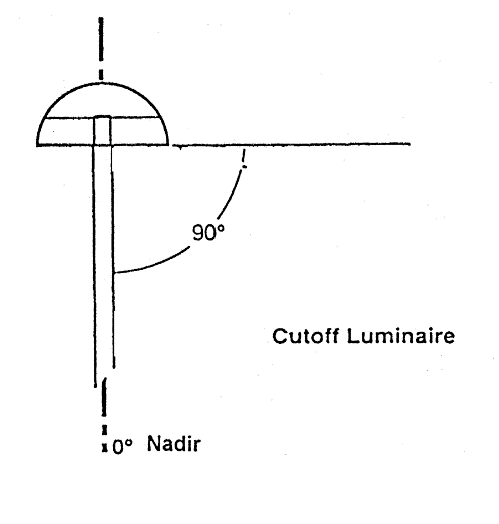
(b)
Prohibited drop lens.
PROHIBITED DROP LENS
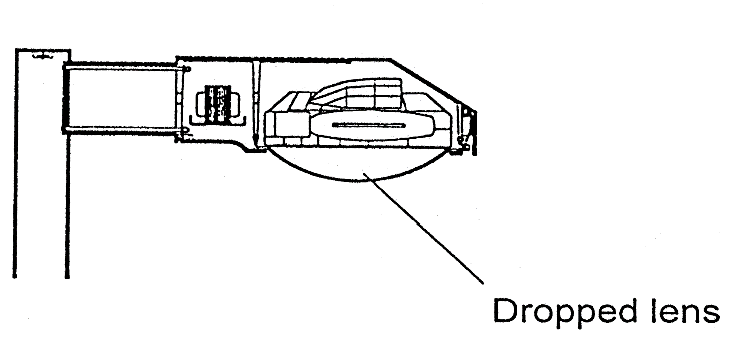
(c)
Examples of permitted full cutoff fixtures.
EXAMPLES OF PERMITTED FULL CUTOFF FIXTURES
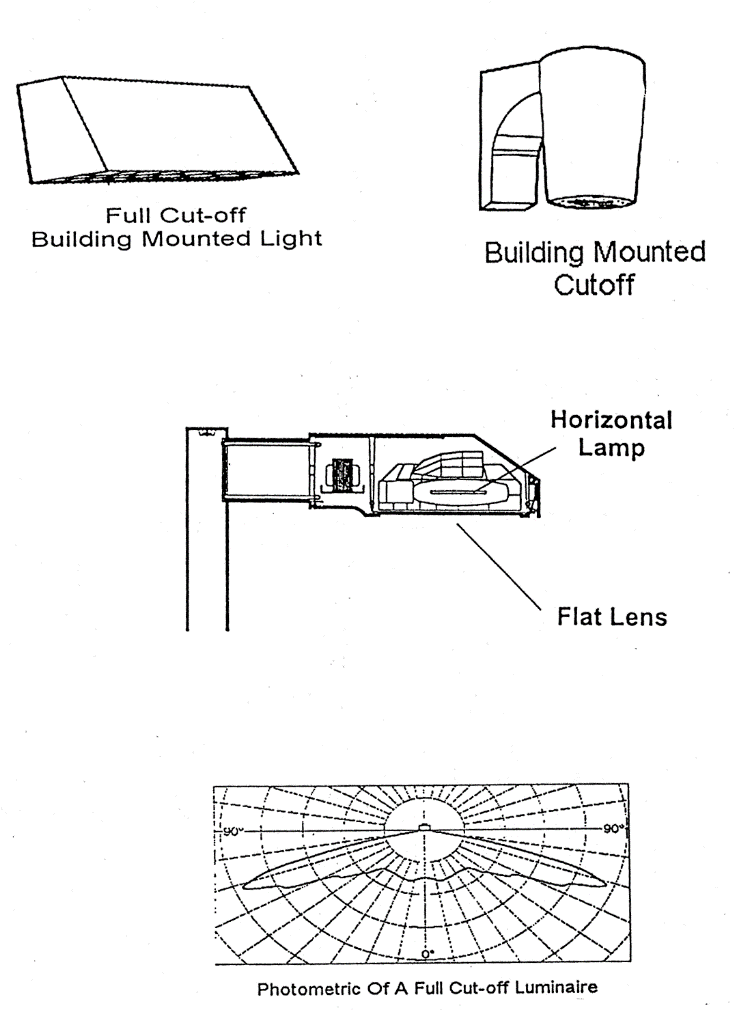
(d)
Recessed luminaire.
RECESSED LUMINAIRE
(Ord. No. 13-24, § 11, 4-1-2024)
Sec. 98-1121. - Purpose and objectives.
(a)
Purpose. Good outdoor lighting at night benefits everyone and enhances the town's nighttime character. New lighting technologies have produced lights that are extremely powerful, and these types of lights may be improperly installed so that they create problems of excessive glare and light trespass that reduce residents' privacy. Excessive glare can be annoying and may cause safety problems. There is a need for a lighting ordinance that recognizes the benefits of good outdoor lighting and provides clear guidelines for its installation so as to help maintain and complement the town's character and which strives to provide linkage between the built and natural environment and acknowledges and sustains the unique nature of the town's corporate-commercial, suburban and rural lifestyles. Appropriately regulated, and properly installed, outdoor lighting will contribute to the safety and welfare of the residents of the town.
(b)
Objectives. Outdoor lighting for nonresidential uses and multifamily uses has the following objectives:
(1)
It is intended to reduce the problems created by improperly designed and installed outdoor lighting in those areas zoned for nonresidential uses and multifamily uses;
(2)
It is intended to eliminate problems of glare and minimize light trespass by establishing regulations which limit the area that certain types of outdoor lighting fixtures can illuminate and by limiting the total allowable illumination of lots located in the town;
(3)
All lighting installed in nonresidential uses and multifamily uses should be designed with the idea of being a good neighbor, thereby eliminating or reducing unnecessary direct light from shining onto abutting properties or streets;
(4)
It is the declared purpose of this subdivision that nonconforming luminaries be eliminated and be required to conform to the regulations of this subdivision within a reasonable time.
(Ord. No. 09-02, § 3(a), (b), 2-5-2002)
Sec. 98-1122. - Applicability.
(a)
New fixtures or additional lighting. This subdivision shall apply to all installations of new fixtures or additional lighting to any new or existing nonresidential or multifamily use or structure.
(b)
Nonconforming Lighting. Luminaries installed prior to the adoption of the ordinance from which this subdivision is derived shall immediately be re-aimed or shielded such that the fixture no longer creates a nuisance as defined in section 74-3. Shielding may be accomplished by louvers, baffles, visors, or shields placed on the luminaries, or any other method whereby the light therefrom does not constitute a nuisance as defined in section 74-3.
(c)
Exemptions.
(1)
Street lighting installed by a governmental agency for public benefit on public rights-of-way; and
(2)
Public outdoor recreational sport fields and sport courts complex.
(Ord. No. 09-02, § 3(c) 2-5-2002; Ord. No. 14-03, § 4, 3-3-2003)
Sec. 98-1123. - Enforcement.
The enforcement of the rules and the provisions of this subdivision shall be by the town manager, or his duly appointed representative.
(Ord. No. 09-02, § 3(d), 2-5-2002)
Sec. 98-1124. - Measurement.
(a)
Metering Equipment. Lighting levels shall be measured in footcandles with a direct-reading, portable light meter.
(b)
Method of footcandle measurement. The meter sensor shall be not more than six inches above ground level in a horizontal position. The reading shall be taken only after the cell has been exposed long enough to provide a constant reading.
(Ord. No. 09-02, § 3(e), 2-5-2002)
Sec. 98-1125. - Prohibited lighting.
The following lighting is prohibited. No owner or occupant of land shall permit any of the following conditions to exist:
(1)
An unshielded light source, including bare bulbs, above 15 watts or 225 lumens, whichever is less, except for temporary seasonal lighting;
(2)
The operation of searchlights, strobes, or pulsating lights;
(3)
The use of low pressure sodium bulbs as a light source;
(4)
The use of a partial cutoff light source;
(5)
The use of a drop lens;
(6)
Luminaires located within the compatibility buffer between dissimilar uses;
(7)
Any luminaire that produces a disability glare;
(8)
Any light or combination of lighting that creates a nuisance as defined in section 74-3;
(9)
Any lighting installed to illuminate an unimproved surface or private outdoor recreational activities that exceeds requirements set forth in subsection 98-1101(b)(2) without an approved waiver, as set forth in subsection 98-1101(b)(3).
(Ord. No. 09-02, § 3(f), 2-5-2002; Ord. No. 101-04, § 6, 12-20-2004; Ord. No. 13-24, § 11, 4-1-2024)
Sec. 98-1126. - Height for light pole standards.
Maximum height for light pole standards shall be as follows:
(1)
In parking areas containing zero to 150 parking spaces, excluding parking spaces located within an enclosed parking garage, light pole standards shall not exceed 25 feet in height.
(2)
In parking areas containing 151 or more parking spaces, excluding parking spaces located within an enclosed parking garage, light pole standards shall not exceed 35 feet in height.
(Ord. No. 09-02, § 3(g), 2-5-2002; Ord. No. 42-21, § 15, 10-4-2021)
Sec. 98-1127. - Building mounted lighting.
All building mounted luminaires exceeding 15 watts or 225 lumens, whichever is less, shall be directed down with a full cutoff fixture.
(Ord. No. 09-02, § 3(h), 2-5-2002; Ord. No. 13-24, § 11, 4-1-2024)
Sec. 98-1128. - Floodlighting.
(a)
Luminaires used for floodlighting shall not direct the luminance above the facade of the object being lighted.
(b)
Spotlights and floodlights mounted overhead on poles or building walls and used for area lighting, including but not limited to residential areas, shall be installed so that the fixture is full cutoff as defined herein, with no light above 90 degree nadir.
(Ord. No. 09-02, § 3(i), 2-5-2002; Ord. No. 101-04, § 7, 12-20-2004)
Sec. 98-1129. - Building entry points.
At all building entry points average projected footcandle readings as determined by the point method photometrics shall not exceed a measurement of five footcandles.
(Ord. No. 09-02, § 3(j), 2-5-2002)
Sec. 98-1130. - Canopy lighting.
All canopy lighting shall be fully recessed fixtures with full cutoff lens and shall not exceed 45 footcandles at any point under the canopy.
(Ord. No. 09-02, § 3(k), 2-5-2002)
Sec. 98-1131. - Spacing.
(a)
In parking areas containing zero to 150 parking spaces, excluding those spaces internal to an enclosed parking garage, minimum spacing of lighting pole standards shall be no less than two times the height of the standard.
(b)
In parking areas containing 151 or more parking spaces, excluding those spaces internal to an enclosed parking garage, minimum spacing of lighting pole standards shall be no less than four times the height of the light standard, a ratio of four to one.
(Ord. No. 09-02, § 3(l), 2-5-2002; Ord. No. 13-24, § 11, 4-1-2024)
Sec. 98-1132. - Parking area lighting.
(a)
Parking area lighting shall not exceed a measurement of 15 footcandles at any point in the parking area. The average projected footcandle reading as determined by the point method photometrics shall not exceed two footcandles.
(b)
The average projected footcandle reading as determined by the point method photometrics shall not exceed two footcandles within the parking area.
(c)
The maximum kelvins of light pole standards in parking areas shall not exceed 3000.
(Ord. No. 09-02, § 3(m), 2-5-2002; Ord. No. 11-25, § 8, 3-3-2025)
Sec. 98-1133. - Penalty.
(a)
Any person violating any provision of this section shall be deemed guilty of a misdemeanor and upon conviction thereof, shall be punished by a fine as provided in section 1-13. A separate offense shall be deemed committed of each day during or on which a violation or failure to comply occurs or continues to occur.
(b)
A footcandle reading, as performed in accordance with section 98-1124, in excess of those amounts defined as a nuisance in section 74-3, shall be prima facie evidence of a violation of this subdivision.
(Ord. No. 09-02, § 3(n), 2-5-2002)
Sec. 98-1134. - Waiver.
(a)
A waiver as to the height restriction may be permitted by the town council for the replacement of luminaries installed prior to the adoption of the ordinance from which this subdivision is derived if such luminaires are damaged, destroyed, or otherwise become inoperable.
(b)
A waiver is permissible for such replacement luminaries only in those situations where more than one luminaire existed prior to the adoption of the ordinance from which this subdivision is derived. The town council may grant a waiver, upon application by the property owner or his designee, if the town council determines that the replacement of a damaged, destroyed, or otherwise inoperable luminaire with a luminaire conforming to the height requirement set forth in this subdivision would:
(1)
Create a nuisance as defined in section 74-3; or
(2)
Be aesthetically inconsistent with the remaining luminaires in determining whether a replacement luminaire would be aesthetically inconsistent, the town council may consider the following factors:
a.
The location of the replacement luminaire on the subject property;
b.
The type of construction material of the replacement luminaire;
c.
The location of the subject property; and
d.
The outdoor lighting used on adjacent and surrounding property.
(c)
Notwithstanding these provisions, under no circumstances may the replacement luminaire exceed 35 feet in height.
(Ord. No. 09-02, § 3(o), 2-5-2002; Ord. No. 13-24, § 11, 4-1-2024)
Sec. 98-1135. - Architectural lighting of buildings and structures.
For spotlights and floodlights mounted at or near ground level and used to light a building wall, sign, or other structure, the axis of illumination shall be adjusted to minimize the amount of light escaping above, below, and to the side of the illuminated object.
(Ord. No. 101-04, § 8, 12-20-2004)
Sec. 98-1136. - Architectural lighting of landscaping.
Landscape lighting installed for nonresidential uses and multifamily uses shall be installed according to the following:
(1)
Any lighting that is to be placed in the canopy of a tree shall be directed in a downward position to simulate natural light received by the area.
(2)
The fixture shall be shielded so that all of the light is directed downward and shall not be directed toward the tree, to reduce light intrusion.
(3)
All proposed lighting that is to be placed in a tree shall be affixed to the trunk or branch through the use of an adjustable bracketing system that will allow for the continued growth of the tree.
(4)
The mounting height of landscape lighting shall not exceed 25 feet.
(5)
No lighting shall be bolted, nailed, or glued to the trunk or any appendages of the tree, and such unauthorized attachment will be treated as a violation of chapter 94, Vegetation, of the town's Code of Ordinances.
(Ord. No. 101-04, § 9, 12-20-2004)

