
Floyd County Unincorporated
City Zoning Code
City Zoning Code
ARTICLE 5
- SIGN REGULATIONS
5.1.1. - PURPOSE OF ARTICLE 5
This Article sets out the standards that control the number, type, and placement of signs on an individual property or building. In addition to the general purposes of this Ordinance, the purpose of these sign regulations are as follows:
a.
To maintain and enhance the aesthetic environment and support economic development of the city and county;
b.
To maintain and improve pedestrian and traffic safety;
c.
To minimize potential adverse effects of signs on nearby property; and
d.
To encourage the proper use of signs as a means of effective communication.
5.2.1 - REGULATED SIGNS
a.
The regulations and requirements of this Article apply to all signs that are or are intended to be viewed from a public right-of-way or that are intended to be viewed from outdoor areas of public property.
b.
Such signs are allowed only in conformance with these sign regulations, or as otherwise provided for nonconforming signs under Article 1 of this Ordinance.
c.
All signs except billboards, real estate and real estate directional signs shall be considered as accessory uses and may be located only on properties where a principal use exists or is under construction.
5.2.2 - PROHIBITIONS
a.
No sign shall be erected or maintained where, by reason of its position, wording, illumination, size, or color, it may obstruct the view of oncoming vehicles or impair, obscure, interfere with the view of, or be confused with any authorized traffic control sign, signal, or device.
b.
No sign shall contain or be an imitation of an official government traffic control sign, signal, or emergency vehicle device.
c.
No part of any sign shall be located in, over, or project into a public right-of-way except for awning signs, canopy signs, or projecting signs in the C-B-C zoning district.
d.
No sign shall be erected, located, or maintained in such a manner as to interfere with safe and free ingress and egress of any door, emergency exit, driveway, street, or roadway.
e.
No sign shall interfere with such utilities as water mains and hydrants, sanitary sewerage, gas, electricity, and communications equipment or lines, nor interfere with natural or manmade storm water drainage facilities.
f.
No building sign shall extend above the top edge of the parapet or eaves of a flat or shed roof; the ridge line of a gable, hip, or gambrel roof; or the deck line of a mansard roof.
g.
No sign shall be painted on or attached to a tree, utility pole, rock, or other natural feature.
h.
An inflatable sign shall be allowed only in association with a special event allowed under the provisions of Article 3.
i.
Prohibited signs. The following types of signs are not allowed:
(1)
Animated Sign: A sign with action, motion, changing colors, flashing lights, or moving characters. Such signs may require electrical energy, but shall also include wind-activated devices including, but not limited to, spinners, aerial devices, and other attention-getting devices. This prohibition does not include rotating signs that revolve no faster than 5 revolutions per minute or electronic message boards that change messages no more often that 12 times per minute.
(2)
Derelict Sign: A sign that is dilapidated or in such condition as to create a hazard or nuisance, or to be unsafe or fail to comply with the Building or Electrical codes.
(3)
Pennant: Any lightweight plastic, fabric, or similar material, suspended from a rope, wire, or string, usually in series, designed to move in the wind. The term "pennant" shall not include a "banner" or an "official or personal flag" as regulated herein.
(4)
Portable Sign: A sign designed to be transported or easily relocated and not attached to the ground, such as:
(a)
A sign designed to be temporarily placed upon the ground and not otherwise affixed to it.
(b)
A sign mounted on a trailer, with or without wheels.
(c)
An A-frame or sandwich board sign.
(d)
A sign mounted or painted upon a parked vehicle that is positioned for the primary purpose of acting as a sign exposed to the public and is not in use in the ordinary course of carrying out its transportation function.
(e)
A sign mounted or painted upon a vehicle that is operated on public streets for the primary purpose of presenting a message or symbol offering or supporting the sale, rent, lease, loan, or other availability of any property, product, or service, and is not otherwise in use in the normal course of transporting people, merchandise, or freight.
(5)
Sound or Smoke Emitting Sign: A sign that emits or utilizes in any manner any sound capable of being detected on any traveled road or highway by a person with normal hearing; or a sign that emits smoke, vapor, particles, or odors.
(6)
Streamer: A long narrow banner, pennant, or strip of fabric or other material.
5.2.3 - EXEMPTIONS
a.
Window displays of goods available on site are not considered to be signs and are exempt from these sign regulations.
b.
Brand names or logos on products, product containers, or dispensers that are an integral part of the product or the product's packaging are not considered to be signs and are exempt from these sign regulations.
c.
A building design, color, or motif that is associated with a particular establishment or organization but conveys no commercial message is not considered to be a sign and is exempt from these sign regulations.
d.
Exempt Signs.
Each of the following types of signs are allowed in any zoning district and are exempt from the restrictions imposed by this Article:
(1)
Official signs: signs placed by a governmental body, governmental agency, or public authority, such as traffic signs, signals, or regulatory devices or warnings; official emblems, public notices, or official instruments; signs of historical interest; signs designating special events or areas of architectural or historic significance or gateways; or other similar signs or devices. Such signs are authorized within all rights-of ways or other properties controlled by such governmental body, agency, or authority.
(2)
Warning Signs: Signs and notices on private property that warn of dangerous conditions or restricted access to property or buildings. Includes "No Trespassing" signs, "No Hunting" notices and pennants, streamers, or other fluttering material used to increase the visibility of a wire or cable.
(3)
Property Address Sign: A sign limited in content to the street name and address number of the building or property to which it is affixed, provided that such sign consist of lettering no larger than 4 inches in height on a building or 2 inches in height on a mailbox.
(4)
Holiday Decorations: Displays erected on a seasonal basis in observance of religious, national, or state holidays, which are not intended to be permanent in nature and that contain no advertising material.
(5)
Agricultural Production Process Sign: A sign placed in conjunction with an agricultural activity on a property that functions solely to assist in the conduct of the activity by marking the location of agricultural products, providing a warning to employees, or indicating an activity related to the production process. Examples include signs that mark row crops, designate loading areas, indicate smoking prohibitions, or designate the content of storage structures.
5.3.1. - REQUIREMENTS APPLYING TO SIGNS IN ALL ZONING DISTRICTS
a.
Conformance to Other Codes.
(1)
A permit shall be obtained from the Building Inspections Department prior to installation or placement of any freestanding sign having a sign structure area greater than 15 square feet or any building sign having a sign face area greater than 6 square feet. All signs for which a building permit is required shall be constructed and maintained in conformance with all Building and Electrical Code requirements.
(2)
Plans required for issuance of a building permit for a sign shall be certified as to conformance with all structural and wind-load resistive standards of the Building Code by a structural engineer registered in the State of Georgia, or be prepared using standard drawings prepared by a structural engineer or other qualified professional meeting or exceeding all requirements of the Building Code. These provisions are excluded from any sign printed or affixed to a wall and/or pylon signs of less than 32 square feet or less than six (6) feet tall.
(3)
All signs involving internal lights or other electrical devices or circuits shall display a label certifying it as being approved by the Underwriter's Laboratories, Inc. No electric sign may be installed that is not approved by the Underwriter's Laboratory, Inc. Each sign manufacturer's UL number and the UL numbers of each individual sign must be provided as part of the sign permit application to prevent non-UL signs from being installed.
(4)
All electrical service to a sign shall be in compliance with the Electrical Code.
(5)
Clearance from all electrical power lines shall be incompliance with the requirements of the Electrical Code.
b.
Sign Maintenance.
All signs, together with all their supports, braces, guys, and anchors shall be kept in good repair and, unless constructed of galvanized or non-corroding metal, shall be given a protective coating as necessary to maintain a clean appearance and safe condition.
c.
Principal Freestanding Signs.
(1)
Each principal freestanding sign shall be located at least 75 feet from any other freestanding sign on an adjacent property on the same side of the street. This distance may be reduced upon approval by the Chief Building Official if it cannot be met due to the location of existing signs on separate but adjoining lots. Such reduction shall be the minimum required in order to maintain the greatest separation possible from such existing signs.
(2)
Principal freestanding sign shall be located at least 37 feet from a side lot line, or one-half the width of the lot frontage, whichever is less, except on intersecting corners of corner lots where the setback must be ten (10) feet from each side. A site drawing must be prepared and provided to the Building Inspection Department when applying for a permit.
(3)
A minimum of 25 square feet of landscape area, exclusive of the sign structure, shall be located at the base of each principal freestanding sign. The landscaping shall consist of shrubs, ground covers, or other plants appropriate to the setting of the sign. This requirement is the responsibility of the property owner or tenant, not the sign company.
(4)
There shall be a minimum of 10 feet between any street right-of-way line and the nearest edge of a principal freestanding sign. Monument signs over 36 inches in height must be set at least 20 feet from any street right-of-way.
d.
Projecting, Awning, and Canopy Signs.
(1)
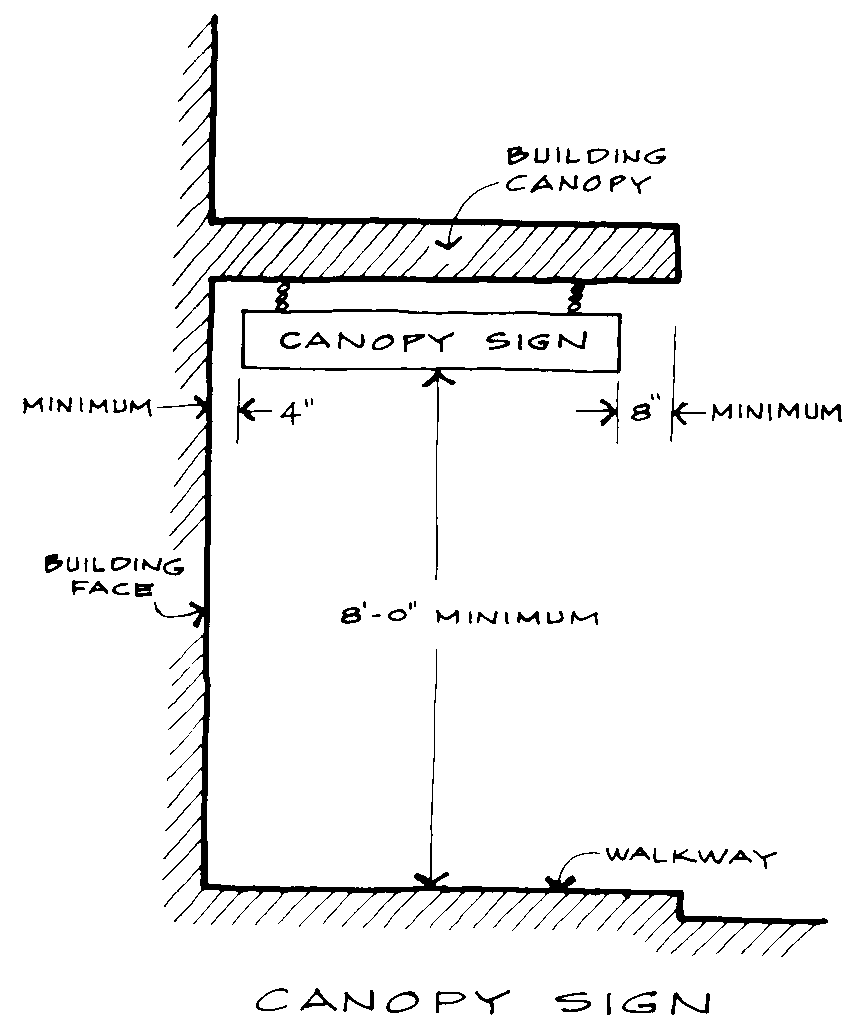
Over Private Property: Projecting, awning, and canopy signs shall provide at least 8 feet of clearance above the ground when erected over pedestrian walkways on private property and 17 feet of clearance when erected over driveways or other areas used for vehicles. Suspended canopy signs shall be at least 4 inches from the building face and at least 8 inches from the edge of the canopy.
(2)
Over Public Property: Projecting, awning, and canopy signs that project over public property, such as a sidewalk along a public street, shall maintain a clear height of 9 feet and shall extend no closer than 18 inches to the back of the curb.
(3)
Projecting and canopy signs shall be limited to no more than 1 per tenant on a property, and each tenant shall have no more than 1 projecting sign or canopy sign.
(4)
These requirements exclude overhanging "Clearance Signs" over private drives used to warn drivers of low clearances under canopies, covered delivery/pickup area, etc.
e.
Banners.
Banners shall be allowed only as wall or window signage and shall be placed flush upon the wall or window to which it is attached. Banners shall not be hung as canopy signs, flown as flags, or used as any other form of sign. In addition to any other signage allowed, one (1) banner per street frontage is allowed. Area of banner shall not exceed 32 square feet.
f.
Conformance with State Law.
Any sign within 660 feet of a State or U.S. numbered highway that advertises or offers anything for sale or lease that is not located on the property where the sign is located must be zoned for commercial or industrial use, and must conform to the regulations of the Georgia Department of Transportation.
For sign clearances under conductors or high tension lines of over 600 volts, see the National Electric Safety Code, ANSI C2-1996, Part 2, Safety Rules for Overhead Lines, Article 234B1 through 234B3 which must be met.
g.
Enforcement by Permit Number.
With each permit issued under this Article, the Building Inspection Department shall issue a sticker bearing the same number(s) of the permit with which is authorized (in One Inch Numbers), to be affixed in the corner area of the sign nearest the street, so as to be easily seen.
The absence of a proper sticker on a sign erected subsequent to the passage or adoption of this code, shall be prima facie evidence that the sign has been erected in violation of the provisions of this ordinance.
5.3.2. - COMPUTATION OF SIGN AREA
In order to determine compliance with the maximum allowable sign areas permitted under this Article, the area of a sign shall be considered the area of the sign structure unless otherwise stated. The area of a sign structure and a sign face shall be computed as follows:
a.
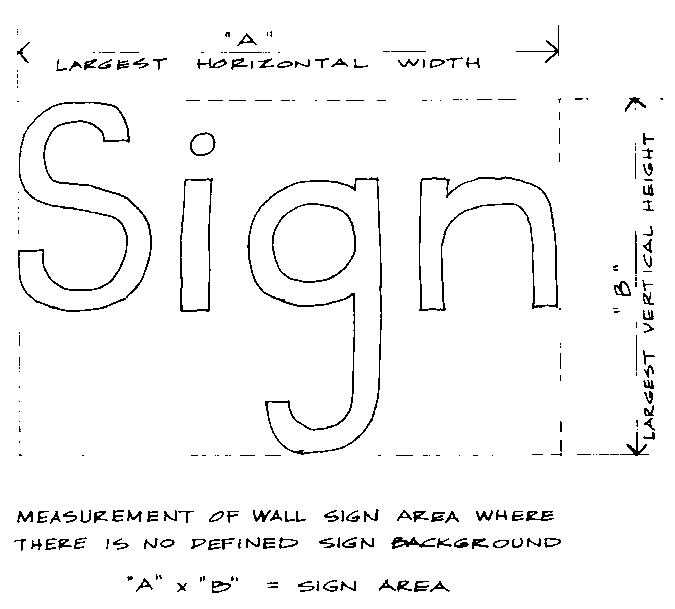
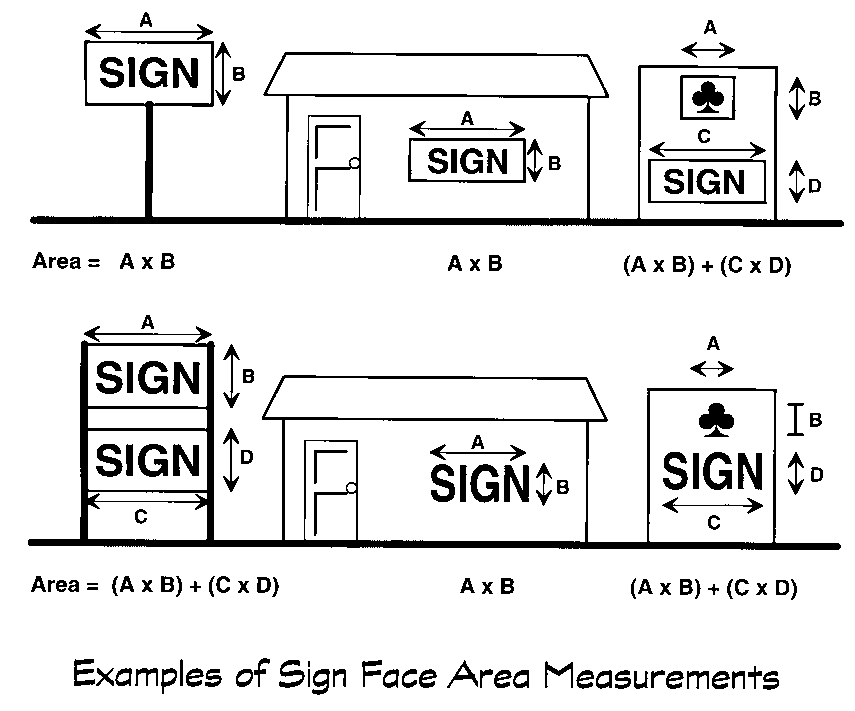
The area of a sign face shall be computed as the area within the smallest rectangle enclosing the limits of a sign face, or the combination of the areas of all such rectangles delimiting each sign face module, together with any frame or material, texture, or color forming an integral part of the sign face or used to differentiate the sign face from the structure upon which it is placed.
b.
The computation of the area of a sign face shall not include the structure, supports or uprights on which the sign face is placed on any portions of a sign structure that are not intended to contain any message or idea and are purely structural or decorative in nature, other than those portions contained within the rectangle that delimits the sign face or a sign face module.
c.
For any sign on which the words, letters, figures, symbols, logos, fixtures, colors, or other design elements are routinely changed or are intended to be changed from time to time, the sign face area shall include the entire area within which any words, letters, figures, symbols, logos, fixtures, colors, or other design elements may be placed, together with any frame or material, texture, or color forming an integral part of the sign face or used to differentiate the sign face from the structure upon which it is placed.
d.
The area of a sign structure shall be computed as the area within the smallest rectangle enclosing the limits of the surface of a sign whereon the sign face or sign face modules may be placed, including all portions of a sign structure that provide a background for the sign face but are not intended to contain any message or idea and are purely structural or decorative in nature.
e.
Any open space contained within the limits of the rectangle delimiting the sign face, sign face module, or sign structure shall be included in the computation of such sign face, sign face module, or sign structure.
f.
For multi-faced signs, when the sign face surfaces are parallel (back-to-back), or where the interior angle formed by the faces is 45 degrees or less, the area of the sign shall be taken as the area on the largest side. For all other multi-faced signs, the area of the sign shall be the total area on all sides that can be viewed at one time from any angle.
5.4.1. - BY ZONING DISTRICT
The following table represents the maximum number, height, and other restrictions relating to specific signage that are permitted by right in each zoning district.
a.
The "Principal Freestanding Sign-One Use on Property" category applies to a lot where there is only one single or two-family dwelling, one multi-family complex, or one business occupant.
b.
The "Principal Freestanding Sign-Two or More Uses on Property" category applies to a single office, commercial or industrial property that is designed or intended for occupancy by two or more principal businesses that are separately-owned and have no corporate relationship.
c.
For building signs in the office, commercial, and industrial zoning districts, the following shall apply:
(1)
For single-occupant buildings, the total sign face area for building signs on each side of a building shall be calculated on the basis of the horizontal length of the wall along that side of the building. Each side of the building shall be calculated separately.
(2)
In addition to the total sign face as calculated from the following table, one more square foot of sign face area shall be allowed on a wall facing a public street for each foot that the building is set back beyond the minimum principal building front setback required from that street.
(3)
For multi-tenant nonresidential developments (such as shopping centers), the total sign face area per wall for each tenant shall be distributed on the basis of the horizontal length of the wall along each tenant's occupied space. The maximum sign face area on a particular wall for each tenant shall be calculated separately.
d.
Project entrance signs are limited to freestanding monument signs.
e.
For signs in the PD Planned Development District, each development shall conform to the sign regulations established as part of the zoning approval for the Planned Development. If no such regulations exist, each portion of a Planned Development shall conform to the regulations of this Article for the zoning district most comparable to that portion of the Planned Development.
Table 5-1. Permitted Signs-By Zoning District or Special Use23
Principal Freestanding Sign—One Use on Property
Principal Freestanding Sign—Two or More Uses on Property
NOTE: Height of sign means, in the case of freestanding signs, the distance in vertical feet measured from the level of an adjacent street centerline to the highest point of the sign structure. The sign measured at its base shall not extend over 40 ft. in height above the centerline of any adjacent road.
Table notes:
23
See text for regulations relating to the P-D Planned Development District.
23
If property has over 200' of street frontage it can have 1 sign per 200' max 3.
Building Sign: Wall signs and awning, canopy, projecting, incidental, roof and window signs, etc. 24
Note: Street frontage is defined in this Code as being a street "from which access may be directly gained."
25
All building signs attached to a particular wall and its windows, doors, awnings, canopies, or roof, including signs that project from the wall, shall collectively not exceed the total square footage of sign face area allowed for the particular wall.
5.4.2. - ADDITIONAL SIGNAGE
In addition to the specific signs permitted in each district, the following signs shall be allowed in all zoning districts (or in the zoning districts as indicated) under the conditions noted for each type of sign.
a.
Project entrance signs.
Two monument signs may be located at each entrance into a residential subdivision or into an office or industrial park consisting of two or more buildings. Each project entrance sign shall not exceed:
(1)
32 square feet in sign face surface area.
(2)
96 square feet in sign structure area.
(3)
2½ feet in height if located within a sight visibility triangle (see Section 6.8) or 8 feet in height otherwise.
b.
Miscellaneous freestanding signs.
Additional freestanding signs are permitted for any multi-family, office, commercial, or industrial use if each sign complies with all of the following:
(1)
Within the minimum front yard setback for principal buildings required for the zoning district, miscellaneous signs may be located at entrance or exit driveways to the property. There shall be no more than 2 such signs per driveway and each such sign shall not exceed 8 square feet in sign area nor be more than 2½ feet in height.
(2)
Miscellaneous signs located farther from the street than the minimum required front yard setback for principal buildings shall be allowed as follows:
(a)
One miscellaneous sign may be located on the property for each principal building on the lot. Each such sign not to exceed 32 square feet in area nor be more than 8 feet in height.
(b)
An unlimited number of miscellaneous freestanding signs may be located on a property developed for multi-family or nonresidential use, provided that each such sign is no more than 6 square feet in sign area or more than 4 feet in height.
c.
Temporary signs.
(1)
Political signs.
(a)
Political signs may be placed as of the date of qualification of candidates, and shall be removed upon the final results. Each political candidate or ballot question shall be considered a separate temporary special event.
(b)
Political signs shall not exceed the following:
Table 5-2
Political Sign Maximums
(2)
Construction signs.
One construction sign per street frontage, not to exceed 64 square feet (2 4'x8' boards) in area, may be placed upon the commencement of construction and shall be removed upon issuance of a final certificate of occupancy for the construction or development project to which it refers.
(3)
Other temporary special event signs.
An additional sign other than a political sign or construction sign may be located on a property related to a temporary special event as defined and permitted in this Code, subject to the following:
(a)
One temporary sign per street frontage announcing a temporary special event may be placed for a period of no more than 30 consecutive days. Temporary signs for the same business or organization shall not be placed on a property more often than 3 times per calendar year, nor within 30 days of when the last temporary sign was placed on the property.
(b)
Each temporary special event sign shall not exceed 6 square feet in a residential zoning district or 32 square feet in a nonresidential zoning district.
(c)
Temporary special event signs shall be limited to one such sign per street frontage per temporary event.
(4)
Inflatable Signs.
In addition to the temporary signs allowed under this Section, a temporary special event may utilize one inflatable sign on the property of the event under the following conditions:
(a)
The inflatable sign may be displayed only during the 30-day period that the other temporary signage is allowed on the property.
(b)
The inflatable sign shall be installed in accordance with all requirements of the Building Code.
(c)
If affixed to a roof, the inflatable sign may extend above the roof line of the building.
(d)
Whether affixed to a roof or freestanding, the inflatable sign shall comply with the maximum sign face and sign structure area associated with the principal freestanding sign otherwise permitted on the property (see Table 5-1).
(5)
Real Estate Signs.
One real estate sign per property or premises may be placed on a site until the property or premises to which the sign refers is sold or leased. Such signs shall be limited as follows:
(a)
Residential districts: 6 square feet in area, 5 feet high.
(b)
Multi-Family and nonresidential districts: 32 square feet in area, 6 feet high.
(6)
Real estate directional signs.
A sign that conveys directions to a specific property for sale or lease, such as a real estate development, residential subdivision, apartment or condominium project, home for sale, apartment for rent, or any other real estate property for sale or lease, is permitted if it complies with all of the following:
(a)
Real estate directional signs may not contain any commercial message or advertisement, but may contain the name, trademark or trade symbol of the development or property to which directions are being provided and/or the real estate company offering the property.
(b)
Real estate directional signs are allowed in all zoning districts except within 660 feet of the right-of-way of any state highway where real estate directional signs are only allowed on properties zoned for commercial or industrial use.
(c)
Real estate directional signs shall be erected and maintained only with the permission of the owner of the property upon which the sign is erected.
(d)
Real estate directional signs shall not exceed a maximum size of four (4) square feet.
(e)
Real estate directional signs shall not be illuminated.
(f)
Real estate directional signs shall be removed within five (5) days of the consummation of the sale or lease of the property to which directions are provided.
(g)
There may be no more than four (4) real estate directional signs providing directions to any one residential, commercial, or industrial development; and no more than two (2) signs providing directions to any one lot.
d.
Semi-public use directional signs.
A sign that conveys directions to a specific use owned or operated by a non-profit, religious or eleemosynary institution for the purpose of providing educational, cultural, recreational, religious, or social services to the general public, is permitted if it complies with all of the following:
(1)
Semi-public use directional signs shall be erected and maintained only with the permission of the owner of the property upon which the sign is erected.
(2)
Semi-public use directional signs shall not exceed a maximum size of six (6) square feet in area and six (6) feet in height.
(3)
Semi-public use directional signs shall not be lighted.
(4)
There shall be no more than four (4) semi-public use directional signs providing directions to any one semi-public use.
(5)
Semi-public use directional signs shall be erected on supports provided specifically for that purpose and no more than one such support may be erected at any street corner.
e.
Billboards.
A billboard is a freestanding sign that exceeds the maximum sign face or sign structure area permitted by right on a property under the provisions of Section 5-4. A billboard may be allowed individually as a principal use or as an additional freestanding sign on a property under the following conditions:
(1)
The sign must be located in an A-R, C-C, H-C, L-I, or H-I zoning district within 660 feet of a State or U.S. numbered highway, and shall comply with all requirements of the State of Georgia.
(2)
The area of the sign face shall not exceed 400 square feet, nor shall the sign exceed 40 feet in height.
(3)
All portions of the billboard shall be located on a lot in accordance with the principal building setback requirements of the zoning district in which it is located.
(4)
The billboard shall not be located within 1,000 feet of any other billboard or within 200 feet of a zoning district where billboards are not allowed. Distance measurements shall be made horizontally in all directions from the nearest edge of the sign structure.
(5)
The billboard may not be located on or project over any building.
(6)
The billboard shall not be located within 1,000 feet of any major river corridor or tributary river corridor established under Article 6 of this Code. Such distance shall be measured from the top of the stream bank.
5.4.3. - UNIFORM SIGN PLAN REQUIRED
a.
A uniform sign plan is required for any multi-tenant nonresidential development, such as a shopping center, before any signs for the development or the development's tenants may be erected on the property.
b.
The uniform plan shall govern the placement and design of all signs within the development as to their location, materials, and size.
c.
A uniform sign plan shall be submitted and approved as follows:
(1)
The uniform sign plan shall consist of such drawings and specifications as may be required to clearly illustrate the location, materials, and size of all and every sign to be placed as freestanding and building signs within the development.
(2)
The uniform sign plan is to be submitted to the Building Inspection Department. The uniform sign plan shall be approved upon a finding by the Chief Building Inspector that:
(a)
The plan provides that signs of a similar type and function within the development have a consistency of size and construction materials so as to present a unified design concept while respecting the differences between tenant types and occupancies.
(b)
The signs proposed in the uniform sign plan comply with the requirements of this Article, such as number, location, and size restrictions.
d.
All tenants of the development, whether an owner, lessee, subtenant, purchaser, or other occupant, shall comply with the approved uniform sign plan.
5.4.4. - MODIFICATIONS TO SIGN RESTRICTIONS
a.
Modifications to the restrictions on signage established by a uniform sign plan for a specific property or development may be requested for administrative approval.
b.
Such requests shall be submitted to the Building Inspections Department for review and handling.
c.
A request for modification shall be supported by a revised uniform sign plan.
(1)
The revised uniform sign plan shall consist of such drawings and specifications as may be required to clearly illustrate the location, materials, size, letter style, and color of all and every sign to be placed as freestanding and building signs within the development.
(2)
The revised uniform sign plan shall establish design standards such that signs of a similar type and function within the development shall have a consistency of size, letter style, color scheme, and construction materials so as to present a unified design concept while respecting the differences between tenant types and occupancies.
d.
Denial.
If the Building Inspections Department denies the requested modification, the applicant may appeal to the Board of Appeals and Adjustments as a special exception. See Section 2.11.4.
e.
Approval.
Following approval by the Chief Building Inspector or the Board of Adjustments, all tenants of the property or development, whether an owner, lessee, sub-tenant, purchaser, or other occupant, shall comply with the approved uniform sign plan.
5.5.1. - ABANDONMENT DEFINED
a.
Any sign that provides notice of a temporary special event or any other temporary purpose that has since occurred shall be deemed to have been abandoned.
b.
Any sign that fails to meet the maintenance requirements of this Article shall be deemed abandoned and subject to removal if such deficiencies are not corrected within 30 days after a written notice from the Chief Building Official to the owner or tenant concerning said deficiencies. The Chief Building Official shall have the discretion to grant an additional 30 days for the required improvements to be made provided substantial progress is being made to correct the deficiencies and a written request for such an extension is received at least five (5) working days before the end of the original notice.
5.5.2. - SIGN REMOVAL
a.
The owner of the sign or owner of the premises shall remove signs that are deemed to be abandoned or otherwise found to be in violation of this Ordinance within 30 days from the written notice by the Chief Building Official. Any such signs not removed within 30 days from the written notice may be removed by the Jurisdiction and all costs charged to the owner of the premises upon which such sign was located, or the owner of the sign itself.
b.
Should any sign become insecure or in danger of falling or otherwise unsafe in the opinion of the Chief Building Official, the owner or person or firm maintaining the sign shall, upon written notice from the Chief Building Official, forthwith in the case of immediate danger and in any case within 10 days, remove such sign or secure it in a manner approved by the Chief Building Official. Any such sign not removed or secured within 10 days from the written notice may be removed by the Jurisdiction and all costs charged to the owner, agent, or person having beneficial interest of the building or premises upon which such sign was located, or in the sign itself.
c.
If any sign is installed, erected, or constructed in violation of this Ordinance, the owner or person or firm maintaining the sign shall, upon written notice from the Chief Building Official within 10 days, remove such sign or bring it into compliance with this Ordinance. Any such sign not removed or properly altered within 10 days from the written notice may be removed by the Jurisdiction and all costs charged to the owner, agent, or person having beneficial interest of the building or premises upon which such sign was located, or in the sign itself.

