
Forest Park City Zoning Code
ARTICLE A
- GENERAL PROVISIONS
Sec. 8-8-1.- Title and authority.
(a)
This document shall be formally known as the City of Forest Park Zoning Ordinance and it may also be cited and referred to as the zoning ordinance, ordinance, or Code.
(b)
This chapter shall be for the purpose of promoting the public health, safety, and general welfare of the city and all of its citizens.
(c)
This chapter shall be under the authority of Official Code of Georgia Annotated, Title 36, Chapter 66, Zoning Procedures, and Title 36, Chapter 67, Zoning Proposal Review Procedures, and all acts amendatory thereto.
(Ord. No. 21-11, § 1(Exh. A), 9-7-2021)
Sec. 8-8-2. - Jurisdiction.
This chapter shall apply to all land within the jurisdiction of the City of Forest Park, being all portions of the city not in the ownership of the municipal, state, or federal government and to any area for which the City of Forest Park Mayor and City Council has jurisdiction consistent with the provisions of Georgia law.
(Ord. No. 21-11, § 1(Exh. A), 9-7-2021)
Sec. 8-8-3. - Purpose.
This chapter is intended to guide the growth and development of the City of Forest Park in accordance with the City of Forest Park Comprehensive Plan and for the following purposes:
(1)
To secure adequate light, air, and convenience of access, and safety from fire, flood, and other dangers.
(2)
To promote the public health, safety, comfort, convenience, morals, and general welfare.
(3)
To plan for the future development of the city to the end:
a.
That the community grows with adequate public ways, utilities, health, education, and cultural and recreation facilities;
b.
That the needs of industry and business be recognized in future growth;
c.
That areas provide healthful surroundings for family life;
d.
That the growth of the community is commensurate with and promotes the efficient and economical use of public funds; and
e.
That the community strives for high aesthetic value and quality planning and design.
(Ord. No. 21-11, § 1(Exh. A), 9-7-2021)
Sec. 8-8-4. - Definitions.
(a)
The definitions contained in this article shall be observed and applied in the interpretation of all other actions in this chapter;
(1)
Words used in the present tense shall include the future;
(2)
Words used in the singular number shall include the plural;
(3)
Words used in the masculine gender shall include the feminine;
(4)
The word "shall" is mandatory, not discretionary;
(5)
The word "may" is permissive;
(6)
The word "lot" shall include the words "tract" and "parcel;"
(7)
The word "building" includes all other structures of every kind regardless of similarity to buildings;
(8)
The phrase "used for" shall include the phrase "arranged for," designed for," intended for," "maintained for," and "occupied for;"
(9)
The word "person" includes a corporation, firm, partnership or similar, as well as an individual;
(10)
All measured distances shall be to the nearest whole foot;
(11)
Parenthetical words or statements are integral parts of the definitions in which they are located;
(12)
Any words not defined in section 8-8-4 shall be construed in their generally accepted meanings as defined by standard dictionaries.
(b)
The words generally used in this chapter are defined in section 8-8-4, definitions, and shall be viewed in that context.
(c)
For the purpose of these regulations, certain words or terms used shall be defined as follows:
Abandonment means the relinquishment of property or a cessation of the use of the property for a continuous period of one (1) year by the owner with neither transferring rights to the property to another owner nor of resuming the use of the property.
Accessory dwelling means a dwelling unit, which is used for residential occupancy, created within an existing single-family home or on the same lot. It is an independent unit, but it may share an entrance, yard and parking with the principal unit.
Accessory equipment means any equipment serving or being used in conjunction with a telecommunications facility or support structure. This equipment includes, but is not limited to, utility or transmission equipment, power supplies, generators, batteries, cables, equipment buildings, cabinets and storage sheds, shelters, or other structures.
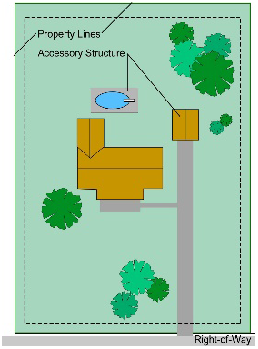
Accessory structure means a structure which is subordinate to a primary structure in area, intent, and/or purpose; contributes to the comfort, convenience, or necessity of occupants of the primary building, structure, or principal use, and does not alter or change the character of the premises; is located on the same lot as the primary building, structure, or use.
Adult day care facility means adult day care facilities shall include any building or portion thereof used to house six (6) or more adults requiring care, maintenance, and supervision for part of a day.
Administrator means the individual or group responsible for the implementation and enforcement of the ordinance. The planning and community development director, or his/her designee, shall be the administrator for the zoning ordinance.
Agricultural product means fruits, vegetables and field crops but shall exclude livestock and livestock products.
Alley means a street which affords only secondary means of access to abutting property, and not intended for general traffic.
Alteration means a change in size, shape, character, occupancy or use of a building or structure.
Alteration, structural means any change in the supporting elements of a building such as bearing walls, columns, beams, or girders.
Amendment means any repeal, modification, or addition to a regulation; or any new regulation.
Apartment means one (1) or more rooms in an apartment building, with private bath and kitchen facilities or combination living space and commercial building, arranged, intended, designed, or occupied on a rental basis as a dwelling unit for a single family, an individual, or a group of individuals.
Apartment building means a multi-family housing structure designed and constructed to accommodate three (3) or more dwelling units with independent cooking and bathroom facilities.
Applicant means the owner, owners, or legal representative of real estate who makes application for action affecting the real estate owned thereby.
Application means the application for and all accompanying documents and exhibits required of a petitioner by an approving authority for a development review process.
Art center means a facility whose mission is to promote the arts and make them available to the public. An arts center may host art exhibits and shows, provide studio space for the use of artists and engage in public education and exposure to the arts.
Art use means creation or assembly of visual art, including two- and three-dimensional works of fine art or craft, or other fine art objects created or assembled for purposes of sale, display, commission, or trade by artists or artisans. Art use may also include classes held for art instruction.
Art/artisan gallery means an establishment that engages in the sale, loan or display of paintings, sculptures, photographs, video art or other works of art. "Art gallery" does not include a cultural facility such as a library, museum or noncommercial gallery that may also display works of art or an arts studio.
Artisan shop means a shop in which goods are custom prepared, displayed, or sold in small quantities, that are often one-of-a-kind items. May also include the production, display, and sale of such goods or a place where a small number of persons are engaged in arts and crafts activities in a class or studio.
Artist studio means an area in a building used for creation, production, rehearsal, study or teaching of any visual art or craft, including but not limited to painting, drawing, graphic design, photography, video, film, sculpture, and pottery; written works of fiction or nonfiction; or any performing art, whether for live or recorded performance, including music, dance, and theater. Arts studio may include performance space related to classes taught on-site and recording studios; a studio for artisan related crafts, such as small-scale metalworking, glassblowing, furniture making, pottery, leather craft and similar activities. Artist studio may also include accessory sales of art produced on the premises.
Artist means a person who practices one (1) of the fine arts, design, graphic, musical, literary, computer, or performing arts; or a person whose profession relies on application of these skills to produce a creative product. The term includes, but is not limited to, individuals who practice visual arts, such as painters, print makers, illustrators, sculptors, potters, jewelry makers, glass makers, craft artists and photographers; performing arts, such as musicians, composers, playwrights, choreographers and dancers; literary arts, such as creative writers and literary translators; architecture and design, such as architects, landscape architects, engineers, urban designers and planners, interior designers and decorators, industrial designers, graphic designers and fashion designers; and media arts, such as filmmakers, video and audio artists and web-based designers.
Arts means the interpretation of imagination and creativity in a physical form or performance.
As built plan means a plan and supporting documentation which describes a particular site after construction has been completed. This plan should indicate all structures, hard surface features, utilities, landscaping areas, tree preservation zones, and tree replacement areas.
Assisted living facility means a state licensed use in which domiciliary care is provided to adults who are provided with food, shelter and personal services within independent living units which include kitchen facilities in which residents have the option of preparing and serving some or all of their own meals. This use shall not include hospitals, convalescent centers, nursing homes, hospices, clinics, or similar institutions devoted primarily to the diagnosis and treatment of the sick or injured.
Attached building means a building that is structurally connected to another building by a foundation, wall, or roof line. Carports, garages, porch awnings and the like shall be considered attached buildings.
Attached wireless communication facility means an antenna array that is attached to an existing structure. These structures include, but are not limited to, utility poles, signs, water towers, rooftops, equipment facilities, and towers with any accompanying pole or device which attaches the antenna array to the existing building or structure and associated connection cables.
Automobile means a self-propelled, free-moving vehicle with four (4) wheels, usually used to transport not more than six (6) passengers and licensed by the appropriate state agency as a passenger vehicle.
Automobile repair, major means a business where engine rebuilding or major reconditioning of worn or damaged motor vehicles or trailers; collision service, including body, frame, or fender straightening or repair; and overall painting of vehicles is performed.
Automobile repair, minor means a business that conducts repairs other than major repair including engine tune-up, muffler shops, shock absorber replacement shops, undercoating shops, and tire stores.
Automobile sales means the use of any building, land area, or other premises for the display and sale of new or used automobiles, generally, but may include light trucks or vans, trailers, or recreational vehicles and including any vehicle preparation or repair work conducted as an accessory use.
Automobile wash means any building or premises or portions thereof used for washing automobiles. The facility for washing automobiles may be self-service, semi-automatic, or automatic application of cleaner, brushes, rinse water, and heat for drying.
Basement means a story partly underground but having more than one-half of its clear height below finished grade.
Bed and breakfast facility means an individual owner-occupied residence containing no more than six (6) guest rooms for hire, for lodging by prearrangement for periods not to exceed three (3) consecutive weeks and providing for occasional meals daily (usually breakfast) and not a hotel, boarding, lodging house, or motel.
Berm means a man-made, formed, earth mound of definite height and width used for landscaping and obscuring purposes.
Blood banks mean the process that takes place in the lab to make sure that donated blood, or blood products, are safe before they are used in blood transfusions and other medical procedures. Blood banking includes typing the blood for transfusion and testing for infectious diseases.
Blood donation center means a facility, fixed or mobile, that is operated by a blood bank and used for the collection of blood, plasma or cytapheresis products, or separation of whole blood into components.
Blood plasma center means an establishment where patrons receive compensation for donating blood plasma.
Boarding house means a dwelling other than a hotel where, for compensation and by prearrangement for a definite period, where meals and/or lodging are provided for four (4) or more persons.
Buffer means any land in permanent vegetation of trees, shrubs, walls, fences, berms, space, or related landscaping features required by Ordinance on private lots, and privately maintained, for buffering lots from adjacent properties or public rights-of-way for the purpose of increasing visual or other aspects of privacy and aesthetics.
Buffer yards means an area adjacent to front, side and rear property lines, measured perpendicularly from adjacent property lines and/or right-of-way lines, intended to provide attractive spaces to reduce the impacts of proposed uses on adjacent property or natural features and to screen incompatible uses from each other. Buffers also help to maintain existing trees or natural vegetation, to block or reduce noise, glare, or other emissions and to maintain privacy. Buffer yards are in addition to, but separate from, the front, rear, or side yard setbacks.
Building means a structure having a roof, supported by columns or walls, and intended for the shelter, housings, or enclosure of an individual, animal; process, equipment, goods, or materials of any kind.
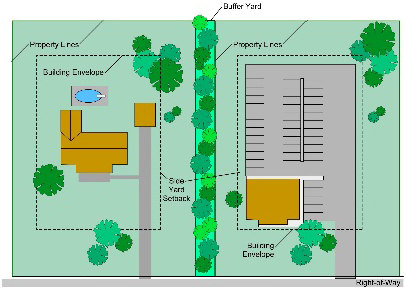
Building area means the horizontal area of the buildings on a lot, measured from the outside exterior walls, excluding open areas or terraces, unenclosed porches or decks, and architectural features that project less than two (2) feet.
Building code means the International Building Code pursuant to O.C.G.A. § 8-2-20.
Building, detached means a building surrounded by open space on the same lot.
Building envelope means the three-dimensional space within which a structure is permitted to be built on a lot and that is defined by the maximum height regulations, minimum yard setbacks, and buffers when applicable.
Building inspector means the person or persons charged with the responsibility of issuing building permits, inspecting buildings, and issuing certificates of occupancy. This person is certified by the state or the International Code Council (ICC) in one (1) or more disciplines; a residential or commercial building inspector, a plumbing, electrical or mechanical inspector or other specialty to inspect structures at different stages of completion.
Building permit means a permit allowing a person, firm, or corporation to erect, construct, enlarge, alter, repair, move, improve, remove, convert, or demolish any building or structure or before starting any construction, excavation, or work within a subdivision within its jurisdiction, or the pursuit of changes to the condition of land.
Building, principal means a building or structure in which is conducted the predominant use of the lot, on which it is located.
Building, residential means a building which is arranged, designed, used, or intended to be used for residential occupancy by one (1) or more families or lodgers and which includes, but is not limited to the following types:
(1)
Single-family detached dwellings;
(2)
Two-family dwellings;
(3)
Single-family or two-family attached and semi-detached dwellings developed initially under single ownership or unified control;
(4)
Multiple-family dwellings.
Business means the engaging in the purchase, sale, barter, or exchange of goods, wares, merchandise, or services; an occupation, employment, or enterprise which occupies time, attention, labor, and materials; or the maintenance or operation of offices, recreational, or amusement enterprises.
Caliper means the diameter of thickness of the trunk of a young tree or sapling as measured at six (6) inches above the top of the root mass. This measurement is used for nursery-grown trees having a diameter of less than six (6) inches.
Canopy means a permanent roof-like structure projecting from a building and open on at least one (1) side for the purpose of shielding a pedestrian walkway from the elements, or a freestanding roof-like structure supported by columns intended to shield a vehicular driveway or service area from the elements.
Carport means an open-sided roofed automobile shelter, formed by extension of the roof from the side of a building.
Cemetery means property used for the interring of the dead. Includes any crematory, mausoleum, or mortuary operated in conjunction with and on the same tract as the cemetery.
Certificate of occupancy means a certificate stating that the occupancy and use of a structure complies with the provisions of the building code and all other applicable regulations of the City of Forest Park.
Clearing means the removal of vegetation from a property by any means.
Club or lodge, private means an association of persons, who are bona fide members paying annual dues, which owns, hires, or leases a building or portion thereof; the use of such premises being restricted to members and their guests.
Commercial vehicle means any truck or similar motorized mechanism designed to transport individuals or goods which is powered by an engine and which is licensed by applicable governmental authorities as a commercial motor vehicle.
Comprehensive plan means the official adopted comprehensive plan pursuant to the Georgia Planning Act of 1989 that includes goals, objectives, and strategies for land use, growth management, transportation or thoroughfares, community facilities and services, environment concerns, infrastructure, aesthetics and identity, economic development, and parks and recreation.
Comprehensive transportation plan means the official adopted plan adopted as part of the Clayton County Comprehensive Plan, as subsequently amended, which includes a street plan, sets forth the location, alignment, dimensions, identification, and classification of existing and proposed streets, and other thoroughfares.
Condition of approval means stipulations or provisions that are provided above and beyond the minimum requirements that are set forth as a prerequisite for the approval of an application.
Condominium means real estate lawfully subject to the Georgia Condominium Act, O.C.G.A. § 44-30-70 et seq. by the recordation of condominium instruments, in which undivided interests in the common areas and facilities are vested in the condominium unit owners.
Conforming building or structure means any building or structure that complies with all the regulations of this chapter or of any amendment hereto governing the zoning district in which building or structure is located; and is designed or intended for a conforming use.
Construction plan(s) means the maps or drawings showing the specific location and design of improvements to be built in accordance with the applicable requirements of the City of Forest Park.
Cottage dwelling means a stick-built dwelling unit that shall not exceed six hundred (600) square feet in floor area, excluding lofts, with a minimum height of six (6) feet and eight (8) inches. Cargo containers and trailers cannot be used as cottage dwellings.
Covenants means private and legal restrictions of various kinds on the usage of lots, typically within a subdivision and applied by the subdivider and/or developer, that are recorded with the plat and deed.
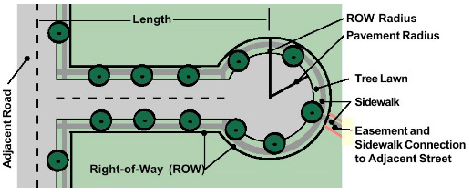
Cul-de-sac means the turnaround at the end of a dead-end street.
Day care center means as defined by Rules and Regulations of the Georgia Department of Human Resources and for the purposes of the zoning ordinance, any place operated by a person, society, cooperation, institution, or group wherein are received for pay for group care, for fewer than twenty-four (24) hours per day without transfer of legal custody, having nineteen (19) or more children under eighteen (18) years of age, and which is required to be licensed by both the City of Forest Park and the Georgia Department of Human Resources.
Decorative wall means a masonry wall consisting of brick, stone or similar materials as approved by the director and constructed with a design that includes specific pattern elements or ornamentation.
Deciduous means a plant with foliage that drops or dies at the end of a growing season.
Design guidelines means the downtown mainstreet regulations codified within section 8-8-54 in this article of the zoning ordinance of the city.
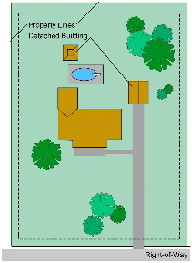
Detached building means a building that has no structural connection with the principal building.
Development means new construction and any reconstruction, relocation, alteration, remodeling, or renovation of structures.
Diameter breast height (DBH) means the standard measure of tree size for trees six (6) inches or greater in caliper existing on a site. The tree trunk is measured at a height of four and one-half (4½) feet above the ground, and if a tree splits into multiple trunks below that point, the trunk is measured at its most narrow point beneath the split.
Director means the director of the planning and community development department.
Domestic pets means animals commonly used as household pets, protection, companions, and for the assistance of disabled persons. Domestic pets shall include, but not be limited to, dogs, cats, parakeets, parrots, finches, spiders, guinea pigs, hamsters, gerbils, rats, mice, rabbits, and aquarium fish.
Drainage easement means a grant by a property owner to specific persons, the general public, corporations, utilities, or others, for the purpose of transporting stormwater.
Drive-through means any facility that may be accessed directly by means of a motor vehicle for transacting business.
Driveway means an access-way connecting one (1) or more dwelling units and/or their parking spaces with a street.
Dwelling means a building or structure or portion thereof, conforming to all requirements applicable to the residential use districts of the zoning ordinance and Georgia Building Code used exclusively for residential occupancy, including single-family dwelling units, two-family dwelling units, and multi-family dwelling units, but excluding hotels, boarding houses, and lodging houses.
Dwelling, duplex means a residential building containing two (2) dwelling units designed for occupancy by not more than two (2) families.
Dwelling, manufactured home means a dwelling unit built in a factory bearing a seal of compliance with Federal Manufactured Housing Construction and Safety Standards 42 U.S.C.A. 5401 et seq. and is installed and anchored on a permanent foundation and perimeter wall, according to the Georgia Manufactured Housing Code, as amended, and its pitched roof and siding are of materials customarily used for site constructed dwellings.
Dwelling, mobile home means a transportable dwelling unit manufactured prior to June 15, 1976, and not subject to the Federal Manufactured Housing Construction and Safety Standards 42 U.S.C.A. 5401 et seq.
Dwelling, multiple family means a residential building designed for or occupied by three (3) or more families, with the number of families in residence not exceeding the number of dwelling units provided.
Dwelling, quadraplex means a building divided into four (4) self-contained residences.
Dwelling, single-family means a detached residential dwelling unit designed for and occupied by one (1) family.
Dwelling, triplex means a building divided into three (3) self-contained residences.
Dwelling, two-family means a residential building containing two (2) dwelling units designed for occupancy by not more than two (2) families.
Dwelling unit means any structure or portion thereof designed for or used for residential purposes as a self-sufficient or individual unit by one (1) family and having permanently installed sleeping, cooking, and sanitary facilities.
Easement means a grant by a property owner to specific persons, the general public, corporations, utilities, governments, or others, for a specified purpose.
Electric vehicle (EV) means a vehicle that operates, either partially or exclusively, on electric power supplied by a rechargeable battery or other energy storage device.
Entertainment, live means any musical act, including karaoke; theatrical act, including a play, revue or stand-up comedy; dance; magic act; disc jockey or similar activity performed live by one (1) or more persons, whether or not for compensation or an admission charge.
Erosion means the process by which land surface is worn away by the action of wind, water, ice, or gravity.
EV charging station means a public or private parking space equipped with battery charging equipment used to transfer electric energy to a vehicle's battery or storage device.
EV park means a designated area or facility designed specifically for EV charging that includes multiple EV charging stations, enhanced landscaping, amenities, and public-use features.
EV-ready means a designation indicating that electrical infrastructure is installed to support the future placement of EV charging equipment.
Event center means a building and/or premises used as meeting or gathering place for social engagements or activities, where people assemble for parties, weddings, receptions, reunions, birthday celebrations, other business purposes, or similar such uses for profit, in which food and beverages may be served to guests.
Evergreen means a plant with foliage that remains green year-round.
Façade means the exposed exterior walls of any structure.
Family means an individual, or two (2) or more persons if related by blood, marriage, adoption, or guardianship and not more than four (4) unrelated persons, occupying a single dwelling unit and using the same cooking facilities.
Family day care home means a residential home in which shelter, care, and supervision are provided for fewer than twenty-four (24) hours per day, without transfer of legal custody, having no more than six (6) children under eighteen (18) years of age who are not related to such persons and whose parent or guardians are not residents in the same private residence. All family day care homes are required to be licensed by both the City of Forest Park and the Georgia Department of Human Resources. All family day care homes shall meet the requirements of the adopted International Residential Building Code.
Farm animals means animals commonly used for transportation, food, skins, and other by-products. Farm animals include, but are not limited to, horses, cattle, pigs, sheep, goats, mules, donkeys, miniature horses, miniature donkeys, camels, emus, ostriches, llamas, alpacas, rabbits, minks, foxes, buffalos, chickens, turkeys, quails, pheasants, and other animals or fowl of similar characteristics.
Farm stand means a direct marketing operation without a permanent structure and only offering on farm produced and locally produced agricultural products.
Fence, chain-link means a fence constructed of galvanized steel or similar materials as approved by the building inspector for the purpose of enclosing or securing an area. Chain-link fences shall not include wire fences or fences of similar construction.
Fence, decorative wall means a masonry wall consisting of brick, stone, or similar materials as approved by the director and constructed with a design that includes specific pattern elements or ornamentation.
Fence, industrial means a chain-link or ornamental fence constructed of materials approved by the director for the purpose of enclosing or securing an industrial use.
Fence, obscuring wall means a masonry wall consisting of brick, stone, or similar materials as approved by the director and constructed for the purpose of enclosing, obscuring, or screening an area from view.
Fence, ornamental means a fence consisting of wrought iron, galvanized steel, aluminum, vinyl, wood, or similar materials fabricated into a design with specific pattern elements or ornamentation. Columns or support structures may consist of brick, stone or stucco that is architecturally consistent with the primary structure. All spaces in the fence shall be open and unobstructed and the fence shall not block vision to an extent greater than forty (40) percent. Ornamental fences shall not include chain-link or wire fences or fences of similar construction.
Fence, privacy means a fence constructed of wood, vinyl or similar materials that blocks vision to an extent greater than forty (40) percent for the purpose of obscuring or screening an area from public view.
Fence, rail means a fence constructed of wood, vinyl or similar materials and consisting of one (1) to four (4) horizontal rails connecting to vertical posts spaced a minimum of six (6) feet apart. All spaces in such fences shall be open and unobstructed and such fences shall not block vision to an extent greater than forty (40) percent.
Fence, temporary means a fence constructed of canvas, plastic, chain-link, wood, or similar material as approved by the director for the purpose of enclosing or securing an area for a limited period of time.
Final plat means the final map, drawing or chart upon which the subdivider's as-built plan of subdivision is presented, and which, if approved, will be submitted for recording among the land records for Clayton County.
Final stabilization means all land disturbing activities at a site have been completed and that for unpaved areas and areas not covered by permanent structures, one hundred (100) percent of the soil surface is uniformly covered in permanent vegetation with a density of seventy (70) percent or greater, or equivalent permanent stabilization measures such as the use of rip rap, gabions, permanent mulches, or geo-textiles, have been used. For the purposes of this definition, permanent vegetation shall consist of: planted trees, shrubs, perennial vines; a crop of perennial vegetation appropriate for the time of year and region; or a crop of annual vegetation and a seeding of target crop perennials appropriate for the region.
Floodplain means the relatively flat area or low land adjoining the channel of a river or stream which has been or may be covered by flood water. The floodplain includes the channel, floodway, and floodway fringe. Floodplain boundaries are to be determined by using the floodway-flood boundary maps of the Federal Insurance Administration/Federal Emergency Management Administration.
Floodway means the channel of a river or stream and those portions of the floodplains adjoining the channel which are reasonably required to efficiently carry and discharge the peak flood flow of the regulatory flood of any river or stream.
Floor area means the sum of the gross horizontal areas of the several floors of the building enclosed by an exterior wall, excluding however, attic and basement floors, open porches, breezeways, and garages.
Floor area of a building (for determining off-street parking and loading requirements) means the sum of the gross horizontal areas of the several floors of the building, or portion thereof, devoted to a specific use; including accessory storage areas located within selling or working space such as counters, racks, or closets; and any basement floor area devoted to retailing activities, to the production or processing of goods, or to business or professional offices.
Floor area, finished means that portion of floor area constructed, completed, and usable for living purposes with normal living facilities which includes sleeping, dining, cooking, working, entertainment, common space living rooms, areas for personal hygiene, or combination thereof.
Floor area, ground means that portion of finished floor area located on the first (or nearest ground level) floor of the dwelling unit. The floor area of a primary structure does not include a garage, carport, deck, unfinished storage, patio, or open porch.
Food truck means a motorized vehicle or trailer drawn by a motorized vehicle used to prepare and sell food to the public directly from the vehicle or trailer.
Food truck court means an area designated in a private parking lot that is accessory to a permitted use conducted in a building on the lot or a freestanding commercial parking lot.
Food truck vendor means any person or entity that prepares and sells food from a food truck in a designated food truck court.
Foundation means the supporting member of a wall or structure.
Front line means with respect to a building, the foundation line that is nearest the front lot line.
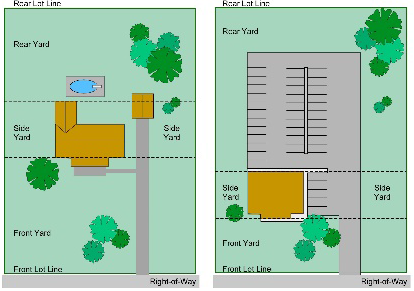
Front lot line means for an interior or through lot, the line marking the boundary between the lot and the abutting street right-of-way or a lake or watercourse; and for a corner lot, the line marking the boundary between the lot and each of the abutting streets.
Front yard means the horizontal space between the nearest foundation of a building to the front lot line, extending to the side lines of the lot, and measured as the shortest distance from that foundation to the front lot line.
Garage means a deck, building, or parking structure, or part thereof, used or intended to be used for the parking and storage of vehicles.
Grading means any land disturbing activity, including clearing, grubbing, stripping, cutting, filling, stockpiling, or any combination thereof, and shall include the land in its cut or filled condition.
Group day care home means a home wherein group care for not less than seven (7) nor more than eighteen (18) children under eighteen (18) years of age for less than twenty-four (24) hours without transfer of legal custody and which is required to be licensed by both the City of Forest Park and the Georgia Department of Human Resources. All group day care homes shall meet the requirements of the adopted International Residential Building Code.
Group home means a dwelling unit or facility in which full time residential care is provided for children under the age of seventeen (17) as a single housekeeping unit. The group residence may provide food, shelter, combination of personal care, social or counseling services and transportation. Bedroom suites shall not include kitchen facilities. The facility is required to be licensed by both the City of Forest Park and the Georgia Department of Human Resources.
Group residence/shelter means a state licensed twenty-four (24) hour residential facility functioning as a single housekeeping unit for the sheltered care of persons with special needs which, in addition to providing food and shelter, may also provide some combination of personal care, social or counseling services and transportation. Bedroom suites shall not include kitchen facilities. For purposes of this chapter, group residence/shelter shall not include those facilities which exclusively care for children under the age of seventeen (17).
Heavy vehicle means any large vehicle, cab, trailer, truck, tractor trailer, bus or car carrier (including rollbacks and wreckers), including, but not limited to, school buses, in excess of nine hundred (900) cubic feet or one-ton capacity.
Height means the vertical distance of a structure measured from the average elevation to the finished grade surrounding the structure of the highest point of the structure.
Hospital means an institution devoted primarily to the maintenance and operation of facilities for the diagnosis, treatment, or care for three (3) or more unrelated individuals suffering from illness, disease, injury, deformity, or other abnormal physical conditions. The term "hospital" does not apply to institutions operating primarily for treatment of insane persons, drug addicts, alcoholics, and other types of cases necessitating restraint of patients, and the term "hospital" shall not include convalescent, nursing, shelter, or boarding homes.
Hotel means a building in which lodging or board and lodging are provided and offered to the public for compensation and in which ingress and egress to and from all rooms is made through an inside lobby or office supervised by a person in charge at all hours. As such, it is open to the public. Compensation is usually assessed on a day-to-day basis.
Hotel, extended stay means a hotel or motel offering individual rooms or suites containing a kitchen area with facilities where cooking is permitted.
Impervious surface means any material that prevents absorption of stormwater into the ground.
Industrial waste means solid waste generated by manufacturing or industrial processes or operations as defined in O.C.G.A. § 12-8-22.
Inoperable vehicle means any motorized vehicle incapable of immediately being driven.
Institutional facility for the developmentally disabled/mentally ill means a residential facility that provides care, supervision and protection and operates under a license issued under the Georgia Department of Human Resources; provides for delivery of mental health services that are appropriate to the needs of the individual; and complies with the rules adopted by the Georgia Department of Human Resources.
Junk yard means a place, usually outdoors, where waste or discarded property, other than organic matter, including, but not limited to, automobiles and farm implements and trucks, is accumulated and is or may be salvaged for reuse or resale; this shall not include any industrial scrap metal yard. The storage, dealing in or the permitting of the accumulation of significant quantities of combustible, organic or nonmetal scrap materials such as, but not limited to, wood, paper, rags, garbage, tires, bones, and shattered glass on the premises of such an establishment will disqualify it from being classified as a scrap metal yard, and the same will be classified as a junk yard.
Kennel means a place primarily for keeping four (4) or more adult dogs, or other small animals that are ordinarily bred for sale as pets. This includes temporary care facility for compensation.
Kidney dialysis centers mean an independent or hospital-based units/facilities, approved and licensed to furnish outpatient dialysis services (maintenance dialysis services, home dialysis training and support services or both) directly to end stage renal disease (ESRD) patient(s).
Land disturbing activity means any activity which may result in soil erosion from water or wind and the movement of sediments into state waters or onto lands within the state, including, but not limited to, clearing, dredging, grading, excavating, transporting, and filling of land.
Landscaping means the improvement of a lot with grass, shrubs, trees, and other vegetation and/or ornamental objects. Landscaping may include pedestrian walks, flower beds, berms, fountains, and other similar natural and man-made objects designed and arranged to produce an aesthetically pleasing effect.
Legal nonconforming fence or wall means a fence or wall which was legally erected or installed but is no longer in compliance with the provisions of this article. Such fences or walls must be located outside of any existing right-of-way and wholly upon the parcel to which they are associated.
Level 1 charging station provides charging through a standard 120V AC outlet. Typically used in residential or low-traffic commercial applications.
Level 2 charging station provides charging through a 240V AC plug, often used in commercial, public, or multi-family locations.
Level 3 charging station (DC fast charger) provides high-voltage direct current (DC) charging, typically for rapid charging in commercial or public settings.
Loading space means space logically and conveniently located for bulk pickups and deliveries, scaled to the size of delivery vehicles expected to be used.
Locally produced agricultural product means agricultural products grown within a fifty-mile radius of the farm stand premises or produce acquired from any food distribution organization run in the State of Georgia dedicated to procuring produce from sustainable family farms.
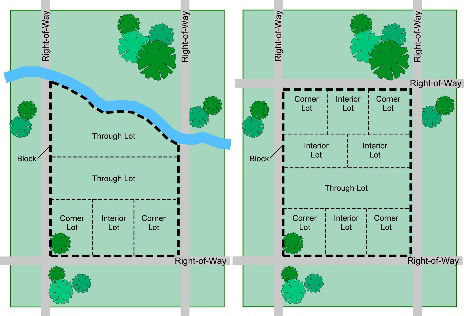
Lot means a contiguous area of land separated from other areas of land by separate description (including a recorded deed, a subdivision plat or record of survey map, or by metes and bounds) for purpose of sale, lease, transfer of ownership or separate use.
Lot coverage means the area of a zoning lot occupied by the principal building and any accessory structures.
Lot depth means the horizontal distance between the front and rear lot lines.
Lot frontage means all property of a lot fronting on a street right-of-way or common, private drive, as measured between side lot lines.
Lot of record means a lot which was lawfully created and is a part of a subdivision recorded in the office of the Clayton County Clerk of the Court, or a parcel or lot described by metes and bounds, and a description of which has been so recorded.
Lot width means the distance as measured between the side lot lines at the front set back line.
Lot, buildable means any lot upon which a building or structure is allowed to be constructed and occupied by the regulations of the City of Forest Park. Generally, the lot shall have frontage on and access to an improved street, meet minimal setbacks, and have all necessary utilities available.
Lot, corner means a lot situated at the intersection of two (2) streets or which fronts a street on two (2) or more sides forming an interior angle of less than one hundred thirty-five (135) degrees.
Lot, developed or improved means a lot with buildings or structures.
Lot, interior means a lot other than a corner lot with only one (1) frontage on a street other than an alley.
Lot, through means a lot fronting on more than one (1) street, other than an alley, or abutting more than one (1) street which do not intersect at the boundaries of the lot. Also includes lots fronting on both a street and a watercourse or lake.
Makerspace means an indoor or outdoor facility or both intended to be used by artists as studio and retail space. Makerspaces often combine production, equipment, community, and education for the purposes of enabling participating individuals to design, prototype, and create works that said individuals would have difficulty producing if working alone due to a lack of resources, tools, artistic input, and/or space. Such space may be in a residential, commercial, mixed use or a live/work building and often provides tools for community use. Makerspaces are characterized by consistent design elements, such as high ceilings, large windows, durable surfaces and wide entrances. These spaces are designed to accommodate and foster a variety of creative activities. Makerspaces may also include common space such as galleries, meeting rooms and open space that encourages resident engagement and community involvement.
Medical/dental/physical therapy specialists (specialized treatment of the human anatomy).
(1)
Medical specialist means a medical practitioner who has been registered as a specialist in a specialty or subspeciality in medicine in terms of the regulations relating to the specialties and subspecialities in medicine and dentistry.
(2)
Dental specialist means any dental practitioner who is registered by the dental council under the Health Practitioners Competence Assurance Act 2003 as a dental specialist in one (1) of the approved branches of dentistry and who is employed in that branch of dentistry or in a similar capacity with minimal oversight.
(3)
Physical therapy specialist means services provided by a qualified physical therapist directed toward improving quality of life and wellbeing following an injury, with a specific focus on mobility and function.
Microbrewery means any establishment where malt beverages are produced or brewed, such as breweries and brewpubs.
Mini-warehouse means a building or portion thereof used for dead storage, mainly of the excess personal property of an individual or family, but also of small amounts of goods or merchandise for businesses or individuals.
Mobile home park means a parcel of land containing two (2) or more dwelling sites, with required improvements and utilities, that are leased for long term placement of manufactured homes and shall include any street used or intended for use as part of the facilities of such manufactured home park. A manufactured home park does not involve sales of manufactured homes in which unoccupied units are parked for inspection or sale.
Motel means an establishment consisting of a group of attached or detached living or sleeping accommodations with bathroom and closet space, located on a single zoning lot, and designed for use by transient automobile tourists. A motel furnishes customary services such as maid service and laundering of linen, telephone, secretarial, or desk service, and the use and upkeep of furniture.
Motorized ATV/off road vehicle or motor bikes means a motorized vehicle whose primary purpose and design is for usage other than transportation and generally off improved road surfaces. Also may be referred to as not being street legal. Vehicles whose design and use are for use on challenging terrain and/or contests of speed and skill in adverse conditions. Examples but limited to; dune buggies, motor cross bikes, off-road motorcycles, quad-runners, and three wheelers.
Motor vehicle means any passenger vehicle, truck, tractor, tractor-trailer, truck-trailer, trailer, or semi-trailer propelled or drawn by mechanical power.
Municipal solid waste means any solid waste derived from households as defined in O.C.G.A. § 12-8-22.
Nonconforming building means a building, structure, or portion thereof, which was designed, erected, or structurally altered in accordance with the provisions of a current such that it does not conform to the regulations of the zoning district in which it is located.
Nonconforming lot of record means a lot that predates the zoning regulations and was created such that it does not conform to the regulations of the zoning district in which it is located.
Nonconforming sign means a sign or portion thereof, which was designed, erected, or structurally altered such that it does not conform to the regulations of the zoning district in which it is located.
Nonconforming use means a use of land, buildings, or structures which does not conform with the use regulations of the zoning district in which it is located.
Nursing home means a use in which domiciliary care is provided to three (3) or more convalescing, chronically or terminally ill non-family members who are provided with food, shelter and care. This use shall not include hospitals, clinics or similar institutions devoted primarily to the diagnosis and treatment of the sick or injured. Convalescent center, nursing home and personal care home are further distinguished in administrative and conditional use provisions.
On farm produced agricultural products means agricultural products grown in a farm or garden on the same premises on which said produce is sold at a farm stand.
Open space means an area of land not covered by buildings, parking structures, or accessory uses except for recreational structures. Open space may include nature areas; streams and floodplains; meadows or open fields containing baseball, football, and soccer fields, golf courses, swimming pools, bicycle paths, etc. Open space does not include street rights-of-way, platted lot area, private yard, patio areas, or land scheduled for future development.
Outdoor arts market means a temporary event held on private or public property where artwork is offered for sale.
Outdoor storage means the outdoor accumulation of goods, junk, cars, buses, tractor trailers, railroad cars, equipment, products, or similar materials for permanent or temporary holding.
Overlay district means a zoning district that encompasses one (1) or more underlying zones and that imposes additional requirements above that required by the underlying zoning district.
Owner means any person, group, of persons, firm or firms, corporation or corporations, or any other legal entity having legal title to the land.
Parking deck means a public or private structure or a portion thereof composed of one (1) or more levels of floors used exclusively for the parking of motor vehicles, whether public or private. A parking structure may be totally below grade (as in an underground parking garage) or either partially or totally above grade with those levels being either open or enclosed.
Parking lot means a group of parking spaces in an open area that may be of dirt, paved, or hard surface not including any part of a street or alley, designed or used for temporary parking of motor vehicles.
Parking space means space within a public or private parking area for the storage of one (1) passenger automobile or commercial vehicle under a one and one-half (1½) ton capacity.
Paved means a durable surface for parking, driving, riding or similar activities that utilizes asphalt, concrete, brick, paving blocks, or similar material. Crushed gravel, stone, rock, dirt, sand, or grass are not permitted as a paved surface.
Permanent foundation means a structural system for transposing loads from a structure to the earth at a depth below the established frost line without exceeding the safe bearing capacity of the supporting soil.
Person means a corporation, company, association, society, firm, partnership, organization, unit of government, or any other group that acts as a unit, as well as a natural person.
Personal care home means a residential dwelling or facility in which are provided two (2) or more beds and other facilities and services, including room, meals, and personal care for non-family ambulatory adults, as regulated by the State of Georgia Department of Human Resources and the City of Forest Park. The term "personal care home" does not include buildings which are devoted to independent living units which include kitchen facilities in which residents have the option of preparing and serving some or all of their own meals, nor does it include halfway houses, residential treatment facilities, nursing homes, sanitariums, hospitals, or other institutional facilities, or rooming or boarding facilities which do not provide personal care.
Petitioner means a person submitting an application for a development permit or for the rezoning of land.
Place of assembly means a place of assembly is a structure, portion of a structure or area (either indoor or outdoor), designed primarily for people to gather to observe or participate in a single event or series of events.
Plat means a map or chart that shows a division of land and is intended to be filed for record.
Porch means a roofed-over structure projecting out from the wall or walls of a main structure and commonly open to the weather in part.
Preliminary plat means the plan or map upon which the approval of a proposed subdivision is based on as described in this zoning ordinance, indicating the proposed layout of the subdivision to be submitted for approval.
Primary building/structure means the building or structure in which the primary use of the lot or premises is located or conducted, with respect to residential uses, the primary building or structure shall be the main dwelling.
Primary care physician/dentist offices means a specialist in family medicine, general internal medicine, dental or general pediatrics who provides definitive care to the undifferentiated patient at the point of first contact and takes continuing responsibility for providing the patient's comprehensive care.
Primary use means the main use of land or buildings as distinguished from an accessory use. A principal use may be either a permitted use or a conditional use.
Professional office means an office used by members of a recognized profession such as architects, artists, dentists, engineers, lawyers, musicians, physicians, surgeons or pharmacists, realtors, or insurance agents and brokers.
Public health center (immunizations, vital records, etc.) means a publicly owned facility for the provision of public health services, including related facilities such as laboratories, clinics, and administrative offices operated in connection with public health centers.
Public utility means any person, firm, or corporation duly authorized to furnish under public regulation to the public, electricity, gas, steam, telephone, fiber optics, transportation, water, or sewerage systems.
Rear lot line means the lot line that is opposite the front lot line and farthest from it, except that for a triangular or other irregularly-shaped lot, the line ten (10) feet long, parallel to the front lot line, and wholly within the lot, that is farthest from the lot line.
Rear yard means the horizontal space between the nearest foundation of a building to a rear lot line and that rear lot line, extending to the side lines of the lot, and measured as the shortest distance from the foundation to the rear lot line. The rear yard of a corner lot shall be that yard at the opposite end of the lot from the front yard.
Recreational vehicle means a vehicle which is built on a single chassis; four hundred (400) square feet or less when measured at the largest horizontal projections; designed to be self-propelled by a light duty truck; and designed primarily not for use as a permanent dwelling, but as quarters for recreational camping, travel, or seasonal use. A vehicle that is a temporary dwelling for travel, recreation, and vacation use.
Recycling center means a lot or parcel of land, with or without buildings, upon which used household good materials are separated and processed for shipment for eventual reuse in new products.
Registered land surveyor means a land surveyor properly licensed and registered through reciprocity permitted to practice in the State of Georgia.
Registered professional engineer means an engineer properly licensed and registered through reciprocity permitted to practice in the State of Georgia.
Residential facility for the developmentally disabled/mentally ill means a residential facility which provides residential services for persons with developmental disabilities or mental illnesses and such facility is licensed and regulated by the Georgia Department of Human Resources.
Restaurant means an establishment where food and drink are prepared, served, and consumed primarily within the principle building.
Restaurant, drive-through means an establishment where food and/or beverages are sold in a form ready for consumption, where all or significant portion of the consumption takes place or is designed to take place outside the confines of the restaurant, and where ordering and pick up of food may take place from an automobile.
Right-of-way means a strip of land acquired by reservation, dedication, prescription, or condemnation, and intended to be occupied by a road, crosswalk, railroad, electric transmission lines, oil or gas pipeline, water line, sanitary storm sewer, and other similar uses.
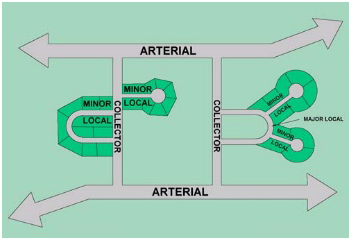
Right-of-way width means the distance between property lines measured at right angles of the centerline of the street.
Road/street means any vehicular route that is an existing state, county, or municipal roadway; or is shown upon a plat approved pursuant to law.
Road/street, private means vehicular streets and driveways which are wholly within private property except where they intersect with other streets within public rights-of-way and are maintained by the owner(s), and a road/street that has not been accepted by the city or other governmental entity.
Road/street, public means all property dedicated or intended for public highway, freeway, or roadway purpose or subject to public easements, therefore.
School means a public or private institution which offers instruction in any of the branches of learning and study comparable to that taught in the public schools under the Georgia School Laws, including pre-kindergarten, kindergarten, elementary school, and junior and senior high schools, but excluding trade, business, or commercial schools.
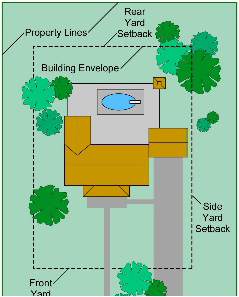
Setback means the minimum horizontal distance between the wall of the building or foundation and a lot line or right-of-way.
Side lot line means a lot boundary line other than a front or rear lot line.
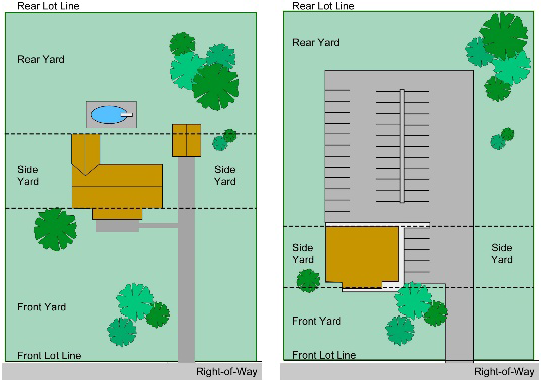
Side yard means the horizontal space between the nearest foundation of a building to the side lot line and that side lot line, unoccupied other than by architectural appurtenances projecting not more than twenty-four (24) inches into that space; steps or terraces not higher than the level of the first floor of the building; and open lattice-enclosed fire escapes, fireproof outside stairways and balconies projecting not over twenty-four (24) inches into that space.
Land development site development plan (site plan) means the plan indicating the location of existing and proposed buildings, structures, paved areas, walkways, vegetative cover, landscaping, and screening within a site proposed for development which is to be submitted to the planning and community development department for approval prior to the release of improvement location permits on the site.
Small power tools means hand equipment driven by other than human means. Examples include circular saws, power drills, portable miter saws, routers, electric belt sanders and wood lathes. Not defined as small power tools are chain saws, mounted miter saws, band saws, jackhammers, and similar power tools.
Solid waste means any garbage or refuse as defined in O.C.G.A. § 12-8-22.
Solid waste handling means the storage, collection, transportation, treatment, utilization, processing, or disposal of solid waste, or any combination of such activities as defined in O.C.G.A. § 12-8-22.
Street grade means the grade of the centerline of a street measured at any point along the street expressed as a percent.
Street tree means any existing tree or any tree to be planted on the street right-of-way.
Structural alteration means a change, other than incidental repairs, which would prolong the life of the supporting members of a building, such as the addition, removal, or alteration of bearing walls, columns, beams, girders, or foundations. Also, substantial roofing and siding work when repairs are made to the structure beneath.
Structure means a composition of materials to form a construction for use, occupancy, or orientation whether installed on, above, or below the surface of land or water.
Structure height means the vertical distance of a structure measured from the average elevation to the finished grade surrounding the structure of the highest point of the structure.
Subdivider means a person, individual, firm, partnership, association, corporation, estate, or trust, or any other group or combination acting as a unit, dividing or proposing to divide land so as to constitute a subdivision, as herein defined, including any agent of the subdivider.
Subdivision means the division of land into two (2) or more lots, parcels, sites, or other divisions of land for the purpose, whether immediate or future, of transfer of ownership or for building development. It includes resubdivision and relates to the process of resubdividing or to the land or territory subdivided.
Supplemental zones means an additional setback requirement for residential buildings that allows for stoops, stairs, low walls and fences, and small gardens to buffer the ground floor from the sidewalk.
Surety means an amount of money or other negotiable security paid by the subdivider, developer, or property owner or his surety to the county which guarantees that the subdivider will perform all actions required by the county regarding an approved plat or in other situations, and provides that if the subdivider, developer, or property owner defaults and fails to comply with the provisions of his approval, the subdivider, developer, or property owner or his surety will pay damages up to the limit of the bond, or the surety will itself complete the requirements of the approval.
Temporary use/structure means a land use or structure established for a limited and fixed period of time with the intent to discontinue such use or structure upon the expiration of the time period.
Tiny home means a stick-built dwelling unit that shall not exceed five hundred (500) square feet in floor area, excluding lofts, with a minimum height of six (6) feet and eight (8) inches. Cargo containers and trailers cannot be used as tiny homes.
Townhouse means a multi-family dwelling consisting of three (3) or more attached dwelling units, separated from others by a fire rated wall extending from the basement to the roof, each of which has primary ground floor access to the outside.
Tractor trailer storage means property used for the long term-controlled storage of tractor trailers which include permanent office or security facilities.
Trailer means trailers designed for human dwellings can be divided into RV or mobile homes. To be classified as a RV trailer it must be less than four hundred (400) square feet and a trailer of four hundred (400) square feet or more is classified as a mobile—single wide. Trailers used for construction or sales offices should not be considered the same as RV or as mobile homes. Also transport trailers used for storage or are abandoned present a different set of issues.
Tree means any living, self-supporting woody or fibrous plant which normally obtains a diameter breast height of at least three (3) inches, and typically has one (1) main stem or trunk and many branches.
Urban design review board or UDRB means the administrative review body as provided by section 8-8-158 of this Code of Ordinances.
Urgent care centers mean walk-in clinics that provide treatment for minor ailments and injuries outside of a traditional hospital-based or freestanding emergency department.
Use means the purposes of which land, building, or structure thereon is designed, arranged, or intended, or for which it is occupied, maintained, let, or leased.
Use, conditional means a use that is designated by the zoning ordinance as being permitted in the district concerned if it meets special conditions, if found to be appropriate and upon application, is specifically authorized by the mayor and city council.
Use, principal means the main use of land or buildings as distinguished from a subordinate or accessory use. (May be either "permitted" or "conditional".)
Use, permitted means a use which may be lawfully established in a particular district or districts, provided it conforms to all requirements, regulations, and performance standards, if any, of such district.
Variance means a specific approval granted by the planning commission in the manner prescribed by the zoning ordinance, to deviate from the development standards that the ordinance otherwise prescribes.
Vehicle means a device used as a mode of transportation of persons and/or goods, including, but not limited to, automobiles, semi-tractor trailers, all types of trailers, snowmobiles, recreational vehicles, motorcycles and like devices.
Warehousing and distribution centers means land and building facilities engaged in storage, wholesale, and distribution of manufactured products, supplies, and equipment.
Wetland means an area that is inundated or saturated by surface or ground water at a frequency and duration that under normal circumstances supports a prevalence of hydrophytic vegetation.
Wireless telecommunications facility means any unmanned facility established for the purpose of providing wireless transmission of voice, data, images, or other information including, but not limited to, cellular telephone service, personal communications service (PCS), and paging service. A telecommunication facility can consist of one (1) or more antennas and accessory equipment or one (1) base station.
Yard means an open space on the same lot with a building or structure, unoccupied and unobstructed from the general ground level to the sky, except as otherwise permitted. (A "yard" extends along a lot line, and to a depth or width specified in the yard requirements for the zoning district in which such lot is located.)
Yard, front means a yard extending along the full length of the front lot line between the side lot lines.
Yard, rear means a yard extending along the full length of the rear lot line between the side lot lines.
Yard, side means a yard extending along a side lot line from the front yard to the rear yard.
Yard, corner side means a side yard which adjoins a public street, road, or highway.
Yard, interior side means a side yard which is located immediately adjacent to another lot or to an alley separating such side yard from another lot.
Zoning district means a section of the City of Forest Park for which uniform zoning regulations governing use, height, area, size, intensity of use of buildings and land, and open spaces about buildings, are established by the zoning ordinance.
Zoning map means a map of the City of Forest Park, Georgia, that legally denotes the boundaries of zoning districts as they apply to the properties within the planning jurisdiction.
Zoning ordinances means an ordinance or resolution of a local government establishing procedures and zones or districts within its respective territorial boundaries which regulate the uses and development standards of property within such zones or districts. The term also includes the zoning map adopted in conjunction with a zoning ordinance which shows the zones and districts and zoning classifications of property therein O.C.G.A. § 36-66-3.
Zero lot line means the location of a building on a lot in such a manner that one (1) or more of the building's sides rest directly on a lot line.
(Ord. No. 21-11, § 1(Exh. A), 9-7-2021; Ord. No. 23-02, § 1, 5-1-2023; Ord. No. 23-08, § 1, 8-7-2023; Ord. No. TA-24-03, § 1, 5-20-2024; Ord. No. 25-01, §§ 1, 2, 1-6-2025; Ord. No. 25-10, §§ 1—3, 8-4-2025)
Sec. 8-8-5. - Compliance.
No structure shall be located, erected, constructed, reconstructed, moved, altered, converted, or enlarged; nor shall any structure or land be used or existing use be expanded, except in full compliance with all provisions of this chapter and after the lawful issuance of all permits and certificates required by this chapter.
(Ord. No. 21-11, § 1(Exh. A), 9-7-2021)
Sec. 8-8-6. - Severability.
If any provision of this chapter or the application of any provision to particular circumstances is held unconstitutional or invalid by the courts, the remainder of the ordinance or the application of such provision to other circumstances shall not be affected.
(Ord. No. 21-11, § 1(Exh. A), 9-7-2021)
Sec. 8-8-7. - Interpretation.
The provisions of this chapter shall be held to be the minimum requirements for the protections of the health, safety, and general welfare of the people at large, and are designed to encourage the establishment and maintenance of reasonable community standards for the physical environment. If two (2) or more provisions within this chapter are in conflict or are inconsistent with one (1) another, then the provision which is most restrictive shall control.
(Ord. No. 21-11, § 1(Exh. A), 9-7-2021)
Sec. 8-8-8. - Jurisdiction.
This chapter shall apply to the entire city limits of the City of Forest Park, Georgia.
(Ord. No. 21-11, § 1(Exh. A), 9-7-2021)
Sec. 8-8-9. - Application.
When this chapter along with private covenants, private contracts, commitments, permits, agreements, state laws, federal laws, or other regulations regulates a structure or parcel of land, the greater restriction shall control. In no instance shall this chapter be interpreted as altering or negating any other applicable regulations.
(Ord. No. 21-11, § 1(Exh. A), 9-7-2021)
Sec. 8-8-10. - Saving provision.
This chapter shall not be construed as eliminating or reducing any action now pending under, or by virtue of, an existing law or previous zoning ordinance. Also, this chapter shall not be construed as discontinuing, reducing, modifying, or altering any penalty accruing or about to accrue.
(Ord. No. 21-11, § 1(Exh. A), 9-7-2021)
Sec. 8-8-11. - Repealer.
The City of Forest Park Zoning Ordinance dated 1959 with all of its amendments, and its associated zoning map and any revisions are hereby repealed. In the event all of this ordinance is struck down as void, unconstitutional or invalid, including therefore this provision, that prior ordinances shall be considered to not have been repealed, and shall therefore still be in effect.
(Ord. No. 21-11, § 1(Exh. A), 9-7-2021)
Sec. 8-8-12. - Transition rules.
(a)
Any application for a building permit that has been filed with the planning and community development department (AKA, department of planning, building and zoning), and is full and complete, prior to the effective date of this chapter, shall be regulated by the terms and conditions of the zoning ordinance that was in place at the time of filing. However, all administrative procedures and penalties shall follow those set forth by this zoning ordinance.
(b)
Any application for a zoning map amendment that was filed with the planning and community development department (AKA, department of planning, building and zoning), and is full and complete prior to the effective date of this chapter, shall continue through the process to completion pursuant to the terms and conditions of the zoning ordinance that was in place at the time of filing. However, if the proposed use would no longer be permitted in the proposed zoning district or the proposed zoning district no longer exists in this chapter, the director shall amend the application such that the request for rezoning would accomplish the same end goal for the applicant.
(c)
Any application before the mayor and city council or planning commission (i.e. conditional use, development standards variance, land use amendment) that has been filed with the planning and community development department (AKA, department of planning, building and zoning), and is full and complete prior to the effective date of this chapter, shall continue the process pursuant to the terms and conditions of the zoning ordinance that was in place at the time of filing, provided that:
(1)
If such application is no longer required by the terms of this chapter, the application will be dismissed; or,
(2)
If the proposed use or development requires additional approvals from the mayor and city council, or planning commission pursuant to the terms of this chapter that were not required under the previous ordinance, the application will be amended to include only those additional approvals that are now required and within the jurisdiction of the mayor and city council.
(Ord. No. 21-11, § 1(Exh. A), 9-7-2021)
Sec. 8-8-13. - Validity.
Should any section or provision of this chapter be declared by the courts to be unconstitutional or invalid, such declaration shall not affect the validity of the ordinance as a whole or any part thereof other than the part so declared to be unconstitutional or invalid. It is the intent that any provision declared unconstitutional shall be severed from the ordinance, and that the remainder of the ordinance remain in effect.
(Ord. No. 21-11, § 1(Exh. A), 9-7-2021)

