
Fort Gratiot Township
City Zoning Code
City Zoning Code
ARTICLE I
- IN GENERAL
Sec. 38-1.- Title of chapter.
An ordinance enacted under Public Act No. 184 of 1943 (MCL 125.271 et seq.) governing the unincorporated portions of the township to regulate and restrict the location and use of buildings, structures and land for trade, industry, residence and for public and semipublic or other specified used; and to regulate and limit the height and bulk of buildings, and other structures; to regulate and to determine the size of yards, courts, and open spaces; to regulate and limit the density of population; and for such purposes to divide the township into districts and establishing the boundaries thereof; providing for changes in the regulations, restrictions and boundaries of such districts; defining certain terms used in this chapter; providing for enforcement; establishing a board of appeals; and imposing penalties for the violation of this chapter.
(Ord. No. 62, § 7-01.01, 8-11-1984)
Sec. 38-2. - Preamble.
Pursuant to the authority conferred by the public acts of the state in such case, made and provided and for the purposes of promoting, and protecting the public health, safety, peace, morals, comfort, convenience, and general welfare of the inhabitants of the township by protecting and conserving the character and social economic stability of the residential, commercial, agricultural, industrial, and other use areas; by securing the most appropriate use of land; preventing overcrowding of the land and undue congestion of population; providing adequate light, air, and reasonable access; and facilitating adequate and economical provisions of transportation, water, sewers, schools, recreation, and other public requirements, and by other means, all in accordance with a comprehensive plan.
(Ord. No. 62, § 7-01.02, 8-11-1984)
Sec. 38-3. - Short title of chapter.
This chapter shall be known and may be cited as the "Charter Township of Fort Gratiot Zoning Ordinance."
(Ord. No. 62, § 7-02.01, 8-11-1984)
Sec. 38-4. - Construction of language.
The following rules of construction apply to the text of this chapter:
(1)
The particular shall control the general.
(2)
In the case of any difference of meaning or implication between the text of this chapter and any caption or illustration, the text shall control.
(3)
The term "shall" is always mandatory and not discretionary. The term "may" is permissive.
(4)
Terms used in the present tense shall include the future; and terms used in the singular number shall include the plural, and the plural the singular, unless the context clearly indicates the contrary.
(5)
A "building" or "structure" includes any part thereof.
(6)
The phrase "used for" includes "arranged for," "designed for," "intended for," "maintained for," or "occupied for."
(7)
The term "person" includes an individual, a corporation, a partnership, an incorporated association, or any other similar entity.
(8)
Unless the context clearly indicates the contrary, where a regulation involves two or more items, conditions, provisions, or events connected by the conjunction and, or, either…or, the conjunction shall be interpreted as follows:
a.
"And" indicates that all the connected items, condition, provisions, or events shall apply.
b.
"Or" indicates that the connected items, conditions, provisions, or events may apply singly or in any combination.
c.
Either…or indicates that the connected items, conditions, provisions or events shall apply singly but not in combination.
Terms not defined in this section or the next shall have the meanings customarily assigned to them.
(Ord. No. 62, § 7-03.01, 8-11-1984)
Sec. 38-5. - Definitions.
The following words, terms and phrases, when used in this chapter, shall have the meanings ascribed to them in this section, except where the context clearly indicates a different meaning:
Accessory use or accessory means an accessory use is a use which is clearly incidental to, customarily found in connection with and (except in the case of accessory off-street parking spaces or loading) located on the same zoning lot as the principal use to which it is related. (Also see section 38-602.) When the term "accessory" is used in the text, it shall have the same meaning as the term "accessory use." An accessory use includes, but is not limited to, the following:
(1)
Swimming pools for the use of the occupants of a residence or their guests.
(2)
Domestic or agricultural storage in a shed, tool room, garage or similar accessory building or other structure.
(3)
Barn (livestock building).
(4)
Home occupations.
(5)
A newsstand primarily for the convenience of the occupants of a building, which is located wholly within such building and has no exterior signs or displays.
(6)
Storage of merchandise normally carried in stock in connection with a business or industrial use, unless such storage is excluded in the applicable district regulations.
(7)
Storage of goods used in or produced by industrial uses or related activities, unless such storage is excluded in the applicable district regulations.
(8)
Accessory off-street parking spaces, open or enclosed, subject to the accessory off-street parking regulations for the district in which the zoning lot is located.
(9)
Accessory off-street loading, subject to the off-street loading regulations for the district in which the zoning lot is located.
(10)
Accessory signs, subject to the sign regulations for the district in which the zoning lot is located.
(11)
Boathouses used for the accessory storage of not more than two boats on any lot or parcel.
Adult bookstore means an establishment having as a portion of its stock in trade, books, magazines and other periodicals which are restricted to persons over the age of 18 years and which is distinguished or characterized by its emphasis on matters depicting, describing or relating to "specific sexual activities" or "specific anatomical areas" (as defined in article V, chapter 6 of this Code) or an establishment with a segment or section devoted to the sale or display of such material.
Adult motion picture theater means an establishment used for presenting material restricted to persons over the age of 18 years distinguished or characterized by an emphasis on matter depicting, describing or relating to "specific sexual activities" or "specific anatomical areas" (as defined in article V, chapter 6 of this Code) for observation by patrons therein.
Agricultural means farms and general farming including horticulture, floriculture, dairying, livestock and poultry raising, farm forestry and other similar enterprises or used, but no farms shall be operated for the disposal of garbage, sewage, rubbish, offal or rendering plants or for commercial slaughterhouses.
Alley means any dedicated public way affording a secondary means of access to abutting property, and not intended for general traffic circulation.
Alterations means any change, addition, or modification in construction or type of occupancy, or in the structural members of a building, such as walls or partitions, columns, beams or girders, the consummated act of which may be referred to in this chapter as "altered" or "reconstructed."
Animal nuisance means any nuisance such as odor, noise, or destruction, which is caused by any animal.
Animal pen means any open or partly open structure of enclosure holding four or more dogs or two or more of any other kind of animal.
Apartments means a suite of rooms or a room in a multiple-family building arranged and intended for a place of residence of a single-family or a group of individuals living together as a single housekeeping unit.
Apartment house means a residential structure containing three or more apartments.
Arcades means any place, premises, room or establishment in which a substantial or significant portion of the business carried on involves the operation of any machine or device including, but not limited to, pinball machines, video and electronic games operated by means of insertion of a token, coin or similar object or for a consideration paid to the owner or custodian thereof for the purpose of a game of skill or amusement. The terms shall also include any place, premises, room or establishment in which three or more machines or devices including, but not limited to, pinball machines, video and electronic games, operated by means of insertion of token, coin, or similar object or for a consideration paid to the owner or custodian thereof for the purpose of a game or contest of skill or amusement are located.
Architectural features means architectural features of a building shall include cornices, eaves, gutters, belt courses, sills, lintels, bay windows, chimneys and decorative ornaments.
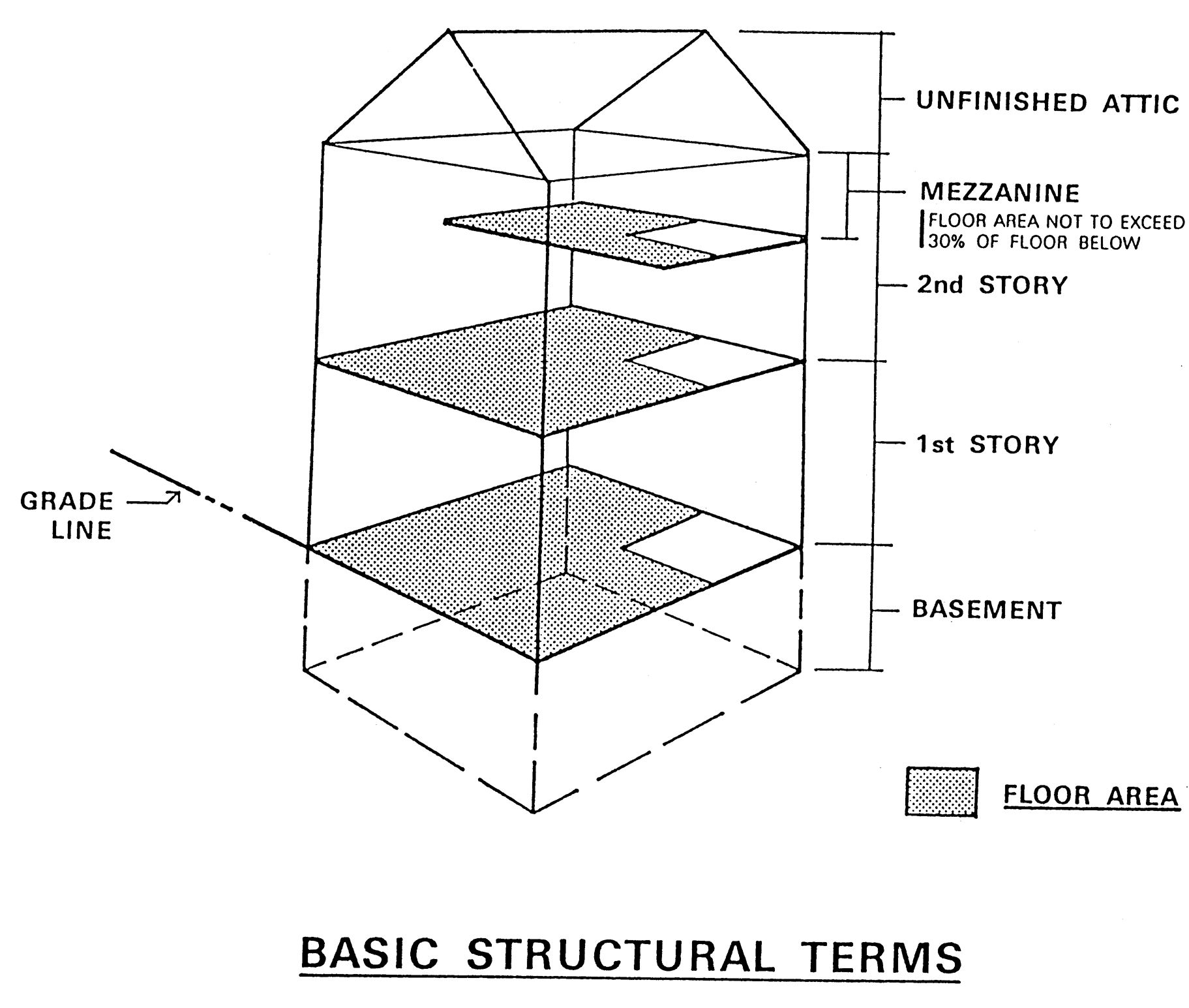
Attic means the space between the ceiling beams of the top habitable floor and the roof.
Automobile repair means general repair, engine rebuilding, rebuilding or reconditioning of motor vehicles; collision service, such as body, frame, or fender straightening and repair; overall painting and vehicle rustproofing.
Auto repair station means a place where, along with the sale of engine fuels, the following services may be carried out: general repairs, engine rebuilding, rebuilding or reconditioning of motor vehicles; collision service, such as body, frame, or fender straightening and repair; overall painting and undercoating of automobiles.
Automobile service station means buildings and premises where gasoline, oil, grease, batteries, tires and automobile accessories may be supplied and dispensed at retail, and where in addition the following services may be rendered and sales made, and no other:
(1)
Sale and servicing of spark plugs, batteries, and distributors and distributor parts;
(2)
Tire servicing and repair, but not recapping or regrooving;
(3)
Replacement of mufflers and tailpipes, water hose, fan belts, brake fluid, light bulbs, fuses, floor mats, seat covers, windshield wipers and wiper blades, grease retainers, wheel bearings, mirrors, and the like;
(4)
Radiator cleaning and flushing;
(5)
Washing and polishing, and sale of automotive washing and polishing materials when accessory and incidental to the principal operation;
(6)
Greasing and lubrication;
(7)
Providing and repairing fuel pumps, oil pumps, and lines;
(8)
Minor servicing and repair of carburetors;
(9)
Emergency wiring repairs;
(10)
Adjusting and repairing brakes;
(11)
Minor motor adjustments not involving removal of the head or crankcase or racing the motor;
(12)
Sales of hot or cold nonalcoholic beverages, packaged foods, tobacco, and similar convenience goods for filling station customers, as accessory and incidental to the principal operation;
(13)
Provision of road maps and other informational material to customers; provision of restroom facilities.
Uses permissible at an automobiles service station do not include major mechanical and body work, straightening of body parts, painting, rustproofing, welding, storage of automobiles not in operating condition, or other work involving noise, glare, fumes, smoke, or other characteristics to an extent greater than normally found in automobile service stations. An automobile service station is not a repair station or garage nor a body shop.
Automobile wash establishment means a building, or portion thereof, the primary purpose of which is that of washing motor vehicles.
Barn (livestock building) means any buildings which have the primary purpose of housing livestock. This would include any buildings, which in fact do house livestock.
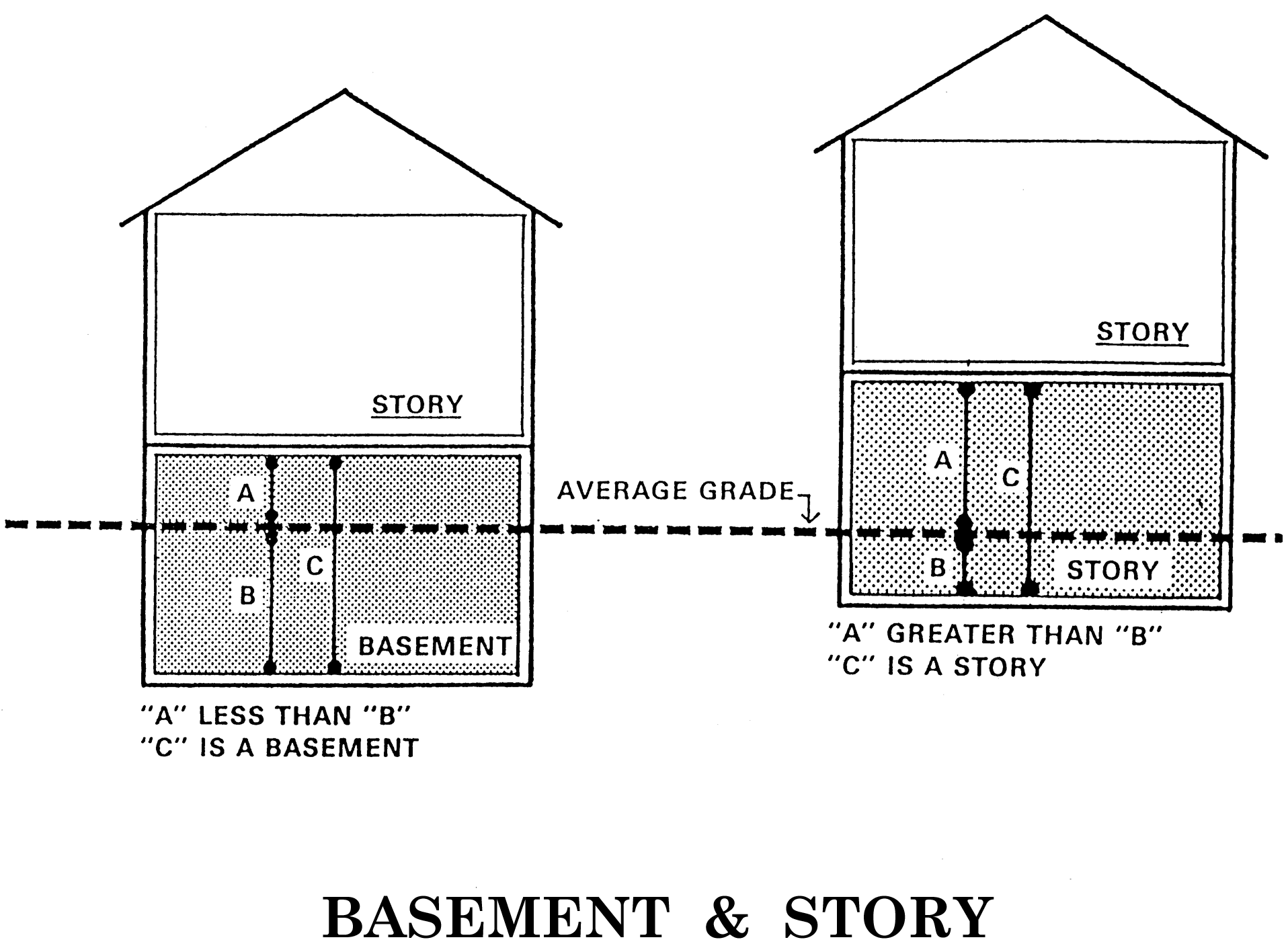
Basement means that portion of a building which is partly or wholly below grade but so located that the vertical distance from the average grade to the floor is greater than the vertical distance from the average grade to the ceiling. A basement shall not be counted as a story.
Block means the property abutting one side of a street and lying between the two nearest intersecting streets, (crossing or terminating) or between the nearest such street and railroad right-of-way, unsubdivided acreage, lake, river or live stream; or between any of the foregoing and any other barrier to the continuity of development, or corporate boundary lines of the municipality.
Boardinghouse means a dwelling where meals or lodging are provided for compensation to three or more persons by prearrangement for definite periods of not less than one week.
Building means a structure erected on-site, a mobile home or mobile structure, a premanufactured or precut structure, above or below the ground, designed primarily for the shelter, support or enclosure of persons, and animals or property of any kind.
Building area means the space remaining after the minimum open space requirements of this chapter have been met.
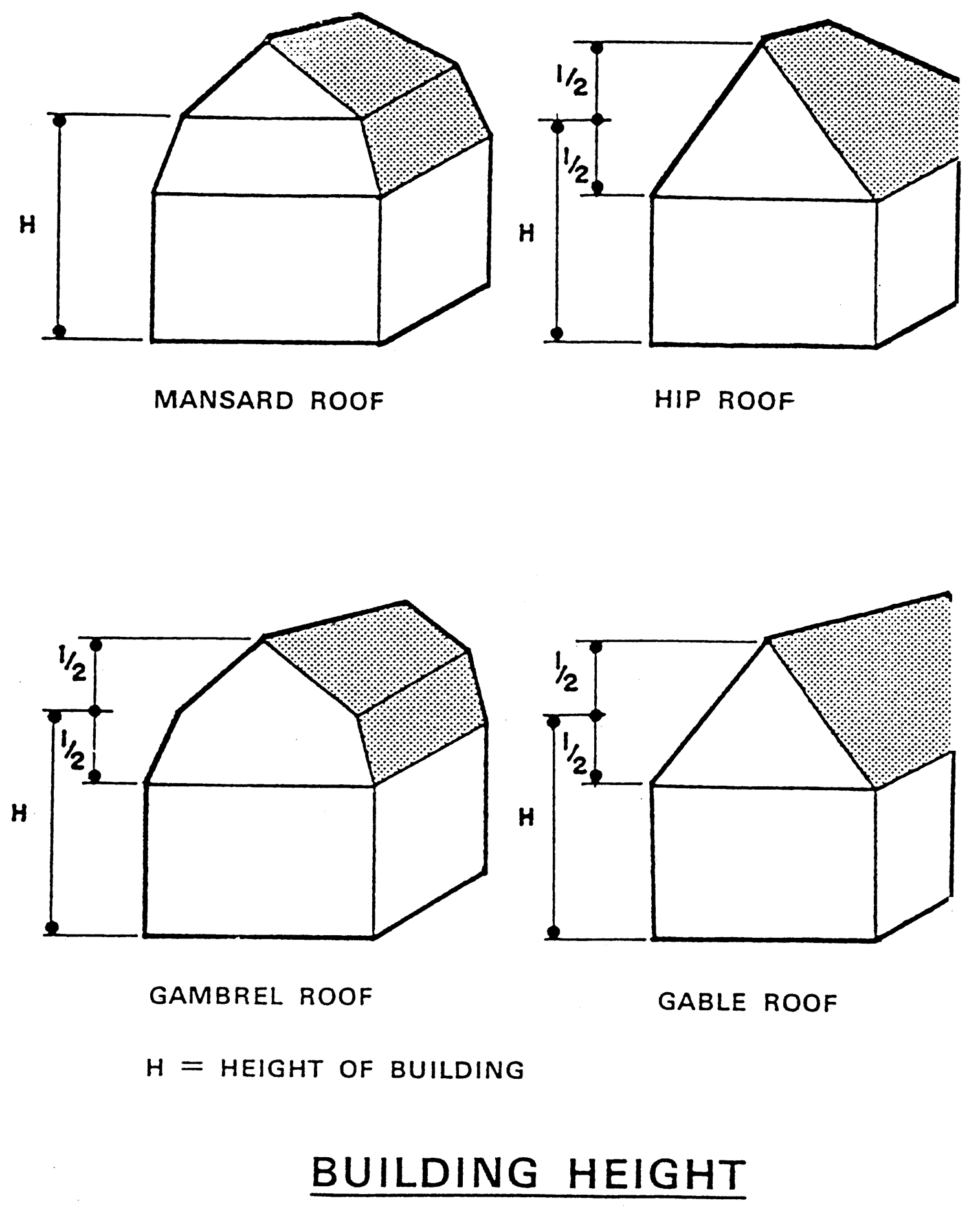
Building height means the vertical distance measured from the established grade to the highest point of roof surface for flat roofs; to the deck line of mansard roofs; and to the average height between eaves and ride for gable, hip, and gambrel roofs. Where a building is located on sloping terrain, the height may be measured from the average ground level of the grade at the building wall.
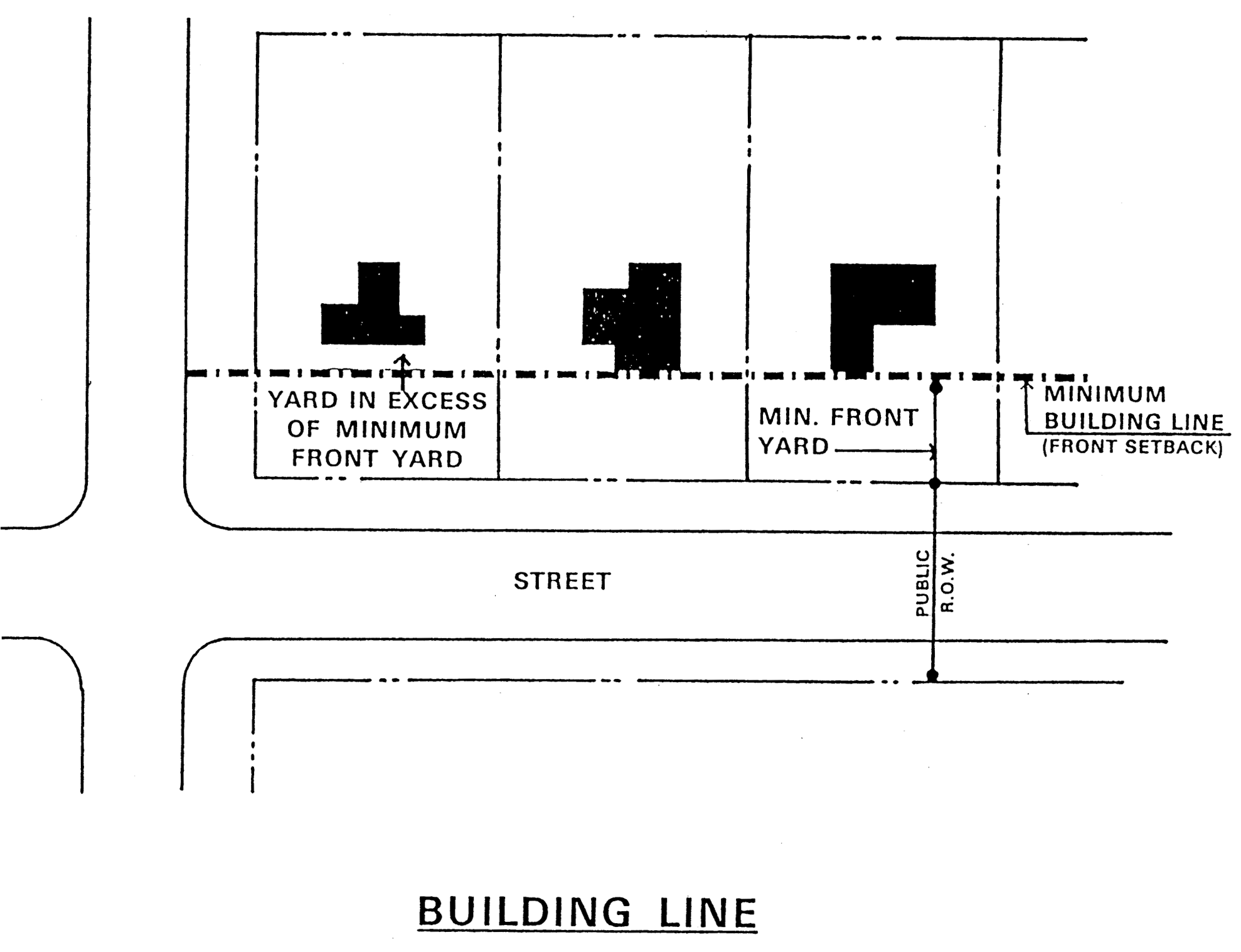
Building line means a line formed by a wall of the building, and for the purposes of this chapter, a minimum building line is the same as a setback line.
Building permit means a permit issued by the building inspector under the terms of the single state construction code. It is not the same as a zoning compliance permit and occupancy permit, nor a special or temporary use permit.
Campground means any parcel of land wherein sites are offered for the use of the public or members of any organization, either free of charge, or for a fee, for the establishment of temporary living quarters for the occupation of five or more tents, travel trailers, truck campers, or other similar recreational units.
Cellar. See Basement.
Clinic means an establishment where human patients who are not lodged overnight are admitted for examination and treatment by a physician, dentist, or similar professionals.
Club means an organization of persons for special purposes for the promulgation of agriculture, sports, arts, science, literature, politics or the like, but not for profit.
Condominium means buildings and improvements located thereon composed of individually owned and occupied units, title to each of which is held separately by the individual owners of that unit, and common areas or elements not a part of any individual unit, title to which is held collectively by the owners' undivided interest in the common areas or elements which is expressed as a percentage of the total ownership.
Convalescent home, home for the aged, or nursing home means a home for the care of children, or the aged or infirm, or a place of rest for those suffering bodily disorders, and licensed or required to be licensed by the state, but not including housing for the elderly where such persons live independently in individual apartment units.
Court means an open, uncovered, unoccupied space other than a yard partially or wholly surrounded on at least two sides of a building. A court having a least one side thereof opening onto a public or private street, alley, or yard or other permanent open space is an outer court. Any other court is an enclosed or an inner court.
Density means the number of families residing on, or dwelling units developed on, an acre of land.
Development means the construction of a new building or other structure on a zoning lot, the relocation of an existing building on another zoning lot, or the use of open land for a new use.
District means a portion of the unincorporated area of the township within which certain regulations and requirements of various combinations thereof apply under the provisions of this chapter.
Drive-in means a business establishment so developed that its retail or service character is dependent on providing a driveway approach or parking spaces for motor vehicles so as to serve patrons while in the motor vehicle rather than within a building or structure.
Driveway means a passageway of definite width, primarily for use by motor vehicles, over private property, loading from a street or other public way to a garage or parking area. A horseshoe shape drive or a "T" shape drive located within a front yard is included within this definition.
Dwelling, multiple-family, means a building or portion thereof, containing three or more dwelling units designed exclusively for occupancy by three or more families, living independently of each other and conforming in all other respects to the standards set forth in this section under the term "dwelling, single-family."
Dwelling, single-family, means a building containing not more than one dwelling unit designed exclusively for and occupied exclusively by one family, complying with the following standards:
(1)
It complies with the minimum square footage requirements of this chapter for the zone in which it is located.
(2)
It has a minimum width across any front, side or rear elevation of 24 feet and complies in all respects with the single state construction code, including minimum heights for habitable rooms. Where a dwelling is required by law to comply with any federal or state standards or regulations for construction are different than those imposed by the single state construction code then such federal or state standard or regulation shall apply.
(3)
It is firmly attached to a permanent foundation constructed on the site in accordance with the single state construction code and shall have a wall of same perimeter dimensions of the dwelling and constructed of such materials and type as required in the applicable building code for single-family dwellings. If the dwelling is a mobile home, such dwelling shall, in addition thereto, be installed pursuant to the manufacturer's setup instructions and shall be secured to the premises by an anchoring system or device complying with the rules and regulations of the state mobile home commission and shall have a perimeter wall as required above.
(4)
If a dwelling is a mobile home, the mobile home shall be installed with the wheels removed. Additionally, no dwelling shall have any exposed towing mechanism, undercarriage or chassis.
(5)
The dwelling is connected to a public sewer and water supply or to such private facilities approved by the county health department.
(6)
The dwelling contains a storage capability area in a basement located under the dwelling, in an attic area, in closet areas, or in a separate structure of standard construction similar to or of better quality than the principal dwelling, which storage area shall be equal to ten percent of the square footage of the dwelling or 100 square feet, whichever shall be less.
(7)
The dwelling is aesthetically compatible in design and appearance with other residences in the vicinity, with either a roof overhang of not less than six inches on all sides, or alternatively with window sills or roof drainage systems concentrating roof drainage at collection points along the sides of the dwelling; has not less than two exterior doors with the second one being in either the rear or side of the dwelling; and contains steps connected to such exterior door areas or to porches connected to such door areas where a difference in elevation requires the same. The compatibility of design and appearance shall be determined in the first instance by the township zoning administrator upon review of the plans submitted for a particular dwelling, subject to appeal by an aggrieved party to the zoning board of appeals within a period of 15 days from the receipt of notice and such zoning administrator's decision. Any determination of compatibility shall be based upon the standards set forth in this definition of dwelling as well as the character, design and appearance of one or more residential dwellings located outside of mobile home parks within 2,000 feet of the subject dwelling where such area is developed with dwellings to the extent of not less than 20 percent of the lots situated within such area; or, where such area is not so developed, by the character, design and appearance of one or more residential dwelling located outside of mobile home parks throughout the township. The foregoing shall not be construed to prohibit innovative design concepts involving such matters as solar energy, view, unique land contour, or relief from the common or standard designed home.
(8)
The dwelling contains no additions or rooms or other areas which are not constructed with similar quality workmanship as the original structure, including permanent attachment to the principal structure and construction of a foundation as required in this section.
(9)
The dwelling complies with all pertinent building and fire codes. In the case of a mobile home, all construction and all plumbing, or electrical apparatus and insulation within and connected to such mobile home shall be of a type and quality conforming to the "Mobile Home Construction and Safety Standards," as promulgated by the United States Department of Housing and Urban Development, being 24 CFR 3280, and as from time to time such standards may be amended. Additionally, all dwellings shall meet or exceed all applicable roof snow load and strength requirements.
(10)
The foregoing standards shall not apply to a mobile home located in a licensed mobile home park except to the extent required by state or federal law or otherwise specifically required in the ordinances of the township pertaining to such parks.
(11)
All construction required herein shall be commenced only after a building permit has been obtained in accordance with the single state construction code.
Dwelling, two-family, means a building containing not more than two separate dwelling units designed exclusively for occupancy by two families living independently of each other and conforming in all other aspects to the standards set forth in the previous definition of the term "dwelling, single-family."
Dwelling unit means a building or portion thereof, designed for occupancy by one family for residential purposes and having cooking facilities.
Erected means built, constructed, altered, reconstructed, moved upon, or any physical operations on the premises which are required for construction, excavation, fill, drainage, and the like, shall be considered a part erection.
Essential services means the erection, construction, alteration or maintenance by public utilities or municipal departments of underground surface, or overhead gas, electrical, steam, fuel, or water transmission or distribution system, collection, communication, supply or disposal system, including towers, poles, wires, mains, drains, sewers, pipes, conduits, cables, fire alarm, and police call boxes, traffic signals, hydrants and similar equipment in connection herewith, but not including buildings which are necessary for the furnishing of adequate service by such utility or municipal departments for the general health, safety, or welfare.
Excavation means any breaking of ground, except common household gardening and working of ground for agricultural purposes.
Family means:
(1)
One or more persons related by blood, marriage, or adoption, with their direct lineal descendants and including the domestic employees thereof living as a single, nonprofit housekeeping unit; or
(2)
A collective number of individuals living together in one house under one head, whose relationship is of a permanent and distinct domestic character, and cooking as a single housekeeping unit. This definition shall not include any society, club, fraternity, sorority, association, lodge, combine, federation, group, coterie, or organization, which is not a recognized religious order, nor include a group of individuals whose association is temporary and resort-seasonal in character or nature.
Farm means all of the contiguous neighboring or associated land operated as a single unit on which bona fide farming is carried on directly by the owner-operator, manager or tenant farmer, by his own labor or with the assistance of members of his household or hired employees; provided, however, that land to be considered a farm under this chapter shall include a continuous parcel of five acres or more in area; provided further, that farms may be considered as including establishments operated as bona fide greenhouses, nurseries, orchards, etc., but establishments such as chicken hatcheries, poultry farms, apiaries, keeping or breeding of fur-bearing animals, stables, commercial dog kennels, stone quarries, or gravel or sand pits, shall not be considered farms or agricultural uses unless combined with a bona fide farm operation on the same continuous tract of land on not less than 20 acres. No farm shall be operated for the disposal of garbage, sewage (except when such sewage is applied by state department of environmental quality approved methods for the purpose of fertilizing the soil on an actively cultivated farm and is approved by the township board), rubbish, offal or rendering plants, or for slaughtering of animals, except such animals as may have been raised on the premises immediately prior thereto and for the use and consumption by persons residing on the premises.
Feedlot means a relatively small, confined land area on which a large concentration of livestock is raised.
Floodplain means those areas of land adjacent to the rivers, and other watercourses of the township, which are deemed official on the township floodplain map, subject to seasonal or periodic flooding as designated.
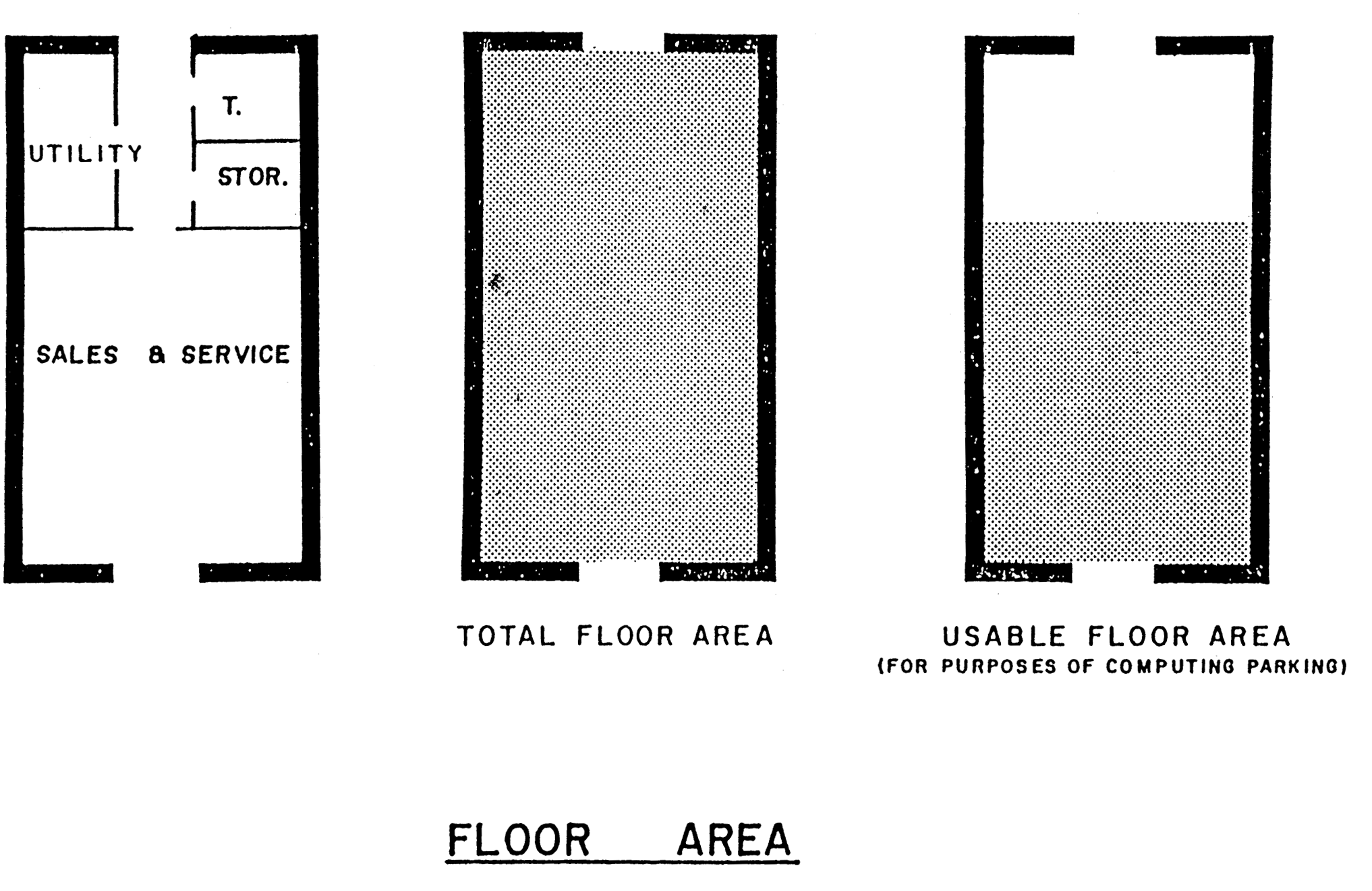
Floor area, gross, means the sum of the gross horizontal areas of the several floors of a building, measured from the exterior walls or from the centerline of walls separating two buildings. In particular, the gross floor area includes basement space; elevator shafts or stairwells; floor space for mechanical equipment, penthouse, balconies, mezzanines, enclosed porches, and accessory buildings; attic floor space (whether or not floors have been laid) providing structural headroom of seven feet, six inches. Gross floor area shall not include: elevator or stair bulkheads, accessory water tanks, or cooling towers; uncovered steps, attic space less than seven feet, six inches, in height, and open porches, terraces or breezeways, provided that not more than 50 percent of the perimeter of such terrace, breezeway or open porch is enclosed.
Floor area, residential, means for the purpose of computing the minimum allowable floor area in a residential dwelling unit, the sum of the horizontal areas of each story of the building shall be measured from the exterior faces of the exterior wall or from the centerline of walls separating two buildings. The floor area measurement is exclusive of areas of basements, unfinished attics, attached garages, breezeway, and enclosed and unenclosed porches.
Floor area, usable, (for the purpose of computing parking) means that area used for or intended to be used for the sale of merchandise or services, or for use to serve patrons, clients, or customers. Such floor area which is used or intended to be used principally for the storage or processing of merchandise, hallways, or for utilities or sanitary facilities, shall be excluded from this computation of usable floor area. Measurements of usable floor area shall be the sum of the horizontal areas of the several floors of the building, measured from the interior faces of the exterior walls.
Frontages means that portion of any property abutting a public street; a corner lot and a through lot having frontage on both abutting streets.
Garage, commercial, means any premises used for the storage, care, repair or refinishing of motor vehicles, but not including a place where any such vehicles are for hire or sale.
Garage, private, means an accessory building designed or used for the storage of motor vehicles owned and used by the occupants of the building to which it is necessary.
Garage, service, means any premises used for the storage or care of motor-driven vehicles, or where any such vehicles are equipped for operation, repaired, or kept for remuneration, hire or sale.
Grade means the ground elevation established for the purpose of regulating the number of stories and the height of buildings. The building grade shall be the level of the ground adjacent to the walls of the building if the finished ground is level. If the ground is not entirely level, the grade shall be determined by averaging the elevation of the ground for each face of the building.
Greenbelt means a long strip of land of varying width and shape which, to major degree, is left in its natural state or which is landscaped to provide a protective screening with natural vegetation. Within this area private construction is prohibited. The purpose for such greenbelts is to provide for permanent open space between two or more urban areas, to retain some of the natural beauty of the region, and/or to provide protective screening.
Health authority means an authority and his designated agents, being full-time administrative officers of an approved township, county, or district board or department of health, delegated this authority by the state.
Home occupations means an occupation that is traditionally and customarily carried on in the home, being primarily incidental to the principal residential use.
Hospital means a building, structure, or institution in which sick or injured persons are given medical or surgical treatment and operating under license by the state, and is used primarily for in-patient services, and including related facilities as laboratories, outpatient departments, central services facilities, and staff offices.
Hotel means a building occupied or used as a more or less temporary abiding place of individuals or groups of individuals with or without meals, and in which more than five sleeping rooms, and in which no provision is made for cooking in any individual room.
Junk means any motor vehicles, machinery, appliances, product or merchandise with parts missing, or scrap metal, or other scrap materials that are damaged, deteriorated, or are in a condition which prevents their use for the purpose for which the product was manufactured. Specifically included are motor vehicles not movable under their own power excluding agricultural machinery.
Junkyard means an open space where waste, used or secondhand materials, are bought and sold, exchanged, stored, baled, packed, disassembled, or handled including, but not limited to, scrap iron and other metals, paper, rags, rubber tires, and bottles. A junkyard includes automobile wrecking yards and includes any area of more than 200 square feet for the storage, keeping or abandonment of junk but does not include uses established entirely within enclosed buildings.
Kennel, commercial, means any lot or premises on which dogs, cats or other household pets are either permanently or temporarily boarded, kept or bred for commercial purposes.
Laboratory means a place devoted to experimental, routine study or basic study such as testing and analytical operations and in which manufacturing of products, except prototypes, is not performed.
Landfill, sanitary, means a tract of land developed, designed, and operated for the disposal of solid waste in a manner consistent with the criteria established by Part 115 of Public Act No. 451 of 1994 (MCL 324.11501 et seq.) and any rules or regulations established based on the act, and applicable township ordinances.
Landowner means the legal or beneficial owner of all the land proposed to be used or developed, the holder of an option or contract to purchase, or other persons having an enforceable proprietary interest in such land.
Landscaping means the treatment of the ground surface with live or synthetic materials such as, but not limited to, grass, ground cover, crushed stone, trees, shrubs, vines and other growing or synthetic horticultural material. Structural features such as fountains, shadow pools, statues, garden walls, pathways, benches, and the like shall also be considered elements of landscaping, but such structural features alone shall not meet the spirit and intent of landscaping requirements.
Livestock building. See Barn.
Loading space means an off-street space on the same lot with a building, or group of buildings, for the temporary parking of a commercial vehicle while loading and unloading merchandise or materials.
Lot means a parcel of land occupied, or intended to be occupied, by a main building or a group of such buildings and accessory buildings, or utilized for the principal use and uses accessory thereto, together with such yards and open spaces as are required under the provisions of this chapter. A lot may or may not be specifically designated as such on public records.
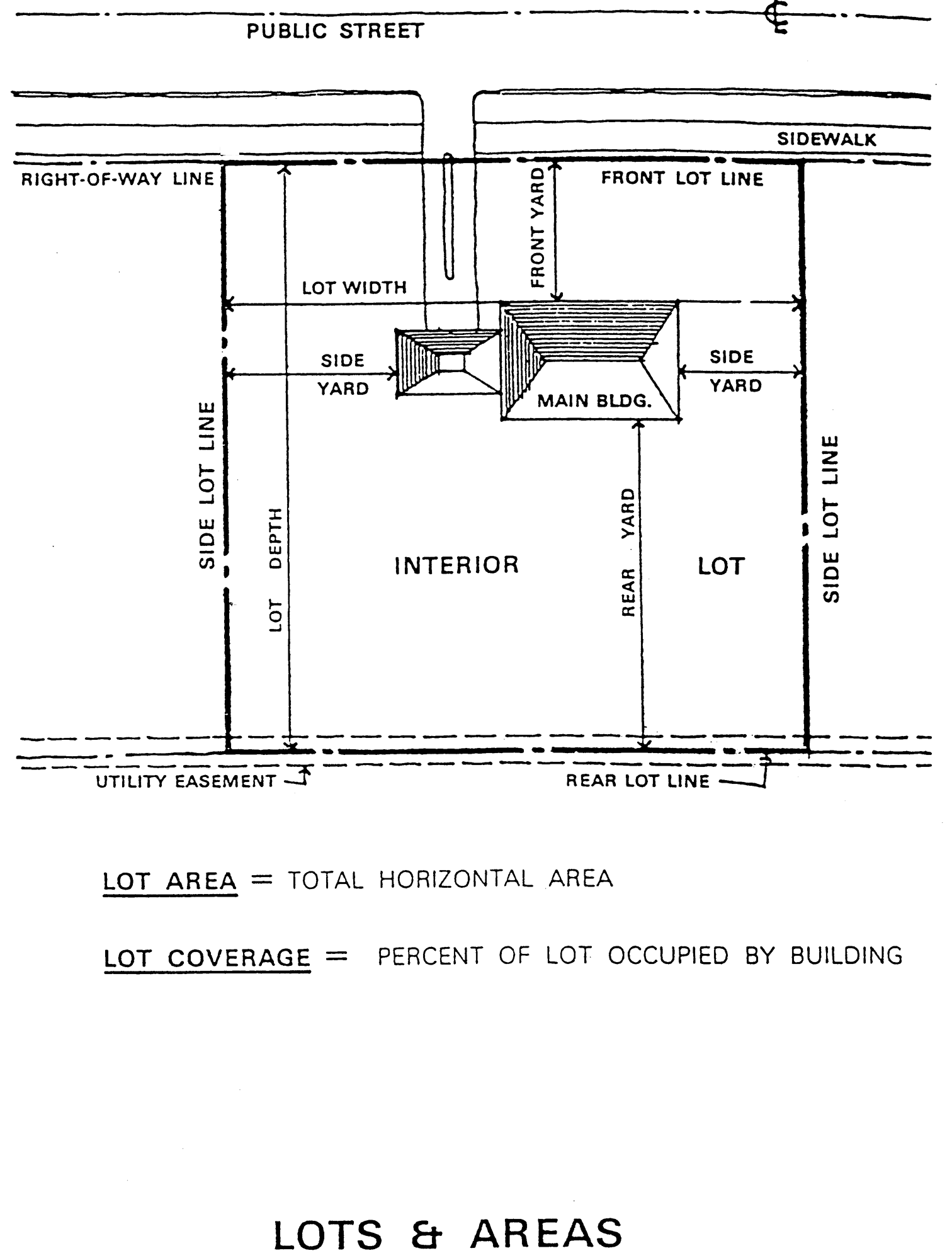
Lot area means the total horizontal area within the lot lines of the lot.
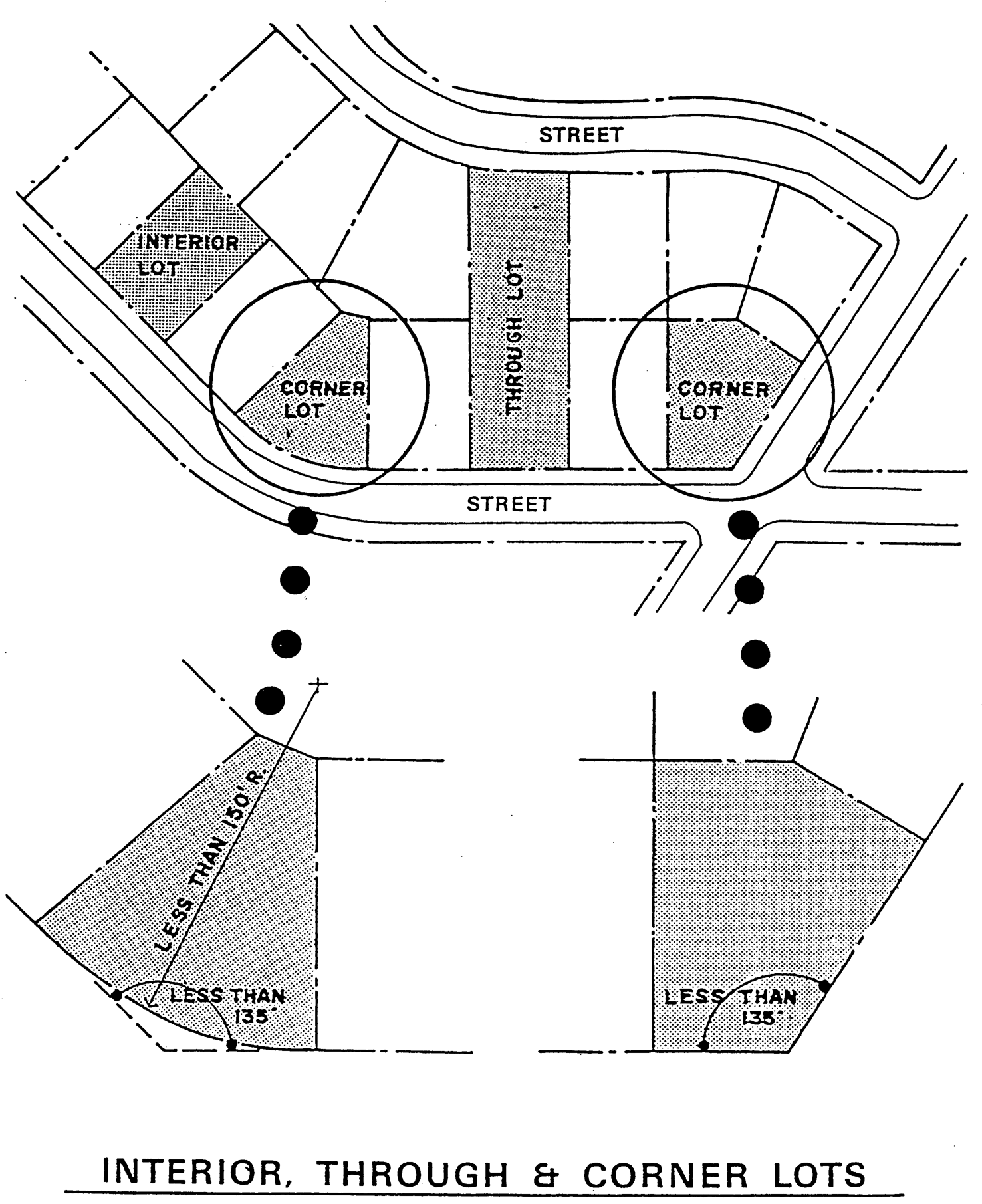
Lot, corner, means a lot where the interior angle of two adjacent sides at the Intersection of two streets is less than 130 degrees. A lot abutting upon a curved street shall be considered a corner lot for the purposes of this chapter if the arc is of less than 150 feet and the tangents to the curve, at the two points where the lot lines meet the curve or the straight street line extended, form an interior angle of less than 135 degrees.
Lot coverage means the part or percent of the lot occupied by buildings, including accessory buildings.
Lot depth means the horizontal distance between the front and rear lot lines, measured along the median between the side lot lines.
Lot, interior, means any lot other than a corner lot.
Lot lines means the lines bounding a lot as follows:
(1)
Front lot line: In the case of an interior lot, is the line separating such lot from the street. In the case of a corner lot, or double frontage lot, is that line separating such lot from either street (see definition of Street).
(2)
Rear lot line: That lot line opposite the front lot line. In the case of a lot pointed at the rear, the rear lot line shall be an imaginary line parallel to the front lot line, not less than ten feet long lying farthest from the front lot line and wholly within the lot.
(3)
The lot line: Any lot line other than the front lot line or rear lot line. A side lot line separating a lot from a street is a side street lot line. A side lot line separating a lot from another lot is an interior side lot line.
Lot of record means a parcel of land, the dimensions of which are shown on a document or map on file with the county register of deeds or in common use by township or county officials and which actually exists as so shown, or any part of such parcel held in a record ownership separate from that of the remainder thereof.
Lot, through, means any interior lot having frontage on two more or less parallel streets as distinguished from a corner lot. In the case of a row, a double frontage lot, all yards of such lots adjacent to streets shall be considered frontage, and front yard setbacks shall be provided as required.
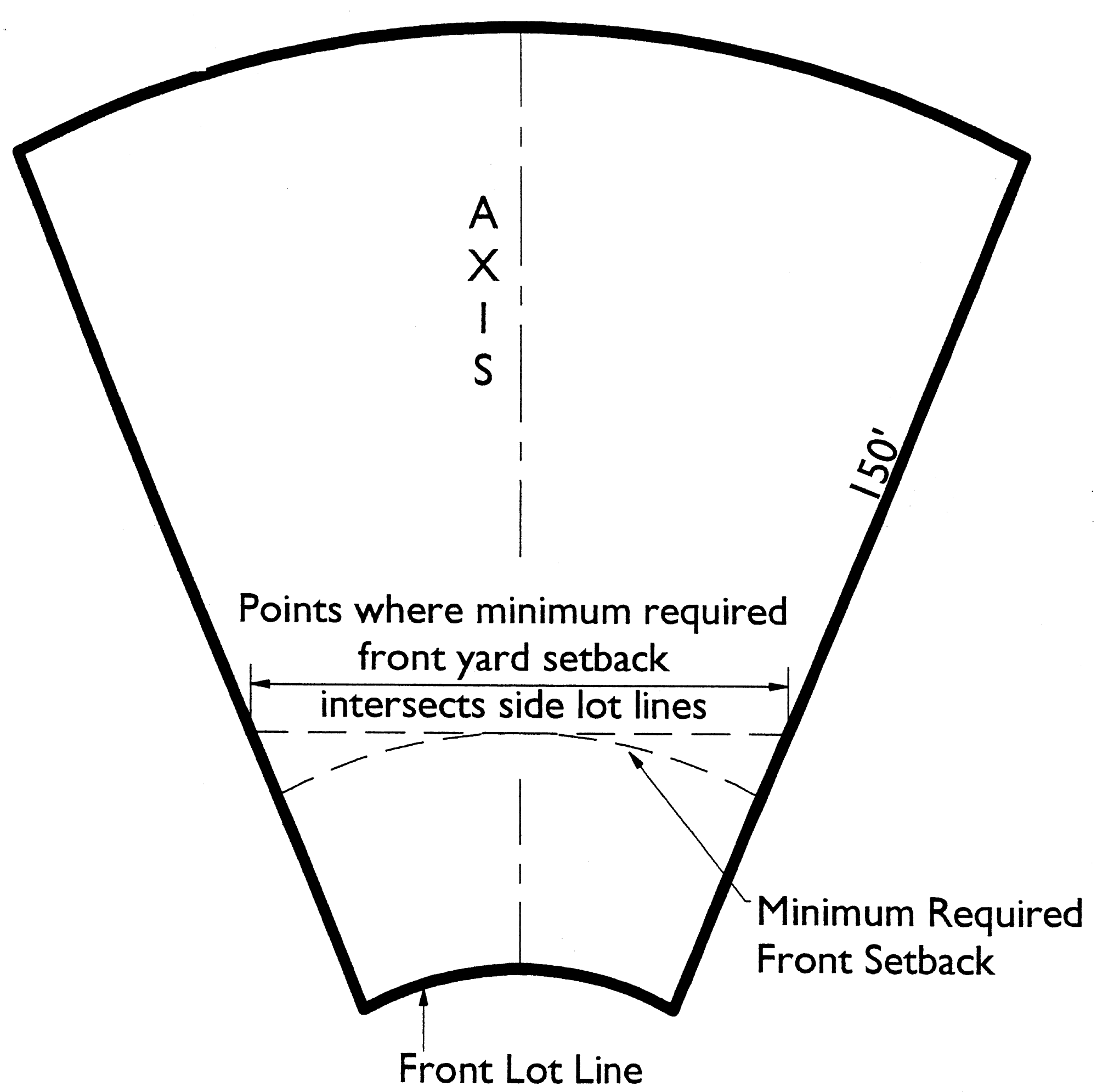
Lot width means the straight line horizontal distance between the side lot lines, measured at the two points where the minimum required front setback intersects with the side lot lines. If the side lot lines are not parallel, the width of the lot shall be the straight line horizontal distance between the side lot lines measured along a line intersecting the axis of the lot at a right angle at a distance equal to the minimum required front setback. The axis of a lot shall be a line joining the midpoint of the front and rear lot lines. See illustration.
Lot, zoning, means a single tract of land, located within a single block, which at the time of filing for a building permit is designated by its owner or developer as a tract to be used, developed, or built upon as a unit, under single ownership or control. A zoning lot shall satisfy this chapter with respect to area, size, dimensions, and frontage as required in the district in which the zoning lot is located. A zoning lot therefore, may not coincide with a lot of record as filed with the county Register of Deeds, but may include one or more lots of record.
Main building means a building in which is conducted the principal use of the lot upon which it is situated.
Major thoroughfare means an arterial street which is intended to serve as a large volume trafficway for both the immediate municipal area and the region beyond, and is designated as a major thoroughfare, parkway, freeway, expressway, or equivalent term on the thoroughfare plan.
Massage parlors means an establishment, unless otherwise licensed by the state, restricted to persons over the age of 18 years and used for housing equipment and employing persons who give massages, body rubs, or muscle relaxing exercises to other persons, necessitating human contact between such employee and any other person.
Master plan means the comprehensive community plan including graphic and written proposals indicating the general location for streets, parks, schools, public buildings, and all physical development of the township, and includes any unit or part of such plan and any amendment to such plan or parts thereof. Such plan may or may not be adopted by the planning commission and/or the township board.
Mezzanine means an intermediate floor in any story occupying not more than one-third of the floor area of such story.
Mobile home means a structure, transportable in one or more sections, which is built on a chassis and designed to be used as a dwelling with or without permanent foundation, when connected to the required utilities, and includes the plumbing, heating, air conditioning, and electrical systems contained in the structure. Mobile home does not include a recreational vehicle.
Mobile home condominium project means a parcel of land under joint ownership which has been planned and improved for the placement of a mobile home for nontransient use, on individual lot, with intent of the sites to constitute individual condominium units.
Mobile home development means a parcel of land under single ownership which has been planned and improved for the placement of a mobile home for the exclusive use of the owner, with other similar parcels of land in the adjoining properties.
Mobile home lot or site means a parcel of land for the placement of a single mobile home and exclusive use of its occupants within a licensed mobile home park, in a condominium project or subdivision project or development.
Mobile home park means a parcel or tract of land under the control of a person upon which three or more mobile homes are located on a continual nonrecreational basis and which is offered to the public for that purpose regardless of whether a charge is made therefor, together with any building, structure, enclosure, street, equipment, or facility used or intended for use incident to the occupancy of a mobile home and which is not intended for use as a temporary trailer park.
Mobile home park license means a written license issued by a mobile home commission allowing a person to operate and maintain a mobile home park under the provisions of Public Act No. 96 of 1987 (MCL 125.2301 et seq.) and this chapter and regulations issued under this chapter.
Mobile home stand means that part of an individual lot which has been reserved for the placement of the mobile home, appurtenant structures or additions.
Mobile home subdivision means a parcel of land under single ownership which has been planned and improved for the placement of mobile homes for nontransient use, on individual lots and for the purpose of selling the lots.
Motel means a series of attached, semidetached or detached rental units containing a bedroom, bathroom and closet space. Units shall provide for overnight lodging and are offered to the public for compensation, and shall cater primarily to the public traveling by motor vehicle.
Nonconforming lot means a lot which exists as a legal lot of record and which existed as a legal lot of record at the effective date or adoption or amendment of the ordinance from which this chapter is derived, which does not conform to the lot requirements of this chapter.
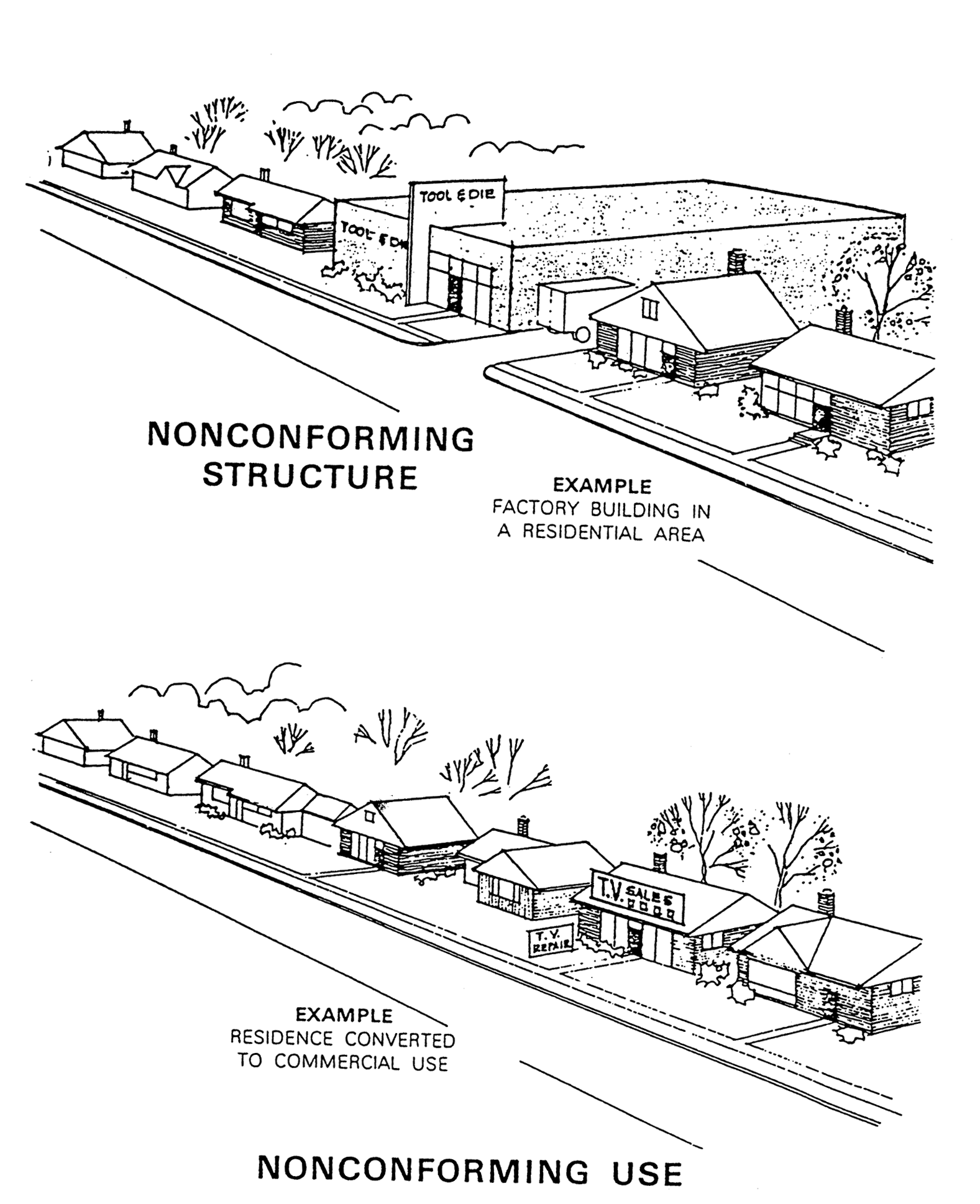
Nonconforming structure means a lawfully occupied building or land at the effective date of the ordinance, or amendments thereto, from which this chapter is derived and that does not conform to the use regulations of the district in which is located.
Nonconforming use means a use which lawfully occupied a building or land at the effective date of the ordinance, or amendments thereto, from which this chapter is derived and that does not conform to the use regulations of the district in which it is located.
Nude modeling studio means an establishment restricted to persons over the age of 18 years used for housing and exhibiting persons in the nude acting as models for other persons to paint, photograph or draw.
Nuisance factors means an offensive, annoying, unpleasant or obnoxious thing, a cause or source of annoyance, especially a continuing or repeating invasion of any physical characteristics of activity or use across a property line which can be perceived by or affects a human being, or the generation of an excessive or concentration movement of people or things such as, but limited to:
(1)
Noise;
(2)
Dust;
(3)
Smoke;
(4)
Odor;
(5)
Glare;
(6)
Fumes;
(7)
Flashes;
(8)
Vibration;
(9)
Shock waves;
(10)
Heat;
(11)
Electronic or atomic radiation;
(12)
Objectionable effluent;
(13)
Noise of congregation of people, particularly at night;
(14)
Passenger traffic;
(15)
Invasion of nonabutting street frontage.
Nursery, plant materials, means a space, building or structure, or combination thereof, for the storage of live trees, shrubs or plants offered for sale on the premises, including products used for gardening or landscaping. The definition of nursery within the meaning of this chapter does not include any space, building or structure used for the sale of fruits, vegetables or Christmas trees.
Nursery schools, day care centers, means a facility other than a private residence, receiving more than six preschool or school age children for group care for periods of less than 24 hours a day, and where the parents or guardians are not immediately available to the child. It includes a facility which provides care for not less than two consecutive weeks, regardless of the number of hours of care per day. The facility is generally described as a child care center, day care center, day nursery, nursery school, parent cooperative preschool, play group, or drop-in center. Child care or day care center does not include a Sunday school conducted by a religious institution or a facility operated by a religious organization where children are cared for during short periods of time while persons responsible for such children are attending religious services.
Off-street parking lot means a facility providing vehicular parking space along with adequate drives and aisles, for maneuvering, so as to provide access for entrance and exit for the parking of vehicles.
Open air business uses means and includes the following uses:
(1)
Retail sale of trees, shrubbery, plants, flowers, seed, topsoil, humus, fertilizer, trellises, lawn furniture, playground equipment, and other home garden supplies, and home improvement equipment such as lawn mowers, fertilizer spreaders, lawn rollers, etc.
(2)
Retail sale of fruit and vegetables.
(3)
Rental or sale of bicycles, recreational vehicles, mobile homes, trailers, motor vehicles, boats, or small hand equipment.
(4)
Outdoor display and sale of garages, swimming pools, and swimming uses.
Open front store means a business establishment so developed that service to the patron may be extended beyond the walls of the structure, not requiring the patron to enter the structure. The term "open front store" shall not include automobile repair stations or automobile service stations.
Parking space means an area of definite length and width; such area shall be exclusive of drives, aisles or entrances giving access thereto, and shall be fully accessible for the parking of permitted vehicles.
Pond means a body of water usually smaller than a lake, artificially created by embankment or excavation intended for any of the specific permitted uses as provided in section 38-624.
Porch, open, means a covered entrance to a building or structure which is unenclosed except for columns supporting the porch roof, and projects out from the main wall of such building or structure and has a separate roof or an integral roof with the principal building or structure to which it is attached.
Premises for nude entertainment means an establishment which is restricted to persons over the age of 18 years and used for housing and exhibiting persons in the nude or "specific anatomical areas" (as defined in section 6-142 of this Code) of the human body.
Principal use means the main use to which the premises are devoted and the principal purpose for which the premises exist.
Public utility means a person, firm or corporation, municipal department, board or commission duly authorized to furnish and furnishing under federal, state or municipal regulations to the public: gas, steam, electricity, sewage disposal, communication, telegraph, transportation, or water.
Recreational vehicles and equipment means any portable structures, machines or devices, self propelled or towable by another vehicle, capable of moving upon the highways without special movement permits; primarily designed, constructed or modified to provide temporary living quarters or for recreational camping or travel use and such trailers or other devices, as shall be primarily intended for such transporting of all such structures, machines or devices. Motorcycles, bicycles, mini-bikes and such vehicles as jeeps, four-wheel drives and pickup trucks with attached cabs which do not exceed the roofline of the vehicle are specifically excluded from this definition. This does not include a temporary building, structure or use, permitted to exist during periods of construction of the principal building, structure or use. Recreational vehicles and equipment include but are not limited to:
(1)
Travel trailer. A portable vehicle on a chassis, which is designed to be used as a temporary dwelling during travel, recreational and vacation uses and which may be identified as a "travel trailer" or a "fifth wheel" by the manufacturer. Travel trailers generally include self-contained sanitary, water and electrical facilities.
(2)
Pickup camper. A structure designed to be mounted on a pickup or truck chassis with sufficient equipment to render it suitable for use as a temporary dwelling during the process of travel, recreational and vacation uses. When not in use, the structure can be detached and set on its own jacks allowing the truck to be used separately.
(3)
Motor home. A recreational vehicle intended for temporary human habitation, sleeping and/or eating, mounted upon a chassis with wheels capable of being moved from place to place under its own power. Motor homes generally contain sanitary, water and electrical facilities.
(4)
Van/camper. A recreational vehicle intended for temporary human habitation, sleeping and/or eating. This class of recreational vehicles includes conversion vans and camper vans which may contain refrigerators, as well as water and electrical facilities. This class closely resembles passenger vans, but some models may be taller to allow for extra headroom.
(5)
Folding tent trailer. A folding structure mounted on wheels and designed for travel and vacation use.
(6)
Boats and boat trailers. Boats, floats, rafts, canoes, plus the normal equipment to transport them on the highway.
(7)
Other recreational equipment. Other recreational equipment includes snowmobiles, personal watercraft, all terrain or special terrain off-road vehicles, utility trailers, plus the normal equipment used to transport them on the highway.
Restaurant, drive-in, means any establishment whose principal business is the sale of foods, frozen desserts, or beverages to the customer in a ready-to-consume state, and whose design, method of operation, or any portion of whose business included one or both of the following characteristics:
(1)
Foods, frozen desserts, or beverages are served directly to the customer in a motor vehicle either by a carhop or by other means which eliminate the need for the customer to exit the motor vehicle.
(2)
The consumption of foods, frozen desserts, or beverages within motor vehicle parked upon the premises, or at other facilities on the premises outside the restaurant building is allowed, encouraged, or permitted.
Restaurant, fast food, means a fast food restaurant is any establishment whose principal business is the sale of foods, frozen desserts, or beverages to the customer in a ready-to-consume state for consumption either within the restaurant building or for the carryout with consumption off the premises, and whose designed or principal method of operation includes both of the following characteristics:
(1)
Foods, frozen desserts, or beverages are usually served in edible containers or in paper, plastic, or other disposable containers.
(2)
The consumption of foods, frozen desserts or beverages within a motor vehicle parked upon the premises, or at other facilities on the premises outside the restaurant building, is posted as being prohibited and such prohibition is strictly enforce by the restaurateur.
Restaurant, standard, means a standard restaurant in any establishment whose principal business is the sale of foods, frozen deserts, or beverages to the customer in a ready-to-consume state, and whose design or principal method of operation includes one or both of the following characteristics:
(1)
Customers, normally provided with an individual menu, are served their foods, frozen deserts, or beverages by a restaurant employee at the same table or counter at which such items are consumed.
(2)
The consumption of foods, frozen desserts, or beverages within the restaurant building, within a motor vehicle parked upon the premises, or at other facilities on the premises outside the restaurant building, is posted as being prohibited, and such prohibition is strictly enforced by the restaurateur.
Roadside stand means an open front stand so designed that service to the patron does not require entering the building, and used solely for the sale of farm products and for sale of the byproducts of agricultural products.
Room means, for the purpose of determining the lot area requirements and density in a multiple-family district, a living room, dining room or bedroom equal to at least 80 square feet in area. A room shall not include the area in kitchen, sanitary facilities, utility provisions, corridors, hallways and storage. Plans presented having one, two, or three bedroom units and including a "den," "library" or other extra room shall count such extra room as a bedroom for the purpose of computing density.
Roominghouse means a building or part thereof, other than a hotel, where sleeping accommodations are provided for hire and where meals may be regularly furnished.
Rubbish means the miscellaneous waste materials resulting from housekeeping, mercantile enterprise, trades, manufacturing and offices, including other waste matter such as slag, stone, broken concrete, fly ash, ashes, tin cans, glass, scrap metal, rubber, paper, rags, chemicals, or any similar or related combinations thereof.
Sauna or open bathhouse means an establishment open to the public used for equipment and housing of apparatus wherein members of the public may have a steam bath or hot water bath.
Setback means the distance required to obtain front, side or rear yard open space provisions of this chapter.
Soil removal means the removal of any kind of soil or earth matter which includes topsoil, sand, gravel, clay or similar materials or any combination thereof, except common household gardening and general farm care.
Special approval uses means based upon the division of the township into districts in each of which are permitted specified uses which are mutually compatible. In addition to such permitted compatible uses, however, there are certain other uses which may be necessary or desirable to allow in certain locations in certain districts, but because of their actual or potential impact on neighboring uses or public facilities, there is a need to carefully regulate them with respect to their location for the protection of the community. These uses, due to their peculiar locations need or the nature of the device offered, may have to be established in a district in which they cannot be reasonably allowed as a permitted use.
Stable, commercial, means a stable other than a private stable, where horses are boarded or are for hire or sale.
Stable, private, means a structure or shelter with capacity for not more than three horses which are not boarded and are not for hire or sale and are owned by the immediate family.
Story means that part of a building, except a mezzanine, included between the surface of one floor and the surface of the next floor, or if there is no floor above, then the ceiling next above. A story, thus defined, shall not be counted as a story when more than 50 percent, by cubic content, is below the height level of the adjoining ground.
Story, half, means an uppermost story lying under a sloping roof having an area of at least 200 square feet with a clear height of seven feet, six inches. For the purposes of this chapter, the usable floor area is only that area having at least four feet clear height between floor and ceiling.
Street means a public dedicated right-of-way, other than an alley, which affords the principal means of access to abutting property.
Structure means anything constructed, placed, or erected which requires permanent location on the ground to include, but not limited to, all buildings, and including satellite dish antennae in excess of three feet in diameter. Excluded are fences, sidewalks, paving on streets, driveways, parking areas, and patios.
Structural alterations means any change in the supporting members of a building or structure, such as bearing walls, columns, beams or girders, or any substantial change in the roof, or any additional floor space added to the building.
Subdivision regulations means the regulations governing the subdivision of land, providing the procedure for the preparation of filing of plats, tentative approval of preliminary plats, submission of records of final plats, approval of the plat by the township board, providing for platting regulations and requirements in regard to conformity to the township's master plan.
Temporary use of building means a use or building permitted by the zoning board of appeals to exist during periods of construction of the main building or use, or for special events.
Tents means a shelter of canvas or the like supported by poles and fastened by cords or pegs driven into the ground and shall not include those types of tents used solely for children's recreational purposes.
Tourist home means a dwelling in which overnight accommodations are provided or offered for transient guests.
Usable floor area (for the purpose of computing parking) means that area used for or intended to be used for the sale of merchandise or services or for use to serve patrons, clients, or customers. Such floor area which is used or intended to be used principally for the storage of merchandise, or for utilities shall be excluded from this computation of "usable floor area." Measurement of floor area shall be the sum of the gross horizontal areas of the several floors of the building measured from the interior faces of the exterior walls.
Use means the principal purpose for which land or a building is arranged, designed or intended, or for which land or building is or may be occupied.
Use, change of, means a modification or deviation from the original purpose, occupancy, utilization or classification of building, structure or parcel or tract of land. The term is inclusive of:
(1)
A discernible increase in the intensity of use, which by ordinance imposes more restrictive parking requirements or other more restrictive characteristics of use; or
(2)
An alteration by change of use in a building heretofore existing to a new use group, as defined in the single state construction code, which imposes other special provisions of law governing building construction equipment or means of egress.
Use, increase in the intensity of, means a discernible increase in the level or volume of activity generated by a change in use or an increase in floor area or an increase in land area configurations.
Utility structure means facilities related to and necessary for the operation of: oil, gas, water pipelines, sewer pipelines, electrical transmission lines, telephone and telegraph lines, oil and gas wells and underground storage fields. Included are such facilities as pumping stations, compressor stations, transformer stations, and switching stations.
Variance means a modification of the literal provisions of this zoning chapter granted when strict enforcement of this zoning chapter would cause undue hardship owing to circumstance unique to the individual property on which the variance is granted.
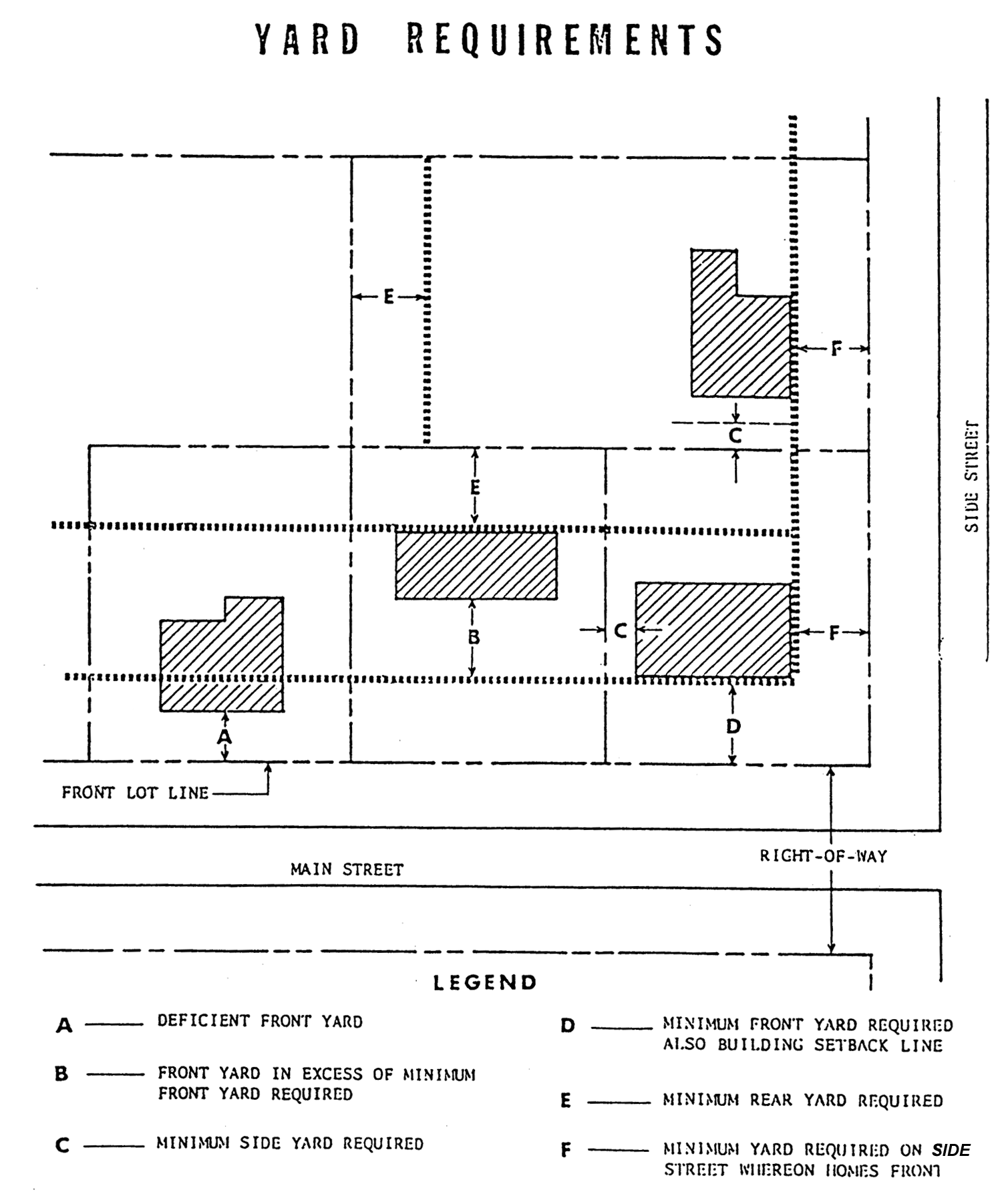
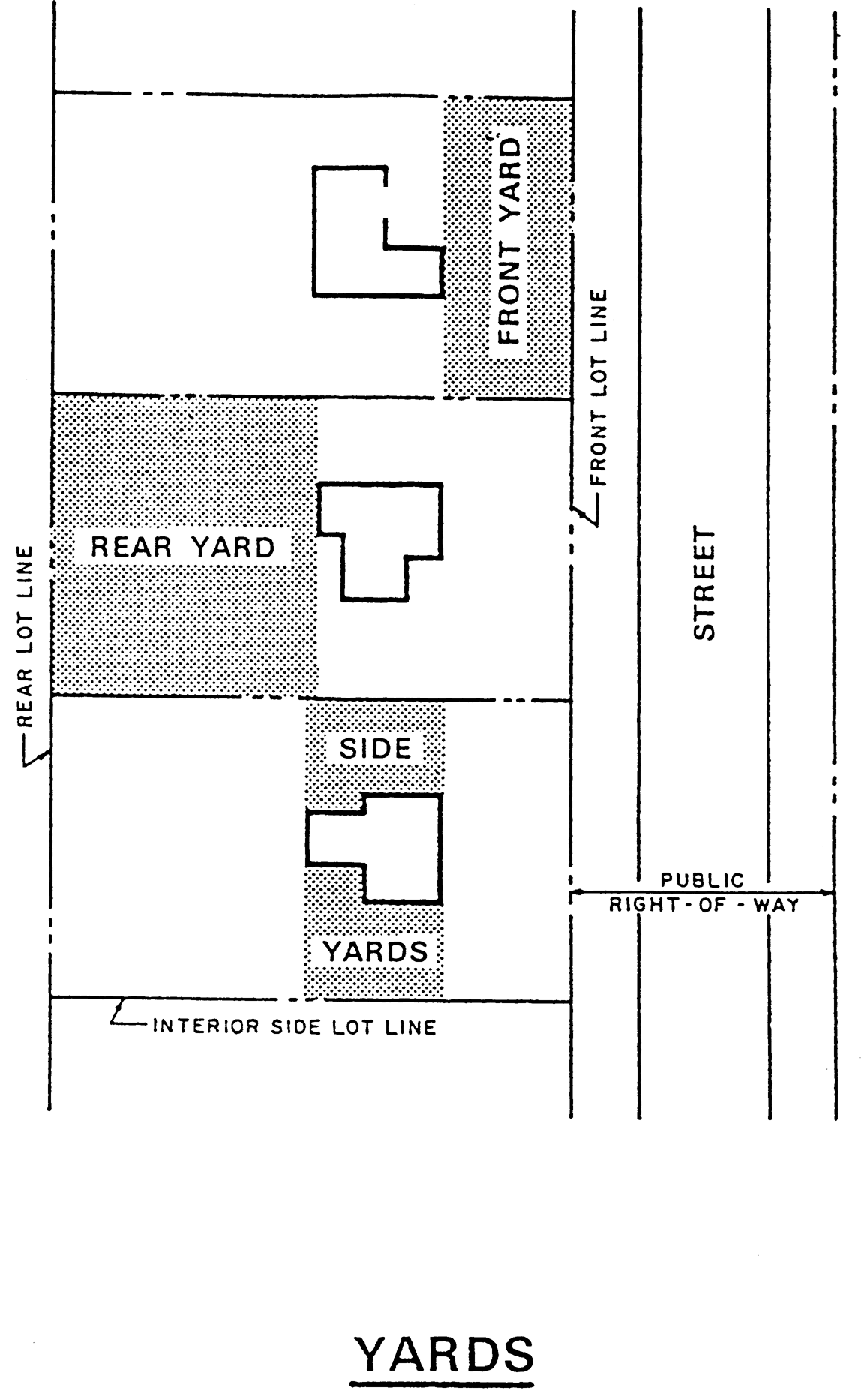
Yards means the open spaces on the same lot with a main building unoccupied and unobstructed from the ground upward except as otherwise provided in this chapter, and as defined in this definition.
(1)
Front yard: An open space extending the full width of the lot, the depth of which is the minimum horizontal distance between the front lot line and the nearest point of the main building.
(2)
Rear yard: An open space extending the full width of the lot the depth of which is the minimum horizontal distance between the rear lot line and the nearest point of the main building. In the case of a corner lot, the rear yard may be opposite either street frontage.
(3)
Side yard: An open space between a main building and the side lot line, extending from the front yard to the rear yard, the width of which is the horizontal distance from the nearest point of the main building.
(4)
Required yard: That portion of a front, side, or rear yard lying between the front, side or rear lot line and the corresponding front, side or rear minimum setback line.
(Ord. No. 62, § 7-03.02, 8-11-1984; Ord. No. 160, § 2, 12-20-2000; Ord. No. 200, § 2, 6-17-2009)
Sec. 38-6. - Changes and amendments.
The township board may from time to time, on recommendations from the planning commission or on petition, amend, supplement or change the district boundaries or the regulations in this chapter, or subsequently established in this chapter pursuant to the authority and procedure established in Public Act No. 184 of 1943 (MCL 125.271 et seq.).
(Ord. No. 62, ch. 7-20, 8-11-1984)
Sec. 38-7. - Interpretation of chapter provisions.
In the interpretation and application, the provisions of this chapter shall be held to be minimum requirements adopted for the promotion of the public health, morals, safety, comfort, convenience, or general welfare. It is not intended by this chapter to repeal, abrogate, annul, or in any way to impair or interfere with any existing provision of law or ordinance other than this chapter, or with any rules, regulations or permits previously adopted or issued or which shall be adopted or issued pursuant to the law relating to the use of building or premises; provided, however, that where this chapter imposes a greater restriction than is required by existing ordinances or by rules, regulations or permits, the provisions of this chapter shall control.
(Ord. No. 62, ch. 7-21, 8-11-1984)
Sec. 38-8. - Vested right.
Nothing in this chapter should be interpreted or construed to give rise to any permanent vested rights in the continuation of any particular use, district, zoning classification of any permissible activities therein; and, they are hereby declared to be subject to subsequent preservation of protection of public health, safety and welfare.
(Ord. No. 62, ch. 7-22, 8-11-1984)

