
Fort Gratiot Township
City Zoning Code
City Zoning Code
ARTICLE VI
SUPPLEMENTAL REGULATIONS
Sec. 38-601.- Scope.
No building or structure, or part thereof, shall be erected, constructed, reconstructed or altered and maintained, and no new use or change shall be made or maintained of any building, structure or land, or part thereof, except in conformity with the provisions of this chapter.
(Ord. No. 62, § 7-16.01, 8-11-1984)
Sec. 38-602. - Accessory building in residential districts.
In AG, R-1A, R-1B, R-2, RM and MHR districts accessory buildings, except as otherwise permitted in this chapter, shall be subject to the following regulations:
(1)
Accessory buildings structurally attached to a main building.
a.
To be considered structurally attached, the accessory building must be attached by a common party wall of at least 50 percent of the accessory building wall that is proposed to be attached to the main building.
b.
Where the accessory building is structurally attached to a main building, it shall be subject to and must conform to all regulations of this chapter applicable to main buildings. Additionally, the color, style and proportions of the accessory building shall be identical to, or shall closely match, or shall complement the exterior of the main building.
(2)
Detached accessory buildings.
a.
The color, style and proportions of the accessory building shall be identical to, or shall closely match, or shall complement the front exterior of the main building as to at least two of these four categories: roof pitch and materials, finish materials and color, window style, or architectural details such as overhangs, brackets or gables.
b.
Size and setback requirements for accessory structures larger than 200 square feet:
c.
Guest quarters, home offices or similar uses. Guest quarters, home offices or similar uses may be permitted in a residential district as part of a detached accessory structure subject to the following requirements:
1.
The guest quarters, home office or similar use shall not be utilized as a permanent dwelling unit. As part of the application for the construction of such accessory structure, the applicant shall sign an affidavit, to be filed with the St. Clair County Register of Deeds, stating the intention for the proposed use. The signed affidavit shall specifically state that the building will not be utilized as a permanent dwelling unit. The application shall also submit a plot plan and building plans showing the location, size, floor plan and building elevations.
2.
Only residents of the main dwelling and their guests shall utilize the area. Rental of the area on a nightly, weekly, monthly or any other basis is prohibited. At no time shall an address be issued to a detached accessory structure.
3.
A home occupation is subject to the standards in this chapter, in the section for home occupations.
4.
The portion of the accessory structure utilized for guest quarters, a home office or similar use shall not exceed an area of 1,000 square feet, and in no instance shall the area exceed the square footage of the main building.
(3)
Boathouse, a boat well, or any other accessory building located substantially over the water, whether it be a river, lake, or canal, the following conditions apply:
a.
No more than 30 percent of the building area may have flooring, whether it is earth, concrete, wood, or any flooring material other than water.
b.
Such boathouse may exceed the area of the primary (residential) building, so long as the total building area does not exceed the percent lot coverage of the exposed land as required in division 12, article III of this chapter for the district in which it is located.
c.
All boathouses and lifts which exceed 16 feet in height or with wells to accommodate more than two boats shall be subject to prior approval of the zoning board of appeals. In determining the height of a boathouse, the definition of height shall apply (see section 38-4), except that in all instances the term "grade" shall be interpreted to mean the surface of the water. For the Black River or its tributaries, the surface of the water shall be set at the nearest base flood elevation as described on the flood insurance rate map. For Lake Huron, the elevation of the surface of the water shall be 580 feet above sea level. A commercial use of a boathouse is not permitted unless it is located within a commercial district.
d.
A second floor shall not be permitted in a boathouse nor shall a boathouse have sanitary facilities unless self-contained or connected to a sanitary sewer system, which facility shall be in compliance with the rules and regulations and approved by the county health department.
e.
A building permit for a boathouse shall not be issued unless and until the applicant has:
1.
Complied with all the provisions of this chapter, the single state construction code and state laws on inland lakes and streams (Part 301 of Public Act No. 451 of 1994 (MCL 324.30101 et seq.); and
2.
Secured the written approval from the U.S. Army Corps of Engineers and the state department of environmental quality when such permits are required and within the jurisdiction of these agencies.
(4)
When an accessory building is to serve both over the water boat storage and automobile storage (garage), the two areas shall be clearly defined. Each area shall be constructed as a separate building and meet the requirements for such building.
(5)
By definition an accessory building is clearly incidental to the principal building housing the main use; therefore, the building inspector shall not issue a building permit for a detached accessory structure prior to the issuance of a building permit for the main or principal building, and no rough framing of an accessory building shall begin until the rough framing of the principal building has been completed.
(Ord. No. 62, § 7-16.02, 8-11-1984; Ord. No. 103, 8-18-1993; Ord. No. 198, art. 9, 8-16-2006; Ord. No. 210, § 5, 9-5-2012)
Sec. 38-603. - Accessory farm building.
All accessory farm buildings for uses other than those usually incidental to the dwelling shall be located not less than 100 feet from any dwelling and not less than 25 feet from any lot line or property boundary with the exception that the main farm building shall not be less than 150 feet from the front property line. This requirement shall not apply to the alteration or addition to an existing barn or other farm buildings, except dwellings, which are located closer to the road and, which existed prior to the adoption of this chapter.
(Ord. No. 62, § 7-16.03, 8-11-1984)
Sec. 38-604. - Appearance.
In any case where a building or accessory building in an M-1 or M-2 industrial district is erected or placed within 200 feet of the front lot line of any parcel of land fronting upon any public street, the front walls of such building or accessory building within such distance of 200 feet shall be constructed of stone, face brick, or approved ornamental material, paper, tin, corrugated iron, or any form of pressed board or felt of similar material within the limits specified in this section. Open storage uses shall be permitted only in the M-2 industrial district.
(Ord. No. 62, § 7-16.04, 8-11-1984)
Sec. 38-605. - Establishing grades.
In establishing the grades on a lot or parcel for the purpose of any construction thereon, the following conditions shall control:
(1)
Where there is existing development in the area or where the adjacent lands are subdivided, the grades about the new development or construction shall be set to conform to the grades of existing development or subdivision.
(2)
All new development shall be accomplished as to contain all runoff on the site or direct runoff to storm facilities without crossing abutting development or platted lands.
(3)
Grades of a site may be raised a total of 12 inches above the crown of an abutting public road if such increase in grade does not cause runoff onto abutting property, other than dedicated public right-of-way.
(4)
Where the grade on a site is in any way to be increased above existing grade, the owner of the property shall, upon application for a building permit, submit a certification signed and sealed by a registered land surveyor or a civil engineer licensed to practice in the state stating the existing and proposed grades and that conditions set forth in subsections (1)—(3) of this section are met. This certification shall be accompanied by a drawing, which contains at least the following information:
a.
A property line survey showing lot shape and dimension, drawn to a scale of at least one inch = ten feet on lots 85 feet in width or less and one inch = 30 feet on lots greater than 85 feet.
b.
A topographic map shall be drawn (may be superimposed on subsection (4)a of this section) at a contour interval of not greater than one foot. Elevations of abutting properties and the crown of abutting road pavement shall be shown.
c.
Proposed changes in grade shall be shown through the use of proposed contour lines.
d.
The first floor elevation of the proposed construction shall be shown.
(5)
Fees for inspection of the new grade shall be paid at the time of application for a permit, and the amount of such fees shall be established by a resolution of the township board and shall cover the cost of the inspection.
(Ord. No. 62, § 7-16.05, 8-11-1984)
Sec. 38-606. - Building to be moved.
Any building or structure which has been wholly or partially erected on any premises located within the township shall not be moved to and placed upon any other premises in the township until a government permit for such removal shall have been secured from the building inspector. Any such building or structure shall fully conform to all the provisions of the chapter in the same manner as a new building or structure.
(Ord. No. 62, § 7-16.06, 8-11-1984)
Sec. 38-607. - Conflicting regulations.
Whenever any provisions of this chapter impose more stringent requirements, regulations, restrictions or limitations than are imposed or required by the provisions of any other law or ordinance, the provision of this chapter shall govern.
(Ord. No. 62, § 7-16.07, 8-11-1984)
Sec. 38-608. - Corner clearance.
So as not to obstruct the view of a driver of a vehicle approaching the intersection, no fence, structure, wall, shrubbery, sign, or other obstruction to vision above a height of 30 inches from the established street grades shall be permitted within the triangular area formed by the street property lines and a line connecting them at points 25 feet from the intersection of the street lines or in the case of a rounded property corner from the intersection of the street property lines extended, exception that shade trees shall be permitted where all branches are not less than eight feet above the road level.
(Ord. No. 62, § 7-16.08, 8-11-1984)
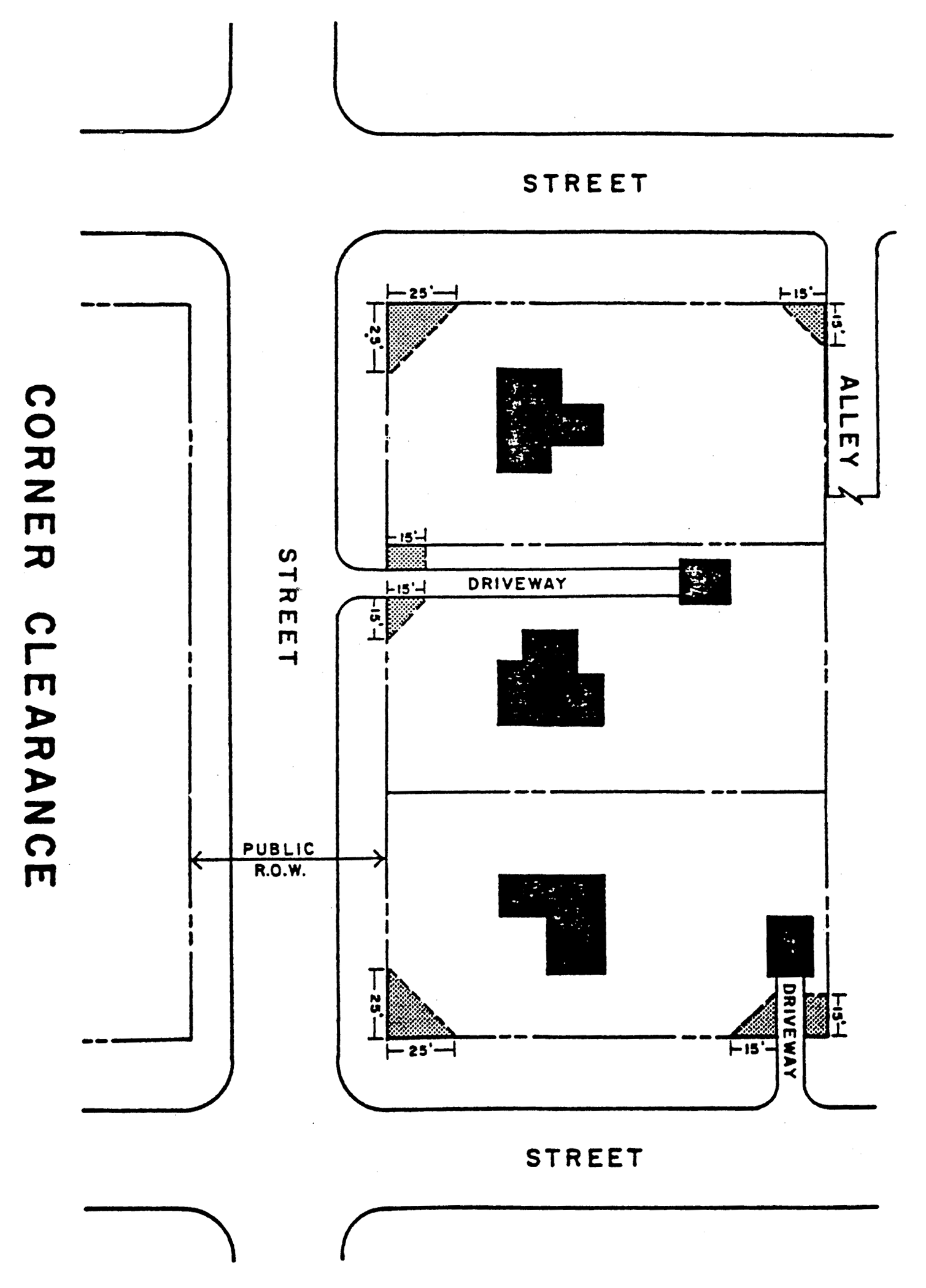
Sec. 38-609. - Corner lots.
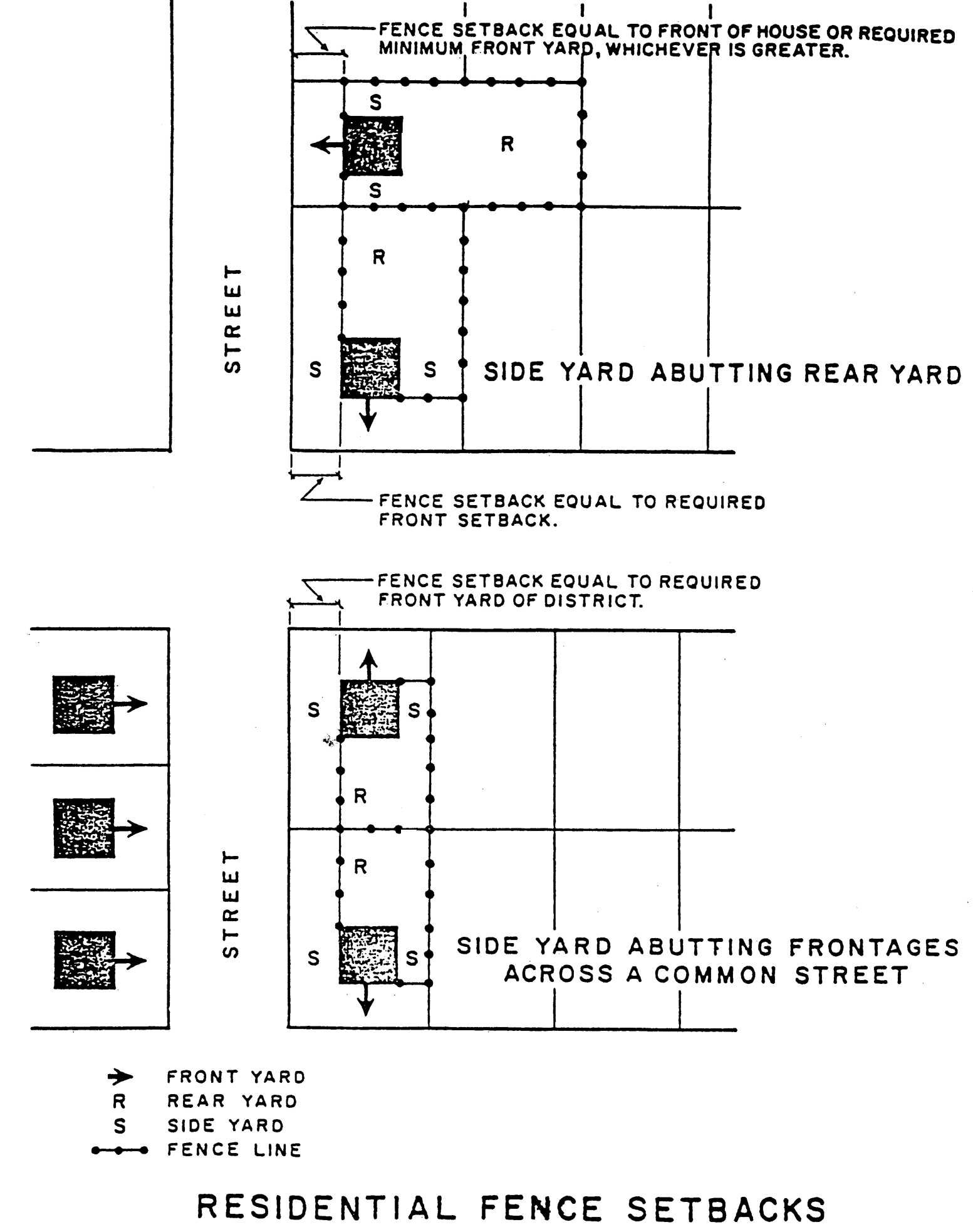
The following shall apply to the AG district and all residential districts. Where a side yard abuts upon a street on which other residential lots front, the side yard width shall not be less than the required front yard setback. This shall apply whether the side yard is on the same side of the street or across the street from such other fronting residential lots. All buildings, structures and accessory uses shall maintain such required yard space. (See section 38-442).
(Ord. No. 62, § 7-16.09, 8-11-1984)
Sec. 38-610. - Excavations or holes.
The construction, maintenance or existence within the township of any unprotected, unbarricaded, open or dangerous excavations, holes, pits or wells, which constitutes or are reasonably likely to constitute a danger or menace to the public health, safety or welfare are hereby prohibited; provided, however, that this section shall not prevent any excavation under a permit issued, pursuant to this chapter, where such excavations are properly protected and warning signs posted in such manner as may be approved by the building inspector; and provided, further, that this section shall not apply to streams, natural bodies of water or to ditches, streams, reservoirs or other major bodies of water created or existing by authority of the state, county, the township or other governmental agency.
(Ord. No. 62, § 7-16.10, 8-11-1984)
Sec. 38-611. - Exterior lighting.
All outdoor lighting in all use districts used to light the general area of a specific site shall be shielded to reduce glare and shall be arranged as to reflect lights away from all adjacent residential districts or adjacent residences.
(1)
All outdoor lighting in all use districts shall be directed toward and confined to the ground areas of lawns or parking lots.
(2)
All lighting in nonresidential districts used for the external illumination of buildings, so as to feature such buildings, shall be placed and shielded so as not to interfere with the vision of persons on adjacent highways or adjacent property.
(3)
Illumination of signs shall be directed or shaded downward so as not to interfere with the vision of persons on the adjacent highways or adjacent property.
(4)
There shall be no flashing, oscillating or intermittent type of illuminated sign or display in any residential district or within 100 feet of any residential district, street intersection or railroad intersection with a street.
(5)
Within all development, the height of light standards shall not exceed 30 feet for parking lots and private roadways nor 15 feet for pedestrian walkways. These restrictions shall not apply in the industrial districts where, except as otherwise permitted, the height of light standards shall be limited to the height limit for structures in the district.
(Ord. No. 62, § 7-16.11, 8-11-1984; Ord. No. 135, 1-15-1997)
Sec. 38-612. - Fences, walls and other protective barriers.
(a)
All fences of any nature, type or description including hedges (but not including planted greenbelts approved by the planning commission) located in the township shall conform to the following regulations:
(1)
The erection, construction or alteration of any fence, wall or other type of protective barrier shall be approved by the building inspector as to their conforming to the requirements of the zoning district wherein they are required because of land use development and to the requirements of this section.
(2)
Fences in other than AG districts, which are not specifically required under the regulations for the individual zoning districts, shall conform to the following requirements:
a.
No fence shall be erected along the line dividing lots or parcels of land or located within any required rear yard in excess of six feet, or less than three feet in height above the grade of the surrounding land, and no fence shall be erected along the line dividing lots or parcels of land or located within any required side yard in excess of five feet, or less than three feet in height above the grade of the surrounding land.
b.
No fence shall be located in the required front yard or yard adjacent to the street of the lots or parcels in question more than 42 inches in height.
c.
All fences erected shall be of an ornamental nature. Barbed wire, spikes, nails or any other sharp point or instrument of any kind on top or on the sides of the fence, or electric current or charge in such fences is prohibited, except as permitted in subsection (a)(3) of this section. Barbed wire cradles may be placed on top of fences enclosing public buildings or wherever deemed necessary in the interest of public safety.
d.
The decorative side of fences shall face outward, toward the abutting property.
(3)
Fences in AG districts and fences for agricultural uses in other districts, after approval as to location and type by the building inspector, may be located on all property on road right-of-way lines of a parcel of land, providing that such fences are maintained in a good condition and do not result in an unreasonable hazard to persons who might come near them.
(b)
Fences shall be subject to the following regulations:
(1)
No person shall construct, erect or install a fence without first obtaining a permit from the township and constructing, erecting or installing such fence in conformance with the standards set forth in this section.
(2)
Fences shall meet the following standards:
a.
Installation and materials. All fences shall comply with the requirements of the single state construction code and this chapter, and any ordinance of the township as they apply to fence installation and materials.
b.
Lakes and river lots. Fences on lots with frontage on Lake Huron or the Black River shall be opened and unobstructed on the lake and on the river side allowing a view up and down the lake or river from adjacent properties.
(3)
The building inspector shall inspect all fences constructed, erected or installed and issue permits of compliance.
(4)
The township board may, by resolution, establish inspection or compliance fees for the cost of administration and enforcement of this section.
(Ord. No. 52, §§ 3-07.02—3-07.04, 3-07.06, 8-18-1982; Ord. No. 62, § 7-16.12, 8-11-1984; Ord. No. 110, 2-2-1994)
Sec. 38-613. - Frontage requirements.
(a)
Every lot or parcel of record created after the effective date of the ordinance from which this chapter is derived shall front upon a public street for the required width of the lot as provided in section 38-441. Lot width shall be measured as defined in the definition of lot width in section 38-5.
(b)
No lot shall be used for any purpose permitted by this chapter unless such lot fronts a public street; or unless such lot fronts upon a private street which was lawfully constructed prior to the adoption of this chapter.
(c)
The zoning board of appeals may grant an exemption from this requirement in cases where a lot has contained two or more dwelling units since prior to passage of the ordinance from which this section is derived and it is proposed that such lot be split so as to create lots containing only one house each, or in other cases where the requirement would serve no useful purpose. An exemption shall be granted only if the zoning board of appeals determines that the exemption will not be detrimental to the public welfare.
(Ord. No. 62, § 7-16.13, 8-11-1984)
Sec. 38-614. - Greenbelts, obscuring walls and berms.
(a)
For those use districts and uses listed in this section, there shall be provided and maintained, on those sides abutting or adjacent to a residential district, an obscuring masonry wall required as follows:
(1)
RM districts. Six-foot high masonry wall, except that no wall is required when adjacent property is also zoned RM or MHR.
(2)
MHR districts. Six-foot high masonry wall adjacent to all abutting properties, except that no wall, greenbelt, or earth berm shall be required for single-family dwellings or mobile homes located outside of licensed mobile home parks and may also be required along right-of-way lines.
(3)
O-1, C-1, and C-2 districts. Six-foot high masonry wall.
(4)
Off-street parking lot. Six-foot high masonry wall.
(5)
Hospital ambulance and delivery areas, funeral home loading and unloading areas. Six-foot high masonry wall.
(6)
Utility buildings, stations and/or substations. Six-foot high masonry wall.
(b)
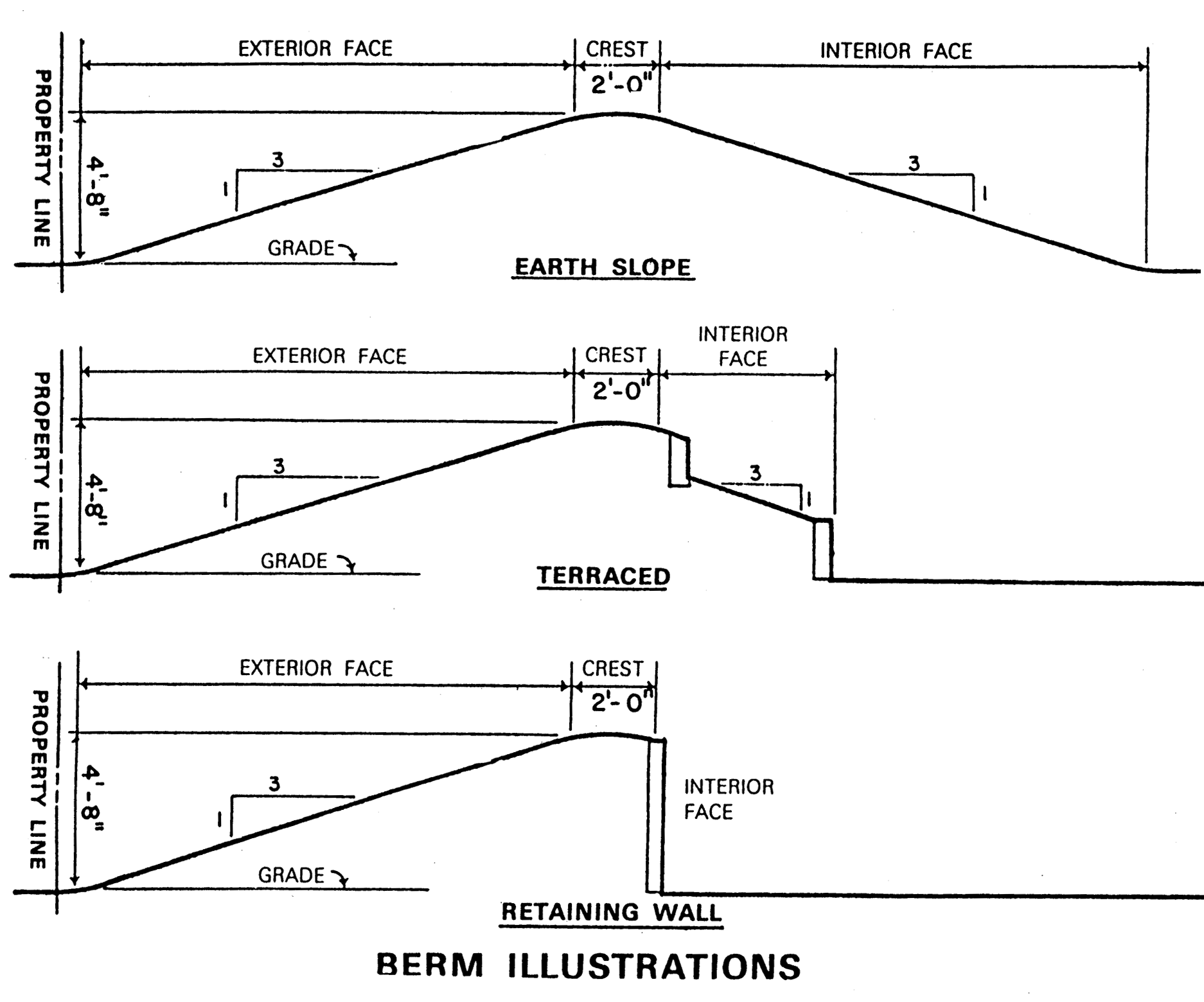
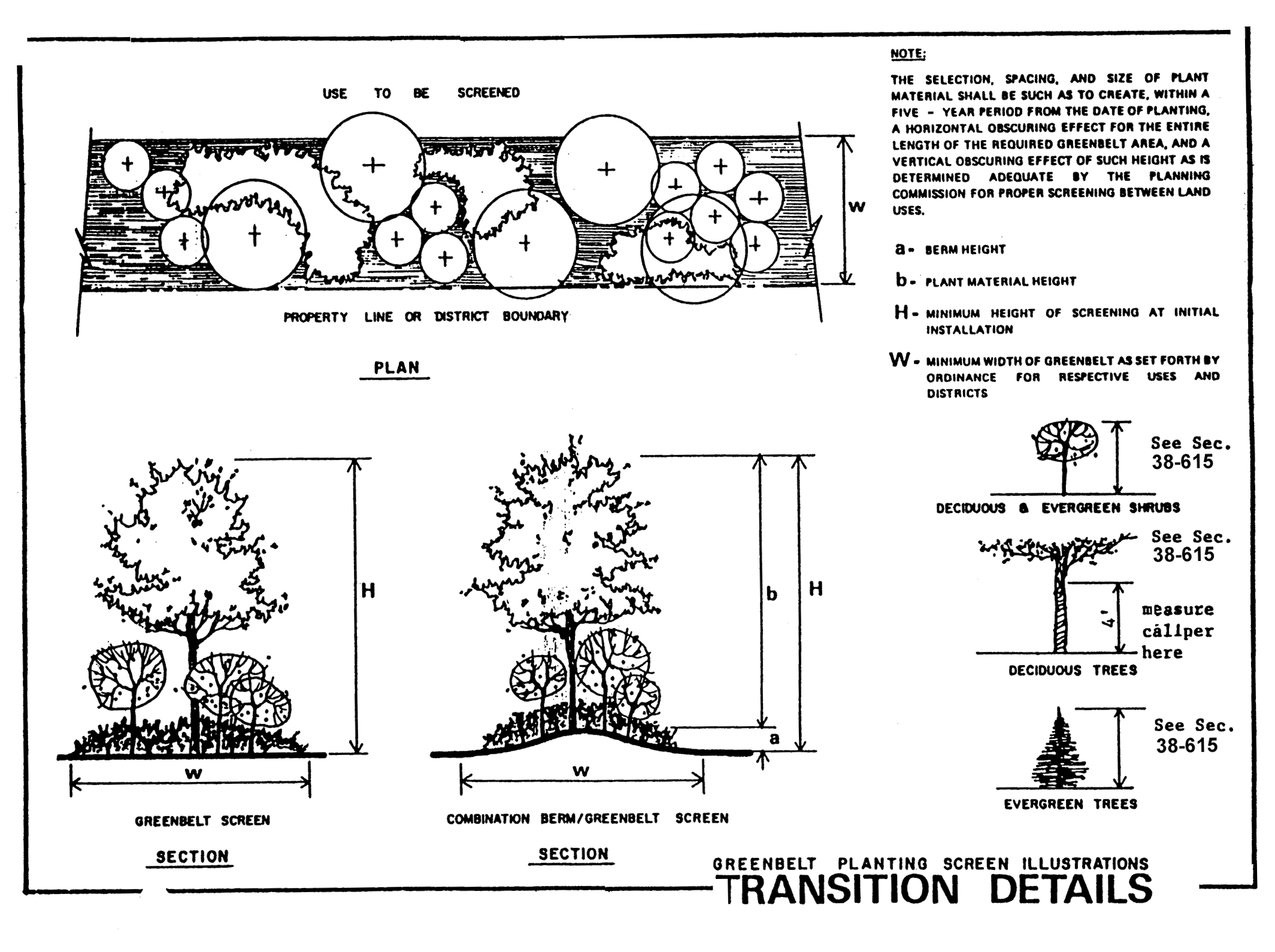
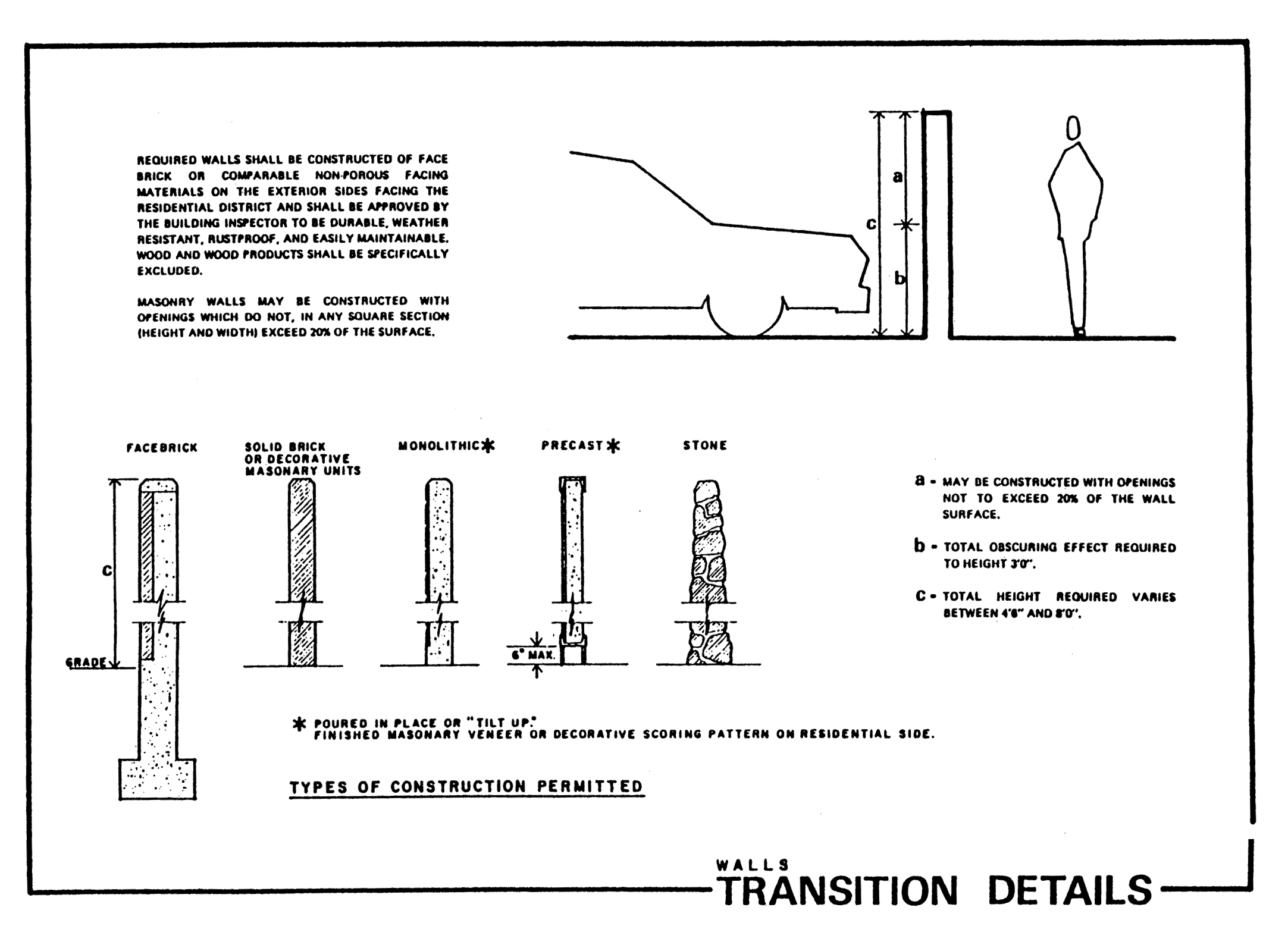
For those use districts and uses listed in subsection (a) of this section, the planning commission may permit, in lieu of an obscuring masonry wall: an obscuring landscaped earth berm (earth mound); or landscaped greenbelt of at least 15 feet in width. Where such earth berm is provided in lieu of a wall, the berm shall be landscaped and maintained in a clean, orderly, and growing condition and shall meet the following minimum design standards. (See illustrations on following pages):
(1)
Continuous earth berms shall be provided with undulating horizontal and vertical tops and sides, the height of which shall be no less than required for a wall in the district. Earth berms may consist of opaque screen planting within the horizontal berm depressions or masonry walls, or a combination of both, as long as the minimum required height of the earth berm, plantings, wall or combinations thereof are provided.
(2)
Berms shall be landscaped earth mounds possessing a maximum slope ratio of three to one (three feet of horizontal plane for each one foot of vertical height). Side slopes shall be designed and planted to prevent erosion. The berms shall have a nearly flat horizontal area at their crests on at least two feet in width.
(3)
Berm or earth mounds shall be protected from erosion by sodding or seeding. If slopes are seeded, they shall be protected with straw mulch held in place by jute netting until the seed germinates and a permanent lawn is established. The straw mulch is not required if the seeded slope is protected by a net which is specifically designed to control erosion. The berm area shall be kept perpetually free of weeds, refuse, debris and general clutter and shall be planted with shrubs, trees, or lawn and shall be continuously maintained in a healthy growing condition. Failure to maintain the earth berm is accordance with these requirements shall constitute a violation of this chapter.
(4)
In those instances where the planning commission permits an earth berm or landscaped greenbelt in lieu of a wall, a detailed drawing of the proposed berm or greenbelt shall be submitted in addition to the site plan.
(c)
Required walls, earth berms or greenbelts shall be located as near as possible to the lot lines, except where underground utilities interfere and except in instances where this chapter requires conformance with front yard setback lines in abutting residential districts. When vehicles or open air display generally exceed a five-foot height, such wall shall be increased to a height not exceeding ten feet, as determined by the planning commission.
(d)
Such walls, earth berms and or greenbelts shall have no openings for vehicular traffic or other purposes except as otherwise provided in this section and subsection (h) of this section. All walls required in this section shall be constructed of face brick or other approved materials as shown in the illustrations accompanying this section. All materials shall be approved by the planning commission to durable, weather resistant, rustproof and easily maintained; wood or wood products shall be specifically excluded. Masonry walls or earth berms may be constructed with openings, which do not, in any square section (height and width), exceed 20 percent of the surface. Where walls or earth berms are so pierced, the openings shall be spaced so as to maintain the obscuring characteristic required and shall not reduce the minimum height requirement. The arrangement of openings shall be reviewed and approved by the planning commission.
(e)
Upon review of the site plan, the planning commission may waive any part or all of the wall, earth berm or greenbelt requirements, if it is determined that the intended screening effect of the wall, earth berm or greenbelt would serve no useful purpose.
(f)
If the planning commission should determine that a residential district may be a future nonresidential area, temporary waiver of the requirements of section 38-614 for an initial period not to exceed one year may be granted, provided that escrow money or surety bond in the amount of the estimated cost for erection of the wall or earth berm is filed with the township for a period not to exceed five years. Granting of waivers, subsequent to the first waiver may be permitted.
(g)
Residential property across alley:
(1)
Any C-1, C-2, M-1, or M-2 district on which a drive-in business, open air display, parking lot or other open use is conducted shall be separated along its entire length from any adjacent residentially zoned district, located across a public alley of not less than 20 feet wide, by either a building housing a permitted use or by a solid decorative masonry wall five feet in height above grade located, preferable on the residential side of such public alley as provided in subsection (g)(2) of this section. Greater wall height may be required as determined by the planning commission.
(2)
Required walls may, upon approval of the planning commission, be located on the opposite side of an alley right-of-way from a nonresidential zone that abuts a residential zone upon agreement with affected property owners. Such agreements shall be indicated on the site plan and recorded as a covenant upon the land. The continuity of the required wall on a given block will be a major consideration of the planning commission in reviewing such requests.
(h)
Where required walls, berms, or greenbelts are provided on the business side of public alleys, requirements may be waived to provide necessary entrance to or exit from required off-street parking and loading areas, provided that approval is secured from the planning commission as to suitability of width and location of such openings.
(i)
Bond:
(1)
A bond or cash in an amount equal to the cost of construction of the required wall, earth berm, or greenbelt shall be deposited with the township clerk until such time as the screening device is constructed and/or planted. If the weather or seasonal conditions prevent transplanting, the petitioner shall be granted six months from the date of issuance of certificate of occupancy to install and screening device or the township shall be authorized to use such funds to install such funds to install such screening device.
(2)
In the case of a earth berm or a greenbelt, the township shall be authorized to withhold 20 percent of the bond or cash for a period of two years from the date of issuance, to ensure that dead or dying nursery stock shall be replaced. Excess funds, if any, shall be returned to the depositor upon completion of the two-year period. It shall be the responsibility for its original intent and purpose.
(Ord. No. 62, § 7-16.14, 8-11-1984)
Sec. 38-615. - Landscaping, screening, green-belts, buffers and fencing.
(a)
Intent. The intent of this section is to promote the public health, safety and general welfare by minimizing noise, air and visual pollution; improving the appearance of off-street parking and other vehicular use areas; requiring buffering between incompatible land uses; regulating the appearance of property abutting public rights-of-way; protecting and preserving the appearance, character of the community; promoting the conservation of property values and natural resources; and preventing soil erosion. Landscaping and greenbelts are capable of enhancing the visual environment, preserving natural features, improving property values and alleviating the impact of noise, traffic and visual disruption related to intensive uses. Screening, buffers and fencing are important to protect less intensive uses from the noise, light, traffic, litter and other impacts of intensive nonresidential uses.
(b)
Scope of application. The requirements of this section shall apply to all uses for which site plan review is required under section 38-46. No site plan shall be approved unless such site plan shows landscaping consistent with the provisions of this section. Furthermore, where landscaping is required, a building permit shall not be issued until the required landscape plan is submitted and approved and a certificate of occupancy shall not be issued unless provisions set forth in this section have been met or a performance guarantee has been posted, in accordance with the provisions set forth in section 38-47. In cases where an existing building is to be structurally altered or enlarged or when the use of changes to a substantially different use or an existing building is structurally altered or enlarged, all of the standards set forth in this section shall be met.
(c)
Landscape plan required. A separate detailed landscape plan shall be required to be submitted as part of a site plan review. The landscape plan shall include, but not necessarily be limited to, the following:
(1)
The landscape plan shall be prepared by or under the direction of a landscape architect and shall bear the seal of a landscape architect, licensed to practice in the state.
(2)
A minimum scale of one inch = 60 feet.
(3)
Existing and proposed contours on-site and 50 feet beyond the site at intervals not to exceed two feet.
(4)
Location, spacing, size and root type (bare root (BR) or balled and burlapped (BB)) and descriptions for each plant type proposed for use within the required landscape area.
(5)
Typical straight cross section including slope, height and width of berms and type of ground cover or height and type of construction for all proposed walls and fences, including footings.
(6)
Significant construction details to resolve specific site conditions, such as tree wells, to preserve existing trees or culverts to maintain natural drainage patterns.
(7)
Planting and staking details, in either text or drawing form, to ensure proper installation and establishment of proposed plant materials.
(8)
Identification of existing trees and vegetation cover to be preserved.
(9)
Identification of grass and other ground cover and method of planting.
(10)
Identification of landscape maintenance program, including statement that all diseased, damaged or dead materials shall be replaced, in accordance with the standards of this article.
(11)
An irrigation plan showing the design of an underground sprinkler system conforming to the requirements of subsection (o) of this section.
(d)
Review of landscape plan by planning commission. The planning commission, upon receipt of a written report and recommendation from the zoning administrator and/or township planner, shall review such landscape plan relative to:
(1)
The proper spacing, placement and location of plant materials relative to the length, width and general configuration of the required landscape element so as to ensure that the intended landscaping effect, including the necessary horizontal and vertical obscuring of proposed land uses, will be achieved.
(2)
The choice and selection of plant materials so as to ensure that the root system will not interfere with public utilities and that fruit and other debris will not constitute a nuisance within the public right-of-way or to abutting property owners.
(3)
The proposed relationship between deciduous and evergreen plant materials so as to ensure that the intended landscaping effect, including maximum obscuring effect, where appropriate, will be maintained throughout the various seasonal periods.
(4)
The size of plant materials (both starting and ultimate) to ensure adequate maturity and optimum screening and/or shading effect of proposed plant materials.
(e)
Landscape design standards.
(1)
Quality. Plant material and grasses shall be of generally acceptable varieties and species, free of insects and diseases, hardy to county, conform to the current minimum standard of the American Association of Nurserymen and shall have proof of any required governmental regulations and/or inspections.
(2)
Composition. A mixture of plant material, such as evergreen trees, deciduous trees and shrubs, is recommended as a protective measure against insect and disease infestation. A limited mixture of hardy species is recommended rather than a large quantity of different species to produce a more aesthetic, cohesive design and avoid a disorderly appearing arrangement.
(3)
Plant material sizes and spacing.
a.
Plant materials shall not be placed closer than four feet from the fence line or property line.
b.
Where plant materials are planted in two or more rows, planting shall be staggered in rows.
c.
Evergreen trees shall have a starting size of at least six feet in height. When planted in informal groupings, they shall be spaced not more than 20 feet on center. When planted in rows, they shall be spaced not more than 12 feet on center.
d.
Narrow evergreens shall have a starting size of at least five feet in height. When planted in informal groupings, they shall be spaced not more than ten feet on center. When planted in rows, they shall be spaced not more than five feet on center.
e.
Large deciduous trees shall have a minimum starting size of 2½ caliper inches. They shall be planted not more than 30 feet on center when placed in informal groupings.
f.
Small deciduous trees shall have a minimum starting size of at least two caliper inches. They shall not be spaced more than 15 feet on center when placed in informal groupings.
g.
Large shrubs shall have a starting size of at least 30 inches in height. They shall be placed not more than six feet on center when placed in informal groupings and not more than four feet on center when planted in rows.
h.
Small shrubs shall have a starting size of not less than 24 inches in height or spread and shall be planted not more than four feet on center.
(4)
Suggested plant materials. The following list of plant materials is not intended to be all-inclusive, but rather suggests certain materials which is suitable for landscaping purposes:
(f)
General landscaping. In addition to any interior parking lot landscaping and/or screening/buffer between land uses required by this chapter, not less than ten percent of the site area, excluding existing thoroughfare rights-of-way, shall be landscaped. Areas used for storm drainage purposes, such as unfenced drainage courses or retention areas in front or side yards, may be included as a portion of the required landscaped area not to exceed five percent of the site area.
(1)
All portions of the landscaped area shall be planted with grass, ground cover, shrubbery or other suitable plant material, except that paved patios, terraces, sidewalks and similar site features may be incorporated with planning commission approval.
(2)
A mixture of evergreen and deciduous trees shall be planted at the rate of one tree for each 3,000 square feet or portion, thereof, of required landscaped open space area.
(3)
Required trees and shrubs may be planted at uniform intervals, at random or in groupings.
(4)
A portion of the required general landscaping, acceptable to the planning commission, shall be provided immediately adjacent to principal buildings. Such landscaping shall be of a size and extent proportionate with the building it is intended to enhance and soften. Larger and taller plant materials, such as deciduous, evergreen and ornamental trees must comprise a significant portion of the required landscaping adjacent to larger structures or monotonous expanses of a building's exterior wall. The location, width and configuration of planting beds as well as the number, size, type and spacing of plant materials shall be subject to the review and approval of the planning commission. For buildings having a height of 14 feet or less, the average width of the planting beds shall not be less than five feet. When the height of the building exceeds 14 feet, the average minimum width of the planting beds shall be increased an additional one foot for each additional two feet of building height, up to a maximum required minimum average width of 15 feet.
(5)
The total landscaped area shall be the basis for determining the required number of trees or shrubs, irrespective of the portion of the site, which is devoted to patios, terraces, sidewalks or other site features.
(g)
Interior parking lot landscaping.
(1)
In off-street parking areas containing greater than 20 spaces, interior parking lot landscaping shall be provided, in accordance with the following schedule:
a.
In an M-1 or M-2 district, one deciduous tree for each 4,000 square feet of the total of the paved driveway and parking lot surface is required.
b.
In all other districts, one deciduous tree shall be required for each 3,000 square feet of paved driveway and parking lot surface, provided that no less than two trees are provided.
Trees shall be distributed evenly throughout the parking area. Whenever possible, parking lot landscaping shall be arranged to improve the safety of pedestrian and vehicular traffic, guide traffic movement and improve the appearance of the parking area.
(2)
Parking lot landscaping shall be no less than five feet in any single dimension and no less than 150 square feet in any single area. Landscaping shall be protected from parking areas with continuous raised reinforced concrete curbing to prevent vehicular encroachment onto landscaped areas.
(3)
A minimum of one deciduous tree, having a clear trunk height of at least six feet, shall be planted in each landscaped area.
(4)
A minimum of three feet shall be established between trunk of the proposed tree and the backside of the curb or edge of the pavement for protection.
(5)
The landscape plan shall designate the sizes, quantities and types of plant material to be used in parking lot landscaping.
(6)
All interior landscaped areas not dedicated to trees or to preservation of existing vegetation, shall be landscaped with grass, ground cover, shrubs or other appropriate landscape treatment. Sand, gravel or other pavement shall not be considered appropriate landscape treatment.
(7)
Required landscaping elsewhere on the parcel shall not be counted in meeting parking lot landscaping requirements.
(8)
Landscaped islands within the parking area shall be designed and placed so as not to unduly interfere or impede the removal of snow. Adequate areas shall be provided, on-site, for the disposition and storage of snow.
(h)
Perimeter parking lot landscaping. The purpose of perimeter landscaping requirements is to define parking areas, shield views of parked cars to passing motorists and pedestrians and prevent two adjacent lots from becoming one large expanse of paving. The provision of the perimeter landscaping, between adjacent parking lots, shall not preclude the need to provide vehicular access between lots. Landscape strips shall be provided around the perimeter of lots, as follows:
(1)
Perimeter landscape strips separating parking lots and driving lanes from abutting rights-of-way.
a.
General requirements. Whenever an off-street parking lot or driving lane abuts a right-of-way, public or private, a perimeter landscape strip shall be created which meets the minimum standards established in this subsection. The perimeter boundary, between the edge of the planned right-of-way and the parking lot or driving lane. Accessways, from public rights-of-way through required landscaped strips, shall be permitted; but such accessways shall not be subtracted from the lineal dimension used to determine the minimum number of trees required, unless such calculation would result in a violation of the spacing requirements set forth in this section.
b.
Landscaping; plantings. The strip shall be landscaped and planted in one of the following approved methods:
1.
A 15-foot wide strip planted with one deciduous tree and ten shrubs for each 35 feet of frontage.
2.
A berm that is at least 2½ feet higher than the finished elevation of the parking lot, planted with one deciduous tree and five shrubs for each 35 feet of frontage.
3.
An eight-foot wide landscaped strip with a minimum three-foot grade drop from the right-of-way to the parking lot, planted with one deciduous tree and five shrubs for each 35 feet of frontage.
4.
An eight-foot wide buffer strip with a three-foot high wall of brick, stone or decorative finished concrete to screen the lot with one deciduous tree for each 35 feet of frontage, planted between the wall and the right-of-way.
5.
If existing woodlands are available, the applicant may preserve a 25-foot wide strip, in lieu of the landscaping requirement.
For subsection (h)(1)b.1—4 of this section, two ornamental or two evergreen trees may be substituted for each required deciduous tree.
(2)
Other perimeter landscaping strips. In addition to the perimeter landscaping required in subsection (h)(1) of this section, perimeter landscaping strips shall be required along the remaining boundaries of a parking lot or driving lane, as follows:
a.
A landscaped strip, at least eight feet wide, planted with one deciduous tree and three shrubs for each 35 feet of perimeter. For small, shallow, narrow or unusually shaped lots, the planning commission may reduce the required width, modify the plantings required or waive this requirement, upon demonstration that compliance with this subsection would cause undue hardship.
b.
If existing woodlands are available, the applicant may preserve a 25-foot wide strip in lieu of the landscaping requirement.
(i)
Buffers between conflicting land uses. All landscaping plans shall conform to all applicable provisions of section 38-614, entitled "Greenbelts, Obscuring Walls and Berms."
(j)
Landscaping of balance of developed site. In addition to the minimum required landscaping elements and areas, set forth in this section, all developed areas of the site which are not devoted to buildings, parking lots, driveways, sidewalks, patios, terraces or other approved site features shall be planted with grass, ground cover, shrubbery or other suitable plant material and shall be maintained in a healthy, growing condition, free of weeds and debris and neat and orderly appearance.
(k)
Existing trees.
(1)
If existing plant material is labeled "To Remain" on site plans, by the applicant or required by the township, protective techniques such as, but not limited to, fencing or barriers placed at the drip line around the perimeter of the plant material shall be installed during construction. No vehicle or other construction equipment shall be parked or stored within the drip line of any plant material intended to be saved. Other protective techniques may be used, provided that the township approves such techniques.
(2)
If healthy trees, which are used to meet the minimum requirements of this section or those labeled to remain, are cut down, destroyed, damaged or excavated at the drip line, as determined by the township, the owner shall replace them with trees which meet this article's requirements.
(l)
Berms.
(1)
Where required or utilized under this section, berms shall be constructed with slopes not to exceed a 1:3 gradient with side slopes designed and planted to prevent erosion and with a rounded crest, a minimum of two feet in width at the highest point of the berm, extending the length of the berm. For the purposes of this subsection, grade elevation shall be the ground elevation at the property line adjacent to the proposed berm. A berm shall be designed and placed so as not to impede storm drainage.
(2)
The berm shall be planted with grass or other suitable ground cover to ensure that it withstands wind and weather and retains its height and shape.
(3)
A minimum of one deciduous or evergreen tree shall be planted for each 30 linear feet or portion of required berm.
(4)
Eight shrubs per tree may be planted as a substitute of the trees required in subsection (l)(3) of this section.
(5)
Required trees and shrubs may be planted at uniform intervals, at random or in groupings.
(6)
For the purpose of determining required plant material, required berm length shall be measured along the exterior periphery of the berm.
(m)
Regulations pertaining to landscaping areas used for sight distance. When a driveway intersects a public right-of-way or when the subject property abuts the intersection of public rights-of-way, all landscaping within the corner triangular areas, described in this subsection shall permit unobstructed cross visibility. Shrubs, located in the triangular area, shall not be permitted to grow to a height of more than 30 inches above the pavement grade at the edge of the pavement. Portions of required berm, located within sight distance triangular areas, shall not exceed 30 inches above the pavement grade at the edge of the pavement. Trees may be maintained in this area, provided that all branches are trimmed to maintain a clear vision for a vertical height of eight feet above the roadway surface. Landscaping, except grass or ground cover, shall not be located closer than three feet from the edge of a driveway. The triangular areas, referred to in this subsection are:
(1)
The area formed at the corner of a public right-of-way and a driveway, two sides of the triangle area being ten feet in length measured along the right-of-way line and driveway line, and the third side being a line connecting these two sides.
(2)
The area formed at the corner of two public rights-of-way lines, the two sides of the triangular area being 25 feet in length measured along the abutting public rights-of-way lines, and the third side being a line connecting these two sides.
(n)
Landscaping of rights-of-way and other adjacent public open space areas. Public rights-of-way and other public open space areas adjacent to required landscaped areas and greenbelts shall be planted with grass or other suitable ground cover and maintained by the owner of the adjacent property as if they were part of required landscaped areas and greenbelts.
(o)
Maintenance. The owner of property required to be landscaped by this article shall maintain such landscaping in a reasonably healthy condition, free from weeds, refuse and debris. All unhealthy and dead material shall be replaced within one year of damage or death or the next appropriate planting period, whichever comes first. All landscaped areas, including parking lot islands, shall be irrigated by means of a properly maintained and operated underground sprinkler system with automatic timing controls.
(p)
Fencing and screening. Unless otherwise specified or determined by the planning commission, zoning administrator or zoning board of appeals, fencing and screening is to be six feet in height. Gateposts and other superstructures over site entrances and exits may be up to 12 feet in height. Fencing and screening materials of a height greater than three feet are not to be located within a required front yard setback or side setback adjacent to a street.
(1)
Mechanical equipment. (This subsection does not apply to single-family residential uses or to any use in an industrial district, except if it abuts a residential district or use). When located outside of a building, support equipment (including air conditioning and heating devices, water and gas meters, but not including plumbing or exhaust vents or chimneys) is to be screened to the height of the particular piece of equipment, as follows:
a.
Roof-mounted equipment: To be screened by architectural features from the view of abutting streets and parcels.
b.
Equipment at grade: When located on the ground adjacent to a building, mechanical equipment is to be screened by landscaping, a solid wall or fencing from the view of the street or surrounding properties.
(2)
Outdoor storage. Outdoor storage shall be screened on all sides by a solid wall or fence.
(3)
Trash receptacles. All trash collection sites utilizing dumpsters and/or four or more trash containers shall be enclosed with a six-foot high reinforced solid decorative masonry wall with enclosed solid wood access gates with latches. Access gates, constructed of chainlink fencing, are not permitted. Developments located within the commercial districts, which have off-street parking lots containing 250 or more parking spaces, shall provide trash receptacles, of a design approved by the planning commission, at evenly dispersed locations throughout the parking area at a ratio of one receptacle per each 50 spaces for use by patrons. All trash enclosures and trash receptacles shall be kept in good repair and maintained in a clean and orderly manner.
(4)
Materials for fencing and screening. Materials for fencing and screening may consist of the following: solid board fences with posts not less than four inches by four inches and solid board cover not less than one inch (nominal) thick. Masonry piers may be substituted for wood posts. Posts or piers shall be spaced not more than eight feet on center. The finished side of the wood shall face abutting properties. Stockade-type fencing is not permitted.
(Ord. No. 135, § 1(7-16.15), 1-15-1997; Ord. No. 151, § 2, 9-15-1999)
Sec. 38-616. - Lot limitations.
In all R-1A and R-1B zoning districts only one principal building shall be placed on a lot of record with the exception of parcels of record described and designated as "out lots," which may be so arranged or subdivided as to provide for one or more principal buildings when the land area allocated to each building is equal to or greater than the lot area required for the district in which it is located; provided further that no building shall be erected on land subdivided in violation of the land division act, Public Act No. 288 of 1967 (MCL 560.101 et seq.).
(Ord. No. 62, § 7-16.16, 8-11-1984)
Sec. 38-617. - Lots, yards, and open spaces.
No space which for the purpose of a building has been counted or calculated as part of a side yard, rear yard, front yard, or other open space, including required lot area per dwelling unit, required by this chapter, may by reason of change in ownership or otherwise, be counted or calculated to satisfy or comply with a yard or other open space or lot area requirement for any other building.
(Ord. No. 62, § 7-16.17, 8-11-1984)
Sec. 38-618. - Nonconforming lots, nonconforming uses of land, nonconforming structures and nonconforming characteristics of use.
(a)
Applicability. To avoid undue hardship, nothing in this chapter shall be deemed to require a change in the approved plans, construction or designated use of any structure or land on which actual construction was lawfully begun prior to the effective date of adoption of this chapter and that there is likelihood that such lawful construction will be completed 12 months after the effective date of the ordinance from which this chapter is derived. Actual construction is hereby defined to include any lawful and approved physical operation on the premises which is preparatory to intend development or to the establishment of a use such as excavation, grading, fill, drainage and the like or the excavation, grading, fill, drainage and the like or the placing of construction materials in permanent position and fastened in a permanent manner; except that where lawful and approved demolition or removal has begun preparatory to rebuilding, such lawful and approved demolition or removal shall be deemed to be actual construction, provided that such lawful and approved demolition and subsequent reconstruction within 18 months after the effective date of the ordinance from which this chapter is derived. The adoption of this chapter shall not be deemed to affect, alter or change any conditional use, special exception, interpretation or variance previously decided or granted by the appropriate administrative or legislative body of the township or by a court of competent jurisdiction upon review of the action of such administrative or legislative body.
(b)
Lawfully existing nonconforming lots.
(1)
The intent of this section is to allow reasonable development of lawfully existing nonconforming lots.
(2)
In any district in which single-family dwellings are permitted, notwithstanding limitations imposed by other provisions of this chapter, a single-family dwelling and customary accessory buildings may be erected on any single lot of record at the effective date of adoption or amendment of this chapter. This subsection shall apply even though such lot fails to meet the requirements for area of width, or both, that are generally applicable in the district; provided, however, that yard dimensions and other requirements not involving area or width, or both, or the lot shall conform to the regulations for the district in which such lot is located. Yard requirements variances may be obtained through approval of the zoning board of appeals. If two or more lots or combinations of lots and portions of lots with continuous frontage in single ownership are of record at the time of passage or amendment of the ordinance from which this chapter is derived, and if all or part of the lots do not meet the requirements for lot width and area as established by this chapter, the lands involved shall be considered to be an undivided parcel for purposes of this chapter, and no portion of such parcel shall be used or occupied which does not meet lot width and area requirements established by this chapter, nor shall any division of the parcel be made which leaves remaining any lot with width or area below the requirements stated in this chapter.
(c)
Definition and classification of nonconforming uses and structures. Nonconforming uses and structures are those which do not conform to certain provisions or requirements of this chapter but were lawfully established prior to the time of its applicability. Class A nonconforming uses and structures are those which have been so designated by the zoning board of appeals, after application by any interested person or the building inspector upon findings that:
(1)
Continuance thereof would be contrary to the public health, safety or welfare.
(2)
The use or structure does not and is not likely to significantly depress the value of nearby properties.
(3)
The use or structure was lawful at the time of its inception.
(4)
No useful purposes would be served by strict application of the provisions or requirements of this chapter with which the use or structure does not conform.
All nonconforming uses, buildings or structures not designated as class A are class B nonconforming uses, buildings or structures.
(d)
Procedure for obtaining class A designation; conditions. A written application as provided by the Charter Township of Fort Gratiot must be filed with the zoning board of appeals. The provided form must be accompanied by a professionally prepared survey and shall include the following:
(1)
The actual shape, location, and dimensions of the property, utility lines, rights-of-way, public and private easements, fences, driveways, parking areas, and high risk erosion areas.
(2)
The shape, size, and location of all existing and proposed buildings or other structures to be erected, altered, or moved.
(3)
Setbacks from all property lines, the nearest fire hydrant, rights-of-way, drains, ponds, the outermost point (including overhangs, gutters, chimneys, architectural features) of existing and proposed structures, and structures on adjoining lots.
(4)
Existing and proposed elevations and finished grade.
(5)
If the property is located within a flood zone, either proof of removal from the flood zone or a professionally prepared elevation certificate must be provided.
(6)
The existing and intended use of the property and of all such structures upon it.
(7)
Such other information concerning the property, and adjoining properties, as may be essential for determining whether the provisions of this chapter are being met.
The zoning board of appeals may require the furnishing of such additional information, as it considers necessary. The notice and hearing procedure before the zoning board of appeals shall be the same as in the case of an application of a variance. The decision shall be in writing and shall set forth the findings and reasons on which it is based. Conditions may be attached, including any time limit, where necessary, to ensure that the use, building or structure does not become contrary to the public health, safety or welfare or the spirit and purpose of this chapter. No vested interest shall arise out of a class A designation.
(e)
Revocation of class A designation. Any class A designation shall be revoked, following the same procedure required for designation, upon a finding that as a result of any charge of conditions or circumstances the use or structure no longer qualifies for class A designation.
(f)
Regulations pertaining to class A nonconforming uses and structures.
(1)
No class A nonconforming use of land, building or structure shall be resumed if it has been, for any reason, discontinued for a continuous period of at least 18 months or if it has been changed to a conforming use for any period.
(2)
A class A use or structure may be used, altered or enlarged, provided that it does not violate any condition imposed by the zoning board of appeals at the time of its designation.
(g)
Regulations pertaining to class B nonconforming uses and structures.
(1)
It is the purpose of this chapter to eliminate class B nonconforming uses and structures as rapidly as is permitted by law without payment of compensation.
(2)
No class B nonconforming use shall be resumed if it has been discontinued for a continuous period at least six months or if it has been changed to a conforming use for any period or if the structure in which use for any period or if the structure in which such use is conducted is damaged by fire or other casualty to the extent that the cost of reconstruction or repair exceeds 50 percent of the reproduction cost of such structure.
(3)
No class B nonconforming structure shall be enlarged or structurally altered, or shall it be repaired or reconstructed if damaged by fire or other casualty to the extent that the cost of reconstruction or repair exceeds 50 percent of the reproduction cost of such structure.
(4)
No class B nonconforming use shall be changed to a substantially different nonconforming use, or enlarged so as to make use of more land area than used at the time of becoming nonconforming.
(5)
In the case of mineral removal operations, existing holes or shafts may be worked and enlarged on the land which constituted the lot on which operations were conducted at the time of becoming nonconforming, but no new holes or shafts shall be established.
(6)
No class B nonconforming use or structure shall be permitted to continue in existence if it was unlawful at the time of its inception.
(7)
No class B nonconforming use shall be moved in whole or in part to any other portion of the lot or parcel occupied by such use at the effective date of adoption or amendment of this chapter.
(8)
If a class B nonconforming structure is moved for any reason for any distance whatever; it shall thereafter conform to the regulations for the district in which it is located after it is moved.
(9)
Ordinary repair and maintenance work may be done on any class B nonconforming structure including repair and replacement of nonbearing walls, fixtures, wiring or plumbing to an extent not exceeding 50 percent of the state equalized value of the structure provided that the cubic content of the building as it existed at the time of adoption of this chapter shall not be increased.
(h)
Repairs and maintenance. Nothing in this chapter shall be deemed to prevent the strengthening or restoring to safe condition of any nonconforming structure or part thereof declared to be unsafe by any official charged with protecting the public safety, upon order of such official.
(i)
Change of tenancy or ownership. There may be a change of tenancy, ownership or management of any existing nonconforming uses of land, structures and premises, provided that there is no change in the nature or character of such nonconforming uses.
(j)
Record of nonconformity. Within six months after the adoption of this chapter, the building inspector shall prepare and complete a record of all known nonconforming uses and structures existing at the adoption of this chapter. Such record shall contain the names and addresses of the owners of record of such nonconforming use and of any occupant, other than the owner, the legal description of the land, and the nature and extent of use. Such record shall also contain any information regarding action by the zoning board of appeals for designation of class A status.
(k)
Nonconforming characteristics of use.
(1)
It is the intent of this chapter to eliminate, as nearly as is practicable with the prevailing requirements of this chapter, nonconforming characteristics of use and to eliminate them as rapidly as is possible without payment of compensation.
(2)
Notwithstanding other provisions of this chapter, whenever a change in use, ownership or tenancy occurs or when structural alterations are made, or when renewal of operating license as provided by other township ordinances is made, those nonconforming characteristics of use which were lawfully inadequate of totally lacking at the effective date of the ordinance from which this chapter is derived, or amendments thereto, shall be eliminated. Such upgrading of characteristics of use shall be completed within 12 months after the occurrence of a change in use, ownership or tenancy, or before the expiration date of the renewed operating license, or after issuance of a building permit for structural alterations.
(3)
The zoning board of appeals may grant an extension of time to remedy those deficient characteristics of use found to exist. In granting such extension of time, the zoning board of appeals shall base their written decision upon findings that:
a.
The applicant can document conclusively that personal hardship exists presently but there is likelihood that the improvements can be completed if the initial time allotment is extended; and
b.
The reasons of personal hardship justify granting an extension of time so as to make possible the reasonable use of land or structure concurrent with the upgrading of those deficient characteristics of use found to exist.
(Ord. No. 62, § 7-16.18, 8-11-1984; Ord. No. 207, § 2, 2-1-2012; Ord. No. 212, § 1, 8-19-2015)
Cross reference— Buildings and building regulations, ch. 4.
State Law reference— Nonconforming uses, MCL 125.286.
Sec. 38-619. - Off-street parking.
The off-street parking and loading requirements of this chapter are established to prevent congestion on the public streets, remove the hazard to all beings of emerging from between parked vehicles onto a public street, to facilitate proper stormwater runoff, prevent the generation of dust into the air and make clear the availability and arrangement of spaces to all users.
(1)
Off-street parking facilities. It shall be the duty of both the owner and occupant of any premises to provide off-street parking space as required in this section. The off-street parking lots shall be laid out, constructed and maintained in accordance with the following standards and regulations:
a.
Any existing off-street parking facilities being used upon the effective date of the ordinance from which this chapter is derived shall not hereafter be reduced below the requirements hereof for the use or a similar structure land use, whenever a use or an activity requiring off-street parking is created or increased in floor area, intensity or activity in some other manner, the number of off-street parking spaces shall be provided and maintained as required in this chapter.
b.
When units or measurements determining the number of required parking spaces result in requirement of a fractional space, any fraction shall require one parking space.
c.
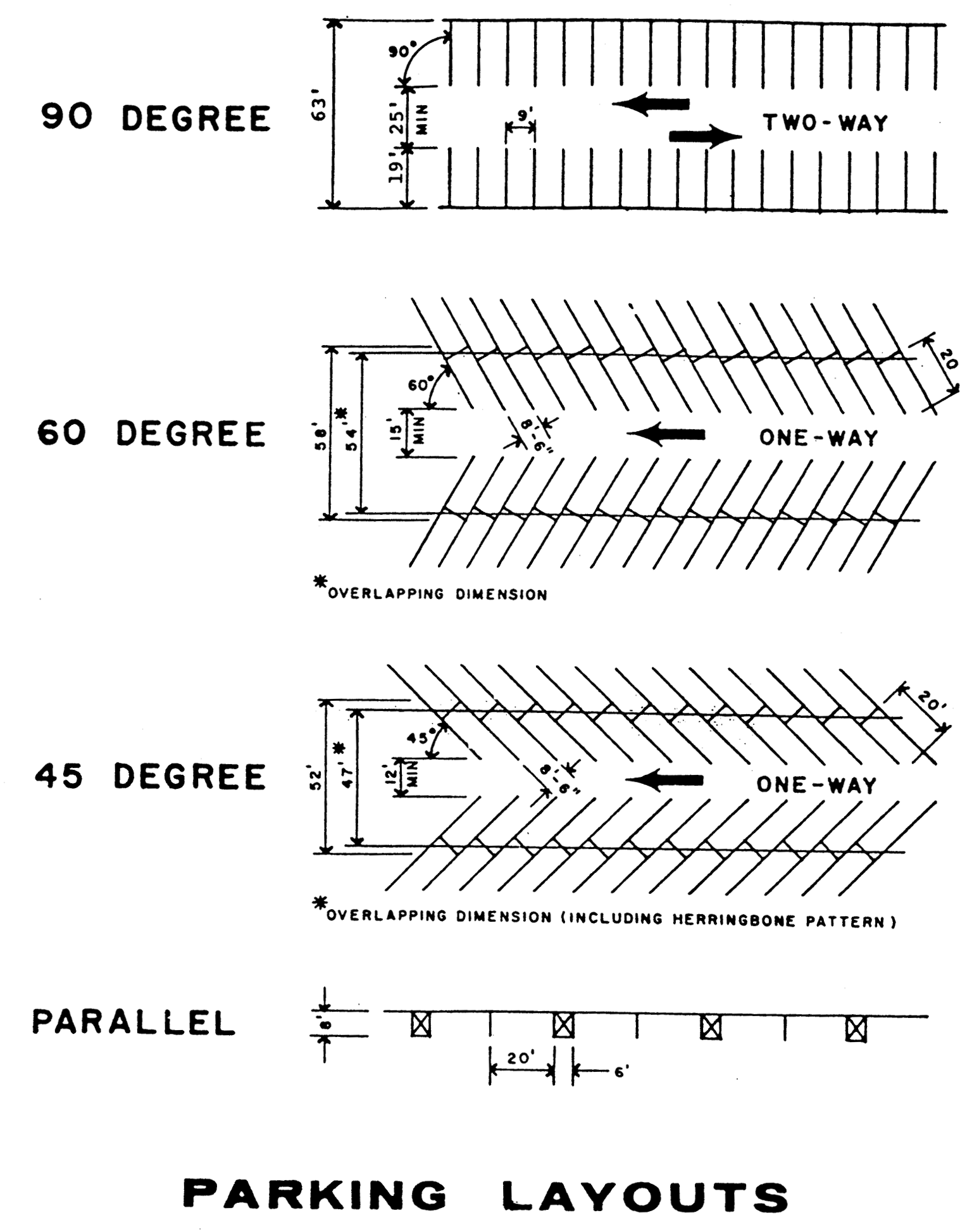
All spaces shall be laid out in accordance with the following schedule, plans for the layout of off-street parking facilities must be approved by the planning commission and shall be in accordance with the following minimum requirements, except that the dimension of spaces for the handicapped shall be as set forth by the building code:
_____
1.
All parking spaces shall be clearly striped to facilitate movement and to help maintain an orderly parking arrangement.
2.
Parallel parking spaces shall be 20 feet in length with a six-foot maneuvering space for each two parking spaces.
3.
All parking lots shall have access from a clearly limited and defined driveway not less than 15 feet wide for a one-way and 24 feet wide for a one-way traffic. In no case shall a driveway exceed 30 feet in width.
4.
All parking spaces shall have access from an aisle on the site to minimize backing onto a street and having a potential traffic hazard.
5.
Vehicular access to a parking lot shall not be across any zoning district that would not permit the principal use or parking lot.
6.
For the purpose of meeting off-street parking requirements for offices, merchandising, service or industrial uses, floor area shall mean the gross floor area used or intended to be used for services to the public as customers, patrons, clients or patients, employees, or as tenants, including areas occupied for storage and fixtures and equipment used for display or sale of merchandise. Where parking is required for both floor area and employees, the area used exclusively by employees may be deducted from gross floor area used to determine the parking required to meet the floor area (square foot) requirement.
7.
In the case of hospitals, bassinets shall not be counted as beds. In the case of stadia, sports arenas, churches and other uses where spectators occupy benches, pews, or other similar seating facilities, each 20 inches of such seating shall be considered as one seat for the purpose of determining off-street parking requirements.
8.
Parking plans be submitted for review and approval of layout and points of access by the planning commission.
9.
In the case of a use not specifically mentioned, the requirement for off-street parking facilities for such use shall be that for a listed use which is most similar as determined by the planning commission.
10.
Nothing in this section shall be construed to prevent collective provisions of off-street parking facilities for two or more buildings or uses, provided that, collectively, such facilities shall not be less than the sum of the requirements for the various uses computed separately. Any such provisions or agreements for collective parking shall be set forth in a recordable instrument and recorded in the register of deeds, describing the lands affected by this agreement or easement.
11.
The amount of required off-street parking space for new uses of buildings, additions thereto and additions to existing buildings as specified in this section shall be determined in accordance with this chapter, and the space so required shall be stated in the application for a building permit and shown on the plot plan or site plan and shall be irrevocably reserved for such use.
12.
The off-street parking facilities required for all uses shall be located on the lot or on property within 300 feet of the permitted use required for such off-street parking. Such distance shall be measured between the nearest point of the parking facility and the building to be served, provided that the off-street parking facility shall not be separated from the building to be served by a major thoroughfare as may be designated in the township master plan.
13.
Except for single-family detached dwelling units or farm uses located in the residential or agricultural districts, all parking areas required shall be paved with concrete or plant mixed bituminous material in accordance with plans approved by the building inspector. Such concrete pavement shall be of a minimum thickness of six inches, and any bituminous paving shall be of a minimum thickness of two inches and shall be placed upon a base of gravel of a minimum thickness of four inches. The zoning board of appeals may grant a variance to this requirement where, upon recommendation of the planning commission, a more imaginative paving solution is presented using brick, paving blocks, or other similar material of adequate loadbearing nature.
14.
All spaces shall be provided adequate access by means of paved maneuvering lanes.
15.
The planning commission may require an access easement to provide for vehicle access to adjacent parking lots to minimize the need for driveways to each facility and thereby decreasing hazards to vehicular traffic.
16.
Parking may be permitted in a required front yard except as provided in subsection (2)e of this section, provided that a landscaped area meeting the requirements of section 38-615(h)(1) shall be provided between the parking area and the public street.
(2)
Off-street parking development regulations. An approved off-street parking area as permitted under this section shall be subject to the following regulations:
a.
No repairs or service to vehicles and no display of vehicles for purpose of sale shall be carried on or permitted upon such premises.
b.
All advertising signs shall conform to the requirements of this chapter.
c.
All land between the lot boundaries of the lot on which is located a parking area and the barriers referred to in this subsection, as well as the surface of the parking area, shall be kept free from tall grass, weeds, rubbish, refuse and debris, and shall be landscaped to conform with the general character of the district.
d.
When lighting facilities are used, reflectors shall be installed to reflect the light away from residential areas and uses and the public right-of-way.
e.
Side yards shall be maintained for a space of not less than ten feet between the side lot lines adjoining residential lots and the parking area. The depth of the front yard or setback line from the street as established for houses on any block in any given residential area shall be continued and made applicable to parking space if located adjacent to such residential area, and it shall be unlawful to use the space between such setback line and the sidewalk for the parking of motor vehicles; provided, however, that the barrier specified in the next subsection shall be located in the setback line as required in this subsection.
f.
Whenever such parking area adjoins residential property and/or residential street or alley, a protective wall or greenbelt shall be erected and maintained between the required yard space and area to be used for parking. On such other locations where a protective barrier is required, advertising whatsoever. Bumper guards, comprising either a curb at least six inches high or steel posts 24 to 30 inches high and not more than five feet apart, set three in concrete, shall be provided to prevent vehicles striking such wall or shrubbery.
g.
Entrance to such parking areas shall be only from adjoining principal use or adjoining alley or street.
h.
A building permit shall be required for the construction of any parking area whether or not such parking area is in conjunction with any structure. The applicant shall submit a written plan to the enforcing officer along with application for a building permit. Such plan shall show in detail at a scale of not more than 50 feet to the inch, the boundary lines of the property involved, the location and size of any structures or proposed structures thereon, parking spaces, entrances and exits, drainage structures, if any required, boundary walls; and landscaping, if required, and the proposed use of the property.
i.
It shall be unlawful for any person to leave, park or store any motor vehicle or to permit any motor vehicle to be left, parked, or stored in a parking lot as permitted in this sub-section for a period of longer than 18 hours, it being the purpose and intent of this subsection that the requirement is to provide for keeping parked motor vehicles off the streets, but such requirement is not designed to permit the storage of wrecks or junked cars or vehicles. Exempt from this provision is the parking of vehicles accessory to the principal use.
j.
No charge for parking shall be made in an off-street parking area permitted under this subsection.
k.
The use of any loud noise producing device or public address system shall be prohibited.
l.
All parking serving other than one-family dwelling shall be side-by-side and tandem parking shall be prohibited.
m.
Pedestrian walkways within parking lots: For the safety of pedestrians, in large (100 spaces or more) high-turnover parking lots, separate raised pedestrian walkways, connecting the main building perimeter sidewalk with existing or proposed sidewalks along street rights-of-way shall be provided. This requirement shall not apply to uses within an industrial district. Not less than one such walkway shall be constructed of concrete, asphalt, stone, brick or other hard-surfaced material. The walkways shall be not less than six feet in width and shall be enhanced with landscaping along both sides to help separate them from traffic and distinguish them from the parking area. The walkways must be integrated with the township's overall plan for pedestrian improvements where applicable. Parked cars shall not be permitted to overhang pedestrian walkways. The land used for this connecting sidewalk shall be countable in the computation of the required percentage of landscape area, as provided in section 38-615(f).
(3)
Paving schedule.
a.
All paving required by this chapter shall be completely installed prior to the issuance of an occupancy permit for the use of the premises, except as provided in this subsection.
b.
In any case where the development of the land and/or buildings has been fully completed and an occupancy permit would otherwise be issued, and the complete installation of the paving required is prevented by inclement weather or acts of nature beyond the control of the owner, then the owner may obtain a temporary occupancy permit for a period not exceeding six months from the building inspector, after review and approval of the planning commission, upon written request therefor, provided that such owner shall:
1.
Deposit security with the township treasurer in the form of cash or a corporate surety bond in an amount equal to the cost of the complete installation of the paving (the cost being determined by the township engineer) plus an additional ten percent thereof. The additional sum of ten percent is hereby determined to be a reasonable expense incurred by the township in causing the complete installation of the paving as may be required and as provided in subsection (3)b of this section.
2.
Complete the installation of the required paving in the time required by the terms of the temporary occupancy. Upon complete installation in that event, the security deposit required shall be cancelled and returned to the depositor upon demand. Upon failure to completely install the paving as required in this subsection, the required security deposit shall be forfeited as liquidated damages, the same hereby being declared to be reasonable in view of the difficulty of more exact ascertainment of the damage incurred as a result of such failure.
3.
If the security deposit is forfeited as provided in subsection (3) b of this section:
i.
The township engineer, after specific authorization by the township board, shall expend such amount as has been authorized by the township board not exceeding the total amount of the security deposit to cause the required paving installation to be made.
ii.
The building inspector shall not issue a regular occupancy permit until the paving required is completely installed; and
iii.
Use or occupancy of the premises after the expiration of the temporary occupancy permit and before the issuance of a regular occupancy permit shall be unlawful and a violation of this chapter.
(4)
Location and design of driveways. All parking areas shall be provided with a safe entrance and exit from the abutting public thoroughfare. Such entrance and exit in the case of a one-way traffic flow system shall be at least 15 feet in width, and may in the case of a two-way traffic flow system be combined as one which shall in no event be less than 24 feet in width; provided, however, that in no case shall there by more than one separate exit and one separate entrance to and from a single street. The location of each such entrance and exit shall be submitted for approval of the county road commission or the state department of transportation, as the case may be, and the township planning commission.
(5)
Off-street waiting area for drive-through facilities. On the same premises with every building, structure or part thereof, erected and occupied for the purpose of serving customers in their automobiles by means of a service window, washing bay, or similar arrangement, there shall be provided six off-street waiting spaces for each service window or service bay not blocking parking spaces, in addition to the use requirement. A waiting space shall be 23 feet long by ten feet wide.
(6)
Minimum number of off-street parking spaces. The minimum number of off-street parking spaces by type of use for the storage or parking of motor vehicles for the use of owners, occupants, employees, customers, or visitors of buildings or uses shall be irrevocably provided and maintained on the premises occupied by such structure of the basis of the following schedule:
a.
Residential use.
1.
The off-street parking facilities required for one- and two-family dwellings shall be located on the same lot or plot of ground other than in the required front yard space of the building they are intended to serve and shall consist of a parking strip, parking apron, carport, and/or garage on the basis of two parking spaces for each dwelling unit.
2.
Multiple-family residential dwellings shall have two paved off-street parking spaces for each dwelling unit. For each additional bedroom over two per unit, one-half additional parking space shall be provided.
3.
Two for each three units, and one for each employee. Should units revert to general occupancy, then two spaces per unit shall be provided and space shown on the site plan to accommodate such a requirement.
4.
As required by R 125.1925 and R 125.1926 of the Mich. Admin. Code. In a licensed mobile home park a secured storage area for recreation vehicles shall be provided buffered from adjacent uses. No unlicensed motor vehicle of any type shall be parked within the development at any time except within a covered building or the enclosed storage area. In the mobile home park no motorized recreation vehicles or boats shall be parked on individual home sites. All group off-street parking lots shall be adequately lighted during hours of darkness with one-half footcandle of illumination.
_____
_____
(7)
Off-street loading requirements. On the same premises with every building, structure or part thereof, erected and occupied for manufacturing, storage, warehouse, goods display, department store, wholesale store, market, hotel, hospital, mortuary, laundry, dry cleaning, or other uses similarly involving the receipt or distribution of vehicles, materials or merchandise, there shall be provided and maintained on the lot adequate space for standing, loading and unloading services in order to avoid undue interference with public use of the streets and alleys. Such loading and unloading space, unless otherwise adequately provided for, shall be an area of ten-foot height clearance, and shall be provided according to the following schedule:
(Ord. No. 62, § 7-16.19, 8-11-1984; Ord. No. 135, 1-15-1997)
Sec. 38-620. - Radio and television towers; wind energy conversion systems.
(a)
Generally. Commercial radio, television and other transmitting or relay antenna towers shall be permitted in any agricultural, commercial, or industrial zoning district, subject to compliance with applicable federal, state, and township ordinances. The minimum setbacks for such towers from all abutting streets or adjacent property shall be a distance equal to the height of such tower, with no zoning ordinance restrictions on tower height. The building inspector must approve the structural plans.
(b)
Definitions. The following words, terms and phrases, when used in this section, shall have the meanings ascribed to them in this subsection, except where the context clearly indicates a different meaning:
Survival wind speed means the maximum wind speed a WECS in automatic, unattended operation (not necessarily producing power) can sustain without damage to structural components or loss of the ability to function normally.
Tower height means the height of the actual tower, plus one-half the rotor diameter on horizontal axis installation, and no vertical axis installations, the distance from the base of the tower to the top of the unit.
Wind energy conversion systems (WECS) means any device which converts wind energy to mechanical or electrical energy.
Wind rotor means the blades plus hub to which the blades are attached used to capture wind for purposes of energy conversion.
(c)
Permitted zones. In any zoning district, the planning commission shall have the power to grant a special permit to allow wind energy conversion systems, subject to the restrictions contained within this chapter. Any special permit denied by the planning commission may be heard by the zoning board of appeals upon the request of the petitioner for the special permit.
(d)
Applicability of section. The standards which follow shall apply to systems intended for the provision of the electrical or mechanical power needs of the owner/operator of the system; also, such a system shall be for one main building and its accessory buildings only. For systems intended for uses other than those in this section, the planning commission approval shall be required. Such approval shall cover the location of the system (shown on a survey of the property) on the site, the noise generated by the system, assurances as to the safety features of the system, and compliance with all applicable state and federal statutes and regulations. The planning commission approval shall specifically be required for arrays of more than one wind energy conversion system is intended to provide the electric power for more than one main building.
(e)
Standards for regulation of WECS.
(1)
Construction. Tower construction shall be in accordance with the latest edition of the township building code, and any future amendments and/or revisions to the same.
(2)
Electric-magnetic interference (EMI). Wind energy conversion system generators and alternators shall be filtered and/or shielded so as to prevent the emission of radio frequency energy which would cause harmful interference with radio and/or television broadcasting or reception, and shall comply with the provisions of Title 47, Chapter 1, Part 15 of the Federal Code of Regulations and subsequent revisions governing such emissions.
(3)
Setbacks. The structural design shall be signed and sealed by a professional engineer, registered in the state, certifying that the structural design complies with all of the standards set forth for safety and stability in all applicable codes then in effect in the state and all sections referred to. The minimum setbacks for such towers from all abutting streets or adjacent property shall be a distance equal to the height of such tower, that is, the property setback shall be on a one to 1½ ratio with tower height. The WECS shall be located a sufficient distance from any overhead utility lines, excluding service drops, such that a structural failure of any portion of the WECS or its supporting structure will not cause any portion of it to fall within five feet of utility lines.
(4)
Maximum height. The maximum height permitted (without variance from the zoning board of appeals) shall be 50 feet unless otherwise prohibited by any state or federal statutes or regulations.
(5)
Minimum blade height. The minimum distance between the ground and any protruding blades utilized on a WECS shall be 15 feet as measured at the lowest point of the arc of the blades.
(6)
Labelling requirements. A minimum of one sign shall be posted near ground level on the tower structure warning of high voltage. In addition, the following information shall be posted on a label on the generator or alternator of the WECS:
a.
The maximum power output of the system and the wind speed at which it is achieved.
b.
Nominal voltage and maximum current.
c.
The manufacturer's name and address, serial number and model number.
d.
The maximum survival wind speed and the emergency and normal shut down procedures.
(7)
Utility company notification. The Detroit Edison Company shall be notified in writing of any proposed interface with the company's grid prior to installing such interface and shall conform with any legislated requirements governing installations of WECS so as to comply with the utility tariff specifications.
(8)
Safety. The WECS's manufacturers shall document that the WECS model has been tested and certified by Underwriters' Laboratories, Inc., or other such applicable independent accrediting agency, and that when installed in accordance with recommended specifications shall have a maximum survival wind speed of not less than 80 miles per hour.
(9)
Noise. The maximum level of noise to be generated by a WECS shall be 50 decibels, as measured on the dB(A), measured at the property line.
(f)
Miscellaneous.
(1)
All electric line/utility wires shall be buried under ground except in agricultural districts.
(2)
Any mechanical equipment associated with and necessary for operation, including a building for batteries and storage cells, shall be enclosed with a six-foot fence. The supporting tower shall also be enclosed with a six-foot fence unless the base of the tower is not climbable for a distance of 12 feet.
(3)
When a building is necessary for storage of cells or related mechanical equipment, the building may not exceed 140 square feet in area nor eight feet in height, and must be located at least the number of feet equal to the height of the tower from any property line.
(4)
The tower and generating unit shall be kept in good repair and sound condition. Upon abandonment of use, the tower and related structure shall be dismantled and removed from the property within 60 days.
(5)
Every WECS shall be insured with minimum liability insurance of $100,000.00 for each occurrence. Proof of insurance shall be furnished to the township.
(Ord. No. 62, § 7-16.20, 8-11-1984)
Sec. 38-621. - Residential entranceway.
(a)
In AG, R-1A, R-1B, R-2, RM and MHR districts, entranceway structures including, but not limited to, walls, columns and gates marking entrances to one-family residential, two-family residential or multiple-family residential developments may be permitted and be located in a required yard, except as provided in section 38-608, corner clearance, provided that entranceway structures shall comply with all codes and ordinances of the Township, with proper permits issued.
(b)
Entranceway structures shall refer only to the development on the land upon which it is located.
(Ord. No. 62, § 7-16.21, 8-11-1984; Ord. No. 198, art. 9, 8-16-2006)
Sec. 38-622. - Permitted area and placement.
No building shall be erected, converted, enlarged, reconstructed or structurally altered, except in conformity with the area and placement regulations of the district in which the building is located.
(Ord. No. 62, § 7-16.22, 8-11-1984)
Sec. 38-623. - Permitted uses.
No building shall be erected, converted, enlarged, reconstructed or structurally altered, nor shall any building or land be used, designed or arranged for any purpose other than is permitted in the district in which the building or land is located, except as otherwise provided in this chapter.
(Ord. No. 62, § 7-16.23, 8-11-1984)
Sec. 38-624. - Ponds.
(a)
Private ponds for fish, ducks, livestock, water, irrigation water, fire protection, recreation, collection of surface drainage of created for the purpose of obtaining fill dirt for on-site construction purposes shall be permitted in any district, subject to the provisions of this section and after first obtaining a zoning compliance permit from the zoning administrator. The application for the permit shall contain:
(1)
The name of the owner of the property;
(2)
Legal description of the property;
(3)
A site plan prepared with drafting instruments and drawn to a scale suitable to demonstrate compliance with applicable regulations.
(b)
No pond shall be constructed without first obtaining a permit from the state department of environmental quality if such pond would be:
(1)
Five acres or greater in area;
(2)
Connected to an existing lake or stream; or
(3)
Located within 500 feet of the ordinary high water of an existing inland lake or stream. The obtaining of a permit from the state department of environmental quality shall not relieve a person from also complying with the requirements of this section 38-624.
(c)
Ponds constructed on any lot or parcel of land having three acres or more in area, or any pond larger than 30 feet in diameter, shall comply with the following regulations:
(1)
Excavated earth material created by construction of a pond shall be used to the maximum extent feasible for on-site purposes. However, excess excavated earth materials not feasible for use on-site may be removed or sold and taken from the property in compliance with an approved site plan and the following requirements. If the applicant proposes that any excess excavated earth is to be removed for the property, he shall first provide a written statement of the cubic yards to be removed. The applicant shall be limited to this stated volume and any amount in excess of the stated volume to be removed must first be approved as an amendment to the site plan. This statement or any amendments thereto shall either be shown on the site plan or physically attached to the site plan and shall be considered a part of the site plan for purposes of review and approval or denial. Further, any excess excavated earth shall be removed within three months after excavation, except under unusual circumstances (i.e., a long period of bad weather as might occur in winter or spring months) then the applicant may apply to the zoning administrator for one extension of three months.
(2)
Excavations undertaken primarily for the purpose of commercial soil, gravel, or mineral removal and not primarily for the purposes set forth in this section shall not be considered as "ponds" but instead shall be considered as "quarries" and subject to the applicable provisions of this chapter and provisions of article V, chapter 12 of this Code. (See section 38-496.)
(3)
The pond shall not be greater than 25 feet in depth.
(4)
The pond may occupy up to a maximum of 20 percent of the lot or property upon which it is placed.
(5)
The pond shall be a minimum of 50 feet from any dwelling, any septic field or any well. This requirement shall take precedence over the setback requirements specified in this section.
(6)
The pond shall be a minimum of ten feet from any overhead wires.
(7)
The pond shall not be placed within a required front yard.
(8)
The pond shall be constructed and maintained such that a minimum setback of 20 feet shall be provided between the high water line and any property line. This shall not prevent a shared pond between properties, provided that the property owners enter into a written agreement to provide for the pond's construction and maintenance to meet such requirements. A recorded copy of this agreement shall be attached to the plan.
(9)
The pond bed within 20 feet of the low water line shall be constructed and maintained at a 25 percent grade (a one to four slope). Beyond 20 feet of the low water line the bed may be constructed up to a maximum grade of 50 percent (a one to two slope).
(10)
At least one permanent safety station consisting of a Coast Guard approved life buoy or ring, 100 feet of one-fourth-foot rope and a ten-foot pole, all mounted on a post, shall be provided nearest the deepest portion of the pond and erected prior to the completion of the pond. Safety station, shall comply with U.S. Soil Conservation Publication SCS-REC-121 (3-71). Signs warning of danger and emergency procedures shall also be placed at appropriate locations as indicated in aforementioned SCS publication.
(11)
If the pond is intended for swimming, the swimming area shall be free of all underwater obstacles such as sudden drop offs, or deep holes, trees, stumps, brush, rubbish, wire, junk machinery, and fences. The swimming area, if any, shall be marked with a float line.
(12)
All of the disturbed areas around the pond shall be seeded with adapted grassed and legumes.
(13)
The pond shall be located so as to prevent sewage or runoff from barnyards from draining into the pond.
(d)
Ponds smaller than 30 feet in diameter, hereinafter referred to as recreational ponds, shall comply with the following regulations when constructed on any lot or parcel:
(1)
Excavated earth material created by construction of a pond shall be used to the maximum extent feasible for on-site purposes. However, excess excavated earth materials not feasible for use on-site may be removed or sold and taken from the property in compliance with an approved site plan and the following requirements. If the applicant proposes that any excess excavated earth is to be removed for the property, he shall first provide a written statement of the cubic yards to be removed. The applicant shall be limited to this stated volume and any amount in excess of the stated volume to be removed must first be approved as an amendment to the site plan. This statement or any amendments thereto shall either be shown on the site plan or physically attached to the site plan and shall be considered a part of the site plan for purposes of review and approval or denial. Further, any excess excavated earth shall be removed within three months after excavation, except under unusual circumstances (i.e., a long period of bad weather as might occur in winter or spring months) then the applicant may apply to the zoning administrator for one extension of three months.
(2)
Excavations undertaken primarily for the purpose of commercial soil, gravel, or mineral removal and not primarily for the purposes set forth in this section shall not be considered as "ponds" but instead shall be considered as "quarries" and subject to the applicable provisions of this chapter and provisions of article V, chapter 12 of this Code. (See section 38-496.)
(3)
The pond shall not be greater than 15 feet in depth.
(4)
The pond shall be a minimum of ten feet from any dwelling, and 50 feet from any septic field or well. This requirement shall take precedence over the setback requirements specified in this section.
(6)
The pond shall be a minimum of ten feet from any overhead wires.
(7)
The pond shall not be placed within a required front yard.
(8)
The pond shall be constructed and maintained such that a minimum setback of 15 feet shall be provided between the high water line and any property line. This shall not prevent a shared pond between properties, provided that the property owners enter into a written agreement to provide for the pond's construction and maintenance to meet such requirements. A recorded copy of this agreement shall be attached to the plan.
(9)
Enclosure. For the protection of the general public, all recreational ponds, or the parcel upon which the pond is located, shall be completely enclosed by a fence or wall. The fence shall be of a type described in section 38-612 not less than four feet high. Any openings in such enclosure shall be equipped with a self-closing, self-latching gate or door which shall be securely locked from the pond side when not in use.
(10)
The pond shall be located so as to prevent draining or in anyway adding water to surrounding properties.
(Ord. No. 62, § 7-16.24, 8-11-1984; Ord. No. 210, § 6, 9-5-2012)
Sec. 38-625. - Porches, patios and terraces.
An open, unenclosed porch, paved patio, or terrace may project into a required front yard for a distance not to exceed ten feet.
(Ord. No. 62, § 7-16.25, 8-11-1984)
Sec. 38-626. - Signs.
(a)
Purpose. The regulations in this section shall govern the type, use, size, height, and number of signs permitted on any parcel of land in the township, based on the zoning district designation of the subject property, as shown on the Official Zoning Map of the Charter Township of Fort Gratiot, as amended. This section is intended to apply reasonable regulations concerning the use of signs and outdoor advertising structures, in order to achieve the following objectives:
(1)
Prevent excessive visual clutter and degradation of the visual environment in the township, which is likely to occur in the absence of reasonable regulations regarding the use of signs.
(2)
Provide adequate opportunity for various types of land uses to identify their location, the nature of the use and manage the use of signs as a means of communication to the general public.
(3)
To ensure that the size, design, type and placement of signs does not conflict with safe and efficient movement of vehicular traffic in the township.
(4)
To ensure that signs and sign structures are designed, constructed, installed, operated, and maintained so as not to constitute a safety hazard.
(5)
To protect and promote the health, safety and general welfare of the township and its residents.
(b)
Definitions. For the purpose of this section, the following words and phrases shall have the meanings hereinafter defined:
Abandoned sign shall mean a sign which no longer correctly advertises or directs a person to a bona fide business, person, goods, product, activity, or service.
Awning/canopy sign shall mean a sign which is part of or located on a canopy or awning which is attached to and projects from a building wall.
Balloon sign shall mean a tethered sign, with or without words, consisting of an envelope inflated with pressurized or heated air, or a lighter-than-air gas, and displayed for the purpose of advertising or attracting attention.
Banners shall mean a sign intended to be hung either with or without a frame, possessing characters, letters, illustrations, or ornamentations applied to paper, plastic, or fabric of any kind. National flags, flags of political subdivisions, and symbolic flags of any institution shall not be considered banners for the purpose of this section.
Bench sign shall mean a sign located on any part of the surface of a bench or seat placed on or adjacent to a public right-of-way or exterior of any business premises.
Billboard sign shall mean a sign which advertises an establishment, service, merchandise, use, entertainment, activity, product or message which is not conducted, sold, produced, manufactured, or furnished upon the parcel or lot on which the sign is located, and additionally shall include those signs as regulated by the state pursuant to Act No. 106 of the Public Acts of Michigan of 1972 (MCL 252.301 et seq.; MSA 9.391(101) et seq.), as amended.
Building(s) shall mean any fully enclosed structure which has a permanent roof, is not a temporary structure, is not a pavilion, is not a pole type building, is not a building used strictly for storage purposes, and is not an amusement device.
Business center shall mean a single building containing two or more business establishments. Lodging uses with on-premise restaurants shall be included within this definition.
Business complex shall mean a land parcel containing two or more buildings, each containing one or more individual business establishments.
Business establishment shall mean a business operating independently of any other business on the same parcel or in the same building, separated from other businesses by walls, and with one or more doors that provide exclusive ingress and egress to that business.
Construction sign shall mean a sign containing identifying information concerning construction activity in progress on the premises on which the sign is located, such as the name of the future occupant or business, development name, type of development, name of the developer, and names of architects, engineers, contractors and lenders involved in the construction activity.
Corner locations shall mean those properties with two or more frontages.
Directional sign, on-premise shall mean a sign whose primary purpose is to direct the movement or parking of vehicles within the premises. Examples of signs which are included in this definition include directional signs at driveway entries from the public road, signs directing the movement of traffic within a parking area or driveway, signs identifying barrier-free parking spaces, signs identifying rear access doors in a multi-business establishment, signs prohibiting parking in loading areas or signs identifying loading dock names or numbers at a product distribution facility.
Figure 1-Display Area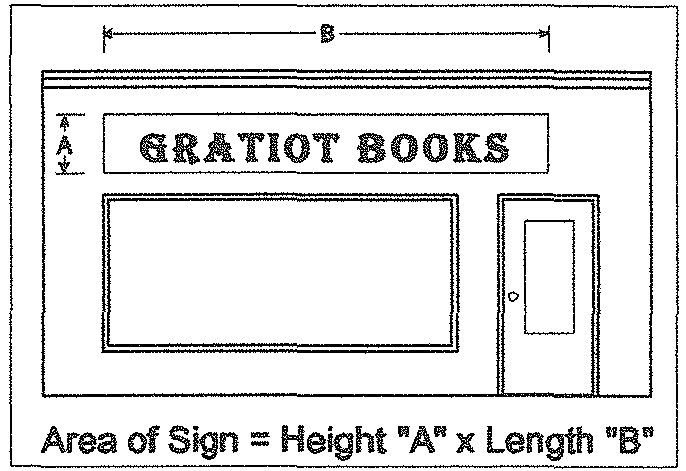
Display area shall mean the entire area within a circle, triangle or parallelogram enclosing the extreme limits or writing, lighting, representation, emblem or any figure of similar character, together with any frame or other material forming an integral part of the display or used to differentiate the sign from the background against which it is placed; excluding the necessary supports or uprights on which such sign is placed.
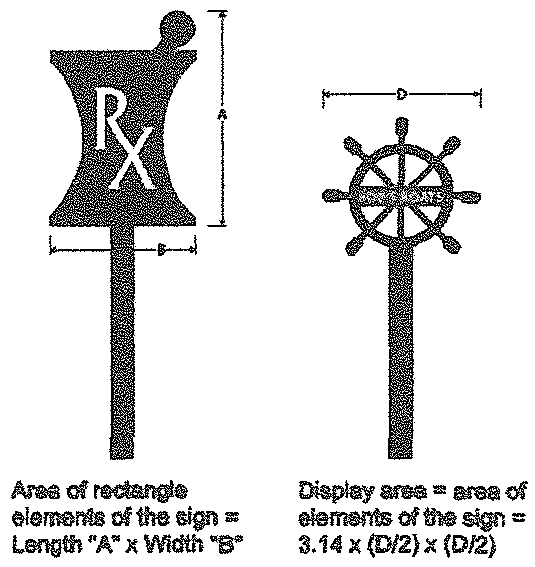
Figure 2-Illustration Measurement of "Display Area"
Display areaexceptions. The area of an awning/canopy sign shall be measured as provided in the main body of this definition, and the sign shall be treated as if it were a wall sign attached to the same wall to which the awning or canopy is attached, for purposes of determining maximum allowed sign area. Where a sign has two or more faces, the area of all faces shall be included in determining the area of the sign; except that where two such faces are placed back to back and are at no point more than three feet from one another, the area of the sign shall be taken as the area of one face if the two faces are of equal area, or as the area of the larger face if the two faces are of unequal area; When the exact area of an irregular shaped sign can be provided, that calculation will be used in place of the calculation illustrated in Figure 2.
Electronic changeable message sign shall mean a sign whose informational content can be changed or altered by means of electronically controlled electronic impulses.
Encroaching sign shall mean a sign which projects beyond the private property line into and over a public right-of-way.
Flag, business shall mean a flag displaying the name, insignia, emblem, or logo of a profit making entity.
Flag, public shall mean a flag displaying the name, insignia, emblem, or logo of any nation, state, municipality, educational institution, civic/religious/fraternal organization, or branch of the U.S. military.
Frontage shall mean that portion of any property abutting a street or access road; a corner lot and a through lot having frontage on both abutting streets.
Grade/grading. Grade shall be determined by measuring the horizontal distance 20 feet in all directions from the base of the sign, and then calculating the average of those measurements.
Ground sign shall mean a sign which is supported by one or more uprights in or upon the ground, where any part of the display surface is less than eight feet above the grade at the base of the sign.
Figure 3 Ground Sign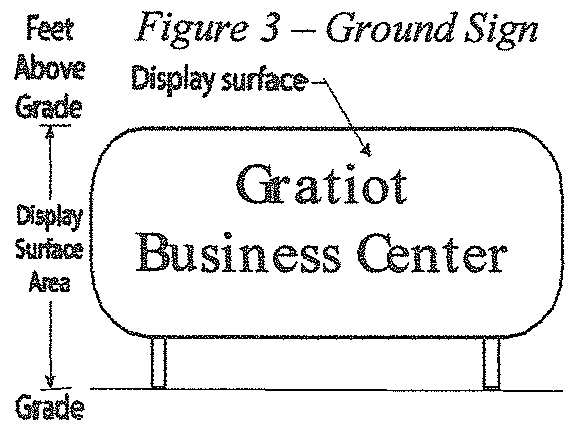
Height of sign shall mean the maximum vertical distance from grade to the uppermost extremity of a sign or sign support.
Home occupation sign shall mean any sign used for the purpose of advertising services in conjunction with a lawful home occupation.
Identification sign shall mean a sign that identifies the name of the property owner, resident, or business on the property, with or without the street address.
Industrial park shall mean a grouping of several industrial businesses on contiguous parcels, accessed by the same public or private street and sharing a common location identity.
Institutional sign shall mean a sign containing a surface area upon which is displayed the name of a church, school, library, museum, day care center, cemetery, community center and similar institutions and the announcement of its services or activities.
Marquee sign shall mean a sign that is attached to the underside of a marquee, or other covered structure and projecting at a right angle from and supported by a building or marquee and does not project horizontally beyond the marquee or covered structure.
Mobile sign shall mean a sign supported on a mobile chassis other than a motor vehicle.
Nonconforming sign shall mean any sign that does not conform to the requirements of this section.
Off-premises sign shall mean a sign which advertises a business, product, service, event, person or subject which is not sold, produced, manufactured or furnished at the property on which said sign is located.
On-premises sign shall mean a sign that advertises a business, product, service, event, person or subject that is located on the same premises as the business, product, service, event, person or subject being advertised.
Figure 4 Pole Sign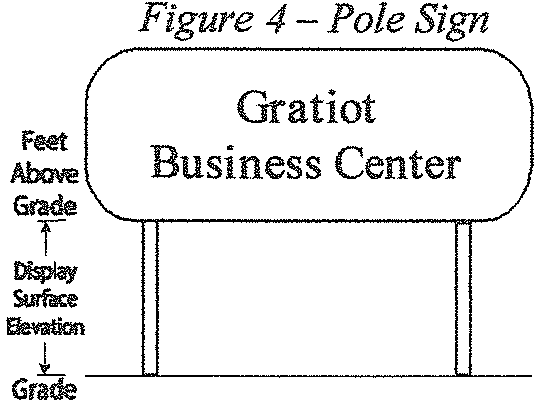
Pole sign shall mean a sign having a sign face that is elevated above the ground by one or more uprights or poles, with all parts of the display surface of the sign eight feet or more above the grade at the base of the sign.
Political sign shall mean a sign which contains a message or graphic related to an election conducted by a governmental entity.
Projecting sign shall mean a sign attached to and projecting perpendicularly from a building wall, excluding awning/canopy signs, as defined herein. One face only shall be used for computation of the display area of a projecting sign.
Real estate sign shall mean a sign announcing or advertising the availability of an improved or unimproved lot, parcel or building, or portion thereof, for sale, lease, or rent.
Roof sign shall mean a sign that is erected, constructed, and maintained upon or above the roof of the uppermost building line and that is wholly or partially supported by such building.
Setback required, shall mean the minimum required horizontal separation distance between a public or private road right-of-way to any part of a sign, including any above-ground portions of a sign which project beyond the point of attachment of the sign to the ground.

Figure 5 Sign Setback
Service signs shall include signs advertising recent service on or to a property, such as lawn care, snow plowing, and other general maintenance. The service must have taken place on the property on which a sign is placed.
Signs shall mean and include every individual announcement, declaration, demonstration, display, illustration, insignia, surface or space when erected or maintained out of doors in view of the general public for identification, advertisement or promotion of the interests of any person. This definition shall include billboard signs and signs painted directly on walls of structures.
Supports and uprights shall mean those members necessary for the structural support of the sign. Decorative trim applied to such members for aesthetic purposes shall be considered as a part of the supports and uprights.
Temporary sign shall mean a sign intended to be displayed for a limited period of time and/or for a specified event or product, and which is not permanently attached to a building wall or to the ground. Types include, but are not limited to, banners, cardboard, corrugated plastic (or any other material) product signs, balloons, yard signs, pennants, string lights, ribbons, or other such features which are hung or strung across any property.
Uppermost building line shall mean the uppermost horizontal line of a building formed by a roof, wall, or parapet wall, not including chimneys, flagpoles, electrical/mechanical equipment, TV antennas and other similar equipment and extensions
Wall sign shall mean a sign that is attached directly to a wall, mansard roof, roof overhang, parapet wall, or above a marquee of a building with the exposed face of the sign in a plane parallel to the building wall or to the surface on which it is mounted, and which projects not more than 18 inches from the building or structure wall, and which does not have any part of such sign or sign supports extending above the uppermost building line. This definition shall include writing, letters or numbers placed or painted directly on a building wall surface.
Window sign shall mean a sign attached to the inside or outside surface of a window on a building wall or door, or placed within six inches of the inside face of a window and intended to be viewed from outside the building.
(c)
Administration and permits. The provisions of this section shall be administered by the township zoning administrator or his/her designee(s), who shall have the authority to issue sign permits. The applicant shall be responsible for obtaining an electrical permit or any other type of required permits, including submittal of additional documentation and payment of any additional fees.
(1)
Sign permit required. No person shall erect, replace, apply, structurally alter, or add to any sign without first obtaining a permit. Application for a permit to erect, replace, apply, structurally alter or add to a sign shall be made to the township, by submission of the required forms, fees, exhibits and information by the owner of the property on which the sign is to be located, or by his agent or lessee.
(2)
Zoning compliance permit required for sign maintenance and change of message. Painting, re-painting, cleaning, maintenance, repair, and change of sign message or graphics shall not be considered erection or alteration of a sign which requires issuance of a sign permit, provided that no structural alterations or additions to the display area are made. Further, signs refaced with a covering, including, but not limited to, banners and/or coverings made of fabric or other material, shall be considered temporary and permitted for a duration of only 60 days, after which the covering shall be replaced with a permanent sign face.
(d)
Impoundment. Signs which are erected without a permit or which do not comply with provisions herein, may be removed, and impounded. A written notice of violation and intent to impound shall be sent by certified mail to the property owner and the owner of the sign (if so labeled) not less than ten days prior to impoundment. Said notice shall also contain information regarding procedures required to obtain release of an impounded sign. Upon written application, up to two extensions of 15 days each may be granted where there is clear and demonstrable evidence that the offending sign owner is actively working on resolving the outstanding violation(s). Signs impounded by the township may be disposed of if not claimed and removed from the place of impoundment within ten business days of the impoundment. If the township has incurred costs related to the impoundment of a sign, the township shall be reimbursed for such costs prior to its release.
(e)
Nonconforming signs.
(1)
It is the intent of this section to permit the continuance of an existing sign that was in conformance with all applicable regulations in effect prior to the effective date of this ordinance, although such sign may not conform to the provisions of this section.
(2)
Signs installed without the required permit shall be considered illegal and shall be either removed or made to conform to this chapter and a permit obtained.
(3)
Class B nonconforming signs shall not be structurally changed, altered, or enlarged unless such change, alteration, or enlargement is made to conform to this chapter.
(4)
Nonconforming signs shall not be moved in whole or in part to another location unless the sign at the new location conforms to this chapter.
(5)
Where any nonconforming sign exists on the premises, the zoning board of appeals shall not authorize any variance to erect a new sign upon said premises.
(6)
Any development or redevelopment that requires planning commission approval for a property on which a nonconforming sign is located shall require that all nonconforming signs on the premises be brought into conformity with the provisions of this ordinance, unless otherwise permitted by the planning commission at the time of the development or redevelopment approval.
(f)
Signs on vacant or unoccupied premises. Any sign located on vacant or unoccupied property which pertains to a use or activity which has not been in existence or operation for more than 120 days shall, within 30 days of the end of the 120-day period, remove all graphics, text copy or other business or premises identification from the subject sign. In the event the sign is an internally illuminated sign with removable graphic display panels, the panels containing the sign graphic or message shall be removed and replaced by a blank panel containing no graphic or message.
(g)
Exemptions from sign regulations. The following signs are exempt from the provisions of this Section and from the permit requirements:
(1)
Signs no greater than two square feet in area posted on property boundaries in the AG zoning district, for purposes of conveying a non-commercial message, such as, but not limited to, a prohibition on hunting or trespassing.
(2)
Signs located in the interior of buildings.
(3)
Window signs, provided that the maximum size of any window sign shall not exceed 25 percent of the area of the window on which it is displayed. Painted messages, text, graphics, posters, balloons, paper advertisements, and similar items affixed to the window shall constitute a window sign.
(4)
Any identification, address, or for sale sign affixed to a wall, mailbox, post, lamppost, or pillar, and which is not larger than two square feet in display surface.
(5)
Traffic control or other municipal signs such as, but not limited to, directional signs placed in rights-of-way, legal notices, railroad crossing signs, danger, and other temporary emergency signs.
(6)
Memorial signs or tablets, names of buildings and dates of erection when cut into any masonry surface or when constructed of bronze or other non-combustible material.
(7)
The display of the flag of the United States of America, or other political subdivision thereof, shall not be regulated when attached to a structure or standardized flagpole.
(8)
On-premises directional signs, subject to the following limitations:
a.
In districts other than industrial zoning districts, the maximum size of an on-premise directional sign shall be four square feet in area.
b.
In industrial zoning districts, the maximum size of an on-premise directional sign shall be 12 square feet in area.
c.
On-premises directional signs shall be located a minimum of one foot from the right-of-way.
d.
An on-premise directional sign having a height greater than four feet shall have a minimum setback from the right-of-way of ten feet.
e.
Multiple on-premise directional signs shall be mounted on the same structure, unless the need to do otherwise can be demonstrated, to the township zoning administrator, by the applicant to create a hardship which is non-financial in nature, in order to limit the detriment to environmental aesthetics and sight obstruction.
(9)
Signs maintained by the United States of America, the State of Michigan, any agencies or political subdivisions thereof, including local municipalities and local governmental units.
(10)
The display of temporary signs, per parcel, in conjunction with an official public, community, or not-for-profit event such as a fair, festival, commemorative event, election, or the like (but specifically excluding public holidays) shall be exempted from application and permit requirements for temporary signs provided that the following standards are met:
a.
Signs shall not be displayed more than 60 days prior to the event to which they pertain.
b.
Signs shall be removed within ten calendar days after the event to which they pertain.
(11)
Signage affixed to the face of a fuel pump at an auto service station.
(12)
Menu boards for a drive-in/drive-through business.
(13)
Directional signs in the interior of parking lots at institutional facilities, such as churches and educational facilities.
(14)
Cart corrals with a maximum height of ten feet above grade and 12 square feet in display area, provided that only the store name and/or logo, symbols and text providing patrons with information concerning cart storage may be included in the display. The advertisement of products is prohibited on cart corrals.
(15)
Scoreboard and athletic field sponsorship signs facing playing fields not primarily visible from a public right-of-way.
(h)
Prohibited signs. The following signs are prohibited in the township:
(1)
Signs that are placed within or encroach into a public right-of-way, including signs placed on utility poles, traffic control signs, structures, or devices. A sign that is unlawfully placed within a public right-of-way may be immediately removed and impounded by the zoning administrator or his authorized designees.
(2)
Roof signs, as defined herein.
(3)
Any sign which, by reason of its size, location, coloring, or manner of illumination, constitutes a traffic hazard or a detriment to traffic safety, by obstructing the vision of drivers, or by obstructing or detracting from the visibility of any traffic control device on public streets and roads.
(4)
Signs which include display of such words as "Stop," "Look," "Danger" or any other words, phrases, symbols or characters, in such a manner as to interfere with, mislead or confuse traffic.
(5)
Signs and sign structures that are no longer in use as originally intended or have been abandoned, or that are structurally unsafe, constitute a hazard to safety and health, or that are not kept in good repair.
(6)
Any sign that obstructs free ingress to or egress from a required door, window, fire escape or other required exit way.
(7)
Any sign or other advertising structure containing any illegal matter.
(8)
Any sign unlawfully installed, erected, or maintained, including any sign installed prior to enactment of this section without a sign permit, when in fact such prior ordinance did require a sign permit.
(9)
Signs having flashing, blinking or running type lights are prohibited, i.e. pulsating or strobe lights.
(10)
Display or parking of a motor vehicle or trailer upon a lot or premises in a location visible from a public right-of-way for a time period exceeding 48 hours, for the primary purpose of displaying a sign attached to, painted on, or placed on the vehicle or trailer. Licensed vehicles used regularly in the course of conducting the principal use located on the premises are permitted, provided that they are not parked in a manner or location for the purpose of serving as a means of attracting attention to the business or use. This is not intended to prohibit the parking of a private vehicle for sale if otherwise permitted at this location.
(11)
Signs, balloons, pennants, and any other items used as a means of advertising and that are defined as a sign herein, placed outside on a day-to-day basis.
(12)
Use of any temporary signs as defined and regulated herein without obtaining an affidavit.
(13)
Any type of inflatable device, character, air dancer, air tube, and similar devices, with or without words or symbols, and that may require the use of an air blower, motor with a blower, and any other machinery to operate the sign.
(14)
Signs having any visible portion either in motion or having the appearance of being in motion, whether on a continuous basis or at intervals, and regardless of whether the motion or appearance of motion is caused by natural or artificial sources, with the exception of electronic changeable message signs.
(15)
Off-premise signs, except for billboard signs as permitted in the Heavy Industrial (M-2) district.
(16)
Billboard signs used for on-premise advertising are prohibited.
(17)
Bench signs, except for a plaque or symbol of one square foot or less identifying the name of individuals or organizations donating the bench or memorialized by the donated bench.
(18)
Signs that are painted directly onto the wall of a building.
(19)
All signs not specifically permitted or exempted are prohibited.
(i)
Temporary signs.
(1)
Affidavit required. A temporary sign shall not be placed on any lot, parcel, or premises, with the exception of single-family, two-family and multiple family residential uses, unless an affidavit authorizing such temporary sign has been issued by the zoning administrator or his/her designee(s). Fees and/or a refundable deposit may be required, and shall be set by resolution of the township board. The affidavit shall contain a waiver, executed by the applicant prior to issuance, authorizing the zoning administrator or his/her designee(s) to enter upon the property for the purpose of inspecting or removing the temporary sign if not otherwise removed upon expiration of the permit.
a.
Affidavits authorizing the display of temporary sign shall not exceed 90 days in any calendar year.
b.
Affidavits must be submitted at least ten business days prior to the beginning of the display period.
c.
A temporary sign for which an affidavit has been issued, and which is placed or displayed in violation of this ordinance, or has not been properly maintained, or has become detached or has become a hazard to safety, may be impounded by the township. Upon removal and impoundment of a temporary sign, the township shall notify the sign owner and/or permit applicant of the township's intent to dispose of the sign. If it is not claimed and removed from the township's place of impoundment within five business days from the date of the notice, the township may dispose of the sign in any manner it deems appropriate.
d.
The township may, by resolution of the board of trustees, set an amount for a refundable deposit which may be required to be submitted with an affidavit to financially guarantee conformance with the provisions contained herein. The deposit shall be forfeited if the sign is not removed upon expiration of the affidavit, or if the township must remove and impound the sign.
e.
The township may, by resolution of the board of trustees, set a fee amount for a temporary affidavit.
(2)
Standards for display of temporary signs. The display of temporary signs, including banners, shall conform to the provisions of Schedule E, herein. In addition, the following standards shall apply to display of temporary signs for all non-residential uses, in all zoning districts.
a.
There shall not be more than three temporary signs displayed per business on a property at any one time. Except that, balloons and/or strings of pennants shall be permitted in addition to the permitted temporary signs.
1.
Balloons must be a standard size of 11 inches or less with a maximum four foot tether.
2.
Pennants, string lights, ribbons, or other such features which are hung or strung across any property shall be 100 feet or less in length for each 50 foot of lot width.
b.
A temporary sign shall not employ any form of flashing lights.
c.
A label indicating the owner's name, address, and telephone number shall be attached to all temporary signs (except permitted balloons and pennants).
d.
Mobile signs shall be subject to the following additional standards:
1.
Illuminated mobile signs shall be installed in conformance with all state and township electrical codes. No flashing or moving lights shall be used on any mobile sign.
2.
All mobile signs and components shall be firmly anchored to the ground in a manner that ensures that the sign will not constitute a safety hazard in the event of high winds, as determined by the building official.
(3)
Additional standards of display. For outdoor and/or open-air display areas for which a special land use permit has been issued, or for retail nurseries, and lawn and garden supply stores, the following additional requirements shall apply:
a.
In addition to those temporary signs otherwise permitted by this section, a maximum of 12 pole banners, not to exceed 15 square feet each, may be continuously displayed on outdoor display area lamp posts, provided that an annual temporary sign permit is obtained in accordance with this section.
b.
Notwithstanding the above, no temporary sign permit shall be issued by the township, nor remain valid for any premises unless all merchandise is confined solely to those areas that have been designated and approved for outdoor display as delineated on the site plan for the premises which was previously reviewed and approved by the planning commission and does not infringe in any manner upon any required landscaping feature or area.
(4)
Special circumstances. Where temporary signs are permitted, an additional 30 days may be granted in a calendar year for each the following reasons that may occur in that year.
a.
Owner and/or name change;
b.
Hiring and/or job fairs;
c.
Grand opening;
d.
Location closing, permanently;
e.
Location closing temporarily, i.e., renovation, repair, new construction etc.
(j)
Electronic changeable message signs.
(1)
Movement prohibition: The use of flashing, scrolling, or blinking characters is prohibited.
(2)
Copy sign area: No more than two-thirds of the maximum display area of a permitted sign shall be devoted to an electronic changeable message sign. The display area of an electronic changeable message sign shall be the extreme limits of the face of the sign excluding the supports/uprights on which the sign is placed.
(3)
Message prohibition: The message, which appears on an on-premise sign, shall not constitute off-premise commercial advertising.
(4)
Emergency messages: The owner of an electronic message board, as a condition of permit approval, shall allow the township to use the electronic message board to communicate emergency public service information approved by authorized township public safety personnel relating to a national disaster or emergency that has been declared by the President of the United States. The operational restrictions on electronic message boards set forth herein shall not apply during any time that the electronic message board is used to communicate authorized emergency public service information.
The owner agrees to update with an approved emergency public service information communication, or discontinue the emergency public service message as soon as possible after receiving a request from authorized township public safety personnel. The owner shall file and keep current at all times with the township the name, email address, phone number, cell phone number, pager and other available emergency contact information of the employee(s) or representative(s) of the owner who has been authorized and designated by the owner to communicate the approved emergency public service message using the electronic message board.
(5)
Public nuisance per se: It is the intent of the township to make reasonable accommodation for responsible usage of electronic changeable message signs. However, this type of sign by its very nature is susceptible to becoming a nuisance to the public and contrary to the health, safety, and general welfare of the community if not operated in a responsible manner. Therefore, upon the issuance of a third notice of violation to an owner of a specific electronic changeable message sign within a 90-day period, or four within a 12-month period, said sign is hereby declared to be a public nuisance per se, and may be abated and removed by order of any court of competent jurisdiction, and, for each offense, a fine imposed of up to $500.00 or 90 days in jail, or both. Each day during which said sign remains in violation constitutes a separate offense.
(k)
Maintenance of signs. All signs, including those for which a permit is not required, together with all their supports, braces, guys, and anchors, shall be maintained in good working order; and when not galvanized or constructed of corrosion resistant, noncombustible materials shall be painted when necessary to prevent corrosion. The exteriors of all signs, supporting members, painted surfaces, advertising materials and lettering shall be kept painted and in good condition so as to present a neat and orderly appearance and so as not to create visual blight within the township. All bulbs or component parts of the sign, including electrical switches, boxes and wiring used in the illumination of the sign, must be well maintained and in good repair. Loose or missing letters, figures, characters, or items such as, but not limited to, torn or damaged awnings or canopies shall constitute a maintenance violation. It shall be the duty and responsibility of the owner or lessee of every sign to maintain the immediate premises occupied by the sign in a clean, sanitary and healthful condition. Failure to maintain any sign in accordance with the standards prescribed herein shall constitute a violation of this ordinance.
(l)
Variances and appeals. The zoning board of appeals may, upon application and a showing of unnecessary hardship or practical difficulty, grant variances from the provisions of this section. However, the fact that other larger signs, constructed prior to the adoption of this ordinance, exist in the area shall not be sufficient reason to declare practical difficulty or unnecessary hardship. In addition, the zoning board of appeals shall not have the power to add to the types of signs (such as "pole" in a district where only "monument" is permitted) permitted on any premises. A person aggrieved of the zoning administrator's decision in refusing to issue a permit can seek review before the zoning board of appeals.
(m)
Signs permitted in residential districts (as defined in 38-111.) In agricultural and residential districts, the requirements of Schedule A shall govern sign use, area, type, height, and numbers, in addition to requirements elsewhere in this chapter. All setbacks shall be measured from the right-of-way, height is measured from grade. No signage is permitted within a right-of-way.
*An electronic message board may be permitted provided that it is not illuminated between the hours of 9:00 p.m. and 7:00 a.m., except during emergencies.
(n)
Signs permitted in Office (O) districts. In the O districts, the requirements of Schedule B shall govern sign use, area, type, height, and numbers, in addition to requirements elsewhere in this chapter. All setbacks shall be measured from the right-of-way, height is measured from grade. No signage shall encroach on or over any right-of-way.
**One additional sign, not to exceed 6 square feet may be placed on or adjacent to each rear entrance or service door for identification or directional purposes provided that no advertising is included in the display. The street address of the premises shall be clearly displayed on said sign.
(o)
Signs permitted in Neighborhood Business (C-1) and General Business (C-2) districts. In the C-1 and C-2 districts, the requirements of Schedule C shall govern sign use, area, type, height, and numbers, in addition to requirements elsewhere in this chapter. All setbacks shall be measured from the right-of-way, height is measured from grade. No signage shall encroach on or over any right-of-way.
**One additional sign, not to exceed 6 square feet may be placed on or adjacent to each rear entrance or service door for identification or directional purposes provided that no advertising is included in the display. The street address of the premises shall be clearly displayed on said sign.
(p)
Signs permitted in Light Industrial (M-1) and Heavy Industrial (M-2) districts. In the M-1 and M-2 districts, the requirements of Schedule D shall govern sign use, area, type, height, and numbers, in addition to requirements elsewhere in this chapter. All setbacks measured from the right-of-way. No signage shall encroach on or over any right-of-way.
** One additional sign, not to exceed 6 sq. ft. may be placed on or adjacent to each rear entrance or service door for identification or directional purposes provided that no advertising is included in the display. The street address of the premises shall be clearly displayed on said sign.
Figure 6: Ilustration, Measurement of Maximum Display Area of Wall Signs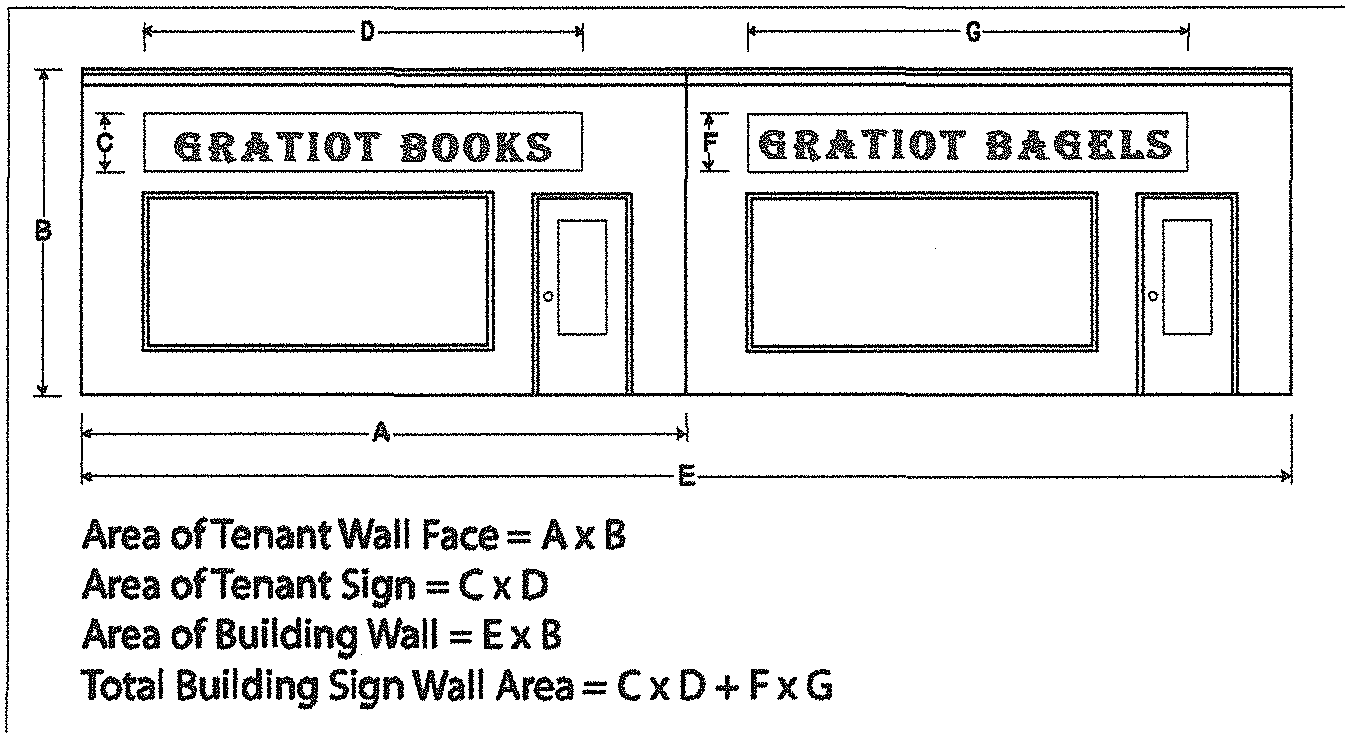
Figure 7: Temporary Signs
(Ord. No. 62, § 7-16.26, 8-11-1984; Ord. No. 91, §§ 3-09.01—3-09.04, 8-17-1991; Ord. No. 95, §§ 3-09.01—3-09.04, 5-20-1992; Ord. No. 189, §§ 1, 2A), 5, 4-6-2005; Ord. No. 207, § 1, 2-1-2012)
Sec. 38-627. - Streets, alleys and railroad rights-of-way.
All streets, alleys, and railroad right-of-way, if not otherwise specifically designated, shall be deemed to be in the same zone as the property immediately abutting upon such street or alley serves as a district wise specifically designated, shall be deemed to be the same as that of the abutting property up to such centerline.
(Ord. No. 62, § 7-16.27, 8-11-1984)
Cross reference— Streets, sidewalks and other public places, ch. 30.
Sec. 38-628. - Swimming pools.
All swimming pools erected in the township shall comply with the following requirements:
(1)
Application. The application for a building permit to erect a swimming pool shall include the name of the owner; the manner of supervision of the pool; a plot plan and location of adjacent buildings, fencing, gates, public utilities, specifications and plans to scale of pool walls, slope, bottom, walkway, and diving boards, type and rating auxiliary equipment, piping and valve layout; and any other detailed information affecting construction and safety features deemed necessary by the building inspector.
(2)
Pool location. Minimum side yard setback shall comply with division 12, article III of this chapter. Furthermore, the pool fence must not be required front yard of required corner lot side yard. Rear yard setback shall not be less than four feet between the pool outside wall and the rear property line, or less than the established easement width at the rear property line, or less than four feet between the pool wall and any building on the lot.
(3)
Enclosure. For the protection of the general public all pools shall be completely enclosed by a fence, wall or building, or building located not less than four feet from the perimeter of the pool. The fence shall be of a type described in section 38-612 not less than four feet high. Any openings in such enclosure shall be equipped with a self-closing, self-latching gate or door which shall be securely locked from the pool side or house side when the pool is not in use.
(4)
Electrical installation. All electrical installations or wiring in connection with swimming pools, shall conform to the provisions of the National Electrical Code. If service drip conductors or other utility wires cross under or over a proposed pool area, the applicant shall be issued for the construction of a swimming pool.
(Ord. No. 62, § 7-16.28, 8-11-1984)
Sec. 38-629. - Parking and storage of recreational vehicles and equipment.
No person shall park or store recreational vehicles and equipment in any such residential district, as defined in section 38-111 of this chapter, except in strict conformance with the conditions set forth in this section.
(1)
Ownership. The storage of any recreational vehicles and equipment on any residential property shall be limited to recreational vehicles and equipment owned by and licensed or registered to the occupant(s) of the residential property on which the residential vehicles and equipment is to be stored.
(2)
No connections, no occupancy. Recreational vehicles and equipment shall not have fixed connections to electricity, water, gas or sanitary sewer facilities; and at no time shall recreational vehicles and equipment be used for living or housekeeping purposes while on the premises.
(3)
Conditions and registration. Recreational vehicles and equipment shall be kept in good repair and carry a current year license and/or registration. This license/registration requirement shall be deemed satisfied for equipment issued a six month registration pursuant to the current laws regulating six month registrations, where such six month registration is current or was current within the previous six months.
(4)
Security. Recreational vehicles and equipment parked or stored outside of a garage or other accessory building shall be secured to prevent unauthorized entry or access.
(5)
Outdoor parking and storage, generally. Recreational vehicles and equipment parked or stored outside of a garage or other accessory building shall be parked or stored in the side or rear yard, as defined in the Code of Ordinances. At no time shall recreational vehicles and equipment protrude beyond the front line of a dwelling, except as otherwise provided for in this section. However, such parking and storage shall be permitted in a non-required front yard year-round when:
a.
Located only upon a lot or parcel having an area of at least two acres; and
b.
Parking or storage is not within 100 feet of a lot line abutting a street; and
c.
Parking or storage is entirely upon that portion of a paved or gravel driveway not located in that portion of the front yard lying between the projected end walls of the dwelling portion of the structure (not in front of the dwelling).
(6)
Setbacks, side and rear. There shall be minimally maintained a two-foot setback from the side lot line for side yard storage and a three-foot setback from the rear lot line for rear yard storage of recreational vehicles and equipment.
(7)
Front yard seasonal storage. On lots having a width of 75 feet or more and an area of 10,000 square feet or more, recreational vehicles and equipment may be parked or stored, temporarily, on that portion of the driveway within the front yard during the normal season of use.
a.
Seasons of use are defined, as follows:
1.
Boats, boat trailers and personal watercraft: April 15th through October 15th.
2.
Travel trailer, pickup camper, motor home, folding tent trailer, camper van, all-terrain or off-road vehicles (other than snowmobiles), utility trailers and other trailers used to transport these items: April 1st through November 30th.
3.
Snowmobiles: November 15th through March 30th.
b.
At no time shall recreational vehicles and equipment extend into any portion of the minimum required front yard setback, nor any portion of a minimum required side yard setback bordering a street.
c.
Not more than one recreational vehicle/equipment unit may be so parked or stored at any one time. In cases when multiple equipment items are parked or stored on a single trailer, this shall be counted as one recreational vehicle/equipment unit. For example, a trailer containing three snowmobiles would be counted as only one recreational vehicle/equipment unit.
(8)
Parking for loading and unloading, time limits. Recreational vehicles and equipment may be parked anywhere on the premises or within a public right-of-way where on-street parking is permitted for two periods of up to 48 hours each in any seven-day week from Sunday to Saturday, for loading, unloading or for trip preparation or for normal maintenance and cleaning. In cases where additional time is required for loading, unloading, trip preparation or for normal maintenance or cleaning, a permit may be obtained, without charge, from the zoning administrator, to permit parking for up to seven consecutive days, providing that not more than three such permits may be issued per recreational vehicle or unit per season of use.
(9)
Lakefront parcels. The storage or parking of recreational vehicles and equipment on lakefront lots or parcels shall comply with the following additional provisions:
a.
No storage or parking of recreational vehicles or equipment shall be permitted at any time (except as permitted by paragraph (8) above) within any part of the yard facing the water, as established by a straight line between the adjacent dwellings from the two corners that are nearest the river and closest to the existing residence.
b.
Except that, watercraft of any type, may be stored in structures or located upon a hoist in/over/or adjacent to navigable waters located over waters that are regulated by the Army Corps of Engineers and the Department of Environmental Quality.
(10)
Repairs for profit. At no time shall recreational vehicles and equipment be stored or parked on any residential property for purposes of making repairs for profit.
(11)
Used for storage. The use of any recreational vehicle and/or equipment for the storage of materials, goods or equipment other than those items considered to be a part of the recreational vehicle and/or equipment or essential to its immediate use is prohibited.
(Ord. No. 125, § 7-16.29, 9-6-1995; Ord. No. 200, § 3, 6-17-2009)
Sec. 38-630. - Satellite dish antennae.
(a)
Satellite dish antennas, no greater than 12 feet in diameter, and other television and radio antennas/receivers, may be permitted as accessory structures in any zoning districts, subject to the following provisions:
(1)
Such accessory structures shall require a building permit and a zoning compliance permit prior to erection. The application for such permits shall include construction drawings illustrating the proposed method of installation, including foundation and anchoring details.
(2)
Any structure covered by this section shall not be located in any front yard or required side yard setback. Such structure shall further be subject to the applicable yard area requirements as specified in section 38-602(2)—(5) for accessory buildings and structures.
(3)
Any antenna, satellite dish antenna or similar aerial reception device may exceed the height limits of the district within which it is located by 15 feet as per the provisions of section 38-674, provided that the requirements of the building inspector are met with respect to the installation and anchoring of such devices to ensure public safety.
(4)
Any dish antenna or similar device in a residential zone shall be located or landscaped to reduce visual impact from surrounding properties and from public streets.
(b)
A variance may be obtained for the location requirements of this section where poor reception is a problem as is required by federal rules.
(Ord. No. 62, § 7-16.30, 8-11-1984)
Sec. 38-631. - High risk erosion area setbacks.
Pursuant to authority granted by Part 323 of Public Act No. 451 of 1994 (MCL 324.32301 et seq.), the state department of environmental quality has designated certain areas of Great Lakes Shoreline within the township as being "high risk erosion areas."
(1)
Lands designated. These areas are delineated on maps provided to the township by the state department of environmental quality. More boundaries are indicated on aerial photographs on file with the state department of environmental quality.
(2)
Authority delegated to zoning administrator. The township zoning administrator is hereby authorized to enforce the provisions of Part 323 of Public Act No. 451 of 1994 (MCL 324.32301 et seq.) with respect to the issuance of shoreline setback permits.
(3)
Permits required. Prior to the construction of any permanent structures, septic systems, or modifications or additions to existing structures on parcels of property containing designated high risk erosion areas, a shoreline setback permit shall be obtained from the building inspector.
(4)
Minimum required setbacks. No permit shall be issued unless such planned structures or improvements are in compliance with the minimum setback requirement from the bluff line as set forth by the state department of environmental quality on maps and other documents provided to the township.
(5)
Applicable setback. In determining the proper setback from the bluff line, in cases where both a front yard, rear yard, side yard, or shoreline setbacks may apply, the greatest setback distance shall govern.
(6)
Dispute. In cases where there is a dispute between the property owner or applicant and the zoning administrator as to the proper setback, or as to the applicability of shoreline setback regulations, such disputes must be submitted to the state department of environmental quality for a determination. The township zoning board of appeals shall not have jurisdiction in these matters.
(Ord. No. 62, § 7-16.31, 8-11-1984)
Sec. 38-632. - Sidewalks along public streets.
(a)
Applicability. For all developments which occur in the multiple-family residential MHR, O-1, C-1, C-2 and M-1 districts, a concrete sidewalk, shall be constructed across all public street frontages on the side or sides of the roadway abutting the development. The county road commission or state department of transportation, as applicable, shall also approve all construction plans for sidewalks.
(b)
Width. For major thoroughfares, secondary thoroughfares and collector streets, the width of such sidewalk shall be six feet. The width of the sidewalk may be reduced to five feet when located along a local street. Such sidewalks shall be increased to eight feet in width, in order to provide for bikeway facilities, when such additional width is indicated on a plan for the area as adopted or accepted by the planning commission or township board.
(c)
Location. Unless otherwise approved, by the planning commission, all sidewalks shall be located within the right-of-way at a distance of one foot from the edge of the right-of-way. In cases where the width of the planned right-of-way is greater than the width of the existing right-of-way, the sidewalk may be located one foot from the edge of the planned right-of-way, provided that an easement is granted to the applicable road agency for sidewalk purposes.
(Ord. No. 135, § 4, 1-15-1997)
Cross reference— Sidewalks, § 30-31 et seq.
Sec. 38-633. - Access management.
(a)
Generally. In order to promote safe and reasonable access between public roadways and adjacent land; improve the convenience and ease of movement of travelers on public roads; and permit reasonable speeds and economy of travel while maintaining the capacity of the roadway, the location and design of access points shall be in accordance with the following access management regulations. The regulations of this section shall apply to all existing, planned or proposed roadways within the township. New or proposed roadways, within the township, not identified on the adopted thoroughfare plan shall interconnect with the existing roadway network in a uniform and efficient manner. Table 1 provides the typical spacing of the various types of roadways within the township. Not all types of roadways may exist in the township at any given point in time.
Table 1
Typical Roadway Spacing
(b)
Access classification of roadways. The planning commission shall assign, to each roadway or portion thereof within the township, an access classification based on a consideration of existing and projected traffic volumes, adopted local transportation plans and needs, the existing and/or projected character of lands adjoining the roadway, adopted local land use plans and zoning and the availability of reasonable access to those lands. These access classifications are defined as follows:
(1)
Access class I. Access class I roadways are capable of providing medium to high speeds and traffic volumes over medium to long distances. Direct access to abutting land is subordinate to providing service to through traffic.
a.
Private direct access to a class I roadway shall be permitted only when the property in question has no other reasonable access to the public roadway network.
b.
The design and location of allowable private access points must comply with all applicable subsections of this section.
c.
All private direct access points to class I roadways shall be designated as "temporary" and all requirements of subsection (j) of this section (temporary access points) shall apply.
d.
The following roadways are hereby designated as access class I roadways: State Highway M-25.
(2)
Access class II. Access class II roads are capable of providing moderate travel speeds and traffic volumes and generally provide the linkage between access class I and access class III roadways. There is a reasonable balance between access and mobility needs within this classification.
a.
Generally, only one private access point shall be provided to an individual parcel from an access class II roadway unless it can be shown that additional access points would not be detrimental to the safety and operation of the roadway and are necessary for the approved use of the property.
b.
The design and location of allowable access points must comply with all applicable subsections of this section.
c.
The following roadways are hereby designated as access class II roadways:
1.
All state highways not otherwise classified as class I;
2.
All county primary roads;
3.
The following county secondary roads: Krafft Road, State Road, Campbell Road, Carrigan Road, Cole Road, Brace Road, Parker Road and Metcalf Road (east of M-25).
(3)
Access class III. The access class III streets allow for low to medium travel speeds and traffic volumes and are linked to the roadway network through intersections with access class I or II roadways and other access class III roadways. Access needs take priority over through traffic movement, without compromising the public health, welfare and safety.
a.
The number of access points to a parcel is limited only to the requirements of subsection (d) (minimum corner clearance) and subsection (e) (minimum sight distance) of this section.
b.
All roadways or portions thereof, as shown on the thoroughfare plan not previously designated as access class I or access class II roadways are hereby designated as class III roadways.
(c)
Minimum spacing of driveways. In order to minimize the potential for accidents and delay through vehicles, all adjacent driveways onto class I and class II roadways must be separated by the minimum distance measured from near edge to near edge of adjacent driveways, as shown in Table 2, according to the posted speed limit on the roadway.
Table 2
Minimum Spacing of Adjacent Driveways
(Source: Adapted from Access Management for Streets and Highways, Report IP-82-3, Federal Highway Administration, Washington, D.C., June, 1982).
Additionally, the spacing of adjacent driveways should be as uniform as possible between major intersections. Distances between adjacent one-way driveways with the inbound drive upstream from the outbound drive can be one-half the distances shown on Table 2, providing that other requirements are satisfied.
(d)
Minimum corner clearance of driveways from intersecting streets. The location of driveways adjacent to intersecting streets shall conform to the minimum corner clearances provided in Figure 1.
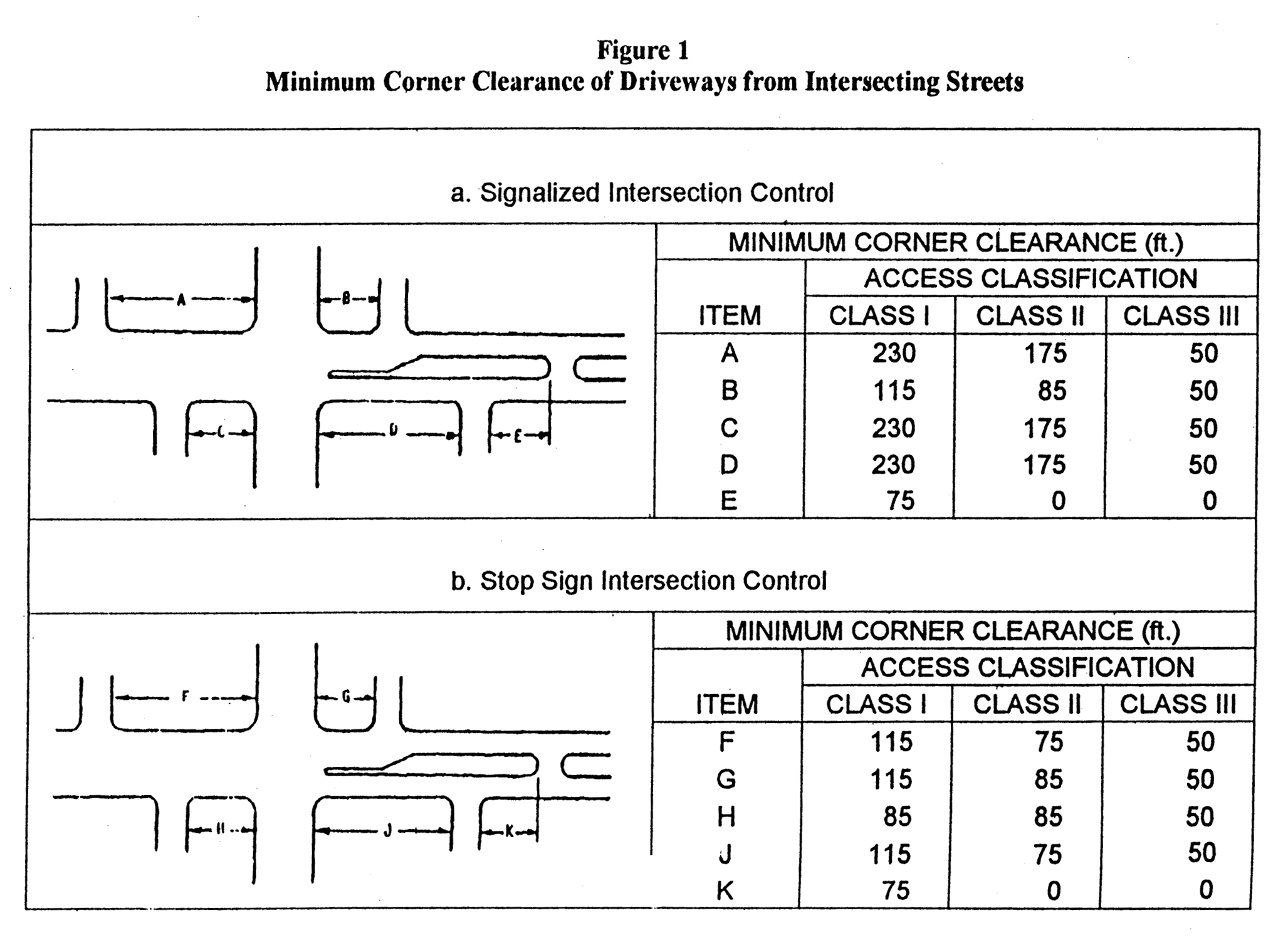
Figure 2
Minimum Sight Distances for Driveways and Intersections
Minimum Sight Distance Along Through Road From Intersection Or Driveway To Allow Vehicle To Safely Turn Left Or Right Onto Through Road At Nonsignalized Driveways And Intersections (Feet)
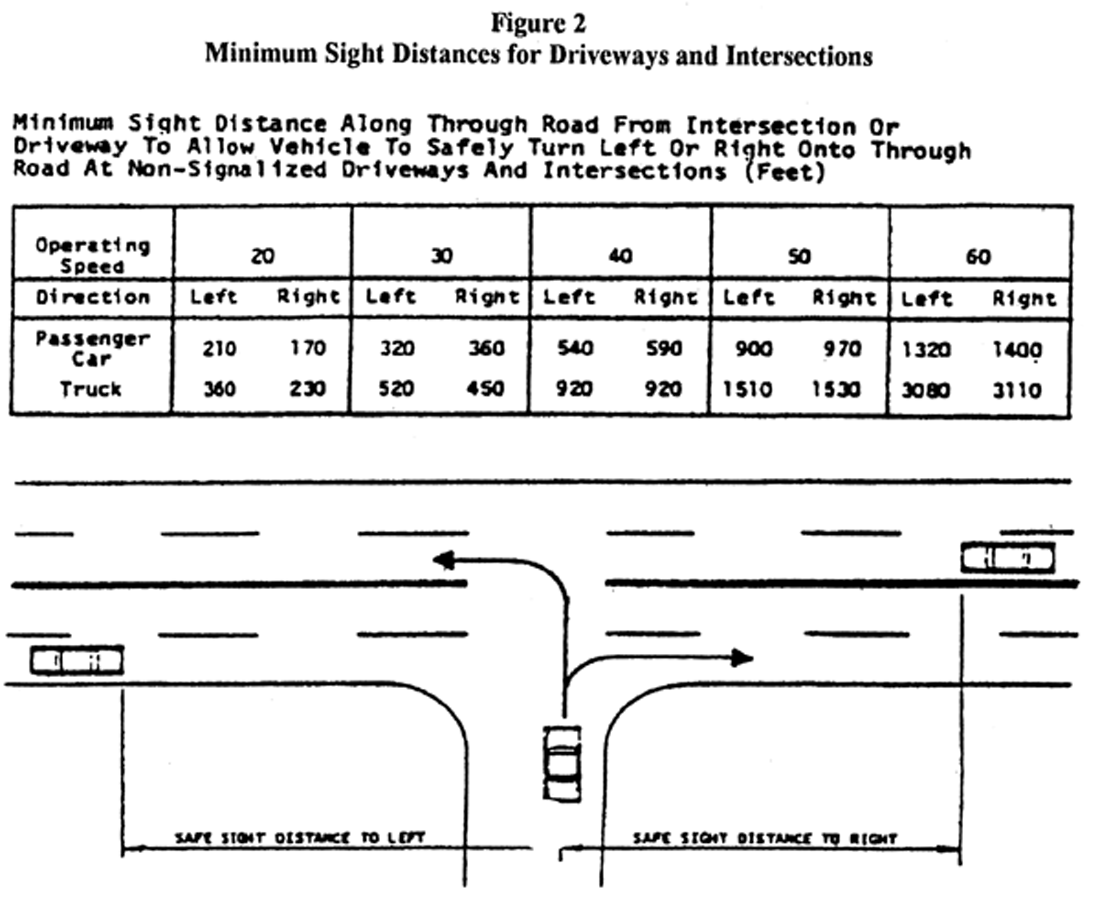
Minimum Sight Distance Along Through Road To Allow Vehicle To Safely Turn Left Into Intersection Or Driveway From Through Road At Locations Where No Left Turn Signal Phase Is Provided (Feet)
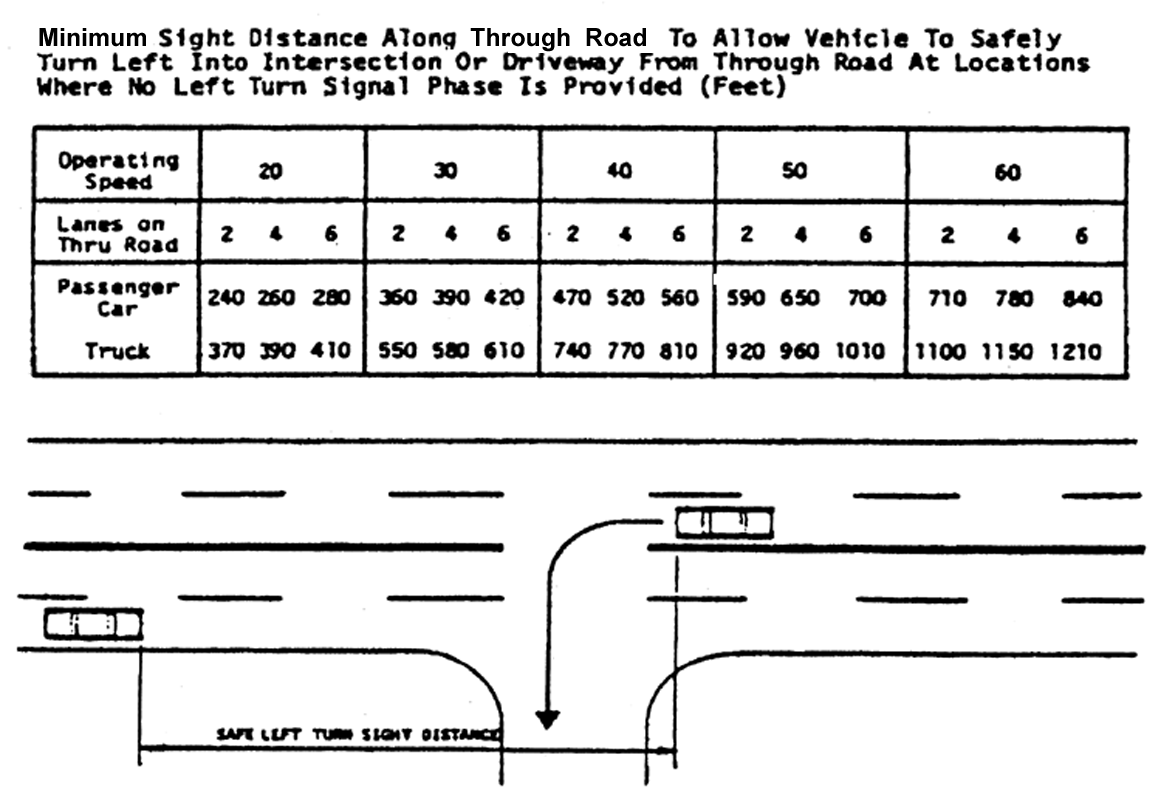
(Source: Traffic Management of Land Development course materials, The Traffic Institute of Northwestern University, Evanston, Illinois, January, 1987).
(Source: Adapted from Stover, Adkins, and Goodknight, Guidelines for Medial and Marginal Access Control On Major Roadways, National Cooperative Highway Research Program Report 93, 1970.)
(e)
Provisions for maintaining the capacity of the roadway. The planning commission may require that, upon completion of a development, all traffic requiring access to and from the development shall operate in such a manner as to not adversely affect the capacity of the roadway. Provisions for the present or future construction of a frontage road, restriction or channelization of turning movements or other improvements may be required, as a condition of approval, in approval, in order to maintain the capacity of any adjacent roadway.
(f)
Number of access points. Each existing tract of land is entitled to one direct or indirect access point to the public roadway network, provided that its location and design fulfill, as a minimum, the requirements of subsection (d) (minimum corner clearance) and figure 2 (minimum sight distance) of this section. Where the roadway frontage of a tract of land is greater than 500 feet, an additional access point may be allowed if determined by the township engineer that the additional access point will not adversely affect the capacity of the roadway. Any additional access point must be in compliance with all applicable subsections of this section.
(g)
Coordination of access points. Major access points on opposite sides of the class I and II roadways shall be located opposite each other. If not so located, turning movement restrictions may be imposed as determined necessary by the planning commission. In addition, in order to maximize the efficient utilization of access points, access drives shall be designed, located and constructed in a manner to provide and make possible the coordination of access with and between adjacent properties developed (present or future) for similar or compatible uses. As a condition of approval for construction, use or reuse of any access point, the planning commission may require that unobstructed and unencumbered access, in accordance with the provisions of this section, be provided from any such access point to adjacent properties.
(h)
Consolidation of existing access points. Whenever the use of a parcel of land changes or two or more parcels of land area assembled under one purpose, plan, entity or usage, the existing access approval shall become void, and new access approval shall be based upon the owner/developer's plans to use some existing driveways and/or close or relocate other driveways. Any such new or reauthorized access point must be in compliance with all applicable subsections of this section.
(i)
Design of access points. The width, angle, grade, curb, radii and other design aspects of access points shall be in accordance with state highway agency regulations, county road commission regulations and/or the subdivision regulations of the township, whichever is applicable. In the case of conflicting applicable standards, the more restrictive standard shall apply.
(j)
Temporary access points. Any access point that does not comply with one or more subsections of this section may be designated as "temporary" upon approval by the planning commission. In all cases where such access points are classified as "temporary," such designation shall be duly noted on the plot plan or site plan submitted for approval and also upon the deed of the property in question. When a property served by a "temporary" access point is provided an alternative means of access, such as a connection to a frontage road, an intersecting street or a shared driveway, the planning commission may require that the temporary access be eliminated, altered or limited to certain turning movements.
(k)
Spacing restrictions for signalized access points. Access points shall be designed such that those which will warrant signalization shall be spaced a minimum distance of one-quarter mile apart and one-quarter mile from the nearest signalized intersection. The location and design of the signalized access points shall be determined by a traffic engineering study, prepared by a qualified traffic engineer at the developer's expense. This study shall be subject to the approval of the planning commission and shall account for at least the following variables:
(1)
Traffic signal phasing, as determined by analysis of projected turning movements;
(2)
Traffic signal cycle length, as determined by analysis of projected traffic volumes;
(3)
Type of signal to be installed (actuated or pretimed);
(4)
Relationship to adjacent signals (existing or proposed) for purposes of signal interconnection and coordination;
(5)
Roadway geometrics and sight distance considerations; and
(6)
Accident experience.
If the installation of a traffic signal is approved, the developer may be required to participate, in full or in part, in the cost of design, purchase, installation, operation and maintenance of the signal equipment.
(l)
Provision of exclusive turning lanes and deceleration/acceleration lanes. At those access points where vehicles turning to and from the roadway will affect the capacity of the roadway or create an unacceptable accident risk, the developer shall dedicate sufficient right-of-way and construct turning lanes or deceleration/acceleration lanes, as necessary, to maintain the capacity of the roadway and minimize the potential accident risk.
(m)
Provision of frontage roads. The planning commission may require the use of frontage roads to provide access to property adjacent to access class I or class II roadways. The landowner/developer may be required to construct the frontage road to the side and/or rear property lines or reserve sufficient right-of-way to allow future construction. As adjacent property develops, landowner/developers shall be required to interconnect the individual portions of frontage roads, as appropriate. Access to the roadway via an intersecting street or a shared driveway may be required if the use of a frontage road is not feasible.
(n)
Approval of access points along routes maintained or controlled by the state highway agency or county road commission. A copy of the plans for all access points to be constructed along a county-maintained or state-maintained or controlled route shall also be submitted to the county road commission or state highway agency (as applicable) for review and approval during the same time as plans are submitted to the planning commission. Permission for the construction of access points along state-maintained roadways is subject to the approval of plans by both the township and county road commission or state highway agency.
(o)
Waiver of requirements. The planning commission may, at its discretion, reasonably waive or modify the requirements of this section, if it is determined that such action is warranted given the nature of the individual project.
(Ord. No. 143, § 7-16.33, 3-4-1998)
Sec. 38-634. - Performance standards.
(a)
Purpose. No use otherwise allowed shall be permitted within the township which does not conform to the following standards of use, occupancy and operation, which standards are hereby established as the minimum requirements maintained within the township.
(b)
Minimum standards. It shall be unlawful to conduct any use in the township which does not meet or exceed these minimum performance standards as hereafter listed:
(1)
Atmospheric discharge. It shall be unlawful to discharge into the atmosphere from any single source of emission whatsoever any air contaminator for a period aggregating more than four minutes in any one-half hour which is:
a.
Smoke. As dark or darker in shade as that designated as No. 2 on the Ringelmann chart, as published by the United States Bureau of Mines, which is hereby made a part of this section. However, the Umbrascope readings of smoke densities may be used when correlated with the Ringelmann chart. A Ringelmann chart shall be on file in the office of the building department.
b.
Other airborne solids. Of such opacity as to obscure an observer's view to a degree equal to or greater than the smoke described in subsection (b)(1)a of this section, except when the emission consists only of water vapor. The quantity of gasborne or airborne solids shall not exceed 0.20 grains per cubic foot of the carrying medium at a temperature of 500 degrees Fahrenheit.
(2)
Debris on public roads. The owner and/or permit holder of any site where there is soil removal and/or any filling shall take whatever steps are necessary to avoid any motor vehicle carrying or tracking onto any public right-of-way from the site any mud, dirt, clay, refuse, etc.
a.
Obligation to clean. If mud, dirt, clay, refuse, etc. is carried or tracked onto a public right-of-way, and it does, or might, constitute a nuisance or hazard to public safety, the owner and/or permit holder shall not leave any such debris on a public right-of-way after the end of any working day.
b.
Notice from township. If notified during a working day by the township of a condition which requires cleaning, the matter shall be taken care of within one hour, weather permitting.
c.
Violations. If a nuisance or hazardous condition is left after a working day, or not cleaned up within one hour after receiving a request from the township, and weather does not prevent the cleanup, the township may issue a citation for a violation of this subsection due to the allowance of such condition to remain on the highway, and/or clean the right-of-way and charge the owner and/or permit holder with the cost thereof, which may be collected in any court having general jurisdiction.
(3)
Drainage. Natural drainage shall not be blocked or diverted, or altered, or altered in such a manner as to cause the natural water flow to back up onto adjacent property, or to flow in a different course or rate of flow upon leaving the property upon which the blocking diversion, or alteration occurs, unless an application is made and a permit is issued by the ordinance enforcement officer pursuant to plans which provide for a drainage flow which will not be determined to surrounding properties.
a.
Retention areas. No area designated for and/or used as a drainage retention area shall be altered, filled in, abandoned or used for other purposes, unless it is done pursuant to a permit issued under this subsection.
b.
Permit. A permit shall be required under this subsection notwithstanding a permit is not otherwise required by this chapter. Permit requirements and procedures shall be as adopted by the township board, from time to time, by resolution.
(4)
Drifting and blown material. The drifting or airborne transmission beyond the property line of dust, particles or debris from any open stockpile, working areas or unplanted areas shall be unlawful and may be summarily caused be abated.
(5)
Electromagnetic radiation. Applicable rules and regulations of the Federal Communication Commission in regard to propagation of electromagnetic radiation are hereby made a part of this Code and shall be on file in the office of the building department.
(6)
Gases. The escape of or emission of any gas in concentrations so as to be injurious, destructive or explosive shall be unlawful and may be summarily caused to be abated.
(7)
Glare or heat. Any operation producing intense glare or heat shall be performed within an enclosure so as to completely obscure and shield such operation from direct view from any point along the lot line, except during the period of construction of the facilities to be used and occupied.
(8)
Light. Exterior lighting shall be so installed that the surface of the source of light shall not be visible from any bedroom window, and shall be so arranged as far as practical to reflect light away from any residential use, and in no case shall more than one footcandle power of light cross a lot line five feet above the ground in a residential district.
(9)
Odors. The emission of noxious, odorous matter in such quantities as to be readily detectable at any point along lot lines, when diluted in the ratio of one volume of odorous air to four or more volumes of clean air, or as to produce a public nuisance or hazard beyond lot lines, is prohibited.
(10)
Radioactive materials. Radioactive materials shall not be emitted to exceed quantities established as safe by the U.S. Bureau of Standards, as amended from time to time.
(11)
Sound. The pressure level of sounds shall not exceed the following decibel levels when adjacent to the following types of uses:
The sound levels shall be measured using a weighted decibel measurements (referenced to 20 micropascals) and with a type of audio output meter approved by the U.S. Bureau of Standards. Objectionable noises due to intermittence, beat, frequency, or shrillness, shall be muffled so as not to become a nuisance to adjacent uses.
Harmonic or pure tones, and periodic or repetitive impulse sound shall be in violation when such sounds are at a sound pressure level of five dB(A) less than those listed above.
Where property is partly in two zoning districts or adjoins the boundary of a zoning district, the dB(A) levels of the zoning district of the property where the noise is emanating shall control.
The following exceptions shall apply to the regulations under this section:
a.
Construction projects shall be subject to the maximum permissible noise levels specified for industrial districts as long as a valid building permit has been issued by the township and is currently in effect.
b.
All railroad operations shall be subject to the maximum permissible noise levels allowed in industrial districts, regardless of the zone where they are located.
c.
Noises occurring between 7:00 a.m. and 9:00 p.m. caused by home or building repairs or from maintenance of grounds are excluded, provided that such noise does not exceed the limitations specified in section 12-74(1) by more than 20 dB(A).
d.
Noises emanating from the discharge of firearms are excluded, provided that the discharge of the firearms was authorized under state law and all local ordinances.
e.
Any commercial, agricultural or industrial use of property which exists now or in the future as a legal nonconforming use (as defined in this chapter) in a higher zoning classification shall be allowed to emit noise in excess of these limitations for the particular zoning classification where such use is located, provided that such noise does not exceed either of the following limitations:
1.
The noise level emitted by such use at the time it became a legal nonconforming use as a result of the enactment of an amendment of this zoning chapter, if available.
2.
The limitations contained in this section based upon such a use being located in the highest zoning district (either commercial and agricultural or industrial) where such a use is specifically allowed as a permissible use.
(12)
Vibration. All machinery shall be so mounted and operated as to prevent transmission of ground vibration exceeding a displacement of 0.003 of one inch measured at any property line of its source.
(13)
Roads. Roads on landfill and soil excavation sites shall be designed and constructed so that traffic will flow smoothly and will not be interrupted by inclement weather. Nonpaved roads between the site and the nearest paved roads, paved roads off of site within one-quarter mile of the site entrance which are used by vehicles and/or equipment traveling to or from the site, and all roads on site shall not be used unless they are treated by sufficient oil, water and/or chemical substance, whichever would be appropriate for the surface, and frequent enough so that they are dustfree whenever used by vehicles and/or equipment.
(14)
Soil erosion. If a soil erosion permit is required by Part 91 of Public Act No. 451 of 1994 (MCL 324.9101 et seq.), no operation shall take place until a permit has been obtained. There shall be compliance at all times with the requirement of the soil erosion permit.
(c)
Waiver of provisions. Any provision of subsection (b)(5)—(10) of this section may be waived with the following conditions met:
(1)
Written request of the applicant;
(2)
Review and recommendation of planning commission; and
(3)
A determination by the township board of the following:
a.
The waiver will not cause or tend to cause a blight, nuisance, danger or hazard to the surrounding area by virtue of sight, noise, odor, shifting earth, standing water, filtration into the underground water systems or drainage.
b.
The waiver creates a more harmonious aesthetic condition with the surrounding area.
c.
The waiver is in the best interests of the health, safety and welfare of the township; and
(4)
If a provision is waived, the township board may impose alternatives or lesser restrictions that are reasonable.
(Ord. No. 62, ch. 5-02, 8-11-1984; Ord. No. 38, § 5-08.08, 2-18-1981; Ord. No. 49, ch. 5-02, 8-16-1981; Ord. No. 83, § 6-07.05, 7-17-1990)

