
Fountain City Zoning Code
ARTICLE III
GENERAL REGULATIONS AND DEVELOPMENT STANDARDS
Sec. 17.06.010. - Purpose and intent.
A.
In addition to the requirements contained elsewhere in this title, all uses of land and structures shall be governed by the general regulations and development standards contained in this article so as to promote the general health, safety and welfare of Fountain residents.
B.
The intent of this article is to encourage the creation of safe, adequate and attractive facilities and to minimize views of unattractive uses or activities through use of sound site design principles and the establishment of minimum requirements. The standards set forth herein are recognized as enhancing the compatibility of dissimilar uses and promoting stable property values.
(Ord. No. 1742, § 1, 1-14-2020)
Sec. 17.06.020. - Applicability.
A.
The general regulations and development standards of this title shall not apply to uses in existence as of the effective date of this title, or with respect to uses in existence on the effective date of amendments hereto, as governed by chapter 17.27. However, these standards shall apply to all uses in all zoning districts under the following circumstances:
1.
New buildings, signs, or construction.
2.
Additions involving expansion of the gross floor area or developed site area by 20 percent or more above that in existence prior to the effective date of this title.
3.
There is a change in the use or occupancy of the building or land, or other site improvements addressed in this article.
B.
Performance guarantee.
1.
The zoning administrator may allow certain improvements to be constructed or installed within an agreed upon time allowing for seasonal changes. Such arrangements may involve a financial security, such as a cashier's check, performance bond or other method as deemed appropriate by the zoning administrator to assure eventual compliance with this title.
(Ord. No. 1742, § 1, 1-14-2020)
Sec. 17.06.030. - Vested rights.
A.
Site-specific development plan. For all site developments, the final approval step, irrespective of its title, which occurs prior to building permit, shall be considered the "site specific development plan" for purposes of C.R.S. art. 68 of tit. 24, as amended. "site specific development plan" means a plan describing with reasonable certainty the type and intensity of use proposed for a specific parcel or parcels of property. The following approvals are deemed "site specific development plans": final plats, preliminary development plan (PDP), final development plan (FDP), major subdivision, and minor subdivision.
B.
Requests to vest. In the event an applicant for site-specific development plan, as defined by subsection A above, wishes approval to have the effect of creating vested property rights pursuant to C.R.S. art. 68 of tit. 24, as amended, the applicant must so request, in writing, at least 30 days prior to the date said approval is to be considered, accompanied by the owner's proposed formal notice of the creation of the vested property right.
C.
Terms. A vested property right has a duration of three years from the date of approval in accordance with C.R.S. § 24-68-104. In the event amendments to a site specific development plan are proposed and approved, the effective date of such amendments, for purposes of duration of a vested property right, shall be the date of the approval of the original site specific development plan, unless the city council specifically finds to the contrary and incorporates such finding in its approval of the amendment.
D.
Vested rights by separate agreement.
1.
The city council may, at its sole discretion, enter into a development agreement with a landowner and provide for the vesting of property rights for a period exceeding three years where warranted in light of all relevant circumstances, including, but not limited to:
a.
The project will be clearly and significantly reduced impacts on the existing infrastructure.
b.
The project will construct public facilities, water, sanitary sewer, drainage facilities and/or public streets that are oversized or extended to be of obvious strategic value to the community.
c.
The project will provide public open space and/or public parkland significantly greater than required and/or provide public recreational facilities that are of obvious strategic value to the community.
d.
A commercial project or commercial component of a mixed-use project must result in clear benefits to the city as evidenced by new jobs and tax revenue.
e.
The project will make special contributions that are clearly in the public interest.
2.
Subsequent reviews. Such agreement shall provide for subsequent reviews and approvals by the city council to ensure compliance with the terms and conditions of the original approval.
3.
Limitations on remedy. The establishment of vested property rights shall not preclude the application of ordinances or regulations which are general in nature and are applicable to all property subject to land use regulation by a local government including, but not limited to, building, fire, plumbing, electrical, mechanical and the Pikes Peak Regional Building Code.
4.
Reservation. The City of Fountain reserves the right to undertake land use regulation of the site specific development plan in contravention of such plan, provided that the compensation required under C.R.S. § 24-68-105(1), is paid to the landowner. The adoption of this section is not intended, and shall not be construed, to enlarge the right of the landowner or the obligation of the city beyond payment of the required compensation under the vesting statute.
5.
Effect. Nothing in this section is intended to create any vested property right, but only to implement the provisions of C.R.S. art. 68 of tit. 24. In the event of the repeal of said article or a judicial determination that said article is invalid or unconstitutional, this section shall be deemed to be repealed, and the provisions hereof no longer effective.
(Ord. No. 1742, § 1, 1-14-2020)
Sec. 17.07.010. - General lot regulations.
A.
Every building shall be located and maintained on a "lot" as defined in this title.
B.
No lot shall be divided to contain more dwellings than are permitted by the regulations of the zoning district in which it is located.
C.
No space needed to meet the width, yard, area, open space, lot coverage, parking, or other requirements of this title for a lot or building may be sold, transferred, or leased away from such lot or building.
D.
No parcel of land which has less than the minimum width, depth and area requirements for the zoning district in which it is located may be divided from a larger parcel of land for the purpose, whether immediate or future, of building or development as a lot.
E.
Each lot or parcel in separate ownership shall have at least 25 lineal feet of frontage on a public street or an access easement approved by the planning commission and city council unless otherwise provided for elsewhere in this title or as part of an overall development plan.
F.
Each principal building devoted wholly or in part to residential use shall be located on a lot contiguous to a public street with permanent access to the public street and sufficient to allow ingress and egress for emergency vehicles providing emergency services to the principal building. A principal building devoted wholly or in part to residential use that is located within an approved planned unit development, may be accessed by a private street if the private street meets the same standards of public streets.
G.
No lot area, yard, open space, off-street parking or loading area which is required by this title for one use shall be used to meet the required lot area, yard, open space, off-street parking or loading area of another use unless authorized by the zoning administrator and as provided under the parking regulations in chapter 17.09.
(Ord. No. 1742, § 1, 1-14-2020)
Sec. 17.07.020. - Lot area requirements.
A.
Basic minimum lot area. Except as provided below, no lot shall be built upon unless containing at least the basic minimum lot requirements established in article II.
B.
Non-conforming lots of record. Where an individual lot was held in separate ownership from adjoining properties or was platted prior to the effective date of this title in a recorded subdivision approved by the city council and has less area or width than required in other sections of this title, such lot may be developed in accordance with these regulations, including setbacks, building height, etc. For the zone on which the lot is located and occupied according to the permitted uses and other requirements set forth in the district in which the lot is located. If a non-conforming lot ever comes under the same ownership as a contiguous parcel it shall no longer be the same non-conforming lot and such cessation shall be processed through the lot line vacation process outlined in title 16, Subdivision Regulations.
(Ord. No. 1742, § 1, 1-14-2020)
Sec. 17.07.030. - Land quality limitations.
A.
No structure can be built within 100 feet of the 100-year flood plain.
B.
Exceptions may be granted upon the applicant providing a study of the land area and surrounding land that may be impacted by potential development. The study shall be produced by a geo-technical engineer licensed in the State of Colorado. Such study shall contain an analysis of potentially unstable slopes, faulting, or soil conditions, etc., that may be unfavorable to development. The study shall also contain, where appropriate, recommendations for special mitigation measures and engineering precautions that shall be taken to overcome those limitations.
C.
Any development that is granted an exception to this regulation and is within the 100-year floodplain or within 100 feet of the floodplain, shall be designed so as not to cause any adverse effects to the development or to any other properties from either increased flood heights, flow velocities, flow duration, rate of rise of flood waters, channel stability or sediment transport; provided, however, that any development shall not be considered as causing an adverse effect to any other properties by reason of increased flood heights if such development does not cause a rise of more than one-tenth of a foot in the base flood elevation of the floodplain.
(Ord. No. 1742, § 1, 1-14-2020)
Sec. 17.07.040. - Land dedications.
Land designated as flood plain management or open space through dedication or reservation for any reason shall be indicated as such on the appropriate zoning district map. Such land and facilities shall be built and maintained either by a unit of government, by a nonprofit corporation or by private interests as part of a subdivision or development of land for use by the inhabitants or general public thereof; ownership of the land may be deeded or reserved to a property owner's association or it may be dedicated to the public; or as required by any condition for granting of a subdivision plat, zoning district or planned development amendment including designation of a park, trail or other open recreation use.
(Ord. No. 1742, § 1, 1-14-2020)
Sec. 17.07.050. - Setback requirements.
A.
Transition. When a nonresidential use which is over 15 feet in height shares a common lot line with a residential use, the required side yard setback for the nonresidential use shall be at least 25 feet and shall be maintained with landscaped plant material to include trees, shrubs, grasses and/or xeriscape plant material as determined by the zoning administrator. Excepted from this requirement are nonresidential uses located prior to the location of the adjacent residential use.
B.
Setback requirements for accessory structures.
1.
Accessory structures and uses shall be set back a minimum of 12 feet from the rear lot line, unless otherwise specified in chapter 17.04, Zoning Districts.
2.
Accessory structures shall maintain the same side and front yard setbacks as required for the principal building located on the lot.
3.
No part of any accessory structure shall be located closer than six feet to any principal building, unless it is attached to or forms a part of such principal building.
4.
Accessory structures and uses shall otherwise comply with the bulk regulations applicable in the district in which they are located.
C.
Side yards and corner lots. On corner lots, the side yard which is contiguous to a street shall not be less than ten feet in width, except that a garage having perpendicular access to the street shall be set back at least 18 feet from the street property line.
D.
Partially developed frontages. When a vacant lot is bordered on two sides by previously constructed buildings and both of which are within the required front yard setback applicable to the district, the required front yard setback for the vacant lot shall be established as the average front yard setback of the two existing adjacent buildings. Where a vacant lot is bordered on only one side by a previously constructed building which does not meet the required front yard setback for the district, the required front yard setback for the vacant lot shall be established as the average front yard setback of the adjacent building and the minimum required front yard setback for the district.
E.
Irregular shaped lots. If a lot is not rectangular or square in shape, and a building is constructed so that one side of the building is parallel to an adjacent street or right-of-way, the setback between the building line and that lot line which is not parallel to the building line may be calculated as the average of the nearest and farthest distances between the building corners and the lot line, except that the minimum setback at any point shall not be less than five feet.
F.
Features allowed within setbacks. The following structures and features may be located within required setbacks:
1.
Trees, shrubbery or other features of natural growth.
2.
Fences or walls that do not exceed the standards established in this article.
3.
Driveways and sidewalks.
4.
Signs, if permitted by the sign regulations of this title.
5.
Bay windows, architectural design embellishments and cantilevered floor areas of dwellings that do not project more than two feet into the required setback provided they do not encroach on public easements.
6.
Eaves that do not project more than 18 inches into the required setback.
7.
Open outside stairways, entrance hoods, terraces, canopies and balconies that do not project more than five feet into a required front or rear setback, provided they do not encroach on public easements.
8.
Chimneys, flues and residential ventilating ducts that do not project more than two feet into a required setback, and when placed so as not to obstruct light and ventilation, provided they do not encroach on public easements.
9.
Utility lines, wires and associated structures, such as power poles.
(Ord. No. 1742, § 1, 1-14-2020)
Sec. 17.08.010. - Application.
The provisions of this chapter shall apply to all properties, public and private streets, public and private access easements and public and private rights-of-way.
(Ord. No. 1742, § 1, 1-14-2020)
Sec. 17.08.020. - Permit and standards.
A.
Permit—Issuance. A permit shall be required for the construction and maintenance of any access approach, driveway, or curb cut as specified in chapter 12.04 of the Fountain Municipal Code.
B.
Permit—Safety requirements. No access approach, driveway, or curb cut shall be constructed or maintained which creates a threat to the safety of persons or vehicles near the access approach, driveway, or curb cut. No permit for the construction of an access approach, driveway, or curb cut shall be issued unless the city engineer determines that the proposed access approach, driveway, or curb cut will not create a threat to the safety of persons or vehicles in the vicinity of the proposed access approach, driveway, or curb cut. In making this determination, the city engineer shall consider the following factors:
1.
Whether the street to which access is sought is residential or commercial in character.
2.
Whether the proposed access approach, driveway, or curb cut would cross a sidewalk.
3.
Whether drivers of vehicles using the proposed access approach, driveway, or curb cut would have difficulty in seeing pedestrians or other vehicles in the vicinity.
4.
Whether pedestrians or the drivers of other vehicles would have difficulty in seeing vehicles using the proposed access approach, driveway, or curb cut.
5.
Whether the proposed access approach, driveway, or curb cut would result in increased noise, dirt, smoke, or fumes near the proposed access approach, driveway, or curb cut.
6.
Whether the property for which an access approach, driveway, or curb cut is proposed is already served by an existing access approach, driveway, or curb cut.
7.
Whether parking is permitted on the street to which access is proposed.
8.
The width of the street to which access is sought.
9.
The posted speed limit on the street to which access is sought.
10.
The distance of the proposed access approach, driveway, or curb cut from the curb line of the nearest street, which intersects the street to which access, is proposed.
11.
The proximity of the proposed access approach, driveway, or curb cut to residential neighborhoods and schools.
C.
Vehicular Ingress and Egress. Vehicular ingress and egress to major or minor public arterials and collector streets from off-street parking areas shall be so combined, limited, located, designed and controlled with flared and/or channeled intersections as to direct traffic to and from such public right-of-way conveniently, safely and in a manner which minimizes traffic friction, and promotes free traffic flow on the streets without excessive interruption. Access shall be unobstructed and direct.
D.
Construction specifications—Location.
1.
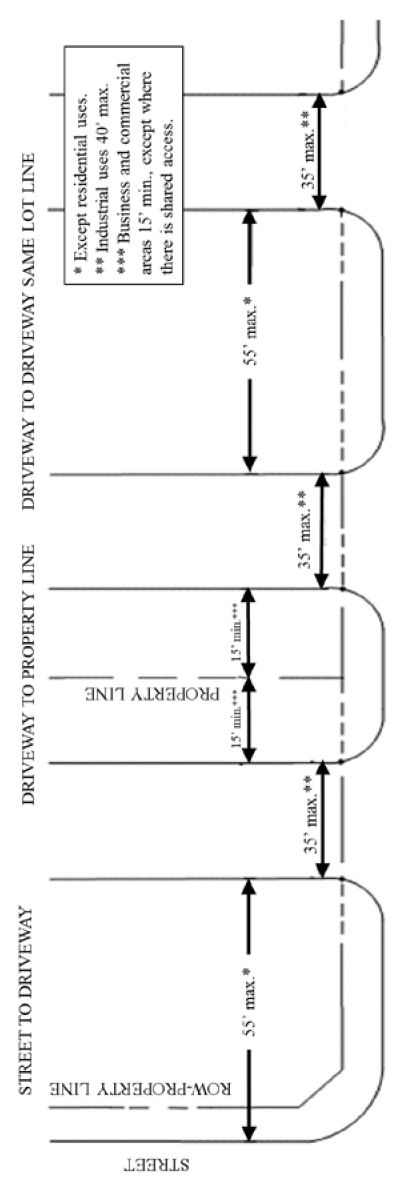
No access approach or curb cut shall be closer than 55 feet to the curb line of any street that intersects the curb line of the street to which access is gained.
2.
The width of any access approach, driveway or curb cut shall not exceed 35 feet in residential and 40 feet in commercial and industrial, as measured along its intersection with the property line.
3.
No two access approaches, driveways or curb cuts on the same lot shall be closer together than 55 feet measured along their intersections with the curb line of a public or private street, access easement or right-of-way. Access approaches, driveways or curb cuts that intersect with an access easement may be reduced by the city engineer based on safety requirements as outlined in section 17.08.020.B. above. Parking lot drive aisles that intersect an access easement or access road internal to a development are exempt from this requirement.
4.
In business and commercial areas, no access approach, or curb cut shall be closer than 15 feet to a property line of an adjacent property except where there is shared access with the adjacent property. Shared access shall be provided and documented through a recorded access and maintenance easement.
5.
Cross access shall be provided between adjacent parcels where feasible. Cross access easements shall be shown on all drawings and easements, shall be recorded and shall establish ownership and maintenance provisions.
Figure 17.08.1: Driveway Spacing from Streets, Property Lines and Other Driveways
E.
Surfacing. All access approaches, driveways, and curb cuts shall be surfaced immediately upon completion. Surface material shall be gravel, asphalt, or concrete when adjacent to a gravel street, and asphalt or concrete when adjacent to an asphalt or concrete street. Surfacing within the right-of-way shall extend from the traveled portion of the street to the right-of-way line.
F.
Drainage. The construction of access approaches, driveways, and curb cuts shall be accomplished so as not to cause water to enter onto the traveled portion of the street and so as not to interfere with the drainage system of the street right-of-way.
G.
Inspection. The city engineer shall be responsible for the inspection, monitoring and final acceptance of the construction of all access approaches, driveways, and curb cuts in accordance with the access permits issued by the city engineer.
H.
Maintenance. The owner of the property serviced by an access approach, driveway, or curb cut shall be responsible for its maintenance and for any removal of snow, ice, and sand, whether deposited by nature, by the traveling public, or by the city's snow removal or street maintenance operation.
(Ord. No. 1742, § 1, 1-14-2020)
Sec. 17.08.030. - Visibility at intersections—Application of sight triangle.
A.
Driveways and other intersections. This section shall apply to all access approaches from private and public driveways onto public and private rights-of-way and access easements.
B.
Sight distance controls. For purposes of this section, a "controlled intersection" means an intersection equipped with a stop sign, yield sign, traffic control device, or other suitable traffic control warning sign. An "uncontrolled intersection" means an intersection that is not equipped with a stop sign, yield sign, traffic control device or other suitable traffic control warning sign. Unless otherwise required by the city engineer, all controlled and uncontrolled intersections shall be designed, constructed and maintained in accordance with the sight intersection distance provisions established in figure 17.08.2 and table 17.08.1 as applicable.
C.
Restrictions within the sight distance area. No landscaping, fence, utility equipment, wall or other structure shall be constructed or maintained in the area identified as the sight distance area (a.k.a. sight triangle) between three feet in height and nine feet in height above the roadway. Nothing shall intrude into the sight triangle so as to obscure or block the visibility of any traffic control device or traffic control sign located at such intersection. No on-street or off-street parking shall be allowed within the area of the sight triangle.
Figure 17.08.2: Sight Distance
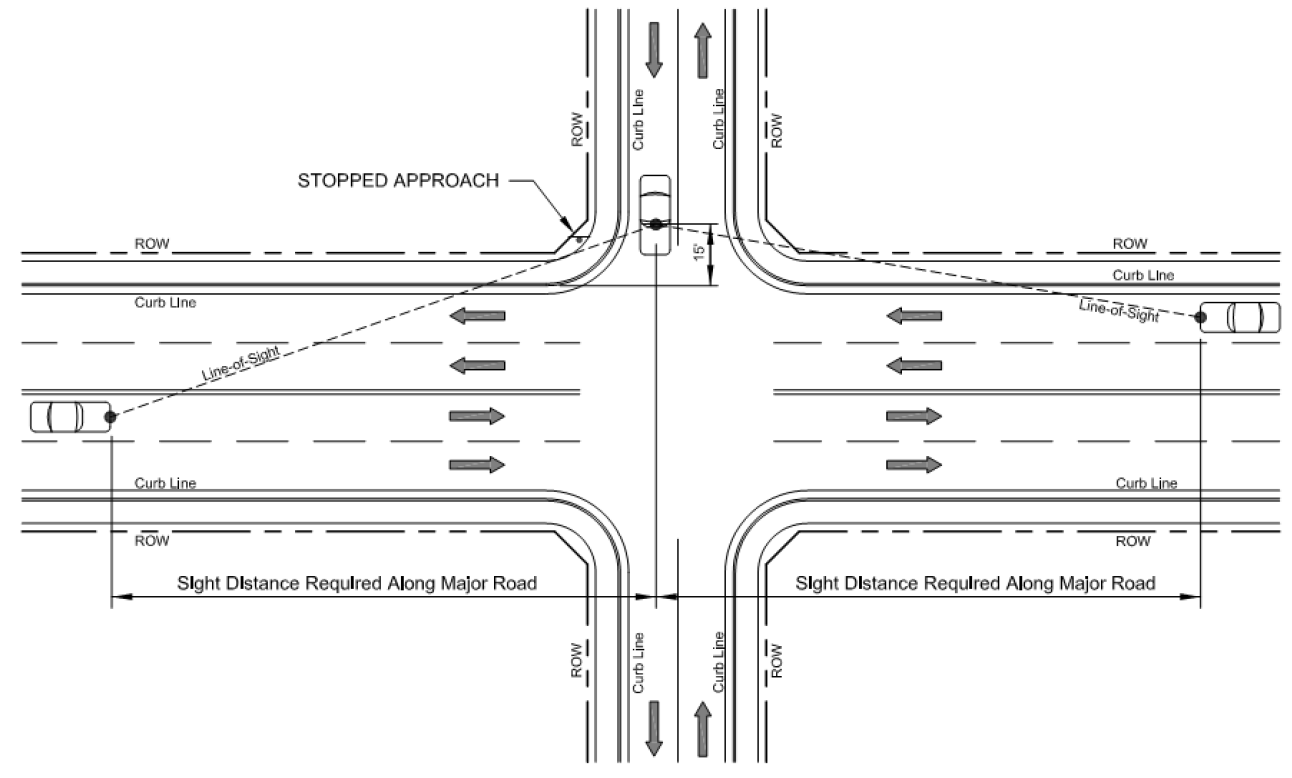
Table 17.08.1: Sight Distance
(Ord. No. 1742, § 1, 1-14-2020)
Sec. 17.09.010. - Purpose and intent.
This chapter imposes minimum requirements for the development of parking areas in conjunction with the various uses permitted in this title. The purpose of this chapter is to require that the owner of a land use provide and maintain sufficient quantities of parking for the land use. The purpose of these requirements is to require attractive, convenient, efficiently developed parking areas which provide sufficient quantities of parking spaces with ample area for fire lanes, maneuvering, snow storage, retention of drainage, landscaping and public safety.
(Ord. No. 1742, § 1, 1-14-2020)
Sec. 17.09.020. - Applicability.
A.
The parking requirements contained herein are minimum requirements.
B.
The parking requirements of this chapter must be met upon:
1.
Any construction of a new structure;
2.
Any addition to or enlargement of an existing building or use;
3.
Any change in use of a building;
4.
Any change in use of land that increases the building area or the developed land area of the use; or
5.
Any change in use of a building or land that increases the parking requirements for a building, structure or land area. Any change in the use of a building or lot which increases the off-street parking as required under this chapter, shall be unlawful and a violation of this title until such time as the off-street parking complies with the requirements of this chapter and other applicable chapters of this title that pertain to parking.
(Ord. No. 1742, § 1, 1-14-2020)
Sec. 17.09.030. - Maintenance—Responsibility of owner.
"Provide and maintain" shall mean that the off-street parking area shall remain free from pavement deterioration, cracking, erosion, chuckholes, pavement failure, and cave-in. It shall also include the maintenance of parking area signage including ADA handicap signage, fire lane signs and striping, directional signage, etc. and parking space striping. The zoning administrator may require the resurfacing of pavement or replacement of signs and striping if they are not maintained.
(Ord. No. 1742, § 1, 1-14-2020)
Sec. 17.09.040. - Procedures and administration.
A.
Off-street parking shall be provided as set forth in this chapter and elsewhere in this title in association with any use generating demand for parking. Nothing in this chapter shall deprive the owners or operators of property, generating a need for parking, the right to maintain control over such property devoted to off-street parking, not inconsistent with this chapter or to charge whatever fees they deem appropriate for such parking.
B.
The proposed method of complying with this chapter shall be indicated on all plans required to be submitted to the city as a part of an application, change in use review, or parking plan, and on any site development plan or plot plan submitted for a building permit.
1.
Parking analysis required. For any new use or change of use of a building or land, a parking analysis shall be submitted to the zoning administrator for review. The parking analysis must prove that ample parking is available for all uses of the property. The parking analysis shall specify the previous or existing use, the proposed new use, the square footage of building or land area that is being changed, the number of off-street parking spaces required by section 17.09.050 of this chapter for the previous, existing and proposed use, and the number of existing parking spaces on the site. The zoning administrator will review the completed parking analysis and the accuracy of the submitted information based on the site's zoning requirements. Any increase in the required number of parking spaces shall be subject to the submittal of a site development plan or parking plan as specified below. The zoning administrator may waive the requirement for a parking analysis in situations where the parking demand for a new use is obvious.
2.
Site development plan required. Addition, enlargement, or change in use that increases the developed land area of the use, or if the required parking is increased by 20 percent or more, then a site development plan shall be filed with the zoning administrator for approval or disapproval in conjunction with the application for a building permit or change in use review. The site development plan shall show compliance with all requirements of this chapter and other applicable parking regulations in this title. Compliance requirements shall include the required number of off-street parking spaces, off-street loading spaces, access, surfacing, lighting, screening, landscaping, and other applicable standards. Compliance shall be shown on a site development plan as regulated in chapter 17.23 of this title.
3.
Parking plan required. If new construction or an addition, enlargement, or change in use does not require the submittal of a site development plan, a separate parking plan shall be filed with the zoning administrator for approval or disapproval in conjunction with the application for a building permit or change in use review. A parking plan shall be required whenever existing parking areas are changed or redesigned.
C.
Parking plan exceptions. A parking plan is not required for a change in use for a shopping center. Parking plans are also not required for a change in use where the new use requires equal or less parking than that previously approved.
D.
Submittal requirements. The parking plan shall be drawn to a scale accurately depicting the area to be allocated to off-street parking, shall analyze required off-street parking and shall clearly show existing and proposed parking spaces, drive aisles, landscaping and other appropriate information.
E.
All applications shall be made by or with the approval of the owner of the entire land area to be included within the parking plan.
F.
Administrative reduction of required parking spaces. The zoning administrator may grant up to 25 percent temporary or permanent reduction in the total number of required off-street parking spaces. Requests for administrative reductions to the minimum number of required off-street parking spaces shall not be combined. Total cumulative reductions shall not exceed the amounts listed and shall meet the criteria as set forth in this subsection for granting parking reductions. Administrative reductions may not be applied to the handicap parking requirements under section 17.09.070 of this chapter.
1.
Commercial and industrial uses in all zoning districts may be granted a reduction in the number of required off-street parking spaces based on the following criteria:
a.
The nature of the use, the size of the site or other physical constraints resulting in a situation where the parking requirements cannot be met on site without necessary hardship, practical difficulties or negative impact on the visual character of the site or neighborhood;
b.
The applicant can satisfactorily demonstrate by means of a parking study or analysis that the needs of all businesses, structures and land uses will be adequately served, and if the reduction is due to the nature of the use, the applicant shall provide assurance that the nature of the use will not change;
c.
A mix of uses is proposed and the parking needs of all the uses can be accommodated through joint use of parking spaces with varying time periods of use that will accommodate required parking needs. The joint use shall be documented in a joint parking agreement that is recorded with provisions of ownership and maintenance provided;
d.
The development is sited within one-fourth mile of a public parking facility, transit stop, transit station or transit terminal; or
e.
The applicant provides an acceptable proposal for an alternate mode of transportation program, including assurances that the use of alternate modes of transportation (i.e. car sharing, van pooling, or other alternates) will adequately replace the need for on-site parking on an ongoing basis.
2.
Required off-street parking in the downtown mixed use district (MU), central mixed use business district (CMU) and residential mixed use district (RMU) may be reduced 100 percent if (1) a combination of a, b, and c below exist, or (2) if d exists:
a.
The business, land use or redevelopment is utilizing an existing structure with limited off-street parking available onsite.
b.
On-street parking is permitted and existing in front, back or to the side of the site or the development is sited within one-fourth mile of a public parking facility.
c.
Structural coverage or mature landscaping on the site prevents any additional parking improvements.
d.
Parking is shared between uses with non-overlapping prime hours of operation.
(Ord. No. 1742, § 1, 1-14-2020)
Sec. 17.09.050. - Number of off-street parking spaces required.
A.
Minimum requirements. All uses shall provide the minimum number of off-street parking spaces listed below. Buildings with more than one use shall provide parking required for each use.
Table 17.09.1 Number of Required Off-Street Parking Spaces
B.
The zoning administrator shall determine parking requirements for uses not specifically listed based on an analysis of parking requirements for similar uses, comparable requirements of other municipalities, or on anticipated parking demands.
C.
Those uses identified above with an asterisk (*) may also be subject to vehicle stacking requirements as specified in section 17.09.090 of this chapter.
D.
Employee parking. Additional parking spaces needed for employee parking and designated for employee parking only may be required upon review of the site and the employment projections for the business. This shall apply to all home-based businesses, temporary uses and zoning districts.
(Ord. No. 1742, § 1, 1-14-2020)
Sec. 17.09.060. - Calculation of parking space requirements.
A.
Number of spaces. Separate off-street parking spaces shall be provided for each use.
1.
Where parking facilities are combined and shared by two or more uses the off-street parking space required for two or more uses having the same or different standards for determining the amount of required off-street parking spaces shall be the sum of the standards of all the various uses.
2.
When any parking calculation results in a required fractional space, such fraction shall be rounded off to the closest whole number (i.e. 2.4 = 2, 2.5 = 3).
B.
Measurement of floor area. Floor areas used in calculating the required number of parking spaces shall be gross floor areas of the building calculated from the exterior outside walls without regard to a specific inside use. In mixed use facilities:
1.
Calculations shall be based on gross square footage of each identifiable use within the building and the total square footage of each identifiable use shall be the same as the gross floor area calculated from outside wall to outside wall.
2.
Uses, which serve more than one of the uses such as bathrooms, mechanical rooms, stairwells, circulation, airshafts, storage areas, and elevators, shall be pro-rated based on the area of each identifiable use.
C.
Compact parking. Up to 30 percent of all required off-street parking spaces may be designated as "compact car spaces." The dimensions for compact spaces are shown in figure 17.346-2. Such spaces shall be appropriately marked with the words "compact car." off-street parking spaces provided in excess of the required number of spaces for a building or use may be in the form of compact parking spaces.
D.
Determination of requirements for uses not listed. Requirements for types of buildings and uses not specifically listed in this chapter shall be determined by the zoning administrator after study and recommendation which should include all relevant factors, including but not limited to:
1.
Vehicle occupancy studies.
2.
Comparable requirements from other relevant municipalities.
3.
Requirements of comparable uses listed in this chapter.
4.
Suitable and adequate means will exist for provision of public, community, group or common facilities.
5.
Provision of adequate loading facilities and for a system for distribution and pickup of goods.
6.
Use is in the interest of the area to be affected and in the interests of the city at large.
7.
Use will not be detrimental to adjacent properties or improvements in the vicinity of the area.
8.
That the proposed use will not confer any special privilege or benefit on the properties or improvements in the area, which privilege or benefit is not conferred upon similarly situated properties elsewhere in the city.
(Ord. No. 1742, § 1, 1-14-2020)
Sec. 17.09.070. - Handicap parking requirements.
A.
The provisions of this section shall be provided in accordance with ADA requirements established in the Americans with Disabilities Act Accessibility Guidelines for Buildings and Facilities (ADAAG) under the U.S. Architectural and Transportation Barriers Compliance Board (access board). Private properties under development shall follow the same ADA requirements for public rights-of-way as required by this section.
B.
Required spaces. Accessible handicap parking spaces must be provided at the following minimum rate for nonresidential projects. A minimum of one in every eight handicap parking spaces shall be van accessible with a minimum of one van accessible space required for every development. The spaces required by this section shall be provided in addition to the number of parking spaces required elsewhere in this chapter.
Table 17.09.2: Required Number of Handicap Accessible Parking Spaces
C.
Location. The required spaces shall be located to provide the least travel distance to the facilities served. Spaces shall be located, where feasible, to allow those parking in the spaces to access the associated building without crossing vehicle traffic areas or passing behind parking spaces other than the handicap parking space being utilized. In parking facilities that do not serve a particular building, accessible parking shall be located on the shortest accessible route of travel to an accessible pedestrian entrance of the parking facility. The distance between the most remote principal entrance of a building and any one space shall not exceed 200 feet.
D.
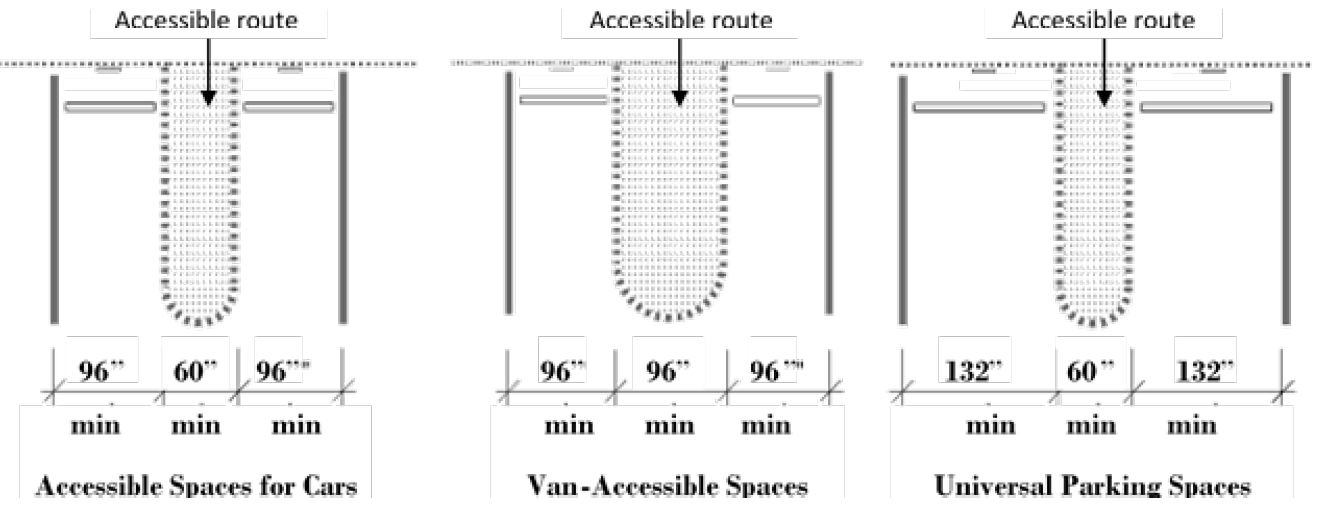
Size. Standard accessible handicap spaces shall be no less than eight feet wide with an adjacent access aisle of no less than five feet in width. Van accessible spaces shall be no less than eight feet wide with an adjacent access aisle of no less than eight feet in width. In the alternative, the parking may be designed to conform to the ADAAG "universal" parking space design of an 11-foot wide parking space with an adjacent access aisle of no less than five feet in width. Two adjacent spaces may share a common access aisle. Such aisles shall provide an accessible route of travel to the building or facility entrance. Boundaries of the required parking spaces and aisles shall be marked to identify the use of such space.
Figure 17.09.1: Handicap Accessible Parking Space Dimensions
E.
Pedestrian and curb ramps. Pedestrian and curb ramps shall be required wherever an accessible route crosses a curb.
1.
All pedestrian curb ramp designs shall meet city adopted design standards and ADAAG guidelines.
2.
If a curb ramp is located where pedestrians must walk across the ramp, or where it is not protected by handrails or guardrails, it shall have flared sides. The maximum slope of a ramp shall be 1:16 and with a maximum slope of the flare at 1:10 unless otherwise authorized by the city engineer due to existing site limitations. Curb ramps with returned curbs may be used where pedestrians would not normally walk across the ramp.
3.
Detectable warning panels required. Curb ramps shall have a detectable warning panel that shall extend the full width of the curb ramp. Detectable warnings shall consist of panels with raised truncated domes with a diameter of nominal 0.9 inches, a height of nominal 0.2 inches, and a center-to-center spacing of nominal 2.35 inches and shall contract visually with adjoining surfaces, either light-on-dark, or dark-on-light. The material used to provide contrast shall be an integral part of the walking surface. Detectable warnings used on interior surfaces shall differ from adjoining walking surfaces in resiliency or sound-on-can contact.
4.
Any development or redevelopment of a site shall require the upgrade of any non-conforming pedestrian curb ramps for areas on the property or in the right-of-way that are within a reasonable area of impact to the development or redevelopment.
F.
Signage and pavement markings. Every parking space required by this section shall be identified by a sign and pavement marking showing the symbol of accessibility. Signs and pavement markings shall comply with the Manual on Uniform Traffic Control Devices (MUTCD) standards as adopted by the city.
G.
Surface. Parking spaces and access aisles shall be firm, stable, smooth and slip resistant.
(Ord. No. 1742, § 1, 1-14-2020)
Sec. 17.09.080. - Restrictions.
A.
Residential weight restrictions. Off-street parking spaces for residential uses shall be used by vehicles up to but not exceeding four tons manufacturer's capacity rating.
B.
Use of required parking spaces in commercial zone districts. Off-street parking spaces shall be used for the parking of vehicles by employees, customers and other associated end users of a land use. Required parking spaces shall not be used for:
1.
The parking or storage of automobile trailers, boats, detached campers or any other object;
2.
The sale, repair, dismantling or servicing of any vehicle, equipment, material or supplies;
3.
The temporary or permanent display of goods;
4.
Temporary or permanent signage;
5.
Dumpsters; or
6.
Any similar object or use that will render the parking space unusable according to the intent and purpose of this chapter. Where a land use requires parking spaces for the storage or display of any vehicle or other good for rental or sale, additional parking spaces over the minimum required shall be provided.
C.
Any parking spaces that are in excess of the required parking or any parking areas proposed for use as display or storage shall be delineated on the required plans and shall meet the minimum design standards contained within this chapter.
(Ord. No. 1742, § 1, 1-14-2020)
Sec. 17.09.090. - Stacking space for drive-through, parking attendant or paid parking collection devices.
A.
Submittal of plans. The location, size and dimensions of all stacking spaces for drive-through, parking attendant or similar facilities shall be shown on any required site development plan or parking plan. The plan shall follow the stacking space schedule and shall demonstrate that such facilities will not result in the stacking of vehicles on public or private rights-of-way or easements, except as otherwise regulated in subsection B. below, and that an adequate area is reserved for the safe transfer of the motor vehicle between any parking attendant or valet and the driver of the vehicle. In no event shall a gated entry or exit, drive-through, parking attendant, paid parking collection device, or area associated with such uses be located in a public street or right-of-way, or interfere with vehicular or pedestrian traffic on a public or private street, sidewalk, trail, easement or other right-of-way or easement.
B.
Stacking in public alleys in the downtown mixed use district (MU), residential mixed use district (RMU) and central mixed use business district (CMU) may be allowed provided:
1.
The primary access for any lot that abuts the alley in the same block where the stacking shall occur is not provided by the alley.
2.
The alley surface is paved.
3.
The traffic generated by the vehicles will not detrimentally affect property owners abutting the alley.
C.
The minimum width of a drive-through lane shall be eight feet, shall not intersect with pedestrian access to a public entrance of a building and shall be striped, marked or otherwise distinctly delineated.
D.
The zoning administrator may require stacking space for uses not listed if determined that the use may create traffic or pedestrian safety hazards.
Table 17.09.3: Stacking Space Schedule
(Ord. No. 1742, § 1, 1-14-2020)
Sec. 17.09.100. - Parking area design standards.
A.
Dimensional standards. Recreational vehicle parking spaces shall measure a minimum of ten feet by 24 feet.
B.
Surface standards. All parking areas shall be (1) properly graded for drainage and surfaced with portland cement concrete, or other surfaces as approved by the city engineer, and (2) in conformance with specifications of the city. Areas shall be maintained in good condition, free of weeds, dust, potholes, and debris.
C.
Driveways. No more than two driveways will be permitted per parcel. Exceptions may be made by the city engineer for large parcels that can demonstrate the driveway spacing meets the review criteria established in section 17.08.020 of this title. In no case shall a parcel have more than four driveways.
D.
Maneuvering in right-of-way. Every parking space shall be so designed that a vehicle does not back across or maneuver within any public or private right-of-way. This requirement shall not apply to single family residential, two-family residential, townhome developments, an alley, unimproved street or approved on-street parking areas. The requirement may be waived by the zoning administrator for uses within the downtown mixed use district, central mixed use district and residential mixed use district.
E.
Sidewalks in parking areas shall be no less than five feet in width.
F.
Vehicle overhang and sidewalk width. Vehicles shall not overhang any property line, walkway, landscaped area, or bicycle path. No parking shall be allowed to overhang or otherwise encroach onto an adjacent parcel unless a parking easement has been recorded for the overhang and/or encroachment. A minimum seven-foot wide sidewalk shall be required where vehicles overhang a sidewalk. A minimum two feet of additional surface improvements will be required where vehicles overhang a trail, path or similar pedestrian or bicycle corridor.
G.
Except for parking spaces for single family detached and two-family (duplex) dwellings, all parking spaces shall be striped on the pavement and the striping shall be maintained so it is visible. Other directional markings or signs shall be installed as permitted or required by the city to ensure the approved utilization of space, direction of traffic flow, and general safety. Fire lanes shall be painted on the property in accordance with city fire department requirements.
H.
Lighting. All multifamily residential uses, including townhomes, and nonresidential uses shall provide adequate lighting in off-street parking areas. Lighting shall conform to the following standards:
1.
Light sources shall be concealed and fully shielded and shall feature sharp cut-off capability so as to minimize up-light, spill-light, glare and unnecessary diffusion on adjacent property.
2.
Neither the direct or reflected light from any light source shall create a traffic hazard to operators of motor vehicles on public or private roads, and no flashing or colored lights may be used in such a way as to be confused or construed as traffic control devices. Parking areas and circulation drives shall be illuminated as unobtrusively as possible to meet the functional needs of safe circulation and of protecting people and property.
3.
The style of light standards and fixtures shall be consistent with the style and character of architecture proposed on the site. Poles shall be anodized or coated to minimize glare from the light source.
4.
Light sources must minimize contrast with the light produced by surrounding uses, and must produce an unobtrusive degree of brightness in both illumination levels and color rendition. Incandescent and high-pressure sodium light sources all can provide adequate illumination with low contrast and brightness and are permitted light sources.
5.
Maximum on-site lighting levels shall not exceed ten foot-candles, except for loading and unloading platforms and fuel canopies where the maximum lighting level shall be 20 foot-candles.
6.
Light levels measured 20 feet beyond the property line of the development site (adjacent to residential uses and public or private rights-of-way) shall not exceed one-tenth foot-candle as a direct result of the on-site lighting.
7.
The height of light standards in parking lots shall not exceed 25 feet.
I.
Shopping cart management. All retail uses larger than 30,000 square feet in area shall provide a cart control system to ensure that required parking spaces and movement corridors are not encroached on by haphazardly placed shopping carts. The zoning administrator may require cart corrals for all parking lots serving retail or commercial uses.
J.
Bicycle facilities and parking. Commercial, industrial, and multifamily residential uses shall provide bicycle facilities to meet the following standards:
1.
Required number. The minimum number of bicycle parking spaces shall equal five percent of the number of required parking spaces. At least one bicycle parking space shall be provided.
2.
Location. For convenience and security, bicycle parking facilities shall:
a.
Be located near building entrances;
b.
Be visible from the land uses they serve; and
c.
Not be located in remote automobile parking areas.
d.
Bicycle parking facilities shall not be located to impede pedestrian or automobile traffic flow nor cause damage to plant material from bicycle traffic.
3.
Design. Bicycle parking facilities shall be provided with bicycle racks and be designed to allow the bicycle to be securely locked to the bicycle rack. The bicycle rack shall be of permanent construction such as heavy gauge tubular steel with angle bars permanently attached to the pavement. Bicycle parking facilities shall be at least two feet in width and five and one-half feet in length, with additional back-out or maneuvering space of at least five feet.
K.
Temporary parking. Temporary parking may be permitted by the zoning administrator for up to one year provided that an all-weather surface as approved by the city engineer is placed as the surfacing material for the parking area.
L.
Parking and loading dimensions are shown in figure 17.09.2.
Figure 17.09.2: Parking Facility Design
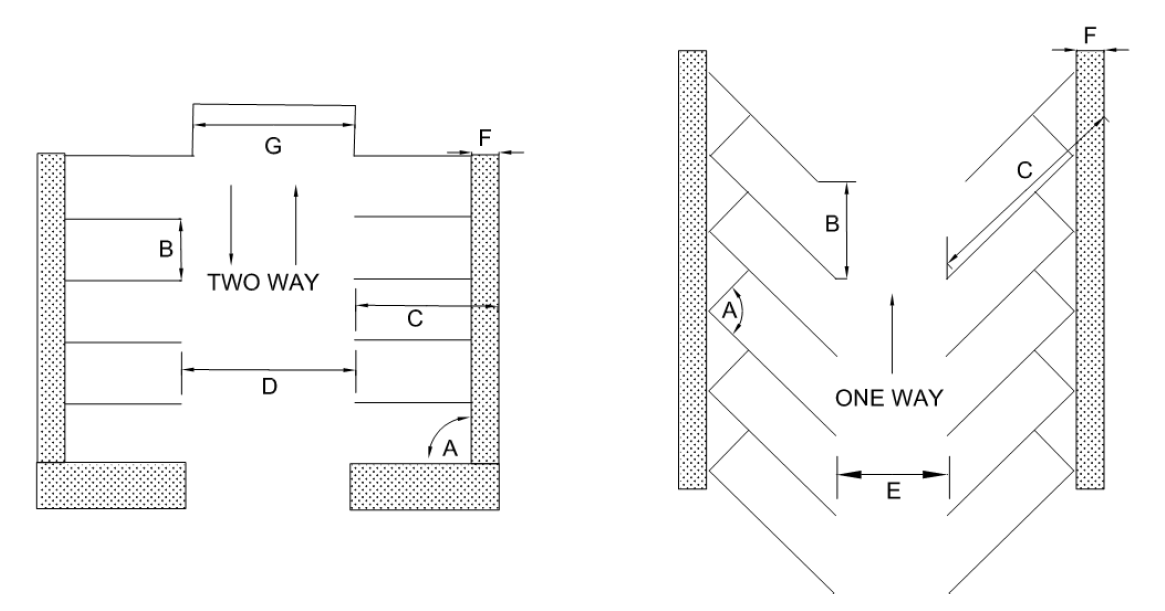
* Only allowed if there is no vehicle overhang onto a sidewalk, trail, path or similar pedestrian or bicycle corridor. If the overhang projects over or onto any pedestrian or bicycle corridor, the overhang width shall adhere to the standards in section 17.09.100. Where wheelstops are used, they shall be located within the parking stall to accommodate the required overhang. Wheelstops shall not be used in conjunction with curbs.
1.
Turn-around area. A turnaround area of five feet in depth and the same width of the drive aisle shall be provided for all dead-end parking drive aisles.
2.
Tandem parking spaces prohibited. All required parking spaces shall be individually accessible. Tandem parking for the purpose of meeting off-street parking requirements is prohibited with the exception of single family residential, home daycare and home-based businesses.
(Ord. No. 1742, § 1, 1-14-2020)
Sec. 17.10.010. - Requirements.
Whenever the normal operation of any development or use requires that goods, merchandise or equipment be routinely delivered to or shipped from that development or use, a sufficient off-street loading and unloading area must be provided in accordance with this chapter to accommodate the delivery or shipment operation in a safe and convenient manner.
(Ord. No. 1742, § 1, 1-14-2020)
Sec. 17.10.020. - Space requirements and standards.
A.
Standards for loading berths.
1.
The loading and unloading area must be of sufficient size to accommodate the numbers and types of vehicles that are likely to use the area, given the nature of the development or use. Loading spaces may be shared in shopping centers.
2.
The zoning administrator may require more or less spaces if necessary to satisfy this chapter. When seeking a reduction, the applicant shall submit a waiver request to the zoning administrator with a justification and statement of hardship. The zoning administrator may consider hours of operation, delivery schedules, size of delivery vehicles and other similar criteria when reviewing the request.
3.
Loading and unloading areas shall be located and designed so vehicles intended to use them can maneuver safely and conveniently to and from the public street right-of-way and complete their operations without interfering with any public right-of-way or parking space.
4.
Loading and unloading areas shall be located in the least visible area of the site, either behind or to the side of the structure. Loading spaces shall not be located in the front of the site or along public right-of-way unless the physical constraints of a site preclude the loading space from being placed in other areas of the parcel. Loading spaces should be screened if visible from public right-of-way or adjacent residential properties.
5.
Loading space dimensions. Required dimensions are as provided in table 17.10.1 below. Each loading berth shall provide not less than 14 feet vertical clearance.
Table 17.10.1: Required Number and Dimensions of Off-Street Loading Spaces
(Ord. No. 1742, § 1, 1-14-2020)
Sec. 17.11.010. - Landscaping requirements.
A.
Purpose. This section establishes minimum standards for landscaping and site design. The city encourages developers and landowners to exceed these minimums whenever possible. Landscape is an essential element of development and seeks to:
1.
Soften the urban form and visual appearance of parking lots, blank building walls, and other unsightly areas.
2.
Limit the amount of continuous impervious surface and provides the opportunity for integrated storm water facilities.
3.
Add shade to pavement that reduces the heat island effort.
B.
Required landscaping. All lots in all zoning districts not covered by impervious materials shall be landscaped to prevent land erosion, improper drainage, and damage to properties and unsightliness. All undeveloped building areas within partially developed commercial or industrial uses shall be landscaped with a ground cover to control dust and erosion. All development is required to obtain approval for landscape plans in accordance with these regulations, except existing lots with individual single family uses; provided that developer-installed landscaping in common areas of residential projects shall not be exempt. All landscape plans shall be designed or approved by a Colorado-registered landscape architect.
C.
Allowable landscape materials. Selection of plant materials shall be based upon Fountain's climate and soils. Native vegetation or low water usage vegetation on water conserving design concepts shall be used whenever possible. Minimum sizes and other requirements for plant material shall be as follows:
1.
Deciduous trees: two and one-half inch caliper.
2.
Evergreen trees: six feet.
3.
Shrubs: five gallon containers.
4.
Ground cover/perennial sizes shall be selected according to growth rate, spacing and the area to be covered.
5.
Thorne plant material shall not be located adjacent to public walks.
6.
Clear space above public walks shall be nine feet or greater.
7.
Artificial plants shall not be used to comply with the requirements of this section.
8.
No more than 50 percent of the required landscaped area can be covered by non-living landscaping material. For instance, if a one acre site is required to provide 20 percent landscaped area for a total of 8,712 square feet, then only one-half of the total landscaped area, or 4,356 square feet, may be covered by non-living landscaping material.
9.
The planting of any trees of the Ulmus genus (elm) is prohibited.
D.
Landscaped strip required.
1.
Minimum landscaping requirements for property lying adjacent to an expressway, freeway, or arterial street shall be as follows:
a.
A landscaped strip at least 15 feet in width, excluding driveways and walkways, shall be required along the entire perimeter area adjacent to the public right-of-way.
b.
Plant materials within the landscaped strip shall include one tree and two shrubs for every 20 feet of street frontage.
2.
Minimum landscaping requirements for property lying adjacent to a collector or local street shall be as follows:
a.
A landscaped strip at least ten feet in width, excluding driveways and walkways, shall be required along the entire perimeter area adjacent to the public right-of-way.
b.
Plant materials within the landscaped strip shall include one tree and two shrubs for every 20 feet of street frontage.
c.
Clustering of trees and shrubs in the landscaped strip is permitted, provided no tree shall be within five feet of another.
E.
Parking lot landscaping.
1.
A minimum of five percent of the gross area of all parking lots shall be landscaped. Landscaping shall be distributed throughout the parking area.
2.
A minimum of one deciduous tree shall be provided for every eight parking spaces and may be placed in a landscape island. All deciduous trees shall be a minimum of two and one-half inch caliper in size.
a.
Any landscaped area used for vehicular overhang shall not be counted towards the required landscaping.
b.
Screening for parking lots. Parking lots with 20 or more spaces shall be screened from adjacent uses and from public streets. Screening shall block at least 75 percent of the light from vehicle headlights. Screening from residential uses shall consist of a fence or wall six feet in height in combination with plant material.
F.
Easements. The layout of the landscaping shall not interfere with the function, safety or accessibility of any utility easement.
G.
Landscaped areas adjacent to streets, vehicular parking, and access areas shall be protected to minimize damage to landscaping areas by vehicular traffic.
H.
The zoning administrator may modify any of the landscape standards set forth in this section if such standard is inappropriate to a design proposal and the intent of this section is not violated. The applicant shall make a written request to the zoning administrator justifying the requested modification. A record of requested modifications shall be kept on file at the city.
I.
Maintenance.
1.
All landscaping shall be reasonably maintained, and any plant material shall be replaced within 30 days of its demise or by an agreed upon date if seasonal conditions prohibit replacement within the 30-day time requirement.
2.
The maintenance of landscaping in the public right-of-way in all zoning districts shall be the responsibility of the abutting property owner.
J.
Enforcement; assurances for installation and completion.
1.
Prior to the issuance of a certificate of occupancy for any structure or building where landscaping is required, all landscaping shall be installed according to the approved site development plan, and the work shall be inspected and approved by the zoning administrator. At the time of inspection for the certificate of occupancy, the zoning administrator shall check the quantities, sizes and locations of landscape materials. The developer shall warrant at the time of the issuance of a certificate of occupancy that the plants installed are of the species, quantities, locations and sizes specified on the approved site development plan.
2.
A certificate of occupancy for a structure or building may be obtained prior to the completion of required landscape improvements, if the completion is not possible due to seasonal or weather conditions and if the owner or developer escrows the necessary funds with the zoning administrator for the completion of the landscaping. Acceptable assurances for guaranteeing the completion of all landscape improvements include irrevocable letters of credit, certified checks, cash, or other assurances acceptable to the city in an amount equal to the cost of plant materials and installation work. Acceptable financial assurances shall be accompanied by written guarantees that such landscaping will be completed to the satisfaction of the zoning administrator within a specified period not to exceed nine months from the date of occupancy.
(Ord. No. 1742, § 1, 1-14-2020)
Sec. 17.11.020. - General fence regulations.
A.
No fence shall be allowed that will inhibit visibility and cause a safety hazard at street or driveway intersections.
B.
All fences shall be constructed in a substantial workmanlike manner and shall consist of standard fence material. All fences shall be maintained in a condition of reasonable repair and shall not be allowed to become and remain in a condition of disrepair, or constitute a nuisance.
C.
No fence shall be higher than seven feet, unless additional height is necessary by the zoning administrator for security, the screening of incompatible uses, required compliance with state or federal law or others deemed acceptable by the zoning administrator. Barbed wire or other sharp-pointed material shall not be used in the construction of any fence, except when:
1.
Located in commercial and industrial zoning districts, provided such barbed wire or other sharp-pointed material is securely affixed to the top of a soundly constructed fence or structural barrier which is at least six feet above grade.
2.
Used for agricultural purposes or fencing required for livestock, including horses, on areas five acres or greater in size.
D.
Electrified wire fences are prohibited in all zoning districts.
E.
A fence may be built on the property line, but shall not be allowed to encroach upon any public right-of-way. Knowledge of public rights-of-way is the responsibility of the property owner.
F.
No fence shall be placed closer to a fire hydrant than 36 inches, and it shall not restrict the operation or use of the hydrant.
(Ord. No. 1742, § 1, 1-14-2020)
Sec. 17.11.030. - Screening standards.
A.
The intent of all required screening is to completely hide stored materials from view of persons standing on the ground outside the storage area in the locations described in the particular section requiring the screening. If no particular location is specified it shall be interpreted as screened from view on all sides.
B.
Height. All trash/refuse collection and outdoor storage areas shall be enclosed at a minimum by a six-foot high solid, opaque fence or masonry wall, styled to match the material of adjacent walls or the main building on the site. No materials stored within an outdoor storage area or behind a screening fence, wall or structure shall be stacked or stored in a manner in which they exceed the height of the walls, fence, or structure.
C.
Materials. Screening walls, fences, or structures shall be constructed from durable materials, which will require low maintenance. Materials, which are architecturally compatible with the primary building on the site or with the streetscape or landscaping of the site, shall be used.
D.
Colors. Screening devices shall blend into the landscaping and shall not be colored as to direct attention to the screen. Muted earth tones shall be used as opposed to bright colors.
E.
Maintenance. All walls, fences, structures or landscaping shall be maintained in good condition.
(Ord. No. 1742, § 1, 1-14-2020)
Sec. 17.11.040. - Buffering and transition between land uses.
A.
Conditions whereby building setbacks may be increased. The required minimum setbacks in any zoning district may be increased by the zoning administrator, planning commission or city council based on any of the following conditions:
1.
The use creates an adverse effect on traffic and pedestrian circulation, where such circulation is necessary to ensure the safety of people and property in relationship to existing uses.
2.
The use creates an adverse effect on solar access of surrounding properties.
3.
The use creates adverse shadow problems on public rights-of-way.
4.
The siting of the use adversely impacts the abutting property, and re-siting of the use will not decrease the total gross floor area of the proposed structure.
5.
The use creates nuisances such as dust, litter, noise or glare of lights.
(Ord. No. 1742, § 1, 1-14-2020)
Sec. 17.12.010. - Purpose and intent.
A.
The purpose of this chapter is to:
1.
Promoting safety of persons and property by regulating signs so as not to confuse or distract motorists or impair drivers' ability to see pedestrians, obstacles, other vehicles, or traffic directional signs;
2.
Promoting efficient communication of messages;
3.
Promoting the public welfare by reducing visual clutter;
4.
Assisting in wayfinding; and
5.
Providing fair and consistent enforcement.
(Ord. No. 1742, § 1, 1-14-2020)
Sec. 17.12.020. - Applicability.
A.
Requirements. A sign may be displayed, erected, placed, established, painted, created, altered or maintained in the city only in conformance with the standards, procedures, exemptions, and other requirements of this chapter.
B.
If any provision of this chapter conflicts with any other adopted city code that regulates signs, this chapter shall govern.
C.
Signs shall be permitted in the various zoning districts as accessory structures in accordance with the regulations contained in this chapter.
D.
Interpretation. The zoning administrator is authorized to render interpretations of this chapter.
E.
Permit required. A sign permit is required for any new sign or modification to an existing sign, unless the sign is exempt from the regulations of this chapter in accordance with section 17.12.040. A sign application shall be submitted to the planning department and a sign permit issued by the zoning administrator under criteria set forth in this chapter. Additional permits may be required, such as building or electrical permits, in conjunction with the sign permit application.
F.
All sign permit applications shall be submitted on a form supplied by the planning department and include, at a minimum, the following information:
1.
Street address of the proposed sign.
2.
Actual shape and dimensions of the lot.
3.
Building locations, height and dimensions.
4.
Size, height, location, setback and type of both existing and proposed signs.
5.
Name, mailing address (and e-mail address if available) and telephone number of owner and sign installer.
6.
Existing zoning.
7.
Elevation drawings of the proposed sign.
8.
Location of existing signs on the property and on adjoining properties.
9.
Additional information as the zoning administrator may reasonably deem necessary to process the application in accordance with the provisions of this chapter.
G.
An approved sign permit expires one year from the date of issuance if a building permit for the sign or structure(s) on the property has not been issued or the sign has not been installed. One, six-month extension may be granted by the zoning administrator for good cause.
1.
Applicant shall contact the planning department for an initial inspection prior to sign installation. The applicant shall stake the location of the property line, sign pole and overhang location.
2.
Applicant shall contact the planning department for a final site inspection upon completion of sign installation.
H.
Sign permits are required for temporary signs, as follows:
1.
A sign permit is required for temporary signs located in all nonresidential zone districts.
2.
A sign permit for an individual temporary sign shall be issued for a duration not to exceed the timeframes established by temporary sign type in section 17.12.070. A temporary sign permit that contains a sign plan for multiple signs may be issued, with individual temporary sign durations not to exceed the timeframes established by temporary sign type in section 17.12.070.
I.
A temporary sign permit shall not be required for temporary signs located in residential zone districts. Temporary signs are not permitted in the public right-of-way.
J.
Master sign plan. For any shopping center, industrial or business park or mixed use development. Shopping centers, as it pertains to master sign plans, must include at least 25,000 square feet of gross floor area as well as include at least three or more units. The applicant shall submit a master sign plan that consists of coordinated, shared signage for the entire development.
1.
Signs in the master sign plan shall have mutually unifying elements, which may include uniformity in materials, color, size, height, letter style, sign type, shape, lighting, location on buildings, and design motif.
2.
A master sign plan application shall include all of the following:
a.
A table allocating sign area to each tenant, lot or pad site;
b.
A description and/or illustration of the materials to be used in wall signage; and
c.
Elevations and materials for any standard signs for the site.
3.
In reviewing an applicant's submittal of a master sign plan in conformance with the provisions of this section, the zoning administrator may vary the following standards:
a.
Sign area for individual signs, and maximum sign area for all allowable signs;
b.
Sign height for individual signs;
c.
Sign setback or separation between freestanding pole or monument signs; and
d.
Maximum number of signs, types of signs, or approved wall areas for purposes of sign location.
e.
In exchange for a creative and quality design, one of the above-listed standards may be altered up to 25 percent at the discretion of the zoning administrator. The zoning administrator may approve a greater change in a dimensional standard based on the applicant demonstrating that the change is warranted by a master sign plan and development that represents an exceptional design, the use of quality materials, increased landscaping, and/or other amenities.
K.
Non-conforming signs. Existing signs for which a sign permit was issued pursuant to the previous provisions of this chapter, and which have become non-conforming because of subsequent amendments to said chapter, shall be maintained in good condition and no such sign shall be:
1.
Structurally changed or altered, except to meet safety requirements.
2.
Re-established after damage or destruction if the estimated cost of reconstruction exceeds 50 percent of the total structure, as determined by the zoning administrator.
3.
If a sign is modified or altered beyond that allowed and noted above, the non-conforming sign shall be brought into compliance.
L.
Signs in the right-of-way. Government-owned signs are permitted within the public right-of-way temporarily and permanently.
(Ord. No. 1742, § 1, 1-14-2020)
Sec. 17.12.030. - Exempt signs.
A.
The following signs are exempt from the sign permit requirements of these regulations, and may be placed in any zoning district subject to the provisions of this chapter. Exempt signs shall otherwise be in conformance with all applicable requirements of this chapter, and the construction and safety standards of the city.
1.
Signs erected by, on behalf of or pursuant to the order or authorization of a governmental entity, including but not limited to traffic control, legal notice, and ADA compliance signs.
2.
On premise site signs, which are not illuminated, in nonresidential and mixed use zone districts less than six square feet in sign area (as defined in section 17.12.090).
3.
On premise site signs, which are not illuminated, in residential zone districts less than four square feet in sign area shall also meet the following requirements:
a.
A maximum of one yard sign per residential property;
b.
Three additional signs per residential property during the nine weeks before an election, extending for one week after an election;
c.
Signs shall not be illuminated;
d.
Signs shall not exceed three feet in height.
4.
Signs erected by public utility companies, oil and gas companies, construction companies and the like, to warn of danger or hazardous conditions.
5.
Any sign displayed on a window of a building that is not visible through a window from a public right-of-way.
6.
Murals, as defined in section 17.12.090.
7.
Temporary and seasonal decorations and displays.
8.
Signs carried by a person and not set on or affixed to the ground.
9.
Flags. Flagpoles shall not exceed 30 feet in height.
10.
One on premise sign per properly-licensed home-based business, in addition to the site signs allowed by this chapter, and shall also comply with the following requirements.
a.
The sign may be placed on the wall of any structure or fence or mounted in the yard.
b.
Signs shall not exceed four square feet in area.
c.
Signs placed in the yard may not exceed three feet in height.
d.
Signs placed on fences may not be placed higher than the top of the fence.
e.
Signs placed on buildings shall be no higher than the roof or parapet line.
f.
No home-based business sign shall be electrical or illuminated, animated or constructed of reflective materials.
11.
Changeable copy. No permit is required for the changing of an advertising copy or message on a lawfully erected, painted or printed sign, theater marquee, or similar signs specifically designed for the use of changeable copy.
(Ord. No. 1742, § 1, 1-14-2020)
Sec. 17.12.040. - Prohibited signs.
The following signs are prohibited, except as noted:
A.
All signs not expressly permitted under this chapter or exempt from regulation in accordance with the previous section are prohibited in the city.
B.
Searchlights or similar devices, except as used by law enforcement or other governmental actors or agents performing their official duties
C.
Off-premise signs, as defined in section 17.12.090, apart from those exceptions listed in section 17.12.060.
D.
Signs that emit any sound which is intended to attract attention.
E.
Signs attached to trees or other plant materials.
F.
Unlawful vehicle sign.
G.
No sign shall be attached to any utility pole or traffic control device. No sign shall be placed on any city property, any street, sidewalk or other public right-of-way.
H.
In no event shall the minimum setback for a sign be less than four feet from the edge of roadway, unless otherwise approved by the city engineer.
I.
In no event shall the following temporary sign types be permitted in the public right-of-way:
1.
Balloons, blimps and inflatable displays;
2.
Banners including wave banners; and
3.
Off-premise signs, except as allowed by this chapter.
J.
No sign shall obstruct the use of sidewalks, walkways, bike and hiking trails, the visibility of vehicles, pedestrians or traffic control signs, or another pre-existing lawful sign. No sign shall be permitted which may obstruct the view in any direction at the intersection of a street with another street, alley or driveway. Signs, other than government-owned signs, shall be prohibited in the traffic circles and medians. All signs shall be, at a minimum, subject to the visibility provisions of section 17.08.030.
K.
No sign shall be permitted which may contribute to confusion of traffic control devices or emergency service vehicles, or which hide or interfere with the effectiveness of such devices or vehicles.
L.
Any sign within the public right-of-way that poses a safety hazard such as signs that have fallen over, are in a state of disrepair, are torn or faded or have otherwise been defaced to where the content of the sign is no longer legible, may be removed by the city.
(Ord. No. 1742, § 1, 1-14-2020)
Sec. 17.12.050. - Sign measurement.
A.
Computation of sign area.
1.
The area of a sign face shall be computed by means of the smallest square, circle, rectangle, triangle, or combination thereof that will encompass the extreme limits of the message, logo, symbol, name, photograph, writing, representation, emblem, artwork, figure or other display used to differentiate the sign from the backdrop or structure against which it is placed (see figure 17.12.1).
2.
Any supporting framework, bracing, poles, fence or wall, or architectural feature or landscape element shall not be computed as sign area.
3.
All sign faces visible from one point shall be counted and considered part of the maximum total sign area allowance for a sign; when two identical sign faces are placed back to back and are not more than 42 inches apart, the sign area shall be computed by the measurement of one of the sign faces.
Figure 17.12.1: Sign Measurement Detail

B.
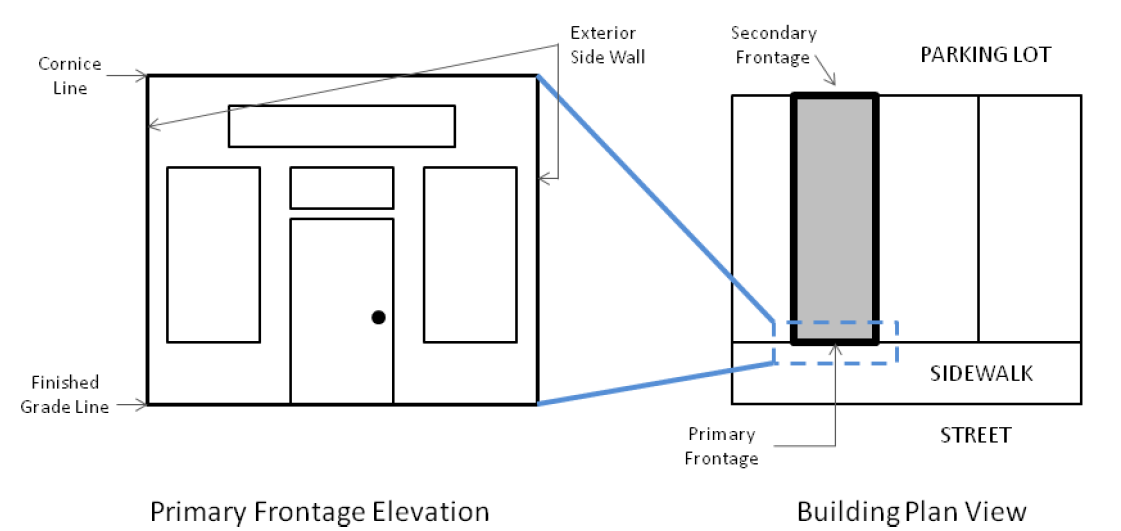
Computation of facade area. The surface area of the building elevation found within the perimeter bounded by the finish grade line, the cornice line, and exterior side walls, not including intermediate walls perpendicular to such surface as owned or leased by a business.
Figure 17.12.2: Facade Area
C.
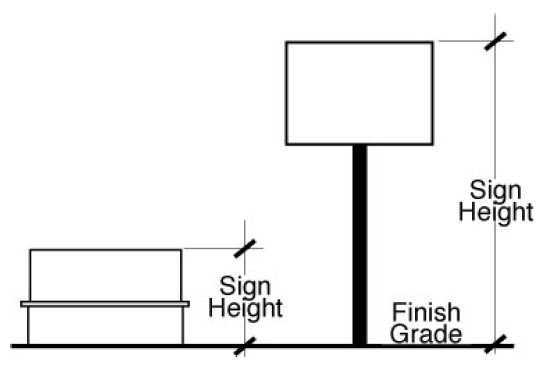
Computation of sign height. The height of any sign shall be determined by the distance between the top most portion of the sign structure and the average ground elevation at the base of the sign (see figure 17.12.3). The grade shall not be artificially changed solely to affect the sign height measurement.
Figure 17.12.3: Sign Height Detail
D.
Number of permitted on-premise signs. Each individually-licensed business establishment may have a maximum of one primary sign and one secondary sign located upon its licensed premises as described in tables 17.12.1 and 17.12.2 below. These signs may be approved on elevations other than those directly facing the primary or secondary frontage; however, sign dimensions, including sign area and letter height, shall be calculated based on the facade area on which the sign is attached.
Table 17.12.1: Primary Sign Area
Table 17.12.2: Secondary Sign Area
1.
For a nonresidential use located within a one-quarter mile radius of an interstate highway interchange, one on-premise freestanding pole sign with a sign area of up to 480 square feet is permitted in addition to the allowed number of permitted on-premise signs provided that such sign is located upon property with the written consent of the property owner and is otherwise in compliance with the Colorado Outdoor Advertising Act and the regulations promulgated thereunder.
2.
The allowable sign area for exempt signs listed in section 17.12.030 shall not be included in sign area calculations.
(Ord. No. 1742, § 1, 1-14-2020)
Sec. 17.12.060. - Standards for specific permanent sign types.
A.
General. The following standards are applicable to all permanent signs:
1.
Sign identification. All permanent signs shall be identified by a label, nameplate or trademark identifying the manufacturer and/or installer of the sign to permit the city to contact the same in the event that the sign design, fabrication or installation causes a threat to the public health, safety or welfare.
2.
Owner consent. No sign permit for any permanent sign shall be issued for any sign on private property without written consent of the property owner or the owner's authorized agent.
3.
Location. All signs shall be located on property owned or controlled by the person or entity locating and in control of the sign, except as otherwise allowed by this chapter. In addition, signs may be located as determined below:
a.
Multiple businesses within common building. When multiple business are within one building, the calculation of permissible sign area for an individual business shall be based upon the portion of the building facade area controlled by that business.
b.
Businesses with no frontage. In those instances where a business has no frontage on any street, the zoning administrator may approve one exterior wall sign not to exceed 15 square feet.
4.
Lighting. Lighting for signs shall be held to the minimum needed to convey the sign's message and illuminate only the intended sign. The light from any light source intended to illuminate a sign shall be so shaded, shielded or directed so that the light intensity or brightness shall not cause glare to adversely affect surrounding properties, or cause glare to adversely affect safe vision of pedestrians or operators of vehicles moving on public or private streets, driveways or parking areas.
5.
Overhangs. The lowest point of a sign that extends over an area intended for pedestrian or vehicle area shall not be less than nine feet above the finished grade below it.
6.
Sign types allowed by use. Specific sign types are allowed for residential and nonresidential uses as noted in this chapter. Sign type examples are provided in figure 17.12.4 below.
Figure 17.12.4: Sign Type Examples
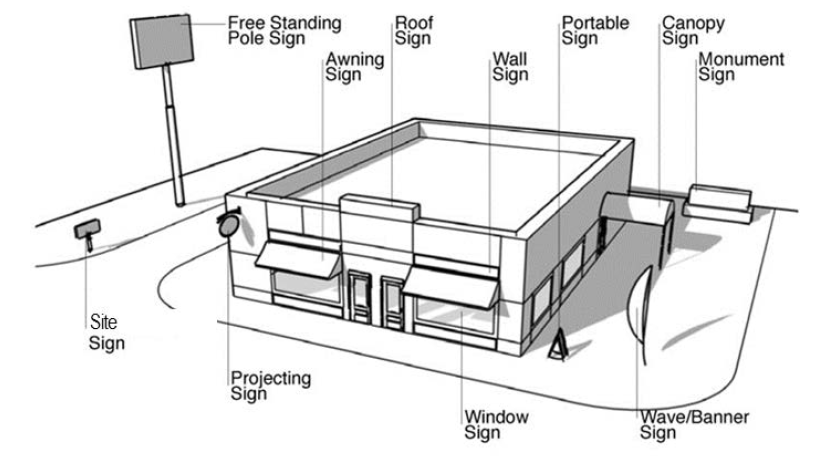
B.
Awning signs.
1.
Location. Awning signs are only allowed in nonresidential zone districts. Signs may be placed only on awnings that are located on first- and second-story building frontages, including those fronting a parking lot or pedestrian way. An awning may include a printed or mounted sign. No sign mounted to an awning shall project beyond, above or below the face of an awning.
2.
Height. No structural element of an awning shall be located less than nine feet above finished grade. Awnings on which signs are printed or mounted shall not extend over a public right-of-way more than seven feet from the face of a supporting building. No awning shall extend above the roof line of any building.
3.
Lighting. Awnings shall not be internally illuminated. Lighting directed downwards that does not illuminate the awning is allowed.
Figure 17.12.5: Awning Sign Detail
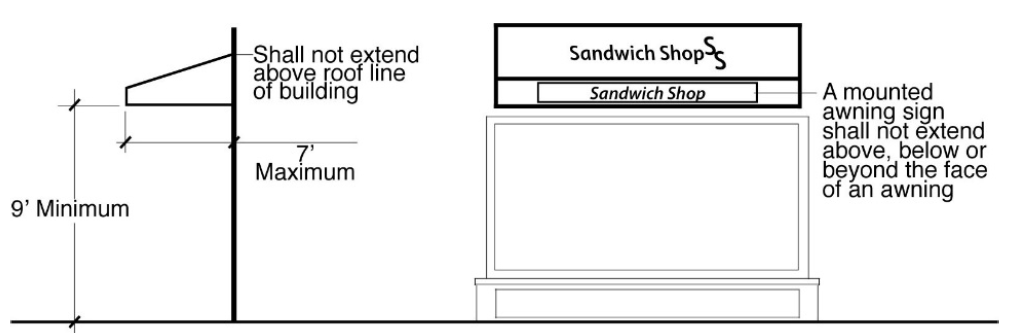
C.
Canopy signs.
1.
Height. No canopy shall extend above the roof line of any building, except in the case of fueling stations. No canopy sign shall project above the top of the canopy upon which it is mounted. However, a sign may project horizontally from the face of a canopy the distance necessary to accommodate the letter thickness and required electrical equipment, but not more than 12 inches.
Figure 17.12.6: Canopy Sign Detail
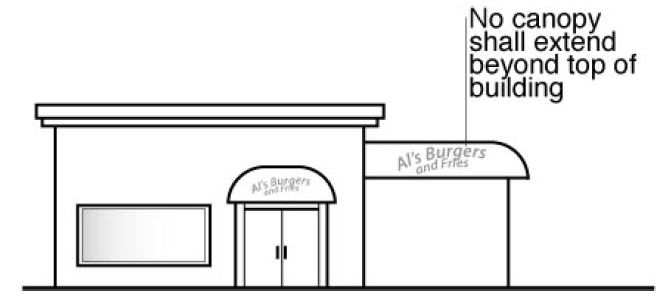
D.
Electronic message centers (EMCs).
1.
Location. EMCs signs are only allowed in nonresidential zones and educational institutions. An electronic message center may be integrated into an on-premise, wall sign or freestanding pole or monument sign only. Existing signage proposed for conversion to the use of an EMC shall conform to the sign standards in this chapter prior to issuance of a sign permit. Non-conforming signs shall not be eligible for conversion to an EMC.
2.
Height. The sign shall comply with the quantity, area and height requirements established for wall sign or freestanding pole or monument signs below. The maximum size of an EMC on any individual sign shall not exceed 50 percent of allowable sign area. EMCs shall not be eligible for the bonus provided in section 17.12.020 for master sign plans.
3.
Lighting. Lighting from the electronic message center shall not exceed 0.3 foot-candles between dusk to dawn as measured from the sign's face. The EMC shall have automatic dimmer software or solar sensors to control brightness for nighttime viewing. The intensity of the light source shall not produce glare, the effect of which constitutes a traffic hazard or cause glare to adversely affect safe vision of pedestrians. Documentation shall be provided from the sign manufacturer which verifies compliance with auto dimming and brightness requirements.
4.
Transition method. The electronic message center shall be limited to static messages, changed only through either dissolve or fade transitions, which may otherwise not have movement, or the appearance or optical illusion of movement, of any part of the sign structure, design, or pictorial segment of the sign, including the movement of any illumination or the flashing scintillating or varying of light intensity.
5.
Transition duration. The transition duration between messages shall not exceed one second.
6.
Message hold time. The message hold time shall be a minimum of ten seconds.
Figure 17.12.7: Electronic Message Center Detail
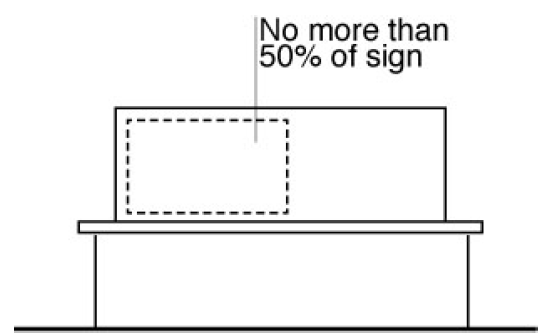
E.
Freestanding pole signs.
1.
Location. Freestanding pole signs are only allowed in nonresidential zone districts. The sign shall be located on a site frontage adjoining a public or private street, easement or right-of-way. No freestanding sign can be erected closer than ten feet from any property line, or closer than four feet to any building (see figure 17.12.8). No freestanding signs shall be located less than 25 feet from any property line adjacent to a residential zoning district line.
2.
Height. Not to exceed 30 feet.
3.
Maximum size. No freestanding sign shall exceed 50 square feet of area per face.
4.
Landscaping. Landscaping shall be provided at the base of the supporting structure in an appropriate amount to be determined by the zoning administrator during review of a sign plan. The zoning administrator may waive this requirement if it is determined that the landscaping would not contribute significantly to the overall aesthetic character of the project, or if physical conditions of the site would preclude all or a portion of the landscaping.
Figure 17.12.8: Freestanding Pole Sign Detail
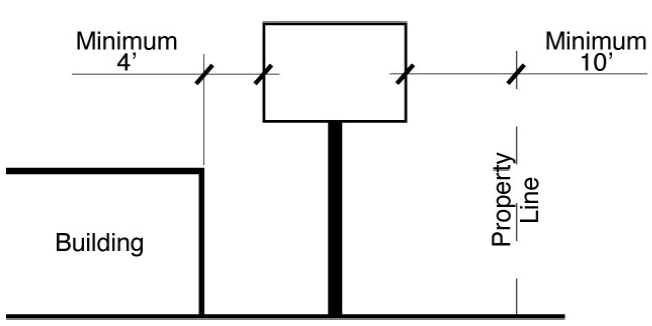
F.
Monument signs.
1.
Location. Monument signs in nonresidential zone districts shall follow the sign area allowances described in section 17.12.050. Monument signs in a residential subdivision are allowed one, 32-square-foot sign located at one vehicular entry to the platted subdivision. The sign shall be located on a site frontage adjoining a public or private street, access easement or right-of-way. The minimum setback from any property line shall be equal to the height of the sign. When located near driveways or intersections, signs shall maintain a clear sight triangle. Upon approval of the zoning administrator, a monument sign can be integrated into a fence or wall.
2.
Height. Shall not exceed eight feet at finished grade for nonresidential zone districts and six feet for residential zone districts.
3.
Landscaping. Landscaping shall be provided at the base of the supporting structure equal to twice the area of one face of the sign. For example, 20 square feet of sign area equals 40 square feet of landscaped area. The zoning administrator may reduce or waive this requirement if it is determined that the additional landscaping would not contribute significantly to the overall aesthetic character of the project, or if physical conditions of the site would preclude all or a portion of the landscaping.
Figure 17.12.9: Monument Sign Detail
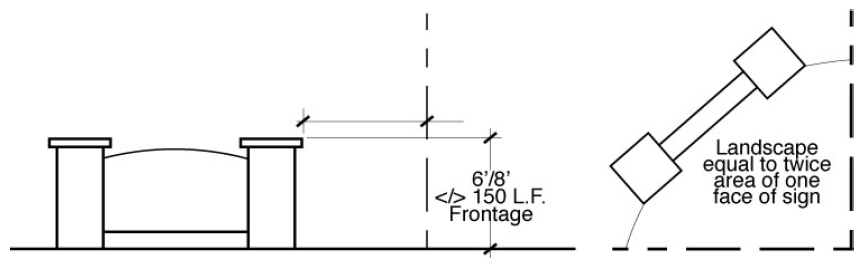
G.
Off-premise signs. No off-premise signs are permitted with the exception of:
1.
Signs within a shopping center established through a master sign plan per section 17.12.020.
2.
Certain temporary signs as described in section 17.12.070.
3.
Billboards existing prior to the adoption of Ordinance Number 785.
H.
Projecting signs.
1.
Location. Projecting signs are only allowed in nonresidential zone districts. Projecting signs shall be placed on a ground floor facade, except for businesses located above the ground level with direct exterior pedestrian access. The sign shall not extend more than four feet from the building wall.
2.
Height. Projecting signs shall not be higher than the wall from which the sign projects if attached to a single story building, or the height of the bottom of any second story window if attached to a multi-story building. Projecting signs shall have a minimum of nine feet clearance.
Figure 17.12.10: Projecting Sign Detail
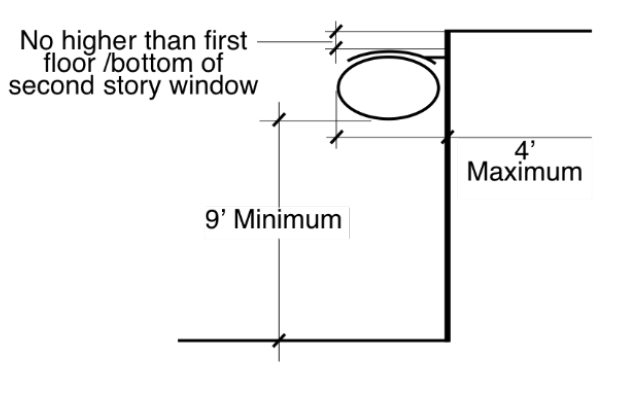
I.
Roof signs.
1.
Location. A permanent roof sign may be permitted in nonresidential zone districts subject to approval by the zoning administrator, based on the following criteria:
a.
The nature of the use, the size of the site or other physical constraints results in a situation where either a wall or freestanding sign cannot be installed without practical difficulties.
b.
The negative impact on the visual character of the site or surrounding area resulting from the installation of a roof sign can be minimized through the use of quality materials and compatible colors.
c.
The sign is not a temporary sign, and does not include an EMC.
2.
Height. No higher than four feet above the roofline, parapet or fascia wall on a flat roof. No higher than roofline on a peaked or mansard roof.
Figure 17.12.11: Roof Sign Detail
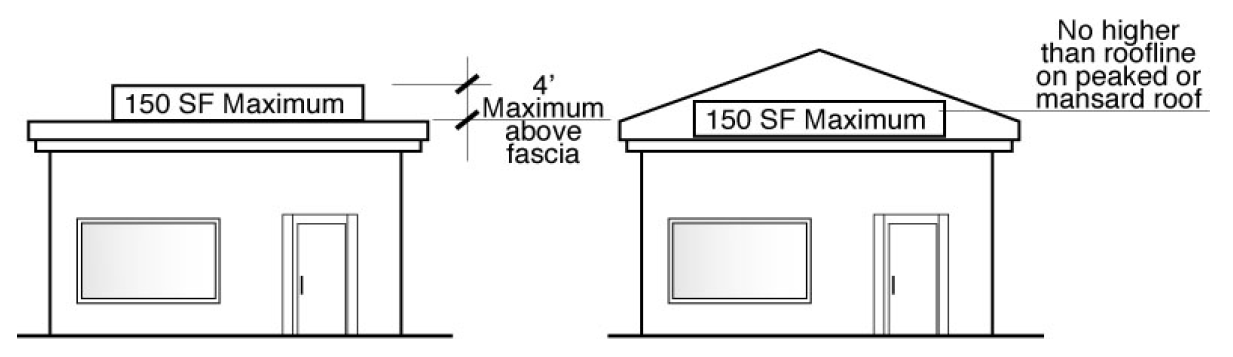
J.
Wall signs.
1.
Location. Wall signs are only allowed in nonresidential and mixed use zone districts, excepting those signs exempted pursuant to section 17.12.030. The sign shall not be placed to obstruct any portion of a window, doorway or other architectural detail. No sign part, including cut-out letters, may project from the building wall more than required for construction purposes and in no case more than 12 inches.
2.
Height. Wall signs shall not be higher than the eave line of the building on which they are placed.
K.
Window signs.
1.
Maximum coverage. When a sign is displayed in a window and is visible beyond the boundaries of the lot upon which the sign is displayed, the total area of such sign shall not exceed 50 percent of the window or door area at the ground floor level. If this provision conflicts with the allowed primary or secondary sign size, this provision shall prevail.
Figure 17.12.12: Window Sign Detail
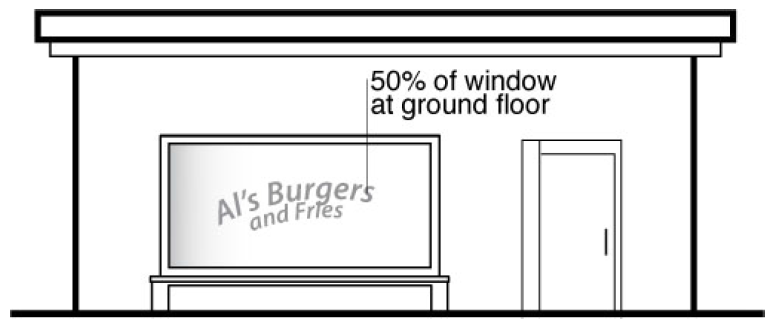
L.
Additional site signs located in nonresidential and mixed use zoning districts may be illuminated and shall not count towards the primary and secondary sign area, provided:
1.
Each sign does not exceed six square feet.
2.
If freestanding, does not exceed three feet in height. Not located above fence or roofline if affixed to a structure or fence.
3.
Otherwise complies with the requirements of this chapter, including but not limited to, lighting and window coverage.
(Ord. No. 1742, § 1, 1-14-2020)
Sec. 17.12.070. - Temporary signs.
A.
General. The following applies to all temporary signs:
1.
Unless otherwise provided for in this section, temporary signs shall not be displayed for a time period exceeding ten weeks in a calendar year. A longer time period may be approved by the zoning administrator on a case-by-case basis.
2.
Display time may be any combination of consecutive days or weekend periods in a calendar year.
B.
Balloons, blimps and inflatable displays.
1.
Balloons, blimps, or other inflatable displays are allowed for grand openings and special events within any zoning district.
2.
Balloons, blimps and other inflatable displays shall be securely anchored or tethered to the ground, building or structure.
C.
Banners.
1.
Residential zoning districts and uses.
a.
Banners in residential zone districts shall not exceed one-fifth square feet of area per lineal foot of property line on residentially or mixed use zoned lots, up to a maximum area of 100 square feet;
b.
However, no one banner shall exceed 32 square feet in area.
2.
Nonresidential and mixed use zoning district uses.
a.
Banners in nonresidential zone districts shall not exceed one and one-half square feet for each linear foot of exterior wall.
3.
Allowable square footage can be split among several banners or allocated to one single banner.
4.
No banner shall be illuminated, animated or constructed of reflective materials.
5.
Each banner must remain firmly attached to the building, structure or other apparatus (e.g. Fences, t-posts, poles, etc.) from which it is displayed.
6.
Banner display shall comply with section 17.12.020; banners shall not be attached to vehicles.
D.
Site signs.
1.
Sites under construction.
a.
One sign shall be allowed per lot.
b.
Sign size.
i.
In nonresidential and mixed use zoning districts, the sign shall not exceed 32 square feet in area.
ii.
In residential zoning districts, the sign shall not exceed 16 square feet in area.
c.
The sign shall be setback a minimum of ten feet from any property line, and shall not exceed six feet in height.
d.
Such signs shall not be erected until a building permit has been issued for the building or structure on the lot.
e.
This temporary sign shall be removed within 14 days after the issuance of a certificate of occupancy for the building or structure.
Figure 17.12.13: Temporary Site Sign Detail
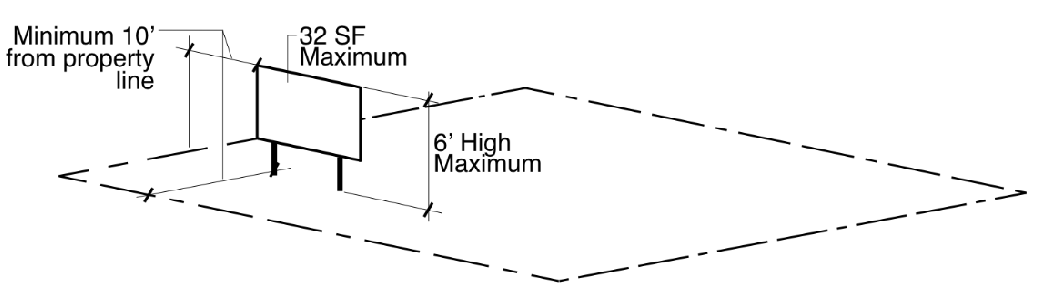
2.
Developed sites.
a.
Nonresidential and mixed use zone districts shall be allowed site signs in accordance with section 17.12.030 for exempt signs and 17.12.060, Standards for Specific Permanent Sign Types, as applicable.
b.
Residential zone districts shall be allowed site signs in accordance with section 17.12.030 for exempt signs.
E.
Swing signs.
1.
Residential zoning districts and uses.
a.
One sign not to exceed up to six square feet in area.
b.
Signs shall not extend into the public right-of-way.
Figure 17.12.14: Temporary Residential Swing Sign Details
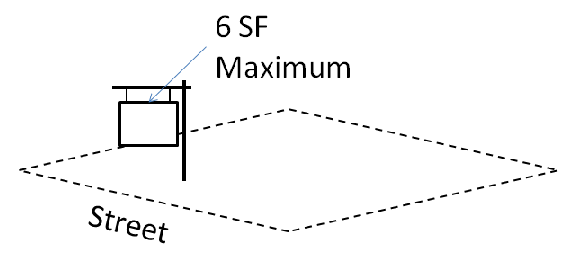
2.
Nonresidential and mixed use zoning districts and uses.
a.
One sign per street frontage not to exceed 32 square feet in area per face.
b.
Signs shall not extend into the public right-of-way.
Figure 17.12.15: Temporary Nonresidential Swing Sign Details
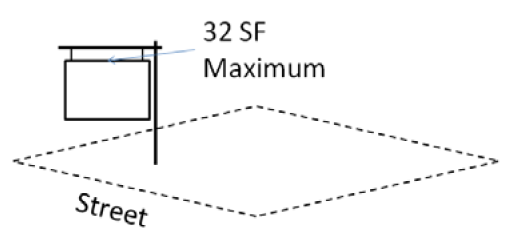
F.
Portable signs.
1.
Nonresidential and mixed use zone districts.
a.
Portable signs shall be securely anchored to the ground, a building, or structure, and weighted sufficiently to prevent movement by wind.
b.
Portable signs may be displayed only during the business hours of the holder of the temporary sign permit.
c.
No more than one portable sign shall be permitted per business, per street frontage.
d.
A portable sign shall not exceed 16 square feet in area.
e.
A portable sign shall not exceed four feet in height.
(Ord. No. 1742, § 1, 1-14-2020)
Sec. 17.12.080. - Sign design, installation and maintenance.
A.
Sign design.
1.
The design of a sign shall logically relate to the average speed of the motorists who will see it. Signs shall not be distracting or unsafe to motorists reading them.
2.
All signs shall be designed to complement or enhance the other signs for a building or development. Whenever possible, signs located on buildings with the same wall elevation shall be placed at the same height, in order to create a unified sign band.
B.
Sign installation.
1.
All permanent signs and all components thereof, including sign structures and sign faces, shall be installed in compliance with all building and electrical codes.
2.
Except for flags, window signs, portable signs and temporary signs conforming to the requirements of this chapter, all signs shall be constructed of high quality durable materials and shall be permanently attached to the ground, a building, or another structure by direct attachment to a rigid wall, frame, or structure.
C.
Sign maintenance.
1.
All signs shall be maintained in good structural condition, in compliance with all building and electrical codes, and in conformance with this chapter, at all times.
2.
All signs, including sign structures and sign faces, shall be kept neatly painted, including all metal parts and supports that are not galvanized or of rust-resistant metals, and in a general state of good repair. For the purposes of this section, good repair shall mean that there are no loose, broken, torn or severely weathered portions of the sign structure or sign face or fading of the sign such that the sign message is no longer legible.
3.
Any permanent sign that is located on property held in common ownership, such as a home owners association, shall be placed within a sign easement or sign tract that is recorded in the office of the El Paso County Clerk and Recorder with ownership and maintenance provisions specified.
4.
Any sign located upon a nonresidential premise that has not been occupied or in operation for a consecutive period of 180 days shall be deemed as abandoned and shall be promptly removed.
5.
The zoning administrator may inspect any sign and shall have authority to order the painting, repair, alteration or removal of a sign and/or sign structure that constitutes a hazard to safety, health or public welfare by reason of abandonment or inadequate maintenance, dilapidation or obsolescence.
6.
All EMC displays shall be equipped with a malfunction display and the ability to automatically shut off if a malfunction occurs. An electronic message center under repair shall be shut off.
(Ord. No. 1742, § 1, 1-14-2020)
Sec. 17.12.090. - Definitions specific to signs.
A.
As used within this section, the following terms, phrases, words and their derivations shall have the following meanings:
Animated sign. Any sign which has any visible moving part, flashing lights, visible mechanical movement of any description, or other apparent visible movement achieved by any means that move, change, flash, or visibly alters in appearance in a manner that is not permitted by this chapter.
Awning sign. A wall sign which is painted, stitched, sewn or stained onto the exterior of an awning. An awning is a movable shelter supported entirely from the exterior wall of a building and composed of non-rigid materials except for the supporting framework.
Banner. A temporary sign having characters, letters, illustrations or ornamentations applied to flexible material (e.g. vinyl, plastic, canvas, cloth, fabric or other lightweight non-rigid material) with only such material for a backing, which may project from, hang from or be affixed to a building, structure or other device such as fences, t-posts or poles. Banners include but are not limited to building decals, cable-hung banners and wave banners.
Canopy sign. A wall sign that is permanently affixed to a roofed shelter supported by a building, or combination of a building and columns.
Changeable copy. A portion of a sign copy which may be easily changed by mechanical or manual means or lighting effects without reworking, repainting, or otherwise altering the physical composition of the sign for the primary objective of displaying frequently changing copy incident to the sign owner's business.
Electronic message center (EMC). A sign that is capable of displaying words, symbols, figures or images that can be electronically or mechanically changed by remote or automatic means, including animated graphics and video.
Freestanding pole sign. Any non-moveable sign, not affixed to a building, with poles or supports.
Message hold time. The time interval a static message must remain on the display before transitioning to another message.
Monument sign. A freestanding sign with the entire bottom of the sign affixed to the ground.
Mural. A picture or graphic illustration applied directly to a wall of a building that contains no text.
Non-conforming sign. Any sign that does not conform to the requirements of this chapter.
Off-premise sign. A stationary sign or billboard located off the premises of the principle business or use conducted by the holder of the sign permit.
On-premise sign. A sign located on the premises owned or controlled by the person or entity proposing or controlling the sign.
Permanent sign. Any sign constructed of permanent materials and permanently attached to the ground, a building, or another structure by direct attachment to a rigid wall, frame, or structure.
Portable sign. A moveable sign that is not permanently affixed to a building, structure, or the ground.
Primary frontage. The side of the building providing the main vehicle and/or pedestrian access, and/or the business primary orientation.
Primary sign. A sign on the primary frontage of the building.
Projecting sign. A sign that is wholly or partly dependent upon a building for support and which projects horizontally beyond the surface of the building to which the sign is attached.
Roof sign. A sign on or above a roof of a building or structure.
Secondary frontage. The side of the building other than the main vehicle and/or pedestrian access.
Secondary sign. A sign on the secondary frontage of the building.
Sign. Any material, structure, or device, or part thereof, composed of letter or pictorial matter, or on which lettered or pictorial matter is placed when used or located outside or on the exterior of any building, including an inside window display area, and includes sign frames, billboards, readerboards, sign boards, painted wall signs, hanging signs, illuminated signs, pennants, fluttering devices, projecting signs or ground signs when the same is placed in view of the general public.
Sign area. The total display surface of a sign, exclusive of frames, posts and other supporting structure. Each side, or face, of a sign shall be measured in determining the sign area.
Sign height. The distance between the top most portion of the sign structure and the average ground elevation at the base of the sign.
Sign structure. Any supports, uprights, braces, or framework of a sign.
Site sign. A type of sign that is attached to the building, as projecting or wall signs, suspended from a canopy, or included as an integral part of a freestanding sign.
Swing sign. A temporary portable sign constructed of paper, vinyl, wood, metal or other comparable material, and designed or intended to be displayed for a limited period of time.
Temporary sign. Any banner, blimp, wind or fan-driven sign, or other sign constructed of light fabric, cardboard, wallboard, plywood, sheet metal, paper or other light materials, with or without a frame, intended or designed to be displayed for a limited period of time.
Traffic control sign. A sign erected in a public right-of-way by an authorized governmental agency for the purposes of traffic regulation and safety.
Transition duration. The time interval it takes the display to change from one complete static message to another complete static message.
Transition method. A visual effect applied to a message to transition from one message to the next. Transition methods include:
1.
Dissolve—A frame effect accomplished by varying the light intensity or pattern, where the first frame gradually appears to dissipate and lose legibility simultaneously with the gradual appearance and legibility of the second frame.
2.
Fade—A frame effect accomplished by varying the light intensity, where the first frame gradually reduces intensity to the point of not being legible (i.e. Fading to black) and the subsequent frame gradually increases intensity to the point of legibility.
Unlawful vehicle sign. A vehicle or trailer parked so as to be visible from a street for more than 24 hours and have the effect of directing attention to a business or profession, to a commodity or service sold, offered or manufactured, or to an entertainment offered on the premises where the vehicle or trailer is located or to another location, except vehicles regularly operated as part of the business and leaving the business premises on a regular basis for a business purpose and when the primary purpose of such vehicles shall not be for the display of signs.
Wall sign. A sign painted on or affixed to the building wall, or any sign consisting of cut-out letters or devices affixed to the building wall with no background defined on the building wall in such a manner that the wall forms the background surface of the sign.
Wayfinding sign. A sign authorized by a governmental body for placement in the public right-of-way that is designed to orient and navigate the general public from place to place.
Window sign. A sign that is painted on, applied or attached to an exterior window or glass door. A window sign does not include merchandise or models of products or services incorporated in a window display.
(Ord. No. 1742, § 1, 1-14-2020)
Sec. 17.13.010. - Utilities.
All new residential and nonresidential electric distribution lines shall be placed underground unless the utilities director approves overhead installation. Such authorization shall be granted if the utilities director finds that overhead installation is necessary, no reasonable alternative to overhead lines exists, and overhead installation will meet the purposes of this title. Nothing in this chapter shall be construed to prohibit construction or installation of a public utility use or structure necessary for transmission of commodities or services of a utility company, through mains or distribution lines, in any zoning district.
(Ord. No. 1742, § 1, 1-14-2020)
Sec. 17.13.020. - Recreational vehicles, campers, motor homes, trailers or similar vehicles.
No recreational vehicle, camper, motor home, trailer or similar vehicle shall be used for a dwelling unit, accessory building, storage or other use as allowed by chapter 17.04, Zoning Districts, or unless located within an approved RV park subject to all rules and regulations governing the district and RV park.
(Ord. No. 1742, § 1, 1-14-2020)
Sec. 17.13.030. - Temporary uses.
A.
Designated. A temporary use permit may be issued for the uses in table 17.13.1 by the zoning administrator upon submittal of an application and site development plan or plot plan and any additional information required by the zoning administrator. Such permits shall be valid only for the period and renewal time specified in table 17.13.1 below. The zoning administrator may permit in a particular district a permitted principal use and a temporary use not listed in this title provided that such use is of the same general type as the uses permitted by this title. The following review criteria may be used in the approval of any temporary use permit:
1.
All temporary uses must comply with the number of required off-street parking spaces.
2.
The temporary use and proposed location will not jeopardize, endanger or otherwise constitute a menace to the health, safety or general welfare of the public.
3.
The temporary use will have no unreasonable adverse effect on nearby properties.
4.
The temporary use will not create hazardous traffic conditions or result in traffic in excess of the capacity of the roads serving the use.
5.
Only one temporary use is allowed per lot or parcel at a time.
6.
The temporary use is in conformance with all standards and criteria of this section.
B.
Any use within city right-of-way will require approval of a revocable permit, obtained through the city clerk's office. Uses on public property may require additional permits.
C.
The zoning administrator may revoke the temporary use permit for failure to comply with the terms and conditions of the permit, ordinances of the City of Fountain or any statutes of the State of Colorado, if applicable. The revocation shall be provided through a written notice to the permit holder by the zoning administrator and shall be effective immediately or as otherwise specified in the notice.
D.
Renewals may be granted by the zoning administrator for the time periods specified in the table below and for the consecutive time period as originally granted. The zoning administrator may grant additional renewals over the maximum allowed in table 17.13.1 based on the following criteria:
1.
Special and extenuating circumstances applicable to the use;
2.
Strict enforcement would cause an unnecessary hardship that is not based on lack of knowledge of these regulations;
3.
Time extension requested is the minimum time period needed to address the hardship;
4.
Granting of the extension will not injure the appropriate use of the property on which is it located or adjacent properties; and
5.
Time extension requested shall not be for more than double the amount originally allowed.
E.
The City of Fountain, at its discretion, may deny or revoke such uses in order to prevent a temporary use from becoming a permanent use under the temporary use guidelines.
F.
All temporary uses must comply with all water, wastewater, electric and other utility rules and regulations.
Table 17.13.1: Temporary Uses
* For all PUD zoned parcels, the governing master plan or overall development plan land use will be used to determine residential or nonresidential district classifications.
(Ord. No. 1742, § 1, 1-14-2020)
Sec. 17.13.040. - Architectural review.
A.
The purpose of architectural review is to promote the preservation of the visual character of the city, to guard against the construction of poorly designed structures, to prevent the use of improper or unsuitable materials, and in general, to promote higher design quality. The zoning administrator, planning commission and city council may require architectural perspectives and building elevations as part of the review process for proposed developments or uses including accessory uses and structures and may impose conditions. It is not the intent of this section to rigidly control architectural character so that individual initiative is stifled, to enforce one uniform architectural style or to require additional expenses for development. The following are general guidelines and conditions that the zoning administrator shall impose upon the approval of site specific development plans, if applicable. Additional requirements and conditions may be stipulated on the site development plan and plot plan by the zoning administrator:
1.
Where the principal use on the property is nonresidential:
a.
All metal structures that are proposed for construction with exterior metal siding shall be designed to have an exterior appearance of conventionally built structures, where the sides of the building that are directly adjacent to a residential use and/or that are most visible to pedestrians shall include exterior surfaces that have at least 25 percent non-metal material and include either stucco, plaster, glass, stone, brick, or decorative masonry. Shiny raw metal surfaces on building sides and roofs are prohibited, except as accents.
b.
All accessory structures shall be of the same color scheme and material as that of the main structure.
c.
The construction material and color scheme of all structures shall be harmonious with the adjacent properties.
d.
The use of bright, intense, extreme or neon colors shall not be permitted, except as accents.
e.
Long blank walls are not allowed.
f.
Buildings shall not be designed or oriented to expose loading docks, service areas or nonresidential overhead doors to roadways.
g.
Roof-mounted mechanical units or other similar equipment, excluding solar or wind equipment, shall be screened from public view by the extension of a parapet wall or point-in-place screening. Mechanical equipment may be painted the same color scheme of the structure.
h.
Fabric covered structures are not permitted.
2.
Metal buildings used as residential accessory structures shall be:
a.
Compatible in color to the primary structure.
b.
Designed to have an exterior appearance of conventionally built structures, where the sides of the building that are directly adjacent to a residential use and/or that are most visible to pedestrians shall include exterior surfaces that have at least 25 percent non-metal material and include either stucco, plaster, glass, stone, brick, or decorative masonry.
c.
Shiny raw metal surfaces on building sides and roofs are prohibited, except as accents.
(Ord. No. 1742, § 1, 1-14-2020)
Sec. 17.13.050. - Relocations of on-site built structures.
No residential or nonresidential on-site built structure shall be moved onto any lot within the city unless the structure was constructed no more than ten years prior to the effective date of this title, unless the structure is upgraded to conform to the Pikes Peak Regional Building Code. Historical structures are exempted from this section as defined by state, national or local registry and regulations.
(Ord. No. 1742, § 1, 1-14-2020)
Sec. 17.13.060. - Carports.
A.
Pre-manufactured or membrane carports are only permitted if accessory to single family and two-family lots or parcels.
B.
For all pre-manufactured or membrane carports, the property owner or occupant must submit a plot plan to the City of Fountain that includes the following information:
1.
Address of property;
2.
Location of residence and carport;
3.
Dimensions of proposed carport;
4.
Location of all easements, rights-of-way and sidewalks;
5.
Structural setbacks;
6.
Structural height;
7.
Lot coverage; and
8.
Any other information deemed pertinent by the zoning administrator.
C.
Pre-manufactured or membrane carports less than 200 square feet in area do not need to comply with the applicable zone district development standards; however, they must be anchored to the ground. The exemption from zone district development standards does not supersede any requirements by homeowners associations or metropolitan districts.
D.
Pre-manufactured or membrane carports that are greater than 200 square feet must comply with all zone district development and dimensional standards including but not limited to setbacks, lot coverage and structural height and are required to obtain a building permit from Pikes Peak Regional Building Department. Carports are exempt from the setbacks outlined in section 17.07.050.
E.
All attached carports regardless of size must obtain a building permit from Pikes Peak Regional Building Department.
F.
All site built (i.e. wood framed) carports regardless of size must obtain a building permit.
G.
At no time shall carports overhang or otherwise adversely affect adjacent properties due to runoff of rain, snow, sleet etc. or interfere with sidewalks or public rights-of-way.
H.
Carports shall not be constructed or maintained in the area identified as the sight distance area (a.k.a. sight triangle) between three feet in height and nine feet in height above the roadway. Nothing shall intrude into the sight triangle so as to obscure or block the visibility of any traffic.
I.
Only one carport shall be permitted per property.
J.
All carports must remain as originally built and approved and are only for the storage of vehicles as defined in chapter 8.20 of the Fountain Municipal Code. A carport does not meet the requirements for storage of inoperable vehicles or junk.
(Ord. No. 1742, § 1, 1-14-2020)

