
Fraser City Zoning Code
ARTICLE I
- IN GENERAL
Sec. 32-1.- Short title.
This chapter shall be known and may be cited as the City of Fraser Zoning Ordinance and shall be referred to herein as "this chapter."
(Ord. No. 279, § 1.00, 12-12-96)
Sec. 32-2. - Construction of language.
The following rules of construction apply to the text of this chapter:
(1)
The particular shall control the general.
(2)
In case of any difference of meaning or implication between the text of this chapter and any caption or illustration, the text shall control.
(3)
The word "shall" is always mandatory and not discretionary. The word "may" is permissive.
(4)
Words used in the present tense shall include the future; and words used in the singular number shall include the plural and the plural the singular, unless the context clearly indicates the contrary.
(5)
A "building" or "structure" includes any part thereof.
(6)
The term "lot" includes any site or parcel comprising an individual piece of land, whether created by platting, splitting, condominium or other legal process.
(7)
The phrase "used for" includes "arranged for," "designed for," "intended for," "maintained for," or "occupied for."
(8)
The word "person" includes an individual, a corporation, a partnership, an incorporated association, or any other similar entity.
(9)
Unless the context clearly indicates the contrary, where a regulation involves two (2) or more items, conditions, provisions, or events connected by the conjunctions "and," "or," "either...or," the conjunction shall be interpreted as follows:
a.
"And" indicates that all the connected items, conditions, provisions, or events shall apply.
b.
"Or" indicates that the connected items, conditions, provisions, or events may apply singly or in any combination.
c.
"Either...or" indicates that the connected items, conditions, provisions or events shall apply but not in combination.
(10)
Terms not herein defined shall have the meaning customarily assigned to them.
(Ord. No. 279, § 16.00, 12-12-96)
Sec. 32-3. - Definitions.
[The following words, terms or phrases, as used in this chapter, shall have their given meanings:]
Abandonment. To cease or discontinue a use or activity without intent to resume, but excluding temporary or short-term interruptions to a use or activity during periods of remodeling, maintaining, or otherwise improving or rearranging a facility, or during normal periods of vacation or seasonal closure.
Abutting. Having a common border with, or being separated from such a common border, by a right-of-way, alley or easement.
Accessory building (accessory structure). A subordinate building or structure detached from, but located on the same lot as, the principal structure, the use of which is clearly incidental and accessory to that of the principal structure. For measurement of area proposed, an attached garage or deck shall be considered an accessory structure.
Accessory sign. See "Sign" definitions.
Accessory use. A use of land or a portion of the building customarily incidental and subordinate to the actual principal use of land or building and located on the same parcel of property with such principal use.
Adult arcade. Means any place to which the public is permitted or invited, wherein coin-operated, slug-operated, or for compensation, electronically, electrically, or mechanically controlled still or motion picture machines, projectors, video screens, videotape decks, computer screens, or other image- producing devices are maintained to show images to five (5) or fewer persons at a time and where the images so displayed are distinguished or characterized by the depicting or describing of "specific sexual activities" of "specified anatomical areas".
Adult book store,adult video store or adult novelty store. Means a commercial establishment which as one of its principal business purposes (meaning either a substantial or significant portion of its stock in trade) offers for sale or rental, or for any form or consideration, any one (1) or more of the following:
(1)
Books, computer diskettes, tapes or hard drives, magazines, periodicals or other printed matter or photographs, films, motion picture, video cassettes or video reproductions, slides or other visual representations which depict or describe "specified sexual activities" or "specified anatomical areas", or
(2)
Instruments, devices, or paraphernalia, which are designed for use in connection with "specified sexual activities." Condoms and clothing articles are excepted.
Adult cabaret-non-liquor establishment. Means a nightclub, bar, restaurant or similar commercial or noncommercial establishment which does not furnish or serve alcoholic beverages or permit the consumption of alcoholic beverages which permits any of the following:
(1)
Persons who appear in a state of nudity or semi-nudity, or
(2)
Live performances characterized by the exposure of "specified anatomical areas" or by "specified sexual activities", or
(3)
Films, motion pictures, video cassettes, slides, computer presentations, or other moving-image reproductions characterized by the depiction or description of "specified sexual activities" or "specified anatomical areas".
Adult cabaret-liquor establishment. Means a nightclub, bar, restaurant or similar commercial or noncommercial establishment which serves, furnishes or permits the consumption of alcoholic beverages which permits any of the following:
(1)
Persons who appear in a state of nudity or semi-nudity, or
(2)
Live performances characterized by the exposure of "specified anatomical areas" or by "specified sexual activities", or
(3)
Films, motion pictures, video cassettes, slides, computer presentations, or other moving-image reproductions characterized by the depiction or description of "specified sexual activities" or "specified anatomical areas".
Adult motel. Means a hotel, motel, or similar commercial establishment which:
(1)
Offers accommodations to the public for any form of consideration and provides patrons with closed circuit television transmissions of X-rated motion pictures or motion pictures equivalent to X-rated motion pictures and has a sign visible from the public right-of-way advertising the availability of this type of photographic reproductions; or
(2)
Offers a sleeping room for rent for a period that is less than eight (8) hours.
Adult motion picture theater. Means a commercial establishment where for any form of consideration films, motion pictures, video cassettes, or similar photographic reproductions are regularly shown which are X-rated or the equivalent of X-rated.
Adult theater. Means a theater, concert hall, auditorium or similar commercial establishment which regularly features persons who appear in a state of nudity or live performances which are characterized by the exposure of "specified sexual activities" or "specified anatomical areas".
Alarm fence. A fence with a low voltage electric alarm system designed to alert security personnel.
Alley. Any dedicated public way affording a secondary means of access to abutting property, and not intended for general traffic circulation.
Alterations. Any change, addition, or modification in construction, type of occupancy or in the structural members of a building, such as walls or partitions, columns, beams or girders, the consummated act of which may be referred to herein as "altered" or "reconstructed." (Also see "Structural alteration.")
Amusement device. Amusement device means any coin, token or otherwise mechanically or electronically operated device which may be operated or set in motion by the insertion of a coin, token or other mechanical or electronic means. Examples of such devices, by way of illustration and not by way of limitation, are video games, dart games, pinball machine, skee-ball machine, air hockey machine, pool table, miniature pool table, shuffle board, motion picture machine, bagatelle, pigeonhole, pingame, puckgame, marblegame, baffleboard, tabletop game, music playing machine commonly known as "juke box" or any similar machine, instrument or contrivance.
Amusement device center. A structure, tenant space or building containing six (6) or more amusement devices.
Antenna. (See also "Satellite dish antenna") A wire or set of wires used in transmitting and receiving electromagnetic waves and including the supporting structure including, but not limited to, amateur radio antennas, television antennas and satellite receiving dishes.
Apartments. The term "apartments" shall mean the dwelling units in an apartment building as defined herein.
Architectural features. Architectural features of a building shall include cornices, eaves, gutters, belt courses, sills, lintels, bay windows, chimneys and decorative ornaments.
Automobile repair garage. A place where the following services may be carried out: general repair, engine rebuilding, rebuilding or reconditioning of motor vehicles; collision service, such as body, frame or fender straightening and repair; overall painting and undercoating of automobiles.
Automobile wash. (See "Car wash.")
Automobile wrecking yard. (See also "Junkyard.") The dismantling or wrecking of used motor vehicles or trailers, or the storage, sale or dumping of dismantled or wrecked vehicles or their parts. The presence on any lot or parcel of land of two (2) or more motor vehicles, which, for a period exceeding thirty (30) days, have not been capable of operating under their own power and from which parts have been or are to be removed for reuse or sale, shall constitute prima facie evidence of an automobile wrecking yard.
Basement (cellar). A basement is that portion of a building partly below grade but so located that the average vertical distance from the grade to the floor is greater than the average vertical distance from the grade to the ceiling; provided, however, that if the average vertical distance from the grade to the ceiling is five (5) feet or more, such areas shall be considered as a story.
Bedroom. A room in a dwelling unit planned and intended for sleeping, separable from other rooms by a door.
Berm. An earthen mound graded, shaped and improved with landscaping in such a fashion as to be utilized for screening purposes.
Billboard. See "Sign" definitions ("Outdoor advertising.")
Block. A block shall include the property having frontage on one (1) side of a street and lying between the two (2) nearest intersecting or intercepting streets, or nearest intersecting or intercepting street and railroad right-of-way.
Buildable area. The buildable area of a site or lot is the space remaining after the minimum yard space requirements of this chapter have been deducted.
Building. A structure, either temporary or permanent, having a roof supported by columns or walls for the shelter, support or enclosure of persons, animals or chattels in a building. This shall include tents, awnings or vehicles situated on private property and used for purposes of a building. When any portion thereof is completely separated from every other part thereof by division walls from the ground up, and without openings, each portion of such building shall be deemed a separate building.
Building, apartment. A building containing three (3) or more dwelling units whose entrances are from a common hallway or series of hallways or porch.
Building group. A group of two (2) or more detached or semi-detached buildings occupying a parcel of land in common ownership and having yards or courts in common.
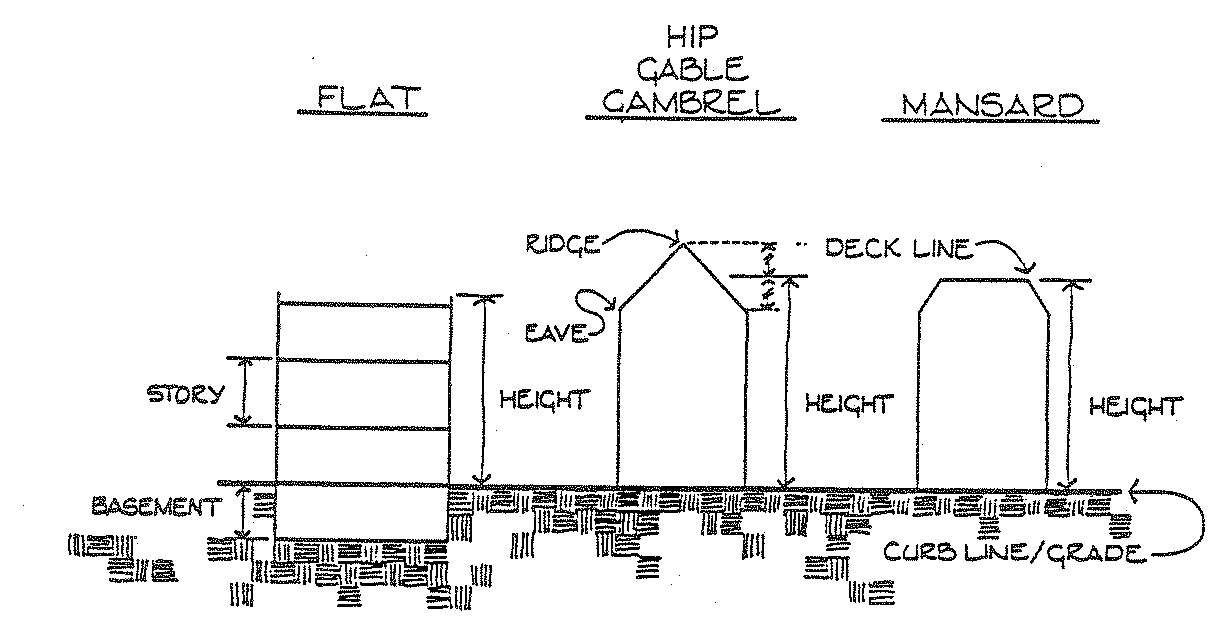
Building height. The vertical distance measured from the grade to the highest point of the roof surface for flat roofs; to the deck line of mansard roofs; and to the average height between eaves and ridge for gable, hip and gambrel roofs, or to a point equivalent to the foregoing on any other roof. Where a building is located on sloping terrain, the height may be measured from the average ground level of the grade at the building wall.
Building line. A line formed by the face of the building and, for the purpose of this chapter, a minimum building line is the same as a front setback line.
Building, main or principal. A building in which is conducted the principal use of the lot on which it is situated.
Building, multiple-family. A building containing three (3) or more dwelling units. The term includes apartments, townhouses, two (2), three (3) and four (4) plexes and the like. For purposes of these regulations, regardless of how units are equipped, any structure in which dwelling units are available for rental periods of less than one week shall be considered a hotel or motel, not a multifamily dwelling.
Building, multiplex. A building designed exclusively for occupancy by two (2) or more families living independently of each other. Each dwelling unit shall have a separate main entrance directly to the outside.
Building official. The building official of the city or his authorized representative.
Building, one-family detached. A one-family dwelling entirely separated from structures on adjacent lots.
Building permits. A building permit is the written authority issued by the building official permitting the construction, removal, moving, alteration or use of a building in conformity with the provisions of this chapter.
Building, temporary. A structure without permanent foundation erected or devoted to the development of, or in connection with, the principal site used for a limited period of time.
Building, townhouse. A building occupied by three (3) or more families where each dwelling unit is divided from the one adjacent to it by a party wall extending the full height of the building. Each dwelling unit is capable of individual use and maintenance without trespassing upon adjoining properties and utilities and service facilities are independent for each property.
Building, two-family. A detached building designed for or occupied exclusively by two (2) families living independently of each other, such as a duplex dwelling unit.
Car wash. An area of land and/or structure with machine or hand-operated facilities used principally for the cleaning and washing of motor vehicles. In no instance shall a commercial car wash so defined be considered an accessory use.
Car wash, automatic. A building that provides facilities for washing and cleaning motor vehicles, which uses production line methods with a conveyor, blower or other mechanical devices, and which may employ some hand labor for drying, polishing or waxing.
Carport. A partially open structure for sheltering vehicles erected in conformity with the site requirements for garages, except as modified in this chapter.
Carry-out restaurant. (See "Restaurant, Fast-Food").
Cemetery. Land used or intended to be used for the burial of the dead and dedicated for cemetery purposes, including columbariums, crematories, mausoleums and mortuaries, when operated in conjunction with and within the boundaries of such cemetery.
Church or place of religious worship. An institution that people regularly attend to participate in or hold religious services, meetings and other activities. The term "church" shall not carry a secular connotation and shall include buildings in which the religious services of any denomination are held. The word "church" shall not include or mean an undertaker's chapel or funeral building.
Clinic. A place for the care, diagnosis and treatment of sick or injured persons and those in need of medical or minor surgical attention. A clinic may incorporate customary laboratories and pharmacies incidental or necessary to its operation or to the service of its patients, but may not include facilities for in-patient care or major surgery.
Club, lodge or fraternity. An organization of persons for special purposes or for the promulgation of agriculture, sports, arts, science, literature, politics or the like, but not for profit.
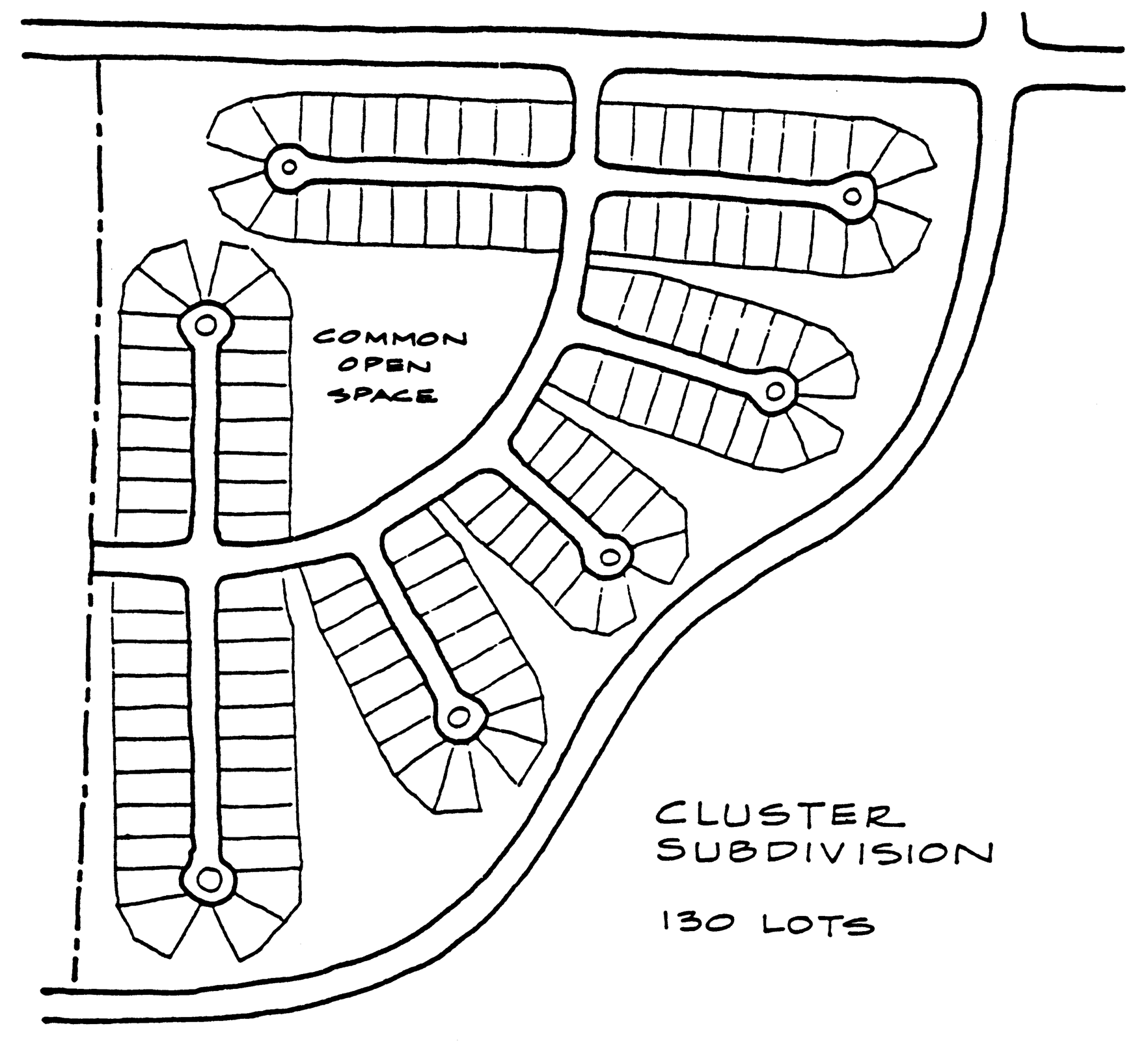
Cluster development. A development design technique that concentrates buildings in specific areas on a site to allow the remaining land to be used for recreation, common open space, and preservation of environmentally sensitive areas.
Commercial establishment. May have other principal business purposes which do not involve the offering for sale or rental of material depicting or describing "specified sexual activities" or "specific anatomical areas" and still be categorized as "adult book store" or "adult video store". Such other business purposes will not serve to exempt such commercial establishment from being so categorized as long as one of its principal business purposes is the offering for sale or rental for consideration, materials depicting or describing "specified sexual activities" or "specified anatomical areas". For purposes of video cassettes or films which are X-rated or of substantially equivalent content of X-rated films, shall be considered to depict or describe "specified sexual activities" or "specified anatomical areas" notwithstanding anymore restrictive definition set forth herein.
Commercial use. An occupation, employment or enterprise dealing with the public that is carried on for profit by the owner, lessee or licensee.
Commission. The word "Commission" shall mean the City of Fraser Planning Commission.
Community center. A place, structure, area or other facility used for and providing religious, fraternal, social and/or recreational programs generally open to the public and designed to accommodate and serve significant segments of the community.
Community facility. A building or structure owned and operated by a governmental, religious, philanthropic, non-profit agency to provide service to the public.
Conditional rezoning (CR). A rezoning of land which authorizes use or development of property in accordance with specific rezoning conditions and a specific conditional rezoning plan agreed upon between the property owner and the city, the terms of which are incorporated into a written conditional rezoning agreement.
Conditional rezoning agreement.A written agreement approved and executed by the city and property owner which sets forth rezoning conditions, a conditional rezoning plan, and other mutually agreeable terms under which property may be developed or used under a rezoning approved by the city with rezoning conditions as authorized under Section 405 of the Michigan Zoning Enabling Act, P.A. 110 of 2006, as amended.
Conditional rezoning plan. A plan prepared by a licensed civil engineer or architect for a development or use of property to be developed or used under a conditional rezoning approved by the city which depicts the location, size, height, design, architecture, or other measures or features of buildings, structures, improvements, landscaping, setbacks and other site components of the property which is the subject of a conditional rezoning, and where appropriate, adjacent property.
Condominium. An estate in real property consisting of an undivided interest in common with other purchasers in a portion of a parcel of real property, together with a separate interest in space in a building. A condominium may include, in addition, a separate interest in other portions of such real property.
Conservation easement. An easement granting a right or interest in real property that is appropriate to retaining land or water areas predominately in their natural, scenic, open or wooded condition, retaining such areas as suitable habitat for fish, plants or wildlife, or maintaining existing land uses.
Convalescent or nursing home. A convalescent home or nursing home is a home for the care of the aged or infirm, or a place of rest for those suffering bodily disorders, where two (2) or more persons are cared for. Such home shall conform and qualify for license under state law, even though state law may have different size regulations.
Court. An open space on the same lot with a building or group of buildings and which is bounded on two (2) or more sides by such building or buildings. A court shall be unoccupied, except as otherwise herein provided.
Deck. A platform structure, customarily constructed of wood, higher than eighteen (18) inches above the mean yard grade.
Density. The number of families residing on, or dwelling units developed on, an acre of land. As used in this chapter, all densities are stated in families or dwelling units per gross acre, that is, per acre of land devoted to residential use, including land in streets, alleys, parks, playgrounds, school yards or other public lands and open spaces donated or dedicated by the developer.
Derrick. Any portable framework, tower mast, and/or structure which is required or used in connection with drilling or re-working a well for the production of oil or gas.
Development. The division of land into two (2) or more parcels; the construction, reconstruction, conversion, structural alteration, relocation or enlargement of any structure; any mining excavation, fill or land disturbance; and any use or extension of the use of land.
District (zoning district). A portion of the city within which certain regulations and requirements of various combination thereof apply under the provisions of this chapter.
Drilling pad. The area of surface operations surrounding the surface location of a well or wells. Such area shall not include an access road to the drilling pad.
Drive-in establishment. A business establishment so developed that its retail or service character is dependent on providing a driveway approach or parking spaces for motor vehicles so as to serve patrons while in the motor vehicle, regardless of whether self-servicing is involved.
Driveway. The paved or approved surface providing access to an attached garage, detached garage, or other required or permitted parking on a lot.
Dwelling unit. A room or rooms connected together, constituting a separate, independent housekeeping establishment for one (1) family only, for owner occupancy or for rental, lease or other occupancy on a weekly or longer basis, physically separated from any other rooms of dwelling units, and containing independent cooking and sleeping facilities.
Easement. The right of a person, government agency or public utility company to use public or private land owned by another for a specific purpose.
Efficiency unit. An efficiency unit is a dwelling unit consisting of one (1) room exclusive of bathroom, kitchen, hallway, closets or dining alcove directly off the principal room providing not less than three hundred twenty (320) square feet of floor area.
Electrified fence. A fence designed to be used with an electric charge sufficient to shock, harm, or kill a living being.
Erected. Built, constructed, altered, reconstructed, moved upon or any physical operation on the premises which is required for the construction. Excavation, fill, drainage and the like shall be considered a part of erection.
Escort. Means a person who, for consideration, agrees or offers to act as a companion, guide, or date for another person, or who agrees to privately model lingerie or to privately perform a striptease for another person.
Escort agency. Means a person or business association who furnishes, offers to furnish or advertises to furnish escorts as one of its primary business purposes for a fee, tip or other consideration.
Essential services. The erection, construction, alteration or maintenance by public, utilities or municipal departments of underground, surface or overhead gas, electrical, steam, fuel or water transmission or distribution systems; collection, communication, supply or disposal systems, including towers, poles, wires, main, drain, sewers, pipes, conduits, cables, fire alarm and police call boxes, traffic signals, hydrants and similar equipment in connection herewith, but not including buildings which are necessary for the furnishing of adequate service by such utilities or municipal departments for the general health, safety or welfare.
Establishment. Means and includes any of the following:
(1)
The opening or commencement of any sexually-oriented business as a new business;
(2)
The conversion of an existing business, whether or not sexually-oriented, to any sexually-oriented business;
(3)
The addition of any sexually-oriented business to any other existing sexually-oriented business; or
(4)
The relocation of any sexually-oriented business.
Excavation. Any breaking of ground, except common household gardening and ground care incidental to maintaining and improving residential landscaping.
Facade. The exterior wall of a building exposed to public view or that wall viewed by persons not within the building.
Family. One (1) or two (2) persons or parents with their direct lineal descendants and adopted children (and including the domestic employees thereof), together with not more than two (2) persons not so related living together in the whole or part of a dwelling comprising a single housekeeping unit. Every additional group of two (2) or less persons living in such housekeeping unit shall be considered a separate family for the purpose of this chapter.
Notwithstanding the definition of the preceding paragraph, a family shall be deemed to include four (4) or more persons not within the second degree of kinship occupying a dwelling unit and living as a single, non-profit housekeeping unit if said occupants are handicapped persons, as defined in Title VIII of the Civil Rights Act of 1968, as amended by the Fair Housing Amendments Act of 1988. Such unrelated individuals shall have the right to occupy a dwelling unit in the same manner and to the same extent as any family unit as defined in the first paragraph of this definition.
Family day-care home. A home licensed under Public Act No. 116 of the Public Acts of 1973 for six (6) children or less which is the bona fide residence of the operator of the family day care home.
Fast-food restaurant. (See "Restaurant, fast-food" and "Restaurant, drive-in.")
Fence. Any artificially constructed barrier of any material or combination of materials erected to enclose or screen areas of land.
Filling. Is the depositing or dumping of any matter onto or into the ground, except common household gardening and ground care.
First floor. The first floor is the floor of a building approximately at or at the first floor above the mean level of the established grade.
First floor area. The floor area shall be the area measured from the exterior walls of the main structure at the ground floor level, not including garages or enclosed or unenclosed porches, and not including attached utility or accessory rooms having three (3) or more exterior sides.
Floor area, gross. (For the purpose of computing parking) Is the sum of the gross horizontal areas of the several floors of the building measured from the exterior faces of the exterior walls or from the centerline of walls separating two buildings. The "floor area" of a building shall include the basement floor area when more than one-half (½) of the basement height is above the established curb level or finished lot grade, whichever is higher (see "Basement" definition). "Floor area" shall include elevator shafts and stairwells at each floor, floor space used for mechanical equipment (except equipment, open or enclosed, located on the roof), attic space having headroom of seven (7) feet, ten (10) inches or more, interior balconies and mezzanines. Any space devoted to off-street parking or loading shall not be included in "floor area."
Floor area, livable. The liveable floor area shall be the area of the first floor, plus the area of the floor next above, and/or the area under a sloping roof having a minimum height of five (5) feet when one-half (½) of the floor area has a ceiling height of seven (7) feet six (6) inches.
Floor area, residential. For the purpose of computing the minimum allowable floor area in a residential dwelling unit, the sum of the horizontal areas of each story of the building shall be measured from the exterior faces of the exterior walls or from the centerline of walls separating two (2) dwellings. The floor area measurement is exclusive of areas of basements, unfinished attics, attached garages, breezeways, and enclosed and unenclosed porches.
Foot candle. The unit of illumination when the foot is taken as the unit of length. It is the illumination on a surface one (1) square foot in area on which there is a uniformly distributed flux of one (1) lumen, or the illumination produced on a surface all points of which are at a distance of one (1) foot from a directionally uniform point source of one (1) candela.
Frontage. Lot frontage is that side of a lot abutting on a street or way and ordinarily regarded as the front of the lot, but it shall not be considered as the ordinary side line of a corner lot, except for setback purposes.
Funeral home. A building, or part thereof, used for human funeral services. Such building may contain space and facilities for: a) embalming and the performance of other services used in preparation of the dead for burial; b) the performance of autopsies and other surgical procedures; c) the storage of caskets, funeral urns and other related funeral supplies; and d) the storage of funeral vehicles, but shall not include facilities for cremation. Where a funeral home is permitted, a funeral chapel shall also be permitted.
Garage, automobile repair. See "Automobile Repair."
Garage, commercial. Any premises, except those described as a private, community or storage garage, available to the public, used principally for the storage of automobiles or motor-driven vehicles, for remuneration, hire or sale, where any such vehicle or engines may also be equipped for operation, repaired, rebuilt or reconstructed, and where vehicles may be greased, washed or serviced.
Garage, private. An accessory building or portion of a main building designed or used solely for the storage of motor-driven vehicles, boats and similar vehicles owned and used by the occupants of the building to which it is accessory, with no facilities for mechanical service or repair of a commercial or public nature, having capacity for not more than three (3) automobiles.
Garage, public. Any building or premises, other than a gasoline filling station, used for housing or care of more than three (3) automobiles, or where any such automobiles are equipped for operation, repaired or kept for remuneration, hire or sale.
Garbage. Garbage shall mean all wastes, animal, fish, fowl or vegetable matter incident to the preparation, use and storage of food for human consumption, spoiled food, dead animals, animal manure and fowl manures.
Gasoline self-service station. An establishment where liquids used as motor fuels are stored and dispensed into the fuel tanks of motor vehicles by persons other than the service station attendant and may include facilities available for the sale of other retail products.
Gasoline self-service station canopy. A structure used to shelter pump islands and adjacent service lanes.
Gasoline service station. A place for the dispensing, sale or offering for sale of motor fuels directly to users of motor vehicles, together with the sale of minor accessories and services for motor vehicles, but not including major automobile repair as herein defined for "Automobile Repair Stations" and may include facilities available for the sale of other retail products.
Gasoline service station canopy. A structure used to shelter pump islands and adjacent service lanes.
Grade. The ground elevation established for the purpose of regulating the number of stories and height of buildings. The building grade shall be the level of the ground adjacent to the walls of the building if the finished grade is level. If the ground is not entirely level, the grade shall be determined by averaging the elevation of the ground for each face of the building.
Grade, building. The finished grade at the building shall be the building grade.
Greenbelt (Also see "Screening"). A strip of land of definite width and location reserved for the planting of shrubs and trees to serve as an obscuring screen or buffer strip in carrying out the requirements of this chapter.
Gross floor area. See "Floor Area, Gross."
Gross site area. The total site area under the ownership of the applicant before any deductions are made for roads, open space, parcels to be separated or planned for later development, and the like.
Hazardous substances. Any substance or materials that, by reason of their toxic, caustic, corrosive, abrasive or otherwise injurious properties, may be detrimental or deleterious to the health of any person handling or otherwise coming into contact with such material or substance.
Height. The vertical distance to the highest point of the roof for flat roofs; to the deck line of mansard roofs; and to the average height between eaves and the ridge for gable, hip and gambrel roofs, measured from the curb level if the building is not more than ten (10) feet from the front lot line or from the grade in all other cases.
Heliport - limited use. Any landing area used for the landing and taking off of helicopters, including all necessary passenger and cargo facilities, fueling and emergency service facilities.
Heliport - unlimited use. Any landing area used by helicopters which, in addition, includes all necessary passenger and cargo facilities, maintenance and overhaul, fueling, service, storage, tie-down areas, hangars, and other necessary buildings and open spaces.
Home occupation. An activity carried on by an occupant of a dwelling unit as a secondary use which is clearly incidental to the use of the dwelling unit for residential purposes. Home offices that do not increase the street traffic or deal directly with the public are accepted in residential areas without special approval.
Horizontal drilling. The drilling of an oil or natural gas well at an angle so that the well runs parallel to the formation containing the oil or gas.
Hospital. A building, structure or institution in which sick or injured persons are given medical or surgical treatment and operating under license by the health department and the State of Michigan, and is used for primarily in-patient services, and including such related facilities as laboratories, out-patient departments, central service facilities and staff offices.
Hotel. A series of attached, semi-detached or detached rental units which provide overnight lodging and are offered to the public for compensation. Hotels may include a restaurant or cocktail lounge, public banquet halls, ballrooms or meeting rooms.
House, boarding. A structure in which non-family members are sheltered and fed for profit.
House, rooming. A structure in which non-family members are sheltered for profit.
House, trailer. See "Mobile Home."
Household pet. Animals that are customarily kept for personal use or enjoyment within the home. Household pets shall include, but not be limited to, domestic dogs, domestic cats, domestic tropical birds and rodents.
Hydraulic fracturing or fracking. The process of injecting water, customized fluids, sand, steam, or gas into a gas well under pressure to improve gas recovery.
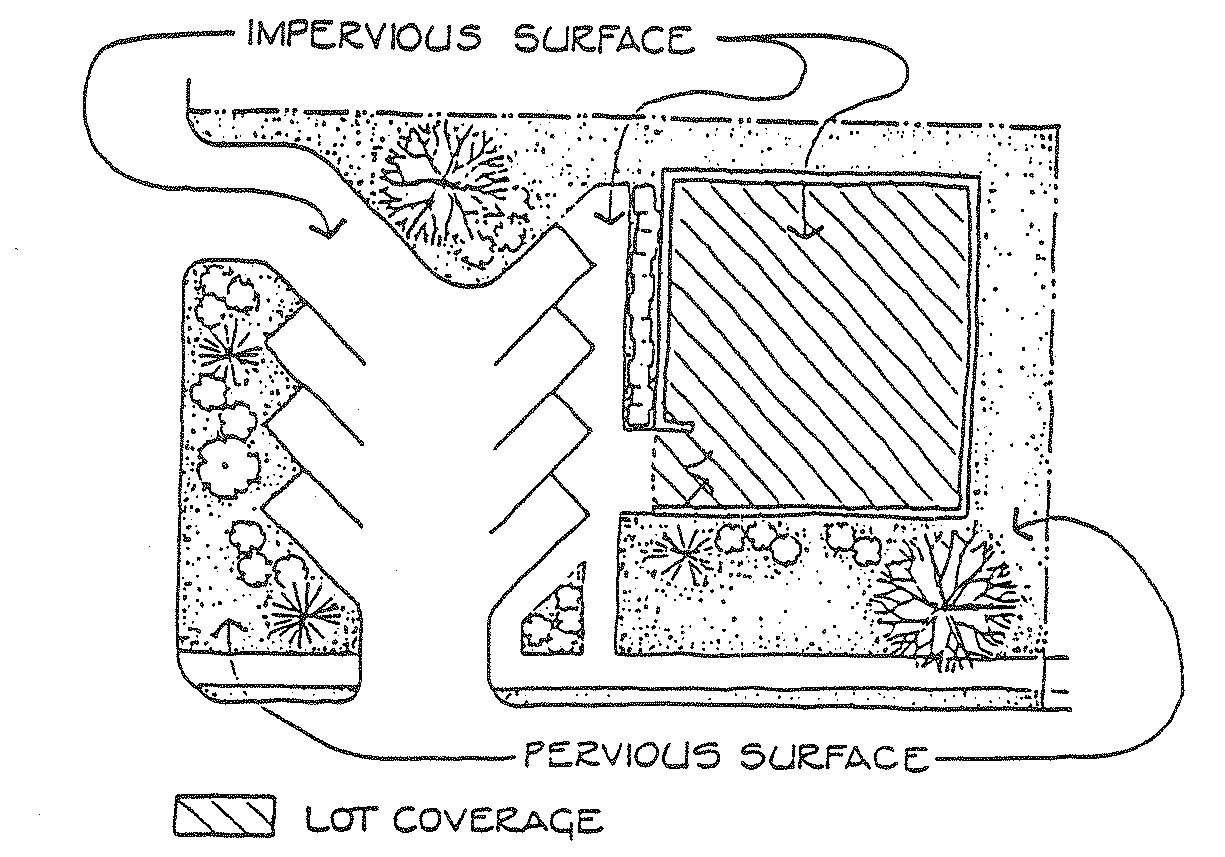
Impervious surface. A surface that has been compacted or covered with a layer of material so that it is highly resistant to infiltration by water. It includes surfaces such as compacted sand, limestone, rock or clay, as well as most conventionally surfaced streets, roofs, sidewalks, parking lots and other similar structures.
Industrial, controlled. A use engaged in the basic processing and manufacturing of materials or products predominantly from extracted or raw materials, or a use engaged in storage of or manufacturing processes using flammable or explosive materials, or storage or manufacturing processes that potentially involve nuisances or commonly recognized offensive conditions. Such use shall be within the limits of the district's performance standards.
Industrial, restricted. A use engaged in the manufacture, predominantly from previously prepared materials, of finished products or parts, including processing, fabrication, assembly, treatment, packaging, incidental storage, sales and distribution of such products, but excluding basic industrial processing. Such use shall be within the district's performance standards.
Junk. For the purpose of this chapter, the term "junk" shall mean any motor vehicles, machinery, appliances, products, merchandise with parts missing or scrap metals or other scrap materials that are damaged, deteriorated, or are in a condition which cannot be used for the purpose that the product was manufactured.
Junkyard. An open area where waste, used or secondhand materials are bought and sold, exchanged, stored, baled, packed, disassembled or handled, including, but not limited to, scrap iron and other metals, paper, rags, rubber tires and bottles. A "junkyard" includes automobile wrecking yards and includes any area of more than two hundred (200) square feet for storage, keeping or abandonment of junk, but does not include uses established entirely within enclosed buildings.
Kennel. A kennel is a lot or premises on which four (4) or more dogs, over six (6) months of age, are kept, either permanently or temporarily boarded.
Laboratory. A place devoted to experimental or routine study, such as testing and analytical operations and in which manufacturing of product or products is not permitted.
Lake, private. Any body of water, other than a public lake, which is owned by one (1) person, group of persons, partnership or corporation for use regulated by the owners only.
Landfill. The orderly deposit of earthen materials for the purpose of elevating the grade to develop the site for specific use.
Loading space. An off-street space on the same lot with a building or group of buildings for the temporary parking of a commercial vehicle while loading and unloading merchandise or materials.
Lot. A parcel of land occupied or intended to be occupied by a main building or a group of such buildings and accessory buildings, or utilized for the principal use and uses accessory thereto, together with such yards and open spaces as are required under the provisions of this chapter. A lot may or may not be specifically designated as such on public records. Each such parcel shall also have its front lot line abutting a public street or approved private road.
Lot area. The total horizontal area within the lot lines of a lot.
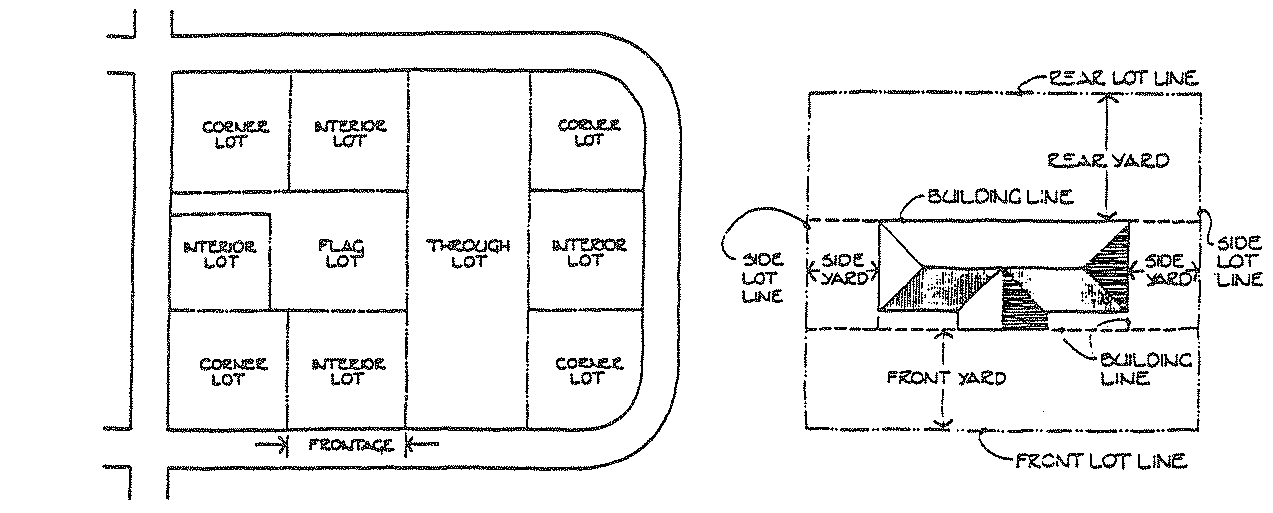
Lot, corner. A lot where the interior angle of two (2) adjacent sides at the intersection of two streets is less than one hundred thirty-five (135) degrees. A lot abutting upon a curved street or streets shall be considered a corner lot for the purposes of this chapter if the arc is of less radius than one hundred fifty (150) feet and the tangents to the curve, at the two (2) points where the lot lines meet the curve or the straight street line extended, form an interior angle of less than one hundred thirty-five (135) degrees (see illustration below).
Lot coverage. The part or percent of the lot occupied by buildings or structures, including accessory buildings or structures.
Lot depth. The horizontal distance between the front and rear lot lines, measured along the median between the side lot lines.
Lot, double frontage (also through lot). Any interior lot having frontage on two more or less parallel streets as distinguished from a corner lot. In the case of a row of double frontage lots, all yards of said lots adjacent to streets shall be considered frontage, and front yard setbacks shall be provided as required.
Lot, interior. Any lot other than a corner lot (see illustration below).
Lot lines. The lines bounding a lot as defined herein:
(1)
Front lot line. In the case of an interior lot, that line separating the lot from the street. In the case of a corner lot or double frontage lot, "front lot line" shall mean that line separating the lot from the street which is designated as the front street in the plat as the greater setback and shall be so designated in the application for a building permit.
(2)
Rear lot line. That lot line opposite the front lot line. In the case of a lot pointed at the rear, the rear lot line shall be an imaginary line parallel to the front lot line, not less than ten (10) feet long, lying farthest from the front lot line and wholly within the lot.
(3)
Side lot line. Any lot line other than the front lot line or rear lot line. A side lot line separating a lot from a street is a side street lot line. A side lot line separating a lot from another lot or lots is an interior side lot line.
Lot of record. A parcel of land, the dimensions of which are shown on recorded plat on file with the county register of deeds at the time of inception of this chapter or in common use by city or county officials, and which actually exists as so shown, or any part of such parcel held in a record ownership separate from that of the remainder thereof.
Lot, substandard. A lot or parcel of land that has less than the required minimum area or width as established by the zoning district in which it is located, and provided that such lot or parcel was of record and a legally created lot on the effective date of this chapter.
Lot width. The horizontal straight line distance between the side lot lines, measured between the two points where the front setback line intersects the side lot lines if the side property lines are not parallel, the width of the lot shall be the length of a line at right angles to the axis of the lot at a distance equal to the front setback required for the district in which the lot is located. The axis of a lot shall be a line joining the midpoint of the front and rear property lines.
Main building. A building in which is conducted the principal use of the lot upon which it is situated.
Main use. The principal use to which the premises are devoted and the principal purpose for which the premises exist.
Major thoroughfare. An arterial street which is intended to serve as a large volume trafficway for both the immediate area and the region beyond, and may be designated as a major thoroughfare, parkway, freeway, expressway or equivalent terms to identify those streets comprising the basic streets of the street plan. Any street with a width, existing or proposed, of one hundred twenty (120) feet or greater shall be considered a major thoroughfare.
Marginal access road. A service roadway parallel to a major thoroughfare which provides access to abutting properties and protection from through traffic.
Master plan. The comprehensive plan, including graphic and written material, indicating the general location for streets, parks, schools, public buildings and all physical development of the municipality, and including any uniform part of such plan and amendment to such plan, or parts thereof, as adopted by the planning commission.
Mezzanine. An intermediate floor in any story occupying not to exceed one-third (⅓) of the floor area of such story (see illustration for "Story").
Mean grade. Mean grade is defined as the arithmetic average of elevations of points on the boundary lines of a site (parcel of land) uniformly spaced and not more than one hundred (100) feet apart.
Mobile home. A structure transportable in one or more sections which is built on a chassis and is designed to be used as a dwelling, with or without permanent foundation, when connected to the required facilities; and includes the plumbing, heating, air conditioning and electrical systems contained in the structure. Mobile home does not include a recreational vehicle.
Mobile home park. A parcel or tract of land under the control of a person upon which two (2) or more mobile homes are located on a nonrecreational basis; and which is offered to the public for that purpose regardless of whether a charge is made therefor, together with any building, structure, enclosure, street equipment, or facility used or intended for occupancy of mobile homes which is not intended for use as a temporary trailer park, and licensed pursuant to the provisions of Act 419, Public Acts of 1976. (MCL 125.1101 et seq.; MSA 19.855(1) et seq.)
Motel. A series of attached, semi-detached or detached rental units containing a bedroom, bathroom and closet space. Units shall provide for overnight lodging and are offered to the public for compensation and shall cater primarily to the public traveling by motor vehicle.
Municipality. The City of Fraser.
Natural gas compressor station. A facility designed and constructed to compress natural gas originating from a gas well, or collection of such wells operating as a midstream facility for delivery of gas to a transmission pipeline, distribution pipeline, natural gas processing plant, or underground storage field, including one (1) or more natural gas compressors, associated buildings, pipes, valves, tanks and other equipment.
Natural gas processing plant. A facility designed and constructed to remove materials such as ethane, propane, butane, methane and other constituents or similar substances from natural gas to allow such natural gas to be of such quality as is required or appropriate for transmission or distribution to commercial markets, but not including facilities or equipment that is designed and constructed primarily to remove water, water vapor, oil or naturally occurring liquids from the natural gas.
Neighborhood. A sub-community area used in planning to describe a service area with a radius of approximately one-half (½) mile defined to support a park or convenience commercial uses. Boundaries are often defined along major or secondary roads, railroads, freeways or natural features, such as drainageways.
Nonconforming structure or building. A building or structure or portion thereof existing on the effective date of this chapter amendments hereto, and that does not conform to the provisions of this chapter relative to height, bulk, area or yards for the district in which it is located.
Nonconforming use. A use which lawfully occupied a building or land at the effective date of this chapter, or amendments thereto, and that does not conform to the use regulations of the district in which it is located.
Nude model studio. Means any place where a person appears in the state of nudity or displayed specified anatomical areas to be observed, sketched, drawn, painted, sculpted, photographed or similarly depicted by any other person who pays money, or any other form or consideration.
Nudity or state of nudity. Means the exposure of the human male or female genitals, pubic area, or buttocks with less than a fully-opaque covering, the showing of the female breasts with less than a fully-opaque covering of any part of the nipple or areola, or the showing of the covered male genitals in a discernibly turgid state.
Nuisance. The word "nuisance" shall include nuisance factor below and any public nuisance as known at common law or in equity jurisprudence; and whatever is dangerous to human life or detrimental to health, safety or welfare; and any dwelling or building which is overcrowded with occupants or is not provided with adequate ingress or egress to or from the same, or is not sufficiently supported, ventilated, sewered, drained, cleaned or lighted in reference to its intended or actual use; and whatever renders the air or human food or drink unwholesome, are also severally, in contemplation of this chapter, nuisances and all such nuisances are hereby declared illegal.
Nuisance factors. An offensive, annoying, unpleasant or obnoxious thing or practice, a cause or source of annoyance, especially a continuing or repeating invasion of any physical characteristics of activity or use across a property line which can be perceived by or affects a human being, or the generation of an excessive or concentrated movement of people or things, such as, but not limited to, noise, reception interference, dust, smoke, odor, glare, fumes, flashes, vibration, shock waves, heat, electronic or atomic radiation, objectionable effluent, noise of congregation of people (particularly at night), passenger traffic, and invasion of non-abutting street frontage by traffic.
Nursery, plant materials. A space, building or structure or combination thereof, for the storage of live trees, shrubs or plants offered for retail sale on the premises, including products used for gardening or landscaping. The definition of nursery within the meaning of this chapter does not include or preclude any space, building or structures used for the sale of fruits, vegetables or Christmas trees.
Nursing home (also convalescent or rest home). A home, whether operated for profit or not, for the care of the aged, infirmed, or those suffering from bodily disorders, wherein seven (7) or more persons are housed or lodged and furnished with licensed personal care.
Nursery school, day school, child center. An establishment wherein seven (7) or more children, not related by bonds of consanguinity or fostership to the family living on the premises, are cared for remuneration. Such schools or centers need not have a resident family on the premises.
Occupancy load. The number of persons that a building can hold, as determined by the fire marshal or as determined by the city's building code.
Occupied. The word "occupied" includes arranged, designed, built, altered, converted to, rented or leased, or intended to be occupied.
Off-street parking lot. A facility other than for single-family dwellings providing vehicular parking spaces along with adequate drives and aisle for maneuvering so as to provide access for entrance and exit for the parking of more than two (2) vehicles.
Oil and gas. Crude oil, natural gas, methane gas, coal bed methane gas, propane, butane and/or any other products or similar substances that are produced by drilling an oil or gas well.
Oil and gas development. The well site preparation, construction, drilling, redrilling, hydraulic fracturing, and/or site restoration associated with an oil or gas well of any depth; water and other fluid storage, impoundment and transportation used for such activities; and the installation and use of all associated equipment, including tanks, meters, and other equipment and structures whether permanent or temporary; and the site preparation, construction, installation, maintenance and repair of oil and gas pipelines and associated equipment and other equipment and activities associated with the exploration for, production and transportation of oil and gas. The definition does not include natural gas compressor stations and natural gas processing plants or facilities performing the equivalent functions.
Oil or gas well. A pierced or bored hole drilled or being drilled in the ground for the purpose of, or to be used for, producing, extracting or injecting gas, oil, petroleum or another liquid related to oil or gas production or storage, including brine disposal or being drilled for an exploration for such purposes.
Oil or gas well site. The location of facilities, structures, materials and equipment whether temporary or permanent, that are used for or incidental to the preparation, construction, drilling, production or operation of an oil or gas well, or exploration for a potential oil or gas well.
Open air business uses. Open air business uses not conducted from a wholly enclosed building, if operated for profit, shall include the following uses and other such uses as determined by the planning commission:
(1)
Bicycle, trailer, recreation vehicle, motor vehicle, manufacturing homes, farm implements, boats, or home equipment sale or rental services.
(2)
Outdoor display and sale of garages, swimming pools and similar uses.
(3)
Retail sales of fruit, vegetables and perishable foods.
(4)
Retail sale of trees, shrubbery, plants, flowers, seed, topsoil, humus, fertilizer, trellises, lawn furniture, playground equipment, and other home garden supplies and equipment.
(5)
Tennis courts, archery courts, shuffleboard, horseshoe courts, miniature golf, golf driving range, children's amusement park or similar recreation uses.
Open front store. A business establishment so developed that service to the patron may be extended beyond the walls of the structure, not requiring the patron to enter the structure. The term "open front store" shall not include automobile repair stations or automobile service stations.
Open space. Land used for recreation, resource protection, amenity and/or buffers. In no event shall any area of a lot constituting the minimum lot area or setback nor any part of an existing or future road or right-of-way be counted as constituting open space.
Open space, common. Open space within or related to a development, not in individually owned lots or dedicated for public use, but which is designed and intended for the common use or enjoyment of the residents of the development.
Outdoor storage. The keeping, in an unroofed area, of any goods, junk material, merchandise or vehicles in the same place for more than twenty-four (24) hours.
Outlot. A lot in a subdivision which is recommended or restricted from use for building purposes, whether or not deeded to the city, but which is not dedicated as a street or public reservation or private park.
Parcel. A continuous quantity of land in the possession of or owned by, or recorded as the property of, the same person or persons.
Parcel of record. A parcel of record is an area of land described by a metes and bounds description and which is not necessarily a lot of record in a subdivision plat.
Park. Any public or private improved land available for recreational, educational, cultural or aesthetic use, or scenic purposes.
Parking space. An area of definite length and width, exclusive of drives, aisles or entrances giving access thereto, and full accessibility for the parking of permitted vehicles. Tandem parking stalls in single-family detached, single-family attached, and townhome residential uses shall be considered to be fully accessible for the purpose of this definition.
Pawnbroker use. Means pawnbroker businesses as defined in the Fraser Code of Ordinances, State Public Acts or substantially similar business.
Performance guarantee (also maintenance guarantee). Any security accepted by the city in the form of cash, certified check, performance bond, surety bond or certificate of deposit endorsed to the city, provided that the city shall not surcharge more than ten (10) percent of the total performance costs to ensure that all improvements, facilities or work required by this chapter will be completed in compliance with the chapter, regulations, and the approved plans and specifications of a development.
Permitee and/or licensee. Means a person in whose name permit and/or license to operate a sexually-oriented business has been issued as well as the individual listed as the applicant on the application for permit and/or license.
Person. Means any individual, proprietorship, partnership, corporation, association or any other legal entity.
Planned development. A proposed use of the land which requires the submission of a site plan for more than one building or structure to be approved as to requirements of this chapter, including spacial relationships and vehicular and pedestrian circulation.
Planned shopping center. A business development of three (3) or more outlets characterized by a unified grouping of such retail outlets served by a common circulation and parking system.
Planned unit development (PUD). A development of land that is under unified control and is planned and developed as a whole in a single development operation or programmed series of development stages. The development may include streets, circulation ways, utilities, buildings, open spaces, and other site features and improvements.
Porch, enclosed. A covered entrance to a building or structure and projects out from the main wall of said building or structure and has a separate roof or an integral roof with the principal building or structure to which it is attached.
Porch, open. An uncovered entrance to a building or structure which is unenclosed, and projects out from the wall of said building or structure.
Principal building. A building in which the primary use of the lot on which the building is located is conducted (also see main building).
Principal use. The main use of land or structures, as distinguished from a secondary or accessory use (also see "Main Use") a site may be occupied by more than one principal use.
Private drive. A means of vehicle access serving one (1) property or one (1) dwelling.
Private street or road. A street or road which the landowners of property served by the private road are responsible for its maintenance and which conforms to all requirements of the city engineering ordinance.
Public street or road. All public property reserved or dedicated for street traffic.
Public utility. Any person, firm or corporation, municipal department, board or commission duly authorized to furnish, and furnishing under federal, state or municipal regulations, to the public: gas, steam, electricity, sewage disposal, communication, telegraph, transportation or water.
Putrescible. Subject to decay and decomposition and to becoming putrid.
Recreation vehicles.
(1)
A "travel trailer" is a vehicular, portable structure built on a chassis, designed to be used as a temporary dwelling for travel, recreational and vacation uses, permanently identified "travel trailer" by the manufacturer.
(2)
A "pick-up camper" is a structure designed primarily to be mounted on a pick-up or truck chassis and with sufficient equipment to render it suitable for use as a temporary dwelling for travel, recreational and vacation uses.
(3)
A "motor home" is a portable dwelling designed and constructed as an integral part of a self-propelled vehicle.
(4)
A "folding tent trailer" is a metal, plastic or canvas folding structure, mounted on wheels and designed for travel and vacation use.
(5)
"Boats" and "boat trailers" shall include boats, jet skis, floats and rafts, plus the normal equipment to transport the same on the highway.
(6)
"Snowmobiles" and "all-terrain vehicles," plus the normal equipment to transport the same on the highway.
Recycling center. A facility that is not a junk yard and in which recoverable resources, such as newspapers, glassware and metal cans, are collected, stored, flattened, crushed or bundled, essentially by hand within a completely enclosed building.
Recycling collection point. An incidental use that serves as a neighborhood drop-off point for temporary storage of recoverable resources. Processing of such items shall be prohibited. This facility would generally be located in a shopping center parking lot or in other public/quasi-public areas, such as in churches and schools.
Recycling plant. A facility that is not a junk yard and in which recoverable resources, such as newspapers, magazines, books and other paper products; glass; metal cans; and other products are recycled, reprocessed and treated to return such products to a condition in which they may again be used for production.
Repairs. The rebuilding or removal of a part of an existing building for the purpose of maintaining its original type and classification.
Restaurant. A business establishment whose principal business is the selling of unpackaged food to the customer in a ready-to-consume state, in individual servings, or in non-disposable containers, and where the customer consumes these foods while seated at tables or counters located within the building.
Restaurant, drive-in. An establishment that delivers prepared food and/or beverages to customers in motor vehicles, regardless of whether or not it also serves prepared food and/or beverages to customers who are not in motor vehicles, for consumption either on or off the premises.
Restaurant, fast-food. Any establishment whose principal business is the sale of foods, frozen desserts or beverages in ready-to-consume individual servings, for consumption either within the restaurant building or for carry-out, and where either: 1) foods, frozen desserts or beverages are usually served in paper, plastic or other disposable containers, and where customers are not generally served their food, frozen desserts or beverages by a restaurant employee at the same table or counter where the items are consumed; or 2) the establishment includes a drive-up, drive-through or drive-in service facility.
Rezoning conditions. Commitments or conditions proposed by the applicant that, after review and recommendation by the planning commission, are accepted by the city council, are incorporated into a conditional rezoning agreement, and constitute legally binding regulations in connection with the development and use of the property under the conditional rezoning.
Right-of-way. The right-of-way line shall be the line established by the Michigan Department of Transportation, Macomb County Road Commission, in their right-of-way requirements established for the city or the city's adopted master plan.
Roadside stands. A roadside stand is a temporary building operated for the purpose of selling only produce raised or produced by the proprietor of the stand or his family on the premises, and its use shall not make into a commercial district land which would otherwise be a residential district, nor shall its use be deemed an approved commercial activity.
Room. For the purpose of determining lot area requirements and density in a multiple-family district, a room is a living room, dining room or bedroom, equal to at least eighty (80) square feet in area. A room shall not include the area in kitchen, sanitary facilities, utility provisions, corridors, hallways and storage. Plans presented showing one-, two- or three-bedroom units and including a "den," "library," or other extra room shall count such extra room as a bedroom for the purpose of computing density.
Rubbish. Means the miscellaneous waste materials resulting from housekeeping, mercantile enterprises, trades, manufacturing and offices, including other waste matter, such as slag, stone, broken concrete, fly ash, ashes, tin cans, plastic, glass, scrap metal, rubber, paper, rags, chemicals, or any similar or related combinations thereof.
Satellite dish antenna. A device incorporating a reflective surface that is solid, open mesh or bar configures and is in the shape of a shallow dish, cone, horn or cornucopia. Such device shall be used to transmit and/or receive radio or electromagnetic waves between terrestrially and/or orbitally based uses. This definition is meant to include, but not be limited to, what are commonly referred to as satellite earth stations, TVROs (television reception only satellite dish antennas), and satellite microwave antennas.
Scenic easement. An easement, the purpose of which is to limit development in order to preserve a view or scenic area.
Screening. The method by which a view of one site from another adjacent site is shielded, concealed or hidden. Screening techniques include fences, walls, hedges, berms or other features. Screening may include one or a combination of the following materials of sufficient mass to be opaque or that shall become opaque after twelve (12) months and which shall be maintained in an opaque condition.
Secondary road. A road that conducts and distributes traffic and carries through-traffic as a lower order major thoroughfare to major activity centers. This is the higher order of street appropriate to a residential neighborhood and residential access to it should be prohibited or severely restricted.
Self-service storage facility (mini-storage). A building consisting of individual, small, self-contained units that are leased or owned for the storage of business and household goods or contractors' supplies.
Separate ownership. Ownership of a parcel of property wherein the owner does not own adjoining vacant property.
Setback. The minimum horizontal distance between the front of the building, excluding only steps, and the centerline of the street right-of-way.
Sexual encounter center: Means of business or commercial enterprise that as one of its principal business purposes offers for any form of consideration:
(1)
Contact in the form of wrestling or tumbling between semi-nude or nude persons of the opposite sex; or
(2)
Physical contact between male and female persons and/or persons of the same sex, where one (1) or more of the persons is in a state of nudity and the contact includes actual or simulated specified sexual activity.
Sexually-oriented business. Means any of the following:
(1)
"Adult arcades";
(2)
"Adult book stores and adult video stores";
(3)
"Adult cabarets";
(4)
"Adult motels";
(5)
"Adult motion picture theaters";
(6)
"Adult theaters";
(7)
"Escort agencies";
(8)
"Nude model studios";
(9)
"Sexual encounter centers";
(10)
Other similar uses.
Shopping center. (See "Planned Shopping Center.")
Sign definitions. For the purpose of this chapter, certain words, terms and phrases shall be defined as follows:
Sign. The use of any word, numeral, figure, object, device, letter, symbol, insignia, illustration, design, trademark, or combination of these, by which anything is made known to the general public, or which is commonly understood to be used to attract the attention of the general public, irrespective of whether it is visible from off the site or lot. Customary displays of merchandise or objects and material, without lettering, placed behind a store window are not signs or parts of signs, nor shall the customary, non-communicative architecture of buildings be considered as a sign or part of a sign.
Sign, accessory. A sign which is customarily incidental and subordinate to the principal use of the premises.
Sign, advertising. Shall be known as a non-accessory sign and shall relate to a business, use or service not carried on on the premises upon which the sign is placed.
Sign, area. The area within a continuous perimeter enclosing or making up a sign, together with any frame or other material or color forming an integral part of the display or used to differentiate such sign from the background against which it is placed; excluding the necessary supports or uprights on which such sign is placed; provided, however, any open space contained within the outer limits of the display face of a sign, or between any component, panel, strip or figure of any kind composing the display face shall be included in the computation of the area of the sign, whether such open space be enclosed or not by a frame or border. Where a sign consists solely of lettering or other sign elements mounted on a wall of a building without any distinguishing border, panel or background, only the area of a tightly drawn imaginary rectangle enclosing each such letter or other sign elements shall be treated as a single sign for the purposes of area computation. For double-face signs, only one (1) display face shall be measured or counted in computing sign area or items of information where the sign faces are parallel or where the interior angle formed by the faces is sixty (60) degrees or less. If the two (2) faces of a double-faced sign are of unequal area, the area of the signs shall be taken as the area of the larger face.
Sign, construction. Shall mean to build, construct, attach, hang, place, suspend, or affix, and shall also include the painting of wall signs.
Sign, direction. A sign directing vehicular or pedestrian traffic to service window, parking areas or loading areas.
Sign, festoon. A sign where incandescent light bulbs, banners or pennants, or other such features are hung or strung overhead and are not an integral physical part of the building or structure they are intended to serve.
Sign, flashing, animated or moving. A sign that intermittently reflects lights from either an artificial source or from the sun or signs which have movement of any illumination, such as intermittent, flashing, scintillating or varying intensity; or a sign that has any visible portions in motion, either constantly or at intervals, which motion may be caused either by artificial or natural sources.
Sign, ground. A freestanding sign supported by one or more upright braces of reasonable size necessary to support such sign, permanently mounted in or upon the ground or to something requiring location on the ground. A ground sign is any sign with less than ten (10) feet clearance between the bottom of the sign and the established grade.
Sign, identification and nameplate. A wall sign stating the name of a person, firm, or name or description of a certain permitted use.
Sign, mechanical movement. Refers to animation, revolution, movement up and down, or movement sideways.
Sign, non-accessory. A sign which is not accessory to the principal use of the premises.
Sign, outdoor advertising. Any card, cloth, paper, metal, painted glass, wood, plastic, stone or other object of any kind or character whatsoever, placed for non-accessory outdoor advertising purposes on the ground or on any tree, wall, bush, rock, post, fence, building, structure or thing whatsoever. The term "placed" as used in the definition of "outdoor advertising sign" and "outdoor advertising structure" shall include erecting, constructing, posting, painting, printing, tacking, mailing, gluing, sticking, carving or other fastening, affixing, or making visible in any manner whatsoever to the public.
Sign, political. A temporary sign, without permit required, relating to the election of a person to public office, or relating to a political party, or relating to a matter to be voted upon at an election called by a public body.
Sign, portable. A freestanding sign not permanently anchored or secured to either a building or the ground, such as, but not limited to: trailers, "A" frame, "T" shaped, or inverted "T" shaped sign structures.
Sign, projecting. A sign which is affixed to any building or part thereof, or structure which extends beyond the building wall, or parts thereof, or structure by more than twelve (12) inches. A projecting sign shall not include a ground sign as herein defined.
Sign, pylon or pole. A type of sign located in the ground and with a clear space of not less than ten (10) feet between the bottom of the face of the sign and the established grade.
Sign, real estate. A business sign placed upon a property advertising that particular property for sale, or for rent, or for lease.
Sign, real estate development. A temporary business sign placed on premises of a subdivision or other real estate development to indicate a proposed start or to inform relative to availability.
Sign, residential entrance ways. Entrance way structures including, but not limited to, walls, columns, grates, lamps and poles, and any associated landscaping materials or improvements.
Sign, roof A sign which is erected, constructed, or maintained upon the roof or parapet of a building but does not project above or beyond the roof or parapet. (A sign projecting beyond or above the roof or parapet shall be known as an "above-the-roof" sign.)
Sign, signable area. A continuous wall area on the front of the building which is free of windows and doors and major architectural design. So-called mansard roofs may be used for signable area, provided they are within twenty (20) degrees of a vertical plane and wall signs on them are vertical, unless individual letters are used to make up the wall sign.
Sign, vehicle business. A vehicle sign when the vehicle upon which the sign is painted or attached is parked or placed upon the owner's premises primarily for advertising purposes. Currently licensed commercial vehicles in general daily off-site use are not included as part of this definition.
Sign, wall. A sign attached to and placed flat against the exterior wall or surface of any building, no portion of which projects more than twelve (12) inches from the wall but which may or may not project above the roof or parapet.
Site. A parcel of land.
Soil removal. Shall mean removal of any kind of soil or earth matter, including topsoil, sand, gravel, clay, rock or similar materials, or combination thereof.
Sound level. Sound level, in decibels, is defined as the reading of a sound-level meter which conforms to the latest standards of the American Standards Association for Sound-Level Meters. The decibel reading shall be based on the seventy (70) DB weighing network and shall be the average of five (5) readings taken at intervals approximately five (5) feet apart, at the height of five (5) feet above the established grade, or any series of readings which would provide more accurate or representative reading.
Special land use. A use that, owing to some special characteristics attendant to its operation or installation (for example, potential danger or nuisance) is permitted in a district, subject to approval by the city and subject to special requirements, different from those usual requirements for the district in which the special land use may be located.
Specified anatomical areas. Means the less than completely and opaquely covered human genitals, pubic region, buttock, and female breast below the point immediately above the top of the areola, and human male genitals in a discernibly turgid state, even if completely and opaquely covered.
Specified sexual activity. Means and includes any of the following:
(1)
The fondling or other erotic touching of the human genitals, pubic region, buttocks, anus, or female breasts;
(2)
Sex acts, actual or simulated, including intercourse or oral copulation, masturbation, or sodomy.
(3)
Excretory functions, as part of or in connection with any of the activities set forth in (1) and (2) above.
State-equalized valuation. The value shown on the city's assessment roll as equalized through the process of state and county equalization.
Storage well. A well-used for and in connection with the underground storage of natural gas, including injection into or withdrawal from an underground storage reservoir for monitoring or observation of reservoir pressure.
Story. That part of a building, except a mezzanine as defined herein, included between the surface of one floor and the surface of the next floor, or if there is no floor above, then the ceiling next above. A story thus defined shall not be counted as a story when more than fifty (50) percent, by cubic content, is below the height level of the adjoining ground.
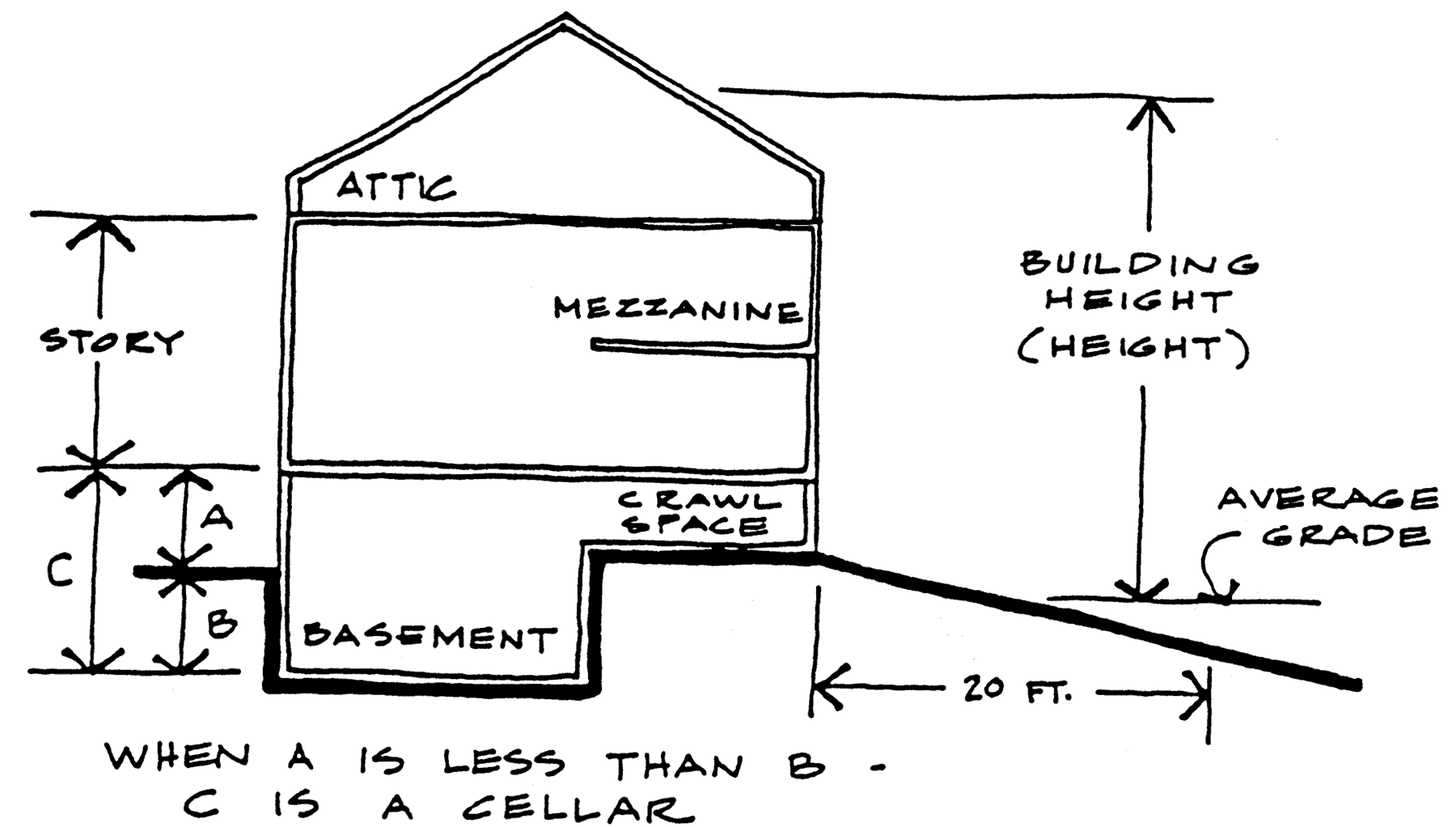
Story, half. An uppermost story lying under a sloping roof, the useable floor area of which, at a height of four (4) feet above the floor does not exceed two-thirds (⅔) of the floor area in the story directly below, and the height above at least two hundred (200) square feet of floor space is seven (7) feet six (6) inches.
Street. A public thoroughfare right-of-way which affords traffic circulation and principal means of access to abutting property, including avenue, place, way, drive, lane, boulevard, highway, road, and any other thoroughfare, except an alley.
Street, service. A thoroughfare which affords access to property by means of private drive, private roadways or other vehicular accessways (such as private drives in multiple-family developments) and where maintenance is provided by other than the public-at-large.
Structure. Anything constructed or erected, the use of which requires location on the ground or attachment to something having location on the ground.
Structural alteration. Any change in the supporting members of a building or structure, such as bearing walls or partitions, columns, beams or girders, stairways, or any change in the width or number of exits, or any substantial change in the roof.
Structure, outdoor advertising. Any structure of any kind or character erected or maintained for outdoor advertising purposes, upon which any outdoor advertising sign or billboard may be placed, including outdoor advertising statuary and balloons or other inflatables.
Swimming pool. Any structure or container intended for swimming, located either above or below grade, designed to hold water to depth of greater than twenty-four (24) inches.
Tattoo use. Means commercial establishments which furnish tattoos as either a substantial or significant portion of its business.
Temporary sign (with permit required). A business sign with or without letters and numerals for authorized occasions and events or public and semi-public functions, as may be permitted by the city manager in an appropriate use district.
Temporary sign (without permit required). A window business sign with or without letters and numerals, in business and industrial districts.
Temporary use or building. A use or building permitted to exist for a limited period of time.
Tents. Tents as used in this chapter shall mean a shelter of canvas or the like supported by poles and fastened by cords or pegs driven into the ground, and shall not include those types of tents used solely for children's recreational purposes.
Townhouse. (See "Buildings.")
Transfer of development rights. The conveyance of development rights by deed, easement, or other legal instrument authorized by local law to another parcel of land and the recording of that conveyance.
Transitional use. A permitted use or structure that by nature or level and scale of activity acts as a transition or buffer between two (2) or more somewhat incompatible uses.
Transplanting. The digging up of a tree from one place on a site and the planting of the same tree in another place on the site.
Tree. A woody plant with an erect perennial trunk, which at maturity is thirteen (13) feet or more in height, which has a more or less definite crown of foliage.
Tree canopy area. The area of land where the outermost limits of the branches of a tree or group of trees projects perpendicularly to the existing grade of a site.
Use. It is the purpose for which land or a building is designed, arranged or intended to be used, or for which land or a building is or may be occupied.
Use variance. A relaxation by the zoning board of appeals of the dimensional regulations of the code where such action will not be contrary to the public interest and where, owing to conditions peculiar to the property and not the result of actions or the situation of the applicant, a literal enforcement of this code would result in unnecessary and undue hardship.
Useable floor area. (See "Floor Area, Gross.")
Utility room. A utility room is a room used primarily for storage, for housing a heating unit, or for laundry purposes.
Variance. A dispensation permitted on individual parcels of property as a method of alleviating practical difficulty by allowing a reasonable use of the building, structure or property, which, because of unusual or unique circumstances, is denied by the terms of the zoning code. A relaxation by the zoning board of appeals of the dimensional regulations of the code where such action will not be contrary to the public interest and where, owing to conditions peculiar to the property and not the result of actions or the situation of the applicant, a literal enforcement of this Code would result in unnecessary and undue hardship.
Vertical projection. Any architectural feature which projects into the yard space from the ground up through the first story, excluding chimneys.
Veterinarian clinic. A place for the care, diagnosis and treatment of sick or injured animals and those in need of medical or minor surgical attention. A veterinarian clinic may include customary pens or cages which are permitted only within the walls of the clinic structure.
Wall. An obscuring structure of definite height and location to serve as an obscuring or protective screen in carrying out the requirements of this chapter.
Warehousing and distribution. A use engaged in storage, wholesale and distribution of manufactured products, supplies and equipment, but excluding bulk storage of materials that are inflammable or explosive or that create hazardous or commonly recognized offensive conditions.
Wetland. Any area of land which is subject to and regulated by the provisions of the Goemaere-Anderson Wetland Protection Act, as amended.
Woodland or woodlot. A tract of land dominated by trees, but usually also containing woody shrubs and other vegetation.
Yard. An open space, unoccupied and unobstructed from the ground upward, except as otherwise provided herein, and being on the same lot with a building. The measurement of a yard shall be construed as the minimum horizontal distance between the right-of-way centerline and the building or structure. A "required yard" is that portion of any lot on which the erection of a main building is prohibited.
(1)
Front yard. An open space extending the full width of the lot, the depth of which is the minimum horizontal distance between the front lot or street centerline, whichever is applicable, and the nearest line of the main building.
(2)
Rear yard. An open space extending the full width of the lot, the depth of which is the minimum horizontal distance between the rear lot line and the nearest line of the main building.
(3)
Side yard. An open space between a main building and the side lot line, extending from the front yard to the rear yard, the width of which is the horizontal distance from the nearest point of the side lot line to the nearest point of the main building.
Yard, non-required. Yard in excess of the yard required herein.
Yard, required. The minimum yard as required herein.
Zero lot line. The location of a building on a lot in such a manner that one (1) or more of the building's sides rests directly on a lot line.
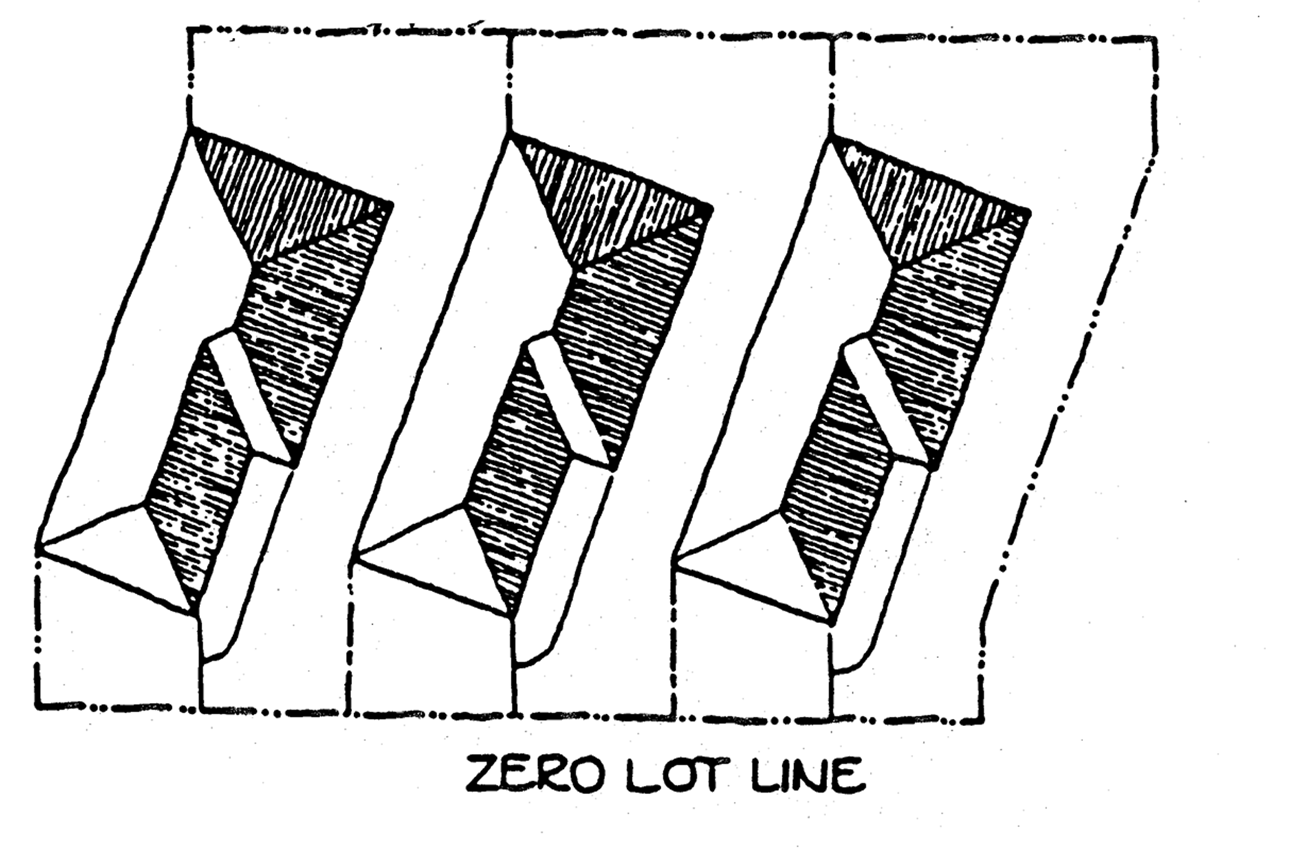
Zone. A portion of the territory of the city, exclusive of streets, alleys and other public ways, within which certain uses of land, premises and buildings are not permitted, and within which certain yards and open spaces are required and certain height limits are established for buildings.
Zoning board of appeals. The words "board of appeals" or "zoning board" shall mean the city zoning board of appeals.
(Ord. No. 279, § 16.01, 12-12-96; Ord. No. 314, § 2, 11-8-01; Ord. No. 328, § 1, 2-10-05; Ord. No. 378, § 2, 4-14-16; Ord. No. 391, § 1, 10-11-18; Ord. No. 399, § 1, 12-11-25; Ord. No. 279-396, § 1, 5-8-25)

