
Fulton City Zoning Code
ARTICLE V
- SUPPLEMENTAL ZONING REGULATIONS2
The intent of this section is to provide additional details about land uses found in table 1, permitted and conditional uses, table 2, accessory structures and uses, and table 3, temporary uses and zoning districts, as described in article II of this chapter.
Sec. 120-111. - Accessory structures and uses.
(a)
Intent. This section sets forth regulations regarding certain activities as being accessory to the main use of the premises. An activity will be considered an accessory use or accessory building when it is commonly associated with, integrally related to and a customarily incidental part of the main use of the property.
(1)
The following shall apply to all accessory buildings in any zoning district:
a.
No accessory building shall be constructed upon a lot until the construction of the main building has been actually commenced, and no accessory building shall be used unless the main building on the lot is also being used. However, nothing shall prevent the use of a temporary construction shed or road wagon for the storage of tools, material and equipment by a contractor during building construction. See table 3, temporary uses, in section 120-51
b.
No accessory building may be erected in front of a main building unless the accessory building is attached to the main building by a common wall and meets the principal building setback requirements of the zoning district.
c.
Accessory buildings may not be used for dwelling purposes.
d.
An accessory structure shall be subordinate in area, extent of use, and fair market value to its principal building or structure.
e.
No accessory building shall:
1.
Be built closer than ten feet from the principal building, or closer than five feet from any other building on the lot.
2.
Be built closer than five feet to the rear property line.
3.
Be built closer than five feet to the side property line for interior lots.
4.
Encroach into any easement.
5.
Be used by anyone other than the property owner or tenant of the premises.
6.
With the exception of alleys, be closer than 25 feet to any public right-of-way.
f.
A driveway or walk to provide access to premises in one district shall not be permitted in a district of a higher classification.
g.
Buildings or structures or uses which are necessary to the use permitted in one district shall not be permitted in a district of a higher classification.
(2)
The following shall apply to residential accessory buildings in zoning districts (R-1, R-2, R-3, C-1, C-2 and MH-1):
a.
Private residential garages shall be used for residential purposes only and shall adhere to the limits in table 4, graduated increase in accessory structure.
b.
Multiple accessory buildings shall be allowed provided the following are met:
1.
Accessory structure must be located in a rear or side yard.
2.
The combined total area of all accessory structures shall not occupy more than 30 percent of a rear yard or be more than the maximum limits from table 4, above.
3.
No single accessory structure shall exceed the area requirements of table 4, above.
4.
There shall be a minimum of ten feet between each accessory structure.
c.
Any accessory buildings located ten feet or less to a main building must be an integral part of the main building and maintain all setback requirements.
d.
An accessory building more than ten feet from a main building may be erected within five feet of a side or rear lot line, but must be located at least 60 feet from the front street line.
e.
Where a garage is entered from an alley, garage foundation must be at least ten feet from the property line.
f.
In the MH-1 district, no accessory building or structure shall exceed one story or 15 feet in height.
(3)
The following shall apply to accessory uses in residential zoning districts (R-1, R-2, R-3 and MH-1):
a.
For the swimming pools and structures of less than 200 square feet (e.g., gazebos, pergolas, etc.) a minimum five-foot setback from any side or rear lot line shall be required.
(4)
The following shall apply to accessory uses in non-residential zoning districts (C-1, C-2, C-3, M-1 and M-2):
a.
Accessory uses may be zero feet from any interior, side or rear property line unless the lot abuts a residential dwelling or a lot zoned for residential purposes, in which case a setback of five feet shall apply.
(Ord. No. 1583-22, § 1(Att.), 4-26-22)
Sec. 120-112. - Drive-throughs and drive-ins.
(a)
Any development containing drive through or drive in services shall provide a site plan which shall be approved by the zoning official.
(b)
The site plan shall include the following information:
(1)
The type, number, and location(s) of all entrances and exits to the lot;
(2)
Circulation patterns for the drive-through lane around the building;
(3)
An escape lane measuring a minimum of 12 feet in width adjacent to the drive-through lane(s). When there are two order points, the escape lane shall be adjacent to the outermost lane;
(4)
A minimum of four queuing spaces from the service window, with each space measuring a minimum of 19 feet in length. No queue space shall block any right-of-way or common driveway aisles;
(5)
A solid fence or wall will be required, along with appropriate landscaping, to be placed between any property used for a drive-through facility and any adjoining residentially zoned property in order to screen passenger car headlight glare from adjacent residential property. The extent and height of such fence or wall shall be determined at the time of the site plan approval.
(Ord. No. 1583-22, § 1(Att.), 4-26-22)
Sec. 120-113. - Fuel oil storage tanks.
When proposed at sites other than in the M-1 industrial district, bulk storage of class III-B type combustible liquids shall be prohibited unless otherwise approved by the city council. The city council's approval shall include, but not be limited to, the following stipulations as with all bulk storage facilities:
(1)
Storage tanks shall be constructed of steel, shall be UL approved, and built in accordance with recognized good engineering standards.
(2)
The storage tanks of bulk oil are located at least 50 feet from the site's boundaries.
(3)
A safety plan as outlined by National Fire Protection Association (NFPA30 2-5.8.4.1) "emergency action plan" is filed with the city.
(4)
Such facilities will be fully in compliance with local, state and federal regulations and with the guidelines and regulations of the National Fire Protection Association (NFPA30 2-5.8.4.1).
(5)
All tanks shall be removed within six months of going out of business or at any time the tanks are no longer in use.
(Ord. No. 1583-22, § 1(Att.), 4-26-22)
Sec. 120-115. - Junkyards and auto wrecking yards.
All junkyards, auto wrecking yards and similar salvage facilities shall be enclosed by a solid wall or fence at least six feet high. Material shall not be piled any higher than said wall.
(Ord. No. 1583-22, § 1(Att.), 4-26-22)
Sec. 120-117. - Mobile homes and house trailers.
All inhabited mobile homes shall be located in an approved planned mobile home park which conforms with the requirements of this chapter per subsection 120-31(c)(4) MH-1 planned mobile home park. No mobile home or trailer located outside an approved mobile home park shall be connected to utilities, except those offered for sale and not inhabited. House trailers may be parked in any district on a vacation basis for a period not to exceed two weeks.
(Ord. No. 1583-22, § 1(Att.), 4-26-22)
Sec. 120-118. - Open storage.
Open storage of equipment, supplies, and products shall occur in an enclosed building or full-screened by a concrete or masonry wall not less than six feet in height
(Ord. No. 1583-22, § 1(Att.), 4-26-22)
Sec. 120-119. - Self-service storage facilities (mini warehouses).
(a)
Intent. Self-service storage facilities are designed and used for the purpose of renting or leasing individual storage space to tenants who have access to such space for the purpose of storing and removing personal properties. Unless otherwise noted, all self-service storage facilities are subject to the provisions of this section. The planning and zoning commission may impose additional requirements for self-service storage facilities when approval is required through the conditional use permit process.
(b)
Drive aisles and exterior storage areas.
(1)
Vehicular aisles providing access to storage units shall not be less than 20 feet wide.
(2)
Parking and storage area surface parking for exterior storage areas shall meet the requirements of subsection 120-202(d), surface parking.
(c)
Lighting.
(1)
Exterior lighting shall be designed to ensure no off-site glare is directed to neighboring parcels. All lights shall be shielded to direct light onto the site and away from adjacent property and shall adhere to subsection 120-202(e) (parking lot lighting).
(2)
Building mounted light fixtures shall be used instead of freestanding light poles wherever possible.
(d)
Parking.
(1)
In the "C-3" district, outdoor storage of boats, watercraft, trailers, and vehicles of any kind shall not be allowed. All items shall be stored within buildings. In the M-1 and M-2 industrial districts, outdoor storage of boats, watercraft, trailers, and vehicles is permissible.
(2)
See section 120-202 for off-street parking requirements.
(e)
Prohibited uses.
(1)
The following uses and activities shall be prohibited:
a.
Any business activity other than the rental of storage units, including garage sales and transfer-storage enterprises that utilize vehicles as part of said business.
b.
Servicing or repair of motor vehicles, boats, trailers, lawnmowers, or similar equipment.
c.
Storage of hazardous, toxic, or volatile substances.
d.
Residential uses, other than one unit for a 24-hour caretaker facility.
(Ord. No. 1583-22, § 1(Att.), 4-26-22)
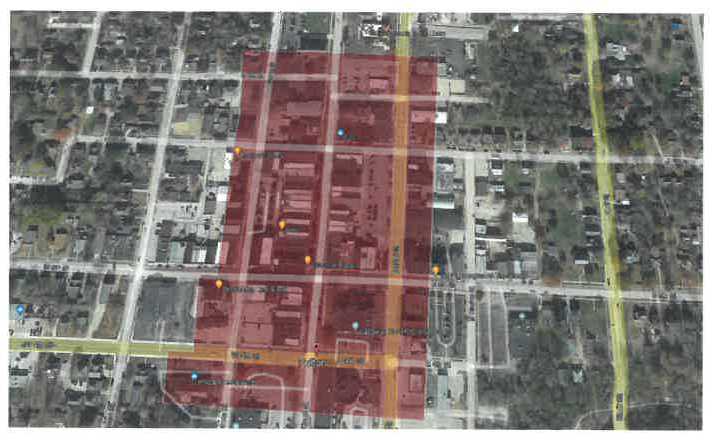
Sec. 120-120. - Brick district overlay zoning area.
An overlay zoning over a portion of the C-1 central business district requiring that any use in this area must conform to uses as designated for the C-1 central business district except in a designated area of this overlay no residential uses shall be allowed on the ground floor of buildings. The boundary of this designated area of the brick district overlay zoning area is both sides of Nichols, Court and Market Streets from the north side of West Seventh Street south to the south side of Fourth Street as shown on the attached plat marked exhibit "A."
Exhibit A
Brick Overlay District
(Ord. No. 1583-22, § 1(Att.), 4-26-22)
Sec. 120-121. - Solar and renewable energy.
(a)
Purpose. To provide for the use of solar energy, including specifications related to the land development, installation, and construction of solar energy systems, subject to reasonable conditions to protect the public health, safety, and welfare. This section applies to solar energy systems to be installed and constructed on any property.
(b)
Applicability. Solar energy systems as described in this section are permitted in all zoning districts as an accessory use to a permitted principal use subject to the standards for accessory uses in the applicable zoning district and the specific criteria set forth herein. Properties seeking the use of solar energy systems which are identified as historic properties and/or properties located within historic districts shall be subject to the provisions and administrative procedures described in chapter 62 (historic preservation).
(c)
General regulations.
(1)
Roof mounted systems.
a.
All roof-mounted solar installations shall provide adequate pathways for access along roof edges and ridge lines to allow for first responder access in case of a fire and maintenance crews in case of system repair. Such pathways shall be consistent with building code requirements and be located over a structurally supported roof area.
b.
The building official may consider exceptions to the provision of this path for solar arrays of less than 1,000 square feet that do not cover the majority of a roof surface, and when the roof pitch is 3:12 or less. (three inches of vertical rise for every foot of horizontal distance).
c.
On structures with pitched roofs, the highest point of the solar installation shall not exceed the highest point of the roof to which it is attached.
d.
For a roof-mounted system installed on a flat roof, the highest point of the system shall be permitted to exceed the district's height limit of up to 15 feet above the rooftop to which it is attached.
(Ord. No. 1583-22, § 1(Att.), 4-26-22)
Sec. 120-201. - Yard and height regulations.
(a)
Yard regulations—Additional requirements. The following additional yard requirements must also be observed:
(1)
On lots fronting on two non-intersecting streets, a front yard must be provided on both streets.
(2)
Whenever a lot abuts upon a public alley, one-half of the alley width may be considered as a portion of the required yard.
(3)
For the purpose of side yard regulations, a two-family dwelling or multiple dwelling shall be considered as one building occupying one lot.
(4)
On corner lots, there must be a front yard on both streets.
a.
On corner lots that are lots of record, the buildable width cannot be reduced to less than 28 feet, except that there shall be a yard along the side street side of such a lot, of at least five feet.
(5)
Where a frontage is divided among districts with different front yard requirements, the deepest front yard required shall apply to the entire frontage.
(6)
In the C, M, and A-1 districts, there may be more than one building on a lot, provided that the required yards be maintained around the group of buildings.
(7)
There may be two or more related multifamily, hotel, motel or institutional buildings on a lot, provided that:
a.
The required yards be maintained around the group of buildings; and
b.
Buildings that are parallel or that are within 45 degrees of being parallel be separated by a horizontal distance that is at least equal to the height of the highest building.
(8)
Those parts of existing buildings that violate yard requirements may be repaired and remodeled.
(9)
Required front yards shall be devoted to landscaped area, except for parking of private passenger vehicles in driveways and the necessary paving of driveways and sidewalks.
(10)
Where an official line has been established for the future widening or opening of a street or major thoroughfare upon which a lot abuts, then the depth of a front or side yard shall be measured from such official line to the nearest line of the building.
(11)
The minimum width of side yards for schools, libraries, churches, community buildings and other public and semi-public buildings in residential districts shall be 25 feet, except where a side yard is adjacent to a commercial or industrial district, in which case the width of that yard shall be as required in the district in which the building is located.
(12)
No sign, fence, wall, shrub or other obstruction to vision exceeding three feet in height above the established street grade shall be erected, planted or maintained within the area of a corner lot that is included between the lines of the intersecting streets and a straight line connecting them at points 30 feet distant from the intersection of the street lines. See sight distance triangle requirements in section 120-261 (definitions).
(b)
Exceptions to yard requirements. The following exceptions may be made to the yard requirements:
(1)
Where, on the effective date of this chapter, 40 percent of a frontage was occupied by two or more buildings, then the front yard is established in the following manner:
a.
Where the building furthermost from the street provides a front yard not more than ten feet deeper than the building closest to the street, then the front yard for the frontage is and remains an average of the then existing front yards.
b.
Where subparagraph (b)(1)a. above is not the case and lot is within ten feet of a building on each side, then the front yard is a line drawn from the closest front corners of these two adjacent buildings.
c.
Where neither subparagraph (b)(1)a. nor (b)(1)b. above is the case, and the lot is within 100 feet of an existing building on one side only, then the front yard is the same as that of the existing adjacent building.
(2)
Sills, belt courses, window air conditioning units, chimneys, cornices and ornamental features may project into a required yard a distance not to exceed 24 inches (encroachments).
(3)
Filling station pumps and pump islands may occupy required yards; provided, however, that they are not less than 15 feet from all lot lines (accessory structures/uses).
(4)
Signs shall be in accordance with provisions of the sign ordinance (chapter 92).
(5)
Open fire escapes, fireproof outside stairways and balconies opening upon fire towers, and the ordinary projections of chimneys and flues into a rear yard for a distance of not more than three and one-half feet, when so placed as to not obstruct light and ventilation, may be permitted by the building inspector.
(6)
Open, unenclosed porches (not glassed in) and decks, may extend ten feet into a front yard.
(7)
Terraces which do not extend above the level of the ground (first) floor may project into a required yard, provided these projections be distant at least two feet from the adjacent side lot line.
(8)
No side yards are required where dwellings are erected above commercial and industrial structures, except such side yard as may be required for a commercial and industrial building, on the side of a lot adjoining a residential district.
(9)
On corner lots the minimum buildable width of 28 feet for main buildings is reduced to 22 feet for accessory buildings.
(c)
Height. Maximum height limits established for buildings and structures not otherwise specified in the supplementary regulations are as follows:
(1)
Thirty-five feet in residential districts.
(2)
Forty-five feet in all commercial districts and the M-1 industrial district and 96 feet in the M-2 district.
(3)
Exceptions. The above height limits may be exceeded in the following instances:
a.
Public, semi-public or public service buildings, hospitals, institutions, agricultural buildings, or schools, when permitted in a district, may be erected to a height not exceeding 110 feet, and churches and temples may be erected to a height not exceeding 75 feet, if the building is set back from each yard line at least one foot for each foot of additional building height above the height limit otherwise permitted in the district in which the building is built.
b.
Television and radio towers, church spires, belfries, monuments, tanks, water and fire towers, stage towers or scenery lofts, cooling towers, ornamental towers and spires, chimneys, elevator bulkheads, stacked, conveyors and flag poles may be erected to such height as may be authorized by the council.
c.
Buildings in the C-3 district may be increased in height one foot for each foot the building is set back from all yard lines, up to a maximum height of 100 feet, provided that the gross floor area provided, exclusive of enclosed garages, does not exceed the number of square feet of land area of the lot on which the building is placed.
(Ord. No. 1583-22, § 1(Att.), 4-26-22)
Sec. 120-202. - Off-street parking and loading regulations.
(a)
Off-street parking requirements. Off-street parking spaces shall be as provided in table 5:
(1)
Manufacturing or industrial establishment, research or testing laboratory, creamery, bottling plant, warehouse or other similar establishments: Two parking spaces for every three employees on the maximum shift, plus space to accommodate all trucks and other vehicles used in connection therewith.
(2)
All nonresidential buildings, except those above specified: One space for each 300 square feet of floor area.
(b)
Rules for computing parking spaces. In computing the number of required off-street parking spaces, the following rules shall apply:
(1)
Floor area shall mean the gross floor area for the specific use, excluding any floor or portion thereof used for parking as herein defined.
(2)
Where fractional spaces result, the parking areas required shall be the nearest whole number.
(3)
In case of mixed uses, the parking spaces required shall be determined as follows:
a.
For mixed use residential and commercial, parking spaces shall be equal to the sum of the requirements of the various uses computed separately.
b.
For mixed use commercial, such as shopping centers and commercial retail centers comprised of leasable space for three or more tenants, six spaces per 1,000 square feet of gross floor area.
(4)
Whenever a building or use constructed or established after the effective date of this chapter is changed or enlarged in floor area, number of employees, number of dwelling units, seating capacity or otherwise, parking spaces shall be provided on the basis of the enlargement or change. Whenever a building or use existing prior to the effective date of this chapter is reconstructed or is enlarged to the extent of 20 percent or more in floor area, said building or use shall then and thereafter comply with the parking requirements for the enlarged area.
(5)
Due to the availability of on-street parking in the C-1 central business zoning district, businesses are not required to provide off-street parking. However, lots used for off-street parking of vehicles in the C-1 district shall adhere to parking lot standards of this section.
(c)
Location of required parking spaces. All parking spaces required herein shall be located as follows:
(1)
The parking spaces required for residential buildings or use shall be located on the same lot with the building or use served. The parking spaces required for any other building or use may be located on an area within 300 feet of said building, and two or more owners of buildings may join together in providing the required parking spaces. Where the required parking spaces are not located on the same lot with the building or use served, the usage of the lot or tract upon which said parking spaces are provided shall be restricted by an instrument of record describing the premises for which said parking is provided and assuring the retention of such parking so long as required by this chapter.
(2)
No required parking spaces may be located in a front yard in any R-1 or R-2 district, except in a driveway.
(3)
In an R-3 district, parking may be allowed in front of the building, provided the zoning official approves of the proposed layout.
(4)
In an R-1 district, circle drives may be allowed in front of the building, the lot has a front footage of 110 feet or more, the parking area is not within the minimum front yard setback area, and the zoning official approves of the proposed layout.
(d)
Open parking areas.
(1)
Parking surface requirements. All open parking areas provided in compliance with this chapter shall be surfaced with a durable, dustproof surface consisting of concrete, bituminous concrete or compacted gravel or crushed stone properly sealed and surface-treated as approved by designated engineering personnel of the city. The parking areas shall be maintained in a usable dust proof condition, graded and drained to dispose of all surface water with a minimum thickness of four inches.
(2)
Landscaping. One standard tree shall be planted on the lot, approved by the zoning official, for each ten parking spaces.
(3)
Parking lot striping. The location of each parking space and the direction of movement along the access driveways shall be indicated by a painting upon the surface of the lot.
(4)
Parking lot curbs. When required by the zoning official, a structurally sound wall or other abutment shall be installed and so placed around each side of the parking lot as to ensure that no part of an automobile either extends over, or is capable of accidentally rolling across, the property line of the parking lot.
(e)
Parking lot lighting.
(1)
General lighting. Minimum and maximum maintained light levels: Parking lot lighting shall be evenly provided based on the following:
a.
Minimum light levels. One-half foot candle is the minimum light level on the parking lot for any given point.
b.
Average light levels. A uniform ratio of average to minimum illumination no greater than 4:1.
c.
Maximum light levels. The upper limit for the light level shall not exceed eight foot-candles.
(2)
Spill light. Where commercial zoning abuts a residential zoning, horizontal light calculations following the property line must be provided. This number shall not exceed one-half foot candle except at the entrances to the lot or any other special instances.
(3)
Fixtures.
a.
Parking lot lighting fixtures of more than 2,000 lumens shall be cutoff fixtures except for decorative lighting.
b.
Whenever lighting is provided, it shall be hooded or shielded so as to reflect or direct light away from abutting or neighboring property, including public rights-of-way.
(4)
Pole height. Pole height shall be limited to 30 feet. Requests for taller poles on larger parking lots can be made and considered by the planning and zoning commission on an individual basis.
(5)
An exterior lighting plan prepared by a licensed professional, such as an architect or engineer, shall be provided which includes the following:
a.
Exterior lighting plan indicating locations of all pole-mounted and wall-mounted exterior light sources.
b.
A photometric plan showing maximum illuminance levels light levels (expressed in foot-candles) on the ground. The plan shall show foot-candle measurements five feet beyond the property lines.
c.
Designated mounting heights and light shielding and/or cut off characteristics of proposed light fixtures.
d.
A statement on the plan that no substitutions, additions, or changes may be made without prior approval by the zoning official or designee; and that all lighting not on the plan shall be removed and no additional lighting shall be installed without prior approvals.
(6)
Lighting existing on effective date. Outdoor light fixtures installed prior to the effective date of this chapter are exempt from the provisions of this chapter; provided, however, that no change in use, replacement, and structural alteration of outdoor light fixtures shall be made unless it thereafter conforms to the provisions of this chapter.
(f)
Off-street loading requirements. There shall be provided at the time any building is erected, or additions are made to existing buildings, off-street loading space in accordance with the following requirements:
(1)
Office buildings, apartments, apartment hotels, motels and hotels. One space for each 5,000 to 50,000 square feet of gross floor area; two spaces for each 50,000 to 200,000 square feet of gross floor area; One additional space for each 75,000 square feet of gross floor area above 200,000 square feet.
(2)
Retail or service establishment or wholesale commercial use. One space for each 2,000 to 20,000 square feet of gross floor area; two spaces for each 20,000 to 100,000 square feet of gross floor area; One additional space for each 75,000 square feet of gross floor area above 100,000 square feet.
(3)
Manufacturing or industrial use. One space for each 10,000 square feet of floor area or fraction thereof in excess of 5,000 square feet.
(4)
Truck maneuvering space. In all cases where the off-street loading space is located in such a manner that a truck must back directly from a major street into a loading space, a maneuvering space of not less than 50 feet shall be provided on the lot on which the industrial use is located.
(Ord. No. 1583-22, § 1(Att.), 4-26-22)
Sec. 120-203. - Nonconforming uses.
(a)
Continuance of nonconforming uses. The lawful use of land existing at the time of the passage of this chapter, although such use does not conform to the provisions hereof, may be continued, but if such nonconforming use is discontinued for over a period of 180 days, any future use of said premises shall be in conformity with the provisions of this chapter.
The lawful use of a building existing at the time of the adoption of this chapter may be continued, and in certain cases altered, although such use does not conform with the provisions herein. Specifically, nonconforming single-family residential uses may be altered or added to in accordance with appropriate provisions of this chapter regarding height, yard and density requirements of specific zoning districts. In multifamily residential uses, including two-family dwellings and all commercial, industrial, agricultural, mobile home and public uses, no structural alterations, except those required by law or in conformity with subsection 120-203(b) of this chapter will be made. Furthermore, in the event that active nonconforming uses cease for more than 180 days, future use of said premises shall be in conformity with district classifications and regulations provided in this chapter.
A nonconforming use, if changed to a conforming use or more restricted nonconforming use, may not thereafter be changed back to a less restricted use than that to which it was changed. If any property is hereafter transferred to a more restricted district by a change in the district boundaries, or the regulations and restrictions in any district are made more restrictive or of a higher classification by amendment to this chapter, the provisions for premises existing at the time of the passage of this chapter shall apply to buildings or premises occupied or used at the time of the passage of such amendment.
The lot area per family restrictions shall not apply to lots where the lot, together with all contiguous land owned by the owner of the lot at the time of the passage of this chapter and by the owner of the said lot at the time of the proposed construction is, at both such times, less than the permitted area; however, only a single-family dwelling may be erected under this exception.
The burden of proof shall at all times rest upon any person claiming an exception or exemption under subsections 120-203(a) and (b) of this chapter.
(b)
Restoration of nonconforming building. Nothing in this chapter shall prevent the restoration of a nonconforming building partly destroyed by fire, explosion, act of God, or act of public enemy, subsequent to the passage of this chapter, or prevent the continuance of the use of such building or part thereof as such use exists at the time of such destruction of such building or part thereof, or prevent a change of such existing use under the limitations provided herein; provided, that such building is not destroyed more than 75 percent of its reasonable valuation.
This chapter shall prevent the restoration of such nonconforming building so damaged not more than 75 percent of the reasonable valuation, if the restoration is not completed within One year from the time of said damage, and shall prevent the continuance of the use of such building or part thereof as such use exists at the time of such damage if such is not restored within One year from the time of said damage, and shall prevent a change of such existing use under the limitations herein if the changes of such existing use under the limitations herein are not made within one year from the time of said damage.
(c)
Conditional uses not conforming. Existing uses eligible for conditional use permits shall be nonconforming uses, but shall require a conditional use permit for any alteration, enlargement or extension.
(d)
Intermittent use. The casual, intermittent, temporary or illegal use of land or buildings shall not be sufficient to establish the existence of a nonconforming use, and the existence of a nonconforming use on part of a lot or tract shall not be construed to establish a nonconforming use on the entire lot or tract.
(e)
Existence of nonconforming use. Whether a nonconforming use exists shall be a question of fact and shall be decided by the board, after public notice and hearing in accordance with the rules of the board.
(f)
Nonconforming uses not validated. A nonconforming use in violation of a provision of the former zoning ordinance, which Ord. No. 1583-22 repeals, shall not be validated by the adoption of this chapter.
(Ord. No. 1583-22, § 1(Att.), 4-26-22)
Sec. 120-204. - Site plans.
(a)
Intent. The city recognizes that land development may create impacts to public safety, automobile related concerns, and aesthetic considerations. The city seeks to ensure that development addresses these potential impacts through a site plan review process.
(b)
Site plans—When required. A site plan complying with the requirements of this section shall be provided for the following:
(1)
Conditional uses as listed in section 120-51 tables 1 and 2 and per subsection 120-231(e).
(2)
Planned unit development per section 120-81.
(3)
Any new building or any addition to an existing building, except:
a.
One- or two-family residential buildings;
b.
Detached accessory buildings serving single- or two-family residential uses;
c.
Detached accessory buildings comprised of less than 250 square feet of gross floor area in the rear yard of any commercial or industrial use.
(c)
Site plans and building permits. Building permits shall not be issued for any use of land or proposed construction on a lot in the zoning districts in which the site plan review is applicable, unless site plan review approval has been reviewed and approved by the building official and the public works director.
(d)
Site plans requirements. Site plans shall be provided at the time of application and submittal and include the information found in table 6.
● Required to be shown.
○ Required only if existing lot conditions change. e.g., development of vacant lot, addition to existing building, construction of accessory building, etc.
(Ord. No. 1583-22, § 1(Att.), 4-26-22)

