
Fulton City Zoning Code
ARTICLE VII
- DEFINITIONS
Sec. 120-261. - Definitions.
(a)
The words and terms found in this section are used in the zoning code. Words and terms have been separated into the following subject areas for ease of use:
(1)
General zoning terms.
(2)
Terms relating to landscaping.
(3)
Terms relating to exterior lighting.
Words used in the present tense include the future; words in the singular number include plural; and words in the plural number include the singular; the word "building" includes the word "structure"; the word "shall" or the word "must" is mandatory and not directory; the word "lot" includes the word "plot"; the term "used for" includes the meaning "designed for" or "intended for."
(b)
General zoning code definitions.
Accessory building or structure: A detached building or structure that is:
(1)
Subordinate in size and purpose to the principal structure or use which it serves;
(2)
Necessary or contributing to the comfort and convenience of the occupants, the principal structure, or use served; and located on the same lot and having the same zoning classification as the principal structure or use served.
By way of example, detached garages, gazebos, storage sheds, and similar roofed structures are common accessory buildings.
Accessory use: Any use that is:
(1)
Subordinate in size or purpose of the principal structure or use which it serves;
(2)
Necessary or contributing to the comfort and convenience of the occupants, the principal structure, or use served; and
(3)
Located on the same lot and having the same zoning classification as the principal structure or use served.
By way of example, uses without roofs such as patios, solar panels, and water fountains are common accessory uses.
Agricultural: Agricultural activity, including: forests and forest products; harvest and management; dairy farming; livestock grazing and pasturage; truck gardening; the raising of crops, fruit and nursery stock; fish farms; animal kennels and fur bearing animal farms; and the harvesting, processing, packaging, packing, shipping and selling of agricultural products produced on the premises; and incidental farm occupations and uses such as machinery, farm equipment and domestic repair and construction, excluding commercial feed lots.
Alley: A dedicated public space which affords a secondary means of access only to an abutting property and has a minimum width of eight feet.
Alteration: Any addition, removal, extension or change in the location of an exterior wall or roof of a main or accessory building.
Apartment: A suite of rooms or a room in an apartment house arranged, intended, designed for, or used as, the place of residence of a single family as a single housekeeping unit.
Apartment hotel: An apartment house which furnishes for the use of its tenants services ordinarily furnished by hotels, but the privileges of which are not primarily available to the public.
Apartment house: A building arranged, intended, designed for or occupied by more than four families.
Arcade: Any licensed business premises containing six or more coin-operated amusement devices which are principally available for public use.
Assisted living facility: Multifamily dwelling units used or designed to be used by older persons, persons with disabilities or other persons needing or desiring assistance with day-to-day living matters, but not including community residences, group community residences, hospitals or convalescent care facilities. Typical uses include retirement communities in which housekeeping services, common dining facilities and recreational and social activities are offered to residents.
Automobile service station: Any land, building, structure or premises used for the sale at retail of motor vehicle fuels, oils or accessories, or for servicing or lubricating motor vehicles, or installing or repairing parts and accessories, but not including the repairing or replacing of motors, bodies or fenders of motor vehicles, or painting motor vehicles, and public garages.
Basement: A story partly below finished grade level and having at least one-half of its height below the average level of the adjoining ground. A basement is counted as a story, for the purposes of height regulation, if subdivided and used for dwelling purposes other than by a janitor employed on the premises.
Bed and breakfast: A home occupation where the owner lives on the premises and offers lodging and breakfast for compensation, where a guest's stay may not exceed a period of ten consecutive days.
Block: A piece or parcel of land entirely surrounded by public highways or streets, other than alleys. In cases where the platting is incomplete or disconnected, the zoning official shall determine the outline of the block.
Board of adjustment: A board responsible for the consideration of appeals to determinations made by the zoning administrative official in the enforcement of this chapter, the consideration of zoning variances, and the consideration of conditional use permits.
Boardinghouse or lodging house: A building, other than a hotel or apartment hotel, where for compensation, and by pre-arrangement for definite periods, lodging, meals, or lodging and meals are provided for three or more persons.
Brick district overlay zoning area: An overlay zoning over a portion of the C-1 central business district.
Building: A structure that is permanently affixed to the land and having a roof supported by columns or walls and designed or intended for use as a shelter for enclosure for persons, animals or goods.
Building, height of: The vertical distance from the finished grade to:
(1)
The highest point of a flat roof;
(2)
The deck line of a mansard roof; or
(3)
The average height between eaves and ridge for gable, hip and gambrel roofs.
Building inspector: The individual designated to administer the zoning ordinance, and who is responsible for the enforcement of the regulations imposed by said ordinance.
Building line or setback line: A line parallel to a street right-of-way, shore of a lake, edge of a stream, or other property line established for the purpose of inhibiting construction of a building or structure in the area between such building line and right-of-way, lakeshore, stream bed or other property line.
Building width: The width of the lot left to be built upon after the required side yards are provided.
Bulk requirements: Standards and controls that pertain to building placement on a lot, including those which establish the maximum size of buildings and structures on a lot, the buildable area within which the building can be located, the amount of coverage allowed by the building or use, setbacks from property lines or structures, building height, impervious surface ratio, floor area ratio, and yard requirements.
Cellar: See "basement."
Cemetery: Any land and/or facility used principally for burial of the dead, including crematory and similar facilities.
City: The City of Fulton, Missouri.
Clinic: An establishment where patients are not lodged overnight but are admitted for examination and treatment by a group of physicians, dentists or other allied health care providers practicing in the same building.
Club, accommodation type: A structure designed or used for the assemblage of persons for social or fraternal purposes, and containing rooms for temporary or permanent occupancy by individuals.
Club, assembly type: A structure designed or used for the assemblage of persons for social, fraternal or entertainment purposes.
Commercial feed lot: An area of land devoted to raising and feeding of livestock, where the operation is not a part of normal agricultural activity.
Commission: The planning and zoning commission of Fulton, Missouri.
Conditional use: A use allowed in a zoning district after a permit is granted by the board of adjustment according to provisions of Section 120-231(e), (f).
Condominium: A development in which individual ownership in fee is restricted to that which is within the walls or designated bounds of a unit, and collective ownership applies to all other land and facilities beyond the individual units.
Convenience store: An establishment or place of business primarily engaged in the retail sale of gasoline or diesel fuel at fuel pumps and a limited number of products related to automobile maintenance, along with, packaged food, cold drinks, tobacco products and household convenience goods. This use shall not include liquor stores, automobile repair facilities or those uses allowed at an automotive repair shop.
Cooperative: A development in which individual ownership is a share of the overall development.
Cooperative house: A structure designed or used as living quarters by a group or groups of persons organized to share the costs of operation.
Council: The city council of Fulton, Missouri.
Court: An unoccupied open space other than a yard on the same lot with a building or buildings, which space is bounded on two or more sides by the walls of such building or buildings.
Court apartment: An apartment house constructed around a court.
Coverage: Percentage of the lot surface area covered or occupied by a building or buildings.
Curb level: The main level of the curb in front of the lot, or in the case of a corner lot, along that abutting street where the mean curb level is the highest.
Dormitory: A building devoted exclusively to living facilities, in which each person residing in each living unit shall be a duly registered student in any accredited school, college or university, or the spouse of a student, or management employee. Such living facilities may contain sleeping rooms for use of one or more persons, provided that there is at least 150 square feet of floor space for the first occupant thereof and at least 100 additional square feet of floor space for every additional occupant thereof, the floor space to be calculated on the basis of total habitable room area.
Driveway: An area established or used for ingress or egress of vehicles from a street or thoroughfare to any point on private property.
Dwelling: A building or portion thereof, designated exclusively for residential occupancy, including one-family, two-family and multiple dwellings, boarding and lodging houses, apartment houses and apartment hotels, but not hotels.
Dwelling, multiple: A dwelling or group of dwellings on one plot, each containing separate living units for three or more families, but which may have joint services or facilities.
Dwelling, one-family: A detached building arranged, intended or designed for occupancy by one family.
Dwelling, two-family: A building arranged, intended or designed for occupancy by two families.
Easement: A right or privilege to use a portion of another's property for a particular purpose.
Family:
(1)
An individual or married couple and the children thereof and no more than two other persons related directly to the individual or married couple by blood or marriage (excluding servants), except that a family may include not more than one individual person not related to the family by blood or marriage, provided that such additional person may be provided with sleeping accommodations but not with kitchen facilities; or
(2)
A group of not more than four persons not related by blood or marriage, living together by joint agreement and occupying a single housekeeping unit with single kitchen facilities on a nonprofit, cost-sharing basis.
Dwelling unit: One or more rooms constituting all or part of a dwelling which are used exclusively as living quarters for one family and contain a bathroom and kitchen facilities.
Family day care home, day care center, preschool center, nursery school, child play center, child experiment station or child development institution: A place for the reception, care, training or instruction of five or more children, not of common parentage, residing therein, regardless of sex, under the age of 18 years, for compensation or otherwise; provided, that nothing herein contained shall be construed as applying to the regularly established public or parochial schools, colleges, universities, academies or seminaries, or other schools or institutions organized under and by virtue of the United States or the State of Missouri, and under the supervision of the duly constituted authorities thereof.
Floor area: The square feet of floor space within the outside line of walls, and including the total of all space on all floors of a building. It does not include porches, garages or space in a basement or cellar when said basement or cellar space is used for storage or incidental uses.
Food store (grocery store): An establishment where food and prepackaged beverages are sold on-site for consumption off-site. A limited amount of food preparation on-site may also be allowed, such as a delicatessen or bakery.
Frontage: All the property on one side of a street or highway, between two intersecting streets (crossing or terminating) or for a distance of 400 feet on either side of a proposed building or structure, measured along the line of the street; or if the street is dead-ended, then all of the property abutting on one side between an intersecting street and the dead-end of the street, but not including property more than 400 feet distant on either side of a proposed building or structure.
Garage, community: Any building or premises, other than a public, private or storage garage, providing storage for motor vehicles, with facilities for washing, but not other services, such garage to be in lieu of private garages within a block or portion of a block.
Garage, private: An accessory building or portion of main building for storage by occupants of premises.
Garage, public: Any building or premises used for the storage, care or repair of motor vehicles, which is operated for commercial purposes.
Garage storage: Any building or premises, except those defined as a private, public or community garage, providing storage for motor vehicles, with facilities for washing but no other services.
Government/public buildings: Buildings or facilities owned or operated by a government entity and providing services for the public, excluding utilities and park and recreation services. Typical uses include administrative offices of government agencies, police, fire and utility billing offices.
Grade: The average level of the finished surface of the ground adjacent to the exterior walls of the building.
Group homes: A home where eight or fewer unrelated mentally or physically handicapped people reside, and may include two additional persons acting as house parents or guardians who need not be related to each other or to any of the mentally or physically handicapped persons. The local zoning authority may require that the exterior appearance of the home and property be in reasonable conformance with the general neighborhood standards. Further, the local zoning authority may establish reasonable standards regarding the density of such individual homes in any specific single-family dwelling neighborhood.
Group housing project: A building project consisting of three or more buildings to be constructed on a plot of ground which is not subdivided into customary streets or lots, or where the existing or contemplated street or streets or lot layouts make it impracticable to apply the requirements of this chapter to the individual building units in such housing project.
Hardship: As applied in association with zoning area variances, a circumstance that, by reason of exceptional shape of a lot, topographic conditions, or other physical conditions or considerations of a parcel of land, strict conformity to the dimensional standards is unnecessarily burdensome or unreasonable in light of the purpose of this Code and has been determined to not be self-imposed.
Height of buildings: The vertical distance measured from the highest of the following three levels:
(1)
From the street curb level;
(2)
From the established or mean street grade, in case the curb has not been constructed;
(3)
From the average ground level of the portion of the lot adjoining and within ten feet of the building where it sets back from the street line ten feet or more to the level of the highest point of the roof beams of flat roofs or roofs inclining not more than one inch to the foot, and to the mean height level of the top of the main plate and the highest ridge for other roofs.
Height of yard or court: The vertical distance from the lowest level of such yard or court to the highest point of any boundary wall.
Home occupation: Any occupation or profession carried on entirely within a building by a member(s) of the dwelling unit, and which is clearly incidental to the use of the dwelling for dwelling purposes and does not change the character thereof.
Hotel: A building in which lodging is provided and offered to the public for compensation, and which is open to transient persons in contradistinction to a boardinghouse or lodging house as herein defined.
Junkyard: A tract of land, including any accessory structures thereon, that is used for buying, selling, exchanging, storing, baling, packing, disassembling or handling waste or scrap materials. Such scrap materials include vehicles, machinery, and equipment not in operable condition or parts thereof, and metals, glass, paper, plastics, rags and rubber tires. A junkyard includes an automobile wrecking yard.
Kennel: An establishment where small domestic animals are temporarily boarded for compensation or where two or more dogs are bred or raised for commercial purposes.
Loading space: A space within the main building or on the same lot for standing, loading or unloading of trucks, having a minimum area of 540 square feet, a minimum width of 12 feet, a minimum depth of 35 feet, and a vertical clearance of at least 14½ feet.
Lodging or rooming house: Same as "boardinghouse."
Lot: A parcel of land included in an approved plat occupied or to be occupied by a building and its accessory buildings, and including such open spaces and parking spaces as are required under this chapter, and having its principal frontage upon a public street.
Lot, corner: A lot abutting upon two or more streets at their intersection. A corner lot shall be deemed to front on that street on which it has its least dimension, unless otherwise specified by the zoning official.
Lot depth: The mean horizontal distance from the front street line to the rear line.
Lot, front of: The front of a lot shall be considered to be that part of a lot which has access upon a public street, except for corner lots, unless otherwise specified by the zoning official.
Lot, interior: A lot other than a corner lot with frontage on only one street.
Lot line, front: The boundary between a lot and the street right-of-way on which it fronts.
Lot line, rear: The boundary line which is opposite and most distant from the street line; except that in the case of uncertainty, the zoning official shall determine the rear lot line.
Lot line, side: Any lot boundary line not a front or a rear line thereof. A side line may be a party lot line, a line bordering on an alley or place or a side street line.
Lot lines: The lines bounding a lot as defined herein.
Lot of record: A lot or parcel of land the plat or deed of which has been recorded prior to the adoption of this chapter.
Lot, through (double frontage): An interior lot having frontage on two streets.
Lot, tier: An inner lot located and situated in one of two or more rows of lots necessitated by unusually rough terrain and shown as such on a subdivision plat approved by the commission and city council, having access to a street, as required by chapter 25 of this Code, and having a driveway, the minimum width of which shall be 18 feet.
Lot width: The mean horizontal distance between side lines, measured at angles to the depth.
Manufactured home: Manufactured homes must comply with the United States Department of Housing and Urban Development (HUD) codes and safety standards, which apply to residential units only. HUD homes must have a permanently affixed metal tag called a HUD label. A HUD label must be affixed to each transportable section of each manufactured home certifying that the home was built to HUD construction and safety standards. HUD homes must remain transportable, and the frame must remain intact. The term "mobile home" may also be used and, for the purposes of this chapter, the terms are used interchangeably. Manufactured homes are classified separately from modular homes or units.
Manufactured home park: A site zoned MH-1 with required improvements and utilities for the long-term placement of manufactured/mobile homes. Services and facilities for residents of the development may also be included on the site. A manufactured housing development differs from a manufacturing housing subdivision in that the overall development is under single ownership with designated individual locations for the placement of manufactured homes to access utilities.
Manufactured home subdivision: A development zoned MH-1 containing lots intended primarily for the individual placement of manufactured/mobile homes for dwelling purposes. A manufactured housing subdivision differs from a manufacturing housing development in that each manufactured/mobile home is located on a lot within a platted subdivision, with each lot having frontage on a public street.
Marijuana or marihuana: Cannabis Indica, Cannabis sativa, and Cannabis ruderalis, hybrids of such species, and any other strains commonly understood within the scientific community to constitute marijuana, as well as resin extracted from the plant and marijuana-infused products. "Marijuana" or "marihuana" do not include industrial hemp containing a crop-wide average tetrahydrocannabinol concentration that does not exceed three-tenths of one percent on a dry weight basis, or commodities or products manufactured from industrial hemp.
Marijuana-infused products: Products that are infused with marijuana or an extract thereof and are intended for use or consumption other than by smoking, including, but not limited to, edible products, ointments, tinctures and concentrates.
Marquee: A roof like structure or awning projecting over an entrance, not to project more than eight feet from the building and to be not less than 11 feet above the ground at its lowest point.
Medical marijuana cultivation facility: A facility licensed by the department of health and senior services (or its successor agency), to acquire, cultivate, process, store, transport, and sell marijuana to a medical marijuana dispensary facility, medical marijuana testing facility, or to a medical marijuana-infused products manufacturing facility.
Medical marijuana dispensary facility or dispensary: A facility licensed by the department of health and senior services (or its successor agency), to acquire, store, sell, transport, and deliver marijuana, marijuana-infused products, and drug paraphernalia used to administer marijuana as provided for in this section to a qualifying patient, a primary caregiver, another medical marijuana dispensary facility, a medical marijuana testing facility, or a medical marijuana-infused products manufacturing facility.
Medical marijuana-infused products manufacturing facility: A facility licensed by the department of health and senior services (or its successor agency), to acquire, store, manufacture, transport, and sell marijuana-infused products to a medical marijuana dispensary facility, a medical marijuana testing facility, or to another medical marijuana-infused products manufacturing facility.
Mobile home: A one-family dwelling unit located in an approved mobile home park and built on a chassis and designed to be transported and to be used with or without a permanent foundation.
Modular home or unit: A factory-built transportable structure which bears the seal of the state public service commission, built to the building code as adopted by the city, does not have its own running gear, and is designed to be used as a dwelling unit or a commercial, industrial, or educational (classroom) unit with a permanent perimeter foundation.
Motel, motor court, motor lodge or tourist court: Any building or group of buildings containing guest rooms or dwelling units, some or all of which have a separate entrance leading directly from the outside of the building, with garage or parking space conveniently located on the lot, and designed, used or intended, wholly or in part, for the accommodation of automobile transients.
Nonconforming use, building or yard: A use, building or yard which does not, by reason of design, use or dimensions, conform to the regulations of the district in which it is situated. It is a legal nonconforming use if established prior to the passage of this chapter and not otherwise approved as provided herein.
Nursing home: A home for the aged or infirm in which three or more persons not of the immediate family are received, kept or provided with food and shelter, or care, for compensation; but not including hospitals, clinics or similar institutions devoted primarily to the diagnosis and treatment of the sick or injured.
Outdoor storage: The keeping of any goods, material, merchandise or vehicles in the same place for more than 24 continuous hours in an unroofed, open area.
Parking space: A surfaced area, enclosed or unenclosed, sufficient in size to store one automobile, not less than nine feet wide and 20 feet long, together with driveway connecting the parking space with a street, road or alley.
Place: An open unoccupied space, a minimum of 50 feet in width, other than a street or alley, permanently established or dedicated as the principal means of access to property abutting thereon.
Place of public assembly: A structure designed or used for the congregation of persons in public or private meetings.
Planned unit development (PUD): An area to be developed as a single entity according to a plan containing one or more residential elements or clusters, which may at times include appropriate commercial, public or quasi-public uses intended to serve the residential development, all as may be approved under a planned unit development plan.
Premises: A lot, together with all buildings and structures thereon.
Principal structure: A building in which is conducted the primary or predominant use of the lot on which it is located. Also see "accessory building."
Principal use: The main use of land or activity within a structure. Also see "accessory use."
Private club: An organized group not open to, or intended for or controlled by, the public or for the use of the public.
Privately endowed cemetery shall include cemeteries, mausoleums, garden crypts, columbarium's, crematoriums, scattering gardens, and all other places held for burial purposes for sale to the public, but shall not include any of the foregoing held or operated by the state or federal government or any political subdivision thereof, any incorporated city or town, or any religious organization or fraternal society holding the same for sale solely to members and their immediate families.
Public open space: Means an open space area conveyed to the city or otherwise dedicated to public use for recreational or conservation purposes.
Recreation vehicle: Any of the following vehicles which are licensed for travel on the highway:
(1)
Travel trailer: a vehicular, portable structure built on a chassis, designed to be used as a temporary dwelling for travel, recreation or vacation, or one permanently identified as a travel trailer by the manufacturer of the trailer;
(2)
Pick-up coach: a structure designed to be mounted on a truck chassis for use as a temporary dwelling for travel, recreation and vacation;
(3)
Motor-home: a portable, temporary dwelling to be used for travel, recreation and vacation, constructed as an integral part of a self-propelled vehicle; and
(4)
Camping trailer: a canvas, material or metal folding structure, mounted on wheels, and designed for travel, recreation and vacation use.
Restaurant: A building or structure wherein food is prepared as part of a commercial enterprise and served in ready to eat form for consumption on or off the premises.
Retail sales and service: An establishment engaged in the sale or rental of goods and services, including, but not limited to, antique shops, apparel and accessory stores, art and supply stores, bicycle shops, book and stationery stores, candy and ice cream stores, cigar and tobacco stores, dressmakers and tailors, flower and gift shops, hobby shops, interior decorators, jewelry stores, key shops, leather goods and luggage stores, music instrument sales and repair, photocopying services, shoe repair and shoe shine stores, sporting and athletic goods, toy stores and department stores; excluding uses more specifically defined.
Self-service storage facility: A building or group of buildings consisting of individual, self-contained units leased to individuals, organizations, or businesses for storage of property belonging to same, with no commercial transactions permitted other than the rental of the storage units. As allowed per zoning district requirements, an accessory use to self-service storage facilities may include designated parking area(s) for the outdoor storage of vehicles and watercraft. Also known as mini warehouses.
Service building: A structure housing a toilet, lavatory and such other facilities as may be required.
Sign: An identification, description, illustration or device, other than a flag, badge or ensign, which is affixed to or represented directly or indirectly upon a building, structure or land, and which directs attention to a product, place, activity, person, institution or business. See chapter 92.
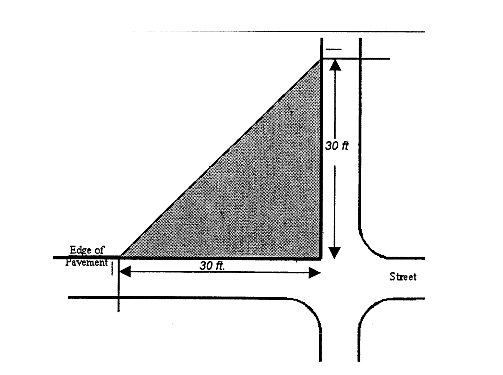
Sight distance triangle: The area bounded by the street right-of-way lines of corner lots and a line joining points along said street lines at a distance of 30 feet from their points of intersection, unless otherwise determined by the director or public works based upon standards published by the American Association of State Highway and Transportation Officials (AASHTO). Sight distance triangles are also applicable to driveways serving development off collector and arterial roadways.
Skilled nursing facility: A residential venue for the aged or infirm in which three or more persons not of the immediate family are received, kept, and provided with food, shelter, and care for compensation. This term also includes facilities commonly referred to as nursing homes, residential care facilities, assisted living facilities, and convalescent centers but does not include hospitals, medical clinics, or similar institutions primarily devoted to the diagnosis and treatment of the sick or injured, or facilities providing care for addiction recovery, mental health issues, or communicable diseases.
Stable, private: An accessory building for the keeping of horses, ponies and mules, used exclusively for pleasure riding or driving, or housed, boarded or kept for hire; including riding track.
Story: That part of a building included between the surface of the floor and the surface of the floor next above, or if there be no floor above, that part of the building which is above the surface of the highest floor thereof. A top story attic is a half-story when the main line of the eaves is not above the middle of the interior height of such story. The first story is the highest story having its interior floor surface not more than four feet above the curb level, established on mean street grade, or average ground level, as mentioned in "height of buildings," of this section.
Street: A public thoroughfare or place which affords principal means of access to property abutting thereon.
Street center line: The street center line is a line halfway between the street right-of-way lines.
Street line: The dividing line between the street and the abutting property.
Structural alteration: Any change, except those required by law or ordinance, which would alter the supporting members of a building or structure, such as bearing walls, columns, beams or girders, not including openings in bearing walls as permitted by other ordinances.
Structure: Anything constructed or erected, which requires location on ground, or attached to something having a location on the ground; including, but not limited to, advertising signs, billboards and poster panels, but exclusive of customary fences or boundary or retaining walls.
Trailer: Any vehicle or structure designed and constructed in such manner as will permit occupancy thereof as sleeping quarters for one or more persons, or the conduct of any business or profession, occupation or trade (or use as a selling or advertising device), and so designed that it is or may be mounted on wheels and used as a conveyance on highways or city streets, propelled or drawn by its own or other motive power, excepting a device used exclusively upon stationary rails or tracks.
Variance: A modification or variance of the provisions of this chapter, as applied to a specific piece of property, as distinct from rezoning.
Veterinarian: See "animal hospital."
Watering station: A facility for supplying water storage tanks with potable water.
Yard: An open space at grade between a building and the adjoining lot line, unoccupied and unobstructed by any portion of a structure from the ground upward, except as otherwise provided. In measuring a yard for the purpose of determining the width of a side yard, the depth of a front yard, or the depth of a rear yard, the least horizontal distance between the lot line and the main building shall be used.
Yard, front: An open space, unoccupied by buildings or structures (except as hereinafter provided) across the full width of the lot extending from the front line of the building to the front street line of the lot.
Yard, rear: An open space, unoccupied (except as hereinafter provided) between the rear lot line and the rear line of the principal building and the side lot lines.
Yard, rear yard depth: The mean horizontal distance from the rear line of the principal building to the center line of the alley where an alley exists; otherwise the rear lot line.
Yard side: An open, unoccupied space on the same lot with the building between the main building and the adjacent side line of the lot, and extending through from the street, or from the front yard to the rear yard, or to the rear line of the lot.
Yard, side(yard) line: Any lot boundary not a front or rear line thereof. A side line may be a party lot line, a line bordering on an alley or place or a side street line.
Zoning administrator: The individual(s) designated to administer this chapter and responsible for administering and enforcing the zoning ordinance and subdivision regulations. The term "zoning official" shall have the same meaning as "zoning administrator" and may be used interchangeably in this chapter
Undefined terms. Any term not herein defined specifically or by implication shall have meaning of common or standard usage or that such as the context of this chapter shall imply.
(c)
Terms relating to landscaping.
Landscaped area: An area that is permanently devoted to, and maintained for, the growing of shrubbery, grass and other plant material.
Standard shrub: Any bush or small evergreen occupying a space of at least 18 cubic feet.
Standard tree: A tree with a minimum caliper of two and one-half inches, ten to 12 feet high, of a deciduous hardwood variety normally capable of attaining a 25 foot height when the tree is 20 years old.
(d)
Terms relating to exterior lighting.
Cutoff fixture: A light fixture that cuts off upward transmission of light.
Foot candles: A unit of measure of the amount of light falling on a surface. The illumination level is equal to the amount of light generated by one candle shining on one square foot of surface, one foot away. Also equal to one lumen per square foot on a horizontal surface.
Lumen: The amount of light energy generated by a light source. Lights are typically rated for their efficiency in lumens per watt, where watts are a measure of the amount of electricity a fixture uses.
(d)
Terms relating to solar energy systems.
Ground-mounted solar energy systems: A solar energy system where an array is mounted onto the ground.
Solar energy: Radiant energy (direct, diffused, or reflected) received from the sun at wavelengths suitable for conversion into thermal, mechanical, chemical, or electrical energy.
Solar energy system: An energy system that consists of one or more solar collection devices and other associated infrastructure with the primary intention of generating electricity, storing electricity, or otherwise converting solar energy to a different form of energy. Solar energy systems may generate energy in excess of the energy requirements of a property if it is to be sold back to a public utility in accordance with local and state laws.
(Ord. No. 1583-22, § 1(Att.), 4-26-22)

