
Garden City City Zoning Code
ARTICLE 6
Sign Code
Sec. 16-6-10. - Findings of fact.
The Board of Trustees finds as follows:
(1)
This Article advances important and substantial governmental interests.
(2)
The regulations set out in this Article are unrelated to the suppression of constitutionally protected free expression and do not involve the content of protected messages which may be displayed on signs, nor do they involve the viewpoint of individual speakers.
(3)
The incidental restriction on the freedom of speech that may result from the regulation of signs hereunder is no greater than is essential to the furtherance of the important and substantial interests that are advanced by this Article.
(4)
The Town has an important and substantial interest in preventing sign clutter (which is the proliferation of signs of increasing size and dimensions as a result of competition among property owners for the attention of passing motorists), because sign clutter:
a.
Creates visual distraction and obstructs views, potentially creating a public safety hazard for motorists, bicyclists and pedestrians;
b.
May involve physical obstructions of streets or sidewalks, creating public safety hazards;
c.
Degrades the aesthetic character of the Town, making the Town a less attractive place for commerce and private investment; and
d.
Dilutes or obscures messages displayed along the Town's streets through the proliferation of distracting structures and competing messages.
(5)
Sign clutter can be reduced and prevented by reasonable sign regulations that:
a.
Do not relate to the content of the regulated signs; and
b.
Balance the legitimate needs of individuals, entities and organizations to convey messages with the legitimate objectives of the Town to promote public safety, enhance community character and support and enhance private property values.
(6)
Temporary signs may be degraded, damaged or destroyed by wind, rain, snow, ice and sun, and, after such degradation, damage or destruction, such signs harm the safety and aesthetics of the Town's streets if they are not removed.
(7)
Abandoned permanent signs create visual clutter without serving a corresponding purpose of displaying a message, and, as such, they harm the aesthetics of the Town's streets if they are not removed.
(8)
The Town has an important and substantial interest in protecting the health of its tree canopy, which contributes to the character and value of the community.
(9)
Certain types of speech are not constitutionally protected due to the harm that they cause to individuals or the community, and speech that is harmful to minors may be prohibited in places that are accessible to minors.
(Ord. No. 03-2015, § 2, 7-7-2015; Ord. No. 03-2016, § 1, 3-29-2016)
Sec. 16-6-20. - Purpose.
The purpose of this Article is to set out reasonable regulations for the erection, installation, operation and maintenance of signs in a manner that preserves and protects the constitutional right to free speech.
(Ord. No. 03-2015, § 2, 7-7-2015; Ord. No. 03-2016, § 1, 3-29-2016)
Sec. 16-6-30. - Objectives.
The objective of the regulations of this Article is to provide a balanced and fair legal framework for design, construction and placement of signs that:
(1)
Promotes the safety of persons and property by ensuring that signs do not create a hazard by:
a.
Collapsing, catching fire or otherwise decaying;
b.
Confusing or distracting motorists; or
c.
Impairing drivers' ability to see pedestrians, obstacles or other vehicles, or to read traffic signs.
(2)
Promotes the efficient communication of messages and ensures that persons exposed to signs:
a.
Are not overwhelmed by the number of messages presented; and
b.
Are able to exercise freedom of choice to observe or ignore said messages according to the observer's purpose.
(3)
Protects the public welfare and enhances the appearance and economic value of the landscape by reducing and preventing sign clutter.
(4)
Ensures that signs are compatible with their surroundings and prevents the construction of signs that are a nuisance to occupants of adjacent and contiguous property or users of the public rights-of-way due to brightness, glare, reflectivity, bulk or height.
(5)
Provides timely, fair and consistent permitting and enforcement.
(Ord. No. 03-2015, § 2, 7-7-2015; Ord. No. 03-2016, § 1, 3-29-2016)
Sec. 16-6-40. - Authority.
The Town has the authority to regulate signs under the United States Constitution, the Colorado Constitution and the police powers conferred upon statutory cities and towns in Title 31, C.R.S. With respect to marijuana businesses, the content of signs related to the marijuana business is restricted by state laws and regulations, and both the advertising and sale of marijuana are prohibited by federal law.
(Ord. No. 03-2015, § 2, 7-7-2015; Ord. No. 03-2016, § 1, 3-29-2016)
Sec. 16-6-50. - Applicability and exceptions.
(a)
Applicability of Article.
(1)
Generally. All construction, relocation, enlargement, alteration and modification of signs within the Town shall conform to the requirements of this Article. This Article applies only to signs that are integrated into, attached to, installed upon or set upon the ground, a structure, landscaping or a building. This Article does not apply to signs that are affixed to or painted on vehicles (except as provided in Subsection 16-6-120(c) below) or to signs that are carried by people.
(2)
Signs permitted before effective date. If a permit for a sign has been issued in accordance with applicable Town ordinances in effect prior to August 6, 2015, the effective date of this Article, and provided that construction is begun within six months of said effective date and diligently pursued to completion, said sign may be completed in accordance with the approved plans on the basis of which the permit has been issued, subject thereafter, if applicable, to the provisions of this Article regarding nonconforming signs.
(b)
Other regulations.
(1)
In addition to the regulations set out in this Article, signs may also be subject to applicable state laws and regulations (e.g., Colorado Department of Highways, "Rules and Regulations Pertaining to Outdoor Advertising," effective January 1, 1984, and as may be amended), federal laws and regulations and applicable adopted building codes.
(2)
When any provision of this Article covers the same subject matter as other regulations of the Town, the more restrictive regulation shall apply.
(3)
When any provision of this Article covers the same subject matter as other regulations of the State or the United States, the applicant is advised that nothing in this Article shall be construed as a defense to a violation of applicable state or federal law, except as provided in the state or federal law.
(c)
Sign permit required. A sign permit is required prior to the erection, installation or substantial modification of any sign that is not an exempt sign as defined in Subsection (d) below.
(d)
Exceptions from permit requirement. The following exempt signs do not require a sign permit, but may require a building permit or other related permit (if subject to building or electrical codes).
(1)
Required signs. Signs that are required by law or regulation:
a.
In furtherance of the performance of a public duty or function (e.g., temporary or permanent traffic control and street signs);
b.
To give legal notice (e.g., notices of pending action pursuant to this Code or Town ordinances);
c.
To comply with building codes (e.g., address numbers); or
d.
To comply with other laws or regulations.
(2)
Flags. Flags that are hung from not more than three building-mounted or ground-mounted flagpoles per property, provided that there is at least eight feet of sign clearance and no flag exceeds 32 square feet in area.
(3)
Signs with de minimus area.
a.
Signs that are affixed to a building or structure and that do not exceed one square foot in sign area, provided that only one such sign is present on each elevation that is visible from public rights-of-way or neighboring property; and
b.
Signs that are less than three-fourths square foot in area that are affixed to machines, equipment, fences, gates, walls, gasoline pumps, public telephones or utility cabinets.
(4)
Holiday decorations. Decorations and signs that are clearly incidental, customary and commonly associated with a holiday, provided that such decorations and signs are displayed for a period of not more than 60 consecutive days nor more than 60 total days in any one calendar year.
(5)
Interior signs. Signs that are not visible from residential lots, abutting property or public rights-of-way.
(6)
Temporary signs. Temporary signs that are in compliance with the applicable requirements of Division 4, Temporary Signs.
(Ord. No. 03-2015, § 2, 7-7-2015; Ord. No. 03-2016, § 1, 3-29-2016)
Sec. 16-6-110. - Measurements and calculations.
(a)
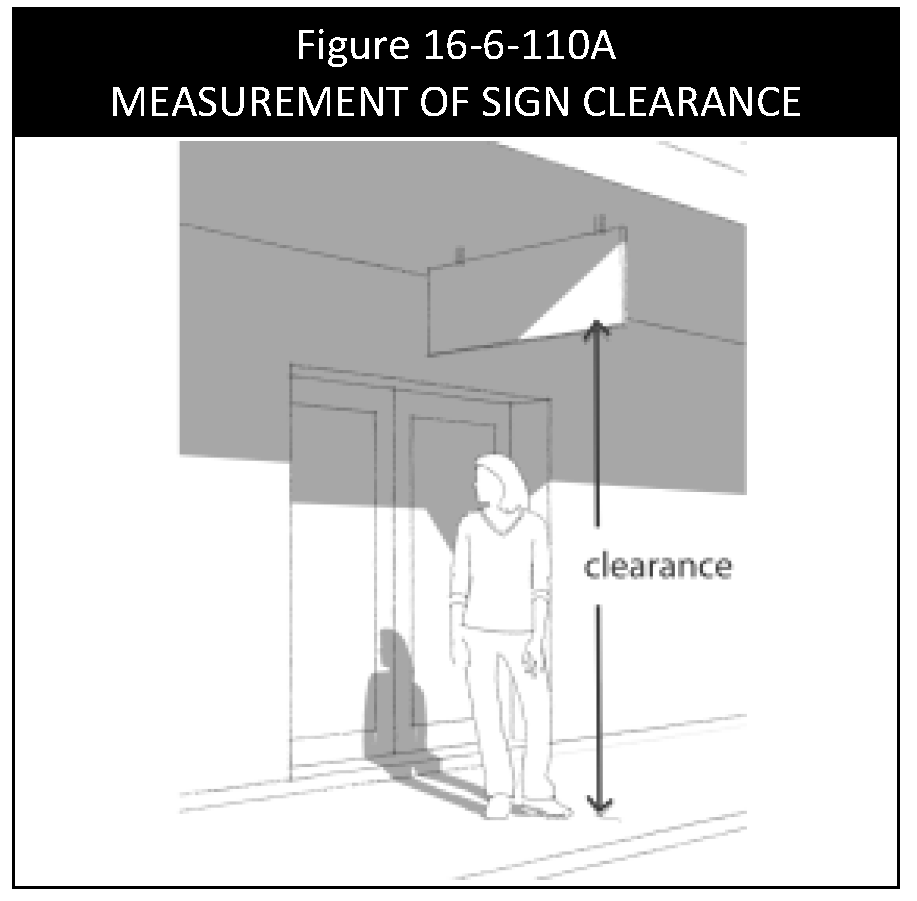
Sign clearance. Sign clearance is the distance between the bottom of a sign face or structural element that is not affixed to the ground and the nearest point on the ground-level surface under it. See Figure 16-6-110A, Measurement of Sign Clearance.
(b)
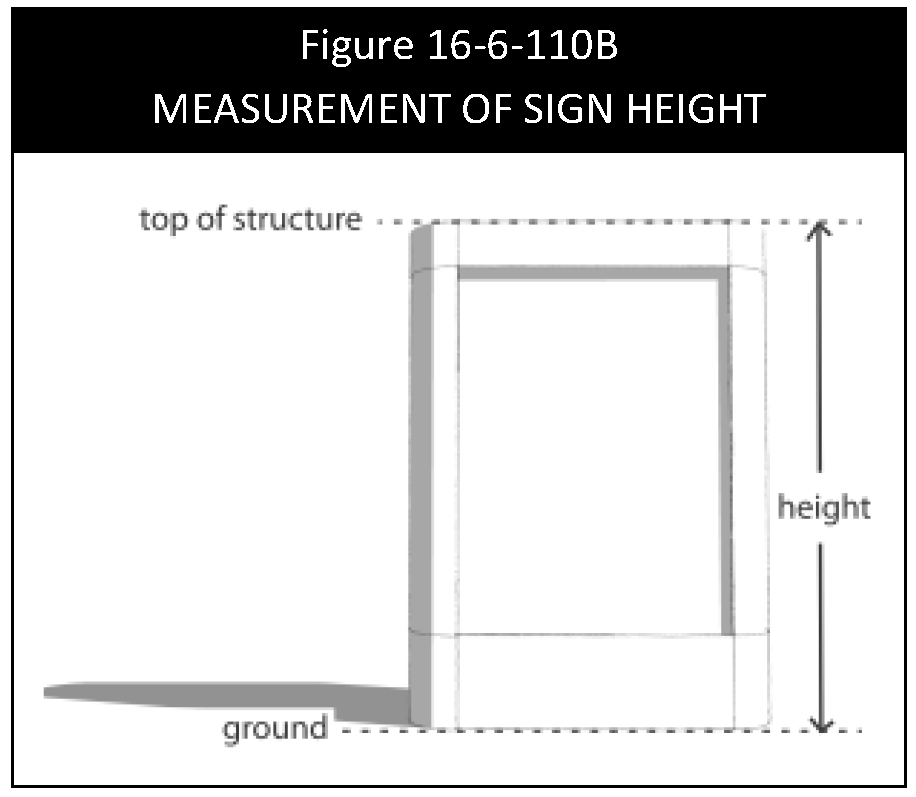
Sign height. For detached signs (temporary and permanent), sign height is the vertical distance to the top of the sign face or sign structure, whichever is higher, measured from the elevation of the average grade around the base of the sign. See Figure 16-6-110B, Measurement of Sign Height.
(c)
Sign area.
(1)
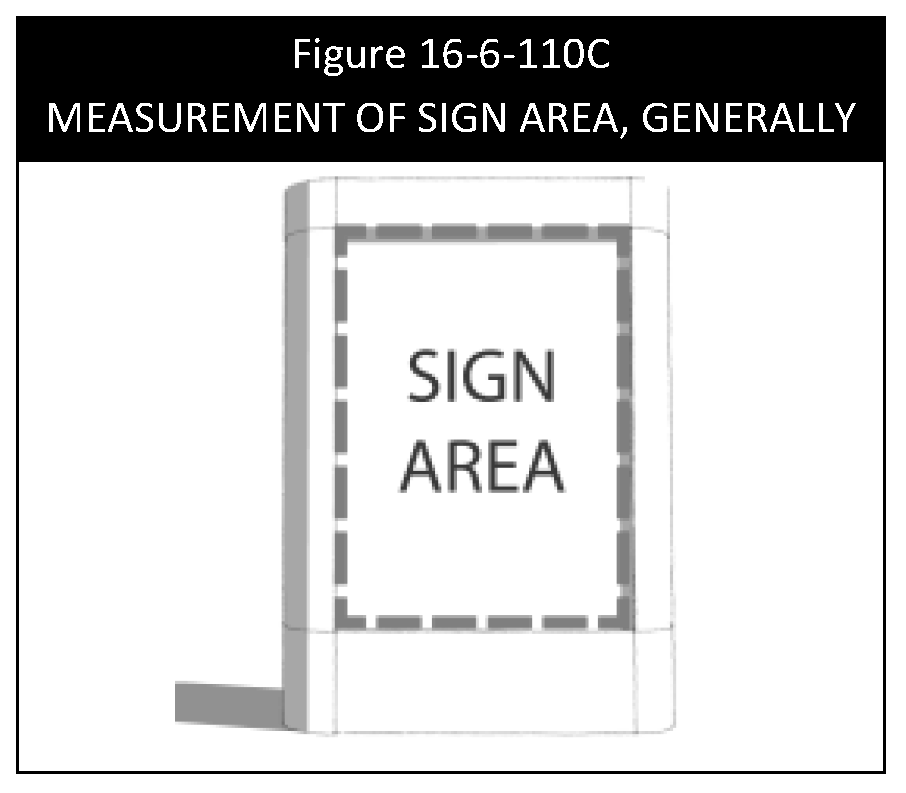
Generally. Sign area is the area within a continuous polygon with up to eight straight sides that completely encloses the limits of text and graphics of a sign, together with any frame or other material or color forming an integral part of the display or used to differentiate the sign's message from the background against which it is placed.
(2)
Inclusions and exclusions. The sign area does not include the structure upon which the sign is placed (unless the structure is an integral part of the display or used to differentiate it), but does include any open space contained within the outer limits of the display face of a sign, or between any component, panel, strip or figure of any kind composing the display face, whether or not this open space is enclosed by a frame or border. See Figure 16-6-110C, Measurement of Sign Area, Generally.
(3)
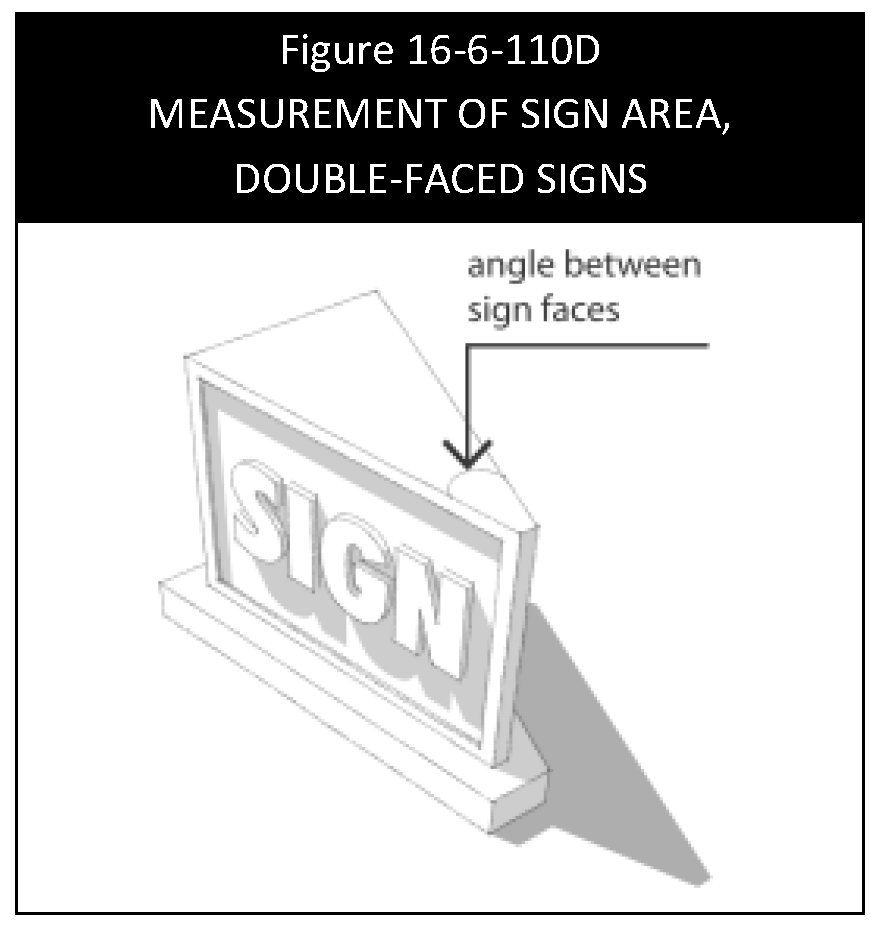
Double-faced signs. For projecting, suspended, freestanding or other double-faced signs, only one sign face is measured, provided that the sign faces are parallel or form an interior angle of less than 30 degrees and the sign faces are mounted on the same structure. If the sign faces are not equal in area, the larger sign face is measured. If the interior angle between the sign faces is more than 30 degrees, then both sign faces are measured. See Figure 16-6-110D, Measurement of Sign Area, Double-Faced Signs.
(Ord. No. 03-2015, § 2, 7-7-2015; Ord. No. 03-2016, § 1, 3-29-2016)
Sec. 16-6-120. - Prohibitions.
(a)
Generally. The prohibitions in this Section apply to temporary and permanent signs in all areas of the Town.
(b)
Prohibited signs. The following sign structures and designs are prohibited:
(1)
Signs with more than two sign faces.
(2)
Signs that are a traffic hazard because they simulate or imitate (in size, color, lettering or design) any traffic sign or signal.
(3)
Animated or moving signs that are visible from public rights-of-way, including any moving, swinging, rotating, flashing, blinking, scintillating, fluctuating or otherwise animated light, except as specifically permitted in Section 16-6-140, Electronic message centers, below.
(4)
Portable signs, except as specifically permitted in Division 4, Temporary Signs, of this Article.
(5)
Pole signs.
(6)
Abandoned signs.
(c)
Prohibited design elements. The following elements shall not be incorporated as an element of any sign or sign structure, whether temporary or permanent:
(1)
Sound, smoke or odor emitters.
(2)
Awnings that are backlit or made of plastic.
(3)
Stacked products (e.g., tires, soft drink cases, bagged soil or mulch).
(4)
Unfinished wood support structures, except that stake signs may use unfinished stakes.
(5)
Flags, banners or comparable elements that are designed to move in the wind, but only when such elements are attached to another sign type (e.g., flags may be attached to flagpoles, but may not be attached to monument signs).
(6)
Spinning or moving parts.
(7)
Bare light bulbs, except on holiday displays (which are exempted from regulation by Paragraph 16-6-50(d)(4) of this Article), and permitted neon window signs that are less than six square feet in sign area. Neon lighting within channels of channel lettered signs is not limited by the prohibition on bare light bulbs.
(8)
Flashing lights, except on holiday displays (which are exempted from regulation by Paragraph 16-6-50(d)(4) of this Article).
(9)
Motor vehicles, unless:
a.
The vehicles are operational, regularly used as motor vehicles and have current registration and tags;
b.
The display of signage is incidental to the motor vehicle use; and
c.
The motor vehicle is legally parked.
(10)
Semi-trailers, shipping containers or portable storage units, unless:
a.
The trailers, containers or portable storage units are:
1.
Structurally sound and capable of being transported,
2.
Used for their primary purpose (e.g., storage, pick-up or delivery), and
3.
If subject to registration, have current registration and tags;
b.
The display of signage is incidental to the primary purpose; and
c.
The semi-trailer, shipping container or portable storage unit is parked or placed in a designated loading area or on a construction site at which it is being used for its primary purpose.
(d)
Prohibited obstructions. In no event shall a sign, whether temporary or permanent, obstruct the use of:
(1)
Building ingress or egress, including doors, egress windows and fire escapes.
(2)
Equipment, structures or architectural elements that are related to public safety or utility service (e.g., standpipes, fire hydrants and meters).
(3)
Any sight distance triangle that is required by this Chapter or other applicable regulations.
(e)
Prohibited mounts. No sign, whether temporary or permanent, shall be posted, installed, mounted on or affixed to any of the following:
(1)
Trees or other vegetation.
(2)
Utility poles or light poles, unless:
a.
The sign is a temporary banner that is not more than ten square feet in area;
b.
There are at least eight feet of sign clearance;
c.
The sign is mounted on brackets at the top and bottom of the sign that extend not more than 30 inches from the utility pole or light pole; and
d.
The owner of the utility pole or light pole consents to its use for the display of the sign.
(3)
Utility cabinets or pedestals (except exempt signs posted by the owner of the utility cabinet or pedestal).
(f)
Prohibited locations. In addition to applicable setback requirements and other restrictions of this Article, no sign shall be located in any of the following locations:
(1)
In or over public rights-of-way (which, in addition to streets, may include other sidewalks, parkways, retaining walls, utility poles, traffic control devices, medians and center islands that are within public rights-of-way), except:
a.
Temporary or permanent signs posted by the Town or governmental entity with jurisdiction over the right-of-way;
b.
Temporary signs posted in connection with authorized work within the right-of-way, as authorized or required by the Town or governmental entity with jurisdiction over the right-of-way; and
c.
Signs painted on or affixed to transit shelters and bus benches as authorized by the provider of the shelter or bench, but not extending beyond the physical structure of the shelter or bench.
(2)
In locations that have less horizontal or vertical clearance from authorized communication or energized electrical power lines than the minimum clearance required by the laws of the State and the regulations duly promulgated by agencies thereof.
(3)
Within easements for overhead utilities, unless authorized by the utility service provider and in compliance with all other applicable requirements of this Article.
(Ord. No. 03-2015, § 2, 7-7-2015; Ord. No. 03-2016, § 1, 3-29-2016)
Sec. 16-6-130. - Illumination.
(a)
Generally. Illumination of signs using internal or external light sources is subject to the provisions and limitations of this Section.
(b)
Light trespass. No sign, whether internally or externally illuminated, shall create light spillover of more than one lux at any property line of a lot or parcel that is in the R or R-B Zoning District.
(c)
Location of illuminated signs. Lighting of signs is allowed in the following corridors: 8th Avenue; 7th Avenue (east of Highway 85); 6th Avenue; 25th Street; and 26th Street.
(d)
Internal illumination.
(1)
Internal illumination is not allowed in the R Zoning District. In all other zoning districts, internally illuminated signs shall not exceed a luminance of 5,000 nits when lit during daylight hours and 100 nits when lit during nighttime hours.
(2)
Awning signs shall not be backlit or otherwise internally illuminated.
(3)
In the B and C Zoning Districts, one window sign per facade may be internally illuminated, provided that the sign area of the illuminated sign is not more than six square feet.
(e)
External illumination. External illumination of signs shall not exceed an illuminance of more than 500 lux on any part of the sign face or surrounding surfaces. External light sources shall be shielded and directed to prevent glare.
(f)
Hours of illumination. All illuminated signs shall be turned off each day by the later of 10:00 p.m. or 30 minutes after closing of the associated land use. Signs may be turned back on at 5:00 a.m.
(Ord. No. 03-2015, § 2, 7-7-2015; Ord. No. 03-2016, § 1, 3-29-2016)
Sec. 16-6-140. - Electronic message centers.
(a)
Generally. Electronic message centers ("EMCs") are a type of internally illuminated sign that is subject to the applicable standards of Section 16-6-130 and the standards of this Section.
(b)
Prohibitions. EMCs are not allowed on nonconforming sign structures or on property that contains a nonconforming pole sign structure. EMCs are not allowed on portable signs.
(c)
Number of EMCs. Not more than one sign per property shall contain an EMC component. Two-sided monument signs and projecting signs may include one EMC per sign face.
(d)
Enclosure required; exception. EMC displays shall be enclosed on all sides with a finish of brick, stone, stucco, finished metal or other durable material that is used for that portion of surface of the sign face that is not an EMC. For freestanding signs, the enclosure shall extend not less than six inches outward from the display on all sides. For projecting or wall signs, the enclosure shall extend not less than four inches outward from the display on all sides. For window signs installed on the interior of buildings, enclosure is not required.
(e)
Proportions.
(1)
An EMC that is incorporated into a freestanding sign shall not occupy more than 50 percent of the area of any sign face.
(2)
An EMC that is incorporated into a projecting or wall sign shall not occupy more than the lesser of:
a.
Thirty-five percent of the area of the sign face into which it is incorporated; or
b.
Thirty-two square feet.
(f)
Other elements. EMC displays are not allowed on signs that also include manual changeable copy elements.
(g)
Pixel pitch. EMC displays shall have a pixel pitch of not more than 16 mm.
(h)
Brightness. EMCs shall conform to the standards of Section 16-6-130 and shall be equipped and programmed to automatically dim when ambient light levels drop.
(i)
Operation. EMCs shall be programmed, maintained and/or operated as follows:
(1)
Images (e.g., messages and graphics) shall be static (without motion, flashing, animation, frame effects or transitions).
(2)
Images shall be displayed for a period of not less than ten seconds.
(3)
If the EMC malfunctions such that image data is not properly displayed, it is programmed to either display a black screen or turn the screen off.
(Ord. No. 03-2015, § 2, 7-7-2015; Ord. No. 03-2016, § 1, 3-29-2016)
Sec. 16-6-150. - Manual changeable copy message centers.
Manual changeable copy message centers are allowed as a component of other signs. The area of the manual changeable copy message center, including its frame, shall not exceed the lesser of 32 square feet or 50 percent of the sign area of the sign in which the manual changeable copy message center is incorporated. The balance of the sign area shall utilize permanently affixed letters, images, graphics or symbols. Manual changeable copy message centers shall not be included on signs that also include EMC components.
(Ord. No. 03-2015, § 2, 7-7-2015; Ord. No. 03-2016, § 1, 3-29-2016)
Sec. 16-6-160. - Unprotected content.
(a)
Prohibition on certain types of unprotected speech. The following content is prohibited without reference to the viewpoint of the individual speaker:
(1)
Text or graphics of an indecent or immoral nature that is harmful to minors under state or federal law;
(2)
Text or graphics that advertise unlawful activity, except as provided in Subsection (b) below;
(3)
Text or graphics that are obscene, fighting words, defamation, incitement to imminent lawless action or true threats; or
(4)
Text or graphics that present a clear and present danger due to their potential confusion with traffic control signs or signs that provide public safety information (for example, signs that use the words "Stop," "Yield," "Caution" or "Danger," or comparable words, phrases, symbols or characters, in such a manner as to imply a safety hazard that does not exist).
(b)
Commercial speech related to marijuana. Federal law prohibits the advertising and sale of marijuana. State law specifically allows the advertising and sale of marijuana, subject to comprehensive state regulation. As of August 6, 2015, the effective date of this Article, the U.S. Department of Justice has indicated that it will use prosecutorial discretion to (in general) not enforce federal marijuana laws in states that have legalized marijuana under state law and enacted comprehensive regulations for the marijuana industry. Accordingly, the Town will allow a limited exception to Paragraph (a)(2) above for the signs of licensed marijuana businesses, provided that they that are in compliance with applicable state statutes and regulations. The exception created by this Subsection does not create a defense to the enforcement of federal law, nor shall the Town be liable for any damages caused by the enforcement of federal law.
(c)
Severability. The narrow classifications of content that are prohibited by this Section are either not protected by the United States or Colorado Constitution, or are offered limited protection that is outweighed by the substantial governmental interests in protecting the public safety and welfare. It is the intent of the Board of Trustees that each paragraph or subsection of this Section (e.g., Paragraphs (a)(1), (a)(2), (a)(3) or (a)(4), or Subsection (b)) be individually severable in the event that a court of competent jurisdiction holds one or more of them to be inconsistent with the United States or Colorado Constitution.
(Ord. No. 03-2015, § 2, 7-7-2015; Ord. No. 03-2016, § 1, 3-29-2016)
___________
Sec. 16-6-210. - Standards for attached permanent signs.
(a)
Wall signs. Wall signs are allowed according to the standards in Table 16-6-210A, Wall Signs.
Table 16-6-210A
Wall Signs
(b)
Projecting signs. Projecting signs are allowed according to the standards in Table 16-6-210B, Projecting Signs.
Table 16-6-210B
Projecting Signs
(c)
Window, awning and under-canopy signs. Window, awning and under-canopy signs are allowed according to the standards in Table 16-6-210C, Window, Awning and Under-Canopy Signs.
Table 16-6-210A
Window, Awning and Under-Canopy Signs
(Ord. No. 03-2015, § 2, 7-7-2015; Ord. No. 03-2016, § 1, 3-29-2016)
Sec. 16-6-220. - Standards for detached permanent signs.
Monument signs are allowed according to the standards in Table 16-6-220A, Monument Signs.
Table 16-6-220A
Monument Signs
(Ord. No. 03-2015, § 2, 7-7-2015; Ord. No. 03-2016, § 1, 3-29-2016)
___________
Sec. 16-6-310. - Standards for attached temporary signs.
(a)
Generally. Attached temporary signs are allowed subject to the standards of this Section, for the duration that is set out in Section 16-6-330, Duration of display of temporary signs, below.
(b)
Banners. Banners are permitted in the B and C Zoning Districts, provided that:
(1)
The property does not have a sign with an electronic message center or manual changeable copy message center;
(2)
There are not more than two banners per principal building;
(3)
No banner exceeds 32 square feet in area; and
(4)
All banners are attached to the principal building.
(c)
Sock signs and temporary wall signs. Sock signs and temporary wall signs are permitted in B and C Zoning Districts, provided that they are used during a period not to exceed 45 days in which a new permanent sign or sign component is being fabricated and installed.
(d)
Window signs. Temporary window signs are allowed in all locations where permanent window signs are allowed, provided that the applicable transparency standards of Section 16-6-210, Standards for attached permanent signs, are met.
(Ord. No. 03-2015, § 2, 7-7-2015; Ord. No. 03-2016, § 1, 3-29-2016)
Sec. 16-6-320. - Standards for detached temporary signs.
The maximum number, maximum sign area, maximum height and other restrictions that apply to detached temporary signs are set out in Table 16-6-320, Standards for Detached Temporary Signs.
Table 16-6-320
Standards for Detached Temporary Signs
(Ord. No. 03-2015, § 2, 7-7-2015; Ord. No. 03-2016, § 1, 3-29-2016)
Sec. 16-6-330. - Duration of display of temporary signs.
(a)
Generally. The purpose of temporary signs is to display messages for a temporary duration. Temporary signs shall not be used as a subterfuge to circumvent the regulations that apply to permanent signs or to add permanent signage to a property in addition to that which is allowed by this Article.
(b)
Duration of display.
(1)
In general, a temporary sign shall be removed as of the earlier of the date that:
a.
It becomes an abandoned sign;
b.
It falls into disrepair (see Section 16-6-510, Sign maintenance); or
c.
The number of days set out in Table 16-6-330, Duration of Temporary Signs, expires.
Table 16-6-330
Duration of Temporary Signs
(2)
Temporary signs that are required due to governmental regulation (e.g., public notices) shall be removed as required by the applicable regulation.
(c)
Administrative interpretations. Materials for signage that are not listed in this Section may be introduced into the market. When a material is proposed that is not listed in this Section, the Town Administrator shall determine the class of materials with which the new material is comparable, based on the new material's appearance, durability and colorfastness. No temporary sign shall be displayed for a longer period than the longest permitted period in this Section, regardless of the material.
(Ord. No. 03-2015, § 2, 7-7-2015; Ord. No. 03-2016, § 1, 3-29-2016)
Sec. 16-6-410. - Permitting procedures.
Applications for sign permits shall be submitted on a form approved by the Town Administrator and accompanied by the processing fee that is specified in the Town's Fee Schedule, along with any fees that are due pursuant to the applicable building code. The Town Administrator shall approve or deny sign permit applications within five business days after receipt of a complete application and fee. If an application is denied, the Town Administrator shall specify the reason for denial to the applicant in writing. If the Town Administrator does not decide the application within five business days, the application is approved.
(Ord. No. 03-2015, § 2, 7-7-2015; Ord. No. 03-2016, § 1, 3-29-2016)
Sec. 16-6-420. - Sign Design Program alternative.
(a)
Purpose. The requirements of this Article ensure that signs that meet certain minimum standards for public safety and consistency with the desired character and quality of development in the Town may be promptly approved and displayed. In some cases, alternative standards may improve the aesthetic and functional qualities of the development. Approval of a Sign Design Program pursuant to the standards of this Section allows for unified presentation of signage throughout a development, flexibility to provide for unique environments and pre-approval of designs and design elements to make processing of subsequent applications for sign permits more efficient. To this end, a Sign Design Program alternative is hereby created.
(b)
Authorization to modify requirements. Signage which is proposed as part of a Sign Design Program may deviate from the standards of this Article in terms of the types and numbers of signs allowed, the maximum sign area and materials and illumination standards (including electronic message centers), subject to compliance with an approved Sign Design Program.
(c)
Procedures. Sign Design Program applications shall be submitted on a form approved by the Town Administrator. Town Staff shall review the application for completeness and shall forward the application to the Board of Trustees for consideration at a public hearing within 31 days after the date of application. The Board of Trustees shall consider the application at a public hearing and shall either approve the application, approve the application with conditions unrelated to sign content or viewpoint or deny the application after applying the approval criteria set out in Subsection (d) below, subject to the limitations of Subsection (e), Hearings on Sign Design Program applications shall not be tabled or continued without the applicant's consent, which shall be included in the record of the hearing.
(d)
Approval criteria. The Board of Trustees may approve a Sign Design Program if it finds that the Sign Design Program results in a substantially improved, comprehensive and unified proposal compared to what is allowed through strict compliance with the sign regulations of this Article.
(1)
Prohibited signs and sign elements. Prohibited signs and sign elements enumerated in Section 16-6-120 of this Article are not eligible for inclusion in a Sign Design Program, except that pole signs may be included at intersections if it is demonstrated that:
a.
The pole sign is necessary to promote safety at the intersection and the site is configured such that a monument sign or attached sign will not provide adequate exposure;
b.
The pole sign is installed in a landscaped area;
c.
The sign height is less than 15 feet; and
d.
The sign area is not more than 32 square feet.
(2)
Modification of sign setbacks. Setbacks for detached signs may be different from the requirements of this Article if it is demonstrated that there is no impact on public safety or on utility easements and all other requirements for approval of a Sign Design Program are met.
(3)
Architectural theme. All signs shall be architecturally integrated into or complementary to the design and materials of the buildings and character of the site and shall use similar and coordinated design features, materials and colors. The Sign Design Program shall establish an integrated architectural vocabulary and cohesive theme for the development.
(4)
Illumination. Lighting standards shall not deviate from the standards of this Article.
(5)
Height, area, number and location of signs. The height, area, type, number and location of signs permitted through the Sign Design Program shall be determined by the Board of Trustees, based on the following criteria:
a.
The overall size of the development and the scale of the uses located or anticipated to be located there (larger land areas and scales of use tend to favor larger signs and/or more signs);
b.
The relationship between the building setback and sign location (additional signage may be appropriate for buildings with lower visibility);
c.
Frontage (larger frontages may justify more or larger signs, particularly if the size of the frontage tends to prevent sign clutter by allowing additional spacing between signs);
d.
Access and visibility to the site;
e.
Intended traffic circulation pattern;
f.
Hierarchy of signage;
g.
Relationship between the site and adjacent uses; and
h.
Consistency with the objectives and design policies of the Town's Comprehensive Plan and any applicable land use or design plans approved by the Board of Trustees for the area in which the Sign Design Program is proposed.
(e)
Maximum total sign area. The total permitted sign area shall not exceed 150 percent of the sign area for permanent signs that would otherwise be permissible if the property were in strict compliance with this Article.
(f)
Elimination of nonconforming signs. In addition to proposed new signage, all existing signs on a property for which a Sign Design Program approval is sought shall be addressed in the application. The Board of Trustees may require removal or modification of existing nonconforming signs as a condition of approval of a Sign Design Program.
(g)
Conditions of approval. The Board of Trustees may impose reasonable conditions on the Sign Design Program that are not related to the content of the signs or the viewpoints of the sign users, in order to ensure continuing compliance with the standards of this Article and approved Sign Design Programs.
(h)
Contents of Sign Design Program. A Sign Design Program shall set forth a master plan for signage for an entire development. Sign Design Programs shall set out:
(1)
The boundaries of the parcel in which the Sign Design Program will be applied;
(2)
Architectural elevations of the buildings on the parcel;
(3)
Sign dimensions and approximate locations;
(4)
Materials and colors;
(5)
Proposed illumination, including maximum illumination levels;
(6)
A design theme with illustrative examples of each sign type, the form of each sign type and the proposed general locations of each sign type; and
(7)
A demonstration that the Sign Design Program will improve the aesthetics of the development, reduce sign clutter and avoid or mitigate adverse impacts on the use, enjoyment or value of adjacent and nearby property.
(i)
Effect of approval. Upon approval of a Sign Design Program, issuance of a sign permit shall be based on compliance with the standards set out in the Sign Design Program for the development. Sign Design Programs may also specify types of signs that may be installed without further permits.
(Ord. No. 03-2015, § 2, 7-7-2015; Ord. No. 03-2016, § 1, 3-29-2016)
Sec. 16-6-510. - Generally.
Signs and sign structures of all types (attached, detached and temporary) shall be maintained as provided in this Division.
(Ord. No. 03-2015, § 2, 7-7-2015; Ord. No. 03-2016, § 1, 3-29-2016)
Sec. 16-6-520. - Paint and finishes.
Paint and other finishes shall be maintained in good condition. Peeling finishes shall be repaired. Signs with running colors shall be repainted, repaired or removed if the running colors were not a part of the original design.
(Ord. No. 03-2015, § 2, 7-7-2015; Ord. No. 03-2016, § 1, 3-29-2016)
Sec. 16-6-530. - Mineral deposits and stains.
Mineral deposits and stains shall be promptly removed.
(Ord. No. 03-2015, § 2, 7-7-2015; Ord. No. 03-2016, § 1, 3-29-2016)
Sec. 16-6-540. - Corrosion and rust.
Permanent signs and sign structures shall be finished and maintained to prevent corrosion and rust. A patina on copper elements is not considered rust.
(Ord. No. 03-2015, § 2, 7-7-2015; Ord. No. 03-2016, § 1, 3-29-2016)
Sec. 16-6-550. - Damage.
Permanent signs that are damaged shall be repaired or removed within 60 days. Temporary signs that are damaged (e.g., torn feather flags or yard signs) shall be removed within 24 hours.
(Ord. No. 03-2015, § 2, 7-7-2015; Ord. No. 03-2016, § 1, 3-29-2016)
Sec. 16-6-560. - Level position.
Signs that are designed to be level, whether temporary or permanent, shall be installed and maintained in a level position.
(Ord. No. 03-2015, § 2, 7-7-2015; Ord. No. 03-2016, § 1, 3-29-2016)
Sec. 16-6-610. - Nonconforming signs.
(a)
Generally. Any permanent sign that exists on August 6, 2015, the effective date of this Article, but does not conform to the provisions of this Article, is a "legal nonconforming" sign, provided that it was originally approved by a sign permit, or, if no sign permit was required under applicable law, it was in all respects in conformity with the applicable law immediately prior to the effective date or had legal nonconforming status at such time.
(b)
Repairs and alterations. Routine maintenance of nonconforming signs is permitted, including necessary non-structural repairs, paint and incidental alterations (e.g., changing the message of the sign by replacing or repainting the sign face). Structural alterations to nonconforming signs are permitted only if it is demonstrated that the alteration will eliminate the nonconformity.
(c)
Termination and removal.
(1)
A nonconforming sign which has been damaged by fire, wind or other cause in excess of 50 percent of its replacement cost shall not be restored, except in conformance with this Article.
(2)
If an element of a sign that causes the sign to be nonconforming is removed, it shall not be replaced, except with a conforming element.
(3)
If a nonconforming sign structure becomes an abandoned sign, it shall be removed or brought into conformance with this Article. For the purposes of this standard, a temporary "sock sign" may be used to display a message while a new sign face is being created.
(4)
If a nonconforming sign structure is removed for any reason other than routine repair and maintenance, it shall not be replaced unless the replacement sign conforms to this Article.
(5)
Nonconforming signs that are a danger to the public safety due to damage or wear shall be removed and shall not be replaced unless the replacement sign conforms to this Article.
(Ord. No. 03-2015, § 2, 7-7-2015; Ord. No. 03-2016, § 1, 3-29-2016)
Sec. 16-6-620. - Enforcement.
(a)
Enforcement authority. This Article shall be enforced by the Town Administrator.
(b)
Immediate removal of signs. Signs that are unlawfully located within the public right-of-way may be summarily removed by the Town and disposed of without notice.
(c)
Penalty for noncompliance. Every person convicted of a violation of any provision of this Article shall be punished by fine not exceeding $2,650.00 per day the violation continues. The Municipal Court may further order the defendant to remove a prohibited or unlawful sign within 20 days and, if the defendant fails to do so, that the Town may remove such sign and charge the property owner for the cost of removal plus a five-percent fee for administration, inspection and other incidentals.
(d)
Serving of notice.
(1)
Notices of violation of this Article shall be either:
a.
Sent by first-class mail, postage prepaid, to the address of the record owner of the real estate and/or person in possession and control of the property upon which the violation is alleged; or
b.
Personally served upon such person.
(2)
The notice of violation shall identify the sign or activity that is in violation of this Article and cite the section number that is allegedly violated. The notice of violation shall provide a period of not less than 14 days to cure the violation.
(3)
Failure to comply with the terms of the notice of violation may result in a summons to appear in Municipal Court.
(e)
Lien for collection of fines, penalties and costs. In order to collect fines, penalties and costs that are assessed by the Municipal Court, the Town may file a lien against the property upon which the prohibited or unlawful sign is located, such lien to have priority over all liens except general taxes and prior special assessments. The lien shall be placed upon the tax rolls for the current year, to be collected in the same manner as other taxes are collected. The Town may file such lien at any time not less than 30 days after judgment is entered by the Municipal Court.
(f)
Alternative procedure. The Board of Trustees finds that the signs and sign elements that are prohibited by Section 16-6-120 of this Article are a public nuisance. As such, in the alternative to the procedure set out in this Section, the Town may enforce this Article with respect to prohibited signs and prohibited sign elements in accordance with Chapter 7 of this Code.
(Ord. No. 03-2015, § 2, 7-7-2015; Ord. No. 03-2016, § 1, 3-29-2016)
Sec. 16-6-710. - Definitions.
For purposes of this Article, the following words shall have the meanings ascribed hereafter:
Abandoned sign means a sign that does not contain a message or contains a commercial or event-based message that is obviously obsolete (e.g., the name of a business that is no longer operational or an advertisement for an event that has already occurred), for a continuous period of 60 days.
Attached sign means a sign that is attached to or located inside a building (e.g., a wall sign, projecting sign, awning sign or window sign).
Awning sign means a sign that is mounted, painted or attached to canvas or other material that is installed over a projecting structural framework above a building window or door.
Banner means a type of temporary sign that is painted or printed on cloth, vinyl or other flexible material, which is typically mounted to poles, fences or walls with ties, clips, rails, brackets, hooks or frames.
Building elevation means the external face of a building, projected onto a two-dimensional plane. For purposes of calculating allowed sign area, the building elevation is the two-dimensional representation of the side of the building upon which the sign is proposed.
Detached sign means a sign that is not attached to or located inside a building (e.g., a monument sign or pole sign).
e.g. means "for example," and is intended to be illustrative and not exclusive.
Electronic message center (EMC) means a display surface that is composed of light-emitting diodes (LEDs) and that is capable of displaying variable messages and graphics, which are generally created on a computer.
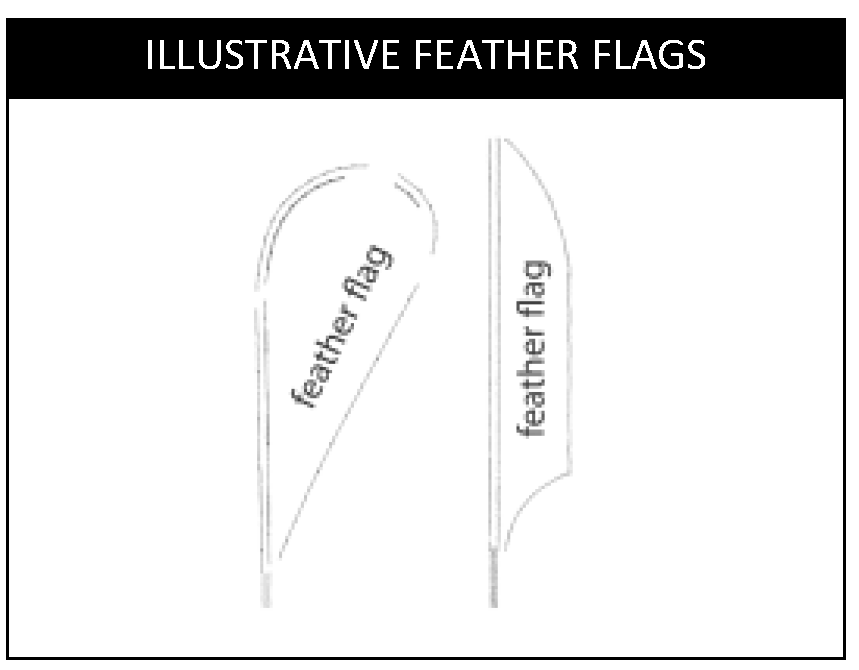
Feather flag means a flag that is mounted on a temporary flagpole (e.g., a flagpole that is installed in a mount that is staked into the ground), which may be vertical, bowed or flexible. Feather flags do not include flags that are flown from permanent, vertical flagpoles.
Flag means a flexible piece of fabric that is attached along one edge to a pole or rope and that is designed to move when the wind blows. Flags are typically (but not necessarily) rectangular in shape, and often (but not always) include printed or embroidered insignia that symbolizes a nation, state or organization, or that display a graphic or message.
Freestanding sign means a pole sign or a monument sign.
Land Use Code means the Land Use Code of the Town, Chapter 16 of this Code, as amended from time to time.
lf. means linear foot.
Lux means a measure of illuminance (a measure of light that falls upon or passes through an object), in terms of lumens per square meter.
Monument sign means a type of freestanding permanent sign generally having a low profile with little or no open space between the surface of the ground and the sign face or frame.
Nits means a measure of luminance (a measure of light that is emitted from an object), in terms of candelas per square meter.
Pixel pitch means a measurement of the resolution of an electronic message center display, in terms of the distance (generally in millimeters) between the center of a light-emitting diode (LED) cluster (pixel) and the center of the next LED pixel. Lower pixel pitch measurements indicate higher display resolution.
Pole sign means a type of freestanding permanent sign that is mounted upon one or more poles.
Portable sign means a sign that is designed to be easily moved from one location to another and, when placed, is neither fastened to a permanent structure or building, nor staked or otherwise installed into the ground. Portable signs include signs that are mounted on trailers, wheeled carriers or frames that are designed to be placed onto a surface without being secured to it.
Projecting sign means a sign that is mounted upon a building wall, such that the sign face is not roughly parallel to the building wall.
Roof sign means a sign that is installed, in whole or in part, above an eave line or parapet of a building.
sf. means square foot.
Sidewalk sign means a type of portable sign that is designed to be placed (but generally not anchored) upon a hard surface in order to attract the attention of pedestrians.
Sign means any surface, fabric, device or display which bears lettered, pictorial or sculptured matter, designed to convey information to the public, that is visible from abutting property, a public street, sidewalk or right-of-way. The term sign also includes all structural members (if any).
Sign face means the surface area of a sign which is designed for placement of text, symbols or images. The sign face does not include the supporting structure, if any, unless the supporting structure is used for the display of text, symbols or images. For wall signs, the sign face is equal to the sign area of the wall sign, or the area within any frame or color used to define, differentiate or mount the wall sign, whichever is larger.
Site sign means a type of temporary sign that is constructed of vinyl, plastic, wood, metal or other comparable rigid material, and that is displayed on a structure that includes at least two posts.
Sock sign means a type of temporary sign that is constructed of flexible material, designed to fit over a permanent sign face or mount.
Substantial modification means any modification of a sign that involves alteration or replacement of a structural support, enlargement of the sign area, material changes to the sign height or sign clearance, obvious changes of materials or components (e.g., replacement of wood with plastic), addition of new components (e.g., installation of lighting or an EMC) or repairs that cost more than 50 percent of the replacement cost of the sign. Substantial modifications do not include replacement of sign panels in a sign cabinet with comparable materials that display different messages, replacement of existing light sources with compliant light sources (unless the electrical work exceeds the repairs limit), painting or repainting,
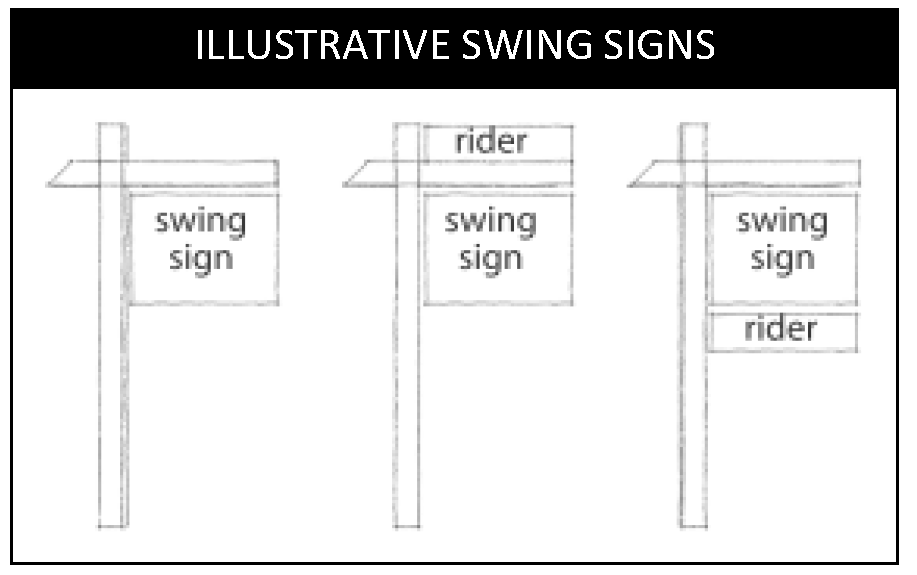
Swing sign means a type of temporary sign that is suspended from a horizontal swing post attached to a post that is staked into the ground. Swing signs may include riders that are mounted to the swing post or suspended under the sign panel.
Town means the Town of Garden City, Colorado.
Under-canopy sign means a type of permanent sign that hangs from a canopy or awning structure, generally perpendicular to the building upon which the canopy or awning structure is mounted.
Wall sign means a type of permanent sign that is painted on or applied to a wall of a building; and a type of permanent sign that is installed against the wall of a building, with a structure that extends not more than one foot from the building wall and a sign face that is roughly parallel to the building wall upon which the sign is mounted.
Window sign means a type of temporary or permanent sign that is: (1) painted on, applied to or attached to a window; or (2) installed or positioned within a building such that the sign face is oriented towards and highly visible through a window that is within six feet of the sign.
Window transparency, when used in relation to regulation of window signs, means the percentage of a window that is not covered or obstructed by a window sign.
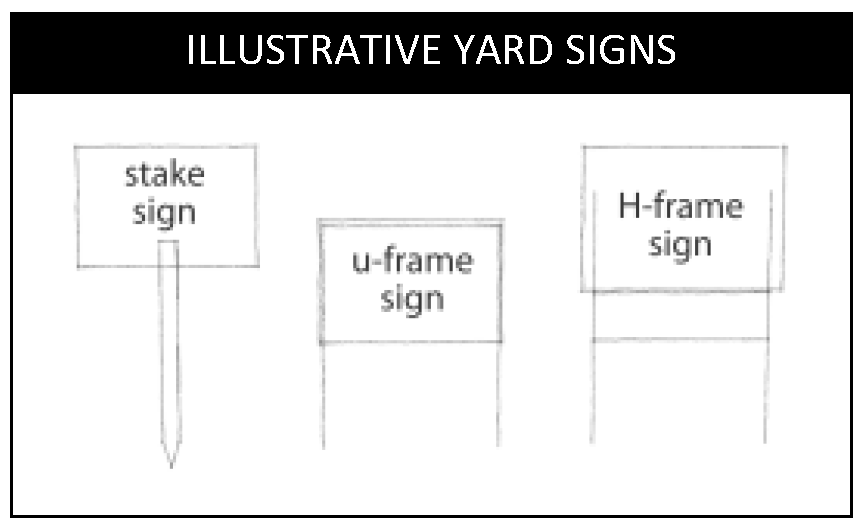
Yard sign means a type of temporary sign that is constructed of paper, vinyl, plastic, wood, metal or other comparable material, and that is mounted on a stake or a frame structure (often made from wire) that includes one or more stakes.
(Ord. No. 03-2015, § 2, 7-7-2015; Ord. No. 03-2016, § 1, 3-29-2016)

