


Garden City City Zoning Code
Sec. 90-49
Designation of mixed-use districts.
(a)
Intent and purpose. The regulations set forth in the Mixed-Use District are designed to:
(1)
Create an environment where residents and visitors can live, work, meet, and play.
(2)
Encourage a balanced mix of retail, professional, residential, civic, entertainment, and cultural uses.
(3)
Provide safe and accessible public space.
(4)
Improve the aesthetics of street and built environments.
(5)
Promote pedestrian safety by ensuring sidewalk-oriented buildings and attractive street-facing facades that foster pedestrian activity and liveliness.
(6)
Provide accessible and sufficient parking in an unobtrusive manner.
(7)
Ensure a compatible mix of residential, commercial, civic, and recreational uses.
(8)
Promote a coherent architectural identity.
(b)
Definitions. As used in this section, unless specifically stated otherwise, the following terms shall be defined as indicated. Words used in this section but not defined herein shall be as defined by section 90-5 as amended hereafter. Where any definition herein conflicts with another definition in section 90-5, the definition contained herein shall prevail.
(1)
Adult business. Business whose primary purpose involves products or services which appeal [to] prurient interests.
(2)
Build-to line. The line generally parallel a street-abutting lot line to which buildings shall enfront to the extent identified in this section. It is a requirement, not a permissive minimum, as is a setback, however, where a minimum and maximum build-to line exists, the building may enfront anywhere between the two lines. The line shall be measured from the back of the sidewalk clear zone along all street frontages and not from the front lot line. For the purposes of this section the build-to line shall exist even when not enfronted by a building.
(3)
Civic. The term defining not-for-profit organizations dedicated to arts, culture, education, recreation, government, transportation, and municipal parking.
(4)
Civic space. An outdoor area utilized for public use. Civic space types are defined by the combination of certain physical constants including the relationship between their intended use, their size, their landscaping, and adjacent buildings.
(5)
Commercial. The term collectivity defining retail, office and lodging functions.
(6)
Development. An action subject to the requirements of [chapter] 70 or section 90-197.
(7)
Development, minor. Development on lots of record of five acres or less and where no land subdivision, combination, recombination, or new street is proposed.
(8)
Development, major. All development that is not a minor development.
(9)
Door yard (see diagram 1). The area between the back of sidewalk clear zone and the build-to line.
(10)
Dwelling, ancillary. A dwelling unit not greater than 600 square feet or 40 percent of the floor area of the primary dwelling unit, whichever is greater, located on the same lot with a one-family dwelling, and sharing ownership and utility connections with it. No more than one ancillary dwelling shall be located per lot. Ancillary dwellings do not count towards maximum density calculations.
(11)
Enfront. To place an element, such as a building, along a build-to line.
(12)
Functions. The uses accommodated by a building and its lot. Functions include: dwellings, retail, office, lodging, and civic.
(13)
Habitable space. Covered and conditioned building floor area utilized for any use except parking, storage, power generators, and other relay equipment.
(14)
Lane. A public or private vehicular driveway generally located to the rear of lots providing access to parking and service, and often serving more than one building. Lanes shall have a maximum width of ten feet for one-way access and 20 feet for two-way access. Lanes are not considered streets.
(15)
Live-work unit. A dwelling unit of at least two stories that contains an office or retail component of the lesser of 600 square feet in floor area or 40 percent of the unit's total floor area. Office or retail functions shall be limited to the ground floor of the unit; shall be adjacent to sidewalk area; and shall be the place of employment for no more than two persons, one of whom shall be a resident thereof. For the purposes of this section, a live-work unit is not a mixed-use building.
(16)
Lodging. Premises available for daily and weekly renting of bedrooms, including motels and hotels.
(17)
Lot of record. A lot of land in existence at the time of rezoning to this district and not subsequently subdivided, combined, or recombined.
(18)
Mixed-use structure. A building containing at least two functions. A live-work unit is not a mixed-use building.
(19)
Office. An establishment available for the transaction of general business but excluding retail, and manufacturing uses.
(20)
Retail. An establishment selling merchandise, services, or food service.
(21)
Sidewalk area (see diagram 1). An area improved for walking that begins at the street curb (or edge of pavement if no curb exists) and consists of a contiguous and continuous landscape zone and clear zone.
a.
Sidewalk landscape zone. The paved or unpaved portion of a sidewalk area adjacent to the street and reserved for trees, groundcover, and street furniture including utility poles, waste receptacles, fire hydrants, traffic signs, traffic control boxes, newspaper boxes, bicycle racks and similar elements in a manner that does not obstruct pedestrian access or motorist visibility.
b.
Sidewalk clear zone. The paved portion of a sidewalk area reserved for pedestrian passage and unobstructed by any permanent objects to a height of eight feet above the paved surface. The sidewalk clear zone shall be adjacent to and between the sidewalk landscape zone and the door yard and shall have a consistent cross-slope not exceeding two percent.
(22)
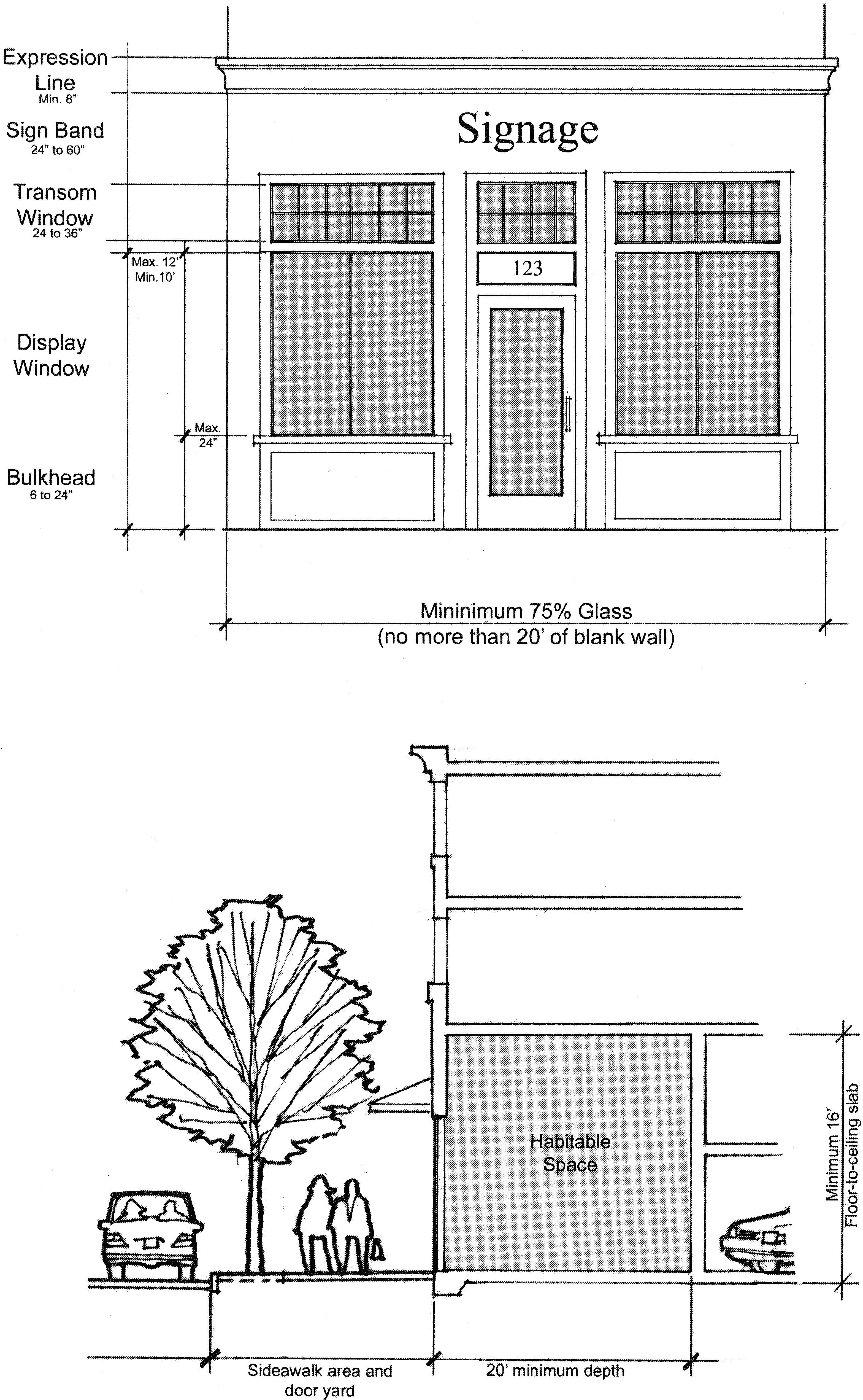
Storefront treatment (see diagram 2). An architectural treatment that:
a.
Is provided on the sidewalk level of a facade abutting a street.
b.
Provides habitable space for a minimum of the first 20 feet in depth behind the street facade.
c.
Provides a display window area consisting of:
1.
A non-glass base or knee wall beginning at grade and extending to not less than six inches but not more than 24 inches above grade.
2.
A glass display window a minimum of 75 percent of the length of the facade beginning at the top of the bulkhead or knee wall, to not less than ten feet and not more than 12 feet above grade. Said window shall provide views into the building interior, or into display cases having a minimum depth of three feet and accessible from the building interior.
3.
A primary pedestrian entrance recessed a maximum of seven feet from the exterior facade, remaining unlocked during normal business hours, and having a surface area that is a minimum of 70 percent glass.
4.
A glass transom located above the glass display window and entry door, having a minimum height of 24 inches and a maximum height of 36 inches.
d.
Provides no length of facade exceeding 20 feet without intervening glass display windows or glass doors.
e.
Provides a non-glass sign band located above the glass transom having a minimum height of 24 inches and a maximum height of 60 inches.
f.
Has an expression line above the sign band a minimum height of eight inches.
g.
Recesses any sidewalk level drop ceiling a minimum of 18 inches from the display window opening.
h.
Finished floor to ceiling slab shall be a minimum of 16 feet. Finished ceiling height shall be a minimum of 12 feet.
(23)
Street facade. The exterior wall of a building, not including extruding structures such as porches, stoops or bay windows, located along a build-to line.
(24)
Street wall. A wall not less than 75 percent opaque built within the dooryard and generally co-planer with the street facade, often for the purpose of masking a parking lot from the street. Street walls shall be a minimum of three and one-half feet in height, and constructed of a material matching the adjacent street facade or dense evergreen hedge. Street walls shall be discontinued no more than necessary to allow automobile and pedestrian access. The street wall shall have other individual openings not exceeding four square feet in area at height of less than three and one-half feet.
(25)
Townhouse. A one-family dwelling unit located on its own lot and sharing a party wall on at least one side with another such dwelling unit. Dwellings not located on a separate lot but otherwise meeting this definition shall be multifamily dwellings.
(c)
Procedural regulations.
(1)
Pre-application conference. Prior to filing a formal application for any development, the applicant may confer with the director of planning and economic development or their designee to review the requirements of the ordinance and the character of the proposed development. At this meeting, the director of planning and economic development or their designee may notify the applicant if the development is a minor development or a major development. In addition, the applicant may be notified if the development requires planning commission approval pursuant to chapter 70 of the Garden City Code.
(2)
Minor developments. Minor developments shall submit a planning commission application to the department of planning and economic development. In addition to the requirements of Code section 90-197, applications shall include:
a.
A boundary survey with computed acreage of the tract bearing the seal of registered land surveyor.
b.
Existing site topography with contours at no greater than two-foot intervals.
c.
The location of any streams or other waterways which exist on the property or that which are immediately adjacent.
d.
A written description of the proposed development, including floor area, dwelling units, parking required, parking provided, and building height.
e.
The type, size and location of all proposed structures.
f.
The location of proposed sidewalks, walkways, and crosswalks.
g.
The location of parking spaces and driveways.
h.
The general landscape treatment, including proposed tree plantings.
i.
Architectural plans and elevations illustrating the character of proposed structures. These shall include door and window locations, exterior facade materials, and the location of signage.
j.
The existing and proposed location of public sanitary sewer and water supply facilities.
k.
The existing and proposed location of private utilities or other easements.
l.
Any other items deemed necessary to establish conformance of the proposed development with the requirements of this section.
(3)
Major developments. Major developments requiring planning commission approval pursuant to chapter 70 shall submit an application for preliminary plan approval. Major development not requiring said approval shall file a building permit. In addition to the standards requirements of chapter 70 or Code section 90-197, both preliminary plat and building permit applications shall include:
a.
A written statement containing the following information:
1.
An explanation of the character of the proposed project, and the manner in which it shall be planned to take advantage of the Mixed-Use District.
2.
The expected schedule of development, including any phasing.
b.
An overall development site plan including the following information:
1.
A boundary survey with computed acreage of the tract bearing the seal of registered land surveyor.
2.
Existing site topography with contours at no greater than two-foot intervals.
3.
The location of any streams or other waterways which exist on the property or that which are immediately adjacent.
4.
The location of proposed lots, with dimensions, lot sizes, setbacks, door yards, and built-to lines indicated.
5.
The location of streets, parking, and driveways. Street dimensions shall be labeled.
6.
The location and size of civic spaces.
7.
Areas proposed to be conveyed, dedicated or reserved for public streets, civic spaces, and civic functions.
8.
The portion of the build-to line enfronted by buildings.
9.
The location of proposed sidewalks, walkways, and crosswalks.
10.
The general landscape treatment, including proposed tree plantings.
11.
A circulation diagram indicating proposed movement of vehicles, goods and pedestrians within the development to and from adjoining streets. Any special engineering feature(s) and traffic regulation devices needed to facilitate or insure the safety of this circulation pattern shall be shown.
c.
Building plans:
1.
The type, size and location of any proposed structures.
2.
A plan for each building site showing the location of buildings, structures, and other improvements.
3.
An off-street parking and loading plan.
4.
Architectural plans and elevations illustrating the character of each proposed structures. These shall include door and window locations, exterior facade materials, and the location of signage.
d.
Phased developments:
1.
Where a development is phased over years, the initial submittal shall include a site plan of the street, block, areas enfronted by buildings, and civic spaces for the entire development, but building plans are only required for the buildings being built during the initial phase. Individual building plans for subsequent phases shall be filed with future building permits.
2.
The applicant shall make such easements, covenants, and other arrangements and shall furnish such performance bond or bonds as may be determined by the planning commission to be reasonably required to assure performance in accordance with the plan and to protect the public interest in the event of the abandonment of the plan before completion.
3.
Any changes to an approved preliminary plan shall require planning commission approval.
(d)
Variances. There shall be two levels of variance: warranted variances (warrants) and exceptional variances (exceptions).
(1)
Warrants permit a practice that is not consistent with a specific provision of this section, but is justified by its intent purpose or by hardship. Warrants may be granted administratively through the director of planning and economic development.
(2)
Exceptions permit a practice that is not consistent with a provision nor the purpose of this section. Exceptions shall be granted only by the planning commission. Requests for exceptions may be filed concurrent with site plan approval.
(3)
The director of the department of planning and economic development shall determine when a variance is a warrant of an exception.
(4)
The request for an exception shall not subject the entire application to public hearing, but only that portion necessary to rule on the issue under consideration.
(5)
Warrants and exceptions shall be considered unique and shall not set precedents.
(e)
Major development site planning standards. The following shall apply to major developments:
(1)
Major developments shall include not less than two functions and subject to the following:
a.
The total floor area of each of the two functions shall be greater than 20 percent of the total development floor area.
b.
The total floor area of additional functions may be less than 20 percent of the total development floor area.
c.
The following shall not be included for the purpose of determining total floor area: parking garages and decks, basements, balconies, roof-top decks, open hallways, attics, and similar exterior or unconditioned internal spaces.
Table 1: Civic Space Standards
(2)
Major developments shall include not less than five percent of the development area as civic space, subject to the following:
a.
Detention ponds, wetlands, parking lot landscape islands, required hydrologic buffers, and any spaces not meeting the requirements of Table 1: Civic Space Standards shall not be used in meeting civic space requirements.
b.
In phased developments the sum of civic space provided in a given phase, plus any such space built in a previous space, shall not be less than five percent of the development area.
c.
A development applicant shall submit a maintenance agreement establishing a mechanism for maintaining civic spaces.
d.
Civic spaces shall be designed as generally described in Table 1: Civic Spaces.
e.
Each development shall contain at least one main civic space. Such shall be within 800 feet of the center of the development, unless environmental conditions, pre-existing streets, or other circumstances warrant.
f.
Each civic space shall have a minimum of 50 percent of its perimeter along a street.
g.
At a minimum, civic spaces shall be open to the public during regular city of Garden City park hours.
(3)
Major developments shall be designed to support and establish an interconnected street system both within the development and to adjacent developments, subject to the following:
a.
For purposes of major development planning there are two streets types:
1.
Primary streets are intended for a high degree of pedestrian orientation and:
(A)
Shall meet the requirements of Table 3: Sidewalk Standards.
(B)
Shall be enfronted by buildings or civic spaces for not less than 80 percent of their length, with such percentage calculated per block, per side. In the absence of buildings a street wall shall be provided, except adjacent to civic spaces.
(C)
Shall provide on-street parking adjacent to commercial functions.
(D)
Shall make up not less than 30 percent of the total length of streets in the development.
(E)
Shall be continuous within a development so as to provide a continuous high-quality pedestrian experience.
2.
Secondary streets are intended for a low degree of pedestrian orientation.
(A)
Shall meet the requirements of Table 3: Sidewalk Standards.
(B)
May be enfronted by parking lots or parking decks subject to the landscaping requirements of [sub]section 90-49(m), Landscaping.
(C)
May be designed to convert to Primary Streets over time.
(D)
Where a Secondary Street abuts parking, all utilities, other than electrical wiring, irrigation, and stormwater only serving said parking, shall be placed under said street. This will facilitate the long-term redevelopment of lot into other uses.
3.
Street type shall change at an intersection with another street, not mid-block.
4.
Parking lot drives are not considered streets unless meeting the requirements of Secondary Streets.
b.
Major developments shall be divided into blocks defined by Primary and Secondary Streets on all edges, subject to the following:
1.
No block perimeter shall exceed 2,400 linear feet (as measured at street centerline) except as identified for civic spaces and stub-out conditions.
2.
Developments with more than 1,320 combined linear feet of side and rear lot lines abutting an adjacent lot or lots shall construct street stub-outs to such in a ratio of at least one stub-out for every 1,320 total linear feet or fraction thereof, except as otherwise warranted.
3.
The maximum perimeter within the development of a block defined by at least one street stub-out shall be 2,000 linear feet, not including the lot line shared with the adjacent lot or lots.
4.
All developments abutting existing or approved street stub-outs shall provide street connection to such, unless otherwise warranted.
5.
Except where a civic space abuts a side or rear lot line, there is no size limit for blocks containing only a civic space. Civic spaces abutting a side or rear lot line and in a development subject to subsections 90-49(e)(3)b.3. shall be bounded by blocks meeting the requirements of subsections 90-49(e)(3)b.3., unless otherwise warranted.
c.
All Primary and Secondary streets, whether public or private, shall function as a public access street and shall not be access controlled.
(f)
Permitted uses.
(1)
Dwelling functions, including the following uses:
a.
One-family dwellings, provided that each dwelling unit shall have a minimum finished living area of 1,200 square feet of floor area.
b.
Two-family dwellings and townhouses, provided that each unit shall have a minimum finished living area of 1,000 square feet of floor area.
c.
Multifamily dwellings, provided that each unit shall have the minimum finished living floor areas:
1.
Efficiency/one bedroom—650 square feet.
2.
Two Bedrooms—780 square feet.
3.
Three bedrooms—940 square feet plus an additional 80 square feet for each bedroom in excess of three bedrooms.
d.
Ancillary dwellings.
e.
Customary home occupation.
f.
Condominium development created in accordance with the Georgia Condominium Act.
1.
Provided that access to the condominium development as a whole shall be from any public street, or from a private street approved as part of a condominium development so long as the property within the condominium development which gains access by a private street is part of the owners' association which controls said street, and so long as the condominium development contains only apartment houses, rooming units, open space, recreational uses related to residential development, and residential related services. Otherwise, access to the condominium development as a whole shall be from public streets.
2.
Provided that as part of the contents of the declaration of condominium which is required by state law to be filed with the Office of Clerk of the Superior Court of Chatham County, Georgia, the declaration shall contain the following:
(A)
The definition of common elements stating that water lines and sewer lines located outside public street rights-of-way and city utility easements are common elements;
(B)
The definition of common expenses stating that ad valorem taxes, public assessments, or governmental liens levied against the common elements are common expenses; and
(C)
A statement providing that the owners' association of the condominium development shall be responsible for maintaining any private street.
(2)
Civic functions, including the following uses:
a.
Public uses: This includes buildings, structures and other uses of land by a government agency or government unit.
b.
Neighborhood recreation center.
c.
Churches and other places of worship.
d.
Public and private schools, including day nurseries, kindergartens and child care centers.
e.
Hospitals and medical centers.
f.
Cultural facilities, including art galleries, legitimate theater, libraries and similar facilities.
(3)
Lodging functions and uses.
(4)
Office functions, including the following uses:
a.
Office buildings.
b.
Live/work units.
(5)
Retail functions, including the following uses:
a.
Retail buildings.
b.
Restaurants, including fast food restaurants but not drive-in restaurants.
c.
Cocktail lounges, nightclubs and taverns.
d.
Amusement or recreational activity carried on wholly within a building, including theater, bowling, billiard parlor, clubs, lodges, dancehalls and similar activities.
e.
Personal services, including barbershops, gyms, beauty shops, shoe repair, dry cleaning and laundry pickup stations, laundromats, photography, watch repair, catering, and similar services.
f.
All sales, service, and displays shall be conducted completely indoors except as follows:
1.
Outdoor dining for restaurants is permitted at all times.
2.
Displays in the door yard are permitted, provided all materials are brought inside between the hours of 9:30 p.m. and 6:30 a.m. daily.
3.
Temporary outdoor displays may be kept outside continuously for up to seven days a maximum of once every three months.
g.
Indoor retail sale and/or storage of motor vehicles provided that:
1.
All sale and/or storage activities are restricted to within an enclosed building;
2.
There shall be no repair work performed as part of such use;
3.
No temporary signage as defined in Garden City Code section 90-5 shall be permitted; and,
4.
A site plan shall be submitted to and approved by the Planning Commission under the provisions of Garden City Code section 90-48.
(6)
Signs, accessory use.
(7)
Incidental or accessory uses and buildings.
(8)
Drive-in facilities, including drive-thru windows, are not permitted by-right. Drive-ins, except those at banks, may only be allowed when granted approved by the planning commission under the conditions outlined below. In order for a drive-in to be considered for such approval, it must conform with the following conditions:
a.
There shall only be one drive-thru window.
b.
Drive-thru windows shall be located in the rear of properties in mid-block and at lane accessed locations.
c.
Drive-in facilities, including all vehicular stacking, shall not be visible from a Primary Street.
d.
There shall be no minimum stacking requirements for vehicles; the maximum stacking allowed for vehicles shall be three vehicle lengths.
e.
Gas stations, automobile service stations, car washes, junk yards, and outdoor vehicular sales.
(9)
The following retail or office uses are expressly prohibited:
a.
Adult businesses.
b.
Farmers markets.
c.
Tattoo parlors.
d.
Animal hospitals, veterinary clinics, or animal boarding.
e.
Gas stations, automobile service stations, car washes, junk yards, vehicular sales.
f.
Flea markets.
(10)
The following other uses and buildings are prohibited:
a.
Industrial, manufacturing, production, and warehousing facilities.
b.
Agriculture.
c.
Airports and aircraft manufacturing.
d.
Major utilities, including sewage treatment plants.
e.
Recreational vehicle parks.
f.
Truck terminals.
g.
Waste removal and treatment services.
h.
Pawn shops.
i.
Small equipment repair and sales.
(11)
All of these permitted and prohibited uses are intended to be interpreted with regard to the primary or customary usage of those facilities and businesses.
(g)
Parking and loading requirements.
(1)
All uses shall provide off-street parking spaces in the amounts defined in Article V.
(2)
Code section 90-132 and Code section 90-135 notwithstanding, to satisfy these requirements parking may be located off-site within 1,000 feet within the district as measured along a pedestrian path or sidewalk. Shared parking between uses in the district is encouraged and may result in reductions of off-street parking requirements. Parking facilities may be shared if the uses generate parking demands at different times of the day or if a use has excess off-street parking capacity. Applicants may submit a plan for shared parking to the director of planning and economic development for administrative authorization of shared parking. Such plans shall include:
a.
A scaled map indicating location of all proposed parking spaces.
b.
A parking demand study by a licensed professional traffic engineer that documents the hours of business operation(s) for the land uses sharing the parking during all times of operation or occupancy and during all seasons of the year. Such study shall also provide sufficient data to document the actual or projected demand for parking and indicate the actual number of spaces that must be provided to satisfy such demonstrated demand.
c.
Written consent of all property owners to the shared or off-site arrangement.
d.
The director shall review the above documents and, based on the results of the study, may permit the reduction of the total required parking. Such shared parking arrangements shall remain in force for the duration of the written consent agreement in [subsection] (c.) above. A renewed consent agreement shall be provided to the director to ensure adequate parking capacity before a certificate of occupancy shall be granted for a new use subject to the terms of the agreement. Lack of a current lease shall automatically terminate the authorization and place the applicants in violation of the zoning ordinance.
e.
Owners of accessory parking facilities that provide excess spaces beyond the minimum required to serve all on-site uses may enter into written agreements to allow said excess spaces to supply required parking for other land uses whose primary door is within 1,000 feet as measured along a pedestrian path or sidewalk.
f.
Any change in use of a building, shop or leased area shall require compliance with the parking standards in this section to obtain a certificate of occupancy.
(3)
Pre-fabricated carports are prohibited, and all other carports are prohibited when visible from a primary street or civic space.
(4)
Garages to all dwelling uses shall not face adjacent streets except where lane access is not provided, in which case such garages shall be set back a minimum of 25 feet from the build-to line.
(5)
Townhouses and live-work units shall be served by a lane.
(h)
Development controls.
(1)
Dwelling density:
a.
The maximum permitted dwelling density shall be 15 units per acre as calculated based on the sum of all dwelling functions and the total development acreage, including multiple lots or blocks, but not rail lines or public streets;
b.
The built dwelling density of individual lots or blocks within a development may be greater or less than 15 units per acre, provided the overall combined average maximum permitted dwelling density is not exceeded; and,
c.
Any changes to an approved plan shall require approval of the original approving entity and shall be reviewed based on the geographic extent of the original approved plan; shall not exceed maximum density requirements of the original application; and shall indicate all built or planned improvements.
(2)
Lot standards:
a.
All uses shall comply with the development standards set forth in Table 2: Development Standards.
b.
The minimum lot areas contained in Table 1 are for establishing minimum lot sizes for land subdivision, subject to the overall development density limitations contained in section 90-49(h)(1) Dwelling Density.
c.
Where a lot contains more than one use and no land subdivision is proposed, the requirements in Table 2 for "Mixed-use structures" shall govern the entire lot.
(i)
Sidewalk requirements.
(1)
Sidewalks shall be located along all existing and new public and private streets and shall have the widths indicated in Table 3: Sidewalk Standards. Along existing streets lacking sufficient right-of-way to accommodate the widths contained in Table 3, sidewalks shall extend into the development site to the extent necessary to meet the minimum requirements, unless otherwise warranted.
Table 2: Development Standards
1. Measured from the back of the sidewalk clear zone, not the property line.
2. The minimum build-to line shall only be zero feet when adjacent to a building. When adjacent to a parking deck or parking lot the minimum build-to line shall be six feet and subject to the landscaping requirements of section 90-49(m).
3. Portions of enfronting facades located higher than four stories shall be set back a minimum additional ten feet from the indicated maximum build-to line, unless otherwise warranted.
4. Applies to principal structures. Garages or outbuildings may be five feet from the property line.
5. The maximum building height may be increased to five stories and 75 feet when a building exceeds the minimum unit size requirements by at least 25 percent above the minimums contained herein.
Table 3: Sidewalk Standards
(2)
Sidewalk landscape zone requirements:
a.
See Table 3: Sidewalk [Standards] for minimum widths.
b.
The landscape zone may be primarily paved adjacent to on-street parking and shall be landscaped in all other areas.
c.
Street trees shall be planted a maximum of 50 feet on center, spaced equal distance between streetlights, and in line with stripes of parallel parking spaces. All newly planted trees shall be a minimum caliper of three and one-half inches measured 12 inches above ground, shall be limbed up to a minimum height of 7 feet and shall have a minimum mature height of 40 feet. The director of planning and economic development may approve an alternate for street tree requirement subject to constraints such as overhead or underground utilities or underground utility easement upon finding that the alternative will not adversely impact adjacent properties or nearby uses.
d.
The landscape zone shall be maintained by the adjacent property owner.
e.
Section 30-0401 of City of Garden City Landscape Ordinance notwithstanding, the critical root zone requirement shall not apply to street trees.
(3)
Sidewalk clear zone requirements:
a.
See Table 3: Sidewalk [Standards] for minimum widths.
b.
No awning or canopy shall extend more than five feet over the clear zone.
c.
Where property within the district abuts another district without an intervening street, the clear zone within 20 feet of such district shall taper as necessary to provide a smooth transition to the existing sidewalk in the other district. In the event that the abutting district has no existing sidewalk the clear zone shall taper to a width of six feet, measured from the street curb, or as approved by the director of planning and economic development.
d.
Any paving materials, including concrete, special pavers, or decorative paving within the clear zone shall continue across any intervening driveway.
(j)
Door yard requirements.
(1)
Adjacent to all uses:
a.
Balconies and bay windows may encroach a maximum depth of five (5) feet into the zone width.
b.
Porches and stoops may occupy the entire depth of said zone.
c.
No door yard shall be used for: recreational areas and facilities such as swimming pools, tennis courts; fences and walls greater than 40 inches in height; service elements such as dumpsters, loading docks and similar elements; mechanical features; driveways unless perpendicular to the street; and parking.
d.
Adjacent to parking lots and decks the door yard shall be landscaped and planted with trees a maximum distance of 25 feet on center. All newly planted trees shall be a minimum caliper of three and one-half inches measured 12 inches above ground, and shall have a minimum mature height of 40 feet.
e.
Fences adjacent to a street shall be picket-wood, stone, composite materials or ornamental metal compatible with the adjacent building and with the finished side facing the street.
f.
All street-facing walls shall be faced with stone, brick, or smooth stucco.
g.
Retaining walls shall not exceed 32 inches in height.
(2)
Adjacent to a commercial uses the door yard:
a.
May be used for pedestrian amenities such as benches, merchandise display, potted plants, and decorative fountains. Outdoor dining is permitted adjacent to restaurants.
(3)
Adjacent to dwelling uses the door yard:
a.
Shall be landscaped, except for porches, stoops, and walkways.
b.
Is encouraged to include a fence, wall, curb or hedge between six and 40 inches in height at the back of the sidewalk.
(4)
Section 30-401 of City of Garden City Landscape Ordinance notwithstanding, the critical root zone requirement shall not apply to newly planted trees in the door yard.
(k)
Frontage requirements.
(1)
The following requirements shall apply to all buildings:
a.
All buildings shall enfront to the build-to lines established in Table 2: Development Standards for at least 30 percent of their exterior wall length, except where a greater percentage is required along Primary Streets.
b.
Buildings, including parking decks, shall provide ground floor habitable space along the enfronting facade as follows:
1.
One-family and two-family dwellings: For the first ten feet of building depth.
2.
All other uses: For the first 20 feet of building depth.
c.
All enfronting ground floor commercial establishments shall have a primary pedestrian entrance which faces, is visible from, and is directly accessible from the adjacent sidewalk along said street. Where a commercial establishment enfronts both a Primary and Secondary Street, said entrance shall be located along the Primary Street.
d.
All multifamily buildings with between one and three enfronting ground floor dwelling units along a single Primary Street shall have access to the adjacent required sidewalk via a lobby or individual entrances.
e.
All multifamily buildings with four or more enfronting ground floor dwelling units along a single Primary Street shall have individual entrances to such units directly accessible from the required sidewalk. All walkways providing such access shall be shared between no more than two adjacent units.
f.
All commercial establishments and residential units not located on an enfronting ground floor shall have pedestrian access to the closest adjacent required sidewalk via an enfronting common lobby or a walkway having a minimum width of three feet.
(2)
The following additional requirements shall apply to buildings abutting a Primary Street:
a.
Off-street parking is prohibited between a Primary Street and any adjacent building.
b.
Buildings shall enfront for a minimum of 80 percent of the width of the build-to line along the primary street, with each block calculated independently. In no case shall a mid-block break in buildings exceed 30 feet. Enfronting facades shall be primarily parallel to the sidewalk, but this shall not be construed as meaning that the facade may not articulate for doors, storefront windows, columns, or similar architectural features.
(l)
Architectural requirements.
(1)
Facade materials for all buildings:
a.
One-family dwelling, two-family dwelling, and townhouse facade materials:
1.
All buildings facades shall be brick, hard coat true stucco, stacked stone, wooden clapboard siding, or hardiplank clapboard siding.
b.
All other building facade materials:
1.
All enfronting facades shall be primarily brick decorative masonry, or stone, except for windows. No more than two brick, masonry or stone types (including color and pattern) may be used on an enfronting facade. This shall not apply to accents not exceeding ten percent of the facade area.
2.
The type and amount of building materials for all other buildings shall comply with Table 4: Facade Materials.
Table 4: Facade Materials
(except detached single-family dwellings, two-family dwellings, and townhouses)
c.
Roof materials for all buildings:
1.
Roof shingles shall be slate, cedar, or asphalt.
2.
Roof tiles shall be clay, terra cotta or concrete.
3.
Metal roofs shall be permitted.
4.
Street-facing gutters shall be copper, aluminum or galvanized steel.
5.
Downspouts shall match gutters in material and finish.
6.
Metal flashing, where utilized, shall be copper or factory finished sheet metal and shall be of a color that blends with other building materials.
d.
Concrete masonry units, glass block, vinyl siding, split-faced brick shall not be used on any exterior facades.
e.
Building facade materials shall be combined only horizontally, with the heavier below the lighter.
f.
Chimneys visible from a street shall not be faced in wood or fiber cements siding and shall not be a metal or ceramic pipe. Chimneys shall be wrapped in a full-depth brick, stone or masonry finish material.
g.
All garage materials shall match those of the principal structure.
h.
Foundations shall be constructed as a distinct building element that contrasts with facade materials. Exposed aboveground [foundations] shall be paraged with cement, stuccoed over or faced in full-depth brick, natural stone, or cast stone.
i.
Awnings shall be of fabrics, canvas, fixed metal, or similar material. Internally lit awnings and canopies that emit light through the awning or canopy material are prohibited.
j.
Where used, window shutters shall match one-half the width of the window opening.
k.
Painted window or door glass is prohibited.
(2)
Commercial and mixed-use buildings architectural requirements:
a.
Buildings shall provide a storefront treatment along the entire length of the enfronting ground floor facade. Blank, windowless walls are prohibited.
b.
All stories above the ground floor shall have windows and doors that equal a minimum of 20 percent and maximum of 60 percent of the total facade area, with each story being calculated independently.
c.
The ground floor finished floor to ceiling slab shall be a minimum of 16 feet. Finished ceiling height shall be a minimum of 12 feet.
d.
Excluding ground floor windows meeting the requirements of storefront treatment, all windows:
1.
Shall have true or simulated divided lights or be one-over-one lights; and
2.
Shall include sills of wood, masonry, stone, cast stone, or terra cotta.
3.
Shall provide glass that is clear, unpainted, and not tinted such that views into the building are obstructed.
4.
Shall be vertically shaped with a height greater than width, including display windows but not transoms.
e.
Upper story windows are encouraged to be equally sized, vertically oriented, equally spaced and arranged in a grid pattern.
f.
Doors and windows that operate as horizontal sliders are prohibited.
g.
All window frames shall be recessed a minimum of two inches from the exterior facade.
h.
Flat roofs shall be permitted.
i.
Non-residential buildings with sloped roofs shall contain a pitch between 4:12 and 12:12. Mansard roofs are prohibited. Pitched roof materials are limited to roof shingles, natural slate, wood shake, factory finished sheet metal, and terra cotta tile.
j.
Upper and lowers facades shall be differentiated. Potential ways to achieve this include windows, belt courses, cornice lines or similar architectural details. This is intended to prevent buildings in which individual floors can not be identified from the building exterior; it should not be interpreted to limit architectural expression.
(3)
One-family dwelling, two-family dwelling, and townhouse architectural requirements:
a.
Windows and doors:
1.
Buildings shall provide windows for a minimum of 30 percent and a maximum of 60 percent of the total enfronting facade area, with the facade of each unit being calculated independently.
2.
Buildings shall provide an entry stoop or porch at a primary enfronting pedestrian entrance.
3.
All enfronting windows shall be vertically shaped with a height greater than width. The top of said windows shall generally be in alignment with the top of the adjacent door frame.
4.
All windows:
(A)
Shall have true or simulated divided lights or be one-over-one lights; and
(B)
Shall include sills of wood, masonry, stone, cast stone, or terra cotta.
(C)
Shall provide glass that is clear, unpainted, and not tinted such that views into the building are obstructed.
5.
Doors and windows that operate as horizontal sliders are prohibited.
6.
All window frames shall be recessed a minimum of two inches from the exterior facade.
b.
Stoops and porches:
1.
The ground floor finished floor elevation should be raised a minimum of 24 inches above the adjacent sidewalk grade, except where front wheelchair access is desired.
2.
Street-facing porches and stoops shall not be enclosed with screen wire or glass.
3.
Enfronting porches and stoops shall be entirely located within the Supplemental Area.
4.
Porch and arcade columns shall be a minimum width of eight inches.
5.
Porches shall be covered and have a minimum depth of eight feet, a minimum length of eight feet and a minimum area of 64 square feet.
6.
Entry steps within the door yard shall have enclosed risers.
c.
Chimneys shall extend to the ground and shall be faced in brick or stacked stone. Chimneys shall extend between three and six feet above the roof line.
d.
All roofs shall have a minimum 25-year roof life and no visible roll roofing.
(4)
Multifamily dwellings, townhouses, and live/work unit architectural requirements:
a.
Multifamily dwellings and live/work dwelling may choose to meet either the architectural requirements for commercial and mixed-use buildings or one-family dwellings and two-family dwellings.
b.
All roofs shall have a minimum 25-year roof and no visible roll roofing.
(m)
Landscaping.
(1)
Refer to City of Garden City Tree Protection and Landscape Ordinance, except as identified herein.
(2)
Code sections 30-410 and 30-413 notwithstanding, where a parking lot or deck is located adjacent to any street, the door yard shall have a minimum width of six feet and shall be landscaped and planted with trees a maximum distance of 25 feet on center. If a street wall is provided it shall be located the back of the said zone. All newly planted trees shall be a minimum caliper of one and one-half inches and shall have a minimum mature height of 25 feet.
(3)
Code sections 30-409 and 30-411 notwithstanding, there shall not be landscape or buffer requirements between different uses within this district.
(4)
The provision of Code section 30-413 to the contrary notwithstanding, the requirements of Code section 30-413 shall only apply when buildings are located six or more feet from the back of the adjacent sidewalk or if there is no sidewalk.
(5)
Code section 30-407 shall be notwithstanding for urban mixed-use areas where all street tree standards and parking lot tree standards are met.
(6)
See subsection 90-49(i) for sidewalk planting requirements.
(n)
Building mechanical and accessory features:
(1)
All buildings shall provide a street address number, a minimum of six inches in height, above or beside the primary street-facing pedestrian entrance.
(2)
Mechanical and accessory features shall be located to the side or rear of the principal structure or on rooftops and shall not be visible from any park or street.
(3)
When located on rooftops, shall be incorporated in the design of the building and screened with materials similar to the building.
(4)
Dumpsters shall be entirely screened from view of any street with vertically enclosed opaque walls matching the materials of the principal structure.
(5)
Code section 30-412 notwithstanding, loading and service areas within a mixed-use development may be screened vertically with architectural fences and walls. All loading and service areas otherwise visible from an adjacent zoning district shall comply with the requirement of section 30-412.
(6)
No barbed wire, razor wire, chain link or similar elements are permitted.
(7)
Skylights are not permitted facing a primary or secondary street.
(8)
Roof-mounted lights and flagpoles are prohibited. Roof-mounted satellite dishes or telecommunication devices shall be screened from public view and shall blend with the background of the building as practical.
(9)
Vending machines, video or other outdoor merchandise displays, mechanical/electrical games, amusement rides, telephones, ice machines, freestanding automated teller machines excluding automated teller machines attached to buildings or integrated into buildings by canopies, and shopping carts shall be placed within the structure of a building and shall be out of view from a primary street.
(o)
Illustrative diagrams. The illustrations contained herein are graphic depictions of several of the requirements of this section. Unless otherwise indicated, each diagram is intended to specifically illustrate the indicated item; all suggestions of architectural style, on-street parking, tree shape and tree grate requirements do not constitute a requirement of this section. Additional principles shown in the illustration that do not illustrate specific requirements are consistent with other requirements of the section.
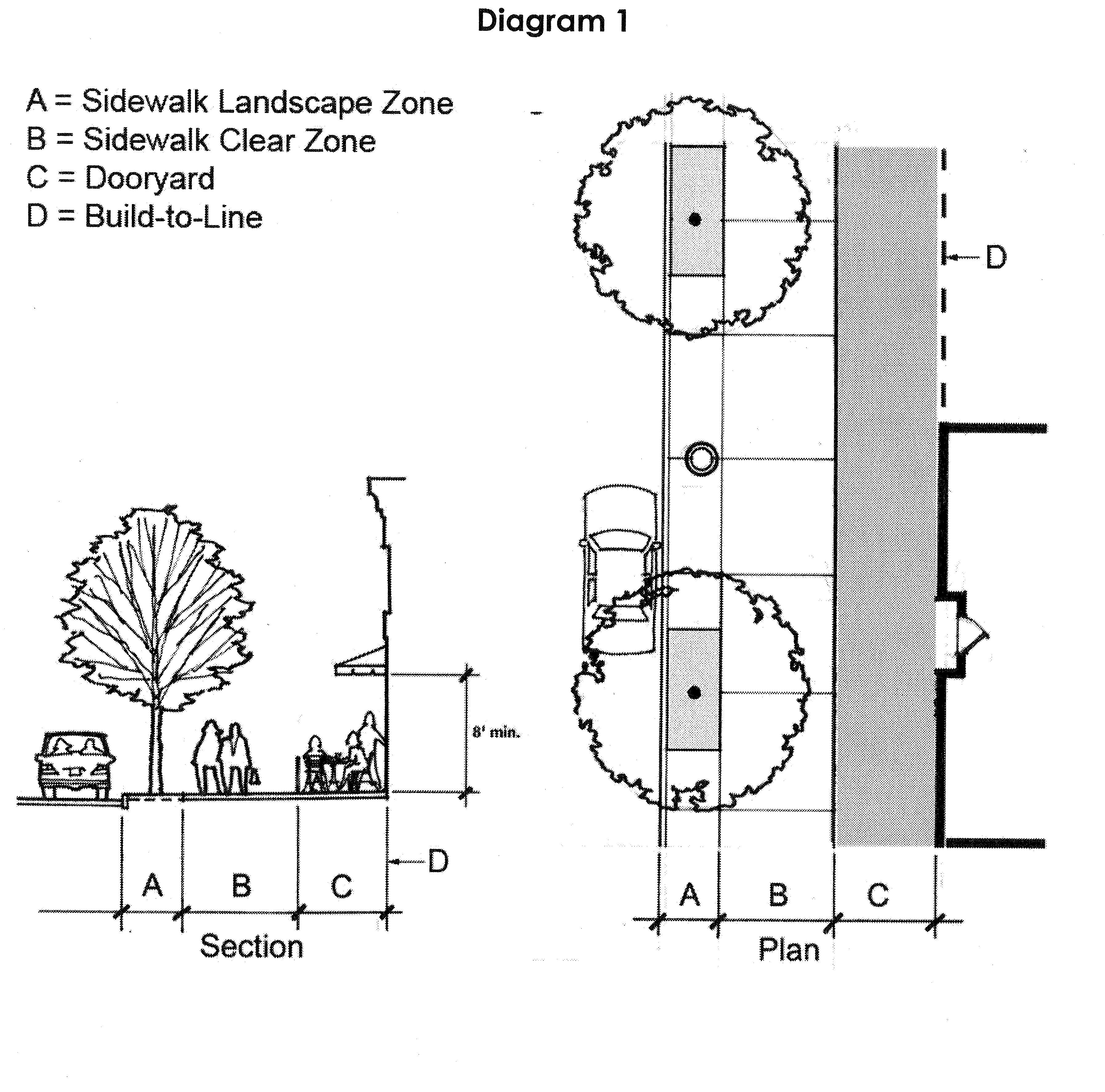
Diagram 2
(Ord. of 5-19-08, § 3; Ord. No. 2020-10, § 2, 10-5-20; Ord. No. 2021-06, §§ 2, 3, 3-3-21)