
Geneseo City Zoning Code
ARTICLE II
PERMISSIVE AND CONDITIONAL USES
Sec. 40-50.- Permit for particular uses; discontinuance.
(a)
When a conditional use permit is granted by the city council, the usage for which the conditional use was sought shall begin within one year of the meeting date or be null and void unless a different date is specified in the permit. All permits granted under the provisions of the previous chapters shall fall under the provisions of this subsection with the meeting date being the date of passage of this chapter.
(b)
Discontinuance of a conditional use. No building or premises used in whole or part under a conditional use permit which remains idle or unused for a continuous period of two years, whether or not the equipment or fixtures are removed, shall again be used for that purpose unless a new permit be granted. Temporary buildings for construction purposes are permitted in any district during periods of construction.
(c)
The city shall not be obliged to grant a conditional use for a lodging and rooming house, boarding house, or bed and breakfast house merely because the owner has obtained a license from the county health department but shall consider all pertinent factors as set forth in this chapter with relation to conditional uses. However, a conditional use may be granted to an owner who has not yet obtained a license from the county health department, subject to such a license being obtained within a reasonable time approved by the city, not to exceed two weeks from the granting of the conditional use. In the event that the owner does not obtain the license within the required period or any extension thereof granted by the city, or in the event the owner's license is revoked by the county health department for any reason, the conditional use shall be automatically revoked and terminated.
(Ord. No. 1206, § 9-5-1, 2-24-1981)
Sec. 40-51. - A Agricultural District.
(a)
Intent. This district is intended to preserve a rural setting of very low density and high quality for estate or gentlemen's farm type development, while providing also for the continuance of commercial agriculture on properties of sufficient area to permit compatibility with surrounding residential development, in areas not served or immediately intended to be served by municipal services, such as sewer and water systems.
(b)
Permissive uses.
(1)
Farm of not less than five acres in size.
(2)
Plant nursery and greenhouse.
(3)
Roadside stand offering for sale only farm products produced on the premises, which stand shall be removed during any period when not in use or not in season.
(4)
Farmstead.
(5)
Publicly owned or operated park or playground.
(6)
Cemetery.
(7)
Accessory uses of an agricultural or farming nature.
(c)
Height, yard, lot width and area regulations. The height, yard, lot width, and area requirements as required in article III of this chapter.
(d)
Off-street parking and loading regulations. In accordance with article IV of this chapter.
(e)
Conditional uses.
(1)
Railroad trackage.
(2)
Country club or golf course, except miniature golf course or golf driving range for commercial purposes.
(3)
Church and school, including college and junior college.
(4)
Home occupation.
(5)
Extraction of sand and gravel.
(6)
Privately operated outdoor recreational facility, including riding stable, lake, swimming, trailer park, pool, tennis court, and golf course, provided they are located on sites of five acres or more.
(7)
Airport, heliport, and helistop, provided they comply with the regulations of the Federal Aviation Administration and the state department of transportation, division of aeronautics. No land or water, or both, within the city limits shall be used for the landing or takeoff of any aircraft except in compliance with the terms of this provision. Nothing in this chapter shall prohibit the evacuation of disaster victims or removal and transportation of persons needing emergency medical treatment when such transportation is required for the preservation of human life, and such transportation is furnished by emergency air ambulance medical helicopter services, the United States Government, National Guard, or qualified civil defense authorities.
(8)
Hospital, nursing home, and educational, religious and philanthropic institution on sites of not less than five acres, provided not more than 20 percent of the site area may be occupied by the buildings and, provided further, that the buildings shall be set back from all required yard lines an additional two feet for each foot of building height above that required of the A Agricultural District.
(9)
Kennel, veterinary hospital or clinic, and stable, provided that any building or enclosure so used shall be located not less than 100 feet from any street or lot line or residential district.
(10)
Single-family dwelling.
(Ord. No. 1206, § 9-5-2, 2-24-1981)
Sec. 40-52. - R-1 Residential District.
(a)
Intent. The principal use of land is for single-family dwellings. These residential areas are intended to be defined and protected from encroachment of uses which are not appropriate to a residential environment. Internal stability, attractiveness, order, and efficiency are encouraged by providing for adequate light, air, and open space for dwellings and related facilities.
(b)
Permissive uses.
(1)
Single-family dwelling.
(2)
Farm: Crop production area only of not less than five acres in size.
(3)
Essential service.
(4)
Accessory building or use as follows:
a.
Private garage and parking areas for the sole use of the occupants.
b.
Vegetable and flower garden.
c.
Tennis court, swimming pool, garden house, pergola, ornamental gate, barbecue oven, fireplace, and similar uses customarily accessory to residential use.
(5)
Home occupations as set forth in section 40-23(2).
(c)
Height, yard, lot width, and area regulations. In accordance with article III of this chapter.
(d)
Off-street parking and loading regulations. In accordance with article IV of this chapter.
(e)
Conditional uses.
(1)
Church or temple.
(2)
Public school or school offering general educational courses the same as ordinarily given in a public school, private preschool, play, special, and other private school.
(3)
Public library and similar public culture uses, located not less than 20 feet from any side lot line in any residential district.
(4)
Community center.
(5)
Branch telephone exchange, transformer station, and booster or pressure regulating station, without service yard storage.
(6)
Country club with golf course, swimming pool, tennis courts, and similar recreational uses, provided that any principal building or swimming pool shall be located not less than 100 feet from any lot in any residential district.
(7)
Cemetery.
(8)
Home occupations as set forth in section 40-23(3).
(9)
Publicly owned or operated park or playground.
(10)
Farm of not less than five acres in size.
(Ord. No. 1206, § 9-5-3, 2-24-1981; Ord. No. O-23-08, §§ IV, VI, 9-12-2023)
Sec. 40-53. - R-2 Residential District.
(a)
Intent. The principal use of land is for single-family dwellings and, under certain conditions, new two-family dwellings and the conversion of older, larger dwellings into two-family and multifamily dwellings. It is further the intent of this district to protect the value of existing residential areas and ensure the value of future residential development while providing for the essential, supporting facilities, both public and private, of the residential areas. Internal stability, attractiveness, order, and efficiency are encouraged by providing for adequate light, air, and open space for dwellings and related facilities.
(b)
Permissive uses.
(1)
Single-family dwelling.
(2)
Farm: Crop production area only of not less than five acres in size.
(3)
Essential service.
(4)
Accessory building or uses as follows:
a.
Private garage and parking area for the sole use of the occupants.
b.
Vegetable and flower garden.
c.
Tennis court, swimming pool, garden house, pergola, ornamental gate, barbecue oven, fireplace, and similar uses customarily accessory to residential use.
(5)
Home occupations as set forth in section 40-23(2).
(c)
Height, yard, lot width, and area regulations. As required in article III of this chapter.
(d)
Off-street parking and loading regulations. In accordance with article IV of this chapter.
(e)
Conditional uses.
(1)
Church or temple.
(2)
Public school or school offering general educational courses the same as ordinarily given in a public school, private preschool, play, special, and other private school.
(3)
Public library and similar public culture uses, located not less than 20 feet from any side lot line in any residential district.
(4)
Community center.
(5)
Branch telephone exchange, transformer station, and booster or pressure regulating station, without service yard storage.
(6)
Country club with golf course, swimming pool, tennis courts and similar recreational uses, provided that any principal building or swimming pool shall be located not less than 100 feet from any lot in any residential district.
(7)
Cemetery.
(8)
Home occupations as set forth in section 40-23(3).
(9)
Publicly owned or operated park or playground.
(10)
Barbershop or beauty shop in accordance with the provisions in section 40-52.
(11)
Private club or lodge, except those whose chief activity is a service customarily carried on as a business, provided any building is located not less than 20 feet from any lot in any residential district.
(12)
Parking area accessory to a use in an adjoining, less restricted district when abutting or directly across an alley, subject to the applicable conditions contained herein, and such further conditions as may be stipulated by the zoning board of appeals.
(13)
The conversion of existing older and large single-family dwellings shall be subject to providing a minimum of 600 square feet of living space per apartment and each apartment shall contain sleeping, cooking (kitchen), toilet, and bathing facility, and comply with the current Uniform Housing Code. Off-street parking shall be provided in accordance with article IV of this chapter.
(14)
Studio, including, but not limited to, artist, photographer, sculptor, or musician.
(15)
Two-family dwelling (duplex).
(16)
Boardinghouse, provided that:
a.
Parking will meet the requirements of article IV of this chapter and must be visually screened from the neighboring properties.
b.
The establishment be operator-occupied.
c.
Interior features are retained to allow reconversion to residential use upon termination of the permit.
d.
The kitchen shall not be remodeled to a commercial kitchen.
e.
The establishment shall be operated entirely within the principal dwelling and guest rooms shall not occupy more than 50 percent of the total living area, excluding basement area, when determining total living area of the building or more than ten guest rooms, whichever is less.
f.
The owner shall provide a copy of an annual license granted by the county health department's bed and breakfast ordinance.
(17)
Lodging and roominghouse, provided that:
a.
Parking will meet the requirements within article IV of this chapter and must be visually screened from the neighboring properties.
b.
The establishment be operator-occupied.
c.
Interior features are retained to allow reconversion to residential use upon termination of the permit.
d.
The establishment shall be operated entirely within the principal dwelling and guest rooms shall not occupy more than 50 percent of the total living area, excluding basement area, when determining total living area of the building or more than ten guest rooms, whichever is less.
e.
The owner shall provide a copy of an annual license granted by the county health department's bed and breakfast ordinance.
(18)
Bed and breakfast house, provided that:
a.
Parking will meet the requirements within article IV of this chapter and must be visually screened from the neighboring properties.
b.
The establishment be operator-occupied.
c.
Interior features are retained to allow conversion to residential use upon termination of the permit.
d.
The establishment shall be operated entirely within the principal dwelling and guest rooms shall not occupy more than 50 percent of the total living area, excluding basement area, when determining total living area of the building or more than ten guest rooms, whichever is less.
e.
The owners shall provide a copy of an annual license granted by the county health department's bed and breakfast ordinance.
(19)
Hospital, clinic; nursing home; housing for the elderly; and educational, philanthropic, and religious institution, provided not more than 50 percent of the site area may be occupied by buildings.
(20)
Child care center.
(21)
Civic theatre.
(22)
Physicians' and dentists' office and private clinic for human care; professional office of architects, engineers, lawyers, and the like; office devoted to real estate, insurance, management, and similar enterprises when not displaying or handling merchandise on the premises. The buildings permitted under this subsection shall be of a design and location compatible with the permitted residential use.
(23)
Greenhouse, florist shop, and nursery.
(24)
Farm of not less than five acres in size.
(Ord. No. 1206, § 9-5-4, 2-24-1981; Ord. No. O-23-08, §§ IV, VI, 9-12-2023)
Sec. 40-54. - R-3 Residential District.
(a)
Intent. The principal use of land may range from single-family to medium density multifamily units. Internal stability, attractiveness, order, and efficiency are encouraged by providing for adequate light, air, and open space for dwellings and related facilities.
(b)
Permissive uses.
(1)
Single-family dwelling.
(2)
Multifamily dwelling not to exceed four units per building.
(3)
Farm: Crop production area only of not less than five acres in size.
(4)
Essential service.
(5)
Accessory building or uses as follows:
a.
Private garage and parking areas for the sole use of the occupants.
b.
Vegetable and flower garden.
c.
Tennis court, swimming pool, garden house, pergola, ornamental gate, barbecue oven, fireplace, and similar uses customarily accessory to residential use.
(6)
Home occupations as set forth in section 40-23(2) of this chapter.
(c)
Height, yard, lot width and area regulations. As required in article III of this chapter.
(d)
Off-street parking and loading regulations. In accordance with article IV of this chapter.
(e)
Conditional uses.
(1)
Church or temple.
(2)
Public school or school offering general educational courses the same as ordinarily given in a public school, private preschool, play, special, and other private school.
(3)
Public library and similar public culture uses, located not less than 20 feet from any side lot line in any residential district.
(4)
Community center.
(5)
Branch telephone exchange, transformer station, and booster or pressure regulating station, without service yard storage.
(6)
Country club with golf course, swimming pool, tennis courts, and similar recreational uses, provided that any principal building or swimming pool shall be located not less than 100 feet from any lot in any residential district.
(7)
Cemetery.
(8)
Home occupations as set forth in section 40-23(3).
(9)
Publicly owned or operated park or playground.
(10)
Barbershop or beauty shop in accordance with the provisions in section 40-52.
(11)
Private club or lodge, except those whose chief activity is a service customarily carried on as a business, provided any building is located not less than 20 feet from any lot in any residential district.
(12)
Parking area accessory to a use in an adjoining less restricted district when abutting or directly across an alley, subject to the applicable conditions contained herein and such further conditions as may be stipulated by the zoning board of appeals.
(13)
The conversion of existing older and large single-family dwellings shall be subject to providing a minimum of 600 square feet of living space per apartment and each apartment shall contain sleeping, cooking (kitchen), toilet, and bathing facilities and comply with the current Uniform Housing Code. Off-street parking shall be provided in accordance with article IV of this chapter.
(14)
Studio, including, but not limited to, artist, photographer, sculptor, or musician.
(15)
Two-family dwelling (duplex).
(16)
Boardinghouse, in accordance with the provisions of section 40-53.
(17)
Lodging and roominghouse, in accordance with the provisions of section 40-53.
(18)
Bed and breakfast house, in accordance with the provisions of section 40-53.
(19)
Hospital; clinic; nursing home; housing for the elderly; and educational, philanthropic, and religious institution, provided not more than 50 percent of the site area may be occupied by buildings.
(20)
Child care center.
(21)
Civic theatre.
(22)
Physicians' and dentists' office and private clinic for human care; professional office of architects, engineers, lawyers, and the like; office devoted to real estate, insurance, management, and similar enterprises when not displaying or handling merchandise on the premises. The buildings permitted under this subsection shall be of a design and location compatible with the permitted residential use.
(23)
Greenhouse, florist shop, and nursery.
(24)
Farm of not less than five acres in size.
(Ord. No. 1206, § 9-5-5, 2-24-1981; Ord. No. O-23-08, §§ V, VI, 9-12-2023)
Sec. 40-55. - R-4 Residential District.
(a)
Intent. The principal use of land may range from single-family to high density multifamily dwelling units. Internal stability, attractiveness, order, and efficiency are encouraged by providing for adequate light, air, and open space for dwellings and related facilities.
(b)
Permissive uses.
(1)
Single-family dwelling.
(2)
Multifamily dwelling not to exceed eight units per building.
(3)
Farm: Crop production area only of not less than five acres in size.
(4)
Essential service.
(5)
Accessory building or uses as follows:
a.
Private garage and parking areas for the sole use of the occupants.
b.
Vegetable and flower garden.
c.
Tennis court, swimming pool, garden house, pergola, ornamental gate, barbecue oven, fireplace, and similar uses customarily accessory to residential use.
(6)
Home occupations as set forth in section 40-23(2) of this chapter.
(c)
Height, yard, lot width and area regulations. As required in article III of this chapter.
(d)
Off-street parking and loading regulations. In accordance with article IV of this chapter.
(e)
Conditional uses.
(1)
Church or temple.
(2)
Public school or school offering general educational courses the same as ordinarily given in a public school, private preschool, play, special, and other private school.
(3)
Public library and similar public culture uses, located not less than 20 feet from any side lot line in any residential district.
(4)
Community center.
(5)
Branch telephone exchange, transformer station, and booster or pressure regulating station, without service yard storage.
(6)
Country club with golf course, swimming pool, tennis courts, and similar recreational uses, provided that any principal building or swimming pool shall be located not less than 100 feet from any lot in any residential district.
(7)
Cemetery.
(8)
Home occupations as set forth in section 40-23(3) of this chapter.
(9)
Publicly owned or operated park or playground.
(10)
Barbershop or beauty shop, in accordance with the provisions in section 40-52.
(11)
Private club or lodge, except those whose chief activity is a service customarily carried on as a business, provided any building is located not less than 20 feet from any lot in any residential district.
(12)
Parking areas accessory to a use in an adjoining less restricted district when abutting or directly across an alley, subject to the applicable conditions contained herein and such further conditions as may be stipulated by the zoning board of appeals.
(13)
The conversion of existing older and large single-family dwellings shall be subject to providing a minimum of 600 square feet of living space per apartment and each apartment shall contain sleeping, cooking (kitchen), toilet, and bathing facilities and comply with the current Uniform Housing Code. Off-street parking shall be provided in accordance with article IV of this chapter.
(14)
Studio, including, but not limited to, artist, photographer, sculptor, or musician.
(15)
Two-family dwelling (duplex).
(16)
Boardinghouse, in accordance with the provisions of section 40-53.
(17)
Lodging and roominghouse, in accordance with the provisions of section 40-53.
(18)
Bed and breakfast house, in accordance with the provisions of section 40-53.
(19)
Hospital; clinic; nursing home; housing for the elderly; and educational, philanthropic, and religious institution, provided not more than 50 percent of the site area may be occupied by buildings.
(20)
Child care center.
(21)
Civic theatre.
(22)
Physicians' and dentists' office and private clinic for human care; professional office of architects, engineers, lawyers, and the like; office devoted to real estate, insurance, management, and similar enterprises when not displaying or handling merchandise on the premises. The buildings permitted under this subsection shall be of a design and location compatible with the permitted residential use.
(23)
Greenhouse, florist shop, and nursery.
(24)
Farm of not less than five acres in size.
(Ord. No. 1206, § 9-5-6, 2-24-1981; Ord. No. O-23-08, §§ V, VI, 9-12-2023)
Sec. 40-56. - R-5 Residential District.
(a)
Intent. The principal use of land is for high density residential development. Certain uses are permitted which are more compatible with intensive residential use than with commercial uses. Internal stability, attractiveness, order, and efficiency are encouraged by providing for adequate light, air, and open space for dwelling and related facilities.
(b)
Permissive uses.
(1)
Single-family dwelling.
(2)
Multifamily dwelling not to exceed eight units per building.
(3)
Farm: Crop production area only of not less than five acres in size.
(4)
Essential service.
(5)
Accessory building or uses as follows:
a.
Private garage and parking areas for the sole use of the occupants.
b.
Vegetable and flower garden.
c.
Tennis court, swimming pool, garden house, pergola, ornamental gate, barbecue oven, fireplace, and similar uses customarily accessory to residential use.
(c)
Height, yard, lot width and area regulations. As required in article III of this chapter.
(d)
Off-street parking and loading regulations. In accordance with article IV of this chapter.
(e)
Conditional uses.
(1)
Church or temple.
(2)
Public school or school offering general educational courses the same as ordinarily given in a public school, private preschool, play, special, and other private school.
(3)
Public library and similar public culture uses, located not less than 20 feet from any side lot line in any residential district.
(4)
Community center.
(5)
Branch telephone exchange, transformer station, and booster or pressure regulating station, without service yard storage.
(6)
Country club with golf course, swimming pool, tennis courts, and similar recreational uses, provided that any principal building or swimming pool shall be located not less than 100 feet from any lot in any residential district.
(7)
Cemetery.
(8)
Home occupation.
(9)
Publicly owned or operated park or playground.
(10)
Barbershop or beauty shop, in accordance with the provisions in section 40-52.
(11)
Private club or lodge, except those whose chief activity is a service customarily carried on as a business, provided any building is located not less than 20 feet from any lot in any residential district.
(12)
Parking areas accessory to a use in an adjoining less restricted district when abutting or directly across an alley, subject to the applicable conditions contained herein and such further conditions as may be stipulated by the zoning board of appeals.
(13)
The conversion of existing older and large single-family dwellings shall be subject to providing a minimum of 600 square feet of living space per apartment and each apartment shall contain sleeping, cooking (kitchen), toilet, and bathing facilities and comply with the current Uniform Housing Code. Off-street parking shall be provided in accordance with article IV of this chapter.
(14)
Studio, including, but not limited to, artist, photographer, sculptor, or musician.
(15)
Two-family dwelling (duplex).
(16)
Boardinghouse, in accordance with the provisions of section 40-53.
(17)
Lodging and roominghouse, in accordance with the provisions of section 40-53.
(18)
Bed and breakfast house, in accordance with the provisions of section 40-53.
(19)
Hospital; clinic; nursing home; housing for the elderly; and educational, philanthropic, and religious institutions provided not more than 50 percent of the site area may be occupied by buildings.
(20)
Child care center.
(21)
Civic theatre.
(22)
Physicians' and dentists' office and private clinic for human care; professional office of architects, engineers, lawyers, and the like; office devoted to real estate, insurance, management, and similar enterprises when not displaying or handling merchandise on the premises. The buildings permitted under this subsection shall be of a design and location compatible with the permitted residential use.
(23)
Greenhouse, florist shop, and nursery.
(24)
Small service-oriented business or retail store within a dwelling structure and designed to serve only the occupants of the premises.
(25)
Mobile home court or park, provided that:
a.
Each lot provided for occupancy of a single mobile home unit or house trailer shall have an area of not less than 4,500 square feet and a width of not less than 45 feet and no court or park shall be permitted a density of more than eight units per acre and each mobile home court or park shall contain a minimum of ten acres and be served by public sewer and water systems.
b.
All mobile home courts or parks shall provide lots sufficient in size to maintain the following requirements:
1.
No mobile home or house trailer, any structure, addition, or appurtenance thereto is located less than ten feet from the adjacent lot boundary.
2.
Space between mobile homes or house trailers may be used for parking of motor vehicles if the space is clearly designated and the vehicle is parked at least ten feet from the nearest adjacent lot boundary.
c.
Each mobile home or house trailer site shall abut or face a clear unoccupied space, driveway, roadway, or street of not less than 28 feet in width, which shall have unobstructed access to a public highway or street.
d.
All private streets or drives within the mobile home court or park must have an improved all weather surface of not less than 28 feet in width.
e.
The mobile home court or park shall be surrounded by a landscaped strip of open space 50 feet wide along the public street frontage of a major street and 25 feet wide around the court or park of a minor street frontage.
f.
No mobile home or trailer sales lot shall be connected with the mobile home or house trailer court except that units may be displayed for sale upon any of the approved sites as model units.
g.
All appropriate state and city health and sanitation regulations shall be strictly observed.
h.
A common space shall be provided within the mobile home court or park for the storage of boats, campers, and other bulky equipment which shall not be permitted on individual mobile home sites.
(26)
Farm of not less than five acres in size.
(Ord. No. 1206, § 9-5-7, 2-24-1981; Ord. No. O-23-08, §§ V, VI, 9-12-2023)
Sec. 40-57. - General intent of business districts; environmental performance standards.
The business districts are intended to provide for a wide range of commercial and light industrial uses. However, any commercial or industrial use shall observe the following environmental performance standards:
(1)
Noise. All noise shall be muffled so as not to be objectionable due to intermittence, beat frequency, or shrillness, and, as measured at any property line, shall not exceed the most current noise regulations adopted by the state pollution control board.
(2)
Smoke. The emission of smoke by any use shall be controlled so to be less dark in shade than that designated as No. 2 of the Ringelmann Chart, published and used by the United States Bureau of Mines; provided, however, that smoke of a density equal to that designated as No. 2 on the Ringelmann Chart may be permitted for not more than eight minutes during any 30-minute period and smoke of a density not exceeding that designated as No. 3 on the Ringelmann Chart may be permitted for not more than six minutes during any eight-hour period while starting or cleaning a fire.
(3)
Dust and other particulate matter. The emission of dust, fly ash, and other particulate matter shall not exceed 0.85 pounds per one 1,000 pounds of flue gas, measured at a convenient point in the stack and under conditions not exceeding 50 percent of excess air. The amount of solids in such gases shall be determined according to the test for dust separation apparatus of the American Society of Mechanical Engineers, revised and amended to date.
(4)
Odor. The emission of odorous matter in such quantity as to be offensive at a point along or outside any lot line shall not be permitted. In determining such quantities of offensive odors, Table III (Odor Thresholds) in chapter 5 of the "Air Pollution Abatement Manual" (copyright 1951 by Manufacturing Chemists Association, Inc., Washington, D. C.) shall be used as a guide.
(5)
Glare and heat. Any operation producing intense heat and glare shall be conducted within an enclosed building or with other effective screening in such manner as to be completely imperceptible from any point along or outside the lot lines.
(6)
Light—Parking lot and exterior facilities lighting.
a.
Lighting standards shall not exceed 20 feet in height and shall provide for a light cutoff angle being equal to or less than 90 degrees from nadir. The 20-foot height limit shall be measured from the ground on which the light fixture is situated extending up to the top of the light fixture. Any base or pedestal from which a pole extends shall be included in the measurement of the 20-foot limit.
b.
For the purposes of this subsection, the term "cutoff angle" means the angle of light distribution from luminaries, upward from nadir, between the vertical axis and the first line at which the bare source (lamp) is not visible, and the term "nadir" shall mean the angle pointing directly downward from the luminaries, or zero degrees. Nadir is opposite the zenith.
c.
In all zoning districts, any lighting shall be arranged to reflect the light away from adjoining property. A person shall not conduct a use that has a source of illumination that produces glare clearly visible beyond a property line or creates a sense of brightness within a visual field so as to cause annoyance, discomfort, or impairment of vision.
d.
No wall or roof lighting shall be used to illuminate areas for motor vehicle parking or access unless the plan commission finds that the proposed lighting is not in conflict with the stated purpose of this chapter; that the proposed lighting will not cause unreasonable harm or restrict public health, safety and welfare or create a nuisance; and, that the proposed luminary has a cutoff angle of less than or equal to 66 degrees. The amount of illumination attributable to exterior lighting from a property shall not exceed one foot-candle of illumination when measured at any boundary line with an adjoining property.
e.
All wiring for parking lot lighting shall be placed underground.
f.
All parking lot and parking structure lighting may be illuminated not more than one hour before the start of business and shall be extinguished within one hour after the end of business except as approved by the police department after finding the following: The property has been identified as an area where the incidence or potential for crime warrant additional lighting; that additional lighting is needed to increase the visibility of a property which is not readily accessible to police for regular patrol; and the use of timers, sensors, or other devices that produce a reduced lighting level that does not conflict with the stated purpose in this section.
(Ord. No. 1206, § 9-5-8, 2-24-1981)
Sec. 40-58. - B-1 Business District (Local).
(a)
Intent. This district is intended to provide for individual or small groups of retail and customer service establishments serving primarily the convenience of an individual residential neighborhood and the character, appearance, and operation of which are compatible with the character of the surrounding neighborhood. It is further intended to be incidental to the neighborhood in which located.
(b)
Permissive uses.
(1)
Bakery whose products are sold at retail on the premises.
(2)
Barbershop and beauty parlor.
(3)
Cleaner and laundry.
(4)
Store for sale of goods and products at retail, not to exceed 2,500 square feet.
(5)
Apothecary and pharmacy.
(6)
Repair shop for household items, including clothing.
(7)
Bank and savings and loan institution.
(8)
Florist and greenhouse as a retail business.
(9)
Mortuary or funeral home.
(10)
Studio, including, but not limited to, artist, photographer, sculptor, or musician.
(11)
Boardinghouse.
(12)
Lodging and roominghouse.
(13)
Bed and breakfast house.
(14)
Hospital; clinic; nursing home; housing for the elderly; and educational, philanthropic, and religious institution provided not more than 50 percent of the site area may be occupied by buildings.
(15)
Public school or school offering general educational courses the same as ordinarily given in a public school, private preschool, play, special, and other private school.
(16)
Child care center.
(17)
Civic theatre.
(18)
Physicians' and dentists' office and clinic for human care; professional office of architects, engineers, lawyers, and the like; offices devoted to real estate, insurance, management, and similar enterprises.
(19)
Accessory use of buildings as follows:
a.
Parking lot.
b.
Incidental storage and light industrial use of buildings; provided, however, that these uses do not exceed 40 percent of the floor space.
(20)
Single-family dwelling.
(21)
Farm of not less than five acres.
(22)
Essential service.
(c)
Height and yard regulations. As required in article III of this chapter.
(d)
Off-street parking and loading regulations. In accordance with article IV of this chapter.
(e)
Conditional uses.
(1)
Restaurant, except drive-in restaurant.
(2)
Animal hospital and animal clinic where there are no open kennels.
(3)
Commercial school.
(4)
Automobile service station.
(5)
Auto laundry.
(Ord. No. 1206, § 9-5-9, 2-24-1981)
Sec. 40-59. - B-2 Business District (Highway).
(a)
Intent. This district is intended to provide for the total service needs of the motoring public using the major highway system through and adjacent to the city and to require adequate space provisions to accommodate peculiar needs of the motorists. It is further intended to provide areas in close proximity to the major highway network and discourage through traffic on minor, local residential streets within the city.
(b)
Permissive uses.
(1)
Bakery whose products are sold at retail on the premises.
(2)
Barbershop and beauty parlor.
(3)
Cleaner, laundry, and laundromat.
(4)
Repair shop for household items, including clothing.
(5)
Store, shop, and retail business or service.
(6)
Florist and greenhouse as retail business.
(7)
Bank and savings and loan institution.
(8)
Mortuary or funeral home.
(9)
Hotel and motel.
(10)
Boardinghouse.
(11)
Lodging and roominghouse.
(12)
Bed and breakfast house.
(13)
Physicians' and dentists' office and clinic for human care.
(14)
Apothecary and pharmacy.
(15)
Hospital; clinic; nursing home; housing for the elderly; and educational, philanthropic, and religious institution provided not more than 50 percent of the site area may be occupied by buildings.
(16)
Animal hospital and animal clinic where there are no open kennels.
(17)
Public school or school offering general educational courses the same as ordinarily given in a public school, private preschool, play, special, and other private school.
(18)
Child care center.
(19)
Commercial school.
(20)
Accessory use of buildings as follows:
a.
Parking lot, public parking building, and public parking garage.
b.
Incidental storage and light industrial use of buildings; provided, however, that these uses do not exceed 40 percent of the floor space.
(21)
Automobile service station and automobile repair shop.
(22)
Auto laundry.
(23)
Farm implements sales, storage of farm implements for operating implement dealer, and repair.
(24)
New and used car sales lot.
(25)
Mobile home or house trailer, boat, trailer (camper) sales or storage.
(26)
Restaurant.
(27)
Restaurant, drive-in.
(28)
Bowling alley, dance hall, skating rink, and other commercial recreational uses.
(29)
Civic theatre.
(30)
Theater and assembly hall.
(31)
Theater, drive-in.
(32)
Studio, including, but not limited to, artist, photographer, sculptor, or musician.
(33)
Office and office building; professional office of architects, engineers, lawyers, and the like; offices devoted to real estate, insurance, management, and similar enterprises.
(34)
Laboratory research, experimental or testing.
(35)
Bus passenger station.
(c)
Height and yard regulations. As required in article III of this chapter.
(d)
Off-street parking and loading regulations. In accordance with article IV of this chapter.
(e)
Conditional uses.
(1)
Wholesale merchandising or storage warehouse.
(2)
General service and repair establishment, including, but not limited to, dying or cleaning works or laundry, plumbing and heating, printing, painting, upholstering, tin smithing, or appliance repair shop.
(3)
Compounding of cosmetics, toiletries, drug, and pharmaceutical products and other similar products.
(4)
Manufacture or assembly of items, including, but not limited to, medical and dental equipment, drafting, optical, and musical instruments, watches, clocks, toys, games, electrical or electronic equipment or apparatus.
(5)
Manufacture of storage of food products, including, but not limited to, beverage blending or bottling, bakery products, candy manufacture, fruit and vegetable processing and canning, packing and processing of meat and poultry products, but not distilling of beverages or slaughtering of poultry or animals.
(6)
Contractors' storage lot.
(7)
Sale and storage of liquid or solid fertilizer.
(8)
Welding and metal fabricating shop.
(9)
Multifamily dwelling not to exceed four units per building.
(10)
Single-family dwelling.
(11)
Farm of not less than five acres in size.
(12)
Essential service.
(13)
Bulk storage of gasoline, liquefied petroleum gas or volatile oils, provided such storage complies in all respects with the rules and regulations of the state fire marshal and all other applicable state laws.
(14)
Recycling of paper, rubber, plastic, metal, and other similar products.
(15)
Adult bookstore. No adult bookstore shall be permitted within 1,000 feet of any residential district, public or private school or licensed day care center, church or religious center, public park, or cemetery, or other adult bookstore. This section shall not be used to require the abolition or removal of an adult bookstore already in existence under this chapter due to the subsequent location of any residential district, public or private school or licensed day care center, church or religious center, public park, or cemetery, or other adult bookstore within 1,000 feet of such bookstore.
(Ord. No. 1206, § 9-5-10, 2-24-1981)
Sec. 40-60. - B-3 Business District (Central).
(a)
Intent. This district is intended to recognize the existing main commercial complex of the city and the development normally associated with a downtown complex. It is intended to provide a wide assortment of commercial and manufacturing activities and goods in a more concentrated location, easily accessible to the whole community while preventing objectionable conditions due to overly offensive noises, smoke, odor, dust, etc.
(b)
Permissive uses.
(1)
Bakery whose products are sold at retail on the premises.
(2)
Barbershop and beauty parlor.
(3)
Cleaner and laundry.
(4)
Store for sale of goods and products at retail, not to exceed 2,500 square feet.
(5)
Apothecary and pharmacy.
(6)
Repair shop for household items, including clothing.
(7)
Bank and savings and loan institution.
(8)
Florist and greenhouse as retail business.
(9)
Mortuary or funeral home.
(10)
Studio, including, but not limited to, artist, photographer, sculptor, or musician.
(11)
Boardinghouse.
(12)
Lodging and roominghouse.
(13)
Bed and breakfast house.
(14)
Hospital; clinic; nursing home; housing for the elderly; and educational, philanthropic, and religious institution provided not more than 50 percent of the site area may be occupied by buildings.
(15)
Public school or school offering general educational courses the same as ordinarily given in a public school, private preschool, play, special, and other private school.
(16)
Child care center.
(17)
Civic theater.
(18)
Physicians' and dentists' office and clinic for human care; professional office of architects, engineers, lawyers, and the like; office devoted to real estate, insurance, management, and similar enterprises.
(19)
Animal hospital and animal clinic where there are no open kennels.
(20)
Commercial school.
(21)
Auto laundry.
(22)
Store, shop, laundromat, and retail business or service.
(23)
Automobile service station.
(24)
Farm implement sales, storage, and repair.
(25)
Hotel and motel.
(26)
Public garage, automobile repair shop, and parking lot or building.
(27)
New and used car sales lot.
(28)
Restaurant.
(29)
Theater and assembly hall.
(30)
Farm store and feed store.
(31)
Office and office building.
(32)
Laboratory research, experimental or testing.
(33)
Mobile home or house trailer, boat, trailer (camper) sales or storage.
(34)
Bus passenger station.
(35)
Multifamily dwelling not to exceed eight units per building.
(36)
Single-family dwelling.
(37)
Farm of not less than five acres in size.
(38)
Essential service.
(39)
Accessory use of buildings as follows:
a.
Parking lot.
b.
Incidental storage and light industrial uses of buildings; provided, however, that these uses do not exceed 40 percent of the floor space.
c.
Lodge hall, temple, or private club.
d.
Private music, dancing, business, vocational, or other school or college.
e.
Police or fire station, library, post office, or other municipal, county, or federal building.
f.
Tavern.
g.
Telephone exchange.
h.
Milk, egg, and produce receiving station.
i.
Store for the collection and distribution of laundry and dry cleaning articles and for the treatment, cleaning, and processing of such articles.
j.
Painting and decorating shop establishment.
k.
Public service building or use.
l.
Printing establishment.
m.
Pool hall.
n.
Hardware, plumbing, and heating establishment.
o.
Upholstering establishment.
p.
Automobile salesroom and automobile accessory store.
(c)
Height and yard regulations. As required in article III of this chapter.
(d)
Off-street parking and loading regulations. In accordance with article IV of this chapter.
(e)
Conditional uses.
(1)
Wholesale merchandising or storage warehouse.
(2)
General service and repair establishment, including, but not limited to, dying or cleaning works or laundry, plumbing and heating, printing, painting, upholstering, tin smithing, or appliance repair shop.
(3)
Compounding of cosmetics, toiletries, drugs, and pharmaceutical products and other similar products.
(4)
Manufacturing or assembly of items, including, but not limited to, medical and dental equipment, drafting, optical, and musical instruments, watches, clocks, toys, games, electrical or electronic equipment or apparatus.
(5)
Manufacture or storage of food products, including, but not limited to, beverage blending or bottling, bakery products, candy manufacture, fruit and vegetable processing and canning, packing and processing of meat and poultry products, but not distilling of beverages or slaughtering of poultry or animals.
(6)
Bulk storage of gasoline, liquefied petroleum gas or volatile oils, provided such storage complies in all respects with the rules and regulations of the state fire marshal and all other applicable state laws.
(Ord. No. 1206, § 9-5-11, 2-24-1981)
Sec. 40-61. - B-4 Business District (Special).
(a)
Intent. This district is intended to provide for those light industrial uses and existing grain and lumber handling enterprises which are in keeping with the residential nature of the community. Industrial uses should not be detrimental to the surrounding community on the basis of actual physical and operational characteristics by virtue of traffic, physical appearance, or other environmental factors.
(b)
Permissive uses.
(1)
Grain elevator.
(2)
Feed mill.
(3)
Lumber yard.
(4)
Building for business, manufacturing, industrial, or railroad purposes.
(5)
Accessory storage shall be enclosed in a building or by a concrete or masonry wall not less than six feet in height.
(6)
Any commercial or industrial use may be allowed that observes the environmental noise standards, except that:
a.
No building shall be erected, converted, reconstructed, or structurally altered for church, school, institutional, or residential except for resident watchmen or caretakers employed on the premises.
b.
No premises is used for auto wrecking, junkyard, and similar storage or salvage.
c.
No premises is used for extraction of raw materials.
d.
No premises is used for bulk storage of oils, petroleum, or similar flammable liquid and chemicals, or for the storage of explosives.
e.
Storage tanks for gasoline, diesel, oil and other fuels are to be located and constructed as approved by the state fire marshall.
(c)
Height and yard regulations. As required in article III of this chapter.
(d)
Off-street parking and loading regulations. In accordance with article IV of this chapter.
(e)
Conditional uses.
(1)
Bulk storage of gasoline, liquefied petroleum gas or volatile oils, provided such storage complies in all respects with the rules and regulations of the state fire marshal and all other applicable state laws.
(2)
Auto parts recycler, provided that all outdoor storage areas shall be screened by the inclusion of a solid fence at least six feet but no more than eight feet in height or be enclosed with a dense evergreen growth at least six feet in height at time of installation. The following restrictions shall also apply:
a.
Storage between the street and such fence or screen, or above the fence or screen, is expressly prohibited.
b.
All gasoline, motor oils, brake and transmission fluids, antifreeze, hydraulic fluids, battery acids, and other fluids shall be removed immediately from salvaged vehicles. Such fluids shall be stored and disposed of in such a manner so as to avoid soil and environmental contamination of the subject site and prevent contamination of surrounding properties and waterways.
c.
All tires shall be disposed of or stored in such a way so as to prevent their holding water or in any way harboring insects or other pests.
(Ord. No. 1206, § 9-5-12, 2-24-1981)
Sec. 40-62. - F Flood Plain Overlay District.
This district is intended to provide a direct link between the zoning regulations and the flood control regulations by identifying those areas subject to flood hazard because of their location within the 100-year flood year. Permissive and conditional uses shall be the same as those applicable in the underlying zone provided they comply with the flood control regulations of chapter 14.
(Ord. No. 1206, § 9-5-13, 2-24-1981)
Sec. 40-63. - PUD Planned Unit Development.
(a)
Intent. The planned unit development provisions of this chapter are intended to encourage land development projects which would include a variety of housing types that will expand housing opportunities and to provide an incentive to include within the project usable open space, convenient shopping facilities, religious, and cultural facilities to an extent that they are designed and incorporated within the project to serve the residents thereof. These provisions are further intended to encourage a greater degree of creativity that would be practicable under the underlying zoning districts and to promote efficient use of land. The district provides a mechanism for which a developer can be given reasonable assurance of ultimate approval before expending complete design moneys, while city officials are assured that the project will retain the character envisioned.
(b)
Special provisions for planned unit development.
(1)
Minimum lot area, excluding common open space, shall be one acre.
(2)
The housing type, yard, height, and accessory uses shall be determined by the requirements and procedures set out below, which shall prevail over conflicting requirements of this chapter or any chapter governing the subdivision of land.
(3)
A preliminary development plan of the project showing the intended use or uses of land; the dimensions and location of proposed structure, except for single-family dwelling lots; location of areas to be reserved for vehicular and pedestrian circulation; parking; public usages; and open spaces shall be submitted to the city plan commission as if it were a preliminary plat as provided for in the city subdivision regulations.
(4)
The plan commission shall conduct a public hearing and review the proposed development as to its conformity with the city land use plan and recognized standards of design, land use planning, and landscape architecture. The city plan commission may impose conditions regarding the layout, circulation, performance of a proposed development, including drainage and replacement and sizing of utilities, and may require that appropriate deed restrictions be filed enforceable by the city council. The city plan commission shall, after the public hearing and review, submit its report and recommendations to the city council for approval.
(5)
All residential land uses shall be exempt from yard requirements, except that a front yard as required by the underlying district shall be required around the perimeter of the planned unit development and along all collector streets as determined by the plan commission director.
(6)
Upon approval of the preliminary development plan by the city council, a final development plan shall be prepared.
(7)
The final development plan shall use as a guide all applicable procedures, standards, and requirements of this chapter or any title of the city governing the subdivision of land and comply with the approved preliminary development plan and approved recommendations of the plan commission. The final development plan shall be prepared by and have the seal of an engineer duly licensed to practice in the state.
(8)
If the final development plan does not comply with the approved preliminary development plan and approved recommendations, the city council may direct the plan commission to hold a second public hearing and may require additional changes to the planned unit development.
(9)
The final development plan will be approved by the city council if it has not been revised from the approved preliminary development plan except to incorporate required changes. The developer may begin construction of the streets and utilities after the council approves the preliminary development plan but no building permits shall be issued until the final development plan is approved and recorded.
(10)
Each unit in the development shall be allotted the minimum lot area required in the underlying district. The area dedicated for public streets shall be deleted from the area of the development for calculating the maximum number of units to be allowed in the development.
a.
A reduction in the required lot area per unit may be permitted in the following ratios:
Common open space/gross area (less streets) = minimum lot area per unit/lot area per unit in zoning regulations.
b.
No reduction will be allowed if the ratio is less than five percent.
(11)
Commercial land uses primarily serving the needs of the planned unit development residents may be permitted in residential districts provided the commercial uses do not comprise more than ten percent of the total area. Furthermore, no such commercial uses shall be construed until 50 percent of the proposed residential units are constructed and occupied.
(12)
Any changes in the approved final development plans either during construction or any time after its completion must be reviewed by the plan commission. The plan commission shall determine if it is a minor or major change. Minor changes may be authorized by the plan commission after notification is given to the city council of that change. The plan commission shall hold a public hearing on all major changes, make a determination on that change, and pass its opinion on to the city council for final approval.
(Ord. No. 1206, § 9-5-14, 2-24-1981)
Sec. 40-64. - H Historic Preservation District.
(a)
Intent. The historic preservation district provisions of this chapter are intended to restrict the construction, erection, alteration, removal, moving, or demolition of buildings and structures in the area of the historic preservation district and to encourage the preservation and enhancement of the education, cultural, economic, and general welfare of the city.
(b)
Special purposes of the H Historic Preservation District.
(1)
Promotion of the use and preservation of historic buildings, structures, and sites which reflect the cultural, social, economic, political, or architectural inheritance of the city for the education and general welfare of the people of the city.
(2)
Protection and enhancement of the attractiveness of the city as it relates to residents, tourists and visitors, serving as a support and stimulant to business, and thereby strengthening the economy of the city and its residents.
(3)
Stabilization and increase of property values within the city.
(4)
Compatibility of any and all construction of new improvements and buildings and modifications of existing structures with the historic architectural character of the city.
(5)
Enhancement of the visual and aesthetic character, diversity, and interests of the city.
(6)
Preservation and further enhancement of civic pride of the residents of the city in the beauty of the city and in the notable accomplishments of the past.
(7)
Protection of the property rights of owners whose property lies within areas of historic architectural significance.
(c)
Special provisions of the H Historic Preservation District.
(1)
The provisions of this district shall apply to all buildings or structures within the H Historic Preservation District except schools, churches, grain elevators, service stations, and buildings used strictly for residential purposes.
(2)
The owner must obtain a certificate of appropriateness, or determine that one is not required, for all improvements requiring a building permit which affect the exterior architectural features and for paint colors, signs, and awnings.
(3)
Anyone wishing to comply with the spirit of the H Historic Preservation District may request information or suggestions from the zoning board of appeals on an informal basis.
(4)
The plan commission will be using the downtown design manual prepared by Chipman Design as a guide in the review of exterior architectural features, paints, and awnings.
(5)
The area of the H Historic Preservation Overlay District shall be designated on the included map by that name.
(6)
Along with the application for a certificate of appropriateness, applicable supporting documents must be submitted to the building inspector in duplicate. The plan commission may require any portion or all of the following documents:
a.
Drawings and specifications, prepared in accordance with good architectural practice, indicating the building or structure exactly as it is proposed to be built, drawn accurately to scale and dimensioned.
b.
A site plan or plot plan showing the plot configuration and its perimeter dimensions, all structures on the site with locating dimensions, location of all structures adjacent to the site within 50 feet of the property line, and all vehicular drives, roads, related parking areas, main walks, walls, fences, and major parking areas, main walks, walls, fences, and major existing landscaping. In addition, locations and names of adjacent streets, a north arrow, existing and finished grade elevations and first floor level at each corner of new constructions, and existing and finished grade elevations at each corner of the site shall be indicated.
c.
Four elevations, including a front, rear, and two side elevations, together with additional views or cross sections, if necessary, to completely indicate the exterior appearance of the structures. All elevations shall be drawn to the same scale, which shall be not less than one-quarter of an inch to the foot, except that the front elevation may be drawn to a larger scale. Each elevation shall show the accurate location of windows, doors, shutters, chimneys, porches, and other architectural features, all materials and finishes, and an accurate finish grade line.
d.
Additional details to show unusual construction.
e.
Color samples of all major finish materials.
f.
For new construction, drawings or photographs of:
1.
Existing structures that are to remain on the site; and
2.
Of structures which are situated on any of the lots.
g.
For additions to existing structures, drawings or photographs of all elevations from which the addition can be seen.
(d)
Plan commission duties. The duties of the plan commission in regard to the historic preservation district are as follows:
(1)
To issue certificates of appropriateness prior to the issuance of any building permit pertaining to the construction, erection, alteration, removal, moving, or demolition of any structure in the H Historic Preservation District.
(2)
To propose from time to time to the council the establishment or disestablishment of structures or areas for historic preservation and of any additions to or changes in the geographic boundaries of the historic preservation district.
(3)
To advise the council, the building inspector, other public agencies and property owners in matters involving structures and areas of historic or architectural significance. Further, assemble and hand over to the chamber of commerce available information pertaining to funds, from both public and private sources, available for restoration, alteration, and preservation.
(4)
To hold a public hearing when requested after a certificate of appropriateness has been denied.
(5)
To advise the building inspector whether a certificate of appropriateness is required for a particular improvement.
(e)
Certificate of appropriateness. Procedures for the issuance or denial of a certificate of appropriateness shall be as follows:
(1)
No building permit for the construction, erection, alteration, removal, moving, or demolition of any structure or building in the H Historic Preservation District shall be issued where such action will affect the exterior architectural features of any such structure or building in the above categories. The building inspector shall submit such application, together with the related plans and specifications, to the board for its consideration.
(2)
An application for a certificate of appropriateness must be filed with the building inspector two weeks prior to the scheduled plan commission meeting. Two copies of all materials required for consideration must be submitted to the building inspector.
(3)
The building inspector shall place a notice of meeting in a prominent place upon the building for which a building permit and certificate of appropriateness has been applied. The notice shall be placed at least ten days prior to the meeting.
(4)
The plan commission shall approve or deny the certificate of appropriateness at its meeting or set a later time to continue the review. The plan commission will work with the applicant on finding any agreed upon changes which would secure the approval of the plan commission. Findings of fact shall be included in the minutes of each case, and the reasons for approval or denial of the request shall be specified.
(5)
Before recommending approval of such a certificate of appropriateness, the plan commission shall consider whether:
a.
The proposed change will adversely affect or destroy any significant historic or architectural feature of the structure.
b.
It is inappropriate or inconsistent with the spirit and purpose of the regulations.
c.
It will affect adversely or destroy the general historic and architectural significance of the district.
d.
With respect to any proposed demolition, the plan commission shall determine whether or not preservation is economically feasible for the applicant, and shall issue a certificate of appropriateness if the denial of such certificate would result in practical difficulty or unnecessary hardship that would deprive the applicant of the reasonable use of the land or building involved.
(f)
Appeals.
(1)
Any appeal of a decision must be submitted in writing within ten days of the meeting to the city clerk's office. The chairperson of the plan commission shall then schedule a public hearing and the city clerk shall notify the applicant and the owners and occupants of neighboring structures by mail at least ten days prior to the hearing and place a legal notice in the local newspaper. The plan commission and the applicant may invite such other persons or groups as desired to attend the hearing. At the conclusion of the hearing the plan commission shall again decide to approve or deny a certificate.
(2)
A party may appeal a decision of the plan commission after its public hearing to the city council. The city council may issue or deny a certificate of appropriateness after they review all of the facts, materials, and the decisions of the plan commission.
(Ord. No. 1206, § 9-5-15, 2-24-1981)
Sec. 40-65. - CUD Condominium Use District.
(a)
Intent. The CUD Condominium Use District provisions of this chapter are intended to encourage infill development or redevelopment of existing lots of record for condominium development projects which would allow multiple buildings on a single parcel of land. This will expand housing opportunities and provide an incentive to include within the project useable open space to an extent that it is designed and incorporated within the project to serve the residents thereof. These provisions are further intended to encourage a greater degree of creativity than would be practicable under the underlying zoning districts and to promote efficient use of land. The district provides a mechanism for which a developer can be given reasonable assurance of ultimate approval before expending complete design moneys, while city officials are assured that the project will retain the character envisioned.
(b)
Special provisions for the condominium use district.
(1)
The developer shall comply with all provisions of the Illinois Condominium Property Act, 765 ILCS 605/1 et seq.
(2)
The property shall be an existing lot of record which is zoned R-3 Residential (four units or less).
(c)
Minimum lot area. Minimum lot area shall be as specified by the height, yard, lot and area requirements for the R-3 Residential zoning district, except as may otherwise be varied in accordance with this chapter. The housing type, yard, height, and accessory uses shall be determined by the requirements and procedures set out below, which shall prevail over conflicting requirements of this chapter or any chapter governing the subdivision of land. Specifically, this district shall allow for the placement of more than one principal building on the lot approved for this purpose.
(d)
Plat required. A condominium plat as required by the Illinois Condominium Property Act shall be submitted to the city plan commission.
(1)
The plan commission shall conduct a public hearing and review the proposed development as to its conformity with the city comprehensive land use plan and recognized standards of design, land use planning, and landscape architecture. The city plan commission may impose conditions regarding the layout, circulation, or performance of a condominium plat, including stormwater drainage and the replacement and re-sizing of utilities, and may require that appropriate deed restrictions be filed enforceable by the city council. The city plan commission shall, after the public hearing and review, submit its report and recommendations to the city council for approval.
(2)
The final condominium plat shall be approved by the city council by regulations and shall be signed by the chairperson of the plan commission, the mayor, and attested by the city clerk.
(3)
The city clerk shall record the final condominium plat with the county recorder of deeds, provided that the owner/developer has paid the cost of the recording fee.
(4)
Any changes in the approved final development plans either during construction or at any time after approval by the city council must be reviewed by the plan commission. The plan commission shall determine if it is a minor or major change. Minor changes may be authorized by the plan commission after notification is given to the city council of that change. A major change would be constituted by, but not limited to, a change which would increase the building to land density ratio of the parcel, a change in the number of buildings, a change in building position that encroached upon a building setback line, or a change in the number of parking spaces or change in the placement of the parking area. The plan commission shall hold a public hearing on all major changes, make a determination on that change, and pass its opinion on to the city council for final approval by regulations.
(Ord. No. 1206, § 9-5-16, 2-24-1981)
Sec. 40-66. - HCOD Highway Corridor Overlay District.
(a)
Purpose. The HCOD Highway Corridor Overlay District performance standards and design regulations are intended to encourage the goals set forward in the city's 1997 comprehensive plan to ensure that new developments in the city do not negatively impact the "small town" character of the community. These standards and guidelines are designed to create development standards which establish maximum building setbacks along commercial corridors to provide continuity and scale to the roadway; to consolidate automobile entry points and driveways to minimize traffic conflict; to place and create multiple distributed parking areas to the side or rear of buildings along prominent road corridors to minimize the visual impact of large paved areas; to maintain pedestrian connections between residential and commercial areas; to provide a hierarchy of building sizes, roof types, and facade styles, and maintain continuity with building materials and architectural details; to encourage new commercial buildings to reflect existing architectural styles and community character; to discourage inappropriate and undesirable generic corporate architecture and signs; to encourage continuity and quality of sign styles and maintain an appropriate scale of signs along road corridors; and, to maintain a strong definition of the public street corridor with street trees, lighting, and continuity of building facades.
(b)
General description, scope of overlay district. The Highway Corridor Overlay District shall be in effect for all properties abutting Interstate 80, Illinois Route 82, U.S. Route 6, Bestor Drive, H.K. Robinson Drive, Chicago Street, and Ogden Avenue.
(c)
Applicability. This chapter shall apply to all nonresidential development or re-development in or upon all properties described in this section in effect for the highway commercial overlay district. Except as otherwise provided in this chapter, no person or entity, including the state and federal governments and their agencies or political subdivisions and any agent, servant, officer or employee of any of the foregoing which meets the following provisions or is otherwise exempted in this chapter, shall commence any development activities as described below without first having obtained a development permit from the zoning administrator:
(1)
Any new development or any redevelopment that affects the exterior architectural features of a structure or alters the exterior of a structure by adding new footings or structures which create new or additional interior space, or adds awnings, roof structures, or new sign structures.
(2)
Any conversion of residential units to commercial operations or operating a business under a home occupation conditional use permit.
(3)
This chapter shall not apply to building permit applications for residential construction or residential improvements, repairs, or maintenance.
(4)
This chapter shall not apply to building permit applications for any commercial construction, improvements, repairs, or maintenance which does not change or affect the exterior of a building or property.
(d)
Permitting. The plan commission shall conduct a public hearing for consideration of an application for development permit in the HCOD in the manner prescribed by the state law to consider the proposal and its effect upon the city and the general health, safety, morals, comfort, and welfare of its citizens. The plan commission shall report its findings to the city council, which shall have final authority on granting or denial of the application. No report for an application for development permit shall be forwarded to the city council within the same week as the public hearing is completed. The standard fee for public hearings as set forth in this chapter shall be paid upon application. The application and fee must be submitted to the city three weeks prior to the scheduled plan commission meeting.
(e)
Exemptions. A development permit shall not be required for the following in the HCOD:
(1)
Any new development, redevelopment or other activity exempted herein.
(2)
The agricultural use of land, including the implementation of conservation measures included in a farm conservation plan approved by the natural resources conservation service, and including the construction of agricultural structures.
(3)
The maintenance of any existing stormwater drainage/detention component or structure or any existing soil erosion/sediment control component or structure; including dredging, levee restoration, tree removal or other function which maintains the original design capacities of the above.
(4)
The construction of, improvements to, or the maintenance of any street, road, highway or interstate highway performed by any unit of government whose powers grant such authority.
(f)
Variances. If a variance is sought from the provisions of this chapter, the plan commission, after a public hearing, may determine and vary requirements and regulations of this chapter in harmony with their general purpose and intent where the plan commission makes written findings of fact in accordance with the standards herein after prescribed and, further, finds that there are practical difficulties or particular hardships in the way of carrying out the strict letter of requirements and regulations of this chapter.
(1)
Application for variance shall be made by a petition of the applicant for the development permit, stating fully the grounds of the petition and the facts relied upon by the applicant. Such petition shall be filed with the development permit application. The zoning administrator will review and transmit recommendations to the plan commission, which shall review such recommendations prior to granting or denying the variance.
(2)
Standards for variance. The plan commission shall not vary the requirements and regulations of this chapter as authorized in this section unless there is evidence presented to it in each specific case that:
a.
The land is of such shape or size, or is affected by such physical conditions, or is subject to such title limitations or record that it is impossible or impractical for the applicant to comply with all of the requirements of this chapter;
b.
The variance is necessary for the preservation and enjoyment of a substantial property right of the applicant;
c.
The granting of the variance will not be detrimental to the public welfare, environment or injurious to other property in the vicinity of the subject property.
(g)
Development permit expiration. Every development permit shall expire and become null and void if the work authorized by such permit has not been commenced within 180 days or if not completed by a date which is specified in the permit, except that the zoning administrator may, if the permittee presents satisfactory evidence that unusual difficulties have prevented work being commenced or completed within the specified time limits, grant a reasonable extension of time if written application is made before the expiration of the permit.
(h)
No city liability; applicant responsibility. The applicant shall not be relieved of responsibility for damage to persons or property otherwise imposed by law, and the city or its officers or agents will not be made liable for such damage by:
(1)
The issuance of a development permit under this chapter;
(2)
Compliance with the provisions of that development permit or conditions attached to it by the zoning administrator;
(3)
Failure of city officials to observe or recognize hazardous or unsightly conditions;
(4)
Failure of city officials to recommend denial or to deny a development permit; or
(5)
Exemptions from development permit requirements of this chapter.
(i)
Other relevant permitting. Before a development permit under this chapter becomes effective, all required federal, state, and local permits will have been received for the site subject to new development or redevelopment. The acquisition of these permits shall be the sole responsibility of the applicant. These may include, but are not limited to, the zoning regulations of the city, the stormwater control regulations of the city, the International Building Code, the National Electrical Code, and the state plumbing code, most recent editions adopted by the city.
(j)
Permitted principal uses. Permitted uses shall be all uses allowed in the underlying zoning districts. This section shall not apply to single-family homes used solely for residential purposes.
(k)
Applicable regulations. All requirements of the underlying zoning districts concerning site planning, building height, lot area, and yard depths shall remain applicable except where modified by the following sections.
(l)
Development incentives.
(1)
For any two adjoining nonresidential properties (disregarding streets and alleys) which combine access and reduce by at least one the number of existing access points serving both properties along the roadway, the combined properties are eligible for a ten percent reduction in total number of required off-street parking spaces. This allowance shall apply to combined properties which would otherwise not demand more than 100 off-street parking spaces under the requirements of this chapter.
(2)
For any individual application which applies for a permit for a monument sign instead of a pole-mounted freestanding sign conforming with the provisions of this chapter, a ten to 25 percent increase in the maximum total sign area for that project shall be allowed.
(m)
Site plan requirements. All applicants for proposed uses in the highway corridor overlay district shall be required to submit a site plan for review and recommendation by the appropriate authority and approved by the plan commission prior to, or in conjunction to a zoning change, special use permit, or building permit. The plan commission shall review site plans for proposed uses requiring approval. The site plan shall include a drawing at a scale of 100 feet or less to the inch indicating:
(1)
The legal description of the property;
(2)
Existing topography and the proposed finished grade of the site, shown with contour intervals of two feet;
(3)
Location and description of existing and proposed utility services on and adjacent to the development, including sanitary sewers, storm sewers, water mains, fire hydrants, electric utilities, and other utilities;
(4)
All existing and proposed easements;
(5)
The location and size of each existing and proposed structure or use on the site;
(6)
The location and width of streets adjacent to or near the property;
(7)
The dimensions and capacities of parking areas and loading areas, including the location and type of illumination and landscaping;
(8)
The types of surfacing, such as paving or turf to be used on the site;
(9)
A drainage plan for the site conforming with the requirements of the city's stormwater regulations;
(10)
The location and height of all existing and proposed walls, fences, and screen plantings, landscaping, existing trees, and buffer areas.
(n)
Traffic analysis. A traffic study shall be required for developments that are expected to generate large volumes of traffic to and from a site. The zoning administrator shall determine if a traffic study is required for a site. The analysis shall be performed by a registered professional engineer. The analysis shall include the anticipated or projected trip generation per day (ADT) and peak hourly traffic resulting from the proposed use; access points and driveways to and from the site, parking areas and number of parking spaces; stacking areas; sight distances from the access points; distance from proposed access points to existing intersections and driveways within 500 feet; and other information necessary for proper review by the city.
(o)
Performance standards for site development of the HCOD Highway Corridor Overlay District.
(1)
Height, yard, lot width and setback regulations. The height, yard, lot width and setback regulations for the underlying zoning district shall apply to the HCOD, except that the distance specified as the minimum setback line shall be the build-to line; that is, the building's street facade shall be placed at the distance specified by the regulations, and not at a greater distance. The build-to distance for zone lots located within a nonresidential zoning district and along Illinois Route 82 or along U.S. Route 6 shall be not less than 80 feet nor more than 100 feet from the centerline of the highway. Where nonresidential zoning districts abut residential zoning districts the minimum height, yard, lot width and setback regulations for the residential zoning district shall apply to the business and commercial zoning district wherever the properties share a common property line.
(2)
Parking and loading requirements. The required number of parking spaces and loading dock bays for the underlying zoning district shall apply to the HCOD, except where a parking development incentive may apply for two properties which are reducing access points to the road by their joint efforts to combine access points.
a.
Commercial zoning districts.
1.
Parking spaces shall be limited at the front, or highway/street side of the building to one tier of pull-in parking, with the remainder of the parking placed along one side or the rear of the building.
2.
Parking lot landscaping. An area equal to ten percent of the total size of the parking area shall be placed in landscaped islands, boulevards, or peninsulas in the interior of the parking area. One shade tree shall be provided for each 200 square feet of landscaped area. Seventy-five percent of each landscaped area shall be comprised of live landscape materials. If planted in deep rooted native grasses, trees, shrubbery, or other plantings approved as acceptable for offsetting new impermeable surface as set forth in the city's stormwater regulations, parking lot and perimeter planting beds may offset the new impermeable surfaces in the calculation of stormwater detention areas. All planting plans are subject to approval from any utility provider or individual holding easement rights on the property. Required plantings may be located within the public right-of-way with the permission of the city or the state department of transportation, as is applicable.
b.
Residential zoning districts. For permitted conversions of single-family homes or conditional use permits for home use occupation, parking spaces are not permitted in any front yard or side yard. Parking spaces shall be placed in the rear yard not closer to adjoining properties or parcels than the side or rear yard building setback lines for the underlying zoning district and shall be screened from the adjoining property by means of a substantial landscape barrier consisting of shrubbery, evergreen trees, or hedges not less than five feet in height. All planting plans are subject to approval from any utility provider or individual holding easement rights on the property. Alternatively, the appropriate authority may approve a solid wood or masonry fence or wall of an acceptable design in the event that a landscaped buffer is not practical.
(3)
Landscaping requirements; native tree preservation. Reasonable efforts shall be taken to preserve desirable, healthy native trees in the landscape plan. In the event that a tree is damaged or must be removed, it shall be replaced with a minimum of two trees for each tree damaged or removed.
a.
Parkway trees. For all new development in the highway commercial overlay district, parkway trees shall be planted at a rate of one tree for each 40 lineal feet of frontage located within the right-of-way, subject to approval by the city or the state department of transportation, as is applicable. The spacing of individual trees may be altered to accommodate signs, drives, light poles, fire hydrants, sight distance, or other obstructions or hazards.
b.
Buffer or transition areas. Supplementary to the landscaping requirements for parking areas set forth above, a landscaped buffer shall be required when a use is established in a more intensive district which is adjacent to a less intensive zoning district. The owner or developer of the property within the more intensive district shall install and maintain a landscaped buffer on the property, as set forth in this section. The buffer shall be a minimum of ten to 20 feet in depth, and shall be planted with predominantly evergreen hedges, shrubs, or trees that are normally expected to attain a minimum height of six feet within three years of planting. The buffer area may be planted in shrubs or trees or be combined with a berm which will be normally expected to attain a minimum height of six feet within three years of planting. Alternatively, the plan commission may approve a solid wood or masonry fence or wall of an acceptable design in the event that a landscaped buffer is not practical.
c.
Recommended trees. A list of recommended trees is found in appendix B to the ordinance from which this section is derived, Desirable Trees Found in Northwestern Illinois.
d.
Recommended native plantings. A listing of recommended deep-rooted native plantings can be found in the Native Plant Guide for Streams and Stormwater Facilities in Northeastern Illinois, USDA Natural Resources Conservation Service's Chicago Metro Urban and Community Assistance Office.
(4)
Parking lot and exterior facilities lighting.
a.
Lighting standards shall not exceed 20 feet in height and shall provide for a light cutoff angle being equal to or less than 90 degrees from nadir. The 20-foot height limit set forth in the preceding sentence shall be measured from the ground on which the light fixture is situated extending up to the top of the light fixture. Any base or pedestal from which a pole extends shall be included in the measurement of the 20-foot limit.
b.
For the purposes of this section, the term "cutoff angle" shall mean the angle of light distribution from a luminaries, upward from nadir, between the vertical axis and the first line at which the bare source (lamp) is not visible, and the term "nadir" shall mean the angle pointing directly downward from the luminaries, or zero degrees. Nadir is opposite of zenith.
c.
Full cut-off lighting fixtures are shown in Figure 1.
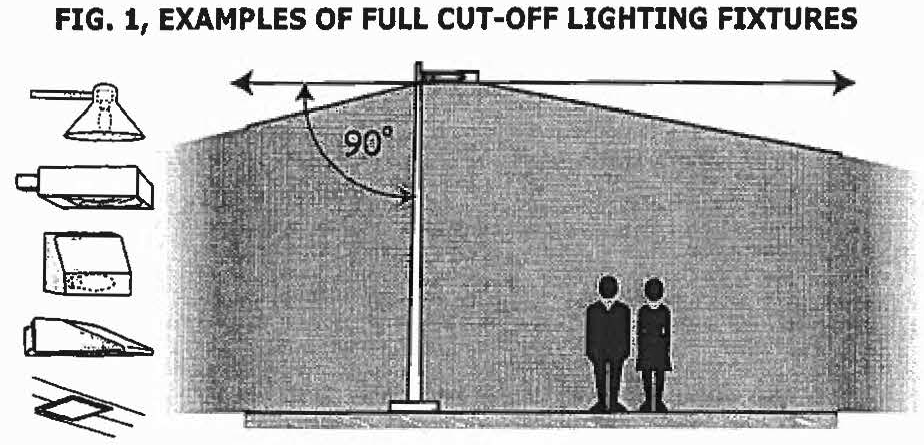
d.
In all zoning districts, any lighting shall be arranged to reflect the light away from adjoining property. A person shall not conduct a use that has a source of illumination that produces glare clearly visible beyond a property line or creates a sense of brightness within a visual field so as to cause annoyance, discomfort, or impairment of vision.
e.
No wall or roof lighting shall be used to illuminate areas for motor vehicle parking or access unless the zoning board of appeals finds that the proposed lighting is not in conflict with the stated purpose of this chapter; that the proposed lighting will not cause unreasonable harm or restrict public health, safety and welfare or create a nuisance; and, that the proposed luminary has a cutoff angle of less than or equal to 66 degrees.
f.
The amount of illumination attributable to exterior lighting from a property shall not exceed one foot-candle of illumination when measured at any boundary line with an adjoining property.
g.
All wiring for parking lot lighting shall be placed underground.
h.
All parking lot and parking structure lighting may be illuminated not more than one hour before the start of business and shall be extinguished within one hour after the end of business except as approved by the police department after finding the following: The property has been identified as an area where the incidence or potential for crime warrant additional lighting; that additional lighting is needed to increase the visibility of a property which is not readily accessible to police for regular patrol; and the use of timers, sensors, or other devices that produce a reduced lighting level that does not conflict with the stated purpose in this section.
(5)
Sign requirements. All signs shall be designed, constructed, and maintained in accordance with the following standards: All signs shall comply with the applicable provisions of the International Building Code and the electrical code of the city at all times; except for banners, flags, temporary signs and window signs conforming in all respects with the requirements of this chapter, all signs shall be constructed of permanent materials and shall be permanently attached to the ground, a building or another structure by direct attachment to a rigid wall, frame, or structure; all signs shall be maintained in good structural condition, in compliance with all building and electrical codes, and in conformance with this Code, at all times.
a.
Computation of sign area and number. The sign area or a sign with more than one face shall be computed by adding together the area of all sign faces visible from any point. When two identical sign faces are put together back-to-back, and when such sign faces are part of the same sign structure and not more than 42 inches apart, the sign area shall be computed by the measurement of one of the faces. The permitted sum of the area of all individual signs on a zone lot shall be computed by applying the formula contained in the table "Maximum Total Sign Area per Zone Lot by District Type" to the lot frontage, or ground floor area, as appropriate, for the zoning district in which the lot is located. Lots fronting on two or more streets are allowed the permitted sign area for each street frontage. However, the total sign area that is oriented toward a particular street may not exceed the portion of the lot's total sign area allocation that is derived from the lot frontage or floor area on that street.
b.
Wall or building signs. In nonresidential areas, no wall or building sign shall extend beyond the building more than 12 inches from the building surface. No wall or building sign shall be extended higher than the lower of the following: 20 feet above grade, or the lowest point of the roof (for one-story buildings with continuous horizontal parapet, a sign may extend as high as the parapet; for buildings having roof gable ends, fronting on the street, a sign may not extend beyond the edge of the roof line.) No sign may be installed on chimneys, roofs, rooftop penthouses, or other similar features.
c.
Sign lighting and illumination. Signs may be illuminated from within or from an unobtrusively positioned remote light source. Where remote lights such as spot lights are used, they are be designed so as to concentrate light only on the sign. Flashing or moving lights are not allowed with the exception of one-time temporary signs. If a registered trademark is used on a sign it may occupy no more than 25 percent of the sign area unless the trademark is that of the sole product at the location.
d.
Architectural standards. The following design provisions are intended to help ensure that redevelopment occurs in a manner compatible with the existing character of the community, to help ensure that HCOD develops as a compact urban area, to integrate parking facilities into the design of developments, to provide a safe and attractive area for pedestrian traffic, to preserve historic and residential traditions, to restrict fortress-like facades at the street level, to avoid a monotonous environment and to ensure the character of the community is enhanced through excellence in design. Visually preferred examples of development are provided in the city's comprehensive plan, August 12, 1997. The architectural building types of the surrounding vicinity will be considered in site plans review. These may be gothic revival, Queen Anne, colonial revival or other types of architecture. The following design guidelines will be applied during the site plan review process in addition to other applicable regulations. Alternative design solutions may be approved if it is demonstrated that the alternatives meet the intent of this section:
1.
All utilities and meters shall be located on side or rear elevations of buildings or shall be screened from view from public streets.
2.
All utilities shall buried and screened from view from public streets.
3.
Trash and refuse dumpsters and recycling bins shall be screened from view from public streets and shall not be located in a public right-of-way.
4.
Access to individual dwelling units shall be from enclosed lobbies or corridors except for at grade level.
5.
Stairways between residential floors shall be enclosed within the building.
6.
Bicycle parking facilities shall be located so as not to impede pedestrian or vehicular traffic.
7.
Varied roof lines and or/heights shall be used to reduce the appearance of the mass of buildings. Flat roofs are prohibited. Acceptable roofing styles include, but are not limited to, gabled, hipped, and mansard. Rooftop mechanical equipment shall be screened by parapet walls.
8.
Techniques, such as varied setbacks, bay windows. Balconies and changes in material, color and texture shall be used to articulate facades and side wall elevations. Where rear walls are visible from the public right-of-way, similar techniques shall be used.
9.
Durable materials, such as masonry shall be used on the street level and are encouraged for upper stories. Masonry does not include concrete block and undressed poured concrete.
10.
Areas of blank walls on the street frontage of a building shall be minimized. At least 40 percent of the length of the street level frontage shall be windows or doorways (not including garage entrances). Loading and unloading facilities shall be located to the rear of a building.
11.
The location and dimension of proposed signs shall be integrated into the design of the overall development and shall be like in size, color, and materials.
12.
Sidewalks and pedestrian ways shall be installed within the right-of-way adjoining the zone lot being developed. Sidewalks and pedestrian ways shall provide access to buildings from the public right-of-way.
13.
Drive-through facilities shall not visually or audibly intrude upon adjoining residential zoning districts.
(p)
Design review.
(1)
Design review committee. Prior to the issuance of a building permit for the construction within the HCOD of a building, structure, or sign, the plans shall be reviewed and approved by the plan commission to ensure that the building, structure, or sign complies with the guidelines herein. The plan commission members may use for assessment of the plans and application the "Site Assessment Factors Review Score Sheet for Highway Corridor Overlay District (HCOD)," included as appendix A to the ordinance from which this section is derived. Permit applications for single-family residential structures are exempt from review.
(2)
Review and approval. The plan commission shall:
a.
Review the development plan application and required submissions for conformance with the performance standards of this section, and if it is found to be in conformance, approve the development plan and authorize the city's building inspector to issue such building and stormwater permits as required by law;
b.
Approve the development plan subject to such reasonable conditions as may be necessary to secure substantially the objectives of the HCOD regulations and issue the approval subject to these conditions and authorize the city's building inspector to issue such building and stormwater permits as required by law; or
c.
Disapprove the development plan, indicating the deficiencies and the procedure for submitting a revised development plan application.
(q)
Applicability. Except as provided in this subsection, no building, structure, or land affected by this chapter shall be used and no building or part thereof of structure shall be erected, constructed, reconstructed, occupied, moved, altered, or repaired, except in conformity with the regulations herein specified for the class of district in which it is located.
(1)
Continued existing uses. Any building, structure or use lawfully existing at the time of enactment of this chapter may be continued, except certain nonconforming uses as provided in subsection (q)(3) of this section. Nothing in this chapter shall prevent the strengthening or restoring to a safe condition any part of any building or structure declared unsafe by the building inspector.
(2)
Nonconforming uses. Any lawfully established use of a building or land, at the effective date of the ordinance from which this chapter is derived that does not conform to the use regulations for the class of district in which it is located shall be deemed to be a legal nonconforming use and may be continued, except as otherwise provided herein.
a.
Any legal nonconforming building or structure may be continued in use provided there is no physical change other than necessary maintenance and repair, except as otherwise permitted herein.
b.
Any building for which a permit has been lawfully granted prior to the effective date of the regulations authorizing this chapter, or of amendments thereto, may be completed in accordance with the approved plans; provided construction is started within six months and diligently prosecuted to completion. Such building shall thereafter be deemed a lawfully established building.
c.
Any nonconforming building or structure which has been or may be damaged by fire, flood, explosion, earthquake, war, riot, or other act of God, may be reconstructed and uses as before if it be done within 12 months of such calamity unless damaged more than 50 percent of its fair market value, as determined by the plan commission, at the time of such damage, in which case, reconstruction shall be in accordance with the provisions of this chapter.
d.
No building, structure, or premises where a nonconforming building or structure has been or may be discontinued for more than one year, or has been or may be changed to a use permitted in the district in which it is located, shall again be devoted to a nonconforming use.
e.
Any building or structure devoted to a nonconforming use with a fair market value of less than $500.00, as determined by the plan commission, may be continued for a period not to exceed three years after the effective date of the regulations authorizing this chapter, whereupon such nonconforming use shall be removed or changed to a conforming use.
f.
Any legal, nonconforming use shall be enclosed on all sides by a solid wall or tight board fence not less than eight feet high if the use includes storage, repair, or maintenance of vehicles, equipment, or materials on the premises and not within the building. The wall or fence shall be maintained to the satisfaction of the building inspector. Any use so described that is in existence at the time of the effective date of the ordinance from which this chapter is derived shall comply with the fencing requirement within 180 days of adoption of this chapter.
g.
A nonconforming building may be enlarged or extended only if the entire building is thereafter devoted to a conforming use or meets all performance regulations herein, and only if the required yards for the district in which it is located are maintained for such enlargement, except as provided for under variances to the zoning regulations.
h.
No building partially occupied by a nonconforming use shall be altered in such a way as to permit the enlargement or expansion of the space occupied by such nonconforming use.
i.
No nonconforming building in any residential district shall be so altered as to increase the number of dwelling units therein.
j.
No nonconforming use may be enlarged or extended in such a way as to occupy any required usable open space, or any land beyond the boundaries of the zoning lot as it existed at the effective date of the regulations authorizing this chapter, or to displace any conforming use in the same building or the same parcel.
(3)
Existing nonconforming signs. A sign that was permitted or existed in conformance with the zoning and building code regulations at the time of the effective date of the regulations authorizing this chapter, but which by reason of its size, height, location, design or construction is not in conformance with the requirements of this chapter shall be considered as a legal nonconforming use. The status shall allow the signs which were made nonconforming by the adoption of the regulations authorizing this chapter, to remain in place and be maintained for a period ending no later than January 14, 2013, provided that no action takes place which increases the degree or extent of the nonconformity. A change in the information on the face of an existing nonconforming sign is allowed. However, any nonconforming sign shall either be eliminated or made to conform with the requirements of this chapter when any proposed change, repair, or maintenance would constitute an expense of more than 25 percent of the lesser of the original value or replacement value of the sign.
(Ord. No. 1206, § 9-5-17, 2-24-1981)

