
Germantown City Zoning Code
ARTICLE II
ADMINISTRATION AND ENFORCEMENT2
Cross reference— Administration, ch. 2.
DIVISION 2. - BOARD OF ZONING APPEALS[3]
Cross reference— Boards and commissions, § 2-126 et seq.
DIVISION 3. - AMENDMENTS[4]
State Law reference— Amendments to zoning ordinances, T.C.A. § 13-7-204.
Sec. 23-26. - Enforcing officer.
It shall be the duty of the Director of Economic and Community Development (the "Director") (including any of the Director's designees, if/as applicable) to administer and enforce the provisions of this chapter. The Director shall have the power to make inspections of buildings or lands necessary to carry out these duties.
(Code 1986, § 25-471; Ord. No. 2024-16, (Att.), 10-18-24)
Sec. 23-27. - Building permits.
(a)
It shall be unlawful to commence the excavation for the construction of any building, including accessory buildings, until the Director has authorized issuing a building permit for such work.
(b)
In applying to the Director for a building permit, the applicant shall submit a dimensional sketch or scale plan indicating the shape, size, height and location on the lot of any buildings to be erected, altered or moved and of any other buildings on the lot. He shall also state the existing and intended use of such buildings and supply other information as may be required by the Director. If the proposed activity as stated in the application complies with the provisions of this chapter and other ordinances of the city, the Director shall authorize issuing the permit or state the refusal in writing, and the cause.
(Code 1986, § 25-472; Ord. No. 2024-16, (Att.), 10-18-24)
Sec. 23-28. - Penalty for violation of chapter.
Any person violating any provision of this chapter shall be deemed guilty of a misdemeanor and, upon conviction, shall be fined not more than $500.00. Each day's continuance of a violation shall be considered a separate offense. The owner of any building or premises, or part thereof, where anything in violation of this chapter shall be placed or shall exist, and any person who may have knowingly assisted in the commission of any such violation, shall be guilty of a separate offense. Persons in violation of this chapter may also be subject to injunctive proceedings.
(Code 1986, § 25-473)
Sec. 23-46. - Organization.
The board of zoning appeals is hereby established in accordance with T.C.A. § 13-7-205. The board of zoning appeals shall consist of seven members which shall include the mayor or a member of the board of mayor and aldermen, a member of the planning commission, and five other members appointed by the mayor and confirmed by a majority vote of the board of mayor and aldermen, all of whom shall serve without pay. The term of office of the appointed members, which is for three years, (except the member of the planning commission) serving at the time of adoption of this section shall remain in effect. One of the persons appointed to fill one of the two new positions shall be appointed for an initial one-year term and the other shall be appointed for an initial two-year term. Upon expiration of such terms, appointees shall be appointed for three-year terms. The term of office for the mayor or aldermen and planning commission member shall be concurrent with their respective term of office or appointment. Any vacancy shall be filled for any unexpired term by an appointment by the mayor which is confirmed by the board of mayor and aldermen.
(Code 1986, § 25-431; Ord. No. 1999-15, 12-27-99)
Sec. 23-47. - Procedure.
(a)
Meetings of the board of zoning appeals shall be held at the call of the chair, at a time agreeable to the board, with public notice consistent with the rules and policies for public meetings of the city. All meetings of the board shall be open to the public. The board shall adopt rules of procedure and shall keep records of applications and action thereupon, which shall be a public record. Upon appointment and annually, the board of zoning appeals shall meet and organize and shall elect its own chair who shall serve one year or until his successor duly qualifies.
(b)
Four members of the board shall constitute a quorum.
(c)
The concurring vote of a majority of the members of the board in attendance shall be necessary to reverse any order, requirement, decision or determination of any such administrative official or to decide questions pertaining to this chapter.
(d)
The chief code officer, city engineer and planner, when requested to do so by the chair of the board, shall bring all plans, specifications, plats and papers relating to any case before the board for determination.
(Code 1986, § 25-432; Ord. No. 1999-15, 12-27-99; Ord. No. 2024-16, (Att.), 10-18-24)
Sec. 23-48. - Appeals.
An appeal to the board of zoning appeals may be taken by any person aggrieved, or by a governmental officer, department, board or bureau. Such appeals may be taken by filing with the board of zoning appeals a notice of appeals specifying the grounds thereof.
(Code 1986, § 25-433)
Sec. 23-49. - Powers.
(a)
The board of zoning appeals shall have the following powers:
(1)
To hear and decide appeals where it is alleged by the appellant that there is error in any order, requirement, decision or change made by the building inspector or other administrative official in the refusal, carrying out or enforcement of any provision of this chapter.
(2)
To permit the extension of a district for a distance of not more than 25 feet where the boundary line of a district divides a lot or tract held in a single ownership on January 19, 1981.
(3)
To interpret the official zoning map where questions of designation arise.
(4)
Where, by reason of exceptional narrowness, shallowness or shape of a specific piece of property, or by reason of exceptional topographic conditions or other extraordinary and exceptional situation or condition of such piece of property, the strict application of any provision of this chapter would result in peculiar and exceptional practical difficulties to or undue hardship upon the owner of such property, to authorize upon appeal relating to the property a variance from such strict application so as to relieve such difficulties or hardship, provided that such relief may be granted without substantial detriment to the public good and without substantially impairing the intent and purpose of this chapter. Financial disadvantage to the property owner is not sufficient proof of hardship.
(5)
Allow in accordance with the following procedure the uses designated as permitted on approval of the board of zoning appeals, provided that all provisions set forth in the appropriate zoning district are met; and all special provisions set forth in this article are met.
Sketch plan review. Prior to submitting an application for a Use on Appeal to the BZA, an applicant must submit a sketch plan to the department of economic and community development (DECD) for sketch plan review, a minimum of 14 days prior to submitting an application to the BZA.
Prior to the establishment of any use permitted on approval of the board of zoning appeals, the applicant shall submit to the city's economic and community development department the required documents, including a site plan, and fees on the most current checklist. The board of zoning appeals may refer the site plan to the planning commission for a review and recommendation, but shall approve or deny the application within the timeframe outlined in the adopted rules of procedure for the city's board of zoning appeals, unless the applicant allows additional time for action. The site plan shall:
a.
Be drawn to a scale of one inch equals 100 feet.
b.
Include the following:
1.
Existing roads.
2.
The zoning of adjacent tracts.
3.
Proposed curb cuts, drives, parking areas and drainage.
4.
The names of the owners of all adjoining lots or tracts.
5.
Building lines and the location of all structures.
6.
Landscaped buffer areas and planting screens to protect adjoining property.
7.
Proposed lighting and measures taken to prevent its adverse impact on adjoining property.
(6)
Allow encroachments into those building setbacks reflected on recorded subdivision plats and planned development plans that differ from those building setbacks found in this Code, provided the findings of paragraph (4) are met.
(b)
The board of zoning appeals in either approving, granting or denying a use, variance, or otherwise when proper, will consider whether or not the approval will impair an adequate supply of light and air to adjacent property, unreasonably increase the congestion of public streets, increase the danger of fire and endanger public safety or in any other way impair the public health, safety, comfort or welfare of the inhabitants of the city. Such consideration further may relate to screening, landscaping, location or other conditions necessary to protect property in the vicinity of the subject site.
(c)
The Director (including any designees, if/as applicable) may grant a variance of up to 12 inches of an applicable required yard setback subject to the following criteria:
(1)
A modified setback shall not be approved unless a specific plan for placement of a structure on the site is presented which justifies that the changed setback is needed to accommodate the development.
(2)
The modified setback shall not conflict with streets, sidewalks or landscape requirements.
(3)
The Director (including any designees, if/as applicable), in either approving, granting, or denying a use, variance, or otherwise when proper, will consider whether or not the approval will impair an adequate supply of light and air to adjacent property, unreasonably increase the congestion of public streets, increase the danger of fire and endanger public safety or in any other way impair the public health, safety, comfort or welfare of the inhabitants of the city. Such consideration further may relate to screening, landscaping, location or other conditions necessary to protect property in the vicinity of the subject site.
(Code 1986, § 25-434; Ord. No. 2009-1, 2-23-09; Ord. No. 2023-20, (Att.), 11-13-23; Ord. No. 2024-16, (Att.), 10-18-24)
Sec. 23-66. - When permissible.
Whenever the public necessity, convenience, general welfare or good zoning practice justify such action, the regulations, restrictions, districts and boundaries provided for in this chapter may be amended or repealed.
(Code 1986, § 25-451)
Sec. 23-67. - Zoning amendment application.
(a)
Zoning Text Amendment. The board of mayor and aldermen may amend the regulations, restrictions, boundaries or any provision of this chapter. The city, the board of mayor and aldermen, and the planning commission may present an application to the board of mayor and aldermen requesting an amendment to this chapter.
(b)
Zoning Map Amendment (Rezoning).
(1)
The board of mayor and aldermen may amend the regulations, restrictions, boundaries or any provision of this chapter. The city, the board of mayor and aldermen, the planning commission or any affected property owner of the city may present an application to the board of mayor and aldermen requesting an amendment to the city's adopted zoning map.
(2)
After the board of mayor and aldermen has taken final action upon an application for a zoning map amendment, the same application shall not be accepted within one year from the date of such final action. This subsection, however, in no way restricts the initiation of a zoning map change by the planning commission or the board of mayor and aldermen.
(Code 1986, § 25-452; Ord. No. 2024-16, (Att.), 10-18-24)
Sec. 23-68. - Planning commission review.
No amendment shall be enacted by the board of mayor and aldermen unless such amendment is first submitted to the planning commission for review.
(1)
If approved by the planning commission, the amendment must be approved by a majority vote of the members of the board of mayor and aldermen present and entitled to vote thereon.
(2)
If disapproved by the planning commission, the amendment must be approved by the favorable vote of a majority of the entire membership of the board of mayor and aldermen.
(3)
Solely in the case of an application for rezoning, where such application for rezoning is disapproved by the planning commission and the applicant does not seek in a timely manner approval of said application for rezoning by the board of mayor and aldermen, then the same application for rezoning shall not be permitted to again be filed with the planning commission for six months from the date of the planning commission's decision.
(Code 1986, § 25-453; Ord. No. 2001-12, 7-23-01; Ord. No. 2001-15, 8-27-01)
Sec. 23-69. - Public hearing requirement.
A public hearing shall be conducted by the board of mayor and aldermen before adoption of any proposed amendment, and shall be publicly noticed per the requirements in the adopted Planning Commission By-Laws.
(Code 1986, § 25-454; Ord. No. 2023-20, (Att.), 11-13-23; TCA13-7-203)
Sec. 23-81. - Generally.
The regulations of this chapter are subject to the exceptions stated in this division.
(Code 1986, § 25-411)
Sec. 23-82. - Front yards.
The required front yards established in the residential districts may be adjusted in situations where the enforcement of the existing yard requirements creates vastly different yard measurements than the standard for previously developed surrounding properties as illustrated in the following diagrams:
FIGURE 1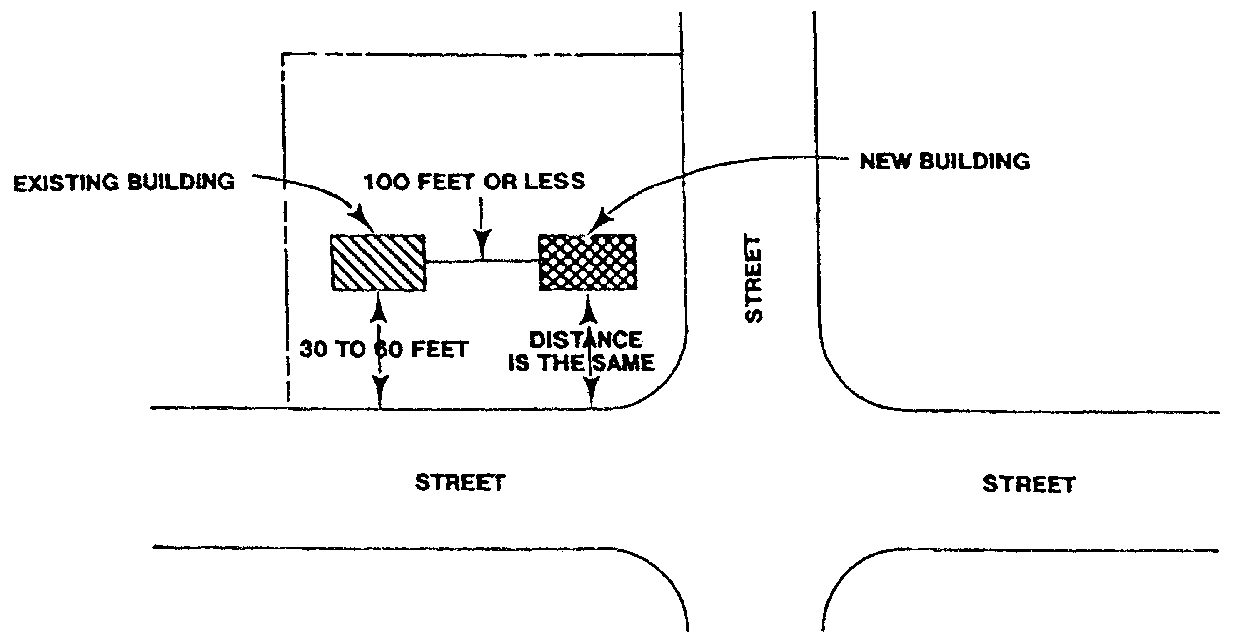
Where a new building will be constructed within 100 feet or less of existing buildings with equal front yard setbacks, the required front yard for the new building shall be the same as that for the existing buildings.
FIGURE 2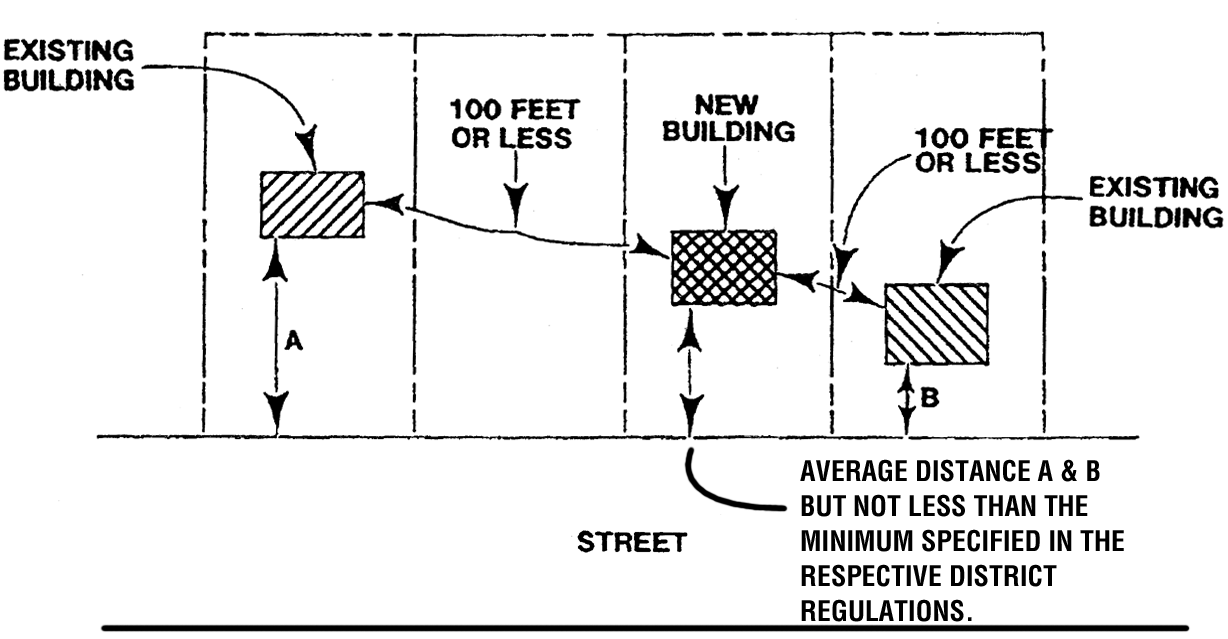
Where a new building will be constructed within 100 feet or less of existing buildings with varying front yard setbacks, the required front yard for the new building shall be the average of the front yard setbacks of the existing buildings, but not less than the minimum specified in the respective district regulations.
FIGURE 3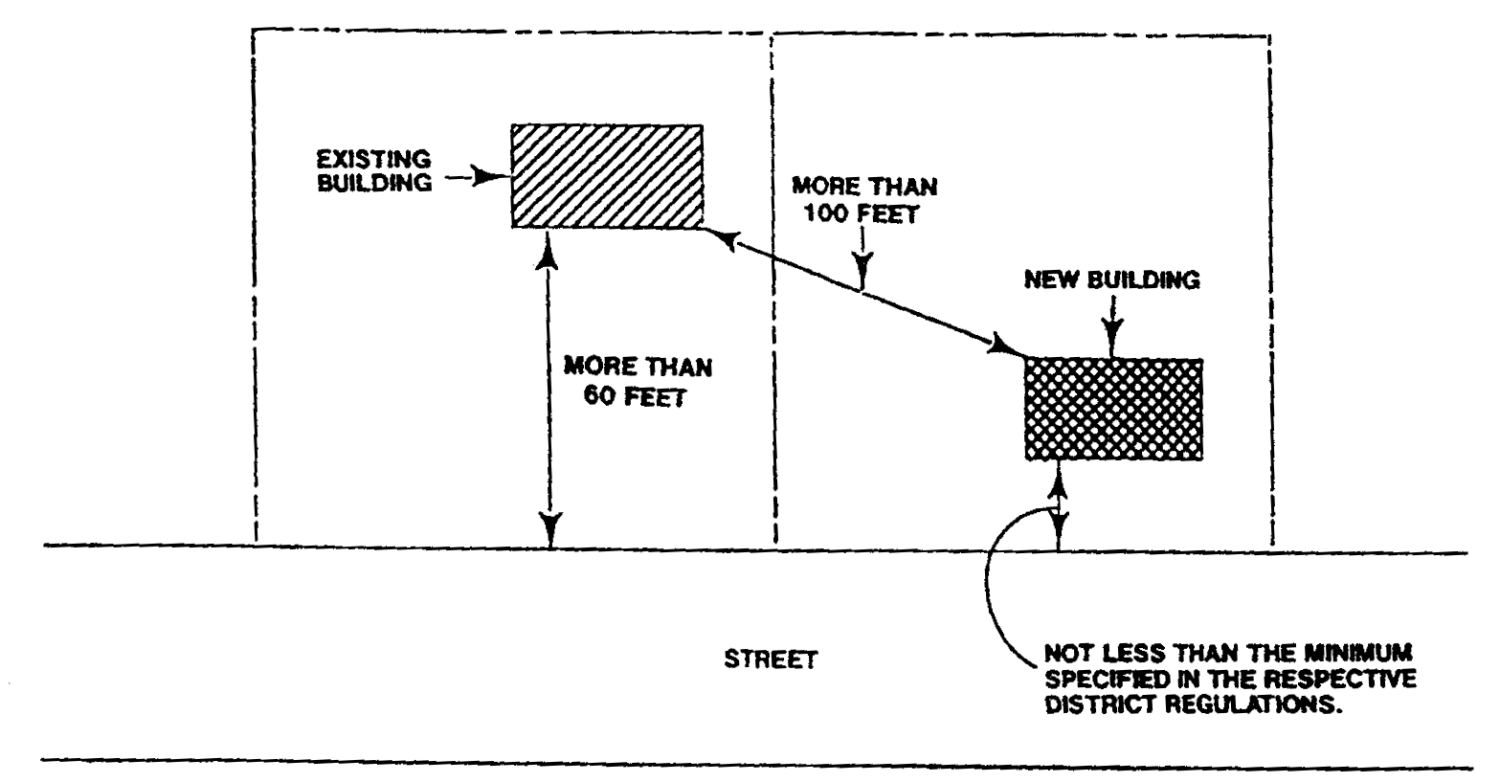
Where a new building will be constructed more than 100 feet from the existing buildings, the required front yard for the new building shall not be less than the minimum specified in the respective district regulations.
(Code 1986, § 25-412)
Sec. 23-83. - Service stations.
An open unenclosed canopy for a filling station may project into the required front yard, provided that the canopy is attached to or constitutes a principal building, and provided further that no portion of the canopy may be closer than 20 feet to the proposed right-of-way line.
(Code 1986, § 25-413)
Sec. 23-84. - Temporary buildings.
Temporary buildings that are used in conjunction with construction work only may be permitted in any district during the period of construction, but such temporary buildings shall be removed as soon as the construction work is complete.
(Code 1986, § 25-414)
Sec. 23-85. - Private garages and carports.
Single story private garages and carports attached to the main building may extend a maximum of ten feet into the required rear yard.
(Code 1986, § 25-415)
Sec. 23-86. - Wireless transmission facilities.
(a)
Scope. The regulations set forth in this section shall apply to wireless transmission facilities. The purpose of the regulations of this section is to minimize the potential negative impact to surrounding property through application of reasonable technical and development standards for the installation and placement of wireless transmission facilities.
(b)
Definitions. The following words, terms and phrases, when used in this section, shall have the meanings ascribed to them in this subsection, except where the context clearly indicates a different meaning:
Mature system means an existing wireless transmission facility.
Street means the surface of and all rights-of-way and the space above and below any public street, road, highway, freeway, lane, path, public way or place, sidewalk, alley court, boulevard, parkway, drive or easement now or hereafter held by the city for the purpose of public travel and shall also mean other easements or rights-of-way as shall be now held or hereafter held by the city which shall, within their proper use and meaning, entitle a user to the use thereof for the purposes of installing plant, facilities and equipment as may be ordinarily necessary and pertinent to utilizing wireless transmission facilities for the purpose of production or transmission.
Tower means the base of any wireless transmission facility including, but not limited to, a self-supporting tower and/or monopole, together with any antennae or other appurtenances.
User means any wireless telecommunications carrier utilizing wireless transmission facilities for the purpose of production or transmission.
Wireless transmission facilities means buildings, cabinets, structures and facilities, including generating and switching stations, repeaters, antennas, transmitters, receivers, towers and all other buildings and structures relating to low-power mobile voice transmission, data transmission, video transmission and radio transmission, or wireless transmission; accomplished by linking a wireless network of radio wave transmitting devices (including, but not limited to, wire, cable, fiber optics, laser, microwave, radio, satellite, portable phones, pagers, mobile phones or similar facilities) to the conventional ground-wired communications system (including, but not limited to, telephone lines, video and/or microwave transmission) through a series of short range, contiguous cells that are part of an evolving cell grid.
(c)
Process.
New Facilities:
(1)
The use of land for wireless transmission facilities shall be permitted in the agricultural, residential and commercial districts; provided, however, that no building permit shall be issued or construction initiated without the review and approval of the planning commission, the design review commission and the board of mayor and aldermen; and that the other requirements set forth in this division are met. Wireless transmission facilities as a use-on-appeal in all agricultural and residential districts, shall also require approval of the board of zoning appeals in addition to approval by the aforementioned governing bodies. (Exception: subsections (c)(2)—(c)(4) of this section.) All wireless transmission facilities shall be subject to the technical and developmental standards of this chapter, to the minimum standards in the zoning district in which the "wireless transmission facility" is located, and to such additional conditions that the board of zoning appeals, the planning commission and the design review commission may require in order to preserve and protect the character of the district in which the proposed use is located.
(2)
The use of a major and/or collector street (per the city major road plan), for wireless transmission facilities, shall be permitted in the agricultural, residential and commercial districts; provided however, that no building permit shall be issued or construction initiated without the administrative review and approval of the department economic and community development, and the review and approval of the board of mayor and aldermen; and that the other requirements set forth in this division are met. All wireless transmission facilities on a major and/or collector street shall be subject to the technical and development standards of this chapter, to the minimum standards in the zoning district in which the wireless transmission facility is located, and to such additional conditions that the department economic and community development and the board of mayor and aldermen may require in order to preserve and protect the character of the district in which the proposed use is located.
(3)
If, upon review of a wireless transmission facility submitted under this subsection (c), the Director (including any designees, if/as applicable) determines that additional review is necessary to completely evaluate the proposed facility, the Director (including any designees, if/as applicable) may refer the facility to the full review process set forth under subsection (c)(1) of this section.
Existing Facilities:
(4)
The use of land for the shared use of wireless transmission facilities where an approved wireless transmission facility, under contract with the city, exists on public or private property, and is not located within an existing power transmission line tower, shall be permitted in the agricultural, residential and commercial districts; provided, however, that no building permit shall be issued or construction initiated without the administrative review and approval of the department of economic and community development, and that the other requirements set forth in this division are met. All wireless transmission facilities shall be subject to the technical and development standards of this chapter, to the minimum standards in the zoning district in which the wireless transmission facility is located, and to such additional conditions that the department of economic and community development and may require in order to preserve and protect the character of the district in which the proposed use is located. Any request to modify any existing facility shall be administratively reviewed and approved by the department of economic and community development within 90 days of a submitted application being deemed as a complete submission to the city, subject to the following criteria:
Such request is for a modification of an existing wireless tower or base station that does not substantially change the physical dimensions of such tower or base station that involves:
— Colocation of new transmission equipment;
— Removal of transmission equipment; or
— Replacement of transmission equipment.
(5)
If, upon review of a wireless transmission facility submitted under this subsection (c)(3), the Director (including any designees, if/as applicable) determines that additional review is necessary to completely evaluate the proposed facility, the Director (including any designees, if/as applicable) may refer the facility to the full review process set forth under subsection (c)(1) of this section.
(d)
Sketch plan review.
(1)
Any owner or authorized agent of a tract of land zoned agricultural or residential, three acres or more in area; or land on which an existing, power transmission line tower is located, and into which a wireless transmission facility can be incorporated; or a street; or a commercial district shall submit a sketch plan for the development of a wireless transmission facility to the planning commission. The sketch plan shall describe the use and general development concept for the entire tract.
(2)
The sketch plan shall:
a.
Be drawn to a scale of one inch equals 100 feet.
b.
Include the following:
1.
Existing and proposed roads and drainage;
2.
General landscape areas and planting screens;
3.
Curb cuts and drives; and
4.
Building setback lines.
c.
Include a vicinity map which shows the relation of the proposed development to the city.
d.
Show the relation of the proposed development to:
1.
The existing street system;
2.
Traffic flow;
3.
The immediate and surrounding use districts;
4.
Adjacent tracts;
5.
Zoning of adjacent tracts; and
6.
The names of the owners of all adjoining lots or tracts.
(e)
Preliminary plan.
(1)
After review of the sketch plan by the sketch plan subcommittee of the planning commission, the applicant shall submit a preliminary plan describing the concept for the development of the entire tract to the planning commission. The preliminary plan shall incorporate the recommendations of the planning commission as determined in the sketch plan review.
(2)
The preliminary plan shall:
a.
Be drawn to a scale of one inch equals 100 feet;
b.
Include the following:
1.
Existing and proposed roads;
2.
Landscaped buffer areas and planting screens;
3.
Curb cuts, drives and parking areas;
4.
Grading and drainage plan which shows the existing and proposed topography;
5.
Building lines and the location of all structures;
6.
The zoning of adjacent tracts;
7.
The names of the owners of all adjoining lots or tracts;
8.
A vicinity map which shows the location of the proposed development within the city;
9.
Proposed uses of the land and buildings; and
10.
Conveyance of access rights to the city as required by the planning commission.
c.
Contain a certification by a licensed civil engineer that the boundaries have been surveyed and are true and correct, and that all encroachments, easements and rights-of-way are shown;
d.
Provide a form for certification of approval by the planning commission by the secretary of the planning commission;
e.
Be prepared in a manner to permit it to be recorded upon arrival;
f.
Provide a form for certification by the owner and trustee of the mortgage, if any, that they adopt the plan and dedicate the streets as shown on the plan and agree to make any required improvements to adjacent streets as shown on the plans; and
g.
Provide the regulations used to control the uses permitted in the project and the uses specifically prohibited.
(f)
Final plan.
(1)
After approval of the preliminary plan, but prior to the issuance of any building permit and/or commencement of construction, the applicant shall have approval of the planning commission and a final plan covering the entire tract or that portion proposed for development.
(2)
The final plan shall:
a.
Be drawn to a scale of one inch equals 100 feet.
b.
Include the following:
1.
Existing and proposed roads and drainage.
2.
Landscaped buffer areas and planting screens.
3.
Curb cuts, drives and parking areas.
4.
Grading and drainage plan which shows the existing and proposed topography.
5.
The total square footage of the parking areas provided.
6.
Building lines and the location of all structures.
7.
The total square footage of building or structure provided.
8.
The zoning of adjacent tracts.
9.
The names of the owners of all adjoining lots or tracts.
10.
A vicinity map which shows the location of the proposed development within the city.
c.
Contain a certification by a licensed civil engineer that the boundaries have been surveyed and are true and correct and that all encroachments, easements and rights-of-way are shown.
d.
Provide a form for certification of approval by the planning commission by the secretary of the planning commission.
e.
Provide a form for certification by the owner and trustee of the mortgage, if any, that they adopt the plan and dedicate the streets as shown on the plan and agree to make any required improvements to adjacent streets as shown on the plan.
(3)
The applicant may, if desired, submit only one final plan for the purpose of securing approval of the development plan if the plan submitted complies with all the requirements of the final plan. The planning commission may grant final approval to such a plan after only one review.
(g)
Time limitation. A site plan approval by the board of mayor and aldermen shall be valid for a period not to exceed six months. If substantial construction on the wireless transmission facilities has not begun within six months, the approval shall expire, and the applicant shall be required to resubmit plans to the planning commission for approval based on the latest technical and development standards in this chapter.
(h)
Technical standards. All wireless transmission facilities shall be subject to the following technical standards:
(1)
Frontage and setbacks. Towers within all agricultural and residential districts shall be located on a single lot with a minimum of 200 feet of frontage to a public street. The minimum distance from the base of the tower to any right-of-way and adjoining property line shall be equivalent to or greater than the height of the tower plus ten feet, unless such distance is demonstrated unnecessary by the applicant's engineer and still meets the "National standards". No buildings or structures, except for associated appurtenances, shall be located within the setback area, thereby providing a clear fall zone for the tower to any right-of-way and adjoining property line. The setbacks for all associated appurtenances, including buildings, cabinets, structures and facilities, shall correspond with the minimum setbacks established by this division (see subsection (i)(1) of this section) and of the zoning district in which the use is proposed.
(2)
National standards. The applicant's engineer shall provide documentation that the proposed wireless transmission facility meets or exceeds the standards of the American National Standards Institute (ANSI) for professionally acceptable radio frequency emissions standards.
(3)
Tower height.
a.
Maximum tower height shall be 140 feet.
b.
To encourage shared use, the maximum tower height for wireless transmission facilities, incorporated within an existing power transmission line tower, shall be 20 feet above the highest point of the existing power transmission line tower.
c.
To encourage shared use, the maximum tower height for wireless transmission facilities, on top of a utility pole, located within the right-of-way of a collector or major street, shall be seven feet, six inches above the highest point of the existing utility pole.
(4)
Structural requirements. Prior to the approval of any tower in excess of 35 feet in height, the applicant shall provide the planning commission with written certification from a registered structural engineer that the tower is able to minimally withstand winds of 70 miles per hour with one-half-inch radial ice, as per the ANSI Standards, and/or 100 miles per hour and/or 130 mph wind gusts, whichever is greater. For towers placed on buildings, the applicant shall also provide the planning commission such written certification, plus evidence that the building itself is structurally capable of safely supporting the tower and its accompanying equipment. Wireless transmission facilities shall be designed in accordance with accepted standards for seismic zone 3.
(5)
Shared use. The shared use of existing towers or the placement of towers less than 35 feet in height at locations adjacent to a mature wireless facility, or wireless transmission facilities incorporated within existing power transmission line towers, shall be encouraged whenever possible.
a.
The applicant's proposal for a new wireless transmission facility shall not be approved unless it can be documented by the applicant that the proposed equipment planned for the proposed tower cannot be accommodated on an existing or approved tower located within a minimum distance of 0.10 miles due to one or more of the following reasons:
1.
The planned equipment would exceed the structural capacity of existing and approved towers, considering existing and planned use of those towers cannot be reinforced to accommodate planned or equivalent equipment at a reasonable cost.
2.
The planned equipment would cause radio frequency (RF) interference with other existing or planned equipment for these towers, and the interference cannot be prevented at a reasonable cost.
3.
Existing or approved towers do not have space on which planned equipment can be placed so it can function effectively and reasonably in parity with other similar equipment in place or approved.
4.
Geographic service requirements.
b.
The applicant shall also address the extent to which shared use of the proposed tower will be allowed in the future. A letter of intent committing the tower owner and his successors to allow shared use of the tower, if an applicant agrees in writing to pay any reasonable charge for shared use, shall be filed in the office of the department of community development, prior to any building permit being issued.
c.
The applicant's plans must demonstrate how shared facilities would potentially be situated on proposed sites. Towers and/or structures shall be required to be designed for multitenants on the initial installation, i.e., designed for two sets of a fully sectored antenna arrays.
(6)
Modifications: Modifications to approve wireless transmission facilities shall be made as follows:
a.
The addition of antennas and ground equipment or expansion of compound area that does not meet FFC Order 14-153, Secs. 188 or 200, or any subsequent pertinent FCC order(s), shall require approval by the Planning Commission. All other modifications shall be subject to administrative review by the Director (including any designees, if/as applicable) as minor modifications. Minor modification that meets FCC Order 14-153, Secs. 188 or 200, or any subsequent pertinent FCC order(s) shall be approved by the Director (including any designees, if/as applicable).
b.
The addition of height beyond 140 feet shall require approval by the Board of Zoning Appeals, unless such addition meets FCC Order 14-153, Secs. 188 or 200, or any subsequent pertinent FCC order(s).
(i)
Development standards.
(1)
Buffer/landscaping provisions. The planting, maintenance and removal of trees associated with wireless transmission facilities shall comply with chapter 22 of this Code, the tree planting, protection and grading ordinance. For ground structures and equipment buildings, located in or abutting property zoned residential (either immediately adjacent to such property or across a public roadway), special care shall be taken to minimize the effects on the adjacent residential area. The following shall be considered minimum standards:
a.
A minimum 50-foot buffer strip shall be required on the outer perimeter of the property, abutting property currently zoned for residential, office or commercial use or development. No internal roads or driveways, parking areas, structures or storage of material shall be allowed within the buffer strip. This standard shall not supersede any existing or future agreements or regulations which may provide for a greater buffer strip than outlined in subsection (i)(1) of this section.
b.
The buffer strip shall consist of plantings and physical features sufficient to screen the view beginning at a specified level, reduce glare and noise, and provide greater privacy for nearby residential uses. The buffer shall be initially installed for the permanent year-round protection of adjacent property by visually shielding internal activities from adjoining property from ground level view to a minimum height of six feet. A landscaping plan detailing the type, substance, design, width, height, opacity, growing period to maturity, time schedule for installation, and responsibility for perpetual maintenance of the buffer strip shall be submitted to and approved by the design review commission.
c.
The landscaping provisions of this section may be varied or reduced if the proposed plan provides for unique and innovative landscaping treatment or physical features that, in the opinion of the design review commission, meet the intent and purpose of this section. In instances where significant physical features exist (i.e., railroads, major roads, hillsides, preserved wooded areas, and utility easements, etc.) which in the opinion of the design review commission provide adequate buffering between land uses, the existing buffers may be used to meet landscaping provisions of this section.
d.
Security fencing shall be required and shall comply with the regulations set forth in chapter 6, article VI of this Code. Security fencing (wood only) shall be required around the area of the wireless transmission facility. Other fencing requested by the user, in compliance with chapter 6, article VI of this Code shall be constructed, in addition to, and behind the required wood fencing.
e.
Wireless transmission facilities mounted on a building or structure in a commercial district shall be screened and/or designed to blend visually with the roof and/or structure and surroundings where mounted. Such methods and materials shall only require approval by the design review commission.
f.
Prior to the issuance of a building permit, security acceptable to the city shall be required to ensure completion of all landscaping and screening provisions as outlined in the plan approved by the design review commission. The security shall be posted in an amount equal to 110 percent of the total cost of the materials and installation of such improvements. Upon the issuance of a certificate of occupancy for the building, or upon the completion of construction of the wireless transmission facility, if no certificate of occupancy is required, a maintenance bond, letter of credit or similar security acceptable to the city shall be required for a period of one year to ensure that the vegetation remains as a living and viable screen.
(2)
Off-street parking. At least one off-street parking space shall be provided per wireless transmission facility.
(3)
Lighting. Outside lighting, if required for safety and security purposes, shall be arranged so as to minimize glare and reflection on adjacent residential properties and public streets. The design review commission may require the submission of a lighting plan by a qualified professional engineer to ensure that the illumination of outside lighting as designed and installed does not exceed 0.4 footcandles, measured at the property line of abutting property zoned for residential use or development. Wireless transmission facilities shall not be artificially lighted unless required by the Federal Aviation Administration or other governmental authority.
(4)
Signs. The visual transfer of information on the public facility through the use of external signs shall comply with the sign regulations set forth for the applicable zoning district in chapter 14 of this Code.
(5)
Vehicle access control. The location and design of driveways and/or accesses to reach the public facility from a public street shall be approved by the planning commission.
(6)
Erosion control and stormwater management. The control of erosion during development and the design of drainage systems suitable to handle stormwater runoff after the site is developed shall be approved by the planning commission.
(7)
Exterior treatment. All wireless transmission facilities including buildings, cabinets, structures and facilities shall be designed and constructed of materials so as to be architecturally compatible with the architectural character of the general area, and approved by the design review commission.
(8)
Noise. The intensity level of sound from the wireless transmission facility including temporary generators used during extended power outages, measured at the property line of abutting property zoned for residential use or development, shall not at any time exceed 70 decibels. In instances where the planning commission and design review commission determines that a new wireless transmission facility site may create objectionable noise or a nuisance to any adjacent property, additional buffers or other physical features shall be required to mitigate the noise.
(j)
Inspections.
(1)
The user shall provide the city with a letter of certification from the design engineers (electrical, structural and civil) indicating that the wireless transmission facility was constructed according to the plans approved by the city. The letter shall be submitted within 30-45 days of completion of the facility.
(2)
The user shall provide the city with a copy of the county's electrical inspector's report which ensures that the user met code requirements during construction of the facility.
(3)
The user shall provide the city with a certified copy of the engineer's annual inspection report, which includes, but is not limited to: the condition of the grounding system, the structural integrity of the facility, any damage incurred over the past year, the condition of the bolts, and a plan to correct any deficiencies.
(k)
Removal. Legal use of the property for a wireless transmission facility shall be discontinued if all facility users vacate the site for a minimum period of 60 days. It shall be the responsibility of the remaining facility user and the landowner to maintain the site as per the approvals granted by the city. Each remaining user which vacates the property shall be responsible for removal of their respective buildings, cabinets, structures and facilities, and other appurtenances, at their expense.
(l)
Contracts.
(1)
The applicant shall enter into a contract with the city after all approvals from the required governing boards and prior to the required building permit.
(2)
The contract shall be accompanied by all required agreements between the user and Memphis Light, Gas and Water, when a wireless transmission facility is incorporated into an existing Memphis Light, Gas and Water power transmission line tower.
(m)
Building permits. It shall be unlawful to commence the excavation for the construction of any wireless transmission facilities, including all associated appurtenances, until the Director has issued approval of a building permit for such work.
(n)
Small wireless facilities.
(1)
Purpose and scope:
a.
Purpose. The purpose of this amendment is to establish policies and procedures for the placement of small wireless facilities in the public rights-of-way within the city's jurisdiction, which will provide public benefit consistent with the preservation of the integrity, safe usage, and visual qualities of the city's rights-of-way and to the city as a whole.
b.
Intent. In enacting this chapter, the city is establishing uniform standards to address issues presented by small wireless facilities, including without limitation, to:
1.
Prevent interference with the use of streets, sidewalks, alleys, parkways and other public ways and places;
2.
Prevent the creation of visual and physical obstructions and other conditions that are hazardous to vehicular and pedestrian traffic;
3.
Prevent interference with the facilities and operations of facilities lawfully located in public rights-of-way or public property;
4.
Protect against environmental damage, including damage to trees;
Preserve the character of the neighborhoods in which facilities are installed; and
5.
Facilitate rapid deployment of small wireless facilities to provide the benefits of advanced wireless services.
c.
Conflicts with other sections or laws. This section supersedes all sections or parts of sections adopted prior hereto that are in conflict herewith, to the extent of such conflict. In the event of any conflict between a provision hereof and a provision of T.C.A. § 13-24-101 et seq., the provision of such state statute shall control.
(2)
Definitions:
a.
Aesthetic plan means any publicly available written resolution, regulation, policy, site plan, or approved plat establishing generally applicable aesthetic requirements within the authority or designated area within the authority. An aesthetic plan may include a provision that limits the plan's application to construction or deployment that occurs after the adoption of the aesthetic plan. For purposes of this part, such a limitation is not discriminatory as long as all construction or deployment occurring after adoption, regardless of the entity constructing or deploying, is subject to the aesthetic plan.
b.
Antenna means communications equipment that transmits or receives electromagnetic radio frequency signals used in the provision of wireless services.
c.
Annual lease fee means the fee due to the city for the reimbursement for the installation of a small wireless facility on city property irrespective of whether the property is owned, leased, or within the public right-of-way. Each installation/spot requires a separate annual lease fee.
d.
Applicant means any person who submits an application pursuant to this part.
e.
Application means a request submitted by an applicant to an authority:
1.
For a permit to deploy or colocate small wireless facilities in the ROW; or
2.
To approve the installation or modification of a PSS associated with deployment or colocation of small wireless facilities in the ROW.
f.
Authority means:
1.
Within a municipal boundary, the municipality, regardless of whether such municipality is a metropolitan government.
2.
Within a county and outside a municipal boundary, the county; or
3.
Upon state-owned property, the state.
"Authority" does not include a government-owned electric, gas, water, or wastewater utility that is a division of, or affiliated with, a municipality, metropolitan government, or county for any purpose of this part, and the decision of the utility regarding a request to attach to or modify the plant, facilities, or equipment owned by the utility shall not be governed by this part;
g.
Authority-owned PSS means a PSS owned by an authority but does not include a PSS owned by a distributor of electric power, regardless of whether an electric distributor is investor-owned, cooperatively-owned, or government-owned;
h.
City means City of Germantown, Tennessee.
i.
Colocate, colocating, and colocation mean, in their respective noun and verb forms, to install, mount, maintain, modify, operate, or replace small wireless facilities on, adjacent to, or related to a PSS. "Colocation" does not include the installation of a new PSS wireless support structure or replacement of authority-owned PSS or wireless support structure;
j.
Communications facility means the set of equipment and network components, including wires and cables and associated facilities, used by a communications service provider to provide communications service;
k.
Communications service means cable service as defined in 47 U.S.C. § 522(6), telecommunications service as defined in 47 U.S.C. § 153(53), information service as defined in 47 U.S.C. § 153(24) or wireless service;
l.
Communications service provider means a cable operator as defined in 47 U.S.C. § 522(5), a telecommunications carrier as defined in 47 U.S.C. § 53(51), a provider of information service as defined in 47 U.S.C. § 153(24), a video service provider as defined in § 7-59-303, or a wireless provider;
m.
Day means calendar day.
n.
Fee means a one-time, nonrecurring charge;
o.
Local authority means an authority that is either a municipality, regardless of whether the municipality is a metropolitan government, or a county, and does not include an authority that is the state;
p.
Micro wireless facility means a small wireless facility that:
1.
Does not exceed 24 inches in length, 15 inches in width, and 12 inches in height; and
2.
The exterior antenna, if any, does not exceed 11 inches in length;
q.
Permittee means an applicant who is party to an application and/or has been granted a permit.
r.
Person means an individual, corporation, limited liability company, partnership, association, trust, or other entity or organization, including an authority;
s.
Potential support structure for a small wireless facility or PSS means a pole or other structure used for wireline communications, electric distribution, lighting, traffic control, signage, or a similar function, including poles installed solely for the colocation of a small wireless facility. When "PSS" is modified by the term "new," then "new PSS" means a PSS that does not exist at the time the application is submitted, including, but not limited to, a PSS that will replace an existing pole. The fact that a structure is a PSS does not alone authorize an applicant to collocate on, modify, or replace the PSS until an application is approved and all requirements are satisfied pursuant to this part;
t.
Rate means a recurring charge;
u.
Residential neighborhood means an area within a local authority's geographic boundary that is zoned or otherwise designated by the local authority for general purposes as an area primarily used for single-family residences and does not include multiple commercial properties and is subject to speed limits and traffic controls consistent with residential areas;
v.
Right-of-way or ROW means the space, in, upon, above, along, across, and over all public streets, highways, avenues, roads, alleys, sidewalks, tunnels, viaducts, bridges, skywalks under the control of the city, and any unrestricted public utility easement established, dedicated, platted, improved, or devoted for utility purposes and accepted as such public utility easement by the authority, but excluding lands other than streets that are owned by the city.
w.
Right-of-way use permit or permit means an excavation/road bore permit for excavation of a street for the construction or installation of fiber optic cable, conduit, and associated equipment in the right-of-way.
x.
Small wireless facility means a wireless facility with:
1.
An antenna that could fit within an enclosure of no more than six cubic feet in volume; and
2.
Other wireless equipment in addition to the antenna that is cumulatively no more than 28 cubic feet in volume, regardless of whether the facility is ground-mounted or pole-mounted. For purposes of this subdivision, "other wireless equipment" does not include an electric meter, concealment element, telecommunications demarcation box, grounding equipment, power transfer switch, cut-off switch, or a vertical cable run for the connection of power and other services.
3.
"Small wireless facility" includes a micro wireless facility.
y.
Utility pole means a pole or similar structure that is used in whole or in part for the purpose of carrying electric distribution lines or cables or wires for telecommunications, cable or electric service, or for lighting, traffic control, signage, or a similar function regardless of ownership, including city-owned/leased poles. Such term shall not include structures supporting only wireless facilities.
z.
Wireline backhaul facility means a communications facility used to transport communications services by wire from a wireless facility to a network.
aa.
Wireless facility means equipment at a fixed location that enables wireless communications between the user equipment and a communications network, including:
1.
Equipment associated with wireless communications; and
2.
Radio transceivers, antennas, coaxial or fiber-optic cable, regular and backup power supplies, and comparable equipment, regardless of technological configuration;
3.
"Wireless facility" does not include:
(i)
The structure or improvements on, under, or within which the equipment is colocated;
(ii)
Wireline backhaul facilities; or
(iii)
Coaxial or fiber-optic cable that is between wireless structures or utility poles or that is otherwise not immediately adjacent to or directly associated with a particular antenna.
bb.
Wireless facility includes small wireless facilities.
cc.
Wireless infrastructure provider means any person, including a person authorized to provide telecommunications service in the state, that builds or installs wireless communication transmission equipment, wireless facilities or wireless support structures, but that is not a wireless services provider.
dd.
Wireless provider means a person who provides wireless service.
ee.
Wireless services means any service using licensed or unlicensed spectrum, including the use of WiFi, whether at a fixed location or mobile, provided to the public.
ff.
Wireless support structure means a freestanding structure, such as a monopole; tower, either guyed or self-supporting; or, other existing or proposed structure designed to support or capable of supporting wireless facilities. Such term shall not include a utility pole.
(3)
Right-of-way use permit:
a.
No person which has been issued a right-of-way use permit by the city may construct, install, and/or operate wireless facilities that occupy the right-of-way without first obtaining approval of a small wireless application from the city. Any right-of-way use permit shall be reviewed, issued, and administered in a non-discriminatory manner; shall be subject to such reasonable conditions as the city may from time to time establish for effective management of the right-of-way, and otherwise shall conform to the requirements of this section and applicable law.
b.
A right-of-way use approval for new utility installation pursuant to section 19-105 is required prior to the issuance of a right-of-way use permit under this chapter.
c.
A right-of-way use permit shall provide for the annual lease fee, which shall be due January 1 of each year of the agreement. The initial annual lease fee payment shall be due upon approval of the right-of-way use permit.
d.
Insurance. Each permittee shall, at all times during the entire term of the right-of-way use agreement, maintain and require each contractor and subcontractor to maintain insurance with a reputable insurance company authorized to do business in the State of Tennessee and which has an A.M. Best rating (or equivalent) no less than "A" indemnifying the city from and against any and all claims for injury or damage to persons or property, both real and personal, caused by the construction, installation, operation, maintenance or removal of permittee's wireless facilities in the rights-of-way. The amounts of such coverage shall be not less than the following:
1.
Worker's compensation and employer's liability insurance. Tennessee statutory requirements.
2.
Comprehensive general liability. Commercial general liability occurrence form, including premises/operations, independent contractor's contractual liability, product/completed operations; X, C, U coverage; and personal injury coverage for limits as specified in Appendix A—Comprehensive Fees and Penalties but in no case less than $1,000,000.00 per occurrence, combined single limit and $2,000,000.00 in the aggregate.
3.
Commercial automobile liability. Commercial automobile liability coverage for all owned, non-owned and hired vehicles involved in operations under this Article XII for limits as specified in Appendix A—Comprehensive Fees and Penalties but in no case less than $1,000,000.00 per occurrence combined single limit each accident.
4.
Commercial excess or umbrella liability. Commercial excess or umbrella liability coverage may be used in combination with primary coverage to achieve the required limits of liability.
e.
The city shall be designated as an additional insured under each of the insurance policies required by this section except worker's compensation and employer's liability insurance. The permittee shall not cancel any required insurance policy without obtaining alternative insurance in conformance with this section. The permittee shall provide the city with at least 30 days' advance written notice of any material changes or cancellation of any required insurance policy, except for non-payment of the premium of the policy coverage.
f.
The permittee shall impose similar insurance requirements as identified in this section on its contractors and subcontractors.
g.
Indemnification. Each permittee, its consultant, contractor, and subcontractor, shall, at its sole cost and expense, indemnify, defend and hold harmless the city, its elected and appointed officials, employees and agents, at all times against any and all claims for personal injury, including death, and property damage arising in whole or in part from, caused by or connected with any act or omission of the permittee, its officers, agents, employees or contractors arising out of, but not limited to, the construction, installation, operation, maintenance or removal of permittee's wireless system or wireless facilities in the rights-of-way. Each permittee shall defend any actions or proceedings against the city in which it is claimed that personal injury, including death, or property damage was caused by the permittee's construction, installation, operation, maintenance or removal of permittee's wireless system or wireless facilities in the rights-of-way. The obligation to indemnify, hold harmless and defend shall include, but not be limited to, the obligation to pay judgments, injuries, liabilities, damages, reasonable attorneys' fees, reasonable expert fees, court costs and all other reasonable costs of indemnification.
h.
A permittee desiring to renew a right-of-way use permit prior to the expiration of the agreement and/or permit shall file an application with the city for renewal of its authorization, which shall include the information and documents required for an initial application and other material information reasonably required by the city engineer, or his or her designee.
i.
The city shall make a determination accepting or denying the renewal application in writing to the permittee.
j.
A valid right-of-way use permit is required to obtain an approval for the installation of small cell wire facilities, poles, and associated equipment.
k.
The city shall timely process any renewal application provided that (i) permittee is not then in material default under any provision of the right-of-way use permit, or in material non-compliance with this chapter, and (ii) has otherwise satisfactorily performed all of its obligations under the right-of-way use permit, and this chapter during the expiring term. In the event the city elects not to renew, it shall provide a written basis for such non-renewal. Determinations to grant or deny a renewal application shall be made on a nondiscriminatory and competitively neutral basis. The city shall not unreasonably delay, condition, withhold or deny the issuance of a renewal right-of-way use permit.
l.
As-built maps. As the city controls and maintains the right-of-way for the benefit of its citizens, it is the responsibility of the city to ensure that such public right-of-way meets the highest possible public safety standards. Upon request by the city and within 30 days of such a request, a permittee shall submit to the department of engineering (or shall have otherwise maintained on file with the department) as-built maps and engineering specifications depicting and certifying the location of all its existing small wireless facilities within the right-of-way, provided in standard electronic or paper format in a manner established by the city engineer, or his or her designee. Such maps are, and shall remain confidential documents and are exempt from public disclosure under the Tennessee Open Records Act (T.C.A. § 10-7-101 et seq.) to the maximum extent of the law. After submittal of the as-built maps as required under this section, each permittee having small wireless facilities in the city right-of-way shall update such maps as required under this chapter upon written request by the city.
m.
Right to inspect. With just and reasonable cause the city shall have the right to inspect all of the small wireless facilities, including aerial facilities and underground facilities, to ensure general health and safety with respect to such facilities and to determine compliance with the terms of this chapter and other applicable laws and regulations. Any permittee shall be required to cooperate with all such inspections and to provide reasonable and relevant information requested by the city as part of the inspection.
n.
Transitional provisions.
1.
Persons already authorized to use the right-of-way. Any wireless provider and/or entity holding a permit or other authorization from the city to own, construct, install, operate, and/or maintain wireless facilities in the right-of-way to provide services may continue to conduct those activities expressly authorized until the earlier of the following: i) the conclusion of the present term of its existing authorization, or ii) 180 days after the effective date of this chapter. Notwithstanding the foregoing, any such person shall apply for a superseding right-of-way use permit pursuant to this chapter within 90 days after the effective date of the chapter and shall be subject to the terms and conditions of this chapter. Upon such application, such person shall be allowed to continue to own, operate and/or maintain is wireless facilities in the right-of-way until such right-of-way use permit becomes effective.
2.
Operating without right-of-way use authorization. Any person that owns or operates any wireless facilities currently located in the right-of-way, the construction, operation, or maintenance of which is not currently authorized but is required to be authorized under this chapter, shall have 90 days from the effective date of this chapter to apply for a right-of-way use permit. Any person timely filing such an application shall not be subject to penalties for failure to hold a right-of-way use permit, provided that said application remains pending. Nothing herein shall relieve any person of any liability for its failure to obtain a right-of-way use permit or other authorization required under other provisions of this chapter or city ordinances or regulations, and nothing herein shall prevent the city from requiring removal of any wireless facilities installed in violation of this chapter or city ordinances or regulations.
(4)
Small wireless facility application and fees:
a.
Permitted use. Colocation of a small wireless facility or installation of a new, replacement, or modified utility pole or wireless support structure for the colocation of a small wireless facility shall be a permitted use, subject to the restrictions in this chapter.
b.
Requirements. No person shall place a small wireless facility in the rights-of-way, without first filing and receiving approval of a small cell facility application and a right-of-way use permit, except as otherwise provided in this chapter.
c.
Small wireless facilities applications. All applications for small wireless facilities filed pursuant to this chapter shall be on a form or paper provided by the city. The applicant may designate portions of its application materials that it reasonably believes contain proprietary or confidential information as "proprietary" or "confidential" by clearly marking each page of such materials accordingly.
d.
Application requirements. The application shall be made by the wireless provider or its duly authorized representative on forms, paper or electronic, and in such number as required by the City of Germantown in accordance with applicable state legislation.
e.
Information updates. Any amendment to information contained in a permit application shall be submitted in writing to the city within ten days after the change necessitating the amendment.
f.
Application fees. Unless otherwise provided by law, all agreement and permit applications for small wireless facility pursuant to this section shall be accompanied by a fee for actual, direct, and reasonable costs incurred by the city related to processing the application and inspection, in the amount specified in annual general fund revenue schedule as adopted by the city in accordance with applicable state legislation.
g.
The city shall review the application in light of its conformity with applicable regulations of this section, and shall issue a permit on nondiscriminatory terms and conditions subject to the following requirement:
1.
The city must advise the applicant in writing of its final decision, and in the final decision document, the basis for a denial, including specific code provisions on which the denial was based, and send the documentation to the applicant on or before the day the city denies the application. The applicant may cure the deficiencies identified by the city and resubmit the application within 30 days of the denial without paying an additional application fee. The subsequent review by the city shall be limited to the deficiencies cited in the original denial.
h.
An applicant seeking to construct, modify or replace a network of small wireless facilities may submit a consolidated permit application and receive a single permit for the installation of multiple small wireless facilities as approved in their small wireless facilities application. The city, at its discretion, may issue a single permit for each location to facilitate the timely installation, inspection, and documenting of installed facilities. The city's denial of any site or sites within a single permit application shall not affect the validity of other sites submitted in the same application and the city shall grant permit(s) for all sites approved in the small wireless facilities application to facilitate the timely installation, inspection, and documenting of installed facilities.
(5)
Facilities in the ROW; maximum height; other requirements:
a.
Unless otherwise determined by city staff, in an attempt to blend into the built environment, all small wireless facilities, new or modified utility poles, wireless support structures for the colocation of small wireless facilities, and associated equipment shall be similar in size, mass, and color to similar existing facilities and equipment in the immediate area subject to following requirements:
1.
Colocation is required, when possible. Should the wireless provider not be able to colocate, the wireless provider shall provide justification in the application.
2.
Utility poles—Maximum height, diameter, design, color. Newly erected utility poles shall be similar and match the height design, and color of existing utility poles in the immediate area but in no case, shall new or modified utility pole or wireless support structure installed in the rights-of-way exceed the greater of:
(i)
Ten feet in height above the tallest existing utility pole in the rights-of-way in place as of the effective date of this section that is located within 500 feet of the new pole; or
(ii)
Fifty feet above ground level.
(iii)
Wood poles are not allowed unless approved by the city.
(iv)
When unable to match the design and color of existing utility poles in the immediate area new poles shall be designed using stealth or camouflaging techniques, to make the installation as least intrusive as possible including stealth poles that are black or dark green in color, powder-coated, that do not exceed 18 inches in diameter. The city reserves the right to require a street light on the utility pole.
3.
If the facility is to be on proposed existing infrastructure the following applies:
(i)
Applicant must provide a site plan indicating the location of any infrastructure upon which such small cell is proposed. The site plan shall indicate the location of all proposed accessory structures/facilities necessary for the support of the small cell. The site plan shall show all existing infrastructure (i.e. curb/gutter, sidewalk, underground utilities, roadways) in the immediate vicinity.
(ii)
Applicant must provide structural analysis from a licensed TN P.E. indicating that existing infrastructure is adequate to support the proposed small cell with appropriate safety factors. If the proposed existing infrastructure is inadequate, the applicant shall replace the existing infrastructure with infrastructure that is adequate to support the small cell. The city has review/approval authority of replacement infrastructure.
(iii)
If the proposed existing infrastructure is a mast arm signalized intersection, all components of the small cell are to be black in color, unless otherwise approved by the city.
(iv)
In the event it is necessary for fiber optics and/or electrical power to be installed with the proposed small cell, and the applicant chooses to install those utilities by directional boring construction techniques, applicant is responsible for providing proof that the directional boring activities shall not adversely affect existing storm drain and/or sanitary sewer connections. "Proof" entails providing pre and post video evidence of all storm drain and/or sewer service connections within the limits of the boring activities.
(v)
The applicant is responsible for maintaining all small cell and accessory infrastructure in perpetuity. This includes any landscaping materials that may be required by the city.
4.
If the proposed location is on applicant installed infrastructure the following applies:
(i)
Any new infrastructure to be installed with small cell must be black in color and must be break-away as per AASHTO (Green Book) guidelines.
(ii)
All items in subsection (5)a.3. shall apply here also.
b.
New small wireless facilities, antennas, and associated equipment shall be similar in size, mass, and color to similar facilities and equipment in the immediate area of the proposed facilities and equipment, minimizing the physical and visual impact to the community, including but not limited to:
1.
Any associated equipment such as an electric meter, concealment element, telecommunications demarcation box, grounding equipment, power transfer switch, cut-off switch, or a vertical cable run for the connection of power and other services that is required for a small wireless facility shall be mounted at least eight feet above grade on the pole and located in a shelter or case that does not extend more than 12 inches past the edge of the pole it is mounted on. In the case of co-location, the mounts shall be on the same side of the pole. City staff has the discretion for authorizing ground-mounted equipment when unique or exceptional circumstances exist to protect the character of the surrounding area.
c.
From time to time, additional criteria regarding the location, type, and/or design of small cell facilities and utility poles shall be subject to change. All changes shall be compiled into a set of guidelines titled, City of Germantown Aesthetic Plan: Design Guidelines for Wireless Communications Facilities in the Public Right-of-Way. In no case, shall any guidelines be retroactive. Facilities approved for which right-of-way use permits have been issued prior to the effective date of a new design guidelines shall not be affected.
d.
Construction in the rights-of-way. All construction, installation, maintenance, and operation of wireless facilities in the right-of-way by any wireless provider shall conform to the requirements of the following publications, as from time to time amended: The Rules of Tennessee Department of Transportation Right-of-Way Division, the National Electrical Code, and the National Electrical Safety Code, as might apply.
(6)
Effect of permit:
a.
Authority granted; no property right or other interest created. A permit authorizes an applicant to undertake only certain activities in accordance with this section and does not create a property right or grant authority to the applicant to impinge upon the rights of others who may already have an interest in the rights-of-way.
b.
Duration. No permit issued under this section shall be valid for a period longer than 12 months unless construction has commenced within that period and is thereafter diligently pursued to completion. In the event that construction begins but is inactive for more than 90 days, the permit expires.
c.
Termination of permit. In all other circumstances, the permit expires in 12 months.
(7)
Maintenance, removal, relocation or modification of small wireless facility and fiber in the ROW:
a.
Notice. Within 90 days following written notice from the city, the permittee shall, at its own expense, protect, support, temporarily or permanently disconnect, remove, relocate, change or alter the position of any small wireless facilities within the rights-of-way whenever the city has determined that such removal, relocation, change or alteration, is reasonably necessary for the construction, repair, maintenance, or installation of any city improvement in or upon, or the operations of the city in or upon, the rights-of-way. The city agrees to use good faith efforts to accommodate any such disconnection, removal, relocation, change, or alteration and to assist with identifying and securing a mutually agreed upon alternative location.
b.
Maintenance of existing facilities. With respect to each wireless facility installed pursuant to a right-of-way use permit, permittee is hereby permitted to enter the right-of-way at any time to conduct repairs, maintenance or replacement not substantially changing the physical dimension of the wireless facility. The permittee shall comply with all rules, standards, and restrictions applied by the city to all work within the right-of-way. If required by city, permittee shall submit a "maintenance of traffic" plan for any work resulting in significant blockage of the right-of-way. However, no excavation or work of any kind may be performed without a permit, except in the event of an emergency. In the event of an emergency, permittee shall attempt to provide advance written or oral notice to the city engineer.
c.
Removal of existing facilities. If the permittee removes any wireless facilities, it shall notify the city of such change within 60 days.
d.
Damage to facilities or property. A permittee, including any contractor or subcontractor working for a permittee, shall avoid damage to any wireless facilities and/or public or private property. If any wireless facilities and/or public or private property are damaged by permittee, including any contractor or subcontractor working for permittee, the permittee shall promptly commence such repair and restore such property within ten business days. The permittee shall utilize the Tennessee One Call System prior to any disturbance of the rights-of-way and shall adhere to all other requirements of the Tennessee Underground Utility Damage Prevention Act.
e.
Emergency removal or relocation of facilities. The city retains the right and privilege to cut or move any small wireless facility located within the rights-of-way of the city, as the city may determine to be necessary, appropriate or useful in response to any serious public health or safety emergency. If circumstances permit, the city shall notify the wireless provider in writing and provide the wireless provider a reasonable opportunity to move its own wireless facilities prior to cutting or removing a wireless facility and shall notify the wireless provider after cutting or removing a wireless facility. Any removal shall be at the wireless providers sole cost. Should the wireless facility be collocated on property owned by a third-party, the city shall rely on the third-party to remove the wireless facility and shall be provided adequate notice and time to facilitate such removal. If the third-party fails to remove the wireless facility in a timely manner then the city has the right to remove the facility at the third-party's expense.
f.
Abandonment of facilities. Upon abandonment of a small wireless facility within the rights-of-way of the city, the wireless provider shall notify the city within 90 days. Following receipt of such notice, the city may direct the wireless provider to remove all or any portion of the small wireless facility if the city reasonably determines that such removal will be in the best interest of the public health, safety, and welfare. Should the wireless facility be collocated on property owned by a third-party, the city shall rely on the third-party to remove the wireless facility and shall be provided adequate notice and time to facilitate such removal. Any removal shall be at the wireless providers sole cost. Failure to remove wireless facilities pursuant to this Code will result in no future permits being granted. If the third-party fails to remove the wireless facility in a timely manner then the city has the right to remove the facility at the third-party's expense.
(8)
Remedies; violations. In the event a reasonable determination is made that a person has violated any provision of this section, small wireless facility application or a right-of-way use permit, such person shall be provided written notice of the determination and the specific, detailed reasons therefor. Except in the case of an emergency, the person shall have 30 days to commence to cure the violation. If the nature of the violation is such that it cannot be fully cured within such time period, the city, in its reasonable judgment, may extend the time period to cure, provided that the person has commenced curing and is diligently pursuing its efforts to cure. If the violation has not been cured within the time allowed, the city may take all actions authorized by this section and/or Tennessee law and regulations.
(9)
General provisions.
a.
Proprietary information. If a person considers information it is obligated to provide to the city under this section to be a business or trade secret or otherwise proprietary or confidential in nature and desires to protect the information from disclosure, then the person shall mark such information as proprietary and confidential. Subject to the requirements of the Tennessee Open Records Act (T.C.A. § 10-7-101 et seq.) as amended, and other applicable law, the city shall exercise reasonable good faith efforts to protect such proprietary and confidential information that is so marked from disclosure to the maximum extent of the law. The city shall provide written notice to the person in the following circumstances: i) if the city receives a request for disclosure of such proprietary and confidential information and the city attorney determines that the information is or may be subject to disclosure under applicable law; or ii) if the city attorney determines that the information should be disclosed in relation to its enforcement of this chapter or the exercise of its police or regulatory powers. In the event the person does not obtain a protective order barring disclosure of the information from a court of competent jurisdiction within 30 days following receipt of the city's notice, then the city may disclose the information without further written notice to the person.
b.
Duty to provide information. Within ten days of a written request from the city, a permittee shall furnish the city with information sufficient to demonstrate the following: that the permittee has complied with all requirements of this section; that all fees due to the city in connection with the services provided and wireless facilities installed by the permittee have been properly paid by the permittee; and any other information reasonably required relating to the permittee's obligations pursuant to this section.
c.
No substitute for other required permissions. No small wireless facility application or right-of-way use permit includes, means, or is in whole or part a substitute for any other permit or authorization required by the laws and regulations of the city for the privilege of transacting and carrying on a business within the city or any permit or agreement for occupying any other property of the city.
d.
No waiver. The failure of the city to insist on timely performance or compliance by any permittee holding a right-of-way use permit shall not constitute a waiver of the city's right to later insist on timely performance or compliance by that permittee or any other permittee holding such right-of-way use permit. The failure of the city to enforce any provision of this section on any occasion shall not operate as a waiver or estoppel of its right to enforce any provision of this chapter on any other occasion, nor shall the failure to enforce any prior ordinance or city charter provision affecting the right-of-way, any wireless facilities, or any user or occupant of the right-of-way act as a waiver or estoppel against enforcement of this section or any other provision of applicable law.
e.
Policies and procedures. The city is authorized to establish such written policies and procedures consistent with this section as the city reasonably deems necessary for the implementation of this section.
f.
Police powers. The city, by granting any permit or taking any other action pursuant to this section, does not waive, reduce, lessen or impair the lawful police powers vested in the city under applicable federal, state and local laws and regulations.
g.
Severability. If any section, subsection, sentence, clause, phrase or word of this chapter is for any reason held illegal or invalid by any court of competent jurisdiction, such provision shall be deemed a separate, distinct and independent provision, and such holding shall not render the remainder of this chapter invalid.
(Code 1986, § 25-416; Ord. No. 1996-10, 7-22-1996; Ord. No. 1997-24, 1-26-1998; Ord. No. 2016-07, 8-8-16; Ord. No. 2019-6, 2-25-19; Ord. No. 2023-20, (Att.), 11-13-23; Ord. No. 2024-16, (Att.), 10-18-24)
Sec. 23-87. - Assisted-care living facilities.
(a)
Scope. The regulations set forth in this section shall apply to assisted-care living facilities. The purpose of the regulations of this section is to minimize the potential negative impacts to surrounding property through application of reasonable development standards for assisted-care living facilities. All assisted-care living facilities shall adhere to the following regulations:
(1)
Open space. A minimum of 35 percent of the total area to be developed for an assisted-care living facility shall be devoted to open space.
(2)
Landscaping. A landscape screen having a minimum width of 25 feet shall be provided along all rear and side lot lines contiguous to roadways or land zoned R-E-10, R-E, R-E-1, R, R-1, R-2 and R-3 districts. Such a landscape screen may be located in the required perimeter side and/or rear yards but shall not extend beyond the required front yard.
(3)
Minimum tract area. The minimum area which may be developed for an assisted-care living facility shall be contained in a contiguous parcel of land under common ownership comprising a total area of at least two acres.
(4)
Minimum width of the tract of building line. A minimum frontage of 200 feet, as measured at the front building line, shall be required for an assisted-care living facility.
(5)
Yard regulations.
a.
Front yard. There shall be a required perimeter front yard having a depth of not less than 40 feet. This yard shall be an open area with no encroachments permitted including drives, parking areas, porches or patios with the exception of entrances the length of which does not exceed the depth of the perimeter yard.
b.
Side yard. There shall be required perimeter side yards having a depth of not less than 50 feet each between any building and side property line. This yard shall be an open area with no encroachments permitted including drives, parking areas, porches, or patios with the exception of entrances the length of which does not exceed the depth of the perimeter yard.
c.
Rear yard. There shall be a required perimeter rear yard having a depth of not less than 50 feet as measured between the rear lot line and any portion of a building. This yard area shall be an open area with no encroachments permitted including drives, parking areas, porches or patios with the exception of entrances the length of which does not exceed the depth of the perimeter yard.
(6)
Height regulations. No structure shall exceed 35 feet in height as measured from the average of the finished ground elevations at the front fine of the building except where the building is adjacent to a public street, in which case the height shall be measured at the perimeter yard building line. This limitation shall not apply to belfries, chimneys, church spires, flagpoles, radio and television antennas or aerials, and water tanks; provided, however, that they comply with the provisions of all pertinent codes and ordinances, and provided further that they are located a distance equal to their own height, plus ten feet, from the nearest property line.
(7)
Parking requirements. Off-street parking shall be provided on the same tract as the assisted-care living units, but not in the required perimeter front, side or rear yards at a minimum of one-half parking spaces per assisted-care living unit, plus one additional space per employee and/or staff member.
(8)
Accessory building.
a.
Accessory buildings shall not extend into the front, side or rear perimeter yards.
b.
Such buildings shall not be closer than 15 feet to the principal building.
c.
Accessory buildings shall not exceed 20 feet in height and shall not be closer than five feet to a recorded easement. However, this subsection shall not be granted to structures containing habitable space.
d.
Accessory buildings shall not cover more than 25 percent of the required rear yard.
(9)
Preliminary plan approval. Prior to the approval of any assisted-care living facility, the developer shall submit a preliminary site plan to the planning commission for review. The preliminary plan shall:
a.
Be drawn to an appropriate scale.
b.
Include:
1.
Existing zoning.
2.
Existing and proposed roads and drainage.
3.
Curb cuts, drives and parking areas.
4.
Lot lines.
5.
Building lines.
6.
Open space and recreational areas.
7.
Boundaries, tracts and names of adjacent property owners.
8.
Existing sewer and water lines.
9.
Contours at vertical intervals of two feet or less.
10.
Exhibit a vicinity map showing the relation of the proposed development to the city.
11.
Proposed landscape areas.
12.
Show the relation of the proposed development to:
i.
The street system; and
ii.
The surrounding property and use districts.
(10)
Final plan approval. After approval of the preliminary plan and prior to the issuance of any building permit or construction contract, the developer must secure planning commission approval of the final plan. The final plan shall embody all the requirements imposed by the planning commission. The final plan shall:
a.
Be drawn to a scale of one inch equals 50 feet.
b.
Include:
1.
Existing and proposed roads.
2.
Curb cuts, drives and parking areas.
3.
Lot lines.
4.
The building line and location of all structures to be built on the site.
5.
Open space, recreational areas and landscaping.
c.
Meet the design features set forth in the preliminary plan section.
d.
Contain a certification by a licensed civil engineer that the boundaries have been surveyed and are true and correct and that all encroachments, easements and rights-of-way are shown.
e.
Provide a form for certification of approval by the planning commission by the secretary of the planning commission.
f.
Provide a form for certification by the owner and trustee of the mortgage, if any, that they adopt the plan and dedicate the streets as shown on the plan and agree to make any required improvements to adjacent streets as shown on the plan.
(11)
State law requirements. All requirements of T.C.A. § 68-11-101 et seq., together with any and all other statutes and rules and regulations of the state, the United States and/or any other regulatory authority governing such facilities shall be met.
(Ord. No. 1996-12, 9-23-1996)
Sec. 23-88. - Driveways.
(a)
Maximum width. The maximum width of a driveway in the required front yard shall be 24 feet at the apron with a maximum driveway surface width of 18 feet, with the following exceptions:
(1)
For houses that require additional width to accommodate garage/carport access, driveways may be up to the width of the garage/carport within 20 feet of the garage/carport;
(2)
For residential corner lots only, a parking pad located beyond the limits of the driveway as described above may be permitted within the required front yard, provided the parking pad's paved area abuts the principal driveway, and does not exceed a maximum of 300 square feet within the required front yard.
(b)
Parking spaces. Parking spaces constructed in a legal location and of a permitted material prior to the effective date of this section shall be permitted and may be maintained in their current location.
(c)
Nonconforming driveways. Any driveway installed according to the ordinances in effect at the time of installation may be maintained, repaired or replaced in its present configuration. However, no driveway may be altered except in conformity with the provisions of this article.
(d)
Driveway permits. It shall be unlawful to commence the installation or alteration of a driveway until the city engineer or his designated representative has issued a permit for such work. Applications for driveway permits will be available at the offices of the city. The city engineer may require the owner to provide an official signed and sealed survey, by a land surveyor in the State of Tennessee, in order to determine the appropriateness of the application for a permit.
(e)
Violation and penalty. Any person violating any provisions of this article shall be deemed guilty of a misdemeanor and, upon conviction, shall be punished as provided in section 1-10. Each day's continuance of a violation shall be considered a separate offense. The owner of any premises, or part thereof, where anything in violation of this article shall be placed, or shall exist, and any person who may have knowingly assisted in the commission of any such violation, shall be guilty of a separate offense. Persons in violation of this article may also be subject to injunctive proceedings.
(Ord. No. 2005-9, § 12, 9-23-05; Ord. No. 2014-08, § 1, 7-28-14)
Sec. 23-89. - Businesses in residential zoning districts.
(a)
Within all zoning districts designated as residential districts, the transaction of administrative matters by the immediate family members who reside on the premises is a permitted use, provided that the principal building on the premises is used primarily as a place of abode.
(b)
The following activities are deemed inconsistent with the nature and the purpose of residential neighborhoods and are prohibited within homes or dwelling units in all zoning districts designated as residential districts:
(1)
Receiving persons at a residential property for the purpose of buying, selling, ordering, or picking up products in connection with a business;
(2)
Individuals coming about a residential property for the purpose of receiving task assignments, performing work, or performing other functions if any of these is related to a business conducted on or off the premises of the residential property, with the exception of work or services for the purposes of repair or maintenance of the owner's property;
(3)
Using residential property as a facility for the repair, manufacture, processing or growing of products sold in conjunction with the operation of a business;
(4)
Using residential property for the parking or storage of vehicles, equipment, or materials that are used or intended for use for business purposes, with the exception of a vehicle used for business purposes, which is less than eight feet in height at all points and less than 20 feet in length and less than 8,000 pounds gross vehicle weight;
(5)
Using residential property for the purpose of receiving materials for transshipment to other locations when done for business purposes; and
(6)
Conducting any activity on a residential property for business purposes that creates noise, odors, or degradation of the neighborhood aesthetics.
(7)
Using residential property to host an event for business purposes in any residential district, wherein there is an admission cost for the event, including ticket price, required donation or door charge, regardless of the cause for which the ticket price, donation or charge is collected. Notwithstanding the foregoing, use of residential property by political, religious, City civic support, or school support organizations and private schools [as defined by T.C.A. § 49-2-603(4)(A)(B)] for the purposes of fundraising, or an event approved by the special event committee in accordance with section 12-97, and promoting the ownership of newly built residential developments within the city, are excluded here from.
(Ord. No. 2005-9, § 12, 9-23-05; Ord. No. 2024-14, 12-9-24)

