
Gibraltar City Zoning Code
ARTICLE XXVII
SITE PLAN AND DEVELOPMENT APPROVAL
Sec. 44-881.- Authority to approve uses.
The city planning commission is hereby designated the commission as specified in the city planning commission article and shall perform the duties of said commission as provided in section 2-74.
(Code 1969, § 5.275; Code 1977, § 28-468; Ord. No. 23-Q, 9-28-1970)
Sec. 44-882. - Survey and plans.
Where the planning commission is empowered to approve certain uses of premises or site and development plans, under the provisions of this chapter, or in cases where the commission is required to make an investigation, the applicant shall furnish such surveys, plans or other information as may be reasonably required by said commission for evaluation and consideration of the matter.
(Code 1969, § 5.275; Code 1977, § 28-469; Ord. No. 23-Q, 9-28-1970)
Sec. 44-883. - Jurisdiction.
The planning commission shall investigate the circumstances of each case and shall notify such parties, who may in its opinion be affected thereby, of the time and place of any public hearing which may be held relative thereto as required under its rules of procedure or of any public hearing required by this chapter.
(Code 1969, § 5.275; Code 1977, § 28-470; Ord. No. 23-Q, 9-28-1970)
Sec. 44-884. - Purpose.
The purpose of site plan and development approval is to determine compliance with this chapter and city standards and specifications and to provide for the orderly development of the proper ingress and egress, sufficient highways and streets, the stability of land values, investments and the general welfare, and to prevent the impairment or depreciation of land values and development by the erection of structures, or additions or alterations thereto, without proper attention to siting, or to unsightly, undesirable or obnoxious appearances, and also to afford protection to related or adjoining residential properties by the construction of suitable masonry fences or walls.
(Code 1969, § 5.275; Code 1977, § 28-471; Ord. No. 23-Q, 9-28-1970)
Sec. 44-885. - Approval by the city planning commission.
The planning commission shall direct and carry out the duties herein set forth.
(Code 1969, § 5.275; Code 1977, § 28-472; Ord. No. 23-Q, 9-28-1970)
Sec. 44-886. - Approval required.
Site plan and development approval is required for the following uses:
(1)
All permitted uses, requiring special use approval.
(2)
Any use requiring planning commission approval.
(Code 1969, § 5.275; Code 1977, § 28-473; Ord. No. 23-Q, 9-28-1970; Ord. No. 420, Art. I, 7-24-2023)
Sec. 44-887. - Application.
Application shall be made by the property owner or agent on a form prescribed by the city for this purpose.
(Code 1969, § 5.275; Code 1977, § 28-474; Ord. No. 23-Q, 9-28-1970)
Sec. 44-888. - Site plan and development requirements.
All site plans submitted to the planning commission shall contain such information as will permit the commission to consider the following:
(1)
The siting of all structures on subject property and on adjoining properties, to determine that light and air are preserved, so as not to be detrimental to the orderly and harmonious development of adjacent premises.
(2)
The relations between the development on the site and the existing and prospective development of the contiguous land.
(3)
Landscaping and/or fencing of yards and setback areas, use of landscaping and/or wall or fencing for screening purposes.
(4)
Design of ingress and egress, construction plans and specifications of streets, highways, exits and entrances abutting streets and together with engineer's estimate of cost of construction of such proposed streets, highways and means of ingress and egress.
(5)
Safety and convenience of both vehicular and pedestrian traffic both within the site and in relation to access streets and connections to adjoining properties.
(6)
Off-street parking and loading facilities and construction details.
(7)
Drawings and sketches, in duplicate, of exterior and elevations, and/or perspective drawings under consideration.
(8)
The impact of proposed improvements upon the natural wooded areas of a site.
(Code 1969, § 5.275; Code 1977, § 28-475; Ord. No. 23-Q, 9-28-1970; Ord. No. 122, § 1, 10-13-1981)
Sec. 44-889. - Action by planning commission.
The planning commission shall have the function, duty and power to approve or disapprove, or to approve subject to compliance with such modifications or conditions as it may deem necessary to carry out the purpose of these regulations; the design and site plan of all proposed buildings or structures, or the development of the entire property; the specifications of all exits, entrances, streets, highways or other means of ingress and egress; the proposed method, time of construction of the latter and the mode of financing therefor; and the proposed manner of dedication to the public or maintenance of the same; and the location and construction of screening walls and/or fences.
(Code 1969, § 5.275; Code 1977, § 28-476; Ord. No. 23-Q, 9-28-1970)
Sec. 44-890. - Principles to be followed.
In carrying out the purpose of site plan and development approval the following principles shall be given primary consideration:
(1)
It is not the purpose of this chapter that design control should stifle architectural design or individual initiative as to particular style of architecture selected; rather, it is the intent of this chapter that any control of design exercised be the minimum necessary to achieve the overall objectives of the chapter. Good architectural character is based upon the appropriate use of sound materials, and upon the principles of harmony and proportion in the elements of the building.
(2)
It is also the purpose of this chapter to assure development of unsubdivided or unplatted properties, or generally of multiple residences, office or business complexes, commercial complexes, shopping center complexes, manufacturing and industrial park complexes and heavy industrial uses in a manner suitable for the use intended and with proper ingress and egress, sufficient parking facilities, exits and entrances, streets, roads and alleys, and screening walls and/or fences and to control the construction of the same to assure whereby they are engineered, planned and installed correctly to assure the needs of public safety, health and welfare and to assure rendition of proper municipal services concerning fire and police protection, surface water and sanitary sewerage drainage, traffic control and maintenance services as furnished or may be required by the city, and to assure preservation and protection of property rights to relate to adjoining residential properties.
(3)
With regard to the planning and construction of streets, roads and alleys and incidental construction thereto concerning drainage, curbs, gutters, fences and screening walls, etc., the same shall comply with the requirements and specifications as provided by chapter 32, and the planning commission may recommend to the city council who may require the deposit or escrow of money or funds sufficient to assure the construction of the same, before granting approval of the development plan. The applicant shall be required to deposit with the clerk the sum of money estimated to pay engineering and inspection fees incurred thereupon by the city and shall be obligated to the exact cost thereof in accord with established schedule of engineering fees, or as otherwise required by the city council.
(4)
It is the purpose of this section to assure natural wooded areas are respected during site developments. Woodlands serve to stabilize land areas, provide wind breaks, reduce pollution and enhance community character. Only in the following instances shall significant trees (those six inches in diameter and five feet above grade) be removed:
a.
The tree is located in the buildable area, yard area or street right-of-way of any property on which a structure or improvement is to be placed, which said tree unreasonably restricts the permitted use of the property.
b.
The tree is diseased, injured or infected beyond restoration, in danger of falling so as to endanger other structures, interferes with utility services, or creates unsafe visual clearance.
(5)
In instances where tree removal is necessary, the applicant may be required to replace trees elsewhere on the site. In determining whether the replacement of trees is reasonable and shall be required, the planning commission shall consider the intended use of the property together with an evaluation of the following:
a.
A minimum density of 16 trees per acre or its equivalent on smaller parcels.
b.
Number of trees to be removed on the entire property.
c.
Number, location, condition of trees on adjacent property.
d.
Area to be covered with structures, parking and driveways.
e.
Character of the site and its environs, including topographic and soil conditions, grading plan, and drainage requirements.
f.
A minimum requirement of one tree for each 50 feet of road frontage.
(Code 1969, § 5.275; Code 1977, § 28-477; Ord. No. 23-Q, 9-28-1970; Ord. No. 122, § 2, 10-13-1981)
Sec. 44-891. - Signs.
In carrying out the purpose of development approval with respect to the external design of the building, particular attention shall be given to signs and outdoor advertising structures which shall comply with the requirements of the sign chapter.
(Code 1969, § 5.276; Code 1977, § 28-478; Ord. No. 23-Q, 9-28-1970)
Sec. 44-892. - Appeal from the decision of the planning commission.
The determination of the planning commission with respect to site plan and development approval is appealable to the board of appeals, such request being filed within 30 days after determination of the planning commission, such determination is final.
(Code 1969, § 5.276; Code 1977, § 28-479; Ord. No. 23-Q, 9-28-1970)
Sec. 44-893. - Downtown development authority (DDA) district development standards.
(a)
Requirements. Except as otherwise noted in this section, any new or modified uses requiring site plan review within the boundaries of the downtown development authority (DDA), as now existing or hereinafter amended in the DDA's tax increment financing and development plan, shall comply with the following requirements:
(b)
Part I. Part I applies to uses within areas 1, 5, and 6 of the DDA district.
(1)
Building entrances. All buildings shall have at least one public entrance that faces the street. Rear entrances are permitted, but only if there is also a primary entrance from the main street.
(2)
Doors. Doors measuring seven to eight feet in height are strongly suggested. Doors, measuring less than seven feet in height shall have a glass transom with a minimum height of 12 inches.
(3)
Facade design. All building facades that face a street shall conform to the following design criteria:
a.
Fenestration. All facades visible from the street must be glazed with transparent glass, as follows:
1.
First floor. First floor minimum 60 percent of facade, 70 percent maximum.
2.
Second floor. Second floor minimum 30 percent of facade, 60 percent maximum.
3.
Glazing. Glazing on first floor retail space shall occur between two feet six inches minimum and eight feet maximum in height above the sidewalk. First floor height shall be 12 feet minimum. Blank, windowless walls are prohibited.
4.
Vertical window. Vertical window orientation shall have a ratio of one wide to two high minimum, and shall be consistent with adjacent buildings. Each shutter to be mounted on either side of a window shall be equal to one-half of the width and one times the height.
b.
Building materials. Buildings are to be constructed from permanent materials that will weather handsomely over time and lend themselves to a nautical theme, such as brick, stone, masonry, cedar shakes, wooden-flat board, or other natural materials. Buildings with multiple storefronts shall be unified through the use of architecturally compatible materials, colors, details, awnings, signage, and lighting fixtures.
c.
Exterior colors. Exterior colors shall be compatible with the colors on adjacent buildings. Proposed colors shall be specified on the site plan. Bright or fluorescent colors are prohibited. Samples of building materials and colors are required at the time of site plan approval.
(4)
Side or rear facade design. Wherever a side or rear facade is visible from a public street, or if parking is located at the side or rear of a building, the facade shall be designed to create a pleasing appearance, in accordance with the following design criteria:
a.
Facades to be similar. Materials and architectural features similar to those present on the front of the building shall be used on the side or rear facade. All visibly exposed sides of a building shall have an articulated base course and cornice. The base course shall align with either the kickplate or sill level of the first floor. The cornice shall terminate or cap the top of a building wall, and may project out horizontally from the vertical building wall plane and may be ornamented with moldings, brackets and other details. The middle section of a building may be horizontally divided at floor, lintel, or sill levels with belt or string courses.
b.
Screened in waste and service areas. Waste receptacle and service areas shall be completely screened with a decorative masonry wall as approved by the planning commission.
c.
Landspaced areas. Open areas shall be landscaped with lawn, ground cover, ornamental shrubs and trees. On every site involving new development or redevelopment, foundation plantings adjacent to the building shall be provided. This shall be above and beyond any other landscaping and screening requirements in this chapter.
(5)
Awnings. Awnings shall be permitted on buildings as follows:
a.
Canvas or similar water-proofed material. All awnings must be made from canvas fabric or similar water-proofed material, rather than metal, aluminum, plastic, or rigid fiberglass.
b.
Attached directly to building. All awnings shall be attached directly to the building, rather than supported by columns or poles.
c.
Compatible awnings used to unify structure. In buildings with multiple storefronts, compatible awnings should be used as a means of unifying the structure.
(6)
Lighting. Exterior lighting shall consist of the historic-era lighting as approved by the downtown development authority and must be placed and shielded so as to direct the light onto the site and away from adjoining properties. Any lighting source shall not be directly visible from adjoining properties. Floodlights, wall pack units, other types of unshielded lights, and lights where the lens is visible outside of the light fixture shall be prohibited, except where historic-style lighting is used that is compatible with existing historic-style lamps as proposed by the DDA or as otherwise approved by the city.
a.
Sidewalks and parking areas. Sidewalks and parking areas shall be properly lit to facilitate the safe movement of pedestrians and vehicles and provide a secure environment. In parking areas, the light intensity shall average a minimum of one footcandle, measure five feet above the surface. In pedestrian areas, the light intensity shall average a minimum of two footcandles, measured five feet above the surface.
b.
Vehicular ways. Light poles used to illuminate vehicular ways shall not exceed 35 feet in height.
c.
Pedestrian ways. Light poles used to illuminate pedestrian ways shall not exceed 15 feet in height.
(7)
Parking. Parking and parking lot design shall comply with the standards of this section, in addition to the provisions of section 44-165, off-street loading and unloading space.
a.
In-front parking. No new parking lot shall be created nor any existing parking lot expanded in front of a building unless the planning commission determines that parking in front of the building would be acceptable for either of the following reasons:
1.
Front yard parking is required to maintain the continuity of building setbacks in the block while making efficient use of the site; or
2.
Front yard parking is required for the purposes of traffic safety and to minimize driveway curb cuts where the new parking lot is proposed to connect with one or more parking lots on adjoining parcels.
b.
New parking in rear. If the planning commission determines that a new parking lot must be created or an existing parking lot must be expanded, the parking lot shall be located to the rear of buildings, unless subsection (6)1.a. and b. of this section are satisfied, on the interior of the lots, accessed by means of common driveways, preferably from side streets or lanes. Such parking lots shall be small in scale where possible, and interconnected with commercial parking lots on adjacent properties. Cross-access easements for adjacent lots with interconnected parking lots shall be required, in language acceptable to the city attorney. Common, shared parking facilities are encouraged, wherever possible.
c.
Parking in front or side must be screened. Parking located in front or on the side of a building shall be screened from the road with one of the following: a 36 inch decorative masonry or stone wall; a 48 inch ornamental fence; or a 36 inch evergreen hedge. This shall be above and beyond any other landscaping and screening requirements in this chapter.
d.
Paving confined to minimum area. In order to maximize the amount of land area left for landscaping and open space, paving shall be confined to the minimum area necessary to comply with the parking requirements of section 44-169, regulations for the development and maintenance of parking lots.
e.
Parking layout to consider pedestrian circulation. Parking lot layout shall take into consideration pedestrian circulation; pedestrian crosswalks shall be provided, where necessary and appropriate, shall be distinguished by textured paving, and shall be integrated into the pedestrian network system. Pavement textures shall be required on pedestrian access ways, and strongly encouraged elsewhere in the parking lot, as surfacing materials, or when used as accents.
f.
Non-required nautical features may be used as in areas of parking. Non-required nautical features may be used as decorative accents in areas of parking and the associated landscaped areas as follows:
1.
Ornamental fencing may be used to distinguish the edge of an area, which consists of a design that is complementary to the downtown area's nautical theme. Round pier posts with a maximum height of four feet that are bounded with rope can serve as the posts for decorative fencing.
2.
Parking space striping may include a nautical theme that includes an anchor image with a chainlink image used as the space demarcation.
3.
Large anchors and driftwood may be used as part of the landscaping design.
(8)
Landscaping. Landscaping shall comply with the standards of this subsection, which shall be above and beyond any other landscaping and screening requirements in this chapter.
a.
Street trees. On every site involving new development or redevelopment, street trees with a minimum caliper of 2½ inches shall be provided at 25 foot intervals. Any of the following street trees with a minimum caliper of 2½ inches shall be planted within the road right-of-way at 25 foot intervals:
1.
Norway Maple;
2.
Red Maple;
3.
Green Ash;
4.
Bradford Pear; or
5.
Little Leaf Linden.
Subject to review and approval by the planning commission.
b.
Plans submitted for review. On every site involving new development or redevelopment, a landscape plan shall be submitted for review and approval. The landscape design shall complement the character of the downtown.
c.
Function requirements. Lots for apartment and nonresidential uses shall balance the functional requirements of parking with the provision of pedestrian amenities. Transition areas between parking and civic, commercial or residential uses shall be designed with textured paving, landscaping and street furniture.
d.
Decorative accents. Non-required nautical features may be used as decorative accents in areas that require landscaping as described in subsection (b)(7)e. of this section.
(9)
Building setback. Buildings shall have the front facades built at the least distance of setback as allowed in figure 7 of the DDA development plan. All side and rear yard setback distances are as required in the particular zoning district of the subject site as otherwise outlined in this chapter, or the average setback of other buildings on the block as determined by the planning commission. Where there is a conflict between these requirements and the requirements of any particular zoning district, these requirements included shall take precedent.
(10)
Building height. Maximum height of all buildings shall be two stories and 28 feet. Both stories shall contain habitable commercial, office, or residential spaces. Where there is a conflict between these requirements and the requirements of any particular zoning district, these requirements shall take precedent.
(11)
Building mass. Buildings located at gateways entering the central business district, area 1, along Middle Gibraltar and North Gibraltar Roads, shall mark the transition into and out of the downtown in a distinct fashion, using massing, additional height, contrasting materials and architectural embellishments to obtain this effect. Buildings on corner lots shall be considered more significant structures, since they have at least two front facades visibly exposed to the street. The planning commission may require additional height and architectural embellishments, such as corner towers, relating to their location. Where there is a conflict between these requirements and the requirements of any particular zoning district, these requirements shall take precedent.
(12)
Service access. A service alley or designated loading space shall be reserved at the rear of the building. Where there is a conflict between these requirements and the requirements of any particular zoning district, these requirements shall take precedent.
(13)
Signs. The following requirements are in addition to the requirements for signs outlined in section 44-99. Where there is a conflict between these requirements and the requirements of section 44-99, the following requirements shall take precedence:
a.
Wall-mounted signs. Wall-mounted signs may be permitted subject to the following:
1.
The sign shall be affixed to the front facade of the building, and shall project outward from the wall to which it is attached no more than six inches.
2.
The area of the signboard shall not exceed five percent of the ground floor building facade area, or 24 square feet, whichever is less.
3.
The maximum permitted height is 15 feet above the front sidewalk elevation, and shall not extend above the base of the second floor window sill, parapet, eave or building facade.
4.
The height of the lettering, numbers or graphics shall not exceed 12 inches.
5.
The sign shall be granted to commercial uses occupying buildings facing on public streets only and shall not be allocable to other uses.
6.
Wall-mounted signs are limited to one sign per business.
7.
Applied letters may be used for wall-mounted signs, if constructed of painted wood, painted cast metal, bronze, brass or black anodized aluminum. Applied plastic letters shall not be permitted. The height of applied letters shall not exceed 12 inches.
8.
Signs should closely resemble or match the nautical thematic signage, as outlined in subsection (b)(13)j. of this section.
b.
Painted window or door signs. Painted window or door signs are permitted, provided the following standards are met:
1.
The sign shall not exceed ten percent of the window or door area, or four square feet, whichever is less.
2.
The sign shall be silk-screened or hand painted.
3.
The height of the lettering, numbers or graphics shall not exceed six inches.
4.
Painted window or door signs are limited to one sign per business, painted on either the window or the door, but not on both.
5.
Painted window or door signs may be in addition to a wall-mounted sign, a freestanding sign, or an awning or valance sign.
c.
Awning signs. Awning signs may be permitted for ground floor uses only, provided the following standards are met:
1.
If acting as the main business sign, it shall not exceed ten square feet in area, and the height of the lettering, numbers or graphics shall not exceed eight inches.
2.
If acting as an auxiliary business sign, it shall be located on the valance only, shall not exceed four square feet in area, and the height of the lettering, numbers or graphics shall not exceed four inches.
3.
Awning signs are limited to two such signs per business, on either awning or valance, but not on both.
4.
If acting as the main business sign, it shall not be in addition to a wall-mounted sign.
d.
Freestanding signs. One freestanding sign may be provided, subject to the following conditions:
1.
The building where the business to which the sign refers, shall be set back a minimum of five feet from the street line.
2.
The area of the signboard shall not exceed 36 square feet.
3.
The height of the lettering, numbers or graphics shall not exceed four inches.
4.
The height of the top of the signboard, or of any posts, brackets or other supporting elements shall not exceed six feet from the ground.
5.
Signs should closely resemble or match the nautical thematic signage, as outlined in subsection (b)(11)j. of this section.
6.
The sign shall be located within four feet of the main entrance to the business, and its location shall not interfere with pedestrian or vehicular circulation.
7.
Freestanding signs are limited to one sign per building and shall not be in addition to wall-mounted signs or awning or valance signs.
e.
Multiple street frontage. Businesses located in corner buildings are permitted one sign for each street frontage.
f.
Service entrances. Businesses with service entrances may identify these with one sign not exceeding two square feet.
g.
Rear parking lot. One directional sign, facing a rear parking lot, may be erected. This sign may be either wall-mounted on the rear facade, projecting or freestanding, but shall be limited to three square feet in area.
h.
Restaurants and outdoor cafes. In addition to other signs, restaurants and outdoor cafes shall be permitted the following, limited to one sign per business:
1.
A wall-mounted display featuring the actual menu as used at the dinning table, to be contained within a shallow wood or metal case, and clearly visible through a glass front. The display case shall be attached to the building wall, next to the main entrance, at a height of approximately five feet, shall not exceed a total area of two square feet, and may be illuminated.
2.
A sandwich board sign, as follows:
(i)
The area of the signboard, single-sided, shall not exceed five square feet.
(ii)
The signboard may be constructed of wood, chalkboard or finished metal.
(iii)
Letters may be painted or handwritten.
(iv)
The sign shall be located within four feet of the main entrance to the business and its location shall not interfere with pedestrian or vehicular circulation.
(v)
The information displayed shall be limited to daily specials and hours of operation.
(vi)
The sign shall be removed at the end of the business day.
i.
Number of address. Each business shall identify the number of its address within the signboard. One sign facing each street or parking lot may be permitted.
j.
Changeable copy signs. One changeable copy sign shall be permitted as part of any freestanding sign. The area of a changeable copy sign shall be contiguous, and shall not exceed 50 percent of the area of the freestanding sign on which it is located, or 12 square feet, whichever is less. If a changeable copy sign is proposed to be an electronic message center sign, such sign shall meet the following additional requirements:
1.
Animation. Copy may appear to move toward or away from the viewer, expand or contract, bounce, rotate, spin, twist or otherwise portray movement or animation.
2.
Frequency. Copy without animation shall change not more frequently than once per six seconds.
3.
Dimming. Any sign shall be equipped with and shall use photosensitive or similar mechanisms to automatically adjust sign brightness and contrast based on ambient light conditions.
4.
Illumination. Illumination levels shall not exceed 5,000 nits when measured from the sign's face at its maximum brightness, from dawn to dusk and 3,500 nits when measured from the sign's face at its maximum brightness from dusk to dawn.
5.
Certification. Any sign permit application shall include a certification from the owner, operator, and/or manufacturer of the sign stating that (i) the sign shall at all times be operated in accordance with City codes, and (ii) the owner, operator, and/or manufacturer shall provide proof of such conformance upon request of the city.
6.
Correction of defects. Any sign found by the building official to be in violation of this chapter shall be turned off until such time as the building official determines that such sign is in conformance with this chapter.
k.
Design standards. Signs should closely resemble or match the nautical thematic signage as illustrated below. Cylindrical pier posts bounded with roping should be used as the freestanding portions of signs with carved wood faces of the sign that include lettering, scripts, or images is preferred. The face portions of signs that are carved wood should include the lettering, scripts, or corporate images. All signs are subject to the review and approval of the planning commission and shall conform to the following design criteria:
1.
Faces of signs. The face of the signs should be carved and include lettering, scripts, or images. The signboard may be constructed of wood, with wood or cast iron brackets, and shall be architecturally compatible with the style, composition, materials, colors and details of the building, as determined by the planning commission. Signs affixed to the exterior of a building shall be architecturally compatible with the style, composition, materials, colors and details of the building, as well as with other signs used on the building or its vicinity, as determined by the planning commission.
2.
Facade features. Signs shall fit within the existing facade features, shall be confined to signable areas, and shall not interfere with door and window openings, conceal architectural details or obscure the composition of the facade where they are located. Signs shall be placed on a facade only in a manner historically appropriate to the style of the building.
3.
Same height for same blockface. Whenever possible, signs located on buildings within the same blockface shall be placed at the same height, in order to create a unified sign band.
4.
Wooden pier posts. Cylindrical wooden pier posts bounded with roping should be used as the freestanding portions of signs.
5.
Materials for signs. Wood and painted metal may be used as materials for signs. Flat signs should be framed with raised edges. The face of each sign should be framed with a narrow relief of wood and should be accented with a contrasting color. Signs using wood shall use only high-quality exterior grade wood with suitable grade finishes. A minimum of 30 percent of the wooden face of the sign should remain as a natural wood or a neutral color to serve as the background. Sign colors should be compatible with the colors of the building facade. A dull or matte finish is recommended, for it reduces glare and enhances legibility.
6.
Signs spot-lighted or back-lighted. Signs other than electronic message center signs shall be either spot-lighted or back-lighted with a diffused light source. Spot-lighting shall require complete shielding of all light sources; light shall be contained within the sign frame and shall not significantly spill over to other portions of the building, or site. Back-lighting shall illuminate the letters, characters, graphics or background on the sign. Fluorescent bulbs may be used to illuminate the interior of display cases.
7.
Concealed mounting. Signs shall be mounted so that the method of installation is concealed. Signs applied to masonry surfaces should be mechanically fastened to mortar joints only, and not directly into brick or stone. Drilling to provide electrical service should also follow the same rule.
8.
Pedestrian circulation. Pedestrian circulation shall be developed for each side of the street in the entire DDA district concrete paving surfaces shall be used. Any portion of the concrete may be substituted with brick pavers or another acceptable textured surface, with approval from the planning commission. All subject site development shall further conform to the standards illustrated in figure 8 of the DDA development plan.
9.
Sidewalk displays. Sidewalk displays shall be permitted directly in front of an establishment, provided at least five feet of clearance is maintained along pedestrian circulation routes.
(i)
Display cases shall be located against the building wall and shall not be more than two feet deep. The display area shall not exceed 50 percent of the length of the store front.
(ii)
Display cases shall be permitted only during normal business hours, and shall be removed at the end of the business day. Cardboard boxes shall not be used for sidewalk displays.
(iii)
Sidewalk displays shall maintain a clean, litter-free and well-kept appearance at all times and shall be compatible with the colors and character of the storefront from which the business operates.
10.
Courtyards and plazas. Exterior public and semi-public spaces, such as courtyards or plazas, shall be designed for function, to enhance surrounding buildings and provide amenities for users, in the form of textured paving, landscaping, lighting, street trees, benches, trash receptacles and other items of street furniture, as appropriate. Courtyards shall have recognizable edges defined on at least three sides by buildings, walls, elements of landscaping, and elements of street furniture, in order to create a strong sense of enclosure.
11.
Mechanical equipment. All air conditioning units, HVAC systems, exhaust pipes or stacks, elevator housing and satellite dishes and other telecommunications receiving devices shall be thoroughly screened from view from the public right-of-way and from adjacent properties, by using walls, fences, roof elements, penthouse-type screening devices or landscaping.
(14)
Fire escapes. Fire escapes shall not be permitted on a building's front facade. In buildings requiring a second means of egress pursuant to the local building codes, internal stairs or other routes of egress shall be used.
(15)
Prohibited. Solid metal security gates or solid roll-down metal windows shall be prohibited. Link or grill type security devices shall be permitted only if installed from inside, within the window or door frames; or, if installed on the outside, if the coil box is recessed and concealed behind the building wall. Security grills shall be recessed and concealed during normal business hours. Models which provide a sense of transparency, in light colors, are encouraged. Other types of security devices fastened to the exterior walls are prohibited.
(c)
Part II. Part II applies to uses within those portions of areas 2, 3, and 4 of the DDA district that have frontage on Gibraltar Road, Middle Gibraltar Road, North Gibraltar Road, or West Jefferson Avenue. All building facades that face a street shall conform to requirements of subsection (b)(2) of this section, facade design.
(1)
Lighting. Exterior lighting shall conform to the requirements of subsection (b)(3) of this section, lighting.
(2)
Parking. Parking and parking lot design shall conform to the requirements of subsection (b)(6) of this section, parking.
(3)
Landscaping. Landscaping shall conform to the requirements of subsection (b)(7) of this section, landscaping.
(4)
Building setback. Building setback shall conform to the requirements of subsection (b)(8) of this section, building setback.
(5)
Building height. Maximum building height shall conform to the requirements of subsection (b)(9) of this section, building height.
(6)
Building mass. Buildings on corner lots shall be considered more significant structures, since they have at least two front facades visibly exposed to the street. The planning commission may require additional height and architectural embellishments, such as corner towers, relating to their location. Where there is a conflict between these requirements and the requirements of any particular zoning district, these requirements shall take precedent.
(7)
Service access. Service access shall conform to the requirements of subsection (b)(11) of this section, service access.
(8)
Signs. Signs shall conform to the requirements of subsection (b)(12) of this section, signs.
(9)
Pedestrian circulation. Pedestrian circulation shall conform to the requirements of subsection (b)(13) of this section, pedestrian circulation.
(10)
Mechanical equipment. Mechanical equipment shall conform to the requirements of subsection (b)(16) of this section.
(11)
Traffic flow. Curb cuts shall be limited to include a minimum separation distance of 175 feet.
(Ord. No. 23KKK, § 1(28-480), 5-14-2001; Ord. No. 316, § 1, 3-13-2006; Ord. No. 332, § 3, 8-11-2008)
Sec. 44-894. - Period of project completion and improvements.
(a)
An approved site plan shall remain valid for a period of one year from the date of approval. Projects requiring phased construction shall receive separate approvals for each phase prior to commencing construction. Each approval so granted shall be treated as an original approval date for purposes of computing the period of completion.
(b)
All improvements shall be completed within one year from the date of site plan approval. For purposes of this section, improvements shall be defined as those features and actions associated with a project that are considered necessary by the planning commission to protect natural resources or the health, safety, and welfare of the residents of the city and future users and inhabitants of the proposed project or project area, including roadways, lighting, utilities, sidewalks, screening, and drainage. Improvements do not include the entire project that is the subject of site plan approval. Any improvements not installed by that deadline shall be completed no later than July 1 of the following construction season.
(c)
The planning commission may, at its discretion, provide successive extensions of the required period of project completion beyond the one year granted under section 44-894(a). Such extensions are subject to the following requirements and conditions.
(1)
Time extensions shall only be granted by the planning commission upon a filing of just cause outside of the ordinary control of the owner and/or the developer. Such cause shall include, but not necessarily be limited to: unexpected delays in securing public agency approvals and permits; declining market demand; and, accidents produced by any force of nature which is irresistible such as lightning, fires, flooding, tornadoes, or earthquakes. In no instance, however, shall time extensions be granted by the planning commission for projects where no substantial physical construction work for the facilities needed for the use have begun (that is, prior to the establishment of vested interests) or owing solely to the economic hardship of the developer.
(2)
Period of extension granted by the planning commission shall be commensurate with the cause of action; however, no single extension granted by the planning commission shall exceed two years.
(3)
A request to extend a project completion deadline for cause shown shall be made in writing by the property owner prior to the projected project completion expiration date. This application shall include specific reason(s) believed to justify the time extension and detailed information on how and when the applicant/developer proposes to complete the project.
(4)
A complete application shall entitle the applicant to make a formal presentation to the planning commission and simultaneously extend the period of project completion until the date acted upon by the planning commission in accordance with section 44-894(c)(6) below.
(5)
The planning commission shall act upon a request to extend a project completion deadline within 90 days of receipt of a complete application. In consideration of such a request, the planning commission shall convene a public hearing.
(6)
The planning commission may approve, deny or conditionally approve a request to extend a project completion deadline. Any decision on such a request shall state the findings of fact and any conditions imposed thereon. All conditions imposed shall remain unchanged except upon the mutual consent of the applicant and the planning commission.
(7)
The planning commission's denial to extend a project completion deadline shall not prevent the applicant from submitting a new site plan for review and approval in accordance with the submittal and processing requirements of Article XXVII of Chapter 44.
(Ord. No. 371, 3-25-2013)
Sec. 44-895. - Downtown waterfront overlay district.
(a)
Purpose. The city's most significant natural asset, the Detroit River, plays an important role in enhancing the quality of life of its residents. The downtown waterfront overlay district is intended to capitalize on the value of the Detroit River as an essential economic, recreational and environmental resource by encouraging land use changes from single use to mixed-use practices and land use patterns that limited the extent to which people could view, access and enjoy the riverfront by providing opportunities for clear views, easements and recreational opportunities. It is intended that:
(1)
Visibility of the Detroit River shall be expanded and enhanced by requiring building setbacks that will provide for improved view of the water from North Gibraltar Road.
(2)
A river walk shall be created along the entire length of the waterfront parallel to North Gibraltar Road River to allow for continuous connection alongside the river for recreational and environmental quality purposes through donation, acquisition and easements. This river walk may extend over the water either partially or completely.
(3)
A variety of people-oriented destinations shall be created along the river walk to provide visual interest, activity and vibrancy. Mixed-use development and high-density residential construction are essential components for encouraging pedestrian activity and public safety.
(4)
Offering additional building height as an incentive for providing pedestrian access along the waterfront.
(b)
Requirements.
(1)
Except as otherwise noted in this section, any new or modified uses requiring site plan review within the downtown waterfront overlay district, shall comply with all of the requirements of section 44-893(b) downtown development authority (DDA) district development standards in addition, the requirements of the downtown waterfront overlay district as outlined in this section shall be optional requirements. Bonuses and parking reductions are available to applicants only if they meet all of the requirements of the downtown waterfront overlay district.
(2)
Building entrances. All buildings shall have at least one public entrance that faces the street. Rear entrances are permitted, but only if there is also a primary entrance from the main street. For buildings with street and river or canal frontage, building entrances shall be provided on both the street and the river side of the building.
(c)
Doors. Primary entry doors shall be a minimum of seven and a maximum of eight feet in height. Doors measuring seven feet in height shall have a glass transom with a minimum height of 12 inches.
(d)
Façade design. All building facades that face a street shall conform to the following design criteria:
(1)
Fenestration. All facades visible from the street must be glazed with transparent glass, as follows:
a.
First floor. First floor minimum 60 percent of façade, 70 percent maximum.
b.
All floors above the first floor. Upper floors minimum 30 percent of facade, 60 percent maximum.
c.
Glazing. Glazing on the first floor retail space shall occur between two feet six inches minimum and eight feet maximum in height above the sidewalk. First floor height shall be 12 feet minimum. Blank, windowless walls are prohibited, except where windows would face electrical equipment, service areas or garbage containers. In such situations, the planning commission shall have the ability to permit windowless walls.
d.
Vertical windows. Vertical window orientation shall have a ratio of one wide to two high minimum. Each shutter to be mounted on either side of a window shall be equal to one-half of the width and one times the height.
(e)
Service access. The planning commission shall have the right to modify or waive the requirements for off-street loading areas specified in section 44-165. Any such modification or waiver shall be based upon a review of a site plan and/or the surrounding area and a determination that there is satisfactory loading space serving the building or that the provision of such loading space is physically and/or functionally impractical to provide.
(f)
Building materials. Buildings are to be constructed from permanent materials that will weather handsomely over time and lend themselves to a nautical theme, such as brick, stone, masonry, cedar shakes, or wooden-flat board. Buildings with multiple storefronts shall be unified through the use of architecturally compatible materials, colors, details, awnings, signage, and light fixtures. Exterior insulation systems or EIFS are prohibited on all buildings.
(g)
Reflective materials. The use of highly reflective surfaces, including reflective glass and mirrors, is prohibited on the ground floor.
(h)
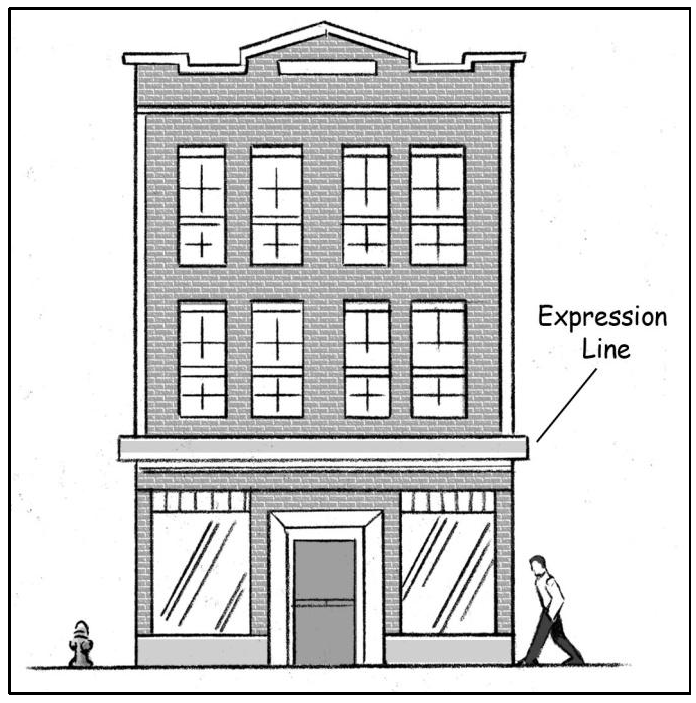
Expression line. The base of any building shall be distinguished from the remainder of the building by providing design elements that enhance the pedestrian environment. A horizontal line on the façade known as the expression line (EL) shall distinguish the base from the remainder of the building. If applicable, the height of the EL shall be related to the prevailing scale of development in the area. The EL shall be created by a change in material, a change in design, or by a continuous setback, recess, or projection above or below the expression line. Elements such as cornices, belt courses, corbelling, molding, stringcourses, ornamentation, awnings or canopies, and changes in material or color or other sculpturing of the base, are appropriate design elements for enhancing the pedestrian environment.
(i)
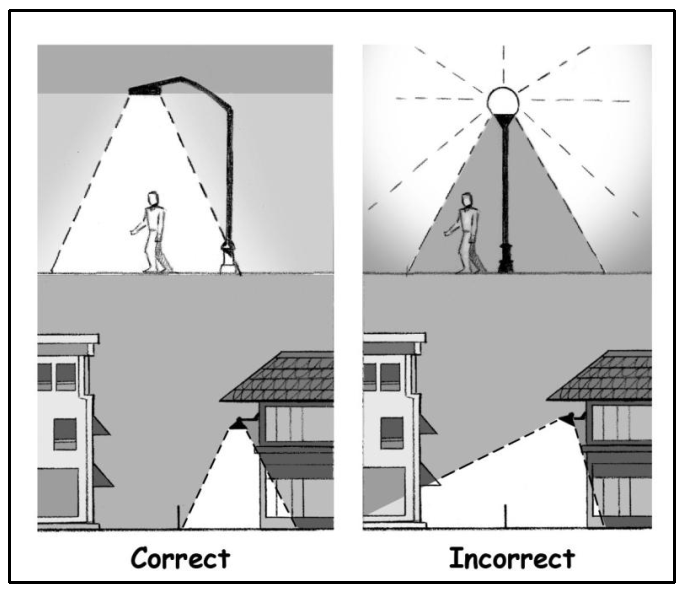
Lighting. Exterior lighting shall consist of the historic-era lighting as approved by the downtown development authority and must be placed and shielded so as to direct the light onto the site and away from adjoining properties. Any lighting source shall not be directly visible from adjoining properties. Floodlights, wall pack units, other types of unshielded lights, and lights where the lens is visible outside of the light fixture shall be prohibited, except where the historic-style lighting is used that is compatible with existing historic-style lamps as proposed by the DDA or as otherwise approved by the city.
(j)
Parking. Parking and parking lot design shall comply with the standards of this section, in addition to the provisions of section 44-165, off-street loading and unloading space, with the following exceptions:
(1)
For residential units in mixed-use buildings, one parking space per bedroom or two spaces per unit, whichever is less, shall be required.
(2)
Shared parking. The planning commission may reduce required parking spaces by up to 20 percent based on the inclusion of a parking demand assessment in the site plan application.
(3)
In-front parking. No new parking lot shall be created nor any existing parking lot expanded in front of a building unless the planning commission determines that parking in front of the building would be acceptable because such parking will provide new dedicated pedestrian connection to the waterfront riverwalk.
(4)
Off-site parking facilities. Required parking for a development may be located off-site under certain circumstances. Requests for off-site parking must meet the requirements of this section.
a.
Residential uses. Parking facilities accessory to dwelling units shall be located on the same zoning lots as the use served. Spaces accessory to uses other than dwellings may be located on a lot adjacent to or across the street from the lot occupied by the use served; but in no case at a distance to excess of 300 feet.
b.
Nonresidential uses. Parking facilities accessory to non residential uses may be located on other than the same zoning lot as the use served (off-site). All required parking spaces shall be within 300 feet of such zoning lot. No parking spaces accessory to a use in the waterfront overlay district shall be located in a residentially zoned district, unless authorized by the planning commission.
(k)
Building height requirements and bonus.
(l)
Site Layout and Building Placement.
(m)
Permitted uses. All uses within the underlying zoning district are permitted in the downtown waterfront overlay district as well as the following:
(1)
All uses as permitted in C-1 districts.
(2)
Boat liveries and marinas.
(3)
Retail sales, serving and storage boats, motors and marine supplies except this shall not permit the storage of old boats or barges beyond a reasonable degree of repair, nor shall this permit the dry land storage of any boats or barges for more than one 12-month period.
(4)
Buildings and uses customarily accessory to any of the permitted uses, but which will not be detrimental to adjacent residential districts.
(5)
Publicly owned buildings, public utility buildings, telephone exchanges, transformer stations and substations with service yards, but without storage yards, water and sewerage pumping stations.
(6)
Residential units on upper floors of buildings.
(7)
Professional offices.
(8)
Restaurants and bars.
(9)
Canoe, kayak, non-motorized personal watercraft and bicycle sales and rentals.
(Ord. No. 372, 3-25-2013)

