
Globe City Zoning Code
ARTICLE 14
7.- PARKING, LOADING, ACCESS REQUIREMENTS
Sec. 14-7-1.- Purpose.
Sec. 14-7-2. - Applicability.
The following subsections describe required standards for off-street parking and off-street loading:
(a)
When the use of any building, structure, or premises is changed to a new use, or the intensity of use is increased through addition of dwelling units, gross floor area, seating capacity, or other units of measurement specified in this article for required parking or loading facilities, parking and loading facilities shall be provided for such increase in intensity of use or change of use in accordance with the provisions of this article.
(b)
Accessory off-street parking or loading facilities which are located on the same lot as the building or use served and which were in existence on the effective date of this chapter (June, 1998) or were provided voluntarily after such effective date shall not hereafter be reduced below, or if already less than, shall not further be reduced below, the requirements of this article for a similar new building or use.
(c)
The requirements set forth in this article with respect to the location or improvement of parking, standing, and loading spaces shall apply to all such spaces that are provided for, such spaces are provided in accordance with the requirements of this article or are voluntarily provided.
(d)
Off-street parking facilities accessory to residential uses and developed in any residential district in accordance with the requirements of this article shall be used solely for the parking of passenger autos, recreational vehicles, or boats owned by occupants of the dwelling structures to which such facilities are accessory, or by guests of said occupants. Under no circumstances shall require off-street parking facilities accessory to residential structures be used for the storage of commercial vehicles associated with a business operation other than for a permitted home occupation at the same location. Such residential parking facilities shall not be used for the parking of automobiles belonging to the employees, owners, tenants, visitors, or customers of nearby commercial or manufacturing establishments.
(e)
No major motor vehicle work of any kind shall be permitted in conjunction with accessory off-street parking or loading facilities; e.g., the overhauling of engines shall be prohibited.
(Res. No. 1791, Exh. A, 11-27-2018; Ord. No. 855, § 1, 11-27-2018)
Sec. 14-7-3. - Off-street parking standards.
(a)
Size. A parking space shall mean an area of not less than 166.5 square feet, with a minimum width of nine feet, and a minimum depth of 18.5 feet, which is specifically designated for, and used for, the parking of an automobile or light truck, exclusive of all driveways and access ways.
(b)
Permits. An applicant for design and site plan review, development review, or a building permit must submit plans showing the off-street parking required by this article. These plans must show locations, arrangement, and dimensions of the off-street parking, turning spaces, drives, aisles, and ingress and egress, and must be approved by the designated approval authority. Whenever a permit has been issued in compliance with the requirements of this article, subsequent use of the structure, or use of the land is conditioned upon the unqualified availability of off-street parking as shown in the approved plans.
(1)
Alterations, Additions, and Expansion of a Business.
a.
A new use, addition, or alteration of a building shall not be approved if it would create or increase a deficit in off-street parking.
b.
It is unlawful to reduce the amount of existing parking below the minimum required by this section without first supplying other spaces as are required.
c.
If a building or business is destroyed, and if it is allowed to be reconstructed subject to the provisions of Section 14-1-3, it shall be required to provide only the number of parking spaces which existed prior to the destruction.
d.
If a business expands, it shall, in addition to the parking spaces in existence prior to such expansion, be required to provide only the number of additional parking spaces necessitated by the expansion.
(2)
Parking Garage. All garages or other space allocated for the parking of vehicles, within buildings, basements, or on roofs of buildings, shall be considered part of the off-street parking facilities and may be included as such in computing the parking area requirements.
(3)
Access. All off-street parking shall have access from a public street or alley.
(4)
Ingress/Egress. Ingress, egress, internal traffic circulation, off-street parking and loading facilities and pedestrian ways shall be designed so as to promote safety and convenience and so that traffic visibility is not obstructed.
(5)
Central Commercial Zone with Historic Preservation Overlay. There shall be no additional minimum parking space requirements for the Central Commercial with Historic Preservation Overlay, however, additional off-street parking provided shall meet these standards.
(c)
Design and Location of Parking Spaces.
(1)
Single-Family, Manufactured Homes, Duplexes and Agricultural Uses.
a.
Location. Required off-street parking shall be located on the same lot or parcel as the use it is intended to serve.
b.
Surfacing. Off-street parking spaces, driveways, and access ways shall be properly surfaced and graded so as to prevent impoundment of surface water in a manner satisfactory to the City Engineer.
(2)
All Other Uses.
a.
Location. Required off-street parking shall be located within 300 feet of the building or use it is intended to serve, the distance being measured along the street line from the nearest point of the building or use to the nearest point of the parking lot. Whenever the use of a separate lot or parcel is proposed for fulfillment of minimum parking requirements, the owner shall submit as a part of his application satisfactory assurance that the separate lot or parcel is permanently committed to parking use by enforceable legal measure and such parking is authorized by the legal owner of the separate lot or parcel.
b.
Off-street parking spaces shall be situated in a manner, which will not result in automobiles backing onto a public street.
c.
Surfacing. Customer, patron parking areas, and automotive display areas: All new construction shall be subject to the following: All areas, access ways, driveways, and display areas for vehicles with gross vehicle weight of less than two and one-half tons shall provide a pavement design drawing showing the extent of the new pavement area. This design drawing shall include a section specifying the type and thickness of the asphalt pavement, aggregate base, and subgrade and shall consist of a minimum of three inches of asphalt over an eight inch aggregate base over a compacted subgrade, or as otherwise specified by the site design engineer and approved by the City Engineer. Paved parking lots shall be maintained at an approved standard for paving. Existing gravel parking lots shall be maintained at an approved standard with a compacted aggregate base and surfaced with three-quarter-inch minus gravel (cinders prohibited) at a two inch minimum depth, or a material of equal or better strength and durability which meets the City Engineer's minimum standards. All surface water run-off shall be detained on-site or drained into a drainage system approved by the City Engineer and shall be maintained by the property owner. The City Engineer may require a drainage study or grading and drainage plans sealed by licensed civil engineer at their discretion.
d.
Curbing. A six-inch wide by six-inch high curb or bumper guard shall be installed along all property lines bordering the parking and maneuvering area, excluding necessary points of ingress and egress, and shall be so located that no part of a vehicle shall extend over or beyond any property line.
e.
Design. As indicated in the diagram below, all areas of the parking lot, with the exception of necessary points of ingress and egress, shall be no closer than ten feet from the front and exterior side yard property lines. That unoccupied area shall be landscaped and maintained with trees, shrubs, ground cover, pedestrian walkways, and plazas in a manner acceptable to the Zoning Administrator. Such landscaping shall be maintained and kept in a weed-free manner. Access to off-street parking areas from a public street shall be from a two-way driveway with a minimum width of 20 feet and a maximum width of 40 feet, or two one-way driveways each with a minimum width of 12 feet and a maximum width of 18 feet. No access driveway shall be located closer than 20 feet from a street intersection or other access driveway, nor any closer than ten feet from any property line unless extraordinary circumstances are demonstrated and approval is granted through the design and site plan review process.
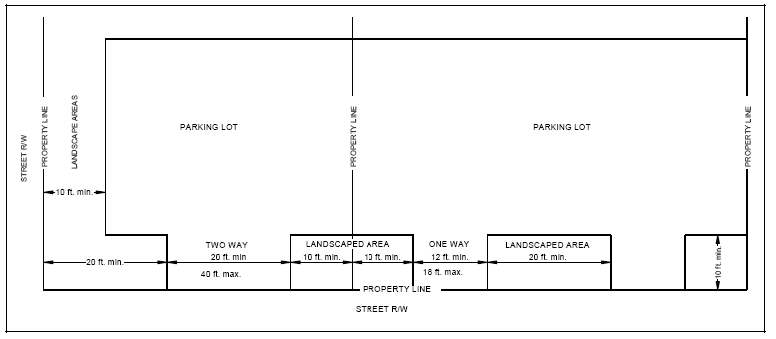
Figure 14-7.1 Parking Lot Minimum Dimensions
f.
Dimensions. Arrangements of parking spaces within the parking lot and driveway widths shall conform with the following requirements:
Minimum parking space dimensions shall be nine feet by 18.5 feet at various angles.
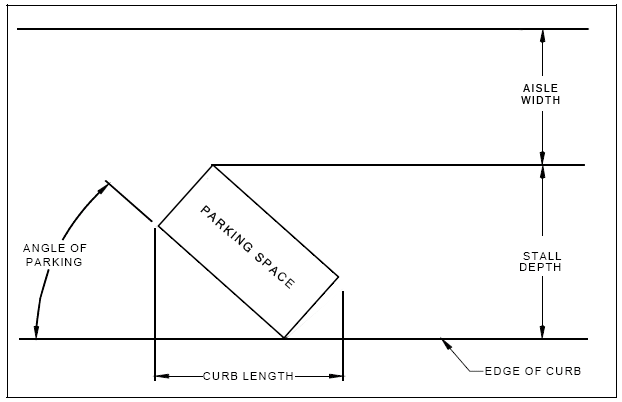
Figure 14-7.2 Parking Space Dimensions
g.
Screening. All on-site parking areas shall be screened from public rights of way with a three-foot masonry wall or a combination of berms and landscaping. Whenever a parking lot or a driveway to a parking lot is established so as to adjoin the side or abut the rear line of a lot in a residential or manufactured home zoning district, a solid masonry or solid material fence six feet in height, or of other material or height as allowed or required by the planning and zoning commission (subject also to the fence height regulations established in Section 14-6-5 of this chapter) shall be constructed and maintained along said side or rear lot line.
h.
Lighting. Parking lots used during hours of darkness shall be lighted to minimum level of 1.5 foot-candles.
Lighting shall be indirect, hooded and arranged so that the source of light is not directly visible from any street or adjoining property. All outdoor lighting shall conform to Article 14-8 of this zoning code, unless otherwise specified herein. Light standards shall be a maximum of 40 feet in height above grade, in airport, commercial and industrial zones and 16 feet in residential zones.
(d)
Schedule of Required Off-Street Spaces.
(1)
Off-Street Parking Spaces. Shall be provided for each specified use in accordance with the schedule below. While the following schedule requires the minimum amount of parking spaces, the business is not relieved of the responsibility to provide adequate off-street parking for all employees and customers, including such parking as required for handicap accessibility as designated by ADA guidelines.
(2)
Definitions. In calculating the total number of required parking spaces, "usable area" as used herein shall mean the area capable of being devoted to the specified use (does not include such spaces as kitchens, restrooms, hallways, etc.), and the term "seat" shall also include each 30 inches of bench seating when individual seats are not provided.
(3)
Mixed Uses. In the event of mixed uses, the total requirement for off-street parking spaces is the sum of the requirements of the various uses computed separately.
(4)
Fractional Amount. In calculating the total number of required off-street parking spaces, fractional amounts are to be rounded to the next highest whole number.
(5)
Unlisted Uses. The Planning and Zoning Administrator shall determine parking requirements for a specific use not listed in this section.
(6)
Land Use Spaces Schedule.
a.
Residential Use.
i.
One or two-family residences: two per dwelling unit.
ii.
Multiple dwellings:
Efficiency units: one and one-half per dwelling unit.
One-bedroom units: one and one-half per dwelling unit.
Two or more bedroom units: two per dwelling unit.
iii.
Senior living facilities: one per two dwelling units.
iv.
Rooming houses, fraternities, sororities, resident clubs, lodges: one per sleeping room or one per bed, whichever is greater.
v.
Manufactured home parks and subdivisions: two per manufactured home and site, plus one per two employees.
vi.
Recreational vehicle parks: one space per each recreational vehicle space, plus space required off-street parking space for any accessory uses.
b.
Commercial Sales and Services.
i.
Restaurants, bars, cocktail lounges: one per 50 square feet of gross floor area excluding kitchens and storage areas.
ii.
Drive-in food or drink places with on-site consumption area: one per 50 square feet of gross floor area excluding kitchens and storage areas, plus one per each three employees on the maximum shift.
iii.
Churches, mortuaries, funeral homes: one per 30 square feet of assembly room space for each congregation meeting at the same time, whichever is greater.
iv.
Self-service laundries and dry cleaners: one per two machines.
v.
Open air businesses: one per 500 square feet of sales area for first 2,000 square feet, plus one per additional 2,000 square feet or portion thereof over 50 square feet.
vi.
Car lots: All parking for employees, customers, and auto storage or display shall be legally contained within the boundary of the property.
vii.
Gasoline service stations: one per employee on the maximum shift, plus two for each service bay (additional parking for grocery or other retail sales shall be required in the amount specified herein).
viii.
Car wash: one per employee, plus reserved spaces equal to five times the wash line capacity.
ix.
Motor vehicle and machinery sales, auto repair shops: one per 800 square feet of floor area.
x.
Barbershops, beauty shops: two per service chair.
xi.
Furniture and appliance stores, household equipment: one per 800 square feet usable floor area.
xii.
Supermarkets, drugstores: one per 250 square feet of gross leasable space.
xiii.
Hotels, motels: one per guest room or suite, plus one per two employees.
xiv.
Bus depots: one per 150 square feet of waiting room space.
xv.
Skating rinks, dance halls, dance studios: one per three persons capacity permitted by fire regulations.
xvi.
Bowling alleys: seven per bowling lane, plus one per five seats in gallery, plus one per two employees.
xvii.
Billiard parlors: two per one billiard tables, plus one per two employees.
xviii.
Gymnasiums, health studios: one per 400 square feet of usable floor area, plus one per two employees.
xix.
Private golf clubs and similar uses: one per eight member families or individuals.
xx.
Theaters: one space for each three seats.
xxi.
Any other retail use not indicated above: one per 250 square feet of customer floor area, plus one per two employees on the maximum shift.
c.
Office and Clinic Uses.
i.
Offices, banks, savings and loan usable agencies: one per 200 square feet of: floor area.
ii.
Medical and dental offices/complexes and clinics: one per 150 square feet of gross floor area for the first 20,000 square feet and one per 250 square feet of the remaining gross floor area over 20,000 square feet.
d.
Schools and Institutions.
i.
Elementary and intermediate schools: one per employee, plus one per every 20 students.
ii.
High schools: one per eight students, plus one per employee.
iii.
Junior colleges, colleges, day universities: one per three enrolled full-time students, plus one per employee.
iv.
Trade schools, business colleges: one per 150 square feet of gross floor area.
v.
Hospitals: one per two beds, plus one per resident employee, plus one per two nonresident employees.
vi.
Day or nursery schools: one space per employee on largest work shift, plus one space per six students for student drop off area.
(e)
Loading Space Requirements.
(1)
Each use is required to provide off-street loading spaces for the safe maneuverability of loading and unloading of its delivery vehicles.
(Res. No. 1791, Exh. A, 11-27-2018; Ord. No. 855, § 1, 11-27-2018)
Sec. 14-7-4. - Location of off-premises parking facilities.
The location of off-premises parking facilities in relation to the use served shall be as prescribed in this section.
(a)
Off-street parking facilities accessory to residential uses shall be located on the same lot as the use served.
(b)
Off-street parking facilities accessory to non-residential uses may be located on a lot adjacent to or across a collector street, local street, or alley from the lot occupied by the use served but in no case at a distance in excess of 100 feet from such use except in the Central Commercial (C-3) District with a Historic Preservation Overlay where this distance may be increased to 400 feet if such off premise parking facility is shared based upon a sharing formula approved by the Zoning Administrator. The distance shall be determined as measured from the closest point of the off-street parking facility to the closest point of the site being served by such off-premise facility. No off-premise parking facilities accessory to an industrial, commercial, or institutional use shall be located in a residential district.
(c)
Pedestrian access between the use or the site and the off-premise parking area shall be via paved sidewalk or walkway.
(Res. No. 1791, Exh. A, 11-27-2018; Ord. No. 855, § 1, 11-27-2018)
Sec. 14-7-5. - Off-street loading standards.
Any use with a gross floor area of 6,000 square feet or more, and which requires deliveries or shipments, must provide off-street loading facilities as determined necessary by the Zoning Administrator after review of the site plan.
(a)
No loading space shall be located within the right-of-way of any street, roadway or public alley or in any designated off-street parking area. At no time shall any part of a truck or van be allowed to extend into a public thoroughfare or the right-of-way while the truck or van is being loaded or unloaded.
(b)
Adequate off-street truck maneuvering area for any required loading berths shall be provided on-site and not within any public street right-of-way or other public lands.
(c)
All required loading berths shall be located on the same lot as the use served.
(d)
All loading spaces shall be accessible at all times from a street, alley or driveway intended to serve such off-street loading areas. Access to loading areas may be provided by way of designated off-street parking areas using only designated and marked aisles for such access. If access to loading spaces involves the utilization of off-street parking areas, no interference of any type shall be permitted in terms of the normal use and function of said off-street parking lot and no designated off-street parking area or space shall be infringed upon at any time for the movement of any vehicle waiting to gain access to said loading space.
(e)
Access to loading spaces shall not be blocked by other loading spaces, permanent or movable structures of any type including trash receptacles or compactors nor shall any loading space interfere with any fire exit or emergency access.
(Res. No. 1791, Exh. A, 11-27-2018; Ord. No. 855, § 1, 11-27-2018)
Sec. 14-7-6. - Access standards for developments.
(a)
Access to public roads and highways in the City of Globe shall be limited to ensure that the congestion created by turning movements is reduced to an absolute minimum. All developments shall meet the following standards, except as otherwise specifically provided in this section.
(1)
All proposed single-family and two-unit attached residential uses shall have direct access to local residential streets only, if possible.
a.
Individual detached single-family residences may have direct access to an arterial street only if no other access options are viable, if the lot is afforded an on-site turn-around area, and if the developer is physically unable to provide a local street. All access physically abutting the developer's property shall be provided at the developer's expense.
b.
All other residential development, including multi-family development of five or more units, must have direct access to a local, collector, or arterial street even though such development may be served internally by private streets and/or drives. All access locations are subject to review and approval by the Town Engineer or designee.
(2)
All nonresidential uses must have primary access to a collector or arterial street or to a frontage road. Direct primary access to a local residential street is prohibited for nonresidential uses. Nonresidential uses may have secondary access to a local residential street with the permission of the Planning and Zoning Commission when principal access to said nonresidential use is provided from either a nonresidential collector street or an arterial street. The establishment of such access shall be in the form of an easement or deed restriction placed upon the lot.
(3)
All uses shall be discouraged from having more than one point of access unless additional access is required by the Fire Department or for other safety purposes. In instances where more than one access point is required, the number shall be minimized by combining access points with adjacent parcels when possible.
(4)
Uses on collector streets which have in excess of 100 feet of frontage may have one access per 100 feet of frontage. In order to promote safe and efficient access, however, uses which have less than 100 feet of frontage on said collector streets shall utilize shared access drives which are located on the abutting property lines. Such shared access drives shall also serve to link off-street parking areas on abutting lots in order to promote site internal circulation between abutting uses and thus minimizing the need to use the collector street in order to accommodate vehicular flow between abutting lots.
(5)
Driveway spacing along existing and planned arterial and collector streets shall be determined as a function of arterial or collector street type.
(6)
No portion of a driveway shall be located within 120 feet of the near curb return of an existing or planned intersection signalized with a traffic light.
(Res. No. 1791, Exh. A, 11-27-2018; Ord. No. 855, § 1, 11-27-2018)

