
Gloucester County Unincorporated
City Zoning Code
City Zoning Code
ARTICLE V
- LANDSCAPING AND BUFFERING
Sec. 34-351.- Short title.
This article shall generally be known as the landscape and buffering regulations of the town land development code.
(Ord. No. 5-92, § 4.2, 8-25-92)
Sec. 34-352. - Purpose and intent.
The primary objective of this section is to protect and preserve the appearance, character, and value of adjacent land uses and to promote the general welfare by providing for the installation of landscaped buffer areas which will screen lower intensity uses from the sight, glare, light and noise intrusion of higher intensity uses.
(Ord. No. 5-92, § 4.3, 8-25-92)
Sec. 34-353. - Exemption.
Lots or parcels of land on which a single-family home is used as a residence shall be exempt from all provisions of these landscaping regulations. This shall not be construed to exempt any residential developments that require final development plan approval from the planning commission.
(Ord. No. 5-92, § 4.4, 8-25-92)
Sec. 34-354. - General requirements.
Wherever a higher intensity property adjoins or abuts a lower intensity land use or zoning classification, a state of natural vegetation shall be preserved or where a lack of appropriate natural vegetation for a buffer occurs a landscape buffer area will be required along the total length of that adjoining or abutting property boundary to provide an attractive land use transition and reduce sight, glare, light and noise intrusion. This landscaped buffer area as set out in this section will be reviewed and approved during the development plan approval process. The landscaped buffer area can be decreased in depth with a continuous brick, stone or concrete block wall, which is located the full length of the adjoining or abutting property boundary being buffered. A landscaped berm of the same height can be substituted for a wall. Buffer areas will be continually maintained in good condition by the property owner. The planning commission will determine the specific requirements of a buffering plan as part of the development plan review process to ensure its effectiveness and to ensure consistency with design principles as listed in section 34-357.
(1)
The exterior boundaries of all sites, including subdivisions, shall have a minimum of four feet of open space around the site. Driveways, fences, walls, sidewalks, street connections to adjoining residential uses or subdivisions, or necessary appurtenances will be permitted within the required four feet.
(2)
All off-street parking areas and drive-in service facilities shall be screened from the bordering streets with a minimum of five feet of landscaped buffer strip between the parking or drive-in area and the bordering street(s), excluding sidewalks, driveways, or necessary appurtenances. This five-foot strip shall have a minimum three-foot height of continuous hedge.
(3)
A six-foot high landscaped berm can be substituted for a wall requirement. The berm must be constructed at a 3:1 slope or less. The berms shall be landscaped with a combination of ground cover, sod, shrubs, and ornamental trees as provided for in this article.
(4)
Where a neighborhood commercial (C-1), commercial (C-2), utility (U), public buildings, churches, cemeteries (PI), or industrial (I) district is separated by a two-lane street from a residential district, then any plot in such nonresidential district adjacent to the separating street shall be provided with a yard at least as deep as that required for the residential district adjoining or lying across the separating street or alley. (See section 34-247, area, yard, height and size requirements.)
(5)
Shopping center uses in C-1 or C-2 districts abutting less intensive use or zoning classification shall have a 25-foot landscape buffer and a stone, brick or concrete block wall unless the planning commission deems a greater setback is necessary. The buffer area shall not be used for a driveway or parking areas, however, sidewalks may be permitted upon review by the development plan review committee. This 25-foot area shall be landscaped in accordance with the specifications contained in section 34-355.
Where frontage roads are not required a shopping center shall have a landscape area with a three-foot high continuous hedge or berm of the same height, sodded open areas, and trees, at least ten feet in depth exclusive of the sidewalk along the street frontage and must be located between the curbline and a line parallel to and ten feet inside the property line. The ten-foot area shall be landscaped in accordance with the specification contained in section 34-355.
(6)
A certificate of occupancy or use shall not be issued until the buffer area and the wall are completed and approved according to the final development order.
Table 1. Buffer Type Requirements
See Figures 1 through 4 for descriptions of buffer types)
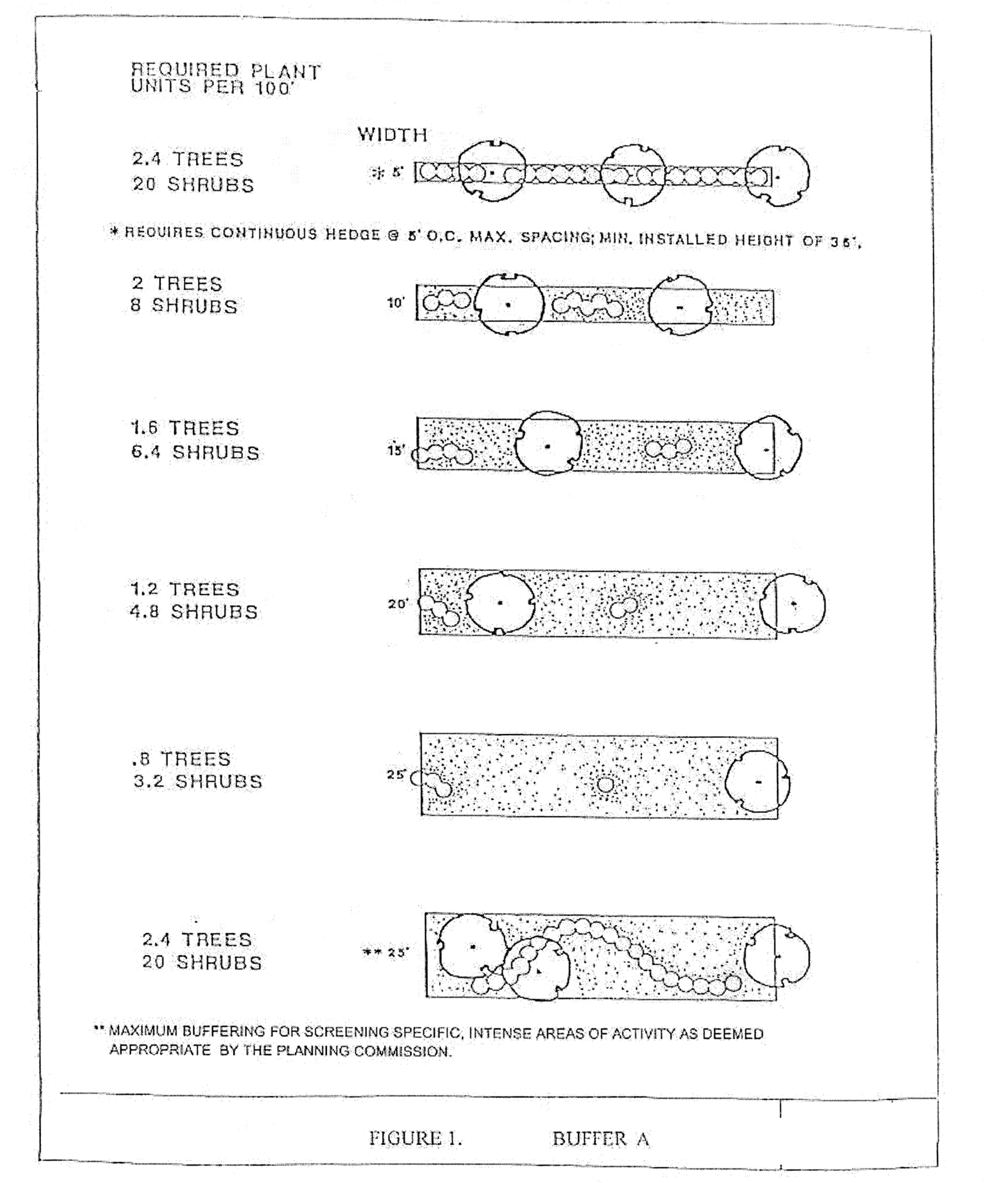
Figure 1 Buffer A
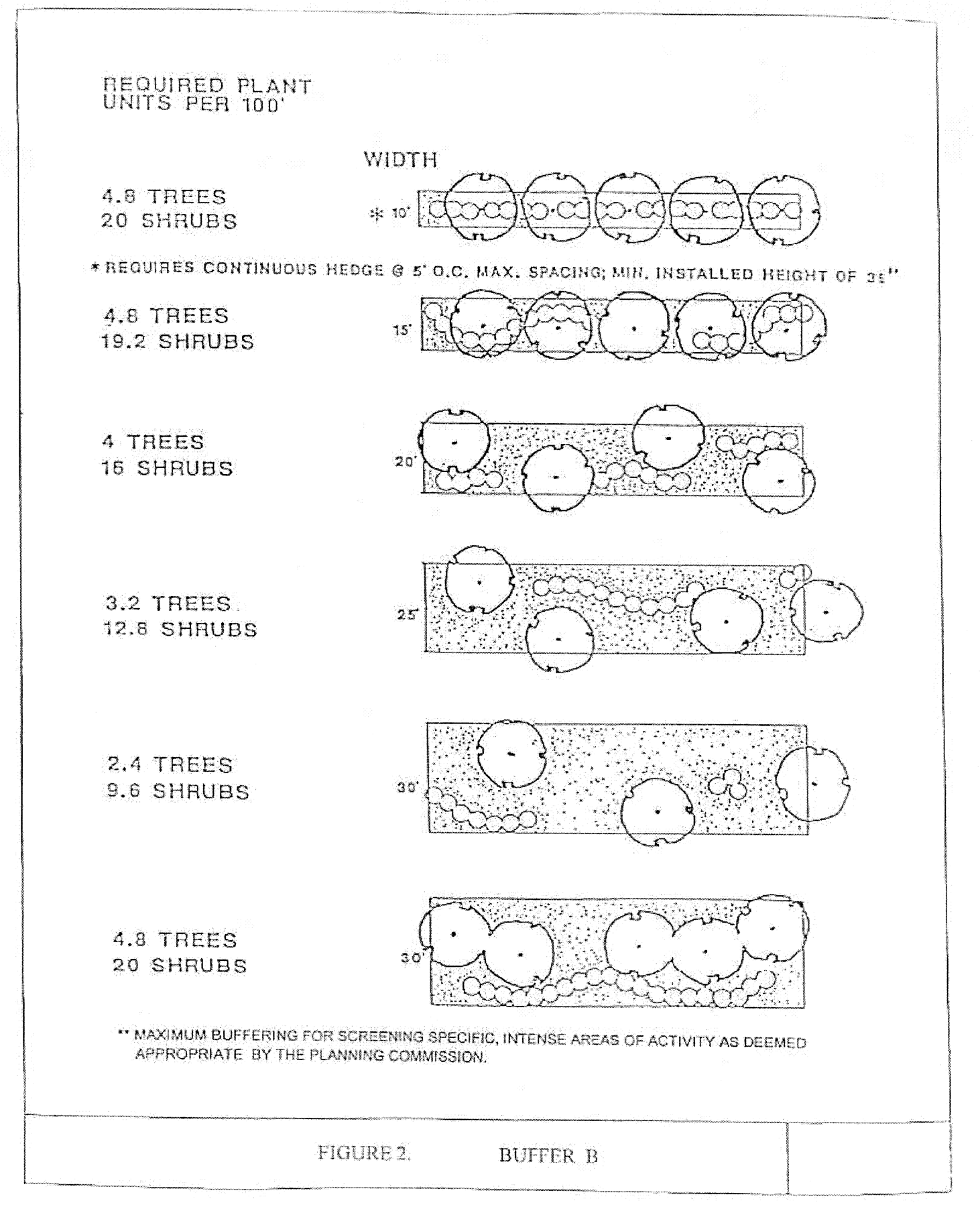
Figure 2 Buffer B
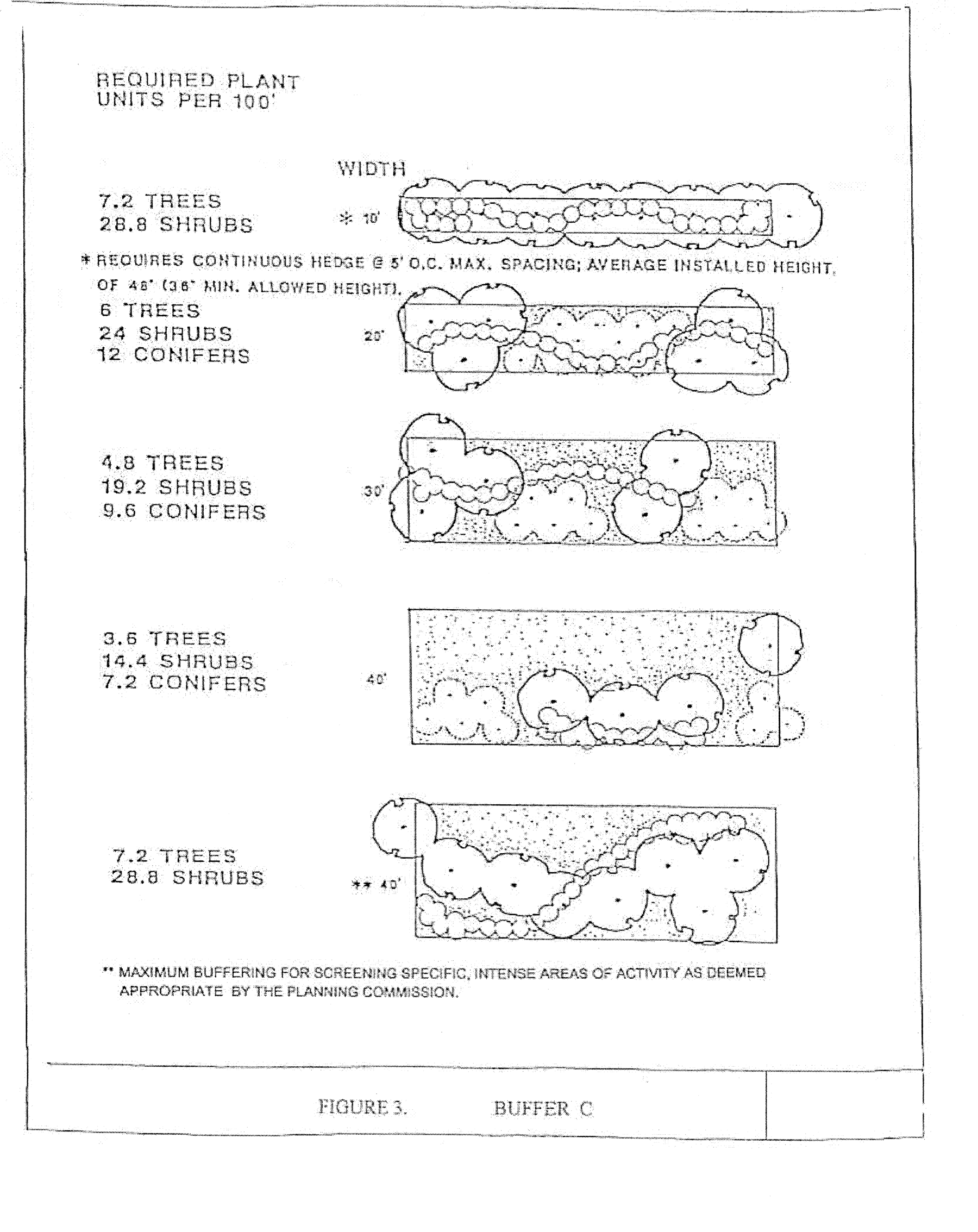
Figure 3 Buffer C
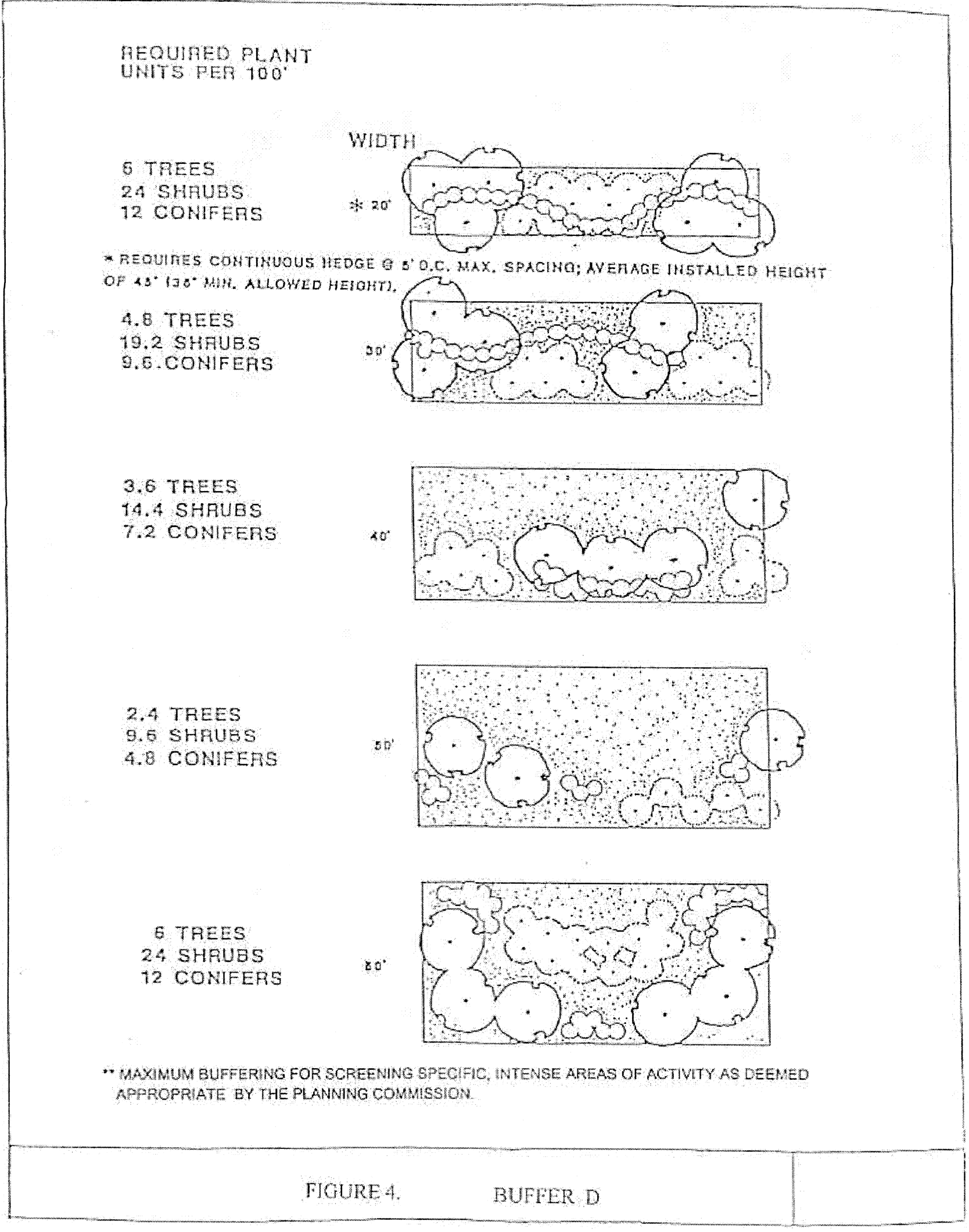
Figure 4 Buffer D
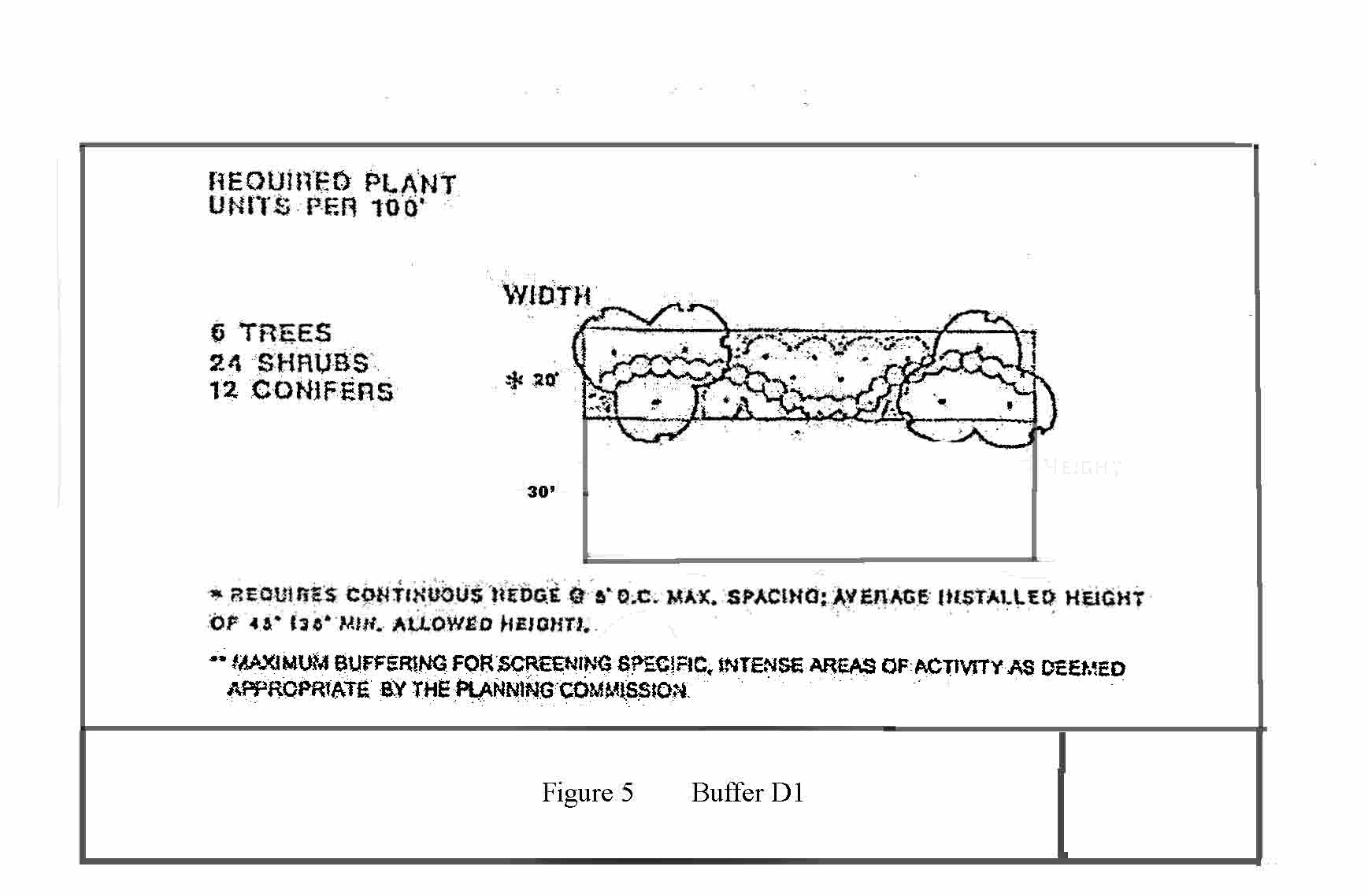
Figure 5 Buffer D1
Buffer D1 shall include at a minimum a 50-foot buffer area with 20 feet of vegetation and include a continuous hedge. The hedge will be of a species that can be expected to grow to a height of eight feet within five years.
(Ord. No. 5-92, § 4.5, 8-25-92; Ord. No. 02-01, § 1, 4-24-01; Ord. No. 05-03, § 1, 6-10-03; Ord. No. 02-10, § 1(Att A), 3-11-10)
Sec. 34-355. - Landscaping specifications in buffer areas.
(a)
Generally. When a landscape buffer area is required under this section then continuous hedging and small trees will be required. The hedging along with the trees shall achieve a 75 percent opacity within two years. The hedge material shall reach a height of three feet in two years, six feet in four years and should be accepted as cold hardy in this zone (zone 9a). All open areas in the buffer area shall be sodded. All landscaped areas shall have a properly installed irrigation system to give 100 percent coverage of the landscaped area or be adequately maintained to ensure the healthy survival of all sod, ground cover, shrubs and trees. All landscape materials that die shall be replaced within 60 days with landscape materials specified under this article.
(b)
Exceptions. Where natural vegetation of a climax successional state is preserved in lieu of a landscaped buffer, the sodded area requirement shall not be applied.
(c)
Trees. Type of small trees such as the following are suggested to be utilized in buffer:
(1)
The following are designated as canopy trees:
(2)
The following are designated as understory trees:
(3)
The following are designated as shrubs:
(4)
The following are designated as ground covers:
(d)
Unfamiliar plant material. If the designer requests plant material which is unfamiliar to the site plan review committee, it shall be the designer's responsibility to prove that the design meets these specifications.
(e)
Prohibited plants. The following plants shall not be installed as landscape material: Noxious exotics, including the Punk tree (Meleleuca quinqueneuia), Australian pine (Casuarina spp.) and Brazilian pepper (Schinus terebinthe folius).
(Ord. No. 5-92, § 4.6, 8-25-92)
Sec. 34-356. - Installation of plants.
(a)
Spacing, size and quality of trees. There shall be an average of one tree for every 25 linear feet of buffer area. Trees shall be a minimum of six feet to eight feet in height when installed. Trees shall be Florida #1.
(b)
Spacing, size and quality of shrubs and hedges.
(1)
Hedge material to be planted shall be a maximum of three feet on center. At the time of installation, plants shall be 18 inches to 24 inches minimum height in three-gallon-sized nursery grown containerized stock and shall conform to the standards for Florida #1.
(2)
All plants shall be healthy and free of diseases and pests, and shall be selected from the list of approved species in section 34-355. The planning commission may authorize the use of an appropriate species not shown on the lists. The planning commission should take steps to have the substituted species added to the list.
(3)
Plants shall be installed during the period of the year most appropriate for planting the particular species. If compliance with this requires that some or all of the landscaping be planted at a time after the issuance of a certificate of occupancy, the developer shall post a performance bond sufficient to pay the costs of the required, but not yet installed, landscaping before the certificate shall be issued.
(4)
Landscaping shall be protected from vehicular and pedestrian encroachment by means of raised planting surfaces, depressed walks, curbs, edges, and the like.
(5)
The landscaping shall not interfere, at or before maturity, with power, cable television, or telephone lines, sewer or water pipes, or any other existing or proposed overhead or underground utility service.
(6)
The developer shall provide sufficient soil and water to sustain healthy growth of all plants.
(c)
Use of required areas. No accessory structures, garbage or trash collection points or receptacles, parking, or any other functional use contrary to the intent and purpose of this chapter shall be permitted in a required landscape area. This does not prohibit the combining of compatible functions such as landscaping and drainage facilities.
(Ord. No. 5-92, § 4.7, 8-25-92)
Sec. 34-357. - Landscape design and materials.
(a)
Design principles. All landscaped areas required by this chapter should conform to the following general design principles:
(1)
Landscaping should integrate the proposed development into existing site features through consideration of existing topography, hydrology, soils and vegetation.
(2)
The functional elements of the development plan, particularly the drainage systems and internal circulation systems for vehicles and pedestrians, should be integrated into the landscaping plan.
(3)
Landscaping should be used to minimize potential erosion through the use of ground covers or any other type of landscape material that aids in soil stabilization.
(4)
Existing native vegetation should be preserved and used to meet landscaping requirements. (See article XI of this chapter for tree protection requirements.)
(5)
Landscaping should enhance the visual environment through the use of materials that achieve variety with respect to seasonal changes, species of living material selected, textures, colors and size at maturity.
(6)
Landscaping design should consider the aesthetic and functional aspects of vegetation, both when initially installed and when the vegetation has reached maturity. Newly installed plants should be placed at intervals appropriate to the size of the plant at maturity, and the design should use short- and long-term elements to satisfy the general design principles of this section over time.
(7)
Landscaping should enhance public safety and minimize nuisances.
(8)
Landscaping should be used to provide windbreaks, channel wind and increase ventilation.
(9)
Landscaping should maximize the shading of streets and vehicle use areas.
(10)
The selection and placement of landscaping materials should consider the effect on existing or future solar access, of enhancing the use of solar radiation, and of conserving the maximum amount of energy.
No development plan shall be denied solely on the basis of the design principles in this section.
(b)
Irrigation. All landscaped areas shall be provided with an appropriate irrigation system that conforms to the Standard Plumbing Code construction standards manual. All irrigation systems connected to a potable water supply shall be fitted with backflow prevention devices. If a landscaped area contains primarily species native to the immediate region, or plants acceptable for xeric landscaping, the planning commission, as applicable, may waive the requirement for installation of an irrigation system. Consideration of a waiver of the irrigation requirement shall include, in addition to the area covered by native vegetation, such local conditions as sun or shade, use of fill soil, and depth to water table.
(c)
Nonliving materials. Mulches shall be a minimum depth of two inches and plastic surface covers shall not be used. Wood chip mulches shall be of a type which do not attract termites.
(Ord. No. 5-92, § 4.8, 8-25-92)
Sec. 34-358. - Wall and fence regulations.
(a)
Construction standards for walls. A wall must be made of brick, stone or concrete block in accordance with prevailing building industry standards for appearance, soundness, safety and resistance to weather.
(b)
General requirements for walls. General requirements for walls shall be as follows:
(1)
Concrete block panels shall not be more than 16 feet in length without providing for expansion.
(2)
A waterproof cap is required for any hollow core wall. This cap shall be installed in such a manner as to prevent moisture from entering the wall.
(3)
Foundations and other structural elements must be designed in accordance with the Florida Building Code. These plans must be submitted to the town engineer and approved before construction on the wall can begin.
(4)
Walls that serve as required buffers shall be a minimum of six feet in height. This six-foot height shall be measured from the highest finished grade of either side of the wall to the top of that wall.
(5)
Plain concrete walls shall be stuccoed or painted.
(6)
The height of the wall may be increased or decreased if the site plan review committee deems it necessary.
(7)
Where the presence of a sidewalk or roadway through the wall and buffer area would allow logical connections between uses, a pedestrian gate opening shall be provided through the buffer area to meet such ends.
(c)
Fence regulations. The primary objective of this section is to protect and preserve the appearance, character, and value of adjacent land uses and to promote the general welfare by providing guidelines for the installation and maintenance of fences. The Town of Inglis requires a permit to erect a fence (see fee schedule) to assure the fence does not obstruct a drivers vision along roadways and the fence provides an orderly appearance that is in keeping with the character of it's surroundings.
(1)
Exemptions. The following types of fences are exempt from permitting requirements provided the proposed fence complies with all other requirements herein:
a.
Fences for bona fide agricultural operations.
b.
Cross fencing within a perimeter fence.
c.
Pens, play yards, kennel runs, and other enclosed areas within an outer perimeter fence. Fences enclosing gardens, landscaped areas, compost piles, and other home horticultural activities.
d.
Fences for permitted temporary uses.
e.
Fences for closure for emergency purposes provided approval is granted and satisfactory evidence of such need has been provided.
(2)
Fences surrounding public utility or hazardous areas are exempt from the height and setback requirements (up to eight feet), and may use up to three strands of barbed wire on security chain link fence provided the barbed wire is at least six feet above average grade.
(d)
General requirements for fences. Fences may be installed in all front, side, and rear yard setbacks. Fences within the required front yard cannot exceed four feet in height and must be ten feet from edge of the road or edge of right of way whichever is greater. Side and rear yard fences cannot exceed six feet in height. If a fence or wall is needed for safety, security, and/or protection of a hazard, it may be approved by the planning commission upon receipt of satisfactory evidence of the need to exceed the height requirements.
(1)
Fence heights are measured from the lowest point of average grade contiguous to the fence to the average top elevation of the fence. If the fence is installed on a berm the berm is included in the overall height.
(2)
Any fence located adjacent to a public right-of-way or private road shall be placed with the finished side facing the right-of-way. Additionally, any fence located within ten feet of a side and/or rear lot line in residential districts shall be placed with the finished side facing the adjoining properties. No fence placed along the water side of any property shall exceed four feet in height, nor shall it block a neighbors view. Materials shall be subject to approval by the zoning officer.
(3)
Fences located within the clear visibility triangle or on a corner lot and/or located within a driveway visibility triangle shall not exceed three feet in height, as not to obstruct the view of motorists checking the intersecting street for traffic. A chain link fence (with out decorative slatting), or any other type fence that does not exceed 20 percent opacity, would be exempt from the three feet height requirement when located within the visibility triangle. Subject to approval by the zoning officer.
(e)
Construction standards for fences. Fence posts must be resistant to decay, corrosion, and termite, infestation. Fences must also be of sound and sturdy construction, and maintained in a sound condition. Fences adjacent to roadways must have the finished side facing the roadway. Fences cannot be constructed of corrugated or sheet metal, or any scrap or offensive material. Additionally, fences cannot contain broken glass, spikes, barbs, electrical wiring or other dangerous materials without planning commission approval. Finally, fences or walls must be constructed so they do not interfere with drainage.
(f)
Maintenance standards. Fences shall be kept in good repair and with an orderly appearance. Fences that show substantial potential for collapse shall be subject to the requirements of article XIII, Hazardous Building and Lands.
(Ord. No. 5-92, § 4.9, 8-25-92; Ord. No. 05-03, § 1, 6-10-03)
Sec. 34-359. - Required landscaping.
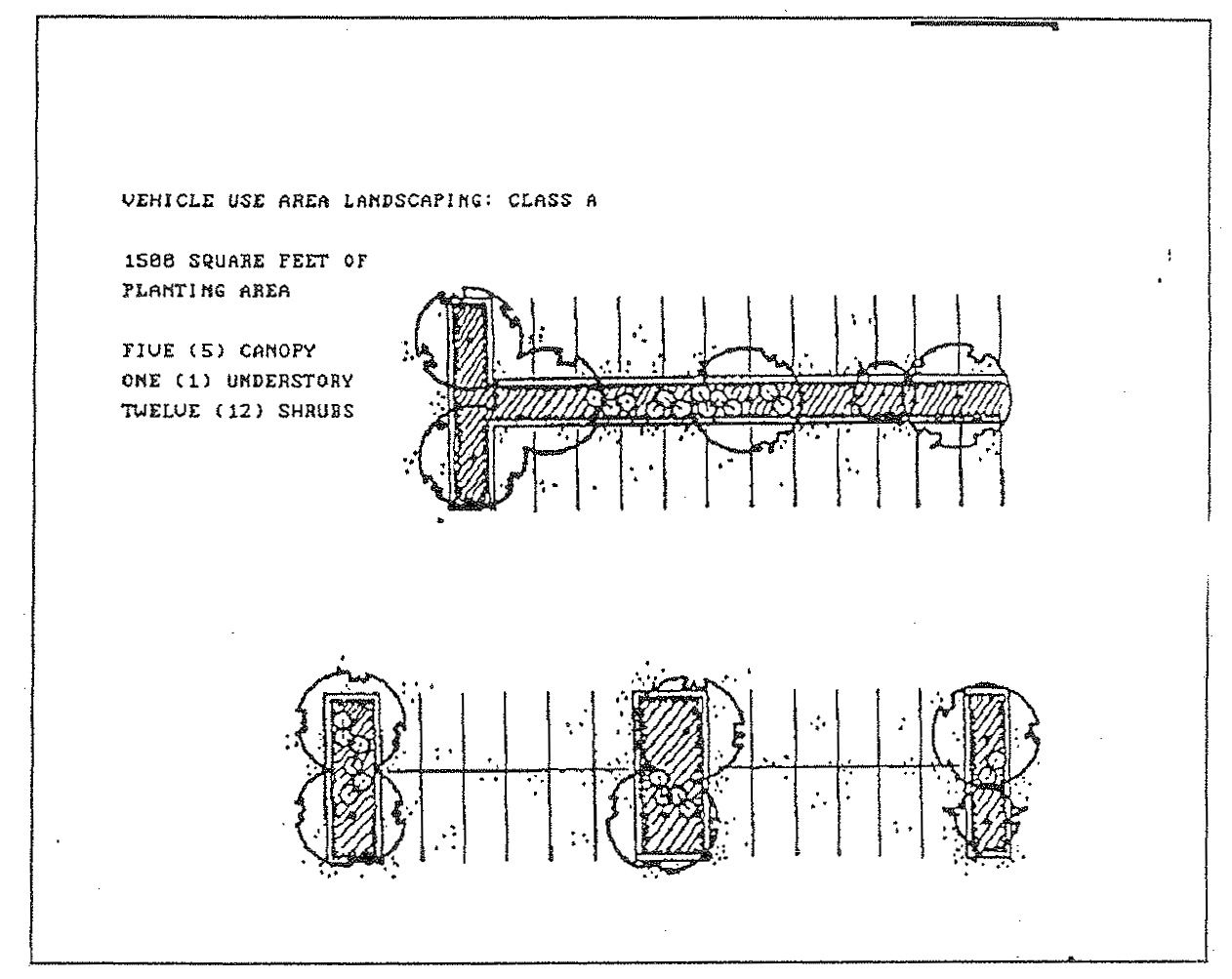
A vehicle use area is any portion of a development site used for circulation, parking, and/or display of motorized vehicles, except junk or automobile salvage yards. All vehicle use areas containing more than 1,000 square feet shall be landscaped as follows:
(1)
For each 24 parking spaces 1,500 square feet of planted area shall be provided with five canopy trees, one understory plant and 12 shrubs. See Figure 1 and Figure 2.
(2)
Proportional amounts of landscaping shall be provided for fractional areas.
(3)
Vehicle use areas designed to accommodate vehicles that are larger or smaller than automobiles, or that do not have designated parking areas, shall meet the requirements of the above figures except that in place of 24 parking spaces, the square footage of 4,800 square feet shall be used.
(Ord. No. 5-92, § 4.10, 8-25-92)
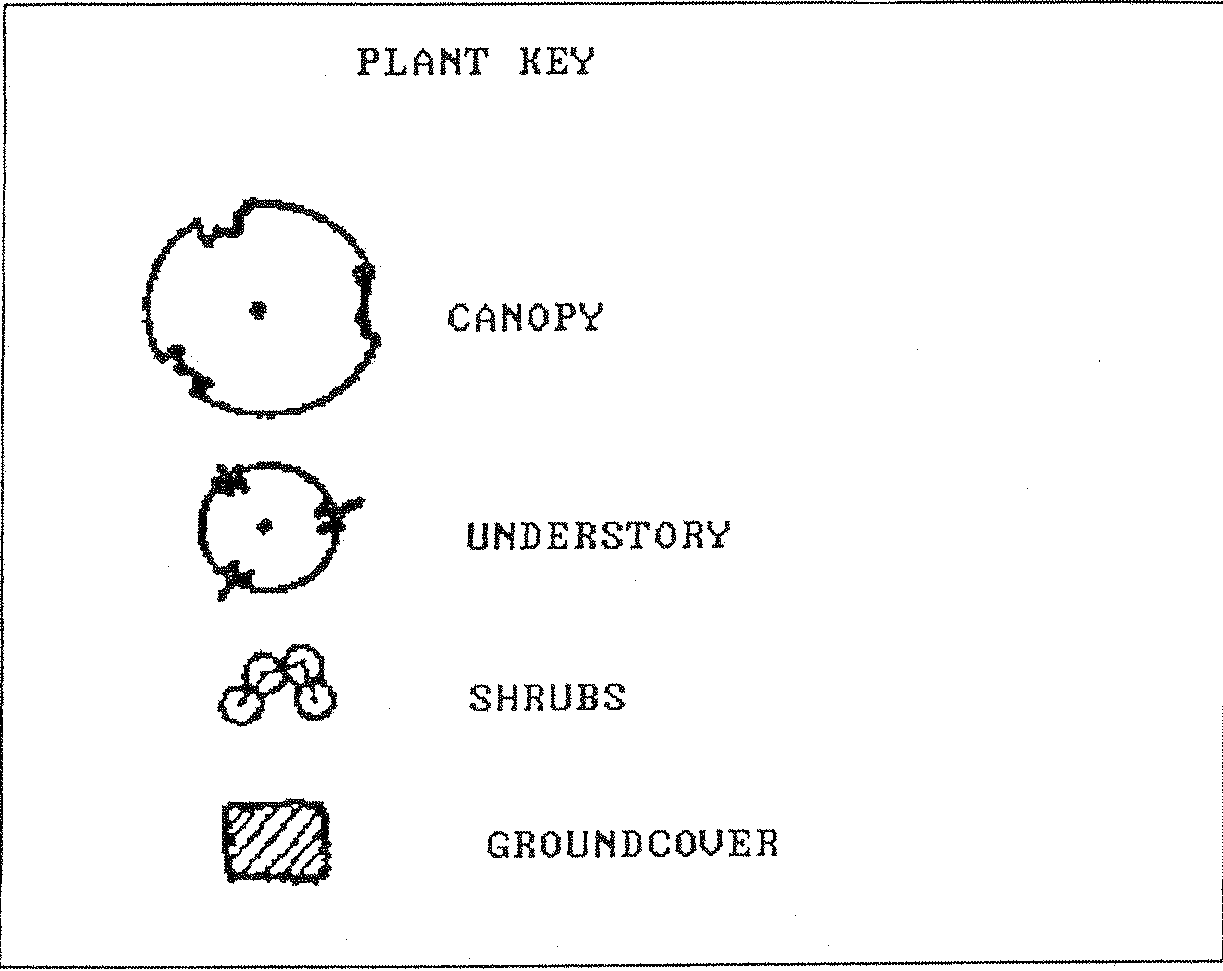
FIGURE 1. PLANT KEY FOR VEHICLE USE ARE LANDSCAPE STANDARDS
FIGURE 2. LANDSCAPING STANDARD
Sec. 34-360. - Variances.
Variances to conditions for landscaping and buffering requirements as written in preliminary development orders may be made via the process for such variances as specified in article XII of this chapter.
(Ord. No. 5-92, § 4.11, 8-25-92)
Sec. 34-361. - Penalties.
(a)
If the required buffer area and landscaping area as specified in the final development order is not constructed, a certificate of occupancy or use shall not be issued until compliance with the final development order is met.
(b)
If landscaping required in the final development order dies and is not replanted within the time specified in subsection 34-355(a), each day thereafter shall be considered a separate offense punishable by a fine of $250.00 per offense.
(Ord. No. 5-92, § 4.12, 8-25-92)

