
Grand Haven City Zoning Code
ARTICLE II
- INTERPRETATION AND DEFINITIONS3
Editor's note—Ord. No. 2021-02, § 1(Exh. A), adopted Jan. 4, 2021, amended art. II in its entirety to read as herein set out. Former art. II, §§ 40-200—40-201.26, pertained to similar subject matter and derived from an ordinance adopted March 5, 2007; Ord. No. 15-02, § 1, adopted Jan. 5, 2015; Ord. No. 17-01, § 2, adopted April 24, 2017; Ord. No. 19-06, § 1, adopted March 4, 2019; Ord. No. 19-07, § 1, adopted March 4, 2019; Ord. No. 20-03, § 1, adopted Feb. 17, 2020.
Sec. 40-200. - Rules of construction.
For the purpose of this ordinance, certain numbers, abbreviations, terms, and words used herein shall be used, interpreted, and defined as set forth in this section. Unless the context clearly indicates to the contrary:
A.
Words used in the present tense include the future tense;
B.
Words used in the singular number include the plural; and words used in the plural number include the singular;
C.
The word "herein" means this ordinance;
D.
The word "regulation" means the regulations of this ordinance; and
E.
The words "this ordinance" shall mean "the ordinance illustrations, text, tables, maps and schedules included herein, as enacted or subsequently amended."
F.
The term "shall" is always mandatory.
G.
Lists of examples prefaced by "including the following", "such as," or other similar preface shall not be construed as exclusive and shall not preclude an interpretation of the list including other similar examples which are not expressly mentioned.
H.
The term "building", "structure," "premises" or any similar term, shall be interpreted to include any part of the building, structure, premises or other similar term unless otherwise stated.
I.
The "city council," "zoning board of appeals," and "planning commission" are respectively the City Council, Zoning Boards of Appeals, and Planning Commission of the City of Grand Haven.
(Ord. No. 2021-02, § 1(Exh. A), 1-4-21)
Sec. 40-201. - Defined terms.
For the purpose of this ordinance, the following terms shall take the meaning set forth in this article. Terms not expressly defined shall be given their customary meaning from common parlance.
(Ord. No. 2021-02, § 1(Exh. A), 1-4-21)
Sec. 40-201.01. - "A."
Access: A way or means of approach to provide vehicular or pedestrian physical entrance to a property or place.
Accessory, or accessory use: A use which is clearly incidental to, customarily found in connection with, and (except in the case of accessory off-street parking spaces, or loading) located on the same zoning lot as the principal use to which it is related. When "accessory" is used in this text, it shall have the same meaning as accessory use. An accessory use includes, but is not limited to, the following:
A.
Residential accommodations for domestic assistance and/or caretakers and garages for private vehicles;
B.
Swimming pools and tennis courts for the use of the occupants of a residence, or their guests;
C.
Domestic or agricultural storage in a barn, shed, tool room, or similar accessory building or other structure;
D.
A newsstand primarily for the convenience of the occupants of a building, which is located wholly within such building and has no exterior signs or displays;
E.
Storage of merchandise normally carried in stock in connection with a business or industrial use, unless such storage is excluded in the applicable district regulations;
F.
Storage of goods used in or produced by industrial uses or related activities, unless such storage is excluded in the applicable district regulations;
G.
Accessory off-street parking spaces, open or enclosed, subject to the accessory off-street parking regulations for the district in which the zoning lot is located;
H.
Uses clearly incidental to a main use such as but not limited to: offices of an industrial or commercial complex located on the site of the commercial or industrial complex;
I.
Accessory off-street loading, subject to the off-street loading regulations for the district in which the zoning lot is located;
J.
Accessory signs, subject to the sign regulations for the district in which the zoning lot is located.
Accessory building: An accessory building, as defined herein, which is a supplementary building on the same parcel as the principal building, or part of the principal building, occupied by or devoted exclusively to an accessory use. When an accessory building is attached to the main building in a substantial manner (such as a wall or roof), the accessory building shall be considered a part of the main building for setback purposes. Examples are private garages, carports, sheds and gazebos.
Accessory structure: A structure which is clearly subordinate or incidental to a principal structure or principal use. Accessory structures include, but are not limited to, the following: parking lots, loading docks, radio and television antennas, or any part thereof; but shall not include fences or elements related to septic systems.
Act of God: For the purposes of this ordinance, an "act of God", shall include weather-related damage, accidental landslide or accidental fire or explosion, or other casualties not related to the intentional actions or negligence of persons.
Adaptive reuse: The development of a new use for an older building or for a building originally designed for a special or specific purpose. Adaptive reuse is the redevelopment, including expansion, of an older building into apartments or condominiums, which may include some or all of the ground floor, on-street frontage committed to retail, office, and service uses.
Adult foster care: A governmental or non-governmental building having as its principal function the receiving of adults for foster care. It includes facilities and foster care family homes for adults, who are aged, emotionally disturbed, developmentally disabled, or physically handicapped who require supervision on an ongoing basis but who do not require continuous nursing care. Adult foster care does not include any of the following:
A.
Nursing homes and hospitals licensed Article 17 of Act 368 of the Public Acts of 1978, as amended;
B.
Hospitals for persons with mental disabilities or a facility for the developmentally disabled operated by the department of mental health under Act 258 of the Public Acts of 1974, as amended;
C.
County infirmary operated by a county department of social services under section 55 of Act 280 of the Public Acts of 1939, as amended;
D.
A child care institution, children's camp, foster family home, or foster family group home licensed or approved under Act 116 of the Public Acts of 1973, as amended;
E.
An establishment commonly described as an alcohol or a substance abuse rehabilitation center, a residential facility for persons released from or assigned to adult correctional institutions, a maternity home, or a hotel or rooming house which does not provide or offer to provide foster care; and
F.
A veteran's facility created by Act 152 of the Public Acts of 1885, as amended.
Adult-use retailer: means a person licensed to obtain marihuana from marihuana establishments and to sell or otherwise transfer marihuana to marihuana establishments and to individuals who are twenty-one (21) years of age or older pursuant to the Michigan Regulation and Taxation of Marihuana Act, 2018 IL 1, MCL 333.27951 to 333.27967.
Affordable housing: Housing that costs no more than thirty (30) percent of a household's monthly income.
Airport: Any location which is used for the landing or taking off of aircraft, which provides facilities for the shelter, supply or care of aircraft, or for receiving or discharging passengers or cargo, and all appurtenant areas used or acquired for airport buildings or other airport facilities, and all appurtenant rights-of-way, either heretofore or hereafter established.
Alley: Any dedicated public way affording a secondary means of access to abutting property, and not intended for general traffic circulation.
Alterations: Any change, addition or modification in construction or type of use, or in the structural members of a building, such as walls or partitions, columns, beams or girders, the consummated act of which may be referred to therein as "altered" or "reconstructed."
Animal boarding: (see Kennel).
Animal grooming service: Any property, structure, building, or premise in or on which pets and other domesticated animals are bathed and/or groomed for commercial gain, but excluding any veterinary or clinical services.
Apartment: A suite of rooms in a two-family or multi-family dwelling arranged and intended for a place of residence of a single-family or a group of individuals living together as a single housekeeping unit.
Apartment, efficiency: A dwelling unit in a two-family or multi-family dwelling consisting of not more than one room in addition to a kitchen and necessary sanitary facilities.
Articulation: The provision of emphasis to architectural elements that create a complementary horizontal pattern or rhythm by a measured and proportioned inflexion and which divides buildings into smaller identifiable segments.
Attic: That part of a building that is immediately below and wholly or partly within the roof framing.
Automobile gasoline station: Any building, land area, or other premises, or portion thereof, used for the retail dispensing or sales of vehicular fuels and convenience items; and which may include as an accessory use the servicing and repair of automobiles and the sale and installation of lubricants, tires, batteries, and similar vehicle accessories; but which does not include an automobile service center.
Automobile repair, major: An establishment engaged in the general repair, engine rebuilding, transmission rebuilding, overhaul or reconditioning of motor vehicles; collision repair services, such as body, frame or fender straightening and repair; major welding activities; and overall painting and undercoating of automobiles.
Automobile repair, minor: An establishment engaged in the general mechanical repair and maintenance of passenger automobiles and trucks weighing less than seven thousand (7,000) pounds, including muffler repair, suspension and brake repair, upholstery repair, oil change and general lubrication service, and tire service, but not including major automobile repair.
Automobile sales facility: An open air business selling new or pre-owned motor vehicles.
Automobile service center: An establishment primarily engaged in furnishing automotive repair that is an integral portion of, or a detached accessory use to, an open air business, such as an automobile sales facility and which is composed of the same construction materials and design of the open air business and wherein automobile products such as motor oils, lubricants and various automobile parts sold at the open air business, may be serviced or installed in an automobile.
Automobile wash: Any building or premises or portions thereof used for the commercial washing automobiles.
Awning or canopy: Any covered structure made of cloth, metal or other material with supporting frames attached to a building which projects beyond the building wall and/or is carried by a frame supported by the building, ground or sidewalk below it.
(Ord. No. 2021-02, § 1(Exh. A), 1-4-21; Ord. No. 2022-07, § 1, 6-20-22)
Sec. 40-201.02. - "B."
Backlit lettering: A sign illumination technique in which raised lettering is formed from opaque material and extended horizontally from the sign face with light sources obscured behind the lettering to create a silhouette of the lettering against the sign face.
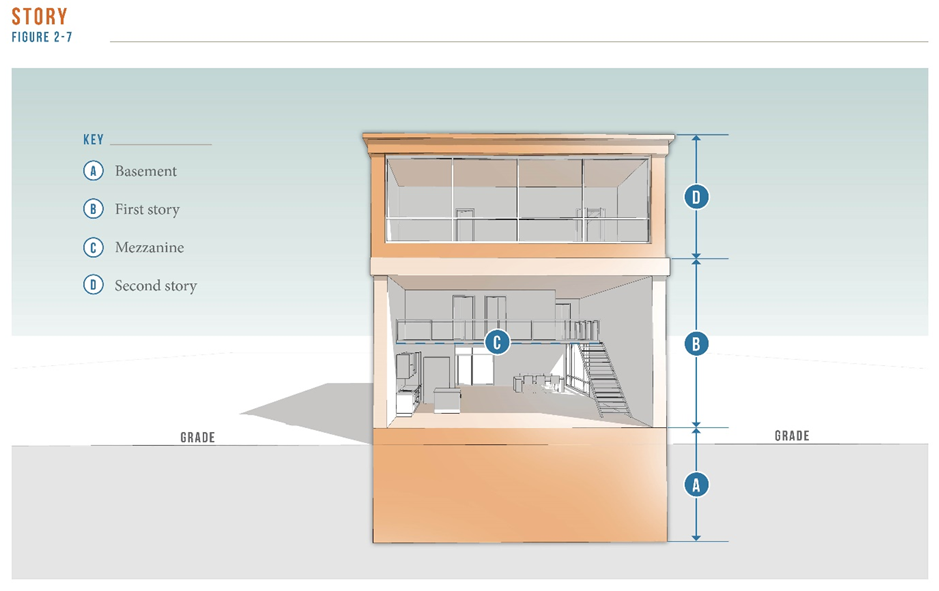
Basement: That portion of a building which is partly or wholly below grade but so located that the vertical distance from the average grade to the floor is greater than the vertical distance from the average grade to the ceiling. A basement shall not be counted as a story.
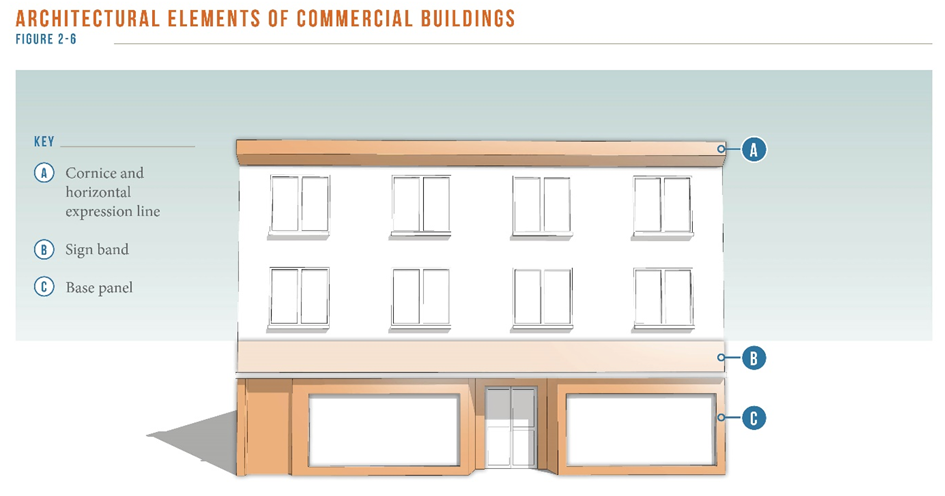
Base panel: The horizontal piece that forms the lowest member of a facade located between finished grade and the base of a window. (See graphic under "Sign band")
Bed and breakfast: A building at which overnight accommodations and a morning meal are provided to transients for compensation, for periods no longer than fourteen (14) days. For the purposes of this ordinance, a bed and breakfast shall not be considered a short-term rental.
Billboard: An outdoor sign advertising services or products, activities, persons, or events which are not made, produced, assembled, stored, distributed, leased, sold, or conducted upon the premises upon which the billboard is located.
Blank wall: Any wall or portion of a wall that is located within forty (40) feet of the street right-of-way, parking area or park and is without a ground level window, door, or other architectural feature along a wall of twenty-five (25) feet in length or greater.
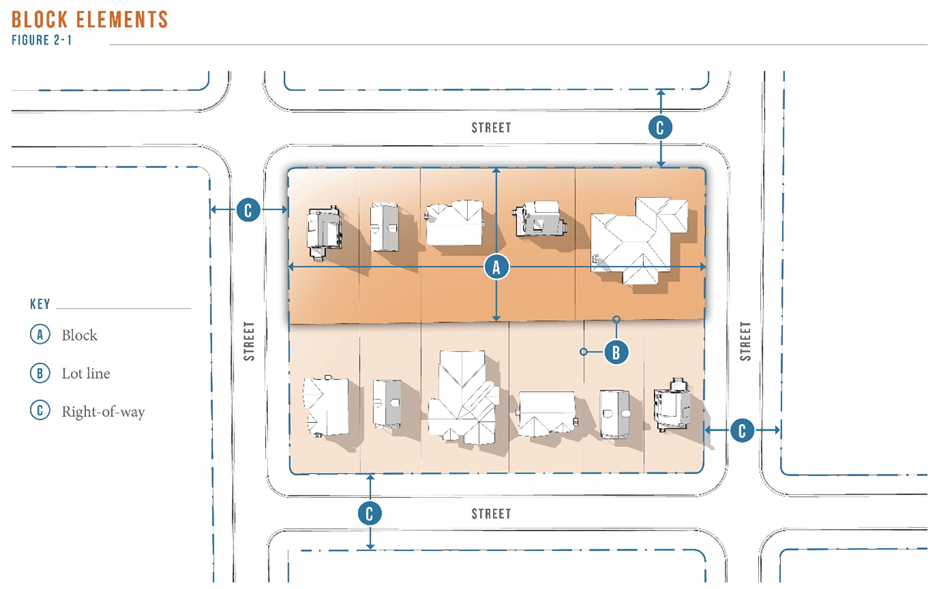
Block: The property abutting one side of a street and lying between the two (2) nearest intersecting streets (crossing or terminating), or between the nearest such street and railroad right-of-way, unsubdivided acreage, lake, river or live stream; or between any of the foregoing and any other barrier to the continuity of development, or corporate boundary lines of the city.
Boarding house: A dwelling unit or part thereof in which, for compensation, lodging and more than one meal is provided, for periods of more than seven (7) days.
Boat: A vehicle used or capable of being used as a means of transportation on water.
Boat launch: A public or private facility designed and used for boat access to the Grand River or Lake Michigan.
Boat slip: A parking space for the parking or storage of a boat.
Boulevard: A broad thoroughfare which contains a landscaped median comprised of turf, trees, shrubs and other landscape material.
Buffer area: A landscaped open space free of development, structures, parking, and buildings, but which may include an obscuring wall, plantings, and berms used to physically separate and screen one use or property from another so as to visually shield or block noise, lights, and other nuisances.
Building: Any structure, either temporary or permanent, having a roof supported by columns or walls and intended for the shelter, housing or enclosure of any individual, animal, process, equipment, goods, or materials of any kind.
Building department: The Building Department of the City of Grand Haven, Michigan.
Building envelope: The three-dimensional space within which a structure is permitted to be built on a lot and that is defined by maximum height regulations and minimum yard setbacks.
Building footprint: The total area contained within the exterior foundation or framing area taken on a horizontal plane at the largest floor level of a building or an accessory building exclusive of unroofed porches, terraces, patios, decks, and steps, and of awnings and nonpermanent canopies.
Building frontage: That facade of the building that abuts the required front yard or corner front yard as stipulated in this zoning code.
Building height: The vertical dimension from the median grade of the building, structure, or wall exposed above grade to the highest point of the roof, parapet wall, or other uppermost part.
Building line: The outermost wall of the building foundation.
Build-to zone: A thirty-six-inch wide area parallel to and between a right-of-way line and building frontage.
Bus passenger station: A premises for the storage and parking of motor-driven buses and the loading and unloading of passengers.
(Ord. No. 2021-02, § 1(Exh. A), 1-4-21)
Sec. 40-201.03. - "C."
Cantilever: A projecting beam or building member or component supported at only one end.
Carport: A roofed structure providing space for the parking of motor vehicles and enclosed on not more than three (3) sides.
Cemetery: Grounds and facilities including any one or a combination of more than one of the following a burial ground for earth interment; a mausoleum for crypt entombment; a crematory for the cremation of human remains; and a columbarium for the deposit of cremated remains.
Child care center: A facility, other than a private residence, receiving one or more preschool or school age children for care for periods of less than twenty-four (24) hours a day, and where the parents or guardians are not immediately available to the child. Child care center or day care center includes a facility that provides care for not less than two (2) consecutive weeks, regardless of the number of hours of care per day. The facility is generally described as a child care center, day care center, day nursery, nursery school, parent cooperative preschool, play group, or drop-in center. Child care center or day care center does not include any of the following:
A.
A Sunday school, a vacation bible school, or a religious instructional class that is conducted by a religious organization where children are in attendance for not more than three (3) hours per day for an indefinite period, or not more than eight (8) hours per day for a period not to exceed four (4) weeks during a twelve-month period.
B.
A facility operated by a religious organization where children are cared for not more than three (3) hours while persons responsible for the children are attending religious services.
Child care family home (up to 6 clients): A private home in which one but not more than six (6) minor children are received for care and supervision for periods of less than twenty-four (24) hours a day, unattended by a parent or legal guardian, except children related to an adult member of the family by blood, marriage, or adoption. Family day care home includes a home that gives care to an unrelated minor child for more than four (4) weeks during a calendar year.
Child care, group home (7—12 clients): A private home in which more than seven (7) but not more than twelve (12) minor children are given care and supervision for periods of less than twenty-four (24) hours a day unattended by a parent or legal guardian, except children related to an adult member of the family by blood, marriage, or adoption.
Church: see Place of public assembly.
Clinic: A facility for the medical or dental care, diagnosis, or treatment of sick, ailing, infirm and injured persons and those who are in need of medical, dental, or minor surgical care attention, but who are not kept on the premises for more than eight (8) hours.
Club: An organization of persons for special purposes or for the promulgation of sports, arts, sciences, literature, politics, or the like, but not operated for profit.
Commercial parking facility: A parking area or parking building available to the public, with or without fee, used to temporarily store motor vehicles.
Commercial storage facility: A structure containing separate, individual, and private storage spaces of varying sizes leased or rented on individual leases for varying periods of time.
Commercial vehicle: Any motor vehicle for hire, which is used for the transportation of passengers, or which is constructed or used for the transportation of goods, wares or merchandise, or which is designed and used for the purpose of transporting other vehicles.
Commission: The Planning Commission of the City of Grand Haven, Michigan.
Community garden: A lot or portion thereof where agricultural plants are cultivated and maintained by individuals or group(s) of individuals from the community. Community gardens may produce food for individual consumption or for sale, may be designed for beautification of the community, and may be used for educational purposes.
Condominium: A building or group of buildings in which individual portions thereof are owned by, or offered for sale to separate entities with common elements owned jointly as prescribed in Act 229 of the Michigan Acts of 1963, as amended.
Conference or convention center: See Place of public assembly.
Contractor's establishment: A facility, building, structure, grounds, or portion thereof used to store tools, trucks, equipment, supplies, resources, and materials used by building construction professionals, contractors, and subcontractors. Such facilities typically will include outdoor storage, assembly, or staging areas.
Convenience store: Any retail establishment offering for sale such items as prepackaged food products, household items, newspapers and magazines, and sandwiches and other freshly prepared foods, such as salads, for off-site consumption.
(Ord. No. 2021-02, § 1(Exh. A), 1-4-21)
Sec. 40-201.04. - "D."
Deciduous tree: A tree that provides shade during the growing season and sheds leaves seasonally or at certain life cycle stages.
Deck: An accessory structure or platform supported by pillars or posts, either attached or unattached to a building, that is higher than seven (7) inches above grade at any portion of the structure or platform, and which does not contain walls.
Density: The number of dwellings per unit of land.
Development: The division of a parcel of land into two (2) or more parcels; the construction, reconstruction, conversion, structural alteration, relocation, or enlargement of any structure or building; any manmade change to improved or unimproved real estate, including, but not limited to, buildings or other structures, mining, dredging, filling, landfills, grading, paving, excavation or drilling operations, or land disturbance; and any use or extension of the use of land.
Dish antenna: An earth based station whose purpose is to receive communications or signals from orbiting satellites or other signal energizing sources together with other equipment pertaining directly to the function of a dish antenna.
District: A part, zone, or geographic area within the city within which certain zoning or development regulations apply.
Domesticated animals: Animals commonly domesticated and kept in homes, including, but not limited to dogs, cats, birds, fish, rabbits, small rodents, small reptiles, and similar animals that do not represent an unusual risk to persons or property.
Dredging facility: A facility designed or used to remove and/or store earth from the bed of a water body, watercourse, or wetland.
Drive-through business: A principal use or accessory use of an establishment that by design, physical facilities, service, or by packaging procedures encourages or permits customers to receive services, obtain goods, or be entertained while remaining in their motor vehicles.
Driveway: A private roadway providing access to a street.
Driveway curb-cut: The opening along a curb line at which point vehicles may enter or leave the street.
Driveway, shared or common: A driveway serving two (2) or more structures or off-street parking areas, which are located on individual lots.
Dry cleaning and laundry establishment: A commercial establishment providing dry cleaning and laundry services on-site for businesses and residents, but which does not include a dry cleaning plant.
Dry cleaning and laundry establishment, on-site: A commercial establishment providing dry cleaning and laundry services on-site for businesses and residents and which includes a dry cleaning plant.
Dry cleaning plant: A facility used or intended to be used for cleaning fabrics, textiles, clothing, laundry or other similar articles by immersion and/or agitation in solvents or other processes.
Dumpster: An accessory use of a property where trash or recyclable material, or other type of waste or refuse, is stored temporarily, having a capacity of at least one cubic yard.
Dwelling: A building or portion thereof that is used exclusively for human habitation and which provides complete living facilities, including permanent provisions for sleeping, eating, cooking and sanitation.
Dwelling, accessory: A separate, complete housekeeping unit with a separate entrance, kitchen, sleeping area, and full bathroom facilities, which is an attached or detached extension to an existing single-family structure and located on the same parcel of land as an existing single-family structure.
Dwelling, manufactured: A one-family dwelling which is substantially or completely built, constructed, assembled, or finished off the premises upon which it is intended to be located and which meets the National Manufactured Home Construction and Safety Standards Act.
Dwelling, multiple-family: A building containing three (3) or more attached dwelling units and is surrounded by open space or yards.
Dwelling, one-family: A building containing one dwelling unit and that is not attached to any other dwelling by any means and is surrounded by open space or yards.
Dwelling, site built: A dwelling which is substantially or completely built, constructed, assembled or finished on the premises upon which it is intended to be located. For the purpose of this definition, site built shall include dwellings consisting of pre-cut materials or panelized wall, roof and floor sections when such sections require substantial or complete assembly and finishing on the premises which it is intended to be located.
Dwelling, two-unit: A building containing two (2) attached dwelling units and is surrounded by open space or yards.
(Ord. No. 2021-02, § 1(Exh. A), 1-4-21)
Sec. 40-201.05. - "E."
Eating and drinking establishment: A retail establishment selling food and drink for consumption on the premises, including restaurants, taverns, coffee houses, bakeries, lunch counters, refreshment stands, and similar facilities selling prepared foods and drinks for immediate on-site consumption or for take-out.
Educational facility: A public, private, or parochial school offering instruction at the elementary, junior, and/or senior high school levels in the branches of learning and study required to be taught in the public schools of Michigan.
Elderly: Adults over the age of sixty (60).
Employee: One employed by another for wages or salary.
Erected: Built, constructed, altered, reconstructed, moved upon, or any physical operations on the premises which are required for construction, excavation, fill, drainage, and the like, shall be considered a part of erection.
Essential services: The erection, construction, alteration or maintenance by public utilities or municipal departments of underground, surface or overhead gas, electrical, steam, fuel or water transmission or distribution systems, collection, communication, supply or disposal systems, including poles, wires, mains, drains, sewers, pipes, conduits, cables, fire alarm and police call boxes, traffic signals and hydrants in connection herewith, but not including buildings which are necessary for the furnishing of adequate service by such utilities or city departments for the general health, safety or welfare.
Evergreen tree: A cone-bearing tree whose foliage remains green and functional through more than one growing season.
Excavation: Any breaking of ground, except common household gardening and ground care.
Exception: Permission to depart from the use or design standards of this zoning ordinance provided an "exception" is not a "variance."
Exotic animal: Any species of animal, reptile, or bird that is not indigenous to the environs of Grand Haven and which is not, in the judgment of the zoning administrator, normally considered a farm animal or a pet and which may potentially be dangerous to humans, domestic animals or property if not properly managed.
Exterior cladding material: Materials used to clad the exterior walls of a building to provide a finished surface. Said materials must meet minimum requirements as set forth in the Michigan Building Code for Exterior Walls.
A.
Composite siding: A man-made factory engineered panel used mainly for exterior cladding, partitioning, load bearing walls and roofing elements. Panels are manufactured of dissimilar materials bonded together on a continuous lamination basis with metal (steel or aluminum) facings encapsulating a foamed polyurethane core to increase performance. Materials selected must be of high quality and durable. The planning commission reserves the right to evaluate and approve use of this contemporary material and design element.
B.
Decorative concrete block: A concrete masonry unit having special treatment of its exposed face for architectural effect, which may consist of exposed aggregates or beveled recesses or other articulation or texture for a patterned appearance (e.g., split face, fluted, burnished).
C.
Fiber cement board: An architectural composite material of fly-ash, Portland cement, wood pulp and water that is steam heated and formed into planks. The result is a durable product that is resistant to damage, rot, insects and is also flame retardant.
(Ord. No. 2021-02, § 1(Exh. A), 1-4-21)
Sec. 40-201.06. - "F."
Family: A single individual or individuals, domiciled together whose relationship is of a continuing, non-transient, domestic character and who are cooking and living together as a single, nonprofit housekeeping unit, but not including any society, club, fraternity, sorority, association, lodge, coterie, organization, or group of students, or other individuals whose relationship is of a transitory or seasonal nature, or for anticipated limited duration of school terms, or other similar determinable period of time.
Farm animals or livestock: Animals customarily kept by humans for the purpose of providing food, clothing or work, and which are customarily raised for profit, including but not limited to, equine, bovine, ovine, caprine, porcine, fowl, and bees.
Fence: An artificially constructed barrier of any material or combination of materials erected to enclose, screen, or separate areas.
Fence, decorative: A designed open or solid fence or wall that contributes to the identification and beauty of the principal use; is not erected to satisfy any other provision of this code; does not act as a retaining structure; and is made of material that typically is not found in security fences.
Fence, obscuring: A fence that is eighty (80) percent or more opaque.
Flag pole: A freestanding structure or a structure attached to a building or to the roof of a building and used for the sole purpose of displaying non-commercial flags.
Floodplain: That area mapped by the National Flood Insurance Program having a flood elevation that has a one percent chance of being equaled or exceeded each year, and as determined by the Federal Emergency Management Agency.
Floodway: Means that area of land adjoining a river or stream that will be inundated by a 100-year flood, which, for the purposes of this chapter, is taken to mean the floodplain area mapped by the National Flood Insurance Program, as determined by the Federal Emergency Management Agency.
Floor area, gross: The sum of the gross horizontal areas of the several floors of a building or structure, including a basement but excluding a porch or other similar unenclosed area, from the exterior face of exterior walls, or from the centerline of a wall separating two (2) buildings, but excluding any space where the floor-to-ceiling height is less than six (6) feet.
Floor area, residential: The sum of the horizontal areas of each story of the building measured from the exterior faces of the exterior walls or from the centerline of walls separating two (2) dwellings; and excluding areas of basements, unfinished attics, attached garages or carports, breezeways, and enclosed and unenclosed porches and decks.
Floor area, usable: The sum of the horizontal areas of the several floors of the building, measured from the interior faces of the exterior walls; including those areas used for or intended to be used for the sale of merchandise or services, or for use to serve patrons, clients or customers; and not including those areas which are used or intended to be used principally for parking, the storage or processing of merchandise, hallways, or for utilities or sanitary facilities.
Flowering landscape tree: A flowering tree whose primary purpose is to be ornamental.
Footprint: See Building footprint.
Foster care: The long-term continuous residential care of adults or children.
Fuel storage: Any combination of storage tanks or containers, including pipes connected thereto, which is used to contain petroleum or other flammable liquids.
Funeral home: See Mortuary.
(Ord. No. 2021-02, § 1(Exh. A), 1-4-21)
Sec. 40-201.07. - "G."
Garage, private: A structure that is accessory to a residential building and that is used for the parking and storage of vehicles owned and operated by the residents thereof and other storage incidental to a residential use such as rakes, lawnmowers, garbage cans, etc., and that is not a separate commercial enterprise available to the general public.
Golf course: A tract of land laid out for at least nine (9) holes for playing the game of golf and improved with tees, greens, fairways, and hazards and that may include a clubhouse, driving range, pro shop, shelter, and related accessory uses.
Governmental buildings: The official offices of any department, commission, independent agency, officer, or instrumentality of the United States, of a state, county, incorporated or unincorporated municipality, township, authority, district, or other governmental unit.
Grade, finished: The final elevation of the ground level after development.
Grade, median: The finished median ground elevation along the perimeter of the building.
Grade, natural: The elevation of the ground level in its natural state, before construction, development, filling, or excavation, as defined on the official City of Grand Haven Topography Map comprised of the 2004 Ottawa County aerial photography with topographical lines at two-foot intervals.
Greenbelt, obscuring: A landscape area of definite width, height and location and containing plant materials of definite spacing designed and intended to serve as an obscuring device in carrying out the screening requirements of this zoning ordinance.
Greenhouse: A building whose roof and sides are made largely of glass or other transparent or translucent material and in which the temperature and humidity can be regulated for the cultivation of delicate or out-of-season plants, but excluding medical marihuana, for subsequent sale, distribution or for personal enjoyment.
Grower: A state operating licensee that is a commercial entity located in this state that cultivates, dries, trims, or cures and packages marihuana for sale to a processor or provisioning center pursuant to the Michigan Medical Marihuana Facilities Licensing Act, 2016 PA 281, as amended, MCL 333.27102 et seq. or a person licensed to cultivate marihuana and sell or otherwise transfer marihuana to marihuana establishments pursuant to the Michigan Regulation and Taxation of Marihuana Act, 2018 IL 1, MCL 333.27951 to 333.27967.
(Ord. No. 2021-02, § 1(Exh. A), 1-4-21; Ord. No. 2022-07, § 1, 6-20-22)
Sec. 40-201.08. - "H."
Hazardous substances: One or more of the following:
A.
A chemical, toxic substance, or other material which is or may become injurious to the public health, safety, or welfare or to the environment.
B.
"Hazardous substance" as defined in the Comprehensive Environmental Response, Compensation and Liability Act of 1980.
C.
"Hazardous waste" as defined in Article II, Chapter 3, Part 111 of P.A. 451 of 1994, as amended, being the Hazardous Waste Management part of the Natural Resources and Environmental Protection Act.
D.
"Petroleum" as defined in Article II, Chapter 8, Part 213 of P.A. 451 of 1994, as amended, being the Leaking Underground Storage Tanks part of the Natural Resources and Environmental Protection Act.
Health club: See Recreation facility.
Home occupation: Any occupation, profession, or activity carried out for gain from a residential property that is clearly subordinate and incidental to the residential nature of the property, and which may involve business activities generally conducted at other locations, or the sale or exchange of services at the residential property.
Home occupation, major: A home occupation as defined herein that may be apparent to neighbors by virtue of activities on site, signage, outdoor storage, or modifications to structures or grounds.
Home occupation, minor: A home occupation as defined herein that, under normal circumstance, is not apparent to neighbors.
Horizontal expression line: A projecting horizontal feature which is located at the top of a facade. (See graphic under "Sign band")
Hospital: A facility providing health services primarily for in-patient medical or surgical care of the sick or injured and including related facilities such as laboratories, out-patient departments, training facilities, central service facilities and staff offices which are an integral part of the hospital facility.
Hotel: A facility offering transient lodging accommodations to the public with access from interior lobbies, and which may provide such additional services or facilities meals or restaurant service, meeting rooms, entertainment, and recreational facilities.
(Ord. No. 2021-02, § 1(Exh. A), 1-4-21)
Sec. 40-201.09. - "I."
Impervious surface: Any material that prevents the absorption of stormwater into the ground.
(Ord. No. 2021-02, § 1(Exh. A), 1-4-21)
Sec. 40-201.10. - "J."
Junk: Scrap or waste material of any kind or nature collected or accumulated for resale, disposal, or storage.
Junkyard: Any area, lot, land, parcel, building, or structure, or part thereof, used for the storage, collection, processing, purchase, sale, salvage, or disposal of junk.
(Ord. No. 2021-02, § 1(Exh. A), 1-4-21)
Sec. 40-201.11. - "K."
Kennel/animal day care: Any lot or premises on which three (3) or more domesticated animals are either permanently or temporarily boarded or trained for remuneration.
Key street segment: Specific streets and portions of streets identified in article III and subject to additional standards of this ordinance.
(Ord. No. 2021-02, § 1(Exh. A), 1-4-21)
Sec. 40-201.12. - "L."
Land division: A land division as defined in the Land Division Act of the State of Michigan, being Public Act 288 of 1967, as amended.
Land preserve: A site with environmental features intended to be preserved and protected in its natural state.
Land use permit: A City of Grand Haven Land Use Permit as established in section 40-111.02 of this zoning ordinance.
LEED: The LEED (Leadership in Energy and Environmental Design) Green Building Rating System; a voluntary, consensus-based national standard for developing high-performance, sustainable buildings.
Library: A public, nonprofit facility in which literary, musical, artistic, or reference materials such as, but not limited to, books, manuscripts, computers, recordings, or films, are kept for use by or loaning to patrons of the facility, but are not normally offered for sale.
Live/work: A structure, or a part of a structure, used both as a residence and for any nonresidential use permitted in the zoning district in which the unit is located.
Living area: An area that is habitable for the entire year.
Loading space: An off-street space on the same lot with a building, or group of buildings, for the temporary parking of a commercial vehicle while loading and unloading merchandise or materials.
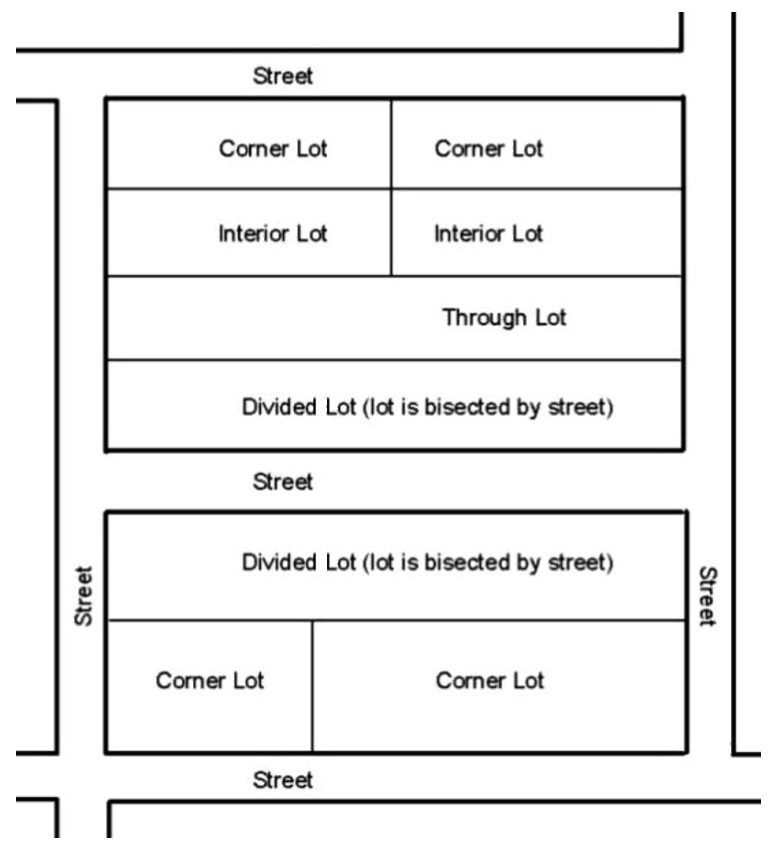
Lot: A parcel of land occupied, or intended to be occupied, by a main building or a group of such buildings and accessory buildings or utilized for the principal uses and uses accessory thereto, together with such yards and open spaces as are required under the provisions of this zoning ordinance. A lot may or may not be specifically designated as such on public records.
Lot area: The total horizontal area within the lot lines of a lot.
Lot, corner: A lot where the interior angle of two (2) adjacent sides at the intersection of two (2) streets is less than one hundred thirty-five (135) degrees. A lot abutting upon a curved street or streets shall be considered a corner lot for the purposes of this zoning ordinance if the arc is of less radius than one hundred fifty (150) feet and the tangents to the curve, at the two (2) points where the lot lines meet the curve or the straight street line extended, form an interior angle of less than one hundred thirty-five (135) degrees.
Lot coverage: That part or percent of the lot occupied by buildings and accessory buildings, including roof overhangs exceeding two (2) feet, roofed decks, roofed patios, and porches.
Lot depth: The horizontal distance from the midpoint of the front lot line to the midpoint of the rear lot line, or to the rear most point of the lot where there is no rear lot line.
Lot, divided: A lot that is bisected by a street or private street.
Lot, interior: Any lot other than a corner lot.
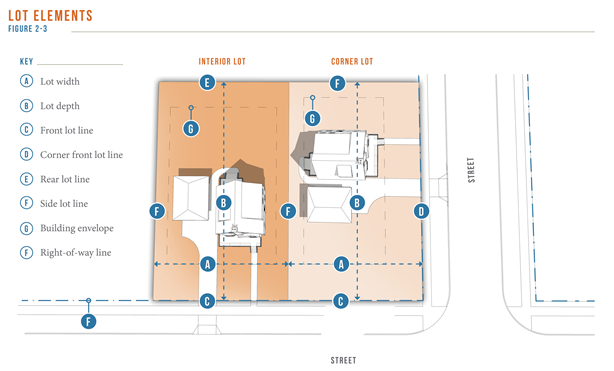
Lot lines: The lines bounding a lot as defined herein:
A.
Front lot line: In the case of an interior lot, is that line separating the lot from the street. In the case of a through lot, is that line separating the lot from either street. In the case of a corner lot, the shorter street line shall be considered the front lot line and the longer line shall be the corner front lot line; except in the case of both street lines being equal, the choice may be made at the discretion of the property owner. However, once declared, the designated front lot line shall remain as such.
B.
Rear lot line: That lot line opposite the front lot line, except in the case of corner lots, which shall not have a rear lot line. In the case of a lot pointed at the rear, the rear lot line shall be an imaginary line parallel to the front lot line, not less than ten (10) feet long lying farthest from the front lot line and wholly within the lot.
C.
Side lot line: Any lot line other than the front lot line, corner front lot line, or rear lot line. A side lot line separating a lot from another lot or lots is an interior side lot line.
Lot of record: A parcel of land, the dimensions of which are shown on a document or map on file with the county register of deeds or in common use by city or county officials, and which actually exist as so shown, or any part of such parcel held in a record ownership separate from that of the remainder thereof.
Lot, through: A lot that fronts upon two (2) more or less parallel streets or that fronts upon two (2) streets that do not intersect at the boundaries of the lot.
Lot width: The horizontal straight-line distance between the side lot lines, measured between the two (2) points where the minimum front setback line intersects the side lot lines.
Lot, zoning: A single tract of land, located within a single block, which, at the time of filing of a building permit, is designated by its owner or developer as a tract to be used, developed, or built upon as a unit, under single ownership or control. A zoning lot need not coincide with a lot of record, and may consist of a single recorded lot, a portion of a recorded lot, or any combination thereof.
(Ord. No. 2021-02, § 1(Exh. A), 1-4-21)
Sec. 40-201.13. - "M."
Maneuvering lane: An area within a parking area intended to provide ingress and egress to parking spaces.
Manufactured home: A dwelling which is transportable in one or more sections, that is built on a permanent chassis, and designed to be used as a dwelling with or without permanent foundation, when connected to the required utilities and includes the plumbing, heating, air conditioning, and electrical systems contained therein and is installed by a Michigan Licensed Mobile Home dealer or Michigan Licensed Mobile Home installer as required by Michigan statute, and administrative rules promulgated thereunder.
Manufactured home sales: An establishment engaged in the selling of manufactured homes to the general public and which may render services incidental to the sale of such manufactured homes.
Manufactured housing community: A use which is a parcel of land under the control of a person upon which three (3) or more manufactured homes are located on a continual, non-recreational basis and which is offered to the public for that purpose regardless of whether a charge is made therefore, together with any building, structure, enclosure, street, equipment, or facility used or intended for use incidental to the occupancy of a manufactured home and which is not intended for use as a temporary manufactured home or trailer.
Manufacturing, compounding, or processing: An enclosed establishment engaged in the mechanical or chemical transformation of materials or substances into new products, including the assembling of component parts, the creation of products, and the blending of materials, usually in a continuous and regular action or succession of actions.
Marihuana, also known as marijuana, also known as cannabis: The term shall have the meaning given to it in section 7601 of the Michigan Public Health Code, 1978 PAS 368, MCL 333.7106, as referred to in section 3(d) of the Michigan Medical Marihuana Act, PA 2008, Initiated Law, MCL 333.26423(d). Any other term pertaining to marihuana used in this chapter and not otherwise defined shall have the meaning given to it in the Michigan Medical Marihuana Act and/or the General Rules of the Michigan Department of Community Health issued in connection with that Act.
Marina: A facility, including three (3) or more waterfront boat slips, which provides for the servicing, storing, fueling, berthing, and securing of boats and that may include eating, sleeping, and retail facilities intended primarily for the owners, crews, and guests of boat owners using the marina.
Masonry: Construction that involves the shaping, arranging, and uniting of stone, brick, building blocks, or similar materials to form walls or other parts of a structure.
Master deed: A legal instrument under which title to real estate is conveyed and by which a condominium is created and established.
Master plan: The comprehensive, long-range master plan intended to guide growth and development in the City of Grand Haven which includes recommendations on future land use, economic development, housing, recreation, transportation, open space, and community facilities.
Medical office: A facility in which medical, health, and related providers maintain offices and provide services to patients on an outpatient basis.
Medical use of marihuana: The acquisition, possession, cultivation, manufacture, use, internal possession, delivery, transfer, or transportation of marihuana or paraphernalia relating to the administration of marihuana to treat or alleviate a registered qualifying patient's debilitating medical condition or symptoms associated with the debilitating medical condition, as defined under the Medical Marihuana Act, PA 2008, initiated Law, MCL 333.26421 et seq.
Mezzanine: An intermediate floor in any story occupying more than one-third (⅓) of the floor area of such story.
Mixed use development: A development of a tract of land, building, or structure with a variety of complementary and integrated uses as permitted by the applicable zoning district.
Mortuary or funeral home: A facility used for the preparation of the deceased for burial and for visitation and for the conduct of memorial and funeral services.
Motel: An establishment providing sleeping accommodations with a majority of all rooms having direct access to the outside without the necessity of passing through the main lobby of the building.
Multi-tenant commercial establishment: A building housing more than one business operated under common management, or a unified grouping of individual businesses, served by a common circulation and parking system.
Municipal uses—Utilities: The generation, transmission, and/or distribution of electricity, gas, steam, communications, and water; the collection and treatment of sewage, stormwater and solid waste; and the provision of mass transportation; as provided by the city or an instrumentality of the city or other governmental unit, entity or collaborative of which the city is a member or to which the city has consented.
(Ord. No. 2021-02, § 1(Exh. A), 1-4-21)
Sec. 40-201.14. - "N."
Natural feature: Physical characteristics of the subject property that are not manmade.
Nonconforming lot: A lot, the area, dimensions, or location of which was lawful prior to the adoption, revision, or amendment of the ordinance but that fails by reason of such adoption, revision, or amendment to conform to the present requirements of the applicable zoning district or other zoning regulations.
Nonconforming structure or building: A structure, building or portion thereof lawfully existing on March 5, 2007, or the effective date of applicable amendments hereto, which thereafter does not conform to the provisions in the district in which it is located relative to building height, bulk, area or setbacks.
Nonconforming use: A use for which a building or land was lawfully used on March 5, 2007, or the effective date of applicable amendments thereafter, which does not contain a use of land permitted in the district in which it is located.
Nuisance factors: An offensive, annoying, unpleasant or obnoxious activity or practice; a cause or source of annoyance, especially a continuing or repeating invasion of any physical characteristics or activity or use across a property line which can be perceived by or affects a human being. The generation of an excessive or concentrated movement of people or things, such as, but not limited to: noise; dust; smoke; odor; glare; fumes; flashes; vibrations; shock waves; heat; electronic or atomic radiation; objectionable effluent; noise of congregation or people, especially at night; passenger traffic; and invasion of non-abutting street frontage by traffic.
Nursery, plant materials: A space, building or structure, or combination thereof, for the storage of live trees, shrubs or plants offered for retail sale on the premises including products used for gardening or landscaping. The definition of nursery within the meaning of this article does not include any space, building, or structure used for the sale of fruit, vegetables or Christmas trees.
Nursing care facility: A residential care facility providing long-term care for elderly, infirm, terminally-ill, physically, emotionally and/or developmentally disabled persons, including a nursing care facility that provides independent living services, assisted living services, and nursing care and medical treatment services, in a campus-like setting that has shared facilities or common areas, or both.
Nursing home/assisted living: A residential care facility providing long-term care for elderly, infirm, terminally-ill, physically, emotionally and/or developmentally disabled persons, licensed in accord with Article 17 of Act 368 of 1978, as amended.
(Ord. No. 2021-02, § 1(Exh. A), 1-4-21)
Sec. 40-201.15. - "O."
Office building: A building used primarily for conducting the affairs of a business, profession, service, industry, or government, or like activity, and may include ancillary services for office workers, such as a coffee shop or child-care facilities.
Off-street parking lot: A facility providing vehicular parking spaces along with adequate drives and aisles, for maneuvering, so as to provide access for entrance and exit for the parking of more than three (3) vehicles.
Open air business: A permanent business including the sales and/or display of retail merchandise or services outside of a permanent structure.
Open space, common: An area within a development designed and intended for the use or enjoyment of all residents or occupants of the development or for the use and enjoyment of the public in general.
Ordinary high water mark: The line between upland and bottomland that persists through successive changes in water levels, below which the presence and action of the water is so common or recurrent that the character of the land is marked distinctly from the upland and is apparent in the soil itself, the configuration of the surface of the soil and the vegetation.
Outdoor combustion furnace: An outdoor wood, oil, pellet, or biomass-fired boiler, freestanding or housed within a small, insulated building and typically used to heat indoor environments, domestic hot water, swimming pools, and jacuzzi tubs via pipes running along the ground or beneath the surface.
(Ord. No. 2021-02, § 1(Exh. A), 1-4-21)
Sec. 40-201.16. - "P."
Parapet: That portion of a wall that extends above the roof line.
Park or parkland: A tract of land, designated, maintained, and used by the public for active and/or passive recreation and which is owned and controlled by a public entity or unit of government.
Park, private: A tract of land owned or controlled and used by private or semi-public entities or groups for active and/or passive recreational purposes.
Parking space: An area of definite length and width, such area shall be exclusive of drives, aisles, or entrances giving access thereto, and shall be fully accessible for the parking of permitted vehicles.
Parkway: A lawn panel customarily located between the curb line, or pavement edge of a street or road and the street or road right-of-way line.
Patio: A level, landscaped, and/or surfaced area directly adjacent to a principal building at or within seven (7) inches of the finished grade and not covered by a permanent roof.
Pergola: A covered slatted or lattice structure primarily intended to cover an outdoor dining/seating area and create shade. Pergolas are often used as supports for climbing plants or as shelters of vines or branches. For the purposes of this ordinance, pergolas shall be considered buildings.
Personal service business: An establishment primarily engaged in providing services involving the care of a person or his or her goods or apparel, but not including a tattoo or piercing parlor.
Pet: Any animal that has been bred or raised to live in or about the habitation of humans and is dependent on people for food and shelter.
Place of public assembly: Buildings, structures and grounds, including theaters, churches, auditoriums, convention space, stadiums, sports arenas, concert halls, lecture halls and other similar facilities intended for commercial or non-commercial entertainment, instruction, worship or similar activities involving assembled groups of people numbering thirty (30) or more.
Place of public assembly, small: A place of public assembly shall be considered a small facility if it has either less than two thousand (2,000) square feet in gross floor area or total seating capacity of no more than one hundred (100) in the largest room or space intended for public assembly.
Place of public assembly, large: A place of public assembly shall be considered a large facility if it has either two thousand (2,000) square feet or more in gross floor area, total seating capacity of more than one hundred (100) in the largest room or space intended for public assembly, or the capability to expand to meet these standards in the future.
Planned development (PD): A specific parcel of land or several contiguous parcels of land, under single ownership and control, for which a comprehensive physical development or redevelopment plan has been prepared establishing a functional use area or areas, density patterns where applicable, a fixed system of streets, including limited access service drives where applicable, service drives, provisions for public utilities, drainage and other essential services, all of which shall be subject to review and approval by the city and which has been, or will be, developed in strict accordance with the approved plan.
Planned residential development (PRD): A specific parcel of land or several contiguous parcels of land, under single ownership and control, for which a comprehensive physical plan, meeting the requirements of section 40-552 of this zoning ordinance and establishing functional use areas, density patterns, a fixed system of streets, provisions for public utilities, drainage and other essential services, and subject to review and approval by the planning commission and city council in accordance with section 40-552, and which has been or will be developed in full accordance with the approved plan.
Pond, detention: A pond designed to temporarily detain stormwater runoff for a short period of time, gradually releasing it to the natural watercourse immediately after the peak volume of stormwater has dissipated.
Pond, retention: A pond designed and intended to hold water for a considerable length of time for aesthetic or consumptive purposes as well as for the collection and holding of stormwater runoff, the volume of which may never be totally discharged to a natural watercourse.
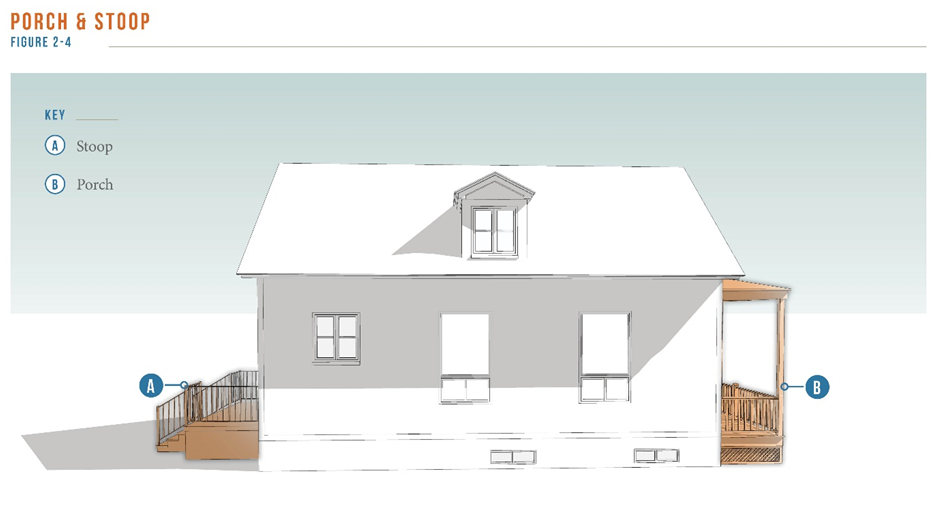
Porch: A patio or deck that is either fully or partially enclosed with screening, glazing or other means of enclosure, whether or not it is heated or cooled by mechanical means.
Power generating facility: A facility designed and used for the production of electrical energy primarily for the purpose of commercial sale to wholesale and retail customers connected to electrical transmission grid. Such facilities include geothermal, hydro, solar, coal, diesel, fuel oil, nuclear, natural gas combustion as well as solid waste incinerators.
Primary caregiver: A person who is at least twenty-one (21) years old and who has agreed to assist with a patient's medical use of marihuana and who has never been convicted of a felony involving illegal drugs.
Principal building: A building in which is conducted the principal use of the lot on which it is located.
Principal use: The main use to which the premises are devoted and the principal purpose for which the premises exist.
Private communications antenna: An accessory structure used for, or intended to be used for, reception of satellite or radio transmissions.
Processor: A state operating licensee that is a commercial entity located in this state that purchases marihuana from a grower and that extracts resin from the marihuana or creates a marihuana-infused product for sale and transfer in packaged form to a provisioning center pursuant to the Michigan Medical Marihuana Facilities Licensing Act, 2016 PA 281, as amended, MCL 333.27102 et seq. or a person licensed to obtain marihuana from marihuana establishments; process and package marihuana; and sell or otherwise transfer marihuana to marihuana establishments pursuant to the Michigan Regulation and Taxation of Marihuana Act, 2018 IL 1, MCL 333.27951 to 333.27967.
Professional service establishment: An establishment engaged in providing assistance, as opposed to products, to individuals, businesses, industries, governments, and other enterprises, including printing, legal, engineering, consulting, and other similar services.
Provisioning center: A state operating licensee that is a commercial entity located in this state that purchases marihuana from a grower or processor and sells, supplies, or provides marihuana to registered qualifying patients, directly or through the patients' registered primary caregivers pursuant to the Michigan Medical Marihuana Facilities Licensing Act, 2016 PA 281, as amended, MCL 333.27102 et seq. Provisioning center includes any commercial property where marihuana is sold at retail to registered qualifying patients or registered primary caregivers. A noncommercial location used by a primary caregiver to assist a qualifying patient connected to the caregiver through the Michigan Department of Licensing and Regulatory Affairs (LARA) marihuana registration process in accordance with the MMMA is not a provisioning center for purposes of this article.
Public and quasi-public uses: Parks, playgrounds, trails, paths, and other recreational areas and open spaces; scenic and historic sites; schools and other buildings and structures; and other places where the public is directly or indirectly invited to visit or permitted to congregate, such as churches, municipal off-street parking lots, libraries, museums, or fraternal organizations.
(Ord. No. 2021-02, § 1(Exh. A), 1-4-21; Ord. No. 2022-07, § 1, 6-20-22)
Sec. 40-201.18. - "R."
Recreation facility: A place designed and equipped for the conduct of sports and leisure-time activities.
Recreation facility, commercial: A recreation facility operated as a business and open to the public for a fee.
Recreation facility, indoor: A permanent building containing facilities for recreational activities, such as tennis, bowling, billiards, platform games, swimming, exercise rooms, handball and similar activities.
Recreational vehicle, or RV: A vehicle designed or constructed for the transportation of people, primarily for recreational purposes, and which may permit occupancy thereof as a dwelling or sleeping place, including motor homes, campers, camper trailers, off-road vehicles, boats and utility trailers.
Refuse incineration: The burning of solid waste, unwanted or discarded material.
Research and development: An establishment for carrying on investigation in the natural, physical, or social sciences, which may include engineering and process or product development, but which does not involve the mass manufacture, fabrication, processing, or sale of products or services.
Residential above retail or office: A mixture of land uses in which dwelling units are located on floors or stories above retail businesses or office uses.
Restaurant: See Eating and drinking establishment.
Retail business or retail sales: An establishment engaged in selling goods or merchandise to the general public for personal or household consumption and rendering services incidental to the sale of such goods.
Retaining wall: Any vertical assembly, with a horizontal length-to-thickness ratio greater than three (3), consisting of materials assembled and designed to resist the lateral load action of soil.
Right-of-way: A strip of land acquired by reservation, dedication, forced dedication, prescription, or condemnation and intended to be occupied by a road, sidewalk, crosswalk, railroad, electric transmission lines, oil or gas pipeline, water line, sanitary storm sewer, and other similar uses.
Roof pitch: The amount of slope of the roofline in terms of angle or other numerical measure; for example, one unit of vertical rise for three (3) units of horizontal shelter is expressed as "1:3."
Rooftop mechanical equipment: Any permanently installed device, structure or equipment located on a building roof and intended or used for heating, air conditioning, make-up air, dust collection, plumbing ventilation, exhaust, telecommunication, or other purposes associated with the occupancy of the building.
Rubbish: Waste, rejected material, trash or debris.
(Ord. No. 2021-02, § 1(Exh. A), 1-4-21)
Sec. 40-201.19. - "S."
Safety compliance facility: A state operating licensee that is a commercial entity that receives marihuana from a facility or registered primary caregiver, tests it for contaminants and for tetrahydrocannabinol and other cannabinoids, returns the test results, and may return the marihuana to the facility pursuant to the Michigan Medical Marihuana Facilities Licensing Act, 2016 PA 281, as amended, MCL 333.27102 et seq. or a person licensed to test marihuana, including certification for potency and the presence of contaminants pursuant to the Michigan Regulation and Taxation of Marihuana Act, 2018 IL 1, MCL 333.27951 to 333.27967.
Satellite dish: A parabolic dish antenna including its structural supports, used for reception of various television programming signals or used to transmit or receive other radio or electromagnetic waves between terrestrially or orbitally-based uses.
Screen: To conceal from view; or a structure or landscape materials providing enclosure and a visual barrier between the area enclosed and adjacent properties and rights-of-way.
Self-service storage facility: A structure containing separate, individual, and private storage spaces of varying sizes leased or rented on individual leases for varying periods of time.
Secure transporter: A state operating licensee that is a commercial entity located in this state that stores marihuana and transports marihuana between marihuana facilities for a fee pursuant to the Michigan Medical Marihuana Facilities Licensing Act, 2016 PA 281, as amended, MCL 333.27102 et seq. or a person licensed to obtain marihuana from marihuana establishments in order to transport marihuana to marihuana establishments pursuant to the Michigan Regulation and Taxation of Marihuana Act, 2018 IL 1, MCL 333.27951 to 333.27967.
Senior assisted living facility: A special combination of housing, supportive services, personalized assistance, and health care designed to respond to the individual needs of those who need help with activities of daily living, which may or may not include a central or private kitchen, dining, recreational, and other facilities, with separate bedrooms or living quarters, and where the emphasis of the facility remains residential.
Sensitive area: An area not suitable or desirable for intense development due to environmental constraints or natural features, including, but not limited to, floodplain area; wetlands; lakes, rivers, streams, and adjacent lands; dunes and the Lake Michigan shoreline; significant vegetation; slopes; and habitat for animal and plant species of concern.
Service drive: A minor public or private street or driveway which may be parallel to and adjacent to a major thoroughfare, and which provides access to abutting properties and restricts access to the major thoroughfare.
Service establishment accessory to a principal use: An establishment whose primary activity is the provision of assistance or products, to individuals, business, industry, government, and other enterprises, and which is located interior to or inside an office building or other principal use.
Setback: The distance required to obtain minimum front, side or rear yard open space provisions of this ordinance.
Setback, elevated: A distance required to obtain minimum front, side or rear yard open space provisions and view corridors, which occurs at a certain elevation above natural grade.
Sexually oriented business: An establishment engaged in providing services or entertainment characterized by an emphasis on matter depicting, describing, or relating to specified sexual activities or specified anatomical areas.
Shared commercial facility. An establishment or facility designed to accelerate the growth of entrepreneurial endeavors by providing access to physical space, equipment, working capital, or other common services to multiple users or tenants. Examples include, but are not limited to, business incubators, co-working spaces, commissary or test kitchens, pop-up retail establishments, artist markets, and similar facilities.
Sheltered housing: A community service facility offering temporary refuge for persons in domestic transition living together as a group of individuals or families.
Short-term rental: A dwelling unit providing transient accommodations for periods of less than one month, more than three (3) times per year.
Showroom: An indoor arrangement of objects, items, products, or other materials, typically not in a fixed position and capable of rearrangement, designed and used for the purpose of advertising a business, product or service.
Sidewalk cafe: An area adjacent to abutting space controlled by the user of a street-level restaurant located within the sidewalk area or pedestrian plaza area of the public right-of-way and used exclusively for dining, drinking, and pedestrian circulation.
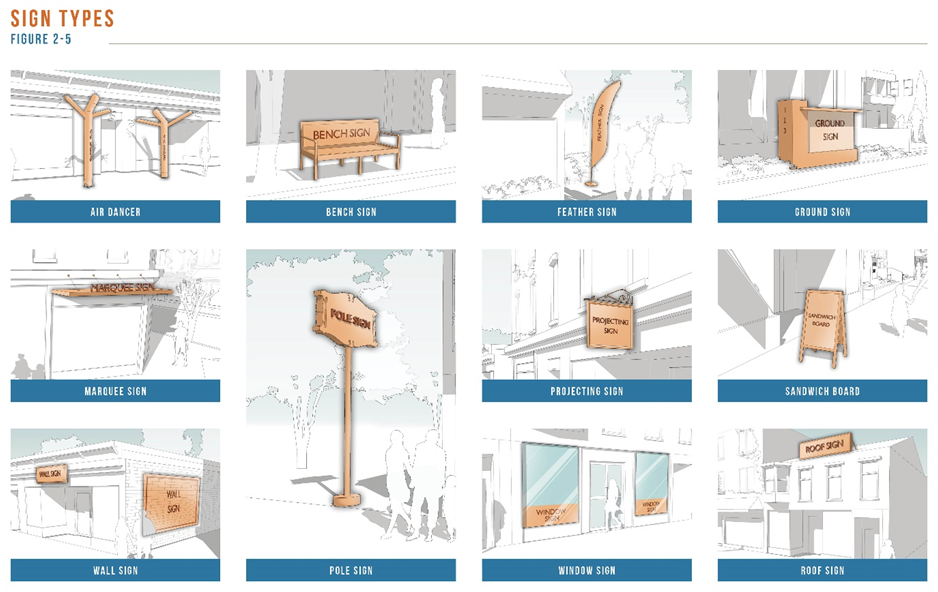
Sign: Any object, device, display, or structure, or part thereof, situated outdoors or indoors, which is used to advertise, identify, display, direct, or attract attention to an object, person, institution, organization, business, product, service, event, or location by any means, including words, letters, figures, design, symbols, fixtures, colors, illumination, or projected images; including the following sign types:
A.
Sign, animated or moving: Any sign or part of a sign that changes physical position or light intensity by any movement or rotation or that gives the visual impression of such movement or rotation, not including electronic message boards.
B.
Sign, bench: A sign painted, located on, or attached to any part of the surface of a bench, seat, or chair placed on or adjacent to a public place or roadway.
C.
Sign, bulletin board: A sign that identifies an institution or organization on the premises of which it is located and that contains the name of the institution or organization, the names of individuals connected with it, and general announcements of events or activities occurring at the institution or similar messages.
D.
Sign, construction: A temporary sign erected on the premises on which construction is taking place, during the period of such construction, indicating the names of the architects, engineers, landscape architects, contractors or similar artisans, and the owners, financial supporters, sponsors, and similar individuals or firms having a role or interest with respect to the structure or project.
E.
Sign, directional: Signs limited to directional messages, principally for pedestrian or vehicular traffic, such as "one-way," "entrance," and "exit."
F.
Sign, electronic message board: A sign with a fixed or changing display/message composed of a series of lights that may be changed through electronic means.
G.
Sign, ground: Any sign, other than a pole sign, in which the entire bottom is in contact with or close to the ground and is independent of any other structure and which is up to six (6) feet in height.
H.
Sign, identification: A sign giving the nature, logo, trademark, or other identifying symbol; address; or any combination of the name, symbol, and address of a building, business, development, or establishment on the premises where it is located.
I.
Sign, marquee: A sign that is mounted, painted, or attached to an awning, canopy, or marquee that is otherwise permitted by ordinance.
J.
Sign, off-premises. See Billboard.
K.
Sign, pole: A sign that is mounted on a freestanding pole or other support so that the bottom edge of the sign face is six (6) feet or more above grade.
L.
Sign, political: A sign announcing or supporting political candidates or issues in connection with any national, state, or local election.
M.
Sign, portable: A sign that is not permanent, affixed to a building, structure, or the ground, such as an A-frame sign.
N.
Sign, projecting: A sign that is wholly of partly dependent upon a building for support and that projects more than twelve (12) inches from such building.
O.
Sign, real estate: A sign pertaining to the sale or lease of the premises, or a portion of the premises, on which the sign is located.
P.
Sign, roof: A sign that is mounted on the roof of a building or that is wholly dependent upon a building for support and that projects above the top walk or edge of a building with a flat roof, the eave line of a building with a gambrel, gable, or hip roof, or the deck line of a building with a mansard roof.
Q.
Sign, suspended: A sign hanging down from a marquee, awning, or porch that would exist without the sign.
R.
Sign, temporary: A sign designed for use for a limited period of time to announce special events.
S.
Sign, wall: A sign fastened to or painted on the wall of a building or structure in such a manner that the wall becomes the supporting structure for, or forms the background surface of, the sign and that does not project more than twelve (12) inches from such building or structure, and the exposed face of which shall be on a plane parallel to the building wall to which it is attached.
T.
Sign, wayfinding: An off-premises sign that is part of a city-sponsored and coordinated program for the purpose of facilitating pedestrian and vehicular transit to local destinations as designated and recognized by the city's way-finding sign program.
U.
Sign, window: A sign attached to, or in close proximity to, the window surface so as to be clearly and comprehensively visible from the outside.
V.
Sign, yard: A sign of relatively impermanent construction manually placed in a yard and typically intended to announce or advertise an infrequent event such as, but not limited to, a garage sale; or to support a political candidate or political position; or the sale or rental or real property.
Sign area: The entire face of a sign, including the advertising surface and any framing, trim, or molding but not including the supporting structure.
Sign band: The horizontal piece of a facade framework, within which a sign is permitted, located between the top of a first story window and the base of a second story window.
Site condominium: A method of subdivision where the sale and ownership of sites is regulated by the Condominium Act (P.A. 59 of 1978), as amended, as opposed to the Land Division Act. Condominium subdivision shall be equivalent to the term "subdivision" as used in this zoning ordinance and the city's subdivision regulations ordinance.
Site condominium subdivision plan: The site, survey and utility plans, floor plans, and sections, as appropriate, showing the existing and proposed structures and improvements, including the location thereof in the land.
Site plan: The development plan for one or more lots on which is shown the existing and proposed conditions of the lot as required by section 40-115 of this zoning ordinance.
Social service center: An overnight or drop-in facility which provides services such as job training, counseling, health training, rehabilitation, therapy, or the distribution of food or clothing, but which does not include a medical office or permanent homeless shelter as a major element.
Solar heating and air conditioning units: A design or assembly consisting of a solar energy collector, an energy storage facility (where used), and components for the distribution of transformed energy for the purposes of heating and cooling a building.
Special land use or special use: A use that is permitted within a specified zone district after meeting specific requirements listed in article V. Such uses may not be appropriate in all circumstances, but with certain restrictions or conditions can be made compatible after planning commission review pursuant to the standards of this ordinance.
Specified anatomical areas: Specified anatomical areas shall include:
A.
Less than completely and opaquely covered human genitals, anus, and female breasts at or below the top of the areola; and
B.
Human male genitals in a discernibly turgid state, even if completely and opaquely covered.
C.
Specified sexual activities: Specified sexual activities shall include:
1.
The fondling or any other erotic touching of human genitals, pubic region, buttocks, anus, or female breasts;
2.
Sex acts, actual or simulated, including intercourse, oral copulation or sodomy; or
3.
Masturbation, actual or simulated; or
4.
Excretory functions as part of or in connection with any of activities set forth in [subsections A., B, or C. above.
Stoop: An exterior floor utilized primarily as an access platform to a building and located directly adjacent to a principal building, which is at least seven (7) inches above finished grade, which may or may not be covered by a permanent roof, but which is neither fully nor partially enclosed with screening.
Storage, motor vehicle: The standing or placement of operable new or used motor vehicles on display for sale, lease, or for private storage.
Storage, outside: The outdoor standing or placement of usable and/or potentially usable goods or equipment other than for display and not including waste or scrap materials, other than in junk yards.
Story: That part of a building, except a mezzanine as defined herein, included between the surface of one floor and the surface of the next floor, or if there is no floor above then the ceiling next above. A basement shall not be counted as a story.
Story, half: An uppermost story lying under a sloping roof having an area of at least two hundred (200) square feet with a clear height of seven (7) feet six (6) inches. For the purposes of this ordinance, the usable floor area is only that area having at least five (5) feet clear height between floor and ceiling.
Street: A dedicated public right-of-way, other than an alley, which affords the principal means of access to abutting property.
Street, local: A street of limited continuity used primarily for access to abutting residential properties.
Street, major: A street which is intended to serve as a large volume trafficway for both the immediate municipal area and the region beyond, and is designated as a major thoroughfare, roadway, parkway, freeway, expressway or equivalent term in the City of Grand Haven Master Plan.
Street, private: A street which is not legally owned, and which has not been accepted by the city or other governmental entity.
Structure: Anything constructed or erected, the use of which requires location on the ground or attachment to something having location on the ground; including, but not limited to, buildings, driveways, fences, signs and walls.
Studio for performing or graphic arts: A facility designed, constructed, or used for instructional, practice or production purposes in graphic and performing arts, including sculpture, painting, music, photography, drama, dance, yoga, and other similar pursuits.
Swimming pool, private: Any artificially constructed non-portable structure, erected in connection with or appurtenant to one or more private residences, either above or below or partly above or partly below grade, located either in part or wholly outside of a permanently enclosed and roofed building, which is designed to hold water to a depth any place in said structure greater than twenty-four (24) inches when filled to capacity, and intended to be used for recreational purposes.
(Ord. No. 2021-02, § 1(Exh. A), 1-4-21; Ord. No. 2022-07, § 1, 6-20-22)
Sec. 40-201.20. - "T."
Tattoo and piercing parlor: An establishment where tattooing or skin piercing is regularly conducted whether or not it is in exchange for compensation.
Telecommunication antenna: A device, the surface of which is used to transmit and/or receive radio-frequency signals, microwave signals, or other signals transmitted to or from other antennas or telecommunication facilities for commercial or municipal purposes.
Telecommunication tower: Any structure which is designed and constructed primarily for the purpose of supporting one or more antennas for telephone, radio or other communication purposes. Such structures may be freestanding, such as self-supporting lattice, guyed, or monopole towers, or attached to an existing structure, such as artificial trees, steeples, light poles, poles supporting power lines or similar mounting structures that effectively camouflage or minimize the visual impact of antennas and towers.
Temporary structures: A structure that lacks a permanent foundation and is affixed to the earth and/or an existing structure with non-permanent fasteners.
Trade and industrial school: A secondary or higher education facility primarily teaching usable skills that prepare students for jobs in a trade and meeting the State of Michigan requirements as a vocational facility. This definition shall also include institutions which provide full-time or part-time education beyond high school.
Trails: Ways designed for and used by equestrians, pedestrians, and cyclists using non-motorized bicycles and others using in-line skates or similar non-motorized devices.
Transparency: The quality of transmitting light to permit the interior of a building to be seen from the outside.
Trellises and arbors: Frames of latticework used as screens or as supports for climbing plants, shelters of vines or branches, or of latticework covered or intended to be covered with climbing plants.
(Ord. No. 2021-02, § 1(Exh. A), 1-4-21)
Sec. 40-201.21. - "U."
Upgradient improved property: A developed property on which the median grade is at a higher elevation than the median grade of the subject property.
Urgent care facility: A medical care facility open to the public in which professional medical care is provided for injuries and illness.
Use: The principal purpose for which land or a building is arranged, designed, or intended, or for which land or a building is or may be occupied.
(Ord. No. 2021-02, § 1(Exh. A), 1-4-21)
Sec. 40-201.22. - "V."
Variance: Permission to depart from the literal requirements of this zoning ordinance.
Veterinary hospital: A facility where animals are given medical care and the boarding of animals is limited to short-term care incidental to the clinic use, which may or may not include boarding or kennel facilities. Kennel facilities are those lots or premises on which four (4) or more domestic animals, six (6) months of age or older are kept temporarily or permanently for the purposes of breeding, boarding, or sale.
View corridor: A line-of-sight corridor from a public activity area, such as a pedestrian walkway, outdoor recreation area, outdoor eating/drinking facility, outdoor attraction, or similar area to Lake Michigan or the Grand River.
Viewshed: A visually attractive, aesthetic or significant area, such as Lake Michigan or the Grand River, that is visible from a defined observation point.
(Ord. No. 2021-02, § 1(Exh. A), 1-4-21)
Sec. 40-201.23. - "W."
Wall, obscuring: A structure of definite height and location to serve as an obscuring screen in carrying out the requirements of this zoning ordinance.
Wall, primary: Those exterior building walls fronting a right-of-way, public parking lot, or park.
Wall, secondary: Those exterior building walls not otherwise defined as primary walls.
Warehouse: A building used primarily for the storage of goods and materials.
Waterfront lot: A lot that has frontage on Lake Michigan, the Grand River or another body of water.
Wells, oil and gas: Wells installed for the commercial extraction of crude oil, natural gas, sour gas or similar products. This definition may include surface or subsurface pumping or processing equipment or facilities.
Wholesale facility: An establishment or place of business primarily engaged in selling merchandise to retailers; to industrial, commercial, institutional, or professional business users; to other wholesalers; or acting as agents or brokers and buying merchandise for, or selling merchandise to, such individuals or companies.
Wind energy conversion systems: A windmill or a wind energy conversion system shall mean all, or any combination of, the following:
A.
A mill or machine operated by wind acting on oblique vanes or sails that radiate from a shaft;
B.
A surface area, either variable or fixed, for utilizing the wind for electrical or mechanical power;
C.
A shaft, gearing, belt, or coupling utilized to convey the rotation of the surface areas into a form suitable for driving a generator, alternator, or other mechanical or electricity producing device;
D.
The generator, alternator, or other device to convert the mechanical energy of the surface area into electrical energy;
E.
The tower, pylon, or other structure upon which any, all, or some combination of the above are mounted.
(Ord. No. 2021-02, § 1(Exh. A), 1-4-21)
Sec. 40-201.25. - "Y."
Yards: The open spaces that lie between the principal building or buildings and the nearest lot line. The minimum required yard as set forth in this zoning ordinance is unoccupied and unobstructed from the ground upward except as may be specifically provided in this zoning ordinance.
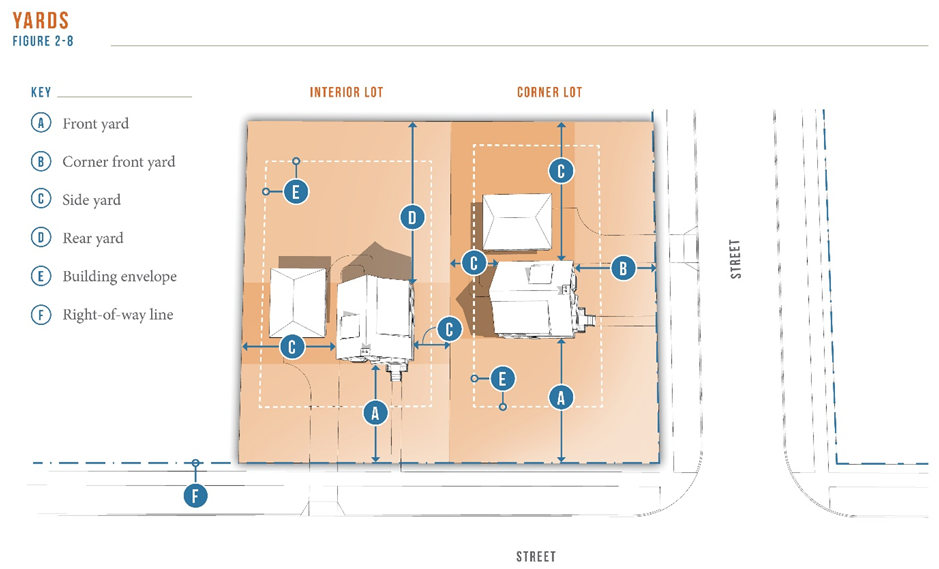
A.
Front yard: An open space extending the full width of the lot, the depth of which is the minimum horizontal distance between the front lot line and the nearest point of the main building.
B.
Rear yard: An open space extending the full width of the lot, the depth of which is the minimum horizontal distance between the rear lot line and the nearest point of the main building.
C.
Side yard: An open space between a main building and the side lot line, extending from the front yard to the rear yard, the width of which is the horizontal distance from the nearest point on the side lot line to the nearest point of the main building. In the case of a corner lot, the side yard shall be opposite either street frontage.
D.
Waterfront yard: For the purposes of this ordinance, a yard abutting Lake Michigan, the Grand River or another body of water shall be considered a rear yard.
(Ord. No. 2021-02, § 1(Exh. A), 1-4-21)
Sec. 40-201.26. - "Z."
Zoning administrator: The City of Grand Haven Zoning Administrator as established in section 40-111 of this zoning ordinance.
Zoning board of appeals: A board consisting of seven (7) members with the powers and duties as provided in Article VI of the Michigan Zoning Enabling Act, Act 110 of the Public Acts of 2006, as amended and as established in Section 40-113 of this ordinance.
Zoning permit: See Land use permit.
(Ord. No. 2021-02, § 1(Exh. A), 1-4-21)

