
Grand Terrace City Zoning Code
CHAPTER 18
64 - OBJECTIVE DESIGN STANDARDS
18.64.010 - Purpose, intent and applicability.
This Chapter is intended to implement the provisions consistent with Senate Bill No. 35 and Senate Bill 330, Government Code Sections 65400.
A.
Purpose. The purpose of this Chapter is to establish design standards that are objective for multifamily residential development and mixed-use development with a residential component to ensure that such development is attractively designed, maintains positive aesthetic characteristics, and to provide property owners and developers with predictable design approval standards for such development. The standards established in this Chapter are supplemental to the development standards applicable to multifamily residential development and mixed-use development as established within the Municipal Code for each zoning district allowing such use. This Chapter also establishes conditions and procedures for processing streamlined housing projects consistent with Government Code Section 65913.4.
B.
Intent. It is the intent of this Chapter to provide design standards that are objective while also ensuring that the City's requirements for quality design of multifamily residential development and mixed-use development with a residential component are satisfied. These design expectations are to be applied uniformly, and without discretion, to enhance the built environment within the City for both affordable and market-rate multifamily residential development.
C.
Applicability. The provisions of this Chapter apply to all multifamily residential developments and mixed-use development with a residential component as defined herein. Regarding the permitting process in particular, any application that complies with all provisions of this Chapter and regulations of the applicable zoning district shall be eligible for a ministerial review process, as set forth in Section 18.64.080 (Permits and Approval). When an applicant elects to deviate from the objective design standards set forth in this Chapter, a ministerial review process shall not apply and the development application shall be subject to any required discretionary application types, review and approvals as set forth in Chapter 18.63 (Site and Architectural Review).
(Ord. No. 348, § 5(Exh. A), 3-28-2023)
18.64.020 - Other standards and requirements.
A.
Zoning and Development Standards. A multifamily residential development or mixed-use development with a residential component that is designed in conformance with this Chapter shall also comply with all development standards and regulations of the designated zoning district and other applicable provisions of Title 18 (Zoning).
B.
Subdivision Regulations. A multifamily residential development or mixed-use development with a residential component that is designed in conformance with this Chapter that requires the approval of a subdivision action in order to establish a legal building site for such development, shall comply with all applicable requirements of Title 17 (Subdivisions).
C.
Building/Fire Codes. A multifamily residential development or mixed-use development project with a residential component that is designed in conformance with this Chapter shall also comply with all applicable regulations of Title 15 (Buildings and Construction), including but not limited to plan check review, permit issuance and applicable fees. Projects must comply with San Bernardino County Fire submittal and review requirements.
D.
California Environmental Quality Act (CEQA). A multifamily residential development or mixed-use development project with a residential component that is designed in conformance with this Chapter, qualifying for a ministerial review process, shall be considered exempt from CEQA pursuant to Government Code Section 65913.4. This exemption does not preclude a determination by the City that certain technical reports (e.g., stormwater quality management plan, water and sewer studies, traffic studies, noise studies, parking studies, biological survey, historical survey) are required as part of the standard submittal checklist established by the Director, or as required through the imposition of standard conditions of approval. Any required technical reports shall conform to City requirements established for such reports. Projects that do not qualify for a ministerial review process shall be reviewed in compliance with the applicable CEQA guidelines for discretionary application types.
(Ord. No. 348, § 5(Exh. A), 3-28-2023)
18.64.030 - Definitions.
For purpose of this Chapter, the following terms shall be defined as follows:
A.
"Multifamily residential development" means a building(s) with two or more attached residential units. It also includes a mixed-use development with a residential use as defined herein. This term does not apply to accessory dwelling units generally unless the application is for new construction of a single-family home with an attached accessory dwelling unit.
B.
"Mixed-use development" means a building(s) and site where at least two-thirds of the square footage of the building(s) shall be designated for residential use. The two-thirds calculation is based upon the ratio of gross square floor area (square feet) of residential units and related residential facilities to gross building(s) floor area (square feet) for the nonresidential use, such as commercial. Buildings that include both residential and nonresidential uses shall be credited proportionate to the intended use. The calculations of building(s) square footage shall not include non- conditioned building floor area or below-grade floor area, such as basements, or underground parking garages.
C.
"Ministerial review process" means a process for development approval involving little or no personal judgment by the City as to the wisdom or manner of carrying out the project. The ministerial review process simply ensures that the proposed development meets all the requirements of this Chapter.
D.
"Objective design standards" are defined in Government Code Sections 65913.4 and 66300 (a)(7) to mean that no personal or subjective judgment is used by the City. The standards are uniformly verifiable by reference to an external and uniform benchmark or criterion available and knowable by both the development applicant/proponent of the project and City prior to submittal of a development application.
(Ord. No. 348, § 5(Exh. A), 3-28-2023)
18.64.040 - Sustainable design.
A.
LEED Certification Requirement. For the purposes of this Chapter, all multifamily residential buildings and sites and mixed-use buildings and sites with a residential use with more than ten dwelling units shall demonstrate that the application qualifies for the most current version of "LEED Certification," as one of the four different levels of LEED certification—Platinum, gold, silver, and certified, or an equivalent standard as defined by the leadership in Energy and Environmental Design (LEED) of the United States Green Building Council (GBCI). Plans and/or supplemental specifications shall be provided at the time an application is submitted for preliminary or formal review as required by City application forms/checklists as established by the Director.
B.
DOE ZERH Certification Requirement. For the purposes of this Chapter, all multifamily residential buildings and sites and mixed-use buildings and sites with a residential use of ten dwelling units or less shall demonstrate that the application qualifies for the most current version of the Department of Energy (DOE) Zero Energy Ready Home Program (ZERH) Requirement. All zero energy ready dwelling units must be certified by a third-party verifier per the DOE-Recognized ZERH Certification Organizations.
C.
Water Efficient Landscape Requirement. For the purposes of this Chapter, all multifamily residential development and mixed-use development with a residential use shall demonstrate that the application is in compliance with all applicable requirements by the Riverside Highland Water Company and compliance with the City's Water Efficient Landscape regulations in Chapter 15.56. The landscaping application shall demonstrate conformance with the latest Model Water Efficient Landscape Ordinance (MWELO) guidelines by the California Department of Water Resources. Plans and/or supplemental specifications shall be provided at the time an application is submitted for preliminary or formal review as required by City application forms/checklists established by the Director.
(Ord. No. 366, § 19, 5-13-2025; Ord. No. 348, § 5(Exh. A), 3-28-2023)
18.64.050 - Building design.
Unless otherwise noted, development shall comply with the Municipal Code design development standard requirements of the underlining zoned district in which they are located, including but not limited to front setback requirements, distance between buildings, required height, and lot coverage.
A.
Residential Entries. The following standards apply to first floor street or publicly accessible common open space-facing façades of residential or mixed-use buildings. The primary orientation of a building or unit entrance in multifamily residential site shall be designed in accordance with the following standards:
1.
Street-Oriented Entries. Buildings fronting a public street shall have a primary residential door entrance oriented to the public street or oriented to within 45 degrees of the line parallel to a public street intersection as illustrated in Figure 18.64.050A. Direct and unobstructed universal access shall be provided between the public sidewalk and the residential primary building entrance. Where a site is located on two or more public streets, the primary building first floor residential entry shall be oriented toward the street with the highest roadway classification as defined in the Circulation Element of the Grand Terrace General Plan. If a multi-family site fronts two public streets of equal roadway classification, either street frontage may be used to meet the entry standard.
2.
Individual Residential Unit Entries. Multi-family residential buildings with exterior residential unit entries shall front and be setback a minimum of ten feet from the public sidewalk. Entries shall be linked to the public sidewalk with a ten-foot minimum width access walkway, ramp, and/or stairs as illustrated in Figure 18.64.050 A.
Figure 18.64.050 A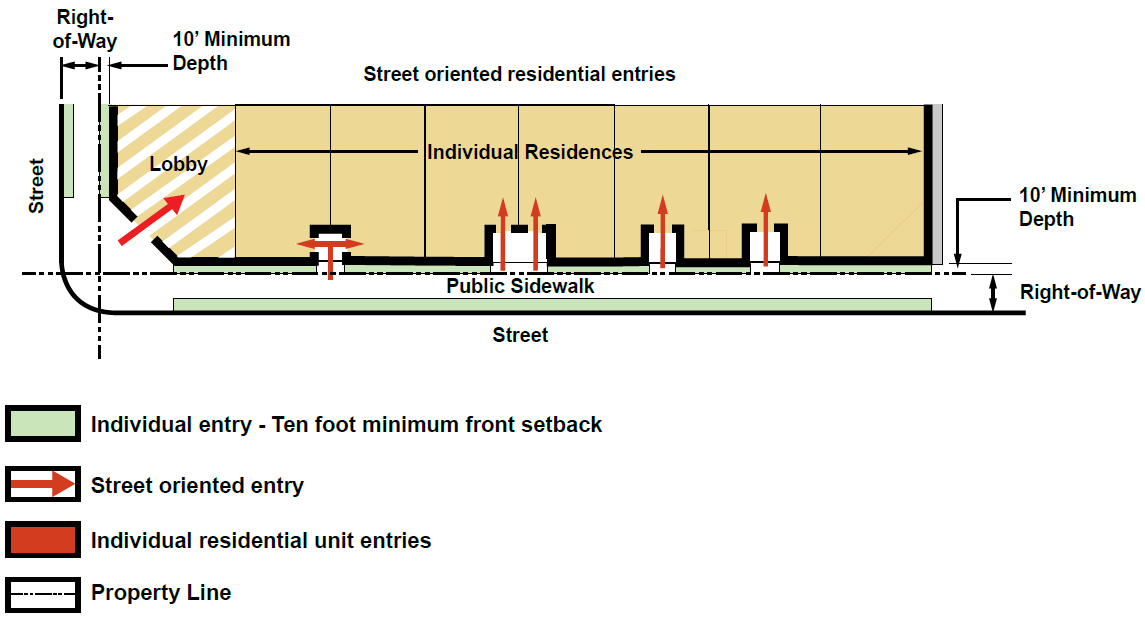
3.
Common Open Space-oriented Entries. Multi-family residential building primary entries are permitted to be located at the first floor and directly accessible from publicly accessible common open space paseos, courtyards, plazas, or a street fronting residential setback as illustrated in Figure 18.64.050B. Common open space entries shall have direct sightlines and continuous and unobstructed universal access sidewalk routes between the entries and the street public sidewalk.
4.
Exterior Multiple Unit Entries. Residential entrances serving multiple units shall be accessed from a first floor lobby or stairwell that is linked to a public sidewalk, publicly accessible open space, or residential front setback. Exterior entrances to individual units on upper floors utilizing an exterior access corridor visible and/or connecting to a public street shall serve a maximum of four units and shall be recessed with a minimum depth of ten feet as illustrated in Figure 18.64.050 B.
Figure 18.64.050 B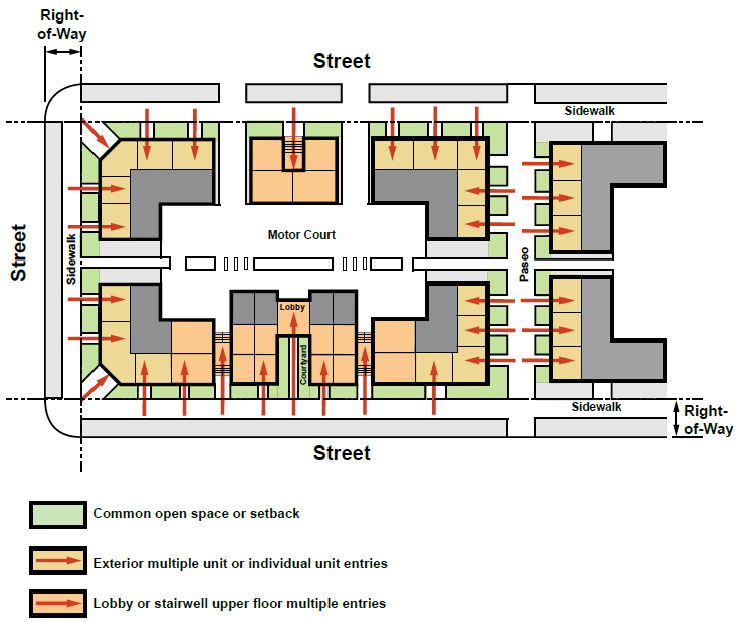
B.
Modulation and Articulation. The massing and articulation of buildings in multifamily residential development shall be designed in accordance with the following standards:
1.
Setbacks. Multifamily units that are anticipated to have impact adjacent development privacy. To mitigate the impacts, the following standards shall apply, as illustrated in Figure 18.64.050C.
a.
Minimum Requirements. When a multifamily residential building is constructed adjacent to any parcel that includes an existing structure, a 15-foot setback is required wherever the multifamily building is located within ten feet of a required side or rear setback. The setback shall be for stories that are one story greater than the highest roof line elevation of any existing residential structure.
b.
Size and Location of Windows. To mitigate privacy impacts, residential units shall reduce the number and locate residential windows to minimize sightlines to existing development. All California Building Code egress window requirements for residential occupied units shall be met.
c.
Landscape Privacy Screening. When adjacent to existing residential development, a ten-foot landscaped setback shall include vertical evergreen trees, at a minimum height of 20 feet, and maximum spacing of ten feet on-center at installation. All privacy screening trees shall be planted at a minimum of 25 percent of full growth maturity. All trees shall be provided at a minimum size of 36-inch box.
Figure 18.64.050 C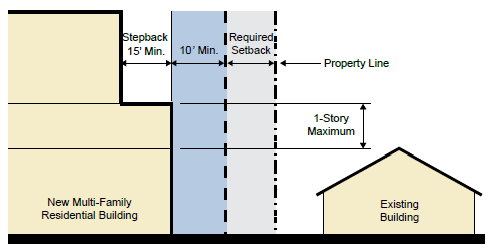
1.5.
Facade Modulation. As illustrated in Figure 18.64.050D, all building facades shall be articulated horizontally a minimum of every 50 feet along all sides, using facade projections, recesses, or step backs of upper floors. Façade area used to meet this standard shall be a minimum of five feet in depth and ten feet in width and shall be articulated vertically a minimum of two-thirds of the height of the structure.
Figure 18.64.050 D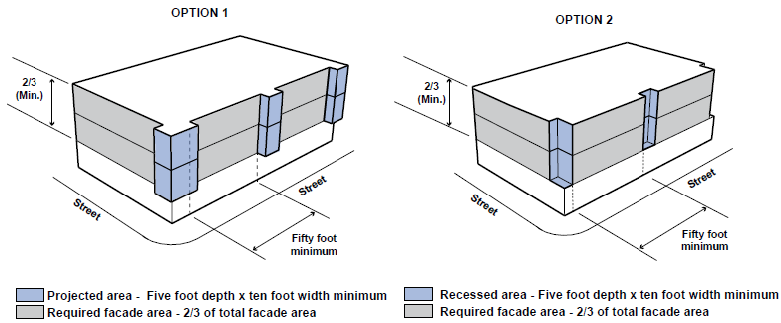
2.
Façade Articulation. Articulation of any facade greater than 20 feet in length along any street-facing frontage, or 30 feet along any façade. These facades shall be articulated by incorporating at least three of the following features each of which is illustrated in Figure 18.64.050E:
a.
Window and Door Fenestration. All individual or window and door systems shall project a minimum of two inches in depth from the primary wall plane or shall be recessed from the primary wall plane a minimum of three inches;
b.
Recessed Ground Floor Modulation. Exterior arcades, porticos or cantilevered ground floor building recesses that provide sheltered walkways, patios, stoops or porches within the building footprint, having a minimum area of 50 square feet;
c.
Horizontal Modulation. Projected or recessed bay, oriel, or alcove of a minimum two-foot depth variations from the primary wall plane for 30 percent of building frontage;
d.
Modulated Entries. A recessed stoop or porch or projected vestibule or foyer unit entry with a minimum area of 50 square feet; or
e.
Vertical wrticulation pilasters which project a minimum of six inches in depth from the primary façade and extend the full height of the building from the first story finished floor elevation to the rooftop eave or top of parapet or cornice line.
Figure 18.64.050 E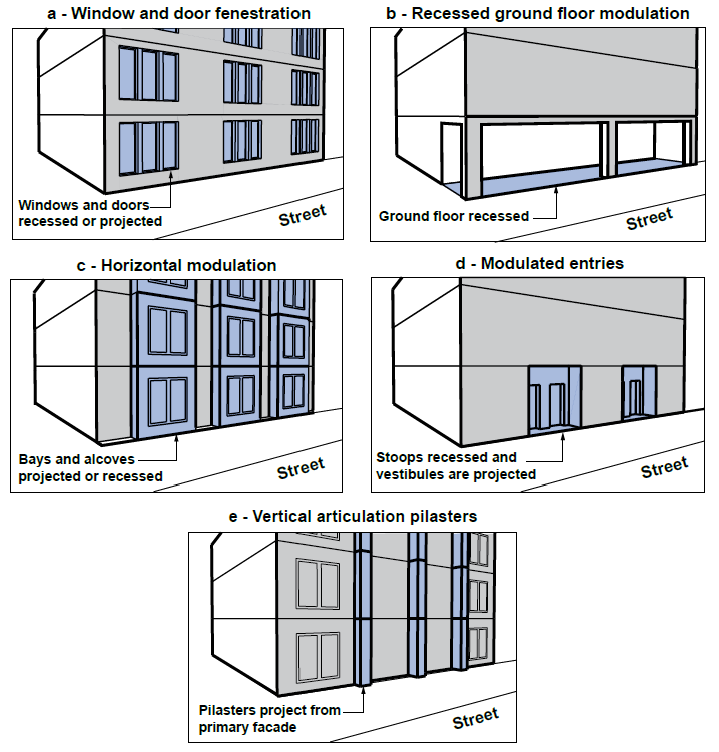
3.
Roofline Articulation. All building rooflines shall be vertically articulated at least every 50 feet, through one of the following techniques as illustrated in Figure 18.64.050F:
a.
Option 1—An increase or decrease in height of a minimum four feet;
b.
Option 2—A change in at least one roof pitch or form; or
c.
Option 3—Articulation of the roofline utilizing of one of the following- dormers, gables, varying height cornices, and/or clerestory windows.
Figure 18.64.050 E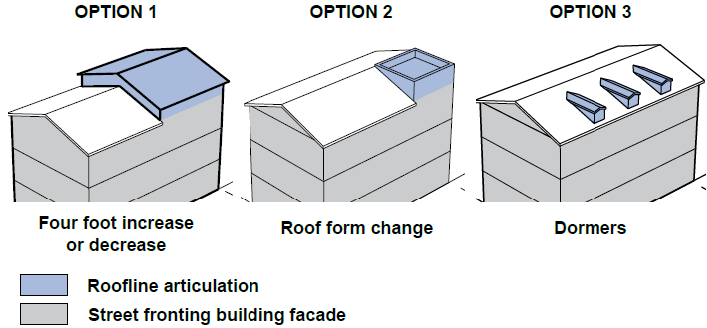
4.
Horizontal Articulation. Buildings three stories or greater in height shall be horizontally articulated a minimum of every 100 feet along all frontages through the use of either façade recesses or façade projections. Setbacks or projections shall be a minimum of five feet in depth and ten feet in width and shall extend the full height of the building from the first story finished floor elevation to the roof eave or top of parapet or cornice line.
5.
Vertical Articulation. Buildings three stories or greater in height shall vertically differentiate the function and use of the first story from the upper story(s) by providing a façade cladding material change between the first story and upper stories for a minimum of 75 percent of all facades. Facades shall incorporate at least two of the following to achieve this differentiation as illustrated in Figure 18.64.050G:
a.
Recesses or Projections. Variation in the primary façade plane projecting or recessing a minimum of four inch in depth at the vertical transition line between the first story and upper story(s) façade materials.
b.
Horizontal Banding. Horizontal articulation between the first story and upper story(s) primary façade planes utilizing a 12-inch projecting ornamental or functional water table, belt course, molding or ledge.
c.
Masonry Base. The first floor primary façade shall consist of a masonry material, including hand laid and mortared field stone, brick, split face, sand blasted, or burnished concrete masonry units (CMU), projecting a minimum depth of one inch from the primary façade of the building. Alternative masonry materials include tile, wood siding, shakes, or metal panels.
d.
Step Backs. Recessing the top story(s) of the façade a minimum of five feet from the lower story(s) primary façade(s).
C.
Architectural Elements. Buildings in multifamily residential development parcels shall be designed in accordance with the following standards:
1.
Four-Sided Architecture. All buildings and structures within a multifamily development parcel shall utilize the same façade design elements, utilized the same materials and roof materials and articulation and modulation treatment on all building facades, including the use of paint colors.
2.
Quality. Mixed income multi-family development parcels that include both affordable residential units and market rate residential units are required to be constructed using the same façade articulation and modulation treatment, façade colors, and materials such that the façades of affordable and market rate units are indistinguishable.
3.
Private Open Space Amenity. All first floor residential units shall include a private terrace or patio. All upper floor residential units shall include a private balcony or rooftop terrace.
4.
Architectural Projections. All building façades and/or roofs shall include a minimum of two of the following features above the first floor of the building along all street frontages as illustrated in Figure 18.64.050 G. The horizontal distance between features shall be no greater than 25 feet. The minimum width and depth of these features shall be as follows:
a.
Greenhouse or garden windows—Must be at least eight inches in depth at the farthest point from the primary façade of the building, and five feet in width.
b.
Bay windows—Must be at least ten inches in depth measured at the farthest point, and five feet in width.
c.
Roof dormers—Must be at least two feet in depth measured at the farthest point from the roof surface of the building, and four feet in width.
d.
Balconies and rooftop decks—Must be at least five feet in depth and ten feet in width.
Figure 18.64.050 G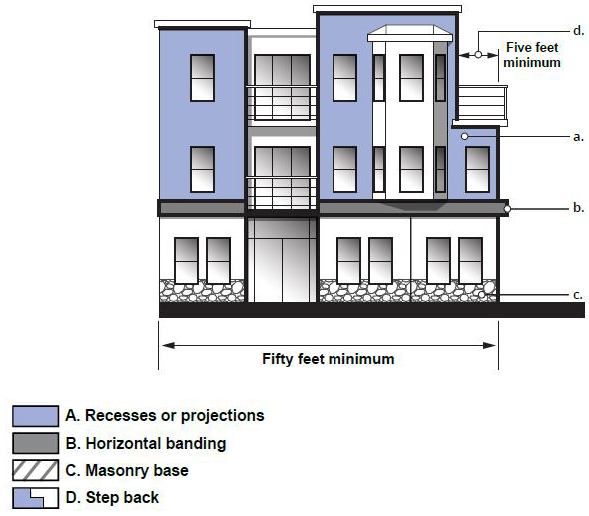
5.
Blank Walls. First floor façade without doors or windows shall be no greater than 200 square feet where fronting sidewalks, multi-use paths, or publicly accessible outdoor common space areas. Blank wall frontages shall include front or side yard setback landscape screening foundation planting beds that must be a minimum of three feet in width for the entire façade length.
6.
Blank Wall Standards. Blank walls shall be mitigated where it is infeasible to provide openings, such as a parking garage, trash room, mechanical room, or electrical room. One of the following treatments shall be provided for any blank wall greater than 20 feet in length:
a.
Wall Treatment. Wall treatment in the form of permitted graphic or sculptural art; decorative ceramic tile; or painted metal or treated wood latticework combined with living plant material shall be provided along the blank wall. A minimum of 50 percent of the blank façade shall be treated.
b.
Surface Texture. Surface articulation that recesses or projects a minimum of two inches from the face of the primary facade shall be provided. Stone, stone veneer, cast in place or precast concrete, and finished concrete block are permitted surface treatments. A minimum of 50 percent of the blank facade shall be treated.
c.
Screen Landscaping. Planting in the form of any combination of climbing vines, perennials, annual flowers, decorative grasses or shrubs, shall be provided in planting beds, raised planting beds or planter boxes in front of the blank wall. Such planting bed or planter boxes shall extend to a depth of at least three feet, inclusive of any structure containing the planted material. Any individual planted area shall have a width and height of at least five feet at time of landscape installation. A minimum of 50 percent of the blank façade shall be screened by planted material.
D.
Building Colors and Materials.
1.
Primary Façade Material. Building primary façades shall be wood, stone, brick, stucco, fiber cement or other cementitious material, or composite wood or stone.
2.
Secondary Façade Material. At least two secondary façade materials shall be used on all building façades.
3.
Building Color. Buildings shall have a minimum of one primary façade color, one secondary façade color, and two accent window and door frame, or trim colors, and one roof color.
4.
Façade Color Standards. Facade colors shall be select that are appropriate for Grand Terrace's Inland Empire setting. Paint color and finish shall be muted and flat to imitate colors found naturally in nearby Blue Mountain soil, trees, rocks, and other organic materials.
a.
The use of color and materials shall strengthen and complement building vertical and horizontal modulation.
b.
All building facades shall be painted equally.
c.
Facade Colors. The primary color and secondary colors shall be limited to warm white shades and rich, warm colors containing some brown (ranging from neutral tan to deep brown).
i.
The outer ring of the color wheel illustrates the range of colors that are of an earth tone and are acceptable for use. Facade colors within the illustrated earth tone spectrum may vary in tint and tone but are not allowed to use the hue (pure color) as illustrated in Figure 18.64.050 H.
Figure 18.64.050 H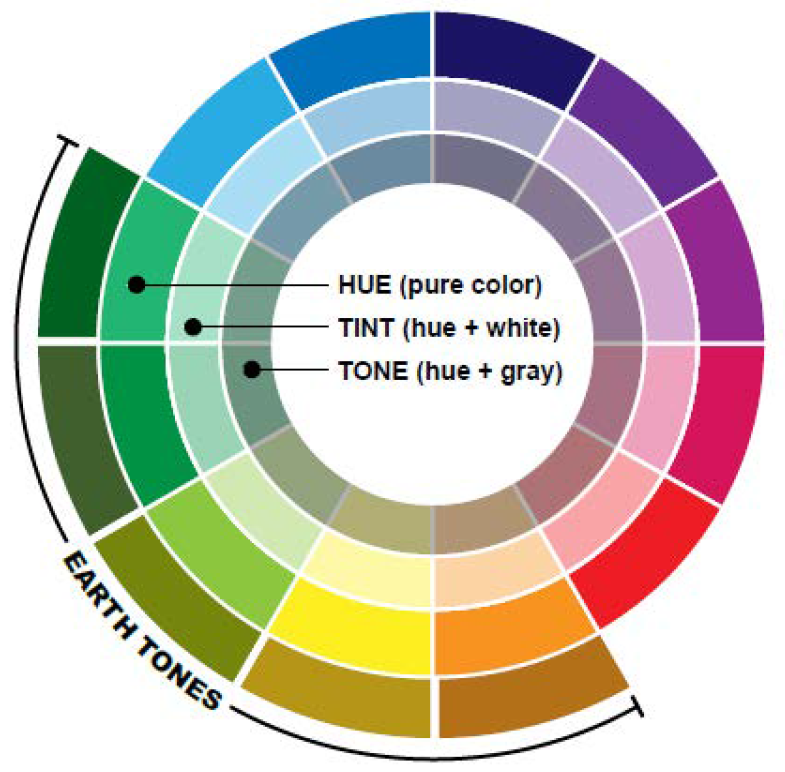
5.
Fenestration Color Standards. Windows, doors, and trim shall be limited to a minimum of two and a maximum of three paint colors.
a.
Window and door trim is permitted to utilize all the tints and tones of the full color spectrum.
b.
Windows shall be limited to shades of black or warm colors containing deep brown.
c.
Doors shall be permitted to utilize the tints and tones of the full color spectrum.
d.
Prohibited Colors. Trim, Doors and Windows are prohibited from utilizing the hue of any color.
6.
Color Sources. Building shall use the hex color palettes identified as earth tones in Hexcolorpedia https://hexcolorpedia.com/?s=earth+tonespage%2F2page%2F2page%2F2 or equivalent on-line color tool that provides information about earth tone color. Buildings shall be limited to:
a.
Primary Building Façade Colors. The primary hex color tints, tones and shades.
b.
Primary Color Blending. Blending two hex color values to create a gradual transition.
c.
Secondary Color Schemes. Complementary, analogous, triadic, tetradic, aesthetic, hue rotation and monochromatic hex colors schemes.
7.
Prohibited Façade Materials. The following materials shall not be used for multi-family residential building façade. Cladding shall include the following prohibited materials: vinyl siding, corrugated fiberglass siding, chain link fencing parapet or mechanical equipment screens, crushed colored rock veneer panel siding, corrugated metal, engineered oriented OSB sheathing panels, tongue and groove and T1-11 plywood siding. No more than five percent of a façade may be of reflective vision and/or spandrel glazing, tumbled glass tiles, ceramic tiles or architectural metal paneling. MDO or CDX grade or better weather protected painted or stained plywood panels used for board and batten cladding is permitted. No cladding shall have exposed or unfinished edges.
8.
Windows. True divided lite window types are permitted. Simulated divided lite windows with decorative grilles embedded or applied to window glass glazing is prohibited. Window tinting is prohibited.
9.
Doors. Fifty percent minimum transparent glass doors for multiple unit lobby entrances shall be required but shall not be required for individual residential unit entries.
(Ord. No. 348, § 5(Exh. A), 3-28-2023)
18.64.060 - Site design.
A.
At-Grade Parking Lots and Individual Residential Unit Parking Garages/Carports. In addition to the requirements of Chapter 18.60 (Off-Street Parking), multifamily residential sites with at-grade parking lots, or where units are served by individual residential unit garages/carports, shall be designed in accordance with the following:
1.
Location. At-grade parking lots, parking spaces, or loading zones shall not be located between the building frontage and public streets. If a site consists of multiple buildings, this standard only applies to the building(s) fronting public streets. At-grade parking lots shall only be located behind street fronting buildings.
2.
Pedestrian Access. Publicly accessible six-foot minimum width sidewalks shall be provided through at-grade parking lots at a minimum of every four rows of parking or at a minimum of every 130 feet, whichever is less. Publicly accessible sidewalks shall be designed to connect to buildings with consolidated entries and linked to other public sidewalks, and publicly accessible sidewalks within the site. All such pathways shall be clearly marked and differentiated from at-grade parking lot drive lanes areas by colored and or surface textured asphalt, unit pavers, or stamped concrete pavement treatment. Public accessible sidewalks shall meet the right-of-way established in the Grand Terrace Circulation Element and shall include the required street landscape, per Municipal Code Chapter 12.28, Street and Parkway Trees.
3.
Motor Vehicle Access. At-grade parking lot motor vehicle access shall be taken from an any existing alley. For sites without an alley, at-grade parking lot motor vehicle access shall be from a public street curb cut and driveway with the lowest roadway classification as identified in the Grand Terrace Circulation Element. Alleys shall be considered part of the multi-family site and shall be maintained by the property owner as a condition of use.
4.
Garage Door Setback. Individual residential unit parking garage doors that front the street shall be setback a minimum of five feet behind the front primary façade of the multi-family building or the front façade of a covered porch or stoop that projects in front of the primary façade.
5.
Garage/Carport Design. Individual residential unit parking garages and/or carports shall include equivalent façade design elements, fenestration, material and color application as those of the residential buildings within the site.
B.
Structured Parking. In addition to the requirements of Chapter 18.60 (Off-Street Parking), multifamily residential buildings that include structured parking shall be designed in accordance with the following standards:
1.
Screening. Where multifamily building fronts public streets, structured parking shall not comprise more than 50 percent of the first floor building width subject to the following:
a.
Any 200 square feet or greater facade shall include required façade articulation, landscaping, and/or other requirements of C. Architectural Elements 5. Blank Walls.
2.
Ventilation. Façade natural exhaust ventilation openings shall be screened with wrought iron grilles and/or landscaping. Ventilation openings shall not exceed 20 percent of any street fronting first floor façade.
3.
Control and Access. Mechanically or manually-controlled structured parking doors or gates shall be setback a minimum of 40 feet behind the back of a public sidewalk. For mixed use buildings or sites, the use of controlled entrances shall be limited to the portion of a structured parking reserved for resident parking spaces. At controlled structured parking driveway entrances, lanes shall be dimensioned to permit motor vehicle U-turns to allow a vehicle to exit without backing into the street. Parking spaces provided for multi-family building guest, service and delivery use shall be provided outside of any controlled entrance parking structure.
C.
Site Access and Connectivity. Multifamily residential site streets, sidewalks, and multi-use pathways shall include:
1.
Internal Sidewalks. Sites shall provide unobstructed American with Disabilities Act (ADA) compliant five-foot minimum width surface separated by a minimum three-foot wide planting bed where fronting any building.
2.
Site Design. For multi-family sites, the following standards shall apply as illustrated in Figure 18.64.060A:
a.
Internal Circulation. Multi-family sites that include internal streets or driveways shall provide uninterrupted continuous vehicle and walking connections through the site and a minimum of two access points to fronting public streets or alleys and sidewalks.
b.
All site internal streets, driveways, alleys, sidewalks, and multi-use pathways shall align with all existing and planned streets, alleys, sidewalks, and multi-use pathways external and fronting to the site.
c.
Any internal site cul-de-sac or other dead-end street longer than 300 feet shall provide sidewalk or multi-use pathway connections between internal or external streets sidewalks or multi-use pathways.
d.
Multi-family sites shall not be greater than 600 feet in length, measured from any fronting cross-street centerline, alley center line, or side property line. Walking and biking midblock access connections shall be provided at distances no greater than 350 feet measured from a cross-street center line, alley center line, or side property line to the mid-block sidewalk or multi-use pathway center line. All connecting midblock sidewalks or multi-use pathways shall have a ten feet minimum width.
Figure 18.64.060 A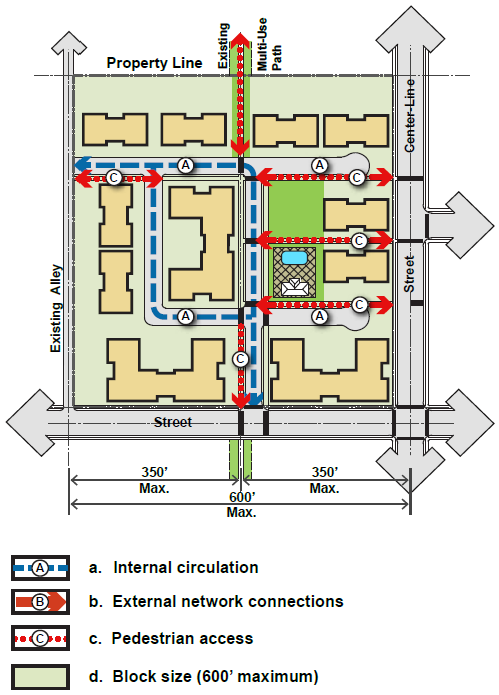
D.
Landscaping and Common Open Space Amenities. Multi-family buildings and sites shall comply with all open space requirements of each zoning district and the following additional site design standards:
1.
Minimum Requirements. Sites shall include live landscape plant and/or mulch materials throughout except where paved parking lots, streets, driveways, sidewalks, patios, service or utility structures/ pads, recreation facilities, or water elements occur. Live landscape planting will comprise a minimum of 75 percent coverage and planted at 50 percent (minimum) at installation.
2.
Minimum Size. All site trees and shrubs shall be planted at a minimum of 25 percent of full growth maturity. Trees within landscaped areas shall be provided at a minimum size of 36-inch box, or a minimum 48-inch box if tree specimen has a 20-foot canopy.
3.
Concrete Surface Standards. Multi-use pathways adjacent to common open space areas that include flat work concrete surfaces greater than 96 square feet shall be poured in place concrete. A minimum of 50 percent shall be a stamped, salt, or exposed aggregate finish or utilize multiple colors of concrete with no individual section having more than 96 square feet of one color. Stamped, or aggregate finish shall be used in high traffic areas.
4.
Other Landscape Requirements. Landscape requirements not specifically stated on this Chapter shall comply with the Municipal Code Chapter 18.61, Landscape Requirements.
5.
Walls and Fences.
a.
Walls and fences within the front setback shall not exceed three feet in height.
b.
Concrete or Concrete Masonry Unit (CMU) will be constructed with split faced or shot blast CMU; or stone veneer over precision block; or monolithic poured concrete with surface resembling either stone veneer, or split face finish; or monolithic poured concrete with raised or depressed patterns of at least one-half inch covering 50 percent of the surface.
c.
Fences must be constructed of cedar or vinyl materials. All posts must have caps. Acceptable type of wood fence are illustrated in Figure 18.64.060 B.
Figure 18.64.060 B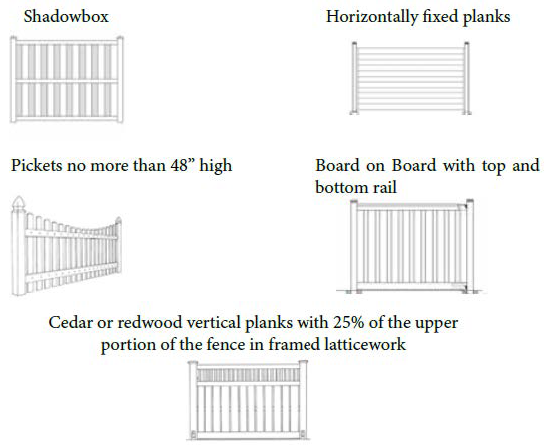
d.
Other fences include:
i.
Wrought iron or decorative iron, must have 12 inches by 12 inches pilaster a minimum of every ten feet.
ii.
Brick, stone, or brick or stone veneer over precision block.
iii.
Glass fencing panels.
iv.
Columns of brick, stone, stone veneer or CMU as above no more than ten feet apart with any of allowed fencing materials between the columns.
6.
Multi-family development sites shall comply with the parkway requirements included on Chapter 12.28, Street and Parkway Trees.
7.
Common Open Space Standards (parkway requirements). Common open space resident amenities areas shall have a minimum dimension of 15 feet in depth and width and shall be contiguous to accommodate passive individual or group active recreational activity areas.
8.
Common Open Space Siting Criteria. Location of common open space amenity areas shall be determined by the following siting criteria:
a.
Equal distance or less to no less than 50 percent of all residential units within the multifamily building or site.
b.
Solar orientation. Preferred option—Oriented no more than 30 degrees off of a true south facing axis line. Alternative Option- oriented no more than 30 degrees off of a true east or west facing axis line. Prohibited—Oriented off a north facing axis line.
c.
Screening. Visually obstructed from first floor windows, streets, service areas and parking lots with a minimum five wide landscaped planting bed and/or fencing excluding chain link materials. All fencing shall be subject to the height limitations of the zoning district and requirements of Chapter 18.73.070 (Fences and Wall Height).
9.
Required Common Open Space Amenities. Common open space areas shall be designed to provide specific amenities as shown in Table 18.64.060A based upon the number of units within a multifamily residential development. The required amenities outlined in Table 18.64.060B are additive and require that the base amenity type and minimum size of amenity be satisfied for the applicable number of units threshold, plus all preceding base amenity type and minimum size of amenity type, plus any additional increase in number or size of the amenity based upon the additive amenity ratio. As an example, a multifamily residential development consisting of 16 units shall provide a business center with at least two work stations or a 250 square foot gym, plus an outdoor active use area or facility, plus 48 square feet of community garden area (32 sf + 16 sf), and two barbecue areas with seating.
Table 18.64.060A
Multifamily Residential Development Amenity Standards
Table 18.64.060B
Multifamily Residential Development Amenity Standards
Notes:
1. Substitute 400 sf Wellness Facility 55+ Age Restricted Development, with an Additive Amenity Ratio calculated at 5 sf/1 Unit.
2. Allows Wellness Facility Substitution for 55+ Age Restricted Development.
3. For 55+ Age Restricted Development May Substitute the Basketball Court with a Bocce Ball Court and/or replace the tennis Court with a Pickleball Court.
E.
Illumination. Multifamily residential sites and building façades shall comply with the following parking lot areas, pedestrian pathways, and building and structure exteriors illumination standards:
1.
Common Area/Private Open Space. All publicly accessible common areas and private residential open space areas shall comply with the illumination foot-candle (fc) level standards as follows:
a.
Service areas and vehicular traffic areas: Minimum two-tenths fc, maximum four fc.
b.
Sidewalks and building entries: Minimum one fc, maximum five fc, with an average of two fc.
c.
Parking lot and area: Minimum one fc, maximum four fc.
2.
Sidewalks. Sidewalk lighting shall have a maximum light pole and fixture height of 15 feet.
3.
Parking Lots. Parking lot and area light fixtures shall be fully shielded and dark sky rated. The light pole and fixture height shall be no greater than 18 feet above the parking lot finished grade.
4.
Accent Lighting. Glare-free direct accent light fixtures with an illumination ratio of less than thirty to one (30:1) shall be permitted to highlight façade articulation, artwork and landscape specimen plantings. The extent of light coverage of all site light installations shall not exceed two foot candle maximum illuminance impact on any fronting residential or commercial sites.
F.
Equipment and Service Areas. Multifamily residential buildings and sites shall comply with the following equipment and service area standards:
1.
Underground. All service connections and on-site utilities including wires, cable, and pipelines and equipment shall be installed underground.
2.
Roof-Top Screening. All exterior mechanical and electrical equipment, which includes, but is not limited to roof-mounted, façade-mounted, or ground-mounted heating, venting, and cooling (HVAC) units, gas and electric utility meters, telecommunication equipment, backflow preventions, assemblies, irrigation control valves boxes, electrical transformers, pull boxes, and all HVAC ducting shall be screened. Roof-mounted equipment shall not be visible from eye level at five feet above grade of fronting streets centerlines and/or first floors of buildings within 20 feet of the multi-family site property lines. Screen façades shall utilize the same façade design elements, colors and materials of the building. All roof- mounted equipment shall be screened from public view by screening materials of the same nature as the building. Mechanical equipment shall be located below the highest vertical element of the building. Ground mechanical equipment units shall be screened in a manner consistent with the building façade.
3.
Ground-Mounted Screening. All ground-mounted mechanical equipment, shall not be visible from eye level at five feet above grade from any publicly accessible open space (rights-of-way, public trails, and parks). Screen façades shall utilize the same design elements, colors and materials of the building.
4.
Refuse Standards. Refuse collection and storage areas shall comply with the requirements of the City's service provider and the following standards:
a.
Utilization of individual dwelling unit refuse containers shall be limited to buildings of four units or less. The containers shall be stored within an unobstructed area of each resident's assigned parking garage space or within a common enclosed refuse container structure that utilizes the same façade design elements, materials, and colors of the residential building.
b.
For multifamily residential buildings consisting of five or more units, common container areas shall be provided and comply with the following standards:
i.
An enclosed refuse container structure that utilizes the same façade design elements, materials, and colors of the residential building(s).
ii.
Enclosed structure(s) shall be separated by a minimum of 20 feet from any dwelling unit located within the multifamily residential site or from any property line.
iii.
The enclosed structures shall be located a maximum of 100 feet distance from the dwelling units served.
iv.
Trash enclosures shall be completely sheltered by a roof.
v.
No minimum distance from dwelling units is required if the containers are located within a fully enclosed refuse room of a residential building. The enclosed refuse room shall be located a maximum of 75 feet from the dwelling units served.
vi.
Refuse container structures shall comply with Burrtec requirements.
(Ord. No. 348, § 5(Exh. A), 3-28-2023)
18.64.070 - Additional standards.
A.
Electric Vehicle Charging Stations (EVCS) Standards. A minimum of one Electric Vehicle Supply Equipment (EVSE) per garage and one EVSE per five parking spaces will be required on a multi-family building site. Parking spaces shall be exclusively dedicated for Electric Vehicle (EV) charging use.
1.
Minimum Space Requirements. A parking space served by EVSE shall count as one parking space for the purpose of complying with any applicable minimum parking space requirements for multi-family development as established by the Municipal Code Section 18.60.030, Off-Street Parking Regulations.
2.
Electric Vehicle Charging Space (EV Space) Locations. Where undedicated/guest parking is provided at least one EV space shall be located in the common use parking area and shall be available for use by all residents or guests. All EV spaces shall be located under a weather protected carport, within a parking structure, or private garage. Electrical equipment shall be located in areas that are well drained and shield from any landscape bed irrigation spray.
3.
Accessibility. EV parking spaces shall comply with at least one of the following options:
a.
The EV space shall be located adjacent to an accessible parking space meeting the requirements of the California Building Code, Chapter 11A, to allow use of the EV charger from the accessible parking space.
b.
The EV space shall be located on an accessible route, as defined in the California Building Code, Chapter 2, to the building.
4.
Electric Vehicle Charging Space (EV Space) Dimensions. The EV spaces shall be designed to comply with the following:
a.
The minimum length of each EV space shall be 19 feet.
b.
The minimum width of each EV space shall be nine feet.
c.
Surface slope for accessible EV space and the aisle shall not exceed one inch vertical in 48 inches horizontal (2.083 percent slope) in any direction.
d.
Where vertical pole or pylon-mounted chargers are utilized, a minimum of 36 inches of clearance shall be provided to ensure safe and easy movement around the charging station.
5.
Level 2 Electric Charging Requirements. A maximum of 80 percent of EVSEs shall have a minimum 40-ampere 208/240-volt dedicated EV branch circuit and shall be installed in close proximity to the proposed location of an EV charger, in accordance with the California Electrical Code.
6.
Direct Current Fast Charging (DCFC) with Combo Connector Requirements. A minimum of 20 percent of EVSEs shall have a minimum 40-ampere 208/240-volt dedicated EV branch circuit and shall be installed in close proximity to the proposed location of an EV charger, in accordance with the California Electrical Code.
7.
Smart Metering. Separate or sub-metering that allows electricity used to be isolated from the rest of the building's energy use shall be provided.
8.
Signage and Wayfinding. All EV parking spaces shall be identified as EV ONLY with a vertical pole or wall sign, and pavement shall be marked with a EV painted symbol as well. Manual on Uniform Traffic Control Devices (MUTCD) compliant signs shall be provided for reserved American Disabilities Act (ADA) accessible EV spaces. Additional information for tenant EVSE use including time limits for charging and enforcement; safety information; and host-operator information shall be provided.
9.
Host-Operator Agreements. The building owner/operator or Home Owner Association (HOA) shall be responsible for establishing any agreements and costs associated with EV charging for tenants.
10.
Equity. A minimum of ten percent of electricity generated from solar panels installed on carports over EV spaces shall be credited to low income tenants for EVSE use. Host-operator agreements shall identify qualifications and process for low income tenants EV use.
B.
Public Art Standards. All multi-family development(s) shall comply with Ordinance 343, Chapter 18.81, Art in Public Places of Title 18 of the Municipal Code.
C.
Bicycle Parking Standards. These standards ensure that required bicycle parking is designed so people of all ages and abilities can access the bicycle parking and securely lock their bicycle. Bicycle parking shall be provided in areas that are safeguarded from theft and accidental damage. The standards allow for a variety of bicycle types, including but not limited to standard bicycles, tricycles, hand cycles, tandems, electric motor assisted cycles and cargo bicycles.
1.
Minimum Bicycle Parking Requirements. Long-term bicycle parking shall be provided in secure, weather protected facilities for multi-family building residents who need bicycle parking for several hours or longer. Short-term bicycle parking shall be located in publicly accessible, highly visible locations that serve the main entrance of a multi-family building. Short-term bicycle parking shall be visible to bicyclists on the street and is intended for visitors. Amounts of required long-term and short-term bicycle parking shall be provided as follows:
a.
Long Term Requirement. Multi-family buildings with five or more units, shall provide one space per unit.
i.
In-unit allowance standards. For sites with 20 or fewer units, up to 100 percent of bicycle parking spaces are permitted to be in dwelling units.
ii.
For sites with more than 20 units, up to 20 percent of bicycle parking are permitted in dwelling units.
iii.
Elderly or disabled multi-family uses shall provide one bicycle parking space per ten units.
b.
Long Term Additional Requirements. Multi-family buildings with more than 20 units, shall include:
i.
Cargo or long tail bicycle parking. A minimum of five percent of bicycle spaces shall be provided for larger bicycles.
ii.
Electrical bicycle charging. A minimum of five percent of spaces shall have access to electrical outlets.
c.
Short Term Requirement. Multi-family buildings with more than 20 units shall provide a minimum of one space per 20 units.
2.
Uniform Standards for All Bicycle Parking. Where long-term and short-term bicycle parking must be provided in lockers or racks, the following standards shall be met:
a.
Bicycle Parking Area. The area devoted to bicycle parking must be hard surfaced.
b.
Bicycle Racks. Racks must be designed so that the bicycle frame and one wheel can be locked to a rigid portion of the rack with a U-shaped shackle lock when both wheels are left on the bicycle.
c.
Bicycle Parking Space, Maneuvering Area, and Clearance Dimensions. Bicycle parking spaces, aisles and clearances must meet the minimum dimensions of the following:
i.
Standard Bicycle Parking Spaces Requirements. The standard required bicycle space is two feet in width, six feet in length and three feet four inches in height. There must be at least five feet behind all bicycle parking spaces to allow room for bicycle maneuvering. Where short-term bicycle parking is adjacent to a sidewalk, the maneuvering area may extend into the right-of-way; A wall clearance of two feet six inches must be provided. A minimum of one foot five inches shall be provided between spaces.
ii.
Vertical Bicycle Parking Spaces Requirements. Vertical bicycle parking secures the parked bicycle perpendicular to the ground is permitted as an alternative to standard spaces. The vertical required bicycle space shall be two feet in width, six feet in height and two feet in depth. There must be at least five feet behind all bicycle parking spaces to allow room for bicycle maneuvering. A minimum of one foot five inches shall be provided between spaces.
iii.
Stacked Bicycle Parking Spaces Requirements. Stacked bicycle parking are racks that are stacked, one tier on top of another are permitted as an alternative to standard spaces. Bicycles shall be horizontal when in the final stored position. The rack must include a mechanically-assisted lifting mechanism to mount the bicycle on the top tier. There must be at least five feet behind all bicycle parking spaces to allow room for bicycle maneuvering. A minimum of one foot five inches shall be provided between spaces.
iv.
Larger Cargo or Long Tail Bicycle Parking Spaces Requirements. These standard space dimensions shall be ten feet in depth by three feet in width by three feet four inches in height. At least five feet behind the pace shall be provided for maneuvering. A minimum of one foot five inches shall be provided between spaces.
d.
Bicycle Lockers. Bicycle lockers that are fully enclosed and secured are permitted. The locker must be anchored to the ground, and an aisle a minimum width of five feet in width behind all bicycle lockers to allow room for bicycle maneuvering shall be provided. The locker space shall have a minimum depth of six feet and an access door that is a minimum of two feet in width.
i.
One bicycle locker with 100 and 120 volt ac power per four units and one bicycle rack parking per every four dwelling units no more than 100 feet from furthest unit served.
3.
Standards for Long-Term Bicycle Parking. Long-term bicycle parking must be provided in lockers or racks that meet the following standards:
a.
Security Standards. Long-term bicycle parking must be provided in one or more of the following:
i.
A restricted access, lockable room or enclosure, designated exclusively for bicycle parking.
ii.
A bicycle locker.
iii.
In a residential dwelling unit.
b.
In-unit Parking Standards. Long-term bicycle parking spaces may be provided in a dwelling unit if following conditions are met:
i.
The residential unit shall include a dedicated bicycle parking area that meets the standard bicycle parking spacing dimensions above.
ii.
For buildings with no elevators, long-term in-unit bicycle parking shall be permitted only for first floor units.
ii.
Balconies, terraces, or patios are prohibited for in-unit parking.
iv.
Signage Standard. If bicycle parking is not visible from the public realm, a sign must be permanently posted at the main building or site entrance indicating the location of the bicycle parking.
4.
Standards for Short-term Bicycle Parking. Short-term bicycle parking must meet the following standards:
a.
Location. Bicycle parking must be on-site, outside the building, at the same grade as the sidewalk or at a location that can be reached by an accessible route.
b.
Main Entrance Proximity. The bicycle parking must be within 50 feet of the main entrance to the building as measured along the most direct pedestrian access route.
(Ord. No. 348, § 5(Exh. A), 3-28-2023)
18.64.080 - Additional mixed use standards.
A.
Conformance with Standards and Requirements. Mixed-use sites and buildings that include residential dwelling units shall comply with both development standards of the zoning district and all applicable multi-family design standards of this Chapter.
B.
Low Income Units. Developments proposing 20 residential units or more are required to provide ten percent low income units or five percent very-low income units. No in-lieu fee shall be accepted.
C.
Off-street Parking. Mixed use sites shall comply with all requirements of the Municipal Code Chapter 18.60, Off-Street Parking.
D.
Ground Floor Use and Height. First floor residential dwelling units shall be prohibited along street facing building frontages. The minimum first floor commercial building height shall be 14 feet, measured from the first finished floor elevation to the second floor finished floor or rooftop elevation. Upper floor to floor heights shall be no greater than the first floor height.
E.
First Floor Window and Door Transparency. All non-residential first floor street fronting uses shall comply with all applicable standards:
1.
Commercial or retail uses: exterior walls facing a street shall include window and door openings that comprise a minimum of 75 percent of the first floor primary façade area, measured vertically between two and eight feet above the finished grade of fronting public sidewalks and horizontally only where first floor conditioned commercial tenant space occurs along the fronting façade.
2.
Office, hotel, and other non-residential uses: exterior walls facing a street shall include window and door openings that comprise a minimum of 75 percent of the first floor primary façade area, measured vertically between two and eight feet above the finished grade of fronting public sidewalks and horizontally only where first floor conditioned office, hotel, and other non- residential use tenant space occurs along the fronting façade.
3.
First floor conditioned tenant space shall include window and/or door openings spaced no greater than ten feet apart measured horizontally along the street facing primary building façade. Reflective, tinted, or mirrored window glazing that prevents views of interior work areas, sales areas, lobbies, or storefront displays at a minimum five-foot depth from the face of the primary first façade is prohibited.
F.
Storefront Treatment. First floor non-residential building façades shall comply with all applicable standards listed and illustrated in Figure 18.64.070A:
1.
Awnings and Canopies. Awnings or canopies shall not extend horizontally beyond first floor non-commercial use window and door openings. Awning and canopy structural hardware shall not be lower than eight feet above the fronting sidewalk finished grade elevation. Signage or branding graphics of any type are prohibited on the exterior surface of the awning or canopy.
2.
Base Panels. A wood, metal, or masonry base panel shall be provided across the entire width of the storefront window system and between any vertically articulated primary façade projections or recesses. The base panels shall be no greater than 24 inches in height, measured from the bottom of the sill of the window system to the adjacent sidewalk finished grade.
3.
Signage. A projecting or recessed tenant signage horizontal molding band or frieze shall be provided to articulate the top of only buildings with multiple storefronts. All tenant signage shall comply with all applicable requirements of Chapter 18.80 (Signs).
Figure 18.64.070 A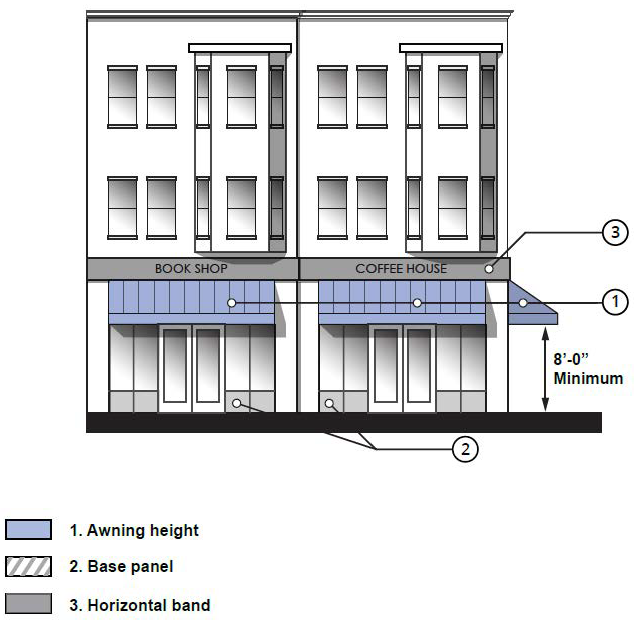
(Ord. No. 348, § 5(Exh. A), 3-28-2023)
18.64.090 - Permits and approvals.
A.
Ministerial Action. The review of and action on the design of multifamily residential development or mixed-use development with a residential component that complies with the provisions of this Chapter is a ministerial action not subject to further discretionary review or action. The Director has the authority to review applications for completeness and compliance with the provisions of this Chapter.
1.
Ministerial design review shall be administered through the Precise Plan of Design requirements as outlined in Chapter 18.63 (Site and Architectural Review), unless modified herein by this Chapter; and shall not require public notice, public hearing or be subject to any required findings for approval.
2.
Ministerial design review approval by the Director shall determine that the proposed application and plans:
a.
Complies with all applicable design standards of this Chapter.
b.
Complies with all applicable development standards of Title 18 (Zoning) without requiring a minor deviation or variance. If the Director is unable to make the above determination, review of the project design shall be subject to all application types, reviews and procedures as outlined in Chapter 18.63 (Site and Architectural Review).
3.
The Director may, from time to time, provide a summary report as an informational item, to the Planning Commission, of any ministerial design review action on a development proposal subject to the provisions of this Chapter. No action by the Planning Commission shall be required.
B.
Other Application Submittals and Types of Review. The following other types of application submittals and types of review may also apply, subject to the provisions outlined in this Section:
1.
The SB 330 Preliminary Application review process is an additional review by the Director and provides early identification of all standards and requirements applicable to a project. A review under this procedure is subject to all requirements and information and materials listed on the City's SB 330 Preliminary Application. The availability of this type of review shall sunset on January 1, 2025, unless extended by the State legislature. The preliminary application review process is at the option of a project proponent and may only be implemented when all requirements of this Chapter are satisfied, including all timeframes required for submittal of a formal application.
2.
If a development qualifies under the Senate Bill 35 eligibility criteria as outlined in this Section, information and materials as listed on the City's SB 35 Application (Affordable Housing Streamlined Review) shall be submitted for review by the Director to determine eligibility.
3.
The provisions, including any requirement for review, hearing and action for minor deviation as provided in Chapter 18.89 (Minor Deviations), Variance as provided in Chapter 18.86 (Variance), or conditional use permit as provided in Chapter 18.83 shall apply to any multifamily residential development or mixed-use development with a residential component that proposes to deviate from any standard of this Chapter and when it is a requirement established by the proposed commercial use. Such deviation shall null and void any ministerial design review action or eligibility for an affordable housing streamlined review process.
4.
All development shall be required to comply with San Bernardino County Fire (SBCF) standards and requirements. All infill development and tenant improvement projects subject to ODS standards shall be required to submit to SBCF to obtain conditions of approval for the project.
5.
For multifamily development with mixed uses that include restaurants, all clearances with San Bernardino County Health Department shall be obtained.
C.
Building Permit. All development subject to the requirements of this Chapter shall require a building permit, subject to all the standard application, review and processing fees and procedures that apply to building permits generally.
D.
Fees. All development subject to the requirements of this Chapter shall be accompanied by the required application fee. Application fees are established by Council resolution.
E.
Preliminary Application. In compliance with Government Code Section 65941.1, a proponent of a multifamily residential development or mixed-use development with a residential component has the option of submitting a preliminary application subject to all the following requirements:
1.
All of the information listed in City's SB 330 Preliminary Application form and payment of the preliminary application processing fee shall be submitted to the City.
2.
If the City determines that the preliminary application for the development project is incomplete, the project proponent must submit the specific information needed to complete the application within 90 days of receiving the City's written identification of the necessary information. If the project proponent does not submit this information within the 90-day period, then the preliminary application shall expire and have no further force or effect, and if any portion of the ministerial design review was completed or approved, it shall be deemed null and void.
3.
After submittal of all of the information required, if the project proponent revises the project to change the number of residential units or square footage of construction changes by 20 percent or more, excluding any increase resulting from density bonus law, the development proponent must resubmit the required information so that it reflects the revisions.
4.
The project proponent shall submit a formal application for a development project within 180 calendar days of submitting a complete preliminary application. If the City determines that the formal application for the development project is incomplete, the project proponent shall submit the specific information needed to complete the application within 90 days of receiving the City's written identification of the necessary information. If the project proponent does not submit this information within the 90-day period, then the preliminary application shall expire and have no further force or effect, and any such ministerial design review approval shall be deemed null and void.
5.
If the applicant revises the project between the preliminary application phase and the formal application phase, such that the number of residential units or square footage of construction changes by 20 percent or more, exclusive of any increase resulting from the receipt of a density bonus, incentive, concession, waiver, or similar provision, the project shall not be deemed to have submitted a preliminary application, in satisfaction of State and City requirements, until the project proponent resubmits the required information, and if any portion of the ministerial design review was completed or approved, it shall be deemed null and void.
6.
Compliance with all applicable provisions of this Chapter; specifically, the process and timeframes outlined in this Section, shall constitute a ministerial design review approval in conjunction with the preliminary application review if the Director determines that the proposed application and plans:
a.
Complies with all applicable design standards of this Chapter.
b.
Complies with all applicable development standards of Title 18 (Zoning Code) without requiring a minor deviation, variance, or conditional use permit. If the Director is unable to make the above determination, review of the project design shall be subject to all application types, reviews and procedures as outline in Chapter 18.63, Site and Architectural Review. Additional review procedures may be required.
7.
The Director may, from time to time, provide a summary report as an informational item, to the Planning Commission, of SB 330 Preliminary Application reviews and associated ministerial design review action on a development proposal subject to the provisions of this Chapter. No action by the Planning Commission shall be required.
F.
Affordable Housing Streamlined Review Eligibility Criteria. In compliance with Government Code Section 65913.4, also known as Senate Bill 35 (SB 35), a qualifying multifamily housing development project may submit to the Director a request for an affordable housing streamlined approval. The Director will determine if the project is eligible for streamlined approval within 60 days after application submittal for projects of 150 or fewer units, or within 90 days for larger projects. If the Director denies the application as incomplete or ineligible for SB 35, the applicant may revise the project to comply with SB 35 and resubmit the application, subject to the same timeline for review. Once the application is accepted for review under SB 35, the Director will approve or deny the project within 90 days after application submittal for projects of 150 or fewer units, or within 180 days for larger projects. To be eligible for streamlined processing under SB 35, the development project must satisfy all of the following criteria:
1.
The project must be a multifamily housing development that contains at least two residential units and comply with the minimum and maximum residential density range permitted for the site, plus any applicable density bonus.
2.
If more than ten residential units are proposed, at least ten percent of the project's units must be dedicated as affordable to households making below 80 percent of the area median income. If the project will contain subsidized units, the applicant has recorded or is required by law to record, a land use restriction for either a minimum of 55 years for rental type units, or a minimum of 45 years for ownership type units.
3.
The project must be located on a legal parcel or parcels within the incorporated City limits. At least 75 percent of the perimeter of the site must adjoin parcels that are developed with urban uses; which means any current or former residential, commercial, public institutional, transit or transportation passenger facility, or retail use, or any combination of those uses. Parcels that are only separated by a street or highway shall be considered adjoined.
4.
The project must be located on a site that is either zoned or has a General Plan designation allowing for multifamily residential development or mixed-use development with a residential component.
5.
The project must meet all objective design standards in effect at the time the application is submitted.
6.
The project must provide at least one parking space per unit without regard to unit size, number of bedrooms, or guest parking spaces; however, no parking is required if the project meets any of the following criteria:
a.
The project is located within one-half mile of public transit.
b.
The project is located within an architecturally and historically significant historic district.
c.
On-street parking permits are required but not offered to the occupants of the project.
d.
There is a car share vehicle within one block of the development.
7.
The project must be located on a property that is outside each of the following areas:
a.
Either prime farmland or farmland of statewide importance, as defined pursuant to United States Department of Agriculture land inventory and monitoring criteria, as modified for California, and designated on the maps prepared by the Farmland Mapping and Monitoring Program of the Department of Conservation, or land zoned or designated for agricultural protection or preservation by the City.
b.
Wetlands, as defined in the United States Fish and Wildlife Service.
c.
A very high fire hazard severity zone, as determined by the Department of Forestry and Fire Protection, or within a high or very high fire hazard severity zone as indicated on maps adopted by the Department of Forestry and Fire Protection pursuant to Section 4202 of the Public Resources Code.
d.
A hazardous waste site that is listed pursuant to Section 65962.5 or a hazardous waste site designated by the Department of Toxic Substances Control pursuant to Section 25356 of the Health and Safety Code, unless the Department of Toxic Substances Control has cleared the site for residential use or residential mixed-uses.
e.
A delineated earthquake fault zone as determined by the State Geologist in any official maps published by the State Geologist, unless the development complies with applicable seismic protection building code standards adopted by the California Building Standards Commission under the California Building Standards Law (Part 2.5 (commencing with Section 18901) of Division 13 of the Health and Safety Code), and by any local building department under Chapter 12.2 (commencing with Section 8875) of Division 1 of Title 2.
f.
A flood plain as determined by maps promulgated by the Federal Emergency Management Agency, unless the development has been issued a flood plain development permit pursuant to Part 59 (commencing with Section 59.1) and Part 60 (commencing with Section 60.1) of Subchapter B of Chapter I of Title 44 of the Code of Federal Regulations.
g.
A floodway as determined by maps promulgated by the Federal Emergency Management Agency, unless the development has received a no-rise certification in accordance with Section 60.3(d)(3) of Title 44 of the Code of Federal Regulations.
h.
Lands identified for conservation in an adopted natural community conservation plan pursuant to the Natural Community Conservation Planning Act (Chapter 10 (commencing with Section 2800) of Division 3 of the Fish and Game Code), habitat conservation plan pursuant to the Federal Endangered Species Act of 1973 (16 U.S.C. Sec. 1531 et seq.), or other adopted natural resource protection plan.
i.
Habitat for protected species identified as candidate, sensitive, or species of special status by State or Federal agencies, fully protected species, or species protected by the Federal Endangered Species Act of 1973 (16 U.S.C. Sec. 1531 et seq.), the California Endangered Species Act (Chapter 1.5 (commencing with Section 2050) of Division 3 of the Fish and Game Code), or the Native Plant Protection Act (Chapter 10 (commencing with Section 1900) of Division 2 of the Fish and Game Code).
j.
Lands under conservation easement.
k.
A site that would require demolition of housing that is subject to recorded restrictions or law that limits rent to levels affordable to moderate, low, or very low-income households; subject to rent control; or currently occupied by tenants or that was occupied by tenants within the past ten years.
l.
A site that previously contained housing occupied by tenants that was demolished within the past ten years.
m.
A site that would require demolition of an historic structure that is on a local, State, or Federal register.
n.
A parcel of land or site governed by the Mobilehome Residency Law, the Recreational Vehicle Park Occupancy Law, the Mobilehome Parks Act, or the Special Occupancy Parks Act
8.
The project does not involve an application to create separately transferable parcels under the Subdivision Map Act.
9.
The project proponent must certify to at least one of the following:
a.
The entirety of the project is a public work as defined in Government Code Section 65913.4(8)(A)(i).
b.
The project is not in its entirety a public work and all construction workers employed in the execution of the development will be paid at least the general prevailing rate of per diem wages for the type of work and geographic area.
c.
The project includes ten or fewer units, is not a public work and does not require subdivision.
10.
If the project consists of 50 or more units that are not 100 percent subsidized affordable housing, the project proponent must certify that it will use a skilled and trained workforce, as defined in Government Code section 65913.4(8)(B)(ii).
(Ord. No. 348, § 5(Exh. A), 3-28-2023)

