
Great Falls City Zoning Code
ARTICLE 6
SPECIAL STANDARDS FOR PRINCIPAL USES
Sections:
17.20.6.005 - Agricultural, horticulture, nursery.
The production or growing of agricultural, horticultural or nursery products is permitted in the R-1, I-1, and I-2 zoning districts. The sale of such products is only permitted in zoning districts allowing such sales.
(Ord. 2950, 2007)
17.20.6.010 - Mobile home park.
A.
Generally. In addition to the other applicable design and improvement requirements contained in this Title, mobile home parks shall comply with the provisions of this part and applicable State law.
B.
Applicability. The design standards of this section shall apply during the establishment of new mobile home parks.
(Ord. 2950, 2007)
C.
Licensing requirements. The mobile home park shall be licensed by the Montana Department of Public Health and Human Services consistent with State law.
D.
Maintenance responsibility. The owner of the mobile home park shall maintain the park in a clean and sanitary manner and may adopt and enforce community rules.
E.
Adoption of State regulations. The City adopts by reference the Montana State Department of Public Health and Human Services regulations titled, "Trailer Courts and Tourist Campgrounds", Administrative Rules of Montana, Title 37, Chapter 111, Sub-Chapter 2. A copy of the above regulation will be filed with the City Clerk as the official code for travel trailer parks, campgrounds and mobile home parks.
F.
Permitted uses. Accessory buildings and uses customarily incidental thereto are permitted. No part of any park shall be used for nonresidential purposes, except such uses that are a direct service and for the well-being of the park residents, and for management and maintenance of the park.
G.
License required. Prior to the establishment of a mobile home park and before January 2 of each calendar year thereafter, the operator of the mobile home park shall obtain a license from the City.
H.
Size. No mobile home park shall be less than one (1) acre in area, be less than one hundred fifty (150) feet wide, or fewer than ten (10) mobile home sites.
I.
Density. The maximum density of mobile home parks shall be not more than ten (10) units per acre.
J.
Access. All mobile home parks shall have access to a public thoroughfare.
K.
Permanent marking of each mobile home space. The limits of each mobile home space shall be clearly marked on the ground with permanent markers. The location of mobile home spaces shall be approximately the same as shown on the approved site plan.
L.
Width of mobile home space. A mobile home space shall be at least fourteen (14) feet wide.
M.
Shape of mobile home space. Considering the orientation of principal windows in mobile homes, mobile home spaces should be arranged diagonally to the street (thirty (30) degrees from perpendicular).
N.
Access. Mobile home spaces shall be arranged to permit the safe and practical placement and removal of mobile homes from a private street internal to the development.
O.
Mobile home pad. There shall be a mobile home pad for each mobile home that meets the following requirements:
1.
The size of the pad shall be at least fourteen (14) feet wide and at least seventy (70) feet long.
2.
The pad shall provide adequate support for the placement of a mobile home but in no case shall the pad consist of less than six (6) inches of crushed gravel over a stabilized base.
P.
Setbacks. The placement of mobile homes, including attached structures (e.g., awnings and carports) and accessory structures shall meet the dimensions listed in Exhibit 20-5.
Exhibit 20-5. Setbacks for Mobile Homes and Accessory Structures
Q.
Skirting. Skirting, footings, and piers shall comply with Title 15, Chapter 15.05, OCCGF. Each mobile home shall be skirted within thirty (30) days of placement on the pad.
R.
Streets. Street widths should be of adequate widths to accommodate expected traffic load, but in all cases shall meet the following minimum requirements:
1.
Collector street with guest parking shall be thirty-four (34) feet wide.
2.
Collector street with no parking shall be twenty-two (22) feet wide.
3.
Minor street with no parking shall be twenty (20) feet wide.
4.
All dead-end streets shall be limited to a maximum length of three hundred (300) feet and shall be provided with a cul-de-sac of at least eighty (80) feet in diameter.
5.
Minimum width to each mobile home site shall be fourteen (14) feet.
S.
Internal access. There shall be a system of paved roadways (concrete or asphalt) to provide access from each and every trailer and automobile parking space within such mobile home park to the public street or highway.
T.
Recreation area. A minimum of ten (10) percent of the gross mobile home park area shall be reserved for park and recreational development. Such area shall be located in a central area of the mobile home park.
U.
Common storage area. The City Commission may require the provision of a common storage area for boats, trailers, recreational vehicles, and similar equipment. Such area shall be screened from view and shall not be considered part of the required common area.
V.
Mail delivery. An off-street area for central mail delivery shall be provided.
W.
Solid waste collection. An off-street area for the collection of solid waste shall be provided.
X.
Utilities. Utilities shall be provided in the following manner or by an alternative manner approved by the City:
1.
All sanitary sewage utilities and water facilities, including connections provided to individual sites, shall meet the requirements of the City plumbing and mechanical codes.
2.
The plumbing connections to each mobile home lot shall be constructed so that all lines are protected from freezing, from accidental bumping, or from creating any type of nuisance or health hazard.
3.
Water shall be piped to each mobile home and the piping shall not be less than three-quarter (¾) inch for each mobile home unit.
4.
Storm drainage facilities, where necessary, shall be so constructed as to protect those that will reside in the mobile home park as well as the property owners adjacent to the park. A storm drainage plan must be submitted for approval to the Director of Public Works.
5.
All electric, telephone and other lines from supply poles to each mobile home lot shall be underground. When meters are installed, they shall be uniformly located.
6.
All fuel lines leading to mobile home lots shall be underground and so designed as to conform with the requirements of the City plumbing code.
7.
Facilities for the storage and disposal of trash and garbage in a sanitary and lawful manner shall be provided in each mobile home park.
8.
Street and yard lights, attached to standards, shall be provided in sufficient number and intensity to permit the safe movement of vehicles and pedestrians at night, and shall be effectively related to buildings, trees, walks, steps and ramps.
9.
The erection, construction, reconstruction, repair, relocation and/or alteration of all permanent buildings and structures located within a mobile home park shall conform to the most recently adopted codes of the City.
10.
All mobile home parks developed under this chapter shall comply with Montana Department of Public Health and Human Services regulations found in Title 24, Chapter 301, and Sub-Chapters 3 and 4, ARM or any amendment thereto concerning plumbing and electrical requirements.
(Ord. No. 3056, § 1, 8-17-2010)
17.20.6.020 - Residence, zero-lot line.
A.
Generally. Houses placed within a zero-lot line development shall comply with all applicable standards, except that side yard setbacks are modified.
(Ord. 2950, 2007)
B.
Intent. The intent of a zero-lot line development is to develop housing on narrow lots and/or to maximize useable yard area. Creation of zero-lot line developments will expand the range of housing options in the City and allow the creation of affordable housing.
C.
Standard. The side yard setback requirement shall be met when the one (1) side yard equals or exceeds the total side yard setbacks for the district. For example, if the district requires a side yard setback of fifteen (15) feet on both sides, the zero-lot line house shall be placed so that the side yard setback is thirty (30) feet or greater.
D.
Setbacks adjacent to surrounding lots. When a zero-lot line parcel abuts another parcel with conventional setbacks, the zero-lot line shall observe the minimum setback for the district on that side.
E.
Construction and maintenance easement required. Each zero-lot line lot with a detached dwelling shall have a construction and maintenance easement from the adjoining lot to allow construction and maintenance of the side of the house on the lot line. Each zero-lot line lot with an attached dwelling shall be subject to a maintenance agreement that specifies the rights and obligations of both property owners.
17.20.6.040 - Residence, multi-family and residence, condominium.
Multi-family and condominium residential buildings should have separate entrances to each dwelling unit if located in a mixed use zoning district.
17.20.6.050 - Townhouse.
A.
Number of dwelling units. Each building shall contain from three (3) to eight (8) dwelling units. No more than five (5) dwelling units may be located in one (1) building, if the average lot frontage is less than twenty (20) feet.
B.
Lot dimension and area. Each lot shall be a minimum of one thousand three hundred (1,300) square feet in area. Any portion of the lot less than sixteen (16) feet in width shall not be included in the calculation of the minimum required one thousand three hundred (1,300) square feet lot area. The minimum average lot width for the end dwelling unit of a townhouse structure shall be thirty-two (32) feet and the minimum lot area of the end dwelling unit shall be two thousand six hundred (2,600) square feet. The minimum lot width to depth ratio shall be no greater than one (1) to seven (7) and shall be based upon the portion of the lot eligible for inclusion in the above mentioned area calculation.
(Ord. 2950, 2007)
C.
Building setback line.
1.
Front yard. The minimum depth of a front yard shall be the depth required by the zoning district in which the townhouse is located. (See Exhibit 20-4). In those instances where the entrance to off-street parking spaces for an individual lot is from a public roadway, the minimum building setback line from the public road right-of-way shall be twenty (20) feet.
2.
Side yard. Every dwelling which is the end unit of a townhouse structure shall have a minimum side yard depth required by the zoning district in which the townhouse is located. (See Exhibit 20-4).
3.
Rear yard. The minimum depth of a rear yard shall be the depth required by the zoning district in which the townhouse is located (See Exhibit 20-4), although the depth of a rear yard for a garage shall be twenty (20) feet where the vehicular entrance crosses the rear property line.
(Ord. 2950, 2007)
D.
Occupied area. No more than fifty (50) percent of the lot area shall be occupied by a building.
E.
Utility service. Each dwelling unit shall have independent service connections to all utilities, including water, sewer, and electricity.
F.
Subsequent divisions. Individual townhouses may not be further subdivided.
G.
Driveways. When the garage is located in the front of the townhouse, common driveways shall be used whenever possible. The width of a single driveway shall be eleven (11) feet and for a common driveway the width shall be eighteen (18) feet.
H.
Vertical off-sets. When five (5) or more dwelling units are constructed, there shall be a vertical offset between each adjoining dwelling unit.
I.
Accessory buildings. Accessory buildings, excluding garages and carports, shall not exceed one hundred (100) cumulative square feet.
J.
Front entrances. Front entrances shall be clearly visible from the street and accentuated by a porch or other architectural feature.
17.20.6.060 - Residence, manufactured/factory-built.
A.
Design and construction. All manufactured/factory-built dwellings shall meet the following minimum standards:
1.
The roof shall have a minimum pitch of 2 to 12.
2.
Suitable roof coverings include clay or ceramic tiles, wood shingles or shakes, fiberglass or asphalt shingles, or a standing seam metal.
3.
The siding must be wood, vinyl, or metal horizontal lap siding, wood shingles, masonry veneer or an Exterior Insulation and Finish System (EIFS).
4.
An overhang shall extend at least ten (10) inches beyond the exterior wall.
(Ord. 2950, 2007)
5.
The building shall be set on and anchored to a continuous permanent foundation that extends around its perimeter, conforming to the criteria of the most recent edition of the International Residential Code adopted by the City of Great Falls.
17.20.6.070 - Campground or recreational vehicle park.
A.
Generally. In addition to the other applicable design and improvement requirements contained in this chapter, campgrounds shall comply with the provisions of this part and applicable State law.
B.
Maintenance responsibility. The owner of the campground shall maintain the campground in a clean and sanitary manner.
C.
Accessory facilities. Accessory facilities (e.g., laundry, food sales) may be allowed as a service to the occupants, but shall be designed, operated, and located to inhibit use by non-occupants.
D.
Density. The density shall not exceed twenty-five (25) spaces per acre (gross).
E.
Access. Recreational vehicle spaces shall be arranged to permit the safe and practical placement and removal of vehicles from a private street internal to the development.
F.
Separation. A campground space shall be no closer than sixty-five (65) feet to the perimeter property line of the site.
G.
Solid waste collection. An off-street area for the collection of solid waste shall be provided.
H.
Licensing requirements. The campground shall be licensed by the Montana Department of Public Health and Human Services consistent with State law.
17.20.6.080 - Micro-brewery, restaurant, and tavern.
A.
As authorized by Mont. Code Ann. § 16-3-306(4) and § 16-3-309(1), with respect to any type or class of liquor license, the City supplants the provisions of Mont. Code Ann. § 16-3-306(1), and eliminates the requirement of a six hundred-foot (600') distance between a licensed establishment and a church, synagogue, or other place of worship (identified above in Exhibit 20-1 as Worship Facility). The elimination of this distance requirement is only applicable if the licensed establishment or Worship Facility is or will be located within a zoning district where both uses are permitted or conditionally permitted. The statutory requirements remaining are not supplanted.
B.
Taverns located in C-1 Districts may not have indoor or outdoor entertainment.
(Ord. 3221, 2020)
17.20.6.090 - Commercial kennel.
The standards applicable to animal shelters apply to commercial kennels.
17.20.6.100 - Sexually-oriented business.
A.
Purpose. This section is intended to regulate sexually-oriented businesses to promote the health, safety, morals, and the general welfare of City residents and to establish reasonable and uniform regulations to prevent the continued deleterious location and concentration of adult businesses within the City. These provisions have neither the intent, purpose, or effect of imposing a limitation or restriction on the content of any communicative materials, including sexually-oriented materials. Similarly, it is not the intent, purpose, or effect of these provisions to restrict or deny access by adults to distributors and exhibitors of sexually-oriented entertainment to their intended market. Neither is it the intent, purpose, or effect to condone or legitimize the distribution of obscene material.
B.
Legislative findings. Based upon analyses of sexually-oriented business by Indianapolis, Indiana; Rochester, New York; and Denver, Colorado, which analyses are found applicable and relevant to the City, the City Commission makes the following findings:
1.
The establishment of sexually-oriented businesses in business districts which are immediately adjacent to and which serve residential neighborhoods has a deleterious effect on both the business and residential segments of the neighborhood, causing or contributing to blight and a downgrading of property values.
2.
The establishment of more than two (2) sexually-oriented businesses within six hundred (600) feet of each other has a deleterious effect on surrounding residential and business areas and the fostering of such businesses within a close proximity tends to create a "skid row" atmosphere.
3.
The concentration of several sexually-oriented businesses in the same neighborhood tends to attract undesirable quantity and quality of transients, a circumstance which adversely affects property values, causes an increase in crime and encourages residents and businesses to move elsewhere.
4.
Concern for, and pride in, the orderly planning and development of a neighborhood should be encouraged and fostered in those persons comprising residential and business segments of that neighborhood.
C.
Classification. A sexually-oriented business includes the following as defined in Chapter 8 of this Title:
1.
Adult arcades.
2.
Adult book stores/adult video stores.
3.
Adult cabarets.
4.
Adult motels.
5.
Adult motion picture theaters.
D.
Applicability. Upon the following events, a sexually-oriented business shall comply with the provisions of this section.
1.
The opening or commencement of a sexually-oriented business.
2.
The conversion of an existing business, whether or not a sexually-oriented business, to a sexually-oriented business.
3.
The addition of a sexually-oriented business to an existing sexually-oriented business.
4.
The relocation of a sexually-oriented business.
5.
The sale, lease, or sublease of a sexually-oriented business.
6.
The transfer of securities which constitute a controlling interest in the sexually-oriented business, whether by sale, exchange, or similar means.
7.
The establishment of a trust, gift, or other similar legal device which transfers the ownership or control of the sexually-oriented business, except for transfer by bequest or other operation of law upon the death of the person possessing the ownership or control.
E.
Proximity to specified zoning districts. A sexually-oriented business shall not be located within three hundred fifty (350) feet of a zoning district that allows residential development.
F.
Proximity to another establishment of the same kind. A sexually-oriented business shall not be located within six hundred (600) feet of another sexually-oriented business.
G.
Proximity to other specified uses. A sexually-oriented business shall not be located within six hundred (600) feet of the following:
1.
Public library.
2.
Public playground or park.
3.
Educational facility (K—12) including its grounds.
4.
A State licensed family day care home, group day care home, or day care center.
5.
Worship facility.
6.
Any youth-oriented establishment.
If one (1) of these specified uses locates within this area of separation after the sexually-oriented business has been granted a building permit or occupancy permit, the sexually-oriented business shall not be required to relocate.
H.
Measurement of distances. For the purpose of this section, specified distances shall be measured in a straight line, without regard to intervening structures or streets, from the property line of the parcel with the sexually-oriented business to the property boundary line with the specified uses or to the specified zoning districts.
I.
Sale of alcohol. A sexually-oriented business shall not sell, distribute, or allow consumption of alcohol on the premises.
J.
Building standards. All building openings, entries and windows shall be located, covered, or screened in such manner as to prevent the interior of such premises from being viewed from outside the establishment.
17.20.6.110 - Veterinary clinic, small animal.
The standards applicable to animal shelters apply to small animal veterinary clinics.
17.20.6.120 - Vehicle repair.
No vehicle shall be serviced or repaired outside of the principal structure intended for such use.
17.20.6.130 - Mini-storage facility.
A.
Minimum lot size. The lot on which a mini-storage facility is located shall be at least one (1) acre in size.
B.
Access. The access to a cubicle shall not open directly onto a public street or alley.
C.
Access. A mini-storage facility shall front on and have direct access to a roadway classified as a collector or a higher classification.
D.
Paving required. All driveways, interior aisles, and walkways shall be concrete or asphalt.
E.
Storage of prohibited substances. No cubicle shall be used to store explosives, toxic substances, hazardous materials, or radioactive materials.
F.
Uses. Only uses which are specific to storage shall occur. No portion of the site may be used for fabrication or any similar use.
G.
Special standards and guidelines for mini-storage facilities in a commercial zoning district. When a mini-storage facility is allowed in a commercial zoning district it shall meet the following architectural design standards and guidelines (See Exhibit 20-6):
1.
Roof. The roof shall have a minimum pitch of 4 and 12 and be covered with sculptured asphalt, wood, or tile shingles.
2.
Door adjacent to a residential district. No door providing access to a rental cubicle shall be located on the outer perimeter of the building when abutting a residential district.
3.
Placement of doors on a single-loaded building. When a mini-storage facility is single-loaded (i.e., cubicle doors only on one (1) side), the cubicle doors shall not face the outer perimeter of the site.
4.
Exterior material. At least forty (40) percent of the wall surface facing toward the outer perimeter of the site shall be brick, decorative concrete block (e.g., ground face or split face), stucco, or a combination thereof.
5.
Fencing. Fences shall be placed on the interior of buffer areas, if required. Fences should be decorative, but at a minimum shall be vinyl coated chain link fence material with support posts three (3) inches or greater in diameter. Vinyl banding shall not be inserted into a chain link fence.
Exhibit 20-6. Key design features of a mini-storage facility project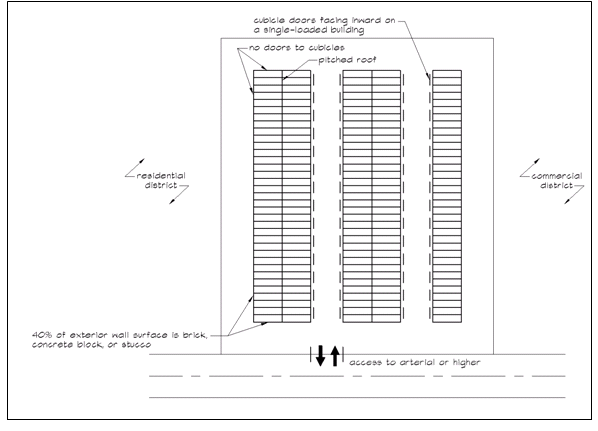
17.20.6.140 - Reserved.
(Ord. 3251, 2022; Ord. 3139, 2016; Ord. 2950, 2007)
17.20.6.150 - Reserved.
(Ord. 3251, 2022; Ord. 2950, 2007)
17.20.6.160 - Animal shelter.
A.
Confinement of animals. All animals shall be confined to an enclosed building. The facility may include a fenced or otherwise confined exercise area provided: (Ord. 2950, 2007)
1.
It is at least two hundred (200) feet from the property boundary line of a residentially zoned parcel, and
2.
No animal is allowed to remain in the exercise area from dusk to dawn.
B.
Noise control. The building shall be designed and operated so that noise from the animals at the facility cannot be heard beyond the property boundary line of the parcel on which it is located.
17.20.6.170 - Cemetery.
Cemeteries shall comply with the following standards:
1.
A cemetery shall have at least seventy-five (75) double burial plots measuring at least ten (10) feet by ten (10) feet to accommodate two (2) adult burials.
2.
Burial plots shall not be located in the floodplain or in wetland areas, nor shall internment occur below the groundwater table.
3.
Burial plots shall not be located within fifty (50) feet of a public street right-of-way.
4.
A permanent marker stating the name of the deceased and the birth and death dates, if known, shall identify the location of each occupied burial plot.
5.
The deceased shall be contained in a casket.
6.
Private drives shall be concrete or asphalt.
7.
Each burial plot shall have access to a private drive at no greater distance than twenty (20) burial plots apart or be located in a building.
8.
The cemetery shall have a formal name, which shall be placed on a permanent sign located by the main entrance to the cemetery.
17.20.6.175 - Community gardens.
Prior to establishment or operation of a new community garden, the group proposing to establish the garden must submit the following documentation to, and receive written approval to proceed from, the Planning and Community Development Department:
A.
Dimensioned Site Plan. A site plan that includes the location and layout of garden plots and the location of any proposed structures or fences.
B.
Garden Coordinator. The name, telephone number and email address of the garden coordinator responsible for coordinating and managing the community garden.
C.
Operating standards. Operating rules addressing, at a minimum, the tax and governance structure of the community garden, hours of operation, maintenance responsibilities and security measures.
D.
User Agreement. A user agreement signed by the garden coordinator and the property owner.
The Planning and Community Development Department may require additional conditions be met for the protection of the community. The aforementioned information shall be kept on file in the Department. The group shall be responsible for providing the Department revised documents reflecting any significant or pertinent changes to operation or management of the garden The Department shall investigate any citizen complaints and enforce established standards if necessary.
(Ord. No. 3068, § 1, 4-5-2011)
17.20.6.180 - Worship facility.
At least one (1) property boundary line shall abut on a collector street or a higher street classification.
17.20.6.200 - Educational facility (K—12).
A.
Modular buildings. Modular buildings may only occur (as a conditional use) in connection with an educational facility to accommodate overflow activity while efforts are made to secure a permanent structure. Under no circumstance shall modular buildings be located on the premises for more than two (2) years.
B.
Access. At least one (1) property boundary line shall abut on a collector street or higher classification.
17.20.6.210 - Composting facility.
A composting facility shall not be located within six hundred (600) feet of a residential zoning district, educational facility, worship facility, or any other place where the public congregates.
17.20.6.220 - Recycling center.
All material shall be fully contained within an enclosed building.
17.20.6.230 - Solid waste transfer station.
A solid waste transfer station shall not be located within six hundred (600) feet of a residential zoning district, educational facility, worship facility, or any other place where the public congregates.
17.20.6.240 - Amateur radio station.
Amateur radio stations may be installed, erected, maintained and/or operated in any residential zoning district except historic districts, without benefit of a building permit or other entitlement process, so long as all the following conditions are met:
1.
The antenna is operated by a federally licensed amateur radio operator as part of the Amateur Radio Service and is less than eighty (80) feet in height.
2.
The antenna use involved is accessory to the primary use of the property which is not a telecommunications facility.
3.
The premises contains no more than three (3) antenna support structures.
4.
Sufficient anti-climbing measures have been incorporated into the facility, as needed, to reduce potential for trespass and injury.
17.20.6.250 - Telecommunications facility.
A.
Purpose. The provisions of this section are established to promote the public health, safety, and welfare, while at the same time not unduly restricting the development of needed telecommunications facilities, and are intended to accomplish the following purposes, to the full extent permitted by law:
1.
Protect the visual character of the City from the potential adverse effects of telecommunication facility development and minor antenna installation.
2.
Insure against the creation of visual blight within or along the City's scenic corridors and ridgelines.
3.
Retain local responsibility for and control over the use of public rights-of-way to protect citizens and enhance the quality of their lives.
4.
Protect City residents from the possible adverse health effects associated with exposure to high levels of non-ionizing electromagnetic radiation (NIER).
5.
Protect environmental resources.
6.
Insure that a competitive and broad range of telecommunications services and high quality telecommunications infrastructure are provided.
7.
Create and preserve telecommunication facilities that will serve as an important and effective part of the City's emergency response network.
B.
Applicability. The provisions of this section apply to all telecommunication facilities, except City government owned or public service use/facility owned and operated receive and/or transmit telemetry station antennas for supervisory control and data acquisition (SCADA) systems for water, flood alert, traffic control devices and signals, stormwater, pump stations and/or irrigation systems, public education and transportation with heights not exceeding thirty-five (35) feet. Additionally, the provisions of this section do not apply to single satellite dishes smaller than ten (10) inches in diameter.
(Ord. 2950, 2007)
C.
City licensing. Telecommunications carriers and providers engaged in the business of transmitting, supplying, or furnishing of telecommunications originating or terminating in the City shall register with the City pursuant to Title 5, OCCGF.
(Ord. 2950, 2007)
D.
Other permitting and licensing. Prior to issuance of a building permit, the applicant shall obtain other applicable permits/approvals from other governmental agencies which may have jurisdiction over the project.
E.
FCC compliance. Commercial telecommunication facilities and antennas shall comply at all times with FCC rules, regulations, and standards. In event of conflict between federal law and this chapter, federal law shall prevail.
F.
Yard setbacks. Facilities and antennas shall not be located in the required yard setback of the zoning district in which it is located.
G.
Placement of satellite dish and parabolic antennas. Satellite dish and parabolic antennas shall be situated as close to the ground as possible to reduce visual impact without compromising their function.
H.
Historic districts. Commercial telecommunication facilities and antennas shall not be located in a historic district, unless fully concealed and not otherwise visible.
I.
Structural requirements. No telecommunication facility shall be designed and/or sited such that it poses a potential hazard to nearby residences or surrounding properties or improvements. To this end, any telecommunication tower, located at a distance of less than one hundred ten (110) percent of its height from an inhabited area or other tower shall be designed and maintained to withstand without failure the maximum forces expected from wind and earthquakes when the tower is fully loaded with antennas, transmitters and other equipment, and camouflaging, if any.
1.
Initial compliance. Initial demonstration of compliance with this chapter shall be provided via submission of a report to the City Building Official prepared by a structural engineer licensed by the State that describes the tower structure, specifying the number and type of antennas it is designed to accommodate, providing the basis for the calculations done, and documenting the actual calculations performed.
2.
Continued compliance. Proof of ongoing compliance shall be provided via submission to the City Building Official at least every five (5) (self-supporting and guyed towers)/ten (10) (monopoles) years of an inspection report prepared by a structural engineer licensed by the State indicating the number and types of antennas and related equipment actually present and indicating the structural integrity of the tower. Based on this report, the building official may require repair or, if a serious safety problem exists, removal of the tower.
J.
Basic tower and building design. All telecommunication facilities shall be designed to blend into the surrounding environment. To this end, all the following measures shall be implemented:
1.
Telecommunication towers shall be constructed out of metal or other non-flammable material, unless specifically conditioned by the City to be otherwise.
2.
Telecommunication towers taller than thirty-five (35) feet shall be monopoles or guyed/lattice towers except where satisfactory evidence is submitted to the Director of Planning and Community Development that a self-supporting tower is required to provide the height and/or capacity necessary for the proposed telecommunication use to minimize the need for screening from adjacent properties, or to reduce the potential for bird strikes.
3.
Satellite dishes other than microwave dishes shall be of mesh construction, except where technical evidence shows that this is not feasible.
4.
Telecommunication support facilities (e.g., vaults, equipment rooms, utilities, and equipment enclosures) shall be constructed out of non-reflective materials (visible exterior surfaces only) and shall be placed in underground vaults to the greatest extent possible.
5.
Telecommunication support facilities shall be no taller than fifteen (15) feet and shall be designed and constructed to look like a building or facility typically found in the area.
6.
Telecommunication support facilities in areas of high visibility shall, where possible, be sited below the ridgeline or designed (i.e., placed underground, depressed, or located behind earth berms) to minimize their profile.
7.
All buildings, poles, towers, antenna supports, antennas, and other components of each telecommunications site shall be initially painted and thereafter repainted as necessary with a "flat" paint. The color selected shall be one that will minimize their visibility to the greatest extent feasible. Improvements which will be primarily viewed against soils, trees, or grasslands shall be painted colors matching these landscapes while elements which rise above the horizon shall be painted a blue gray that matches the typical sky color at that location.
8.
The project description and permit shall include a specific maximum allowable gross cross-sectional area, or silhouette of the facility. The silhouette shall be measured from the "worst case" elevation perspective.
9.
The City shall have the authority to require special design of the telecommunication facilities where findings of particular sensitivity are made (e.g., proximity to historic or aesthetically significant structures, views and/or community features).
10.
Antennas and supporting electrical/mechanical equipment installed on the rooftop or above a structure shall be screened, constructed, and/or colored to match the structure to which they are attached.
11.
Telecommunication facilities shall insure that sufficient anti-climbing measures have been incorporated into the facility, as needed, to reduce potential for trespass and injury.
12.
No sign shall be placed on a tower.
13.
When a telecommunication facility is located in a residential zoning district, no employee shall be based at the site. Routine maintenance and monitoring is permissible.
K.
Required setback. Telecommunication towers shall be set back at least twenty-five (25) percent of the tower height from all property lines. Guy wire anchors shall be set back at least twenty (20) feet from any property line.
L.
Maximum height. Towers shall not exceed the heights listed in Exhibit 20-7. Not withstanding the preceding, no tower shall exceed the height limitations described in Chapter 54 of this Title.
Exhibit 20-7. Maximum tower/antenna height
M.
Visibility. All telecommunication facilities shall be located so as to minimize their visibility and the number of distinct facilities present. To this end all of the following measures shall be implemented for all telecommunications facilities:
1.
No telecommunication facility shall be installed within the influence zone of the Great Falls International Airport or any helipad unless the airport owner/operator indicates that it will not adversely affect the operation of the airport or helipad;
2.
No telecommunication facility shall be installed at a location where special painting or lighting will be required by the FAA regulations unless technical evidence acceptable to the Director of Planning and Community Development is submitted showing that this is the only technically feasible location for this facility;
3.
No telecommunication facility shall be installed on an exposed ridgeline, in or at a location readily visible from Interstate 15, a public trail, public park or other outdoor recreation area, or in property designated as a floodway unless it blends with the surrounding existing natural and man-made environment in such a manner as to be effectively unnoticeable and a finding is made that no other location is technically feasible;
4.
No telecommunication facility that is readily visible from off-site shall be installed closer than one-half (½) mile from another readily visible, un-camouflaged or unscreened, telecommunication facility unless it is a co-located facility, situated on a multiple-user site, or blends with the surrounding existing natural and man-made environment in such a manner as to be effectively unnoticeable; or technical evidence acceptable to the Director of Planning and Community Development is submitted showing a clear need for this facility and the unfeasibility of co-locating it on one (1) of these former sites;
5.
No telecommunication facility that is readily visible from off-site shall be installed on a site that is not already developed with telecommunication facilities or other public or quasi-public uses unless it blends with the surrounding existing natural and man-made environment in such a manner so as to be effectively unnoticeable or technical evidence acceptable to the Director of Planning and Community Development is submitted showing a clear need for this facility and the unfeasibility of co-locating it on one (1) of these former sites; and
N.
Lighting. Lighting shall comply with the standards contained in Chapter 40 of this Title.
O.
Vegetation protection and facility screening. All telecommunications facilities shall be installed in such a manner so as to maintain and enhance existing native vegetation and to install suitable landscaping to screen the facility, where necessary. To this end, all of the following measures shall be implemented for all telecommunication facilities:
1.
A landscape plan shall be submitted with project application submittal indicating all existing vegetation, identifying landscaping that is to be retained on the site and any additional vegetation that is needed to satisfactorily screen the facility from adjacent land uses and public view areas. The landscape plan shall be subject to approval during the site plan review process.
2.
Existing trees and other screening vegetation in the vicinity of the facility and along the access roads and power/telecommunication line routes involved shall be protected from damage, both during the construction period and thereafter.
3.
All areas disturbed during project construction other than the access road and parking areas required under Chapter 36 of this Title shall be replanted with vegetation compatible with the vegetation in the surrounding area (e.g., ornamental shrubs or natural brush, depending upon the circumstances) to the satisfaction of the Director of Planning and Community Development.
4.
Any existing trees or significant vegetation, on the site or along the affected access area that die shall be replaced with native trees and vegetation of a size and species acceptable to the Director of Planning and Community Development.
P.
Fire prevention. All telecommunication facilities shall be designed and operated in such a manner so as to minimize the risk of igniting a fire or intensifying one (1) that otherwise occurs. To this end, all of the following measures shall be implemented, when determined necessary by the Building Official:
1.
At least one-hour fire resistant interior surfaces shall be used in the construction of all buildings.
2.
Monitored automatic fire extinguishing systems shall be installed in all equipment buildings and enclosures.
3.
Rapid entry systems shall be installed.
Q.
Environmental resource protection. All telecommunication facilities shall be sited so as to minimize the effect on environmental resources. To that end the following measures shall be implemented for all telecommunication facilities:
1.
No telecommunications facility or related improvements shall be sited such that their construction will damage an archaeological site or have an adverse effect on the historic character of a historic feature or site;
2.
No telecommunications facility shall be sited such that its presence threatens the health or safety of migratory birds;
3.
Potential adverse visual impacts which might result from project related grading or road construction shall be minimized;
4.
Potential adverse impacts upon nearby public use areas such as parks or trails shall be minimized.
R.
Noise. Telecommunication facilities shall be constructed and operated in such a manner as to minimize the amount of disruption caused to the residents of nearby homes and the users of nearby recreational areas such as public parks and trails.
S.
Use of backup generators. Backup generators shall only be operated during power outages and for testing and maintenance purposes. Testing and maintenance shall only take place on weekdays between the hours of 8:30 a.m. and 4:30 p.m. If the facility is located within one hundred (100) feet of a residential dwelling, noise levels at the property boundary shall not exceed an Ldn (Day-Night Average Level) of fifty (50) dB (decibels).
T.
Visual compatibility. Facility structures and equipment shall be located, designed, and screened to blend with the existing natural or built surroundings so as to reduce visual impacts to the extent feasible considering the technological requirements of the proposed telecommunication service and the need to be compatible with neighboring residences and the character of the community.
U.
Visual analysis. A visual analysis, which may include photo montage, field mock-up, or other techniques, shall be prepared by or on behalf of the applicant that identifies the potential visual impacts, at design capacity, of the proposed facility. Consideration shall be given to views from public areas as well as from private residences. The analysis shall assess the cumulative impacts of the proposed facility and other existing and foreseeable telecommunication facilities in the area, and shall identify and include all feasible mitigation measures consistent with the technological requirements of the proposed telecommunication service. All costs for the visual analysis, and applicable administrative costs, shall be borne by the applicant. The City may require the applicant to provide funding to the City to cover the cost of a second analysis if the analysis submitted by the applicant does not accurately or completely analyze the visual effects of the proposed project.
V.
NIER (non-ionizing electromagnetic radiation) exposure. No telecommunication facility shall be sited or operated in such a manner that it poses, either by itself or in combination with other such facilities, a potential threat to public health. To that end, no telecommunication facility or combination of facilities shall produce at any time power densities in any inhabited area that exceed the ANSI C95.1-1992 standard for human exposure or any more restrictive standard subsequently adopted or promulgated by the City, county, State, or the federal government.
1.
Initial compliance. Initial compliance with this requirement shall be demonstrated for any facility within four hundred (400) feet of residential uses or sensitive receptors such as schools, churches, hospitals, etc. and all broadcast radio and television facilities, regardless of adjacent land uses, through submission, at the time of application for the necessary permit or entitlement, of NIER calculations specifying NIER levels in the inhabited area where the levels produced are projected to be highest. If these calculated NIER levels exceed eighty (80) percent of the NIER standard established by this Section, the applicant shall hire a qualified electrical engineer licensed by the State to measure NIER levels at said location after the facility is in operation. A report of these measurements and his/her findings with respect to compliance with the established NIER standard shall be submitted to the Director of Planning and Community Development. Said facility shall not commence normal operations until it complies with, or has been modified, to comply with this standard. Proof of said compliance shall be a certification provided by the engineer who prepared the original report. In order to assure the objectivity of the analysis, the City may require, at the applicant's expense, independent verification of the results of the analysis.
2.
Ongoing compliance. Every telecommunication facility within four hundred (400) feet of an inhabited area and all broadcast radio and television facilities shall demonstrate continued compliance with the NIER standard established by this section. Every five (5) years a report listing each transmitter and antenna present at the facility and the effective radiated power radiated shall be submitted to the Director of Planning and Community Development. If either the equipment or effective radiated power has changed, calculations specifying NIER levels in the inhabited areas where said levels are projected to be highest shall be prepared. NIER calculations shall also be prepared every time the adopted NIER standard changes. If calculated levels in either of these cases exceed eighty (80) percent of the standard established by this section, the operator of the facility shall hire a qualified electrical engineer licensed by the State to measure the actual NIER levels produced. A report of these calculations, required measurements, if any, and the author's/engineer's findings with respect to compliance with the current NIER standard shall be submitted to the Director of Planning and Community Development within five (5) years of facility approval and every five (5) years thereafter. In the case of a change in the standard, the required report shall be submitted within ninety (90) days of the date said change becomes effective.
3.
Failure to submit required reports. Failure to supply the required reports or to remain in continued compliance with the NIER standard established by this section shall be grounds for revocation of the use permit or other entitlement.
W.
Co-located and multiple-user facilities. An analysis shall be prepared by or on behalf of the applicant, which identifies all reasonable, technically feasible, alternative locations and/or facilities which would provide the proposed telecommunication service. The intention of the alternatives analysis is to present alternative strategies which would minimize the number, size, and adverse environmental impacts of facilities necessary to provide the needed services to the City and surrounding rural and urban areas. The analysis shall address the potential for co-location at an existing or a new site and the potential to locate facilities as close as possible to the intended service area. It shall also explain the rationale for selection of the proposed site in view of the relative merits of any of the feasible alternatives. Approval of the project is subject to a finding that the proposed site results in fewer or less severe environmental impacts than any feasible alternative site. The City may require independent verification of this analysis at the applicant's expense. Facilities which are not proposed to be co-located with another telecommunication facility shall provide a written explanation why the subject facility is not a candidate for co-location.
1.
All co-located and multiple-user telecommunication facilities shall be designed to promote facility and site sharing. To this end telecommunication towers and necessary appurtenances, including but not limited to, parking areas, access roads, utilities and equipment buildings shall be shared by site users when, in the determination of the Director of Planning and Community Development, this will minimize overall visual impact to the community.
2.
The facility shall make available unused space for co-location of other telecommunication facilities, including space for these entities providing similar, competing services. A good faith effort in achieving co-location shall be required of the host entity. Requests for utilization of facility space and responses to such requests shall be made in a timely manner and in writing and copies shall be provided to the City. Unresolved disputes may be mediated by the Board of Adjustment. Co-location is not required in cases where the addition of the new service or facilities would cause quality of service impairment to the existing facility or if it became necessary for the host to go off-line for a significant period of time.
3.
Approval for the establishment of facilities improved with an existing microwave band or other public service use or facility, which creates interference or interference is anticipated as a result of said establishment of additional facilities, shall include provisions for the relocation of said existing public use facilities. All costs associated with said relocation shall be borne by the applicant for the additional facilities.
X.
Waiver. The City Commission may grant a waiver to the requirements specified in this section when the waiver would not increase the visibility of the facility or decrease public safety. Tower setback requirements may be waived when:
1.
The facility is proposed to be co-located onto an existing, legally-established telecommunication tower; or
2.
The reduced setback enables further mitigation of adverse visual and other environmental impacts than would otherwise be possible.
(Ord. No. 3056, § 1, 8-17-2010)
17.20.6.260 - Heli-pad.
A.
Surface. The surface of the heli-pad shall be of concrete or asphalt.
B.
Location. A heli-pad may be located on the ground or on top of a building with a roof engineered for such use.
(Ord. 2950, 2007)
C.
FAA requirements. Heli-pads shall obtain all approvals and licenses as may be required.
D.
Landscaping. Landscaping shall be provided as determined by the City on a case-by-case basis.
17.20.6.270 - Contractor yard, type I.
A.
Generally. These standards do not apply to contractor yards in Industrial zoning districts
B.
Lot size requirements. The minimum lot size shall be one (1) acre.
C.
Limitations on equipment. No more than two (2) pieces of heavy equipment exceeding three (3) tons may be stored on the premises.
D.
Storage of material. Exterior storage of construction materials, wastes, or any other material related to the operation of the contractor yard is prohibited.
E.
Buildings. A building(s) not exceeding a cumulative total of three thousand (3,000) square feet shall be constructed on the premises to accommodate the contractor's operations.
(Ord. 2950, 2007)
17.20.6.280 - Contractor yard, type II.
A.
Lot size requirements. There are no minimum lot size requirements.
B.
Limitations on equipment. There are no limitations on the number of trucks, trailers, or other heavy equipment.
C.
Storage of material. Exterior storage of construction materials, wastes, or any other material related to the operation of the contractor yard is permitted.
D.
Buildings. The size of the building(s) shall conform to the dimensional requirements as appropriate for the district.
17.20.6.290 - Junk yard.
A.
Generally. All salvage material not fully enclosed within a building with walls, shall be screened from public view. Acceptable screening includes fencing or other manmade barriers and natural barriers as herein described.
B.
Standards for fences. If a fence is used, the boards may be spaced and/or slanted to reduce wind load. The space which can be seen from a broadside view will not be more than one-half (½) inches wide when viewed at any angle from forty-five (45) degrees to ninety (90) degrees to the fence. The interval between spaces will not be less than seven and one-half (½) inches. Chain-link metal fences with standard fiberglass or other inserts are acceptable, provided the gap between adjacent slats does not exceed one and one-half (1½) inches. The breaks in the fence may be vertical or at any angle; they cannot be horizontal. Fences are to be constructed of sound building materials. Rough dimensional lumber or better is acceptable. Slabs are not considered rough dimensional lumber. Plastics or other materials that are placed over the salvage or scrap are not acceptable. Trees and shrubs can best be used in conjunction with other screening materials to improve the appearance of the salvage or scrap facility. Chain-link type metal fence with slats inserted is acceptable. Other screening than the two (2) types of fencing specifically approved above (metal and wood) but of equivalent permanence, attractiveness, and screening qualities are also acceptable if approved by the Board of Adjustment.
C.
Standards for other types of screening. Screening with shrubs and trees, while not subject to precise measurements, is to provide a similar degree of screening at all times of the year as would a fence. A berm may be constructed of any solid material, including stumps, demolition debris, etc. The slopes of the berm are to be covered and graded smooth, with not less than three (3) inches of topsoil and seeded with an adequate seeding formula.
D.
Height of screening. Screening must be of sufficient height so that none of the salvage material on the premises is visible from public view. This is not intended to require that permanent buildings, other structures, utility poles, cranes or derricks or similar structures be screened.
E.
Consistent use of materials. No more than one (1) of the approved screening materials is to be used on one (1) side of the facility. Trees and shrubs may be placed on the outside of the screening material. Other sides may use different approved materials.
F.
Maintenance. The screening is to be maintained by the facility operator in a neat and workmanlike manner. It is to be replaced where necessary by the operator. Damage by vandals or other causes is the risk of the operator and is not to be a reason for not maintaining the screening.
17.20.6.300 - Light manufacturing and assembly.
A.
Outside storage prohibited. Outdoor storage of materials shall be prohibited except in I-1 districts.
B.
Separate loading/unloading area required. A separate loading/unloading area and entrance shall be provided.
C.
Impact of air contaminants and odors. No air contaminants or potentially offensive odors shall be emitted outside of the building or area of manufacture/assembly.
D.
Prohibition on certain materials. No radioactive materials, hazardous substances, hazardous wastes or regulated substances shall be handled or produced.
E.
Noise impact on neighboring uses. Such uses shall not produce loud or offensive noises outside of the building or area of manufacturing/assembly. If necessary, buildings and/or areas housing such uses shall be soundproofed.
17.20.6.310 - Motor vehicle graveyard.
This use must meet all requirements as required by State law.
17.20.6.320 - Motor vehicle wrecking facility.
This use must meet all requirements as required by State law.

