
Grosse Pointe City Zoning Code
ARTICLE I
- IN GENERAL
Sec. 90-1.- Preamble.
In accordance with the authority and intent of the Michigan Zoning Enabling Act, P.A. 110 of 2006 (MCL 125.3101 et seq.) as amended, the city desires to provide for the orderly development of the city, which is essential to the well-being of the community, and which will place no undue burden upon developers, commerce or residents. The city further desires to ensure the provision of adequate sites for commerce and residence; to provide for the free movement of vehicles upon the proper streets and highways of the city; to protect commerce and residences against incongruous and incompatible uses of land, and to promote the proper use of land and natural resources for the economic well-being of the city as a whole; to ensure the provision of adequate space for the parking of vehicles of customers using commercial and retail areas; and that all uses of land and buildings within the city be so related as to provide for economy in government and mutual support. The result of such purposes of this chapter, which relates to the city's comprehensive development plan, will promote and protect the public health, safety, comfort, convenience and general welfare of the residents, shoppers and workers in the city.
(Code 1980, § 5.1; Ord. No. 370, § I, 10-16-06)
Sec. 90-2. - Short title.
This chapter shall be known and may be cited as the Zoning Ordinance of the City of Grosse Pointe.
(Code 1980, § 5.2)
Sec. 90-3. - Definitions.
The following words, terms and phrases, when used in this chapter, shall have the meanings ascribed to them in this section, except where the context clearly indicates a different meaning:
Accessory building means a subordinate building or structure on the same lot, or part of the main building occupied by or devoted exclusively to an accessory use, other than play equipment and play structures as defined herein.
Accessory building-attached means a subordinate building or structure on the same lot, or that is an integrated part of the main building occupied by or devoted exclusively to an accessory use, other than play structures as defined herein. Integrated part shall mean connected to the principal structure by a common wall, enclosed breezeway, or covered porch.
Accessory building-detached means a subordinate building or structure on the same lot, occupied by or devoted exclusively to an accessory use that is not connected to the principal structure. Unenclosed breezeways, arbors, or patios do not constitute a connection to the principal structure for the purpose of this definition.
Accessory use means a use naturally and normally incidental to, subordinate to, and auxiliary to the permitted use of the premises.
Alley means any dedicated public way providing a secondary means of ingress to or egress from land or structures thereon, as designated upon the zoning map.
Alteration means any change, addition or modification in construction or type of occupancy; any change in structural members of a building, such as walls, partitions, columns, beams, girders or any change which may be referred to in this chapter as altered or reconstructed.
Animal-grooming shop means an establishment providing grooming services to domestic pet animals including, but not limited to, clipping, bathing and related services.
Apartment means a room or suite of rooms used as a dwelling for one family which may do its cooking therein.
Apartment house means a structure with three or more apartments sharing a building and a lot; may be for rent, or for sale as a condominium.
Artisan maker spaces means non-residential space designed to be used for personal-scale, low-impact artisan production of wholesale goods. Consumption or sale of goods on-site is permitted as an accessory use.
Automobile service station means a building or structure designed or used for the retail sale or supply of fuels, lubricants, air, water and other operating commodities for motor vehicles, aircraft or boats, and including the customary space and facilities for the installation of such commodities on or in such vehicles, and including space for facilities for the temporary storage of vehicles not over 48 hours, minor repair or servicing, but not including bumping, painting, refinishing, major repairs and overhauling, steam cleaning, rustproofing or high-speed washing thereof.
Bank means an establishment for the custody, loan, exchange or issue of money, for the extension of credit, and for facilitating the transmission of funds by drafts or bills of exchange. A bank shall be construed to mean an establishment wherein all business is transacted with customers totally within a building, and shall not include drive-in teller windows, booths and accessory structures designed to serve customers while in their automobiles.
Basement means a portion of a building partly or wholly below the finished grade level and so located that the vertical distance from the grade level to the floor is greater than the vertical distance from the grade level to the ceiling. (See illustration, Table A, at the end of this section.)
Billboard means any construction or portion thereof upon which a sign or advertisement is placed, painted, or otherwise designated for the purpose of making anything known to the general public, but not including bulletin boards used to display official court or public office notices.
Block means the property abutting one side of a street and lying between the two nearest intersecting streets or between the nearest such streets and unsubdivided acreage or lake; or between any of the foregoing and any other barrier to the continuity of development.
Board of zoning appeals means the board of zoning appeals of the city.
Brewpub means an eating and drinking establishment that includes the brewing of beer (including ale) as an accessory use for sale on the same premises of not more than 5,000 barrels per year.
Buildable area means the space of a lot remaining after the minimum open space requirements of this chapter have been complied with.
Building means any structure having a roof supported by columns or by walls and intended for the shelter, housing or enclosure of any person, animal or chattel.
Building height means the vertical distance measured from the reference level to the highest point of the roof surface if a flat roof; to the deck of mansard roofs; and to the mean height level between eaves and ridge of gable, hip and gambrel roofs. (See illustration, Table B, at the end of this section.)
Building inspector means the building inspector of the building department or his authorized representative.
Building line means a line established, in general, parallel to the front street right-of-way line between which line and the front street line no part of a building shall project, except as otherwise provided by this chapter.
Building, principal means a building in which is conducted the principal use of the lot in which it is located.
Building, separate means any portion of any structure completely separated from every other portion by masonry or a fire wall, which wall extends from the ground to the roof.
Carport means a building or structure which is not completely enclosed, and which is designed or used for the storage of not more than three motor vehicles not more than one of which may be a commercial vehicle not larger than a regularly manufactured pickup or panel truck of three-fourths ton capacity, owned by and for the private use of the occupants of the building to which it is accessory.
Catering hall or banquet hall means any establishment whose principal business is the sale of foods or beverages in a ready-to-consume state, and whose design or principal method of operation includes one of the following characteristics:
(1)
A minimum of 25 percent of the useable floor area (excluding kitchens) is devoted to a room, hall or combination of rooms or halls available for rental or leasing, these facilities not being open to the general public;
(2)
Such rooms are made primarily available for use by private groups, or for meetings of groups, clubs and organizations or for social affairs; or
(3)
The general tenure of a customer using the premises is in excess of two hours.
Childcare center means a facility, other than a private residence, licensed by the State of Michigan, in which one or more preschool or school age children are given care and supervision for periods of less than 24 hours per day, and where a parent or legal guardian is not immediately available. Childcare or day care center includes a facility, which provides care for not less than two consecutive weeks, regardless of the number of hours of care per day. Child care or day care center does not include those operated in a private residence, Sunday school, or a religious class that is conducted by a religious organization where children are in attendance for not greater than four hours per day for an indefinite period, or not greater than eight hours per day for a period not to exceed four weeks, during a 12-month period, or a facility operated by a religious organization where children are cared for not greater than four hours, while persons responsible for the children are attending religious classes or services.
City engineer means the city engineer or his authorized representative.
Clerk means the clerk of the city.
Convalescent home means a home for the care of children or the aged or infirm, or a place of rest for those suffering bodily disorders, wherein two or more persons are cared for. Such home shall conform and qualify for license under state laws.
Court means an open unoccupied space other than a yard, and bounded on at least two sides by a building. A court extending to the front lot line or front yard, or to the rear lot line or rear yard is an outer court. Any other court is an inner court.
Craft distillery means an establishment that manufactures not more than 60,000 gallons of spirits annually. A craft distillery may also include retail sales, and/or a restaurant, bar, or tasting room as an accessory use.
Density means the number of families residing on, or dwelling units developed on, an acre of land. As used in this chapter, all densities are stated in families per net acre, that is, per acre of land devoted to residential use, exclusive of land in streets, alleys, parks, playgrounds, school yards, or other public lands and open spaces.
District means a portion of the city within which, on a uniform basis, certain uses of land and buildings are permitted and within which certain yards, open spaces, lot areas and other requirements are established.
Drive-in establishment means a business establishment, other than a drive-in restaurant, so developed that its retail or service character is dependent on providing a driveway approach or parking spaces for motor vehicles so as to serve patrons while in the motor vehicle, and may include drive-in banks, drive-in cleaners, and drive-in laundries.
Drive-in restaurant means a drive-in restaurant or other drive-in establishment serving food and/or drink so developed that its retail or service character is dependent on providing a driveway approach or parking spaces for motor vehicles so as to serve patrons for consumption on the premises while in the motor vehicle.
Dwelling, multiple means a building or portion thereof used or designed as a residence for three or more families living independently of each other and doing their own cooking in the building. This definition includes three-family houses, four-family houses and apartment houses, but does not include hotels, motels, trailer camps or mobile home parks.
Dwelling unit means a building or portion thereof designed or used as a place of residence for a single family.
Education uses means publicly or privately owned and operated activities that provide extracurricular education courses such as, but not limited to, art, cooking, and tutoring services.
Erected means built, constructed, reconstructed, moved upon or any physical operations on the premises required for the building. Excavations, fill, drainage and the like shall be considered a part of erection.
Essential services means the erection, construction, alteration or maintenance by public utilities or municipal departments or commissions of underground, surface or overhead gas, electrical, steam or water transmission or distribution systems, collection, communication, supply or disposal systems, including mains, drains, sewers, pipes, conduits, wires, cables, fire alarm boxes, police call boxes, traffic signals, hydrants, towers, poles and other similar equipment, and accessories in connection therewith reasonably necessary for the furnishing of adequate service by such public utilities or municipal departments or commissions or for the public health or safety or general welfare, but not including buildings other than such buildings as are primarily enclosures or shelters of the above essential service equipment.
Family means one or more persons living together and interrelated by bonds of consanguinity, marriage or legal adoption, and occupying the whole or a part of a dwelling unit as a single nonprofit housekeeping unit, or a group of not more than three persons who need not be related by bonds of consanguinity, marriage or legal adoption living together as a single housekeeping unit and occupying a single nonprofit housekeeping unit, as distinguished from a group occupying a hotel, club, boardinghouse, fraternity or sorority house. A family shall be deemed to include domestic servants, gratuitous guests and not more than three foster or boarded children who are sponsored or whose room and board is paid by a recognized child care agency or organization.
Filling means the depositing or dumping of any matter on or into the ground, except deposits resulting from common household gardening.
Fitness center means a commercial establishment providing accommodations for a variety of physical activities and their instruction. Space may be provided for, among other activities, weightlifting, running, dance, basketball, racquetball, or handball. This definition also includes establishments where physical exercise is conducted in group sessions with an instructor including, but not limited to: Yoga, barre, Pilates, spinning, and interval training studios. This definition does not include those facilities which are only accessible to residents of a development.
Floor area, gross means the sum of the gross horizontal areas of the floors within outside walls of a building including basement, elevator shafts and stairwells at each story, floor space used for mechanical equipment, penthouse, half story, and mezzanine or interior balcony. (See illustration, Table C, at the end of this section.)
Floor area, usable means any floor area within outside walls of a building exclusive of areas in cellars, basements, utility areas, unfinished attics, garages, open porches and accessory buildings. (See illustration, Table C, at the end of this section.)
Foster child means a child unrelated to a family by blood or adoption with whom he lives for the purposes of care and/or education.
Garage apartment means a room or suite of rooms in an accessory building used as a dwelling unit for one family which may do its cooking therein.
Garage, commercial means any premises used for the storage, care, repair or refinishing of motor vehicles, but not including a place where any such vehicles are for hire or sale. (See also definition of Automobile service station.)
Garage, community means a series of private garages located jointly on a parcel of land under a single ownership.
Garage, private means an enclosed building or structure not larger than the principal building on same lot, if any, which is completely enclosed by solid walls except for windows and garage doors and which is used primarily for the storage of not more than three motor vehicles, not more than one of which may be a commercial vehicle not larger than a regularly manufactured pickup or panel truck of three-fourths ton capacity, owned by and for the private use of the occupants of the building to which it is accessory. See sections 90-207(4), 90-222(1).
Home occupation means any use customarily conducted entirely within the dwelling and carried on entirely by the inhabitants thereof, which use is clearly incidental and secondary to the use of the dwelling for dwelling purposes and does not change the character thereof; provided further, that no article or service is sold or offered for sale on the premises, except such as is produced by the occupation; that the occupation shall not require internal or external alterations or construction features, equipment, machinery, outdoor storage or commercial signs. Clinics, hospitals, barbershops, beauty parlors, tearooms, tourist homes, animal hospitals, kennels, millinery shops, and childcare day nurseries, among others, shall not be deemed to be home occupations.
Hospital means an institution providing health services, primarily for inpatients and medical or surgical care of the sick or injured, including as an integral part of the institution such related facilities as laboratories, outpatient departments, training facilities, central service facilities and staff offices.
Hotel means a building occupied as a more or less temporary abiding place for individuals who are lodged with or without meals in rooms consisting of a minimum of one bedroom and a bath, occupied for hire, and which typically provides hotel services such as maid service, the furnishing and laundering of linens, telephone and secretarial or desk service, the use of furniture, a dining room and general kitchen, and meeting rooms.
Housing for the elderly means:
(1)
Independent elderly housing means housing for the elderly or seniors provided in a multiple-family form with full facilities for self-sufficiency in each individual unit.
(2)
Assisted living means housing for the elderly or seniors provided in a multiple-family housing form with central dining facilities provided as a basic service to each unit. Dependent elderly housing may also include congregate care or assisted care facilities where some assistance with the activities of daily living is provided.
(3)
Convalescent or nursing home means a home for the care of children or the aged or infirm, or a place of rest for those suffering bodily disorders, wherein two or more persons are cared for. Such home shall conform and qualify for license under state laws.
Inspector means the building inspector of the city.
Live-work means a dwelling unit that contains a ground floor commercial component occupied by the same occupant.
Loading space means an off-street space on the same parcel of property with a building or group of buildings, for temporary parking of a commercial vehicle while loading and unloading merchandise or materials.
Lot means land occupied or to be occupied by a use, building or structure and permitted accessory buildings together with such open spaces, lot width and lot area as are required by this chapter and having its principal frontage upon a public street or upon a private way used for street purposes. A lot need not be a lot of record.
Lot area means the total horizontal area of a lot within the lot line as defined. For lots fronting or lying adjacent to private street or public alleys, lot area shall be interpreted to be that area within the lot lines measured to the center of the adjacent private street or public alley.
Lot, corner means a lot of which at least two adjacent sides abut for their full length upon a street, provided that such two sides intersect at an angle of not more than 135 degrees. Where a lot is on a curve, if tangents through the extreme point of the street line of such lot make an interior angle of not more than 135 degrees, it is a corner lot. In the case of a corner lot with curved street line, the corner is that point on the street lot line nearest to the point of intersection of the tangents described above. (See illustration, Table D, at the end of this section.)
Lot coverage means the part or percent of the lot occupied by buildings or structures, including accessory buildings or structures, and permanent swimming pools.
Lot depth means the mean horizontal distance from the front street line to the rear lot line.
Lot, double frontage means an interior lot having frontages on two more or less parallel streets as distinguished from a corner lot. In the case of a row of double frontage lots, one street will be designed as the front street in the plat and the request for a building permit. (See illustration, Table D, at the end of this section.)
Lot, interior means a lot other than a corner lot. (See illustration, Table D, at the end of section.)
Lot, lakefront means a lot adjoining Lake St. Clair.
Lot lines means the property lines bounding the lot.
(1)
Front lot line. In the case of a lot abutting upon one public or private street, the front lot line shall mean the line separating such lot from such street right-of-way. In the case of any other lot, the owner shall, for the purpose of this chapter, have the privilege of electing any street lot line, the front lot line, providing that such choice, in the opinion of the building inspector, will not be injurious to the existing, or the desirable future development of adjacent properties. (See illustration, Table E, at the end of this section.)
(2)
Rear lot line. Ordinarily, that lot line which is opposite and most distant from the front lot line of the lot. In the case of an irregular, triangular, or gore-shaped lot, a line ten feet in length entirely within the lot parallel to and at the maximum distance from the front lot line of the lot shall be considered to be the rear lot line for the purpose of determining depth of rear yard. In cases where none of these definitions are applicable, the building inspector shall designate the rear lot line. (See illustration, Table E, at the end of this section.)
(3)
Side lot line. Any lot line not a front lot line or a rear lot line. A side lot line separating a lot from a street is a side lot line. A side lot line separating a lot from another lot or lots is an interior side lot line. (See illustration, Table E, at the end of this section.)
(4)
Street or alley lot line. A lot line separating the lot from the right-of-way of a street or an alley.
Lot width means the mean horizontal distance between the side lot lines, measured at right angles to the side lot lines. Where the side lot lines are not parallel, the lot width shall be considered as the average of the width between such side lot lines.
Microbrewery means a brewery that produces less than 30,000 barrels of beer per year as allowed by state law. A microbrewery may also include retail sales, and/or a restaurant, bar, or tasting room as an accessory use.
Mobile home means any structure intended for or capable of human habitation, sleeping or cooking, mounted on wheels or any other devices and capable of being moved from place to place, either by its own power or by the power supplied by some vehicle attached thereto. This definition shall not include travel homes eight feet or under in width and 32 feet or under in length as defined in this section.
Motor vehicle repair means general repair, engine rebuilding, rebuilding or reconditioning of a motor vehicle; collision service such as body, frame or fender straightening and repair; overall painting; but not including undercoating of automobiles unless conducted in a completely enclosed spray booth.
Municipal use means any use of land, building or structure, owned or controlled by the City of Grosse Pointe or an agency, commission or instrumentality thereof, which serves a public purpose.
Nonconforming building means a nonconforming building or portion thereof lawfully existing at the effective date of this chapter, or amendments thereto, and which does not conform to the provisions of the chapter in the zoning district in which it is located.
Nonconforming use means a use which lawfully occupied a building or land at the effective date of this chapter, or amendments thereto, and that does not conform to the use regulations of the zoning district in which it is located.
Nursery, day nursery, nursery school or child care center means an establishment wherein three or more children not related by bonds of consanguinity or fostership to the family residing on the same premises are, for remuneration, cared for. Such nurseries or centers need not have a resident family on premises.
Off-street parking lot means a facility providing vehicular parking spaces, along with adequate drives and aisles for maneuvering, so as to provide access for entrance and exit for the parking of more than two automobiles.
Parking space means a rectangular area of not less than nine feet wide by 20 feet long, for each automobile or motor vehicle, such space being exclusive of necessary drives, aisles, entrances or exits and being fully accessible for the storage or parking of permitted vehicles.
Permanent resident means the person(s) occupying a property as their principal residence.
Personal service establishment means establishments providing services, as opposed to products, to the general public, including financial services, insurance, real estate, dry cleaning, tailors, salons, spas, wellness, and similar uses.
Play structure means any structure transported or built on-site, or fabricated and assembled on-site, that is designed to be used by climbing thereon or entering therein. A play structure is an accessory building under this chapter. Sheds designed for and used for the storage of yard equipment shall also be considered as accessory buildings under the provisions of this chapter 90, zoning, but shall not be deemed to be play structures.
Principal residence means the one dwelling unit where an owner of the property, or tenant of a period greater than 30 days, has their true, fixed, and permanent home to which, whenever absent, they intend to return and that shall continue as a principal residence until another principal residence is established.
Public or quasi-public use means a nonprofit, public, or quasi-public use, such as a school, library, museum, or government owned or government operated structure or land use for public purpose.
Public utility means any person, municipal department or board, duly authorized to furnish and furnishing under federal, state or municipal regulations to the public electricity, gas, steam, communications, telegraph, transportation or water.
Reference level, for any building within ten feet of the front lot line, means the official established curb grade opposite the center of the front of such building; for any building more than ten feet from the front lot line, or where no curb grade is established, the reference level is the mean level of the finished grade of the ground across the front of such building. When the mean finished grade abutting any portion of a building varies five feet or more from that at the front, such mean may be taken as the reference level for such portion of the building.
Retail establishment means establishments engaged in selling goods or merchandise to the general public for personal or household consumption, which render services incidental to the sale of such goods, and are engaged in activity designed to attract the general public to purchase such goods or merchandise. Such definition includes any establishment selling food or beverages for consumption off-premises.
Rubbish means the miscellaneous waste materials resulting from housekeeping, mercantile enterprises, trades, manufacturing and offices, including other waste matter such as slag, stone, broken concrete, fly ash, ashes, tin cans, glass, scrap metal, rubber, paper, rags, chemicals or any similar or related combinations thereof.
Satellite dish antenna means an electronic device which can collect electromagnetic waves transmitted from a satellite for conversion into television or sound.
Short-term rental unit means any dwelling unit that is rented wholly or partly for compensation, for periods of 30 consecutive days or less, including:
(1)
Non-principal residence short-term rental (or commercial rental) means an activity where the owner of a non-principal residence hosts visitors, for compensation, for periods of 30 consecutive days or less.
(2)
Principal residence homestay means an activity whereby the permanent resident(s) host visitors in their homes, for compensation, for periods of 30 consecutive days or less, while at least one of the permanent residents lives on-site in the dwelling unit, throughout the visitors' stay.
(3)
Principal residence whole house means an activity whereby the permanent resident(s) host visitors in their homes, for compensation, for periods of 30 consecutive days or less, while a residential dwelling unit is not occupied by the owner of record while the guest is present.
Sign, outdoor advertising means any "sign" as defined in section 58-2 of this Code, placed for outdoor advertising purposes on the ground or on any tree, wall, bush, rock, post, fence, building, structure or thing whatsoever. The term "placed" as used in the definition of outdoor advertising sign and outdoor advertising structure shall include erecting, constructing, posting, painting, printing, tacking, mailing, gluing, sticking, carving or other fastening, affixing or making visible in any manner whatsoever. See also "billboard."
Single parcel ownership means possession of a parcel of property wherein the owner does not own adjoining vacant property or developed property.
Small winemaker means a facility that manufactures, sells, and/or distributes no more than 50,000 gallons of wine or related products, including mead or cider, per year. A small wine maker may also include retail sales, and/or a restaurant, bar, or tasting room, with required state licenses.
Soil removal means the removal of any kind of soil or earth matter which includes topsoil, sand, gravel, clay or similar materials or any combination thereof, except common household gardening and general farm care.
State equalized valuation means the value shown on the city assessment roll as equalized through the process of state and county equalization.
State licensed residential facilities: means any structure constructed for residential purposes that is licensed by the State of Michigan pursuant to Public Act 287 of 1972, Public Act 11 of 1973, or Public Act 218 of 1979 and provides residential services to six or fewer persons under 24-hour supervised care. These acts provide for the following types of residential structures:
(1)
Adult foster care family home means a private residence with the approved capacity to receive six or fewer adults to be provided with foster care for five or more days a week and for two or more consecutive weeks. The adult foster care family home licensee shall be a member of the household, and an occupant of the residence.
(2)
Family day care home means a private home in which one but fewer than seven minor children are received for care and supervision for periods of less than 24 hours a day, unattended by a parent or legal guardian, except children related to an adult member of the family by blood, marriage, or adoption. Family day care home includes a home in which care is given to an unrelated minor child for more than four weeks during a calendar year.
(3)
Foster family home means a private home in which one but not more than four minor children, who are not related to an adult member of the household by blood or marriage, or who are not placed in the household under the Michigan Adoption Code are given care and supervision for 24 hours a day, for four or more days a week, for two or more consecutive weeks, unattended by a parent or legal guardian.
(4)
Foster family group home means a private home in which more than four but fewer than seven minor children, who are not related to an adult member of the household by blood or marriage, or who are not placed in the household under the Michigan Adoption Code are provided care for 24 hours a day, for four or more days a week, for two or more consecutive weeks, unattended by a parent or legal guardian.
Story means that portion of a building, other than a cellar or mezzanine, included between the surface of any floor and the floor next above it, or, if there is no floor above it, then the space between the floor and the ceiling next above it. (See illustration, Table G, at the end of this section.)
(1)
Mezzanine: Shall be deemed a full story when it covers more than 50 percent of the story underneath the mezzanine, or if the vertical distance from the floor next below it to the floor next above it is 24 feet or more. For the purpose of this chapter, a basement or cellar shall be counted as a story if over 50 percent of its height is above the level from which the height of the building is measured, or if it is used for business purposes, or if it is used for dwelling purposes by other than a janitor or domestic servants employed in the same building including the family of the same.
(2)
Ground story: The lowest story of a building, the floor of which is not more than 12 inches below the elevation of the reference level.
(3)
Half story: The part of a building between a pitched roof and the uppermost full story, such part having a floor area which does not exceed one-half of the floor area of the full story.
Street means a thoroughfare which affords traffic circulation and principal means of access to abutting property, including avenue, place, way, drive, lane, boulevard, highway, road, and any other thoroughfare except an alley. A public street is a street accepted by dedication or otherwise by the city. A private street is a street not so accepted, or any street designated as a private street upon a recorded plat.
Structure means anything constructed or erected which requires permanent location on the ground or attachment to something having such location.
Structural alteration means any change in the supporting members of a building or structure, such as bearing walls or partitions, columns, beams or girders or any change in the width or number of exits, or any substantial change in the roof.
Structure, outdoor advertising means any structure of any kind or character erected or maintained for outdoor advertising purposes, upon which any outdoor advertising sign may be placed, including also outdoor advertising statuary.
Terrace dwelling means a series of attached single-family private dwellings separated from one another by common or party walls of fireproof construction, and composed of three to 12 attached one-family dwellings, not more than 2½ stories in height in which each dwelling unit has its own front entrance and rear entrance, except as otherwise provided in section 90-251 et seq.
Travel home or travel trailer means any structure intended for or capable of human habitation, sleeping or eating, mounted upon wheels and capable of being moved from place to place, either by its own power or power supplied by some other vehicle attached thereto. This definition shall include all such vehicles eight feet or under in width and 32 feet or under in length. Such definition shall include travel trailers, motor homes, campers, etc.
Use means the purpose for which land or premises or a building thereon is designed, arranged or intended, or for which it is occupied or maintained, let or leased.
Utility room means a room or space, located other than in the basement, specifically designed and constructed to house any home utilities or laundry facilities.
Yard means an open space on the same lot with a building unoccupied and unobstructed from the ground upward, except as otherwise provided in this chapter. The measurement of a yard is the minimum horizontal distance between the lot line and the building or structure. (See illustration, Table H, at the end of this section.)
Yard, front means a yard extending the full width of the lot, the depth of which is the minimum horizontal distance between the front lot line and the nearest line of the principal building on the lot.
Yard, rear means a yard extending the full width of the lot, the depth of which is the horizontal distance between the rear lot line and the nearest point of the principal building or of accessory building attached thereto on the lot.
Yard, side means a yard between the side line of the lot and the nearest line of the principal building and extending from the front yard to the rear yard or, in the absence of either of such yards, to the front and rear lot lines as the case may be; except that on a corner lot, the side yard adjacent to a street shall extend the full depth of the lot.
Zone or zoning district means a portion of the city within which, on a uniform basis, certain uses of land and buildings are permitted and within which certain yards, open spaces, lot areas and other requirements are established.
Drawing, Table A
Drawing, Table B—ms 1888
Drawing, Table C—ms 1889
Drawing, Table D—ms 1890
Drawing, Table E—ms 1891
Drawing, Table F—ms 1892
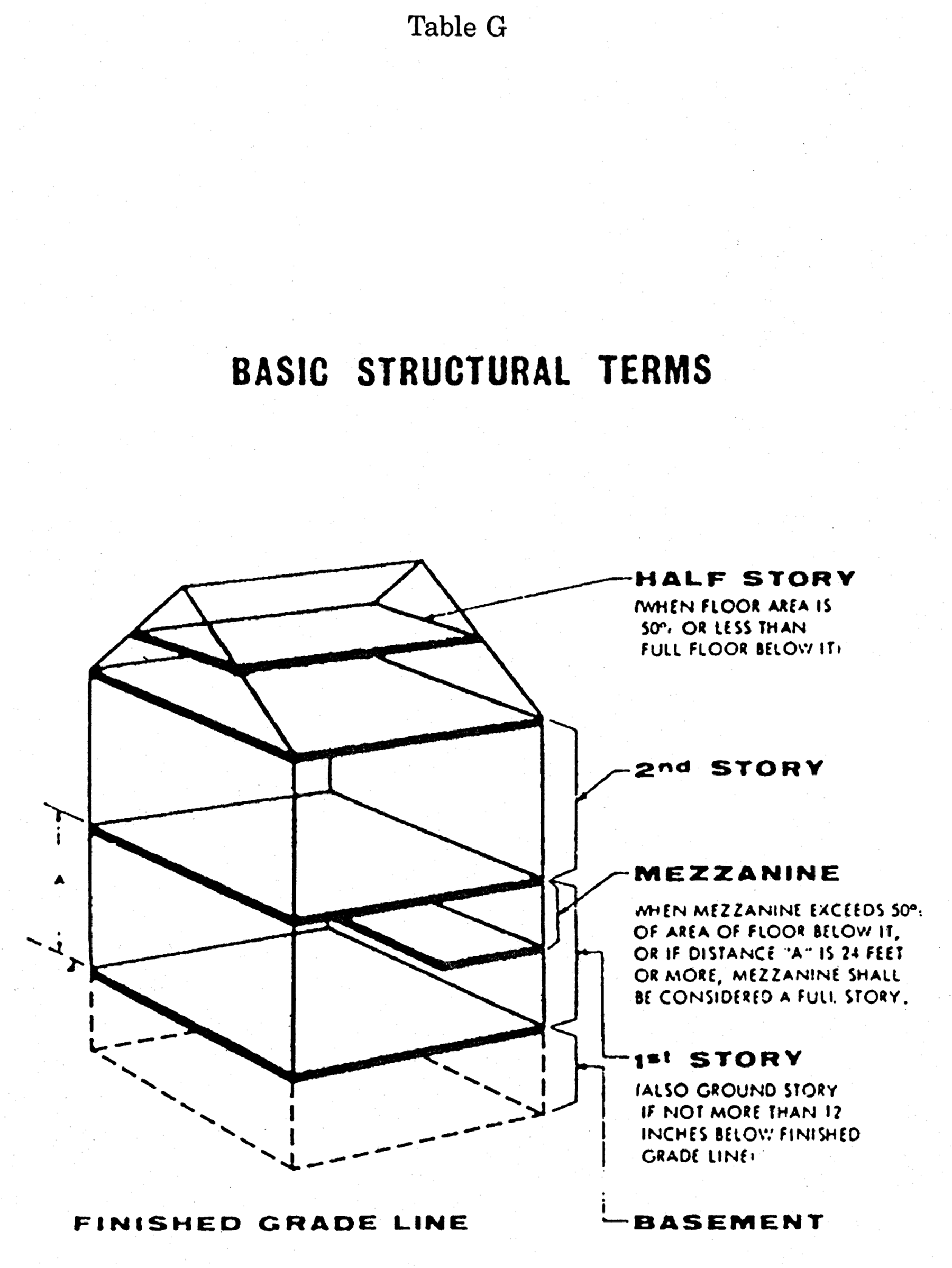
Table G—Basic Structural Terms
Table G—Basic Structural Terms
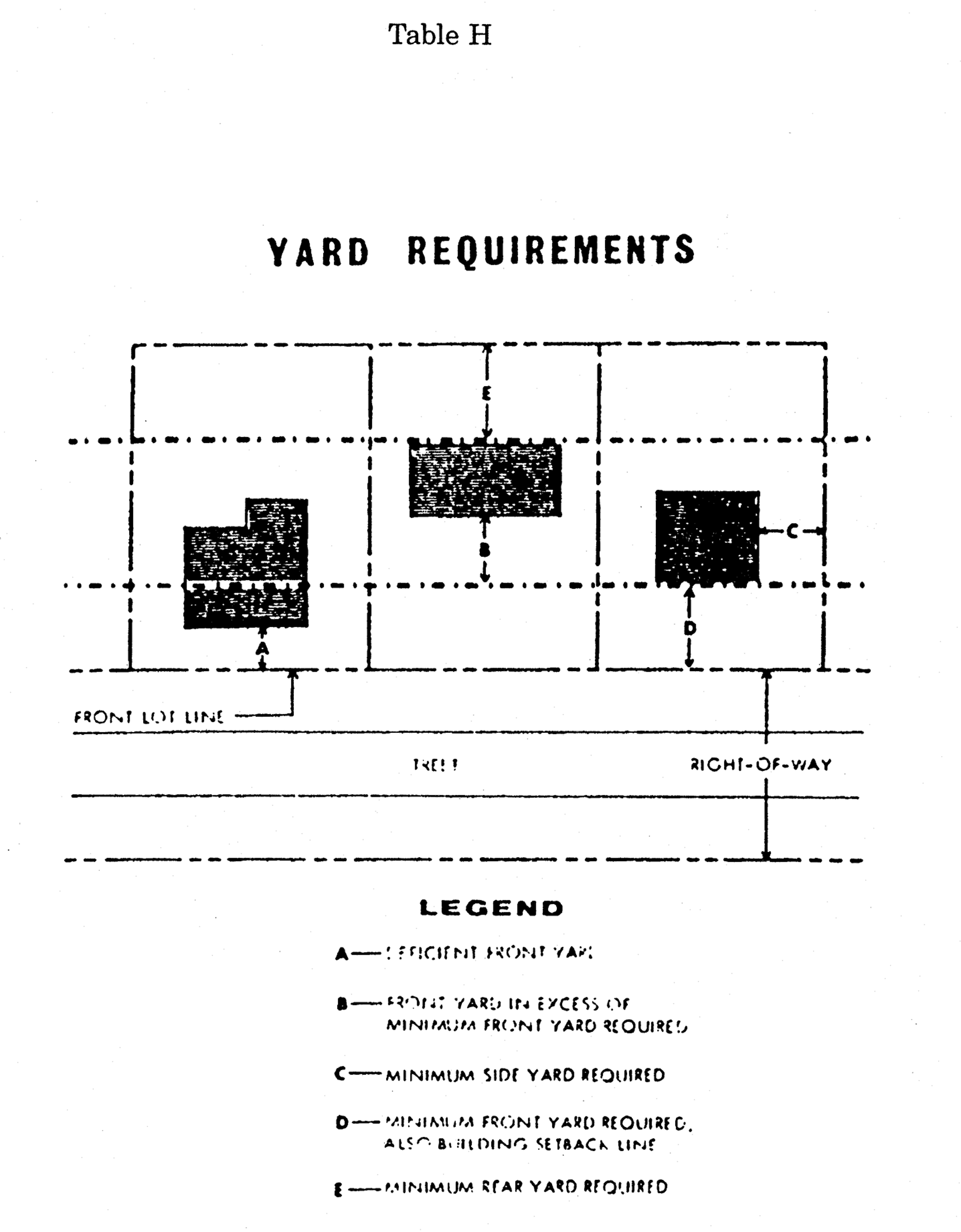
Table H—Yard Requirements
(Code 1980, §§ 5.3—5.13; Ord. No. 309, § 3, 10-19-98; Ord. No. 327, §§ I, II, 9-17-01; Ord. No. 350, § I, 11-1-04; Ord. No. 357, § I, 8-15-05; Ord. No. 358, § I, 12-12-05; Ord. No. 370, § II, 10-16-06; Ord. No. 407, §§ I, II, 7-15-13; Ord. No. 414, § IV, 6-16-14; Ord. No. 445, § I, 5-17-21; Ord. No. 451, § I, 8-15-22)
Cross reference— Definitions generally, § 1-2.
Sec. 90-4. - Districts.
The city is divided into 11 zoning districts known as follows:
E-R Estate Residential District.
R-1A Single-Family Residential District.
R-1B Single-Family Residential District.
R-T Terrace District.
RO-1 Restricted Office District.
C-1 Local Business District.
C-2 Central Business District.
T Transition District.
T-1 Transition-1 District.
T-2 Transition-2 District.
P-1 Vehicular Parking District.
(Code 1980, § 5.21; Ord. No. 358, § II, 12-12-05; Ord. No. 407, § III, 7-15-13)
Sec. 90-5. - Zoning map.
The boundaries of the zoning districts are shown upon the map which is on file in the city clerk's office and made a part of this chapter, which map is designated as the zoning map of the city. The zoning map and all notations, references and other information shown thereon are a part of this chapter and have the same force and effect as if the zoning map and all such notations, references and other information shown thereon were fully set forth or described in this chapter. Except where references on the map are to a street or other line designated by the dimensions shown on the map, the district boundary lines follow lot lines or the centerlines of the street or alley rights-of-way or such lines extended and the corporate limits of the city as they existed at the time of the adoption of this chapter.
(Code 1980, § 5.22)
Sec. 90-6. - Conflicting regulations.
Whenever any provision of this chapter imposes more stringent requirements, regulations, restrictions or limitations than are imposed or required by the provisions of any other law or ordinance, the provisions of this chapter shall govern.
(Code 1980, § 5.27)
Sec. 90-7. - Scope.
No building or structure, or part thereof, shall hereafter be erected, constructed, reconstructed or altered and maintained, and no new use or change shall be made or maintained of any building, structure or land, or part thereof, except in conformity with the provisions of this chapter.
(Code 1980, § 5.28)
Sec. 90-8. - Violations; penalties.
Any person violating or neglecting or refusing to comply with any of the provisions of this chapter, upon conviction thereof, shall be punished by imposition of a fine not to exceed $500.00 or by imprisonment for a period not to exceed 90 days, or by imposition of both fine and imprisonment in the discretion of the court. Each day that a violation exists shall constitute a separate offense.
(Code 1980, § 5.202)
Sec. 90-9. - Validity.
This chapter and the various articles, sections, paragraphs and clauses thereof are declared to be severable. If any article, section, paragraph or clause is adjudged unconstitutional or invalid, it is hereby provided that the remainder of the chapter shall not be affected thereby.
(Code 1980, § 5.203)
Sec. 90-10. - Interpretation, purpose and conflict.
In interpreting and applying the provisions of this chapter, they shall be held to be the minimum requirements for the promotion of the public safety, health, convenience, comforts, prosperity and general welfare. It is not intended by this chapter to interfere with or abrogate or annul any ordinance, rules, regulations, or permits previously adopted or issued and not in conflict with any of the provisions of this chapter, or which shall be adopted or issued pursuant to law relating to the use of buildings or premises, and likewise not in conflict with this chapter; nor is it intended by this chapter to interfere with or abrogate or annul any easements, covenants or other agreements between parties; provided, however, that where this chapter imposes a greater restriction or requires larger open spaces, or larger lot areas than are imposed or required by such chapter or agreements, the provisions of this chapter shall control.
(Code 1980, § 5.201)
Sec. 90-11. - Street and alley rights-of-way.
All street and alley rights-of-way, if not otherwise specifically designated, shall be deemed to be in the same zone as the property immediately abutting upon such street and alley rights-of-way. Where the centerline of a street or alley serves as a district boundary, the zoning of such street or alley, unless otherwise specifically designated, shall be deemed to be the same as that of the abutting property up to such centerline.
(Code 1980, § 5.29)
Sec. 90-12. - Permitted uses.
No building shall be erected, converted, enlarged, reconstructed or structurally altered, nor shall any building or land be used, designed or arranged for any purpose other than is permitted in the district in which the building or land is located.
(Code 1980, § 5.30)
Sec. 90-13. - Permitted area.
No building shall be erected, converted, enlarged, reconstructed or structurally altered, except in conformity with the area regulations of the district in which the building is located.
(Code 1980, § 5.31)
Sec. 90-14. - Permitted height.
No building shall be erected, converted, enlarged, reconstructed or structurally altered to exceed the height limit established in this chapter for the district in which the building is located, except that roof structures for the housing of elevators, stairways, tanks, ventilating fans or similar equipment required to operate and maintain the building, and fire or parapet walls, skylights, towers, steeples, stage lofts and screens, flagpoles, chimneys, smokestacks, individual domestic radio and television aerials and wireless masts, water tanks or similar structures may be erected above the height limits prescribed in this chapter. No such structure may be erected to exceed by more than 15 feet the height limits of the district in which it is located; nor shall such structure have a total area greater than 25 percent of the roof area of the building, nor shall such structure be used for any residential purpose or any commercial purpose other than a use incidental to the main use of the building.
(Code 1980, § 5.32)
Sec. 90-15. - Buildings on zoning lot.
Every building hereafter erected or structurally altered to provide dwelling units shall be located on a lot and in no case shall there be more than one such building on one lot unless otherwise provided in this chapter.
(Code 1980, § 5.33)
Sec. 90-16. - Lots, yards, open spaces.
No space which for the purpose of a building or dwelling group has been counted or calculated as part of a side yard, rear yard, front yard or other open space required by this chapter may by reason of change in ownership or otherwise be counted or calculated to satisfy or comply with a yard, court or other open space requirement of or for any other building. In any residential district, the front and rear yard requirements of a double frontage lot shall be the same as prescribed for any single lot in the zone wherein the double frontage lot is located.
(Code 1980, § 5.34)
Sec. 90-17. - Yard encroachments.
(a)
The following shall be considered as part of the building and shall not be allowed to encroach into any required yard or open space:
(1)
Outside stairways.
(2)
Fire escapes.
(3)
Fire towers.
(4)
Enclosed porches. An "enclosed porch" shall mean any porch with screen(s), roof(s) or removable storm window sash.
(5)
Balconies at any level of the building.
(6)
Boiler flues.
(7)
Other similar projections.
(b)
The following structure may encroach or project a maximum of 12 inches into a required yard:
(1)
One fireplace or chimney, which does not exceed eight feet in width.
(c)
The following may encroach or project a maximum of 18 inches into a required yard or open space:
(1)
Cornices not exceeding 18 inches in width, including the width of the gutter or downspout.
(d)
The following may encroach or project a maximum of 12 feet into a required front or rear yard, but in no case shall the encroachment be closer than four feet to an interior side lot line, or closer than five feet to a side lot line abutting upon a street:
(1)
Platforms.
(2)
Terraces.
(3)
Steps below the first floor.
(4)
Unenclosed porches
(5)
Ground level unenclosed projections not over one story in height.
(e)
The minimum yard spaces, including lot area per family and maximum lot coverage required by this chapter for each and every building existing at the time of the passage of this chapter or for any building hereafter erected, shall not be encroached upon or considered as yard or open space requirements for any other building.
(Code 1980, § 5.35; Ord. No. 374, § V, 8-20-07)
Sec. 90-18. - Use of yard spaces, other open areas for storage.
(a)
No front or other yard shall be used for the storage or parking of automobiles or any other material or equipment; provided that in residential areas not more than three automobiles with a current license and in operating condition may be parked on an approved service driveway, extending from the street directly to a side yard or a garage. (See also section 90-26.)
(b)
No machinery, equipment, vehicles, lumber piles, crates, boxes, building blocks or other materials either discarded, unsightly or showing evidence of a need for repairs, with or without a current license, shall be stored, parked, abandoned or junked in any open area that is visible from the street, public place or adjoining residential property; and should such use of land occur, it shall be declared to be a nuisance. In addition to penalties if such nuisance is not abated within ten days after the owner of the land is notified by the city manager, the city may perform the necessary work to eliminate the nuisance at the expense of the property owner; and if the property owner fails to reimburse the city within 30 days after receiving notice of the amount due from the city treasurer, the amount shall become a lien upon the property.
(Code 1980, § 5.36)
Sec. 90-19. - Substandard lots.
Any residentially zoned lot which was of record at the time of the adoption of this chapter that does not meet the requirements of this chapter for yards or other areas of open space may be utilized for single residence purposes, provided the area for such yard or court in width, depth, or open space is not less than 80 percent of that required by the terms of this chapter, except that vacant lots having in the aggregate a continuous frontage of 120 feet or more, regardless of ownership, shall not be subject to this exception. The purpose of this provision is to permit utilization of recorded lots which lack adequate width or depth as long as reasonable living standards can be provided.
(Code 1980, § 5.37)
Sec. 90-20. - Street access.
No dwelling shall be built, moved or converted upon a lot having a frontage of less than 20 feet upon a public street, or upon a private street or other permanent easement giving access to a public street. No building permit shall be issued for any construction located on any lot or parcel of land in the city that does not abut on a public street or highway or upon a private street fully improved according to chapter 70, relating to new subdivisions; provided, that this chapter shall not be the basis for preventing the issuance of a building permit for ordinary repair or maintenance of any building that is already erected on the date of the adoption of this chapter upon a lot or parcel of land that does not so abut such a street or highway. For the purpose of this chapter, no lot or parcel of land shall be construed to abut on such a street or highway unless it includes title to a minimum frontage of 20 feet on such a street or highway and title to land providing access not less than 20 feet in width from such street or highway to the proposed construction.
(Code 1980, § 5.38)
Sec. 90-21. - Visibility at intersections.
No structure, wall, fence, shrubbery or trees shall be erected, maintained or planted on any lot which will obstruct the view of the driver of a vehicle approaching an intersection, excepting that shrubbery and low retaining walls not exceeding 2½ feet in height above the curb level and shade trees where all branches are not less than eight feet above the street level will be permitted. For residential corner lots, this unobstructed area will be a triangular section of land formed by the two street curblines and a line connecting them at points 30 feet from the intersection of the curblines, or in the case of a rounded corner, the unobstructed area shall be construed to be an area formed by the curved curbline and an arc with a radius of 30 feet measured from the midpoint of the rounded corner at the curb extending from one street curb to the other street curb (e.g., the area being a football shape with two arcs facing each other, connected at each curbline).
(Code 1980, § 5.39)
Sec. 90-22. - Reserved.
Editor's note— Ord. No. 408, § I, adopted July 15, 2013, repealed § 90-22, which pertained to dwellings in nonresidential districts and derived from the Code of 1980, § 5.40.
Sec. 90-23. - Dwellings in other than main structure.
No residential structure shall be erected upon the rear of a lot or upon a lot with another dwelling, other than servants' quarters serving the principal building on the lot in accordance with requirements of section 90-207(4).
(Code 1980, § 5.41)
Sec. 90-24. - Number of buildings on lot, restricted.
Each dwelling hereafter erected or structurally altered shall be located on a lot and, except in the case of a terrace housing project, there shall be not more than one main building and an accessory building on any single lot. In order to permit the assembly of two or more adjoining lots by the owner of the lots for the purpose of erecting or constructing a principal building on the lots, there shall be required a declaration of restrictions running with the land executed by the owner and recorded with the county register of deeds, consolidating the lots into one single parcel which shall henceforth be deemed by the building inspector as a single lot and subject to all of the provisions contained in this chapter. The location of the dwelling and its accessory building on the lot shall conform with the general plan and scheme of the subdivision in which the lot is located.
(Code 1980, § 5.42)
Sec. 90-25. - Accessory buildings.
Accessory buildings, except as otherwise permitted in this chapter, shall be subject to the following regulations:
(1)
No more than one detached accessory building may be located on a residential lot except that a second detached accessory building no more than 100 square feet in area and no more than ten feet in height at the highest point may be located on a residential lot, provided the combined floor area of all accessory buildings does not exceed the maximum permitted area for accessory buildings allowed in the zoning district in which the lot is located.
(2)
Attached accessory buildings shall be subject to, and must conform with all regulations of this chapter applicable to main or principal buildings.
(3)
Detached accessory buildings shall only be located in a rear yard. Further, in no instance shall such a building be nearer than three feet to any adjoining side lot line nor closer than six feet to any adjoining rear lot line.
(4)
The highest point of a detached accessory building shall not exceed 20 feet. A detached accessory building greater than 18 feet in height at the highest point must maintain a minimum roof pitch of 6:12. Further, in no instance shall the highest point of a detached accessory building exceed the highest point of the main building.
(5)
No detached accessory building shall be located closer than ten feet to any main or principal building. On lots that are less than 100 feet deep, the building inspector may allow this distance to be reduced if he determines that there is adequate fire separation.
(6)
In the case of double frontage lots, accessory buildings shall observe front yard requirements on both street frontages wherever there are any principal buildings fronting on the streets in the same block or adjacent blocks.
(7)
In the case of corner lots detached accessory buildings shall be set back from the lot line adjacent to the side street at least as far as the main building and in no case shall be closer than 17 feet to the sidewalk, or to the property line if no sidewalk exists. The building inspector may allow a detached accessory building to be set back a minimum of 12 feet from the lot line adjacent to the side street on lots with a lot width of 40 feet or less if there are no other locations for a detached accessory building on the lot, provided that the proposed detached accessory building will be in keeping with the general development pattern of the immediately surrounding neighborhood.
(8)
When an accessory building is located in the rear yard area on a corner lot, the side lot line of which is substantially a continuation of the required front yard setback of the lot to its rear, the accessory building shall be set back from the street side at least as far as the established front yard setback of the lot at the rear of the subject corner lot.
(9)
Generally, attached accessory buildings shall be located completely to the rear of the principal building except as permitted on corner lots in section 90-25(8). However, on lots over 20,000 square feet where the principal building is set back a minimum of 50 feet from the front property line, an attached accessory building may project in front of the principal building, if the attached accessory building will meet the applicable front yard setback and, also, will be less than 50 percent of the width of the principal building.
(10)
In any residential zone, no attached accessory building shall be erected closer to the side lot line than the permitted distance for the dwelling.
(11)
Accessory buildings in single-family districts on lots that are less than 6,000 square feet in area shall not exceed 60 percent of the required rear yard or 600 square feet, whichever is less. Accessory buildings in two-family districts on lots that are less than 6,000 square feet in area shall not exceed 60 percent of the required rear yard or 800 square feet, whichever is less. Accessory buildings in single family and two-family districts on lots that are between 6,000 square feet and 11,999 square feet in area shall not exceed 65 percent of the required rear yard or 800 square feet, whichever is less. Accessory buildings in single family and two-family districts on lots that are 12,000 square feet, or more in area shall not exceed 40 percent of the required rear yard or 1,200 square feet, whichever is less. In no case shall an accessory building exceed the ground floor of the main structure.
(12)
All accessory buildings shall be included in the determination of compliance with the maximum lot coverage standards as specified in section 90-351 for the zoning district in which they are located.
(13)
All accessory buildings having a roof and walls shall be provided with a slab foundation and rat wall. Accessory buildings of more than 400 square feet must have a footing that complies with the International Residential Code.
(Ord. No. 1980, § 5.43; Ord. No. 350, § II, 11-1-04)
Sec. 90-26. - Parking, storage of mobile homes, travel homes, boats, trucks, other items.
Mobile homes, travel homes, boats, trucks and other items shall be subject to the following requirements:
(1)
No mobile home may be stored or parked on any lot.
(2)
No more than one travel home, and no more than one boat may be parked on any lot which is zoned or used for residential purposes.
(3)
Travel homes and boats, where parked or stored, shall be located only in the rear yard, and in addition shall conform to the required yard space requirements for accessory buildings in the zoning district wherein located.
(4)
On lots zoned for residential use, the maximum permitted lot coverage of all buildings, including travel home or boat storage space, shall not be exceeded.
(5)
All travel homes and boats shall be locked or secured at all times when not in use so as to prevent access thereto by children or others.
(6)
A suitable covering (e.g., tarpaulin) shall be placed over all boats and travel devices whenever they are not enclosed, in order to prevent vandalism by or injury to children.
(7)
Commercial trucks and trailers shall not be parked or stored on residentially zoned property at any time, except as provided for under section 90-207(4).
(8)
It shall be a prohibited use in all residentially zoned districts to park or store power driven construction equipment, used lumber or metal, or any other miscellaneous scrap or salvageable material.
(9)
It shall be a prohibited use in all zoned districts to park or store wrecked or junked vehicles.
(Code 1980, § 5.44)
Sec. 90-27. - Automobile service stations and public garages.
In order to regulate and control the problems of noise, odor, light, fumes, vibration, dust, danger of fire and explosion, and traffic congestion which result from the unrestricted and unregulated construction and operation of automobile service stations, and to regulate and control the adverse effects which these and other problems incidental to the automobile service station may exercise upon adjacent and surrounding areas, the following additional regulations and requirements are provided for automobile service stations located in any zone. All automobile service stations erected after the effective date of this Code shall comply with all requirements of this section. No automobile service station existing on the effective date of this Code shall be structurally altered so as to provide a lesser degree of conformity with the provisions of this section than existed on the effective date of this Code.
(1)
An automobile service station shall be located on a lot having a frontage along the principal street of not less than 140 feet, and having a minimum area of not less than 14,000 square feet.
(2)
An automobile service station building housing an office and/or facilities for servicing, greasing and/or washing motor vehicles shall be located not less than 40 feet from any street lot line, and not less than 25 feet from any side or rear lot line adjoining a residentially zoned district.
(3)
All driveways providing ingress to or egress from an automobile service station shall be not more than 30 feet wide at the property line. No more than one curb opening shall be permitted for each 50 feet of frontage or major fraction thereof along any street. No driveway or curb opening shall be located nearer than 20 feet to any corner or exterior lot line, as measured along the property line. No driveway shall be located nearer than 30 feet, as measured along the property line, to any other driveway giving access to or from the same automobile service station.
(4)
A raised curb six inches in height shall be erected along all street lot lines, except for driveway openings.
(5)
The entire lot, excluding the area occupied by a building, shall be hardsurfaced with concrete or a plant-mixed bituminous material, or, if any part of the lot is not so surfaced, then that area shall be landscaped and separated from all surface areas by a low barrier or curb.
(6)
All lubrication equipment, motor vehicle washing equipment, hydraulic hoists and pits shall be enclosed entirely within a building. All gasoline pumps shall be located not less than 15 feet from any lot line, and shall be arranged so that motor vehicles shall not be supplied with gasoline or serviced while parked upon or overhanging any public sidewalk, street or right-of-way.
(7)
An automobile service station located on a lot having an area of 14,000 square feet shall include not more than eight gasoline pumps and two enclosed stalls for servicing, lubricating, greasing and/or one enclosed stall may be included with the provision of each additional 2,000 square feet of lot area.
(8)
Where an automobile service station adjoins property located in any residential zone, a masonry wall five feet in height shall be erected and maintained between the station and required yard space, or if separated from the residential zone by an alley, then along the alley lot line. All masonry walls shall be protected by a fixed curb or barrier to prevent vehicles from contacting the wall. (See also section 90-39.)
(9)
All exterior lighting, including illuminated signs, shall be erected and hooded or shielded so as to be deflected away from adjacent and neighboring property.
(10)
No automobile service station or public garage shall be located nearer than 500 feet as measured from any point on the property line to any public or private school or playground.
(11)
Outdoor storage or parking of vehicles other than private automobiles shall be prohibited between the hours of 10:00 p.m. and 7:00 a.m.
(12)
No fuel tank shall be filled at an automobile service station except through a hose connected to a pump of a type approved by the Underwriters' Laboratories, Inc.
(13)
No gasoline or inflammable liquid shall be kept or conveyed in open receptacles or in glass bottles or other breakable containers on the premises of an automobile service station, except in glass bottles of not more than eight-ounce capacity used for sample purposes, and shall not be used for cleaning purposes on such premises. No gasoline pump shall be installed in any building.
(14)
All combustible waste and rubbish, including crankcase drainings, shall be kept in metal receptacles fitted with a tight cover until removed from the premises. No gasoline, oil, grease or inflammable liquid shall be allowed to flow into or be placed in the sewer system. Oil and grease shall not be allowed to accumulate on the floor. Sawdust shall not be kept in any automobile service station or place of storage therein, and sawdust or other combustible material shall not be used to absorb oil, grease or gasoline.
(15)
All automobile service station proprietors and attendants upon being notified by the building inspector of the presence of gasoline or volatile liquids in sewers shall cooperate in ascertaining the reason therefor. There shall be constantly maintained in good working order at least one, 2½ gallons fully charged, portable foam type fire extinguisher at each automobile service station.
(Code 1980, § 5.45)
Sec. 90-28. - Occupancy; garage apartments, basement apartments, mobile home dwellings, accessory buildings used for residential purposes.
No garage, basement, accessory building, temporary building or mobile home now existing or in the future erected or placed on a lot after the effective date of the zoning ordinance adopted February 20, 1967, shall be occupied or used for dwelling purposes. Expressly excepted from this regulation are living quarters for members of the family occupying the principal building located on the same lot and domestic servants employed by the family.
(Code 1980, § 5.46)
Sec. 90-29. - Building grades.
(a)
Any building requiring yard space shall be located at such an elevation that a sloping grade shall be maintained to cause the flow of surface water to run away from the walls of the building. A sloping grade, beginning at the curb level as determined by the building inspector, shall be maintained and established from the center of the front lot line to the finished grade line at the front of the building. The rear and side yards shall be sloped to allow for the flow of surface water away from the building without creating a nuisance. However, this shall not prevent the grading of a yard space to provide sunken or terraced areas, provided proper means are constructed and maintained to prevent the runoff of surface water from creating a nuisance on the adjacent properties.
(b)
When a new building is constructed on a vacant lot between two existing buildings or adjacent to an existing building, the reference level shall be used in determining the grade around the new building, and the yard around the new building shall be graded in such a manner as to meet existing grades and not to permit runoff of surface water to flow onto the adjacent properties.
(c)
Final grades shall be approved by the building inspector, who may require a certificate of grading and location of building within the city in accordance with the approved grading plan on file with the building department, which has been duly completed and certified by a registered civil engineer or land surveyor.
(Code 1980, § 5.47)
Sec. 90-30. - Buildings to be moved, placed on premises in city.
Any building or structure which has been wholly or partially erected on any premises shall not be moved to and be placed upon any premises in the city.
(Code 1980, § 5.48)
Sec. 90-31. - Excavations, holes.
The construction, maintenance or existence within the city of any unprotected, unbarricaded, open or dangerous excavations, holes, pits or wells, or of any excavations, holes or pits which constitute or are reasonably likely to constitute a danger or menace to public health, safety or welfare, is hereby prohibited; provided, however, this section shall not prevent any excavation under a permit issued pursuant to this chapter or the building code of the city, where such excavations are properly protected and warning signs posted in such manner as may be approved by the building department and, provided further, that this section shall not apply to streams, natural bodies of water or to ditches, streams, reservoirs or other major bodies of water created or existing by authority of the state, the county, the city or other governmental agency.
(Code 1980, § 5.49)
Sec. 90-32. - Excavation, removal and filling of land.
The use of land for the excavation, removal, filling or depositing of any type of earth material, topsoil, gravel, rock, garbage, rubbish, or other wastes or byproducts is not permitted in any zoning district except under a certificate from, and under the supervision of the building department in accordance with a topographic plan, approved by the city engineer, submitted by the feeholder owner of the property concerned. The topographic plan shall be drawn at a scale of not less than 50 feet equals one inch and shall show existing and proposed grades and topographic features and such other data as may from time to time be required by the city engineer. Such certificate may be issued in appropriate cases upon the filing with the application of a cash bond or surety bond by a surety company authorized to do business in the state running to the city in an amount as established by the city engineer which will be sufficient in amount to rehabilitate the property upon default of the operator of the excavating or filling operation, and to cover court costs and other reasonable expenses. This regulation does not apply to normal soil removal for basement or foundation work when a building permit has previously been duly issued by the building department. Costs of a permit to fill or excavate shall be established in accordance with section 90-71.
(Code 1980, § 5.50)
Sec. 90-33. - Restoring unsafe buildings.
Nothing in this chapter shall prevent the strengthening or restoring to a safe condition of any part of any building or structure declared unsafe by the building inspector or the required compliance with his lawful order.
(Code 1980, § 5.51)
Sec. 90-34. - Construction begun prior to adoption of chapter.
Nothing in this chapter shall be deemed to require any change in the plans, construction or designed use of any building upon which actual construction was lawfully begun prior to the adoption of this chapter, and upon which building actual construction has been diligently carried on, and provided further, that such building shall be completed within one year from the date of passage of this chapter.
(Code 1980, § 5.52)
Sec. 90-35. - Temporary use of premises as voting place.
The provisions of this chapter shall not be so construed as to interfere with the temporary use of any property as a voting place in connection with a municipal or other public election.
(Code 1980, § 5.53)
Sec. 90-36. - Approval of plats.
No proposed plat of a new subdivision shall hereafter be approved by the city council unless the lots within such plat equal or exceed the minimum size and width requirements set forth in the various districts of this chapter, and unless such plat fully conforms with the statutes of the state and this Code.
(Code 1980, § 5.54)
Sec. 90-37. - Essential services.
(a)
Essential services as defined in section 90-3 shall be permitted as authorized and regulated by law and other provisions of this Code, it being the intention to exempt such essential services from the application of this chapter.
(b)
The board of zoning appeals shall have the power to permit the erection and use of a building or an addition to an existing building, of a public service corporation or for public utility purposes, in any permitted district to a greater height or of larger area than the district requirement established in this chapter, and permit the location in any use district of a public utility building, structure or use, if the board shall find such use, height, area, building or structure reasonably necessary for the public convenience and service, provided such building, structure or use is designed, erected and landscaped to conform harmoniously with the general architecture and plan of such district.
(Code 1980, § 5.55)
Sec. 90-38. - Signs.
The erection, construction or alteration of all outdoor advertising structures, billboards, signs and other notices which advertise a business, commercial venture or name of a person or persons shall be approved by the building inspector as to compliance with all applicable city sign regulations and ordinances and all requirements of this chapter.
(Code 1980, § 5.56)
Sec. 90-39. - Protective screening.
In order to provide adequate protective screening for residential areas adjacent or near nonresidential areas, the following regulations shall apply:
(1)
Adjacent residential property. Where a C-2, T, T-1, or T-2 use abuts directly upon a residentially zoned district, an ornamental masonry wall, approved by the building inspector, not less than four feet or more than six feet in height above the grade shall be constructed along the abutting property line; or a building constructed along the building setback line between the properties and the residential area, with an unpierced masonry wall, having a brick face or a facing of other material meeting the approval of the building inspector.
When the building is constructed along the building setback line, the yard area required by article VII shall be landscaped and maintained by the owner of the C-2, T, T-1, or T-2 used properties.
The planting plans for the required yard or greenbelt area shall be subject to the approval of the building inspector as to the suitability of planting materials and arrangements. The planting shall be designed and arranged and shall be so maintained that within two years after it is planted it shall form a complete screening not less than four feet in height.
Where vehicles or open-air display exceed a height of five feet, the wall or screening shall be increased to a height of not to exceed 12 feet to completely screen the areas used for commercial purposes.
Where a greenbelt is provided and it is not sufficiently and properly maintained, the city manager, after five days' notice sent by regular mail to the owner thereof as shown on the latest assessment rolls, may take whatever steps are necessary to suitably maintain a greenbelt area and charge all the costs plus a fee of $25.00 to the abutting business or commercial property owner responsible for the maintenance.
(2)
Residential property across the alley. Any C-2 district on which a drive-in business, open air display, commercial parking lot or other uses are conducted shall be separated along its entire length from any adjacent residentially zoned district, located across a public alley of not less than 20 feet wide, by either a building housing a permitted use or by a solid ornamental masonry wall four to six feet in height above grade located, preferably, on the residential side of the public alley. Greater wall height may be required in accordance with subsection (1) above.
(Code 1980, § 5.57; Ord. No. 408, § II, 7-15-13; Ord. No. 445, § II, 5-17-21)
Sec. 90-40. - Animals.
No livestock shall be kept or maintained in any zone, except that for each dwelling unit the occupant may keep for his personal use domestic pets so long as they are not kept or used for commercial or breeding purposes, subject to all applicable provisions of this Code.
(Code 1980, § 5.58)
Sec. 90-41. - Trash containers.
Outside trash containers shall be permitted in R-T, RO-1, C-1, C-2, T, T-1, and T-2 districts provided that they comply with the following requirements:
(1)
Adequate vehicular access shall be provided to such containers for truck pickup either via a public alley or vehicular access aisle which does not conflict with the use of off-street parking areas or entrances to or exits from principal buildings nearby.
(2)
A solid ornamental screening wall or fence shall be provided around all sides of trash containers which shall be provided with a gate for access and be of such height as to completely screen the containers, the maximum height of which shall not exceed six feet.
(3)
The trash containers, the screening wall or fence and the surrounding ground area shall be maintained in a neat and orderly appearance, free from rubbish, waste paper or other debris. This maintenance shall be the responsibility of the owner of the premises on which the containers are placed.
(4)
There shall be compliance with all city, county and state health ordinances and statutes.
(Code 1980, § 5.59; Ord. No. 408, § III, 7-15-13)
Sec. 90-42. - Drive-in facilities for banks, similar financial institutions.
Drive-in facilities for banks and similar financial institutions shall be subject to the following requirements:
(1)
A site plan shall be submitted to the planning commission in accordance with section 90-283.
(2)
A site plan for the drive-in facility shall be submitted to the city planner, director of public safety and city engineer or traffic consultant for review and recommendation to the planning commission. The review will specifically address itself to the impact the drive-in facility would have on adjacent land uses and immediate traffic patterns.
(3)
The drive-in facility shall, in the opinion of the planning commission, substantially conform to the architectural style and building material of the principal building to which it is attached.
(4)
No more than two drive-in facilities in the principal building or an auxiliary building or more than three remote pneumatic tube installations shall be permitted for each bank or financial institution.
(5)
Drive-in facilities shall be so planned and designed as to effectively separate patrons utilizing the drive-in facility and patrons seeking service inside the principal building.
(6)
Each drive-in facility shall, in the opinion of the city engineer or traffic consultant, have adequate maneuvering space and a stacking space magazine for waiting cars at least 200 feet in length.
(Code 1980, § 5.60; Ord. No. 353, § I, 5-9-05; Ord. No. 408, § IV, 7-15-13)
Sec. 90-43. - Satellite dish antenna.
Placement of a satellite dish antenna in any zoning district in the city shall comply with the following requirements:
(1)
Permit required. Any satellite dish antenna which is to be constructed, placed or established in the open and not contained within a building in any zoning district shall be considered structures subject to the provisions and terms of this chapter and a permit for such installation shall be obtained from the building department prior to the installation of any satellite antenna. Antenna having a diameter of three feet or less and mounted on the roof of a building are exempted from the requirements of this section.
(2)
Requirements for permit.
a.
Applications for a permit to install a satellite dish antenna shall be submitted to the building department. The application shall include a site plan showing the proposed location of the installation; including building locations on the site and on any contiguous lot, a picture or sketch of all the elements of the antenna which would be exposed to view from adjacent properties and the dimensions of all buildings, size and exact location of the antenna, lot lines and setback lines as established in the zoning regulations.
b.
There shall be compliance with the following design standards:
1.
Maximum number per residential lot: one.
2.
Maximum diameter of antenna dish: ten feet.
3.
Maximum height: compliance with height limits of the zoning district wherein located, and as regulated under subsection (2)b.4 following.
4.
Location: Location in only the rear yard space between rear lot line and rear building line of the principal building on the site. There shall also be compliance with required yard setbacks for the zoning district wherein located. Roof installation is permitted but only if antenna and supports are not visible from any part of public street right-of-way at a six-foot height of vision.
5.
By placement of such antenna on the ground, area so occupied shall be considered in calculating compliance with lot coverage limits in this chapter.
6.
Signs, as defined in chapter 58, attached to or painted on satellite dish antenna are prohibited.
7.
The satellite dish antenna shall be designed so that both construction plans and final construction of the antenna meet the requirements of this section and the building code and afford safety to the public at time of high winds. Roof installation shall meet dead weight and wind loading and torque factors on roof structure strength.
c.
The building department shall submit all applications for a permit to install a satellite dish antenna to the planning commission, together with recommendations concerning screening, landscaping, fencing or other matters having an impact on adjoining properties. The planning commission shall establish a date for a public hearing on the application and shall cause a notice of the hearing to be sent to the owners of property located within 300 feet of the lot or parcel upon which the installation is proposed pursuant to notice of hearing procedures at section 90-102.
d.
The planning commission, after the public hearing where interested property owners shall have the opportunity to be heard, may grant the request, may deny the request (if it is found to be injurious to the surrounding neighborhood) or may grant the request subject to conditions. Such conditions may relate to the location, size, elevation, screening, landscaping, fencing or other matters having impact upon adjoining properties. A petitioner may appeal a determination of the planning commission to the board of zoning appeals. Upon approval of the application, the building department shall issue a permit for such installation.
(3)
Prior nonconforming installation. A satellite dish antenna in existence on the effective date of Ordinance No. 230 shall be deemed to be nonconforming and shall not be moved or relocated without first securing a permit for installation as provided in this section; and the owner or person in possession of such satellite dish antenna shall either remove same or report same to building inspector not later than July 1, 1985.
(Code 1980, § 5.61)
Sec. 90-44. - Commercial antennas.
(a)
Commercial radio, television, cable TV, cellular and other transmitting, receiving or relay antenna towers or poles housing one or more antennas are permitted in C-1, C-2, T, T-1, T-2 and P-1 districts and on property used or committed for other than residential or school purposes, subject to the provisions of this section.
(b)
Application for a special use permit for placement of a commercial antenna in any district shall be made to the city planning commission in accordance with procedures established by the city administration.
(c)
The city planning commission shall hold a public hearing with notice pursuant to section 4a of Act No. 207 of the Public Acts of Michigan of 1921 (MCL 125.581 et seq., MSA 5.2931 et seq.) as amended.
(d)
In making its determination of whether or not to recommend approval of the application, the city planning commission shall consider the following criteria:
(1)
Whether the requested use is essential or desirable to the public convenience or welfare.
(2)
Whether the proposed antenna tower or pole is of such location, size and character as to be compatible with the orderly development of the zoning district in which it is situated, and shall not be detrimental to the orderly development, property values, environment or use of adjacent properties and/or zoning districts.
(3)
In order to maximize the efficiency of the provision of telecommunication services, while also minimizing the impact of such facilities on the city, co-location, or the provision of more than one facility at a single location shall be encouraged by the city planning commission. In this regard the applicant may be required to provide information regarding the feasibility of co-location at proposed sites. Further the applicant may be required to provide a letter of intent to lease excess space on a facility and commit itself to:
a.
Respond to any requests for information from another potential shared use applicant;
b.
Negotiate in good faith and allow for leased shared use if an applicant demonstrates that it is technically practicable; and
c.
Make no more than a reasonable charge for a shared use lease.
(e)
If the city planning commission determines that the applicant has met the above criteria, it may recommend to the city council that the application be approved.
(f)
The city council may grant the permit if it determines that the following standards have been met:
(1)
A 40 percent fall zone shall be required for any antenna tower or pole. Fall zone percentage means the distance relative to the height of the tower or pole, as measured from surrounding grade to the uppermost element of the antenna, which the tower or pole must set back from all adjacent property lines.
(2)
All transmission lines related to and serving any antenna tower or pole shall be placed underground.
(3)
Antenna towers or poles may be on owned or leased premises, on top of or adjacent to existing buildings, steeples or other towers, subject to setback standards as measured from surrounding grade for freestanding towers and poles.
(4)
Antenna towers, poles and related equipment shelter buildings shall be subject to site plan review as provided in this chapter. Equipment shelter buildings shall be constructed of face brick on all sides with gable roof.
(5)
Equipment shelter buildings shall be considered as accessory buildings to the principal use (i.e., antenna tower or pole) and shall comply with building setback and height standards at section 90-25.
(6)
Antenna towers shall not exceed 150 feet in height as measured from surrounding grade.
(g)
A permit may include reasonable conditions for the protection of the health and safety of the public, including requiring periodic structural and safety inspections or reports. A permit may also require the hold to provide a cable television or telecommunications carrier with nondiscriminatory access to the antenna or pole if (1) there is sufficient capacity and (2) there is no safety or reliability reason to deny access under generally applicable engineering standards. Violation of any such reasonable condition shall be grounds for revocation of a permit by the city council after notice to the holder and an opportunity for hearing.
(h)
On application for a permit, a fee shall be paid in accordance with a commercial antenna schedule established from time to time by resolution of the city council.
(i)
Issuance, amendment or renewal of a permit shall not limit or impair the right of the city to acquire any property, right or interest by eminent domain proceedings.
(Ord. No. 298, § 1, 3-18-96; Ord. No. 408, § V, 7-15-13)
Sec. 90-45. - Play structures.
(a)
No owner or tenant of any residential property within the city shall install or maintain play structures on any residential property owned or controlled by him or her within the city if such play structures do not conform to the regulations contained in this chapter.
(b)
No play structure shall be installed or maintained within the residential areas of the city, which play structure exceeds 100 square feet of gross floor area as measured within the outside walls of the structure, or ten feet in height. Further, no play structure shall be installed or maintained within ten feet of any property line of the property where such equipment is installed or maintained. No play structure shall be installed or maintained in the front yard area of any residence.
(c)
Any play structure having a roof and walls must also have a slab foundation and a rat wall.
(Ord. No. 327, § III, 9-17-01; Ord. No. 350, § III, 11-1-04)
Sec. 90-46. - Prohibition of marihuana establishments.
(a)
Marihuana establishments, as authorized by and defined in the Michigan Regulation and Taxation of Marihuana Act (the "Act"), are prohibited in all zoning districts, and shall not be permitted as home occupations under section 90-3 of this chapter.
(b)
No use that constitutes or purports to be a marihuana grower, marihuana safety compliance facility, marihuana processor, marihuana microbusiness, marihuana retailer, marihuana secure transporter or any other type of marihuana related business authorized by the Act, that was engaged in prior to the enactment of this section, shall be deemed to have been a legally established use under the provisions of the city zoning code; i.e., that use shall not be entitled to claim legal nonconforming status.
(c)
This section does not superseded rights and obligations with respect to the transportation of marihuana by marihuana secure transporters through the city to the extent provided by the Act.
(Ord. No. 436, § I, 12-17-18)

