
Grosse Pointe City Zoning Code
ARTICLE VI
- DISTRICT REGULATIONS
DIVISION 2. - E-R ESTATE RESIDENTIAL DISTRICT[3]
Editor's note— Ord. No. 358, § IV, adopted December 12, 2005, amended division 2 in its entirety to read as herein set out. Former division 2, §§ 90-206—90-208, pertained to R-1A single-family residential district, and derived from §§ 5.101—5.103 of the 1980 Code; Ord. No. 298, § 1, 3-18-96; Ord. No. 303, § 1, 6-16-97; Ord. No. 309, § 1, 10-19-98; Ord. No. 350, § V, 11-1-04.
DIVISION 3. - R-1A SINGLE-FAMILY RESIDENTIAL DISTRICT[4]
Editor's note— Ord. No. 358, § IV, adopted December 12, 2005, amended division 3 in its entirety to read as herein set out. Former division 3, 90-221—90-223, pertained to R-1B single-family residential district, and derived from §§ 5.108—5.110 of the 1980 Code; Ord. No. 298, § 1, 3-18-96; Ord. No. 303, § 2, 6-16-97; Ord. No. 309, § 2, 10-19-98; Ord. No. 350, § VI, 11-1-04.
DIVISION 4. - R-1B SINGLE-FAMILY RESIDENTIAL DISTRICT[5]
Editor's note— Ord. No. 358, § IV, adopted December 12, 2005, amended division 4 in its entirety to read as herein set out. Former division 4, §§ 90-236—90-238, pertained to R-2 two-family residential district, and derived from §§ 5.115—5.117 of the 1980 Code; Ord. No. 298, § 1, 3-18-96; Ord. No. 303, § 3, 6-16-97; Ord. No. 350, § VII, 11-1-04.
DIVISION 6. - RO-1 RESTRICTED OFFICE DISTRICT[6]
Editor's note— Ordinance No. 348, § I, adopted May 17, 2004, amended Ch. 90, Art. 6, Div. 6 in its entirety. Formerly, such sections pertained to similar provisions and derived from §§ 5.129—5.134 of the 1980 Code.
DIVISION 11. - T-2 MIXED USE TRANSITION-2[7]
Editor's note— Ord. No. 389, § VIII, adopted October 19, 2009, set out provisions intended for use as §§ 90-335A—343A. For purposes of clarity, and at the editor's discretion, these provisions have been included as §§ 90-345—90-350.3.
Sec. 90-206.- Statement of purpose.
The E-R estate residential district is established exclusively for single-family residential and municipal uses. This district is tailored to certain residential estate areas having characteristics of planned residential developments, larger lot sizes, and a relationship to the lake. The specific intent of this district is:
(1)
To encourage the construction and continued use of the land for single-family dwellings.
(2)
To encourage the continued use and improvement of significant accessory structures such as garages, coach houses, pool houses, etc. of the existing homes and accessory structures.
(3)
To provide special zoning provisions that reflects the unique characteristics and architectural heritage of the existing homes of the city.
(4)
To preserve the estates of Gross Pointe by discouraging the subdivision of existing lots.
(5)
To prohibit business, commercial, or industrial use of the land, and to prohibit any other use which would substantially interfere with the development and maintenance of single-family dwellings.
(6)
To encourage the discontinuance of existing uses that would not be permitted as new uses under the provisions of this chapter.
(7)
To discourage any land use which would generate traffic on minor or local streets, other than normal traffic to serve those residences.
(8)
To discourage any use which because of its character or size would create requirements or costs for public services such as fire and police protection, water supply, and sewerage, substantially in excess of such requirements and costs if the district were developed solely for single-family dwellings.
(Ord. No. 358, § IV, 12-12-05)
Sec. 90-207. - Permitted uses.
In the E-R district the following uses are permitted:
(1)
Single-family detached dwellings.
(2)
Municipal buildings and uses pursuant to plans being reviewed and approved by the planning commission and subject to the review standards set forth in sections 90-74 and 90-75.
(3)
Municipal parks, municipal recreation areas, and municipal community centers pursuant to plans being reviewed and approved by the planning commission and subject to the review standards set forth in sections 90-74 and 90-75.
(4)
Home occupations as limited and defined in section 90-3.
(5)
Temporary buildings for use incidental to the construction work as approved by the board of zoning appeals for a period not to exceed six months, subject to renewal, which buildings shall be removed upon the completion or abandonment of the construction work.
(6)
Commercial antennas only as permitted in section 90-44 and subject to those provisions.
(7)
Wireless communication facilities only as permitted in section 90-44 and subject to those provisions.
(8)
State licensed residential facilities, except for adult foster care facilities for care and treatment of persons released from or assigned to adult correctional facilities.
(Ord. No. 358, § IV, 12-12-05; Ord. No. 370, § XVI, 10-16-06)
Sec. 90-208. - Accessory uses and structures.
(1)
Accessory buildings or uses customarily incidental to any of the permitted uses, when located on the same lot and not involving any business, profession, trade or occupation. Subject to the following provisions:
a.
One private detached garage for each residential lot in which there are housed not more than one commercial vehicle not larger than a regularly manufactured pickup or panel truck of three-quarter-ton capacity which shall be housed within a garage and provided the commercial vehicle is owned and operated by a member of the family who resides in the living unit. (Refer also to section 90-28(8)).
b.
All accessory buildings shall conform and be located as required in section 90-25.
c.
Private swimming pools as defined in section 90-3.
d.
Additional living quarters shall be considered an accessory use if used for household staff employed at subject property.
(Ord. No. 358, § IV, 12-12-05)
Sec. 90-209. - Area, height, bulk, and placement requirements.
The area, height, bulk and placement requirements for the E-R district shall be in accordance with the schedule of regulations in section 90-351 et seq.
(Ord. No. 358, § IV, 12-12-05)
Sec. 90-210. - Specifically prohibited uses.
In order to clarify the type of permitted uses in the E-R estate residential district, the following uses, among others, are specifically prohibited:
(1)
Short-term rental units.
(Ord. No. 451, § II, 8-15-22)
Sec. 90-221.- Statement of purpose.
The R-1A, single-family residential district provides for a principal land use of single-family dwellings and related educational, cultural, and religious uses where found appropriate and harmonious with the residential environment. In promoting the general purpose of this chapter, the specific intent of the R-1A, single family residential district is:
(1)
To encourage the construction and continued use of the land for single-family dwellings.
(2)
To preserve the existing design of the district characterized by larger homes, lots, and open spaces by discouraging the division of existing lots.
(3)
To prohibit business, commercial, or industrial use of the land, and to prohibit any other use which would substantially interfere with the development and maintenance of single-family dwellings.
(4)
To encourage the discontinuance of existing uses that would not be permitted as new uses under the provisions of this chapter.
(5)
To discourage any land use which would generate traffic on minor or local streets, other than normal traffic to serve those residences.
(6)
To discourage any use which because of its character or size would create requirements or costs for public services such as fire and police protection, water supply, and sewerage, substantially in excess of such requirements and costs if the district were developed solely for single-family dwellings.
(Ord. No. 358, § IV, 12-12-05)
Sec. 90-222. - Permitted uses.
In the R-1A district the following uses are permitted:
(1)
Any use permitted in, and subject to, the provisions of the E-R, estate residential district.
(2)
Religious and other facilities normally incidental thereto, provided that the proposed site for a religious facility is not less than five acres, that there is adequate access to all off-street parking areas, and that there is no parking in the required front yard, that the site is adjacent to a major thoroughfare as defined in the city's comprehensive master plan, and subject to site plan review and approval from the planning commission and subject to the review standards set forth in sections 90-74 and 90-75.
(3)
Public, parochial, and private elementary, junior, and senior high schools offering courses in general education and libraries, not operated for profit, and subject to site plan review and approval from the planning commission.
(4)
Private non-profit theatrical facilities, subject to the following use, locational, and design standards:
a.
Use must have direct access to and principal footage upon a thoroughfare or collector street as defined by the city's comprehensive development plan.
b.
Minimum size of site shall be 20,000 square feet.
c.
Maximum building size on site shall be 7,500 square feet.
d.
Minimum yard spaces, maximum building height, and maximum lot coverage shall be as required in section 90-351 and section 90-352.
e.
Only one non-illuminated identification sign not larger than 12 square feet in area is permitted on the premises.
f.
No shows, theatrical productions, or other types of stage performances for the public, with or with out charge, shall be permitted.
g.
Rehearsals or any other music-producing effects shall be limited to the hours between 9:00 a.m. and 11:00 p.m.
(5)
Commercial antennas only as permitted in section 90-44 and subject to those provisions.
(6)
State licensed residential facilities, except for adult foster care facilities for care and treatment of persons released from or assigned to adult correctional facilities.
(Ord. No. 358, § IV, 12-12-05; Ord. No. 370, § XVII, 10-16-06)
Sec. 90-223. - Area, height, and bulk, and placement requirements.
The area, height, bulk, and placement requirements for the R-1A district shall be in accordance with the schedule of regulations in section 90-351 et seq.
(Ord. No. 358, § IV, 12-12-05)
Sec. 90-224. - Specifically prohibited uses.
In order to clarify the type of permitted uses in the R-1A residential district, the following uses, among others, are specifically prohibited:
(1)
Short-term rental units.
(Ord. No. 451, § III, 8-15-22)
Sec. 90-236.- Statement of purpose.
The purpose of the R-1B, single-family residential district is to establish a principal land use of single-family residential and to provide for the existing two-family dwellings within the city. The specific intent of this section is:
(1)
To encourage the construction and continued use of the land for single-family dwellings.
(2)
Provide for the varying lot sizes within this district to promote reinvestment and maintenance of the property.
(3)
To preserve the balance between single-family and two-family housing stock by allowing only existing lots with two-family dwelling units to be rebuilt.
(4)
Encourage the design and maintenance of two-family dwelling units to be consistent with the surrounding single-family homes.
(5)
To prohibit business, commercial, industrial, or any other use of the land, which would substantially interfere with the development and maintenance of the existing residences.
(6)
To encourage the discontinuance of existing uses that would not be permitted as new uses under the provisions of this chapter.
(7)
To discourage any land use which would generate traffic on minor or local streets, other than normal traffic to serve those residences.
(8)
To discourage any use which because of its character or size would create requirements or costs for public services such as fire and police protection, water supply, and sewerage, substantially in excess of such requirements and costs if the district were developed solely for single-family or two-family dwellings.
(Ord. No. 358, § IV, 12-12-05)
Sec. 90-237. - Permitted uses.
In the R-1B district the following uses are permitted:
(1)
Any use permitted in, and subject to, and subject to the provisions of the R-1A, single-family residential district.
(2)
State licensed residential facilities, except for adult foster care facilities for care and treatment of persons released from or assigned to adult correctional facilities.
(Ord. No. 358, § IV, 12-12-05; Ord. No. 370, § XVIII, 10-16-06)
Sec. 90-238. - Permitted uses after special land use review.
(1)
Two-family dwellings, subject to the special land use review standards as stated in section 90-75 and subject to the following provisions:
a.
The two-family dwellings must be an existing use on the subject property at the time of this Code amendment adoption.
b.
Only one entrance per two-family dwelling unit shall be visible from each public right-of-way.
c.
The structure must have the overall appearance of a single-family dwelling including but not limited to such items as: architectural design, roof design, garage and driveways.
(Ord. No. 358, § IV, 12-12-05)
Sec. 90-239. - Area, height, and bulk, and placement requirements.
The area, height, bulk, and placement requirements for the R-1B district shall be in accordance with the schedule of regulations in section 90-351 et seq.
(Ord. No. 358, § IV, 12-12-05)
Sec. 90-240. - Specifically prohibited uses.
In order to clarify the type of permitted uses in the R-1B residential district, the following uses, among others, are specifically prohibited:
(1)
Short-term rental units.
(Ord. No. 451, § IV, 8-15-22)
Sec. 90-251.- Statement of purpose.
The R-T terrace district is designed to permit residential use of land with terrace types of multiple dwellings and related uses. These areas would be located near major streets for good accessibility and be designed to complement adjacent single-family areas. Various types and sizes of residential accommodations for ownership or rental would thereby be provided to meet the needs of the different age and family groups in the community without over-taxing existing community facilities, utilities or services.
(Code 1980, § 5.121)
Sec. 90-252. - Permitted uses.
In the R-T district the following uses are permitted:
(1)
All uses permitted in the R-1A and R-1B districts, subject to all requirements for such uses in zoning districts where first permitted.
(2)
Terrace dwellings and apartment houses.
(3)
Hospitals and nursing homes, provided that the proposed site for a hospital or nursing home is not less than five acres, that there is adequate access to all required off-street parking areas, that there is no parking in the required front yard, that the site is adjacent to a major thoroughfare as defined on the city's comprehensive development plan, and that approval is secured from the city council.
(4)
Semiprivate, nonprofit clubs.
(5)
Signs, as regulated by chapter 58, and when located on the same lot pertaining to the use of the particular building or buildings, provided that they shall not overhang any public right-of-way; shall not be illuminated; shall not exceed six square feet in area; shall not project higher than four feet above the level of the ground; and shall not indicate any other information except the name or address of the building or management thereof. For community facility uses as enumerated in subsections (3) and (4), signs shall be in accordance with chapter 58. Signs for off-street parking areas, open or enclosed, are permitted providing they do not exceed two square feet in area and are not higher than seven feet above curb level.
(6)
Community garages and carports serving the principal residential building, containing space for no more than two passenger vehicles for each dwelling unit in the principal building on the lot, and having common and unpierced dividing walls between every two contiguous private garages or carports. Further, there shall be compliance with standards at section 90-25(8).
(7)
Private swimming pools (as regulated by section 14-176 et seq.) designed and operated only for occupants of the principal building and their personal guests.
(8)
Off-street parking in accordance with the requirements of article V.
(9)
Commercial antennas only as permitted in section 90-44 and subject to those provisions.
(10)
State licensed residential facilities, except for adult foster care facilities for care and treatment of persons released from or assigned to adult correctional facilities.
(Code 1980, § 5.122; Ord. No. 298, § 1, 3-18-96; Ord. No. 303, § 4, 6-16-97; Ord. No. 358, § IV, 12-12-05; Ord. No. 370, § XIX, 10-16-06)
Sec. 90-253. - Specifically prohibited uses.
In order to clarify the type of permitted uses in the R-T terrace residential district, the following uses, among others, are specifically prohibited:
(1)
Rental offices, as accessory to a terrace dwelling unit project or an apartment house project.
(2)
Tourist home, lodging house, boarding house or short-term rental units.
(3)
Motel, hotel or mobile home park.
(4)
A residential structure for a home for children of other than those residing therein, or for the aged, indigent or physically handicapped; or a rest or convalescent home.
(Code 1980, § 5.123; Ord. No. 451, § V, 8-15-22)
Sec. 90-254. - Reserved.
Editor's note— Ord. No. 455, § XII, adopted March 20, 2023, repealed § 90-254, which pertained to site plan review and derived from the Code of 1980, § 5.124.
Sec. 90-255. - Area, height, bulk and placement requirements.
The area, height, bulk and placement requirements for the R-T district shall be in accordance with the schedule of regulations in section 90-351 et seq.
(Code 1980, § 5.125)
Sec. 90-266.- Statement of purpose.
The RO-1 restricted office district is intended to permit those office and restricted business uses which will provide opportunities for local employment close to residential areas, thus reducing travel to and from work; and which will provide clean, modern office buildings in landscaped settings; which will provide, adjacent to residential areas appropriate districts for uses which do not generate large volumes of traffic, traffic congestion and parking problems; and which will promote the most desirable use of land in accordance with the comprehensive development plan.
(Ord. No. 348, § I, 5-17-04)
Sec. 90-267. - Permitted uses.
In the RO-1 district the following uses are permitted:
(1)
Uses resulting from any of the following occupations: executive, administrative, professional, accounting, banking, clerical, stenographic and drafting.
The above uses shall not be construed to eliminate offices of recognized manufacturers' agents, provided that no display will be in an exterior show window, and the total area devoted to display including both the objects displayed and the floor space set aside for persons observing the displayed objects, shall not exceed 15 percent of the usable floor area of the establishment using the display of an actual product for sale as a sales procedure; provided that there shall be no outdoor storage of goods or material, irrespective of whether or not they are for sale, and provided further, that there shall be no warehousing or indoor storage of goods or material, irrespective of whether or not they are for sale, and provided further, that there shall be no warehousing or indoor storage of goods or material beyond that normally incidental to the above permitted office type uses.
(2)
Medical or dental centers, not including veterinarian hospital or any type of medical facility permitting overnight patients.
(3)
Professional office of a medical doctor, osteopath, chiropractor, dentist, architect, lawyer, professional engineer, land surveyor or city planner.
(4)
Publicly owned building and public utility offices, transformer stations and substations but not including storage yards.
(5)
There shall be no accessory structures in a RO-1 district except that signs may be permitted, providing they pertain to a use conducted within the main building and shall be displayed flat against the side of the building and not project above the roof line. Such signs shall not have flashing illumination and shall not exceed 12 square feet in area for anyone building. One sign shall be permitted for each office or clinic use in a building; such sign shall not exceed ten square feet in area.
(Ord. No. 348, § I, 5-17-04)
Sec. 90-268. - Permitted uses after special approval.
In the RO-1 restricted office district, the following special approval uses are permitted, subject to application design and location criteria, and to the approval of the city planning commission after public hearing and notice pursuant to the requirements of this section and to site plan review as provided under section 90-269:
(1)
Barbershop or beauty shop, with the condition that the planning commission may modify the parking requirements provided the applicant can demonstrate to the satisfaction of the planning commission that there is adequate parking available for the proposed use after considering; the intensity of the proposed use, the hours of operation of the proposed use and other uses within the same block, public parking available within the same block, available on-street parking, or shared parking arrangements with other uses within the same block.
(2)
Uses similar to the principal permitted uses provided in section 90-267, permitted uses, after the planning commission has determined that such uses are in harmony with the character of the district and the purpose and intent of the master plan of the city.
(3)
Dance studios, fitness centers, yoga studios, or similar uses as determined by the planning commission, with the condition that the planning commission may modify the parking requirements provided the applicant can demonstrate to the satisfaction of the planning commission that there is adequate parking available for the proposed use after considering; the intensity of the proposed use, the hours of operation of the proposed use and other uses within the same block, public parking available within the same block, available on-street parking, or shared parking arrangements with other uses within the same block.
(Ord. No. 348, § I, 5-17-04; Ord. No. 391, § I, 7-19-10; Ord. No. 434, § I, 7-18-18)
Sec. 90-268A. - Specifically prohibited uses.
In order to clarify the type of permitted uses in the RO-1 restricted office district, the following uses, among others, are specifically prohibited:
(1)
Short-term rental units.
(Ord. No. 451, § VI, 8-15-22)
Sec. 90-269. - Reserved.
Editor's note— Ord. No. 455, § XIII, adopted March 20, 2023, repealed § 90-269, which pertained to site plan review and derived from Ord. No. 348, adopted May 17, 2004.
Sec. 90-270. - Off-street parking facilities.
In RO-1 districts, off-street parking facilities shall be provided as specified in article V of this chapter, with the further condition that no parking be permitted in the front yard, nor within five feet of any side or rear property zoned E-R, R-1A, R-1B or R-T, or which is adjacent to any property or lot used for residential purposes. (Refer to section 90-159 for off-street parking development regulations.)
(Ord. No. 348, § I, 5-17-04; Ord. No. 358, § IV, 12-12-05)
Sec. 90-271. - Landscaping.
Along any property line of an RO-1 district abutting a residentially zoned district a five-foot greenbelt shall be maintained. The greenbelt shall be sodded, planted and shrubbed to form a permanent screen which shall be maintained at a height of not less than four feet or more than seven feet.
(Ord. No. 348, § I, 5-17-04)
Sec. 90-272. - Architectural plans.
In RO-1 districts, all architectural plans for buildings shall be presented to the city council and receive its approval prior to submitting plans to the building inspector for approval and issuance of a building permit. It is intended that such buildings, when located adjacent to a residential area, shall take on the appearance of residential buildings in order to preserve the general character of the residential neighborhood.
(Ord. No. 348, § I, 5-17-04)
Sec. 90-273. - Area, height, bulk and placement regulations.
The area, height, bulk and placement requirements for RO-1 districts shall be in accordance with the schedule of regulations in section 90-351 et seq.
(Ord. No. 348, § I, 5-17-04)
Sec. 90-274.- Statement of purpose.
The neighborhood commercial (NC) district is intended to maintain a mix of small scale, office, retail, residential and service uses while maintaining the unique physical characteristics of the district such as the generous private frontage area, protect the adjacent residential uses, and balance the demand for parking.
Further, it is designed and intended to:
(1)
Maintain the existing character of the NC district by developing regulations that require parking to be located to the rear or sides of buildings.
(2)
Balance the need to maintain a critical mass of buildings with the need for adequate parking by developing parking requirements that accurately reflect the demand for parking in this business district.
(3)
Promote a compatible balance of neighborhood retail uses that conveniently serve the commercial needs of the surrounding neighborhood, office uses to maintain a viable commercial district and maximize the use of the existing parking supply.
(4)
Encourage the shared use of private parking lots to maximize the use of the existing parking supply.
(5)
Maintain the current boundaries of the NC district.
(6)
Establish definitive screening requirements to protect the adjacent residential uses to the west including decorative fencing and landscaping.
(7)
Enhance the appearance of the parking areas and public sidewalk areas.
(Ord. No. 414, § I, 6-16-14)
Sec. 90-275. - Permitted uses.
The following table lists the permitted, special approval, accessory, and not permitted uses allowed in the NC district:
;adv=6; 1 Use over 5,000 square feet in area may be permitted subject to special use approval.
(Ord. No. 414, § I, 6-16-14; Ord. No. 451, § VII, 8-15-22)
Sec. 90-276. - Protective screening.
(a)
Any surface parking visible from a public street must be screened from the street with a three-foot tall decorative wall constructed of brick or stone. The reviewing body including; planning commission, city manager, or his designee may allow alternative screening methods that are in keeping with the intent to protect adjacent roads and residential uses, the intent to provide consistent screening throughout the district, and that are compatible with the architecture of adjacent buildings.
(b)
Residential uses or zoning shall be screened from adjacent parking lots with a decorative brick or stone wall a minimum of six feet in height. The reviewing body including planning commission, city manager, or his designee, may require an eight-foot decorative brick or stone wall to screen more intensive activities such as garbage collection or loading areas.
(Ord. No. 414, § I, 6-16-14)
Sec. 90-277. - Development standards.
(a)
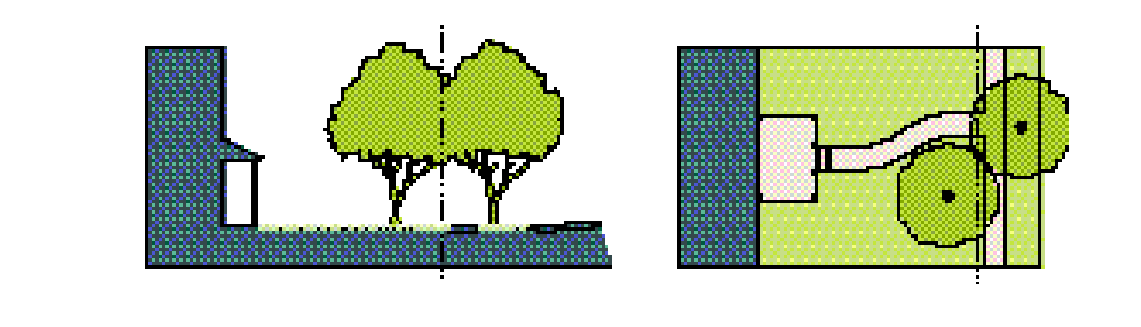
Private frontage. The private frontage is the area between the right-of-way and the principal building façade. Buildings must contain architectural elements consistent with one of the following four private frontages. Each frontage is designed to be consistent with some or all of the uses permitted in the NC district.
Note that the following table includes specific dimensional requirements for each of the frontages. Unless otherwise noted, the dimensional requirements are in addition to any other dimensional requirement of this section:
Shopfront Illustration:
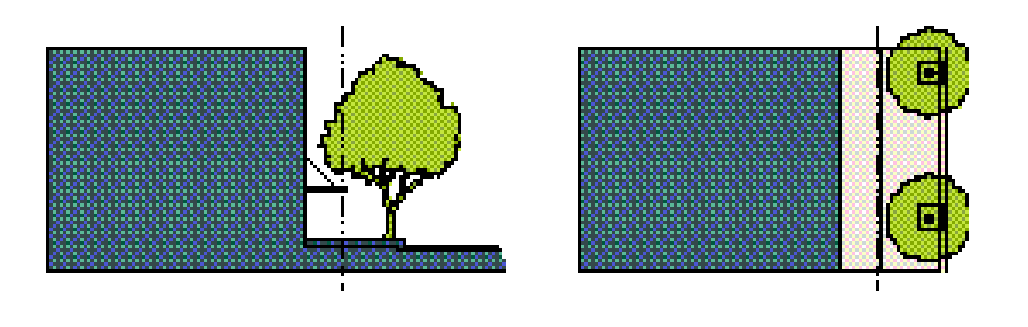
Gallery Illustration:
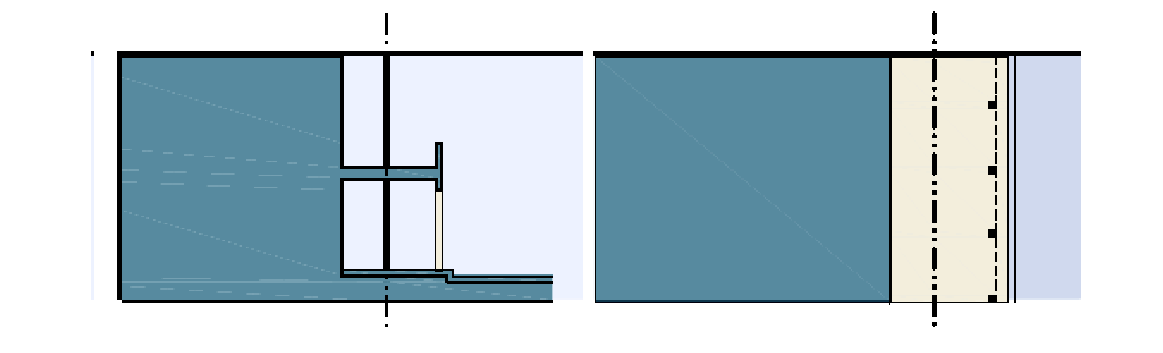
Courtyard Illustration:
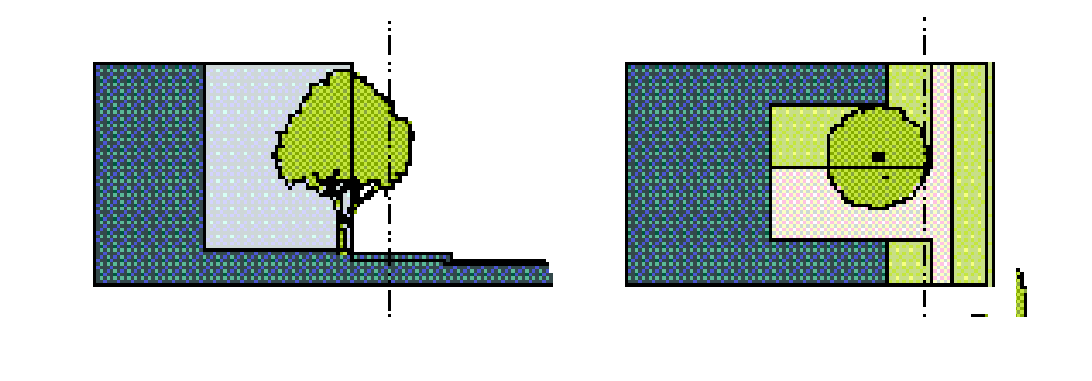
Terrace Illustration:
(b)
Streetscape improvements. Property owners shall provide one street tree every 50 feet on center. Each street tree shall be located in a tree well with a grate. Details are available at the city.
Property owners shall provide decorative light fixtures (details available at the city) every 50 feet on center.
Required trees and lighting shall be located within five feet of the curb.
(c)
Outdoor displays. Outdoor displays shall be permitted as an accessory use subject to the following standards:
(1)
All outdoor display areas must be maintained and displayed in a neat, orderly and safe manner.
(2)
Must maintain access to the business and may not be located on public property.
(3)
The goods, merchandise or products offered for sale in an outdoor display area must be of such a nature that they are typically located within the principle use.
(4)
Display fixtures shall be decorative in nature, constructed of high quality durable material, and compatible with the character of the principal building.
(d)
Building design standards. All building façades visible from a public street, parking area, or adjacent residential district shall comply with section 90-305.
(e)
Service areas. All service areas, including utility access, above ground equipment and dumpsters shall be located in side or rear yards and shall be screened from view from any street.
(f)
Mechanical and utility equipment. Mechanical equipment, electrical and gas meter and service components, and similar utility devices (whether ground level, wall mounted, or roof mounted) shall be screened from view from the front property line. Exterior screening materials shall be the same as the predominant exterior materials of the principal building.
(Ord. No. 414, § I, 6-16-14)
Sec. 90-278. - Parking.
The parking requirements of section 90-157 parking and loading requirements may be reduced by ten percent to account for the availability of on-street parking.
In addition the city may allow an additional reduction of up to ten percent for those uses that can demonstrate that they have a shared parking arrangement or a mix of uses that do not have conflicting peak hour parking requirements. In order to be eligible for the ten percent parking reduction, the applicant shall provide a parking study.
Designated parking areas may encroach up to ten feet into the predominant front building setback. Property owners may receive credit for one parking space for each additional 200 square feet of landscaping or streetscape improvements located in front of a parking lot and within the first ten feet of the predominant front building setback.
(Ord. No. 414, § I, 6-16-14)
Sec. 90-279. - Area, height, bulk and placement regulations.
The area, height, bulk and placement requirements for the NC district shall be in accordance with the schedule of regulations in section 90-351 et seq.
(Ord. No. 414, § I, 6-16-14)
Sec. 90-281.- Statement of purpose.
The local business district (C-1) intends to encourage a vibrant mix of office, commercial, and residential uses within easy walking or biking distance of residential neighborhoods. Pedestrian-oriented development standards and flexible parking strategies are provided to decrease parking demand in the district and provide for easy access to sites through other modes of transportation.
(Code 1980, § 5.139; Ord. No. 445, § VI, 5-17-21)
Sec. 90-282. - Permitted uses.
In the C-1 district the following uses are "permitted", "special use", "accessory" or "not permitted", subject to the conditions set forth below:
(Code 1980, § 5.140; Ord. No. 298, § 1, 3-18-96; Ord. No. 445, § VII, 5-17-21; Ord. No. 451, § VIII, 8-15-22)
Sec. 90-283. - Development standards.
(a)
Applicability.
(1)
New construction. All new developments that require site plan review after the effective date of this ordinance amendment shall fully comply with the development standards in this section.
(2)
Existing buildings. Any expansion or redevelopment of a site less than 25 percent of the existing building area or site need not comply with the development standards. Expansion or redevelopment that exceeds 25 percent of the existing building area or site shall require the site to become more compliant, and shall not result in the site being less compliant, with the development standards in this section.
(b)
Build-to-line. All buildings must be built-to the predominant building line established along the block in accordance with section 90-351(f)(3). Exceptions from this requirement include:
(1)
Plazas, outdoor cafés, or public amenities. Where provided, up to 40 percent of the building façade may be set back up to ten feet to allow space for a public plaza or outdoor dining area.
(2)
Architectural features such as bay windows, awnings, or other projection not exceeding 25 percent of the building frontage may project up to five feet beyond the build-to line.
(c)
Facade breaks required. There shall be no blank or unarticulated façades. All façades must provide windows and/or façade offsets and breaks. Breaks may include changes of material, projections or recessions, distinctive window patterns, parapet or cornice on the upper level, or other design treatment that satisfies the intent of this standard. Articulations shall follow the traditional building width within the district.
(d)
Building entrances.
(1)
Building fronts shall be oriented to the primary street.
(2)
All buildings shall have pedestrian access on the street frontage side of the building and off-street parking side of the building in the side or rear yard, as applicable.
(3)
Building entrances shall be clearly defined by utilizing elements such as overhangs, awnings, or lintels; change in plane (such as a recessed) entryway, differentiation in material and/or color; greater level of detail; or enhanced lighting. Any such element shall be architecturally compatible with the style, materials, colors, and details of the primary building.
(e)
Storefront design.
(1)
Building storefronts shall have open, plate-glass storefronts.
(2)
Display windows shall not be blocked with merchandise or interior display.
(3)
If a building has several storefronts, they shall be unified in design treatment, such as the design of windows and door openings, materials, or colors.
(f)
Exterior lighting. Façades shall be internally or externally illuminated. Lights should be properly shielded or recessed behind architectural features, so they do not produce glare or spillage of light onto adjacent properties. No light, except streetlights, shall shine directly onto public roads.
(g)
Windows. Windows shall be untinted. Windows should not be visually obstructed by signs, advertisements, window screens, security grills, or other permanent window coverings.
(1)
All facades facing a public street or parking area shall have a minimum of 60 percent clear glass area on the ground floor and 30 percent transparency on upper floors.
(2)
For all other facades, a minimum of 20 percent of the façade shall consist of clear glass area.
(h)
Building colors and materials. Coordination of colors and material finishes is encouraged within the district to establish continuity and positive district character. Similar or engineered equivalents of any permitted materials are also acceptable, subject to approval by the city manager or their appointed designee.
(1)
Permitted primary materials (at least 50 percent of building façade): Brick, cut stone, field stone, cast stone, or other masonry; stucco; timber or dimensional wood; metal paneling.
(2)
Permitted accent materials: Clear or lightly tinted glass; metal and metal paneling; timber or dimensional wood; polymer plastic (for example Fypon and Azek materials); fiber cement boards or paneling; exterior insulation and finishing systems (EIFS) above the first story only.
(3)
Permitted roofing materials: Architectural shingles; slate; clay; copper; standing metal seam; EPDM, rubber sheet, or other layered roofing system.
(4)
Prohibited materials: Vinyl; concrete masonry units (CMU) or similar concrete block units (e.g., split-face block); dark tinted, reflective, or mirrored glass.
(i)
Roofs. Roofs shall be flat or set pitch with a terminating vertical break such as a parapet, cornice, or eaves.
(j)
Security features. Security roll-down grilles should be designed and recessed into the interior of the window system. Where an exterior grille already exists, the roll-down grille box should be as inconspicuous as possible.
(k)
Location and design of parking areas.
(1)
Parking shall be located in the side or rear yard only.
(2)
Side yard parking and existing front yard parking shall be screened in accordance with section 90-284.
(3)
Canopies, port-cochères, or similar structures shall be located in the side or rear yard. When located in the side yard, the structure shall be set back at least ten feet from the front building line. Canopies shall be designed to be consistent with the primary building style, materials, and colors.
(l)
Site access. Vehicular access to sites and off-street parking areas shall be provided from a side street, rear alley, or shared access drive between properties.
(m)
Loading, refuse collection, and service areas. All loading, refuse collection, and service areas on a site shall be located in side or rear yards and shall be screened from view from any street.
(n)
Green building and site design.
(1)
Green building and site design techniques are permitted and encouraged for all buildings and sites.
(2)
For parking lots, minimum landscaping requirements may be satisfied by bioswales, rain gardens, or other green infrastructure.
(3)
Native plantings are encouraged for all landscaped areas.
(Ord. No. 445, § VIII, 5-17-21)
Editor's note— Ord. No. 445, § VIII, adopted May 17, 2021, amended § 90-283 in its entirety to read as herein set out. Former § 90-283, pertained to site plan approval, and derived from the Code of 1980, § 5.141.
Sec. 90-284. - Screening.
(a)
Mechanical and utility equipment. All mechanical equipment, HVAC, utility boxes, telecommunications devices, and similar utility devices shall be screened from public view. Exterior screening materials shall be the same as the predominant exterior materials of the principal building.
(b)
Roofs. Building roofs are to be uncluttered with vertical projections integrated in the architecture and screened from view by parapet walls or other enclosures.
(c)
Parking.
(1)
Side and front yard parking shall be screened from the street by a decorative low wall, fence, or hedge row between 30 and 36 inches in height. Street walls, where provided, shall extend from the primary façade of the principal building to maintain a cohesive streetscape.
(2)
Where front yard parking already exists, similar screening and incorporation of pedestrian cut throughs in the screening are required to be incorporated into the site plan for any plan requiring planning commission review.
(d)
Adjacent residential property.
(1)
Where a use directly abuts a residentially zoned use, a buffer at least five feet in width consisting of a living fence, comprised of a combination of ornamental shrubs, grasses, and other plantings and a decorative fence or masonry wall at least four feet in height shall be provided along the abutting property line. Where space for a five-foot buffer does not exist, an ornamental masonry wall between four to six feet in height above grade shall be constructed along the abutting property line.
(2)
Where a use abuts a residentially zoned use but is separated along its entire length by a public alley not less than 20 feet wide, an ornamental fence or masonry wall four to six feet in height above grade shall be constructed along the abutting property line. If an ornamental masonry wall is constructed, it is preferred to be constructed on the residential side of the public alley. A taller ornamental masonry wall may be required in certain instances.
(Code 1980, § 5.142; Ord. No. 445, § IX, 5-17-21)
Sec. 90-285. - Area, height, bulk and placement regulations.
The area, height, bulk and placement requirements for C-1 districts shall be in accordance with the schedule of regulations in section 90-351 et seq.
(Code 1980, § 5.143)
Sec. 90-296.- Statement of purpose.
The C-2 central business district is designed and intended to promote the development of a pedestrian oriented and accessible, central commercial service district in which a variety of retail, commercial, office, civic and residential uses are permitted. Each use shall be complementary to the stated function and purpose of the district and shall not have adverse impact upon the viability of retail uses adjacent, street capacity and safety, utilities, and other city services.
The C-2 central business district is further designed and intended to:
(1)
Maintain and enhance a viable mix of complimentary retail uses and discourage domination of the village by any single category of use.
(2)
Preserve and enhance the village as a community asset that contributes positively to property values, community identity, and a sense of place.
(3)
Serve as the central business district for the citizens of the community to shop in a safe and enjoyable environment.
(4)
Create a retail oriented mix of businesses that encourages an active pedestrian environment and promotes both convenience and destination shopping activities.
(5)
Encourage a lively social environment and economically viable downtown with a wide variety of uses in a pedestrian oriented unified setting, with shared parking.
(6)
Extend greater opportunities for traditional community living, working, housing and recreation to citizens and residents of the city.
(7)
Discourage the development of separate off-street parking facilities for each individual use, and encourage the development of off-street parking facilities designed to accommodate the needs of several individual uses with access from side streets only.
(8)
Promote the creation of urban places such as plazas which are oriented to the pedestrian thereby promoting citizen security and social interaction.
(9)
Promote developments where the physical, visual and spatial characteristics are established and reinforced through the consistent use of traditional urban design and architectural design elements. Such elements shall relate to the design characteristics of an individual structure or development based on usage of traditional early American and late 1800 to early 1900 architectural style influences, ranging from Colonial styles of Georgian and Williamsburg; Victorian styles of Italianate, Gothic and Queen Anne; and later Romanticized styles of Tudor and French Country, used in a harmonious manner, resulting in coherent overall development patterns and streetscape for the downtown as well as surrounding areas.
(10)
Discourage commercial and business uses that create objectionable noise, glare or odors.
(11)
Promote uses that support and compliment the retail focus of the village, such as office and residential uses, above the first floor.
(12)
Preserve and promote opportunities for mid-size retail uses that will attract customers from local and regional markets to support other uses in the village.
(Code 1980, § 5.148; Ord. No. 336, § I, 11-18-02; Ord. No. 389, § III, 10-19-09; Ord. No. 408, § VI, 7-15-13)
Sec. 90-297. - Permitted uses.
In the C-2 district the following uses are permitted provided that the use occupies 5,000 square feet of gross floor area or less. The following uses are permitted because they are considered to generate and promote pedestrian activity at the street level creating a vibrant and viable downtown environment.
(1)
Advertising signs subject to the requirements set forth in chapter 58.
(2)
Antique and consignment shops.
(3)
Art galleries.
(4)
Bake shops, retail.
(5)
Barbershop or beauty shop.
(6)
Clothing or costume rental establishments.
(7)
Department stores.
(8)
Furniture stores.
(9)
Interior decorating establishments with a showroom.
(10)
Office supply store.
(11)
Off-street parking and loading in accordance with article V, provided that no off-street parking, parking ingress or egress, or access lanes for parking or loading shall be permitted within 100 feet of the Kercheval Avenue right-of-way.
(12)
Photographic establishments.
(13)
Sit-down restaurants except those having a drive-in or drive-through facility.
(14)
Generally recognized retail sales businesses, within an enclosed building, that supplies commodities on the premises for use or consumption off the premises, such as, but not limited to: Groceries, meats, dairy products, baked goods or other foods, drugs, dry goods, clothing and notions or hardware.
(15)
Dance studios, offices, either business professional, medical, or governmental, including stockbroker, real estate and insurance offices and travel agencies, subject to the following provisions:
a.
The use may be located in a basement or above the first floor.
b.
For buildings more than 150 feet deep as measured from the building line running closest to and parallel to Kercheval, the use may be located on the first floor of a building with frontage on Cadieux, Notre Dame or St. Clair provided such use is no closer than 45 percent of the building depth to Kercheval or 70 feet, whichever is greater.
c.
For buildings more than 150 feet deep as measured from the building line running closest to and parallel to Kercheval, the use may be located on the first floor of a building with frontage on Kercheval provided such use is no closer than 45 percent of the building depth to Kercheval or 70 feet, whichever is greater.
d.
For buildings 150 feet deep or less as measured from the building line running closest to and parallel to Kercheval, the use may be located on the first floor of a building with frontage on Cadieux, Notre Dame or St. Clair provided the building is a minimum of 80 feet deep and such use occupy no more than the rear 40 percent of the building depth or 40 feet whichever is greater to Kercheval.
e.
For buildings 150 feet deep or less as measured from the building line running closest to and parallel to Kercheval, the use may be located on the first floor of a building with frontage on Kercheval provided the building is a minimum of 80 feet deep and such use occupy no more than the rear 40 percent of the building depth or 40 feet whichever is greater to Kercheval.
f.
Such use may not be located in buildings less than 80 feet deep.
(16)
Outdoor cafés and outdoor eating areas subject to the following provisions:
a.
Such eating areas shall be defined by planters, posts with ropes, or other decorative, removable enclosures.
b.
The outdoor seating shall in no way impair the use and enjoyment of adjacent or nearby properties.
c.
Outdoor seating shall be subject to applicable city, county and state requirements.
d.
A site plan shall specify the plans for storage of tables, chairs, and equipment during the months when the outdoor seating is not in use.
e.
The outdoor eating area shall be kept clean and void of litter at all times.
f.
Outdoor eating areas shall not be operated between the hours of 11:00 p.m. and 7:00 a.m.
g.
The capacity of the outdoor seating area shall be provided by the applicant and verified by the building official.
h.
Additional signs associated with the outdoor eating area are prohibited.
i.
Details regarding the hours and type of entertainment, music, speakers, or similar devices used in outdoor eating areas must be identified at the time of special use/site plan review.
j.
Preparation of food and beverages shall be prohibited in any outdoor eating area. The sale and consumption of alcohol are governed by the Michigan Liquor Control Act and local ordinance.
k.
In addition to the standards listed above, outdoor sidewalk cafés shall also be subject to the following standards:
(i)
To allow for pedestrian circulation, a minimum of five feet of sidewalk along the curb and leading to the entrance to the establishment must be maintained free of tables and other encumbrances. If the sidewalk is not wide enough to allow for a five-foot wide clearance for circulation, the café should not be permitted.
(ii)
Pedestrian circulation and access to store entrances should not be impaired. Thus, a boundary (maximum encroachment width and length) into the public sidewalk should be established, with an accessible aisle being maintained between this line and the curb, in accordance with the provisions of the National Americans with Disabilities Act (ADA) and Michigan barrier-free requirements.
(iii)
Tables, chairs, planters, trash receptacles, and other elements of street furniture should be compatible with the architectural character of the adjacent buildings. If table umbrellas will be used, they should complement building colors.
(iv)
Liability issues for use of the public sidewalk should be addressed and reviewed by the city attorney.
(17)
Residential uses subject to the following provisions:
a.
Residential uses shall only be located on the second story of a building or above.
b.
Residential uses shall be intergraded into the design of a larger mixed-use development.
c.
No dwelling unit shall be located on the same floor as a business use (excluding a home occupation), and no floor may be utilized for business or office purpose which is located above a floor used for residential purposes.
d.
Adequate provisions for off-street parking for any use above the second floor must be demonstrated to the satisfaction of the city planning commission.
(18)
Uses similar to the uses listed above as determined by the city manager, or his designee. Such determination shall be based on a finding of fact:
a.
That the proposed use(s) will contribute to the viable mix of uses in the village;
b.
Is compatible with the uses permitted in the village; and
c.
Will not adversely impact the retail oriented environment of the village.
(19)
Short-term rental units.
(Code 1980, § 5.149; Ord. No. 336, § I, 11-19-02; Ord. No. 374, §§ II, III, 8-20-07; Ord. No. 389, § III, 10-19-09; Ord. No. 408, § VII, 7-15-13; Ord. No. 410, § I, 9-5-13; Ord. No. 441, § I, 2-10-20; Ord. No. 451, § IX, 8-15-22)
Sec. 90-298. - Permitted uses after special approval.
(a)
In the C-2 district the following special approval uses are permitted, subject to the approval of the city planning commission after public hearing and notice pursuant to the requirements of the Michigan Planning Enabling Act, PA12 of 2008, as amended, and to site plan review as provided under section 90-302. The following uses are considered to be supporting and compatible with those uses listed in section 90-297 provided they comply with the general criteria identified in section 90-300.
(1)
Uses permitted in section 90-297 that exceed 5,000 square feet.
(2)
Banks, savings and loan, credit union or other type of financial institutions.
(3)
Buildings and facilities for furnishing utility services, including heat, light, water and power.
(4)
Fitness centers located on the ground floor of a building fronting on Kercheval, subject to the following provisions:
a.
No less than 30 percent of the building depth from Kercheval (rounded to the nearest whole foot) shall be devoted to retail sales. The city council may modify this requirement based on a finding that the proposed use will be consistent with the intent of the ordinance.
b.
Business shall remain open during regular retail hours.
c.
Retail area shall be staffed during business hours.
d.
Lockers rooms with changing areas and showers shall be provided within the business.
(5)
Hotel subject to the following conditions:
a.
Adequate parking, as determined by the city, for hotel guests and visitors shall be located in a parking structure connected to or designed as an integral part of the hotel.
b.
Drop-off or pick-up areas shall be located in that portion of the building directly opposite of the Kercheval Avenue frontage.
c.
The area located on the ground floor between the exterior wall of a building facing Kercheval Avenue or any intersecting side street and a line parallel to the exterior wall, setback 20 feet, with the exception of the hotel entrance, shall be occupied with a use permitted under section 90-297 or section 90-298 subject to all applicable conditions. Exceptions to this condition may be granted by the city planning commission provided the applicant can demonstrate that the proposal will be consistent with the intent of the C-2 district to provide a pedestrian oriented environment.
(6)
Permitted uses with gross floor area in excess of 5,000 square feet.
(7)
Theaters.
(b)
Also, the following temporary special uses are permitted in the C-2 district, subject to approval of the city planning commission after like notice and hearing:
(1)
Use of existing, portable or other structures (including trailers and sheds) and use of yards, on a temporary basis, as (a) offices, (b) places to store materials or equipment or (c) similar support facilities, in connection with and incidental to the construction or development of a property within the C-2 district or a property within a P-1 or PUD district which adjoins the C-2 district, for a principal permissible use;
(2)
Use of existing, portable or other structures (including trailers and non-conforming buildings), on a temporary basis, as (a) showrooms, (b) sales or marketing offices or (c) similar support facilities, in connection with and incidental to the construction or development of a property within the C-2 district or a property within a P-1 or PUD district which adjoins the C-2 district, for a principal permissible use;
Temporary special uses may be approved with respect to one property in the C-2 district together with, and incidental to, development of another property (not necessarily contiguous) owned, leased, or occupied by the applicant elsewhere within the C-2 district or the adjoining P-1, or PUD overlay district.
(c)
The application for a temporary special use shall:
(1)
Describe the nature and purpose of the proposed use, and how the temporary use and any structure will be removed from the site on expiration of the approved period.
(2)
State whether the temporary use will in any way constitute a change in the basic uses permitted in the C-2 district.
(3)
Be accompanied by (i) a site plan for review and approval which includes such items as, but not limited to: parking, signage, trash, noise, lighting, and typical elevations if applicable; and (ii) a description of any provisions for emergency vehicle access, off-street parking and loading, drainage and soil erosion.
(4)
Demonstrate adequate provisions for or availability of off-street parking.
(5)
Demonstrate that such temporary use shall not displace viable, existing retail business establishments as permitted in section 90-297.
(d)
The planning commission shall consider whether the proposed temporary special use is consistent with the requirements of this section 90-298 and any applicable requirements of section 90-300, and whether the applicant has available, or has made provision for, adequate off-street parking. In approving any application, the commission may impose other conditions deemed necessary to protect the public health, safety, and general welfare.
(e)
Approval for a temporary special use may be granted for a period not exceeding 24 months; provided that the commission may authorize the building inspector to extend the approval for not more than six additional months if the continued use is incidental and necessary to the construction, sales or marketing of the principal property under construction or development.
(f)
Performance bonds. To insure strict compliance with the conditions attached to the issuance of the permit for a temporary structure or use, the planning commission may require the applicant to furnish a performance bond in accordance with section 90-73 of this division (performance bonds) in an amount equal to the estimated cost of removing and disposing of the temporary structure or use ($1,000.00 minimum). The bond, less any sum applied under (G), shall be returned after the temporary structure has been removed from the premises and any temporary special use has been discontinued.
(g)
Temporary buildings associated with construction shall not be erected unless a site plan has been approved. Such building shall be removed from the site before a final certificate of occupancy is issued for the primary building. Temporary structures other than temporary construction buildings shall be removed and temporary uses shall be discontinued within ten days after expiration of the permit or approval. If the applicant or other party in possession fails to effect such a timely removal, the building inspector may use the bond to effect the removal.
(Code 1980, § 5.150; Ord. No. 336, § I, 11-18-02; Ord. No. 367, § I, 6-5-06; Ord. No. 374, § IV, 8-20-07; Ord. No. 389, § IV, 10-19-09; Ord. No. 408, § VIII, 7-15-13; Ord. No. 441, § II, 2-10-20)
Sec. 90-299. - Reserved.
Editor's note— Ord. No. 389, § V, adopted October 19, 2009, repealed § 90-299, which pertained to design and locational criteria for uses permitted after special approval and derived from Ord. No. 336, § I, 11-18-02; Ord. No. 357, § IV, 8-15-05.
Sec. 90-300. - General criteria for uses permitted after special approval in the C-2 district.
In addition to specific site plan standards, which the city planning commission may apply to the use, the following standards shall serve the city planning commission as the basis for decisions involving special land uses. Each proposed use or activity shall:
(a)
In location, size and intensity of the principal and/or accessory operation, be compatible with adjacent uses and zoning of land;
(b)
Be consistent with and promote the intent and purpose of this division.
(c)
Be compatible with the natural environment and conserve natural resources and energy;
(d)
Be consistent with existing and future capabilities of public services and facilities affected by the proposed use;
(e)
Protect the public health, safety, and welfare as well as the social and economic well-being of those who will use the land use or activity, residents, businesses and landowners immediately adjacent and the city as the whole;
(f)
Promote the use of land in a socially and economically desirable manner;
(g)
Not be in conflict with convenient, safe and normal neighborhood vehicular and pedestrian traffic routes, flows, intersections, and general character and intensity of neighborhood development;
(h)
Be of such a design and impact that the location and height of buildings, the location, nature and height of walls, fences and the nature and extent of landscaping on the site shall not hinder or discourage the appropriate development and use of adjacent land and buildings or impair the value thereof;
(i)
In the nature, location, size and site layout of the use, be a harmonious part of the district in which it is situated taking into account, among other things, prevailing shopping habits, convenience of access by prospective patrons, the physical and economic relationship of one type of use to another and characteristic groupings of uses of said district;
(j)
In the location, size, intensity and site layout be such that operations will not be objectionable to nearby dwellings, by reason of noise, fumes, glare or flash of lights.
(Ord. No. 336, § I, 11-18-02)
Sec. 90-301. - Rezoning area requirements.
No district shall be zoned as a C-2 district unless the zone shall contain several or all of the uses in section 90-297 and satisfies the objectives of section 90-296. Any expansion of the C-2 district must be consistent with the city's general development plan.
(Code 1980, § 5.151; Ord. No. 336, § I, 11-18-02)
Sec. 90-302. - Reserved.
Editor's note— Ord. No. 455, § XIV, adopted March 20, 2023, repealed § 90-302, which pertained to site plan review and derived from the Code of 1980, § 5.152 and Ord. No. 336, adopted November 18, 2002.
Sec. 90-303. - Protective screening.
Protective screening for C-2 districts that directly abut residential districts shall be in compliance with the regulations set forth in section 90-39. In addition, any parking visible from a public street must be screened from the street with a continuous row of evergreen shrubs a minimum of 30 inches high at the time of planting, or a 30-inch decorative masonry wall constructed of brick or stone.
(Code 1980, § 5.153; Ord. No. 336, § I, 11-18-02)
Sec. 90-304. - Area, height, bulk and placement requirements.
The area, height, bulk and placement requirements for C-2 districts shall be in accordance with the schedule of regulations in section 90-351 et seq.
(Code 1980, § 5.154; Ord. No. 336, § I, 11-18-02)
Sec. 90-305. - Development standards.
The following standards shall apply to all new development, redevelopment, or renovation within the C-2, central business district.
(1)
Building scale. The intent of these standards is to encourage the construction of buildings that are in scale and design with the majority of the existing buildings in the village, while promoting a traditional architectural style such as; traditional early American and late 1800 to early 1900 architectural style influences, ranging from Colonial styles of Georgian and Williamsburg; Victorian styles of Italianate, Gothic and Queen Anne; and later Romanticized styles of Tudor and French Country. The majority of the older buildings are narrow in width. The intent of these standards is not to limit building width, but to encourage the division of wide facades by dividing the mass in proportion and scale with existing buildings, to create compatibility with existing facades.
(a)
Large, long facades shall be subdivided into bays, through the location and arrangement of openings and architectural treatments, that are compatible in size and scale to existing buildings.
(b)
The height to width ratio of one-story, single bay facades, or individual bays of multiple bay facades, is not to exceed 1:2.
(c)
The height to width ratio of two-story, single bay facades, or individual bays of multiple bay facades, is not to exceed 1:1.
(2)
Building height. Buildings in the central business district are a mix of one, two, and two and one-half story buildings. Taller buildings, a maximum of four floors, shall be limited to the core of the village and the maximum height should be limited to 2½ floors at the edges of the village where commercial buildings are adjacent to or facing residential buildings.
(a)
Buildings located within 300 feet of the Neff Street right-of-way shall be limited to two and one-half stories in height, or 35′-0″.
(b)
Buildings located between 300 feet of the Neff Street right-of-way and St. Clair Avenue shall be limited to three stories in height, or 42′-0″.
(c)
Buildings located within 240 feet of the Cadieux Road right-of-way shall be limited to two and one-half stories in height, or 35′-0″.
(d)
Buildings located between 240 feet of the Cadieux Road right-of-way and Notre Dame Avenue shall be limited to three stories in height, or 42′-0″.
(e)
Buildings located with frontage on Kercheval between St. Clair and Notre Dame shall be limited to four stories or 54′-0″ provided, the fourth story shall be enclosed in a mansard roof, or setback 15 feet from the building facade of the third story.
(f)
No building may be more than one story taller or less than one story shorter than any adjacent building.
(g)
Special architectural features will be allowed to exceed the above height if:
- The feature is located at a corner or,
- The feature is deemed necessary to the type, use, or style of the building in question.
- Special architectural features such as pediments, turrets, or other elements compatible with the architecture of the building, shall not exceed the height of the remainder of the building by more than ten feet.
(h)
Roof top equipment must be screened with architecturally compatible building elements such as parapet walls.
(3)
Building roof types.
(a)
Roof types shall consist or flat roofs with parapets, gabled, or hipped roofs consistent with traditional architectural styles of the building.
(b)
Mansard roofs must extend around all sides of the roof. Cantilevered or mock mansards are not permitted.
(4)
Street facade. The majority of the existing street facades, the facade that faces a public right-of-way, are comprised of common facade components. The arrangement of facade elements shall follow this model, which include the following typical components: Facade frame, storefront opening, canopy/awning and sign.
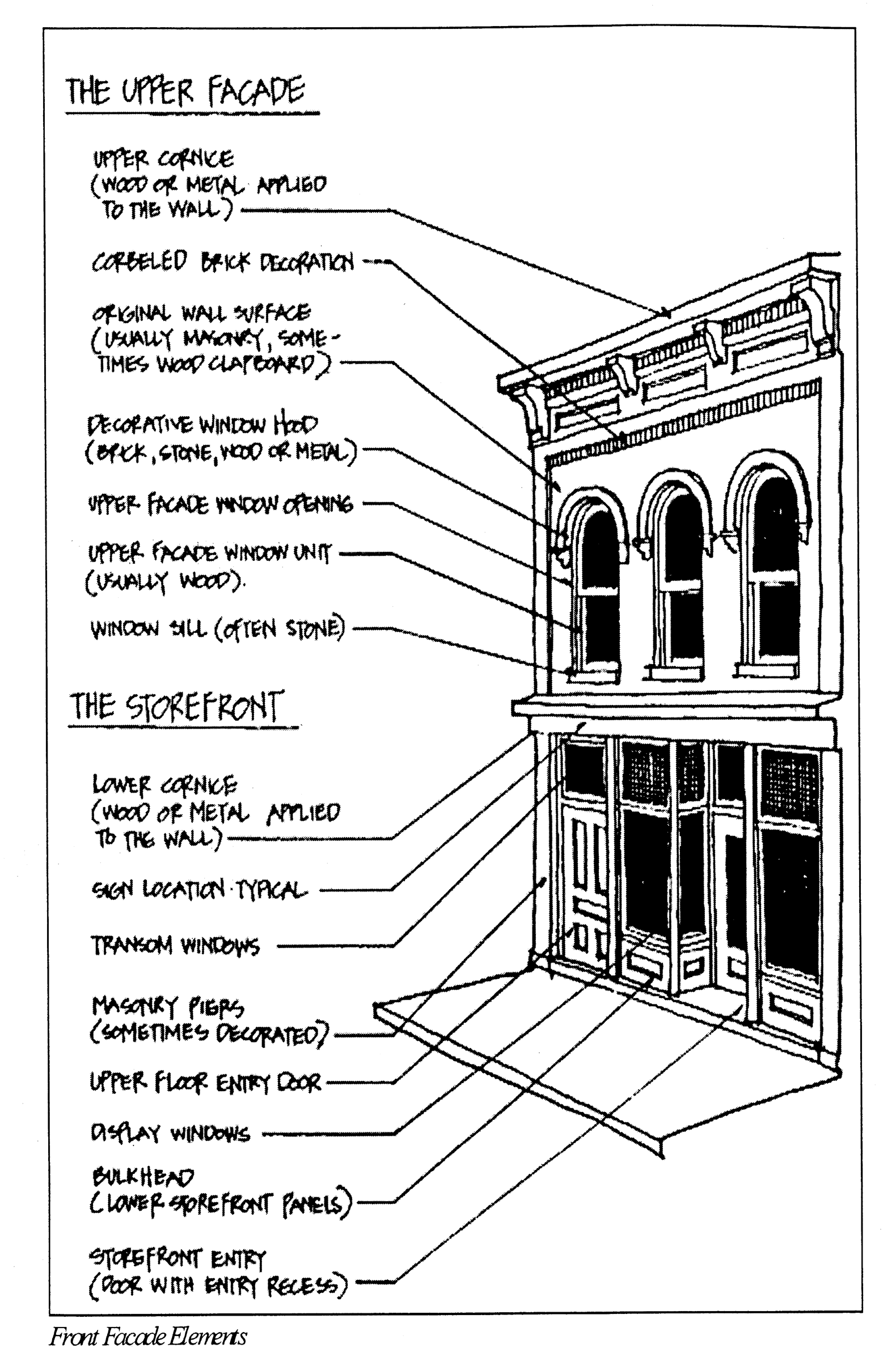
Front Facade Elements
(a)
Facade frame. The facade frame, shall be constructed primarily of brick or stone, constructed principally in a single plane. E.I.F.S (exterior insulation systems) shall not be permitted. The top of the parapet wall shall be flat or step slightly to accentuate end piers. (a) The facade frame shall be capped by a stone, or simulated stone, coping or narrow cap flashing. Brick shall be laid primarily in running bond with minimal decorative detail.
(b)
Storefront opening. Storefronts shall be directly accessible from public sidewalks. Each storefront must have transparent areas, equal to 70 percent of its portion of the facade, between one and eight feet from the ground. The wood or metal glass framing system shall be painted, bronze, or powder coated. The building entry is often centered in the storefront opening and is commonly recessed.
(c)
[Blank walls.] Blank walls shall not face a public street or parking area. Walls facing a public street or parking area shall included windows and architectural features customarily found on the front facade of a building, such as awnings, cornice work, edge detailing, or decorative finish materials.
(d)
Canopies/awnings. A canopy or awning is typically located at the top of the storefront opening.
i.
Awning shall be traditional in design; they shall be triangular in section, sloping outward and down from the top of the opening. Narrow front and side flaps are common. Round-top, half-round, box, or other unusual awning shapes are discouraged. Internally lighted awnings are prohibited. Signage on awnings shall be limited.
ii.
Canopies shall be narrow in elevation, six inches to 12 inches, and flat. Typically such canopies would have internal drainage. Canopies shall be self-supporting or supported by tension rods. Canopy projections to be limited to 48 inches. Sloping, or unusually shaped, canopies are prohibited.
(5)
Rear facades. Rear facades, facades not facing a public right-of-way, are as important as street facades because they are located adjacent to parking and, therefore, serve as the primary entrance to the building. Often times they must also accommodate service and delivery functions.
Rear facades shall exhibit the same components as street facades, however, need not follow as rigorous a design model:
(a)
Facade frame. The facade frame, like that at the street facade, shall be constructed principally in a single plane. If a parapet is used at the rear facade, the parapet wall shall be flat or step slightly to accentuate end piers, as illustrated. If no parapet is used, downspouts shall be located at the outer sides of the facades, not in the middle of the facade. Acceptable materials include brick or stone consistent with the design of the front facade.
(b)
Storefront opening. Like the street facade, the storefront opening shall be a rectangular or square opening, ten feet to 12 feet high, yet it may be a smaller portion of the width of the facade, or bay than the street facade; approximately 40 percent of the width. The opening shall be almost entirely glass (window, showcases, or door) with few subdivisions. The wood or metal glass framing system shall be painted, bronze, or powder coated. The building entry is often centered in the storefront opening and is commonly recessed.
(c)
Canopies/awnings. A canopy or awning typically located at the top of the storefront opening, is recommended.
i.
Awnings shall be traditional in design; they shall be triangular in section, sloping outward and sown from the top of the opening. Narrow front and side flaps are common. Round-top, half-round, may be approved by the city planning commission if it is determined that a round-top or half-found awning is consistent with the architectural character of the building. Box, or other unusual awning shapes are prohibited. Internally lighted awnings are also prohibited. Awnings are not intended to be a principal means of signage.
ii.
Canopies shall be narrow in elevation and flat. Typically such canopies would have internal drainage. Canopies shall be self-supporting or supported by tension rods, as illustrated. Canopy projections to be limited to 48″.
(6)
Materials. Maintained consistent palette of materials is important to establish continuity within the streetscape and to maintain and enhance the overall appearance of the village. The following are identified as acceptable building materials.
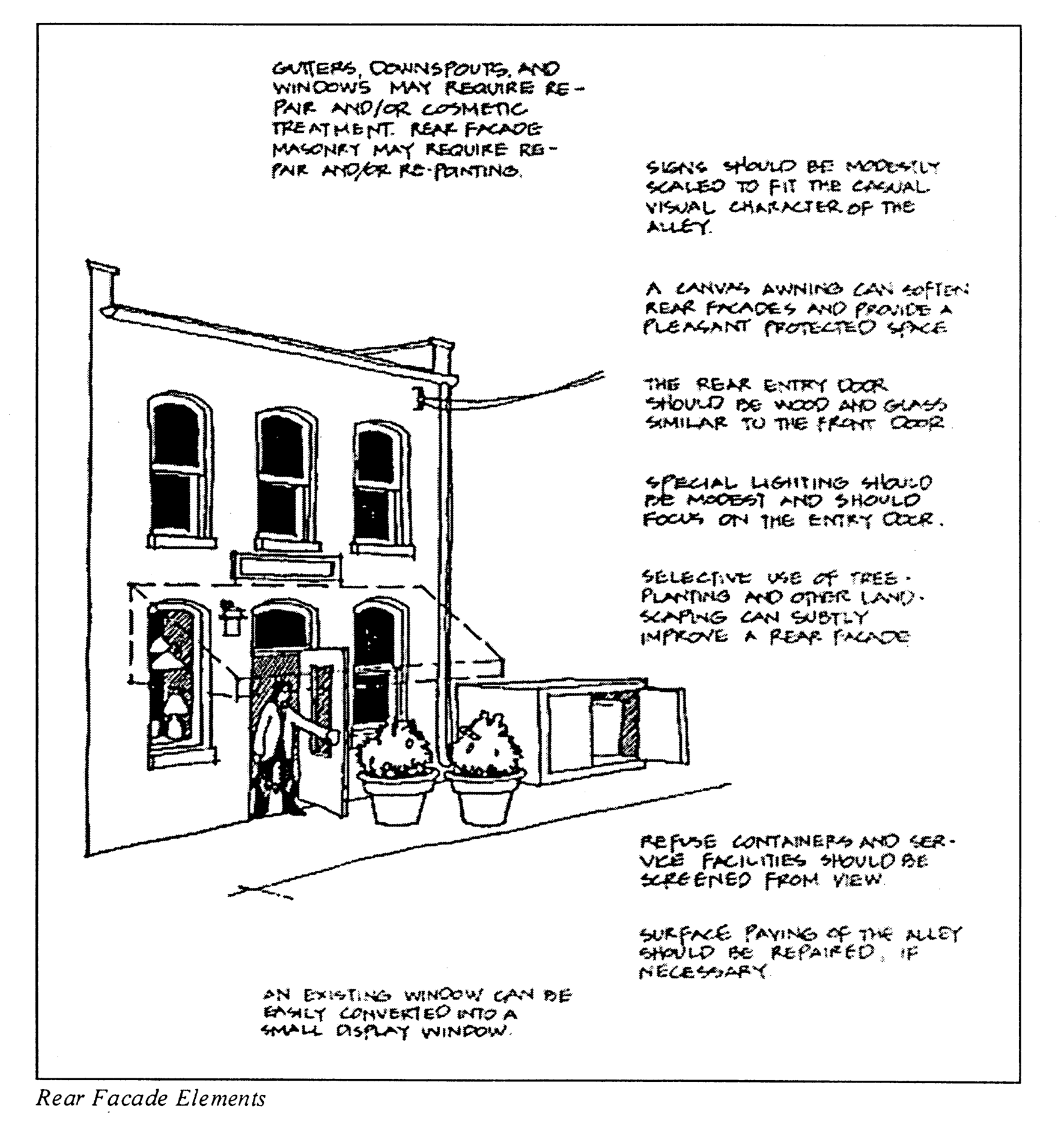
Rear Facade Elements
(a)
Facade frame. Acceptable materials:
i.
Brick: Shall be standard modular brick with common tooled mortar joints. Untooled joints, distressed brick, or irregular shaped brick are prohibited. Brick color and texture shall be compatible with original brick facades in the central business district. Textures varied from smooth or glazed to rough. Textures tended to be uniform.
ii.
Stone: Smooth finish stone such as limestone or sandstone.
iii.
Aluminum parapet cap: Typical material is aluminum or painted sheet steel. Color and finish shall match that of window framing system.
iv.
Artificial stone and pre-case parapet cap: To simulate traditional limestone and sandstone caps.
(b)
Storefront opening. Acceptable materials:
i.
Storefront framing system: Aluminum or pre-painted steel storefront glazing system. Natural finish aluminum is the most common material and finish.
ii.
Glass: Clear or with slight green tint.
iii.
Entry door: One or two-lite door matching storefront glazing system.
(c)
Canopies. Acceptable materials:
i.
Canopy facia trim: Metal. Typically, natural finish aluminum or painted.
ii.
Soffit: Metal or cement plaster.
iii.
Support rods: Metal.
(d)
Awnings. Acceptable materials:
i.
Frame: No requirements.
ii.
Fabric: Standard fabrics for non-internally lighted awnings. Patterns and colors to be compatible with other facade materials.
(7)
Colors. Colors shall be limited to those traditional colors that were predominant in early American architectural styles. A color board showing the proposed colors and materials of the various exterior building elements shall be submitted during the site plan review process.
(8)
Design standard modifications. When a particular building design and the materials and colors or combination of materials and colors proposed to be used in the exterior walls are found by the city planning commission to be in keeping with the intent and purpose of this section, but may differ from the strict application of this section, the city planning commission may modify the requirements of this section.
(9)
Signs. All signs in the C-2 district shall comply the City Sign Code and be compatible with the architectural style and details of the building on which they are located.
(10)
Lighting.
(a)
Site lighting for parking lots shall utilize a similar traditional style fixture as those used in the village streetscape. The model number for the light pole and luminaire, as well as detailed product specifications will be provided by the city.
(b)
The light source shall be consistent with that used in the city's street lighting along Kercheval Avenue.
(c)
The light intensity shall average a minimum of one-half foot-candles, measured five feet above grade for parking lots and one- to three-foot-candles measured five feet above grade for pedestrian sidewalks.
(d)
All lighting shall be shielded or directed away from any adjacent roads, parking, residential zone, or residential use.
(e)
Building lighting shall be directed downward toward the building. Fixtures shall be compatible with the traditional style of building architecture.
(Ord. No. 336, § I, 11-18-02)
Sec. 90-306. - Specifically prohibited uses.
In order to clarify the type of permitted uses in the C-2 district, the following uses, among others, are specifically prohibited:
(a)
Pawn shops.
(b)
Currency exchanges.
(c)
Payday loan stores.
(d)
Resale shops.
(Ord. No. 389, § VI, 10-19-09)
Sec. 90-307.- Statement of purpose.
The hospital facilities (HF) zone district is intended to accommodate the unique nature and requirements of large scale and significant medical facilities associated with a full service hospital and their accessory uses in a manner compatible with the surrounding land uses.
Further, it is designed and intended to:
(1)
Help meet the health and wellness needs of the community.
(2)
Provide opportunities for the logical and orderly development of hospital facilities.
(3)
Ensure compatibility between hospital facilities and surrounding residential land uses.
(4)
Minimize traffic related impacts on adjacent road network.
(Ord. No. 412, § I, 2-24-14)
Sec. 90-308. - Permitted uses.
In order to ensure consistency with the master plan and the purpose of the HF district, the HF district has been divided in to four subdistricts. The following table lists the permitted, special approval, accessory, and not permitted use allowed in the four subdistricts.
Key: P — Permitted S — Special Approval A — Accessory — Not Permitted
(Ord. No. 412, § I, 2-24-14)
Sec. 90-309. - Area, height, bulk and placement requirements.
(a)
Setbacks. The following schedule lists the setback requirements for the HF district:
;adv=6;(1)
Existing parking areas that do not meet the required setbacks may be allowed to be repaired or replaced but not expanded.
(2)
Light wells may project into the required setback, but in no case shall encroach closer than ten feet to a lot line adjacent to a street.
(3)
The minimum setback from Cadieux for buildings in the HF-3 district may be reduced to 40 feet subject to special use approval.
(4)
The minimum setback from Jefferson for buildings in the HF-3 district may be reduced to 450 feet subject to special use approval.
(b)
Building height. The following schedule lists the maximum building height requirements for the HF district:
1 Buildings in the HF-4 district may not exceed the maximum height of the existing building as of the date the ordinance from which this division is derived goes into effect.
2 Buildings in the HF-3 district that exceed 35 feet shall be setback a minimum of 140 feet from Cadieux. Buildings in the HF-3 district shall not exceed the building height allowed in the HF-4 district under any circumstances.
(Ord. No. 412, § I, 2-24-14)
Sec. 90-310. - Protective screening.
(a)
Any surface parking visible from a public street must be screened from the street with a six foot tall decorative wall constructed of brick. To avoid a continuous horizontal surface, there shall be offsets or other architectural features on the wall surface. Walls may not be located within ten feet of an adjacent right-of-way. In addition, a landscape plan shall be provided indicating the use of evergreen and deciduous plant material subject to the approval of the city manager or his designee to further minimize the visual impact of the wall.
(Ord. No. 412, § I, 2-24-14)
Sec. 90-311. - Development standards.
The following standards shall apply to all new development, redevelopment, or renovation within the HF district:
(1)
All buildings and other architectural elements shall be subject to review by the City Manager or his designee to ensure compatibility with the existing hospital and surrounding neighborhoods.
(2)
All buildings shall be predominantly brick with stone and glass as acceptable accent materials.
(3)
Buildings that have facades greater than 100 feet in length, measured horizontally, shall incorporate wall plane projections or recesses. No uninterrupted length of any façade shall exceed 20 horizontal feet.
(Ord. No. 412, § I, 2-24-14)
Sec. 90-312. - Parking.
At the time of adoption of this section, the hospital in the HF district shall pay to have a parking study conducted of the existing facility to document current parking supply and parking demand generation to be conducted by a parking consultant selected by the hospital and approved by the city. This study shall be revised for each building addition, or for major changes in use as determined by the city manager or his designee. In no case shall the parking supply be less than 110 percent of the parking demand generation.
(Ord. No. 412, § I, 2-24-14)
Sec. 90-313. - Site plan review.
For all new construction, renovation consisting of exterior modifications, new use, or expansion of existing use in the HF district over 1,000 square feet or that would represent a major change in use as determined by the city manager or his designee, a site plan must be submitted to the city planning commission showing all buildings, parking areas and landscaping at a scale sufficient to permit study of all elements of the plan. Typical elevations (with color renderings and a material board) and floor plans of the building must also be provided. A duly licensed or certified design professional must prepare plans.
A community impact statement must be completed with each application. The contents of the community impact statement are contained in the forms available at the city. If the plans meet the required standards and design and indicate no adverse effects which, in the opinion of the city planning commission, cause injury to adjoining property or the city as a whole, the city planning commission shall determine whether the required standards have been met and then may approve or disapprove the plans. Plans so approved shall regulate the development on the premises unless modified in the same manner as the plans were originally approved.
The hospital shall provide the city with an annual report from the management entity providing an update on the status of the facility and addressing any changes in the operation or other impacts such as traffic and parking.
(Ord. No. 412, § I, 2-24-14)
Sec. 90-314. - Notice.
Notice shall be sent by mail or personal delivery to the owners of all property for which site plan approval is being considered, to the owners of all real property within 150 feet of the boundary of the property in question, and to the occupants of all structures within 150 feet of the boundary of the property in question. If the name of the occupant is not known, the term "occupant" may be used in making notification. Notification need not be given to more than one occupant of a structure, except that if a structure contains more than one dwelling unit or spatial area owned or leased by different individuals, partnerships, businesses, or organizations, one occupant of each unit or spatial area shall receive notice. In the case of a single structure containing more than four such units or spatial areas, notice may be given to the manager or owner of the structure, who shall be requested to post the notice at the primary entrance to the structure. This notice shall be sent not less than 15 days prior to the date of the public hearing schedule. The noticing requirements from section 90-77 shall be followed where public notice is required by the zoning code (special approval uses or variance).
(Ord. No. 412, § I, 2-24-14)
Sec. 90-316.- Statement of purpose.
The P-1 vehicular parking district is intended to permit the establishment of areas to be used for off-street vehicular parking or private cars, so as to serve business, commercial and institutional areas. This district is also designed to afford maximum protection to next adjacent residential areas by providing landscaped setbacks, fences and well-designed parking lot facilities. It is also intended that this district act as a transitional area between nonresidential areas and residential areas, thereby permitting private developers as well as public agencies to provide needed off-street parking. There is also permitted as special land uses offices, financial institutions, utility buildings and facilities and residential apartments subject to design and locational criteria.
(Code 1980, § 5.158; Ord. No. 336, § I, 11-18-02)
Sec. 90-317. - Permitted uses.
Vehicular parking, subject to requirements in section 90-318—90-334 inclusive and commercial antennas subject to provisions at section 90-44 are permitted in the P-1 district.
(Code 1980, § 5.159; Ord. No. 298, § 1, 3-18-96; Ord. No. 336, § I, 11-18-02)
Sec. 90-318. - Uses permitted after special review.
In the P-1 district the following special approval uses are permitted, subject to application design and locational criteria provided under section 90-319, and to the approval of the city planning commission after public hearing and notice pursuant to the requirements of Section 4a of Act No. 207 of the Public Acts of Michigan of 1921 (MCL 125.581 et seq.), as amended, and to site plan review as provided under section 90-333. The following uses are considered to be supporting and compatible with those uses listed in section 90-297 provided they comply with the design and locational criteria in section 90-319.
(1)
Offices, either business, professional, medical or governmental, including stockbroker, real estate and insurance offices, and travel agencies.
(2)
Banks, savings and loan, credit union or other type of financial institutions.
(3)
Buildings and facilities for furnishing utility services, including heat, light, water and power.
(4)
Residential apartments.
(Code 1980, § 5.160; Ord. No. 298, § 1, 3-18-96; Ord. No. 336, § I, 11-18-02)
Sec. 90-319. - Design and locational criteria for uses permitted after special approval.
(1)
Any of the uses permitted after special approval in the P-1 district shall only be permitted if they are an integral part of a parking structure serving a use or uses located in the C-2 central business district.
(2)
Office, financial, and utility uses may occupy a portion of the ground floor of a parking structure consisting of the first 40 feet from any facade of the parking structure facing a road.
(3)
Residential uses in the P-1 district shall only be located above the top level of a parking structure provided the total combined structure shall not exceed 35 feet.
(4)
Residential dwellings in the P-1 district shall comply with the minimum area per dwelling unit and minimum floor area per dwelling located in the C-2 district.
(5)
The architectural design of any parking structure must be compatible with the design of buildings located in the C-2 district.
(Ord. No. 336, § I, 11-18-02)
Sec. 90-320. - Limitation of use.
The following regulations shall apply in P-1 districts:
(1)
Parking areas shall be used only for parking of passenger vehicles operated by the management, the employees, customers and guests of the enterprise doing business in the city.
(2)
Parking may be with or without charge.
(3)
No business involving the repair or services to vehicles, trailers, mobile homes, travel trailers, boats or boat trailers, or sale, display, or storage of same shall be permitted from or upon property zoned in a P-1 district.
(4)
No building other than those for shelter of attendants shall be erected upon the premises, except as provided for in section 90-319, 90-332 and 90-44. There shall not be more than two such buildings in the area and each such building shall not be more than 50 square feet in area nor shall exceed 15 feet in height.
(5)
Any signs erected or maintained on the premises shall comply with the requirements of chapter 58 of this Code, and any other city sign regulations.
(Code 1980, § 5.160; Ord. No. 336, § I, 11-18-02; Ord. No. 357, § IV, 8-15-05)
Sec. 90-321. - Location.
All P-1 districts shall be contiguous to a business, commercial or industrial district. In all cases, lots, which are use for parking, shall be the adjacent successive lots from the business or commercial property.
(Code 1980, § 5.161; Ord. No. 336, § I, 11-18-02)
Sec. 90-322. - Ingress and egress.
In P-1 districts adequate ingress and egress shall be provided for vehicles to premises used for parking and shall be in accordance with the plan, which shall be submitted in triplicate for approval in accordance with section 90-333.
(Code 1980, § 5.162; Ord. No. 336, § I, 11-18-02)
Sec. 90-323. - Surface of parking area.
In P-1 districts the parking area shall be provided with a pavement in accordance with section 90-159(2).
(Code 1980, § 5.163; Ord. No. 336, § I, 11-18-02)
Sec. 90-324. - Front yard.
(a)
Where a P-1 district is contiguous to a residentially zoned district which has a common frontage on the same block with the P-1 district, and wherein residential structures have been erected, there shall be provided a yard space equal to the average setback of homes in the block on the same side of the street.
(b)
Where the P-1 district is contiguous to a residentially zoned district which has a common frontage in the same block with the P-1 district, and wherein residential structures have been erected having a front yard of greater than 20 feet in depth, there shall be provided a yard space equal in depths to the minimum distance of any residential structure so located or to the minimum distance required by such restriction, except in cases where residential structures have been erected at the rear of lots. In such cases, the yard space shall not be less than 20 feet in depth or equal to the minimum required by the private restrictions.
(c)
Where the P-1 district lies across a street and opposite a residentially zoned district where the lots front upon such a street, there shall be provided a yard space not less than 20 feet in depth, and a protective wall as set forth in section 90-326.
(Code 1980, § 5.164; Ord. No. 336, § I, 11-18-02)
Sec. 90-325. - Side yards.
(a)
Where a P-1 district is contiguous to side lot lines of premises in a residentially zoned district, there shall be provided a side yard not less than ten feet in width between the side lot lines and the parking area.
(b)
Where the P-1 district lies across a street and opposite a residentially zoned district where the side lot lines are contiguous to such street, there shall be provided a yard space not less than ten feet in depth.
(Code 1980, § 5.165; Ord. No. 336, § I, 11-18-02)
Sec. 90-326. - Protective wall.
Where the P-1 district adjoins or fronts upon residentially zoned or used property, there shall be provided around the parking area between the required yard spaces and the actual parking area a wall in accordance with section 90-159(5).
(Code 1980, § 5.166; Ord. No. 336, § I, 11-18-02)
Sec. 90-327. - Bumper rail.
In P-1 district there shall be provided a bumper rail in accordance with section 90-159(6).
(Code 1980, § 5.167; Ord. No. 336, § I, 11-18-02)
Sec. 90-328. - Landscaping.
(a)
Wherever a wall is required, all land between the wall and the boundaries of the P-1 district shall be kept free from refuse or debris, and shall be landscaped. The landscaped area adjacent to the wall shall be planted with deciduous shrubs, evergreens and/or ornamental trees. Fruit trees shall not be used. Where the arrangement of planting materials will result in exposure of the walls, the walls shall be covered with ivy, spirea border or similar plant material. The remainder of the landscape area, which is not planted with the aforementioned stock, shall be in well-kept lawn. All landscaping shall be maintained in a healthy growing condition, neat and orderly in appearance.
(b)
All planting plans shall be first submitted to the building inspector for approval as to suitability of planting materials and arrangement thereof in accordance with the provisions of subsection (a) of this section and requirements of section 90-159.
(c)
Where required landscaping is not sufficiently and properly maintained, the city manager may, after five days' notice has been given to the property owner as shown on the latest assessment roll, order whatever steps are necessary to suitably maintain the landscaped area and charge all of the costs plus a $5.00 fee to the property owner.
(Code 1980, § 5.168; Ord. No. 336, § I, 11-18-02)
Sec. 90-329. - Lighting.
Where lighting facilities are provided, they shall be so arranged as to reflect the light away from all residentially zoned properties which are adjacent to the P-1 district, and shall be in accordance with section 90-159(3).
(Code 1980, § 5.169; Ord. No. 336, § I, 11-18-02)
Sec. 90-330. - Approval.
All plans for the development of any P-1 district must first be approved by the building inspector before construction is started, after site plan approval by the city planning commission.
(Code 1980, § 5.170; Ord. No. 336, § I, 11-18-02)
Sec. 90-331. - Modifications of requirements.
The board of zoning appeals upon application by the property owner of the parking area may modify the yard, wall and ingress and egress requirements where in unusual circumstances, undue hardship would be suffered or no good purpose would be served in compliance with the requirements of this division. In all cases where such a protective wall extends to an alley which is a means of ingress or egress to a parking area, it shall be permissible to end the wall not more than ten feet from such alley line in order to permit a wider means of access to the parking area and better visibility.
(Code 1980, § 5.171; Ord. No. 336, § I, 11-18-02)
Sec. 90-332. - Parking structures.
Notwithstanding requirements set forth in section 90-320(4) and section 90-319 for uses permitted under special approval, parking structure may be permitted in the P-1 district subject to the following conditions: A site plan must be submitted per requirements at section 90-333. Specific design standards for the parking structure and appurtenances (e.g., signs) thereto follow:
(1)
When the parking structure is contiguous to side lot lines of a residentially zoned or used district, there shall be provided a minimum side yard of 15 feet between the side lot lines and the structure.
(2)
Permitted height of any parking structure shall not exceed 30 feet except as permitted at section 90-319(4). For every one foot the parking structure exceeds ten feet in height, the yard requirements shall be increased by one foot beyond the minimum 15-foot requirements in subsection (1) above.
(3)
When parking is permitted on the roof of a parking structure, an ornamental wall shall be provided around the perimeter of the roof. This wall shall be of suitable material and in harmony with the architecture of the parking structure and sufficiently opaque as to substantially conceal parked cars.
(4)
All exterior lighting, especially that which may be provided on the roof, shall be glare-free and so arranged as to reflect away from all residentially zoned or used properties affected by the parking structure. There shall be no lighting of elevations or a parking structure facing any residentially used or zoned property.
(5)
Signs shall be in accordance with all related city ordinances.
(Code 1980, § 5.172; Ord. No. 336, § I, 11-18-02)
Sec. 90-333. - Reserved.
Editor's note— Ord. No. 455, § XV, adopted March 20, 2023, repealed § 90-333, which pertained to site plan review and derived from Ord. No. 336, adopted November 18, 2002.
Sec. 90-334. - Area, height, bulk and placement requirements.
The area, height, bulk and placement requirements for P-1 districts shall be in accordance with the schedule of regulations in section 90-351 et seq.
(Ord. No. 336, § I, 11-18-02)
Sec. 90-335.- Statement of purpose.
The T-1, transition-1 district is designed and intended to provide a transition from the higher intensity mixed-use core of the central business district (CBD) and the edges of the village. While there are a wider range of uses permitted in this district, it is still intended to promote the development of a pedestrian oriented and accessible, mixed-use district in which a variety of retail, commercial, office, service, civic and residential uses are permitted. Each use shall be complementary to the stated function and purpose of the district and shall not have adverse impact upon adjacent street capacity and safety, utilities, and other city services.
The T-1 mixed-use district is further designed and intended to:
(1)
Maintain and enhance a viable mix of complimentary uses and discourage domination of the village by any single category of use.
(2)
Provide a physical transition from the larger buildings anticipated in the core of the village to the lower buildings anticipated at the edges of the village.
(3)
Preserve and enhance the village as a community asset that contributes positively to property values, community identity, and a sense of place.
(4)
Support the central business district for the citizens of the community to shop in a safe and enjoyable environment.
(5)
Create a mix of businesses that encourages an active pedestrian environment and promotes both convenience and destination shopping activities while providing opportunities for other uses including office and service uses.
(6)
Extend greater opportunities for traditional community living, working, housing and recreation to citizens and residents of the city.
(7)
Discourage the development of separate off-street parking facilities for each individual use, and to encourage the development of off-street parking facilities designed to accommodate the needs of several individual uses with access from side streets only.
(8)
Promote the creation of urban places such as plazas which are oriented to the pedestrian thereby promoting citizen security and social interaction.
(9)
Promote developments where the physical, visual and spatial characteristics are established and reinforced through the consistent use of traditional urban design and architectural design elements. Such elements shall relate to the design characteristics of an individual structure or development based on usage of traditional early American and late 1800 to early 1900 architectural style influences, ranging from Colonial styles of Georgian and Williamsburg; Victorian styles of Italianate, Gothic and Queen Anne; and later Romanticized styles of Tudor and French Country, used in a harmonious manner, resulting in coherent overall development patterns and streetscape for the downtown as well as surrounding areas.
(10)
Discourage commercial and business uses that create objectionable noise, glare or odors.
(11)
Promote uses that support and compliment the retail focus of the village, such as office and residential uses.
(Ord. No. 389, § VII, 10-19-09)
Sec. 90-336. - Permitted uses.
In the T-1 district the following uses are permitted provided that the use occupies 5,000 square feet of gross floor area or less. The following uses are permitted because they are considered to support and contribute to a vibrant and viable downtown environment.
(1)
Advertising signs subject to the requirements set forth in chapter 58.
(2)
Antique and consignment shops.
(3)
Art galleries.
(4)
Bake shops, providing that at least 75 percent of all baked goods produced on the premises are sold on the premises at retail and further provided that floor area used for bakery production shall be limited to 500 square feet per establishment.
(5)
Banks, savings and loan, credit union or other type of financial institutions.
(6)
Barbershop or beauty shop.
(7)
Clothing or costume rental establishments.
(8)
Department stores.
(9)
Fitness centers or dance studios.
(10)
Furniture stores.
(11)
Interior decorating establishments including bath and kitchen design, with a showroom.
(12)
Offices, either business professional, medical, or governmental, including stockbroker, real estate, insurance offices, and travel agencies.
(13)
Office supply store.
(14)
Off-street parking and loading in accordance with article V.
(15)
Outdoor cafés, and outdoor eating areas subject to the following provisions:
a.
Such eating areas shall be defined by planters, posts with ropes, or other decorative, removable enclosures.
b.
The outdoor seating shall in no way impair the use and enjoyment of adjacent or nearby properties.
c.
Outdoor seating shall be subject to applicable city, county and state requirements.
d.
A site plan shall specify the plans for storage of tables, chairs, and equipment during the months when the outdoor seating is not in use.
e.
The outdoor eating area shall be kept clean and void of litter at all times.
f.
Outdoor eating areas shall not be operated between the hours of 11:00 p.m. and 7:00 a.m.
g.
The capacity of the outdoor seating area shall be provided by the applicant and verified by the building official.
h.
Additional signs associated with the outdoor eating area are prohibited.
i.
Details regarding the hours and type of entertainment, music, speakers, or similar devices used in outdoor eating areas must be identified at the time of special use/site plan review.
j.
Preparation of food and beverages shall be prohibited in any outdoor eating area. The sale and consumption of alcohol are governed by the Michigan Liquor Control Act and local ordinance.
k.
In addition to the standards listed above, outdoor sidewalk cafés shall also be subject to the following standards:
(i)
To allow for pedestrian circulation, a minimum of five feet of sidewalk along the curb and leading to the entrance to the establishment must be maintained free of tables and other encumbrances. If the sidewalk is not wide enough to allow for a five-foot wide clearance for circulation, the café should not be permitted.
(ii)
Pedestrian circulation and access to store entrances should not be impaired. Thus, a boundary (maximum encroachment width and length) into the public sidewalk should be established, with an accessible aisle being maintained between this line and the curb, in accordance with the provisions of the National Americans with Disabilities Act (ADA) and Michigan barrier-free requirements.
(iii)
Tables, chairs, planters, trash receptacles, and other elements of street furniture should be compatible with the architectural character of the adjacent buildings. If table umbrellas will be used, they should complement building colors.
(iv)
Liability issues for use of the public sidewalk should be addressed and reviewed by the city attorney.
(16)
Photographic establishments.
(17)
Residential uses above the first floor of a building subject to the following provisions:
a.
Residential uses shall only be located on the 2nd story of a building or above.
b.
Residential uses shall be intergraded into the design of a larger mixed-use development.
c.
No dwelling unit shall be located on the same floor as a business use (excluding a home occupation), and no floor may be utilized for business or office purpose which is located above a floor used for residential purposes.
d.
Adequate provisions for off-street parking for any use above the second floor must be demonstrated to the satisfaction of the city planning commission.
e.
Parking for residential uses shall be located in a parking structure connected to or designed as an integral part of the proposed development.
(18)
Terrace dwellings and apartment houses.
(19)
Restaurants except those having a drive-in or drive-through facility.
(20)
Generally recognized retail sales businesses, within an enclosed building, that supplies commodities on the premises for use or consumption off the premises, such as, but not limited to: Groceries, meats, dairy products, baked goods or other foods, drugs, dry goods, clothing and notions or hardware.
(21)
Uses similar to the uses listed above as determined by the city manager or his designee. Such determination shall be based on a finding of fact:
a.
That the proposed use(s) will contribute to the viable mix of uses in the village;
b.
Is compatible with the uses permitted in the village; and
c.
Will not adversely impact the retail oriented environment of the village.
(22)
Short-term rental units.
(Ord. No. 389, § VII, 10-19-09; Ord. No. 451, §§ X, XI, 8-15-22)
Sec. 90-337. - Permitted uses after special approval.
In the T-1 district the following special approval uses are permitted, subject to the approval of the city planning commission after public hearing and notice pursuant to the requirements of the Michigan Zoning Enabling Act, and to site plan review as provided under section 90-302. The following uses are considered to be supporting and compatible with those uses listed in section 90-336 provided they comply with the general criteria identified in section 90-300.
(1)
Uses permitted in section 90-297 that exceed 5,000 square feet.
(2)
Buildings and facilities for furnishing utility services, including heat, light, water and power.
(3)
Hotel subject to the following standards:
a.
Adequate parking, as determined by the city, for hotel guests and visitor shall be located in a parking structure connected to or designed as an integral part of the hotel.
b.
Drop-off or pick-up areas shall be located in that portion of the building directly opposite of the Kercheval Avenue frontage.
c.
The area located on the ground floor between the exterior wall of a building facing Kercheval Avenue or any intersecting side street and a line parallel to the exterior wall, setback 20 feet, with the exception of the hotel entrance, shall be occupied with a use permitted under section 90-297 or section 90-298 subject to all applicable conditions. Exceptions to this condition may be granted by the city planning commission provided the applicant can demonstrate that the proposal will be consistent with the intent of the T-1 district to provide a pedestrian oriented environment.
(4)
Interior decorating establishments including bath and kitchen design, without a showroom.
(5)
Theaters.
(Ord. No. 389, § VII, 10-19-09)
Sec. 90-338. - General criteria for uses permitted after special approval in the T-1 district.
In addition to specific site plan standards which the city planning commission may apply to the use, the standards contained in section 90-300 shall serve the city planning commission as the basis for decisions involving special land uses.
(Ord. No. 389, § VII, 10-19-09)
Sec. 90-339. - Rezoning area requirements.
No district shall be zoned as a T-1 district unless the zone shall contain several or all of the uses in section 90-336 and satisfies the objectives of section 90-335. Any expansion of the T-1 district must be consistent with the city's master plan.
(Ord. No. 389, § VII, 10-19-09)
Sec. 90-340. - Reserved.
Editor's note— Ord. No. 455, § XVI, adopted March 20, 2023, repealed § 90-340, which pertained to site plan review and derived from Ord. No. 389, adopted October 19, 2009.
Sec. 90-341. - Protective screening.
Protective screening for T-1 districts that directly abut residential districts shall be in compliance with the regulations set forth in section 90-39. In addition, any parking visible from a public street must be screened from the street with a continuous row of evergreen shrubs a minimum of 30 inches high at the time of planting, or a 30-inch decorative masonry wall constructed of brick or stone.
(Ord. No. 389, § VII, 10-19-09)
Sec. 90-342. - Area, height, bulk and placement requirements.
The area, height, bulk and placement requirements for T-1 district shall be in accordance with the schedule of regulations in section 90-351 et seq.
(Ord. No. 389, § VII, 10-19-09)
Sec. 90-343. - Development standards.
The development standards for the T-1 district shall be in accordance with the standards in section 90-305.
(Ord. No. 389, § VII, 10-19-09)
Sec. 90-344. - Specifically prohibited uses.
In order to clarify the type of permitted uses in the T-1 district, the following uses, among others, are specifically prohibited:
(a)
Pawn shops.
(b)
Currency exchanges.
(c)
Payday loan stores.
(d)
Resale shops.
(Ord. No. 389, § VII, 10-19-09)
Sec. 90-345.- Statement of purpose.
The T-2, Transition-2 district is designed and intended to provide a transition from the higher intensity mixed-use core of the central business district (CBD) and the edges of the village. While there are a wider range of uses permitted in this district, it is still intended to promote the development of a pedestrian oriented and accessible, mixed-use district in which a variety of retail, commercial, office, service, civic and residential uses are permitted. Each use shall be complementary to the stated function and purpose of the district and shall not have adverse impact upon adjacent street capacity and safety, utilities, and other city services.
The T-2 mixed-use district is further designed and intended to:
(1)
Maintain and enhance a viable mix of complimentary uses and discourage domination of the village by any single category of use.
(2)
Provide a physical transition from the larger buildings anticipated in the core of the village to the lower buildings anticipated at the edges of the village.
(3)
Preserve and enhance the village as a community asset that contributes positively to property values, community identity, and a sense of place.
(4)
Support the central business district for the citizens of the community to shop in a safe and enjoyable environment.
(5)
Create a mix of businesses that encourages an active pedestrian environment and promotes both convenience and destination shopping activities while providing opportunities for other uses including office and service uses.
(6)
Extend greater opportunities for traditional community living, working, housing and recreation to citizens and residents of the city.
(7)
Discourage the development of separate off-street parking facilities for each individual use, and to encourage the development of off-street parking facilities designed to accommodate the needs of several individual uses with access from side streets only.
(8)
Promote the creation of urban places such as plazas which are oriented to the pedestrian thereby promoting citizen security and social interaction.
(9)
Promote developments where the physical, visual and spatial characteristics are established and reinforced through the consistent use of traditional urban design and architectural design elements. Such elements shall relate to the design characteristics of an individual structure or development based on usage of traditional early American and late 1800 to early 1900 architectural style influences, ranging from Colonial styles of Georgian and Williamsburg; Victorian styles of Italianate, Gothic and Queen Anne; and later Romanticized styles of Tudor and French Country, used in a harmonious manner, resulting in coherent overall development patterns and streetscape for the downtown as well as surrounding areas.
(10)
Discourage commercial and business uses that create objectionable noise, glare or odors.
(11)
Promote uses that support and compliment the retail focus of the village, such as office and residential uses.
(Ord. No. 389, § VIII, 10-19-09)
Sec. 90-346. - Permitted uses.
In the T-2 district the following uses are permitted provided that the use occupies 5,000 square feet of gross floor area or less. The following uses are permitted because they are considered to support and contribute to a vibrant and viable downtown environment.
(1)
Advertising signs subject to the requirements set forth in chapter 58.
(2)
Antique and consignment shops.
(3)
Art galleries.
(4)
Bake shops, providing that at least 75 percent of all baked goods produced on the premises are sold on the premises at retail and further provided that floor area used for bakery production shall be limited to 500 square feet per establishment.
(5)
Banks, savings and loan, credit union or other type of financial institutions.
(6)
Barbershop or beauty shop.
(7)
Clothing or costume rental establishments.
(8)
Department stores.
(9)
Fitness centers or dance studios.
(10)
Furniture stores.
(11)
Interior decorating establishments including bath and kitchen design, with a showroom.
(12)
Offices, either business professional, medical, or governmental, including stockbroker, real estate, insurance offices, and travel agencies.
(13)
Office supply store.
(14)
Off-street parking and loading in accordance with article V.
(15)
Outdoor cafés, and outdoor eating areas subject to the following provisions:
a.
Such eating areas shall be defined by planters, posts with ropes, or other decorative, removable enclosures.
b.
The outdoor seating shall in no way impair the use and enjoyment of adjacent or nearby properties.
c.
Outdoor seating shall be subject to applicable city, county and state requirements.
d.
A site plan shall specify the plans for storage of tables, chairs, and equipment during the months when the outdoor seating is not in use.
e.
The outdoor eating area shall be kept clean and void of litter at all times.
f.
Outdoor eating areas shall not be operated between the hours of 11:00 p.m. and 7:00 a.m.
g.
The capacity of the outdoor seating area shall be provided by the applicant and verified by the building official.
h.
Additional signs associated with the outdoor eating area are prohibited.
i.
Details regarding the hours and type of entertainment, music, speakers, or similar devices used in outdoor eating areas must be identified at the time of special use/site plan review.
j.
Preparation of food and beverages shall be prohibited in any outdoor eating area. The sale and consumption of alcohol are governed by the Michigan Liquor Control Act and local ordinance.
k.
In addition to the standards listed above, outdoor sidewalk cafés shall also be subject to the following standards:
(i)
To allow for pedestrian circulation, a minimum of five feet of sidewalk along the curb and leading to the entrance to the establishment must be maintained free of tables and other encumbrances. If the sidewalk is not wide enough to allow for a five-foot wide clearance for circulation, the café should not be permitted.
(ii)
Pedestrian circulation and access to store entrances should not be impaired. Thus, a boundary (maximum encroachment width and length) into the public sidewalk should be established, with an accessible aisle being maintained between this line and the curb, in accordance with the provisions of the National Americans with Disabilities Act (ADA) and Michigan barrier-free requirements.
(iii)
Tables, chairs, planters, trash receptacles, and other elements of street furniture should be compatible with the architectural character of the adjacent buildings. If table umbrellas will be used, they should complement building colors.
(iv)
Liability issues for use of the public sidewalk should be addressed and reviewed by the city attorney.
(16)
Photographic establishments.
(17)
Residential use subject to the following provisions:
a.
Residential uses shall only be located on the 2 nd story of a building or above.
b.
Residential uses shall be intergraded into the design of a larger mixed-use development.
c.
No dwelling unit shall be located on the same floor as a business use (excluding a home occupation), and no floor may be utilized for business or office purpose which is located above a floor used for residential purposes.
d.
Adequate provisions for off-street parking for any use above the second floor must be demonstrated to the satisfaction of the city planning commission.
e.
Parking for residential uses shall be located in a parking structure connected to or designed as an integral part of the proposed development.
(18)
Restaurants except those having a drive-in or drive-through facility.
(19)
Generally recognized retail sales businesses, within an enclosed building, that supplies commodities on the premises for use or consumption off the premises, such as, but not limited to: groceries, meats, dairy products, baked goods or other foods, drugs, dry goods, clothing and notions or hardware.
(20)
Uses similar to the uses listed above as determined by the city manager or his designee. Such determination shall be based on a finding of fact:
a.
That the proposed use(s) will contribute to the viable mix of uses in the village;
b.
Is compatible with the uses permitted in the village; and
c.
Will not adversely impact the retail oriented environment of the village.
(21)
Short-term rental units.
(Ord. No. 389, § VIII, 10-19-09; Ord. No. 451, § XII, 8-15-22)
Sec. 90-347. - Permitted uses after special approval.
In the T-2 district the following special approval uses are permitted, subject to the approval of the city planning commission after public hearing and notice pursuant to the requirements of the Michigan Zoning Enabling Act, and to site plan review as provided under section 90-302. The following uses are considered to be supporting and compatible with those uses listed in section 90-336 provided they comply with the general criteria identified in section 90-300.
(1)
Uses permitted in section 90-297 that exceed 5,000 square feet.
(2)
Buildings and facilities for furnishing utility services, including heat, light, water and power.
(3)
Hotel subject to the following standards:
a.
Adequate parking, as determined by the city, for hotel guests and visitor shall be located in a parking structure connected to or designed as an integral part of the hotel.
b.
Drop-off or pick-up areas shall be located in that portion of the building directly opposite of the Kercheval Avenue frontage.
c.
The area located on the ground floor between the exterior wall of a building facing Kercheval Avenue or any intersecting side street and a line parallel to the exterior wall, setback 20 feet, with the exception of the hotel entrance, shall be occupied with a use permitted under section 90-297 or section 90-298 subject to all applicable conditions. Exceptions to this condition may be granted by the city planning commission provided the applicant can demonstrate that the proposal will be consistent with the intent of the C-2 district to provide a pedestrian oriented environment.
(4)
Interior decorating establishments including bath and kitchen design, without a showroom.
(5)
Theaters.
(Ord. No. 389, § VIII, 10-19-09)
Sec. 90-348. - General criteria for uses permitted after special approval in the T-2 district.
In addition to specific site plan standards which the city planning commission may apply to the use, the standards contained in section 90-300 shall serve the city planning commission as the basis for decisions involving special land uses.
(Ord. No. 389, § VIII, 10-19-09)
Sec. 90-349. - Zoning area requirements.
No district shall be zoned as a T-2 district unless the zone shall contain several or all of the uses in section 90-336 and satisfies the objectives of section 90-335. Any expansion of the T-2 district must be consistent with the city's master plan.
(Ord. No. 389, § VIII, 10-19-09)
Sec. 90-350. - Reserved.
Editor's note— Ord. No. 455, § XVII, adopted March 20, 2023, repealed § 90-350, which pertained to site plan review and derived from the Ord. No. 389, adopted October 19, 2009.
Sec. 90-350.1. - Protective screening.
Protective screening for T-2 districts that directly abut residential districts shall be in compliance with the regulations set forth in section 90-39. In addition, any parking visible from a public street must be screened from the street with a continuous row of evergreen shrubs a minimum of 30 inches high at the time of planting, or a 30-inch decorative masonry wall constructed of brick or stone.
(Ord. No. 389, § VIII, 10-19-09)
Sec. 90-350.2. - Area, height, bulk and placement requirements.
The area, height, bulk and placement requirements for T-2 district shall be in accordance with the schedule of regulations in section 90-351 et seq.
(Ord. No. 389, § VIII, 10-19-09)
Sec. 90-350.3. - Development standards.
The development standards for the T-2 district shall be in accordance with the standards in section 90-305.
(Ord. No. 389, § VIII, 10-19-09)
Sec. 90-350.4. - Specifically prohibited uses.
In order to clarify the type of permitted uses in the T-2 district, the following uses, among others, are specifically prohibited:
(a)
Pawn shops.
(b)
Currency exchanges.
(c)
Payday loan stores.
(d)
Resale shops.
(Ord. No. 389, § IX, 10-19-09)
Editor's note— Ord. No. 389, § IX, adopted October 19, 2009, set out provisions intended for use as § 90-344A. For purposes of clarity, and at the editor's discretion, these provisions have been included as § 90-350.4.
Sec. 90-350.100.- Statement of purpose.
The T transition district is designed and intended to provide a transition from the vehicular parking district (P-1) on the outside of the mixed-use core of the central business district (C-2) and the surrounding residential areas. This district is intended to accommodate a range of residential uses to serve as a transition between the activities of the village and the surrounding single-family residential land uses. Various types and sizes of residential accommodations would thereby be provided in this district to meet the needs of different age and family groups without over-taxing existing community facilities, utilities, or services. This district shall be pedestrian-oriented, and its residential uses shall be complementary to residential uses both within and adjacent to the T district.
(Ord. No. 407, § VIII, 7-15-13)
Sec. 90-350.101. - Permitted uses.
In the T district the following uses are permitted:
(1)
Apartment houses.
(2)
Hotel subject to the following conditions:
a.
Adequate parking, as determined by the city, for hotel guests and visitors shall be provided.
(3)
Housing for elderly, independent.
(4)
Housing for elderly, assisted.
(5)
Public parking facilities.
(6)
One- and two-family homes existing at the time of establishment of the T district.
(7)
Uses similar to the uses listed above as determined by the city manager, or his designee.
Such determination shall be based on finding of fact:
a.
That the proposed uses(s) will contribute to the viable mix of uses in the village;
b.
Is compatible with the uses permitted in the village; and
c.
Will not adversely impact the retail oriented environment of the village.
(Ord. No. 407, § VIII, 7-15-13)
Sec. 90-350.102. - Permitted uses after special approval.
In the T district the following special approval uses are permitted, subject to the approval of the city planning commission after public hearing and notice pursuant to the requirements of the Michigan Zoning Enabling Act, and to site plan review as provided under section 90-74. The following uses are considered to be supporting and compatible with those uses listed in section 90-350.101 provided they comply with the standards identified in section 90-75(g).
(1)
Commercial antenna.
(Ord. No. 407, § VIII, 7-15-13)
Sec. 90-350.102A. - Specifically prohibited uses.
In order to clarify the type of permitted uses in the T district, the following uses, among others, are specifically prohibited:
(1)
Short-term rental units.
(Ord. No. 451, § XIII, 8-15-22)
Sec. 90-350.103. - Zoning area requirements.
No district shall be zoned as a T district unless the zone shall contain several or all of the uses in section 90-350.101 and satisfies the objectives of section 90-350.100. Any expansion of the T district must be consistent with the city's master plan.
(Ord. No. 407, § VIII, 7-15-13)
Sec. 90-350.104. - Reserved.
Editor's note— Ord. No. 455, § XVIII, adopted March 20, 2023, repealed § 90-350.104, which pertained to site plan review and derived from the Ord. No. 407, adopted July 15, 2013.
Sec. 90-350.105. - Protective screening.
Protective screening for T districts that directly abut residential districts shall be in compliance with the regulations set forth in section 90-39. In addition, any parking visible from a public street must be screened from the street with a continuous row of evergreen shrubs a minimum of 30 inches high at the time of planting, or a 30-inch decorative masonry wall constructed of brick or stone as determined by the planning commission.
(Ord. No. 407, § VIII, 7-15-13)
Sec. 90-350.106. - Area, height, bulk, and placement requirements.
The area, height, bulk, and replacement requirements for the T district shall be in accordance with the schedule of regulations in section 30-351.
(Ord. No. 407, § VIII, 7-15-13)
Sec. 90-350.107. - Development standards.
Hotels and other uses with accessory commercial or service uses on the first floor shall comply with the development standards in section 90-305.
Residential uses shall comply with the following development standards:
(1)
Site design standards.
a.
Parking.
(i)
All parking spaces, including those in garages, shall be located behind the front building wall of the principal building closest to the front street. Exception: Portions of driveway spaces for residential dwelling units may be located in a front yard provided that the driveways pace has a minimum depth of 18 feet measured from the front property line.
(ii)
Driveways should access side streets for sites with side street access. Driveways may not access front streets when a site has side street access. The driveway standards may be modified to permit driveways that access front streets when side street access is available if there is no reasonable alternative.
b.
Front yard landscaping. The area between the building and the front street shall be landscaped except where vehicle or pedestrian circulation areas are located.
c.
Encroachments. Front stoops attached to a dwelling may project up to six feet into a required front yard, but in no case may project into a right-of-way or similar easement.
d.
Garages.
(i)
Garage doors may not be facing a public street.
e.
Building materials.
(i)
Combination of materials. Building materials may be combined on a building facade horizontally, with the heavier material below the lighter material.
(ii)
Primary building materials. Primary building materials shall be used on a minimum of 60 percent of the facade are of the building (excluding the area of doors and windows).
Durable natural or natural-appearing building materials such as brick, stone, exposed logs or timber, cementitious siding, split face block, or other similar materials are preferred primary building materials. Durable synthetic building materials that convincingly match the appearance of natural building materials may be used as a primary building material.
(iii)
Accent building materials. Accent materials may be used on up to 40 percent of the facade area of the building (excluding the area of doors and windows).
Acceptable accent materials include decorative precast concrete block, metal, and glass. Non-durable building materials such as EIFS may be used as an accent building material on up to ten percent of the total wall area of any facade, but may not be used on the base level of a building.
f.
Base, middle, cap standards.
(i)
Base.
(A)
The base of the building shall have a minimum height of ten feet.
(B)
A horizontal molding or cornice shall be provided at the roofline for a one-story building, between the first and second floor for multiple story buildings with two to four stories, or between the first and second floor or second and third floor for five or more story buildings. This molding or cornice adds visual interest and visually separates the base of the building from upper stories. The molding or cornice shall have a minimum height of four inches and a projection of at least two inches.
(ii)
Middle. The middle area of the building includes upper stories, and is visually defined by the molding or cornice that defines the base of the building and a cornice or eaves line that defines the cap of the building. There are no specific requirements for the middle of the building. Building material transitions may take place between the base and the middle portions of the facade, or within the middle portion of the facade for buildings four stories or greater where the design intent is to create a more substantial appearing base.
(iii)
Cap. Pitched roofs shall be sloped no less than 5:12, except that roofs for porches and attached sheds may be no less than 2:12. Flat roofs shall be enclosed by parapets a minimum of 30 inches high, or higher if required to conceal mechanical equipment from view from the front street or from any single family residential property. Flat roofs shall include a cornice to define the top of the building.
g.
Building transparency.
(i)
Minimum first floor transparency. The minimum transparency on the first floor front facade shall be 35 percent for buildings with residential first floor uses.
(ii)
Maximum upper floor transparency. The maximum transparency on upper stories shall not exceed 50 percent.
(iii)
Proportion of openings. Building openings, including doors and windows, shall be square or vertical in proportion except on the first floor front facade, where windows may have a horizontal proportion. Individual windows with a vertical proportion may be grouped together even if the group of windows will have an overall horizontal proportion.
h.
Buildings wider than 75 feet shall incorporate vertical elements in the principal façade to mimic smaller-scale development.
i.
Encroachments. Balconies on upper stories may project up to six feet from the face of the building, and may encroach into setback areas.
j.
Mechanical equipment and service areas.
(i)
Service areas, including utility access, loading areas, and dumpsters shall be located in side or rear yards and shall be screened from view from any street and any residentially used property.
(ii)
Mechanical and utility equipment, such as gas or electrical meters, telephone boxes, utility cabinets, HVAC equipment, and other similar utility devices (whether ground, wall, or roof mounted) shall be screened from view from a point eight feet above grade level at the centerline of any abutting roads and along any parcel line abutting a residentially used property. The applicant shall submit a line of sight drawing demonstrating that the equipment will not be visible from the above locations. Exterior screening materials shall be the same as the predominant materials of the principal building.
(iii)
Modification of building design standards. In the interest of architectural diversity, the building design standards may be modified to permit alternate materials or design. Any approved modification must result in a building that is equal to or exceeds the quality and design of a building that complies with the building design standards.
(2)
Stoop building design standards.
a.
Design features. Any street-facing façade that is visible from a public right-of-way or private road easement shall include features such as, but not limited to columns, cornices, pediments, articulated bases, and fluted masonry covering a minimum of ten percent of the exterior wall area.
b.
Front porch or stoop required. Each dwelling unit or building subdivision shall have a minimum 30 square feet unenclosed porch or stoop. The porch or stoop shall be raised at least 18 inches above sidewalk grade.
The porch or stoop may be covered so long as the area between the surface of the top surface of the stoop and the underside of the canopy covering the stoop is at least 75 percent open. For the purpose of calculating the enclosure requirement, the vertical area of any surface or building element intended to enclose the stoop, including screens, shall be subtracted from the total vertical area of the stoop between the floor and the canopy.
c.
Elevated first floor. In order to provide privacy for first floor rooms, the first floor of the building shall be elevated a minimum of 30 inches above the level of the sidewalk adjacent to the front property line.
d.
Entrances. A minimum of 75 percent of all units within a stoop building shall have their principal entrance on the front facade of the building.
(3)
Courtyard building design standards.
a.
Courtyard width. The courtyard shall not exceed 60 percent of the width of the lot.
b.
Ground story design.
(i)
Entrances. All buildings shall have their principal entrance on the front façade of the building. Entrances may be recessed up to vie feet from the front building wall of the building.
(ii)
Ground story height. A minimum clear height of 12 feet shall be provided for the ground story in a courtyard building.
(iii)
Bulkhead below first floor windows. First floor windows may not extend down to grade level. A bulkhead or kickplate with a minimum height of one foot shall be provided below first floor windows. The bulkhead should use primary materials, and the chosen material should appear heavier visually than the material used for the walls.
c.
Modification of building design standards. In the interest of architectural diversity, the building design standards may be modified. Any approved modification must result in a building that is equal to or exceeds the quality and design of a building that complies with the building design standards.
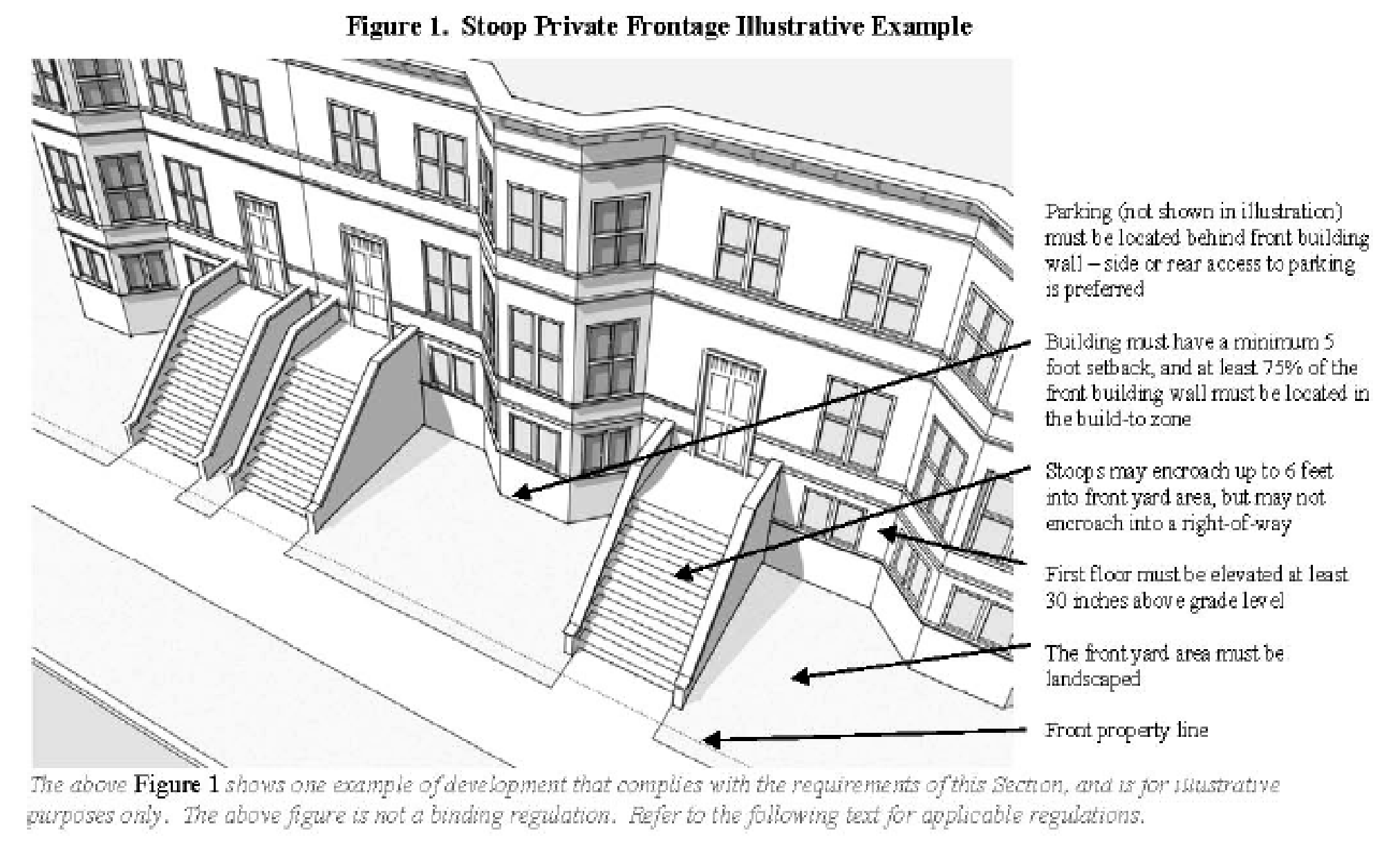
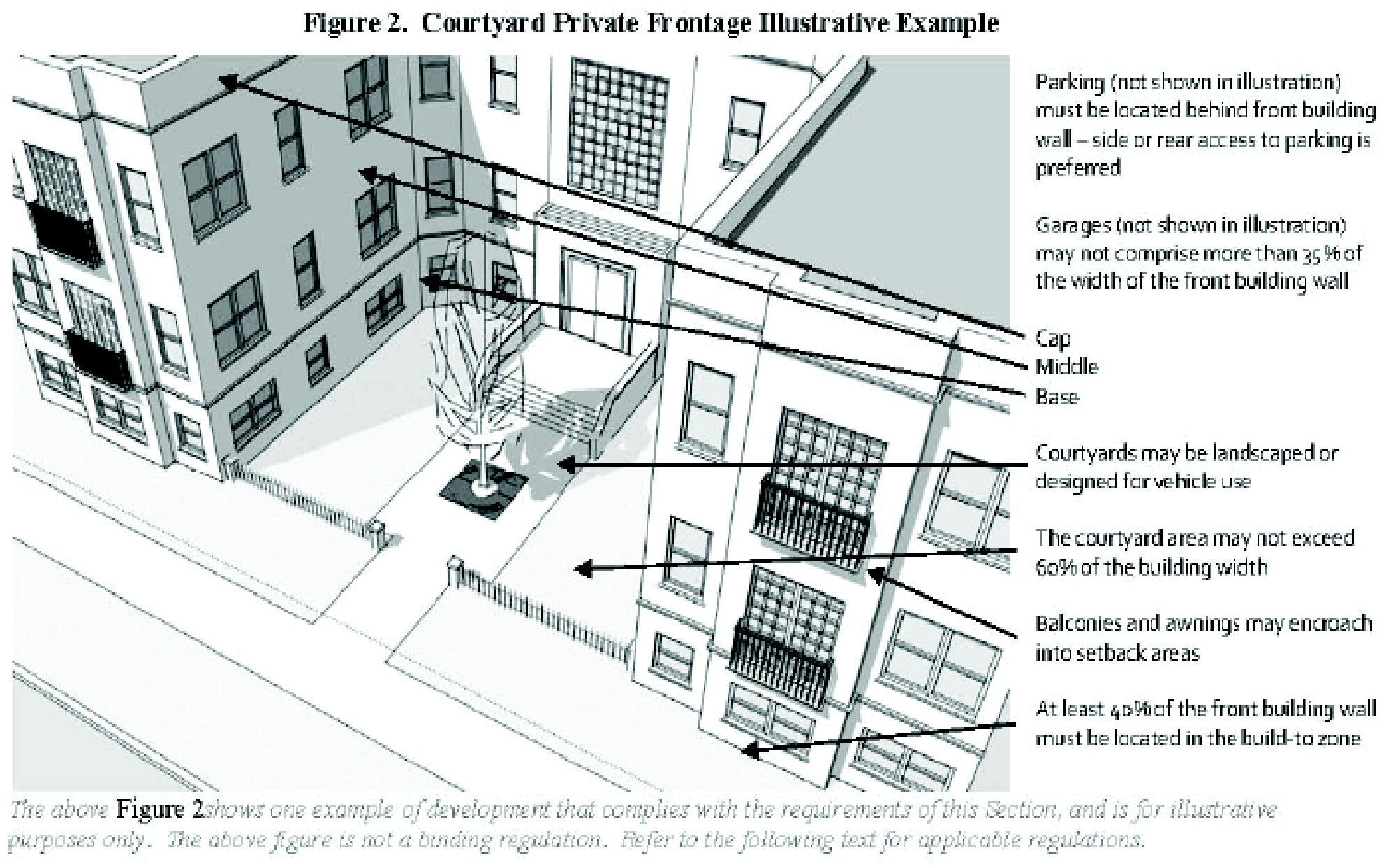
(Ord. No. 407, § VIII, 7-15-13)

