
Gun Barrel City City Zoning Code
CHAPTER 156
- ZONING CODE7
Editor's note— The zoning ordinance, adopted on December 12, 1978, has been amended numerous times since its adoption. Ordinances that specifically zone or rezone property or that grant variances or special uses are not incorporated herein. Ordinances that generally amend the zoning ordinance have been incorporated into the zoning code found in this chapter. Such amending ordinances are as follows, although this listing is not meant to be all-inclusive: Ord. 106, passed 6-12-79; Ord. 111, passed 10-9-79; Ord. 120, passed 6-10-80; Ord. 123, passed 8-12-80; Ord. 129, passed 11-11-80; Ord. 130, passed 12-9-80; Ord. 134A, passed 3-10-81; Ord. 139, passed 4-28-81; Ord. 142A, passed 6-23-81; Ord. 146A, passed 7-14-81; Ord. 152A, passed 10-14-81; Ord. 175, passed 4-12-83; Ord. 191, passed 3-13-84; Ord. 218, passed 2-11-86; Ord. 234, passed 2-10-87; Ord. 235, passed 2-10-87; Ord. 261, passed 1-24-89; Ord. 263, passed 1-24-89; Ord. 269, passed 2-28-89; Ord. 271, passed 4-25-89; Ord. 344, passed 6-23-92; Ord. 385, passed 3-22-94; Ord. 395, passed 7-12-94; Ord. 421, passed 12-13-94. Beginning with Ord. 428, passed 2-14-95, all ordinances which amend the zoning code will only be cited in the legislative history of the appropriate code section.
Charter reference— Planning and Zoning Commission, Master Plan, Board of Adjustment, see Charter Art. IX
Cross reference— Replatting and variance requirements, see § 150.003
State Law reference— Compliance with Open Meetings Law, see Tex. Local Gov't Code § 211.0075; Municipal zoning authority, see Tex. Local Gov't Code §§ 211.001 et seq.; Repeal of zoning regulations by referendum, see Tex. Local Gov't Code § 211.015
Sec. 156.001 - TITLE.
This chapter shall be known, cited and referred as the "Zoning Code for the City of Gun Barrel City, Texas."
(Ord. 100, passed 12-12-78)
Sec. 156.002 - ZONING MAP ADOPTED.
The map herein referred to and identified by the title, "Zoning Map of the City of Gun Barrel City, Texas," and all explanatory matter thereon, is hereby adopted and made a part of this chapter, and such Zoning Map shall be treated as if set forth in full herein.
(Ord. 100, passed 12-12-78)
Sec. 156.003 - PURPOSE.
(A)
Basic goal. It is the intent of this chapter to encourage and promote, in accordance with present and future needs, the safety, morals, health, order, convenience, prosperity, and general welfare of the citizens of the city.
(B)
Objectives. To achieve this end, these regulations are prepared in accordance with and for the promotion of the goals and objectives of the Comprehensive Development Plan, and are designed to conserve the value of land, buildings, and resources; protect the character and maintain the stability of residential, commercial, and industrial areas; and provide for the efficiency and economy in the process of development through the:
(1)
Appropriate use of land;
(2)
Regulating of the use and occupancy of buildings and land;
(3)
Healthful and convenient distribution of population;
(4)
Convenience of traffic and circulation of people and goods;
(5)
Adequacy of public utilities and facilities;
(6)
Promotion of the civic amenities of beauty and visual interests;
(7)
Protection, enhancement, and perpetuation of specific community areas with special character, interest, or value which represents and reflects elements of the city's cultural, social, economic, and political heritage;
(8)
Establishment of zoning districts which will regulate the location and use of buildings and other structures, land for trade, industry, residence and other purposes by regulating and limiting or determining the height, bulk, and access to light and air of buildings and structures, the area of yards and other spaces, and the density of use.
(C)
Accomplishment of objectives. To accomplish these objectives, the regulations and districts and accompanying map have been designed with reasonable consideration, among other things, to the character of the districts and their peculiar suitability for particular uses.
(Ord. 100, passed 12-12-78)
Sec. 156.004 - DEFINITIONS.
(A)
Rules for construction of language. For the purpose of the administration and enforcement of this chapter, and unless otherwise stated in this chapter, the following rules of construction shall apply:
(1)
The word "shall" is always mandatory and not discretionary. The word "may" is permissive.
(2)
Words used in the present tense shall include the future; and words used in the singular number shall include the plural, and the plural the singular, unless the context clearly indicates the contrary.
(3)
The phrase "used for" includes "arranged for," "designed for," "maintained for," "provided for," or "occupied for."
(4)
The word "person" includes an individual, a corporation, a partnership, or any other similar entity.
(5)
Unless the context clearly indicates the contrary, where a regulation involves two or more items, conditions, provisions or events, connected by the conjunction "and," "or," or "either...or," the conjunction shall be interpreted as follows:
(a)
"And" indicates that all the connected items, conditions, provisions, or events shall apply;
(b)
"Or" indicates that the connected items, conditions, provisions, or events may apply singly or in any combination;
(c)
"Either...or" indicates that the connected items, conditions, provisions, or events shall apply singly but not in combination.
(6)
The word "includes" shall not limit a term to the specified examples, but is intended to extend its meaning to all instances or circumstances of like kind or character.
(B)
Definitions. For the purpose of this chapter, the following definitions shall apply unless the context clearly indicates or requires a different meaning.
ACCESS. The primary means of ingress and egress to abutting property from a dedicated right-of-way.
ACCESSORY STRUCTURE. A structure incidental and subordinate to the principal use of the property and located on the same lot as the principal use.
ALLEY. A public or private right-of-way, not more than 30 feet in width, which affords a secondary means of public or private access to property abutting thereon.
ANIMAL CREMATORY. A structure containing a furnace used or intended to be used for the cremation, or reducing to ashes, of animal remains.
APARTMENT. See DWELLING, MULTIPLE FAMILY.
AUTOMOTIVE REPAIR FACILITIES. Establishments used for mechanical engine overhaul which includes the removal of engine, chassis, or body components for repair or replacement; and wherein the dispensing of gasoline may be included but not gasoline service stations. AUTOMOTIVE REPAIR FACILITIES shall also include body, paint, brake, transmission and tire service shops.
BOARDING HOUSE. An establishment with lodging for four or more persons, where meals with compensation are regularly prepared and served to such lodgers, without service or ordering of individual portions from a menu.
BUILDABLE AREA. That portion of a lot remaining after the required yard setbacks have been provided.
BUILDING. Any structure, either temporary or permanent, having a roof, and used or built for the enclosure or shelter of persons, animals, vehicles, goods, merchandise, equipment, materials, or property of any kind. This definition shall include tents, dining cars, trailers, mobile homes, sheds, garages, carports, animal kennels, storerooms, or vehicles serving in any way the function of a building as described herein.
(1)
ACCESSORY BUILDING. A subordinate building, the use of which is incidental to that of the principal building on the same lot.
(2)
PRINCIPAL BUILDING. A building in which is conducted the principal use of the lot on which it is situated. In a residential district any dwelling shall be deemed to be the principal building on the lot on which the same is situated. An attached carport, shed, garage or any other structure with one or more walls or a part of the principal building and structurally dependent, totally or in part, on the principal building, shall comprise a part of the principal building and be subject to all regulations applicable to the principal building. A detached and structurally independent carport, garage, or other structure shall conform to the requirements of any accessory building.
BUILDING HEIGHT. The vertical distance measured from the average elevation of the proposed finished grade at the front of the building except that the distance shall be measured to the average height between the eaves and ridge for gable, hip or gambrel roofs and to the deck line of a mansard roof.
BUILDING SETBACK LINE or BUILDING LINE or SETBACK LINE. A line defining an area on the building lot between the street right-of-way line and all other property lines and the building line within which no building or structure shall be constructed (also referred to as a "yard"), encroach or project except as specifically authorized in an adopted ordinance of the city. The term BUILDING SETBACK LINE may be used interchangeably with the terms BUILDING LINE(S) and SETBACK LINE(S) throughout the zoning code.
(1)
FRONT BUILDING SETBACK LINE (defining a front yard). A line parallel to the street right-of-way line which the building faces, and takes its primary access from. Where lots have multiple frontages on one or more streets, the required front yard shall be provided on each street (see examples below).
(2)
SIDE BUILDING SETBACK LINE (defining a side yard). A line parallel to an adjacent lot which the building sides up to.
(3)
REAR BUILDING SETBACK LINE (defining a rear yard). A line parallel to an adjacent lot or alley, which the building backs up to and has its rear or secondary access from.
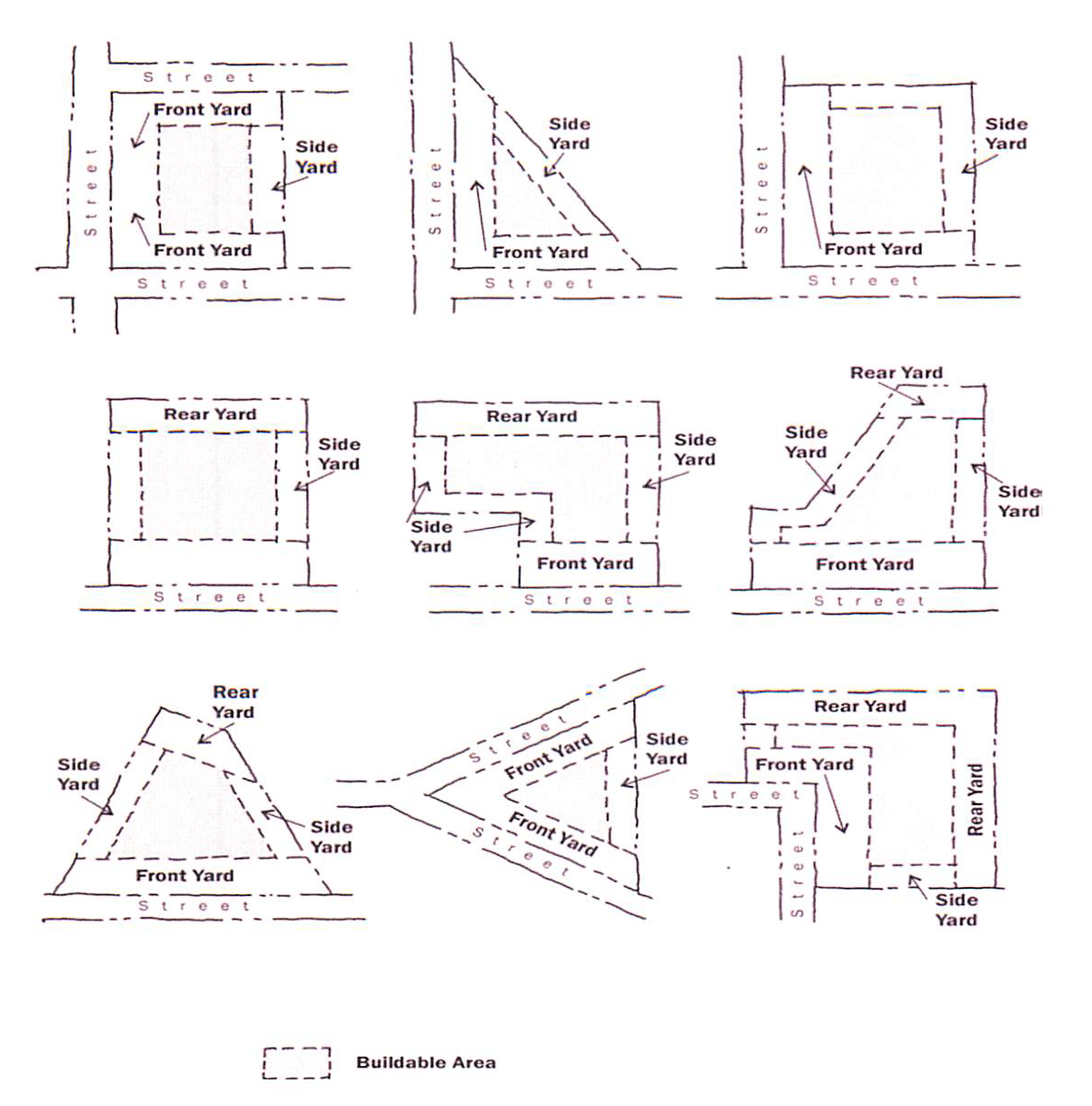
BUSINESS SERVICE ESTABLISHMENTS. Establishments providing supplies and services to business and professions and telephone answering service, office supply and stationery stores, delivery and messenger services, advertising agencies, direct mail service, detective agencies, employment agencies, collection agencies, and any other establishments offering goods or services of a similar nature, but not including establishments of research or light industrial nature.
CENTERLINE. The line midway between the street right-of-way lines or the surveyed and prescribed centerline established by the city which may not be the line midway between the existing or proposed street right-of-way lines.
CHILD DAY CARE CENTER. A place, home, building or location where care is provided for four or more children under the age of 18 years. Such term specifically includes nursery schools, kindergartens or any other facility caring for children during the day or night.
CLINICS. A medical office or group of offices, used for the care, diagnosis and treatment of sick, injured persons, and those in need of medical or surgical attention, but not involving overnight care on the premises. Clinics may include accessory facilities for retail sales of pharmaceuticals, and medical, optical or dental supplies.
COMMERCIAL AMUSEMENT. An indoor or outdoor enterprise (such as a bingo parlor, driving range, miniature golf course, pony rides, miniature train rides, rodeo, water slides, go-cart track, giant slide, motorcycle track, skateboard track, video arcade, eight liner arcade, bowling alley, billiard parlor and similar enterprises) whose main purpose is to provide the general public with a variety of amusing or entertaining activities, and where tickets are sold or fees collected to participate in any such enterprise.
CONTRACTOR SHOPS AND YARDS. Stores, fabrication and repair shops and yards for cabinet makers and carpenters, electrical contractors, electric sign contractors, glaziers, heating and sheet metal contractors, linoleum and carpet contractors, painters, plumbers, roofers, tent and awning contractors, upholsterers, and any other concern of a similar nature, but not including concrete mixing or asphalt plants.
COURT, GENERAL. An open space, other than a yard, on the same lot with a building or structure, which is bounded on two or more sides by the walls of such building or structure.
(1)
OUTER COURT. A court enclosed on three sides by exterior walls of a building or structure, or by exterior walls and lot lines on which walls are allowable, with one side or end open to a street, driveway, alley or yard.
(2)
INNER COURT. A court which is completely surrounded by a building or buildings.
DENSITY. An existing or projected relationship between the allowable lot area per dwelling unit for a district and the land area zoned in each zoning district. The number of dwelling units is found by dividing the total land area zoned in each zoning district by the allowable lot area for that district.
DRY GOOD STORES. Establishments selling clothing, linens, blankets, yardage and notions and shall include shoe repair stores, gift stores, notions stores, luggage stores, tailor shops, yardage stores, shoe stores, clothing stores, and other stores of a similar nature, but excluding variety stores and department stores.
DWELLING UNIT. A dwelling unit consists of one or more rooms which are arranged, designed or used as living quarters, including permanently installed individual bathrooms and complete kitchen facilities.
(1)
DWELLING, SINGLE-FAMILY ATTACHED. A structure designed as one dwelling unit at ground space and intended to be occupied exclusively by one family and structurally connected by common walls or with separation of not more than one inch from at least one or more other dwelling units.
(2)
DWELLING, SINGLE-FAMILY DETACHED. A structure designed as one dwelling unit and intended to be occupied exclusively by one family and structurally connected to no other dwelling unit.
(3)
DWELLING, MULTIPLE-FAMILY. A structure designed with more than one dwelling unit with accommodations for each dwelling unit independent of each other and intended to be occupied by more than one family.
EATING ESTABLISHMENTS. Establishments where meals or prepared food, including beverages and confections, are served to customers for consumption on or off the premises, and shall include restaurants, cafes, coffee shops, donut shops, ice cream parlors, soda fountains, hamburger and hot dog stands, sandwich shops, delicatessens, cafeterias and other stores of similar nature.
FAMILY. A collective number of individuals domiciled together in one dwelling unit whose relationship is of a continuing nontransient domestic character and who are cooking and living as a single nonprofit housekeeping unit. This definition shall not include any society, club, fraternity, sorority, association, lodge, organization, or group of students or other individuals whose domestic relationship is of a transitory or seasonal nature or for an anticipated limited duration of a school term or other similar determinable period.
FINANCIAL INSTITUTIONS. Establishments and offices offering financial services or counsel and shall include full service banks, saving and loan institutions, stock brokers offices, banking companies, finance company offices, credit union offices and any other institutions of a similar nature.
FOOD STORES. Establishments selling food and/or drink products for consumption off the premises and shall include convenience grocery stores, fruit and vegetable stores, bakeries, retail (limited preparation of products for on-premises sales) meat and fish stores, dairy product stores, butcher shops, candy stores, liquor and/or wine stores and other stores of a similar nature.
FRONTAGE. Distance measured along an abutting public street right-of-way.
FURNITURE AND APPLIANCE STORES. Establishments selling new or used furniture or appliances and providing incidental service and maintenance and shall include new and used furniture stores, appliance stores, antique dealers, carpet and linoleum dealers, and other establishments of a similar nature.
GASOLINE SERVICE STATION. Establishments for servicing of automotive vehicles which includes activities such as oil changes, lubrication, dispensing of gasoline, tune up, tire replacement and repair, and wheel alignment and balancing, but no overhaul, body or paint shops. Brake and transmission shops shall also be considered minor automotive repair facilities.
HOME OCCUPATION. Any occupation or profession engaged in by the occupants of a dwelling not involving the conduct of a retail business, and not including any occupation conducted in any building on the premises excepting the building which is used by the occupant as his or her private dwelling. HOME OCCUPATIONS shall include, in general, personal or professional services such as furnished by an architect, lawyer, physician, dentist, musician, artist, barber, and seamstress when performed by the person occupying the building as his or her private dwelling and not including a partnership or the employment of more than one assistant in the performance of such services.
HOTEL. A building in which lodging or board and lodging are provided and offered to the public for compensation and in which ingress and egress to and from all rooms is made through an inside lobby or office supervised by a person in charge at all hours. As such, it is open to the public in contrast to a boarding house, a lodging house, or a multiple-family dwelling which are herein defined.
HOUSEHOLD AND FAMILY SERVICE ESTABLISHMENTS. Establishments providing for the sale, repair, and/or maintenance of articles of normal home or family use and shall include cleaning and drying establishments, coin operated laundries, lawn mower and saw sharpening, fix-it shops, smaller home appliance stores and repair shops, sewing machine stores, hardware stores, camera and photo supply stores, pet stores excluding veterinarian services, art stores, music stores, pawn shops, florists and any other shops of a similar nature; provided, however, that establishments for the selling, repairing and/or maintenance of vehicles or tires shall not be deemed to be household and family service establishments.
LIVING UNIT. See DWELLING UNIT.
LODGING HOUSE. A building or place where lodging is provided (or which is equipped to provide lodging regularly) by prearrangement for definite periods, for compensation, for three or more persons in contrast to hotels open to transients.
LOT. A piece, parcel, tract, or plot of land in an approved subdivision.
(1)
LOT AREA. The total horizontal area included within lot lines.
(2)
LOT, CORNER. Lot bounded by more than one intersecting street.
(3)
LOT COVERAGE. The ratio of enclosed ground floor area of all buildings on a lot to the horizontally projected area of the lot expressed as a percentage.
(4)
LOT DEPTH. The mean horizontal distance between the front and rear lot lines.
(5)
LOT LINE. The boundary line of a lot in a platted subdivision.
(a)
FRONT. That property line which abuts on a public street or an approved private way, or in the event the property abuts on two or more streets or approved private ways, it shall mean that property line abutting on a street or approved private way, and which has been so designated by the owner at the time of his application for a building permit.
(b)
SIDE. Any property line not a front lot line or a rear lot line. A side lot line separating a lot from a street is an exterior side lot line. A side lot line separating a lot from another lot or lots is an interior side lot line.
(c)
REAR. That boundary of a lot which is most distance from and is, or is most nearly, parallel to the front lot line.
(6)
LOT OF RECORD. A lot whose existence, location and dimensions have been legally recorded or registered in a deed or on a plat prior to the effective date of this chapter.
(7)
LOT WIDTH. The mean horizontal distance between the side lot lines measured at the required front property line.
MOBILE HOME. A structure that was constructed before June 14, 1976, transportable in one or more sections, which, in the traveling mode, is eight body feet or more in width or 40 body feet or more in length, or when erected on-site, is 320 or more square feet, and which is built on a permanent chassis and designed to be used as a dwelling with or without a permanent foundation when connected to the required utilities, and included plumbing, heating, air-conditioning and electrical systems.
MOBILE HOME PARK. A parcel of land designed, constructed, equipped, operated, managed and maintained for the purposes of providing spaces for rent or lease on which are placed mobile homes which are rented, leased or owned.
MOBILE HOME SUBDIVISION. The division of a parcel of land into contiguous lots or parcels, designated by reference to the number or symbol of the lot or parcel contained in the plat of such subdivisions, for the purpose of transfer of ownership and the subsequent placement of a mobile home on such lot or parcel for the establishment of a permanent residence and meeting all requirements of the city subdivision regulations.
MOTEL. A group of attached, semi-detached, or detached buildings containing individual sleeping or living units designed for or used temporarily by automobile tourists, or transients, with garage attached or parking space conveniently located to each unit and offering to the public daily as well as other longer term rental rates and maintaining a register of guests and/or their vehicles.
NONCONFORMING BUILDING OR STRUCTURE. A building or structure existing at the time of passage or amendment of this chapter which does not conform to the property development and regulations of area, height, lot coverage, yard setbacks, or other like requirements of the district in which it is located.
NONCONFORMING LOT. Any single lot, tract or parcel of land in existence at the time of passage or amendment of this chapter which does not meet the minimum dimensions, area or other regulations of the district in which it is located.
NONCONFORMING USE. Any land use existing at the time of passage or amendment of this chapter which does not conform to the provisions, requirements and regulations of the district in which it is located.
ON-SITE CONSTRUCTION. Buildings which are primarily constructed upon the premises where they are to stand permanently (that is, the foundation, walls, siding, roof and floor covering must be constructed on the such premises).
PARKING SPACE, OFF-STREET. An area of not less than 162 square feet, surfaced with a suitable, dust free surface, enclosed or unenclosed, exclusive of driveways and alleys, and adjacent to a driveway or alley, with the minimum dimensions of 9 feet by 18 feet, designed so as to be used for parking of a motor vehicle.
PERSONAL SERVICE ESTABLISHMENTS. Establishments and offices offering services for the health and welfare of the individual and shall include barber shops, beauty shops, reducing or slenderizing studios, and any other establishments of a similar nature, but not including any professional services.
PORTABLE BUILDING. A movable structure constructed on skids or wheels that is capable of being transported. A PORTABLE BUILDING shall be an accessory structure as defined by this section.
PREFABRICATED STRUCTURE. A structure made or built in standard-sized sections for shipment and quick assembly. A PREFABRICATED STRUCTURE may be pre-assembled or assembled on the site.
PROFESSIONAL SERVICES. Services offered by doctors, lawyers, accountants, real estate brokers, insurance agents, land developers, engineers, architects, planners, computer systems analysts and any other individuals or groups offering professional services of a similar nature.
PROPERTY LINE. See LOT LINE.
PUBLIC BODY. Any government or governmental agency, board, commission, or authority of the city of Gun Barrel City, Henderson County, State of Texas, or the U.S. Government or any legally constituted district.
PUBLIC USE. The use of any land, water, or buildings by a public body for a public service or purpose.
RECREATIONAL AND SPORT STORES. Establishments selling sporting goods, bicycles, and other sports and recreation equipment and shall include sporting goods stores, gun shops, bicycle shops including bicycle repair, toy stores and any other stores selling goods of a similar nature, but excluding motorized recreation vehicle sales and services including cycle sales and services.
RECREATION VEHICLE. Any vehicle designed and intended for recreational purposes, and shall include trailers, travel trailers, camp-cars, pickup campers, buses, tent trailers or any other similar vehicles with or without motive power, designed and constructed to travel on public thoroughfares.
RESIDENCE. See DWELLING UNIT.
RIGHT-OF-WAY. A strip of land dedicated or deeded to the perpetual use of the public.
SEMI-PUBLIC BODY. Churches and organizations operating as a non-profit activity serving a public purpose of service and includes such organizations as noncommercial clubs and lodges, theater groups, recreational and neighborhood associations, and cultural activities.
SEMI-PUBLIC USE. The use of any land or building by a semi-public body.
SPECIAL EXCEPTION. A use that would not be appropriate generally or without restriction throughout a zoning district but which, if controlled as to number, area, location, or relation to the neighborhood, and approved through a public hearing of the Board of Adjustment would promote the public health, safety, welfare, morals, order, comfort, convenience, appearance or prosperity. Such uses may be permitted in such zoning districts as special exceptions and as outlined in the applicable zoning district.
STORAGE BUILDING. See ACCESSORY STRUCTURE.
STORY. That portion of a building, other than the basement, included between the surface of any floor and the surface of the floor next above it; or if there be no floor above it then the space between the floor and the ceiling next above it.
STORY, HALF. A partial story under a gable, hip or gambrel roof, the wall plates of which on at least two opposite exterior walls are not more than four feet above the floor of such story, except that any partial story used for residence purposes, other than by a family occupying the floor immediately below it, shall be deemed a full story.
STREET. A right-of-way which provides principal vehicular and pedestrian access to adjacent properties.
(1)
PRIVATE STREET OR WAY. A private right-of-way serving more than one ownership, built to standard city specifications for a public street and approved as provided herein. A private street or way is owned in common by the owners of real property in the subdivision and must be maintained by the homeowners association of the subdivision.
(2)
PUBLIC STREET. A right-of-way dedicated to public use, built to standard city specification for a public street, whether designated as a street, avenue, highway, road, boulevard, lane, place or otherwise, and which has been accepted by the city for maintenance.
STREET RIGHT-OF-WAY. The property line which bounds the right-of-way set aside for use as a street. Where sidewalks exist and the exact location of the right-of-way is unknown, the side of the sidewalk farthest from the centerline of the traveled street shall be considered as the right-of-way line.
STRUCTURAL ALTERATION. Any change except for repair or replacement in the supporting members of a structure such as bearing walls or partitions, columns, beams, or girders, or any substantial change in the roof or in the exterior walls of a structure.
STRUCTURE. Anything constructed or erected with a fixed location on the ground or attached to something having a fixed location on the ground, and having a height of four inches or more except for patios, parking and loading facilities, walls, or fences. See also ACCESSORY STRUCTURE.
TATTOO STUDIO. Any establishment, place of business, or location, wherein adornment of any part of the human body or head, whether artistic, cosmetic or otherwise, is practiced through the use of needles, scalpels, or any other instruments designed to touch, penetrate or puncture the skin for purposes of: inserting, attaching or suspending jewelry, decorations or other foreign objects; producing an indelible mark or figure on the human body or face by scarring skin or flesh; producing an indelible mark or figure on the human body or face by inserting a pigment under or upon the skin; or permanently changing the color or other appearance of the skin.
TRAILER or MOTOR HOME. See RECREATION VEHICLE.
USABLE OPEN SPACE. That part of the ground area (improved or unimproved) roof, balcony, or porch which is designed or intended for outdoor living, recreation, or utility space and may include recreational buildings or structures, but shall not include streets, driveways, parking and loading areas or any other paved vehicular ways and facilities as well as all required minimum front yard areas.
USE. Any activity, functions, or purpose, to which a parcel of land or building is put and shall include the words used, arranged, or occupied, for any purpose, including all residential, commercial, business, industrial, public or any other use.
(1)
ACCESSORY USE. A use which is wholly incidental to and supportive of the principal use on the same lot.
(2)
PRINCIPAL USE. The primary purpose for which land or building is used as permitted by the applicable zoning district.
VARIANCE. A relaxation of the terms of this chapter where such variance will not be contrary to the public interest and where a literal enforcement of this chapter would result in unnecessary and undue hardship.
VEHICLE. Any self-propelled conveyance designed and used for the purpose of transporting or moving persons, animals, freight merchandise, or any substance, and shall include passenger cars, trucks, buses, motorcycles, scooters, but shall not include tractors, construction equipment, or machinery, or any device used in performing a job as stated above.
ZONING DISTRICT. A portion of the territory of the city including the Zoning Map and all amendments to such zoning ordinance and Zoning Map.
(Ord. 100, passed 12-12-78; Am. Ord. 99-025, passed 11-9-99; Am. Ord. 01-012, passed 8-28-01; Am. Ord. O-2012-005, passed 4-24-12; Am. Ord. O-2019-004, passed 2-26-19; Am. Ord. O-2021-027, passed 12-17-19)
State Law reference— Tex. Rev. Civ. Stat. Art. 5221f, § 3
Sec. 156.005 - BUILDING SETBACK LINES.
The minimum front building lines upon any lot in the city, where the building has not been established by an approved plat or by any other city ordinance such as the subdivision regulations or zoning regulations, shall be determined by the City Council prior to issuance of a building permit. The minimum building setback lines shall be 25 feet in front, ten feet in rear and five feet on each side.
('88 Code, Ch. 3, § 15.00; Ord. 260, passed 1-10-89)
Cross reference— Penalty, see § 150.999
State Law reference— Authority to establish building lines, see Tex. Local Gov't Code §§ 213.001 et seq.
Sec. 156.015 - ESTABLISHMENT OF DISTRICTS.
In order to classify, regulate, and restrict the use of land, buildings and structures; to regulate and restrict the height and bulk of buildings; to regulate the area of yards and other open spaces about buildings; to regulate the intensity of land use, and to promote the orderly urban growth within the corporate area of the city, the following zones are established:
(A)
Single-Family Detached Residential Districts (R-1).
(B)
Single-Family Detached Residential Districts (R-2).
(C)
Single-Family Detached Residential Districts (R-3).
(D)
Single-Family Detached Residential Districts (R-4, R-4A).
(E)
Single-Family Detached Residential Districts (R-5).
(F)
Single-Family Detached Residential Districts (R-6A, B, C, and D).
(G)
Multiple-Family Residential Districts (MF-1).
(H)
Manufactured Housing Subdivision Districts (MH-1).
(I)
Recreational Vehicle Park Districts (RVP-1).
(J)
Local Business Districts (B-1).
(K)
General Business Districts (B-2).
(L)
Light Industrial District (L-1).
(M)
Agriculture District (A).
(N)
Planned Development District (PD).
(Ord. 100, passed 12-12-78; Am. Ord. 98-033A, passed 11-10-98; Am. Ord. 99-002, passed 3-9-99; Am. Ord. 00-008, passed 4-25-00)
Sec. 156.015.1 - ZONING DISTRICTS WITHIN SUBDIVISIONS.
The following table is a list of zoning districts within the subdivisions of the city.
Sec. 156.015.2 - OVERLAY DISTRICTS.
(A)
South 198 Overlay District.
(1)
Boundary. The South 198 Overlay District includes all business property, which means properties zoned B-1, B-2, L-1 or PD, that is south of State Highway 334 ("SH 334") and adjacent to, or within 100 feet of State Highway South 198 ("South 198") or Old Gun Barrel Lane. A map generally depicting the South 198 Overlay District boundary is attached and incorporated into this section as Exhibit "A" and is on file in the City Secretary's office.
(2)
Development standards. Within the South 198 Overlay District the minimum building setback line for the front yard shall be 25 feet. Where South 198 Overlay District standards conflict with base zoning requirements, the South 198 Overlay District shall apply. Otherwise, base zoning of a property shall not be affected by the South 198 Overlay District.
(3)
Penalty. Any person, firm, entity or corporation violating any provisions of this section shall be deemed guilty of a misdemeanor and, upon conviction in the municipal court of the city shall be punished by a fine not to exceed the sum of $2,000 for each offense. Each occurrence in violation of this section and/or each day the violation continues shall constitute a separate and distinct offense. The penal provisions imposed under this section shall not preclude the city from filing suit to enjoin the violation nor shall it preclude the city from taking such other lawful action as is necessary to prevent or remedy any violation. The city retains all legal rights and remedies available to it pursuant to local, state and federal law.
(B)
East 334 Overlay District.
(1)
Boundary. The East 334 Overlay District includes all business property, which means properties zoned B-1, B-2, L-1 or PD, that is East of State Highway 198 ("SH 198") and adjacent to, or within 100 feet of State Highway 334 East ("East 334"). A map generally depicting the East 334 Overlay District boundary is attached to Ord. O-2013-012 and is on file in the City Secretary's office.
(2)
Development standards. Within the East 334 Overlay District the minimum building setback line for the front yard shall be 25 feet. Where East 334 Overlay District standards conflict with base zoning requirements, the East 334 Overlay District shall apply. Otherwise, base zoning of a property shall not be affected by the East 334 Overlay District.
(3)
Penalty. That any person, firm, entity or corporation violating any of the provisions of this division shall be deemed guilty of a misdemeanor and, upon conviction in the municipal court of the city shall be punished by a fine not to exceed the sum of $2,000 for each offense. Each occurrence in violation of this division and/or each day the violation continues shall constitute a separate and distinct offense. The penal provisions imposed under this division shall not preclude the city from filing suit to enjoin the violation nor shall it preclude the city from taking such other lawful action as is necessary to prevent or remedy any violation. The city retains all legal rights and remedies available to it pursuant to local, state, and federal law.
(Ord. O-2012-004, passed 3-27-12; Am. Ord. O-2013-012, passed 6-25-13)
Sec. 156.016 - DESIGNATION OF DISTRICT BOUNDARIES.
The boundaries of each district are designed and established as shown on the Zoning Map of the city. The regulation of this chapter governing the use of land and buildings, the height of buildings, lot areas, setbacks, lot coverage, parking and loading requirements buildings, lot areas, setbacks, lot coverage, parking and loading requirements are hereby included within the boundaries of each and every district shown upon the Zoning Map.
(Ord. 100, passed 12-12-78)
Sec. 156.017 - RULES OF INTERPRETATION OF DISTRICT BOUNDARIES.
When uncertainty exists as to the boundaries of the various districts on the Zoning Map, the following rules shall apply:
(A)
Location of district boundary lines.
(1)
Centerlines. Boundaries indicated as approximately following the centerlines of streets, highways, avenues, and alleys shall be construed to follow such lines.
(2)
Lot lines. Boundaries indicated as approximately following platted lot lines shall be construed as following such lot lines.
(3)
Corporate boundaries. Boundaries indicated as approximately following corporate boundaries shall be construed as following such corporate boundaries.
(4)
Railroad lines. Boundaries indicated as following railroad lines shall be construed to be the centerline of the railroad right-of-way.
(5)
Water lines. Boundaries indicated as approximately following the centerlines of streams, canals or other bodies of water shall be construed to follow such centerlines.
(6)
Parallel lines. Boundaries that are approximately parallel to the centerlines or street lines of streets, the centerlines or alley lines of alleys, or the centerlines or right-of-way lines of highways, shall be construed as being parallel thereto and at such distance therefrom as indicated by the scale shown on the Zoning Map.
(B)
Uncertainties. Where physical or cultural features existing on the ground are at variance with those shown on the Zoning Map, or in case any other uncertainty exists, the Board of Adjustment shall interpret the intent of the Zoning Map as to the location of district boundaries.
(C)
Street abandonments. Where a public road, street, avenue, or alley is officially vacated or abandoned, the regulations applicable to the property to which it reverted shall apply to such vacated or abandoned road, street, avenue, or alley.
(D)
Annexed areas. All territory hereafter annexed to the city shall be temporarily zoned as the closest or most similar zoning district to the existing deed restrictions and/or subdivision restrictions for that development. The City Manager shall recommend to the City Council the proposed zoning district and the newly annexed area should be classified as until permanent zoning has been given. The procedure for establishing permanent zoning of annexed territory shall conform to the procedure established by law or ordinance.
(E)
Special provisions for lots divided by district boundaries. Where any lot, existing at the effective date of this chapter, is located in two or more districts in which different uses are permitted, or in which different use, area, bulk, accessory off-street parking and loading, or other regulations apply, the provisions of this division (E) shall apply.
(1)
Use regulations.
(a)
If more than 50% of the lot area of the lot is located in one of two or more districts, the use regulations applicable to the district containing the majority lot area shall apply to the entire lot.
(b)
If the lot is divided so that 50% of the lot area lies within each of two or more districts, the applicable use regulations of the more restrictive district shall apply to the entire lot.
(2)
Dimensional requirements regulations.
(a)
If more than 50% of the lot area of the lot is located in one of two or more districts, the dimensional requirement regulations applicable to the district containing the majority lot area shall apply to the entire lot.
(b)
In cases where the lot is divided so that 50% of the lot area lies within two or more districts the lot area, yard setback, height, lot coverage, and off-street parking and loading regulations and requirements for the district with the more restrictive regulations shall apply to the entire lot.
(Ord. 100, passed 12-12-78)
Sec. 156.018 - APPLICATION OF DISTRICTS.
(A)
Existing uses. In all districts after the effective date of this chapter:
(1)
The use of any existing building or other structure may be continued.
(2)
The use of any existing tract of land may be continued.
(3)
The enlargement, alteration, conversion, reconstruction, rehabilitation, or relocation of any existing building or other structure shall be in accordance with the dimensional requirement regulations of the district within which the property is located and other applicable requirements of this chapter.
(4)
Every existing building hereafter enlarged, altered, reconstructed, or relocated shall be on a lot herein defined, and in no case shall there be more than one principal building on one lot, unless otherwise provided in this chapter.
(B)
New uses.
(1)
In all districts after the effective date of this chapter any new building or parcel of land shall be used, constructed or developed only in accordance with the use and dimensional requirement regulations of the district within which the property is located and other applicable requirements of this chapter.
(2)
Every building hereafter constructed or erected shall be on a lot as herein defined, and in no case shall there be more than one principal building on one lot, unless otherwise provided in this chapter.
(C)
Uses not expressly provided for. In a district where an application is made for a use not expressly permitted or prohibited, the enforcing official shall determine that use which is expressly prohibited or permitted most closely similar or allied to that use requested. In the event any applicant or citizen objects to a determination made by the enforcing official, such person or persons may appeal his case to the Zoning Board of Adjustment.
(Ord. 100, passed 12-12-78)
Sec. 156.030 - SINGLE-FAMILY DETACHED RESIDENTIAL DISTRICT (R-1).
(A)
Purpose. The intent of this district is to provide for very low density, single-family residential development of a relatively spacious character together with such public and semi-public buildings and facilities and accessory structures as may be necessary and are compatible with residential development of this nature. The provisions of this district are intended to protect and stabilize the essential characteristics of such existing development; to encourage such future development to occur on vacant land where the natural characteristics of such land are suitable for this type of development; to provide policies which will encourage low density development to occur where public facilities and services and other factors are available which are conducive to residential development of such densities; and to discourage any activities not compatible with such residential development.
(B)
Permitted uses.
(1)
Uses permitted by right.
(a)
Single-family detached dwelling, on-site construction in R-1 District;
(b)
Leasing or renting of rooms, however, the number of tenants in each dwelling shall not exceed two;
(c)
Public schools or private schools offering curricula comparable to that of the public schools;
(d)
Churches and other houses of worship (see § 156.084).
(2)
Accessory structures permitted. Garages, storage rooms, swimming pools, and other structures that are customarily incidental to the principal structures.
(3)
Uses permitted by special exception.
(a)
Cemeteries and mausoleums (see § 156.082);
(b)
Child day care centers (see § 156.083);
(c)
Public and private utility services, excluding sanitary landfills, incinerators, refuse and trash dumps (see § 156.090);
(d)
Governmental buildings and services;
(e)
Semi-public recreational facilities and buildings.
(C)
Dimensional requirements on Single-Family Residential Detached District (R-1). All principal and accessory structures shall be located and constructed in accordance with division (D) of this section where it applies, as well as to the following requirements:
(1)
Residential uses.
(a)
Minimum lot area - 10,000 square feet.
(b)
Minimum lot width at building line - 100 feet.
(c)
Minimum lot depth - 90 feet.
(d)
Minimum yard setbacks:
1.
Front - 25 feet.
2.
Side, interior - 5 feet.
3.
Side, street - 25 feet.
4.
Rear - 20 feet.
(e)
Minimum building floor space of principal structures - 1,800 square feet.
(f)
Maximum building height of principal structures - 35 feet.
(g)
Maximum percent of lot coverage - 30%.
(h)
Two car garage is required. Minimum driveway to be 20 feet wide and 25 feet deep, with the remainder, if any, to be a minimum of 12 feet wide to the public street. Driveway to be hard surfaced such as asphalt, concrete, brick, cobblestone or paving stone.
(2)
Accessory structures.
(a)
No accessory structure, excluding fences or walls, shall be closer to any property line than the required yard setbacks; however, an accessory structure to a residential dwelling may be as close as ten feet to any rear property line.
(b)
An accessory structure shall not exceed 50% of the interior square footage of the principal structure; however, if the interior square footage of the principal structure is less than 1,440 square feet, the maximum accessory structure shall not exceed 720 square feet. The combined sum of all structures (principal and accessory) shall not exceed the maximum lot coverage under any circumstance.
(c)
An accessory structure shall not exceed two stories or 25 feet in height.
(d)
An accessory structure shall not be located in a required front yard, unless a variance is granted pursuant to the variance procedures in § 156.140 of this zoning code.
(D)
Special regulations. In addition to division (C) of this section, the general district regulations of §§ 156.055 et seq. shall apply.
(Ord. 100, passed 12-12-78; Am. Ord. 00-008, passed 4-25-00; Am. Ord. O-2013-013, passed 6-25-13)
Cross reference— Penalty, see § 156.999
Sec. 156.031 - SINGLE-FAMILY DETACHED RESIDENTIAL DISTRICT (R-2).
(A)
Purpose. The intent of this district is to provide for low density, single-family residential development of a relatively spacious character together with such public and semi-public buildings and facilities and accessory structures as may be necessary and are compatible with residential development of this nature. The provisions of this district are intended to protect and stabilize the essential characteristics of such existing development; to permit population densities which are low enough to be compatible with neighboring single-family developments; to encourage such future development to occur on vacant land where the natural characteristics of such land are suitable for this type of development; to provide policies which will encourage such low density residential development to occur where public facilities and services and other factors are available which are conducive to development of such densities; and to discourage any activities not compatible with such residential development.
(B)
Permitted uses.
(1)
Uses permitted by right.
(a)
Single-family, detached dwelling, on-site construction;
(b)
Leasing or renting of rooms, however, the number of tenants in each dwelling shall not exceed two;
(c)
Public schools or private schools offering curricula comparable to that of the public schools;
(d)
Public recreational facilities and buildings;
(e)
Churches and other houses of worship (see § 156.084).
(2)
Accessory structures permitted. Garages, storage rooms, swimming pools, and other structures that are customarily incidental to the principal structures.
(3)
Uses permitted by special exception.
(a)
Child day care centers (see § 156.083);
(b)
Public and private utility services, excluding sanitary landfills, incinerators, refuse and trash dumps (see § 156.090);
(c)
Governmental buildings and services;
(d)
Semi-public recreational facilities and buildings;
(e)
Cemeteries and mausoleums (see § 156.082);
(f)
Off-site parking.
1.
Ingress and egress to off-site parking shall be prohibited from arterial streets in R-2 zoned areas.
2.
Land used for off-site parking shall be able to accommodate emergency vehicles however, the property must be screened from the public view.
3.
Constructed business shall insure that no structure requiring/requesting off-site parking fronts the R-2 area.
(C)
Dimensional requirements on Single-Family Residential Detached District (R-2). All principal and accessory structures shall be located and constructed in accordance with division (D) of this section where it applies, as well as to the following requirements:
(1)
Residential uses.
(a)
Minimum lot area - 7,500 square feet.
(b)
Minimum lot width at building line - 75 feet.
(c)
Minimum lot depth - 90 feet.
(d)
Minimum yard setbacks:
1.
Front - 25 feet.
2.
Side, interior - 5 feet.
3.
Side, street - 15 feet.
4.
Rear - 10 feet.
(e)
Minimum building floor space of principal structure - 1,450 square feet.
(f)
Maximum building height of principal structures - 35 feet.
(g)
Maximum percent of lot coverage - 30%.
(h)
Two car garage is required. Minimum driveway to be 20 feet wide and 25 feet deep, with the remainder, if any, to be a minimum of 12 feet wide to the public street. Driveway to be hard surfaced such as asphalt, concrete, brick, cobblestone or paving stone.
(2)
Accessory structures.
(a)
No accessory structure, excluding fences or walls, shall be closer to any property line than the required yard setbacks; however, an accessory structure to a residential dwelling may be as close as 7 1/2 feet to the rear property line.
(b)
An accessory structure shall not exceed 50% of the interior square footage of the principal structure; however, if the interior square footage of the principal structure is less than 1,440 square feet, the maximum accessory structure shall not exceed 720 square feet. The combined sum of all structures (principal and accessory) shall not exceed the maximum lot coverage under any circumstance.
(c)
An accessory structure shall not exceed two stories or 25 feet in height.
(d)
An accessory structure shall not be located in a required front yard, unless a variance is granted pursuant to the variance procedures in § 156.140 of this zoning code.
(D)
Special regulations. In addition to division (C) of this section, the general district regulations of §§ 156.055 et seq. shall apply and the following regulations shall apply where required:
(1)
All construction is to be 55% brick, natural stone or better; and all construction is to be of new material.
(Ord. 100, passed 12-12-78; Am. Ord. 428, passed 2-14-95; Am. Ord. 00-008, passed 4-25-00; Am. Ord. O-2013-013, passed 6-25-13)
Cross reference— Penalty, see § 156.999
Sec. 156.032 - SINGLE-FAMILY DETACHED RESIDENTIAL DISTRICT (R-3).
(A)
Purpose. The intent of this district is to provide for medium density, single-family, residential development of a moderately spacious character together with such public and semi-public buildings and facilities and accessory structures as may be necessary and are compatible with residential development of this nature. The provisions of this district are intended to protect and stabilize the essential characteristics of such existing development; to encourage such future development to occur on vacant land where the natural characteristics of such land are suitable for this type of development; to provide policies which will encourage medium density development to occur where public facilities and services and other factors are available which are conducive to residential development of such densities; and to discourage any activities not compatible with such residential development.
(B)
Permitted uses.
(1)
Uses permitted by right.
(a)
Single-family detached dwelling, on-site construction;
(b)
Leasing or renting of rooms, however, the number of tenants in each dwelling shall not exceed two;
(c)
Public schools or private schools offering curricula comparable to that of the public schools;
(d)
Churches and other houses of worship (see § 156.084).
(2)
Accessory structures permitted. Garages, storage rooms, swimming pools, and other structures that are customarily incidental to the principal structures.
(3)
Uses permitted by special exception.
(a)
Child day care centers (see § 156.083);
(b)
Public and private utility services, excluding sanitary landfills, incinerators, refuse and trash dumps (see § 156.090);
(c)
Governmental buildings and services;
(d)
Semi-public recreational facilities and buildings.
(C)
Dimensional requirements on Single-Family Residential Detached District (R-3). All principal and accessory structures shall be located and constructed in accordance with division (D) of this section where it applies, as well as to the following requirements:
(1)
Residential uses.
(a)
Minimum lot area - 6,500 square feet.
(b)
Minimum lot width at building line - 65 feet.
(c)
Minimum lot depth - 90 feet.
(d)
Minimum yard setbacks:
1.
Front - 25 feet.
2.
Side, interior - 5 feet.
3.
Side, street - 10 feet.
4.
Rear - 10 feet.
(e)
Minimum building floor space of principal structures - 1,250 square feet.
(f)
Maximum building height of principal structures - 35 feet.
(g)
Maximum percent of lot coverage - 30%.
(h)
One car garage is required. Minimum driveway must be 12 feet wide to the public street. Driveway to be hard surfaced such as asphalt, concrete, brick, cobblestone or paving stone.
(2)
Accessory structures.
(a)
No accessory structure, excluding fences or walls, shall be closer to any property line than the required yard setbacks; however, an accessory structure to a residential dwelling may be as close as 7 1/2 feet to any rear property line.
(b)
An accessory structure shall not exceed 50% of the interior square footage of the principal structure; however, if the interior square footage of the principal structure is less than 1,440 square feet, the maximum accessory structure shall not exceed 720 square feet. The combined sum of all structures (principal and accessory) shall not exceed the maximum lot coverage under any circumstance.
(c)
An accessory structure shall not exceed two stories or 25 feet in height.
(d)
An accessory structure shall not be located in a required front yard, unless a variance is granted pursuant to the variance procedures in § 156.140 of this zoning code.
(D)
Special regulations. In addition to division (C) of this section, the general district regulations of §§ 156.055 et seq. shall apply.
(Ord. 100, passed 12-12-78; Am. Ord. 00-008, passed 4-25-00; Am. Ord. O-2013-013, passed 6-25-13)
Cross reference— Penalty, see § 156.999
Sec. 156.033 - SINGLE-FAMILY DETACHED RESIDENTIAL DISTRICT (R-4, R-4A).
(A)
Purpose. The intent of this district is to provide for high density, single-family, residential development on smaller lots together with such public and semi-public buildings and facilities and accessory structures as may be necessary and are compatible with residential development of this nature. The provisions of this district are intended to protect and stabilize the essential characteristics of such existing development; to permit population densities which are compatible with neighboring single-family development; to encourage such further development to occur on vacant land where the natural characteristics of such land are suitable for this type of development; to provide policies which will encourage such high density residential development to occur where public facilities and services and other factors are available which are conducive to development of such densities; and to discourage any activities not compatible with such residential development.
(B)
Permitted uses.
(1)
Uses permitted by right.
(a)
Single-family detached dwelling, on-site construction;
(b)
Leasing or renting of rooms, however, the number of tenants in each dwelling shall not exceed two;
(c)
Public schools or private schools offering curricula comparable to that of the public schools.
(2)
Accessory structures permitted. Garages, carports, storage rooms, swimming pools, and other structures which are customarily incidental to the principal structures.
(3)
Uses permitted by special exception.
(a)
Churches and other houses of worship (see § 156.084);
(b)
Child day care centers (see § 156.083);
(c)
Public and private utility services, excluding sanitary landfills, incinerators, refuse and trash dumps (see § 156.090);
(d)
Governmental buildings and services;
(e)
Semi-public recreational facilities and buildings;
(f)
Off-site parking.
1.
Ingress and egress to off-site parking shall be prohibited from arterial streets in R-4 zoned areas.
2.
Land used for off-site parking shall be able to accommodate emergency vehicles however, the property must be screened from the public view.
3.
Constructed business shall insure that no structure requiring/requesting off-site parking fronts the R-4 area.
(C)
Dimensional requirements on Single-Family Detached Residential District (R-4). All principal and accessory structures shall be located and constructed in accordance with division (E) of this section where it applies, as well as to the following requirements:
(1)
Residential uses.
(a)
Minimum lot area - 5,500 square feet.
(b)
Minimum lot width at building line - 55 feet.
(c)
Minimum lot depth - 90 feet.
(d)
Minimum yard setbacks:
1.
Front - 25 feet.
2.
Side, interior - 5 feet.
3.
Side, street - 10 feet.
4.
Rear - 10 feet.
(e)
Minimum building floor space of principal structures - 1,250 square feet.
(f)
Maximum building height of principal structures - 35 feet.
(g)
Maximum percent of lot coverage - 50%.
(h)
Required one car garage or one car carport enclosed on two sides. Minimum driveway must be 12 feet wide to the public street. Driveway to be hard surfaced such as asphalt, concrete, brick, cobblestone or paving stone.
(2)
Accessory structures.
(a)
No accessory structure, excluding fences or walls, shall be closer to any property line than the required yard setbacks; however, an accessory structure to a residential dwelling may be as close as 7 1/2 feet to any rear property line.
(b)
An accessory structure shall not exceed 50% of the interior square footage of the principal structure; however, if the interior square footage of the principal structure is less than 1,440 square feet, the maximum accessory structure shall not exceed 720 square feet. The combined sum of all structures (principal and accessory) shall not exceed the maximum lot coverage under any circumstance.
(c)
An accessory structure shall not exceed two stories or 25 feet in height.
(d)
An accessory structure shall not be located in a required front yard, unless a variance is granted pursuant to the variance procedures in § 156.140 of this zoning code.
(D)
Dimensional requirements on Single-Family Residential Detached District (R-4A). All principal and accessory structures shall be located and constructed in accordance with division (E) of this section where it applies, as well as the following requirements:
(1)
Residential uses.
(a)
Minimum lot area - 4,500 square feet.
(b)
Minimum lot width at building line - 55 feet.
(c)
Minimum lot depth - 90 feet.
(d)
Minimum yard setbacks:
1.
Front - 25 feet.
2.
Side, interior - 5 feet.
3.
Side, street - 10 feet.
4.
Rear - 5 feet.
(e)
Minimum building floor space of principal structures - 1,450 square feet.
(f)
Maximum building height of principal structure - 35 feet.
(g)
Maximum percent of lot overage - 50%.
(h)
Principal structure shall be built in place on-site.
(i)
All construction is to be a minimum of 65% masonry.
(j)
No pre-fabricated housing, modular homes or mobile homes in sections 1 or 2.
(k)
Two-car garage is required. Minimum driveway to be 20 feet wide and 25 feet deep, with the remainder, if any, to be a minimum of 12 feet wide to the public street. Driveway surface to be concrete.
(2)
Accessory structures.
(a)
No accessory structure, excluding fences or walls, shall be closer to any property line than the required yard setbacks; however, an accessory structure to a residential dwelling may be as close as 7 1/2 feet to any rear property line.
(b)
An accessory structure shall not exceed 50% of the interior square footage of the principal structure; however, if the interior square footage of the principal structure is less than 1,440 square feet, the maximum accessory structure shall not exceed 720 square feet. The combined sum of all structures (principal and accessory) shall not exceed the maximum lot coverage under any circumstance.
(c)
An accessory structure shall not exceed two stories or 25 feet in height.
(d)
An accessory structure shall not be located in a required front yard, unless a variance is granted pursuant to the variance procedures in § 156.140 of this zoning code.
(E)
Special regulations. In addition to divisions (C) and (D) of this section, the general district regulations of §§ 156.055 et seq. shall apply.
(Ord. 100, passed 12-12-78; Am. Ord. 00-008, passed 4-25-00; Am. Ord. O-2007-002, passed 4-10-07; Am. Ord. O-2013-013, passed 6-25-13)
Cross reference— Penalty, see § 156.999
Sec. 156.034 - SINGLE-FAMILY DETACHED RESIDENTIAL DISTRICT (R-5).
(A)
Purpose. The intent of this district is to provide for very high density, single-family, residential development on smaller lots together with such public and semi-public buildings and facilities and accessory structures as may be necessary and are compatible with residential development of this nature. The provisions of this district are intended to protect and stabilize the essential characteristics of such existing development; to encourage such future development to occur on vacant land where the natural characteristics of such land are suitable for this type of development; to provide policies which will encourage very high density development to occur where public facilities and services and other factors are available which are conducive to residential development of such densities; and to discourage any activities not compatible with such residential development.
(B)
Permitted uses.
(1)
Uses permitted by right.
(a)
Single-family detached dwelling, on-site construction;
(b)
Leasing or renting of rooms, however, the number of tenants in each dwelling shall not exceed two;
(c)
Public schools or private schools offering curricula comparable to that of the public schools.
(2)
Accessory structures permitted. Garages, carports, storage rooms, swimming pools, and other structures which are customarily incidental to the principal structures.
(3)
Uses permitted by special exception.
(a)
Churches and other houses of worship (see § 156.084);
(b)
Child day care centers (see § 156.083);
(c)
Public and private utility services, excluding sanitary landfills, incinerators, refuse and trash dumps (see § 156.090);
(d)
Governmental buildings and services;
(e)
Semi-public recreational facilities and buildings.
(C)
Dimensional requirements on Single-Family Residential Detached District (R-5). All principal and accessory structures shall be located and constructed in accordance with division (D) of this section where it applies, as well as to the following requirements:
(1)
Residential uses.
(a)
Minimum lot area - 4,500 square feet.
(b)
Minimum lot width at building line - 45 feet.
(c)
Minimum lot depth - 90 feet.
(d)
Minimum yard setbacks:
1.
Front - 25 feet.
2.
Side, interior - 5 feet.
3.
Side, street - 10 feet.
4.
Rear - 10 feet.
(e)
Minimum building floor space of principal structures - 1,050 square feet.
(f)
Maximum building height of principal structures - 35 feet.
(g)
Maximum percent of lot coverage - 45%.
(2)
Accessory structures.
(a)
No accessory structure, excluding fences or walls, shall be closer to any property line than the required yard setbacks; however, an accessory structure to a residential dwelling may be as close as 7 1/2 feet to any rear property line.
(b)
An accessory structure shall not exceed 50% of the interior square footage of the principal structure; however, if the interior square footage of the principal structure is less than 1,440 square feet, the maximum accessory structure shall not exceed 720 square feet. The combined sum of all structures (principal and accessory) shall not exceed the maximum lot coverage under any circumstance.
(c)
An accessory structure shall not exceed two stories or 25 feet in height.
(d)
Required one car garage or one car carport enclosed on two sides. Driveway to be minimum of 12 feet wide to the public street and hard surfaced such as asphalt, concrete, brick, cobblestone or paving stone.
(e)
An accessory structure shall not be located in a required front yard, unless a variance is granted pursuant to the variance procedures in § 156.140 of this zoning code.
(D)
Special requirements. In addition to division (C) of this section, the general district regulations of §§ 156.055 et seq. shall apply.
(Ord. 100, passed 12-12-78; Am. Ord. 00-008, passed 4-25-00; Am. Ord. O-2013-013, passed 6-25-13)
Cross reference— Penalty, see § 156.999
Sec. 156.035 - SINGLE-FAMILY DETACHED RESIDENTIAL DISTRICT (R-6A, B, C, AND D).
(A)
Purpose. The intent of these districts is to provide for high density, single-family residential development on smaller lots together with such public and semi-public, buildings and facilities and accessory structures as may be necessary and are compatible with residential development of this nature. The provision of this district are intended to protect and stabilize the essential characteristics of such existing development; to permit population densities which are compatible with neighboring single-family development; to encourage such future development to occur on vacant land where the natural characteristics of such land are suitable for this high density residential development to occur where public facilities and services and other factors are available which are conducive to development of such densities; and to discourage any activities not compatible with such residential development.
(B)
Permitted uses.
(1)
Uses permitted by right.
(a)
Single-family detached dwelling;
(b)
Leasing or renting of rooms, however, the number of tenants in each dwelling shall not exceed two;
(c)
Public school or private schools offering curricula comparable to that of the public school;
(d)
HUD manufactured homes, modular homes and industrialized housing.
(2)
Accessory structures permitted. Garages, carports, storage rooms, swimming pools, and other structures which are customarily incidental to the principal structures.
(3)
Uses permitted by special exception.
(a)
Churches and other houses of worship (see § 156.084);
(b)
Child day care centers (see § 156.083);
(c)
Public and private utility services, excluding sanitary landfills, incinerators, refuse and trash dumps (see § 156.090);
(d)
Governmental buildings and services;
(e)
Semi-public recreational facilities and buildings.
(C)
Dimensional requirements on Single-Family Residential District (R-6A). All principal and accessory structures shall be located and constructed in accordance with division (G) of this section where it applies, as well as to the following requirements:
(1)
Residential uses.
(a)
Minimum lot area - 6,000 square feet.
(b)
Minimum lot width at building line - 60 feet.
(c)
Minimum lot depth - 100 feet.
(d)
Minimum yard setbacks:
1.
Front - 25 feet.
2.
Side, interior - 5 feet.
3.
Side, street - 8 feet.
4.
Rear - 7 1/2 feet.
(e)
Minimum building floor space of principal structures - 1,200 square feet.
(f)
Maximum building height of principal structures - 35 feet.
(g)
Maximum percent of lot coverage - 50%.
(2)
Accessory structures.
(a)
No accessory structure, excluding fences or walls, shall be closer to any property line than the required yard setbacks; however, an accessory structure to a residential dwelling may be as close as 7 1/2 feet to any rear property line.
(b)
An accessory structure shall not exceed 50% of the interior square footage of the principal structure; however, if the interior square footage of the principal structure is less than 1,440 square feet, the maximum accessory structure shall not exceed 720 square feet. The combined sum of all structures (principal and accessory) shall not exceed the maximum lot coverage under any circumstance.
(c)
An accessory structure shall not exceed two stories or 25 feet in height.
(d)
An accessory structure shall not be located in a required front yard, unless a variance is granted pursuant to the variance procedures in § 156.140 of this zoning code.
(D)
Dimensional requirements on Single-Family Residential Detached District (R-6B). All principal and accessory structures shall be located and constructed in accordance with division (G) of this section where it applies, as well as to the following requirements:
(1)
Residential uses.
(a)
Minimum lot area - 5,200 square feet.
(b)
Minimum lot width at building line - 60 feet.
(c)
Minimum lot depth - 85 feet.
(d)
Minimum yard setbacks:
1.
Front - 20 feet.
2.
Side, interior - 5 feet.
3.
Side, street - 8 feet.
4.
Rear - 7 1/2 feet.
(e)
Minimum building floor space of principal structures - 1,000 square feet.
(f)
Maximum building height of principal structures - 35 feet.
(g)
Maximum percent of lot coverage - 50%.
(2)
Accessory structures.
(a)
No accessory structure, excluding fences or walls, shall be closer to any property line than the required yard setbacks; however, an accessory structure to a residential dwelling may be as close as 7 1/2 feet to any rear property line.
(b)
An accessory structure shall not exceed 50% of the interior square footage of the principal structure; however, if the interior square footage of the principal structure is less than 1,440 square feet, the maximum accessory structure shall not exceed 720 square feet. The combined sum of all structures (principal and accessory) shall not exceed the maximum lot coverage under any circumstance.
(c)
An accessory structure shall not exceed two stories or 25 feet in height.
(d)
An accessory structure shall not be located in a required front yard, unless a variance is granted pursuant to the variance procedures in § 156.140 of this zoning code.
(E)
Dimensional requirements on Single-Family Residential Detached District (R-6C). All principal and accessory structures shall be located and constructed in accordance with division (G) of this section where it applies, as well as to the following requirements:
(1)
Residential uses.
(a)
Minimum lot area - 5,000 square feet.
(b)
Minimum lot width at building line - 50 feet.
(c)
Minimum lot depth - 100 feet.
(d)
Minimum yard setbacks:
1.
Front - 25 feet.
2.
Side, interior - 5 feet.
3.
Side, street - 8 feet.
4.
Rear - 7 1/2 feet.
(e)
Minimum building floor space of principal structures - 800 square feet.
(f)
Maximum building height of principal structures - 35 feet.
(g)
Maximum percent of lot coverage - 50%.
(2)
Accessory structures.
(a)
No accessory structure, excluding fences or walls, shall be closer to any property line than the required yard setbacks; however, an accessory structure to a residential dwelling may be as close as 7 1/2 feet to any rear property line.
(b)
An accessory structure shall not exceed 50% of the interior square footage of the principal structure; however, if the interior square footage of the principal structure is less than 1,440 square feet, the maximum accessory structure shall not exceed 720 square feet. The combined sum of all structures (principal and accessory) shall not exceed the maximum lot coverage under any circumstance.
(c)
An accessory structure shall not exceed two stories or 25 feet in height.
(d)
An accessory structure shall not be located in a required front yard, unless a variance is granted pursuant to the variance procedures in § 156.140 of this zoning code.
(F)
Dimensional requirements on Single-Family Detached Residential District (R-6D). All principal and accessory structures shall be located and constructed in accordance with division (G) of this section where it applies, as well as to the following requirements:
(1)
Residential uses.
(a)
Minimum lot area - 5,000 square feet.
(b)
Minimum lot width at building line - 50 feet.
(c)
Minimum lot depth - 100 feet.
(d)
Minimum yard setbacks:
1.
Front - 20 feet.
2.
Side, interior - 5 feet.
3.
Side, street - 20 feet.
4.
Rear - 5 feet.
(e)
Minimum building floor space of principal structure - 1,000 square feet.
(f)
Maximum building height of principal structures - 35 feet.
(g)
Maximum percent of lot coverage - 50%.
(2)
Accessory structures.
(a)
An accessory structure shall not exceed 50% of the interior square footage of the principal structure; however, if the interior square footage of the principal structure is less than 1,440 square feet, the maximum accessory structure shall not exceed 720 square feet. The combined sum of all structures (principal and accessory) shall not exceed the maximum lot coverage under any circumstance.
(b)
All accessory structures must conform to yard setbacks as all principal structures and mobile homes.
(c)
An accessory structure shall not be located in a required front yard, unless a variance is granted pursuant to the variance procedures in § 156.140 of this zoning code.
(G)
Special regulations. In addition to divisions (C), (D), (E), and (F) of this section, the general district regulations of §§ 156.055 et seq. shall apply.
(Ord. 100, passed 12-12-78; Am. Ord. 99-002, passed 3-9-99; Am. Ord. O-2013-013, passed 6-25-13; Am. Ord. O-2021-005, passed 1-26-21)
Cross reference— Penalty, see § 156.999
Sec. 156.036 - MULTIPLE-FAMILY RESIDENTIAL DISTRICT (MF-1).
(A)
Purpose. The intent of this district is to provide for an efficient and economic use of land through a mixture of medium/high density, multiple-family housing types together with such public and semi-public buildings and facilities and accessory structures as may be necessary and are compatible with such residential developments. The provisions of this district are intended to provide for the development of such projects with population densities and building heights that are compatible with developments in areas of similar intensity or in transitional areas on land where the clustering of units would permit the most effective utilization of such land while preserving open space and other natural features; to encourage such residential developments to locate near concentrations of non-residential activities and facilities such as employment centers; to avoid undue traffic congestion on minor streets by directing such development to abut upon or have relatively close access to major transportation arteries; to encourage privacy, internal stability, attractiveness, order and efficiency in these areas by providing for adequate light, air, and usable open space for dwellings and related facilities through the careful design and consideration of the proper functional relationship among uses permitted; and to provide policies which will encourage such residential development to occur where public facilities and services are existing or within plans for improvement.
(B)
Permitted uses.
(1)
Uses permitted by right.
(a)
Multiple-family dwellings, including apartments, townhouses, row houses, duplexes, and other single-family attached dwellings;
(b)
Single-family detached dwellings, including the leasing or renting of roofs in such dwellings; however, the number of tenants in each dwelling shall not exceed two;
(c)
Public schools or private schools offering curricula comparable to that of the public schools;
(d)
Churches and other houses of worship (see § 156.084);
(e)
Public recreational facilities and buildings;
(f)
Clinics (see § 156.087).
(2)
Accessory structures permitted.
(a)
Garages, carports, storage rooms, swimming pools, and other structures which are customarily incidental to the principal structure;
(b)
Administrative/management offices, club or game rooms, recreational facilities and uses, and laundry facilities intended for use solely by the residents of the development and their guests; however, leasing or renting of same on a commercial basis is strictly prohibited.
(3)
Uses permitted by special exception.
(a)
Child day care centers (see § 156.083);
(b)
Governmental buildings and services;
(c)
Public and private utility services, excluding sanitary landfills, incinerators, refuse and trash dumps (see § 156.090);
(d)
Nursing and convalescent homes (see § 156.089);
(e)
Semi-public recreational facilities and buildings;
(f)
Hospital (see § 156.087).
(C)
Dimensional requirements. All principal and accessory structures shall be located and constructed in accordance with division (D) of this section where it applies, as well as to the following requirements:
(1)
Multiple-family and single-family attached dwellings.
(a)
Minimum lot area - 12,000 square feet.
1.
Per one bedroom unit - 1,500 square feet.
2.
Per two or more bedroom units - 1,800 square feet.
(b)
Minimum lot width at building line - 100 feet.
(c)
Minimum yard setbacks for one building per lot:
1.
Front - 25 feet.
2.
Side, interior - 10 feet.
3.
Side, street - 15 feet.
4.
Rear - 15 feet.
(d)
Minimum floor space per bedroom unit - 600 square feet.
(e)
Maximum building height of principal structures - 35 feet.
(f)
Maximum percent of lot coverage - 30%.
(g)
Maximum lot density not to exceed 16 living units per acre.
(2)
Single-family detached dwellings.
(a)
Minimum lot area - 5,500 square feet.
(b)
Minimum lot width at building line - 55 feet.
(c)
Minimum lot depth - 90 feet.
(d)
Minimum yard setback:
1.
Front - 20 feet.
2.
Side, interior - 7 1/2 feet.
3.
Side, street - 10 feet.
4.
Rear - 10 feet.
(e)
Minimum building floor space of principal structures - 600 square feet.
(f)
Maximum building height of principal structures - 35 feet.
(g)
Maximum percent of lot coverage - 50%.
(3)
Accessory structures.
(a)
No accessory structure, excluding fences or walls, shall be closer to any property line than the required yard setbacks, however, an accessory structure to a single-family, detached dwelling may be as close as 7 1/2 feet to any rear property line.
(b)
An accessory structure shall not exceed the interior square footage of the principal structure or 600 square feet whichever is less.
(c)
An accessory structure shall not exceed two stories or 25 feet in height.
(D)
Special regulations. In addition to division (C) of this section, the general district regulations of §§ 156.055 et seq. shall apply and the following regulations shall apply where required:
(1)
Site plan approval process (see §§ 156.105 through 156.111).
(Ord. 100, passed 12-12-78; Am. Ord. 99-021, passed 9-14-99; Am. Ord. 00-017, passed 6-13-00)
Cross reference— Penalty, see § 156.999
Sec. 156.037 - MANUFACTURED HOUSING SUBDIVISION DISTRICT (MH-1).
(A)
Purpose. The intent of this district is to provide for the location of HUD manufactured housing, modular housing, industrialized housing or on-site construction single-family residential, together with such public and semi-public buildings and facilities and accessory structures as may be necessary and compatible with residential surroundings of this nature. The district is specifically designed to permit at acceptable densities the platting and selling of subdivided lots upon which such structures are to be located, or for the location of such structures on rented parcels in developments which are under single ownership; to encourage such development on vacant land where the natural characteristics of such land are suitable for this type of development; to permit population densities which are low enough to be compatible with neighboring single-family development; to encourage development to occur where public facilities and services are existing or within plans for improvement.
(B)
Permitted uses.
(1)
Uses permitted by right.
(a)
HUD manufactured housing, modular housing, and industrialized housing;
(b)
Single-family detached dwelling, on-site construction;
(c)
Public schools or private schools offering curricula compatible to that of the public schools;
(d)
Public recreational facilities and buildings.
(2)
Accessory structures permitted. Garages, carports, storage rooms, swimming pools, and other structures which are customarily incidental to the principal structure.
(3)
Uses permitted under special use regulations.
(a)
Child day care centers (see § 156.083);
(b)
Churches and other houses of worship (see § 156.084);
(c)
Public and private utility services, excluding sanitary landfills, incinerators, refuse and trash dumps (see § 156.090);
(d)
Governmental building and services, unless preempted by federal or state law;
(e)
Golf courses;
(f)
Semi-public recreational facilities and buildings.
(C)
Dimensional requirements on Manufactured Housing Subdivision District (MH-1). All principal and accessory structures shall be located and constructed in accordance with division (D) of this section where it applies, as well as to the following requirements:
(1)
Residential uses.
(a)
Minimum lot area - 5,500 square feet.
(b)
Minimum lot width at the building line - 60 feet.
(c)
Minimum yard setbacks:
1.
Front - 20 feet.
2.
Each side - 5 feet.
3.
Rear - 10 feet.
(d)
Minimum building floor space of principal structures which are on-site construction - 1,250 square feet.
(e)
Maximum building height of principal structures - 35 feet.
(f)
Maximum percent of lot coverage - 50%.
(g)
For on-site construction dwelling units a one-car garage or one-car carport enclosed on two sides is required. Minimum driveway must be 12 feet wide to the public street. Driveway to be hard surfaced such as asphalt, concrete, brick, cobblestone or paving stone.
(2)
Accessory structures.
(a)
No accessory structure, excluding fences or walls, shall be closer to any property line than the required yard setbacks; however, an accessory structure to a residential dwelling may be as close as 7 1/2 feet to any rear property line.
(b)
An accessory structure shall not exceed 50% of the interior square footage of the principal structure; however, if the interior square footage of the principal structure is less than 1,440 square feet, the maximum accessory structure shall not exceed 720 square feet. The combined sum of all structures (principal and accessory) shall not exceed the maximum lot coverage under any circumstance.
(c)
An accessory structure shall not exceed two stories, or 25 feet in height.
(d)
An accessory structure shall not be located in a required front yard, unless a variance is granted pursuant to the variance procedures in § 156.140 of this zoning code.
(3)
Installation, occupancy and maintenance of manufactured housing dwelling units. The installation, occupancy and maintenance of principal structures qualifying as manufactured housing and, in this subdivision, shall be subject to the following additional requirements:
(a)
A secondary exit from the subdivision shall be provided for use only in cases of emergency as declared by the appropriate city official. Such exit shall be equipped with a locked security gate approved by the city, the key to which shall be maintained by the Police Department.
(b)
No outside horizontal dimension of a structure shall be less than 28 feet, except for original extensions or subsequent additions containing less than 50% of the total enclosed floor area.
(c)
Structures shall have a certification label stating the unit is constructed in conformance with the federal construction and safety standards in effect on the date of manufacture or other such applicable standards as required by state or federal law.
(d)
Structures shall be installed by a person licensed by the state in compliance with state law.
(e)
The structure frame shall be supported by a foundation system capable of supporting the loads imposed as determined by the character of the supporting soil. A tie-down and anchoring system separate and apart from the foundation ties shall be provided as recommended by the manufacturer, if different from the foundation ties.
(f)
Axle and hitch assemblies shall be removed at the time of placement of the structure on the foundation.
(g)
Structures shall be totally skirted with metal, masonry, pressure treated wood, or other non-degradable material which is compatible with the design and exterior materials of the principal structure.
(h)
Garage and carport additions are permitted, provided they cover a paved parking area and are connected to a street by a paved drive, meet the minimum building setback requirements, and have roof and siding materials comprised of suitable metal or other materials compatible with the principal structure.
(i)
Patio and porch covers are permitted, provided they cover an improved patio deck or porch, are comprised of suitable metal or other materials compatible with the principal structure and meet the minimum building setback requirements.
(j)
Additions to living areas are permitted, provided they meet the minimum building setback requirements, have roof and siding materials that are compatible with the principal structure, and comply with the same structural standards as the principal structure.
(k)
No structure in this district shall exceed a height of 35 feet, or 1 1/2 stories in height.
(4)
Construction of on-site construction dwelling unit. All dwelling units qualifying as "on-site construction" shall be subject to all city-adopted building codes, building permits, building inspections and certificate of occupancy.
(5)
Special regulations. In addition to division (C) of this section, the general district regulations of § 156.055 et seq. shall apply, and the following regulations shall apply where required: the city Subdivision Regulations (see chapter 155).
(Ord. 100, passed 12-12-78; Am. Ord. 99-002, passed 3-9-99; Am. Ord. O-2008-026, passed 9-9-08; Am. Ord. O-2013-013, passed 6-25-13)
Cross reference— Manufactured home housing standards, see Chapter 152; Penalty, see § 156.999
Sec. 156.038 - RECREATIONAL VEHICLE PARK DISTRICT (RVP-1).
(A)
Purpose. The intent of this district is to provide for recreational vehicle park development on small units or spaces together with such public and semi-public buildings and facilities and accessory structures or uses as may be necessary and are compatible with residential development of this nature. District shall be located to conform to the Comprehensive Plan, and zoned by conditional use permit only. The district is specifically designed to accommodate overnight, weekly, monthly (three month maximum), and camping spaces of current state licensed recreational vehicles. All RV parks should only be operated with a permit and fee as established in the city's annual fee schedule. The permit shall expire one year from the date of issuance.
(B)
Permitted uses.
(1)
Uses permitted by right.
(a)
Recreational vehicles: A vehicle designed for human habitation for recreational purposes and being used on public road or other vehicle transportation facility. Recreational vehicle shall include a motor home, travel trailers, camping trailers and tiny home trailers, but shall not include a mobile home or manufactured home;
(b)
Mobile homes (One only to be used for owner or manager as a residence. No older than three years at the time of placement);
(c)
Store (sales of food, beverages, gasoline, camping and recreational related items).
(2)
Accessory structures permitted.
(a)
Restroom facility building shall include showers;
(b)
Laundry washroom buildings;
(c)
Storage buildings related to principal structure or business-related. (This does not include dry boat storage sheds or workshops.)
(3)
Dimensional requirements.
(a)
Minimum setback from park boundaries at public street - 20 feet.
(b)
Minimum horizontal distance between recreational vehicles:
1.
Side to side - 10 feet.
2.
End to end - 15 feet.
3.
Side to end - 15 feet.
(c)
Minimum recreation vehicle park size - five acres with ten sites per acre.
(d)
A drainage analysis and plan of the recreation vehicle park shall be provided and approved by the City Engineer.
(e)
Minimum front yard of the recreational vehicle park - 60 feet setback.
(f)
Maximum advertising signage shall be one monument sign no more than eight feet in height and no larger than 100 square feet to be placed only in front yard.
(g)
Minimum recreational vehicle lot within the park - 20 feet wide by 50 feet long.
(h)
Zoning use table: recreational vehicle park shall be allowed as a conditional use and require a site plan to be considered and reviewed by the Planning and Zoning Commission and the City Council. May be a conditional use in retail/commercial zone or an agricultural zone.
(4)
Development requirements.
(a)
A set of engineer plans as well as site plan and survey must be submitted for plan review and approval by the city Building Official, Fire Marshal and city engineers. Construction according to plans. All spaces or units shall be constructed as plans show at time of approval. Must follow Texas Accessibility Rules (ADA).
(b)
A drainage analysis and plan of the recreational vehicle park shall be provided and approved by the city engineers.
(c)
Paving of streets. All streets or driveways shall be paved, oiled, or graveled in such a manner as to clearly distinguish the road from play and space unit areas.
(d)
Street lighting. All streets within the park shall be lighted at night with electric lights providing a minimum illumination of 0.2 footcandles.
(e)
Fire hydrants. All phases will include at least one fire hydrant every 1,000 feet. Fire hydrants will be connected to, at least, a six-inch water main.
(f)
Registration. All recreational vehicles must have up to date and current Requirement Registration License, or as required by the issuing state.
(g)
Two entrance/exit hard surface roads shall be provided, each of which of at least 24 feet wide meeting the minimum requirements of the city's fire prevention code for a fire lane.
(h)
Materials; onsite construction. All structures other than mobile home for manager's residence shall be constructed of new materials and onsite construction.
(i)
Underground electrical service, city water and waste water service is to be provided to each recreational vehicle lot with full hookup. RV dump station shall be required.
(j)
Minimum screening fence of eight feet shall be placed in the side yard and rear yards of the recreational vehicle park.
(k)
Minimum 20% of the recreational vehicle park excluding vehicle lot shall be landscaped and provided with common open-space amenities.
(l)
One off-street parking space for every recreational vehicle lot within the recreational vehicle park in addition to the recreational vehicle lot (overflow parking).
(m)
Garbage/trash disposal. Adequate facilities for the collection, storage and disposal of garbage/trash of the occupants of the RV park shall be provided.
(n)
Unsightly structures. No unsightly travel trailer or motor home shall be allowed. Further, no converted school buses or other converted vehicle shall be allowed in the park.
(Ord. 100, passed 12-12-78; Am. Ord. 04-006, passed 4-27-04; Am. Ord. O-2022-020, passed 10-25-22)
Cross reference— Penalty, see § 156.999
Sec. 156.039 - PLANNED DEVELOPMENT DISTRICT (PD).
(A)
Purpose and Intent. The Planned Development District (PD) is intended to provide for greater flexibility and discretion in the development of commercial, industrial, and mixed residential and non-residential uses and to allow the development of multi-family residential uses in certain designated areas. The PD District is intended to provide for increased compatibility and more effective mitigation of potentially adverse impacts than is possible under conventional district regulations. It is recognized that it is desirable for certain improved sites within the city to be redeveloped and for other unimproved sites to be developed symbiotically with adjacent improved land in accordance with site plans prepared and approved as a part of the ordinance authorizing the zoning necessary for the proposed development.
(B)
Designation of PD District.
(1)
Site Plan Approval Required. No building permit or Certificate of Occupancy shall be issued and no use of land, buildings or structures shall be made in the PD District until the same has been approved as part of a site plan in compliance with the procedures, terms and conditions of this chapter.
(2)
Site Plan Requirements. The site plan submitted in support of a request for site plan approval shall contain sufficient information delineating the characteristics of the site, changes in those characteristics as may be proposed by the development, how the development will relate to public services and facilities, and what protection features are included to ensure that the development will be compatible with existing and allowable development on adjacent property. The site plan shall show at least the following items of information:
(a)
The land area included within the site, the land area of all adjacent sites and the zoning classification thereof, and all public and private rights-of-way and easements bounding and intersecting the site and the adjacent sites which are proposed to be continued, created, relocated and/or abandoned.
(b)
The proposed finished grade of the site and its relation to elevations of adjacent sites if pertinent.
(c)
A description of the proposed site and the boundaries thereof.
(d)
The location of each existing and each proposed structure on the site, the specific category of use or uses to be contained therein, the type of exterior construction material, and the location of entrances and exits to buildings.
(e)
The location and width of all curb cuts and driving lanes.
(f)
The dimensions and capacities of parking areas and loading areas, and the character and location of illumination facilities for same.
(g)
All pedestrian walks, malls and open areas for use by tenants or the public.
(h)
The location and height of all walls, fences and screen planting and landscaping.
(i)
The location, size, height, foot candle level and orientation of all lighting and signs.
(j)
The types of surfacing such as paving, turf or gravel to be used at the various locations.
(k)
The location of fire hydrants.
(l)
Location and screening of garbage containers, air conditioners and outside storage or display.
(m)
A schedule of the phasing of all improvements shown in the plan.
(3)
Application. An application for site plan approval shall be filed with the Planning and Zoning Commission on a form prepared by that Department and accompanied by a site plan.
(4)
Procedure for Zoning Change to PD District. The procedures for hearing a request for a zoning change to the PD District shall be the same as for a requested change to any other district.
(C)
Procedure for Site Plan Approval in PD District.
(1)
Public Hearing Required. The Planning and Zoning Commission shall hold a public hearing on all applications for site plan approval. The procedures for hearing a request for approval of a site plan shall be in accordance with this section.
(2)
Written Notice. Written notice of the public hearing before the Planning and Zoning Commission shall be sent to the owners of real property within 200 feet of the property upon which a site plan has been submitted.
(D)
Site Plan Revisions.
(1)
Review and Evaluation. Any substantial revisions to the site plan after the public hearing before the City Council shall be submitted to the city staff for review and written evaluation prior to re-submission to and approval by the Zoning Commission and City Council. Minor changes to an approved site plan which will not cause any of the following will not require reevaluation of the site plan.
(E)
Considerations for Site Plan Approval.
(1)
Criteria. During the site plan review and evaluation process, the following criteria shall be considered:
(a)
The nature and character of the development and adequacy of the buffer between proposed improvements on the site and adjacent property.
(b)
The adequacy of utilities, access roads, drainage and other necessary supporting facilities that have been or will be provided.
(c)
The adequacy of the design, location and arrangement of all driveways and parking spaces so as to provide for the safe and convenient movement of vehicular and pedestrian traffic without adversely affecting the general public or adjacent developments.
(d)
The adequacy of any nuisance prevention measures that have been or will be taken to prevent or control offensive odor, fumes, dust, noise and vibration.
(e)
The effect directional lighting will have on neighboring properties.
(f)
The impact of the proposed development on adjacent property values and on the ability of the adjacent property to be developed.
(2)
Additional Requirements. In approving a site plan, the Planning and Zoning Commission or City Council may impose additional reasonable requirements necessary to protect the public interest and welfare of the community.
(3)
Violation of Conditions. The violation of any condition or requirement on an approved site plan or any construction or use that is not in compliance with an approved site plan shall be deemed to be a violation of the ordinance which granted the PD District zoning change subject to site plan approval.
(F)
Property Development Standards. In addition to any other specific regulations, the following standards shall apply in any PD District.
(1)
The Planning and Zoning Commission, in approving any PD District, may designate the maximum height, floor area and/or other restrictions on the development of such uses.
(2)
The height, yard, sign and parking regulations of the most restrictive district in a mixed-use application shall constitute the minimum development requirements; provided, however, that the City Council or Planning and Zoning Commission may impose more restrictive requirements in order to minimize incompatibilities.
(G)
Development Schedule. A development phasing schedule shall be submitted, indicating the phasing of the proposed development. The development schedule shall, if adopted and approved by the City Council, become part of the ordinance creating such Planned Development District (PD), and shall be adhered to by the owner, developer, and successors in the interest. The Planning and Zoning Commission or City Council may, if in their opinion the owner or owners of the property are failing or have failed to meet the approved schedule, initiate proceedings to amend the ordinance of the Planned Development District (PD).
(Ord. 00-012, passed 5-23-00)
Sec. 156.040 - LOCAL BUSINESS DISTRICT (B-1).
(A)
Purpose. The intent of this district is to provide for a limited number of existing or potential low intensity office, business and commercial facilities. The provisions of this district are intended to permit the continuance of existing and compatible business and commercial developments which benefit from being in close proximity to each other; to avoid the development of any large general strip commercial or business developments; to encourage such future low intensity development to occur on vacant land where the natural characteristics of such land are suitable for this type of development; to avoid undue traffic congestion on minor streets by directing such developments to abut upon or have relative; close access to major transportation arteries; and to discourage any encroachment by industrial, residential or other uses considered capable of adversely affecting the localized commercial and business characteristics of the district.
(B)
Permitted uses.
(1)
Uses permitted by right.
(a)
Retail-commercial sales and service:
1.
Food stores;
2.
Dry good stores;
3.
Household and family service establishments;
4.
Recreation and sport stores;
5.
Drugstores and pharmacies;
6.
Business service establishments.
(b)
Professional and personal services:
1.
Personal service establishments;
2.
Professional services.
(c)
Governmental buildings and facilities;
(d)
Public and private utilities; excluding sanitary landfills, incinerators, refuse and trash dumps (see § 156.090).
(2)
Accessory structures permitted. Garages, storage rooms and other structures which are customarily incidental to the principal structure.
(3)
Uses permitted by special permit.
(a)
Eating establishments;
(b)
Financial institutions;
(c)
Gasoline service stations and car washes (see § 156.086);
(d)
Child day care centers (see § 156.083);
(e)
Commercial amusements, subject to the site plan approval process set forth in §§ 156.105 - 156.111, inclusive;
(f)
Tattoo studio;
(g)
Animal crematory.
(C)
Dimensional requirements. All principal and accessory structures shall be located and constructed in accordance with division (D) of this section where it applies, as well as to the following requirements:
(1)
Retail-commercial sales and service; professional and personal services; eating establishments; and financial institutions.
(a)
Minimum lot area - no limitations.
(b)
Minimum yard setbacks:
1.
Front - 40 feet.
2.
Side, street - 15 feet.
3.
Side interior - zero feet; except where the side yard abuts a residential district, then 25 feet.
4.
Rear - zero feet; except where the rear yard abuts a residential district, then 25 feet.
(c)
Maximum building height of principal structure - 35 feet.
(d)
Maximum lot coverage - no limitations.
(e)
Minimum lot coverage - 800 square feet.
(2)
Accessory structures. An accessory structure shall not exceed two stories or 25 feet in height.
(3)
Additional requirements.
(a)
No parking, storage or similar use shall be permitted in the required front yards of this district, except that automobile parking is permitted in such yards if separated by at least 100 feet from any single-family residential district.
(b)
No parking, storage or similar use shall be permitted in any required side yard (interior or street) of this district adjoining a single-family residential district.
(4)
Construction standards.
(a)
All buildings will comply with the most recent building codes adopted by the City Council.
(b)
All structures shall be of exterior fire-resistant construction having 60% of the total exterior walls, excluding doors and windows, constructed of brick, stone, fiber reinforced cementitious board, or other masonry or material of equal characteristics in accordance with the city's Building Code and Fire Prevention Code. Fire resistant construction material is a product that when tested in accordance with ASTM E 84 for a period of 30 minutes shall have a flame spread of not over 25 and show no evidence of progressive combustion.
(c)
Flat roof shall be concealed behind a parapet or an extension of the wall plane.
(d)
No plumbing stacks, venting stacks or roof mounted attic ventilators (except gable and/or dormer vents) shall penetrate the roof surfaces facing the street. Roof projections must be mounted straight and perpendicular to the ground plane and be painted to blend with the roof color. Roof projections and HVAC equipment mounted on the roof shall be screened from view and shall not be visible from any streets abutting or adjacent to the structure.
(e)
The minimum roof pitch, visible from the street, shall be 4:12.
(D)
Special regulations. In addition to division (C) of this section, the general district regulations of §§ 156.055 et seq. shall apply.
(Ord. 100, passed 12-12-78; Am. Ord. 01-009, passed 5-22-01; Am. Ord. 01-012, passed 8-28-01; Am. Ord. O-2008-031, passed 12-9-08; Am. Ord. O-2019-004, passed 2-26-19; Am. Ord. O-2019-027, passed 12-17-19)
Cross reference— Penalty, see § 156.999
Sec. 156.041 - GENERAL BUSINESS DISTRICT (B-2).
(A)
Purpose. The intent of this district is to provide for areas that are designed for the commercial needs that appeal to a wider community interest than those found in the local business district. The provisions of this district are intended to encourage general commercial development to locate along major arteries where sites are adequate for an integrated design of commercial and business establishments particularly adjacent to major intersections where such development could most adequately serve the needs of the community's residents and those of the traveling public without resorting to excessive quantities of strip development; and to discourage any encroachment by industrial, residential or other uses considered capable of adversely affecting the general business characteristics of this district.
(B)
Permitted uses.
(1)
Uses permitted by right.
(a)
Retail-commercial sales and services:
1.
Food stores;
2.
Dry good stores;
3.
Household and family service establishments;
4.
Recreation and sport stores;
5.
Drugstores and pharmacies;
6.
Business service establishments;
7.
Eating establishments;
8.
Vehicular and equipment sales and services;
9.
Lumber and building materials;
10.
Vehicular and equipment rentals;
11.
Contractor shops and yards;
12.
Furniture and appliance stores.
(b)
Professional and personal services:
1.
Personal service establishments;
2.
Professional services;
3.
Financial institutions.
(c)
Hotels, motels or motor lodges;
(d)
Gasoline service stations and car washes (see § 156.086);
(e)
Hospitals and clinics (see § 156.087);
(f)
Major automotive repair facilities;
(g)
Funeral homes and mortuaries (see § 156.085);
(h)
Governmental buildings and facilities;
(i)
Public and private utilities, excluding sanitary landfills, incinerators, refuse, and trash dumps (see § 156.090).
(2)
Accessory structures permitted. Garages, storage rooms and other structures which are customarily incidental to the principal structure.
(3)
Uses permitted by special permit.
(a)
Veterinary hospitals or clinics (see § 156.091);
(b)
Child day care centers (see § 156.083);
(c)
Wholesale establishments and warehouses;
(d)
Nursing and convalescent homes (see § 156.089);
(e)
Commercial amusements, subject to the site plan approval process set forth in §§ 156.105 - 156.111, inclusive;
(f)
Indoor self-storage or mini-storage facilities;
(g)
Tattoo studio;
(h)
Animal crematory;
(i)
Boat/trailer storage facilities.
(C)
Dimensional requirements. All principal and accessory structures shall be located and constructed in accordance with division (D) of this section where it applies, as well as to the following requirements:
(1)
Retail-commercial sales and services; professional and personal services; hotels, motels or motor lodges; major automotive repair facilities; and wholesale establishments and warehouses.
(a)
Minimum lot area - no limitations.
(b)
Minimum yard setbacks:
1.
Front - 40 feet.
2.
Side, street - 15 feet.
3.
Side, interior - zero feet; except where the side yard abuts a residential district, then 25 feet.
4.
Rear - zero feet; except where the rear yard abuts a residential district, then 25 feet.
(c)
Maximum building height of principal structure - 60 feet.
(d)
Maximum lot coverage - no limitations.
(e)
Minimum lot coverage - 800 square feet.
(2)
Accessory structures. An accessory structure shall not exceed two stories or 25 feet in height.
(3)
Construction standards.
(a)
All buildings will comply with the most recent building codes adopted by the City Council.
(b)
All structures shall be of exterior fire-resistant construction having 60% of the total exterior walls, excluding doors and windows, constructed of brick, stone, fiber reinforced cementitious board, or other masonry or material of equal characteristics in accordance with the city's Building Code and Fire Prevention Code. Fire-resistant construction material is a product that when tested in accordance with ASTM E 84 for a period of 30 minutes shall have a flame spread of not over 25 and show no evidence of progressive combustion.
(c)
Flat roof shall be concealed behind a parapet or an extension of the wall plane.
(d)
No plumbing stacks, venting stacks or roof mounted attic ventilators (except gable and/or dormer vents) shall penetrate the roof surfaces facing the street. Roof projections must be mounted straight and perpendicular to the ground plane and be painted to blend with the roof color. Roof projections and HVAC equipment mounted on the roof shall be screened from view and shall not be visible from any streets abutting or adjacent to the structure.
(e)
The minimum roof pitch, visible from the street, shall be 4:12.
(D)
Special regulations. In addition to division (C) of this section, the general district regulations of §§ 156.055 et seq. shall apply and the following regulations shall apply where required:
(1)
Site plan approval process (see §§ 156.105 through 156.111).
(Ord. 100, passed 12-12-78; Am. Ord. 01-009, passed 5-22-01; Am. Ord. 01-012, passed 8-28-01; Am. Ord. 02-019, passed 5-14-02; Am. Ord. O-2008-031, passed 12-9-08; Am. Ord. O-2019-004, passed 2-26-19; Am. Ord. O-2019-027, passed 12-17-19; Am. Ord. O-2021-037, passed 8-24-21)
Cross reference— Penalty, see § 156.999
Sec. 156.042 - LIGHT INDUSTRIAL DISTRICT (L-1).
(A)
Purpose. The intent of this district is to provide for areas that are appropriate for the industrial needs in the city. The provisions hereof are to encourage light industrial development to locate at a reasonable distance from heavily inhabited areas. Development in this district is to be restricted to "clean" industry, that is, that which does not produce substantial air or water pollution and excessive noise or odor. The provisions hereof are further meant to discourage residential development in this district or any other development which would hinder or adversely affect industry.
(B)
Permitted uses.
(1)
Uses permitted by right.
(a)
Any use permitted in the B-2 District;
(b)
Apparel and other products assembled from finished textiles;
(c)
Bottling works;
(d)
Carting, express, hauling or storage yard;
(e)
Coal, coke or wood yard;
(f)
Wood products (pre-fabrication of building components or finished products); but not including lumber mills or wood refining operations;
(g)
Contractors yard;
(h)
Cosmetic factory;
(i)
Drugs and pharmaceutical products manufacturing;
(j)
Electronics products assembly;
(k)
Glass products, from previously manufactured glass;
(l)
Household appliance products assembled and manufactured from prefabricated parts;
(m)
Musical instruments assembling and manufacturing;
(n)
Sporting and athletic equipment manufacturing.
(2)
Special exceptions.
(a)
Fur good manufacturing, but not including tanning or dying;
(b)
Industrial and manufacturing plants including the processing or assembling of parts for production of finished equipment where the process of manufacturing or treatment of materials is such that only a nominal amount of dust, odor, gas, smoke, or noise is emitted; and not more than 10% of the lot or tract is used for the open storage of products, material or equipment;
(c)
Plastic products manufacture, but not including the processing of raw materials;
(d)
Testing and research laboratories;
(e)
Other uses similar to the above listed uses except for uses that are specifically prohibited in the comprehensive ordinance.
(C)
Dimensional requirements.
(1)
All principal and accessory structures shall be located and constructed in accordance with division (D) of this section where it applies, as well as to the following requirements:
(a)
Minimum lot area - no limitation.
(b)
Minimum yard setbacks:
1.
Front - 40 feet.
2.
Side, street - 15 feet.
3.
Side, interior - zero feet; except where the side yard abuts a residential district, then 150 feet.
4.
Rear - zero feet; except where the rear yard abuts a residential district, then 150 feet.
(c)
Maximum building height of principal structure - 60 feet.
(d)
Maximum lot coverage - no limitations.
(e)
Minimum lot coverage - 800 square feet.
(2)
Accessory structures. An accessory structure shall not exceed two stories of 25 feet in height.
(D)
Special regulations. In addition to division (C) of this section, the general district regulations of §§ 156.055 et seq. shall apply and the following regulations shall apply where required:
(1)
Site plan approval process (see §§ 156.105 through 156.111).
(Ord. 100, passed 12-12-78)
Cross reference— Penalty, see § 156.999
Sec. 156.043 - AGRICULTURE DISTRICT (A).
(A)
General purpose. This district is intended to apply to fringe areas of the city which are used for agricultural purposes, and to which urban services are not yet available. These lands shall continue to be used for agricultural purposes until needed for urban purposes in conformity with the orderly growth of the city. It is anticipated that all agriculture zoned areas will eventually be changed to other zoning as the city becomes fully developed; therefore, uses permitted should not be detrimental to future urban land uses. Newly annexed territory will be temporarily zoned agricultural until permanent zoning is established by the City Council, unless other zoning is approved by the City Council at the time of annexation. The procedure for establishing permanent zoning on annexed territory shall conform to the procedure established by law for the adoption of original zoning regulations.
(1)
Temporary zoning. In an area temporarily classified as Agriculture District (A):
(a)
No person shall erect, construct, proceed or continue with the erection or construction of any building or structure or cause the same to be done in any newly annexed territory to the city without first applying for and obtaining a building permit or certificate of occupancy from the Building Official or the City Council as may be required.
(b)
No permit for the construction of a building or use of land shall be issued by the Building Official other than a permit that will allow the construction of a building permitted in the Agriculture District (A), unless and until such territory has been classified in a zoning district other than the Agriculture District (A), by the City Council in the manner prescribed by law except as provided in division (c) following.
(c)
An application for a permit for any use other than that specified in division (b) above shall be made to the Building Official of the city and the Building Official shall refer the application to the Planning and Zoning Commission for consideration and recommendation to the City Council and the action and recommendation of each body concerning any such permit shall take into consideration the appropriate land use for the area. The City Council, after receiving and reviewing the recommendations of the Planning and Zoning Commission may, by majority vote, authorize the issuance of a building permit or certificate of occupancy or may disapprove the application.
(B)
Permitted uses.
(1)
All general and special agricultural, farming, ranching, greenhouses, stables and related accessory buildings, stock and poultry raising, dairy and other related uses so long as such uses do not cause a health hazard by reason of unsanitary conditions, and not offensive by reason of excessive odors, dust, fumes, noise or vibration; and not otherwise detrimental to the public health, safety and welfare;
(2)
Single family residential dwellings on a single-platted lot where these dwellings can be adequately served by water wells and septic tanks located on the building lot;
(3)
Institutional and community service uses;
(4)
Utility uses;
(5)
Sand, gravel or earth excavation, sales and storage;
(6)
Public buildings, including libraries, schools, churches, museums, auditoriums, police and fire stations, and similar public uses and facilities.
(C)
Space regulations. The minimum space regulations shall be:
(1)
Front yard - 50 feet.
(2)
Side yard - 30 feet.
(3)
Rear yard - 20 feet.
(4)
Lot size - 1 acre.
(5)
Building height - 35 feet.
(D)
Interpretation.
(1)
Distances not specifically indicated on a zoning district map shall be determined by the scale of the map.
(2)
When there is a question as to the boundary and zoning of a tract of land, and that question cannot be resolved by the interpretation of the zoning text or the zoning map, the Board of Adjustment shall make that determination.
(E)
Additional regulations.
(1)
Residences per lot. No more than one primary or principal residential dwelling or structure shall be placed on any single-platted lot.
(2)
Metal buildings. No metal building shall be constructed in which the primary or principal use of the building is for residential purposes. Metal buildings may be used as an accessory/ancillary building to a primary residence. For purposes of this section, a METAL BUILDING is defined as a building whose exterior walls or any portion thereof, as viewed from the outside, are constructed of wrinkled or flat aluminum, wrinkled or flat steel or any other type of combination of metals, whether coated or not. Any structure that is permitted as a mobile home or residential manufactured home pursuant to this Code is exempt from this prohibition.
(3)
Mobile homes, recreational vehicles and nonconforming uses. No person shall park, store, use, or occupy a mobile home or recreational vehicle as a residential dwelling in the Agriculture District (A), except that a mobile home may be used as a temporary office or shelter incidental to construction or development of the land on which the mobile home is located, only during the time construction or development is actually underway. Any mobile homes or recreational vehicles used or occupied as residential dwellings that are located in the Agriculture District (A) on the effective date of this section shall be allowed to remain as a lawful, nonconforming use, and such use may continue until discontinued, abandoned, or terminated as provided herein. If the nonconforming use is abandoned or discontinued for a period of 30 or more days, any future use of the structure and land or portion thereof shall conform with the provisions of this chapter. If a nonconforming mobile home or recreational vehicle is not occupied for a period of 30 or more days, said use is deemed to be abandoned by operation of law. If a nonconforming mobile home or recreational vehicle is destroyed or damaged to an extent greater than 50% of its fair market value by fire, explosion, act of God, or other cause, then any future use of the structure and land on which the mobile home or recreational vehicle was situated shall conform to the provisions of this chapter. A nonconforming use shall not be enlarged, extended or expanded into any other portion of the land on which the nonconforming mobile home or recreational vehicle is situated. Nothing in this division is intended to prohibit normal repairs and maintenance of a nonconforming mobile home or recreational vehicle. If a nonconforming mobile home or recreational vehicle is removed from the parcel of land on which it is situated, any future use of the structure and land on which the mobile home or recreational vehicle was situated shall conform to the provisions of this chapter. For purposes of this section, RECREATIONAL VEHICLE shall mean a camper, travel trailer, tent, tent trailer, motor home or other vehicle with sleeping accommodations.
(4)
Commercial development. Commercial buildings or structures must be involved with agricultural use, including but not limited to:
(a)
A business that raises, cares, and/or harvests trees, plants, animals, minerals, and/or crops;
(b)
A farm-related business; and
(c)
Community services that meet the needs of the community.
(5)
Multi-family residential buildings. No multi-family residential buildings or structures shall be permitted in the Agriculture District (A).
(6)
Other nonconforming uses. All other nonconforming uses, except mobile homes and recreational vehicles, of buildings, structures and/or land, including business establishments within the Agriculture District (A) shall comply with the provisions of § 156.064 of this Code for such nonconforming uses. No existing nonconforming uses shall in any way be expanded, extended, enlarged, reconstructed, altered or otherwise improved unless its use is changed to a use permitted within the Agriculture District (A). If any such nonconforming use is discontinued or changed in any way, any future use of buildings, structures and/or land shall be in conformity with all regulations, including zoning, pertaining to the Agriculture District (A).
(Ord. 98-033A, passed 11-10-98; Am. Ord. O-2013-015, passed 8-26-13)
Sec. 156.044 - TWO-FAMILY RESIDENTIAL DISTRICT (R-DP).
(A)
Definitions. The following terminology is defined as follows:
DUPLEX (TWO-FAMILY DWELLING). A house designed for and occupied exclusively as the residence of two families, each living as an independent housekeeping unit.
ONE-CAR GARAGE. A garage with an interior dimension of 12 feet six inches wide by 22 feet deep.
TWO-CAR GARAGE. A garage with an interior dimension of 23 feet wide by 22 feet deep.
(B)
Purpose. The intent of this district is to provide for medium-density, two-family, duplex-type residential development of a moderately spacious character together with such public and semi-public buildings and facilities and accessory structures as may be necessary and are compatible with residential development of this nature. The provisions of this district are intended to protect and stabilize the essential characteristics of such existing development; to encourage such future development to occur on vacant land where the natural characteristics of such land are suitable for this type of development; to provide policies which will encourage medium-density development to occur where public facilities and services and other factors are available which are conducive to residential development of such densities; and to discourage any activities not compatible with such residential development.
(C)
Permitted uses.
(1)
Uses permitted by right.
(a)
Two-family duplex dwelling, on-site construction;
(b)
Public schools or private schools offering curricula comparable to that of the public schools;
(c)
Churches and other houses of worship (see § 156.084).
(2)
Accessory structures permitted. Garages, storage rooms, swimming pools, and other structures that are customarily incidental to the principal structures.
(3)
Uses permitted by special exception.
(a)
Child day care centers (see § 156.083);
(b)
Public and private utility services, excluding sanitary landfills, incinerators, refuse and trash dumps (see § 156.090);
(c)
Governmental buildings and services;
(d)
Semi-public recreational facilities and buildings.
(D)
Dimensional requirements. All principal and accessory structures shall be located and constructed in accordance with division (E) of this section where it applies, as well as to the following requirements:
(1)
Residential uses.
(a)
Minimum lot area - 5,500 square feet.
(b)
Minimum lot width at building line - 55 feet.
(c)
Minimum lot depth - 90 feet.
(d)
Minimum yard setbacks:
1.
Front - 25 feet.
2.
Side, interior - 5 feet.
3.
Side, street - 10 feet.
4.
Rear - 10 feet.
(e)
Minimum building floor space of principal structures:
1.
One-bedroom unit - 900 square feet.
2.
Two-bedroom unit - 1,050 square feet.
3.
Three or more-bedroom unit - 1,250 square feet.
(f)
Maximum building height of principal structures - 35 feet.
(g)
Maximum percent of lot coverage - 60%.
(h)
Minimum of one-car garage is required for each one bedroom unit and the driveway must be 12 feet wide to the public street. Minimum of two-car garage is required for a two or more bedroom unit and the driveway must be 20 feet wide and 25 feet deep, with the remainder, if any, to be a minimum of 12 feet wide to the public street. Driveway to be hard surfaced, such as concrete, brick, cobblestone or paving stone.
(2)
Accessory structures permitted.
(a)
No accessory structure, excluding fences or walls, shall be closer to any property line than the required yard setbacks; however, an accessory structure to a residential dwelling may be as close as 7 1/2 feet to any rear property line.
(b)
One storage unit per dwelling unit 120 square feet or less.
(c)
An accessory structure shall not exceed 12 feet in height.
(E)
Special regulations. In addition to division (D) of this section, the general district regulations of §§ 156.055 et seq. shall apply and the following regulations shall apply where required: Site plan approval process (see §§ 156.105 through 156.111).
(Ord. 05-004, passed 04-12-05)
Cross reference— Penalty, see § 156.999
Sec. 156.045 - TOWNHOUSE RESIDENTIAL DISTRICT (R-TH).
(A)
Definitions. The following terminology is defined as follows.
CONDOMINIUM. Real estate, as an apartment building or housing area, in which the living units are owned individually and the common areas are owned jointly by all the unit owners.
ONE-CAR GARAGE. A garage with an interior dimension of 12 feet six inches wide by 22 feet deep.
TOWNHOUSE. An attached dwelling of one to three stories, designed for occupancy by a single family, utilizing common wall construction with other townhouse units constructed in a series or group of three units or more.
TWO-CAR GARAGE. A garage with an interior dimension of 23 feet wide by 22 feet deep.
(B)
Purpose. The intent of this district is to provide for medium density, single-family, residential development of a moderately spacious character on separately plotted lots together with such public and semi-public buildings and facilities and accessory structures as may be necessary and are compatible with residential development of this nature. The provisions of this district are intended to protect and stabilize the essential characteristics of such existing development; to encourage such future development to occur on vacant land where the natural characteristics of such land are suitable for this type of development; to provide policies which will encourage medium-density development to occur where public facilities and services and other factors are available which are conducive to residential development of such densities; and to discourage any activities not compatible with such residential development. Condominium residences are not allowed.
(C)
Permitted uses.
(1)
Uses permitted by right.
(a)
Single-family attached dwelling, on-site construction;
(b)
Public schools or private schools offering curricula comparable to that of the public schools;
(c)
Churches and other houses of worship (see § 156.084);
(d)
Parks, playgrounds, and nature preserves, publicly-owned.
(2)
Accessory structures permitted. Garages, storage rooms, swimming pools and other structures that are customarily incidental to the principal structures.
(3)
Uses permitted by special exception.
(a)
Child day care centers (see § 156.083);
(b)
Public and private utility services, excluding sanitary landfills, incinerators, refuse and trash dumps (see § 156.090);
(c)
Governmental buildings and services;
(d)
Semi-public recreational facilities and buildings.
(D)
Dimensional requirements. At least three but not more than six townhouse units shall be attached in one continuous row or group. All principal and accessory structures shall be located and constructed in accordance with division (F) of this section where it applies, as well as to the following requirements:
(1)
Residential uses.
(a)
Minimum yard setbacks:
1.
Front - 25 feet.
2.
Rear - 10 feet.
3.
No side yard width is required except for the following:
a.
A minimum side yard of 10 feet shall be required to each end unit in a row of townhouses containing three or more units.
b.
Side yards which are adjacent to a public street shall be at least 15 feet.
(b)
Minimum building floor space of dwelling:
1.
One-bedroom unit - 900 square feet.
2.
Two-bedroom unit - 1,050 square feet.
3.
Three or more-bedroom unit - 1,250 square feet.
(c)
Maximum building height of principal structures - 35 feet.
(d)
Maximum percent of lot coverage - 60%.
(e)
Minimum of one-car garage is required for each one-bedroom unit and the driveway must be 12 feet wide to the public street. Minimum of two-car garage is required for a two or more bedroom unit and the driveway must be 20 feet wide and 25 feet deep, with the remainder, if any, to be a minimum of 12 feet wide to the public street. Driveway to be hard surfaced, such as concrete, brick, cobblestone or paving stone.
(2)
Accessory structures permitted.
(a)
No accessory structure, excluding fences or walls, shall be closer to any property line than the required yard setbacks; however, an accessory structure to a residential dwelling may be as close as 7 1/2 feet to any rear property line.
(b)
One storage unit per dwelling unit 120 square feet or less.
(c)
An accessory structure shall not exceed 12 feet in height.
(E)
Buffer area regulations. Whenever an R-TH Townhouse development is located adjacent to a developed residential district or a nonresidential district, without any division such as a dedicated public street, park or permanent open space, all principal buildings or structures shall be set back a minimum of 40 feet from the adjoining property line. The setback area shall contain appropriate landscape improvements, fencing, berms, or trees to adequately buffer adjoining uses.
(F)
Special regulations. In addition to division (D) of this section, the general district regulations of §§ 156.055 et seq. shall apply and the following regulation shall apply where required: Site plan approval process (see §§ 156.105 through 156.111).
(Ord. 05-004, passed 4-12-05)
Cross reference— Penalty, see § 156.999
Sec. 156.046 - CONDOMINIUM RESIDENTIAL DISTRICT (CD-1).
(A)
Definitions. The following terminology is defined as follows:
CONDOMINIUM. Real estate, as an apartment building or housing area, in which the living units are owned individually and the common areas are owned jointly by all the unit owners.
ONE-CAR GARAGE. A garage with an interior dimension of 12 feet six inches wide by 22 feet deep.
TWO-CAR GARAGE. A garage with an interior dimension of 23 feet wide by 22 feet deep.
(B)
Purpose. The intent of this district is to provide for medium-density, single-family, residential development of a moderately spacious character together with such public and semi-public buildings and facilities and accessory structures as may be necessary and are compatible with residential development of this nature. The provisions of this district are intended to protect and stabilize the essential characteristics of such existing development; to encourage such future development to occur on vacant land where the natural characteristics of such land are suitable for this type of development; to provide policies which will encourage medium density development to occur where public facilities and services are available which are conducive to residential development of such densities; and to discourage any activities not compatible with such residential development.
(C)
Permitted uses.
(1)
Uses permitted by right.
(a)
Single-family attached dwelling and multiple-family dwellings, on-site construction;
(b)
Public schools or private schools offering curricula comparable to that of the public schools;
(c)
Churches and other houses of worship (see § 156.084);
(d)
Parks, playgrounds, and nature preserves, publicly-owned.
(2)
Accessory structures permitted.
(a)
Garages, storage rooms, swimming pools, and other structures that are customarily incidental to the principal structure; and
(b)
Administrative/management offices, club or game rooms, recreational facilities and uses, intended for use solely by the residents of the development and their guests.
(3)
Uses permitted by special exception.
(a)
Child day care centers (see § 156.083);
(b)
Governmental buildings and services;
(c)
Semi-public recreational facilities and buildings;
(d)
Nursing, senior assisted living and convalescent homes (see § 156.089).
(D)
Dimensional requirements. Not more than ten dwellings per acre. All principal and accessory structures shall be located and constructed in accordance with division (F) of this section where it applies, as well as to the following requirements:
(1)
Residential uses.
(a)
Minimum yard setbacks:
1.
Front - 25 feet.
2.
Rear - 10 feet.
3.
Side street - 15 feet.
4.
Side yard - 5 feet.
(b)
Minimum building floor space of dwelling:
1.
One-bedroom unit - 900 square feet.
2.
Two-bedroom unit - 1,050 square feet.
3.
Three-bedroom unit - 1,250 square feet.
(c)
Maximum building height of principal structures - 35 feet.
(d)
Maximum percent of lot coverage - 60%.
(e)
Minimum two-car garage - 440 square feet.
(f)
Driveway must be 20 feet wide and 25 feet deep, with the remainder, if any, to be a minimum of 12 feet wide to the public street. Driveway to be hard surfaced, such as concrete, brick, cobblestone or paving stone.
(2)
Accessory structures.
(a)
No accessory structure, excluding fences or walls, shall be closer to any property line than the required yard setbacks; however, an accessory structure to a residential dwelling may be as close as 7 1/2 feet to any rear property line.
(b)
An accessory structure shall not exceed two stories or 35 feet in height.
(E)
Buffer area regulations. Whenever a condominium development is located adjacent to a developed single-family or business district, without any division such as a dedicated public street, park, or permanent open space, all structures shall be set back a minimum of 25 feet from the adjoining property line. The setback area shall contain appropriate improvements, six-foot wooden or masonry fencing, hedges, trees, or landscaping to adequately buffer adjoining uses.
(F)
Special regulations. In addition to division (D) of this section, the general district regulations of §§ 156.055 et seq. shall apply and the following regulation shall apply where required: Site plan approval process (see §§ 156.105 through 156.111).
(Ord. 05-004, passed 4-12-05)
Cross reference— Penalty, see § 156.999
Sec. 156.055 - SCOPE.
Provisions set forth in this subchapter apply to the entire corporate area of the city and all zoning districts therein.
(Ord. 100, passed 12-12-78)
Sec. 156.056 - ACCESS.
(A)
Use of residentially zoned property for access. No residentially zoned land shall be used for driveway, walkway, or access purposes to any land which is non-residentially zoned or used for any purpose not permitted in a residential district except for ingress and egress to a use existing at the time of adoption of this chapter which does not abut a public street.
(B)
Access to commercial uses. Where a parcel of property zoned for commercial use abuts more than one street, access from either street to such property will be permitted only if no residentially zoned property lies immediately across such street from such commercial zoned property; provided, however, access may be permitted from any major collector or major thoroughfare and provided further, that one point of access shall be permitted in any case, notwithstanding other provisions of this chapter.
(C)
Facing of commercial uses. Commercial uses shall face other commercial or industrial districts across a street if within a commercial or industrial zone, and shall not face residential zones which may front on an intersecting or rear street adjacent to such commercial or industrial zone, except where property has been previously zoned commercial or industrial.
(Ord. 100, passed 12-12-78)
Cross reference— Penalty, see § 156.999
Sec. 156.057 - AUTHORITY TO ENTER UPON PRIVATE PROPERTY.
The enforcing official may in the performance of his functions and duties under the provisions of this chapter enter upon any land and make examinations and surveys as deemed necessary in the administration and enforcement of this chapter.
(Ord. 100, passed 12-12-78)
Sec. 156.058 - BOUNDARIES WHEN PUBLIC PROPERTY ABANDONED.
(A)
For any public street or alley which is hereafter officially vacated or abandoned, the regulations applicable to each parcel of abutting property shall apply to the centerline of the property which is abandoned. In the event abandoned property is not divided at the centerline for abutting properties, the zoning districts applicable shall apply to such ownership lines as determined by virtue of such abandonment.
(B)
For any public property other than streets or alleys, the regulations applicable to the zoning classifications which abut the abandoned property for the greatest number of lineal feet shall apply to the entire property. For purposes of this section, property separated by an intersecting street shall be deemed to abut the abandoned property along the centerline of such street right-of-way.
(Ord. 100, passed 12-12-78)
Sec. 156.059 - EXCEPTION TO HEIGHT LIMITS.
Church spires, chimneys, water, fire, radio and television towers, smokestacks, flag poles, monuments and similar structures and their necessary mechanical appurtenance may be erected above the height limits herein established; however, the heights of these structures or appurtenance thereto shall not exceed the height limitations within any airport flight approach zone.
(Ord. 100, passed 12-12-78)
Cross reference— Penalty, see § 156.999
Sec. 156.060 - FLOOD HAZARD AREAS.
(A)
Flood hazard areas shall include all areas subject to inundation by flood waters of the 100-year frequency as delineated by the most recent Flood Hazard Boundary Map or Flood Insurance Rate Map, as the case may be, issued by or on behalf of the Federal Insurance Administration, and approved by the Planning and Zoning Commission and City Council.
(B)
Development and/or use of any areas subject to inundation according to division (A) of this section shall comply with the regulations and requirements of the zoning district where such is located and the Flood Damage Prevention Ordinance of the city.
(Ord. 100, passed 12-12-78)
Cross reference— Flood damage prevention, see Chapter 153
Sec. 156.061 - HOME OCCUPATIONS.
(A)
Home occupations shall include any professional and personal services meeting the standards and criteria stated below, but shall not include activities at the premises involving retail and wholesale sales and services, automotive or similar repair businesses, automotive body repair businesses or other such similar businesses.
(B)
Persons desiring a permit for a home occupation shall make application for same to the Building Inspector. The Building Inspector shall determine whether the home occupation is clearly incidental and subordinate to the dwelling unit. If such is the case, a permit for same shall be issued by the Building Inspector. Once the home occupation permit is issued to an applicant, it cannot be transferred to a second applicant through the sale, leasing, or rental of the premises on which the home occupation is located or in any other manner. Such application for a permit shall contain such information as the Building Inspector may require, but, in any event, shall include the following:
(1)
Name of applicant;
(2)
Location of residence where the home occupation will be conducted;
(3)
Total floor area of the residence;
(4)
Area of room or rooms to be utilized in the conduct of the home occupation;
(5)
A sketch with dimension showing the floor plan and the area to be utilized for the conduct of the home occupation; and
(6)
The exact nature of the home occupation.
(C)
Any person may seek revocation of a home occupation permit by making application therefor to the Building Inspector, who shall cause an investigation to be made to determine whether the permit holder is conducting the home occupation in a lawful manner as prescribed by this section. In the event that the Building Inspector determines that the permit holder is in violation of the provisions of this section, the permit shall be immediately revoked by the Building Inspector. The decision of the Building Inspector shall be subject to appeal to the Zoning Board of Adjustment.
(D)
All home occupations shall comply with the following standards and criteria before permits can be issued:
(1)
The home occupation shall be conducted only within the principal building;
(2)
No more than one additional person other than the residents residing on the premises shall be employed or engaged in the home occupation at the premises;
(3)
There shall be no alteration or change to the outside appearance, character, or use of the building or premises, or other visible evidence of the conduct of such home occupation, other than one sign not exceeding one square foot in area, nonilluminated, mounted flat against the wall of the principal building;
(4)
No home occupation shall occupy more space than 20% of the total floor area of a residence, exclusive of any open porch, attached garage, or similar space not suited for or intended to be occupied as living quarters; provided, however, that in no event shall such home occupation occupy more than 500 square feet;
(5)
No commodities or goods of any kind shall be sold on the premises, nor displayed on the premises for sale elsewhere;
(6)
No equipment or process shall be used in such home occupation, which creates noise, vibrations, glare, fumes, odors, or electrical interference detectable to the normal senses outside the dwelling unit, nor shall there be any combustible materials located anywhere on the premises which are in violation of the city's Fire Prevention Code. In the case of electrical interference, no equipment or process shall be used which creates visual or audible interference in any radio or television receivers off the premises, or causes fluctuations in live voltage off the premises;
(7)
No articles or materials used in connection with such home occupation shall be stored on the premises other than in the principal building so used;
(8)
No more than one automobile or truck whose size shall not be larger than a stock one ton panel or pick-up truck used in conjunction with such home occupation shall be permitted to park on the premises in question or off the premises in question and within view from surrounding properties.
(Ord. 100, passed 12-12-78)
Cross reference— Penalty, see § 156.999
Sec. 156.062 - LIVING UNITS IN ZONES OTHER THAN RESIDENTIAL.
Dwelling units shall not be permitted in any commercial or industrial districts except as otherwise provided for in this chapter.
(Ord. 100, passed 12-12-78)
Cross reference— Penalty, see § 156.999
Sec. 156.063 - MINIMUM PROPERTY FRONTAGE.
(A)
In all districts, no building or structure except as hereinafter provided shall be erected on a lot or parcel of land which does not abut a public street or approved private way for the required minimum lot width of the district where such is located. A residential dwelling may be erected on a lot or parcel of land which abuts at least one public street or approved private way for at least 50 feet, except that a minimum abutting distance of at least 25 feet may be approved for properties of an irregular shape bordering curving streets or cul-de-sacs, provided that a minimum lot width of 50 feet is met at the required front yard setback line.
(B)
Any building or structure existing on a lot or parcel of land in violation of the preceding division (A) prior to the effective date of this section may be modified, enlarged, or extended; provided the modification, enlargement, or extension shall not be closer to any property line than the required side yard area applicable to the district within which such building or structure is located.
(Ord. 100, passed 12-12-78; Am. Ord. 99-025, passed 11-9-99)
Cross reference— Penalty, see § 156.999
Sec. 156.064 - NONCONFORMING USES.
(A)
General. Any lawful use of land or a building existing at the date of passage of this chapter and located in a district in which it is not permitted under this chapter is hereby declared a nonconforming use and not in violation of these regulations; provided, however, such nonconforming use shall be subject to the regulations in this subchapter.
(B)
Certificate of occupancy.
(1)
The owner of a nonconforming building or use shall certify by affidavit to the Building Inspector that his building or use was made nonconforming by the passage of this chapter.
(2)
On acceptance of the affidavit the Building Inspector shall issue a certificate of occupancy for the nonconforming use or building. Such certificate shall designate the location, nature and extent of such nonconforming and any additional data necessary for issuance of the certificate.
(3)
If, upon review of the affidavit, any illegally established violation of previous or existing ordinances or codes is found, the Building Inspector shall not issue the certificate of occupancy and shall declare such use to be in violation of this chapter and shall act accordingly.
(4)
Any use not in conformance with this chapter and on which no certificate of occupancy has been issued shall be presumed to be in violation of these zoning regulations and shall be treated accordingly.
(C)
Continuation of nonconforming use of land. Any use of land in legal existence prior to passage of this chapter may continue as to its specific use at the time of passage. This shall not however, limit any other authority of the city in controlling or abating nuisances, hazards, or infringement on public well-being.
(D)
Change of nonconforming use.
(1)
(a)
A nonconforming use may be changed to another similar nonconforming use where in the opinion of the Zoning Board of Adjustment such new use:
1.
Will not extend the life of a nonconforming use;
2.
Will reduce traffic, sound, odor, smoke, or number of employees;
3.
Will not include structural alteration or expansion;
4.
Will improve the character and value of surrounding property.
(b)
Such change in use may be permitted only following formal application for change with the Zoning Board of Adjustment. Where proper findings are made, the Zoning Board of Adjustment may direct the Building Inspector to issue the necessary permits.
(2)
Whenever a nonconforming use has been changed to a conforming use, it shall not revert to a nonconforming use.
(E)
Restoration of nonconforming buildings.
(1)
Nonconforming buildings may be restored only if destruction caused by fire, explosion, or act of God is 50% or less of its structural valuation prior to such destruction. (The determination of such reduced structural valuation shall be made by an appraiser appointed by the city.)
(2)
Any building whose destruction exceeds 10% but less than 50% of its prior structural valuation must apply for a building permit for reconstruction within six months and commence reconstruction within the date of the described destruction.
(3)
In lieu of such reconstruction, the nonconforming use shall be considered abandoned, and such building shall be permitted to be reconstructed as a permitted use only.
(4)
Any building whose destruction exceeds 10% but less than 50% of its prior structural valuation, must apply for a building permit for reconstruction with 60 days and commence reconstruction within six months of the date of the described destruction.
(F)
Discontinuance or abandonment of nonconforming use. Any nonconforming use of land or building which has ceased by discontinuance or abandonment for a period of six months shall thereafter conform to the provisions of this chapter.
(Ord. 100, passed 12-12-78)
Cross reference— Penalty, see § 156.999
Sec. 156.065 - OFF-STREET PARKING AND LOADING REQUIREMENTS.
(A)
Rules for computing number of parking spaces. In computing the number of parking spaces required for each of the uses herein described, the following rules shall govern:
(1)
FLOOR AREA shall mean the gross floor area of the specific use.
(2)
Where fractional spaces result the parking spaces required shall be construed to be the nearest whole number.
(3)
The parking space requirement for a use not specifically mentioned herein shall be the same as required for a use of singular nature.
(4)
Whenever a building or use constructed or established after the effective date of this chapter is changed or enlarged in floor area, number of employees, number of dwelling units, seating capacity or otherwise, to create a need for an increase of 10% or more in the number of existing parking spaces, such spaces shall be provided on the basis of the enlargement or change. Whenever a building or use existing prior to the effective date of this chapter is enlarged to the extent of 50% or more in floor area or in the area used, the building or use shall then and thereafter comply with the parking requirements set forth herein.
(5)
In the case of mixed uses, the parking spaces required shall equal the sum of the requirements of the various uses computed separately.
(B)
Parking requirements based on use. In all districts there shall be provided at the time any building or structure is erected or structurally altered (except as provided in division (A) of this section), off-street parking spaces in accordance with the following requirements:
(1)
Residential use requirements:
(a)
Single-family dwellings: Two parking spaces per dwelling unit.
(b)
Multiple-family dwellings: Two parking spaces per dwelling unit.
(c)
Mobile homes: Two parking spaces per dwelling unit.
(2)
Non-residential use requirements:
(a)
Barber and beauty shops: Two parking spaces per barber or beauty chair.
(b)
Bowling alley: Five parking spaces for each alley.
(c)
Business or professional office, studio, or bank: Three parking spaces plus one additional parking space for 200 square feet of floor area over 500.
(d)
Child day care center: One storage space for loading and unloading children per every three children based on the center's child capacity plus one parking space for every employee.
(e)
Church or other place of worship: One parking space for each four seats in the main auditorium.
(f)
Community center, library, museum or art gallery: Ten parking spaces plus one additional space for each 300 square feet of floor area in excess of 2,000 square feet. If an auditorium is included as a part of the building, its floor area shall be deducted from the total and additional parking provided on the basis of one space for each four seats that it contains.
(g)
Dance hall, assembly or exhibition hall without fixed seats: One parking space for each 100 square feet of floor area used therefor.
(h)
Drive-in banks: Eight storage spaces per every teller window designed to serve drive-in patrons to be provided in the approach lane to each drive-in window or in a common reservoir storage area; provided it does not interfere with other required off-street parking plus one parking space per every three employees.
(i)
Drive-in cleaners and other similar drive-in facilities not herein specified: Three storage spaces for every drive-in window designed to serve drive-in patrons to be provided in the approach lane to each service window or in a common reservoir storage area; provided it does not interfere with other off-street parking plus one parking space per every three employees.
(j)
Furniture or appliance store, hardware store, wholesale establishments, machinery or equipment sales and service, clothing or shoe repair or service shop: Two parking spaces plus one additional parking space for each 300 square feet of floor area over 1,000.
(k)
Gasoline service station: Two parking spaces per each service stall (a service stall being an area for vehicles maintenance not including washing stalls or areas for pumping gasoline), plus two spaces for employees.
(l)
Hospital: Four parking spaces plus one additional parking space for each four beds.
(m)
Hotel: One parking space for each two sleeping rooms or suites plus one space for each 200 square feet of commercial floor area contained therein.
(n)
Laundromats and self-service dry cleaning establishments. One parking space per every two washing and/or dry cleaning machines.
(o)
Manufacturing or industrial establishment, research or testing laboratory, creamery, bottling plant, warehouse, printing or plumbing shop, or similar establishment: One parking space for each two employees on the maximum working shift plus space to accommodate all trucks and other vehicles used in connection therewith, but not less than one parking space for each 600 square feet of floor area.
(p)
Medical professional services (medical or dental clinics and offices): One parking space per every 200 square feet of gross floor area.
(q)
Mortuary or funeral home: One parking space for each 50 square feet of floor space in slumber rooms, parlors or individual funeral service rooms.
(r)
Motor-vehicle salesrooms and used car lots: One parking space for each 800 square feet of sales floor or lot area.
(s)
Offices of non-medical professional services and financial institutions (financial and business offices, banks, offices of lawyers, architects, engineers, and the like): One parking space per every 300 square feet of gross floor area.
(t)
Private club, lodge, country club or golf club: One parking space for each 150 square feet of floor area or for every five members, whichever is greater.
(u)
Night club, cafe or similar recreation or amusement establishment: One parking space for each 100 square feet of floor area.
(v)
Retail store or personal service establishment, except as otherwise specified herein: One parking space for each 200 square feet of floor area.
(w)
Rooming or boarding house: One parking space for each two sleeping rooms.
(x)
Sanitarium, convalescent home, home for the aged or similar institution: One parking space for each six beds.
(y)
School, elementary: One parking space for each ten seats in the auditorium or main assembly room or one space for each classroom, whichever is greater.
(z)
School, secondary: One parking space for each eight seats in the main auditorium or three spaces for each classroom, whichever is greater.
(aa)
Supermarkets, convenience grocery stores, or self-service food stores containing over 2,500 square feet of gross floor area: One parking space per every 150 square feet of gross floor area.
(bb)
Theater, auditorium (except school), sports arena, stadium, or gymnasium: One parking space for each four seats or bench seating spaces.
(cc)
Tourist home, cabin or motel: One parking space for each sleeping room or suite.
(dd)
Vehicular washing facilities: Three storage spaces per every washing stall to be provided in the approach lane to each washing stall.
(ee)
Warehousing, manufacturing and industrial concerns with retail business on premises: One parking space per every 300 square feet of gross floor area.
(ff)
Restaurants with dine in facilities only: One parking space for each 100 square feet of dining area.
(gg)
Restaurants with limited dine in facilities and a drive thru purveyance: One parking space for each 200 square feet of dining area.
(C)
Location of parking spaces.
(1)
All parking spaces required herein shall be located on the same lot with the building or use served, except as follows:
(a)
Where an increase in the number of spaces is required by a change or enlargement of use or where such spaces are provided collectively or used jointly by two or more buildings or establishments, the required spaces may be located not to exceed 300 feet from an institutional building served and not to exceed 500 feet from any other non-residential building served.
(b)
Not more than 50% of the parking spaces required for theaters, bowling alleys, dance halls, night clubs or cafes, nor more than 80% of the parking spaces required for a church or school auditorium may be provided and used by banks, offices, retail stores, repair shops, service establishments and similar uses not normally open, used or operated during the same hours as such theaters, bowling alleys, dance halls, night clubs or cafes, or church or school auditoriums; provided, however, that written agreement thereto is properly, executed and filed as specified below.
(2)
In any case where the required parking spaces are not located on the same lot with the building or use served, or where such spaces are collectively or jointly provided and used, a written agreement thereby assuring their retention for such purposes shall be properly drawn and executed by the parties concerned, approved as to form by the City Attorney and shall be filed with the application for a building permit.
(D)
Minimum dimension for off-street parking.
(1)
Ninety degree angle parking. Each parking space shall be not less than nine feet wide nor less than 19 feet in length. Maneuvering space shall be in addition to parking space and shall be not less than 24 feet perpendicular to the building or parking line.
(2)
Sixty degree angle parking. Each parking space shall be not less than ten feet wide perpendicular to the parking angle nor less than 19 feet in length when measured at right angles to the building or parking line. Maneuvering space shall be in addition to parking space and shall be not less than 22 feet perpendicular to the building or parking line.
(3)
Forty-five degree angle parking. Each parking space shall be not less than 12 feet wide perpendicular to the parking angle nor less than 19 feet in length when measured at right angles to the building or parking line. Maneuvering space shall be in addition to parking space and shall be not less than 20 feet perpendicular to the building or parking line.
(4)
Alley parking. When off-street parking facilities are located adjacent to a public alley, the width of the alley may be assumed to be a portion of the maneuvering space requirement.
(5)
Additional parking space. Where off-street parking facilities are provided in excess of the minimum amounts herein specified, or when off-street parking facilities are provided but not required, they shall comply with the minimum requirements for parking and maneuvering space herein specified.
(E)
Off-street loading space. Every building or part thereof erected or occupied for retail business, service, manufacturing, storage, warehousing, hotel, mortuary, or any other use similarly involving the receipt or distribution by vehicles of materials or merchandise, shall provide and maintain on the same premises loading space in accordance with the following requirements:
(1)
In District B-2, one loading space for the first 5,000 to 15,000 square feet of floor area in the building and one additional loading space for each 15,000 square feet, or fraction thereof, of floor area in excess of 15,000 square feet.
(2)
Each required loading space shall have a minimum area of at least 50 feet in depth, 12 feet in width and with an overhang clearance of not less than 14 feet, exclusive of access, platform, or maneuvering area to be used exclusively for loading and unloading of merchandise.
(F)
Minimum standards. All residential dwellings, commercial, and industrial buildings shall include provisions for adequate off-street parking to accommodate the parking needs for the type of occupancy for which the building is designed. However, in no case shall there be less than two off-street parking spaces provided which shall be constructed of all-weather material such as asphalt, gravel, concrete, and the like.
(Ord. 100, passed 12-12-78; '88 Code, Ch. 3, § 16.00; Ord. 260, passed 1-10-89; Am. Ord. 98-030, passed 9-22-98)
Cross reference— Penalty, see § 156.999
Sec. 156.066 - PERMITTED BUILDABLE AREA.
The principal structure on any lot or parcel of land shall be erected within the area bounded by the building lines established by setback or yard requirements. Accessory structures may be erected with any building line established for the principal structure and in required rear yards as may be otherwise provided in these regulations.
(Ord. 100, passed 12-12-78)
Cross reference— Penalty, see § 156.999
Sec. 156.067 - RESTRICTIONS ON PRE-FABRICATED STRUCTURES.
(A)
All tongue pull, fifth wheel and travel trailers shall be prohibited in B-l and B-2 Districts, except during the construction of a principal structure. Within 30 days following completion of the principal structure, all tongue pull, fifth wheel and travel trailers shall be removed.
(B)
Accessory structures are permitted in B-l and B-2 Districts, provided they comply with all zoning requirements, restrictions and local, state and federal fire regulations.
(1)
Are subject to Fire Marshall inspection.
(2)
Should be located at the rear of commercial building whenever possible.
(a)
In the event an accessory structure must be placed in the front or side of commercial building, it shall be temporary, not to exceed 90 days without written permission of local official.
(Ord. 100, passed 12-12-78; Am. Ord. O-2021-025, passed 5-25-21)
Cross reference— Penalty, see § 156.999
Sec. 156.068 - VALIDITY OF PREVIOUSLY ISSUED PERMITS IN CONFLICT WITH REGULATIONS.
Permits for either the construction of buildings or for the use of land or buildings which have been issued prior to the adoption of this chapter and which are in violation with the regulations of this chapter shall be declared void unless evidence is shown to establish that substantial expenditures have been made either for the preparation of plans for construction or for preliminary planning. Investment in real property shall not be construed as an expenditure towards construction. Unless actual construction work, including grading and excavation is under way within six months after the adoption of this chapter such permit shall become void.
(Ord. 100, passed 12-12-78)
Sec. 156.069 - BUILDING MATERIAL RESTRICTIONS.
(A)
All structures whether residential, commercial, accessory or any other type of structure, shall be constructed of new finished type material.
(B)
Any variation in the use of required building materials must be approved by the Building Inspector prior to the use thereof.
(Ord. 100, passed 12-12-78)
Cross reference— Penalty, see § 156.999
Sec. 156.070 - DUPLICATE RESIDENTIAL EXTERIORS PROHIBITED.
(A)
This section applies to the R-1, R-2, R-3, R-4, R-4A, R-5, R-6A, R-6B, R-6C and R-6D Districts.
(B)
During construction of a single-family detached dwelling in the districts listed in division (A), the single-family dwellings shall be ordered so as to avoid duplicate exterior design and appearance on adjoining lots. The design and appearance shall be the front facade appearance, including siding and trim, and design or structuring of the front facade. An adjoining lot shall be considered as:
(1)
On the same side of the street and within three lots from another single-family detached dwelling of the single family detached dwelling to be constructed; or
(2)
On the opposite side of the street and on a lot that is directly across from any part of the lot containing the single-family detached dwelling to be considered.
(C)
This section does not prohibit identical floor plans within the distances described in division (B), so as long as the exterior design and appearance is not the same within those areas.
(Ord. O-2006-009, passed 6-13-06)
Sec. 156.080 - PURPOSE.
The purpose of this subchapter is to establish standards and considerations in order to achieve the maximum compatibility of the following listed uses with their immediate and general settings.
(Ord. 100, passed 12-12-78)
Sec. 156.081 - ACCESSORY STRUCTURES.
Detached accessory structures shall be at least five feet from any principal structure on the same lot within residential districts, and shall be considered in the calculating of the total coverage.
(Ord. 100, passed 12-12-78)
Cross reference— Penalty, see § 156.999
Sec. 156.082 - CEMETERIES AND MAUSOLEUMS.
In addition to the requirements applicable to cemeteries and other such similar uses within the districts where such are permitted, the following requirements and regulations shall be complied with:
(A)
Dimensional requirements.
(1)
Minimum parcel size. The minimum parcel size for cemeteries and/or mausoleums shall not be less than ten acres.
(2)
Minimum yard setbacks. No part of any crypt, mausoleum, or other building, other than a subterranean grave, shall be less than 50 feet from the nearest lot line.
(3)
Parcel coverage. Crypts, mausoleums or other structures, other than monuments, shall together not occupy more than 10% of the total area.
(B)
Buffering and screening. A continuous screening device shall be provided and maintained along all boundary lines separating cemeteries from any contiguous land.
(Ord. 100, passed 12-12-78)
Cross reference— Penalty, see § 156.999
Sec. 156.083 - CHILD DAY CARE CENTERS.
In addition to the requirements applicable to day care centers within districts where such are permitted, the following requirements and regulations shall be complied with:
(A)
Dimensional requirements.
(1)
Minimum lot area. The minimum lot area shall not be less than 10,000 square feet and in compliance with state law.
(2)
Minimum lot width. The minimum lot width at the property line shall not be less than 100 feet.
(3)
Minimum yard setbacks.
(a)
Front - 25 feet.
(b)
Side, interior - 10 feet.
(c)
Side, street - 15 feet.
(d)
Rear - 20 feet.
(4)
Maximum building height of principal structure. The maximum building height of a principal structure shall be 35 feet.
(5)
Maximum lot coverage. The maximum lot coverage shall be 30%.
(6)
Minimum outdoor play area. There shall be provided a minimum of not less than 200 square feet of outdoor play area per child. The play area shall be provided on the same lot as the principal use, and shall not be located in the required front yard.
(B)
Buffering and screening.
(1)
There shall be a fence six feet in height surrounding all play areas. Such fencing shall be continuous with latching gates at exit and entrance points. The fencing may be of masonry construction, chain link or wood.
(2)
In the case of special exceptions, the Zoning Board of Adjustment may require that plantings be placed on the outside of the above required fencing and may also require that such fencing areas be setbacks from any property line.
(Ord. 100, passed 12-12-78)
Cross reference— Penalty, see § 156.999
Sec. 156.084 - CHURCHES AND OTHER HOUSES OF WORSHIP.
In addition to the requirements applicable to churches and other houses of worship within the districts where such are permitted, the following requirements and regulations shall be complied with:
(A)
Dimensional requirements.
(1)
Minimum lot area - 1 acre.
(2)
Minimum lot width - 100 feet.
(3)
Minimum yard setbacks - 35 feet.
(4)
Maximum building height of principal structure, excluding church spire - 35 feet.
(5)
Maximum lot coverage - 25%
(Ord. 100, passed 12-12-78; Am. Ord. O-2021-008, passed 1-26-21)
Cross reference— Penalty, see § 156.999
Sec. 156.085 - FUNERAL HOMES AND MORTUARIES.
In addition to the requirements applicable to funeral homes and mortuaries within the districts where such are permitted, the following requirements and regulations shall be complied with:
(A)
Dimensional requirements.
(1)
Minimum lot area - 1 acre.
(2)
Minimum lot width - 100 feet.
(3)
Minimum yard setbacks - 35 feet.
(4)
Maximum building height of principal structure - 35 feet.
(5)
Maximum lot coverage - 30%.
(B)
Buffering and screening. All such operations including the loading and unloading facilities shall be screened from abutting properties.
(Ord. 100, passed 12-12-78; Am. Ord. O-2021-008, passed 1-26-21)
Cross reference— Penalty, see § 156.999
Sec. 156.086 - GASOLINE SERVICE STATIONS AND CAR WASHES.
In addition to the requirements applicable to gasoline service stations and car washes within the districts where such are permitted, the following requirements and regulations shall be complied with:
(A)
Gasoline service stations.
(1)
Minimum lot area. The minimum lot area to be occupied by a gasoline service station shall not be less than 12,000 square feet with a lot frontage of not less than 100 feet.
(2)
Minimum pump setback. All fuel pumps and pump islands shall be setback a minimum distance of at least 15 feet from any street right-of-way line, property line or buffer strip.
(3)
Permitted uses.
(a)
Automobiles, trucks, luggage carries, boats, trailers, but not including wrecks thereof, may be parked on the premises, only within a totally enclosed building.
(b)
Minor adjustments or repairs to automobiles, trucks, trailers, or other vehicles which do not require body work, painting, or removal of engines from frames or dismantling of differentials shall be permitted. Major adjustments or repairs at service stations shall only be permitted within zoning districts where such is so specified.
(c)
Retail sale of minor automobile parts and accessories, gasoline, diesel fuel, kerosene, lubricating oils and greases; articles dispensed by vending machines providing such vending machines are located under the roof of the principal structure.
(4)
Outdoor storage. No permanent outdoor storage of materials or products shall be permitted.
(5)
Lift and repair facilities. No lift or repair facilities shall be located outside of the principal structure.
(B)
Car washes.
(1)
Minimum lot area. The minimum lot area to be occupied by a car wash containing either one conveyor belt washing stall or four or less self-service and/or automatic washing stalls shall not be less than 15,000 square feet with a lot frontage of not less than 100 feet. For each additional washing stall over one or four, as the case may be, an additional 2,000 square feet shall be added to the minimum lot requirement.
(2)
Compliance with other regulations. Except as provided for in division (B)(1) above, all car washes shall comply with the regulations of division (A) of this section.
(Ord. 100, passed 12-12-78)
Cross reference— Penalty, see § 156.999
Sec. 156.087 - HOSPITALS AND CLINICS.
In addition to the requirements applicable to hospitals and clinics within districts where such are permitted, the following requirements and regulations shall be complied with:
(A)
Hospitals.
(1)
Dimensional requirements.
(a)
Minimum lot area - 2 acres.
(b)
Minimum lot width - 200 feet.
(c)
Minimum yard setbacks - 100 feet.
(d)
Maximum building height of principal structure - 60 feet.
(e)
Maximum lot coverage - 40%
(B)
Clinics.
(1)
Dimensional requirements.
(a)
Minimum lot area - 10,000 square feet.
(b)
Minimum lot width - 100 feet.
(c)
Minimum yard setback:
1.
Front - 25 feet.
2.
Side, street - 15 feet.
3.
Side, interior - ten feet; except where the side yard abuts a residential district, then 25 feet.
4.
Rear - 25 feet.
(d)
Maximum building height of principal structure, 35 feet.
(e)
Maximum lot coverage, 20%.
(2)
Parking. In addition to the required off-street parking requirements for such uses, automobile parking will be permitted in front yard setbacks if separated by at least 100 feet from any residential dwelling.
(Ord. 100, passed 12-12-78; Am. Ord. O-2021-008, passed 1-26-21)
Cross reference— Penalty, see § 156.999
Sec. 156.088 - MANUFACTURED HOMES.
In addition to the requirements within the districts where such uses are permitted, the following requirements and regulations shall be complied with:
(A)
Location. No person shall park, store or use a manufactured home on any lot other than in a licensed manufactured home park or a manufactured home subdivision district within the corporate limits of the city, except that a manufactured home may be used as a temporary office or shelter incidental to construction or development of premises on which the manufactured home is located, only during the time construction or development is actively underway. Manufactured homes sales establishments, excluding the use of manufactured homes as living units, shall be permitted only in the B-2 District unless otherwise provided by this chapter.
(B)
Additional requirements. Manufactured homes that now exist in single-family or multiple family residential districts shall be required to meet the Texas Department of Labor and Standards' Texas Mobile Home Tie-down Standards. A skirt or apron which is continually and properly maintained shall also be required to surround each manufactured home between the bottom of the unit and the ground. The time period for meeting these standards will be one year from the enactment date of this chapter.
(Ord. 100, passed 12-12-78; Am. Ord. O-2023-005, passed 2-28-23)
Cross reference— Penalty, see § 156.999
Sec. 156.089 - NURSING AND CONVALESCENT HOMES.
In addition to the requirements within the MF-1 and B-2 Districts where such uses are permitted, the following requirements and regulations shall be complied with:
(A)
Dimensional requirements.
(1)
Minimum lot area - 10,000 square feet.
(2)
Minimum lot width - 100 feet.
(3)
Minimum yard setbacks - 25 feet.
(4)
Maximum building height of principal structure - 35 feet.
(5)
Maximum lot coverage - 20%.
(B)
State and federal regulations. Such uses shall meet the minimum requirements as set forth by the state or federal agencies regulating such activities, and shall upon application, for either building permit or occupancy certificate, submit certificates indicating approval by such state or federal agencies.
(Ord. 100, passed 12-12-78; Am. Ord. O-2021-008, passed 1-26-21)
Cross reference— Penalty, see § 156.999
Sec. 156.090 - PUBLIC AND PRIVATE UTILITIES.
In addition to the requirements applicable to such uses within the districts where such are permitted, the following requirements and regulations shall be complied with:
(A)
Dimensional requirements. All such requirements for such facilities shall be in accordance with the principal dimensional requirements of the district in which such facilities are permitted.
(B)
Buffering and screening.
(1)
Equipment storage. Any unhoused equipment shall be enclosed by a chain-link fence of not less than six feet in height without openings except for entrances and exits, which shall be equipped with unpierced gates or other screening as approved by the Planning and Zoning Commission; however, when the equipment is totally enclosed within a building, no fence or other screening device shall be required.
(2)
Residential districts. In residential districts, such facilities shall not include the storage of vehicles or equipment used in the maintenance of any utility or create hazardous effects; however, such other equipment may be stored in residential districts provided it is enclosed within a building or properly screened.
(Ord. 100, passed 12-12-78)
Cross reference— Penalty, see § 156.999
Sec. 156.091 - VETERINARY HOSPITALS AND CLINICS.
In addition to the requirements applicable to such uses within the districts where such are permitted, the following requirements and regulations shall be complied with:
(A)
Dimensional requirements.
(1)
Minimum lot area. The minimum lot area shall not be less than 10,000 square feet.
(2)
Minimum lot width. The minimum lot width at the building line shall not be less than 100 feet.
(3)
Minimum yard setback. All buildings and structures excluding fences or walls shall be setback a minimum distance of 25 feet from any residential district boundary. All other setbacks shall conform to the requirements of the district in which such uses are located.
(4)
Additional requirements. Veterinary hospitals or clinics shall not be required to meet any minimum lot coverage or building height except for the maximum building height regulations of the district in which such facilities are permitted.
(B)
Additional regulations.
(1)
No such facilities shad be permitted to have outside cages or runs except those permitted in industrial districts.
(2)
All such facilities shall be sound proof so as to prevent any noise from being heard outside any building or structure. Outside cage structures permitted in industrial districts shall not be required to be sound proof.
(Ord. 100, passed 12-12-78)
Cross reference— Penalty, see § 156.999
Sec. 156.092 - REAL ESTATE SALES AND CONSTRUCTION OFFICES.
(A)
Temporary real estate sales and construction offices are permitted by right in any zoning district. A permit shall be required, for which the fee shall be as provided for in § 31.00 of the Fee Schedule found in Appendix 1 of this Code.
(B)
The term of the permit shall be for not more than six months. Up to four six-month permit extensions may be granted, provided that active or continuous construction is maintained on the development.
(C)
Sales or construction offices shall not be larger than 800 square feet in size, and shall conform to all required setbacks in the district in which they are located. Off street parking is not required.
(D)
Offices shall be made of materials that are compatible with structures in the surrounding area.
(E)
Sales or construction offices shall not be used for construction or sales in another development.
(Ord. 99-005, passed 2-9-99; Am. Ord. O-2009-006, passed 2-24-09)
Sec. 156.093 - GARAGE SALES.
(A)
Definition. For the purpose of this section, the following definition shall apply unless the context clearly indicates or requires a different meaning.
GARAGE SALE. The offering for sale of personal property belonging to the person or persons residing on the premises where the sale is being conducted. Such personal property must not have been purchased for resale.
(B)
Sign and permit regulations.
(1)
A permit to conduct a garage sale and erect signs must be obtained from the City Code Compliance Department. The cost of such permit shall be as provided for in § 24.00 of the Fee Schedule found in Appendix 1 of this Code.
(2)
The Gun Barrel City Code Compliance Department will provide four garage sale signs, at issuance of permit, to be placed at location of the sale. No more than four signs may be posted for any given garage sale.
(3)
To reduce the proliferation of signs, provide a mechanism for the Code Compliance to easily identify permitted garage sales, and to regulate the number of garage sales conducted each year, the city shall require the use of signs purchased from the city which shall be considered a permit, to include the address of the garage sale and date(s) such sale is to be conducted, written in permanent marker at the time of issuance of the permit.
(4)
Garage sales may only be conducted between the hours of sunrise and sunset, and may not be conducted for more than three consecutive days. No more than two sales per year at the same location shall be permitted.
(5)
Garage sale signs must be posted on private property only, with permission from the property owner. Signs shall not be posted on utility poles, street right-of-way, or any public property.
(6)
Garage sale signs must not be posted more than 24 hours before the first day of the sale, and must be removed within 24 hours after the last day of the sale.
(7)
Garage sale signs shall not cause undue traffic congestion, or create a disturbance, nuisance or breach of the peace.
(8)
It shall be the duty of the persons conducting the garage sale to remove all accessories to the sale after its completion and restore the premises to the state and condition that existed prior to the sale.
(9)
Garage Sale Permits will be sold from 8:00 a.m. to 10:00 a.m. and 3:00 p.m. to 5:00 p.m. Monday through Friday only.
(10)
Rain check policy. If a person has to cancel the sale due to inclement weather, he or she must notify the city on the next business day in order to reschedule the sale. If he or she fail to notify the city on the next business day, the sale will be charged to his or her annual limit of garage sales allowed.
(Ord. 99-016, passed 9-14-99; Am. Ord. O-2005-015, passed 9-27-05; Am. Ord. O-2009-006, passed 2-24-09; Am. Ord. O-2021-025, passed 5-25-21)
Cross reference— Penalty, see § 156.999
Sec. 156.094 - TATTOO STUDIOS.
In addition to the requirements applicable to such uses within the districts where such are permitted, the following requirements and regulations shall be complied with:
(A)
That any tattoo studio shall be prohibited within 1,000 feet of any church, public or private school, or residential zoning district. Said distance being measured in a straight line, without regard to intervening structures or objects, from the nearest portion of the building or structure used as a part of the premises where a tattoo studio is operated, to the nearest property line of the premises of a church or school, or to the nearest boundary of an affected residential district, or residential lot. The 1,000 foot separation distance may be reduced or waived by City Council if it is determined that operation of the tattoo studio would not be detrimental or injurious to the public health, safety or general welfare, or otherwise offensive to the neighborhood.
(B)
That any tattoo studio shall, at all times, maintain full compliance with all requirements of Texas state law relative to such uses.
(Ord. O-2019-004, passed 2-26-19)
Sec. 156.095 - BOAT/TRAILER STORAGE FACILITIES.
In addition to the requirements applicable to such uses within the districts where such are permitted, the following requirements and regulations shall be complied with.
(A)
Storage.
(1)
Vessels and vessel trailers may be stored in a boat storage facility.
(2)
Recreational vehicles may be stored in a boat storage facility as long as the number of recreational vehicles stored does not exceed 25% of the total number of storage spaces in the storage area.
(3)
A boat storage facility may consist of enclosed storage structures or outdoor storage areas, or both. The location of all storage structures and storage areas must be specified on the plot plan or site development plan. The plot plan or site development plan must indicate the maximum number of storage spaces for vessels, vessel trailers, and recreational vehicles, and must specify the percentage of parcel area to be devoted to the storage of vessels, vessel trailers, and recreational vehicles.
(4)
Enclosed storage structures.
(a)
Vessels, vessel trailers, and recreational vehicles may be stored in an enclosed or covered structure, but only in an area designated for a storage structure on an approved plot plan or site development plan.
(b)
A storage structure may be in the form of a canopy system.
(c)
Prefabricated shipping or cargo containers may not be used as storage units.
(d)
Storage structure drawings must be provided with the land use permit application.
(5)
Outdoor storage areas.
(a)
Vessels, vessel trailers, and recreational vehicles may be stored outdoors in areas designated for outdoor storage on an approved plot plan or site development plan.
(b)
Outdoor storage areas must be screened by natural buffers, planted landscape areas, or walls or fences.
(c)
Outdoor storage is prohibited within all setback areas.
(d)
Outdoor storage areas must be clearly indicated on the site plan or site development plan.
(B)
Access, interior circulation, parking, and loading areas.
(1)
One defined point of vehicular ingress and egress must be provided onto each street or highway adjoining the facility. Each defined point of vehicular ingress and egress must conform to the standards and requirements of the Public Works Department and the fire district having jurisdiction. The site must be designed to provide easy access for emergency service vehicles.
(2)
The following access and interior circulation standards apply:
(a)
At least 40 feet of unobstructed driveway depth must be provided from an adjoining street or highway to the storage facility's primary access gate or principal entry point.
(b)
Any interior driveway providing access to storage areas on both sides of that driveway must be at least 36 feet wide, except the Zoning Administrator may authorize a width of less than 36 feet if the reduced width is necessary because of the irregular shape or configuration of the lot or parcel. No interior driveway may be less than 20 feet wide.
(c)
Any interior driveway providing access to storage areas on only one side of that driveway must be at least 20 feet wide.
(3)
One standard parking space for each 2,000 square feet of gross building storage floor area must be provided. Parking spaces may not obstruct any driveways or adversely affect vehicular ingress and egress to and from the facility. Storage spaces in approved outdoor storage areas do not qualify as required parking spaces.
(4)
The boat storage facility must be designed to allow loading and unloading to occur exclusively on-site. The following parking and loading area standards apply:
(a)
One exclusive use loading area must be located in front of each ground level storage unit, if the storage unit is located in a storage structure and has a roll-up door. These exclusive use loading areas do not qualify as required parking spaces.
(b)
Common loading areas must be provided in an amount sufficient to serve the users of all interior storage units. Common loading areas must be designed to prevent obstruction of driveways.
(c)
Adequate queuing space must be provided on site to prevent vehicles from using adjacent streets or highways for maneuvering. Streets and highways may not be used for queuing.
(C)
Outdoor lighting.
(1)
Outdoor lighting must be shielded to direct light and glare only onto storage areas. Lighting and glare must be deflected, shaded and focused away from all adjoining properties.
(2)
Outdoor lighting must not exceed an intensity of one foot-candle of light throughout the facility.
(3)
All outdoor lighting must be clearly depicted on the plot plan or site development plan.
(Ord. O-2021-037, passed 8-24-21)
Sec. 156.105 - PURPOSE.
The purpose of these provisions is to promote harmonious functional relationships among the various elements within any development such as the location of activities, vehicular and pedestrian circulation systems and visual form, to insure physical, social, and economic compatibility with neighboring developments and conditions, as well as the community at large and to prevent detrimental impact to the natural environment on and off the site by providing for review and evaluation by the Planning and Zoning Commission of site plans for all developments of the types listed below. Although certain minimum standards are set forth in this subchapter, such review will permit maximum flexibility in evaluating each plan on its merits and encourage variety and innovation while insuring privacy and safety on all levels.
(Ord. 100, passed 12-12-78)
Sec. 156.106 - SITE PLAN REVIEW REQUIRED.
All site plans involving any new development shall be required to have site plan approval from the Planning and Zoning Commission. Final Planning and Zoning Commission approval of site plans must be achieved prior to issuance of any building permit.
(Ord. 100, passed 12-12-78)
Cross reference— Penalty, see § 156.999
Sec. 156.107 - USES REQUIRING SITE PLAN REVIEW.
The site plan approval provisions contained herein shall apply to the following uses:
(A)
All multiple-family dwellings in excess of ten units;
(B)
All mobile home parks and recreational vehicle parks;
(C)
All commercial and industrial development of one acre or more;
(D)
All residential subdivision developments containing two or more lots, or five or more acres;
(E)
All uses proposing a private way or street.
(Ord. 100, passed 12-12-78; Am. Ord. 99-004, passed 2-9-99; Am. Ord. 99-025, passed 11-9-99)
Sec. 156.108 - CONSIDERATION OF PLANNING AND ZONING COMMISSION WHEN REVIEWING SITE PLANS.
The Planning and Zoning Commission shall consider the following when reviewing site plans:
(A)
General character and compatibility, that is the Planning and Zoning Commission shall determine that the proposed development is compatible or in agreement (internally or with surrounding areas) in terms of housing types, yard depths, ground coverage, tree cover, surface drainage, density (in residential developments) and will result in the least possible detrimental impact to the site and surrounding areas and will be designed so as not to cause substantial depreciation of property value, or reduce the safety, light, or general convenience of neighboring developments.
(B)
Ingress to and egress from property and internal circulation, including access of service and emergency vehicles and design of off-street parking and loading areas.
(C)
The location and arrangement of all buildings and structures with regard to setback requirements and special consideration given to aspects such as visual form, sociability, and personal safety with regard to police and fire protection.
(D)
Environmental aspects with regard to sedimentation, drainage, and flood control and preservation of natural greenery on the site.
(E)
Utilities, with regard to availability and suitability for the use intended, and consideration of hook-in and service locations, including fire hydrants.
(F)
Screening, buffering and landscaping with regard to the type and dimensions, to preserve the character of surrounding areas and to provide privacy for the site in question.
(G)
Recreation and open space with attention to the location, size and development of the areas with regard to their usability, adequacy, and their relationship to community-wide open spaces and recreation facilities (for residential developments).
(Ord. 100, passed 12-12-78)
Sec. 156.109 - SITE PLAN REVIEW PROCEDURES.
The following process shall be utilized to obtain approval of site plans:
(A)
Pre-site plan review conference. The applicant for site plan review shall meet with the Building Inspector to discuss basic site plan procedures and requirements, to consider the elements of the site in question, and to discuss proposed developments.
(B)
Administrative processing.
(1)
Building Inspector review. Following the pre-site plan review conference, a site plan may be filed with the Building Inspector. The applicant shall submit five copies of the material as indicated in § 156.110 of this subchapter. The material will be distributed to various departments or offices for review and comment relative to their specialty or concern. The comments and recommendations from the various departments and offices will be collected and compiled by the Building Inspector and the site plan with all comments and recommendations will be presented to the Planning and Zoning Commission for its consideration.
(2)
All requirements and schedules shall comply with state law.
(C)
Building permit procedures. Site plan approval, as granted by the Planning and Zoning Commission, shall be effective for a period of six months unless otherwise specified at the time of approval. A building permit must be applied for within this period or the site plan may be deemed null and void. At the end of the six months, an extension for additional time not to exceed six months may be granted upon formal request to the Planning and Zoning Commission at its discretion. A building permit may be issued for construction of the development as exactly shown on the final approved site plan. No changes, alterations, or modifications to the approved site plan shall occur unless a final site plan amendment is approved.
(Ord. 100, passed 12-12-78; Am. Ord. O-2021-025, passed 5-25-21)
Sec. 156.110 - SITE PLAN SUBMISSION REQUIREMENTS.
The applicant must submit five copies of the following required materials and information for site plan review.
(A)
A legal description of the property under review for site plan approval;
(B)
Site conditions information, including:
(1)
A topographic map of the site at a scale not smaller than one inch = 100 feet, showing two-foot contours;
(2)
Soil type and evaluation for entire site, including consistency, texture, percolation capacity, bearing strength, shrink/swell potential, and the like;
(3)
Means or methods of controlling sedimentation.
(C)
A site conditions map at a scale not smaller than one inch = 100 feet, showing:
(1)
A location map showing the relationship of the site to such external facilities as streets, residential areas, commercial facilities, and recreation/open space areas;
(2)
The exact location of all existing public streets, rights-of-way, easements, and other reservations of the land in the area of the property in question and adjacent properties in the same frontage, indicating the locations of buildings and structures on such adjacent properties, means of ingress and egress to such properties, off-street parking, loading and service areas, if any, for or on such properties, and any screening or buffering on such properties and the nature and type thereof;
(3)
The exact location, size, and capacity of all existing utilities, including existing fire hydrant locations;
(4)
The exact location of all water-holding or -carrying facilities, natural or man-made, including creeks, ponds, sinkholes, ditches, culverts, and storm sewers.
(D)
A site development plan at a scale not smaller than one inch = 60 feet, showing:
(1)
The name of the planner, architect, or designer who prepared the plans, the name of the developer whether it be an individual, group, or corporation, the name of the proposed project or development, a north arrow and date;
(2)
The exact location of all proposed public streets, private ways, driveways, or other facilities designed to accommodate vehicular movement in the development, points of ingress and egress, gates or other control features of a controlled access development, parking areas, including the exact number of spaces, and loading and service areas, including the exact number of spaces, and loading and service areas (including location of dumpsters) and a traffic impact analysis of projected trip generation for the development, if required by the City Engineer;
(3)
The exact locations of all proposed buildings and structures to be included in the development:
(a)
For commercial or industrial development, an indication of gross floor area of all buildings;
(b)
For residential development, an indication of the exact number of dwelling units broken down into sizes by bedrooms (number of one-bedroom units, number of two-bedroom units, and the like).
(4)
The manner of drainage of the property, showing the manner of drainage of all impervious surfaces (including roofs of buildings) and all green areas, including all control devices such as storm sewers and retention or detention facilities;
(5)
The percentage of the site that will be covered by building and structures and the percentage that will be covered by streets, drives, parking and loading areas.
(E)
A development timetable if project is to be constructed in phases.
(Ord. 100, passed 12-12-78; Am. Ord. 99-025, passed 11-9-99)
Sec. 156.111 - FINAL SITE PLAN AMENDMENTS.
Changes, alterations, or modifications to any finally approved site that involves construction, removal, or relocation of a building or structure; redesign or modification of the vehicular or pedestrian circulation system (including all points of access, drives, parking areas, and walkways); modifications of all the drainage system, or relocation of any landscaped area shall require approval of the Planning and Zoning Commission in accordance with the procedures described above.
(Ord. 100, passed 12-12-78)
Sec. 156.120 - CREATION.
There is hereby created and established for the city a Planning and Zoning Commission.
(Ord. 66, passed 11-11-74; '88 Code, Ch. 12, § 1.01)
Charter reference— Planning and Zoning Commission, see Charter § 9.01 et seq.
State Law reference— Authority to establish Zoning Commission, see Tex. Local Gov't Code § 211.007
Sec. 156.121 - MEMBERSHIP.
(A)
Composition. The Planning and Zoning Commission shall be composed of seven members.
(B)
Terms of membership. The members shall be appointed to serve two years staggered terms, with four members serving terms ending on September 30 on even numbered years, and three members serving terms ending on September 30 of odd numbered years. The appointment shall be made at a City Council meeting in September.
(C)
Qualifications of members. The members shall be resident citizens, taxpayers and qualified voters of the city.
(D)
Method of appointment. The members shall be appointed by the Mayor subject to confirmation by the City Council.
(E)
Filling vacancies. All vacancies shall be filled in the same manner as provided for original appointments.
(F)
Removal of members. Members of the Planning and Zoning Commission may be removed by the Mayor, with the consent of the City Council, after public hearing and for cause assigned writing or upon the completion of their assigned project.
(G)
Compensation. The members of the Planning and Zoning Commission shall serve without compensation.
(Ord. 66, passed 11-11-74; '88 Code, Ch. 12, § 1.02; '88 Code, Ch. 12, § 1.03; '88 Code, Ch. 12, § 1.04; '88 Code, Ch. 12, § 1.05; '88 Code, Ch. 12, § 1.06; '88 Code, Ch. 12, § 1.07; '88 Code, Ch. 12, § 1.08; Am. Ord. 382, passed 3-7-94; Ord. O-2024-006, §§ A.3), A.4), 1-23-24; Ord. O-2024-025, § I(A), 9-24-24)
Sec. 156.122 - OFFICERS.
The Planning and Zoning Commission shall elect a Chairperson and a Vice-Chairperson from its membership.
(Ord. 66, passed 11-11-74; '88 Code, Ch. 12, § 1.09)
Sec. 156.123 - HIRING OF EMPLOYEES.
The Planning and Zoning Commission shall have the power to employ such qualified persons as may be necessary for the proper conduct and undertakings of the Planning and Zoning Commission and to pay for the services and such other necessary expenses, provided that the cost of such services and expenses shall not exceed the amount appropriated by the City Council for the use of the Planning and Zoning Commission.
(Ord. 66, passed 11-11-74; '88 Code, Ch. 12, § 1.10)
Sec. 156.124 - RULES, REGULATIONS, AND BYLAWS.
(A)
The Planning and Zoning Commission shall also have the power to make rules, regulations and by-laws for its own government which shall conform as nearly as possible with those governing the City Council and changes in rules, regulations and bylaws made by the City Council shall be subject to acceptance of the Planning and Zoning Commission.
(B)
Bylaws shall include, among other items, provisions for: regular and special meetings open to the public; records of its proceedings to be open for inspection by the public; reporting to the City Council and the public from time-to-time and annually; and for the holding of public hearings and its recommendations.
(Ord. 66, passed 11-11-74; '88 Code, Ch. 12, § 1.11; '88 Code, Ch. 12, § 1.12)
Sec. 156.125 - POWERS AND DUTIES.
(A)
The Planning and Zoning Commission shall have the power, and it shall be its duty to make recommendations for adoption of a master plan, as a whole or in parts for the future development and redevelopment of the municipality and its environs.
(B)
The Planning and Zoning Commission shall have as its powers and duties the responsibility of approving plats.
(C)
The City Council shall perform other duties as described by ordinance or state law.
(Ord. 66, passed 11-11-74; '88 Code, Ch. 12, § 1.13)
Sec. 156.135 - ESTABLISHMENT, ORGANIZATION AND PROCEDURE.
(A)
A Board of Adjustment is hereby established in accordance with the provisions of Tex. Local Gov't Code § 211.008.
(B)
The Board of Adjustment shall consist of five members and two alternates to be appointed for terms of two years. Each position will be numbered one through five, with the even numbered positions serving until September 30 for even numbered years, and the odd numbered positions serving until September 30 of odd numbered years. The appointing authority shall be the Mayor, with confirmation by the City Council. Appointments for said positions shall be made by the City Council at a City Council meeting in September. A vacancy on the Board shall be filled for the unexpired term. Present members of the Board will be retained in positions one, three and five.
(C)
There shall be two alternate Board members to serve in the absence of one or more regular members and are appointed by the Mayor, subject to confirmation by the City Council. An alternate member serves for the same period as a regular member and is subject to removal in the same manner as a regular member. A vacancy among the alternate members shall be filled in the same manner as a vacancy among the regular members.
(D)
The Board shall elect its own Chairperson and Vice Chairperson who shall serve for a period of one year or until his or her successor is elected.
(E)
Members of the Board may be removed by the City Council upon written charges and after public hearing.
(F)
Pursuant to Tex. Local Gov't Code § 211.008(d), each case before the Board of Adjustment must be heard by at least 75% of the members.
('88 Code, Ch. 12, § 3.01; Ord. 254, passed 11-22-88; Am. Ord. O-2021-025, passed 5-25-21; Ord. O-2024-006, § A.5), 1-23-24)
Charter reference— Board of Adjustment, see Charter § 9.05
Sec. 156.136 - MEETINGS; HEARINGS; MINUTES.
(A)
Meetings.
(1)
The time for the regular monthly meeting of the Board of Adjustment is scheduled to be at 2:00 p.m. on the first Thursday of each month.
(2)
When appeals are brought before the Board, the meetings of the Board will be scheduled on the first Thursday of the month at 2:00 p.m. The Chairperson may call a special or emergency meeting of the Board at such other times as deemed necessary.
(B)
Hearings.
(1)
A record of the members of the Board in attendance at each meeting shall be recorded and a quorum established and reported to the Chairperson immediately after calling the meeting to order. The hearings of the Board of Adjustment shall be public. However, the Board may go into executive session as permitted by Texas law.
(2)
The Board shall hear the intervention of any owner of property adjacent to, in the rear of, or across the street from a lot as to which the granting of any building permit is pending, and shall also hear other parties in interest.
(C)
Rules and regulations. The Board shall keep minutes of its proceedings, showing the vote of each member upon each question or, if absent or failing to vote, indicating such fact, and shall keep records of its examinations. Each and every meeting of the Board of Adjustment will be recorded on tape. The minutes, tapes and other official actions, shall be immediately filed in the office of the City Secretary and shall be a public record.
('88 Code, Ch. 12, § 3.02; '88 Code, Ch. 12, § 3.03; '88 Code, Ch. 12, § 3.04; Ord. 254, passed 11-22-88; Am. Ord. 269, passed 2-28-89; Am. Ord. 271, passed 4-25-89; Am. Ord. 394, passed 6-14-94)
Sec. 156.137 - AUTHORITY OF BOARD.
(A)
The Board may hear and decide an appeal that alleges error in an order, requirement, decision, or determination made by an administrative official in the enforcement of an ordinance.
(B)
The Board may hear and decide special exceptions to the terms of a zoning ordinance when the ordinance requires the Board to do so.
(C)
The Board may authorize in specific cases a variance from the terms of a zoning ordinance if the variance is not contrary to the public interest and due to special conditions, a literal enforcement of the ordinance would result in unnecessary hardship, and so that the spirit of the ordinance is observed and substantial justice is done.
(D)
The concurring vote of 75% of the members of the Board is necessary to reverse an order, requirement, decision, or determination of an administrative official.
(E)
The concurring vote of 75% of the members of the Board is necessary to decide in favor of an applicant on a matter on which the Board is required to pass under a zoning ordinance.
(F)
The concurring vote of 75% of the members of the Board is necessary to authorize a variation from the terms of a zoning ordinance.
('88 Code, Ch. 12, § 3.05; Ord. 254, passed 11-22-88)
Sec. 156.138 - POWERS AND DUTIES.
(A)
The Board shall have the power to subpoena witnesses, administer oaths, and punish for contempt, and may require the production of documents, under such regulations as it may establish.
(B)
The Board shall have the power to hear and decide appeals where it is alleged there is error of law in any order, requirement, decision or determination made by the Building Inspector in the enforcement of this chapter.
(C)
The Board shall have the power to hear and decide special exceptions to the terms of this chapter upon which the Board is required to pass as follows or elsewhere in this chapter:
(1)
Permit the erection and use of buildings.
(2)
To permit a public utility or public service use or structure in any district, or a public utility or public service building of a ground area and of a height at variance with those provided for in the district in which such public utility or public service building is permitted to be located, when found reasonably necessary for the public health, convenience, safety, or general welfare.
(3)
Permit a transitional use between a business or industrial and residential district where the side of a lot in a single-family or multiple-family district abuts upon a lot zoned for business or industrial purposes as follows:
(a)
On a lot in a single-family district which sides upon a lot zoned for business or industrial purposes, the Board may permit a two-family dwelling on a lot with an area of not less than 6,000 square feet.
(b)
Provided, however, that in no case shall any transitional use have a width of more than 100 feet.
(4)
To grant a permit for the extension of a use, height or area regulation into an adjoining district, where the boundary line of the district divides a lot in a single ownership on the effective date of this chapter.
(5)
Waive or reduce the parking and loading requirements in any of the districts whenever the character of use of the building is such as to make necessary the full provision of parking or loading facilities, or where such regulations would impose an unreasonable hardship upon the use of the lot as contrasted with merely granting an advantage or a convenience.
(6)
Permit land within 300 feet of a multi-family dwelling to be improved for the parking spaces required in connection with a multi-family dwelling, but only when there is positive assurance that such land will be used for such purpose during the existence of the multi-family dwelling.
(7)
To determine in cases of uncertainty the classification of any use not specifically named in this section.
('88 Code, Ch. 12, § 3.06; Ord. 254, passed 11-22-88)
Sec. 156.139 - APPEAL TO ZONING BOARD OF ADJUSTMENT.
(A)
Appeals may be taken to and before the Board of Adjustments by any persons aggrieved, or by any officer, or department of the city. Such appeal shall be made by filing with the Building Inspector a notice of appeal and specifying the grounds thereof. The office or department from which the appeal is taken shall forthwith transmit to the Board of Adjustment all of the papers constituting the record upon which the action appealed from was taken.
(B)
An appeal stays all proceedings in furtherance of the action that is appealed unless the official from whom the appeal is taken certifies in writing to the Board facts supporting the official's opinion that a stay would be an imminent peril to life or property. In that case, the proceedings may be stayed only by restraining order granted by the Board or a court of record on application, after notice to the official, if due cause is shown.
(C)
The Board shall set a reasonable time for the appeal hearing and shall give public notice of the hearing and due notice to the parties in interest. A party may appear at the appeal hearing in person or by agent or attorney. The Board shall decide the appeal within a reasonable time.
('88 Code, Ch. 12, § 3.07; Ord. 254, passed 11-22-88)
State Law reference— Appeals, see Tex. Local Gov't Code § 211.010
Sec. 156.140 - VARIANCES.
The Board shall have the power to authorize upon appeal in specific cases such variance from the terms of this chapter as will not be contrary to the public interest, where owing to special conditions, a literal enforcement of the provisions of this chapter will result in unnecessary hardship, and so that the spirit of this chapter shall be observed and substantial justice done, owing to and including the following special conditions:
(A)
Permit variance in the yard requirements of any district where there are unusual and practical difficulties or unnecessary hardships in the carrying out of these provisions due to an irregular shape of the lot, topographical or other conditions, provided such variance will not seriously affect any adjoining property or the general welfare.
(B)
Authorize upon appeal, whenever a property owner can show that a strict application of the terms of this chapter relating to the use, construction or alterations of buildings or structures or the use of land will impose upon him unusual and practical difficulties or particular hardship, such variances from the strict application of the terms of this chapter as are in harmony with its general purpose and intent, but only when the Board is satisfied that a granting of such variation will not merely serve as a convenience to the applicant, but will alleviate some demonstrable and unusual hardship or difficulty so great as to warrant a variance, and at the same time, the surrounding property will be properly protected.
(C)
(1)
The cost of compliance with the zoning ordinances is greater than 50% of the appraised value of the structure as shown on the most recent certified appraisal role;
(2)
Compliance would result in a loss to the lot on which the structure is located of at least 25% of the area on which development may physically occur;
(3)
Compliance would result in the structure not to be in compliance with a requirement of another city ordinance, building code or other requirements;
(4)
Compliance would result in the unreasonable encroachment on the adjacent property or easement; or
(5)
The city considers the structure to be a non-conforming structure.
('88 Code, Ch. 12, § 3.08; Ord. 254, passed 11-22-88; Am. Ord. O-2022-013, passed 6-21-22)
Sec. 156.141 - CHANGES.
The Board shall have no authority to change any provisions of this chapter, and its jurisdiction is limited to hardship and borderline cases which may arise from time to time.
('88 Code, Ch. 12, § 3.09; Ord. 254, passed 11-22-88)
Sec. 156.142 - JUDICIAL REVIEW OF BOARD DECISION.
(A)
Any person aggrieved by decision of the Board may present to a court of record a verified petition stating that the decision of the Board of Adjustment is illegal in whole or in part and specifying the grounds of the illegality.
(B)
A taxpayer may present to a court of record a verified petition stating that the decision of the Board of Adjustment is illegal in whole or in part and specifying the grounds of the illegality.
(C)
An officer, department, board, or bureau of the municipality may present to a court of record a verified petition stating that the decision of the Board of Adjustment is illegal in whole or in part and specifying the grounds of the illegality.
(D)
The petition must be presented within ten days after the date the decision is filed in the Board's office.
(E)
On presentation of the petition, the court may grant a writ of certiorari directed to the Board to review the Board's decision. The writ must indicate the time by which the Board's return must be made and served on the petitioner's attorney, which must be after ten days and may be extended by the court. Granting of the writ does not stay the proceedings on the decision under appeal, but on application and after notice to the Board, the court may grant a restraining order if due cause is shown.
(F)
The Board's return must be verified and must concisely state any pertinent and material facts that show the grounds of the decision under appeal. The Board is not required to return the original documents on which the Board acted but may return certified or sworn copies of the documents or parts of the documents as required by the writ.
(G)
(1)
If at the hearing, the court determines that testimony is necessary for the proper disposition of the matter, it may take evidence or appoint a referee to take evidence as directed. The referee shall report the evidence to the court with the referee's findings of fact and conclusions of law. The referee's report constitutes a part of the proceedings on which the court shall make its decision.
(2)
The court may reverse or affirm in whole or in part or modify the decision that is appealed. Costs may not be assessed against the Board unless the court determines that the Board acted with gross negligence, in bad faith, or with malice in making its decision.
('88 Code, Ch. 12, § 3.10; Ord. 254, passed 11-22-88)
State Law reference— Judicial review, see Tex. Local Gov't Code § 211.011
Sec. 156.155 - KEEPING OF OFFICIAL ZONING MAP.
(A)
The Official Zoning Map of the city shall be kept in the office of the City Secretary and one copy shall be maintained in the office of the Building Inspector. It shall be the duty of the City Secretary to keep the official map and the copies thereof, herein provided for, current by entering on such maps any changes which the City Council may from time to time order by amendments to the zoning ordinance.
(B)
The City Secretary, upon the adoption of this chapter, shall affix a certificate identifying the map in his office as the Official Zoning Map of the city. He shall likewise officially identify the copies directly to be kept in the office of the Building Inspector.
(Ord. 100, passed 12-12-78)
Sec. 156.156 - ENFORCEMENT AGENT; PROCEDURES.
(A)
Administrative official.
(1)
The provisions of this chapter shall be administered and enforced by the Building Inspector of the city.
(2)
The Building Inspector or any duly authorized person shall have the right to enter upon any premises at any reasonable time for the purpose of making inspections of buildings or premises necessary to carry out his duties in the enforcement of this chapter.
(3)
Whenever any construction work is being done contrary to the provisions of this chapter, the Building Inspector may order the work stopped by notice in writing served on the owner or contractor doing or causing such work to be done, and any such person shall forthwith stop such work until authorized by the Building Official to proceed with the work.
(B)
Requirements for building permit.
(1)
All applications for building permits shall be accompanied by accurate plot plans, submitted in duplicate, drawn to scale, showing:
(a)
The actual shape and dimensions of the lot to be built upon;
(b)
The exact sizes and locations on the lot of the buildings and accessory building then existing;
(c)
The lines within which the proposed buildings and structure shall be erected or altered;
(d)
The existing and intended use of each building or part of building;
(e)
The number of families or housekeeping units the building is designed to accommodate;
(f)
Such other information with regard to the lot and neighboring lots as may be necessary to determine and provide for the enforcement of this chapter.
(2)
One copy of such plot plans will be returned to the owner when such plans have been approved.
(3)
All dimensions shown on these plans relating to the location and size of the lot to be built upon shall be based on an actual survey by a qualified registered surveyor and the lot shall be staked out on the ground before construction is started.
(C)
Existing permits and private agreements. This chapter is not intended to abrogate or annul any permits issued before the effective date of this chapter; or any easement, covenant or any other private agreement.
(D)
Preserving rights in pending litigation and violations under existing ordinances. By the passage of this chapter, no presently illegal use shall be deemed to have been legalized unless specifically such use falls within a use district where the actual use is a conforming use. Otherwise, such uses shall remain nonconforming uses where recognized or an illegal use, as the case may be. It is further the intent and declared purpose of this chapter that no offense committed, and no liability, penalty or forfeiture, either civil or criminal, shall be discharged or affected by the adoption of this chapter; but prosecutions and suits for such offenses, liabilities, penalties or forfeitures may be instituted or causes presently pending be proceeded within all respects.
(E)
Completion of authorized buildings. Nothing in these regulations nor in any amendments hereto which change district boundaries shall require any change in the plans, construction or designated use of a building which shall be completed in its entirety within two years from the date of the passage of this chapter, provided such building was authorized by building permit before the passage of this chapter, and further provided construction shall have been started within 90 days of the passage of this chapter. Commitments with reference to construction of public buildings necessary for proposed expansion of the city made prior to the passage of this chapter shall be observed.
(Ord. 100, passed 12-12-78)
Sec. 156.157 - CERTIFICATES OF OCCUPANCY.
(A)
When required.
(1)
Certificates of occupancy shall be required for any of the following:
(a)
Occupancy and use of a building hereafter erected or structurally altered;
(b)
Change in use of an existing building to a use of a different classification;
(c)
Occupancy and use of vacant land, except agricultural use.
(d)
Any change in the use of a nonconforming use;
(e)
Any change in occupancy or ownership.
(2)
No such occupancy, use or change of use, shall take place until a certificate of occupancy therefore shall have been issued by the Building Inspector.
(3)
Businesses planning to conduct retail sales must comply with and/or provide the following documentation to the Building Inspector at time of application for certificate of occupancy:
(a)
Taxpayer and vendor account information for the sales and use permit number issued by the State Comptroller's office.
(b)
The Taxpayer/Vendor Hold Status must reflect "NOT ON VENDOR HOLD" and the Sales Tax Permit Status must reflect "PERMITTED." The address, postal city, state, and zip code must reflect the current business address.
(c)
In the event multiple location numbers exist, a specific location number with proper address information must be allocated for the business being applied for at time of certificate of occupancy application.
(B)
Procedures for new or altered buildings.
(1)
Application. Written application for a certificate of occupancy for a new building or for an existing building which is to be altered shall be made at the same time as the application for the building permit for such building. The certificate shall be issued within three days after a written request for the same has been made to the Building Inspector after the erection or alteration of such building or part thereof has been completed in conformity with the provisions of this chapter.
(2)
Fee for issuance. A fee as provided for in § 18.00 of the Fee Schedule found in Appendix 1 of this Code shall be paid to the City Secretary for the issuance of certificates of occupancy hereunder on all occupancies within the B-1, B-2, and L-I zoned districts.
(C)
Procedures for vacant land or a change in use. Written application for a certificate of occupancy for the use of vacant land, or for a change in the use of land or a building, or for a change in a conforming use, as herein provided, shall be made to the Building Inspector. If the proposed use is in conformity with the provisions of this chapter, the certificate of occupancy therefore shall be issued within three days after the application for same has been made.
(D)
Contents and filing of certificate of occupancy. Every certificate of occupancy shall state that the building or the proposed use of a building or land complies with all provisions of law. A record of all certificates of occupancy shall be kept on file in the office of the Building Inspector and copies shall be furnished on request to any person having proprietary or tenancy interests in the building or land affected.
(E)
Temporary certificate. Pending the issuance of a regular certificate, a temporary certificate of occupancy may be issued by the Building Inspector for a period not exceeding six months, during the completion of alterations or during partial occupancy of a building pending its completion. Such temporary certificates shall not be construed as in any way altering the respective rights, duties, or obligations of the owners of the city relating to the use or occupancy of the premises or any other matter covered by this chapter.
(Ord. 100, passed 12-12-78; Ord. 155, passed 11-10-81; '88 Code, App. A, § 20.00; Am. Ord. 98-012, passed 3-10-98; Am. Ord. 98-023, passed 8-11-98; Am. Ord. 02-017, passed 5-14-02; Am. Ord. O-2006-011, passed 7-11-06)
Sec. 156.158 - AMENDMENTS.
(A)
Petition. Any person or corporation having a proprietary interest in any property may petition the City Council for a change, supplement or amendment to the provisions of this chapter or the Planning and Zoning Commission may on its own motion or on request from the City Council institute a study and proposal for changes, supplements and amendments in the public interest.
(B)
Procedures.
(1)
The City Council may, from time to time, amend, supplement, or change by ordinance the districts or the regulations herein established.
(2)
(a)
Before taking action on any proposed amendment, supplement, or change, the City Council shall submit the proposed revisions to the Planning and Zoning Commission for its recommendations and report.
(b)
The Planning and Zoning Commission shall hold a public hearing on any request for any amendment, supplement or change prior to making its recommendation and report to the City Council.
(3)
Written notice of all public hearings before the Planning and Zoning Commission on any proposed amendment, supplement, or change shall be sent to all owners of real property lying within 200 feet of the property on which the change is requested. Such notice shall be given not less than ten days before the date set for hearing by posting such notice properly addressed and postage-paid to each taxpayer as the ownership appears on the last approved city tax roll.
(4)
A public hearing shall be held by the City Council before adopting any proposed amendment, supplement, or change. Notice of such hearing shall be given by publication one time in a paper of general circulation in the city, stating the time and place of such hearing, which time shall not be earlier than 15 days from the first date of publication.
(5)
Unless a proposed amendment, supplement or change has been approved by the Planning and Zoning Commission, or if a protest against such proposed amendment, supplement, or change has been filed with the City Secretary, duly signed and acknowledged by the owners of 20% or more of the area of the lots included in such proposed change, or of those immediately adjacent in the rear thereof extending 200 feet therefrom, or of those directly opposite thereto extending 200 feet from the street frontage of such opposite lots, or of those immediately adjacent on either side of the area of the lots extending 200 feet therefrom, such change shall not become effective except by favorable vote of three-fourths of all the members of the City Council.
(6)
The City Council may elect to hold the hearing authorized herein by division (B)(2) of this section simultaneously and jointly with the Planning and Zoning Commission hearing. In cases where the Council elects to hold joint hearings with the Planning and Zoning Commission, notices must be given as herein provided indicating that a joint hearing will be held.
(C)
Limitation of resubmission of petition. No amendment, supplement, or change or repeal of any section of this chapter which has been legally rejected by both the City Council and the Planning and Zoning Commission shall be again considered either by the City Council or the Planning and Zoning Commission on an appeal or petition by an appellant or request before the expiration of one year from the date of the original action.
(Ord. 100, passed 12-12-78)
State Law reference— Zoning referendum, see Tex. Local Gov't Code § 211.015
Sec. 156.159 - INTERPRETATION, INTENTION, AND CONFLICT.
In interpreting and applying the provisions of this chapter, they shall be held to be the minimum requirements for the promotion of the public safety, health, convenience, comfort, prosperity or general welfare. It is not intended by this chapter to interfere with or abrogate or annul any easements, covenants or other agreements between parties; provided, however, that where this chapter imposes a greater restriction upon the building or premises or upon height of building, or requires larger open spaces than are imposed or required by other ordinances, rules, regulations or by easements, covenants or agreements, the provision of this chapter shall govern.
(Ord. 100, passed 12-12-78)
Sec. 156.160 - VIOLATIONS.
Any violation of this chapter shall be a misdemeanor and each day that such violation occurs shall be a separate misdemeanor.
(Ord. 100, passed 12-12-78)
Cross reference— Penalty, see § 156.999
Sec. 156.999 - PENALTY.
Any person, firm or corporation who violates any provision of this chapter for which no penalty is otherwise provided shall be subject to the penalty provided in § 10.99.
State Law reference— Enforcement, penalties and remedies, see Tex. Local Gov't Code § 211.012

