
Hanover Park City Zoning Code
ARTICLE VI
- DEVELOPMENT STANDARDS OF GENERAL APPLICABILITY
Sec. 110-6.1. - Bulk regulations.
6.1.1. Bulk regulations. All new buildings, additions, and structures shall conform to the building regulations established herein for the district in which each building shall be located, except that parapet walls, chimneys, cooling towers, elevator bulkheads, fire towers, solar thermal and solar PV panels mounted on flat roofs, stacks, and necessary mechanical appurtenances including antennas not exceeding eight feet in height above the highest point of the building shall be permitted to exceed that maximum height provisions when erected in accordance with all other ordinances of the village.
6.1.2. Lot coverage.
a.
Maintenance of yards, courts and other open spaces. The maintenance of yards, courts and other open spaces and minimum lot area legally required for a building shall be a continuing obligation of the owner of such building or of the property on which it is located as long as the building is in existence. Furthermore, no legally required yards, courts, or other open space shall by virtue of a change of ownership or for any reason be used to satisfy yard, court, or other open space or minimum lot area requirements for any other building on another lot.
b.
Division of zoning lots. No improved zoning lot shall hereafter be divided into two or more zoning lots unless each zoning lot resulting from such division shall conform with all applicable bulk regulations of the zoning district in which the property is located.
c.
Location of required open space. All yards, courts, and other open spaces allocated to a building or dwelling group shall be located on the same zoning lot as such building or dwelling group.
d.
Required yards for existing buildings. No yards now or hereafter provided for a building existing on the effective date of this chapter shall subsequently be reduced below the minimum yard requirements of this chapter for equivalent new construction. No yards already below the minimum yard requirements shall be further reduced.
e.
Vision clearance, corner lots. All corner lots shall provide for a clear sight distance of not less than 25 feet measured along the intersecting right-of-way lines. The area within this triangle created by these intersecting lines shall be free from all buildings, structures, plant materials, and play equipment, or parking, loading or storage uses between three feet and eight feet in height above grade.
f.
Exception for existing development.
(1)
In the event 50 percent or more of the lots fronting on one side of a street between two intersecting streets are improved with principal structures that have front yard setbacks greater in depth than required for such zoning district in this Code, the average of the existing front yard setbacks of such structures upon all such improved lots between such streets shall be the established front yard setback for new buildings on such block. This requirement shall not apply to corner-side yard setbacks.
(2)
Where 30 percent or more of the frontage on one side of a street between two parallel streets is developed with buildings that have not observed a front yard as herein required, then:
(a)
Where a building is to be erected within 100 feet of existing buildings on both sides, the minimum front yard shall be a line drawn between the closest front corners of the two existing buildings;
(b)
Where a building is to be erected within 100 feet of an existing building on one side only, it may be erected as close to the street as the existing building.
g.
Permitted accessory buildings, structures and uses in required yards. The following accessory buildings, structures, and uses are permitted obstructions in required yards when in compliance with chapter 38 of the engineering standards and specifications:
_____
6.1.3. Lot area and dimensions. Contiguous parcels. When two or more parcels of land, each of which lacks adequate area and dimension to qualify for a permitted use under the requirements of the districts in which they are located, are contiguous and are held in one ownership, they may be used as one zoning lot. As a condition of permitting such use on these abutting lots, the village shall require that the owner agree that the lots shall be considered to be a single lot.
6.1.4. Access to public streets. Except as otherwise provided for herein, every building shall be constructed or erected upon a lot or parcel of land that abuts a public street, or abuts a permanent easement of access to a public street.
6.1.5. Number of buildings on a zoning lot. Except in the case of a planned unit development, not more than one principal detached building shall be located on a zoning lot, nor shall a principal detached building be located on the same zoning lot with any other principal building.
(Code 1975, ch. 27, § 6.1; Ord. No. O-93-51, § 1, 9-2-1993; Ord. No. O-95-02, §§ 8, 14, 16, 1-5-1995; Ord. No. O-11-17, § 1, 7-22-2011; Ord. No. O-15-16, § 2, 7-16-2015; Ord. No. O-18-27, § 2, 7-19-2018)
Sec. 110-6.2. - Off-street parking and loading.
6.2.1. Scope and application.
a.
Scope of regulations. The off-street parking and loading provisions of this chapter shall apply as follows:
(1)
For all buildings and structures erected and all uses of land established after the effective date of this chapter, accessory parking and loading facilities shall be provided as required in this chapter. However, where a building permit has been issued prior to the effective date of this chapter and construction is begun within six months of such effective date and diligently pursued to completion (completion to be accomplished within 12 months of the effective date of this chapter), parking and loading facilities in the amounts as previously required for the issuance of said building permit may be provided.
(2)
When the intensity of use of any building, structure, or premises shall be increased through the addition of dwelling units, gross floor area, seating capacity, or other units of measurement specified herein for required parking or loading facilities, parking and loading facilities as required herein shall be provided.
(3)
Whenever the existing use of a building or structure shall hereafter be changed to a new use, parking or loading facilities shall be provided as required for such new use.
b.
Existing parking and loading facilities. Accessory off-street parking and loading facilities in existence on the effective date of this chapter and located on the same lot as the building or use such facilities served shall not hereafter be reduced below the current parking and loading requirements, or if already less than the current standards, shall not be further reduced below the requirements for a similar new building or use under the provisions of this chapter.
c.
Permissive parking and loading facilities. Nothing in the chapter shall be deemed to prevent the voluntary establishment of off-street parking or loading facilities to serve any existing use of land or buildings, provided adherence to all regulations herein governing the location, design, and operation of such facilities.
d.
Damage or destruction. For any conforming or legally nonconforming building or use in existence on the effective date of this chapter, which subsequently thereto is damaged or destroyed by fire, collapse, explosion, or other cause, and which is reconstructed, reestablished, or repaired, off-street parking or loading facilities need not be provided, except that parking or loading facilities equivalent to any maintained at the time of such damage or destruction shall be restored or continued in operation. However, in no case shall it be necessary to restore or maintain parking or loading facilities in excess of those required by this chapter for equivalent new uses or construction.
6.2.2. Off-street parking.
a.
General requirements.
(1)
All parking spaces required to serve buildings or uses erected or established after the effective date of this chapter shall be located on the same zoning lot as the building or use served, except that parking spaces to serve business, commercial, industrial, and office buildings or uses may be located within 500 feet of such use if said spaces are located in a business, commercial, industrial, or office district. Spaces with electric vehicle charging stations count towards the number of required spaces.
Buildings or uses existing on the effective date of this chapter subsequently altered or enlarged so as to require the provision of parking spaces under this chapter may be served by parking facilities located on land other than the zoning lot on which the building or use served is located, provided such facilities are within 500 feet of such use. Owners of property nonconforming as to parking, who elect to provide parking and become conforming, may locate such parking on land other than the zoning lot on which the building or use is located, as allowed in this section.
Off-street parking spaces for property zoned for residential use may be located in any yard, except a maximum of two spaces may be located within the required front yard or corner side yard.
Off-street parking spaces are prohibited in the following yards in the business park district and high cube district:
Feet
(a)
Front, abutting an arterial or collector street .....50
(b)
Front, abutting an interior street .....50
(c)
Corner side, abutting an arterial or collector street .....50
(d)
Corner side, abutting an interior street .....50
(e)
Interior side .....10
(f)
Rear interior .....10
(g)
Rear; abutting an arterial or collector street .....50
(h)
Perimeter, abutting a residential district .....60
(i)
Perimeter, abutting a nonresidential district other than business park or high cube district .....25
Parking may extend into the 50-foot rear yard building setback to within 30 feet of an arterial or collector street, provided the area between the parking and the abutting arterial or collector street is bermed and landscaped to a height of six feet at 70 percent opacity. Coniferous plant material must be used to provide a yearround screen.
(2)
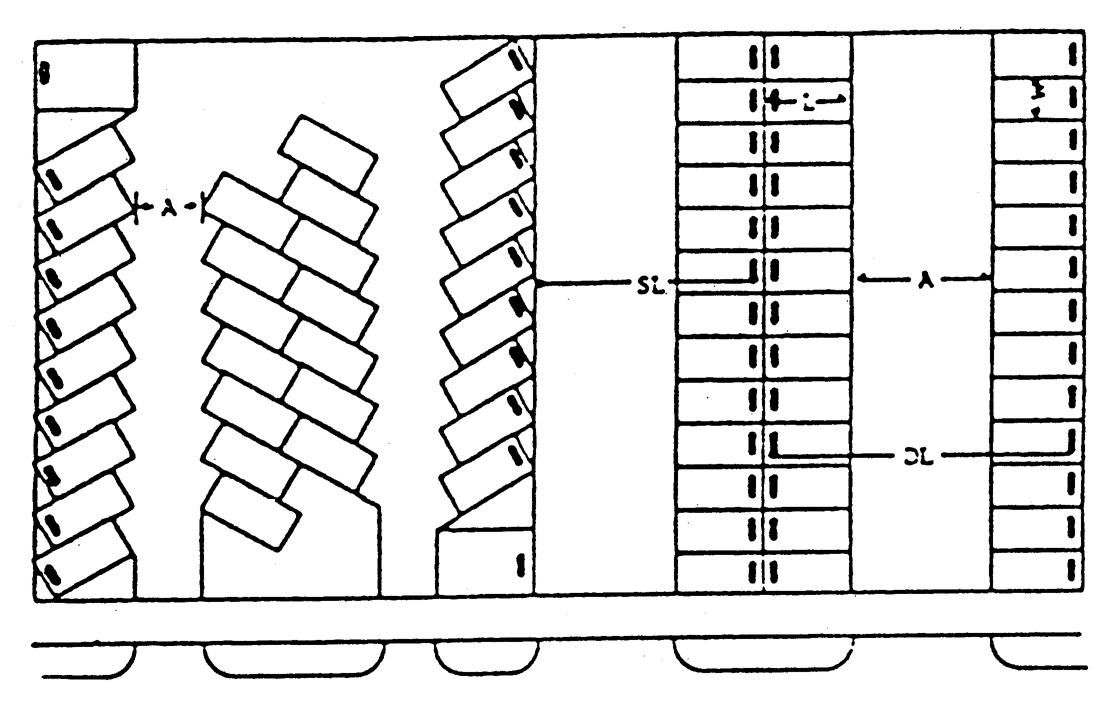
Size of parking stalls. Except for parallel parking spaces, each required off-street parking space shall be at least nine feet in width and at least 18 feet in length, exclusive of access drives or aisles, ramps, or columns. Such space shall have a vertical clearance of at least seven feet, and shall be measured at right angles to the axis of the vehicle. Compact car spaces of at least 8½ feet in width and 16 feet in length shall be allowed supplemental to required parking spaces. For parallel parking, the length of the parking space shall be increased to 22 feet. All other requirements as to size shall be as hereinafter set forth in table 6.2.2, Off-street Parking.
TABLE 6.2.2. OFF-STREET PARKING
OFF-STREET PARKING
Key:
*Two-way traffic authorized.
Note: All measurements are from face of curbs. Required parking for stall angles other than those contained in the above table may be interpolated from said table.
(3)
Handicapped parking.Any parking area for use by the general public shall provide parking spaces designated and located to adequately accommodate persons with disabilities, and these shall be clearly marked as such. Handicapped stalls for use by persons with disabilities shall be located in close proximity to the principal building, supplied in number, and constructed as per the Illinois Accessibility Code. The designation of handicapped parking stalls shall constitute consent by the property owner to the enforcement by the village of the restriction of use of such spaces to motorist who are persons with disabilities.
(4)
Access. All off-street parking facilities shall be designed with appropriate means of vehicular access to a street or driveway that will least interfere with traffic movement. All driveways shall conform to all applicable driveway requirements adopted by the village. No driveway across private property nor curb cut shall exceed a width of 20 feet in residential districts, nor 30 feet in nonresidential districts.
(5)
Shared parking.
(a)
Off-street parking facilities for separate uses may be provided collectively if the total number of spaces so provided is not less than the sum of the separate requirements of each such use and all regulations governing location of accessory parking spaces in relation to the use served are adhered to. Further, no parking space or portion thereof shall serve as a required space for more than one use unless otherwise authorized by the president and board of trustees or as provided in 6.2.2.a.
(b)
The zoning administrator may authorize a reduction in the total number of required parking spaces for two or more nonresidential uses jointly providing off-street parking when their respective hours of operation do not overlap. (See schedule of shared parking.) Reduction of joint use parking shall be subject to the following conditions:
(1)
Not more than 50 percent of the parking spaces required for a building or use may be supplied by parking facilities required for any other building or use.
(2)
The number of shared spaces for two or more distinguishable land uses shall be determined by the following procedure:
(a)
Multiply the minimum parking required for each individual use, as set forth in the attached schedule of required parking, by the appropriate percentage indicated, for each of the six designated time periods.
(b)
Add the resulting sums for each of the six columns.
(c)
The minimum parking requirement shall be the highest sum among the six columns resulting from the above calculations.
SCHEDULE OF SHARED PARKING CALCULATIONS
___________
(3)
If one or all of the land uses for which joint parking facilities is proposed does (do) not conform to one of the general land use classifications in the shared parking schedule as determined by the zoning administrator, then the petitioner shall submit sufficient data to indicate that there is not substantial conflict in the principal operating hours of the uses.
(4)
The property owners involved in the joint use of off-street parking facilities shall submit a legal agreement approved by the village attorney guaranteeing that the parking spaces shall be maintained so long as the uses requiring parking are in existence or unless the required parking is provided elsewhere in accordance with the provisions of this article. Such instrument shall be recorded by the property owner with the county recorder of deeds, and a copy filed with the zoning administrator.
(5)
Fractional parking spaces. When determination of the number of off-street parking spaces required by this chapter results in a requirement of a fractional space, any fraction of less than one-half may be disregarded, while a fraction of one-half or more, shall be counted as one parking space.
(6)
Use of required parking spaces. Except as may otherwise be provided in the granting of special uses or a temporary use permit, required accessory off-street parking facilities provided for uses listed in section 110-6.2.3 shall be solely for the parking of passenger automobiles of patrons, occupants, or employees of such uses.
(7)
Design and maintenance.
(a)
Plan: The design of access drives and parking lots or areas shall be in accordance with standards contained in chapter 38 of the Municipal Code.
(b)
Surfacing: All open off-street parking areas shall be paved with a hard surface material such as concrete, asphalt, and/or brick and shall drain properly as required by chapter 38 of the Municipal Code.
(c)
Landscaping and screening: Landscaping and screening shall be provided in accordance with the requirements of section 110-6.3.
(d)
Lighting: Any lighting used to illuminate off-street parking areas shall be down lit away from residential properties and public streets in such a way as not to create a nuisance. However, in no case shall such lighting exceed one footcandle measured at the lot line.
b.
Specific requirements. All off-street parking spaces hereinafter required by this chapter shall be designed and provided in accordance with one of the formulae set forth in the schedule of parking requirements. Parking spaces for accessory uses not specifically enumerated within a parking class shall be assumed to be included in the principal (permitted or special) use requirement. If, for any reason, the classification of any use for the purpose of determining the amount of off-street parking or the number of spaces to be provided by such use is not readily determinable hereunder, the parking class of such use shall be established by the zoning administrator.
When computing required parking spaces, the total number of required spaces shall be based upon use(s) of the zoning lot or portion thereof. Therefore, one principal use may actually contain two or more parking class uses (e.g., retail sales and warehousing.)
In the event this chapter does not specify the number of parking spaces for a specific use, the zoning administrator shall determine the number of spaces required. In determining the number of spaces required for a proposed use the zoning administrator shall consider the number of parking spaces required for the listed use most similar to the proposed use in terms of parked vehicles expected to be generated. In determining the number of parked vehicles likely to be generated by a use, the zoning administrator shall consider the square footage occupied by the use where appropriate. In the alternative, the zoning administrator may consider the number of employees and patrons anticipated for the proposed use.
c.
Land banking of required parking.
(1)
Land banking authorized. Notwithstanding any other provision of this article, the board of trustees may authorize not more than 50 percent of the off street parking spaces required by this article in a business park, high cube or limited industrial zoning district may be left as open space which can be readily converted to parking facilities ("land bank"). The parking facilities to be constructed and the land bank, if converted to parking spaces, must comply with the off street parking facility requirements of this article at the time the land bank is approved.
(2)
Land bank plans required. The owner of the property making a land bank request shall submit a detailed land bank parking plan for review and approval by the board of trustees and an application fee of $50.00 for each parking space to be land banked. This land bank parking plan shall show both the full compliance with the parking regulations of this article and the land bank area showing the reduced number of parking spaces and interim use of the land banked area.
(3)
Termination of land banking. The board of trustees shall have the right in its sole and absolute discretion to require the property owner or successor, at any time to construct all or a portion of the land banked parking facilities, with the zoning administrator providing notice to the owner that the land banked parking facilities must be constructed and completed within 240 days from the date of said notice.
(4)
Land banking covenant. As a condition of approving a land bank request, the property owner shall file with the zoning administrator his unconditional agreement and covenant in a form and substance satisfactory to the village attorney. The agreement and covenant after approved [approval] by the board of trustees shall be recorded with the recorder of deeds of the county in which the property is located.
6.2.3. Schedule of parking requirements. For the following uses, accessory off-street parking spaces shall be provided as required hereinafter. Parking spaces required on an employee basis are based on the maximum number of employees on duty on the premises at any one time.
___________
___________
6.2.4. General parking provisions.
a.
Parking of commercial vehicles in residential districts is not permitted, except under the conditions stated below in items (1) through (5): No commercial vehicle, having a gross weight in pounds, including vehicle and maximum load, in excess of 8,001 pounds and bearing a class designation other than "B" under the provisions of 625 ILCS 5/15-111, as amended, shall be parked or stored on any residential premises, except when making a delivery or rendering a service at such premises or as listed below. The storage of a commercial vehicle or contractor's equipment at a place of residence shall not constitute the making of a delivery or the rendering of a service and shall be prohibited unless specifically permitted below in this section 6.2.4.
(1)
Box trucks, flat bed trucks, dump trucks, light weight duty dump trucks, platform / stake bodies, semi-trailer or truck/tractor combination, dovetail body, mechanical cranes, hoists, booms, bed lifts, step trucks or step vans shall be prohibited to be parked or stored in a residential district regardless of size or license plate classification, except when making a delivery or rendering a service in the residential district.
(2)
Commercial vehicles having a gross weight when fully loaded of 12,000 pounds or less, including those within such weight bearing a classification of "D" under the provisions of the Illinois Vehicle Code and displaying a current Illinois state inspection sticker, but excluding those vehicles described in (1) above, may be permitted to be parked in a zoning area classified as a residential district provided equipment and racks/ladders and cargo which do not extend beyond the front or rear of the body of the vehicle may remain on top of the vehicle parked in a residential district provided such equipment and racks/ladders and cargo and the vehicle shall together not exceed nine feet in height as measured from the surface at ground level nearest the vehicle. One commercial vehicle shall be permitted to be parked per residential property.
(3)
Except for the equipment and racks/ladders and cargo located upon the top of the commercial vehicle described in (2) above, the storage of equipment or commercial/contractor material within or upon a commercial vehicle otherwise permitted to be parked in a residential district, shall be completely concealed from view by a commercial grade manufactured bed cap, permanent original equipment (OE) grade enclosure, or manufactured cover secured to the body of the vehicle. The use of plywood as a bed riser, height extender, or equipment enclosure is prohibited.
(4)
All commercial vehicles permitted by this section 6.2.4. to be parked in a residential zoning classification shall: display plate classification on the front and rear of the vehicle at all times; be parked on a permanent paved surface as otherwise required by this Code; and be owned or under the control or possession of one of the occupants of the residence.
(5)
It shall be unlawful for any person to park a public passenger vehicle, other than a taxicab or limo, in any zoning area classified as a residential district between the hours of 6:00 a.m. and 6:00 p.m. except when dropping off or picking up a passenger.
b.
Repair and service. No motor vehicle repair work of any kind shall be permitted in conjunction with necessary off-street parking facilities.
c.
Off-site parking. All proposals to provide required parking on a site other than the zoning lot of which the proposed use is to be established shall be a special use subject to the provisions provided herein for special uses.
d.
In parkways. No person, firm or corporation shall park, deposit, leave or store any motor vehicle, or trailer at any time between the sidewalk line and curbline in a residential district.
e.
Use of parking and loading facilities.
(1)
It shall be unlawful for any person to park a vehicle or place goods or materials upon any nonresidential off-street parking or loading area for the purpose of displaying it for sale.
(2)
It shall be unlawful to park any vehicle except upon an off-street parking space or loading area in compliance with requirements herein.
(3)
Subsection (1) shall not apply where such vehicle, goods or materials are on property where their sale or storage is a lawfully permitted use.
(4)
Whenever any vehicle is parked in violation of subsection (1) or (2) the person in whose name such vehicle is registered shall be prima facie responsible for such violation and subject to the penalties therefor.
6.2.5. Parking and storage of recreational vehicles.
a.
No recreational vehicle shall be used for storage of goods, materials, or equipment other than those items considered to be part of the unit or essential to its immediate use.
b.
No recreational vehicle shall be connected to utility services (water, sewer, electric) except for temporary connection to electric service for battery charging.
c.
Recreational vehicles shall not be temporarily occupied for more than 14 days in any six-month period to accommodate visitors. Use of internal cooking and sanitary facilities shall not be permitted.
d.
Recreational vehicles may be parked in the rear yard of a principal building on a temporary surface including but not limited to gravel, patio blocks, or similar materials. Recreational vehicles parked in the required side or front yard of any principal building shall only be permitted to be parked on a hard surface meeting the requirements of chapter 38 of the Municipal Code.
e.
No more than one recreational vehicle shall be located outside a building on any lot of record or zoning lot in a residence district. A recreational vehicle for the purpose of this section shall not include a personal mobility device that means a device with an electric motorized propulsion system designed for and used by a person with disabilities; to transport only one person such as a wheelchair or three-wheeled scooter that is incapable of a speed in excess of eight miles per hour on level ground, a self-balancing, two-nontandem-wheeled device, or a golf cart that is originally designed and manufactured for transporting one or two persons for operation on a golf course for sporting or recreational purposes and that is not capable of exceeding speeds of 20 miles per hour.
6.2.6. Off-street loading; general requirements.
a.
Location.
(1)
All required loading berths shall be located on the same zoning lot as the use served. No loading berth for vehicles over two tons capacity shall be closer than 50 feet to a residence district unless it is completely enclosed by building walls or a uniformly painted solid fence or wall (chainlink fencing with slats prohibited), or any combination thereof, not less than six feet in height. No permitted or required loading berth shall be located within 25 feet of the nearest point of intersection of any two streets.
(2)
All required loading berths in a high cube and business park district facing a street shall be enclosed except as hereinafter set forth. Open loading berths shall be permitted along interior side yards or interior rear yards; provided however, that if a lot has front yards on two sides and a railroad track on a third side or a street frontage on three sides, then an open loading berth shall be permitted in the front yard or corner side yard subject to approval of a landscape screening plan for said loading berth approved by the zoning administrator. Loading berths shall not be permitted on any building face adjoining a residential zoning district.
b.
Size. Unless otherwise specified, a required off-street loading berth shall be at least ten feet in width by at least 25 feet in length exclusive of aisle and maneuvering space, and shall have a vertical clearance of at least 14 feet.
c.
Access. Each required off-street loading berth shall be designed with appropriate means of vehicular access to a street or driveway in a manner that will least interfere with traffic movement, and shall be subject to approval by the zoning administrator.
d.
Surfacing. All open off-street loading berths shall be surfaced pursuant to chapter 38 of the Municipal Code.
e.
Utilization. Space allocated to any off-street loading use shall not, while so allocated, be used to satisfy the space requirements for any off-street parking facilities or portions thereof.
f.
Central loading. Central loading facilities may be substituted for loading berths on individual zoning lots, provided the following conditions are fulfilled:
(1)
Each zoning lot served shall have direct access to the central loading area without crossing streets or driveways at grade.
(2)
Total off-street loading berths provided shall meet the minimum requirements herein specified, based on the several types of uses served. (Area of types of uses may be totaled before computing number of loading berths.)
(3)
No zoning lot served shall be more than 500 feet away from the central loading area.
(4)
The tunnel or ramp connecting the central loading area with the zoning lot served shall be not less than seven feet in width and shall have a clearance of not less than seven feet.
g.
Minimum facilities. Uses for which off-street loading facilities are required herein, but which are located in buildings of less floor area than the minimum prescribed for such required facilities, shall be provided with adequate receiving facilities, accessible by motor vehicle off any abutting street or driveway, service drive, or open space on the same zoning lot.
(1)
Where any building is erected, reconstructed, or converted for any of the uses permitted in the B-1, B-2, or H zoning districts, one loading space shall be provided for each 50,000 square feet or fraction thereof of floor area. No off-street loading is required for freestanding buildings that have less than 5,000 square feet in gross floor area and are located in a B-1, B-2, or H zoning district.
(2)
In the L-I, high cube, and business park zoning districts, the loading requirements shall be based on the floor area of the building(s) as shown herein:
Each additional 100,000 square feet or fraction thereof in excess of the first 100,000 square feet shall require one additional loading space.
6.2.7. Existing nonconforming off-street parking and loading facilities. All existing off-street parking and loading facilities that are nonconforming to the surfacing requirements of chapter 38 of the Municipal Code must comply with those surfacing requirements within ten years from the effective date of this chapter or be discontinued.
(Code 1975, ch. 27, § 6.2; Ord. No. O-92-10, §§ 2, 3, 2-6-1992; Ord. No. O-92-87, § 1, 11-19-1992; Ord. No. O-93-75, § 1, 11-18-1993; Ord. No. O-95-02, §§ 11, 12, 1-5-1995; Ord. No. O-97-57, § 3, 10-2-1997; Ord. No. O-08-30, § 2, 5-1-2008; Ord. No. O-08-77, § 1, 12-18-2008; Ord. No. O-12-26, § 1, 8-16-2012; Ord. No. O-19-21, § 1, 6-6-2019; Ord. No. O-23-34, § 2, 10-19-2023; Ord. No. O-24-36, § 2, 11-7-2024)
Cross reference— Motor vehicles and traffic, ch. 62.
Sec. 110-6.3. - Landscaping, buffering and screening.
6.3.1. Purpose and intent. In order to ensure the compatibility of different land uses, this section sets forth standards for the installation and maintenance and preservation of landscape. The visual and environmental setting of the village has an effect upon the welfare of the citizens. The promotion and control of landscaping will preserve and enhance the public health, safety and welfare of the village. These regulations are intended to minimize the harmful or nuisance effects resulting from noise, dust, debris, emissions and poor air quality, erosion, heat, motor headlight glare, the use of impervious ground material, artificial light intrusion, excessive storm water, objectionable sights or activities, or similar incompatible impacts conducted or created by adjoining or nearby land uses.
The standards set forth in this section are not intended to inhibit or discourage innovative design proposals. As the standards provide the minimal framework for landscape proposals, it is anticipated that they will foster and encourage creativity, innovation, and add to the natural beauty of Hanover Park.
6.3.2. Scope. The regulations set forth in this section shall apply as follows:
a.
New development: When any development involves the construction of a new building, or addition to an existing non-residential or multiple-family building, or a new single-family or two-family building.
b.
Special use permit; variation; planned unit developments: When development of property is subject to a special use permit, a variation, or a planned unit development permit.
c.
Intensity of use increases: The intensity of use of any existing building, structure or premises is increased through the addition of: one or more dwelling units; the gross floor area of a building is increased to require the construction of one or more additional off-street parking spaces to meet the off-street parking requirement; when there is an addition or enlargement of a building. Uses qualifying for site plan review exceptions in section 110-4.3 shall not be required to provide additional landscaping.
d.
Expansion or reconstruction of parking areas: When any existing off-street parking area for a non-residential use is expanded or undergoes major reconstruction. Major reconstruction means removal of 50 percent or more of existing pavement within a parking area and replacement of such pavement. Resurfacing without reconstruction does not constitute major reconstruction.
e.
Major building renovations and tenant changes: Physical improvements or change of business or tenant for non-residential uses with 10,000 square feet or more of gross floor area. Building renovations include work to the extent of more than 50 percent of the replacement cost of the building, to include but not be limited to, façade renovations and interior remodeling.
f.
Reoccupation of buildings: Reoccupation of vacant freestanding non-residential single-user buildings of any size, or reoccupation of 3 or more tenants in a shopping center building, when vacant for more than 180 days.
g.
Access and drainage changes: Any change to the access between a non-residential site and any arterial road. Any change in the grading or drainage on the site.
h.
Freestanding sign: The installation, reconstruction, or relocation of a freestanding sign shall require landscaping or screening around such sign as defined in section 6-6.3.10.
i.
Ground-mounted mechanical or utility equipment: Installation of ground-mounted mechanical or utility equipment shall require landscaping or screening around such equipment as defined in section 110-6.3.10.
Chapter 38, article XI, protection of existing trees, landscaping, and parkway grading; and chapter 102, trees and shrubs, should be referenced for general requirements for parkway trees, grading and erosion control, and treatment of diseased trees.
Chapter 18, article IV, property maintenance code, should be referenced for general requirements for maintenance standards for landscaping.
6.3.3. Landscape plan review and approval. Landscape plans shall be reviewed and approved as directed in section 110-4.3. site plan review, and as set forth herein.
6.3.4. Landscape plan requirements. For each property subject to these regulations, the property owner shall submit a landscape plan to the zoning administrator for their review with the building or other permit application, or at the time zoning relief is applied for, whichever is earlier. All landscape plans so submitted shall be at an appropriate scale, not smaller than 1 inch = 40 feet. Completed landscape plans shall contain all of the following information, unless specifically not applicable to the project:
a.
Title block:
(1)
Name and address of the property owner and/or petitioner.
(2)
Name of registered landscape architect and/or contractor.
(3)
Landscape architect's and/or contractor's firm name and address.
(4)
Scale data, north arrow, plan creation date and date of any revisions.
b.
Landscape site plan information; location of existing conditions and proposed improvements:
(1)
Property lines.
(2)
Building footprint, with entry and exit points.
(3)
Identification of all proposed plant materials with planting bed locations and dimensions.
(4)
Treatment of all ground surfaces (ground covers, sod, seed, seasonal beds, paving, impervious and pervious materials).
(5)
Location of water detention sites.
(6)
All utilities and lighting.
(7)
Walls and fences (indicating height and material).
(8)
Parking spaces and driveway aisles (spaces delineated including dimensions, curbing and handicapped spaces).
(9)
Shopping cart collection points.
(10)
Spot elevations and/or contours, existing and proposed.
(11)
Berms, with one foot interval contours indicated.
(12)
Sidewalks.
(13)
Existing survey of all trees with a diameter of six inches or greater, as measured at four and one-half feet above the ground elevation (hereafter referred to as diameter at breast height or DBH).
(14)
Monument sign locations.
(15)
Refuse and recycling disposal areas.
(16)
Public rights-of-way and easements, including street widths, drives, and approaches.
(17)
Planters or planting boxes.
(18)
Trash cans.
(19)
Other exterior landscape amenities including exterior tables and benches and trash receptacles.
c.
Schedule of proposed and existing landscape material:
(1)
List of all proposed plantings, indicating common and botanical names, diameter at breast height, height or size and quantity.
(2)
List of all existing trees, six inch diameter at breast height or greater, proposed for removal, indicating diameter, common and botanical names.
(3)
List of all existing trees, six inch diameter at breast height or greater, planned for preservation, indicating diameter size, common and botanical names.
d.
Miscellaneous:
(1)
Irrigation plan, specifying how the landscaping will be hydrated, including system details and sprinkler head locations as applicable.
(2)
Methods proposed to protect plants and plant beds to help ensure that they reach maturity.
(3)
Construction erosion control plan and storm water pollution prevention plan, if required by village engineering standards.
e.
Where applicable, the zoning administrator may require less information, or any other additional information, to appropriately evaluate compliance of the proposed development or improvement.
6.3.5. Planting design and preservation criteria. The landscape design, scale and nature of landscape material for any given site, shall be appropriate to the specific site and structures, and shall take into account the location of underground and above ground utilities. Earthen berms and existing topography shall, whenever practical, be incorporated into the landscape treatment of the site.
a.
Landscape design and selection of plant material: New planting materials used in conformance with the provisions of this section, shall be:
(1)
High quality nursery-grown stock. Substandard "B-grade" or "park grade" plants are not acceptable.
(2)
Grown in a climate zone similar to Hanover Park. (i.e. United States Department of Agriculture Zone 5b).
(3)
Capable of withstanding the extremes of individual site micro climates.
(4)
Selected for interest in its structure, texture, color and for its ultimate growth.
(5)
Harmonious to the overall design and of good appearance.
(6)
In conformance with the American Standards for Nursery Stock, ANSI Z60.1,- Latest Edition.
(7)
In conformance with the schedule of prohibited trees and schedule of recommended plants maintained by the village forester.
(8)
For each type of tree (canopy tree, evergreen tree, etc.) there shall be no more than 25 percent of one genus.
b.
Existing trees with an eight inch diameter at breast height or greater that are in good health shall be preserved on the property to the extent possible as determined by the village forester or designee, and shall comply with the requirements of section 6.3.5.a. above. Trees that are preserved shall be counted toward compliance of the requirements of this section.
c.
Evergreens may be incorporated into the landscape plan and treatment of a site, where appropriate to the site as determined by the zoning administrator, and shall be in required buffers for property zoned residential, the screening of refuse holding areas, and critical points of required parking lot screening.
d.
Plantings located at or near the intersection of two public streets or the intersection of any driveway and street in an area enclosed by a triangle, each leg of which is a distance of 25 feet, measured along each curb of the intersection streets, from the point where the extension of the curb lines intersect (sight triangle) shall not exceed 30 inches in height at maturity.
e.
Plant materials should be placed against long expanses of building walls, fences and other barriers to mitigate the visual appearance of long building expanses, accentuate building entrances and architectural features, and screen mechanical equipment.
f.
Where site characteristics or property dimensions limit the use or survivability of live landscaping as an effective screen, masonry walls may be used to satisfy required screening.
g.
All masonry walls or decorative fencing which may be approved shall be constructed and installed in a durable fashion and shall have the finished side facing the street or property line subject to the regulations set forth in section 110-6.6, accessory uses and structures.
h.
Consideration should be given to site constraints, such as overhead wires, when designing the landscape plan to avoid excessive and unsightly tree trimming in the future.
i.
Installation of plant materials:
(1)
Plant materials of all types and species shall be installed in accordance with the minimum technical specifications of the "Illinois Chapter of Landscape Contractors", including the guarantee and replacements sections.
(2)
Minimum plant sizes at time of installation shall be:
(a)
Shade trees: two and one-half inch diameter as measured six inches above the soil line (hereafter referred to as caliper).
(b)
Ornamental trees: two inch caliper or if in clump form, six feet in height.
(c)
Evergreen trees: five feet in height.
(d)
Shrubs required for screening: three feet in height; shrubs used for other purposes: 18 inches in height.
(e)
Ground Cover: spaced no less than 12 inches on center (from the center of one planting to the center of the next).
(3)
A minimum 30 inches of soil depth and 250 cubic feet of soil is required per tree.
j.
Plantings on any portion of the public right-of-way provided by an adjacent property owner, association, or individual, that are removed as a result of village utility construction or maintenance, or other village activities, may be replaced at the sole responsibility of the property owner, association or individual.
6.3.6. Minimum landscape requirements for residential lots.
a.
Each single-family detached lot or two-family lot shall be planted with deciduous trees totaling at least six inches caliper per lot, evergreen trees totaling at least six feet in height per lot, and a minimum of 12 shrubbery plants per lot.
b.
Each townhouse or garden court dwelling unit and associated parking area shall be planted with deciduous trees totaling at least four inches caliper per unit, evergreen trees totaling at least three feet in height per unit, and a minimum of ten shrubbery plants per unit.
c.
Each apartment development and associated parking area shall be planted with deciduous trees totaling at least 18 inches in caliper per gross acre, evergreen trees totaling at least 18 feet in height per gross acre, and a minimum of 15 shrubbery plants per gross acre.
d.
Credit shall be given against the above requirements and those of section 6.3.5, planting design and preservation criteria, for existing trees that are preserved.
e.
Minimum planting requirement shall be maintained at all times, unless otherwise approved by zoning administrator due to site conditions, plant maturity/size, or overcrowding.
6.3.7. Minimum landscape requirements for off-street parking lots.
a.
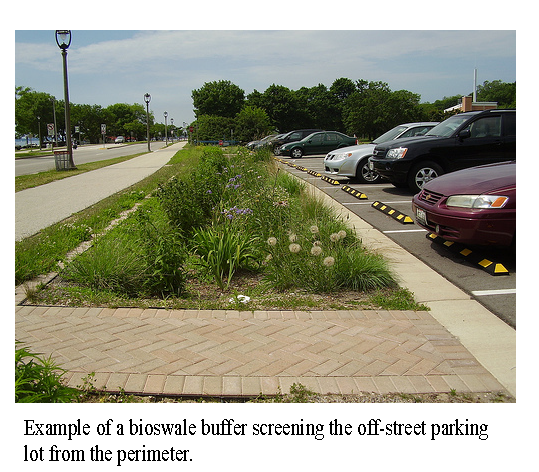
Parking lot screening required: Every off-street parking lot or parking area containing five or more parking spaces shall be set back, buffered and screened from public view and adjacent property by a landscaped area having a minimum width of eight feet, or, where screening by a masonry wall, a minimum width of five feet, except for properties fronting Irving Park Road, where the landscaped area shall have a minimum width of five feet.
(1)
The minimum width for the parking lot screening area shall be measured from the property line and shall not include any parking overhang.
(2)
Screening within the parking lot screening area shall consist of one or more of a masonry wall, densely planted hedge, decorative fencing, or massing of shrubs, installed in a manner so as to inhibit public views of the parking area.
(3)
Parking lot screening shall be continuous, except for breaks as may be permitted for sidewalks, driveways and sight triangles.
(4)
Masonry walls or decorative fences used for parking lot screening shall have a minimum height of thirty (30) inches and a maximum height of thirty-six (36) inches. Such walls shall have a finished surface which is the same or closely similar to the masonry of the principal building.
(5)
Shrubs planted as parking lot screening shall be at least three feet in height at time of installation, unless located at or near the intersection of two public streets or the intersection of any driveway and street in an area enclosed by a triangle, each leg of which is a distance of 25 feet, measured along each curb of the intersection streets, from the point where the extension of the curb lines intersect (sight triangle), in which case they shall not exceed 30 inches in height at maturity.
(6)
In addition to the requirements above, the surface of the parking lot screening area shall be suitably covered with grass, ground cover or similar vegetation and periodically mulched. A layer of stone, or impervious materials such as concrete or asphalt, is prohibited.
(7)
A six inch continuous poured-in-place concrete curb shall separate all drive and parking surfaces from landscape areas except when built for bio-filtration purposes.
(8)
The Zoning Administrator may recommend a creative alternative of berms, walls, shrubs, trees or other material, which has the effect of providing a minimum three foot high visual screen of parking areas.
b.
Interior Landscaping Requirements:
(1)
All off-street parking areas containing 15 or more spaces shall be landscaped in accordance with the standards of this section.
(2)
Planting areas shall be located between the ends of a series of parking space and the driveway or circulation area providing access to those spaces.
(3)
Planting areas shall be located so that the parking area contains no single series of more than 20 parking spaces.
(4)
Landscaping along the perimeter of parking areas or landscaped areas not bound on at least three sides by parking spaces, driveways, or maneuvering areas shall not be counted toward the landscaped area required under this section.
(5)
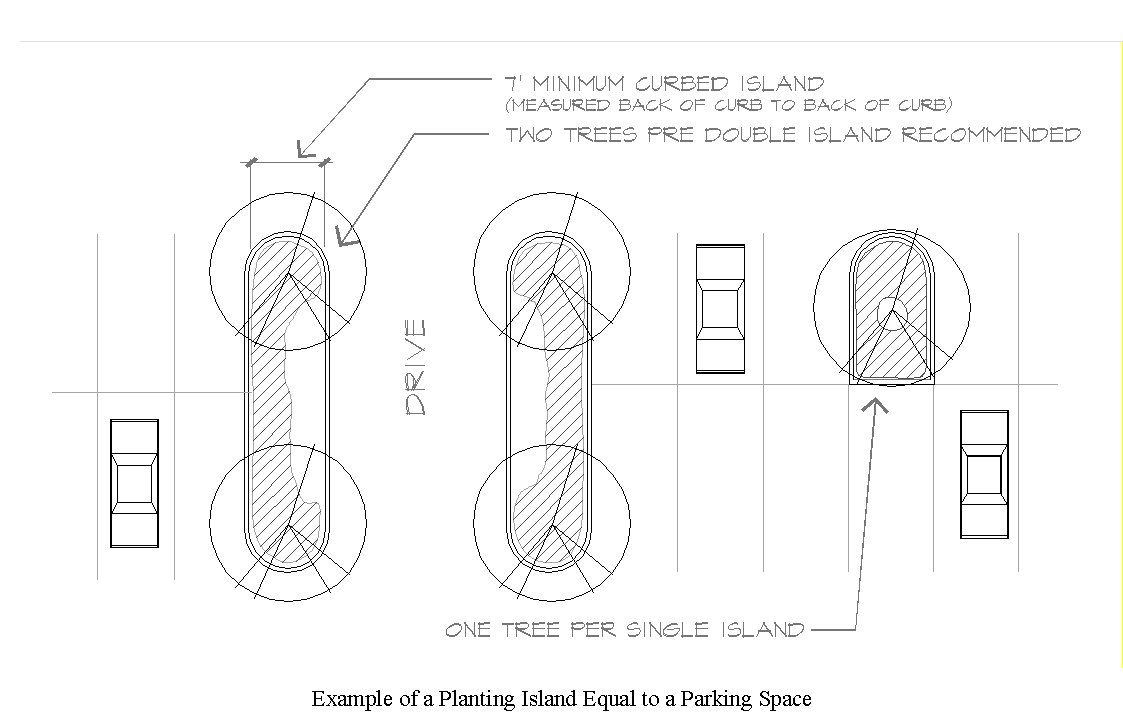
Such planting areas shall have a minimum width of seven feet and minimum length of 16 feet from back of curb. A planting area having a minimum width of seven feet and minimum length of 32 feet from back of curb shall be located at the end of a back-to-back parking row. Alternative designs, such as a continuous landscape area between rows, may be considered, provided that such area has a minimum width of seven feet.
(6)
Each planting area shall include at least one shade tree, at a minimum of one tree per 15 parking spaces. To determine the required number of trees, the total number of parking spaces shall be divided by 15, with fractions of one-half or greater being rounded up to one.
(7)
At least fifty percent of the surface of the planting island shall be suitably planted with grass, ground cover or similar salt-resistant vegetation. The remaining area shall contain landscape mulch. A layer of stone or impervious materials such as asphalt and concrete is prohibited.
Landscape material in parking islands is to remain within the planting area at all times and be maintained in conformance with section 6.3.11.
(8)
A six inch continuous poured in place curb shall separate and surround all interior landscape island areas, except when built for bio-filtration purposes.
(9)
All areas within or at the edges of parking lots which are greater than 50 square feet and not designed for parking spaces, drive aisles or shopping cart collection points, shall be curbed and landscaped with sod, ground cover, shrubs, or trees.
(10)
The installation of bio-filtration swales for landscaping and stormwater management purposes is encouraged.
(11)
Except those designed as bio-infiltration swales, all landscaped areas shall have a minimum topsoil depth of three feet and mounded to a center height of six to 12 inches above top of curb height to provide positive drainage.
(12)
Plant materials should be appropriate for pedestrian areas, and are not to include thorns or other elements detrimental to pedestrians or parking lot functionality.
6.3.8. Minimum landscape requirements for foundation plantings.
a.
Where a front yard setback is required, a minimum building foundation landscape area of at least five feet in width, as measured from the foundation wall, shall be located immediately along the front and sides of all buildings.
b.
Where a front yard setback does not exist, the applicant shall install planters where possible.
c.
Except for building entryway areas and sidewalks as may be permitted, the surface of the required foundation landscape area shall be free of paving or other impervious surfaces and a minimum of 50 percent of the length shall be planted with live plantings.
d.
A six-inch curb shall separate all foundation landscape areas from drive aisle and parking areas.
e.
Foundation landscaping shall be provided, and shall include a variety of hedges, shrubs, evergreens and ground cover in a manner which accents building entranceways and architectural features, softens large expanses of building walls, and screens mechanical equipment.
6.3.9. Landscape buffer and screening requirements between zoning districts.
a.
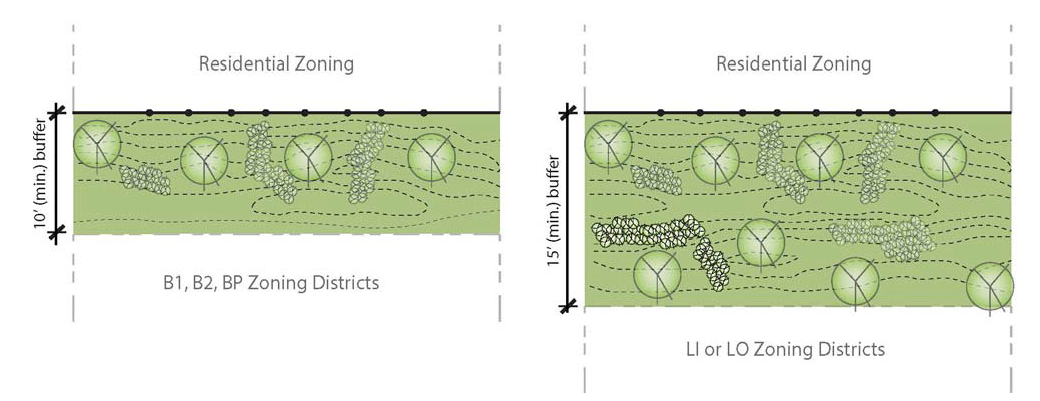
A landscape buffer shall be installed along the boundary between a nonresidential zoning district and a residential zoning district. Such buffer shall have a minimum width of ten feet along the length of any property line located in the B1, B2, and BP zoning districts, and a minimum width of 15 feet along the length of any property located in the LI, or LO zoning districts.
(1)
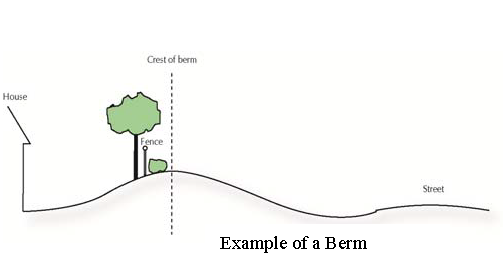
Required screening shall consist of a six foot fence or six-foot high berm, or combination thereof, as well as four shade or ornamental trees every 100 lineal feet, and 14 shrubs every 100 lineal feet. The mix of trees shall consist of one-third shade trees, one-third ornamental trees, and one-third evergreen trees.
(2)
Screening shall be continuous along the property line.
(3)
Berms shall be utilized to the maximum extent feasible.
(4)
Evergreen trees and shrubs shall be used to the greatest extent feasible in a fashion so as to inhibit views from residential property.
(5)
The surface of the landscape buffer area shall be suitably covered with grass, ground cover or similar vegetation and periodically mulched. Impervious materials such as asphalt, concrete or a layer of stone is prohibited. The landscape buffer shall not be used for the purposes of parking, loading, servicing, or storage.
(6)
An eight-foot high masonry wall within a five-foot landscape setback area may be utilized as an alternative to meeting the minimum ten-foot width requirement. Masonry walls are subject to the regulations set forth in section 110-6.6, accessory uses and structures.
6.3.10. Miscellaneous landscape requirements.
a.
Landscaping of freestanding signs:
(1)
Landscaping shall be installed in a minimum three-foot radius around the sign base.
(2)
The landscaped area shall consist of plantings such as, but not limited to, shrubs, evergreens, flowering plants and ground cover plants. Landscaping bark, mulch, sod or seeded areas shall not be considered in calculating the square footage of the required landscaped area.
b.
Landscaping and screening of mechanical and utility equipment:
(1)
All mechanical equipment, including heating and air conditioning units, shall be screened by a semi-opaque fence, wall, or densely planted evergreen landscape planting at a maximum height sufficient to obscure such equipment from view from all adjacent streets.
(2)
All fences installed to satisfy the screening requirement shall comply with the regulations of section 110-6.6, accessory uses and structures, and with all other applicable Code regulations.
c.
Changes to approved landscape plan: Any change to an approved landscape plan shall require the prior approval of the zoning administrator.
6.3.11. Landscape maintenance required. Property owners shall be responsible for ongoing maintenance, fertilization, repair and replacement of all vegetation, barriers and landscape planting materials, including, but not limited to, the following:
a.
Replacement plantings shall be no less than the minimum required size or the size indicated in the approved landscape plan, whichever is greater.
b.
The property owner shall make replacement plantings promptly after any plant has died but no later than 30 days after notification by the village of violation of this chapter, unless a time extension is given by the village.
c.
Planting beds shall be initially, and thereafter periodically, filled with soil and mulched in their entirety, with shredded bark or other organic equivalent. Such material shall be contained within landscape areas and excess material outside of such areas shall be cleared on a regular basis.
d.
Grass, sod and lawn areas shall be periodically and routinely mowed during the growing season. The grass height of any lawn area shall be as required by Village Code, chapter 54, article V, plants and weeds.
e.
Plants shall be pruned and inspected for pests on a regular basis.
f.
Litter shall be removed from planting areas on a regular basis.
6.3.12. Variations.
a.
A property owner may file an application for a variation when compliance with the requirements of this section for a new or pre-existing development pose a practical hardship in accordance with the procedures and standards in section 110-4.7, variations.
b.
Additionally, application may be made to the zoning administrator for an administrative variance of no more than ten percent of any particular landscape requirement in lieu of the development commission process and village board action, provided the intent of such requirements are met and the variance otherwise meets all requirements for a variation. The application or decision concerning an administrative landscape variance shall not eliminate the potential to apply to the development commission for the same or similar variation.
6.3.13. Tree preservation.
a.
Purpose: While allowing the reasonable use and improvement of property, the village desires to preserve, protect, replace and properly maintain trees within the village and protect the public from trees which pose a threat or danger. The preservation of trees is intended to accomplish the following goals:
(1)
Preserve trees as an important public resource, which enhance the quality of life and the general welfare;
(2)
Preserve and enhance the village's physical and aesthetic environment;
(3)
Enhance the air quality by filtering air pollutants;
(4)
Reduce noise by creating a natural barrier;
(5)
Reduce topsoil erosion through the soil retention effect of tree roots;
(6)
Reduce stormwater runoff and the associated costs and replenish ground water supplies; and
(7)
Protect and enhance property values.
b.
Scope: This section 110-6.3.13 shall apply to all new and changes to existing non-residential and multiple-family construction, and new single-family and two-family construction.
c.
Tree preservation during construction:
(1)
Trees required or scheduled to be preserved shall be protected during construction as follows:
(a)
Protective fencing shall encircle and be erected one foot beyond the periphery of the drip line, or as otherwise approved by a landscape professional. All fencing shall be of a rigid material such as wooden snow fencing, brightly colored plastic construction fencing, chainlink fencing, or an alternative barrier, as approved by the zoning administrator, shall be a minimum height of four feet and secured to posts driven into the ground that are spaced no more than ten feet apart.
(b)
Protective barriers shall be in place prior to the initiation of construction and shall remain in place until construction and site work is completed.
(c)
No materials, construction equipment or vehicles shall be stored, driven upon or parked within any drip line.
(d)
Crushed limestone or other material detrimental to trees shall not be dumped, placed, or stored within any drip line or at a higher elevation where drainage could affect the health of the tree(s).
(e)
The existing grade within the drip line shall not be modified and shall be maintained to the fullest extent possible. Where grade changes of four inches or more are required surrounding the drip line, a low retaining wall or other permanent tree protection technique, as may be approved by the zoning administrator, shall be used to ensure the long term health of the tree designated for preservation.
(f)
In the event an underground utility line is to be located within five feet of a tree designated for preservation, said utility line shall be augured to prevent damage to the tree's root system.
(2)
Methods for tree protection shall be clearly specified prior to the issuance of a building permit. If, in the opinion of the zoning administrator, such methods are not adequate to protect trees designated for preservation, a building permit shall not be issued. If during construction, adequate methods are not employed so as to protect designated trees, the zoning administrator may issue a stop work order until such time as adequate preservation methods are employed.
(3)
If a deciduous or evergreen tree designated for preservation is damaged, razed or removed as a result of construction, such tree shall be replaced in accordance with the tree replacement section of this division.
d.
Tree removal and replacement: The following shall apply to the removal of any tree greater than eight inches in diameter at breast height or having an aggregate diameter at breast height of 15 inches or greater:
(1)
Such removal shall only occur for the following reasons:
(a)
Tree is dead or dying;
(b)
Tree is diseased;
(c)
Tree is damaged or injured to the extent that it is likely to die, or that it constitutes a hazard to persons or property; or
(d)
Removal of tree is consistent with good forestry practices.
(e)
Removal of such tree is otherwise required for overall site plan, minimum landscape requirements are met, and feasible alternative design options do not exist, as approved by the zoning administrator.
(2)
Removal of any tree greater than eight inches in diameter at breast height requires replacement of new trees with a total caliper equal to or greater than that of existing trees being removed, unless minimum landscape requirements are already met.
(3)
Alternative tree replacement location:
(a)
If the zoning administrator, determines that full tree replacement pursuant to the requirements of the section will result in the unreasonable crowding of trees on the lot where construction activity is taking place, or would be otherwise inconsistent with current best practices, the zoning administrator may designate that some or all of the replacement trees required be planted in the public right-of-way immediately adjacent to the lot where the construction activity is taking place.
(b)
If the zoning administrator determines that the alternative tree replacement required by this division will result in the unreasonable crowding of trees upon the public right-of-way in accordance with current best practices, the zoning administrator may reduce the number of replacement trees to be planted immediately adjacent to the public right-of-way, and require that replacement trees be located on other nearby public rights-of-way, or other suitable locations.
(c)
All replacement trees designated for the public right-of-way or village property shall only be of those species permitted by the village on the schedule of recommended plants, and shall be installed by the permittee.
(4)
Payment in-lieu of tree replacement: In the event that the zoning administrator determines that the full replacement of tree as required by this section would result in unreasonable crowding of trees upon the lot where construction activity will occur, or on the immediately adjacent public right-of-way, a permittee may be allowed to pay the village a fee in lieu of making such replacement in kind. The village has no obligation to grant such a request. If the request is granted, the following regulations shall apply:
(a)
This fee shall be equal to the tree replacement value based upon the average cost per tree inch of trees planted by the village during the previous fiscal year.
(b)
The tree replacement fee must be received by the village within 30 days after issuance of a building permit, or the date of the damage or removal for which the replacement is required.
(c)
The zoning administrator may issue a stop work order if a permittee fails to pay the tree replacement fee within 30 days after the date of the damage or removal for which the replacement is required. No certificate of occupancy for the property in question shall be issued until the tree replacement fee has been received by the village.
e.
Penalties: For any tree designated for preservation that is damaged, razed or removed without the prior written approval of the zoning administrator, a monetary fine (as outlined in chapter 102, article I, section 102-12, trees and shrubs) shall be assessed upon the owner of the property on which the trees were damaged or removed. No building permits or licenses for the property shall be issued or given final approval until said charge is paid and a replacement tree plan is prepared and approved by the zoning administrator.
(Code 1975, ch. 27, § 6.3; Ord. No. O-93-54, § 3, 9-16-1993; Ord. No. O-94-34, § 2, 7-7-1994; Ord. No. O-95-57, § 1, 9-7-1995; Ord. No. O-97-57, §§ 4, 5, 10-2-1997; Ord. No. O-04-46, § 1, 10-7-2004; Ord. No. O-14-38, § 3, 11-6-2014)
Sec. 110-6.4. - Adverse impact performance standards.
The purpose of this section is to establish regulations and standards for the installation and operation of industrial uses, based upon consideration of the objectionable characteristics of such uses and the zones in which they are permitted. Further, this section is intended to prescribe procedures and methods of measurement of industrial characteristics subject to such standards.
Any use permitted in the L-I, B-1, B-2, BP, and HC districts, whether such use is permitted as a principal use or as accessory use, shall be subject to these standards.
6.4.1.
Permit procedure. Before the zoning administrator issues a building permit for a use in any L-I, B-1, B-2, BP or HC districts, the applicant shall furnish sufficient information to enable the zoning administrator to assure that all performance standards and site development standards set forth in this chapter can and will be complied with all times. The zoning administrator may, in order to determine whether or not the applicant will meet such standards, require the applicant to submit the following information:
a.
A plot plan showing the location of all present and proposed structures, drives, parking lots, waste disposal areas, bulk storage areas, streets, streams, or other significant features on or within 200 feet of the proposed site.
b.
A description of the activity to be conducted regarding waste products, external effects or other conditions regulated herein; provided however, that the applicant shall not be required to reveal any trade secrets or sufficient detail with regard to a process that would cause any secret process of manufacturing procedure for a closely guarded proprietary compound or product to become public knowledge and be available to competitors.
c.
The type and location of abatement devices to control, or recording instruments to measure, conformance with required standards, not including devices and instruments inherent in the manufacturing process.
d.
Such other data and certification as may reasonably be required by the zoning administrator to reach a determination.
All information and evidence submitted in applications to indicate conformity to performance standards shall constitute a certification and an agreement on the part of the applicant that the proposed use can and will conform to such standards at all times.
6.4.2. Performance standards. In the BP, HC, L-I districts, the following regulations shall apply:
a.
Noise.
(1)
Maximum permitted noise levels for uses are as follows:
TABLE 6.4-1. MAXIMUM PERMITTED SOUND PRESSURE LEVEL IN DECIBELS
(2)
Method of measurement. Sound levels shall be measured with a sound level meter and associated octave band filter and impact noise filter manufactured according to standards prescribed by the American National Standards Institute (ANSI). Measurements shall be made using the flat network and "slow" meter response of the sound level meter. Impulsive type noises shall be subject to performance standards if those noises are capable of being accurately measured with such equipment. Noises capable of being so measured, for the purpose of this chapter, shall be those noises which cause rapid fluctuations of the needle of the sound level meter with a variation of no more than plus or minus two decibels. Noises incapable of being measured, but objectionable because of intermittence, beat, frequency, or shrillness, shall be controlled so as not to become a nuisance to abutting uses.
(3)
Exception. Nothing in this section shall apply to noises not directly under the control of the property user; noises resulting from the construction and maintenance of buildings and facilities including site preparation; noises of safety signals or warning devices; and noises of railroad or trucking equipment.
b.
Vibration. Steady-state vibrations, for the purpose of this chapter, are vibrations that are continuous or vibrations in discrete pulses more frequent than 100 per minute. Discrete pulses that do not exceed 100 impulses per minute shall not cause displacement in excess of twice the values established in table 6.4-2 below. Impact vibrations shall mean vibrations occurring in discrete pulses separated by an interval of at least one minute and numbering no more than eight per each 24-hour period.
(1)
Permitted vibration displacements. At no point on or beyond the boundary of any lot shall the ground-transmitted steady-state or impact vibration caused by any use or activity (except those not directly under the control of the property user) exceed the limits as established in tables 6.4-2 and 6.4-3 below for the various industrial zones and for any industrial zone boundary abutting a residential zone.
___________
TABLE 6.4-2. MAXIMUM PERMITTED STEADY-STATE VIBRATION DISPLACEMENT IN INCHES
TABLE 6.4-3. MAXIMUM PERMITTED IMPACT VIBRATION DISPLACEMENTS IN INCHES
(2)
Method of measurement. For the purpose of measuring vibrations, a three-component measuring system shall be used. A three-component measuring system denotes instrumentation that can measure earth-borne vibrations in three directions each of which occurs at right angles to the other two.
c.
Smoke and particulate matter. The emission of particulate matter from all sources within any lot containing more than five percent by weight of particles having a particle diameter larger than 44 microns is prohibited. Dust and other types of air pollution borne by the wind from such sources as storage areas, yards, and roads within the boundaries of any lot shall be kept to a minimum by appropriate landscaping, paving, or other acceptable means. Emission of particulate matter from such sources in excess of weight limitations specified herein is prohibited. The emission of smoke or particulate matter of a density equal to, or greater than No. 2 on the Ringelmann Chart is prohibited at all times, except as otherwise provided herein.
(1)
Smoke emission.
(a)
In the BP and HC zones, the emission of more than 12 smoke units per stack in any one hour period is prohibited. However, once during any six-hour period each stack shall be permitted up to 12 additional units in a 15-minute period for soot blowing and fire cleaning. Only during such 15-minute periods shall smoke of a density equal to, but not exceeding, no. 3 on the Ringelmann chart be permitted, and then only for fire cleaning and for not more than four minutes per period.
(b)
In the L-I zone, the emission of more than 22 smoke units per stack in any one hour is prohibited. However, once during any three-hour period each stack shall be permitted up to 40 additional units—not to exceed Ringelmann no. 2—for soot blowing and fire cleaning. Only during fire cleaning periods, however, shall smoke of a density equal to, but not exceeding, no. 3 on the Ringelmann chart be permitted, and then for not more than four minutes per period.
(2)
Particulate matter emission. The rate of emission of particulate matter from all sources within the boundaries of any lot shall not exceed the rate established in table 6.4-4 below:
TABLE 6.4-4. PERMITTED RATE OF PARTICULATE MATTER EMISSION IN POUNDS PER HOUR, PER ACRE
___________
(3)
Methods of measurement.
(a)
Smoke: For the purpose of grading the density of emission of smoke, the Ringelmann chart, published and used by the United States Bureau of Mines, shall be employed. For the purposes of determining smoke units, the Ringelmann density readings shall be made at least every minute during the period of observation. Each reading (Ringelmann number) shall be multiplied by the time in minutes for which it is observed, and the products added together to determine the total number of smoke units observed during the total period of observation.
(b)
Particulate matter: The total net rate of emission of particulate matter within the boundaries of any lot shall be determined as follows: Determine the maximum emission in pounds per hours from each source of emission and divide this figure by the number of acres of lot area, thereby obtaining the hourly rate of emission in pounds per acre. Add together the individual rates of emission from all sources of emission within the boundaries of the lot. It is this total that shall not exceed the rate established in table 6.4-4 above.
d.
Odors. No continuous, frequent, or repetitive emission of odors or odor-causing substances that would be offensive beyond any property line of any industrial use shall be permitted. An odor emitted no more than 15 minutes in any one day shall not be deemed as continuous, frequent, or repetitive within the meaning of these regulations. The existence of an odor shall be presumed when analysis by a competent technician demonstrates that a discernible odor is being emitted. Any process involving the creation or emission of any odors shall be provided with a primary and a secondary safeguard system so that control will be maintained if the primary safeguard system fails. All land uses shall comply with the rules and regulations of the Illinois Pollution Control Board.
e.
Radiation hazards. The handling of radioactive materials, the discharge of such materials into air and water, and the disposal of radioactive wastes shall be in conformance with (a) the applicable regulations of the Atomic Energy Commission; and (b) the applicable regulations of any instrumentality of the State of Illinois.
f.
Fire and explosive hazards.
(1)
All land uses shall comply with the provisions of the Illinois Revised Statutes, and no explosives shall be stored, used or manufactured without first submitting to the zoning administrator a certificate of compliance from the Illinois Department of Mines and Minerals.
(2)
No gasoline or other inflammables or explosives shall be stored unless the location, plans and construction conform to the laws and regulations of the village and the State of Illinois and have the approval of the state fire marshal.
g.
Glare and Heat. Every use and activity shall be so operated that it does not emit heat or heated air beyond the boundary of the lot on which it is located. No direct or sky-reflected glare shall emanate beyond the boundary of the lot on which such use or activity is located. This restriction shall not apply to signs otherwise permitted by the provisions of this chapter or applicable ordinances, nor to activities of a temporary or of an emergency nature. Night lighting necessary for safety and the protection of property is excluded from this provision.
h.
Electromagnetic interference. There shall be no electromagnetic interference that adversely affects the operation of any equipment other than that belonging to the creator of such interference, or that does not conform to the regulations of the Federal Communications Commission.
6.4.3. Enforcement. The zoning administrator shall enforce the provisions of this section. Upon confirmation of a violation, enforcement and penalty provisions of article IV shall prevail. In addition, the zoning administrator may require of the offending industry the installation, maintenance, and operation of continuous measuring or recording instruments to demonstrate the operation and to ensure continuous compliance with the prescribed standards.
(Code 1975, ch. 27, § 6.4)
Sec. 110-6.5. - Floodplain regulations.
See the Municipal Code, chapter 38, article III, "Engineering Standards and Specifications."
(Code 1975, ch. 27, § 6.5)
Sec. 110-6.6. - Accessory uses and structures.
The following accessory uses and structures are allowed and may or may not be regulated by additional requirements in this chapter, including section 110-6.1.2.g. "bulk regulations." Not all uses require a building permit.
6.6.1. Allowable accessory uses and structures in residential districts.
a.
Day care homes.
b.
Detached garages and carports not to exceed 720 square feet in size, one per zoning lot.
c.
Driveways in accordance with section 110-6.6.4.
d.
Fences in accordance with section 110-6.6.5.
e.
Flagpoles, with a maximum height of 15 feet.
f.
Home occupations in accordance with section 110-6.6.6.
g.
Open off-street parking spaces, in accordance with section 110-6.2, "Off-street parking and loading."
h.
Playground and laundry drying equipment.
i.
Playhouses and gazebos.
j.
Racquet and paddle ball courts, unlighted.
k.
Radio and television antennas (in accordance with section 110-6.6.10).
l.
Satellite dishes (in accordance with section 110-6.6.7).
m.
Sheds and/or storage buildings for garden equipment and household items as accessory to dwellings, not exceeding 200 square feet in area, one per lot, provided, in the R residential district, the shed may be increased to 400 square feet. Non-corroding, non-decaying, plastic storage bins less than 25 square feet in area do not require a building permit and that not more than two such bins per lot shall be allowed.
n.
Spas and hot tubs.
o.
Swimming pools, private, when conforming also with other codes or ordinances of the village.
p.
Tennis courts, private, unlighted.
q.
Terraces, patios, decks, and outdoor fireplaces.
r.
Hobby kennels, as accessory special uses in the R, R-2, and R-3 residential districts where allowed and conforming with the ordinances of the village, including but not limited to chapter 58 of the Municipal Code requiring a license to maintain a hobby kennel.
s.
Horse stables, as accessory special uses, in the R residential district where permitted and conforming with the ordinances of the village, including, but not limited to chapter 58 of the Municipal Code requiring a permit to maintain a stable.
t.
Rabbitry, as accessory use in the R-1, R-2, and R-3 residential districts and conforming with the ordinances of the village, including but not limited to chapter 58 of the municipal code requiring a permit to maintain a rabbitry use.
u.
Amateur radio antennas (in accordance with section 110-6.6.8).
v.
On properties owned by governmental bodies, accessory buildings of governmental bodies may be constructed that meet the zoning requirements for principal structures in that zoning district. Accessory buildings containing not-for-profit amateur athletic uses shall also be allowed on properties owned by governmental bodies and leased to that not-for-profit amateur athletic organization.
w.
Meteorological tower (in accordance with section 110-6.6.9).
x.
Building mounted solar energy systems, in accordance with section 110.6.6.11 solar energy systems and the bulk standards of the district. Only roof mounted energy systems are permitted in the historic district.
y.
Level 2 electric vehicle charging stations.
z.
Level 3 electric vehicle charging stations, as accessory special uses.
6.6.2. Allowable accessory uses and structures in nonresidential districts.
a.
Day care facilities.
b.
Detached garages.
c.
Fences in accordance with section 110-6.6.5.
d.
Flagpoles, subject to height restrictions of the district in which they are located.
e.
In BP and HC districts only, retail business service and personal service uses shall be permitted only as accessory uses, to consist of not more than 15 percent of the building area. The retail business and personal service uses shall be ones that primarily service the principal use.
f.
In BP and HC districts only, recreational facilities, including but not limited to, tennis courts, golf courses, and jogging, walking, and biking trails and paths.
g.
In BP and HC districts only, showroom and sales area.
h.
Open off-street parking spaces, in accordance with section 110-6.2, "Off-street parking and loading."
i.
Open off-street loading spaces, in accordance with section 110-6.2 of this chapter.
j.
Outdoor restaurant tables and seating.
k.
Racquet and paddle ball courts.
l.
Radio and television antennas (in accordance with section 110-6.6.10).
m.
Satellite dishes (in accordance with section 110-6.6.7).
n.
Storage of merchandise normally carried in stock on the same lot with any retail service or business use as regulated by this chapter and the Municipal Code.
o.
Swimming pools, private, when conforming also with other codes or ordinances of the village.
p.
Tennis courts.
q.
Terraces, patios, decks, and outdoor fireplaces.
r.
In BP and HC districts only, enclosed accessory structures. The total of any or all such structures shall not exceed three percent of the square footage of the principal building.
s.
Amateur radio antennas (in accordance with section 110-6.6.8).
t.
On properties owned by governmental bodies, accessory buildings of governmental bodies may be constructed that meet the zoning requirements for principal structures in that zoning district. Accessory buildings containing not-for-profit amateur athletic uses shall also be allowed on properties owned by governmental bodies and leased to that not-for-profit amateur athletic organization.
u.
Solar energy systems, in accordance with section 110.6.6.11 solar energy systems and the bulk standards of the district. Only roof mounted energy systems are permitted in the historic district.
v.
Level 2 electric vehicle charging stations.
w.
Level 3 electric vehicle charging stations, as accessory special uses.
6.6.3. General regulations for accessory structures.
a.
Accessory building, structure or use: An accessory building, structure or use is one that:
1.
Is subordinate to and serves a principal building or principal use;
2.
Is subordinate in building area, intensity of use, or purpose to the principal building or principal use served;
3.
Contributes to the comfort, convenience, necessity of occupants of the principal building or principal use served;
4.
Is, except as otherwise expressly authorized by the provisions of this chapter, located on the same zoning lot as such principal structure or use;
5.
Is under the same ownership or control as the principal structure or use; and
6.
Is prohibited prior to the establishment of the primary use except where authorized by the zoning administrator.
b.
Accessory structure, nonpermanent: A nonpermanent accessory structure is an accessory structure that is temporarily or semi-permanently affixed to the ground, including patios, sheds, and aboveground swimming pools.
c.
An accessory use shall not include the keeping, propagation, or culture of pigeons, poultry, or livestock, whether or not for profit.
d.
Location.
1.
No part of a detached accessory structure, excluding driveways and fences, may be located on any easement, or closer than ten feet to the rear lot line or five feet to the side lot line, or ten feet from the principal building as measured from the overhanging eaves, except that sheds need not be located ten feet from the principal building and driveways need not be located five feet from the side lot line.
2.
On lots less than 30 feet, or less, in width in multifamily residential districts, at-grade decks and patios may be constructed, reconstructed, or repaired on interior multifamily units to the full width of the lot. Decks and patios on end multifamily units may be constructed to the interior side lot line and may not be closer than five feet to the exterior side lot line, unless enclosed by a fence, or if located on a corner, must maintain the required corner-side yard, and no deck or patio in a multifamily district may be constructed on any easement or closer than five feet of the rear lot line. Above grade decks and patios in multifamily residential districts must maintain a minimum of five feet from the side lot line and ten feet from the rear lot line. As used in this subsection, the term "at-grade" shall mean no greater than 12 inches above the ground level at the point closest to the residence.
3.
Electric vehicle charging stations may be installed on principal or accessory structures and adjacent to any existing or permitted parking space, but not adjacent to a driveway or drive aisle where the use may obstruct the safe or necessary flow of traffic.
e.
Percentage of rear yard occupied. No accessory building or buildings shall occupy more than 40 percent of a required rear yard.
f.
Percentage of front yard occupied. No accessory structure shall occupy more than 40 percent of a required front yard, unless otherwise permitted in this ordinance.
g.
Height of accessory buildings. No detached accessory building shall exceed 15 feet in height as measured to the highest point of the roofline from the average grade.
h.
On reversed corner lots. On a reversed corner lot in a residential district, no accessory building or portion thereof located in a required rear yard shall be closer to the side lot line abutting the street than the required front yard on the abutting lot to the rear. Further, in the above instance, no such accessory building shall be located within five feet of any part of a rear lot line that coincides with a side lot line or portion thereof of property in a residential district.
6.6.4. Residential driveways
Driveways in residential districts shall be subject to the following regulations:
a.
Driveways shall not be less than nine feet nor greater than 20 feet in width. The area of a driveway in the required front or corner side yard that is expanded to meet the requirements of this section shall not be subject to the maximum front yard coverage or lot coverage limitation, but the area of the expanded driveway shall be included for all other determinations of lot coverage.
However, driveway widths in excess of 20 feet may be permitted for three or more car garages at a width of ten feet per parking stall provided lot coverage is met. This provision does not include tandem garage parking spaces.
Further, driveway widths in excess of 20 feet but less than 28 feet may be permitted in the front yard but only if the lot coverage in both said front yard and the lot does not exceed the limitations for yard or lot coverage provided elsewhere in this comprehensive zoning ordinance.
b.
Driveway extensions shall not be within two feet of a side lot line, however they may be constructed to the side lot line if there is sufficient area to expand the driveway eight feet in width and all storm water run-off is completely retained on the lot or parcel where the driveway expansion occurs and the front yard coverage and lot coverage limitations are both not exceeded as otherwise provided elsewhere in this comprehensive zoning ordinance.
c.
Driveway extensions shall be at the same grade and utilize the same material as the existing adjacent driveway. However, up to an 18-inch wide concrete, brick, or semi-permanent pavers may be permitted along each side of a driveway. The width of such extension shall count towards overall width calculations, unless permeable material, such as bricks or pavers, is used.
d.
Driveway widening shall only be allowed towards the nearest lot line for detached single-family dwellings to the extent feasible, or as otherwise approved by the zoning administrator.
e.
Driveways may have a "swing out" that connects the existing driveway to a pad located in the side yard. Such "swing out" may only be permitted if the maximum driveway width of 28 feet front yard coverage and lot coverage limitations are not exceeded.
f.
Driveway expansions shall not be located within six feet of a door facing the front yard, as measured perpendicularly from the building frontage.
6.6.5. Fences.
a.
Purpose. The purpose of a fence, shrub or hedge is to provide privacy, security and boundary definitions for residential, business, office, and industrial districts within the corporate limits of the village. This section encourages the use of natural screening instead of fencing wherever possible.
b.
Required fences for swimming pools. The construction and placement of fences around swimming pools with a depth in excess of twenty-four inches shall meet all requirements of the building code, chapter 18 of the Municipal Code.
c.
Prohibited fences. The following fences are hereby prohibited:
(1)
Barbed wire, chicken wire, hog wire, rope, cable, and electrically charged wire, except that barbed wire may be used on top of permitted fences in nonresidential districts and on fences enclosing public service and government uses;
(2)
Snow fences, except for exclusive control of snow between November 1 and March 31 and as authorized by the zoning administrator for special events or construction sites;
(3)
Chain-link fences with barbed wire ends up, except as permitted fences in nonresidential districts and fences enclosing public service and government uses;
(4)
Chain-link fencing with slats of any kind, except for fences of public service and government uses;
(5)
Fences on any portion of any public right-of-way, except fences erected by a government body;
(6)
Fences that interfere with clear vision at or near a street intersection in an area enclosed by a triangle, each leg of which is a distance of 25 feet, measured along each right-of-way of the intersecting streets, from the point where said curb lines or extensions thereto intersect;
(7)
Fences placed or maintained so as to obstruct a clear view of private driveways, sidewalks or pedestrian walks;
(8)
Fences so constructed as to prevent natural water drainage and/or water runoff;
(9)
Fences that abut existing fences, except that abutting fences shall be permitted alongside and rear property lines where single-family detached and duplex residential uses abut rental residential dwellings containing four or more units;
(10)
Fences constructed of wire, except chain link and 16 gauge or larger gauge wire may be attached to the interior of a split rail, or other wooden fence, provided the only supports used for the wire are the wood horizontal and vertical members of the primary fence. Wire shall not be permitted as a fence material in the required front yard and on corner lots wire shall not be permitted as fence material in the corner side yard; and
(11)
Fences constructed with wood sheet or plywood.
d.
Regulations for permitted fences.
(1)
Fence requirements for residential uses. Solid fences shall not exceed six feet in height, while all other fences shall not exceed five feet in height except decorative fences and dog enclosures or dog runs. Decorative fences shall be subject to the requirements of section 110-6.6.5.d(5)(c). Dog enclosures and dog runs shall be subject to the requirements of section 110-6.6.5.d(5)(f).
(2)
Hanover Terrace and Hanover Park Terrace subdivisions. In the Hanover Terrace and Hanover Park Terrace subdivisions (Glendale Terrace), open fencing with a maximum height of four feet shall be permitted in front yards and off property lines. In no case shall fencing block vehicular access. Chain-link fencing shall consist of a minimum no. nine gauge.
(3)
Fence requirements for nonresidential uses. No fence shall exceed eight feet above grade. Fences in the L-O limited office district shall not exceed six feet in height without a special use in accordance with section 110-5.13.3.
(4)
Fence requirements for landscape buffers. Any fence used as part of a landscape buffer shall be a solid fence constructed of wood (excluding boards less than three inches in width), brick, stone, or masonry, with metal or wooden posts with a minimum three-inch diameter. The fence shall meet all fence height requirements specified in this section, except that such fence shall be a minimum six feet in height. Such fences shall be located on the property line.
(5)
Requirements applicable to all uses.
(a)
Except as provided herein, no fence shall be constructed or installed in any front yard closer to any street or roadway than the front yard line.
(b)
Fences shall not be permitted at or near the street intersection in an area enclosed by a triangle, each leg of which is a distance of 25 feet, measured along each curb of the intersection streets, from the point where the extension of the curb lines intersect.
(c)
Decorative fences, excluding chain link, shall be permitted in the front yard and corner side yard and shall be constructed so as not to exceed 36 inches in height. Such fences shall be semi-open, with 50 percent of the surface open and unobstructed to both light and air, when viewed perpendicular to the plane of the fence. Decorative fences may be located off property lines.
(d)
Public service and government uses and all regulation size tennis courts shall be exempt from the height limitations.
(e)
Patio privacy fences and trellises not exceeding six feet in height shall be permitted within the buildable area, except that if a dwelling unit has a legal nonconforming side, corner-side, or rear building line, patio privacy fences and trellises may be extended in a horizontal manner, along only one legal, nonconforming side.
(f)
A dog enclosure or run shall be permitted, not to exceed six feet in height or enclose an area greater than 20 percent of the rear yard. Such enclosure shall not be permitted in the corner side yard.
(g)
Except as provided herein all fences must be constructed within six inches (6") of property lines.
(h)
On corner lots, corner side yard fences and rear yard fences other than decorative fences shall not be constructed beyond any front yard line of the adjoining property.
(i)
Fence posts and related supporting structures shall be erected so that the finished side or sides of the fence shall be facing the neighboring properties or public right-of-way. Fence posts and rails shall be on the inside of the fence, facing the owner's property.
(j)
Fence posts, including crowns, are permitted to extend five inches above the height of the permitted adjoining fence panel.
(k)
No existing survey monuments or lot pins shall be disturbed by any removal, replacement, or installation of fencing. Any disturbed survey monument or lot pin shall be reestablished by a registered Illinois Land Surveyor.
(6)
Fences may be located off of the property line, within the following provisions:
a)
Fences, where the lot line is located in a watercourse, or adjacent to the village's Greenbrook Sewer Treatment Plant may be located set back from the property line.
b)
Fences adjacent to telephone, electrical, cable, gas, or other utility pedestals, or above storm manholes, catch basins, or pipes, may be located set back from the property line, provided that access to such areas is provided through a gate or other means.
c)
When a fence is located off of a property line, the property owner is responsible for maintaining all areas within their property, whether or not they are within the fence.
d)
The location of fences off of rear and side property lines shall only be approved by the zoning administrator when a fence on the property line is not feasible. Such location shall be based on the locations of similarly situated existing non-conforming fences to establish a reasonably consistent setback from the lot line.
e.
Reserved.
f.
Applicability of building code. All provisions of the building code of the village shall be followed as they pertain to fences.
g.
Nonconforming fences. When a nonconforming fence is rebuilt, it must be brought into a conformance with this chapter except in the following situations:
(1)
that fences in the Fremont Junction Subdivision, Units 1 through 5 of Liberty Square Subdivision, Units 1 through 4 of Olde Salem Subdivision, and Units 1 through 5 of Tanglewood Subdivision shall be permitted to construct, reconstruct, replace or add to existing six-foot fences, and
(2)
that the end building units of Units 1 through 5 of Tanglewood Subdivision shall be permitted to construct, reconstruct, replace or add fences not on property lines, provided the fence extends from the corner of the building and connects to the rear property line in a perpendicular manner, and
(3)
that Units 1 through 5 of Tanglewood Subdivision shall be permitted to replace or repair existing fences not on property lines in the same location as the existing fence.
h.
Variations. Variations to fence regulations may be granted in accordance with the process and standards of this chapter.
6.6.6. Home occupations.
A home occupation operated for profit shall be permitted in all residence districts provided:
a.
It is operated in its entirety within a building (not a temporary building) and only by the person or persons whose dwelling is on the same lot;
b.
It does not have a separate entrance from the outside of the building;
c.
It does not display or create outside the building any external evidence of the operation of a home occupation;
d.
It does not include the conducting of a retail business, other than by mail or delivery; manufacturing business; auto repair shop, or repair shop of any kind;
e.
It does not include group counseling or other group meetings containing more than three persons exclusive of the resident;
f.
It does not utilize more than 20 percent of the gross floor area of the dwelling unit, not to exceed 500 square feet in area;
g.
It has no more than one employee or assistant who is not a member of the family who occupy the dwelling unit;
h.
It does not utilize mechanical or electrical equipment other than the type normally found in the single dwelling unit;
i.
It does not involve the sale of commodities upon the premises;
j.
It does not store or utilize any dangerous, flammable materials;
k.
Teaching of musical instruments, dancing, and voice shall be limited to one pupil at one time; and where academic or religious instructions may be given to not more than three pupils at one time;
l.
No home occupation shall be operated in such a manner as to cause a nuisance, some of which are listed herein:
(1)
It will not require more vehicle parking space than is required by this chapter for residential uses servicing the dwelling unit.
(2)
The activity shall create no noise in excess of that of normal daily activity for a residential area, measured at the lot line of the premises or exterior to party walls in multiple-family areas.
(3)
Except for the emission of odors normally associated with food preparation, the emission of odorous matter in such quantities as to be readily detectable at any point along lot lines, or exterior to party walls in multiple-family areas, is prohibited.
(4)
It will not interfere with normal television and/or radio reception in the surrounding area.
m.
No hazard shall be created that would or could endanger the dwelling unit or its occupants or other structure or their occupants by reasons of fire, health, safety or environmental hazards, not normal and usual to residential use of the premises; and
n.
It does not create a public or private nuisance.
o.
There shall be no parking of commercial vehicles, except as permitted per section 110-6.2.4.a., "general parking provisions."
6.6.7. Satellite dishes.
Satellite dishes shall be permitted in any zoning district upon compliance with the following requirements:
a.
No satellite dish shall be permitted in required front or side yards. On corner side lots, no dish shall be erected outside of the established building line of both street frontages, and where no building line is established, satellite dishes shall have a minimum setback of 25 feet from property lines fronting on any street or highway.
b.
No freestanding satellite dish in any residential district shall exceed ten feet in diameter or eight feet above the highest point of the roof of the residence. No freestanding satellite dish in any commercial district shall exceed 14 feet in diameter or 15 feet in height.
c.
No roof-mounted satellite dish shall exceed eight feet in height, as measured vertically from the highest point of the roof to the top of the antenna or satellite dish when positioned for operation.
d.
No advertising, shall be permitted on any satellite dish surface and all satellite dishes shall be neutral in color.
e.
All satellite dishes shall be installed, constructed, and maintained in compliance with manufacturer's specifications and the applicable regulations of the village.
f.
No person or entity shall construct, install, or erect, or cause a satellite dish to be installed, constructed or erected without obtaining a building permit. No permit shall be issued without plans for roof- or pole-mounted satellite dishes (excluding ground mounted units less than twelve feet in height or satellite dishes with a diameter less than one meter (39.37 inches) sealed by a State of Illinois registered structural engineer.
6.6.8. Amateur radio antennas.
Amateur radio antennas shall be permitted in any zoning district upon compliance with the following requirements:
a.
All antennas must be either roof mounted or located in the rear yard;
b.
Antennas must be set back at least five feet from any side lot line, ten feet from any rear lot line and may not be located on any easements;
c.
A building permit must be acquired prior to installation of the antenna; and
d.
Ground-mounted antennas may not exceed 60 feet in height from the ground to the top of the antenna, or if roof mounted, not exceeding eight feet above the highest point of the roof.
6.6.9. Meteorological towers.
Meteorological
towers shall be permitted subject to the following requirements:
a.
Located in an R-2 single-family detached residence district.
b.
A maximum tower height of 150 feet.
c.
A tower may be erected for a maximum period of 16 months and located on a minimum parcel size of 15 acres.
d.
A clear zone surrounding the tower of one and three-tenths times the height of the structure, measured from the outermost point on the base.
e.
No habitable structures or off-street parking facilities shall be within the clear zone.
f.
The clear zone must be entirely within the subject property.
g.
No signs may be placed on the tower.
h.
No antennas may be placed on the tower.
i.
The base of the tower must be enclosed with eight-foot fencing not less than 20 feet in diameter around the base and each guy wire must also be enclosed with fencing or other suitable safety measures to preclude unauthorized climbing.
j.
The tower shall be constructed and operated so that it does not interfere with television, radio, cellular telephone, or microwave reception in neighboring areas.
k.
No part of the tower shall be located within an easement.
6.6.10. Radio and television antennas.
Radio and television antennas shall be permitted in any zoning district upon compliance with the following requirements:
a.
Ground mounted antennas may be a maximum of 60 feet in height,
b.
Roof mounted antennas may not exceed eight feet above the highest point of the roof.
6.6.11. Solar energy systems. Solar energy systems as described herein shall be allowed as an accessory use in all zoning districts, subject to the bulk standards for the applicable zoning district and to certain requirements as set forth below.
6.6.11.1. General requirements.
1.
Solar energy systems may be freestanding, building-mounted, or building-integrated as further defined here in section 110-6.6.11, solar energy systems.
2.
Tree removal shall be minimized.
3.
Advertising, including signs, streamers, pennants, spinners, reflectors, ribbons, tinsel, balloons, flags, banners or similar materials are prohibited. Only manufacturer and equipment information, warning signs or ownership information is permitted on any equipment of the solar energy system.
4.
A building permit is required for installation of all solar energy systems.
5.
Installation and removal of all solar energy systems shall meet the requirements of adopted state, federal, and local codes.
6.
If a Solar Energy System is inoperable or abandoned for a period of 12 consecutive months; the owner may be notified by the village that the energy system must either be repaired and made operable or removed within 90 days.
7.
Nothing in this subsection does, or is intended to, abrogate the owner's responsibility to meet all other requirements of the village Code.
8.
For the purposes of determining compliance bulk standards for the applicable zoning district, and the standards established in section 110-6.1.2. Lot coverage, the total horizontal projection area of all freestanding solar energy systems, including solar collectors, cells, panels, arrays, and inverters, shall be considered pervious coverage, and not count toward lot coverage, so long as pervious conditions are maintained underneath the freestanding solar energy system.
6.6.11.2. Height.
1.
When mounted on a pitched roof, the total height of the building with the solar energy systems shall not exceed the maximum allowed height in the applicable zoning district, as identified in section 110, article V, zoning districts.
2.
When mounted on a flat roof, the total height of the building with the solar energy system shall not exceed the maximum by eight feet as allowed under section 110-6.1, bulk.
3.
Freestanding solar energy systems, at full tilt, shall not exceed the setback from the lot line.
4.
Public way use solar energy system shall not exceed the height limitations set in section 38-143, street lighting, by more than three feet.
5.
Private parking lots solar energy system shall not exceed the height limitations otherwise set forth herein by more than three feet, or as required by the village engineer.
6.6.11.3. Set-back and encroachments.
1.
Solar collectors mounted on the sides of buildings and serving as awnings are considered to be building-integrated systems and are regulated as awnings.
2.
Solar energy systems must meet the accessory structure setback for the zoning district and primary land use associated with the lot on which the system is located.
6.6.11.4. Compliance with the State of Illinois Statutes. In accordance with 765 ILCS 165, Homeowners' Energy Policy Statement Act, private restrictions on solar energy systems, such as homeowner's association covenants or restrictions, shall not be permitted.
(Code 1975, ch. 27, § 6.6; Ord. No. O-92-10, § 1, 2-6-1992; Ord. No. O-92-48, § 1, 7-16-1992; Ord. No. O-93-54, § 2, 9-16-1993; Ord. No. O-94-09, § 2, 3-17-1994; Ord. No. O-95-02, §§ 5—7, 9, 10, 13, 15, 17, 1-5-1995; Ord. No. O-95-57, §§ 4, 5, 9-7-1995; Ord. No. O-96-21, §§ 1—3, 4-18-1996; Ord. No. O-96-27, § 1, 5-16-1996; Ord. No. O-97-57, §§ 6, 7, 10-2-1997; Ord. No. O-02-27, § 1, 8-1-2002; Ord. No. O-03-42, § 1, 12-4-2003; Ord. No. O-04-44, § 1, 10-7-2004; Ord. No. O-06-30, § 1, 7-6-2006; Ord. No. O-07-31, § 2, 11-1-2007; Ord. No. O-08-20, § 1, 3-6-2008; Ord. No. O-10-30, § 1, 12-2-2010; Ord. No. O-11-17, § 2, 7-21-2011; Ord. No. O-15-16, § 3, 7-16-2015; Ord. No. O-18-27, §§ 3—5, 7-19-2018; Ord. No. O-23-34, § 3, 10-19-2023)
Sec. 110-6.7. - Temporary uses and structures.
6.7.1. Purpose. The provisions of this section are based on the recognition that there are uses, buildings, and structures which, because of their unique characteristics, should not be permitted in any particular zoning district on a permanent basis, but which may be either necessary or desirable for a temporary period, provided that they are carefully regulated with respect to location and operation. The temporary uses, buildings and other structures permitted in this section shall be established and maintained so as to least interfere with the use and enjoyment of neighboring uses, buildings and other structures and to ensure public safety.
6.7.2. Permit required. A temporary use permit shall be required prior to the establishment of any temporary use, buildings, or other structures listed herein. Any permit issued and found to be in conflict with the provisions of this section shall be null and void upon notice by the village of said conflicts to said permittee. A separate permit application will not be required if the use is reviewed and approved via another village-issued permit, such as a building permit, and the conditions of this chapter are met.
6.7.3. Permitted temporary use and structures. Temporary uses and structures which may be allowed pursuant to this section shall include, but not be limited to, the following:
a.
Holiday trees sales. The sale of holiday trees may be allowed only in nonresidential zoning districts, places of worship, or on property owned by not-for-profit or governmental organizations.
b.
Temporary buildings for construction purposes may be allowed in any district but shall be removed prior to issuance of a certificate of occupancy for the principal building on the lot on which such temporary building is located.
c.
A temporary real estate office may be allowed in conjunction with development of a lot, contiguous lots, or a planned unit development limited to the selling or renting of new dwelling units in such development, but in no case to be in operation for more than one year following the issuance of the certificate of occupancy for the last dwelling unit or structure in such development.
d.
Temporary storage of building materials and equipment and temporary buildings may be allowed for the duration of on-site construction for which a building permit has been issued.
e.
Temporary portable storage units and dumpsters. Temporary portable storage units and dumpsters may be permitted under certain conditions and require a temporary use permit. Permits are not required for storage units and dumpsters present on residential lots for less than 30 days. A storage unit may be used only for the storage of property customarily associated with the principle use on a limited basis and may be permitted on-site with or without association to a permitted construction project. The storage unit shall be located on an approved paved surface, such as a parking lot or driveway, and shall not encroach on the sidewalk, street, etc. Storage units located in a common parking lot or driveway of a multifamily property shall require the written permission of the property owner or homeowners' association.
f.
Retail product displays, outdoor. Displays may be permitted in nonresidential districts and shall be compact and contained to not create clutter. Property owner permission is required.
g.
Truck or trailer displays and/or sales. Sales and/or display of products from trucks or truck trailers shall be prohibited unless otherwise authorized by village ordinance.
h.
Temporary outdoor dining. Restaurants may provide a temporary area for outdoor seating in accordance with a policy adopted by the village board.
i.
Food trucks. Food trucks may be allowed with the following criteria met:
(1)
A temporary use permit shall be required, with the consent of the property owner, and shall be renewed annually. At the time of permit submittal, a list shall be provided of days and times when food trucks will be located on the property, along with a site plan depicting the location of the food truck(s) and any associated equipment or supplies. Said information shall be provided annually as part of the permit renewal process and when there are revisions to scheduling or locations throughout the year. Only food trucks licensed by the village shall be permitted.
(2)
Food trucks shall be located in designated parking spaces as illustrated on the submitted site plan and shall not be allowed in fire lanes, drive aisles, or handicapped parking spaces, nor shall they impede traffic flow or emergency access or have an adverse effect on other activities on the property. Appropriate refuse and recycling containers shall be provided for proper disposal of waste.
(3)
Food trucks shall not be permitted adjacent to existing restaurants unless as part of a special event.
(4)
Food trucks shall only be allowed in nonresidential districts or on publicly-owned properties, unless affiliated with an approved temporary special event, when a separate food truck permit will not be required.
j.
Similar and compatible uses. Other uses which are similar and compatible to those allowed as temporary uses in this section. Determination of what constitutes similar and compatible shall be made by the zoning administrator.
6.7.4. Standards. A temporary use permit shall be issued only when the proposed temporary use structure complies with all of the following, as determined by the zoning administrator:
a.
Compatible with existing development. The nature and intensity of the temporary use and the size and placement of any temporary structure is so planned that the temporary use or structure will be compatible with existing development.
b.
Parcel of sufficient size. The size of the parcel is of sufficient size to adequately accommodate the temporary use or structure without causing a hardship for existing uses.
c.
Traffic. The location of the temporary use or structure is such that adverse effects on surrounding properties will be minimal, particularly regarding the traffic generated by the temporary use or structure.
d.
Parking and access. Off-street parking areas shall be paved (except during temporary events which are sponsored by and for which parking will be located on property which is owned by a religious institution, public agency, school district, park district, or charitable civic organization) and of adequate size for the particular temporary use or structure and properly located and the entrance and exit drives are laid out so as to prevent traffic hazards and nuisances.
e.
Effect on surrounding areas. In all respects, the temporary use or structure is not significantly or materially detrimental to the health, safety and welfare of the public or injurious to other property or improvements in the surrounding area, nor will it cause prolonged undue economic hardship, either through sales or occupancy of parking, with an adjoining permanent permitted or special use.
f.
Business license required. Such temporary uses shall be conducted by an operator with a Hanover Park business license.
g.
Walkway access. Temporary uses may not block walkways or entrances and must follow all accessibility regulations.
h.
Litter control. Temporary uses must not create litter, either by the use or the users.
6.7.5. Conditions of approval. In addition to the specific regulations, standards, and time limitations set forth in this section, temporary uses and structures shall be subject to such conditions and restrictions on their location and operation as deemed necessary from time to time by the zoning administrator to meet the approval standards. Inspectional services may require a bond to insure [ensure] the conditions of the permit are fulfilled.
6.7.6. Fees. No temporary use permit shall be issued until all necessary fees are paid. See section 18-208 and other relevant sections of article XVII of chapter 18 of this code for applicable permit fees.
(Code 1975, ch. 27, § 6.7; Ord. No. O-15-16, § 3, 7-16-2015; Ord. No. O-24-36, § 3, 11-7-2024; Ord. No. O-25-14, § 2, 6-5-2025)

