
Hanover Park City Zoning Code
ARTICLE IX
- VILLAGE CENTER VC ZONING DISTRICTS
Sec. 110-9.1. - Overview.
9.1.1. Purpose and intent. The Village Center (VC) districts are intended to support implementation of the Village Center and Transit-Oriented Development Plan, adopted by the village board on May 3, 2012, and the 2017 Village Center Plan Update, including the following goals:
a.
Sense of place. A sense of place defined by human-scaled development consisting of a variety of high quality buildings and civic spaces with well-designed landscape and streetscapes.
b.
Walkable, connected development. Walkable, connected development that is comfortable, safe, and interesting for the pedestrian through the use of appropriately scaled blocks, an interconnected system of streets with multiple choices for routes, and prioritization of streets for pedestrians and vehicles.
c.
Mixed-use. Vibrant places with a "live-work-play" atmosphere, accommodated through a mix of uses that activate internal streets and civic spaces during the day and into the evenings, and multi-story development that defines the public spaces and creates "eyes on the street."
9.1.2. Organization of code.
a.
110-9.1: Overview. The overview provides introductory provisions for the VC districts regulations, including such items as mapping.
b.
110-9.2: Master plan developments. The master plan development standards regulate the introduction of new streets and open space, and the use and layout of multiple building types on larger developments.
c.
110-9.3: Building types. The building type regulations govern the permitted building forms within the districts. A series of allowable building types regulate the location of buildings and parking on the site, the height of the buildings in stories, and basic façade and roof regulations.
d.
110-9.4: Uses. Uses allowed within each district are established in this section.
e.
110-9.5: General building design. Design regulations applicable to all building types address such elements as allowable major and minor building façade materials, balcony design, and window design.
f.
110-9.6: General site design. Design standards applicable to all sites within the VC districts include landscape standards, off-street parking regulations, and sign regulations as they differ from other areas of the village.
g.
110-9.7: Procedures. The processes for site plan approvals and master plan developments, as well as exceptions processes are established in this section.
h.
110-9.8: Definitions and measuring. Definitions and methods for measuring regulations related to the VC districts are addressed.
9.1.3. Districts established. The following zoning districts are established for the village center as designated on the village's official zoning map.
a.
VC-C, Village Center—Mixed-Use Core. The VC-C district is intended for use in the core of the village center, along major streets and adjacent to the station, supporting developments with a wide mix of uses.
b.
VC-R, Village Center—Mixed Residential. The VC-R district is intended for use in areas adjacent to the village core, supporting a mix of residential housing types and mostly residential uses.
c.
VC-N, Village Center—Neighborhood Mix. The VC-N district is intended for use in new neighborhood areas, focusing predominantly on a mix of single-family attached and detached houses.
d.
VC-P, Village Center—Public and Institutional. The VC-P district is intended for parks, civic uses, and other institutional uses.
9.1.4. Regulating map. The regulating map in Figure 1-A. illustrates the following:
a.
Master plan developments (MPD). Parcels where an MPD is required to incorporate new streets, blocks, and open space types, and to allow a mix of building types. Refer to 110-9.2 for regulations and 110-9.7 for the development approval process.
b.
Primary streets. Refer to Figure 1-A. for primary street designations on existing streets. Building type regulations in 110-9.3 refer to primary streets.
c.
Required storefront. Refer to Figure 1-A. for locations where storefront frontage is required. Refer to 110-9.3 for storefront regulations per building type.
(Ord. No. O-22-25, § 1(Exh. A), 8-8-2022)
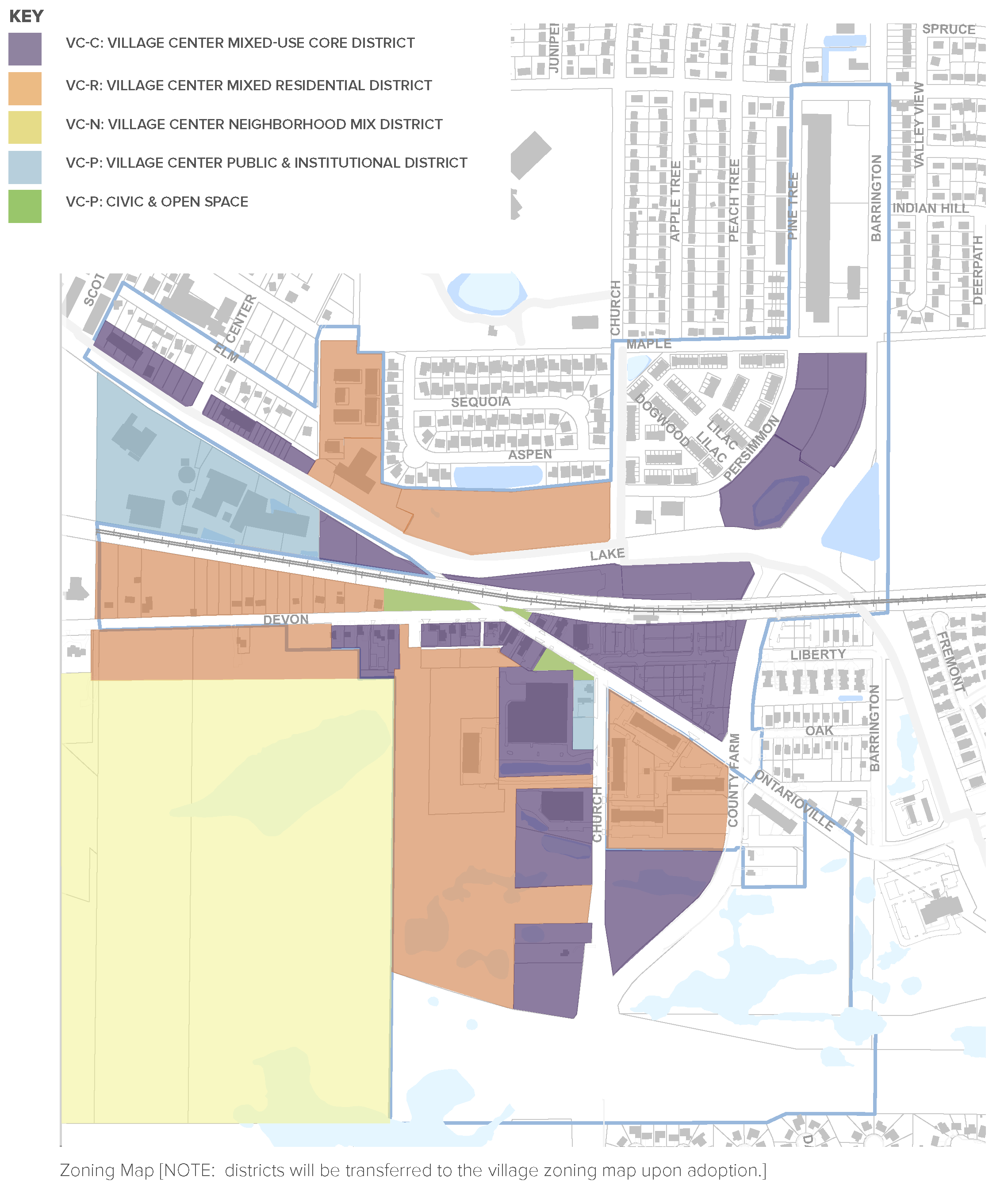
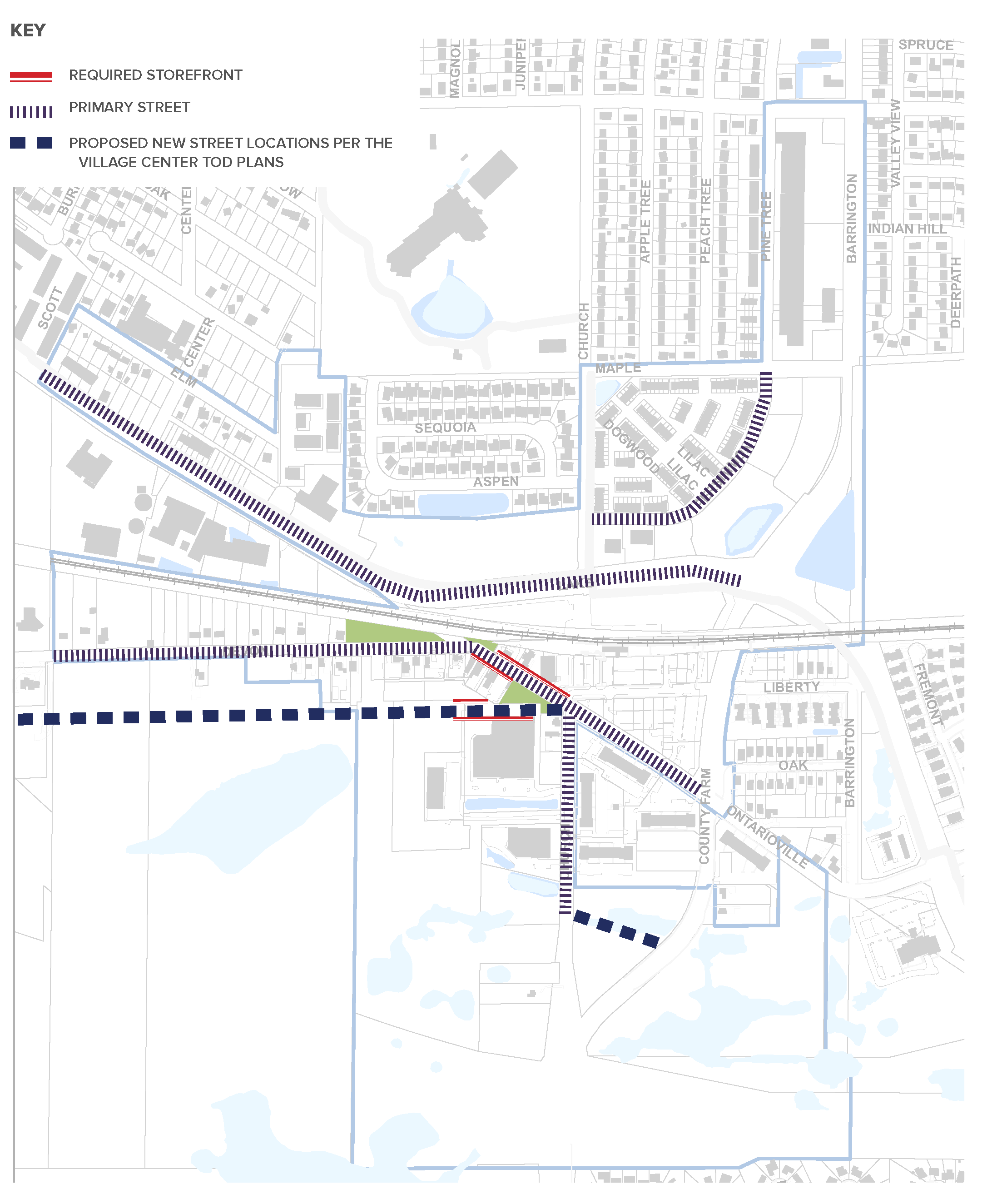
(Ord. No. O-22-25, § 1(Exh. A), 8-8-2022)
Sec. 110-9.2. - Master plan developments (MPDs).
All master plan developments (MPD) must meet the regulations of this section 110-9.2.
9.2.1. Intent. In addition to the intent defined for the VC district regulations (refer to 9.1.1), these MPD regulations are intended to require larger parcels to provide a system of blocks and open space; complete streets including streetscape, pedestrian facilities, and bicycle access; and a mix of building types and uses within new, walkable neighborhoods.
9.2.2. Applicability.
a.
Regulating plan. All developments on a single parcel or combination of parcels totaling three acres or more must meet the MPD regulations, prior to any subdivision, rezoning, or submittal of a site plan for review.
b.
The following must be included in the MPD:
1.
All adjacent and abutting land under the same ownership must be included.
2.
All parcels considered to be part of the same development or phases of a development.
3.
All adjacent and abutting parcels under separate ownership that are either vacant or currently undergoing development review must be included for planning purposes, and noted as such. Planning purposes include such items as access to those sites, incorporation into the blocks of the MPD, and mixing of uses.
4.
All parcels the zoning administrator requests to be included for planning purposes.
c.
Design exception. The village board may approve a master plan development that meets the intent of the MPD requirements (see 9.2.1) and is consistent with the recently adopted plans for the area, but modifies specific regulations of this section, 110-9.2. The submittal must include a clear description of the modifications to be approved (see 9.7.4).
9.2.3. Master plan development (MPD) submittal. An MPD shall be submitted to the community and economic development department for approval by the development commission for approval per 9.7.4 to illustrate compliance with the regulations in this 110-9.2 and those sections referenced, and to provide guidance throughout all phases of the project.
9.2.4. Boundary lines. All streets, civic open space, and building sites require measurable boundary lines delineated on the MPD submittal. These boundary lines provide the baseline for measuring the allowed location of buildings and other regulations.
a.
Easement and property lines. If a component (street, open space types, building site) is dedicated or under separate ownership, the easement line, right-of-way or property line serves as the boundary line for the subject component.
b.
No other areas. All areas of the MPD site must be fully occupied by one or more of the following: streets (per 9.2.6), alley or service drives (per 9.2.7), open spaces (per 9.2.10), building and parking sites (per 9.2.11), or conservation areas (per chapter 90, Subdivision regulations).
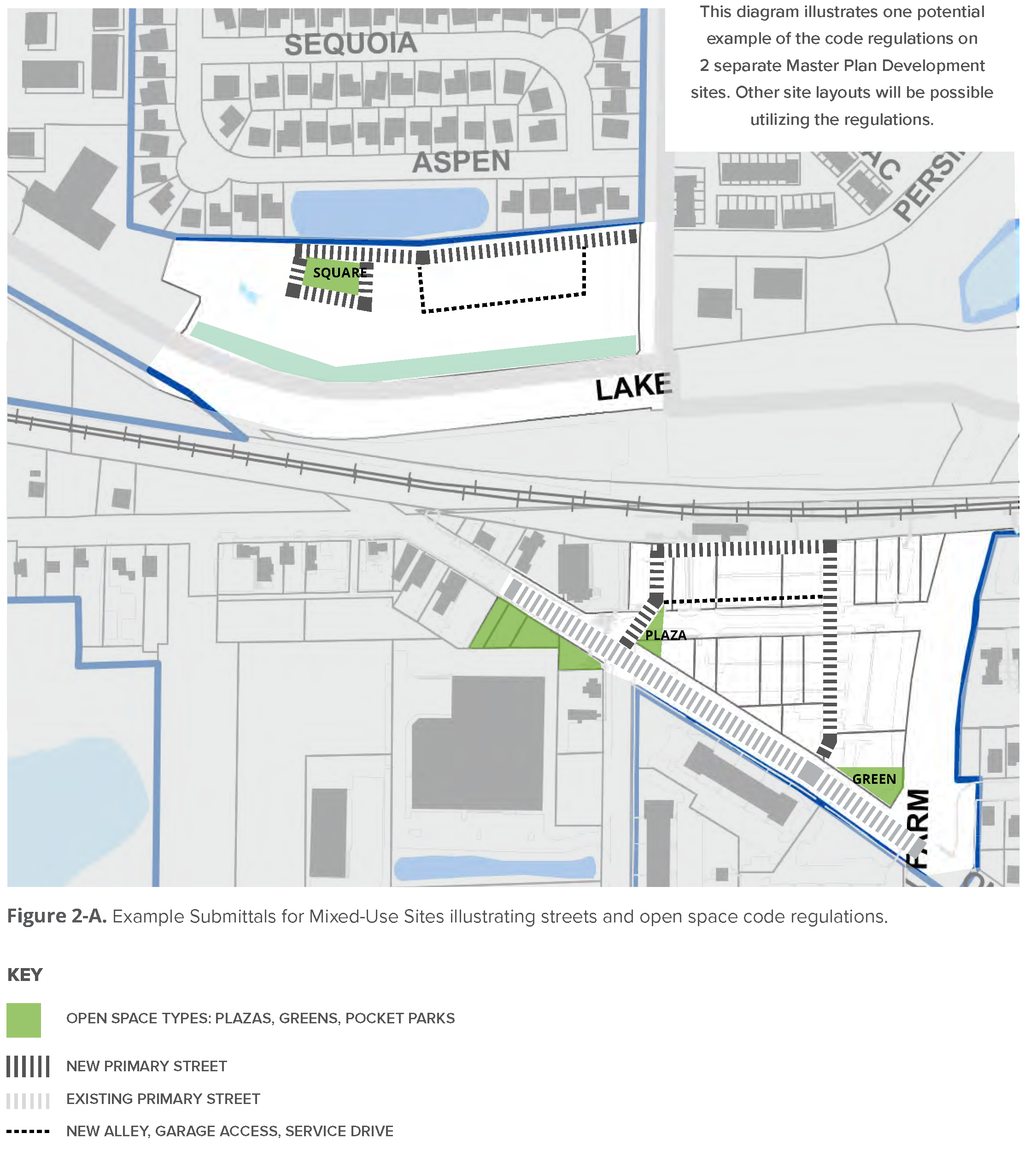
9.2.5. Blocks. An interconnected system of streets and blocks is required for all development sites. Refer to Figure 2-A for example illustrations of these regulations. Note that other configurations that meet the regulations may be considered.
a.
Block size. Block length must be no more than 600 feet, with a maximum perimeter of 1,800 feet. Deviations from these dimensions for sites with natural or existing constraints may be approved with a minor exception per 9.7.5.
b.
Access points. A minimum of two access points must be provided for each development, with a minimum of one per every 1,500 feet of boundary. An access point is a new street connecting to an existing street. Deviations from these regulations for sites with natural or existing constraints may be approved with a minor exception per 9.7.5.
c.
Extend existing streets. Streets must connect and continue existing streets from adjoining areas. Future connections must be considered and temporary dead end streets may be supplied for future extension.
d.
Shape of blocks. The shape of a block should be generally rectangular in order to accommodate typically rectilinear buildings, but may vary due to natural features or site constraints.
e.
Lots and building sites configuration. All lots or building sites must have frontage along a street per the building type regulations, unless otherwise specified. Refer to 110-9.3.
1.
With the exception of blocks containing open space, blocks must typically be fronted with lots or buildings on at least two block faces, preferably on the longest streets.
2.
The configuration of the blocks must consider alley and service drive inclusion per 9.2.7.
3.
Blocks may be established including already existing lots and those lots may retain their existing zoning district designation.
9.2.6. Streets. Complete streets provide for multiple modes of access throughout the village. Refer to Figure 2-A for illustrations of these regulations. The following applies to new streets within any MPD.
a.
Cul-de-sacs and dead end streets. Cul-de-sac and temporary dead end streets require a design exception per 9.7.6 and are permitted only when necessitated by natural features or site constraints, including, but not limited to, waterbodies, rail lines, or highways. Where feasible, pedestrian connections and landscape plantings will required by the zoning administrator.
b.
Open space types. Refer to 9.2.10 for open space type regulations, including street frontage regulations. Open space, existing and new, must be fronted with streets to provide more visibility and access, unless otherwise allowed in this article IX.
c.
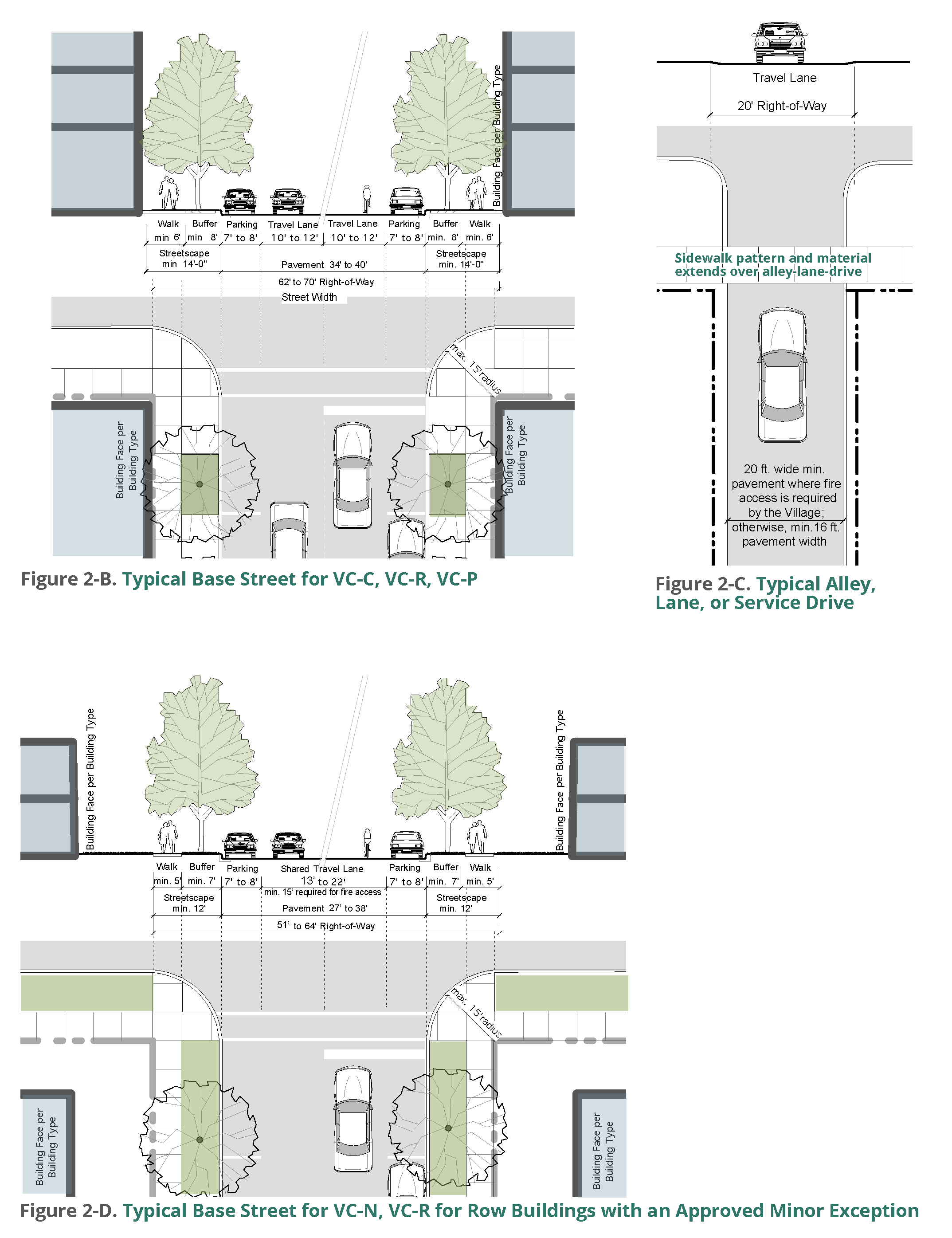
Base street requirements. The base street types are illustrated in Figure 2-B and Figure 2-D. The zoning administrator and/or village engineer may require additional street width or configuration based on existing context and circulation needs. The base street defines the minimum components of any new street on the interior of the development and includes the following:
1.
On-street parking. On-street parallel parking must be provided on both sides of all new streets through VC districts. Back-in or head-in, angled parking is acceptable in lieu of parallel parking, but may require additional street space. On-street parking on one side of the street may be approved as a minor exception by the zoning administrator, though parking on both sides is encouraged.
2.
Streetscape. See 9.6.1 for streetscape design regulations.
(a)
The minimum dimension required for streetscapes along non-residential ground stories is 14 feet, with a clear sidewalk width of at least six feet and an eight-foot street tree and furnishings area.
(b)
Along residential ground stories, the minimum is 13 feet with a clear sidewalk of at least five feet and an eight-foot landscape area (parkway).
(c)
Inclusion of stormwater best management practices, such as rain gardens, permeable pavement and other infiltration methods, is encouraged in the streetscape area.
(d)
A minor exception may be approved by the zoning administrator and the village engineer for up to two feet less of any dimension per 9.7.5.
3.
Maximum pavement width. The maximum pavement width for all streets internal to the development is 38 feet. Pavement widths wider than 38 feet must include a median in the middle to provide pedestrian refuge and/or bulb-outs to reduce the crossing widths to less than 38 feet.
4.
Medians. Landscape medians are optional and permitted up to a maximum of 15 feet in width. Medians must accommodate pedestrian crossings. Note that wider spaces within street configurations may be permitted by utilizing a open space type per 9.2.10.
5.
Reduced minimum pavement. When only one lane of on-street parking is approved, the minimum pavement width for a two-way street is 28 feet and the minimum right-of-way width is 54 feet.
6.
Exceptions. A design exception may be approved for other street configurations per 9.7.6.
d.
Bicycle accommodations. New streets within the development must accommodate bicycle access per the village's most recent bicycle policy. Bicycle accommodations must be included on through streets and higher activity streets; on non-commercial and lower activity streets, bicycles may share vehicular lanes.
e.
Mid-block pedestrian paths within development. Mid-block pedestrian paths may be located on blocks within the development that are longer than the maximum block sizes, approved by the zoning administrator during the master plan development approval process.
f.
Street crosswalks. Crossings at all street intersections must include a clear pedestrian path across streets (crosswalks) with accessibility ramps at curbs, demarcated by paint, stamped patterns, or pavers. Raised crosswalks are encouraged.
9.2.7. Alleys, lanes, or service drives.
a.
Required through all blocks. Alleys, lanes, or service drives (see Figure 2-C) must be provided through all blocks to provide vehicular access to all lots, except as follows:
1.
Parking drives and parking structure drives may serve as service drives if the drive is continuous through the block, has at least 2 access points, and serves all lots on the block.
2.
Exception. A design exception per 9.7.6 may be approved per block with one of the following conditions:
(a)
A single point of access is all that is required and a non-primary street is available for access.
(b)
Natural or existing constraints limit the block depth and no more than two vehicular access points are required for the lots on the block.
b.
Size. Per Figure 2-C, alleys, lanes, or service drives must be located within a separate parcel or within boundary lines 20 feet in width. for illustration. Paving width is 16 feet. A minor exception may be approved by the zoning administrator and village engineer for different widths based on existing context and circulation needs.
9.2.8. Primary street designation. The orientation and location of buildings on lots is determined by the primary street designation. Some building type regulations are specific to the primary street frontage (see 110-9.3). Primary street frontages prioritize the street frontages for locating the front facade of the building and limit vehicular access to parking off these streets.
a.
Minimum designation. A minimum of 50 percent of a combination of the new streets in the development and existing streets fronting the development must be designated as primary streets. A design exception may be approved for up to a 20 percent reduction in the minimum requirement for streets treated as primary. Refer to 9.7.6 for the design exception process.
b.
Building frontage. Primary streets must be designated so that all building lots or sites front at least one primary street, except up to 20 percent of the lots or building sites may front a non-primary street.
c.
Open space type frontage. Where practicable, streets along open space types must be designated as primary streets to ensure buildings front the open space. Refer to 9.2.10 for open space regulations.
d.
Driveways and alleys/lanes. Driveways and alleys/service drives to building sites or lots must not be located off a primary street, except when the lot is fronted by more than two primary streets and/or there is no other alternative access.
e.
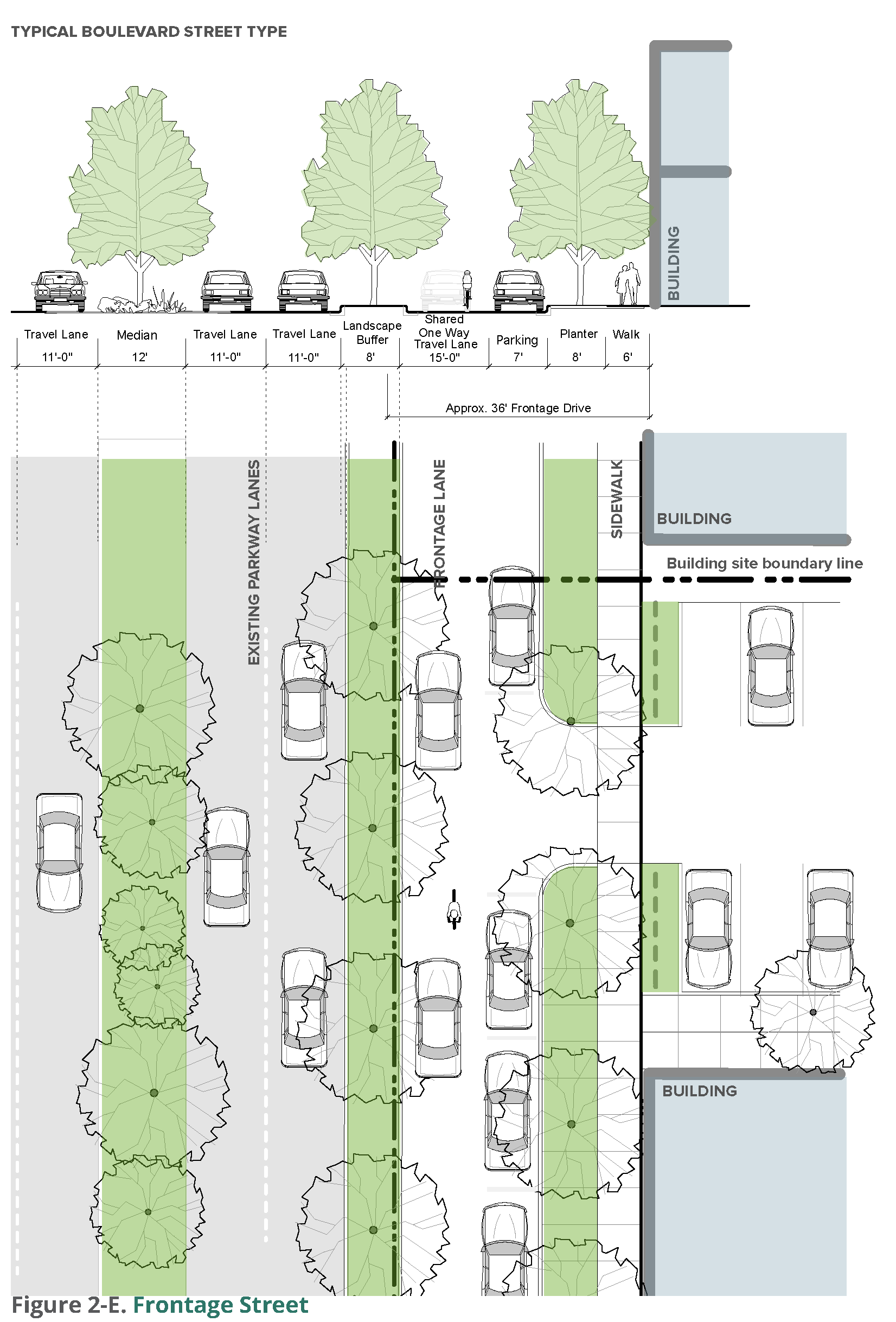
Major streets. When the development abuts a major street, including W Lake Street or Barrington Road, one of the following layouts could be utilized to create slower, more accessible, and more walkable streets for fronting buildings with ground floor commercial uses than the major street would provide:
1.
Perpendicular. A new primary street could be located generally perpendicular to existing major streets.
2.
Frontage street. A new frontage street could be provided essentially parallel to the major street with a landscape buffer island separating the streets of at least eight feet and serving as a primary street for abutting building lots. Refer to Figure 2-E for Typical Frontage Layout.
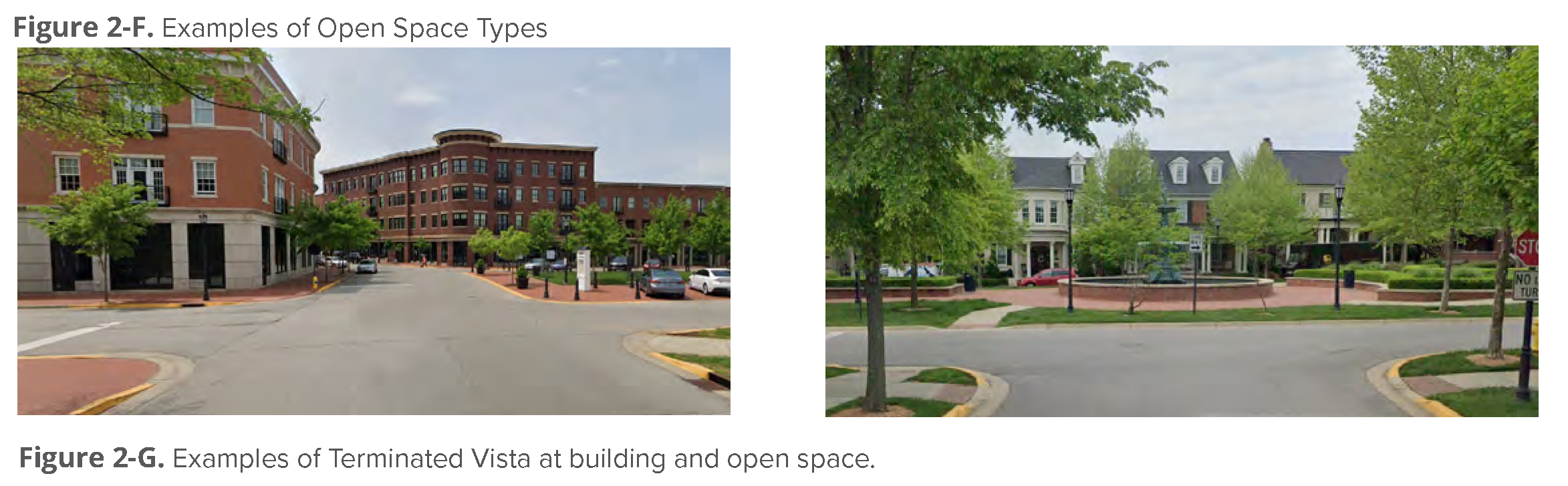
9.2.9. Vistas. Views down streets must be considered when laying out streets and locating open space, parking, and buildings. See Figure 2-G for illustrative images of appropriately terminated vistas.
a.
Rears of buildings. The location of open space and streets must not create views of the rear of buildings or parking behind buildings.
b.
Street termini. When a street terminates at a parcel, the parcel must be occupied by one of the following:
1.
Open space. If the parcel is open space, any open space type must be utilized.
2.
Building. If the parcel is not utilized as an open space, the façade of a building, whether fronting a primary street or not, shall terminate the view. The building may incorporate one of the following treatments to terminate the view: a tower, a bay, or a courtyard.
3.
Parking. A parking structure or a surface parking lot must not terminate a street vista.
9.2.10. Open space. All MPDs must provide the following open space:
a.
Required amount. The following minimum amount of open space must be provided:
1.
A minimum of ten percent of the total development site must be provided as one of the open space types, and
2.
One type of open space is required within a 500-foot distance, as measured continuously along a sidewalk, from any principal exterior entrance of all units and buildings. The intent is to provide usable open space within a short walkable distance for all occupants and visitors.
b.
Designation. Open space must be located either on a separate lot or within an easement on a lot defined by boundary lines on a plat and zoned VC-P.
c.
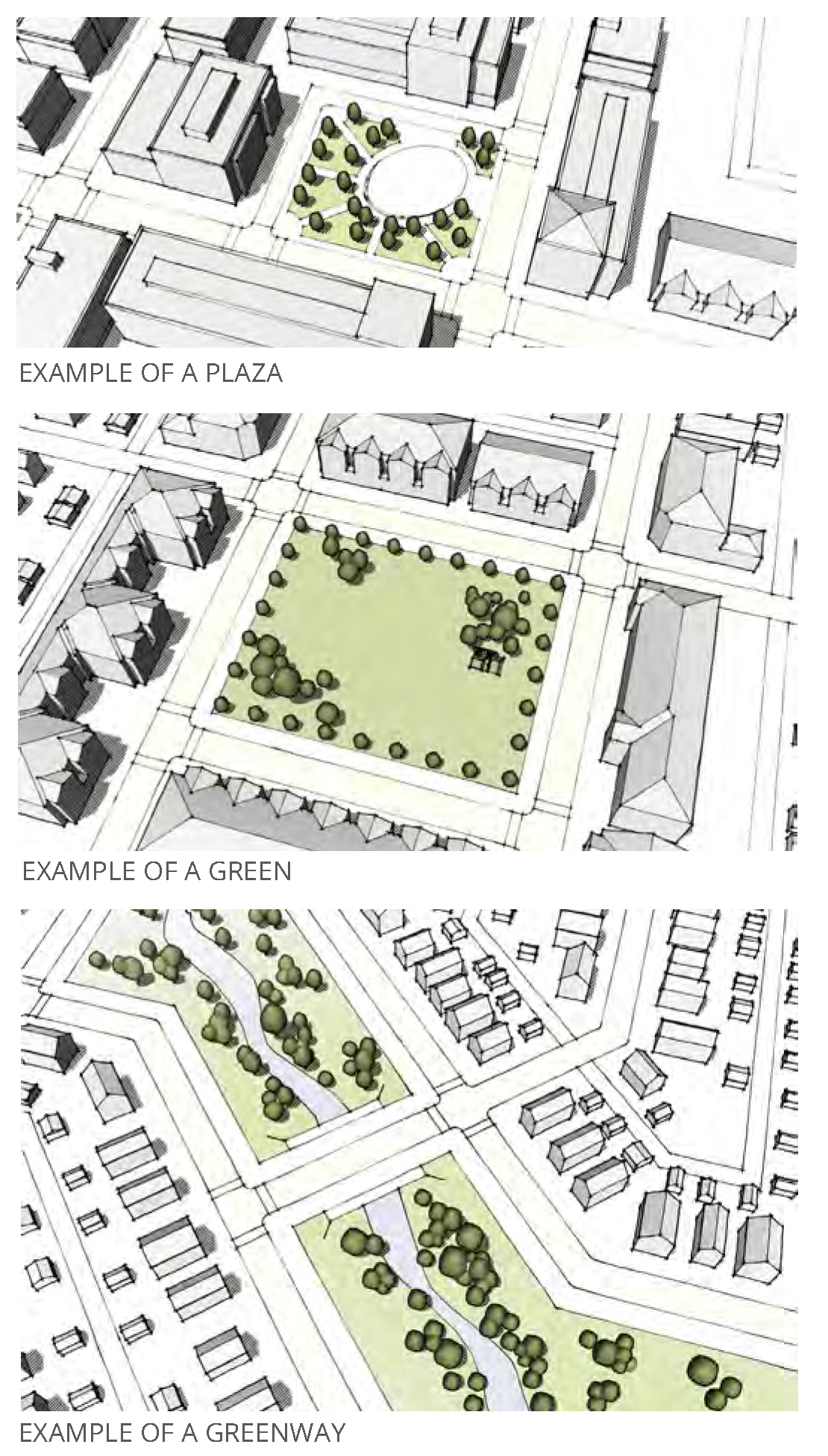
Types of open space. The following types of open space are permitted. A mix of types is required, with not more than two of any one type utilized on one development. Refer to Figure 2-F for example images.
1.
Plaza. A plaza is a generally hardscaped area (minimum 60 percent coverage), minimum one-eighth acre in size, with either street, rail corridor, or building frontage on all sides and at least one side the equivalent of 25 percent of the perimeter fronting a primary street. A single plaza may not fulfill the minimum open space regulations; if a plaza is utilized to meet the distance requirement, another open space must be incorporated in another location on the site.
2.
Pocket park. A pocket park is a combination of hardscape and landscape, minimum one-eighth acre in size with street frontage on at least 25 percent of the perimeter. One pocket park is allowed per development, plus one additional pocket park allowed for every two civic spaces of another type.
3.
Square. A square is a combination of hardscape and landscape (approximately 50 percent and 50 percent respectively), minimum one-fourth acre in size, and surrounded by street frontage on all sides.
4.
Green. A green is a generally landscaped space (minimum 70 percent), minimum one-third acre with street frontage.
5.
Greenway. A greenway is a linear landscape space, minimum one and one-half acres in total with minimum 20 feet wide and minimum average 30 feet wide, and with street frontage on at least 30 percent of the perimeter.
6.
Paseo. A paseo is a linear landscape space lined with building frontages along the two longest sides, minimum 25 feet and maximum 40 feet in width. One paseo is allowed per development, plus one additional paseo allowed for every two civic spaces of another type.
7.
Park or conservation area. A park or conservation area is a larger, generally landscaped space, a minimum of one acres in size, visible and accessible from street. Conservation areas include sensitive landscape areas, such as wetlands or forests, and must include continuous access trails on the perimeter or a portion of the area connecting to a public sidewalk.
d.
Existing open space. With approval of the zoning administrator, existing usable open space, more than one-fourth of an acre and meeting one of the types defined above, may fulfill the regulations. Landscape area and buffer area does not count towards the open space requirement.
e.
Trails. Refer to any village open space and/or trail plans, and any existing trails surrounding the site, to provide connections through and within the site for continuity.
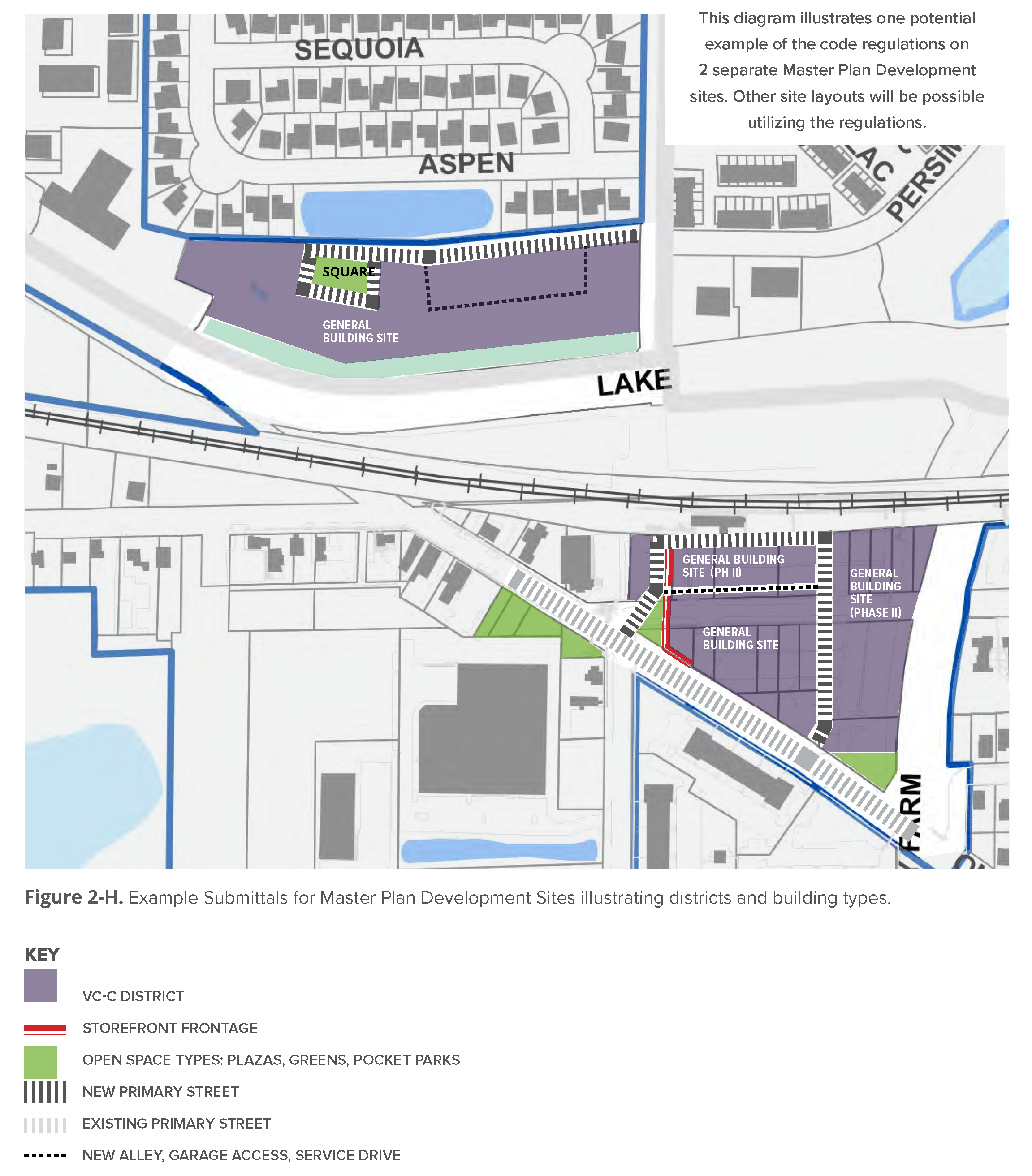
9.2.11. Storefronts and building types. The MPD submittal must define districts and building types to meet the following regulations. Refer to Figure 2-H for illustrations of one site layout fulfilling these regulations. A design exception per 9.7.6 may be requested for changes to the following regulations.
a.
New districts. A rezoning of all or part of the site may be requested, reviewed, and a rezoning may be approved concurrent with the MPD approval process. All new districts and building types must be illustrated on the MPD submittal.
b.
Permitted building types. The location of building types must be designated on the MPD plan.
1.
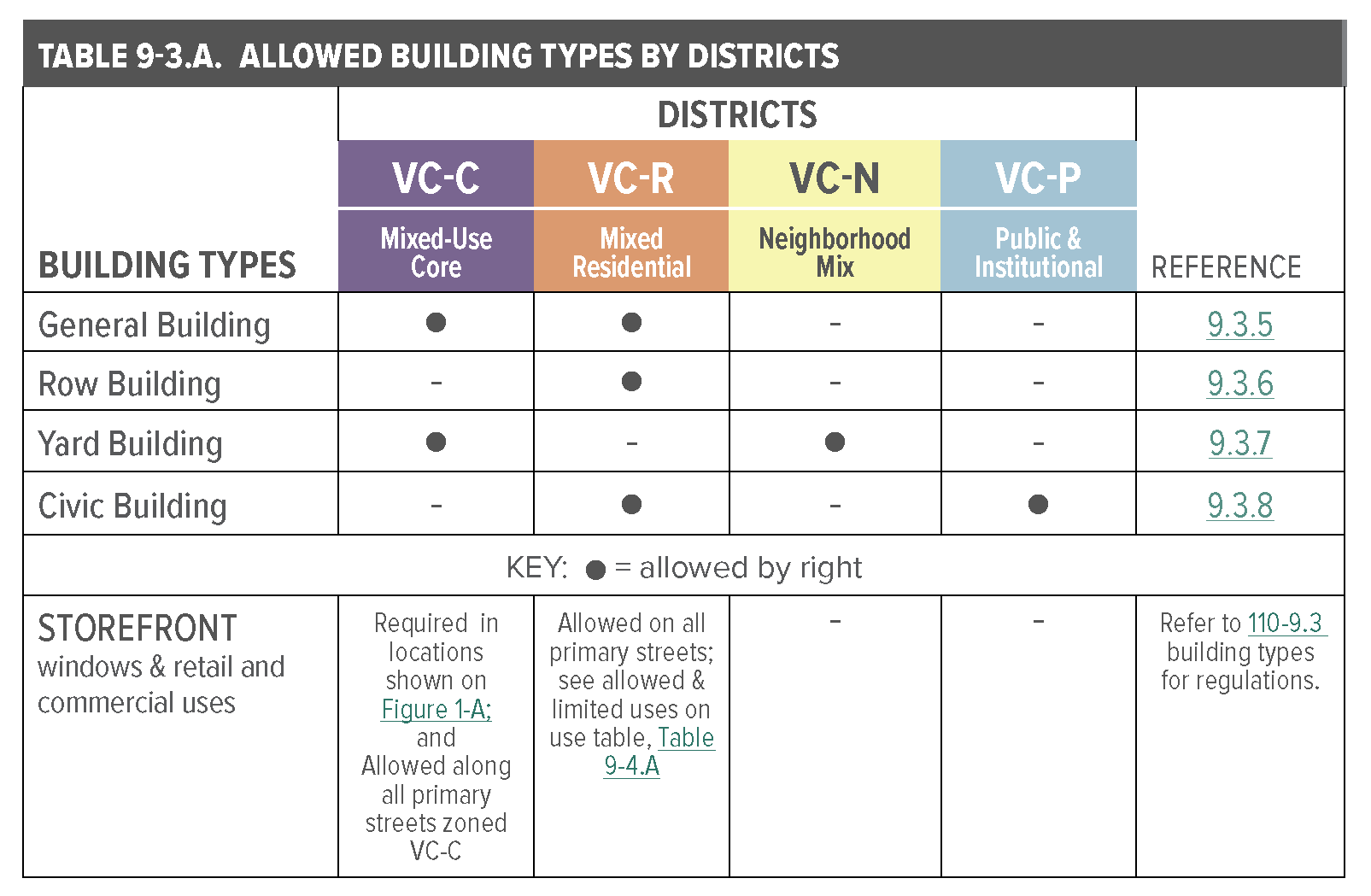
Refer to Table 9-3.A for allowed building types by districts.
2.
Refer to 110-9.3 for description and regulations for allowed building types.
3.
Refer to Figure 2-H for an example of an MPD plan submittal for a site.
c.
Storefronts. The location of storefronts must be designated on the MPD plan. Refer to 9.2.11.d for the general layout. The following layout regulations are applicable to any storefront applied to a site.
1.
On lots zoned VC-C, see Figure 1-A, regulating plan, for required locations for storefronts. The MPD submittal must note these locations as storefronts, along with any additional storefronts locations required by the applicant.
2.
Storefronts must begin within 500 feet of any major street and may extend, generally continuously, into the site any distance.
3.
Storefronts should be clustered into areas of at least 100 linear feet of frontage, or in a node, located on corners at an intersection, totaling at least 120 feet of frontage.
4.
Storefront clusters or nodes should be uninterrupted and continuous.
5.
New storefronts façades must not be located closer than 150 feet from any single-family zoned lot.
d.
General layout of building types. The following general layout regulations apply to all building types:
1.
Similar building types should generally face each other across streets, including existing buildings.
2.
More intense buildings and categories of uses (multiple units to single units, or commercial to residential) located on blocks with less intense buildings and uses should be located on block ends.
3.
Changes in building type should generally occur at a rear boundary line, at an alley, or at corner parcels.
(Ord. No. O-22-25, § 1(Exh. A), 8-8-2022)
Sec. 110-9.3. - Building types.
9.3.1. Introduction.
a.
Applicability. This section establishes the building form and use regulations for all buildings within the VC districts defined in 110-9.1.
b.
Building types permitted. See Table 9-3.A for allowed building types by district. All principal buildings must the standards of an allowed building type in the district.
c.
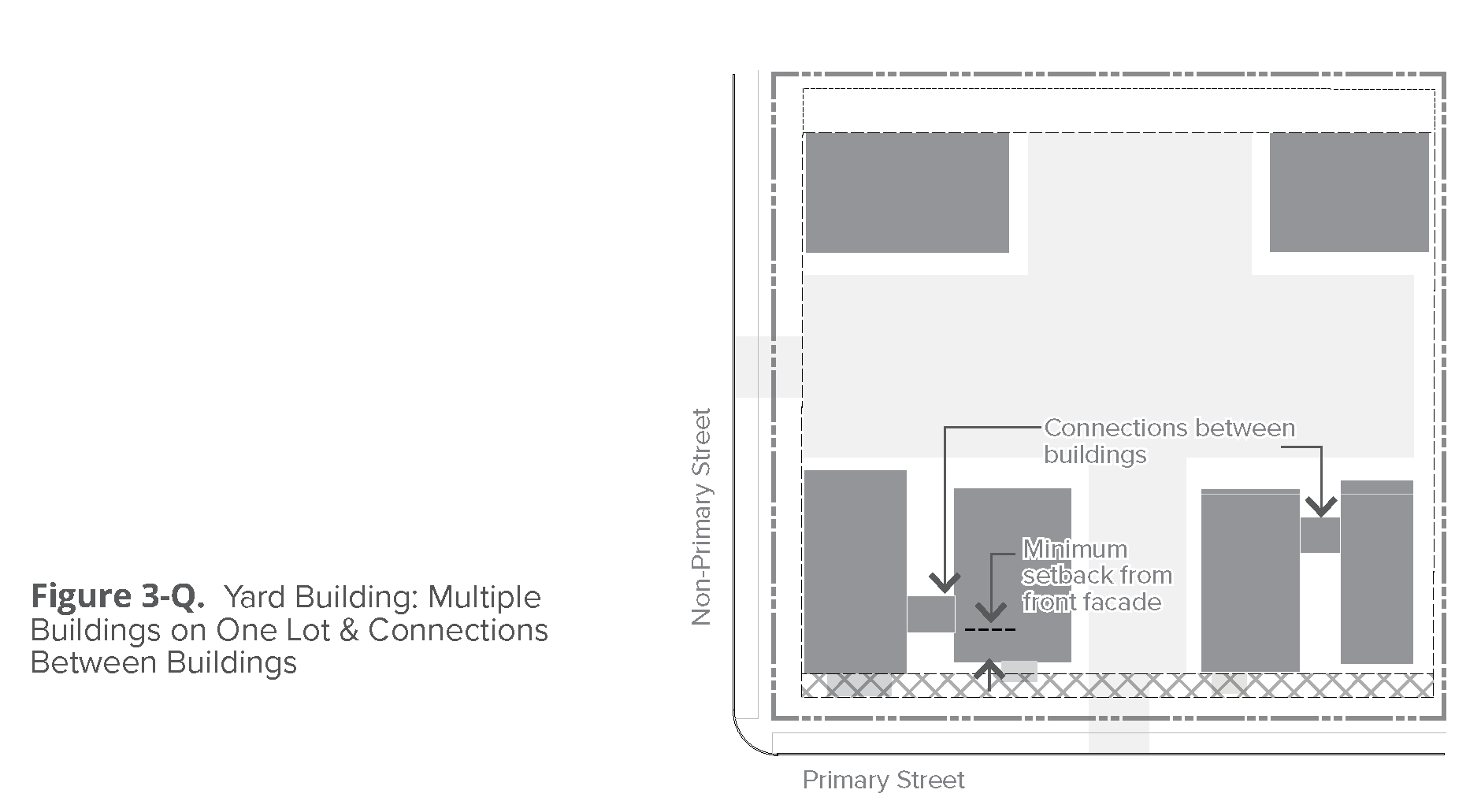
Multiple principal buildings on one lot. For all districts except VC-N, multiple principal buildings are allowed on all lots; however, each building must meet the regulations of the building type, unless otherwise noted.
d.
Permanent structures. All buildings constructed must be permanent construction without a chassis, hitch, or wheels, or other features that would render the structure mobile, unless otherwise defined in this article IX.
e.
Uses by building type. Refer to 110-9.4 for uses allowed per district. Building types may have additional standards on allowed uses.
f.
Design exception. A design exception per 9.7.6 may be approved for any building type regulation, provided the exception meets the intent of the VC districts in 9.1.1.
9.3.2. Description and intent of building types. The zoning map governs where districts are allowed in the village. (Refer to 9.1.3 for a description of each district.) Table 9-3.A regulates which building types are allowed in which districts. The following describes the intent behind each building type. Refer to 9.3.4 for regulations applicable to all building types.
a.
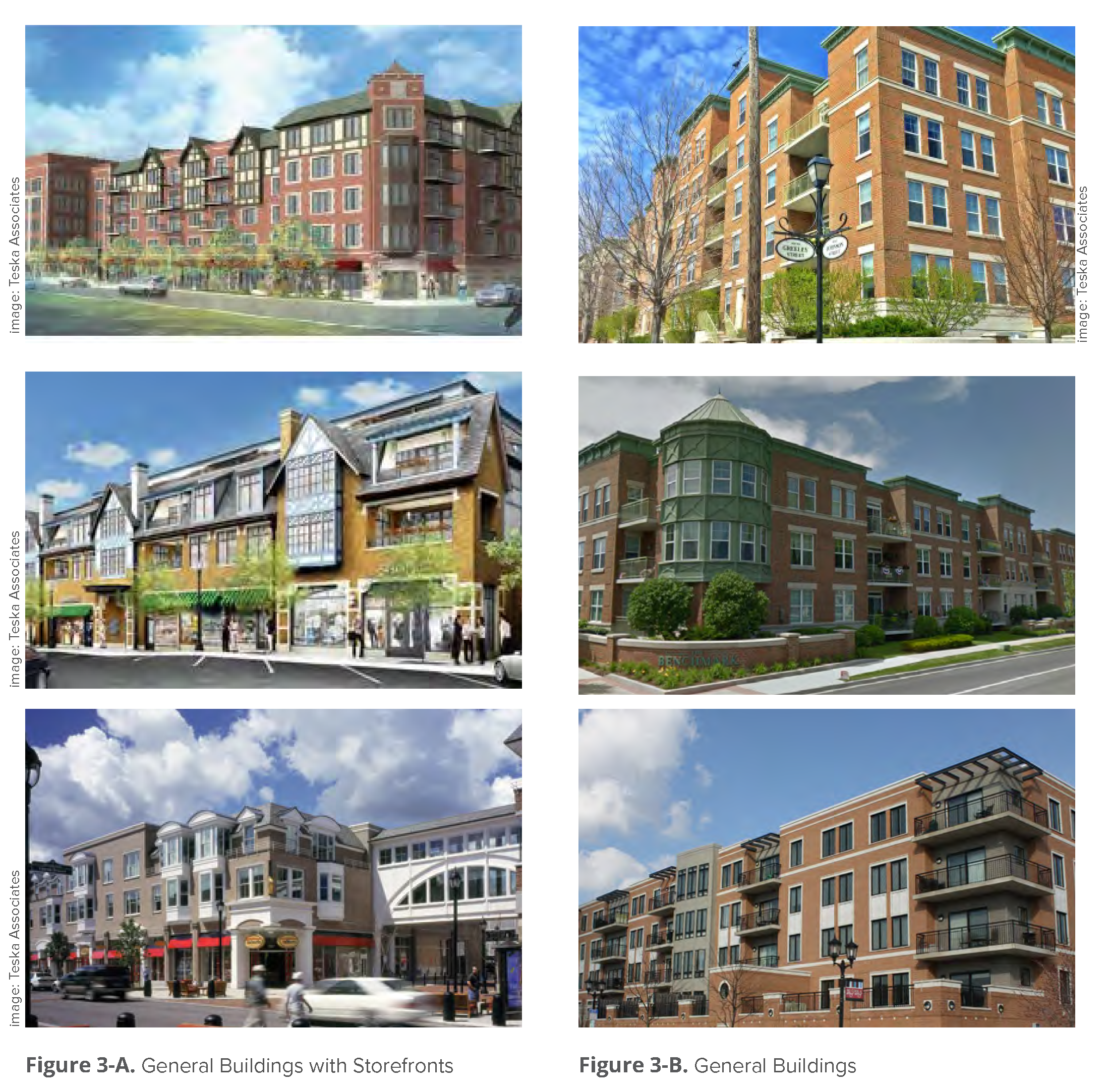
General building type. The general building type is a basic building that can accommodate a wide range of uses, from storefronts to apartment buildings to offices. Storefronts may be incorporated into this building type in allowed districts. Refer to Figure 3-A and Figure 3-B for examples of typical general buildings. Refer to 9.3.5 for regulations specific to this building type.
b.
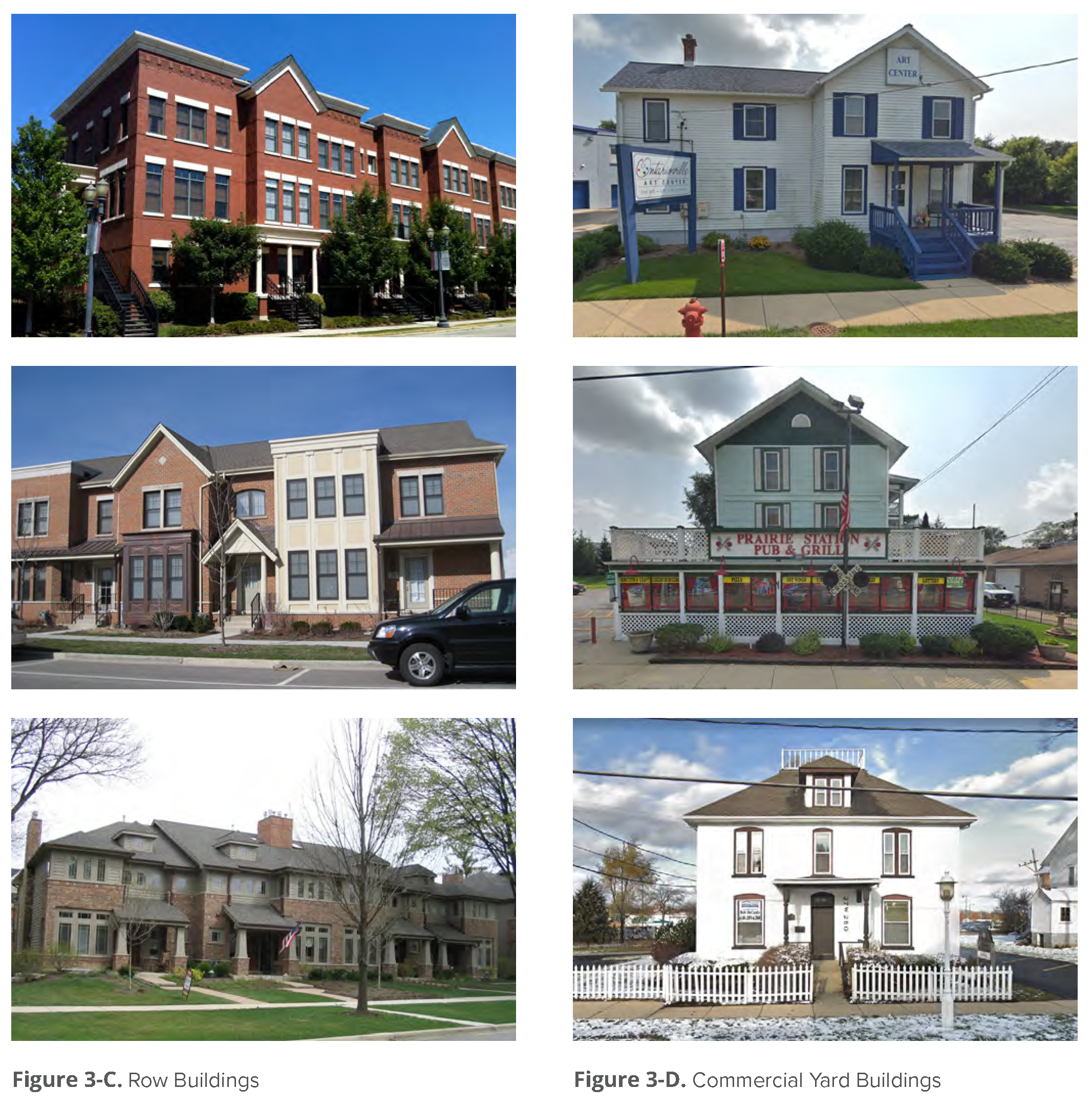
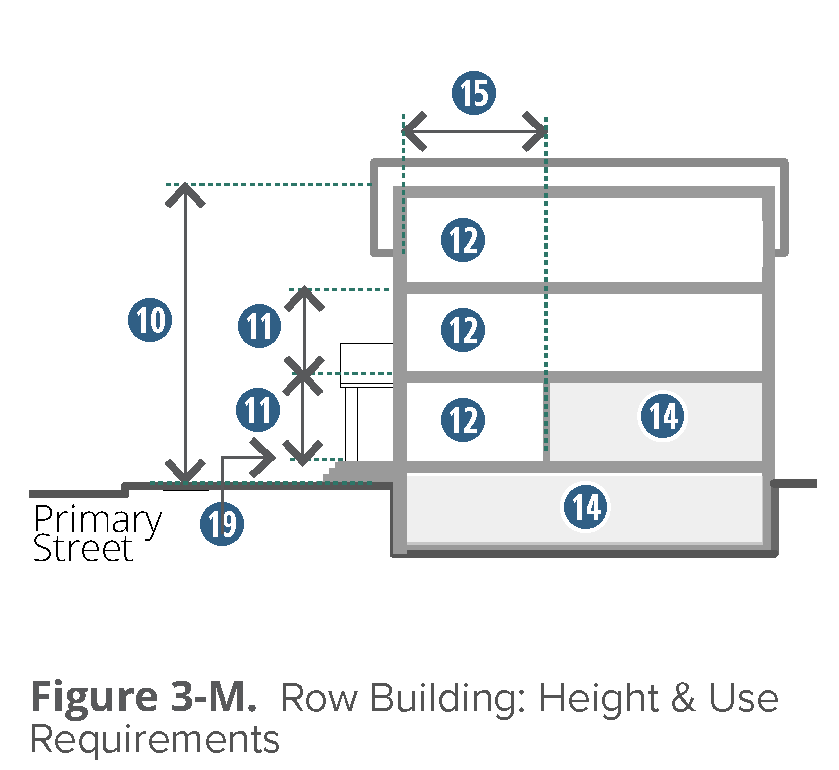
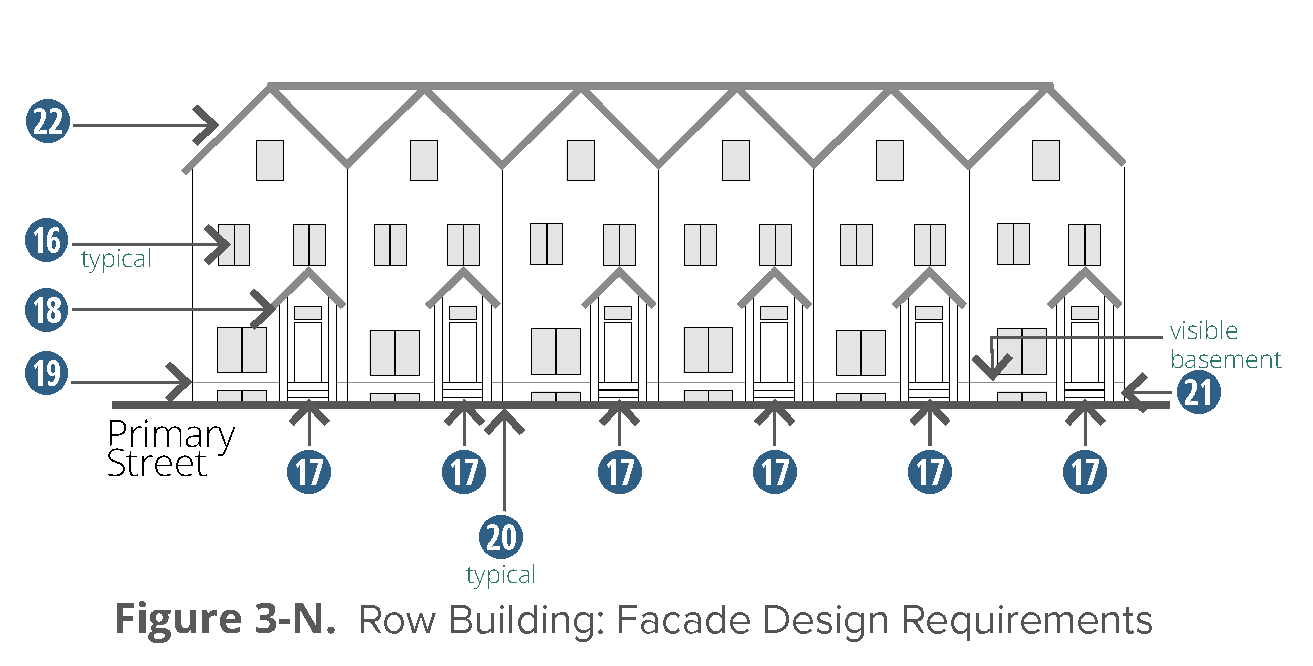
Row building type. The row building type is similar to the general building, but is smaller in scale and divided into a series of vertical units each with separate entrances. Townhouses, rowhouses, or live-work units exemplify this building type. Refer to Figure 3-N for examples of typical row buildings. Refer to 9.3.6 for regulations specific to this building type.
c.
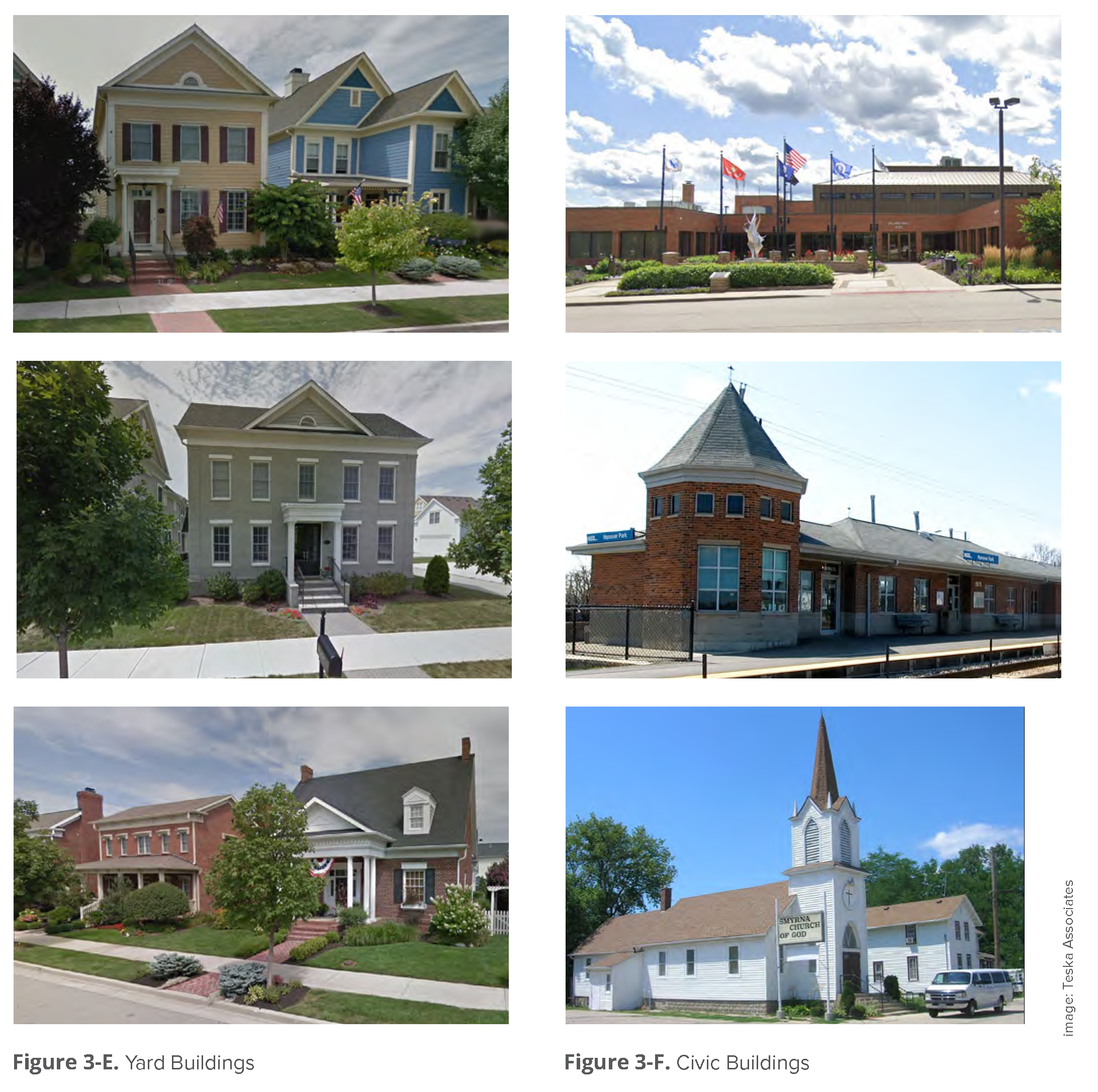
Yard building type. The yard building type is smaller in width than the general building, includes yard area surrounding the structure, and typically includes a pitched roof. Uses within the yard building may differ significantly based upon the district in which it is located (e.g., in VC-C, the yard building may accommodate commercial uses, while in VC-N, the yard building is limited to single-unit residential uses only). Refer to Figure 3-D and Figure 3-E for examples of typical yard buildings. Refer to 9.3.7 for regulations specific to this building type.
d.
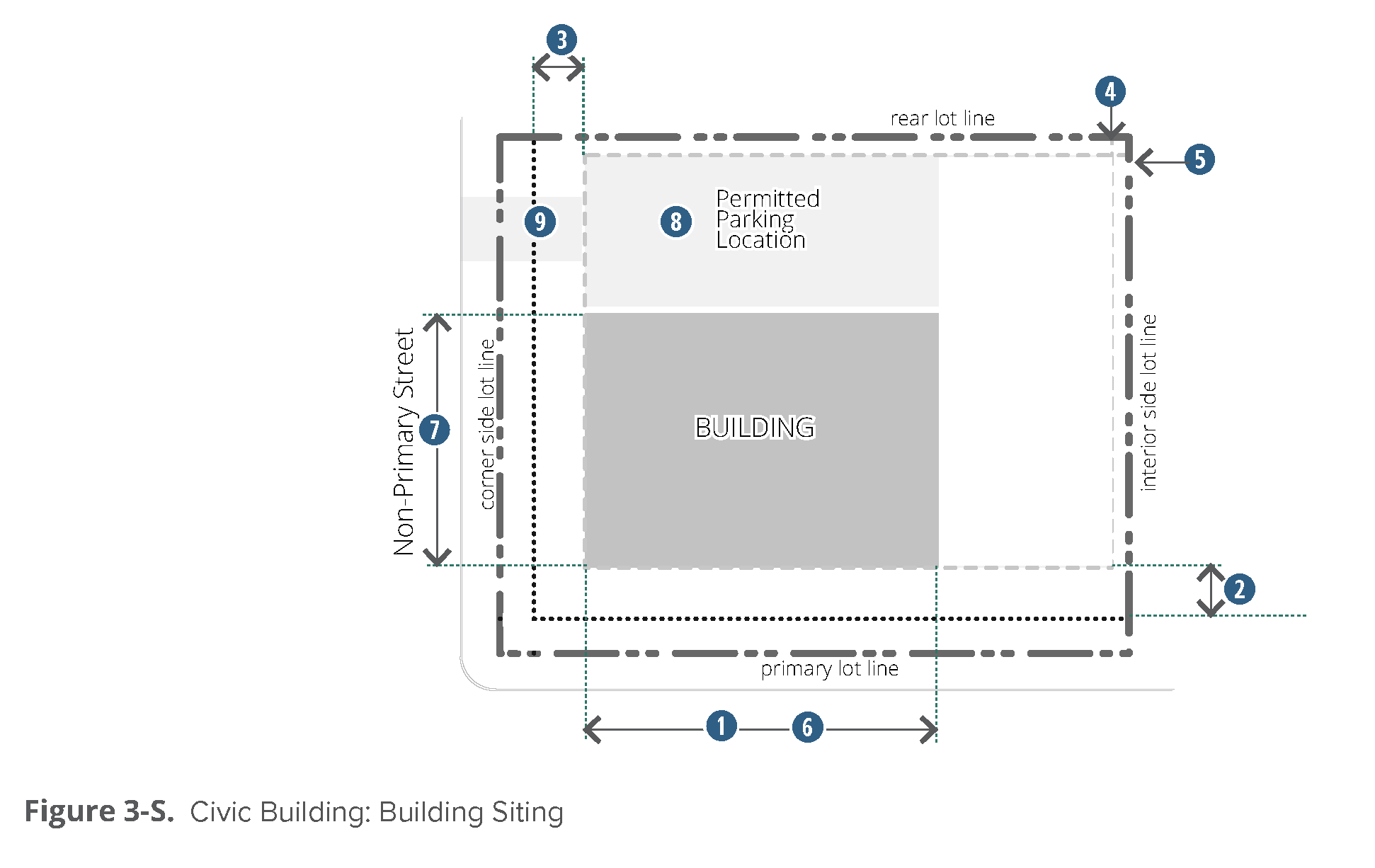
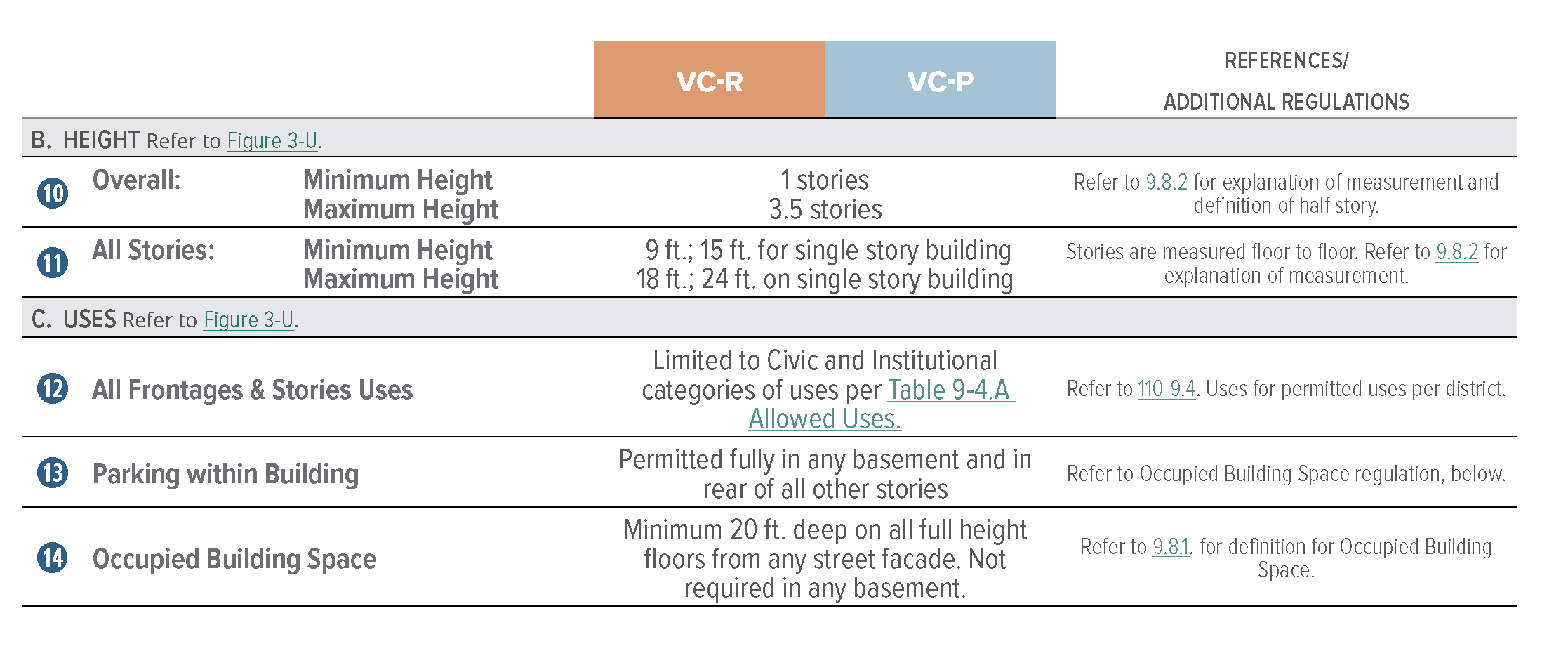
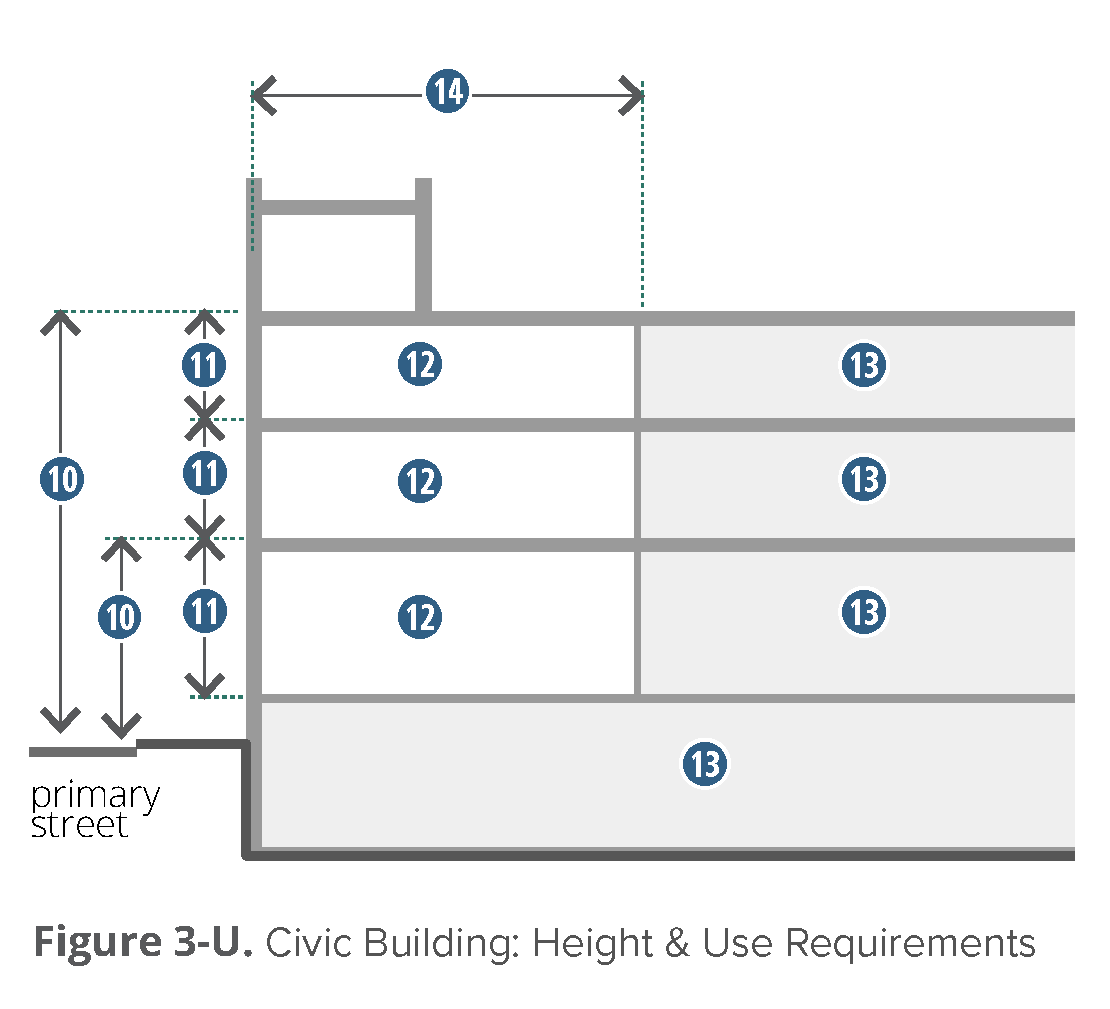
Civic building type. The civic building type is the most flexible building, meant to allow for singular, more iconic designs or buildings set back with landscape surrounding. This building type, however, is limited to civic and institutional uses. Refer to Figure 3-F for examples of typical civic buildings. Refer to 9.3.8 for regulations specific to this building type.
9.3.3. Storefronts.
a.
Required storefront. The regulating map in Figure 1-A establishes locations where ground story storefront windows (a higher percentage of transparency) and retail and service category uses are required per Table 9-3.A. Retail and service category uses must be allowed in VC-C per 110-9.4.
b.
Allowed storefront. Where storefronts are noted as allowed in Table 9-3.A, retail and service category uses are allowed in the district's permitted building types and storefront windows (a higher percentage of transparency) may be required per the building type regulations. Other nonresidential uses may also be allowed or limited per Table 9-4.A, and storefront windows are not required for those other uses.
9.3.4. Regulations applicable to all building types. The following applies to all building types:
a.
General design requirements. Refer to 110-9.5 for building design regulations and 110-9.6 for site design regulations applicable to all buildings, unless otherwise stated in this article IX.
b.
Build to the corner. The intersections of two build-to zones at a corner must be occupied by building.
c.
Multiple principal buildings. Multiple principal buildings are allowed for any building type, except the yard building in VC-N. All buildings must meet the regulations for the building type.
d.
Primary and non-primary street frontages. A hierarchy of frontages is established for the VC districts by the definition of primary streets on Figure 1-A or on an approved MPD.
1.
Primary frontage required. At least one street frontage of all lots must be treated as primary and all buildings must have at least one primary frontage, unless otherwise defined by the building type regulations.
2.
Arterial primary streets. Unless otherwise determined by the master development plan, Ontarioville Road, Devon Ave, W. Lake Street, and Barrington Road must be treated as primary streets.
3.
Frontages along open space types. Building façades along or across the street from open spaces must be treated as primary façades, unless a design exception is approved per 9.7.6.
4.
Corners. At all intersections of primary and non-primary streets, primary façade transparency must extend along the non-primary façade a minimum of 30 feet, measured from the corner of the building.
5.
Non-primary streets. Non-primary frontages allow for a lower level of façade treatment as well as permit locations for garage and parking lot driveways entrances. Non-primary frontages may always be treated at the higher level of a primary frontage.
6.
Two primary streets. When multiple primary streets abut a parcel, the zoning administrator shall determine which building façades must be treated as primary, unless otherwise specified in this article IX. A minimum of 50 percent of lot frontage is recommended to be treated as primary frontage.
7.
No primary streets. When no designated primary street abuts a parcel, the zoning administrator shall determine which frontage(s) must serve as primary, unless otherwise specified in this article IX.
e.
Landscape and hardscape areas. The following establishes the required landscape and hardscape treatments permitted for the site other than building locations:
1.
Landscape areas. All street yards, build-to zones, side yards, and rear yards not covered by buildings, parking, or driveway must contain either landscape, patio space, or sidewalk space. Maximum impervious coverage regulations for each building type apply, unless otherwise stated.
(a)
Landscape includes shrubs, groundcovers, and/or lawn per 110-6.3. Trees may be included.
(b)
Patio space is outdoor space for people that includes seating, outdoor eating, or outdoor display, and does not include parking of motor vehicles.
(c)
Sidewalk is any walking surface serving as a pedestrian or bicycle path between points of interest or access.
2.
Permitted parking and driveway locations. Parking areas and driveway locations are permitted in specific locations by building type regulations. Generally, off-street parking is not permitted in street yards, unless specifically noted.
3.
Build-to zones and setbacks. Parking and driveways are not permitted in build-to zones or setbacks except as follows:
(a)
Where driveway access is permitted off streets, driveways may cross perpendicularly through the build-to zone or setback with a maximum width of 20 feet for two way driveways and 12 feet for one way and single-family residential driveways.
f.
Driveways and vehicular access. Parking locations on a lot or building site are defined by building type. Driveway and vehicular access for all building types, unless otherwise defined, is allowed as follows:
1.
Alleys, lanes, and service drives. Driveways and garage entrances are allowed off alleys, lanes, and service drive locations that exist or are established by the master development plan. Refer to 9.2.7 for definitions.
2.
Driveways off streets. If no alley is planned, one driveway or garage entrance is permitted off non-primary street or façade.
3.
Row building alley access off streets. If no alley exists or is required per the master development plan, a private alley is required with access off a non-primary street for row buildings. One access point is permitted off a non-primary street for every 150 feet of street frontage.
4.
Visibility of garage doors. Row building type units must be configured so that garage doors are fully screened from any street by the building or wingwalls off buildings.
5.
Driveways off primary streets. If no alley and no non-primary street exists or is planned abutting the lot, the zoning administrator may approve a driveway off a primary street through a minor exception process. Refer to 9.7.5.
g.
Accessory structures. Unless otherwise regulated in 110-9, refer to 110-6.6 for accessory structures.
h.
Utility structures. Minor utility structures not located within buildings and permitted in the VC districts are exempted from the building type standards, except street, side, and rear minimum setbacks, and maximum heights. Refer to 110-6.3.10 for landscape screening regulations.
9.3.5. General building type. The following defines the regulations specific to this building type. Refer to 9.3.1 through 9.3.4 for regulations applicable to all building types.
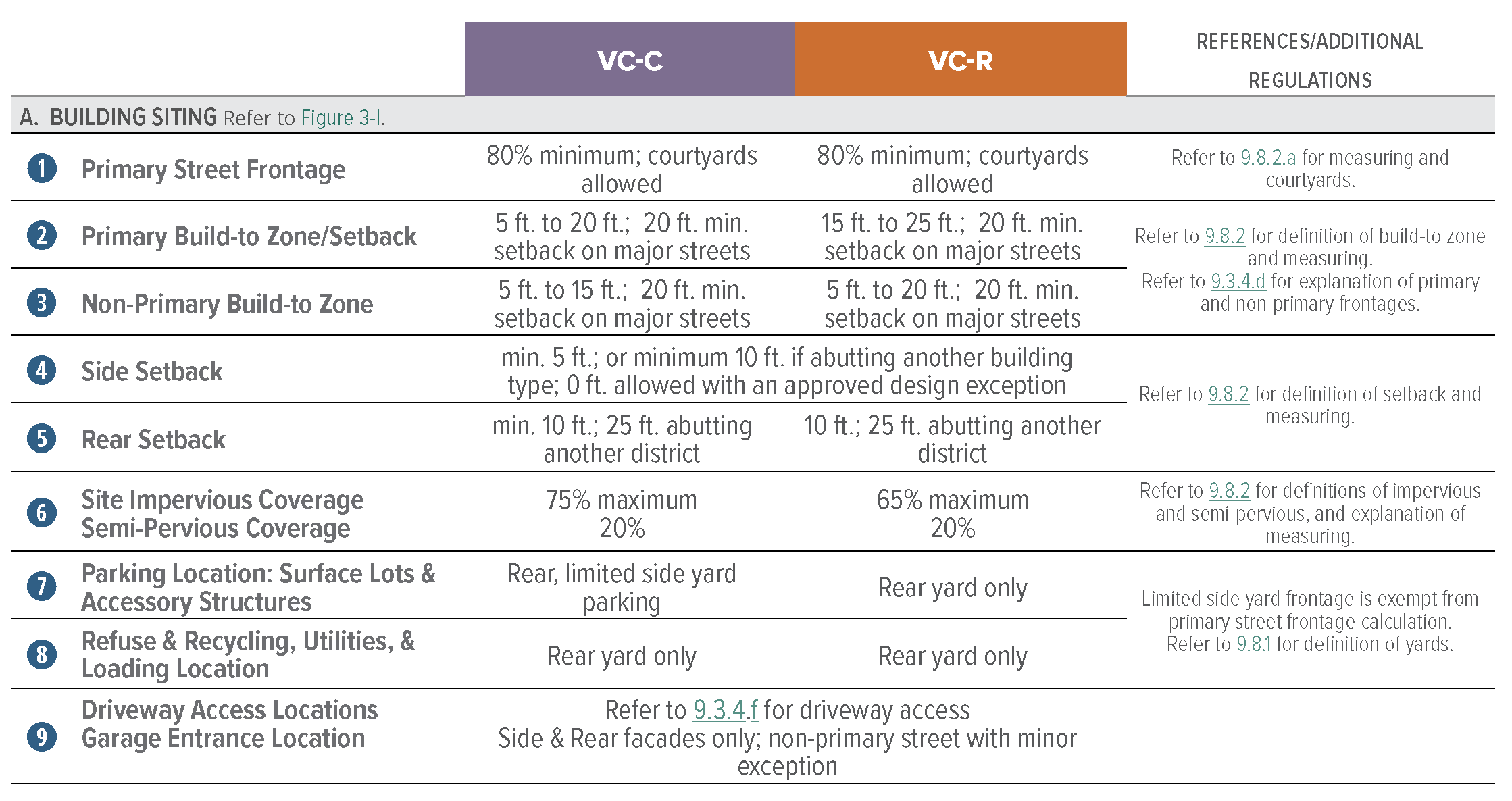
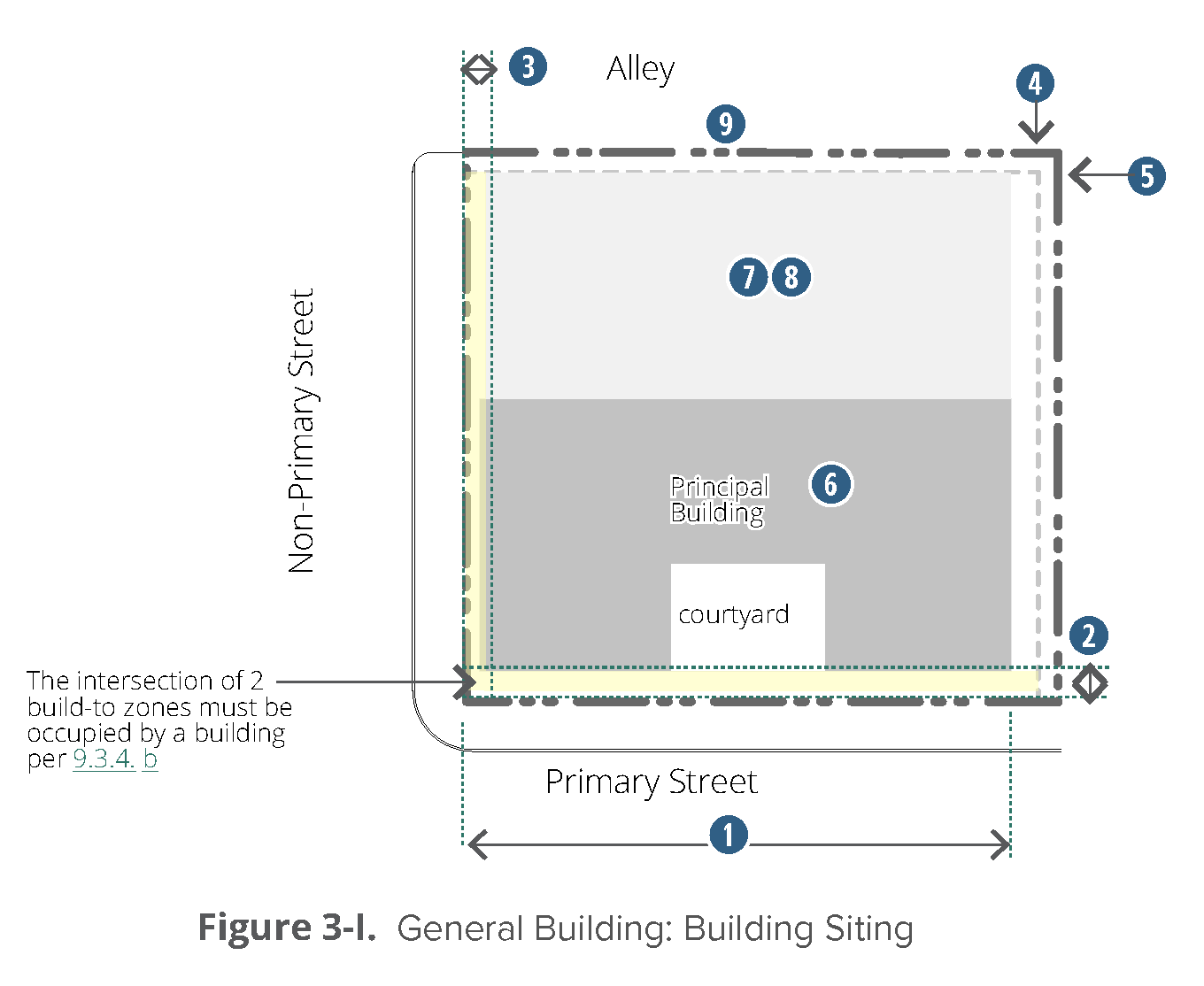
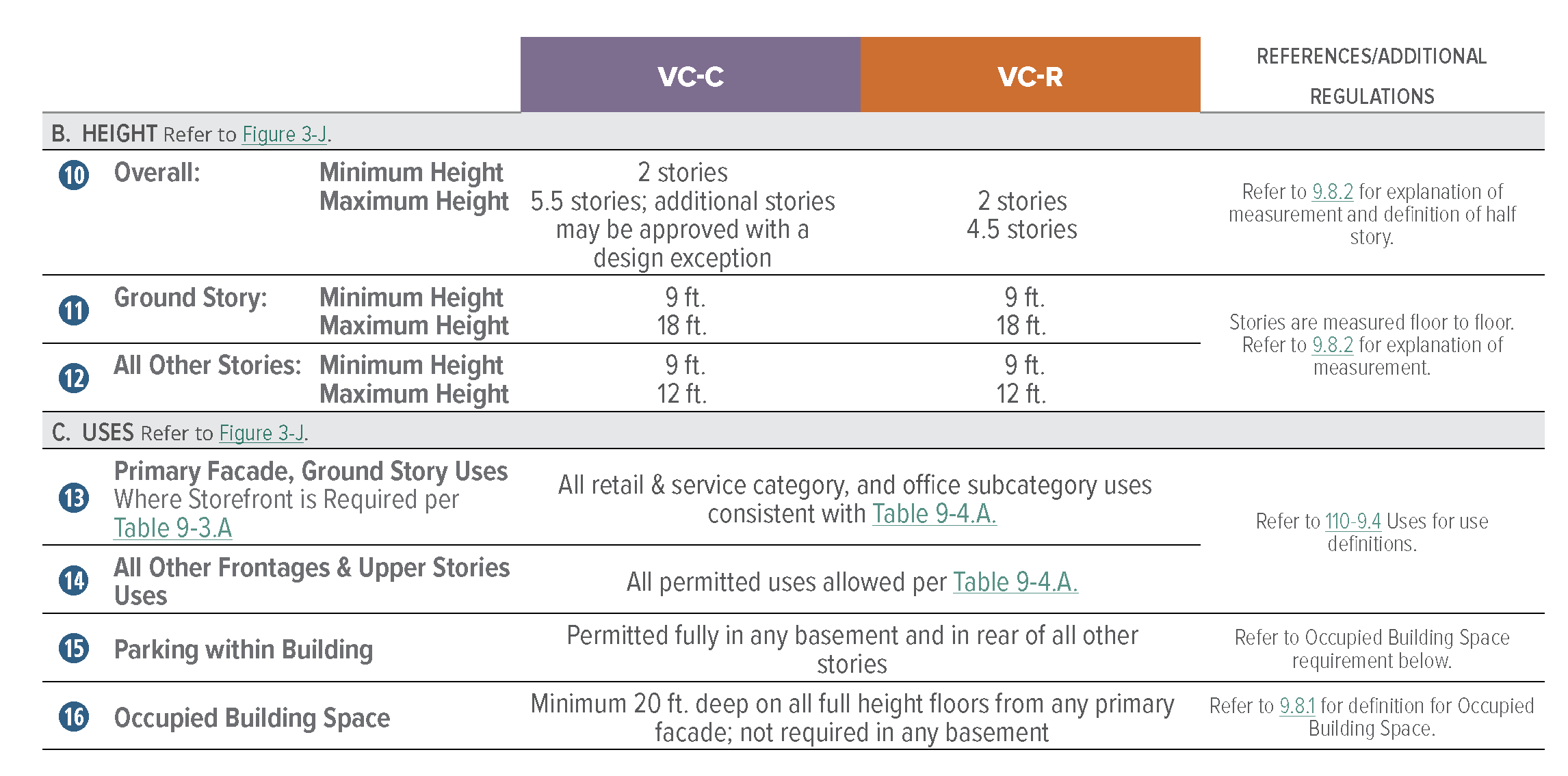
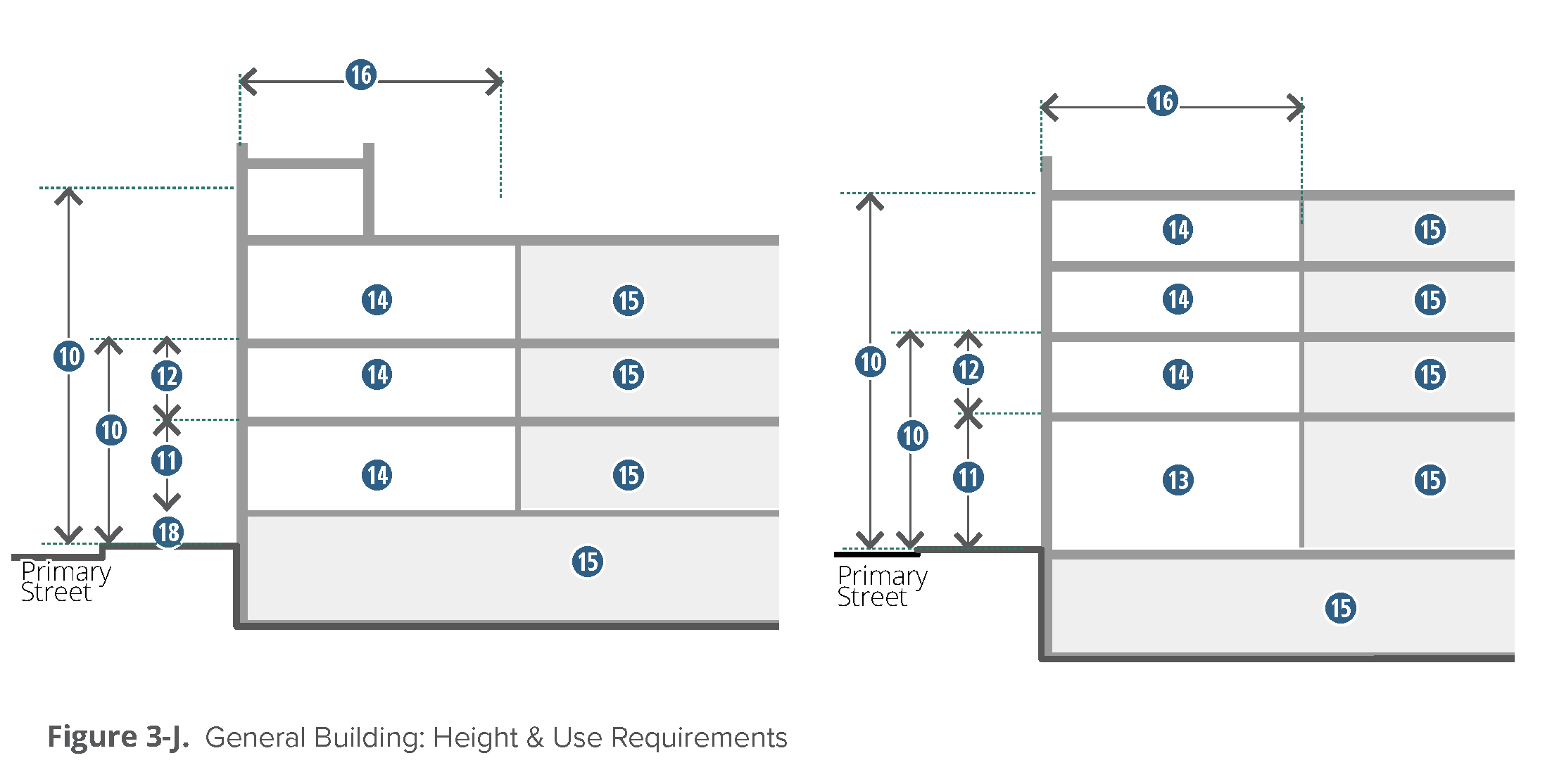
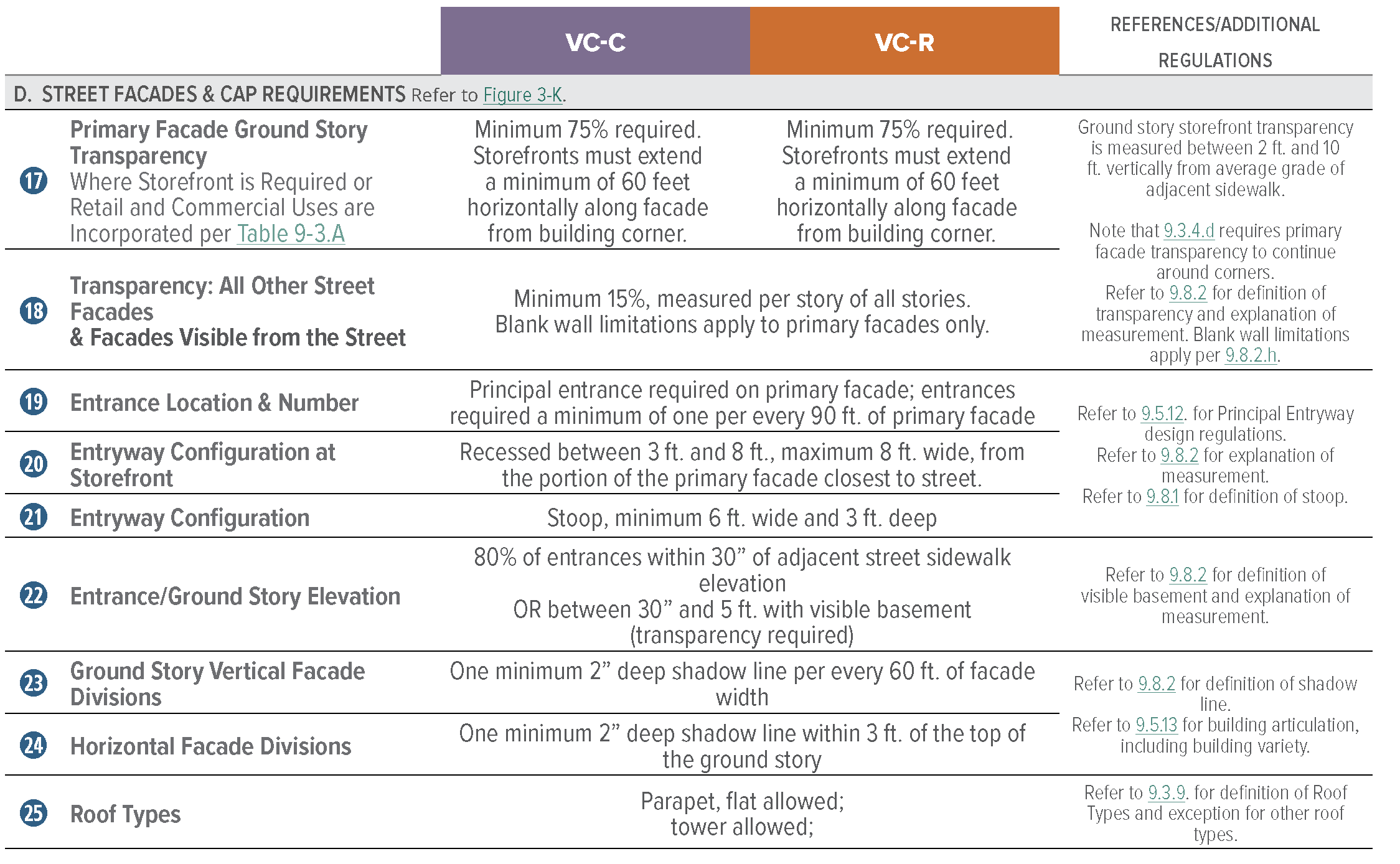
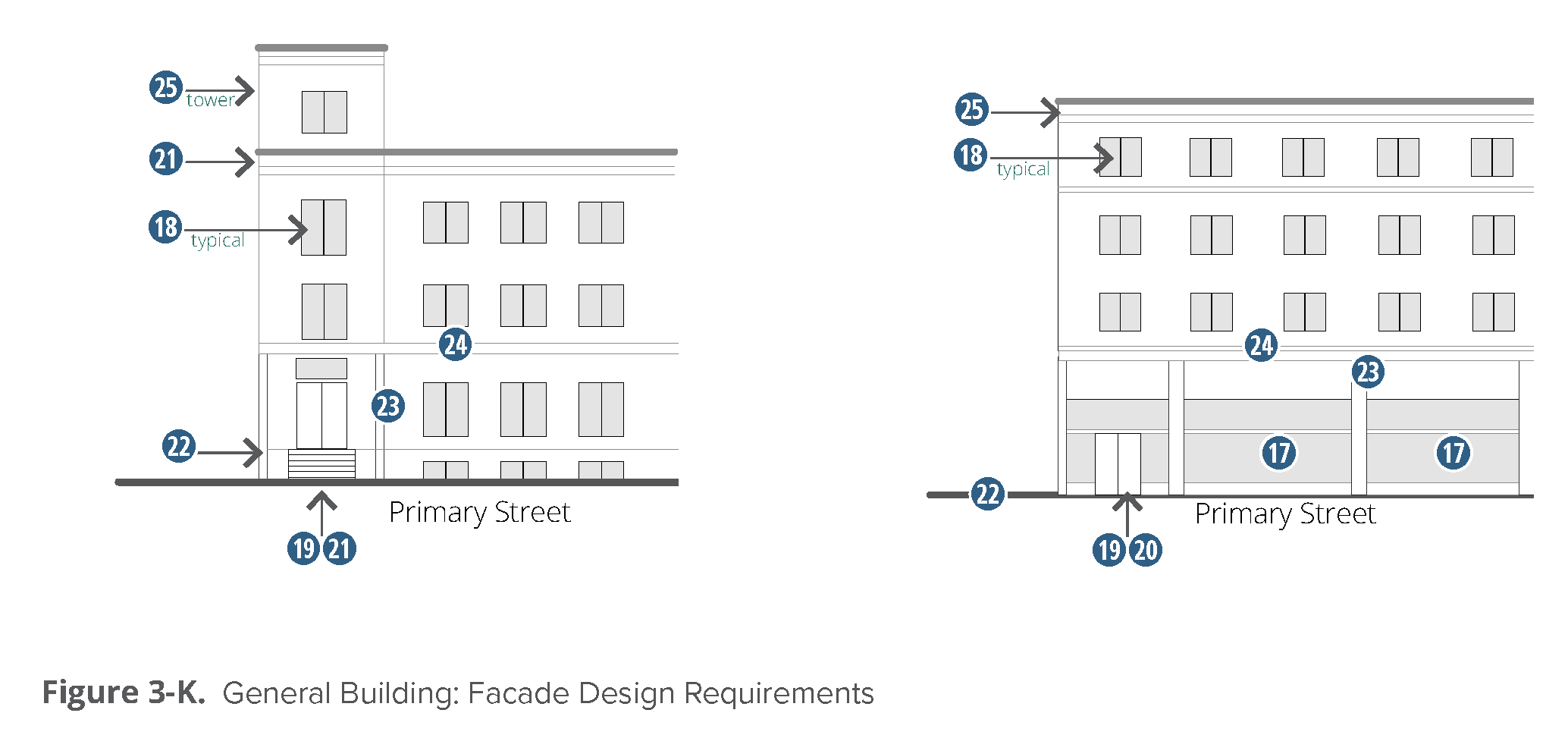
9.3.6. Row building type. The following defines the regulations specific to this building type. Refer to 9.3.1 through 9.3.4 for regulations applicable to all building types.
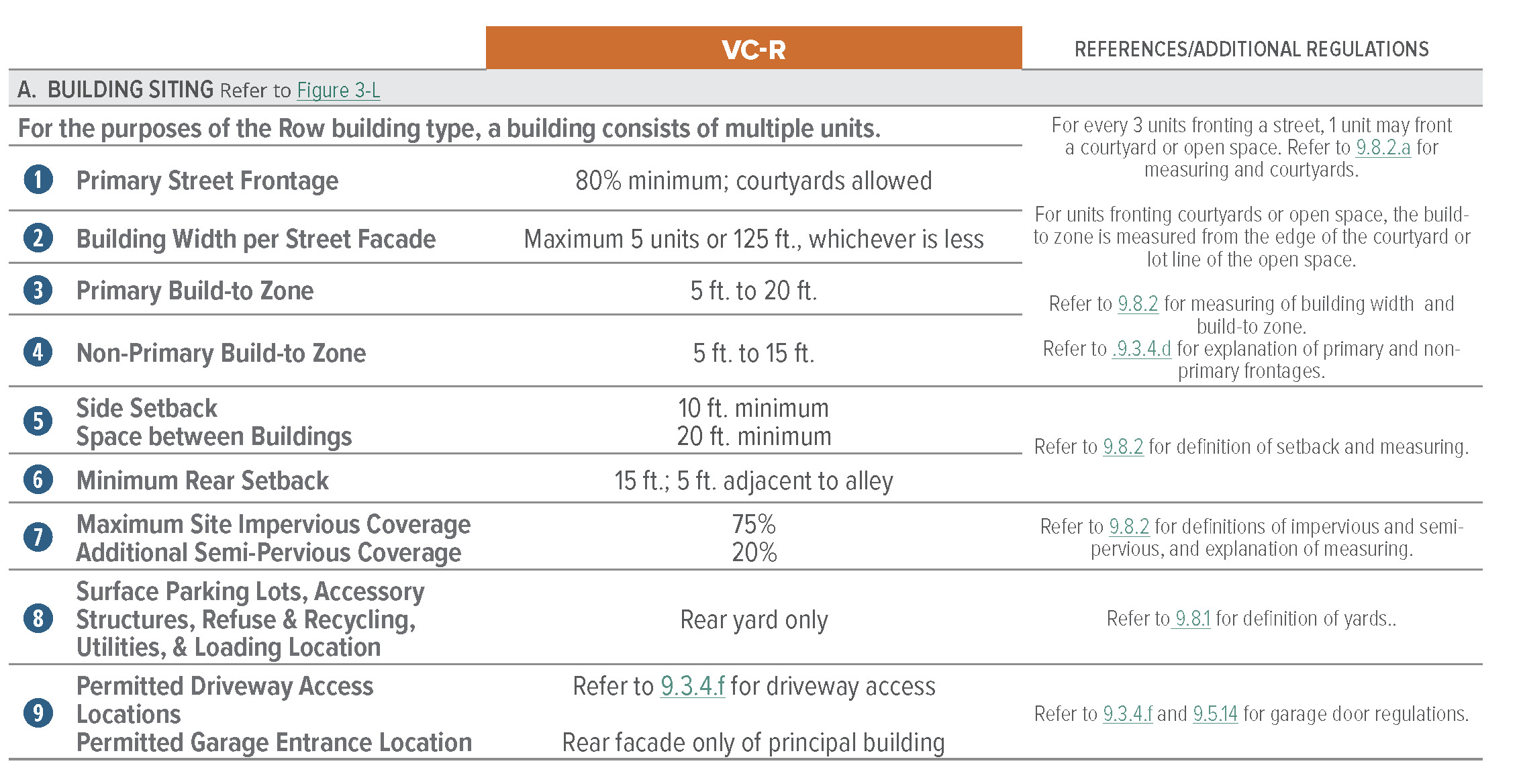
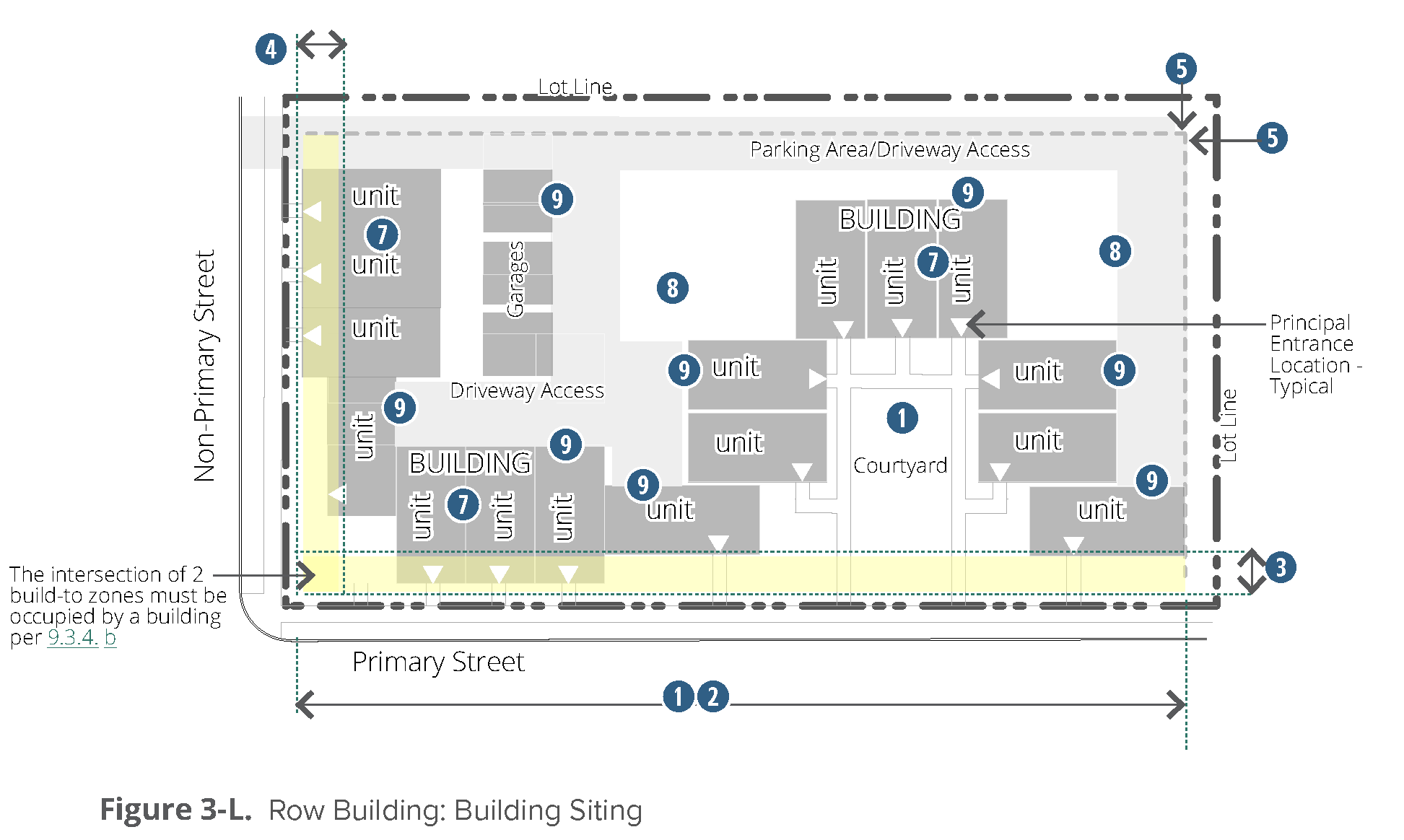
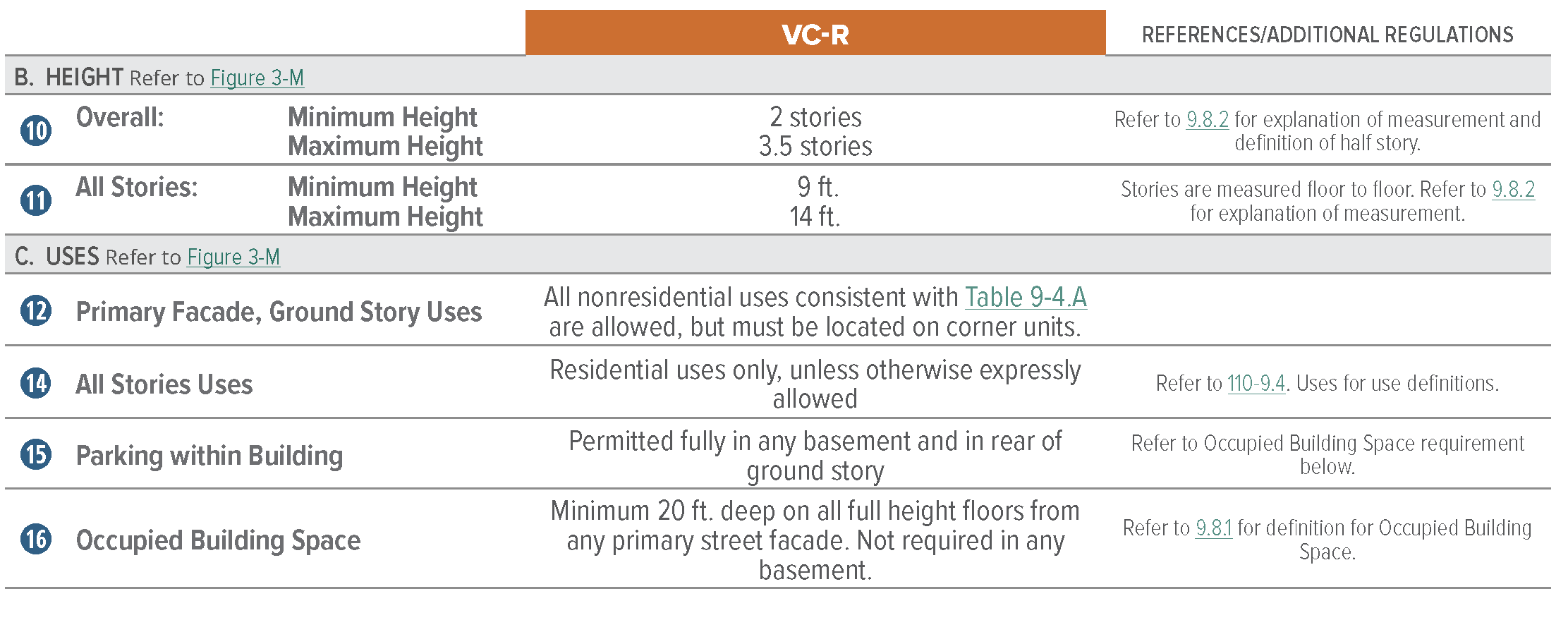
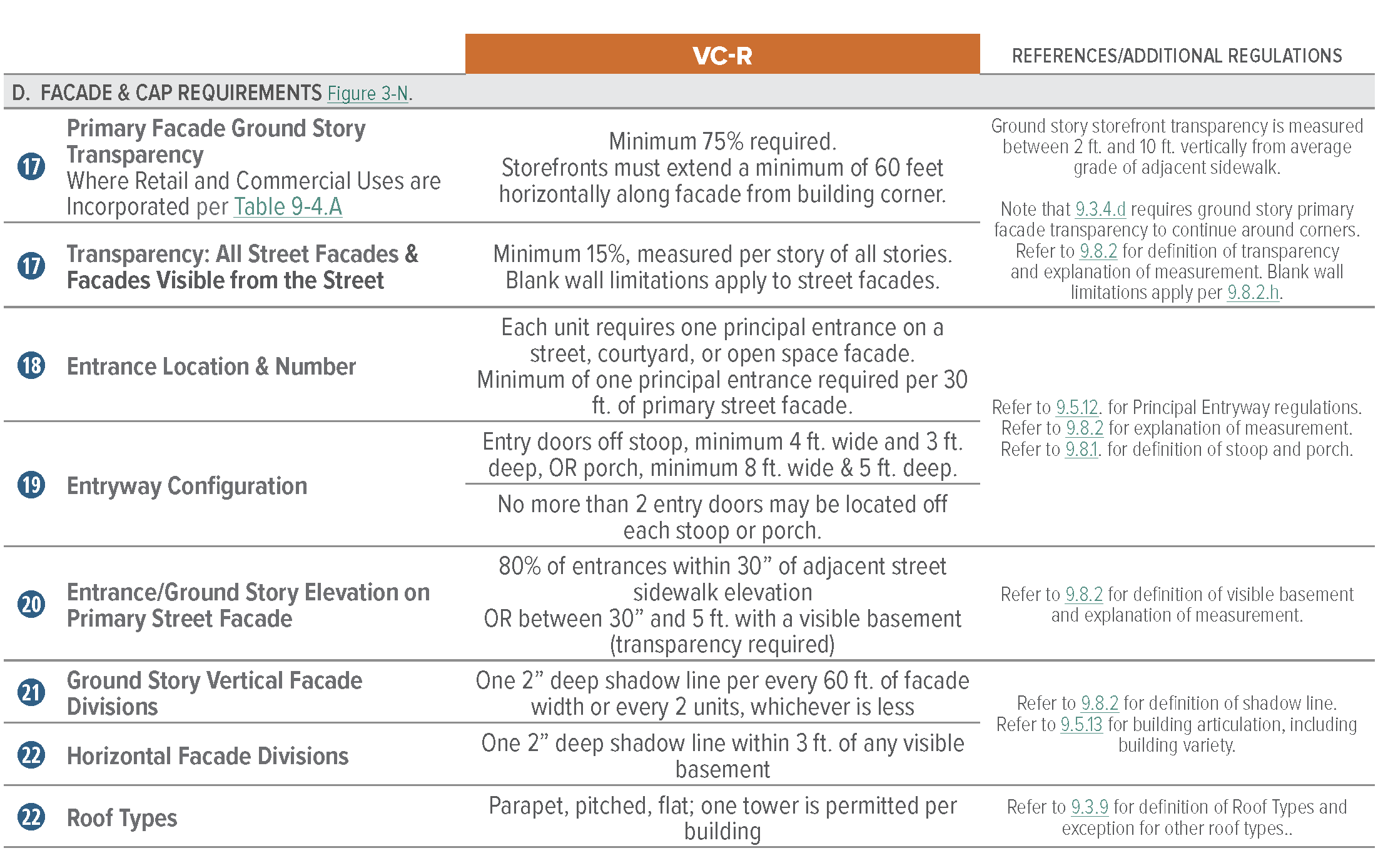
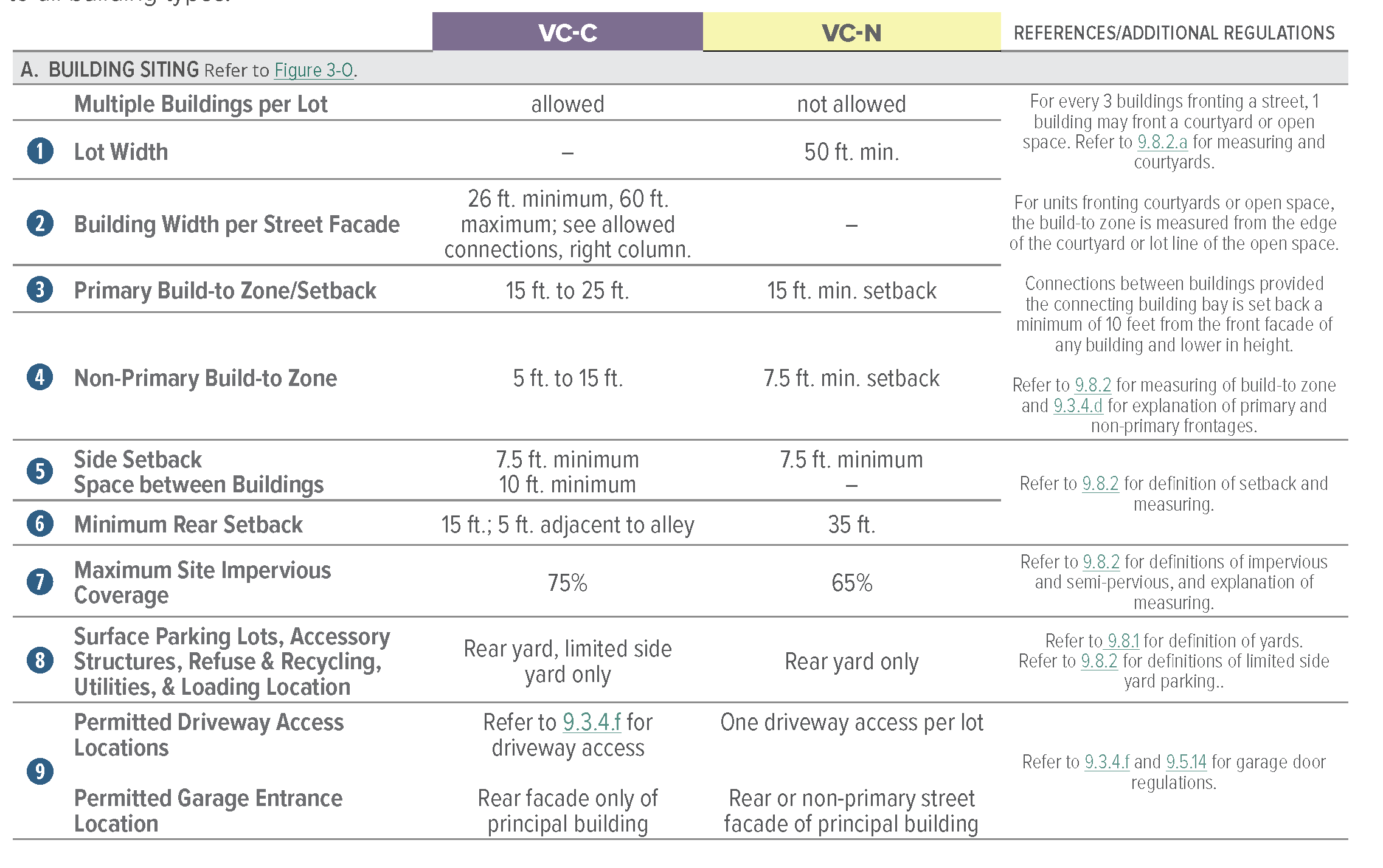
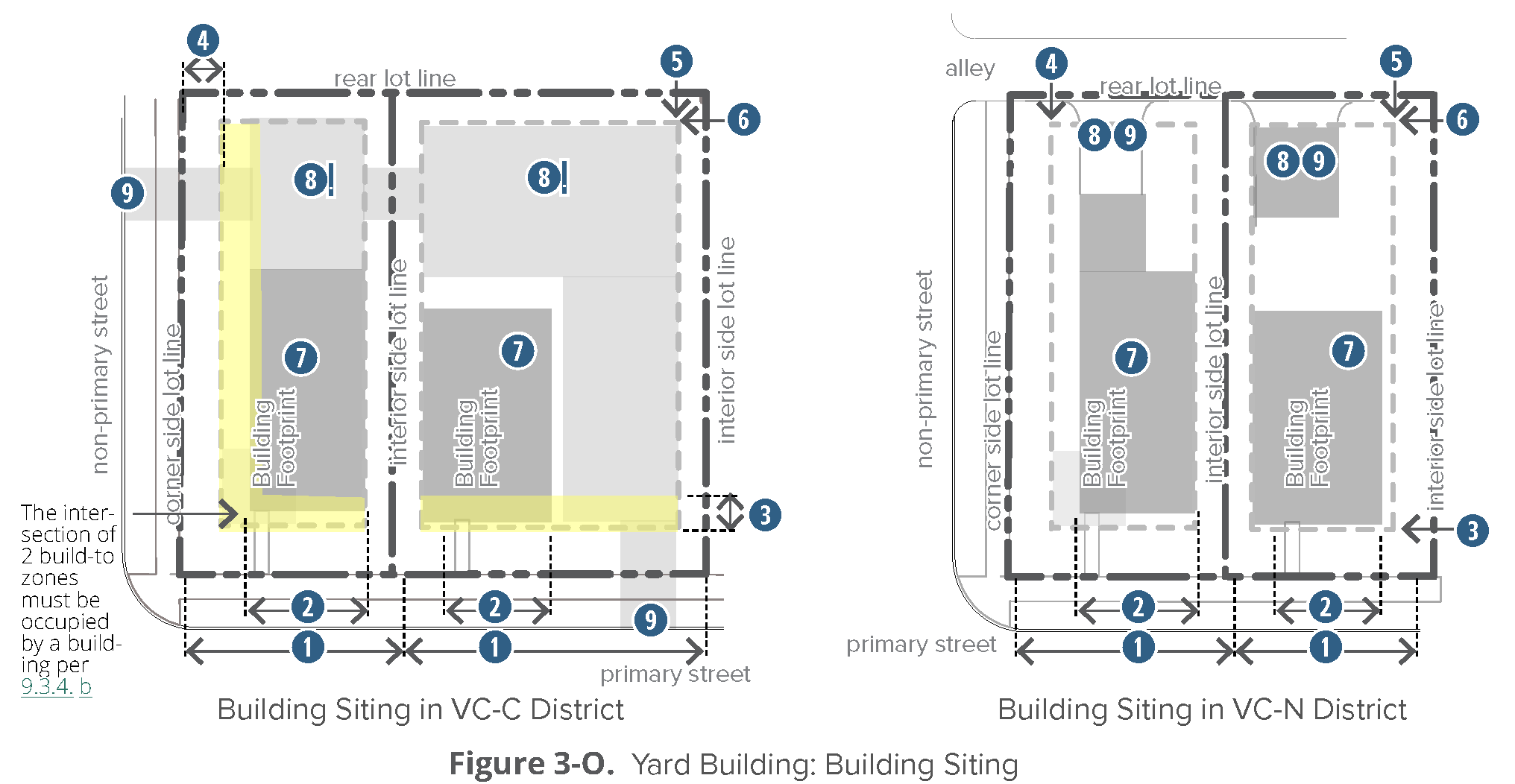
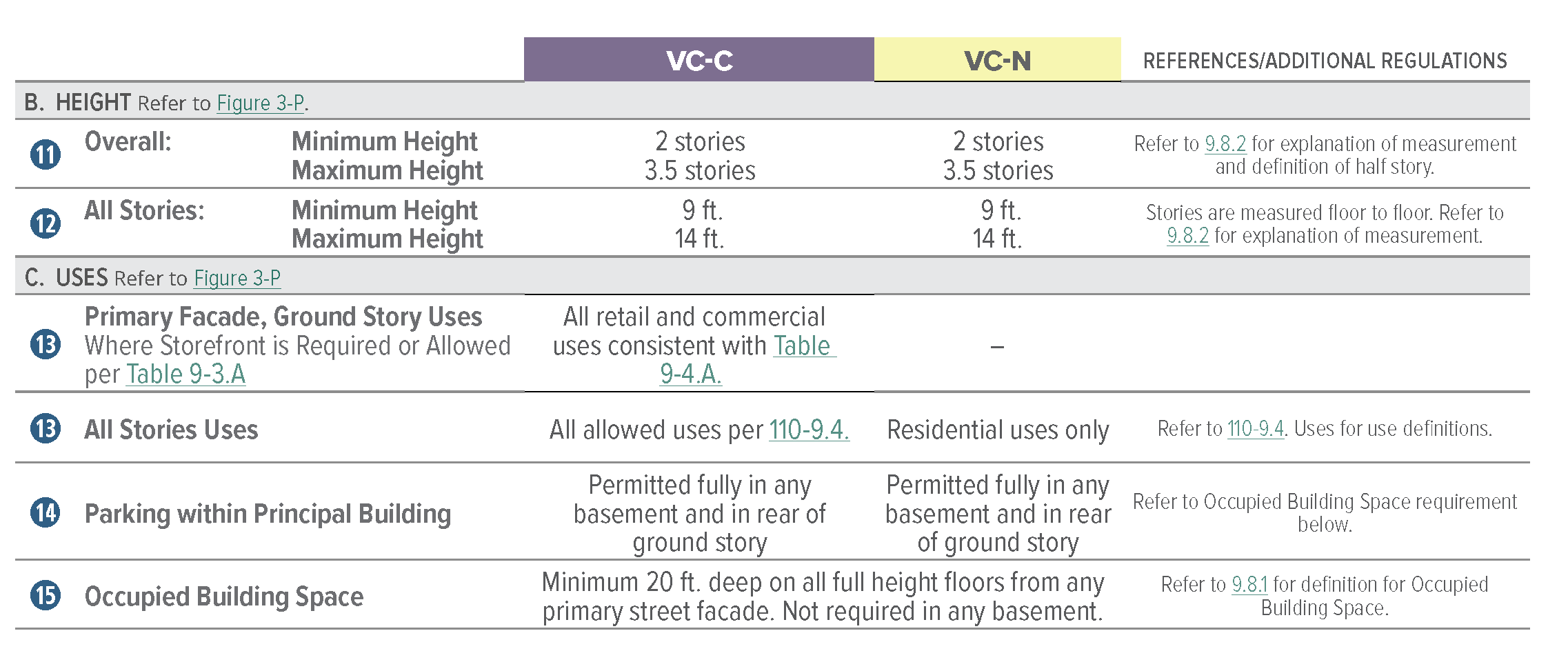
9.3.7. Yard building type. The following defines the regulations specific to this building type. Refer to 9.3.1 through 9.3.4 for regulations applicable to all building types.
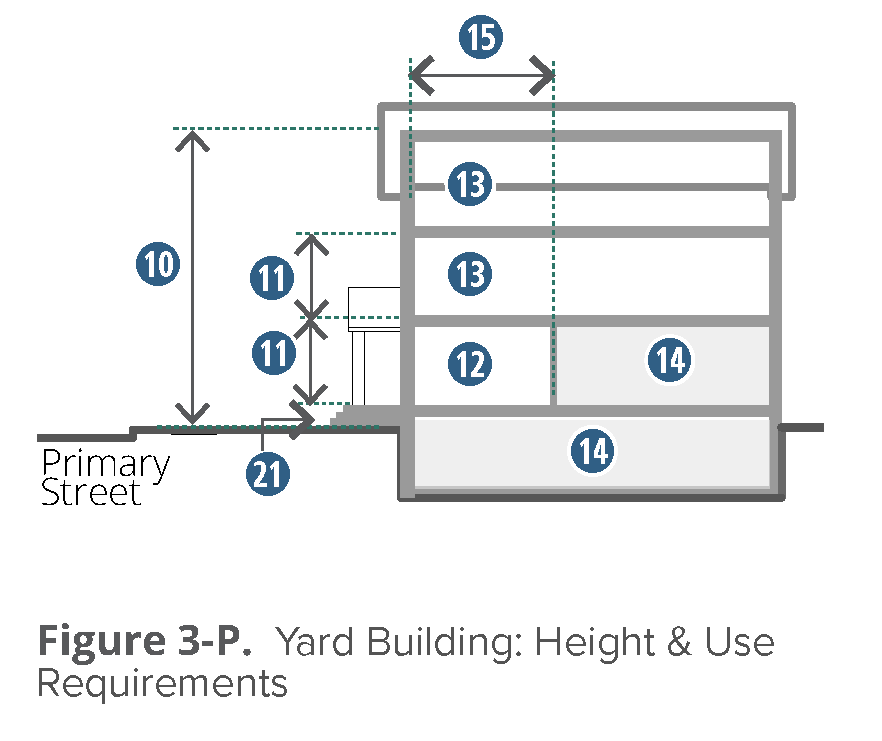
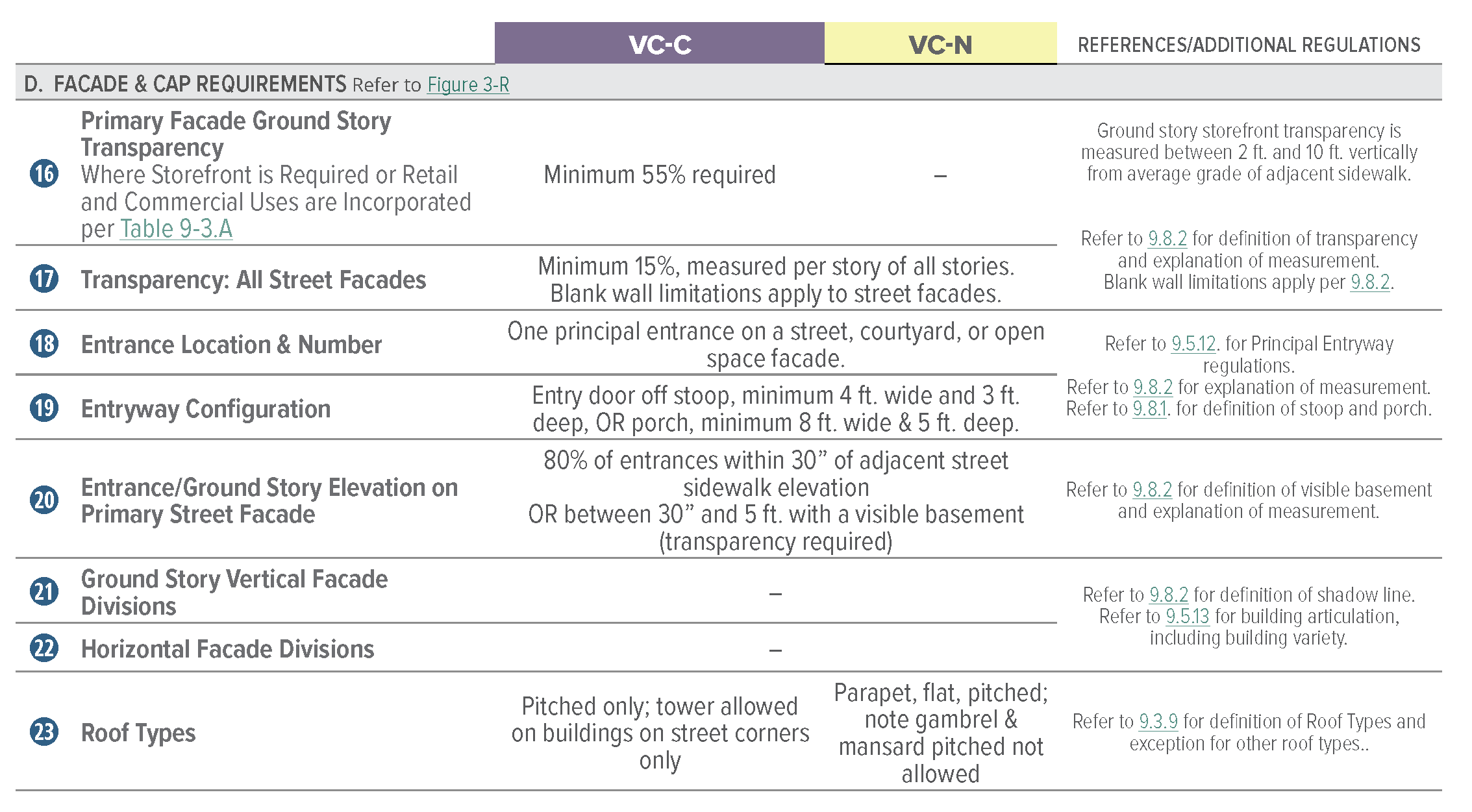
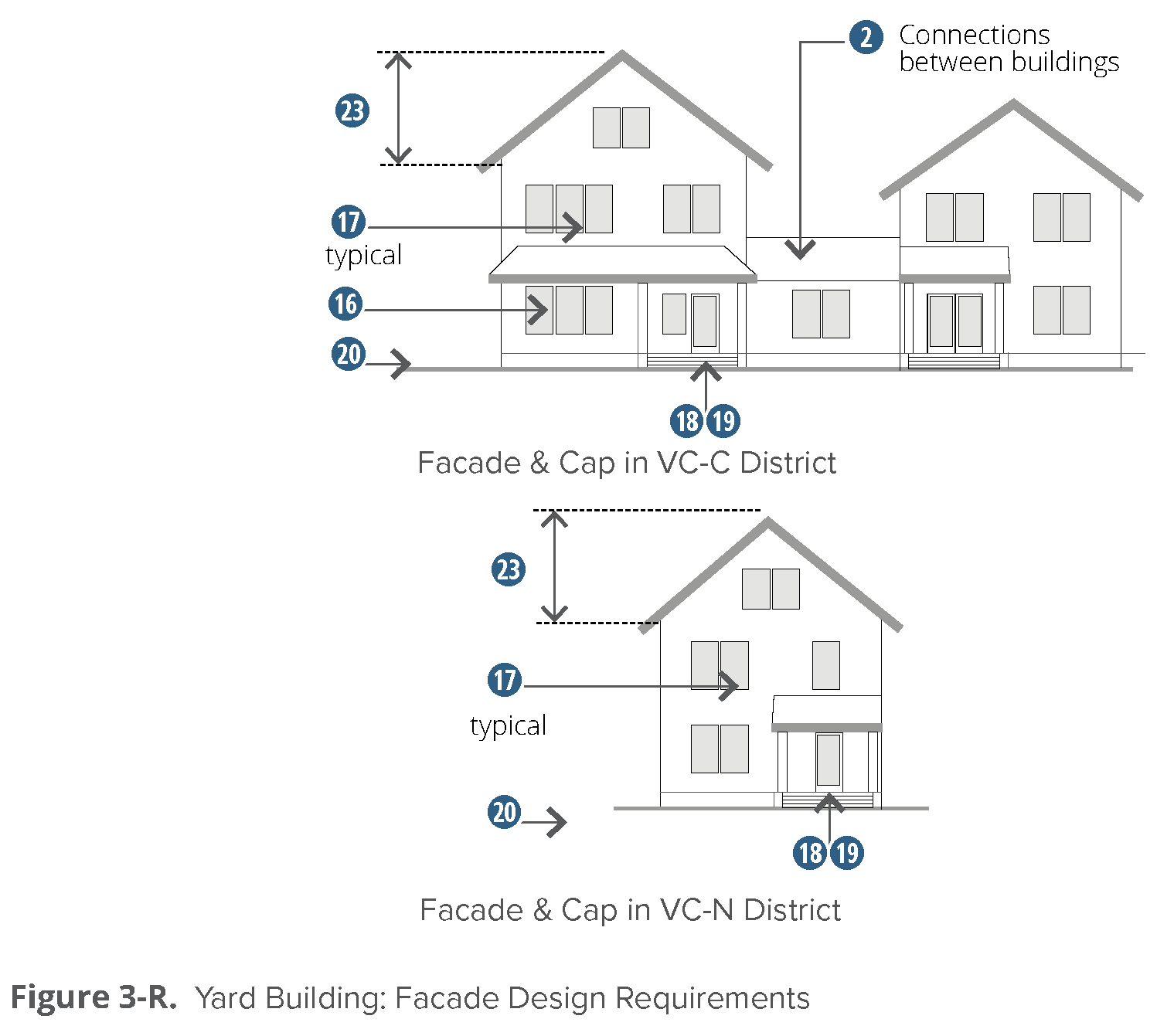
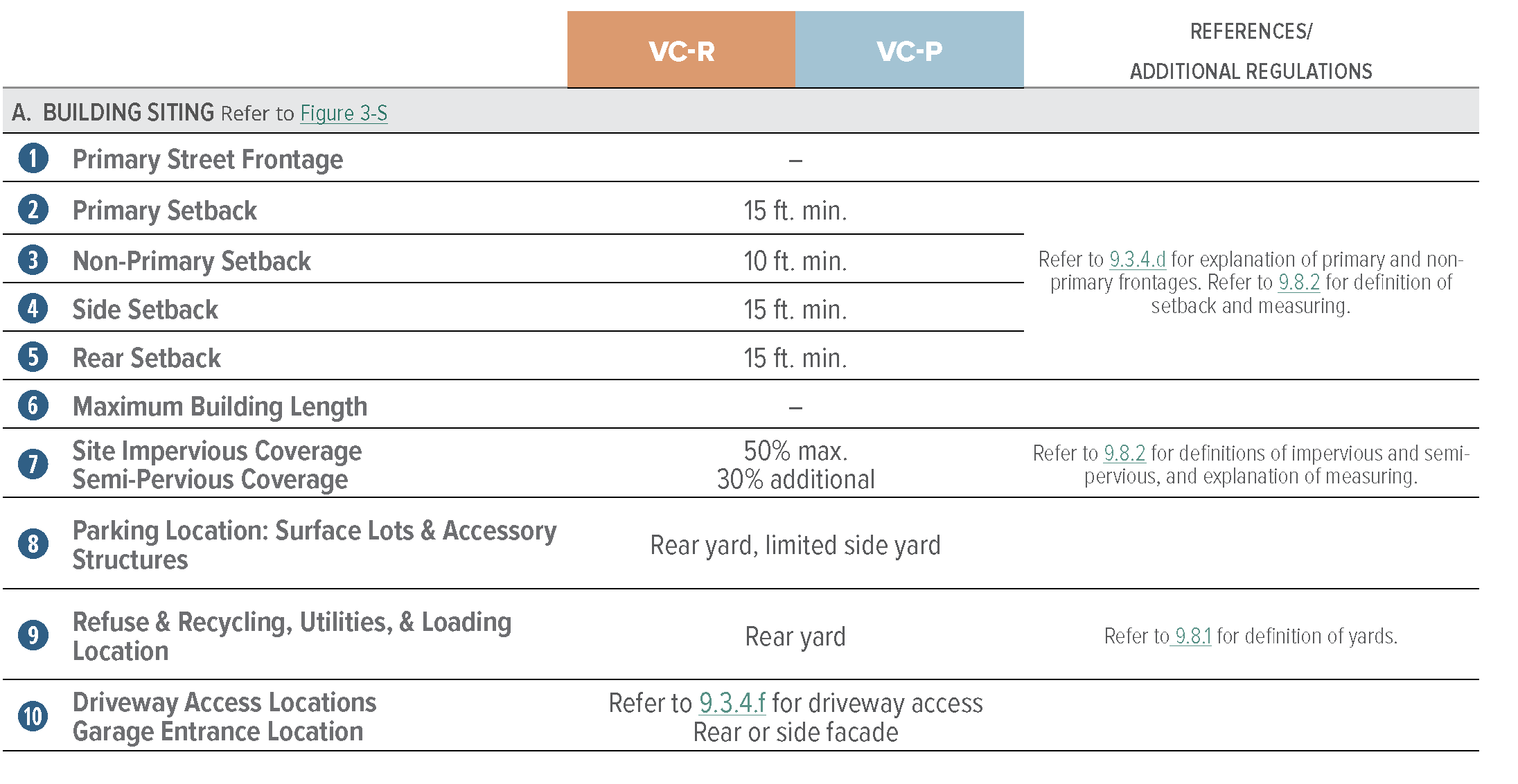
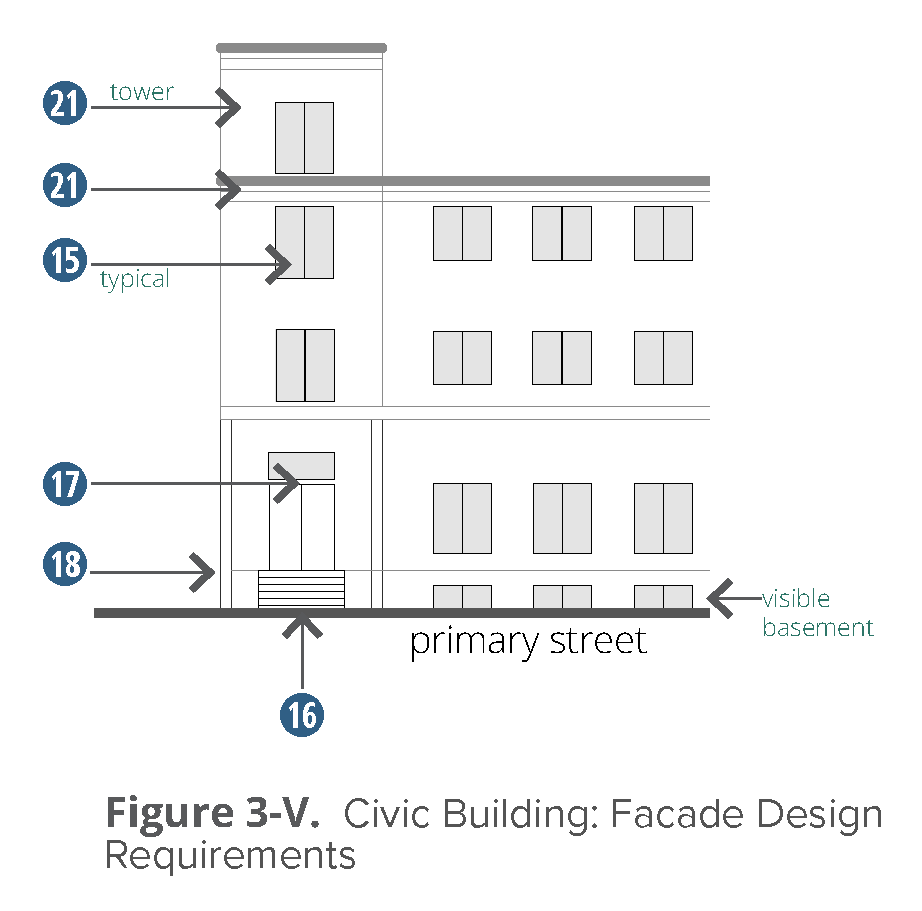
9.3.8. Civic building type. The following defines the regulations specific to this building type. Refer to 9.3.1 through 9.3.4 for regulations applicable to all building types.
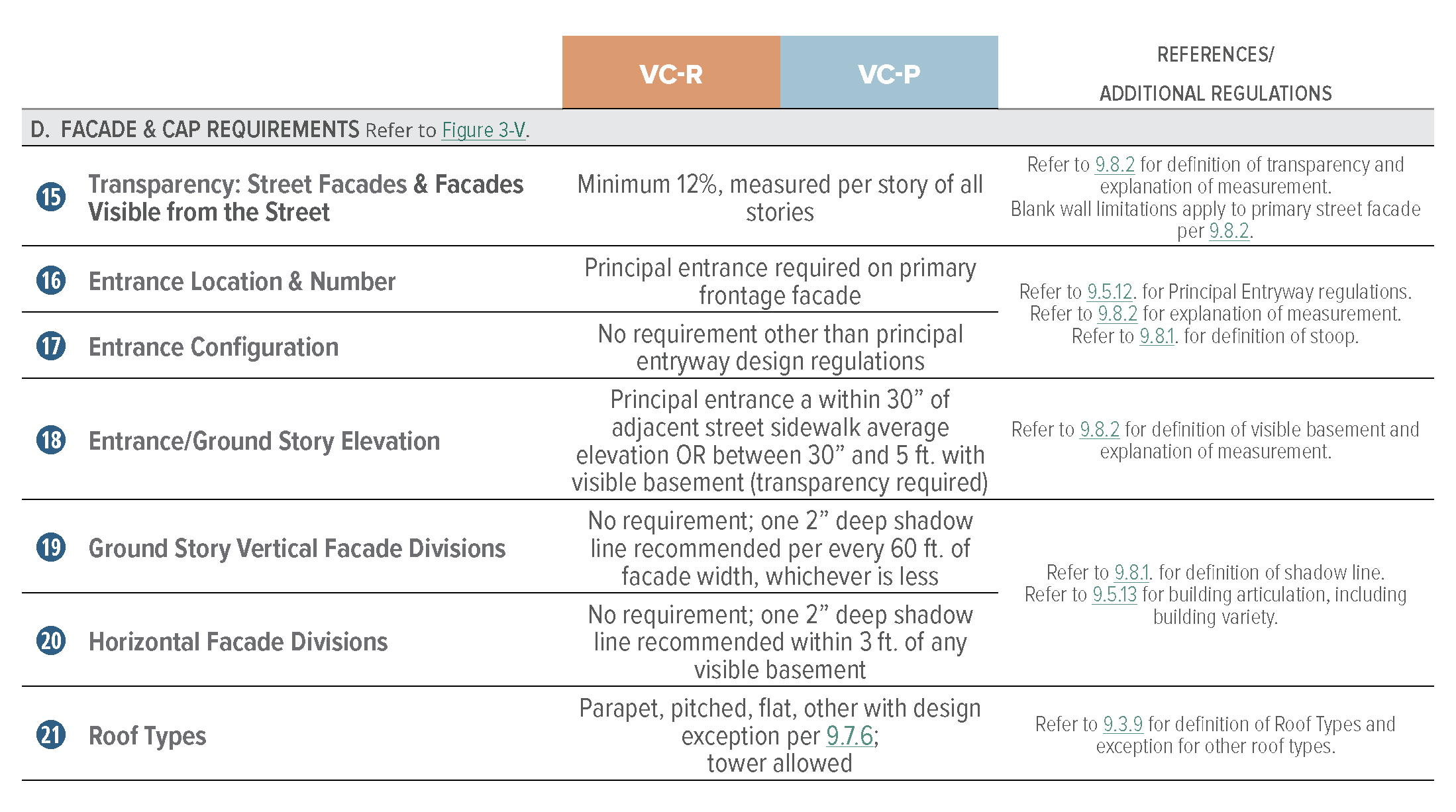
9.3.9. Roof types. The major components of any roof must meet the regulations of one of the roof types allowed per the building type regulations. Roofs for bay or bow windows and dormers are not required to meet a roof type.
a.
Rooftop gardens and terraces. Terraces, green roofs, rooftop gardens, and other outdoor facilities are allowed on any roof and are not considered a roof type; however, any permanently covered area is considered a story and must meet the following:
1.
Where a cover is visible from any street, rail corridor, or open space, the cover must comply with a roof type.
2.
Any fully enclosed structure on a roof must meet the tower regulations.
b.
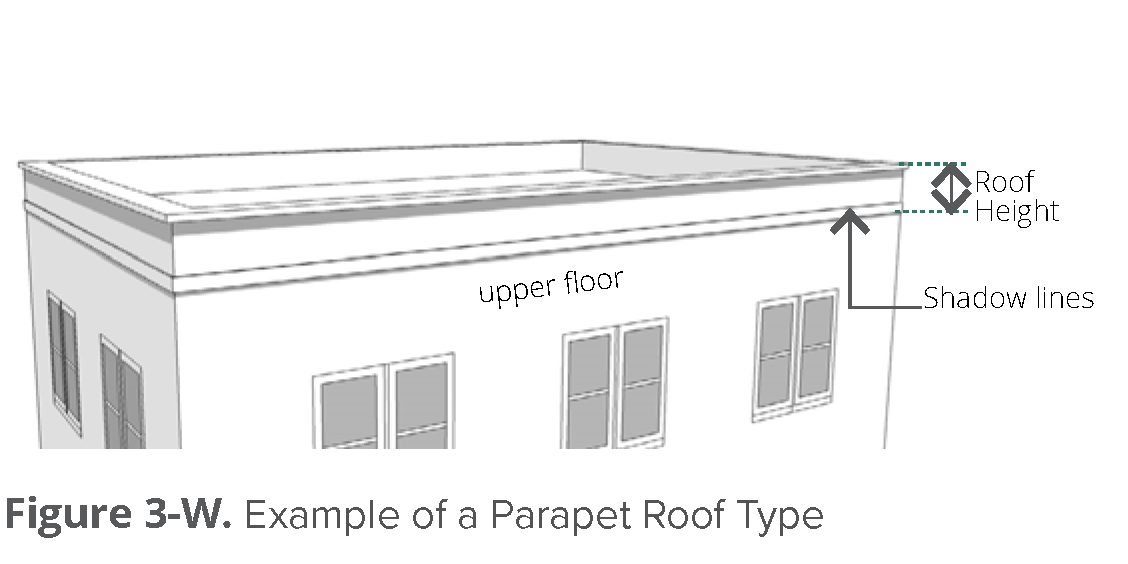
Parapet roof type. (Refer to Figure 3-W.) A parapet is a low wall projecting above a building's roof along the perimeter of the building.
1.
Parapet height. Height is measured from the top of the upper story to the top of the parapet. Minimum height is two feet with a maximum height of six feet. Horizontal shadow lines. A shadow line must define the parapet from the upper stories of the building and must also define the top of the cap. Refer to 9.8.1 for definition of shadow line.
2.
Occupied building space. Occupied building space shall not be incorporated behind this roof type. Refer to 9.8.1 for definition of occupied building space.
3.
Rooftop appurtenances. Any rooftop appurtenances must be located towards the rear or interior of the parapet roof. The parapet must screen the mechanicals from the elevation of the sidewalk across the street
c.
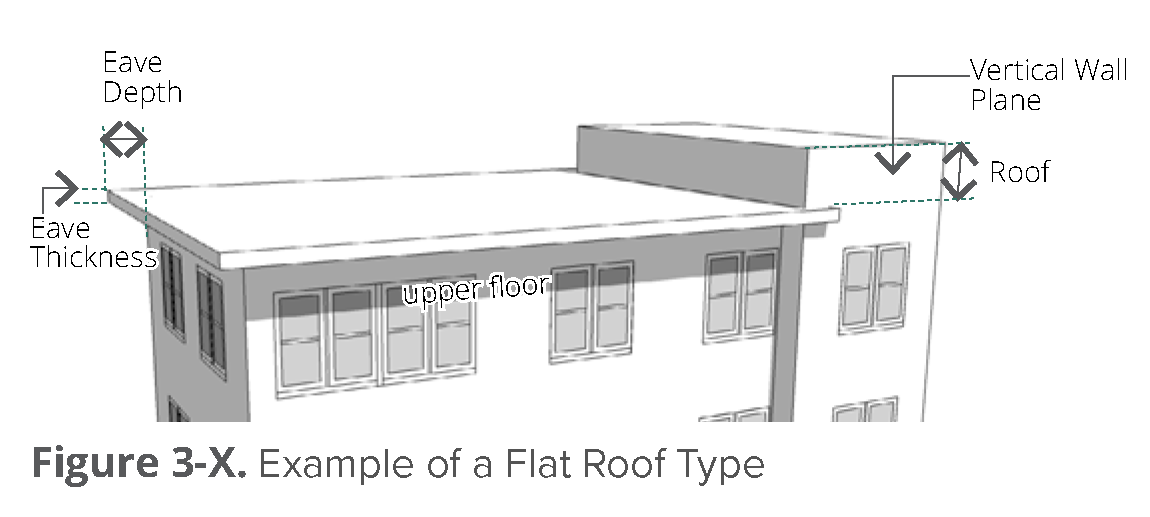
Flat roof type. (Refer to Figure 3-X.) This roof type is a visibly flat roof with overhanging eaves.
1.
Configuration. The roof must have no visible slope from the street and eaves are required on all primary and non-primary frontage façades.
2.
Eave depth. Eave depth is measured from the building façade to the outside edge of the eave. Eaves must have a depth of at least 14 inches.
3.
Eave thickness. Eave thickness is measured at the outside edge of the eave, from the bottom of the eave to the top of the eave. Eaves must be a minimum of six inches thick.
4.
Interrupting vertical walls. Vertical walls may interrupt the eave and extend above the top of the eave with no discernible cap.
(a)
No more than one-third of the front façade may consist of an interrupting vertical wall.
(b)
Vertical walls shall extend no more than eight feet above the top of the eave.
5.
Occupied building space. Occupied building space shall not be incorporated behind this roof type. Refer to 9.8.1 for definition of occupied building space.
6.
Rooftop appurtenances. Any rooftop appurtenances must be located behind the interrupting vertical wall with no visibility on any street elevation drawing.
d.
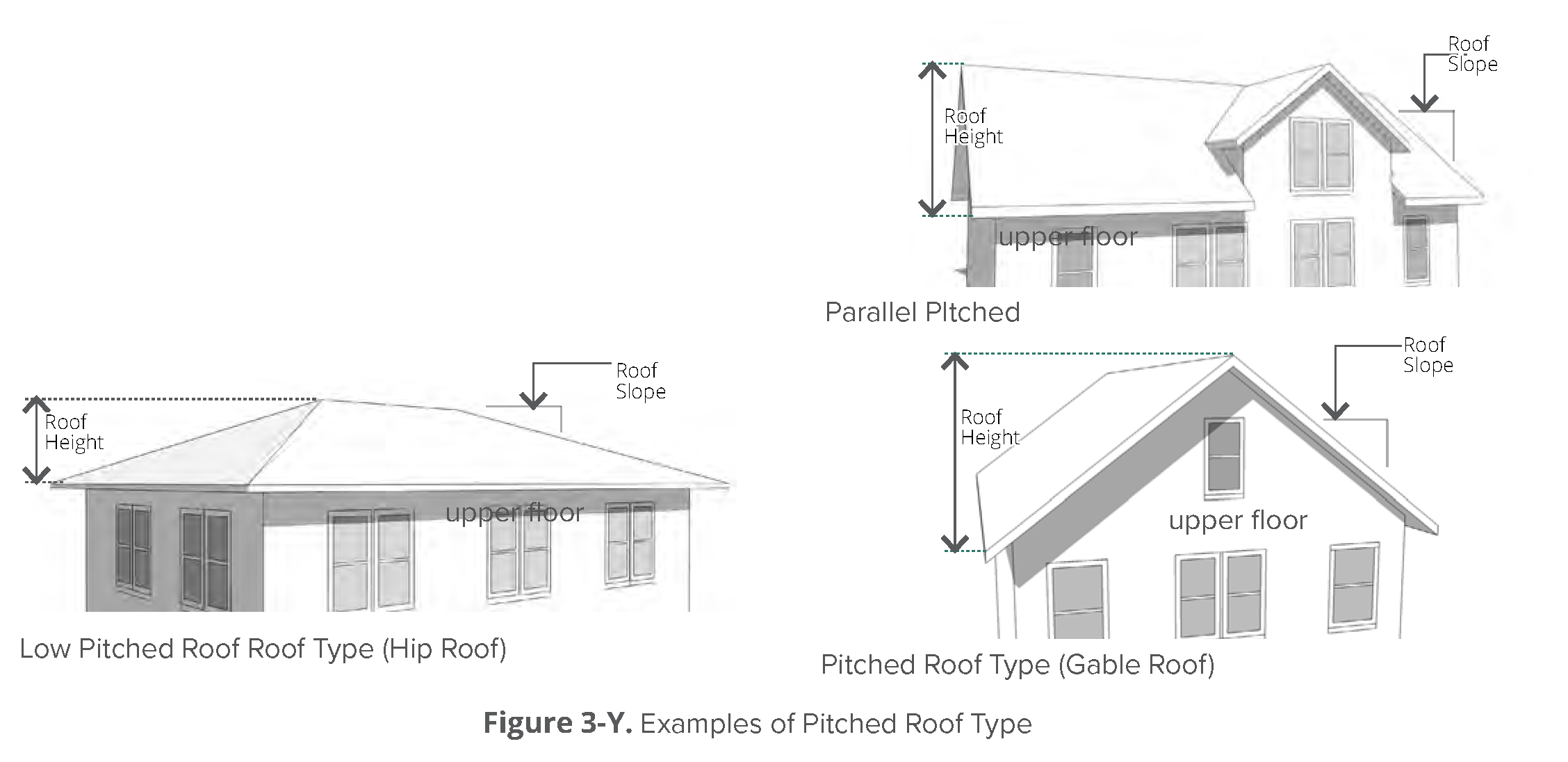
Pitched roof type. (Refer to Figure 3-Y.) This roof type is a sloped or pitched roof. Slope is measured with the vertical rise divided by the horizontal span or run.
1.
Pitch measure. The roof may not be sloped less than a 4:12 (rise:run) or more than 14:12. Slopes less than 4:12 are permitted to occur on second story or higher roofs.
2.
Configurations.
(a)
Hipped, gabled, and combination of hips and gables with or without dormers are permitted.
(b)
Butterfly (inverted gable roof) and shed roofs are permitted with a maximum height of eight feet, inclusive of overhang.
(c)
Gambrel and mansard roofs are not allowed.
3.
Parallel ridge line. A gabled end or perpendicular ridge line must occur at least every 100 feet of roof when the ridge line runs parallel to the primary frontage. (Refer to Figure 3-Y.)
4.
Roof height. Roofs without occupied building space and/or dormers must have a maximum height on primary and non-primary frontage façades equal to no more than one and one-half times the upper story floor to floor height utilized on the building.
5.
Occupied building space. Occupied building space may be incorporated behind this roof type. If used, the space counts as a half story. Refer to 9.8.1 for definition of occupied building space.
6.
Rooftop appurtenances. Any rooftop appurtenances must be recessed within the pitched roof with no visibility on any street elevation drawing.
e.
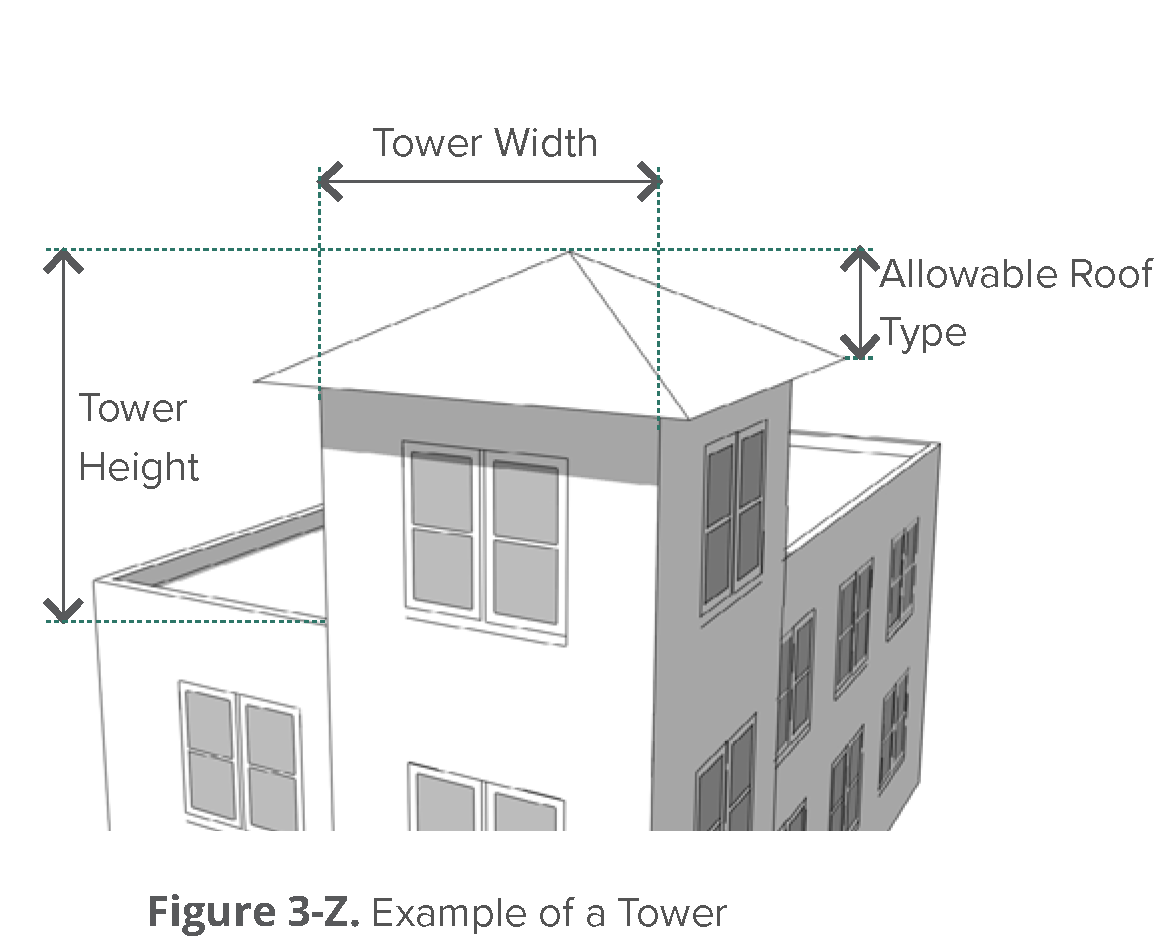
Towers. A tower is a vertical element, polygonal (simple), rectilinear or cylindrical in plan that must be used with other roof types. Refer to Figure 3-Z.
1.
Quantity. Unless otherwise defined in the building type tables (9.3.4 through 9.3.7), a maximum of two towers total are permitted within 15 feet of all street façades and two additional towers are permitted a minimum of 30 feet from a street façade. Tower locations are typically limited to allowing towers associated with the façade design and visible from the street, and those more functional towers located beyond the façade.
2.
Tower height. Maximum height, measured from the top of the parapet or eave to the top of the tower shaft not including the cap, is the equivalent of the height of one upper floor of the building to which the tower is applied.
3.
Tower width. Maximum width along all façades is one-third the width of the front façade or 30 feet, whichever is less.
4.
Tower spacing. Towers must be generally spaced from other towers a minimum of 60 feet and specifically by a minimum of 120 feet along a primary or non-primary frontage façade.
5.
Transparency. Towers that meet the minimum floor-to-floor to height of the building type and are located within 30 feet of a façade must meet the minimum transparency regulations of the building.
6.
Horizontal shadow lines. A shadow line is required between the fourth and fifth stories of any tower and at the cap of the tower.
7.
Occupied building space. Towers may be occupied by the same uses allowed in upper stories of the building type to which it is applied, unless otherwise stated. Refer to 9.8.1 for definition of occupied building space.
8.
Rooftop appurtenances. No rooftop appurtenances are permitted on tower roofs.
9.
Tower cap. The tower may be capped by the parapet, pitched, or flat roof types.
f.
Other roof types. Special cap designs otherwise not defined in this section may be approved through a design exception with the following regulations:
1.
The building shall warrant a separate status from the majority of buildings in the district, with a correspondence between the form of the cap and the building use, such as a dome for a planetarium, a dome for a place of worship, or a unique, singular roof for a more distinctive village hall.
2.
The roof type shall not create additional occupiable space beyond that permitted by the building type. Refer to 9.8.1 for definition of occupied building space.
3.
The scale and type of the roof type must be consistent with the character of the village and the area within which it is located.
4.
The shape of the roof must be different from those defined in this section, 9.3.9, such as a dome, spire, or vault, and not a gabled roof, hipped roof, butterfly roof, gambrel roof, mansard roof, roof with parapet, or flat roof.
(Ord. No. O-22-25, § 1(Exh. A), 8-8-2022)
Sec. 110-9.4. - Uses.
Uses are allowed in the VC districts in accordance with the following table. Uses may be further restricted by building type 9.3.5 through 9.3.8).
9.4.1. Use definitions. Unless otherwise defined below, refer to 110-2.3 for definitions of listed uses.
9.4.2. General provisions.
a.
A building, unit, or building site may contain more than one principal use, unless otherwise specified.
b.
Each of the principal uses may function as either a principal use or accessory use on a lot, unless otherwise specified.
c.
Each use must be located indoors (within a permitted building type), unless otherwise expressly stated.
9.4.3. Table of principal uses. Table 9-4.A identifies the principal uses allowed in each district.
a.
Permitted use ("P"). Uses designated with "P" are permitted by-right in the building types in which they are listed, in all locations within the building, unless otherwise noted. Use-specific standards may apply to the use per the definition. Further limitations may apply per the building type regulations in 9.3.5 through 9.3.8.
b.
Permitted with limitations ("L"). Uses designated with "L" are permitted only on the ground story of a primary frontage, limited to no more than 25 percent of the building's frontage or the corner unit on a row building. These uses may occur in the storefront frontage allowed in the building type table, Table 9-3.A.
c.
Requires special use ("S"). Uses designated with "S" require a special use per section 110-4.5 in order to occur in the districts in which they are listed. The use must meet any use-specific standards defined for the use in this section as well as meet any regulations of the special use approval. The use may occur anywhere in the building, unless otherwise specified.
d.
Prohibited use ("-"). Uses designated with a "-" indicates that the use is prohibited in that building type.
9.4.4. Prohibited uses. The following uses are expressly prohibited within the VC districts:
a.
Personal credit establishments, such as payday lenders, bail bonders, pawn shops, and check cashing facilities, and not including banks, trust companies, savings banks, savings and loan associations, credit unions, and other guaranteed institutions. Establishments who provide their check cashing services incidental to an allowed principal business are not classified as check cashing establishments.
b.
Vehicle sales and service uses, such as fueling stations, personal vehicle repair and maintenance, personal vehicle sales and rentals, vehicle body and paint finishing. Car washes are allowed.
c.
Sexually oriented businesses.
9.4.5. Accessory uses. Customary accessory uses are permitted, unless otherwise stated.
a.
Outdoor display. Permanent outdoor display of goods is not allowed in the VC districts.
1.
A special use may be approved for the permanent outdoor display of goods.
2.
The outdoor display must not occur within a public or private street right-of-way.
3.
The display must be consistent with the character of the area and with appropriate presentation and screening.
4.
The only goods permitted for display must be consumer retail goods intended for outdoor use, such as gardening supplies or outdoor furniture.
9.4.6. Civic and institutional use category.
a.
Assembly, community. A facility that has organized services, meetings, or programs to benefit, educate, entertain, or promote discourse amongst the residents of the community in a public or private setting, generally with little or no relationship to commerce. Includes places of worship, religious institutions, community centers, convention centers, performing arts venues.
b.
Library, museum, cultural facility. A facility open to the general public housing educational, cultural, artistic, or historic information, resources, and exhibits. May also include accessory food service and a gift shop.
c.
Parks and recreation. A use of land for active or passive, outdoor space available to the general public. Includes such uses as parks, plazas, greens, parklets, playfields, playgrounds, and tot lots for general recreation, athletics, and leisure. This use generally has little or no relationship to commerce. May include historic structures/monuments, ornamental gardens, or arboretums. May be associated with an assembly or school use. Park uses may also be utilized to host temporary private or community events, such as a farmer's market or art fair. Additional use-specific standards include:
1.
Parking. Parking lots are not permitted in parks in any district except by special use approval.
2.
Stormwater accommodations. Parks that incorporate stormwater management on a site or district scale are encouraged.
3.
Stormwater facilities must be designed to accommodate additional uses, such as an amphitheater or a sports field.
4.
Stormwater facilities must be designed not to be fenced and must not impede public use of the land they occupy.
d.
Police/fire station. A facility providing public safety and emergency services; training facilities, and locker rooms. Limited overnight accommodations may also be included. Fire/police stations are permitted in applicable districts with the following use-specific standards include:
1.
Garage doors are permitted on the front façade.
2.
Exempt from maximum driveway widths.
e.
School, public, private. A public or private education facility for pre-kindergarten through 12th grade with classrooms and offices, that may also include associated indoor facilities such as ball courts, gymnasium, theater, and food service.
9.4.7. Retail and service use category. For all retail and service category uses, all goods produced on the premises must be sold at retail on premises and outdoor storage of goods is not allowed in the VC districts without a special use.
a.
General service. A subcategory of uses that provides patrons services that occur indoors and limited retail products related to those services. Visibility and accessibility are important to these uses; walk-in customers and by-appointment clients are typically both accommodated. Includes such uses as, but not limited to, barber and beauty shops, spa facilities, tailors, consumer goods repair. Does not include animal service.
1.
Animal service. A use that provides patrons animal care services and limited retail products related to those services, such as pet grooming services, veterinary services, outdoor kenneling not permitted.
b.
Eating and drinking establishments. Eating and drinking establishments is a subcategory of uses including establishments selling and serving food and drink such as restaurants, cafes, coffee shops, bars, banquet halls, and taverns. Eating and drinking establishments may also include outdoor dining facilities on the property. Drive-through facilities allowed separately.
c.
Entertainment.
1.
Indoor. A commercial indoor facility for gathering events for entertainment such as, but not limited to, movie theaters and indoor skating rinks.
2.
Outdoor. A large, outdoor facility for entertainment events and businesses, such as, but not limited to, putt-putt golf, driving ranges, batting cages, go-carts, swimming pools.
d.
Financial services. Chartered financial depository institutions, including such uses as banks, savings and loans. Does not include personal credit establishments. Drive-through facilities allowed separately.
1.
Personal credit establishments. An establishment primarily engaged in the business of lending money on the security of pledged goods, left in pawn, on the condition that it may be redeemed or repurchased by the seller; of purchasing tangible personal property left in pawn; or of providing cash to patrons for payroll, personal, and bank checks. Includes such uses as pawn shops, payday loan stores, and title loan stores. The conditions of sections 110-5.9.3.aa, bb, and cc apply.
e.
Hotel. See section 110-2.3 for definition. The following use-specific standards apply in the VC districts:
1.
Temporary lodging is permitted for up to 30 days within a six-month period.
2.
Rooms must be accessed from the interior of the building.
3.
Exterior stairs to upper stories are not permitted on any street façade.
4.
Hotels must not be located within 200 feet of any single-family zoning district.
f.
Retail sales. A category of uses involving the sale of goods or merchandise to the general public for personal or household consumption.
1.
Artisan studio/retail. A use involving the creation of art works, custom goods, or small-scale production, assembly, and/or repair through the use of hand tools and small-scale equipment with little to no noxious by-products. Use must include a showroom or small retail outlet selling art and/or goods produced. Includes such uses as craft brewery, craft distillery, furniture shop, glass blowers, jewelers, pottery and ceramic sales, upholsterers, woodworking shop. The following use-specific standards apply:
(a)
The maximum overall gross floor area is limited to 10,000 square feet, unless otherwise noted.
(b)
A showroom, taproom, tasting room, or retail outlet must be located in the front of the building and must occupy a minimum of 25 percent of the gross floor area. The space must be generally opened to the public during regular shopping hours and shall sell the products produced on-site.
(c)
This use may also include associated facilities such as offices and small scale warehousing, but distribution is limited to no more than two vans or small trucks. Distribution access shall be from the rear.
2.
General retail. Uses involving the sale of goods to the consumer in a store open regular business hours.
(a)
This category includes such uses as apparel stores, convenience stores, drug stores, grocery and specialty food stores, wine or liquor stores, gift shops, florists, department stores, appliance stores, electronics stores, bike shops, book stores, stationery stores, art galleries, hobby shops, furniture stores, pet stores, antique shops, music stores, toy stores, sporting goods stores, variety stores, medical supplies, office supplies.
(b)
Smoke shops, tobacco shops, vaping supply stores, and medical marijuana dispensaries are not allowed in this category.
(c)
General sales dealer, excluding pawn shops, subject to the requirements and limitations of 58-301 of chapter 58 of this code.
(d)
Limited sales dealer, subject to the requirements and limitations of 58-301 of chapter 58 of this code.
3.
Large-scale retail. Uses involving the sale of goods to the consumer in a warehouse or large-scale store 35,000 square feet or larger and open regular business hours. Outdoor storage of goods is not allowed. Includes such uses as lumber stores, home improvement stores, furniture warehouse stores, recreational equipment stores (i.e. trampolines, play equipment).
g.
Studios or instructional service. Uses in an enclosed building that focus on providing individual or small group instruction or training in fine arts, music, dance, drama, fitness, language or similar activities. Includes dance studios, ballet academies, yoga studios, gyms, martial arts instruction, tutoring, artist studios and photography studios. Does not include outdoor training or outdoor instruction on-site, or parking or standing of instructional vehicles.
9.4.8. Office and classroom use category.
a.
Office. Uses that focus on providing executive, management, administrative, professional or medical services in an office setting. Examples of specific office use types include:
1.
Business and professional office. Office uses for companies and non-governmental organizations. Examples include corporate offices, law offices, architectural firms, insurance companies and other executive, management or administrative offices for businesses and corporations. Also included are insurance claims adjusters/estimators with no more than one vehicle inspection bay and no on-site repair facilities.
2.
Medical, dental and health practitioner office. Office uses related to diagnosis and treatment of human patients ft. illnesses, injuries and physical maladies that can be performed in an office setting with no overnight care. Typical uses include offices of physicians, dentists, psychiatrists, psychologists, and chiropractors. Also includes practitioners of massage therapy, when performed solely by state-licensed professionals. Surgical, rehabilitation and other medical centers that do not involve overnight patient stays are included in this use subcategory, as are medical and dental laboratories, unless otherwise expressly indicated. Ancillary sales of medications and medical products are allowed in association with a medical, dental or health practitioner office.
b.
Research and laboratories. Uses engaged in scientific research and testing services leading to the development of new products and processes. Such uses resemble office buildings or campuses and do not involve the mass production, distribution or sale of products. Research services do not produce odors, dust, noise, vibration or other external impacts that are detectable beyond the building site of the subject property.
c.
Trade school. Uses in an enclosed building that focus on teaching the skills needed to perform a particular job. Examples include schools of cosmetology, modeling academies, computer training facilities, vocational schools, administrative business training facilities and similar uses. Does not include outdoor training or outdoor instruction on-site, or parking or standing of instructional vehicles.
9.4.9. Other use category.
a.
Accessory parking structure. Parking structures accessory to the principal building must meet the following:
1.
Location. Accessory parking structures must be located only in the rear yard.
2.
Height. The height of the structure must be lower than any part of the principal building by a minimum of six feet.
3.
Façade design. See 9.5.15 for design standards for parking structure façades visible from the street.
b.
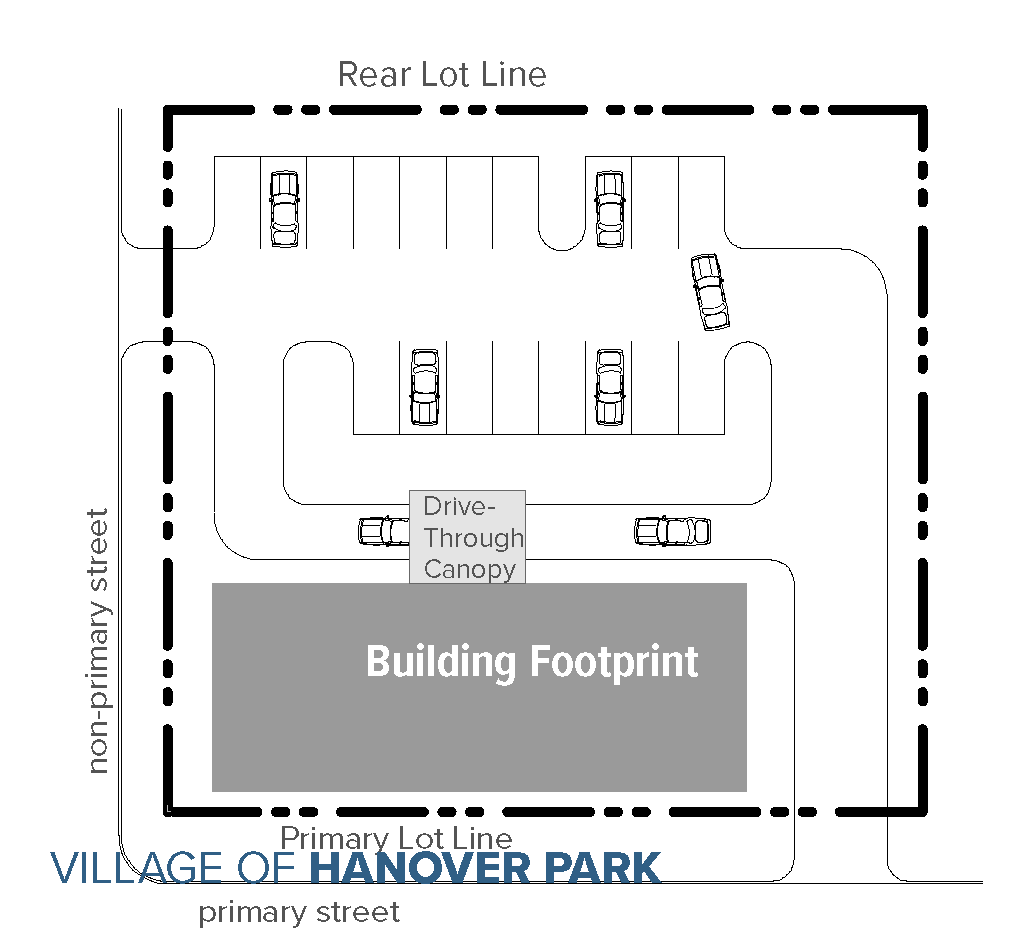
Drive-through facility. Drive-through facilities accessory to the principal building and any allowed principal use in the building must meet the following:
1.
Location. Drive-through facilities must be located only in the rear yard or be attached to the rear façade of the building. The facility, including such elements pick-up windows, menus, and audio equipment, must be fully screened from view of the primary street by the principal building.
2.
Structure. Drive-through canopies and roofs must match the roof of the principal building. Materials used for the drive-through supports or other features must be repeated from the principal building design.
3.
Stacking. Stacking of vehicles must be fully accommodated on the site in the rear or interior side yard.
c.
Publicly owned and/or operated parking lots and structures. A parking facility, surface lot or garage/structure, may be located as the principal use on the lot only when publicly owned and/or operated.
d.
Historic buildings. The following regulations, requirements and prohibitions are applicable to historic buildings located in Village Center Core (VC-C) and Village Center Public and Institutional (VC-P) zoning districts.
For the purpose of this subparagraph d., a historic building has some kind of historic value connecting people in the present to the building through past events which warrants it being considered as an integral part of the Village Center. Buildings 75 years or older as of August 4, 2022, located in the Village Center Core (VC-C) and Village Center Public and Institutional (VC-P) zoning districts shall be presumed to be historic which may be rebutted. Recognizing historic buildings promote the educational, cultural and economic development, and general welfare of the community by fostering civic understanding and pride in the village center's history.
1.
Procedure for development approval. The zoning administrator shall review all building permit applications for significant alterations or minor exterior modifications within the village for compliance with this subparagraph.
a.
Permits for a minor exterior modification. Minor modifications shall include, but not be limited to the following:
(1)
Application or removal of paint from masonry or wood surfaces;
(2)
Addition, removal, or replacement of siding;
(3)
Addition, removal or replacement of window sash or window units;
(4)
Removal, replacement or repair of porch, window and door trim, and other decorative architectural elements;
(5)
Addition, removal, or replacement of window shutters;
(6)
Addition, removal, or replacement of awnings and canopies;
(7)
Addition, removal, or replacement of fences;
(8)
Addition, removal, or replacement of landscaping; and
(9)
Removal, replacement or addition of signs.
The zoning administrator shall, within 14 days following the receipt of a completed application for a permit for minor exterior modifications for a historic building may approve, deny, or approve with conditions the permit application. If the application for a permit is denied, the applicant may appeal to the village manager's designee within seven days.
b.
Permits for a significant alteration. Improvements, construction, removal, or demolition other than minor exterior modifications shall require a permit for significant alteration. The zoning administrator shall, within 14 working days following the receipt of a permit application for a significant alteration approve, approve with condition, or deny the application.
The applicant must meet all requirements for a building permit.
(1)
Review criteria for a significant alteration. In making a determination whether to recommend approval, approval with conditions or denial of a permit for a significant alteration, the zoning administrator shall consider the purpose and intent of the (VC) districts and the building. The standards to be used by the zoning administrator in making their determination shall include, but not be limited to the following:
(a)
The preservation or restoration of the significant original qualities or character of the property, structure or improvements, including, if significant, its landscaping.
(b)
The removal or alteration of any historic or distinctive architectural or landscape features.
(c)
The compatibility of the architectural style and design detailing of the proposed construction, or significant alteration, with the original architecture of the property or the exterior architectural character of other structures within the Village Center Districts.
(d)
The compatibility of the general design, arrangement, scale, texture or materials of the construction or alteration, with the historic, cultural, aesthetic or architectural and landscape values of significance in the Village Center Districts.
(e)
The relationship of the location of the construction, alteration, or removal to streets, public or semipublic ways and any other structures, property, or landscaping within the Village Center Districts.
(f)
Construction, alteration and demolition shall be allowed only in accordance with the following additional standards:
(i)
Every reasonable effort shall be made to minimize the alteration of significant features of the property, structure or site, and its environment.
(ii)
All property and structures shall be recognized as products of their own time. Alterations that have no historical basis and which seek to create an earlier or later appearance shall be discouraged.
(iii)
Changes which may have taken place in the course of time are evidence of the history and development of a property, structure, or site and its environment. These changes may have acquired significance in their own right, and this significance shall be recognized and preserved.
(iv)
Distinctive stylistic features or examples of skilled craftsmanship which characterize a property, structure, or site shall be protected.
(v)
Deteriorated architectural features shall be repaired rather than replaced, whenever possible. In the event replacement is necessary, the new material need not be identical to but should match the material being replaced in composition, design, color, texture, and other visual qualities. Repair or replacement of missing architectural features should be based on accurate duplications of features, substantiated by historic, physical, or pictorial evidence rather than on conjectural designs or the availability of different architectural elements from other structures.
(vi)
The surface cleaning of structures shall be undertaken with the gentlest means possible. Sandblasting and other cleaning methods that will damage the historic building materials shall not be undertaken.
(vii)
Every reasonable effort shall be made to protect and preserve archaeological resources affected by, or abutting to, any project.
(viii)
Contemporary design for new construction, alterations, and additions to existing properties or structures shall not be discouraged when such construction, alterations, and additions do not destroy significant historical, architectural, or cultural material, and such design is compatible with the size, scale, color, material, and character of the property, neighborhood, or environment.
(ix)
Wherever possible, new additions or alterations to structures shall be done in such a manner that if such additions or alterations were to be removed in the future, the essential form and integrity of the structure would not be impaired.
(2)
Zoning administrator review process for a significant alteration.
(a)
If the zoning administrator finds that the work proposed in the application will comply with the review criteria in section 110-5.7.5(b)(1), the administrator shall issue a building permit for significant alteration.
(b)
The zoning administrator shall briefly state the reasons for the decision in writing and may recommend conditions to assure appropriateness of design, arrangement, texture, scale, material, color, location, landscaping, or other elements of appearance of the building, property, or structure involved.
(c)
If the zoning administrator finds that the proposed work does not meet the review criteria and that it will adversely affect or destroy any significant historic, cultural, aesthetic, or architectural feature or value of the structure or property within the Village Center Districts or is inappropriate or inconsistent with the guidelines, the zoning administrator shall deny the application.
2.
Appeals process. Initiation and processing.
a.
An appeal may be taken to the president and board of trustees by the applicant aggrieved by the recommendations for denial or issuance of a permit for significant alteration within the Village Center Districts.
b.
The appeal shall be taken within 30 days following the recommendation of denial or issuance by the zoning administrator of an application for a significant alteration.
c.
The president and board of trustees shall fix a reasonable time for the hearing of the appeal and give due notice thereof to the parties and zoning administrator and decide the appeal within 30 days after the conclusion of its hearing. At the hearing, a party may appear in person or be represented by an attorney. The president and board of trustees may recommend to reverse or affirm, wholly or partly, or may modify the application and recommendation for denial or issuance of an application for a significant alteration.
d.
Decisions. All final decisions shall be accompanied by findings of facts specifying the reason or reasons for recommending the approval or denial of the appeal. The decision of the president and board of trustees thereon shall be final.
3.
Signs. All signs for historic buildings shall be in accordance with section 6-10, Permitted signs in the historic and limited office districts, of the Municipal Code.
4.
Off-street parking and loading. Parking and loading facilities shall be provided as required by section 110-9.6.2. of this chapter, except when the proposed erection and use of any new building or structure or the enlargement, rehabilitation, or increase in the capacity of any existing principal structure located in the Village Center Core (VC-C) District would result in practical difficulty or undue hardship in complying with the off-street parking and loading requirements as required by section 110-9.6.2. of this chapter, the president and board of trustees may, upon finding that such practical difficulty or undue hardship exists, allow as a condition for a building permit a contribution by the applicant to the village an amount of $2,000.00 for each parking space and $3,000.00 for each loading space not otherwise provided as required by this chapter. The method and time period required for payment shall be determined by the village manager. These funds shall be deposited in an account to provide for the acquisition, erection, construction, improvement, or installation of parking facilities or structures. The expenditure of such funds for said purposes may be made at the time and in the manner determined by the corporate authorities to best provide adequate off-street parking facilities for the Village Center Districts.
(Ord. No. O-22-25, § 1(Exh. A), 8-8-2022; Ord. No. O-23-11, § 1, 4-6-2023; Ord. No. O-23-11-A, § 1, 4-6-2023)
Sec. 110-9.5. - General building design.
9.5.1. Applicability. The following design regulations apply to all building types unless otherwise stated.
9.5.2. Intent. In addition to the general intent stated in 9.1.1, the regulations of this section, 110-9.5, in conjunction with the building type regulations of 110-9.3, are intended to improve the physical quality of buildings, improve the long-term value and durability of buildings, enhance the pedestrian experience, and protect or establish the character of the village center.
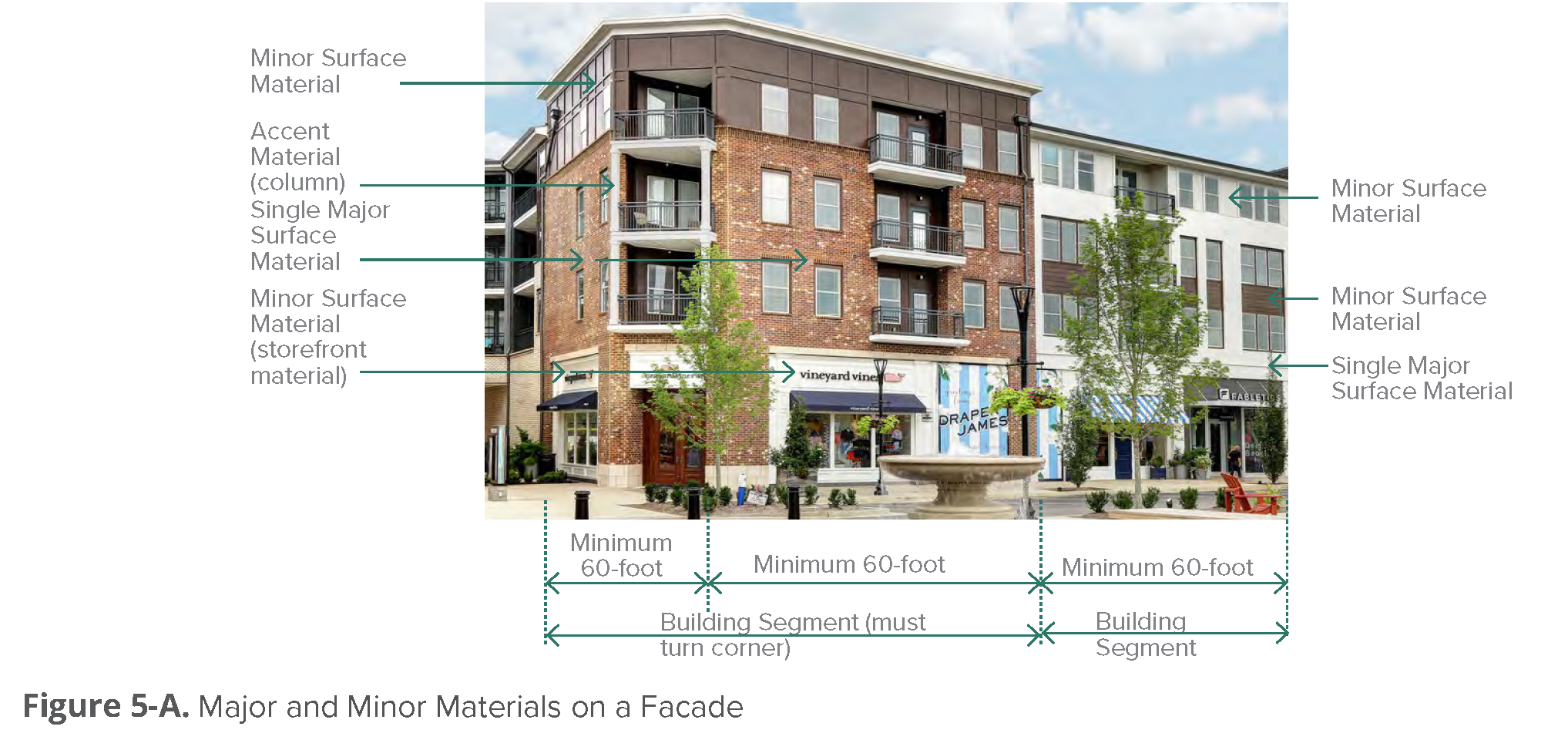
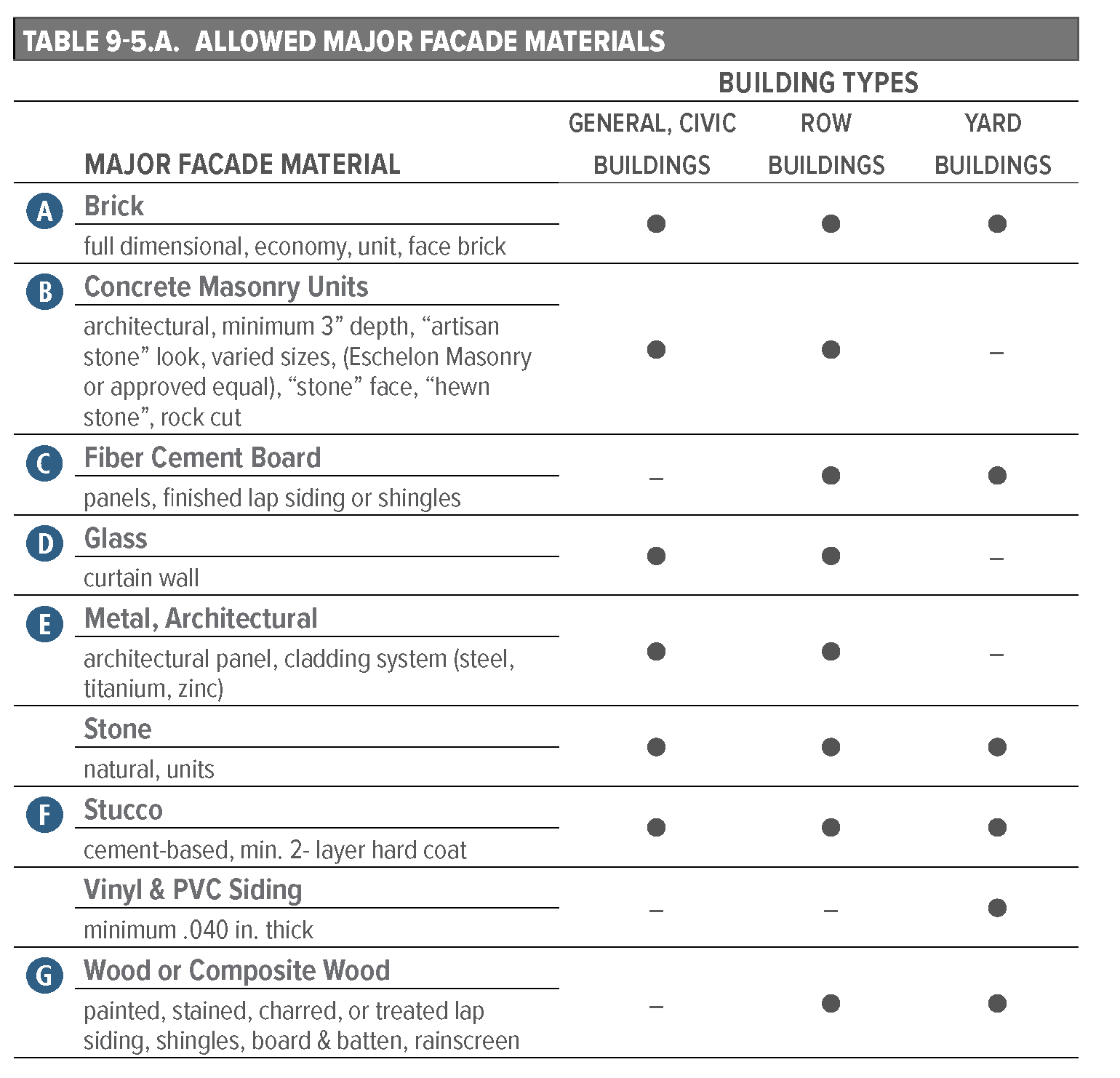
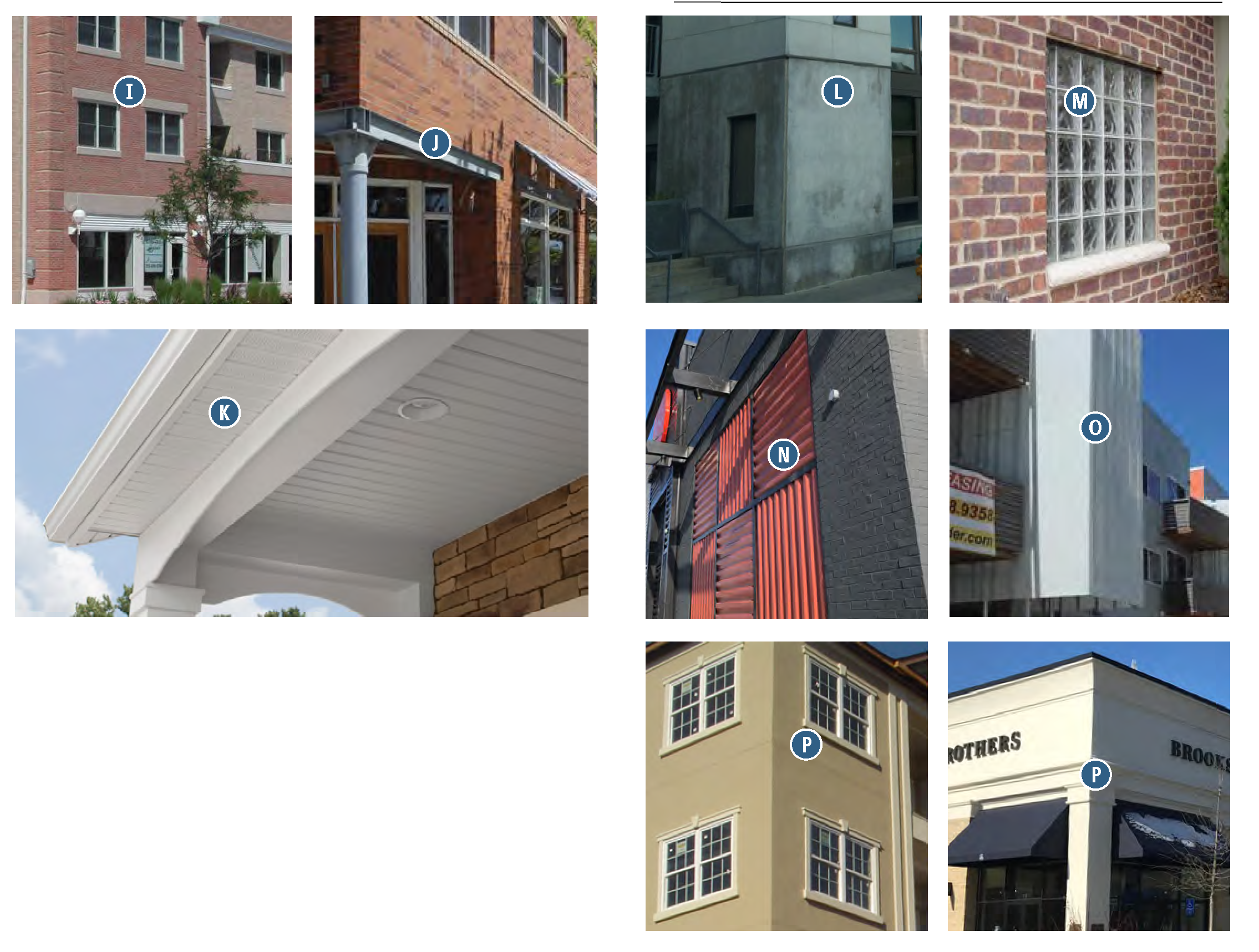
9.5.3. Major façade materials. A minimum of 70 perfect of each façade surface, not including window and door areas, must be composed of major façade materials per Table 9-5.A. A design exception may be approved for less than 70 perfect major materials on façades with no or limited visibility from any street, civic space, or the rail corridor.
a.
Durable, high quality. The minimum design standards are intended to ensure use of well-tested, high quality, durable, weather-resistant, exterior grade, preferably natural materials on the majority of finished highly visible façade surfaces, while permitting a wider range of materials for details. High quality materials can improve the quality of buildings in that they weather well, have a low failure rate, require a lower level of maintenance, have a longer life cycle and sense of permanence, and maintain higher long term value.
b.
Simplicity of surface materials. On each building or on each 60-foot or wider façade division of a building, a minimum of 60 perfect of street façades, not including window and door areas, must be faced in a single major material. See Figure 5-C.
c.
Other materials. A design exception may be approved for materials not listed as permitted major materials, with the exception of those materials listed in Table 9-5.D as prohibited materials. Refer to 9.7.6 for design exceptions process. Samples and examples of successful high-quality local installation and the manufacturer's warranty and industry ratings must be provided by the applicant.
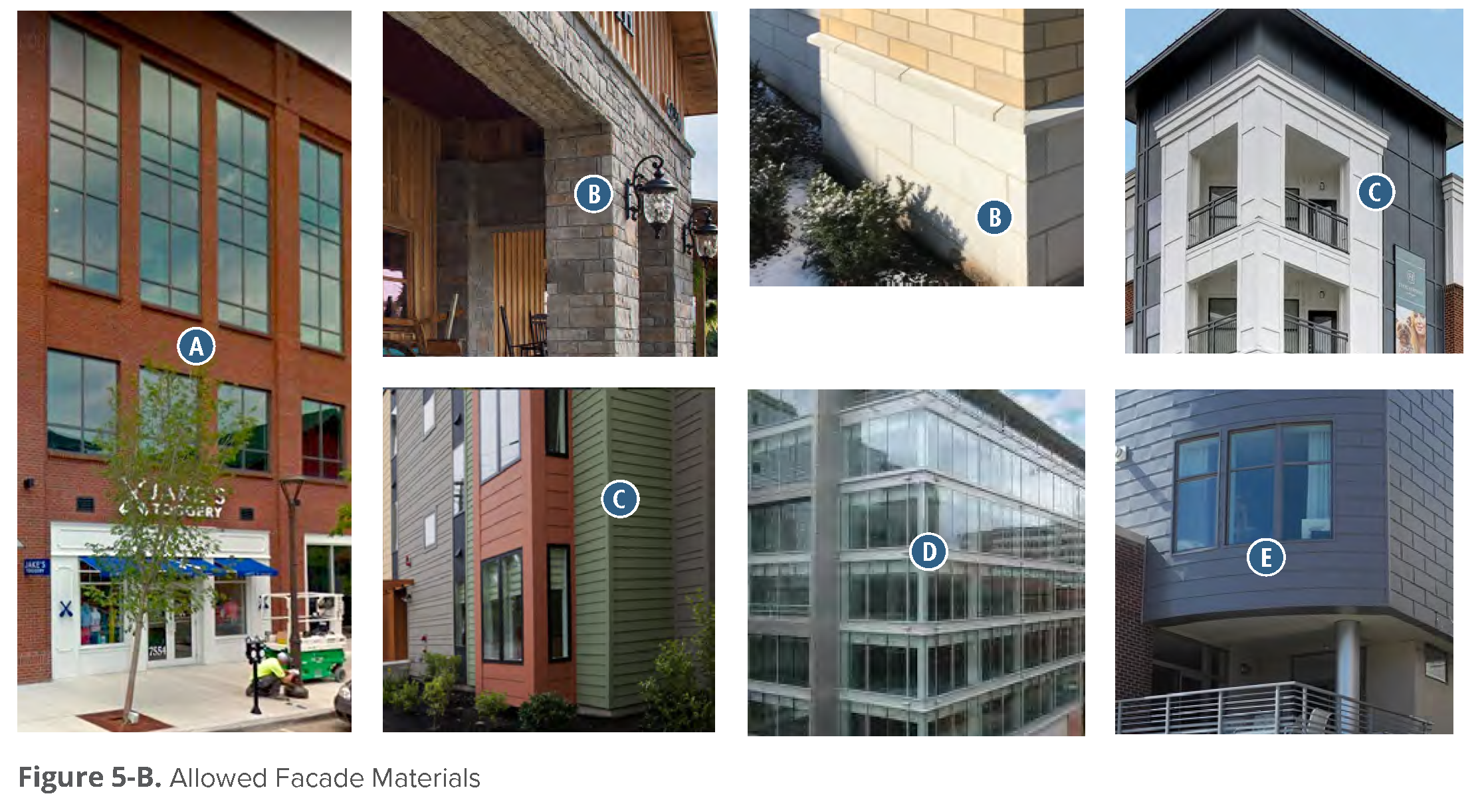
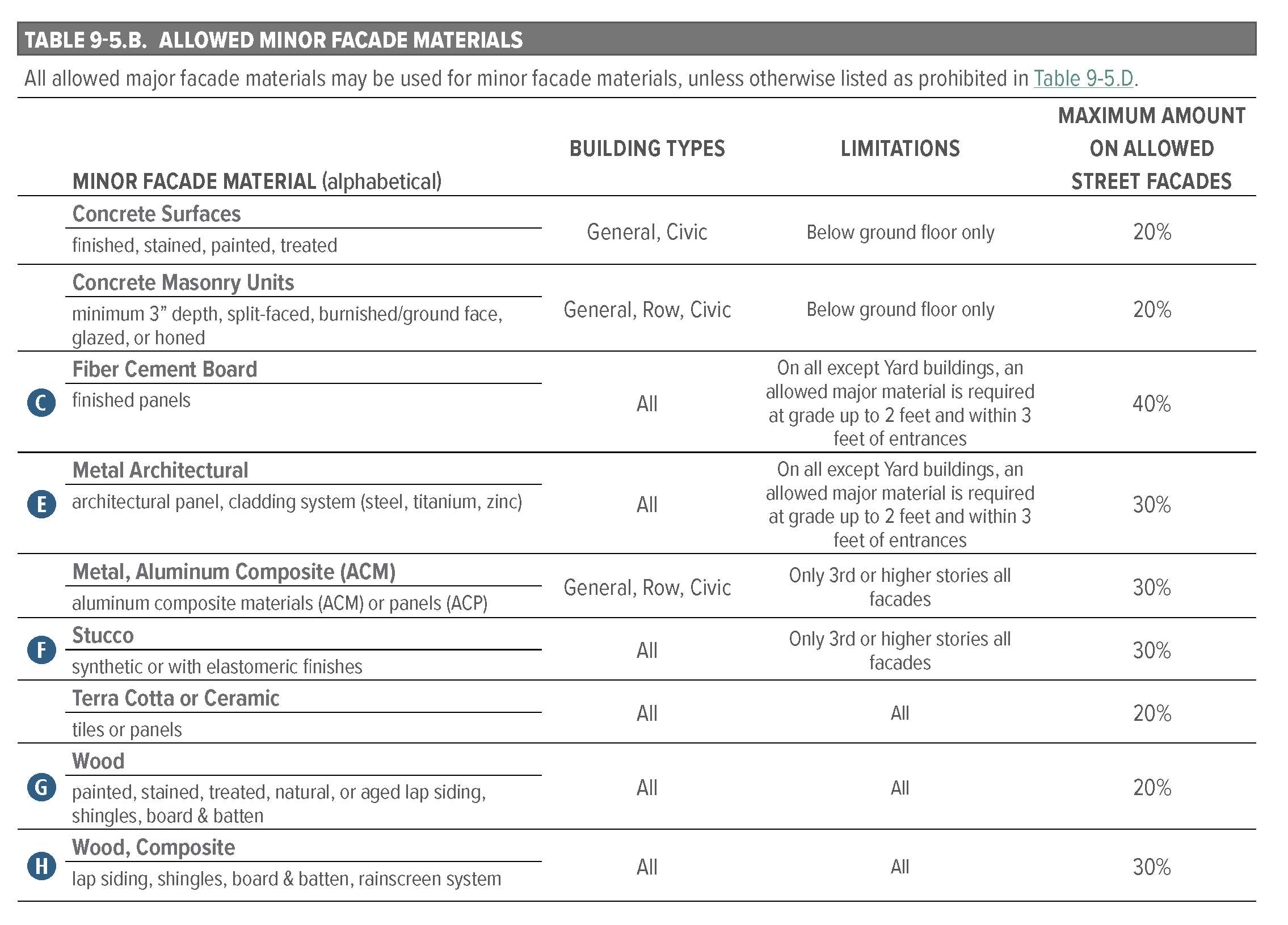
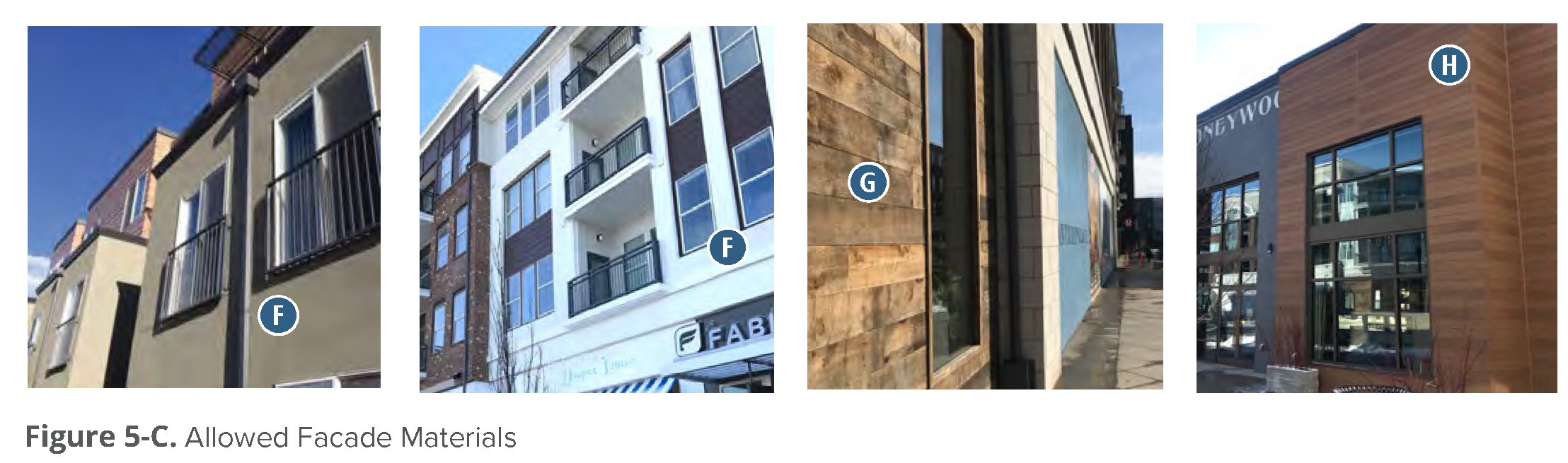
9.5.4. Minor façade materials.
a.
Maximum minor materials for surface areas. A maximum of 30 percent of each façade surface, not including window and door areas, may be composed of minor façade materials per Table 9-5.B.
b.
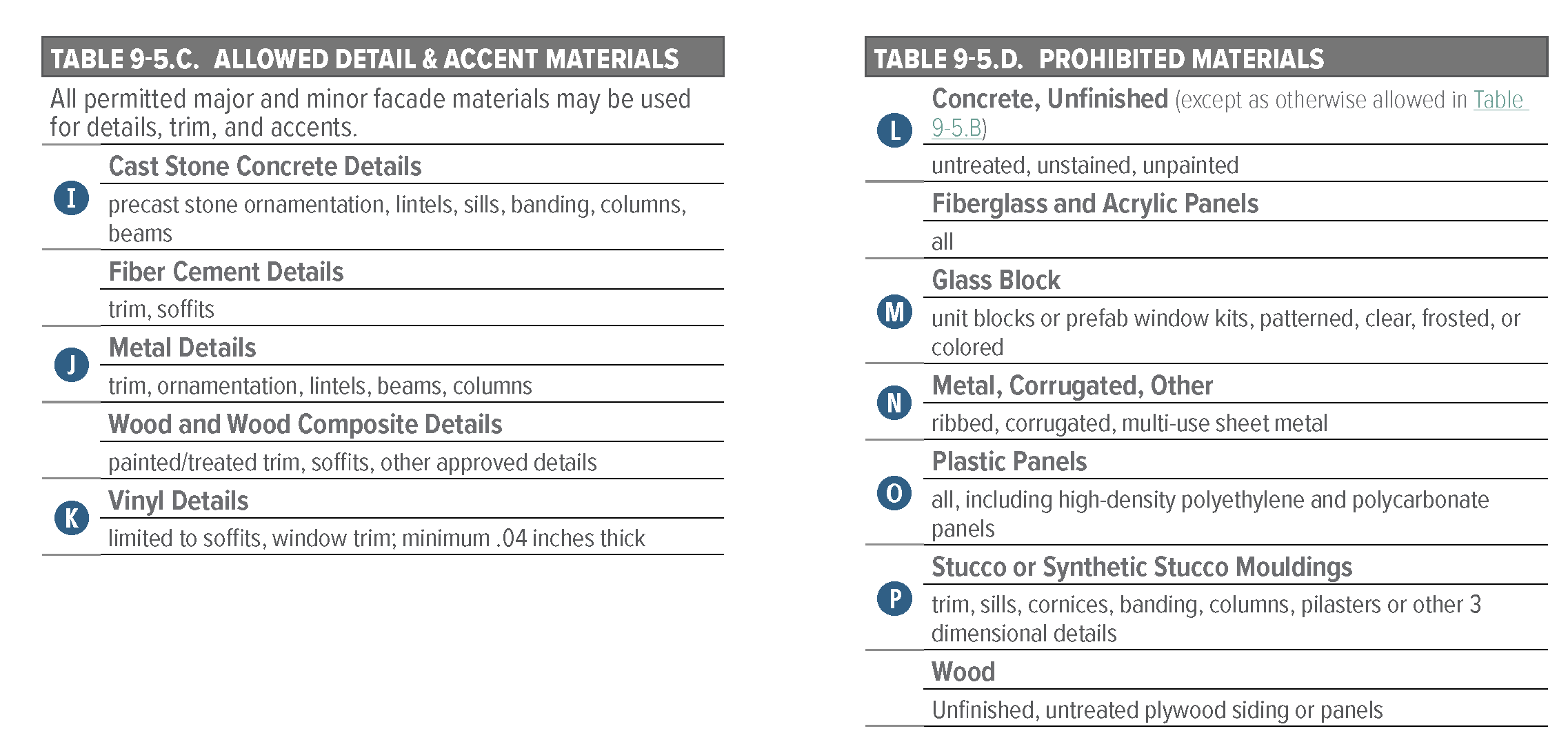
Accents and details. Additional materials are permitted for trim, accents, and details per Table 9-5.C, not included in the maximum surface area.
c.
Other materials. A design exception may be approved for materials not listed as permitted minor materials or accent and detail materials, with the exception of those materials listed in Table 9-5.D as prohibited materials. Refer to 9.7.6 for design exceptions process.
9.5.5. Pitched roof materials. Allowed pitched roof materials include dimensional asphalt composite shingles, wood shingles and shakes, metal tiles or standing seam, slate, and ceramic tile. Engineered wood or slate may be approved as a minor exception per 9.7.5 with an approved sample and documented examples of successful, high quality local installations.
9.5.6. Materials installation quality.
a.
Intent. The intent of the materials installation quality regulations is to advance the quality of construction, durability, and aesthetics of buildings, specifically related to application and detailing of façade materials.
b.
Changes in material. Changes in vertical surface materials for buildings must meet the following standards:
1.
Changes in surface materials. Changes in surface materials, whether major materials or minor materials, must occur only at concave corners, minimum 12 inches deep, or at shadow lines two inches or greater in depth above the material surface. Surface materials cover the façade surface (such as unit materials, siding, stucco, panels) and do not include detail materials, such as, but not limited to, cast stone for lintels or cornices, exposed metal beams, or any material used to create an shadow line. See 9.8.1 for definition of shadow line.
2.
Materials hierarchy. Unit materials must be elevated on the face of the building above less detailed, surface materials (e.g. stucco, as a constant surface material, must be recessed behind a bricked surface). Likewise, heavier materials should be lower on the façade than lighter materials (e.g. concrete block at the base of a building façade with fiber cement panels above).
c.
Shadow lines on surfaces. Shadow lines must be created at changes in materials with solid materials of a thickness that is greater than two inches, such as cast stone, masonry, or stone. For example, cast stone pieces may be offset to create a shadow, where the convex corner of the piece is used to create the corner of the detail.
d.
Appropriate grade of materials. Except on the yard building in VC-N and any row building, all doors, windows, and hardware must be of commercial grade quality.
e.
Stucco installation. Any stucco construction shall be of the highest installation quality, meeting the following criteria:
1.
Jointing. All stucco joints must be aligned along the façade in the pattern shown on the elevations submitted for the site plan approval. Joints must also align with the locations of windows and doors and other changes in material.
2.
Construction. The stucco wall assembly must be indicated on the plans specifying stucco type and construction.
f.
Exception. Modification to these material installation regulations may be approved through a design exception.
9.5.7. Windows. Windows on primary and non-primary street façades of all buildings must be constructed consistent with the following:
a.
Amount. Each building must meet the transparency regulations applicable to the building type. See 110-9.3 for building type regulations.
b.
Recessed. All window glass, with the exception of ground story storefront systems and glass curtain wall systems, must be recessed a minimum of two inches from the façade surface material or adjacent trim.
c.
Vertically oriented. All windows must be vertically oriented except:
1.
Flat roof type. When the flat roof type is used, horizontally oriented windows may be used for up to 30 percent of the total transparency area of each upper story.
2.
Window sets. Connected windows.
d.
Visibility through glass. Reflective glass and glass block windows are prohibited on street façades. Windows must meet the transmittance and reflectance factors established in the transparency definition in 9.8.2.h.
e.
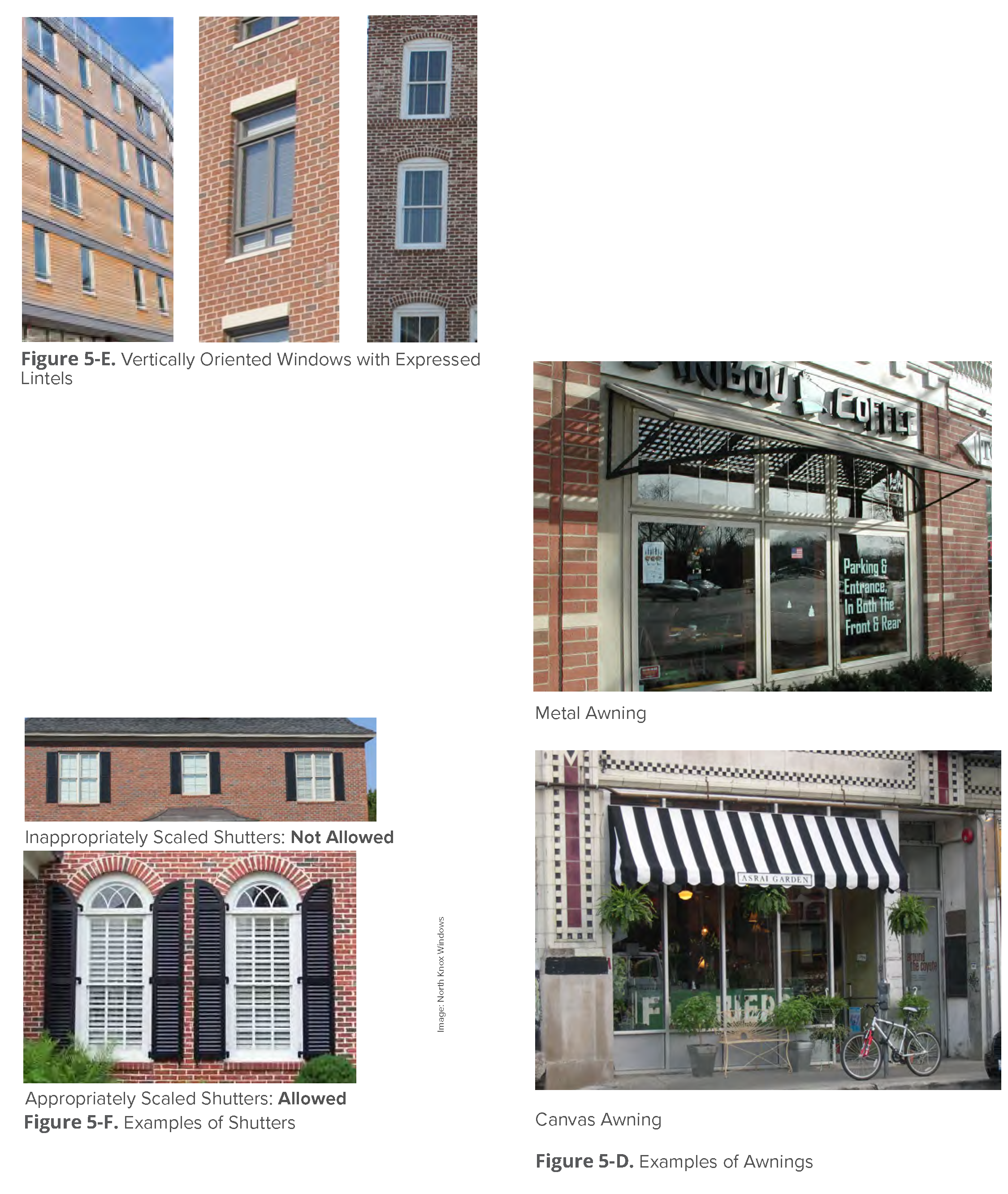
Expressed lintels. For masonry construction, the expression of lintels must be included above all windows and doors by a change in brick coursing or by a separate detail or element. See Figure 5-E for illustrations of expressed lintels.
9.5.8. Shutters. When shutters, whether functional or not, are utilized on a street façade of any building type except in the VC-N district, the shutters must the following regulations. See Figure 5-F for examples of shutters.
a.
Size. All shutters must be sized for the windows, so that, if the shutters were to be closed, they would not be too small for complete coverage of the window.
b.
Materials. Shutters must be wood, metal, or fiber cement. Other synthetic and engineered woods may be approved through a design exception provided that the applicant submits a sample and examples of high quality, local installations of the material.
9.5.9. Awnings, canopies, and light shelves. Awnings, canopies, and light shelves on all buildings must be constructed consistent with the regulations of this subsection. See Figure 5-D for examples of awnings.
a.
Encroachment. Awnings, canopies, and light shelves must not extend into a right-of-way, public easement, or street, except as otherwise approved by the village.
b.
Attached awnings and canopies. Awnings and canopies that are attached to the building and could be removed must meet the following standards:
1.
Material. All awnings and canopies must be canvas or metal. Plastic awnings are prohibited. Other materials may be approved with a design exception.
2.
Shapes. Waterfall or convex, dome, and elongated dome awnings are permitted only with an approved design exception.
3.
Lighting. Backlit awnings are prohibited.
4.
Structures. Frames must be metal and wall mounted. Support poles from the ground are prohibited unless the awning is over eight feet in depth and utilized for outdoor eating areas or entrances.
5.
Multiple awnings on the façade. When more than one awning is mounted on a façade, the awning types and colors must be coordinated.
c.
Canopies and light shelves. Permanent canopies, projections, or overhangs used as architectural features, light shelves, or shading devices are allowed.
d.
Clearance. All portions of any awning, canopy, or light shelf must provide at least eight feet of clearance over any walkway and 15 feet of clearance over vehicular areas.
e.
Signage. Refer to chapter 6 of the code of ordinances for signs on awnings and canopies.
9.5.10. Balconies. Balconies facing any street, courtyard, or open space must be consistent with the regulations of this subsection. See Figure 5-F for examples of balconies.
a.
Definition. For the purpose of this subsection, balconies must include any roofed or un-roofed platform that projects from the wall of a building above grade that is enclosed only by a parapet or railing. This definition does not include false balconies, Juliet balconies, or balconettes.
b.
Balconettes. Sometimes referred to as Juliet balconies, balconettes are false balconies consisting of a rail and door, either without an outdoor platform or with an outdoor platform less than 18 inches in depth. Balconettes are allowed with an approved design exception.
c.
Location. Balconies are not permitted on primary frontage façades on the storefront building.
d.
Size. Balconies shall be a minimum of four feet deep and five feet wide.
e.
Integrated design. Balconies are intended to be integrated with the design of the façade, and tacking (or the appearance of tacking) the balconies onto the façade after the elevation has been designed must be avoided.
1.
A minimum of 50 percent of the perimeter of each balcony shall abut an exterior wall of the building, partially enclosing the balcony, or shall include structural columns.
2.
The balcony support structure, including separate columns or posts are permitted if they are architecturally integrated into the design of the building facade.
f.
Platform. The balcony platform shall be at least three inches thick and any underside of a balcony that is visible from any street shall be finished.
g.
Façade coverage. A maximum of 50 percent of the street façades, calculated separately for each façade, may be covered by balconies. The balcony area is calculated by drawing a rectangle around the following: the platform or floor of the balcony; any rails, walls, columns or indentations; and any ceiling, roof, or upper balcony.
h.
Build-to zone requirement. The portion of the façade occupied by an upper story balcony is exempt from meeting the build-to zone requirement.
i.
Street encroachment. Balconies shall not extend into any right-of-way, easement, or street except as otherwise approved by the village.
j.
Exception. A design exception may be submitted for an alternate balcony design per 9.7.6.
9.5.11. Principal entryway. See Figure 5-F for examples of defined principal entryways. Principal entrances to all buildings or units shall be clearly delineated through one or more of the following design features:
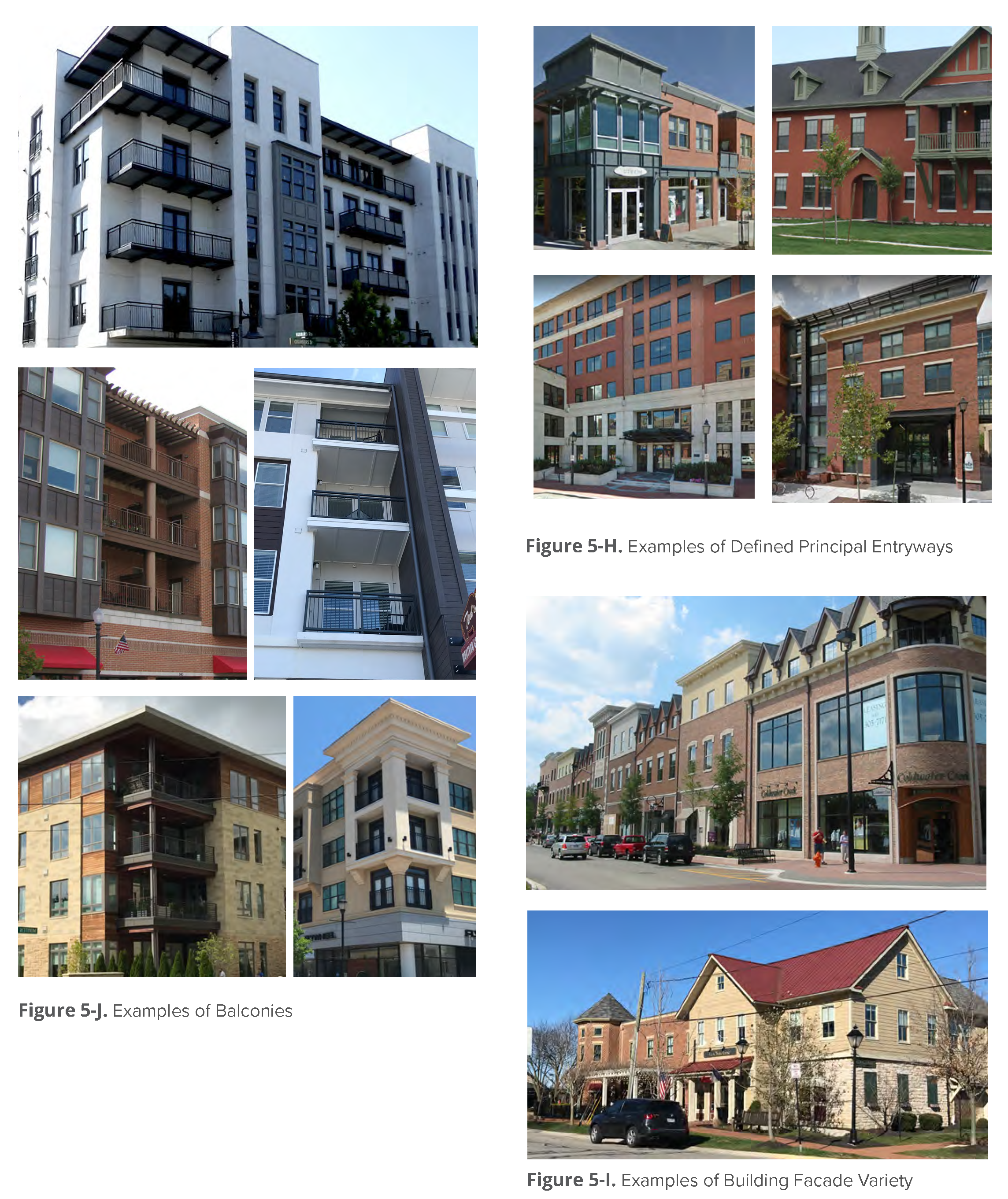
a.
Roof or canopy. The entryway is covered by a roof or canopy differentiating it from the overall building roof type.
b.
Porch. The entryway is through a porch.
c.
Sidelights and transom. Sidelights or transom windows are included around the entryway.
d.
Extended articulation. The entryway is included in a separate bay of the building that extends up at least two stories.
e.
Other design. A design that does not meet the above standards maybe approved with a minor exception if it is determined that the design adds emphasis and draws attention to the entryway.
9.5.12. Building façade variety. The following applies to all building types. See Figure 5-I for examples of building façade variety. Buildings 120 feet in length or greater, as measured along any street frontage shall fulfill the following regulations:
1.
Increments. Each street façade shall be varied in segments less than or equal to 90 feet.
2.
Requirements. Each façade segment shall vary by the type of dominant material or by color, scale, or orientation of that material, and by at least two of the following:
(1)
The proportion of recesses and projections. within the build-to zone.
(2)
The location of the entrance and window placement, unless storefronts are utilized.
(3)
Roof type, plane, or material, unless otherwise stated in the building type regulations.
(4)
Building heights.
3.
Design exception. A design exception may be approved for a façade design that does not meet regulations of this subsection if the applicant demonstrates that the proposed design achieves the intent of the building articulation regulations without meeting the building façade variety regulations. Refer to 9.7.6.
9.5.13. Garage doors. The following regulations apply to garage doors provided on any street façade.
a.
Location.
1.
Primary frontages. Garage doors are permitted on primary frontage façades only when utilized for patio access, open air dining, or display and not utilized for vehicular access.
2.
Non-primary frontages. Garage doors are permitted on non-primary frontage façades with direct access to the street.
3.
Interior lot façades. The preferred location is on interior lot façades.
b.
Recessed from façades. Garage doors located on street-facing façades shall be recessed a minimum of three feet from the dominant façade of the principal building facing the same street.
c.
Design.
1.
Garage doors facing a non-primary street and intended to be closed during business hours shall be clad with materials consistent with the design of the building.
2.
Carriage-style, windows in the door, or upgraded architectural doors are required on the row building type.
9.5.14. Parking structure façades. Parking structure façades visible from any street or other front façade shall meet the following standards. See Figure 5-K for one illustration of a parking structure façade.
a.
Materials. Major and minor material requirements, per 9.5.3 and 9.5.4, above, shall be met on all street and façades visible from any street. An additional permitted minor material is stained, finished concrete.
b.
Ramps and slopes. Ramps and slopes shall not be located on any front or street façades.
c.
Vertical divisions. Vertical divisions extending the full height of the structure are required every 30 feet to de-emphasize the horizontal decks. Divisions shall be a minimum of two feet in width with a minimum projection of two inches.
d.
Blank wall limitations. No rectangular area greater than 30 percent of any story's façade, as measured from floor to floor, and no horizontal segment of a story's façade greater than 15 feet in width may be solid wall without an opening.
e.
Entry tower. Any pedestrian entrances directly into the parking structure from the street are required to be separate from the vehicular entrance and directly accessed the sidewalk. The pedestrian entrance must meet the principal entryway regulations in 9.5.11. Stairwells must be located inside a tower per 9.5.14.f with windows at a transparency rate of 65 percent.
f.
Cap. The top story of the parking structure must include a parapet or other roof type along all street, open space, and rail corridor façades. Refer to roof types defined in 9.3.9.
g.
Vehicular entrances. Driveways must be no wider than 22 feet and the entrance and exit should be split by a median. Access shall be located on a non-front street, unless the lot does not abut a non-front street. No more than two access points shall be located on any one street, totaling no more than 24 feet of drives crossing sidewalk.
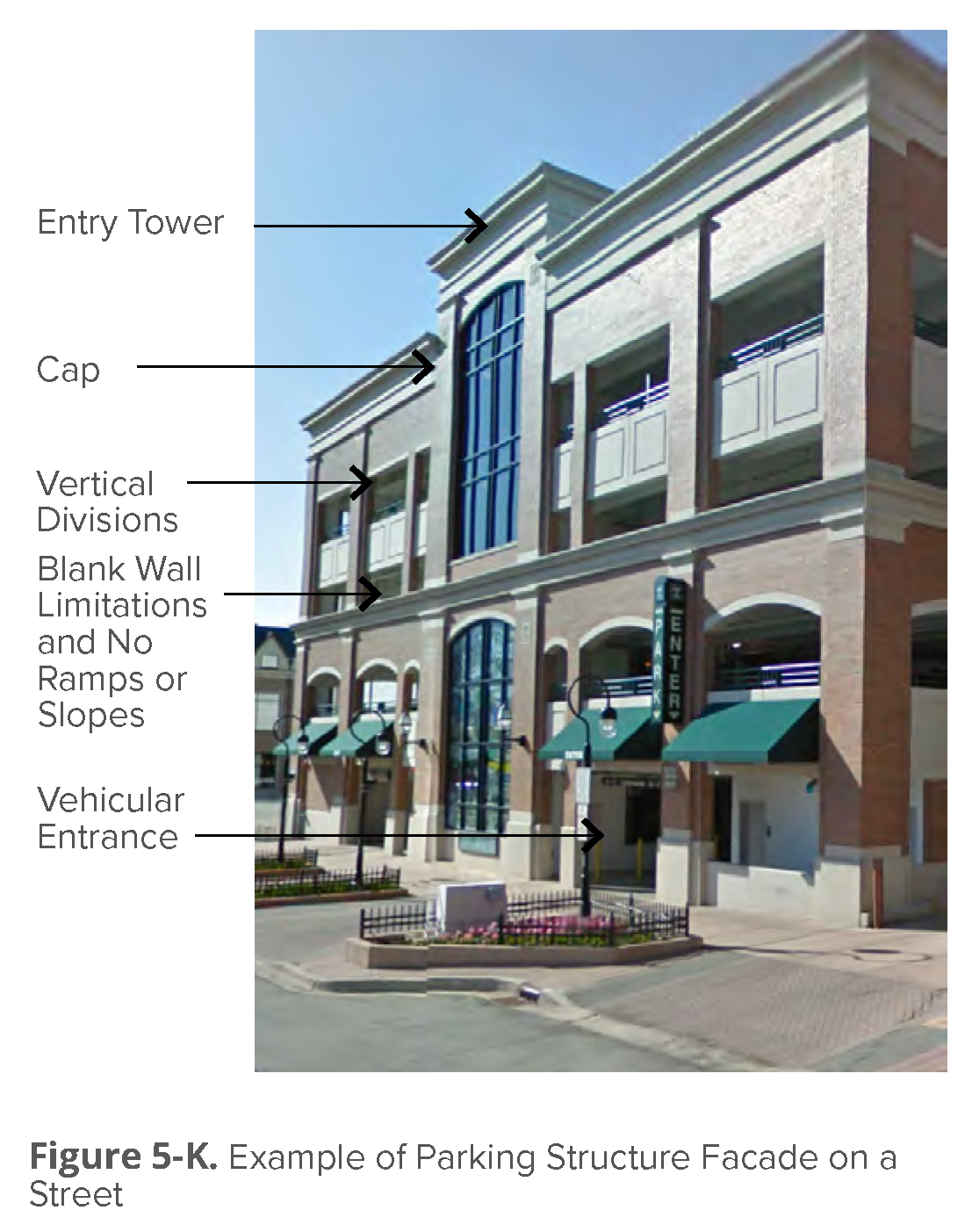
9.5.15. Mechanical equipment and appurtenances.
a.
Intent. Mechanical equipment and appurtenances can have a negative visual impact and detract from the quality of the design of a building. The purpose of the standards of this section is to ensure that the visual impact of mechanical equipment and appurtenances is minimized.
b.
Mechanical equipment in building. Mechanical equipment shall be located within the building, unless the applicant demonstrates the equipment is necessary for the function of the building and locating the equipment within the building would conflict with the equipment's function.
c.
Rooftop mechanical equipment. Any rooftop mechanical equipment, such as, but not limited to, vents, ducts, condensers, and ventilators, shall be located consistent with one of the following methods:
1.
Incorporate equipment into the roof design consistent with the applicable standards of 9.3.9. Refer to Figure 5-L for an example of appropriately mounted rooftop equipment.
2.
Set the equipment back a minimum of 20 feet from any street façade.
3.
To the extent practicable, all rooftop mechanical shall be painted to blend with the structural roof and limit its visibility.
4.
Rooftop mechanical equipment visible from adjacent highways shall be screened with materials consistent with the building design.
d.
Mechanical equipment and utility appurtenances on façades. Mechanical equipment and utility appurtenances shall not be located on a façade unless the applicant demonstrates that locating the equipment in a different location would conflict with the equipment's function. Refer to Figure 5-M for an example images of equipment on façades. Any equipment or appurtenance approved on a façade, such as, but not limited to, dryer vents, gas meters, and air conditioners, shall be located consistent with the following standards:
1.
Façade. The mechanical equipment may be located on a primary façade only if the following regulations are met:
(a)
The equipment is located on a surface perpendicular to any right-of-way;
(b)
The equipment extends from the façade surface no more than three inches; and
(c)
The equipment is screened from the sidewalk.
2.
Alignment. Multiple pieces of mechanical equipment shall be organized on the façade in a regular pattern and aligned. Compliance with this standard must be illustrated on the drawing elevations submitted as part of the application.
3.
Material coordination. To the extent practicable, façade-mounted mechanical appurtenances shall be located on a material that limits their visibility. For example, dark colored vents will be more visible on light colored stucco than a textured, darker surface such as brick.
e.
Mechanical equipment and utility appurtenances on other horizontal surfaces. Mechanical equipment located on the ground, decks, or horizontal surfaces other than the roof, such as, but not limited to, electrical equipment and air conditioners, shall be located consistent with the following standards:
1.
No encroachment. Mechanical equipment shall not extend into any right-of-way, easement, or street.
2.
Yard location.
(a)
No mechanical equipment shall be located in a street (primary or non-primary frontage) yard. A design exception may be approved for equipment in a non-primary frontage yard with approved screening. Refer to Figure 5-N for examples of inappropriately located equipment on primary streets.
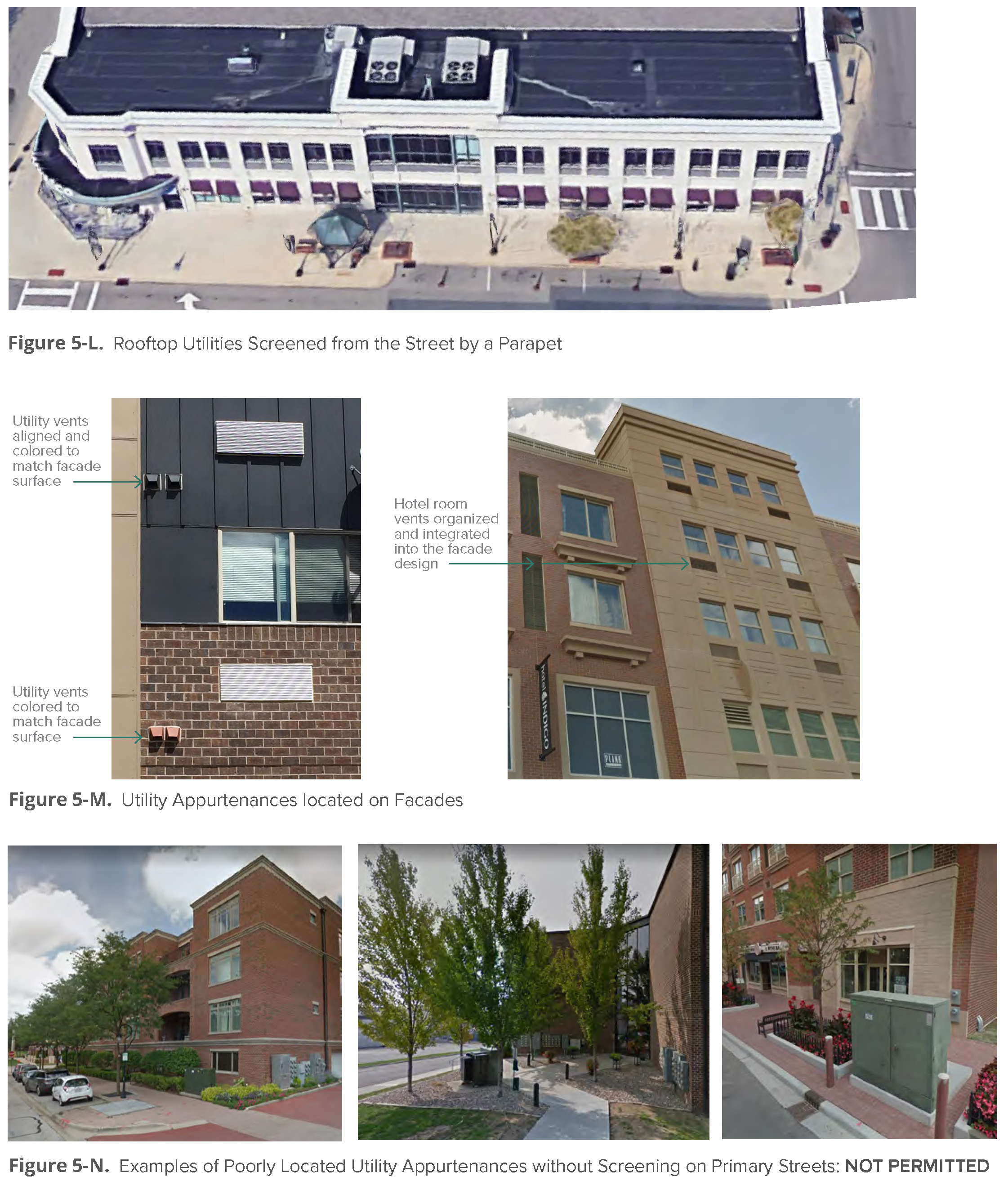
(b)
Mechanical equipment may be located in a side yard provided the side yard does not contain or abut a civic or open space.
3.
Screening from street or open space.
(a)
All equipment shall be screened from view from any street or open space with landscaping, fencing, or walls consistent with the building design, colors, and materials.
(b)
Where landscaping only is employed, a single row of evergreen shrubs shall fully screen the equipment within one year of installation. The zoning administrator may require additional landscape materials. Refer to 110-6.3.10 for landscape regulations.
(c)
Where landscaping is employed, the utility shall be located in a larger landscape area and the landscape screen shall be designed as part of the bed design.
4.
The zoning administrator may approve appurtenances located in a primary street yard only if the following conditions are met:
(a)
The applicant demonstrates that the equipment cannot be located in a rear yard, non-primary street yard, or in a side yard.
(b)
No utility cabinets, boxes, or other appurtenances are within 200 feet along the same side of the street as the proposed utility appurtenance.
(c)
The appurtenance is fully screened in a manner that is consistent with the building design, colors, and materials and of a height that is the minimum to adequately screen the appurtenance and that does not prevent the façade from fulfilling any transparency regulations. See Figure 5-M for examples of poorly located, unscreened equipment on primary streets.
(d)
The appurtenance is located a minimum of 35 feet from a street intersection.
(e)
The appurtenance does not impact the sight vision clearance at intersections per 110-6.1.2.e.
f.
Solar panels and small wind energy systems. Roof-mounted solar panels and roof-mounted small wind energy systems (maximum 3kW rated capacity) are allowed with approval of a design exception per.
1.
The intent for the energy shall be generated for on-site use only, with the potential for selling excess energy back to the local energy provider.
2.
The area of the solar panels may not extend beyond the perimeter of the roof surface.
3.
The solar panels shall not extend more than three feet parallel above a pitched roof surface or four feet parallel above a flat roof surface.
4.
Small wind generators are limited to no more than two per 1500 feet of roof surface and may not extend more than five feet above the highest peak of a pitched roof and no more than 15 feet in overall height above the roof's surface.
5.
The solar panels and small wind energy systems shall be integrated with the building design and shall not detract from the design and character of the area.
(Ord. No. O-22-25, § 1(Exh. A), 8-8-2022; Ord. No. O-26-02, § 1, 2-5-2026)
Sec. 110-9.6. - General site design.
9.6.1. Streetscape. For all developments in VC districts, the following streetscape is required to be installed by the applicant, unless otherwise determined by the zoning administrator. These regulations are in addition to the regulations of chapter 102 of the Municipal Code and section 110-6.3 of the Zoning Code, unless otherwise stated.
a.
Streetscape location. Streetscape occupies the full pedestrian area of any street and the street yards, from the back of curb to the building façade, of all developments per 9.6.1.b and 9.6.1.c, below.
b.
General, row, yard, and civic buildings. For all general, row, yard, and civic buildings, the following minimum landscape is required on all street frontages.
1.
Street trees. The parkway area between the back of curb and the sidewalk must be planted with shade trees, spaced a minimum of 50 feet on center, and grass or planting bed. Planting beds may include a maximum of 20 percent mulch area with mature plants. See 110-6.3 for general landscape regulations.
2.
Street yards. The primary and non-primary street yards must be planted with a minimum of 40 percent planting bed. The remaining area may be grass, sidewalk, or patio area. Planting beds may include a maximum of 20 percent mulch area with mature plants. Stormwater best management practices, such as bioswales or rain gardens, may also be located in this area, as determined appropriate by the zoning administrator and village engineer.
3.
Other landscape areas. Other landscape areas on residential sites must be planted per the requirements of section 102-9 or 110-6.3.6. The zoning administrator may waive the requirements of sections 102-9 and 110-6.3.6 if no landscape areas other streetscape areas will exist on the site.
c.
Storefront frontages. For all general buildings with storefronts, the following streetscape and landscape is required along all street frontages.
1.
Streetscape required. The entire area from building face to back of curb shall be designed as a combination of hardscape, tree wells, and/or planting areas. Paving material pattern and design shall be defined for each street and must include a minimum of six-foot clear sidewalk width and a minimum of 20 percent special paving areas, including such materials as pavers, stamped concrete, or other acceptable materials other than concrete. Shade trees are required, spaced a minimum of 40 feet on center, located in tree wells or planters. See 110-6.3 for general landscape regulations. Stormwater best management practices, such as bioswales or rain gardens, may also be located in this area, as determined appropriate by the zoning administrator and village engineer.
2.
Existing streetscape in right-of-way. In locations where existing streetscape is planned or recently installed in the right-of-way, the zoning administrator may partially or fully waive the requirements of 9.6.1 for streetscape within the right-of-way. Streetscape on the private property, however, must be tied into the streetscape design in the right-of-way with approval of the city. The zoning administrator may also request repairs or other improvements to the existing right-of-way streetscape.
3.
Standard specifications. Streetscape shall meet any standards defined by the village for sidewalk, curb, access, and parkway construction, unless otherwise stated.
4.
Street furnishings. Street furnishings including such items as benches, seatwalls, planters, planter fences, tree grates, tree guards, and trash receptacles shall be specified and quantities and locations listed for each street. For each 300 linear feet of block face, a minimum of two benches and one trash receptacle is required.
5.
Bicycle racks. Bicycle racks must be supplied to meet the minimum bicycle parking regulations of the blockface uses per for required bicycle parking spaces. If rear bicycle parking is utilized, a minimum of 50 percent of the required ground floor use bicycle parking shall be supplied within the streetscape, coordinated with the zoning administrator.
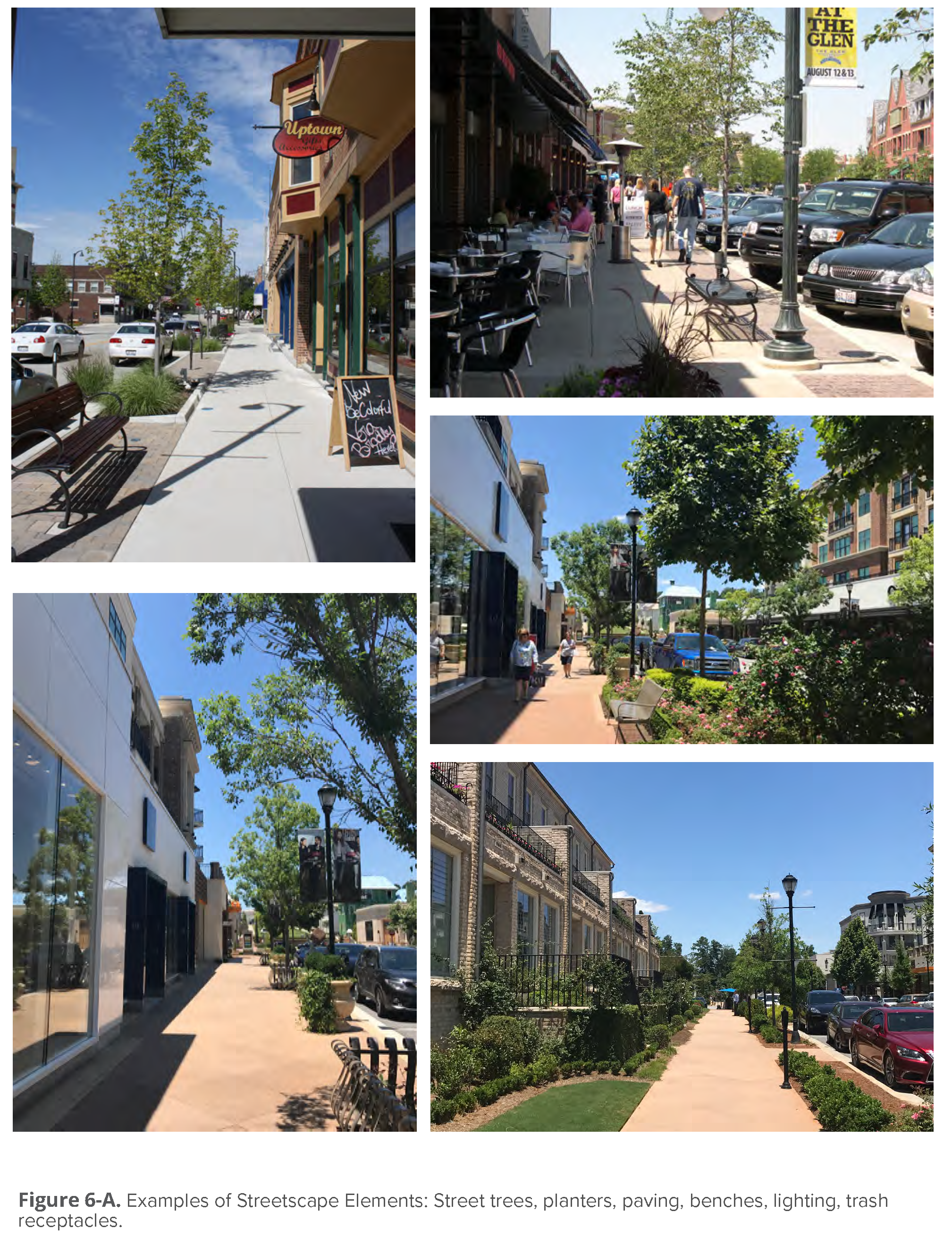
6.
Lighting. Pedestrian and vehicular lighting shall be specified and locations and quantities noted. All lighting shall meet any regulations of the village. Cut sheets and samples shall be submitted upon request of the zoning administrator.
9.6.2. Parking. Off-street parking regulations in section 110-6.2.2 apply with the following applicable to the VC districts:
a.
Location of off-street parking. Refer to the building type regulations in 110-9.3 for allowed locations for off-street parking lots and structures.
b.
Parking lot design. The following applies to any parking lot within a VC district in addition to the design requirements of 110-6.2.2.
1.
Pavement design. Pavement areas shall consist only of necessary drives, walkway paths, and parking spaces; all other areas must be landscaped. Excessive pavement shall be avoided.
2.
Pedestrian access. All parking lots with two or more double-loaded aisles must provide internal pedestrian pathway(s) within the parking area and outside of the parking drive aisle.
(a)
Dimension. The pathway shall be a minimum of six feet in width.
(b)
Quantity. One pathway is required for every two double-loaded aisles.
(c)
Location. The pathway shall be centrally located within the parking area to serve a maximum number of parking stalls.
(d)
Pathways shall provide direct connections to the principal structure(s) entrances from the spaces furthest from the entrance.
(e)
Pathway delineation. Pedestrian pathways should be clearly marked through the use of alternative materials, such as pavers.
c.
Required off-street parking spaces. Refer to Table 9-6.A for the minimum number of off-street spaces required per use within any VC district, except VC-N. VC-N must meet the requirements of 110-6.2.
d.
Credits and reductions. Credits towards or reductions from the minimum required off-street parking spaces may apply per this section in addition to any credits or reductions in 110-6.2.
1.
Alternate parking ratios. The motor vehicle parking ratios of this section are not intended to be a barrier to development. In order to allow for flexibility in addressing the actual expected parking demand of specific uses, alternatives to the motor vehicle parking requirements of this section may be approved through a design exception, provided that:
(a)
The required motor vehicle parking ratios do not accurately reflect the actual day-to-day parking demand that can reasonably be anticipated for the proposed use;
(b)
The allowed parking credits and reduction alternatives of this section are infeasible or do not apply; and
(c)
The reduced parking ratios proposed are not likely to cause adverse impacts on traffic safety or on the general welfare of property owners and residents in the area.
2.
On-street parking credit. Nonresidential uses may count on-street parking spaces on street rights-of-way abutting the subject property towards satisfying off-street motor vehicle parking requirements.
(a)
One on-street parking space credit may be taken for each 25 linear feet of abutting right-of-way where on-street parking is allowed.
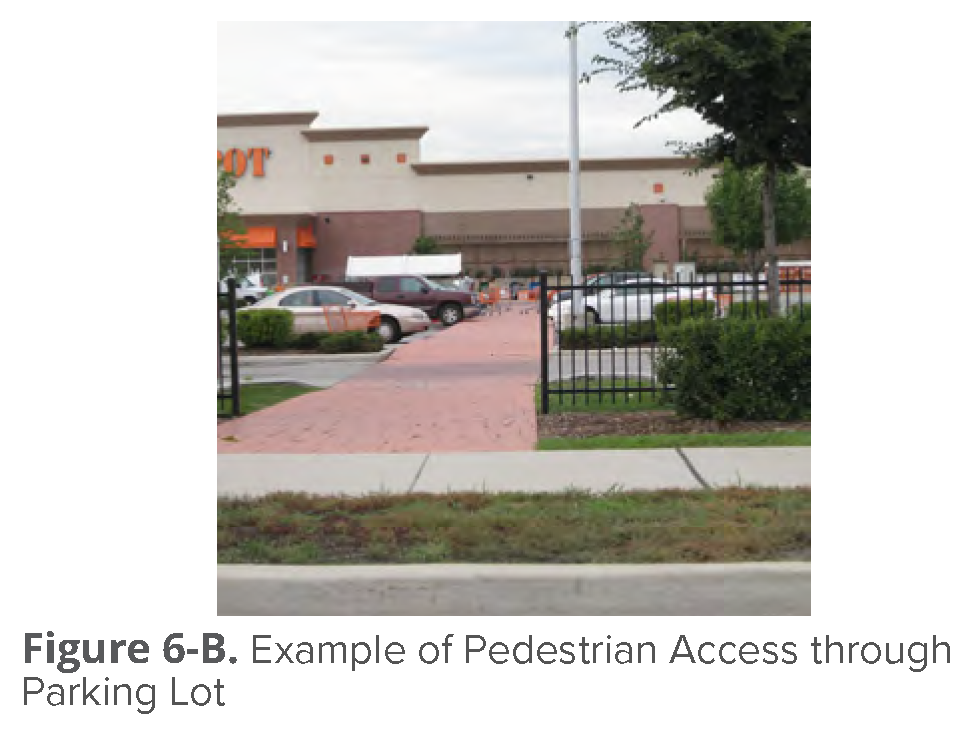
(b)
Only space on the same side of the street as the subject use may be counted except, where no building is located across the street, spaces on both sides of the abutting street may be counted.
e.
Bicycle parking. Minimum long-term and short-term bicycle parking spaces for specified land uses are set forth in Table 9-6.A.
1.
Required showers and changing facilities. For new office uses, hospital and hospital-related uses, colleges, and universities, one shower and changing facility shall be provided for one for 100 full-time occupants and, for more than 100 full-time occupants, one-half percent times the number of full-time occupants, rounded up to the nearest one. For example, a site with 100 employees must provide one shower and changing facility; a site with 1,000 employees must provide five shower and changing facilities.
2.
Bicycle parking design.
(a)
Location. Bicycle parking should be located within 50 feet of the entrance of the use on the same zoning lot as the use.
(b)
Short-term bicycle parking may be indoors or outdoors.
(c)
Long-term bicycle spaces must be located in a limited-access enclosure protecting bicycles from precipitation and theft, such as: enclosed indoor bicycle rooms, bicycle sheds, bicycle lockers, and weather-protected bicycle parking spaces that are monitored by an attendant or security system, such as bike boxes.
(d)
Aisle. An aisle a minimum of five feet wide shall be provided adjacent to any bicycle parking facilities to allow for maneuvering.
(e)
Racks. Racks shall be installed a minimum of two feet from any wall or other obstruction, except for wall-mounted bicycle racks, which may be mounted directly on a wall.
(f)
Spaces located within individual dwelling units may not be counted toward bicycle parking regulations.
(g)
Bicycle parking facilities shall be separated from vehicular parking areas to protect parked bicycles from damage. The separation may be accomplished through grade separation, distance or physical barrier, such as curbs, wheel stops, poles or other similar features.
(h)
Racks and structures. Racks and structures shall be provided for each unprotected parking space, and shall be designed to accommodate both chain and U-shaped locking devices supporting the bicycle frame at two points. Racks may be floor-mounted or wall-mounted, and they must be securely affixed or bolted to the floor or wall.
3.
Surface. The parking surface shall be designed and maintained to be mud and dust free. The use of rock or gravel areas for bicycle parking is permitted provided that edging materials, so that the bicycle parking area is clearly demarcated and the rock material is contained.
4.
Signage. If required bicycle parking for public use is not visible from the street, signs must be posted indicating their location.
(Ord. No. O-22-25, § 1(Exh. A), 8-8-2022)
Sec. 110-9.7. - Procedures.
9.7.1. Development review procedures. Refer to article IV, Development Review Procedures. This section, 110-9.7, establishes the process for rezoning and development approvals in the VC districts.
9.7.2. Pre-submittal meetings. A pre-submittal meeting is required with the zoning administrator and the village's staff development review committee (DRC).
9.7.3. Site plan review. All development in the VC districts must be approved per the site plan review procedure in 110-4.3. In lieu of 110-4.3.3, the scope of site plan review must consist of meeting the regulations of article IX.
9.7.4. Master plan development approval. When required per 110-9.2, an application must be submitted for review and approval of the master plan development. Refer to Figure 7-A for a flow chart of the process.
a.
Applicable area. The master plan development must include all properties as defined in 9.2.2; project implementation may be phased. Abutting or adjacent parcels required to be considered for planning purposes per 9.2.2 must marked as such on the submittal.
b.
Zoning administrator review. Following the formal submission of a complete application for a master plan development, the zoning administrator and the staff development review committee (DRC) will prepare a review report outlining how the development meets or does not all applicable regulations.
c.
Development commission approval. Following the submittal of the staff review report, the development commission must review and approve, approve with conditions, or disapprove the application. Approval with conditions requires a resubmittal of the master plan development for full approval. Any rezoning requires approval of the village board.
d.
Master plan development submittal requirements. The following submittals are required and must illustrate compliance with 110-9.2 and other applicable regulations at this stage, as determined by the zoning administrator.
1.
Narrative information. A project narrative must be provided including the following:
(a)
Total area in development project including legal description.
(b)
Ownership and contact information.
(c)
Intent of development.
2.
Project phasing. Description and mapping of project timing and phasing, including all components (such as utilities, streets, parking, open spaces, landscaping, uses, building types).
3.
Plans and details. The components of the master plan development must be clearly illustrated on the submittal drawings. Contact the department of community and economic development at village hall for a list of submittal drawings required.
e.
Master plan development components. The master plan development must include the components defined in 110-9.2, including, but not limited to, the following:
1.
Streets and blocks. All streets require boundaries located on the master plan development and designed per 9.2.5, 9.2.6, and 9.2.7. Regulations for anticipated building types must be considered when setting block depth and width to avoid the need for future variances or exceptions.
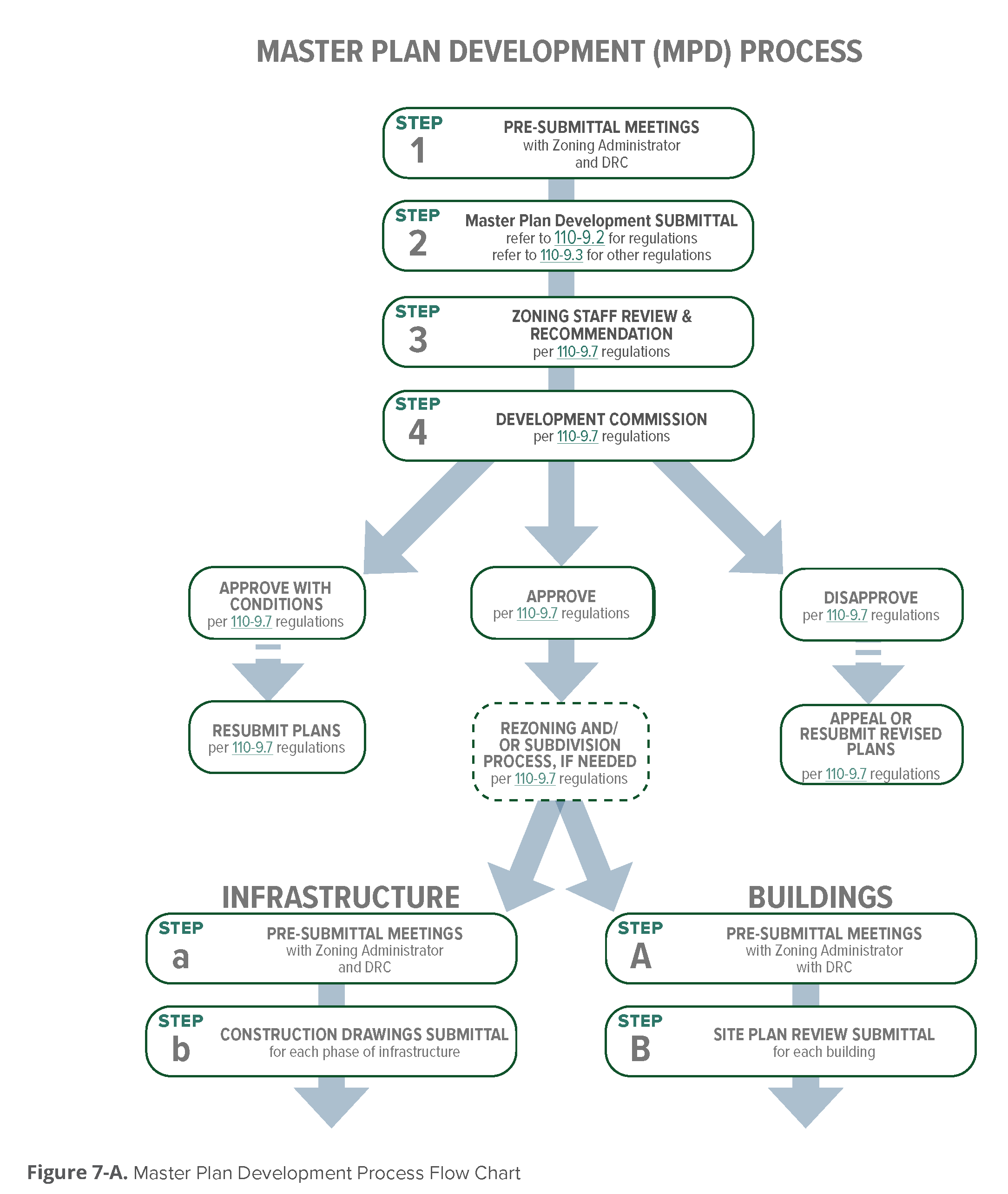
2.
Primary street designation. Primary streets must be designated on the master plan development per 9.2.8. Primary streets will establish the location for fronts of buildings and driveways to parking and loading.
3.
Open space. Open space type must be located on the master plan development with boundaries and must meet the regulations of 9.2.10.
4.
Building types. The master plan development must locate the boundaries for building types per 9.2.11 and must consider the regulations for building types in 110-9.3 to ensure the areas designated can accommodate buildings meeting the regulations. Building plans are not required for the master plan development; however, building and parking footprints are encouraged.
f.
Master plan development posting. The approved master plan development must be posted on the village's website and available at village hall for public viewing.
g.
Rezoning. Rezoning of any portion of the development site is required per the following:
1.
Rezoning to a VC district may occur concurrently with the master plan development approval process.
2.
Rezoning must follow the processes defined article IV.
3.
Rezoning to a VC district must be contingent upon approval of the master plan development and the master plan development must accompany the zoning.
h.
Subdivision platting. In addition to the subdivision requirements, subdivision platting of the development will be required in any residential zoning district of the village center districts where the development consists of more than two dwelling units, and also with any dedication of any rights-of-way, open spaces, or detention and/or retention improvements for storm water. The process established in chapter 90 of the village's municipal code shall be adhered to, but any specific regulation in this article IX shall take precedence over a similar regulation in said chapter 90.
i.
Site plan approvals. Upon master plan development and zoning approvals, each building development may be built as a matter of right when it meets all of the standards of the VC districts.
9.7.5. Minor exceptions. Minor exceptions to the regulations of article IX except 110-9.2, may be requested for approval by the zoning administrator, as follows:
a.
Conditions of approval. Exceptions, outlined below, are permitted under the following conditions:
1.
The exception fulfills the intent defined for this article IX of the zoning ordinance.
2.
The resulting form is consistent or compatible with the surrounding context and the vision defined in the comprehensive plan and other planning documents approved by the village.
b.
Permitted minor exceptions for site plan review. The following are permitted minor exceptions, if the above conditions are met.
1.
Up to ten percent variance of any dimension in article IX, up to a maximum of five feet in variance.
2.
Additional minor exceptions are noted throughout this article IX.
9.7.6. Design exceptions.
a.
Application. An application for design exception must accompany any site plan review submittal or master plan development. The application must define the requested exception, reference the applicable code section, and provide supporting material for approval, in the opinion of the applicant.
1.
Master plan development. Design exceptions per 9.7.6 must be reviewed and approved concurrent with the master plan development approval process.
2.
Building type, building design, and site design. Design exceptions per 110-9.3, 110-9.5, 110-9.6, and this 9.7.6 must be reviewed and approved prior to approval of the site plan review permit.
b.
Approval. Approval of the design exception must be obtained by:
1.
Review by the zoning administrator and DRC with recommendation for consideration by the development commission and village board.
2.
The development commission must consider recommendations provided by the zoning administrator and the DRC, may request additional information from the applicant, may hear testimony of the applicant, and must hold a public hearing. The development commission must make a recommendation to the village board to approve, approve with conditions, or disapprove the design exception application.
3.
The village board shall consider the application, the zoning ordinance, any testimony, and additional facts to approve, approve with conditions, or disapprove the design exception application.
c.
Conditions of approval. Design exceptions allowed by this article IX are permitted under the following conditions:
1.
The exception fulfills the intent defined for this article IX of the zoning regulations.
2.
The resulting form is consistent or compatible with the surrounding context or the vision defined in the comprehensive plan and other planning documents approved by the village.
d.
Master plan development (MPD) exceptions. Design exceptions to the regulations are defined throughout 9.7.6. Other design exceptions defined by the applicant may be requested. MPD design exceptions must be reviewed and approved as part of the MPD approval process.
e.
Building type, building design, and site design exceptions. Design exceptions to the regulations are defined throughout 110-9.3, 110-9.5, 110-9.6. Additionally, the following apply:
1.
Existing building exceptions. The following exceptions are permitted when applied to the renovation of an existing building(s):
(a)
For renovation of existing buildings, the maximum primary frontage coverage may be waived with an existing coverage of 60 percent; however, any expansion on the ground story must contribute to the extension of the primary frontage coverage.
(b)
For renovation of existing buildings, the location of the building within up to five feet from any minimum yard requirement or build-to zone width/location.
(c)
For renovation of existing buildings, the minimum height of the ground story and upper story may be increased or decreased by up to two feet for existing stories.
(d)
For renovation of existing buildings, other required dimensions may be modified up to five feet or ten percent, whichever is less, unless otherwise modified by this section.
2.
Alternative building materials. Alternative building materials may be exempted from the regulations of 110-9.5, unless expressly prohibited. For approval, the following must be met:
(a)
Samples and local examples of the material installed for a minimum of three years must be provided by the applicant a minimum of four weeks prior to the review, to allow site visits to see the installed material. The manufacturer's warranty and industry ratings must also be provided by the applicant.
(b)
The submitted application meets the intent of the materials regulations and the material will maintain its structure, color, and appearance for a minimum period of 15 years with little or no maintenance.
9.7.7. Nonconforming structures. The following applies in the VC districts is in addition to the regulations of article VII.
a.
General building design requirements. For any expansion or exterior renovation, 110-9.5, general building design requirements, must be met. A design exception may be requested per 9.7.6.
b.
General site design requirements. For any site renovations, 110-9.6, general site design requirements, must be met. A design exception may be requested per 9.7.6.
c.
Large renovations. Where any renovation includes an addition of more than 50 percent in gross building square footage within a five-year period, all regulations must be met. A design exception may be requested per 9.7.6.
d.
Façade renovations. If the building's façade exists or will exist within the required build-to zone of these regulations, the façade requirements of the applicable building type (per 110-9.3) must be met, if the renovation includes any one of the following:
1.
Expansion or change in location of 50 percent or more of the windows on any street façade of the building. Refer to 9.8.1 for definition of street façade.
2.
Replacement of 50 percent or more of façade materials on any street façade of the building with a different façade material.
e.
Roof renovations. If the renovation of the shape or style of more than 50 percent of the roof occurs and 30 percent of the street façade exists within the build-to zone, the roof type requirements of the applicable building type (per 110-9.3) must be met.
(Ord. No. O-22-25, § 1(Exh. A), 8-8-2022)
Sec. 110-9.8. - Definitions and measuring.
9.8.1. General definitions. For the purposes of the VC districts, the following terms shall have the following meanings:
a.
Boundary line. Boundary lines are delineations on the master development plan defining the limits of a street, open space site, or building site, and used for measuring build-to zones and other regulations for building types.
b.
Building site. For the purposes of section 110-9.2, a building site is defined by boundary lines on the master development plan and designated with a building type.
c.
Courtyard. An outdoor area enclosed by a building or buildings on at least three sides for at least 75 percent of the length of each side, and open to the sky. Refer to Figure 8-A for an example of a courtyard.
d.
Frontage. For the VC districts, the yard and building façade abutting a street or open space.
e.
Major street. For the VC districts, major streets include W Lake Street, Barrington Road, and County Farm Road.
f.
Occupied space. Interior building space regularly occupied by the building users. It does not include storage areas, utility space, or parking. Refer to Figure 8-E for an example of occupied space on a primary frontage façade.
g.
Porch. A roofed, open-air platform at the entrance to a building, with or without steps, usually with space for seating. Refer to Figure 8-C for an illustration of a porch.
h.
Primary frontage. The building site or lot frontage abutting a primary street.
i.
Primary frontage, non-. The building or lot frontage abutting a non-primary street.
j.
Primary frontage façade. The exterior walls of a building exposed to public view from a primary street, including return walls as illustrated in Figure 8-B. Also referred to as a primary façade or more generally as a street façade.
k.
Primary frontage façade, non-. The exterior walls of a building exposed to public view from a non-primary street, including return walls as illustrated in Figure 8-B. Also referred to as a non-primary façade or more generally as a street façade.
l.
Primary street. A street that receives priority over other streets in terms of pedestrian orientation and setting fronts of buildings. Driveway entrances are not located off primary streets, unless no other option exists. Primary streets are delineated on the master development plan. Refer to 9.2.8 for explanation of primary streets related to the master development plan and 9.3.4.c for explanation of primary streets related to building types.
m.
Shadow line. An architectural feature consisting of a decorative, three-dimensional, linear element, horizontal or vertical, protruding or indented a minimum depth from the exterior façade of a building, typically utilized to delineate the top or bottom of floors or stories of a building, and intended to create a linear shadow. Examples may include cast stone cornices, pilasters, or stepped brick coursing. Refer to Figure 8-F for examples of shadow lines.
n.
Stoop. An open-air platform or flat, paved area at the entrance to a building, with or without steps and with or without a projecting canopy, typically unroofed. Refer to Figure 8-D for an illustration of a stoop.
o.
Street. For the purposes of article IX, a street includes all of the components of a complete street as defined in 9.2.6.
p.
Street façade. Either a primary or non-primary frontage façade. Refer to the definition of a primary or non-primary street façade.
q.
Transparency. The measurement of the percentage of a façade that has highly transparent, low reflectance windows. For example, mirrored glass would not fulfill transparency regulations. Refer to 9.8.2.h for explanation of measuring transparency.
r.
Yard. The space on a lot which is unoccupied and unobstructed from the ground to the sky by the principal building. Refer to Figure 8-G. Note that the rear yard is fully screened from the street by the structure.
1.
Yard, non-primary frontage. For the VC districts, a yard extending from the non-primary frontage building façade along a non-primary street boundary or lot line between the primary frontage yard and rear boundary or lot line. Also referred to as a corner side or street yard.
2.
Yard, primary frontage. For the VC districts, a yard extending from the primary frontage façade of the principal building along the full length of the primary frontage boundary line between the side boundary or lot lines, or side and any street boundary lines. Also referred to as a front or street yard.
3.
Yard, rear. For the VC districts, a yard extending from the rear building façade along the rear boundary or lot line between the side yards or, on a corner building site, the street and side yards.
4.
Yard, side. For the VC districts, a yard extending from the side building façade along a side boundary or lot line between the primary frontage yard and rear boundary line.
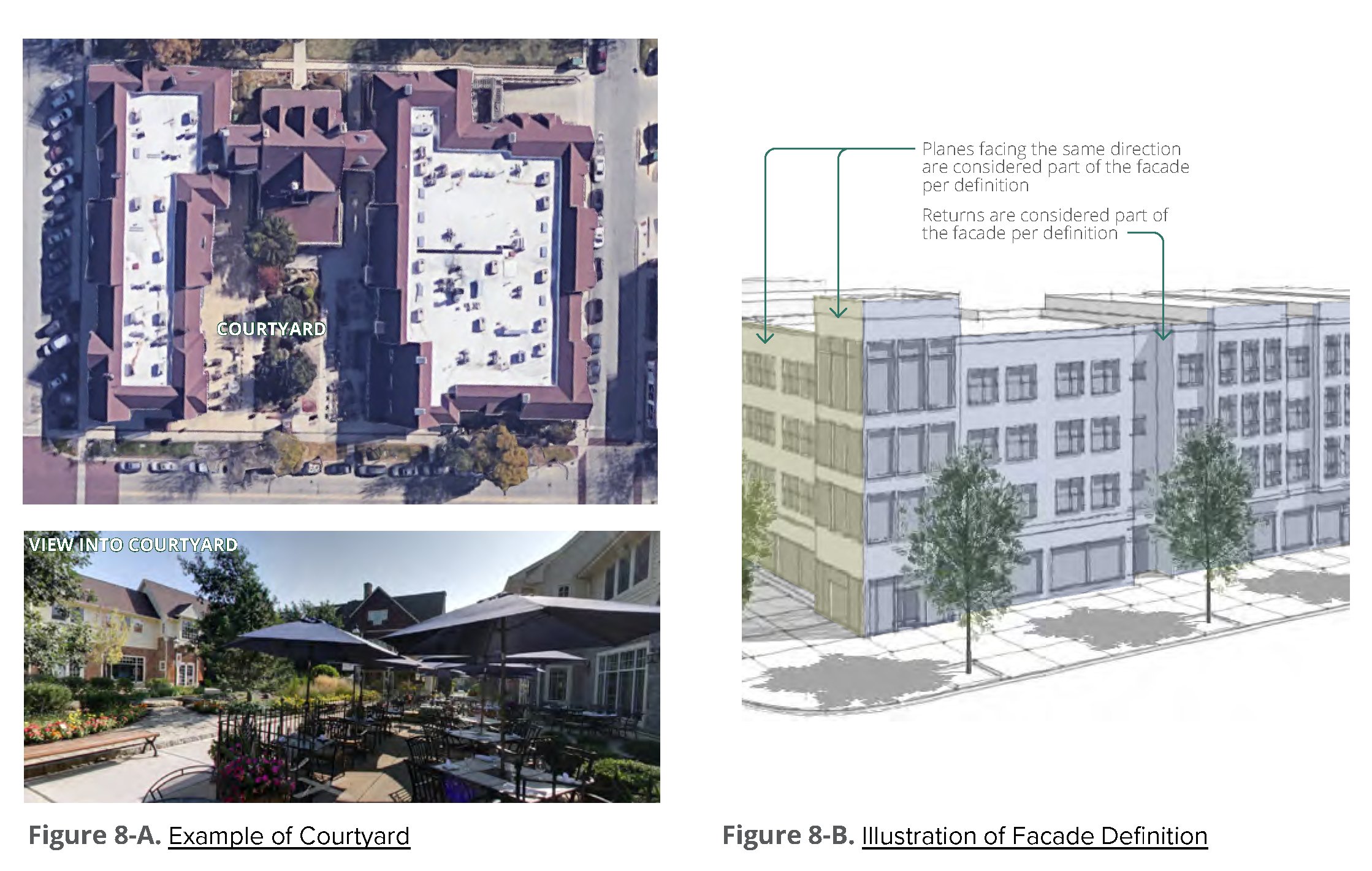
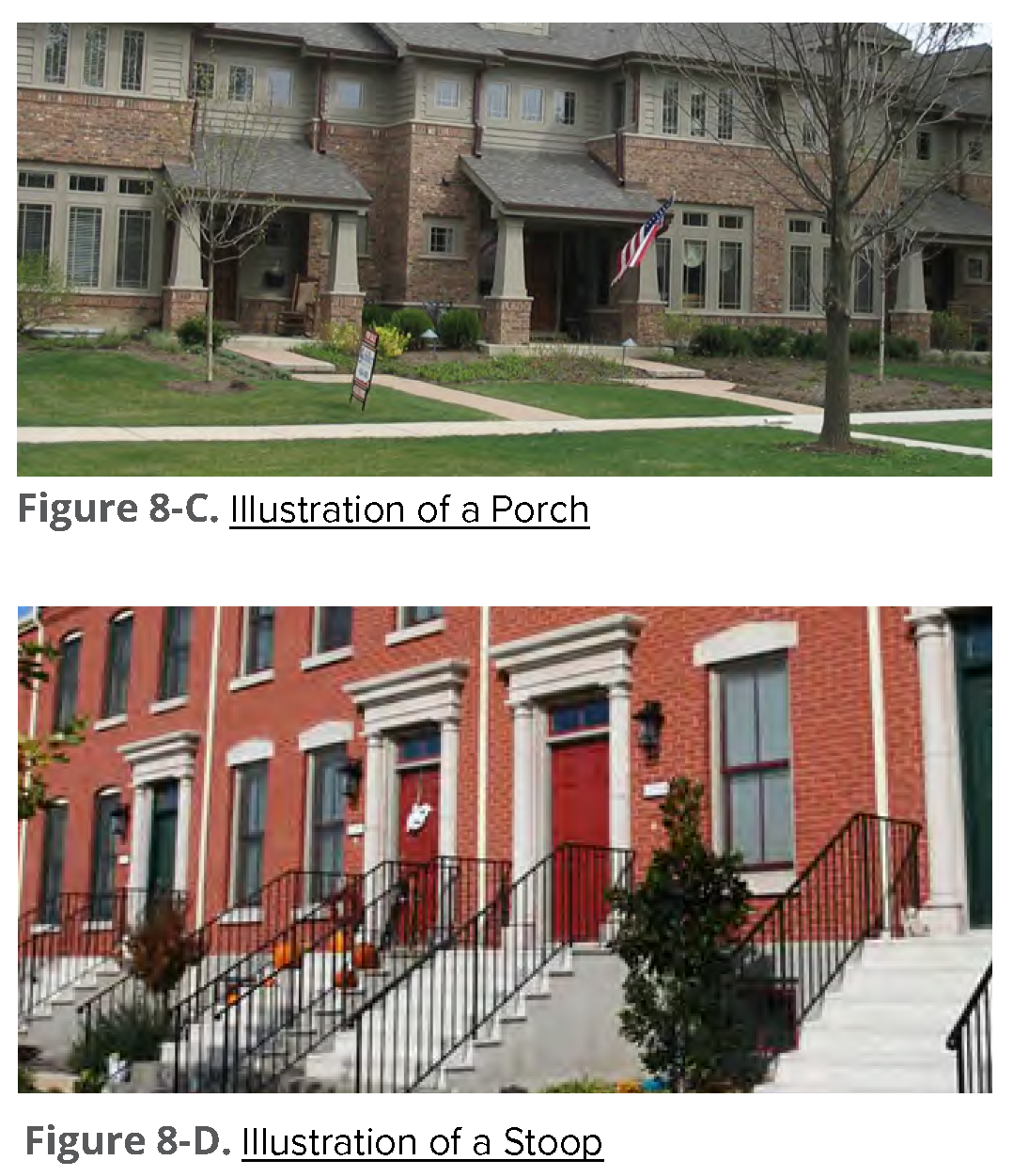
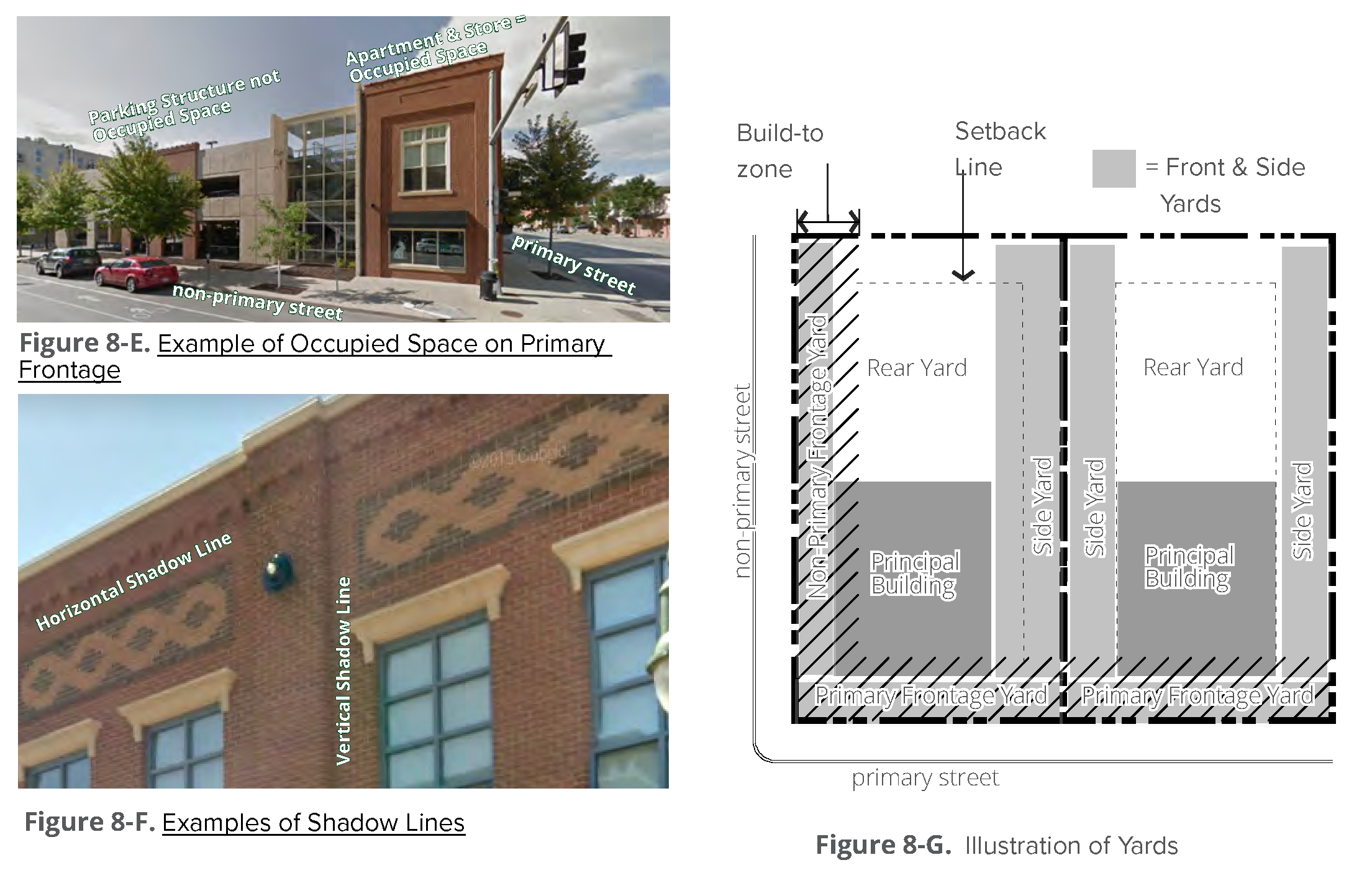
9.8.2. Measuring. The following explains the standards outlined on the tables in 110-9.3, Building types and uses, specific to each building type, refer to 9.3.5 through 9.3.8.
a.
Minimum primary frontage coverage. The minimum percentage of building façade along the primary frontage of a lot is designated on each building type table.
1.
Measurement. The width of the principal structures (as measured within the build-to zone along the frontage edge) is divided by the length of the frontage parallel to the boundary line, right-of-way line, or property line following the street. Refer to Figure 8-H. A boundary line is designated on the master development plan to delineate the space of a street or building site. When a minor design exception to subsection 9.3.4.f.5., Driveways Off Primary Streets, of section 110-9.3 is granted, the width of the approved driveway shall not be included in the length of the frontage for frontage coverage calculations.
2.
Courtyards.
(a)
Definition. A courtyard is an outdoor area enclosed by a building or buildings on at least three sides for at least 75 percent of the length of each side, and open to the sky.
(b)
Applies to coverage. Where noted by building type, courtyards maximum of 30 percent of façade width or 30 feet wide, whichever is less, may count towards the minimum primary frontage coverage.
3.
Open space type. Open space type regulations are exempt from minimum primary frontage coverage.
b.
Build-to zone. The build-to zone is designated separately for each frontage of the building types per the building type table regulations. Refer to Figure 8-I.
1.
Definition. Build-to zone is an area in which the front or corner side façade of a building shall be placed; it may or may not be located directly abutting a boundary or lot line. The zone dictates the minimum and maximum distance a structure may be placed from a boundary or lot line.
2.
Measurement. The build-to zone for all frontages is measured from the boundary or lot line parallel to the frontage, unless otherwise noted. When additional streetscape area is required beyond the street boundary line, the build-to zone is measured from the edge of the required streetscape onto the site.
3.
Height. All primary frontage façades must be located within the build-to zone.
4.
Encroachments. Awnings, balconies, and building mounted signage may extend up to three foot beyond the build-to zone into any yard area, but may not extend beyond a street boundary line or right-of-way unless otherwise expressly approved by the village.
c.
Setbacks. Building setbacks are designated separately for each building type per the building type table regulations. Setbacks are typically defined to establish minimum interior side and rear yards, but in some cases, are utilized to establish minimum street yards along primary and non-primary frontages.
1.
Definition. Setback is the minimum horizontal distance from a boundary line, property line, or other building into the lot or building site, beyond which a building may be placed.
2.
Measurement. The setback is measured perpendicularly from the boundary line, property line, or other building into the lot or building site.
d.
Impervious and semi-pervious site coverage. Site impervious coverage and additional semi-pervious coverage shall be calculated and measured as follows. Refer to Figure 8-J.
1.
Definitions.
(a)
Impervious site coverage. The percentage of a lot or building site developed with principal or accessory structures and impervious surfaces, such as driveways, sidewalks, and patios.
(b)
Pervious surface. Also referred to as pervious material. A material or surface that allows for the absorption of water into the ground or plant material.
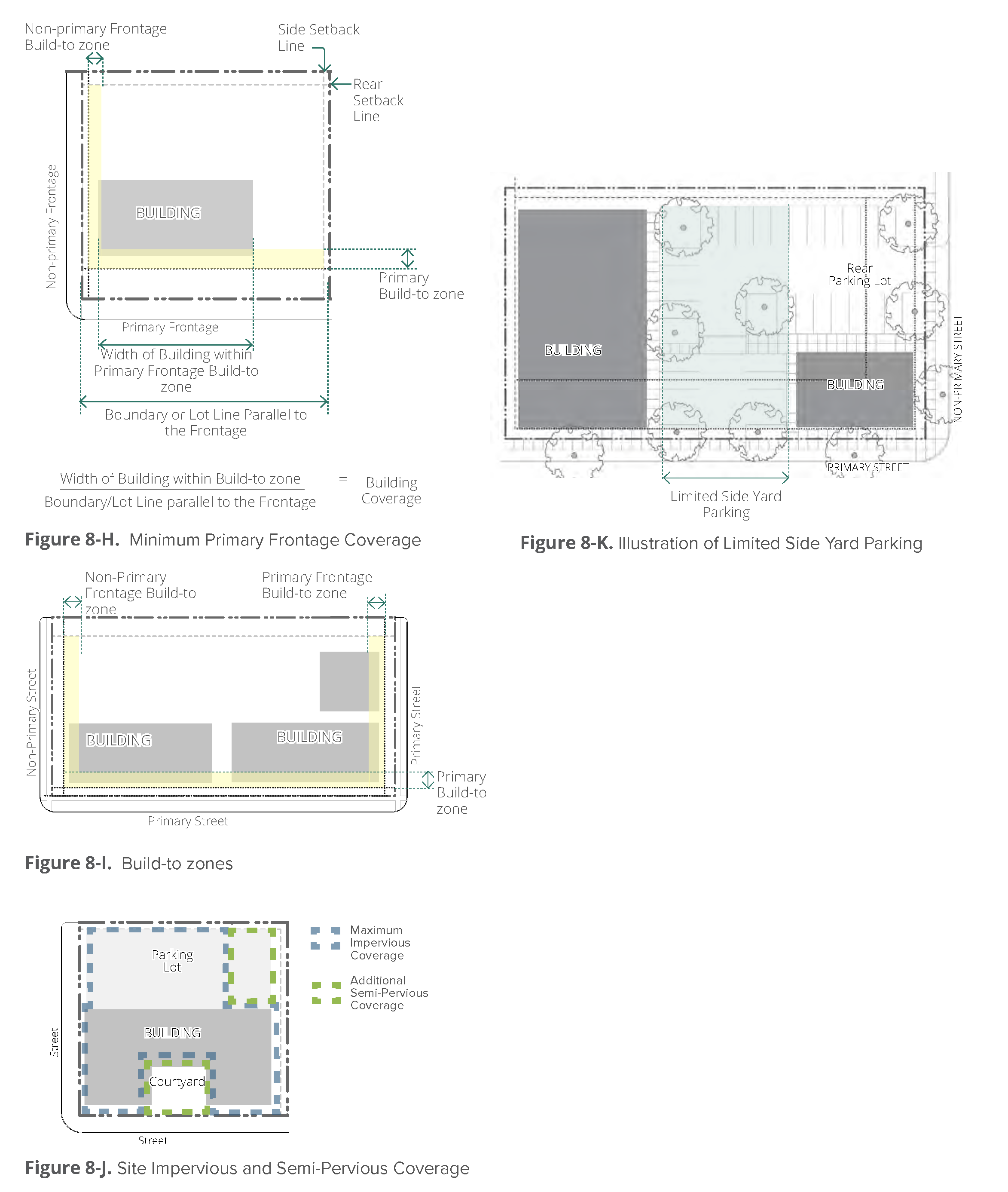
(c)
Semi-pervious surface. Also referred to as semi-pervious material. For the purposes of this section, a material or surface that allows for at least 40 percent absorption of water into the ground or plant material, such as pervious pavers, permeable asphalt, permeable concrete, and gravel, and including vegetated or green roofs.
2.
Measurement.
(a)
Maximum site impervious coverage. The maximum site impervious coverage is calculated as the maximum percentage of the area of a lot or building site covered by structures, pavement, and other impervious surfaces.
(b)
Additional semi-pervious coverage. In addition to the allowable impervious coverage on a site, a maximum percentage of the lot or building site of additional semi-pervious coverage is permitted.
e.
Limited parking. Limited side yard parking means one double or single loaded aisle, perpendicular to the street, maximum 65 feet in width as measured along the primary frontage boundary or lot line. Refer to Figure 8-K for an illustration of limited side yard parking.
f.
Ground story and upper stories, minimum and maximum height. (Refer to Figure 8-L, Measuring stories with floor-to-floor height.)
1.
Definitions.
(a)
Story, ground. Also referred to as ground floor. The first floor of a building that is level to or elevated above the finished grade on the front and corner façades, excluding basements or cellars.
(b)
Story, half. A story either in the base of the building, partially below grade and partially above grade ("basement"), or a story fully within the roof structure with transparency facing the street.
(c)
Story, upper. Also referred to as upper floor. The floors located above the ground story of a building.
(d)
Visible basement. A half story partially below grade and partially exposed above with required transparency on the street façade.
2.
Minimum overall height. Minimum heights require a minimum number of stories on the primary frontage façades of the building.
(a)
The building must meet the minimum required height for the first 30 feet of occupied building space measured from the primary frontage façade into the building.
(b)
False stories are not permitted.
3.
Maximum overall height. Maximum heights are specified both in number of stories and overall dimension. This requirement applies to the entire building.
4.
Towers. Where noted, towers may exceed the overall maximum height per 9.3.9, Roof types.
5.
Roof type. Where noted, certain roof types may allow additional height.
6.
Two half stories. Refer to 9.8.2.f.1, above, for definition of a half story. A building incorporating both a half story within the roof and a visible basement shall count the height of the two half stories as one full story.
g.
Minimum and maximum height per story. Each story is measured with a range of permitted floor-to-floor heights. Refer to Figure 8-L.
1.
Measurement. Floor height is measured in feet between the floor of a story to the floor of the story above it. Minimum and maximum floor-to-floor heights are required to be met on floors along façades, a minimum of 80 percent of each story.
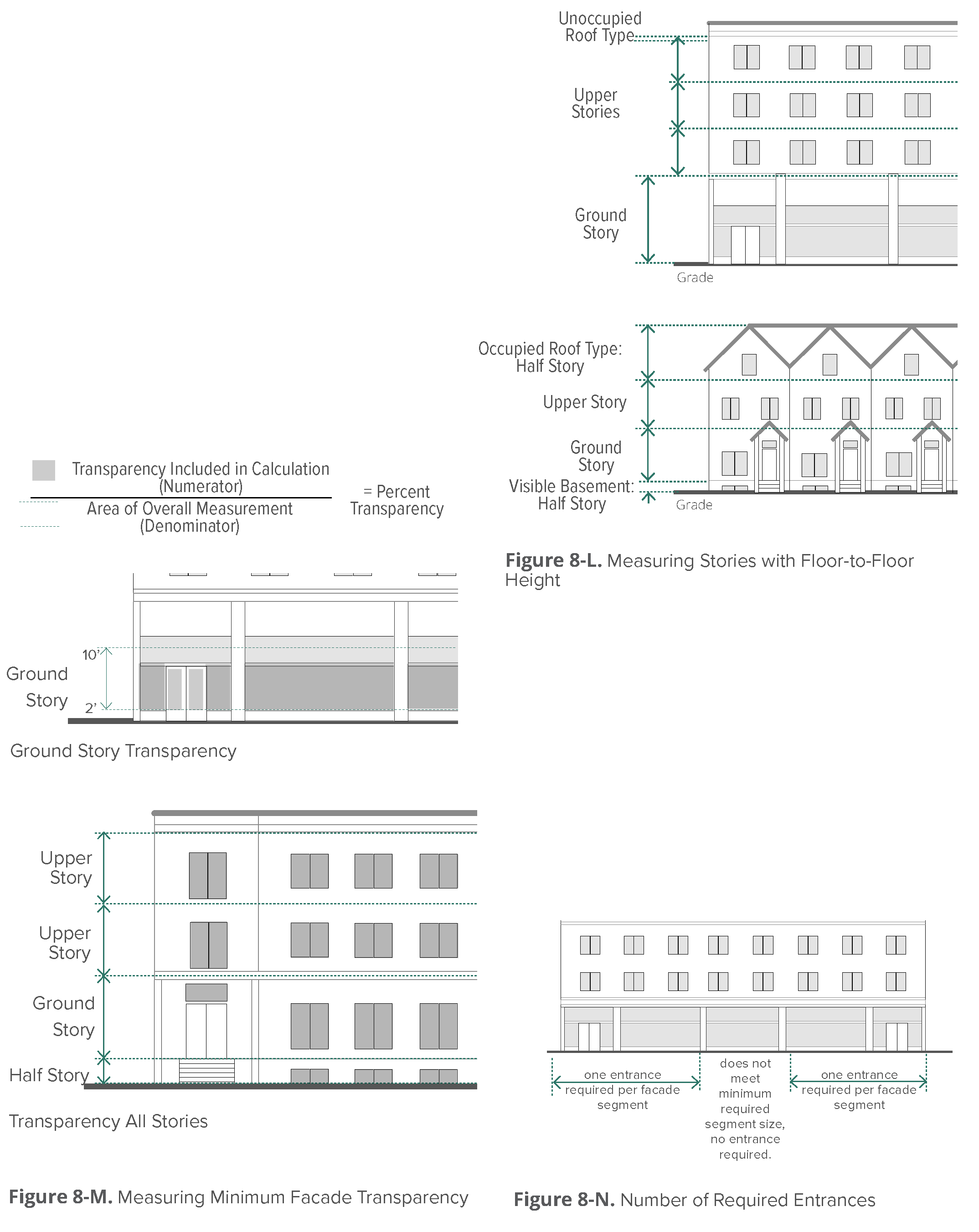
2.
Single story buildings and top floor measurement. For single story buildings and the uppermost story of a multiple story building, floor-to-floor height shall be one foot less than noted per building type and measured from the floor of the story to the ceiling.
3.
Mezzanines. Mezzanines may be included within the floor-to-floor height of any story, included in the calculation of stories. Mezzanines occupying more than 30 percent of the floor area below and extending above the story's allowable floor-to-floor height shall count as an additional story.
4.
Taller spaces. Spaces exceeding the allowable floor-to-floor heights of the building are not permitted on primary frontage façades. These spaces are unlimited on interior lots and non-primary frontage façades, but shall be counted as the number of stories that would fit within their height.
h.
Minimum required transparency. Per the regulations of each building type, a minimum amount of transparency is required on all stories of all façades.
1.
Degree of transparency. Highly transparent, low reflectance windows means a minimum of 50 percent transmittance factor and a reflectance factor of not greater than 0.25.
2.
Measurement. Minimum façade transparency is measured from floor-to-floor of each story separately. Refer to Figure 8-M, Measuring minimum façade transparency. Transparency, defined in 9.8.1, Definitions, includes windows and any glass in doors that is highly transparent with low reflectance. The measurement may include the frame, mullions, and muntins, but shall not include trim or casing.
3.
Blank wall segments. No more than a 15-foot wide section, measured horizontally, and no more than 30 percent of any story shall be without transparency.
4.
Exception. When a façade of any story is located within three feet of a parallel building façade, no minimum transparency is required for that story.
5.
Minimum ground story transparency. When required by the building type, ground story transparency shall be measured between two feet and either eight or ten feet, as noted, from the average grade at the base of the façade. Minimum ground story transparency supersedes the overall minimum transparency required for the building type.
6.
Tall stories. Stories that are 18 feet or taller in height shall be counted as two stories for the purpose of calculating minimum façade transparency, with each horizontal half of the story calculated separately.
7.
Half stories. All half stories located within roof structure and visible basements are required to meet the minimum transparency.
i.
Minimum number of required entrances. Entrances shall be provided consistent with the entrance location and number regulations established for the building type and consistent with Figure 8-N.
(Ord. No. O-22-25, § 1(Exh. A), 8-8-2022; Ord. No. O-26-02, § 1, 2-5-2026)

