
Hardee County Unincorporated
City Zoning Code
City Zoning Code
ARTICLE 5
INFRASTRUCTURE DESIGN AND IMPROVEMENT STANDARDS
SECTION 5.01.00 - GENERAL PROVISIONS
The purpose of this Article is to provide development and infrastructure design and improvement standards applicable to all development activity within unincorporated Hardee County.
5.01.01 - Building and Construction - Safety Standards
(A)
Purpose. To protect the public health, safety, and welfare of the residents of the County, the construction related to building code/safety standards and Florida Statutes, as published by the International Code Congress International, Inc., the National Electrical Code, State of Florida, and Hardee County, as listed below, are adopted by reference, and made a part of this Unified Land Development Code.
(B)
Minimum Standards. The construction safety standards/codes hereby adopted by the County include the following, as updated, and amended.
(1)
Florida Building Code: Building, current edition, and Supplements, as amended.
(2)
Florida Building Code: Residential, current edition, and Supplements, as amended.
(3)
Florida Building Code: Existing Building, current edition, and Supplements, as amended.
(4)
Florida Building Code: Plumbing, current edition, and Supplements, as amended.
(5)
Florida Building Code: Fuel Gas, current edition, and Supplements, as amended.
(6)
Florida Building Code: Mechanical, current edition, and Supplements, as amended.
(7)
Florida Building Code: Test Protocols, current edition, Supplements, as amended.
(8)
Florida Building Code: Energy, current edition, and Supplements, as amended.
(9)
Chapter 514, Florida Statutes, Public Swimming and Bathing Facilities, as amended.
(10)
Chapter 515, Florida Statutes, Residential Swimming Pool Safety Act, as amended.
(11)
National Electrical Code, current edition, as amended, as amended.
(12)
Chapter 582, Florida Statutes, Soil and Water Conservation, as amended.
(13)
Chapter 553 Part II, Florida Statutes, Accessibility by Handicapped Persons, as amended.
(14)
Chapter 633, Florida Statutes, Fire Prevention and Control, as amended.
(C)
Interpretations. The County Building Official/Engineer shall review all written requests or inquiries and prepare interpretations to the Florida Building Code pursuant to F.S. § 533.775, for all of the applicable building, construction, and safety codes.
(D)
Appeals. All appeals to all applicable County Building, Construction, and Safety Codes and Interpretations, if permitted by law, shall be conducted in accordance with the applicable Florida Statutes and/or the Florida Administrative Code. The appellant shall bare all the costs and the responsibility to file such an appeal.
(E)
Conflicts. In the event of a conflict between the requirements/standards listed in this Article, or a conflict with the requirements/standards in the Hardee County Technical Standards Manual, the more restrictive or stringent requirement/standard shall apply, as determined by the Planning and Development Director, Building Official, Fire Marshal/Inspector, Public Works Director, or County Engineer/Consultant.
5.01.02 - Responsibility for Improvements
Unless otherwise specifically provided, all improvements required by these Codes and the Hardee County Technical Standards Manual shall be designed, installed, and paid for by the Applicant.
5.01.03 - Principles of Development Design
The provisions of this Article are intended to ensure functional and attractive development. Development design shall first consider the protection of natural resources as prescribed in Article 7 of this Code. All development shall be designed to avoid unnecessary impervious surface cover; to provide adequate access to lots and sites; and to avoid adverse effects of shadow, glare, noise, odor, traffic, drainage, and utilities on surrounding properties.
5.01.04 - Blocks, Yards, and Lots
(A)
Blocks. As used in this Article, a block is a group of lots entirely surrounded by streets, railroad right-of-way, water courses, subdivision boundaries, or any combination thereof. The lengths, widths, and shapes of blocks shall be determined with regard to the following:
(1)
Where a tract of land is bounded by streets forming a block, said block shall have sufficient width to provide for two tiers of lots of appropriate depths.
(2)
The lengths, widths, and shapes of blocks shall be consistent with adjacent areas, where appropriate.
(3)
Block lengths shall not exceed 1,000 feet in length or be less than 500 feet in length, except as may be approved by the Planning and Zoning Board. In blocks over 800 feet in length, the County may require one or more pedestrian-ways or crosswalks with a right-of-way not less than 10 feet and to extend entirely across the block and at locations deemed necessary. Cul-de-sac arrangements may be less than 500 feet in length.
(B)
Yards and Lots.
(1)
Obstructions to vision at street intersections shall not be allowed. See Section 5.02.02(C), "Clear Visibility Triangle".
(2)
Double frontage lots shall, on both of the adjacent streets, meet the front yard regulations of the district in which they are located.
(a)
For new, residential construction on a through lot, each lot must maintain the front yard setback from both streets.
(b)
An exception to (2)(a) is buffer yards between residential and nonresidential uses. One of the front yard setbacks may be reduced from a front yard setback to a buffer between residential and nonresidential uses. The intent is to preserve the privacy and property value of the residential use. The buffer yard must be addressed in a preliminary site plan and approved by the Planning and Development Director and shall be no less than 50 feet in width.
(c)
Ingress/egress from a through lot in residential or mixed neighborhoods must be addressed in a preliminary site plan and approved by the Planning and Development Director.
(3)
Corner Lots. For residential construction on a corner lot, every corner lot has two front yards and must maintain the setback for front yards on both streets. For purposes and intent of this Code, a street-side yard is considered a front yard.
(4)
The creation of flag lots shall not be permitted.
(5)
No lot, even though it may consist of one or more adjacent lots of record, shall be reduced in area so that lot area, yard, width or other dimension and area regulations of this Code are not maintained. This Section shall not apply when a portion of a lot is acquired for a public purpose.
(6)
The subdividing of the land shall be such as to provide, by means of a public street or an approved private street, each lot with satisfactory access to an existing public street. In no case shall a lot be less than 40 feet in width at the front property line. Minimum lot width must be met at the front setback.
(7)
Side lot lines shall be substantially at right angles or radial to street lines. Unless otherwise approved, no lot shall have an interior angle less than 30 degrees.
5.01.05 - Requirements for Lots Divided by a Right-of-Way
Where a single lot or parcel that has been recorded in the public records of Hardee County under a unified legal description is divided by a public or private right-of-way, road, alley or easement, the following standards shall apply:
(A)
Where the land area on each side of the right-of-way or easement meets the minimum lot width and area required of the applicable zoning district, the property shall be considered two lots for the purposes of this Code.
(B)
Where the land area on one or both sides of the right-of-way or easement fails to meet the minimum size requirement, then the property shall be considered one lot for the purposes of this Code. The principal structure shall be located on the larger portion of the property, if it meets the minimum lot width, and area requirements of the applicable zoning district.
(C)
No subdivision plat that includes a lot divided by a right-of-way or easement shall be approved unless such lot meets the applicable minimum lot size requirements on at least one side of the right-of-way or easement required by the applicable zoning district.
5.02.01 - General Provisions
(A)
Purpose. This Section establishes minimum requirements applicable to the development of the transportation system, including public and private streets, bikeways, pedestrian ways, parking, and loading areas, and access control to and from public streets. The standards in this Section are intended to minimize the traffic impacts of development, to ensure that all developments adequately and safely provide for the storage and movement of vehicles consistent with good engineering and development design practices.
(B)
Compliance with Technical Construction Standards. All required elements of the transportation system shall be provided in compliance with the "Manual of Uniform Minimum Standards for Design, Construction, and Maintenance for Streets and Highways", and engineering design and construction standards adopted in the Technical Standards Manual.
5.02.02 - Street Design Standards
(A)
General Design Standards.
(1)
All streets in a new development shall be designed and constructed pursuant to all engineering design standards adopted by the Hardee County. Streets shall be dedicated to the County upon completion, inspection, and acceptance by the County unless approved as private streets.
(2)
The street system of the proposed development shall, to the extent practicable, conform to the natural topography of the site, preserving existing hydrological and vegetative patterns, and minimizing erosion potential, runoff, and the need for site alteration. Particular effort should be directed toward securing the flattest possible grade near intersections.
(3)
Streets shall be laid out to avoid environmentally sensitive areas.
(4)
Private streets may be allowed within any residential subdivision platted and approved in accordance with Section 9.11.00, provided they are designed and constructed pursuant to Hardee County standards applicable to public roads of the same functional classification. Private ownership of streets within a residential platted subdivision and approved in accordance with Section 9.11.00, may be permitted with approval by the County Commission, if the developer, in writing, assures the County that these private improvements shall be kept in a satisfactory state of repair and maintained by the developer or by legally established homeowners' association, which shall be clearly stated on the face of the final plat. Private streets may be allowed in a Planned Unit Development in accordance with Section 3.05.04.02.
(5)
The street layout in all new development shall be coordinated with and interconnected to the street system of the surrounding area.
(6)
Streets in proposed subdivisions shall be connected to rights-of-way in adjacent areas to allow for proper inter-neighborhood traffic flow. If adjacent lands are unplatted, stub-outs in the new development shall be provided for future connection to the adjacent unplatted land.
(7)
Residential streets shall be arranged to discourage through traffic, but not eliminate it.
(8)
Streets shall intersect as nearly as possible at right angles and in no case shall be less than 75 degrees.
(B)
Pavement Widths. Pavement widths for each street classification may be found in the Technical Standards Manual.
(C)
Clear Visibility Triangle. To provide a clear view of intersecting streets to the motorist, there shall be a triangular area of clear visibility formed by two intersecting streets or the intersection of a driveway and a street. The following standards shall be met:
(1)
Nothing shall be erected, placed, parked, planted, or allowed to grow in such a manner as to materially impede vision between a height of 2 feet and 10 feet above the grade, measured at the centerline of the intersection (see Figure 5.02.02(A)).
(2)
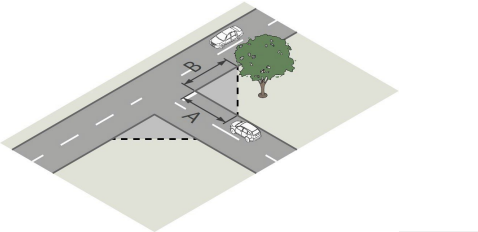
The clear visibility triangle shall be formed by extending a line from the edge of pavement or surface of two intersecting roadways to a point of intersection, measuring a prescribed distance from the point in both directions, and drawing a third line connecting the two points.
(3)
The distance from the intersection of the lines extended from the edge of pavement or surface of each street for the various road classifications are shown in Figure 5.02.02(B).
(4)
Where roads of different functional classifications intersect, the distances (A or B) for each street type as listed in Figure 5.02.02(B) shall be used.
Figure 5.02.02(A): Clear Visibility Triangle Vision
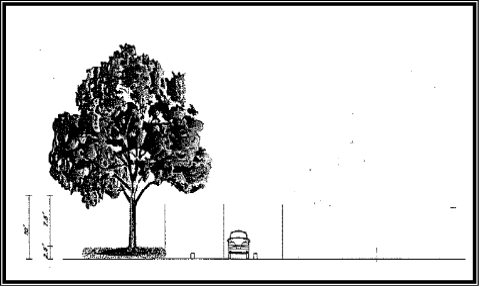
Figure 5.02.02(B): Clear Visibility Triangle Illustration and Table of Distances
(D)
Signage and Signalization. The developer shall provide and install all necessary roadway signs and traffic signalization as may be required by the County, based upon County or state traffic standards (Section 5.06.00). At least two street name signs shall be placed at each four-way street intersection, and one at each "T" intersection. Signs shall be installed under light standards and free of visual obstruction. The design of street name signs shall be consistent, of a style appropriate to the community, and of a uniform size and color.
5.03.01 - Functional Classification of Streets
The arrangement of streets shall provide an efficient and orderly hierarchy of streets in accordance with the following definitions of functional classifications:
(A)
Arterials. Arterials provide a through traffic function principally for intra-regional destinations. They connect to other arterials or collectors and they do not penetrate identifiable residential neighborhoods. Through traffic movement will always take precedence over access to private property. Use of frontage roads and consolidation of access is strongly promoted. Individual curb cuts are undesirable and the curb cuts that are permitted require a configuration that permits faster entry and exit speeds to and from the arterial. These may be further stratified into principal and minor arterials.
(B)
Collectors. Two types of collector streets are identified herein:
(1)
Major collectors generally emphasize through movement, but the trip lengths are shorter, providing for inter- and intra-city destinations. Major collectors provide connections to arterials and other collectors and collect traffic from local commercial streets and other commercial collectors. While there is access to individual businesses, they should not interfere with the through movement of traffic and consolidation of access is promoted.
(2)
Minor collectors generally provide for the collection of local residential traffic from neighborhoods and connect to other collectors or arterials. There is less emphasis on through movement of traffic and more emphasis on access to residential property; however, access and traffic considerations should be balanced so as not to create delays.
(C)
Local Streets. Two types of local streets are identified herein:
(1)
Local commercial streets are similar to residential collectors in that they have less emphasis on through traffic, but again the traffic and access considerations should be balanced. Local commercial streets provide access to abutting properties and connections to collector streets.
(2)
Local residential streets are strictly for access to individual residences and provide for connections from other local streets to collectors. There is no emphasis on through traffic movement and minor delays to traffic on local residential streets are acceptable. Local residential streets are typically internal subdivision streets.
5.03.02 - Other Criteria
(A)
Streets shall also be arranged in accordance with the following criteria.
(1)
Conform to the overall highway and street plan as may be determined applicable by Hardee County.
(2)
Be integrated with the street system of the surrounding area in a manner that is not detrimental to existing neighborhoods.
(3)
Use of local streets by through traffic is discouraged.
(B)
Facilitate and coordinate with the desirable future development of adjoining property of a similar character and provide for local circulation and convenient access to neighborhood facilities.
(C)
Subdivisions.
(1)
No half roads will be accepted along a boundary of a subdivision.
(2)
Where a proposed subdivision has no frontage on an existing county road, the subdivider must provide and dedicate to the County a suitable facility meeting County standards to connect the proposed subdivision to an existing county road.
5.03.03 - Minimum Standards for Right-of-Way Improvements
Streets abutting rights-of-way shall be designed as hereinafter specified. A minimum of one paved access on public rights-of-way shall be provided to connect to the existing network of paved streets. Improvements of existing streets to meet the following criteria may be required for this access. At the option of the Planning and Development Director, more than one paved access may be required.
5.03.04 - Design Specifications
Streets shall be classified based on the definitions described above, unless superseded by alternative criteria adopted by the Board of County Commissioners. Where the Board of County Commissioners has adopted a higher classification than the classification based on projected traffic volumes, the higher classification shall be used. All streets shall be designed in accordance with the "Manual of Uniform Minimum Standards for Design, Construction, and Maintenance for Streets and Highways", the Technical Standards Manual, and the following minimum specifications and improvements in accordance with this Code, except that greater requirements must be met when imposed by an agency having jurisdiction of a particular road.
5.03.05 - Cul-de-Sac
Cul-de-sacs shall be provided with a turnaround having an outside roadway diameter of at least 80 feet, and a street right-of-way diameter of at least 100 feet. Cul-de-sacs shall have a maximum length of 800 feet including the turnaround. On-street parking shall be prohibited in the turnaround area. "T" turnarounds may be permitted by the Director of Public Works.
Whenever an island is proposed in the center of a cul-de-sac turnaround, the pavement shall be 24 feet, exclusive of curbs.
5.03.06 - Continuation of Existing Street Pattern
A proposed street layout shall be coordinated with the street system of the surrounding area. Arterial and collector streets on a proposed site shall be connected to arterial and collector streets in adjacent areas where required to provide for proper traffic circulation.
5.03.07 - Street Access to Adjoining Property
Street stubs to adjoining areas shall be provided when required to give access to such areas or to provide for proper traffic circulation. Street stubs in excess of 250 feet shall be provided with a temporary cul-de-sac turnaround. This temporary cul-de-sac shall meet the requirements as specified in Subsection 5.03.05, above. The developer of the adjoining area shall pay the cost of restoring the street to its original design cross section and extending the street.
5.03.08 - Cross Access and Joint Access
(A)
If the connection spacing standards of this Section cannot be achieved, then joint use connections and/or cross access easements shall be required.
(B)
Applicants for all non-residential developments may be required to use cross access easements and joint use connections to connect adjacent properties to reduce curb cuts, to increase the area for parking and landscaping, and to preserve the capacity and safety of the roadway system.
(C)
Property owners utilizing joint and/or cross access shall record with the Hardee County Clerk of Court:
(1)
An easement allowing cross access to and from the adjacent properties;
(2)
A joint maintenance agreement defining maintenance responsibility of property owners that share the joint use connection and cross access system.
(D)
Property owners that provide for joint and cross access may be granted a temporary connection permit, where necessary, to provide reasonable access until such time as the joint use connection and cross access connections are provided with adjacent properties.
(E)
Within six months after construction of a joint use or cross access connection, property owners utilizing such access shall close and remove any existing temporary connections provided for access in the interim.
(F)
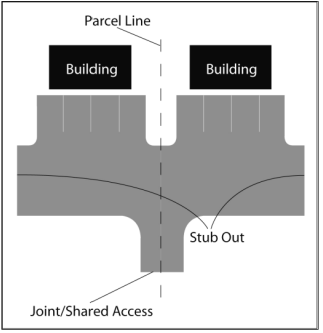
Development may be required to construct a paved stub-out to the property line in anticipation of a future cross access connection. (See Figure 5.03.08(A).
(G)
The design of the cross access corridor or joint connection including driveway apron shall conform to the Engineering Standards. The design shall ensure efficient and safe vehicular operation and pedestrian movements for internal traffic circulation and for traffic mobility on the adjacent roadway.
(H)
Cross access easements are not intended to be publicly maintained.
(I)
Properties that provide for joint use driveways under this Section shall be eligible for a reduction in the number of required off-street parking spaces of up to 15%, subject to review and approval of the Planning and Development Director.
Figure 5.03.08(A): Cross Access Stub-outs
5.03.09 - Intersection Design
Streets shall be laid out to intersect as nearly as possible at right angles; however, no street shall intersect any other street at less than 75 degrees. Multiple intersections involving the juncture of more than two streets shall be prohibited. Sight distances shall be provided to comply with the specifications contained in Section 5.02.02 (C) of this Code but, in all cases, the minimum sight distance of 200 feet from any intersection shall be maintained on the intersecting streets. This requirement shall not be construed to increase the minimum allowable intersection separation of local residential streets of 150 feet. The gradient within 100 feet of intersections should not exceed 3%.
5.03.10 - Intersection Separation
Intersections on streets or roads designated as arterials should not be less than 1,320 feet apart; intersections on streets or roads designated as collectors should not be less than 660 feet apart. All measurements shall be from centerline to centerline of intersections. On local streets, intersections with centerline offsets of less than 150 feet shall be prohibited.
5.03.11 - Dedication of Additional Right-of-Way
On any arterial or collector street within a minimum of 150 feet of its intersection with another arterial or collector street, or at any other location where provisions of this Article require additional right-of-way, the right-of-way shall be increased by at least 10 feet to permit proper design of auxiliary lanes and tapers. This additional right-of-way shall be dedicated or conveyed as a public right-of-way easement.
5.03.12 - Radii at Intersections
The minimum intersection radii of back of curb at all typical intersections approximating a right angle shall be as follows:
Table 5.03.12(A): Radii at Intersections
The Director of Public Works may require a greater radius than those established consistent with public safety. For example, where a local road is being accessed for use by large trucks and semi-tractor trailers, the Director of Public Works may require a larger radius to improve the safety of vehicles using the intersection.
A taper or deceleration lane may be required on roads with a functional classification of collector or higher, or on roads with design speeds 35 miles per hour or greater. Appropriate special radii shall be designed, subject to approval by the Director of Public Works, for other than right angle intersections.
SECTION 5.04.00 - STREET SPECIFICATIONS
For all new developments, and for existing platted subdivisions being developed with four lots (inclusive of the parent parcel) or more, except where specifically exempted in this Section, street improvements designed as above shall conform to functional classifications as set forth in this Section and, where a proposed development includes or abuts an existing full or half right-of-way, said street improvements shall also be improved as required by the following schedule:
5.04.01 - Street Schedule
(A)
Grading and centerline gradients shall be provided per plans approved by the Director of Public Works consistent with the Technical Standards Manual.
(B)
Arterial streets shall maintain a minimum right-of-way of 150 feet and shall be improved with two 24-foot pavements, with no inverted crowns, and a 20-foot median. The developer shall be required to install the second 24-foot pavement only in large developments where the projected average daily traffic generated on the arterial by such development exceeds 7,000. Phased improvements may be accepted by the County.
(C)
On divided two-lane roads (boulevards), the minimum right-of-way width shall be 100 feet and the pavement width for each lane shall be 14 feet, exclusive of curbs and gutters. On four-lane roads, minimum lane widths shall be 12 feet each, with provisions for left-turn storage, acceleration, deceleration, tapers, or channels as may be required by the Director of Public Works.
(D)
Major Collector streets shall be improved as follows:
Minimum right-of-way width: 80 feet.
Minimum pavement width: 24 feet.
(E)
Minor Collector streets shall be improved as follows:
Minimum right-of-way width: 60 feet.
Minimum pavement width: 22 feet.
(F)
Local streets shall be improved as follows:
Minimum right-of-way width: 60 feet.
Minimum pavement width: 20 feet.
The minimum right-of-way width of 60 feet may be reduced to 50 feet provided that curb and gutter drainage is constructed and an additional five-foot easement, located on each side of the right-of-way, is provided and reflected on the final plat.
(G)
Curbs and gutters, when provided, shall be as follows:
Standard curb and gutter or Miami curb.
(H)
Sub-grade shall be approved by the Director of Public Works as being suitable material prepared in accordance with the design standards established by this Code and the Technical Standards Manual.
(I)
Pavement base shall be improved as follows:
Arterials, collectors, and local streets: shell, limerock, or like material as approved by the Director of Public Works, meeting the design standards of this Code and the Technical Standards Manual.
(J)
Wearing surface shall be improved as follows:
(1)
Arterials and collectors. 1 1/2 inches of asphaltic concrete surface course.
(2)
Local streets. 1 1/2 inches of asphaltic concrete surface course or alternate as may be approved by the Director of Public Works based on conditions such as total street length, number of lots being accessed by the street or other consideration as may be approved by the Director of Public Works.
(K)
Sodding and maintenance of swales, parkway medians, percolation areas, and planting strips shall be in accordance with the standards established by this Code.
(L)
Street name signs with appropriate block numbers shall be installed at all intersections and all costs for these signs are to be paid by the developer.
(M)
Street lighting, where required, shall be installed by the developer. Lighting shall be installed as approved by the Director of Public Works in coordination with the local utilities. All utilities shall be installed underground. See Section 5.10.00.
(N)
Intersection improvements and traffic control devices such as acceleration, deceleration, and turning lanes, signalization devices, and other traffic control devices shall be installed by the developer within the project area and on abutting streets and highways in accordance with the Manual for Uniform Control Devices as directed by the Director of Public Works, who will provide specifications on required materials.
(O)
For two years from issuance of the Certificate of Completion, the developer shall be responsible for the maintenance of all facilities in public rights-of-way and easements.
5.04.02 - Street Schedule—Existing Unpaved Public Streets
The provisions of this Section shall apply solely to streets with a local functional classification. For existing, active unpaved local streets within the County, street improvements shall conform to the following schedule:
(A)
Streets shall be improved as follows:
Minimum right-of-way shall be determined by the Director of Public Works; however, in no instance shall the right-of-way be less than 50 feet. Existing unpaved streets with less than 50 feet right-of-way shall not be identified by the County for improvement. Travel width shall be determined by the Director of Public Works but in no event shall be less than 18 feet.
5.04.03 - Street Schedule Platted Unopened Streets
Unopened platted, local streets, excepting new development and existing platted subdivisions being developed with four lots or more, may be improved and accepted by the County for maintenance under the following provisions.
(A)
Any request for approval of an alternate street standard pursuant to this Section shall be in an existing, platted subdivision recorded in the Public Records of Hardee County. New subdivisions, or land not platted within a recorded subdivision, or land recorded in a subdivision without platted public rights-of-way, shall not be eligible for consideration.
(B)
Any request for approval of an alternate standard street shall be limited solely to streets classified as local streets. Streets classified as collector or higher shall not be eligible for consideration.
(C)
Any request for approval of an alternate standard street must be a function of an extension of a street currently maintained by the County. No new street, in and of itself, would be eligible for consideration.
(D)
The level of improvement shall be approved by the Director of Public Works; however, at minimum the Director of Public Works shall require the following.
(1)
The right-of-way as identified on the plat shall not be reduced, and all work shall occur within the right-of-way.
(2)
The street shall be constructed with an appropriate sub-base and base surface to permit vehicle support and access, specifically emergency vehicles, in all usual weather conditions.
(3)
The street shall be so designed and constructed to direct stormwater off the street and into, at a minimum, swale drainage on each side of the street to prevent water accumulation on the street and flooding of properties.
(4)
The travel surface of the street shall be a minimum of 18 feet in width and be of an appropriate material which will minimize washing out and support emergency vehicles.
(E)
The length of the proposed alternate standard street shall not exceed 500 feet, nor shall the proposed alternate standard street access more than four developable lots/parcels meeting minimum zoning standards of the district in with the parcels are located.
(1)
Such extension and construction of an alternate standards street as set forth above shall be considered only once for the subdivision where the alternate street standard is being proposed. Additional extensions of the alternate street standard shall be prohibited.
Applicants proposing the extension of an alternate standard street shall coordinate with the Hardee County Public Works division to establish the parameters of the alternate street design. Once established, the applicant shall prepare a cross-section plan of the street identifying the limits of the right-of-way, limits of drainage, sub-base area and material type, base area and material type with dimensions of drainage, sub-base and base limits and submit six copies, along with a completed application and application fee to the Planning and Development division for processing and distribution. Upon approval of the alternate street plan the applicant shall be authorized to begin construction and shall request staged inspections as follows: at completion of sub-base; at completion of base and drainage. Where required by the Public Works Director, stabilization in the form of sod or approved alternate shall be installed to minimize erosion. Upon completion and final inspection/approval by the Director of Public Works, the Board of County Commissioners shall consider an ordinance accepting the street for maintenance.
Where applicable, and when it may be required by the Director of Public Works and the County Manager, the provisions of Section 5.03.02 shall apply to this Section.
In the case of existing platted subdivisions being developed with four lots or more the Board of County Commissioners may approve a level of street improvement consistent with the prevailing level of improvement and as provided for above.
SECTION 5.05.00 - ADDITIONAL RIGHT-OF-WAY AND/OR PAVEMENT WIDTH
Additional right-of-way and/or pavement width may be required by the Director of Public Works at his/her discretion to promote public safety and convenience or to ensure adequate access, circulation, and parking. Whenever any street shows need for improvement within the area to be developed, the appropriate right-of-way and pavement shall be required. Where a development abuts or contains an existing street of inadequate right-of-way or pavement width, additional right-of-way and pavement in conformance with the minimum standards of this Code shall be required to be dedicated.
Half streets and substandard rights-of-way and pavement widths shall be prohibited. Where a previously dedicated incomplete street, improved or unimproved, abuts or is within a tract to be developed, the remainder of the right-of-way shall be dedicated and the full street improved according to County standards.
Right-of-way requirements shall be based upon a 20-year planning period, according to the official County transportation plan as may be adopted. All rights-of-way shall be transferred to the County by means of a recorded deed, or by dedication to and official acceptance by the Board of County Commissioners.
5.05.01 - Private Road Acceptance for County Maintenance and Operation
All private roads to be accepted by Hardee County for County maintenance and operation must meet the following.
(A)
Petitioner(s) must submit a written request to the Board of County Commissioners; which request must contain the following.
(1)
A field survey defining the boundaries of the road and a map of the survey including description provided by a registered land surveyor.
(2)
A statement that certifies that Hardee County will be provided right-of-way sufficient to meet the minimum standards as called for in Florida Administrative Code 14-15.002.
(3)
A statement that certifies all fences, buildings, other structures, trees or physical barriers of any type shall be removed from the right-of-way at the expense of the Petitioner(s) prior to the Board of County Commissioners accepting the road.
(4)
A statement that certifies all necessary drainage improvements, including structures, pipe, ditches, and easements shall be installed by the Petitioner(s) in accordance to plans and specifications prepared by a registered professional engineer and as approved by appropriate State agencies, Southwest Florida Water Management District (SWFWMD) and Hardee County and/or as directed by the Consultant Engineer to Hardee County, or staff.
(5)
A statement that certifies the road does or the road does not meet the minimum standards for design, construction and operation for streets and highways used by the public and consistent with Florida Administrative Code 14-15.002; the Petitioner(s) will make all necessary improvements to the road so that it meets minimum standards.
(B)
The road shall be of benefit to the general public and provide access to an average of one dwelling unit per 450 feet of frontage.
(C)
The road shall intersect or be an extension of an existing County- or State-maintained Road.
(D)
The road shall be paved and must meet the minimum standards for design, construction, and operation for streets and highways used by the general public and consistent with Florida Administrative Code 14-15.002. If improvements to the road and drainage system are required to be made in order to meet minimum standards, all such costs of improvements shall be the responsibility of the Petitioner(s), and all such improvements shall be completed before the Board of County Commissioners of Hardee County, Florida will accept the road.
(E)
The Petitioner(s) shall have the right to appear before the Board of County Commissioners of Hardee County, Florida and request waiver of strict adherence to portions of the criteria above-cited. The Board of County Commissioners of Hardee County, Florida will make the final determination if criteria above-cited causes an undue hardship or results in unfair or unnecessary harsh treatment to the Petitioner(s).
5.06.01 - Street Names
New street names shall not duplicate or closely approximate phonetically, in spelling or by use of alternative suffixes, such as "lane," "way," "drive," "court," "avenue," or "street," the names of existing streets. All proposed new street names shall be submitted to the Sheriff's 911 Office for approval.
5.06.02 - Street Signage
The developer shall be responsible for providing and installing street signage within the development. Said signage shall include, but not be limited to, street name signs, traffic control signs, traffic information signs, etc.
In developments where improvements are dedicated to the County a payment to the County in lieu of providing and installing signage may be approved, provided that such payment equals the cost of the signage and installation. This provision shall not apply to privately owned development projects.
SECTION 5.07.00 - SIDEWALKS
(A)
All developments having lots primarily facing Arterial or Collector roads shall provide concrete pedestrian ways on the right-of-way of these roads. If existing right-of-way is insufficient, additional right-of-way must be provided for pedestrian way construction.
(B)
Design and Construction Standards. Design and construction of sidewalks and other footpaths shall conform to all applicable engineering requirements adopted by Hardee County, including provisions for access by physically handicapped persons.
(1)
New subdivisions abutting Principal and Minor Arterials and Major Rural Collectors shall provide sidewalks adjacent to such roadways. The location of sidewalks shall be consistent with planned roadway improvements. Sidewalk construction shall be exempt in F-R and A-1 zoning districts. Developments of one acre or more in the R-05, R-1, R-2, R-3, R-2.5, and PUD overlay zoning districts may request the sidewalk requirements to be paid in lieu of construction. The Board of County Commissioners may at the time of Subdivision Plat approval, approve payment in lieu of construction. The fee shall be based on calculated costs of construction and approved by the Director of Public Works prior to Board action.
(2)
Sidewalks shall be provided on both sides of all residential streets where the average lot width at the street is less than 150 feet, except as otherwise exempted.
(3)
Where a proposed development includes improvements or new construction of Collector or Arterial facilities, facility designs shall include provision for sidewalks and footpaths within the right-of-way.
(4)
Residential developments adjacent to or in the immediate vicinity of commercial, office, service, schools, or recreation activities shall provide pedestrian and bicycle access from the development to the activity center.
(5)
Sidewalks shall be of concrete construction, a minimum of five feet in width and four inches in thickness.
(6)
Pedestrian-ways or crosswalks consistent with Section 5.01.04(A)(3).
SECTION 5.08.00 - ACCESS POINTS ONTO STREETS
All proposed development shall meet the following standards for vehicular access and circulation.
(A)
Number of Access Points.
(1)
The maximum number of points of access permitted onto any one road shall be as shown in Table 5.08.00(A).
Table 5.08.00(A): Number of Access Points
(2)
For commercial, residential, and public institutional development accessing a private or County maintained road, each access point shall have a minimum width of 20 feet at the property line with appropriate turning radius, and a maximum width of 30 feet with appropriate turning radius to property line from the road. For industrial development accessing a private or County maintained road, each access point shall have a minimum width of 30 feet at the property line with appropriate turning radius, and a maximum width of 50 feet with appropriate turning radius to property line from the road.
(3)
In lieu of any two openings onto any one road, there may be permitted a single point of access of up to a maximum width of 48 feet. When this alternative is elected there shall be a permanent median at the center of the opening.
(4)
Adjacent uses may share a common driveway provided that appropriate access easements are granted between or among the property owners.
(B)
Separation of Access Points.
(1)
There shall be a minimum setback of 12 feet from the edge of a driveway and the nearest side property line except in the case of a shared access easement.
(2)
No point of access shall be allowed within 40 feet of the intersection of the right-of-way lines of any public road.
(C)
Access to Residential Lots. No residential lot having a width less than 125 feet shall abut a Principal or Minor Arterial without also directly abutting a Local or Rural Major Collector.
5.09.01 - Applicability
(A)
This Section shall apply to all new construction requiring off-street parking, and existing nonconforming parking facilities if on-site renovation, construction, or repair exceeds 50% of the assessed value of the property.
(B)
There shall be provided, at the time of the erection of any main building or structure or at the time any main building or structure is enlarged or increased in capacity by adding dwelling units, guest rooms, floor area or seats, minimum off-street automobile parking space with adequate provisions for access in accordance with the following requirements. The Planning and Zoning Board may modify, upon submission of a study by the developer, parking space requirements. Sufficient parking space, as set forth in the requirements of this Code shall be in place before a Certificate of Occupancy is issued.
(C)
As to all other uses, the Planning and Zoning Board shall determine the off-street parking facilities that will be required, according to circumstances surrounding a particular activity.
5.09.02 - Off-Street Parking
(A)
Number of Required Spaces. In all districts, off-street parking shall be provided as set forth in the following table and as may be modified by the provisions following the table or as conditioned in a Special Exception or Planned Unit Development. The maximum permitted off-street parking is 10% the amount permitted in Table 5.09.02 (A).
Table 5.09.02(A): Minimum Required Off-Street Parking Spaces
2 Square Feet, Gross Leasable Area (SFGLA) is the floor area of a building, less administrative, public, and similar areas.
3 ACLF/Nursing Home Facility shall provide at least two off-street parking spaces, plus one additional space for each 200 s.f. of floor area devoted to medical or therapeutic treatment activities, plus one space for each five residents, excluding staff and immediate family members.
4 Flea Market: Flea markets must provide: 1) parking for the vendors; 2) parking for the customers; and 3) parking cannot be in the public right-of-way.
(B)
Special Parking Restrictions in R-0.5, R-1, R-2, and R-3 Districts.
(1)
Parking of Heavy Trucks, Commercial Motor Vehicles, Trailers, Semitrailers. Within the R-0.5, R-1, R-2, and R-3 zoning districts, heavy trucks, commercial motor vehicles, trailers or semitrailers for non-recreational use shall be parked for storage purposes, including overnight, within a completely enclosed garage. No such heavy trucks, commercial motor vehicles, trailers or semitrailers shall be parked on a public right-of-way. This Subsection shall also apply to empty trailers designed to carry commercial boats or other vehicles.
(2)
Storage of Boats and Recreational Vehicles. Within said districts, recreational vehicles (including collapsible camping trailers), and boats on trailers may be parked for storage purposes only within the side yard area not less than five feet from the side property line, and within the rear yard area not less than five feet from the rear property line. No recreational vehicle or boat may be parked between any public street and the living areas of the principal building, except on a driveway.
(3)
Parking of Recreational Vehicles.
(a)
No recreational vehicle may be parked between any public street and the living areas of the principal building, except on a drive-way, and then only for a period not to exceed two weeks.
(b)
A self-contained recreational vehicle owned by a visitor or owned by the owner of the residential property on which a dwelling is located may be used temporarily by a visitor for a period not to exceed a total of two weeks in any one calendar year. The owner of a residential property may, submit a written petition to the County Manager/designee for one extension not to exceed two additional weeks; said request for extension must be made to the County Manager or his/her designee at least three business days prior to the expiration of the two weeks.
(c)
Parked recreational vehicles are prohibited as living quarters except within a delineated RV park.
(4)
Parking Restrictions in RE-2.5, F-R, A-1, and A-2 Districts.
(a)
No loading of agricultural products may take place in the public right-of-way.
(b)
Recreational vehicles, including collapsible camping trailers, and boats on trailers may be parked for storage purposes only within the side yard area not less than five feet from the side property line, within the rear yard area not less than five feet from the rear property line, or in the front yard meeting the required front yard setback.
5.09.03 - Handicapped Parking
Parking spaces designated for physically handicapped people and accessible passenger loading zones that serve a particular building shall be located on the shortest possible accessible circulation route to an accessible entrance of the building. In separate parking structures or lots that do not serve a particular building, parking spaces for physically handicapped people shall be located on the shortest possible circulation route to an accessible pedestrian entrance of the parking facility.
5.09.03.01 Handicapped Parking Spaces
Any property owner offering parking for the general public shall provide specially designed and marked parking spaces for the exclusive use of physically disabled persons who have been issued parking permits pursuant to Florida Statutes and the Florida Accessibility Code.
(A)
Diagonal or perpendicular parking spaces shall be a minimum of 12 feet wide measured from center to center of the blue demarcation lines. Parallel parking spaces shall be located either at the beginning or end of a block or adjacent to alley entrances. Curbs adjacent to such spaces shall be of a height which will not interfere with the opening and closing of motor vehicle doors.
(B)
Each parking space shall be conspicuously outlined in blue paint, and shall be posted and maintained with a permanent, above-grade sign bearing the international symbol of accessibility or the caption "PARKING BY DISABLED PERMIT ONLY," or bearing both sign and symbol. The signs shall not be obscured by a vehicle parked in the space. All handicapped parking spaces must be signed and marked in accordance with the standards adopted by the U.S. Department of Transportation.
(C)
All spaces shall have an adjacent access aisle 60 inches wide minimum. Parking access aisles shall be part of the accessible route to the building or facility entrance. Two accessible parking spaces shall share a common access aisle. Parked vehicle overhangs shall not reduce the clear width of an accessible circulation route.
(D)
All spaces shall provide accessibility to a curb-ramp or curb-cut, when necessary, to allow access to the building or use served, and shall be located so that users will not be compelled to wheel behind parked vehicles.
(E)
The minimum number of such parking spaces shall comply with the following schedule:
Table 5.09.03.01 (A) Required Number of Handicapped Accessible Parking Spaces
(F)
Passenger Loading Zones. Passenger loading zones shall provide an access aisle at least 60 inches wide and 20 feet long adjacent and parallel to the vehicle pull-up space. If there are curbs between the access aisle and the vehicle pull-up space, then a curb ramp shall be provided. A minimum vertical clearance of 108 inches shall be provided at accessible passenger loading zones and along vehicle access routes to the area from site entrances.
(G)
Curb Ramps.
(1)
Curb ramps complying with Section 4.7, Curb Ramps, of the current edition of the Florida Accessibility Code for Building Construction shall be provided whenever an accessible route crosses a curb. Ramps or curb cuts from parking areas that are privately owned, to the walkway level, shall be provided and if more than one is provided, shall be spaced along such walkways at intervals of no more than 100 feet and such ramps or curb cuts shall be located as close as practical to main entrances and exits to buildings. All requirements contained herein for curb cuts pertain only to such features when located on privately owned property.
(2)
Slope. Slopes of curb ramps shall comply with the Section 4.8.2, Slope and Rise, of the current edition of the Florida Accessibility Code for Building Construction. The slope shall be measured as shown in the figure. Maximum counter slope of adjoining gutters and road surfaces immediately adjacent to the curb ramp or accessible route shall not exceed a ratio of 1 to 20. Curb cuts used in lieu of ramps shall have a maximum rise of eight inches.
(3)
Width. The minimum width of a curb ramp shall be 44 inches, exclusive of flared sides.
(4)
Surface. Surfaces of curb ramps shall comply with Section 4.5, Ground and Floor Surfaces, of the current edition of the Florida Accessibility Code for Building Construction.
5.09.04 - Location of Parking Spaces
Parking spaces required by this Section shall be located as follows:
(A)
Parking spaces required in this Section shall in no part exist upon, and no portion of any vehicle shall over-hang, the right-of-way of any public road, street, alley, or walkway. There shall be no off-street parking in the front yards of single-family residences, except as normally exists in driveways.
(B)
Parking spaces for all other structures shall be located within the same development site as the main building.
(C)
Satellite parking facilities may be utilized with approval of the Planning and Development Director.
(1)
All required ADA accessible parking spaces must be located on the same development site as the main building.
(2)
Satellite parking facilities must be within a quarter mile (1,320 feet) linear walkable route to the primary entrance of the use served and are located within the same or more intense zoning district as the principal use served.
(3)
If the property is not owned by the applicant, the applicant shall provide adequate documentation to verify permission to utilize a satellite parking location.
(4)
The site will maintain the buffering requirements as outlined in Section 5.13.07.04.
(D)
Parking requirements for two or more uses, of the same or different types, may be provided by the establishment of the required number of spaces for each use in a common parking area.
5.09.05 - Required Parking Lot Improvements
Any off-street parking lot serving any use other than dwellings of four units per building or less shall meet the following requirements for off-street parking lot improvements.
(A)
Buffer and Canopy. The parking area will be buffered and canopy provided pursuant to Sections 5.13.06 and 5.13.07.
(B)
Surfacing.
(1)
For all retail sales and services, business services, and professional services serving the general public and having access to and abutting a paved street, the off-street parking area shall be provided with a hard surface of all-weather pavement, of asphalt or concrete, except where a permeable surface is approved, and shall be so graded and drained as to provide for the adequate runoff and disposal of surface water, and shall be constructed in accordance with standards of the County Engineer.
(2)
For public and private schools offering academic courses, places of worship, and other large non-commercial areas of public assembly, general overflow parking involving only occasional use, which shall be considered not in excess of an average of three times per week, may consist of grass or paver parking.
(C)
Lighting. Where lighting facilities are provided for the parking area, they shall be designed and installed to direct the light away from any contiguous residential property.
(D)
All automobile and truck parking, loading, and unloading spaces and access thereto shall be surfaced in a stable manner.
5.09.06 - Bicycle Parking
(A)
General.
(1)
Each required bike parking space shall be at least two feet by six feet. Where a bike can be locked on both sides of a bike rack without conflict, each side may be counted as a required space.
(2)
Bike racks shall be securely anchored, usable with both U-locks and cable locks, and support a bike at two points of contact to prevent damage to the bike wheels and frame.
(3)
No fee may be charged for bike parking where free automobile parking is provided.
(4)
Bike parking shall be provided in a well-lit area.
(5)
Bike parking shall be located adjacent to pedestrian areas but shall not block or interfere with pedestrian movements.
(6)
Be located to prevent damage to bicycles by cars.
(7)
Be located so as not to interfere with pedestrian movements.
(B)
Calculations. Bicycle parking spaces shall be provided as identified in Table 5.09.06 (A), or fraction thereof.
Table 5.09.06 (A) Required Bicycle Parking Spaces
5.09.07 - Off-Street Loading Requirements
No motor vehicle shall be allowed to extend onto a public street, sidewalk, or alley while loading or unloading. Off-street loading spaces shall be provided in accordance with the following standards.
(A)
All manufacturing, industrial, warehouses and similar establishments customarily receiving and distributing goods by motor vehicle shall provide loading and unloading facilities on the premises. The minimum number of spaces shall be determined according to the following floor area schedule:
Table 5.09.07 (A): Minimum Loading Berths for Manufacturing, Industrial, Warehouses
(B)
Retail operations, wholesale operations and industrial operations, with a gross floor area of less than 10,000 square feet shall provide sufficient space for loading and unloading operations in order that the free movement of vehicles and pedestrians over a sidewalk, street or alley shall not be impaired.
(C)
Table 5.09.07(B) includes the minimum loading spaces for Retail and service operations over 10,000 square feet.
Table 5.09.07 (B): Minimum Loading Berths for Retail and Service Operations over 10,000 SF
(D)
Every off-street loading and unloading space shall have a direct access to a public street or alley, and shall have the following minimum dimensions.
(1)
Length: 55 feet.
(2)
Width: 12 feet.
(3)
Height: 14 feet.
(E)
Manufactured home and recreational vehicle sales establishments shall provide adequate space off the public right-of-way for the maneuvering of manufactured homes and recreational vehicles into position on the property without blocking traffic on the abutting street or road.
5.09.08 - Design Standards for Off-Street Parking and Loading Areas
(A)
Location. All required off-street parking spaces shall be located on the same parcel as the use they are intended to serve. Parking spaces required for residential uses shall be located no further than the following distances from the units they serve:
Resident parking: 200 feet
Visitor parking: 250 feet
Distances shall be measured from a dwelling unit's entry to the parking space. Where a stairway or elevator provides access to dwelling units, the stairway or elevator shall be considered to be the entrance to the dwelling unit. For purposes of measuring these distances, each required parking space shall be assigned to a specific unit on the development plan, whether or not the developer will actually assign spaces for the exclusive use of the specific unit.
(B)
Size.
(1)
Standard and compact parking spaces shall be sized according to Table A as follows.
(2)
Parallel parking spaces shall be a minimum of eight feet wide and 22 feet long. If a parallel space abuts no more than one other parallel space, and adequate access room is available, then the length may be reduced to 20 feet.
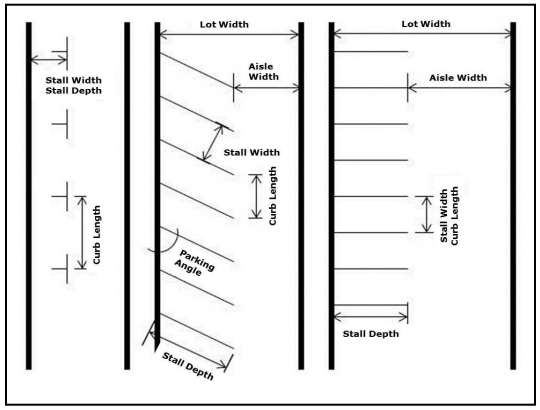
Table 5.09.08 (A): Parking Space Design Requirements
A = Parking Angle
B = Stall Width
C = Stall Depth
D = Aisle Width
E = Curb Length Per Car
F = Lot Width
Figure 5.09.08 (B)
Parking Space Illustration
(3)
Tandem parking spaces must be a minimum of nine feet wide and 20 feet long.
(4)
A standard motorcycle parking space shall be 4 1/4 feet wide and 9 1/4 feet long.
(5)
The minimum off-street loading space is addressed in Section 5.09.07.
(6)
The Board of County Commissioners may modify these requirements where necessary to promote a substantial public interest relating to environmental protection, heritage conservation, aesthetics, tree protection, or drainage. The requirements may also be amended administratively as described in Section 11.05.00. The County Engineer shall certify that the modification does not create a serious hazard or inconvenience, and the Board of County Commissioners shall submit a written statement of the public interest served by allowing the modification.
(C)
Layout.
(1)
Pedestrian circulation facilities, roadways, driveways, and off-street parking and loading areas shall be designed to be safe and convenient.
(2)
Parking and loading areas, aisles, pedestrian walks, landscaping, and open space shall be designed as integral parts of an overall development plan and shall be properly related to existing and proposed buildings.
(3)
Buildings, parking and loading areas, landscaping and open spaces shall be designed so that pedestrians moving from parking areas to buildings and between buildings are not unreasonably exposed to vehicular traffic.
(4)
Landscaped, paved, and gradually inclined or flat pedestrian walks shall be provided along the lines of the most intense use, particularly from building entrances to streets, parking areas, and adjacent buildings. Pedestrian walks should be designed to discourage incursions into landscaped areas except at designated crossings.
(5)
Each off-street parking space shall open directly onto an aisle or driveway that, except for single-family and two-family residences, is not a public street.
(6)
Aisles and driveways shall not be used for parking vehicles, except that the driveway of a single-family or two-family residence shall be counted as a parking space for the dwelling unit, or as a number of parking spaces as determined by the Planning and Development Director based on the size and accessibility of the driveway.
(7)
The design shall be based on a definite and logical system of drive lanes to serve the parking and loading spaces. A physical separation or barrier, such as vertical curbs, may be required to separate parking spaces from travel lanes.
(8)
Parking spaces for all uses, except single-family and two-family residences, shall be designed to permit entry and exit without moving any other motor vehicle.
(9)
No parking space shall be located to block access by emergency vehicles.
5.10.01 - Requirements for All Developments
Utility easement of 10 feet will be accepted as a minimum if adjacent to a public street. Utility easements shall not be less than 15 feet wide or 7.5 feet on each side of a lot. The following basic utilities are required for all developments subject to the criteria listed herein:
(A)
Water and Sewer. Every principal use and every lot within a newly platted subdivision shall have central potable water and wastewater hookup whenever required by the Comprehensive Plan and where the topography permits the connection to a public water or sewer line by running a connecting line no more than 200 feet from the lot to such line.
(1)
All new water lines shall be PVC or ductile iron pipe.
(2)
All PVC pipe shall meet the requirements for minimum 150 psi pressure rating, American Water Works Association (AWWA) C-900 or C-905 pipe, as applicable, and shall be laid with 14-gauge copper trace wire.
(3)
Installation shall be in accordance with County standards.
(4)
All fittings shall be mechanical joint, short-body ductile iron.
(5)
All valves shall be gate valves with all valves larger than 3" being of the resilient wedge type. All valves shall meet applicable AWWA standards.
(B)
Stormwater and Drainage. Where a lot is traversed by a watercourse, drainage way, channel or stream, there shall be provided a stormwater easement or drainage right-of-way conforming substantially with the lines of such watercourse and width adequate for its purpose, access, and maintenance. Parallel streets or parkways may be required in connection therein.
(C)
Septic Tanks. Where septic tanks are permitted, each individual single-family residence shall have its own septic tank. No septic tank system, including drain field, may be located less than five feet from any property line. Any system shall comply with and be permitted by the Florida Department of Health.
(D)
Fire Hydrants. All developments served by a central water system shall include a system of fire hydrants consistent with design standards adopted by Hardee County and approved by the Hardee County Fire Department as set forth in the Hardee County Fire Prevention Ordinance.
(E)
Electricity, Communication, and Cable Television. Every principal use and every lot within a subdivision shall have available to it a source of electric power, telephone, and cable television adequate to accommodate the reasonable needs of such use and every lot within such subdivision, and shall be placed underground, except as follows:
(1)
Equipment appurtenant to underground facilities, such as surface mounted transformers, pedestal mounted terminal boxes, and meter cabinets.
(2)
Emergency Back-up Generators shall be required for all new multi-family buildings containing four or more units, apartment complexes, commercial, retail, stand-only offices, office parks, public/institutional, manufacturing/warehousing, mixed-use and industrial buildings.
(3)
Emergency Back-up Generators shall be required for all new residential and non-residential subdivision developments for lift stations, street lighting, other utilities, and community/common area structures, such as a Clubhouse, laundry facilities or other similar type amenities.
(4)
Poles supporting only street lights.
(F)
Telephone. Every principal use and every lot within a subdivision shall have available to it a telephone service cable adequate to accommodate the reasonable needs of such use and every lot within such subdivision.
(G)
Illumination. All streets, driveways, sidewalks, bikeways, parking lots and other common areas and facilities in developments shall provide illumination meeting design standards adopted by Hardee County.
(1)
Each new subdivision or development, with public or private streets, shall have a minimum of one street light at the entrance, one at each street intersection and a minimum of one street light along the streets with a maximum spacing of 400 feet.
(2)
All street lights shall be installed on poles with a high-pressure sodium fixture with a minimum of 70-watt lamp. Lighting fixtures meeting International Dark Shy program requirements are preferred. The applicant may submit plans for light standards with concrete poles, which shall be approved by the Planning and Development Director.
(3)
All private developments planned and operated as a single entity, such as multiple family developments, apartments, condominiums, commercial, industrial, or any other private land developments, shall be required to provide street lighting adequate for the safety and wellbeing of the occupants. The amount and number of street lights shall be determined by the County Engineer/Consultant and approved by the Planning and Development Director.
(4)
As a condition of plat approval of a residential development in an R-0.5, R-1, R-2, R-3, or Planned Unit Development (PUD) zoning district, and commercial or industrial development where the streets and rights-of-way are dedicated to the public, the developer shall provide for the installation, operation, and maintenance of street lights. Said provisions of street lighting shall be implemented through the creation of a nonprofit property owners' association under Chapter 617, Florida Statutes or a community development district under Chapter 190, Florida Statutes. Said property owners' association shall meet the requirements set forth in paragraph (a) below:
(a)
Each property owners' association established pursuant to this Section shall meet the following criteria, as a general condition of final acceptance and plat approval for any portion of the project.
1.
The property owners' association shall be properly incorporated under Chapter 617, Florida Statutes and the articles of incorporation shall be filed with the secretary of state or established under a community development district under Chapter 190, Florida Statutes.
2.
Membership in the property owners' association shall be mandatory for each property owner within the project. Such membership shall be established in a declaration of restrictive covenants or other instrument prepared by the applicant, recorded in the public records of Hardee County, Florida, and binding upon each parcel of land located within the project and each owner thereof, its heirs, successors, and assigns. Such restriction shall be deemed a covenant running with the land, and shall be clearly stated therein.
3.
The property owners' association shall have the right to collect an assessment from each unit owner's pro rata share assessment of the cost of installing, maintaining, operating, repairing or replacing said street lights. All such assessments shall constitute a lien against the property of the unit owner, which lien shall be subject to foreclosure in accordance with state law.
(b)
The applicant shall enter into an agreement with the utility as may provide electric service to the project, for the installation, operation and maintenance of street lights as prescribed by the County. The form and content of such agreement shall be acceptable to the County. Said agreement shall set forth the installation costs of said street lights, the operating charges, and the provisions for adjustments in the operating charges. The developer shall pre-pay said installation costs, if any. The developer's agreement shall reference the declaration of covenants and restrictions, or other instrument recorded by the applicant.
(c)
The applicant shall submit to the County a copy of the agreement with the utility company; a copy of the declaration or restriction or other instrument as referenced in paragraphs (1)(a), (b), and (c); a copy of the articles and bylaws of the property owners' association and such other documents or information as the County shall request.
(d)
In the event no property owners' association is created, as a condition of final inspection, or issuance of a Certificate of Occupancy for any portion of a residential, commercial, or industrial development, whether approved by issuance of a single permit, a final site plan or a final plat, the applicant shall be required to pay to the County an amount of money that will produce the required monthly charge on an annual basis for all street lighting facilities being installed or constructed as a result of such development activity if invested at the then current interest rate applicable to final judgment in the circuit court as set by Florida Statutes. If for any reason no such interest rate has been established in the Florida Statutes, the said interest rate shall be 8%. An appropriate sum of money shall be required for each lighting pole or other lighting facility to offset the cost of any pole rental charges, annual power consumption charges or any other user charges established by the electric utility supplying the same, as such charges are then in effect. Upon such payment, the applicant shall have met the requirements for the installation of street lights or other illumination devices for the project.
(e)
The County shall maintain such fees in a trust account, and the interest or other returns thereon shall be used solely for the payment of the County's street lighting facilities charges assessed by the appropriate utility or other provider. These trust funds may be invested by the County in accordance with law and shall be used only for the purposes expressed therein.
5.10.02 - Design Standards
(A)
Compliance with Technical Construction Standards. All utilities required by this Article shall meet or exceed minimum standards adopted by Hardee County.
(B)
Placement of Utilities Underground. All subdivision residential lots of one acre or more are exempted from the following regulations.
(1)
All electric, telephone, cable television, and other communication lines (exclusive for transformers or enclosures containing electrical equipment, including but not limited to switches, meters, or capacitors that may be pad mounted and exceed three feet square), and gas distribution lines shall be placed underground within easements or dedicated public rights-of-way, installed in accordance with the County's adopted design standards.
(2)
Lots abutting existing easements or public rights-of-way where overhead electric, telephone, or cable television distribution supply lines and service connections have previously been installed may be supplied with such services from the utility's overhead facilities, provided the service connection to the site or lot is placed underground in accordance with the provisions of Hardee County Public Works Department, Technical Standards Manual.
(C)
Screening of Above Ground Utility Apparatus. Screening of any utility apparatus placed above ground with a footprint of three-square feet or more shall be buffered with a Figure "C" buffer yard, where it abuts a residential lot. Buffer yards are outlined in Section 5.13.07.
(D)
Screening of Service, Utility, Display, and Storage Areas.
(1)
Utilities for all new commercial developments shall be located underground. Utility boxes must be totally screened from view of principal streets, as well as pedestrian walkways and areas.
(2)
Loading areas or docks (See Figure 5.10.02(A)), outdoor storage, waste disposal, mechanical equipment (See Figure 6.03.01(B)), satellite dishes, truck parking, and other service support equipment shall be located behind the building line and shall be fully screened from the view of adjacent properties both at ground and roof top levels.
(3)
The display area of an automobile sales outlet shall not dominate the site frontage. Cars shall not be raised above the landscaping along the front yard.
(4)
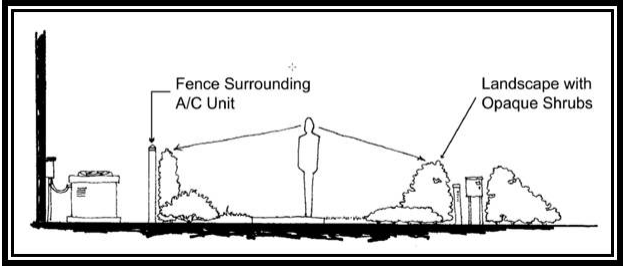
Refuse containers, air conditioners and similar elements shall be screened from view.
Figure 5.10.02(A)
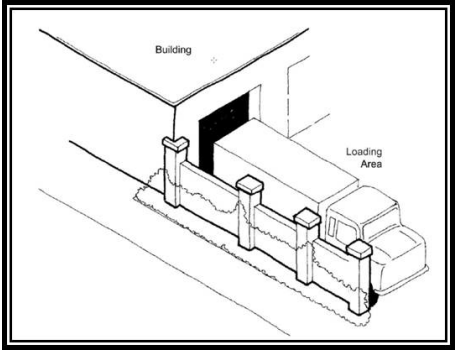
Figure 5.10.02(B)
5.10.03 - Utility Easements
When an applicant installs or causes the installation of water, sewer, electrical power, telephone, or cable television facilities and intends that such facilities shall be owned, operated, or maintained by a public utility or any entity other than the applicant, the applicant shall transfer to such utility or entity the necessary ownership or easement rights to enable the utility or entity to operate and maintain such facilities in accordance with the provisions of Hardee County Public Works Department, Technical Standards Manual.
SECTION 5.11.00 - STORMWATER MANAGEMENT
Treatment of stormwater runoff shall be required for all development, redevelopment, and when expansion occurs, existing developed areas. The stormwater treatment system or systems can be project specific or serve sub-areas within the County. The design and performance of all stormwater management systems shall comply with applicable state regulations and the rules of the Southwest Florida Water Management District (SWFWMD). Stormwater discharge facilities shall be designed so as to not lower the receiving water quality or degrade the receiving water body below the minimum conditions necessary to maintain their classifications as established in state regulations. Steps to control erosion and sedimentation shall be taken for all development.
5.11.01 - Stormwater Management Requirements
(A)
Performance Standards. All development must be designed, constructed, and maintained to meet the following performance standards and the Hardee County Technical Standards Manual, whichever is more restrictive:
(1)
While development activity is underway and after it is completed, the characteristics of stormwater runoff shall approximate the rate, volume, quality, and timing of stormwater runoff that occurred under the site's natural unimproved or existing state, except that the first one inch of stormwater runoff shall be treated in an off-line retention system or according to FDEP's Best Management Practices.
(2)
Maintenance activity may be undertaken so long as it does not change or affect the quality, rate, volume or location of stormwater flows on the site or of stormwater runoff.
(3)
Actions may be undertaken during emergency conditions that violate these regulations to prevent imminent harm or danger, or to protect property from fire, violent storms, hurricanes, or other hazards. Upon cessation of the emergency, all activities shall conform to this Section.
(4)
Agricultural activity may be engaged in, provided farming activities are conducted in accordance with the requirements set forth in an approved USDA Natural Resources Conservation Service (formerly known as the Soil Conservation Service) Conservation Plan. If the Conservation Plan is not implemented accordingly, this exemption shall become void and a stormwater permit shall be required.
(B)
Residential Performance Standards. It is intended that all of the standards in the citations from the Florida Administrative Code (F.A.C.) are to apply to all development and redevelopment and that exemptions based on project size thresholds and individual structures do not apply for concurrency determinations. All development must meet F.A.C. and subsequently meet the following performance standards and the Hardee County Technical Standards Manual, whichever is more restrictive.
(1)
New Construction. For the purposes of determining whether residential development of one to four units on an individual lot requires retention, all the following standards must be met:
(a)
Structure and all impervious surface can be placed less than 100 feet from the receiving waterbody; and,
(b)
The topography of the lot is greater than a 6% slope; and
(c)
The total of all impervious surface is 10% or more of the total lot area.
(2)
Infill Development. Infill development within an existing subdivision or a developed residential area is exempt from a retention area when:
(a)
Infill residential development shall be designed so as not to lower the receiving water quality or degrade the receiving waterbody below the minimum conditions necessary to maintain their classifications as established in Chapter 62-302, F.A.C.
5.11.02 - Design Standards
To comply with the foregoing performance standards, the proposed stormwater management system shall conform to the following design standards and the Hardee County Technical Standards Manual, whichever is more restrictive.
(A)
Detention and retention systems shall be designed to comply with the FDEP's Best Management Practices.
(B)
To the maximum extent practicable, natural systems shall be used to accommodate stormwater.
(C)
The proposed stormwater management system shall be designed to accommodate the stormwater that originates within the development and stormwater that flows onto or across the development from adjacent lands.
(D)
The proposed stormwater management system shall be designed to function properly for a minimum 20-year life.
(E)
The design and construction of the proposed stormwater management system shall be certified as meeting applicable requirements by a professional engineer registered in the State of Florida.
(F)
No surface water may be channeled or directed into a sanitary sewer to exceed the peak predevelopment rate. Overland flow over roadways shall not be permitted.
(G)
The proposed stormwater management system shall be compatible with the stormwater management facilities on surrounding properties or streets, taking into account the possibility that substandard systems may be improved in the future.
(H)
The banks of detention and retention areas shall be sloped at no less than a 3:1 ratio and shall be planted with appropriate vegetation.
(I)
Dredging, clearing of vegetation, deepening, widening, straightening, stabilizing, or otherwise altering natural surface waters shall be minimized.
(J)
Natural surface waters shall not be used as sediment traps during or after development.
(K)
Water reuse and conservation shall, to the maximum extent practicable, be achieved by incorporating the stormwater management system into irrigation systems serving the development.
(L)
Vegetated buffers of sufficient width to prevent erosion shall be retained or created along the shores, banks, or edges of all natural or man-made surface waters.
(M)
In phased developments, the stormwater management system for each integrated stage of completion shall be capable of functioning independently, regardless of how many years the phasing may take.
(N)
All detention and retention basins, except natural waterbodies used for this purpose, shall be accessible for maintenance from streets or public rights-of-way.
5.11.03 - Dedication or Maintenance of Stormwater Management Systems
If the Director of Public Works determines that a stormwater management system approved under this Code will function as an integral part of a County-maintained drainage system, then the Hardee County Board of County Commissioners will consider an application to dedicate the facilities to the County. The Board of County Commissioners reserve the right to accept or reject the dedication. The applicant must be an acceptable entity and must be responsible for the operation and maintenance of the stormwater management system from the time construction begins until the stormwater management system is dedicated to and accepted by another acceptable entity. All stormwater management systems that are not dedicated to Hardee County shall be operated and maintained by one of the following entities:
(A)
An active water control district created pursuant to Chapter 298, F.S., or drainage district created by special act, or Community Development District created pursuant to Chapter 190, F.S., or Special Assessment District created pursuant to Chapter 170, F.S.
(B)
A State or Federal agency.
(C)
An officially franchised, licensed, or approved communication, water, sewer, electrical or other public utility.
(D)
The property owner or applicant if the following items are submitted.
(1)
Written proof is submitted in the appropriate form by either letter or resolution, that a governmental entity or such other acceptable entity as set forth in paragraphs (A) through (C) above, will accept the operation and maintenance of the stormwater management and discharge facility at a time certain in the future.
(2)
A bond or other assurance of continued financial capacity to operate and maintain the system is submitted.
(E)
For-profit or non-profit corporations including homeowners' associations, property owners' associations, condominium owners' associations or master associations if:
(1)
The owner or applicant submits documents constituting legal capacity and a binding legal obligation between the entity and the County affirmatively taking responsibility for the operation and maintenance of the stormwater management facility.
(2)
The association has sufficient powers reflected in its organizational or operational documents to operate and maintain the stormwater management system as permitted by the County, establish rules and regulations, assess members, contract for services and exist perpetually, with the Articles of Incorporation providing that if the association is dissolved, the stormwater management system will be maintained by an acceptable entity as described above.
(3)
A bond or other assurance of continued financial capacity to operate and maintain the system is submitted.
If a project is to be constructed in phases, and subsequent phases will use the same stormwater management facilities as the initial phase or phases, the operation and maintenance entity shall have the ability to accept responsibility for the operation and maintenance of the stormwater management systems of future phases of the project.
In phased developments that have an integrated stormwater management system, but employ independent operation and maintenance entities for different phases, such entities, either separately or collectively, shall have the responsibility and authority to operate and maintain the stormwater management system for the entire project. That authority shall include cross easements for stormwater management and the authority and ability of each entity to enter and maintain all facilities, should any entity fail to maintain a portion of the stormwater management system within the project.
5.11.04 - Special Considerations
Special consideration shall be given in the layout of streets, lots, blocks, buildings, and easements to the preservation of resource and specimen individual trees. Special consideration shall also be given to preserving natural drainage methods and natural topography and landscape. Special consideration shall be given to providing special screening, buffers, or berms where developments abut incompatible land uses.
5.11.05 - Maintenance Requirements
It shall be the duty of the applicant/property owner to provide proper maintenance of the stormwater management system so that the system continues to meet the requirements of this Section. The County shall have access to inspect stormwater management systems and facilities and to require such maintenance, repair, and replacement of facilities as necessary.
5.12.01 - General Provisions
All uses shall conform to the standards of performance described in this Section and shall be constructed, maintained, and operated so as not to be injurious or offensive to the occupants of adjacent premises by reason of the emission or creation of noise, vibration, smoke, dust, or other particulate matter, toxic or noxious waste materials, odors, fire and explosive hazard or glare. Within 100 feet of a residential district, all processes and storage, except for vehicle parking, shall be in completely closed buildings. Processes and storage located at a greater distance shall be effectively screened by a solid wall or fence at least six feet in height. Where other ordinances or regulations (whether federal, state, or local) that may be adopted hereinafter impose greater restrictions than those specified herein, compliance with such other ordinances and regulations is mandatory.
5.12.02 - Specific Standards
5.12.02.01 Reserved
5.12.02.02 Vibration
Every use shall be so operated that ground vibration inherently and recurrently generated is not perceptible, without instruments, at any point on the property line of the property on which the use is located. Unless otherwise cited herein, vibration standards shall be consistent with those identified in Article 13, Land Excavation and Mining Regulations, of this Code. An exception to this standard shall be when such vibration is generated during permitted construction of a temporary nature.
5.12.02.03 Smoke
Every use shall be so operated as to prevent the emission of smoke, from any source whatever, to a density greater than described as Number 1 on the Ringelmann Smoke Chart; provided, however, that smoke equal to, but not in excess of, that shade of appearance described as Number 2 on the Ringelmann Chart may be emitted for a period or periods totaling four minutes in any 30 minutes. For the purpose of grading the density of smoke, the Ringelmann Chart as published and used by the United States Bureau of Mines, and which is hereby made, by reference, shall be standard. All measurements shall be at the point of emission. Smoke emission must comply with applicable rules of the FDEP.
5.12.02.04 Dust and Dirt
Every use shall be so operated as to prevent the emission into the air of dust or other solid matter that may cause damage to property and health of persons or animals at or beyond the lot line of the property on which the use is located. Emissions must comply with applicable FDEP rules.
5.12.02.05 Industrial Sewage and Waste
Every use shall be so operated as to prevent the discharge into any stream, lake, or the ground of any waste that will be dangerous or discomforting to persons or animals or that will damage plants or crops beyond the lot line of the property on which the use is located. All discharge shall comply with applicable rules of the State of Florida.
5.12.02.06 Hazardous Wastes
The handling, generating, storing, disposing and/or treating of all hazardous waste shall follow all applicable standards established by the U.S. Congress, State of Florida, and the County Health Department. Appropriate County officials shall review all procedures involving the handling and discharge of all hazardous waste to ensure that it does not create any safety or health problems.
5.12.02.07 Odors
Where Federal and State regulations are not applicable, no use subject to this Section shall emit any continuous, frequent, or repetitive odor or odor-causing substance that is detectable at or beyond the lot line. An odor that is emitted no more than 15 minutes in any one day or more than two days out of the calendar month shall not be deemed to be continuous, frequent, or repetitive under this Subsection. The existence of an odor shall be presumed when the concentration of the odor-causing substance in the air or beyond the lot line exceeds the lowest concentration listed as the odor threshold for such a substance in TABLE III, ODOR THRESHOLDS, appearing in Chapter 5 "Physiological Effects", The Air Pollution Abatement Manual", Manufacturing Chemists' Association (1952), 1825 Connecticut Avenue, Washington, DC 20009, or any subsequent amendments or revisions thereto. Substances that are not listed in that Table shall not be deemed to be odorous unless analysis by a competent chemist demonstrates that a discernible odor is being emitted.
5.12.02.08 Glare
No direct or sky-reflected glare, whether from floodlights or from high temperature processes, such as combustion or welding, shall cause illumination in excess of 0.5 foot-candles at the lot line. Buffering may provide a means of meeting this standard.
5.12.02.09 Fumes, Vapors, and Gases
There shall be no emission of fumes, vapors, or gases of a noxious, toxic, or corrosive nature that can cause any danger or irritation to health, animals, vegetation, or to any form of property.
5.12.02.10 Heat, Cold, Dampness, or Movement of Air
Where the Federal and State regulations are not applicable, no continuous, frequent, or repetitive discharge or emission of heat shall be allowed if it increases the ambient air or water temperature by one degree centigrade (1 degree Celsius) or more or beyond the lot line by one degree centigrade (1 degree Celsius) or more or beyond the lots line of the property from which it is being emitted or discharged.
5.12.02.11 Fire and Safety Hazard
(A)
Each use shall be operated to minimize the danger from fire and explosion. The specific regulations to be met are set forth in the building code and the fire prevention code of Hardee County and the State of Florida.
(B)
Access to Structures or Areas.
(1)
Access Box or Boxes. The Fire Chief/Marshall/Inspector shall have the authority to require an access box or boxes to be installed in an accessible location to allow access to or within a structure or area.
(2)
The Fire Chief/Marshal/Inspector shall have the authority to require fire department access be provided to all new development, expansion of existing development, gated subdivisions, new structures, or expansion of existing structures through the use of an approved device or system.
(3)
The developer/owner/operator/occupant of a structure or area, with required fire department access as specified above, shall notify the Fire Chief/Marshall/Inspector when the access is modified in a manner that could prevent fire department access.
5.12.02.12 Radioactive Emission
There shall be no radiation emitted from radioactive materials or by-products exceeding a dangerous level of radioactive emissions at any point. Radiation limitations shall not exceed quantities established as safe by the U.S. Bureau of Standards.
5.12.02.13 Electromagnetic Radiation
(A)
Compliance with Federal Communications Commission Regulations. No person shall operate or cause to be operated, any planned or intentional source of electromagnetic radiation for such purposes as communication, experimentation, entertainment, broadcasting, heating, navigation, therapy, vehicle velocity measurement, weather survey, aircraft detection, topographical survey, personal pleasure, or any other use directly or indirectly associated with these purposes that does not comply with the current regulations of the Federal Communications Commission regarding such sources of electromagnetic radiation. Further, such operation in compliance with the Federal Communications Commission regulations shall be unlawful if such radiation causes an abnormal degradation in the performance of other electromagnetic receptors or radiators of quality and proper design because of proximity, primary field, blanketing, spurious re-radiation, conducted energy in power or telephone systems or harmonic content.
(B)
Evaluation of Performance. The determination of abnormal degradation in performance and of good quality and proper design shall be made in accordance with good engineering practices as defined in the principles and standards of the American Institute of Electrical Engineers, the Institute of Radio Engineers, and the Radio Manufacturer's Association. In case of any conflict between the latest standards and principles of the above groups, the following precedence in the interpretation of the standards and principles shall apply:
(1)
American Institute of Electrical Engineers.
(2)
Institute of Radio Engineers.
(3)
Radio Manufacturer's Association.
(C)
Recognizing the special nature of many of the operations that may be conducted in connection with research and educational activities, it shall be unlawful for any person, firm, or corporation to operate or cause to be operated, to maintain or cause to be maintained, any planned or intentional source of electromagnetic energy, the radiated power from which exceeds 1,000 watts.
5.13.01 - Purpose and Intent
The Board of County Commissioners finds that landscaping makes important contributions to the public safety and the general welfare of the County. The purpose and intent of this Section is to set forth requirements and standards for the provision of canopy trees, buffer yards, the conservation of native plants and trees, and the conservation of water resources in the County. Specifically, it is intended that buffer yards will aid in reducing the potential negative impacts caused by glare, noise, dust, dirt, litter, odors, and view of various land uses on adjacent land uses. It is further intended that the planting of canopy trees will aid in lowering the ambient temperature of the air through increased shading; in conserving water; in enhancing the appearance of properties; in improving property values; and generally in protecting the health, safety and welfare of the public through the improvement of the quality of the human environment. As part of the development approval process, Hardee County shall ensure that all new development is properly buffered to prevent adverse impacts on surrounding land uses.
5.13.02 - General Provisions, Applicability of This Section, and Exemptions
Applicability. Except as specifically excluded in the exemptions below, the requirements and regulations of this Article shall apply to the following.
(A)
The construction of any new building or improvements that require off-street parking and other impervious surfaces to be constructed on the site, other than a single-family, detached residence or a detached duplex structure, are exempt from all provisions of this Section.
(B)
The alteration of existing structures or improvements, other than a single-family, detached residence and a detached duplex structure, where the alteration adds usable floor area that requires additional off-street parking and other impervious surfaces to be constructed on the site.
(C)
The construction or expansion of off-street parking and/or loading areas.
(D)
The paving of any existing unpaved off-street parking and/or loading areas.
5.13.03 - Permitting: Landscape Plans and Permits
Prior to issuance of any Development Permit, a Landscape Plan shall be submitted showing tree canopy and buffer yard information required by this Section. The Landscape Plan shall be drawn to a scale with sufficient clarity and detail to indicate the type, nature, and character of the improvements on the site, and the relative location of all landscaping in relation to said improvements. The Landscape Plan may be submitted separately but shall be a part of the Site Development Plan, when a Site Development Plan is required under Section 9.10.00.
(A)
Nature of Required Plan. The landscape plan for all other development shall be prepared by and bear the seal of a Landscape Architect; or otherwise be prepared by persons authorized to prepare landscape plans or drawings by Chapter 481, Part II, (Landscape Architecture) of Florida Statutes. Plans may be prepared by other legally qualified persons, such as: Architects, where applicable; Engineers, where applicable; Nurserymen; Nursery stock dealers; and Nursery agents.
(B)
Contents of Landscape Plans. Landscape plans shall, at a minimum, contain the following information, as applicable:
(1)
A title block that contains the date, scale, north arrow, project name and the name and address of the person preparing the plan, including property lines, property dimensions and distances.
(2)
The location, dimensions and setbacks of all existing and proposed structures, fire hydrants, pumps, lift stations, lighting, other hardscape, right-of-way, easements, underground utilities, and other utilities, including power lines.
(3)
Delineate the existing and proposed parking spaces, or other vehicular areas, access aisles, driveways, and similar features. Also provide percentage of vehicle use area to be covered by tree canopy. The location, quantity, container size or tree.
(4)
The location and dimensions of all proposed landscaping, buffering, and screening areas.
(5)
The location, species, size, and existing base elevation of any existing trees to be preserved, and counted against total requirements of this Section, and location and detail of protective barriers.
(6)
Delineate and label the location of sprinklers or water outlets.
(7)
Designate by name and location the plant material to be installed or preserved in accordance with the requirements of this Article. The location, quantity, container size or tree caliper and existing diameter breast height (dbh), common names and botanical names of all proposed planted materials.
(8)
Identify and describe the location and characteristics of all other landscape materials to be used.
(9)
The street and lot layout showing existing pavement and interior parking areas including any detention and retention areas.
(10)
The size, in square feet, of all landscape islands and medians in the parking areas.
(11)
The location of irrigation well(s) or any other water sources used for irrigation on the site, if applicable.
(12)
The location of irrigation control unit, lines, water use zones, rain/moister sensors, backflow preventers and sprinkler heads and emitters.
(13)
A zone chart that identifies the flow rate (gallons per minute), pressure, head type, water use type, precipitation rate and run time for each zone on the site, including the delineation and labeling of all water use zones.
(14)
Show all landscape features, including areas of vegetation required to be preserved by law, in context with location and outline of existing and proposed buildings and other improvements upon the site, if any.
(15)
Include tabulation clearly displaying the relevant statistical information necessary for Planning and Development Director to evaluate compliance with the provisions of this Article. This includes gross acreage, area of preservation areas, number of trees to be planted or preserved, square footage of paved areas, and such other information as the Planning and Development Director may require.
(16)
Contain such other information that may be required by the Planning and Development Director that is reasonable and necessary to a determination that the landscape plan meets the requirements of this Article.
(17)
Delineate and label all wetland jurisdiction lines and upland buffers.
(18)
All Landscape Plans shall include cross-sections of all proposed landscape areas and buffers, and
(19)
All Landscape shall include elevations and renderings of all proposed landscape areas and buffers.
(C)
Permitting. No County department shall issue a permit provided for herein in violation of this Article.
5.13.04 - Land Clearing/Vegetative Protection and Preservation
5.13.04.01 Objectives
The objectives of this Section in limiting land clearings are:
(A)
To limit the use of irrigation water in open space areas by promoting the preservation of existing native plant communities.
(B)
To limit the removal of valuable existing native vegetation in advance of the approval of land development plans.
(C)
To limit the removal of valuable existing native vegetation when no comparable vegetation plan has been prepared for the site.
5.13.04.02 Preservation of Existing Native Vegetation
Existing native vegetation and plant communities shall be protected and incorporated into the landscape plan wherever feasible.
(A)
General. All existing native plant communities on sites proposed for development shall be preserved in as much as they can be incorporated into the required open space. Existing plant communities that are specified to remain shall be preserved in their entirety, with all trees, understory, and ground covers left intact and undisturbed. The purpose of the preservation of existing plant communities is to decrease the initial costs of site development, decrease future water and maintenance requirements and benefit the aesthetic appearance of the property.
(B)
Existing Native Plant Communities Required to Remain. When existing native plant communities occur on a parcel of land to be developed, at least 25% of the required open space shall be in the form of preserved native plant communities.
(C)
Open Space Credit for the Preservation of Existing Native Plan Communities. Portions of existing viable, healthy native plant communities over and above the minimum required to be preserved by paragraph (A), that are preserved in a natural state, and are capable of sustaining life with adjoining site development, shall be credited as open space at 1.5 times the actual area of the protected plant community. The minimum size of a preserved plant community eligible for the open space credit shall be 1/8 acre.
(D)
Required Management Plan. For all areas of preserved native plant communities larger than ½ acre in area, the owner shall submit, for the approval of the building department, a management plan indicating the manner in which the owner will preserve the native plant communities. The plan shall include the following items at a minimum.
(1)
Whether or not the existing vegetation is to be preserved in the existing species composition.
(2)
If applicable, the manner in which the composition of existing plant material is to be preserved (hand removal of invasion species, prescribed burning, etc.).
(3)
The schedule for the removal of exotic species.
(4)
The schedule for the removal of debris.
(5)
Other information that may be required by the building department that is reasonable and necessary to make a determination that the management plan meets the requirements of this Article.
(E)
Requirement of Owner's Covenant with the County for the Maintenance of Preserved Native Plant Communities Receiving Open Space Credit. In order to receive open space credit for areas of preserved native vegetation, the owner shall covenant with the County, in a form acceptable to the County, that the preserved plant community will be maintained as per the accepted management plan.
5.13.04.03 Protection of Native Vegetation and Trees During Construction
(A)
General. During construction, all steps necessary to prevent the destruction or damaging of native vegetation and trees to be protected on the site shall be taken. Native vegetation and trees destroyed or receiving major damage must be replaced by vegetation of equal environmental value, as specified by the Planning and Development Department.
(B)
Excavation. Unless otherwise authorized by the vegetation removal permit, no soil is to be removed from within the drip line of any that is to remain at its original location.
(C)
Filling and Construction Debris. During construction, unless otherwise authorized by the approved site construction plan, no excess soil, additional fill, equipment, liquids, or construction debris, shall be placed within the drip line of any tree that is required to be preserved in its present location.
(D)
Attachments. No attachments or wires other than those of a protective or non-damaging nature shall be attached to any protected vegetation during construction.
(E)
Protective Barriers.
(1)
Installation of Protection Barriers. All protection barriers shall be installed and maintained for the period of time beginning with the commencement of any land clearing or building operations and ending with the completion of the permitted clearing or building construction work on the site.
(2)
On-site Representative Required. The applicant shall, at the time of application, designate an on-site representative who will be responsible for the installation and the maintenance of all protection barriers. The representative shall be responsible for supervising the removal of all existing vegetation permitted to be removed. The representative shall be on-site at all times during the vegetation clearing operations.
(3)
Protection of Large Areas of Native Vegetation. When the circumference of an area of vegetation to be preserved is more than 200 linear feet, the area shall be protected during land alternation and construction activities by placing 2x2 wood stakes a maximum of 20 feet apart around the perimeter of the area of vegetation, and tying ribbon, survey flagging, rope, or similar material at a minimum height of three feet from stake to stake along the perimeter of such areas to be preserved.
(4)
Protection of Small Areas of Native Vegetation. When the circumference of an area of protected vegetation is less than 200 linear feet, a protective barrier shall be placed around the groups of trees and understory that are indicated to remain. The barrier shall be not less than three feet in height, shall limit access to the protected area, and shall be composed of wood, metal, or other suitable materials, which ensures compliance with the intent of the Article. The barrier shall be highlighted with strips of survey flagging placed no more than five feet on center. The provided barrier shall not harm the protected vegetation through construction or any other means.
(5)
Protection of Individual Trees. When the retention of single trees is required by this Article, a protective barrier, similar to that required in paragraph (4) above, shall be placed around the tree at a minimum distance from the trunk of six feet or 2/3 of the drip line, whichever is greater of a hardwood tree, and six feet or the drip line, whichever is greater for a softwood tree, or as otherwise determined by the Planning and Development Department.
5.13.05 - Landscaping
Landscaping shall include the conservation of native plants and trees; the selection and planting of trees to vehicular use areas, sidewalks, and other paved surfaces; and the design, selection of trees and shrubbery, and the planting and establishment of buffer yards.
The standards provided in this Section shall be considered the minimum requirements for the installation of all plant materials within the County.
5.13.05.01 Selection of New Trees and Shrubs; Site Conditions
All plants identified in this Article are "Florida Friendly" plants for Hardee County, and are well suited to the environment in the County. A Florida Friendly Landscape is designed to reduce impacts to the environment through the selection of the right plant for the right location, thereby reducing the need for greater landscape maintenance and irrigation.
All new living plant material to be installed shall be nursery grown and root pruned stock, free of insects, disease, and defects, and shall satisfy the requirements of this Article and be Florida Grade No. 1 or better as defined in the most current edition of Grades and Standards for Nursery Plants, Florida Department of Agriculture and Consumer Services, Florida Division of Plant Industry. All plants installed on the site shall be in accordance with the plans stamped approved by the County.
5.13.05.02 Preservation of Existing Trees and Shrubs
An existing canopy tree shall be preserved whenever possible and its canopy calculated as it exists or from Table 5.13.11(A), whichever is greater. When a buffer is to be provided by preserving existing trees and shrubs, all healthy species growing in the location shall be acceptable except for those trees that are classified as nuisance trees by the State of Florida (e.g., Melaleuca, Australian Pine and Brazilian Pepper) and to the County and shall be maintained in their natural setting.
5.13.05.03 Exotic and Nuisance Plants
The use of exotic and nuisance plants is prohibited and shall not be accepted as part of an approved landscape plan. For purposes of this Section, exotic and nuisance plants shall be those provided in the most recent Invasive Plant List of the Florida Exotic Pest Plant Council.
5.13.05.04 Minimum Tree Planting Height, Planting Area, and Distance from Pavement
(Source: University of Florida "Planting Area Guidelines," 2011; planting area and distance from pavement; based on minimum 3' soil depth).
All newly planted trees shall be staked and guyed immediately after installation and shall remain supported until the root systems have established themselves to adequately support the tree.
5.13.05.05 Minimum Shrub Planting Requirements
Shrubs shall be a minimum of two foot tall at the time of planting, except where they are to act as required screening for residential uses and districts, in which case they shall be a minimum of three feet in height at the time of planting and maintained at a minimum height of five feet at maturity. One foot high shrubs shall be spaced no greater than 30 inches on center and three foot high shrubs shall be spaced no greater than 36 inches on center. The County may authorize alternate spacing for species which have especially broad coverage.
5.13.05.06 Ground Covers
Ground covers shall be spaced no greater than 18 inches on center and may be planted in lieu of lawn grass. A list of recommended ground cover species is provided in Table 5.13.11(F) of this Article.
5.13.05.07 Lawn Grass
Grass may be sodded, plugged, sprigged, or seeded except that solid sod shall be used in swales or other areas subject to erosion (generally slopes steeper than 10:1). Grassed areas that are installed by methods other than sod shall attain a full grassed coverage within three months of the date of installation. A list of lawn grass species and their characteristics, including drought tolerance level, soil type, light requirements, wear tolerance and plant maintenance, are provided in Table 5.13.11(G). The selection of lawn grasses shall be based upon the species and characteristics which are most appropriate for the site.
5.13.05.08 Mulch
Planting beds shall be mulched with standard accepted mulch materials to 1) prevent the invasion of other plant species; 2) to absorb moisture for the benefit of the plants; and 3) to present a neat and orderly appearance of the landscaped area. The mulched bed shall have a uniform coverage and a minimum depth of two inches. Mulched areas around trees should be at least eight feet in diameter. The use of pine, rather than cypress (or other valuable species) mulch is encouraged.
5.13.05.09 Planting Beds
The planting bed for all landscaping materials shall be free of weeds, debris, and nuisance/invasive materials, and shall consist of a healthy plant growth medium. The planting bed soil shall provide adequate support, drainage, and nutrients for the plants.
5.13.05.10 Landscaping for Decorative and Masonry Walls
Residential subdivisions and commercial and industrial developments may have decorative entrance and screening walls. Landscaping (a combination of trees and shrubbery) shall be installed within the property setback/buffer yard area. If there are no specific buffer yard requirements for the development, one tree shall be planted for each 50 linear feet of wall. Buffer yard trees and shrubs required by this Article shall be planted on the street side of the wall.
5.13.05.11 Encroachments
(A)
Structures. Accessory uses, buildings, and dumpster pads shall not encroach upon or conflict with required landscaped areas.
(B)
Parking Stalls. No more than two feet of vehicular overhang shall be allowed into a landscape area and no trees and shrubs shall be planted within the area of encroachment.
5.13.05.12 Landscaping in Rights-of-Way
(A)
Maintaining Safe Sight Distance at Intersections and Points of Access. Landscaping shall comply with the following:
(1)
Sight distance for landscaping adjacent to public rights-of-way, points of access to off-street parking and loading areas shall be provided to permit visibility for vehicular and pedestrian traffic. When an access-way intersects a public right-of-way or when the subject property abuts the intersection of two or more rights-of-way, all landscaping within the triangular area described in this Code shall provide an unobstructed cross-visibility at a level between two and ten feet.
(2)
No wall, fence, vegetative planting, earthen berm, or other visual obstruction between a height of two and ten feet above the average finished grade measured at the road centerline shall be established within the clear visibility triangle.
(B)
Placement of Plants and Landscape Material.
(1)
The building department shall have the final authority to approve or disapprove the location of plants and landscaping with respect to safe and proper engineering practices.
(2)
Plants may be permitted within the rights-of-way of streets provided that they comply with the roadside recovery area provision of the State of Florida Department of Transportation's Manual of Uniform Minimum Standards for Design, Construction, and Maintenance of Streets and Highways, (commonly known as the "DOT Green Book"), as amended.
(C)
Maintenance. The permittee, or the successor in interest, shall be responsible for the proper maintenance of all landscaping and shall keep the area free from any refuse or debris.
5.13.06 - Canopy Coverage and Tree Species
Trees providing canopy coverage shall be required for the purpose of shading vehicular use areas, sidewalks and other paved surfaces associated with all development in the County, thereby lowering the ambient temperature of the air through increased shading; conserving water; enhancing the appearance of properties; improving property values; and protecting the general health, safety, and welfare of the public through the improvement of the quality of the human environment. Buildings and structures shall not be counted as impervious surface for the purpose of calculating the areas that must be shaded with canopy trees. This subsection requires the calculation of the total impervious surface on a given site and the shading of 1/3 of that total impervious surface. To standardize the calculation, each paved parking space shall require 200 square feet of canopy area. Loading zones, sidewalks, and other paved surfaces, with the exception of swimming pool decks and aprons, shall be calculated separately and 1/3 of the total area shall be shaded with canopy trees.
(A)
Canopy trees shall be selected from Table 5.13.11(A) and planted no closer than five feet to any paved surface.
(B)
Planting areas for canopy trees shall be no less than 100 square feet in area.
(C)
Planting areas under canopy trees shall be planted in compatible shrubs from Table 5.13.11(C) or groundcovers.
(D)
Trees located in buffer yards may receive partial credit in meeting vehicular use areas interior landscaping canopy requirements.
5.13.07 - Buffer Yards
A buffer yard is a landscaped strip along parcel boundaries containing plant material, fences, walls and/or berms which provide a visual screen and physical separation between incompatible or potentially incompatible uses. Buffer yards are intended as landscaped open space, therefore, they shall be free of pavement and permanent structures other than fences, play equipment, unpaved pedestrian paths, and drainage and retention facilities. The purpose of this Subsection is to establish minimum buffer yard widths and landscaping requirements, in order to ensure compatibility between adjacent properties and land uses. The minimum required width of the buffer yard is therefore based on the potential degree of incompatibility between two abutting land uses. In no case shall the buffer yard width be less than the minimum setback required by the zoning district.
5.13.07.01 Buffer Yard Width and Landscaping Requirements
The number of trees and shrubs required in a buffer yard depends on the nature of the adjoining land uses. The standards for buffer yard width and the associated number of trees and shrubs are set forth in Figures A, B, C, and D that specify the number of each type of plant required per 100 linear feet. For each buffer yard standard, several options for the developer as to the width are offered and different numbers of each type of plant are specified, depending on the width. From the buffer yard requirement, the developer is free to choose the option that best fits the site constraints and the features of the site design. As buffer yard width increases, planting requirements are reduced. Trees and shrubs may be spaced evenly along the length of the buffer yard or grouped to best display the plant material. When natural plant material is present, it counts toward fulfilling the total requirement for trees and shrubs except those listed by the State of Florida as nuisance species (i.e. Melaleuca, Australian Pine, Brazilian Pepper, etc.).
5.13.07.02 Buffer Yards Between Proposed Uses and Vacant Property
When the property adjacent to a proposed development is vacant, the need for a buffer yard is determined by the zoning classification of the vacant site. If the zoning will permit the development of a land use that requires a buffer, the buffer standard that applies will be found in Table 5.13.07 (B).
5.13.07.03 Buffer Yards Between Proposed Uses and Streets
(A)
To complete calculations for buffer yards, one must determine the requirement along the street. First, determine the classification of the type of street: Principal Arterial, Minor Arterial, Major Rural Collector (Non-residential), Major Rural Collector (Residential) or Local. Then, determine the width for the required buffer yard by using Table 5.13.07(C).
(B)
When determining the length of a buffer yard along a front property line, driveway cuts do not figure into the total length and a visibility triangle must be maintained.
(1)
Driveway access from an abutting street to your property will not count against the buffer yard. This means that the width, or widths of the driveways will be subtracted from the length of the property line they cross, and only the unpaved portion of the property line must have a buffer yard. As an example, if there is a property line that is 200 feet long next to a street, and there will be a two-way driveway somewhere along that property line, 40 feet for the two driveways is subtracted from the 200 feet, leaving 160 feet that will be the length of the buffer yard.
(2)
The visibility triangle, which is the subject of regulations set forth in Section 5.02.02 (C), shall be provided at all locations where a driveway intersects with a street. This means that plant materials must be sized to provide clear view of on-coming traffic, where the buffer yard is adjacent to the street.
(C)
Utility easements in a buffer yard do not prohibit the planting of shrubs in the area of the easement for an underground utility, but no trees will be planted within 12 feet of a buried utility. Easements for overhead wires only prohibit the planting of large trees, so understory trees are allowed in narrow buffer yards under power lines.
(D)
Shrubs planted around pad-mounted county water meter boxes and sewer cleanouts, and appurtenances should be set back far enough not to be damaged by maintenance of the appurtenances, approximately 10 feet from the front and three feet from the other three sides.
(E)
No trees shall be planted within 12 feet of road rights-of-way.
(F)
No utility pads or utility structures, except water and wastewater, shall be placed within 40 feet of centerline of road rights-of-way.
(G)
Railroad Rights-of-Way. Commercial and industrial land uses located along railroad rights-of-way shall not be required to provide buffering between the use and the right-of-way. New residential developments, excluding individual single-family home sites, individual duplex units and individual infill lot development shall meet the requirements of a "D" buffer yard as illustrated under Section 5.13.07.07 of this Article.
5.13.07.04 Buffer Yards for Free Standing or Satellite Parking Lots
Buffer yards for free standing or satellite parking lots shall meet the following requirements:
(A)
Residential Zoning Districts. Standing or satellite parking lots located in residential zoning districts, which serve adjacent zoned businesses, shall meet the following requirements.
(1)
Where the parking lot is contiguous to side lot lines of residentially zoned property, buffered front and side yards at least 10 feet in width shall be provided. A four foot tall wall will be installed within the front setback area of the property. The remainder of the property may have a six foot tall wall.
(2)
All yard spaces between the required wall and lot lines shall be landscaped with at least one hedgerow of hardy shrubs, not less than five feet in height, placed next to the walls. The remainder of such yard space shall be covered by lawn grass or other approved ground covers as provided in Tables 5.13.11(F) and 5.13.11(G). All such landscaping shall be maintained in a healthy, growing condition, neat and orderly in appearance. Yard spaces shall be kept free of refuse or debris.
(B)
All Other Zoning Districts. With the exception of letter (A) above, free standing or satellite parking lots located in all other zoning districts shall be designed in accordance with the following requirements.
(1)
The parking area shall be provided with a buffer yard at least 10 feet in width along all property lines and streets on which the off-street parking area is located.
(2)
See Section 5.13.07.03, Buffer Yards Between Proposed Uses and Streets, for landscape buffer requirements adjacent to public rights-of-way.
(3)
A waiver of buffer yard requirements may be granted by the Planning and Development Director or designee along property lines where adjoining businesses propose to share a common parking lot. A site plan is required for review and approval.
5.13.07.05 Buffers Between Vehicular Use Areas and Lot Lines
Every vehicular use area shall be screened from view from abutting properties. Unless this Article specifies some other perimeter landscape treatment, a perimeter landscape strip shall be created which meets the following minimum standards.
(A)
Minimum Dimensions.
(1)
Minimum Width. The minimum width of the perimeter landscape strip shall be 10 feet.
(2)
Minimum Length. The perimeter landscape strip shall extend along the length of the boundary between the vehicular use area and the abutting property. The landscape strip may be pierced by accessways as necessary to comply with the requirements of this Article or other applicable provisions.
(B)
Minimum Planting Requirements. One tree shall be planted for each 30 linear feet (or fraction thereof) of the perimeter landscape strip.
(C)
A buffer shall not be required if:
(1)
The vehicular use area is entirely screened from the view from the right-of-way by buildings or structures; or
(2)
When the vehicular use area abuts a dedicated alley.
5.13.07.06 Buffer Yards Around Schools
Buffers for public or private elementary, middle, and high schools shall include shrubs and canopy trees. The plant selection and landscape design shall be developed in accordance with the Florida Safe Schools Design Guidelines to promote natural surveillance from roads and surrounding property and to prevent crime through proper environmental design. Alternative landscape buffer designs, developed in accordance with the Florida Safe Schools Design Guidelines, will not be subject to waiver requirements.
Table 5.13.07(A)
Buffer Yard Requirements Between Proposed and Existing Abutting Land Uses
Table 5.13.07(B)
Buffer Yard Requirements Between Proposed Land Uses and Vacant Land
Table 5.13.07(C)
Buffer Yard Requirements Between Proposed Land Uses and Rights-of-Way
5.13.07.07 Buffer Yard Diagrams
Upon determining the type of buffer yard required for a property (Type A, B, C, or D), the yard width and number of plantings shall be calculated. Three options are offered within each buffer yard type, allowing a buffer yard which best fits the constraints and features of the site. Any of the options within a particular buffer yard type will fulfill the buffer yard requirement. For example, if a Buffer Yard A is required, there are three options to choose from a 10 foot wide buffer, a 15 foot wide buffer, or a 20 foot wide buffer. The number of trees and shrubs to be planted within the buffer yard area is dependent upon the buffer yard width chosen; a wider buffer yard requires less plant material.
The diagrams specify the number of each type of plant required per 100 linear feet, excluding any driveway access. The plant material does not need to be equally spaced and may be placed in any configuration or grouped to best display the plant material within the required buffer yard area. When natural plant material is present, it may be counted towards the total buffer yard requirement for trees and shrubs provided the existing material is generally consistent with the intent of this Article.
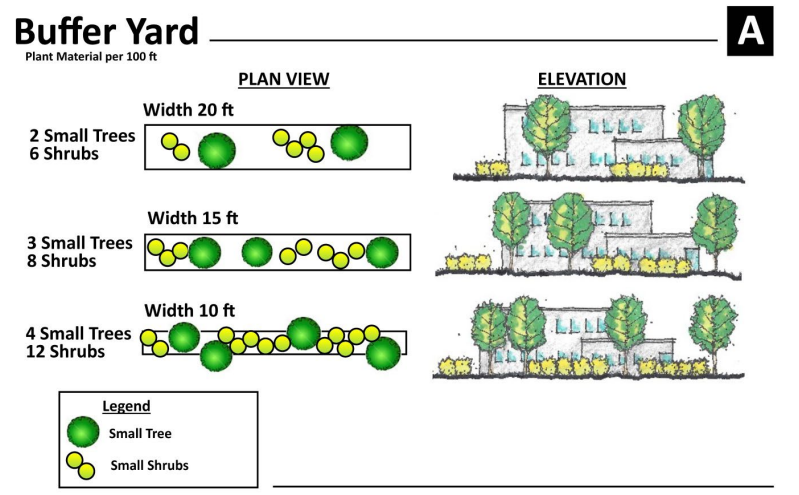
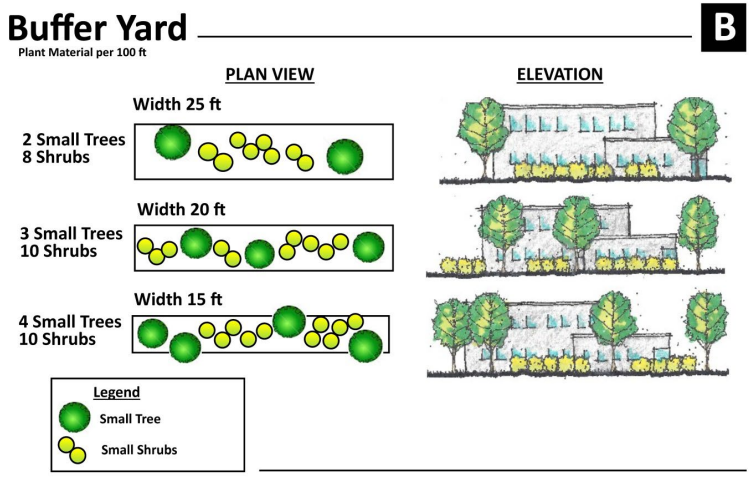
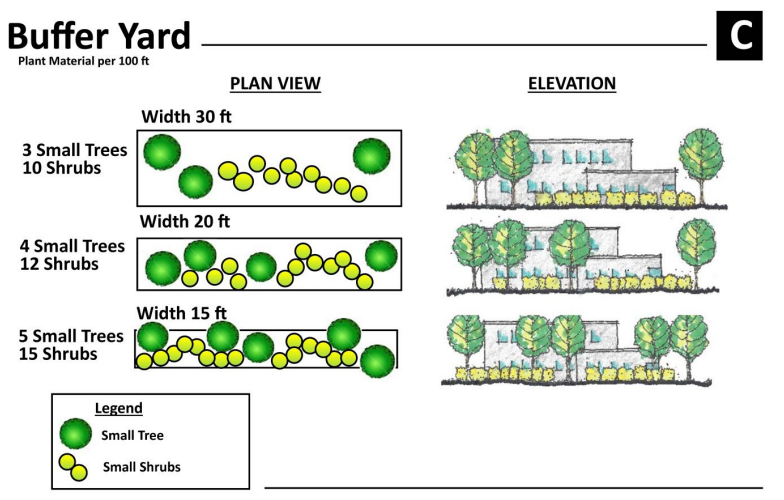
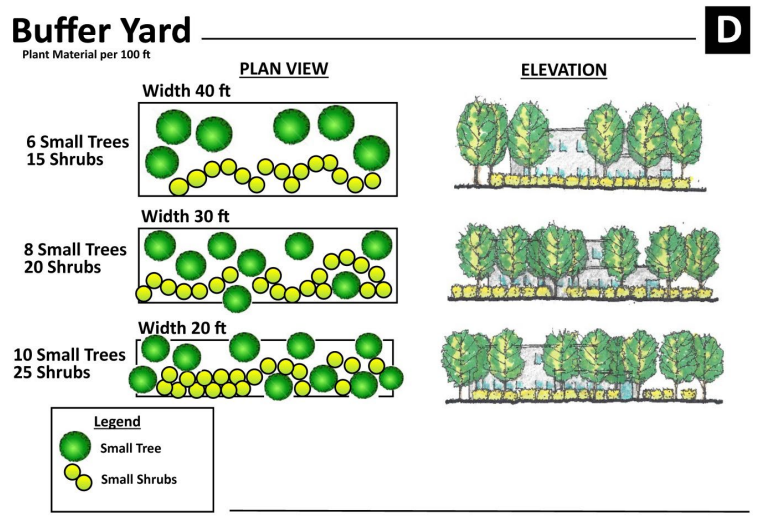
5.13.07.08 Buffer Yards, Utilities, and Utility Easements
Utility easements in a buffer yard do not prohibit the planting of shrubs in the easement of an underground utility, but no tree shall be planted within 12 feet of a buried utility. Tree planting restrictions in relation to overhead power lines are identified in Figure 5.13.11 (A) of this Article. Large and medium sized trees should not be planted closer than 15 feet to any light pole.
5.13.08 - Installation, Irrigation, Inspection, and Certificate of Occupancy
Installation of Plants. All plants shall be "Florida No. 1" or better, shall be healthy and free of diseases and pests, and shall be selected from the Tables under Section 5.13.11. The trunks of canopy trees at the time of planting shall be a minimum of three inches in diameter; small trees shall be a minimum of 1-1/2 inches in diameter. There is no minimum standard for groundcover.
(A)
Plants shall be installed during the period of the year most appropriate for planting the particular species. If this requirement results in the planting of some or all of the landscaping subsequent to development approval, a performance bond shall be posted prior to the issuance of a Certificate of Occupancy in an amount sufficient to ensure that the required landscaping is installed.
(B)
Landscape plants shall not interfere, at or before maturity, with power, cable television, or telephone lines, sewer, or water pipes, or any other existing or proposed overhead or underground utility service or road right-of-way maintenance.
(C)
The developer shall provide an appropriate planting soil medium for required plants and shall irrigate plant materials to sustain healthy growth of all plants to maturity. Required plants that die shall be replaced before the next growing season.
(D)
Areas within public rights-of-way, and areas off-site which have been disturbed by construction activity, shall be cleaned of all debris, re-graded to the proper elevations, and sodded to restore the area to a stabilized and planted state.
(E)
Irrigation. See the Technical Standards Manual for detailed irrigation system design, installation, operation, and maintenance standards.
(F)
Inspection and Certificate of Occupancy. The County shall inspect the landscaping installation to ensure that it is in conformance with the requirements set forth in this Article and with the approved landscape plan, prior to issuance of a Certificate of Occupancy.
5.13.09 - Landscape Maintenance
(A)
General Standards. The developer, property owner, Home Owners Association (HOA), or other responsible entity of land, subject to this Section, shall be responsible for the perpetual care, maintenance, and upkeep of all landscaped areas so as to present a neat, healthy, and orderly appearance free from refuse and debris.
(B)
Mowing. Grass shall be mowed as necessary in order to encourage deep root growth and, therefore, the preservation of irrigation water.
(C)
Watering. All watering of planted areas shall be conducted in accordance with County or Water Management District rules and water restrictions, whichever are more restrictive.
(D)
Replacement of Dead Plant Materials. All plant material which dies shall be replaced with plant material of required variety and size within 30 days from the date of official notification.
5.13.10 - Violations and Penalties
(A)
If a restoration plan is presented and differs from the original approved landscape plan, three copies of such restoration plan shall be submitted and approved by the Planning and Development Director, or designee. Planning and Development Director, or designee, shall re-inspect the property for compliance after the restoration is complete.
(B)
Each failure to comply with any of the provisions of this Article shall constitute an individual violation. Failure to maintain viable landscaping consistent with the approved landscape plan shall constitute a violation subject to penalties and shall be subject to code enforcement action by the County.
5.13.11 - Plant Species List
Plants species identified in this Section include "Florida-Friendly" native and non-native plants. The species lists are recommended lists developed using the Florida-Friendly Landscaping Guide to Plant Selection and Landscape Design published by the University of Florida/Institute of Food and Agricultural Sciences (UF/IFAS), Florida-Friendly Landscaping Program. The species identified in these lists have been carefully selected, based on cold hardiness zone. "Right Plant, Right Place" should govern the selection of plant species for a given site, bearing in mind soil, light, water, proximity to power lines (see Figure 5.13.11 (A)), and other site-specific conditions.
Any new plant material, which will serve to meet the County's minimum landscape requirements, shall be selected from the following plant species tables. The Building Official, or his or her designee, may approve an applicant's request to use a plant species not included in the following tables if a landscape architect certifies that the proposed species meets the intent of this code and provides the relevant information as included in the tables for said species.
In calculating canopy requirements, each existing tree to be preserved, and each new tree to be planted shall be credited with its mature canopy, as provided in this Article. If an on-site preserved tree is not listed as an invasive plant in the most recent Invasive Plant List of the Florida Exotic Pest Plant Council, and its actual canopy exceeds the canopy area identified in this Article, the greater canopy area may be used in calculating canopy coverage.
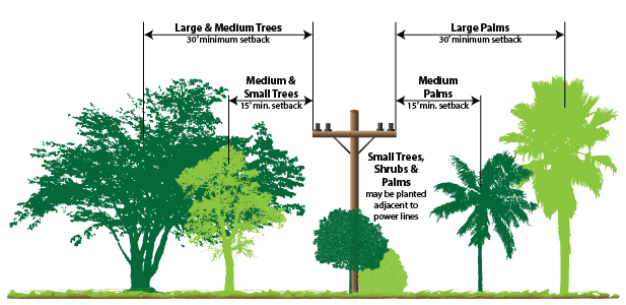
Figure 5.13.11 (A) Planting Distance from Power Lines
Table 5.13.11(A)
Large Trees
Table 5.13.11(B)
Medium and Small Trees
Table 5.13.11(C) Palms Trees and Palm-Like Plants
Table 5.13.11(D) Large Shrubs
Table 5.13.11(E) Small Shrubs
Table 5.13.11(F) Ground Covers
Table 5.13.11(G) Lawn Grass Species
Source: "Selecting a Turf Grass for Florida Lawns," University of Florida IFAS Extension (ENHO4, 2007).
5.14.01 - Intent and Purpose
It is the intent and purpose of this Section to implement uniform procedures that promote water conservation through more efficient landscape design and irrigation methods and through the installation of more efficient plumbing fixtures.
5.14.02 - Definitions
For definitions related to this Section, see "Landscape Irrigation Water Conservation Definitions" in Article 14, Definitions and Acronyms.
5.14.03 - Efficient Plumbing Requirements
(A)
Applicability. Contractors obtaining Hardee County Building Permits, for all new residential, commercial, and institutional construction, no more than 60 days after the effective date of this Section, shall incorporate WaterSense plumbing fixtures and Energy Star appliances into said construction. All new construction shall incorporate WaterSense plumbing fixtures and Energy Star appliances prior to issuance of a Certificate of Occupancy.
(B)
Exceptions. In applications where WaterSense plumbing fixtures and Energy Star appliances are not available, a written request for an exception must be submitted and approved by the Planning and Development Director. For the exception to be approved, a best alternative water and/or energy conservative fixture and/or appliance must be identified in the submittal.
5.14.04 - Irrigation System Design and Installation Standards
(A)
Applicability. Irrigation system design and installation standards shall apply to the following:
(1)
All new residential, commercial, and institutional construction where a new landscape irrigation system is required.
(2)
Where significant rehabilitation (50% or greater) of an existing landscape irrigation system will be conducted.
(B)
General.
(1)
Requirements for installing irrigation systems are specified in other locations within Section 5.14.00 of the Unified Land Development Code.
(2)
All irrigation systems shall be designed by an irrigation design professional consistent with the irrigation systems standards and as set forth in this Section.
(3)
A "Letter of Certification of the Design for an Irrigation System" by an irrigation design professional certifying the design is consistent with the requirements of this Section shall be required to obtain a building or irrigation permit before issuance of said permit.
(4)
A "Letter of Completion Certifying Compliance with Design for Irrigation System" by an irrigation design professional consistent with the design shall be required before issuance of a certificate of completion.
(5)
Compliance with this Section shall not exempt an individual from any other local, state, or federal requirements.
(6)
Irrigation systems shall satisfy the requirements of Section 5.14.04 prior to the issuance of a Certificate of Occupancy.
(C)
System Design and Installation Standards. Irrigation system design and installation shall be consistent with the irrigation systems standards and the following requirements:
(1)
The maximum total irrigated area on residential lots, regardless of lot size, shall not exceed 0.5 acres. This provision does not apply to temporary irrigation such as portable hoses and portable sprinklers.
(2)
High volume irrigation area shall not exceed 60% of the landscaped area. This standard is applicable on residential and commercial lots over 1/8 acre. This standard applies to common and open space areas. This standard excludes vegetable gardens and fruit or nut trees on individual lots or in community gardens.
(3)
Narrow areas, four feet wide or less, shall not be irrigated unless correctly installed low volume irrigation is used.
(4)
High volume irrigation shall not be used for trees, shrubs, or groundcover beds. Permanent low volume irrigation may be used in these areas. The County encourages the use of temporary establishment irrigation.
(5)
Irrigation zones shall be divided according to vegetated groupings (e.g., turfgrass, shrubs, native plants, trees) and the water requirements of the plants. Turf grass and landscaped beds, such as trees, shrubs, and groundcover beds, shall not be irrigated in the same zone as each other.
(6)
Sprinkler head types, such as spray heads and rotors, shall not be mixed in the same zone.
(7)
Distribution equipment in a given zone shall have matched precipitation rates.
(8)
Rotors and spray sprinkler heads in turfgrass areas shall be spaced to provide head to head coverage.
(9)
A minimum separation of four inches shall be required between distribution equipment and pavement.
(10)
A minimum separation of 24 inches shall be required between distribution equipment and buildings and other vertical structures, except fences and walls.
(11)
Technology that inhibits or interrupts operation of the system during periods of sufficient moisture shall be required on all irrigation systems to avoid irrigation during periods of sufficient rainfall. Examples of such devices include soil moisture sensors, weather stations, rainfall shut-off devices and smart-control systems. The technology shall override the irrigation cycle when adequate rainfall has occurred. Technology that depends on rainfall for bypassing irrigation shall be placed where it is exposed to unobstructed natural rainfall and in compliance with F.S. § 373.62, as amended.
(12)
Permanent irrigation systems shall be equipped with an automatic control system to provide the following minimum capabilities:
(a)
Ability to be programmed in minutes, by day of week, season, and time of day;
(b)
Ability to accommodate multiple start times and programs;
(c)
Automatic shut-off during rainfall or after adequate rainfall events;
(d)
Ability to maintain time during power outages; and Operational flexibility to meet applicable year-round water conservation requirements.
(13)
Check valves which are capable of holding a minimum of a five-foot head shall be used in low-lying areas to prevent head drainage.
(14)
Irrigation system equipment shall be installed in accordance with manufacturer's specifications.
(15)
No direct spray shall be allowed onto walkways, buildings, roadways, and drives.
(16)
Pipelines shall be designed to provide the system with the appropriate pressure required for maximum irrigation uniformity.
(17)
All sprinkler heads with spray nozzles (non-rotary) shall be pressure-regulated at the head.
(18)
All irrigation system underground piping shall have minimum soil cover of six inches.
5.14.05 - Operation and Maintenance of Irrigation Systems
(A)
An irrigation professional responsible for installing or substantially modifying an irrigation system shall provide the property owner with a maintenance checklist affixed to or near the controller and accompanied by a recommended maintenance schedule, proper irrigation system settings according to season, recommendations for checking technology that inhibits or interrupts operation of the system during periods of sufficient moisture, filter cleaning recommendations, if applicable, and information on the current water restrictions.
(B)
A property owner shall ensure that irrigation systems on their property are inspected at least annually for leaks, overspray, maladjusted heads, and heads that may be capped due to changes in the landscape, such as maturity or changes in plants. Technology that inhibits or interrupts operation of the system during periods of sufficient moisture may need to be replaced every few years and shall be correctly functioning to be in compliance with this article. Irrigation systems with known leaks shall not be operated until the leaks are repaired, except for testing purposes.
(C)
Within 60 calendar days after installation, the property owner shall ensure that the irrigation controller is adjusted to operate according to normal, established landscape conditions or irrigation restrictions, if the irrigation system is installed as part of newly established landscaping.
5.14.06 - Exemptions
The following are exempted from the provisions of this article, but should follow applicable Florida Friendly Best Management Practices for Protection of Water Resources by the Green Industries:
(A)
Bona fide agricultural activities;
(B)
Vegetable gardens and fruit and nut trees;
(C)
Athletic fields;
(D)
Golf course play areas;
(E)
Cemeteries;
(F)
Nurseries; and
(G)
Temporary establishment irrigation.
5.14.07 - Alternative Compliance
(A)
An applicant may submit a proposal that varies from the strict application of the requirements of this Section (also known as "alternative compliance") to accommodate unique site features or characteristics, utilize innovative design, prevent extraordinary hardship, or to promote the overriding public interest or general public welfare. Diminished value of property or inconvenience is not an extraordinary hardship.
(B)
An applicant seeking authorization for alternative compliance shall have the burden of demonstrating to the County the reasons why the strict application of the requirements of this Section should not apply.
(C)
Requests for alternative compliance shall be submitted as part of the irrigation system approval process.
(D)
The County may approve an alternative compliance plan upon finding that the alternative compliance plan fulfills the intent and purpose of this Section.
(E)
The County may require a site inspection and corresponding site inspection fee for systems which are installed following a department-approved alternative compliance plan.
5.14.08 - Enforcement
Violation of any provision of this Article shall be subject to penalties as provided in the Hardee County Code of Ordinances and Unified Land Development Code or any other remedy available at law or equity.

