
Harrison Village City Zoning Code
ARTICLE III
GENERAL PROVISIONS
Sec. 117-46.- Application of regulations.
(a)
In their interpretation and application, the provisions of this chapter shall be minimum requirements for the promotion of the public health, safety, morals, comfort, convenience and general welfare of the community.
(b)
Where the conditions imposed by any provision of this chapter are either more restrictive or less restrictive than comparable conditions imposed by any other law, ordinance, statute, resolution or regulation of any kind, the regulations which are more restrictive or which impose higher standards or requirements shall prevail.
(c)
If there are found to be differences between the meaning or implication of the text of this code and any drawing, table, figure, title or section heading, the text of this code shall apply.
(Ord. No. 10-147, § 3.0(1), 7-27-2010)
Sec. 117-47. - Conformity.
The regulations set by this chapter shall be minimum regulations and shall apply uniformly to all buildings and structures, lands and waters within the jurisdictional limits of the Village of Harrison, Calumet and Outagamie Counties, Wisconsin, except as hereinafter provided:
(a)
No land, building or structure shall hereafter be used or occupied, and no building, structure, or part thereof shall hereafter be erected, constructed, reconstructed, moved, or structurally altered except in conformity with all the regulations herein specified for the district in which it is located.
(b)
No sign shall hereafter be erected, hung, placed, painted, altered, or moved except in conformity with the regulations of the district in which it is located.
(c)
No part of a yard, open space, or off-street parking or loading space required about or in connection with any building for the purpose of complying with this chapter shall be included as part of a yard, open space, off-street parking or loading space similarly required for any other building.
(d)
No lot or yard existing at the effective date of adoption of this chapter shall be reduced in dimension or area below the minimum requirements set forth herein. Lots or yards created after the effective date of adoption of this chapter shall meet the minimum requirements established by this chapter.
(e)
No accessory building or structure shall be constructed upon a lot until the construction of the principal building or structure has actually commenced. No accessory building or structure shall be used unless the principal building on the lot is also being used. No cellar, basement or accessory building or structure shall be used as a dwelling prior to substantial completion of the dwelling of which it is part.
(Ord. No. 10-147, § 3.0(2), 7-27-2010)
Sec. 117-48. - Use regulations.
Only the following uses and structures shall be allowed in a zoning district:
(a)
Permitted uses and structures. Uses and structures specified as permitted or permissible for a zoning district.
(b)
Accessory uses and structures. Uses and structures, that are accessory or incidental to the principal use or structure, specified as permitted or permissible for a zoning district.
(c)
Conditional uses and structures. Uses and structures specified for a zoning district which shall require review and approval in accordance with the provisions of article XI, Conditional Use Permits.
(d)
Temporary uses and structures. Uses and structures specified for a zoning district in accordance with the provisions of section 117-134.
(e)
Uses not listed. Any use that is not listed or that is questionable as a permitted use, accessory use or conditional use in the established zoning district, where such use is proposed, is not allowed unless determined otherwise, through interpretation of the intent of the chapter and the intent for each individual zoning district.
(1)
The zoning administrator may determine that an unlisted or questionable use may be placed if it is significantly similar to another use that is a principal use, accessory use or as a conditional use.
(2)
The decision of the zoning administrator may be appealed to the plan commission.
(3)
In no instance may this interpretation be construed as a process for establishing a use variance.
(f)
Essential municipal and utility services. The provisions of this chapter shall not be so construed as to limit or interfere with the construction, installation, operation and maintenance of essential municipal and utility services, as defined, in any district. "Essential municipal and utility services" shall not include communication, radio/television/relay towers or antennas, solar or wind energy systems.
(g)
Restricted uses or prohibited uses. Carport, attached or detached, shall be prohibited in the village.
(Ord. No. 10-147, § 3.0(3), 7-27-2010)
Sec. 117-49. - Area and yard regulations.
(a)
Minimum frontage requirement. All lots shall have frontage upon a public or private street of not less than the lot width required by the zoning district in which the lot is located or 33 feet in width for flag lots approved as part of a land division. Flag lots shall only be allowed in the General Agricultural [AG] and Rural Residential [RR] zoning districts. Lots on curves or cul-de-sacs shall meet 75 percent of this requirement.
(b)
Restriction on lot area and yard reductions. No lot shall be reduced, diminished or maintained in any manner in which the yards, open spaces or total lot area and width shall be less than prescribed by this chapter, nor shall the density of dwelling units be increased in any manner except in conformity with the regulations herein established.
(c)
Yards. Every building or structure shall be located on a lot, as defined herein, and shall provide yards as specified in the zoning district. Such required yards shall meet the following regulations:
(1)
How measured. The yard distances shall be measured from the nearest portion of the building or structure to the yard lot line or mapped/deeded roadway. For the purpose of this section, egress window enclosures shall be included as part of the building or structure, regardless if the egress window enclosure is an integral part of the foundation or a separate component.
(2)
Exemptions. Every required front, side, rear, and accessory yard shall be open and unobstructed from the ground to the sky, except for those projections permitted as follows:
a.
Roof eaves may project into a required yard not more than two feet.
b.
Sills, belt courses, cornices, vertical solar screens and other ornamental features may project not more than one foot into a required yard.
c.
Windows and fireplaces. Only one of the following may be allowed per wall. For the purposes of this section, a wall shall include all faces of that side of the building.
1.
Fireplace structures may project into a required side or rear yard not more than two feet and shall not be longer than six feet in length, except in the RS-2 zoning district.
2.
Windows or cantilevered living areas may project into a required side or rear yard not more than two feet and shall not exceed 20 percent of the wall length on which it is located, except in the RS-2 zoning district.
d.
Handicap accessible ramps. Barrier-free accessible ramps used for the purpose of egress and ingress by the physically challenged may be permitted to encroach into any front or rear yard subject to it being:
1.
Limits the degree of encroachment to the maximum extent possible such as its overall length is the shortest distance possible to access the public sidewalk or private driveway, whichever is the point of ingress or egress.
2.
Installed in such a manner as will preserve existing landscaping or provide for replacement landscaping.
3.
Uncovered.
4.
Not less than three feet nor more than four feet in width.
5.
Must meet all state and local rules and regulations for construction.
6.
Covenant. The property owner shall provide a covenant suitable for recording with the Calumet County Register of Deeds providing notice to future owners or long-term lessors of the property that the existence of the accessible ramp is predicated upon the occupancy of the principal dwelling by a person who is physically challenged. The covenant shall also require any owner of the property to remove the accessible ramp upon discontinuing use of the accessible ramp by the physically challenged.
e.
Egress decks or landings shall not project into any required rear yard more than six feet and shall be no larger than 36 square feet in area.
f.
Fire escapes, stairways and balconies unroofed, open and unenclosed may not project into any required side or rear yard more than two feet. Such structures whether covered or enclosed shall not intrude into required yards.
(3)
Double frontage lots. On through lots or lots with double frontage, the required front yard shall be provided on each street, except lots containing access restriction provisions, in which the access restricted yard shall be required to meet the rear yard requirements.
(4)
Corner lots. On corner lots, the street side yard shall be equal to the required front yard for lots fronting on that street.
(5)
No part of a yard or other open space provided about any building or structure for the purposes of complying with the provisions of this chapter shall be included as part of a yard or other open space required under this chapter for another building or structure.
(6)
Front yard reduction. A yard of less than what is required in the zoning district may be permitted in the following cases:
a.
Where each side of the proposed building location is occupied by an adjacent principal building located within 200 feet of the proposed building footprint, and less than the required yard, the required front yard for the proposed building shall be the average of the front yards of the adjacent principal buildings, as measured from the wall of the adjacent principal building to the front lot line.
b.
Where one side of the proposed building location is occupied by an adjacent principal building located within 200 feet of the proposed building footprint, and less than the required front yard, the required front yard for the proposed building shall be the average of the adjacent principal building, as measured from the wall of the adjacent principal building, and the front yard required for that zoning district and road type.
(7)
Development in mapped streets. Where an official line has been established for the future widening or opening of a street, the depth of a front yard or the width of a side yard shall be measured from such official line to the nearest line of the building.
(8)
More than one building on a lot. In any zoning district other than residential, more than one building housing a principal use or structure may be erected on a single lot provided that yard and other requirements of these regulations shall be met for each building as though it were on an individual lot, unless otherwise specified in section 117-93 for commercial or residential developments.
(9)
Building groups. In any nonresidential zoning district, a group or buildings separated only by common or party walls shall be considered as one building.
(10)
When a structure becomes a nonconforming use as to setback from a street or highway, because the street or highway was widened or relocated, such structure shall not be considered a nonconforming use or structure under this chapter, pursuant to article X, Nonconforming Uses and Structures.
(Ord. No. 10-147, § 3.0(4), 7-27-2010)
Sec. 117-50. - Height regulations.
Except as hereinafter provided, no building or structure shall be hereafter enlarged, erected, reconstructed or structurally altered to a height which exceeds the height limit established for the zoning district wherein such building or structure is located except the following:
(a)
Public buildings. Public buildings, including but not limited to educational institutions (public and private elementary, middle and high schools), may be erected to a height not exceeding 45 feet, provided that the building or structure is set back an additional two feet on all sides for each foot such building exceeds the height limit in the district.
(b)
Special structures. Special structures, including but not limited to, cooling towers, fire towers, grain elevators, smokestacks, water towers, and electric power and transmission lines may be erected to a height which exceeds the height limit established for the zoning district.
Radio/television/relay towers and antennas shall meet the requirements of section 117-132. Solar and wind energy systems shall meet the provisions of this chapter.
(c)
Other exceptions. Height limitations of the zoning district do not apply to the following structures, including but not limited to, cupolas, spires or bell towers of religious institutions, private television and amateur radio antennas, elevator bulkheads, chimneys, flagpoles, necessary mechanical equipment, or other appurtenances usually required to be placed above the roof line and not intended for human occupancy.
(Ord. No. 10-147, § 3.0(5), 7-27-2010)
Sec. 117-51. - Lot coverage.
Except as hereinafter provided, no building or structure shall be hereafter enlarged, erected, reconstructed or structurally altered to a size which exceeds the lot coverage limit established for the zoning district wherein such building or structure is located.
Accessory structures including, but not limited to, parking lots, driveways, patios (slab on grade), decks, tennis courts, basketball courts or other similar courts and swimming pools shall not count towards the lot coverage requirements. For the purpose of this section, patios or other paved areas with a footing and foundation shall be counted towards the lot coverage for the lot. Lot coverage shall be measured along the ground floor foundation of the building or structure and shall exclude the ordinary projections of the roof eaves up to two feet.
(Ord. No. 10-147, § 3.0(6), 7-27-2010)
Sec. 117-52. - Impervious surface coverage.
Except as hereinafter provided, no building or structure shall be hereafter enlarged, erected, reconstructed or structurally altered to a size which exceeds the impervious surface coverage limit established for the zoning district wherein such building or structure is located. Accessory structures including, but not limited to, parking lots, driveways, patios (slab on grade), decks, tennis courts, basketball courts or other similar courts and swimming pools shall be included in the calculation of impervious surface coverage and shall not exceed the maximum impervious surface coverage percentage as established for the applicable zoning district. For the purpose of this section, gravel shall be counted in the impervious surface coverage of the lot.
Impervious surface shall be measured from the outer most edge of the building or structure.
(Ord. No. 10-147, § 3.0(7), 7-27-2010)
Sec. 117-53. - Visual clearance.
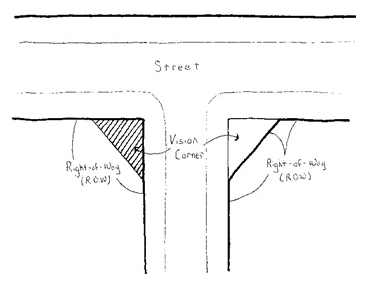
No obstruction permitted. No visual obstructions, such as structures, parking or vegetation, shall be permitted in any zoning district between the heights of four feet and ten feet within the triangular space formed by any two existing or proposed intersecting street or alley right-of-way lines and a line joining points on such lines from their intersection for the following street classifications:
(a)
Twenty-five feet along village roads with a posted speed limit of 35 mph or less.
(b)
Seventy-five feet along village roads with a posted speed limit greater than 35 mph.
(c)
Two hundred feet along county roads.
(d)
Two hundred feet along state and/or federal highways and railroads.
(Ord. No. 10-147, § 3.0(8), 7-27-2010)
Sec. 117-54. - Accessory uses, buildings and structures.
(a)
General regulations for accessory uses, buildings and structures. All accessory uses, buildings and/or structures shall abide by the following general regulations:
(1)
No accessory use, building and/or structure shall be constructed or established on a lot prior to the principal use or building being present or under construction, except temporary construction trailers.
(2)
When attached to the principal building, accessory buildings and/or structures shall comply with all requirements of this chapter applicable to the principal building, unless otherwise stated, including, but not limited to setback requirements, building height limits, and maximum lot coverage standards.
(3)
When not attached to the principal building, accessory buildings and/or structures shall comply with all requirements of this chapter applicable to the accessory buildings and/or structures in the zoning district including, but not limited to setback requirements, building height limits, and maximum lot coverage standards.
(4)
Accessory buildings or structures in the RS-1, RS-2, and RT zoning districts shall not be located closer to the front lot line than is the principal structure, except those properties located adjacent to the shoreline of Lake Winnebago.
(5)
Accessory buildings or structures shall not be located within any recorded easement (utility, drainage, or other) without written consent of the entity controlling the easement. The zoning administrator may authorize fences provided all the following are met:
a.
The fence does not restrict stormwater runoff flow, as determined by the zoning administrator.
b.
The fence is not located within a storm sewer easement or drainage easement with storm sewer pipe, inlets, or other infrastructure improvements.
1.
The zoning administrator, with input from the public works department, may authorize the placement of a fence in a storm sewer easement or drainage easement with underground infrastructure provided:
i.
Village staff verify fence and storm sewer or underground infrastructure placement.
ii.
The fence be a minimum of five feet from the storm sewer or underground infrastructure.
iii.
A fee for review be submitted.
c.
The property owner signs a "Permission to Occupy Drainage Easement Agreement" document.
(6)
The following, including but not limited to, truck, truck tractor, truck trailer, canopy or bus, or portion thereof, shall not be used for, storage purposes, as a principal use and/or structure or an accessory use and/or structure in any zoning district, unless otherwise stated in this chapter.
(7)
Any detached accessory use, building and/or structure with a water closet (toilet facility) shall require a conditional use permit, pursuant to article XI, Conditional Use Permits.
(8)
Accessory uses, buildings and/or structures shall be located on the same lot as the principal use, structure or building.
(9)
Detached accessory buildings shall not be used as a secondary dwelling.
(b)
Use restrictions. All accessory uses, buildings and/or structures shall abide by the following use restrictions:
(1)
When located in a residential zoning district: RR, RS-1, RS-2, RT, RM.
a.
Accessory buildings shall be restricted to parking or storage purposes by the occupant(s) of the lot upon which the building is located.
b.
The enclosed parking or storage of not more than one commercial or service vehicle may be permitted within an attached garage or detached garage provided that such vehicle is used by the occupant(s) of the lot upon which the vehicle is parked or stored.
(2)
When located in a nonresidential zoning district: AG, CN, COR, CC, BP, IM. The enclosed parking or storage within an attached garage or detached garage shall be restricted to vehicles used by the occupant(s) of the lot upon which the vehicles are parked or stored.
(Ord. No. 10-147, § 3.0(9), 7-27-2010, Ord. No. V19-17, 10-29-2019)
Sec. 117-55. - Unfit or dilapidated buildings.
All buildings and structures shall be kept in a safe and habitable condition.
(a)
Pursuant to Wis. Stats. § 66.0413 and amendments thereto, the village board, building inspector, or other designated officer of the village may:
(1)
If a building is old, dilapidated or out of repair and consequently dangerous, unsafe, unsanitary or otherwise unfit for human habitation and unreasonable to repair, order the owner of the building to raze the building or, if the building can be made safe by reasonable repairs, order the owner to either make the building safe and sanitary or to raze the building, at the owner's option.
(2)
If there has been a cessation of normal construction of a building for a period of more than two years, order the owner of the building to raze the building.
(b)
Any determination made under this section shall follow the procedures and regulations of Wis. Stats. § 66.0413.
(Ord. No. 10-147, § 3.0(10), 7-27-2010)
Sec. 117-56. - Drainage.
(a)
Single-family and two-family residential buildings. All new single-family and two-family residential buildings shall meet the following conditions prior to issuance of a zoning occupancy permit, pursuant to article XIV, Permits.
(1)
The top of the house foundation shall be approximately eight inches, but not less than six inches, above the final ground elevation at the foundation.
(2)
All lots shall be graded to the elevations indicated on the approved grading/drainage plan for the subdivision. If there is no grading/drainage plan, then the average elevation of the existing grades on the adjacent properties shall be maintained, unless a special grading/drainage plan is reviewed and approved by the village.
(3)
The lot shall be graded to an even gradient from the foundation to all grading elevations.
(b)
Multiple-family, commercial, and industrial buildings. All new multiple-family residential, commercial, and industrial developments shall meet the grading/drainage plan approved as part of the site plan review process in accordance with the post-construction stormwater management ordinance, chapter 113 of this Code.
(c)
Agricultural buildings. All new agricultural buildings shall meet the requirements of the post-construction stormwater management ordinance, chapter 113.
(Ord. No. 10-147, § 3.0(11), 7-27-2010; Ord. No. 11-162, 11-29-2011)
Sec. 117-57. - Filling and grading.
A zoning permit is required for filling, grading, excavating (including pond development), and ditching under this section in any zoning district for filling and grading of the following areas.
(a)
>2,000/<12%. The filling, grading, ditching, or excavating exceeds 2,000 square feet on slopes of less than 12 percent.
(b)
>1,000/12—20%. The filling, grading, ditching, or excavating exceeds 1,000 square feet on slopes of 12 to 20 percent.
(c)
>20%. The filling, grading, ditching, or excavating is on slopes of more than 20 percent.
(d)
Exemptions. No zoning permit shall be required if:
(1)
An erosion control permit has been issued under chapters 105 and 113 of the Village of Harrison Code of Ordinances.
(2)
The filling and grading is incidental to a project authorized by a zoning permit.
(3)
For planting, growing, cultivating, and harvesting agricultural crops, installation of public utilities or sanitary waste disposal systems, or construction of public roads and walkways, nor projects authorized by state or federal agencies under § 30.19, Wis. Stats.
(e)
Construction grades. Final grading around any structure shall comply with the grade elevation established on the stormwater management plan or other drainage plan for the particular subdivision. When a stormwater management plan or drainage plan is nonexistent for a lot, the final grade and maintained grade shall not be higher than the average of the grade on the adjacent properties. The zoning administrator may require that a grading and drainage plan be prepared and approved prior to the issuance of a zoning permit for new construction. Dependent on the amount of grading proposed, the zoning administrator may require the plan include a cross section of the adjacent parcels, and the parcel subject of the grading, to ensure the proposed grading will not result in adverse runoff onto the adjacent parcels. In areas where drainage is not parallel to lot lines, the site plan for the zoning permit application shall address the direction and handling of surface water flow. In no case shall water be diverted onto a road surface.
Sec. 117-58. - Shoreland-wetland zoning.
Pursuant to § 59.692(7), provisions of the Calumet County and Outagamie County shoreland zoning ordinances that were enacted under § 59.692 that were applicable, prior to incorporation or annexation, to any shoreland area that was part of a village that incorporated as a village after April 30, 1994 or annexed to the village after May 7, 1982, shall continue in effect and shall be enforced after incorporation or annexation by the village. The Calumet County and Outagamie County shoreland zoning provisions necessary to effect the purposes under § 59.692(1m) are incorporated by reference for the purpose of administering this section and are on file in the office of the zoning administrator.
Sec. 117-59. - Methods of construction.
All construction of principal buildings in the RS-I, RS-2, RT, and RM zoning districts shall be stick built construction. No shipping containers, trailers, mobile storage units, semi-trailers, or other similar shall be utilized as dwelling units within these zoning districts. Modular homes, stick built off-site and transported to the site, shall be deemed acceptable.

