
Hartsville City Zoning Code
ARTICLE VII
SIGNS AND ADVERTISING DEVICES2
Cross reference— Businesses, ch. 14; traffic signs, signals and markings, § 78-46 et seq.; signs, projections and obstructions over streets and sidewalks, § 74-66 et seq.
Sec. 1. - Intent.
The purpose of the following sign requirements is to promote and protect the public health, welfare, and safety by regulating existing and proposed signs of all types. It is intended to protect property values, create a more attractive economic and business climate, and enhance and protect the scenic and natural beauty of designated areas. It is further intended to reduce sign or advertising distraction and obstructions that may be caused by signs overhanging or projecting over public rights-of-way, provide more open space, curb the deterioration of the natural environment and enhance community development.
(Ord. No. 1012, art. VII, § 1, 5-11-1993; Ord. No. 4348, 10-9-2018)
Sec. 2. - General requirements.
a.
Any sign, display, or device allowed under this ordinance may contain in lieu of any other copy, any otherwise lawful noncommercial message that does not direct attention to a business operated for profit or to a commodity or service for sale, and that complies with all other regulations and requirements of this ordinance.
b.
Except as provided in section 3, below, no business or advertising sign or structure shall be erected or altered without a proper zoning permit. General maintenance is not included. Failure to adhere to the requirements of this ordinance automatically cancels such permit and said structure shall be removed forthwith. In addition, any sign structure erected on a designated primary route must receive any required SCDOT approval before being submitted to the city planner for a zoning permit.
c.
For the purpose of computing sign area, only one side of a "V-type" or double faced sign shall be considered.
d.
All signs, whether permanent or temporary, shall comply with the minimum standards for the City of Hartsville.
e.
A sign shall be removed within 90 days by the owner or lessee of the premises upon which the sign is located when the business which it advertises is no longer on the premises.
(Ord. No. 1012, art. VII, § 2, 5-11-1993)
Sec. 3. - Signs allowed without a permit.
a.
Sign permits shall not be required for the following signs:
1.
Changeable copy signs, including bulletin boards and signs for theatres and gas stations.
2.
Signs not visible beyond the boundaries of the lot or parcel upon which they are located, or from any public right-of-way.
3.
Signs on trucks, buses, trailers, or other vehicles, while such vehicles are in use in the normal course of business.
4.
Commemorative plaques and historical markers erected by a recognized non-profit historical organization or a governmental body; provided, however, that no such plaque or marker shall exceed three square feet in area.
5.
Flags; provided, however, that no single flag shall exceed a maximum size of 54 square feet and no more than three flags may be displayed on any property.
6.
Handicap parking signs.
7.
Plaques or markers that are integrated into the construction of a building when made or carved into stone, concrete, bronze, aluminum, or some other permanent construction material, such as, by way of example only, names of buildings, dates of erection, or commemorative plaques.
8.
Signs erected by any public entity.
9.
Danger, warning, or private property signs.
10.
Traffic direction signs within a campus or premises.
b.
Sign permits shall not be required for one temporary sign on each roadway frontage of a property during such time that the property on which the sign is located, or a portion thereof, is being actively marketed for sale or rent, or a structure on such property is actively under construction. Any such sign may not exceed a height of eight feet and may not exceed an area of eight square feet in residential zoning districts or 32 square feet in all other zoning districts.
c.
Other than those signs permitted under subsection b. of this section, temporary signs shall not require a permit, but shall be subject to the following:
1.
For the purposes of this subsection, a "temporary sign" is defined as any sign constructed of cloth, canvas, light fabric, cardboard or any other paper-based material, corrugated plastic, unfinished or untreated wood, wallboard or other light materials, with or without frames.
2.
Temporary signs shall not exceed eight feet in height, and shall not exceed four square feet in residential districts or 32 square feet in all other zoning districts;
3.
Temporary signs shall be removed within 45 days of its placement;
4.
Temporary signs are prohibited in the public right-of-way or on any public property, utility poles, or street signs;
5.
Temporary signs shall be limited to one per street frontage;
d.
All banners shall not require a permit, but shall subject to the following:
1.
Subject to the additional conditions of this subsection d, a banner is permitted in any commercial or industrial zoning district except the Central Business (B-1) District; except that in the Central Business (B-1) District (i) a non-profit or religious organizations may display a banner on property owned or occupied by such organization; and (ii) a business may display a banner exclusively during the period of seven days prior to and for 30 days after the date the business initially commences operation.
2.
A banner must be hung flush against and securely attached to the building upon which it is; except in the case of any property owned or occupied by a non-profit or religious organization, the entity may securely hang a free-standing banner one week in advance of an event held by such organization, to be removed upon completion of such event.
3.
Except where otherwise provided for herein, a business or organization may display a banner for a period of 30 days.
4.
No banner shall exceed a maximum size of 48 square feet.
(Ord. No. 1012, art. VII, § 3, 5-11-1993; Ord. No. 1101, 3-11-1997; Ord. No. 1131, 5-12-1998; Ord. No. 1143, 10-13-1998; Ord. No. 3057, 1-8-2008; Ord. No. 4348, 10-9-2018)
Sec. 4. - [Prohibited signs.]
The following signs shall be prohibited in all districts:
a.
Signs which imitate an official traffic sign, and which are not otherwise authorized by other ordinances.
b.
Signs which are of a size, location, movement, content, coloring, or manner of illumination which may be confused with or construed as a traffic control device, or which hide from view any traffic or street sign signal, or which obstruct the view in any direction at any street or road intersection.
c.
Signs not otherwise allowed in any public right-of-way. Signs projecting over public property shall be permitted in accordance with the building code, only where zero setbacks are allowed.
d.
Signs which contain or consist of pennants, banners, ribbons, streamers, spinners, strings of lightbulbs, strobes, or other similar moving or flashing devices.
e.
Signs which are pasted or attached to utility poles, trees, or fences, or in an unauthorized manner to walls or other signs.
f.
Signs advertising activities which are illegal under federal, state, or city laws or regulations.
g.
Any sign displayed on an automobile, truck, or other motorized vehicle, when that vehicle is used primarily for the purpose of such advertising display, or is parked in such a way that it is being used for advertisement as a sign board.
h.
Signs projecting above the roofline.
i.
Signs that contain statements, words, or pictures of an obscene, indecent or immoral character.
j.
Flashing signs, except for time and temperature signs.
k.
Signs affixed to trees, other natural vegetation, or rocks.
l.
Signs that obstruct ingress or egress from any window, door, fire escape, stairway, ladder, or opening intended to provide light, air, ingress or egress for any room or building as required by law.
m.
Signs which cast or reflect a glare or light, directly or indirectly, on any public roadway or adjacent property within a residential district.
n.
Signs which are visible from any interstate federal highway, except for on-site sale or rental signs, and on-site business signs, as permitted.
o.
Signs, other than official road markers or public information signs, placed on an official road right-of-way.
p.
Signs located in such a manner as to materially impede the view of any road intersection; or in such manner as to materially impede the view of an intersection or a road with a railroad grade crossing.
q.
Signs greater than 15 feet aboveground.
r.
Billboards or signs which advertise businesses which are not on the same lot as the sign. (This shall not include off premises directional signage which is regulated and allowed in some zones.)
s.
Signs which revolve, rotate or otherwise move by mechanical means.
t.
Portable temporary signs whether mounted on vehicles, wheels, platforms or freestanding. Such signs existing prior to this ordinance shall be removed within six months to be in compliance of this ordinance.
(Ord. No. 1012, art. VII, § 4, 5-11-1993; Ord. No. 4348, 10-9-2018)
Sec. 5. - Residential and agricultural zoning districts; permitted signs.
a.
Reserved.
b.
Residential developments may erect permanent subdivision or development identification signs at any entrance to such development; provided, however, such signs must be ground mounted, and nonilluminated except by floodlights which are mounted in the ground in front of the sign and that do not shine into roadways, and may not exceed a maximum size of 15 square feet in area or six feet in height.
c.
Off-premises signs for any noncommercial use within the residential district, provided that such sign shall not exceed two square feet in area, shall be within one mile of the use, shall not exceed eight feet in height, and shall not be illuminated.
d.
Signs advertising private nursery schools, day care centers, or kindergartens may have on-premises one unlighted sign that may not exceed a maximum size of six square feet or a maximum height of four feet.
e.
All other non-residential uses permitted in a residential zoning district may erect one freestanding sign not exceeding 15 square feet in area or a maximum height of six feet. Such signs shall use only external illumination.
f.
Agricultural operations may have one sign that may not exceed a maximum size of 15 square feet or a maximum height of eight feet. Such sign may be lit from the ground but not internally illuminated.
(Ord. No. 1012, art. VII, § 5, 5-11-1993; Ord. No. 4348, 10-9-2018; Ord. No. 4477, 8-13-2024)
Sec. 6. - Signs permitted in the professional office zone, P-1.
Residential and noncommercial directional signage shall be allowed as specified in section 5. Business signage shall be as follows: For each parcel in the P-1 zone, eight square feet of sign area shall be allowed. Such sign may be in form of a single sign or in a combination of not more than two signs subject to the following limitations:
a.
One sign for each business located in a building, not to exceed one square foot in area, attached flat against a building or mailbox. Such sign may contain any or all of the following information: The address and name of the business and the names, titles and occupations of business principals.
b.
One freestanding sign not to exceed eight square feet in area. Such sign may contain any or all of the following information: The address and name of any or all of the businesses located in the building, and names, titles and occupations of business principals. Signs shall not be internally lit. All lighting must be external.
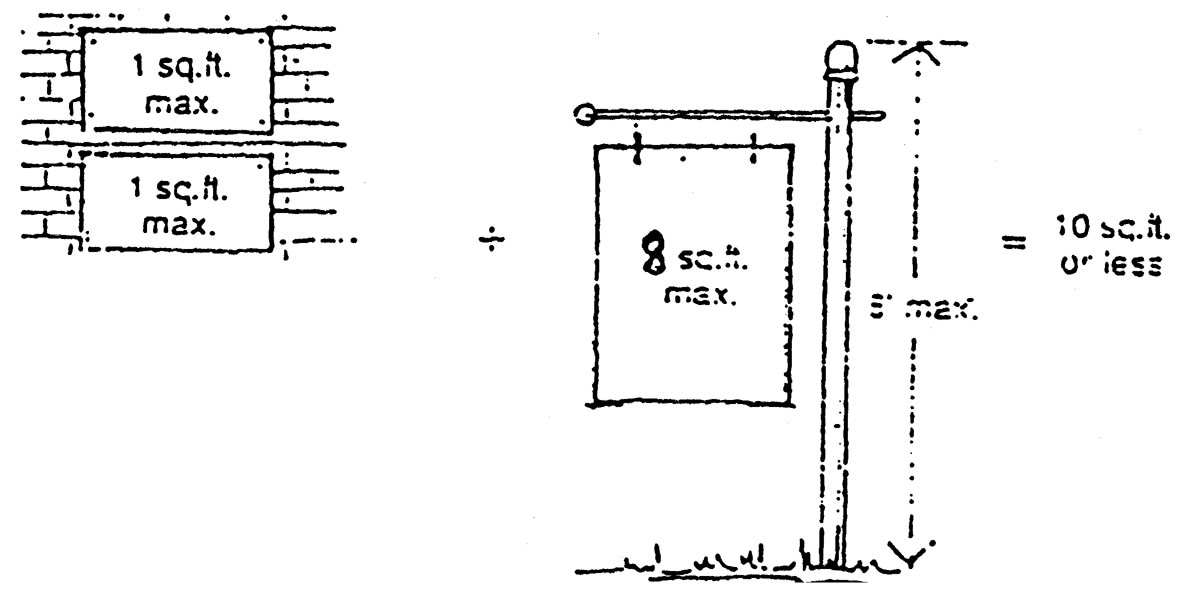
Signs permitted in P-1 zone
c.
For properties and buildings with more than one tenant, no more than one freestanding sign shall be permitted. The sign shall be limited to 12 square feet in area and have a maximum height of eight feet.
d.
Residential signage shall adhere to the standards set for residential districts.
(Ord. No. 1012, art. VII, § 6, 5-11-1993; Ord. No. 1120, art. VII, § 6, 2-10-1998; Ord. No. 1143, 10-13-1998)
Sec. 7. - Signs permitted in central business district B-1.
For each lot, tract, or parcel in the B-1 zone, one and one-half square feet of sign
area shall be allowed for each one lineal foot of building frontage on the primary
public street. In the case of buildings that front on more than one public street,
sign area shall be based on the length of frontage of one side of the building only.
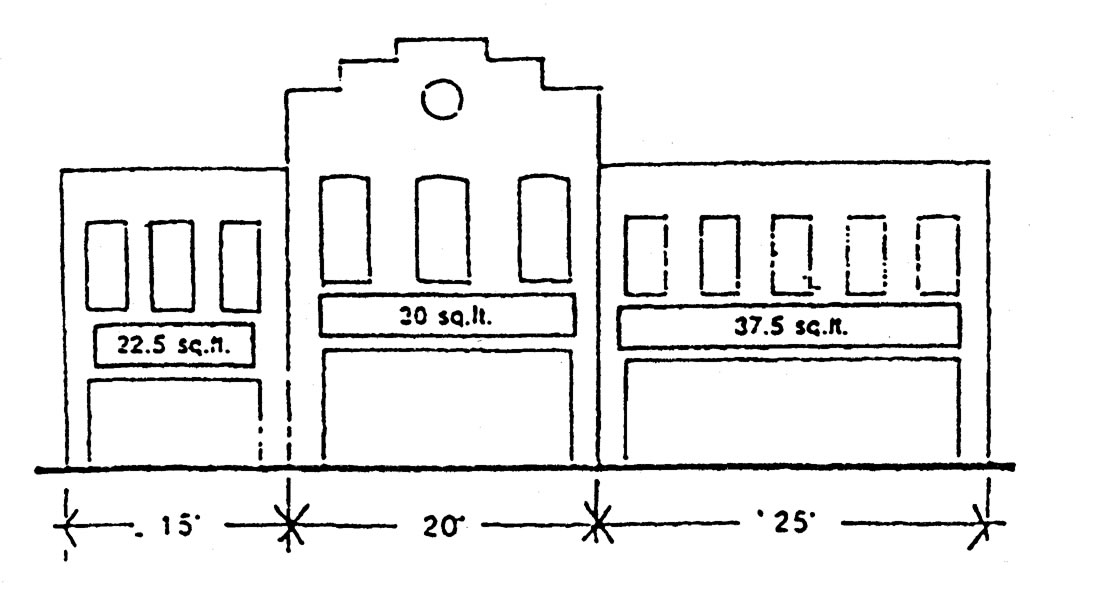
Signs permitted in B-1 district
Such sign area may be in the form of a single sign, or in a combination of signs located on one or more sides of the building. Additional signage shall be permitted for the rear of the building, computed on the ratio of one-half square foot of sign for each one lineal foot of building frontage. Permitted signs shall be subject to the following limitations:
a.
Wall signs, provided that such signs do not exceed 20 percent of any exposed finished wall surface area and do not extend more than six inches beyond the building wall surface.
b.
Freestanding signs. One freestanding sign not to exceed eight square feet shall be allowed. The maximum height shall be eight feet. For parcels on which more than one tenant is located, no more than one freestanding sign shall be permitted. Such sign shall be limited to 12 square feet in area and have a maximum height of eight feet.
c.
Window signs. Provided that such signs take up no more than 25 percent of the glass upon which they are placed.
d.
Projecting signs and signs attached to the bottom of a marquee or roof overhang, limited to one such sign per business. Maximum sign size is ten square feet. Such sign can not extend more than six feet from the building facade or closer than two feet from any curbline. The signage must have a minimum clearance height of eight feet from ground level and a maximum height of 12 feet above the ground. Such sign must be affixed by a solid metal frame.
e.
Awning signs, provided that the bottom of such signs shall be at least eight feet above the sidewalk or grade at any point, and extend horizontally no closer than three feet from the curb.
f.
Canopy signs, provided that the bottom of such canopies shall have a minimum clearance of at least ten feet, and shall extend horizontally no closer than three feet from the edge of the curb.
g.
Internally-illuminated signs that lay flat on a building or window, provided that such sign bear only the name of the business located in the building, conform to the size restrictions, are non-translucent with only the lettering of the business name illuminated, and do not fall into any of the categories defined as prohibited in this section of the ordinance.
h.
Portable sandwich board type special advertising event signs on the property being advertised, limited to eight square feet, provided that they are displayed no more than 60 days within any one calendar year, and for no more than 14 days in a row and that such signs do not fall into any of the categories defined as prohibited in this section.
i.
Blade signs shall be calculated at a maximum of 15 square feet per story for buildings with a minimum of three stories in height and shall be limited to one such per building. Buildings with a minimum of two stories in height shall be allowed one blade sign per business not to exceed 15 square feet per story. A building with equal and opposing entrances shall be allowed a sign of equal size on both entrances based on the 15 square feet per story. Such signs shall not extend more than six feet from the building façade or closer than two feet from any curb line. The signage must have a minimum height of 12 feet from the finished grade at the ground level. Such signs shall be stationary. Such signs shall display only the name of the business and the letters can be in either ascending or descending order. All other projecting signs shall comply with section 7(d).
(Ord. No. 1012, art. VII, § 7, 5-11-1993; Ord. No. 1143, 10-13-1998; Ord. No. 1186, 3-14-2000; Ord. No. 2039, 6-11-2002; Ord. No. 2069, 11-10-2003; Ord. No. 4174, 11-18-2014; Ord. No. 4200, 6-9-2015)
Sec. 8. - Signs permitted in the neighborhood business district B-2.
For each lot, trade [tract] or parcel in the neighborhood business district or B-2 zone, two square feet of business sign area for each lineal foot of building frontage shall be allowed, not exceeding a total of 100 square feet. Such sign area may be in a single sign, or in a combination of signs subject to the following limitations:
a.
Wall mounted signs, provided that no such sign exceeds one hundred (100) square feet in area, extends more than six inches (6") beyond the building wall surface, or projects above the roofline of the building. Businesses with an additional customer entrance on the side or rear of the building will be allowed to have an additional sign of equal size with the same restrictions. Businesses with a service or delivery entrance will be allowed to place an additional sign above or next to the service door. The size of such signs cannot exceed a ratio of ½ square foot per one foot of lineal building frontage up to a maximum of twenty-five (25) square feet. There is a limit of one additional customer or service entrance sign per business.
b.
Freestanding signs, provided that such signs are no longer than 12 square feet in area, and not taller than eight feet from grade at the base of the sign. Only one freestanding sign shall be permitted for each business, with the exception of those located in shopping centers, which may have a freestanding sign in accordance with item (c) of this section.
c.
For shopping centers and buildings in which more than three tenants are located, no more than one freestanding sign shall be permitted. The sign shall be limited in area to 16 square feet and shall not extend higher than eight feet. Such signs shall indicate only the name of the shopping center or building and/or business uses in the building. The square footage of total sign area shall not be effected [affected] by this section.
d.
Projecting signs and signs attached to a marquee or roof overhang, provided that such signs have a minimum clearance of eight feet, and shall not project more than five feet from the building front nor closer than two feet from the property line. The maximum size for these signs shall be eight square feet.
e.
Internally illuminated signs, that lay flat on a building or window, provided that such sign bear only the name and/or logo of the business located in the building, conform to the size restrictions, have an opaque background that allows light to shine only through the lettering and logo, and do not fall into any of the categories defined as prohibited in this section of the ordinance. All other signs shall use only external illumination. Such signs shall not interfere visually with the safe ingress to or egress from the site and shall not fall into categories prohibited in this section.
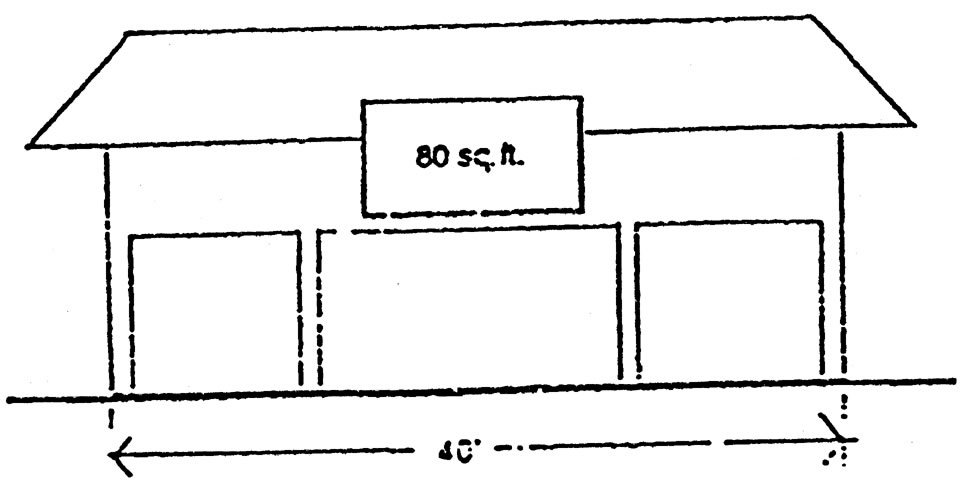
Signs permitted in B-2 district
Calculation of maximum total sign area in B-2 and M-1 zones for each one lineal foot of building frontage × 2 = sign area (in square feet).
(Ord. No. 1012, art. VII, § 8, 5-11-1993; Ord. No. 1061, art. VII, § 8, 1-10-1995; Ord. No. 1101, art. VII, § 8, 3-11-1997; Ord. No. 1120, art. VII, § 8, 2-10-1998; Ord. No. 2053, 1-14-2003; Ord. No. 3090, 5-12-2009)
Sec. 9. - Signs permitted in the general business B-3, and industrial, M-1 and M-2 districts.
a.
For shopping centers and buildings in which more than one tenant is located, no more than one freestanding sign shall be permitted. Such sign area may be in a single sign, or in a combination of signs subject to the following limitations:
1.
Wall mounted signs, provided that no such sign exceeds one hundred (100) square feet in area, extends more than six inches (6) beyond the building wall surface, or projects above the roofline of the building. Businesses with an additional customer entrance on the side or rear of the building will be allowed to have an additional sign of equal size with the same restrictions. Businesses with a service or delivery entrance will be allowed to place an additional sign above or next to the service door. The size of such signs cannot exceed a ratio of ½ square foot per one foot of lineal building frontage up to a maximum of twenty-five (25) square feet. There is a limit of one additional customer or service entrance sign per business.
2.
Roof signs, provided that such signs shall not be illuminated, shall not exceed 100 square feet in area, shall not project above the roofline, and that no more than two such signs shall be allowed per building.
3.
Freestanding signs, provided that such signs are no larger than 30 square feet in area and not taller than eight feet from grade at the base of the sign. Only one freestanding sign shall be permitted on a property. All freestanding signs shall be ground mounted, monument style signs. The maximum size of the total sign structure including the base, sign, and surrounding structure will be 40 square feet. Such interior lit signs shall be required to have an opaque background so that light only shines through the lettering and other designs.
4.
For shopping centers and buildings in which more than three tenants are located, no more than one freestanding sign shall be permitted. The sign shall be limited in area to 100 square feet, and shall not extend higher than 15 feet. Such signs shall indicate only the name of the shopping center or building and/or business uses within the building. The square footage of total sign area allowed for each business shall not be effected [affected] by this section. Such interior lit signs shall be required to have an opaque background so that light only shines through the lettering and other designs.
5.
Projecting signs and signs attached to a marquee or roof overhand [overhang], provided that such signs have a minimum clearance of ten feet, and shall not project more than six feet from the building front nor closer than two feet from the curbline. The maximum size for these signs shall be ten feet.
6.
Office building or industrial signs: one ground-mounted identification sign at each major entrance of an office or industrial center, provided that no such sign shall exceed 40 square feet in area or ten feet in height.
7.
Illuminated signs, provided that such signs do not interfere visually with safe ingress to or egress from the site and do not fall into any of the categories defined as prohibited in this section.
b.
Off premises directional business signage is allowed for businesses that do not have frontage on any of the following roads: Fourth Street, Fifth Street, Sixth Street, Carolina Avenue, College Avenue, Home Avenue, Poole Street, Washington Street, Marlboro Avenue and Westfield Road or any public parking lots subject to the following conditions:
1.
Both the business and the sign must be located in the M-1 or M-2 zones.
2.
The sign can not be located within 20 feet of any other business signage.
3.
Such signage shall conform in style, color and shape to the City of Hartsville streetscape signage plans and drawings on file in city hall.
4.
Such signs shall have a maximum height of six feet from ground level. The maximum square footage shall be 24 square feet. This shall include all parts of the sign including supports and frame. Individual business names and an arrow are all that shall be allowed in the sign, and each name and arrow shall be a maximum size of one foot tall by three feet wide.
5.
This directional signage shall only be allowed within 25 feet of a street intersection. Only one such sign per intersection shall be allowed. All such signs shall have space for two business names on them.
(Ord. No. 1120, art. VII, § 9, 2-10-1998; Ord. No. 1162, 5-4-1999; Ord. No. 2053, 1-14-2003)
Sec. 10. - Streetscape banner program, vertical banners.
A.
Streetscape banner program.
(a)
The streetscape banner program shall be designed to advertise public events in the City of Hartsville at the city's discretion. Banners shall not display commercial advertisements or sponsor information.
(b)
Eligible participants are non-profit and civic organizations.
(c)
Program requirements:
(1)
Applicant must complete and return application to the planning and development department at least a month before the event. Submit a drawing/illustration with dimensions, text, color, and graphic/design. The city will review and approve design prior to production.
(2)
Approval is on a first come, first serve basis. City sponsored endorsed events will have priority.
(3)
Materials: 100 percent acrylic coated polyester with grommets at the bottom of pockets.
(4)
Design: All banners must be double sided.
(5)
Size: Two feet × four feet, traffic light poles; 18 inches by three feet, decorative 16 foot poles.
(Optional) Add-on/date banner: 24 inches × 12 inches with grommets. The attachments can only advertise date, time, and place of event.
(6)
Banners may be displayed 14 days prior to the event.
(7)
Banners can be only installed at West Carolina Avenue and Sixth Street; West Carolina Avenue and Fifth Street; East Carolina Avenue and Fourth Street; North Fifth Street and Home Avenue; and North Fifth Street and College Avenue intersections.
(d)
The application fee shall be $30.00 with a $180.00 installation fee.
(e)
Any deviation from the approved content and design will result in immediate revocation of the permit.
(f)
The planning director shall coordinate with public works and other departments.
(g)
City manager has final approval.
B.
Vertical banner.
(a)
Vertical banners are permitted in campus (CA) and manufacturing (M-1; M-2) zoning districts.
(b)
Banners shall be designed to promote the business or organization's activity or event. Banners shall not display commercial advertisements or sponsor information.
(c)
Requirements:
(1)
Applicant must complete and return application to the planning and development department. A permit is required for each banner change.
(2)
Submit a drawing/illustration with dimensions, text, color, and graphic/design. The city will review and approve design prior to production.
(3)
Materials: 100 percent acrylic coated polyester with grommets at the bottom of pockets.
(4)
Design: All banners must be double sided.
(5)
Size: Two feet by four feet, light poles; 18 inches by three feet, decorative 16 foot poles.
(Optional) Add-on/date banner: 24 inches × 12 inches with grommets. The attachments can only advertise date, time, and place of event.
(6)
Number: Up to 20 single hung and 40 double hung banners.
(7)
Location: Banners must be on-premise and firmly attached to light poles with the appropriate banner brackets. Banners are not permitted on wooden and metal utility or progress energy poles.
(8)
Height clearance: Eight foot minimum.
(9)
Orientation: Up to two banners per pole. Double hung banners shall be oriented side by side.
(d)
The application fee shall be $30.00.
(e)
Any deviation form the approved content/design will result in immediate revocation of the permit.
(Ord. No. 3062, 3-11-2008)
Sec. 11. - Nonconforming signs and structures.
Signage and associated structures are lawful as of the effective date of this ordinance but not in conformance with the current regulations shall be permitted as nonconforming signs and structures. The continued use of signage and associated structures shall not be permitted after the business/agency has closed or moved.
(Ord. No. 3060, 2-12-2008)
Sec. 12. - Confiscated signs retrieval.
Signs illegally posted in the city's right-of-way and on trees, utility poles, and fences will be confiscated. The owner shall have the right to retrieve the confiscated sign(s) up to seven days from the date the sign was removed. The retrieval fee shall be $10.00 per sign.
(Ord. No. 3060, 2-12-2008)
Sec. 13. - Murals.
(A)
Goal. The City of Hartsville would like to promote its history and culture through the display of public art, including murals.
(B)
Definitions.
Commercial message. Any message that advertises a business conducted, services rendered, or goods produced or sold. Any proposed mural that contains a commercial message would follow the sign ordinance.
Graffiti. Any unsanctioned material posted/painted on public or private property.
Mural. An image, such as a painting or enlarged photograph, applied directly to an external surface of a building or building attachment, that is a one-of-a-kind, hand-painted, printed or hand-tiled two-dimensional image that does not contain any commercial message and does not project more than four inches from the surface of the building or building attachment.
Property. Any public or private property, which is observable from the public right-of-way or from a public space.
(C)
Regulations.
(1)
Murals are allowed with a mural permit. Graffiti is not allowed.
(2)
Murals are purely artistic forms of expression. While basic content is free from evaluation, obscenity shall not be allowed.
(3)
No person shall apply a mural on the exterior of any building or building attachment or change any existing mural a building or building attachment prior to the issuance of a mural permit. The following design criteria shall apply to any mural commissioned.
(a)
The proposed mural shall be well integrated with the building and neighboring structures and is harmonious with the surrounding environment. The proposed mural, by its design, scale, construction and location, shall not have a substantial adverse effect on abutting property or the permitted use, and will contribute to Hartsville's character and quality of life.
(b)
The proposed mural shall exhibit exceptional design quality that enhances the overall development and appearance of Hartsville. The paint and/or materials to be used and applied on the structure shall be appropriate for use in an outdoor locale for an artistic rendition and shall be of a permanent or long lasting variety.
(c)
No mural may consist of, or contain, electrical or mechanical components, changing images (moving structural elements, flashing or sequential lights, lighting elements, or other automated methods that result in movement, the appearance of movement, or change of mural image.
(d)
No mural shall be placed over the exterior surface of any building opening, including, but not limited to, windows, doors, and vents.
(4)
Maintenance of the mural is the responsibility of the property owner. It shall be the property owner's responsibility to remove the mural if it is not maintained as required. While naturally occurring changes to the mural caused by exposure to the elements or the passage of time is acceptable, murals that are not maintained sufficiently may be considered a public nuisance.
(5)
A mural permit application shall be completed by the building owner or their applicants' assign and submitted to the zoning administrator. Review and approval must be obtained from the architectural review board. The application shall include, at a minimum, the intended location of the mural, size, subject matter, medium and a summary of the general color palette to be used. A visual representation of the Mural shall also be included in the application.
(D)
Evaluation. Murals shall be approved for a five-year period. The architectural review board shall reevaluate the mural five years after approval.
(E)
Expiration. The mural permit shall expire two years after issuance if the approved mural has not been installed, or 180 days from issuance if the work permitted has not begun. The permit shall also expire if it is deemed that the work authorized by the permit has been suspended, discontinued or abandoned for a continuous period of 180 days.
(F)
Fees. [Reserved.]
(G)
Appeal. An applicant who has been denied a permit under this section may appeal to the zoning board of appeals of the City of Hartsville.
(Ord. No. 4356, 12-11-2018)

