
Hastings City Zoning Code
155 General
Provisions
155.01 Establishment Of Districts; Official Zoning Map
- Official Zoning Map. The city is divided into Use Districts as shown on the Official Zoning Map(s), which with all explanatory matter thereon, is adopted by reference and declared to be part of this chapter. The Official Zoning Map(s) shall be identified by the signature of the Planning Director under the following certification: “I certify that this is the Official Zoning Map referred to in Section 1 of City Zoning Ordinance of the City of Hastings, Minnesota, passed (month, date, year).” An index shall be affixed to and become a part of the Official Zoning Map(s). Amendments as approved by the Council shall be tabulated on the index, with an entry as follows:No changes of any nature shall be made in the Official Zoning Map(s) or matter shown thereon except in conformity with the procedures set forth in this chapter. Any unauthorized change of whatever kind by any person shall be considered a violation of this chapter. Despite the existence of purported copies of the Official Zoning Map(s) which may, from time to time, be made or published, the Official Zoning Map(s) which shall be located in the office of the Planning Department shall be the final authority as to the current zoning status of land and water areas, buildings, and other structures in the city.
Date Page Amendment Signature (Date of Council Resolution) (Page of Maps) (Brief Description of Amendment) (Signature of Mayor and City Clerk) - Replacement Of Official Zoning Map. In the event that the Official Zoning Map becomes damaged, destroyed, lost, or difficult to interpret because of the nature or number of changes and additions, the Council may, by resolution, adopt the new Official Zoning Map that shall supersede the prior Official Zoning Map. The new Official Zoning Map may correct drafting or other errors or omissions in the prior Official Zoning Map, but no correction shall have the effect of amending the original Zoning Map or any subsequent amendments thereof. The new Official Zoning Map shall be identified by the Signature of the Mayor, attested by the City Clerk, and bearing the seal of the city under the following words: “This is to certify that this official zoning map supersedes and replaces the official zoning map adopted (date of adoption of map being replaced) as part of City Zoning Ordinance of the City of Hastings, Minnesota.” Unless the prior Official Zoning Map has been lost, or has been destroyed, the prior map or any significant part of it remaining shall be preserved, with all available records about its adoption or amendment.
(Prior Code, § 10.01)
Amended by Ord. 2022-03, Third Series on 3/7/2022
Amended by Ord. 2022-04, Third Series on 3/7/2022
Amended by Ord. 2022-15 on 10/3/2022
Amended by Ord. 2022-17 on 10/3/2022
Amended by Ord. 2023-18 on 12/18/2023
Amended by Ord. 2024-07 on 6/3/2024
Amended by Ord. 2026-01 on 4/20/2026
155.02 Definitions
For the purpose of this chapter, the following definitions shall apply unless the context clearly indicates or requires a different meaning. ACCESSORY USE OR STRUCTURE. A use or structure on the same lot with, and of a nature customarily incidental and subordinate to, the principal use or structure. ANTENNA. Any structure or device used for the purpose of collecting or transmitting electromagnetic waves, including but not limited to directional antennas, such as panels, microwave dishes, and satellite dishes, and omni-directional antennas, such as whip antennas. BED AND BREAKFAST. An owner or manager occupied dwelling in which a room or rooms are rented on a nightly basis for periods of less than a week. Meals may or may not be provided. BED AND BREAKFAST UNIT. A room or group of rooms forming a single habitable unit used or intended to be used for living and sleeping, but not for cooking or eating purposes. BREW PUB. A restaurant establishment holding an on-sale intoxicating liquor license in which malt liquor is brewed or manufactured solely for sale on tap on the licensed premises that shall be owned by the brewer. BREWERY TAPROOM. An area on the premises of a brewery or on premises adjacent to a brewery owned by the brewer in which the brewer sells or otherwise provides exclusively malt liquor produced by the brewer for consumption with the brewery taproom. BUILDABLE AREA. The portion of a lot remaining after required yards have been provided. CAMPING AREA. Any area, whether privately or publicly owned, used on a daily, nightly, weekly, or longer basis for the accommodation of five or more tents, recreational camping vehicles, as defined by M.S. § 327.14, subd. 7, as it may be amended from time to time, free of charge or for compensation. COCKTAIL ROOM. A facility on or adjacent to premises owned by a microdistillery for the consumption of distilled spirits produced by the microdistillery. CLIMATE CONTROLLED STORAGE FACILITY. A storage facility characterized by individual separate storage spaces which are accessible by customers for the storing and retrieval of personal effects and household goods. Storage spaces are climate controlled to provide a regulated temperature.
COMMERCIAL WIRELESS TELECOMMUNICATIONS SERVICE. Licensed commercial wireless telecommunication services including cellular, personal communication services (PCS), specialized mobilized radio (SMR), enhanced specialized mobilized radio (ESMR), paging, and similar services that are marketed to the general public. CONVERSION. The converting of any 1-family dwelling to a multiple-family dwelling. DOWNTOWN OVERLAY DISTRICT. The area zoned C-3 bounded by the Mississippi River to the north, 4th Street to the south, Bailly Street to the east, and Eddy Street to the west.
DRIVE-IN RESTAURANT OR REFRESHMENT STAND. Any place or premises used for sale, dispensing, or servicing of food, refreshments or beverages in automobiles, including those establishments where customers may serve themselves and may eat or drink the food, refreshments, or beverages on site. DWELLING, 2-FAMILY. A detached residential dwelling building containing 2 dwelling units. DWELLING, MULTIPLE-FAMILY. A residential building designed for 2 or more families, with the number of families in residence not exceeding the number of dwelling units provided. DWELLING, SINGLE-FAMILY. A detached residential dwelling unit other than a manufactured home, designed for and occupied by 1 family only. DWELLING UNIT. A building or portion thereof, constituting an independent housekeeping establishment for owner occupancy, rental, or lease and separate from any other dwelling units that may be in the same structure and containing independent cooking and sleeping facilities. ESTABLISHED STRUCTURE SETBACK. The setback established by an existing structure. The Established Structure Setback may be less than the minimum zoning provision provided that the structure is legally nonconforming. EQUIPMENT SALES AND RENTAL FACILITIES. A sales or service establishment which may offer a wide variety of large-sized or bulky materials and equipment for sale or rental. FAMILY. A group of individuals living under 1 roof. FUNERAL HOME. A building, or part thereof, used for human funeral services and which may include space for the embalming and other services used in the preparation of the dead for burial, the storage of caskets, funeral urns, and other related supplies, the storage of funeral vehicles, facilities for cremation, chapels, and other related uses. HOME OCCUPATION. An occupation conducted in a dwelling unit.
INTERIM USE. A temporary use of property until a particular date, until the occurrence of a particular event, or until zoning regulations no longer permit it.
LOADING SPACE, OFF-STREET. Space logically and conveniently located for bulk pickups and deliveries.
LODGING FACILITIES. A building used as, maintained as, advertised as, or held out to be a place in which sleeping accommodations are furnished to the public for temporary periods, and having five or more beds to let to the public. Including and limited to hotels, motels, and bed and breakfast facilities.
LOT. A separate parcel, tract, or area of land undivided by any public street or approved private road, established by plat, metes and bounds subdivision, or as otherwise permitted by law, and occupied by or intended to be developed for and occupied by a principal building or group of the buildings and accessory buildings, or utilized for a principal use and uses accessory thereto, including the open spaces and yards as are designed and arranged or required by this chapter for the building, use, or development.
LOT-CORNER (CORNER LOT). A lot at the intersection of 2 or more streets.
LOT FRONTAGE. The front of a lot shall be construed to be the portion nearest the street. For the purposes of determining yard requirements on corner lots and through lots, all sizes of a lot next to streets shall be considered frontage, and yards shall be provided as indicated under yards in this section.
LOT-INTERIOR (INTERIOR LOT). A lot other than a corner lot with only 1 frontage on a street.
LOT MEASUREMENT. The depth of a lot shall be considered the distance between the midpoints of straight lines connecting the foremost points of the side lot lines in front and the rearmost points of the side lot lines in the rear. Width of a lot shall be considered the distance between straight lines connecting the front lot width at setback.
LOT OF RECORD. A lot that is part of a plat recorded in the office of the County Recorder, or a lot or parcel described by metes and bounds, the description of that has been so recorded.
LOT-THROUGH (THROUGH LOT). A lot other than a corner lot with frontage on more than 1 street.
MANUFACTURED HOME (MOBILE HOME). A single-family detached housing built to the National Manufactured Housing Construction and Safety Standards Act of 1974 or as may be amended.
MEASURED DISTANCES. That all distances expressed in feet shall be to the nearest tenth of a foot.
MICRODISTILLERY. A distillery which produces premium, distilled spirits.
MOTOR COACH. A Type A Motor Home, as defined in M.S. § 168.002, subd. 17(d)(1), as it may be amended from time to time, and having an overall length of no less than twenty (20) feet, being no more than fifteen (15) years old at the time of use and with all essential components in M.S. 168.002, subd. 17 (b), (1-5) for classification as a motor home having been installed by a first-stage or final-stage manufacturer.
MOTOR COACH COMMERCE FACILITY. A facility consisting of parking pads, and utility hook-ups, and in some cases water pumps, lift stations, and facilities necessary to provide vehicle washing and waxing, or maintenance, designed and operated to serve transient users of motor coaches and travel trailers.
MOTOR VEHICLE IMPOUND LOT. A facility for the temporary storage of motor vehicles, as defined by M.S. Chapter 169, as it may be amended from time to time. This definition does not include the storage of motor vehicles for salvaging, repairing, stripping, dismantling, sales or storage beyond time limits provided by ordinance.
PORTABLE ACCESSORY STRUCTURE. A lightweight structure without a fixed foundation that can easily by moved by the owner.
PRINCIPAL STRUCTURE. A structure in which is conducted the primary use of the lot.
PUBLIC SAFETY TELECOMMUNICATIONS SERVICES. Licensed telecommunications systems used by local governments and all other public and private entities eligible under Part 90 of the FCC rules for public safety purposes including police, fire, emergency medical, highway maintenance, and forestry conservation radio service.
PUBLIC UTILITY. Persons, corporations, or governments supplying gas, electric, transportation, water, sewer, or land line telephone service to the general public. For the purpose of this chapter, personal wireless service shall not be considered public utility uses, and are defined separately.
RESIDENTIAL CARE FACILITY, DEPENDENT. A residential facility licensed in accordance with Minn. Rules, Chapter 4655.0100, subpart 8, as it may be amended from time to time, now in effect, or as may be amended in the future, and used to provide full dependent care for aged or infirm persons who require nursing care and related services.
RESIDENTIAL CARE FACILITY, SEMI-INDEPENDENT. A state licensed residential facility for aged and/or disabled persons within which provides only personal or custodial care. RESIDENTIAL SENIOR FACILITY, INDEPENDENT. A residential facility in which at least 1 resident per dwelling unit is 55 or older. The dwelling units must be self-contained and physically accessible to aged persons. ROOF LINE. The line in which an exterior wall surface of a building structure departs from a vertical plane. SENIOR/DISABLED CITIZEN DWELLING UNIT. Is defined pursuant to § 155.22. SERVICE STATION. A retail station for servicing motor vehicles especially with gasoline, oil, and other accessories. SHOPPING CENTER. A group of commercial retail establishments with multiple tenants that share parking and have a visual appearance as a contiguous structure that may or may not be planned, constructed, or managed as a total entity. SIGN. Any letter work, symbol, model, printed, projected or affixed device, poster, picture, reading matter, or other representation in the nature of an advertisement, announcement, direction or informative device including structural and compound parts that is located outdoors and is larger than 1 square foot in area.
- BANNERS. A sign, flag, banner, pennant, or valance constructed of cloth, canvas, light fabric, cardboard, wallboard, plastic or other light materials with or without frames, which is not permanently secured and is intended to be displayed for a limited period of time only.
- CONSTRUCTION SIGN. Any sign that displays information regarding the construction or development of the site in which it is displayed.
- DIRECTIONAL SIGN. A sign that serves primarily to direct traffic to the location of a place, area, or activity.
- ELECTRONIC GRAPHIC DISPLAY SIGN. A sign or portion thereof displaying electronic images, graphics, or pictures, with or without text information, defined by a small number of matrix elements using different combinations of light emitting diodes (LEDs), fiber optics, light bulbs or other illumination devices within the display area where the message change sequence is accomplished immediately or by means of fade, repixilization or dissolve modes. ELECTRONIC GRAPHIC DISPLAY SIGNS include computer programmable, microprocessor controlled electronic or digital displays. ELECTRONIC GRAPHIC DISPLAY SIGNS are prohibited from flashing or pulsing. ELECTRONIC GRAPHIC DISPLAY SIGNS include projected images or messages within these characteristics onto buildings or other objects.
- FLAG. A rectangular piece of fabric of distinctive design mounted on a pole used as a symbol (as a nation), signaling device (nautical), or attention getting device (advertising).
- FREESTANDING SIGN. A sign that is self-supporting and affixed to a frame structure, not attached to a building.
- GRADE OF SIGN. The lowest point of elevation of the finished surface of the ground, paving, or sidewalk within the area between the sign and a line 10 feet from the sign.
- IDENTIFICATION SIGN. A sign that displays only the name, address and title of an occupant or the name and address of a building or development.
- MONUMENT SIGN. Any freestanding sign with its sign face mounted on the ground or mounted on a base at least as wide as the sign.
- NONCONFORMING SIGN. Any sign that does not conform to the regulations of this chapter.
- OFF-PREMISES SIGN. Any sign that advertises anything other than the business located on the same lot.
- PERMANENT SIGN. Any sign other than a temporary sign.
- PORTABLE SIGN. Sandwich boards and other types of durable signage which are placed in front of a business during operating hours and are removed at the end of the business day. Vehicle Signs shall not be considered Portable Signs.
- PROJECTING SIGN. Any sign affixed to an outside exterior wall or soffit of any building and is not parallel to the plane of the wall or soffit.
- PUBLIC SIGN. Any sign display intended primarily to promote items of general interest to the community such as time, temperature, date, atmospheric conditions, news, and the like. This does not include any information that would be related to the products or services at the display site.
- REAL ESTATE SIGN. Any sign about the sale, lease, or rental of land or buildings.
- ROOF LINE. The line at which an exterior wall surface of a building structure departs from a vertical plane.
- ROOF SIGN. Any sign erected and constructed wholly on and over the roof of a building, supported by the roof structure, and extending vertically above the highest portion of the roof.
- SHOPPING CENTER AREA IDENTIFICATION SIGN. A freestanding sign used to identify single tenant or multi-tenant buildings.
- SIGN AREA. The area within the marginal lines or extreme outside edge of the surface that bears the advertisement, or in the case of messages, figures, or symbols attached directly to any part of a building, that area included in the smallest rectangle that can be made to circumscribe any message, figure, or symbol displayed thereon. For a sign with not more than 2 back-to-back faces, only the area of 1 side is computed in determining the sign area.
- SIGN HEIGHT. The height of a sign shall be measured from the grade of the sign.
- SIGN ILLUMINATION. A light source within or directed at the sign.
- TEMPORARY SIGN. Any sign used only temporarily and is not permanently mounted including ribbons, banners, pennants, and other similar attention getting devices.
- TRAFFIC SIGN. A sign erected by a governmental agency for guiding vehicular traffic and providing information to motorists.
- VEHICLE SIGN.
- Flat, one-dimensional signs painted or placed magnetically or otherwise attached (i.e. glue) to a vehicle.
- Signs under 10 square feet attached to a vehicle via a structural support.
- Temporary Signs and Banners affixed to vehicles shall not be considered Vehicle Signage.
- VIDEO DISPLAY SIGN. A sign that changes its message or background in a manner or method of display characterized by motion or pictorial imagery, which may or may not include text and depicts action or special effects to imitate movement, the presentation of pictorials or graphics displayed in a progression of frames which have the illusion of motion, including but not limited to the illusion of moving objects, moving patterns or bands of light, or expanding or contracting shapes. VIDEO DISPLAY SIGNS include projected images or messages with these characteristics onto buildings or other objects.
- WALL SIGN. A sign affixed to the exterior wall, mansard roof, or soffit of a building that is parallel to the building wall. A wall sign does not project more than 12 inches from the surface to which it is attached, or extend beyond the top of the parapet wall.
SPECIAL USE. A use that would not be appropriate generally or without restriction throughout the zoning district but, if controlled as to number, area, location, or relation to the neighborhood, would not detract from the public health, safety, and welfare. Special uses may be permitted in a zoning district if specific provision for the special uses is made in this Zoning Ordinance. Conditional Uses and Conditional Use Permits shall have a similar meaning as Special Uses and Special Use Permits. Chapter 30.02, Subd. (E)(2) established conditions governing application procedures, granting of permits, and limitations. STREET RIGHT-OF-WAY. The line dividing privately owned property from property dedicated or conveyed for public use. STRUCTURE. Anything constructed or erected with a fixed location on the ground. Among other things, structures include buildings, manufactured homes, and fences. TOWER. Any ground mounted pole, spire, structure, or combination thereof, including supporting lines, cables, wires, braces, masts, intended primarily for the purpose of mounting an antenna, meteorological device, or similar apparatus above grade. TOWER, MULTI-USER. A tower designed for the antennas of more than 1 commercial wireless telecommunications service provider or governmental agency. TOWER, SINGLE-USER. A tower designed for only the antennas of a single user. TRAVEL TRAILER. A Travel Trailer as defined in M.S. § 168.002, subd. 36, as it may be amended from time to time, and having an overall length of no less than twenty (20) feet, being no more than fifteen (15) years old at the time of use, and with all essential components in M.S. 168.002, subd. 17 (b), (1-5) for classification as a Travel Trailer having been installed by a first-stage or final-stage manufacturer.
VARIANCE. A modification from the literal requirements of this chapter. YARD. A required open space on a lot adjoining a lot line, containing only landscaping or other uses and structures provided by this zoning ordinance. YARD, FRONT. A yard extending along the full width of a front line between side lot lines and from the front lot line to the front building line in depth. YARD, REAR. A yard extending across the full width of the lot and lying between the rear lot line and the nearest line of the building. Rear-yard depth shall be measured at right angles to the rear line of the lot. YARD, SIDE. A yard lying between the side line of the lot and the nearest line of the building and extending from the front yard to the rear yard, or without either a front or rear yards, to the front or rear lot lines. Side-yard width shall be measured at right angles to side lines of the lot. YARD, SPECIAL. A yard behind any required yard next to a public street, required to perform the same functions as a side or rear yard, but next to a lot line so placed or oriented that neither the term side nor rear yard clearly applies. In such cases, the administrative official shall require a yard with minimum dimensions as generally required for a side yard or a rear yard in the district, determining which shall apply by the relation of the portion of the lot on which the yard is to be located to the adjoining lot or lots, with due regard to the orientation and location of structures areas thereon. ZERO LOT LINE. The location of a building on a lot in such a manner that 1 or more of the building’s sides rest directly on a lot line.
(Prior Code, § 10.02)
Amended by Ord. 462A, 2nd Series on 9/4/2001
Amended by Ord. 558, 2nd Series on 12/4/2006
Amended by Ord. 2010-20, 3rd Series on 12/20/2010
Amended by Ord. 2014-06, 3rd Series on 4/7/2014
Amended by Ord. 2015-12, 3rd Series on 10/19/2015
Amended by Ord. 2017-12, 3rd Series on 12/18/2017
Amended by Ord. 2018-06, 3rd Series on 7/9/2018
Amended by Ord. 2019-04, 3rd Series on 9/3/2019
Amended by Ord. 2021-02, 3rd Series on 1/19/2021
Amended by Ord. 2021-08, 3rd Series on 7/19/2021
Amended by Ord. 2023-10 on 4/17/2023
155.03 Generally
- Application. Except as herein provided, no buildings or land within the city shall hereafter be used or occupied and no building or part thereof shall be erected, moved, or altered unless in conformity with applicable regulations herein specified.
- Geographic Jurisdiction. The geographic jurisdiction of this chapter shall be the entire area within the present or future corporate limits of the city and any area outside the city, which by state law is or may hereafter be governed by this chapter.
- Annexed Territory. Annexed territory shall be designated by an ordinance of the Council to a proper use zoning district after annexation, after referral to and recommendation by the Planning Commission. No permit shall be issued for construction or use in annexed territory until the area is clarified by the Council.
- Essential Services. Essential services shall include governmentally and privately owned and operated. Governmentally owned and operated essential services are exempt from the application of this chapter. Privately owned and operated essential services are subject to the provisions of this chapter unless specifically exempted by a provision hereof or by Council.
(Prior Code, § 10.03)
155.04 Rules For Interpretation Of District Boundaries
- Generally. Where uncertainty exists as to the boundaries as shown on the Official Zoning Map, the following rules shall apply.
- Rules.
- Boundaries indicated as approximately following the centerline of streets, highways, or alleys shall be construed to follow the center lines.
- Boundaries indicated as approximately following platted lot lines shall be construed as following the lot lines.
- Boundaries indicated as approximately following city limits shall be construed as following the city limits.
- Boundaries indicated as following railroad lines shall be construed to be midway between the main tracks.
- Boundaries indicated as following shore lines shall be construed to follow the shore lines, and in the event of change in the shore line shall be construed as moving with the actual shore line; boundaries indicated as approximately following the center lines of streams, river canals, lakes, or other bodies of water shall be construed to follow the center lines.
- Boundaries indicated as parallel to or extensions of features indicated in divisions (B)(1) through (B)(5) above shall be so construed. Distances not specifically indicated on the Official Zoning Map shall be determined by the scale of the map.
- Where physical or cultural features existing on the ground are at variance with those shown on the Official Zoning Map, or in other circumstances not covered by divisions (B)(1) through (B)(6) above, the Board of Adjustment shall interpret the district boundaries.
- Where a district boundary line divides a lot that was in single ownership at the time of the effective date of this chapter, the Board of Adjustment may permit the extension of the regulations for either portion of the lot not to exceed 50 feet beyond the district line into the remaining portion of the lot.
(Prior Code, §10.04)
155.05 Application Of District Regulations
- Generally. The regulations set by this chapter within each district shall be minimum regulations and shall apply uniformly to each class of structure or land, except as hereinafter provided.
- Intent. No structure or land shall hereafter be used or occupied, and no structure or part thereof shall be hereafter erected, constructed, reconstructed, moved, or altered except in conformity with all of the regulations herein specified for the district in which it is located.
- Building Regulations. No structure shall hereafter be erected or altered to exceed the height or bulk; to accommodate a greater number of families; to occupy a greater percentage of lot area; to have narrower or smaller rear yards, front yards, side yards, or other open space than herein allowed; or in any other manner contrary to the provisions of this chapter.
- Accessory Building And Structure Requirements. Accessory buildings and structures shall meet the following requirements.
- No accessory building shall be erected in any required front or side yard fronting a public street or right-of-way.
- No accessory building or structure shall be constructed on any lot prior to the time of construction of the principal building to which it is accessory.
- Accessory structures, except fences meeting the requirements of division (F) below, shall not be placed in any easements.
- All accessory structures, except fences, shall meet the setbacks listed in the table in division (D)(11) below.
- All accessory structures shall be setback at least 6 feet from all other structures.
- At grade accessory structures such as basketball courts, patios, dog kennels shall meet the accessory structures setbacks listed in the table in division (D) (11) below. These accessory structures are not included in the total allowable square footage allowed, as long as the total impervious surface of the lot does not exceed 35% for the rear yard. The rear yard shall be measured from the rear building line to the rear lot line.
- Accessory structures shall have weather resistive exterior finishes that are durable and architecturally compatible with and similar in design, color, and material to the principal structure.
- Accessory structures shall not exceed 1 story in height and shall not exceed 16 feet in height as measured to the mean of the roofline, or the height of the principal structure, whichever is more restrictive. The roofline mean height shall be measured from the mean height of the ground grade surrounding the accessory structure. Sidewalls shall not exceed 10 feet in height as measured from the mean height of the floor of the structure.
- The height of any accessory structure shall not be taller than the primary structure.
- Portable accessory structures 75 square feet or less do not require a permit, but must meet applicable regulations. Structures between 76 square feet and 200 square feet require a zoning permit. Structures over 200 square feet require a building permit.
- The following table shall determine the number, size, and setbacks of accessory structures. In addition to the accessory structures listed in the table below, swimming pools meeting the requirements of § 150.09 and 155.05 are permitted.
Accessory Building/Structure Number, Size, and Setback Standards Setbacks Property Zoning Number of Structures Maximum Floor Area Size Side Corner Side (a) Rear A R-1, R-1L, R-2, R-3, R-4, R-5 with attached garage (b) 1 1,000 square feet 5 10 5 R-1, R-1L, R-2, R-3, R-4, R-5 without attached garage 2 Combined total 1,000 square feet 5 10 5 R-6 1 1,000 square feet 5 10 5 Multi-Family 4 or more units Site Plan Review Site Plan Review Site Plan Review Site Plan Review Site Plan Review Commercial/ Office Districts Site Plan Review Site Plan Review Site Plan Review Site Plan Review Site Plan Review Industrial Districts Site Plan Review Site Plan Review Site Plan Review Site Plan Review Site Plan Review NOTES TO TABLE:
(a) Garages shall be setback 20 feet from the right-of-way.
(b) Residential properties with an attached garage are also permitted an accessory storage structure 120 square feet in size or less.
(c) Portable accessory structures up to 75 square feet are exempt from the allowable number of structures and total size limitations of this section.
- Yard Area Regulations. No yard or lot existing at the time of passage of this chapter shall be reduced in dimension or area below the minimum requirements set forth herein. Yards or lots created after the effective date of this chapter shall meet at least the minimum requirements established by this chapter.
- Fences And Walls Or Hedges.
- Location. Fences are permitted, but shall not extend into public right-of-way. Notwithstanding other provisions of this chapter, fences, walls, and hedges are permitted in any yard, including a required yard, or along the edge of any yard, provided that no fence, wall, or hedge shall extend into public right-of-way.
- Materials. All fences built or maintained on a residential property shall be constructed of materials capable of providing a finished appearance on the outward side visible to the public. All materials used to construct the fence shall be sound materials, resistant to rot, and capable of accepting and maintaining a visually attractive appearance. The fence shall be constructed in such a manner as to be capable of resisting the design wind loads for structures as defined by the state building code.
- Hazardous fences and walls. Hazardous fences and walls such as barbed wire, electric, chain link with barbs exposed, and walls with protruding sharp edges thereof, and other fences and walls designed for or likely to cause harm to persons are declared hazardous and are prohibited in the city, except as follows: conventional barbed wire fences with barbs exposed are allowed with permission of the Council by simple resolution in commercially zoned areas, and are allowed without permission of the Council in industrial and agriculturally zoned area. Any fence constructed in violation of this section after the effective date shall be brought into compliance or removed as determined by the Planning Director.
- Height restrictions. The maximum height of any fence installed within a residential zoning district of the City of Hastings is 6 feet; however, fences installed within the front yard are limited to a maximum height of 3.5 feet or 42 inches. Fences installed around swimming pools from ground up must be a minimum of 4 feet high and non-climbable with a self-closing, self-latching gate. Maximum height of all fences shall be in compliance with the city zoning code or as approved by the Planning Commission.
- Special consideration/corner lots. Fences that extend into front yards of corner lots must not impair traffic visibility. No fence or hedge shall be over 30 inches in height located within 25 feet each direction from a property corner fronting a street right of way.
- Covenants. The City of Hastings does not enforce the private covenants of subdivisions. Homeowner’s association covenants may restrict the ability to construct fences. Homeowners should review any covenants prior to submittal of a permit.
- Permits. A zoning permit is required for all fences installed in Hastings.
- Setbacks. All fences may be installed up to, but not on the property line.
- Establishing Property Lines. The City of Hastings does not provide surveying service. It is up to the homeowner to establish the location of the lines and make these available at time of application or upon request of the inspector.
- Erection Or More Than 1 Principal Structure On A Lot. In any district, more than 1 structure housing a permitted principal use may be erected on a single lot provided that yard and other requirements of this chapter shall be met for each structure as if it were on an individual lot.
- Exceptions To Height Regulations. The height limitations contained in § 155.20, do not apply to spires, belfries, cupolas, antennas, water tanks, ventilators, chimneys, or other appurtenances usually required to be placed above the roof level and not intended for human occupancy except as otherwise allowed by the City Council.
- Structure To Have Access. Every building hereafter erected or moved shall be on a lot next to a public street, or with access to a city allowed private street or driveway and all structures shall be so located on lots as to provide safe and convenient access for servicing, fire protection, and required off street parking.
- Yard Maintenance. In all districts, landscaping and fences shall be constructed and maintained so as not to be unsightly or present harmful health or safety conditions.
- Portable Carport. A nonpermanent structure designed as a shelter for motor vehicles, boats, and the like. Such structure shall not be permanently affixed to a foundation. Temporary tarps, tents and the like erected for periods not to exceed 1 week are not considered portable carports.
- Portable carports must remain open on 4 sides, with no sidewalls.
- Portable carports must be anchored in such a manner as to prevent wind uplift.
- Portable carports may not be permanently anchored to concrete slabs or footings or otherwise anchored in a manner that would impede easy removal and portability.
- All anchoring systems must be inspected and approved by the City Building Inspector.
- Portable carports are allowed in the rear and side yards, not the front yard.
- Portable carports must be setback 6 feet from the home and 3 feet from the garage.
- The sidewall height of a carport shall be limited to 10 feet.
- Carports shall not be considered as an approved shelter, cover or screening for miscellaneous materials and equipment.
- A zoning permit will be required before installation of a portable carport.
- Pre-existing portable carports. All structures used solely as a carport prior to February 19, 2007, shall be allowed to continue as a nonconforming structure as allowed by this chapter and state statute; however, pre-existing carports must adhere to all provisions of this chapter including but not limited to materials and appearance standards.
(Prior Code, § 10.05) Penalty, see § 10. 99
Amended by Ord. 417, 2nd Series on 10/20/1997
Amended by Ord. 497, 2nd Series on 7/7/2003
Amended by Ord. 521, 2nd Series on 9/7/2004
Amended by Ord. 547, 2nd Series on 3/20/2006
Amended by Ord. 563, 2nd Series on 2/17/2007
Amended by Ord. 2007-05, 3rd Series on 9/4/2007
Amended by Ord. 2011-05, 3rd Series on 4/18/2011
Amended by Ord. 2018-05, 3rd Series on 7/9/2018
Amended by Ord. 2021-08, 3rd Series on 7/19/2021
155.06 Nonconforming Lots, Uses Of Land, Structures, Uses Of Structures And Premises, Characteristics Of Use
- Intent. Within the districts established by this chapter or amendments that may later be adopted there exist: lots, structures, uses of land and structures, and characteristics of use that were lawful before this chapter was passed or amended, which would be prohibited, regulated, or restricted under the terms of this chapter or future amendment. It is the intent of this chapter to permit these nonconformities to continue until they are removed, but not to encourage their survival. It is further the intent of this chapter that nonconformities shall not be enlarged upon, expanded or extended, not to be used as grounds for adding other structures or uses prohibited elsewhere with permitted uses in the districts involved. A nonconforming use of a structure, a nonconforming use of land, or a nonconforming use of structure and land in combination shall not be extended or enlarged after passage of this chapter by attachment on a building or premises of additional signs intended to be seen from off the premises, or by the addition of other uses of a nature that would be prohibited generally in the district involved. To avoid undue hardship, nothing in this chapter shall be deemed to require a change in the plans, construction, or designated use of any building on which actual construction was lawfully begun before the effective date of adoption or amendment of this chapter and upon which actual construction was lawfully begun before the effective date of adoption or amendment of this chapter and upon which actual building construction has been carried on diligently. Actual construction is hereby defined to include the placing of construction materials in permanent position and fastened in a permanent manner. Where excavation or demolition or removal of an existing building has been substantially begun preparatory to rebuilding, the excavation or demolition or removal shall be deemed to be actual construction, provided that work shall be carried on diligently and continues to completion within 1 year.
- Nonconforming Lots Of Record. In any district in which single-family dwellings are permitted, a single-family dwelling and accessory buildings may be erected on any single lot of record at the effective date of adoption or amendment of this chapter not withstanding limitations imposed by other provisions of this chapter. The lots must be in separate ownership, and not of continuous frontage with lots in the same ownership. This provision shall apply though the lot fails to meet the requirements for area or width, or both, that are generally applicable in the district, provided that yard dimensions and requirements other than those applying to area or width, or both, of the lot shall conform to the regulations for the district in which the lot is located. Variance of yard requirements shall be obtained only through action of the Board of Adjustments. If 2 or more lots or combinations of lots and portions of lots with continuous frontage in single ownership under 1 tax parcel are of record at the time of passage or amendment of this chapter, and if all or part of the lots do not meet the requirements established for lot width and area, the lands involved shall be considered an undivided parcel for the purposes of this chapter, and no portion of the parcel shall be used or sold in a way that diminishes compliance with lot width and area requirements established by this chapter, nor shall any division of any parcel be made which creates a lot with width or area below the requirements stated in this chapter. Any lots so divided to lesser requirements than those of this chapter shall not be built upon.
- Nonconforming Uses Of Land. Where at that time of passage of this chapter lawful use of land exists that would not be permitted by the regulations imposed by this chapter the use may be continued while it remains otherwise lawful, provided:
- No nonconforming use shall not be enlarged, increased, or extended to occupy a greater area of land than was occupied at the effective date of adoption or amendment of this chapter;
- No nonconforming use shall be moved in whole or in part to any portion of the lot or parcel other than that occupied by the use at the effective date of adoption or amendment of this chapter;
- If any nonconforming use of land ceases for any reason for a period more than 30 days, any subsequent use of the land shall conform to the regulations specified by this chapter for the district in which the land is located; and
- No additional structure not conforming to the requirements of this chapter shall be erected in connection with the nonconforming use of land.
- Nonconforming Structures. Where a lawful structure exists at the effective date of adoption or amendment of this chapter that could not be built under the terms of this chapter because of restrictions on area, lot coverage, height, yards, its location on the lot, or other requirements concerning the structure, the structure may be continued while it remains otherwise lawful, subject to the following provisions.
- No nonconforming structure may be enlarged or altered except as follows:
- A structure or portion thereof may be altered to decrease its nonconformity.
- A nonconforming structure may be expanded provided it does not exceed beyond the Established Structure Setback.
- Should the nonconforming structure or nonconforming portion of structure be destroyed by any means to an extent of more than 50% of its replacement cost at the time of destruction, and no building permit has been applied for within 180 days of when the properties damaged, it shall not be reconstructed except in conformity with the provisions of this chapter. In this case, the City may impose reasonable conditions upon a building permit to mitigate any newly created impact on adjacent properties. Nothing in this subsection shall allow a nonconforming use to be continued or expanded if another provision of this chapter prohibits continuation or expansion of the nonconformity.
- Should the structure be moved for any reason for any distance whatever, it shall thereafter conform to the regulations for the district in which it is located after it is moved.
- No nonconforming structure may be enlarged or altered except as follows:
- Nonconforming Uses Of Structures Or Of Structures And Premises In Combination. If lawful use involving individual structures or of structure and premises in combination, exists at the effective date of adoption or amendment of this chapter, which would not be allowed in the district that it is located under the terms of this chapter, the use may be continued while it remains otherwise lawful, subject to the following provisions.
- No existing structure devoted to a use not permitted by this chapter in the district in which it is located shall be enlarged, extended, constructed, reconstructed, moved, or structurally altered, except in changing the use of the structure to a use permitted in the district in which it is located.
- Any nonconforming use may be extended throughout any parts of a building that were manifestly arranged or designed for the use at the time of adoption or amendment of this chapter, but no use shall be extended to occupy any land outside any building.
- If no structural alterations are made, any nonconforming use of a structure or structure and premises may be changed to another non-conforming use provided that the Board of Adjustment, either by general rule or by making findings in the specific case, find that the proposed use is equally appropriate or more appropriate to the district that the existing nonconforming use. In permitting the change, the Board of Adjustment may require appropriate conditions and safeguards in accord with the provisions of this chapter.
- Any structure, or structure and land in combination, in or on which a nonconforming use is superseded by a permitted use, shall thereafter conform to the regulations for the district, and the nonconforming use may not thereafter be resumed.
- When a nonconforming use of a structure, or structures and premises in combination, is discontinued or abandoned for 6 consecutive months (unless government action impedes access to the premises), the structure, or structures and premises in combination shall not thereafter be used except in conforming with the regulations of the district in which it is located.
- Where nonconforming use status applied to a structure and premises in combination, removal or destruction of the structure shall eliminate the nonconforming status of the land except that in the case of destruction, application for a building permit to replace the damaged structure within 180 days of when the property is damaged shall prevent elimination of the nonconforming status of the land. In the case where a building permit is not applied for within 180 days of when the property is damaged, the City may impose reasonable conditions upon a building permit to mitigate any newly created impact on adjacent properties. Nothing in this subsection shall allow a nonconforming use to be continued or expanded if another provision of this chapter prohibits continuation or expansion of the nonconformity. Destruction for the purpose of this subsection is defined as damage to an extent of more than 50% of the replacement cost at the time of destruction.
- Repairs And Maintenance. On any nonconforming structure or portion of a structure containing a nonconforming use, work may be done in any period of 12 consecutive months on ordinary repairs, or on repair or replacement of nonbearing walls, fixtures, wiring, or plumbing, to an extent not exceeding 10% of the current replacement cost of the nonconforming structure or nonconforming portion of the structure, provided that the cubic content existing when it becomes nonconforming shall not be increased. If a nonconforming use becomes physically unsafe or unlawful due to lack of repairs and maintenance, and is declared by any duly authorized official to be unsafe or unlawful because of physical condition, it shall not thereafter be restored, repaired, or rebuilt except in conformity with the regulations of the district in which it is located. Nothing in this chapter shall be deemed to prevent the strengthening or restoring to a safe condition of any building or part thereof declared to be unsafe by any official charged with protecting the public safety, upon order of the official.
(Prior Code, § 10.06) Penalty, see § 10.99
Amended by Ord. 2010-20, 3rd Series on 12/20/2010
Amended by Ord. 2011-19, 3rd Series on 8/15/2011
155.07 Special Provisions
- Temporary Outdoor Merchandising Events. Temporary outdoor merchandising events may be allowed as an accessory use within the C-1, C-2, C-3, and C-4, zoning districts, subject to the requirements of this section. For the purposes of this section, MERCHANDISING EVENT or EVENT is defined to include the promotion and sale of goods and/or services, including, but not limited to, inventory reduction or liquidation sales, distressed merchandise sales, seasonal sales, and special event sales. The following standards shall apply to all temporary outdoor merchandising events in private parking lots.
- A proposed event and any temporary structures to be used in that event must meet all applicable building, fire, and electrical codes and adopted appendices and city ordinances.
- One event shall not exceed 60 consecutive calendar days. Any combination of events shall not exceed 60 calendar days per site per calendar year. For purposes of this section, shopping centers shall be considered 1 site and 1 event shall not exceed 60 consecutive calendar days and any combination of events held at a shopping center shall not exceed 75 calendar days per calendar year.
- No merchandise shall be sold which would violate the city’s zoning ordinances.
- Temporary structures may be used, provided they will not impair the parking capacity, emergency access or the safe movement of pedestrian and vehicular traffic on or off the site. All temporary structures shall be constructed with materials approved for weather-exposure durability and appearance. All temporary structures shall be removed within 24 hours after the end of the event.
- The site shall have adequate off-street parking will exist for the proposed event and adjoining buildings. In multi-tenant buildings, consideration will be given to the parking needs of the other tenants. In no event, can designated handicapped parking spaces or handicapped access be impaired by an event.
- All signs related to the event shall comply with the standards of the zoning district.
- Applicant must submit a completed application form to the Planning Department for review and approval.
- Seasonal Outdoor Garden Centers. Seasonal outdoor garden centers may be allowed as an accessory use within the C-1, C-2, C-3, C-4, and C-5 zoning districts, subject to the requirements of this section. For purposes of this section, GARDEN CENTER is defined to include the promotion and sale of goods and/or services, including but not limited to plants, vegetation, landscaping materials, and lawn care items. Garden centers will be permitted for a maximum period of 180 days. Garden centers are permitted upon application to the Planning Department for review and approval subject to the following.
- Applicant must submit a completed application form to the Planning Department for review and approval.
- Applicant must submit a site plan with the application, indicating the following:
- Location on the property;
- Size of the area;
- Method of containment area. Indicate materials and design of the proposed garden center structure, any fencing on the site, and trash containment systems;
- Pedestrian and traffic control safety measures. The sales area may not impede pedestrian and vehicular circulation patterns on the site;
- Utility plan; indicate how water and electricity will be provided to the site; and
- An inspection by the Fire Marshal of the garden center and surrounding site will be required prior to the garden center opening for business.
- Towers And Antennas.
- Purpose and intent. The purpose of this division (C) is to accommodate and provide a reasonable opportunity for the establishment of wireless telecommunications in the city. The city finds it necessary to adopt standards and regulations that promote the public health, safety, and general welfare, while minimizing the possible adverse effects of towers and antennas on nearby property. The Council finds that these regulations are necessary to:
- Ensure standards which permit a reasonable and equitable opportunities for the establishment of wireless telecommunications services in the city;
- Ensure that towers and antennas are designed, constructed, installed, and maintained in a manner that does not adversely impact public safety;
- Maximize the use of existing and approved towers and buildings to accommodate new wireless telecommunications antennas in order to reduce the number of towers needed to serve the community; and
- Minimize adverse visual effects from towers through careful design and siting standards which attempt to screen and/ or camouflage towers and antennas from adjacent public and private property.
- Findings. The City of Hastings finds it necessary for the promotion and preservation of the public health, safety, welfare, and aesthetics of the community that the construction, location, size, and maintenance of wireless telecommunication facilities be controlled. Further, the city finds:
- Towers and antennas have a direct impact on, and relationship to, the image of the community;
- The manner of installation, location, and maintenance of towers and antennas affects the public health, safety, welfare, and aesthetics of the community;
- A reasonable opportunity for the establishment of wireless telecommunications must be provided to serve residential, business, public utility and public safety needs; and
- Uncontrolled and unlimited towers and antennas adversely impact the image and aesthetics of the community and, thereby, undermine economic value and growth.
- Building permits.
- It shall be unlawful for any person, firm, or corporation to erect, construct, replace, re-erect, or repair any tower without first making application for and securing a building permit as provided in this ordinance. This also includes adding antennas to existing towers.
- The applicant shall provide at the time of application for a building permit sufficient information to indicate that construction, installation, and maintenance of the antenna and tower will be in compliance with applicable Building Code requirements.
- Permits are not required for:
- Adjustment or replacement of the elements of an antenna array affixed to a tower or antenna, provided that the replacement does not reduce the safety factor; and
- Antennas and /or towers erected temporarily for test purposes, for emergency communication, or for broadcast remote pick-up operations, provided that the antennas or towers are not located on a public right-of-way, and towers are protected against unauthorized climbing. Temporary antennas used for test purposes or broadcast remote pick-up operations shall be removed within 72 hours following installation.
- Height restrictions.
- The height of towers shall be determined by measuring the vertical distance from the tower’s point of contact with the ground to the highest point of the tower, including all antennas or other attachments.
- Except as provided in the following subdivision of this section, maximum heights for towers are as follows.
- In all residential zoned property, the maximum height of any tower, including all antennas and other attachments, shall be 80 feet.
- In all non-residential zoning districts, the maximum height of any tower, including all antennas and other attachments, shall not exceed a height of 125 feet. The City Council may allow towers up to 150 feet high if the applicant can demonstrate that based upon the topography of the site and surrounding areas, antenna design, surrounding tree cover and structures and/or through the use of screening, that off-site views of the tower will be minimized.
- Exceptions to height restrictions. The following are exceptions to the maximum height restrictions for towers.
- Multi-use towers made to accommodate more than 1 user may exceed the height limit by 25 feet.
- Antennas located on existing buildings or water towers are limited to rise 15 feet above the structure. The City Council may permit the antenna to rise 25 feet above the structure if the applicant can demonstrate that by a combination of antenna design, positioning of the structure and/or by screening erected or already in place on the property, that off-site views of the antenna are minimized to acceptable levels.
- Setbacks. Towers shall conform with each of the minimum setback requirements.
- Towers shall meet the setbacks of the underlying zoning district with the exception of industrial and commercially zoned districts, where the tower may encroach into the rear setback area, provided that the rear property line abuts another industrial or commercially zoned district and the tower does not encroach upon any easements.
- Towers located on property in or abutting residential districts shall be setback the height of the tower from residential property lines.
- Towers located in industrial districts shall have a minimum setback equal to the engineered fall zone, as determined in writing by a qualified engineer, and agreed upon by the City Council.
- Towers shall be set back from all platted or planned public rights-of-way by a minimum distance equal to 1/2 of the height of the tower including all antennas and attachments.
- Towers shall not be located between a principal structure and a public street.
- A tower’s setback may be reduced or its location in relation to a public street varied, at the sole discretion of the City Council, to allow the integration of a tower into an existing or proposed structure, such as a church steeple, light pole, power line support device, or similar structure.
- No tower shall be located in a wetland or a wetland setback.
- In a residential district, the required setback from property lines for antennas and towers not rigidly attached to a building or structure shall be equal to the height of the antenna and tower. Those antennas and towers rigidly attached to a building or structure, and whose base is on the ground, may reduce the required setback by the amount equal to the distance from the point of attachment to the ground.
- Towers in residentially zoned districts. Towers located in residentially zoned areas are subject to the following restrictions.
- Towers supporting amateur radio antennas shall conform to all applicable provisions of this code and shall be allowed only in the rear yard of residential property.
- Towers supporting commercial antennas and conforming to all applicable provisions of this Code shall be allowed in residential zoned districts in the following locations:
- Church sites, when camouflaged as an architectural feature such as steeples or bell towers;
- Park sites, when compatible with the nature of the park as determined by the Natural Resource Commission; and
- Government, school, utility, and institutional sites.
- Only 1 tower shall exist at any 1 time on any 1 residential parcel with the exception of towers designed to replicate an existing structure, such as a tree or light.
- Multiple principal uses and structure on a single lot. For the purposes of this division (C), 1 tower and multiple antennas shall be permitted on the same lot as another principal use or structure subject to the requirements of this chapter.
- Construction requirements. All antennas and towers erected, constructed, or located within the city shall comply with the following requirements:
- All applicable provisions of this code;
- Towers and their antennas shall be certified by a qualified and licensed professional engineer to conform to the latest structural standards and wind loading requirements of the Building Code and the Electronics Industry Association and all other applicable reviewing agencies;
- With the exception of necessary electric and telephone service and connection lines approved by the city, no part of any antenna or tower nor any lines, cable, equipment, or wires or braces in connection with either shall at any time extend across or over any part of the right-of-way, public street, highway, sidewalk, or property line;
- Towers and their antennas shall be designed to conform with accepted electrical engineering methods and practices and to comply with the provisions of the National Electric Code;
- All towers shall be constructed to conform with the requirements of the Occupational Safety and Health Administration;
- All towers shall be protected against unauthorized climbing.
- Metal towers shall be constructed of, or treated with, corrosive resistant material.
- The applicant is responsible for receiving approvals from the Federal Aviation Administration, Federal Communications Commission, and any appropriate state review authority stating that the proposed tower complies with regulations administered by that agency or that the tower is exempt from those regulations.
- Tower and antenna design. Proposed or modified towers and antennas shall meet the following design requirements.
- Towers and antennas (including supporting cables and structures) shall be designed to blend into the surrounding environment through the use of color, camouflaging and architectural treatments. Communication towers not requiring FAA or FCC painting/marking shall be painted an appropriate color, such as, blue, gray, brown, white, or black finish.
- Commercial wireless telecommunications service towers shall be of a monopole design unless the City Council determines that an alternative design would better blend in the surrounding environment.
- Radio and television antennas may be of a design related to their function, provided that no part of any antenna or tower nor any lines, cable, equipment, or wires or braces in connection with either shall at any time extend across or over any part of the right-of-way, public street, highway, sidewalk, or property line.
- Personal television and radio antennas on top of residential structures shall be exempt.
- Co-location requirements. All communication towers erected, constructed, or located within the city shall comply with the following requirements.
- A proposal for a new telecommunications service tower shall not be approved unless the City Council finds that the telecommunications equipment planned for the proposed tower cannot be accommodated on an existing or approved tower or building within a 1-mile search radius (1/2-mile search radius for towers under 120 feet in height, towers under 80 feet are exempt from this requirement) of the proposed tower due to 1 or more of the following reasons.
- The planned equipment would exceed the structural capacity of the existing or approved tower or commercial building, and the existing or approved tower cannot be reinforced, modified, or replaced to accommodate planned or equivalent equipment at a reasonable cost.
- The planned equipment would cause interference materially impacting the usability of other existing or planned equipment at the tower or building and interference cannot be prevented at a reasonable cost.
- Existing or approved towers and buildings within the search radius cannot accommodate the planned equipment at a height necessary to reasonable function.
- The applicant must demonstrate that a good faith effort to co-locate on existing towers and structures within a 1-mile radius was made, but an agreement could not be reached.
- Any proposed telecommunication service tower shall be designed, structurally, electrically, and in all respects, to accommodate both the applicant’s antennas and comparable antennas for at least one additional user. Towers must be designed to allow for future rearrangement of antennas upon the tower and to accept antennas mounted at varying heights.
- A proposal for a new telecommunications service tower shall not be approved unless the City Council finds that the telecommunications equipment planned for the proposed tower cannot be accommodated on an existing or approved tower or building within a 1-mile search radius (1/2-mile search radius for towers under 120 feet in height, towers under 80 feet are exempt from this requirement) of the proposed tower due to 1 or more of the following reasons.
- Lighting. Towers shall not be illuminated by artificial means and shall not display strobe lights unless the lighting is specifically required by the Federal Aviation Administration or other federal or state authority for a particular tower. When incorporated into the approved design of the tower for camouflage purposes, light fixtures used to illuminate ball fields, parking lots, or similar areas may be attached to the tower.
- Signs and advertising. No signage, advertising, or identification of any kind intended to be visible from the ground or other structures is permitted, except applicable warning and equipment information signage required by the manufacturer or by federal, state, or local authorities.
- Accessory utility buildings. All utility buildings and structures accessory to a tower may not exceed 1 story in height and 400 square feet in size and shall be architecturally designed to blend in with the surrounding environment and meet the minimum setback requirements of the underlying zoning district. The use of compatible materials such as wood, brick, or stucco is required for associated support buildings. Equipment located on the roof of an existing building shall be screened from the public view with building materials identical to or compatible to existing materials. In no case shall wooden fencing be used as a rooftop equipment screen. Site plan review and approval is required for these accessory utility buildings.
- Landscaping. Ground mounted equipment shall be screened from view by suitable vegetation, except where a design of non-vegetative screening better reflects and compliments the architectural character of the surrounding area. Removal of existing shrubs and trees shall be minimized through careful site selection and design. Landscaping requirements shall be determined through site plan review.
- Antennas mounted on roofs, walls, and existing towers. The placement of wireless communication antennas on roofs, walls, and existing towers may be administratively approved by the city, provided that the antenna meets the requirements of this code and the following.
- The maximum height of an antenna shall not exceed 15 feet above the roof and shall be setback at least 10 feet from the roof edge.
- Wall or facade mounted antennas may not extend 5 feet above the cornice line and must be constructed of a material or color which matches the exterior of the buildings or structure.
- Application. In addition to the submittal requirements required elsewhere in this code, an application for a building permit for antennas to be mounted on an existing structure shall be accompanied by the following information:
- A site plan showing the location of the proposed antennas on the structure, accessory structures and wiring, and documentation that the request meets the requirement of this code;
- A building plan showing the construction of the antennas, the proposed method of attaching them to the existing structure, and documenting that the request meets the requirements of this code;
- A report prepared by a qualified and licensed professional engineer indicating the existing structure or tower’s ability to support the antennas; and
- Compliance with FCC regulations is required to ensure there will be no interference with existing tenants or public safety telecommunication providers.
- Appeals. An applicant may appeal an administrative decision under this division (C) to the City Council. Following review and recommendation by the Planning Commission, the City Council shall make a final determination on the application.
- Existing antennas and towers. Antennas and towers in residential districts and in existence as of the effective date of this division (C) which do not conform to or comply with this division (C) are subject to the following provisions.
- Towers may continue in use for the purpose now used and as now existing but may not be replaced or structurally altered without complying in all respects with this chapter.
- If the towers are hereafter damaged or destroyed due to any reason or cause whatsoever, the tower may be repaired and restored to its former use, location and physical dimensions upon obtaining a building permit therefore, but without otherwise complying with this chapter, provided, however, that if the cost of repairing the tower to the former use, physical dimensions, and location would be 50% or more of the cost of a new tower of like kind and quality, then the tower may not be repaired or restored except in full compliance with this chapter.
- Time limit on tower completion. Once a tower is approved by the city, the tower must be substantially completed within one year, including any structures accompanying the tower, following the date of permit.
- Abandoned or unused towers or portions of towers. Abandoned or unused towers or portions of towers and accompanying facilities shall be removed as follows.
- All abandoned or unused towers and associate facilities shall be removed within 12 months of the cessation of operations at the site unless a time extension is approved by the City Council. In the event that a tower is not removed within 12 months of the cessation of operations at a site, the tower and associated facilities may be removed by the city and the costs of removal assessed against the property.
- Unused portions of towers above a manufactured connection shall be removed within 2 years 6 months of the time of antenna relocation, if the unused portion exceeds 25% of the height of the tower or 30 feet, whichever is greater. The replacement of portions of a tower previously removed requires the issuance of a new special use permit.
- Interference with public safety telecommunications. No new or existing telecommunications service shall interfere with public safety telecommunications. All applicants for new service shall be in compliance with FCC regulations.
- Additional submittal requirements. In addition to the information required elsewhere in this code, applications for a building permit towers and antennas, applications for towers shall include the following supplemental information:
- A report from a qualified and licensed professional engineer;
- Describing the tower height and design including a cross-section and elevation;
- Documenting the height above grade for all potential mounting positions for co-located antennas and the minimum separation distances between antennas;
- Describing the tower’s capacity, including the number and type of antennas that it can accommodate;
- Demonstrating the tower’s compliance with all applicable structural and electrical standards and including an engineer’s stamp and registration number; and
- For all commercial wireless telecommunications service towers, a letter of intent committing the tower owner and successor owners to allow the shared use of the tower if an additional user agrees in writing to meet reasonable terms and conditions for shared use and so long as there is no negative structural impact upon the tower, and there is no disruption to the service provided.
- Purpose and intent. The purpose of this division (C) is to accommodate and provide a reasonable opportunity for the establishment of wireless telecommunications in the city. The city finds it necessary to adopt standards and regulations that promote the public health, safety, and general welfare, while minimizing the possible adverse effects of towers and antennas on nearby property. The Council finds that these regulations are necessary to:
- Home Occupations.
- Purpose. The purpose of this division (D) is to provide a means, through the establishment of specific standards and procedures, by which home occupations can be conducted in residential neighborhoods. This division (D) recognizes that home occupations that are clearly incidental and subordinate to the primary residential use of a structure may be conducted so long as they do not negatively affect the residential character, health, safety, or general welfare of the surrounding neighborhood. In addition, this section is intended to provide a mechanism enabling a distinction between permitted home occupations and conditional or customarily more sensitive home occupations, so that permitted home occupations may be allowed through an administrative process rather than a quasi-judicial hearing process.
- General regulations.
- Exterior alterations or modifications that change the residential character or appearance of the dwelling, any accessory buildings, or the property itself for the purpose of a home occupation shall be prohibited.
- Exterior display or storage of equipment or materials related to the home occupation is prohibited. No article for sale shall be visible from the street.
- There shall be no indication of offensive noise, vibration, smoke dust, odors, heat, or glare at or beyond the property line.
- The home occupation shall be conducted indoors and shall be clearly incidental and subordinate to its use for residential purposes by its occupants.
- The use shall not generate sewage of a nature or rate greater than normally associated with a residential occupancy nor shall it generate hazardous waste or solid wastes at a rate greater than that normally associated with residential occupancy.
- No home occupation shall be allowed which jeopardizes the health and safety of city residents.
- Shipment and delivery of products, merchandise, or supplies shall be limited to between 8:00 am and 6:00 pm.
- No home occupation causing additional parking or traffic than would be normally expected in a residential neighborhood shall be conducted between the hours of 8:00 p.m. and 7:00 a.m.
- Only articles or services made or originating on the premises shall be sold to customers on-site, unless the articles are incidental to a permitted home occupation.
- Only 1 vehicle and 1 trailer specifically used for a home occupation are permitted to be parked at the residence licensed for a home occupation. The parking of these vehicles must be off-street and in compliance with the parking regulations of the City Code.
- Signage may consist of not more than 1 single faced unlighted wall sign per home with a maximum area of 2 square feet.
- Type I. Non-licensed home occupations may be allowed without a license if in compliance with the following regulations:
- Compliance with division (D);
- Persons engaged in operation of the home occupation are limited to only those members of the family residing on the premises.
- Traffic generated by such a permitted home occupation shall not exceed 1 vehicle at a time. The Type I non-licensed home occupation shall remain in effect provided it meets the requirements of this division (D). It shall be a misdemeanor to operate a Type I home occupation in violation of this division (D). Each day a violation occurs is a separate offense and may be punished as a separate misdemeanor.
- Type II. Licensed home occupations require a license to be reviewed by the Planning Commission and granted by the City Council. Type II licensed home occupations must comply with the following conditions.
- The Type II licensed home occupation application fee shall be set by resolution of the City Council.
- The resident of the home must be chiefly involved in conducting the home occupation. Persons not residing in the home may be employed in the home occupation upon approval by the City Council.
- No traffic shall be generated by the home occupation in greater volumes than would normally be expected in a residential neighborhood. Any need for parking generated by the conduct of the home occupation shall be met off of the street in accordance with parking regulations of the City Code.
- Accessory structures and garages may be used in the operation of a home occupation upon approval by the City Council and determination that its use will not negatively affect the ability to store equipment and vehicles.
- The process for review of Type II home occupations requires the following:
- Notification of all property owners within 350 feet of a proposed home occupation at least 10 days prior to the Planning Commission meeting where the home occupation is to be reviewed. The notice must provide the date of consideration before the Planning Commission and indicate that parties may be heard to consider the application. Failure of a property owner to receive the notice shall not invalidate any such proceedings as set forth within this code.
- A fire safety inspection shall be required prior to issuance of any home occupation license in any case where the City Council allows the home occupation to employ outside employees. The fire safety inspection shall occur prior to any license renewal.
- Licenses shall be issued for a one year probationary period from the date of City Council approval. The City Council shall consider issuance of a full license at the end of the probationary period. The term of a license shall be 5 years.
- Licenses shall not run with the land and shall not be transferable.
- Whenever an application for a Type II home occupation license has been considered and denied by the City Council, a similar application for a license affecting substantially the same property and use shall not be considered again by the Planning Commission or City Council for at least 6 months from the date of its denial unless a decision to reconsider the matter is made by not less than 6/7 vote of the full City Council.
- An applicant shall not have a vested right to a permit renewal by reason of having obtained a previous permit. The previous granting or renewal of a permit shall not constitute a precedent or basis for the renewal of a license.
- The city hereby reserves the right upon issuing any home occupation license to inspect the premises in which the occupation is being conducted to ensure compliance with the provisions of this chapter or any conditions additionally imposed. The city shall only have the right of inspection in cases which the resolution of the potential violation cannot be determined from outside the bounds of the property.
- It shall be a misdemeanor to operate a Type II home occupation in violation of this division. Each day a violation occurs is a separate offense and may be punished as a separate misdemeanor. The Type II licensed home occupation shall remain in effect during the license year so long as it is operated in compliance with the provisions of this division (B)(4). The City Council may revoke the Type II license of any individual that violated the provisions of this division (B)(4). Before any Type II license is revoked the holder of the license will be given a hearing before the City Council, which hearing will be preceded by 10-days’ mailed notice outlining the basis for the revocation of the license. At the hearing, the holder of the license will be given an opportunity to address the Council regarding the alleged violations.
- The City Council shall consider renewing a Type II home occupation every five years under the following circumstances:
- The home occupation has not intensified since being granted its license.
- The home occupation has not generated unresolved complaints.
- Payment of the application fee that shall be established by resolution of the City Council.
- Notification of all property owners within 350 feet of the home occupation at least 10 days prior to the City Council meeting where the renewal will be reviewed. The notice must provide the date of consideration. Failure of a property owner to receive the notice shall not invalidate any such proceedings as set forth within this code.
- Home day care centers. Home day care centers are permitted without a license, per the requirements of Dakota/Washington County.
- Effective date. All home occupations in existence on the effective date of this division (B)(4) shall comply with all provisions of this division (D) within 180 days from this division’s effective date. The City Council reserves all rights to modify this division (D) in the future as it may deem appropriate. No home occupation operator, whether Type I or Type II, shall acquire any vested rights to continue operation under any ordinance provision that has been subsequently amended.
- Violations. It shall be a misdemeanor for anyone to violate a provision of this division. Each day a violation occurs is a separate offense and may be punished as a separate misdemeanor. (Prior Code, § 10.12)
- Residential Care Facilities, Dependent And Semi-Dependent.
- Senior/disabled citizen dwelling unit, dependent. A dwelling unit specifically designed for occupancy by no more than 2 individuals, 1 of whom is 62 years of age or disabled. A dependent dwelling unit shall be part of a residential facility that is licensed in accordance with Minn. Rules, Chapter 4655, now in effect, as it may be amended from time to time, and used to provide full dependent care for aged, infirm, or disabled persons who require nursing care and related services.
- Senior/disabled citizen dwelling unit, semi-independent. A dwelling unit containing a kitchen, bathroom, living and storage space, of not less than 350 square feet and specifically designed for occupancy by no more than 2 individuals, 1 of whom is at least 62 years of age or disabled.
- Accessory uses. Barber/beauty shops and other services intended exclusively for the use and convenience of residents of the principal use, provided that the accessory uses are accessible only from the interior of the principal building, and have no signs or display relative thereto visible from the outside of the principal building. Not more than 10% of the gross floor area of a principal building shall be devoted to these accessory uses.
- Density. The maximum density shall be 3,000 square feet for each dwelling unit.
- Requirements for setbacks and height. Except when adjacent to R-1 or R-1L property, minimum setbacks are as follows:
R.O.W. Interior Side Yard Rear Yard 35 feet* 25 feet* 35 feet* NOTES TO TABLE:
* Minimum distance to adjacent R-1 and R-1L property shall equal building height minus 30 feet plus 80 feet. - Required roof pitch. The roof shall have an angle of at least 15%.
- Screening. Adequate screening shall be provided adjacent to residential care facilities, accessory structures, parking lots, loading and unloading areas.
- Lighting. Parking lot lighting and all other outside lighting shall conform 155.53.5 Exterior Lighting Standards and be designed so as not to be obtrusive to adjacent residential areas nor to passing motorists on public rights-of-way.
- Community facilities. Principal buildings shall provide recreational, service, and meeting facilities for the use and enjoyment of residents and guests. The facilities shall comprise not less than 1,250 square feet, or 15 square feet of floor area per senior/disabled resident citizen dwelling unit. The facilities shall be indoor space and shall be conditioned for year round occupancy. Outdoor areas, laundry facilities, storage areas, mechanical rooms, hallways, foyers, offices, circulation space, and other similar areas shall not be included to satisfy this requirement.
- Grandfather provisions. The lawful use of any residential care facility at the time of the enactment of this section may be continued. Any addition, alteration, or change of any use or structure which increases the floor square footage or intensity of use, shall comply with the requirements of this section and any other city codes including, but not limited to, setbacks. Structures existing at the time of passage of this ordinance, and which have nonconforming setbacks under the prior zoning code, shall be deemed as under the prior zoning code, shall be deemed as having an approved setback for the existing nonconforming structure or portion of a nonconforming structure. Should the nonconforming structure or nonconforming portion of a structure be destroyed, it may be reconstructed provided the structure is reconstructed at the same or greater setback prior to destruction. When a nonconforming structure or portion of a nonconforming structure is destroyed, reconstruction must be completed within 1 year of destruction, otherwise, the structure must be reconstructed in conformance with the provisions of this section and the property development standards of the applicable zone. Once a grandfathered use, structure, or land is altered to become more in compliance with this section, the grandfathered use, structure, or land shall not thereafter be altered so as to become or revert into less compliance.
- Development agreement. At the discretion of the city, the applicant/owner shall execute a development agreement with the city which shall include, but is not limited to, the requirements of division (E) above and any other conditions deemed necessary to protect the health, safety, and general welfare of the public. (Prior Code, § 10.12)
- Neighborhood Commercial.
- Any business related activity occurring on the premises shall not cause any adverse changes to the residential character of the neighborhood;
- Adherence to the minimum parking standards of § 155.09;
- The operation of any retail business, unless it is conducted entirely by mail, is prohibited. On-site sales shall be limited to those clearly incidental to services provided in the dwelling;
- Operation of any business shall be in conformance to the residential character of the neighborhood;
- Location of the property shall be considered. Properties not fronting on a major roadway or adjacent to a commercial zoning district may be unsuitable for operation of a neighborhood commercial uses;
- Any exterior changes necessary to conduct the business shall be sufficiently screened, properly designed, or separated by distance so as to be consistent with existing adjacent residential uses and compatible with the residential nature of the neighborhood;
- Shipment and delivery of products, merchandise, or supplies shall be limited to between 7:00 a.m. and 6:00 p.m. and shall occur only in single rear axle straight trucks or smaller vehicles normally used to serve residential neighborhoods;
- Any interior changes necessary to conduct the business shall comply with all building, electrical, mechanical, and fire codes governing the use in a residential occupancy;
- Signage may consist of not more than 1 single faced unlighted wall sign per home with a maximum area of 2 square feet;
- The conduct of the business shall not generate noise, glare, vibrations, fumes, odors, or electrical interference detectable to normal senses outside of the dwelling unit. In the case of electrical interference, no equipment or process shall be used which creates visual or audible interference in any radio or television;
- No traffic shall be generated by the business in greater volumes than would normally be expected in a residential neighborhood. The home occupation shall not increase parking requirements by more than 4 additional parking spaces at any given time in addition to the parking spaces required by the occupants. Any need for parking generated by the conduct of the home occupation shall be met off of the street;
- No business shall be allowed which jeopardizes the health and safety of city residents; and
- The Fire Marshal may conduct a fire safety inspection of the space proposed to be used for the home occupation. Occupancy shall meet all applicable fire codes prior to opening for business as well as thereafter. (Prior Code, § 10.13) (Am. Ord. 501, passed 8-18-2003)
- Transient Merchant - Extended Stay.
- Definition. Transient Merchant – Extended Stay. Transient Merchants – Extended Stay are subject to the definition of TRANSIENT MERCHANT as defined in Chapter 115.01 - Peddlers.
- General Regulations.
- Allowed on vacant lots within the C-1, C-2, C-3 and C-4 zoning districts.
- Applicant must submit a completed application form to the Zoning Administrator for review and approval. Intensive uses and high traffic will require the applicant to apply for a Special Use Permit which requires City Council and Planning Commission approval.
- Permit shall be valid for 90 days with one 90-day renewal period in one calendar year.
- Transient Merchants who are in operation longer than one year shall file for an extension of the permit. The extension requires approval by the City Council. Approval is contingent on meeting site plan improvements such as, but not limited to, parking and landscaping. An annual inspection is required.
- No merchandise shall be sold which would violate the city’s zoning ordinances. Any changes in merchandise sold from the original application will require a new permit.
- Temporary structures may be used, provided they will not impair the parking capacity, emergency access or the safe movement of pedestrian and vehicular traffic on or off the site. All temporary structures shall be constructed with materials approved for weather-exposure durability and appearance.
- The site shall have adequate off-street parking.
- All signs related to the Transient Merchants shall comply with the standards of the zoning district.
- Transient Merchant must meet all applicable building, fire, and electrical codes and adopted appendices and city ordinances.
- Planned Residential Developments. Planned residential developments that include all developments having 2 or more principal uses or structures on a single parcel of land; and may include, but is not limited to, multiple-family dwellings, manufactured homes, single-family homes, multi-use structures such as apartments with commercial at the ground floor level, mixed residential and commercial developments, and similar projects. Planned residential developments are subject to the requirements of this chapter, including, but not limited to, § 155.51 and Chapter 154 as well as any other requirements of the city. A planned residential development is intended to provide a process which will encourage the following:
- Variety. Within a comprehensive site design concept, a mixture of land uses, housing types, and densities;
- Sensitivity. Through the departure from the strict application of minimum lot requirements and other performance standards associated with traditional zoning, planned residential developments can maximize the development potential of land while remaining sensitive to its unique and valuable natural characteristics;
- Efficiency. The consolidation of areas for recreation and reductions in street lengths and widths and other utility related expenses; and
- Density transfer. The project density may be clustered, basing density on number of units per acre versus specific lot dimensions.
- Historic Apartments. Historic Structures may be granted by SUP, a number of dwelling units above what is normally allowed within the zoning district upon adherence to the following provisions:
- That the facility shall be part of a formally designated local, state, or national historic site or district;
- That all dwelling units shall be established within the principal structure;
- That the number of units may be dependent on the amount of off-street parking as required by the Parking and Loading Requirements of §155.09;
- That the structure shall have a minimum size of 4,000 finished square feet;
- That the lot shall have a minimum of 9,000 square feet;
- That the SUP application be reviewed by the Heritage Preservation Commission as required by §30.10;
- That necessary and approved changes are made to the structure with all applicable building permits, HPC review, and payment of applicable fees.
- Dwelling units shall be determined as follows:
- One residential dwelling unit per 1,000 square feet of finished structure size shall be allowed.
- An additional 1,800 square feet of lot area shall be required for each additional unit in excess of 5 units
- Cannabis Uses and Lower-Potency Hemp Edible Uses.
All cannabis and lower-potency hemp edible uses must comply with the requirements of this section.- Definitions. Unless otherwise noted in this section, words terms, and phrases found in the definitions of Minnesota Statutes Section 342.01, or as amended, apply unless otherwise noted or except where the context clearly indicates a different meaning. In addition, the following definitions apply:
Cannabis Business. Any of the following businesses:- Cannabis microbusiness;
- Cannabis mezzobusiness;
- Cannabis cultivator;
- Cannabis manufacturer;
- Cannabis retailer;
- Cannabis wholesaler;
- Cannabis transporter;
- Cannabis testing facility;
- Cannabis event organizer;
- Cannabis delivery service;
- Lower-potency hemp edible manufacturing
- Lower-potency hemp edible retailer; or
- Medical cannabis combination business.
- Cannabis microbusiness;
- Definitions. Unless otherwise noted in this section, words terms, and phrases found in the definitions of Minnesota Statutes Section 342.01, or as amended, apply unless otherwise noted or except where the context clearly indicates a different meaning. In addition, the following definitions apply:
Cannabis Use or Cannabis Industry. Every item, product, person, process, action, business, or other thing related to cannabis flower and cannabis products.
Office of Cannabis Management or OCM. The Minnesota Office of Cannabis Management.
Residential Treatment Facility. A 24-hour-a-day program under the treatment supervision of a mental health professional, in a community residential setting other than an acute care hospital or regional treatment program for adults with mental illness under Chapter 245I, Minnesota Rules, parts 9520.0500 to 9520.0670, or other rules adopted by the commissioner.
School. A public school as defined in Minnesota Statutes Section 120A.05 or nonpublic school that meets the reporting requirements under Minnesota Statutes Section 120A.24.
State License. An approved licensed issued by the Minnesota Office of Cannabis Management to a cannabis and lower-potency hemp edibles business.
2. Outdoor Cultivation. Any cannabis business that includes outdoor cultivation, such as cannabis cultivator, microbusiness, or mezzobusiness must comply with the following:
- A minimum of twenty (20) contiguous acres is required for the portion of the property that will be dedicated to cultivation.
- The cannabis plants must be setback a minimum of three hundred feet (300') from the property lines.
- There must be fencing of six feet (6') around the perimeter and a landscaped or screened buffer is required to be placed outside of the fence but within the setback area, which may consist of a berm, trees, or combination thereof.
- The cannabis plants cannot be visible from any public right of way.
- No retail sales shall be allowed at the same location as any business with an outdoor cultivation business license.
3. Indoor Cultivation (greenhouses, hoop houses). Any cannabis business that includes indoor cultivation enclosed in structures, such as, but not limited to greenhouses or hoop houses. Requirements surrounding the lighting and illumination within the structures, including hours shall be included of the conditional use permit.
4. Manufacturing, production, testing or processing of cannabis or wholesale (if products stored on site). Must comply with the following performance standards:
a. No exterior storage is allowed, including storage of products in semis or trailers that are parked outside of an enclosed building.
b. All mechanical, odor suppression equipment and trash enclosures must be screen and approved as part of a site plan approval.
5. Performance Standards. All cannabis and lower-potency hemp edible businesses must comply with the following:
a. Retail sales of cannabis and lower-potency hemp edible products are permitted from 10:00 a.m. to 9:00 p.m., seven days a week. Retail sales of lower-potency beverages associated with an on-sale or off-sale liquor license are permitted during the hours of operation of the associated liquor license.
b. No cannabis or lower-potency hemp edible use shall be allowed as part of any Adult Use Establishment business, as defined in City Code Section 114.21.
c. Cannabis or lower-potency hemp edible uses cannot violate City Code Chapter 95 regarding public nuisances.
d. Distance restrictions. Distances from a cannabis or lower-potency hemp edible use are measured from the storefront of a retail use and from the property line of all other cannabis or lower-potency hemp edible uses, and shall comply as provided below.
(1) There must be at least one thousand feet (1000') between each cannabis use.
(2) The location of the cannabis or lower-potency hemp edible use must be located:
(a) More than five hundred feet (500') from a school as measured from the property line of the school to the use;
(b) More than five hundred feet (500') from a residential treatment facility, as measured from the property line of the facility to the use;
(c) More than five hundred feet (500') from an attraction within a public park that is regularly used by minors, such as, but not limited to a playground, athletic field, athletic court, picnic area or restrooms, pavilion or park building, disc golf features, as each is measured from the location of the public park attraction to the use. However, such distance restriction shall not extend across Highway 61 or Highway 55 but shall terminate if it intersects with such highways.
(d) All buildings used for manufacturing, production, testing, processing, or warehousing of cannabis must be setback a minimum of five hundred feet (500') from a residential zoning district or residential use as measured from the property line of the cannabis use to the property line of the nearest residential zoning district or residential use.
(3) Exceptions to distance restrictions:
(a) Lower-potency hemp edible retail uses shall be five hundred feet (500') from other lower-potency hemp edible retail uses and five hundred feet (500') from all other cannabis uses but otherwise shall be exempt from the distance requirements in City Code 155.07.J.5.d(2).
(b) On-sale and off-sale liquor establishments selling lower-potency beverages and that have a lower-potency hemp edible City Registration and State License shall be exempt from the distance requirements in City Code 155.07.J.5.d.(1) and 155.07.J.5.d.(2) and they do not count against other uses for purposes of City Code 155.07.J.5.d.(1).
(c) Cannabis retail uses located east of Vermillion Street and North of 4th Street and West of Bailey Street in the DC Downtown Core or C-3 Community Regional Commerce zoning districts shall be exempt from the distance requirements of City Code 155.07.J.5.d.(2)(c).
(d) Cannabis cultivation uses shall comply with the distance requirements in the City Code 155.07.J.5.d.(1) but shall be exempt from the distance requirements in City Code 155.07.J.5.d.(2).
(e) Use of cannabis concentrate in the manufacturing of lower-potency hemp edibles. Use of cannabis plants to produce cannabis concentrate shall not be exempted from distancing requirements.
e. Signs must comply with the standards in City Code 155.08 for the relevant zoning district in which business is located, except for the following:
(1) No cannabis use shall have more than two (2) signs;
(2) Blinking, moving, and flashing signs that are visible from the exterior of the building are prohibited;
(3) No lower-potency hemp edible use shall advertise the lower-potency hemp edible products on more than one (1) exterior sign;
(4) No interior sign shall be visible from the exterior of the building.
f. Cannabis uses must meet the minimum parking requirements for each type of uses as stated in City Code for that use, for example, retail must meet the retail requirements, manufacturing must meet the manufacturing parking requirements. If there is a combination of uses at the same location, the use that requires the largest number of spaces must be met.
g. A security plan must be submitted to and approved by the Chief of Police to address security issues in order to protect the public health, safety, and general welfare. The security plan must include, but is not limited to, addressing issues surrounding parking, traffic, securing of monetary transactions, building security and alarm systems both internal and external, screening, lighting, window and door placement, landscaping, and hours of operation.
K. Solar Energy Systems.
1. Purpose. Hastings supports the use of solar energy systems in appropriate zoning districts within the City. The development of solar energy systems should be balanced with the protection of the public safety and the existing natural resources in Hastings, with limited adverse impacts on nearby properties. This Section provides for the regulation of the construction and operation of solar energy systems in Hastings, subject to reasonable conditions to protect the environment, public health, safety, and welfare. The provisions of this Section shall apply within all zoning districts. In no case shall the provisions of this Section guarantee rights to solar access.
a. COMMUNITY SOLAR GARDEN. A solar electric (photovoltaic) array that provides retail electric power (or a financial proxy for retail power) to multiple community members or businesses residing or located off site from the location of the solar energy system, under the provisions of Minnesota Statutes § 216B.1641.
b. PHOTOVOLTAIC SYSTEM. An active solar energy system that converts solar energy directly into electricity.
c. SOLAR COLLECTOR. A device, structure, or a part of a device or structure for which the primary purpose is to capture sunlight and transform into thermal, mechanical, chemical, or electrical energy.
d. SOLAR DAYLIGHTING. A device specifically designed to capture and redirect the visible portion of the solar spectrum, while controlling the infrared portion, for use in illuminating interior building spaces in lieu of artificial lighting.
e. SOLAR ENERGY. Radiant energy received from the sun that can be collected in the form of heat or light by a solar collector.
f. SOLAR ENERGY DEVICE. A system or series of mechanisms designed primarily to provide heating, cooling, electrical power, mechanical power, or solar daylighting or to provide any combination of the foregoing by means of collecting and transferring solar generated energy into such uses either by active or passive means. Such systems may also have the capability of storing such energy for future utilization.
g. SOLAR ENERGY SYSTEM. An active solar energy system that collects or stores solar energy and transforms solar energy into another form of energy or transfers heat from a collector to another medium using mechanical, electrical, thermal, or chemical means.
h. SOLAR ENERGY SYSTEM, GRID INTERTIE: A photovoltaic solar energy system that is connected to an electrical circuit served by electric utility company.
i. SOLAR ENERGY SYSTEM, GROUND MOUNTED: A freestanding solar energy system mounted directly to the ground using a rack or pole rather than being mounted on a building.
j. SOLAR ENERGY SYSTEM, OFF GRID. A photovoltaic solar energy system in which the circuits energized by the solar energy system are not electrically connected in any way to electrical circuits that are served by an electric utility company.
k. SOLAR ENERGY SYSTEM, ROOF MOUNTED. A solar energy system mounted onto the roof of a building.
l. SOLAR FARM. A commercial facility that converts sunlight into electricity, whether by photovoltaic (PV), concentrating solar power devices (CSP), or other conversion technology, for the principal purpose of wholesale sales of generated electricity. A solar farm is the primary land use for the parcel on which it is located.
m. SOLAR HEAT EXCHANGER. A component of solar energy device that is used to transfer heat from one substance to another, either liquid or gas.
n. SOLAR HOT AIR SYSTEM. An active solar energy system that includes a solar collector to provide direct supplemental space heating by heating and recirculating conditioned building air.
o. SOLAR HOT WATER SYSTEM. A system that includes a solar collector and a heat exchanger that heats or preheats water for building heating systems or other hot water needs, including residential domestic hot water and hot water for commercial processes.
p. SOLAR MOUNTING DEVICES. Racking, frames, or other devices that allow the mounting of a solar collector onto a roof surface or the ground.
3. General Standards. Solar energy systems in accordance with the standards in this Section are allowed as permitted accessory use in all zoning districts.
a. Applicability. Solar collectors and solar energy systems with a cumulative area of six (6) square feet or less per lot are permitted in all zoning districts and are exempt from the provisions of this Section. Examples of these systems include outdoor accent lighting systems, power supply for traffic control systems, backup power systems during power outages, and similar solar energy systems. Cumulative area is defined as including solar collectors or solar energy systems that are connected to a singular photovoltaic system.
b. Wall Mounted Solar Energy Systems. Wall mounted solar energy systems must be flush with the wall, integrated into the building design, and shall be placed to limit visibility from the public right-of-way or to blend into the wall design, provided that minimizing visibility still allows the property owner to reasonably capture solar energy. Wall mounted solar energy systems shall comply with the minimum setback requirements for the zoning district in which they are located and may not extend into any easements.
c. Roof-Mounted Solar Energy Systems.
1. Roof mounting devices and roof mounted solar energy systems shall be flush mounted to the roof. They may be mounted at an angle to the roof only when flush mounting prevents the reasonable capture of solar energy.
2. Roof-mounted solar energy systems shall not extend beyond the exterior perimeter of the building on which the system is mounted or built as required by Building Code.
3. Roof-mounted solar energy systems shall comply with the maximum height requirements for the zoning district in which they are located.
4. Roof-mounted solar energy systems shall be placed to limit visibility from the public right-of-way or to blend into the roof design, provided that minimizing visibility still allows the property owner to reasonably capture solar energy.
5. Reflection angles from collector surfaces shall be oriented away from neighboring windows. Where necessary, screening may be required to address glare.
d. Ground-Mounted Solar Energy Systems.
1. Ground-mounted solar energy systems may only be erected as an accessory use on properties consisting of five (5) or more acres, regardless of the zoning district in which they are located.
2. Ground-mounted solar energy systems may only be erected as a primary use when stipulated in the applicable zoning district in which they are located.
3. Ground-mounted solar energy systems shall not exceed fifteen feet (15') in height when oriented at maximum tilt as measured from the ground to the highest point of the solar collector or related appurtenance.
4. Ground-mounted solar energy systems shall comply with the accessory structure setback standards for the applicable zoning district in which they are located, except as otherwise required in this Section. Solar energy systems shall not extend into the minimum front, rear, or side yard setbacks when oriented at minimum or maximum design tilt.
5. Ground-mounted solar energy systems erected as an accessory use are prohibited in the front yard of properties. Ground-mounted solar energy systems erected as a primary use must comply with the minimum front yard setback as required in the zoning district they are located in or such greater distance as may be required in this Section.
e. Heliostats. Heliostats are prohibited in all zoning districts.
4. Additional Requirements.
a. Public Easements. Solar energy systems shall not encroach on public drainage or utility easements.
b. Glare. Solar collectors shall be placed and arranged such that reflected solar radiation or glare shall not be directed onto adjacent buildings, properties, or roadways, and shall not emit unreasonable glare as determined by City Staff.
c. Applications for Solar Energy Systems. All solar energy systems require a building permit and must include the following information:
1. A site plan of existing and proposed site conditions.
2. Description and depiction of the solar energy system.
3. Number of solar collectors to be installed.
4. Location and spacing of solar collectors and mounting devices.
5. Applications for ground-mounted solar energy systems shall identify existing vegetation on the installation site (list vegetation type and percentage of cover; i.e., grassland, plowed field, wooded areas, etc.), and provide a maintenance plan for controlling vegetative growth on site upon installation of the solar energy system.
6. A description of the method of connecting the solar collectors to a building or substation and a signed copy of the interconnection agreement with the local electric utility shall be included or a written explanation outlining why an interconnection agreement is not required.
7. Planned location of underground or overhead electric lines connecting solar energy system to the substation or distribution line.
8. New electrical equipment other than existing building or substation that is the connection point for the solar energy system.
9. Manufacturer's specifications and recommended installation methods for all major equipment, including solar collectors, mounting systems, and foundations for poles or racks. The City reserves the right to deny a building permit for proposed solar energy systems deemed to have inadequate certification.
10. Existing and proposed (if existing grade will be altered) topography at two-foot (2') contours.
11. Demonstrate that there will be no unreasonable glare generated by the solar energy system and that any glare generated shall not be directed onto adjacent buildings, properties, or roadways or otherwise adversely impact neighboring properties and deemed necessary by City Staff.
d. Grid Interties. For all grid intertie solar energy systems, all power lines shall be placed underground within the interior of each parcel and between the solar energy system and its connected to the electrical grid. The collection system may be placed overhead near substations or points of interconnection to the electric grid. All grid intertie systems shall have an agreement with the local utility prior to the issuance of a building permit. A visible external disconnect must be provided if required by the utility. Off grid systems are exempt from this requirement.
e. Historical Structures. Solar energy systems on buildings within designated historical districts or locally designated historic buildings must receive approval by the Hastings Heritage Preservation Commission and shall be consistent with the standards for solar energy systems on historically designed buildings published by the U.S. Department of Interior.
5. Community Solar Gardens and Solar Farms. Community solar gardens and solar farms are permitted subject to the following requirements:
a. Ground-Mounted Community Solar Gardens and Solar Farms. Ground-mounted community solar gardens and solar farms are only permitted when stipulated in the applicable zoning district in which they are located and must comply with the following requirements:
1. A minimum of five (5) acres of land is required. All ground-mounted solar energy systems and solar collection appurtenant equipment must set back a minimum of twenty feet (20') from all property boundary lines.
2. Vegetative screening and buffering of the ground-mounted solar energy systems will be required as part of the conditions of approval. The developer or applicant of a solar energy project shall submit to the City for approval a screening and landscape plan. A buffer and screening plan may use a combination of trees, shrubs, fencing, and/or berms that provides year-round coverage that completely screens the solar installation from the public right-of-way and from adjacent and nearby residences. If existing screening in the form of vegetation that provides year-round coverage or site topography is such that it provides the required screening from adjacent residential properties and right-of-way, the screening requirement may be waived or reduced.
3. The electrical connection systems shall be placed underground within the interior of each parcel and between the solar energy system and the point where the interconnection to the electric grid is made.
4. Site plan required: The owner or operator shall submit to the City a detailed site plan for both existing and proposed conditions. These plans shall show the location of all areas where solar arrays would be placed, the existing and proposed structures, property lines, access point, fencing, landscaping, surface water drainage patterns, floodplains, wetlands, the ordinary high-water mark for all water bodies, any other protected resources, topography, electric equipment and all other characteristics requested by the City.
5. Stormwater management, erosion and sediment control shall meet the requirements of the City and best management practices.
6. The owner or operator shall contain all unenclosed electrical conductors located above ground within structures that control access or they must be protected from entry by a six-foot-tall fence. All electrical connections to the utility system must meet or exceed the National Electrical Safety Code.
b. Roof Mounted Community Solar Gardens and Solar Farms: Roof mounted community solar gardens and solar farms are permitted on flat roofs on principal structures in all zoning districts regardless of lot size, and must comply with the following requirements:
1. All feeder lines and grid interties shall be placed underground between the solar energy system and the point where the interconnection to the electric grid is made. The collection system may be placed overhead near substations or points of interconnection to the electric grid.
2. Roof-mounted systems shall comply with all building setbacks in the applicable zoning district and shall not extend beyond the exterior perimeter of the building on which the system is mounted or as required by Building Code.
3. Roof-mounted solar energy systems must abut an existing electrical distribution system for purposes of making the interconnection to the electric grid.
c. Decommissioning: A decommissioning plan shall be submitted with all applications for community solar gardens or solar farm systems. Owners and\or applicants must comply with the following requirements:
1. Decommissioning plans shall outline the anticipated means and cost of removing the solar energy system at the end of its serviceable life or upon the discontinuation of its use. The cost estimates shall be made by a competent party, such as professional engineer, a contractor capable of decommissioning the system, or a person with suitable expertise or experience with decommissioning. The plan shall also identify the financial resources that will be available to pay for the decommissioning and removal of the system. Owners of solar energy systems may rely on manufacturer's data to submit estimates.
2. Decommissioning of the system must occur within ninety (90) days from either of the following:
i. The end of the system's service life; or
ii. The system becomes a discontinued use.
3. A system shall be considered a discontinued use after one ear without energy production, unless a plan is developed during the year the system is discontinued and submitted to the Community Development Director outlining the steps and schedule for returning the system back into service.
4. The City may, at its discretion, require the owner and/or operator of the solar energy system to provide financial security in the form of a cash escrow, bond, or irrevocable letter of credit in an amount equal to one hundred twenty five percent (125%) of a cost estimate for decommissioning the system.
5. The owner of the property where a community solar garden or solar farm is located must notify the City in writing when feeder lines and/or grid interties are disconnected from the local utility transmission line.
5. Abandonment: If a solar energy system remains nonfunctional or inoperative for a continuous period of one year, the system shall be deemed to be abandoned and shall constitute a public nuisance. The owner shall remove the abandoned system at its expense after a demolition permit has been obtained. Removal shall include removal of the entire solar energy systems, including all solar collectors, mounting structures, and related components.
Amended by Ord. 444, 2nd Series on 5/1/2000
Amended in its entirety by Ord. 514, 2nd Series on 8/16/2004
Amended by Ord. 521, 2nd Series on 9/7/2004
Amended by Ord. 547, 2nd Series on 3/20/2006
Amended by Ord. 2007-05, 3rd Series on 9/4/2007
Amended by Ord. 2008-06, 3rd Series on 3/17/2008
Amended by Ord. 2009-08, 3rd Series on 9/21/2009
Amended by Ord. 2010-08, 3rd Series on 6/21/2010
Amended by Ord. 2010-17, 3rd Series on 8/2/2010
Amended by Ord. 2011-01, 3rd Series on 1/3/2011
Amended by Ord. 2015-01, 3rd Series on 1/5/2015
Amended by Ord. 2019-07, 3rd Series on 1/6/2020
Repealed by Ord. 2021-08, 3rd Series on 7/19/2021
Amended by Ord. 2023-05 on 3/20/2023
Amended by Ord. 2023-07 on 4/17/2023
Amended by Ord. 2023-17 on 12/18/2023
Amended by Ord. 2024-15 on 12/2/2024
Amended by Ord. 2025-13 on 12/1/2025
155.08 Signs
- General Provisions.
- Purpose. Findings, Purpose and Effect.
- Findings. The City Council hereby finds as follows:
- Exterior signs have a substantial impact on the character and quality of the environment.
- Signs provide an important medium through which individuals may convey a variety of messages.
- Signs can create traffic hazards, aesthetic concerns and detriments to property values, thereby threatening the public health, safety and welfare.
- The city’s zoning regulations have, historically included the regulation of signs in an effort to provide adequate means of expression and to promote the economic viability of the business community, while protecting the city and its citizens from a proliferation of signs of a type, size, location and character that would adversely impact upon the aesthetics of the community and threaten the health, safety and welfare of the community. The regulation of the physical characteristics of signs within the city has had a positive impact on traffic safety and the appearance of the community.
- Purpose and intent. It is not the purpose or intent of this section to regulate the message displayed on any sign; nor is it the purpose or intent of this section to regulate any building design or any display not defined as a sign, or any sign which cannot be viewed from outside a building. The purpose and intent of this section is to:
- Regulate the number, location, size, type, illumination and other physical characteristics of signs within the city in order to promote the public health, safety and welfare.
- Maintain, enhance and improve the aesthetic environment of the city by preventing visual clutter that is harmful to the appearance of the community.
- Improve the visual appearance of the city while providing for effective means of communication, consistent with constitutional guarantees and the city’s goals of public safety and aesthetics.
- Provide for fair and consistent enforcement of the sign regulations set for herein under the zoning authority of the city.
- Effect. A sign may be erected, mounted, displayed or maintained in the city if it is in conformance with the provisions of these regulations. The effect of this section, as more specifically set forth herein, is to:
- Allow a wide variety of sign types in commercial zones, and a more limited variety of signs in other zones, subject to the standards set forth in this section.
- Allow certain small, unobtrusive signs incidental to the principal use of a site in all zones when in compliance with the requirements of this section.
- Prohibit signs whose location, size, type, illumination or other physical characteristics negatively affect the environment and where the communication can be accomplished by means having a lesser impact on the environment and the public health, safety and welfare.
- Provide for the enforcement of the provisions of this section.
- Findings. The City Council hereby finds as follows:
- Definitions. See § 155.02.
- Generally. The following are minimum requirements.
- All signs shall be erected or installed according to state building and electrical codes. Furthermore, all electrical signs shall require underground wiring.
- All signs/sign structures shall be maintained in safe and orderly condition with the areas around them kept free from debris or anything else that would be a nuisance.
- Address signs that are clearly legible from the street which access is gained shall be required for each principal structure, except in non-sewered areas where addresses shall be affixed and visible from both sides of the mailbox and/or a separate structure visible from the access or street.
- Illuminated signs shall be designed so as not to be obtrusive to adjacent property or to passing motorists on private or public rights-of-way.
- Except as otherwise regulated herein, the minimum setback from property lines for all signs may be zero feet provided that no portion of the sign extends into public right-of-way. At no time shall a sign be permitted to extend into a Minnesota Department of Transportation right-of-way. Signs above 30 inches in height may not be placed within the vision triangle, which is measured by 25 feet in either direction of an intersection at the edge of the street, or within any easement.
- Signs permitted by this section shall be designed and constructed to resist wind and seismic forces as specified in the 1982 Uniform Sign Code.
- Roof signs. To provide reasonable flexibility in respect to the sign regulations set forth in this section, the City Council may approve an application for a roof sign where an exception would be consistent with the intent of these regulations, in cases where the applicant demonstrates practical difficulties in using a wall sign or freestanding sign. However, no roof sign shall exceed in size the district requirements for freestanding signs. If the City Council approves a roof sign, the area of the roof sign may be subtracted from the allowable freestanding and/or wall signage allowed for the property and/or building.
- Portable signs are allowed in all commercial districts as follows:
- Properties zoned DC (Downtown Core) or within the East 2nd Street Historic District are allowed to have one portable sign per business. The sign shall be no greater than eight (8) square feet in size, six (6) feet in height, and shall not substantially impede pedestrian traffic along the sidewalk. Signs may not be left outdoors overnight. Signage shall complement the historic nature of downtown.
- Commercial Districts, excluding the DC (Downtown Core) and East 2nd Street Historic District, are allowed to have one portable sign per business. A sign permit is not allowed if:
- The sign is less then sixteen (16) square feet in size and six (6) feet in height; and
- The sign is not left outdoors overnight.
- Additional Regulations. Portable signage may not be situated within any public street right-of-way or easement, unless the building has a zero front yard setback.
- Purpose. Findings, Purpose and Effect.
- Prohibited Signs And Sign Structures.
- No sign shall be located within or over a public right-of-way unless otherwise specifically permitted by this section or the City Council.
- No illuminated flashing or revolving signs shall be permitted with the exception of electronic graphic display signs and movie theaters, time and temperature provided the signs are designed so as not to be obtrusive to adjacent property or to passing motorists on private or public rights-of-way. Furthermore, movie theaters with illuminated flashing or revolving signs shall use light bulbs that are 25 watts or less and shall not be operated between 12:00 a.m. and 6:00 a.m.
- No sign shall be erected or maintained in a way that obstructs, obscures, or otherwise physically interferes with an official traffic sign, signal/device, or driver’s view of approaching, merging, or intersecting traffic.
- No sign shall be erected or maintained which imitates or resembles any official traffic sign, signal, or device. Furthermore, no sign shall contain the wording including, but not limited to, “stop,” “warning,” or “caution” which may be confused with traffic signing or controls unless the signs are approved by the city.
- No sign shall be painted or placed on a utility pole, tree, or other like structure except those signs that provide public information concerning a school, city, county, state, or federal event.
- No sign shall be made of any nondurable material and attached directly to a building.
- No sign/structure shall be placed that will obstruct safe access to doors, windows, or fire escapes.
- No sign shall be supported by guy wires.
- No sign shall be placed on a rooftop or project above the roof line when attached to a structure except as may be permitted by the City Council under division (A) above.
- Any sign not expressly permitted by the provisions of this section.
- Video display signs.
- Signs affixed to vehicles, except Vehicle Signs.
- Signs Permitted Without A Permit.
- Traffic signs as approved by the Public Works Director;
- Public signs as approved by the City of Hastings;
- One temporary, on-site construction sign for a residential development provided a final plat has been filed. The sign shall not exceed 100 square feet in size, 10 feet in height and must be located on a vacant lot or lot with a model home within the subdivision at least 10 feet from the nearest property line. Furthermore, the sign shall be removed when 90% of single-family or 75% of multiple-family lots are sold. Construction trailers may be placed in close proximity to support construction of the site. Placement and/or use of the trailers solely for advertising shall be prohibited;
- One temporary, on-site construction sign in a commercial, industrial, or public institution development, provided a building permit has been issued. The sign shall not exceed 100 square feet in size, 10 feet in height and shall be removed before any building in the project is occupied. Where a building permit or certificate of occupancy is not required for a construction project including, but not limited to, landscaping projects, 1 on-site sign not to exceed 25 square feet in size and 10 feet in height may be allowed up to 7 days. Construction trailers may be placed in close proximity to support construction of the site. Placement and/or use of the trailers solely for advertising shall be prohibited;
- Temporary Signs are allowed in commercial, industrial, and public institution districts upon submittal of a sign notification form to the City. The devices shall be removed if they become torn, discolored, or in any way damaged to modify their original appearance. Businesses and/or property owners utilizing these temporary devices that include advertising and/or a message shall be allowed only a total of 90 days during any 12-month period. Only 1 device shall be used at a time, and the maximum size of the device shall be equal to or less than the monument sign area standards for the district in which the site is located, or in the case of the East 2nd Street Historic District or Downtown Core District, equal or less than the wall sign standards. Signage placed on public property as part of a City Council designated “Special Event” shall be exempt from temporary sign regulations.
- Signs 6 square feet or less in size per visible side on residential properties provided that signs identifying home occupations must comply with the signage restrictions set forth in § 155.07(D); and
- Notwithstanding any other provisions of this section, all signs of any size containing noncommercial speech may be posted from August 1 in any general election year until 10 days following the general election and 13 weeks prior to any special election until 10 days following the special election.
- Vehicle Signs.
- Signs Requiring A Permit.
- Permit required. Except for signs specifically allowed by this section without a permit, no signs shall be erected, altered, reconstructed, maintained or moved in the city without first securing a permit from the city. The content of the sign shall not be reviewed or considered in determining whether to approve or deny a sign permit. Sign applications are available from the Planning Department. The applicant shall include sign dimensions, height, colors, construction materials, method of anchoring and location. A sketch or photograph of the proposed sign and a site plan that adequately illustrates the location of the sign is required. In addition, the application shall include the location and size of all other signs at the subject property/development. Once a completed sign application is filed with the Planning Department, City Staff shall review the plans and specifications for the proposed sign(s). If the proposed sign meets section requirements, the Building Code and all other city ordinances, a signed permit will be approved. The required fee as established by resolution of City Council shall be paid to the city before issuance of a signed permit. Unless otherwise noted, the following regulations apply to all zoning districts.
- One monument sign for each principal structure, unified development, or legal parcel, whichever is more restrictive. Lots adjacent to more than 1 street may have 1 sign per street frontage. In no case shall secondary signs exceed 50 square feet in size or 6 feet in height.
- Wall canopy, projecting or marquee; except as otherwise noted, the amount of signage permitted is based on the wall to which the sign will be attached. Sign heights shall not exceed the top of the parapet wall or, if there is no parapet wall, sign height shall not exceed height of eaves.
- On-site directional signs. To direct vehicular and pedestrian traffic in a safe and convenient manner, directional signs are permitted, provided the sign does not exceed the sizes indicated in the table in division (D)(1)(e) below. The number and location of directional signs will be determined through sign permit review.
- Electronic graphic display signs must meet the following requirements:
- Allowable zoning districts. Electronic graphic display signs may only be located in the C-1, C-2, C-3, C-4, P-I, and O-1 Zoning Districts. Electronic graphic display signs shall be prohibited in all other zoning districts and the East 2nd Street Historic District.
- Setback from residential. The leading edge of the sign must be a minimum distance of 60 feet from an abutting residential district.
- Dimmer control. Electronic graphic display signs must have an automatic dimmer control to produce a distinct illumination change from a higher illumination level to a lower level for the period between 1 half-hour before sunset and 1 half-hour after sunrise.
- Use. Electronic graphic display signs must adhere to signage limits established in division (D)(1)(e).
- Flashing. The messages on an electronic graphic display sign may change at a rate of no less than 6 seconds. No flashing shall be allowed.
- Use in Windows. Electronic graphic display signs placed within windows and visible to the exterior must not exceed 25 percent of the window area.
- The table below illustrates the allowed amounts of signage permitted in the various districts.
Zoning Districts A, R, PI C-1, O-1 C-2 I-1, I-2 DC Monument Maximum Height 5 feet 6 feet 6 feet 6 feet N/A Sign Face Size 50 square feet 50 square feet 50 square feet 50 square feet N/A Cap Height (max.) 8 inches 8 inches 8 inches 8 inches N/A Wall Maximum Size Greater of 40 square feet or 5% of wall area See division (D)(8) below Projecting Clearance N/A 8 feet 8 feet N/A 8 feet Maximum Distance from Building N/A 4 feet 4 feet N/A 2.5 feet Directionals Maximum Height 4 feet 4 feet 4 feet 4 feet N/A Maximum Size - 2 square feet 2 square feet 2 square feet N/A Zoning Districts C-3 I-1, I-2, C-4 Single Occupant Multiple Occupants Single - under 100,000 square feet Single - over 100,000 square feet Multiple Occupant Building Monument Maximum Height 6 feet 10 feet 6 feet 15 feet 20 feet Sign Face Size 50 square feet 100 square feet 50 square feet 75 square feet 100 square feet Cap Height (max.) 8 inches 12 inches 8 inches 18 inches 24 inches Wall Maximum Size Greater of 40 square feet or 5% of wall area Projecting Clearance 8 feet 8 feet 8 feet 8 feet 8 feet Maximum Distance from Building 4 feet 4 feet 4 feet 4 feet 4 feet Directionals Maximum Height 4 feet 4 feet 4 feet 4 feet 4 feet Maximum Size 2 square feet 2 square feet 2 square feet 2 square feet 2 square feet NOTES TO TABLE:
a. 5, 6 and 10 foot tall monument signs may be taller than noted if equal height bases are used, up to 3 feet
b. 15 and 20 foot tall monument signs may be taller than noted if equal height bases are used, up to 5 feet
- A, R, and PI Districts.
- Residential developments with 6 or more single-family or multiple-family dwelling units may have 1 monument identification sign per the size indicated in the table in division (D)(1)(e) above.
- Churches, public or private schools, hospitals, and residential care facilities are permitted 1 monument identification for the purpose of displaying the name of the institution and its activities or services.
- On-site directional signs are permitted for churches, public or private schools, hospitals, residential care facilities, or government/public institutions.
- One monument identification sign not to exceed 50 square feet in size or 5 feet in height for any commercial or institutional use within the PI Zoning District. Lots adjacent to more than 1 street may have 1 sign per street frontage.
- C-1 and O-1 Districts.
- Signs as permitted per division (D)(1) above.
- Lots adjacent to more than 1 street may have 1 sign per street frontage. In no case shall secondary signs exceed 50 square feet in size or 6 feet in height.
- C-2 District.
- Signs as permitted per division (D)(1) above.
- Lots adjacent to more than 1 street may have 1 sign per street frontage. In no case shall secondary signs exceed 50 square feet in size or 6 feet in height.
- Additional monument signs permitted for automobile dealerships:
- One monument sign not to exceed 50 square feet or 6 feet in height for advertisement of sale of pre-owned automobiles; and
- One monument sign not to exceed 50 square feet or 6 feet in height for each additional new automobile product line (automobile make) sold on the premises.
- C-3 District.
- Signs as permitted per division (D)(1) above.
- Lots adjacent to more than 1 street may have 1 sign per street frontage. In no case shall secondary signs exceed 50 square feet in size or 6 feet in height.
- Those properties located within the East 2nd Street Historic District are subject to the regulations of division (D)(8) below.
- C-4 Districts.
- Signs as permitted per division (D)(1) above.
- Lots adjacent to more than 1 street may have 1 sign per street frontage. In no case shall secondary signs exceed 50 square feet in size or 6 feet in height.
- For movie theatres, the primary wall sign may not exceed 10% of the building facade on which the sign is erected. Secondary signs on the other building facades may not exceed 5% of the building facade on which the sign is erected, or 40 square feet, whichever is greater.
- I-1 and I-2 Districts. Signs as permitted per division (D)(1) above.
- DC Downtown Core and East 2nd Street Historic District.
- Downtown Hastings is a remarkably intact and compact example of commercial architecture from the 1860' s to the 1920' s. This historic character is considered an important asset of Downtown and, therefore, it is the intent of this section that this character be preserved. To accomplish this objective, all permanent signage within the East 2nd Street Historic District or on property zoned DC Downtown Core shall comply with the following requirements and guidelines.
- Wall signs not to exceed 2 square feet per linear foot of building frontage. The size of a sign should be appropriate to the building.
- Signs should not cover up the traditional design elements of a building as identified in the following sketch. When feasible, signage shall be at traditional locations, including: painted inside the windows, door pane or transom pane; flush on the storefront cornice or lintel; letters painted or attached directly on the cornice or lintel; mounted flush between the lintel and second floor windows.
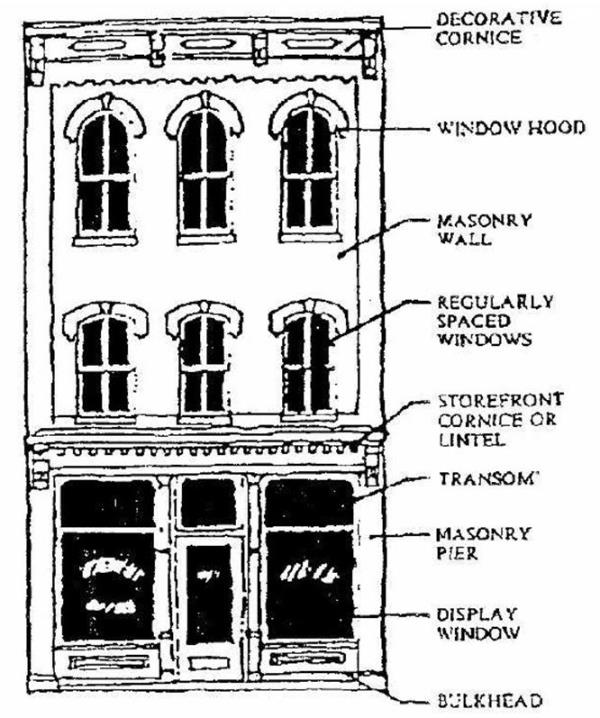
- The style, colors, lettering, and materials of the sign should reflect the age of the building. Examples may be found in old photographs and surviving signs.
- Contrast between a dark background and light lettering, or vice versa, is more important than size. The lettering style should be chosen for its legibility.
- Plastic, aluminum, and back lit signs are not usually appropriate on older buildings because of their materials, colors, size, and style of lettering. The content and logo of corporate and product signs can be transferred to more traditional materials and styles of sign.
- Signage shall be permitted on canvas or treated cloth awnings where they are compatible with the age of the building and character of Downtown.
- Projecting signs must conform to the following.
- Minimum height above grade is 8 feet. Maximum height above grade is 11 feet for the sign, and 12 feet for the bracket.
- Sign may not project more than 2 and 1/2 feet from the face of the building.
- Total sign face may not exceed 6 square feet.
- Materials must be wood and/or metal. Plastic signs are not permitted.
- Projecting signs may not be lit, internally or externally.
- Plans must be submitted to show how the sign will be anchored to the building and masonry.
- Only 1 projecting sign permitted per business.
- Signs must be advertising a specific business name, not a generic product.
- The sign area of the projecting sign comes off the total signage allowed for the building under these requirements.
- All signs proposed to be constructed on properties that are designated as Heritage Preservation Sites or are in a Historic District are subject to approval by the Heritage Preservation Commission.
- Freestanding signs are prohibited in the East 2nd Street Historic District or on properties zoned DC Downtown Core.
- Downtown Hastings is a remarkably intact and compact example of commercial architecture from the 1860' s to the 1920' s. This historic character is considered an important asset of Downtown and, therefore, it is the intent of this section that this character be preserved. To accomplish this objective, all permanent signage within the East 2nd Street Historic District or on property zoned DC Downtown Core shall comply with the following requirements and guidelines.
- Permit required. Except for signs specifically allowed by this section without a permit, no signs shall be erected, altered, reconstructed, maintained or moved in the city without first securing a permit from the city. The content of the sign shall not be reviewed or considered in determining whether to approve or deny a sign permit. Sign applications are available from the Planning Department. The applicant shall include sign dimensions, height, colors, construction materials, method of anchoring and location. A sketch or photograph of the proposed sign and a site plan that adequately illustrates the location of the sign is required. In addition, the application shall include the location and size of all other signs at the subject property/development. Once a completed sign application is filed with the Planning Department, City Staff shall review the plans and specifications for the proposed sign(s). If the proposed sign meets section requirements, the Building Code and all other city ordinances, a signed permit will be approved. The required fee as established by resolution of City Council shall be paid to the city before issuance of a signed permit. Unless otherwise noted, the following regulations apply to all zoning districts.
- Permit Requirements.
- Except as otherwise provided in this section, no sign or structure shall be erected, constructed, altered, rebuilt, or relocated until a permit has been issued by the city.
- Sign applications are available from the Planning Department. The applicant shall include sign dimensions, height, colors, construction materials and method of anchoring. A site plan that adequately illustrates the location of the sign is required. In addition, the application shall include the location and size of all other signs at the subject property/development.
- Once a completed sign application is filed with the Planning Department, staff shall review the plans and specifications for the proposed sign(s). If the proposed sign(s) meets ordinance requirements, the building code and all other laws and ordinances of the city, a sign permit will be approved.
- The required fee as established by resolution of the City Council shall be paid to the city before issuance of a sign permit.
- Signs erected without a permit are subject to payment of twice the established sign permit fee.
- Nonconforming And Illegal Signs.
- Any sign legally existing on the effective date of this section that does not conform to the requirements set forth in this section shall become a nonconforming use and/or structure. Except as otherwise provided in this section, nonconforming signs shall be allowed to continue, but shall not be rebuilt, relocated, replaced, or altered without being brought into compliance with all the requirements of this section. Furthermore, nonconforming signs are subject to the provisions contained at § 155.06.
- Any sign that is in violation of this section shall be removed or altered to comply with this section.
- Maintenance of existing signs, including the replacement of faceplates of the same size, or smaller shall be permitted on nonconforming signs.
- Temporary ribbons, banners, pennants, and similar devices that are in use as of the adoption of this section must comply with the provisions of division (C)(11) above.
- Repairs. Any sign located in the city which may be or hereafter become out of order, rotten or unsafe, and every sign which shall hereafter be erected, altered, resurfaced, reconstructed or moved contrary to the provisions of this section shall be removed or otherwise properly secured in accordance with the terms of this section by the owners thereof or by the owners of the grounds on which said sign shall stand, upon receipt of proper notice so to do, given by the issuing authority. No rotten or other unsafe sign shall be repaired or rebuilt except in accordance with the provisions of this section and upon a permit issued by the issuing authority.
- Removal. In the event of the failure of the owner or person, company or corporation having control of any sign, or the owner of the ground on which the sign is located, to remove or repair said sign within 60 days after the use is terminated, a notice shall be given to the owner of the sign and the sign may be removed by the city at the expense of the owner or manager of the sign, or the owner of the ground upon which the sign stands.
- Substitution Clause. The owner of any sign which is otherwise allowed by this section may substitute noncommercial copy in lieu of any commercial or noncommercial copy. This substitution of copy may be made without any additional approval or permitting. The purpose of this provision is to prevent any inadvertent favoring of commercial speech over noncommercial speech, or favoring of any noncommercial message over any other noncommercial message. This provision prevails over any more specific provision to the contrary.
(Prior Code, § 10.08) Penalty, see § 10.99
Amended by Ord. 462A, 2nd Series on 9/4/2001
Amended by Ord. 485, 2nd Series on 2/3/2003
Adopted by Ord. 541, 2nd Series on 10/17/2005
Amended by Ord. 553, 2nd Series on 5/15/2006
Amended by Ord. 558, 2nd Series on 12/4/2006
Amended by Ord. 2007-01, 3rd Series on 7/16/2007
Amended by Ord. 2008-01, 3rd Series on 1/7/2008
Amended by Ord. 2009-06, 3rd Series on 5/4/2009
Amended by Ord. 2009-11, 3rd Series on 11/16/2009
Amended by Ord. 2010-15, 3rd Series on 7/19/2010
Amended by Ord. 2014-06, 3rd Series on 4/7/2014
Amended by Ord. 2018-08, 3rd Series on 10/1/2018
Amended by Ord. 2023-18 on 12/18/2023
155.09 Parking And Loading Requirements
- General Provisions.
- No change of use, tenancy, or occupancy of a parcel of land or building, including construction of new building or an addition to a building, which requires additional parking or loading spaces shall be allowed until the additional parking or loading spaces are approved and furnished. Review may be required under the site plan review procedures of § 155.51.
- Required parking shall be available for the parking of operable vehicles of residents, customers, and employees. A required loading space shall not be used for any other purpose than the immediate loading or unloading of goods or passengers.
- Parking and loading spaces shall meet all requirements of this chapter before the building for which they serve is occupied, except as otherwise permitted in this chapter.
- Required parking and loading spaces shall be located on the same development site as the use served. Except residential uses in the R-1, R-1L and R-2 zoning districts, the city may approve off-site parking if the City Council finds the following.
- Reasonable access shall be provided from the off-site parking facilities to the use being served.
- The parking shall be within 400 feet of a building or lot for the use being served.
- The parking area shall be under the same ownership as the site served, under public ownership or the use of the parking facilities shall be protected by a recorded instrument, acceptable to the city.
- Failure to provide on-site parking shall not encourage parking on the public streets, other private property or in private driveways or other areas not expressly set aside for the purposes.
- The off-site parking shall be maintained until on-site parking is provided or an alternate off-site parking facility is approved by the city as meeting ordinance requirements.
- Notwithstanding any other provision of this section to the contrary, a land use may provide the required off-street parking area for additional land uses on the same development site if the following conditions are met.
- Because of the hours of operation of the respective uses, their sizes and their modes of operation there will be available to each use during its primary hours of operation an amount of parking sufficient to meet the needs of the use.
- The joint use of the parking facilities shall be protected by a recorded instrument, acceptable to the city.
- Design Requirements.
- Standard dimensions. Except as permitted in division (B)(2) below, a parking space shall have a minimum width of 9 feet and a minimum length of 18 feet not including access driveways and turnarounds sufficient to permit a standard automobile to be parked in and removed from the space without the necessity of moving other vehicles. The minimum dimensions of stall and aisles are as follows.
Curb Angle Stall Length Length Aisle 45 degrees 12.0 feet 18.0 feet 13 feet* 60 degrees 10.0 feet 18.0 feet 18 feet* 75 degrees 9.0 feet 19.0 feet 21 feet* 90 degrees 9.0 feet 18.0 feet 22 feet** Parallel 20.0 feet 8.0 feet 22 feet NOTES TO TABLE:
* One-way aisles only.
** Aisles that are not between 2 rows of 90 angle parking spaces may be 18 feet wide.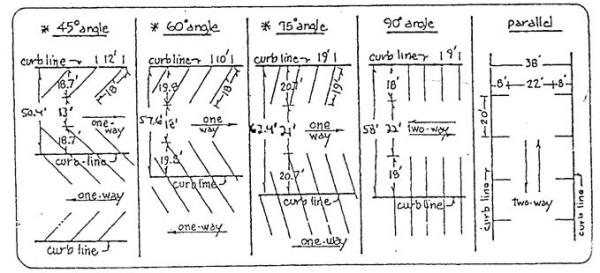
- Compact car dimensions. A compact car space shall have a minimum width of 8 feet and a minimum length of 16 feet not including access driveways and turnarounds sufficient to permit a compact automobile to be parked in and removed from the space without the necessity of moving other vehicles. The minimum dimensions of compact stalls shall be as follows.
Angle Curb Length Stall Length 45 degrees 10.0 feet 16.0 feet 60 degrees 8.5 feet 17.5 feet 75 degrees 8.0 feet 16.5 feet 90 degrees 8.0 feet 16.0 feet Parallel 16.0 feet 8.0 feet - Compact car parking conditions. Compact car parking may be provided if the following conditions are met.
- A maximum of 25% of the total number of required parking spaces may be used for compact cars, provided the total parking area has at least 20 stalls.
- Compact car stalls shall be clearly marked with directional signs as approved by the city.
- Compact car stalls shall be distributed throughout the parking area to have reasonable proximity to the structure(s) served by and shall not have generally preferential locations such that their use by non-compact cars will be discouraged.
- Compact car stalls shall be designed to discourage their use by non-compact cars.
- Access and location.
- Parking areas shall be designed to provide an adequate means of access to a public alley or street. The driveway access shall not exceed 30 feet in width for residential uses and 32 feet in width for commercial, office, or industrial uses at the property line and driveways shall be so located as to cause the least interference with traffic movement. All driveway widths shall be measured from the property line, not the roadway. Driveways must be located at least 3 feet from the extension of the side lot line from the property line to the curb to accommodate the driveway apron. Driveways abutting a public street must have a minimum 3-foot landscaped separation between any adjacent driveway.
- Driveway widths up to 50 feet will be permitted only by special permission of the Planning and Public Works Directors. All off-street parking spaces shall access off driveways and not directly off a public street unless otherwise approved by the Planning and Public Works Directors.
- Standard dimensions. Except as permitted in division (B)(2) below, a parking space shall have a minimum width of 9 feet and a minimum length of 18 feet not including access driveways and turnarounds sufficient to permit a standard automobile to be parked in and removed from the space without the necessity of moving other vehicles. The minimum dimensions of stall and aisles are as follows.
- Surfacing.
- Generally.
- Except as otherwise provided in this chapter, all parking spaces, access, maneuvering areas, and driveways shall be engineered according to city specifications and constructed with an asphalt or another impervious surface, and concrete curb and gutter. Single- and 2-family homes shall be graded and paved with asphalt or another impervious surface, but are exempt from curb and gutter requirements. All parking areas shall be maintained in good condition, in accordance with city specifications.
- If access is gained from an improved street, that portion of the access in the public right-of-way also shall be paved.
- Any improvement that expands or modifies the surface of an existing parking lot or drive aisle by more than 25% within a 5-year period shall trigger full compliance with city specifications for the entire parking lot.
- Exemptions. Exemptions from surfacing requirements shall meet the following requirements:
- Provide gravel, oil mat, and\or durable dustless surface to control dust;
- Pave driveways and aprons to prevent debris from entering the street right-of-way or sidewalk;
- Install gates at the access to catch gravel and dirt;
- Direct traffic through other paved portions of the parking area; and
- Provide adequate drainage to dispose of runoff.
- Generally.
- Setbacks/Buffers.
- Access drives, driveways, and aisles shall not be allowed to intrude into a required parking setback except at the access point or where a joint drive serving more than 1 property will provide better/safer traffic circulation.
- For residential structures, no parking space shall be within 5 feet of any building.
- Parking structures/ramps shall be subject to site plan review, including the following criteria for establishing setbacks.
- A parking structure shall be deemed an underground garage for the level(s) of parking which are below grade and are unexposed except entrance and exit points. Where the roof or any portion of the roof of such a qualifying structure is used as surface parking, the parking shall meet the applicable zoning district and other ordinance requirements regarding surface parking location, setbacks, and screening.
- A parking structure with 1 or more parking levels that is completely or partially below grade and does not qualify as an underground garage shall meet the applicable zoning district and other ordinance requirements regarding surface parking location, setbacks, and screening.
- Any parking structure or portion thereof which is partially or completely above grade shall be deemed a structure for meeting the applicable zoning district and other ordinance requirements regarding building setbacks/screening.
- Drainage, Lighting, Signs, And Curb And Gutter.
- Drainage. Adequate drainage shall be provided to prevent ponding and to dispose of the runoff from the impervious surface of the parking area. Provisions shall be made for the on-site collection of drainage waters to eliminate sheet flow of water onto sidewalks, public right-of-way, and abutting private property, subject to the approval of the Public Works Director.
- Lighting. Lighting shall conform with 155.53.5 Exterior Lighting Standards.
- Signs. Except as permitted in § 155.08, no signs shall be located in any parking area except as necessary for orderly operational movement, including, but not limited to:
- Parking stalls shall be clearly marked with painted stripes showing the full 18 or, for compact cars, 16-foot length and access lanes with directional arrows to guide internal movements;
- Areas used for compact cars shall be clearly marked;
- Handicapped parking spaces shall be designated according to state standards; and
- Additional signs and markings shall be required if determined by the Public Works Director to be necessary for traffic circulation of safety.
- Curb and gutter. Curb and gutter is required for all parking lots with 6 or more parking spaces.
- Minimum And Maximum Off-Street Parking Requirements.
- Floor area for calculating the number of parking spaces shall be the total gross floor area for each story of the building/structure.
- The amount of parking shall be computed according to the standards of this section and the formulas listed in Appendix B at the end of this section. The maximum number of parking stalls shall not exceed 20% of the minimum required unless the City Council grants an exception.
- Parking requirements for a use not specifically mentioned shall be computed at the requirement for the use it most closely resembles at the discretion of the Planning Director.
- For mixed uses, the total requirements for off-street parking facilities shall be the sum of the requirements for the various uses computed separately.
- The minimum number of parking spaces shall be based on the maximum number of employees and/or seating capacity/occupancy at peak hours of operation.
- Existing structures and uses within the C-3, DC and RMU Zoning Districts prior to the adoption of the Downtown Master Plan (5-5-2003) and located south of the Mississippi River, west of the CP Railroad, north of 6th Street, and east of Spring Street shall be considered in conformance with the minimum parking and loading requirements of this section, provided the use and intensity is unchanged. Conversion of existing building space of no greater than 10,000 s.f. into a restaurant, tavern, or lounge may be exempt from meeting additional parking and loading requirements upon approval of a Special Use Permit. All parking and loading requirements for any intensification of an existing building or use, or construction of a new building shall be determined by a proof of parking study. When a study is required, the Urban Land Institute’s 1983 publication, Shard Parking Standards, the Institute of Transportation Engineers Shared Parking Standards Planning Guidelines (1995), or equivalent study shall be used to determine the number of spaces needed for a single or shared use.
- Loading Requirements.
- Off-street loading shall be required of uses or buildings that receive or distribute merchandise by truck and shall be adequate to handle the needs of the particular use or building and as designated by Appendix A at the end of this section.
- All schools having a capacity of 25 or more students shall have a driveway designed for a continuous flow of passenger vehicles for loading and unloading students.
APPENDIX A: OFF-STREET LOADING REQUIREMENTS
| Square Feet of Floor Area or Outside Storage Area | Loading Space | Special Requirements |
| 1,000 - 5,000 | 250 square feet | None |
| 5,000 - 20,000 | 300 square feet | None |
| 20,000 - 50,000 | 750 square feet | 1 space must measure 10 feet by 50 feet |
| 50,000 + | 1,000 square feet | 1 space must measure 10 feet by 50 feet |
APPENDIX B: REQUIRED NUMBER OF SPACES
| Residential | Required # of Spaces |
| Single-Family/Duplex | 2 per dwelling unit |
| Multi-Family - over 3 units | 1.75 per dwelling unit |
| Manufactured (Mobile) Home Park | 2 per dwelling unit |
| Residential Care Facility, Semi-Independent | 1 per 2 units |
| Residential Care Facility, Dependent | 1 per 3 units |
| Residential Senior Facility | 1 per dwelling unit |
| Tourist Lodging | Required # of Spaces |
| Hotels and Motels: | |
| 1. With no other facilities than guest rooms: | 1 per room + 1 per employee on the major shift |
| 2. With other facilities, including restaurants, conference facilities, or meeting rooms: | 1 per room + 1 per each 4 persons of capacity in other facilities |
| Bed and Breakfast | See relevant provisions in Chapter 155 |
| Commercial | Required # of Spaces |
| General Retail | 1 per 200 square feet |
| Professional/General Office | 1 per 300 square feet |
| Banks/Credit Unions, including stacking spaces | 1 per 300 square feet |
| Self-Service Laundry | 1 per 3 washing machines |
| Bowling Alley | 5 per lane |
| Commercial | Required # of Spaces |
| Theater | 1 per 6 seats based on design capacity |
| Furniture and Appliance Store | 1 per 500 square feet |
| Restaurant, tavern, or lounge (sit down full service): | |
| 1. Without on-sale intoxicating liquor or dance hall license | 1 per 60 square feet or 1 per 3 seats |
| 2. With on-sale intoxicating liquor or dance hall license | 1 per 50 square feet or 1 per 2 seats, except that in cases that there is a bar area separate from the food service area, a dance area larger than 100 square feet, or other public areas, additional parking may be required. |
| Recreation-Participant/Spectator: | |
| 1. Indoor and Outdoor | 1 per 4 seats or 8 feet of bench length. |
| 2. Shopping Center* | At least 4 spaces per 1,000 square feet of area. |
| Automobile Service or Gas Station | 2 parking spaces for each service stall plus 1 parking space for each 200 square feet of gross building area and adequate parking for gas pump areas. |
| Auto, Boat, Trailer/Mobile Home Sales or Service | 1 per 500 square feet |
| NOTES TO TABLE: * - If a center contains substantial interior common space, required parking spaces may be reduced based on an analysis of parking demand and proof of parking to be installed if needed at the request of the city. | |
| Places of Assembly | Required # of Spaces |
| Churches, Mortuaries, and the like | 1 per 3 seats based on design capacity |
| Youth-oriented church services (ages 17 and under) | 1 per 6 seats based on design capacity |
| Schools | Required # of Spaces |
| Preschool, Nursery, Kindergarten | 1 per classroom + 1 for each 30 student capacity |
| Elementary, Jr. High/Middle | 1 per classroom + 2 per each 30 student capacity |
| Senior High and Post-Secondary | 1 per classroom + 1 per each 6 students based on design capacity |
| Public/quasi-public | Required # of Spaces |
| Hospital | 3 per 2 beds |
| Library | 1 per 500 square feet, plus 1 per employee |
| Government | 1 per 300 square feet |
| Industrial | Required # of Spaces |
| Warehouse and Manufacturing | 1 per 1,000 square feet but no less than 1 per employee |
| Wholesale Establishment | 1 per employee plus 1 per 1,000 square feet |
(Prior Code, § 10.09) Penalty, see § 10.99
Amended by Ord. 479, 2nd Series on 12/2/2002
Amended by Ord. 497, 2nd Series on 7/7/2003
Amended by Ord. 549, 2nd Series on 4/17/2006
Amended by Ord. 551, 2nd Series on 5/1/2006
Amended by Ord. 2007-05, 3rd Series on 9/4/2007
Amended by Ord. 2015-01, 3rd Series on 1/5/2015
Amended by Ord. 2017-08, 3rd Series on 10/2/2017
Amended by Ord. 2022-05 on 3/22/2022
155.10 Small Wireless Facilities And Wireless Support Structures In Right Of Way
- Small Wireless Facilities within Right of Way are Permitted Uses in all zoning districts, subject to the regulations of City Code Section 90.07.
- Wireless Support Structures within Right of Way are Special Uses in the A, R-1, R-1L, R-2, and R-3 Districts, as well as all National Register Historic Districts, subject to the regulations of City Code Section 90.07.
- Wireless Support Structures within Right of Way are Permitted Uses in districts in areas outside of National Register Historic Districts and within the R-4, RMU, R-6, C-1, C-2, C-3, DC, C-4, O-1, I-1, I-2, and PI Zoning Districts, subject to the regulations of City Code Section 90.07.
- Notwithstanding any inconsistent limitations in Chapter 155, the height and placement of Wireless Support Structures within Right of Way shall be as allowed under Minnesota Statute Section 237.163, subdivision 3(b), as amended.
Amended by Ord. 2017-13, 3rd Series on 12/18/2017

