
Hastings City Zoning Code
155 Districts
155.20 Generally
- Zoning Districts. The city is hereby divided into the following use districts:
- A Agriculture;
- R-1 Low Density Residence;
- R-2 Medium Density Residence;
- R-3 Medium-High Density Residence;
- R-4 High Density Residence;
- RMU Residential Mixed Use;
- R-6 Manufactured Home Park Residence;
- C-1 General Commerce;
- C-2 Highway Auto-Specialized Commerce;
- C-3 Community Regional Commerce;
- DC Downtown Core;
- C-4 Regional Shopping Center;
- O-1 General Office;
- I-1 Industrial Park;
- I-2 Industrial Park Storage/Service;
- PI Public Institution; and
- VSO Vermillion Street Overlay. (Am. Ord. 497, passed 7-7-2003)
- Zoning Map. The location and boundaries of the above use districts are as shown on the Zoning Map, and the Map is hereby made a part of this chapter. The Map and all notations, references, and data shown thereon are hereby incorporated by reference into this chapter and shall be as much a part of it as if all were fully described herein. All amendments to the Zoning Map are generally described in Table II of the Table of Special Ordinances. It is unlawful to use or permit the use of any building or premises within the city for any purpose other than as listed.
(Prior Code, § 10.10)
HISTORY
Amended by Ord. 497, 2nd Series on 7/7/2003
Amended by Ord. 497, 2nd Series on 7/7/2003
155.21 A Agriculture
- Generally. Any land that may be annexed to the city shall be placed in the A Agricultural District until action by the Council that assigns the land to another district.
- Intent. The intent of this chapter in establishing an Agricultural District is to allow maximum freedom of operation for agricultural purposes and to protect the uses from untimely encroachment by potential conflicting urban uses. It is also the intent to protect the natural amenities of the Hastings area from harmful exploitation.
- Uses Permitted.
- Farmsteads and agricultural operations;
- Single-family detached dwellings;
- Public parks and non-commercial recreational uses;
- Cemeteries;
- Home occupations subject to the standards listed at § 155.07;
- Accessory uses incidental to the foregoing principal uses such as private garages and sheds;
- Recreation facilities, including, but not limited to, golf courses, pistol and rifle ranges, sportsmen clubs and camping areas subject to site plan review;
- Nurseries and greenhouses subject to site plan review;
- Commercial Kennels and veterinary establishments subject to site plan review;
- Storage rental facilities subject to site plan review;
- Agricultural service operations, heavy equipment contractors, tree service contractors, or other uses subject to site plan review;
- Other uses similar in nature to the above uses and which, in the opinion of the Council, will not be detrimental to the integrity of the Agriculture District;
- Cluster developments so as to provide an alternative to rural subdivisions. Home locations may be placed closer together as long as the overall subdivision density still meets the 1 home per 10 acres density. Cluster developments are intended to preserve and enhance open space and natural amenities. Cluster developments are subject to the requirements of this chapter, including, but not limited to, § 155.51 and Chapter 154. Variation in lot sizes and yards are permitted while maintaining the overall density required by the underlying zoning district.
- Uses By Special Permit.
- Temporary asphalt hot mix plants accessory to mineral extraction subject to site plan review.
- Land reclamation, mining, soil processing, and general land grading subject to the following.
- Land reclamation. Under this chapter, land reclamation is the reclaiming of land by the depositing of material so as to elevate the grade. Any lot upon which 400 cubic yards or more of fill is to be deposited shall be land reclamation. The application for land reclamation permit shall include a finished grade plan which will not adversely affect adjacent lands, the type of fill to be used, program for fire and rodent control, and general maintenance of the site, controls of vehicular ingress and egress, and for control of material disbursed from wind or hauling of material to or from the site. The plan shall also include necessary drainage structures to divert or convey stormwater runoff.
- Mining. The extraction of sand, gravel, or other material from the land, in the amount of 400 cubic yards or more and removal thereof from the site without processing shall be mining. The application for a mining permit shall include a plan for a finished grade which will not adversely affect adjacent lands or the development of the site on which the mining is being conducted, and the route of trucks moving to and from the site.
- Soil processing. The operation of processing of sand, gravel, or other material mined from the land shall be permitted. The application for soil processing permit shall include a site plan where the processing is to be done, showing the route of the trucks moving to and from the site, and the condition in which the site is intended to be left upon completion. The Council may restrict the duration of the permit for operation after which the permit will have to be renewed.
- General land grading. This section restricts all excavations, pits, holes, or earthly deposits of any kind to more than 3 feet depth upon any property within the city.
- It is unlawful for any person to dig and leave open, unfenced, unbarricaded, or uncovered, any pit, quarry, hole, or excavation, including basements, wells, septic tanks, or cesspools; and for any person to deposit earthly material including rock, sand, gravel, organic or other fill material to a depth of over three feet without a permit as required under the grading chapter of the International Building Code or as may be amended.
- No grading permit shall be required by any person making any excavation or earthly deposit as part of contractual work for construction of utilities for which appropriate permits have been secured or under any contract with the city.
- Application for land reclamation, mining, and soil processing. Application for the permit shall be made in writing to the Council which shall set forth the location and plan for removal from or deposits upon property in accordance with this chapter. The application shall include:
- A legal description of the lands upon which grading operations shall be performed;
- Copies of any agreements contemplated or entered into between the owner of the property and any other person charged with performance of the grading;
- If requested by the city a plat and topographical map of the proposed area to be graded, and the other pertinent information as deemed necessary;
- The full name and address of the person applying for permit hereunder;
- A permit fee is required in accordance with the city fee schedule;
- In all cases, each application for permits for the above must be approved by the Public Works Director before the permit is granted. Also, in all cases of the above, the Public Works Director has the right to review procedures, processes, and results in view of the operations to determine whether they are in accordance with general public welfare and safety through regular on-site inspections. The Public Works Director upon determining the permittee’s operation creates a serious and immediate safety hazard may order the operation ceased for a period of 72 hours. Upon so ordering the Public Works Director shall immediately notify the Mayor and the permittee in writing of the hazard and the Mayor shall call a special meeting of the Council. The permittee shall be requested to attend this meeting. If the Council determines that an immediate safety hazard exists, the permit shall be withdrawn until the permittee complies with Council directives to eliminate the hazard;
- Within 10 days after City Council approval of the permit and before work begins, the applicant shall submit to the city an irrevocable bond or other forms of security acceptable to the city. This bond or other form of security shall be in an amount determined by the City Council, upon recommendation by the Public Works Director, to be sufficient to guarantee the applicant’s full compliance with the provisions of this chapter and all other conditions of the permit issued by the city, including, but not limited to, any restoration required by the city or the extraordinary cost and expense of repairing, from time to time, any highways, streets, or other public ways where the repair work is made necessary by the special burden resulting from the hauling and removal of material from any operation. The bond or other approved security shall remain in effect for at least 1 year after the expiration of the permit issued under this chapter. The Council may review and modify the amount of terms of the bond or other approved security as a condition of any permit renewal; and
- Prior to commencing work under a mining or soil processing permit, the applicant shall secure insurance as provided herein. At the time the Council issues land reclamation, the Council shall determine if the applicant must comply with the following insurance requirements. All applicants required to provide insurance herein shall, prior to commencing work, secure, maintain and file with the City Clerk a liability insurance policy or certificate of insurance from an insurance company authorized to write casualty insurance in the state as will protect the applicant, its agents and the city from claims for bodily injury, death, or property damage which may arise from operations under a permit issued under this chapter. Each insurance policy shall contain a clause providing that it shall not be cancelled by the insurance company without 10-days’ written notice to the city of intention to cancel. The amounts of the insurance shall not be less than the following:
- Worker’s compensation and employer’s liability which shall be secured and maintained as required by state law;
- Public liability, personal injury, and property damage;
- Injury or death of 1 person - $250,000;
- Injury or death to more than 1 person in a single accident - $500,000; and
- Property damage - $200,000.
- Towers as regulated by § 155.07.
- Motor vehicle impound lots, subject to the following conditions.
- Motor vehicles cannot be kept in an impound lot for more than 14 days unless a police hold has been placed on the motor vehicle.
- No sales of motor vehicles, salvaging, repairing, dismantling, or stripping of motor vehicles shall be allowed in the impound lot.
- 100% opaque fencing or landscaping at least 6 feet high must be placed around the entire lot and must be adequately maintained.
- All motor vehicles impounded shall be kept within the opaque fenced or landscaped area.
- All buildings on the lot must be permanent structures with permanent foundations.
- The entire impound lot shall be surfaced with a bituminous covering, class 5 gravel, or other surface covering as approved by the city.
- A sufficiently sized bituminous area shall be provided for the parking of vehicles which may be leaking fluids or other pollutants.
- Any lighting in the impound lot shall not be obtrusive to neighboring property.
- Employees of the city or its duly appointed representatives, shall be allowed on the property at any time to inspect the impound lot to verify compliance with the City Code.
- Any special use permit issued hereunder shall be reviewed annually and at other times deemed appropriate by the city, to verify compliance with the City Code and any special conditions of the permit. As part of the review procedure, the city may hold a public hearing, preceded by the appropriate mailed and published notice. As part of any review procedure, the city may amend the permit by adding or deleting any conditions it deems necessary to protect the public health, safety, and welfare.
- All conditions imposed by § 30.02 must be met. Additionally, the city may impose any other conditions it feels are necessary to protect the public, health, safety, and welfare.
- Any violation of this subdivision or any conditions imposed upon the special use permit shall be cause for termination of the permit by the city. (Prior Code, § 10.11) Penalty, see § 10.99
- Cannabis, medical cannabis and hemp growing, cultivating or farming operations, indoor or outdoor, pursuant to the following conditions:
- A minimum of twenty (20) contiguous acres under single ownership is required for the use.
- The operator must be licensed by the State of Minnesota
- The sale of cannabis products is not permitted on the same property as the use.
- A minimum of twenty (20) contiguous acres under single ownership is required for the use.
- Interim Use
- Purpose. Interim Uses are allowed upon issuance of an Interim Use Permit and execution of an Interim Use Agreement establishing parameters and conditions for operation. The City Council may grant permission of an Interim Use of the property if:
- The use conforms to the zoning regulations;
- The date or event that will terminate the use can be identified with certainty;
- Permission of the use will not impose additional costs on the public if it is necessary for the public to take over the property in the future; and
- The user agrees to any conditions that the City deems appropriate for permission of the use.
- The use conforms to the zoning regulations;
- Uses by Interim Use Permit.
- Interim Waiver of Site Plan Requirements. Uses identified as permitted or by special permit may be granted an Interim Use Permit to defer the construction of certain property improvements for a defined period of time. Deferred construction items may include paving and/or curbing of a parking lot, construction items may include paving and/or curbing of a parking lot, construction of a permanent building, and other similar items. Only properties outside of the Metropolitan Urban Services Area (MUSA) may be eligible for issuance of an Interim Waiver of Site Plan Requirements the business must comply with any deferred items to continue operation.
- Ground-Mounted Community Solar Gardens and Solar Farms.
- Additional Requirements.
- Interim Use Permits shall be issued for a six-month probationary period as determined by City Council. The City Council may consider full issuance of an Interim Use Permit at the end of the probationary period.
- The site must be returned to its pre-developed condition upon termination of the interim use permit.
- If applicable, the business must present an acceptable plan for on-site portable restrooms and trash removal.
- All temporary and permanent signage will require a separate sign permit.
- As a condition of approval, the City will need to review and approve any temporary or mobile structure.
- The construction of or movement of any buildings onto the property requires Site Plan Approval.
- Interim Use Permits shall be subject to the requirements of Chapter 30.02 (E) (2) - Special Use Permits.
- Hours of operation shall be reviewed.
- Any interim use may be terminated by a change in zoning regulations.
- Interim Use Permits shall be issued for a six-month probationary period as determined by City Council. The City Council may consider full issuance of an Interim Use Permit at the end of the probationary period.
- Purpose. Interim Uses are allowed upon issuance of an Interim Use Permit and execution of an Interim Use Agreement establishing parameters and conditions for operation. The City Council may grant permission of an Interim Use of the property if:
HISTORY
Amended by Ord. 426, 2nd Series on 3/2/1998
Amended by Ord. 436, 2nd Series on 8/3/1998
Amended by Ord. 2009-09, 3rd Series on 9/8/2009
Amended by Ord. 2011-22, 3rd Series on 10/3/2011
Amended by Ord. 2023-05 on 3/20/2023
Amended by Ord. 2023-10 on 4/17/2023
Amended by Ord. 2024-02 on 2/5/2024
Amended by Ord. 2024-15 on 12/2/2024
Amended by Ord. 426, 2nd Series on 3/2/1998
Amended by Ord. 436, 2nd Series on 8/3/1998
Amended by Ord. 2009-09, 3rd Series on 9/8/2009
Amended by Ord. 2011-22, 3rd Series on 10/3/2011
Amended by Ord. 2023-05 on 3/20/2023
Amended by Ord. 2023-10 on 4/17/2023
Amended by Ord. 2024-02 on 2/5/2024
Amended by Ord. 2024-15 on 12/2/2024
155.22 R-1 Low Density Residence
- Intent. The intent of this chapter in establishing a low density residence district is to provide for the normal outward residential expansion of Hastings according to current standards of development, and to protect the desired quiet living environment from encroachment from potential conflicting uses.
- Uses Permitted.
- One-family detached dwellings:
- All single-family detached dwellings to be located on a lot in a residential zone shall be installed on perimeter foundations that form complete enclosures under exterior walls;
- The width of a 1-family detached dwelling that is located on a lot in a residential zone, shall not be less than 20 feet. The width shall be the narrowest dimension measured to the exterior of the building regardless of how it is oriented on the lot. The width is the installed width and does not include bay windows, roof projections, overhangs or eaves under which there is not interior space. Provided, however, this minimum width regulations shall not apply to seasonal use rooms such as porches and breeze ways, nor to garages or carports, and provided further, that these minimum width requirements shall not apply to additions to existing structures, where the addition is less than 400 square feet in area; and
- Sheet metal siding shall not be permitted except that horizontal lap type metal siding with sections overlapping in sections no wider than 12 inches shall be permitted. Other metal sidings may be permitted on review by the Board of Design Control.
- Public parks, playgrounds, country clubs, athletic fields, and other recreational uses of a non-commercial nature;
- Churches, libraries, and public and parochial schools;
- Home occupations, pursuant to § 155.07.
- Cluster developments so as to provide an alternative to the conventional lot and block residential design. Cluster developments are intended to preserve and enhance open space and natural amenities. Cluster developments are subject to the requirements of this chapter, including, but not limited to, § 155.51 and Chapter 154. Variation in lot sizes and yards are permitted while maintaining the overall density required by the underlying zoning district;
- Accessory uses if incidental to the foregoing principal uses such as private garages and sheds;
- Residential care facility - independent; and
- Keeping chickens, ducks, and quail pursuant to 91.02.
- One-family detached dwellings:
- Uses By Special Permit.
- Fire stations and cemetery;
- Residential care facilities, dependent and semi-independent, subject to the conditions listed at § 155.07.
- Towers are regulated by § 155.07.
(Prior Code, § 10.12) Penalty, see § 10.99
HISTORY
Amended by Ord. 2021-08, 3rd Series on 7/19/2021
Amended by Ord. 2024-08 on 6/3/2024
Amended by Ord. 2021-08, 3rd Series on 7/19/2021
Amended by Ord. 2024-08 on 6/3/2024
155.22.5 R-1L Low Density Residence Large Lot
- Intent. The intent of this chapter in establishing a very low density residence district is to protect the desired character of the larger lot environment from the possible progression of a more dense nature.
- Uses Permitted.
- Same as permitted in the R-1 Low Density Residence District
- Same as permitted in the R-1 Low Density Residence District
HISTORY
Adopted by Ord. 2007-05, 3rd Series on 9/4/2007
Amended by Ord. 2021-08, 3rd Series on 7/19/2021
Amended by Ord. 2024-08 on 6/3/2024
Adopted by Ord. 2007-05, 3rd Series on 9/4/2007
Amended by Ord. 2021-08, 3rd Series on 7/19/2021
Amended by Ord. 2024-08 on 6/3/2024
155.23 R-2 Medium Density Residence
- Intent. The intent of this chapter in establishing a medium density residence district is to protect those predominately single-family residential areas within Hastings that were developed in most part prior to World War II, encroachment from potential conflicting uses, and to provide for future residential and related development consistent with proper existing development existing neighborhood character and with minimum maintaining standards for the provision of health, light, air, and visual appeal.
- Uses Permitted.
- Same as permitted in the R-1 Low Density Residence District;
- Two-family/multiple-family dwellings, including both new construction and conversions of existing single-family dwellings;
- Fire stations and library;
- Bed and breakfast lodging facilities subject to the following criteria:
- That the facility shall be part of a formally designated local, state, or national historical structure;
- That a maximum of 10 bed and breakfast units may be established in a structure;
- That the facility shall have a minimum size of 2, 500 gross square feet;
- That all bed and breakfast units shall be established within the principal structure;
- That 1 off-street parking space shall be provided for the home plus 1 space for each bed and breakfast unit;
- That not more than 1 identification sign not exceeding 2 square feet in area may be attached to each wall that faces a street; and
- That the lot on which a bed and breakfast facility is proposed shall have a minimum area of 7,000 square feet plus 1,000 square feet for each unit in excess of 5 units.
- Uses By Special Permit.
- Residential care facilities, dependent and semi-independent, subject to the conditions listed at § 155.07.
- Neighborhood commercial subject to the site plan requirements of §155.07.
- Towers as regulated by §155.07.
- Funeral Homes
- Historic apartments, subject to the conditions listed in §155.07.
- Original Hastings Design Standards.
- Intent. Original Hastings Design Standards (OHDS) preserve and enhance traditional neighborhood design by reflecting the general characteristics of buildings dating from 1845 to 1940, the predominate era for building construction within the OHDS District. OHDS regulations ensure traditional neighborhood design by incorporating design features such as alleys, carriage houses, front porches, period sensitive housing design, sidewalks, and traditional street lighting. Design standards create and enhance the character of older neighborhoods by establishing regulations to guide property development and rehabilitation consistent with the unique historic character of the neighborhood. The OHDS are derived from the Design Guidelines for Original Hastings, adopted in 2003 by the City Council as part of the Heart of Hastings Master Plan.
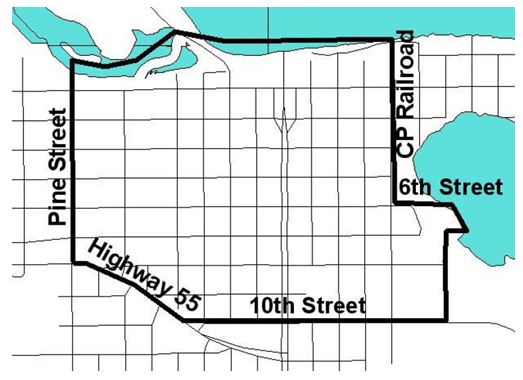
- Designated District. OHDS shall be effective for portions of the R-2 District as indicated in the figure below and shall be further identified on the Official Zoning Map. Areas not zoned R-2 are excluded from the OHDS.
- Applicability. The OHDS are applicable to all new residential development within the OHDS District. Substantial modifications to existing residential buildings shall also adhere to the design standards. Substantial modifications are defined as building improvements affecting the exterior of a structure, and exceeding 10% of its current building market value as defined by the Dakota County Assessor. This percentage shall be reviewed by the City Council on a regular basis. Substantial Modifications may include the following:
- Projects in corner side yards abutting a right-of-way.
- Accessory structures over 120 square feet.
- Any project that would negatively affect the historic appearance of the streetscape.
- Exemptions. The following activities shall be exempt from Original Hastings Design Standards:
- Accessory buildings under 120 square feet;
- Fences, decks, porches and patios within the rear yard or interior side-yard. Corner side yards abutting a right-of-way shall not be exempt from the design standards;
- Areas of a home or structure not directly part of an alteration or improvement;
- Alterations or improvements to the interior of a structure not affecting the outward appearance;
- Exterior modifications to homes built after 1950; and
- Demolition of home
- The HPC shall have 10 days to visually record a structure after an application is submitted to demolish a structure that is over 50 years old within the OHDS. If a formal designation study has already been completed for the property, the HPC shall have up to 6 weeks to request that the City Council begin a designation process as outlined in § 30.10(D). If the City Council initiates the designation process, the demolition application must be handled in accordance with § 30.10(D).
- Relationship to historic preservation districts and standards. Original Hastings Design Standards are different from and complimentary to established historic preservation districts and standards. Original Hastings Design Standards focus less on historic re-creation, but on the consistency of new and rehabilitated buildings to the established traditional character, bulk, height and form of the neighborhood. Provisions of § 30.10 still apply to properties within the OHDS that are within a designated Heritage Preservation District or individually designated as a Historic Preservation Site.
- Garages. New garages directly accessing a public street shall be prohibited if an improved alley way abuts the property.
- Immediate neighborhood. The immediate neighborhood as used to determine OHDS applicability shall include all properties along street frontages within 150 feet of the subject parcel as indicated in the figure below.
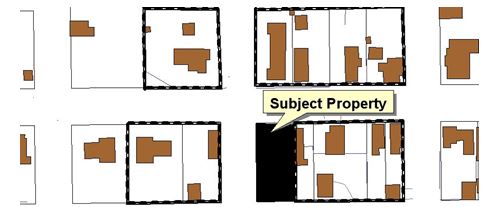
- Immediate neighborhood average. The immediate neighborhood average is defined as a range between 10% above and 10% below the mean for a given design standard within the immediate neighborhood.
- Frontage types. Application of OHDS are based upon the following frontage types.
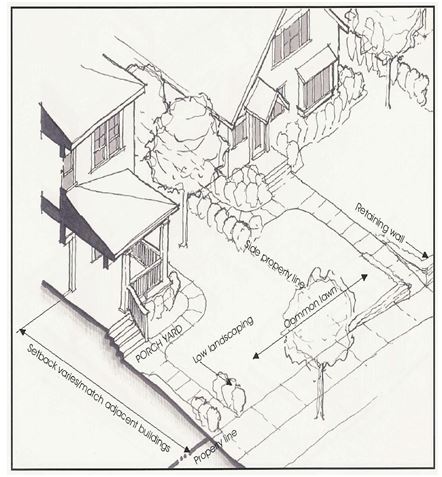
- Front yard. Front yards contain a landscaped lawn between the street\sidewalk and the residence. Structure setbacks shall be consistent with the immediate neighborhood average. Fences may be constructed in accordance with the § 155.05. Raised porches are encouraged.
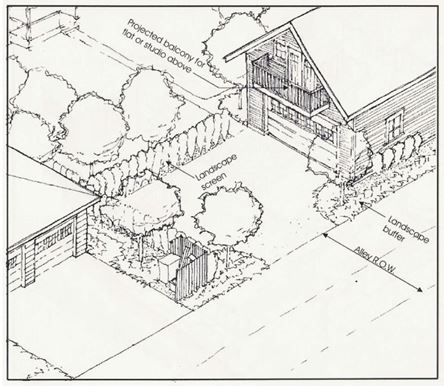
- Garage\alley. Neighborhood alleys provide service and garage access to residential uses in order to preserve the pedestrian character of the primary street frontage. Detached or semi-detached garages can front the alley in 1 of the 2 configurations shown in the sketch below. Lofts in 1.5-story garages may be suitable for residential use. Garages are further regulated under the accessory structure provisions of this chapter.
- Front yard. Front yards contain a landscaped lawn between the street\sidewalk and the residence. Structure setbacks shall be consistent with the immediate neighborhood average. Fences may be constructed in accordance with the § 155.05. Raised porches are encouraged.
- Outline of design standards.
Front Yard Garage/Alley Yard Use Pedestrian only. No vehicle parking or drives in front yard if abutting an improved alley way Vehicle Parking. Pedestrian path to rear entry. If abutting an improved alley way Yard and Street Wall Materials Landscaping predominant. Concrete, brick, or stone paths. Paved driveway. Landscaped buffer. Screen walls – Brick or painted wood. Yard and Street Wall Technique Lawn and Trees predominant. Wall or fence shall match building style. Ground floor shall be raised above grade 24 to 48 inches if containing a porch. Wall or fence to match building style. Building Wall Front Yard setback varies to match immediate neighborhood average. Side yard setback conforms to Residential Lot District Requirements of § 155.50 Side loaded garage must have 5 foot green space between drive and alley. Maximum setback for all garages is 25 feet. Building Width Must conform to the immediate neighborhood average Entry Level Wall Openings 30% to 50% transparent window and door openings Size and shape of windows to match main building. Entry Level Wall Materials Brick or stone masonry in historic size and pattern. Cement Stucco. Wood lap, vinyl, metal, cementitious, or drop siding with maximum 5 inches exposed. Same materials as on main building. Entry Level Wall Technique Historic window, door, and porch detailing. Main entry from roofed porch. Porch optional with a minimum 8-foot depth, but no less than 5 feet from sidewalk/curb. Historic window and door detailing to match main building. Upper Level Wall Openings Reflect bay pattern and size of immediate neighborhood average. 25% to 50% window openings. Reflect entry level bay width. Upper Level Wall Materials Brick or stone masonry in historic size and pattern. Cement stucco. Wood lap, vinyl, metal, cementitious or drop siding with maximum 5 inches exposed. Upper Level Wall Technique Detailing to be consistent with historic building style of the immediate neighborhood average. Entry Shelter Type Cantilevered roof shelter over entry or covered porch. Relate to entry openings. Door must face the front street. Residential use of garage shall require a cantilevered roof shelter over entry. Entry Shelter Materials Wood or iron-framed structure. Wood, metal, or composition shingle roof consistent with immediate neighborhood average. Entry Shelter Technique Detailing consistent with historic building style and immediate neighborhood average. Roof Style and Pitch Steep pitch (8:12 minimum) gable roof. Lower pitch Italianate hip or porch roof. Same as main building. Roof Materials Low slope membrane roof. Steep pitch metal, wood, slate or composition shingle roof. Same as main building. Roof Technique Cap parapet with integral or projecting cornice. Consistent with historic building style and the immediate neighborhood average. Same as main building. Roof Height Roof height shall be consistent with the immediate neighborhood average. - Administration. The Planning Department shall administer the design standards consistent with § 155.51. New residential development and substantial modifications to existing development shall be reviewed by the Heritage Preservation Commission and approved by the City Council. Substantial modifications are defined as building improvements changing the exterior of a structure, and exceeding 10% of its current building market value as defined by the Dakota County Assessor. The Community Development Director shall have the authority to determine conformance of any project to the Original Hastings Design Standards that do not require Planning Commission review and City Council approval.
- Appeals. Any appeal of an administrative decision shall be forwarded to the Board of Zoning Adjustment and Appeals as outlined in § 30.02.
- Effective date. The provisions of this section shall apply to all properties in the R-2 OHDS Overlay District immediately upon passage and publication.
(Prior Code, § 10.13A) Penalty, see § 10. 99
HISTORY
Amended by Ord. 497, 2nd Series on 7/7/2003
Amended by Ord. 546, 2nd Series on 3/20/2006
Amended by Ord. 561, 2nd Series on 2/5/2007
Amended by Ord. 2009-01, 3rd Series on 1/20/2009
Amended by Ord. 2011-02, 3rd Series on 1/3/2011
Amended by Ord. 2017-12, 3rd Series on 12/18/2017
Amended by Ord. 2019-06, 3rd Series on 1/6/2020
Amended by Ord. 2019-07, 3rd Series on 1/6/2020
Amended by Ord. 2021-08, 3rd Series on 7/19/2021
Amended by Ord. 2024-08 on 6/3/2024
Amended by Ord. 497, 2nd Series on 7/7/2003
Amended by Ord. 546, 2nd Series on 3/20/2006
Amended by Ord. 561, 2nd Series on 2/5/2007
Amended by Ord. 2009-01, 3rd Series on 1/20/2009
Amended by Ord. 2011-02, 3rd Series on 1/3/2011
Amended by Ord. 2017-12, 3rd Series on 12/18/2017
Amended by Ord. 2019-06, 3rd Series on 1/6/2020
Amended by Ord. 2019-07, 3rd Series on 1/6/2020
Amended by Ord. 2021-08, 3rd Series on 7/19/2021
Amended by Ord. 2024-08 on 6/3/2024
155.24 R-3 Medium High Density Residence
- Intent. The intent of this chapter in establishing a moderate high density residential district is in recognition of the growing demand for rental housing in Hastings and of the desire to provide for multi-family housing upon fairly sizeable tracts of land, thereby allowing increased design flexibility and a more compatible land use development pattern.
- Uses Permitted.
- Multiple-family and single-family dwellings when part of a PRD;
- Residential care facility, dependent and semi-independent, residential senior facility-independent, dormitories, public and parochial schools and churches, fire stations, professional offices, day care center, library, gift or craft shop and similar uses of a public service nature;
- Accessory uses incidental to the foregoing principal uses such as private garages and sheds;
- Home occupations in accordance with § 155.07;
- Planned residential developments pursuant to § 155.07.
- Uses By Special Permit.
- Neighborhood commercial subject to the requirements of § 155.07. (Am. Ord. 501, passed 8-18-2003)
- Towers as regulated by § 155.07.
(Prior Code, § 10.14) Penalty, see § 10.99
HISTORY
Amended by Ord. 2021-08, 3rd Series on 7/19/2021
Amended by Ord. 2024-08 on 6/3/2024
Amended by Ord. 2021-08, 3rd Series on 7/19/2021
Amended by Ord. 2024-08 on 6/3/2024
155.25 R-4 High Density Residence
- Intent. The intent of this chapter in establishing a medium density residence district is in recognition of the growing demand for multiple-family housing and of the desire to encourage high quality developments less than 3 stories in height in strategic locations within the city.
- Uses Permitted. Same as permitted in the R-3.
- Uses By Special Permit. Same as permitted in the R-3 District.
(Prior Code, § 10.15) Penalty, see § 10.99
155.26 RMU Residential Mixed Use
- Intent. The intent of the RMU zone is to encourage the development of higher density multiple-family dwellings and limited commercial activities adjacent to the downtown area to support the activities in the Downtown Core District, to serve as a transitional district from commercial to lower density residential districts, provide an area for restricted commercial activities and to provide a variety of housing types to satisfy individual preferences and financial capabilities.
- Uses Permitted.
- Multiple-family dwellings;
- Library, public and private schools, and similar uses of a public service nature;
- Accessory uses incidental to the foregoing principal uses including, but not limited to, garages, and recreational facilities;
- Home occupations in accordance with § 155.07;
- Planned residential developments in accordance with § 155.07; and
- Commercial activities are permitted but limited to the first floor of the building, and shall not exceed 50% of the entire structure.
- Uses By Special Permit.
- Multiple-family dwellings greater than 40 feet in height as measured by the International Building Code; and
- Neighborhood commercial subject to the requirements of § 155.07. (Am. Ord. 501, passed 8-18-2003)
- Conversion of existing building space of no great than 10,000 s.f. into a restaurant, tavern, or lounge per Section 155.09, Subd. F.6.
- Building And Site Design. Approvals granted through building permit, site plan, special use permit, or planned residential development shall require conformance with the Original Hastings Design Guidelines as adopted by the City Council.
(Prior Code, § 10.16) Penalty, see § 10.99
HISTORY
Amended by Ord. 477, 2nd Series on 10/21/2002
Amended by Ord. 497, 2nd Series on 7/7/2003
Amended by Ord. 2009-09, 3rd Series on 9/8/2009
Amended by Ord. 2017-08, 3rd Series on 10/2/2017
Amended by Ord. 477, 2nd Series on 10/21/2002
Amended by Ord. 497, 2nd Series on 7/7/2003
Amended by Ord. 2009-09, 3rd Series on 9/8/2009
Amended by Ord. 2017-08, 3rd Series on 10/2/2017
155.27 R-6 Manufactured Home Residence
- Intent. The intent of this chapter in establishing a manufactured home residence district is to provide for the development of well designed manufactured homes in areas consistent with the Hastings Comprehensive Plan.
- Permitted Uses. Manufactured homes, community centers, storm shelters, subdivisions, parks, office for management of the manufactured home park, accessory uses if incidental to the foregoing principal uses such as private garages, storage sheds, decks, patios, play equipment. All permitted uses are subject to the following requirements:
- Manufactured homes in an approved subdivision; and
- Manufactured home parks subject to the site plan review pursuant to § 155.51 and the following requirements.
- Each manufactured home shall be equipped with skirting around the entire perimeter of the home. The skirting shall be compatible with the principal structure and shall be functional and non-permanent. It shall be unlawful to construct, erect, attach, or cause to be constructed, erected, or attached any foundation, wall, or embankment under, around, or near any manufactured home in any manufactured home park in the city or to otherwise impede the removal of the manufactured home.
- It is unlawful for any type vehicle to travel at a rate in excess of 10 mph within the limits of a manufactured home park. The park owner shall adequately post the speed limits within the manufactured home park.
- No recreational vehicle shall be used for living, sleeping, or housekeeping purposes while parked in a manufactured home park.
- Design and operation standards for manufactured home parks:
- Parking.
- Each manufactured home lot shall have an approved hard surfaced off street parking space for 2 automobiles, which shall not be less than 20 feet in width and 20 feet in depth.
- If street widths do not permit on-street parking as stipulated in Chapter 154, each manufactured home park shall provide an approved hard surfaced off street parking lot for guests of occupants in the amount of one space for each 5 manufactured home lots. All off-street parking shall be located within 400 feet of the unit to be served.
- Utilities.
- A central underground fuel distribution system shall be installed to serve all manufactured home lots. No individual fuel tanks shall be allowed for the purpose of providing a source of fuel for cooking, heating or other purposes for a manufactured home or accessory building.
- All utilities shall be underground. There shall be no overhead wires or supporting poles except those essential for street or other lighting purposes.
- Water and sewer charges shall be determined from a water meter(s) with the meter(s) to be located on public right-of-way at the entrance(s) to the park.
- The park owner shall pay to the city any inspection and testing fees for utility service to the park.
- Lighting. The manufactured home park grounds and streets shall be lighted as approved by the city from sunset to sunrise. Entrances to manufactured home parks shall be clearly defined and well lit.
- Patio and sidewalks. Each manufactured home site shall contain a concrete patio and a concrete sidewalk leading from the patio to the off-street parking area for the site. The sidewalk shall be constructed of concrete with a minimum of 4-inch thickness.
- Registration. It shall be the duty of the operator of the manufactured home park to keep a record of all manufactured home owners and occupants located within the park. The park operator shall keep the register available for inspection by authorized city, county, and state and other public officials whose duty necessitates acquisition of the information contained in the register. The register shall contain the following information:
- The name and address of each manufactured home occupant;
- The name and address of the owner of each manufactured home; and
- The date of arrival and departure of each manufactured home.
- Review procedures. Upon making application for site plan approval of a manufactured home park plan, all information required by this subdivision shall be submitted to the city for review in accordance with the same procedure and time schedule for platting procedures as outlined in Chapter 154.
- Fees. The applicant shall reimburse the city for any expenses associated with reviewing the proposal such as, but not limited to, fees for consultants, engineering, legal and environmental studies.
- Parking.
- Home occupations in accordance with § 155.07.
- Uses By Special Permit.
- Neighborhood commercial subject to § 155.07. (Am. Ord. 501, passed 8-18-2003)
- Towers as regulated by § 155.07.
(Prior Code, § 10.17) Penalty, see § 10.99
155.28 C-1 General Commerce
- Intent. The intent of this chapter is to have an area that allows a variety of commercial development similar to the downtown, but has more restrictive setbacks than the downtown.
- Permitted Uses.
- All uses permitted in C-3 Community-Regional Commerce District;
- Gasoline dispensing and car washes, provided auto repair is not included; and
- Residential dwellings on the first floor level provided the dwelling is accessory to a commercial use.
- Uses By Special Permit.
- Small animal clinics, excluding establishments with outside runs and non-patient overnight boarding; and
- Towers as regulated by § 155.07.
(Prior Code, § 10.18) Penalty, see § 10.99
155.29 C-2 Highway Auto Sales And Service
- Intent. The intent of this chapter in establishing a highway-auto sales and service district is to provide appropriate areas for commercial establishments which are oriented to the motoring public or which require large sites for off-street parking or display of merchandise for sale.
- Uses Permitted.
- Food and beverage establishments, automobile service stations, auto repair shops, car wash, and lodging facilities.
- Accessory uses incidental to the foregoing principal uses.
- Lower-potency hemp edible retail with on-sale or off-sale liquor license.
- Uses By Special Permit.
- Commercial sales establishments requiring large sites for off-street parking or for outdoor display and sales limited to farm implement sale, auto and truck dealers, and equipment sales and rental facilities. Open sales or rental lots are subject to the site plan review requirements of § 155.51; and
- Towers as regulated by § 155.07. (Prior Code, § 10.19) Penalty, see § 10.99
- Uses By Interim Use Permit.
- Motor Coach Commerce Facility.
- Prohibited Uses.
- Camping Areas.
HISTORY
Amended by Ord. 2021-02, 3rd Series on 1/19/2021
Amended by Ord. 2025-13 on 12/1/2025
Amended by Ord. 2021-02, 3rd Series on 1/19/2021
Amended by Ord. 2025-13 on 12/1/2025
155.30 C-3 Community Regional Commerce
- Intent. The intent of this chapter in establishing a community-regional commerce district is in recognition of the existing downtown commercial development and of the need for its future expansions, rehabilitation and redevelopment.
- Uses Permitted.
- Commercial establishments including, but not limited to, the following:
- Retail and service establishments excluding automobile repair;
- Offices;
- Entertainment and amusement services; and
- Lodging services including hotel and motel.
- Public and semi-public buildings;
- Private clubs;
- Residential dwellings provided they are located above the first floor level;
- Automobile parking lots;
- Churches; and
- Accessory uses incidental to the foregoing principal uses.
- Lower-potency hemp edible retail with on-sale or off-sale liquor license.
- Commercial establishments including, but not limited to, the following:
- Uses By Special Permit.
- Automobile service stations and motor vehicle repair and wash;
- Small animal clinics, excluding establishments with outside runs and non-patient overnight boarding;
- Towers as regulated by § 155.07; and
- Residential dwellings on the first floor level provided the dwelling is accessory to a commercial use, less than 50% of the first level floor area and is located in the rear of the building with a separate outside entrance. (Prior Code, § 10.20A) Penalty, see § 10.99
- Dairies and Creameries
- Brew Pub
- Brewery Taproom, provided that a minimum 20 percent of the floor area devoted to use as retail sales and a brewery production and distribution area up to 7,500 square feet.
- Microdistillery with Cocktail Room, provided that a minimum 20 percent of the floor area is devoted to use as retail sales and a microdistillery production and distribution area up to 7,500 square feet.
- Conversion of existing building space of no greater than 10,000 s.f. into a restaurant, tavern, or lounge per Section 155.09, Subd. F.6.
- Lower-Potency edible retail use not associated with on-sale or off-sale liquor license and that complies with the requirements in City Code Section 155.07.J.
- Cannabis retail, not associated with any other cannabis use on the same property and that complies with the requirements of City Code Section 155.07.J.
- Lower-Potency hemp edible manufacturing if part of a brewpub or microdistillery and that complies with the requirements of City Code Section 155.07.J.
HISTORY
Amended by Ord. 433, 2nd Series on 7/6/1998
Amended by Ord. 497, 2nd Series on 7/7/2003
Amended by Ord. 2015-02, 3rd Series on 1/5/2015
Amended by Ord. 2015-12, 3rd Series on 10/19/2015
Amended by Ord. 2017-08, 3rd Series on 10/2/2017
Amended by Ord. 2023-05 on 3/20/2023
Amended by Ord. 2024-15 on 12/2/2024
Amended by Ord. 2025-13 on 12/1/2025
Amended by Ord. 433, 2nd Series on 7/6/1998
Amended by Ord. 497, 2nd Series on 7/7/2003
Amended by Ord. 2015-02, 3rd Series on 1/5/2015
Amended by Ord. 2015-12, 3rd Series on 10/19/2015
Amended by Ord. 2017-08, 3rd Series on 10/2/2017
Amended by Ord. 2023-05 on 3/20/2023
Amended by Ord. 2024-15 on 12/2/2024
Amended by Ord. 2025-13 on 12/1/2025
155.31 DC Downtown Core
- Intent. The intent of the Downtown Core District is to create a vibrant mixed-use core with an aesthetic character that is distinctly different than other areas of the community and mix of uses arranged in a manner that encourages pedestrian movement and accessibility. The Downtown Core District focuses on the vertical integration of uses requiring certain uses to integrate residential housing above street level businesses. These high density residential developments have historically contributed to the life-cycle housing mix available in and around the downtown. Maintaining historical residential housing densities is also a contributor to downtown commerce and street level activity. The preservation and growth of connected first floor commercial activity is essential in maintaining the viability of downtown. First floor residential units interspersed within areas of predominant commercial activity will diminish the cohesiveness and viability of downtown. Maintaining the historic distribution of business and density of housing is essential to protect municipal and private investment. Planning efforts to secure a transit center in the downtown will further the objectives maintaining and enhancing a pedestrian scale core. Careful design of buildings, public, and private spaces is also a primary focus in the Downtown Core District which shall be guided by the Original Hastings Design Guidelines as adopted by the City Council. The guidelines establish design criteria for building fronts that are bases on street types.
- Uses Permitted.
- Commercial retail and service establishments that have floor areas of less than 15,000 square feet on any single level including, but not limited to, the following:
- Retail and service establishments excluding automobile repair;
- Offices;
- Entertainment and amusement services; and
- Lodging services including hotel and motel.
- Public and semi-public buildings;
- Private clubs;
- Residential dwellings provided they are located above the first floor level;
- Automobile parking lots subject to following conditions:
- Parking lots shall not have frontage or driveway access points on streets with an east/west orientation, if an alternate access to the property is available;
- Parking lots may front on street with a north \south orientation when a landscape buffer is provided along the perimeter of the parking areas in accordance with § 155.09;
- Every attempt shall be made to locate parking lots internally within a block to allow building to front on street corridors; and
- Existing alleys should be utilized whenever practical to facilitate orderly access and use of land.
- Churches; and
- Accessory uses incidental to the foregoing principal uses.
- Lower-potency hemp edible retail with on-sale or off-sale liquor license.
- Commercial retail and service establishments that have floor areas of less than 15,000 square feet on any single level including, but not limited to, the following:
- Uses By Special Permit.
- Outdoor patio areas for entertainment, dining, and recreational activities;
- Small animal clinics, excluding establishments with outside runs and non-patient overnight boarding;
- Towers as regulated by § 155.07; and
- Residential dwellings on the first floor level of buildings fronting the following streets:
- 1st Street between Vermillion Street and the CP Railroad Tracks;
- 3rd Street between Eddy Street and the CP Railroad Tracks;
- 4th Street between Eddy Street and the CP Railroad Tracks;
- Sibley Street between 3rd Street and 4th Street;
- Ramsey Street between 1st Street and 4th Street;
- Tyler Street between 1st Street and 4th Street; and
- Bailey Street between 1st Street and 4th Street.
- 2nd Street between Tyler Street and the CP Railroad Tracks; and
- 2nd Street between Spring Street and Vermillion Street.
- Brew Pub
- Brewery Taproom, provided that a minimum 20 percent of the floor area is devoted to use as retail sales and a brewery production and distribution area up to 7,500 square feet.
- Micro distillery with Cocktail room, provided that a minimum 20 percent of the floor area is devoted to use as retail sales and a brewery production and distribution are up to 7,5000 s.f.
- Conversion of existing building space of no greater than 10,000 s.f. into a restaurant, tavern, or lounge per Section 155.09 Subd. F.6.
- Lower-potency edible retail uses not associated with on-sale or off-sale liquor license that comply with the requirements in City Code Section 155.07.J.
- Cannabis Retail, not associated with any other cannabis use on the same property and that complies with the requirements of City Code Section 155.07.J.
- Lower-potency hemp edible manufacturing if part of a brewpub or microdistillery and that complies with the requirements of City Code Section 155.07J.
- Uses Prohibited. First floor residential dwellings fronting the following streets shall be prohibited: 2nd Street between Vermillion Street and Tyler Street.
- Bulk Standards.
- Minimum lot width - 22 feet;
- Minimum lot depth - 80 feet;
- Maximum building height
- Properties located north of 3rd Street: 47 feet or 756.5 feet above sea level; whichever is greater. Maximum of 4 stories in height.
- Properties located south of 3rd Street: 57 feet.
- Minimum residential density - 14 dwelling units per acre; and
- Minimum floor area ratio for non-residential uses (vertically mixed buildings) - 1.5.
- Building And Site Design. Approvals granted through building permit, site plan, special use permit, or planned residential development shall require conformance with the Original Hastings Design Guidelines as adopted by the City Council.
(Prior Code, § 10.20B) Penalty, see § 10.99
HISTORY
Amended by Ord. 497, 2nd Series on 7/7/2003
Amended by Ord. 530, 2nd Series on 4/4/2005
Amended by Ord. 532, 2nd Series on 4/18/2005
Amended by Ord. 2015-09, 3rd Series on 6/15/2015
Amended by Ord. 2015-12, 3rd Series on 10/19/2015
Amended by Ord. 2015-11, 3rd Series on 10/19/2015
Amended by Ord. 2017-08, 3rd Series on 10/2/2017
Amended by Ord. 2021-13 on 11/15/2021
Amended by Ord. 2025-13 on 12/1/2025
Amended by Ord. 497, 2nd Series on 7/7/2003
Amended by Ord. 530, 2nd Series on 4/4/2005
Amended by Ord. 532, 2nd Series on 4/18/2005
Amended by Ord. 2015-09, 3rd Series on 6/15/2015
Amended by Ord. 2015-12, 3rd Series on 10/19/2015
Amended by Ord. 2015-11, 3rd Series on 10/19/2015
Amended by Ord. 2017-08, 3rd Series on 10/2/2017
Amended by Ord. 2021-13 on 11/15/2021
Amended by Ord. 2025-13 on 12/1/2025
155.32 C-4 Regional Shopping Center
- Intent. The intent of this chapter in establishing a regional shopping center district is in recognition of future needs for one or more large commercial areas to serve the city and surrounding areas.
- Uses Permitted. All uses permitted in C-3 Community Regional Commerce District.
- Uses By Special Permit.
- All uses permitted by special use in the C-3 Community Regional Commerce District and the following.
- Adult Establishments and Accessory Adult Establishments (as defined in Chapter 114) subject to the following minimum requirements:
- Adult Establishments and Accessory Adult Establishments shall be located at least 500 feet away from any residential property;
- Adult Establishments and Accessory Adult Establishments shall be located at least 500 feet away from any church, school, library, park and public recreation area;
- Adult Establishments and Accessory Adult Establishments shall be located at least 500 feet away from any other Adult Establishment or Accessory Adult Establishments; and
- Adult Establishments and Accessory Adult Establishments shall obtain all city licenses required in Chapter 114 before commencing operation.
- Towers as regulated by §155.07.
- Temporary auto sales may be allowed to support the activities of a non-profit community organization (such as a fund-raiser for a sports team or school). Each auto dealership may be allowed 1 sale per year, with the sale not to exceed 14 calendar days per year. Each parcel of land in the C-4 District is allowed 1 sale per year. If a business consists of more than 1 parcel, only 1 sale may be allowed.
- The following shall be considered in granting a special use permit:
- The effect on the total number of parking spaces at the business the sale is held.
- The effect of the ingress and egress at the parking lot.
- The effect on accessibility of emergency services.
- The effect on neighboring businesses or residential areas from an increase in traffic. (Prior Code, § 10.21) Penalty, see §10.99
- The following shall be considered in granting a special use permit:
- Climate Controlled Storage Facility.
- All storage activity must be conducted within a building. Exterior storage, or use of accessory buildings, pods, trailers, and the like shall be prohibited.
- No more than 20,000 s.f. of any building shall be utilized for Climate Controlled Storage.
HISTORY
Amended by Ord. 555, 2nd Series on 8/7/2006
Amended by Ord. 2007-02, 3rd Series on 7/16/2007
Amended by Ord. 2008-11, 3rd Series on 9/15/2008
Amended by Ord. 2019-04, 3rd Series on 9/3/2019
Amended by Ord. 2021-07, 3rd Series on 5/3/2021
Amended by Ord. 2023-05 on 3/20/2023
Amended by Ord. 555, 2nd Series on 8/7/2006
Amended by Ord. 2007-02, 3rd Series on 7/16/2007
Amended by Ord. 2008-11, 3rd Series on 9/15/2008
Amended by Ord. 2019-04, 3rd Series on 9/3/2019
Amended by Ord. 2021-07, 3rd Series on 5/3/2021
Amended by Ord. 2023-05 on 3/20/2023
155.33 O-1 General Office
- Intent. The intent of this chapter in establishing a general office district is to provide the city and its residents with a zoning designation that permits limited business applications in certain areas of the community as determined by the Hastings Comprehensive Plan. This designation can be used as a buffer zone to insulate residential areas from high movement areas or provide neighborhood convenience establishments.
- Permitted Uses. The following uses are permitted:
- Offices excluding uses with drive-through facilities;
- Retail and service facilities within an office building but limited to 50% of the gross floor area; and
- Accessory uses incidental to the foregoing principle uses.
- Uses By Special Permit.
- Office uses with drive-thru facilities;
- Retail and service facilities;
- Towers as regulated by § 155.07; and
- Small animal clinics, excluding establishments with outside runs and non-patient overnight stays.
(Prior Code, § 10.22) Penalty, see § 10.99
HISTORY
Amended by Ord. 434, 2nd Series on 7/6/1998
Amended by Ord. 2017-12, 3rd Series on 12/18/2017
Amended by Ord. 434, 2nd Series on 7/6/1998
Amended by Ord. 2017-12, 3rd Series on 12/18/2017
155.34 I-1 Industrial Park
- Purpose And Intent. The I-1 Industrial Park District is established to provide land to serve industrial, manufacturing, and warehouse needs that provide vital services and increase the tax base of the city. The nature of I-1 uses prohibits their operation in most other districts in the city. Operations that are incompatible in most commercial zoning districts and require additional separation from residential properties shall be the primary use of land. The predominance of retail and service uses shall be discouraged. Limited retail or service uses may be acceptable, provided it is incidental to the primary use of property, or does not detract from operation of primary uses. Land designated I-1 shall be located to minimize conflict with incompatible uses. The I-1 designation of land is limited to only those areas identified Industrial in the Comprehensive Plan to serve the following objectives:
- Prevent expansion of scattered industrial operations;
- Limit industrial uses to planned industrial parks where uniform performance standards and land use regulations can be applied;
- Protect industrial areas from encroachment by non-industrial uses;
- Preserve industrial areas for the advancement of the city’s tax base; and
- Maximizing creation and retention of jobs in conformance with adopted minimum wage criteria.
- Uses Permitted.
- All fabricating, manufacturing, production or processing of materials, goods, and products provided the activity shall be undertaken within completely enclosed buildings, and provided further that any outdoor storage of raw materials or finished products shall be effectively screened by natural or manmade means from adjacent properties and public streets and highways;
- Wholesaling, all commodities except live animals;
- Building material sales and storage, provided that any outdoor storage of materials or finished products shall be effectively screened by natural or man made means from adjacent properties and public streets and highways; and
- Retail and service uses incidental to the primary use of a building.
- Brewery Taproom
- Microdistillery
- Lower-potency hemp edible retail with on-sale or off-sale liquor license.
- Uses By Special Permit.
- Retail and service establishments as primary uses of a building or property;
- Religious institutions; and
- Towers as regulated by § 155.07.
- Manufacturing, production, testing, processing, or warehousing of cannabis or lower-potency hemp edibles and that complies with the requirements of City Code Section 155.07.J;
- Cannabis wholesale without on site storage of cannabis products and that complies with the requirements of City Code Section 155.07.J;
- Cannabis, indoor or outdoor cultivation use and that complies with the requirements of City Code Section 155.07.J;
- Lower-potency hemp edible manufacturing if part of a brewpub or micro distillery and that complies with the requirements of City Code Section 155.07.J.
(Prior Code, § 10.23) Penalty, see § 10.99
HISTORY
Amended by Ord. 498, 2nd Series on 7/21/2003
Amended by Ord. 2015-12, 3rd Series on 10/19/2015
Amended by Ord. 2023-05 on 3/20/2023
Amended by Ord. 2024-15 on 12/2/2024
Amended by Ord. 2025-13 on 12/1/2025
Amended by Ord. 498, 2nd Series on 7/21/2003
Amended by Ord. 2015-12, 3rd Series on 10/19/2015
Amended by Ord. 2023-05 on 3/20/2023
Amended by Ord. 2024-15 on 12/2/2024
Amended by Ord. 2025-13 on 12/1/2025
155.35 I-2 Industrial Park Storage/Service
- Intent. The intent of this chapter in establishing an industrial park storage/service district is in recognition of the need to segregate for aesthetic and functional reasons uses that involve exterior storage of products, raw materials, equipment or vehicles and that require a lesser degree of public improvements that is typically provided in the I-1 Industrial Park District. It shall be recognized that the intensity and type of industrial uses that shall be permitted in the I-2 District will be based upon a determination by the city that an adequate level of public services to support the uses can be provided based upon the level of public improvements available to the district. The District serves to regulate existing I-2 uses. Further expansion of the I-2 District geographic limits is not anticipated. Future rezoning of land for industrial storage and services uses shall be designated I-1, subject to the provisions of § 155.34.
- Permitted. Same as permitted in the I-1 District.
- Uses By Special Permit.
- Motor vehicle impound lots, subject to the following conditions.
- Motor vehicles cannot be kept in an impound lot for more than 14 days unless a police hold has been placed on the motor vehicle.
- No sales of motor vehicles, salvaging, repairing, dismantling, or stripping of motor vehicles shall be allowed in the impound lot.
- 100% opaque fencing or landscaping at least 6 feet high must be placed around the entire lot and must be adequately maintained.
- All motor vehicles impounded shall be kept within the opaque fenced or landscaped area.
- All buildings on the lot must be permanent structures with permanent foundations.
- The entire impound lot shall be surfaced with a bituminous covering, and concrete curbing to city standards.
- A sufficiently sized bituminous area shall be provided for the parking of vehicles that may be leaking fluids or other pollutants.
- Any lighting in the impound lot shall not be obtrusive to neighboring property.
- Employees of the city or its duly appointed representatives, shall be allowed on the property at any time to inspect the impound lot to verify compliance with the city code.
- Any special use permit issued hereunder shall be reviewed annually and at other times deemed appropriate by the city, to verify compliance with the city code and any special conditions of the permit. As part of the review procedure, the city may hold a public hearing, preceded by the appropriate mailed and published notice. As part of any review procedure, the city may amend the permit by adding or deleting any conditions it deems necessary to protect the public health, safety, and welfare.
- All conditions imposed by § 30.02 must be met. Additionally, the city may impose any other conditions it feels are necessary to protect the public, health, safety, and welfare.
- Any violation of this division (C) or any conditions imposed upon the special use permit shall because for termination of the permit by the city.
- Towers as regulated by § 155.07.
- Manufacturing, production, testing, processing, or warehousing, of cannabis and that complies with the requirements of City Code Section 155.07.J;
- Cannabis wholesale without onsite storage of cannabis products and that complies with the requirements of City Code Section 155.07.J;
- Cannabis, indoor or outdoor cultivation and that complies with the requirements of City Code Section 155.07.J.
- Motor vehicle impound lots, subject to the following conditions.
(Prior Code, § 10.24) Penalty, see § 10.99
HISTORY
Amended by Ord. 498, 2nd Series on 7/21/2003
Amended by Ord. 2024-15 on 12/2/2024
Amended by Ord. 498, 2nd Series on 7/21/2003
Amended by Ord. 2024-15 on 12/2/2024
155.36 PI Public Institution
- Intent. The intent of this chapter in establishing a public institution district is in recognition of the substantial amount of land within Hastings now devoted to medical care, government service, and community service facilities. The city shall protect the Public Institution District from encroachment by incompatible uses.
- Uses Permitted.
- Hospitals, sanitariums, residential care facilities, dependent and semi-independent, residential senior facility - independent, dormitories, and other medical care facilities of a similar nature;
- Specialized educational facilities above the secondary level;
- Governmental buildings when the use is considered to be an office use or jail;
- Accessory uses incidental to the above principal uses including, but not limited to, signs and off-street parking;
- Churches;
- Community gymnasiums and fitness facilities;
- Museums in structures of special historical significance; and
- Keeping chickens, ducks, and quail pursuant to 91.02.
- Uses By Special Permit. Towers as regulated by § 155.07.
(Prior Code, § 10.25A) Penalty, see § 10.99
HISTORY
Amended by Ord. 497, 2nd Series on 7/7/2003
Amended by Ord. 542, 2nd Series on 12/5/2005
Amended by Ord. 2009-08, 3rd Series on 9/21/2009
Amended by Ord. 2021-08, 3rd Series on 7/19/2021
Amended by Ord. 2024-08 on 6/3/2024
Amended by Ord. 497, 2nd Series on 7/7/2003
Amended by Ord. 542, 2nd Series on 12/5/2005
Amended by Ord. 2009-08, 3rd Series on 9/21/2009
Amended by Ord. 2021-08, 3rd Series on 7/19/2021
Amended by Ord. 2024-08 on 6/3/2024
155.37 VSO Vermillion Street Overlay
- Intent. The intent of the Vermillion Street Overlay District is to preserve the character of existing residential and religious buildings while allowing conversions of their use to accommodate residential, institutional, and commercial activities. Preservation of building and site character elements are critical to ensure this corridor maintains its vitality, and traditional character. Conversions of structures to uses other than the original are based on performance criteria as defined in this section. This district recognizes that because each building and site has its own unique design characteristics, some structures will have greater conversion potential than others.
- Uses Permitted. All permitted uses identified in the underlying zoning district shall be permitted uses in the VSO District.
- Uses By Special Permit.
- All uses by special permit identified in the underlying zoning district shall be uses by special permit in the VSO District in addition to the following:
- Commercial activities in residential buildings. Use conversion shall meet all requirements of the adopted building code;
- Commercial activities in buildings previously used for institutional or religious purposes;
- Professional offices in residential districts; and
- Mixed residential use of commercial structures.
- Limited disruption or change to the inherent character of the building, site, and corridor shall be predominant criteria in determining approval of a special use permit in the VSO District.
- All uses by special permit identified in the underlying zoning district shall be uses by special permit in the VSO District in addition to the following:
- Uses Prohibited. The following uses shall be prohibited in the VSO District:
- Assembly, storage, and manufacturing activities; and
- Outside sales.
- Site Plan Review. Any building site construction or alteration shall be subject to the site plan review procedure as stipulated in § 155.51. In addition to the requirements of § 155.51, review of site plans within the VSO District shall be subject to the following: the existing building and site character shall be maintained consistent with the Original Hastings Design Guidelines, as adopted by the City Council.
(Prior Code, § 10.25B) Penalty, see § 10.99
HISTORY
Amended by Ord. 497, 2nd Series on 7/7/2003
Amended by Ord. 497, 2nd Series on 7/7/2003

