
Highland City Zoning Code
ARTICLE 6
Supplementary Regulations
3-601 Supplementary Regulations
- The intent of the regulations in this Article is to provide land use and development standards that are applicable in more than one zone.
- The general regulations set forth in this Article shall apply to all property within Highland in addition to the specific use and development standards set forth in the various zones.
- Where the provisions of this Article conflict with other provisions of this Code, the more stringent shall control.
Amended by Ord. O-2026-22 on 8/4/2026
3-602 Yard Space For One Building Only
3-603 Occupancy Permit Required
Land, buildings, or premises in any district shall hereafter be used only for a purpose permitted in such a district and in accordance with the appropriate regulations. A permit of occupancy shall be issued by the Building Inspector to the effect that the use, building, or premises conform to provisions of this and all related ordinances, regulations, and requirements prior to occupancy, for any building erected, enlarged, or altered structurally for the occupancy or use of any land. No permit of occupancy shall be issued until structures are completed to the standards as set forth in the most current issue of "International Building Code (IBC)." Occupancy of a structure prior to issuance of a permit of occupancy shall be deemed a misdemeanor, and such occupancy shall be deemed a separate offense for each and every day of such unlawful occupancy. Such a permit is needed whenever use or character of any building or land is to be changed.
(Ord: #2009-23, 09/01/2009)
3-604 Each Dwelling To Be On A Zoning Lot
3-605 Area Of Accessory Building
Accessory buildings shall cover not more than five (5) percent of the total lot area.
(Amended 9/5/00)
3-606 Accessory Buildings Prohibited As Living Quarters
Except as permitted by Section 3-624, dwelling units shall not be permitted in any accessory building or structure, and no person shall live or sleep in an accessory building or structure.
Amended by Ord. O-2026-28 on 9/1/2026
3-607 Storage Of Junk And Debris Prohibited
3-608 Percolation Test
3-609 Culinary Water Requirements
3-610 Sight Triangle And Clearance Regulations
- Sight triangles. No structure, vegetation, landscaping, walls, fences, or grading in excess of three (3) feet in height shall be allowed, installed, or constructed within any sight triangle area described herein.
- For intersecting streets, the sight triangle shall be the area formed by the diagonal line connecting the two points forty (40) feet on either side of the intersection of the street curb lines or the edge lines of the roadways where curbing is not installed. See Standard Drawing ST-06.
- For all roads, driveways, and other vehicular accesses or trafficways, the sight triangle shall also include all minimum required sight distance areas described in the AASHTO Policy on Geometric Design of Highway and Streets, latest edition.
- For intersecting streets, the sight triangle shall be the area formed by the diagonal line connecting the two points forty (40) feet on either side of the intersection of the street curb lines or the edge lines of the roadways where curbing is not installed. See Standard Drawing ST-06.
- Height measurement. For purposes of this section, height shall be measured from grade of the adjacent sidewalk or from the grade of the adjacent driving surface where sidewalk is not installed.
- Fire safety. There shall be no fence, wall, structure, or vegetation other than ground cover within three (3) feet of any fire hydrant.
- The portion of a sight triangle area within a park strip or unimproved right of way and the areas near fire hydrants shall be maintained by the abutting property owner, with park strip areas maintained according to the requirements set forth in Section 3-621. Private fences, walls, structures, hedges, and similar vegetation and improvements shall not be installed within a public right of way, whether improved or unimproved.
(Amended 8/21/07)
Amended by Ord. O-2026-23 on 8/4/2026
3-611 Additional Height Allowed For Public Buildings
3-612 Fences, Theme Walls, Screen Walls, And Retaining Walls
- Permit Required.
- All fences, theme walls, screen walls, and retaining walls shall be subject to review and approval by the Land Use Authority and shall not be constructed without first obtaining the approval of the Land Use Authority.
- An application shall contain an application form, any information specifically required by this ordinance, such additional information specified by the Land Use Authority, and a fee established by the City Council.
- The Land Use Authority shall approve, approve with conditions, or deny an application within a reasonable time after a complete application is received. The applicant shall comply with all conditions of approval of the application. Any appeals of the Land Use Authority's final decision shall be heard by the Appeal Body.
- General.
- Definitions: As used in this section, the listed terms are defined as follows:
- Athletic Court Fencing. Fencing surrounding or enclosing an athletic court, which is a solid playing surface constructed for recreational purposes such as a basketball, tennis, or pickleball court. Athletic court fencing is subject to the fence regulations of this Section and applicable zoning regulations (See Section 3-4112(4), Section 3-4212(4), and Section 3-4262(4)).
- Fence. A man-made structure of any material or combination of materials, extending at least three (3) feet above finished grade, erected to enclose, screen, or provide a barrier to areas of land. “Fence” does not include buildings or portions thereof, retaining walls, or interior fencing enclosed within a fence of at least the same height.
- Fence Height. The highest point of the finished grade to the highest point of the main fence structure. Fence posts, columns, and monuments and caps thereon may exceed the otherwise required fence height limit by no more than six (6) inches if the width of the post, column, monument, or cap does not exceed two (2) feet with a minimum spacing between posts, columns, and monuments of four (4) feet.
- Finished Grade. The final surface elevation of a property after completion of grading and other surface improvements. Surface improvements that do not extend more than five (5) feet perpendicularly from the fence or wall line, including planter boxes and raised garden or patio areas, are not considered surface improvements that establish the finished grade.
- Open or Open Style. A fence that is constructed so a majority of the vertical surface is open, with no bars, supports, lines, or other fence structures. Where no more specific requirement is established, an open-style fence shall be a minimum of 55% open.
- Privacy Fencing. A fence that is constructed to be fully or primarily opaque throughout the vertical surface area of the fence.
- Retaining Wall.
- Any structure designed to resist the lateral displacement of soil or other materials to a slope that would not naturally be sustained (typically a steep, near vertical, or vertical slope) in accordance with accepted engineering practices, building code requirements, and/or manufacturer specifications. Examples include block walls, rock walls, concrete walls, and segmented walls.
- Walls that are parts of buildings or underground structures, such as foundation walls, basement walls, vault walls, tunnels, and swimming pool structures are not considered retaining walls. Walls that are not foundation or basement walls, but provide access to basement or below-grade entrances (e.g., daylight basements and window wells) are considered retaining walls and shall be subject to all applicable retaining wall regulations.
- Retaining walls are not considered fences, provided that any portion of a retaining wall that extends above the retained material and is not required to resist the lateral forces or lateral displacement of the retained material is considered a fence and shall be subject to all applicable fence regulations, including height regulations.
- Screen Wall. A fence that is installed by a developer or subdivider of a non-residential development between different land uses or to screen trash enclosures, loading docks, utility connections and equipment, outdoor storage areas, or other similar features as determined during the development review process.
- Theme Wall. A fence installed by a developer or subdivider of a residential subdivision or a planned development with residential uses along state highways, arterial and collector streets, and trails and open space areas as determined during the development review process.
- All fences, retaining walls, screen walls, and theme walls shall comply with the following general regulations, and all other specific regulations set forth in this Section.
- Fences shall not exceed six (6) feet in height, provided that property line fences separating a residential property from a park designated as an athletic complex shall not exceed eight (8) feet in height.
- Fence height shall be measured from the highest point of the finished grade to the highest point of the fence. Where there is a difference in finished grade within five (5) feet of either side of a fence, the fence height shall instead be measured from the average finished grade of the property within five (5) feet of either side provided that the fence shall not exceed eight (8) feet in total height as measured from the lowest point within five (5) feet of either side of the fence.
- Fences subject to the parkway detail shall follow location height, and setback requirements as specified therein. All other fences shall follow the requirements set forth in this Chapter.
- Fences on or adjacent to retaining walls are subject to Subsection 6 Retaining Walls.
- Fences, retaining walls, screen walls, and theme walls, including all posts, footings, and other support structures, shall be located entirely on the applicant’s property, unless the applicant obtains the written approval of the adjacent property owner.
- Definitions: As used in this section, the listed terms are defined as follows:
- Fences. All fences shall comply with the following regulations in addition to all other applicable regulations set forth in this Chapter:
- Location
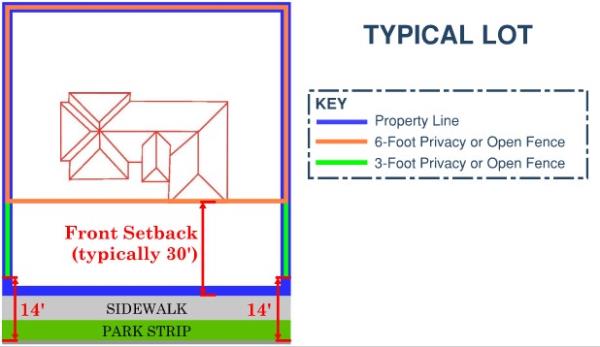
- Fences may be installed on the side and rear lot lines behind the front setback of the applicable zone. A fence along the side lot lines may extend into the front set back up to fourteen (14) feet from the back of curb if the fence is a maximum height of three (3) feet.
- A fence shall be set back a minimum of fourteen (14) feet from the back of curb on all sides that abut a street. This setback may be reduced to be six (6) feet from the back of the curb, up to the property line, in the following circumstances:
- for all side and rear property line fencing, if the fence is 66% open, or
- for rear property line fencing, the setback may be reduced if the portion of the property immediately adjacent to the street is less than fifty percent (50%) of the total length of the rear property line.
- All fences shall not exceed three (3) feet in height in the clear vision area and shall comply with the clear view area requirements as defined in Section 3-610 Clear View of Intersecting Streets.
- In no event shall a fence be installed within the front setback of the applicable zone parallel to a street.
- Materials
- Permitted: Vinyl, wood, open style metal fencing with the appearance of wrought iron, precast concrete, concrete, steel cable, gabion, stone, masonry, and hog/horse wire within wooden or metal beams and posts. Hog/horse wire without beams are permitted for animal enclosures required for large animals.
- Prohibited: Chain link and all other materials not listed above are prohibited.
- Specific lot considerations
- Typical Lot
 Corner Lot
 - The setback along the side property line adjacent to a street may be reduced to be six (6) feet from the back of curb, up to the property line, if the fence is 66% open.
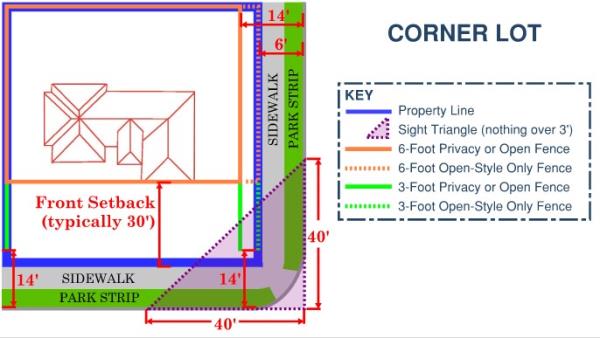
- The setback along the side property line adjacent to a street may be reduced to be six (6) feet from the back of curb, up to the property line, if the fence is 66% open.
- Double-Fronted Lot
- The setback along the rear property line adjacent to a street may be reduced to six (6) feet from the back of curb, up to the property line, if the fence is 66% open or if the portion of the property immediately adjacent to the street is less than fifty percent (50%) of the total length of the rear property line.
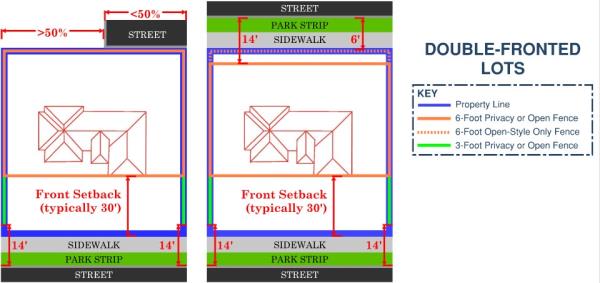
- The setback along the rear property line adjacent to a street may be reduced to six (6) feet from the back of curb, up to the property line, if the fence is 66% open or if the portion of the property immediately adjacent to the street is less than fifty percent (50%) of the total length of the rear property line.
- Lots adjacent to trails or open space
- Open style fences and privacy fences less than four (4) feet in height along the side or rear lot lines that are adjacent to a trail or open space are permitted.
- Privacy fences higher than four(4) feet in height along the side or rear lot lines that are adjacent to a trail or open space are permitted, up to the maximum allowed fence height, except that privacy fencing along the side or rear lot lines adjacent to a trail or open space is limited to a maximum of four (4) feet of privacy fencing, with at least the top two (2) remaining feet open in either of the following circumstances:
- The trail or open space area is less than thirty (30) feet in width, is not immediately adjacent to a public street or to other property owned by a public entity or utility with open style or no fencing, and the entire area is not visible from a public area such as a street or park within 300 feet.
- The trail or open space area is wider than thirty (30) feet but cannot be seen from two public areas such as a street or park.
- The Land Use Authority may approve an alternative fence design for fencing adjacent to trails or open space if:
- The proposed alternative meets the intent of this section; and,
- There are special circumstances attached to the property that do not generally apply to other properties in the same subdivision; and,
- The natural visibility or observation of the trail or open space is not diminished if the proposed alternative is constructed on all the lots adjacent to the trail or open space.
- Highways/arterial lot
- On all state highways or arterial streets, fences shall be set back a minimum of thirty (30) feet from the back of curb or as required by the parkway detail. This 30-foot restriction is applicable to fences along the front, side, and rear property lines that abut the highway or arterial street, no matter the height.
- Lots with side or rear property lines adjacent to a golf course facility
- The fence may be a maximum of fifteen (15) feet in height. The materials of this fence are limited to open style netting with black support posts or beams no closer than five (5) feet apart.
- Location
- Theme Walls. Theme walls shall comply with all regulations applicable to fences, except to the extent such regulations conflict with the requirements of this Subsection, in which case the requirements of this Subsection shall control
- Any developer of a residential subdivision shall provide a six (6) foot theme wall adjacent to all arterial and collector streets, open space areas, and trails except as provided herein.
- Gates connecting to open space areas may be allowed in theme walls if approved as part of the development review process.
- All theme walls shall be located on private property and owned by the owner of such private property or by a homeowners' association, unless the City agrees otherwise by way of a condition of approval during the development review process or recorded agreement.
- Materials and Design
- Permitted Materials: Precast concrete, concrete, masonry block, brick, stone, or a similar solid, durable material of equal or better quality. Accent landscaping and design elements such as stone veneer, brick, planters, marble, rock, decorative pilasters, decorative caps, stone or tile insets, or other significant design features are also permitted.
- Prohibited: Vinyl, wood, chain link.
- All theme walls between different uses shall provide columns every fifty (50) feet to provide variety and visual interest. Said columns shall extend a minimum of six (6) inches from the face of the theme wall and be architecturally enhanced as required above.
- Theme walls and gates shall be privacy fencing, provided that theme walls and gates adjacent to open space and trails shall meet the requirements of Subsection 3(c)(iii).
- Maintenance and Reconstruction
- The Owner of the theme wall shall maintain the theme wall in reasonably good and safe condition.
- Any reconstruction of the theme wall shall conform to the theme wall design approved as part of the development review process, unless a different design is approved by the City Council.
- Screen Walls. Screen walls shall comply with all regulations applicable to fences, except to the extent such regulations conflict with the requirements of this Subsection, in which case the requirements of this Subsection shall control
- The developer of any residential development with a density greater than six (6) units per acre which abut any R-1-40, R-1-30, R-1-20, or A-1 district must provide a screen wall with a minimum height of six (6) feet along the abutting property line.
- The developer of any nonresidential use that abuts any residential district must provide a screen wall with a minimum height of six (6) feet along the abutting property line. Any loading docks within one hundred (100) feet of a residential district must have a separate eight (8) foot high screen wall of similar materials compatible with the building design to screen the dock areas.
- All outdoor storage areas shall have a six (6) foot screen wall as required in this section.
- Materials and Design
- Permitted: Precast concrete, concrete, masonry block, brick, stone, or a similar solid, durable material of equal or better-quality. Accent landscaping and design elements such as stone veneer, brick, planters, marble, rock, decorative pilasters, decorative caps, stone or tile insets, or other significant design features.
- Prohibited: Vinyl, wood, chain link.
- If a screen wall is erected as an enclosure, a gate of equal height shall be required in order to secure the enclosure. The gate shall be privacy fencing and shall be compatible with the design of the building(s).
- Screen walls and gates shall be privacy fencing, provided that screen walls adjacent to open space and trails shall meet the requirements of Subsection 3(c)(iii).
- Retaining Walls
- A retaining wall within the front setback shall be a minimum of ten (10) feet from the front property line and shall not exceed four (4) feet in exposed height. The maximum height of a retaining wall in any other location is six (6) feet exposed height. A retaining wall shall be set back a minimum of fourteen (14) feet from the back of curb on all sides that abut a street.
- Retaining walls for daylight basements or window wells have a maximum exposed height of eleven (11) feet.
- Retaining walls shall not be placed any closer to another retaining wall than at a ratio of one foot horizontal to one foot vertical height of the wall, measured from the back side of the lower wall to the front side of the higher wall.
- Fences and Retaining Walls: Fences on or adjacent to retaining walls are subject to the following regulations:
- Privacy fences are permitted to be on the same vertical plane as a retaining wall, provided that the privacy fence and retaining wall may not exceed eight (8) feet in height measured from the finished grade of the lower property. If a privacy fence and retaining wall would exceed eight (8) feet in height, measured from the finished grade of the lower property, the privacy fence shall be set back at least four (4) feet from the back side of the retaining wall. Under no event may the height of a privacy fence exceed six (6) feet measured from the finished grade of the higher property.
- Open style fences are permitted to be on the same vertical plane as a retaining wall. The height of an open style fence may not exceed six (6) feet measured from the finished grade of the higher property.
- Retaining walls shall not be permitted within public utility easements without city approval, and no approval will be granted where a storm drain, culinary water line, pressurized irrigation line, or sewer line is installed or may be installed in the near future.
- Retaining walls require a building permit if there is a four (4) foot difference between the grades on either side of the retaining wall or the retaining wall supports a surcharge, per building code.
- The application for a building permit for a retaining wall must include:
- a stamped engineered plan from a licensed engineer.
- a drainage plan which provides for containment of run-off water on site or discharged to a City approved location.
- plans for a conduit as required by the City Engineer if the retaining wall is to be constructed within the public utility easement where utilities do not exist. The property owner shall be financially responsible for the removal or reconstruction of a retaining wall in a public utility easement if the easement is needed per Utah State law.
- Public and Utility Fencing and Retaining Walls.
- Fences for Highland City, other public entities, and public utilities may be chain link.
- Fences and retaining walls for Highland City, other public entities, and public utilities may deviate from the standards set forth in this Chapter for the benefit of the public and public resources with the approval of the Land Use Authority.
- Fences for non-Highland City public entities and utilities are required to be open style fencing along trail corridors that are less than thirty (30) feet wide
- Nothing herein shall exempt non-Highland City entities from applying for and obtaining City approval of fences and retaining walls prior to construction .
(Amended: 9/15/98,11/2/99, 12/7/99, 6/5/01, 10/2/01, 6/17/03, 5/3/05, 4/4/06, 10/3/06, 5/15/07, Ord #2010-18 11/3/10))
Amended by Ord. O-2021-11 on 5/18/2021
Amended by Ord. O-2022-09 on 7/19/2022
Amended by Ord. O-2022-18 on 10/4/2022
Amended by Ord. O-2022-17 on 10/4/2022
Amended by Ord. O-2023-11 on 5/16/2023
Amended by Ord. O-2024-11 on 7/2/2024
Amended by Ord. O-2024-12 on 7/2/2024
Amended by Ord. O-2024-13 on 7/2/2024
Amended by Ord. O-2024-14 on 7/2/2024
Amended by Ord. O-2024-15 on 7/2/2024
Amended by Ord. O-2024-23 on 8/20/2024
Amended by Ord. O-2024-27 on 10/1/2024
3-613 Fractional Numbers
Unless otherwise specified herein, any computation or measurement resulting in a fractional number shall be rounded down to the next smaller whole number.
Amended by Ord. O-2026-10 on 4/21/2026
3-614 Home Occupations
- The terms and definitions provided in Chapters 5.04 and 5.08 of the Municipal Code are incorporated herein.
- A home occupation license shall be obtained for all home occupations according to the procedures and standards set forth herein and in Chapter 5.08 of the Municipal Code before a person may engage in business on a residential property.
- The acts of employees rendering services to employers, conducted entirely within a dwelling unit or accessory structure with no external evidence or impact from such acts, are permitted in all residential properties and do not require a home occupation license. A home occupation license may be obtained by the resident if desired.
- Home Occupations shall be permitted in any residential dwelling unit subject to the regulations, standards, and restrictions set forth herein and in Chapter 5.08 of the Municipal Code.
- Except as specifically authorized herein, home occupations, shall be permitted only subject to and in compliance with the following conditions:
- Only bona fide residents of the residential property shall be employed by, operate, or otherwise carry on the home occupation.
- The home occupation shall be conducted entirely within the main dwelling, including an attached garage and shall not involve the use of any accessory building or yard space for storage or business activity.
- The home occupation shall not display nor create outside the building any external evidence of the operation of the home occupation, including signs.
- The home occupation shall be clearly incidental and secondary to the use of the property for dwelling purposes and shall not change the character or appearance of the building from that of a dwelling.
- The total area devoted to the home occupation shall not exceed 25% of the dwelling unit, including an attached garage. If there are multiple dwelling units within a property that are occupied by different families, the home occupation shall not exceed 25% of the portion of the structure containing the dwelling unit occupied by the licensee.
- The home occupation shall be registered with and licensed by the business license division of the city and with all applicable government entities and shall comply with governing law.
- Entrance from the outside to the area of the dwelling used for the home occupation shall be the same entrances normally used by the residing family, except when otherwise required by governing law.
- The home occupation shall not generate pedestrian or vehicular traffic that is unusual for or in excess of that customarily associated with the zone in which the use is located. There is a presumption that a home occupation generates excessive vehicular traffic and is therefore not permitted if any of the circumstances described below are true. These circumstances are not exhaustive of the circumstances that may warrant denial or revocation of a home occupation license due to unusual or excessive traffic.
- The home occupation generates additional vehicular traffic in an amount at least equal to the average daily trips generated for the residential use alone;
- The home occupation generates traffic or a need for parking, including temporary parking or drop-off areas, that cannot be safely accommodated within the residential property and the available parking area on the half-street portion of the adjacent right-of-way(s) fronting on the residential property; or
- The home occupation involves regular deliveries or shipments by medium- or heavy-duty trucks.
- The home occupation shall not generate vehicular traffic or parking that violates city parking and traffic regulations or is contrary to or obstructs traffic control devices, including traffic or parking that obstructs adjacent driveways, the flow of traffic on the right-of-way, or fire hydrant clearance and sight triangle areas.
- The home occupation and the structure in which it is conducted shall, comply with all fire, building, plumbing, electrical and health codes.
- The home occupation shall not be associated with nor produce odor, fumes, dust, light, glare, color, design, materials, construction, lighting, sounds, noises, vibrations, including interference with radio or television reception, that may be discernible beyond the premises, or which disturb the peace and quiet of the neighborhood.
- The home occupation shall not cause a demand for municipal or utility services or community facilities in excess of those usually and customarily provided for residential uses.
- Except as authorized by Chapter 10.09 of the Municipal Code, all maintenance or service vehicles and equipment, or any vehicle bearing any advertising related to the home occupation shall be garaged or stored entirely within a building or structure, or entirely behind a building or structure, out of view of the street.
- Daycares and In-Home Instruction. A daycare or in-home instruction business may be operated as a home occupation in accordance with the following regulations, standards, and restrictions:
- Daycare and in-home instruction home occupations may only be operated on residential properties of at least 8,000 square feet and that have a minimum of 80 feet of frontage on a street.
- Except as expressly set forth in this subsection (6), daycare and in-home instruction home occupations shall comply with all regulations, standards, and restrictions applicable to home occupations
- Daycare and in-home instruction home occupations may employ individuals who are not residents of the residential property to assist, operate, or otherwise carry on the home occupation.
- One (1) off street parking space is required for each employee of the home occupation who does not reside at the residential property.
- A traffic flow and parking plan must be submitted by the applicant with the home occupation license application to ensure that the vehicular traffic and parking generated by the home occupation will be adequately managed in accordance with city standards, and that the detrimental effects of the traffic and parking on adjacent properties and city utility and street systems has been substantially mitigated. The traffic flow and parking plan shall contain at least the following information:
- Anticipated number of non-resident employees;
- Anticipated time of arrival and departure of non-resident employees;
- Anticipated number of clients, students, or other non-employee individuals visiting the residential property for the home occupation;
- Anticipated times of drop-off and pick-up of clients, students, or other non-employee individuals visiting the residential property for the home occupation.
- A site map showing fire hydrants, adjacent driveways, trails, crosswalks, and intersections, existing traffic control devices, available on- and -off-site parking areas to be used by the home occupation, and proposed traffic circulation and flow to, from, and on the residential property.
- Subject to city approval of the traffic flow and parking plan, daycare and in-home instruction home occupations may generate pedestrian or vehicular traffic in excess of that customarily associated with the zone in which the use is located in accordance with the approved traffic flow and parking plan.
- Daycare and in-home instruction home occupations may use accessory buildings and yard space on the residential property.
- Daycares must receive applicable licensing from the Utah Department of Health and Human Services. A copy of this license must be submitted to the city with the home business license application.
- For preschools operated as in-home instruction, a background check is required for all teachers and instructors.
- The regulations set forth in this section do not apply to daycares or educational businesses that are not operated as a home occupation.
(Amended: 7/6/99, 7/18/2000, 5/2/06, 9/2/08)
Amended by Ord. O-2022-08 on 7/19/2022
Amended by Ord. O-2022-23 on 12/6/2022
Amended by Ord. O-2026-08 on 4/21/2026
3-615 Building Permit Bond
- The Building Inspector shall require, prior to issuance of the building permit, that the applicant post with the City a Bond for the protection of the cities offsite improvements. Said bond will be released after occupancy and an inspection has been conducted to insure that no damage is evident in the improvements.
Amended by Ord. O-2020-29 on 9/15/2020
3-616 Rules For Locating Boundaries
Where uncertainty exists as to the boundary of any Zone, the following rules shall apply:
- Where the zone boundary is indicated as being approximately upon the center line of a street, alley or block, or along a property line, then unless otherwise definitely indicated on the map, the center line of such street, alley, or block, or such property line shall be so construed to be the boundary of such Zone.
- Whenever such boundary line of such Zone is indicated as being approximately at the line of any river, irrigation canal, or other waterway or railroad right-of-way, or public park or other public land or any section line, then in such case the center of such stream, canal, or waterway, or of such railroad right-of-way or the boundary line of such public land or such section line shall be deemed to be the boundary of such Zone.
- Where such Zone boundary lines cannot be determined by the above rules, their location may be found by the use of the scale appearing upon the Zoning Map.
- Where the application of the above rules does not clarify the Zone boundary location, the Board of Adjustment shall interpret the Map.
3-617 Model Homes
Model homes used for the sale of homes/lots within a subdivision in Highland are a permitted use in all residential zones, provided that the model home conforms to the following requirements:
- The maximum number of personnel shall not exceed three (3) at any given time. not including visitors.
- All parking and traffic created by the use must follow typical traffic laws. with the same number of off-street parking spaces provided with the model home as required for other similar residential units within the zone.
- Signage shall be regulated by the existing sign ordinance.
- Outdoor lighting shall be limited to outdoor and landscape lighting permitted in a residential setting as defined in the Municipal Code.
- A model home shall operate only between the hours of 7:00 a.m. to 9:00 p.m. Monday through Saturday.
- Model homes shall obtain a business license and follow typical business license regulations that are not specified in this Code.
- If any portion of the model home is used as a sales office or for other commercial purposes, such portion shall comply with applicable ADA requirements.
- Garages used as sales offices shall be conve1ted back before occupancy is permitted.
- All homes permitted under this section shall have a final inspection prior to conversion as a residential use.
- No model home use shall exceed two (2) years. An extension may be approved by the Zoning Administrator if it is determined not to create an undue burden upon residents of the immediate area and the applicant is actively marketing homes/lots related to the model home within Highland.
(Amended: April 11, 1995)
Amended by Ord. O-2022-12 on 8/2/2022
Amended by Ord. O-2023-04 on 2/7/2023
3-618 Building And Fire Codes
All development, redevelopment, and construction shall conform to all current building and fire codes, including all adopted appendices thereof.
Adopted by Ord. O-2025-08 on 5/6/2025
3-619 Inspection
3-620 Building Permits
3-621 Park Strip And Parkway Detail Regulations
- All park strips shall be landscaped and maintained by the property owner directly adjacent to that sidewalk using water-wise landscaping according to the definition in Chapter 10., the standards provided in Section 30628, and the following requirements:
- Lawn shall not be installed in park strips.
- Vegetation such as grasses, flowers, ground covers and shrubs shall not exceed 22-inches in height. Vegetation shall not include weeds identified on the State of Utah Department of Agriculture and Food Designated Noxious Weed List for Colorado (CO), Idaho (ID), Kansas (KS), Montana (MT), Nebraska (NE), North Dakota (ND), South Dakota (SD), Utah (UT), Wyoming (WY) but may include approved drought tolerant plants.
- The park strip may be covered with mulch such as wood chips or decorative landscaping rocks (rock diameter of one inch minimum and six inches maximum) in combination with live plants.
- Vegetation and trees planted in the park strip shall be watered through drip irrigation systems and not watered from a hose, or above ground sprinkler.
- Only trees from the city approved Class I Trees list may be planted within a park strip pursuant to Section 2.36.160 Municipal Code.
- The seller of a newly constructed residence shall inform the first buyer of the residence of the water-wise landscaping requirements for park strips.
- Parkway details shall be dedicated, improved, and maintained as follows:
- Parkway detail areas shall be landscaped and improved according to the city’s current design and construction standards and specifications. The city council may approve modifications to the parkway detail implementation in a specific area to address specific property or design constraints or to improve public use and connectivity such as by widening roadways or adding multiuse trails.
- Parkway details shall be installed and maintained along the right of way corridors identified in the city’s general plan and master transportation plan, including the following:
- Timpanogos Highway (SR-92);
- Alpine Highway (SR-74);
- 4800 West and North County Boulevard (SR-129);
- Highland Boulevard;
- Beacon Hill Boulevard;
- 10400 North;
- 11800 North;
- 6800 West.
- The property on which a parkway detail is installed and maintained that extends beyond the area required by the applicable right of way cross-section standard shall be dedicated to the city either in fee simple or as a parkway landscape and public access easement.
- Unless the city has otherwise agreed in writing, parkway detail areas shall be maintained by the city and not by the property owner directly adjacent to the parkway detail or another person. No person shall modify, re-grade, or landscape parkway detail areas or use parkway detail areas for construction or vehicular access without the City’s prior written authorization. Fences installed along the boundary of parkway detail areas remain owned by the adjacent property owner, who is responsible for the maintenance of such fence.
(Amended: 6/18/02, 8/21/07)
Amended by Ord. O-2020-18 on 6/2/2020
Amended by Ord. O-2022-19 on 11/1/2022
Amended by Ord. O-2023-01 on 1/3/2023
Amended by Ord. O-2024-24 on 9/3/2024
Amended by Ord. O-2026-22 on 8/4/2026
3-622 Purpose Of Public Utilities
Public, Private and Individual Utilities shall be regulated and governed as indicated below. Objects that are placed upon an individual lot for the sole purpose of serving that individual property are exempt from locating within a Public Utility Zone.
- Above-Ground. Any above ground device or structure of a culinary water, irrigation, reservoir, or private utility system not owned or operated by Highland City or controlled on Highland City owned property, which is intended to regulate the function of a storage device or distribution line or which receives or transmits a signal, shall only be located within the Public Utility Zone (Article 3-4.10 in this Code) and shall be required to obtain a Conditional Use Permit prior to installation. Any above ground device or structure of a culinary water, irrigation, reservoir, or other utility system owned or operated by Highland City or other similar municipal public utility controlled on property owned by Highland City, which is intended to regulate the function of a storage device or distribution line or which receives or transmits a signal, shall be required to first obtain a Conditional Use Permit prior to installation.
- Exception. The replacement or repair of existing above ground transmission power lines or distribution power lines require a Conditional Use Permit but are not required to be within a Public Utility Zone. All new distribution power lines (less than 34 kV) which may be constructed shall be installed under-ground. Emergency replacement of power poles and or lines does not require compliance with this section of the code. It shall be a requirement that replacement power lines and poles shall be placed in a location that is consistent with the transportation element of the Highland City General Plan, unless the City Council determines that placement in said location is not in the best interest of the City. This exception does not apply to telecommunication facilities (Municipal Code; Chapter 13.44).
- Exception. The replacement or repair of existing above ground transmission power lines or distribution power lines require a Conditional Use Permit but are not required to be within a Public Utility Zone. All new distribution power lines (less than 34 kV) which may be constructed shall be installed under-ground. Emergency replacement of power poles and or lines does not require compliance with this section of the code. It shall be a requirement that replacement power lines and poles shall be placed in a location that is consistent with the transportation element of the Highland City General Plan, unless the City Council determines that placement in said location is not in the best interest of the City. This exception does not apply to telecommunication facilities (Municipal Code; Chapter 13.44).
- Under-Ground. Any landscape or structure removed during installation of an under-ground utility or utility system shall be restored to original condition or replaced accordingly (consistent with State Law). The replacement or repair of existing under ground utilities shall not be required to be within a Public Utility Zone however the installation of any new facilities shall be required to first obtain a Conditional Use Permit prior to construction.
- Individual Utilities. Individual utilities that are placed upon an individual lot for the sole purpose of serving that individual property and not for creating profit or for commercial purposes are not required to obtain a Conditional Use Permit. Individual Utilities are not permitted to locate within a Public Utility Zone. Individual utilities include:
- Lot Improvements. Utility, irrigation, and sewer lines associated with individual building permits connecting individual residences or commercial users to an existing distribution line.
- Antennas. (including: single user transmitters, receivers, antenna facilities and other types of installation used for the provision of personal wireless services, personal Satellite dish receiving antennas eighteen inches or less in diameter, personal television broadcast receiving antennas, personal radio broadcast receiving antennas, personal amateur radio antennas used for receiving and transmitting)
- Location. Antennas shall be located only on a roof or in rear or side yards unless such restriction precludes reception of an acceptable quality signal (the City does not enforce subdivision requirements which may require additional restrictions on the placement of personal antennas). In such case such antennas may be placed anywhere on the lot except within a public utility easement. Proof of the inability to receive an acceptable quality signal shall be provided to the Zoning Administrator upon request.
- Height. The vertical apex of the receiving device shall not exceed the greater of the Zone Height Limit or twenty (20) feet in height from ground level.
- Lot Improvements. Utility, irrigation, and sewer lines associated with individual building permits connecting individual residences or commercial users to an existing distribution line.
- Alternative Energy Conversion Systems. Individual alternative energy conversion systems that are placed upon an individual lot for the sole purpose of serving that individual property and not for creating profit or for commercial purposes are not required to locate within a Public Utility Zone. Individual alternative energy conversion systems include:
- General Requirements.
- Safety. There shall be sufficient safety measures in place established by the property owner to prevent any alternative energy towers from becoming a climbing hazard or from twisting or falling over due to natural events.
- Emergency Procedure Sign. Procedures for emergency shutdown of power generation units shall be established and posted prominently and permanently within three (3) feet of the meter panel and visible from the meter panel.
- Existing Power Line Facility. The applicant shall obtain approval from the local power company indicating that the proposed location for the tower(s) will not interfere with existing electric utility facilities.
- Emergency Procedure Sign. Procedures for emergency shutdown of power generation units shall be established and posted prominently and permanently within three (3) feet of the meter panel and visible from the meter panel.
- Net Metering. Net metering or interconnect systems shall meet any cost or regulation required by the local power company’s guidelines.
- Trees. It is not recommended that trees are removed or destroyed for the purposes of better access for alternative energy.
- Guy Wires. Alternative Energy Facilities shall not use guy wires or other similar peripheral supporting devices in order to provide structural support but shall be installed upon one independent pole that is adequately engineered to support that system.
- Building Permit. All Ground Mounted Alternative Energy Facilities (GMAEF) shall be required to include the following information:
- All GMAEF applications and plans shall be stamped by a qualified engineer identifying each specific site indicating that the tower will withstand a minimum of a 100 m.p.h. wind load; and
- The qualified engineer, or his designee, shall be present during installation and verify in writing that the construction of the tower meets or exceeds the minimum wind load and/or requirements as indicated within the submitted plans; and
- Manufacturer specifications for components and installation shall be required with each application; and
- Net metering locations and connection details; and
- The application shall include a detailed site plan showing the location of the proposed tower with elevations; and
- GMAEF must comply with applicable Federal Aviation Administration (FAA) regulations; and
- All other information required to be submitted and inspected by the current International Building Code related to the specific alternative energy facility proposed.
- All GMAEF applications and plans shall be stamped by a qualified engineer identifying each specific site indicating that the tower will withstand a minimum of a 100 m.p.h. wind load; and
- Abandonment. If an alternative energy facility is not functional, operational or maintained for a period of one (1) year then the owner shall have the facility immediately removed from the property.
- Safety. There shall be sufficient safety measures in place established by the property owner to prevent any alternative energy towers from becoming a climbing hazard or from twisting or falling over due to natural events.
- Roof Mount Solar Energy System. A roof mounted solar system may be installed upon the roof of the primary structure or an accessory structure within any zone.
- Sloped Roof. On a sloped surface, in no instance shall any part of the system extend beyond the lower or upper roofline. Panels shall not exceed more than one (1’) foot in height measured from the finished roof to the top of the panel.
- Flat Roof. On a flat surface, panels shall be set back a minimum of five (5’) feet.
- Sloped Roof. On a sloped surface, in no instance shall any part of the system extend beyond the lower or upper roofline. Panels shall not exceed more than one (1’) foot in height measured from the finished roof to the top of the panel.
- Ground Mount Solar Energy System (GMSES). Ground mounted solar systems are permitted within all commercial zones and only permitted within a residential zone if the following applies:
- Number. Each homeowner may install one (1) Ground Mount Solar Energy System on their lot based upon the size of the lot as follows:
- Lots 20,000 square feet or less may have one (1) ground mounted alternative energy facility installed on that property; and
- Lots between 20,000 – 40,000 square feet may have two (2) ground mounted alternative energy facilities installed on that property; and
- A property owner may install one (1) additional ground mounted alternative energy facility for each additional acre above 40,000 square feet.
- Lots 20,000 square feet or less may have one (1) ground mounted alternative energy facility installed on that property; and
- Rear Yard. All GMSES shall not be located within the minimum front yard setback of any lot, nor within the minimum side yard setback facing a street on a corner lot, nor on the roof of a residential structure; and
- Height. The height of the system is not to exceed twenty-two feet (22’) in height at its maximum peak; and
- Setbacks. In all cases the minimum setback shall be no less than ten feet from a property line, and one-hundred ten percent (110%) of the height of the solar facility from all overhead utility lines; and
- Density. The GMSES shall be considered an accessory structure when determining the size within a residential lot. The GMSES combined with any accessory structures shall not exceed five percent (5%) of the size of the lot.
- Number. Each homeowner may install one (1) Ground Mount Solar Energy System on their lot based upon the size of the lot as follows:
- Small Wind Energy Conversion Systems (SWECS). A SWECS shall be any wind tower and wind generator that is specifically constructed as an individual utility as specifically defined in this ordinance. A small wind energy conversion system (SWECS) shall not be permitted that is designed without an automatic braking, governing, or managing system for the purpose of preventing uncontrolled rotation, overspeeding, and excessive pressure on the tower structure, rotator blades, and turbine components. The following regulations shall apply to all small wind energy conversion systems:
- Number. Each homeowner may install one (1) Small Wind Energy Conversion System on their lot.
- Lots 20,000 square feet or less may have one (1) ground mounted alternative energy facility installed on that property; and
- Lots between 20,000 – 40,000 square feet may have two (2) ground mounted alternative energy facilities installed on that property; and
- A property owner may install one (1) additional ground mounted alternative energy facility for each additional acre above 40,000 square feet.
- Lots 20,000 square feet or less may have one (1) ground mounted alternative energy facility installed on that property; and
- Setbacks. Except as provided for in this ordinance, no portion of the SWECS shall be set back a distance no less than fifty percent (50%) of the total height from a property line, and one hundred ten percent (110%) of the tower height plus the turbine blade length from all overhead utility lines, dwellings, and roads. The setback from any structures on adjacent property shall be one hundred ten percent (110%) of the tower height plus the turbine blade length.
- Location. No part of the SWECS shall be located within the minimum front yard setback of any lot, nor within the minimum side yard setback facing a street on a corner lot, nor on the roof of a residential structure.
- Height. A SWECS may not exceed a total of fifty-two feet (52’) in height from grade to the highest point of the facility including the generator and turbine blades.
- The minimum distance between the ground and any protruding blades utilized on a small wind energy system shall be 15 feet as measured at the lowest point of the arc of the blades.
- The minimum distance between the ground and any protruding blades utilized on a small wind energy system shall be 15 feet as measured at the lowest point of the arc of the blades.
- Material. SWECS towers shall maintain either a galvanized steel finish or a finish in a color approved by the Home Owner’s Association/Architectural Approval Board of the subdivision the property is located in (if one exists) and City Council as part of the Conditional Use Permit Process, and shall not be artificially lighted unless required by the FAA.
- Noise. SWECS shall not exceed sixty (60) decibels as measured at the closest property line except during short term severe wind events. A manufacturer’s sound report shall be required with an application for a small wind energy system.
- Number. Each homeowner may install one (1) Small Wind Energy Conversion System on their lot.
- Roof Mount Wind System. Roof mount wind energy conversion systems are prohibited in residential zones but are permitted in commercial zones on a flat roof however each facility shall be set back a minimum of five (5’) feet from the roofline.
- Additional Standards. The Zoning Administrator or City Council may require additional conditions to mitigate potential impacts including but not limited to the following:
- Additional landscaping along an affected property line not exceeding ten feet (10’) in height to help mitigate any visual or other impact created by the new facility; and
- Painting, coloring, and other agreed upon method of concealing the material the pole is constructed from to mitigate any visual or other impact created by the new facility; and
- Increased engineering stability and construction requirements exceeding the above specifications may be included if it is proven that the requirements above are not adequate for a specific location; and
- The City may require the facility to be reasonably moved within the property boundary to help mitigate aesthetic concerns of adjacent property owners only if it does not negatively affect the power output of the facility significantly.
- Additional landscaping along an affected property line not exceeding ten feet (10’) in height to help mitigate any visual or other impact created by the new facility; and
- Conditional Use Permit Requirements for Alternative Energy. If the minimum standards defined herein cannot be met, a conditional use permit shall be required.
- General Requirements.
(Ord: #2010-16, 10/05/2010) (Amended: 11/11/03, 4/20/04, 8/6/04)
3-623 Temporary Uses
In addition to regulating uses, which are permanent in nature, it is the intent of this section to provide for certain temporary uses for limited periods of time. The purpose of this section is to establish the standards, regulations, procedures, and review criteria, which shall be used when considering an application for a temporary use permit.
- General Regulations.
- No temporary use permit shall be granted until adequate assurances have been provided ensuring compliance with the provisions of this section and all other applicable city codes.
- Temporary uses shall be consistent with the intent and purpose of this section and not to be detrimental to surrounding properties.
- Temporary uses shall obtain a Highland City business license.
- Temporary uses shall only be permitted in the C-1, CR, and the Town Center Overlay zoning districts. Temporary Uses are prohibited in residentially zoned areas except those with certain institutional uses, regardless of the zoning designation, and produce stands when located on intersecting arterial streets and the intersection of arterial streets and minor or major collector streets. These institutional uses include, but are not limited to: public or quasi public sites, city parks, city buildings, and public schools.
- No temporary use permit shall be granted until adequate assurances have been provided ensuring compliance with the provisions of this section and all other applicable city codes.
- Permitted Temporary Uses. The following uses shall be permitted upon receiving the appropriate approvals and the granting of a temporary use permit by the city.
- Christmas tree sales, snow shacks, produce stands, firework stands, or similar seasonally related events;
- Off-site commercial sales events;
- Temporary retail sales;
- Such other uses as the city may deem to be within the intent and purpose of this section.
- Christmas tree sales, snow shacks, produce stands, firework stands, or similar seasonally related events;
- Application Process, Fees, Noticing. Application for a temporary use permit shall be made on forms obtained from the Zoning Administrator. Application for a temporary use permit shall be made by the property owner of a duly authorized agent and a filing fee shall be shall be charged and collected at the time of application submittal. The Zoning Administrator may require additional information deemed necessary to understand the application.
- Those temporary uses which meet the following criteria in the opinion of the city do not require posting and may be approved subject to the appropriate conditions. The criteria are as follows:
- The use and/or structure complies with all applicable codes and ordinances;
- The use and/or structure does not interfere with pedestrian access ways, fire lanes, driveways, landscaped areas, or traffic visibility at driveways or street intersections;
- The use and/or structures are compatible with surrounding land uses;
- Parking on the property is adequate to serve any existing permanent use and the temporary use; and
- The temporary use shall only be conducted between the hours of 7:00 a.m. and 11:00 p.m.
- The use and/or structure complies with all applicable codes and ordinances;
- Those temporary uses which do not meet the above criteria in the opinion of the Zoning Administrator, shall be posted by the city for public notification within five (5) working days following application submittal and shall be subject to the appropriate conditions.
- Application for a temporary use permit shall be reviewed by the Zoning Administrator who shall approve, conditionally approve, or disapprove such application no sooner than five (5) and no later than eight (8) working days from the date of posting where applicable and no later than three (3) working days from receipt of application when no posting is required.
- An application for a temporary use shall only be approved if the Zoning Administrator finds that it meets the requirements herein.
- Approval may be made subject to further conditions deemed necessary to assure that all adverse impacts to the surrounding properties are minimized to the fullest extent possible. Conditions to be considered may include, but are not be limited to, the following:
- Regulation of parking, dust control measures and site lighting;
- Regulation of hours of operation;
- Regulation of site ingress and egress;
- Assurance of compliance with building, fire, electrical and all other appropriate codes; and
- Such other conditions deemed necessary to carry out the intent and purpose of this section.
- Regulation of parking, dust control measures and site lighting;
- The city shall notify the applicant of the decision in writing and shall state any conditions for approval or reasons for denial on said letter.
- All temporary use permit approvals shall be made subject to a time limit as set forth by the city. In no event shall a temporary use permit be granted for longer than six (6) months. Upon expiration of the time limit set forth at the time of approval, any continuation of the use shall require the submittal and approval of a new application.
- Upon expiration of any temporary use permit, any permit holder wanting to extend the length of the permit shall be required to re-apply for a new temporary use permit. Temporary use permit renewals shall be approved for a period not to exceed three (3) months. All temporary uses lasting six (6) weeks or over shall not be renewed more than once within a one-year period.
- Upon cessation of the use or expiration of the permit, whichever occurs first, the premises will be promptly cleaned and restored to substantially the same condition existing prior to commencement of such use.
- Those temporary uses which meet the following criteria in the opinion of the city do not require posting and may be approved subject to the appropriate conditions. The criteria are as follows:
- Appeals. Upon receiving notification of the decision, the applicant, any citizen or any party in interest, aggrieved by the decision may file with the city a written notice of appeal to the Planning Commission within seven (7) calendar days of the decision. Upon appeal, all material in the matter shall be filed by the city with the Planning Commission. The Commission may then review the case and based upon the information, uphold the action of the staff, remand the matter back to staff with instructions for further review or overturn the action of the staff. The Commission’s decision shall be limited to whether or not the proposed use meets the criteria set forth in this section.
(Ord #2011-TBD, 3/01/11)
Amended by Ord. O-2019-12 on 8/6/2019
3-624 Accessory Dwelling Unit
- General Requirements. All accessory dwelling units (ADUs), whether detached or internal, shall comply with the following requirements:
- Each ADU shall be registered with the city, subject to the review and approval of the Land Use Authority for compliance with this Section and other applicable law. To register an ADU, the owner of the property shall:
- Complete an application and pay applicable fees;
- Execute and cause to be recorded against title to the property a notice of approval that designates the addresses for the primary and accessory dwelling unit, requires the property to be owner-occupied, and provides notice of the City’s right to enforce these requirements.
- Any rental, lease, or sublease of an ADU for a period of less than thirty (30) consecutive days is considered a short term rental, and requires a business license, and shall comply with all regulations applicable to businesses and short-term rentals. Renting, leasing, or subleasing an ADU for a period of thirty (30) consecutive days or longer shall not require a business license.
- No more than one (1) ADU, whether detached or internal, shall be permitted for each residential property. No more than two total dwelling units, one primary and one accessory, may be created within a single-family residential lot or parcel.
- The residential property shall be owner-occupied. The owner may reside in the primary dwelling unit or the ADU.
- Each ADU shall conform to building, fire, health and other safety codes. Construction of an ADU, including remodeling, reconstruction, or conversion of use of existing buildings or structures, shall require a building permit and be subject to inspection and approval by the building official and fire marshal prior to occupancy.
- Separate utility accounts, meters, or laterals for the primary and accessory dwelling units are not permitted. All ADUs shall connect to and use the utilities serving the primary dwelling unit.
- An ADU shall not be constructed or occupied unless the residential property is served by adequate utilities and public facilities, and the city determines there is sufficient capacity in the city utility systems and public facilities to serve the ADU.
- If the property is served by a private septic system, the owner shall obtain the approval of the Utah County Health Department to connect the ADU to the septic system prior to connection. The owner shall comply with all requirements and regulations of the Utah County health department regarding the septic system.
- If the owner cannot or fails to comply with all requirements and regulations of the Utah County health department regarding the septic system, the owner shall be required to connect the ADU and primary dwelling unit to the City’s sewer system at the owner’s expense.
- An ADU shall be designated with an address separate from the primary dwelling unit. The address shall be set by the city. The owner of the property shall affix address markers to the structure(s) and residential property to mark the separate dwelling units. Separate mailboxes are permitted, and the owner of the property shall coordinate with the United States Post Office regarding mailboxes and mail delivery.
- Any parking spaces required for the primary dwelling unit or ADU contained within a carport or garage that are lost due to the creation of an ADU shall be replaced or otherwise provided for on the residential property.
- An ADU may not be subdivided from or transferred separately from the residential property or main dwelling. Each ADU shall remain under common ownership with the residential property and main dwelling.
- Each ADU shall be registered with the city, subject to the review and approval of the Land Use Authority for compliance with this Section and other applicable law. To register an ADU, the owner of the property shall:
- Internal Accessory Dwelling Units (IADUs) shall meet the following requirements in addition to the general requirements set forth herein:
- IADUs shall only be permitted on single-family residential property within lots or parcels of at least 6,000 square feet.
- A minimum of one (1) off-street parking space shall be provided for the IADU in addition to any other required parking spaces for the primary dwelling unit.
- The front of the main dwelling shall not be modified in any form that will give the appearance that separate dwelling units are incorporated within the main dwelling, except separate addresses and mailboxes.
- The primary entrance for the IADU shall be provided for from the rear of the main dwelling; a side entrance is allowable in the event that the entrance is camouflaged by property fencing or landscaping and is not visible from the street fronting on the front property line.
- Detached Accessory Dwelling Units (DADUs) shall meet the following requirements in addition to the general requirements set forth herein:
- DADUs shall only be permitted on single-family residential property within lots or parcels of at least 11,000 square feet.
- A DADU shall be constructed within a detached accessory building that meets the following requirements:
- Except as otherwise provided herein, the accessory building shall comply with all accessory building regulations of the applicable zone.
- Except as otherwise provided herein, the accessory building shall not exceed the lesser of the maximum height allowed for accessory buildings for the applicable zone, or the actual height of the main dwelling.
- The accessory building shall comply with the setback regulations applicable to the main dwelling, provided that the rear setback may be reduced to a minimum of twenty feet (20’) from the rear property line if the accessory building is limited to a single story above grade with a maximum height of fifteen feet (15’).
- The accessory building shall not be located between the main dwelling and the front property line.
- The accessory building footprint shall not exceed the main dwelling building footprint.
- The architecture of the accessory building shall be complementary to the main dwelling.
- An existing accessory building may be remodeled, reconstructed, or otherwise converted to contain a DADU if the accessory building conforms or is made to conform to all requirements of this section and all applicable building, fire, and other safety codes, and the portion of the accessory building containing the DADU conforms to all requirements of this section.
- A DADU shall receive a certificate of occupancy in conformance with applicable building code prior to use as a dwelling.
- A DADU shall not exceed 1250 square feet of living area.
- An accessory building may contain a DADU and other areas or rooms that are not part of the DADU, subject to applicable accessory building and DADU size regulations.
- A minimum of one (1) off-street parking space shall be provided for a DADU that is smaller than 650 square feet, and a minimum of two (2) off-street parking spaces shall be provided for a DADU that is 650 square feet or larger, in addition to any other required parking spaces for the primary dwelling unit.
- The City may enforce these requirements through any means available to the City, including by recordation of a lien in accordance with state law.
Adopted by Ord. O-2020-06 on 2/18/2020
Amended by Ord. O-2021-14 on 7/6/2021
Amended by Ord. O-2024-27 on 10/1/2024
Amended by Ord. O-2026-28 on 9/1/2026
3-625 Shipping Containers
- A shipping container is a reusable container designed for intermodal freight or other commercial transportation.
- Shipping containers that are kept or used on a property for longer than 60 days shall meet the following regulations:
- Shipping containers may only be permitted in the R-1-40, R-1-30, and R-1-20 Districts.
- Shipping containers shall meet the accessory structure regulations for the applicable zone.
- Building permits are required for shipping containers larger than 200 square feet or that require electrical, plumbing, or other utilities.
- Shipping containers may not be stacked vertically.
- Shipping containers shall be set back at least ten feet (10') from the front of the home,
- Shipping containers shall be painted a color consistent with that of the main dwelling.
- Shipping containers are prohibited on lots without a home, except for municipal uses.
Adopted by Ord. O-2021-24 on 11/9/2021
3-626 Driveway Regulations
- Driveways and other accesses that provide vehicular access from a public or private road shall conform to all requirements of the applicable zoning district, the clear view requirements set forth in Section 3-610, and the city’s adopted engineering, design, and construction standards and specifications.
- Driveways and other accesses that provide vehicular access from a public or private road shall be planned and designed in connection with any site plan or building permit that requires or necessitates the driveway or access.
- Driveways and other accesses that provide vehicular access from a public or private road shall not be permitted to cross or be constructed upon a landscape easement, parkway detail, conservation or open space area, or any land reserved or dedicated for stormwater, drainage, or flood control purposes.
- Driveways and other accesses that provide vehicular access from a public or private road and on-site parking areas and drive aisles shall be designed, graded, located, and maintained so as to not cause water to drain or run off onto adjacent properties without authorization.
- After January 1, 2024, no new driveways or other accesses that provide vehicular access from a public or private road to a property shall be permitted to connect to the following roads:
- Highland Boulevard
- 4800 West from SR-92 north to Highland City boundary
- 11800 North
- 6800 West from 9600 North south to Highland City boundary
Adopted by Ord. O-2024-04 on 1/16/2024
Amended by Ord. O-2026-22 on 8/4/2026
3-627 Swimming Pools
A swimming pool is a semi-permanent or permanent structure that is constructed to hold water that can be entered and used for recreational purposes, including pools and spas as defined by the currently adopted International Pool and Spa Code. A pool that could be installed by the typical homeowner and may be packaged as a kit, or a pool that is erected for temporary use of less than one year, is not considered a swimming pool. Swimming pools in all zones are subject to the following requirements:
- Swimming pools may be installed only in zones that expressly authorize the installation of swimming pools.
- Any structural portion of a swimming pool shall not be permitted within an easement of any kind.
- Pools that are enclosed or covered within a permanent structure other than the main or primary building on the property, and pool facilities, equipment, and enhancements, such as slides, water features, and diving boards, shall be considered accessory structures and shall be subject to all regulations related to accessory structures of the applicable zone.
- For the purposes of this section only, a “permanent structure” shall be considered any structure or landscaping object exceeding one-hundred twenty (120) square feet in size or exceeding fourteen (14) feet in height constructed for the purpose of enhancing the swimming pool or pool equipment facilities.
- Swimming pool setback requirements are measured to the inside wall of the swimming pool, and are as follows:
- Front Yard: Thirty-one feet (31’), or consistent with the primary building, whichever is greater.
- Rear Yard: Eleven feet (11’).
- Side Yard: Eleven feet (11’).
- Side Yard Adjacent to a Street: Eleven feet (11’) (fence is permitted 5’ from property line).
- Trail or Landscape Easement: Eleven feet (11’) measured from nearest easement line.
- The rear and side yard setbacks, not adjacent to a street or to a trail or landscape easement, may be reduced a minimum setback of six feet (6’) if each of the following requirements are satisfied:
- There are no utility easements within the pool or setback area or such easements are vacated.
- The property owner obtains a survey of the property and setback lines.
- There are no structures, retaining walls, utility facilities, sensitive lands as defined by Chapter 8, or any other feature or improvement within 10 feet of either side of the relevant property line that may be affected by the excavation and installation of the swimming pool.
- No access or work is permitted on the neighboring property without the neighboring property owner's written authorization.
- No pool facility, equipment, or enhancement is permitted between the pool and the property line. Any structure sheltering pool equipment or utilities must be set back at least ten feet away from the property line.
- A soil stabilization plan is required to prevent soil collapse during excavation and construction.
- All outdoor swimming pools shall be enclosed with a fence and gates or equipped an automated safety cover, as required by the currently adopted International Pool and Spa Code.
- All permanent swimming pools shall require a building permit.
Adopted by Ord. O-2024-16 on 7/2/2024
3-628 Landscape Regulations
- As used in this Section:
- “Activity Zones” means portions of the landscape designed for recreation or function, such as storage areas, fire pits, vegetable gardens, and playgrounds.
- “Active Recreation Areas” means areas of the landscape dedicated to active play where lawn is used as the playing surface.
- “Gathering Areas” means portions of the landscape dedicated to congregating, such as patios, gazebos, decks, and other seating areas. Gathering areas shall be constructed of hardscape.
- “Hardscape” means durable landscape materials, such as concrete, wood, pavers, stone, or compacted inorganic mulch.
- “Lawn” means ground that is covered with grass or turf that is or typically should be regularly mowed.
- “Mulch” means any material such as rock, bark, compost, wood chips or other materials left loose and applied to the soil or on top of landscape fabric or similar barriers.
- “Paths” means designed routes between buildings, activity zones, active recreation areas, gathering areas, and other landscape areas and features. Does not include sidewalks along rights of ways and accesses.
- “Planting Bed” means areas of the landscape that consist of plants, such as trees, ornamental grasses, shrubs, perennials, and other regionally appropriate plants.
- “Total Landscaped Area” means the improved areas of the property that incorporate all the completed features of the landscape. The landscaped area does not include footprints of buildings or structures, sidewalks along rights of ways and accesses, parking areas, drive aisles, driveways, and other vehicular accesses, and non-irrigated areas intentionally left undeveloped.
- Water-wise landscaping. All new commercial, institutional, industrial, and multi-family development, and all front and side yard landscaping for new single-family residential development shall implement water-wise landscaping and shall comply with the following:
- Lawn shall not be less than 8 feet wide at its narrowest point.
- Lawn shall not be installed in park strips, paths, or on slopes greater than 25% or 4:1 grade.
- Paths shall be made with hardscape, mulch, or other non-lawn ground surface material
- For residential development, lawn shall not exceed 50% of the total landscaped area in front and side yards.
- For commercial, industrial, institutional, and common area landscapes for multi-family development, lawn areas shall not exceed 20% of the total landscaped area outside of active recreation areas.
- At least 25% of non-lawn landscaped areas must contain plants, trees, and shrubs that create at least 50% living plant cover at maturity at the ground plane, not including tree canopies, throughout the total landscaped area.
- No more than 25% of the total landscaped area outside of activity zones and gathering areas may be covered by impervious material. All impervious materials and hardscapes shall be designed, graded, located, and maintained so as to not cause water to drain or run off onto adjacent property without authorization.
- For areas within the wildland-urban interface, as designated in the Highland City Wildland-Urban Interface Map, landscaping shall be designed, installed, and maintained to comply with the current Wildland-Urban Interface code.
- Maintenance of Landscaping. The property owner shall be responsible for the proper installation, maintenance, repair, and replacement of all landscaping as required by this Section. Landscaped areas shall be maintained in a live, clean, orderly, and healthful condition as follows:
- Vegetation, trees, and lawn receive proper pruning, weeding, fertilizing, and mowing.
- Dead, dying, or diseased vegetation, trees, and lawn be removed and replaced;
- Landscaped areas, including planting beds and mulched areas, be kept free of uncontrolled weed and volunteer plant growth;
- Mulched areas within landscaping be maintained with a minimum of three inches of mulch.
- Vegetation and trees within or adjacent to the sight triangle, sidewalks, street, and buildings be pruned and trimmed to maintain required clearances;
- Landscaped areas be kept free of nuisances, refuse, debris, litter, dead vegetation, and animal waste, except for properly applied fertilizer or compost and maintained and protected compost piles;
- Irrigation systems be maintained in good operating condition to provide adequate water to vegetation, trees, and lawn and prevent the waste of water through overspray on impervious areas, overwatering, or leaks. Sprinklers be regularly adjusted to reduce overspray and to primarily irrigate permeable areas with vegetation, trees, and lawn. Leaks, broken sprinklers, improperly adjusted sprinklers, and other damage or improper condition of an irrigation system resulting in waste of water be addressed and repaired.
- Private Landscaping Plan Submission.
- For non-residential development, a private landscaping plan conforming to the requirements of this Section and all requirements of the applicable zone shall be provided by the property owner for the following:
- Site plan or conditional use permit review, as applicable, including with proposed amendments or revisions to approved site plans or conditional use permits; or
- Any addition, expansion, or change in use of a property that increases or decreases the floor area by 50% or more, increases or decreases the number of parking stalls required by 50% or more, or modifies any required landscaping by 50% or more.
- For non-residential development, a private landscaping plan conforming to the requirements of this Section and all requirements of the applicable zone shall be provided by the property owner for the following:
Amended by Ord. O-2026-22 on 8/4/2026
Amended by Ord. O-2026-27 on 8/18/2026

