
Highland City Zoning Code
ARTICLE 4
1 R-1-40 Zone
3-4101 R-1-40 Residential Zone
- The objective in establishing the R 1 40 Residential Zone is to support a very low density residential environment within the City which is characterized by large lots, well-spaced buildings, well kept lawns, trees and other landscaping with the nature of the environment substantially undisturbed, a minimum of vehicular traffic, and quiet residential conditions favorable for family life.
- Representative of the uses within the R 1 40 Zone are single-family dwellings, schools, churches, parks, playgrounds, and other community facilities designed in harmony with the characteristics of the Zone. (see section 5-128)
- Multi family dwellings (with the exception of approved accessory dwelling units as defined within Section 3-624 of this Code), commercial and industrial use areas are strictly prohibited in this Zone.
(Amended 10/7/08)
Amended by Ord. O-2020-06 on 2/18/2020
3-4102 Permitted Uses
The following buildings, structures, and uses of land shall be permitted in the R-1-40 Zone upon compliance with requirements set forth in this Code:
- Single-family dwellings, conventional construction, which include a garage of sufficient size for storage of two automobiles (see 10-102(16) for definition of Dwelling).
- Accessory uses such as storage buildings, private garages, carports, noncommercial greenhouses, and swimming pools.
- Public utility lines and subject to 5-114(6).
- Household pets.
- Fences, walls, hedges.
- Gardens, fruit trees, and field crops.
- Keeping of animals subject to the following requirements:
- All large animals shall be provided shelter or cover. The shelter or cover where animals are normally fed, watered, and corralled shall be at minimum of one hundred (100) feet from any residence, except that it may be a minimum of seventy-five (75) feet from the animal owner’s residence.
- All large animals shall be enclosed in a fence and no part of the enclosure shall be nearer than twenty (20) feet from any residential structure.
- No large animal shall be kept on a lot of less than 30,000 square feet in area. Three (3) large animals may be kept on a lot with a minimum area of 30,000 square feet and four (4) large animals may be kept on a lot with a minimum area of 40,000 square feet. One additional large animal may be kept on a lot for each 10,000 square feet of area of the lot in excess of 40,000 square feet. No small animal shall be kept on a lot of less than 20,000 square feet. No more than twelve (12) small animals shall be kept per 20,000 square feet of lot area. In determining the number of animals allowed on any lot based on its area, no proration of numbers shall be allowed within the area increments specified in this paragraph.
- Pigs shall not be kept on any lot.
- Chickens are permitted on lots less than 20,000 square feet subject to the following conditions:
- The maximum number of chickens above the age of 6 months shall be as follows:
Minimum Lot Area (square feet) Maximum Number of Chickens = 20,000 14 = 15,000 10 = 10,000 6 - All sheds, coops, hutches, or similar structures used for the housing of chickens shall be at minimum of twenty (20) feet from any adjacent neighboring residences. The structure shall be cleaned regularly to prevent offensive odors from becoming a nuisance as determined by the Animal Control Officer.
- The coop or similar structures for the housing of chickens shall have a minimum floor area of at least two (2) square feet per chicken. However, if chickens are not allowed to roam within an enclosed rear yard, the coop shall a minimum floor area of six (6) square feet per chicken. All coops or similar structures for the housing of chickens shall be predator resistant.
- Chickens shall not be permitted to roam free unless enclosed in a rear yard.
- Roosters are prohibited on lots less than 20,000 square feet.
(Ord#: 2012-06 4/03/12)
- The maximum number of chickens above the age of 6 months shall be as follows:
- Residential Facilities for Persons with a Disability. Residential Facilities for Persons with a Disability shall be a permitted use in all residential zones and requires final zoning approval by the Land Use Authority. The building and use must comply with all of the requirements defined by this Section.
- “Disabled” or “Disability” under this section shall include, with respect to a person, a person who has a physical or mental impairment which substantially limits one or more of that person’s major life activities or has a history of having such impairment.
- For the purpose of Section 3-4102(8) “Disability” does not include any disability arising from, related to, or caused by substance abuse and/or addiction to alcohol and/or a controlled substance, as defined in Section 102 of the Controlled Substances Act, 21 U.S.C. 802.
- For Residential Facilities for the Rehabilitation and Treatment of the Disabled, which treat disabled persons for the illegal use of, or addiction to, alcohol and/or any federally controlled substance, please refer to 3-4102(9).
- For Residential Facilities for the Rehabilitation and Treatment of the Disabled, which treat disabled persons for the illegal use of, or addiction to, alcohol and/or any federally controlled substance, please refer to 3-4102(9).
- Disabled or Disability also does not mean an impairment or limitation resulting from or related to kleptomania, pyromania, or any sexually related addiction or disorder, including but not limited to: sex and pornography addictions, transvestism, transexualism, pedophilia, exhibitionism, voyeurism, gender identity disorders (those not resulting from physical impairments), or any other sexual behavior disorder.
- For the purpose of Section 3-4102(8) “Disability” does not include any disability arising from, related to, or caused by substance abuse and/or addiction to alcohol and/or a controlled substance, as defined in Section 102 of the Controlled Substances Act, 21 U.S.C. 802.
- “Residential Facilities for Persons with a Disability” means a residence:
- in which one or more persons with a disability resides; and
- is licensed or certified by the State of Utah Department of Human Services under Title 62A, Chapter 2, Licensure of Programs and Facilities; and
- is licensed or certified by the State of Utah Department of Health under Title 26, Chapter 21, Health Care Facility Licensing and Inspection Act; and
- is consistent with Utah Code 10-9a-520 and complies with Title 57, Chapter 21, Utah Fair Housing Act, and the Federal Fair Housing Amendments Act of 1988, 42 U.S.C. Sec. 3601 et seq.
- is licensed or certified by the State of Utah Department of Human Services under Title 62A, Chapter 2, Licensure of Programs and Facilities; and
- in which one or more persons with a disability resides; and
- Discrimination against Residential Facilities for Persons with a Disability shall be prohibited.
- Residential Facilities for Persons with a Disability shall not be considered multi-family dwellings if the following requirements are met;
- Any Residence for Persons with a Disability shall be occupied only by individuals who are considered disabled per 3-4102(8)(a) (excluding staff members).
- Occupancy by any staff member shall only be allowed if such occupancy is primarily for the purpose of serving the residents and not primarily a benefit of employment to the staff member (room and board shall not be offered as a benefit).
- Any Residence for Persons with a Disability shall be occupied only by individuals who are considered disabled per 3-4102(8)(a) (excluding staff members).
- A Residential Facility for Persons with a Disability shall meet all of the requirements of a person with a disability according to the definition of “disability” as contained in 3-4102(8)(a); and
- The home shall not be occupied by more than four (4) unrelated individuals living in a family type environment consistent with 10-102(12) Common Household; and
- Any group or individual considered disabled may apply for a Reasonable Accommodation per Highland City’s Reasonable Accommodation Policy and procedure; and
- Any group or individual considered disabled may apply for a Reasonable Accommodation per Highland City’s Reasonable Accommodation Policy and procedure; and
- The owner/operator of such facilities shall provide adequate personal space for each resident.
- Any Residential Facility for Persons with a Disability shall be occupied only by individuals who are considered disabled per 3-4102(8)(a) (excluding staff members).
- The home shall not be occupied by more than four (4) unrelated individuals living in a family type environment consistent with 10-102(12) Common Household; and
- Residency within a Residential Facility for Persons with a Disability shall be strictly voluntary and not part of, or in lieu of, confinement, rehabilitation, or treatment in a correctional facility, or a condition of probation/parole. A Residential Facility for Persons with a Disability shall not include any persons referred by the Utah State Department of Corrections or any District or Juvenile Court.
- Residency within a Residential Facility for Persons with a Disability shall not be available to or occupied by any individual whose tenancy would constitute a direct threat to the health or safety of other individuals or whose tenancy could result in substantial physical damage to the property of others.
- Owners or operators of Residential Facility for Persons with a Disability may provide training or treatment programs for residents with disabilities provided that such training or treatment programs are in compliance with the State of Utah Department of Human Services standards as set forth in the Utah Administrative Code.
- Appeals. Any Appeals arising from any final decision of the Land Use Authority with respect to a Residential Facility for Persons with a Disability shall be heard by the Appeal Body.
- “Disabled” or “Disability” under this section shall include, with respect to a person, a person who has a physical or mental impairment which substantially limits one or more of that person’s major life activities or has a history of having such impairment.
- Residential Facilities for the Rehabilitation and Treatment of the Disabled. Residential Facilities for the Rehabilitation and Treatment of the Disabled shall be a permitted use in all residential zones and requires zoning approval by the Land Use Authority; provided that the building and use is consistent with Utah Code 10-9a-520 and complies with Title 57, Chapter 21, Utah Fair Housing Act, and the Federal Fair Housing Amendments Act of 1988, 42 U.S.C. Sec. 3601 et seq.
- Residential Facilities for the Rehabilitation and Treatment of the Disabled under this section shall mean, with respect to a person, a person who has a physical or mental impairment which substantially limits one or more of that person’s major life activities arising from, related to, or caused by use of, and/or addiction to, alcohol and/or any federally controlled substance, as defined in Section 102 of the Controlled Substances Act, 21 U.S.C. 802.
- Disabled or Disability under this section does not mean an impairment or limitation resulting from or related to kleptomania, pyromania, or any sexually related addiction or disorder, including but not limited to; sex and pornography addictions, transvestism, transexualism, pedophilia, exhibitionism, voyeurism, gender identity disorders (those not resulting from physical impairments), or any other sexual behavior disorder.
- Disabled or Disability under this section does not mean an impairment or limitation resulting from or related to kleptomania, pyromania, or any sexually related addiction or disorder, including but not limited to; sex and pornography addictions, transvestism, transexualism, pedophilia, exhibitionism, voyeurism, gender identity disorders (those not resulting from physical impairments), or any other sexual behavior disorder.
- “Residential Facilities for the Rehabilitation and Treatment of the Disabled” means a residence:
- in which one or more persons with a disability resides; and
- is licensed or certified by the State of Utah Department of Human Services under Title 62A, Chapter 2, Licensure of Programs and Facilities; and
- is licensed or certified by the State of Utah Department of Health under Title 26, Chapter 21, Health Care Facility Licensing and Inspection Act; and
- is consistent with Utah Code 10-9a-520 and complies with Title 57, Chapter 21, Utah Fair Housing Act, and the Federal Fair Housing Amendments Act of 1988, 42 U.S.C. Sec. 3601 et seq.
- is licensed or certified by the State of Utah Department of Human Services under Title 62A, Chapter 2, Licensure of Programs and Facilities; and
- in which one or more persons with a disability resides; and
- Discrimination against disabled persons or against Residential Facilities for the Rehabilitation and Treatment of the Disabled shall be prohibited.
- Residential Facilities for the Rehabilitation and Treatment of the Disabled shall not be considered multi-family dwellings if the following requirements are met;
- Any Residential Facility for the Rehabilitation and Treatment of the Disabled shall be occupied only by individuals who are considered disabled per 3-4102(9)(a) (excluding staff members) and meet the following conditions:
- Individuals have been diagnosed with an addiction to alcohol or a controlled substance (as defined in Section 102 of the Controlled Substance Act, 21 U.S.C. 802);
- Individuals are unable to abstain from the use of alcohol or controlled substances without the structured supportive setting offered by a residence for the disabled; and
- Individuals have completely abstained from the use of alcohol and all controlled substances for a continuous period of at least thirty (30) days immediately prior to becoming a resident of the home.
- All residents in the home must completely abstain from using alcohol and controlled substances during the period that they are residents in the home. Any resident of a Residential Facility for the Rehabilitation and Treatment of the Disabled who uses alcohol or a controlled substance, whether on or off the premises, shall be immediately expelled from the home and shall not be readmitted for a period of at least 30 days following the violation. However, nothing contained herein shall be construed to prohibit a resident from taking a prescribed medication for which a resident has a valid and current prescription.
- Individuals have been diagnosed with an addiction to alcohol or a controlled substance (as defined in Section 102 of the Controlled Substance Act, 21 U.S.C. 802);
- Occupancy by any staff member shall only be allowed if such occupancy is primarily for the purpose of serving the residents and not primarily a benefit of employment to the staff member (room and board shall not be offered as a benefit).
- Any Residential Facility for the Rehabilitation and Treatment of the Disabled shall be occupied only by individuals who are considered disabled per 3-4102(9)(a) (excluding staff members) and meet the following conditions:
- A Residential Facility for the Rehabilitation and Treatment of the Disabled exceeding four (4) unrelated persons shall meet all of the requirements of a person with a disability according to the definition of “disability” as contained in 3-4102(9)(a); and
- The home shall not be occupied by more than four (4) unrelated individuals living in a family type environment consistent with 10-102(12) Common Household; and
- Any group or individual considered disabled may apply for a Reasonable Accommodation per Highland City’s Reasonable Accommodation Policy and procedure; and
- Any group or individual considered disabled may apply for a Reasonable Accommodation per Highland City’s Reasonable Accommodation Policy and procedure; and
- The owner/operator of such facilities shall provide adequate personal space for each resident.
- The home shall not be occupied by more than four (4) unrelated individuals living in a family type environment consistent with 10-102(12) Common Household; and
- Residency within a Residential Facility for the Rehabilitation and Treatment of the Disabled shall be strictly voluntary and not part of, or in lieu of, confinement, rehabilitation, or treatment in a correctional facility, or a condition of probation/parole. A Residential Facility for the Rehabilitation and Treatment of the Disabled shall not include any persons referred by the Utah State Department of Corrections or any District or juvenile court.
- Residency within a Residential Facility for the Rehabilitation and Treatment of the Disabled shall not be available to or occupied by any individual whose tenancy could constitute a direct threat to the health or safety of other individuals or whose tenancy could result in substantial physical damage to the property of others.
- The owner/operator of a Residential Facility for the Rehabilitation and Treatment of the Disabled shall have conducted an individualized assessment of each person desiring to become a resident of the facility to determine if such person would constitute a threat prior to allowing occupancy of the facility by such a person.
- The assessment shall be conducted by a properly licensed psychologist, social worker or other licensed individual qualified to perform such assessments properly licensed in the State of Utah.
- Assessments shall include, but not be limited to, consideration of such things as past criminal histories and/or violent acts of the individual, the amounts of time that have lapsed since such acts, and treatments the individual has received.
- Evaluations of individuals who have committed acts of sexual aggression or criminal sex acts shall also include psycho-sexual evaluations by a licensed psychiatrist or an individual holding a PhD in psychology.
- No individual determined to pose a risk for commission of sexual offenses, or being classified as having predatory tendencies may be accepted as a resident.
- Assessments shall include, but not be limited to, consideration of such things as past criminal histories and/or violent acts of the individual, the amounts of time that have lapsed since such acts, and treatments the individual has received.
- The owner/operator of a Residential Facility for the Rehabilitation and Treatment of the Disabled shall have conducted an individualized assessment of each person desiring to become a resident of the facility to determine if such person would constitute a threat prior to allowing occupancy of the facility by such a person.
- Owners or operators of Residential Facilities for the Rehabilitation and Treatment of the Disabled may provide training or treatment programs for Residential Facilities for the Rehabilitation and Treatment of the Disabled provided that such training or treatment programs are in compliance with the State of Utah Department of Human Services standards as set forth in the Utah Administrative Code.
- No alcohol or controlled substance shall be allowed on the premises of the Residential Facilities for the Rehabilitation and Treatment of the Disabled; however, nothing contained herein shall be construed to prohibit a resident from taking prescribed medication for which a resident has a valid and current prescription. A first violation of this requirement shall result in a warning to the occupancy permit holder. A second violation occurring within a twelve month period shall result in a fine of five hundred dollars ($500) to the occupancy permit holder. A third violation occurring within a twelve month period shall result in the revocation of a occupancy permit to operate a Residential Facility for the Rehabilitation and Treatment of the Disabled and no occupancy permit shall be reissued to the occupancy permit holder (or principals of the occupancy permit holder if the occupancy permit is an entity) for a period of at least one year following such revocation. The City shall have the right to deny an annual occupancy permit to any individual or entity that has had more than one revocation of an annual occupancy permit to operate a residence for the disabled.
- The annual occupancy permit holder shall be required to perform a hair follicle test on each potential resident before allowing such person to become an occupant in a Residential Facility for the Rehabilitation and Treatment of the Disabled.
- The annual occupancy permit holder shall not allow any person whose test results indicate the use of alcohol or drugs in the previous thirty (30) days to become an occupant of the home.
- The annual occupancy permit holder shall not allow any person whose test results indicate the use of alcohol or drugs in the previous thirty (30) days to become an occupant of the home.
- The annual occupancy permit holder shall conduct random urinalysis testing (or other equally effective testing methods) on each of the residents at least once per week to verify ongoing abstinence from alcohol and drugs.
- Any resident who test positive for alcohol or drugs or who refuses to submit to a test shall be immediately expelled from the home.
- Any resident who test positive for alcohol or drugs or who refuses to submit to a test shall be immediately expelled from the home.
- The annual occupancy permit holder shall maintain records of the initial testing results and the ongoing test results and shall submit to the City a monthly report representing an accurate accounting of these tests.
- The method and frequency of testing procedures must be included in a Policy and Procedures manual presented along with the application for an annual occupancy permit.
- The method and frequency of testing procedures must be included in a Policy and Procedures manual presented along with the application for an annual occupancy permit.
- The owner/operator shall provide to the City a monthly running report for each occupant identifying the time, date, and result of each assessment completed.
- The annual occupancy permit holder shall be required to perform a hair follicle test on each potential resident before allowing such person to become an occupant in a Residential Facility for the Rehabilitation and Treatment of the Disabled.
- Appeals. Any Appeals arising from any final decision of the Land Use Authority with respect to a Residential Facility for the Rehabilitation and Treatment of the Disabled Facility shall be heard by the Appeal Authority.
- Residential Facilities for the Rehabilitation and Treatment of the Disabled under this section shall mean, with respect to a person, a person who has a physical or mental impairment which substantially limits one or more of that person’s major life activities arising from, related to, or caused by use of, and/or addiction to, alcohol and/or any federally controlled substance, as defined in Section 102 of the Controlled Substances Act, 21 U.S.C. 802.
- Procedure for Initial Approval and Annual Review of a Residence for the Disabled and Residential Rehabilitation and Treatment Facility for the Disabled referred to in this section as group homes. All group homes under 3-4102(8) and 3-4102(9) shall first obtain final zoning approval from the Land Use Authority prior to receiving an annual occupancy permit and prior to occupancy. In addition, the facility shall comply with the following requirements:
- The home and use shall be consistent with Utah Code 10-9a-520 and complies with Title 57, Chapter 21, Utah Fair Housing Act, and the Federal Fair Housing Amendments Act of 1988, 42 U.S.C. Sec. 3601 et seq.
- At least ten (10) days before the Land Use Authority hears the application for a group home, the City shall provide written notification by mail to all citizens living within or owning property within 500 feet of the proposed site as measured in a straight line between the closest property lines of the proposed facility.
- Zoning Approval.
- To obtain zoning approval the owner of a group home shall comply with the following requirements:
- The group home shall comply with all applicable state and federal laws; and
- The owner of the group home shall obtain building permits that verify compliance with the same building, safety, and health regulations as are applicable in the same zone to similar uses that are not residential facilities for persons with a disability; and
- The owner shall obtain final site plan approval from the Land Use Authority prior to obtaining an annual occupancy permit; and
- Prior to the initial occupancy of a Residential Facility for the Rehabilitation and Treatment of the Disabled and at least quarterly, the owner/operator of the facility shall certify that the individualized psychological and psycho-sexual assessments have been performed on each resident and that each resident meets the requirements of this section.
- The group home shall comply with all applicable state and federal laws; and
- To obtain zoning approval the owner of a group home shall comply with the following requirements:
- Safety Plan. To ensure the safety of the residents and surrounding community, all group home operators shall develop a safety plan demonstrating adequate supervision and control of the residents.
- The safety plan shall be reviewed by the Reviewing Body and shall be approved by the Land Use Authority.
- The safety plan shall address the following:
- Parking and traffic circulation plan.
- Security and surveillance operation.
- Visitation hours.
- Parking and traffic circulation plan.
- In addition, Residential Facilities for the Rehabilitation and Treatment of the Disabled shall include:
- Testing procedures and operations (see 3-4102(9)(p); and
- A copy of the Policy and Procedures Manual for the specific location required through the State Licensing process.
- Testing procedures and operations (see 3-4102(9)(p); and
- Residential Character. Any group home that would likely create a fundamental change in the character of a residential neighborhood shall be excluded from this zone except as allowed by State or Federal law.
- Group homes may be located within an existing residential dwelling or located within a residential zone only if that structure is capable of use as such a facility without structural or landscaping alterations that would change the structure’s residential character.
- The site plan must show any alteration of the structure and landscaping and must be approved by the Land Use Authority before an annual occupancy permit is issued.
- Any new structure constructed for use as a group home shall be of a size, scale and design that is in harmony with other residential homes and residential uses in the neighborhood and subdivision.
- The inclusion of features which make a residential dwelling handicap accessible, such as hand rails, ramps, or oversize doors, shall not be deemed to change or alter the residential nature of a structure.
- The site plan must show any alteration of the structure and landscaping and must be approved by the Land Use Authority before an annual occupancy permit is issued.
- At least six (6) off-street parking stalls shall be provided in each group home to serve the needs of residents, visitors and staff members.
- If considered necessary for traffic safety, additional parking in a reasonable number may be required by the Land Use Authority and may be based upon one parking stall per individual occupying the home over the age of sixteen (16) including staff and at least 0.5 parking stalls per individual occupying the home for visitors.
- Visiting and group schedules will detail visiting hours and visiting times for invited visitors. The proposed schedule will demonstrate that parking will be managed to minimize traffic impacts.
- Group homes shall provide the City with an updated copy of its visiting and group schedules anytime those schedules change.
- Group homes shall provide the City with an updated copy of its visiting and group schedules anytime those schedules change.
- If considered necessary for traffic safety, additional parking in a reasonable number may be required by the Land Use Authority and may be based upon one parking stall per individual occupying the home over the age of sixteen (16) including staff and at least 0.5 parking stalls per individual occupying the home for visitors.
- Group homes may be located within an existing residential dwelling or located within a residential zone only if that structure is capable of use as such a facility without structural or landscaping alterations that would change the structure’s residential character.
- Separation. Group homes shall be dispersed throughout Highland as follows:
- No group home shall be located within three-quarters (3/4) of a mile from any other group home established under sections 3-4102(8), 3-4102(9) or 3-4102(11), or other similar use, as measured in a straight line between the closest property lines of any group home listed above.
- No group home shall be located within three-quarters (3/4) of a mile from any other group home established under sections 3-4102(8), 3-4102(9) or 3-4102(11), or other similar use, as measured in a straight line between the closest property lines of any group home listed above.
- Upon receipt of approval from the Land Use Authority, the owner/operator of a group home shall be eligible to secure an annual occupancy permit from the City. Said occupancy permit shall be valid for one calendar year and shall be reviewed annually and be subject to:
- The receipt to a renewal application that shall include the information and certifications required under 3-4102(8) and/or 3-4102(9) above and a certification that none of the residents pose a threat as of the date of the renewal; and
- At least ten (10) days prior to the Land Use Authority hearing the renewal application, the City shall provide written notification by mail to all residents and/or property owners within 500 feet of the existing facility.
- A finding by the Land Use Authority that during the preceding year that the group home operated under compliance with the terms of 3-4102(8) and/or 3-4102(9) and any other conditions of approval.
- The receipt to a renewal application that shall include the information and certifications required under 3-4102(8) and/or 3-4102(9) above and a certification that none of the residents pose a threat as of the date of the renewal; and
- Requirements for an Annual Occupancy Permit. Owners of group homes shall provide to the City a copy of the following documentation prior to occupying a residence:
- Verification of a State License to operate; and
- Copies of any required reports and/or inspections provided by the Department of Human Services and/or the Department of Health or required to be provided by the owner/ operator to these departments, whichever may apply; and
- Proof and verification to the City that each of the residents admitted falls within the definition of disability as set forth in 3-4102(8)(a) and/or 3-4102(9)(a); and
- Proof of adequate insurance for the program’s vehicles, hazard insurance on the home and liability insurance to cover residents and third party individuals; and
- Any additional required information, documentation, testing, or other data as required by this ordinance.
- An annual occupancy permit to operate a group home shall be:
- Non-transferable and shall terminate if the person or entity that applied for the occupancy permit ceases to operate or own the facility, structure is devoted to a use other than that specifically approved by the Land Use Authority, or the structure fails to comply with all building, safety, health and zoning requirements of Highland City.
- Terminated if at any time it is demonstrated to the Land Use Authority that:
- The structure or operation fails to comply with the requirements of 3-4102(8) and/or 3-4102(9).
- Non-transferable and shall terminate if the person or entity that applied for the occupancy permit ceases to operate or own the facility, structure is devoted to a use other than that specifically approved by the Land Use Authority, or the structure fails to comply with all building, safety, health and zoning requirements of Highland City.
- Verification of a State License to operate; and
- Requirements for a Highland City Business License.
- In the event that an owner of a Residential Facility for Persons with a Disability or a Residential Facility for the Rehabilitation and Treatment of the Disabled shall charge for services or care provided to the residents of the facility, a business license must be obtained from the City.
- A business license obtained from the City shall not be deemed in anyway as replacing or satisfying the requirement that the owner of a Residential Facility for Persons with a Disability or a Residential Facility for the Rehabilitation and Treatment of the Disabled secure appropriate State licenses and/or approvals as are required herein.
- In the event that the applicant needs a business license in order to obtain the proper State license, a temporary license will be issued for that purpose however, the owner/operator shall provide to Highland City proof of State licensure prior to occupancy and issuance of a permanent license.
- If the owner/operator of a Residential Facility for Persons with a Disability or a Residential Facility for the Rehabilitation and Treatment of the Disabled fails to renew a business license, the City shall notify the State Department of Health and Human Services within thirty (30) days of the expiration of that license.
- Each Residential Facility for Persons with a Disability or a Residential Facility for the Rehabilitation and Treatment of the Disabled which is subject to state licensing procedures, must provide the city proof of a valid license issued by the Utah State Division of Licensing and compliance with the Department of Human Services.
- If the owner/operator of a Residential Facility for Persons with a Disability or a Residential Facility for the Rehabilitation and Treatment of the Disabled fails to renew a business license, the City shall notify the State Department of Health and Human Services within thirty (30) days of the expiration of that license.
- Upon review of an application for a new group home and upon determination of compliance with all of the above requirements, the business license application may be approved; however, if the information provided by the applicant is insufficient for a new group home in compliance with 3-4102(8) and/or 3-4102(9) the business license may be denied.
- If approved, the City shall provide written notice of approval for the proposed group home to all citizens living within 500 feet of the proposed group home as measured in a straight line between the closest property lines of the proposed facility.
- If denied, the City shall provide the applicant written notice of the decision to deny the application.
- The notice of approval or denial shall be in addition to the notice required in 3-4102(10)(b) and shall be provided by mail within one week (seven days) of the decision.
- If approved, the City shall provide written notice of approval for the proposed group home to all citizens living within 500 feet of the proposed group home as measured in a straight line between the closest property lines of the proposed facility.
- In the event that an owner of a Residential Facility for Persons with a Disability or a Residential Facility for the Rehabilitation and Treatment of the Disabled shall charge for services or care provided to the residents of the facility, a business license must be obtained from the City.
- Enforcement. The responsibility to license programs or entities that operate Residential Facilities for the Disabled and Residential Facilities for the Rehabilitation and Treatment for the Disabled as well as to require and monitor the provision of adequate services to persons residing in those facilities, shall rest with the State of Utah Department of Health and Human Services as follows:
- For programs or entities licensed or certified by the Department of Human Services, the Department of Human Services as provided in Title 62A, Chapter 5, Services to People with Disabilities; and
- For programs or entities licensed or certified by the Department of Health, the Department of Health under Title 26, Chapter 21, Health Care Facility Licensing and Inspection Act.
- For programs or entities licensed or certified by the Department of Human Services, the Department of Human Services as provided in Title 62A, Chapter 5, Services to People with Disabilities; and
- Violations. Failure of the annual occupancy permit holder, any staff member, or any tenant to comply with the ordinances in accordance with this Code, shall result in a fine to the annual occupancy permit holder in the amount of two-hundred fifty dollars ($250) for the first violation, five hundred dollars ($500) for the second violation, one thousand dollars ($1,000) for a third violation, and revocation of the annual occupancy permit and the business license for the fourth violation during a twelve month period.
- No alcohol or controlled substance shall be allowed on the premises of the Residential Facilities for the Rehabilitation and Treatment of the Disabled. However, nothing contained herein shall be construed to prohibit a resident from taking a prescribed medication for which a resident has a valid and current prescription.
- A first violation of this requirement shall result in a warning to the occupancy permit holder.
- A second violation occurring within a twelve month period shall result in a fine of five hundred dollars ($500) to the occupancy permit holder.
- A third violation occurring within a twelve month period shall result in the revocation of a occupancy permit to operate a Residential Facility for the Rehabilitation and Treatment of the Disabled and no occupancy permit shall be reissued to the occupancy permit holder (or principals of the occupancy permit holder if the occupancy permit is an entity) for a period of at least one year following such revocation.
- The City shall have the right to deny an annual occupancy permit to any individual or entity that has had more than one revocation of an annual occupancy permit to operate a residence for the disabled.
- A first violation of this requirement shall result in a warning to the occupancy permit holder.
- No alcohol or controlled substance shall be allowed on the premises of the Residential Facilities for the Rehabilitation and Treatment of the Disabled. However, nothing contained herein shall be construed to prohibit a resident from taking a prescribed medication for which a resident has a valid and current prescription.
- Inspections. Representatives of the City shall have the right to enter onto the premises of a group home for the disabled with reasonable prior notice to verify compliance with the provisions of this section.
- As part of the annual occupancy permit application for a group home, the applicant shall provide the City with written authorization to enter upon the premises of the residence.
- Failure of the annual occupancy permit holder, any staff member, or any tenant to allow the City to enter upon the premises in accordance with this section, shall result in a fine to the annual occupancy permit holder in the amount of two-hundred fifty dollars ($250) for the first violation, five hundred dollars ($500) for the second violation, one thousand dollars ($1,000) for a third violation, and revocation of the annual occupancy permit and the business license for the fourth violation during a twelve month period.
- As part of the annual occupancy permit application for a group home, the applicant shall provide the City with written authorization to enter upon the premises of the residence.
- Termination. Annual occupancy permits granted under this subsection are nontransferable and shall terminate if the person or entity applying for the annual occupancy permit ceases to own or operate the facility, the structure is devoted to another use, or if it at any time fails to comply with any applicable requirement as defined in this Code.
- Appeals. Appeals arising from any decision of the Land Use Authority with respect to a group home may be directed to the Appeal Authority.
(Ord: #2010-09, 07/20/2010, Ord: # 2011-TBD 04/05/11)
- The home and use shall be consistent with Utah Code 10-9a-520 and complies with Title 57, Chapter 21, Utah Fair Housing Act, and the Federal Fair Housing Amendments Act of 1988, 42 U.S.C. Sec. 3601 et seq.
- Residential Facilities for Elderly Persons. Residential Facilities for Elderly Persons shall be considered a permitted use in any residential zone except for areas zoned exclusively for single family dwellings in which case it shall be considered a Conditional Use. All Residential Facilities for Elderly shall require final zoning approval by the Land Use Authority. Upon application to establish a Residential Facility for Elderly Persons in any area where residential dwellings are allowed, the City may grant the requested annual occupancy permit for the Residential Facility for Elderly Persons if the facility proposed complies with the following requirements:
- For the purpose of this ordinance, an “elderly person” shall be considered anyone who is 60 years of age or older.
- Discrimination against elderly persons and against Residential Facilities for Elderly Persons shall be prohibited.
- A Residential Facility for Elderly Persons shall meet all of the requirements a Residential Facility for Elderly Persons; and
- No more than four (4) unrelated persons may occupy a Residential Facility for Elderly Persons that include paid full time, 24 hours a day, professional staff; or
- The home shall not be occupied by more than eight (8) unrelated individuals living in a family type environment consistent with 10-102(12) Common Household; and
- The owner/operator of such facilities shall provide adequate personal space for each resident; and
- Occupancy by any staff member shall be allowed if such occupancy is primarily for the purpose of serving the residents and not primarily a benefit of employment to the staff member.
- For purposes of this section:
- No person who is being treated for alcoholism or drug abuse may be placed in a Residential Facility for Elderly Persons; and
- Placement in a Residential Facility for Elderly Persons shall be on a strictly voluntary basis and may not be a part of, or in lieu of, confinement, rehabilitation, or treatment in a correctional institution.
- No person who is being treated for alcoholism or drug abuse may be placed in a Residential Facility for Elderly Persons; and
- No more than four (4) unrelated persons may occupy a Residential Facility for Elderly Persons that include paid full time, 24 hours a day, professional staff; or
- A Residential Facility for Elderly Persons may not operate as a business.
- A Residential Facility for Elderly Persons may not be considered a business even though a fee is charged for food or for actual and necessary costs of operation and maintenance of the facility.
- A Residential Facility for Elderly Persons may not be considered a business even though a fee is charged for food or for actual and necessary costs of operation and maintenance of the facility.
- A Residential Facility for Elderly Persons shall be owned by one of the residents or by an immediate family member of one of the residents or be a facility for which the title has been placed in trust for a resident.
- Appeals. Any appeals arising from any final decision of the Land Use Authority with respect to a Residential Facility for Elderly Persons shall be heard by the Appeal Authority.
- For the purpose of this ordinance, an “elderly person” shall be considered anyone who is 60 years of age or older.
- Procedure for Initial Approval and Annual Review of Residential Facilities for the Elderly. All Residential Facilities for the Elderly shall first obtain final zoning approval prior to receiving an annual occupancy permit and prior to occupancy if the facility is proposing to provide service to more than four (4) unrelated residents; if a permit is required then the facility shall comply with the following requirements:
- The home and use shall be consistent with Utah Code 10-9a-516-519 and complies with Title 57, Chapter 21, Utah Fair Housing Act, and the Federal Fair Housing Amendments Act of1988, 42 U.S.C. Sec. 3601 et seq.
- At least ten (10) days before the Land Use Authority hears the application for a Residential Facilities for the Elderly, the City shall provide written notification by mail to all citizens living within or owning property within 500 feet of the proposed site as measured in a straight line between the closest property lines of the proposed facility.
- Zoning Approval.
- To obtain zoning approval the owner of a Residential Facilities for the Elderly shall comply with the following requirements:
- The Residential Facilities for the Elderly shall comply with all applicable state and federal laws; and
- The owner of the Residential Facilities for the Elderly shall obtain building permits that verify compliance with the same building, safety, and health regulations as are applicable in the same zone to similar uses that are not residential facilities for persons with a disability; and
- The owner shall obtain final site plan approval from the Land Use Authority prior to obtaining an annual occupancy permit; and
- The Residential Facilities for the Elderly shall comply with all applicable state and federal laws; and
- To obtain zoning approval the owner of a Residential Facilities for the Elderly shall comply with the following requirements:
- Safety Plan. To ensure the safety of the residents and surrounding community, all operators of Residential Facilities for the Elderly shall develop a safety plan demonstrating adequate supervision and control of the residents.
- The safety plan shall be reviewed by the Reviewing Body and shall be approved by the Land Use Authority.
- The safety plan shall address the following:
- Parking and traffic circulation plan.
- Security and surveillance operation.
- Visitation hours.
- Parking and traffic circulation plan.
- Residential Character. Any Residential Facilities for the Elderly that would likely create a fundamental change in the character of a residential neighborhood shall be excluded from this zone except as allowed by State or Federal law.
- Residential Facilities for the Elderly may be located within an existing residential dwelling or located within a residential zone only if that structure is capable of use as such a facility without structural or landscaping alterations that would change the structure’s residential character.
- The site plan must show any alteration of the structure and landscaping and must be approved by the Land Use Authority before an annual occupancy permit is issued.
- Any new structure constructed for use as a Residential Facilities for the Elderly shall be of a size, scale and design in harmony with other residential homes and residential uses in the neighborhood and subdivision.
- The inclusion of features which make a residential dwelling handicap accessible, such as hand rails, ramps, or oversize doors, shall not be deemed to change or alter the residential nature of a structure.
- The site plan must show any alteration of the structure and landscaping and must be approved by the Land Use Authority before an annual occupancy permit is issued.
- At least six (6) off-street parking stalls shall be provided in each Residential Facilities for the Elderly to serve the needs of residents, visitors and staff members.
- If considered necessary for traffic safety, additional parking in a reasonable number may be required by the Land Use Authority and may be based upon one parking stall per individual occupying the home over the age of sixteen (16) including staff and at least 0.5 parking stalls per individual occupying the home for visitors.
- Visiting and group schedules will detail visiting hours and visiting times for invited visitors. The proposed schedule will demonstrate that parking will be managed to minimize traffic impacts.
- If considered necessary for traffic safety, additional parking in a reasonable number may be required by the Land Use Authority and may be based upon one parking stall per individual occupying the home over the age of sixteen (16) including staff and at least 0.5 parking stalls per individual occupying the home for visitors.
- Residential Facilities for the Elderly may be located within an existing residential dwelling or located within a residential zone only if that structure is capable of use as such a facility without structural or landscaping alterations that would change the structure’s residential character.
- Separation. Residential Facilities for the Elderly shall be dispersed throughout Highland as follows:
- No Residential Facilities for the Elderly shall be located within three quarters (3/4) of a mile from any other Residential Facility for the Elderly home, group home per 3-4102(8) and 3-4102(9) or other similar use, as measured in a straight line between the closest property lines of any Residential Facilities for the Elderly listed above.
- No Residential Facilities for the Elderly shall be located within three quarters (3/4) of a mile from any other Residential Facility for the Elderly home, group home per 3-4102(8) and 3-4102(9) or other similar use, as measured in a straight line between the closest property lines of any Residential Facilities for the Elderly listed above.
- Upon receipt of approval from the Land Use Authority, the owner/operator of a Residential Facilities for the Elderly shall be eligible to secure an annual occupancy permit from the City. Said occupancy permit shall be valid for one calendar year and shall be reviewed annually and be subject to:
- The receipt to a renewal application that shall include the information and certifications required under this section and and/or 3-4102(11) above and a certification that none of the residents pose a threat as of the date of the renewal; and
- At least ten (10) days prior to the Land Use Authority hearing the renewal application, the City shall provide written notification by mail to all residents and/or property owners within 500 feet of the existing facility.
- A finding by the Land Use Authority that during the preceding year that the Residential Facilities for the Elderly operated under compliance with the terms of 3-4102(11) and any other conditions of approval.
- The receipt to a renewal application that shall include the information and certifications required under this section and and/or 3-4102(11) above and a certification that none of the residents pose a threat as of the date of the renewal; and
- Requirements for an Annual Occupancy Permit. Owners of Residential Facilities for the Elderly shall provide to the City a copy of the following documentation prior to occupying a residence:
- Verification of a State License to operate if applicable; and
- If applicable, copies of any required reports and/or inspections provided by the Department of Human Services and/or the Department of Health or required to be provided by the owner/ operator to these departments, whichever may apply; and
- Proof and verification to the City that each of the residents admitted falls within the definition of disability as set forth in 3-4102(8)(a) and/or 3-4102(9)(a); and
- Proof of adequate insurance for the program’s vehicles, hazard insurance on the home and liability insurance to cover residents and third party individuals; and
- Any additional required information, documentation, testing, or other data as required by this ordinance.
- An annual occupancy permit to operate a Residential Facilities for the Elderly shall be:
- Non-transferable and shall terminate if the person or entity that applied for the occupancy permit ceases to operate or own the facility, structure is devoted to a use other than that specifically approved by the Land Use Authority, or the structure fails to comply with all building, safety, health and zoning requirements of Highland City.
- Terminated if at any time it is demonstrated to the Land Use Authority that:
- The structure or operation fails to comply with the requirements of 3-4102(8) and/or 3-4102(9).
- The structure or operation fails to comply with the requirements of 3-4102(8) and/or 3-4102(9).
- Non-transferable and shall terminate if the person or entity that applied for the occupancy permit ceases to operate or own the facility, structure is devoted to a use other than that specifically approved by the Land Use Authority, or the structure fails to comply with all building, safety, health and zoning requirements of Highland City.
- Verification of a State License to operate if applicable; and
- Enforcement. If applicable, the responsibility to license programs or entities that operate Residential Facilities for the Elderly as well as to require and monitor the provision of adequate services to persons residing in those facilities, shall rest with the State of Utah Department of Health and Human Services as follows:
- For programs or entities licensed or certified by the Department of Human Services, the Department of Human Services as provided in Title 62A, Chapter 3, Aging and Adult Services; and
- For programs or entities licensed or certified by the Department of Health, the Department of Health under Title 26, Chapter 21, Health Care Facility Licensing and Inspection Act.
- For programs or entities licensed or certified by the Department of Human Services, the Department of Human Services as provided in Title 62A, Chapter 3, Aging and Adult Services; and
- Violations. Failure of the annual occupancy permit holder, any staff member, or any tenant to comply with the ordinances in accordance with this Code, shall result in a fine to the annual occupancy permit holder in the amount of two-hundred fifty dollars ($250) for the first violation, five hundred dollars ($500) for the second violation, one thousand dollars ($1,000) for a third violation, and revocation of the annual occupancy permit and the business license for the fourth violation during a twelve month period.
- Inspections. Representatives of the City shall have the right to enter onto the premises of a Residential Facilities for the Elderly with reasonable prior notice to verify compliance with the provisions of this section.
- As part of the annual occupancy permit application for a Residential Facilities for the Elderly, the applicant shall provide the City with written authorization to enter upon the premises of the residence.
- Failure of the annual occupancy permit holder, any staff member, or any tenant to allow the City to enter upon the premises in accordance with this section, shall result in a fine to the annual occupancy permit holder in the amount of two-hundred fifty dollars ($250) for the first violation, five hundred dollars ($500) for the second violation, one thousand dollars ($1,000) for a third violation, and revocation of the annual occupancy permit and the business license for the fourth violation during a twelve month period.
- As part of the annual occupancy permit application for a Residential Facilities for the Elderly, the applicant shall provide the City with written authorization to enter upon the premises of the residence.
- Termination. Annual occupancy permits granted under this subsection are nontransferable and shall terminate if the person or entity applying for the annual occupancy permit ceases to own or operate the facility, the structure is devoted to another use, or if it at any time fails to comply with any applicable requirement as defined in this Code.
- Appeals. Any appeal arising from any final decision of the Land Use Authority with respect to a group home shall be heard by the Appeal Authority.
- The home and use shall be consistent with Utah Code 10-9a-516-519 and complies with Title 57, Chapter 21, Utah Fair Housing Act, and the Federal Fair Housing Amendments Act of1988, 42 U.S.C. Sec. 3601 et seq.
- Accessory Dwelling Units for residential property; please refer to Article 6, Section 3-624, Supplementary Regulations in this Code.
- Public buildings and grounds, including maintenance buildings, storage yards, storage structures, and repair shops subject to providing a courtesy notice to adjacent property owners.
- Public parks and open space including appurtenances primarily associated with a public park as follows: playground equipment, pavilions, restrooms, temporary restrooms, benches, tables, outdoor athletic courts, outdoor athletic fields, outdoor sand pits, permanent barbeque pits/stands, and permanent accessory buildings associated with the maintenance of those grounds (if smaller than 1800 square feet (footprint), two (2) stories maximum), concessions (if associated with a sport park and attached to a restroom facility), and temporary facilities associated with temporary City held events subject to providing a courtesy notice to adjacent property owners.
- Home Occupations pursuant to Article 6, Section 3-614, Supplementary Regulations
- Model Homes, Please refer to Article 6 Supplementary Regulations Section 3-617 Model Homes.
- Private dog training and recreation subject to the following requirements.
- The operator shall obtain a business license.
- All requirements of Title 6 of the Highland Municipal Code shall apply, with the business licensee deemed to be the owner and keeper of the dogs associated with the use at all times the licensee has charge of the dogs.
- The area used for training and recreation property shall be enclosed with a fence sufficient to restrain all dogs.
- The property shall be maintained, landscaped, and cleaned so as to not be a nuisance. Waste shall be regularly collected and properly disposed of. Irrigation of the property shall not cause any waste or contaminated water to drain or run off to any body of water, ditch, waterway, adjacent property, or sanitary sewer or storm sewer system.
- Hours of operation shall be limited to 8 a.m. to 6 p.m., Monday through Saturday.
- The total number of dogs at any time shall not exceed the number of small animals allowed for the property.
- No boarding of dogs is permitted, and no dogs may be kept on the property overnight except for household pets within a residence as allowed by City regulations.
- All parking related to this use must be provided on-site, and there shall be no more than 20 vehicular trips per day generated or associated with this use.
(ord: #2010-10, 07/20/2010) (Amended :2/18/97, 7/15/08, 12/02/08)
Amended by Ord. O-2020-06 on 2/18/2020
Amended by Ord. O-2021-02 on 1/5/2021
Amended by Ord. O-2022-23 on 12/6/2022
Amended by Ord. O-2023-04 on 2/7/2023
Amended by Ord. O-2024-27 on 10/1/2024
Amended by Ord. O-2026-08 on 4/21/2026
Amended by Ord. O-2026-20 on 7/7/2026
3-4103 Area And Width Requirements
- The maximum number of lots to be permitted on a subdivided property is determined by dividing the total square footage, less any area used as an existing prescriptive easement or roadway, by 40,000 square feet. Churches and other public buildings and grounds shall not be used in calculating the number of allowable lots. Lots in the R-1-40 Zone may not be smaller than 20,000 square feet with not more than 25% of the lots being 30,000 square feet or less. In determining number of lots, a fractional number shall be rounded to the nearest whole number. Area and width requirements of a building lot in the R-1-40 Zone shall be as follows:
Use Minimum Lot Area Minimum Width at Setback Line One-family dwelling 20,000 Square Feet 130 feet - Subdividing an existing lot in a subdivision for the purposes of this section, the density requirement is calculated using the number of lots that would be have been permitted under the original plat of the subdivision. If a subdivision was platted with less than the maximum number of lots, an existing lot may be further subdivided if both lots meet all the requirements of the Development Code.
(Amended: 6/16/98, 6/5/01, 1/15/02)
Amended by Ord. O-2022-06 on 7/5/2022
Amended by Ord. O-2026-10 on 4/21/2026
3-4104 Location Requirements
Buildings and structures on lots within the R 1 40 Zone shall be located as follows:
- All main dwellings and other main buildings shall be set back not less than thirty (30) feet from the front lot line, except that a portion of a main dwelling or building may project up to five (5) feet into the required front setback area, provided that the width of the projecting portion shall not exceed thirty (30) percent of the length of the portion of the structure facing the front setback.
- All main dwellings and other main buildings shall be set back not less than fifteen (15) feet from either side lot line; provided, however, on nonconforming lots of record all main dwellings and buildings shall be set back not less than ten (10) feet from either side lot line and the combined total distance of the two side setbacks shall not be less than twenty four (24) feet, except that a portion of a main dwelling or building may project up to five (5) feet into the required side setback area, provided that the width of the projecting portion shall not exceed thirty (30) percent of the length of the portion of the structure facing the side setback. Stairwells descending below grade may project up to seven (7) feet into the side yard setback but in no event shall any part of the stairwell be less than five (5) feet from the property line or located within an easement.
- All main dwellings and other main buildings shall be set back not less than thirty (30) feet from the rear lot line, except that a portion of a main dwelling or building may project up to five (5) feet into the required rear setback area, provided that the width of the projecting portion shall not exceed fifty (50) percent of the length of the portion of the structure facing the rear setback.
- Notwithstanding any provision of this Section to the contrary, the following additional requirements shall apply to corner lots:
- All main dwellings and other main buildings shall be set back not less than thirty (30) feet from the side lot line which abuts on a street, except that a portion of a main dwelling or building may project up to five (5) feet into the required front setback area, provided that the width of the projecting portion shall not exceed thirty (30) percent of the width of the dwelling.
- The side setback required for the interior side of such lots shall be that required by paragraph (2) of this Section.
- Except as set forth herein, anything structurally attached to the main dwelling or other main building, including foundation walls, support posts, cantilevers, bay, bow, or box windows, a deck requiring a building permit (covered or uncovered), or a covered patio shall be considered part of the main dwelling or building.
- Decks (covered or uncovered) and covered patios that are attached to the main dwelling or other main building and that do not extend above the top of the first story above grade may be considered accessory buildings not subject to the setbacks applicable to main dwellings and buildings if each of the following requirements are met:
- All portions of the deck or covered patio comply with all regulations for accessory buildings, including setback and lot coverage requirements, except for any requirement for an accessory building to be set back a certain distance from the main dwelling or building.
- Except for the side(s) of the deck or covered patio abutting the main dwelling or building, each side of the deck or covered patio shall be a minimum of 66% open and unenclosed. This shall not prevent the installation of privacy fencing as permitted by Section 3-612.
- A building permit is obtained for the construction, reconstruction, or expansion of the deck or covered patio.
- No part of the main dwelling or other main building shall project into or be constructed upon an easement of any kind.
- Stairways shall not encroach into a front setback.
(Amended: 9/5/00, 8/1/06)
Amended by Ord. O-2022-10 on 7/19/2022
Amended by Ord. O-2026-12 on 6/2/2026
3-4105 Height Of Buildings
The maximum height of any building in the R 1 40 Zone shall not exceed thirty-five (35) feet. The height is measured from one location along any elevation where the “Grade of Building” (as defined in 10-102(23)) to the highest part of the building is at its greatest vertical distance. On sloped lots where the grade difference exceeds four feet in elevation the averaged maximum “Height of Building” (as defined in 10-102(26)) in the R-1-40 Zone shall not exceed an average height of thirty-five (35) feet above grade of building as defined in Section 10-202(23). No building shall be constructed to less than the height of 10 feet or one story above finished grade.
(Amended 6/7/05, 3/7/06)
3-4106 Size Of Dwellings
3-4107 Special Provisions
- The space required around buildings and structures shall be kept free from refuse and debris.
- All buildings and uses within this zone shall comply with all applicable sections of Chapter 3, Article 6.
- Park or Planter Strips. All park strip areas, between the sidewalk and the curb, shall be landscaped and maintained in compliance with Section 3-621.
- At least seventy percent (70%) of the area contained within a required front yard or side yard adjacent to a street shall be landscaped within one year of occupancy in compliance with Section 3-628.
- Sufficient off street parking shall be provided and maintained for all automobiles and recreational vehicles owned or used by occupants of each dwelling.
(Amended: 6/18/02, 8/21/07)
Amended by Ord. O-2026-22 on 8/4/2026
3-4108 Conditional Uses
- The buildings, structures and uses of land described herein shall be allowed in the R-1-40 Zone upon compliance with the provisions of this Section as well as other requirements of this Code and upon obtaining a conditional use permit as specified in Chapter 4 of this Code.
- All conditional uses shall landscape a minimum of 35% of their site and comply with parking requirements as determined by the Land Use Authority.
- Authorized conditional uses:
- Public schools.
- Churches.
- Libraries, museums, art galleries.
- Nonprofit country clubs used for recreational purposes as defined in this Section by members of the club. A non-profit country club shall be limited to golf. Preparation and serving of food and/or beverages associated with golf, on property specifically associated for these uses may be approved with Conditional Use. Sale of equipment and/or supplies may be approved with the conditional Use. Preparation and serving of food and/or beverages and the sale of equipment and/or supplies shall be a secondary and ancillary use to golf. Non-profit country clubs shall have memberships and regular periodic dues associated with the country club. A minimum of 50% of the proposed property associated with a non-profit country club shall be landscaped. The proposed landscaping area shall be limited to 15% non-living material. The applicant shall submit annually to Highland City a copy of the certified annual report required by the Utah Department of Commerce.
- Applicants desiring to obtain a nonprofit country club conditional use shall provide the following information when applying for a Conditional Use:
- Legal evidence and documentation of their non-profit corporation status with the Utah State Department of Commerce; and
- Two (2) copies of detailed Architectural elevations (1/8" scale) for any structures and associated site plan (1" = 20' scale); and
- Two (2) copies of a detailed Landscaping Plan (1" = 20' scale).
- Legal evidence and documentation of their non-profit corporation status with the Utah State Department of Commerce; and
- Applicants desiring to obtain a nonprofit country club conditional use shall provide the following information when applying for a Conditional Use:
- Wireless and other communications, masts or towers, subject to other city, state, and federal regulations.
- Funeral Homes subject to the following requirements:
- The property fronts onto an arterial street and the primary access is from an arterial street.
- Crematories are not permitted.
- A caretaker’s residence may be permitted as an accessory use, provided that the caretaker’s residence shall be contained within the mortuary building.
- The architecture shall be compatible with residential uses.
- The property fronts onto an arterial street and the primary access is from an arterial street.
(Ord: #2010-09, 07/20/2010, Ord: #2011. 04/19/11) (Amended 2/18/97, 4/21/98, 11/3/98, 1/15/02, 6/17/03, 12/2/03, 3/2/04, 6/15/04, 12/2/2008)
Amended by Ord. O-2020-06 on 2/18/2020
Amended by Ord. O-2021-02 on 1/5/2021
Amended by Ord. O-2023-04 on 2/7/2023
Amended by Ord. O-2024-17 on 7/2/2024
Amended by Ord. O-2024-27 on 10/1/2024
Amended by Ord. O-2025-21 on 11/18/2025
3-4109 Accessory Buildings
All accessory buildings within this zone shall conform to the following standards, setbacks and conditions:
- An Accessory Building is any building or structure which is not attached to the main dwelling on the lot that is
- Greater than 200 square feet, or
- That is attached to a permanent foundation as defined by the building code.
- Size. All accessory buildings shall comply with the following size limitations:
- Accessory buildings shall not cover more than five percent (5%) of the total gross lot area, except as provided below in subsection b.
- Accessory buildings may cover up to seven percent (7%) of the gross lot area if the lot has at least two (2) acres.
- The total area of all accessory buildings on a lot shall not exceed 8,000 square feet.
- Any accessory building 3,000 square feet or larger shall be set back from the rear property line a minimum of sixty feet (60') and be set back from the side property lines a minimum of twenty feet (20').
- Accessory buildings shall not cover more than five percent (5%) of the total gross lot area, except as provided below in subsection b.
- Height. All accessory buildings shall comply with the following height limitations:
- No accessory building shall be erected to a height greater than twenty-five feet (25’) from grade, except as provided below.
- Accessory buildings may be erected to a maximum height of thirty-five feet (35') from grade if the following requirements are met:
- The lot has at least two (2) acres;
- The average height of the accessory building is twenty-five feet (25') from grade; and
- For each one foot (1') the accessory building exceeds twenty-five feet (25') in height from grade, the rear and side setback requirements are increased by two feet (2'), provided that in no event shall the rear setback requirement be increased beyond sixty feet (60').
- The lot has at least two (2) acres;
- No accessory building shall be erected to a height greater than twenty-five feet (25’) from grade, except as provided below.
- Setbacks. All accessory buildings shall comply with the following setbacks, unless a greater setback is otherwise required:
- All accessory buildings shall be set back from the front property line a minimum of thirty feet (30') or consistent with the primary dwelling, whichever is less.
- An accessory building shall be set back from the rear property line a minimum of ten feet (10').
- All accessory buildings shall be set back from the side property line a minimum of ten feet (10').
- All accessory buildings shall be set back at minimum an amount of twenty feet (20') from the side lot line which abuts a street or twenty feet (20’) from the Parkway Detail.
- All accessory buildings shall be set back at minimum an amount of twenty feet (20') from the side lot line which abuts a street or twenty feet (20’) from the Parkway Detail.
- All accessory buildings shall be placed no closer than six feet (6’) from the main building. Said six feet shall be measured to the closest part of the structures including any roof overhang.
- All accessory buildings shall be set back from the front property line a minimum of thirty feet (30') or consistent with the primary dwelling, whichever is less.
- Materials. Accessory buildings shall be constructed out of exterior materials consistent with the primary dwelling if the lot is 1/2 acres or less.
- Any accessory building used for a home occupation shall comply with the regulations governing a home occupation business.
(Ord. No., Amended, 09/05/2000; Ord. No., Amended, 01/15/2002; Ord. No., Amended, 09/17/2002; Ord. No. 2010-01, Amended, 01/05/2010)
Amended by Ord. O-2020-19 on 6/16/2020
3-4110 Large Animal Shelter
Large Animal Shelter is any structure for the purpose of sheltering large animals which may also be used for storing hay and farm equipment in addition to large animals. Any Large Animal shelter shall be subject to the following requirements:
- A large animal shelter shall require a building permit, except pole barns not attached to a permanent foundation. Large animal shelters that require a building permit:
- Greater than 200 square feet; or
- That is attached to a permanent footings or foundation as defined by building code.
- Setbacks. All large animal shelters shall comply with the following setbacks:
- Minimum of hundred feet (100’) from an adjacent residential dwelling unit.
- Minimum of seventy-five feet (75’) from the owner’s residential structure. Excluding any detached accessory structure.
- Minimum of ten feet (10’) from a side or rear property line.
- Minimum of thirty feet (30’) from any street.
- Minimum of thirty feet (30’) or consistent with the primary dwelling, whichever is less.
- Minimum of ten feet (10’) from a trail easement. All large animal shelters shall not be constructed within any easement.
- Height. No large animal shelter shall be erected to a height greater than twenty-five feet (25’) from grade.
- Open Design. A large animal shelter is a minimum of 50% open on the longest side of one side.
- Materials. A large animal shelter shall be one of the following architectural elevations or similar construction.
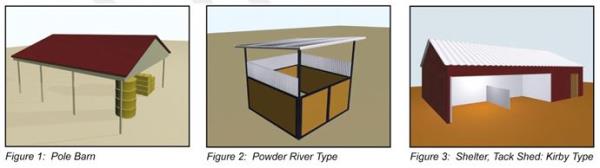
(Added 12/7/04)
Amended by Ord. O-2020-14 on 5/19/2020
3-4112 Athletic Court
An athletic court is a solid playing surface constructed for recreational purposes. Athletic courts having any type of structure exceeding six feet (6’) in height including fencing and lighting shall require a building permit and shall be subject to the following requirements:
- Any structural portion of an athletic court shall not be permitted within an easement (see exception in 3-4112(3)(f) below).
- Athletic courts that are enclosed or covered within a permanent structure and are detached from the main dwelling unit shall be considered an accessory structure and shall be subject to Sections 3-4104 and 3-4109 of this Code.
- Setbacks. An athletic court may cover the total lot area within a rear yard not located within an easement. Minimum setback requirements from property lines are as follows:
- Front Yard: 30’ Minimum
- Rear Yard: 10’ Minimum (see exception in 3-4112(3)(f) below)
- Side Yard: 10’ Minimum (see exception in 3-4112(3)(f) below)
- Side Yard Adjacent to Street: 10’ Minimum (see exception in 3-4112(3)(f) below)
- Trail or Landscape Easement: 10’ Minimum (measured from the nearest easement line)
- Exception. It is not recommended that any resident/property owner construct an athletic court within a recorded easement however, if a resident provides the information listed below with their building permit for an athletic court with a fence less than six feet (6’) in height, the rear and side yard setbacks defined above would not apply and the property owner may install their athletic court within any portion of their property behind the minimum front yard setback and within a public utility easement. The required documentation for this exception is as follows:
- Acknowledgement letters from all of the utility companies who have interest in that easement (it is important to understand the utility companies will typically not vacate or waive their right to use a recorded public utility easement); and
- Blue stake tickets indicating any utilities within that easement; and
- A signed and notarized “hold harmless” letter indemnifying Highland from any potential future loss and acknowledgement of potential financial loss for the property owner, due to the possible use of that easement.
- Acknowledgement letters from all of the utility companies who have interest in that easement (it is important to understand the utility companies will typically not vacate or waive their right to use a recorded public utility easement); and
- Front Yard: 30’ Minimum
- Fencing. All athletic courts enclosed with fencing shall be required to obtain a fence permit prior to construction. An athletic court is the only use that allows fencing enclosures above six feet (6’) in height. Fencing above six feet (6’) in height shall not exceed the fencing enclosure maximum height of twelve feet (12’). Fencing enclosures shall not be considered as part of standard property line fencing. Fencing materials for athletic courts shall consist of open mesh fabric or vinyl coated chain link without slats. Fencing for athletic courts that are less than six feet (6’) in height may be placed along a rear property line or side property line within the rear yard. In all cases, Athletic courts with fences between six feet (6’) and twelve feet (12’) in height shall be subject to 3-4112(3) in this ordinance (above).
- Lighting. All athletic court lighting must be directed downward and shall not spill on to an adjacent property. The applicant shall provide evidence indicating that their light product and lighting plan will not cause light or light pollution from the athletic court light(s) to extend beyond their property line. Design and location shall be specified with the plans submitted for a building permit. Lights and light poles including the light base and any supporting structures in regards to athletic courts shall not be in excess of twenty feet (20’) in height. Light operating hours shall be restricted to 7:00 am - 10:00 pm.
- Grading. All athletic court areas shall be designed, graded, and constructed to allow for drainage which meets Appendix J Section J109 of the International Building Code. In no case shall any court be designed to permit water from any source to drain onto an adjacent property or upon the public right-of-way.
(Adopted 4/7/09)
3-4113 Private Riding Arenas
Private riding arenas are permitted under the following conditions:
- A riding arena is a post and beam structure without a floor or subfloor used for the riding of horses.
- Riding arenas are only allowed on parcels greater than or equal to two (2) acres and are only allowed if there is a home on the property. If no home is on the property, a riding arena may be allowed by obtaining a conditional use permit.
- The riding arena shall be for private purposes only. No public purposes, events or uses are permitted.
- The maximum size of a riding arena shall not exceed ten (10) percent of the gross lot area.
- No riding arena shall be greater than eighteen (18) feet in height at the side wall and twenty-five (25) feet in height at the peak.
- Riding shall be placed in the rear yard and not located any closer than fifteen (15) feet from any property line or within seventy-five (75) feet of an adjacent existing home.
- Outside lighting used on riding arenas should be fully shielded and directed down.

