Highland Charter Township
City Zoning Code
City Zoning Code
ARTICLE 2
- RULES OF CONSTRUCTION AND DEFINITIONS
Sec. 2.01.- Rules of interpretation.
For the purpose of this Ordinance, certain terms or words used herein shall be interpreted as follows:
A.
The particular shall control the general.
B.
In the case of any differences of meaning or implication between the text of this Ordinance and any caption or illustration, the text shall control.
C.
The word "person" includes a firm, association, organization, partnership, trust, corporation, or company as well as an individual.
D.
The present tense includes the future tense; the singular number includes the plural, and the plural number includes the singular.
E.
The word "shall" is mandatory; the word "may" is permissive.
F.
The words "used" or "occupied" include the words "intended," "designed," or "arranged to be used" or "occupied."
G.
A "building" or "structure" includes any part thereof.
H.
Unless the context clearly indicates the contrary, where a regulation involves two or more items, conditions, provisions, or events connected by the conjunction "and," "or," "either…or," such conjunctions shall be interpreted as follows:
"And" indicates that all the connected items, conditions, provisions, or events shall apply.
"Or" indicates that the connected items, conditions, provisions or events may apply singly or in any combination.
"Either…or" indicates that the connected items, conditions, provisions or events shall apply singly but not in combination.
I.
Terms not herein defined shall have the meaning customarily assigned to them.
Sec. 2.02. - Definitions beginning with the letter "A."
Accessory use, building or structure. A use, building or structure on the same parcel with, and of a nature customarily incidental and subordinate to, the principal use, building or structure.
Adult oriented business. Establishments whose patrons are restricted by law to persons 18 years or older and which by their very nature have serious objectionable operational characteristics, particularly when several of them are concentrated under certain circumstances thereby having a deleterious effect upon the adjacent areas. See also SEXUALLY ORIENTED BUSINESS.
Alley. Any dedicated public way affording a secondary means of access to abutting property, and not intended for general traffic circulation.
Alterations. Any change, addition or modification in construction or type of occupancy, or in the structural members of a building such as walls or partitions, columns, beams or girders, the consummated act of which may be referred to in this Ordinance as altered or reconstructed.
Alternative energy systems. Energy generated from renewable natural resources such as sunlight, wind, and geothermal heat. Alternative energy systems may also include facilities that generate energy through conversion of biomass or biogas to energy.
Alternative energy systems, site specific scale. Alternative energy systems that are designed primarily to supply some or all of the energy needs of the permitted principal uses of the site. Excess electric energy may be delivered to public grid.
Alternative energy systems, utility scale. Alternative energy systems that are designed primarily to deliver energy to end users in other locations (e.g., electric energy generated specifically to deliver to the grid).
Animal. A non-human zoological species.
Animal feed operations (AFOs). Any agricultural operations where animals are kept and raised in confined situations for a total of forty-five (45) days or more in any twelve (12) month period. Feed is brought to the animals rather than the animals grazing or otherwise seeking feed in pastures. AFOs that meet the regulatory definition of a concentrated animal feeding operation (CAFO) have the potential of being regulated under the National Pollutant Discharge Elimination System (NPDES) permitting program as regulated by the Environmental Protection Agency (EPA).
Automobile collision repair facility. A facility which offers and provides for, vehicle frame straightening, repair or replacement of vehicle sheet metal, vehicle painting or repainting, and similar related services.
Automobile gas station. A building or premises for the sale of vehicular fuels. The premises may also include electric vehicle charging stations. Automobile gas stations may sell oil, coolants, wiper fluids and similar automotive accessories and provide equipment for use by customers such as vacuums and air compressors to fill vehicle tires. Gas stations do not include automotive repair facilities. Gas Stations typically include sales of convenience foods and beverages and may be a component of a multiple use facility such as a retail strip center or restaurant.
Automobile oil changing station. A building or premises used primarily for the dispensing, sale, or offering for sale of motor oil and other fluids directly to users of motor vehicles, together with the sale of minor accessories and services for motor vehicles such as filling tires with air, checking fluid levels, adding water to batteries or radiators, and similar activities.
Automobile parts and accessory store. An establishment whose principal business activity is the sale of automobile parts and accessories.
Automobile repair facility. A facility which offers and provides for repair of mechanical, electrical, cooling, exhaust, brake, and power system repairs including collision shops, transmission repair shops, shops used for the internal repair or engine components and drive train repair, and radiator repair shops.
Automobile washing facility. A building, or portion thereof, the primary purpose of which is that of washing vehicles either by automatic or self-service means.
Awning or canopy. An overhanging projection or shelter for protection from the sun or weather or an ornamental roof like projection or covering typically made of canvas.
(Ord. No. Z-031, § 1, 7-1-2024)
Sec. 2.03. - Definitions beginning with the letter "B."
Banquet/meeting hall. A building or part of a building used for the purposes of entertaining a large group of people where food and beverage may be provided; and where a catering facility may be included. This use shall also include a building or part thereof in which facilities are provided for such purposes as meeting for groups of civic, educational, political, religious or social purposes.
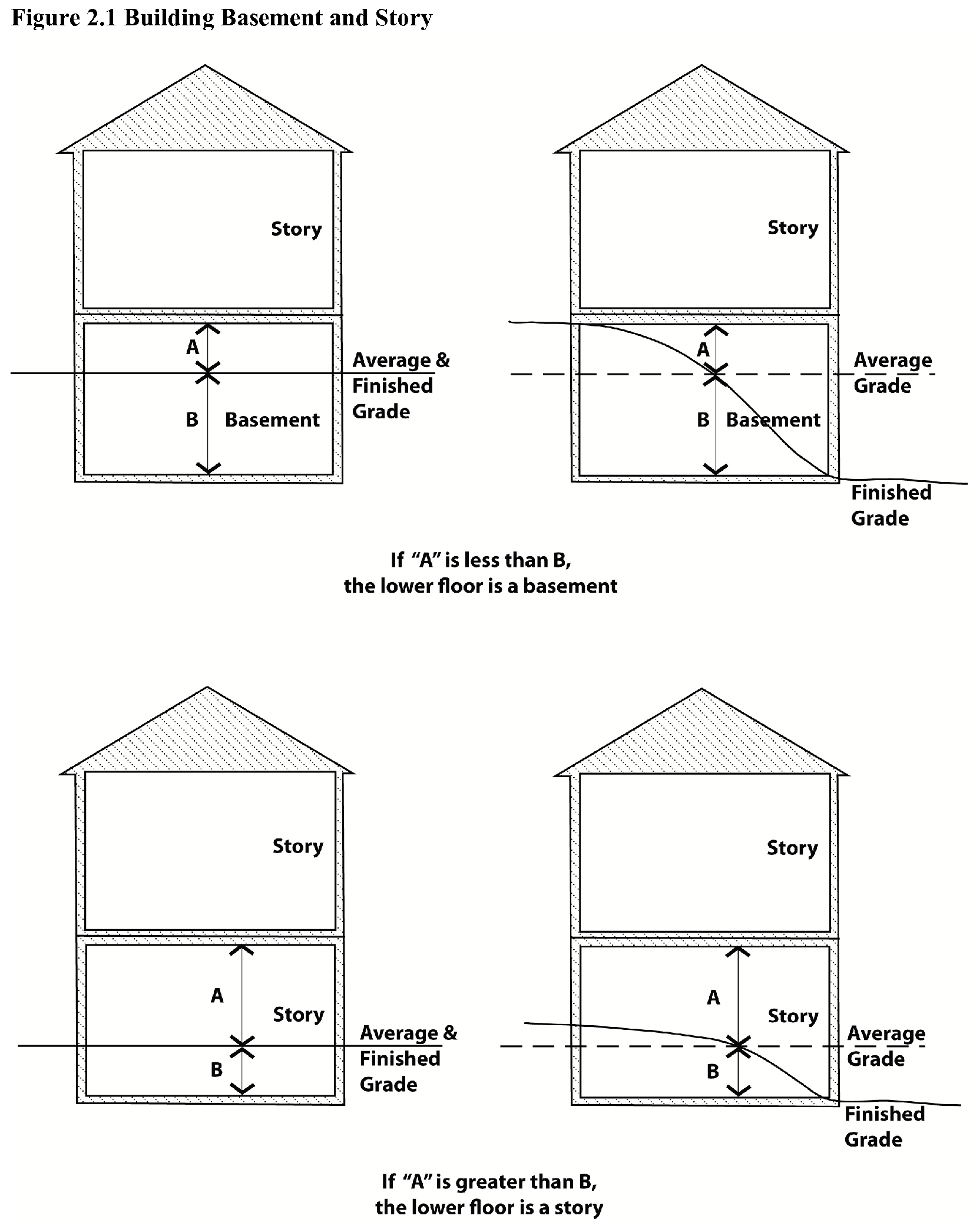
Basement. That portion of a building which is partly or wholly below grade, but so located that the vertical distance from the grade to the floor is greater than or equal to the vertical distance from the grade to the ceiling. A basement shall not be counted as a story unless it is more than 6 feet above the finished grade for more than 50 percent of the total building perimeter. Basement is illustrated in Figure 2.1.
Bed and breakfast. A structure which is occupied on a permanent basis by a family or household which rents rooms to individuals and/or families on a daily or weekly basis. Rented rooms shall not include cooking facilities.
Block. The property abutting one side of a street and lying between the two nearest intersecting streets (crossing or terminating) or between the nearest such street and railroad right-of-way, un-subdivided acreage, lake river or live stream or any other barrier to the continuity of development or corporate boundary lines of the Township.
Buildable area. That area of a lot which is free of all public rights-of-way, all private road easements, any public utility easements, all drainage easements, all wetlands, water bodies, areas of recorded flooding which shall place limitations on overhead, surface or underground use or development.
Building. A structure erected on-site, a mobile home or mobile structure, a pre-manufactured or pre-cut structure, above or below ground, designed primarily for the shelter, support or enclosure of persons, animals or property of any kind.
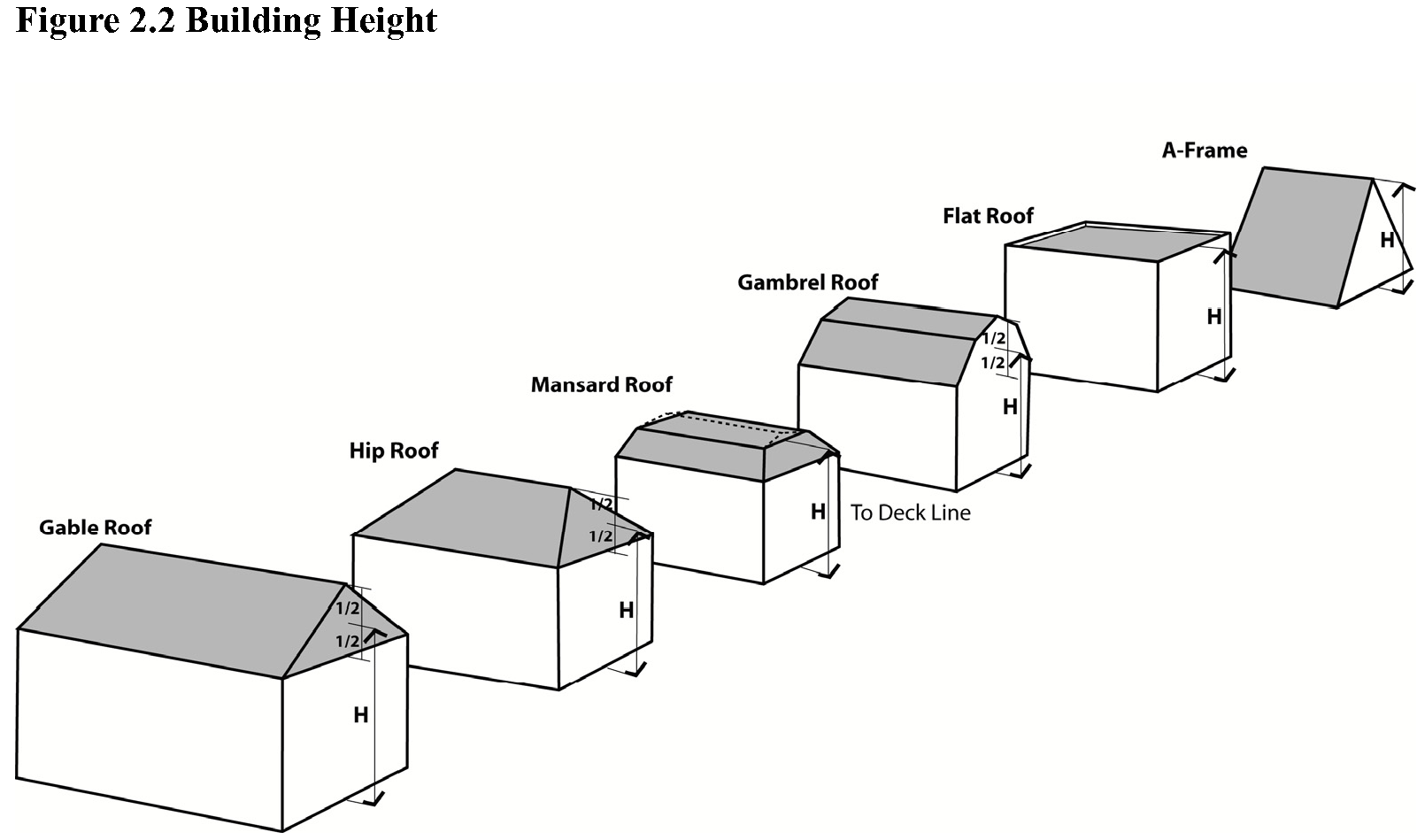
Building height. The vertical distance measured from finished grade to the highest point of flat roofs, to the deck line of mansard roofs, and to the average height between the point where the external wall intersects the roof line and the ridge for gable, hip and gambrel roofs. Building height is illustrated in Figure 2.2.
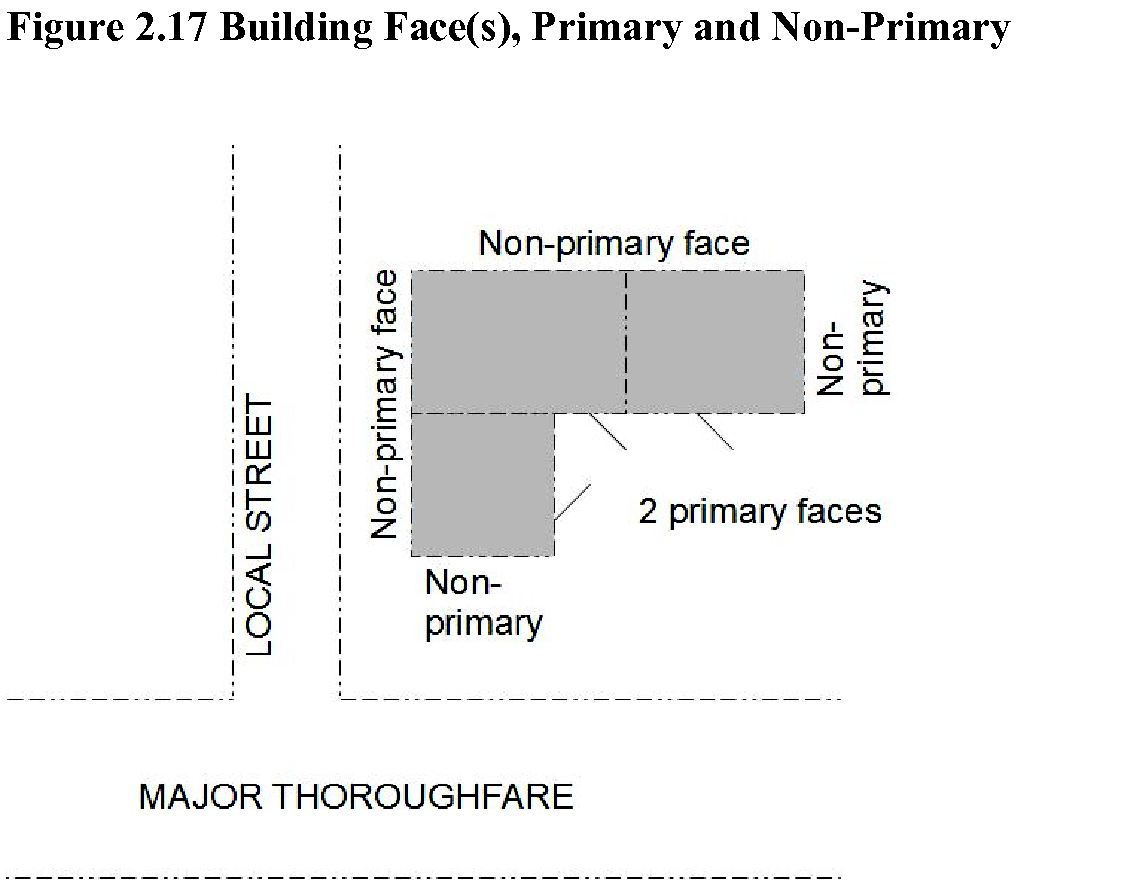
Building, primary face(s). The face(s) of a building used for office, commercial or industrial uses which collectively contain the public entrances to businesses occupying the building. Each unit may have only one (1) primary face. Primary face(s) of [a] building is illustrated in Figure 2.17.
(Ord. No. Z-005, § 1, 3-11-2015)
Sec. 2.04. - Definitions beginning with the letter "C."
Campground. A parcel in which sites are offered for the use of the public or members of an organization, either free of charge or for a fee, for the establishment of temporary living quarters for tents or recreational vehicles.
Catering facility. A place where cooking services with related equipment, utensils and food service items are for hire and the food is prepared on the premises for delivery to customers who are picking up the food or being served off premises. Catering facilities do not include banquet facilities where food is served.
Club. Buildings and facilities owned and operated by a corporation or association or persons for social or recreational purposes for members and guests, but not operated primarily for profit or to render a service customarily carried on as a business.
College/university. An institution other than a trade school that provides full-time or part-time education beyond high school.
Commercial vehicle. Any vehicle bearing or required to bear commercial license plates or falls into one or more of the categories listed below:
(1)
Truck tractors;
(2)
Semi-trailers, which shall include flat beds, stake beds, roll-off containers, tanker bodies, dump bodies and full or partial box-style enclosures;
(3)
Vehicles of a type that are commonly used for the delivery of bread, fruit, milk and ice cream or similar vending supply or delivery trucks. This category shall also include vehicles similar in nature that are commonly used by construction-oriented contractors, such as electricians and plumbers;
(4)
Tow trucks;
(5)
Commercial hauling trucks;
(6)
Vehicle repair service trucks;
(7)
Snow plowing trucks;
(8)
Passenger buses, taxis and limousines; and
(9)
Any other vehicle similar to the vehicles listed above.
Community living facility. A multi-tenant residential building consisting of sixty-four (64) or more living units designed to encourage socialization among residents and otherwise promote a shared sense of community by means of facilities, amenities and/or services not commonly found in many apartments. Such facilities, amenities and/or services may include, but are not limited to, common dining areas, game rooms, fitness centers, libraries or reading rooms, health and beauty salons, spas, pools, saunas, small gift shops, on-site medical care, on-site banking, as well as concierge services such as housekeeping, laundry, personal hygiene, pet care and transportation. Examples of community living facilities include, but are not limited to, retirement communities, assisted living facilities, and other residential communities catering to a particular lifestyle or demographic. The facilities, amenities and/or services provided shall be limited to use by the facility's tenants and their guests, and shall not be open to the general public.
Condominium. Condominium shall include the following elements:
Condominium Act. Refers to Act 59 of the Public Acts of 1978, as amended.
Condominium documents. The master deed recorded pursuant to the Condominium Act and any other instrument referred to in the master deed or bylaws which affects the rights and obligations of a co-owner in the condominium.
Condominium lot. The condominium unit including the contiguous limited common element surrounding the condominium unit which shall be considered a lot as defined by this Ordinance.
Condominium unit. The portion of a condominium project designed and intended for separate ownership and use as described in the master deed.
General common element. The common elements other than the limited common elements reserved in the master deed for use by all of the co-owners.
Limited common element. A portion of the common elements reserved in the master deed for the exclusive use of less than all of the co-owners.
Master deed. The condominium document recording the condominium project to which are attached as exhibits and incorporated by reference with the bylaws for the project and the condominium subdivision plan for the project.
Site condominium. A condominium development in which each co-owner owns exclusive rights to a volume of space within which a structure or structures may be constructed, herein defined as a condominium unit. Such developments are also described in the Master Deed.
Crematorium. A facility intended and equipped for use in the act of cremation.
(Ord. No. Z-014, § 1, 6-12-2019)
Sec. 2.05. - Definitions beginning with the letter "D."
Day care facility. Means the following:
Adult day care center. A center other than a private home in which one or more adults 18 years of age or older are supervised and receive care for periods of time not to exceed sixteen (16) hours in a twenty-four (24) hour period. It includes facilities for adults who are aged, mentally ill, developmentally disabled or physically handicapped that require supervision. An adult day care center does not include alcohol or substance abuse rehabilitation centers, residential center for persons released from or assigned to a correctional facility, or any other facilities which do not meet the definition of adult day care center.
Adult day care home. An owner occupied private home, in which one (1) but less than seven (7) adults, 18 years of age or older are given care and supervision for periods of time not to exceed sixteen (16) hours in a twenty-four (24) hour period. It includes facilities for adults who are aged, mentally ill, developmentally disabled or physically handicapped that require supervision. An adult day care home does not include alcohol or substance abuse rehabilitation centers, residential center for persons released from or assigned to a correctional facility, or any other facilities which do not meet the definition of adult day care home.
Child care center. A state-licensed facility other than a private home receiving one (1) or more minor children for care and supervision for periods of less than twenty-four (24) hours a day unattended by a parent or legal guardian. The facility is generally described as a child-care center, day-care center, day nursery, nursery school, parent cooperative preschool, play group or drop-in center. The term "day-care center" does not include any of the following:
(1)
A Sunday school, a vacation bible school or a religious instructional class that is conducted by a religious organization where children are in attendance for not greater than three (3) hours per day for an indefinite period, or not greater than eight (8) hours per day for a period not to exceed four (4) weeks during a twelve (12) month period.
(2)
A facility operated by a religious organization where children are cared for not greater than three (3) hours while persons responsible for the children are attending religious services.
Family child care home. A state licensed private home in which one (1) but less than seven (7) minor children are received for care and supervision for periods of less than twenty-four (24) hours a day, unattended by a parent or legal guardian, except children related to an adult member of the family by blood, marriage or adoption. The term "family child care home" includes a home that gives care to an unrelated child for more than four (4) weeks during a calendar year. The licensee of the family child care home must also be a resident of the private home.
Group child care home. A state-licensed private home in which more than six (6) but not more than twelve (12) minor children are given care and supervision for periods of less than twenty-four (24) hours a day unattended by a parent or legal guardian except children related to an adult member of the family by blood, marriage or adoption. The term "group child care home" includes a home that gives care to an unrelated minor child for more than four (4) weeks during a calendar year. The licensee of the group child care home must also be a resident of the private home and a member of the household.
Dealership. A building or premises used primarily for the sale or rental of new and used automobiles, trucks, boats, recreational vehicles and other motor vehicles, and which may include accessory repair facilities and outside storage and display areas.
Deck. A structure without a roof having a foundation to hold it erect, and attached to or abutting one or more walls of a building or constructed separately from a building with or without direct access to the ground, the floor of which is above finished grade, and intended for use as an outdoor living area.
Density, residential. The number of dwelling units in relation to the number of buildable acres of the parcel on which such units are situated.
Drive-through facility. An establishment that is designed to permit customers to receive products or services while remaining seated in a motor vehicle.
Dwelling, multiple-family. A building or portion thereof used for occupancy by three (3) or more families living independently of each other and containing two (2) or more dwelling units.
Dwelling, single-family. A building containing not more than one (1) dwelling unit.
Dwelling, single-family attached. A building containing dwelling units, each of which has primary private ground floor access to the outside and which are attached to each other by party walls without openings. The term is intended primarily for such dwelling types as townhouses and duplexes.
Dwelling unit. One or more rooms connected together with principal kitchen and bathroom facilities designed as a unit for residence by only one (1) family for living and sleeping purposes, constituting a separate, independent housekeeping establishment, and physically separated from any other rooms or dwelling units which might be in the same structure.
Sec. 2.06. - Definitions beginning with the letter "E."
Easement. The right of an owner of property by reason of such ownership to use the property of another for purposes of ingress, egress, utilities, drainage and similar uses. In the context of this Ordinance, private road easements shall be designated for the purposes of vehicle ingress and egress.
Essential services. The term "essential services" shall mean the erection, construction, alterations, or maintenance by public utilities or municipal departments, commissions, or boards, or by other government agencies of underground, surface, or overhead gas, electric, steam, or water transmission or distribution system, collection, communications, supply or disposal systems, dams, weirs, culverts, bridges, canals, locks, poles, wires, mains, drains, sewers, towers, pipes, conduits, cables, fire alarm boxes, police call boxes, traffic signals, or signs and fire hydrants, and other similar equipment and accessories in connection therewith, reasonably necessary for the furnishing of adequate service by such public utilities or municipal departments or commissions, or other government agencies, or for the public health, safety, or general welfare, but not including buildings other than those buildings which are primarily enclosures or shelters for the installed central services equipment.
Equestrian sports academy. Any establishment where horses are kept for training, riding, driving, or stabling for compensation or incidental to the operation of any club, association, ranch or similar establishment.
(Ord. No. Z-014, § 1, 6-12-2019)
Sec. 2.07. - Definitions beginning with the letter "F."
Family. An individual or a group of two (2) or more persons related by blood, marriage, or adoption, including foster children and servants, together with not more than three (3) additional persons not related by blood, marriage, or adoption, living together as a single housekeeping unit in a dwelling unit.
Farm buildings. Any building or structure, other than a dwelling, erected, moved upon, or used on a farm, which is essential and customarily used on farms of that type for pursuit of agricultural activities.
Farm market. A place or an area where farm products are sold directly to the customer. A farm market may include, but need not include, a temporary or permanent structure. Farm markets shall be further classified as follows:
Class A farm market. A farm market that satisfies the following conditions:
(1)
Display and sales area no larger than 1000 square feet; and
(2)
Does not involve any permanent structures; and
(3)
Does not operate more than 180 days per calendar year.
Class B farm market. A farm market with one or more of the following characteristics:
(1)
Display and sales area in excess of 1000 square feet; or
(2)
Which involves a permanent structure; or
(3)
Which operates more than 180 days per calendar year.
(4)
May include small classes or demonstrations limited to 12 participants at a time.
Class C farm market event venue. A farm market of any size which conducts activities designed to attract and entertain customers, such as, but not limited to cooking demonstrations, corn mazes, farm education programs, farm tours, fishing ponds, hay rides, horseback riding, petting farms, picnic areas, festivals, etc.
Farm product. Plants and animals useful to humans produced by agricultural activities, including, but not limited to, forages and sod crops, grains and feed crops, field crops, dairy and dairy products, poultry and poultry products, cervidae, livestock (including breeding and grazing), equine, fish and other aquacultural products, bees and bee products, berries, herbs, fruits, vegetables, flowers, seeds, grasses, nursery stock, trees and tree products, mushrooms and other similar products, or any other product which incorporates the use of food, feed, fiber, or fur as determined by the Michigan Commission of Agriculture.
Fence. An enclosure, obscuring screen or a barrier erected to prevent straying from within, intrusion or to promote visual privacy.
Fence, decorative. A structure intended primarily for ornamental purposes. A decorative fence shall be any fence which by definition, is not to be considered a protective or security fence, a chain link fence or a privacy fence.
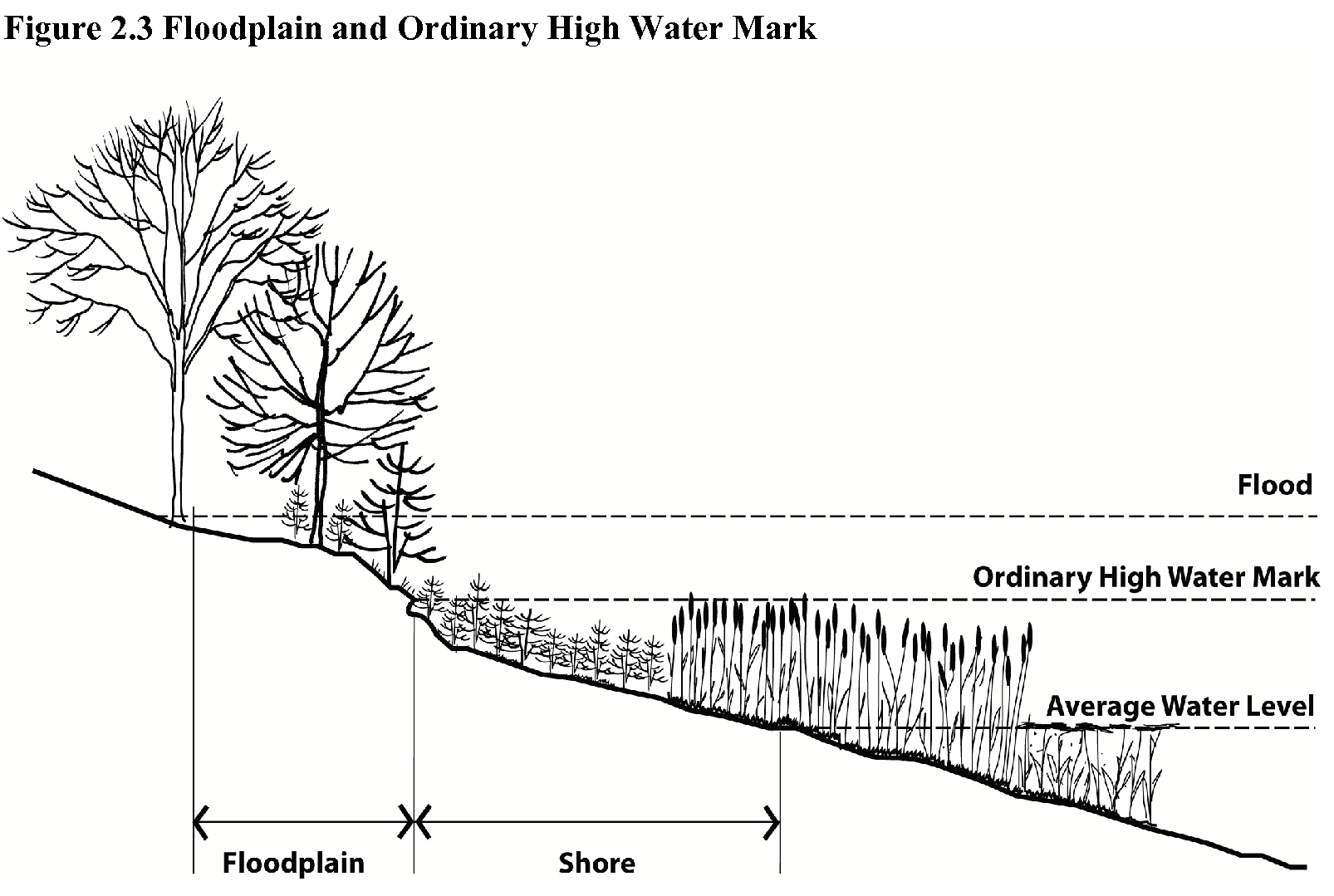
Floodplain. Area of land adjoining a river, stream, or other body of water that is susceptible to being inundated by flood waters. Floodplain is illustrated in Figure 2.3.
Floor area, gross. The floor area within the inside perimeter of the exterior walls of a building under consideration.
Floor area, net. Measurement of the actual occupied area not including unoccupied accessory areas such as corridors, stairways, toilet rooms, mechanical rooms and closets.
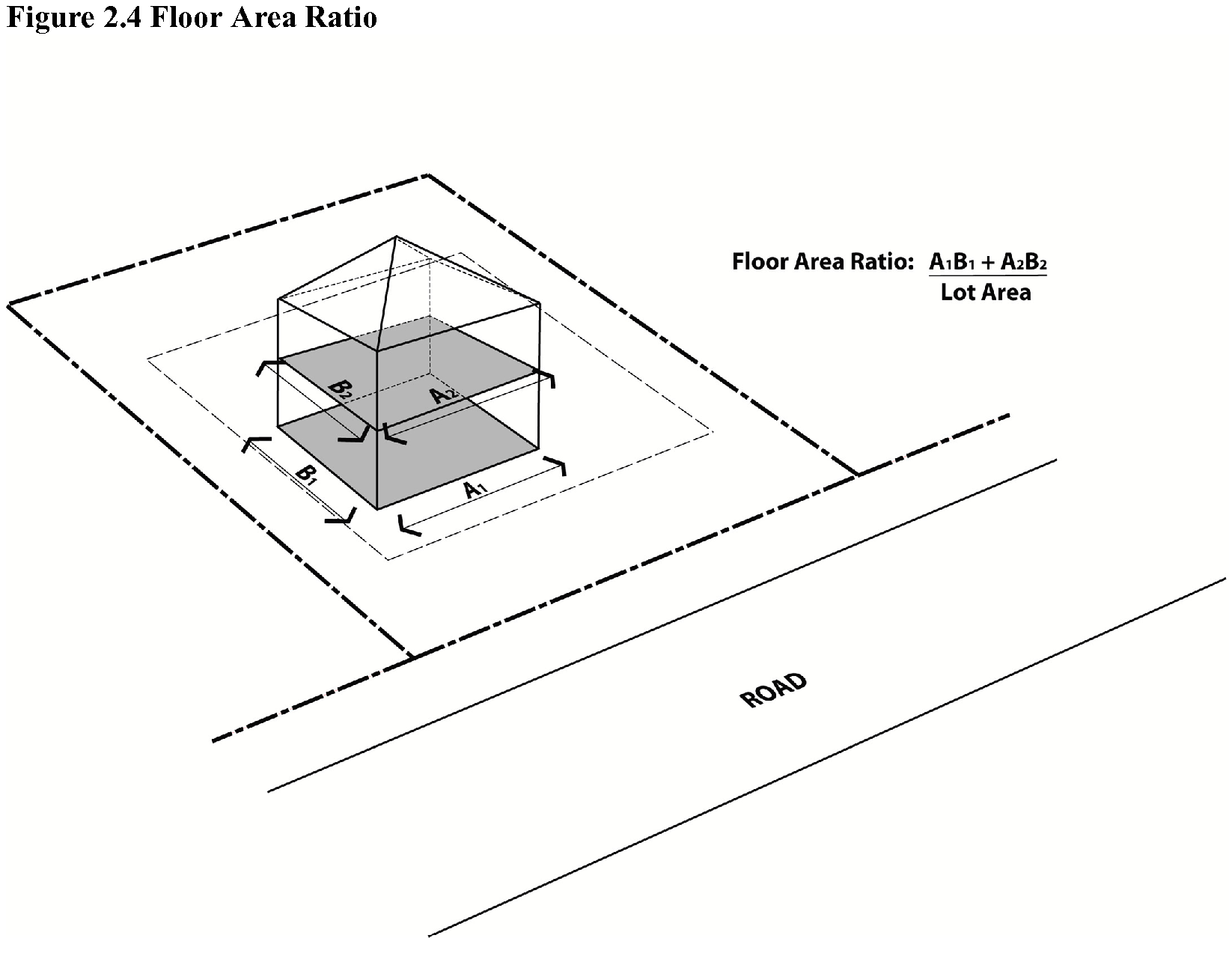
Floor area ratio. The gross floor area of principal and accessory structures divided by the buildable area of the site. For the purposes of calculating floor area ratio, pools, play structures, sheds of 150 square feet or smaller, most uncovered decks or porches or any structure with a height of less than five feet above grade are not included in the calculation. That portion of uncovered decks and porches that is less than 50 percent of the footprint of the principal building is exempt from inclusion in the calculation of gross floor area and floor area ration. Floor area ratio is illustrated in Figure 2.4.
Foot-candle. A basic measurement of luminance, which is the amount of light falling on a surface. Foot-candle measurement is taken with a light meter. One foot-candle is equivalent to the luminance produced on one square foot of surface area by a source of one standard candle at a distance of one foot.
Foster care. Provision of supervision, personal care and protection in addition to room and board for twenty-four (24) hours a day, five (5) or more days a week and for two (2) or more consecutive weeks for compensation.
Foster care, adult. A state licensed, governmental or non-governmental establishment that provides foster care to adults. It includes facilities and foster care family homes for adults who are aged, mentally ill, developmentally disabled, or physically handicapped who require supervision or an ongoing basis but who do not require continuous nursing care. An adult foster care facility does not include nursing homes, homes for the aged, hospitals, alcohol or substance abuse rehabilitation center, residential centers for persons released from or assigned to a correctional facility, or any other facilities which have been exempted from the definition of adult foster care facility by the Adult Foster Care Facility Licensing Act, 218 of 1979, MCL 400.701, as amended. Licensed adult foster care facilities include the following:
Adult foster care small group home. A state licensed facility with the approved capacity to receive twelve (12) or fewer adults who are provided supervision, personal care, and protection in addition to room and board, for twenty-four (24) hours a day, five (5) or more days a week, and for two (2) or more consecutive weeks for compensation.
Adult foster care large group home. A state licensed facility with the approved capacity to receive at least thirteen (13) but not more than twenty (20) adults to be provided supervision, personal care, and protection in addition to room and board, for twenty-four (24) hours a day, five (5) or more days a week, and for two (2) or more consecutive weeks for compensation.
Adult foster care family home. A state licensed private home with the approved capacity to receive six (6) or fewer adults to be provided with foster care for five (5) or more days a week and for two (2) or more consecutive weeks. The adult foster care family home licensee must be a member of the household and an occupant of the residence.
Adult foster care congregate facility. A state licensed facility with the approved capacity to receive more than twenty (20) adults to be provided with foster care.
Foster care home, child. A state licensed establishment that provides foster care to minor children. Licensed child foster care facilities include the following:
Foster family home. A state licensed private home in which one (1) but not more than four (4) minor children, who are not related to an adult member of the household by blood or marriage, are provided care and supervision for twenty-four (24) hours a day, for four (4) or more days a week, for two (2) or more consecutive weeks, unattended by a parent or legal guardian.
Foster family group home. A state licensed private home in which more than four (4) but fewer than seven (7) minor children, who are not related to an adult member of the household by blood or marriage, or who are not placed in the household under the Michigan adoption code, are provided care and supervision for twenty-four (24) hours a day, for four (4) or more days a week, for two (2) or more consecutive weeks, unattended by a parent or legal guardian.
(Ord. No. Z-030, § 1, 1-8-2024)
Sec. 2.08. - Definitions beginning with the letter "G."
Garage, private. An accessory building or structure used principally for storage of automobiles and for other incidental storage purpose only and having no public sales or shop services in connection therewith.
Glare. Direct light emitted by a lamp, luminous tube lighting or other light source that causes annoyance, discomfort or loss in visual performance and visibility.
Golf course. A tract of land laid out with at least nine holes for playing a game of golf and improved with tees, greens, fairways, and hazards. A golf course includes a clubhouse and shelters as accessory uses.
Golf course, miniature. A novelty version of golf played with a putter and a golf ball on a miniature course, typically with artificial playing surfaces, and including obstacles such as bridges and tunnels.
Golf course, par 3. A golf course that is a shorter, lower-par course than a regulation 18-hole course. A par-3 course is often only nine holes in length.
Golf driving range. An area equipped with distance markers, clubs, balls, and tees for practicing golf drives and putting, and which may include a snack-bar and pro-shop, but excludes miniature golf courses and "putt-putt" courses.
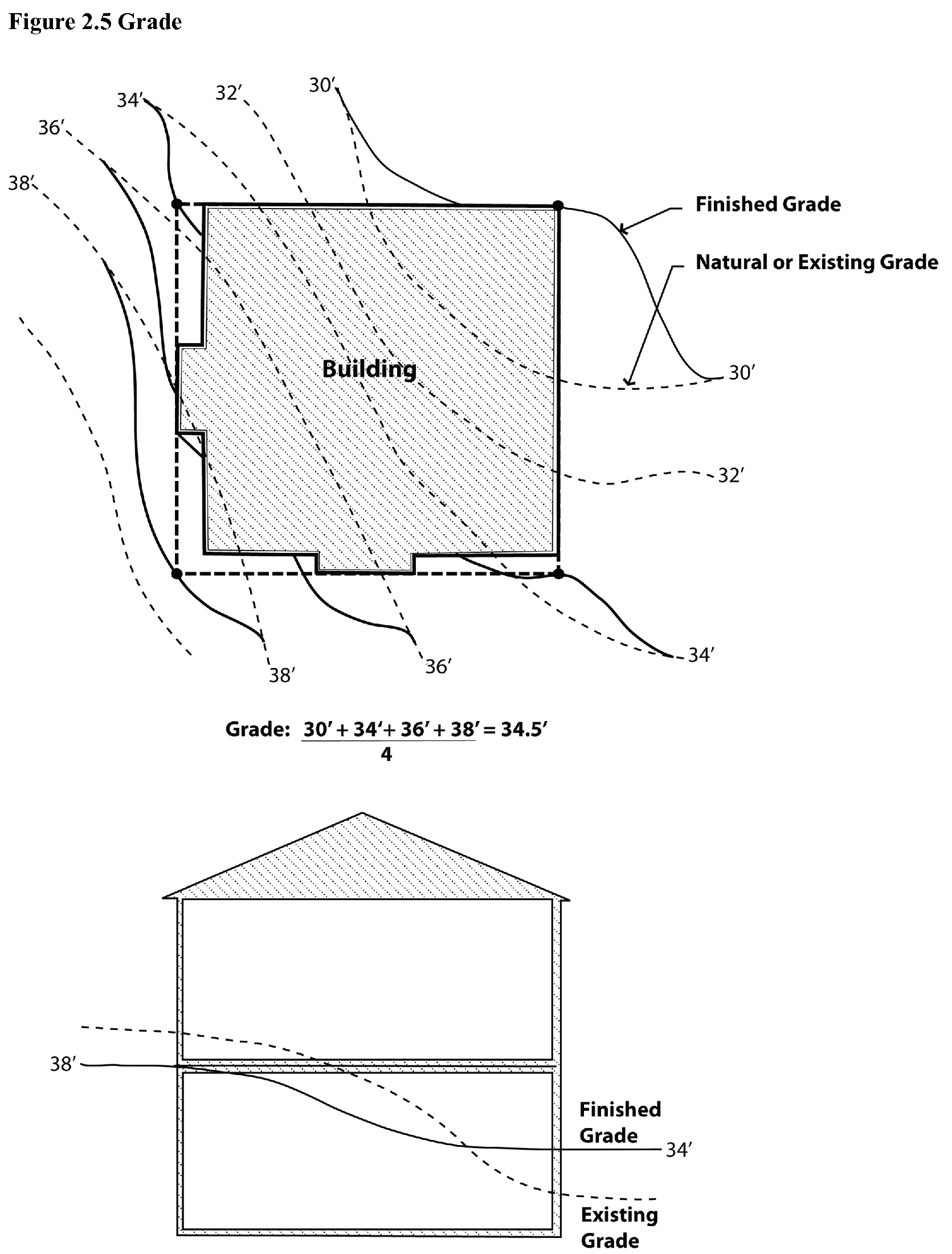
Grade. The average elevation of the land around a building or structure. Grade is illustrated in Figure 2.5.
Grade, finished. The final elevation of the ground surface after development. Finished grade is illustrated in Figure 2.5.
Grade, natural. The elevation of the ground surface in its natural state before construction, filling, or excavation. Natural grade is illustrated in Figure 2.5.
Gross site area. Area of site determined by the legal description of the parcel excluding submerged lands and public road right-of-ways.
Sec. 2.09. - Definitions beginning with the letter "H."
Hazardous substances. Hazardous substances include hazardous chemicals as defined by the Michigan Department of Public Health and the Michigan Department of Labor; flammable and combustible liquids as defined by the Michigan Department of State Police, Fire Marshal Division; hazardous materials as defined by the U.S. Department of Transportation; and critical materials, polluting materials, and hazardous waste as defined by the Michigan Department of Natural Resources. Petroleum products and waste oil are considered hazardous substances for the purpose of this ordinance.
Home for the aged. A state-licensed supervised personal care facility, other than a hotel, adult foster care facility, hospital, or nursing home, that provides room, board, and supervised personal care to twenty-one (21) or more unrelated, nontransient, individuals sixty (60) years of age or older. Home for the aged includes a supervised personal care facility for twenty (20) or fewer individuals sixty (60) years of age or older if the facility is operated in conjunction with and as a distinct part of a licensed nursing home.
Home occupation. An occupation that is clearly incidental and subordinate to the principal residential use that is carried on in the home by a resident member of the family.
Hospital. An institution providing health services primarily for in-patient medical or surgical care of the sick or injured, and includes related facilities such as laboratories, out-patient departments, training facilities, central service facilities and staff offices which are integral parts of the facilities.
Hotel. A building with a common entrance or entrances in which the rental units are used primarily for transient occupancy, and/or in which one or more of the following services are offered: maid service, furnishing of linen, telephone, secretarial or desk service and bellhop service. A hotel may include a restaurant or cocktail lounge, public banquet halls or meeting rooms. This term does not include short term rentals as defined in section 2.19.
(Ord. No. Z-014, § 1, 6-12-2019; Ord. No. Z-030, § 1, 1-8-2024)
Sec. 2.10. - Definitions beginning with the letter "I."
Institutional uses. Public and private schools; colleges; libraries; community buildings; religious institutions and municipal facilities.
Institutional uses, large scale. For purposes of this Ordinance, a large scale institution shall mean an institutional use with a seating capacity of one thousand (1,000) people or more in its main area of assembly or more than three hundred twenty five (325) parking spaces. A large scale institution may also be characterized by any one or more of the following features: region-serving accessory facilities such as high schools, colleges, and seminaries; one or more buildings fifty thousand (50,000) square feet in floor area or greater; or other features. Large scale institutions are distinguished by such features as: large size of assemblies and resultant traffic surges, large off-street parking lots, retreat and conference centers, or major institutional character.
Invasive species. A plant species that evolved in a country or region other than Oakland County, Michigan, and has been introduced by human activity, has no natural controls, and is able to out-compete and gradually displace native plants. A list of prohibited invasive plant species is included in this Ordinance.
Sec. 2.11. - Definitions beginning with the letter "J."
Reserved.
Sec. 2.12. - Definitions beginning with the letter "K."
Kennel. Any building, structure, enclosure, or premises where three (3) or more dogs or cats, six (6) months of age or older, are kept for breeding, sales and/or sporting purposes.
(Ord. No. Z-005, § 1, 3-11-2015)
Sec. 2.13. - Definitions beginning with the letter "L."
Lamp. The component of the luminary that produces light including luminous tube lighting.
Landscaping. The following definitions shall apply in the application of this Ordinance:
A.
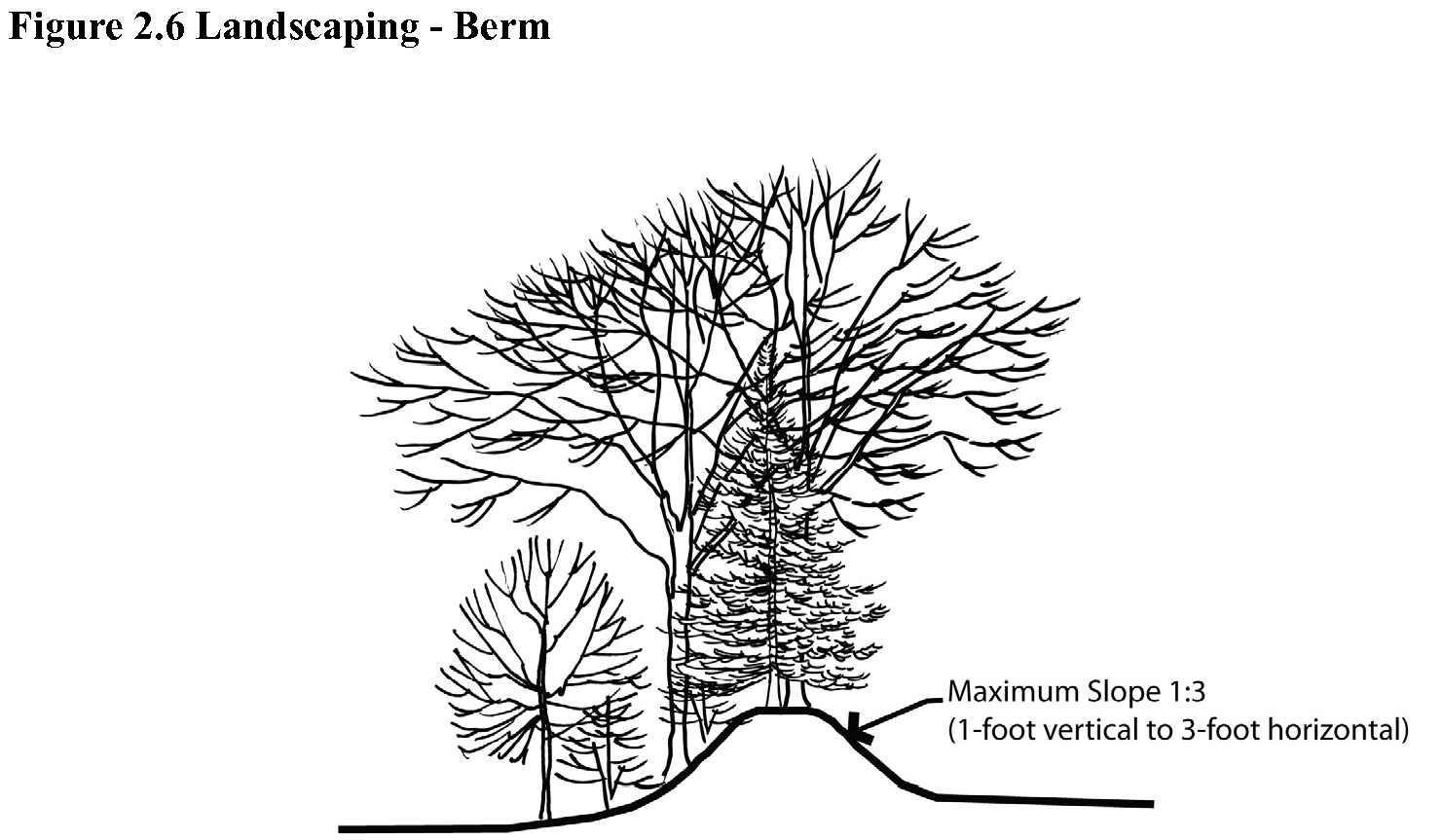
Berm. A landscaped mound of earth which blends with the surrounding terrain. Berm is illustrated in Figure 2.7.
B.
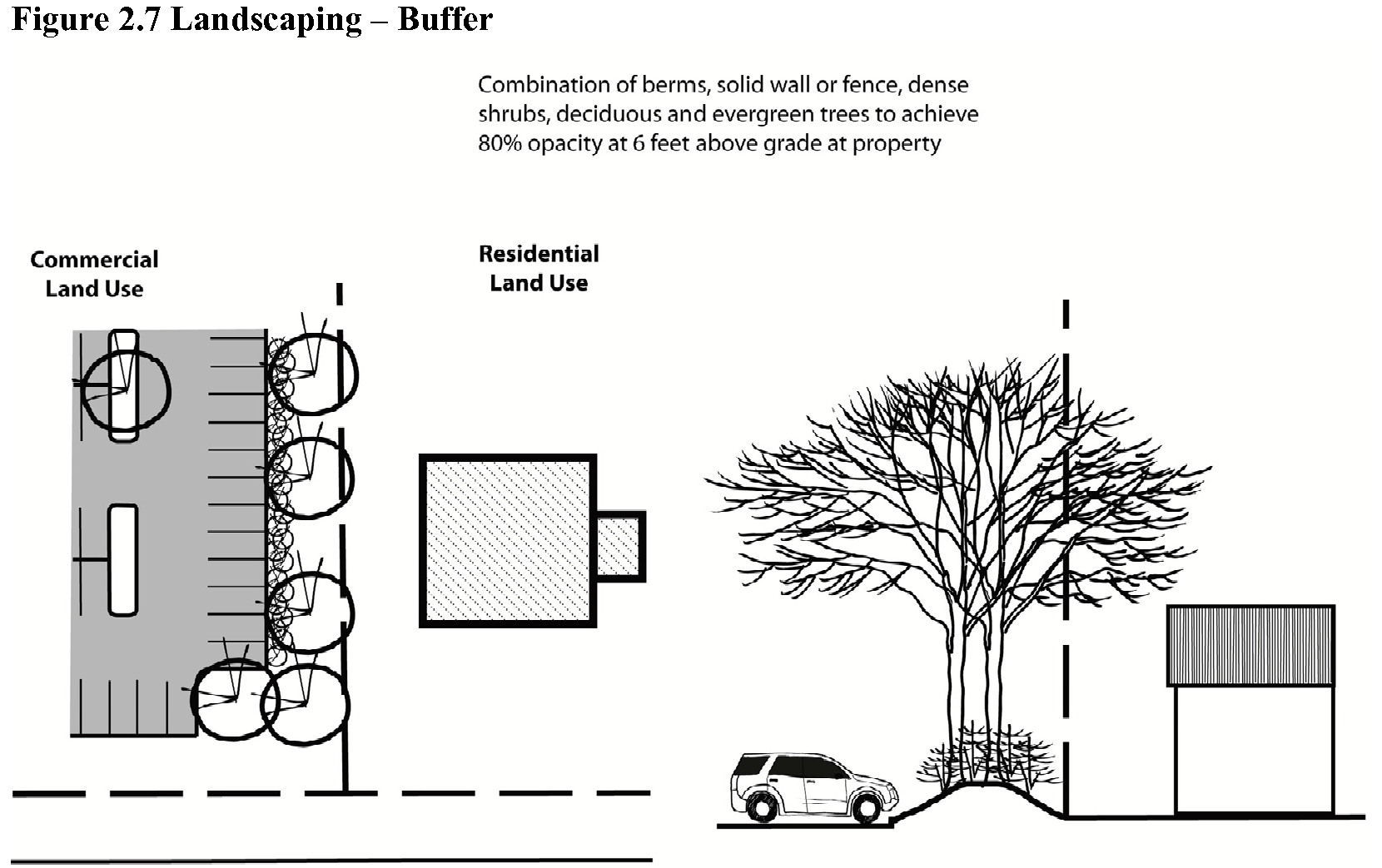
Buffer. A landscaped area composed of living material, wall, berm, or combination thereof, established and/or maintained to provide visual screening, noise reduction, and transition between conflicting types of land uses. Buffer is illustrated Figure 2.7.
C.
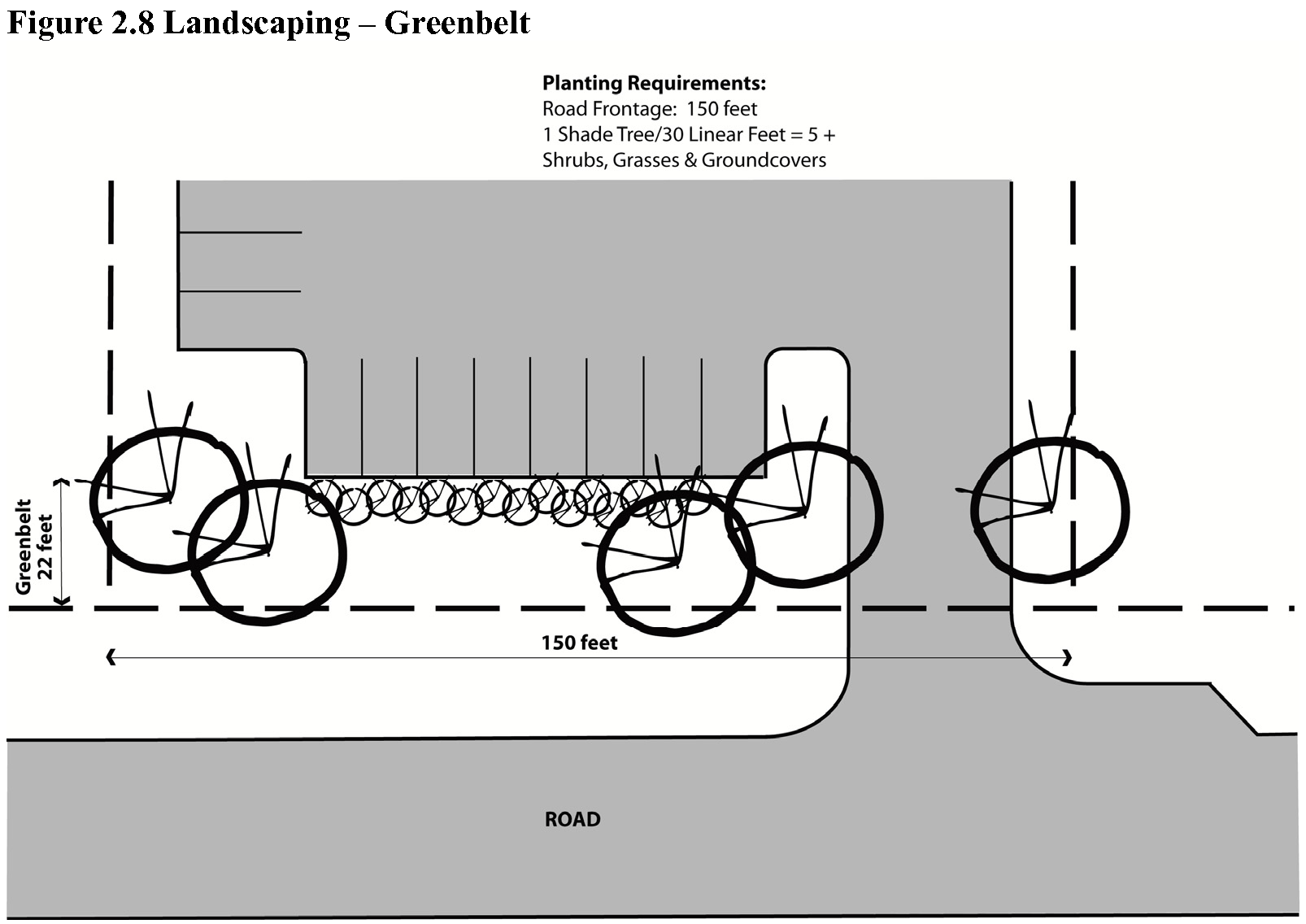
Greenbelt. A landscaped area which is intended to provide a transition between a parcel and public road right-of-way. Greenbelt is illustrated in Figure 2.8.
D.
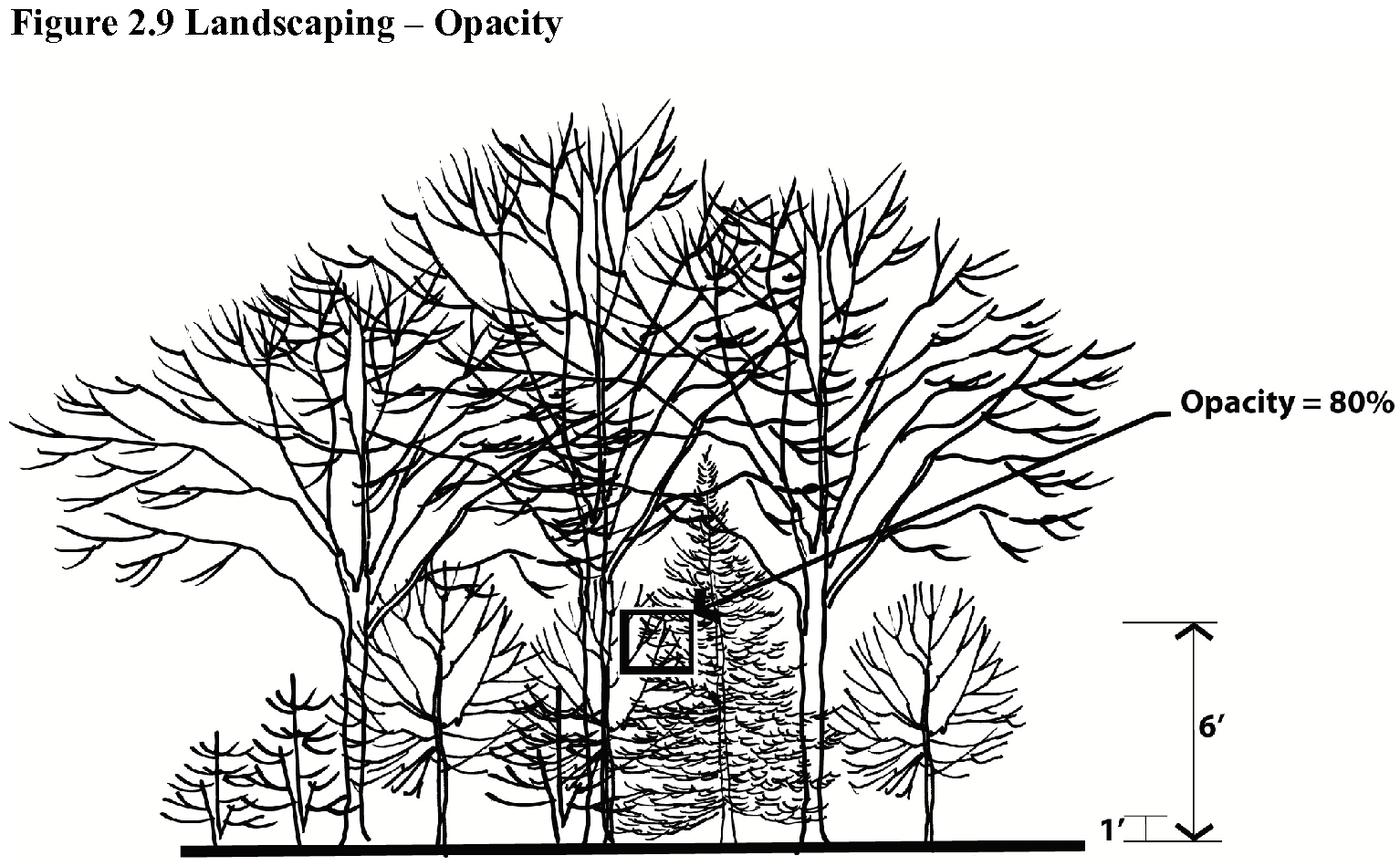
Opacity. The state of being impervious to sight. Opacity is illustrated in Figure 2.9.
E.
Plant material. A collection of living evergreen and/or deciduous, woody-stemmed trees or ornamental, shrubs, vines and ground cover.
F.
Screen. A structure providing enclosure such as a fence and provides a visual barrier between the area enclosed and the adjacent property. A screen may also consist of shrubs or other living materials.
Large scale retail establishment. A retail establishment commonly referred to as a "big box" store, which exceeds fifty thousand (50,000) square feet in gross floor area.
Light fixture. The assembly that holds a lamp and may include an assembly housing, a mounting bracket or socket, a lamp holder, a ballast, a reflector or mirror, and a refractor or lens. A light fixture also includes the assembly for luminous tube and fluorescent lighting. A light fixture is a luminary.
Light pollution. Artificial light which causes a detrimental effect on the environment, the enjoyment of the night sky or the practical use of adjacent properties.
Light trespass. The shining of light produced by a luminary beyond the boundaries of the property on which it is located.
Livestock. Farm animals, such as beef cattle, dairy cows, horses, sheep, hogs, goats, chickens, and turkeys otherwise known as bovine, equine, swine, ovine and poultry raised for home use or for profit, especially on a farm.
Loading space, off-street. Space logically and conveniently located for bulk pickups and deliveries, scaled to delivery vehicles expected to be used and accessible to such vehicles when required off-street parking spaces are filled. Required off-street loading space is not to be included as off-street parking space in computation of required off-street parking space.
Lot. A measured portion of a parcel or tract of land which is described and fixed in a recorded plat. For the purpose of this Ordinance refer to the definition of parcel.
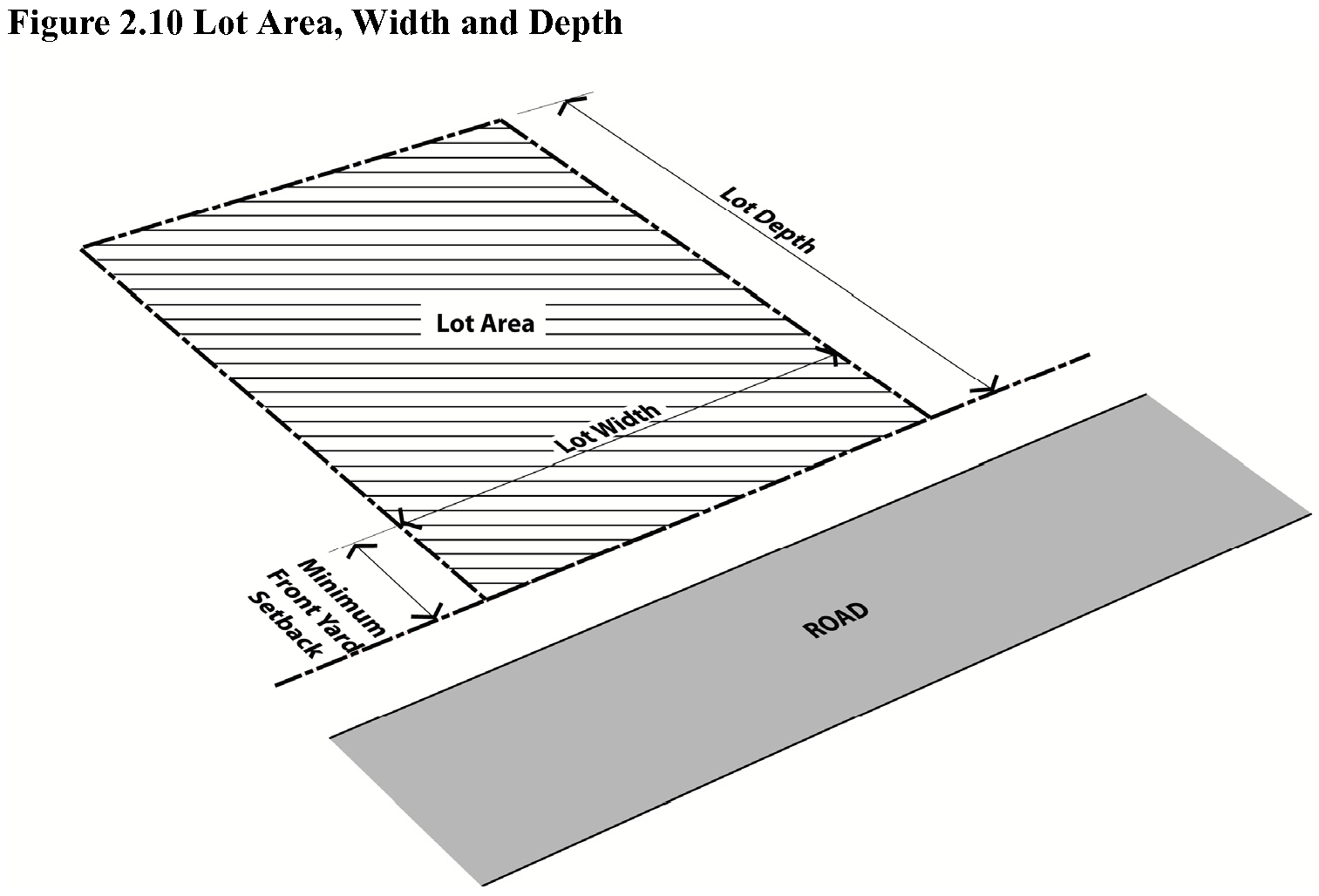
Lot area. The horizontal area within the lines of a parcel. Lot area is illustrated in Figure 2.10.
Lot coverage. The area of a parcel covered by buildings or structures expressed as a percentage of the total parcel area, including principal and accessory structures, decks, pools and similar structures.
Lot depth. The distance between the front and the rear lot lines measured at the farthest point. Lot depth is illustrated in Figure 2.10.
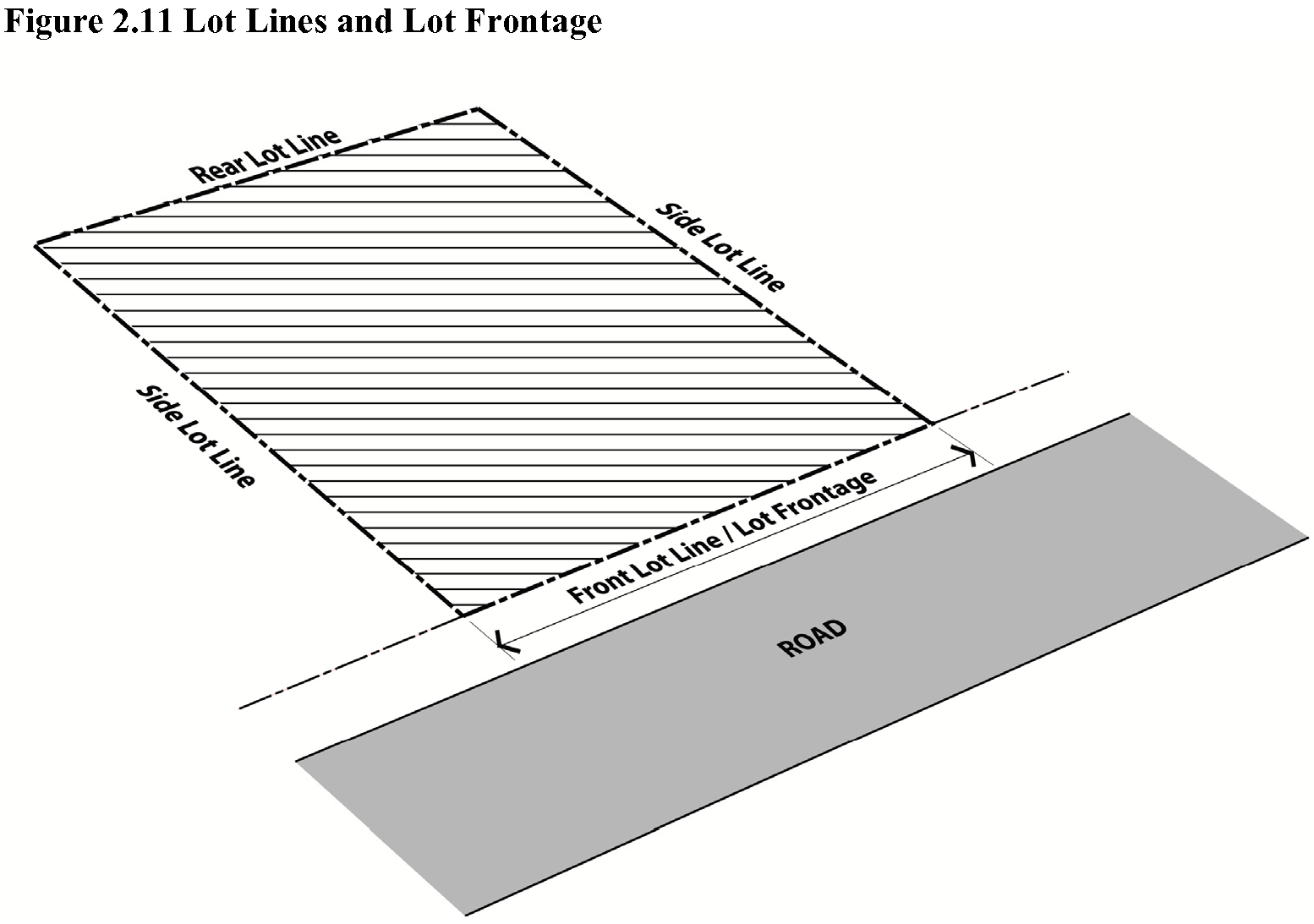
Lot frontage. The length of the front lot line measured along the street right-of-way line. Lot frontage is illustrated in Figure 2.11.
Lot lines. A line separating a parcel from surrounding parcels or adjacent street or road rights-of-way or easements. Lot lines may include the following:
A.
Front. A line separating a parcel from a street right-of-way or road easement.
B.
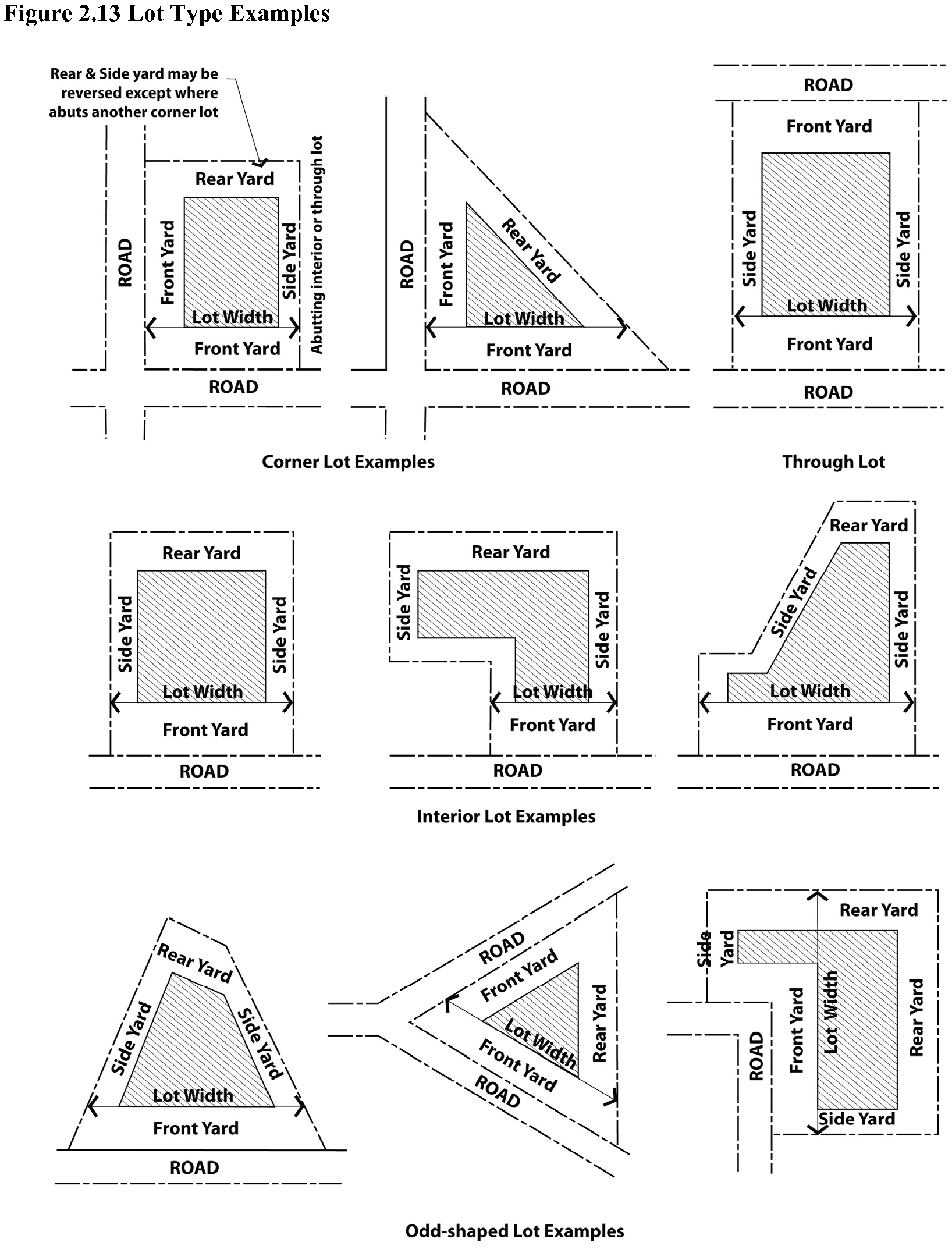
Rear. The lot line which is typically opposite and most distant from the front lot line. In the case of corner or irregularly shaped lots, the rear lot line shall be determined by review of adjacent lot geometry and prevailing building patterns to ensure that a) side to side setback and rear to rear setback relationships are established where practical; and b) rear lot lines are established in anticipation of future land divisions where allowable by ordinance.
C.
Side. Any lot line which is not a front or rear lot line.
Lot lines are illustrated in Figure 2.11.
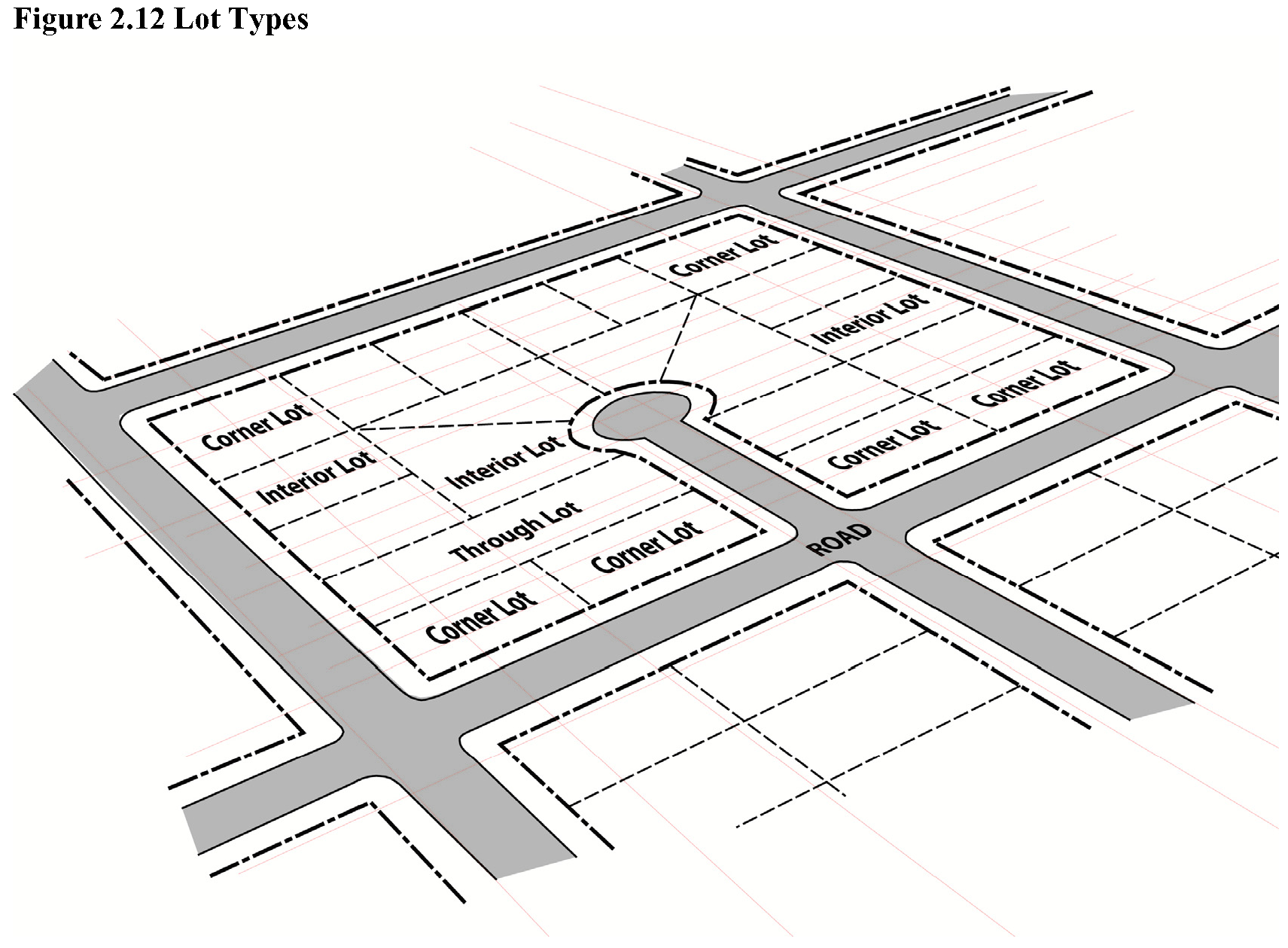
Lot types.
A.
Corner. A parcel located at the intersection of two (2) or more streets where the interior angle does not exceed one hundred thirty-five (135) degrees.
B.
Interior. A parcel other than a corner lot with only one (1) frontage on a street.
C.
Irregular frontage. A parcel which cannot conform to the minimum lot width requirements of this ordinance as measured at the front lot line.
D.
Through or double frontage lot. A parcel other than a corner lot with frontage on more than one (1) street.
Lot types are illustrated in Figures 2.12 and 2.13
Lot width. The length of a straight line measured between the two points where the required front setback intersects the side lot lines. For lots having two (2) or more lot frontages, the minimum lot width shall be the shortest of the lot frontages. Lot width is illustrated in Figure 2.10.
Lumens. A measurement of the perceived power of light.
Sec. 2.14. - Definitions beginning with the letter "M."
Major thoroughfares. For the purpose of this Ordinance, the following roads are considered major thoroughfares: Clyde Road, Duck Lake Road, Harvey Lake Road, Hickory Ridge Road, Highland Road (M-59), Livingston Road, Milford Road, Rose Center Road and White Lake Road.
Manufactured home. A structure, transportable in one (1) or more sections which is built on a chassis and designed to be used as a dwelling with or without a permanent foundation when connected to the required utilities, and includes the plumbing, heating, air-conditioning, and electrical systems contained in the structure.
Manufactured home pad. That part of a mobile home site specifically designated for the placement of a manufactured home.
Manufactured home park. A parcel or tract of land under the control of a person on which three (3) or more manufactured homes are located on a continual non-recreational basis and offered to the public for that purpose regardless of whether a charge is made therefor, together with any building, structure, enclosure, street, equipment or facility used or intended for use incident to the occupancy of a manufactured home and which is not intended for use as a temporary trailer park.
Manufactured home site. The entire area which is designated for use by a specific manufactured home.
Marginal access drive. Any drive which provides vehicular access between adjacent parcels without necessitating the use of the adjacent street. A marginal access drive may be located in a public right-of-way subject to the approval of the public agency having jurisdiction over the right-of-way. A marginal access drive may be located on private property provided that appropriate access easements are recorded. A marginal access drive located on private property may also serve to provide access to individual parking spaces.
Marihuana or medical marihuana. That term as defined in Section 7106 of the Public Health Code, 1978 PA 368, MCL 333.7106, as amended.
Massage establishment. Any individual, group of individuals, person or business which engages in the practice of massage as defined herein, and which has a fixed place of business where any person, firm, association, partnership, limited liability company or corporation carries on any of the activities as defined in herein. Massage establishment shall also include, but not be limited to, a Turkish bath parlor, steam bath, sauna, magnetic healing institute, health club, health spa, or physical fitness club or business that offers massages on occasion or incidental to its principal operation, as well as an individual's home where a person is engaged in the practice of massage for consideration.
Massage therapy. The application of a system of structured touch, pressure, movement, and holding to the soft tissue of the human body in which the primary intent is to enhance or restore the health and well being of the client. Practice of massage therapy includes complementary methods including the external application of water, heat, cold, lubrication, salt scrubs, body wraps, other topical preparations and electromechanical devices that mimic or enhance the actions possible by the hands. Practice of massage therapy does not include medical diagnosis, practice of physical therapy, high-velocity, low-amplitude thrust to a joint, electrical stimulation, application of ultrasound, or prescription of medicines.
Master plan. The Comprehensive Land Use Plan adopted by the Township in accordance with Michigan statute.
Medical marihuana activities. The acquisition, possession, cultivation, manufacture, use, internal possession, delivery, transfer or transportation of medical marihuana by a qualifying patient or primary caregiver as defined in the Michigan Medical Marihuana Act, PA 2008, Initiated Laws, MCL 333.26421 et seq.
Medical marihuana provisioning center. A commercial entity located in the Township that acquires, possesses, manufactures, delivers, transfers, or transports medical marihuana and sells, supplies, or provides medical marihuana to registered qualifying patients, directly or through their registered primary caregivers. The term shall include, but not be limited to, dispensaries, cooperatives, and any other operation or facility similar in nature, and any commercial property where medical marihuana is sold to registered qualifying patients and registered primary caregivers, or any property used by more than one primary caregiver. The location used by a single primary caregiver to assist a qualifying patient connected to the caregiver through the medical marihuana registration process in accordance with the Michigan Medical Marihuana Act is not a provisioning center for the purposes of this article.
Medical marihuana safety compliance facility or safety compliance facility. An entity that tests marihuana produced for medical use for contaminants.
Medical marihuana safety compliance facility agent or medical marihuana provisioning center agent. A principal officer, board member, employee, operator, or agent of the safety compliance facility or provisioning center, as applicable.
Mineral mining and extraction. The removal of natural mineral deposits such as, but not limited to, sand, gravel, clay, stone or other non-metallic or metallic material. Mineral mining and extraction shall not include oil and gas well exploration and installation, excavation associated with a construction project for which a site plan has been approved, or excavation associated with a project conducted by a public agency or utility.
Motel. A series of attached, semidetached or detached rental units containing bedroom, bathroom and closet space. Such units shall provide for overnight lodging, are offered to the public for compensation and shall cater primarily to the public traveling by motor vehicle. This term does not include short term rentals as defined in section 2.19.
Municipal facilities. Land or buildings owned or operated by a governmental or other public agency.
(Ord. No. Z-005, § 1, 3-11-2015; Ord. No. Z-030, § 1, 1-8-2024)
Sec. 2.15. - Definitions beginning with the letter "N."
Natural feature. A wetland or watercourse, including a lake, pond, river, stream, or creek; any flood-prone area; woodlands; steep slopes; and the habitat of rare or endangered plant and animal species.
Nature and wildlife preserve. A parcel of land which is established for the purpose of preserving and protecting natural communities of plants and animals for their scientific and/or aesthetic interest.
Non-conforming building or structure. A structure or building lawfully constructed prior to the effective date of this ordinance that does not conform with the requirements of the district in which it is situated.
Non-conforming use. A use which lawfully occupies a building or land at the effective date of this Ordinance, or amendments thereto, that does not conform to the provisions of the Ordinance in the district in which it is located.
Non-conforming lot. A lot, the area, dimension, or location of which was lawful prior to the adoption, revision, or amendment of the zoning ordinance but that fails by reason of such adoption, revision, or amendment to conform to the present requirements of the zoning district.
Sec. 2.16. - Definitions beginning with the letter "O."
Ordinance. The Charter Township of Highland Zoning Ordinance and any amendments thereto.
Ordinary high water mark. The line between upland and bottomland which persists through successive changes in water levels, below which the presence of action of the water is so common or recurrent that the character of the land is marked distinctly from the upland and is apparent in the soil itself, the configuration of the surface of the soil and vegetation. On an inland lake which has a level established by law, it means the highest established level. Where water returns to its natural level as a result of the permanent removal or abandonment of a dam, it means the natural ordinary high water mark. Ordinary high water mark is illustrated in Figure 2.3.
Outdoor display and sales. Placement of portable products that are typically sold by a particular business that may be placed outside the building for marketing purposes.
Sec. 2.17. - Definitions beginning with the letters "P" and "Q."
Parcel. A continuous area or tract of land. A parcel may consist of acreage, a lot, a combination of lots, a condominium unit in a condominium subdivision plan, as reflected in the Township tax map.
Parking facility, off-street. A land surface or area providing vehicular parking spaces along with adequate drives and aisles for maneuvering so as to provide access for entrance and exit for the parking of motor vehicles.
Parking space. One (1) unit of a parking facility provided for the parking of one (1) vehicle.
Path. A sidewalk, trail or corridor intended to provide for pedestrian, bicycle or other non-motorized forms of travel.
Performance guarantee. Cash or an automatically renewable irrevocable letter of credit deposited by an applicant with the Township to ensure completion of site improvements or performance of other obligations associated with a permit or land use approval.
Pet care facility. A pet care facility is an establishment where domesticated household pets are supervised, socialized, and/or trained. Pet care facilities may offer accessory retail sales of goods and services such as pet food and other pet care supplies, grooming, and overnight boarding within the confines of the building.
Planning Commission. The Charter Township of Highland Planning Commission.
Play structure. A freestanding accessory structure used for recreational and play activities.
Principal structure. The structure or structures which house the principal use or uses to which a parcel is devoted.
Private road. An area of land which is privately owned, has not been dedicated to public use other than access by emergency and public safety vehicles, is maintained by its private owners, and vehicular access to more than one (1) lot unless otherwise specified herein.
Public road. A traffic-way dedicated to either the Road Commission for Oakland County or the State of Michigan, which provides vehicular access to abutting thoroughfares.
Public services. Services provided by government to its citizens including but not limited to police, ambulance, fire services, libraries, parks and recreation.
Public utility. Any person, firm, corporation, municipal department or board duly authorized to furnish and furnishing under federal, state, or municipal regulations, to the public: electricity, gas, steam, communications, telephone, transportation, water or sanitary sewer facilities. Wireless communication service providers are not defined as public utilities.
(Ord. No. Z-005, § 1, 3-11-2015)
Sec. 2.18. - Definitions beginning with the letter "R."
Recreational vehicle. For purposes of this Ordinance, a recreational vehicle shall include the following:
A.
Boats and boat trailers. Shall include watercrafts, boats, jet skis, rafts, canoes, plus the normal equipment to transport them on the highway.
B.
Folding tent trailer. A folding structure mounted on wheels and designed for travel and vacation use, such as a pop-up camper.
C.
Motor home. A recreational vehicle intended for temporary human habitation, sleeping, and/or eating, mounted upon a chassis with wheels and capable of being moved from place to place under its own power. Motor homes generally contain sanitary, water and electrical facilities.
D.
Other recreational equipment. Other recreational equipment includes snowmobiles, all terrain or special terrain vehicles, utility trailers, plus the normal equipment to transport them on the highway.
E.
Pickup camper. A structure designed to be mounted on a pickup or truck chassis with sufficient equipment to render it suitable for use as a temporary dwelling during or travel, recreational and vacation uses.
F.
Travel trailer. A portable vehicle on a chassis which is designed to be used as a temporary dwelling during travel, recreational, and vacation uses, and which may be identified as a travel trailer by the manufacturer. Travel trailers generally contain sanitary, water, and electrical facilities.
Religious institution. A site used for or intended for the regular assembly of persons for conducting religious services and accessory uses. Such accessory uses may include living quarters for members of the religious order who carry out their duties primarily on the site, religious education classes, day care, outdoor recreation facilities (unlighted), religious office space, youth centers and other similar activities. Rescue missions, tent revivals and other temporary assemblies are not included in this definition.
Restaurant. Any establishment whose principal business is the preparation and sale of food and beverages. Restaurants shall include the following:
A.
Cafe or open-front restaurant. A restaurant whose method of operation involves delivery of prepared food for consumption primarily on the premises, but with seating options both outside and inside the enclosed building.
B.
Carry-out restaurant. A restaurant whose method of operation involves the sale of food, beverages and/or frozen desserts in disposable or edible containers or wrappers in a ready-to-consume state for consumption primarily off the premises.
C.
Drive-in restaurant. A restaurant whose method of operation involves delivery of prepared food so as to allow its consumption in a motor vehicle or elsewhere on the premises, but outside of an enclosed building.
D.
Drive-through restaurant. A restaurant whose method of operation involves the delivery of prepared food to the customer in a motor vehicle, typically through a drive-through window, for consumption off the premises.
E.
Standard restaurant. A restaurant whose method of operation involves the consumption of food and beverages by customers seated at tables.
F.
Tavern. A type of restaurant which is operated primarily for the dispensing of alcoholic beverages, although the sale of prepared food or snacks may also be permitted. If a tavern is part of a larger dining facility, it shall be defined as that part of the structure so designated or operated.
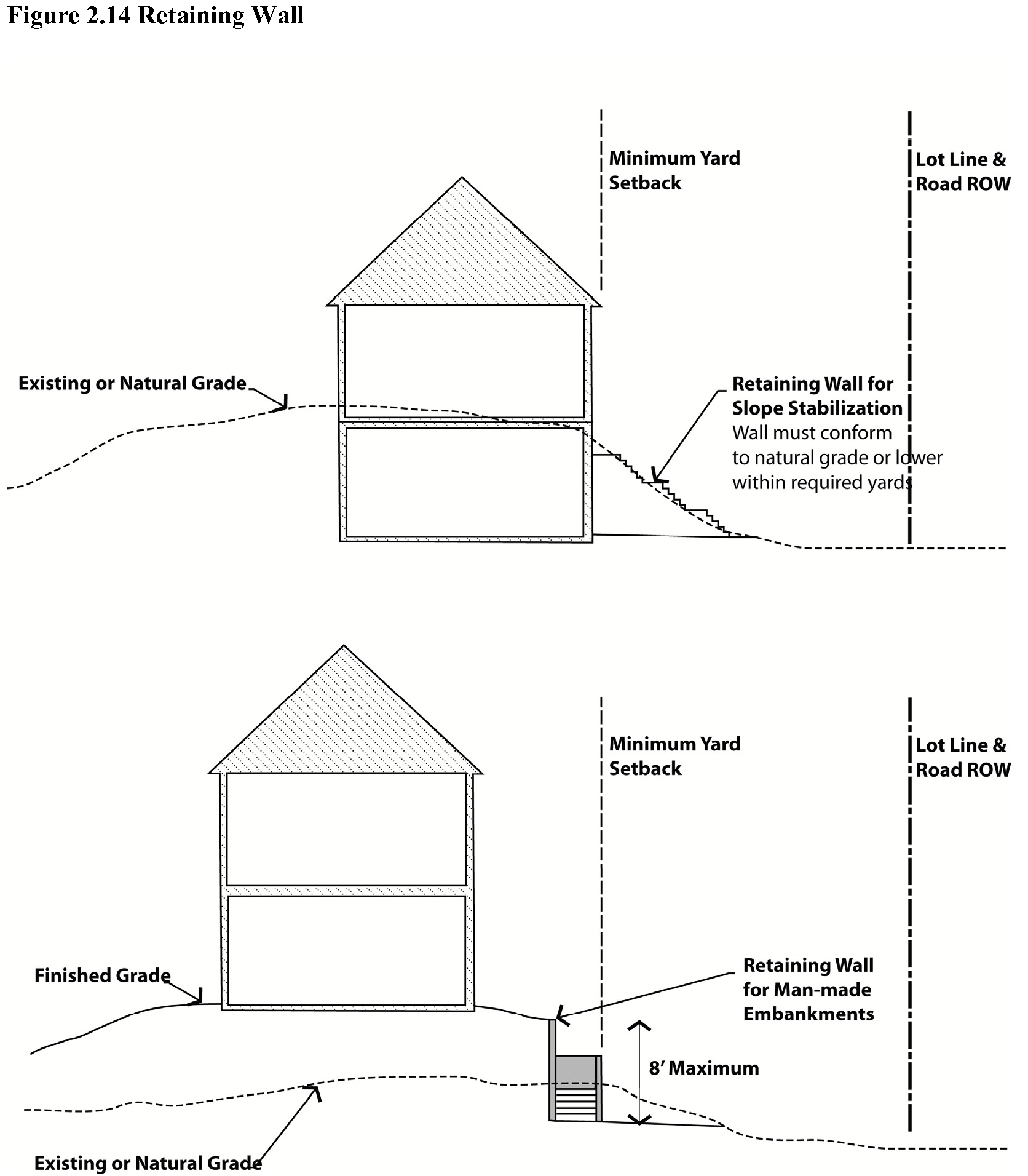
Retaining wall. A structure intended to hold back earth where it is impractical or unfeasible to establish a stable finished grade through grading and vegetation alone. Retaining wall is illustrated in Figure 2.14.
Right-of-way. A strip of land over which a person may pass by right and upon which facilities such as roads, railroads and/or utilities can be built. A right-of-way may be either a public or private strip of land to be used for the above purpose.
Right-of-way, proposed. A proposed right-of-way is a strip of land still under private ownership that is planned to be a right-of-way by the owner or a federal, state or local unit of government in the future for which the transfer of title has not been executed as of the date the property is subject to review for some development purpose.
Sec. 2.19. - Definitions beginning with the letter "S."
Salvage yard. A place, structure, parcel or use of land where junk, waste, discard, salvage or similar materials such as old iron or other metal, wood, lumber, glass, paper, rags, cloth, leather, rubber, bagging, cordage, barrels, containers, etc. are bought, sold, exchanged, stored, baled, packed, disassembled, or handled, including auto wrecking yards, inoperative machines, used lumber yards, house wrecking and structural steel materials and equipment and including establishments for the sale, purchase, or storage of salvaged machinery and the processing of used, discarded, or salvaged materials, for any thirty (30) consecutive days.
Sanitary land fill. Any land where garbage, filth, refuse, waste, trash, debris or rubbish, including cans, bottles, waste paper, cartons, boxes and crates or otherwise offensive or obnoxious matter is kept for disposal. This excludes the spreading of sludge on farm fields for fertilizing purposes.
Schools.
Charter school (public school academy). A charter school or public school academy is a public school and a school district, and is subject to the leadership and general supervision of the Michigan State Board of Education. A public school academy is authorized by the executive action of an authorizing body with jurisdiction.
Private school. Any school other than a public school giving instruction to children below the age of sixteen (16) years and not under the exclusive supervision and control of the officials having charge of the public schools of the state. Nonpublic schools include private, denominational, and parochial schools.
Public school. An elementary or secondary educational entity or agency that has as its primary mission the teaching and learning of academic and vocational-technical skills and knowledge, and is operated by a school district, local act school district, special act school district, intermediate school district, public school academy corporation, public state university, or department or state board with jurisdiction.
Seasonal uses. Uses that are devoted to products or services that are typically associated with a particular season of the year.
Self-storage facility. A building consisting of individual, small self-contained units that are leased for the storage of personal and household goods.
Sexually oriented business. For the purpose of this Ordinance, the following definitions shall be classified as adult oriented uses, adult entertainment use or an establishment including but not limited to the following:
A.
Adult arcade. Any place to which the public is permitted or invited wherein coin-operated or slug-operated or electronically, internet or mechanically controlled still or motion picture machines, projectors or other image producing devices are maintained to show images and where the images so displayed are distinguished or characterized by the depicting or describing of "sexually explicit activities" or "specific anatomical areas."
B.
Adult bookstore or adult video store. A commercial establishment which offers for sale or rental for any form of consideration, as one of its principal business purposes, any one or more of the following:
1.
Books, computer diskettes, tapes or hard drives, magazines, periodicals or other printed matter or photographs, films, motion pictures, video matter, digital media or photographs, cassettes or video reproductions, slides or other visual representation and/or items which are characterized by their emphasis upon the exhibition or description of "sexually explicit activities" or "specified anatomical areas"; or
2.
Instruments, devices or paraphernalia which are characterized by their emphasis upon the exhibition or description of "sexually explicit activities" or "specified anatomical areas," or designed for use in connection with "sexually explicit activities"; or
3.
Items, materials, materials, gimmicks, or paraphernalia depicting, displaying, advertising or packaged as "sexually explicit activities" or depict or describe or are characterized by their emphasis on the exhibition or description of "specified anatomical areas."
4.
For purposes of this Section, "principal business purpose" means:
a.
The devotion of a significant or substantial portion of its stock-in-trade or interior floor space, meaning thirty percent (30%) or more of the stock in trade or interior floor area; or
b.
The receipt of fifty percent (50%) of more of its annual revenues from the sale of the items listed above. Revenue is a gross measure in assets or a gross decrease in liabilities recognized and measured in conformity with Generally Accepted Accounting Principles; or
c.
The devotion of a significant or substantial portion of its advertising expenditures to the promotion of the sale, rental or viewing of books, magazines, periodicals or other printed matter, or photographs, film, motion pictures, video cassettes, compact discs, slides or other visual representations, items, materials, gimmicks, or paraphernalia which are characterized by the depiction, description display, advertising or packaging of "sexually explicit activities" or "specified anatomical areas."
5.
An establishment may have other principal business purposes that do not involve the offering for sale, rental or viewing of materials depicting or describing "sexually explicit activities" or "specified anatomical areas," and still be characterized as an adult book store, adult novelty or retail store or adult video store. Such other business purposes will not serve to exempt such establishment from being categorized as an adult bookstore, adult novelty store or adult video store, so long as the establishment falls within the definition of an adult bookstore, adult novelty store or adult video store as set forth above.
C.
Adult cabaret. A nightclub, bar restaurant or similar commercial establishment which regularly features:
1.
Persons who appear in a state of restricted nudity; or
2.
Live performance which are characterized by the partial exposure of "specified anatomical areas"; or
3.
Films, motion pictures, video cassettes, compact discs, slides, digital media or other photographic reproductions which are characterized by the depiction or description of "sexually explicit activities" or "specified anatomical areas."
D.
Adult motel. A hotel, motel or similar commercial establishment which:
1.
Offers accommodations to the public for any form of consideration and provide patrons with closed-circuit television transmission, films, motion pictures, video cassettes, compact discs, slides or other photographic reproductions which are regularly characterized by the depiction or description of "sexually explicit activities" or "specified anatomical areas" or which advertises the availability of this adult type of material by means of a sign, visible from the public right-of-way, or by means of any off-premises advertising, including, but not limited to, newspapers, magazines, pamphlets or leaflets, radio, internet or television; or
2.
Permits patrons to be filmed or photographed performing "sexually explicit activities" or displaying "specified anatomical areas" for electronic transmission over the World Wide Web; or
3.
Offers a sleeping room for rent for a period of time that is less than ten (10) hours; or
4.
Allows a tenant or occupant of a sleeping room to sub-rent the room for a period of time that is less than ten (10) hours.
E.
Adult motion picture theater. A commercial establishment where, for any form of consideration, films, motion pictures, video cassettes, compact discs, slides, electronic media or similar photographic reproductions are regularly shown which are characterized by the depiction or description of "sexually explicit activities" or "specified anatomical areas."
F.
Adult theater. A theater, concert hall, auditorium or similar commercial establishment which regularly features persons who appear in a state of nudity or live performances which are characterized by the exposure of "specified anatomical areas" or by the performance of "sexually explicit activities." This definition does not include a theater which features occasional live nude performances with serious literacy, artistic or political value and which has no adverse secondary effects.
G.
Escort. A person who, for consideration in any form, agrees or offers to act as a companion, guide or date for another person, or who agrees or offers to privately perform as an entertainer, including, but not limited to, the modeling of lingerie, the removal of clothing and the performance of a dance or skit. Under this definition, "privately" shall mean a performance for an individual and/or that individual's guests.
H.
Escort agency. A person or business association who furnishes, offers to furnish or advertises to furnish escorts as one of its primary business purposes for a fee, tip or other consideration.
I.
Nude model studio. Any place where a person appears in a state of nudity or displays "specific anatomical areas," and is provided money or any form of consideration to be observed, sketched, drawn, painted, sculpted, photographed or similarly depicted by other persons. This includes modeling studios that provide for nude modeling on an occasional basis, but it does not include modeling studio whose primary function is to provide art classes as part of a college, university or educational institution and which is certified by the State of Michigan.
J.
Nudity ora state of nudity. The appearance of a human bare buttock, anus, male genitals, female genitals or female breasts.
K.
Peep booth. An adult motion picture theater with a viewing room or cubicle of less than one hundred fifty (150) square feet of floor space.
L.
Private room. A room in a hotel/motel that is not a peep booth, has a bed and a bath in the room or adjacent room, and is used primarily for lodging.
M.
Semi-nude. A state of dress in which clothing covers no more than the genitals, pubic region and areola of the female breast, as well as portions of the body covered by supporting straps or devices.
N.
Sexual encounter center. A business or commercial enterprise that as one (1) of its primary business purposes offers a place where two (2) or more persons may congregate, associate or consort for the purpose of "sexually explicit activities," or the exposure of "specified anatomical areas" for any form of consideration including but not limited to:
1.
Physical contact in the form of wrestling or tumbling between persons of the same or opposite sex; or
2.
Activities when one or more of the persons is in a state of nudity or semi-nudity; or
3.
Permits patrons to display or be filmed or photographed performing "sexually explicit activities" or displaying "specified anatomical areas" for recording or transmission over the World Wide Web or any other media.
O.
Sexually explicit activities. Includes any of the following:
1.
The fondling or other erotic touching of human genitals, pubic region, buttocks, anus or female breasts; or
2.
Sex acts, normal or perverted, actual or simulated, including, but not limited to, intercourse, oral copulation or sodomy; or
3.
Masturbation, actual or simulated; or
4.
An activity intended to arouse, appeal to or gratify a person's lust, passions or sexual desires; or
5.
Human genitals in a state of sexual stimulation, arousal or tumescence; or
6.
Excretory function as part of or in connection with any of the activity set forth in 1 through 5 above.
P.
Sexually oriented business. An adult arcade, adult bookstore or adult video store, adult novelty or retail store, adult cabaret, adult motel, adult motion picture theater, adult theater, escort agency, nude model studio, sexual encounter center or similar establishment or any place that permits patrons to be filmed or photographed performing "sexually explicit activities" or displaying "specified anatomical areas" for electronic transmission over the World Wide Web. "Sexually oriented" when used to describe film, motion picture, videocassette, slides, or other photographic reproductions shall mean film, movies, motion picture videocassette, slides or other photographic reproductions that regularly depict material which is distinguished or characterized by an emphasis on matter depicting or describing "sexually explicit activities" or "specified anatomical areas" offered for observation by the patron(s) on the premises of a sexually oriented business. The definition of "sexually oriented business" shall not include an establishment where a medical practitioner, psychologist, psychiatrist or similar professional person licensed by the State engages in medically approved and recognized sexual therapy.
Q.
Specified anatomical areas. Includes any of the following:
1.
Less than completely and opaquely covered human genitals, pubic region or pubic hair, buttock, or female breast or breasts of any portion thereof that is situated below a point immediately above the top of the areola, or any combination of the foregoing; or
2.
Human genitals in a state of sexual arousal, even if opaquely and completely covered.
R.
Specified criminal acts. Sexual crimes against children, sexual abuse, criminal sexual conduct, rape, and crimes classified as sexual crimes by the State of Michigan or any other state, or crimes connected with another adult use business including but not limited to the distribution of obscenity, prostitution and/or pandering.
S.
Significant or substantial portion. Thirty percent (30%) or more of the term modified by such phrase.
T.
Substantial enlargement. Of a sexually oriented business means the increase in floor area occupied by the business by more than fifteen percent (15%), as the floor area exists on the date of adoption of this ordinance.
U.
Transfer of ownership or control. Of a sexually oriented business means and includes any of the following:
1.
The sale, lease or sublease of the business;
2.
The transfer of securities which constitute a controlling interest in the business whether by sale, exchange or similar means; or
3.
The establishment of a trust, gift or other similar legal device which transfers the ownership or control of the business except for transfer by bequest or other operation of law upon the death of the person possessing the ownership or control.
Shielded fixture. Outdoor light fixture that shields the lamp or constructed so that light rays emitted by the fixture are projected below the horizontal plane passing through the lowest point on the fixture from which light is emitted (e.g., "shoebox" type fixtures with a flat lens). A luminary mounted in a recessed fashion under a canopy or other structure such that the surrounding structure effectively shields the lamp in the same manner as a shoebox type fixture is also considered fully shielded for the purposes of this ordinance.
Shopping center. A coordinated grouping of retail commercial and service establishments located on a single site or contiguous group of sites with common parking and access.
Short-term rental. Rental of a single-family residence, a dwelling unit in a one-to-four-family house, or any unit or group of units in a condominium, for terms of not more than 30 consecutive days.
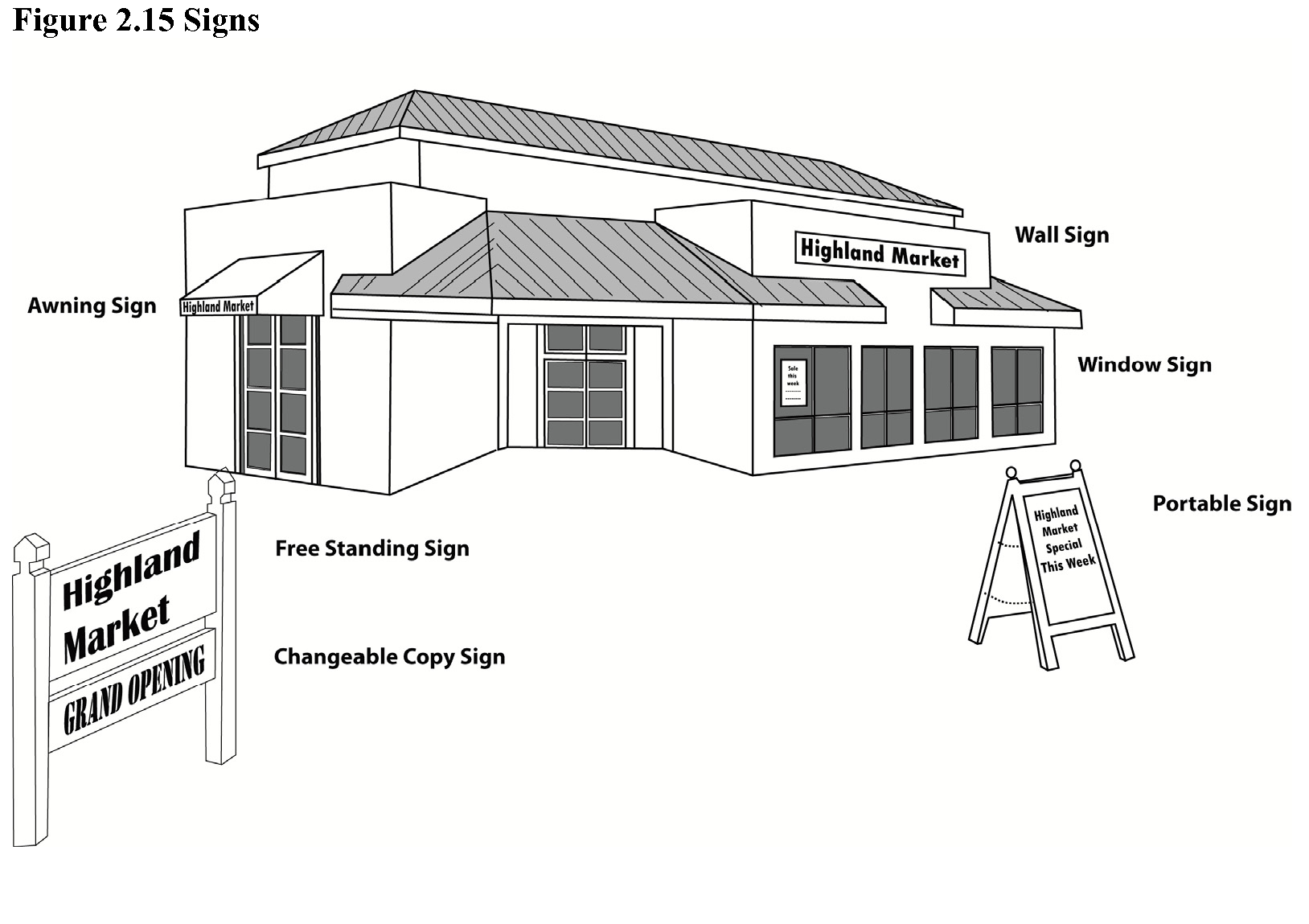
Sign. Any announcement, message, declaration, display or illustration situated outdoors or indoors, that is designed and placed to advertise, identify, direct, or attract attention to an object, person, institution, organization, business, product, service, event, or location or otherwise convey information in written or pictorial form. Signs are further defined as follows:
Abandoned sign. A sign which advertises a business, service, product, or activity no longer conducted, available, or in existence on the parcel on which the sign is located.
Awning or canopy sign. Any sign attached to an awning or canopy.
Changeable copy sign. A sign or portion of a sign with letters or numbers that can be changed or rearranged, manually or electronically, without altering the face or surface of the sign.
Free standing sign. A sign not attached to any building that is self supported by structural supports mounted in or on the ground.
Non-accessory sign. Any sign which contains a message unrelated to or not advertising a business transacted or goods sold or produced on the parcel on which the sign is located; also referred to as a remote sign, billboard, or off-premise sign.
Obsolete sign message. A sign which no longer advertises a business, service, product, or activity conducted, available, or in existence, or the parcel on which the sign is located.
Temporary sign. A sign that may include a banner, pennants or other advertising device constructed of cloth, canvas, plastic or other light temporary material, with or without structural frame, or any other sign intended for a limited period of display, unless otherwise specified herein.
Wall mounted sign. A sign attached directly to and parallel to the exterior wall of a building.
Window sign. A sign painted on or affixed to a window or door for the purposes of viewing from outside the premises. This term does not include merchandise located in a window.
Portable sign. Any sign not permanently attached to the ground or a building.
Skilled care nursing facility. A state licensed facility providing skilled, specialized care, room and board on a short or long-term basis. Such facilities may include nursing homes, extended healthcare facilities, intermediate healthcare facilities, assisted living, and hospice residences.
Sky glow. A condition where the night sky is illuminated when upwardly directed light reflects off particles in the atmosphere.
Special land use. A use which may be permitted after consideration and approval by the Planning Commission. A special land use may be granted in a zoning district only when there is a specific provision for such special use in this Ordinance.
Story. That portion of a building included between the upper surface of a floor and the upper surface of the floor or the roof next above. Story is illustrated in Figure 2.1.
Story, half. An uppermost story lying under a sloping roof having an area of at least two hundred (200) square feet with a clear height of seven feet six inches (7'6"). For the purpose of this Ordinance, the useable floor area is only that area having at least four (4) feet clear height between floor and ceiling.
Street. Dedicated public or approved private road rights-of-way other than an alley which provides vehicular access to abutting property.
Structure. Anything constructed, erected or placed with a fixed location on the ground or affixed to something having a fixed location on the ground.
Substantial construction. Work of a substantial character done by way of preparing the site for actual use, which includes obtaining all necessary approvals and building permits, and actual physical placement of building materials in their permanent position. Clearing trees, grading and other preparatory work does not constitute substantial construction.
Swimming pool. Any structure intended for swimming or recreational bathing that contains water over twenty-four (24) inches deep. This includes in-ground, aboveground and on-ground swimming pools, hot tubs, spas and inflatable pools.
(Ord. No. Z-005, § 1, 3-11-2015; Ord. No. Z-014, § 1, 6-12-2019; Ord. No. Z-030, § 1, 1-8-2024)
Sec. 2.20. - Definitions beginning with the letters "T," "U," "V" and "W."
Temporary outdoor storage. The placement of a portable product that is typically sold by a particular business that may be placed outside the building for a short time when a shipment of seasonal products are delivered to the store as provided for in this Ordinance.
Temporary use or temporary building. A use or building permitted to exist during a specified period of time under conditions and procedures as provided for in this Ordinance.
Time limits. Time limits shall mean calendar days unless otherwise specified.
Township. The Charter Township of Highland, Oakland County, Michigan.
Township Board. The Charter Township of Highland Board of Trustees.
Township engineer. An engineer and/or engineering firm appointed by the Township Board to represent the Township.
Township planner. A planner and/or planning firm appointed by the Township Board to represent the Township.
Trade schools. A trade school is any school other than a public secondary school where the principal course of instruction is to prepare students to participate in a trade. Trade schools are not colleges or universities or other institutes of liberal arts or professional education.
Transfer station. An area where sludge, household or commercial wastes are temporarily stored awaiting permanent disposal.
Travel trailer. See Recreational Vehicle.
Undefined terms. Any term not defined herein shall have the meaning of common or standard use.
Use. The principal purpose for which land or a building is arranged, designed or intended, or for which land or a building is or may be occupied.
Variance. A departure from a provision of the Zoning Ordinance approved by the Zoning Board of Appeals for a specific parcel based on practical difficulty.
Vested right. A right to continue a particular use, district, zoning classification or any activity regardless of subsequent changes in ordinances or regulations.
Walkway. A pathway that allows pedestrians and non-motorized traffic access to adjacent properties. Examples include, but are not limited to: Sidewalks, trails, multiuse paths and bikepaths.
Wireless communications facilities (WCF). All structures and accessory facilities relating to the use of the radio frequency spectrum for the purpose of transmitting or receiving radio signals including but not limited to radio and television transmission towers and antennae, telephone devices and exchanges, microwave relay towers, telephone transmission equipment building and commercial mobile radio service facilities.
Antenna(e). Equipment used for the transmission or reception of wireless communication signals.
Amateur radio antenna. An antenna and associated support structure that is owned and operated by a federally licensed amateur radio station operator for personal use. Also referred to as "ham radio antenna."
Collocation. Shall mean the location by two (2) or more wireless communication facilities on a common structure, tower, or building,
Ground equipment. Equipment use in the operation of the facility other than antennae or towers and the structure of enclosure within which the equipment is stored, maintained and serviced.
Provider. Entity that is properly licensed by the Federal communications commission (FCC) and other appropriate governmental authorities to provide services through wireless communications facilities.
Satellite dish antenna. An antenna structure designed to receive from or transmit to orbiting satellites.
Tower. A structure and any support thereto that is intended to hold apparatus which transmits or receives radio, television, pager, telephone, or similar communications, including self-supporting lattice towers, guyed towers, light poles, wood poles, or monopole towers. The term includes radio and television transmission towers and antenna arrays, microwave towers, common-carrier towers, cellular telephone and wireless internet towers, alternative tower structures, and similar wireless communication antennae support structures.
Sec. 2.21. - Definitions beginning with the letter "Y."
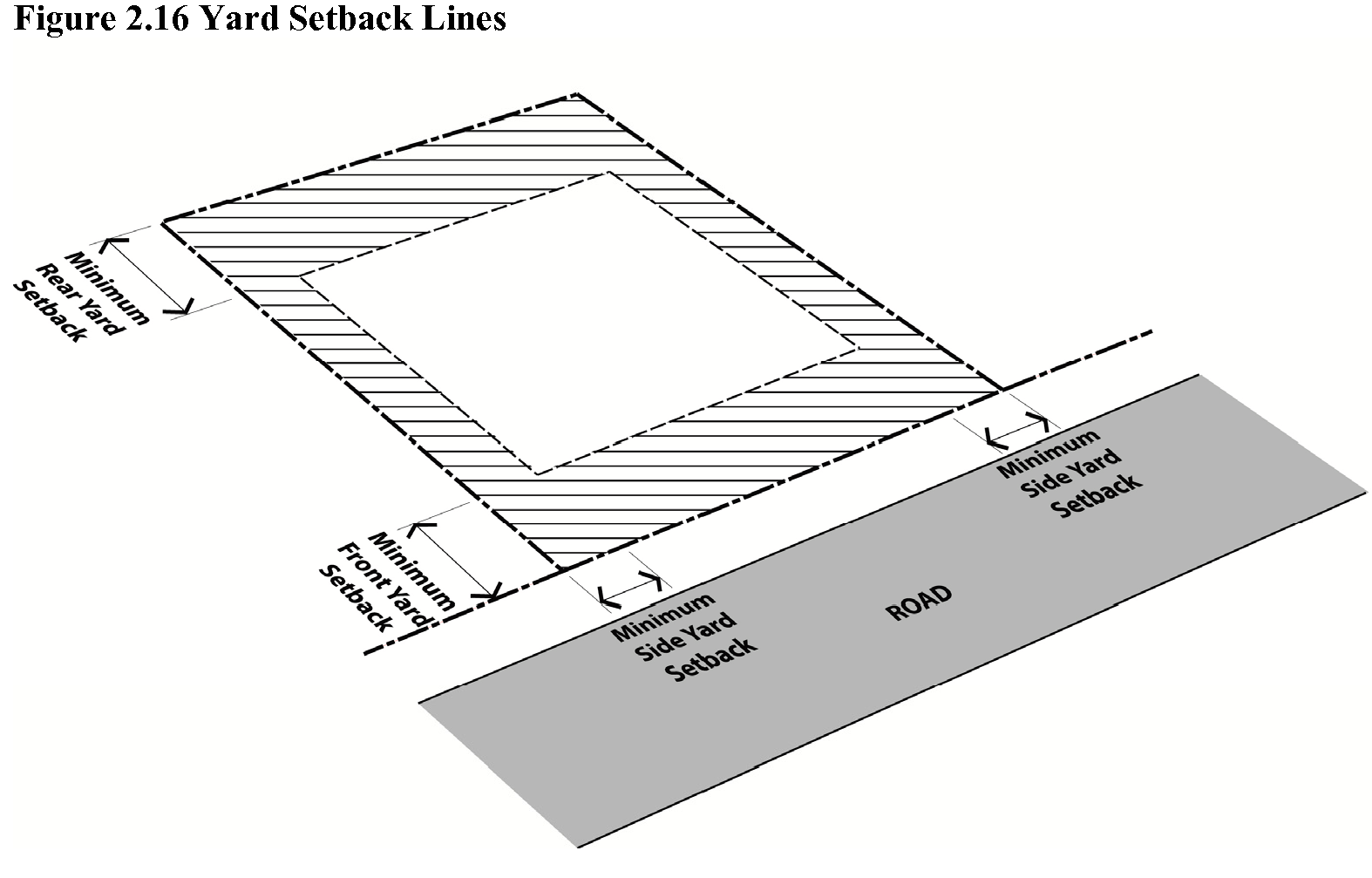
Yard, required. The open space between a lot line and the yard setback line within which no structure shall be located except as provided in the Zoning Ordinance
Yard setback lines. Yard setback lines are the lines delineated by the required minimum front, rear and side yard setbacks measured perpendicular to the front, rear and side lot lines. Yard setback lines are illustrated in Figure 2.16.