
Hillsborough City Zoning Code
CHAPTER 17
24 - REQUIRED SETBACK AREAS4
Prior history: Prior Code § 101.2.24 and Ords. 370 and 618.
17.24.010 - General rules.
A.
Except as otherwise set forth in these general rules, no structure placed, erected, or constructed on private property shall be located in the setback areas as described in Section 17.24.020.
B.
Subject to subsection C. below, the following accessory structures may be located within setback areas as indicated:
1.
Retaining walls, provided that the maximum height allowed is six feet in the street-line setback area (as defined in Section 17.24.020 A. and B.) and four and one-half feet in the interior setback area (as defined in Section 17.24.020 C., measured as set forth in Section 12.12.050. Terraced retaining walls shall be horizontally separated by a minimum distance of five feet and shall include landscape screening. Exposed faces of retaining walls shall be screened with landscaping. Landscape screening for retaining walls is subject to the design review process.
2.
Water wells, provided that they are a minimum of five feet from any property line and that all associated equipment meets the standards for accessory structures as outlined in Section 17.24.010. as well as all other applicable permitting and code requirements of outside agencies including, but not limited to, those of the San Mateo County Health Department.
3.
Decks, stairs, landings no higher than eighteen inches, ponds (a pond being a pool of water no more than eighteen inches deep), walkways, patios, terraces, driveways, benches, and railings.
4.
Any outdoor fixture meeting the requirements of Chapter 12.12 of this code and all other applicable laws and regulations.
5.
In the total combined setback areas of a lot, one enclosed structure not exceeding forty square feet in floor area if:
a.
The structure is no more than six feet high; and
b.
The structure is no closer than five feet from any lot line; and
c.
The structure is at least forty feet from any adjoining residence; and
d.
The structure is more than twenty-five feet from any street line; and
e.
The adjoining affected property owner(s) (i.e., the owner(s) whose property is adjacent to the proposed structure) has indicated in writing that the affected owner has no objection to the proposed location.
6.
Unenclosed structures (such as tennis or other courts, play structures, arbors, swimming pools, spas, and hot tubs) if:
a.
The structure is no more than eight feet high, provided, however, that any structure more than six feet high is subject to prior design review approval as set forth in Chapter 2.12; and
b.
The structure is no closer than five feet from any lot line; and
c.
The structure is at least forty feet from any adjoining residence; and
d.
The structure is more than twenty-five feet from any street line; and
e.
The adjoining affected property owner(s) (i.e., the owner(s) whose property is adjacent to the proposed structure) has indicated in writing that the affected owner has no objection to the proposed location.
C.
No structure shall be located over a public utility easement except that a fence not over seven feet high may be so located, and, if the entity owning the easement has given prior written approval, a retaining wall not over four and one-half feet high may be so located.
D.
Architectural features such as bay windows, chimneys, and overhanging eaves may encroach a maximum of twenty-four inches into street-line and interior setback areas.
E.
Solar Energy Systems, as defined in the California Civil Code Section 801.5(a) or successor provision, are exempt from the requirements of this section but shall be no closer than five feet from any property line. Additionally, solar energy systems shall be subject to all applicable Federal, State and Hillsborough Municipal Code health and safety requirements.
(Ord. 683 § 8, 2008: Ord. 639 § 17, 2003)
(Ord. No. 692, § 4, 9-3-2010; Ord. No. 761, § 15, 1-13-2020; Ord. No. 766, § 2, 9-14-2020; Ord. No. 767, § 2, 10-12-2020)
17.24.020 - Location of setback areas.
A.
The street-line setback area is that twenty-five foot wide strip of land that is bounded on one side by the street line and on the other side by a parallel line on the lot and twenty-five feet distant from the street line, such parallel line continuing until either end of it abuts a lot line. If the lot is bounded by more than one street line, the area bounded by all street lines and their parallel lines twenty-five feet distant constitutes the street-line setback areas of the lot. The provisions of this paragraph are illustrated by the first diagram following the next paragraph.
B.
Notwithstanding subsection A. of this section.
1.
On property having frontage along a street or right-of-way established by easement (as opposed to dedication in fee), whether public or private, the outside boundary of the street-line setback area shall be the line between the easement and the remainder of the private property unencumbered by the easement, as illustrated by the second diagram below.
17.24.020: Location of setback areas (shown in plan view)
17.24.020A:
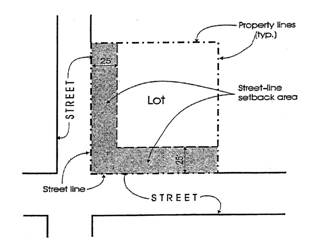
Example, on a corner lot, of street line setback areas where the "street" is a dedicated right-of-way.
17.24.020B.1:
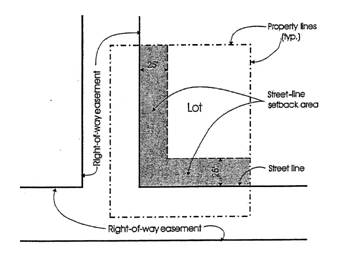
Example, on a corner lot, of street line setback areas where the "streets" are easements for right-of-way purposes, rather than a dedicated right-of-way.
2.
On property having frontage along a street or right-of-way established by public use, the outside boundary of the street-line setback area shall be the edge of the paved street abutting the private property in question.
C.
The interior setback area is that twenty-foot wide strip of land that is bounded on one side by a lot line that is not a street line and on the other side by a parallel line located on the lot and twenty feet distant from the lot line, such parallel line continuing until either end of it abuts a lot line. If the lot is bounded by more than one lot line that is not a street line, the area bounded by all such lot lines and their parallel lines twenty feet distant constitutes the interior setback areas of the lot. Any lot area that, pursuant to the descriptions in this section, falls within both the street-line setback area and the interior setback area shall be deemed part of the street-line setback area and not part of the interior setback area. The provisions of this paragraph are illustrated by the following diagram:
17.24.020C: Location of setback areas (shown in plan view):
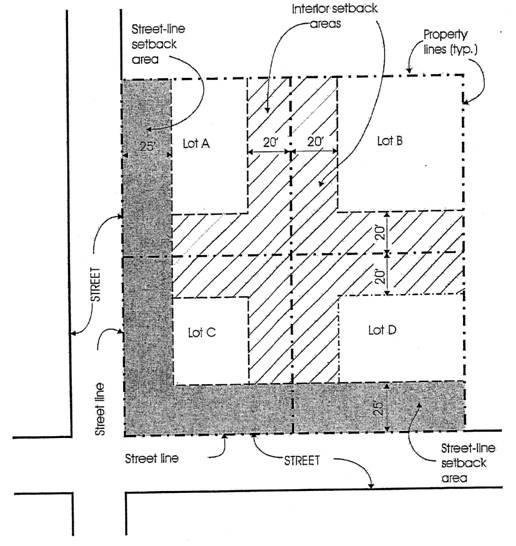
Example of some interior and street line setback areas. Note that, for clarity, not all of the setback areas are shown for Lots A, B, and D.
D.
Notwithstanding subsection (A) of this section, no part of any dwelling shall be erected closer than fifty feet from the center line of any right-of-way; provided, however, that the maximum distance required by this paragraph between any part of the dwelling and the street line shall be thirty feet. (Any dwelling legally erected prior to the effective date of this subsection and not conforming to the provisions of this paragraph shall be a legal nonconforming structure and may be enlarged, reconstructed, or otherwise altered so long as the resulting dwelling is not any closer to the center line of any right-of-way and not any closer to the street line than the dwelling was prior to the alteration.) The provisions of this paragraph are illustrated by the following diagrams:
17.24.020D. Setback distances for dwellings (shown in plan view):
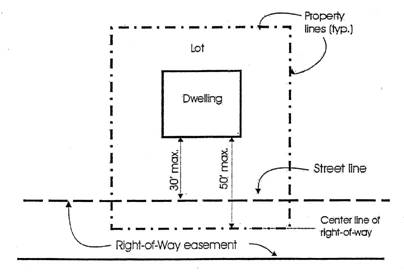
Example where the "street" is a dedicated right-of-way.
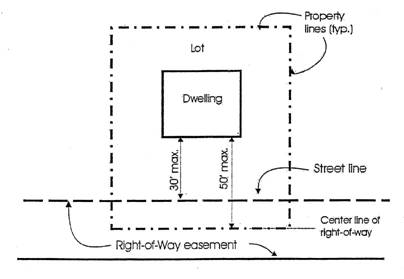
Example where the "street" is an easement for right-of-way purposes, rather than a dedicated right-of-way.
E.
The diagrams in this section are illustrative only and not part of the ordinance.
F.
Homes Eight Thousand Square Feet and Greater. On property improved with a single-family residence eight thousand square feet or greater in size, the street line and interior setbacks shall be increased in the aggregate by fifteen feet beyond what would otherwise be required under this chapter, with a minimum of five feet being added to the street-line setback and the balance being added to the interior setback.
(Ord. 683 § 9, 2008; Ord. 639 § 17, 2003)
17.24.030 - Measurement.
A.
In determining compliance with the provisions of this chapter, the distance between a lot line and a structure located on the lot shall be measured along a line perpendicular to the lot line beginning at the lot line and continuing to the nearest measuring point (as defined in subsection B of this section) of the structure.
B.
1.
The edge of the pavement on tennis and other play courts shall be the measuring point for such structures.
2.
The edge of the coping, if any, of a swimming pool, spa, or hot tub shall be the measuring point. If there is no coping, the edge of the water in a swimming pool, spa, or hot tub shall be the measuring point.
3.
The nearest exterior wall shall be the measuring point for buildings.
4.
For all other structures, the edge of the structure shall be the measuring point.
(Ord. 639 § 17, 2003)

