
Holland Township City Zoning Code
PART III
DEVELOPMENT PROVISIONS
Sec. 8.1 - Intent and purpose.
This article outlines requirements that are applicable for situations that may occur in any location in Holland Charter Township regardless of the zoning district designation, unless otherwise specified.
Sec. 8.2 - Access.
A.
Frontage. Each lot of record shall have frontage on a public street right-of-way or private street easement for at least the minimum lot width required for the zoning district within which the lot is located. Cul-de-sac lots or lots on the outside edge of curved streets shall have a minimum of 40 feet of lot frontage and minimum lot width shall comply with the requirement of the applicable zoning district.
B.
Residential private streets.
1.
A private street easement not less than 66 feet in width shall be provided to such lot of record if it is not located in a platted subdivision or a site condominium. The easement shall be recorded in the Ottawa County Register of Deeds Office and a copy of the recorded easement provided to the zoning administrator prior to issuance of a building permit for construction of improvements on the lot of record.
2.
The lot of record shall have frontage on the private street easement for at least the minimum lot width required for the zoning district within which the lot of record is located.
3.
The street surface shall be improved and constructed with a width and materials according to the following schedule, based on the number of lots of record that may be served by the private street easement currently or in the future:
a.
One to four lots of record: 22-foot wide asphalt or concrete surface.
b.
Five or more lots of record: Width shall comply with the specifications of the Ottawa County Road Commission for public streets.
c.
The street surface shall be constructed in accordance with the requirements of this section.
4.
When a lot of record is located in a platted subdivision or site condominium, access shall be provided from a street meeting the requirements of chapter 30, Subdivisions.
C.
Non-residential private streets.
1.
A private street easement not less than 66 feet in width shall be provided to such lot of record if it is not located in a platted subdivision or a site condominium. The easement shall be recorded in the Ottawa County Register of Deeds Office and a copy of the recorded easement provided to the zoning administrator prior to issuance of a permit for construction of improvements on the lot of record.
2.
The street surface shall be improved with asphalt or concrete pavement, constructed in accordance with the requirements of this section.
3.
When a lot of record is located in a platted subdivision or site condominium, access shall be provided from a street meeting the requirements of chapter 30, Subdivisions.
D.
Construction requirements.
1.
Construction and pavement shall comply with the specifications of the Ottawa County Road Commission for public streets.
2.
An engineer's certification of construction compliance is required.
3.
Base course pavement shall be installed prior to the issuance of building permits for structures to be served by the street.
4.
Surface course pavement shall be installed prior to the issuance of building certificates of occupancy for the structures that will be served by the street.
E.
Easement and maintenance agreement. Applications for private streets shall include a recordable legal instrument and agreement for a review prior to approval.
1.
Recordable legal instrument. A copy of the recordable legal instrument(s) describing and granting the easement(s).
2.
Content. A copy of a recordable travel surface maintenance agreement, signed by all owners of the lands served by the access easement and other parties in interest, which includes the following:
a.
Provisions that assure that the travel surface will be maintained, repaired, and snowplowed for the full width and length to ensure safe travel and accessibility by emergency vehicles at all times.
b.
Provisions that assure that the costs of maintenance of the travel surface and its easement are paid for in an equitable manner.
c.
A legal description of the easement and a legal description of the individual lots of record to be served. All properties served by the easement and travel surface shall be subject to the maintenance agreement.
d.
Provisions declaring that the maintenance agreement constitutes a restrictive covenant, running with the benefitted lands, and binding on all current and future owners and other parties in interest as to the respective obligations stated therein.
e.
Provisions to indemnify, save and hold the township, and its officers, employees, and agents, harmless from any and all claims for personal injury and/or property damage arising out of the failure to property construct, maintain, repair, or replace the travel surface.
(Ord. No. 596, § 2, 8-15-2019; Ord. No. 647, § 2, 9-7-2023)
Sec. 8.3 - Accessory buildings.
A.
Residential principal use. Buildings accessory to principal residential dwellings are subject to the following requirements:
1.
Detached and attached. Accessory buildings may be detached from the permitted principal building or as an integral part of the permitted principal building.
2.
Character. The architectural character of all accessory buildings shall be compatible and similar to the principal building.
3.
Attached. Accessory buildings shall be considered as attached to a principal building when the distance between the two buildings is solidly covered by a breezeway, portico, covered colonnade or similar architectural element no greater than ten feet in length. Attached accessory buildings are subject to the spatial requirements for principal buildings for the applicable zoning district.
4.
Living quarters prohibited. No accessory building or structure shall include residential or living quarters.
5.
Commercial use prohibited. Accessory buildings may be used for hobby, storage, or recreational activities and shall not involve the conduct of any business, trade, or industry.
B.
Non-residential principal use. Buildings accessory to non-residential principal buildings are subject to the same requirements as the principal building.
Table 8.3A Accessory Building Requirements: Agricultural and Residential Districts, Number and Size
1 Pump houses that are 15 square feet in area or less and under three feet in height do not count against the maximum number of detached accessory buildings per lot of record.
Table 8.3B Accessory Building Requirements: Agricultural and Residential Districts, Other Requirements
2 Pump houses may be located within 40 feet of the shoreline if 15 square feet in area or less and if under three feet in height.
(Ord. No. 596, § 3, 8-15-2019)
Sec. 8.4 - Control of external impacts.
A.
General requirements. Every regulated use shall be operated in a manner that it is not obnoxious or dangerous by reason of heat, glare, fumes, odors, dust, noise, or vibration beyond the lot of record on which the use is located. All land shall be stabilized in such manner as is necessary to prevent erosion, sand blows, or other soil conditions.
B.
Fire and explosion hazards. All buildings, storage and handling of flammable materials, and other activities shall conform to fire ordinances and to any applicable state and federal regulations or requirements. A land use shall not represent a fire or explosion hazard to another adjacent property or to the general public. The storage, use, or manufacture of materials, goods or products, ranging from free or active burning to intense burning, as determined by the Fire Marshal, is permitted subject to compliance with all other yard requirements and performance standards previously described and if the following conditions are met:
1.
All flammable liquids, solvents, cleaners, and other hazardous substances capable of contaminating groundwater or soil shall be stored within a building. Secondary containment measures shall be installed and utilized to prevent ground contact by any spills.
2.
All such materials or products shall be produced, stored, or used in a completely enclosed building or structure that has noncombustible exterior walls and that also meets all related building code requirements.
3.
The storage and handling of flammable liquids, liquefied petroleum, gases, and explosives shall comply with applicable state rules and regulations.
4.
All handling of flammable or hazardous substances shall be in accordance with state and federal laws, all required permits shall be obtained, and the establishment shall remain in conformance with all such requirements.
C.
Smoke and/or air pollution control. Smoke, radiation, fumes, gases, dust, odors or other atmospheric pollutants shall not be emitted beyond the boundaries of a lot in a manner that may cause property damage or hazards to public health, be detrimental to the property rights of others, or constitute a nuisance. Emissions shall be in strict conformance with all applicable federal, state and county health laws.
D.
Vibration. Vibration caused by a land use activity shall not be detectable beyond the boundaries of the site on which the activity is conducted.
E.
Noise. Noise created by a land use activity shall not adversely affect an adjoining property.
Sec. 8.5 - Grading, excavation, and ponds.
A.
Drainage.
1.
Slope. Elevations for any site with a building located on it, or a site proposed for a building, shall have a grade sloping away from the walls of the building to prevent the ponding of surface water along foundations.
2.
Runoff. No site shall be filled or graded in a way that will discharge surface runoff onto adjacent properties in a manner that increases the amount of runoff over predevelopment conditions.
B.
Excavation. The construction, maintenance or existence of any unprotected, un-barricaded, open or dangerous excavations, holes, pits or wells, which, in the opinion of the zoning administrator, constitute or are likely to constitute a danger to the public health, safety or welfare is prohibited. This section shall not apply to any excavation for which a building permit or a temporary permit has been issued by the township.
C.
Ponds. No pond shall be constructed in Holland Charter Township unless it has been approved as required by the Ottawa County Water Resources Commissioner.
Sec. 8.6 - Height.
A.
Measurement. Building height is measured from the elevation of the finished grade at the front of a building, on a level lot, to:
1.
Mansard, gable, hip or gambrel roof. The average height between the eaves and the ridge (Figure 8-1).
2.
Flat roof. The highest point of the roof for a flat roof.
3.
Other roof type. A point equivalent to the roof types specified in this section, as determined by the zoning administrator.
B.
Requirements and exceptions. See Tables 3.3B, 4.3B, 5.3B, and 6.3B for height maximums by zoning district. The following buildings and structures shall be exempt from height regulations in all zoning districts: Parapet walls (up to 48 inches), chimneys, cooling towers, elevator bulkheads, fire towers, gas tanks, grain elevators, silos, stacks, stage towers or scenery lofts, penthouses housing necessary mechanical appurtenances, flour mills, food processing plants, elevated water tanks and water towers, monuments, cupolas, domes, spires, and windmills. Amateur radio and over-the-air reception devices are regulated in section 9.3 and wireless communication towers and antennas are regulated in section 9.29 and are not subject to this section or Tables 3.3B, 4.3B, 5.3B, and 6.3B.
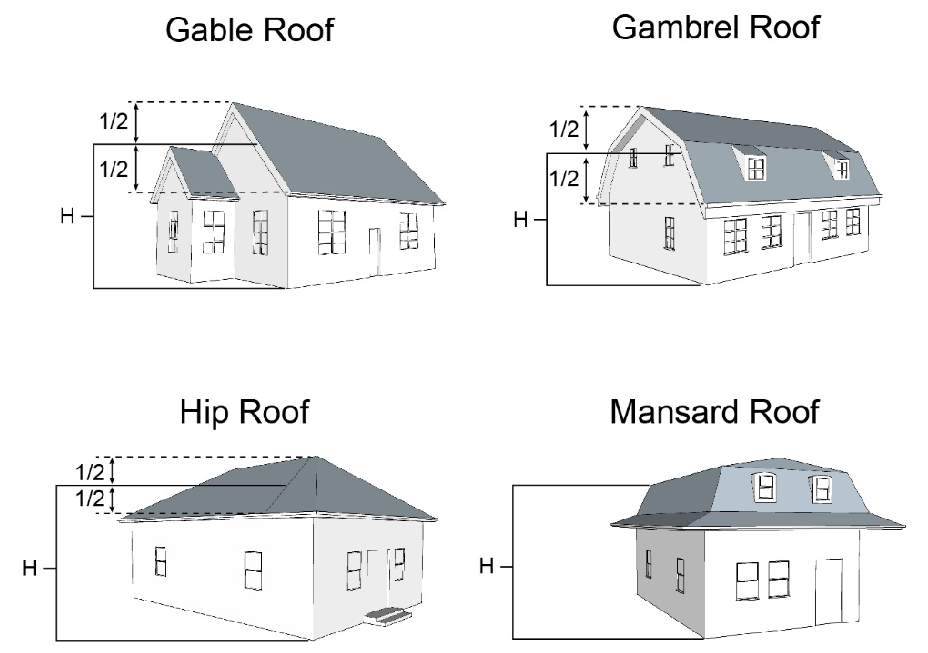
Figure 8-1 Roof Height Measurement
Sec. 8.7 - Household domestic animals.
Keeping household domestic pets is expressly permitted as an accessory use. No more than four adult dogs or cats or any combination thereof shall be kept or housed in one dwelling unit. Keeping of wild animals is prohibited.
(Ord. No. 596, § 4, 8-15-2019)
Sec. 8.8 - Murals.
Only one mural is allowed per structure and murals must be maintained to minimize flaking paint or surface failure.
Sec. 8.9 - Principal buildings and uses.
On residential lots of record in the AG, R-1, R-2, R-2A, and R-3 districts, no more than one principal building shall be placed on a lot of record. This section does not apply to single-family attached and multi-family residential developments.
Sec. 8.10 - Setbacks, orientation, and lot dimensional requirements.
A.
Setback requirements.
1.
Minimum requirement. Unless otherwise stated, principal buildings, accessory buildings, and all structures over 30 inches in height are subject to a minimum required horizontal separation from right-of-way lines and lot lines as required by the applicable zoning district. Also included is any portion of a building or structure which is supported by a foundation, regardless of height.
2.
Measurement. Setbacks are measured from the exterior edge of the foundation of buildings and structures, or the exterior and outermost edge of any structure over 30 inches with or without a foundation.
B.
Projections into setback areas.
1.
Architectural features. Certain architectural features such as cornices, bay windows, window wells, eaves, and other cantilevered elements determined by the zoning administrator to be similar, may project no further than three feet into a setback area, provided that the extension is at least five feet from the vertical plane of any lot line.
2.
Stairs and ramps. Stairs and ramps may project into a setback area, provided that the extension is at least five feet from the vertical plane of any lot line.
3.
Covered and enclosed additions. Any permanently constructed porch, patio, carport, terrace, addition, deck, or balcony that is covered by a roof or trellis, or enclosed by a barrier, wall, or screen, shall meet the minimum setback requirements of the principal building or accessory building to which it is attached. Any other similar covering or enclosing structural element shall be subject to the same requirement.
C.
Depth to width ratio. If under ten acres in area, a lot of record shall not be more than four times deeper than its width.
D.
Macatawa waterfront setbacks.
1.
Applicability. The minimum rear (lake side) setback for a lot abutting Lake Macatawa shall, notwithstanding any other term or provision of this article to the contrary, be established by measurement from an established point at the water's edge, known as a traverse line.
2.
Requirements. The minimum setback for the lots depicted on the traverse line maps is established as follows:
a.
Specified neighborhoods.
i.
Lots south of the Howard B. Dunton Park and north of Lot 21 of the Oak Lawn Park Subdivision shall have a rear yard building setback of 90 feet from the traverse line.
ii.
Lots, including south and west of Lot 21 of the Oak Lawn Park Subdivision, shall have a rear yard building setback of 50 feet from the traverse line.
b.
Historical setback line. The minimum rear yard shall be the lesser of the established setback as indicated in this section or, if the lot has an existing principal structure, that building footprint may be replicated and used as the setback for that portion on the lake side, so long as the building is determined to be legal nonconforming and construction on a replacement structure commences within one year following the date of a demolition permit. If the previous principal building is destroyed by casualty, the one year period shall begin to run as of the date of the casualty. The one year time period specified above shall, as of the effective date that this subsection is added to the ordinance, be applied retroactively so that the rear yard of a principal building destroyed or demolished before that effective date may be utilized to establish the rear yard of a new building provided application for a zoning permit is made for the new building within one year after the loss by casualty or demolition of the old building.
Sec. 8.11 - Swimming Pools.
A.
Permit required. No person shall erect, install, locate or maintain a swimming pool unless a permit therefor has first been obtained from the Township.
B.
Requirements.
1.
Location. No pool shall be located in a front yard.
2.
Setbacks.
a.
In-ground. The outside edge of the pool wall or a complementing structure, such as a deck or pool access structure, shall not be located nearer than five feet to any lot or property line.
b.
Above-ground. The outside edge of the pool wall or a complementing structure, such as a deck or pool access structure, shall not be located nearer than ten feet to any lot or property line.
3.
Structures. Any complementing structure that is erected immediately adjacent to a pool, shall be considered to be part of the pool and will, for the purposes of zoning, be considered to be attached or one with the pool.
Sec. 8.12 - Tents.
A.
Applicability. This section applies to tents when permitted in association with special events and temporary outdoor sales, as defined in article 22.
B.
Requirements.
1.
Tents are subject to International Fire Code and Township permitting requirements.
2.
All tents must be composed of material meeting the flame propagation performance criteria of National Fire Protection Association ("NFPA") 701 or shall be treated with a flame retardant in an approved manner and meet the flame propagation performance criteria of NFPA, and that such flame propagation performance criteria are effective for the period specified by the permit. All membrane structures shall have a permanently affixed label bearing the identification of size and fabric or material type.
3.
No tent shall be located within 20 feet of a lot line, structure, building, generator, internal combustion engine, and any outdoor cooking apparatus that produces sparks or grease-laden vapors. Generators and other internal combustion engines shall be isolated from the general public by access control.
4.
Tents or membrane structures shall be adequately roped, braced, and anchored to withstand the elements of weather and prevent against collapsing.
5.
Aisles, exits, and access points must always be kept clear and exits must be identified.
6.
Tents used after dark must be equipped with approved lighting.
Sec. 8.13 - Traffic visibility.
A.
Clear vision. No use, building, structure, sign, snow storage, or plant material (except trees with all branches six feet or more above the ground) taller than 30 inches or which obstructs safe vision at a street corner shall be located, erected, or maintained within the following clear vision areas.
1.
Intersection of streets. Within the triangular area formed by the intersection of the street right-of-way lines and a line connecting two points which are located on those intersecting right-of-way lines 30 feet from the point of the intersection of the right-of-way lines (Figure 8-2).
2.
Street and driveway. Within the triangular area formed by the intersection of a street right-of-way line and a driveway and a line connecting two points that are located on the right-of-way line and the driveway 20 feet from the point of intersection of the right-of-way line and driveway (Figure 8-2).
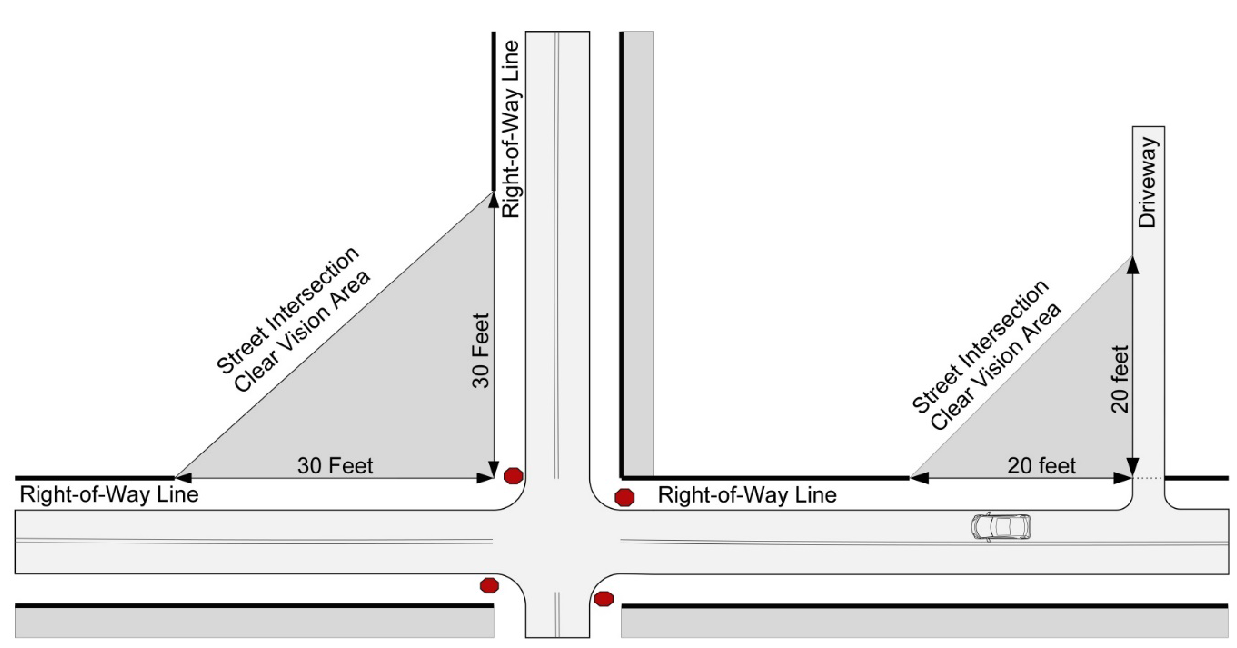
Figure 8-2 Traffic Visibility
Sec. 8.14 - Unwholesome substances.
A.
Dumping prohibited. No unwholesome substance, as defined in article 22, shall be deposited, dumped or accumulated by any person on any land, private or public, in the township, unless such place has been designated as a public dumping ground by the township, or unless such substance is housed in a completely enclosed building.
B.
Water quality protection. No sewage, wastewater, or water containing foreign substances shall be deposited or drained onto any land or deposited or drained into any open ditch, creek, stream, lake, pond or other body of water unless the same has been first approved by the Michigan Department of Health and the Ottawa County Health Department.
C.
Accumulation of materials. No rubbish, boxes, barrels, lumber, scrap metal, automobile body, or other materials shall be accumulated by any person on any land in such a manner as to provide rat harborage. Lumber, boxes, barrels and similar materials shall be neatly piled on suitable platforms raised above the ground so as to discourage and prevent rat harborage.
Sec. 8.15 - Walls and fences.
A.
Applicability. The provisions of this section shall not apply to fences utilized as part of a farm operation.
B.
Setbacks. No fence, hedge, or planting of shrubs exceeding 30 inches in height shall be erected or maintained within 15 feet of the front lot line or any other lot line which is adjacent to a street.
C.
Height.
1.
Agricultural and residential. No fence exceeding six feet in height shall be erected or maintained in the agricultural and residential zoning districts.
2.
Non-residential. No fence exceeding eight feet in height shall be erected or maintained in any non-residential district.
3.
Screening. Any fence erected on top of a deck or patio serving as a screen or security function shall be no more than six feet above the average surrounding grade or alternatively be no more than four feet above the surface of the deck.
4.
Waterfront. Fences and walls, including pool fences, shall not exceed four feet in height within Lake Macatawa waterfront yards.
D.
Residential materials and design.
1.
Materials. Walls and fences, including gates, shall be constructed of new, durable, weather-resistant, rustproof, and easily maintainable materials customarily used in the construction of walls and fences, such as wood, wrought iron, masonry, or wood rail construction. This shall not preclude the use of decorative architectural materials when consistent with the intent of this section, the character of the area in which the fence is to be placed, and if approved by the zoning administrator. Chain link fences slats are prohibited.
2.
Finished side. If one side of a fence has a finished side, that side shall face adjacent properties, the water, or public right-of-way.
3.
Sharpened edges and points. No fence shall contain barbed wire, razor wire, or any other sharpened edges.
E.
Commercial and industrial districts materials. In the C-1, C-2, C-3, I-1, and I-2 zoning districts, barbed wire, razor wire, and sharpened edges may be utilized as part of a fence if the sharpened portions are at least six feet above the ground. Chain link fence slats are prohibited.
(Ord. No. 596, § 5, 8-15-2019)
Sec. 8.16 - Waste disposal.
A.
Storage. If materials or wastes are stored outside which might cause fumes, odors, unsanitary conditions, blight, and dust or which constitute a fire hazard or which may be edible by rodents or insects, then such materials shall be stored only in closed containers and screened from public view and adjacent properties.
B.
Litter prevention. No materials or wastes shall be deposited on a lot of record in such form or manner that they may be moved off the lot of record by natural causes or forces.
C.
Accumulation. Waste materials shall not be allowed to accumulate on a lot of record in such manner as to be unsightly, constitute a fire hazard or contribute to unsanitary conditions.
Sec. 8.17 - Water, sewer, and septic.
No permit shall be issued for the construction of a building or structure which is to have drinking water and/or sanitary facilities located therein and which is to be located on a lot of record which is not served by both public water and sewer facilities if its water supply and/or sewage disposal facilities, as the case may be, do not comply with the Rules and Regulations Governing Waste and Sewage Disposal of Ottawa County.
Sec. 8.18 - Recreational marihuana establishments.
A.
Marihuana establishments, as authorized by and defined in the Michigan Regulation and Taxation of Marihuana Act (the "Act"), are prohibited in all zoning districts, and shall not be permitted as home occupations under section 9.13 of this ordinance.
B.
No use that constitutes or purports to be a marihuana grower, marihuana safety compliance facility, marihuana processor, marihuana microbusiness, marihuana retailer, marihuana secure transporter or any other type of marihuana related business authorized by the Act, that was engaged in prior to the enactment of this ordinance or prior to the addition of this section to the ordinance, shall be deemed to have been a legally established use under the provisions of this ordinance; that use shall not be entitled to claim legal nonconforming status.
C.
Violations of this section are subject to the violations and penalties pursuant to article 1 of this ordinance and may be abated as nuisances.
(Ord. No. 590, § 1, 2-21-2019)
Sec. 9.1 - Intent and purpose.
A.
Applicability. Specific requirements apply to all land uses listed in this article. These requirements apply in addition to all the regulations of the zoning district in which the use is located, as well as all other applicable requirements in this ordinance.
B.
Special land uses. A use identified in this ordinance as a special land use shall be established only per the procedures and standards of article 15. All standards listed in this article, in addition to the general standards for special land uses listed in section 15-3, shall be met.
Sec. 9.2 - Agricultural labor camp.
A.
Location. An agricultural labor camp shall be located on an active farm operated by the agricultural labor camp operator.
B.
Minimum area. An agricultural labor camp shall be located on a lot of record five acres or greater.
C.
Security. Agricultural labor camps shall only be occupied when licensed by the State of Michigan. Buildings shall be secured to prevent unauthorized access when not licensed or occupied.
D.
State regulations. State of Michigan rules, regulations, and standards governing the licensing, occupancy, and operation shall apply to all agricultural labor camps.
E.
Spatial requirements.
1.
Setbacks. Agricultural labor camp buildings and amenities shall be located at least 50 feet from public right-of-way and at least 50 feet from any other property line. Parking areas shall be set back at least 50 feet from property lines and public right-of-way.
2.
Separation. The minimum distance between residential buildings in the camp shall be 20 feet.
F.
Emergency access. Clear and unrestricted access for emergency vehicles shall be maintained and site plans shall be subject to fire department review and approval.
G.
Parking requirements. See Table 10.3.
Sec. 9.3 - Amateur radio and over-the-air reception devices.
A.
Amateur radio.
1.
Intent and purpose. This section is intended to provide reasonable accommodation for amateur radio services in the township and to constitute minimum practicable regulation to accomplish the township's legitimate purposes consistent with state and federal laws including federal communication commission regulations pertaining to amateur radio services, as noted in PRB-1 (1985), as amended and reconsidered. Legitimate purposes include but are not limited to preserving residential character and preserving public health, safety, and welfare.
2.
General requirements. The following shall apply to all amateur radio antennas and/or amateur radio antenna support structures, which are physical components of amateur radio service:
a.
Allowed in all districts on a lot with a principal building, subject to requirements of the zoning ordinance.
b.
All amateur radio antennae and amateur radio antenna support structures shall comply with the FCC required safety standards and regulations pertaining to amateur radio services.
c.
Amateur radio antenna and/or amateur radio antenna support structures shall be set back from all lot lines a distance no less than 110 percent of its overall height, or the required building setbacks of the zoning district, whichever is greater.
d.
Height.
i.
For roof-mounted antenna and/or antenna support structures, overall height is measured from the elevation of the finished grade at the front of a building.
ii.
For ground-mounted amateur radio antennas and/or antenna support structures, overall height is measured from the established grade adjoining the antenna and/or support structure.
e.
Maximum number. Two per lot of record.
3.
Permitting and review.
a.
Review authority. Required review procedures shall be based on the height, as follows:
i.
Seventy feet or less, exempt from permitting.
ii.
Over 70 feet, special land use review process.
b.
Content. Applications shall include the following:
i.
A copy of the manufacturer's specifications for construction, assembly and erection and a certification from the owner and/or licensee that such specifications have been followed in erecting the subject structure.
ii.
A certification by a licensed professional engineer confirming the structural stability and soundness of the proposed amateur radio antenna and/or amateur radio antenna support structures if over 70 feet.
iii.
FCC amateur radio license.
iv.
Site plan showing location, setbacks, and other requirements.
B.
Over-the-air reception devices.
1.
Intent. The intent of this section is to prevent unreasonable delay of permitting these devices, to allow installation, maintenance and use; to not unreasonably increase the cost of installation, maintenance or use; to ensure reception of an acceptable quality signal; and to protect health, safety, and welfare.
2.
Exemption. The following devices are exempt from permitting and zoning requirements:
a.
A dish antenna that is one meter (39.37 inches) or less in diameter and is designed to receive direct broadcast satellite service, including direct-to-home satellite service, or to receive or transmit fixed wireless signals via satellite.
b.
An antenna that is one meter (39.37 inches) or less in diameter or diagonal measurement and is designed to receive video programming services via broadband radio service (wireless cable) or to receive or transmit fixed wireless signals other than via satellite.
c.
An antenna that is designed to receive local television broadcast signals.
3.
Height and masts. Antennas may be mounted on mast structures to reach the height needed to receive or transmit an acceptable quality signal (e.g. maintain line-of-sight contact with the transmitter or view the satellite).
4.
Permitting. Mast structures higher than 12 feet above the highest point of a building are subject to Township permitting and the design standards of this section and the following information shall be provided:
a.
A copy of the manufacturer's specifications for construction, assembly and erection and a certification from the owner and/or licensee that such specifications have been followed in erecting the subject structure.
b.
A certification by a licensed professional engineer confirming the structural stability and soundness of the proposed amateur radio antenna and/or amateur radio antenna support structures if over 50 feet.
c.
Site plan showing location, setbacks, and other requirements.
5.
Setbacks. Over-the-air reception devices mounted on mast structures that are 12 feet higher than the roofline of the principal building shall be subject to setbacks of no less than 110 percent of their height.
C.
Design standards. The following standards shall be met and maintained for all amateur radio antenna and/or amateur radio antenna support structures as well as all over-the-air reception devices mounted on mast structures that are 12 feet higher than the roofline of the principal building:
1.
Color. Towers shall either maintain a galvanized steel finish or, subject to any applicable standards of the FAA, be painted a neutral color to reduce visual obtrusiveness.
2.
Location. No roof-mounted amateur radio antenna and/or amateur radio antenna support structures shall be fixed to the side of a structure or roof that faces a street. Ground-mounted amateur radio antenna and/or amateur radio antenna support structures shall not be allowed in the front yard or a side yard facing a street.
3.
Guy wires. Guy wires may encroach into required rear and side setbacks, but shall be no closer than one foot from lot lines.
4.
Security and safety. Climbable ground-mounted amateur radio antenna and antenna support structures shall be completely enclosed by a fence at least five feet but no more than seven feet in height or shall have appropriate anti-climb devices attached up to a height of five feet or more.
5.
Lighting. Lighting shall be installed per federal aviation administration rules and/or regulations, if required.
Sec. 9.4 - Bed and breakfast.
A.
Principal residence. The dwelling in which the bed and breakfast operates shall be the principal residence of the owner/operator and the owner/operator shall live on the premises when the bed and breakfast is in operation.
B.
Appearance. The structure shall maintain an exterior appearance that is in character with surrounding residential uses.
C.
Guest rooms. The number of guest rooms is limited to one less than the total number of bedrooms in the dwelling unit, not to exceed five guest rooms total.
D.
Occupancy. Maximum occupancy is limited to two adults per guest room.
E.
Term. Length of stay for a lodger shall not exceed 14 consecutive days.
F.
Cooking. No separate cooking facilities shall be provided.
G.
Special events. Outside special events shall occur no more than four times within a 12-month period, with a maximum duration of two days per occurrence. Sufficient parking shall be provided for each event. A temporary use permit approved by the zoning administrator shall be obtained for assembly activities. Noise from events is subject to the noise regulations of the township Code.
H.
Parking. See Table 10.3.
Sec. 9.5 - Day care, group day care home (7+ children).
A.
Separation. Is located not closer than 1,500 feet to any of the following:
1.
Another licensed group day care home.
2.
Another adult foster care small group home or large group home licensed under the Adult Foster Care Facility Licensing Act, Michigan Act No. 218 of the Public Acts of 1979 (MCL 400.701—400.737).
3.
A facility offering substance abuse treatment and rehabilitation service to seven or more people licensed under article 6 of the Public Health Code, Act No. 368 of the Public Acts of 1978 (MCL 333.6101—333.6523).
4.
A community correction center, resident home, halfway house, or other similar facility which houses an inmate population under the jurisdiction of the department of corrections.
B.
Fencing. Appropriate fencing for the safety of the children in the group day care home shall be determined by the planning commission.
C.
Appearance. The property and improvements related to the operation shall be consistent with the characteristics of the neighborhood.
D.
House of operation. Operations shall not exceed 16 hours of operation during a 24-hour period. The planning commission may limit but not prohibit the operation of a group day care home between the hours of 10:00 p.m. and 6:00 a.m.
Sec. 9.6 - Dwelling, accessory.
A.
Single-family. Accessory dwelling units are limited to single-family dwellings.
B.
Detached prohibited. No detached accessory building or structure shall be used for dwelling purposes.
C.
Number. Only one attached accessory dwelling unit shall be permitted per principal building, per lot of record.
D.
Design.
1.
An attached accessory dwelling unit shall be integrated within or attached to the principal dwelling. Any accessory dwelling unit shall comply with all setback requirements applicable to the principal dwelling.
2.
The accessory dwelling may be designed as an independent living area that can be isolated from the principal dwelling space, however, an internal connection to the principal dwelling must be maintained and the primary entrance to the home shall be shared.
E.
Appearance. The accessory dwelling shall retain a residential appearance consistent with the design and materials of the principal dwelling portion of the building.
F.
Area. Accessory dwelling square footage shall not exceed 640 square feet, or 50 percent of the principal dwelling square footage, whichever is less.
G.
Metering and mailing. The accessory dwelling shall not have a separate meter for public utilities, such as electric and gas service, or a separate mailing address.
Sec. 9.7 - Dwelling, multi-family, single-family attached.
A.
R-2A requirements. The principal means of ingress and egress to the site is from a street classified as a primary road by the Ottawa County Road Commission.
B.
Storage. Each dwelling unit shall include or be provided storage areas totaling no less than ten percent of the required minimum floor area. These storage areas shall provide floor to ceiling storage and may consist of a basement, closet area, attic and/or separate accessory building.
(Ord. No. 596, § 5, 8-15-2019; Ord. No. 657, § 4, 3-20-2025)
Sec. 9.8 - Dwelling, single-family and two-family.
A.
Applicability. All single-family and two-family dwellings are subject to the requirements of this section.
B.
Purpose. The purpose of this provision of the zoning ordinance is to provide reasonable standards that ensure that all single-family and two-family dwellings, regardless of construction type (e.g. site-built, manufactured, prefabricated, or modular), are safe and compatible and compare aesthetically within the same residential district.
C.
Foundations. The dwelling shall be firmly attached to a foundation wall of the same perimeter dimensions as the dwelling unit and be constructed of such materials and type as required for on-site constructed single-family dwellings.
D.
Dimensional requirements.
1.
The dwelling shall have a maximum length to width ratio of three to one.
2.
The dwelling shall have a minimum width across any front, side or rear elevation of 20 feet.
E.
Storage. Storage areas totaling no less than 120 square feet per dwelling unit shall be provided. These storage areas may consist of a basement, closet area, attic, and/or a separate accessory building.
F.
Appearance.
1.
The dwelling shall be constructed entirely with materials of consistent quality. The dwelling shall contain no additions, rooms, or other areas which are not constructed with similar quality workmanship as the original structure.
2.
Garages shall be architecturally compatible with the dwelling and in conformance with all other requirements of this ordinance.
3.
The exterior finish of the dwelling shall not cause excessive glare or reflection that is greater than that from siding coated with clean, white, gloss, exterior enamel.
G.
Garage. One private garage per dwelling unit is required, which may be either attached or detached, unless another provision of this ordinance requires that the garage be attached, and shall have minimum dimensions of ten feet in width by 22 feet in length.
H.
Additional requirements for manufactured homes. A manufactured home shall be installed with the wheels removed. No manufactured home dwelling shall have any exposed towing mechanism, undercarriage, or chassis. However, this requirement does not apply to manufactured homes located in manufactured home communities within the township.
I.
Additional requirements for two-family dwellings.
1.
R-2. Two-family dwellings are permitted if each dwelling unit is provided with an attached private garage; the lot of record has frontage on a street classified as a primary road by the Ottawa County Road Commission; and the dwelling is aesthetically compatible in design and appearance with other dwellings in the vicinity.
2.
R-2 A. Two-family dwellings are permitted if each dwelling unit is provided with an attached private garage and the dwelling is aesthetically compatible in design and appearance with other dwellings in the vicinity.
(Ord. No. 596, § 6, 8-15-2019; Ord. No. 647, § 3, 9-7-2023)
Sec. 9.9 - Earth-sheltered buildings.
A.
Requirements.
1.
The design of the earth-sheltered structure shall be certified by an architect or engineer registered in Michigan.
2.
In computing the compliance with the requirements of this ordinance with respect to minimum floor area requirements, unfinished areas shall not be counted.
3.
Minimum yard requirements shall be determined excluding any portion of ground above finished grade which is covering a portion of the structure.
4.
The earth-sheltered structure is in compliance with all applicable health laws, codes, rules, and regulations.
B.
Specific special land use approval standards. In addition to the requirements of section 15.3, the planning commission shall consider the following additional standards:
1.
The architectural character of the earth-sheltered structure in relation to the architectural character of the surrounding neighborhood;
2.
Whether the portion of the structure below finished grade is safe, healthy and waterproof;
3.
Whether proper light and ventilation will be provided to the portion of the structure below finished grade;
4.
Whether the site of the earth-sheltered structure is subject to flooding; and
5.
The effect of the proposed earth-sheltered structure on adjoining properties and the surrounding neighborhood.
Sec. 9.10 - Farms and farm operation.
Farms and farm operations are defined in section 22.2 and are regulated by the State of Michigan Department of Agriculture. Farms that are compliant with the State of Michigan Generally Accepted Agricultural and Management Practices (GAAMPs) are not subject to this ordinance unless the farms are prohibited by this ordinance where they are located, and that prohibition is not superseded by GAAMPs.
Sec. 9.11 - Food truck.
A.
Location and restrictions. Unless otherwise specified herein food truck service is limited to serving employees, patrons, and customers of a business operating on the lot of record on which the food truck is parked.
B.
Requirements.
1.
Food trucks shall be located on a privately-owned lot of record where an existing permanent business operates in a building with a certificate of occupancy. A maximum of two food trucks shall be allowed on a lot of record at any one time.
2.
Food trucks shall not obscure traffic sight visibility or operate in driveways or fire lanes.
3.
Food trucks may operate in parking spaces if the required parking for the property remains in compliance with the parking requirements of this ordinance.
4.
Food trucks shall not provide a drive-through service of any kind.
5.
Food truck service shall be limited to two hours per day, per lot of record, unless all of the following conditions can be met:
a.
Service is associated with a large-scale regional special event, as determined by the zoning administrator.
b.
Food truck parking, placement and usage as part of a large-scale regional special event shall require written authorization from the zoning administrator.
c.
Food truck shall only be allowed to remain for a maximum of 14 days.
6.
Food truck parking shall be set back at least 20 feet from public right-of-way and all lot lines.
Sec. 9.12 - Foster care, adult foster care group home (7+ adults).
No adult foster care group home shall in any event be located within a 1,500 radius of any other adult foster care home.
Sec. 9.13 - Home occupation.
A.
Applicability. A home office that involves no sales of products or services with direct customer interaction on-site, no employees on-site, and no customers or clients that visit the premises, is not subject to the requirements of this section.
B.
Requirements.
1.
There shall be no sale of products or services except those that are produced on the premises where the home occupation is located.
2.
No person other than members of the family residing in the dwelling shall be engaged in the conduct of the home occupation.
3.
The use of the dwelling for the home occupation shall be clearly incidental and subordinate to its use for residential purposes, and not more than 20 percent of the floor area of the dwelling shall be used for the conduct of the home occupation.
4.
There shall be no change in the outside appearance of the dwelling or any other visible evidence of the conduct of the home occupation in the dwelling. The home occupation shall be conducted and operated entirely within the confines of the dwelling.
5.
There shall be no outdoor storage of items supportive of the home occupation.
6.
No equipment or process shall be used in the home occupation which creates noise, vibration, glare, fumes or odors detectable to the normal senses off of the premises on which the home occupation is located if a single-family dwelling or outside the actual dwelling unit itself if conducted in a two-family or multifamily dwelling. In addition, in the case of a single-family dwelling, no equipment or process shall be used in the home occupation which creates electrical interference which causes visual or audible interference in any radio or television receivers off the premises on which the home occupation is located or causes fluctuation in the line voltage off the premises on which the home occupation is located. In the case of a two-family or multiple-family dwelling, no equipment or process used in the home occupation shall create such interference or line voltage fluctuation to any other dwelling unit on the premises or off the premises on which the home occupation is located.
7.
The operator of the home occupation shall make the dwelling unit within which the home occupation is conducted his/her legal and primary place of residence, where all activities such as sleeping, eating, entertaining and other functions and activities normally associated with home life are conducted.
8.
Visits by customers, clients, students or patients to licensed home occupations shall be limited to the hours of 7:00 a.m. to 8:00 p.m.
9.
The home occupation shall not generate traffic in a greater volume than would normally be expected in a residential neighborhood. Any need for parking generated by the conduct of the home occupation shall be met with the provision of suitable off-street parking to be located without utilizing any portion of the required front yard.
C.
Prohibited home occupations.
1.
Animal processing.
2.
Any repair of motorized vehicles, including the painting or repair of automobiles, trucks, trailers, boats, and lawn equipment.
3.
Animal hospitals or kennels.
4.
Restaurants or catering/food preparation businesses; including general food handling, processing, or packaging, but not including small bakery operations.
5.
Medical or dental offices.
6.
Construction businesses or landscaping businesses that provide for the storage of goods, equipment and materials to be utilized in the operation of the business or use.
7.
Furniture finishing and refinishing.
8.
Warehousing.
9.
Welding or machine shops.
Sec. 9.14 - Keeping of farm animals, chickens, and bees.
A.
Farm animals and chickens. Farm animals and chickens are only permitted on conforming lots in the AG zoning district; and at schools on school properties of at least five acres, with a maximum of five animals (excluding young animals dependent on mothers or less than six months of age), when approved as a special land use. Operations shall be compliant with all applicable State of Michigan Generally Accepted Agricultural and Management Practices.
B.
Beekeeping. The intent of this section is to authorize residents to keep honey bees on residential property under certain conditions.
1.
Applicability. Honey bees may be kept on non-farm properties in the AG, R-1, and R-2 zoning districts, subject to the requirements of this section.
2.
General requirements.
a.
Hives must be set back ten feet from all property lines and at least 50 feet from any dwelling on a neighboring property.
b.
An adequate and constant source of water, as temperatures allow, shall be placed within 20 feet of the location of bee hives and shall be permanently maintained while actively beekeeping.
c.
Beekeeping operations shall be compliant with the State of Michigan Generally Accepted Agricultural and Management Practices for Beekeeping and Apiary Management. Beekeepers must be able to provide verification of compliance.
(Ord. No. 602, § 4, 12-5-2019)
Sec. 9.15 - Manufactured home community.
A.
Conformance to state regulations. All manufactured home communities shall conform to the all applicable state regulations.
B.
Required development standards. Subject to subsection A. above, each lot in the community shall have:
1.
A minimum lot area of 4,750 square feet; and
2.
A minimum width of 50 feet at the front setback line.
Sec. 9.16 - Mineral extraction.
A.
Applicability. The provisions of this section shall not apply to the following:
1.
Where the removal or extraction of natural resources is more than 500 feet from any street or property line, occupies not more than five acres in area, does not constitute a weekly average intensity of use of more than 15 yards of material per day, and creates no area which fills with water other than a watering pond for farms.
2.
The incidental excavation of sand and gravel for only on-site use is excluded from the regulations of this ordinance except for the setback and yard requirements.
3.
General landscaping activities or the cultivation of land for farming purposes.
B.
Setbacks, buffers and separation.
1.
No excavation shall occur within 100 feet of a road right-of-way; within 200 feet of an off-site residence, housing development or residential district; and within 100 feet of a property line other than the above limits.
2.
The special land use permit may allow mineral extraction within the required setback area set forth above if a property owner, or owners, abutting that portion of the site affected by the minimum setbacks provide written consent prior to the planning commission's recommendation of the site plan. However, in no case shall an excavation occur within 200 feet of an off-site residence or 100 feet of a property owned by a non-consenting party.
3.
Areas within the setback are considered buffer zones that shall remain in a natural state, farmland, woodland or planted with vegetation. The township may require berms and/or other screening to reduce sound or vibration impact on neighboring properties when existing vegetation or topography is determined to be insufficient to mitigate impacts.
4.
Planted vegetative buffers, when required, shall be continuously maintained and noticeable gaps shall be replanted. Management or thinning is permitted to enhance overall growth, if conducted under the guidance of a certified forester or other qualified professional.
5.
Visible posts or markers shall be staked at the excavation limit setback lines every 50 feet during extraction in the active area to warn excavator operators of the limits of site disturbance.
6.
No mining shall take place within the specified distance from the margin of any stream or waterway as established by the Michigan Water Resources Commission, Department of Environmental Quality.
C.
Processing plants and stockpile.
1.
Permanent and temporary processing plants and accessory structures shall not be closer than 200 feet from any property line, including the road right-of-way.
2.
When practicable, the permanent processing plant shall be located within the excavation area, at a point lower than the general level of the surrounding terrain, to reduce the visual and noise impact of the plant structure.
D.
Operational plan. With the application for a special land use permit, an operational plan must be submitted for review by the planning commission and township board. At minimum, the operation plan shall include the following information:
1.
The areas to be mined and proposed phases.
2.
The location of permanent structures.
3.
Locations for storage piles.
4.
The points of access upon public streets.
5.
Screening and reclamation plans.
6.
Hours of operation.
7.
Estimated type and quantity of mineral materials to be removed.
8.
Description of extraction and processing methods.
9.
Equipment to be placed on the site.
10.
A summary of the procedures and practices that will be used to ensure compliance with the requirements of this section.
E.
Security and safety.
1.
Upon commencement of mining operations, the active mining area shall be enclosed by a fence that is no less than four feet in height and "No Trespassing" signs shall be placed along the fence at least every 100 feet. Fences shall be maintained in an upright position and in good repair.
2.
A gate at the active mining area shall be locked when the mine is not in active operation.
F.
Nuisance and impact mitigation.
1.
Noise and vibration shall not be a nuisance to the general health, safety, and welfare of the residents in the township, and shall be minimized in their effect on adjacent properties by the proper use of berms, walls, screen plantings and fences.
2.
Air pollution in the form of dust and dirt shall be kept at a minimum. Regular dust control practices shall be implemented for general excavation, moving soils, screening and crushing and records of activities shall be kept on site. Upon a complaint-based inspection or regular scheduled inspection, a Township code enforcement official shall inspect the site for unacceptable dust levels. Whether higher dust levels are due to environmental factors (dry season, wind, etc.) or management practices, upon notice, the operator shall proceed with an appropriate and effective dust control action, including but not limited to:
a.
As-needed watering to unpaved travel surfaces.
b.
As-needed sweeping of internal roads.
c.
Paving additional segments of the internal roadway or applying millings.
d.
As-needed watering during the crushing operations.
e.
A temporary pause of operations, should excessive winds result in the ineffectiveness of all other dust control measures.
f.
All equipment used for the mining operation shall be operated in such a manner as to minimize, to the maximum extent practicable, dust, noise and vibration conditions that are injurious or substantially annoying to persons living in the vicinity.
G.
Interior roads.
1.
Interior road surfaces may be gravel, crushed stone, or concrete or asphalt millings. When paving is required, it shall be completed prior to commencement of operations.
2.
Internal roads shall be maintained to reduce potholes and ruts as reasonable.
3.
Internal road signs shall be established, as required by the township. Required signs may include, but are not limited to: No engine brake, speed limit, slow, and stop.
4.
Operations shall incorporate internal circulation routes that minimize the need for truck reverse movements.
H.
Hours of and days of operation. The operation of mineral extraction and processing shall be restricted to the township approved hours and days of the week. No operations shall be conducted on Sundays or legal holidays, or at any time over the Memorial Day or Labor Day weekend, or the Independence Day weekend if July 4 falls on a Monday or Friday. The operation hours, days, seasons or months may be further restricted by the planning commission to minimize nuisance impacts on neighbors or for public safety considerations with respect to the use of roads. Under emergency, unanticipated or unusual circumstances, the hours of operation may be modified for a temporary period not to exceed 14 days, upon receipt of approval of the zoning administrator.
I.
Financial guarantee.
1.
The operator shall post a financial guarantee for restoration and stabilization determined by the planning commission. The township may adjust the guarantee amount at the time of special land use permitting and on an annual basis.
2.
The guarantee shall be provided in one of the following forms:
a.
Cash.
b.
Certified check.
c.
Irrevocable bank letter of credit.
d.
Surety bond acceptable to the township board.
3.
Upon reclamation of mined acreage, and reduction of net operational area, the bond or security shall be released in accordance with the amount or security required per acre.
J.
Standards of approval. In addition to review of the standards in this section and section 15.3, the planning commission shall also consider the following factors when assessing the likelihood of very serious consequences resulting from the extraction of natural resources:
1.
The relationship of extraction and associated activities with existing land uses.
2.
The impact on existing land uses in the vicinity of the property.
3.
The impact on property values in the vicinity of the property and along the proposed hauling route serving the property, based on credible evidence.
4.
The impact on pedestrian and traffic safety in the vicinity of the property and along the proposed hauling route serving the property.
5.
The impact on other identifiable health, safety, and welfare interests in the local unit of government.
6.
The overall public interest in the extraction of the specific natural resources on the property.
Sec. 9.17 - Mini-warehouse/self-storage.
A.
Spatial requirements. Mini-warehouse/self-storage facilities are subject to the following requirements:
Table 9.17 Mini-Warehouse/Self-Storage Spatial Requirements
B.
Use restriction. Use of any storage unit for the conduct of manufacturing, repair, service, sales, fabrication, assembly, or any other business purpose, other than storage of goods or merchandise, is prohibited.
C.
Caretaker's dwelling. A single one-bedroom dwelling unit is permitted as an on-site residence for the facility caretaker. This dwelling unit shall be physically attached to the building which contains the leasing and management office for the facility.
D.
Parking and access.
1.
Parking shall be paved in accordance with the requirements of section 10.4.
2.
There shall be a ten-foot wide parking lane adjacent to each side of a building that has access doors to storage units. Required parking may be situated in these lanes.
3.
One-way traffic aisles shall not be less than 15 feet in width. Two-way traffic aisles shall not be less than 22 feet in width. This width shall not count required parking lanes.
4.
Site access shall be limited to no more than two driveways which are located and constructed in compliance with all township ordinances and the requirements of the Ottawa County Road Commission, whichever are more stringent.
E.
Outdoor storage. Areas provided for outdoor storage of automobiles, boats, recreational vehicles, trailers, and similar personal property shall be designated on the site plan. These storage areas shall be enclosed and screened by the on-site storage unit buildings. Outdoor storage shall not be located within any required setback area. Storage surface area shall meet the requirements of section 9.22C.
Sec. 9.18 - Offices and services, temporary office.
A.
Temporary construction office. A temporary office building or yard for construction materials and/or equipment is permitted in any zone without a permit for such period of time as it is both incidental and necessary to construction at the site.
B.
Temporary sales office. A temporary office is permitted in any zone without a permit for such period of time as it is both incidental and necessary for the sale or rental of real property in a new subdivision or housing project.
C.
Natural disaster and emergency offices. The nature of emergency events is so unique based on each circumstance that they shall be reviewed on a case-by-case basis by the zoning administrator.
Sec. 9.19 - Outdoor display, sales and rental.
A.
Setbacks.
1.
General retail. General outdoor retail sales areas shall be subject to the setbacks for principal buildings.
2.
Vehicles, recreational equipment, manufactured homes, heavy equipment, and boats. Sales and rental lots shall be subject to 20-foot front yard setbacks.
B.
Maximum area.
1.
General retail. General outdoor retail sales areas may not exceed 20 percent of the principal building square footage.
2.
Vehicles, recreational equipment, manufactured homes, heavy equipment, and boats. Sales and rental lots are not subject to maximum sales area requirements.
C.
Surface area. Display areas shall be paved with asphalt or concrete.
Sec. 9.20 - Outdoor display, sales, temporary.
A.
Review. Temporary outdoor sales are subject to review and approval by the zoning administrator in accordance with this section.
B.
Location and restrictions. Temporary outdoor sales may be permitted only in connection with, incidental to, and on the same lot as, a permitted use. Outside party temporary outdoor sales and sales on vacant lots of record are prohibited. Proof of tenant occupancy in the principle building shall be provided to the satisfaction of the zoning administrator. This section does not apply to charitable fundraisers where 100 percent of proceeds benefit non-profit organizations which have been granted tax-exempt status by the Internal Revenue Service or a federal court.
C.
Submittal requirements. Applications shall include a site plan illustrating structures, tents, off-street parking, utilities, and lighting.
D.
Requirements.
1.
Merchandise sold shall be that of the regular retail use in the principal building of the site.
2.
The event or sale shall be permitted a maximum of twice during a calendar year for a maximum of 14 days total.
3.
A minimum pedestrian walkway with a clear area of at least five feet in width shall be maintained along the front of the display/sales area, driveway, and any public right-of-way.
4.
The sales area shall not extend into the clear vision area at any street intersection.
5.
No more than 20 percent of the available parking spaces may be utilized for temporary use.
6.
All temporary structures shall be erected in a safe manner in accordance with any applicable building codes, ordinances, and standards. Tents shall be subject to section 8.12.
Sec. 9.21 - Outdoor display, sales, yard and garage sales.
A.
Number. Yard and garage sales are permitted for durations of four days, no more than four times a calendar year.
B.
Permitting. Permits are not required.
C.
Requirements. The following regulations shall apply to any yard or garage sale that is over two days but not more than four days in duration.
1.
Vehicles may not be parked on grass or yard.
2.
Vehicles may not block any sidewalk or driveway.
3.
Items may not be left outside after the maximum time allotment and items shall not be left outside unattended when the sale is not operating.
Sec. 9.22 - Outdoor storage.
A.
Location. Outdoor storage areas shall not be located within a front yard.
B.
Setbacks. The outdoor storage of equipment or materials or both shall not be placed within required setback areas or required landscape buffers.
Table 9.22 Outdoor Storage Area Setbacks
C.
Screening. These storage areas shall be enclosed and screened by the on-site buildings or by a minimum six foot 100 percent opaque privacy fence or a comparable evergreen vegetative screen, berm, or combination of fencing, evergreens, and berms.
1.
The approval authority may authorize existing vegetation as screening if it meets the standard of this section.
2.
Chain link fence slats and mesh wind screens are prohibited.
D.
Storage area surface.
1.
Surface. Storage areas shall be paved with asphalt or concrete.
2.
Alternative material. Subject to approval by the zoning administrator, the storage area surface may be a pervious surface of equal durability. Gravel, crushed rock, and other alternative surfaces may also be permitted if they:
a.
Are demonstrated to be properly drained;
b.
Can be maintained in a durable state that minimizes dust generation;
c.
Will maintain the character and quality of nearby development; and
d.
Will be maintained and free of weeds, grass, and overgrown vegetation at all times.
3.
Approval. Approval of alternative material does not provide a permanent right that carries with the lot of record. Surfaces may be required to be upgraded during future improvements, change of use, and/or further development.
E.
Maximum area. Outdoor storage areas shall not exceed the area of principal building footprint.
(Ord. No. 657, § 5, 3-20-2025)
Sec. 9.23 - Public utility facility.
In authorizing a public utility facility as a special use, the planning commission may authorize the building to be constructed of a greater height or a larger area than would otherwise be authorized by the zoning district in which the building is located.
Sec. 9.24 - Recreation facility, commercial and golf course.
All retail sales and concessions shall be operated entirely within an enclosed building. The incidental retail sales shall not be advertised on any freestanding or wall sign on the lot of record to which the special use approval applies.
Sec. 9.25 - Sexually oriented business.
A.
Purpose and intent. The purpose and intent of this section is to minimize the negative secondary effects associated with sexually oriented businesses through regulating, but not excluding, the location and operation of sexually oriented businesses within the township. It is recognized that sexually oriented businesses, because of their very nature, have serious objectionable operational characteristics which cause negative secondary effects upon nearby residential, educational, religious and other similar public and private land uses. The regulation of sexually oriented businesses is necessary to ensure that their negative secondary effects will not adversely impact the health, safety and general welfare of township residents, nor contribute to the blighting or downgrading of surrounding areas.
B.
Intention. The provisions of this section are not intended:
1.
To violate the guarantees of the First Amendment to the United States Constitution or Article I, Section 5 of the Michigan Constitution of 1963;
2.
To deny adults access to sexually oriented businesses and their products;
3.
To deny sexually oriented businesses access to their intended market; or
4.
To legitimatize activities which are prohibited by township ordinance, state or federal law.
C.
Validity. The township further states that it would have passed and adopted what might remain of this section following the removal, reduction or revision of any portion of this section found to be invalid or unconstitutional.
D.
Requirements. Any sexually oriented business granted special land use approval shall continue to comply with all of the requirements of this section at all times while the business is operational.
1.
No sexually oriented business shall be located on a lot of record that is within 1,000 feet of another sexually oriented business.
2.
For purposes of the distance and separation requirements, the distance between a proposed sexually oriented business and: (1) another sexually oriented business, (2) the boundary of any land zoned agricultural or residential, or approved as a planned unit development for residential purposes, or (3) land used for any single or multiple-family residence, township, county or state park, school, library, licensed child care facility, playground, church or place of worship, shall be measured in a straight line from the nearest property line of the lot of record upon which the proposed sexually oriented business is to be located to: (1) the nearest property line of the lot of record used for the other sexually oriented business, (2) the nearest boundary of the land zoned agricultural or residential, or approved as a planned unit development for residential purposes, or (3) the nearest property line of the lot of record used for a single- or multiple-family residence, township, county, or state park, school, library, licensed child care facility, playground, church or place of worship.
3.
No sexually oriented business shall be located on a lot of record that is within 500 feet of the boundary of any land zoned agricultural or residential, or approved as a planned unit development for residential purposes.
4.
No sexually oriented business shall be located on a lot of record within 500 feet of any single- or multiple-family residence, any township, county or state park, any school, library, licensed child care facility, playground, church or place of worship.
5.
No sexually oriented business shall be located within any principal or accessory building or structure already containing another sexually oriented business.
6.
The proposed use shall conform to all requirements of the zoning district in which it is located.
7.
The proposed use shall be in compliance with all other ordinances of the township and with all statutes, laws, rules and regulations of the county, state and federal government and, to the extent required, all governmental approvals must be obtained.
8.
The outdoor storage of garbage and refuse shall be contained, screened from view and located so as not to be visible from neighboring properties or the adjacent right-of-way of a public street or private street.
9.
Signs shall not include photographs, silhouettes, drawings, or pictorial representations of specified anatomical areas, specified sexual activities or obscene representations of the human form, and may not include animated or flashing illumination.
10.
Entrances to the proposed sexually oriented business must be posted on both the exterior and interior walls, in a location clearly visible to those entering and exiting the business, and using clearly marked lettering no less than two inches in height stating that:
a.
"Persons under the age of 18 are not permitted to enter the premises"; and
b.
"No alcoholic beverages of any type are permitted within the premises unless specifically allowed pursuant to a license duly issued by the Michigan Liquor Control Commission."
11.
No product or service for sale or gift, or any picture or other representation of any product or service for sale or gift, shall be displayed so as to be visible by a person of normal visual acuity from the nearest adjoining right-of-way of a public street or private street or a neighboring property.
12.
Hours of operation shall be limited to 10:00 a.m. to 10:00 p.m., Monday through Saturday. All sexually oriented businesses shall remain closed on Sundays and legal holidays.
13.
Parking areas shall be illuminated after sunset during all hours of operation of the sexually oriented business, and until one hour after the business closes.
14.
Any booth, room or cubicle available in any sexually oriented business, except an adult motel, that is used by patrons for the viewing of any entertainment characterized by the showing of specified anatomical areas or specified sexual activities shall:
a.
Be handicap accessible to the extent required by law;
b.
Be unobstructed by any floor, lock or other entrance and exit control device;
c.
Have at least one side totally open to a public, lighted aisle so that there is an unobstructed view of any occupant at all times from the adjoining aisle;
d.
Be illuminated such that a person of normal visual acuity can, by looking into the booth, room or cubicle from its entrance adjoining the public lighted aisle, clearly determine the number of people within; and
e.
Have no holes or openings in any side or rear walls not relating to utility, ventilation or temperature control services or otherwise required by any governmental building code authority.
Sec. 9.26 - Solar energy collectors and commercial solar energy systems.
A.
Applicability. This section applies to ground-mounted solar energy collectors and commercial solar energy systems. This section does not apply to smaller-scale solar energy collectors mounted on fences, poles, or on the ground with collector surface areas less than 50 square feet and less than five feet above the ground.
B.
General requirements.
1.
Applications. In addition to all other required application contents, equipment and unit renderings or plans shall be submitted for review.
2.
Glare and reflection. The exterior surfaces of solar energy collectors shall be generally neutral in color and substantially non-reflective of light. A unit shall not be installed or located so that sunlight or glare is reflected into neighboring residences or onto adjacent streets.
3.
Location. Solar energy equipment shall be located in the area least visibly obtrusive to adjacent residential properties while remaining functional.
4.
Installation.
a.
A solar energy collector shall be permanently and safely attached to the ground. Solar energy collectors, and the installation and use thereof, shall comply with building codes and other applicable township, county, state and federal requirements.
b.
Solar energy collectors shall be installed, maintained and used only in accordance with the manufacturer's directions. Upon request, a copy shall be submitted to the township prior to installation.
5.
Power lines. On site power lines between solar panels and inverters shall be placed underground.
6.
Abandonment. Solar energy collection systems that cease to produce energy on a continuous basis for 12 months will be considered abandoned unless the responsible party (or parties) with ownership interest in the system provides substantial evidence every six months after 12 months of no energy production to the township of the intent to maintain and reinstate the operation of that facility. The responsible party shall remove all equipment and facilities and restore the site to its condition prior to development of the facility within one year of abandonment.
C.
Building-mounted solar energy collectors.
1.
Certification. A building mounted unit shall be only of such weight as can safely be supported by the structure. A certification by a professional engineer or other qualified person, shall be submitted to the township prior to installation.
2.
Location. Wall-mounted units shall not be located on the front wall of a building.
3.
Height.
a.
Wall-mounted unit shall not exceed the height of the building wall to which they are attached.
b.
A roof-mounted unit shall not project more than three feet above the highest point of the roof and may exceed the maximum building height limitation for the zone district by no more than three feet.
4.
Extension. A solar energy collector that is wall-mounted shall not project horizontally beyond the eave of the roof, or 12 inches, whichever is less.
D.
Ground-mounted solar energy collectors. These systems shall only be established as accessory uses to principal buildings. The following requirements apply:
1.
Location. The unit shall be located in the rear yard and shall be subject to the setbacks for accessory buildings.
2.
Maximum size. One thousand five hundred square feet of collector panels per ground-mounted solar energy collector structure.
3.
Maximum height. Twelve feet, measured from the natural grade below the unit to the highest point.
4.
Screening. Screening may be required in cases where ground-mounted units impact views from adjacent residential properties.
E.
Commercial solar energy system. Commercial systems shall be established as principal uses only. The following requirements apply:
1.
Minimum setbacks. One hundred feet minimum.
2.
Maximum height. Sixteen feet, measured from the natural grade below the unit to the highest point.
3.
Minimum acreage. Five acres.
4.
Screening. Views of collectors and equipment from residential properties or public right-of-way may be required to be screened. Screening methods may include the use of materials, colors, textures, screening walls, and landscaping, that will blend the facility into the natural setting and existing environment.
5.
Decommissioning. A decommissioning plan signed by the responsible party and the landowner (if different) addressing the following shall be submitted prior to approval:
a.
Defined conditions upon which decommissioning will be initiated (i.e. end of land lease, no power production for 12 months, abandonment, etc.)
b.
Removal of all non-utility owned equipment, conduit, structures, fencing, roads, solar panels, and foundations.
c.
Restoration of property to condition prior to development of the system.
d.
The timeframe for completion of decommissioning activities.
e.
Description of any agreement (e.g. lease) with landowner regarding decommissioning, if applicable.
f.
The entity or individual responsible for decommissioning.
g.
Plans for updating the decommissioning plan.
h.
A performance guarantee shall be posted in the form of a bond, letter of credit, cash, or other form acceptable to the township, to ensure removal upon abandonment. As a part of the decommissioning plan, the responsible party shall provide at least two cost estimates from qualified contractors for full removal of the equipment, foundations, and structures associated with the facility. These amounts will assist the township when setting the performance guarantee amount. The performance guarantee shall be valid throughout the lifetime of the facility. Bonds and letters of credit shall be extended on a regular basis with expiration dates never less than two years from the annual anniversary of special land use approval.
Sec. 9.27 - Special events.
A.
Review. Special events are subject to review and approval by the Zoning Administrator in accordance with this section.
B.
General requirements.
1.
If the event is in a commercial or industrial zone, it shall not operate past 11:00 p.m. If the event is within 500 feet of a residential zone, it shall not operate past 9:00 p.m.
2.
A 20-foot wide access lane for fire and emergency vehicles must be provided to within 150 feet of all temporary structures. Special events may not be located in a manner that would impede ingress, egress, clear vision areas, on-site vehicle or pedestrian circulation, or emergency access. No driveways or fire protection instruments shall be blocked.
3.
Parking shall be provided per section 10.4C.
4.
Clean-up following the event is the responsibility of the property owner, and shall be completed within 24 hours following the event. Any materials left on-site will be cleaned up at the expense of the property owner.
5.
Permanent changes to the site on which the special event will be located are prohibited.
6.
Special events shall not violate any of the applicable conditions that were set forth upon the approval of the principle use located on the site.
7.
Special events may not be located upon any public right-of-way, public street/sidewalk, or other public property except as provided in the Holland Charter Township Code of Ordinances. However, this requirement shall not apply to block parties when street closures have been approved by the township or road commission.
8.
The operator of the special event must obtain all other required permits applicable to the activity, such as health department permits.
9.
All temporary structures shall be erected in a safe manner in accordance with any applicable building codes, ordinances, and standards. Tents are subject to section 8.12.
10.
Operators of special events shall provide sanitation and waste facilities in compliance with all applicable regulations.
11.
All special events shall comply with fire safety regulations. Combustible ground cover shall not be permitted and open fires are prohibited.
12.
A minimum distance of ten feet shall be maintained at all times from buildings located on the site or adjacent to the site the special event is located.
13.
A minimum pedestrian walkway with a clear area of five feet is required along all areas of pedestrian movement or seating areas, areas where the general public will be served, and any public right-of-way.
C.
Food vendors. Food vendors at special events, including food trucks, shall comply to the following regulations.
1.
Cooking is not permitted within 200 feet of a residential zone.
2.
Area occupied by cooking apparatus and/or concession stand and service areas shall not consume more than 20 percent of the parking spaces, nor shall it be greater than 1,000 square feet.
3.
Cooking apparatus shall be separated from areas of pedestrian movement, and smoke emissions shall not impair the pedestrian or vehicular sight distances or serve as a distraction at street intersections.
4.
Solid waste receptacles shall be provided and shall be emptied on a daily basis. Sites must be kept clean and free of debris.
5.
If outdoor seating is used, it shall be kept in a clean and well-maintained state.
Sec. 9.28 - Wind energy.
A.
General. For the purpose of this section, the following applies:
1.
Rotor diameter. The cross-sectional dimension of the circle swept by the rotating blades of a WET.
2.
Structure. Any building or other structure, such as a municipal watertower that is a minimum of 12 feet high at its highest point of roof and is secured to frost-footings or a concrete slab.
3.
Total height. The vertical distance measured from the ground level at the base of the tower to the uppermost vertical extension of any blade, or the maximum height reached by any part of the wind energy turbine (WET).
B.
Temporary uses. Anemometers are permitted as a temporary use, in compliance with the provisions of this section, and the applicable WET regulations.
C.
Permits. The construction, installation, or modification of an anemometer tower shall require a building permit and shall conform to all applicable local, state, and federal applicable safety, construction, environmental, electrical, communications, and FAA requirements.
D.
Minimum requirements. An anemometer shall be subject to the minimum requirements for height, setback, separation, location, safety requirements, and decommissioning that correspond to the size of the WET that is proposed to be constructed on the site.
E.
Timeframe. An anemometer shall be permitted for no more than 13 months for a SSMWET, STMWET, or MWET, and no more than three years for a LWET.
F.
A small structure-mounted wind energy turbine (SSMWET) and small tower-mounted wind energy turbine (STMWET). These types of wind turbines are permitted uses in all zoning districts and shall not be erected, constructed, installed, or modified as provided in this ordinance unless a building permit has been issued to the owner(s) or operator(s). All SSMWETs and STMWETs are subject to the following minimum requirements:
1.
Siting and design requirements.
a.
"Upwind" turbines shall be required.
b.
Visual appearance.
i.
SSMWET or STMWET, including accessory buildings and related structures shall be a non-reflective, non-obtrusive color (e.g. white, gray, black). The appearance of the turbine, tower, and any ancillary facility shall be maintained throughout the life of the SSMWET or STMWET.
ii.
A SSMWET or STMWET shall not be artificially lighted, except to the extent required by the FAA or other applicable authority, or otherwise necessary for the reasonable safety and security thereof.
iii.
SSMWET or STMWET shall not be used for displaying any advertising (including flags, streamers, or decorative items), except for identification of the turbine manufacturer.
c.
Ground clearance. The lowest extension of any blade or other exposed moving component of a SSMWET or STMWET shall be at least 15 feet above the ground (at the highest point of the natural grade within 30 feet of the base of the tower) and, in addition, at least 15 feet above any outdoor surfaces intended for human use, such as balconies or roof gardens, that are located directly below the SSMWET or STMWET.
d.
Noise. Noise emanating from the operation of a SSMWET or STMWET shall not exceed, at any time, the lowest ambient sound level that is present between the hours of 9:00 p.m. and 9:00 a.m. at any property line of a residential use lot of record or from the property line of parks, schools, hospitals, and churches. Noise emanating from the operation of a SSMWET(s) or STMWET shall not exceed, at any time, the lowest ambient noise level plus 5 dBA that is present between the hours of 9:00 p.m. and 9:00 a.m. at any property line of a non-residential use.
e.
Vibration. Vibrations shall not be produced which are humanly perceptible beyond the property on which a SSMWET or STMWET is located.
f.
Guy wires. Guy wires shall not be permitted as part of the SSMWET or STMWET.
g.
Additional requirements for SSMWET. In addition to the siting and design requirements listed previously, the SSMWET shall also be subject to the following:
i.
Height. The height of a SSMWET shall not exceed 15 feet as measured from the highest point of the roof, excluding chimneys, antennae, and other similar protuberances.
ii.
Setback. The setback of the SSMWET shall be a minimum of 15 feet from the property line, public right-of-way, public easement, or overhead utility lines if mounted directly on a roof or other elevated surface of a structure. If the SSMWET is affixed by any extension to the side, roof, or other elevated surface, then the setback from the property line or public right-of-way shall be a minimum of 15 feet. The setback shall be measured from the furthest outward extension of all moving parts.
iii.
Separation. If more than one SSMWET is installed, a distance equal to the height of the highest SSMWET must be maintained between the base of each SSMWET.
h.
Additional requirements for STMWET. In addition to the siting and design requirements listed previously, the STMWET shall also be subject to the following:
i.
Height. The total height of a STMWET shall not exceed 120 feet.
ii.
Location. The STMWET shall only be located in a rear yard of a property that has an occupied building.
iii.
Occupied building setback. The setback from all occupied buildings on the applicant's lot of record shall be a minimum of 20 feet measured from the base of the tower.
iv.
Other setbacks. The setback shall be equal to 110 percent of the total height of the STMWET, as measured from the base of the tower, from the property line, public right-of-way, public easement, or overhead public utility lines. This setback may be reduced if the applicant provides a registered engineer's certification that the WET is designed to collapse, fall, curl, or bend within a distance or zone shorter than the height of the wind turbine.
v.
Separation. If more than one STMWET is installed, a distance equal to 110 percent of the height of the highest STMWET must be maintained between the base of each STMWET.
vi.
Electrical system. All electrical controls, control wiring, grounding wires, power lines, and system components shall be placed underground within the boundary of each lot of record at a depth designed to accommodate the existing land use to the maximum extent practicable. Wires necessary to connect the wind generator to the tower wiring are exempt from this requirement.
2.
Permit application requirements.
a.
Name of property owner(s), address, and parcel number.
b.
A site plan shall include maps (drawn to scale) showing the proposed location of all components and ancillary equipment of the SSMWET(s) or STMWET, property lines, physical dimensions of the property, existing building(s), setback lines, right-of-way lines, public easements, overhead utility lines, sidewalks, non-motorized pathways, roads and contours. The site plan must also include adjoining properties as well as the location and use of all structures.
c.
The proposed type and height of the SSMWET or STMWET to be constructed; including the manufacturer and model, product specifications including maximum noise output (measured in decibels), total rated generating capacity, dimensions, rotor diameter, and a description of ancillary facilities.
d.
Documented compliance with the noise requirements set forth in this section.
e.
Documented compliance with applicable local, state and national regulations including, but not limited to, all applicable safety, construction, environmental, electrical, communications, and FAA requirements.
f.
Proof of applicant's liability insurance.
g.
Evidence that the utility company has been informed of the customer's intent to install an interconnected, customer-owned generator and that such connection has been approved. Off-grid systems shall be exempt from this requirement.
h.
Other relevant information as may be reasonably requested.
i.
Signature of the applicant.
j.
In addition to the permit application requirements previously listed, the SSMWET Application shall also include:
i.
The total proposed number of SSMWETs.
ii.
A description of the methods that will be used to perform maintenance on the STMWET and the procedures for lowering or removing the STMWET to conduct maintenance.
3.
Safety requirements.
a.
If the SSMWET or STMWET is connected to a public utility system for net-metering purposes, it shall meet the requirements for interconnection and operation as set forth in the public utility's then-current service regulations meeting federal, state, and industry standards applicable to wind power generation facilities, and the connection shall be inspected by the appropriate public utility.
b.
The SSMWET or STMWET shall be equipped with an automatic braking, governing or feathering system to prevent uncontrolled rotation, over-speeding, and excessive pressure on the tower structure, rotor blades and other wind energy components unless the manufacturer certifies that a braking system is not necessary.
c.
A clearly visible warning sign regarding voltage shall be placed at the base of the SSMWET or STMWET.
d.
The structural integrity of the SSMWET or STMWET shall conform to the design standards of the International Electrical Commission, specifically IEC 61400-1, "Wind Turbine Safety and Design" and/or IEC 61400-2, "Small Wind Turbine Safety," IEC 61400-22 "Wind Turbine Certification," and IEC 61400-23 "Blade Structural Testing," or any similar successor standards.
4.
Signal interference. The SSMWET or STMWET shall not interfere with communication systems such as, but not limited to, radio, telephone, television, satellite, or emergency communication systems.
5.
Decommissioning. The process of terminating operation and completely removing a WET(s) and all related buildings, structures, foundations, access roads, and equipment.
a.
The SSMWET or STMWET owner(s) or operator(s) shall complete decommissioning within 12 months after the end of the useful life. Upon request of the owner(s) or assigns of the SSMWET or STMWET, and for a good cause, the Township Board may grant a reasonable extension of time. The SSMWET or STMWET will presume to be at the end of its useful life if no electricity is generated for a continuous period of 12 months. All decommissioning expenses are the responsibility of the owner(s) or operator(s).
b.
If the SSMWET or STMWET owner(s) or operator(s) fails to complete decommissioning within the period prescribed above, the township board may designate a contractor to complete decommissioning with the expense thereof to be charged to the violator and/or to become a lien against the premises. If the SSMWET or STMWET is not owned by the property owner(s), a bond must be provided to the township for the cost of decommissioning each SSMWET or STMWET.
c.
In addition to the decommissioning requirements listed previously, the STMWET shall also be subject to the following:
i.
Decommissioning shall include the removal of each STMWET, buildings, electrical components, and any other associated facilities. Any foundation shall be removed to a minimum depth of 60 inches below grade, or to the level of the bedrock if less than 60 inches below grade.
ii.
The site and any disturbed earth shall be stabilized, graded, and cleared of any debris by the owner(s) of the facility or its assigns. If the site is not to be used for agricultural practices following removal, the site shall be seeded to prevent soil erosion, unless the property owner(s) requests in writing that the land surface areas not be restored.
6.
Public Inquiries and Complaints. Should an aggrieved property owner allege that the SSMWET or STMWET is not in compliance with the noise requirements of this section, the procedure shall be as follows:
a.
Notify the township in writing regarding concerns about noise level.
b.
If the complaint is deemed sufficient by the zoning administrator to warrant an investigation, the township will request the aggrieved property owner deposit funds in an amount sufficient to pay for a noise level test conducted by a certified acoustic technician to determine compliance with the requirements of this ordinance.
c.
If the test indicates that the noise level is within ordinance noise requirements, the township will use the deposit to pay for the test.
d.
If the SSMWET or STMWET owner(s) is in violation of the noise requirements, the owner(s) or operator(s) shall reimburse the township for the noise level test and take immediate action to bring the SSMWET or STMWET into compliance which may include ceasing operation of the WET until ordinance violations are corrected. The township will refund the deposit to the aggrieved property owner.
G.
Medium and large wind energy turbines. In addition to the materials required for all special land uses, the application shall include the following:
1.
Siting and design requirements.
a.
"Upwind" turbines shall be required.
b.
The design of a MWET or LWET shall conform to all applicable industry standards.
c.
Visual appearance.
i.
Each MWET or LWET, including accessory buildings and other related structures shall be mounted on a tubular tower and a non-reflective, non-obtrusive color (e.g. white, gray, black). The appearance of turbines, towers and buildings shall be maintained throughout the life of the MWET or LWET.
ii.
Each MWET or LWET shall not be artificially lighted, except to the extent required by the FAA or other applicable authority, or otherwise necessary for the reasonable safety and security thereof.
iii.
Each MWET or LWET shall not be used for displaying any advertising (including flags, streamers, or decorative items), except for reasonable identification of the turbine manufacturer or operator(s).
d.
Vibration. Each MWET or LWET shall not produce vibrations humanly perceptible beyond the property on which it is located.
e.
Shadow flicker. The MWET or LWET owner(s) and/or operator(s) shall conduct an analysis on potential shadow flicker at any occupied building with direct line-of-sight to the MWET or LWET. The analysis shall identify the locations of shadow flicker that may be caused by the project and the expected durations of the flicker at these locations from sun-rise to sun-set over the course of a year. The analysis shall identify situations where shadow flicker may affect the occupants of the buildings for more than 30 hours per year, and describe measures that shall be taken to eliminate or mitigate the problems. Shadow flicker on a building shall not exceed 30 hours per year.
f.
Guy wires. Guy wires shall not be permitted as part of the MWET or LWET.
g.
Electrical system. All electrical controls, control wiring, grounding wires, power lines, and all other electrical system components of the MWET or LWET shall be placed underground within the boundary of each lot of record at a depth designed to accommodate the existing land use to the maximum extent practicable. Wires necessary to connect the wind generator to the tower wiring are exempt from this requirement.
h.
Location. The MWET shall only be located in a general common element in a condominium Development.
i.
Height. The total height of a MWET shall not exceed 150 feet.
j.
Ground clearance. The lowest extension of any blade or other exposed moving component of a MWET shall be at least 15 feet above the ground (at the highest point of the grade level within 50 feet of the base of the tower) and, in addition, at least 15 feet above any outdoor surfaces intended for human occupancy, such as balconies or roof gardens, that are located directly below the MWET.
k.
Noise. Noise emanating from the operation of a MWET or shall not exceed, at any time, the lowest ambient sound level that is present between the hours of 9:00 p.m. and 9:00 a.m. at any property line of a residential or agricultural use lot of record or from the property line of parks, schools, hospitals, and churches. Noise emanating from the operation of a MWET(s) shall not exceed, at any time, the lowest ambient noise level plus five dBA that is present between the hours of 9:00 p.m. and 9:00 a.m. at any property line of a non-residential or non-agricultural use lot of record.
l.
Quantity. The number of MWETs shall be determined based on setbacks and separation.
m.
Setback and separation.
i.
Occupied building setback. The setback from all occupied buildings on the applicant's lot of record shall be a minimum of 20 feet measured from the base of the tower.
ii.
Property line setbacks. With the exception of the locations of public streets (see below), drain rights-of-way and lots of record with occupied buildings (see above), the internal property line setbacks shall be equal to 110 percent of the total height of the MWET as measured from the base of the Tower. This setback may be reduced to a distance agreed upon as part of the special use permit if the applicant provides a registered engineer's certification that the WET is designed to collapse, fall, curl, or bend within a distance or zone shorter than the height of the WET.
iii.
Public street setbacks. Each MWET shall be set back from the nearest public street a distance equal to 110 percent of the Total Height of the MWET, determined at the nearest boundary of the underlying right-of-way for such public street.
iv.
Communication and electrical lines. Each MWET shall be set back from the nearest above-ground public electric power line or telephone line a distance equal to the total height of the MWET, as measured from the base of the tower, determined from the existing power line or telephone line.
v.
Tower separation. MWET/tower separation shall be based on industry standard and manufacturer recommendation.
2.
Additional LWET requirements. In addition to the siting and design requirements listed previously, the LWET shall also be subject to the following:
a.
Ground clearance. The lowest extension of any blade or other exposed moving component of an LWET shall be at 50 feet above the ground (at the highest point of the grade level within 150 feet of the base of the tower).
b.
Noise. Noise emanating from the operation of a LWET or shall not exceed, at any time, the lowest ambient sound level that is present between the hours of 9:00 p.m. and 9:00 a.m. at any property line of a residential or agricultural use lot of record or from the property line of parks, schools, hospitals, and churches. Noise emanating from the operation of a LWET(s) shall not exceed, at any time, the lowest ambient noise level plus 5 dBA that is present between the hours of 9:00 p.m. and 9:00 a.m. at any property line of a non-residential or non-agricultural use lot of record.
c.
Quantity. The number of LWETs shall be determined based on setbacks and separation.
d.
Setback and separation.
i.
Occupied building setback. Each LWET shall be set back from the nearest occupied building that is located on the same lot of record as the LWET a minimum of two times its total height, or 1,000 feet, as measured from the base of the tower, whichever is greater.
ii.
Property line setbacks. With the exception of the locations of public streets (see below), drain rights-of-way and lots of record with occupied buildings (see above), the internal property line setbacks shall be a minimum of one and one-half times the total height, as measured from the base of the tower. This setback may be reduced to a distance agreed upon as part of the special use permit if the applicant provides a registered engineer's certification that the WET is designed to collapse, fall curl, or bend within a distance or zone shorter than the height of the WET.
iii.
Public street setbacks. Each LWET shall be set back from the nearest public street a minimum distance no less than 400 feet or one and one-half times its total height, whichever is greater, determined at the nearest boundary of the underlying right-of-way for such public street.
iv.
Communication and electrical lines. Each LWET shall be set back from the nearest above-ground public electric power line or telephone line a distance no less than 400 feet or one and one-half times its total height, whichever is greater, determined from the existing power line or telephone line.
v.
Tower separation. Turbine/tower separation shall be based on industry standards and manufacturer recommendation.
vi.
Access driveway. Each LWET shall require the construction of an internal access drive to offer an adequate means by which the township may readily access the site in the event of an emergency.
3.
Safety requirements.
a.
If the MWET or LWET is connected to a public utility system for net-metering purposes, it shall meet the requirements for interconnection and operation as set forth in the public utility's then-current service regulations applicable to wind power generation facilities, and the connection shall be inspected by the appropriate public utility.
b.
The MWET or LWET shall be equipped with an automatic braking or governing system to prevent uncontrolled rotation, over-speeding, and excessive pressure on the tower structure, rotor blades and other wind energy components unless the manufacturer certifies that a braking system is not necessary.
c.
Security measures need to be in place to prevent unauthorized trespass and access. Each MWET or LWET shall not be climbable up to 15 feet above ground surfaces. All access doors to MWETs or LWETs and electrical equipment shall be locked and/or fenced as appropriate, to prevent entry by non-authorized person(s).
d.
All spent lubricants, cooling fluids, and any other hazardous materials shall be properly and safely removed in a timely manner.
e.
Each MWET or LWET shall have one sign, not to exceed two square feet in area, posted at the base of the tower and on the security fence if applicable. The sign shall contain at least the following:
i.
Warning high voltage.
ii.
Manufacturer's and owner/operators name.
iii.
Emergency contact numbers (list more than one number).
iv.
The structural integrity of the MWET or LWET shall conform to the design standards of the International Electrical Commission, specifically IEC 61400-1, "Wind Turbine Safety and Design," IEC 61400-22 "Wind Turbine Certification," and IEC 61400-23 "Blade Structural Testing," or any similar successor standards.
4.
Signal interference. The MWET or LWET shall not interfere with communication systems such as, but not limited to, radio, telephone, television, satellite, or emergency communication systems.
5.
Decommissioning. The process of terminating operation and completely removing a WET(s) and all related buildings, structures, foundations, access roads, and equipment.
a.
The MWET or LWET owner(s) or operator(s) shall complete decommissioning within 12 months after the end of the useful life. Upon request of the owner(s) or the assigned of the MWET or LWET, and for a good cause, the township board may grant a reasonable extension of time. Each MWET or LWET will presume to be at the end of its useful life if no electricity is generated for a continuous period of 12 months. All decommissioning expenses are the responsibility of the owner(s) or operator(s).
b.
Decommissioning shall include the removal of each MWET or LWET, buildings, electrical components, and roads to a depth of 60 inches, as well as any other associated facilities. Any foundation shall be removed to a minimum depth of 60 inches below grade, or to the level of the bedrock if less than 60 inches below grade. Following removal, the location of any remaining wind turbine foundation shall be identified on a map as such and recorded with the deed to the property with the Ottawa County Register of Deeds.
c.
All access roads to the MWET or LWET shall be removed, cleared, and graded by the MWET or LWET Owner(s).
d.
The site and any disturbed earth shall be stabilized, graded, and cleared of any debris by the owner(s) of the MWET or LWET or its assigns. If the site is not to be used for agricultural practices following removal, the site shall be seeded to prevent soil erosion, unless the property owner(s) requests in writing that the land surface areas not be restored.
e.
In addition to the decommissioning requirements listed previously, if the MWET owner(s) or operator(s) fails to complete decommissioning within the period prescribed above the township may designate a contractor to complete decommissioning with the expense thereof to be charged to the violator and/or to become a lien against the premises. If the MWET is not owned by the property owner(s), a bond must be provided to the township for the cost of decommissioning each MWET.
f.
In addition to the decommissioning requirements previously listed, the LWET shall also be subject to the following:
i.
An independent and certified professional engineer shall be retained to estimate the total cost of decommissioning ("decommissioning costs") with no regard to salvage value of the equipment, and the cost of decommissioning net salvage value of the equipment ("net decommissioning costs"). When determining this amount, the township may also require an annual escalator or increase based on the Federal Consumer Price Index (or equivalent or its successor). Estimates shall be submitted to the zoning administrator after the first year of operation and every fifth year thereafter.
ii.
The LWET owner(s) or operator(s)shall post and maintain decommissioning funds in an amount equal to net decommissioning costs; provided, that at no point shall decommissioning funds be less than 100 percent of decommissioning costs. The decommissioning funds shall be posted and maintained with a bonding company or federal or state chartered lending institution chosen by the owner(s) or operator(s) and participating landowner(s) posting the financial security. The bonding company or lending institution is authorized to conduct such business and is approved by the township.
iii.
Decommissioning funds shall be in the form of a performance bond made out to the township.
iv.
A condition of the bond shall be notification by the bond company to the zoning administrator when the bond is about to expire or be terminated.
v.
Failure to keep the bond in effect while an LWET is in place will be a violation of the special land use permit. If a lapse in the bond occurs, township may take action up to and including requiring ceasing operation of the WET until the bond is reposted.
vi.
The escrow agent shall release the decommissioning funds when the owner(s) or operator(s) has demonstrated and the township concurs that decommissioning has been satisfactorily completed, or upon written approval of the township in order to implement the decommissioning plan.
vii.
If neither the owner(s) or operator(s), nor the landowner(s) complete decommissioning within the periods addressed previously (decommissioning requirements i and ii), then the township may take such measures as necessary to complete decommissioning. The entry into and submission of evidence of a participating landowner agreement to the township shall constitute agreement and consent of the parties to the agreement, their respective heirs, successors and assigns that the township may take such action as necessary to implement the decommissioning plan.
6.
Site plan requirements.
a.
Site plan drawing. All applications for an MWET or LWET special land use permit shall be accompanied by a detailed site plan map that is drawn to scale and dimensioned, displaying the following information:
i.
Existing property features to include the following: Property lines, physical dimensions of the property, land use, zoning district, contours, setback lines, rights-of-way, public and utility easements, public streets, access roads (including width), sidewalks, non-motorized pathways, large trees, and all buildings. The site plan must also include the adjoining properties as well as the location and use of all structures and utilities within 300 feet of the property.
ii.
Location and height of all proposed MWETs or LWETs, buildings, structures, ancillary equipment, underground utilities and their depth, towers, security fencing, access roads (including width, composition, and maintenance plans), electrical sub-stations, and other above-ground structures and utilities associated with the proposed MWET or LWET.
iii.
Additional details and information as required by the special use requirements of the zoning ordinance or as requested by the planning commission.
b.
Site plan documentation. The following documentation shall be included with the site plan:
i.
The contact information for the owner(s) or operator(s) of the MWET or LWET as well as contact information for all property owners on which the MWET or LWET is located.
ii.
A copy of the lease, or recorded document, with the landowner(s) if the applicant does not own the land for the proposed MWET or LWET. A statement from the landowner(s) of the leased site that he/she will abide by all applicable terms and conditions of the use permit, if approved.
iii.
Identification and location of the properties on which the proposed MWET or LWET will be located.
iv.
In the case of a condominium development, a copy of the condominium development's master deed and bylaws addressing the legal arrangement for the MWET or LWET.
v.
The proposed number, representative types and height of each MWET or LWET to be constructed; including their manufacturer and model, product specifications including maximum noise output (measured in decibels), total rated capacity, rotor diameter, and a description of ancillary facilities.
vi.
Documents shall be submitted by the developer/manufacturer confirming specifications for MWET or LWET tower separation.
vii.
Documented compliance with the noise, and shadow flicker requirements set forth in this ordinance.
viii.
Engineering data concerning construction of the MWET or LWET and its base or foundation, which may include, but not be limited to, soil boring data.
ix.
A certified registered engineer shall certify that the MWET or LWET meets or exceeds the manufacturer's construction and installation standards.
x.
Anticipated construction schedule.
xi.
A copy of the maintenance and operation plan, including anticipated regular and unscheduled maintenance. Additionally, a description of the procedures that will be used for lowering or removing the MWET or LWET to conduct maintenance, if applicable.
xii.
Documented compliance with applicable local, state and national regulations including, but not limited to, all applicable safety, construction, environmental, electrical, and communications. The MWET or LWET shall comply with Federal Aviation Administration (FAA) requirements, Michigan Airport Zoning Act, Michigan Tall Structures Act, and any applicable airport overlay zone regulations.
xiii.
Proof of applicant's liability insurance.
xiv.
Evidence that the utility company has been informed of the customer's intent to install an interconnected, customer-owned generator and that such connection has been approved. Off-grid systems shall be exempt from this requirement.
xv.
Other relevant information as may be requested by the township to ensure compliance with the requirements of this ordinance.
xvi.
Following the completion of construction, the applicant shall certify that all construction is completed pursuant to the special use permit.
xvii.
A written description of the anticipated life of each MWET or LWET; the estimated cost of decommissioning; the method of ensuring that funds will be available for decommissioning and site restoration; and removal and restoration procedures and schedules that will be employed if the MWET(s) or LWET(s) become inoperative or non-functional.
xviii.
The applicant shall submit a decommissioning plan that will be carried out at the end of the MWET's or LWET's useful life, and shall describe any agreement with the landowner(s) regarding equipment removal upon termination of the lease.
xix.
The township reserves the right to review all maintenance plans and bonds under this ordinance to ensure that all conditions of the permit are being followed.
xx.
Signature of the applicant.
c.
In addition to the site plan Requirements listed previously, the LWET shall be subject to the following:
i.
A site grading, erosion control and storm water drainage plan will be submitted to the zoning administrator prior to issuing a special use permit for an LWET. At the township's discretion, these plans may be reviewed by the township's engineering firm. The cost of this review will be the responsibility of the applicant.
ii.
A description of the routes to be used by construction and delivery vehicles and of any road improvements that will be necessary to accommodate construction vehicles, equipment or other deliveries, and an agreement or bond which guarantees the repair of damage to public streets and other areas caused by construction of the LWET.
iii.
A statement indicating what hazardous materials will be used and stored on the site.
iv.
A study assessing any potential impacts on the natural environment (including, but not limited to, assessing the potential impact on endangered species, eagles, birds and/or other wildlife, wetlands and fragile ecosystems. The study shall conform to state and federal wildlife agency recommendations based on local conditions.
H.
Certification and compliance.
1.
Notification. The township must be notified of a change in ownership of a MWET or LWET or a change in ownership of the property on which the MWET or LWET is located.
2.
Inspections. The township reserves the right to inspect any MWET, and all LWETs, in order to ensure compliance with the ordinance. Any cost associated with the inspections shall be paid by the owner/operator of the WET.
3.
Other requirements. In addition to the certification and compliance requirements listed previously, the LWET shall also be subject to the following:
a.
A sound pressure level analysis shall be conducted from a reasonable number of sampled locations at the perimeter and in the interior of the property containing any LWETs to demonstrate compliance with the requirements of this ordinance. Proof of compliance with the noise standards is required within 90 days of the date the LWET becomes operational. Sound shall be measured by a third-party, qualified professional.
b.
The LWET owner(s) or operator(s) shall provide the zoning administrator with a copy of the yearly maintenance inspection.
I.
Public inquiries and complaints. Should an aggrieved property owner allege that the MWET or LWET is not in compliance with the noise and shadow flicker requirements of this Ordinance, the procedure shall be as follows:
1.
Noise complaint.
a.
Notify the zoning administrator in writing regarding concerns about noise level.
b.
If the complaint is deemed sufficient by the zoning administrator to warrant an investigation, the township will request the aggrieved property owner deposit funds in an amount sufficient to pay for a noise level test conducted by a certified acoustic technician to determine compliance with the requirements of this ordinance.
c.
If the test indicates that the noise level is within ordinance noise requirements, the township will use the deposit to pay for the test.
d.
If the MWET or LWET owner(s) is in violation of the ordinance noise requirements, the owner(s) shall reimburse the township for the noise level test and take immediate action to bring the MWET or LWET into compliance which may include ceasing operation of the WET until Ordinance violations are corrected. The township will refund the deposit to the aggrieved property owner.
2.
Shadow flicker complaint.
a.
Notify the zoning administrator in writing regarding concerns about the amount of shadow flicker.
b.
If the compliant is deemed sufficient by the zoning administrator to warrant an investigation, the township will request the owner(s) to provide a shadow flicker analysis of the turbine as constructed to determine compliance of the requirements of this ordinance.
c.
If the MWET or LWET owner(s) is in violation of the ordinance shadow flicker requirements, the owner(s) take immediate action to bring the MWET or LWET into compliance which may include ceasing operation of the WET until the ordinance violations are corrected.
Sec. 9.29 - Wireless communications.
A.
Background.
1.
The township has received or expects to receive requests to site wireless communications towers and antennas within its boundaries.
2.
The township finds that it is in the public interest to permit the siting of wireless communications towers and antennas within its boundaries.
3.
It is the township's intent to permit the siting of wireless communications towers and antennas within its boundaries.
4.
It is the township's intent to protect and promote the public health, safety and welfare by regulating the siting of wireless communications towers and antennas within its boundaries.
B.
Purpose and goals. The purpose of this section is to establish general guidelines for siting wireless communications towers and antennas. To further these goals, the township shall consider its comprehensive plan, zoning map, existing land uses, and environmentally sensitive areas in approving sites for the location of towers and antennas. The goals of this section are to:
1.
Protect residential areas and land uses from potential adverse impacts of towers and antennas;
2.
Encourage the location of towers and antennas in nonresidential areas;
3.
Minimize the total number of towers and antennas throughout the township;
4.
Promote the joint use of existing tower sites rather than construction of additional towers;
5.
Promote the location of towers and antennas in areas where the adverse impact on the township is minimal;
6.
Promote the configuration of towers and antennas to minimize their adverse visual impact through careful design, siting, landscape screening, and innovative camouflaging techniques;
7.
Promote telecommunications services to the township which are quick, effective, and efficient;
8.
Protect the public health and safety of the township and its residents; and
9.
Avoid potential damage to adjacent properties from tower failure through engineering and careful siting of tower structures.
C.
Applicability.
1.
New towers and antennas. All new towers and new antennas in the township shall be subject to this section, except as otherwise provided in this section.
2.
Amateur radio and over-the-air reception devices. This section does not apply to amateur radio and over-the-air reception devices.
3.
Preexisting towers and antennas. Preexisting towers and preexisting antennas shall not be required to meet the requirements of this section.
4.
Exemption. Wireless communication equipment is a permitted use of property and is not subject to special land use approval or any other approval under the Michigan Zoning Enabling Act if all the following requirements are met:
a.
The wireless communications equipment will be collocated on an existing wireless communications support structure or in an existing equipment compound.
b.
The existing wireless communications support structure or existing equipment compound is in compliance with the zoning ordinance or was previously approved by the township.
c.
The proposed collocation will not do any of the following:
i.
Increase the overall height of the wireless communications support structure by more than 20 feet or 10 percent of its original height, whichever is greater.
ii.
Increase the width of the wireless communications support structure by more than the minimum necessary to permit collocation.
iii.
Increase the area of the existing equipment compound to greater than 2,500 square feet.
d.
The proposed collocation complies with the terms and conditions of any previous final approval of the wireless communications support.
D.
General requirements.
1.
Principal or accessory use. Antennas and towers may be considered either principal or accessory uses. A different existing use of or on the same lot shall not preclude the installation of an antenna or tower on that lot. Likewise, an existing antenna or tower on a lot shall not preclude the location of a different use, building or structure on the same lot.
2.
Lot size. Even though antennas or towers may be located on leased portions of a lot, the dimensions of the entire lot shall be used to determine if the installation of a tower or antenna complies with the regulations of the applicable zoning district, including, but not limited to, setback requirements, lot coverage requirements, and other such requirements. The area of the lot and the lot dimensions, frontage for example, shall meet the minimum requirements of the zoning district within which it is located.
3.
Inventory of existing sites. Each applicant for an antenna and/or tower shall provide to the zoning administrator an inventory of applicant's existing towers, antennas, or sites approved for towers or antennas, that are either within the jurisdiction of the township or within one mile of the township border, including specific information about the location, height, and design of each tower or antenna.
4.
Tower finish. Towers shall either maintain a galvanized steel finish or, subject to any applicable standards of the FAA, be painted a neutral color so as to reduce visual obtrusiveness.
5.
Tower site. At a tower site, the design of the buildings and related structures shall, to the extent possible, use materials, colors, textures, screening, and landscaping that will blend them into the natural setting and surrounding buildings.
6.
Antenna color. An antenna and its supporting electrical and mechanical equipment must be of a neutral color that is identical to, or closely compatible with, the color of the supporting structure so as to make the antenna and related equipment as visually unobtrusive as possible.
7.
Lighting. Towers shall not be artificially lighted, unless required by the FAA or other applicable authority. If lighting is required, the lighting alternatives and design chosen must cause the least disturbance to the surrounding views.
8.
State or federal requirements. All towers and antennas must meet or exceed current standards and regulations of the FAA, the FCC, and any other agency of the state or federal government with the authority to regulate towers and antennas. If such standards and regulations are changed, then the owners of the towers and antennas governed by this ordinance shall bring such towers and antennas into compliance with such revised and applicable standards and regulations within six months of the effective date of such standards and regulations, unless a different compliance schedule is mandated by the controlling state or federal agency. Failure to comply with such revised and applicable standards and regulations shall constitute grounds for the township to seek a court order, authorizing the township or its designee to remove the tower and/or antenna at the owner's expense.
9.
Building codes; safety standards. The owner of a tower or antenna shall ensure its structural integrity by maintaining it in compliance with standards contained in applicable state or local building codes and applicable standards published by the Electronic Industries Association or any similar successor organization, as amended from time to time. If the township suspects that a tower or an antenna does not comply with such codes and standards and constitutes a danger to persons or property, then the township may proceed under applicable State of Michigan law (i.e., Michigan Public Act 144 of 1992, (MCL 125.539 et seq.), as amended, or any successor statute) or common law to bring the tower or antenna into compliance or to remove the tower or antenna at the owner's expense.
10.
Measurement. Tower setbacks and separation distances shall be measured and applied to facilities located in the township without regard to municipal and county jurisdictional boundaries.
11.
Not essential services. Towers and antennas shall be regulated and permitted pursuant to this section. They shall not be regulated or permitted as essential services, public utilities, or private utilities.
12.
Franchises. Owners and/or operators of towers or antennas shall certify that all franchises required by law for the construction and/or operation of a wireless communication system in the township have been obtained; they shall file a copy of all required franchises with the zoning administrator.
13.
Signs. No signs or advertising shall be allowed on an antenna or tower. However, the tower owner may post a sign no larger than 32 square feet in area designating a person to contact in an emergency, together with the person's telephone number and address.
14.
Metal towers. Metal towers shall be constructed with a corrosion-resistant material.
15.
No interference. Towers shall not interfere with television or radio reception on surrounding properties.
16.
Paving. All parking and drive areas shall be surfaced with concrete or asphalt pavement and shall be constructed in accordance with the requirements of article 10.
E.
Special use permits.
1.
General. The following provisions shall govern the issuance of special use permits for towers or antennas by the planning commission:
a.
Applications for special use permits under this section shall be subject to the general procedures and requirements of this ordinance for special uses, except as modified in this section.
b.
In granting a special use permit, the planning commission may impose such conditions that the planning commission concludes are necessary to minimize any adverse effect of the proposed tower or antenna on adjoining properties.
c.
Any information of an engineering nature that the applicant submits, whether civil, mechanical, or electrical, shall be certified by a licensed professional engineer. This engineer shall certify in writing that the tower or antenna will be structurally sound and will comply with all applicable building and other construction code requirements.
2.
Application.
a.
A scaled site plan showing the location, type and height of the proposed tower or antenna; on-site land uses and zoning; adjacent land uses (including buildings and structures located thereon) and zoning (even if adjacent to another municipality); comprehensive plan classification of the site and all properties within the applicable separation distances set forth in Tables 9.29A and B of this section; small scale sketch of properties, streets and uses within one-half mile of the proposed tower or antenna; adjacent roadways; proposed means of access; setbacks from property lines; elevation drawings of the proposed tower or antenna and any other structures; topography; parking; and other information deemed necessary by the zoning administrator or planning commission to assess compliance with this ordinance.
b.
Legal description of the lot and the leased portion of the lot (if applicable), together with a copy of the applicant's deed or lease pertaining to that lot.
c.
The separation distance between the proposed tower or antenna and the nearest dwelling, platted residential properties, and unplatted residentially zoned properties.
d.
The separation distance from other towers or antennas described in the inventory of existing site, the type of construction of those existing towers or antennas, and the owners/operators of those existing towers and antennas, if known.
e.
A landscape plan showing specific landscape materials, both existing and proposed.
f.
Method of fencing, finished color and, if applicable, the method of camouflage and illumination.
g.
Sealed construction plans for the tower and/or antenna.
h.
A description of compliance with the requirements of this section, and of all applicable federal, state, county or township laws, rules, regulations and ordinances.
i.
A notarized statement by the applicant for a tower, indicating if the tower will accommodate collocation of additional antennas for future users.
j.
A description of the services to be provided by the proposed new tower or antenna, and any alternative ways to provide those services without the proposed new tower or antenna.
k.
A description of the feasible location(s) of applicant's future planned towers or antennas within the township based upon existing physical, engineering, technological or geographical limitations in the event the proposed tower or antenna is erected.
3.
Review standards. In addition to any other standards specified in this ordinance for considering special use permit applications, the planning commission shall consider the following factors in determining whether to issue a special use permit under this section:
a.
Height of the proposed tower or antenna;
b.
Proximity of the proposed tower or antenna to residential structures and residential district boundaries;
c.
Nature of uses on adjacent and nearby properties;
d.
Surrounding topography;
e.
Surrounding tree coverage and foliage;
f.
Design of the proposed tower or antenna, with particular reference to design characteristics that have the effect of reducing or eliminating visual obtrusiveness;
g.
Proposed ingress and egress to the proposed tower or antenna;
h.
Availability of suitable existing towers or antennas, alternative tower structures, other structures, or alternative technologies not requiring the use of towers or antennas or other structures, as discussed below in this section;
i.
The effect of the proposed tower or antenna on the conforming properties and the surrounding neighborhood; and
j.
Whether or not the proposed tower or antenna is located in zoning districts or on structures where the township intends at least most towers and antennas in the township to be located, as subsequently described in this section.
4.
Intent. The township intends that most if not all towers and antennas will be located as described below:
a.
The township encourages the location of towers and antennas, including the placement of additional buildings or other supporting equipment used in connection with them, in the C-2, C-3, and I-2 zoning districts.
b.
The township encourages the location of antennas on existing structures or towers consistent with the terms of subsections a) and b) below:
i.
The township encourages antennas on existing structures which are not towers, as an accessory use to any commercial, industrial, professional, institutional, or multifamily structure of eight or more dwelling units, provided the antenna does not extend more than 30 feet above the highest point of the structure;
ii.
The township encourages antennas on existing towers, provided that:
a)
A tower which is modified or reconstructed to accommodate the collocation of one or more additional antennas shall be of the same tower type as the existing tower or a monopole;
b)
A tower which is modified or reconstructed to accommodate the collocation of an additional antenna may be modified or rebuilt to a taller height, not more than once per tower and not to exceed 30 feet over the tower's existing height (this additional height shall not require an additional distance separation per Tables 9.29A and B of this article; rather the tower's premodification height shall be used to calculate such distance separations); and
c)
A tower which is modified or reconstructed to accommodate the collocation of an additional antenna may be moved on-site within 50 feet of its existing location (a relocated tower shall continue to be measured from its original location for purposes of calculating separation distances between towers pursuant to Table 9.29B of this section).
5.
Availability of suitable existing towers, antennas, alternative tower structures, other structures, or alternative technology. No new tower or antenna shall be permitted unless the applicant demonstrates to the planning commission that no existing tower, antenna, alternative tower structure or alternative technology can provide the services sought by the applicant without the erection of the applicant's requested new tower or antenna. To prove that no existing tower, antenna, alternative tower structure, structure, or alternative technology can provide the services sought by the applicant, the applicant could demonstrate that:
a.
No existing towers, antennas, alternative tower structures, alternative technology, or other structures are available within the geographical area which meet the applicant's engineering requirements;
b.
Existing towers, antennas, alternative tower structures, or other structures are not of sufficient height to meet the applicant's engineering requirements, and that their height cannot be increased to meet such requirements;
c.
Existing towers, alternate tower structures, or other structures do not have sufficient structural strength to support the applicant's proposed antenna and related equipment, and that their strength cannot practically be increased to provide that support;
d.
The proposed antenna would cause electromagnetic interference with existing towers or antennas, or that existing towers or antennas would cause interference with the applicant's proposed antenna;
e.
The costs to collocate an antenna exceed the costs of erecting a new tower or antenna;
f.
There are other limiting factors that render existing towers, antennas, alternative tower structures, and other structures unsuitable; or
g.
An alternative technology that does not require the use of towers or antennas is cost-prohibitive or unsuitable.
F.
Setbacks. The following setback requirements shall apply to all towers for which a special use permit is required:
1.
Towers must be set back a distance equal to at least 75 percent of the height of the tower from any adjoining lot line. The setback is measured from the perimeter or outside edge of the base of the tower.
2.
Guys and accessory buildings must satisfy the minimum setback requirements for the applicable zoning district.
G.
Separation. The following separation requirements shall apply to all towers for which a special use permit is required:
1.
Separation of towers from off-site uses/designated areas.
a.
Tower separation shall be measured from the perimeter or outside edge of the base of the tower to the lot line of the off-site uses and/or designated areas as specified in Table 9.29A, except as otherwise provided in Table 9.29A. The separation distance shall be measured by drawing or following a straight line between the base of the proposed tower and the off-site uses or designated areas.
b.
Separation requirements for towers shall comply with the minimum standards (listed in linear feet) established in Table 9.29A.
c.
Once a tower has been located, all future buildings or structures on the same lot of record as the tower was initially located on shall be located so as to comply with the separation requirements contained in Table 9.29A.
Table 9.29A Wireless Communication Tower Separation Requirements
1 Separation measured from base of tower to closest building setback line.
2 Includes any unplatted residentially zoned properties without a preliminary subdivision plan or site condominium approval as a PUD or pursuant to other applicable provisions of this ordinance and any R-3 zoning district land.
2.
Separation distances between towers and tower pairs.
a.
Separation distances between a tower and a tower pair, or between two towers which are not included in a tower pair, shall be applicable for and measured between the proposed tower and a preexisting tower pair, or between the proposed tower and any preexisting tower which would not form a tower pair with the proposed tower. The separation distances shall be measured by drawing or following a straight line between the base of the closest existing tower and the proposed base, pursuant to a site plan of the proposed tower.
b.
Separation distances between a tower and a tower pair, or between two towers which are not included in a tower pair, shall comply with the minimum distances (listed in linear feet) established in Table 9.29B.
Table 9.29B Wireless Communication Tower Required Separation Between Existing Towers
H.
Security fencing. Towers and their guy wires, if any, for which a special use permit is required shall be enclosed by security fencing not less than six feet in height. The towers shall also be equipped with appropriate anticlimbing devices.
I.
Landscaping. The following requirements shall govern the landscaping [of] surrounding towers for which a special use permit is required. The required landscaping shall be maintained in good condition for the duration of the special use permit:
1.
Tower facilities shall be landscaped with a buffer of plant materials that effectively screens the view of the tower compound from property then used for dwellings, single-family or multiple-family, or included in a residential zoning district or PUD residential development. The standard buffer shall consist of a landscaped strip at least four feet wide outside the perimeter of the compound.
2.
Existing mature tree growth and natural land forms on the site shall be preserved to the maximum extent possible. In some cases, such as towers sited on large wooded lots, the planning commission may conclude that natural growth around the property perimeter may be a sufficient buffer.
J.
Accessory utility buildings. All utility buildings and structures accessory to a tower or an antenna shall comply with all other requirements of this ordinance, shall be architecturally designed to blend in with the surrounding environment and shall meet the minimum setback requirements of the zoning district where the tower or antenna is located. Ground-mounted equipment shall be screened from view by suitable vegetation, except where a design of nonvegetative screening better reflects and complements the architectural character of the surrounding neighborhood.
K.
Removal of abandoned antennas and towers. Notwithstanding anything to the contrary elsewhere in this ordinance, any antenna that is not operated or any tower that is not utilized for an operating antenna for a continuous period of 12 months shall be considered abandoned, and the owner of such antenna or tower shall remove the same within 90 days of receipt of notice from the township notifying the owner of such abandonment. Failure to remove an abandoned antenna or tower within the 90 days shall be grounds for the township to proceed under applicable State of Michigan law to remove the tower or antenna at the owner's expense. If there are two or more users of a single tower, then this provision shall not become effective until all users cease using the tower. The owner of each antenna and/or tower shall submit to the township in January of each year evidence satisfactory to the township that the antenna and/or tower is being currently operated and utilized.
L.
Expansion of nonconforming use. Notwithstanding any other provisions of this ordinance to the contrary, towers that are constructed and antennas that are installed in accordance with this section shall not be deemed to be the expansion of a nonconforming use or structure.
Sec. 10.1 - Intent and purpose.
The purpose of this article is to prescribe regulations for off-street parking of personal and commercial vehicles to ensure that sufficient space for parking, loading, and access is provided in a safe and convenient manner and to alleviate and prevent congestion on public streets.
Sec. 10.2 - General requirements.
A.
Determination. The zoning administrator shall provide a final determination regarding total parking required for all single and multi-use development sites in all cases.
B.
Applicability.
1.
Compliance. Parking areas for more than five vehicles shall be developed and maintained in accordance with the requirements of this article.
2.
Restriping and resurfacing. Restriping and resurfacing of existing lots shall conform to the dimensional requirements for spaces and drive aisles.
3.
Required parking spaces.
a.
New construction. Before any new building or addition to a building is occupied, off-street parking spaces for vehicles shall be provided in accordance with this article.
b.
Capacity increase and change of use. Before any building capacity increases or changes use, off-street parking spaces for vehicles shall be provided in accordance with this article.
C.
Setbacks. Parking lots shall be subject to ten-foot front setbacks. See section 11.7 for buffer requirements.
D.
Restrictions. Required off-street parking facilities shall be used solely for the parking vehicles for patrons, occupants, or employees of specified uses, unless otherwise authorized by this ordinance. Inoperable vehicles shall not be stored in an off-street parking area for more than 24 hours, except for areas allowable for outdoor storage of inoperable or junk vehicles per this ordinance.
E.
Clear passage. All aisles or driveways shall remain unobstructed at all times and allow for the passage of emergency vehicles.
F.
Residential Lots.
1.
Passenger Vehicles. Passenger vehicle parking is restricted to driveways, vehicle storage areas connected to the driveway, or within a building. Driveways and vehicle storage areas shall be surfaced with either concrete pavement, asphalt pavement, or an improved, compacted aggregate surface with a clearly defined edge.
2.
Commercial vehicles and trailers. Commercial vehicle parking is restricted to one per lot of record, up to a Class III (14,000 pounds gross vehicle weight rating) commercial heavy duty pickup truck or van without modifications to its factory storage capacity. This section shall not apply to temporary commercial vehicle parking while engaged in a delivery, pickup, or service call to the property where located, or those parked completely in an enclosed private garage or accessory building.
G.
Recreational equipment. In the agricultural (article 3) and residential (article 4) zoning districts, recreational equipment stored or parked on private property shall be subject to the following requirements:
1.
Maximum number. The maximum number of recreational equipment parked or stored outdoors on a lot of record shall comply with Table 10.2. Limits and restrictions do not apply to farm equipment on farms.
Table 10.2 Recreational Equipment Maximums
2.
Setbacks. Unless parked or stored in a completely enclosed private garage, all recreational equipment shall be stored or parked so that it is no closer than 21 feet to the edge of the traveled portion of any street, and so that it is no closer than five feet from the rear lot line; provided, however, that in the case of a waterfront lot, it shall be parked or stored no closer than 40 feet to the water's edge.
3.
Location. Recreational equipment may only be parked or stored either in the rear yard or in the side yard that is adjacent or nearest to the private garage, if there is one, or if there is no garage, then the side yard nearest the driveway. If recreational equipment is parked or stored in the front yard, the recreational equipment shall be parked or stored in the driveway portion of the front yard or in a parking or storage area immediately adjacent to and having direct access to the driveway.
4.
Appearance. All recreational equipment parked or stored shall be maintained in a clean, well-kept state so as not to detract from the appearance of the surrounding neighborhood.
5.
Ownership and registration. The parking or storage of recreational equipment shall be limited to only those items of equipment owned by and licensed or registered to an occupant of dwelling unit on the lot of record on which the recreational equipment is parked or stored.
6.
Connections. Recreational equipment shall not have permanent fixed connection to electricity, water, gas, or sanitary sewer, and shall not be used for permanent living purposes.
Sec. 10.3 - Required off-street parking and stacking.
A.
Location of facilities.
1.
Agricultural (article 3) and residential (article 4) zoning districts. Required parking shall be provided on the same lot of record as the building it is required to serve.
2.
Commercial and office (article 5) and industrial (article 6) zoning districts. Required parking shall be provided within 300 feet of the building it is meant to serve, unless otherwise stated in this article. The measurement is taken from the nearest point of public entrance to the building to the nearest point of the parking lot.
B.
Calculating required spaces. The following instructions shall apply:
1.
Floor area. Off-street parking requirements shall be calculated based on total floor area served by the parking lot, or as otherwise provided in Table 10.3.
2.
Fractions. If the calculation of required parking spaces results in a fraction, the number shall be rounded down to a whole number.
3.
Public assembly seating. Each 24-inch segment a bench, pew, or similar seating type shall be counted as one seat for the purpose of determining parking requirements.
4.
Unlisted uses. For uses not specified in Table 10.3 the required parking spaces shall be determined by the zoning administrator, on the basis of requirements for similar uses.
5.
Multiple uses. For projects with multiple land uses on the same site or within the same building, the amount of parking spaces for each use shall be provided and the space for one use shall not be considered as providing required spaces for any other use except as permitted by section 10.6.
C.
Stacking for drive-through facilities. For every building or use having a drive-through facility, sufficient stacking capacity shall be provided to ensure that queuing of vehicles does not extend into a street or alley. A stacking space shall be at least ten feet in width by 20 feet in length. Stacking spaces shall be designed to minimize conflicts with pedestrians, cyclists, and parking area traffic.
Table 10.3 Parking Requirements by Use
Sec. 10.4 - Location and Design Requirements
A.
Dimensions and layout. Parking spaces and aisles shall meet the width and length requirements of Table 10.4.
Table 10.4 Minimum Dimensional Requirements (Feet)
1 Drive aisle width is also subject to review and approval of the fire department.
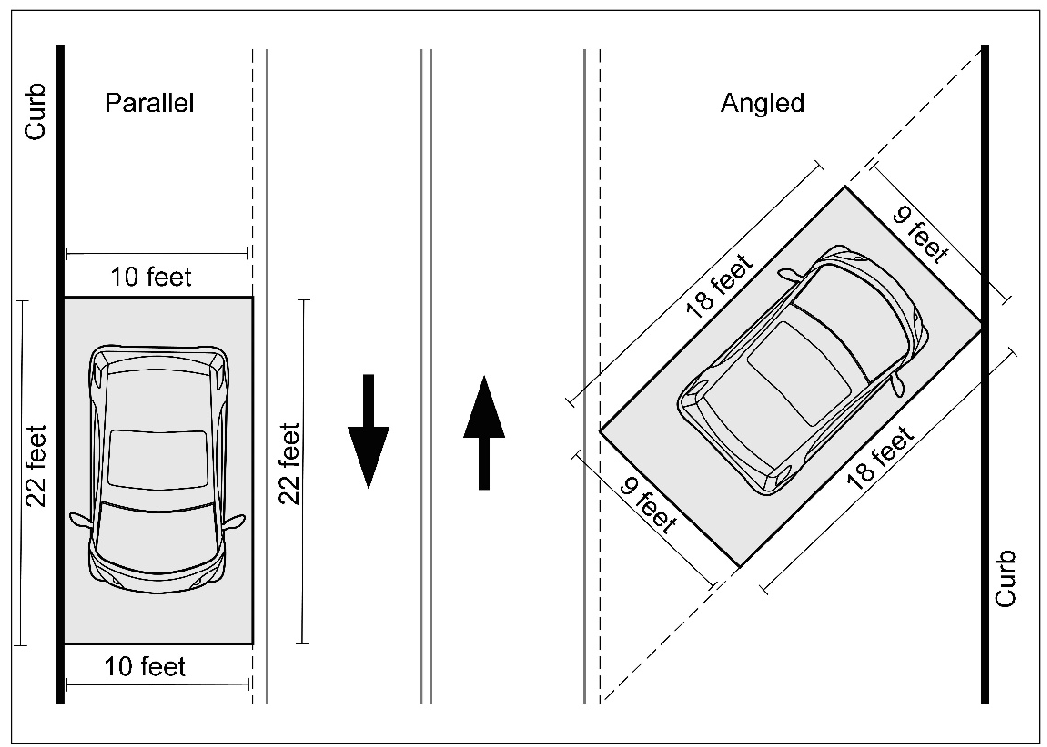
Figure 10-1 Parking Measurement
B.
Parking lot requirements.
1.
Surface.
a.
Maintenance. Driveways, drive aisles, and parking spaces shall be maintained and free of potholes, debris, or major structural deficiencies.
b.
Driveway surface. Driveways, drive aisles, and spaces shall be surfaced with asphalt, concrete, brick pavers, or equivalent surface as approved by the zoning administrator.
2.
Drainage or runoff. Parking areas shall be graded and properly drained in such a manner that there will be no free flow of water onto adjacent property or public sidewalks and shall be subject to Ottawa County Water Resource Commissioner approval.
3.
Striping of parking. Parking areas shall be striped to identify each parking space. The striping shall be permanently maintained and visible. Car sales lots are not required to have stripes to designated parking areas for vehicles for sale because the spaces are not intended for public use. However, vehicle space striping shall be shown on site plans to demonstrate the maximum number of vehicles to be listed for sale at any time.
4.
Wheel and bumper guards. Exterior parking spaces and those facing sidewalks and landscaped areas shall be equipped with wheel or bumper guards, so no part of a parked vehicle will extend beyond the parking space, unless a raised curb serves the same function.
5.
Accessible parking. Pursuant to the Michigan Barrier Free Act, as amended, accessible parking shall be provided for any building or use initiated after the effective date of this ordinance per the minimum requirements of the Act and other requirements that may be adopted by federal or state law.
6.
Driveways. Entrances and exits shall minimize traffic congestion and shall comply with the Holland Charter Township Commercial Driveways Ordinance, as amended, Section 12-51 [28-71].
7.
Connectivity. Sites shall be designed to preserve the possibility of future connectivity and cross access movements of vehicles and pedestrians between adjacent lots of record.
C.
Special event parking. It is recognized that there may be special community events or situations that occur infrequently which would result in the temporary reduction in the availability of required parking spaces or the need for temporary or overflow parking arrangements.
1.
Minimum requirements. Parking shall be provided for expected patrons utilizing either existing on-site parking or temporary parking as approved by the zoning administrator. Parking will generally be based on one space for every three people on-site at any one time.
2.
Displacement. No more than 25 percent of existing parking may be displaced for the special event.
3.
Requirements. Temporary and overflow parking areas are subject to the following requirements:
a.
Parking areas shall be located and designed to ensure safe and efficient circulation for both pedestrians and vehicles, including designated maneuvering lanes, ingress and egress.
b.
Aisles and parking rows shall meet the minimum widths required in this section. Lanes and parking rows shall be designated by temporary markings, such as paint, cones, flags or ribbons.
c.
Parking areas and maneuvering lanes shall be gravel, stone, or a similar material, or shall be grassed. Grassed lots shall be maintained, mowed, and seeded to ensure a passable and stable surface.
d.
Parking lots shall be graded and/or properly drained to dispose of all surface and storm water and to prevent drainage onto abutting properties.
e.
Barrier free spaces shall be provided on asphalt or concrete surfaces, pursuant to the Michigan Barrier Free Act.
Sec. 10.5 - Shared parking.
A.
Number. The total parking space requirement shall be the aggregate number of spaces required at any time for the most parking intensive use or combination of uses.
B.
Justification. To qualify for this option, an applicant is required to explain in detail, as part of the site plan and to the satisfaction of the Planning Commission, how the shared parking option would function.
C.
Requirements.
1.
Facilities located on adjoining separate properties must be within 600 feet of each other, measured from the nearest point of public entrance to the building to the nearest point of the parking lot.
2.
A convenient pedestrian connection shall be provided between the properties.
3.
The availability of parking for all affected properties or uses shall be indicated by directional signs.
4.
Interior vehicular access shall be provided to interconnect all properties sharing the parking facility(ies).
D.
Change in conditions. Any change to the conditions that were considered during the approval shall require a review by the planning commission for the exemption to remain valid.
E.
Agreements. Prior to establishing shared use of parking, the property owner or owners shall submit a written agreement providing for the shared parking use and a cross access and parking easement to the zoning administrator. All shared parking agreements shall run with the land and such deed restrictions shall be filed with the Ottawa County Register of Deeds. If any party to the agreement withdraws, that party shall be responsible to provide the required parking individually, in accordance with the provisions of this article. The agreement shall be filed prior to the establishment of the use.
Sec. 10.6 - Reduction and deferment.
A.
Permitted reductions. Parking minimums may be reduced when it is demonstrated to the approving authority that parking demand is expected to be lower than the requirements of Table 10.3 and the following standards are met:
1.
Single building or use.
a.
Convenient municipal off-street parking or on-street spaces are located within 500 feet of the subject property.
b.
Expectation of walk-in trade is reasonable due to sidewalk connections to adjacent residential neighborhoods or employment centers. To allow for a parking space reduction, the site design shall incorporate pedestrian connections to the site and on-site pedestrian circulation, providing safe and convenient access to the building entrance.
c.
The applicant has provided a parking study, conducted by a traffic engineer or qualified parking professional, demonstrating that another standard would be more appropriate based on actual number of employees, expected level of customer traffic, or actual counts at a similar establishment.
2.
Mixed occupancy or multiple buildings. Parking may be reduced for shared/common parking lots by multiple uses where:
a.
There will be a high proportion of multipurpose visits.
b.
Uses have peak parking demands during differing times of the day or days of the week.
B.
Deferred parking. When appropriateness of a reduction in the number of required parking spaces is demonstrated at the time of an application, but future conditions could warrant increased parking, some of the required parking may be deferred by the township. A performance guarantee may be required by the township.
1.
Requirements. Deferred parking plans shall be in accordance with the following:
a.
Site plan. A site plan shall show all required parking but identify those spaces that will not be constructed until warranted. All deferred parking spaces and aisles shall meet the design and dimensional requirements of this article.
b.
Landscaping. Any area designated for deferred parking shall be landscaped and not used for any other purpose, such as outdoor storage or accessory buildings. Required parking lot landscaping shall be installed during deferred parking area construction.
2.
Timeframe. Construction of all or a portion of the deferred parking spaces may be initiated by the owner or required by the township. The deferred parking shall meet all requirements of the ordinance in effect at the time of construction.
C.
Agreement. A written agreement in form satisfactory to the township requiring the provision of additional parking spaces, if a greater number of employees or visitors use the lot of record at a future time, shall be executed by the township and the owner and/or occupant of the property.
D.
Validity. The site plan approval of lesser parking requirements shall be valid only for the stated use. An occupancy permit for a new use shall not be issued unless a new site plan is reviewed and approved.
Sec. 10.7 - Off-street loading.
A.
Applicability. For every use involving receipt or distribution of materials or merchandise in trucks, loading zones must be provided.
B.
Requirements. Loading zones and maneuvering lanes are subject to the following requirements:
1.
Maneuverability. Sufficient space for truck maneuvering shall be provided and demonstrated on a site plan based on anticipated truck types. Maneuvering space for trucks using the loading spaces shall be provided on the lot of record and shall not necessitate the use of public right-of-way.
2.
Number and dimensional requirements. The number and dimensional requirements of off-street loading spaces is subject to Table 10.7.
3.
Location. Loading docks, overhead doors, and other service entries shall not be located on the primary street side of principal buildings unless otherwise provided for in this section.
C.
Modification. The approval authority may modify the required size of loading spaces for uses such as offices or smaller retail businesses that will involve smaller delivery trucks. The approval authority may also approve the location of an overhead door on the primary street side of the principal building if:
1.
The overhead door is not used for the receipt or distribution of materials or merchandise; and
2.
The location of the door will not, in the determination of the zoning administrator, negatively impact access to the building or parking, site maneuverability, nor increase congestion on adjacent public or private streets.
Table 10.7 Minimum Off-Street Loading Requirements
(Ord. No. 609, §§ 1, 2, 9-3-2020)
Sec. 11.1 - Intent and purpose.
The purpose of this article is to minimize the adverse effects of certain land uses and outdoor activities upon their surroundings and to improve the appearance of parking areas and street frontages within the community. It is further intended to preserve and enhance the aesthetic qualities, character, privacy, and land values within Holland Charter Township. The standards of this article are intended to help achieve a number of functional and environmental objectives such as:
A.
Reduce the physical impact between adjacent land uses by requiring complementary landscape treatments and providing a transitional area adjacent to natural areas.
B.
Screen headlights to reduce glare and incidental pollution.
C.
Control soil erosion by slowing the effects of erosive winds and water.
D.
Provide reasonable standards to bring developed sites, which existed prior to the adoption of these standards, into compliance with the requirements contained in this article.
E.
Recognize and preserve the aesthetic value of natural areas such as woodlands, wetlands, and floodplains within and adjacent to a development site.
Sec. 11.2 - General landscaping requirements.
A.
Applicability.
1.
Site plan approval. These requirements apply to all new buildings and parking lots and the area affected, or the area adjacent to, expansions to existing buildings and parking lots requiring site plan approval.
2.
Installation. Required landscaping shall be installed before occupancy or establishment of the use, unless the township authorizes occupancy or establishment of the use prior to complete landscape installation, based on unforeseen weather conditions or the timing of construction as it relates to the planting season. In cases where deferment is approved, a performance guarantee may be required per section 18.2.
3.
Zoning districts. Landscaping requirements apply to all non-residential and non-farm properties within the agricultural (article 3) and residential (article 4) districts, all multi-family residential developments within the residential (article 4) districts, and all uses in the commercial and office districts (article 5), and the industrial districts (article 6).
B.
Materials.
1.
Type. All plant material shall be hardy to Ottawa County, and be free of disease and insects. A prohibited list of species is available in the community development department office.
2.
Restriction. Artificial plant material shall not be used within any required landscaped area.
C.
Number.
1.
Substitution. No substitution of plant species or sizes shall be allowed unless approved by the zoning administrator.
2.
Variety. No one tree species can exceed 50 percent of the total proposed.
3.
Rounding. Where this article requires landscaping based on a distance measured in feet along a property boundary and a dimension results in a fraction of the given requirement, the number shall be rounded down to a whole number.
4.
Separate requirements. All landscape plans shall meet each required calculation individually and in no case shall any required plantings and planting areas be counted towards other landscape requirements.
D.
Size.
1.
Minimum installation size. When landscaping is required, it shall be installed at the minimum sizes included in Table 11.2A. Tree widths are measured at the diameter at breast height (DBH), which is four and one-half feet above the ground.
Table 11.2A Landscaping Minimum Installation Size
2.
Credit for existing trees. When landscaping is required and existing trees within front yards or designated buffer areas can be preserved, healthy and desirable trees may be counted to satisfy the requirements of this article. Sizes of existing material must meet the requirements for newly installed trees and shrubs to qualify (Table 11.2A). However, larger trees may count for two required trees if the minimum sizes of Table 11.2B are met.
Table 11.2B Credit for Existing Trees
E.
Placement and maintenance.
1.
Setback. Plant material shall not be placed closer than three feet to any fence or property line.
2.
Placement. All landscaped areas shall be arranged to simulate a natural setting such as staggered rows or massings. Planting beds shall have a well-maintained edge.
3.
Utilities. All plant material shall be installed in a manner that will not cause damage to utility lines (above and below ground) and public streets. Landscape plans shall consider utility easements, overhead power lines, and underground utilities.
4.
Drainage. All plant material shall be installed in a manner that does not alter drainage patterns on site or on adjacent properties.
5.
Groundcover. All planting beds shall be mulched, or comparably treated, and those areas not containing landscaping be planted with ground cover. Mulch, or comparable products, shall not be used for ground cover.
6.
Berms. The maximum slope for a berm shall be one foot vertical to three feet horizontal with a crest area at least four feet wide.
7.
Sight lines. Landscaping shall be installed such that, when mature, it does not obscure traffic signs, fire hydrants, lighting, or obstruct vision for safety of ingress or egress.
8.
Planting soil. Planting Soil (approximately one-third topsoil, one-third peat, one-third excavation material) shall be placed around all plantings as required and within planting beds to a depth of eight to 12 inches.
9.
Topsoil. Topsoil (loam soil free of stones, sticks, weeds, or debris) shall be placed to a depth of four to six inches for lawn areas.
F.
Maintenance. All landscaping shall be maintained in a healthy, neat and orderly state free from refuse and debris. Required trees and shrubs that are determined by the zoning administrator to be diseased, dead, or dying shall be replaced within one growing season.
G.
Lawn grasses. Lawn grasses shall be planted in species normally grown as permanent lawns in Ottawa County. Grasses may be plugged, sprigged, seeded, or sodded. Rolled sod, erosion reducing net or suitable mulch shall only be used in swales or other areas susceptible to erosion and shall be staked where necessary for stabilization. Lawns shall be free of weeds and noxious pests or disease.
H.
Performance guarantee. The planning commission may require a performance guarantee in accordance with the requirements of section 18.2 sufficient amount to ensure the installation of all required landscaping.
Sec. 11.3 - Modifications.
A.
Circumstances. The approval authority may vary the landscaping requirements of this article only under at least one of the following circumstances:
1.
When existing natural or topographic features render compliance with the requirements unnecessarily difficult;
2.
When adherence to the requirements result in the loss of significant natural or cultural features;
3.
Where a variation clearly results in a superior landscape that could not be achieved under the requirements of this article;
4.
When existing vegetation can be preserved to meet the intent of the screening and buffering intent of this article.
B.
Easements. Where easement restrictions exist, the type and/or location of trees and shrubs may be adjusted with approval of the zoning administrator upon review of the easement holder's published planting guidelines.
Sec. 11.4 - Landscape plans.
A.
Landscape plans. Landscape plans shall be professionally prepared. Landscape plans shall include the following materials:
1.
A separate plan sheet shall be drawn at the same scale as the required site plan. To ensure that landscaping is not affected by, nor interferes with utilities, the plans shall indicate all existing or proposed utilities and easements. At the discretion of the zoning administrator, for simple site plans, plantings may be shown directly on site plans.
2.
Provide existing and proposed contours at intervals not to exceed two vertical feet.
3.
Plans shall show all landscaped areas and plants listed in a table by common and scientific name, including quantities, and size at installation. Anticipated mature height shall be indicated and the crown spread shall be shown on the plan with circles indicating anticipated plant size at maturity. Plans shall illustrate the location, spacing, species, and size of proposed plant material.
4.
Text shall accompany the landscape plan that provides calculations for the proposed landscaping and describes how the plan complies with the regulations of this article. Required trees or materials cannot be double-counted.
5.
Existing natural and man-made landscape features and proposed buildings and structures, as required for the overall site plan, shall be clearly indicated.
6.
Landscape plans shall show all existing trees eight inch caliper or greater for deciduous and 12 feet or taller for evergreen, located in portions of the site that will be built upon or otherwise altered. Trees shall be labeled "To Be Removed" or "To Be Saved" on the plan.
7.
Limits of grading shall be indicated and measures to protect existing trees to be saved shall be noted on the plans, including but not limited to protective fencing. When protective fencing is proposed, plans shall include the following statement: "Protective fencing shall be installed prior to site disturbance." Tree preservation fencing shall be established at the drip line of the tree and a detail of the fence shall be provided.
8.
Provide planting details to ensure proper installation and establishment of proposed plant material.
9.
Identify grass areas and other methods of ground cover.
10.
Include a description of irrigation methods for landscaped areas.
11.
Identify a landscape maintenance program including a statement that all diseased, damaged or dead materials shall be replaced in accordance with standards of this article.
Sec. 11.5 - Right-of-way landscaping.
The area between the street paving or curb line and the property line or sidewalk, with the exception of driveways and walkways, shall be used exclusively and maintained as landscaped area with grass, trees, and other plants.
Sec. 11.6 - Front yard landscaping.
A.
Applicability. For all uses within the commercial and office districts (article 5), industrial districts (article 6), and all non-residential and non-agricultural uses in the agricultural (article 3) and residential districts (article 4), front yard trees and shrubs are required in accordance with this section within a ten-foot wide strip.
B.
Trees.
1.
Number. The total number of trees shall be based on a ratio of one per 40 linear feet of frontage.
2.
Placement. The required front yard landscaping strip shall be planted between the parking area and the road right-of-way. If there is no front yard parking, the landscaping strip may be placed anywhere within the front yard, subject to the spacing requirements of this section.
3.
Spacing. Trees shall be spaced in a manner so as not to overlap crown spread at maturity. Spacing from curbs and paved areas shall be at least four feet, unless additional space is necessary for healthy growth. Grouping of different height trees can overlap, as long as each tree does not interfere with the growth potential of a nearby required tree.
C.
Shrubs. For areas where parking lot screening is not required, front yards shall include:
1.
Number. Three shrubs for every 40 linear feet of frontage or fraction thereof.
2.
Placement. Shrubs are encouraged to be placed in groups/clusters with shrub spacing not to exceed five feet on center.
(Ord. No. 647, § 5, 9-7-2023)
Sec. 11.7 - Buffers.
A.
General requirements. A buffer is an area intended to provide visual barrier and noise abatement between specified land uses.
1.
Applicability.
a.
A buffer area is not required if the qualifying adjacent zoning districts are separated by a public right-of-way.
b.
A buffer area shall be required even when the adjacent property is undeveloped.
2.
Design and placement.
a.
The buffer area shall abut the applicable property line and plantings shall fall within the required buffer area width.
b.
Buildings, structures, and parking lots may not encroach into the buffer area. Driveways may cross the required buffer areas perpendicularly.
c.
Stormwater management measures, such as areas for infiltration or retention, may be located in the buffer area, provided, the planting requirements in Table 11.7A can still be met.
3.
Walls. When a wall is provided, it shall have a maximum height of six feet and shall be constructed of brick, stone, or decorative masonry material.
a.
The colors and materials of the wall shall complement that of the main building or structure.
b.
A residential privacy fence may be approved in place of a solid wall if it is more compatible with the character of the area. The privacy fence must be six feet tall, completely opaque and, if wooden, treated to prevent decay.
B.
Buffer requirements. Buffer area types applicable to the following zoning districts are indicated in the following tables:
Table 11.7A Buffer Types
Table 11.7B Buffer Planting Requirements
(Ord. No. 647, § 5, 9-7-2023)
Sec. 11.8 - Screening.
A.
Non-residential and multi-family dumpsters, rolling carts, and trash cans. Unless otherwise permitted in accordance with this section, garbage and recycling service areas shall be screened from the view of all streets and publicly accessible parking lots with evergreen trees, solid fence, or wall enclosure that meets the following specifications:
1.
Enclosures shall be constructed of masonry, concrete, metal, treated wood, or similar materials and must be durable, weather resistant, rust resistant and easily maintained.
2.
Screening shall be opaque. Chain link fences with slats are not acceptable.
3.
a. Access gates shall be closed at all times when not in use.
b.
A three-sided enclosure without a gate may be approved if the depth of the enclosure is at least three times the depth of the dumpster and if the zoning administrator or planning commission determines that this design will provide the same degree of screening required by this section.
4.
Enclosures shall be protected by bollards or other means to prevent interior or exterior damage.
5.
Enclosures shall be a height sufficient to obscure containers and garbage cans but shall be no less than four feet in height.
6.
Enclosures shall be subject to front yard building setbacks and placed outside of all landscape buffers. At no time shall enclosures be closer to a side or rear property line than ten feet.
B.
Off-street parking. Except for entrance/exit areas, all off-street parking areas will be lightly screened when adjacent to public right-of-way and abutting the agricultural (article 3) and residential (article 4) zoning districts.
1.
Height. Thirty inches.
2.
Type. Walls or hedgerows shall be used to meet this requirement.
a.
Hedgerows shall be planted with evergreen or deciduous shrubs, two and one-half feet on center within a landscape area at least four feet wide.
b.
Walls shall be incorporated when a four foot wide area is not available.
(Ord. No. 647, § 5, 9-7-2023)
Sec. 11.9 - Parking lot canopy trees.
A.
Purpose. To provide shade and to break up the visual appearance of large paved areas, parking lot canopy trees are required. This requirement does not apply to paved outdoor vehicle sales areas.
B.
Canopy trees. Off-street parking areas containing five or more parking spaces shall be provided with one canopy tree and 100 square feet of landscaped area per 12 spaces, or fraction thereof.
C.
Location. A minimum of one-half of the required trees shall be placed within the interior of the parking area, within islands, peninsulas, or corners. The remaining trees shall be placed within ten feet surrounding the parking lot.
D.
Dimensions. Islands or peninsulas containing canopy trees shall be a minimum of nine feet wide and shall have no more than one tree per 15 feet of length. Consolidating internal islands is encouraged and may be required when practical to improve tree health and provide options of stormwater infiltration.
E.
Protection. Landscape areas shall be protected by raised curbs (with or without cuts), parking blocks, or other similar methods to prevent damage. Notwithstanding this requirement, alternative low impact design solutions shall be encouraged, such as areas for stormwater infiltration, with incorporation of methods to prevent damage.
F.
Design and placement. Trees shall be planted at least three feet from curbs or the edge of pavement.
(Ord. No. 647, § 5, 9-7-2023)
Sec. 12.1 - General requirements.
A.
Applicability. Outdoor light fixtures shall be subject to the requirements of this article.
B.
Shielding and fixture specifications.
1.
Light shall be fully shielded, confined on-site by the direction of the fixture, shielding, or adjustment the level of brightness.
2.
Under-canopy lighting shall be mounted flush or recessed.
3.
Wall pack and pole-mounted light fixtures shall be a down-lighted type and 100 percent cut off. Light fixtures shall be constructed and installed in such a manner that all light emitted, either directly from the lamp or a diffusing element, or indirectly by reflection or refraction from any part of the luminaire, is projected below the horizontal plane through the lowest light-emitting part.
C.
Government flag lighting. Government flag lighting shall only illuminate the flag and shall be placed so lighting or glare is not directed toward streets or adjacent properties.
Sec. 12.2 - Prohibited lighting.
A.
Prohibited lighting. The following lighting types and methods are prohibited for commercial and residential application:
1.
Laser lights, searchlights or any similar high intensity light for outdoor advertisement or entertainment.
2.
Any lighting where the light source creates glare and is a hazard to travelers on an adjacent street.
3.
Lighting that flashes, moves, or is intermittent. Residential holiday lighting shall be exempt from the provisions of this section.
4.
Lighting that is similar to that used for traffic control devices or emergency vehicles.
Sec. 12.3 - Public area lighting.
A.
Applicability. Lighting shall be provided throughout any non-residential or multi-family parking lot. Lights to illuminate parking lots shall not be attached to any building, except for the lighting of parking rows immediately adjacent to buildings. This requirement does not apply to home occupations.
B.
Adaptive control integration. Dimmers, timers, and use of occupancy motion sensors are permitted after hours of public access.
C.
Type and color. The lighting color temperature of new and replacement light fixtures shall not exceed 3,000 Kelvins.
D.
Height. Light poles shall have a maximum height of 20 feet when in or adjacent to an agricultural or residential zoning district. All other light poles shall have a maximum height of 25 feet. The maximum height shall be measured from the parking lot grade at the base of the pole to the top of the pole. No portion of any light fixture mounted on a light pole may extend more than one additional foot higher than the maximum light pole height.
E.
Illumination levels. Light levels on commercial sites shall meet the requirements in Table 12.3 for the developed portion of the site containing buildings, drives and parking lots.
1.
Sites are not subject to minimum lighting levels during closed hours.
2.
Table 12.3 shall not apply to ornamental street lighting, public street lights or driveway/intersection lighting necessary for pedestrian and traffic safety.
3.
The light level along a non-residential lot line may be increased to the parking lot maximum in cases where there are shared access/vehicular connections or the adjacent use is a similar use.
Table 12.3 Required Site Illumination
F.
Demonstration of compliance. Compliance with the lighting design criteria shall be demonstrated by submitting the following information as part of the required site plan:
1.
Lighting plan showing light fixture locations, height, and type designations.
2.
Lighting equipment specifications and data sheets.
G.
Photometric plans. The zoning administrator or planning commission may require a photometric plan to ensure that the intent and requirements of this section are met. When required, a photometric plan with a lighting grid shall be prepared by a lighting professional. The photometric plan shall show horizontal luminance levels (footcandles) in a point-by-point format.
Sec. 13.1 - Intent and purpose.
The intent and purpose of this article is to protect free speech, minimize and eliminate visual clutter, reduce the number and types of distractions experienced by drivers, and to channelize commercial and customer traffic to commercial and industrial areas of the township.
Sec. 13.2 - Sign permits.
A.
Sign permit required. No person shall erect, replace, attach, structurally alter, or add to any sign without first obtaining a permit, unless specifically exempted by this article.
B.
Plans. Plans shall be drawn to an accurate, common scale, depicting the following:
1.
A scaled drawing of the proposed sign showing the display area and dimensions, including the height of the sign.
2.
For ground signs and pylon signs, a site plan drawn to scale, accurately identifying the location of the proposed sign and setbacks from the nearest public or private street right-of-way and property lines. If there are proposed grade changes, such as adding a berm, this shall be noted on the site plan.
3.
For wall signs, the height and width of the building wall.
C.
Validity. All sign permits shall be valid for a period of one year from the date of issuance.
D.
Responsibility for compliance. The owner of property on which a sign is located is declared to be responsible for the erection, inspection, safety, condition, and removal of a sign.
Sec. 13.3 - General requirements.
A.
Applicability. This article applies to all signs, as defined in article 22. Murals and menu boards are not subject to the requirements of this article.
B.
Conformity. All signs and billboards erected after the effective date of this ordinance shall conform to this article.
C.
Consent. Signs, temporary or permanent, shall not be erected, constructed, installed, or located on private property without the written consent of the owner of such property, however, the requirement that the consent be written shall not apply to temporary yard signs.
D.
Requirements.
1.
Signs shall not interfere with, obstruct the view of, or be confused with any authorized traffic sign, signal, or device; constitute a nuisance; or cause a hazard to vehicle or pedestrian traffic.
2.
Signs shall be constructed to withstand all wind and vibration forces which can normally be expected to occur. Signs and sign structures shall remain structurally safe and shall not constitute a hazard to safety or health. All signs shall be properly maintained and shall not be allowed to become unsightly through disrepair or because of the effects of the weather.
3.
Signs shall not be placed in, upon or over any public right-of-way, alley, or other public place, except as may be otherwise permitted by the Ottawa County Road Commission or Michigan Department of Transportation.
4.
Signs shall not contain external moving parts.
5.
Signs shall not obstruct free ingress to or egress from a required door, window, fire escape, or other required exit way.
6.
A sign and its supporting mechanism shall conform to the setback requirements of this article.
7.
Signs shall not be attached to any tree, utility pole, street sign, traffic control device, or other similar object, or installed, attached or affixed to any public building or structure.
E.
Measurement of sign area. No sign shall exceed the maximum sign area allowed for the district in which it is located. The sign area is to be expressed in square feet, computed to the nearest tenth of a square foot.
1.
Pylon and ground signs.
a.
Single-face sign. The area of a sign shall be measured as the area within a single, continuous perimeter composed of any straight line geometric figure which encloses the extreme limits of writing, representation, emblem, logo or any other figure of similar character, together with any frame or other material or color forming an integral part of the display or used to differentiate the sign from the background against which it is placed, excluding only the pylon, pole, or base structure necessary to support the sign and any wrapped support structure not exceeding 24 inches in width (Figure 13-1).
b.
Double-face sign. The area of a pylon and ground signs that have two or more faces shall be measured by including the area of all sign faces, except if two faces are placed back-to-back and are no more than two feet apart at any point, the area of only one face shall be counted toward the maximum size requirement. In this case, if the two back-to-back faces are of unequal size, the larger of the two sign faces shall be counted as the one face.
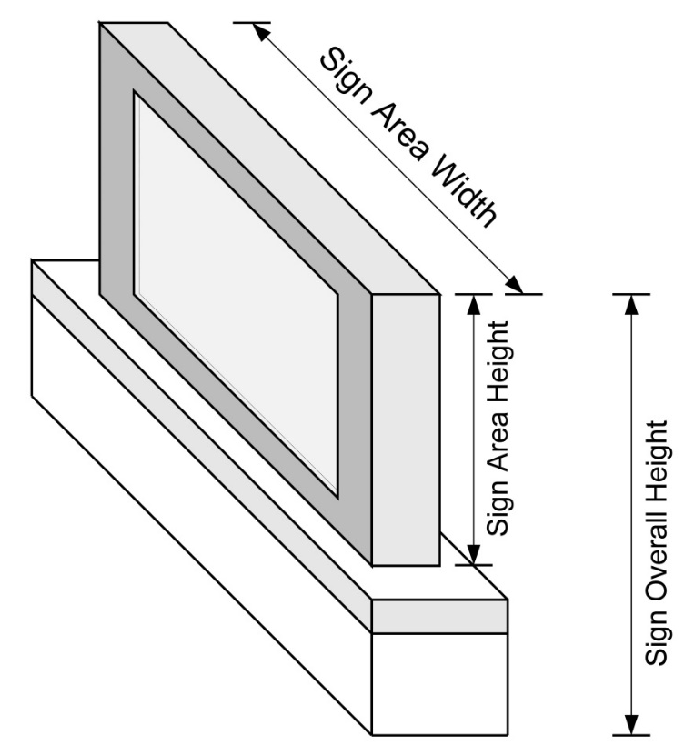
Figure 13-1 Sign Measurement
2.
Wall sign.
a.
Area. For a sign consisting of individual letters and/or a logo affixed directly onto a building, the area of the sign shall be computed by measuring the area of the envelope required to enclose the lettering and logo.
b.
Multi-tenant building sign area. For buildings with multiple tenants, the sign area for wall, projecting, canopy or awning signs shall be determined by taking that portion of the front wall of the building applicable to each tenant and computing the sign requirements for that portion of the total wall (Figure 13-2).
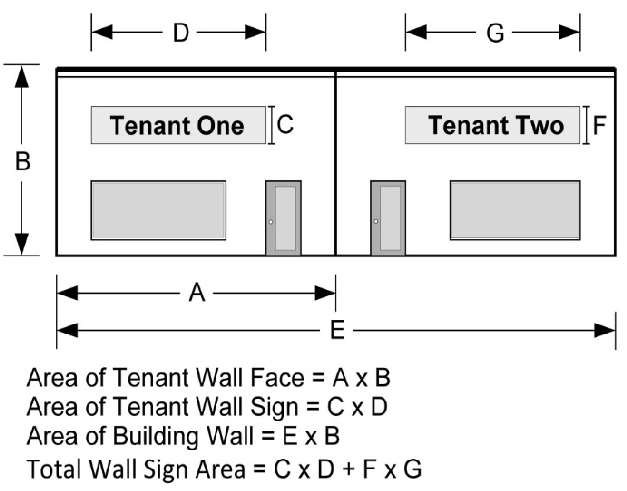
Figure 13-2 Multi-Tenant Sign Area Calculation
c.
Projection. Signs shall not extend more than 12 inches from the facia to which they are attached.
d.
Height. Signs shall not extend above the roof line or parapet wall.
F.
Sign height. The height pylon and grounds signs shall be measured as the vertical distance from the highest point of the sign to the finished grade of the ground immediately beneath the sign, including the sign standard. Artificially constructed earthen berms shall count against the maximum height.
G.
Vacated business. Any sign advertising a business which has vacated the premises shall have the name of the vacated business either hidden or removed in a manner acceptable to the township within three months of the date of the operations closure.
H.
Site and building changes. Adjustment of lot lines or changes to buildings that will cause a sign to become nonconforming are not permitted.
I.
Setbacks. Setbacks required by this article are measurement from the road right-of-way and lot lines.
J.
Traffic visibility and clear vision areas. Signs are prohibited in the following clear vision areas:
1.
Intersection of streets. Within the triangular area formed by the intersection of the street right-of-way lines and a line connecting two points which are located on those intersecting right-of-way lines 30 feet from the point of the intersection of the right-of-way lines (Figure 13-3).
2.
Street and driveway. Within the triangular area formed by the intersection of a street right-of-way line and a driveway and a line connecting two points that are located on the right-of-way line and the driveway 20 feet from the point of intersection of the right-of-way line and driveway (Figure 13-3).
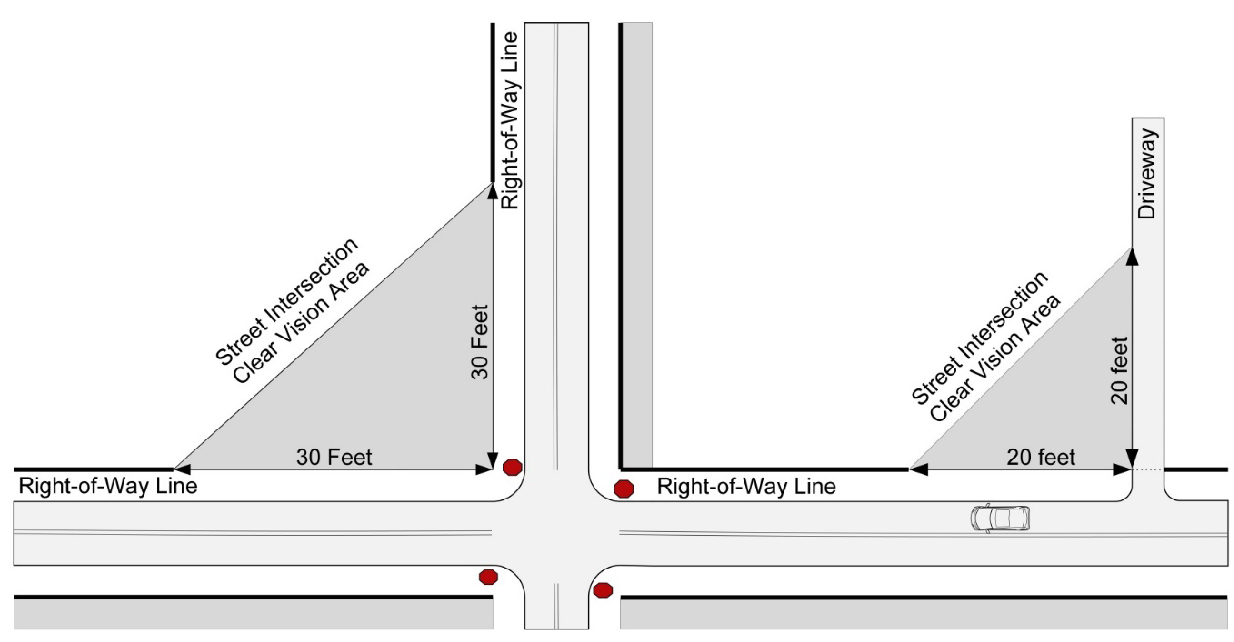
Figure 13-3 Traffic Visibility
(Ord. No. 647, § 6, 9-7-2023)
Sec. 13.4 - Exempt signs.
A.
Applicability. Certain signs are designated as exempt from the permitting requirements of this article. However, exempt signs remain subject to all applicable requirements of this article.
B.
Sign types. The following sign types and improvements are exempt:
1.
Painting, repainting, cleaning, maintenance, repair, and change of a sign face, message or graphics, provided that no structural alterations or additions to the display area are made.
2.
Changing copy or message of signs that are specifically designed for changeable copy as well as changing the display panels of a sign.
3.
Government and public signs.
4.
Public utility signs.
5.
Internal site signs on non-residential property no more than four square feet which are not oriented toward the public right-of-way.
6.
Incidental signs one square foot or less.
7.
Historic designation markers, plaques, and informational resources.
8.
Signs established in association with public utility facilities.
9.
Signs on tablets are either cut into the face of a masonry surface or constructed of bronze or other incombustible material when located flat on the face of a building.
10.
Government flags.
11.
Window signs.
12.
Temporary yard signs.
a.
Signs shall be limited to one sign per lot of record in agricultural and residential districts. One extra sign is permitted during a time period of 45 days prior to a township run election date to 15 days after the election date. Each sign shall not exceed six square feet in area.
b.
Signs shall be limited to one sign per street frontage in commercial, office, and industrial districts. One extra sign is permitted per frontage during a time period of 45 days prior to a township run election date to 15 days after the election date. Each sign shall not exceed six square feet in area.
c.
Signs shall be subject to a ten-foot setback from any property line and right-of-way.
13.
Temporary ground signs on construction sites.
a.
Lots of record shall be limited to one sign in the agricultural (article 3) and residential (article 4) districts.
b.
Lots of record shall be limited to one sign per street frontage in the commercial and office (article 5) and industrial (article 6) districts.
c.
Each sign shall not exceed 32 square feet in area.
d.
Signs shall be subject to a ten-foot setback from any property line and right-of-way.
e.
Signs shall be confined to the site of the construction and shall be removed within 14 days after the issuance of an occupancy permit.
14.
Temporary ground signs at platted subdivisions and site condominium developments.
a.
Developments shall be limited to one sign per entrance, but no more than two per development.
b.
Each sign shall not exceed 64 square feet in area.
c.
Signs shall be subject to a ten-foot setback from any property line and right-of-way.
d.
Signs shall not exceed eight feet in height.
e.
Signs shall be removed when 75 percent of the lots within the plat or units within the site condominium have been sold.
15.
Temporary ground signs on properties for sale in commercial and office (article 5) and industrial (article 6) districts.
a.
Signs shall be limited to one per street frontage.
b.
Each sign shall not exceed 32 square feet in area.
c.
Signs shall be subject to a ten-foot setback from any property line and right-of-way.
d.
Signs shall not exceed eight feet in height.
e.
Signs shall be removed once the property is sold.
(Ord. No. 596, § 7, 8-15-2019v
Sec. 13.5 - Prohibited signs.
A.
Prohibited sign types. The following sign types are prohibited:
1.
Vehicles or trailers which have the primary function of acting as a sign.
2.
Roof signs.
3.
Human signs.
4.
Feather signs.
5.
All off-site signs, including portable signs, unless specifically permitted as billboards by this ordinance.
(Ord. No. 596, § 8, 8-15-2019)
Sec. 13.6 - Portable signs.
A.
General use. Portable signs shall be permitted in the commercial and office (article 5) and industrial (article 6) districts and in PUDs only. No portable sign shall be larger in area than 60 square feet on one face. In determining the area of a portable sign, the border shall be included. Except as provided in subsection B. of this section, each property shall be entitled to display and utilize only one portable sign for a continuous period of 30 days during a six month period. This period shall begin the day the sign is first displayed. All portable signs shall comply at all times with the requirements of this article.
B.
Grand openings. Portable signs, which shall not be counted against the number of portable signs permitted by subsection A. of this section, shall be permitted when displayed and utilized in connection with the grand opening of the commercial enterprise located on the premises, provided that the portable signs are not displayed more than 20 days for a grand opening. These portable signs shall comply with all requirements contained in this section. The use of balloons as a sign or as a part of a sign shall be permitted only in connection with a grand opening, as provided in this section.
Sec. 13.7 - Permanent signs.
Table 13.7A Agricultural and Residential Districts
Table 13.7B Commercial, Office, and Industrial Districts
Sec. 13.8 - Billboards.
A.
Zoning districts. Billboards are permitted in the AG, I-1, and i-2 zoning districts.
B.
Requirements. Billboards shall:
1.
Be located more than 1,000 feet from any state trunkline or primary road as classified by the Ottawa County Road Commission intersections or from expressway access or exit ramps.
2.
Be located no closer than 1,000 feet (measured parallel to the road) from a billboard on the other side of a street.
3.
Be located more than 1,000 feet from any major arterial or primary collector street intersections or from expressway access or exit ramps.
4.
Be no closer than 50 feet to the street right-of-way and 20 feet from any other lot line.
5.
Be located no closer than 500 feet to the property line of a lot of record on which a residence is located.
6.
No billboard shall be stacked or placed one above another, and not more than one billboard shall be permitted on any single location other than a double-sided billboard. A "V" billboard shall be considered as one billboard and each face (side) shall not exceed 400 square feet.
7.
No billboard, either single or double sided, shall have an area in excess of 400 square feet per side including border and trim, but excluding uprights and supports.
C.
Other signs. In all agricultural and residential zoning districts, no other permanent sign shall be located on the property on which a billboard is located.
D.
Illumination. Illumination of billboards must comply with the provisions found in section 13.9.
E.
Height. Billboards shall not exceed 25 feet.
F.
Construction and maintenance. A billboard shall be constructed in such a fashion that it will withstand all wind and vibration forces that can normally be expected to occur in the vicinity and in compliance with all applicable codes. A billboard shall be maintained so as to assure proper alignment of structure, continued structural soundness, have paintable surfaces regularly maintained and continued readability of message.
G.
Permitting. Every billboard requires a township sign permit and building permit before installation or modification. Permits shall be reviewed and issued consistent with the terms of this section as well as all other applicable ordinances of the township including, without limitation, this zoning ordinance as amended from time to time. Every applicant for a billboard permit shall file with the application a certificate of insurance, certifying that the applicant is insured against bodily injury and for property damage arising out of the erection, maintenance, repair, and replacement of the billboard. Each applicant, if the permit is granted, shall be required to maintain said insurance.
H.
Other requirements. Billboards must otherwise comply with all other relevant regulations and ordinances of the township.
I.
Applicability. To the extent they are not specifically inconsistent with the terms and provisions of this section dealing specifically with billboards, all of the other terms and provisions of this article pertaining to signs shall be applicable to billboards.
(Ord. No. 596, § 9, 8-15-2019)
Sec. 13.9 - Sign illumination.
A.
Code compliance. A sign's wiring and electronic components shall be installed in accordance with the State of Michigan Electrical Code.
B.
Prohibited illumination. Flashing, animation, moving, oscillating, blinking, intermittent illumination, or variable intensity light is prohibited on all signs and billboard sign faces.
C.
External illumination.
1.
Sign lighting shall be of low intensity with effective provisions made to minimize spillover of light beyond the actual sign face.
2.
The light source shall be enclosed and directed to prevent light from shining directly onto traffic or neighboring property.
D.
Internal illumination. Sign faces shall be opaque so that individual lamps are muted and cannot be distinguished behind the sign face.
E.
Electronic changeable message (ECM) signs.
1.
Number. Lots of record are limited to one ECM sign each.
2.
Display. ECM image displays shall be static.
3.
Interval. ECM displays shall not change more frequently than once every eight seconds. Transitions from one static image to the next shall appear instantaneously.
4.
Brightness. Brightness of ECM signs shall be measured as follows:
a.
At least 30 minutes following sunset, a foot candle meter shall be used to obtain an ambient light reading for the location. This is done while the sign is off or displaying black copy. The reading shall be made with the meter aimed directly at the center of the sign area from a distance determined with the following formula: The square root of the product of the sign area multiplied by 100. Example using a 12-square foot sign:
b.
Measurement distance = √(12 squre feet × 100) = 34.6 feet as the determined setback.
c.
The sign shall then be turned on to full white copy to take another reading with the meter at the same location.
d.
If the difference between the readings is 0.3 foot candles or less, the brightness is properly adjusted and the sign is in compliance.
F.
Neon. Neon illumination is prohibited.
Sec. 13.10 - Nonconforming signs.
A.
Continuation. A lawfully established sign that does not conform to the type, height, size, area, location or other requirements of this article as of the effective date of this article or amendments to this article is determined to be nonconforming. Nonconforming signs shall be permitted to continue unless otherwise required to conform by this article. It is the intent of this section to permit the continuance of legal nonconforming signs until they are removed or destroyed and to encourage overall compliance with this article.
B.
Illegal nonconforming signs. Signs installed without a sign permit shall be considered illegal nonconforming signs and shall be either removed or made to conform to this article and a permit shall be required. Nothing in this section shall be construed to give a nonconforming status to any illegal nonconforming sign erected without a sign permit.
C.
Requirements and restrictions.
1.
Change. Nonconforming signs shall not:
a.
Be changed to another nonconforming sign.
b.
Be structurally altered so as to prolong the life of the sign or so as to change the shape, size or type.
2.
Replacement. A nonconforming sign shall not be replaced with a nonconforming sign, if removed.
3.
Re-facing. The face of a nonconforming sign may be replaced as long as the nonconforming nature of the sign is not expanded or increased.
4.
Repair. Any nonconforming sign, sign structure, frame or standard damaged by any means shall not be repaired or rebuilt if the damage exceeds 50 percent of present day replacement value considering a sign of equal and similar size, building materials, construction, and quality. The sign owner shall provide an estimate acceptable to the Zoning Administrator for an official determination concerning restoration and repair eligibility.
5.
Normal maintenance. Nonconforming signs may be painted, cleaned, and maintained.

