
Hollywood City Zoning Code
ARTICLE V
- ZONING DISTRICT REGULATIONS
Sec. 58-91.- Required conformance to district regulations.
Except as otherwise provided in this chapter, no structure or land shall hereafter be used or occupied and no structure, or part thereof, shall be altered, moved, erected or built except in conformity with the regulations herein specified for the zoning district in which the structure or land is located.
(Code 1998, § 5-5-31)
Sec. 58-92. - Use districts.
In order to carry out the purpose and provisions of this chapter, the town is hereby divided into districts designated as follows:
(Code 1998, § 5-5-32; Ord. No. 2013-14-13, 6-23-2014)
Sec. 58-93. - RA Rural/agriculture.
The intent of the RA district is to establish and preserve areas primarily for agriculture and rural dwellings, forest management and various other low density uses on large sites, and to encourage preservation of natural resources and guard against the premature or unreasonable alteration of land resources.
(1)
Minimum lot area.
a.
The minimum lot area shall be 30,000 square feet for the RA district.
b.
The following uses are exempt from the minimum lot area requirements:
1.
Arboreta, botanical, and similar type gardens;
2.
Playgrounds and parks;
3.
Water and sewer supply substations;
4.
Bus stops; and
5.
Boat docks.
(2)
Open space requirement. Common open space is required for any development proposed for ten or more dwelling units. Refer to article VI of this chapter regarding common open spaces.
(3)
Minimum yard and setback requirements. The minimum yard and setback requirements are as follows:
a.
Front yard setback shall be 50 feet.
b.
Side yard setback shall be 25 feet.
c.
Rear yard setback shall be 25 feet.
(4)
Minimum lot width. The minimum lot width shall be 70 feet.
(5)
Maximum height of structures. The maximum height of structures shall be 35 feet. Agricultural structures are exempt from the height requirement.
(6)
Parking requirements. See article X of this chapter.
(7)
Mobile homes. Mobile homes are allowed in the RA district.
(Code 1998, § 5-5-33; Ord. No. 2018-19-4, 2-25-2019)
Sec. 58-94. - R-1 Residential 1.
The intent of the R-1 district is to establish and preserve low density residential neighborhoods and to exclude uses which are not compatible with such residential uses.
(1)
Minimum lot area.
a.
The minimum lot size shall be 30,000 square feet; except in areas served by public water or sewer, the minimum lot size shall be 12,500 square feet, or, if served by both public water and sewer, the minimum lot size shall be 10,000 square feet.
b.
The following uses are exempt from the minimum lot area requirements:
1.
Arboreta, botanical, and similar type gardens;
2.
Playgrounds and parks;
3.
Water and sewer supply substations;
4.
Bus stops; and
5.
Boat docks.
(2)
Open space requirement. Common open space is required for any development proposed for ten or more dwelling units. Refer to article VI of this chapter regarding common open space.
(3)
Minimum yard and setback requirements. The minimum yard and setback requirements are as follows:
a.
Front yard setback shall be 50 feet on Highway 165 or 162 and other streets shall be 25 feet.
b.
Side yard setback shall be ten feet.
c.
Rear yard setback shall be ten feet.
(4)
Minimum lot width. The minimum lot width is 70 feet.
(5)
Maximum height of structures. The maximum height of structures is 35 feet.
(6)
Parking requirements. See article X of this chapter.
(7)
Mobile homes. Mobile homes are not allowed in the R-1 district.
(Code 1998, § 5-5-34; Ord. No. 2018-19-5, 2-25-2019)
Sec. 58-95. - R-1-M Residential one-mobile home.
The intent of the R-1 district is to establish and preserve low density residential neighborhoods and to exclude uses which are not compatible with such residential uses.
(1)
Minimum lot area.
a.
The minimum lot size shall be 30,000 square feet; except in areas served by public water or sewer, the minimum lot size shall be 12,500 square feet, or, if served by both public water and sewer, the minimum lot size shall be 10,000 square feet.
b.
The following uses are exempt from the minimum lot area requirements:
1.
Arboreta, botanical, and similar type gardens;
2.
Playgrounds and parks;
3.
Water and sewer supply substations;
4.
Bus stops; and
5.
Boat docks.
(2)
Open space requirement. Common open space is required for any development proposed for ten or more dwelling units. Refer to article VI of this chapter regarding common open spaces.
(3)
Minimum yard and setback. The minimum yard and setback requirements are as follows:
a.
Front yard setback shall be 50 feet on Highway 165 or 162 and other streets shall be 25 feet.
b.
Side yard setback shall be ten feet.
c.
Rear yard setback shall be ten feet.
(4)
Minimum lot width. The minimum lot width shall be 70 feet.
(5)
Maximum height of structures. The maximum height of structures shall be 35 feet.
(6)
Parking requirements. See article X of this chapter.
(7)
Mobile homes. Mobile homes are allowed in the R-1-M district
(Code 1998, § 5-5-35; Ord. No. 2018-19-6, 2-25-2019)
Sec. 58-96. - R-2 Residential 2.
The intent of the R-2 district is to establish and preserve areas for high density single-family and multifamily residential uses.
(1)
Minimum lot area.
a.
The minimum lot areas requirements for the R-2 district are as follows:
1.
Per single-family, detached dwellings, 6,000 square feet.
2.
Per patio home, 4,000 square feet.
3.
Per dwelling unit for two-family and multifamily developments, 2,000 square feet.
b.
The following uses are exempt from the minimum lot area requirements:
1.
Arboreta, botanical, and similar type of gardens;
2.
Playgrounds and parks;
3.
Water and sewer supply substations;
4.
Bus stops; and
5.
Boat docks.
(2)
Open space requirement. Common open space is required for any development proposed for ten or more dwelling units. Refer to article VI of this chapter regarding common open spaces.
(3)
Minimum yard and setback. The minimum yard and setback requirements are as follows:
a.
Front yard shall be 50 feet on Highway 165 or 162 and other streets shall be 25 feet.
b.
Side yard shall be ten feet.
c.
Rear yard shall be ten feet.
(4)
Minimum lot width. The minimum lot width shall be 50 feet.
(5)
Maximum height of structures. The maximum height of structures shall be 35 feet.
(6)
Parking requirements. See article X of this chapter.
(7)
Mobile home. Mobile homes are not allowed in the R-2 district.
(Code 1998, § 5-5-36; Ord. No. 2012-13-07, 11-26-2012)
Sec. 58-97. - R-2-M Residential two-mobile home.
The intent of the R-2-M district is to establish and preserve areas for high density single-family and multifamily residential uses.
(1)
Minimum lot area.
a.
The minimum lot areas for R-2-M district are as follows.
1.
Per single-family, detached dwellings, mobile homes not part of a mobile home park or principal nonresidential uses, 6,000 square feet.
2.
Per patio home, 4,000 square feet; and per dwelling unit in mobile home parks, 4,000 square feet. (See article VIII, special uses, of this chapter.)
3.
The minimum lot area for R-2-M district shall be 2,000 square feet per dwelling unit for two-family and multifamily developments.
b.
The following uses are exempt from the minimum lot area requirements:
1.
Arboreta, botanical, and similar type gardens;
2.
Playgrounds and parks;
3.
Water and sewer supply substations;
4.
Bus stops; and
5.
Boat docks.
(2)
Open space requirement. Common open space is required for any development proposed for ten or more dwelling units. Refer to article VI of this chapter regarding common open space.
(3)
Minimum yard and setback. The minimum yard and setback requirements are as follows:
a.
Front yard shall be 50 feet on Highway 165 or 162 and other streets shall be 25 feet.
b.
Side yard shall be ten feet.
c.
Rear yard shall be ten feet.
(4)
Minimum lot width. The minimum lot width shall be 50 feet.
(5)
Maximum height of structures. The maximum height of structures shall be 35 feet.
(6)
Parking requirements. See article X of this chapter.
(7)
Mobile homes. Mobile homes are allowed in the R-2-M district.
(Code 1998, § 5-5-37; Ord. No. 2018-19-6, 2-25-2019)
Sec. 58-98. - NC Neighborhood commercial.
This district is established primarily to serve the needs of the surrounding residential neighborhood by providing convenience to goods and services that are normally needed on a day-to-day basis. This district should be located along major streets and should be sized in accordance to the surrounding residential area. Nonresidential uses, excluding uses classified under education and public and general government administration, in this district may not exceed 2,500 square feet gross floor area per lot. Outdoor storage of goods or items related to business activity is not permitted.
(1)
Minimum lot area.
a.
The minimum lot areas for the NC district are as follows:
1.
Per single-family, detached dwellings, 6,000 square feet.
2.
Per patio home, 4,000 square feet; and per dwelling unit in mobile home parks, 4,000 square feet. See article VIII of this chapter, special uses.
3.
Per dwelling unit for two-family and multifamily developments, 2,000 square feet.
4.
For nonresidential uses, the minimum lot area shall be 4,000 square feet.
b.
The following uses are exempt from the minimum lot area requirements:
1.
Arboreta, botanical, and similar type of gardens;
2.
Playgrounds and parks, water and sewer supply substations;
3.
Bus stops; and
4.
Boat docks.
(2)
Open space requirement. Common open space is required for any development proposed for ten or more dwelling units. Refer to article VI of this chapter regarding common open space.
(3)
Surface requirement. Pervious surface requirement shall be 20 percent.
(4)
Minimum yard and setback. The minimum yard and setback requirements are as follows:
a.
Front yard.
1.
Highway 165 or 162 shall be 50 feet.
2.
Other streets shall be 25 feet.
b.
Side yard.
1.
Residential uses shall be ten feet.
2.
Nonresidential uses shall be 25 feet.
3.
Nonresidential uses adjacent to residential districts shall be 50 feet.
c.
Rear yard.
1.
Residential uses shall be ten feet.
2.
Nonresidential uses shall be five feet.
3.
Nonresidential uses adjacent to residential districts shall be 50 feet.
(5)
Minimum lot width. The minimum lot width shall be 50 feet.
(6)
Maximum height requirement. The maximum height requirement shall be 35 feet.
(7)
Parking requirements. See article X of this chapter.
(Code 1998, § 5-5-38)
Sec. 58-99. - GC General commercial.
The intent of this district is to encourage the continued use of, and rehabilitation of, existing structures in this district for commercial, public and other permitted uses, and to encourage the location of new facilities in this district so as to promote viable commercial areas.
(1)
Minimum lot area.
a.
The minimum lot areas for GC district are as follows:
1.
Per single-family, detached dwellings, 6,000 square feet.
2.
Per patio home, 4,000 square feet.
3.
Per dwelling unit for two-family and multifamily developments, 2,000 square feet.
4.
For nonresidential uses, the minimum lot areas shall be 4,000 square feet.
(2)
The following uses are exempt from the minimum lot area requirements:
1.
Arboreta, botanical, and similar type gardens;
2.
Playgrounds and parks;
3.
Water and sewer supply substations;
4.
Bus stops; and
5.
Boat docks.
(2)
Open space requirement. Common open space is required for any development proposed for ten or more dwelling units. Refer to article VI of this chapter regarding common open space.
(3)
Surface requirements. Pervious surface requirement shall be 15 percent.
(4)
Minimum yard and setback. The minimum yard and setback requirements are as follows:
a.
Front yard.
1.
On Highway 165 or Highway 162 shall be 50 feet.
2.
On other streets shall be 25 feet.
b.
Side yard.
1.
Residential uses shall be ten feet.
2.
Nonresidential uses shall be ten feet.
3.
Nonresidential uses adjacent to residential districts shall be 50 feet.
c.
Rear yard.
1.
Residential uses shall be ten feet.
2.
Nonresidential uses shall be ten feet.
3.
Nonresidential uses adjacent to residential districts shall be 50 feet.
(5)
Minimum lot width. The minimum lot width shall be 50 feet.
(6)
Maximum height requirement. The maximum height requirement shall be 35 feet.
(7)
Parking requirements. See article X of this chapter.
(Code 1998, § 5-5-39)
Sec. 58-100. - TC Town center.
(a)
Intent. The town center district is the heart of Hollywood. This area (the downtown) has been historically and is currently the central area for shopping, services, and governmental facilities for both the residents of the Town and surrounding areas. The downtown and its businesses shall be easily accessible by vehicles, bikes, and pedestrians. A mixture of uses that respect the existing structures, especially those with historic significance, in scale and use are appropriate for this district.
(b)
General.
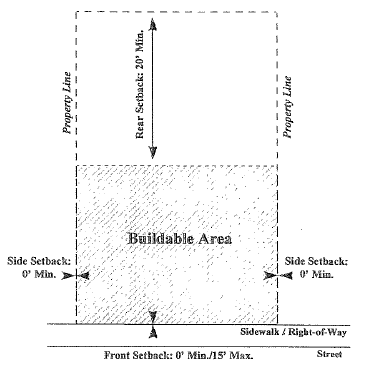
(1)
Minimum lot size: 5,000 square feet.
(2)
Maximum lot coverage: Building footprint shall not exceed 70 percent of the lot coverage.
(3)
Setbacks:
a.
Speed limits posted 30 mph or less.
1.
Front: 0 feet min. to 15 feet max.
2.
Side: 0 feet min.
3.
Rear: 20 feet min.
b.
Speed limits posted greater than 30 mph.
1.
Front: 50 feet min. or average of neighboring properties.
2.
Side: 10 feet min.
3.
Rear: 20 feet min.
(4)
Maximum building height: 35 feet.
Water towers, transmission towers, chimneys, flag poles, masts and aerials are permitted to exceed height limits, provided evidence from appropriate authorities is submitted to the effect that such building or structure will not interfere with any airport approach zones or flight patterns.
(c)
Uses.
(1)
Permitted uses: The following uses shall be permitted in the TC district.
a.
Office/commercial: The following office and commercial uses are permitted in the TC district provided that all specified standards are met:
1.
Use list: See section 58-106, permitted uses per district.
2.
Standards:
i.
Balconies, bay windows, at an upper level and their supports at ground level, together with awnings above head height (min. seven feet six inches) are permitted over the sidewalk with a maximum of five-foot encroachment into the right-of-way.
ii.
Trash containers shall be located in the parking area and shall be screened from the right-of-way.
iii.
Mechanical equipment at ground level should be placed on the parking lot side of building and away from buildings on adjacent sites.
iv.
Building facades should constitute a street frontage at pedestrian scale.
v.
Main pedestrian access to the building shall be from the street. Secondary access may be from parking areas.
b.
Single-family residential: Single-family residential uses are permitted in the TC district provided that all specified standards are met.
1.
Standards: Garages may be detached or attached to the main dwelling, with or without habitable rooms above. The front wall of the garage shall be at least ten feet behind the front facade of the dwelling or constitute less than 30 percent of the front facade of the building.
c.
Multifamily residential: Attached or detached multi-family residential uses are permitted in the TC district provided that all specified standards are met.
1.
Standards:
i.
Garages may be detached or attached to the main dwelling, with or without habitable rooms above. The front wall of the garage shall be at least ten feet behind the front facade of the dwelling or constitute less than 30 percent of the front facade of the building.
ii.
Minimum lot area per housing unit: 2,500 square feet.
iii.
Parking requirement: Two spaces per unit.
d.
Institutional: The following institutional uses are permitted in the TC district:
1.
Use list:
i.
Church.
ii.
Government.
iii.
School.
e.
Utility: Utility uses are permitted in the TC district provided that all specified standards are met.
1.
Standards:
i.
Public utility or communication tower, setback a minimum of one foot for each one foot in height.
f.
Outdoor storage: Outdoor storage uses are permitted in the TC district provided that all specified standards are met.
1.
Standards:
i.
The storage shall be either an accessory use on the same lot as or a primary use for a lot provided that the primary business utilizing the storage is located within the TC district.
ii.
Outdoor storage shall not front on main streets.
g.
Mixed uses: A mixture of the above uses are permitted, provided that these uses meet the specified standards for that use in addition to the following standards.
1.
Standards:
i.
When residential uses are attached to businesses or institutional uses, where business and residential portions of the building are located on different floors, business/commercial uses shall occupy the floors below the residential uses to preserve a residential atmosphere for the residents above.
ii.
When residential uses are attached to businesses or institutional uses, business and residential portions of the mixed use building must be separated either by a soundproof concrete or masonry wall or two framewalls at least two feet apart, each insulated or otherwise soundproofed with the intervening space unoccupied except for utility lines, heating and air conditioning ducts, and similar devices not producing noise or vibration or requiring regular access.
(2)
Accessory uses: Permitted accessory uses and structures shall be limited to the following and any additional uses and structures the planning director finds are similar to those listed in scope, size, and impact and which are otherwise in compliance with this section.
a.
Residential:
1.
Private greenhouse.
2.
Private swimming pool.
3.
Private tennis or outdoor recreational court.
4.
Storage shed for personal, noncommercial use.
5.
Studios and workshops without outdoor display for personal use.
6.
Utility substation.
7.
Public utility or communication tower, setback a minimum of one foot for each one foot in height.
b.
Commercial:
1.
Storage shed.
2.
Utility substation.
3.
Public utility or communication tower, setback a minimum of one foot for each one foot in height.
c.
Standards: The following standards apply to accessory uses or structures listed as permitted in a. and b. above.
1.
Accessory uses or structures shall be located on the same lot as the principal structure or use.
2.
Accessory structures shall be included in the calculation of total lot coverage.
3.
Unless otherwise noted, no accessory use or structure shall be located in a required yard.
4.
No accessory use shall create a nuisance or hazard.
5.
No accessory use shall be established until the principal use is established.
(3)
Prohibited uses: The following uses shall be prohibited in the TC district.
a.
Mobile homes.
b.
Auto repair garage.
c.
Gas station.
d.
Sexually oriented businesses.
e.
Any use not listed as being permitted is prohibited; also see section 58-106.
(d)
Parking.
(1)
Refer to general parking provisions by use.
(2)
Except for single-family residential, parking shall be located to the rear of the building.
(3)
Parking requirements for a use may be waived by the planning commission if the site has available public on- or off-street parking or shared adjacent private parking available, especially if this allows the site to fit more appropriately in the town center.
(4)
Parking areas on adjacent lots should be connected.
(e)
Landscaping.
(1)
Intent. Landscaping is required in the TC district to provide for buffering of adjacent zones, sound and light abatement, and screening of commercial uses, commercial parking, or residential parking with more than eight spaces.
(2)
Requirements for parking area borders parallel to rights-of-way.
a.
A garden wall, opaque fence, or hedge [min. three feet in height] shall be installed along any street frontage adjacent to parking areas.
(3)
Requirements for parking area borders parallel to adjacent property lines.
a.
Buffer strip shall be at least five feet in width.
b.
A garden wall, opaque fence, or hedge [min. four feet in height] shall be installed along any adjacent property line.
c.
One small maturing tree is required every ten linear feet.
(4)
Street trees.
a.
Where appropriate, street trees shall be planted along all public streets with permission of the appropriate jurisdiction. Street trees shall be large maturing canopy species such as Silver Maple, Red Maple, or Live Oak.
b.
Maximum of one street tree every 30 feet on center.
c.
Tree size: min. of three inches in caliper.
(f)
Tree protection requirements in Town Center. See Town Code of Ordinances, Chapter 22, Article IV, Protection of Natural Resources.
(g)
Signage.
(1)
Materials employed for construction of sign shall be durable and weather-resistant, and all signs shall be maintained in good repair.
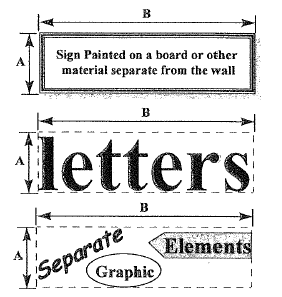
Sign area: Shall be measures by height (A) by length (B) of the smallest rectangle that can be drawn to measure all sign elements. Unless otherwise noted, only one side or face of the same sign shall be used in computing sign area.
(2)
Allowed signs: See Town Code of Ordinances Chapter 42 for additional clarification.
a.
Wall sign:
1.
Maximum size: 25 square feet or 15 percent of the front wall area, whichever is greater.
b.
Window sign:
1.
Maximum size: 25 percent of the window area.
c.
Projecting sign:
1.
Maximum size: Six square feet for one side.
2.
Clearance: Eight feet above ground level.
d.
Awning sign:
1.
Maximum size: Individual letters shall not exceed ten inches in height.
2.
Signs, symbols, or designs may be painted or sewn on to any awning.
e.
Ground sign:
1.
Maximum size: 25 square feet per sign face.
2.
Maximum height: Five feet from finished grade.
(3)
Secondary signs: The following signs shall be permitted along in conjunction with the allowed sign:
a.
One sign per business occupying the upper floors of a building no larger than six inches × eighteen inches.
(4)
Prohibited signs:
a.
Moving signs of any type other than barber poles.
b.
Internally illuminated other than non-flashing neon.
c.
Signs projecting above the roof line.
d.
Roof signs.
e.
Freestanding signs except ground signs.
f.
Ground signs on North Main Street or South Main Street.
g.
Any sign not listed as being allowed is prohibited.
(h)
General provisions. The following general provisions apply to all street types:
(1)
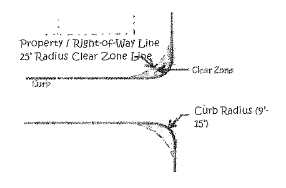
Corner radii and clear zones: Corner curb radii shall be between nine feet and 15 feet. Fairly tight turning radii shorten pedestrian crossings and inhibit reckless drivers from turning corners at high speeds. To allow for emergency vehicles (e.g., fire trucks) to turn corners, a 25-foot radius clear zone shall be established free of all vertical obstructions including, but not limited to, telephone poles, sign poles, fire hydrants, electrical boxes, or newspaper boxes.
(2)
Alleys: Alleys are required in the town center to minimize curb cuts and to provide access to parking and service areas behind buildings. Alley requirements may be waived by the architectural review board (ARB) for access to detached single-family residential lots greater than 55 feet in width in situations in which proper streetfront orientation, pedestrian circulation, and parking can still be accomplished. Alley locations and dimensions are not fixed but shall be designed to accommodate the alley's purpose. Additional curb cuts shall be added only with the permission of the ARB. Alleys may be incorporated into parking lots as drive aisles and fire lanes.
(3)
Exceptions from build-to lines:
a.
Exceptions from build-to lines may be granted by the ARB for avoiding trees with calipers greater than eight inches.
b.
On corner sites (within 50 feet of the corner) with build-to lines set back from the property line, building frontage may be positioned forward of the build-to line up to the property line, provided it does not encroach upon the clear zone.
(4)
Side and rear setbacks: No side or front setbacks are required in the town center.
(5)
First floor height for residential: Residential uses on the first story shall have finished floor height raised a minimum of two feet above sidewalk grade.
(6)
Diversity of building widths: No more than three residential buildings 20 feet or less in width are permitted within any 200 feet of frontage.
(7)
Accessory structures: Accessory structures are permitted and may contain parking, accessory dwelling units, home occupation uses, storage space, and trash receptacles. Home occupation uses are restricted to owner plus one employee, shall not include noxious or disruptive functions, and may not disrupt parking for neighboring residents.
(8)
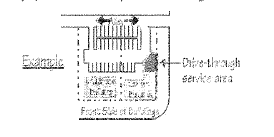
Drive-throughs: Drive-through service windows are permitted in the rear in mid-block and alley accessed locations provided they do not substantially disrupt pedestrian activity or surrounding uses.
(9)
Civic sites: Civic buildings contain uses of special public importance. Civic buildings include, but are not limited to, municipal buildings, churches, libraries, schools, daycare centers, recreation facilities, and places of assembly. Civic buildings do not include retail buildings, residential buildings, or privately owned office buildings. In order to provide greater flexibility to create a special architectural statement, civic buildings are not subject to build-to line requirements or building frontage requirements. The design of civic buildings shall be subject to review and approval by the ARB.
(i)
Parking.
(1)
Parking requirements.
a.
The intent of these parking regulations is to encourage a balance between compact pedestrian oriented development and necessary car storage. The goal is to construct neither more nor less parking than is needed.
b.
There shall be no minimum parking requirement in the Town Center. The applicant shall provide a parking analysis justifying the proposed parking solution.
c.
Minimum parking space dimensions for head-in or diagonal parking shall be nine feet × 18 feet with 11 foot drive lanes (22 feet for two-way traffic) and parallel parking spaces shall be eight feet × 20 feet minimum with ten-foot drive lanes (20 feet for two-way traffic).
d.
Parking shall be provided as necessary to meet the requirements of the Americans with Disabilities Act.
(2)
On-street parking. The selection of diagonal or parallel parking along any section of road shall be determined in consultation with ARB. In the event that ARB approves diagonal instead of parallel parking, dimensions should be adjusted.
(3)
Off-street surface parking lot placement. Off-street surface parking lots shall be set back a minimum of 50 feet from the property line along Highway 162. ARB shall have discretion to make this requirement applicable elsewhere on prominent frontages, such as along key pedestrian connections, within significant vistas and within important public spaces. Outbuildings serving as garages facing alleys shall be permitted within this setback. Surface parking lots may be built up to the property line on all other street frontages.
(4)
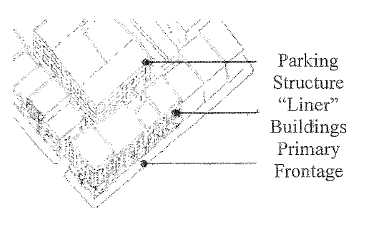
Structured parking lot placement. Parking structures shall be set back a minimum of 50 feet from the property lines of all adjacent streets to reserve room for liner buildings between parking structures and the lot frontage. The liner building shall be no less than two stories in height. Liner buildings may be detached from or attached to parking structures.
(5)
Access to off-street parking.
a.
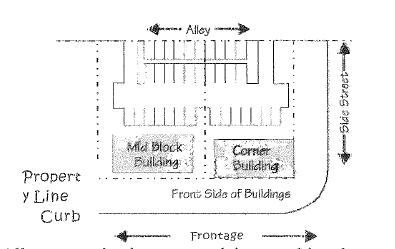
Alleys shall be the primary source of access to off-street parking. Parking along alleys may be head-in, diagonal or parallel.
b.
Alleys may be incorporated into parking lots as standard drive aisles. Access to all adjacent properties shall be maintained. Access between parking lots across property lines is encouraged.
c.
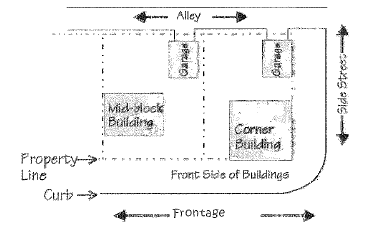
Circular drives are prohibited except for civic buildings.
d.
Corner lots that have both rear and side access shall access parking through the rear (see diagram). Garage door(s) shall be positioned no closer to streets, squares or parks than 20 feet behind the principal plane of the building frontage. Garage doors facing streets, squares or parks shall not exceed ten feet in width. Where space permits, garage doors shall face the side or the rear.
(6)
Parking lot landscaping requirements.
a.
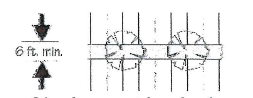
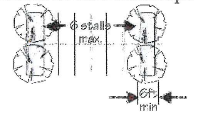
Landscape strips of at least six feet in width shall be provided between parking isles of either head-in or diagonal parking. Tree spacing in parking lots shall be determined by the city arborist based upon tree species and location. The objective is to create as continuous a shade canopy as possible. A diversity of tree species across the Town Center is encouraged. To minimize water consumption, the use of low-water vegetative groundcover other than turf is encouraged.
b.
In lieu of landscape strips, landscape islands can be provided. No more than six consecutive parking stalls are permitted without a landscape island of at least six feet in width and extending the entire length of the parking stall. A minimum of one tree shall be planted in each landscape island.
(j)
Complete streets. All streets proposed in this district will be designed as "complete streets" providing for movement and accommodation of pedestrians, bicycles, and transit, as well as motorized vehicles. Streets shall be designed as gathering places and public spaces.
(k)
Large footprint buildings. Buildings with a footprint greater than 20,000 square feet may be built within the Town Center District by special exception only. Such buildings must abide by all rules in this code with the following special limitations:
(1)
Buildings may be one story in height on any frontage except Main Street and Market Square, but shall be at least 24 feet in height. This may be accomplished with liner buildings or higher ceiling heights and/or parapets.
(2)
To encourage use by pedestrians and decrease the need for solely auto-oriented patronage. Large-footprint buildings must reinforce the urban character of the Town Center and shall therefore continue a connected system of walkable street frontages.
(3)
Buildings are exempt from maximum lot size restrictions, however building footprints may not be larger than a single block.
(4)
Loading docks, service areas and trash disposal facilities shall not face streets, parks, squares or significant pedestrian spaces.
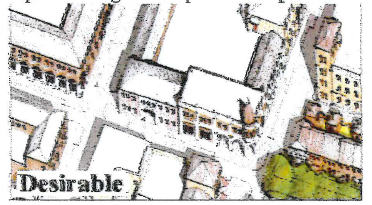
Large footprint buildings are wrapped in a liner of smaller buildings with doors and windows facing the street.
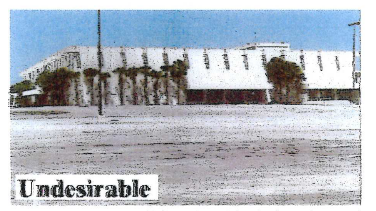
Large footprint building has blank facades and sits behind a field of parking.
(5)
Additional prohibitions: The following are prohibited where visible from parks, squares and primary streets:
a.
Coin-operated newspaper vending boxes.
b.
Utility boxes and machinery including, but not limited to, backflow devices, electric meters and air conditioning units.
(l)
Architectural guidelines.
The lists of permitted materials and configurations come from study of traditional buildings found in Central Florida and have been selected for their appropriateness to the visual environment and climate.
A primary goal of the architectural guidelines is authenticity. The guidelines encourage construction which is straightforward and functional, and which draws its ornament and variety from the traditional assembly of genuine materials.
(1)
General requirements.
a.
The following shall be located in rear yards or sideyards not facing side streets:
1.
Window and wall air conditioners;
2.
Electrical utility meters;
3.
Air conditioning compressors; and
4.
Irrigation and pool pumps.
b.
The following shall be located in the rear yards only:
1.
Antennas;
2.
Permanent barbecues.
c.
The following are prohibited:
1.
Undersized shutters (the shutter or shutters must be sized so as to be equal to the width that would be required to cover the window opening.);
2.
Plastic or inoperable shutters;
3.
Clotheslines;
4.
Clothes drying yards;
5.
Satellite dish antennas greater than 18 inches in diameter;
6.
Reflective and/or bronze-tint glass;
7.
Plastic or PVC roof tiles;
8.
Backlit awnings;
9.
Glossy-finish awnings; and
10.
Fences made of chain-link, barbed wire, or plain wire mesh.
(2)
Building walls.
a.
General requirements. Required for all buildings except single-family houses:
1.
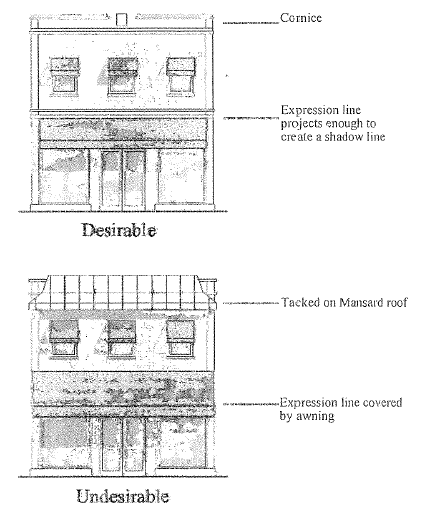
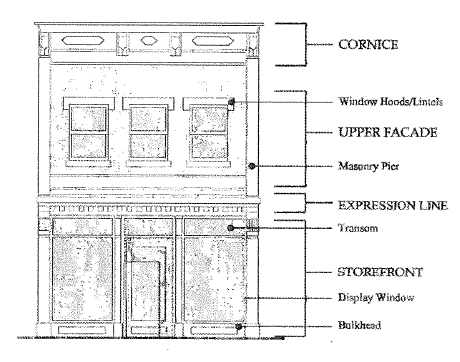
An expression line shall delineate the division between the first story and the second story. A cornice shall delineate the tops of the facades. Expression lines and cornices shall either be moldings extending a minimum of two inches, or jogs in the surface plane of the building wall greater than two inches.
b.
Permitted finish materials.
1.
Concrete masonry units with stucco (C.B.S.).
2.
Reinforced concrete with stucco.
3.
"Hardie-Plank" siding.
4.
Wood: Painted white, left (termite-resistant) natural (cypress and cedar preferred), or painted/stained with colors approved by the ARB.
5.
Brick.
(3)
Garden walls, fences and hedges.
a.
General requirements.
1.
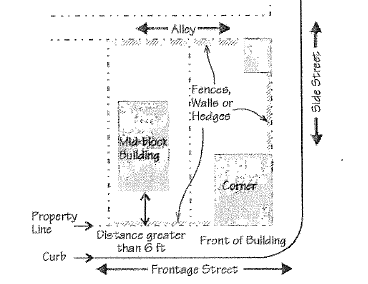
Fences, garden walls, or hedges are strongly encouraged and, if built, should be constructed along all un-built rights-of-way which abut streets and alleys as shown in the diagram below. Fences, garden walls and hedges shall be minimum 25 percent opaque.
2.
Height:
i.
Front yard: Maximum height of 48 inches. Pillars and posts may extend up to six inches more, to a height of 54 inches.
ii.
Side and rear yards: Maximum height of 72 inches. Pillars and posts may extend up to six inches more, to a height of 78 inches.
b.
Permitted finish materials.
1.
Wood (termite-resistant): Painted white, left natural, or painted/stained with colors approved by the development review committee.
2.
Concrete masonry units with stucco (C.B.S.).
3.
Reinforced concrete with stucco.
4.
Wrought iron.
5.
Brick.
c.
Permitted configurations.
1.
Wood:
i.
Picket fences: Minimum 30 percent opaque, w/corner posts.
ii.
Other: To match building walls.
2.
Stucco: With texture and color to match building walls.
3.
Wrought iron: Vertical, five-eighths-inch minimum dimension, four-inch to six-inch spacing.
(4)
Columns, arches, piers, railings and balustrades.
a.
General requirements.
1.
Column and pier spacing:
i.
Columns and piers shall be spaced no farther apart than they are tall.
b.
Permitted finish materials.
1.
Columns:
i.
Wood, painted or (termite-resistant) natural.
ii.
Cast iron.
iii.
Concrete with smooth finish.
2.
Arches:
i.
Concrete masonry units with stucco (C.B.S.).
ii.
Reinforced concrete with stucco.
iii.
Brick.
3.
Piers:
i.
Concrete masonry units with stucco (C.B.S.).
ii.
Reinforced concrete with stucco.
iii.
Brick.
4.
Railings and balustrades:
i.
Wood (termite-resistant), painted or natural.
ii.
Wrought iron.
c.
Permitted configurations.
1.
Columns:
i.
Square, six-inch minimum, with or without capitals and bases.
ii.
Round, six-inch minimum outer diameter, with or without capitals and bases classical orders.
2.
Arches:
i.
Semi-circular and segmental.
3.
Piers:
i.
Eight-inch minimum dimension.
4.
Porches:
i.
Railings 2-¾-inch minimum diameter.
ii.
Balustrades four-inch minimum spacing, six-inch maximum spacing.
(5)
Opacity and facades.
a.
Each floor of any building facade facing a park, square or street shall contain transparent windows covering from 15 percent to 70 percent of the wall area.
b.
Retail storefront areas only: In order to provide clear views of merchandise in stores and to provide natural surveillance of exterior street spaces, the ground floor along the building frontage shall have transparent storefront windows covering no less than 50 percent of the wall area. Storefronts facing Main Street, parks and squares shall remain unshuttered at night and shall utilize transparent glazing material, and shall provide a view of interior spaces lit from within. Doors or entrances with public access shall be provided at intervals no greater than 50 feet, unless otherwise approved by the architectural review board.
(6)
Roofs and gutters.
a.
General requirements.
1.
Permitted roof types: Gabled, hipped, shed, barrel vaulted and domed. Shed roofs shall be concealed with parapets along the street frontage. Applied mansard roofs are not permitted.
2.
Exposed rafter ends (or tabs) at overhangs are strongly recommended.
3.
Downspouts are to match gutters in material and finish.
b.
Permitted finish materials.
1.
Metal:
i.
Galvanized.
ii.
Copper.
iii.
Aluminum zinc-alum.
2.
Shingles:
i.
Asphalt or metal, "dimensional" type.
ii.
Slate.
iii.
Cedar shake.
3.
Tile: Clay, terra cotta, concrete.
4.
Gutters:
i.
Copper.
ii.
Aluminum.
iii.
Galvanized steel.
c.
Permitted configurations.
1.
Metal: Standing seam or "five-vee" 24-inch maximum spacing, panel ends exposed at overhang.
2.
Shingles: Square, rectangular, fishscale, shield.
3.
Tile: Barrel, flat, French.
4.
Gutters:
i.
Rectangular section.
ii.
Square section.
(7)
Windows, skylights and doors.
a.
General requirements.
1.
Rectangular window openings facing streets shall be oriented vertically.
2.
The following accessories are permitted:
i.
Shutters (standard or Bahama types).
ii.
Wooden window boxes.
iii.
Muntins and mullions.
iv.
Fabric awnings (no backlighting; no glossy-finish fabrics).
b.
Finish materials.
1.
Windows, skylights, and storefronts:
i.
Wood.
ii.
Aluminum.
iii.
Copper.
iv.
Steel.
v.
Vinyl clad wood.
2.
Doors: Wood or metal.
c.
Permitted configurations.
1.
Windows:
i.
Rectangular.
ii.
Square.
iii.
Round (18-inch maximum outer diameter) semi-circular.
iv.
Octagonal.
2.
Window operations:
i.
Casement.
ii.
Single- and double-hung.
iii.
Industrial.
iv.
Fixed frame (36 square feet maximum).
3.
Skylights: Flat to the pitch of the roof.
4.
Door operations:
i.
Casement.
ii.
French.
iii.
Sliding (rear only).
(m)
Signage.
(1)
General requirements.
a.
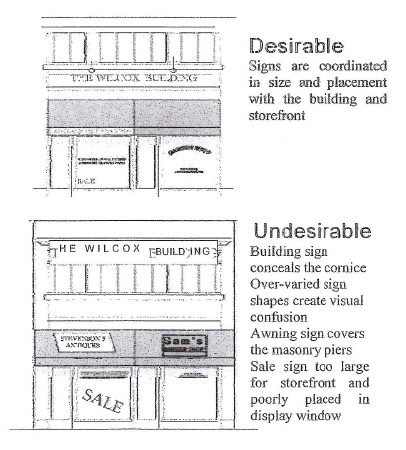
All signs shall be subject to approval by the ARB in order that signs are consistent and in harmony with the Town Center. The ARB shall use graphics in this section as nonbinding guidelines, but shall make a determination of appropriateness on a case by case basis.
b.
Signs shall be flat against the facade, mounted projecting from the facade, or mounted above the top of the facade. Freestanding monument signs are permitted by special exception.
c.
Signs shall be externally lit. Individual letters and symbols may be internally lit or back-lit.
(2)
Finish materials.
a.
Wood: Painted or natural.
b.
Metal: Copper, brass, galvanized steel.
c.
Painted canvas.
d.
Neon.
e.
Paint/engraved directly on facade surface.
(3)
Configurations.
a.
Maximum gross area of signs on a given facade shall not exceed ten percent of the applicant's facade area.
b.
Maximum area of any single sign mounted perpendicular to a given facade shall not exceed ten square feet.
c.
Signs shall maintain a minimum clear height above sidewalks of eight feet.


(n)
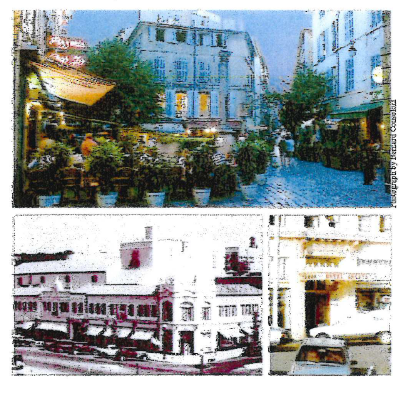
Building elements.
(1)
Awnings and marquees.
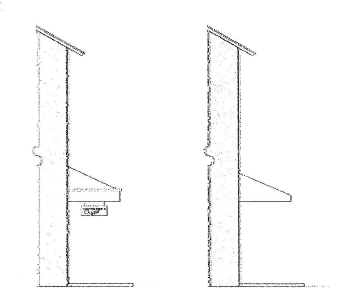
Depth = five-foot minimum.
Height = ten-foot minimum clear.
Length = 25 percent to 100 percent of building front.
a.
The above requirements apply to first-floor awnings. There are no minimum requirements for awnings above the first floor.
b.
Marquees and awnings shall occur forward of the build-to line and may encroach within the right-of-way, but shall not extend past the curb line. Awnings shall be made of fabric. High-gloss or plasticized fabrics are prohibited.
(2)
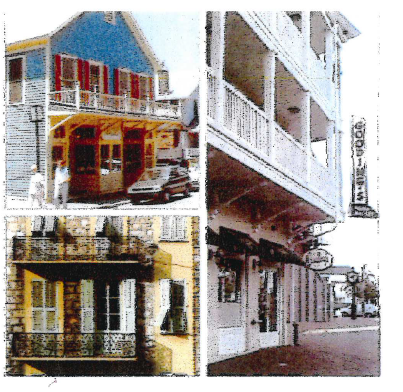
Balconies.
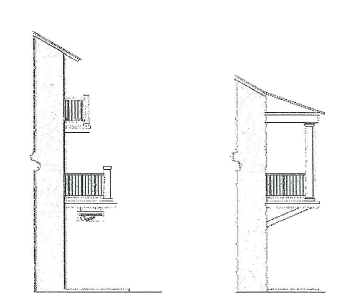
Depth = six-foot minimum for 2nd floor balconies.
Height = ten-foot minimum clear.
Length = 25 percent to 100 percent of building front.
a.
Balconies shall occur forward of the build-to line and may encroach within the right-of-way, but shall not extend past the curb line.
b.
Balconies may have roofs, but are required to be open, un-air conditioned parts of the buildings. On corners, balconies may wrap around the side of the building facing the side street.
(3)
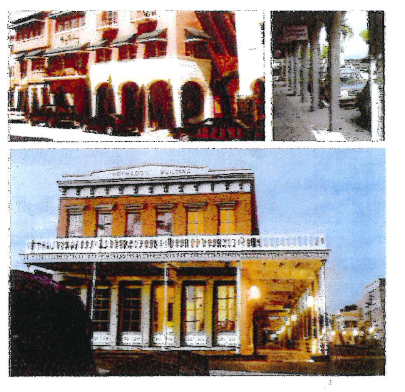
Colonnades/areades.
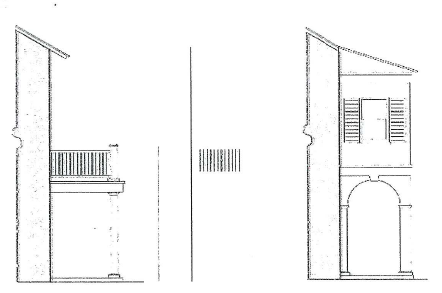
Depth = ten-foot minimum from the build-to line to the inside column face.
Height = ten-foot minimum clear.
Length = 75—100 percent of building front.
a.
Open multi-story verandas, awnings, balconies, and enclosed useable space shall be permitted above the colonnade.
b.
Colonnades shall only be constructed where the minimum depth can be obtained. Colonnades shall occur forward of the build-to line and may encroach within the right-of-way, but shall not extend past the curb line.
c.
On corners, colonnades may wrap around the side of the building facing the side street.
(4)
Front porches.
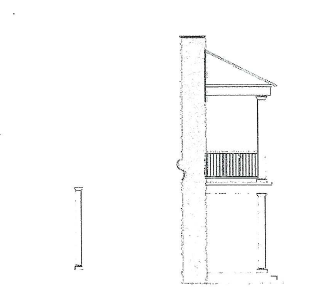
Depth = eight-foot minimum.
Length = 25 percent to 90 percent of building front.
a.
Front porches may have multi-story verandas and/or balconies above.
b.
Front porches shall occur forward of the build-to line. Porches shall not extend into the right-of-way.
c.
Front porches are required to be open, unairconditioned parts of the buildings. More than 25 percent of the floor area of a porch shall not be screened if the porch extends forward of the build-to line.
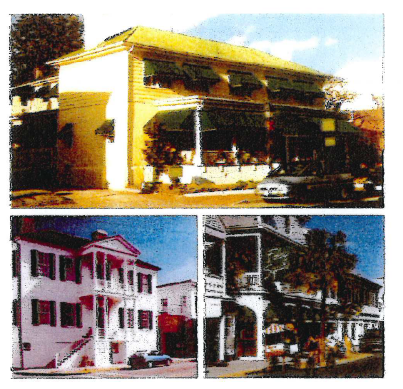
(5)
Stoops.
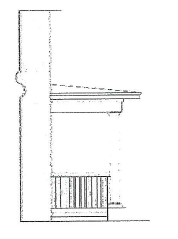
Depth = six-foot minimum.
Length = five-foot minimum.
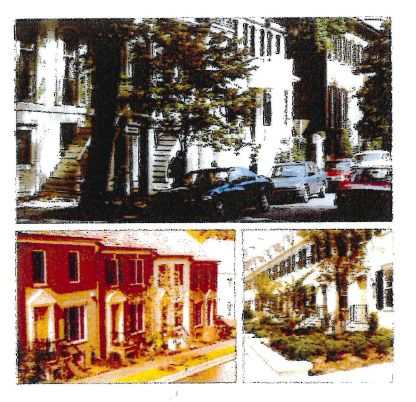
Stoops are permitted and may occur forward of the build-to line. Stoops may encroach within the right-of-way with approval. Sidewalks shall have clear access for pedestrians. Stoops may be covered or uncovered.
(o)
Definitions.
Accessory structure: A building or structure subordinate to the principal building and used for purposes customarily incidental to the main or principal building and located on the same lot or set of attached lots therewith.
Alley: A secondary way publicly or privately owned which affords access to the side or rear of abutting property.
Appurtenances: Architectural features not used for human occupancy consisting of: Spires, belfries, cupolas or dormers; silos; parapet walls, and cornices without windows; chimneys, ventilators, skylights, and antennas.
Awning: An architectural projection roofed with flexible material supported entirely from the exterior wall of a building.
Balcony: A porch connected to a building on upper stories supported by either a cantilever or brackets.
Block: An increment of land composed of an aggregate of lots, tracts and alleys circumscribed by thoroughfares.
Build-to-line: A line parallel to the property line, along which a building shall be built. Exact location of build-to-lines shall be established by the DRC at the time of application.
Building frontage: The vertical side of a building which faces the primary space or street and is built to the build-to-line.
Building volume: The space displaced by the exterior walls and roof of a building; a product of building width, depth, and height. It is the intent of this Code to regulate building volume in order to shape public spaces that are human-scaled, well-ordered, and which maximize the shared real estate amenity.
Building width: The distance from one side of a building frontage to the other. In conditions where buildings are attached, building width is the distinction between buildings which shall be expressed via a change in architectural expression, such as a vertical element running from ground to roof, a change in fenestration or style, color or texture, or a break in facade plane or roof line. These changes may be subtle or significant, but it is the intent to avoid homogenous blocks of excessively long buildings.
Colonnade or arcade: A covered, open-air walkway at standard sidewalk level attached to or integral with the building frontage; structure overhead is supported architecturally by columns or arches along the sidewalk.
Dwelling area: The total internal useable space on all floors of a structure, not including porches, balconies, terraces, stoops, patios, or garages.
Front porch: A roofed area, attached at the ground floor level or first floor level, and to the front of a building, open except for railings, and support columns.
Garden wall: A freestanding wall along the property line dividing private areas from streets, alleys, and or adjacent lots.
Height: The vertical distance from the lowest point on the tallest side of the structure to the top of the parapet, cornice or eave.
Liner building: A building built in front of a parking garage, cinema, supermarket etc., to conceal large expanses of blank wall area and to face the street space with a facade that has doors and windows opening onto the sidewalk (see diagrams, subsection (5) of this section). Parking garages and their liners may be built at different times.
Lot: A single building plot; the smallest legal increment of land which may be bought and sold.
Lot frontage: The property line adjacent to the frontage street.
Marquee: A permanently roofed architectural projection the sides of which are vertical and are intended for the display of signs; which provides protection against the weather for the pedestrian; and which is supported entirely from an exterior wall of a building.
Primary space or street: The space or street that a building fronts. At squares and street intersections the space or street highest in the hierarchy is the primary street.
Stoop: A small platform and/or entrance stairway at a house door, commonly covered by a secondary roof or awning.
Storefront: Building frontage for the ground floor usually associated with retail uses.
Structured parking: Layers of parking stacked vertically.
(Code 1998, § 5-5-40; Ord. No. 2006-38, 12-22-2008; Ord. No. 2011-12-10, 2-27-2012; Ord. No. 2015-16-10, 6-27-2016)
Sec. 58-101. - LI Light industrial.
This district is established to accommodate wholesaling, distribution, storage, processing, and light manufacturing.
(1)
Minimum lot area. The minimum lot area shall be 15,000 square feet.
(2)
Open space requirement. Not applicable.
(3)
Surface requirement. Pervious surface requirement shall be 20 percent.
(4)
Minimum yard and setback. The minimum yard and setback requirements are as follows:
a.
Front yard.
1.
On Highway 165 or Highway 162 shall be 50 feet.
2.
On other streets shall be 35 feet.
b.
Side yard.
1.
Residential uses shall be ten feet.
2.
Nonresidential uses shall be 50 feet.
3.
Nonresidential uses adjacent to residential districts shall be 75 feet.
c.
Rear yard.
1.
Residential uses shall be 25 feet.
2.
Nonresidential uses shall be 50 feet.
3.
Nonresidential uses adjacent to residential districts shall be 75 feet.
(5)
Minimum lot width. The minimum lot width shall be 100 feet.
(6)
Maximum height of structures. The maximum height of structures shall be 35 feet.
(7)
Parking requirements. See article X of this chapter.
(Code 1998, § 5-5-41)
Sec. 58-102. - GI General industrial.
The intent of this district is to establish and preserve areas for various types of industrial uses which do not create excessive noise, odors, smoke, dust and are not detrimental to surrounding uses.
(1)
Minimum lot area. The minimum lot area shall be 15,000 square feet.
(2)
Open space requirement. Not applicable.
(3)
Surface requirement. Pervious surface requirement shall be 20 percent.
(4)
Minimum yard and setback. The minimum yard and setback requirements are as follows:
a.
Front yard.
1.
On Highway 165 or Highway 162 shall be 50 feet.
2.
On other streets shall be 35 feet.
b.
Side yard.
1.
Residential uses shall be ten feet.
2.
Nonresidential uses shall be 50 feet.
3.
Nonresidential uses adjacent to residential districts shall be 75 feet.
c.
Rear yard.
1.
Residential uses shall be 25 feet.
2.
Nonresidential uses shall be 50 feet.
3.
Nonresidential uses adjacent to residential districts shall be 75 feet.
(5)
Minimum lot width. The minimum lot width shall be 100 feet.
(6)
Maximum height of structures. The maximum height of structures shall be 35 feet.
(7)
Parking requirements. See article X of this chapter.
(Code 1998, § 5-5-42)
Sec. 58-103. - PD Planned development.
A planned development is a tract of land zoned residential and/or business, under a single, corporation, firm, partnership, or association ownership, and planned and developed as an integral unit. It is established as a single development operation or a programmed series of development operations.
(1)
Intent. The intent of this district is to allow developers design flexibility in return for site plans utilizing innovative design concepts and increased amenities which will contribute to the quality of life to the town.
(2)
Permitted uses. In order to remain flexible, the planned development is intended to allow various types of uses including residential, retail, office, and industrial. Any use proposed by the developer and considered by the planning commission as being compatible to other nearby uses within and beyond the district may be permitted in such district, upon approval of the planning commission. A listing of permitted uses within a particular planned development district shall be provided by the applicant and adopted as part of the regulations applying to that district upon approval of the planning commission. After approval by the commission, the list shall be adopted as part of the regulations for that particular planned development district. The uses permitted in the district shall be restricted to those listed, approved and adopted.
(3)
Size requirement. All planned development districts must be at least one acre in size.
(4)
Cost of application. The cost for an application for the planned development district shall be established by the town council. The planning commission may retain a registered professional engineer, architect, landscape architect, planner, or other professional consultant to advise the commission regarding the proposed site plan. The cost for this service will be borne by the applicant.
(5)
Preapplication conference. Before submitting an application for the planned development zoning, the applicant shall meet with the town planning director and building official to obtain information and guidance prior to incurring substantial expenses in the preparation of the plan.
(6)
Application. All applications for planned development district zoning shall be filed with the planning director. The applicant shall submit ten copies of a site plan prepared by a professional engineer, architect, or landscape architect drawn to scale. The site plan shall include the following information:
a.
Name of the project, boundaries, date, north arrow and scale and total acreage or square footage of the development and tax map number.
b.
Name and address of the owner, developer, and seal of the engineer, architect, or landscape architect.
c.
Names and addresses of all owners of abutting parcels, and zoning of the subject property and adjacent parcels.
d.
All existing lot lines, easements, and rights-of-way.
e.
Adjacent land uses, and the location and use of structures on adjacent properties.
f.
The location and use of all existing and proposed buildings and structures within the development. Dimensions of the height and the floor area with the exterior entrances with anticipated additions or alterations should also be included.
g.
The location of all proposed roadways, parking areas, sidewalks, ramps, curbs, fences, paths, landscaping and walls.
h.
Location and type of any proposed screening.
i.
The location, height and intensity of all lighting with the direction of illumination and methods to eliminate glare on adjoining properties.
j.
The location, size, height, materials, and design of all proposed signage.
k.
The location of all proposed utility systems including: sewage or septic tank system, water supply system, telephone, cable, and electrical lines; and storm drainage system including existing and proposed culverts, catchbasins, headwalls and drainage swales.
l.
Landscaping plan meeting the requirements of article III of chapter 26, Environment.
m.
If the project is to be built in stages, this must be indicated on the plan.
(7)
Maintenance guarantee. A maintenance guarantee shall be submitted which states the guarantees and assurances to be provided for the maintenance of common areas, recreational areas, sidewalks, and other privately owned but common facilities.
(8)
Covenants and restrictions. Any covenants and restrictions governing the ownership, management and maintenance of common areas shall be submitted with the site plan.
(9)
Subdivision of property. The subdivision of property shall follow the guidelines set forth in chapter 30, Land Development.
(10)
Procedural requirements. Any order authorizing the establishment of a planned development district shall be treated as an amendment to this chapter and map and shall be enacted pursuant to the procedures and regulations outlined in article I of this chapter, concerning amendments.
(11)
Design requirements for planned developments.
a.
Common areas. All planned developments shall contain commonly owned land equal in area to at least ten percent of the entire project area.
b.
Setback requirements and height limitations. The setback requirements for the planned development district shall follow those of the existing district unless approved by the planning commission. All buildings shall not exceed 35 feet in height unless approved by the planning commission.
c.
Lot sizes. Lot sizes for all uses within proposed planned developments shall be approved by the planning commission. The planning commission shall use the current zoning district regulations as a guide.
d.
Signs and street names. All development within the planned development district shall fall under the provisions of chapter 30, Land Development, and this chapter regarding signs and street names.
e.
Pervious surface. The minimum pervious surface shall be 20 percent for the total project area.
f.
Parking requirements. Parking requirements can be found in article X of this chapter.
(Code 1998, § 5-5-43; Ord. No. 2005-16, § 5-5-43, 10-24-2005)
Sec. 58-104. - CD Cluster development overlay.
A cluster development is one that is designed to concentrate buildings in specific areas on a site to allow the remaining land to be used for recreation, common open space, and preservation of environmentally sensitive areas.
(1)
Intent. The intent of the cluster development is to allow the developer to decrease lot sizes and leave the increased undeveloped land as open space. This technique should lower development cost and increase the amenity of the project without increasing the density beyond what would be permissible under current zoning.
(2)
Districts where permitted. Cluster developments may be proposed in the R-1 and R-2 zoning districts.
(3)
Open space. The amount of usable open space must be calculated by subtracting the square footage requirement of the current zoning district of each lot that is smaller than the standard then adding the results obtained for each lot.
(4)
Setback requirements and height limitations. All cluster developments shall follow the setback and height requirements of the current zoning district.
(5)
Division of property. The subdivision of property shall follow the guidelines set forth in chapter 30, Land Development.
(6)
Maintenance guarantee. A maintenance guarantee shall be submitted which states the guarantees and assurances to be provided for the maintenance of common areas, recreational areas, sidewalks, and other privately owned but common facilities.
(Code 1998, § 5-5-44; Ord. No. 2019-20-6, § 2, 11-25-2019)
Sec. 58-105. - MPF Movie/media production facilities overlay district.
(a)
Intent. The intent of this district is to provide for the production, filming, distribution, adaptation, computer generation, planning, and audio/sound production for television, movies and other forms of media in such ways compatible with the uses of surrounding properties.
(b)
Movie/media production facilities defined. For purposes of this chapter, movie/media production facilities shall include, but not be limited to, production, filming, distribution, adaptation, computer generation, audio and sound production, and other similar facilities for the production of television, movie and/or other media products; depot, storage, transshipment and/or distribution facilities associated with the production of television, movie and/or other media products; support structures primarily associated with the production of television, movie and/or other media products; and filming involving the use of structures, as defined herein.
(c)
Special use permit required. All movie/media production facilities must receive a conditional use permit pursuant to section 58-186 et seq., and must comply with all the requirements and conditions therein.
(d)
Locations. Movie/media production facilities may be located in the following zoning districts:
(e)
Overlay requirements. The requirements of the MPF overlay district will apply in addition to the requirements of the primary zoning district; in case of conflict, the requirements of the MPF district will control.
(f)
Maximum height of structures; requirements. The maximum height of structures shall be 125 feet, as limited by conditions of the special use permit. Height shall be measured from the ground level, or from the minimum flood level if applicable. Air handler shafts, elevator mechanical rooms, communication satellites, dishes and antennas located on the top of a structure are not included in the height limitation, but must be situated so as to minimize the visual impacts on surrounding properties.
(g)
Vehicular access. All structures and areas used for filming must have access to at least one paved street.
(h)
Utilities. All permanent structures must be served by public water and sewer service.
(i)
Parking requirements. Parking must be provided on an all-weather surface to meet the following minimums:
(Code 1998, § 5-5-45)
Sec. 58-106. - Permitted uses per district.
The following tables depict the uses that are allowed in each district. The letter P indicates that the use is permitted. The letter C indicates that the use may be permitted as a conditional use upon review.
TABLE 1
SCHEDULE OF PERMITTED USES BY DISTRICT
(RESIDENTIAL)
P=Permitted, C=Conditional
TABLE 2
SCHEDULE OF PERMITTED USES
(NONRESIDENTIAL)
P=Permitted, C=Conditional
(Code 1998, § 5-5-46; Ord. No. 2011-12-13, 2-27-2012; Ord. No. 2012-13-19, 6-24-2013; Ord. No. 2018-19-7, 2-25-2019; Ord. No. 2018-19-8, 2-25-2019)
Sec. 58-107. - RC Rural conservation.
(a)
[Intent.] The intent of the rural conservation (RC) district is:
(1)
To control the intensity of development in rural areas of the town that are sensitive natural and historical resources;
(2)
To preserve and protect the rural residential character of specific areas within the town;
(3)
To ensure that the cultural integrity of the area's historical resources is protected; and
(4)
To protect these areas from infiltration and incompatible land uses.
This district shall be applied in the annexation of property in to the town; as well as other areas in the future that the property owner or town sees benefit in preserving the rural character of the town.
(b)
Minimum lot area. The RC district applies to parcels ten acres and greater. There shall be no more than one principal dwelling unit per ten acres, There shall be no more than one accessory dwelling unit per principal unit. Examples of accessory dwelling units are guest houses, caretaker quarters, servant's quarters or housing for an elderly family member.
(c)
Open space requirements. None.
(d)
Minimum yard and setback requirements. No yard front, side or rear on interior lots. A buffer of 75 feet is required from any off-site roadway.
(e)
Maximum height of structure. Building height is limited to three livable stories, which is defined as 35 feet. Antennas, chimneys, flue vents or other similar structures may extend up to five feet above the maximum specified height of 35 feet. Church spires, bell towers, flagpoles and like architectural features may extend over the specified height limit of 35 feet. Agricultural structures are exempt from height limits.
(f)
Parking requirements. None.
(g)
Mobile homes. Allowed.
(h)
Permitted uses.
(1)
Agricultural and agricultural storage, single-family residential units, mobile home, sale of products produced on-site, bed and breakfast inns, accessory dwelling units, schools, colleges and churches. All other uses are prohibited.
(2)
Accessory agricultural uses shall include all residential accessory uses and those accessory uses and activities customarily associated with agricultural operations, such as determined by the planning director. Barns and farm-related structures, including roadside stands selling sweet grass baskets or indigenous produce grown or produced on the farm where the roadside stand is located shall be allowed in all parcels in agricultural rural conservation (RC) zoning districts.
(Ord. No. 2006-59, 12-17-2007; Ord. No. 2017-18-1, 8-28-2017)
Sec. 58-108. - PE Parks and entertainment district.
The intent of the parks and entertainment district is to establish a venue for public interaction, recreation and entertainment. The zoning is for nonresidential use. The zoning is designed to manage concerts, receptions, parties, shows, festivals or similar large gatherings. The zoning district is designed to mitigate the effect of traffic, garbage and noise to neighboring properties. This zoning district may be used for private properties or municipal parks.
(1)
The minimum lot size for this district is three acres.
(2)
Minimum lot width: 300 feet.
(3)
Maximum height of structures: 35 feet.
(4)
Parking requirements: See article X of this chapter.
(5)
Any facility in this district may not include a hotel, restaurant or a commercial business that is not related to the reception or concert.
(6)
Lighting and noise requirements:
a.
Lighting and sound shall be limited to protect neighboring property. Property lights shall not be directed off the property.
b.
Termination of events will be set by policy.
c.
Owners of the property and event managers are responsible for the prompt cleaning of the property from any garbage or debris resulting from an event.
d.
Amplified music shall be directed away from neighboring residents and towards a wooded area, river or other sound barrier.
e.
Speakers shall be located no closer than 500 feet of a neighboring residence.
f.
The owners of the property and managers of an event shall provide neighboring residents with a name, address and telephone number of a person that they may immediately contact in the event that there is a problem with noise from an event.
g.
Venues using amplified music are encouraged to consult with an acoustic engineer to evaluate and establish walls, berms, vegetative barriers or other alternatives to mitigate noise pollution.
h.
Owners of the property and event managers are strongly encouraged to actively monitor the noise level at any event.
i.
Events having crowds of more than 100 guests must hire an off-duty law enforcement officer to maintain order and direct traffic.
j.
The Town of Hollywood ordinances, including but not limited to any applicable noise ordinance and the business license ordinance, shall apply to events occurring in the parks and entertainment district.
(Ord. No. 2013-14-13, 6-23-2014)

