
Holyoke City Zoning Code
SECTION 4
- USE REGULATIONS
4-1. - General.
No structure shall be erected or used, or land used, except as set forth in this ordinance, unless exempted by this ordinance or by statute. Uses not expressly provided for herein are prohibited. Not more than one principal structure shall be placed on a lot, except in accordance with section 5-4.
(Ord. of 2-19-02 [45th amd.], § 4.0)
4-2. - Applicability.
When an activity might be classified under more than one of the following uses, the more specific classification shall govern; if equally specific, the more restrictive shall govern.
4-3. - Table of principal uses.
Symbols employed below shall mean the following:
Y—A permitted use.
N—An excluded or prohibited use.
CC—A use authorized under special permit from the city council as provided under section 9-3.
PB—A use authorized under special permit from the planning board as provided under section 9-3.
BA—A use authorized under special permit from the board of appeals as provided under section 9-3.
DISTRICTS
(Ord. of 2-19-02 [45th amd.], § 4.0; Ord. of 6-15-04 [60th amd.], § 1; Ord. of 4-15-08 [71st amd.], § 1; Ord. of 9-2-08 [78th amd.], § 1; Ord. of 11-18-08 [84th amd.], § 1; Ord. of 3-5-13 [108th amd.], § 1; Ord. of 8-5-14 [123rd amd.], § 1; Ord. of 4-26-16 [131st amd.], § 1; Ord. of 10-4-16 [133rd amd.], § 1; Ord. of 12-5-17 [141st amd.], § 1; Ord. of 12-5-23 [173rd amd.], § 1)
4-4. - Accessory uses and structures.
4.4.1 Nonresidential accessory uses. Any use permitted as a principal use is also permitted as an accessory use provided such use is customarily incidental to the main or principal building or use of the land. Any use authorized as a principal use by special permit may also be authorized as an accessory use by special permit provided such use is customarily incidental to the main or principal building or use of the land. Any use not allowed in the district as a principal use is also prohibited as an accessory use. Accessory uses are permitted only in accordance with lawfully existing principal uses. In all instances where site plan review and approval is required for a principal use, the addition of any new accessory use to the principal use, where such addition exceeds the thresholds established in section 10, shall also require site plan review and approval. Notwithstanding this provision, the following nonresidential accessory uses are permitted.
4.4.2 Permitted uses. The following accessory uses are specifically authorized in the districts indicated:
4.4.3 Dwelling units in accessory structures. No accessory structure shall be used as a dwelling except by special permit granted by the city council for any auxiliary building with a dwelling unit in an RM-20, RM-40, RM-60, DR or R2 district where the city council makes the following findings and subject to the following conditions:
1.
The accessory building is of historical significance and its conversion to a dwelling unit would result in a preservation of architectural qualities that give it historical significance.
2.
The dwelling unit will satisfy a desirable local need and its design and appearance will not be injurious to the establishment or future character of the vicinity and the neighborhood.
3.
The conversion will not be deleterious to use and enjoyment of surrounding properties.
4.
Dimensional controls: The accessory building to be converted to a dwelling unit is at least two stories in height and contains a minimum of 1,000 square feet.
5.
Overall design standards: The dwelling unit shall be an integral part of the premises and have convenient access to and from adjacent uses and blocks. The dwelling unit shall be related to the principal building in design, materials, and placement to provide a visually and physically integrated lot. The dwelling unit shall be accessible to emergency vehicles. The location of the dwelling unit will not interfere with existing privacy between adjacent buildings.
6.
Landscaping design standards: Landscape treatment for the dwelling unit shall be part of an integrated landscape design for the entire lot.
7.
Other conditions: The city council may prescribe such further conditions with respect to the conversion of an accessory building to a dwelling unit as it deems appropriate.
4.4.4 ATM as an accessory structure. In the case that an ATM is free-standing, the following considerations shall be made:
1.
The ATM shall not be situated so as to cause vehicles to queue onto adjacent roads while awaiting service.
2.
The ATM shall be provided with three parking spaces, except where such ATM location is designed to serve only customers in vehicles. Such parking spaces shall not include parking spaces assigned to other principal uses on the same or adjacent lots.
3.
The traffic circulation pattern for the ATM shall not interfere with parking spaces or parking lot aisles designated for other uses on the same or adjacent lots.
4.4.5 Canopy as an accessory structure. A canopy shall be defined as an accessory structure provided that there is a permanent structure on site. A canopy shall meet the following criteria:
1.
The canopy shall not project over a sidewalk or right-of-way.
2.
The canopy shall have a minimum vertical clearance to grade at entrance of eight feet.
3.
One canopy per building lot shall be allowed.
4.
Those canopies projecting solely over the entrances of businesses for the protection of pedestrians shall not be considered accessory structures.
4.4.6 Location of accessory structures. Accessory structures attached to principal structures shall be located in accordance with the dimensional controls in the table of dimensional controls, section 5.2.1, for the district(s) in which they are located. Detached accessory structures may be erected in the rear yard area, provided:
1.
Not more than 25 percent of the rear yard is occupied by such structures;
2.
No accessory structure is located nearer than eight feet of any principal structure of any rear lot line;
3.
No one-story accessory structure is located nearer than five feet of any side lot line, and no two story accessory structure is located nearer than ten feet of any side lot line.
4.4.7 Height of accessory structures. In all districts, except IG and WM, no accessory structureshall be higher than two stories. Such structures shall not exceed 22 feet in height for a one story building and 30 feet in height for a two story building. In IG districts, no accessory structure shall exceed 60 feet in height.
4.4.8 Farm buildings. The provisions of this section shall not apply to agricultural structures; however, all such buildings shall be located at least 50 feet from residence districts other than RA.
4.4.9 Accessory to scientific research. The provisions of this section shall not apply to accessory uses which are necessary in connection with scientific research, scientific development or related production activities, whether or not on the same premises as the principal use and only if such uses are accessory to principal uses permitted as a matter of right. Such accessory use may only be allowed by special permit of the city council and only after it is determined that the proposed accessory use does not substantially derogate from the public good. All general requirements for the granting of a special permit shall apply in these cases.
4.4.10. Temporary storage units. Temporary storage units are allowed by right if used for not more than 60 days. Said container may not be utilized for more than two periods of up to 60 days within one calendar year. All temporary storage units must comply with the guidelines prescribed for this section, as well as complying with the provisions of section 7.2.12, and for storage units in BH, BG, IG and IP zones, section 6.3, outdoor storage area.
1.
Location: Temporary storage units are prohibited from being placed in streets or the front yard of a property. Units in residential zones must be kept in the driveway of the property at the furthest accessible point from the street. The applicant must obtain preapproval from the building commissioner if the property does not have a driveway or the driveway is located in the front yard of the property. Units in the BG, BH, BE, IG and IP districts must comply with the guidelines prescribed for the outdoor storage of materials as outlined in section 6.3.
2.
Number of units: Only one temporary storage unit may be placed on any property at any time.
3.
Registration: Any temporary storage unit accessory to a commercial or industrial use shall be registered with the city clerk by the person that owns, rents or controls the property at which the temporary storage unit will be used. The application shall contain the following:
a.
The name of the person to whom the unit is supplied;
b.
Whether the person owns, rents, occupies or controls the property;
c.
The address at which the unit will be placed;
d.
The delivery date and removal date;
e.
Active building permit number, if unit will be used for storage of building materials;
f.
The building commissioner's preapproval of the location, if applicable; and
g.
A sketch depicting the location and placement of the temporary storage unit.
The application shall be accompanied by a $25.00 fee. The effective date of the registration shall be the date of the city clerk's approval.
4.
Violations and penalties. Any person who shall place a temporary storage unit in violation of this section shall be subject to a fine of not more than $300.00 for each offense. Each day that the violation continues shall constitute a separate offense.
4.4.11. BESS (Small-Scale) as an accessory structure. A BESS (small-scale) shall be defined as an accessory structure provided that it is accessory to a permanent structure on site.
A BESS (small-scale) shall meet the following criteria:
1.
The BESS shall be no greater than 200 square feet in size, including its enclosure.
2.
The BESS shall meet all local, state, and federal standards and/or codes for safe installation.
3.
The BESS shall provide backup power primarily to the residence, business, or industrial use on the site, however, may also export power to the electrical grid through a utility sponsored program provided that the BESS is solely connected to the existing building service.
4.
The BESS shall not produce sound within the human hearing range audible to a person at a distance of 50 feet.
5.
The BESS shall be located as set forth in section 4.4.6 of this ordinance.
(Ord. of 2-19-02 [45th amd.], § 4.0; Ord. of 11-18-08 [88th amd.], § 1; Ord. of 12-5-23 [173rd amd.], § 1)
4-5. - Swimming pools.
4.5.1 General. Swimming pools shall be regulated by the following provisions:
4.5.2 Location. The wall of a swimming pool shall not be located less than eight feet from any dwelling or accessory structure, six feet from any rear or side lot line, and ten feet from the street line. In the case of corner lots, pools may be allowed within the front yard or side yards pending that they are not located within the front yard or side yard setbacks as prescribed in section 5.2 Table of Dimensional Regulations.
4.5.3 Safety barrier. All swimming pools to be constructed, in process of construction, or already constructed shall be enclosed by a safety barrier to prohibit, within reason, unrestrained intrusion, beneath, over, or through the safety barrier enclosure by persons or animals. The safety barrier shall be constructed in accordance with current edition of the State Building Code, 780 CMR.
4.5.4 Lights. Lights to illuminate any swimming pool shall be so arranged and shielded as to direct or reflect light away from adjoining premises and public streets.
4.5.5 Minimum standards. The minimum standards for swimming pools, as maintained by the Holyoke Board of Health in accordance with the Massachusetts Department of Public Health regulations and applicable General Laws, shall be in effect and full force for the construction and maintenance of a swimming pool.
(Ord. of 2-19-02 [45th amd.], § 4.0; Ord. of 6-1-10 [102nd amd.], § 1; Ord. of 3-5-13 [110th amd.], § 1; Ord. of 5-17-22 [165th amd.], § 1)
4-6. - Fences.
4.6.1 Setback. Fences are permitted to be installed with a zero setback from the lot line; however, the fence and any foundation, footing or other support structures shall not encroach over the lot line, or the invisible vertical plane above and below ground that is represented by the lot line.
4.6.2 Visibility
4.6.2.1 Corner lot. A fence, planted hedgerow, or other barrier may be erected on a corner lot following the rules for corner lots established in Section 5.0 Dimensional Controls, provided that no structure or vegetation shall be over three and one-half feet in height within the "sight triangle". The "sight triangle" is defined as the area within an area within a triangle formed by two lines measured along the center of the nearest lane of travelled way of intersecting streets from the point of intersection for a distance of 25 feet, and a third line connecting the terminal points on the two legs measured along the lanes of travel.
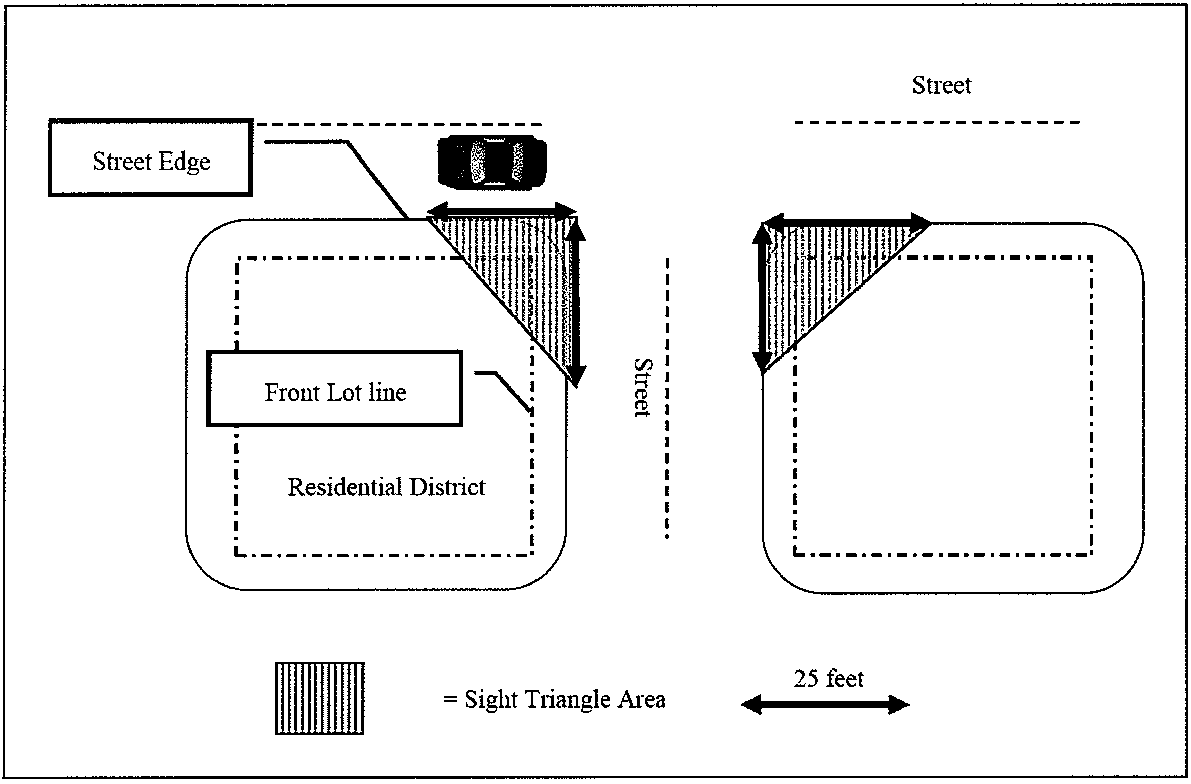
4.6.2.2 Driveways. No fence shall be erected or maintained along the front or side line of a front yard in a manner which interferes with vehicular, pedestrian or other traffic visibility or safety of egress from the driveway.
4.6.3 Height. Fences along both the front and side property lines in a front yard shall not exceed four feet in height. Fences in side and rear yards shall not exceed six feet in height
4.6.3.1 Artificial foundations: Where a fence is placed atop any other manmade feature such as a retaining wall, berm, or foundation, the height of such structure above the surrounding (natural) grade shall be considered as part of the total height of the fence.
4.6.3.2 A Special Permit may be granted by the Planning Board to exceed the height of a fence in the following instances where the Board finds that:
• The fence is necessary for safety, security or shielding of one use from an adjacent, unlike use
• Planting materials such as hedges, or shrubbery are not adequate or possible
• The fence shall not impair sight distance of vehicular, pedestrian, or other traffic
• The proposed fence is of a material that is of durable construction
• The proposed fence is of a design and material that harmonizes with the surrounding neighborhood
(A)
Industrial Uses: In the case of industrial uses in IP, IG, and WM zones, fencing height may be increased if found necessary to shield the use from neighboring properties as well as for security purposes.
(B)
Commercial Uses: In the case of commercial uses, when the property abuts a residential use a fence height may be increased for the security of outdoor display and storage.
(C)
Multifamily (4 family and above) Residential/Institutional Uses: When the property abuts an unlike use, fence height may be increased when found necessary to shield that use from the neighboring uses.
(D)
Abutting Properties: A property that abuts an unlike use, where the unlike use is eligible to apply for a special permit to exceed fence height, shall also be eligible to apply for a special permit to exceed fence height, which may be granted in accordance with the criteria set forth herein.
(E)
Front yard (Proposed): In the case of residential uses, fence height in a front yard may be increased provided that the proposed fencing meets the criteria established above and that no fence or other barrier over three and one-half (3 ½) feet is erected in the "sight triangle" established in Section 4.6.2.1: Corner Lots.
4.6.3.3. Exemptions
(A)
Where state or federal law requires a minimum fence height in excess of those permitted by right under this section, nothing herein shall be construed to prohibit or require a special permit for such a fence.
(B)
Dumpster enclosures: Dumpster enclosures shall shield the dumpster from sight and shall be at least as tall as the dumpster.
4.6.4 Materials used in fencing
4.6.4.1 Generally. Fences shall be made of wood, vinyl, brick, masonry, stone or other like and durable materials that harmonize with materials and styles used in the surrounding neighborhood.
4.6.4.2 Facing side. Fences shall be placed with the most attractive side (e.g., in the case of a picket fence, the side without horizontal members) facing the street and neighboring properties.
4.6.4.3 Antipersonnel wire prohibited. No person shall install a fence in whole or in part, using razor, barbed, concertina wire or tape, or other substantially similar materials of whatever name, manufacturer or commercial designation. Where state or federal law requires use of such fencing, nothing in this statute shall be construed so as to prohibit such required fencing materials.
(Ord. of 2-19-02 [45th amd.], § 4.0; Ord. of 5-4-10 [101st amd.], § 1; Ord. of 6-4-13 [116th amd.], § 1; Ord. of 9-3-19 [150th amd.], § 1; Ord. of 11-16-21 [158th amd.], § 1)
4-7. - Nonconforming uses and structures.
4.7.1 Applicability.
This zoning ordinance shall not apply to structures or uses lawfully in existence or lawfully begun, or to a building or special permit issued before the first publication of notice of the public hearing required by M.G.L.A. c. 40A, § 5 at which this zoning ordinance, or any relevant part thereof, was adopted. Such prior, lawfully existing nonconforming uses and structures may continue, provided that no modification of the use or structure is accomplished, unless authorized hereunder.
4.7.2 Nonconforming uses. The city council may award a special permit to change a nonconforming use in accordance with this section only if it determines that such change or extension shall not be substantially more detrimental than the existing nonconforming use to the neighborhood. The following types of changes to nonconforming uses may be considered by the city council:
1.
Change or substantial extension of the use;
2.
Change from one nonconforming use to another, less detrimental, nonconforming use.
4.7.3 Nonconforming structures, other than single- and two-family structures. The city council may award a special permit to reconstruct, extend, alter, or change a nonconforming structure in accordance with this section only if it determines that such reconstruction, extension, alteration, or change shall not be substantially more detrimental than the existing nonconforming structure to the neighborhood. The following types of changes to nonconforming structures may be considered by the city council:
1.
Reconstructed, extended or structurally changed;
2.
Altered to provide for a substantially different purpose or for the same purpose in a substantially different manner or to a substantially greater extent.
4.7.4 Variance required. The reconstruction, extension or structural change of such nonconforming structures so as to increase an existing nonconformity, or create a new nonconformity, including the extension of an exterior wall at or along the same nonconforming distance within a required yard, shall require the issuance of a variance from the board of appeals.
4.7.5 Nonconforming single- and two-family structures. Nonconforming single- and two-family residential structures may be reconstructed, extended, altered, or structurally changed upon a determination by the building commissioner that such proposed reconstruction, extension, alteration, or change does not increase the nonconforming nature of said structure, and the issuance of a building permit, where applicable. In the event that the building commissioner determines that the nonconforming nature of such structure would be increased by the proposed reconstruction, extension, alteration, or change, the city council may, by special permit, allow such reconstruction, extension, alteration, or change where it determines that the proposed modification will not be substantially more detrimental than the existing nonconforming structure to the neighborhood.
4.7.6 Abandonment or nonuse. Except as otherwise provided herein, a nonconforming use or structure which has been abandoned, or not used for a period of two years, shall lose its protected status and be subject to all of the provisions of this zoning ordinance.
4.7.7 Reversion to nonconformity. No nonconforming use shall, if changed to a conforming use, revert from a nonconforming use.
(Ord. of 2-19-02 [45th amd.], § 4.0)
4-8. - Home occupation.
4.8.1 As of right. A home occupation may be allowed as of right, provided that it:
1.
Is conducted solely within a dwelling and solely by the person(s) occupying the dwelling as a primary residence;
2.
Does not exhibit any exterior indication of its presence or any variation from residential appearance;
3.
Does not produce any customer, client, student or pupil trips to the occupation site and has no nonresident employees;
4.
Is registered with the city clerk and an annual fee of $100.00 is paid.
4.8.2 By special permit. A home occupation may be allowed by special permit issued by the city council, provided that it:
1.
Is clearly incidental and secondary to the use of the premises for residential purposes;
2.
Does not produce offensive noise, vibration, smoke, dust, odors, heat, lighting, electrical interference, radioactive emission or environmental pollution;
3.
Does not utilize exterior storage of material or equipment (including the parking of commercial vehicles);
4.
Is conducted within a dwelling, or within a building accessory to a dwelling, solely by the person(s) occupying the dwelling as a primary residence and, in addition to the residents of the premises, by not more than one additional employee not a resident;
5.
Does not exhibit any exterior indication of its presence, or any variation from residential appearance, except for a sign or name plate in compliance with this ordinance.
Such special permit may be granted subject to conditions including, but not limited to, restriction of hours of operation, maximum floor area, off-street parking, and maximum number of daily customer vehicle trips.
(Ord. of 2-19-02 [45th amd.], § 4.0; Ord. of 3-18-03 [50th amd.], § 1)

