
Holyoke City Zoning Code
SECTION 6
- GENERAL REGULATIONS
6-1. - Off-street parking.
6.1.1 Basic requirements. There shall be provided, at the time any building or structure or part thereof is erected, off-street parking spaces for automobiles, on the premises or on nearby premises, in accordance with the requirements set forth herein. If the use or intensity of use of a building or structure erected on or after the effective date of this ordinance is changed to another use or increased in intensity in a manner requiring more off-street parking than required for the original use, additional off-street parking spaces shall be provided to conform to this section. Except in the case of dwellings, no parking area provided hereinafter shall be established for less than three spaces.
6.1.2 Size and access. Each off-street space shall be at least nine feet in width by 18 feet in length in size exclusive of access and drives or aisles and shall be of usable shape and condition. Access to every required space shall be provided by at least one aisle of sufficient width to insure free movement in and out of the space. Where a parking lot does not abut a public way, alley or easement of access, there shall be provided at least one access drive not less than ten feet in width in the case of dwellings, and not less than 14 feet in width in all other cases, leading to the parking areas required hereunder in the most appropriate manner. Such access drive shall not be located in any residence district if the drive provides access to uses other than those permitted in the residence district. Access points to off-street parking areas shall be limited to well-defined locations, and in no case shall there be permitted unrestricted access (such as continuous curb cuts along the length of the street or alley upon which the parking area abuts).
6.1.3 Form of parking space; setbacks. Where a required off-street parking space is in the form of a private garage its location on the lot shall be as provided in section 4, in accordance with the regulations governing accessory uses. Where a required off-street parking space is in the form of a parking lot or other open air parking space, it shall not be located within five feet of a street line or within five feet of any other lot line. Greater setbacks may be required in specific instances elsewhere in this ordinance.
6.1.4 Number of spaces required. Minimum standards for the provision of off-street parking spaces are set forth in the schedule below. In the case of uses not specifically enumerated herein, the provisions for the use most similar shall apply. The building commissioner is hereby authorized to establish reasonable off-street parking requirements in accordance with the spirit of these regulations for uses not specifically covered in the schedule.
6.1.5 Joint use. Off-street parking spaces for business or industrial uses may be provided to jointly serve two or more buildings or uses, provided that the total spaces in such a joint parking area shall not be fewer than would be required in the schedule, above, if the buildings or uses were separate.
6.1.6 Multipurpose buildings. In the case of a building or structure to be devoted to more than one kind of use, the off-street parking spaces provided shall equal the total number which would be required in the schedule, below, if the uses were to be conducted in separate buildings.
6.1.7 Special permit for reduction of parking requirements. The planning board may grant a special permit to reduce otherwise applicable requirements for parking where the Board finds that the reduction is not inconsistent with public health and safety, or that the reduction promotes a public benefit. Such cases might include:
1.
Use of a common parking lot for separate uses having peak demands occurring at different times;
2.
Age or other characteristics of occupants of the facility requiring parking which reduces auto usage;
3.
Peculiarities of the use which make usual measures of demand invalid.
TABLE OF OFF-STREET PARKING STANDARDS
NOTES TO TABLE OF OFF-STREET PARKING STANDARDS
1. Where marked with an asterisk (*), space for employees shall be computed at the rate of 2 spaces for each 3 employees in the maximum working shift.
2. Net floor space shall mean the total area of the building less space devoted to hallways, stairwells, utility areas and storage.
3. Gross floor space shall mean the total area of the building without subtracting the space devoted to hallways, stairwells, utility areas and storage.
4. Where the building commissioner determines the required off-street parking, he or she shall use the nearest comparable use in making such determination.
6.1.7.1 Special permit for parking on adjacent or nearby parcel (downtown zones).
6.1.7.2 Purpose. The purpose of special permit for parking is to allow a principal use in the downtown to meet the off-street parking standards set forth herein and to protect the health, safety, convenience and general welfare of the city by providing a mechanism to review plans for such lots and ensure that their development is in a manner that reasonably protects the visual and environmental qualities of the site and neighboring properties. The planning board may grant a special permit to allow parking as an accessory use on an adjacent or nearby parcel in accordance with the following:
6.1.7.3 Criteria.
1.
The parcel on which the principal use is located ("principal parcel") and the parcel upon which the accessory parking is proposed ("accessory parcel") must be located in a DR, IG or BC zone.
2.
The applicant must provide documentation that they cannot otherwise provide parking on the principal parcel, including, but not limited to, plans, drawings, and diagrams.
3.
The accessory parcel must be adjacent to or directly across the street from the principal parcel and both parcels must be under common ownership and used solely by the primary owner.
4.
The maximum number of parking spaces allowed on the accessory parcel(s) shall be the difference between the number of spaces required to be provided for the principal use in accordance with the table of off-street parking standards set forth herein, and the number of spaces provided on the principal parcel(s). In no event shall number of parking spaces authorized by special permit result in a total number of spaces that is greater than the number required by this appendix on both the principal and accessory parcels
5.
The special permit shall be nontransferable, unless both the principal parcel and the accessory parcel are sold together to a new owner and the same use will continue on the principal parcel. In the event of a change of use of the principal parcel, the special permit shall be reviewed by the planning board for potential amendment.
6.
As a condition of the special permit, the streetscape along the accessory parcel shall be improved with the inclusion of features such as trees, a green belt, or other similar features that will improve the streetscape and promote pedestrian access between the principal and accessory parcel.
7.
The accessory parking allowed by a special permit under this section shall comply with all other requirements for off-street parking set forth herein.
6.1.7.4 Contents. A special permit submitted under this section shall be prepared by a registered architect, landscape architect, or engineer. In all downtown districts, the plan shall include the following components and information:
1.
Locus plan. A locus plan showing the entire proposed parking lot and its relation to existing areas, buildings and roads for a distance of one fourth (¼) mile from the boundaries of the proposed development or such other distance as may be approved or required by the planning board. The plan shall also show all contiguous land owned by the applicant or by the owner of the property which is the subject of the application.
2.
Utility plan. A plan depicting all utilities, including sewer, water, electric, cable, lighting, etc. All easements shall be illustrated on the plan describing the bounds and purpose thereof.
3.
Landscape plan. A landscape plan showing the limits of work, existing tree lines, and all proposed landscape features and improvements including but not limited to, fences, walls, screening devices, decorative paving, irrigation systems, and planting areas with size and type for each shrub or tree. The plan shall contain a legend stating all common, botanical names, and at what stage of maturity each is represented of the proposed species to be planted.
4.
Improvements plan. A plan depicting all existing and proposed parking areas and their respective areas (s.f.), driveways or driveway access aprons, sidewalks, paths, etc.
5.
Erosion control plan. A plan depicting all erosion control measures to be utilized during installation including, limit of work, all methods being utilized with their location depicted on the plan (i.e. hay bales), sediment tracking pad, etc. Details shall be included for all measures.
6.
Details. Detail sheets including, but not limited to, pavement, curbing, catch basins, signage (temporary and permanent), stormwater management structures, retaining walls, pavement markings, lighting fixtures, fencing, and any site improvements included in plan 3—5 above.
7.
Stormwater management plan. Sufficient information to evaluate the environmental characteristics of the affected areas, the potential impacts of the proposed parking lot on water resources, and the effectiveness and acceptability of measures proposed for managing stormwater runoff. The plan shall be reviewed by the city engineer in compliance with the Holyoke Code of Ordinances - Stormwater & Erosion Control Ordinance.
6.1.7.5 Accompanying narratives.
1.
Development impact statement.
a.
Summarize the content of the plans and set forth the development schedule;
b.
Explain how the proposed parking lot will fulfill a general public need;
c.
Explain how primary site currently functions. Is the existing site parking prioritized? (i.e. Parking for seniors, parking for mother w/ child);
d.
Project the economic benefits and liabilities of the proposed parking lot;
e.
Detail the demands which will be placed on city services and infrastructure by the proposed parking lot;
f.
Explain what security measures will be implemented for the proposed lot;
g.
Explain how the proposed parking lot will be integrated into the existing neighborhood through design features such as vegetative buffers and the retention of open space;
h.
Account for the impact of the proposed parking lot on all streets and intersections adjacent to or within one-fourth (¼) mile of the proposed lot or other distance as approved by the planning board;
i.
Detail adequate measures to prevent pollution of surface water or ground water, to minimize erosion and sedimentation, and to prevent changes in groundwater levels, increased runoff and potential for flooding;
j.
Assure that outdoor lighting fixtures in parking areas are arranged to minimize glare and light spill over on to neighboring properties;
k.
Assure that all permits or licenses that may be required by federal, state, or local law have been obtained or will be obtained prior to installation of the parking lot; and
l.
Identify any changes that the proposed parking lot will make to features or structures of historical significance on parcels adjacent to the parcel.
2.
Traffic impact statement. The purpose of this section is to document existing traffic conditions in the vicinity of the proposed parking lot, to describe the volume and effect of projected traffic generated by the proposed lot, and to identify measures proposed to mitigate any adverse impacts of the lot. The traffic impact statement shall contain:
a.
The projected number of parking spaces;
b.
The projected traffic flow pattern including vehicular movements at all major intersections likely to be affected by proposed parking lot;
c.
Traffic flow patterns at the site including entrances and egresses and curb cuts on site and within 500 feet of the lot;
d.
A detailed assessment of the traffic safety impacts of the proposed parking lot on the carrying capacity of any adjacent highway or road, including the projected number of motor vehicle trips to enter and depart from the site estimated for daily hour and peak hour traffic levels, road capacities, and impact on intersections existing daily and peak hour traffic levels and road capacities shall also be given;
e.
A plan to minimize traffic and safety impacts through such means as physical design and layout concepts, staggered program schedules, promoting use of public transit or carpooling, or other appropriate means;
f.
An internal traffic and pedestrian circulation plan designed to minimize conflicts and safety problems;
g.
Adequate pedestrian and bicycle access to adjacent properties; and
h.
Specific mitigation measures which alleviate impacts to the adjacent roadway network.
6.1.7.6 General design standards.
1.
Access and egress points shall be well defined and have sufficient width. Fourteen feet of access onto the property for safety purposes shall be shown on plans in accordance with the Holyoke Zoning Appendix.
2.
The entire parking area must be paved and striped and have a perimeter curb or barrier that must be provided to prevent encroachment of the vehicles into the required setback and landscaped areas.
3.
The maximum number of parking spaces on a lot shall be the number which is the result of dividing the usable square feet of parking area by 310 to include allowance for setbacks and access.
4.
All parking lots shall buffer the activities from adjacent parcels by landscaping or other buffering materials. Preferred materials shall be decorative fencing and/or vegetative material to beautify the property. Landscape plans shall be forwarded to the planning board for review.
5.
Within the right of way, when trees are proposed, trees shall be installed with the spacing, caliper and species as approved by the city forester.
6.
Where a required off street parking space is in the form of a parking lot or other open air parking space, it shall not be located within five feet of a street line or within five feet of any other lot line. Greater setbacks may be required in specific instances elsewhere in this appendix.
7.
All outdoor lighting shall be directed so that it does not shine or spill onto adjacent properties.
8.
Parking lots shall not be within 25 feet of another permitted parking area.
9.
Auto-related uses shall not be allowed in circumstances where the accessory parking lot is larger than the parking lot of the primary parcel and shall not be used for the storage of motor vehicles.
10.
If required for accessibility, an ADA connection between the parking lot and the primary parcel (use) shall be incorporated into the plan and its installation shall be paid for at the expense of the Applicant.
6.1.7.7 Stormwater management design criteria and standards. All stormwater management measures must comply with the Holyoke Stormwater & Erosion Control Ordinance and all parking lots will require a stormwater permit issued by the stormwater authority. No plan shall be approved unless the development provides design and management measures necessary to maintain the post development peak discharges for a 24 hour, two-year frequency storm event at a level that is equal to or less than the respective, pre development peak surcharge rates. When the proposed discharge may have an impact upon a sensitive receptor, including streams, storm drains, combined sewers, roads, and/or buildings, the city engineer may require an increase in these minimum requirements. The plan shall incorporate the following performance standards to accomplish this objective:
1.
Stormwater management measures. Stormwater management measures shall be required to satisfy the minimum control requirements and shall be according to the following order of preference:
a.
Low impact development technologies.
b.
Infiltration, flow attenuation, and pollutant removal of runoff through the use of open vegetated swales, natural depressions or underground systems.
c.
Detention and evaporation of stormwater in parking lots.
d.
Use of stormwater for irrigation.
e.
Stormwater detention structures for the temporary storage of runoff which are designed so as not to create a permanent pool of water.
f.
Stormwater retention structures for the permanent storage of runoff by means of a permanent pool of water.
2.
Low impact development. An applicant shall utilize low impact development best practices as described in the Massachusetts Stormwater Management Guide.
6.1.7.8 Application. The following documents must be provided at the time of the special permit application:
a.
Two original application forms and a designer's certificate.
b.
*Five full sets of the site plans drawn to scale no larger than 24" × 36", and seven copies of reduced size plans, preferably 11" × 17". Plans shall be prepared by a registered surveyor, engineer or architect and shall include the names and addresses of the record owner, design professional and include their seals.
c.
A digital (pdf) file of the site plan and other required submittal materials.
d.
List of property owners and their addresses for all parcels of land within 300 feet of the subject parcel, to be obtained from the most recent property list from the Holyoke assessors office.
e.
Stamped A10 sized envelopes twice the quantity of the number of abutters established in d above. Envelopes will be used to mail hearing notices and the decision to all abutters.
f.
Required fee of $100.00; Check made payable to the City of Holyoke.
g.
The planning board will require the applicant to submit as-built drawings and plans in computer formats. Contact the planning board for required format.
h.
A revision list is required for all revisions to plans.
i.
The cost of publication shall be borne by the applicant.
* Number may vary with location, please call to confirm number of plans required for submission.
6.1.7.9 Review procedure. Once the application is received by the planning board clerk, a copy of the application materials shall be forwarded to the city engineer/stormwater authority, building department, historical commission, fire department, and conservation (if applicable) for comment. Each shall be given 21 days, running concurrently from the date received by the planning board clerk, to provide a written response. The planning board will take this information, as well as planning staff comments, into consideration during their public hearing.
6.1.7.10 Action by the planning board. Special permit review shall be conducted in accordance with the procedures set forth in G.L. c. 40A. After determining that the special permit is in conformance with the requirements of this appendix, the planning board may approve, approve with modification, or disapprove the application or grant leave to withdraw. Approval may be subject to any conditions, modifications and/or restrictions as the planning board may deem necessary. Leave to withdraw or disapproval by the planning board must be supported by written findings.
1.
Failure to take action within 90 days following the date of the public hearing shall be deemed to be a grant of site plan approval, and the site plan will be approved.
2.
The planning board shall file a copy of its decision with the city clerk within 14 days. No approval shall be issued until the 20-day appeal period has lapsed.
3.
The planning board may require the posting of a bond for public improvements in an amount to be recommended by the city engineer, to assure compliance with the public improvements required by this site plan as approved by the planning board. The amount of the bond shall not exceed the cost of the public improvements.
6.1.7.11 Enforcement, lapse and appeal. The terms and conditions of special permit approval shall be enforced by the building commissioner. Any special permit approval issued under this section shall lapse within two years if a substantial use thereof has not commenced sooner except for good cause. Such extension request shall be submitted to the planning board, in writing, prior to the expiration of said two-year term. The time required to pursue and await determination of a judicial appeal pursuant to G.L. c. 40A shall not be included within the two-year time.
1.
Appeal. Persons aggrieved by the action of the planning board pursuant to this section 6.1.7.1 shall appeal in accordance with the provisions of G.L. c. 40A, s. 17.
2.
Special permit shall be renewed bi-annually by the anniversary date of its approval. Things such as complaints, use, maintenance will be looked at as criteria for renewal. Renewals are not subject to an additional fee.
3.
Any violation of any provision of this appendix shall result in penalties as prescribed by the City of Holyoke Code of Ordinances, and local, state and federal laws, up to and including, revocation of the special permit.
6.1.8 Residential driveways. On residentially zoned lots, driveways shall be constructed within the side yard as illustrated below in Figure 1 and Figure 2.
At least 50 percent of the front yard, as defined herein, must be designated as landscaped
open space. Parking areas shall not be allowed between the house and the street of
any residentially zoned lots. No vehicle may be parked in the landscaped open space
area of any front yard.
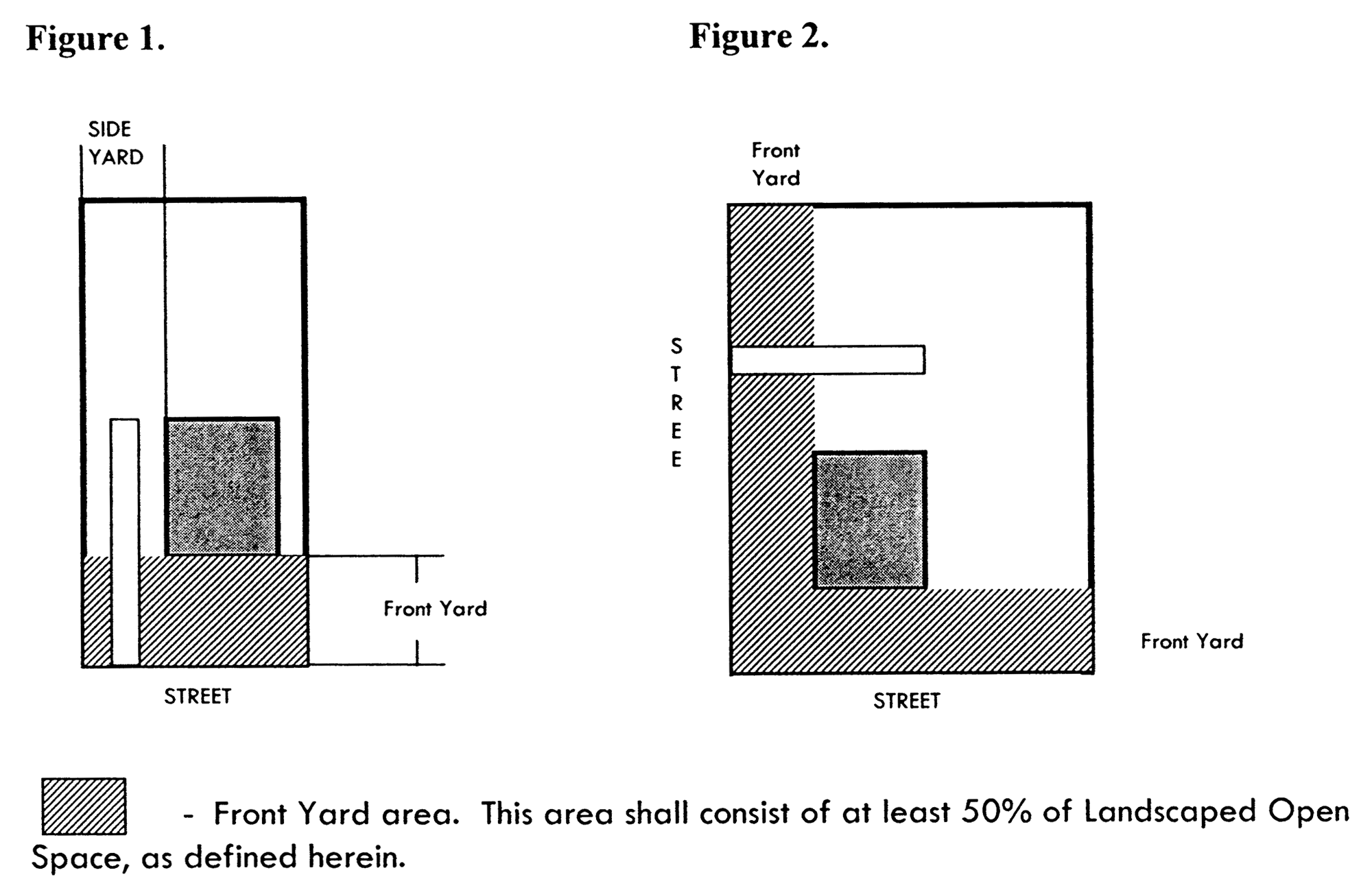
Figures 1 and 2
6.1.8.1. Special permit for a driveway in a front yard. A special permit may be granted by the city council for a driveway within the front yard of a residentially zoned property in special circumstances that hinder the property owner from complying with this regulation.
The driveway may be allowed by special permit where the city council determines that the following conditions have been met:
1.
The property complies with the front yard landscaped open space requirement of 50 percent remaining landscaped.
2.
The proposed driveway is compatible with the surrounding neighborhood.
3.
The proposed driveway meets all requirements of the department of public works, including but not limited to curb cut permit(s), setbacks, and distance from intersections, etc.
6.1.9 Common driveways.
1.
Purpose: Common drives may be allowed by special permit from the planning board in all zoning districts. The purpose of this subsection is to:
• Allow for more efficient traffic flow,
• Reduce traffic hazards from numerous individual driveways,
• Consolidate access to lots across wetland and steep slope resources,
• Provide access where such an arrangement will be more advantageous to the neighborhood than separate driveways, and
• Preserve or enhance the prevalent character of an area by reducing curb cuts that would otherwise be allowed and by maintaining existing vegetation and topography.
2.
Definition:
Common driveway. A form of access, which is not an accepted public roadway (street), but extends from a public roadway to provide common vehicular access to more than one, but no more than three lots, built in accordance with standards set forth in this subsection, and allowed only by special permit.
3.
Common driveway standards. All applicants must comply with the standards below including those where there are existing driveways. The applicant shall submit documents, plans, and profiles to the planning board for its approval of the proposed common driveway to assure compliance with the following standards for common driveways prior to the issuance of a building permit:
a.
Length and width. The minimum width for residential common driveways shall be 16 feet from the roadway to the point of intersection of individual driveways, unless otherwise approved by the city engineer. The maximum length shall be 500 feet. The curb radii of a driveway at its intersection with the public roadway shall be in accordance with the regulations of the city department of public works. Commercial common drives shall comply with the regulations of the department of public works.
b.
Materials. Driveways shall be surfaced with a durable, all-season non-dusting material, drained and suitably maintained to the extent necessary to avoid any nuisance by reason of dust, erosion or water flow onto streets or adjoining properties. The common driveway shall be paved within the right-of-way of the public roadway to the satisfaction of the city engineer. Commercial and industrial common driveways shall be paved in accordance with the requirements of the department of public works.
c.
Site distance. The common driveway shall have adequate sight distance at its intersection with the public roadway and shall not create traffic (or pedestrian) safety hazards to its users or to the public.
d.
Disturbance. The location and construction of a common driveway shall minimize soil disturbance, vegetation removal, and drainage impacts, and preserve existing trees of over 12-inch caliper and other natural features of special significance to the greatest extent practicable.
e.
Frontage. The common driveway shall enter from the same public roadway which serves as frontage for the lots in the common drive development, and shall be located entirely within the boundaries of the lots served thereby. Each lot shall have legal frontage on a public way meeting the requirements of the zoning ordinance in effect with regard to the district in which the lot is located at the time of the application. All other dimensional requirements for lots served by a common driveway, including but not limited to lot area, coverage, width, and setback of front, side and rear yards, as measured in relation to the public way serving as the legal frontage for the lots, shall be the same as would be required for those lots had they not shared a common driveway.
f.
Parking. Parking shall be in compliance with the zoning ordinance subsection 6.1.8, residential driveways.
g.
Status and covenant. The common driveway shall not become a public or private way maintained by the city. Further, the City of Holyoke shall not be required to provide construction, reconstruction, maintenance, trash removal, snowplowing, school bus pickup or police patrols along the common driveway. Further, a covenant shall be placed on the property stating that the owners of property served by the common driveway shall not petition the city for accepting the driveway as a public way and that all lots served by the common driveway are jointly responsible for its maintenance and repair. The covenant shall be recorded at the Hampden County Registry of Deeds. Evidence of the recording must be submitted to the building commissioner and planning board prior to the issuance of a building permit for any lot served by the common driveway.
h.
Existing common driveways. Any common driveway in existence at the time of adoption of this amendment will not be subject to these conditions. Such preexisting common driveways may not be changed unless such expansion, extension, or change is not substantially more detrimental to the neighborhood than the existing driveway.
(Ord. of 2-19-02 [45th amd.], § 6.0; Ord. of 9-5-06 [65th amd.], § 1; Ord. of 12-15-09 [99th amd.], § 1; Ord. of 9-1-15 [127th amd.], § 1)
6-2. - Off-street loading.
6.2.1 Basic requirements. There shall be provided at the time of construction of any building or structure or part thereof having a gross floor area of 5,000 square feet or more and intended to be used for business or industrial purposes, or other uses similarly requiring the receipt or distribution by vehicles of material or merchandise, a minimum of one off-street berth for loading and unloading, and such additional berths as are sufficient in the reasonable judgment of the building commissioner for the proposed use.
6.2.2 Size and access. Loading berths shall not be less than 12 feet in width, 25 feet in length, and 14 feet in height. Access to every required berth shall be provided by drives of suitable width for the free maneuvering of service vehicles. No loading berths shall be accessible directly from public streets or ways. Access drives for loading berths shall not traverse parking areas for public use in a manner to threaten the safe and efficient use of such parking areas.
6.2.3 Location. Off-street loading berths shall not be located within ten feet of a street line or within five feet of any other lot line. Greater setbacks may be required elsewhere in this ordinance. Insofar as possible, facilities for handling all shipping and receiving shall be located on those sides of the building which do not front on a street.
(Ord. of 2-19-02 [45th amd.], § 6.0)
6-3. - Outdoor storage areas.
No outdoor storage of material or equipment shall be established or maintained in any district except BG, BH, IG and IP, and then only when incidental to the operation of a business or industry and only in compliance with the following regulations:
6.3.1 BG and IP districts. In BG and IP districts, no open storage shall occupy an area exceeding in size 25 percent of the area of the same premises which is covered by buildings.
6.3.2 IP district. No such area in an IP district shall be located within a 100 feet of any residence district; in BG and BH districts, no outdoor storage area shall be placed within 30 feet of any abutting residence district.
6.3.3 Adjacent to residential districts. All outdoor storage facilities shall be enclosed by a fence, wall or screen planting adequate to conceal such facilities and the contents thereof from adjacent residential districts.
6.3.4 Highly inflammable materials. No highly inflammable or explosive liquids, solids or gases shall be stored in bulk above ground. Tanks or drums of fuel directly connected to heating devices or appliances located on the same premises as the tanks or drums of fuel are excluded from this provision.
6.3.5 Nuisances. All materials or wastes which might cause fumes or dust or which constitute a fire hazard or which may be edible by or otherwise be attractive to rodents or insects shall be stored outdoors only in closed containers.
6.3.6 Windblown materials. No materials or wastes shall be deposited on any premises in such form or manner that they may be transferred off such premises by natural causes.
6.3.7 Automobile junkyards and wrecking establishments. Automobile junkyards and wrecking establishments are not permitted in any district.
6.3.8 Temporary storage units. See section 4.4.10. Temporary storage units are allowed by right if used for not more than 60 days. Said container may not be utilized for more than two periods of up to 60 days within one calendar year. All temporary storage units in the above stated zones must comply with the guidelines prescribed for the outdoor storage of materials as set forth in this section, as well as complying with the registration provisions of subsection 4.4.10.c.
(Ord. of 2-19-02 [45th amd.], § 6.0; Ord. of 11-18-08 [89th amd.], § 1)
6-4. - Signs.
6.4.1 General. For the purposes of this ordinance, any business or advertising sign exceeding six square feet in area shall be considered a separate structure and shall require a permit for its erection, alteration, or reconstruction.
6.4.2 Exemptions. The following shall not be considered signs within the context of this ordinance:
(a)
Flags and insignia of any government except when displayed in connection with commercial promotion.
(b)
Legal notices, or informational devices erected or required by public agencies.
(c)
Temporary displays inside windows, covering not more than 30 percent of window area, illuminated by building illumination only.
(d)
Standard gasoline pumps bearing thereon in usual size and form the name, type, and price of gasoline.
(e)
Integral decorative or architectural features of a building, except letters, trademarks, moving parts, or parts internally illuminated or decorated with gaseous tube or other lights.
(f)
Devices identifying a building as distinct from one or more of its occupants, such device being carved into or attached in such a way as to be an integral part of the building, not illuminated separate from building illumination, without color contrasting with sign background, and not exceeding four square feet in area.
(g)
Address identification through numerals or letters not exceeding three inches in height.
(h)
Textile or fabric banners that do not advertise a business or product. The material may be supported by framing and which is attached to the building by either a pole as in an "open" sign or directly to a building such as an architectural feature.
(i)
Banners not extending into the public right-of-way unless permitted by the DPW, attached to the building facade often used as an architectural feature. No advertising, business name, or the like on such sign shall be greater than six square feet.
(j)
Banners attached to light poles. Sponsorship may be displayed on said banner provided that it not be greater than six square feet.
6.4.3 Special regulations.
1.
Projection. Signs shall not project beyond property lines. Signs shall not project over public sidewalk areas without receiving a permit from the board of public works. Signs permitted by the board of public works must conform to the requirements of this ordinance. No projecting sign in a business or industrial district shall project more than six feet from the main wall of a building. Wall signs may not project more than 12 inches from the surface of the wall to which they are attached. On corner lots, no sign or portion thereof shall interfere with vehicular or pedestrian traffic and visibility.
2.
Signs in right-of-way. Signs, other than an official traffic sign, shall not be erected within the right-of-way lines of any street unless such advertising sign is in conjunction with a service sign as described in M.G.L.A. c. 85, § 2D. Further, a fee for such sign shall be paid to the board of public works, and the board of public works shall determine the location of the sign, and its size.
3.
Height. No sign shall be higher than the height limit for the district in which it is located. No sign shall be located upon the roof of any building.
4.
Painted wall signs. No sign exceeding 60 square feet in area shall be painted upon the wall of a building or otherwise affixed so that it is not easily removable. Pre-existing historic wall advertisements shall be allowed to be restored to their original state and content.
5.
Temporary for sale signs. All temporary signs advertising the sale or lease of the premises shall be removed within ten days after the transfer of the premises.
6.
Electronic signs. No sign or advertising device shall, in any district, incorporate or be lighted by, flashing, scrolling or blinking lights, or be designed to attract attention by change in light intensity or direction, or by repeated mechanical or electrical motion. Digital signs are allowed with the following exceptions: Image, text, or message area may only change once every 24 hours.
7.
Temporary sign. Temporary signs shall include fixed signs, portable signs, banners, inflatables, balloon signs, sandwich boards, and other similar signs. Temporary signage greater than six square feet in business and industrial districts shall require a permit and shall comply with section 6.4.6. Temporary signs less than six square feet shall be allowed in all districts without a permit, and not more than one sign shall be placed per business except in the case of a corner lot where two signs are permitted (one facing each street).
• No temporary signs may be placed in the right-of-way without obtaining a permit from the board of public works.
• Sandwich boards are allowed within the right-of-way with a permit from the board of public works provided that they are only displayed during business hours.
8.
Sign glare. No lighting or illumination shall be permitted to be used in any way in connection with an illuminated sign unless it is effectively shielded so as to prevent light from being directed at any portion of the traveled way or onto any other property. Signs shall not cause glare or impair the vision of the driver of any motor vehicle, or otherwise interfere with any drivers' safe operation of a motor vehicle.
9.
Wayfinding signs: Signs placed on a premise to guide the public to a specific location on site. Signs may be placed at the entrance to a: parking lot, private right of way, private driveway or similar.
• Sign shall be no greater than five feet in height above the surrounding (natural) grade.
• Sign shall not exceed a total of 12 square feet maximum surface area.
• No sign shall be erected so as to interfere with vehicular or pedestrian line of sight.
• Co-location of multiple tenant sites is required.
• One sign for every continuous 300 feet of private roadway shall be allowed when placed within the grounds, development, or campus.
6.4.4 Previously constructed, nonconforming signs. Any new signs, as of the date of first publication of this revision on May 13, 2008, must comply with this section.
1.
Signs legally existing at the time of this ordinance may continue as a nonconforming structure.
2.
No nonconforming sign shall be structurally altered so as to change the shape, size, color, content, or type of the sign, nor shall any nonconforming sign be relocated.
3.
No nonconforming sign shall be allowed to remain after the business has been discontinued.
6.4.5 Signs in residence districts. The following types of unanimated, non-illuminated signs are permitted in residential districts:
1.
Nameplate or identification signs. A sign indicating the name or address of the occupant, or a permitted home occupation, not larger than one square foot in area shall be permitted. Only one such sign per dwelling unit is permitted, except in the case of a corner lot where two such signs (one facing each street) are permitted for each dwelling unit.
2.
Multifamily dwellings, rooming houses, nonresidential buildings, and businesses located in a mixed use building. A single identification sign not exceeding 12 square feet in area and indicating only the name and address of the building and the name of the management or the name of the business may be displayed. On a corner lot two such signs (one facing each street), are permitted.
3.
Multifamily developments, residential subdivisions, assisted living facilities, etc. Monument signs shall be allowed in the above circumstances. A single identification sign not exceeding 40 square feet in area and indicating only the name of the facility and/or the name of the management may be displayed. In the case of a corner lot, and in case where there is more than one entrance to the facility, one such sign is permitted at each street, or one at each entrance, not both.
4.
Sale or rental signs advertising the sale or rental of the premises. Said signs shall be permitted where they are erected by the owner or broker and signs bearing the word "sold" or "rented" with the name of the persons effecting the sale or rental. No such sign shall exceed four square feet in area. Not more than one sign shall be placed upon any property except in the case of a corner lot where two signs are permitted (one facing each street).
5.
Exempt and institutional signs. Signs as identified in section 4.3 Table of Principal Uses, (B) Exempt & Institutional Uses:
• Signage shall be allowed in accordance with section 6.4.6, Signs in Business and Industrial Districts shall follow that which is allowed for Business Highway (BH).
6.
Bed and breakfast signs. Signs shall identify the establishment rather than advertise it. Signs shall be limited to six square feet in size (was two square feet), one per establishment, and shall not be self-illuminated.
7.
Signs advertising the sale of any vehicle. A sign advertising the sale of any vehicle, boat or any other item(s) of personal property may be erected or placed on or in proximity to the particular vehicle, boat or other personal property being offered for sale at the residence of the owner, provided however, that such vehicle, boat or other personal property being offered for sale is located exclusively in the driveway of the residence of the owner of such vehicle, boat or other personal property. No such sign shall be erected or placed on the premises of the owner for more than 30 continuous days. No such sign shall exceed four square feet in area. Not more than one such sign shall be placed at such premises. This section shall not apply to lawful signs advertising a tag sale for which a permit was issued in accordance with section 66-91 of the Holyoke Code of Ordinances.
8.
New signage as defined within section 6.4 may be permitted in residence districts when the following conditions are met:
• The property is a legal pre-existing, non-conforming commercial/business use as determined by the building commissioner.
• Is permitted to operate as regulated by the City of Holyoke.
• The proposed sign is limited to one 12 square foot sign per place of business per side of building facing the street.
6.4.6 Signs in business and industrial districts.Political signs, not exceeding six square feet may be erected or posted in business and industrial districts, not within the public way, provided, however, that such restriction shall not apply to political signs erected or posted on campaign offices. All signs permitted in residence districts are permitted in business and industrial districts. Business announcement signs and signs advertising goods and services for sale on the premises are permitted in business and industrial districts in accordance with the following regulations:
1.
Total wall sign area. No more than one wall sign per place of business shall be allowed per side of building fronting a street. In the case of wall-mounted signs, signs affixed to, suspended from, or incorporated as part of a building, they shall comply with the Table below, provided that the total area of the signs on a wall shall not exceed ten percent of the area of that wall.
2.
Total pylon sign area. No more than one free standing sign per entrance for a single tenant site shall be allowed, and shall comply with the table below.
3.
Multi-tenant pylon signs. In the case of a multi-tenant facility, co-location of signs on one pylon is required. One pylon sign per entrance to such facility shall be placed at the entrance listing all businesses within the facility.
4.
Special permit. A special permit for an increase in size or for more than one sign per business on a wall may be granted by the planning board. The gross surface areas of signs on any premises shall not exceed those specified in the following table:
SIZE LIMITATIONS FOR SIGNS IN BUSINESS AND INDUSTRIAL DISTRICTS
Note— See section 6.4.5.2 above for multi-tenant sites.
Note— *Signs for businesses within the DR zoning district shall comply with the above regulations.
Note— **Signs for businesses within the BH Zoning District 25,000 square feet or more of floor area.
Note— All residential uses within the DR district shall comply with section 6.4.4 signs in residential districts.
5.
Promotional, advertising, and civic signs are prohibited in an IP zone.
6.
Window signs. Signs affixed to the inside of windows or otherwise displayed inside a building such that they can only be viewed from outside the building are allowed, provided the total area of window signs is no larger than 20 percent of the area of first floor windows of the business displaying the window signs. The allowed area of window signs shall be calculated separately from either permanent or temporary signs, as described in other sections of this ordinance.
7.
Signs on canopies. Signs shall be allowed on canopies with the display area being measured by drawing a box around the name of the business and any other graphic features of the sign. Such signs shall be painted on or attached flat against the surface of, but not extending beyond or attached to the underside. A minimum clearance above the sidewalk level of seven feet must be allowed for pedestrian clearance. If located over public sidewalks, a permit must be granted by the board of public works.
6.4.6.8 Off-premises signs.
1.
Allowed only in IG zones within the off-premises sign overlay districts overlay districts, following the size limitations for signs in the business and industrial districts table.
2.
May only be permitted on a parcel or abutting lot which has a legally occupied structure.
3.
Monument, pole, or other ground sign is limited to 20 feet above surrounding natural grade.
4.
No property shall have more than one off-premises sign without exception.
5.
No sign shall be erected or maintained within the front or side yard in a manner which interferes with vehicular, pedestrian, or other traffic visibility or safety of egress from properties.
6.
All off-premises signs shall be allowed by way of a special permit of the city council. Said special permit shall accompany a fee pursuant to the terms of section 9-3.
7.
An annual review of the special permit shall be conducted by the city council to ensure compliance with this ordinance.
6.4.6.8.1 I-91 Exit 15 and I-391 off-premises sign overlay districts.
1.
Establishment. The off-premises sign overlay district is an overlay district having a land area of approximately 17 acres in size that is superimposed over the underlying industrial general (IG) zoning district and is shown on the zoning map as set forth on the map entitled "Holyoke Zoning Map, dated May 18, 2018", as amended. This map is hereby made a part of the Zoning Ordinance and is on file in the office of the city clerk.
2.
Sub-district. The off-premises sign overlay district:
a.
I-91 Exit 15 off-premises sign overlay district.
b.
I-391 off-premises sign overlay district.
6.4.7 Reserved
6.4.8 Signs for professional office or studio in professional office overlay district.Signs for a professional office or studio located within the professional office overlay district located on Northampton Street from Beech Street to Dwight Street shall be limited to one and no greater than two feet by three feet, must be illuminated from outside rather than from within, and must be approved through the special permit process. All signage must be designed in a manner compatible to the existing structures as well as the surrounding neighborhood. Interiorly-lit signs that existed prior to December 20, 1994 shall be allowed to remain and/or be replaced with a sign of equal or lesser size.
6.4.9 Advertising blimp.See section 7.2.3.
6.4.10 Enforcement.
1.
This ordinance shall be administered and enforced by the building commissioner.
2.
Violations and penalties. Any person, corporation or entity found in violation of any provisions of this ordinance shall be punished by a fine in accordance with the following schedule of fines. Each day that the violation continues shall constitute a separate offense per sign.
Notice of violation and procedures pertaining thereto shall be in accordance with M.G.L.A. c. 40, § 21D (non-criminal disposition).
(Ord. of 1-20-09 [92nd amd.], § 1; Ord. of 8-5-14 [124th amd.], § 1; Ord. of 11-21-17 [136th amd.] § 1; Ord. of 8-1-17 [137th amd.], § 1; Ord. of 5-15-18 [142nd amd.], § 1; Ord. of 10-16-18 [144th amd.], § 1; Ord. of 11-16-21 [159th amd.], § 1; Ord. of 5-17-22 [164th amd.], § 1)
Editor's note— Ord. of 1-20-09 [92nd amd.], § 1, deleted the former § 6-4, §§ 6.4.1—6.4.8, and enacted a new § 6.4 as set out herein. The former § 6.4 pertained to signs and derived from Ord. of 2-19-02 [45th amd.], § 6.0; Ord. of 5-20-03 [53rd amd.], § 1.
6-5. - Performance standards.
6.5.1 General. In no district will any use be permitted which will produce a nuisance or hazard from fire or explosion, toxic or corrosive fumes, gas, smoke, odors, obnoxious dust or vapor, harmful radioactivity, offensive noise or vibration, flashes, objectionable effluent or electrical interference which may affect or impair the normal use and peaceful enjoyment of any property, structure, or dwelling in the neighborhood. All industrial uses and uses accessory thereto shall be subject to the following performance standards and procedures. Any other use, existing or proposed, which the building commissioner or the board of appeals adjudges to be violating or likely to violate these standards shall also be subject thereto. No land or building in any district shall be operated in a manner to create any dangerous, injurious, noxious or otherwise objectionable fire, explosive or other hazard; noise or vibration; odor; smoke, dust, dirt or other form of air pollution; electrical or other disturbance; glare; or other substance, condition or element in such amount as to adversely affect the surrounding area; provided that any use permitted by this ordinance may be undertaken and maintained in ig and wm districts if it conforms to the regulations of this subsection limiting dangerous and objectionable elements at the specified point or points of the determination of their existence.
6.5.2 Fire and explosion hazards. All manufacturing, processing, handling and storage of inflammable and explosive materials shall be provided with adequate safety devices against the hazard of fire and explosion, adequate fire fighting and fire suppression equipment and any safety devices standard to the industry. Burning of waste materials in open fires is prohibited.
6.5.3 Radioactivity or electrical disturbance. No activities shall be permitted which emit dangerous radioactivity or electrical disturbance which adversely affects the operation of any equipment.
6.5.4 Noise. At the points of measurement, the maximum sound pressure level radiated in each standard octave band by any use or facility (other than temporary construction work) shall not exceed the values for octave bands lying within the several frequency limits given in Table 1, after applying the corrections shown in Table 2. The sound pressure level shall be measured with a sound level meter and associated octave band analyzer conforming to standards prescribed by the American Standards Association.
NOISE TABLE 1
*If the noise is not smooth and continuous and is not radiated between the hours of 9:00 p.m. and 7:00 a.m. one or more of the corrections in Table 2 shall be applied to the octave band levels given in Table 1.
NOISE TABLE 2
* Apply one correction only
6.5.5 Vibration. No vibration shall be permitted which is detectable without instruments at the point of measurement specified above.
6.5.6 Glare. No direct or sky-reflected glare, whether from floodlights or from high-temperature processes such as combustion or welding or otherwise, which is visible at the points of measurement specified above shall be permitted. This restriction shall not apply to signs permitted by this ordinance.
6.5.7 Air pollution. No emission shall be permitted from any chimney or otherwise, of visible grey smoke of a shade equal to or darker than No. 2 on the Power's Micro-Ringelmann Chart (published by McGraw-Hill Publishing Company, Inc., copyright 1954); except that visible grey smoke of a shade equal to No. 3 on said chart may be emitted for four minutes in any 30 minute period. No emission shall be permitted of odorous gases or other odorous matter in such quantities as to be readily detectable without instruments. No emission of fly ash, dust, fumes, vapors, gases or other forms of air pollution shall be permitted which can cause any damage to health, animals, vegetation, or other forms of property, or which can cause any excessive soiling.
6.5.8 Water pollution. No discharge of material to a watercourse, water body or open drainageway shall be permitted where such material will affect the quality of the water in a manner bringing it below the latest standards for Class B, as adopted by the Commonwealth of Massachusetts Water Resources Commission, Division of Water Pollution Control. No material having or likely to have an adverse effect on water quality within the limits defined above shall be discharged through a sewer or drain which does not connect with a treatment facility capable of removing such material. Nothing in the foregoing provisions shall limit the continued operation of existing establishments where such establishments are pursuing a systematic program of pollution abatement consistent with state and/or federal time schedules.
6.5.9 Enforcement. Any application for a building permit for a use subject to performance standards shall be accompanied by a sworn statement by the owner of subject property that said use will be operated in accordance with the performance standards set forth herein. Continued compliance with these performance standards is required and shall be enforced. The determination of the existence of any dangerous and objectionable elements (as enumerated above) shall be made: For fire and explosion hazards, radioactivity and electrical disturbances, smoke and other forms of air pollution: At the point or points where such elements shall be most apparent; For noise, vibration, glare, and odors: At or beyond the property lines of the use creating such elements, wherever the effect is greatest.
(Ord. of 2-19-02 [45th amd.], § 6.0)
6-6. - Landscaping requirements.
6.6.1 Purposes. This section is designed to accomplish the following objectives:
1.
To provide a suitable boundary or buffer between residential uses and districts and nearby nonresidential uses;
2.
To separate different and otherwise incompatible land uses from each other in order to partially or completely reduce potential nuisances such as dirt, dust, litter, noise, glare from motor vehicle headlights, intrusion from artificial light (including ambient glare), or view of signs, unsightly buildings or parking lots;
3.
To provide visual relief to parking lots and protection from wind in open areas;
4.
To preserve or improve the visual and environmental character of Holyoke, as generally viewed from residential or publicly accessible locations; and
5.
To offer property owners protection against diminution of property values due to adjacent nonresidential use.
6.6.2 Applicability. The requirements of this section shall apply to:
1.
Any nonresidential use which adjoins or abuts any residential use or district;
2.
Any nonresidential use which adjoins or abuts any educational use;
3.
Any multifamily parking facility which adjoins or abuts any residential use or district;
4.
Any nonresidential or multifamily area used for loading;
5.
Any nonresidential or multifamily area used for open or semienclosed storage.
6.6.3 Requirements. The property line(s) separating residential uses or districts shall be adequately screened from the uses specified in section 6.6.2 by means of vegetation, plantings, or fencing, to be provided and maintained by the owner of the property used for nonresidential or multifamily purposes.
6.6.4 Coordination with site plan approval. The planning board shall not approve a site plan unless the board has determined that the application complies in all respects with the requirements of this section.
6.6.5 Maintenance. The owner of the property used for nonresidential or multifamily purposes shall be responsible for the maintenance, repair and replacement of all landscaping materials installed in accordance with this section. All plant materials required herein shall be maintained in a healthful condition. Dead limbs, refuse and debris shall be promptly removed. Bark mulch and nonplant ground surface materials shall be maintained so as to control weed growth. Dead plantings shall be replaced with new live plantings at the earliest appropriate season. Fences or walls shall be maintained in good repair and presentable appearance, or replaced.
(Ord. of 2-19-02 [45th amd.], § 6.0)

