
Homewood City Zoning Code
ARTICLE XI
TREE PROTECTION AND LANDSCAPE3
Editor's note— The "appendix A" referenced throughout this article is attached to the ordinance codified in this article and is available on file with the city.
Sec. A. - Intent.
This article XI is intended to promote public health, safety, and civic beauty; to provide for green spaces; to assist in preserving a sustainable urban forest; to protect and enhance private and public property values, and to provide for the general welfare and aesthetics of Homewood and all its citizens, in accordance with the guidance and regulations published by the American National Standards Institute (ANSI).
(Ord. No. 2818, § 2, 11-8-2021; Ord. No. 2859, § 2, 12-12-2022)
Sec. B. - Applicability.
The terms and provisions of this article shall apply to:
1.
All real property in Homewood, except as otherwise provided hereinafter.
2.
Any development which requires the issuance of a land disturbance permit, development permit, or building permit, except as otherwise provided hereinafter.
3.
Development on any city-owned property, including property owned by city agencies, boards, and authorities, except as otherwise provided hereinafter.
(Ord. No. 2818, § 2, 11-8-2021; Ord. No. 2859, § 2, 12-12-2022)
Sec. C. - Administration.
1.
This article shall be administered by the director of the engineering and zoning department, or their appointed representative. The director may, when necessary and feasible, consult with other departments, private firms, or persons with noted experience in qualifying disciplines, who, when so acting, shall be considered representatives of the city.
2.
City arborist or city approved official.
a.
The city arborist shall be charged with the responsibility and authority to review and oversee all tree related activities within the city limits which may involve tree planting, maintenance and removal. The city arborist shall have absolutely no authority to vary any city-approved plans, issued permits, or executed agreements.
b.
The role of the city arborist or city approved official, may include the following, as deemed necessary by the director of the engineering and zoning department, but not necessarily be limited to:
(1)
Receive and review applications for tree removal, land clearing/disturbing activity and other permits under this article.
(2)
Confirm that information provided by an applicant is correct and accurate.
(3)
Inspect trees and tree protection zones.
(4)
Validate permit applications including the following components:
(a)
Tree inventory including number, species and status of all qualifying trees on site, and the locations of trees requested for removal and/or for preservation.
(b)
MTD calculation showing the locations, species and sizes of all qualifying trees counting towards the MTD and the required number of replacement trees, if applicable.
(5)
Where applicable, calculate a value assessment of public trees, to recommend a fine or replacement cost to damaged or removed city trees.
(6)
Where appropriate, offer alternative arboriculture practices that may satisfy the applicant's needs (as discussed with the applicant) instead of tree removal (only applicable if trees requested for removal are qualifying, nonhazardous trees.)
(7)
Issue cease-and-desist orders upon persons or entities in violation of this article for a maximum of two (2) working days. Upon review of the violation, the director of the DEZ may extend the cease-and-desist order until the violation is brought into compliance and all fines are paid, if applicable.
(8)
Augment the city's forest by overseeing tree planting on public property.
(9)
Liaise with the Homewood Environmental Commission to implement and maintain an active tree planting program in the city.
(10)
Educate city personnel responsible for tree removal, planting, pruning and landscape maintenance.
(11)
Assist in implementing development agreements, plans, or permits relating to landscaping and trees.
(12)
Perform other related job duties as assigned by the director of DEZ.
(Ord. No. 2818, § 2, 11-8-2021; Ord. No. 2859, § 2, 12-12-2022)
Sec. D. - Permitting for tree removal and preservation.
1.
Tree permit is required for.
a.
Removal of a qualifying tree.
b.
Tree preservation during construction or land disturbance activities.
c.
Increases to impervious area of any lot by twenty (20) percent.
2.
Tree permit conditions.
a.
Persons obtaining a permit for tree preservation or removal or landscaping must be duly licensed with the city to conduct tree services, tree removal, or landscaping or shall provide proof of subcontracting with a company duly licensed with the city to perform the aforementioned services.
b.
Persons obtaining a permit which involves tree or landscape preservation, planting, pruning or removal must follow applicable ANSI 300 tree care standards.
c.
Applications for tree removal or tree preservation shall require a tree inventory which shall capture MTD for the site, before and after proposed activity, the locations, D.B.H., species (botanical name), and intended treatment (removal or preservation) of all qualifying trees.
d.
All permits issued by the DEZ wider this section shall be required to be consistent, and not in conflict with any city-approved plans, permits, or development agreements.
3.
Tree permit application and fees.
a.
An application for a tree permit shall be filed on official forms provided by the DEZ.
b.
The applicant shall be required to pay a nonrefundable permit fee as established by the DEZ for purposes of processing the application, enforcing requirements of this section, and inspecting the real property subject to the application.
c.
If the applicant is not the property owner, then the applicant shall attach the written permission of the property owner to the application. All completed applications shall be returned to the DEZ with permit fees, and required inclusions (i.e. tree inventory).
d.
Display of permit. Any permit issued pursuant to this article shall be displayed on the site of the subject area covered by the permit in such a manner as to be clearly visible and available for inspection by residents and city personnel.
e.
Applications for permits shall be made prior to tree removal or land disturbance activity; except in the following cases, applications shall be filed when indicated:
(1)
All new subdivisions shall be required to submit an application for a tree permit at the time of initial submittal of the subdivision plan to the city so that due consideration may be given to protection of trees during the subdivision design process.
(2)
Any commercial, multi-family or other use requiring site plan approval under the city land development regulations shall be required to submit an application for a tree permit at the time of site plan submittal so that due consideration may be given to the protection of trees during the site plan design process.
(3)
All permit applications for a new single-family or multi-family dwelling units shall include an application for a tree permit. A tree inventory must be shown on the site/development plan or as required by the DEZ, as a condition of the issuance of any permit.
f.
Reserved.
g.
Tree permit violations. Persons that fail to acquire a permit for tree removal will be subject to a five-hundred-dollar ($500.00) penalty per qualifying tree removed. The fees required by this article and all fines relating to violations of this ordinance shall be paid into a tree preservation fund which shall be used solely by the city to replant trees in the city.
h.
Tree permit evaluation process. When a lot or parcel is being developed, reasonable effort shall be made to protect trees existing on the lot or parcel, except for those trees shown on a city-approved plot, site or development plan as being within the footprint area of the proposed development or building.
i.
Tree removal only. Permit applications that include tree removal will require the following:
(1)
A complete tree inventory of the site identifying the number of trees, species, diameter at breast height, and identifying the qualifying trees requested for removal. Qualifying trees must also be identified as hazardous or non-hazardous according to the definition herein.
(2)
MTD must be calculated to determine if tree replacement is required. If tree replacement would be required, the following permit conditions apply.
(a)
The owner of the property must sign the permit stating they have been made aware of the requirements for tree replacement and agree to abide by those requirements.
(b)
The city arborist may assess the potential for alternative arboriculture practices, such as pruning, to satisfy the applicants request in place of removal (if applicant is willing).
(c)
The city arborist may recommend appropriate replacement trees.
j.
Tree removal with development, or other land disturbance activity:
(1)
The DEZ will ensure all other required permits and plans have been approved in accordance with the associated land disturbance activity (i.e. any other building and development requirements of the city) before proceeding to assess the application for tree removal.
(2)
The DEZ will assess compliance with any other landscape requirements of this article that may be or may need to be included as part of the tree permit application before proceeding to assess the tree removal component of the application.
(3)
Applications found not to be in full compliance with the landscape requirements of this article will need to be resubmitted with the appropriate landscape requirements included.
(4)
If compliance is satisfied, the DEZ will proceed with the application process as follows:
(a)
For applications that include removal of only qualifying trees that are located within a building area as shown on city-approved plans and validated by site visit, a permit will be issued but MTD shall be met for subject site, therefore, tree replacement may be required.
(b)
For applications that include removal of any qualifying tree(s) located outside of the building area as shown on city-approved plans, a site visit by the city arborist is required to assess the status of the tree(s) as qualifying, non-hazardous or hazardous; and to calculate MTD and determine if MTD would be met or not met after tree removal and, therefore, if tree replacement would be required.
(5)
If MTD would be met after tree removal, a permit will be issued at this point.
(6)
If MTD would not be met after tree removal:
(a)
The city arborist will determine if any qualifying trees, requested for removal, are suitable for preservation in accordance with appropriate tree preservation methods as described by ANSI 300 tree care standards.
(b)
If qualifying trees are suitable for conservation, the DEZ will request the applicant to amend the permit to include preservation of the qualifying trees.
k.
If qualifying trees are not suitable for conservation, tree replacement will be required in compliance with section H of this article.
4.
Public tree removal. No public tree(s) shall be removed or damaged from city property or city rights-of-way without consent of the city council, unless deemed a hazard. Requests should be made to the DEZ, after which they will be placed on the next available council/committee agenda. Hazard trees on public property or rights-of-way that pose an apparent, immediate threat must be brought to the attention of the DEZ without delay.
5.
Tree preservation. When a tree inventory, site survey or landscape plan is submitted which includes tree preservation the following requirements apply:
a.
A site visit by a building inspector or the city arborist will be required to assess that the trees are suitable for conservation or for preservation before, during and after land disturbance and development activities.
b.
For non-residential zoning districts:
(1)
Trees approved for preservation become qualifying trees under this article, regardless of size.
(2)
Trees and landscaping must be continually cared for with adequate watering, mulch, and protection from herbicides.
(3)
If a tree does not survive or if it declines to the point of becoming a hazard within one (1) year, it must be removed and replaced by the owner following subsection H.2., tree planting and replacement requirements.
6.
Impervious area is increased by twenty (20) percent. The following describes the process for evaluating permit applications that are triggered by an increase in impervious area of twenty (20) percent or more.
a.
Compliance with MTD will be required, which may include required tree plantings elsewhere on the site to achieve MTD as described in section H of this article.
b.
DEZ will confirm this increase is not in conflict with other city codes or regulations before proceeding with a tree permit.
(Ord. No. 2818, § 2, 11-8-2021; Ord. No. 2859, § 2, 12-12-2022)
Sec. E. - Permitting for landscaping.
1.
All building, development and land disturbance permits for commercial and multi-family development issued by the city are subject to the landscaping requirements of this article and must show the applicable requirements on landscape plans as part of site/development plans.
2.
A schedule of all new and existing plants proposed for landscaping must also be included in the landscape plans, including trees, shrubs, grasses and other ground cover types.
3.
All commercial and multi-family landscape plans, site plans and/or tree inventories shall be prepared by a landscape architect licensed by the State of Alabama.
4.
Known invasive species, including but not limited to, those identified by the Alabama Invasive Plant Council in its List of Alabama's Invasive Plants by Land-Use and Water-Use Sectors are prohibited within the city limits.
(Ord. No. 2818, § 2, 11-8-2021; Ord. No. 2859, § 2, 12-12-2022)
Sec. F. - Exemptions.
1.
All trees removed by a utility, county or state agency and which are located within a public road, drainage rights-of-way, or permanent utilities and drainage easements shall be exempt from the requirements of this article.
2.
Building permits issued for any alteration or renovation that does not increase the building footprint of the primary structure.
3.
In lieu of satisfying the requirements for landscaping required by this article, the applicant or homeowner may satisfy the provisions of this article by paying to the city at the time of the application a sum equal to one thousand five hundred dollars ($1,500.00) per required tree for any tree over fifty (50) percent of the required MTD. For example, if the MTD is four (4) trees, two (2) trees shall be installed and one thousand five hundred dollars ($1,500.00) per tree may be paid for the remaining two (2) trees. The funds shall be paid into a tree replacement fund which shall be used solely by the city to replant trees in the city.
4.
Tree is verified dead and/or deemed a hazardous tree by the city arborist.
(Ord. No. 2818, § 2, 11-8-2021; Ord. No. 2849, § 1, 9-26-2022; Ord. No. 2859, § 2, 12-12-2022)
Sec. G. - Variance application.
1.
Variance requests may be granted under the following conditions:
a.
Exceptional, alternative methods of meeting the standards and intent set forth in this article, especially where existing healthy, native vegetation is preserved, and/or innovation in site design is demonstrated, and;
b.
Extreme hardship or when detriment to health, safety, and public welfare is demonstrated.
2.
The board of zoning and adjustments will hear variance requests only if the variance application meets the intent of this article and conforms to other ordinances or as shown on adopted city plans.
(Ord. No. 2818, § 2, 11-8-2021; Ord. No. 2859, § 2, 12-12-2022)
Sec. H. - Tree and landscape requirements.
1.
Minimum tree density requirement: The city recognizes a minimum tree density (MTD) defined by this article as the minimum number of trees that must be present on a given site. It is the intent of the city that all property types, whether public, private, residential, commercial, developed, undeveloped, or unimproved, be brought into compliance with the MTD requirements as stated herein, even if development activity is not occurring or planned. However, sites will only be assessed for compliance with MTD when they are brought under review through the issuance of building, development, land disturbance, or tree permits. MTD must be met before a certificate of completion or certificate of occupancy can be issued, regardless of whether trees existed on the site before development or construction and regardless of whether the site met MTD before development or construction. When tree planting is required to meet MTD on the site they shall include only species defined in appendix A and shall follow the ANSI 300 standards for planting.
a.
MTD standards.
(1)
Zero (0) to one (1) acre: sixteen (16) trees per acre.
(2)
Greater than one (1) to less than or equal to five (5) acres: twenty (20) trees per acre.
(3)
Greater than five (5) acres: twenty-four (24) trees per acre.
b.
MTD calculation.
(1)
Convert acreage to square feet using the conversion one (1) acre = forty-three thousand five hundred sixty (43,560) square feet.
(2)
For purposes of determining MTD, the footprint square footage of the primary structure/dwelling unit plus three hundred twenty-five (325) square feet for the required parking area, shall be deducted from the lot square footage.
(3)
For purposes of determining the number of trees required for a lot, the total lot square footage, (minus the footprint of the primary structure and required driveway), should be multiplied by the MTD standards in a) above. Fractional numbers, or decimals, shall be rounded up to the next whole number to determine to number of required trees.
2.
Tree planting and replacement requirements:
a.
Species.
(1)
All trees planted to meet MTD by this article shall be a canopy tree cited in appendix A: native tree list.
(2)
The city arborist may make exceptions and approve other trees based on site conditions, including soil quality, water availability, shade potential, ecological characteristics, screening needs, and/or other challenging or conflicting characteristics. However, invasive species will not be allowed.
(3)
When planting or replacing qualifying trees, the trees specified must contain no more than fifty (50) percent of a single species.
b.
Size.
(1)
Containerized, replacement tree(s) must be a minimum of twenty-five (25) gallon or larger.
(2)
Field grown, ball and burlap, trees must be a minimum of two and one-half (2.5) inch caliper or larger.
(3)
Replacement trees must have been grown in compliance with the current edition of American Standard for Nursery Stock published by American Nursery and Landscape Association.
c.
Location.
(1)
Where applicable, canopy trees shall not be planted closer than forty (40) feet of each other and understory trees a minimum of ten (10) to a maximum of twenty (20) feet of each other.
(2)
It is noted that, because of the ability of tree roots to anchor the soil, trees shall be employed to control erosion on steep slopes and cleared areas. Therefore, whenever the slope of an area to be cleared is three (3) to one (1) or steeper, the slope shall be stabilized by planting one (1) canopy tree or two (2) understory trees for each thirty (30) by thirty (30) foot area (excluding the footprint of the primary structure).
(3)
Trees shall not be planted underneath an existing power line or within, or immediately adjacent, any utility easement or city right-of-way. Trees must comply with the regulations of the applicable utility.
d.
Installation of all required landscaping and/or trees shall occur prior to the issuance of a certificate of occupancy or certificate of completion. The DEZ may approve an extension, not to exceed one hundred twenty (120) days, when good cause is demonstrated and documented.
e.
All trees planted pursuant to this section are deemed qualifying trees, and shall be maintained in a healthy, living condition. Any such trees which die shall be replaced.
f.
The property owner shall be responsible for the cost of tree planting and replacing the trees.
3.
Tree preservation requirements. Tree protection practices must comply with part 5 of the ANSI 300 tree care standards including, but not limited to:
a.
A plan for tree protection must be included on the preliminary development plan or site plan, as appropriate, before land disturbing activity, demolition and construction occurs, as required for subdivision submittal, site plan submittal, or building/development permits.
b.
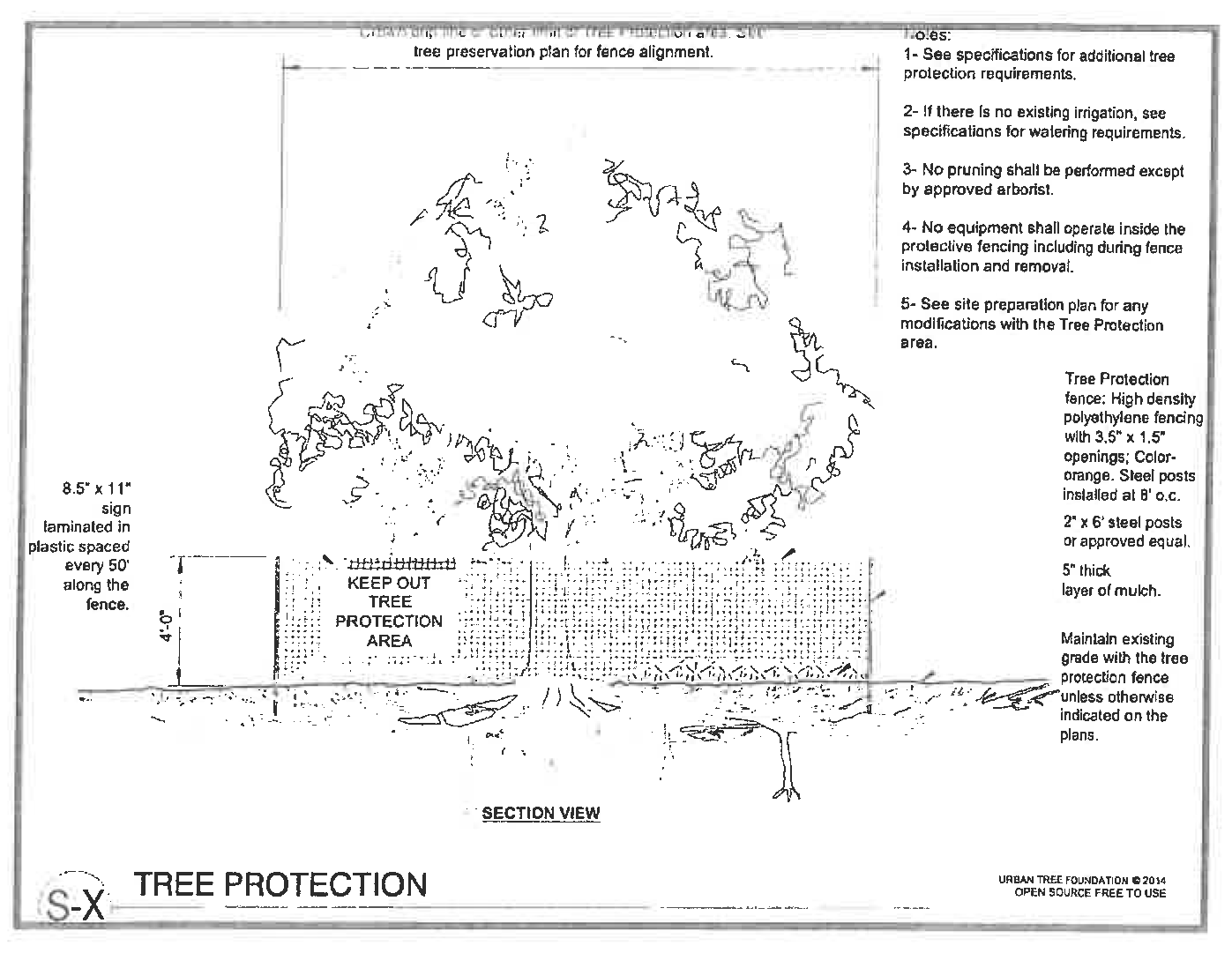
Barriers and signage are required throughout permitted activity and shall be installed prior to activity begins. Barriers and signage must be placed around every tree or group of trees to be preserved, including, by written request, those on adjacent properties, in compliance with the following requirements.
(1)
Waterproof, rigid "tree protection zone" signs of appropriate size and spacing to reasonably inform crews and public the tree is being preserved along the tree protection zone barriers.
(2)
Tree protection zones shall be at a minimum determined by the definition of critical root zone but may need to be larger as determined by the city arborist.
(3)
All construction activities and storage of materials and/or equipment shall be prohibited within the tree protection zones. Construction activities include, but not limited to, excavating, filling, trenching, construction storage and dumping, portable restroom facilities, and parking or operating construction equipment and vehicles.
(4)
It shall be unlawful for any person, during the construction of any structures or other improvements, to place solvents, petroleum products, paint or masonry materials, construction machinery or temporary soil deposits within the dripline. of any qualifying tree for which a tree removal permit is required but has not been obtained, including soil that is placed in the dripline permanently for the purpose of a grade change.
c.
It shall be the responsibility of the property owner and their agents to ensure that these requirements are adhered to for any tree to be preserved as shown on the tree inventory.
4.
The property owner shall guarantee survival of retained trees and replacement trees for one (1) year from completion of permitted construction, unless a greater time period is required by development agreement or the DEZ. If a preserved tree dies, or the crown dieback is at fifty (50) percent within one (1) year from the date the certificate of occupancy or completion is issued, the property owner shall replace the tree in accordance with this article, or be subject to a five-hundred-dollar ($500.00) penalty per dead/dying tree.
(Ord. No. 2818, § 2, 11-8-2021; Ord. No. 2859, § 2, 12-12-2022)
Sec. I. - Other landscaping requirements.
The applicability of the requirements of this section are given for each requirement by listing of zoning district codes. Table 1, landscaping requirements gives an overview of the requirements of this section aligned with zoning districts and applicable land uses.
1.
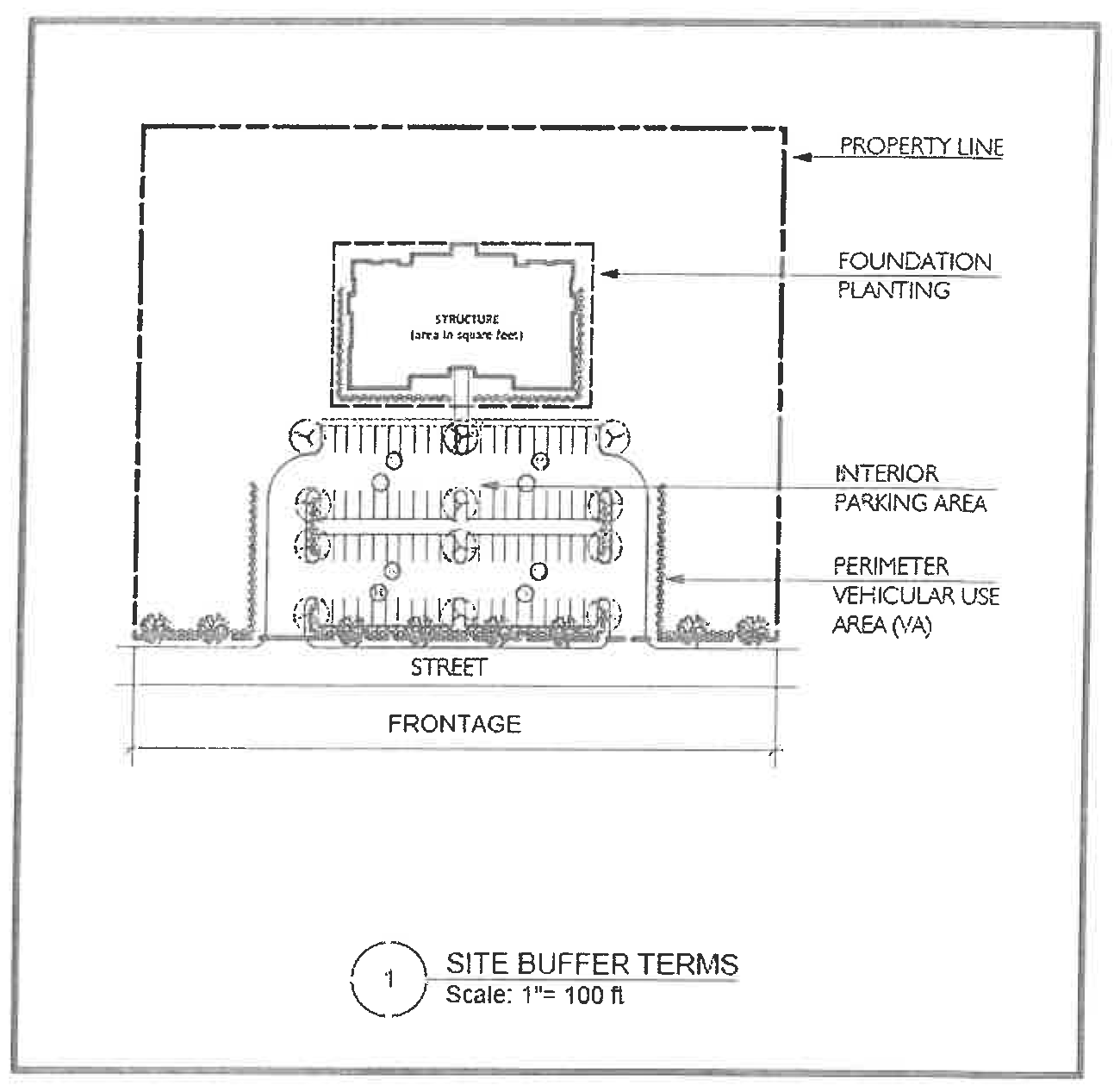
General off-street parking and vehicular use area (VA) landscape requirements:
a.
A well-designed, landscaped parking lot or vehicular use area utilizes perimeter landscaping and landscaped islands to create clear delineations between parking lots for driving and pedestrian safety, to mitigate urban heat island effects, improve air quality and create an appealing aesthetic.
b.
Applicability: This section applies to all non-single-family district surface parking areas with more than ten (10) spaces. For purposes of this section, multiple platted lots contained on a single site plan and any separate parking areas connected with drive aisles are considered a single parking area.
1.
All off-street parking areas within any zoning district with frontage on any portions of a street right-of-way (not including alley) must adhere to the perimeter island requirements set forth in this section.
2.
Perimeter VA landscape area (PVA):
a.
A perimeter VA landscape (PVA) shall be provided along the outside of an off-street parking and vehicular use area (VA).
b.
PVA landscape area must be a minimum of fifteen (15) feet wide as measured from the back of curb of the VA toward the property boundary.
c.
The PVA shall be landscaped at a rate of one (1) canopy tree per fifty (50) linear feet of perimeter curb and gutter, excluding required egress width.
d.
Shrubs, that under typical conditions can be expected to reach a height and spread of three (3) feet within three (3) years of planting, shall be installed at a rate of thirty (30) shrubs per one hundred (100) linear feet, within which shrubs may be grouped or randomly spaced as long as the total number of shrubs required is utilized. All shrubs shall be a minimum of thirty-six (36) inches in height at installation.
e.
A PVA landscape area may also serve as the location for a sidewalk connecting the use and the street. In such case, the sidewalk shall be a minimum of five (5) feet wide and the remaining planting area shall be a minimum of ten (10) feet wide.
f.
PVA landscape required in conjunction with street yard requirements can be counted together, with the stricter of the two (2) requirements taking precedent. PVA trees may count toward the required MTD on the site.
g.
Existing healthy vegetation and the area of land used to maintain the vegetation may be counted toward meeting the performance criteria for VA landscape areas.
3.
Interior island landscape area requirements:
a.
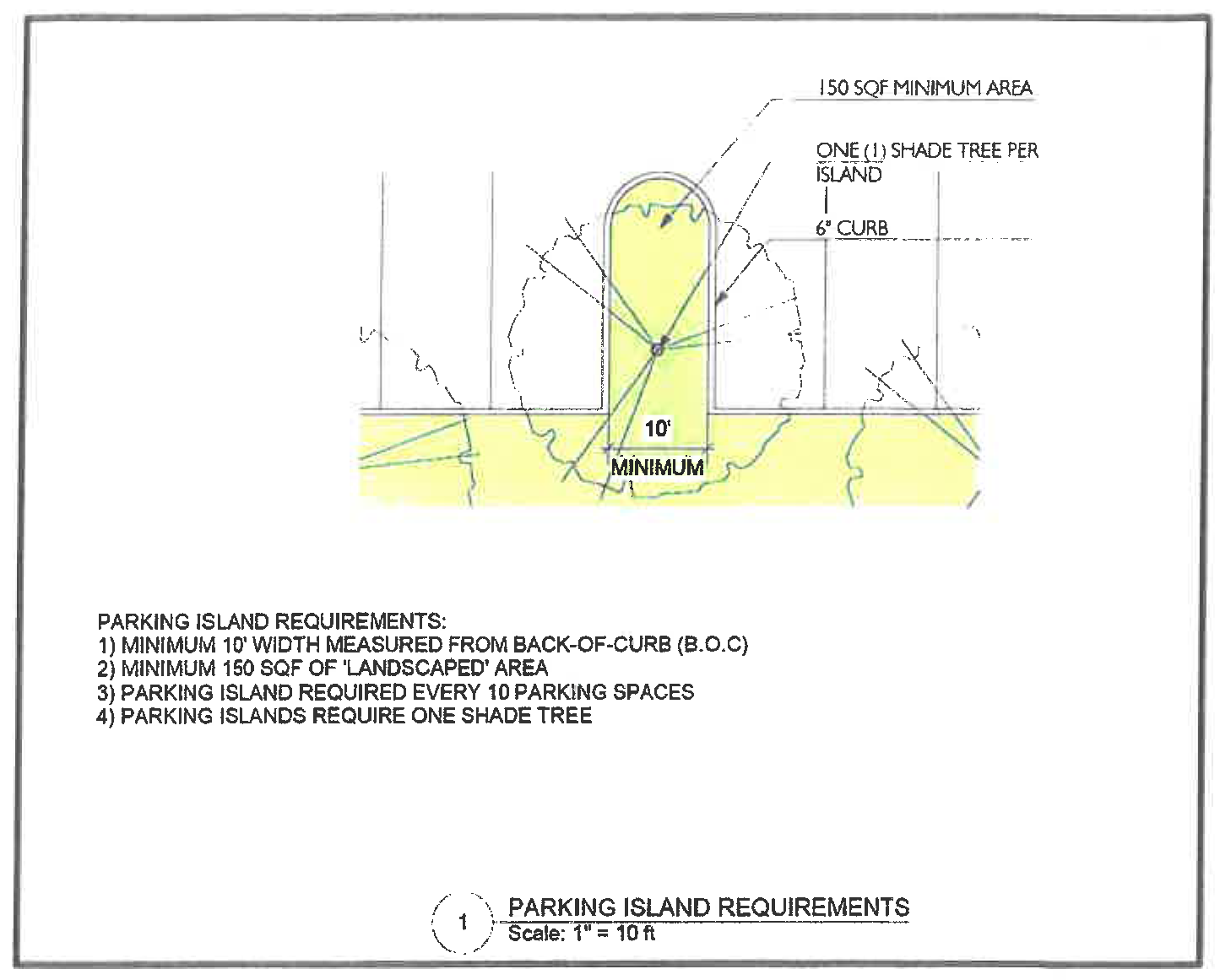
An interior island landscape area, in the form of an island and/or peninsula, shall be provided within a VA that has ten (10) parking spaces or more.
b.
An interior island landscape area must be a minimum of ten (10) feet in width back of curb to back of curb and be a minimum of one hundred fifty (150) square feet in area.
c.
An interior island landscape area must be provided every ten (10) parking spaces. Interior islands must be distributed evenly throughout the parking area.
d.
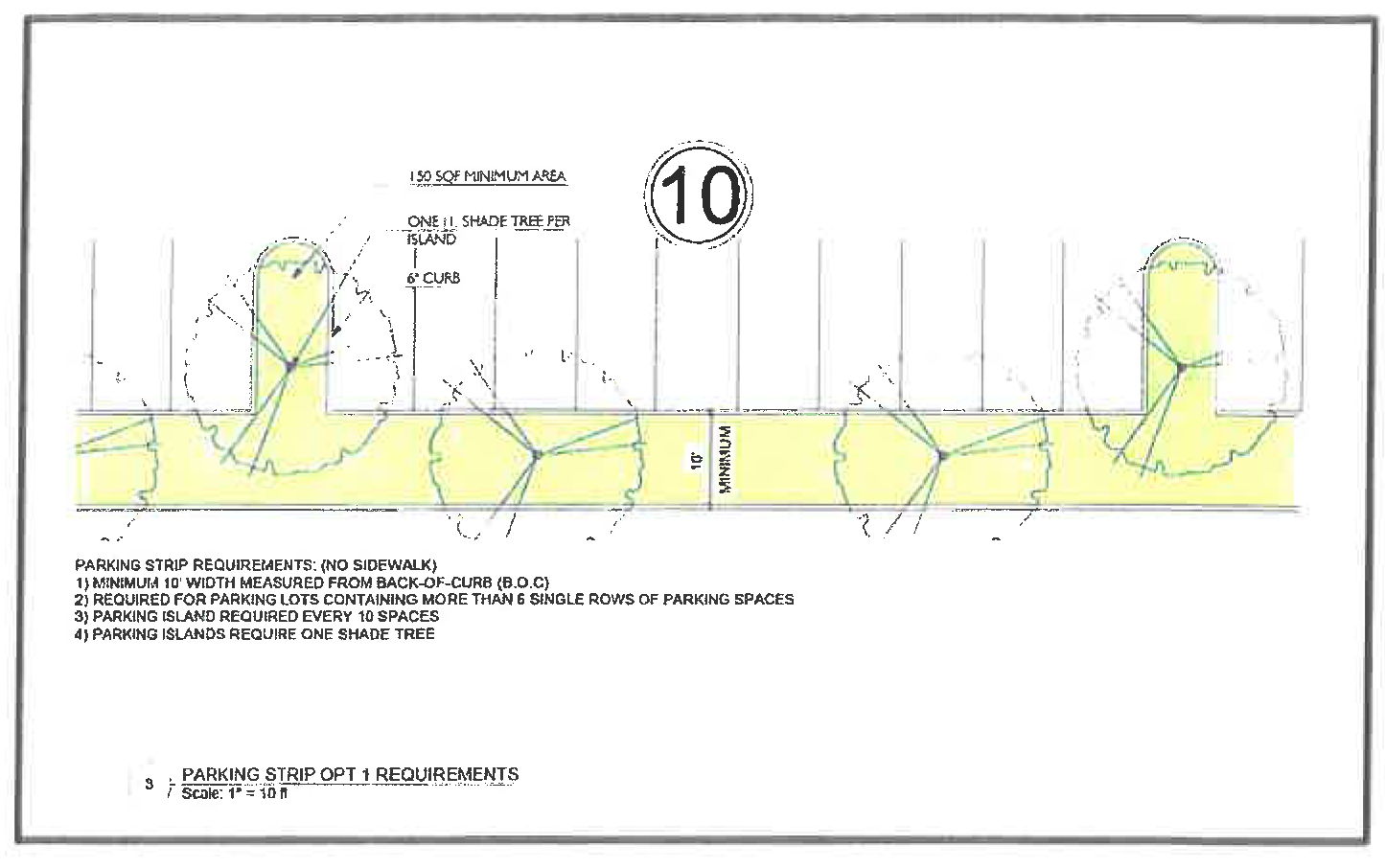
Median islands. A type of interior island landscape area that must be provided between every six (6) single parking rows.
(1)
A landscaped median island must be a minimum of ten (10) feet wide back of curb to back of curb.
(2)
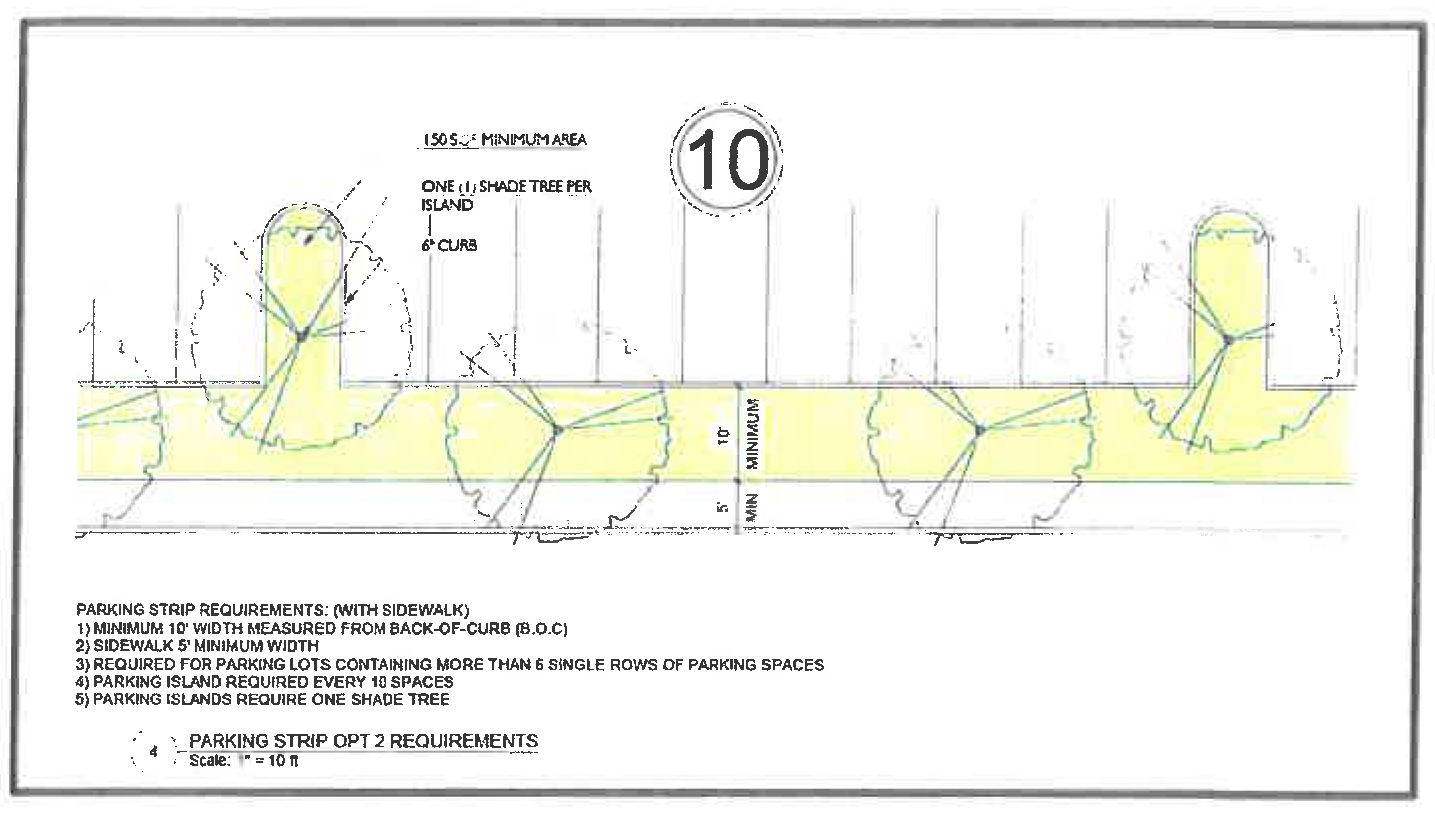
A median island may also serve as the location for a sidewalk connecting the parking and the use served by the parking area. The sidewalk must be a minimum of five (5) feet wide. When the median is utilized for location of a sidewalk, the median width must be expanded by at least five (5) feet for a total minimum of fifteen (15) [feet].
(3)
One (1) understory tree per every one hundred (150) square feet of interior island landscape area shall be required (see appendix A for approved tree list). Two understory trees equal one canopy tree for the required MTD on the site.
e.
Interior island landscape areas may be consolidated, in order to preserve existing trees.
f.
Plantings which may not be counted toward meeting the interior island landscape coverage requirements are:
(1)
Plantings required for perimeter VA (PVA) landscape area.
(2)
Plantings required by the street yard or foundation landscape requirements of this section.
(3)
Plantings required by the screening requirements for dumpsters and loading docks.
(4)
Plantings required in buffer strip.
4.
Foundation landscaping:
a.
Foundation landscaping requirements are applicable for attached residential, commercial, institutional, and parking garages with businesses or offices on the ground level (R-6, R-7, PR-I, PR-2, and all commercial and institution).
(1)
A minimum of fifty (50) percent of the linear feet of any side of a building facing a public street must be planted.
(2)
Plantings must be placed adjacent to building sides or provided in planters near the building sides.
(3)
Planting areas must be a minimum of three (3) feet in width, excluding a minimum two (2) foot wide strip along the curb for vehicular overhang, unless wheel stops are used.
(4)
Six (6) shrubs are required for every fifteen (15) square feet of total required planted area.
(5)
Shrubs planted immediately adjacent to the building shall be a minimum of eighteen (18) inches in height at installation.
(6)
Shrubs planted in elevated planters located near the building should be a minimum of fifteen (15) to eighteen (18) inches in height and a minimum three (3) gallon container at installation.
(7)
Foundation plants should be grouped so as not to block or obstruct windows and doors.
(8)
No landscaping or screening shall be planted inside utility and drainage easements, excluding overhead easements, without the consent of the city and the easement owner. Any landscaping located near a power line, shall not exceed a mature height of fifteen (15) feet and is subject to following local power authority regulations.
(9)
For non-single family attached residential, commercial, institutional, industrial zoning districts and parking garages with businesses or offices on the ground level all newly planted and relocated plant material shall be watered by a fully automatic irrigation system, providing one hundred (100) percent coverage of all required landscaped areas.
(Ord. No. 2818, § 2, 11-8-2021; Ord. No. 2859, § 2, 12-12-2022)
Sec. J. - Elimination of invasive trees and shrubs.
The city's natural resources, including groves, woodland areas and regulatory floodways shall be protected by the control and elimination of invasive, non-native species. To that end, the following guidelines shall apply:
1.
Planting of trees and shrubs listed by the Alabama Invasive Plant Council, is prohibited for fulfilling the requirements of this article.
2.
Removal of trees and shrubs listed by the Alabama Invasive Plant Council, from commercial, office, industrial, institutional, or multifamily sites (excluding jurisdictional wetlands) shall be completed as a requirement for approval of any development permit issued by the city or the issuance of a certificate of occupancy.
3.
Control and elimination procedures shall in no way harm or cause the decline of preserved or planted trees and landscaping.
(Ord. No. 2818, § 2, 11-8-2021; Ord. No. 2859, § 2, 12-12-2022)
Sec. K. - Plant hardiness considerations.
All plant materials must be hardy to zone 8A-B, in accordance with the U.S. Department of Agriculture's Plant Hardiness Zone Map.
(Ord. No. 2818, § 2, 11-8-2021; Ord. No. 2859, § 2, 12-12-2022)
Sec. L. - Maintenance of landscaping and trees.
The owner and/or tenant is responsible for maintaining the good health of all required landscaping.
1.
Any dead, unhealthy, or missing landscaping must be replaced with landscaping that conforms to this article within thirty (30) days of notification by the DEZ, city arborist or their designee. In the event the dead, unhealthy, or missing landscaping is the result of an unusual weather occurrence, or other act of nature, or if the weather conditions are not conducive to planting, the owner or tenant may request an extension, not to exceed one (1) year.
2.
All required landscaping shall be allowed to reach its required size and shall be maintained at that required size.
3.
Commercial landscaping and trees shall be subject to annual review. Any dead, unhealthy, or missing landscaping must be replaced with landscaping that conforms to this article within thirty (30) days of notification by the DEZ.
(Ord. No. 2818, § 2, 11-8-2021; Ord. No. 2859, § 2, 12-12-2022)
Sec. M. - Penalties.
Responsible parties that fail to preserve, plant or replace trees, as required by this article, within one hundred twenty (120) days of notification by the DEZ, will be subject to a five-hundred-dollar ($500.00) penalty per tree.
1.
In the event that any public tree or landscaping is damaged or destroyed, or otherwise caused to be removed, due to the fault of a party, other than the city, whether intentionally or by accident the party shall be responsible for replacing the landscaping and public tree, and will be subject to a five-hundred-dollar ($500.00) fine for each damaged tree. If the incurred damage may be remediated with pruning or other arboriculture practices, to enable its best chance of survival tree, the costs, which would otherwise not have accrued, will be assessed against the responsible party, for a period of two (2) years.
(Ord. No. 2818, § 2, 11-8-2021; Ord. No. 2859, § 2, 12-12-2022)
Sec. N. - Site inspections.
The DEZ may conduct periodic inspections of the site. It is the responsibility of the property owner and their agents to ensure that all provisions of this article are met at all times throughout permitted activities and during any applicable warranty periods.
Sec. O. - Certificate of completion/occupancy.
The building inspector cannot issue a certificate of compliance or occupancy until all tree and landscaping requirements of this article are met.
(Ord. No. 2818, § 2, 11-8-2021; Ord. No. 2859, § 2, 12-12-2022)

