
Homewood City Zoning Code
ARTICLE II
DEFINITIONS
When not inconsistent with the context, words used in the present tense include the future, the singular number includes the plural and the plural the singular. The word "building" shall include the word "structure" and the word "shall" is mandatory and not directory. Words and terms are defined as follows:
Accessible alley: An alley within city right-of-way that is paved at least ten (10) feet in width.
Accessory structures: A subordinate structure incidental to the primary use of the lot.
Accessory use: A use which is related but subordinate to the main use of the lot.
Alley: A public way less in width than a street, designed for the special accommodation of the property it reaches, and not intended for general travel.
Alteration and altered: The word "alteration" shall include any of the following:
(a)
Any addition to a building or structure.
(b)
Any change in the location of any of the exterior walls of a building or structure.
In addition to the foregoing, a building or structure shall be classified as altered when it is repaired, renovated, remodeled, or rebuilt at a cost in excess of fifty (50) percent of its value prior to the occurrence which necessitated the alteration.
Artificial turf: Synthetic materials made to resemble natural grass. Artificial turf, limited to rear yards only, will not be considered an accessory structure if a subsurface drainage plan and detailed section, designed by a professional engineer or landscape architect, registered in the State of Alabama, is provided to the DEZ. A letter, certified by the design professional, shall acknowledge the design intent was met during installation and will be required prior to issuance of a certificate of occupancy.
Attached dwelling unit: A dwelling unit in a building which contains two (2) or more dwelling units.
Basement: That portion of a building between floor and ceiling, which is partly above and partly below grade, but so located that the vertical distance from grade to the floor below is less than the vertical distance from grade to ceiling, provided, however, that the distance from grade to ceiling shall be at least four (4) feet six (6) inches.
Buffer strip: A vegetated strip of ground that is located within the property boundary and that meets all of the following criteria:
(1)
At its narrowest point, it has a level, horizontally measured width of ten (10) feet minimum; and
(2)
Its entire ground surface must remain unobstructed by manmade structures (except for approved fences and walls), pavement or any other impervious surface improvement; and
(3)
It must be so populated with plant materials that, within one (1) full calendar year after the date of installation of the plant material, the plant population provides a persistent, evergreen barrier that has a uniform distribution of foliage that is sufficiently dense so as to be impervious to transverse view from every vantage point located 0-to-6 feet in height along the longitudinal edges of the strip; and the plant population must be cultured and maintained so that, within three (3) full calendar years after the original date of installation of the plant material, the plant population is sufficiently dense so as to be impervious to transverse view from every point located 0-to-8 feet in height along the longitudinal edges of the strip. All vantage points shall be determined by vertical (plumb) measure taken from the relative point on the ground surface along said longitudinal edges; and
(4)
Its entire ground surface must be covered by an overstory of vegetation; and
(5)
Its entire ground surface must be covered by a layer of organic mulch, having a minimum thickness of four (4) vertical inches and being comprised of clean pine straw, shredded tree bark or other organic material approved by the city planner; and
(6)
It must be adequately maintained so as to effect the continuing and satisfactory performance of its requisite functions as a buffer strip.
Building: Any structure having a roof supported by columns or walls.
Building, main: The principal building on a lot, including an attached garage, carport, porch or part thereof.
Building area: The portion of the lot which may be occupied by the main building and accessory structures.
Building height: The vertical extent of a building height. Limits do not apply to chimney flues, and elevator bulkheads. Building height shall be measured from the first floor at the front door to the building's highest top of parapet or ridge of the roof.
Building line: A line defining the distance from the property line or lines beyond which a structure may be built in compliance with this ordinance.
Caliper: The diameter of a tree, measured at a point six (6) inches above the ground line if the resulting measurement is no more than four (4) inches. (ANSI A300 (Part 6) 2005 Transplanting)
Canopy tree: An evergreen or deciduous tree whose mature height can be expected to exceed thirty-five (35) feet, and which has an expected crown spread exceeding thirty (30) feet.
Clinic: An establishment, public or private, where there are no overnight facilities and where people are given examination, diagnosis and treatment as out-patients by physicians, dentists, optometrists or other members of the medical profession.
Cold frame: An unheated outdoor apparatus consisting of a wooden or concrete frame and a top of glass or clear plastic, used for protecting seedlings and plants from the cold no more than thirty-two (32) square feet in area and four (4) feet in height.
Community garden: A lot(s) or parcel(s) of land managed and maintained by a non-profit organization, an association, or a group of individuals from multiple households to grow and to harvest food, crops and/or non-food, ornamental crops, such as flowers, for personal or group use, consumption, or donation. Community gardens may be divided into separate plots for cultivations by individuals, or may be farmed collectively by the members of the group, and may include common areas maintained and used by group members. A community garden does not include a garden or edible landscaping maintained by an individual or members from one (1) household for personal use.
Community garden structure: A detached structure, the use of which is customary to community gardens.
Condominium: Individually owned attached dwelling units, situated on property which is owned and maintained by an association of residents, for their common use and benefit.
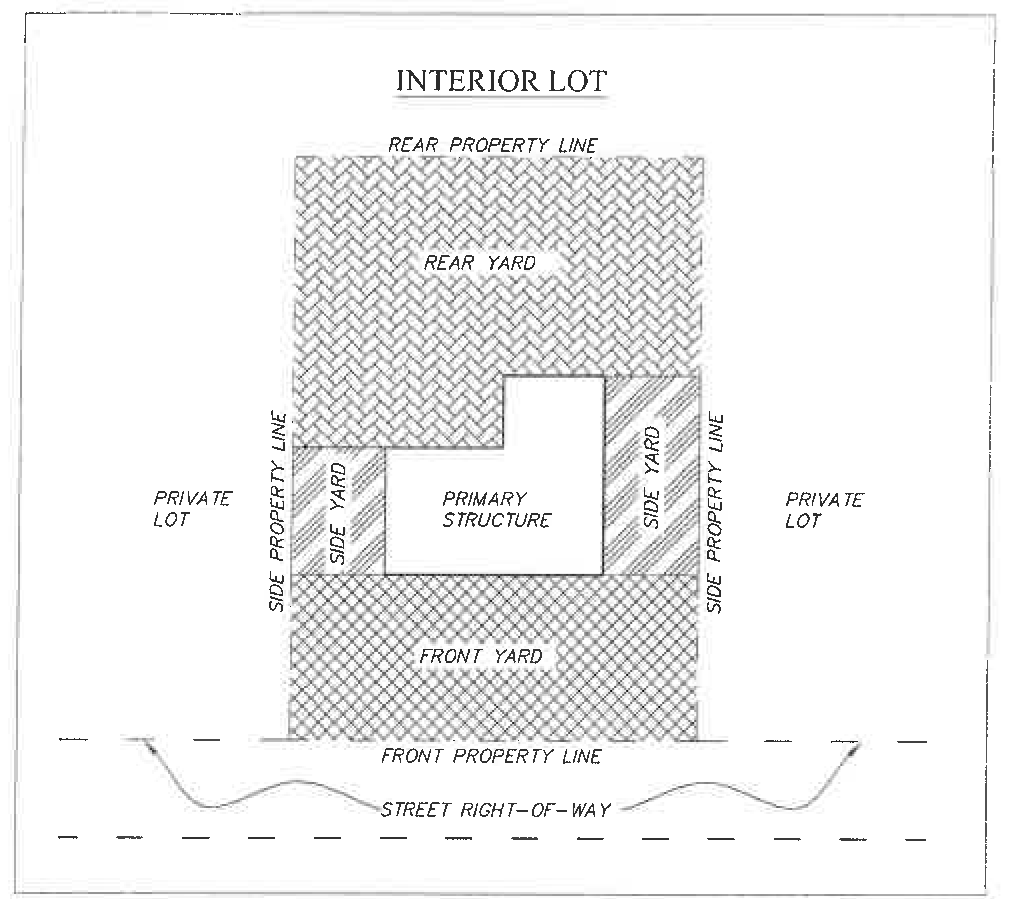
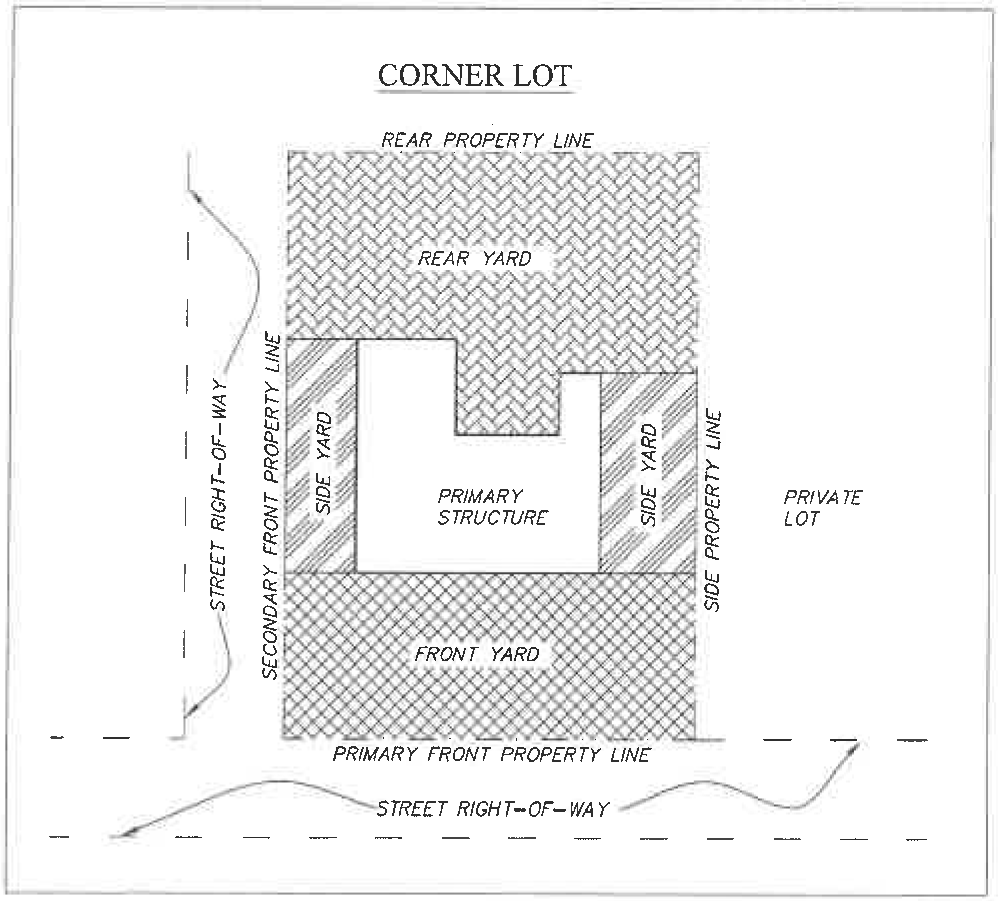
Corner lots: Lots fronting two (2) or more streets shall use the frontage with the least dimension as the predominant front property line. The frontage with the longest dimension shall be the secondary front. The area between the secondary front property line and the elevation of the primary dwelling unit shall be considered a side yard. The building setback along the secondary front shall be the applicable side building setback for the zoning district, but not less than nine (9) feet in NPD zoning. The property line located opposite the predominant front property line shall be the rear property line. The rear building setback along the rear property line shall be that of the applicable zoning district. The area not designated as a side yard or a front yard shall be considered the rear yard for the placement of accessory uses and structures.
Critical root zone: The minimum volume of roots necessary, for maintenance of tree health and stability, and being the area uniformly measured by a circle with a radius equal to one (1) foot per inch of DBH tree trunk of the preserved tree measured at four and one-half (4½) feet above the ground (measured to the nearest inch), with the trunk of the tree at the center of the circle. The minimum radius shall not be less than seven (7) feet. (ANSI A300 (Part 5) 2005 Management)
Crown: The leaves and branches of a tree measured from the lowest branch on the trunk to the top of the tree. (ANSI A300 (Part 6) 2005 Transplanting).
Day care center: Any child care facility receiving more than six (6) children for care.
Day care home: A child care facility which is a family home and which receives no more than six (6) children for care.
D.B.H.: Acronym for diameter at breast height; diameter of tree measured at four and one-half (4.5) feet above ground. (ANSI A300 (Part 6) 2005 Transplanting)
Deciduous plants: Those that shed all their leaves during their dormant season and produce all new leaves the following growing season.
Detached dwelling unit: A dwelling unit which is the main building on a lot.
Dormitory: A structure other than a dwelling, designed, used or offered for residential occupancy, which is part of an institution, and serves only the members, students or employees thereof.
Dripline: An imaginary line defined by the branch spread. (ANSI A300 (Part 5) 2005 Management)
Duplex: A building containing two (2) dwelling units.
Dwelling: Any building or portion thereof which is designed or used primarily for residential occupancy, except that the word "dwelling" shall not include boarding or rooming houses, tents, dormitories, motels, hotels, or other structures designed or used primarily for transient residents.
Dwelling unit: Any portion of a building used, intended, or designed as a separate abode for one (1) family.
Evergreen plants: Those that retain their green leaves during their dormant season.
Family: One or more persons related by blood, marriage, adoption, or by some other legal custodial relationship, living as a single housekeeping unit in a dwelling unit, including persons who reside in the dwelling unit and are employed to care for family members; or three (3) unrelated individuals living as a single housekeeping unit in a dwelling unit. However, notwithstanding the preceding definition, a family shall also be deemed to include up to three (3) unrelated persons occupying a dwelling unit and living as a single, non-profit housekeeping unit, if any one or more of said three (3) unrelated occupants is handicapped as defined in Title VIII of the Civil Rights Act of 1968 as amended by the Fair Housing Act Amendments of 1988 and the Alabama Fair Housing Law, § 24-8-1 et seq., Ala. Code 1975.
Fence: A freestanding barrier intended to mark the boundary of a lot, provide separation and privacy, or as a means of security, protection, confinement, or buffering.
Fence, natural: A vegetative barrier formed by a dense row of shrubs or trees intended to separate two (2) pieces of land, mark the boundary of a lot, provide privacy and security, and prevent escape or intrusion.
Fence, privacy: A freestanding barrier made of posts and boards, wire, or vinyl panels, intended to separate two (2) pieces of land, mark the boundary of a lot, provide privacy and security, and prevent escape or intrusion.
Fence, wall: An upright structure constructed of masonry, plaster, cement, interlocking block, or similar material, serving to enclose, divide or protect an area located within the boundary of a lot, such as a patio. A masonry fence is not a retaining wall.
Garden coordinator: The person having legal or equitable interest in a propose project subject to the provision of this article. The coordinator performs the role of management of the community gardens in coordination with the city.
Grade: A reference plane representing the average of finished ground level adjoining the building at all exterior walls.
Ground cover, organic: Any of various low, dense-growing plants, vines and shrubs that grow over the surface of the ground or mulches originating from tree bark or pine needles used to retain soil moisture, prevent soil erosion and compaction and suppress weed growth, especially in areas of dense shade where grass is difficult to grow, or on steep slopes where the maintenance of grass is not practicable, and which also encourages the growth of microorganisms and beneficial insects.
Ground cover, inorganic: Any of various stones, rocks and gravel, mulches made of synthetic materials such as rubber or plastic, landscape fabrics (geotextiles) and plastic sheeting, used to help retain soil moisture, prevent soil erosion and compaction, and suppress weed growth.
Hazardous tree: A structurally unsound tree that could strike a target when it fails. A tree is potentially hazardous when:
1.
It has a readily observable structural defect that predisposes the entire tree or a significant part of the tree, to structural failure.
2.
The structural defect cannot be remedied by an accepted arboricultural practice.
3.
A target exists beneath or adjacent to the tree that could be injured or damaged, including, but not limited to: pedestrians, vehicles, streets, sidewalks, buildings, utility lines and other man-made structures.
Home occupation: An accessory use of a dwelling, employing only the inhabitants thereof, which is clearly incidental and secondary to residential occupancy, and subject to the criteria set forth in Article IX, section C, subsection 1, subparagraph b of this chapter.
Hoop house: An apparatus made of polyvinyl chloride (PVC) piping or other material covered with translucent plastic, constructed in a half-round or hoop shape, used for growing and protecting plants no more than two hundred (200) square feet in area and eight (8) feet in height.
Hotel: An establishment offering transient lodging accommodations to the general public, with all rooms having sole access, (other than required or permitted emergency exits) to the outside through the main lobby of the building, and providing additional services, such as restaurants, coffee shops, gift shops and meeting rooms.
Invasive plant: A species that is nonnative (or alien) to the ecosystem under consideration, and whose introduction causes, or is likely to cause, economic or environmental harm or harm to human health. See USDA Executive Order 13112 (Section 1. Definitions).
Landscape plan: A plan, drawn to scale, showing proposed landscaping, which may include, but is not limited to grading, irrigation, stormwater management, vegetation removal and planting with species type, size and spacing. A landscape plan is required as part of a land disturbance permit, building permit application, or development/site plan. A schedule of all land disturbance or landscaping activities must be included with the landscape plan.
Land disturbance activity: Any activity that may result in soil erosion from wind or water, such as excavation, land clearing, grubbing, placement of fill, grading, blasting, reclamation, vegetation removal, construction and preconstruction activities. Land disturbance activity may also include areas in which construction materials are stored in association with a land disturbance or handled above ground including but not limited to, construction site vehicle parking, equipment or supply storage areas, material stockpiles, temporary office areas and access roads.
Land disturbance permit: A permit required for land disturbance activities.
Living area: The area on all floors of a building exclusive of porches, unfinished basements, unfinished attics, garages or breezeways.
Lot: A platted parcel of land that is part of a subdivision, abuts a public street, has the minimum area and dimensions required by the district regulations in which it is located, and is recorded in the office of the judge of probate.
Major vehicle repair: Rebuilding of engines and other components, painting, grinding, sanding, fabrication of parts, and other activities which require the storage of vehicles or are detrimental to property, health or safety beyond the district in which it is located, due to emission of odor, gas, dust, fumes, smoke, noise, vibration or waste material.
Mini-warehouse: A structure or group of structures, not to exceed one (1) story in height, partitioned for leasing of individual storage spaces of five hundred (500) square feet or less, wherein no retail or wholesale trade is conducted.
Minimum tree density (MTD): Minimum number of trees that must be present on a given site.
Motel: An establishment providing transient accommodations to the general public containing twenty-five (25) or more rooms, with at least seventy-five (75) percent of the rooms having access to the outside without the necessity of passing through the main lobby of the building.
Native plant: Any plant that occurs naturally or originates in a geographic area.
Native tree: Trees that are indigenous to central Alabama as identified in appendix A to article X.
Nonconforming lot of record: A lot which was lawful when platted but does not conform to the provisions of this ordinance, or any subsequent amendments thereto.
Nonconforming use: A use of any building, structure, or land which was lawful when the use commenced, but does not conform with the provisions of this ordinance or any subsequent amendments thereto for the district in which it is located.
Nursing home: A home for the aged, chronically ill or incurable persons (except mental or alcoholic patients and drug addicts), in which two (2) or more persons are received, kept or provided with food, shelter and care for compensation but not including hospitals, clinics or other institutions devoted primarily to the diagnosis, treatment or care of the sick or injured.
Office park: A lot or parcel on which more than one (1) office building is located.
Offices: Space or rooms used for professional, administrative, clerical and similar uses.
Parcel: A tract of land that is not part of a subdivision, the map of which has not been recorded in the office of the judge of probate.
Parking lot: An open area which is surfaced by either asphalt pavement or concrete used primarily for the purpose of parking motor driven vehicles.
Parking space: A clearly designated area located on private property, surfaced by either bituminous pavement or concrete, for temporary occupancy by a motor driven vehicle.
Parking structure: A structure or portion thereof designed or used primarily for the parking of motor driven vehicles.
Permeable surface: An area paved with porous asphalt, pervious concrete, open jointed blocks or other materials designed to allow at least fifty (50) percent of surface runoff during a typical rain event into an underlying stone reservoir that temporarily stores surface runoff before it infiltrates into the subsoil.
Personal fitness studio: A facility for the purpose of physical fitness, exercise and/or weight control where client(s) are under the direction of fitness instructor(s) and/or personal trainer(s). Typical activities shall include, among others: yoga, Pilates, aerobics, or other related activities. All activities shall be conducted entirely within an enclosed building.
Planning commission: The City of Homewood Planning Commission.
Property lines:
Front property line: Any property line along a street right-of-way.
Side property line: Any property line intersecting a street right-of-way.
Rear property line: Any other property line that is neither a side nor a front.
Public tree: A tree located on city property, including city rights-of-way, or any tree owned by the city. Trees within city rights-of-way do not count toward the minimum tree density requirement. Any work proposed on or immediately adjacent to public trees must receive city council approval. All public trees must be protected during construction on private property. Any damage to public trees, including root systems, will require removal and replacement of the public tree at the expense of the violator.
Qualifying tree: A tree six (6) inches DBH or larger, except for invasive species listed by the Alabama Invasive Plant Council.
Replacement tree: A tree that replaces a qualifying tree that has been removed for any approved reason. A replacement tree assumes the "qualifying tree" status of the qualifying tree removed.
Restaurant: A building in which food is cooked or prepared, offered for sale, and where patrons are served at tables by employees, including cafeterias.
Restaurant, fast food: A building in which food is cooked or prepared and offered for sale; designed where patrons serve themselves and eat at tables, on the premises in their cars, and off the premises.
Service station: Any place of business at which fuels or oils for the use of motor vehicles is offered for sale at retail, and where minor repairs, services, and inspections may be carried on and rendered incidental to the sale of such fuel.
Shopping center: A group of two (2) or more retail sales or service establishments located within one (1) building or a group of architecturally unified building; and having an integrated parking area.
Sign: Any object, device, display or structure, or part thereof, situated outdoors or indoors, which is used to advertise, identify, display, direct or attract attention to an object, person, institution, organization, business, product, service, event or location by any means, including words, letters, figures, design, symbols, fixtures, colors, illumination or projected images.
Story: That portion of a building included between the upper surface of any floor and the upper surface of the floor next above; or any portion of a building between the topmost floor and the roof, in which the floor area with eight (8) feet or more of head clearance is equivalent to fifty (50) percent or more of the floor area. A basement is considered a story if its ceiling height is more than four (4) feet six (6) inches above grade.
Street: Any public way set aside for common travel as designated on the master plan.
Street yard: The area of a lot between the primary street right-of-way and the required front setback line, extending horizontally from side property line to the opposite property line. For corner lots which front two (2) streets, the frontage with the least dimension shall be considered the primary street right-of-way.
Structure: Any combination of materials, including buildings, constructed or erected, the use of which requires location on the ground or attached to anything having location on the ground, including among other things signs, dish antennas, fences, retaining walls, decks, storage buildings, sidewalks, driveways, parking pads, patios, outdoor fireplaces, mechanical/electrical appurtenances, etc.
Total floor area: The floor area of all stories of a building including garages, carports, and porches.
Townhouse: Attached dwelling units situated on individual lots.
Transient(s): A person, firm, or business entity that rents or is furnished any room or rooms, lodging or accommodations in a hotel or a motel for a period of less than one hundred eighty (180) continuous days in the city.
Tree permit: A permit that must be applied for as required by article XI.
Tree disturbing activity: Any activity that results in one (1) or more of the following:
1.
The movement or compaction of earth, the chemical or physical alteration of earth, vegetative or non-vegetative change in the existing soil cover or the topography in the critical root zone area of a tree or within any tree conservation area, including but not limited to: chemical application, clearing, grading, filling, excavation, stabilization of structures and road or walkway construction that in any way diminishes the health and vigor of nearby trees.
2.
Chemical or physical alteration of a tree in any way that diminishes its health and vigor, including but not limited to removal, cutting, root pruning, branch pruning, topping, bark scraping and application of chemical or biological agents.
3.
The placement within the critical root zone area, or within any tree conservation area, any permanent or temporary encroachment, including, but not limited to, the application of impervious surfaces, storage of equipment, materials, earth parking or the storage, staging or circulation of vehicles or equipment.
Tree inventory: A comprehensive list of individual trees with accompanying descriptive information. (ANSI A300 (Part 5) 2005 Management)
Tree protection zone: A space above and below ground within which trees are to be retained and protected. (ANSI A300 (Part 5) 2005 Management). For the purposes of this article, the tree protection zone will be, at minimum, the extent of the critical root zone, but may need to be larger as determined by the city arborist. Physical intrusion is prohibited in this area in order to prevent damage to the tree and critical root zone.
Tree protection zone barrier: Devices such as fencing, berms, or signage installed to limit access to tree protection zones. (ANSI A300 (Part 5) 2005 Management). For the purposes of this article, a tree protection zone barrier shall be a polygon of two (2) inch by four (4) inch wide stakes spaced a maximum of eight (8) feet from each other at the perimeter of the tree protection zone and which extends out of the ground at least thirty-six (36) inches, with the top four (4) inches marked by fluorescent orange paint or tape.
Tree replacement assessment: The total amount of monetary compensation owed to the city, which may be required for the replacement of trees cut, destroyed, or removed from public property or rights-of-way without prior approval. The amount assessed will be calculated by the city arborist using the latest edition of the Guide for Plant Appraisal.
Understory tree: An evergreen or deciduous tree whose mature height and canopy width can be expected to range between fifteen (15) feet and thirty-five (35) feet.
Use: The purpose for which land or a building or other structure is designed, arranged, or intended or for which it is or may be occupied or maintained.
Vehicular use area (VA): An off-street area designated for the parking and movement of vehicles.
Wall, sitting: A freestanding wall built to define an outdoor area and provide seating.
Yard, required: The area measured from a property line to the required minimum building setback line, unoccupied and unobstructed from the ground upward, except by trees, plants, shrubberies.
Yard, remaining: The area of a lot measured within the confines of the building setbacks, which may be occupied by a building(s) and accessory structure(s).
Zoning lot: A lot or parcel created by the combination of two (2) or more lots or parcels which are adjacent or contiguous to each other and are under common ownership on the effective date of this ordinance or subsequent thereto, where any of such individual lot(s) or parcel(s), do not meet the minimum requirements of this ordinance prior to combination.
(Ord. No. 1826, § 1, 8-23-1993; Ord. No. 2001, § 1, 11-23-1998; Ord. No. 2019, § 1, 6-28-1999; Ord. No. 2459, § 1, 5-14-2012; Ord. No. 2475, § 1, 12-17-2012; Ord. No. 2630, § 1, 9-12-2016; Ord. No. 2663, § 1, 7-10-2017; Ord. No. 2710, § 1, 8-13-2018; Ord. No. 2722, § 1, 12-3-2018; Ord. No. 2749, § 1, 6-24-2019; Ord. No. 2790, § 2, 1-11-2021; Ord. No. 2818, § 1, 11-8-2021; Ord. No. 2857, §§ 1, 2, 11-28-2022; Ord. No. 2859, § 1, 12-12-2022)

