
Honeyville City Zoning Code
CHAPTER 19
- OFF STREET PARKING AND LOADING
10-19-1: - Purpose
The purpose of this chapter is to assure the provision and maintenance of off-street parking and loading facilities in proportion to the parking and loading demand of land uses. The requirements of this chapter are intended to assure useful and attractive parking and loading facilities, to protect public safety, and to mitigate adverse land use impacts.
(Adopted by Ord. 2007-02 on 7/11/2007)
10-19-2: - Scope
The requirements of this chapter shall be applicable to any new development requiring motor vehicle access under the provisions of this title. The requirements of this chapter shall not be construed to prohibit or limit other applicable provisions of this title, this code, and other laws.
(Adopted by Ord. 2007-02 on 7/11/2007)
10-19-3: - Parking to be provided
A.
Off Street Parking Required: Every land use established under the authority of this title shall have parking required by this chapter. When any building or structure is erected, enlarged or increased in capacity, or any use is established or changed, parking shall be provided in accordance with the requirements of this chapter.
B.
Continuing Obligation to Provide Parking: Provision of parking as required by this chapter shall be a continuing obligation so long as a use continues which requires parking. It shall be unlawful for any owner, land use operator, or person responsible for providing parking to discontinue or dispense with required parking facilities without providing an alternate parking area which meets the requirements of this chapter.
C.
Alteration Where Parking Insufficient: A building, structure or use which lacks sufficient parking as required by this chapter may not be altered or enlarged or the use changed unless additional parking for the alteration or enlargement is supplied that meets the requirements of this chapter.
(Adopted by Ord. 2007-02 on 7/11/2007)
10-19-4: - Parking calculation
The following provisions shall be used to calculate the total number of parking spaces required by this chapter:
A.
More than One Use on Lot: If a lot contains more than one use, parking spaces shall be provided in an amount equal to the total of the requirements for each use unless shared parking is permitted pursuant to this chapter.
B.
Fixed Seating: Where seating consists of chairs, benches, pews or other forms of fixed seating parking shall be calculated at the rate of one parking space per four (4) seats.
C.
Square Foot Basis: Parking requirements based on square footage shall be calculated using gross floor area ("GFA") unless otherwise provided in this chapter.
D.
Employee Basis: Parking requirements based on the number of employees shall be calculated using the largest number of persons working on any shift.
E.
Use Not Listed: If a use and a corresponding parking standard is not listed in table 10-19-1 of section 10-19-11 of this chapter, the zoning administrator shall determine the number of spaces required for such use based on the nearest comparable use or a parking study as provided in subsection 10-19-10E of this chapter.
(Adopted by Ord. 2007-02 on 7/11/2007)
10-19-5: - Parking location
A.
On-Site Parking: Except as allowed in subsection B of this section, all required parking shall be located on the same lot as the use to which it is appurtenant and shall be located within three hundred feet (300') from the premises served.
B.
Off-Site Parking: Where practical difficulties exist in providing on-site parking or if public safety or convenience, or both, would be better served by locating parking on a separate lot, the planning commission may authorize off-site parking subject to the following conditions:
1.
Required parking spaces reserved for persons with disabilities shall not be located in an off-site parking lot.
2.
Off-site parking lots shall be located in the same or a more intensive zone which applies to the property where the use served is located.
3.
No off-site parking space shall be located more than three hundred feet (300') from a public entrance of the use served, measured along the route of the shortest legal, practical walking distance. Off-site parking shall not be separated from a principal use by a street right of way with a width of more than seventy-two feet (72').
4.
Availability of each off-site parking lot shall be assured by an agreement approved by the city which requires:
a.
The parking lot to be continuously available unless an alternative legal parking lot is provided;
b.
All spaces to be available without charge; and
c.
The zoning administrator to be notified thirty (30) days prior to the expiration or termination of the agreement.
5.
Before approving an off-site parking lot, the planning commission shall find that such parking is conveniently usable without causing unreasonable:
a.
Hazard to pedestrians;
b.
Hazard to vehicular traffic;
c.
Traffic congestion;
d.
Interference with safe and convenient access to other parking areas in the vicinity;
e.
Detriment to the appropriate use of business property in the vicinity; or
f.
Detriment to any residential neighborhood.
C.
Temporary Parking:
1.
Unimproved temporary parking areas shall be exempt from the landscaping and paving requirements of this chapter.
2.
The city may allow a temporary use approved pursuant to chapter 29 of this title to occupy or use parking areas ordinarily required for a permanent use if it is found that the temporary use will not cause a shortage in parking needed for the permanent use.
D.
Prohibited Parking:
1.
Vacant lots, public rights of way, or open land areas shall not be used as parking areas for customers or employees.
2.
Overnight parking of vehicles for display other than in designated and improved areas shall be prohibited.
E.
Commercial Vehicle Parking in Residential Zones: One commercial vehicle with a rated capacity of more than two (2) tons may be parked for not more than twenty-four (24) continuous hours in any thirty (30) day period on a lot in a residential zone. Contracting and earthmoving equipment shall not be parked in a residential zone.
F.
Recreational Vehicle Parking in Residential Zones: In residential zones, no boat or recreational vehicle shall be parked within a front yard adjacent to a public street for longer than seven (7) consecutive days per calendar quarter.
(Adopted by Ord. 2007-02 on 7/11/2007; Ord. No. 2024-07, § 1 (Att.), 8-14-2024)
10-19-6: - Number and type of parking spaces
A.
Parking Required: Off-street parking spaces shall be provided in accordance with this section for every land use authorized by this title except as otherwise expressly allowed by this title. The total number of parking spaces required by this section shall be determined by summing the parking required by each of the subsections in this section.
B.
Standard Parking Spaces: Standard parking spaces shall be provided as set forth in table 10-19-1, "Off Street Parking Schedule", of section 10-19-11 of this chapter.
C.
Handicapped Parking Spaces: Parking spaces for handicapped persons shall be provided as required by the international building code and the "Uniform Federal Accessibility Standards Manual".
D.
Stacking Parking Spaces: Stacking or queue spaces shall be provided as follows:
1.
Bank drive-through including automatic teller machines: Three (3) per lane.
2.
Car wash:
a.
Self wash: Three (3) per bay.
b.
Automatic wash accessory use: Four (4) per bay.
c.
Automatic wash primary use: Four (4) per bay.
3.
Gasoline pump island: One per pump.
4.
Fast food restaurant drive-through: Five (5) per lane.
E.
Off-Street Loading Spaces: Off street loading spaces with a height clearance of fourteen feet (14') or more shall be provided for buildings used for retail, office, industrial, hospital, storage warehousing, and similar uses as follows:
F.
Tandem Parking Spaces: Tandem parking spaces shall not qualify as required parking unless approved by the planning commission in the following instances:
1.
In multi-family dwellings with garages; or
2.
In conjunction with valet parking service.
G.
Recreational Vehicle Parking: Adequate and accessible recreational vehicle parking storage areas shall be required in each multiple-family and planned residential development project unless the premises are subject to restrictive covenants or other means limiting the parking of such vehicles.
(Adopted by Ord. 2007-02 on 7/11/2007)
10-19-7: - Parking dimensions
Unless otherwise modified as provided in this chapter, parking space, bay, and related dimensions shall be as follows:
A.
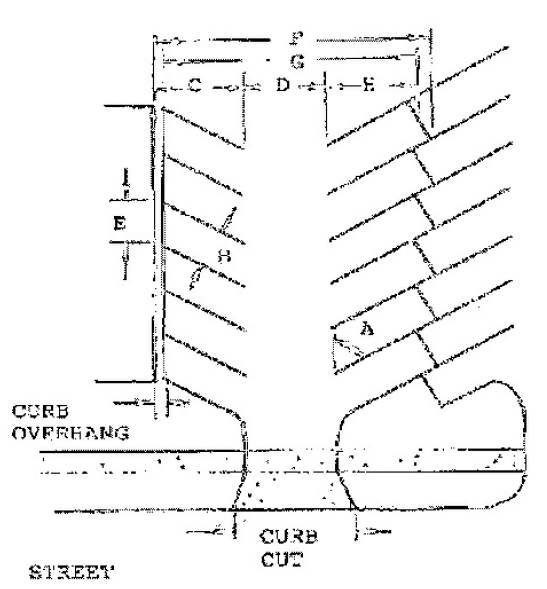
Parking Space Dimensions: Parking space and related dimensions shall be as set forth in this section and as shown on table 10-19-2 and figure 10-19-1 of section 10-19-11 of this chapter.
1.
Standard parking space: Nine by twenty feet (9 x 20').
2.
Carport: Minimum inside dimension of nine by twenty-two feet (9 x 22') for each parking space.
3.
Garage: Minimum inside dimension of ten by twenty-two feet (10 x 22') and minimum door width of eight feet (8') for each parking space.
4.
Handicapped parking space: Standard size plus four foot (4') unloading area parallel to the length of the space. Loading area may be shared with an adjacent handicapped parking space.
5.
Angle parking space: See table 10-19-2 and figure 10-19-1 of section 10-19-11 of this chapter.
6.
Parallel parking space: Nine by twenty-two feet (9 x 22').
7.
Loading space: Ten by twenty-five feet (10 x 25').
8.
Stacking space: Ten by twenty feet (10 x 20').
9.
Where the tires of parked vehicles contact curbing, parking stall length may be reduced by two feet (2') if space is available and vehicle overhang does not block a sidewalk.
B.
Driveway Dimensions: Minimum driveway dimensions shall be as follows:
1.
For access to five (5) or fewer spaces: Twelve feet (12').
2.
For access to six (6) or more spaces: Twelve feet (12') for one-way traffic; twenty-five feet (25') for two-way traffic. Driveway width shall not exceed thirty-five feet (35').
(Adopted by Ord. 2007-02 on 7/11/2007)
10-19-8: - Parking lot design and construction
A.
Parking Plans: Plans for any proposed parking lot shall be submitted to the zoning administrator. The plan shall clearly indicate the proposed development, including location, size, shape, design, curb cuts, lighting, landscaping and other features and appurtenances of the proposed development.
B.
Access to Public Street: Except for parking for a single-family or two-family dwelling, access to a parking space or parking lot shall be from a parking lot aisle and not directly from a public street. Every parking lot shall have access to a public street. Such access may be provided through platted or recorded easements, reciprocal arrangements, or other guaranteed means.
C.
Private Driveway: Parking for single-family and two-family dwellings may be accessed from a public street via a private driveway.
D.
Backing Space: Backing space shall be provided for all parking lots so that cars will not back onto a public street. Public sidewalks shall not be used as a part of the required backing area. Separate exits shall be provided for angled and one-way parallel parking so a vehicle will not exit by backing onto a public street.
E.
Curb: Required parking for multiple-family residential, public facility, commercial and industrial uses shall be bordered by continuous concrete curbing to serve as wheel stops and drainage channels.
F.
Curb Cuts: Curb cuts and driveways allowing access to a public street shall conform to the requirements of section 10-19-9 of this chapter.
G.
Internal Circulation: Each parking lot shall provide for traffic circulation on the property adequate to access all parts thereof without the necessity of exiting onto a public street.
H.
Landscaping: Parking lots shall be landscaped as provided in chapter 18 of this title.
I.
Lighting: Parking lots used at night shall be adequately lighted, utilizing hooded light sources. Parking lot lights shall be arranged to reflect light away from adjoining residential premises.
J.
Paving: Unless expressly provided otherwise in this title, every parking lot required by this title shall:
1.
Be paved with asphalt, concrete or some other all weather surfacing material;
2.
Be maintained to eliminate dust or mud; and
3.
Be graded and drained to dispose of all surface water. Such surface water drainage shall not cross a public sidewalk.
(Adopted by Ord. 2007-02 on 7/11/2007)
10-19-9: - Access requirements
A.
Individual Spaces: Access to each parking space in a parking lot shall be from a private driveway and not from a public street.
B.
Minimum Standards: Adequate ingress and egress shall be provided to all uses at the following minimum standards:
1.
Number of Driveways: No more than two (2) driveways shall be allowed for each one hundred feet (100') or fraction thereof of frontage on any one street.
2.
Distance to Property Line: No driveway in a residential district shall be closer than three feet (3') to any property line.
3.
Entering Public Roadway: No driveway which enters a public roadway shall be closer than ten feet (10') to any property line.
4.
Distance to Each Other on Same Property: No two (2) driveways on the same property shall be closer than twelve feet (12') to each other.
5.
Corner Location: No driveway shall be located closer than twenty feet (20') to any corner.
6.
Backing onto Public Streets: Parking spaces for all uses except residential uses shall be so located that parking or departing vehicles do not back onto public streets.
7.
Safety Island, Buffer Zone: Where a parking area adjoins an existing curb and gutter and/or sidewalk, a safety island or buffer zone shall be provided to prevent the entrance or exit of vehicles, except via established driveways. The safety island or buffer zone may consist of a concrete curb or a landscaped strip of no less than eight feet (8') in width, depending on the site conditions and the decision of the planning commission.
(Adopted by Ord. 2007-02 on 7/11/2007)
10-19-10: - Parking modifications
A.
Modification Permitted: The number of parking spaces required under section 10-19-6 of this chapter may be modified in accordance with the provisions in this section. The purpose of such modifications is to avoid creating unnecessary parking areas that will be essentially unused. In considering a modification, the planning commission may require a parking study to be completed as provided in subsection E of this section.
B.
Shared Use Parking: The planning commission may authorize shared use of a parking lot subject to the following conditions:
1.
The uses sharing the parking lot are unlikely to produce a substantial demand for parking at the same time. The city may require a shared parking study to be completed which clearly establishes that uses will make use of the shared spaces at different times of the day, week, month or year.
2.
Required parking spaces reserved for persons with disabilities shall not be reduced.
3.
Ongoing shared use of the parking lot is assured by an agreement or easement approved by the city which requires:
a.
The parking lot to be continuously available unless an alternative legal parking lot is provided;
b.
All spaces to be available without charge;
c.
The zoning administrator to be notified thirty (30) days prior to the expiration or termination of the agreement or easement; and
d.
Provision of additional parking up to the amount otherwise required under this chapter if the zoning administrator determines, based on parking counts, that a shared parking lot does not satisfy the off-street parking demand of the uses involved.
C.
Commercial, Retail, Office, and Mixed-Use Developments: The planning commission may modify the number of parking spaces required or allowed for commercial, retail, office, or mixed-use developments after considering the following items and making a finding that adequate parking will be provided:
1.
Total number of spaces that would otherwise be required for each individual establishment in the development;
2.
Hours of operation for each business establishment located in the development, including peak business hours;
3.
Estimated tradeoff between businesses which are open when others are closed;
4.
Availability of approved on street or shared parking;
5.
Transportation alternatives, including proximity to transit stations; and
6.
Car or van pooling programs available to users of the development.
D.
Multiple-Family and Planned Developments: The planning commission may modify the total number of parking spaces required for multiple-family or planned developments after considering the following items and making a finding that adequate parking will be provided:
1.
Size of housing units by number of bedrooms;
2.
Cost range of units proposed;
3.
Owner/tenant characteristics and lifestyle, i.e., singles, couples, families, professionals, retired, elderly, etc.;
4.
Examination of existing comparable parking by area or projects;
5.
Size of project;
6.
Special parking requirements for visitors and recreational vehicles;
7.
Future parking expansion capabilities;
8.
Transportation alternatives, including proximity to transit stations;
9.
Workplace relationships;
10.
Handicap requirements;
11.
Restrictive covenants; and
12.
Availability of approved on-street parking for required guest parking.
E.
Parking Space Study: When a parking space study is required for a particular use shown on table 10-19-1 of section 10-19-11 of this chapter, or when an applicant requests a modification in the number of parking spaces required under section 10-19-6 of this chapter, a parking study shall be provided by the applicant which recommends an adequate number of parking spaces and sets forth the basis of the recommendation.
1.
The study shall provide:
a.
Planning and traffic engineering data, including estimates of parking demand based on recommendations from the Institute of Parking Engineers;
b.
Data collected from uses or combinations of uses that are the same or comparable to the proposed project as indicated by density, scale, bulk, area, type of activity, and location;
c.
The source of data used to develop the study's recommendations; and
d.
The name and qualifications of the persons who prepared the study.
2.
The planning commission shall determine the required number of parking spaces after:
a.
Considering the recommendations of the parking study and any recommendations from the city engineer; and
b.
Making the findings required under subsection C or D of this section.
(Adopted by Ord. 2007-02 on 7/11/2007)
10-19-11: - Tables and figures
TABLE 10-19-1
OFF STREET PARKING SCHEDULE
TABLE 10-19-2
PARKING SPACE AND AISLE DIMENSIONS (IN FEET)
FIGURE 10-19-1
PARKING SPACE AND AISLE ILLUSTRATION
(Adopted by Ord. 2007-02 on 7/11/2007)

