
Hugo City Zoning Code
ARTICLE VI
REQUIREMENTS FOR SPECIFIC USES AND PERFORMANCE STANDARDS
Sec. 90-201. - Purpose.
The purpose of this article is to establish minimum development standards. These standards are intended and designed to assure compatibility of uses; to prevent urban blight, deterioration and decay; and to enhance the health, safety and general welfare of the residents of the community.
(Prior Code, § 1195-010.1)
Sec. 90-202. - Application of article.
Unless stated otherwise in this article, the provisions of this article apply only where provisions elsewhere in this chapter reference these provisions.
Sec. 90-203. - Accessory apartments.
(a)
It is unlawful for any person to construct, lease, or let out an accessory apartment except in conformance with the requirements of this section.
(b)
Performance Standards.
(1)
Accessory apartments must comply with the city building code and the rules of the county health department.
(2)
The structure in which an accessory apartment is located must be owner-occupied.
(3)
No separate driveway or curb cut shall be allowed for the accessory unit.
(4)
There shall be no more than one accessory apartment within any single-family structure.
(5)
The accessory apartment may not be located in or above a garage or other accessory building except in the agricultural zoning district.
(6)
The accessory apartment must contain its own toilet, bathtub or shower, and kitchen facilities.
(7)
The accessory apartment must not require a variance to any building setback, height, or maximum impervious surface standard established in this chapter.
(c)
At the time a building permit is issued for an accessory apartment, the applicant for the permit shall pay the city parkland dedication fee in accordance with section 90-324, if such fee has not already been paid for the dwelling unit being created. Parkland dedication fees are not required for accessory apartments located in the agricultural and long-term agricultural zoning districts.
(Prior Code, § 1195-020.1)
Sec. 90-204. - Accessory buildings.
(a)
It is unlawful for any person to construct or replace an accessory building in any district in the city, except in conformance with this chapter.
(b)
A site plan must be submitted for approval by the community development director or designee before a permit is issued for any accessory building.
(c)
One accessory storage shed is allowed per lot with a maximum size less than 120 square feet in addition to the number and size of accessory buildings listed in this section.
(d)
Setbacks for accessory buildings less than 120 square feet and located in the urban residential zoning districts are as follows:
(1)
Ten-foot rear yard setback
(2)
Six-foot side yard setback
(3)
Shall be outside all drainage and utility easements.
(e)
All accessory buildings 120 square feet or larger, are to be in conformance with all building setbacks.
(f)
Accessory buildings, up to the maximum number and size listed in this section are permitted as an accessory use in all residential and agricultural districts of the city. Accessory buildings of up to 125 percent of the size permitted may be allowed by conditional use permit, if no variance is required for their construction. The number and size of accessory buildings permitted are as follows:
(g)
Garages allowed under sections 90-229 and 90-230 are permitted in addition to accessory buildings. Detached garages are considered accessory buildings and are subject to all requirements of this section. For residential properties without an attached garage, an additional 500 square feet, and an additional building shall be allowed beyond the maximum size and number of buildings referenced in the table above.
(h)
Except for agricultural buildings, no accessory building may exceed in size or height, the size or height of the principle building on a lot, or be located within six feet of another building.
(i)
Except in the agricultural and long-term agricultural zoning districts, no accessory building shall be located or protrude in front of the principle building on the site, in relation to any public street.
(j)
All accessory buildings shall resemble, in style, materials, color, roofline, and siding type, the principle building on the lot, except the following building types may vary from this standard:
(1)
Accessory buildings located in the agricultural and long-term agricultural zoning districts.
(2)
Accessory building under 120 square feet in size.
(3)
Horse stables and riding arenas.
(4)
Greenhouses.
(5)
Gazebos and decorative shelters.
(6)
Historic buildings.
(7)
Buildings, constructed as part of a planned unit development, which are subject to an overall site plan prepared by a registered architect.
(k)
Any accessory building located in a commercial or industrial zoning district shall have an approved site plan from the community development director prior to the issuance of a building permit. The maximum number and size of buildings permitted shall be determined on a case by case basis. Accessory buildings shall not dominate the streetscape, restrict views across the property, and shall not alter the character of the area.
(l)
All accessory buildings located in commercial and industrial zoning districts shall be of the same style, materials, color, roofline, and siding type as the principle building on the lot. Building types listed under subsection (j), (1)—(7) of this section may vary from this standard.
(m)
Accessory buildings shall not have indoor plumbing such that it would allow the structure to be used as living space, which would constitute a dwelling.
(n)
Other provisions of this chapter notwithstanding, there is no limit to the number or size of agricultural buildings allowed on parcels of land 20 acres or more in size located in the agricultural, long-term agricultural, and rural residential zoning districts.
(o)
Any property zoned R-l, RR, AG, or FUS that is less than three acres in size shall be allowed two accessory buildings with a maximum combined size of 1,500 square feet, and shall not be subject to the requirements as stated in the table outlined in subsection (f).
(Prior Code, § 1195-030.1; Ord. 2009-429, § 1, 6-15-2009; Ord. No. 2015-470, § 3, 5-4-2015)
Sec. 90-205. - Accessory retail and service uses.
Accessory, enclosed retail, rental, or service shall not constitute more than 25 percent of the gross floor area of the principal building.
(Prior Code, § 1195-040.1; Ord. No. 2015-470, § 3, 5-4-2015)
Sec. 90-206. - Automobile recycling or junkyards.
(a)
It is unlawful for any person to operate an automobile recycling facility or junkyard in the city except in conformance with these regulations.
(b)
The operations and permitting of automobile recycling facilities and junkyards are regulated by chapter 42, article IV.
(c)
Automobile recycling facilities shall be set back a minimum of 30 feet from adjacent property lines to allow for screening and landscaping.
(Prior Code, § 1195-060.1)
Sec. 90-207. - Reserved.
Editor's note— Ord. No. 2010-453, § 1, adopted Dec. 6, 2010, deleted § 90-207, which pertained to automotive service stations and derived from the prior Code, § 1195-070.1.
Sec. 90-208. - Heavy vehicle and equipment repair.
Servicing of motor freight vehicles and heavy construction equipment; directly related accessory materials and parts sales for such repair and servicing (not including new or used vehicle sales); and accessory materials and parts warehousing which is related to and dependent upon such uses shall be permitted, provided that:
(1)
All servicing of vehicles and equipment shall occur entirely within the principal structure.
(2)
To the extent required by state law and regulations, painting shall be conducted in an approved paint booth, which thoroughly controls the emission of fumes, dust, or other particulate matter.
(3)
Storage and use of all flammable materials, including liquid and rags, shall conform with applicable provisions of the state fire code.
(4)
Parking, driveway, and circulation standards and requirements shall be subject to the review and approval of the city and shall be based upon the specific needs of the operation and shall accommodate large vehicle equipment and semi-trailer/tractor trucks.
(5)
The storage of damaged vehicles and vehicle parts and accessory equipment must be completely inside a principal or accessory building.
(6)
The sale of products other than those specifically mentioned in this section shall be subject to a separate conditional use permit.
(Prior Code, § 1195-080.1)
Sec. 90-209. - Commerical balloon ports.
It is unlawful for any person to operate or maintain a commercial balloon port in the city, except in compliance with this chapter.
(1)
The balloon port must comply with all rules and regulations of federal, state, and county agencies.
(2)
Where the expected or actual automobile traffic to the site exceeds 15 cars per day, the main entrance to the facility must be located on a state highway, county road, or city commercial collector street.
(3)
The minimum lot size for a balloon port is ten acres.
(4)
The balloon take-off area shall be a minimum of 50 feet away from any property line, and 200 feet away from any overhead power line, antenna, or other potentially dangerous structures.
(Prior Code, § 1195-090.1)
Sec. 90-210. - Bed and breakfast businesses.
It is unlawful for any person to operate or maintain a bed and breakfast business in the city, except in compliance with this chapter.
(1)
The use of single-family detached homes for a bed and breakfast business may be allowed in districts as specified in article III of this chapter with a conditional use permit.
(2)
No structure may be constructed for the sole purpose of being used as a bed and breakfast facility. No building shall be enlarged or expanded for the purpose of providing extra rooms for guests. The exterior appearance of all facilities shall not be altered from its single-family character.
(3)
Where the expected or actual automobile traffic to the site exceeds 15 cars per day, the main entrance to the facility must be located on a state highway, county road, or city commercial collector street.
(4)
Primary entrance to all guestrooms must be from within the dwelling unit.
(5)
Guests are limited to a length of stay not exceeding 30 consecutive days.
(6)
No food preparation shall be conducted within any guestroom. The only meal to be provided to guests shall be morning breakfast, and this meal shall be served only to guests lodging at the facility.
(7)
Commercial activities, in addition to overnight lodging, shall not be conducted on the site, including, but not limited to, luncheons, banquets, parties, weddings, meetings, charitable fund raising, or sales events.
(8)
Off-street parking, sufficient to handle all guests and owner vehicles, shall be provided.
(Prior Code, § 1195-100.1)
Sec. 90-211. - Campgrounds.
(a)
It is unlawful for any person to lease or let space for the location of a tent, camping trailer or motor home in the city, except in a campground established in accordance with this chapter.
(b)
The minimum parcel size for a campground is 20 acres.
(c)
The main entrance to a campground must be located on a state highway, county road, or city collector street.
(d)
All campgrounds must be licensed by the state department of health.
(e)
A 50-foot buffer and setback area shall be maintained between the campsites and adjacent property lines.
(f)
No recreational vehicle or travel trailer is allowed to be stored permanently on the property.
(g)
The sale, storage, use, or occupancy of any manufactured home, except permanent buildings constructed in accordance with this chapter, is prohibited.
(h)
Unit density for tents or travel trailers shall not exceed ten units per acre, and must meet the following standards:
(1)
Each camping and trailer-marking space shall be clearly delineated and numbered.
(2)
Each space shall maintain 20 feet between each camping trailer, motor home, and tent.
(3)
Each space shall have a minimum of 200 square feet of parking space, with at least 16 feet of driveway frontage. No space may have direct access to a public road.
(4)
Each lot, or pair of lots, shall contain a watertight, rodent- and insect-resistant refuse container.
(5)
Each lot shall be no further than 400 feet from the nearest readily available drinking water supply.
(i)
All internal streets shall be paved with bituminous, concrete, pavers, or other approved dustless and erosion-resistant material.
(j)
All utilities shall be buried, and there shall be no overhead wires or support poles, except those essential for street or other lighting purpose.
(k)
Centralized refuse containers and all maintenance facilities shall be fenced and screened.
(l)
All land and facilities shall be adequately drained and properly maintained free of dust, refuse, garbage, rubbish, and debris.
(m)
Each campground shall have at least one building with central heating that is adequately lighted during all hours of darkness. The building shall contain laundry washers, dryers, showers, and public toilets. The building shall be serviced by municipal sanitary sewer or an approved septic system. Each campground shall have a room or building for use of its caretaker distinctly marked "office."
(n)
An adult caretaker shall be on duty at all times there is a guest occupying a space in the campground. The caretaker shall have immediate access to a public phone, and maintain a register of all persons using the facility. This register shall record the name, address, motor vehicle license number, and number of guests, as well as the date and time of their arrival and departure.
(o)
New commercial motor home parks or campgrounds and new residential type subdivisions and condominium associations that will include motor homes and the expansion of any existing similar use exceeding five units or dwelling sites shall be subject to the following:
(1)
Any new or replacement motor home will be allowed in the floodway or flood fringe districts provided said recreational vehicle and its contents are placed on fill above the regulatory flood protection elevation and proper elevated road access to the site exists in accordance with subsection 90-138(5) of this chapter. No fill placed in the floodway to meet the requirements of this section shall increase flood stages of the 100-year or regional flood.
(2)
Any new or replacement motor home not meeting the criteria of subsection (1) above may, as an alternative, be allowed as a conditional use if in accordance with the following provisions and the provisions of section 90-37 of this chapter. The applicant must submit an emergency plan for the safe evacuation of all vehicles and people during the 100-year flood. Said plan shall be prepared by a registered engineer or other qualified individual, shall demonstrate that adequate time and personnel exist to carry out the evacuation, and shall demonstrate the provisions of subsections 90-138(4)k.1.(i) and 90-138(4)k.1.(ii) of this chapter will be met. All attendant sewage and water facilities for new or replacement recreational vehicles must be protected or constructed so as to not be impaired or contaminated during times of flooding in accordance with Washington County's sewer and water regulations.
(3)
All new or replacement motor homes in the floodway or flood fringe districts shall not have any structural additions or decks whether or not its attached or detached from the motor home.
(Prior Code, § 1195-110.1; Ord. No. 2009-434, § 1, 10-5-2009)
Sec. 90-212. - Campus development.
For purposes of this chapter the term "campus development" means two or more principal buildings on any lot or parcel. All campus development shall be constructed under a master plan prepared by a professional, registered, architect, and approved as a provision of the conditional use permit for the site.
(Prior Code, § 1195-120.1)
Sec. 90-213. - Carwash.
(a)
It is unlawful for any person to construct or operate a commercial carwash in the city, except in conformance with this chapter.
(b)
Carwashes must be serviced by a public sanitary sewer system.
(c)
Parking, or stacking space, must be provided to accommodate the number of vehicles that may be washed in a 15-minute period. A minimum of 180 feet of stacking lane shall be provided separate from all parking areas.
(d)
Operation of the carwash shall not disrupt or degrade the quality of service provided by the municipal water system to other users or for fire flow.
(Prior Code, § 1195-130.1)
Sec. 90-214. - Cemeteries.
(a)
It is unlawful for any person to construct or operate a cemetery, or interment for the dead, except in conformance with this chapter.
(b)
The main entrance to a cemetery must be located on a state highway, county road, or city collector street.
(c)
Cemeteries shall be a minimum of five acres in size.
(d)
A cemetery shall not be located so as to obstruct the future development of adequate collector streets or extension of public utilities for the area in which it is located.
(e)
Burial plots, gravemarkers, monuments, and buildings must meet building setback and height requirements for the zoning district in which they are located.
(f)
Access to cemeteries shall be limited and controlled through the use of gates or similar structures. The entire perimeter of the cemetery shall be clearly delineated.
(g)
Graves and structures used for interment shall be set back a minimum of 50 feet from all wells.
(h)
No grave or structure used for interment shall be constructed below the regulatory flood protection elevation.
(i)
Cemeteries shall be landscaped in accordance with section 90-181.
(Prior Code, § 1195-140.1)
Sec. 90-215. - Reserved.
Editor's note— Ord. No. 2010-453, § 1, adopted Dec. 6, 2010, deleted § 90-215, which pertained to the rural preservation program—generally and derived from the prior Code, § 1195-150.1, subds. 1—3.
Sec. 90-216. - Reserved.
Editor's note— Ord. No. 2010-453, § 1, adopted Dec. 6, 2010, deleted § 90-216, which pertained to the rural preservation program—development standards and derived from the prior Code, § 1195-150.1, subds. 4—6.
Sec. 90-217. - Indoor commercial recreation.
(a)
It is unlawful for any person to construct or operate indoor commercial recreation activities, except in accordance with this chapter.
(b)
Pool tables, pinball games, dart boards, screen games, and similar small activities accessory to the principal use of the facility are permitted accessory uses to legally conforming bars, clubs, campgrounds, and resorts regardless of the zoning district in which they are located.
(Prior Code, § 1195-160.1)
Sec. 90-218. - Community residence.
(a)
Compliance. It is unlawful for any person to construct or operate a community residence, except in accordance with this chapter.
(b)
Requirements.
(1)
A community residence servicing one to six individuals and appropriate staff is allowed as a principal use in any residential or agricultural zoning district of the city.
(2)
A community residence serving seven to 16 individuals with appropriate staff may be allowed as a principal use in any residential or agricultural zoning district with a conditional use permit.
(3)
Community residences must be licensed by the state and/or county, where required.
(4)
Community residences located in a single-family housing district must have an appearance similar in size, scale, color, roofline, and materials as other homes in the zoning district.
(5)
No community residence shall provide accommodations to any person whose tenancy constitutes a direct threat to the health and safety of other individuals. No community residence shall accept court-ordered referrals for treatment instead of incarceration without adequate physical security measures in place and approved by the county sheriff.
(6)
Adequate off-street parking shall be provided in accordance with this chapter.
(7)
Adequate utilities, including sewage disposal, must be available.
(8)
No community residence shall be constructed or established within 1,000 feet of an existing community residence.
(9)
Community residences shall be landscaped to the same standards as other uses in the zoning district where it is located.
(Prior Code, § 1195-180.1)
Sec. 90-219. - Convenience store and gas stations.
Convenience stores and gas stations with prepared food and/or motor fuel sales, grocery, food operations, and/or convenience motor fuel with no vehicle service or repair are allowed as provided in this chapter, provided that:
(1)
Convenience/deli food is of the take-out type only and that no provision for seating or consumption on the premises is provided. Furthermore, that the enclosed area devoted to such activity, use and merchandise shall not exceed 15 percent of the gross floor area.
(2)
The storage, preparation and serving of food items are subject to specific written sanitary requirements based upon the applicable state and county regulations.
(3)
The proximate area and location of space devoted to nonautomotive merchandise sales shall be specified in the application and in the conditional use permit.
(4)
The off-street loading space and building access for delivery of goods shall be separate from customer parking and entrances and shall not cause conflicts with customer vehicles and pedestrian movements.
(5)
The hours of operation shall be limited to 6:00 a.m. to 11:00 p.m., unless amended by the council as part of the conditional use permit.
(6)
Motor fuel facilities shall be installed in accordance with state and city standards. Additionally, adequate space shall be provided to access gas pumps and to allow maneuverability around the pumps. Underground fuel storage tanks are to be positioned to allow adequate access by motor fuel transports and unloading operations which do not conflict with circulation, access and other activities on the site. Fuel pumps shall be installed on pump islands.
(7)
A protective canopy located over pump islands may be an accessory structure on the property and may be located 20 feet or more from the front lot line, provided adequate visibility both on and off site is maintained.
(8)
All canopy lighting for motor fuel station pump islands shall be recessed or shielded to provide a 90-degree cutoff. Illumination levels for pump islands shall not exceed 30 footcandles.
(9)
Litter control. The operation shall be responsible for litter control from the premises and litter control is to occur on a daily basis. Trash receptacles must be provided at a convenient location on site to facilitate litter control.
(Prior Code, § 1195-190.1; Ord. No. 2010-453, § 3, 12-6-2010)
Editor's note— Ord. No. 2010-453, § 3, adopted Dec. 6, 2010 changed the title of § 90-219 from convenience grocery market to convenience store and gas stations.
Sec. 90-220. - Daycare facilities.
(a)
It is unlawful for any person to construct or operate a day care facility, except in accordance with this chapter.
(b)
Day care facilities located in residential and agricultural zoning districts must be constructed to appear similar in scale, color, and materials as homes in the district.
(c)
All exterior play areas for day care facilities must be surrounded by a minimum six- foot-tall fence. All openings shall be controlled by doors or gates, and the fence shall meet all yard setback requirements.
(Prior Code, § 1195-200.1)
Sec. 90-221. - Drive-in businesses.
(a)
It is unlawful for any person to construct or operate a drive-in business, except in accordance with this regulation.
(b)
The main entrance to all drive-in businesses must be located on a state highway, county road, or city commercial collector street.
(c)
The minimum lot width of a drive-in business shall be 150 feet.
(d)
All traffic utilizing the business, including vehicle parking, stacking and waiting areas, shall be provided for on site and off public roads, alleys, and other easements.
(e)
A minimum of 180 feet of drive aisle stacking space shall be provided. Drive-in traffic stacking lanes shall be separate from parking areas and meet yard setback requirements.
(Prior Code, § 1195-210.1)
Sec. 90-221.1. - Drive-through businesses.
(a)
It is unlawful for any person to construct or operate a drive-through business, except in accordance with this regulation.
(b)
The main entrance to all drive-through businesses must be located on a state highway, county road, or city commercial collector street.
(c)
The minimum lot width of a drive-through business shall be 150 feet.
(d)
All traffic utilizing the business, including vehicle parking, stacking and waiting areas, shall be provided for on site and off public roads, alleys, and other easements.
(e)
The drive-through lane shall provide a minimum of 180 feet of drive aisle stacking space. The lane shall include the stacking area, order box and pick-up window. The lane shall be at least 200 feet from a residentially zoned property and meet all setback requirements. If the lane is proposed to be closer than 200 feet from a residentially zoned property a CUP shall be required.
(Ord. No. 2010-453, § 2, 12-6-2010)
Sec. 90-222. - Driveways.
(a)
It is unlawful for any person to construct or maintain a driveway, except in accordance with these regulations.
(b)
Driveways are allowed in all zoning districts of the city by permit issued by the city building official for platted property, or the city engineer for unplatted property.
(c)
Driveway access to all county roads and state highways requires a permit from the agency controlling the road or highway. Private driveway access to County Road 4, County Road 8, and Forest Boulevard (T.H. 61) will be allowed only where no viable alternative exists.
(d)
Except in the long term agricultural, agricultural, rural residential, and future urban service zoning districts, all driveways in the city shall be paved with bituminous, concrete, pavers, or other approved dustless and erosion-resistant material.
(e)
Driveways shared by two or more separate parcels or lots of land may be permitted only by conditional use permit. An access easement and maintenance agreement shall be recorded against the properties that contain the shared driveway.
(f)
Driveways may cross or encroach upon wetland area only by permit from the appropriate regulatory authority.
(g)
Driveways may cross or encroach upon a public drainage easement only by conditional use permit.
(h)
Driveways crossing a public road ditch in platted areas require a minimum 15 inches reinforced concrete pipe with aprons. In other areas, a minimum 15-inch corrugated metal pipe is an acceptable alternative. A higher standard in dimension or materials may be required by the city engineer for public safety or to maintain drainage. Property owners are required to keep such culverts in good repair and free from obstructions.
(i)
Driveways located in the floodplain overlay district shall meet the requirements of section 90-138.
(j)
Driveways shall connect to a public road at an angle between 60 and 90 degrees as measured along the driveway's edge from the road connection point to the building front yard setback line.
(k)
Only one driveway permit will be granted per lot or parcel of land, except one or more additional permits may be approved by the city engineer if such accesses will not impede traffic or pose a public safety risk.
(l)
Driveways must meet the minimum design requirements for the zoning district in which they are located, as specified in this subsection. However, in no case shall the width of a driveway exceed 35 percent of the lot width, as measured at the required front yard setback. The following driveway widths shall be as measured at the right-of-way line:
(Prior Code, § 1195-220.1; Ord. No. 2017-483, § 2, 6-5-2017)
Sec. 90-223. - Essential public services.
(a)
It is unlawful for any person to construct, operate, or maintain an essential public service in the city, except in conformance with this chapter.
(b)
Essential services shall be permitted in any zoning district of the city by permit issued by the city engineer.
(c)
Essential government services must comply with all state, federal, and local rules and regulations pertaining to their construction, maintenance, and operation.
(d)
Performance standards.
(1)
Except for electrical lines, phone lines, cable television lines, gas lines, and similar linear facilities, all essential public services in the agricultural, rural residential, and long-term agricultural districts shall be located on parcels of land at least one acre in size. In all other zoning districts, parcels of land used for essential services must be at least 1½ times the minimum lot size required in the zoning district.
(2)
Notwithstanding the prohibition against two or more uses on any individual parcel, utility substations and communications antennas permitted by this chapter shall be allowed by lease; however, the lot shall be large enough so that all structures and facilities comply with the required setbacks for the zoning district.
(3)
The site shall be landscaped and maintained in accordance with section 90-181. Screening is required for all above-grade lift stations, pump stations, substations, and similar structures not located within a building.
(4)
Buildings and structures shall be constructed to resemble in size, color, appearance, and shape the other structures in the zoning district.
(5)
Facilities and equipment shall be removed within six months of their becoming unnecessary.
(e)
Essential public services located in the floodplain district shall be constructed in accordance with section 90-138, and floodproofed in accordance with the state building code or elevated above the regulatory flood protection elevation. Railroads and service roads may be constructed at an elevation below the regulatory flood protection elevation where failure or interruption of the transportation services would not endanger the public health or safety, or delay access to critical facilities in times of emergency.
(f)
Wherever feasible, all electrical, cable television, phone lines and similar facilities located in the urban development area shall be built underground. Services to all new development shall be built underground. All services built or replaced parallel to and within 500 feet of Forest Boulevard, County Road 8, and County Road 4 shall be constructed underground. All services built or replaced crossing Forest Boulevard, County Road 8, and County Road 4 shall be built underground for 500 feet on either side of the roadway.
(Prior Code, § 1195-230.1)
Sec. 90-224. - Exterior storage.
(a)
It is unlawful for any person to use a property for exterior storage, except in conformance with this chapter.
(b)
Exterior storage on an area not exceeding the size of the principal building on the site is a permitted accessory use in the general industrial district. Exterior storage exceeding the size of the principal building may be allowed in the general industrial district by conditional use permit.
(c)
Exterior storage of farm materials and products is a permitted accessory use in the agricultural and long-term agricultural districts on all parcels of property, and in the rural residential district on parcels of land exceeding ten acres in size.
(d)
Exterior storage areas shall be fenced and screened from adjacent property and public right-of-way. Fencing and screening of exterior storage areas on parcels of land exceeding ten acres in size is not required in the agricultural, long-term agricultural, and rural residential districts unless required by conditional use permit.
(e)
Exterior storage shall meet all yard setback requirements.
(f)
Except in the agricultural, long-term agricultural, and rural residential districts, exterior storage areas shall be paved with bituminous, concrete, pavers, or other approved dustless and erosion-resistant material. Positive drainage control through use of curb, gutter, storm sewer, or other approved means shall channel all stormwater from exterior storage areas into a public drainage channel. Treatment of stormwater runoff shall comply with national urban runoff protection standards prior to discharge into the public system, unless the property is served by a regional treatment facility.
(Prior Code, § 1195-240.1; Ord. No. 2015-470, § 2, 5-4-2015)
Sec. 90-225. - Farm and garden produce sales.
(a)
It shall be unlawful for any person to sell farm or garden produce except in conformance with this chapter.
(b)
Farm and garden produce may be sold at retail in accordance with federal and state law, and in conformance with the regulations for retail sales contained in this chapter.
(c)
Any person may sell or peddle the products of the farm or garden they occupy and cultivate without obtaining a license therefor, so long as such sales are in conformance with this chapter.
(d)
Roadside stands for sale of produce grown on the property from which they are offered for sale are a permitted accessory use in the agricultural and long-term agricultural zoning districts. Such stands shall not occupy an area greater than 500 square feet, shall be located in conformance with all yard setback requirements and shall provide for adequate off-street parking.
(e)
Transient sales by the grower of farm and garden produce are permitted as authorized by law.
(f)
Transient sales of farm and garden produce by persons other than the grower are allowed in accordance with the standards for seasonal outdoor retail sales contained in this chapter.
(Prior Code, § 1195-250.1)
Sec. 90-226. - Feedlots.
(a)
It shall be unlawful for any person to construct, operate, or maintain a feedlot, except in conformance with this chapter.
(b)
An environmental assessment worksheet is required for facilities meeting the standards found in section 90-167.
(c)
No feedlot shall be located in the following areas:
(1)
Within the wellhead protection district.
(2)
Within 300 feet of any lake, stream, or public waterbody in the city's shoreland district.
(3)
Within 100 feet of any public drainage channel or wetland.
(d)
Feedlots requiring a conditional use permit shall be operated in conformance with Minnesota Pollution Control Agency Rules ch. 7020.
(Prior Code, § 1195-260.1)
Sec. 90-227. - Fences.
(a)
It is unlawful for any person to construct or maintain a fence, except in conformance with this chapter.
(b)
All fences shall be located entirely upon the property of the person owning the fence, except line fences used for agricultural purposes.
(c)
All fence owners shall maintain the fence in a state of good repair and appearance, and not allow the fence to become a safety hazard or nuisance. The city building official may order the removal or repair of any fence that is unsafe, seriously dilapidated, blocking drainage, or in any way poses a threat to public health, safety, and welfare.
(d)
No fences shall be placed in a public road right-of-way, except temporary barriers authorized by public safety personnel, the city engineer, or the city public works director.
(e)
As to any fence (or any structure or landscaping), or any part thereof, installed or present within a public easement, the city may remove the fence (or order it removed at its own discretion) in the event that work needs to be performed within the easement free of any claims of cost, loss or damage. The city and any agent of the city shall be held harmless for any and all claims for damage to the fence, or part thereof, arising out of or relating to work performed in the easement, including but not limited to the removal of the fence or any part thereof. The city is not responsible or liable for the costs of repair, reinstallation or restoration of any fence or part thereof removed from the easement.
(f)
Fences (or any structure or landscaping), may not be placed within a public easement where public improvements are located, or where an easement provides access to a public improvement, without first receiving approval of an encroachment agreement by the public works director or other designee, along with proof that the agreement has been filed with the record for the property in the office of the County Recorder or Registrar of Title.
(g)
That side of the fence considered to be the face or facing as applied to fence posts, shall front abutting property (good side out). This shall not prohibit construction of wire or cable fences used to control livestock in conformance with common agricultural practices.
(h)
No person shall construct or maintain any fence that is connected to, or charged by, an electrical system, except low-amperage systems used for livestock control in agricultural, long-term agricultural, and rural residential zoning districts.
(i)
The following fencing materials are allowed in all zoning districts:
(1)
Chain link.
(2)
Decorative masonry or block.
(3)
Wrought iron.
(4)
Brick.
(5)
Natural stone, dressed, or undressed.
(6)
Wood of proven exterior durability such as cedar, redwood, or treated wood.
(7)
Plastic fencing manufactured to look like wood fencing.
(j)
Barbed wire and cable fences are allowed only in the agricultural, long-term agricultural, rural residential, and future urban service zoning districts, except up to four strands of barbed wire may be used to top fencing at least six feet high in the industrial and restricted industrial zoning districts. Razor or ribbon wire is prohibited in all zoning districts.
(k)
No opaque fence or other visual obstruction over two feet tall shall be placed or allowed to develop within 20 feet of the intersection of any public street where both streets have a speed limit of 35 miles per hour or less. In this case, the intersection shall be considered the edge of the curb or travel portion of the roadway. Where one or more of the streets has a speed limit in excess of 35 miles per hour, such setback requirement shall be 30 feet or as may be necessary for traffic and pedestrian safety.
(l)
No fence over three feet high shall be constructed within ten feet of the ordinary high-water level of any lake or waterbody listed in section 90-137. No fence shall extend beyond the ordinary high-water level of any lake or waterbody listed in section 90-137.
(m)
All fences constructed in the floodplain overlay district shall be of an open type, and must not obstruct the free-flow of floodwaters, either by its construction, or through the collection of debris during periods of flooding.
(n)
A conditional use permit shall be required in the floodway and a use permit shall be required in the flood fringe for any fences that have the potential to obstruct flood flows such as cyclone fences and fences made of rigid walls such as wood or concrete privacy fences.
(o)
All fences constructed or maintained in the city shall comply with the setback and height requirements found below:
Fence Setback and Maximum Height Standards (in feet)
(p)
Fences up to six feet high may be constructed on a side property line in the urban residential, multifamily, and central residential zoning districts. Fences up to eight feet high may be constructed along side and rear yards in these zoning districts with a setback of six feet from all property lines.
(q)
Front yard fences may be of opaque construction up to a height of four feet, excepting corner setback areas, and so long as they do not pose a threat to public safety. In the agricultural, long-term agricultural, and rural residential zoning districts, that portion of a fence over four feet high must be of open construction.
(r)
Temporary fencing of construction sites, disaster scenes, and other sites posing a threat to public safety is allowed subject to permission of the property owner. Such temporary fencing shall be allowed only for the period of time required to ensure the public safety. Manufactured safety fence, snow fences, plywood and natural wood fences, portable concrete barriers, and similar products and techniques are allowed for this use, as well as those materials specified for use in permanent fencing.
(Prior Code, § 1195-270.1; Ord. No. 2009-434, § 1, 10-5-2009; Ord. No. 2025-544, 7-21-2025)
Sec. 90-228. - Funeral homes.
(a)
It is unlawful for any person to construct or maintain a funeral home, except in conformance with this chapter.
(b)
Facilities for cremation may be allowed as an accessory use to funeral homes with a conditional use permit.
(c)
All funeral homes shall have adequate off-street parking and vehicle stacking areas to serve their needs.
(Prior Code, § 1195-280.1)
Sec. 90-229. - Garages, commercial.
(a)
It is unlawful for any person to construct, operate, or maintain a commercial garage in the city, except in conformance with this chapter.
(b)
Commercial garages used only for the temporary parking of automobiles and light trucks for people employed or conducting business in nearby buildings may be allowed as an accessory use in the general business zoning district.
(Prior Code, § 1195-290.1; Ord. No. 2015-470, § 3, 5-4-2015)
Sec. 90-230. - Garages, private.
(a)
It is unlawful for any person to construct, operate or maintain a private garage in the city, except in conformance with this chapter.
(b)
Private detached garages are considered accessory buildings and are subject to all requirements under section 90-204.
(c)
Private attached garages must meet the following standards:
(1)
May not exceed, in size or height, the principle building located on the lot.
(2)
May not exceed 1,000 square feet plus 25 percent of the amount by which the footprint of the principle building exceeds 1,000 square feet in size.
(3)
May not occupy over 40 percent of the lot's public street frontage as measured at the front yard setback line.
(d)
Private garages may be used only by the owner or occupant of the property on which they are located; they may not be rented, leased, or occupied for commercial purposes.
(e)
On residential lots of less than 10,400 square feet in size, all garage walls, including front walls, must be located at, or to the rear of, the front wall of the principle building on the lot.
(f)
Except for agricultural buildings and long-term agricultural zoning districts, private garages shall resemble, in color, style, exterior siding, and roofing materials, the principle building on the lot or parcel.
(Prior Code, § 1195-300.1; Ord. No. 2009-430, § 1, 6-15-2009)
Sec. 90-231. - Golf courses.
(a)
It shall be unlawful for any person to construct, operate, or maintain a golf course in the city, except in conformance with this chapter.
(b)
All federal, state, and local rules and regulations must be met in the construction, maintenance, and operation of the facility.
(c)
Performance standards.
(1)
Landscaping shall be planted to buffer the use from adjacent land uses and to provide screening.
(2)
Fairways shall be designed to avoid golf balls being driven onto or across any public road, trail, or walkway, or onto adjacent properties.
(3)
Storage and use of pesticides and fertilizers shall meet the standards of the state department of agriculture. A chemical storage plan shall be provided to the community development director at the time of application, and updated thereafter as necessary, to provide the city an adequate knowledge of the location, type, amount, and storage method of all groundskeeping pesticides, chemicals, and fertilizers kept on the site.
(4)
Regardless of the conditions found in other sections of this chapter, conditional use permits for golf courses may include driving ranges, putting greens, a pro shop, a clubhouse, locker rooms, a restaurant, a bar and maintenance buildings as accessory uses.
(5)
A parking plan shall be provided in accordance with this chapter.
(6)
The main entrance to the golf course must be from a county highway, state highway or local commercial collector street.
(7)
Any mandatory environmental assessment worksheet (EAW) shall be prepared prior to the development of any golf course. It is the responsibility of the applicant to pay all cost associated with the EAW. The city council shall review the EAW, and all comments received as part of the EAW review process, prior to determining whether to issue the conditional use permit for the development.
(Prior Code, § 1195-310.1)
Sec. 90-232. - Home occupations.
(a)
Unlawful unless conditions met. It is unlawful to conduct or operate a business from a home in any zoning district of the city, except under the conditions contained in this chapter.
(b)
Purpose and intent. The purpose of this section is to maintain the character and integrity of residential areas, prevent unfair competition with commercial districts, encourage the existing entrepreneurial spirit in the city, and provide a means through the establishment of specific standards and procedures by which home occupations can be conducted without jeopardizing the health, safety, and general welfare of the surrounding neighborhood. The intent is to provide a mechanism enabling the distinction between those home occupations having minimal or no secondary impact, and those which have potential to adversely affect surrounding properties.
(c)
General standards for all home occupations. Home occupations, which conform to all of the following standards, may be permitted without obtaining a home occupation interim use permit:
(1)
Any home occupation shall be clearly incidental and secondary to the residential use of the premises and shall not change the residential character thereof.
(2)
The existence of the home occupation shall not be apparent beyond the boundaries of the site, except a nameplate, not to exceed two square feet in size, identifying the business or service conducted on the premises, affixed directly to the building.
(3)
All home occupations shall be conducted entirely within the principal dwelling, except that up to 50 percent of the total floor area of accessory structures (e.g., attached garages, detached garages, and other outbuildings) on a site may be used for the storage of equipment, trailers, or materials related to the home occupation, provided that no assembly, display, manufacturing, repair, or other business operations are conducted within an accessory structure. In no event shall the storage of materials related to a home occupation result in fewer parking spaces than required by this code.
(4)
The business or occupation shall not create any radio or television interference beyond the boundaries of the site.
(5)
The area set aside for home occupations shall not exceed 25 percent of the total floor area of such residence.
(6)
No home occupation shall permit light, glare, noise, odor, smoke, dust, or vibration that will in any way have an objectionable effect upon adjacent or nearby property owners.
(7)
No home occupation shall generate customer or vehicle trips to the site earlier than 7:00 a.m. and later than 9:00 p.m., Monday through Saturday, or earlier than 8:00 a.m. and later than 8:00 p.m. on Sunday.
(8)
No commodities shall be sold on the premises except incidental materials or agriculture products.
(9)
No home occupations shall generate on average more than eight vehicle trips per day, including no more than one delivery vehicle of a type that customarily serves a residential area. Vehicle trips related to the home occupation from customers and clients should generally be by appointment only.
(10)
There shall be no exterior storage of business equipment, merchandise, inventory, heavy equipment, or other materials and miscellaneous items used in the home occupation except for one business related automobile, truck, or van not exceeding 25 feet in length or a gross vehicle weight rating of 9,200 pounds may be parked on the premises.
a.
In addition to the above, in the Agricultural, Long Term Agricultural, Rural Residential and Future Urban Service zoning districts, or within any urban residential district on property ten acres or greater in size, one additional business-related vehicle shall be allowed. Said vehicle may exceed the weight and length limitations outlined above. One business related trailer shall be allowed provided the trailer is attached to a vehicle and the combined length of the vehicle and trailer does not exceed 46 feet.
(11)
No alteration of the exterior of the dwelling or the accessory structure that changes the residential character of the premises shall be permitted, except where required to comply with local and state fire and police regulations.
(12)
No more than one person, other than those who reside on the premises, shall engage in business activities on the premises. The business may employ others only if their work activities are performed off the premises.
(13)
On-street parking facilities shall not be utilized to accommodate parking demand.
(14)
No home occupation shall involve the use of hazardous materials or activities that require a hazardous waste generator's license.
(d)
Home occupations not requiring interim use permit. The following uses, subject to the above performance standards, are examples of home occupations that may be permitted without a home occupation interim use permit: home office facilities, music and art studios, tutoring services with no more than two pupils per session, dressmaking and tailoring, and home craft production such as rug weaving and model making.
(e)
Home occupation interim use permits. Home occupations which do not conform to the above standards may be conducted by a home occupation interim use permit. The information required and the procedure to be followed for all home occupation interim use permit applications shall be the same as that required for a conditional use permit set forth in subsections 90-37(a) and (b). In addition, the applicant may be required to submit supplementary information pertaining to the nature of the home occupation, the equipment used, days and hours that the home occupation will be conducted, and a plan showing the portion of the dwelling or site to be used for the home occupation.
(f)
Criteria for approval of a home occupation interim use permit. An application for a home occupation interim use permit may be granted only upon a finding that all the following criteria have been met:
(1)
The applicant owns the property and resides at the principal residential address associated with the home occupation, unless the council determines that unique conditions or circumstances warrant special arrangements.
(2)
The proposed home occupation is allowed as an accessory use in the respective zoning district and conforms to this chapter.
(3)
The proposed home occupation is in keeping with the spirit and intent of this chapter.
(4)
The proposed home occupation is compatible with the present character of the surrounding area.
(5)
The proposed home occupation shall have a set date in which the permit shall be reviewed and extended through the renewal process or terminated.
(6)
The home occupation will not impose additional unreasonable costs on the public.
(7)
The proposed home occupation shall be subject to, by agreement with the property owner, any conditions that the city council deems appropriate for permission of the use.
(g)
Conditions of approval. In permitting a new home occupation interim use permit or amending an existing home occupation interim use permit, the planning commission may recommend and the city council may impose, additional conditions and requirements to protect the health, safety, and welfare of the surrounding area and the community at whole, mitigate unfavorable consequences of activities resulting from issuing the permit, enforce laws and regulations, and ensure compliance with the conditions of the permit. These conditions may include, but are not limited to, the following:
(1)
Limitations on period of use, occupancy, and operation.
(2)
Buffering and screening measures.
(3)
Renewal periods between one to five years.
(h)
Renewal of a home occupation interim use permit. A home occupation interim use permit shall be issued for an initial period of up to two years, after which the permit may be renewed for periods of up to five years each. Notice of the permit renewal application must be provided to the property owners of record for properties located within 300 feet of the lot or parcel to which the home occupation interim use application applies and the property owners shall be allowed a period of ten days in which to respond. Notice of the permit renewal application should also be provided to the planning commission and the city council. If no parties wish to be heard at a public meeting to consider the application within ten days of the notice the application can be approved administratively. A public hearing shall also be required if deemed necessary by the community development director, or a majority of the planning commission or the city council. If a public hearing is deemed necessary, the community development director shall schedule the item for consideration by the city council and shall notify the surrounding property owners of the hearing date. The city council shall renew an interim use permit if the following criteria are met:
(1)
The interim home occupation satisfies the performance standards for interim home occupations and the conditions of the home occupation interim use permit.
(2)
The interim home occupation has been operating without violation of city ordinances or significant impact on surrounding neighbors.
(3)
The interim home occupation is operating as the same type of business at the same scale and intensity as originally approved. If the home occupation has significantly changed, the applicant shall apply for a new home occupation interim use permit.
(i)
Interim use permit nontransferable. Home occupation interim use permits do not run with the land. The permit is not transferable from person-to-person, and shall expire if there is a change in ownership of the property, unless the following conditions are met:
(1)
The new permit holder must own the property and reside at the principal residential dwelling address. In the event that the permit holder is not the owner of the property or the principal resident, the city council may approve a transfer of the permit if unusual conditions warrant a transfer.
(2)
The transfer of the permit must be approved by the city and filed accordingly.
(j)
Renewal of transferred permits. Transferred permits shall be renewed within two years of the date that the permit transfer was recorded or by the original renewal date, whichever is sooner. If the permit expires, the current principal owner of the property may reapply for a home occupation interim use permit and shall follow the information submittal and procedural requirements outlined in this section.
(k)
Urban residential home occupations. A home occupation interim use permit may be granted for home occupations in the R-1, R-3, R-4, R-5, and CR-3 zoning districts that meet all the requirements of subsection (c) of this section except subsections (c)(9), (12), or (13), provided that the home occupations conform to the following standards:
(1)
Interim home occupation may employee more than one nonresident if the applicant can satisfactorily prove unusual or unique conditions or need for additional nonresident assistance and that this exception would not compromise the intent of this chapter.
(2)
Interim home occupations may be allowed to accommodate their parking demand through utilization of on-street parking. In such cases where on-street parking facilities are necessary, the city council reserves the right to establish the maximum number of on-street parking spaces permitted.
(3)
Interim home occupations that generate more than eight vehicle trips on average per day or are served by delivery vehicles which do not customarily service residential areas, may be allowed by the council on a case-by-case basis.
(l)
Home occupations for which permits may be issued. The following uses, subject to the performance standards of this section, are examples of home occupations that are permitted with a home occupation interim use permit: barber or beauty shops with a single chair, tutoring services with no more than six pupils per session, domestic animal grooming, and photography studios.
(m)
Home occupations not permitted in certain zones. The following uses by the nature of the investment or operation are not compatible with the use and value of an area zoned for residential purposes or have a pronounced tendency, once started, to rapidly increase beyond the limits permitted for home occupations. Therefore, the uses specified below are prohibited home occupations in the R-1, R-3, R-4, R-5, and CR-3 zoning districts: minor or major vehicle and engine repair and painting of vehicles, woodworking and cabinet making, medical or dental clinics, welding or machine shops, massage or tattoo parlors, animal hospitals, rental businesses, restaurants, and contractor's yards where construction materials and supplies commonly used by building, excavation, roadway construction, landscaping, and similar contractors are stored or serviced.
(n)
Rural residential home occupations. A home occupation interim use permit may be granted for home occupations within the LA, AG, and RR zoning districts, or within any urban residential district on property greater than ten acres in size. The interim use permit must meet all the requirements of subsection (c) of this section except subsections (c)(3), (7), (9), (10), (12), or (13), provided that the home occupations conform to the standards for home occupation interim use permits in any other districts and the following standards:
(1)
A home occupation may be conducted in an accessory building provided that the home occupation is contained entirely within one building.
(2)
Exterior storage of materials, equipment, and permitted vehicles used for the home occupation may be allowed provided that the storage area is screened from the view of adjacent property owners and public rights-of-way using fencing, landscaping, berms, or other methods approved by the City, except that any business-related vehicles or trailers allowed under subsection (c)(10), above may be parked on the driveway of the residence without being screened. In no case shall the exterior storage area, on parcels of land less than ten acres, exceed half the size of the largest accessory building on the property. Up to 500 square feet of exterior storage area may be allowed per acre of property on parcels of land exceeding ten acres.
(o)
Home occupations, rural versus urban areas. The city recognizes that certain home occupations in the rural area of the city are less likely to negatively impact adjacent property owners and the character of the neighborhood than in the urban residential areas of the city. Therefore, the following uses that are prohibited in all other residential districts as home occupations may be permitted with a home occupation interim use permit in the LA, AG, RR, and FUS districts, provided that the home occupations meet the above standards: minor or major vehicle and engine repair or painting of vehicles, welding or machine shops, woodworking and cabinet making, and contractor's yards where construction materials and supplies commonly used by building, excavation, roadway construction, landscaping, and similar contractors are stored or serviced. All other home occupation uses that are prohibited in the urban residential districts shall be prohibited in the LA, AG, RR, and FUS districts.
(Prior Code, § 1195-330.1; Ord. No.2008-421, § 1(1195.330.1(Subd. 2(J)), 1(1195.330.1(Subd. 13(B)), 7-7-2008; Ord. No. 2015-470, § 4, 5-4-2015)
Sec. 90-233. - Horse training and boarding facilities.
(a)
It is unlawful for any person to construct or operate a horse training and/or boarding facility in the city, except in accordance with these regulations.
(b)
Horse training and boarding facilities offering services to the public, and having the facilities to maintain or care for ten or more horses, must have their principal entrance located on a state highway, county road, or city collector street.
(c)
The requirements for the keeping of livestock found in this chapter must be met.
(d)
Horse training facilities may not be used for human living quarters, the preparation of meals, or for similar personal living activities, except as allowed in subsection (e) of this section.
(e)
Other provisions of this chapter notwithstanding, commercial horse training facilities may provide living quarters for one employee. Such living quarters may be located in the stable. Living quarters for the employees shall meet the standards of the state building code and comply with the standards for an accessory apartment found in this chapter.
(f)
Other provisions of this chapter notwithstanding, horse training and boarding facilities may be issued a conditional use permit to sell horse care and riding supplies at retail.
(g)
Horse training facilities that offer boarding, training, or other services to the public shall provide sanitary facilities for the public's use. The sanitary facilities must be constructed in accordance with the state building code, and connected to an individual sewage treatment system or the municipal sanitary sewer system.
(Prior Code, § 1195-340.1)
Sec. 90-234. - Hunt and gun clubs.
(a)
It is unlawful for any person to construct or operate a hunt club or gun club except in conformance with this chapter.
(b)
All hunt and gun clubs must have their principal entrance located on a state or county highway, or city collector street.
(c)
Hunt and gun clubs must be located on parcels of land at least 40 acres in size.
(d)
Site plans for all shooting ranges, skeet ranges, trap ranges, archery courses, and similar facilities shall be constructed in accordance with an approved site plan that shall be a provision of the conditional use permit issued for the site. All shooting activities must be confined to the designated ranges, and located at least 500 feet away from all property lines.
(e)
All hunt and gun clubs shall be subject to safety and sound control plans approved by the city council. All required safety and sound control measures shall be constructed and operational prior to any discharge of firearms on the property of any hunt or gun club.
(Prior Code, § 1195-360.1)
Sec. 90-235. - Indoor riding arenas.
(a)
It is unlawful for any person to construct or operate an indoor riding arena, except in conformance with this chapter.
(b)
Indoor riding arenas may be allowed in the agricultural, rural residential, and future urban service zoning districts on parcels at least ten acres in size, subject to the following conditions:
(1)
The riding arena may not exceed 8,400 square feet in size. Other agricultural and accessory buildings may be constructed on the property or attached to the riding arena provided the size of the structures does not exceed the permitted square footage outlined in section 90-204.
(2)
The riding arena may not be located between the home and a public street.
(3)
Not more than 25 percent of the structure can contain a concrete floor or other similar surface.
(4)
The riding arena shall be a minimum of 40 feet from the side lot line and meet all other applicable setback requirements.
(5)
If the use of the riding arena is discontinued in the future, the building may not be used for the operation of a business, including the storage of business related materials and equipment.
(6)
The keeping of animals and construction of other horse-related facilities shall comply with sections 90-233 and 90-241.
(Prior Code, § 1195-365.1; Ord. No. 2015-470, § 3, 5-4-2015)
Sec. 90-236. - Kennels—Commercial.
(a)
It is unlawful for any person to construct or operate a commercial kennel, except in conformance with this chapter and chapter 14 of this Code.
(b)
Commercial kennels that have the facilities to house, maintain, or keep four or more animals, must have their principal entrance located on a state highway, county road, or city commercial collector street.
(c)
The minimum lot size for a commercial kennel in the agricultural zoning district is five acres.
(d)
All structures, pens, fences, or other materials used for the confinement, care, or breeding of animals shall be set back a minimum of 100 feet from any residential property line and 50 feet from any water supply well.
(e)
Adequate sewage disposal, through either an individual sewage treatment system or the municipal sewage system, shall be provided to handle all human and animal waste for the facility.
(Prior Code, § 1195-370.1)
Sec. 90-237. - Same—Hobby.
(a)
It is unlawful for any person to construct or operate a hobby kennel, except in conformance with this chapter and chapter 10 of this Code.
(b)
All hobby kennels shall be fenced to prevent dogs running loose off the kennel property.
(c)
No hobby kennel may house or maintain over four dogs over six months of age.
(d)
All exterior structures used for the confinement, care, or breeding of animals, shall be set back a minimum of ten feet from any property line and 50 feet from any water supply well.
(Prior Code, § 1195-380.1)
Sec. 90-238. - Lifts and ramps.
(a)
It is unlawful for any person to construct or expand a lift or ramp within the shoreland district, except in conformance with this chapter.
(b)
Lifts and ramps are allowed as an accessory use in the shoreland overlay district by permit issued by the building official.
(c)
Stairways and lifts are preferred to major topographic alterations for achieving access up and down bluffs and steep slopes to shore areas.
(d)
Stairways and lifts on residential lots shall not exceed four feet in width. Wider stairways may be used for commercial properties, public open space, and recreational properties, and in planned unit developments. Stairways and lifts exceeding eight feet in width require a conditional use permit.
(e)
Landings for stairways and lifts on residential lots shall not exceed four feet in width. Wider landings may be used for commercial properties, public open space, recreational properties, and in planned unit developments. Landings exceeding eight feet in width require a conditional use permit.
(f)
Canopies or roofs are not allowed on stairways, lifts, or landings.
(g)
Lifts and ramps shall be constructed to provide positive control of erosion.
(h)
Lifts and ramps shall be located in the most visually inconspicuous location feasible as viewed from the surface of the public water and assuming summer leaf-on conditions.
(i)
Facilities for achieving access by physically handicapped persons shall be reasonably allowed so long as they are in compliance with Minnesota Regulations 1340.
(Prior Code, § 1195-390.1)
Sec. 90-239. - Lighting, outdoor.
(a)
It is unlawful for any person to erect, install or operate outdoor lighting, except in conformance with this chapter.
(b)
Outdoor lighting is a permitted accessory use in all zoning districts of the city.
(c)
Within all residential zoning districts, all outdoor light sources shall be shielded or controlled so as not to light adjacent property at an intensity exceeding one-quarter footcandle as measured at the property line, and not to light any public right-of-way to an intensity exceeding one-half footcandle meter reading as measured on the street's centerline.
(d)
Within all zoning districts not listed in subsection (c), no light source, or combination of light sources, shall cast a light on any adjacent property exceeding one-half footcandle as measured at the property line, or one footcandle on any public street, as measured at the street's centerline.
(e)
More intensive lighting may be allowed by conditional use permit for outdoor recreational activities. No outdoor recreation facility, public or private, shall be illuminated after 11:00 p.m., unless the lighting fixtures conform to the standards for its zoning district.
(f)
The following outdoor light fixtures are prohibited:
(1)
Searchlights between the hours of 11:00 p.m. and sunrise.
(2)
Flashing lights not erected by government authority.
(3)
Any light source that poses a risk to public safety.
(g)
The following lighting mechanisms are exempted from the provisions of this chapter not relating to public safety:
(1)
Temporary holiday lighting used during customary holiday seasons.
(2)
Civic event lighting approved by the city council.
(3)
Airport lighting required for the safe operation of aircraft.
(4)
Safety lighting required by federal, state, or local law, ordinance, or regulation.
(h)
Measurements shall be taken after dark with the light meter held six inches above the ground with the meter facing the light source. A reading shall be taken with the light source on, then with the light source off. The difference between the two readings is the illumination intensity.
(i)
Outside lighting shall not be located within a shoreland impact area or over public waters unless it is utilized to illuminate potential safety hazards and shielded to prevent illumination across public waters. This does not preclude the use of navigational lights, where required.
(Prior Code, § 1195-400.1)
Sec. 90-240. - Light manufacturing.
(a)
It is unlawful for any person to construct or operate a light manufacturing business, except in conformance with this chapter.
(b)
Wherever possible, all loading and unloading areas shall be located on the side or rear of the building and screened from view from all adjacent properties and public streets.
(c)
Retail sales of products manufactured on site is a permitted accessory use. Such retail sales must be conducted from within a building, and may occupy an area not exceeding 20 percent of the principal building.
(d)
All vehicle parking, stacking, and circulation, including that of trucks, shall occur on the business site and be separated from streets and adjoining properties.
(e)
Exteriors of all principal and accessory buildings shall be of architecturally enhanced concrete panel, architecturally enhanced masonry block, exterior insulation and finish system (EIFS), brick, dressed stone, or glass. Colors shall be neutral or earth tones, except to create a decorative effect, 20 percent of the building facade (excluding window and door areas from the computation) may be decorated with glazed tile, glass, plastic, or metal panels, or wood of various colors.
(f)
Parapet walls shall be utilized where necessary to completely screen rooftop equipment from ground and street level view. Rooftop equipment shall be painted to minimize its visual impact.
(g)
All roof drainage must be collected and channeled to a public drainage system.
(h)
All trash handling areas shall be fenced with materials consistent with the exterior facing materials on the principal building.
(i)
Pylon signs are not permitted. Freestanding monument signs are permitted as an accessory use and shall complement in color, shape, and material, the exterior of the principal building. Monument signs may not exceed five feet in height and eight feet in width.
(j)
Ground level mechanical units shall be low profile and located to the side or rear of the building.
(k)
All utilities shall be constructed underground, and utility meters shall be screened or integrated into the building structure.
(l)
On-site exterior lighting shall be directed down and shielded from adjacent properties and roadways. The maximum height of parking lot lighting adjacent to residential areas shall be 20 feet.
(m)
All areas not covered by building, parking, driveways, or impervious storage areas shall be landscaped and maintained in accordance with section 90-181.
(Prior Code, § 1195-410.1)
Sec. 90-241. - Livestock and poultry.
(a)
It is unlawful for any person to keep or maintain any animal, domestic or nondomestic, in the city, except in conformance with the requirements of this section.
(b)
Domestic livestock and poultry may be kept or maintained in the agricultural, long-term agricultural, future urban service, and rural residential zoning districts on parcels of land of five acres or more in size. Two animal units shall be allowed for the first five acres of land, and one additional animal unit shall be allowed for each acre of land in excess of five acres. On parcels of land less than five acres in the agricultural, long-term agricultural, future urban service, and rural residential zoning districts, up to five chickens may be kept or maintained, all of which may not be roosters. For the purposes of this subsection (b), the following conditions shall apply:
(1)
Adjacent parcels of land under common ownership may be combined to determine the maximum number of animal units allowed, if the parcels are operated as a single enterprise.
(2)
In instances where a parcel of land consists of a fraction of an acre, the property size shall be rounded down to the nearest whole number to determine the number of animal units allowed.
(c)
The Comparison of Livestock Units table, shows the animal units for common domestic livestock. For all other livestock, the animal units will be computed by dividing the average weight of the animal by 1,000 pounds.
(d)
Up to double the animal unit density may be allowed by conditional use permit subject to an approved facility management and waste-handling plan.
(e)
Buildings housing domestic livestock, including barns, stables, sheds, and similar facilities shall be located no nearer than 100 feet from any inhabited, neighboring dwelling.
(f)
All domestic livestock shall be kept in an enclosure, such as a barn, stable, paddock, or fenced-in area sufficient to retain the animals on the owner's property.
(g)
Within the agricultural and long-term agricultural zoning districts, open enclosures, such as paddocks, corrals, and other fenced-in areas used to maintain domestic livestock, may be located on any property line insofar as they do not obstruct traffic safety on any public roadway.
(h)
Use of the University of Minnesota's Agricultural Extension Service's best management practices for animal waste shall be encouraged. This subsection (h) shall not prohibit the spreading of animal waste for disposal on farm fields located in the agricultural and long-term agricultural zoning districts, or in the rural residential district on parcels of land exceeding ten acres in size, in accordance with common agricultural practice.
(i)
Nondomestic animals, wildlife, and rare exotic animals may be maintained in the city upon issuance of a conditional use permit. As a minimum, United States Department of Agriculture guidelines will be followed for the care, maintenance, housing, and security of such animals.
(Prior Code, § 1195-420.1; Ord. No. 2015-470, § 3, 5-4-2015)
Sec. 90-242. - Manufactured home park.
(a)
It is unlawful for any person to operate a manufactured home park in the city without first having obtained a conditional use permit from the city, and a license to operate such park from the state department of health.
(b)
Performance standards for a manufactured home park.
(1)
All manufactured home parks must be served by municipal sewer and water, and all homes within the park must be connected to such services. A fire hydrant must be located within 250 feet of each manufactured home. Sanitary sewer, storm sewer, and water system components in the park shall be constructed and maintained by the owner of the park, in accordance with the standards of the state department of health and the requirements of the city's utility system.
(2)
All manufactured home parks with ten or more units must have a shelter to provide a safe place within the park for all residents to assemble in case of severe weather conditions, such as tornadoes, high winds, and floods. Such shelter shall be constructed in accordance with chapter 1370 of the state building code. Such shelter shall be constructed within 500 yards of each manufactured home.
(3)
All manufactured home parks must be adequately drained so that no home, building, roadway or public place is made unusable or unsafe by standing stormwater at any time other than a 100-year, or greater, storm event.
(4)
All manufactured homes located in the park must be served by an internal road network owned and maintained by the park owner. Such roads must be constructed, as a minimum, in accordance with the standards for an urban minor street found in chapter 66 of this Code, except that the roadway width may be reduced to 24 feet, face-of-curb to face-of-curb where no on-street parking is allowed. In accordance with Minn. Stat. § 327.27, subd. 2a, all private streets meeting the standard defined herein shall be posted with a speed limit not to exceed 30 miles per hour. Speed limits on private streets existing prior to the adoption of the ordinance from which this chapter is derived, and not meeting the above standard, shall be ten miles per hour.
(5)
All streets and roadways located in a manufactured home park shall be maintained in a safe and useable condition by the park's owner for emergency vehicles at all times.
(6)
Street lighting shall be provided within the park by the park's owner. As a minimum, the street lighting shall illuminate all entrances to the park and the intersections of all roadways within the park.
(7)
Off-street parking shall be provided within the park in accordance with the standards for multifamily housing found in this chapter.
(8)
The addresses of all lots within a manufactured home park shall be clearly marked on the lot with a minimum of six-inch-tall numbers, made of reflective material or artificially illuminated, and clearly visible from the street.
(9)
A minimum of ten percent of the net buildable area in the park must be set aside as recreational space for the tenants and homeowners in the park. A minimum of one acre of park space is required for each manufactured home park, improved with children's playground equipment, and constructed, installed, and maintained by the park's owner in accordance with the standards of the equipment manufacturer and the consumer products safety commission.
(10)
Solid waste removal must be provided for in the park in accordance with chapter 62 of this Code, and all waste storage facilities shall be fenced, screened and maintained in a clean and sanitary condition. The park owner shall ensure that no waste matter, rubbish, or refuse is allowed to accumulate within the park, and that the park is kept free of vermin and rodents.
(11)
Manufactured home parks shall be landscaped in accordance with the standards set for multifamily housing found in section 90-181.
(12)
Manufactured home parks will be screened from adjacent properties and public rights-of-way in accordance with section 90-181, except that up to 20 percent of the perimeter, including access roads, may be open to view from adjacent property and the public road right-of-way.
(13)
All electrical, telephone, cable television, and other such utility service lines shall be constructed underground.
(14)
The principal entrance to all manufactured home parks must be located adjacent to a county or state highway, a city collector street or a frontage road serving such a highway or collector street.
(15)
All manufactured home parks must be identified at all entrances with a sign, not less than ten square feet and not more than 20 square feet, marked with the name of the park and a current telephone number of the person responsible for the park's care. The sign must meet the standards for a permanent sign found in this chapter.
(c)
New manufactured home parks and expansions to existing manufactured home parks shall be subject to the provisions placed on subdivisions by section 90-336 of this chapter.
(Prior Code, § 1195-430.1; Ord. No. 2009-434, § 1, 10-5-2009)
Sec. 90-243. - Manufactured housing.
Manufactured homes may be located in any residential zoning district of the city so long as they meet all zoning, environmental, and safety standards of the city, as well as the following conditions:
(1)
All manufactured homes located in the city, and constructed after 1972, must meet the requirements of the state's manufactured home building codes. A certificate of compliance from the state department of administration is required for each home to prove such compliance.
(2)
All manufactured homes located outside of a manufactured home park must have a minimum width of 24 feet, and a minimum first-floor area of 940 square feet, garage not included. All manufactured homes located outside a manufactured home park must be constructed on a permanent foundation, including frost footings, unless specifically exempted under this chapter.
(3)
All manufactured homes located in the city for a period in excess of 48 hours shall be stabilized and anchored in accordance with the rules of the state department of administration. Manufactured home installers must be licensed by the state department of commerce.
(4)
All manufactured homes constructed after 1972 and offered for sale must have a seal from the state department of administration. All manufactured homes, regardless of year constructed, must be accompanied by a safety disclosure form, as specified by the state department of administration, when sold.
(5)
Manufactured structures, whether located in a manufactured home park or elsewhere in the city, may not be located in the floodplain district of the city, unless raised on fill or other acceptable method above the regulatory flood protection elevation and serviced by a street or driveway constructed in accordance with section 90-222. All manufactured housing located in the floodplain district must be securely anchored to an adequate foundation system to resist flotation, collapse, and lateral movement. This requirement is in addition to applicable anchoring requirements for resisting wind forces.
(6)
In order to provide temporary housing to property owners whose home has been destroyed by fire or act of nature, and regardless of minimum building dimension requirements, the city council may issue a permit to place a manufactured home on any residential parcel or lot of land for a period not to exceed one year. The manufactured home must be owner-occupied, and not leased or let to a second party. The manufactured home must be connected to a safe drinking water supply and adequate septic treatment or removal facilities. Portable toilets and sewage holding tanks are not allowed as a substitute for an operational septic system or connection to a public sanitary sewer. Frost footings need not be required.
(7)
Temporary location of a manufactured home as an accessory use on a lot or parcel of land in the rural development area for the purpose of providing home-based care of an elderly or seriously ill family member may be allowed by conditional use permit in the agricultural, rural residential, and long-term agricultural zoning districts. The manufactured home must be owner-occupied and not leased or let to a second party. The manufactured home must be connected to a safe drinking water supply and adequate septic treatment or removal facilities. Porta-potties and sewage holding tanks are not allowed as a substitute for an operational septic system or connection to a public sanitary sewer. Frost footings need not be required.
(Prior Code, § 1195-440.1; Ord. No. 2009-434, § 1, 10-5-2009)
Sec. 90-244. - Marinas, commercial.
(a)
It is unlawful for any person to construct or operate a commercial marina except in conformance with this chapter.
(b)
All commercial marinas must have their principal access on a paved public road.
(c)
All commercial marinas must provide sanitary facilities and a potable water supply for use by their patrons.
(d)
Commercial marinas may provide up to one mooring slip for each 25 feet of shoreline on natural environment lakes, and one mooring slip for each 15 feet of shoreline on all other lakes, or one mooring slip per 600 square feet of property above the ordinary high-water level, whichever is lower.
(e)
The number of boats maintained on the site may not exceed the number of mooring slips permitted.
(f)
Commercial marinas shall provide off-street parking in accordance with this chapter.
(g)
Exterior storage is prohibited on the grounds of commercial marinas.
(Prior Code, § 1195-450.1)
Sec. 90-245. - Marinas, private.
(a)
It is unlawful for any person to construct or operate a private marina, except in conformance with this chapter.
(b)
Private marinas may provide up to one mooring slip for each 50 feet of shoreline on natural environment lakes, and one mooring slip for each 25 feet of shoreline on all other lakes, or one mooring slip per thousand square feet of common area above the ordinary high-water level, whichever is lower. Private marinas serving a planned unit development may provide one docking or mooring space for each allowable unit in the first tier of development.
(c)
Private marinas may be allowed one boat-launching ramp, including a dock not extending more than 30 feet over the water as measured from the ordinary high-water elevation.
(d)
The number of boats maintained on the site may not exceed the number of mooring slips permitted.
(e)
Exterior storage is prohibited on the grounds of private marinas.
(f)
Off-street parking may be required on site at private marinas.
(g)
Use of private marinas for commercial purposes is prohibited.
(Prior Code, § 1195-460.1)
Sec. 90-246. - Meat processing facility.
It is unlawful for any person to establish a meat processing facility in the city, except in conformance with the following requirements:
(1)
Meat processing facilities may be allowed only as an accessory use to the meat market. The meat processing facility shall be located in the same building as a meat market and the floor area of the meat processing facility shall not exceed the floor area of the meat market.
(2)
The applicant must submit a plan showing all staging areas for the temporary storage of carcasses and disposal of animal remains. Any staging area must be screened by an opaque fence, such that any animal remains are not visible from surrounding properties.
(3)
Animal remains from the meat processing must be disposed of at least on a weekly basis. The city may require more frequent pickups of the remains if odors become detectable off of the premises. All animal remains must be kept in a sealed dumpster container with a lid at all times.
(Prior Code, § 1195-465.1)
Sec. 90-247. - Mining and excavation.
(a)
It is unlawful for any person to use land for, or to engage directly or indirectly in, mining operations, unless such person shall first have obtained a permit authorizing such activity from the city council under the conditions contained in this section.
(b)
Mining may not be conducted without a mining permit.
(c)
Form of application. Application for a permit for mining operations shall be made in writing to the city council on forms made available by the city. The application shall include:
(1)
The name, address, and phone number of the applicant.
(2)
The legal description of the property to be mined.
(3)
Proof of the applicant's ownership of the property to be mined.
(4)
Proof of a conditional use permit having been issued for the site to allow the mining.
(5)
A statement as to the amount and type of material to be removed from the site over the permit period, and for the expected remaining life of the mine.
(6)
A statement as to whether the application includes a request for the manufacturing or processing of any kind on the site, including, but not limited to, recycling of construction materials, importation of material to create a final product, use of a rock crusher, etc.
(7)
For the first issuance of a mining permit for a site, and each four years thereafter, a topographic survey of the site and adjacent property within 300 feet, prepared by a registered surveyor. The survey shall be scaled at no less than one inch equals 100 feet with two-foot contour intervals. As a minimum, the survey shall show all structures, wetlands, lakes and waterbeds, roads and easements (public and private), and trees over eight feet in height.
(8)
For the first issuance of a mining permit for a site, and each four years thereafter, boring logs showing groundwater elevations, with one boring required for every five acres to be mined, and no less than three borings for each separate mining site, spaced so as to evenly cover the site and show a representative sample of groundwater elevations.
(9)
A description of how water used for washing purposes will be impounded and treated on the site.
(10)
A reclamation plan meeting the conditions of section 90-36 and showing the land contours and drainage patterns to be established on the site following cessation of mining operations.
(11)
A permit from the watershed district having jurisdiction over the site authorizing the mining.
(12)
Processing machinery must meet the same setback requirements from ordinary high-water levels as designated for structures.
(d)
Applications shall be administered in accordance with section 90-370(a).
(e)
The council may approve, approve with conditions, or deny issuance of the permit based upon the following factors:
(1)
A permit shall be issued only if the mining operation or excavation is approved as a conditional use under this chapter.
(2)
Whether, and the extent to which, the mining operation may create any safety risks to surrounding persons and property, or exacerbate any existing risk.
(3)
Whether, and the extent to which, mining operations may cause any harm to the environment including, but not limited to, noise, dust, erosion, undue destruction of vegetation, and accumulation of waste materials or pollutants.
(4)
Whether adequate plans have been submitted for restoring the site of the mining operation once the operation has ceased.
(5)
Whether there will be a reasonable follow-on use for the property once the mining operation has ceased.
(6)
Whether there is substantial likelihood that the applicant will be able to comply with the rules, regulations, and conditions regulating the site.
(f)
Processing machinery permitted as part of a mining operation must meet the setback requirements from public waterbodies found in section 90-138.
(g)
Conditional use permits shall not be approved for mining operations that will damage or endanger significant natural communities, as defined in this chapter.
(h)
All mining permit approvals shall be contingent upon the applicant providing the following security to the city clerk prior to the commencement of mining operations, and in any case, within 30 days following the permit's approval, or the approval shall be automatically rescinded:
(1)
A bond or letter of credit guaranteeing performance under the permit in an amount equal to 125 percent of the city engineer's estimate for the cost of reclamation, or $100,000.00, whichever is greater. The bond shall be for the benefit of the city only.
(2)
A certificate of liability insurance, issued by an insurance company authorized to do business in the state, insuring the persons conducting mining operations, the city and the city's agents in the sum of not less than $100,000.00 for injury to one person, $600,000.00 for one accident, and at least $100,000.00 for property damage, or such other amounts as the city council shall determine. Termination of the insurance, without adequate replacement, automatically terminates the mining permit at the date and time the insurance lapses.
(Prior Code, § 1195-470.1)
Sec. 90-248. - Motor freight terminal.
(a)
It is unlawful for any person to construct, operate, or maintain a motor freight terminal, except in conformance with this chapter.
(b)
Vehicle maintenance activities and fuel-dispensing accessory to a motor freight terminal may be allowed by conditional use permit.
(c)
Exteriors of all principal and accessory buildings shall be of architecturally enhanced concrete panel, architecturally enhanced masonry block, exterior insulation and finish system (EIFS), brick, dressed stone or glass. Colors shall be neutral or earth tones except, to create a decorative effect, 20 percent of the building facade (excluding window and door areas from the computation) may be decorated with glazed tile, glass, plastic or metal panels, or wood of various colors.
(Prior Code, § 1195-480.1)
Sec. 90-249. - Motor vehicles, boat, and trailer sales.
(a)
It is unlawful for any person to sell or maintain for sale any motor vehicle, except in conformance with this chapter.
(b)
Motor vehicle, boat, and trailer sales, new and used, may be allowed as a principal use in the general business, restricted commercial, general industrial, and restricted industrial districts by conditional use permit. Private individuals may sell to another individual a motor vehicle, boat, or trailer that they have owned for their personal use, from off their own property.
(c)
The minimum development standards established below shall be complied with in full prior to the storage or sale of any motor vehicle, boat, or trailer from any parcel or lot:
(1)
Minimum lot width of 150 feet is required, except for a corner lot, where 200 feet of frontage is required on any state highway or county road.
(2)
All sales shall occur on one lot.
(3)
Parking areas for the outside storage and sale of vehicles, boats and trailers, shall be on impervious surface, either bituminous, concrete, or approved equivalent.
(4)
Interior concrete or asphalt curbs shall be constructed within the property to separate driving and parking areas from landscaped areas. Interior curbs shall be a nominal six inches in height or greater.
(5)
All areas of the property not devoted to buildings or parking areas shall be landscaped in accordance with section 90-181.
(6)
Off-street parking shall be provided for customers and employees in accordance with section 90-253.
(7)
The maximum area permitted for outside storage of motor vehicles, boats, and trailers, shall not exceed eight square feet of outside storage area to each one square foot of enclosed area. Each space used as parking for a motor vehicle, boat, or trailer which is for sale shall not be less than nine feet wide by 18 feet in length.
(d)
Display of motor vehicles, boats, and trailers for sale off the property of their owner is prohibited unless authorized by conditional use permit.
(Prior Code, § 1195-490.1)
Sec. 90-250. - Motor vehicle repair business.
(a)
It is unlawful for any person to operate a motor vehicle repair business in the city, except in conformance with this chapter.
(b)
A drainage system for the collection of hazardous materials must be installed in conformance with the rules and regulations of the state pollution control agency.
(c)
All of the lots not covered by buildings or impervious surface shall be landscaped in accordance with section 90-181.
(d)
The dispensing of motor fuels is not allowed, except when a motor vehicle repair business is allowed as an accessory use to a convenience store or gas station.
(e)
Interior concrete curbs shall be constructed within the property separating driving and parking surfaces from landscaped areas. Interior curbs must be at least six inches in height, except at approved entrance and exit locations.
(f)
No vehicles shall be parked on the premises except those utilized by employees, customers awaiting service, or as allowed by the conditional use permit. Storage of unlicensed vehicles is prohibited.
(g)
Exterior storage shall be limited to items offered for sale on the site. All such items shall be located with yard setback requirements, and shall be located in containers or on racks or similar structures designed to display merchandise.
(h)
No boats, recreational vehicles, automobiles, trucks, or other motor vehicles may be displayed for sale on the site, except as may be authorized by conditional use permit.
(i)
All areas utilized for storage and disposal of trash, debris, discarded parts, and similar items shall be fully screened with materials consistent to those used on the principal building. All structures and grounds shall be maintained in an orderly, clean, and safe manner.
(Prior Code, § 1195-500.1; Ord. No. 2010-453, § 3, 12-6-2010)
Sec. 90-251. - Multifamily residential developments.
(a)
It is unlawful for any person to construct or let a multifamily dwelling in the city, except in conformance with this chapter.
(b)
The maximum density of housing units shall be ten units per buildable acre. No more than five percent of the units in any complex may be efficiency apartments. Densities of more than ten units per buildable acre may be allowed by conditional use permit where all parking is provided underground.
(c)
The maximum height of multifamily housing buildings shall be three stories, or 35 feet, whichever is lower.
(d)
All lot area not covered by a building or impervious surface shall be landscaped in accordance with a plan prepared by a landscape architect, and approved by the city council.
(e)
All multifamily dwellings shall have each exterior wall surface constructed of like materials. Three-story, multifamily structures shall have 50 percent of its exterior surface covered by brick or comparable material. Brick must be distributed across the exterior to provide a balanced appearance on all sides.
(f)
No exterior storage of trash or rubbish is allowed. All trash-handling facilities shall be contained within a roofed and walled enclosure constructed of the same materials used on the exterior facing of the principal building.
(g)
Adequate laundry facilities shall be provided in each building.
(h)
Multifamily housing development of ten or more units shall provide 100 square feet of exterior play or recreational area for each unit. Such area shall be approved as part of the landscaping plan for the development.
(i)
At the time a building permit is issued for a multifamily housing development, the applicant for the permit shall pay the city a parkland dedication fee in accordance with section 90-324, if such fee has not already been paid for the dwelling units being created.
(Prior Code, § 1195-510.1; Ord. No. 2015-470, § 2, 5-4-2015)
Sec. 90-252. - Reserved.
Editor's note— Ord. No. 2010-453, § 1, adopted Dec. 6, 2010, deleted § 90-252, which pertained to office, clinics and professional services and derived from the prior Code, § 1195-520.1.
Sec. 90-253. - Parking and loading.
(a)
Unlawful unless conditions met. It is unlawful for any person to construct any building or facility, or to use a property, unless such property shall have adequate parking, loading, driveway, and access road facilities, as required in this section. It is unlawful for any person to construct any parking area, loading area, driveway or access road, except in conformance with this chapter.
(b)
Purpose and intent. The regulations of parking and loading in this section is to alleviate or prevent congestion of the public right-of-way and to promote the safety and general welfare of the of the public by establishing minimum requirements for parking and loading of motor vehicles upon various parcels of land and for structures.
(c)
General standards.
(1)
Parking areas for five or more vehicles must be approved by the city engineer prior to construction.
(2)
Back of curb of all parking areas shall meet the following setbacks:
(3)
No parking areas shall be constructed on a public road right-of-way or drainage and utility easement without approval of the city council.
(4)
Curb cut and driveway access locations.
a.
Driveway access to parking areas shall comply with section 90-222 Driveways, except that no parking entrance may be located within 60 feet of the intersection of two public streets.
b.
Curb cuts on state highways and county roads shall meet the requirement of the permitting agency.
c.
Accesses to a property shall be minimized to amount needed to allow proper circulation on the site. As a minimum, each parcel of land shall be allowed one curb cut on a city street; otherwise, one curb cut shall be allowed for each 150 feet of road frontage on a city collector street, and one curb cut for each 125 foot of frontage on all other city streets. Credit for fractions of the required frontage shall not be granted. In no case shall the separations be less than outlined above, unless unique circumstances are present and are reviewed and approved by the community development director or designee.
(d)
Design standards.
(1)
Minimum requirements.
a.
Parking spaces designated for handicapped parking shall meet the requirements of the Americans with Disabilities Act.
b.
Parking areas shall be constructed to meet the minimum dimensional requirements found in the following table:
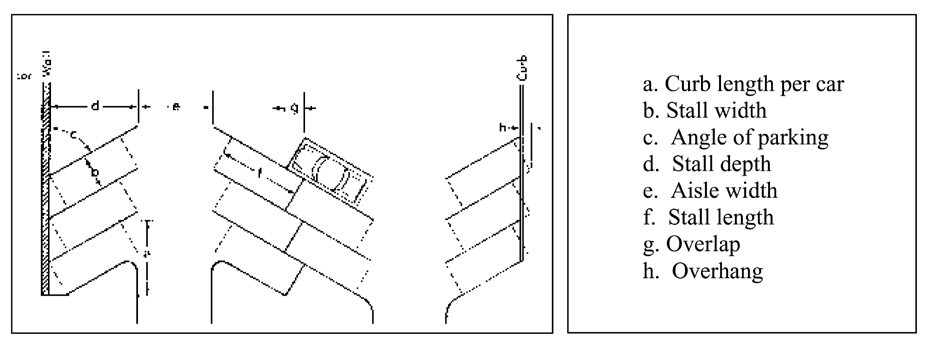
c.
Angled parking not listed in the table above shall be reviewed and approved by the city engineer.
d.
Except for single-family and multi-family housing, parking areas shall be constructed so that the circulation between bays and/or aisles occurs within the parking areas, and does not encroach on any public street or road right-of way. Dead end aisles are discouraged, but if used shall be provided with a unencumbered area at the end to facilitate vehicle turning movement.
e.
Except in the agricultural, long-term agricultural, future urban service, and rural residential zoning districts, all parking shall be paved with bituminous, concrete, pavers, or other approved dustless and erosion-resistant material. Positive drainage control through the use of curb, gutter, storm sewer, or approved means shall channel all stormwater from the parking areas into a public stormwater drainage system. Treatment of stormwater runoff shall comply with national urban runoff protection standards prior to discharge into the public stormwater drainage system, unless the property is serviced by a regional treatment system.
f.
Except for single-family and townhomes, all off-street parking areas shall have a continuous concrete perimeter curb around the entire parking lot.
g.
Except for single-family and townhomes, all parking stalls shall be delineated by white or yellow painted lines at least four inches in width.
h.
The grade elevation of any parking area or driveway shall not exceed ten percent. Other grade elevations shall be reviewed and approved by the city engineer.
i.
Adequate snow storage space shall be provided to maintain the minimum number of parking spaces in the winter months. If excessive snow cannot be stored on site, while maintaining the minimum number of parking spaces required, the property owner shall remove the snow from the site.
j.
Driveway turnarounds may be required by the city engineer, where necessary, to avoid interference with traffic flow on any public street.
k.
Parking ramps and related facilities may be exempted from the strict provisions of this section if approved by the city engineer.
(2)
Landscaping.
a.
All open, off-street parking areas of five or more spaces shall be landscaped in accordance with section 90-181.
(3)
Lighting.
a.
Exterior lighting shall be directed down and shielded (downcast cut-off fixture) from adjacent properties and roadways and shall be in accordance with section 90-239.
b.
The maximum height of parking lot lighting adjacent to or within residential areas shall be 20 feet.
(e)
Number of spaces required.
(1)
Calculating parking space requirements. In calculating parking space requirements, the following rules shall apply:
a.
When determining the number of off-street parking spaces results in a fraction, each fraction shall constitute another space.
b.
In facilities where patrons or spectators occupy benches, pews, or similar seating facilities, each 24 inches of such seating facilities shall be counted as one seat for the purposes of determining parking requirements.
c.
For structures containing two or more types of uses, the parking requirements shall be determined independently, and combined to determine the total off-street parking spaces required.
d.
On-street parking shall not be used when calculating the number of parking spaces required for a use, unless approved by the city council.
(2)
The minimum number of parking spaces designated in the following table shall be provided for the use specified, unless the property is part of a shared parking system or a variance is granted by the city council. Fractions over one-half shall be counted as one additional space. The parking spaces shall be evaluated in accordance with this section in any zoning district whenever a new use is established or existing use is enlarged [and] approved by the community development director or designee, to determine if parking constraints will require additional parking spaces.
(3)
Other uses. Any use not in the parking requirements in this section shall be assigned a parking requirement by the community development director or designee.
(4)
Parking deferment. A portion of the parking area required under this section may remain unimproved until such time as the city council deems that it must be improved to adequately serve the parking demand. Such delayed construction of parking may be permitted only after the city council is satisfied that the initial occupancy of the premises will be adequately served by the lesser number of parking spaces and only after approval of a final development plan clearly indicating the location, design, traffic circulation, and other development requirements of the deferred parking. The land area shall be delineated for future parking and shall be brought to finish grade and landscaped, and shall not be used for building, storage, loading or other purposes.
a.
The applicant shall enter into a development agreement or other agreement approved by the city council, to be recorded against the property, which includes a clause requiring the owner to install the additional parking spaces, upon a finding of the community development director or designee that such additional parking spaces are necessary to accommodate the use.
(5)
Shared parking. Parking facilities for a combination of buildings, structures, or uses may be provided collectively in any zoning district provided that the total number of spaces provided shall equal the sum of the separate requirements of each use. A lesser number of parking spaces than required for each use may be allowed with approval by the community development director or designee, provided that each use is compatible in regards to peak parking periods. Shared curb cuts and access drives shall be encouraged. Where shared parking and accesses are utilized, easements and maintenance agreements shall be placed on the shared areas and recorded against the properties.
(f)
Shoreland district.
(1)
Within the shoreland district of the city, parking areas, driveways, access roads and loading areas shall meet the following:
a.
Designed and constructed to make use of existing natural vegetation and topography to screen such facilities from view of the public waterbody, as much as feasible.
b.
Setback from the ordinary high water level (OHW) to the same extent required for structures in section 90-137(1).
c.
Constructed to avoid bluff impact zones and shore impact zones.
(g)
Prohibited parking.
(1)
Parking restrictions for vehicles and trailers.
a.
In order to expedite the prompt and efficient removal of snow from the streets of the city it is unlawful for any person to stop, stand or park any vehicle or trailer or permit the same to stand on any street within the city between the hours of 2:00 a.m. and 7:00 a.m. from November 1 until March 31 of the following year. At all times of the year it is unlawful for any person to stop, stand or park any vehicle or trailer or permit it to stand on any public street within the city between the hours of 2:00 a.m. and 7:00 a.m. after a continuous or intermittent snowfall, during which there has been an accumulation of two inches or more of snow on any street, until the snow has been plowed or removed to the full width of the street.
b.
No person shall park any vehicle on any street within the city for an excess of 72 hours.
c.
Parking of trailers is prohibited on all public streets, except while being loaded or unloaded for a cumulative period not to exceed 24 hours during any seven-day period.
d.
For the purposes of the time limitations outlined in subsection (c) of this ordinance section, any trailer moved a distance of three-tenths of a mile or less during the seven-day period shall be deemed to have remained parked.
e.
Vehicles and trailers may be parked in the front yard, provided it is kept on an established driveway, and is entirely on the equipment owner's property.
f.
Within any residential zoning district, parking of any vehicle or trailer exceeding 9,200 pounds licensed gross vehicle weight on any property or public street is prohibited, except under the following conditions:
1.
Vehicles lawfully delivering goods, products, or services to a property may be parked for a reasonable period of time on the property or adjacent street to deliver such goods, products or services.
2.
Vehicles used in construction activities may be parked or stored on the site of such construction activities for a reasonable period of time to complete the work. Parking of these vehicles on a city street is allowed only by permit issued by the city engineer.
3.
Vehicles primarily used in the conduct of agricultural activities may be parked on the property where the agricultural activities are undertaken, or the farmstead of the vehicle owner.
g.
Any vehicle parked in violation of these sections more than two times in any 30-day period may be towed pursuant to Minn. Stat. § 169.041. Violation of this section shall constitute a petty misdemeanor with a fine of $50.00.
(2)
Large recreational vehicles. As defined under section 90-1.
a.
Except for on properties zoned agricultural, long-term agricultural, rural residential or future urban service, all lakeshore property, and all properties at least one acre in size, large recreational equipment units shall be parked or stored within a building, except that large recreational equipment may be parked or stored on the property outside of a building under the following conditions:
1.
No more than two large recreational equipment units shall be parked or stored outside of a building on the property, with not more than one unit being located in the front yard and no more than one unit being located in the rear yard.
2.
For properties exceeding one-half acre in size, no more than three large recreational equipment units shall be parked or stored outside of a building on the property, with not more than one unit being located in the front yard and no more than one unit being located in the rear yard.
3.
Large recreational equipment may be parked in the front yard, provided it is kept on an established driveway, and is entirely on the equipment owner's property. Recreational equipment shall not be parked or stored on public property, in a street right-of-way, or closer than 30 feet from the curb, except that between one week before Memorial Day and one week after Labor Day recreational equipment may be parked no closer than ten feet from the curb.
4.
Large recreational equipment may be parked in the side yard abutting an attached or detached garage, provided the area is surfaced with asphalt, concrete, or crushed decorative rock. If the area is surfaced with asphalt or concrete, the surface shall be no closer than five feet from the side lot line. If the area is surfaced with decorative crushed rock, the surface shall be no closer than one foot from the side lot line. Parking or storage of large recreational equipment on the side yard abutting the principal building is prohibited.
5.
Large recreational equipment may be parked in the rear yard, no closer than five feet from the rear lot line, five feet from the side lot lines, and not located within a drainage or utility easement.
6.
In the case of a corner lot, large recreational equipment may be stored on the side of an attached or detached garage adjacent to a public street, but shall be located at least 20 feet from the public right-of-way.
7.
Large recreational equipment may be parked or stored temporarily while being loaded or unloaded or during routine maintenance and servicing not exceeding 72 hours.
8.
Parking of licensed large recreational equipment is prohibited on all public streets except while being loaded or unloaded for a period not to exceed 24 hours.
9.
The community development director or his designee may approve an alternate location for an item that does not meet the technical restrictions set forth in this section but that otherwise complies with the intent of this section. Such approval may be accompanied by a screening plan designed to minimize the impact to the surrounding properties.
(Prior Code, § 1195-530.1; Ord. No. 2010-453, § 3, 12-6-2010; Ord. No. 2017-483, § 3, 6-5-2017; Ord. No. 2021-504, § 1, 3-1-2021; Ord. No. 2025-542, 4-7-2025)
Sec. 90-254. - Places of worship.
(a)
It is unlawful for any person to construct or operate a place of worship, except in conformance with this chapter.
(b)
Nothing in this chapter shall prohibit the use or establishment of a chapel or place of prayer in any building, for use by people living or working in the building, so long as the use is clearly incidental to the principal use of the building.
(c)
When located outside of the central business, general business, and residential service zoning districts of the city, a place of worship shall only be allowed where its principal road entrance is to a state highway, county road, or city collector street.
(Prior Code, § 1195-540.1)
Sec. 90-255. - Plant nurseries, retail.
(a)
It is unlawful for any person to construct, operate, or maintain a retail plant nursery, except in conformance with this chapter.
(b)
Retail sales of the plants grown on-site are permitted, except that retail sales in the agricultural zoning district will be allowed only if the principal road access to the site is a state highway, county road, or city collector street.
(c)
Retail sales of materials brought in from off-site may be allowed.
(Prior Code, § 1195-550.1; Ord. No. 2015-470, § 3, 5-4-2015)
Sec. 90-256. - Plant nurseries, wholesale.
(a)
It is unlawful for any person to construct, operate, or maintain a wholesale plant nursery, except in conformance with this chapter.
(b)
The import, storage, processing, and distribution of plant materials grown off site may be allowed.
(c)
Wholesale plant nurseries are a conditional use in the general business zoning district subject to the following conditions and standards:
(1)
The city council may require a greater front yard setback in order to ensure that the proposed greenhouse structures are compatible with the city's comprehensive plan and adjacent land uses.
(2)
Adequate parking and truck loading and maneuvering areas shall be provided on the site.
(3)
On-site storage and use of pesticides and fertilizers shall meet the standards of the state department of agriculture. A chemical storage plan shall be provided to the zoning administrator at the time of application for a conditional use permit to provide the city with the location, type, amount, and storage method of pesticides, chemicals, and fertilizers kept on the site.
(4)
Operation of a landscaping business is not incidental to operation of a wholesale plant nursery, and only equipment and machinery actively used and maintained for the principal purpose of cultivating plants grown on site, or as allowed by the principal use of the property, may be stored or maintained on the site of a plant nursery.
(5)
It is the intent of this section to allow landscaping plants, shrubs, trees, etc., to be grown as an agricultural activity.
(Prior Code, § 1195-560.1; Ord. No. 2015-470, § 3, 5-4-2015)
Sec. 90-257. - Recycling centers.
(a)
It is unlawful for any person to construct, operate, or maintain a recycling center, except in conformance with this chapter.
(b)
All waste storage and recycling materials shall be maintained in a clean and sanitary condition, fenced or enclosed, and screened from adjacent properties and public rights-of-way. Waste matter, rubbish, refuse and recyclable materials shall be stored in a building, in a container with a lid or cover, or contained and screened in a way approved by the city which is sufficient to mitigate visual and noise impacts. In the case where the materials are stored in a building or contained in a way approved by the city, it shall be stored upon an impervious surface. All materials shall be contained and stored in a method shown on a site plan approved by the City and shall not otherwise accumulate loose on the property. The property shall be kept free of vermin and rodents.
(Prior Code, § 1195-570.1;Ord. No. 2015-472, § 1, 9-8-2015)
Sec. 90-258. - Reserved.
Editor's note— Ord. No. 2010-453, § 1, adopted Dec. 6, 2010, deleted § 90-258, which pertained to religious worship facilities and derived from the prior Code, § 1195-580.1.
Sec. 90-259. - Restaurants.
Restaurants internal to a multitenant shopping center, are subject to the following:
(1)
The use will not conflict with existing or potential neighboring uses.
(2)
The storage, preparation, and serving of food items are subject to the specific written sanitary requirements based upon the applicable state and county regulations.
(Prior Code, § 1195-590.1)
Sec. 90-260. - Schools.
(a)
It is unlawful for any person to construct, operate, or maintain a school, except in conformance with this chapter.
(b)
Schools must be located so that their principal entrance is from a state highway, county road, or city collector street.
(c)
Nothing in this chapter shall prohibit the home-based schooling of residents on their own property.
(Prior Code, § 1195-610.1)
Sec. 90-261. - Seasonal outdoor retail sales.
(a)
It is unlawful for any person to operate, or allow to be operated, any seasonal outdoor retail sales, except in conformance with this chapter.
(b)
Seasonal outdoor retail sales shall be allowed for a period of time not to exceed a combined total of 120 days in any 12-month period. Outdoor retail sales shall not occupy an area exceeding ten percent of a lot's area, and shall meet all yard setback requirements.
(c)
Where seasonal outdoor retail sales are conducted in a parking lot, they shall be confined to a defined area, and not be allowed to obstruct access of emergency vehicles, shall maintain good traffic circulation, and continue to provide adequate parking for the primary use. Temporary fencing or other suitable mechanisms shall be used to delineate the sales area and provide for pedestrian safety.
(d)
Where tents, temporary greenhouses, or similar structures are used to store, and/or display merchandise, they shall be anchored to provide a wind-load resistance of 40 miles per hour.
(Prior Code, § 1195-620.1; Ord. No. 2010-453, § 3, 12-6-2010; Ord. No. 2015-470, 5-4-2015)
Sec. 90-262. - Self-service storage facilities (ministorage).
(a)
It is unlawful for any person to construct, operate, or maintain a self-service storage facility, except in conformance with this chapter.
(b)
Self-service storage facilities are a permitted principal use in the general industrial and restricted industrial zoning districts shall be on parcels of land two acres or more in size.
(c)
Units are to be used for dead storage only. Units are not to be used for retailing, auto repair, human habitation, or any commercial activity, except as permitted by section 90-261.
(d)
Combining office and/or retail space with a self-service storage facility may be allowed by conditional use permit.
(e)
Storage of hazardous or flammable materials is prohibited.
(f)
No exterior storage is allowed.
(g)
The facility shall be secured by either the walls of the structure and/or fencing. All doors on the units shall face inward and away from the street and property lines.
(h)
Only one entrance and exit to the facility is allowed for general public use. One additional emergency exit is allowed for each two acres of property.
(i)
An on-site manager is allowed only where adequate sanitary facilities are provided, either through use of a septic system or through connection to the public sanitary sewer system. Use of portable sanitary facilities does not fulfill this requirement.
(Prior Code, § 1195-630.1)
Sec. 90-263. - Sexually oriented businesses.
(a)
It is unlawful for any person to produce, sell, stock, or provide sexually oriented materials or services, except in conformance with this chapter.
(b)
In no instance will a sexually oriented business be considered a home occupation.
(c)
Performance standards.
(1)
No sexually oriented use may be located within 300 feet of any church, synagogue, or other place set aside for communal worship or prayer.
(2)
No sexually oriented use may be located within 300 feet of any elementary, grammar, or secondary school, or any childcare center.
(3)
No sexually oriented use may be located within 300 feet of any public library.
(4)
No sexually oriented principal use may be located within 300 feet of another sexually oriented principal use.
(5)
No sexually oriented use may be located within 300 feet of any public park.
(6)
Sexually explicit material may not be displayed or stored in such a manner that it may be seen at any time from any public sidewalk, roadway, or easement, or from any property not under the immediate control of the business operator or owner.
(7)
No vulgar or obscene language, picture, or character may be used on any sign or advertisement for a sexually oriented use.
(8)
No sexually oriented use may be conducted in conjunction with the sale or consumption of alcohol.
(9)
A sign shall be displayed at all entrances to stores or areas where sexually oriented materials are available for sale or view, and within two feet of door openings, stating, "This business sells or displays material containing sexually oriented themes. Persons under 18 years of age shall not enter."
(Prior Code, § 1195-640.1)
State Law reference— Sexually oriented businesses, Minn. Stat. § 617.242.
Sec. 90-264 - Short term rentals—Prohibited.
(a)
Prohibition. It shall be unlawful for any person or entity to offer for rent, or enter into a rental agreement, a dwelling unit, or any other portion of their property, as a short-term rental in any zoning district within the city. State-licensed hotels, motels, and lodging establishments located in areas where expressly permitted by the city's land use regulations are allowed, subject to all applicable law and rules.
(Ord. No. 2021-508, § 1, 9-20-2021)
Sec. 90-265. - Signs.
It is unlawful for any person to construct, erect, install, or maintain any sign in the city, except in conformance with this section.
(a)
Purpose/intent. The intent of this ordinance is to create the framework for a comprehensive and balanced system of sign regulations to facilitate an easy and pleasant communication between people and their environment and to avoid the visual clutter that is potentially harmful to traffic and pedestrian safety, property values, business opportunities and community appearance. With these purposes in mind, it is the intent of this ordinance to authorize signs which are:
(1)
Compatible with their surroundings;
(2)
Appropriate to the activity that displays them;
(3)
Expressive of the identity of the individual activities and the community as a whole;
(4)
Legible in the circumstances in which they are seen; and
(5)
Encourage quality design and construction.
It is not the purpose or intent of this sign ordinance to regulate the message displayed on any sign; nor is it the purpose or intent of this article to regulate any building design or any display not defined as a sign, or any sign which cannot be viewed from outside a building.
(b)
General standards.
(1)
Sign area will be calculated as the area of a single rectangle containing the entire sign message and does not include the sign supports and brackets.
(2)
All signs shall be of sound structural quality, be maintained in good repair and have a clean and neat appearance. Land adjacent to such sign shall be free from debris, weeds and trash. If signs are not being maintained as described and the community development director deems them a public hazard or nuisance, such sign shall be ordered to be repaired or removed.
(3)
The owner of any sign which is otherwise allowed by this sign ordinance may substitute noncommercial copy in lieu of any other commercial or noncommercial copy. This substitution of copy may be made without any additional approval or permitting. The purpose of this provision is to prevent any inadvertent favoring of commercial speech over noncommercial speech, or favoring of any particular noncommercial message over any other noncommercial message. This provision prevails over any more specific provision to the contrary.
(4)
The city has the right to remove and discard any signs in the public right-of-way, without notice or compensation.
(5)
All new multi-tenant buildings, buildings that include sub-tenants, and shopping centers, are required to have development sign criteria approved by the community development director or his or her designee prior to erecting any signs. The development sign criteria must specify the type, material, size, design, location, and colors of signs to be permitted on the building and must ensure consistency of format throughout the project. Development sign criteria will allow the development to have flexibility from the sign ordinance. Each sign erected on the property must conform to the development sign criteria.
(6)
Except as otherwise provided in this chapter, no sign shall be installed until a sign permit has been approved by the city.
(c)
Nonconforming signs. It is recognized that signs exist within the zoning districts which were lawful before this sign ordinance was enacted, which would be prohibited, regulated or restricted under the terms of this chapter or future amendments. Nonconforming signs shall not be enlarged upon, expanded or extended, nor be used as grounds for adding other signs or uses prohibited elsewhere in the same district. Legal nonconforming signs existing on the effective date of this sign ordinance, or amendments thereto, may continue as legal nonconforming signs provided such signs are safe, are maintained so as not to be unsightly, and have not been abandoned or removed subject to the following provisions. This shall not prevent minor maintenance and repair that is less than 50 percent of the fair market value of the sign, the re-facing of signs where the type of business has not changed, or the keeping of painted signs in a neat and readable manner.
(1)
No sign shall be enlarged or altered in a way which increases its nonconformity.
(2)
Should such sign or sign structure be destroyed by any means to an extent greater than 50 percent of its replacement cost and no sign permit has been applied for within 180 days of when the property was damaged, it shall not be reconstructed except in conformity with the provisions of this ordinance.
(3)
Should such sign or sign structure be moved for any reason for any distance whatsoever, it shall thereafter conform to the regulations for the zoning district in which it is located after it is moved.
(d)
Items not considered maintenance. The following items are not considered maintenance and shall require that the sign be brought into conformance with all requirements with this section.
(1)
Said maintenance shall not include any changes made to size, height, light intensity or bulk of the sign or the temporary or permanent removal of the sign for the repair or replacement of the cabinet or any part thereof, not including the face.
(2)
Sign maintenance shall not include changes to the type of sign or changes to components of the sign. For example, replacement of a paper, vinyl, or static sign with dynamic or electronic displays shall not be considered sign maintenance and is prohibited.
(e)
Removal of abandoned signs.
(1)
If a building, structure or premise is vacated for a six-month period of time, the owner of said property shall be responsible for removing any nonconforming sign or signs located thereon with the exception of advertisements dealing with the sale or leasing of the facility. In addition, the owner shall be responsible for restoring the facade of the building, structure or premise to its normal appearance.
(2)
If the provisions of this section are not complied with, the code enforcement officer will mail a certified written notice, return receipt requested to the owner, tenant, or occupant of the property requiring them to comply with the provisions of this section. If the owner or owner's address is unknown, the city clerk will publish a notice in the city's official newspaper. The notices and publication shall include the property address or description of the property and description of the violation. The violation shall be abated by the owner within seven days of the mailing notice or publication. If there is failure to comply with the violations outlined by the ordinance, the city will remove the sign and assess the cost to the owner. The owner shall pay the assessment within 30 days or the assessment will be applied to the owner's property tax statement.
(f)
Signs allowed without a permit.
(1)
Traffic signs as approved by the public works director.
(2)
Public signs as approved by the City of Hugo.
(3)
Window signs.
(4)
Vehicle signs.
(5)
The flags of any nation, state, municipality, US military service, or veterans organizations chartered by Congress.
(6)
Safety notices and warnings.
(7)
Signs identifying buildings listed on the national historic building register.
(8)
Holiday decorations in their season.
(9)
No hunting, no trapping, no fishing, no trespassing, and similar signs erected in accordance with Minnesota State Statutes.
(10)
Signs erected under the direction of a city ordinance, state or federal law, or court order.
(11)
Signs that are customarily associated with residential and agricultural uses, limited to signs giving property identification names and numbers, name of residents, signs on mail boxes or newspaper tubes, signs identifying membership in an association, signs posted on private property relating to private parking, signs that warn the public against trespassing or danger from animals, and all other similar noncommercial signs are allowed subject to the following regulations:
a.
On residential properties less than five acres in size the signs shall not exceed four square feet in size.
b.
On agricultural properties and Residential properties of five acres or more the signs shall not exceed 12 square feet in size.
(12)
Signs in an agricultural district used for advertising of products or services permitted in agricultural zoning districts.
(13)
Manufacturer's identification or logo that is permanently affixed to and is designed as an integral part of a product made by the identified manufacturer.
(14)
Political signs on private property. The signs may be posted from August 1 in any general election year and removed within ten days following the general election, and 13 weeks prior to any special election until ten days following the special election. Signs can be of any number and any size. There shall be approval from the property owner of which the signs are erected prior to display. No sign shall be located in the public right-of-way. No sign shall cause a sight distance problem. No political signs shall be affixed to utility poles.
(15)
Garage sale and open house signs no larger than four square feet that state that a particular home, commercial, industrial, or public institutional structure will be open for public inspection for a limited number of hours on a specific day. The signs shall only be allowed on the same day of the garage sale or open house and only during the garage sale or open house.
(16)
Temporary on-site real estate and construction signs are allowed subject to the following regulations:
Residential properties less than five acres in size:
a.
One sign per property is allowed per contractor.
b.
Signs are allowed up to six square feet in area and six feet maximum height.
c.
Signs shall be removed upon sale or lease of the property or completion of construction project.
d.
Signs shall be at least ten feet from the curb or shoulder of the road.
Commercial, industrial, or residential properties of five acres or more:
a.
One sign per property is allowed per contractor.
b.
Signs are allowed up to 32 square feet in area and eight feet maximum height.
c.
Signs shall be removed upon sale or lease of the property or completion of construction project.
d.
Signs shall be at least ten feet from the curb or shoulder of the road.
(g)
Prohibited signs.
(1)
Internally lit box signs.
(2)
Pylon signs.
(3)
Awning signs.
(4)
Exposed neon tubes.
(5)
Sign raceways.
(6)
Ply wood signs, except temporary signs allowed by this section.
(7)
Painted signs on flat sign board or painted directly on a building.
(8)
Advertising signs.
(9)
Video display signs.
(10)
Signs projected onto a building or surface from a projector.
(11)
Abandoned signs.
(12)
Signs that contain offensive, obscene, or indecent symbols, pictures, or written materials.
(13)
Signs that by reason of position, shape, movement, color, or other fashion resemble, or interfere with, the proper functioning of a traffic sign or signal, or otherwise constitute a traffic hazard.
(14)
Signs with flashing lights, intermittent lights, and revolving beacons.
(15)
Signs that block the view of driveway or street intersections in such a manner as to pose a safety hazard.
(16)
Private signs on a public right-of-way or easement are prohibited.
(17)
Signs purporting to be a street name sign, unless approved by the public works director.
(18)
Signs painted on or directly affixed to any tree, rock, ledge, or other natural feature.
(19)
Signs painted on or directly affixed to any fence or utility pole.
(20)
Signs, any part of which extends above the height of the roof or parapets of the principal building on the site.
(21)
Signs painted and/ or mounted on the roof of any building or structure.
(22)
Signs bearing misleading or false information or information inconsistent with the zoning or other regulations.
(23)
Attention attracting devices.
(h)
Performance standards.
(1)
Wall signs. Each wall sign shall be compatible with the architecture of the building on which it is located. Wall signs are meant to enhance the appearance of the building and not detract from the building. Wall signs are prohibited on unarticulated walls or walls not intended for a sign. Wall signs are prohibited for residential uses.
a.
Single-tenant buildings. For single-tenant buildings, wall signs are permitted on the front, side, or rear of the building, up to one wall sign per façade. The signs shall only be located on façades that include a public entrance and/or the façade s that are visible from a public road. Wall signs may cover a maximum of ten percent of the gross wall area of the building wall of which the sign is affixed to, including doors and windows. No sign shall extend above the top of the wall.
b.
Multi-tenant buildings. For multi-tenant buildings, including shopping centers, wall signs are permitted on the front, side, or rear of the building, up to one wall sign per tenant per façade. The signs shall only be located at the main entrances of the tenant space and/or the f façades of the tenant spaces that are visible from a public road. Wall signs may cover a maximum of ten percent of the building wall area of the tenant space of which the sign is to be affixed to, including doors and windows. Tenant signs shall have a consistent display format and be constructed of the same material. No sign shall extend above the top of the wall. All signs shall comply with development sign criteria.
c.
Buildings with sub-tenants. Where one retail establishment (the "sub-tenant") leases space and conducts business within another retail establishment ( the "primary-tenant") but does not have an exterior business façade and an exterior door leading directly to the sub-tenant space, one exterior wall sign may be permitted if the following conditions are met:
i.
The sub-tenant's business establishment occupies at least 200 square feet of floor area, and is staffed and open for business during predetermined hours.
ii.
The primary tenant's business establishment occupies at least 25,000 square feet of floor area.
iii.
The sub-tenant's business is a separate legal entity from the primary tenant's business, as opposed to a department, division or subsidiary of the primary tenant's business.
iv.
Development sign criteria for the building has been approved by the community development director or his or her designee.
v.
The total area for all signs on the same façade does not exceed the allowable signage area for that district.
d.
Pedestrian oriented signage. These signs shall be limited to projecting signs and hanging signs. For buildings with sidewalks along one or more sides of the building, a sign may be hung from under the covered walkway or mounted to the building identifying the business. Such sign shall be located at the entrance of the business it is identifying and shall not exceed five square feet. One sign shall be permitted per tenant space. The lowest point of the sign shall be at a minimum of seven feet above the sidewalk and no sign shall extend above the top of the wall.
e.
Canopy signs. Signs located on the canopies of gas stations or other businesses shall be considered wall signs. The canopy shall be considered a part of the building and shall be regulated as part of the building.
(2)
Freestanding signs.
a.
Monument signs in residential districts. Monument signs are permitted for residential subdivisions and multi-family developments of nine or more units. Where the development is located on both sides of the public street or private driveway, one monument sign may be located on each side of the street or driveway, or alternatively one monument sign may be located within a landscaped median within the center of the street or driveway. Where a monument sign is to be located within the public right-of-way, plans shall be approved by the city council showing the location, size, and design of the sign, as well as any required maintenance and hold harmless agreements. Monument signs shall be a maximum of 32 square feet per face. Said sign shall be a maximum of six feet in height, measured from the grade of the ground, and shall be setback at least ten feet from all property lines and five feet from the right-of-way. The sign shall be designed to be architecturally compatible with the project, and shall be within a landscaped for three feet on each side of the sign.
b.
Monument signs for nonresidential uses in residential districts and agricultural districts. One monument sign shall be allowed for nonresidential uses in residential districts. Monument signs shall be a maximum of 32 square feet per face. The monument sign shall be a maximum height of six feet, measured at the grade of the ground, and shall be setback at least ten feet from all property lines and five feet from the right-of-way. The sign shall be designed to be architecturally compatible with the project, and shall be located within a landscaped area extending at least three feet around the base of the sign. Signs for home occupations are permitted under section 90-232 of the City of Hugo Municipal Code.
c.
Single-tenant monument signs. One monument sign shall be allowed for single-tenant commercial or industrial buildings, which are not part of a shopping center. The monument sign shall be a maximum of 40 square feet per face. The monument sign shall be a maximum height of ten feet, measured at the grade of the ground, and shall be setback at least ten feet from all property lines and five feet from the right-of-way. The sign shall be designed to be architecturally compatible with the project, and shall be located within a landscaped area extending at least three feet around the base of the sign.
d.
Multi-tenant monument signs. One monument sign shall be allowed for multi-tenant commercial or industrial buildings, which are not part of a shopping center. The monument sign shall be a maximum of 40 square feet per face. The monument sign shall be a maximum height of ten feet, measured at the grade of the ground, and shall be setback at least ten feet from all property lines and five feet from the right-of-way. The sign shall be designed to be architecturally compatible with the project, and shall be located within a landscaped area extending at least three feet around the base of the sign.
e.
Shopping center monument signs.
i.
All shopping centers shall have development sign criteria approved by the community development director.
ii.
One monument sign shall be allowed for commercial shopping centers along each public street frontage on the perimeter of the project. The monument shall be a maximum of 100 square feet per face. The monument sign shall be a maximum height of 20 feet, measured at the grade of the ground, and shall be setback at least ten feet from all property lines and five feet from the right-of-way. The sign shall be designed to be architecturally compatible with the project, and shall be located within a landscaped area extending at least three feet around the base of the sign. All tenants may be presented on the monument sign.
iii.
In addition to the above, a gasoline service station, designed as part of the shopping center is permitted one monument sign with a maximum of 50 square feet per face. The monument sign shall be a maximum height of 20 feet and shall meet the all design regulations outlined above.
f.
Pylon signs. Pylon signs are allowed with a conditional use permit, with a planned unit development, or as part of development sign criteria. One pylon sign is allowed in lieu of a monument sign and shall follow the same restrictions as monument signs. The design of the pylon sign shall be architecturally compatible with the building.
(3)
Miscellaneous signs. A permit is required for all the following signs:
a.
Temporary off-site directional signs. Signs such as to direct traffic to residential developments may be approved by interim use permit if the following conditions are met:
i.
The development does not have frontage on an arterial road.
ii.
Each development is limited to one sign.
iii.
The sign shall be removed when 90 percent of the lots are purchased.
iv.
The sign shall be limited to 32 square feet and eight feet in height.
v.
There shall be permission from the property owner where the sign is located.
b.
Directional signs. One directional sign shall be permitted at each entrance to a building site, at key intersections within the site and at each entrance to a drive-through facility. Ground mounted signs shall not exceed five feet in height, four square feet of sign area per face, and may be single or double-faced. Wall mounted signs shall not exceed four square feet of sign area, shall be single-faced and may be located adjacent to drive-up windows, loading docks or service entrances. Such sign may indicate entrances, exits, addresses, direction of traffic flow, and the location of loading docks, parking areas, leasing offices, ATM's, delivery doors, drive-through lanes and similar facilities. Up to 25 percent of the area of the sign may be used to display the name or logo of the developer, building, project name or principle tenant.
c.
Electronic display signs. Electronic message display boards are allowed within monument signs in any commercial district. The electronic display sign shall be a maximum of 40 percent of the monument sign. Electronic display signs that pulse or flash are prohibited.
d.
Special event signs. One special event sign and attention attracting device is allowed per business for not more than 90 calendar days per year. The sign and device may be attached to the building or located on the premises where the event is occurring and shall be taken down after the event or sale is over. A sign permit shall be issued and approved by the community development director or his or her designee prior to the installation of a special event sign.
e.
Menu boards. Businesses providing a drive-through or drive-in service are allowed either a menu board wall sign or a freestanding menu board sign. Each business shall be allowed either one wall menu board sign or freestanding menu board sign per drive-thru lane or per drive-in station. The wall menu board shall be next to the pick up window and shall be a maximum of eight square feet in size. The freestanding menu board shall be located on the property at least ten feet from the right-of-way. The freestanding menu board shall be a maximum height of eight feet and a maximum of 32 square feet in size.
f.
Flag signs. A flag sign is permitted in conjunction with at least two governmental flags, provided the flag sign does not exceed the size of the governmental flags.
(i)
Severability. If any section, subsection, sentence, clause, or phrase of this sign ordinance is for any reason held to be invalid, such decision shall not affect the validity of the remaining portions of this sign ordinance. The city council hereby declares that it would have adopted the sign ordinance in each section, subsection, sentence, or phrase thereof, irrespective of the fact that any one or more sections, subsections, sentences, clauses, or phrases be declared invalid.
(Prior Code, § 1195-660.1; Ord. No. 2008-428, § 1, 3-2-2009)
Sec. 90-266. - Single-family detached housing.
(a)
It is unlawful for any person to construct, develop, or occupy any single-family detached housing structure, except in conformance with this chapter.
(b)
Single-family detached houses must have a minimum floor area of 960 square feet for a one-level or split-level type house, or 1,200 square feet for two-level house.
(c)
At the time a building permit is issued for a single-family detached house, the applicant for the permit shall pay the city parkland dedication fee in accordance with section 90-324, if such fee has not already been paid for the dwelling units being created as part of a subdivision or development agreement.
(d)
Dwelling unit densities for single-family detached housing in the shoreland overlay district may not exceed those found in subsection 90-267(i).
(Prior Code, § 1195-670.1)
Sec. 90-267. - Townhouses (single-family attached houses).
(a)
It is unlawful for any person to construct, develop, or occupy any townhouse structure, except in conformance with this chapter.
(b)
Townhouses may not exceed more than eight units per building.
(c)
In addition to public parkland dedication requirements, ten percent of the buildable area devoted to townhouses shall be set aside for recreational use by the development's residents.
(d)
Each townhouse shall have a single car attached garage as a minimum.
(e)
Each townhouse development shall be subject to an organized homeowner's association with written covenants describing each member's responsibilities, singly and jointly. Each townhouse in a development shall be subject to the covenants of the homeowner's association.
(f)
Each and every townhouse development shall be subject to a unified landscaping plan approved by the city council at the time of subdivision approval.
(g)
Private roads shall meet the construction standards established for city streets in chapter 66.
(h)
At the time a building permit is issued for a townhouse development, the applicant for the permit shall pay the city a parkland dedication fee in accordance with section 90-324, if such fee has not already been paid for the dwelling units being created as part of a subdivision or development agreement.
(i)
Dwelling unit densities for townhomes in the shoreland overlay district may not exceed those found in the following table:
Permitted Dwelling Unit Densities in Shoreland Areas
(Prior Code, § 1195-680.1)
Sec. 90-268. - Twinhomes (duplex).
(a)
It is unlawful for any person to construct a twinhome in the city, except in conformance with this chapter.
(b)
Each unit in a twinhome must meet the minimum floor area standards for a single-family detached dwelling.
(c)
Each unit in a twinhome must include a garage.
(d)
Driveways for all twinhome units must be separated, unless part of a homeowner's association.
(e)
Twinhomes must meet all yard setback requirements other than the setback from the adjoining property line between the units in a twinhome.
(f)
Dwelling unit densities for twinhomes in the shoreland overlay district may not exceed those found in section 90-267(i).
(g)
At the time a building permit is issued for a twinhome development, the applicant for the permit shall pay the city a parkland dedication fee in accordance with section 90-324, if such fee has not already been paid for the dwelling units being created as part of a subdivision or development agreement.
(Prior Code, § 1195-690.1)
Sec. 90-269. - Warehousing and distribution.
(a)
It is unlawful for any person to construct, operate, or maintain a warehouse and distribution facility in the city, except in conformance with this chapter.
(b)
Retail sales of products stored on site may be allowed from warehousing and distribution facilities as long as the retail sales area does not occupy more than 20 percent of the building.
(c)
Exteriors of all principal and accessory buildings shall be of architecturally enhanced concrete panel, architecturally enhanced masonry block, exterior insulation and finish system (EIFS), brick, dressed stone, or glass. Colors shall be neutral or earth tones, except to create a decorative effect, 20 percent of the building facade (excluding window and door areas from the computation) may be decorated with glazed tile, glass, plastic or metal panels, or wood of various colors.
(Prior Code, § 1195-700.1)
Sec. 90-270. - Water-oriented accessory structure.
It is unlawful for any person to construct or expand any water-oriented accessory structure, except under a permit issued in accordance with chapter 14 of this Code, and the following conditions:
(1)
Stairways, fences, docks, and retaining walls may be constructed between the ordinary high-water level of a water feature and the building setback line for shoreland areas as allowed by this chapter.
(2)
In addition to those structures allowed by section 90-137(1), each lot or parcel of land within the shoreland overlay district may have one water-oriented accessory structure not meeting the normal structure setback from the ordinary high-water level found in section 90-137, so long as the structure complies with all of the following:
a.
On a natural environment lake and all rivers, the structure or facility must not exceed ten feet in height, exclusive of safety rails, and cannot occupy an area greater than 250 square feet. On general development and recreational development waterbodies, water-oriented accessory structures used solely for watercraft storage, including storage of related boating and water-oriented sporting equipment, may occupy an area up to 400 square feet, with a maximum width of 20 feet, as measured parallel to the shoreline.
b.
Detached decks must not exceed eight feet above grade at any point.
c.
The setback of the structure or facility from the ordinary high-water level must be at least ten feet.
d.
The structure or facility must be treated to reduce visibility as viewed from public waters and adjacent shorelands by vegetation, topography, increased setback or color, assuming summer leaf conditions.
e.
The structure or facility may not be used for human habitation, and must not contain a water supply or sewage treatment facility.
(Prior Code, § 1195-710.1)
Sec. 90-271. - Wind-powered generators.
(a)
It is unlawful for any person to erect or maintain a wind-powered generator in the city, except in conformance with these regulations.
(b)
Wind-powered generators shall not exceed a height of 100 feet (including propeller blades). Any such generators shall be located on parcels of land at least five acres in size. No more than one wind-powered generator shall be located on a lot or parcel of land.
(c)
Wind-powered generators and their supporting towers shall be located in rear yards, meet the minimum structure setback requirements and shall be set back from all property lines, residential dwellings, and overhead electrical transmission lines at least 50 feet plus the height of the tower and generator, including propeller blades. No part of the tower, generator, or any appurtenances thereto shall be located on, or extend across, any public right-of-way, public street, highway, sidewalk, or trail, except as may be approved by the city council.
(d)
The height of the wind-powered generator shall not exceed that allowed by Federal Aviation Administration Regulation (FAA) 77, "Objects Affecting Navigable Air Space" or Minnesota Department of Transportation (Mn/DOT) Rule 14, MCAR 1.3015 "Criteria For Determining Obstruction to Air Navigation."
(e)
Wind-powered generators and their supporting towers shall be erected and maintained to meet the following standards, except that FAA and Mn/DOT regulations shall be followed as they may apply:
(1)
Structural design, mounting, and installation of the tower, generator, and all components shall be in compliance with manufacturer's specifications. The tower, generator, and components shall be professionally designed and constructed to meet all federal, state, and local regulations, including those relating to nonionizing radiation and other health hazards. If new, more restrictive regulations are adopted, the property owner shall bring the facility and its operation into compliance with the new regulations within six months.
(2)
All wind-powered generators shall be equipped with both a manual and an automatic overspeed control device.
(3)
All wind-powered generators shall be adequately grounded for protection against direct strike by lightning.
(4)
Foundations shall not exceed 150 square feet in ground coverage, and shall be designed and constructed to resist two times the wind uplift calculated pursuant to the state building code. Design and construction of the foundation shall be certified by a professional engineer.
(5)
Propeller blades shall not exceed 30 feet in diameter, and arcs from the propeller blades shall be constructed to be a minimum of 30 feet above ground level.
(6)
No noise, glare, or vibration from the structure and its related facilities shall be detectable from off the property on which they are located.
(7)
The tower must be freestanding, not include any guy wires, be treated with corrosive-resistant materials, and painted to be as inconspicuous as possible when viewed from off the property.
(8)
Effective measure shall be taken to prevent climbing of the tower by unauthorized persons.
(9)
No advertising signs or extraneous materials shall be located on the tower. The tower shall not be illuminated except to meet federal or state safety regulations, and one warning sign not exceeding two square feet is permitted.
(10)
All wind-powered generators shall be constructed as monopoles.
(11)
All wind-powered generators shall be kept in a condition of good repair at all times.
(12)
If at any time the equipment produces an unusual amount of noise or vibration not commonly associated with the normal operation of the equipment, the generator shall be turned off until such time as repairs are made.
(13)
At the time of approval of a wind-powered generator, the city may require the owner to submit a right-of-entry agreement, allowing the city the right to enter the property in order to turn off any malfunctioning equipment via the manual shut-off device that is required to be installed by subsection (e)(2) of this section.
(f)
The tower, generators, and all appurtenances thereto shall be maintained by the property owner in a safe and structurally sound condition at all times. The tower, generators, and all appurtenances thereto shall be adequately insured by the property owner for injury and property damage that may be caused by collapse or other catastrophic failure. Liability insurance in an amount not less than $500,000.00 shall be maintained by the property owner at all times.
(g)
Interface of a wind-powered generator with the consumer's electrical service shall be made pursuant to the state electrical code and such other federal and state law as may apply.
(h)
Interface of a wind-powered generator with an electrical distribution system shall be made only with the knowledge and approval of the electric utility.
(i)
The property owner shall remove the tower, generator, and all other components, from the property within 120 days after the system is no longer used for the generation of electrical power.
(Prior Code, § 1195-720.1)
Sec. 90-272. - Commercial and industrial construction standards.
(a)
It shall be unlawful for any person to construct any commercial or industrial building in the city except in conformance with the following standards:
(1)
Exteriors for all buildings, principal and accessory, shall be architecturally enhanced concrete panel, architecturally enhanced masonry block, masonry with block, masonry with exterior insulation and finish system (EIFS), brick, dressed stoned or glass. Colors shall be neutral or earth tones, except, to create a decorative effect, 20 percent of the building facade (excluding window and door areas for the computation) may be decorated with glazed tile, glass, plastic or metal panels, or wood of various colors.
(2)
All roof- and ground-mounted mechanical equipment shall be completely enclosed with building materials compatible with the principal structure and painted to blend in unobtrusively with their background.
(3)
Accessory buildings and structures on each lot shall match, in color, form, and appearance, the principal building on the lot.
(4)
All trash-handling and loading areas shall be fenced with materials consistent with the exterior facing materials on the principal buildings.
(5)
Ground-level mechanical units shall be low profile and located to the side or rear of the building.
(6)
On-site exterior lighting shall be directed down and shielded from adjacent properties and roadways. The maximum height of parking lot lighting adjacent to residential areas shall be 20 feet.
(7)
All utilities shall be constructed underground, and utility meters shall be screened or integrated into the building structure.
(8)
All areas not covered by building, parking, driveways, or impervious storage areas shall be landscaped and maintained in accordance with section 90-181.
(b)
Within five years of the adoption of the ordinance from which this section was derived, the city council may issue a conditional use permit to allow the expansion of any existing commercial or industrial buildings not in conformance with this section. Such permit may allow the nonconforming building to be enlarged, up to double its existing size, using the same structural techniques as used for the existing building. The building must comply with all other pertinent building and zoning codes.
(c)
Any building constructed in a commercial or industrial zoning district shall comply with the commercial and industrial design guidelines.
(Prior Code, § 1195-740.1; Ord. No. 2011-457, § 1, 8-1-2011)
Sec. 90-273. - Public improvement construction standards.
(a)
Minimum standards required. This section describes the minimum construction standards required for improvements or expansion of public infrastructure within the city. The city engineer may authorize or require deviations from these standards to protect the public's safety, adjust for unusual site conditions, and to ensure the economical construction and maintenance of public infrastructure.
(b)
Municipal water system. All improvements to the municipal water system shall be made in conformance to the city's comprehensive water supply plan. All materials and construction shall conform to state department of health rules. All construction and use of sanitary sewer system shall comply with chapter 82 of this Code.
(c)
Sanitary sewer system. All improvements to the sanitary sewer system shall be made in conformance to the city's Comprehensive Sanitary Sewer Plan. All materials and construction shall conform to Minnesota Pollution Control Agency rules and the standards of Metropolitan council Environmental Services where appropriate. All construction and use of sanitary sewer system shall comply with chapter 82 of this Code.
(d)
Stormwater management. All improvements to the public drainage and stormwater management system shall be made in conformance with the city's comprehensive stormwater management plan. Necessary permits from the U.S. Army Corps of Engineers, Minnesota department of natural resources, and/or the watershed district of jurisdiction are required prior to final approval of any drainage plans by the city.
(e)
Streets. All street improvements shall be made in conformance to the city's comprehensive transportation plan. Streets shall be constructed in accordance with the standards found in chapter 66 of this Code and in conformance with American Public Works Association Standards.
(f)
Sidewalks, paths and trails. All sidewalks, paths, and trails shall be constructed in conformance with the city's master parks plan, state department of transportation bicycle transportation planning and design guidelines, and in accordance with the standards found in chapter 66 of this Code.
(g)
Street lighting.
(1)
Within the urban development, commercial/industrial development, and Egg Lake redevelopment areas all street lighting systems shall be constructed in accordance with Illuminating Engineering Society Standards, except for lighting on urban residential streets. Lighting on urban residential streets shall be constructed with at least one 100-watt high-pressure sodium vapor street light at each public street intersection and at mid-block locations to achieve a maximum spacing of 300 feet. Additional street lights shall be installed to illuminate pedestrian crosswalks and other locations deemed to operate with a higher degree of hazard.
(2)
Within the agricultural and rural residential development areas, rural minor streets shall be constructed with at least one 100-watt high-pressure sodium vapor street light at each public street intersection. Additional street lights shall be installed to illuminate pedestrian crosswalks and other locations deemed to operate with a higher degree of hazard.
(Prior Code, § 1195-750.1)
Sec. 90-274. - Neighborhood food services.
Neighborhood food services such as traditional restaurants, cafes, carry-out, or delivery food services, except drive-through and drive-in establishments are permitted, provided that:
(1)
The hours of operation are from 6:00 a.m. to 10:00 p.m.
(2)
The storage, preparation, and serving of food items are subject to the specific written sanitary requirements based upon the applicable state and county regulations.
(3)
Shipment or delivery of products shall be between the hours of 7:00 a.m. and 6:00 p.m.
(4)
If the business abuts a residentially zoned property, an odor filtration system may be required to reduce odor drift. Said system shall be approved by the building official.
(5)
Drive-in or drive-through services are prohibited, except with a conditional use permit.
(6)
Outdoor entertainment or speakers that play music are prohibited.
(Ord. No. 2008-423, § 1, 10-20-2008)
Sec. 90-275. - Reserved.
Editor's note— Ord. No. 2017-483, § 4, adopted June 5, 2017, repealed § 90-275, which pertained to large recreational equipment parking and storage and derived from Ord. No. 2007-414, § 1(1195-530.1(Sub. 11)), adopted Dec. 3, 2007.
Sec. 90-276. - Farmhand living quarters.
On properties 20 acres or more in size, located in the future urban service, rural residential, agricultural, and long term agricultural districts a second dwelling shall be allowed for living quarters for a farmhand. The second dwelling shall only be allowed with approval of an interim use permit upon finding that the following conditions have been met:
(a)
The primary use of the property shall be a bona fide agricultural operation of sufficient size to necessitate the assistance of a farmhand.
(b)
The living quarters shall be for employees hired to conduct work on the farm or members of the family.
(c)
The living quarters shall not be used or rented out for any purpose other than agriculture.
(d)
The living quarters shall meet all zoning and building code requirements.
(e)
There shall be no variances involved in the request.
(f)
Within 12 months of the date that agricultural operations on the property cease, the second dwelling shall be removed or the property shall be subdivided and meet all code requirements.
(Ord. No. 2010-453, § 2, 12-6-2010)
Sec. 90-277. - Accessory dwelling unit.
(a)
It shall be unlawful for any person to construct or maintain an accessory dwelling unit in the city, except in conformance with this chapter.
(b)
Purpose and intent. The purpose and intent of the ordinance [from which this section derives] is to provide supplemental, but separate living quarters to the primary residence. The supplemental living quarters are intended to provide separate living space with separate cooking and plumbing facilities for an individual that is receiving care from or providing care or service to residents living in the primary residence. A housekeeper, nanny, elderly relative, care provider, guests or employee of a home occupation or farm are examples of individuals that may reside in the accessory dwelling unit. The ordinance [from which this section derives] is not intended to provide a second dwelling unit on the property for a second family or for rental purposes.
(c)
Requirements. All accessory dwelling units shall meet the following:
(1)
Accessory dwelling units shall only be allowed as part of a detached garage and shall meet all requirements under chapter 90, section 90-204, Accessory buildings. The accessory building shall continue to function as a detached garage.
(2)
Accessory dwelling units shall meet all zoning district and building code requirements.
(3)
No more than one accessory dwelling unit shall be allowed on a parcel.
(4)
No more than one bedroom and one bathroom shall be allowed.
(5)
Well and septic systems shall be evaluated and approved by Washington County for an accessory dwelling unit.
(6)
The accessory dwelling unit shall not be considered as a second dwelling unit on the property and shall not be used for the purpose of providing rental income for the property owner. The occupant of the accessory unit shall have a family or business relationship to residents within the primary residence requiring that care or service be provided.
(Ord. No. 2011-459, § 1, 10-3-2011)
Sec. 90-278. - Solar energy systems.
(a)
Unlawful unless conditions met. It is unlawful for any person to construct, erect, install, or maintain a solar energy system in the city, except in conformance with this section.
(b)
Purpose and intent. The purpose of this section is to allow for the generation of renewable energy within the City of Hugo. Promoting the safe, effective, and efficient use of solar energy, may reduce the onsite consumption of fossil fuels and utility-supplied electric energy while avoiding adverse impacts on the community at large.
(c)
General standards for all solar energy systems. Solar energy systems must conform to all of the following standards:
(1)
A building permit shall be required for the erection of solar energy system. Prior to the issuance of a building permit, the operator must provide evidence of an agreement with the local utility. Off-grid systems shall be exempt from providing evidence of an agreement with the local utility.
(2)
It shall be the responsibility of the property owner to secure any solar energy easements, if applicable, to protect solar access for the system (as per MN Statute Section 500.30).
(3)
Solar energy system components shall be labeled with the manufacturers name and address, model number, and serial number.
(4)
All exterior electrical or other service lines shall be buried underground. The collection system may be placed overhead near substations or points of interconnection to the electrical grid. Exceptions may be granted in instances where shallow bedrock, water courses, or other elements of the natural landscape interfere with the ability to bury lines.
(5)
All solar energy systems shall be in compliance with the adopted city and state building code, electrical code, and plumbing code, as amended and receive any necessary permits or approvals from any regulatory agency having jurisdiction.
(d)
Solar farms.
(1)
Solar farm interim use permits. An interim use permit application must be submitted for approval by the planning commission and city council before a permit is issued for a solar farm. The information required and the procedure to be followed for all solar farm interim use permit applications shall be the same as that required for a conditional use permit set forth in subsections 90-37(a) and (b). In addition, the applicant shall submit supplementary information pertaining to the nature of the solar farm including:
a.
Total square footage of the solar energy system.
b.
Total energy production for the site.
c.
To scale horizontal and vertical (elevation) drawings.
d.
Drawings must show the location of the system on the property including the property lines and proposed fencing or vegetative buffer.
e.
Decommissioning plan.
(2)
Performance standards for solar farms.
a.
Solar farms shall be located on a minimum lot size of 20 acres within the Long Term Agricultural (LA), Agricultural (AG), Rural Residential (RR), and Future Urban Service (FUS) zoning districts.
b.
Solar farms shall be 100 feet from all property lines, 200 feet from any public road rights-of-way, and 400 feet from any principal structure on adjacent properties.
c.
Solar farms shall be located, insofar as possible, on a central portion of the property in order to minimize visual impact on adjacent properties and dwellings.
d.
Solar farms shall be limited to a size of five acres, measured by the exterior edges of the solar array.
e.
Ground mounted solar energy systems shall not exceed 15 feet in height at any point when oriented at maximum tilt.
f.
Solar farms shall be enclosed by approved perimeter fencing or adequate vegetative buffer for screening. The primary form of buffer for screening shall be at least six-foot tall vegetation. Exception may be granted if the natural landscape provides screening from all public right of ways and neighboring properties.
g.
All ground areas within the perimeter fencing of a solar farm that are not occupied by equipment or access paths shall be planted with deep rooted, native pollinator plantings.
h.
Solar farm applications shall include a vegetation establishment and management plan which shall be reviewed and approved by staff.
i.
The owner/operator of the solar farm shall provide the city with evidence that the solar energy system is functioning properly. This shall be provided at any time deemed necessary by the city.
j.
The owner/operator shall submit a decommissioning plan for the solar farm to ensure that the owner/operator properly removes the equipment and facilities upon the end of the project life, abandonment, expiration, or termination of the interim use permit. If the solar energy system remains nonfunctional or inoperative for a continuous period of 12 months, the system shall be deemed abandoned and shall constitute a public nuisance. The owner shall remove the abandoned system at their expense after a demolition permit has been obtained within 90 days after notice has been given. Removal includes the entire structure including transmission equipment, structures and foundations, and the restoration of soil and vegetation. The owner/operator shall provide a current-day decommissioning cost estimate, and shall post financial security in a form acceptable by the city. This estimate must include an inflationary escalator, in an amount determined by the city, which will allow the city to remove the solar farm from the property after the 90-day period has elapsed.
(3)
Criteria of approval of a solar farm. An application for a solar farm interim use permit may be granted only upon finding that all of the following criteria have been met:
a.
The applicant owns the property or has secured a proper lease agreement on the property, unless the city council determines that unique conditions or circumstances warrant special arrangement.
b.
The proposed solar farm is allowed as a principle use in the respective zoning district and conforms to this chapter.
c.
The proposed solar farm is keeping with the spirit and intent of this chapter.
d.
The construction of a solar farm shall not impede the city's ability to implement its comprehensive plan.
e.
The proposed solar farm is compatible with the present character of the surrounding area.
f.
The proposed solar farm shall have a set date in which the permit shall be reviewed or terminated.
g.
The proposed solar farm shall be subject to any conditions that the city council deems appropriate for the permission of the use.
(4)
Conditions of approval. In permitting a new solar farm interim use permit or amending an existing solar farm interim use permit, the planning commission may recommend and the city council may impose additional conditions and requirements to protect the health, safety, and welfare of the surrounding area and the community at large, mitigate unfavorable consequences of activities resulting from the solar farm, enforce laws and regulations, and ensure compliance with the conditions of the permit. These conditions may include, but are not limited to, the following:
a.
Limitations on period of use and operation.
b.
Buffering and screening measures.
c.
Additional setbacks.
d.
Approval periods between one to 25 years, beginning at the start of operation.
(5)
Renewal of a solar farm interim use permit. Because of its temporary nature, an interim use permit for a solar farm shall not be renewed. Continuation of a solar farm beyond the date of expiration of its interim use permit requires approval of a new interim use permit.
(6)
Interim use permit nontransferable. Solar farm interim use permits do not run with the land. The permit is not transferable from person-to-person, and shall expire if there is a change in ownership of the property, unless the following conditions are met:
a.
The new permit holder must own the property or have a written lease agreement with the property owner stating the land will continue to be used for the production of energy via a solar farm.
b.
The new permit holder shall abide by all requirements of the original permit, including, but not limited to, posting financial security to the city for decommissioning, as outlined in subsection (2)f.
c.
The transfer of the permit must be approved by the city and filed accordingly.
(7)
Basis for denial. In order to recommend denial of an interim use permit, the planning commission must find that the proposed use will not meet one or more of the conditions found in subsection (d)(3) of this section.
(8)
Suspension and revocation.
a.
The city council may suspend or revoke an interim use permit upon failure of the interim use, or the interim use permit holder, owner, operator, tenant, or user, to comply with city codes, the laws of the State of Minnesota, the approved plans, or the conditions of approval, or by which that activities allowed under the permit adversely affect the public health, safety, or welfare.
b.
A suspension or revocation of an interim use permit shall be preceded by written notice to the permit holder and a hearing before the city council. The notice shall provide at least ten days' notice of the time and place of the hearing and shall state the nature of the violations. The notice shall be mailed to the permit holder at the most recent address listed on the application.
(9)
Expiration and termination. An interim use permit shall expire and the interim use permit shall terminate at the earlier of:
a.
The expiration date established by the city council at the time of approval, but in no case more than 25 years from the date of the start of operation. Solar farms shall be constructed and operational within one year of city council approval.
b.
Occurrence of any event identified in the interim use permit for the termination of the use.
c.
Upon an amendment to the city code that no longer allows the interim use.
(10)
Issuance of permit. The community development director or designee shall, within ten days of city council approval of any interim use permit, provide one copy of the completed permit to the applicant, the city clerk, and for permits issued in the floodplain district or shoreland district, to the Commissioner of the Department of Natural Resources.
(e)
Accessory solar energy systems.
(1)
Accessory solar energy systems building permit. A building permit application must be submitted and approved by the building official before an accessory solar energy system is installed. The information required and the procedure to be followed for all accessory solar energy system applications shall be the same as that required for a building permit. In addition, the applicant shall submit supplementary information pertaining to the nature of the accessory solar energy system including:
a.
Total square footage of the solar energy system.
b.
Total energy production for the site.
c.
To scale horizontal and vertical (elevation) drawings.
d.
Drawings must show the location of the system on the building or on the property including the property lines and proposed screening, if required.
(2)
Accessory commercial or industrial solar energy systems building permit. All commercial or industrial solar energy systems will require submittal for approval by the community development director or designee before a permit is issued for any accessory solar energy system. This submittal process will require the same application and supplementary information required in (e) (1). Denial of a building permit request may be appealed to the planning commission by following the procedures outlined in section 90-37.1.
(3)
Performance standards for accessory solar energy systems. Accessory solar energy systems shall be erected and maintained to meet the following standards.
a.
Setbacks for accessory solar energy systems are as follows:
1.
Ground or pole mounted solar energy system panels shall conform to all setback requirements for accessory uses in the district in which they are located.
2.
Roof mounted solar energy systems shall abide by all manufacturer specifications and requirements.
b.
Coverage requirements for accessory solar energy systems are as follows:
1.
Ground mounted solar energy systems are considered accessory structures. The size of the system (sq. ft.) will be calculated as part of the maximum combined number and size of accessory structures allowed by lot size. The number and size of accessory structures permitted are as follows:
2.
Roof mounted systems are not accessory structures and are excluded from size and number calculations for accessory structures.
3.
A variance application may be submitted if the ground mounted solar energy system exceeds the limits for maximum combined size of accessory structures, but does not meet the definition of a solar farm.
c.
Height requirements for accessory solar energy systems are as follows:
1.
Ground or pole mounted solar energy systems shall not exceed 15 feet in height when oriented at maximum tilt.
2.
Roof mounted solar energy systems shall not project vertically more than the height requirements of the district in which they are located.
d.
Screening requirements for accessory solar energy systems are as follows:
1.
Residential roof mounted solar energy systems are not required to be screened by this section.
2.
Commercial or industrial roof mounted solar energy systems shall be installed such that it is compatible with the building architecture. Architectural standards as found in the commercial and industrial guidelines, a PUD, or other architectural conditions shall apply.
e.
Except in the agricultural and long-term agricultural zoning districts, no ground or pole mounted solar energy system shall be located or protrude in front of the principle building on the site, in relation to any public street.
f.
Roof mounted solar energy systems shall not extend beyond the perimeter of the building on which the system is mounted or built. Exterior piping for solar hot water systems shall be allowed to extend beyond the perimeter of the building.
g.
If the solar energy system remains nonfunctional or inoperative for a continuous period of 12 months, the system shall be deemed abandoned and shall constitute a public nuisance. The owner shall remove the abandoned system at their expense within 90 days. Removal includes the entire structure including transmission equipment, structures and foundations, and the restoration of soil and vegetation.
(4)
Criteria for approval of an accessory commercial or industrial solar energy system. An application for an accessory commercial or industrial solar energy system permit may be granted only upon a finding that all the following criteria have been met:
a.
The applicant owns the property or has a leasing contract with the owner of the property.
b.
The proposed solar energy system conforms to this chapter.
d.
The proposed solar energy system shall be subject to, by agreement with the property owner or lease holder, any conditions that the city deems appropriate for permission of the use.
(Ord. No. 2016-475, 12-21-2015; Ord. No. 2023-523, § 1, 5-1-2023; Ord. No. 2025-541, 4-7-2025)
Sec. 90-279. - Swimming pools.
(a)
Unlawful unless conditions met. It is unlawful for any person to construct, erect, install, replace, or maintain a swimming pool in the city, except in conformance with this section.
(b)
General standards for all swimming pools. All swimming pools must conform to all of the following standards:
(1)
One swimming pool is allowed per lot.
(2)
A building permit shall be required for the erection of all in-ground swimming pools. In addition, a building permit shall be required for all above ground swimming pools with a capacity over 5,000 gallons and/or a wall height over 42 inches. These swimming pools shall be in compliance with the adopted city and state building code, electrical code, and plumbing code, as amended.
(3)
Except in the agricultural, long-term agricultural, rural residential, and future urban service zoning districts, no swimming pool shall be located or protrude in front of the principal building on the site, in relation to any public street.
(4)
Swimming pools shall not be located within any private or public utility easement, walkway, drainage, right-of-way, or other easements.
(5)
The pump, filter unit, heating unit, or other noise-making mechanical equipment shall be screened from the view of any nearby dwelling or public street and located a minimum of 30 feet from any adjacent or nearby dwelling. Setback requirements may be minimized if the applicant can demonstrate sufficient noise proofing by other methods. This shall be reviewed and approved by city staff.
(6)
Swimming pool lighting shall be directed toward the pool and not toward adjacent properties.
(7)
All access for construction or erection of a swimming pool shall be over the owner's land. The owner shall be liable for damages caused to any public or private property. Back-flushed water or water from swimming pool drainage shall be directed onto the owner's property or into approved public drainageways and shall not be discharged into or onto any portion of a private sewage treatment system.
(c)
In-ground swimming pools.
(1)
A site plan must be submitted for approval by the community development director or designee before a permit is issued for any in-ground swimming pool. In addition, the applicant shall submit supplementary information including:
a.
Size of swimming pool.
b.
Impervious surface coverage of lot.
c.
Drawings (must be to scale and show the following):
1.
Location of swimming pool.
2.
Location of pump, filter unit, heating unit, or other noise-making mechanical equipment.
3.
Required and proposed setbacks.
4.
Location of principal structure, garage, and any accessory structures.
5.
Location of fencing.
6.
Location of easements.
7.
Location of overhead electrical wires.
8.
Location of well and septic (if applicable).
9.
Any other improvements on the lot.
10.
Drawings of any final treatments or finishes (decking, landscaping, fencing, etc.) proposed around the pool.
(2)
Setbacks (measured to the pool water) for in-ground swimming pools located in the urban residential or rural residential zoning districts are as follows:
a.
Fifteen-foot rear yard setback.
b.
Ten-foot side yard setback.
c.
Six feet from any principal structure or frost footing (i.e., deck).
(3)
In-ground swimming pools at locations served by a private well and/or sewage treatment system must meet the following setbacks (measured to the pool water):
a.
Twenty feet from a water-supply well.
b.
Ten feet from any septic tank.
c.
Twenty feet from any soil treatment area.
(4)
All in-ground swimming pools shall be completely surrounded by a fence or wall, not less than four feet high and not exceeding six feet high. All gates or doors shall be equipped with a self-closing and self-latching gate or door with provisions for locking. This shall remain securely closed at all times. Fencing shall be installed prior to the filling of the pool. Please refer to section 90-227 for fence performance standards.
(d)
Above ground swimming pools.
(1)
General standards for all above ground swimming pools. All above ground swimming pools with a wall height exceeding 24 inches must conform to all of the following standards:
a.
Setbacks (measured to the pool water) for above-ground swimming pools located in the urban residential or rural residential zoning districts are as follows:
1.
Thirty-foot rear yard setback.
2.
Ten-foot side yard setback.
3.
Six feet from any principle structure or frost footing (i.e., deck).
b.
Above-ground pools at locations served by a private well and/or sewage treatment system must meet the following setbacks (measured to the pool water):
1.
Twenty feet from a water-supply well.
2.
Ten feet from any septic tank.
3.
Twenty feet from any soil treatment area.
(2)
Large above ground swimming pools. Large above ground swimming pools are those with a capacity over 5,000 gallons and/or a wall height over 42 inches. Above ground swimming pools of this size must conform to the following standards:
a.
A site plan must be submitted for approval by the community development director or designee before a permit is issued for any above ground swimming pool with a capacity over 5,000 gallons and/or a wall height over 42 inches. In addition, the applicant shall submit supplemental information including:
1.
Size of swimming pool.
2.
Impervious surface coverage of lot.
3.
Drawings (must be to scale and show the following):
i.
Location of swimming pool.
ii.
Location of pump, filter unit, heating unit, or other noise-making mechanical equipment.
iii.
Required and proposed setbacks.
iv.
Location of principal structure, garage, and any accessory structures.
v.
Location of fencing.
vi.
Location of easements.
vii.
Location of overhead electrical wires.
viii.
Location of well and septic (if applicable).
ix.
Any other improvements on the lot.
4.
Drawings of any final treatments or finishes (decking, landscaping, fencing, etc.) proposed around the pool.
b.
All above ground swimming pools with a capacity over 5,000 gallons and/or a wall height over 42 inches shall be completely surrounded by a fence or wall, not less than four feet high and not exceeding six feet high. All gates or doors shall be equipped with a self-closing and self-latching gate or door with provisions for locking. This shall remain securely closed at all times. Fencing shall be installed prior to the filling of the swimming pool. Please refer to section 90-227 for fence performance standards.
(3)
Small above ground swimming pools. Small above ground swimming pools are those with a capacity of less than 5,000 gallons and wall height 24 inches to 42 inches. Above ground swimming pools of this size that are not surrounded by a fence must have a removable ladder that is removed at all times when the swimming pool is not in use.
(Ord. No. 2017-484, 6-5-2017)
Sec. 90-280. - Cannabis businesses.
(a)
Findings and purpose. The purpose of this section is to implement the provisions of Minn. Stat. ch. 342, which authorizes the City of Hugo to protect the health, safety, and welfare of residents by regulating cannabis businesses within the boundaries of the city.
(1)
Authority and jurisdiction. The City of Hugo has the authority to adopt this section applicable to the legal boundaries of the city, pursuant to:
a.
Minn. Stat. § 342.13(c) regarding the authority of a local unit of government to adopt reasonable restrictions of the time, place, and manner of the operation of a cannabis business provided that such restrictions do not prohibit the establishment or operation of cannabis businesses.
b.
Minn. Stat. § 342.22, regarding the local registration and enforcement requirements of state-licensed cannabis retailers and lower-potency hemp edible retailers.
c.
Minn. Stat. § 152.0263, subd. 5, regarding the use of cannabis in public places.
d.
Minn. Stat. § 462.357, regarding the authority of a local authority to adopt zoning ordinances.
(2)
Severability. If any section, clause, provision, or portion of this section is adjudged unconstitutional or invalid by a court of competent jurisdiction, the remainder of this section shall not be affected thereby.
(3)
Enforcement. The City of Hugo is responsible for the administration and enforcement of this section. A violation of this section shall be punishable as a misdemeanor and may be, without limitation, enforced by the city through injunctive relief or any other remedy at law or equity. Violations of this section can occur regardless of whether or not a permit is required for a regulated activity listed in this section.
(b)
Unlawful unless conditions met. It shall be unlawful for any person or entity to operate a cannabis business within the city, except in conformance with this section.
(c)
General standards for all cannabis businesses.
(1)
Compliance verification prior to state license approval. Pursuant to Minn. Stat. § 342.13(g), within 30 days of receiving a copy of a state license application from the state office of cannabis management, the City of Hugo shall certify whether a proposed cannabis business complies with local zoning ordinances and, if applicable, whether the proposed business complies with the state fire code and building code.
a.
In order to verify that a state license application meets local ordinance requirements, the application must include the following to be reviewed and approved by staff:
1.
A security plan consistent with all state requirements.
2.
A waste management plan consistent with all state requirements.
3.
An interior floor plan with dimensions of each room, and a description of the activity taking place in each room.
4.
Demonstration that all light and glare from interior lighting will be confined to the interior of the building.
5.
An exterior lighting plan that includes all lighting be downcast, and is otherwise consistent with outdoor lighting requirements under section 90-239 of city code.
6.
An odor control plan that is consistent with all standards adopted by the state office of cannabis management and the state pollution control agency.
7.
Plans for signage.
(2)
Cannabis registrations.
a.
No person or entity may operate a state-licensed cannabis business, or conduct retail sales of lower-potency hemp edible products with a license from the state, within the City of Hugo without registering with the city. Any state-licensed cannabis business or lower-potency hemp edible retailer that operates within the city without a valid municipal cannabis registration shall incur a civil penalty up to the maximum allowed by state law.
b.
Cannabis registration application and approval procedure.
1.
Registration terms and fees. The City of Hugo shall charge a registration fee to applicants depending on the type of cannabis business, as established in the city fee schedule.
i.
Each cannabis registration shall be issued for a period of one calendar year.
ii.
The first fee payment shall include the initial registration fee and first renewal fee.
iii.
Any registration renewal fee shall be charged at the time of the second renewal, and each subsequent annual renewal thereafter.
2.
Application submittal. An applicant for a cannabis registration shall submit:
i.
A completed application form provided by the city.
ii.
The required registration fee(s).
iii.
A copy of a valid state license application.
iv.
A written statement of approval from the property owner.
v.
Any additional materials requested at the discretion of the city.
3.
City council review and approval.
i.
Complete applications meeting all requirements shall be accepted by the city on a first-come, first-served basis. An application that is incomplete, or otherwise does not meet the requirements of this section, shall be considered invalid.
ii.
Once a registration application is considered complete, city staff shall inform the applicant as such, and forward the application to the city council for approval or denial within 30 calendar days.
4.
Basis for denial. The city council may deny an application for a cannabis registration if the city finds that:
i.
The application does not meet the requirements of this section or any other applicable rule or law.
ii.
The applicant does not have a valid state-issued cannabis business license.
iii.
The registration application is for a cannabis retailer, the retail location of a cannabis microbusiness with a retail operations endorsement, or a retail location of a cannabis mezzobusiness with a retail operations endorsement, and:
A.
The registration of the retail business would exceed the maximum number of cannabis retail business registrations permitted under section 90-280(c)(2)f of this section.
B.
The total number of registered cannabis retailers, retail locations of cannabis microbusinesses, and retail locations of cannabis mezzobusinesses within Washington County meets or exceeds one registration per 12,500 residents within the county, pursuant to Minn. Stat. § 342.13, subd. j.
d.
The applicant has previously held a state-issued cannabis business license in another community that has been suspended or revoked.
c.
Location Change. If a state-licensed cannabis business registered with the city seeks to move to a new location still within the legal boundaries of the City of Hugo, the license holder must receive an updated certification of zoning approval and apply for a new cannabis registration.
d.
Renewal of Registration. the City of Hugo shall renew an annual cannabis registration if the applicant meets all requirements of this section, and if the state renews the license. A cannabis registration issued under this section shall not be transferred.
1.
An applicant for renewal of a cannabis registration shall submit a renewal fee annually, beginning at the application for the second renewal.
2.
The application for a cannabis registration renewal shall include all items for an initial registration as required under section 90-280(c)(2)(b) of this section.
3.
Basis for denial. An application for renewal of a cannabis business registration may be denied if:
a.
Any of the conditions for basis of denial of an initial registration listed under section 90-280(c)(2)b.4 of this section are met.
b.
The registration is currently suspended by the city.
c.
The cannabis business no longer holds a valid license issued by the state office of cannabis management.
d.
The renewal application does not meet the requirements of this section, or any other applicable rule or law.
e.
Suspension of registration.
1.
Violations. Any violation of this section, or any applicable rule or law, shall be deemed to be an administrative offense of the registration holder, and the registration holder shall be subject to the administrative penalties set forth in the city fee schedule for cannabis businesses. The administrative penalty amount shall be calculated against all offenses occurring within a 36 consecutive month period from the date of the most recent violation. Any violation having occurred beyond 36 consecutive months prior to the most recent violation shall not be counted in terms of imposing the fee. Penalties shall be paid within 60 days of the time of issuance of the notice.
2.
When suspension is warranted. The City of Hugo may suspend a cannabis business registration, after notice and an opportunity for hearing when reasonably available, if it violates a city ordinance or poses an immediate threat to the health or safety of the public. The city shall promptly notify the cannabis business in writing the grounds for the suspension.
3.
Notification to the state. The City of Hugo shall immediately notify the state office of cannabis management in writing the grounds for the suspension, who shall in turn provide the city and cannabis business a response to the complaint within seven calendar days, and perform any necessary inspections within 30 calendar days.
4.
Length of suspension. The suspension of a cannabis business registration may be up to 30 calendar days, unless the state office of cannabis management suspends the license for a longer period. The business may not make sales to customers if their registration is suspended. The city may reinstate a registration if it determines that the violation(s) have been resolved. The city shall reinstate a registration if the state office of cannabis management determines that the violation(s) have been resolved.
5.
Subject to Minn. Stat. § 342.22, subd. 5(e), the city may impose a civil penalty, as specified in the city fee schedule, for registration violations. The penalty shall not exceed the maximum allowed by state law.
f.
Limiting of retail registrations. The City of Hugo shall limit the number of cannabis retail registrations to one registration for every 12,500 residents. This limit shall include registrations for cannabis retailers and the retail location(s) of a cannabis microbusiness or cannabis mezzobusiness. This limit shall not extend to lower-potency hemp edible retailers and the retail location(s) of a medical cannabis combination business.
(3)
Annual compliance checks. The City of Hugo shall complete at minimum one compliance check per calendar year of every registered cannabis business that conducts retail sales of products to customers or patients, to assess if the business meets age verification requirements, as required under Minn. Stat. § 342.22, subd. 4(b) and Minn. Stat. § 342.24.
(4)
Multiple license types. Subject to all applicable state law, and cannabis licensing rules under Minn. Stat. ch. 342, a cannabis business that holds more than one license type can perform all activities for which they are granted a state-issued license, provided that the business meets all applicable conditions in this section and any other applicable rule or law.
(5)
Signs.
a.
Cannabis businesses are limited to two exterior, on-site signs.
b.
Signs shall consist only of the name and logo of the business.
c.
Signage for cannabis business shall not be a temporary sign, portable sign, neon sign, window-mounted sign, or a sign lit with static LED, blinking, moving, or flashing lights.
d.
Exterior advertisement of cannabis products is prohibited.
e.
Interior signs shall not be visible from the exterior of the building.
f.
Special event signs are prohibited for cannabis business.
g.
Signs for cannabis businesses shall meet all other applicable requirements for signs under section 90-265 of city code.
(d)
Cannabis microbusinesses.
(1)
Performance standards.
a.
All cultivation activity shall be consistent with the standards for cannabis cultivators under section 90-280(f) of this section, except that the plant canopy shall be limited to 5,000 square feet.
b.
All manufacturing activity shall be consistent with the standards for cannabis manufacturers under section 90-280(g) of this section.
c.
Cannabis microbusinesses with a retail operations endorsement may operate a retail location within the city that meets the performance standards for cannabis retailers under section 90-280(h) of this section. A cannabis microbusiness may operate a retail location within a building that also has spaces for cultivation and manufacturing of cannabis products, provided that the retail location does not exceed more than 2,500 square feet of gross floor area.
d.
The registration of the retail location of a cannabis microbusiness in the City of Hugo shall count towards the limit of cannabis retail registrations under section 90-280(c)(2)f of this chapter.
(e)
Cannabis mezzobusinesses.
(1)
Performance standards.
a.
All cultivation activity shall be consistent with the standards for cannabis cultivators under section 90-280(f) of this section, except that the plant canopy shall be limited to 15,000 square feet.
b.
All manufacturing activity shall be consistent with the standards for cannabis manufacturers under section 90-280(g) of this section.
c.
Cannabis mezzobusinesses with a retail operations endorsement may operate a retail location within the city that meets the performance standards for cannabis retailers under section 90-280(h) of this section. A cannabis mezzobusiness may operate a retail location within a building that also has spaces for cultivation and manufacturing of cannabis products, provided that the retail location does not exceed more than 2,500 square feet of gross floor area.
d.
The registration of the retail location of a cannabis mezzobusiness in the City of Hugo shall count towards the limit of cannabis retail registrations under section 90-280(c)(2)f of this section.
(f)
Cannabis cultivators.
(1)
Performance standards.
a.
All cultivation of cannabis must occur indoors and may not occur in greenhouses, hoop houses, tents, or similar mixed-light structures. The building(s) for a cannabis cultivator must be constructed to the standards for commercial and industrial construction under section 90-272 of city code.
b.
Cannabis cultivators are limited to a plant canopy area of 30,000 square feet.
c.
Cannabis cultivators may utilize a portion of their building area for post-harvest processing and packaging for transportation.
(g)
Cannabis manufacturers.
(1)
Performance standards.
a.
All manufacturing of cannabis products must occur in an enclosed building that is constructed to the standards for commercial and industrial construction under section 90-272 of city code, and the standards for light manufacturing under section 90-240 of city code.
(h)
Cannabis retailers.
(1)
Performance standards.
a.
Hours of operation. Cannabis retailers are limited to operating between the hours of 10:00 a.m. and 10:00 p.m.
(i)
Cannabis wholesalers.
(1)
Performance standards.
a.
A cannabis wholesaler shall be subject to the performance standards for warehousing and distribution under section 90-269 of city code, except that retail sales of cannabis products is prohibited.
b.
A cannabis wholesaler that operates a motor freight terminal shall be subject to all applicable performance standards under section 90-248 of city code, and shall require approval of a conditional use permit.
(j)
Lower potency hemp edible retailers.
(1)
Performance standards.
a.
Retail sales of lower-potency hemp edibles, in conjunction with a state-issued license under Minn. Stat. § 342.46, may only occur in an establishment that:
1.
Holds an alcohol license under chapter 6, article II of city code, except that the license shall not be a one-day permit.
2.
Holds a tobacco license under chapter 38, article III, division 2 of city code.
3.
Is a cannabis retailer, a retail location of a cannabis microbusiness, or a retail location of a cannabis microbusiness, subject to all applicable performance standards under section 90-280 of this chapter.
b.
The cannabis registration of a lower-potency hemp edible retailer shall not count towards the limit of retail cannabis registrations under section 90-280(c)(2)f of this section.
(k)
Medical cannabis combination businesses.
(1)
Performance standards.
a.
Medical cannabis combination businesses shall be conditional uses within the I-3 and BP zoning districts.
b.
All cultivation of cannabis must occur indoors and may not occur in greenhouses, hoop houses, tents, or similar mixed-light structures. The building(s) for a cannabis cultivator must be constructed to the standards for commercial and industrial construction under section 90-272 of city code.
c.
All manufacturing of cannabis products must occur in an enclosed building that is constructed to the standards for commercial and industrial construction under section 90-272 of city code.
d.
A medical cannabis combination business with appropriate endorsements may operate a retail location within a building that also has spaces for cultivation and manufacturing of cannabis products, provided that the retail location does not exceed more than 2,500 square feet of gross floor area.
e.
The cannabis registration of the retail location of a medical cannabis combination business shall not count towards the limit of retail cannabis registrations under section 90-280(c)(2)f of this section.
f.
A medical cannabis combination business that operates a warehouse shall be subject to the performance standards for warehousing and distribution under section 90-269 of city code, except that retail sales of cannabis products is prohibited. If the medical cannabis combination business operates a motor freight terminal shall be subject to all applicable performance standards under section 90-248 of city code, and include the motor freight terminal request in their conditional use permit request.
(l)
Cannabis delivery services.
(1)
Performance standards.
a.
Cannabis delivery services are allowed as accessory uses if the primary use of the property is a cannabis wholesaler, cannabis transporter, or medical cannabis combination business, subject to all applicable performance standards under section 90-280 of this chapter.
b.
Cannabis delivery services may operate between the hours of 10:00 a.m. and 10:00 p.m.
(Ord. No. 2025-539, 1-6-2025)
Sec. 90-295. - Purpose of division provisions.
In order to accommodate the communication needs of residents and businesses (while protecting the public health, safety, and general welfare of the community), the council finds that these regulations are necessary in order to:
(1)
Minimize adverse visual effects of towers through artful design and siting standards.
(2)
Avoid potential damage to adjacent properties from tower failure through structural standards and setback requirements.
(3)
Maximize the use of existing and approved towers and buildings, to accommodate multiple antennas in order to reduce the number of towers needed to serve the community.
(Prior Code, § 025-010)
Sec. 90-296. - Definitions.
The following words, terms and phrases, when used in this division shall have the meanings ascribed to them in this section, except where the context clearly indicates a different meaning:
Amateur radio antenna means any equipment or device used to transmit, receive or transmit/receive electromagnetic signals for amateur radio service communications as defined in 47 CFR 97.3(4), and as used in 47 CFR 97.15(a).
Antenna means any device which by use of any means, is designed to transmit or receive any electromagnetic, microwave, radio, television, or other frequency energy waves, of any type, for any purpose.
Antenna support structure means any building, pole, telescoping mast, tower, tripod, or any other structure which supports an antenna.
Registered engineer means an engineer that is registered in accordance with the laws of the state.
Structure, public, means an edifice or building of any kind, or any piece of work artificially built up or comprised of parts jointed together in some definite manner which is owned, or rented and operated by a federal, state, or local government agency.
(Prior Code, § 025-020)
Sec. 90-297. - Preference for antenna and support structure locations.
When selecting sites for the construction of new antenna support structures and/or for the placement of new antenna, the following preferences shall apply:
(1)
Preferred land use areas.
a.
Industrial zoned property.
b.
Trunk Highway 61 and C.S.A.H. 8 development corridors in nonresidential areas, and at least 1,000 feet from the edge of the road right-of-way to the antenna support structure.
c.
Public land or structures.
d.
Athletic complexes, public parks, and golf courses.
e.
Parking lots, if the monopole replicates, incorporates or substantially blends with the overall lighting standards of the lot.
f.
Private open land outside the MUSA area.
(2)
Preferred support structures.
a.
Water towers.
b.
Collocation on existing antenna support structures.
c.
Church steeples.
d.
Sides of buildings over two stories high.
e.
Existing power, lighting or phone poles.
(3)
Prohibitions.
a.
No new support structures shall be approved at any location other than a preferred land use area unless the applicant shows to the reasonable satisfaction of the city that such locations are not feasible from an engineering standpoint.
b.
No new support structures shall be approved for construction, unless the applicant shows, to the reasonable satisfaction of the city, that a preferred support structure is not feasibly available for use from an engineering standpoint.
(Prior Code, § 025-030)
Sec. 90-298. - Dimensional requirements.
(a)
Table of height and lot size requirements.
(b)
Exceptions to maximum height restrictions. The maximum height restrictions in subsection (a) of this section shall not apply to public structures used as an antenna support structure. Additionally, no antenna may extend more than 15 feet above its antenna support structure.
(c)
Setback requirements. In all districts, all antenna support structures shall be set back from the nearest property line at least a distance equal to the height of the antenna support structure. This provision does not apply to existing antenna support structures unless said structure is enlarged or structurally modified.
(d)
Distance from residences.
(1)
Antenna support structures of up to 150 feet in height shall not be constructed within 300 feet of any residential structure.
(2)
Antenna support structures of over 150 feet in height shall not be constructed within 500 feet of any residential structure.
(Prior Code, § 025-040)
Sec. 90-299. - Permit requirements.
(a)
Generally. Except as indicated below, conditional use permits are required before any antenna or antenna support structure is installed or constructed. Applications for conditional use permits shall be made on forms available from the city and shall be processed in the manner as are other conditional use permits pursuant to this chapter.
(b)
Administrative permit. An administrative permit may be issued by the city administrator to any applicant whom the city administrator determines has complied with all of the terms, requirements, regulations and conditions of this division for the following:
(1)
Antennas to be constructed on a public structure.
(2)
Satellite dish antennas larger than two meters but smaller than six meters in size.
(3)
Antennas or antenna support structures erected temporarily for test purposes or for emergency communications. The term "temporarily" means that the antenna or support structure is removed within 72 hours following the termination of testing or emergency communication needs.
Any person aggrieved by the city administrator's decision shall be entitled to appeal that decision to the city council.
(c)
Exceptions. No permits are required for the following:
(1)
Household television antennas extending less than 15 feet above the highest point of a residential structure.
(2)
Satellite dish antennas two meters or less in size.
(3)
Adjustment, repair or replacement of the elements of an antenna, provided that such work does not constitute a clear safety hazard.
(4)
Antennas and antenna support structures used by the city for city purposes.
(Prior Code, § 025-050)
Sec. 90-300. - Antenna regulations in all districts.
(a)
The following standards shall apply to all antennas and antenna support structures:
(1)
All obsolete and unused antennas and antenna support structures shall be removed within 12 months of cessation of operation at the site, unless an exemption is granted by the zoning administrator. After the facilities are removed, the site shall be restored to its original or an improved condition. The city may require that a letter of credit be posted with the city to guarantee compliance with this provision.
(2)
All antennas shall be constructed in compliance with city building and electrical codes.
(3)
Structural design, mounting and installation of the antenna shall be in compliance with manufacturer's specifications. The plans shall be approved and certified by a registered professional engineer at the owner's expense.
(4)
When applicable, written authorization for antenna erection shall be provided by the property owner.
(5)
No advertising message shall be affixed to the antenna structure.
(6)
The height of the antenna shall be the minimum necessary to function satisfactorily, as verified by a registered electrical engineer.
(7)
Antennas shall not be artificially illuminated and must not display strobe lights unless required by law or by a governmental agency to protect the public's health and safety. When incorporated into the approved design, the tower may support light fixtures used to illuminate ballfields, parking lots, or other similar areas.
(8)
When applicable, proposals to erect new antennas shall be accompanied by any required federal, state, or local agency licenses.
(9)
No new antenna support structures shall be constructed if it is feasible to locate the proposed new antenna on existing support structures. Feasibility shall be determined according to generally accepted engineering principles. If a new antenna support structure is to be constructed, it shall be designed structurally and electrically to accommodate both the applicant's antennas and comparable antennas for at least two additional users if the antenna support structure is over 100 feet in height, or for at least one additional user if the tower is over 60 feet in height. Any antenna support structure must also be designed to allow for future rearrangement of antennas upon the tower and to accept antennas mounted at different heights. Other users shall include, but not be limited to, other cellular communication companies, personal communication systems companies, local police, fire and ambulance companies.
(10)
Antenna support structures shall be constructed and painted to reduce visual impact and according to all applicable F.A.A. requirements.
(11)
The use of guyed towers is prohibited. Towers must be self-supporting without the use of wires, cables, beams or other means. The design should utilize an open framework or monopole design. Permanent platforms or structures, exclusive of antennas, are prohibited.
(12)
The base of any tower shall occupy no more than 500 square feet and the top of the tower shall be no larger than the base.
(13)
Antennas and antenna support structures must be designed to blend into the surrounding environment through use of color and camouflaging architectural treatment, except in instances where the color is dictated by federal or state authorities. All locations should provide the maximum amount of screening from off-site views as is feasible. Existing on-site vegetation shall be preserved to the maximum extent practicable.
(14)
The base of all antenna support structures shall be landscaped according to a plan approved by the city engineer. Accessory structures shall be designed to be architecturally compatible with the principal antenna support structure.
(15)
Antennas shall be subject to state and federal regulations pertaining to nonionizing radiation and other health hazards related to such facilities. If new, more restrictive standards are adopted, antennas shall be brought into compliance with the new standards by the owner and operator. The cost of verification of compliance shall be borne by the owner and operator of the antenna.
(16)
Except as approved by the city as to public utilities, no part of any antenna or support structure, nor any lines, cable, equipment, wires, or braces shall at any time extend across or over any part of any right-of-way, public street, highway, sidewalk, or property line.
(17)
All metal towers (and all necessary components) shall be constructed of, or treated with, corrosion-resistant material.
(18)
All antennas and support structures shall be adequately insured for injury and property damage caused by collapse or other catastrophic failure.
(19)
All new antenna support structures shall be constructed to provide space for the installation of a city emergency/fire siren in such a fashion that it will not interfere with any antennas. Said space shall be available for said use by the city at no cost to the city.
(b)
The following regulations shall apply to all antennas and antenna support structures for which a conditional use permit, administrative permit or site plan is required under this article:
(1)
The applicant shall demonstrate by providing a coverage/interference analysis and capacity analysis prepared by a registered professional engineer that location of the antennas as proposed is necessary to meet the frequency reuse and spacing needs and to provide adequate coverage and capacity to areas which cannot be adequately served by locating the antennas in a less restrictive district. Said analysis shall also demonstrate to the reasonable satisfaction of the city that the proposed use will not interfere with the radio, television, telephone and other similar services enjoyed by the properties in the area.
(2)
Transmitting, receiving and switching equipment shall be housed within an existing structure whenever possible. If a new equipment building is necessary for transmitting, receiving and switching equipment, it shall be situated in the rear yard of the principal use and shall be screened from view by landscaping.
a.
Unless the antenna is mounted on an existing structure, at the discretion of the city, a security fence not greater than eight feet in height with a maximum opacity of 50 percent shall be provided around the support structure.
b.
All antenna support structures shall be reasonably protected against climbing.
(3)
At least annually, and at each time a new user is added to an antenna support structure, the owner or operator shall provide to city a report from a registered engineer that the antennas comply with all applicable regulations regarding emission of radiation and electromagnetic waves.
(4)
The base of all antenna support structures shall be posted with signs stating "Danger High Voltage" on all sides.
(Prior Code, § 025-060)
Sec. 90-301. - Amateur radio antenna and towers.
(a)
Exemptions. Antennas and antenna support structures for federally licensed amateur radio operators are hereby exempted from the following provisions of this article:
(1)
90-297(1).
(2)
90-297(3).
(3)
90-298(a).
(4)
90-298(d).
(5)
90-299(a).
(6)
90-300(a)(3), (a)(6), (a)(9), (a)(11) and (a)(19).
(7)
90-300(b)(1), (b)(2)a, (b)(3) and (b)(4).
(b)
Site plan. No amateur antenna support structures shall be constructed unless site plan approval has been given by the city administrator. Any person aggrieved by the city administrator's decision shall be entitled to appeal that decision to the city council.
(c)
Support structure construction. Amateur radio support structures (towers) must be installed in accordance with the instructions furnished by the manufacturer of that tower model. Because of the experimental nature of the amateur radio service, antennas mounted on such a tower may be modified or changed at any time so long as the published allowable load on the tower is not exceeded and the structure of the tower remains in accordance with the manufacturer's specifications.
(Prior Code, § 025-070)

