
Hull Town Marathon County
City Zoning Code
City Zoning Code
Title 2
- ZONING DISTRICTS AND USES
Sec. 17.201. - Zoning districts.
17.201.01.
Zoning districts. In order to classify, regulate, and restrict the location of trades, residences, recreation, and other land uses and the location of buildings, designed for special uses, to regulate and limit the height, bulk, number of stories, and size of buildings and other structures hereafter erected or altered, to regulate and limit the amount of lot area which may be occupied, setback lines, size of yards, courts, and other open spaces within and surrounding such buildings, the density of population, the incorporated territory of Marathon County, Wisconsin is hereby divided into zone districts. All such regulations are uniform for each building, structure or use within each zone district.
The County is divided into zoning districts as follows:
17.201.02.
Zoning districts map. These districts are shown upon the maps of the towns of this county, designated as the "Zoning Maps of Marathon County, Wisconsin" and as such maps are prepared and adopted by the towns coming under this section, they thereby become a part of this section. All notations, references, and other information shown upon the zoning maps of the towns shall be as much a part of this section as if the matter and the things set forth by the maps were fully described herein.
A.
The districts and their boundary lines are indicated upon a map entitled "Zoning Districts Map of the County of Marathon, Wisconsin" which map is part of this Zoning Ordinance. The Zoning Districts Map together with all notations, references, and other matters shown thereon are hereby declared a part of this Zoning Ordinance.
B.
The original or master of such Zoning Districts Map shall be retained in County of Marathon, Wisconsin Conservation, Planning and Zoning Department, maintained current with amendments and be available to the public.
17.201.03.
Interpretation of district boundaries. Where uncertainty exists with respect to the boundaries of any of the aforesaid districts as shown on the Zoning Districts Map, the following rules shall apply:
A.
Where Boundaries Approximately Follow Streets, Alleys, or Highways. Where district boundaries are indicated as approximately following the center line or right-of-way lines of streets, the center line or alley line of alleys, or the center line or right-of-way lines of highways, such lines shall be construed to be such district boundaries.
B.
Where Boundaries Parallel Street Right-of-Way Lines, Alley Lines, or Highway Right-of-Way Lines. Where district boundaries are so indicated that they are approximately parallel to the center lines or right-of-way lines of streets, the center lines or alley lines of alleys, or the centerlines or right-of-way lines of highways, such district boundaries shall be construed as being parallel thereto and at such distance therefrom as indicated on the Map. If no distance is given, such dimensions shall be determined by the use of the scale shown on the Zoning Map.
C.
Where Boundaries Approximately Follow Lot Lines. Where district boundaries are indicated as approximately following lot lines, such lot lines shall be construed to be such boundaries.
D.
Where Boundaries Do Not Follow or Parallel Street, Alley, Highway, or Lot Lines. Where district boundaries are so indicated that they do not follow or parallel street, alley, highway, or lot lines, but do connect points established by the intersection of such lines, such straight lines connecting such points shall be construed to be the district boundaries. Where district boundaries are so indicated that they follow topographical features, such lines shall be construed as following the center line of such features. The location of such topographical features shall be determined by use of the scale shown on the zoning map.
E.
Where Boundaries Follow USGS Contours. Where district boundaries are indicated by the land below the USGS contour elevation such as the floodplain area the pool elevation at the original lot line shall be designated on the zoning map. For the specific location falling between the original lot lines the local pool elevation shall be calculated using the straight line interpolation method.
F.
Vacation of Public Ways. Whenever any street, alley, or public way is vacated in the manner authorized by law the zoning districts adjoining each side of the street, alley, or public way shall be automatically extended to the center of such vacations and all areas included in the vacation shall then and henceforth be subject to all regulations of the extended districts.
17.201.04.
Zoning district purpose statements.
A.
U-R Urban Residential District. The purpose of the U-R district is to encourage relatively greater density residential development in areas generally adjacent to the built up sections of the community or in areas of existing development of such density. The Residential districts are designed to encourage a suitable environment for family life by permitting under certain conditions, such neighborhood facilities as churches, schools, playgrounds, and appropriate institutions and by protecting the residential character against non-compatible uses. The U-R district is to encourage multi-family development at densities up to five dwelling units per acre in areas adjacent to community shopping facilities. Development is to consist primarily of single-family (attached or detached), planned unit development, and multi-family dwellings in groupings which will provide for the efficient development and utilization of community facilities.
B.
L-D-R Low Density Residential District. The purpose of the L-D-R district is to accommodate single-family residential use along existing streets and to promote single-family residential development (involving the extension of new streets) where sanitary sewer and municipal water may be available. The densities are intended to provide for areas of suburban character in the community and to prevent excessive demands on sewerage and water systems, streets, schools, and other community facilities. The districts are intended to avoid overcrowding by requiring certain minimum yards, open spaces, and site area while making available a variety of dwelling types and densities to serve a wide range of individual requirements and thereby providing a more orderly and efficient extension of public facilities.
C.
R-R Rural Residential District. The purpose of the R-R district is to accommodate single-family residential use along existing streets, to preserve the rural character while promoting open space single-family residential development (involving the extension of new streets), and to separate agricultural uses from other more extensive community development within the county. Limited agricultural activities are permitted in this district. These areas may or may not be serviced by municipal water and sanitary sewer.
D.
R-E Rural Estate District. The purpose of the R-E district is to accommodate single-family residential use along existing streets, to preserve the rural character while promoting open space single-family medium residential development (involving the extension of new streets), and to separate agricultural uses from other more extensive community development within the County. Limited agricultural activities and livestock are allowed in this district. These areas may or may not be serviced by municipal water and sanitary sewer.
E.
G-A General Agricultural. The purpose of the G-A district is designed to foster the preservation and use of agricultural land related uses and to provide for limited residential uses in a rural environment but not the division of land as classified in § 18.07(2) and (3) into five or more tracts, parcels or lots within a five-year period. This district provides for limited residential development with modest densities that require relatively large land areas that are compatible with the surrounding rural land use activities. The district is intended to provide towns with multiple options to guide growth and development in concert with the comprehensive planning efforts.
F.
F-P Farmland Preservation Zoning. The intent of this district is to maintain highly productive agricultural lands in food and fiber production by effectively limiting encroachment of non-agricultural development and minimizing land use conflicts among incompatible uses. This district is not intended to accommodate non-agricultural growth.
G.
C-V/R-C Conservancy/Recreation District. The purpose of the Conservancy/Recreation district is to provide areas that conserve existing undeveloped natural areas and include the following:
1.
To preserve and protect the value of distinctive geologic, topographic, botanic, historic, or scenic areas;
2.
To protect the ecological balance of an area;
3.
To conserve natural resources, such as river valleys, and tracts of forest land; and
4.
To reduce the problems created by intensive development of areas having excessively high water tables, or which are subject to flooding, or which are topographically unsuited for urban type uses.
5.
To provide for the orderly and attractive grouping of passive recreation-oriented establishments, facilities, and structures.
H.
N-C Neighborhood Commercial District. The purpose of the N-C district is to accommodate the wide range of retail stores and personal service establishments which cater to frequent recurring needs.
I.
C Commercial District. The purpose of the C district is to provide or promote uses principally to accommodate the sale of retail goods, personal services, and administrative establishments, thereby encouraging local or regional shopping areas. It is intended that the design of this district will encourage grouping of business establishments located on a unified site providing adequate off-street parking facilities as well as an efficient and safe method for handling vehicular and pedestrian traffic.
J.
B-R Business Regional District. The purpose of the B-R district is to provide for regional commercial uses which are compatible with highway travel. The purpose of this district is to accommodate local or regional shopping areas which rely upon automobile travel. Where possible, access roads with controlled egress and ingress to highways and local roads should be encouraged.
K.
L-I Light Industrial. Industrial Research and Office district. The purposes of the L-I district are:
1.
To provide an environment exclusively for and conducive to the development and protection of modern administrative facilities and research institutions that are office-like in physical appearance and service requirements.
2.
To provide for and accommodate industrial uses in the fields of repair, storage, manufacturing, processing, wholesaling, and distribution, free from the encroachment of residential, retail, and institutional uses unless otherwise specified in this Ordinance. The uses allowed are those which, because of their normally unobjectionable characteristics, can be in relatively close proximity to residential and commercial districts.
L.
H-I Heavy Industrial. The Heavy Industrial district is intended to provide for uses which by their nature could exhibit characteristics harmful, noxious, or detrimental to surrounding uses of the land.
M.
F-P Farmland Preservation District. See Section 17.301.01.
N.
M-H Manufactured/Mobile Home Park District. See Section 17.302.01.
O.
HWY Highway Corridor Overlay District. See Section 17.303.01.
P.
W-P Well Head Protection Overlay District. See Section 17.304.01.
Q.
A-A-P Airport Approach Protection Overlay District. See Section 17.305.01.
(O-34-23)
Sec. 17.202. - Schedule of regulations.
The regulations in this Chapter establish minimum, and in some cases maximum dimensional standards for development in the various zoning districts.
17.202.01.
Standard methods of measurement. The following standard methods of measurement are used in applying the dimensional requirements established in this Ordinance.
A.
Minimum Street Yard Setback Requirements. The minimum yard setback requirements listed in Table 2 shall be measured from the center line of road right-of-way and/or the right-of-way, whichever distance is greater, unless specifically noted otherwise.
1.
Private roads and railroad. Private easement roads and railroads serving more than one residence or parcel, or from a railroad right-of-way, shall be 30 feet from the described easement or right-of-way. In the case of an easement that does not have a legal description the setback shall be 30 feet from the nearest point on the edge of the traveled way.
B.
Lot line setback measurement standards. Measurements for setbacks shall be from the lot line to closest point of the wall of the structure unless there are decks, porches, patios, landings, stoops or roof overhangs of greater than two feet. Then the setback measurement is to the closest edge of that structure.
C.
Attached Accessory Structures Considered Part of Principal Structure. Attached accessory garages and other structures, and enclosed porches, patios, terraces, and decks shall be deemed a part of such main building for the purpose of determining compliance with the yard requirements of this Ordinance.
D.
Net Lot Area and Open Space Calculations County and State Subdivision.
1.
For purposes of compliance with this Ordinance, the term lot area shall mean net lot area. Lakes, ponds, jurisdictional wetlands, utility easements, public street rights-of-way, and private road easements are excluded from area calculations for net lot area.
2.
No space which for the purpose of a building has been counted or calculated as part of a side yard, rear yard, front yard, or other open spaces required by these regulations may, by reason of change in ownership or otherwise, be counted or calculated to satisfy the yard or other open space requirement of, or for, any other building.
17.202.02.
Schedule of regulations.
A.
Schedule of Regulations. The following Table 2 is the schedule of regulations and presents the minimum and maximum dimension, volume, and density requirements for each zoning district within the County of Marathon.
B.
Footnotes to the Schedule of Regulations. Superscript text in parentheses in any cell in the schedule of regulations is a reference to one of the footnotes in Section 17.202.03 following the table.
C.
Unit of Measurement. All requirements in the following table are in feet unless otherwise noted.
D.
Shoreland, Shoreland Wetland, and Floodplain Regulations and Provisions. The shoreland, Shoreland wetland, and floodplain regulation and provisions of Chapter 22 (when applicable) supersede any of the setback requirements of the schedule of regulations.
17.202.03.
Footnotes to the schedule of regulations.
A.
Shoreland-Wetland, and Floodplain Regulations and Provisions. Refer to Section 22.101 for shoreland wetland, and floodplain regulations and provisions.
B.
Setbacks from Septic/Private Onsite Waste Treatment System.
1.
POWTS in ground dispersal area (Drainfield).
a.
Building: Ten feet.
b.
Swimming Pool: Fifteen feet.
2.
Treatment Tank or Holding Tanks.
a.
Building: Five feet.
C.
Maximum Lot Coverage. The maximum lot coverage allowable in each zoning district as identified in Table 2 is calculated by dividing the total square footage of all the existing and/or proposed structures (excluding stairs, patios, walkways, and driveways) on a parcel.by the total area of the lot.
D.
Maximum Density Based on Net Developable Area. See definitions section for the calculation of net developable density (Note: this only applies to subdivisions, multifamily developments, and conservation developments).
E.
Farmland Preservation. See the Farmland preservation district for specific criteria Section 17.301.01.
F.
Minimum Frontage (Flag Lots). Minimum frontage on an existing street shall be 66 feet when it is determined by the administrator, that obtaining the required frontage per Table 2 established by zoning district is not feasible or requiring such frontage would be unnecessary burdensome. Taking into consideration lot arrangement and configuration, environmental conditions, pre-existing structures, and the intent of the land division and/or development.
1.
Residential Easements: Shall be a cleared easement at least 66 feet in width that shall be continuous from the road to the part of land being subdivide and/or sold.
2.
Residential Ownership: Lots having less than 66 feet of frontage but at least 33 feet as of February 16, 2016, will be considered legal access for residential construction.
3.
Sub-Standard Frontage/Access: See Section 17.202.05(D).
G.
Front Yard/Side Yard (Road) Setbacks. Setbacks from roads shall be measured from the road right-of-way and/or the centerline of the traveled way. Preference shall be given to measurements from right-of-way.
1.
Road Classifications:
a.
Class A: All State and federal highways are hereby designated as Class A highways.
b.
Class B: All County trunk highways are hereby designated as Class B highways. For the purpose of this section any road will be considered as a county trunk after it has been placed on the County trunk system by the County Board and approved by the State Department of Transportation.
c.
Class C: All town roads, public streets and highways not otherwise classified are hereby designated Class C highways.
2.
Setbacks:
a.
Class A Highways. The setback for Class A highways shall be 110 feet from the centerline of the highway and/or 50 feet from the right-of-way line, whichever distance is greater, except that for any freeway or divided Class A highway the setback distance shall be 50 feet from the right-of-way line.
b.
Class B Highways. The setback for Class B highways shall be 83 feet from the centerline of such highway and/or 42 feet from the right-of-way line, whichever distance is greater. Buildings which were legally built at a setback of 75 feet to 83 feet from the centerline may be added to or rebuilt on the existing foundation subject to the limitations in Section 17.19(1)(a)4 and 17.25.
c.
Class C Highways. The setback from Class C highways shall be 63 feet from the centerline of such highway and/or 30 feet from the right-of-way line, whichever distance is greater. Dedicated public accesses to navigable water shall not be considered Class C highways for setback purposes unless they serve a dual purpose of access to navigable water and vehicular access to adjoining parcels of land.
d.
Access Easement or Railroad right-of-way. Thirty feet from the described easement or right-of-way.
e.
Dedicated public accesses to navigable water shall not be considered Class C highways for setback purposes unless they serve a dual purpose of access to navigable water and vehicular access to adjoining parcels of land.
H.
Lot frontage in Cul-de-sac. The minimum frontage at the street in cul-de-sac shall be 45 feet for the L-D-R and U-R Districts.
I.
Height exceptions in the H-2 District. The Board of Adjustment may grant a building height exemption for buildings in the industrial district, subject to the following standards:
1.
The height exemption may not exceed 80 feet, 35 feet maximum in shoreland areas.
2.
The purpose of the height exemption shall be to accommodate functional building elements that are incidental to the permitted use of the building.
3.
The horizontal area of the building elements that are exceeding the maximum height permitted in the district shall not exceed 50 percent of the total horizontal roof area of the building.
4.
The Board of Adjustment may require additional building setbacks to minimize impact on residential districts or uses.
J.
Easement Acreage. No permanent easement shall be recorded which reduces the lot size below minimum acreage.
K.
Lot Area Averaging. Lot areas for individual lots in a subdivision or site condominium development may be smaller than the minimum lot area for the district provided that:
1.
Average Lot Area. The average area of all the lots in the development meets or exceeds the minimum lot area for the district.
2.
Minimum Lot Width. The minimum lot width in an average lot area development may be reduced to not less than 85 percent of the minimum lot width required in the schedule of regulations.
3.
Resultant Density. The overall density of the development does not exceed the density that could be achieved using a conventional layout.
4.
Exclusive Development Option. The modifications permitted under this section may not be used in conjunction with any other development option, such as the conservation development Section 17.204.19 or the mixed residential development option Section 17.204.16.
L.
Building Design Standards. See Section 17.202.04 for building design standards.
17.202.04.
Business Regional (B-R) District building design standards. The following building design standards apply to all buildings constructed in the B-R Business Regional districts in the county.
A.
Building Transparency.
1.
Minimum First Floor Transparency. The minimum transparency on the first floor front façade shall be 65 percent for buildings with non-residential first floor uses in the B-R districts, and 40 percent for buildings with residential first floor uses.
2.
Maximum Upper Floor Transparency. The maximum transparency on upper stories shall not exceed 60 percent.
3.
Ground Floor Glass. All ground floor windows shall use transparent, non-reflective, non-tinted glass.
B.
Ground Story Entrances. All buildings shall have a principal entrance on the front façade of the building facing the street. Secondary entrances may be provided on side or rear facades.
C.
Buildings wider than 75 feet in the B-R District shall incorporate vertical elements in the principal façade that break up the mass of the building to mimic smaller-scale development. Such vertical elements shall occur at least every 75 feet.
D.
Mechanical Equipment and Service Areas.
1.
Service Areas, including utility access, loading areas, and dumpsters shall be located in side or rear yards and shall be screened from view from any street and any residentially used property.
2.
Mechanical and Utility Equipment, such as gas or electrical meters, telephone boxes, utility cabinets, HVAC equipment, and other similar utility devices (whether ground, wall, or roof mounted) shall be screened from view along any parcel line abutting a residentially used property. Exterior screening materials shall be the same as the predominant materials of the principal building.
E.
Building Materials.
1.
Combination of Materials. Building materials may be combined on a building façade horizontally, with the heavier material below the lighter material.
2.
Primary Building Materials. Primary building materials shall be used on a minimum of 60 percent of the façade area of the building (excluding the area of doors and windows).
Durable natural or natural-appearing building materials such as brick, stone, exposed logs or timber, split face block, or other similar materials are preferred primary building materials. Durable synthetic building materials that convincingly match the appearance of natural building materials may be used as a primary building material.
3.
Accent Building Materials. Accent materials may be used on up to 40 percent of the façade area of the building (excluding the area of doors and windows).
Acceptable accent materials include decorative precast concrete block, metal, and glass. Non-durable building materials such as EIFS (Exterior Insulation and Finish System) may be used as an accent building material on up to ten percent of the total wall area of any façade, but may not be used on the base level of a building.
4.
Modification to the Building Material Standards. The Board of Adjustment may approve modifications to the building material standards to allow for alternate materials or to alter the minimum or maximum percentages upon finding that:
a.
Approval of the modification will not result in development that is incompatible with, or will negatively impact existing or potential future development in the vicinity of the subject property.
b.
The requested modification is consistent with the intent and purpose of this Ordinance.
c.
The modification will result in a superior development when compared with what could be achieved through a strict application of the design and aesthetic requirements of this Ordinance.
d.
A lesser modification will not accomplish the same purpose as the requested modification.
17.202.05.
Substandard lots.
A.
Lots of existing record prior to the adoption of this section or the establishment or change of zoning districts, but of substandard size, may be devoted to uses permitted in the district in which located, provided the requirements of applicable Wisconsin Administrative Codes and all dimensional setback requirements of this Code can be satisfied.
B.
The boundaries of existing lots may be altered provided:
1.
The resulting parcel(s) are in compliance with the zoning district lot size standards in which the parcel(s) are located or
2.
There is not sufficient contiguous ownership to comply with minimum lot size standards and the Zoning Administrator has waived this requirement based on the following standards:
a.
The boundary alterations are needed to address specific existing lot deficiencies and/or are needed for title correction purposes or
b.
The boundary alterations are for other purposes and documentation is provided to prove the remaining lots are either buildable or unbuildable.
C.
Farmland Preservation District. Substandard farmland preservation lots or parcels having less than 35 acres. See Section 17.301.
D.
Substandard Frontage and/or Access. Lots created prior to the establishment of this Ordinance that currently do not meet the minimum frontage and/or access requirements of Section 17.202 may be devoted to uses permitted in the district in which they are located provided there are no other feasible alternatives, the development meets all other applicable regulations, and the parcel has not been reconfigured since the establishment of this Ordinance. The Zoning Administrator shall make determinations regarding substandard frontage and access by taking into consideration lot arrangement and configuration, environmental conditions, pre-existing structures or developments, adjacent properties, road right-of-way width, and other factors to minimize the potential impact on adjacent lands as well as ensure the parcel can be adequately accessed by emergency vehicles.
17.202.06.
Projections into yard areas.
A.
Ornamental light standards, flag poles, trees, memorial statues, and outdoor fuel-dispensing equipment are permitted in any yard unless otherwise restricted by this code and shall be placed as not to be a distraction or hazard when in the front yard.
B.
Improvements intended to provide universal accessibility (in accordance with the ADA) into a structure such as wheelchair ramps may protrude into any yard or required setback. The permitted encroachment for such structures shall be the minimum reasonably necessary to accommodate universal accessibility and shall be removed once no longer required.
Note: See the General Code of Ordinances for Marathon County Chapter 22 Shoreland, Shoreland-Wetland, and Floodplain regulations for greater restrictions on parcels within the shoreland overlay district.
17.202.07.
Permitted height exceptions.
A.
Except as specifically stated in other parts of these regulations, no building shall be erected, converted, enlarged, reconstructed, or structurally altered to exceed the height limit hereinafter established for the district in which the building is located, except that penthouse or roof structures for the housing of elevators, stairways, tanks, ventilating fans, or similar equipment required to operate and maintain the building, and fire or parapet walls, skylights, flagpoles, chimneys, wireless masts, water tanks, or similar structures may be erected above the height limits herein subject to the following requirements:
1.
No such structure may be erected to exceed by more than 15 feet the height limits of the district in which it is located.
2.
No such structure shall have a total area greater than 25 percent of the roof area of the building.
3.
No such structure may be used for any purpose other than a use incidental to the main use of the building.
4.
Radio, television, and wireless aerials or masts are subject to the requirements of Chapter 17.404.
B.
Places of worship, silos, barns, windmills, towers, steeples, stage lofts and screens, smokestacks may be erected to a height not to exceed 75 feet, unless the structure is set back from each lot line at least one foot for each foot of additional building height above the height limit otherwise provided in the district in which the building is located. Unless otherwise governed by Federal or State regulations.
C.
Adjacent to airports the maximum height of any object, except for field crops and fences under five feet high, located within 500 feet of either side of the centerline of a landing strip and extended to a distance of two miles from the end of the runway shall be no higher than 1/50 of the distance of the object to the boundary of the airport as provided in § 114.136(2)(b), Wis. Stats., See Airport Approach Protection Overlay regulations as described in Section 17.305.
17.202.08.
Principal building.
A.
Residential Zoning Districts. No more than one single-family or two-family dwelling unit shall be permitted on any lot and every dwelling shall be located on a lot having required frontage on a public street unless otherwise specifically stated in these regulations.
B.
Commercial, Business, and Industrial Zoning Districts. The principal building shall the be the structure primarily utilized for the commercial or industrial use(s) onsite. Storage buildings and other secondary structures may be considered accessory to the principal use/building onsite.
C.
Agricultural Zoning Districts. No more than one single-family or two-family dwelling unit shall be permitted on any lot unless otherwise permitted by this Ordinance. Those parcels which have no residential structure located on the premises may be considered to be designated primarily for agricultural uses, and in some instances an agricultural building may be considered a principal building. Within the agricultural zoning districts, it may be permitted to have both a single-family home (principal) and a principal agricultural building on one parcel.
17.202.09.
Clear vision area (CVA).
A.
Purpose. The CVA setbacks are intended to provide motorists a safe braking and stopping distance to avoid accidents and to provide motorists turning onto roads, streets, and highways a safe accelerating distance to merge with traffic to reduce traffic congestion. As essential as they are to the traffic safety, CVA regulations cannot guarantee unobstructed vision due to topography, natural vegetative growth, and development that may encroach. Obstacles to be kept out of CVAs need only be capable of causing a traffic hazard; they need not actually be shown to cause unsafe traffic conditions. Obstacles which may be allowed are ones which a typical motorist in a vehicle can be expected to see over, under, or through reasonably enough to see approaching traffic. See Section 17.202.10.
B.
Clear Vision Area. The triangular clear vision area is described as follows (see Figure 1).
C.
Standards for CVAs.
1.
At each uncontrolled road intersection or road-railroad intersection in the General Agriculture (G-A) and Farmland Preservation (F-P) area formed at the corner intersection of two public road centerlines, the two sides of the triangle area being 300 feet from a Class A highway intersection, 200 feet from a Class B highway intersection, and 150 feet from a Class C highway and private easement road intersections, and the third side being a line connecting these two sides, or.
2.
At controlled intersections vegetation and landscape restrictions shall be as follows:
a.
In agricultural zones, when one road has a stop or yield sign: The leg of the CVA following the centerline of the road that has no stop or yield sign shall be the length as required in (C-1). The CVA line shall extend from the end of that line to a point on the center line of the street which has the stop or yield sign, and which is 100 feet from the intersection of the centerlines of the two streets.
b.
When both roads have stop signs, yield signs or traffic lights, or the intersection is in a non-agricultural zone, vegetation and landscape restrictions shall be as follows: The CVA line shall be bounded by the street centerlines and a line connecting points on them 100 feet from their intersection.
c.
Within a CVA, no structure shall be constructed, and no vegetative material shall be planted or landscaping done that causes or will cause an obstruction to view between a height of 30 inches and ten feet above the elevation of the road or highway. Vegetation or landscaping occurring in the CVA may be ordered to be pruned, thinned, and/or removed if it is capable of causing a traffic hazard and removal of the obstacle to view has been requested by the unit of government having jurisdiction over one or more of the intersecting roads, streets, or highways, or by a law enforcement agency having jurisdiction.
d.
The planting and harvesting of field crops is permitted but not so as to constitute a substantial obstruction to the view of motorists and pedestrians across the clear vision area triangle from one highway or street to another.
D.
Small Front Setbacks Exempted. The clear vision requirements shall not apply to existing principal structures located on a lot having a lesser minimum front or street-side setback than required by the clear vision area.
Figure 1: TRIANGLE CLEAR VISION AREA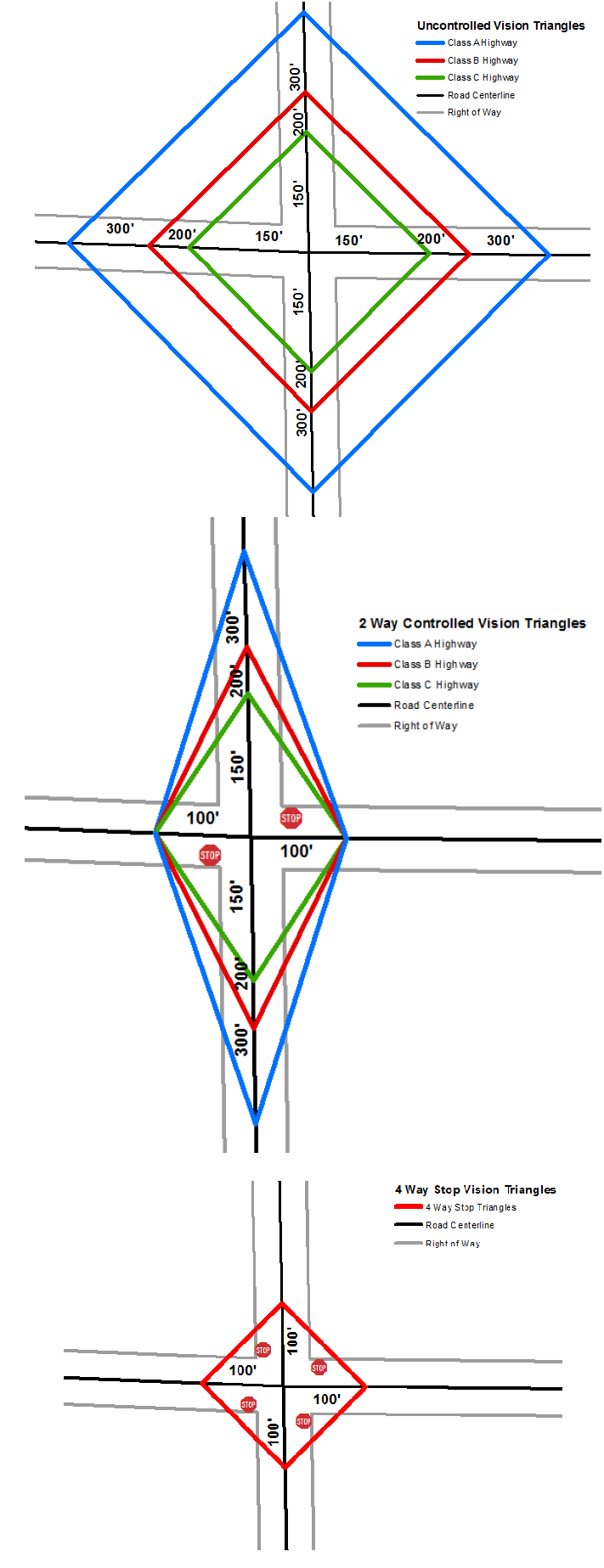
No fence, wall, sign face, structure, or landscape planting shall be erected, established, or maintained on any lot which will obstruct the view of drivers in vehicles approaching an intersection of two roads or the intersection of a road and a driveway. Fences, walls, structures, or plantings located in the triangular area described below shall not be permitted to obstruct cross-visibility between a height of 30 inches and eight feet above the lowest point of the intersecting road(s).
Figure 2: CLEAR VISION AREA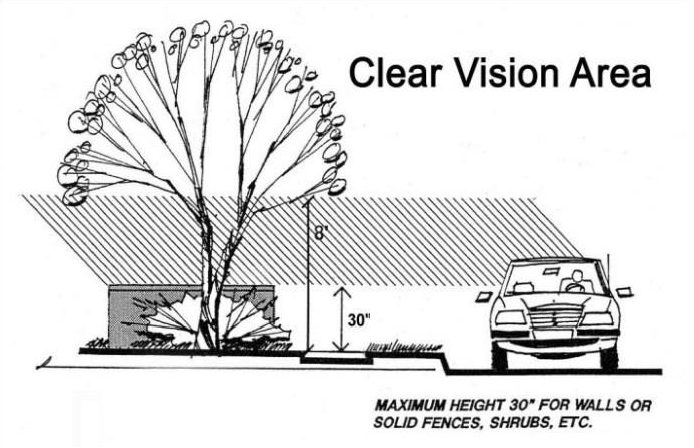
17.202.10.
Structures permitted within setback lines.
A.
The following structures shall be permitted within yard setback areas.
1.
Open fences.
2.
Petroleum and gas transmission lines, telephone, telegraph, cable television, and power transmission poles and lines and portable equipment both above and below ground that is readily removable in its entirety. Additions to and replacement of all such structures may be made, provided the owner will file with the Zoning Administrator or designee an agreement in writing that the owner will move or remove all new construction, additions, and replacements erected after the adoption of this section at his or her expense, when necessary to the public interest, i.e. highway construction, airport, sewer and water lines, etc.
3.
Underground structures not capable of being used as foundations for future prohibited over-ground structures.
4.
Access to frontage roads constructed by the public to plans approved by the County Highway Committee.
5.
Signs placed by the public authorities for the guidance or warning of traffic.
17.202.11.
Floor area standards. Structures used as a dwelling shall provide for each unit the following above ground living area. Furthermore, the regulations contained herein are not intended to conflict with and shall comply with applicable provisions of Wisconsin regulations. Applicable Wis. Stats., shall preempt any conflicts.
A.
Single-family dwelling: 800 square feet minimum.
B.
Hunting/Fishing Shelters: 800 square feet maximum.
C.
Manufactured single-family homes: Minimum square feet for a manufactured home shall be determined by the applicable state and federal standards.
D.
Mobile Homes: Minimum square feet for a mobile home shall be determined by the applicable state and federal standards.
1.
Mobile home note: This does not supersede or regulate building (i.e. construction) or safety standards for manufactured homes, as such regulations are preempted from state and local control by the National Manufactured Housing Construction and Safety Standards Act of 1974 (42 U.S.C.A. 5401).
E.
Two-family dwelling: Minimum 800 square feet per unit.
F.
Multifamily apartments: These are minimum square foot requirements and include kitchen and bath areas but do not include utility, storage rooms, or basement areas.
1.
Three-bedroom unit: 1,300 square feet of living area for each unit.
2.
Two-bedroom unit: 1,024 square feet of living area for each unit.
3.
One-bedroom unit: 800 square feet of living area for each unit.
4.
One room efficiency: 585 square feet of living area for each unit.
(O-34-23)
Sec. 17.203. - Permitted uses by district.
17.203.01.
Permitted uses and conditional uses. In order to avoid intrusion of undesirable uses and to foster all possible benefits for a continued high quality environment, all residential and non-residential land and structure uses have been classified into permitted uses and uses allowed by conditional use permit. Permitted uses include those which require a minimum of limitation and are therefore permitted anywhere within a zoning district. Conditional uses may be appropriate at some, but not all, locations within a zoning district and are subject to a discretionary decision process. See Section 17.805 (Conditional Land Use Review) for review and decision procedures for conditional use permits.
At the expense of the applicant, additional reports, studies, and documentation may be required by the Zoning Administrator, Board of Adjustment, and/or Committee to ensure public health, safety, general welfare; and to promote orderly, efficient, and appropriate development of land in Marathon County.
17.203.02.
Adoption of North American Industrial Classification System (NAICS). In listing uses for zoning districts, this section employs a terminology found in the North American Industrial Classification System (NAICS); standard used by Federal statistical agencies. NAICS was developed under the auspices of the Office of Management and Budget, and adopted in 1997 to replace the Standard Industrial Classification (SIC) system. See: https://www.census.gov/naics/ for detailed descriptions of all of the NAICS categories. Reference shall be made to the NAICS manual as a source of definitions of these terms.
17.203.03.
Prohibited uses and uses not expressly permitted. No building shall be erected, converted, enlarged, reconstructed, or structurally altered, nor shall any building or land with public and/or privately developed improvements be used, arranged to be used, or designed to be used, in a manner which does not comply with all of the district provisions established by these regulations for the districts in which the building or land is located.
A.
Uses which do not appear in the Zoning Ordinance by virtue of their omission from all permitted use lists, all conditionally permitted use lists, all accessory use lists, and all other use lists are prohibited.
B.
A prohibited use may become a permitted use if the Committee approves an amendment incorporating the prohibited use into appropriate use lists for appropriate zoning district(s).
C.
A prohibited use may become a permitted use if the Committee determines the use should be a permitted use in an appropriate zoning district because it is substantially similar in character to specifically permitted use in such district.
D.
Uses for enterprises or purposes that are contrary to federal, state, or local laws or ordinances are prohibited.
17.203.04.
Multiple uses. A use may be combined with any other use(s) permitted in the zoning district provided that the regulations for each use are maintained.
17.203.05.
Table of permitted uses. The following Table 3 lists the uses that may be permitted in each zoning district, provided that the development also meets the design and building standards set forth for each district, along with all other development standards contained in this Ordinance. For instance, when a certain use, is or may be, permitted in more than one zoning district, each zoning district will have different standards for building bulk, location, and design. The customized design standards set forth in each zoning district are tailored to the existing and intended character of each zoning district and are further intended to prevent inappropriate development from occurring within the county.
A.
Uses Permitted in Each District. Table 3 lists the permitted uses in each district. Refer to Section 17.203 for definitions of all uses listed in the following Table 3.
B.
Development Standards Applicable to Uses. Whenever a specific development standard is included for a particular use in Table 3, any development must comply with the requirements of the referenced section. All development standards are listed in section 17.204.
C.
Special Purpose Zoning Districts Not Listed in Table 3. Refer to Table 3 for the uses and development standards applicable in the special purpose zoning districts. Special purpose zoning districts are not listed in Table 3, and include the Manufactured/Mobile Home Park District, Highway Corridor and Interchange Overlay, Wellhead Protection Overlay, and Airport Approach Protection Overly. Refer to Title 3.
(O-34-23; O-21-24)
Sec. 17.204. - Development standards for specific uses agricultural land uses.
17.204.01.
Agricultural buildings and uses.
A.
Minimum General Standards.
1.
Livestock and Fowl:
a.
Shall comply with the Marathon County Animal Waste Storage & Nutrient Management Ordinance, Livestock Facilities Licensing Ordinance and other applicable Wisconsin Administrative Codes and County ordinances including dairying, livestock, and poultry animal husbandry.
b.
Grazing livestock shall be adequately fenced to ensure proper confinement.
c.
Animal units shall comply with NR 243 or as amended from time to time.
2.
Animal Confinement Facilities/Livestock Facilities:
a.
Such facilities shall be in compliance with the General Code of Ordinances for Marathon County Chapter 13 Livestock Facilities Licensing Ordinance and Marathon County Animal Waste Storage & Nutrient Management Ordinance.
3.
Buildings:
a.
Animal Lots and structures used for the housing, sheltering, or feeding of livestock shall be located no less than 100 feet from any lake or stream.
1)
Where meeting this setback is impossible or impractical due to location of existing agricultural facilities, as verified by the Zoning Administrator, new buildings and building additions may be constructed at a lesser setback provided the new buildings and/or additions secure a variance through the Board of Adjustment.
b.
Buildings housing animals shall be at least 25 feet from any adjoining property line.
B.
In the Farmland Preservation District. See Section 17.301.
C.
In the G-A District Only.
1.
General farming:
a.
Permitted agricultural activities such as crop or forage production, nurseries, sod, or Christmas tree production, silviculture, maple syrup production, floriculture, aquaculture, fur farming, forest management, non-commercial greenhouses, beekeeping, vegetable warehouses, seasonal sale of seed and fertilizer, and other similar enterprises or uses,
b.
Farms may not be operated for the disposal or reduction of garbage, sewage, rubbish, or offal.
2.
Livestock:
a.
Animal Unit Density: No maximum animal unit per acre.
b.
Where 500 or more animal units are proposed the rules contained in the Marathon County Livestock Facilities Licensing Ordinance, Chapter 13, shall apply.
3.
Agricultural related Uses:
a.
The following activity, facility, or use whether located on or off a farm and is considered either a primary and/or an incidental agricultural related use as determined by the Zoning Administrator include: agricultural equipment dealership, facility providing agricultural supplies, facility for storing and/or processing agricultural products, facility for processing agricultural wastes, and by-product disposal facilities.
D.
In the R-E and CV/RC District.
1.
Agricultural uses, such as a garden, greenhouse, nursery, and usual farm buildings are subject to the following restrictions:
a.
Raising or breeding of livestock, fowl, or poultry for commercial purposes shall only be permitted on lots of five acres or more.
b.
Animal Unit Density: 0.5 animal units per acre.
c.
The storage or use of manure or any odor or dust producing substance is prohibited within 25 feet of a property line.
2.
Livestock:
a.
Fowl.
1)
Minimum lot size for housing fowl is two acres.
b.
Horses.
1)
Minimum of three acres for one horse, and an additional 1½ acres for each additional horse.
c.
All other livestock.
1)
Minimum lot size for housing all other livestock is three acres.
E.
In the R-R District only. The following animals may be kept for show, breeding, and consumed by the residents/owner of the parcel and are subject to the following restrictions:
1.
Livestock:
a.
Horses.
1)
Minimum of three acres for one horse, and an additional one and one-half acres for each additional horse.
b.
Fowl.
1)
Allowed fowl includes chickens (hens only; no roosters), ducks, quail, pheasants, and partridge/grouse.
2)
Maximum total of six fowl for lots 0.5 acres to 0.99 acres. Maximum total of 12 fowl for lots one acre or greater.
3)
Fowl must be kept in an enclosure at all times. The enclosure includes the covered structure(s) and fenced area. The enclosure shall be a minimum of 25 feet from any side or rear lot line and completely in the rear yard of the home. Setback shall be measured from fencing and structure.
4)
The fenced enclosure and covered structure shall be maintained and kept in a sanitary condition so as not to create a nuisance.
c.
All other livestock.
1)
Minimum lot size for housing all other livestock is three acres.
2)
Animal Unit Density: 0.25 animal units per acre.
F.
In the L-D-R and U-R Districts. The following animals may be kept for show, breeding, and consumed by the residents/owner of the parcel and are subject to the following restrictions:
1.
Livestock, and horses shall not be permitted (except F(1)a).
a.
Fowl.
1)
Allowed fowl includes chickens (hens only; no roosters), ducks, quail, pheasants, and partridge/grouse.
2)
Maximum total of six fowl for lots 0.5 acres to 0.99 acres. Maximum total of 12 fowl for lots one acre or greater.
3)
Fowl must be kept in an enclosure at all times. The enclosure includes the covered structure(s) and fenced area. The enclosure shall be a minimum of 25 feet from any side or rear lot line and completely in the rear yard of the home. Setback shall be measured from fencing and structure.
4)
The fenced enclosure and covered structure shall be maintained and kept in a sanitary condition so as not to create a nuisance.
17.204.02.
Aircraft landing fields, private. Private aircraft landing fields are air transportation facilities for the purpose of providing takeoff, landing, storage, and maintenance of private aircraft including ultralight aircraft and private helicopters may be permitted provided the following requirements are met:
A.
Minimum Site Area. The site area is not less than 20 acres.
B.
Building Setback. All buildings and storage areas shall be located a minimum of 100 feet from all lot lines.
1.
All runway and landing areas shall be located to provide for the safe operation of the facility and to prevent hazards to surrounding property.
2.
Approval of the Federal Aviation Association (FAA).
17.204.03.
Biomass storage, processing and production. The storage, processing, and production of biomass product may be permitted provided the following requirements are met:
A.
Screening. The storage, processing, and production area shall be fully screened from view of any residential district.
B.
Setback. All biomass activities shall be 500 feet from any residence other than the owner's.
C.
Noise and Odor. Such activity shall be conducted so as not to be detrimental to any person, property or the general welfare by reason of excessive noise or odor.
D.
Brine Processing. Brine processing may not be permitted.
17.204.04.
Sawmill. Sawmills shall be located a minimum of 500 feet from a residence other than the owner's.
17.204.05.
Commercial/private greenhouse.
A.
Commercial:
1.
Shall not be located within 100 feet of any boundary of a residential lot other than that of the owner or lessee of such greenhouse.
B.
Private:
1.
Shall be treated as an accessory structure.
17.204.06.
Land spreading of municipal sewage sludge. Land spreading of municipal sewage sludge when done in accordance with, and subject to, the conditions contained in a permit from the Department of Natural Resources issued pursuant to Wisconsin Administrative Code NR 204 and any Marathon County Nutrient Management Plan.
17.204.07.
Kennel and pet boarding facility.
A.
Kennel. The boarding, breeding, raising, grooming, or training of seven or more dogs over six months of age either:
1.
Not owned by the owner or occupant of the premises, or
2.
For commercial gain may be permitted and shall conform to Section 17.204.07(B).
B.
Pet Boarding Facility. A pet boarding facility, sometimes referred to as "doggie day care," is a business for the temporary boarding and care of common household pets generally during daytime hours, but in some cases including overnight boarding. Pet boarding facilities may provide related services such as grooming or training, but no animals may be bred or sold at a pet boarding facility unless the pet boarding facility is accessory to a principal retail use. Kennel and pet boarding facilities are subject to the following requirements:
1.
Minimum Site Area. Such activity shall be permitted only on a parcel of land not less than five acres in area.
2.
Enclosures. All animals shall be kept in pens or cages designed, constructed, and maintained so as to be harmonious and appropriate in appearance with the character of the general area in which located, and such use will not affect the character of the same area in a negative way.
3.
Enclosure Setbacks. All pens or cages shall be located not less than 100 feet from any property line and all animals shall be kept therein or within a building. No animal shall be allowed to run at large.
4.
Noise and Odor. Such activity shall be conducted so as not to be detrimental to any person, property, or the general welfare by reason of excessive noise or odor.
5.
Nuisance Prohibited. The keeping of the animals described in this subsection shall not constitute a nuisance to persons living in the surrounding area. Upon receipt of a written complaint filed by a neighbor with the County stating the animals constitute a nuisance, the Board of Adjustment shall hold a hearing with notice to all property owners within 300 feet of the property where the animals are kept. The Board of Adjustment shall determine if, in fact, the animals do constitute a nuisance.
If the Board of Adjustment determines that the animals have and will likely continue to constitute a nuisance, the animals shall not be kept on the property after the date set by the Board of Adjustment. If, in the opinion of the Board of Adjustment, there is reason to believe that reasonable measures will be taken to alleviate the nuisance associated with the animals, the Board of Adjustment may issue a permit, renewable yearly, for the keeping of such animals with or without restrictions. If a hearing is held and a determination is made, the matter may not be reviewed again on a complaint of a neighbor unless there has been a change of circumstances.
6.
No person shall allow animals under such person's control or ownership to constitute a nuisance. Notwithstanding anything to the contrary in this Ordinance, this subsection shall not be a limitation on, any other County ordinance pertaining to animals, and the enforcement of it.
7.
Wastewater. A wastewater treatment system may require review and approval by the Department of Natural Resources and Department of Safety & Professional Services.
8.
On-site vehicular circulation shall be configured to accommodate vehicles within the boundaries of the site. In no case shall vehicles awaiting drop-off or pick-up of a pet be allowed to encroach onto a public or private street.
9.
Overnight stay. Any pets being boarded overnight shall be confined within the building from the hours of 10:00 p.m. until 7:00 a.m.
10.
Facilities shall be constructed, maintained, and operated so that the sounds and smell of animals cannot be discerned outside of the building. Outdoor runs shall be maintained so that no odors are discernable from adjacent properties.
11.
Outdoor runs where pets will be permitted either on or off-leash shall be set back a minimum of 100 feet from any adjacent residentially zoned or used land. The 100-foot setback notwithstanding, outdoor runs shall be located as far as practicable from any adjacent residential zoning district. Any outdoor runs where pets will be permitted off-leash shall be surrounded by a minimum 54-inch, (four and one-half feet), tall fence. If the fence will be visible from any adjacent residential district or road right-of-way, the fence shall be decorative in nature, determined by the Zoning Administrator.
12.
The Zoning Administrator and/or Board of Adjustment may require a landscaped buffer or solid wall to be provided between the outdoor run and any adjacent district if the location proposed outdoor run could negatively impact adjacent land.
17.204.08.
Livestock collection and transfer depots.
A.
Setbacks. Shall be located not less than 300 feet from a residential district.
B.
On-site vehicular circulation shall be configured to accommodate vehicles within the boundaries of the site. In no case shall vehicles awaiting drop-off or pick-up of livestock be allowed to encroach onto a public or private street.
17.204.09.
Animal waste storage facilities. Animal waste storage facilities shall adhere to Marathon County Animal Waste Storage and Nutrient Management Code, Chapter 11.02 guidelines or any other applicable agency requirements.
17.204.10.
Migrant labor camp. Migrant Labor camps shall be certified under § 103.92, Wis. Stats.
A.
Migrant labor camp shall be an accessory use to an active principal use, under the same ownership.
17.204.11.
Ponds.
A.
Slope. The slope from the shoreline shall be no greater than three feet horizontal to one foot vertical to a water depth of six feet.
B.
Setbacks.
1.
New ponds shall be located a minimum of 30 feet from any road right-of-way and/or 63 feet from the centerline; whichever distance is greater, when being constructed, excavated, or expanded.
2.
Ponds shall be located 50 feet from any drain field and 25 feet from a septic or holding tank.
3.
New Ponds shall be located in accordance with the minimum side and rear yard setbacks required in the district of which it is located shown in Table 2, unless Section 17.204.11(B)(4) is satisfied. Any overflow devices shall be directed in the opposite direction as the required setback(s). All new pond excavation and/or expansion are subject to the post construction requirements per Wis. Stats., Ch 88 and 283.33, administrative rule NR 216 and NR 151.
4.
An agreement must be signed whereby all owners of the properties acknowledge that a pond crosses property lines, and said agreement shall be recorded for each of the affected property records at the Register of Deeds.
C.
Dams, dikes, or berms.
1.
Earthen dams or dikes greater than six feet high shall be designed, or the design shall be approved, by a State licensed engineer or hydrologist to ensure structural integrity.
2.
Dams, dikes, or berms must be outside of road rights-of-way and easements.
D.
Exempt Activities.
1.
Ponds that are governed by either a NR340 or a NR135 permit will be exempt from obtaining a pond permit as long as these permits are in good standing.
17.204.12.
Roadside/produce stands. Roadside/Produce stands shall be used for the sale of seasonal agricultural products and shall comply with the following standards:
A.
Such stand, sign, and required off-street parking shall be located and set back in such a manner so as not to create a traffic hazard.
B.
Such uses may not encroach into any right-of-way.
C.
Stand to be removed and stored at the conclusion of the seasonal sales. (Permanent roadside/produce sales and structures may require additional permitting and approvals).
17.204.13.
Slaughterhouse. Slaughterhouses may be permitted as a conditional use in the G-A, F-P and H-I Districts provided the following requirements are met:
A.
[Slaughterhouses.]Slaughterhouses shall be located not less than 1,000 feet from any residential structure other than that of the owner of the premises, his agent or employee.
B.
Trash Containers. There shall be trash containers of sufficient size and capacity to contain any and all wastes generated by the operation of business.
C.
Noise and Odor. Such activity shall be conducted so as not to be detrimental to any person, property, or the general welfare by reason of excessive noise or odor.
17.204.14.
Public stable/riding academy, and private stable.
A.
Public stables, including riding academies, are subject to § 91.01(1), Wis. Stats. and the following requirements:
1.
Minimum Area. The uses may be permitted on parcels of land that are at least 10 contiguous acres or more in area.
2.
Building Setbacks. The stable shall be so situated on the site so as to be at least 300 feet from any residences on abutting parcels or lots.
3.
Access and Frontage. Ingress and egress to the stable area shall be provided solely through the parcel in question, which shall abut a public right-of-way.
4.
Parking. Adequate off-street parking facilities shall be provided on the site.
5.
Manure Management shall adhere to Marathon County Animal Waste Storage and Nutrient Management Code, Section 11.02 or any other applicable agency requirements.
6.
Outdoor Lighting. Floodlights or any other source of artificial lighting provided to facilitate night riding activities shall be properly shielded or directed away from residences or abutting properties, and shall be turned off nightly no later than 11:00 p.m.
B.
Private stables ancillary to a private residence and shall be permitted only for the use of the property owner, or lessee thereof, and his or her family and/or friends invited to use such animals without payment of any fee are subject to the following:
1.
Minimum Lot Area. A minimum lot area of three acres is required for private stables.
2.
Maximum Number of Animals. A minimum of three acres of contiguous land shall be provided for the first horse, and each additional horse stabled shall require one and one-half additional acres of land. The property shall be under control or use of the permit holder with either title or lease.
3.
Outdoor Use Area Locations and Setbacks. Confinement areas and/or stables shall, in all instances, be located in the rear and/or side yard. Horses shall be confined to fenced pastures, paddocks, or stables unless harnessed and under the direct control of a person.
4.
Building Setbacks. An accessory building used as a stable shall be a minimum of 25 feet from any property line and a minimum of 50 feet from any dwelling other than the owner's.
5.
Manure management shall adhere to Marathon County Animal Waste Storage and Nutrient Management Code, Section 11.02, or any other applicable agency requirements.
6.
Nuisance. In each instance when the Zoning Administrator issues a permit for a private stable, the Committee shall find that there has been compliance with the conditions of this subsection, that the activity will not or has not been a nuisance to residents in the area, is compatible with adjacent land uses, and is consistent with the public health, safety, and welfare of the county.
17.204.15.
Stock water ponds. Stock water ponds are ponds constructed for the exclusive use of watering livestock. They are eligible for a reduced application fee if the following requirements are met:
A.
Surface Area. The stock water pond surface area is 2,500 square feet or less.
B.
Fencing. The stock water pond area must be fenced for livestock.
C.
Slope. The slope from the shoreline shall be no greater than three feet horizontal to one foot vertical to a maximum water depth of six feet.
RESIDENTIAL LAND USES
17.204.16.
Mixed residential development option.
A.
Purpose. To encourage innovation in residential subdivision design, the mixed development option may be permitted as a conditional use to provide for more efficient layout of lots, streets, and utilities; for the preservation of open space and recreation areas; and for the provision of a variety of housing options in a low-density and predominantly single-family setting.
17.204.17.
Mixed use building - Residential with nonresidential.
A.
Location of Residential Units. No residential unit may be located on a floor underneath a floor containing a non-residential use.
B.
Permitted Nonresidential Uses. Nonresidential uses permitted in a mixed use residential with nonresidential building are limited to those that are permitted in the district by Table 3. Uses Permitted by District. Conditional use approval is required for any use listed as a conditional land use.
17.204.18.
Multifamily dwelling. A building used exclusively for residential purposes containing three or more residential dwelling units where each dwelling unit has its own exterior entrance; is capable of individual use and maintenance without trespassing on adjoining dwellings; and access, utilities and service facilities are independent for each dwelling. Multi-family dwellings are subject to the following standards:
A.
Proximity to Improved Street. The property shall be within 250 feet of a fully improved public right-of-way and street.
B.
Access Points. Any multi-family dwelling developments with more than 20 units shall have two access points to the public street.
C.
Traffic Control.
1.
A traffic impact study shall be provided for any project including 40 or more dwelling units. See Section 17.406 for traffic impact study requirements.
2.
Traffic control lights shall be provided at private roads or at intersections with primary streets if warranted by the traffic impact study.
D.
Recreation Areas.
1.
Passive or active outdoor recreation areas (including but not limited to seating areas, playgrounds, swimming pools, walking paths, plazas, courtyards, and other recreational elements in accordance with the intended character of the development) shall be provided at a ratio of at least five percent of the gross site area of the development. These open space areas are in addition to the area of any required setbacks.
2.
The minimum area of each recreation area shall be not less than 1,200 square feet.
3.
The length to width ratio of each area, as measured along the perimeter, shall not exceed 4:1.
4.
Such areas shall be centrally and conveniently located to be physically and visibly accessible to residents and shall not be located within any required setbacks or building separations.
E.
Trash. Central facilities for collection and disposal of trash shall be provided and screened.
F.
Sidewalks. Minimum five-foot-wide concrete sidewalks shall be provided to connect parking areas, public sidewalks, and recreation areas to all building entrances; such sidewalks shall also be provided along collector roads and streets within the development; and streets adjacent to the development.
G.
Density. The maximum density shall not exceed that permitted in the zoning district.
H.
Building Design Standards. Apartment buildings shall comply with the following standards:
1.
Building Entrances. Each building shall have at least one entrance door on each street-facing façade to create an appearance that is consistent with a single-family character. Entrances to individual units may occur off an interior hallway that is accessed via a front door or may be located on the side or rear of the building. Interior hallways may also have a secondary entrance on the side or rear of the building.
I.
Parking. On-street parking spaces on interior streets are encouraged and shall count toward the minimum parking requirement. Parking spaces on streets exterior to the development shall not be counted toward the minimum parking requirement.
17.204.19.
Conservation development option.
A.
Purpose. Conservation development is an optional form of development that is offered as an alternative to the regulations of the zoning districts where the open space option is permitted. The purpose of the conservation development option is to protect and promote the health, safety, and general welfare of the County, to enhance the visual appearance of residential development, to protect and promote the character and vista of the rural areas within the County, to prevent unnecessary clutter and congestion within such developments and the surrounding neighborhoods, to protect environmentally sensitive areas, and to establish regulations for flexible design alternatives to the requirements of the underlying district to encourage site design practices that provide for efficient layout of infrastructure and preserve open space and natural features, while maintaining density control in conformity with the underlying district.
B.
Standards to Apply. Where the standards of the open space option and the underlying district differ, the conservation option development standards shall apply. However, the density under the conservation option shall not be greater than the maximum density of the underlying district based on the net developable density of the development.
C.
Application. The conservation option may be used at the option of the developer when the proposed residential development has an area of ten or more acres.
D.
Uses.
1.
Permitted Uses. The following uses are permitted in a conservation development.
a.
Single-family dwelling, detached.
b.
Accessory buildings and uses incidental and subordinate to the single-family dwelling use, excluding any activity conducted as a business.
2.
Conditionally Permitted Uses. None.
E.
Density. The permitted density in a conservation development shall not exceed the maximum density permitted in the zoning district per Table 2. Schedule of Regulations, based on net development density.
F.
Lot Requirements.
1.
Minimum Lot Area. The minimum lot area in a conservation development shall be 70 percent of the minimum area required in a conventional development in the underlying zoning district.
2.
Minimum Lot Width. The minimum lot width at the building setback line in a conservation development shall be 70 percent of the minimum width required in a conventional development in the underlying zoning district.
3.
Minimum Front and Side Street Yard Setback. The minimum front and side street yard setback in a conservation development shall be 75 feet in the R-R district, 40 feet in the L-D-R district, and 30 feet in the U-R district.
4.
Minimum Interior Side Yard Setback. The minimum interior side yard setback in a conservation development shall be ten feet in the R-R district, eight feet in the R-1 district, and seven feet in the U-R district.
5.
Minimum Rear Yard Setback. The minimum rear yard setback in a conservation development shall be 60 feet in an R-R district and 40 feet in an L-D-R or U-R district.
G.
Dwelling Area Requirements. The minimum floor area of a dwelling unit in a conservation development shall be 1,700 square feet.
H.
Maximum Building Height. The maximum building height shall be 35 feet.
I.
Minimum Open Space Requirements.
1.
Minimum Area Required. An amount of common open space equal to or greater than the area gained through the reduction of lots below the minimum lot area required in the district shall be provided. For the purposes of calculating the minimum open space requirement, only lots that are reduced below the minimum area required in the district shall be included.
2.
Unbuildable Site Conditions. A maximum of 20 percent of the land dedicated toward the minimum open space requirement may meet one or more of the unbuildable site conditions listed in the definition of net developable area. A minimum of 80 percent of open space lands shall be otherwise buildable, upland area. Any area planned or designated for stormwater management facilities may not be counted towards the minimum open space requirement.
3.
Access to Open Space Areas. Each open space area shall have frontage on a street to ensure that the open space land is accessible and visible to all residents of the development. The minimum contiguous linear frontage each open space area is required to have along a street shall be determined by dividing the area of open space (in square feet) by 1,500, or 100 feet, whichever is less. An open space area may have multiple frontages on a street or streets, and secondary frontages may be of any length provided that one frontage meets the minimum contiguous linear frontage requirement.
4.
Phased Developments. When a subdivision is to be developed in phases, the common area required to reduce the lot sizes in any particular phase shall be provided in the current phase and/or already provided in earlier phases.
J.
Maintenance, Perpetuation of Open Space, Guarantee of Development. The open space requirement may be accomplished by providing for the retention of open space in common ownership of the individual owners within the development through appropriate legal documents, with appropriate provision to assure continuous maintenance and the use of the common property for the purpose intended. The legal documents shall place unencumbered title to the common property in a form of common ownership representing the residents of the development, shall place responsibility for the management and maintenance of all common property, shall set forth the restrictive covenants, and place responsibility for the enforcement thereof, and shall provide for the subjection of each lot within the development to assessment of its proportionate share of maintenance costs of the common property. Such legal documents shall be filed with the application for approval of the open space requirement and shall be approved as to form by the County Corporation Counsel. Such legal documents shall be recorded as deeds or plats are recorded with the County Register of Deeds Office. Or, the open space requirement may be accomplished by an alternative approach approved by the Committee as part of site plan approval.
17.204.20.
Single-family dwelling, detached.
A.
Dwelling. The structure must be in compliance with the Wisconsin Uniform Building Code and Private On-Site Waste Ordinance.
B.
Dwellings in N-C and C districts:
1.
Structure must be in compliance with the Wisconsin Uniform Building Code and Private On-Site Waste Ordinance.
2.
Dwelling must be accessory to the business on the property.
3.
Dwelling is for the owners of the business.
17.204.21.
Two-family dwelling.
A.
Dwelling. Two-family dwelling units may share the same lot. The structure must be in compliance with the Wisconsin Uniform Building Code and Private On-Site Waste Ordinance.
B.
Setback Requirements. Attached single-family dwelling unit buildings shall adhere to zoning district setbacks Section 17.202.
C.
Individual Entrances Required. All dwelling units shall have entrances that are directly accessible from the exterior of the building. No unit shall gain access from an interior hallway within a building. The primary exterior entrance to all units shall face a street with a connection leading from the roadside sidewalk to the front entrance of the unit. In no case shall a front entrance to a townhouse unit face the rear yard of another dwelling unit or a service area.
17.204.22.
Manufactured home and mobile home.
Manufactured Homes. Manufactured homes shall have a minimum floor area of 800 square feet and conform to the following standards:
A.
A manufactured home used for human habitation must meet the construction standards contained in Wisconsin Administrative Code Chapter SPS 327.
B.
Manufactured home must be constructed in conformance with the federal construction and safety standards established by the secretary of housing and urban development pursuant to the "Manufactured Housing Construction and Safety Standards Act of 1974," 88 Stat. 700, 42 U.S.C.A. 5401, 5403, and that has a permanent label or tag affixed to it, as specified in 42 U.S.C.A. 5415.
C.
A manufactured home is considered to be single-family residence and is an allowed use in any zoning district where single-family dwellings are an allowed principal use provided that:
1.
A site plan is submitted with the zoning permit application to the department for review and approval. The site plan must show the size of the manufactured home, its location on the lot, all yard measurements, and the location of the septic tank, drain field, and water supply.
2.
The manufactured home must be set on an enclosed foundation in accordance with § 70.043(1), Wis. Stats., and Wisconsin Administrative Code Chapter SPS 321.
3.
The manufactured home must be securely anchored to its foundations in accordance with Wisconsin Uniform Dwelling Codes. The number of tie-downs must conform to the manufacturer's recommendations, provided that there are at least four tie-downs.
4.
The manufactured home must be installed in accordance with the manufacturer's instructions and is properly connected to utilities.
5.
The hitch and wheels must be removed.
6.
The roof must be double pitched so that there is at least a three-inch vertical rise for each 12-inches of horizontal run. The roof must have a minimum eight-inch overhang on each perimeter wall and the overhang must be architecturally integrated into the design of the dwelling. The roof must be residential in appearance; must be covered with an approved material, such as wood, asphalt, composition, fiberglass shingles, or metal.
7.
The exterior siding material must be residential in appearance; may consist of clapboards, concrete, masonry, simulated clapboards such as conventional vinyl or metal siding, stucco, wood, wood shingle shakes, or a similar material. The exterior siding material must extend to ground level, except that when a solid concrete or masonry perimeter foundation is used, the siding material need not extend below the top of the foundation.
Mobile Homes. Mobile homes shall have a minimum floor area of 800 square feet and conform to the following standards:
A.
A mobile home that does not meet the standards of Section 17.204.22(A—C) may not be located on a lot outside of an approved and licensed Manufactured/Mobile Home Park, except as permitted under Section 17.204.63 or as otherwise authorized by this Ordinance.
B.
The hitch and wheels must be removed.
C.
Skirting. Skirting specifically designed for manufactured homes, or some other material, must enclose the area between the ground and the bottom of the manufactured home.
17.204.23.
Farm consolidation. Farm residences constructed prior to January 1, 2014, and farm structures may be separated from the farm plot, and not be required to be rezoned, provided that the parcel created conforms to all the following regulations:
A.
Permitted Use.
1.
Conforms to all regulations forth in the Rural Residential district (parcel dimensions and uses).
2.
Lot size not to exceed 4.99 acres, and meets the requirements of the General Code of Ordinances for Marathon County Chapter 18, Land Division and Survey Regulations.
B.
Residences constructed after January 1, 2014, would be required to rezone from the Farmland Preservation or General Agricultural Zoning.
COMMUNITY, CIVIC, AND INSTITUTIONAL USES
17.204.24.
Campgrounds and recreational vehicle parks.
A.
Campgrounds. Campgrounds which provide sites for primitive camping, tent camping, and camping trailers shall not contain a total number of campsites that exceed eight campsites per acre, excluding any acreage located in the shoreland setback area, floodplain or wetlands. Publicly or privately owned and/or operated campgrounds, summer camps and group accommodations are subject to the following:
1.
Property Line Setback. All structures and activity areas, except off-street parking area, shall be located at least 100 feet from all property lines.
2.
Ingress/Egress Separation. All points of entrance or exit shall be located no closer than 200 feet from the intersection of two major thoroughfares and/or no closer than 200 feet from the intersection of a major thoroughfare and a collector street.
3.
Natural Buffers Preferred. Site locations should be preferred that offer natural or manmade barriers that would lessen the effect of intrusion into the area.
4.
Accessory Uses. Only retail uses which are customarily accessory or incidental to the main recreational use shall be permitted as part of the campground. Permitted retail uses are refreshment stands, souvenir stands, concession stands, park office, and the limited sale of groceries when the customers are primarily the campers using the park.
5.
Minimum Lot Area. A minimum lot area of 20 acres shall be required.
6.
Supervision; Nuisance. All activities, programs, and other events shall be adequately and properly supervised so as to prevent any hazard and to assure against any disturbance or nuisance to surrounding properties, residents, or to the community in general.
7.
State Rules. All campground uses shall comply with applicable state regulations.
B.
Recreational Vehicle Parks. Recreational vehicle parks shall comply with the following requirements:
1.
Minimum Lot Area. No permit shall be issued for the establishment of a recreational vehicle park unless such park is situated on a minimum of 20 acres of land.
2.
Recreational Vehicle Parks which provide sites for a mixture of recreational vehicles, motor homes, camping trailers, tent sites, and primitive camping shall not contain a total number of campsites that exceed 12 camping sites per acre, excluding any acreage located in the shoreland setback area, floodplain or wetlands.
3.
Sites. Each recreational vehicle site or individual campsite shall be no less than 25 feet in width and 40 feet in length.
4.
Where the recreational vehicle park fronts on a lake or other water frontage, the frontage width shall be not less than 500 feet per every 20 acres. The number of campsites and recreational vehicle sites to be allowed on a body of water shall be determined by the conditional use permit procedure set forth in this Ordinance including but not limited to considering the gross water area, the number of such sites in a campground or recreational vehicle park, the number of permanent and seasonal residents on the body of water and the total amount of frontage owned by such other residents, the amount of frontage for future residential development, and water frontage values. All other applicable provisions of this Ordinance must also be met.
5.
A zoning permit is required when the aggregate area of the patios/decks exceeds 200 square feet. When not connected, or immediately adjacent, to a patio or deck, a six-foot-wide landing not exceeding the length of the camping unit is exempt.
6.
No more than two manufactured homes shall be permitted in a campground in a temporary or permanent nature.
7.
Park Model Unit, or Manufactured Home on existing camping spaces shall obtain a zoning permit prior to placement and shall meet all Shoreland, yard, and street setbacks and be provided with a state approved method for sewage disposal when intended for human habitation.
8.
Subleasing of campsites or recreational vehicles, motor homes, and camping trailers located in campgrounds and recreational vehicle parks is strictly prohibited.
9.
An earth tone colored storage shed up to 48 square feet shall be permitted at an individual campsite. Structures commonly associated with a campsite such as fire rings, picnic tables, grills, and necessary utility hook-ups shall be permitted at an individual campsite.
11.
A three-season room up to 400 square feet with no bedroom or bathroom attached to the recreational vehicle shall be permitted at an individual campsite.
C.
Recreational Vehicle Park Setbacks. The following minimum setback regulations shall apply:
1.
No building, structure, camp site, or recreational vehicle site shall be located within 200 feet of adjacent property lines when the adjacent property is zoned single or multifamily residential districts. For all other use districts, the minimum distance shall be 100 feet. No building, structure, campsite, or recreational vehicle shall be closer than 75 feet to any state, county, or town highway or road or arterial street or roadway right-of-way.
2.
Recreational vehicles or tents shall not be located so close to the traveled portion of any streets or roadway within such park as to create a safety hazard.
3.
No part of any recreational vehicle or tent, or any addition or appurtenance thereto, shall be placed within ten feet of any other recreational vehicle or tent, or addition or appurtenance thereto, nor within 50 feet of any accessory/service building or structure.
D.
Height. No building, structure, or recreational vehicle located in a campground and recreational vehicle park shall exceed two stories or 25 feet in height.
E.
Parking. There shall be at least one off-street parking space available for each individual camp site or recreational vehicle site which shall be located within 100 feet of such site. However, the total number of parking spaces provided in each campground and recreational vehicle park shall be equal to no less than one and one-third times the maximum number of sites which can be located in compliance with this Ordinance.
F.
Landscaping. Within a 50-foot peripheral setback area along each property line of such a park, designated screen fencing or landscape planting shall be placed so as to be 50 percent or more opaque between the heights of two feet and eight feet from the average ground elevation when viewed from any point along each property line and not to encroach on the clear vision area.
G.
Design and Improvement. The design and improvements provided in such proposed parks, including street widths and construction of approach streets or ways, shall conform to the requirements of the Marathon County Subdivision Regulations. However, the street widths and construction requirements in the Subdivision Regulations shall be applied only to those streets which would be necessary to service a future conventional residential subdivision on such tract of land and need not be applied to secondary mobile home site access streets or ways unless the Zoning Administrator or Board of Adjustment determines certain requirements are necessary for ingress and egress of public emergency or service vehicles.
H.
Common Space. Each park shall provide at least three acres of common space, exclusive of the required 50-foot peripheral setback area in which common recreational or service facilities can be located. An additional 200 square feet of common space shall be provided for each campground or recreational vehicle in excess of 160 located within such park. Any such common space shall be reasonably compact in area so as to be usable and shall be located on well-drained land which is not subject to periodic flooding or lengthy periods of wet conditions.
I.
Exception, Special Event Campground. A campground designed, maintained, intended or used for the purpose of providing sites for non-permanent overnight use of camping units at a special event, as those terms are defined in ATCP 79, the operator of which special event campground has applied for and obtained a permit under ATCP 79 shall not be required to meet the requirements of this section during the period of the special event, subject to the condition that the remaining provisions of Section 17.204.64, Marathon County are otherwise met.
17.204.25.
Cemeteries. Cemeteries are permitted in the U-R, L-D-R, R-R, R-E, G-A, and F-P districts and are subject to the requirements of ch. 157, Wis. Stats., Disposition of Human Remains, Subchapter II, Cemeteries.
A.
General. The area proposed for a cemetery shall be used for cemetery purposes only, and shall comply with the following requirements:
1.
Ingress/Egress Separation. All points of entrance or exit shall be located no closer than 200 feet from the intersection of two arterial streets; and/or no closer than 200 feet from the intersection of an arterial street and a collector street.
2.
Lot Area. The minimum lot area required for a cemetery site shall be 20 acres.
3.
Parking. Sufficient parking space shall be provided as to not deter traffic flow within the cemetery.
4.
Signs. Only signs designating entrances, exits, traffic direction, and titles shall be permitted, and must be approved by the Zoning Administrator.
5.
Landscape Buffer. Adequate screening with shrubs, trees, or compact hedges shall be provided parallel to property lines adjacent to or abutting residential dwellings; such shrubs, trees, and hedges shall not be less than two feet in height and shall be maintained in good condition.
17.204.26.
Charitable or philanthropic organizations. All activities, programs and other events by quasi-public institutionally or organizationally owned and/or operated recreational, instructional, and meeting facilities shall be adequately and properly supervised so as to prevent any hazard and to assure against any disturbance or nuisance to surrounding properties, residents, or to the community in general.
17.204.27.
Day care uses.
Child Day Care. The care of less than four children shall not be regulated under this Chapter. The following day care uses include the following types of facilities: Type A - Day-Care Home (four to eight children); Type B - Day Care Home (nine to 15 children); and Type C - Group Day Care Center (nine or more children). These day care facilities shall comply with the following requirements:
A.
Type A - Day Care Home (four to eight children). Occupied residences in which a qualified person(s) provide child care for four to eight children. Refer to § 66.1017(1)(a), Wis. Stats. These shall not be considered "Home Occupations" for the purpose of the Chapter.
B.
Type B - Day Care Home (nine to 15 children). Occupied residences in which a qualified person(s) provide child care for nine to 15 children. Refer to § 48.65, Wis. Stats. These shall not be considered "Home Occupations" for the purpose of the Chapter.
C.
Type C - Group Day Care Center (nine or more children). Group day care centers provide child care services for nine or more children by qualified persons. Group day care facilities may include nursery schools and day care centers; however, shall not be located within a residential unit. Group day care facilities may be operated on a profit or not-for-profit basis in conjunction with another principal use such as a church, school, business, and civic organization.
Adult Day Care. The care of less than three non-related people receiving care from a non-family member in the same structure shall not be regulated under this Chapter, but considered a home occupation. The following day care uses include the following types of facilities:
A.
Adult Day Care Center. Care provided for part of a day, e.g., less than 24 hours, in a group facility for adults.
B.
Family Adult Day Center. Care provided for part of a day for small groups of no more than six adults in the home of a provider.
17.204.28.
Community living arrangements. Community living arrangement land uses include all facilities provided for in § 46.02(22), Wis. Stats., including child welfare agencies, group homes for children, and community based residential facilities. Community living arrangements do not include day care centers, nursing homes, general hospitals, special hospitals, and prisons or jails. Community living arrangement facilities are regulated depending upon their capacity per the requirements established in § 60.63, Wis. Stats.
A.
Community Living Arrangement (one to eight residents). Community living arrangements with a capacity for eight or fewer, shall be subject to the limitations set forth in § 59.69(15) and 60.63, Wis. Stats.
1.
The total capacity of all community living arrangements shall not exceed one percent of a Town's population unless specifically authorized by the Town Board following a public hearing.
B.
Community Living Arrangement (nine to 15 residents). Community living arrangements with a capacity for eight or fewer, shall be subject to the limitations set forth in § 59.69(15) and 60.63, Wis. Stats.
1.
The total capacity of all community living arrangements shall not exceed one percent of a Town's population unless specifically authorized by the Town Board following a public hearing.
C.
Community Living Arrangement (15 residents and greater). Community living arrangements with a capacity for 15 residents and greater, shall be subject to the limitations set forth in § 60.63, Wis. Stats.
1.
No community living arrangement shall be established within 2,000 feet of any other such facility regardless of its capacity.
2.
The total capacity of all community living arrangements shall not exceed one percent of a Town's population unless specifically authorized by the Town Board following a public hearing.
17.204.29.
Cultural, municipal or public use.
A.
Government building(s) located in any District shall comply with the following requirements:
1.
Ingress/Egress Separation. All points of entrance or exit shall be located no closer than 200 feet from the intersection of two major thoroughfares and/or no closer than 200 feet from the intersection of a major thoroughfare and a collector street.
2.
Thoroughfares. Such developments shall be located on arterial streets, at intersections of arterial or collector streets, or on service roads for interstates.
3.
Minimum Lot Area. The minimum lot area shall be one and one-half acres.
17.204.30.
Hospitals, medical clinics, and human care institutions. Institutions for human medical care, hospitals, sanitariums, convalescent homes, nursing homes, homes for the aged, and philanthropic institutions are subject to the following:
A.
Property Line Setbacks. All structures and activity areas, except off-street parking area, shall be located at least 100 feet from any property line.
B.
Minimum Lot Area. The minimum lot area shall be at least three acres.
C.
Ingress/Egress Separation. All points of entrance or exit shall be located no closer than 100 feet from the intersection of two major thoroughfares and/or no closer than 100 feet from the intersection of a major thoroughfare and a collector street.
D.
Thoroughfares. Such developments shall be located on major thoroughfares, at intersections of major and/or collector streets, or on service roads for major thoroughfares.
17.204.31.
Institution for higher education, parochial, technical school, colleges, and universities.
A.
Thoroughfare. In all districts where institutions for higher education are permitted as conditional uses such facilities shall be located on major thoroughfares, at intersections of major collector streets or on service roads of major thoroughfares.
B.
Residential Districts. Where permitted in residential districts, such uses shall comply with the following requirements:
1.
Property Line Setbacks. All structures and activity areas, except off-street parking area, shall be located at least 50 feet from all property lines.
2.
Minimum Lot Area. The minimum lot area shall be three acres.
3.
Ingress/Egress Separation. All points of entrance or exit shall be located no closer than 100 feet from the intersection of two major thoroughfares and/or no closer than 100 feet from the intersection of a major thoroughfare and a collector street.
17.204.32.
Place of worship.
A.
Preferred Location. In all districts where churches and other religious facilities are permitted, such facilities shall be encouraged adjacent to parks and other nonresidential uses such as schools and shopping facilities where use could be made of joint parking facilities.
B.
Residential Districts. Churches and other religious facilities located in any residential district shall comply with the following requirements:
1.
Ingress/Egress Separation. All points of entrance or exit shall be located no closer than 50 feet from the intersection of two major thoroughfares and/or no closer than 50 feet from the intersection of a major thoroughfare and a collector street.
2.
Thoroughfares. Such developments shall be located on major thoroughfares, at intersections of major and/or collector streets, or on service roads for major thoroughfares.
3.
Property Line Setback. All structures and activity areas, except off-street parking areas, shall be located at least 100 feet from all property lines.
4.
Minimum Lot Area. The minimum lot area shall be one and one-half acres.
17.204.33.
K-12 Schools.
A.
Property Line Setback. All structures and activity areas, except off-street parking areas, shall be located at least 100 feet from all property lines.
B.
Ingress/Egress Separation. All points of entrance or exit shall be located no closer than 200 feet from the intersection of two major thoroughfares and/or no closer than 200 feet from the intersection of a major thoroughfare and a collector street.
C.
Minimum Lot Size. The minimum lot size shall be three acres.
17.204.34.
Facilities for a private club, fraternal organization, or community group.
A.
Location. Such uses may only be located along an arterial or collector street.
B.
Minimum Site Area in Residential Districts. Such uses shall have a minimum lot area of one acre in residential districts.
C.
Minimum Lot Frontage in Residential Districts. Such uses shall have a minimum lot frontage of 150 feet in residential districts.
COMMERCIAL, OFFICE, AND SERVICE USES
17.204.35.
Adult entertainment use. Adult Entertainment Uses shall conform to the following standards:
A.
Purpose. It is the purpose of this section to regulate adult entertainment uses in order to promote the health, safety, morals, and general welfare of the citizens of the county, and to establish reasonable and uniform regulations to prevent the harmful location and concentration of Adult entertainment uses and to minimize their negative secondary effects within the county. Based upon studies undertaken and reported by numerous other communities, it is recognized that the adult businesses, identified in this section because of their very nature, have serious objectionable operational characteristics that cause negative secondary effects upon nearby residential, educational, religious, and other similar public and private uses. The regulation of adult entertainment uses is necessary to ensure that their negative secondary effects will not contribute to the blighting or downgrading of surrounding areas.
The provisions of this section do not have the purpose or effect of imposing a limitation or restriction on the content of any communicative materials, including sexually oriented materials. The provisions of this section are not intended to offend the guarantees of the First Amendment to the United States Constitution, or to restrict or deny access by adults to adult entertainment uses and their products, or to deny access by the distributors and exhibitors of sexually oriented entertainment to their intended market. Neither is it the intent nor effect of this section to condone or legitimize the distribution of obscene material.
The regulations in this section are for the purpose of locating these uses in areas where the adverse impact of their operations may be minimized by the separation of such uses from one another and places of public congregation.
B.
Findings. Based on evidence of the negative secondary effects of adult uses as identified in a series of 43 secondary effects studies published by the National Law Center for Children and Families in 2005, and specifically based on studies conducted by the following cities: Denver, Colorado (1998); Garden Grove, California (1991); Houston, Texas; Indianapolis, Indiana (1984); Kansas City, Missouri; Los Angeles, California; New York, New York (two Studies-1994); Oklahoma City, Oklahoma; and St. Paul Minnesota; and based on findings incorporated in various court cases, Marathon County finds that adult entertainment uses as a category of establishments are correlated with harmful secondary effects, and that the foregoing referenced reports are reasonably believed to be relevant to the problems that Marathon County, WI is seeking to abate and prevent in the future.
Due to the demonstrated potential for harmful secondary effects, the county further determines that it is in the best interests of Marathon County, WI for adult entertainment uses to be permitted subject to the specific standards contained herein. The primary control or regulation is for the purpose of preventing a concentration of these uses in any one area, i.e., not more than two such uses within a specified distance of each other which would create such adverse effect(s).
C.
Classifications. Adult entertainment uses are classified as follows:
1.
Adult arcades;
2.
Adult bookstores, adult novelty stores or adult video stores;
3.
Adult cabarets;
4.
Adult massage parlors;
5.
Adult motion picture theaters;
6.
Adult theaters;
7.
Escort agencies;
8.
Nude model studios; and
9.
Sexual encounter centers.
D.
Location.
1.
Zoning Districts. Adult entertainment uses may only be conditionally permitted in the Commercial District C.
2.
Separation Requirements. No adult entertainment use shall be permitted:
a.
Within 500 feet of any other existing Adult Entertainment Use, and/or
b.
Within 1,000 feet of any residentially zoned district, or any of the following residentially related uses:
1)
Churches, monasteries, chapels, synagogues, convents, rectories, religious article, or religious apparel stores;
2)
Schools up to and including the 12th grade, including their adjunct play areas; and
3)
Public playgrounds, public swimming pools, public parks, and public libraries.
3.
Measurement of Distances. For the purposes of this section spacing distances shall be measured as follows:
a.
From all property lines of any Adult Entertainment Use;
b.
From the outward line of the boundary of all residential zoning districts;
c.
From all property lines of any residential-related use as enumerated in subsection (2)b.1) through (3) above.
E.
Signs and Other Visible Messages. All adult entertainment uses shall be permitted signs or other visible messages based on the allowable sign area of the applicable district, provided that messages that are visible or intended to be visible from outside the property (such as on or within doors or windows) shall not display materials, items, publications, pictures, films, videocassettes, or printed material available on the premises; or pictures, films, videocassettes, or live presentation of persons performing, or services offered on the premises.
F.
Discontinuance of Operation. Should any adult entertainment use cease or discontinue operation for a period of 12 months, it may not resume or be replaced by any other adult entertainment use unless such use complies with all the requirements set forth in this section.
G.
Modifications to Conditional Use Permit. An application for a conditional zoning permit for an adult entertainment use in the Commercial District:
1.
Shall be heard by the Board of Adjustment within 30 days of receipt;
2.
The Board of Adjustment shall make a decision upon such application at the time of hearing;
3.
The decision of the Board of Adjustment shall be appealable as specified in Section 17.805. The provisions in this subsection (G) control over any contrary provision in the Zoning Ordinance of the County.
H.
Severability. Each of the provisions of this section are severable, and if any provision is held invalid by a court of competent jurisdiction, the remaining provisions shall not be affected, but shall remain in full force and effect.
17.204.36.
Bed and breakfast.
A.
Bed and breakfast may be located in an, R-R, R-E, G-A, and N-C Districts with the following conditions, and any other specific conditions imposed by the Board of Adjustment:
1.
Owner Occupied. The owner must reside at the site and provide proof of residency annually to the Zoning Administrator.
2.
Guests. A maximum of three guest units shall be permitted.
3.
Safety Items. Each facility shall have the following safety items:
a.
Smoke alarms in each unit;
b.
Two fire extinguishers, which shall be "abc" rating and one shall be located in the kitchen and one shall be located at main entrance/exit;
c.
First-aid kit;
d.
Emergency lighting and/or other safety devices as recommended by the fire chief.
4.
Food Licensing. Food licensing shall be mandated by Marathon County Health Department.
5.
Health and Safety. Home occupancy must meet state health and safety requirements.
6.
Signs. Signage shall be subject to Title 7, Signs.
7.
Limitation on Stay. The same guest or group of registrants shall not stay at the facility for a period of more than seven consecutive days or more than 14 total days within a given calendar year.
8.
Cause for Repeal of Permit. Failure to comply with these conditions and subject to § 254.61, Wis. Stats., or other such agencies shall be cause for repeal of the conditional use permit.
9.
Trash. Shall provide central facilities for collection and disposal of trash.
10.
[ADA Compliant.] Facility must be ADA compliant.
B.
In the G-A District.
1.
Converted Dwellings Only. Shall be converted dwellings only; no new principal structures shall be erected for that purpose.
17.204.37.
Car wash.
A.
Setbacks. Shall, at a minimum, conform to all setback requirements of the district in which they are permitted and shall be subject to Zoning Administrator approval.
B.
Performance Standards. The construction, operation, and maintenance of such use shall not be hazardous, noxious, or offensive due to the emission of odor, noise vibration, refuse matters, or water-carried wastes.
C.
Ingress/Egress. Ingress and egress driveways shall be limited to one driveway to any one road, shall not exceed 30 feet each in width, shall be separated from the intersection of any two road right-of-way lines by at least 40 feet, and from the intersection of any property line with any road right-of-way line by at least ten feet.
D.
Stacking Space. There shall be an adequate area for stacking of vehicles waiting servicing so as to ensure no interference with traffic flow. The Zoning Administrator will address and determine the adequacy of the stacking area during site plan review.
E.
Site Plan Review Required. No conditional use permit shall be issued until final site plans have been submitted and approved by the Board of Adjustment.
17.204.38.
Drive through facility. Any use or building that contains a drive-through facility that is designed to provide service to a patron who remains in their car shall comply with the requirements of this section. These requirements are intended to support, enhance, and create a high quality public realm; to support and enhance the pedestrian environment and pedestrian connections; and to encourage development that fits well with and improves its existing or planned context.
A.
Building Design. Drive-through uses must be built as an integral architectural element of the primary structure and use. Building materials shall be the same as those used in the primary structure. Drive-through facilities and structures separate from the primary structure are prohibited.
B.
Building Location and Orientation. The principal building to which the drive-through use is accessory should be located at or near the front and, if applicable, side street setback lines. Any building with a drive-through use shall have a prominent entrance facing each street upon which it has frontage.
C.
Drive-Through Setback. Drive-through uses, including the drive-through window and any canopies, shall be located to the rear or side of the primary structure, and set back a minimum of ten feet from the front or side street building wall of the primary structure.
D.
Stacking.
1.
Stacking lanes shall not be located between the building and a street, and may not be located in a required front yard.
2.
Stacking lanes shall not impede maneuvering or travel lanes on or off-site.
3.
There is no minimum stacking requirement, however, the applicant must submit evidence that the proposed number of stacking spaces provided in stacking lanes will be adequate to serve the anticipated traffic. Such evidence may include anticipated number of cars per hour, average service time per car, or other applicable information.
E.
Headlight Glare. Drive-through uses shall be configured and screened such that glare from the headlights of vehicles waiting in the stacking lane is obstructed from shining into a public right-of-way or neighboring residential use.
17.204.39
Gas station.
A.
Miscellaneous. Gasoline service stations shall conform to all setback requirements of the district in which they are permitted except that gasoline pump islands need not conform to the building setback lines but shall be setback from all road right-of-way lines at least 25 feet. Lubrication, washing, and other incidental servicing of motor vehicles and all supply and merchandise storage shall be completely within an enclosed building except as provided elsewhere herein. Lighting, including permitted illuminated signs, shall be arranged so as not to reflect or cause glare that would constitute a nuisance to any residential district or hazard to traffic on any public thoroughfare. Ingress and egress driveways shall be limited to two, shall not exceed 30 feet each in width, shall be separated from the intersection of any two road right-of-way lines by at least 40 feet, and from the intersection of any other property line with any road right-of-way line by at least ten feet.
B.
Stacking Spaces. Employee vehicles and vehicles waiting servicing or return to customers following servicing shall be parked in areas indicated for such parking on the approved site plan. Such parking areas shall not be closer than 50 feet to any road right-of-way.
C.
Outdoor Storage. Not more than eight square feet of ground area may be used for the outdoor storage of discarded materials, automobile parts, scrap, and other waste prior to their collection and subsequent disposal. Such storage areas shall be completely obscured from view from any point off the site by a masonry wall not less than five feet in height. Such storage area shall not be located between the principal building and any road right-of-way line and shall be made structurally a part of the principal building or shall be located a distance from the principal building not greater than ten feet.
D.
Visibility at Intersections. All sites shall comply with the clear vision area requirements of Section 17.202.10.
E.
Rental Trucks and Trailers. The rental and storage of utility trailers and trucks offered for rent shall be permitted in conjunction with an automobile service station upon compliance with the following conditions:
1.
Setbacks. Storage areas for rental trailers and trucks shall conform to all building setback lines;
2.
Separation of Uses. Storage areas shall be clearly separated from, and shall not interfere with areas approved on the site plan for vehicular circulation, automobile servicing, and vehicular parking areas necessary and incidental to the primary purpose of the gasoline service station operation; and
3.
Paved Area. Storage areas shall be permitted only on paved portions of the site.
17.204.40.
Gun ranges.
A.
Shooting stands shall be no less than 1,000 feet from residential buildings, other than that of the owner, his agent or employee unless owners and occupants of such residences waive this condition in writing.
B.
No firing shall be toward or over any named navigable water (determined at the time of application) located within 1,000 feet of the bullet barrier or population center located within two miles of the bullet barrier. Safety of potential users of non-named minor navigable streams (determined at the time of application) shall be addressed in the application, and if deemed safe by the Board of Adjustment, firing toward or over these streams may be permitted.
C.
The range shall be clearly identified from all directions with conspicuous "Danger Shooting Range" signs.
D.
There shall be a barrier, impenetrable to any missile fired on the range, which shall extend a distance above and to each side of the targets equal to one foot for each 25 yards to the most remote shooting stand, but in no case less than four feet, nor shall barriers be required to be more than 20 feet above the target or 30 feet to either side of the target unless land uses down range would require a higher or wider barrier.
E.
Any other conditions the Board of Adjustment considers necessary for the public safety.
F.
Trap and skeet ranges providing the owner of the trap or skeet range has under control by ownership or lease an area no less than 1,800 feet wide and 900 feet deep and providing further that there shall be no residences within 1,000 feet of the external boundaries of the range, unless owners and occupants of such residences waive this condition in writing.
17.204.41.
Archery ranges.
A.
Indoor Ranges.
1.
Lane width and side clearance - 24 inch minimum, 30 inches is preferred.
2.
For a 20-yard range, the NFAA requires a minimum vertical clearance of eight feet, six inches. For kids with light bows, ten feet is preferred. This clearance is between the floor and anything hanging from the ceiling in the line-of-fire, such as structural beams or light fixtures. Obviously, light fixtures immediately above the target but are not in the line-of-fire only need to be head height.
B.
Outdoor Ranges.
1.
The ground should be flat, free of obstructions, and the shooting direction should be within 45° of true north in the Northern Hemisphere (shooter less likely to face sun).
2.
Each shooting lane should be no narrower than ten feet. Safety (buffer) lanes along the side boundaries should be no less than 15 yards.
3.
No firing shall be over any named navigable water (determined at the time of application) Safety of potential users of unnamed minor navigable streams (determined at the time of application) shall be addressed in the application, and if deemed safe by the Zoning Administrator, firing toward or over these streams may be permitted.
4.
If targets are placed within 100 feet of the property line shooting must be directed into the lot unless a barrier is placed behind the target to ensure arrows/bolts do not leave property.
5.
The safety area behind the target at the longest distance should be no less than 40 yards.
6.
Five yards minimum is recommended behind the shooting line for the competitors, plus at least another five yards for bow racks, chairs, etc.
17.204.42.
Public or self storage. Public storage facilities including self-service storage facilities and mini-storage shall conform to the following standards:
A.
Security. Electronic surveillance equipment shall be required to serve as security for the facility.
B.
Lot Coverage. Lot coverage of all structures shall be limited to 80 percent of the lot area.
C.
Circulation. All one-way driveways shall provide for one ten-foot parking lane and one travel lane of a width sufficient to permit emergency vehicle circulation. Traffic direction and parking shall be designated by signage and/or driveway painting. All two-way driveways shall provide for one ten-foot parking lane and two 12-foot travel lanes. The parking lanes may be eliminated when the driveway does not serve storage units.
1.
Prior to permit issuance, all final circulation/building plans shall be approved by the local fire department and/or applicable emergency services department to ensure the proposed Public or Self Storage facility is sufficiently spaced and/or designed to allow for emergency vehicle access and circulation.
D.
Buffer. Along residential zoned boundaries a screening and buffering plan shall be submitted and approved by the Conservation, Planning, and Zoning department, consistent with Title 6. Such plan shall be designed to minimize any potential conflict with adjacent residential land uses to greatest extent practicable.
E.
Outside Storage Prohibited. Outside storage is prohibited in the self-service storage facilities.
17.204.43.
Recreation, indoor. An indoor recreational use is generally operated as a business or non-profit organization. Such facilities may accommodate individual, organized or franchised sports, athletic training and/or recreational amusements. This use, conducted wholly indoors, may or may not include spectator seating and encompasses a variety of activities including, but not limited to, basketball courts, ice hockey rink, soccer field, tennis courts, volleyball courts, swimming pool, gymnasium, martial arts studio, fitness club, bowling alley, arcade, miniature golf course, billiard hall, community center, or other similar uses. Such a facility may provide regular organized, franchised and/or charitable events. All uses shall be operated as to create no significant impact on surrounding properties. All facilities and uses permitted pursuant to this section shall remain in compliance with all applicable standards including the performance standards of Section 17.407.
17.204.44.
Recreation, outdoor. An outdoor recreational use is generally operated as a business or non-profit organization. Such facilities may accommodate individual, organized or franchised sports, athletic training and/or recreational amusements. This intensive use, conducted wholly outdoors, may or may not include spectator seating and encompasses a variety of activities including, but not limited to picnic areas, parks, playgrounds, athletic fields, swimming facilities, tennis clubs, golf courses, driving ranges, riding academies, country clubs, paintball courses, tracks for motorized and nonmotorized sports. Such a facility may provide regular organized, franchised and/or charitable events. All facilities and uses permitted pursuant to this section are subject to the following:
A.
General. All facilities and activities permitted pursuant to this section shall remain in compliance with all applicable standards including the performance standards of Section 17.407 and shall meet the following requirements:
1.
Natural Barriers. Site locations shall provide natural or man-made barriers that would lessen the effect of intrusion into an area.
2.
Accessory Uses. Only retail uses which are customarily accessory or incidental to the main recreational use shall be permitted and shall include such uses as refreshment stands, souvenir stands, and concession stands.
3.
Supervision; Nuisance. All activities, programs, and other events shall be adequately and properly supervised so as to prevent any hazard and to assure against any disturbance or nuisance to surrounding properties, residents, or to the community in general.
B.
Residential Districts. Recreational facilities pursuant to this section located in any residential district shall meet the following requirements:
1.
Property Line Setback. All structures and activity areas, except off-street parking areas, shall be located at least 100 feet from all property lines.
2.
Ingress/Egress Separation. All points of entrance or exit shall be located no closer than 50 feet from the intersection of two major thoroughfares and/or no closer than 50 feet from the intersection of a major thoroughfare and a collector street.
17.204.45.
Retail sales, outdoor.
A.
Lot Requirements. The minimum lot area shall be 10,000 square feet, and the minimum lot width shall be 100 feet.
B.
Setbacks.
1.
Display areas shall meet the setback requirement applicable to principal buildings in the zoning district.
2.
Storage areas. The outdoor storage of products for sale shall not be located in any required front or side yard and shall be handled and stored so as to present an orderly, planned, efficient operation at all times.
17.204.46.
Vehicle sales, service or rental (new and/or used).
A.
Pavement. All areas subject to vehicular use shall be encouraged to be paved with durable dust-free surfacing, with appropriate bumper guards where needed.
B.
Display Areas.
1.
Display areas shall be set back a minimum of ten feet from any front property line.
2.
When adjacent to a residential zoning district, display, and storage areas shall comply with the setback requirements applicable to a principal building, and a minimum six-foot obscuring wall or buffer shall be provided.
3.
When adjacent to a nonresidential zoning district, display, and storage areas shall be set back a minimum of ten feet from any side or rear property line.
C.
Parking Limitation. Any motor vehicle that is being serviced shall not remain on the premises for more than 30 days. No vehicle shall remain on the premises for more than ten days if deemed the vehicle will not be serviced, unless otherwise authorized by the ordinance.
D.
Dismantling Prohibited. No vehicle shall be dismantled unless said vehicle is being repaired and said repair shall be accompanied by a repair order showing the description of the automobile, owner, and the description of the work required. A valid and current license plate shall be displayed on all vehicles.
E.
Sales Prohibited. No vehicle parked on the property shall be dismantled for the purposes of selling, bartering, swapping, or giving of any part or parts of said vehicle.
F.
Impounding Prohibited. The impounding of vehicles shall not be permitted pursuant to the conditions of this section.
17.204.47.
Mechanical equipment sales and/or service.
A.
Parking in Required Front Yard. There shall be no parking in the required minimum road setback area as designated by the road classification in Section 17.202.03, other than employees and/or customers waiting for service.
B.
Rubbish. The premises shall be devoid of all rubbish, litter, debris, and parts.
C.
Trash Containers. There shall be trash containers of sufficient size and capacity to contain any and all wastes generated by the operation of business.
D.
Commercial District Standards. The following standards apply in the Commercial Districts (in addition to all of the above standards):
1.
Inside Building. All service activities shall take place inside the building.
17.204.48.
Veterinary hospital, clinic or office. All such uses shall be located in a building having adequate soundproofing and odor control. The boarding of animals shall be restricted to allow overnight lodging only as necessary for animals receiving medical attention.
17.204.49.
Places of assembly. Places of assembly shall adhere to all applicable local, state, and federal standards and requirements (approvals shall be obtained prior to the start of construction, where applicable) and may be subject to Buffering and Screening requirements of Title 6, subject to the Zoning Administrator and/or Board of Adjustment determination and approval.
A.
Wedding Barns.
1.
Agricultural Building must be brought into compliance with the Wisconsin Commercial Building Code.
2.
If building is to be used for public use or as a place of employment on a temporary basis, a temporary event must be issued under SPS 361.03(12) and SPS 314.01(5).
INDUSTRIAL AND EXTRACTION USES
General Standards. The following general standards for the Industrial districts are to provide areas for manufacturing, warehousing, other light industrial/office/research operations, and may include intensive agricultural related uses. It may also be used for commercial storage facilities, contractor and trade establishments, and similar businesses. However, such use may not be detrimental to the surrounding area or to the county as a whole because of dust, groundwater degradation, noise, odor, physical appearance, smoke, traffic, or other nuisance factors.
A.
Site Plan Requirement. A site plan must be reviewed and approved by the Zoning Administrator and/or the Board of Adjustment prior to the start of any new construction or any addition or alteration that adds to the area of an existing structure or to the total area of all existing structures on the site.
B.
Development Standards. The development standards contained in this section are minimum standards and must be met by any industrial use established after the effective date of this Ordinance or any applicable amendment and by any prior non-conforming use that is added to, altered, expanded, extended, or modified after the effective date of this Ordinance or any applicable amendment.
1.
Driving Surfaces. All driveways, parking areas, and roads must be maintained in a durable condition.
2.
Enclosures. All allowed and permitted uses must be conducted within completely enclosed buildings, unless outdoor uses have been included in a site plan that has been reviewed and approved by the Zoning Administrator and/or Board of Adjustment and subject to any conditions set by the Board of Adjustment.
3.
Landscaping. All landscaping shown on an approved site plan must be established and maintained in a healthy condition. Landscaping materials must be replaced when necessary.
4.
Lighting. Lighting used to illuminate any portion of the site must be shielded and arranged so that it does not directly shine on any abutting property.
5.
Waste Receptacle. The site must be kept free of debris and refuse and contained within a waste receptacle.
6.
Loading and unloading. Adequate space must be provided for the loading, parking, standing, and unloading of motor vehicles without undue interference with the public use of roadways. No portion of a vehicle that is loading, parked, standing, or unloading may project into a public roadway.
7.
Noise. The sound generated by a use may not exceed 70 decibels at the lot line.
8.
Odor. No use may cause or result in the emission of any substance or combination of substances into the ambient air and produce an objectionable odor unless preventative measures satisfactory to the department are taken to abate or control the emission. An odor will be deemed objectionable when either or both of the following tests are met:
a.
If the department, upon investigation, determines that the odor is objectionable based upon the nature, intensity, frequency, and duration of the odor, taking into consideration the type of area involved and any other pertinent factor identified by the department.
b.
If 60 percent of a sample of persons exposed to the odor in their place of residence or employment, other than the place that is the odor's source, find the odor to be objectionable based upon its nature, intensity, frequency, and duration.
9.
Outdoor Storage. Outdoor storage is permitted if the storage area is screened and the stored materials are not visible from any public road.
10.
Screening. Required screening may be provided by use of fences, hedges, or other plantings, and walls that are at least four feet in height. Any required screening must be maintained in good condition.
11.
Vibration. Ground vibrations generated by a use must not be perceptible at any point on the lot line without the use of instruments, excluding nonmetallic mining operations.
12.
Other. No use may emit dangerous or obnoxious fumes, glare, heat, or radiation that extends beyond any lot line on which the use is located.
17.204.50
Manufacturing, fabricating, and processing (heavy). Heavy manufacturing and processing activities are permissible only if, in the opinion of the Board of Adjustment, adequate conditions exist or can be imposed that will make such uses compatible with the purposes of this Ordinance and will minimize impacts on residential neighborhoods. Compliance with the performance standards of Section 17.407 shall be the minimum threshold for compatibility with neighboring residential uses.
17.204.51.
Solid waste disposal, composting, and recycling facility. Land disposal of waste material other than agricultural waste and sanitary landfill, provided no location shall be within one-half mile of the boundary of any residential district and the operation shall be in full compliance with NR 214 and 500—555, or other applicable Department of Natural Resources codes. Composting and recycling sites shall not be located within 500 feet of a residential structure. Solid waste disposal, composting and recycling facilities are subject to the follow conditions:
A.
Any solid waste disposal, composting, and recycling facility must be located so that it does not prevent or interfere with the proper development of the surrounding area.
B.
Any solid waste disposal, composting, and recycling facility shall be adequately fenced or otherwise screened year-round with a dense shrub growth to prevent unsightliness and the blowing of materials off the premises.
C.
Minimum front, side, and rear yards shall be 50 feet.
17.204.52.
Junk yard, storage/impound yard, and salvage yard. Junk, storage/impound, and salvage yards are subject to Section 17.407 as well as the following conditions:
A.
Lot Depth. The required setback shall be 150 feet in depth whenever contiguous to a residential district or residentially used property.
B.
Open Space. At least the first 50 feet of any yard shall be open space landscaped and maintained so as to minimize undesirable visual effects generated by the impound yard and may not be used for any other purpose. The balance of the yard area may be used as open space, employee picnic or recreation areas, or employee and visitor parking, subject to conditions deemed appropriate by the Board of Adjustment. Any area used for employee and visitor parking shall have a hard surface such as asphalt or concrete.
C.
Fence Adjacent to Residential District or Use. Any yard contiguous to a residential district or residential used property shall have a Type C buffer complying with the requirements of Section 17.602.
D.
Fence General. That portion of a lot used for the impound area shall be completely enclosed with a solid fence six feet in height. That portion of a fence not subject to paragraph C above shall be fenced pursuant to specifications appearing in Section 17.401.05.B.
E.
Circulation; Storage. Each storage space for an impounded vehicle shall be contiguous to a driving aisle. No storage space may contain more than one impounded motor vehicle.
F.
Prohibited. Impounded motor vehicles may not be dismantled, wrecked, sold, exchanged, traded, painted, or given any body repair work.
G.
Repairs. Impounded motor vehicles may be given engine, mechanical, electrical, and similar repairs needed to allow inoperable cars to become operable. The repairs contemplated by this Section are minor repairs and do not include substantial or complete motor replacement. All repairs shall be made within a building.
H.
Totaled Vehicles. Any impounded motor vehicle which is totaled, substantially totaled, or motor-less, may not be stored in an impound motor vehicle yard more than 30 days. Such vehicles must be relocated to junk yards, salvage yards, or automobile wrecking yards.
I.
Inventory Report. An operator of an impound motor vehicle yard must submit an inventory report to the Zoning Administrator as frequently as the Zoning Administrator may require, except that the Zoning Administrator may not require the submission of said report any more frequently than once a month. Said report shall be submitted on a form designed by the Zoning Administrator. Two copies of said form shall be given to the operator when the operator gets a zoning certificate. One copy shall be used by the operator to submit a first report. The second copy shall be used by the operator to make copies to be used for subsequent reports.
J.
Monitoring. The Zoning Administrator shall have the authority with the prior written consent of the Corporation Counsel Department, to promulgate rules and regulations reasonably necessary to administer monitoring the operation of said yards.
K.
Waste Storage and Disposal. All solid and liquid waste storage and disposal shall be in compliance with all applicable local, state, and federal standards and requirements including, but not limited to, § 291, Wis. Stats. and Wis. Adm. Code. NR500—NR538, NR600, NR660—NR670, and NR673.
17.204.53.
Warehousing/distribution. Coal, coke, bulk storage, flammable liquids, and underground storage are not permitted within 300 feet of any residential district.
17.204.54.
Nonmetallic mining. Nonmetallic mining may be permitted as a conditional use in the R-E, F-P, G-A, C-V/R-C, and the H-I districts in accordance with the following:
General Requirements. Mining of nonmetallic minerals and the processing for manufacture of materials incidental to such extraction and the erection of buildings and the installation of equipment and machinery are subject to the following requirements:
A.
Aerial Photograph and Map.
1.
The boundary of the affected parcel and any adjacent parcel, pipelines, railroads, streams, utilities, and wetlands on the proposed extraction site and any adjacent parcel.
2.
The name of the owner of each adjacent parcel and the location of all structures within 300 feet of the proposed mine site.
3.
The proposed location, extent, and depth of the intended sand, gravel, and rock excavation, showing the setback distances.
4.
The proposed location of any ponds, sediment basins, and stockpiles showing the setback distances.
5.
The surface drainage and estimated depth to groundwater.
B.
Operational Information.
1.
The duration of any applicable lease.
2.
The estimated date that operations will commence and terminate.
3.
Anticipated hours of operation.
4.
The proposed primary travel routes to transport material to and from the site.
5.
A description of the excavation and processing equipment to be used.
6.
A description of measures to be taken to screen or buffer the operation from view from any adjacent residential parcel.
7.
A description of measures to be taken to control dust, noise, and vibrations from the operation.
C.
Operation.
1.
All blasting must be done by a state licensed and certified blaster, who must have a certificate of liability or proof of liability insurance.
2.
All excavation equipment must be constructed, maintained, and operated in such a manner as to eliminate, as practicable, dust, noise, or vibration that might adversely affect or injure any person living in the vicinity of the operation.
3.
Any excavation access road must have and be maintained with a dustless surface.
4.
Operations must be conducted in such a manner that any water runoff from the operation does not adversely affect any adjacent parcel.
5.
All equipment and temporary structures, such as stone crusher, conveyor, or screener, must be removed from the site within 90 days of the termination of extraction operations.
D.
Setback Requirements.
1.
The excavation must be setback at least 100 feet from any existing occupied structure other than the owner's.
2.
All operations shall be at least 50 feet from the centerline of any right-of-way and ten feet from any property line unless there is a written agreement between adjoining owners both of whom hold valid nonmetallic mining permits under which they both agree to mine up to their common property line. Mining up to or into the right-of-way may be authorized where it is determined by the unit of government having jurisdiction over the road that such mining would be beneficial.
3.
All accessory uses such as offices and parking areas shall be at least 75 feet from any right-of-way or property line.
E.
Nonmetallic mining shall comply with the terms of Marathon County Nonmetallic Mining Code, Chapter 21, General Code of Ordinances.
F.
All nonmetallic mining shall be required to provide for the proper closure and reclamation of the extraction site to an agricultural use.
G.
Nonmetallic mining activity and operation shall be consistent with Wisconsin Statute, Chapter 91, Farmland Preservation, Section 91.46(6).
Farmland Preservation Districts. Nonmetallic mineral extraction in Farmland Preservation Districts may be permitted if all of the following apply:
A.
The operation complies with Subchapter 1 of Chapter 295, Wis. Stats., and rules promulgated under that subchapter, with General Code of Ordinances for Marathon County Chapter 21 Nonmetallic Mining Reclamation Code under § 295.13 or § 295.14, Wis. Stats., and general requirements standards under this section and provided the reclamation of the extraction site is to an agricultural use (including all applicable provisions of this Ordinance), and with any applicable requirements of the Wisconsin Department of Transportation concerning the restoration of nonmetallic mining sites.
B.
The operation and its location in the Farmland Preservation zoning district are consistent with the purposes of the Farmland Preservation zoning district.
C.
The operation and its location in the Farmland Preservation zoning district are reasonable and appropriate, considering alternative locations outside the Farmland Preservation zoning district, or are specifically approved under state of federal law.
D.
The operation is reasonably designed to minimize the conversion of land around the extraction site from agricultural use or open space use.
E.
The operation does not substantially impair or limit the current or future agricultural use of surrounding parcels of land that are zoned for or legally restricted to agricultural use.
F.
The owner agrees to restore the land to agricultural use, consistent with any required reclamation plan, when extraction is completed.
17.204.542
Metallic mining exploration.
A.
This section is established for metallic mining exploration in accordance with state law, including, but not limited to, § 293, Wis. Stats., and Wisconsin Administrative Code NR 130.
B.
The requirements of this section apply to any and all operators of exploration sites within towns that have adopted the General Code of Ordinances for Marathon County Chapter 17 - Zoning Code.
C.
An application for an exploration permit shall be filed with the Zoning Administrator contemporaneously with the filing of a WI DNR exploration license application.
D.
Exploration may be permitted in all zoning districts except urban and low density residential, manufactured/mobile home park, highway corridor/interchange overlay, and wellhead protection overlay district if conducted and consistent with this Zoning Ordinance.
E.
Issuance. Exploration permits shall be issued only in conformity with the provisions of this section, unless the Zoning Administrator receives a written order from the Board of Adjustment (BOA) deciding an appeal or variance.
F.
Application Requirements. Completed applications for exploration permits shall be submitted to the Zoning Administrator, and accompanied by the appropriate fee as specified by the Department fee schedule on forms provided by the Zoning Administrator. At a minimum, the applicant must supply the following information:
1.
Copies of all state and federal documents with respect to the proposed exploration that have been submitted to the respective State and Federal agencies;
2.
Name, address, and phone number of all property owners and applicants;
3.
The location, dimensions, and parcel identification number of the lot(s) including a legal description;
4.
Zoning district;
5.
Location of any and all nearby public and private streets;
6.
A plan of the site drawn to scale showing dimensions of the lot and the location of all existing, temporary and proposed building(s) or structures and location of existing or proposed private onsite wastewater treatment system;
7.
The boundary of the affected parcel(s) and any adjacent parcel(s), pipelines, railroads, streams, utilities, and wetlands on the proposed exploration site and any adjacent parcel;
8.
Financial Responsibility under Section 17.204.545(L)(1) General Liability Insurance is hereby incorporated as if set forth in full.
G.
Notification. Upon receipt of an application, the Zoning Administrator shall notify the political subdivision(s) of jurisdiction, the Metallic Mining Committee Chair, the Environmental Resources Committee Chair, and the DNR.
H.
Inspections and Reports. Section 17.204.545(M) is hereby incorporated as if set forth in full.
I.
Fees. The applicant shall submit a $500.00 for an exploration permit as specified in Section 17.801.06, schedule of fees.
J.
Review and Issuance of Exploration Permit. Exploration permits shall be reviewed and acted upon by the Zoning Administrator under the following conditions:
1.
Within 20 business days after receipt of the completed application, provided that payment of all applicable fees have been made, the Zoning Administrator shall issue an exploration permit if the application and information obtained through field inspections complies with all applicable regulations. If denied, the Zoning Administrator shall give written notice of denial and state reasons for denial including sections of the Zoning Ordinance that the applicant does not comply with.
2.
An application for an exploration permit which has been made to the county, pursuant to sections A. through F. above, shall be processed under the regulations effective at the time the application was submitted.
3.
Timing of the issuance and term of the exploration permit shall be consistent with the procedures outlined in NR 130.107.
4.
The Zoning Administrator shall issue a placard to be posted by the applicant in a conspicuous place on the property for which an exploration permit is issued, attesting to the fact that the activity is in conformance with the provisions of this Zoning Ordinance.
K.
Commencement and Termination of Exploration Permits.
1.
Commencement. The applicant shall notify the county by registered mail of intent to drill on a parcel contemporaneously with the notification to the WI DNR.
2.
Termination of exploration activities shall be in compliance with § 293.13, Wis. Stats., and NR 130.112.
17.204.543.
Metallic mining bulk sampling.
A.
Purpose and Intent. This section is established for metallic mining bulk sampling in accordance with state law, including, but not limited to, ch. 293, Wis. Stats., NR 130 and in accordance with the purpose and intent expressed in Section 17.204.545(A). All bulk sampling permitted pursuant to this section shall be located, constructed, operated and reclaimed to protect the public health, safety and general welfare.
B.
Successor Statutes and Administrative Rules Incorporated. This Ordinance has been passed and published in response to 2017 WI ACT 134, which removed barriers to the initiation of nonferrous metallic mining in WI and authorized bulk sampling. The provisions of the act are effective July 1, 2018. At the time of the publication of this Ordinance, the State has not published any administrative rules governing bulk sampling. The effect of Act 134 is to amend, repeal, and create certain sections of WI statutes. It is anticipated that related statutes and administrative rules and regulations, current at the time of publication of this Ordinance, will also undergo substantial change in response to Act 134. All citations to state or federal statutes and/or regulations shall include any and all modifications, amendments, or revisions thereto after the effective date of this Ordinance.
NOTE: Upon promulgation, by the State, of administrative rules governing bulk sampling, this code section shall be reviewed.
C.
The requirements of this section apply to any and all operators of bulk sampling sites within towns that have adopted General Code of Ordinances for Marathon County Chapter 17 Zoning Code.
D.
General Requirements.
1.
Bulk sampling may be permitted in the General Agricultural (G-A) district.
2.
The applicant for a bulk sampling permit shall demonstrate that they have applied for all necessary approvals, licenses and permits for the proposed bulk sampling from the WI DNR (including, but not limited to, those under chs. 30, 31, 107, 280 to 299, Wis. Stats.), from any other agency of the Wisconsin, and from any federal agency with jurisdiction.
3.
The reclamation standards set forth in Wis. Stats., 293.13(2) shall apply to bulk sampling activities in Marathon County.
4.
All applicants shall be required to provide for the proper closure and reclamation of the bulk sampling site to a permitted use under the general agricultural district.
5.
All excavation shall be setback at least 100 feet from any existing occupied structure other than the owner's.
6.
All operations shall be at least ten feet from the any right-of-way and property boundaries. Unprocessed and processed materials stockpiles, equipment storage, fueling stations, other related accessory uses such as scales, are not allowed within the setback area.
7.
Bulk sampling up to or into a right-of-way may be authorized in writing by the political subdivision having jurisdiction over the right-of-way.
8.
Screening is required along any adjacent residential parcels. Screening may include but is not limited to vegetation, berms, natural landscape, temporary visual screening, fencing, and/or distance. Existing vegetation, topography, and/or landscape on proposed site and/or adjacent parcel may be taken into consideration.
9.
Lighting shall be limited to that which is minimally necessary for safe operations for bulk sampling.
10.
All petroleum products kept onsite and related to the operation shall be stored in state approved fuel storage tank systems and fueling areas.
11.
Safety and Security. The applicant shall comply with the applicable and appropriate state and federal requirements.
12.
The applicant shall utilize appropriate Best Management Practices as specified by Wisconsin Administrative Code NR 415.075.f [control of dust and mud] and NR 445 [control of hazardous pollutants].
13.
The applicant/operator shall avoid or minimize adverse environmental impacts related to bulk sampling of nonferrous metallic minerals to the extent practicable, as set forth and consistent with ch. 293, Wis. Stats., as determined by the DNR.
14.
The applicant/operator shall not utilize any chemical extraction or processing methods on the site.
15.
All equipment and temporary structures must be removed prior to the termination of the permit.
16.
Before the bulk sampling permit is approved by the Zoning Administrator, the applicant shall provide documentation regarding an agreement with the political subdivision(s) with jurisdiction over the primary travel routes to transport material and/or equipment to and from the site. The agreement may address the prevention of potential road damage. The agreement shall address the repair of road damage that occurs due to bulk sampling. In the event the applicant demonstrates that no agreement addressing road damage under this paragraph can be reached, the Zoning Administrator may require a reasonable surety addressing the cost to repair road damage. NOTE: Section 349.16(1)(c), Wis. Stats., sets forth a process for addressing road damage retrospectively. Said process may be used but is not mandated by this Ordinance.
17.
Hours of operation for bulk sampling shall not exceed 7:00 am to 7:00 pm, Monday through Friday, excluding holidays. This shall include startup and shutdown of equipment.
18.
Blasting hours shall not exceed 8:00 am to 6:00 pm. All blasting shall be done in compliance with State and Federal guidelines and requirements, including § 307.41, Wis. Stats. All blasting must be done by a state licensed and certified blaster who must have a certificate of liability or proof of liability insurance. Blasting logs shall be provided to the County within five working days, excluding weekends, of a written request from the County. Blasting logs shall include only the date, time and location of any blasting activities.
19.
The applicant/operator shall post on site at the entry point from the public road(s), primary and secondary contacts to receive public comment and provide further information.
E.
Application Requirements.
1.
An application for a bulk sampling permit shall be filed with the Zoning Administrator contemporaneously with the filing of a WI DNR bulk sampling application, pursuant to § 293.26, Wis. Stats., and NR 130.204.
2.
The application submitted for a bulk sampling permit shall not be determined to be complete, unless the following is submitted:
a.
Application fee, an electronic copy and two paper copies of the following original materials.
b.
Complete WI DNR application for bulk sampling, including the bulk sampling plan, pursuant to § 293.26, Wis. Stats.
c.
All State and Federal documents with respect to the proposed bulk sampling and the following information and/or plans reasonably reflecting the best information available at the time of the application.
d.
Aerial Photograph(s) and Map(s).
1)
The boundary of the affected parcel(s) and any adjacent parcel(s), pipelines, railroads, streams, utilities, and wetlands on the proposed extraction site and any adjacent parcel;
2)
The proposed boundary of the future mine site for which data is being collected through bulk sampling;
e.
A map of all well locations on affected parcel(s) and adjacent parcel(s);
f.
The proposed location, extent, and depth of the proposed bulk sampling, showing the setback distances;
g.
The proposed location of areas to be used for material handling;
h.
The proposed location of any ponds, sediment basins, stockpiles, and showing the setback distances;
i.
The proposed location of any onsite fuel storage facilities and waste storage facilities;
j.
The locations of proposed permanent and temporary structure(s) showing setback distances;
k.
The surface drainage and estimated depth to groundwater.
l.
Descriptions of Bulk Sampling as follows:
1)
The estimated date that activities will commence and terminate;
2)
The proposed primary travel routes to transport material to and from the site, type of vehicle used in transport, average loaded weight of vehicle, and the common schedule of travel to be used for transporting;
3)
A description of measures to be taken to control noise and vibrations from the activities;
4)
A description of the proposed frequency and amount of blasting, if any, to be used;
5)
A description of measures to be taken to control dust including excavation, grading, stockpiling, and hauling on internal and external roads;
6)
A description of the methods, machinery and equipment to be used for extraction and mechanical processing of extracted material;
7)
A description of the measures to be taken to stabilize excavated areas prior to reclamation;
8)
A description of measures to be taken to screen or buffer the operation from view with vegetative or other screening devices from adjacent residential properties;
9)
A description of proposed lighting to be used during the bulk sampling; including the type and style of lighting to be used and its power source(s);
10)
A description of security and safety measures including any proposed fencing, gating, or signing;
11)
Anticipated hours of operation including start-up and shutdown of all equipment;
12)
A schedule of calculations providing details of all materials excavated including overburden and any other materials removed from any portion of the excavation site;
13)
Financial Responsibility under Section 17.204.545(L)(1), General Liability insurance is hereby incorporated as if set forth in full.
m.
The primary and secondary contacts to receive public comment and provide further information relating to the application and operations.
F.
Notification. Upon receipt of an application, the Zoning Administrator shall notify the political subdivision(s) of jurisdiction, the Metallic Mining Committee Chair, the Environmental Resources Committee Chair, and the DNR.
G.
Issuance. There shall be no more than one Bulk Sampling Permit granted per potential mining site. A bulk sampling permit shall be issued only in conformity with the provisions of this Zoning Ordinance, unless the Zoning Administrator receives a written order from the Board of Adjustment (BOA) deciding an appeal or variance.
H.
Inspections and Reports. Section 17.204.545(M) is hereby incorporated as if set forth in full.
I.
Emergencies. At the discretion of the Zoning Administrator, the conditions set forth herein may be modified temporarily to the extent necessary to mitigate an emergency.
J.
Fees. The applicant shall submit a fee for the evaluation of the bulk sampling application in the amount of $1,500.00 to cover the estimated cost of evaluating the operator's bulk sampling permit application.
17.204.544.
Metallic mining prospecting.
A.
This section is established for metallic mining prospecting in accordance with state law, including, but not limited to, Wis. Stats., 293 and Wisconsin Administrative Code NR 131 and in accordance with the purpose and intent expressed in Section 17.204.545(A).
B.
Successor Statutes and Administrative Rules Incorporated. This Ordinance has been passed and published in response to 2017 WI ACT 134, which removed barriers to the initiation of nonferrous metallic mining in WI. The provisions of the act are effective July 1, 2018. The effect of Act 134 is to amend, repeal, and create certain sections of WI statutes. It is anticipated that related statutes and administrative rules and regulations, current at the time of publication of this Ordinance, may undergo changes in response to Act 134. All citations to state or federal statutes and/or regulations shall include any and all modifications, amendments, or revisions thereto after the effective date of this Ordinance.
C.
The requirements of this section apply to any and all operators of prospecting sites within towns that have adopted General Code of Ordinances for Marathon County Chapter 17 Zoning Code.
D.
General Requirements.
1.
All prospecting permitted pursuant to this section shall be located, constructed, operated and reclaimed to protect the public health, safety and general welfare.
2.
Prospecting may be permitted by the Marathon County Board of Adjustment (BOA) in accordance with Section 17.803 of this code as a conditional use in the General Agricultural (G-A) district.
3.
The applicant for a prospecting conditional use permit shall comply with eligibility criteria set forth in Section 17.803.02 of this code and shall demonstrate that they have applied for all necessary approvals, licenses and permits for the proposed prospecting from the WI DNR (including, but not limited to, those under chs. 30, 31, 107, 280 to 299, Wis. Stats.), from any other agency of the Wisconsin, and from any federal agency with jurisdiction.
4.
The reclamation standards set forth in Wisconsin Administrative Code NR 131.08 and § 293.13(2), Wis. Stats., shall apply to prospecting activities in Marathon County.
5.
All prospecting shall be required to provide for the proper closure and reclamation of the extraction site to a permitted use under the general agricultural district.
6.
All excavation shall be setback at least 100 feet from any existing occupied structure other than the owner's.
7.
All operations shall be at least ten feet from the right-of-way and property boundaries. Unprocessed and processed materials stockpiles, equipment storage, fueling stations, other related accessory uses such as scales, are not allowed within the setback area.
8.
Prospecting up to or into a right-of-way may be authorized in writing by the political subdivision having jurisdiction over the right-of-way.
9.
Screening may be required along any adjacent residential parcel. Screening may include, but is not limited to, vegetation, berms, natural landscape, and/or distance. Existing vegetation, topography, and/or landscape on proposed site and/or adjacent parcel may be taken into consideration.
10.
Lighting shall be limited to that which is minimally necessary for safe operations for prospecting.
11.
All petroleum products kept onsite and related to the operation shall be stored in state approved fuel storage tank systems and fueling areas.
12.
Safety and Security. The applicant shall comply with the applicable and appropriate state and federal requirements.
13.
The applicant shall utilize appropriate Best Management Practices as specified by Wisconsin Administrative Code NR 415.075 [control of dust and mud] and NR 445 [control of hazardous pollutants].
14.
The applicant/operator shall avoid or minimize adverse environmental impacts related to prospecting of nonferrous metallic minerals to the extent practicable.
15.
The applicant/operator shall not utilize any chemical extraction or processing methods on the site.
16.
All equipment and temporary structures must be removed prior to the termination of the conditional use permit as determined by the BOA.
17.
Before the conditional use permit is approved by the BOA, the applicant shall provide financial assurance to the political subdivision(s) with jurisdiction ensuring that the primary travel routes to transport material and/or equipment to and from the site will be constructed, maintained, repaired and reconstructed, as determined by the political subdivision(s). Not to exceed the costs of complete reconstruction. The amount of the financial assurance shall be determined by the political subdivision(s) with jurisdiction. A copy of the financial assurance and a letter from the political subdivision(s) with jurisdiction stating the financial assurance has been properly filed and meets their requirements shall be submitted to the Zoning Administrator. In the event the applicant demonstrates that no agreement regarding financial assurance under this paragraph can be reached, the Zoning Administrator may require a reasonable surety related to the cost to construct, maintain, repair and reconstruct all affected public roadways. Prior to release of the financial assurance, all improvements shall be inspected by the political subdivision(s) with jurisdiction and found to have been completed according to specifications.
18.
Blasting hours may be regulated by the conditions placed on the conditional use permit. All blasting shall be done in compliance with State and Federal guidelines and requirements, including § 307.41, Wis. Stats. All blasting must be done by a state licensed and certified blaster who must have a certificate of liability or proof of liability insurance. Blasting logs shall be provided to the County within five working days of a written request from the County. Blasting logs shall include only the date, time and location of any blasting activities.
19.
It is the intention of the County to foster communication between applicants and other local units of government for the purposes of reaching agreement relative to impacts to general public health, safety, and welfare.
E.
Application Requirements.
1.
An application for a prospecting conditional use permit shall be filed with the Zoning Administrator contemporaneously with the filing of a WI DNR prospecting permit application.
2.
The application submitted for a prospecting conditional use permit shall not be determined to be complete, unless the following is submitted:
a.
Application fee, an electronic copy and two paper copies of the following original materials.
b.
Complete WI DNR application for prospecting pursuant to § 293.35, Wis. Stats., and NR 131.06, 131.07, and 131.08.
c.
All State and Federal documents with respect to the proposed prospecting and the following information and/or plans reasonably reflecting the best information available at the time of the application.
d.
Aerial Photograph(s) and Map(s).
1)
The boundary of the affected parcel(s) and any adjacent parcel(s), pipelines, railroads, streams, utilities, and wetlands on the proposed extraction site and any adjacent parcel;
2)
The proposed boundary of the future mine site for which data is being collected through prospecting;
e.
A map of all well locations on affected parcel(s) and adjacent parcel(s);
f.
The name of the owner of each affected and adjacent parcel(s) and the location of all structures within 300 feet of the proposed prospecting site;
g.
The proposed location, extent, and depth of the proposed prospecting, showing the setback distances;
h.
The proposed location of areas to be used for material handling;
i.
The proposed location of any ponds, sediment basins, stockpiles, and showing the setback distances;
j.
The proposed location of any onsite fuel storage facilities and waste storage facilities;
k.
The locations of proposed permanent and temporary structure showing setback distances;
l.
The surface drainage and estimated depth to groundwater.
m.
Descriptions of prospecting as follows:
1)
The estimated date that activities will commence and terminate;
2)
The proposed primary travel routes to transport material to and from the site, type of vehicle used in transport, average loaded weight of vehicle, and the common schedule of travel to be used for transporting;
3)
A description of measures to be taken to control noise and vibrations from the activities;
4)
A description of the proposed frequency and amount of blasting, if any, to be used;
5)
A description of measures to be taken to control dust including excavation, grading, stockpiling, and hauling on internal and external roads;
6)
A description of the methods, machinery and equipment to be used for extraction and mechanical processing of extracted material;
7)
A description of measures to be taken to screen or buffer the operation from view with vegetative or other screening devices from adjacent residential properties;
8)
A description of proposed lighting to be used during the prospecting; including the type and style of lighting to be used and its power source(s);
9)
A description of security and safety measures including any proposed fencing, gating, or signing;
10)
Anticipated hours of operation including start-up and shutdown of all equipment;
11)
A description of measures to be taken to avoid or minimize adverse environmental impacts related to prospecting of a sulfur bearing ore;
12)
A schedule of calculations providing details of all materials excavated including overburden and any other materials removed from any portion of the excavation site;
13)
Financial Responsibility under Section 17.204.545(L)(1) General Liability insurance is hereby incorporated as if set forth in full.
F.
Inspections and Reports. Section 17.204.545(M) is hereby incorporated as if set forth in full.
G.
Emergencies. At the discretion of the Zoning Administrator, the conditions set forth herein may be modified temporarily to the extent necessary to mitigate an emergency.
H.
Fees.
1.
The applicant shall submit a fee for a conditional use permit as specified in Section 17.801.06, Schedule of Fees.
2.
The applicant shall submit a fee for the evaluation of the prospecting application in the amount of $1,500.00 to cover the estimated cost of evaluating the operators prospecting permit application. Upon completion of its evaluation, the County shall adjust the fee to reflect the actual cost of evaluation less any fees paid for the same services to satisfy other requirements. Evaluation of a prospecting permit application shall be complete upon the grant or denial of a prospecting permit. Costs under this subsection shall include staff time, equipment and material costs, licensed professionals and legal counsel.
17.204.545.
Metallic mining.
A.
Purpose and Intent. The purpose of this section is to regulate, consistent with Marathon County's Comprehensive Plan, metallic mineral mining in Marathon County and to promote the public health, safety, and general welfare and accomplish the purposes under § 59.69(1), Wis. Stats., including, but not limited to, the protection of water, groundwater, forest and other natural resources, and the protection of property values and the property tax base. In addition, it is the purpose of this section to coordinate the requirements of this section with other applicable state and federal requirements. It is not the intent of Marathon County to duplicate or supersede the regulatory authority of the Wisconsin Department of Natural Resources (WI DNR) or other state and federal government agencies. Furthermore, it is the intent of Marathon County to require applicants to provide copies of the information submitted by applicants to the WI DNR or other state and federal government agencies for the purposes of permitting. It is also the intent of Marathon County to require the applicant to pay all costs including but not limited to the review, permitting and monitoring of metallic mining.
Marathon County, geographically, is the largest county in the State of Wisconsin with an area of 1,584 square miles. Marathon County continues to attract people to the community with a population growing from 126,031 in 2000 to 134,063 in 2010. Marathon County provides opportunities that make the Marathon County area a preferred place to live, work, visit, and do business. It is valued for its scenic beauty and recreational resources. It also has known deposits of metallic minerals. If not properly regulated, metallic mineral mining could have an adverse impact on the environmental character and quality of the communities in Marathon County.
B.
Authority. This Chapter is adopted under authority of the powers set forth in §§ 59.01, 59.03, 59.04, 59.51, 59.54(6), 59.57, 59.69, 59.70, 92.07, and 293, Wis. Stats.
C.
Interpretation/Severability. Where provisions of this section of the Marathon County Zoning Ordinance impose requirements or procedures that differ from other provisions in this Ordinance, the provisions of this section shall govern. Should any portion of this section be declared unconstitutional or invalid by a court of competent jurisdiction, the remainder of this section shall not be affected.
D.
Marathon County Metallic Mining Local Impact Committee. See Chapter 2 for membership and duties and responsibilities of Marathon County Metallic Mining Local Impact Committee.
E.
Successor Statutes and Administrative Rules Incorporated.
1.
This Ordinance has been passed and published in response to 2017 WI ACT 134, which removed barriers to the initiation of nonferrous metallic mining in WI. The provisions of the act are effective July 1, 2018. The effect of this act is to amend, repeal, and create certain sections of WI statutes. It is anticipated that related statutes and administrative rules and regulations, current at the time of publication of this Ordinance, will also undergo substantial change in response to 2017 WI ACT 134. All citations to state or federal statutes and/or regulations shall include any and all modifications, amendments, or revisions thereto after the effective date of this Ordinance.
F.
Conditional Use Permit Required.
1.
The requirements of this section apply to any and all operators of metallic mining sites within towns that have adopted Chapter 17 Marathon County General Code of Ordinances and commencing operation or expansion of an existing metallic mine effective upon passage and publication according to law.
2.
No person or business entity may commence construction of a metallic mine or conduct metallic mining in Marathon County unless in conformance with a valid metallic mining conditional use permit issued by the County pursuant to this section.
3.
A conditional use permit issued in accordance with this section may contain conditions, restrictions and limitations on mine construction, operation, and reclamation of mining activities as necessary to achieve the intent of this section.
4.
Conditions established by the conditional use permit pursuant to this section must be met at all times or the applicant may be found in violation and be subject to forfeitures, penalties, permit suspension or revocation or other enforcement provided herein.
5.
A conditional use permit issued pursuant to this section shall become effective on the date the applicant is issued a WI metallic mining permit for the identical mining site.
6.
Any conditional use permit issued pursuant to this section may be in addition to any local agreement entered into by the County and the applicant. Local agreements may address conditions set forth herein.
7.
Any conditional use permit issued pursuant to this section may be in addition to any other state, federal or local permits, licenses or approvals necessary for any mine construction or any aspect of the mining operation.
G.
Timing Milestones and Triggering Events. The following is a list of significant regulatory milestones and events prescribed by statute, rule or regulation:
1.
Notice of Intent to file WI DNR Mining permit application.
2.
Activation of Local Impact Committee (Marathon County Metallic Mining Committee).
3.
Filing of conditional use permit Application is required prior to and as part of the WI DNR Mining Permit Application.
4.
Filing of WI DNR Mining permit application.
5.
WI DNR Review of completeness of WI DNR Mining permit application.
6.
Environmental Impact Report (may not be required).
7.
Environmental Impact Statement.
8.
Notice of WI DNR Public Hearing.
9.
Determination of completeness of conditional use permit Application.
10.
Public Hearing regarding proposed Local Agreement(s).
11.
Approval of Local Agreement(s).
12.
Notice of Marathon County Board of Adjustment Public Hearing.
13.
Marathon County Board of Adjustment Decision.
14.
WI DNR Public Comment Period Regarding Permit Issuance.
15.
WI DNR Decision Document.
16.
Commencement of Operations.
17.
Reclamation - Commencement and Completion.
18.
Closure of Mine.
19.
Long Term Monitoring.
20.
WI DNR - Partial and/or Full Certificate of Completion.
21.
Post Mining Land Use Established.
22.
Marathon County - Certificate of Completion.
23.
Continuance and phased release of Financial Assurance(s).
24.
Final Release of Financial Assurance(s).
H.
General Requirements.
1.
All mines permitted pursuant to this section shall be located, constructed, operated and reclaimed to protect the public health, safety and general welfare.
2.
Metallic mining may be permitted by the Marathon County Board of Adjustment (BOA) in accordance with Chapter 17.803 of this code as a conditional use in the General Agricultural (G-A) district. The powers of the BOA include, but are not limited to, establishing conditions which regulate the duration, transfer or renewal of the permit.
3.
The applicant shall comply with eligibility criteria set forth in Section 17.803.02 of this code. The applicant for a mining permit shall demonstrate that they have applied for all necessary approvals, licenses and permits for the proposed project from the WI DNR (including, but not limited to, those under chs. 30, 31, 107, 280 to 299, Wis. Stats.), from any other agency of the Wisconsin, and from any federal agency with jurisdiction over the mining or mining operation.
4.
Mining activities are prohibited within any areas described in Administrative Code, NR 132.18, unless an exemption is granted by WI DNR under NR 132.19. The areas include both the above-ground portion and the underground portion extending vertically from the site boundaries within the specified setback areas as follows:
a.
Any area designated as unsuitable as described in NR 132.03(25)(a)(b);
b.
Within 1,000 feet any navigable lake, pond, or flowage;
c.
Within 300 feet of any navigable river or stream;
d.
Within a floodplain;
e.
Within 1,000 feet of the nearest edge of the right-of-way of any of the following: any state trunk highway, interstate or federal primary highway; the boundary of a state public park; the boundary of a scenic easement purchased by the WI DNR or the Department of Transportation; the boundary of a designated scenic or wild river; a scenic overlook designated by the department by rule; or a bike or hiking trail designated by the United States Congress or the Wisconsin Legislature; unless, regardless of season, the site is visually inconspicuous due to screening or being visually absorbed due to natural objects, compatible natural plantings, earth berm or other appropriate means, or unless, regardless of season, the site is screened so as to be aesthetically pleasing and inconspicuous as is feasible;
f.
Within wetlands, to the extent regulated under §§ 293.13(2)(c)8 and 281.36.5, Wis. Stats.
5.
Mining activities are prohibited within any of the following described areas unless it is determined by BOA that the activity will not have an adverse impact upon the described area. The areas include both the above-ground portion and the underground portion extending vertically from the mining site boundaries within the specified setback areas as follows:
a.
800 feet of any Marathon County owned land, excluding road right of ways;
b.
800 feet of any land owned by a city, village, town or any other political subdivisions of the State of Wisconsin, excluding road rights-of-way;
c.
800 feet of any residential structure;
d.
650 feet of any nonresidential structures;
e.
1,200 feet of any water well used for potable water.
6.
Buffer Zones.
a.
A 500-foot buffer zone shall be established and maintained from the boundaries of the mining site, except for identified haulageways. The buffer zone is an area to be left in its natural state except for the planting of native trees or shrubs to provide an aesthetic visual barrier to the active mine site. The buffer zone is to remain during active mining and for a period of 40 years following issuance of certificate of completion by WI DNR of mining unless an alternate use is approved by the county as part of the reclamation plan.
7.
Environmental Impact Report and Statement.
a.
An environmental impact report and statement shall be completed pursuant to § 1.11, 293, Wis. Stats., and NR 150.
8.
Mine Reclamation Standards.
a.
The standards set forth in Wisconsin Administrative Code NR 132.07(4)(g) and NR 132.08 shall apply to metallic mineral mining activities in Marathon County.
9.
Location and Operation.
a.
A metallic mineral mining project shall be located, designed, constructed and operated in such a manner so as to prevent any surface or subsurface discharge from the facility into navigable waters or groundwater that would cause a violation of any applicable water quality standard contained in or promulgated pursuant to chs. 281 and 283, Wis. Stats., or constitute an unlawful discharge of any hazardous substance under ch. 292, Wis. Stats., or under any other State, Federal or local law.
10.
Financial Assurance.
a.
In addition to financial assurance provided to state and federal agencies, the applicant shall provide adequate financial assurance naming the County and other political subdivisions affected by the mining operation as beneficiaries or additional insureds, in kinds and amounts as set forth below in Section 17.204.545(I). Assurance shall include:
1)
General Liability Insurance.
2)
Other Financial Assurance(s) Required by WI DNR.
3)
Groundwater Trust Fund.
4)
Property Value Compensation Fund.
5)
Road Damage Compensation Trust Fund.
6)
Political Subdivisions Compensation Fund.
11.
Control of Environmental Pollution.
a.
The Applicant shall comply with the standards of chs. 160, 280, 281, 283, 285, 291, 292 and 293, Wis. Stats., and related Administrative Codes including, but not limited to, NR 102, 103, 105, 132, 135, 140, 142, 151, 182, 200 et seq., 300 et seq., 500 et seq., 660 and 700 et seq.
12.
Groundwater Protection.
a.
The Applicant shall comply with the standards of the Preventive Action Limits and Enforcement Standards set forth in NR140 and 820, Wisconsin Administrative Code, shall apply and be enforced, including but not limited to application of the provisions of NR 132 and 182, Wisconsin Administrative Code.
13.
Surface Water Protection.
a.
The Applicant shall comply with the requirements of:
1)
The Non-Agricultural Performance Standards set forth in NR 151, Wisconsin Administrative Code.
2)
The water quality standards set forth in NR 102, 103, 104 and 105, Wisconsin Administrative Code.
3)
The provisions of NR 132, 182, 207, 216, 269, and 270, Wisconsin Administrative Code.
4)
All stormwater including stormwater runoff, snow or ice melt runoff and surface runoff and drainage from the active mine site, shall at a minimum be managed and controlled in accordance with federal and/or state regulations, including but not limited to those under ch. 30, Wis. Stats., and NR 151, 216 and 132, Wisconsin Administrative Code.
5)
All activities in or near navigable waters shall be in accordance with all applicable federal or state approvals, including but not limited to those under chs. 30 and 31, Wis. Stats., 33 U.S.C. Section 1344 and all applicable shoreland, shoreland-wetland, and floodplain zoning ordinances.
14.
Wastewater Discharges.
a.
The Applicant shall comply with the standards of all wastewater discharges to surface or ground water in accordance with all applicable federal or state approvals; including, but not limited to, those under chs. 281, 283, 292 and 293, Wis. Stats.
15.
Water Supplies.
a.
The Applicant shall comply with the standards of chs. 160, 293.65, and 30, 31, 280, and 281, Wis. Stats., and related Administrative Code Standards and Federal laws.
16.
Hydrologic Studies.
a.
The results of any hydrologic studies conducted in furtherance of any Environmental Impact Report provided to the WI DNR shall be provided to Marathon County; applicant shall pay the cost of a licensed professional hired by the county to interpret the results.
17.
Well Monitoring.
a.
The Applicant shall, prior to commencement of construction of any mine, and during the period of operation of any mine, and for 40 years after completion of mine reclamation, pay the cost of well monitoring. Periodic well monitoring shall occur for all private and public wells, subject to, or potentially at risk of, depletion or contamination, identified by a hydrologic study. The wells shall be monitored, in order to provide baseline data concerning quantity and quality of water adequate for all purposes, including, but not limited to, determining the validity of any well damage claim. The well monitoring intervals and analytical parameters shall be established at the time of permit application and included in the permit as a condition of permit approval. The well monitoring required under this section shall be performed by an independent licensed professional hired by the County.
18.
Air Quality Standards.
a.
The Applicant shall comply with the standards of NR 400 et seq., Wisconsin Administrative Code.
19.
Hazardous Waste Standards.
a.
The Applicant shall comply with the standards of NR 662 et seq., Wisconsin Administrative Code.
20.
Solid Waste Standards.
a.
The Applicant shall comply with the standards of NR 182, 528, and 538, Wisconsin Administrative Code.
b.
All solid and hazardous waste which is not subject to the mine permit issued by the WI DNR shall be disposed of at a solid waste or hazardous waste facility.
21.
Traffic Safety, Road Maintenance and Infrastructure.
a.
All studies, plans, reports and analyses regarding roads, traffic, traffic safety, drainage, utilities, and public utilities shall be in conformance with Wisconsin Department of Transportation standards.
22.
Mine Safety and Security.
a.
The applicant shall comply with the requirements of NR 132.07(3)(i) and (j), NR 132.07(4)(m), and NR 132.17(2), Wisconsin Administrative Code.
23.
Prevention of Adverse Impacts.
a.
The Applicant shall comply with the standards of NR 132.08(2)(c), Wisconsin Administrative Code.
b.
The applicant shall not allow adverse impacts during mining operations, or 40 years following issuance by WI DNR of a certificate of completion of mining, including, but not limited to those situations set forth in NR 132.10(1)(j), Wisconsin Administrative Code as follows:
1)
Significant landslides or substantial deposition from the proposed operation in stream or lake beds;
2)
Significant surface subsidence which cannot be reclaimed; or
3)
Hazards resulting in irreparable damage to any of the following, which cannot be avoided by removal from the hazard area or mitigated by purchase or by obtaining the consent of the owner;
4)
Dwellings;
5)
Public buildings and land;
a)
Schools;
b)
Churches;
c)
Cemeteries;
d)
Commercial or institutional buildings;
e)
Public roads, or
f)
Habitat required for survival of vegetation or wildlife designated as an endangered species through prior inclusion in rules adopted by the WI DNR if such endangered species cannot be firmly re-established elsewhere.
24.
Limitations on Blasting.
a.
The applicant shall comply with the requirements of NR 132.07(5) and SPS Chapter 307, Wisconsin Administrative Code.
b.
Blasting hours may be regulated by the conditions placed on the conditional use permit.
c.
All blasting shall be done in compliance with State and Federal guidelines and requirements, including SPS 307, Wisconsin Administrative Code.
d.
All blasting must be done by a state licensed and certified blaster, who shall have a certificate of liability or proof of liability insurance.
e.
Blasting logs shall be provided to the County upon written request within 72 hours, excluding weekends, and legal holidays. Blasting logs shall include, but not limited to, the date, time and location of any blasting activities.
25.
Public Lands.
a.
Notice and Consultation. The County shall provide notice of any application for mining permit on lands owned, in whole or part, by the state or federal governments, the County, towns or any other political subdivisions of either the state or federal governments, to the governmental body or administrator responsible for each such parcel or tract of land, and such governmental body or administration shall be consulted by the BOA before action is taken on the conditional use permit and/or exemption.
b.
Consistency with Public Purpose. Before a mining permit is issued it shall be determined by the BOA, that such use of the land is not in violation of any laws or regulation governing the public use of said land and that such use of the land in question shall not unduly interfere with or violate the purpose or purposes for which such land is owned and maintained by the governmental body in question.
26.
Local Agreement.
a.
A local agreement, pursuant to § 293.41, Wis. Stats., between Marathon County and the applicant shall be in place prior to the issuance of a conditional use permit.
I.
Processing.
1.
In this subsection, "processing" shall mean milling, concentrating, refining, or chemically treating ore mined at the site.
2.
The results of any studies conducted and information gathered in furtherance of any Environmental Impact Report and mining plan, pursuant NR 132.07, Wisconsin Administrative Code, regarding processing of the ore extracted that is provided to the WI DNR shall also be provided to Marathon County prior to the issuance of any conditional use permit or upon request of the County; applicant shall pay the cost of a licensed professional hired by the county to interpret the reports.
J.
Local Agreements.
1.
Negotiating Process.
a.
All conditions established pursuant to this Ordinance may be subject to local agreement pursuant to § 293.41, Wis. Stats.
b.
The County Board shall abide by the requirements of the Wisconsin Open Meetings Law, § 19.81 et seq., Wis. Stats.
2.
Approval Process.
a.
Governing Body. The governing body for the purposes of approving a local agreement under § 293.41, Wis. Stats., is the County Board.
3.
Timing.
a.
No local agreement shall be approved for public hearing under § 283.41, Wis. Stats., until the applicant has filed all applications for all necessary approvals, conditional use permits and permits from the WI DNR and any other state or federal agency with jurisdiction over the prospecting or mining site or operation, and those permit applications have been deemed complete by the agency to whom they have been submitted and the applicant has filed the Environmental Impact report under § 23.11, Wis. Stats., relating to any state permit applications.
Note (1): There is no triggering event or decision rendered by the WI DNR which certifies that an application for a mining permit is "deemed complete." The application is deemed complete at the time that the comment period has expired and further information has not been requested by the WI DNR.
Note (2): It is the intent of the County to commence communication and negotiation of local agreements with the applicant any time after the filing of the Notice of Intent to Apply for a permit with the WI DNR. It is the intent of the County to approve said agreements after the applicant has submitted all information required by the WI DNR and/or the County.
b.
A local agreement, pursuant to § 293.41, Wis. Stats., between Marathon County and the applicant shall be in place prior to the issuance of a conditional use permit.
4.
Non-Applicability Provisions.
a.
The local agreement may not declare any portions of this Ordinance non-applicable to a metallic mining operation or include variances from this Ordinance except upon an affirmative vote of a majority of the Marathon County Environmental Resource Committee, an affirmative vote of a majority of the members of the County Board, and upon the affirmative vote of the Town Board of each Town in which the proposed mining site is located. Any exceptions, variances, or rezoning must comply with federal and state law.
b.
A local agreement may include the right to reopen and modify the local agreement after it has been approved under conditions specified in the local agreement. In such a case, the agreement shall be modified in accordance with the approval process set forth above except that any vote to reopen and modify must be made by a three-fourths vote of the County Board.
K.
Application Requirements.
1.
An application for a conditional use permit shall be filed with the Zoning Administrator contemporaneously with the filing of a WI DNR Mining Permit application.
2.
The application submitted for a conditional use permit for a metallic mining permit shall not be determined to be complete, unless the following is submitted:
a.
Application fee, an electronic copy and one paper copy of the following original materials;
b.
Copies of all deeds, leases and landowner agreements for proposed mine site;
c.
Complete application for mining pursuant to § 293.37, Wis. Stats., and NR 132.06;
d.
All State and Federal documents with respect to the proposed mining permit and the following information:
1)
Environmental Impact Report prepared under § 23.11, Wis. Stats.
2)
Environmental Impact Statement pursuant to § 293.39, Wis. Stats.
3)
Mining Operational Plan pursuant to NR 132.07.
4)
Reclamation Plan pursuant to NR 132.
5)
Hydrologic study which identifies and characterizes groundwater resources that potentially could be impacted by the mining activity, including all accessible public and private wells subject to depletion or contamination.
6)
A map and aerial photo identifying the proposed locations of existing and proposed permanent and temporary structures showing setback distances to property boundaries, rights-of-way, potable wells and private onsite wastewater treatment systems.
7)
A description of the proposed primary travel routes to transport material to and from the site, type of vehicle used in transport, average loaded weight of vehicle, and the anticipated schedule of travel to be used for transporting. The description shall identify the following information:
a)
The anticipated need for road modifications resulting from the likely mine-related traffic impacts, including both primary and secondary impacts and shall fully describe the existing reasonably foreseeable mine-related changes to traffic patterns, traffic volume, the class of roads associated with those patterns, and any load-related needs and restrictions.
b)
All reasonably foreseeable road construction and maintenance needs arising in Marathon County and affected towns from operation of the proposed mine and reasonably foreseeable secondary impacts of the mining operation which may result in the demand for additional road improvements, including, but not limited to, transport of materials and equipment to and from the mining site.
8)
A description of the proposed frequency and amount of blasting, if any, to be used in the operation.
9)
A description of measures to be taken to control dust including during mining, stockpiling, and on haul roads (internal and external).
10)
A description of measures to be taken to screen or buffer the operation from view with vegetative or other screening devices from adjacent properties.
11)
A description of proposed lighting to be used during the mining operation; including location, type, style and intensity of lighting to be used and its power source(s).
12)
A description of security and safety measures including any proposed fencing, gating, or signing.
13)
A description of the anticipated hours of operation including startup, shutdown, and maintenance of all equipment.
14)
A description of how ore extracted is processed.
15)
If for any reason a mining permit is not required by the WI DNR or if the application requirements for a State of Wisconsin mining permit change substantially from those in effect on the effective date of this section, the applicant shall provide the county with all of the information, materials and application content that would be required to be provided to the WI DNR under the mine permit application process.
L.
Financial Responsibility. The period of the financial assurance is dictated by the period of time required to reach milestones as set forth below. The financial assurances set forth below shall survive any transfer of ownership and/or the conditional use permit, until specifically released by the County.
1.
General Liability Insurance. Applications for a mining permit shall be accompanied by a copy of a certificate of insurance, as required by the WI DNR, certifying that the applicant has in force general liability insurance policy issued by an insurance company authorized to do business in Wisconsin or evidence that the operator has satisfied state or federal self-insurance requirements. Insurance shall cover all mining activities of the applicant and afford personal injury and property damage protection. Marathon County and any other political subdivisions affected shall be named as beneficiaries and/or additional insureds. Insurance provisions shall provide coverage of operations in the United States and shall be consistent with current Marathon County insurance minimum coverages. In addition, applicant shall demonstrate pollution impairment liability coverage of not less than $1,000,000.00 per claim.
Note: Marathon County Minimum Coverages, as of April 2018, are:
•
Wisconsin Statutory Workers Compensation Coverage Minimums.
•
General Liability $1,000,000.00 per occurrence and $2,000,000.00 in aggregate for bodily injury and Property Damage.
•
Professional Liability Coverage, $1,000,000.00 per occurrence and $2,000,000.00 in aggregate.
•
Automobile Liability $1,000,000.00 per occurrence and in aggregate for bodily injury and property damage.
•
Excess Liability Coverage, $1,000,000.00 over the General Liability and Automobile Liability Coverage.
•
If aircraft are used in conjunction with this project, $2,000,000.00 per occurrence and in aggregate for bodily injury and property damage.
2.
Applications for a mining permit shall be accompanied by a copy of all other proof of financial assurance, as required by the WI DNR, pursuant to § 293.51, Wis. Stats.
3.
Groundwater Trust Fund.
a.
The applicant shall make a deposit into an interest-bearing trust account for each well potentially impacted, as identified by the hydrologic study, in the amount of $15,000.00. The original deposit, any additional deposits, as requested by the County Administrator, pursuant to par. e, below, and other accumulated interest shall remain in the trust account for a period of 100 years after certificate of completion, issued by the WI DNR. If no outstanding claims are pending at the end of the 100-year period, any remaining balance shall be returned to the operator. The applicant agrees to establish the trust account at a bank or financial organization identified by Marathon County.
b.
The applicant shall pay the cost for the County to monitor all potentially impacted private or public wells as identified by the hydrologic study. The applicant shall also pay the cost of any licensed professional hired by the county to collect and interpret the results.
c.
The groundwater trust fund shall be used to pay for replacing any contaminated, damaged or depleted wells and/or for providing potable water to any well owner/claimant whose well has been contaminated, damaged or depleted. The mine operator may object to payment of these claims only if it can establish that the contamination, damage or depletion is not due in whole or in any part to the mining operation.
d.
Any person whose well is contaminated, damaged or depleted beyond the identified hydrologic study area may apply for funds for a replacement well or alternate water supply if that person can demonstrate, by the preponderance of the evidence, that the contamination, damage or depletion was due in whole or in any part to the mining operation.
e.
The Marathon County Administrator or their designee is designated to supervise and administer the Groundwater Trust Fund. It shall approve of the distribution of monies from said fund to claimants under this subsection. The County Administrator shall be empowered to hold meetings and hire licensed professionals to assist him or her in the proceeds of ascertaining the entitlement of the claimant to compensation, to ascertain the amount of such damages and to authorize disbursements to the claimant or to purchase and provide water to the claimant. The Groundwater Trust Fund shall also be monitored to determine if there are adequate funds to cover actual and/or pending claims. The County Administrator shall request the operator to provide additional funding within 30 days if funding is deemed inadequate.
4.
Property Value Compensation Fund.
a.
The applicant may enter into a property value compensation agreement with any political subdivision where property values are, or are likely to be, impacted by the mining operation.
b.
Marathon County, at the cost of the applicant, may hire a licensed independent agent to create a distribution plan for a compensation fund which identifies property whose values have suffered or may suffer a substantial economic impact as a result of mining operations. Criteria to be used for the determination of impact shall come from the Environmental Impact Report and Statement, and other criteria as determined by the licensed independent agent. Prior to the commencement of any mining, the operator shall compensate those property owners identified in the distribution plan.
5.
Road Damage Compensation Trust Fund.
a.
The applicant may enter into a roadway maintenance agreement with any political subdivision whose roads are, or are likely to be, affected by the mining operation.
b.
The applicant shall fund an irrevocable road damage compensation trust. The applicant shall initially deposit funds in an amount determined by the BOA to be the reasonably anticipated cost to construct, maintain, repair and reconstruct all affected public roadways to meet the traffic demands to be caused by the mining operation. The cost projection shall be based on a roadway improvement and maintenance engineering study required by the BOA, at the applicant's expense.
c.
The Marathon County Administrator or their designee shall supervise and administer the fund. The County Administrator shall approve the distribution of monies from said fund to claimants under this subsection. The County Administrator shall be empowered to hold meetings and hire licensed professionals to assist him or her in the process of ascertaining the entitlement of the claimant to compensation, the amount of damages, and authorizing disbursements to the claimant. The County Administrator may seek the cooperation and assistance of the County Infrastructure Committee and County Highway Commissioner, if any, in planning and undertaking all road studies, planning, construction, maintenance and repair pursuant to the road damage compensation trust. The trust fund shall also be monitored to determine if there are adequate funds to cover actual and/or pending claims. The County Administrator shall request the operator to provide additional funding within 30 days if funding is deemed inadequate.
6.
Political Subdivisions Compensation Fund.
a.
The applicant may enter into a local impact agreement with any political subdivision which is, or is likely to be, impacted by the mining operation.
b.
Marathon County, at the cost of the applicant, may hire a licensed independent agent to create a distribution plan for compensation to political subdivisions that have suffered or may suffer a substantial economic impact as the result of mining operations. Criteria to be used for the determination of impact shall come from the Environmental Impact Report and Statement, and other criteria as determined by the licensed independent agent. Prior to the commencement of any mining, the operator shall compensate those political subdivisions identified in the distribution plan.
7.
Application Fee.
a.
The application fee for a metallic mining conditional use permit shall be in the amount of $50,000.00. This fee will be used as an advance deposit to cover actual costs, described below. The balance of the fee, or any additional costs incurred that have been billed by the County, shall be held by the County in a segregated fund until the final billing for actual costs has been paid and then refunded to the applicant.
8.
Actual Costs.
a.
The applicant for a proposed mining project shall be responsible for all costs reasonably incurred by the County as necessary to evaluate the operator's application for a conditional use permit and for any permits required from the State of Wisconsin and the Federal Government, and to participate in any administrative or legislative meetings, public hearings and adjudicatory or contested hearings related to such mining project, including the hearings required under this section.
b.
The applicant shall also be responsible for those costs incurred before or after the application for the conditional use permit is filed with the County and for monitoring any such mining project which becomes operational, continuing for the life of the operation and during the 40 years following closure.
c.
Costs under this subsection shall include staff time, equipment and material costs, licensed professionals and legal counsel. Such costs shall not exceed those which are reasonably charged for the same or similar services by licensed professionals of the type retained. The County shall also avoid duplication of services where reasonably possible, taking into consideration the normal duties and responsibilities of the staff.
d.
Prior to processing an application for a permit under this section, if the department determines that the cost involved in permit review and approval will exceed $50,000.00, the department shall supply an estimate of the cost involved in the permit review and approval process.
e.
Costs under this section may be billed to the applicant for reimbursement to the County on a quarterly basis and shall be paid within 30 days of such billing. Should the applicant fail or refuse to pay costs within 30 days upon request or demand from the County, the County may stop the processing of the permit application.
f.
If an applicant withdraws its application at any time after its submittal, all fees and charges assessed for work to that point in time by the County shall be paid by the applicant. Any balance would be refunded to applicant.
M.
Inspections and Reports.
1.
Inspections.
a.
Upon application for a conditional use permit, the applicant and property owner are deemed as a condition of application to have consented to allow inspections of the mining site and all mining operations by the county for the purpose of determining compliance with the provisions of this section and the terms and conditions of the conditional use permit. Inspections may occur pursuant to this section upon showing of proper identification, with or without advance notice to the applicant and/or property owner.
2.
Reports.
a.
Operator shall supply copies of all mine operation reports provided to the WI DNR until such time that a certificate of completion is issued.
N.
Commencement of Mining Operations.
1.
The granting of a conditional use permit shall not be deemed effective until the operator has procured all necessary permits from the state and federal agencies to construct, operate, close, reclaim, and monitor the mining operation and provided all financial assurances required by those permits. Construction must be commenced within two years of the effective date of the last state and federal permit issued or the conditional use permit shall be null and void.
O.
Permit Modification.
1.
The County reserves the right to reopen and modify a conditional use permit after it has been granted if it is determined, upon the basis of substantial evidence, including evidence presented at state or federal hearings, that mining activity pursuant to the permit would endanger the public health, welfare or safety.
2.
In order to reopen a permit, the County or the conditional use permit permittee shall identify the specific terms of the permit subject to reopening and file an application for a public hearing with BOA. The BOA shall hold a public hearing in accordance with the procedures in Section 17.804.04. No modifications to an existing permit shall be made unless supported by the substantial evidence and approved by the BOA.
3.
Successors in Interest. In the event one operator succeeds to the interest of another by sale, assignment, lease, or otherwise, the operator holding the conditional use permit shall notify the Zoning Administrator. Such transfer of ownership shall constitute grounds for the BOA to re-open and/or modify the conditional use permit to protect the public health, welfare or safety. Any successor acquiring rights of ownership, possession or operation of the permitted mine shall be subject to all existing conditions of the conditional use permit and any conditions established as a result of BOA action.
a.
No transfer of the conditional use permit may occur until the successor has satisfied all financial assurance requirements under this code.
b.
All forms of financial assurance must name the County as the beneficiary.
c.
The successor shall also provide proof that it has satisfied all financial assurances required by the WI DNR.
d.
The operator holding the permit shall maintain proof of financial assurance until the successor acquiring ownership, possession or operation of the mine obtains BOA approval.
4.
In the event the state/federal laws and/or regulations are amended to the extent that the terms and conditions of the conditional use permit are affected, the applicant shall apply for a modification to the permit within six months of the effective date of such amendments.
P.
Violation/Enforcement.
1.
Conducting Metallic Mining Operations without a conditional Use Permit are subject to the following:
a.
After the fact permit application fees; and
b.
Penalties under Section 17.204.545(N).
2.
Such other and further relief, including, but not limited to, equitable relief granted by a court of competent jurisdiction.
3.
Permit Revocation or Suspension. The Zoning Administrator may revoke or suspend a mining permit issued under this section if it is determined that there is substantial evidence that any of the following has occurred:
a.
Statutes, ordinances, or permit requirements have been violated;
b.
Financial Assurance has not been provided as required or has lapsed;
c.
Insurance coverage has lapsed or fallen below required levels;
d.
Actual costs have not been paid for permit processing, monitoring or review;
e.
Applicant has failed to comply with County, State and Federal Regulations;
f.
Failure to strictly comply with County, State and Federal laws, regulations or permits;
g.
The mine is idle for two consecutive years.
Q.
Penalties.
1.
Any operator violating this section shall, upon conviction, pay a forfeiture of not less than $250.00 nor more than $10,000.00, plus costs per day for each day a violation continues. Forfeitures for second or subsequent offenses shall be not less than $500.00 nor more than $20,000.00 plus costs per day for each day a violation continues.
ACCESSORY, TEMPORARY, AND OTHER USES
17.204.55.
Garage, yard, estate, and in-home sales.
A.
Garage, Yard, Estate, and In-Home Sales. The sale of household items or products on a short-term basis shall comply with the following requirements.
1.
Shall be permitted in all residential districts and shall be restricted to the owner of the property or by a firm conducting an estate or in-home sale on behalf of the owner of the residence.
2.
Shall be limited to a maximum of four sales per year, with a maximum duration of three days per sale.
3.
All temporary signs advertising the yard sale must be removed on the last day of the sale. No signs shall be located or placed in the public right-of-way.
17.204.56
Minor home occupation/home professional business.
A.
Minor Home Occupation. Any occupation for gain or support, when such occupation employs only members of the resident family. No person other than a member of the resident family shall be employed on the premises. A minor home occupation may include such uses as babysitting, canning, laundering, and crafts. Home occupations shall comply with the following requirements listed in Subsection B.
B.
Minor Home Professional Business. Any professional occupation or business may include such uses as attorneys, doctors, dentistry, real estate brokerage, photography studio, and service oriented shops such as beauty and barber shops, tax preparation, and licensed children's day care. A minor home professional business shall not employ more than two persons not members of the resident family. Minor home professional businesses shall comply with the following requirements:
1.
Location within Dwelling Unit. Such use shall be conducted entirely within the dwelling unit or approved accessory structure owned by the person conducting the home occupation or home professional business as his or her private residence. No minor home occupation and/or home professional business activity shall be conducted within an accessory structure except as follows:
a.
A conditional use permit shall be required to establish or maintain a minor home occupation or professional office within an accessory structure on a parcel that has a principal use of residential or agricultural.
2.
Incidental and Secondary. Such use shall be clearly incidental and secondary to the use of the dwelling for dwelling purposes and shall not involve any extension or other structural modification of the dwelling.
3.
No stock-in-trade shall be kept or sold except that made on the premises. This provision shall not apply to stock or products kept for the purpose of off-premises demonstration, sales, or service.
4.
Reside in Dwelling. Such use shall be conducted only by persons residing in the dwelling unit.
5.
Floor Area Limitation.
a.
Home Occupation: No more than 25 percent of the floor area of one floor.
b.
Home Professional Business: No more than 50 percent of the floor area of one floor.
6.
Nuisance. Such use shall not create a nuisance by reason of noise, odor, dust, vibration, fumes, smoke, electrical interference, or other causes.
7.
Signage. There shall be no outward evidence of such use except not more than one sign as authorized by Title 7.
8.
Traffic/Parking. Traffic or parking generated by such home occupation shall not be significantly greater in volume or requirement than normally to be expected in a residential neighborhood.
9.
POWTS System. A private on-site wastewater treatment system evaluation shall be conducted and any improvement to or replacement of the system must be completed before the business may commence.
10.
Farmland Preservation District. Use shall not impair or limit the current or future agricultural use of the farm or of other protected farmland.
17.204.57.
Major home occupation/home professional business.
A.
Major Home Occupation/Home Professional Business. Any home occupation or home professional business may include uses such as upholstery, small engine repair, pet boarding, kennel, appliance repair, and veterinary clinic. A major home occupation/home professional business shall not employ more than two persons not members of the resident family. Major home occupation/home professional businesses shall comply with the following requirements:
1.
Location. A conditional Use Permit shall be required to establish or maintain a major home occupation or professional office within an accessory structure on a parcel that has a principal use of residential or agricultural. Such use shall be conducted primarily outside of the residence used by the person conducting the major home occupation/home professional business as his private residence.
2.
Incidental and Secondary. Such use shall be clearly incidental and secondary to the use of the dwelling for dwelling purposes and shall not involve any extension or other structural modification of the dwelling.
3.
Reside in Dwelling. Such use shall be conducted only by persons residing in the dwelling unit.
4.
Architectural Design. Any structure used as a major home occupation/home professional business must be compatible in terms of height, bulk, and building materials type of the District in which it is located.
5.
Minimum Yard Setback. All structures must comply with district requirements.
6.
Nuisance. Such use shall not create a nuisance by reason of noise, light, odor, dust, vibration, fumes, smoke, electrical interference, or other causes.
7.
Outdoor Storage. Outdoor sales, storage and display of goods, supplies and equipment shall not be located in any required setback. All goods, supplies, or equipment shall be located within the building being used as the major home occupation or home professional business.
8.
Signage. There shall be no outward evidence of such use except not more than one sign as authorized by Title 7.
9.
Traffic/Parking. Traffic or parking generated by such major home occupation/home professional business shall not be significantly greater in volume or requirement than normally to be expected in a residential neighborhood.
10.
POWTS System. A private on-site wastewater treatment system evaluation shall be conducted and any improvement to or replacement of the system must be completed before the business may commence.
11.
Farmland Preservation District. The use shall not impair or limit the current or future agricultural use of the farm or other protected farmland.
17.204.58.
Hunting and/or fishing shelters.
A.
Hunting and Fishing Shelters. Hunting and fishing shelters shall meet the following requirements:
1.
Size. Maximum area of 800 square feet of above ground living area.
2.
Only one hunting and fishing shelter per parcel.
3.
A hunting and/or fishing shelter agreement shall be recorded at the Register of Deeds with property.
4.
The shelter complies with the provisions of Chapter Safety and Professional Services 383, Wisconsin Administrative Code, and the sanitary requirements of General Code of Ordinances for Marathon County Chapter 15 Private Sewage Systems.
5.
Shall obtain a Uniform Dwelling Code permit.
6.
Must acquire a site address from Marathon County for E911.
7.
May include a maximum of four of the following:
a.
Any plumbing fixtures. If any plumping fixtures are present or will be installed, a private onsite waste treatment system or hook up to municipal sewer and water is required.
b.
Full or partial basement, including crawlspaces, and frost walls.
c.
Electric services by connection to the lines of a power company.
d.
Attached or detached garage.
e.
Insulated using common insulation products.
f.
Telephone service based locally.
g.
Central heating or cooling, including electric heat, furnace or other heater with a circulation system.
17.204.59.
Recreational vehicles (private).
A.
The use of Recreational vehicles may be allowed for recreational purposes in all districts identified in Table 2 yet may only be stored in those Residential or Agricultural districts containing a principal structure. Recreational vehicles are not allowed within DNR mapped or delineated Wetlands nor Floodplain areas where such use is not permitted in Chapter 22 of Marathon County's code of ordinances. Recreational vehicles shall not be used for the purposes of permanent habitation or for business or commercial purposes unless otherwise permitted by this Ordinance.
B.
If recreational vehicles are parked longer than 180 days, they shall be screened from the road right-of-way.
C.
The maximum number of recreational vehicles allowed for private/personal use on a single parcel shall not exceed three, unless otherwise determined and approved by the Zoning Administrator taking into consideration lot size, unique environmental conditions, and the length of time of which the recreational vehicles are in use or stored.
D.
The wheels or any similar transporting device of any recreational vehicle shall not be removed, except for repairs, nor shall any such recreational vehicle be otherwise fixed to the ground in any manner that would prevent immediate removal.
E.
Recreational Vehicles are required to have an adequate self-contained sanitary system which shall comply with Chapter 15 and/or shall have a compliant Private Onsite Wastewater Treatment System (POWTS) specifically designed and/or designated to accommodate the Recreational Vehicle's waste.
17.204.60.
Limited outdoor sales, display, or storage areas accessory to a principal use.
A.
In the N-C, C, and B-R Districts. Limited outdoor sales, display, and storage areas shall comply with the following regulations:
1.
Outdoor sales, storage and display of goods, supplies, and equipment may not be located within the required road setback or other required open space.
2.
All goods, supplies, or equipment shall be screened from any adjacent residential lot and from any street right-of-way by a substantially solid wall or fence specified in Section 17.401.05.B.
3.
Outdoor display and storage areas shall be maintained in a neat and orderly fashion.
4.
The site plan, submitted to the Zoning Administrator pursuant to Section 17.803 shall indicate:
a.
The area to be used for outdoor display/storage.
b.
Proposed fence locations.
5.
Outdoor storage and/or display areas shall not be located in areas intended for vehicular or pedestrian traffic circulation according to the site plan.
B.
In the L-I District. Accessory outdoor display and storage areas may be provided in the L-I District pursuant to the following regulations:
1.
Outdoor sales, storage and display of goods, supplies, and equipment may not be located within the required road setback or other required open space.
2.
All goods, supplies, or equipment shall be screened from any adjacent residential lot and from any street right-of-way by:
a.
A substantially solid wall or fence erected to a height of not less than four feet, or
b.
By planting a strip of land at least eight feet in width with dense landscaping (including substantial all season planting) at least four feet high to obstruct sight and noise.
3.
Outdoor display and storage areas shall be maintained in a neat and orderly fashion.
4.
The site plan, submitted to the Zoning Administrator pursuant to Section 17.803 shall indicate:
a.
The area to be used for outdoor display and/or storage,
b.
Proposed fence location, and
c.
The location and type of any artificial illumination devices contemplated.
17.204.61.
Concrete and/or blacktop mix plant, processing, stockpiling, and recycling of road building materials.
A.
The proposed plant is strongly advised to be located within an existing permitted nonmetallic mine where there are currently no violations.
B.
The proposed plant shall not be located within 100 feet of a residence (unless it is the owner or operator's residence).
C.
Hours of operation shall be limited to Monday through Friday 7:00 a.m.—7:00 p.m. (unless otherwise specified by the BOA).
D.
The proposed plant permit shall be valid for a maximum of two years (unless otherwise specified by the BOA).
E.
No portion of the batch plant or its operation shall be located on a public or private street.
F.
The proposed plant shall be operated in a manner that eliminates unnecessary dust, noise, and odor.
G.
The site must be clear of all equipment, material and debris upon completion of the project or upon expiration of the permit, whichever comes first.
17.204.62.
Outdoor dining. Outdoor dining and table service, including, but not limited to, patios and sidewalk cafes, are subject to the following requirements:
A.
The sales and service of food outdoors shall be incidental to a similar principal use indoors and adjacent to that principal use.
B.
Outdoor dining areas shall not obstruct the entrance to any building or sidewalk. If outdoor dining areas are located on a sidewalk in front of a building, a minimum five-foot-wide clear pedestrian travel way shall be maintained on the sidewalk or pathway.
C.
Temporary, manufactured, or freestanding food service providers are not considered outdoor dining uses.
D.
The outside table service shall be located in a manner which will not interfere with visibility, vehicular or pedestrian mobility or access to County or public utility facilities. The determination of whether the outside table service (or any part thereof) interferes shall be made by the Zoning Administrator at the time of application based on the characteristics of each proposed site.
E.
The height of any barrier or installed landscaping shall not exceed three and one-half feet. Any barriers permitted in a public right-of-way shall be entirely portable.
F.
Signs are not allowed in the outside table service area with the exception of a menu sign. Business names may be allowed on the valence of awnings and/or umbrellas.
G.
All outside table services must be readily accessible to, and useable by, individuals with disabilities.
H.
Approval of a right-of-way use permit by the agency with jurisdiction.
I.
Use and occupation of the public right-of-way which is allowed under this Ordinance may be temporarily suspended, without prior notice or hearing when, in the discretion of the Zoning Administrator and Town Chairperson, any such use, occupation or obstruction may interfere with public safety efforts or programs, special events, street improvement activities, construction activities, cleaning efforts, or other similar activities or with the health, welfare, or safety of the citizens of the County.
17.204.63.
Temporary residential structure. The temporary use of a manufactured home, mobile home or dwelling unit shall be permitted while a permanent dwelling is under construction, providing the temporary dwelling unit and the proposed permanent dwelling are located on the same lot or parcel of land. A temporary residential structure is subject to the following requirements:
A.
The temporary residential structure shall not be inhabited for more than one year, unless an extension is authorized in writing by the town board.
B.
A County sanitary permit has been obtained for the permanent dwelling.
C.
An approved private waste disposal system is utilized by the temporary dwelling unit.
17.204.64.
Special event, transient amusements, and temporary/intermittent events. Transient amusements and temporary/intermittent uses such as music festivals, carnivals, rodeos, horse shows, circuses, temporary campgrounds, and specialty club events and shows are subject to the Marathon County Assemblies Ordinance and shall require a temporary zoning permit.
A.
Temporary campgrounds shall conform to the requirements of Department of Agriculture, Trade and Consumer Protection (DATCP), ATCP 79, Wisconsin Administrative Code which shall apply until amended and then apply as amended, and be licensed under ATCP 79 Wisconsin Administrative Code as special event campgrounds.
B.
There shall be no more than three events permitted within one calendar year.
C.
Any event permitted under this section shall not be allowed to occur/operate for more than a total of five days within a period of nine consecutive days.
D.
No event shall be permitted within nine days of the last day of the previous event.
E.
An application for a Special event, Transient Amusements, and Temporary/Intermittent Events shall include the following as well as what is required under Section 17.802.
1.
A statement identifying the maximum number of persons which the applicant shall permit to assemble at any one time as well as the maximum total number of persons whom will assemble over the duration of the event.
2.
A statement specifying the exact nature and purpose of the assembly.
3.
A detailed site plan that identifies the location of the following as well as the requirements of Section 17.802.02(F):
a.
Toilets or restrooms (shall be compliant with Chapter 15);
b.
Concessions stand(s) (food and/or soft drink beverages);
c.
Alcohol beverage sales tent/stand(s);
d.
Main event staging area(s);
e.
Camping areas;
f.
Proposed screening and/or buffering;
g.
Parking and travel areas.
4.
A list of all the required Federal, State, or Local permits or approvals required for the event. (Including, but not limited to: Campground License(s), Temporary Restaurant License(s), Liquor License(s), road access limitations/requirements, etc.)
a.
An application for an event under this section which violates any other applicable local, state, or federal regulations may be denied. Additionally, information provided to all regulatory entities shall be consistent.
F.
Event access, circulation, and layout, shall be designed in a manner which minimizes the potential effect on adjacent properties and/or conflicting land uses.
1.
Buffering and Screening consistent with Title 6 may be required.
(O-34-23)

