
Hull Town Marathon County
City Zoning Code
City Zoning Code
Title 5
- PARKING
Sec. 17.501. - General.
Whenever a parking lot is built, such parking lot shall be laid out, constructed and maintained in accordance with the regulations of this title. The building of a parking lot is subject to the requirements for a zoning permit.
17.501.01.
General standards. Off-street parking, in conjunction with all land and building uses shall be provided as herein prescribed:
A.
Existing Off-Street Parking. If off-street parking existed at the effective date of this Ordinance in connection with the operation of an existing building or use shall not be reduced to an amount less than would by this Ordinance be required for such building or use.
B.
Location of Parking Spaces.
1.
Proximity. In all districts, in connection with every building or part thereof hereafter created, sufficient parking facilities shall be provided off-street to meet all the parking needs; the nearest edge of such facilities shall be within 500 feet of the principal permitted use or building.
2.
Location of Parking Spaces.
a.
In Residential Districts. A residential use must provide at least one space per dwelling unit. Parking may be located in front or side or rear yards.
b.
In Commercial Districts. Off-street parking may be located in all yards, provided that a minimum 20-foot-wide landscaped strip is provided between the parking area and the street right-of-way line. When off-street parking facilities are located in the required side or rear yard adjacent to a parcel in a residential district, a minimum ten-foot-wide landscaped area shall be provided between the parking area and the lot line.
c.
In B-R and Industrial Districts. Off-street parking may be located in all yards, provided that a minimum 20-foot-wide landscaped strip is provided between the parking area and the street right-of-way line. When off-street parking facilities are located in the required side or rear yard adjacent to a parcel in a residential district, a minimum ten-foot-wide landscaped buffer area shall be provided between the parking area and the lot line. The landscaped buffer area shall comply with the standards for a Type B buffer (Section 17.603), and the Zoning Administrator and/or Board of Adjustment may require a decorative masonry wall.
3.
Single-family residential off-street parking shall consist of a parking strip, driveway, parking bay, garage or combination thereof and shall be located on the premises they are intended to serve. Such single-family residential off-street parking is exempt from the regulations of this Title governing a parking lot.
C.
Landscaping of off-street parking lots shall be subject to the requirements of Title 6 (Buffering and Screening), Section 17.602.01.
D.
Use of Off-Street Parking Areas. Required off-street parking shall be for use of occupants, employees, visitors, and patrons and shall be limited in use to vehicles.
(O-34-23)
Sec. 17.502. - Parking requirements.
17.502.01.
Parking requirements.
A.
Measurement Standards. For the purpose of computing the number of parking spaces required, the following measurement standards are used:
1.
Floor Area. For the purposes of this title, and where floor area is the unit for determining the required number of parking spaces, "floor area" in offices, merchandising and service types of uses shall mean the area used for service to the public and shall exclude areas used principally for non-public purposes such as storage, incidental repair, processing, show windows, rest rooms and dressing rooms.
2.
Fractional Spaces. When calculations for determining the required number of parking spaces results in a fractional space, any fraction of less than one-half may be disregarded, while a fraction of one-half or more shall be counted as one space.
3.
Employee Parking. Parking spaces required for employees shall be based on the maximum number of employees on the premises at any one time during the largest typical daily work shift.
4.
Places of Assembly. For religious institutions, sports arenas, or similar places of assembly in which those in attendance occupy benches, pews, or similar seating, each two feet of such seating shall be counted as one seat. For places of assembly without fixed seating, the parking requirement shall be calculated on the basis of the maximum permitted occupancy of the structure or facility as permitted by the Wisconsin Building Code.
5.
Persons. Any parking standard calculated on the basis of "persons," "students," or a similar group shall be based upon the maximum permitted occupancy of the structure or facility as permitted by the Wisconsin Building Code.
B.
Minimum Parking Required. The minimum number of off-street parking spaces shall be determined in accordance with the following Table 8, Minimum Parking Requirements. For the list of uses that are included in each category, refer to Section 17.203.05.
C.
Maximum Parking Permitted. To minimize excessive areas of parking which negatively impact aesthetic standards and contribute to high volumes of storm water runoff, the maximum amount of off-street parking permitted for any use shall not exceed 200 percent of the minimum parking requirements of Table 8. This requirement shall not apply to single-family or two-family dwellings. The Zoning Administrator and/or Board of Adjustment may permit additional parking over and above the maximum parking limit based on documented evidence indicating that the maximum parking permitted will not be sufficient to accommodate the use on a typical day.
D.
Uses Not Listed. For uses not listed in Table 8, the default parking requirement for the category of use shall apply, unless the reviewing authority determines that the standard for another use is more appropriate than the default parking standard.
E.
Parking Lots in Residential Districts. The Board of Adjustment may issue a conditional zoning permit for parking lots in residential districts subject to the following conditions:
1.
Accessory Use. The parking lot shall be accessory to and for the use in connection with one or more permitted or conditionally permitted uses in an adjoining commercial or industrial district.
2.
Size and Location. Such parking lot shall contain not less than 5,000 square feet, which shall abut at least 50 feet, either directly or across a street, on the district in which the use for which the parking is provided, permitted or conditionally permitted.
3.
Setbacks. Such parking lot area shall conform to the minimum building lines of the district in which the parking area is located.
4.
Passenger Parking Only. Such parking lot shall be used solely for the parking of passenger vehicles and no commercial repair work or service of any kind shall be conducted in such parking lot.
5.
Signs. No sign of any kind, other than entrance and exit signs shall be permitted.
6.
Ingress/Egress. Entrances and exits shall be at least 20 feet from any adjacent property located in any residential district.
7.
Screening.
a.
Type. Such parking lot shall be efficiently screened on each side by a fence of acceptable design, wall or compact hedge.
b.
Height; Width. Such fence, wall or hedge shall be not less than four feet in height and no solid portion shall be more than six feet in height and shall be maintained in good condition. The planting strip for hedges shall be no less than three feet in width.
c.
Side Setback. The space between such fence, wall or hedge and the side lot line of adjoining premises in any residential district shall be landscaped with grass, hardy shrubs or evergreen ground cover and maintained in good condition.
F.
Bicycle Parking. Bicycle parking shall only apply in B-R districts. Bicycle parking areas, including racks, are required in conjunction with off-street parking lots that are larger than 25 spaces. One bicycle space shall be provided for every 25 required vehicle parking spaces or fraction thereof. Shelters, bicycle lockers, or other methods of protecting the parked bicycles are encouraged. Bicycle parking spaces may be located anywhere on the site, including inside the building, and need not be located within the boundaries of the vehicle parking lot, but shall be located proximate to building entrances. Bicycle parking spaces shall not be located in a manner that would in any way obstruct required building ingress or egress for fire safety.
17.502.02.
Minimum number of required parking spaces.
17.502.03.
Modification of minimum parking requirements.
A.
Modification of Minimum Parking Requirement. The Board of Adjustment may modify the numerical requirements for off-street parking based on evidence submitted by the applicant that another standard would be more reasonable because of the level of current or future employment or customer traffic. The Board of Adjustment may condition the approval of a modification of the parking requirements that binds such approval to the specific use in question.
B.
Land Banking. With respect to any retail, service, mixed use, industrial or multi-family dwelling, the Board of Adjustment may, upon finding that the number of parking spaces required by Table 8 are not reasonably necessary in order to provide adequate parking for a proposed development, authorize or require a developer to provide a lesser number of actual parking spaces and to land bank the remaining spaces required by Table 8 for future parking needs. The entire land banked area shall be shown on the site plan as approved by the Board of Adjustment. Land banked parking shall be located in areas that are suitable for future parking, and that comply with the requirements of this title.
In the event a future change of use or tenancy or expansion of a use requires, in the determination of the Zoning Administrator, additional actual parking, the Zoning Administrator and/or Board of Adjustment shall require that additional parking spaces be provided from the previously land banked area of the development. An agreement executed between the county and the applicant shall be recorded with the Marathon County Register of Deeds Office and shall attach said restrictions to the real property under the doctrine of lis pendens to be filed at the applicant's cost prior to occupancy permit being issued.
C.
Shared Parking. Two or more buildings or uses may collectively provide the required off-street parking, in which case the required number of parking spaces shall not be less than the sum of the requirements for the several individual uses computed separately. However, in cases of dual functioning of off-street parking where operating hours do not overlap, the Zoning Administrator and/or Board of Adjustment may reduce the required number of parking spaces based on the peak hour demand. Shared parking shall be located within 500 feet of the building it is intended to serve, measured from the property line of the site containing the parking facility.
1.
Excess Shared Parking Area. Shared parking areas should contain sufficient parking area to accommodate spill over parking in situations where the Zoning Administrator and/or Board of Adjustment determines that the probability of increased parking demand or frequency thereof for associated uses is above that which is required for each separate use as required by Table 8. Excess shared parking areas shall be located within 500 feet of the building it is intended to serve, measured from the property line of the site containing the parking facility. Excess shared parking areas shall apply to and conform to the following conditions:
a.
Applicability. Excess parking area shall only apply to buildings that contain 4 or more building units.
b.
Quantity of Shared Parking Area. Excess parking areas shall be equal to the required number of parking spaces for the several individual uses computed separately, plus 20 percent. The Zoning Administrator and/or Board of Adjustment may modify the amount of excess parking based on evidence submitted by the applicant.
D.
Mixed Use. In the case of a mixed use facility, the number of off-street parking facilities required shall equal the sum of the required spaces of the various uses computed individually. If the Zoning Administrator and/or Board of Adjustment determine that special characteristics of the uses within such a facility will require fewer spaces than the computed sum, the Zoning Administrator and/or Board of Adjustment may reduce the required number of spaces by no more than one-half the sum of the spaces required for each individual use.
(O-34-23)
Sec. 17.503. - Parking design standards.
17.503.01.
Commercial/industrial parking lot layout and design standards.
A.
Parking Area Design. Parking areas shall be of useable shape, and encouraged to be improved with bituminous concrete or equivalent surfacing unless required by development standards (refer to Section 17.503.02, Surfacing) and so graded and drained as to dispose of all surface water within the area.
B.
Lighting. All lighting used to illuminate parking areas shall be so arranged as to direct light away from adjoining premises or rights-of-way. Open light sources, such as the stringing of light bulbs shall be prohibited.
C.
Access Points. Access points shall be located to minimize traffic congestion and avoid undue interference with pedestrian access at street intersections. Setbacks, widths and siting of driveway(s) are under the jurisdiction of the applicable town, county Highway Department, and/or Wisconsin Department of Transportation.
D.
Maneuvering Lanes. All parking areas shall be provided adequate access by means of maneuvering lanes. Backing directly into any public or private street from an off-street parking space shall be prohibited.
E.
Pedestrian Circulation (B-R District only). Parking and loading areas, maneuvering lanes and access points shall be designed to cause no interference with safe and convenient movement of automobile and pedestrian traffic on and adjacent to a site. Parking lots shall also conform to the following to ensure safe pedestrian movement within and adjacent to parking areas:
1.
Separation. The parking lot layout shall accommodate direct and continuous pedestrian circulation, clearly divided from vehicular areas.
2.
Crosswalks. Pedestrian crosswalks shall be provided, distinguished by textured paving or pavement striping and integrated into the sidewalk network.
3.
Pavement Markings. Pavement markings such as directional arrows on and flush with the pavement shall be provided, as approved by the Board of Adjustment.
4.
Directional Signs. Directional signs including, but not limited to, stop, yield or pedestrian crossing signs shall be provided.
5.
ADA Considerations. All parking and loading areas shall conform to applicable sections of the (or hereafter amended) Americans with Disabilities Act (ADA) Standards for Accessible Design.
6.
Other Pedestrian Safety Measures. The Zoning Administrator and/or Board of Adjustment may require speed bumps or other parking lot improvements where such improvements are deemed necessary. The Zoning Administrator and/or Board of Adjustment should seek input from the Sheriff Department when additional safety measures are being considered.
F.
Barrier Free Parking Spaces.
1.
Barrier Free Spaces Required. Each parking lot that serves a building, except single-and two-family dwelling units, shall have a number of level parking spaces, identified by a sign which indicates the spaces are reserved for physically handicapped persons. Barrier-free parking shall comply with the Federal Americans with Disabilities Act.
2.
Construction Standard. Each barrier-free parking space shall have no more than a nominal three percent grade and shall be not less than eight feet in width and be adjacent to an access aisle not less than five feet in width. Required van-accessible barrier-free spaces must be eight feet in width and be adjacent to an access aisle not less than eight feet in width.
3.
Number of Barrier Free Spaces Required. Barrier free spaces shall be required in accordance with Table 9. Table 9 is based on the most recent Department of Justice ADA accessible parking requirements. If the accessible parking requirements are updated, the updated standards shall supersede those listed in Table 9.
G.
Parking Space Size and Dimensions. The minimum rectangular dimensions for a parking space shall be:
1.
Angled Parking. Nine and one-half feet in width and 19 feet in length for all angled parking, including right angle parking.
2.
Parallel Parking. Nine feet in width and 23 feet in length.
All dimensions shall be exclusive of maneuvering lanes and other circulation areas. Table 10 below includes design standards for parking spaces and maneuvering lanes. Construction of off-street parking spaces shall conform to the following requirements:
H.
Striping Requirements. The striping of off-street parking shall be done with either white or yellow paint. The striping of off-street handicapped parking stalls shall be identified with blue paint. All parking spaces shall be clearly striped with four-inch-wide lines spaced two feet apart to facilitate movement and to help maintain an orderly parking arrangement, as shown in Figure 4.
Figure 4: Parking Lot Double Striping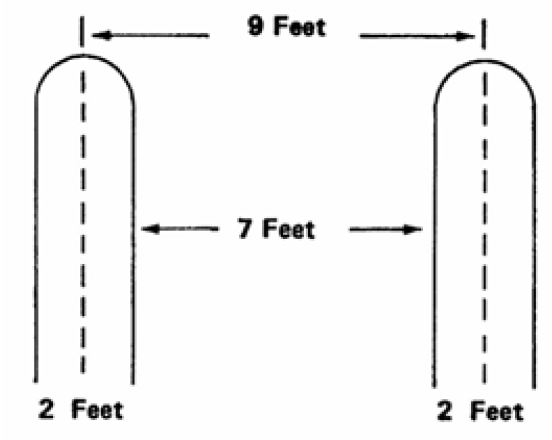
I.
Vehicle Overhang. Parked vehicles may hang over the interior landscaped area or curbing no more than two feet, as long as concrete or other wheel stops are provided to insure no greater overhang or penetration of the landscaped area.
17.503.02
Surfacing.
A.
Surfacing. The entire parking area, including parking spaces and maneuvering lanes, required under this title are encouraged to have asphaltic or concrete surfacing; or porous pavers in accordance with specifications provided by an engineered design report and approved by the Zoning Administrator and/or Board of Adjustment. Such facilities shall provide on-site drainage to dispose of all surface water in the parking area, unless otherwise approved by the Zoning Administrator and/or Board of Adjustment.
B.
Permeable Paving. Permeable or porous paving methods are encouraged in all parking lots regardless of size, including open joined pavers, porous concrete/asphalt, and other methods of increasing stormwater infiltration.
1.
Design Considerations.
a.
Location. In order to maximize positive impacts on stormwater systems, all proposed permeable parking spaces shall be located adjacent to landscaped areas, whether they be interior or perimeter parking lot landscaping (refer to Section 17.602.01.A and Section 17.602.01.B. These areas shall be shown on site plans.
b.
Number. The total number of contiguous, adjacent permeable parking spaces shall be limited to no more than five spaces.
c.
Maneuvering Lanes. In order to accommodate heavy travel, snow plowing vehicles, and promote maintenance and longevity of parking areas, maneuvering lanes shall be regular (i.e., impervious) pavement, while parking spaces only may be permeable.
d.
Use Limitations. Permeable paving may only be provided for low-turnover uses, such as multifamily residential and institutional uses, as determined by the Zoning Administrator and/or Board of Adjustment. High turnover, high traffic volume, and heavy vehicles, normally associated with commercial and industrial uses are not ideal for permeable paving. The Zoning Administrator and/or Board of Adjustment may permit permeable parking spaces for all uses based on evidence submitted by the applicant.
2.
Approval. These methods may only be used when the permeable paving will have sufficient strength to bear expected vehicle loads for the parking area, as demonstrated by the applicant. In addition, all permeable pavement shall comply with the community's Stormwater Management Regulations (if applicable). As such, all proposed permeable pavement shall be reviewed by the community's officials who may consult with state and federal agencies and other technical experts as necessary.
C.
When Surfaced. The parking area shall be surfaced within two months of occupancy of the use it is to serve if it is for a new use, and within two months of the effective date of rezoning if said parking area is to serve an existing use or uses, except when weather conditions prohibiting the pouring of concrete or asphalt extend such time period.
17.503.03.
Off-street loading and parking. Every building used for nonresidential purposes which customarily receives or distributes goods by motor vehicle shall provide sufficient space on the premises for all loading, unloading and service purposes on the basis of the following minimum regulations:
A.
Location. Access to truck loading and unloading space shall be provided directly from a public street or alley or from any right-of-way that will not interfere with public use of the streets or alley and will allow orderly and safe movement.
B.
Supplemental to Off-Street Parking. Loading space required pursuant to this section shall be provided in addition to off-street parking spaces required under Section 17.502.02.
C.
Dimensions. Such loading and unloading space shall be ten feet by 40 feet in area with a 14-foot height clearance and shall be provided according to Table 11:
(O-34-23)

