
Indiantown City Zoning Code
CHAPTER 3
- ZONING DISTRICTS
DIVISION 1. - GENERAL PROVISIONS
The purpose of this division is to establish the zoning districts. The established zoning districts shall govern the use of land and water in the Village.
DIVISION 2. - ZONING DISTRICTS AND STANDARDS
The purpose of this division is to establish the general character and dimensional regulations for the zoning districts.
DIVISION 3. - USE TABLE
The purpose of this division is to establish the permitted, conditional and special exception uses in each zoning district.
DIVISION 4. - SUPPLEMENTAL DEVELOPMENT AND SITE STANDARDS
The purpose of this division is to establish supplemental standards for subordinate structures.
DIVISION 5. - STANDARDS FOR GENERAL USES AND TEMPORARY USES
The purpose of this division is to establish standards for uses of property including temporary or subordinate uses.
DIVISION 6. - DESIGN AND PERFORMANCE STANDARDS
The purpose of this division is to establish supplemental standards for specific uses or for development generally.
DIVISION 7. - CONDITIONAL USE REGULATIONS
The purpose of this division is to establish the conditions of approval for all conditional uses.
Sec. 3-1.1. - Establishment of districts.
The Village is divided into 13 zoning districts and the special Planned Unit Development (PUD) that are established by Table 1, Indiantown Zoning Districts. These districts are shown on the Official Zoning District Map.
Sec. 3-1.2. - Conformance with the Comprehensive Plan.
All development in the Village must be consistent with the Village's Comprehensive Plan. Where there are apparent conflicts between the Village's Comprehensive Plan and any adopted rule, regulation, or ordinance, the Village's Comprehensive Plan shall prevail.
Sec. 3-2.1. - Rural Residential Zoning District.
The Rural Residential zoning district is intended to maintain a scenic character in low-density parts of the Village. Development may cluster in small enclaves or hamlets without detracting from the rural character of the area. Allowable uses in the Rural Residential zoning district include detached single-family dwellings along with accessory uses characteristic of rural development. Low impact farming activities are permitted on parcels larger than one acre.
Density: Maximum density for Rural Residential ranges from one to two dwelling units per acre, depending upon the underlying Future Land Use Designation. The Rural Community Future Land Use Designation allows a density of two units per acre and the Small Residential Farm Future Land Use Designation requires one acre lots.
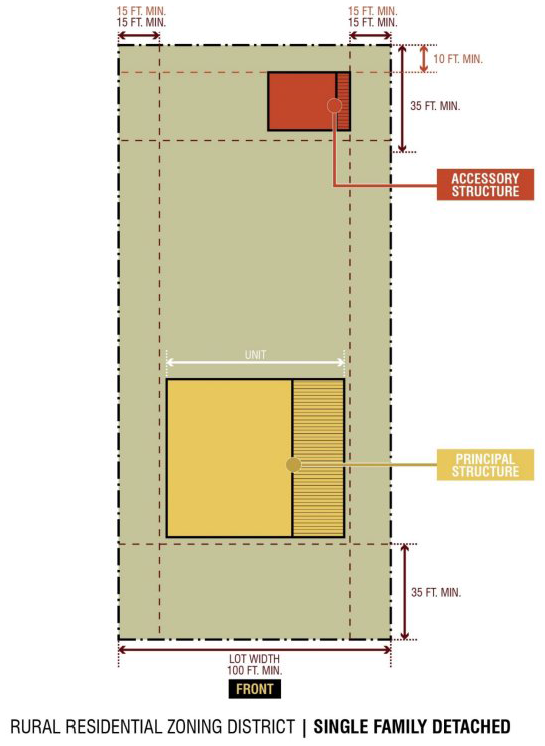
Non-residential Uses: Low impact non-residential uses or those uses which provide needed services to rural residences may be permitted through the special exception process. Permitted uses can be found in the Use Table in division 3 of this chapter.
Sec. 3-2.1.1. - Cluster development in the Rural Residential Zoning District.
The Village Council may approve a property for cluster development in accordance with the following regulations and procedures.
(1)
Purpose. It is the purpose and intent of this chapter to promote more imaginative and appropriate developments in the RR, Rural Residential District by permitting the clustering of single-family dwelling units subject to review and approval of specific regulations and criteria.
(2)
Uses permitted. A cluster development may be approved after public hearing and all necessary plats and agreements or restrictions have been recorded in the public records of Martin County for the following uses:
a.
A one-family residence, including all customary uses associated with this use.
b.
Structures for common usage on commonly owned property, provided they are shown on the site plan approved at a public hearing.
(3)
General requirements.
a.
Minimum site area. The minimum site area, including dedicated rights-of-way, areas reserved and/or dedicated for public parks and for school sites and existing and proposed canals, lakes, and lagoons, shall be ten acres in the RR District.
b.
Density. Density shall be based on net area. Net area shall include all portions of the site, including easements, private streets, and areas dedicated for public parks and for school sites, but excluding dedicated, zoned or proposed rights-of-way, areas proposed or reserved but not dedicated for public parks and for school sites, existing and proposed canals, lakes, lagoons and golf courses.
The maximum number of dwelling units shall not exceed two units per net acre.
Approval for the maximum number of units established above may be granted only for site plans which incorporate the cluster concept, are compatible with the surrounding areas, are consistent with any studies accepted or approved by the Village Council, and fully satisfy the site plan criteria hereafter included.
c.
Lot frontage. Each cluster lot shall have a clear, direct frontage on public streets or to accessways complying with private street requirements.
d.
Setbacks. The following setback requirements shall be maintained:
1.
Single-family dwellings and structures for common usage shall be setback 25 feet from the development perimeter property lines.
2.
Accessory uses in connection with single-family dwellings shall comply with the setback requirements for such structures of the RR, Rural Residential zoning district only when adjacent to the development perimeter property line.
e.
Utilities. Each single-family dwelling unit shall be serviced with separate utilities and other facilities and shall otherwise be independent of one another.
f.
Common open space. Open space for the common benefit of the residents of the proposed development shall be provided in accordance with the requirements herein established. Areas to be credited toward the common open space requirements are categorized as follows:
1.
Category 1:
(a)
Landscaped areas with grass, trees and shrubbery, and unencumbered with any structure or off-street parking, or private drives.
(b)
All of the following uses: entrance features, sitting areas, pedestrian walks, passive recreational uses and permanent outdoor art displays.
2.
Category 2:
(a)
Active outdoor recreational uses including sports facilities such as tennis courts, baseball fields, and other similar uses.
(b)
Existing and proposed water bodies, including lakes, lagoons and canals.
Following are the minimum and maximum percentages for each category of common open space:
Total common open space shall be a minimum 40 percent of net area.
Landscaping and trees shall be provided in accordance with Chapter 4 of these LDRs.
g.
Private open space. Private open space on individual lots shall be for the benefit of the individual lot and shall be the responsibility of the individual lot owner to maintain the same. Privately owned open space shall constitute no less than 20 percent of each individual lot.
h.
Common ownership provisions. Provisions satisfactory to the Village shall be made to assure that all common areas and facilities for use of all residents shall be maintained in a continuous and satisfactory manner, and without expense to the general taxpayer of the Village. Such may be provided by the incorporation of a membership in the homeowners' association for the purpose of holding title to such areas and facilities and levying assessments against each individual ownership for the purpose of maintaining such common areas and facilities. These areas and facilities shall include, but not be limited to, all commonly owned recreational facilities, open space, off-street parking areas, private streets, sidewalks, streetlights. Such maintenance may include the upkeep of individual privately owned lots and structures and water bodies such as lakes, lagoons, and canals. Such assessments shall be a lien superior to all other liens except tax liens and first mortgage liens.
Other methods, including special taxing districts, may be acceptable if there is no expense to the general taxpayers.
Homeowners' associations or condominium owners' associations shall not grant exclusive rights to any individual lot owner.
The instrument incorporating such provisions shall be approved by the Village Attorney as to form and legal sufficiency before submission to the Village Council. After approval such instrument shall be recorded in the public records of Martin County.
i.
Development in stages. Where the proposed development is in excess of the minimum site area requirements the same may be developed in stages providing that each stage meets minimum site area requirements and all other requirements of residential cluster development regulations are met for each stage.
j.
Condominium provisions. Anything herein to the contrary notwithstanding, ownership of a cluster development may be by way of a condominium in accordance with law in that regard made and provided.
k.
Additions. Additions and/or changes to single-family dwellings, to accessory uses in connection therewith and/or to the structures for common usage such as utility rooms, swimming pools, clubs, open terraces or patios roofed and/or screened but not enclosed, new facade treatments, trellis and other similar garden amenities, and sun control devices such as awnings may be authorized provided:
1.
That such proposed additions and/or changes will be compatible with the existing development in the area, in harmony with the general appearance and character of the community, in compliance with the site plan review criteria hereinafter provided and will not otherwise be detrimental to the public welfare.
2.
That such proposed additions and/or changes are designed and arranged on the site in a manner that minimizes aural and visual impact on the adjacent structures while affording the applicant a reasonable use of the land.
3.
That such proposed additions and/or changes and the structures adjacent thereto in individually owned lots or on commonly owned land are illustrated by means of site plans, floor plans, sections and elevations.
4.
That such proposed additions and/or changes are approved in writing from an official authorized body designated by the cluster development to approve architectural changes in the cluster community and providing further that written approval of the immediate adjacent cluster unit owners is secured.
(4)
Site plan review.
a.
Procedure. Cluster developments shall be reviewed in accordance with the Major Site Plan review process and with all applicable requirements, including the site plan review exhibits and criteria provided within.
In approving a development plan, the Village Council may, by special exception, vary, amend or modify the applicable RR, Rural Residential zoning district regulations and/or subdivision regulations in order to effectuate the plan, provided the elements affected by such special exceptions are specifically noted upon the site plan review exhibits and provided the same are in harmony with the general purpose and intent of these LDRs.
b.
Criteria. The following criteria shall be utilized in the site plan review process:
1.
Purpose and intent. The proposed development fulfills the purpose and intent of this chapter.
2.
Studies. Design studies, planning studies and/or neighborhood area studies accepted or approved by the Village Council that include development patterns or environmental design criteria which would apply to the development proposal under review shall be utilized in the plan review process.
3.
Clustering. The major site planning elements, buildings, open space, both common and private, and roads and parking shall be so arranged as to group the dwelling units into physically definable clusters.
4.
Buffers. Architectural and landscape elements that provide a logical transition to adjoining existing or permitted uses shall be provided.
5.
Exterior spatial relationships. The arrangement of structures and landscape shall produce spatial relationships that function with the intended use and occupancy of the project and are compatible with the development or zoning in the adjoining area. Spacing between buildings shall provide ample access for emergency equipment.
6.
Scale. Scale of proposed structures shall be compatible with surrounding proposed or existing uses or shall be made compatible by using buffering elements.
7.
Circulation. Pedestrian and auto circulation shall be separated as is practicable, and all systems shall adequately serve the needs of the development and be compatible and functional with circulation systems outside the development.
8.
Parking areas. Parking areas shall be so designed as to appropriately relate to the development, its environs, and adjacent properties.
9.
Storage areas. Storage areas for boats and trailers, when provided, shall be screened and designed, as to appropriately relate to the development, its environs and adjacent properties.
10.
Trash containers. Trash containers, when provided, shall be screened and so designed as to be conveniently accessible to their users.
11.
Landscape. Landscape shall be preserved in its natural state insofar as is practicable by minimizing tree removal. Landscape shall be used to shade and cool, direct wind movements, enhance architectural features, relate to the design of the site, and visually screen noncompatible uses.
12.
Common open space. Common open spaces shall be provided, appropriate to the needs of the development. Common open space shall relate to any natural characteristics in such a way as to preserve and enhance their scenic and functional qualities and shall be so located and developed as to be accessible by all residents of the development.
13.
Private open space. Open space intended for the private use of each individual dwelling unit should be so located and designed as to maximize its utility to the dwelling unit it serves.
14.
Privacy. Aural and visual privacy shall be considered in the design of the development.
Sec. 3-2.2. - Limited Residential Zoning District (LR).
The Limited Residential zoning district is intended to accommodate development of residential neighborhoods with a mix of community facilities. Allowable uses in this zoning district include all housing types and residential accessory uses, as well as complimentary community services, recreational facilities and light infrastructure serving the residential uses.
Density: Maximum density for Limited Residential is five dwelling units per acre. This zoning district enables the Suburban Residential Future Land Use Designation.
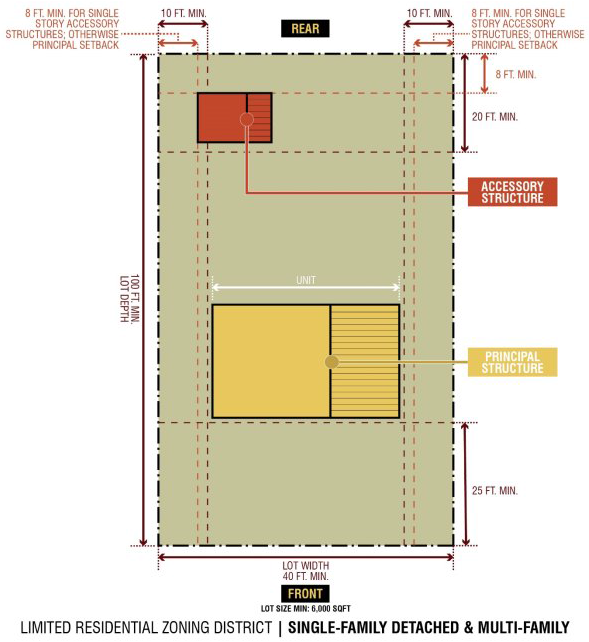
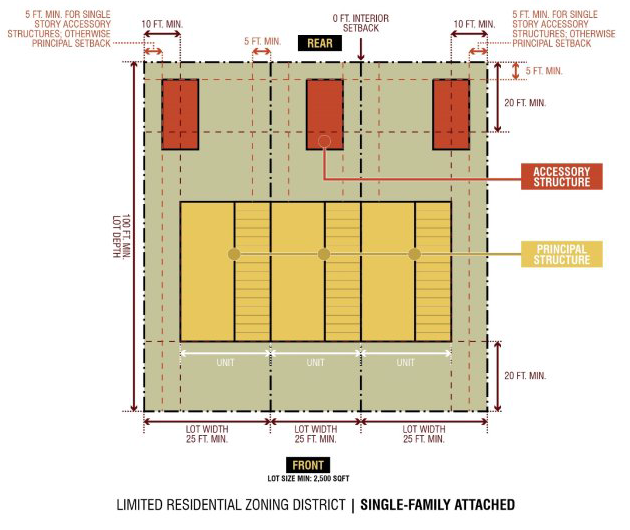
Non-residential Development: This zoning district permits community services, recreational facilities and light infrastructure, serving the residential uses, which are compatible and complimentary to a residential neighborhood. All non-residential development shall meet the Community Facility (CF) development standards.
Sec. 3-2.3. - Single-Family Residential Zoning District (SR).
The Single-Family Residential zoning district is intended to preserve the integrity of established residential neighborhoods, including established mobile home subdivisions, while allowing compatible infill development. Allowed uses in this zoning district are attached and detached single-family dwellings, including mobile homes where appropriate, and residential accessory uses; commercial development is not permitted.
Density: The single-family residential district allows a density of eight dwelling units per acre with an optional density bonus up to ten dwelling units per acre when in compliance with additional criteria (see Additional Density within this section for details). This zoning district enables the Residential and Mobile Home Future Land Use Designations.
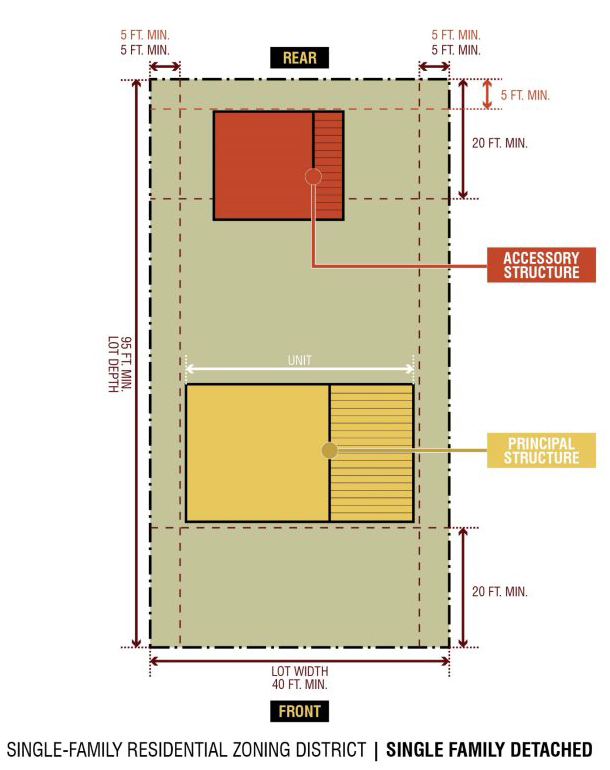
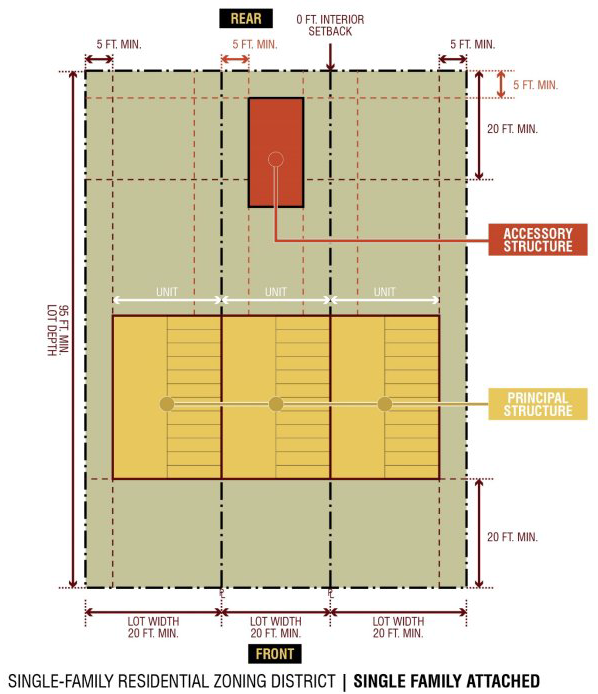
Non-residential Development: This zoning district permits community services, recreational facilities and light infrastructure, serving the residential uses, which are compatible and complimentary to a residential neighborhood. All non-residential development shall meet the Community Facility (CF) development standards.
Sec. 3-2.4. - Neighborhood Mixed-Use Zoning District (NMU).
The Neighborhood Mixed-Use zoning district is intended to encourage the creation of complete neighborhoods through the integration of residential, commercial and mixed-use developments. Allowable uses in the Neighborhood Mixed-Use zoning district include a mix of dwelling types, as well as small-scale neighborhood-serving commercial uses and a complement of civic amenities (see Use Table for additional details and specific uses).
Density and Intensity: The Neighborhood Mixed-Use zoning district enables the Village Core Mixed-Use and Urban Residential Office Future Land Use Designations. The allowable density and intensity of a property is dependent upon the underlying Future Land Use Designation. For land in the Village Core Mixed-Use Future Land Use Designation the density range is 5—20 dwelling units per acre and maximum intensity for non-residential uses is floor area ratio of 2.5. For land in the Urban Residential Office Future Land Use Designation the density range is 3—15 dwelling units per acre and maximum intensity for non-residential uses is floor area ratio of 1.5.
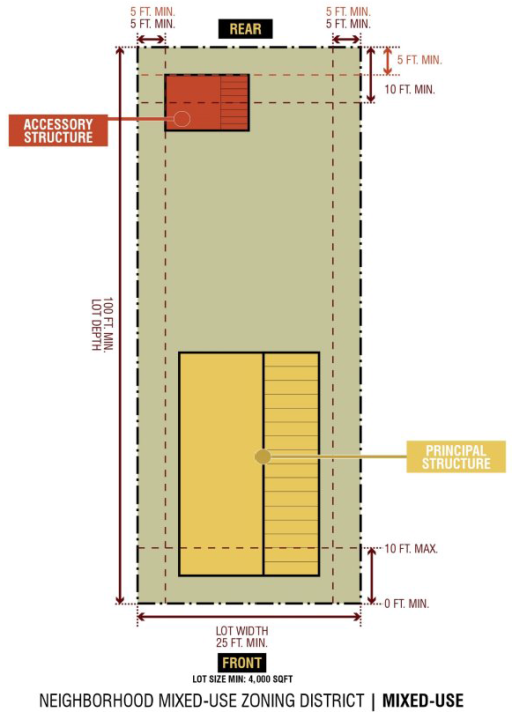
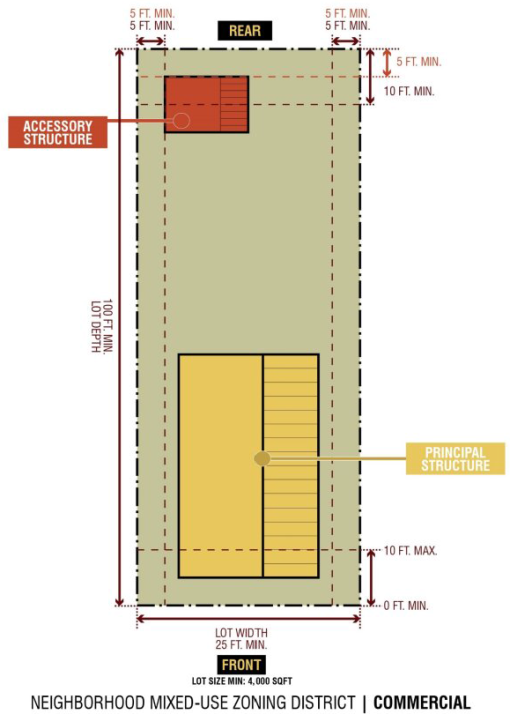
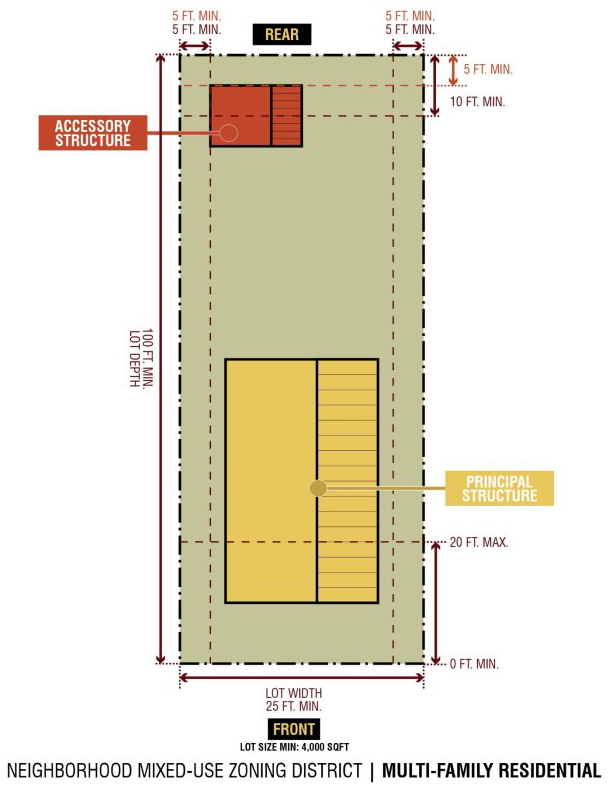
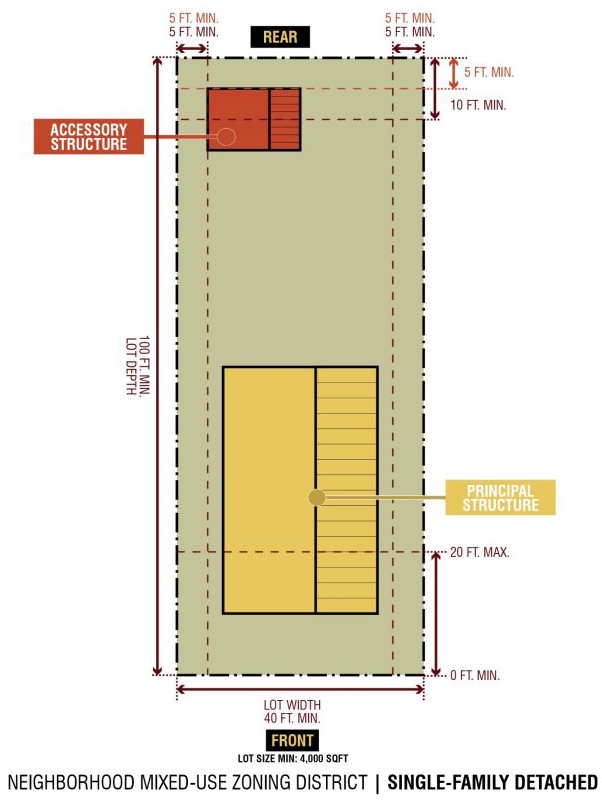
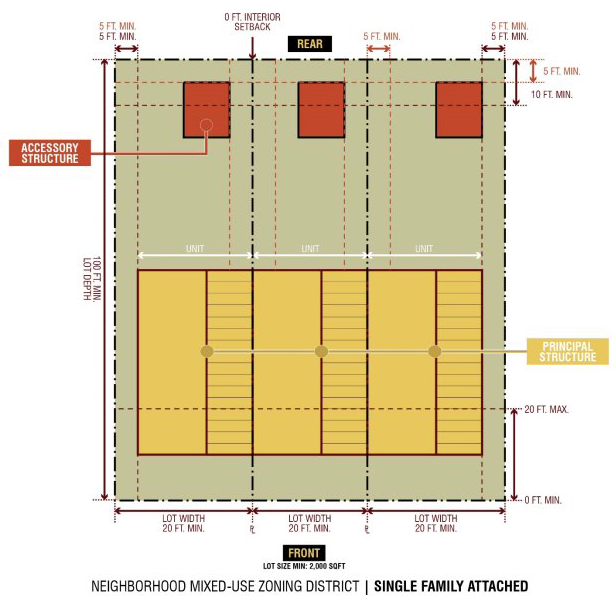
Façade Elements: To create a consistent interface between the pedestrian realm and the built environment, 65—80 right-of-way of the building frontage must be built to the front setback.
Canopies, awnings, arcades, porches or balconies must extend at least 50 percent of the length of the building frontage. These features may encroach over the entire sidewalk, minus two feet. Enclosed building space over arcades or porches is permitted. Any built space over the sidewalk will require appropriate permits.
Parking areas shall be located to the rear or side of buildings and should be interconnected with other parking areas when possible.
Design Standards: The Design Standards in Certain Zoning Districts, found in Chapter 3, section 3-6.6, apply to development and redevelopment in the Neighborhood Mixed-Use zoning district.
Green and Sustainable Development Incentives: Development in the Neighborhood Mixed-Use zoning district may achieve a greater gross area per floor, height and number of stories by meeting the requirements for Green and Sustainable Development, found in Chapter 3, section 3-6.8, Green and Sustainable Development Standards.
Sec. 3-2.5. - Downtown Zoning District (D).
The Downtown zoning district is intended to provide for a dense, mixed-use and walkable district to serve as the business, cultural, social and geographic center of the Village. Allowable uses in this zoning district include a variety of complementary and integrated uses that are walkable, including office, retail, entertainment, dining and employment centers together with a full array of dwelling types and civic amenities (see Use Table for additional details and specific uses).
Density and Intensity: The density range for Downtown is 5—20 dwelling units per acre and a floor area ratio for non-residential uses of 2.5. This zoning district enables the Village Core Mixed-Use Future Land Use Designation.
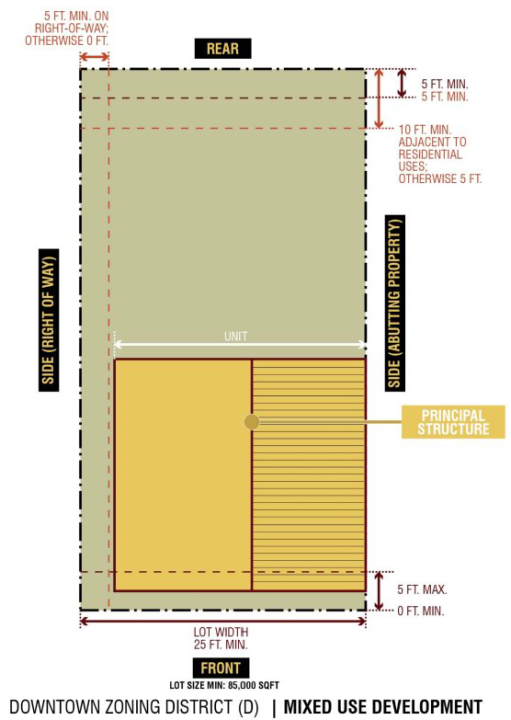
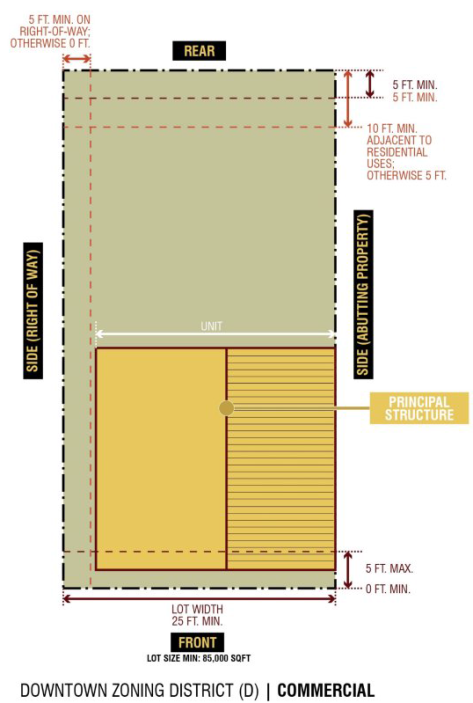
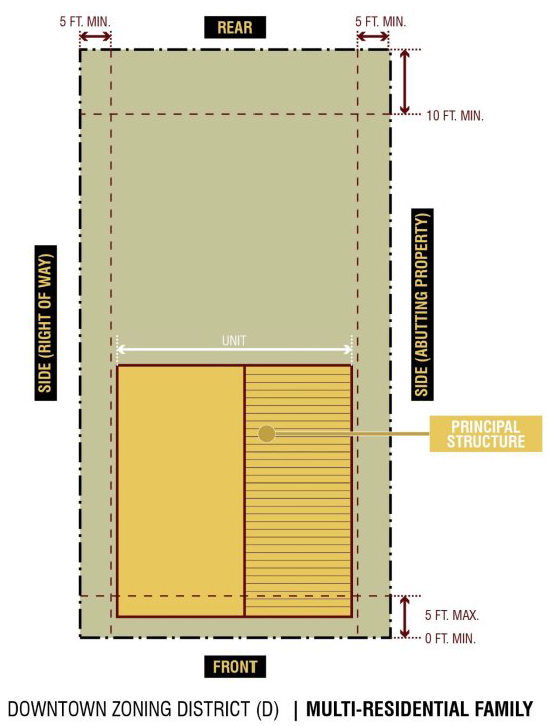
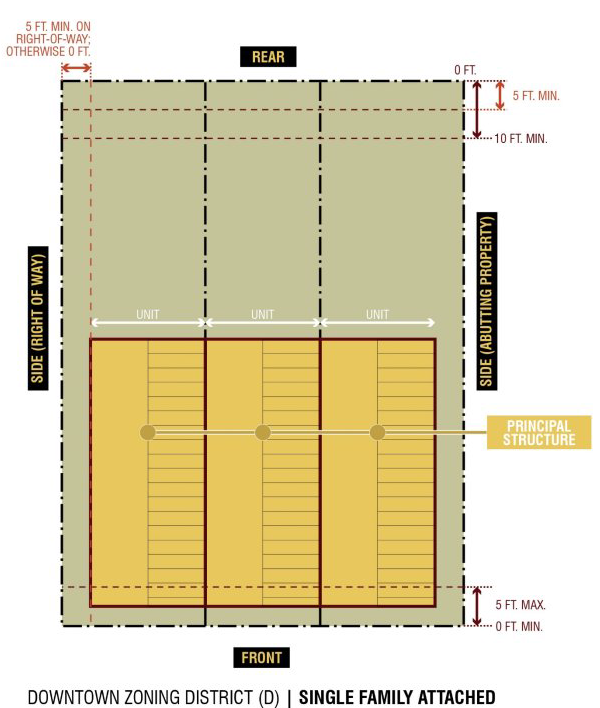
Façade Elements: To create a consistent interface between the pedestrian realm and the built environment, a minimum of 80 percent of the building frontage must be built to the front setback.
Canopies, awnings, arcades, porches or balconies must extend at least 50 percent of the length of the building frontage. These features must encroach 50 percent of the depth of the sidewalk to create a pedestrian friendly streetscape and must provide a minimum of ten feet clear height and eight feet depth. Enclosed building space over arcades, that encroach the sidewalk, is permitted with appropriate permits.
Parking areas shall be located to the rear or side of buildings and should be interconnected with other parking areas when possible.
Design Standards: The Design Standards in Certain Zoning Districts, found in Chapter 3, section 3-6.6, apply to development and redevelopment in the Downtown Zoning District.
Green and Sustainable Development Incentives: Development in the Downtown zoning district may achieve a greater gross area per floor, height and number of stories by meeting the requirements for Green and Sustainable Development, found in Chapter 3, section 3-6.8, Green and Sustainable Development Standards.
Sec. 3-2.6. - Village Mixed-Use Zoning District (VMU).
The Village Mixed-Use zoning district is intended to accommodate a broad range of uses in corridors and nodes but with more flexible design standards than Downtown. Allowable uses in this zoning district include a full range of single-family and multi-family residences as well as office, retail, dining and employment centers (see Use Table for additional details and specific uses).
Density and Intensity: The density range for Village Mixed-Use is 5—20 dwelling units per acre and a floor area ratio for non-residential uses of 2.5. This zoning district enables the Village Core Mixed-Use Future Land Use Designation.
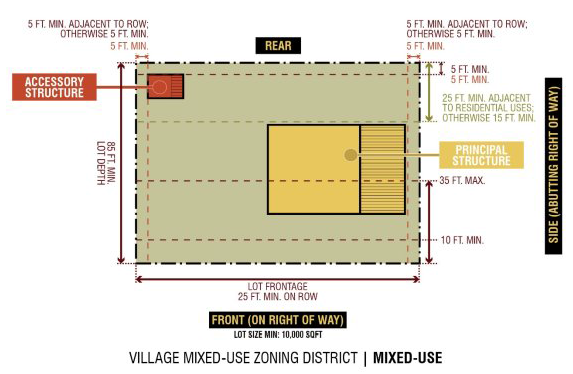
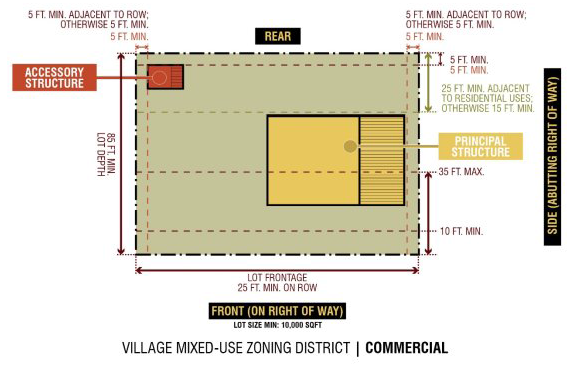
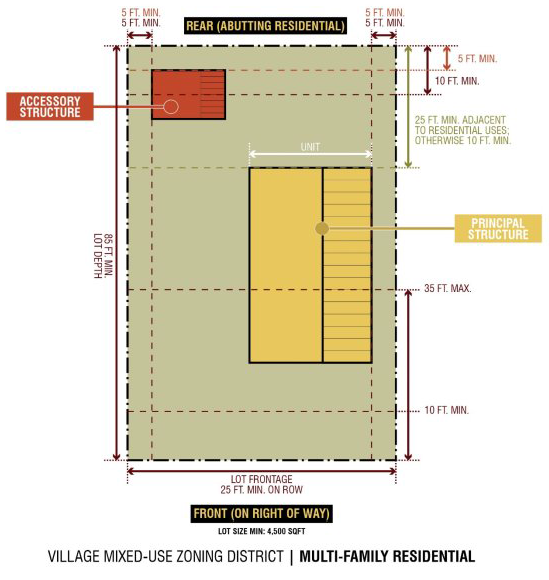
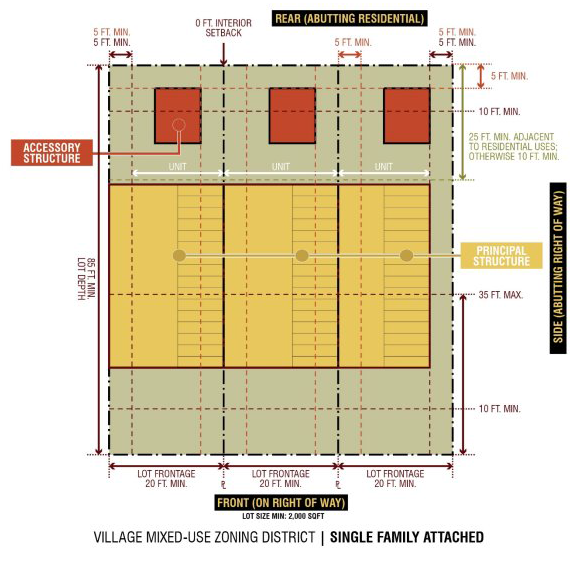
Façade Elements: To create a consistent interface between the pedestrian realm and the built environment, 60—80 percent of the building frontage must be built to the front setback.
Canopies, awnings, arcades, porches or balconies must extend at least 50 percent of the length of the building frontage. These features may encroach up to 50 percent of the depth of the setback (example: 10-foot building setback allows encroachment of five feet, or 30-foot building setback allows encroachment of 15 feet). Enclosed building space over arcades or porches is permitted.
When frontage is located on Warfield Boulevard, parking areas shall be located to the rear or side of buildings and should be interconnected with other parking areas when possible.
Design Standards: The Design Standards in Certain Zoning Districts, found in Chapter 3, section 3-6.6, apply to development and redevelopment in the Village Mixed-Use zoning district.
Green and Sustainable Development Incentives: Development in the Village Mixed-Use zoning district may achieve a greater height and number of stories by meeting the requirements for Green and Sustainable Development, found in Chapter 3, section 3-6.8, Green and Sustainable Development Standards.
Sec. 3-2.7. - Canal Mixed-Use Zoning District (CMU).
The Canal Mixed-Use zoning district is intended to support the development of maritime activities and water-related uses along waterfront-accessible sites. Allowable uses in the Canal Mixed-Use zoning district include marinas with docking facilities of all types, boatyards, boating-related sales and repair, restaurants, and retail. Hotels and residential uses are also permitted if associated with a mixed-use project (see Use Table for additional details and specific uses).
Density and Intensity: The Canal Mixed-Use zoning district allows commercial at a floor area ratio of 3.0. Mixed-use developments are permitted a residential density of 20 units per acre. Hotel and motel rooms are permitted up to 30 rooms per acre. The Canal Mixed-Use zoning district enables the Commercial Waterfront Future Land Use Designation.
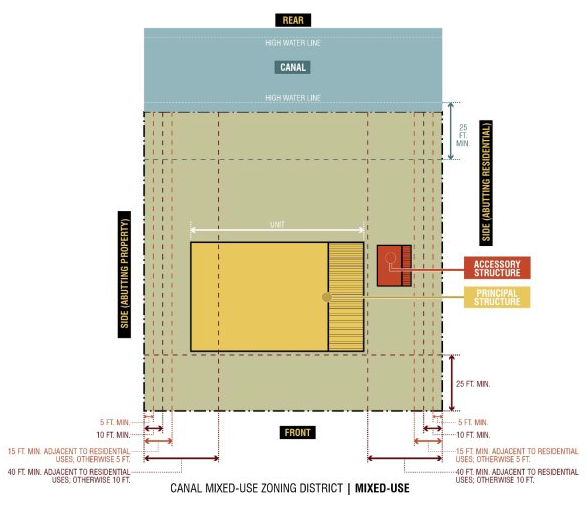
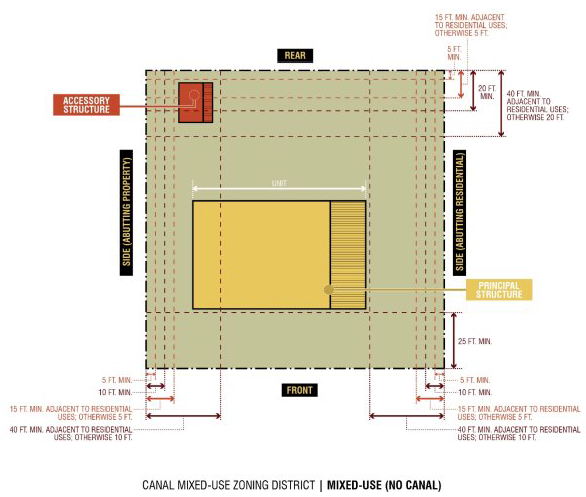
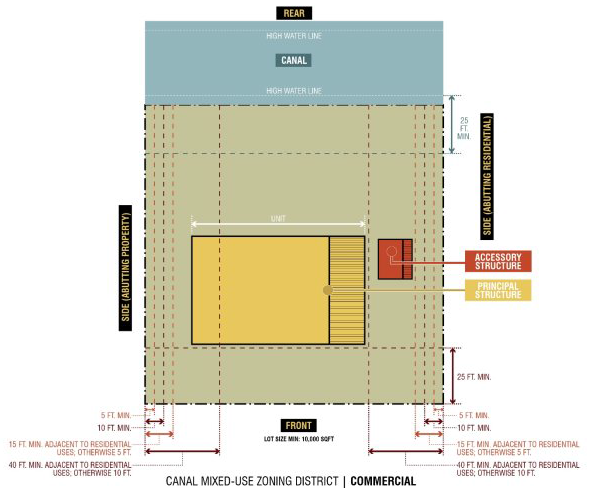
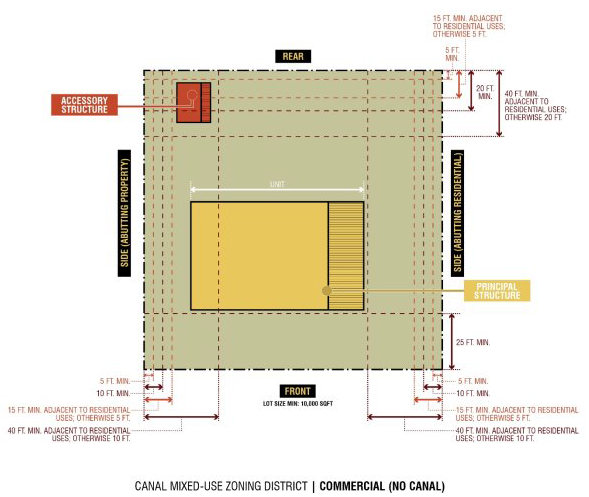
Façade Elements: To create a consistent design aesthetic, please refer to section 3-6.6.
Parking areas may be located to the rear or side of buildings and should be interconnected with other parking areas when possible.
Design Standards: The Design Standards in Certain Zoning Districts, found in Chapter 3, section 3-6.6, apply to development and redevelopment in the Canal Mixed-Use zoning district.
Green and Sustainable Development Incentives: Development in the Canal Mixed-Use zoning district may achieve a greater gross area per floor, height and number of stories by meeting the requirements for Green and Sustainable Development, found in Chapter 3, section 3-6.8, Green and Sustainable Development Standards.
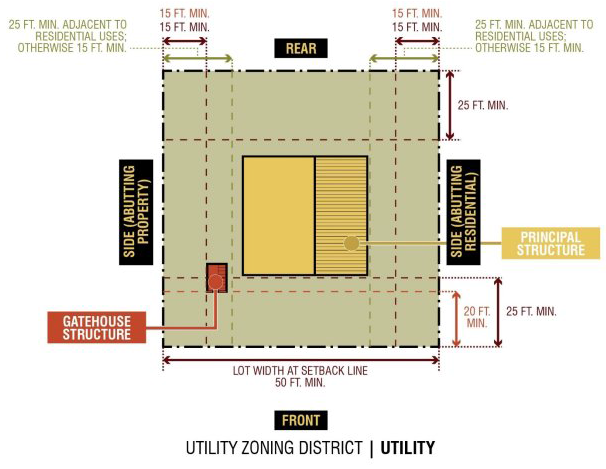
Sec. 3-2.8. - Utility Zoning District (U).
The Utility zoning district is intended to accommodate existing (and future) utility infrastructure. This zoning district allows water, sewer, and electrical plants as well as accessory utility infrastructure (see Use Table for additional details and specific uses).
Intensity: The Utility zoning district allows development up to a floor area ratio of 3.0. This zoning district enables the Utility Future Land Use Designation.
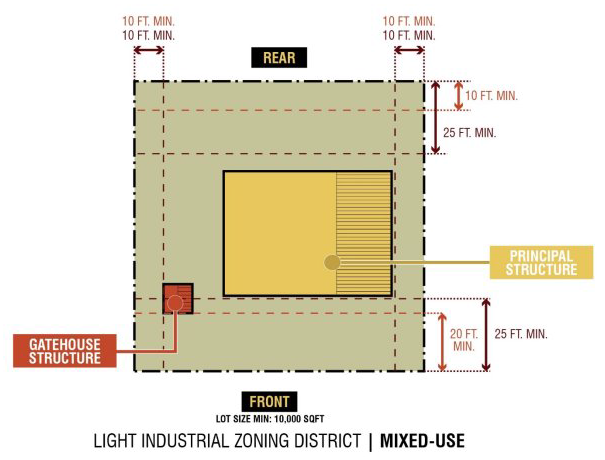
Sec. 3-2.9. - Light Industrial Zoning District (LI).
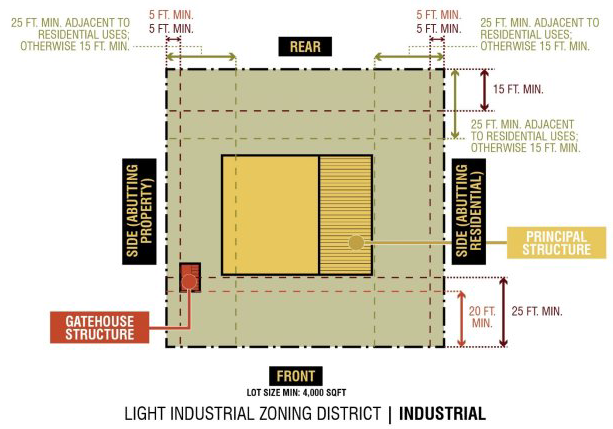
The Light Industrial zoning district is intended to accommodate manufacturing businesses and activities which do not have a substantial impact on adjacent uses, together with complementary commercial activities. Allowable uses in this zoning district include research and development, small-scale production, assembly, warehousing and other uses which do not use hazardous materials and processes or create noise, smoke, vibration, and dust (see Use Table in Division 3 of this chapter for additional details and specific uses).
Intensity: Maximum floor area ratio for Light Industrial is 2.0. This zoning district enables the Light Industrial Future Land Use Designation.
Height in Light Industrial: Structures taller than 50 feet or over four stories may be permitted administratively where the applicant for the project can show the following:
1.
The proposed additional height of the building or structure will not increase the noise, vibration, smoke or dust generated by the use;
2.
The building or structure will not create a danger to air traffic;
3.
The building or structure is set back an adequate distance from any property line to ensure the collapse of the structure will not impact surrounding properties; and
4.
The proposed building or structure meets all other code requirements.
Performance Standards: It is the intent of these regulations to prevent development that creates noxious or hazardous conditions. Any use permitted in the Light Industrial zoning district must also comply with section 3-6.9, industrial performance standards. The Village Manager or designee may require a signed and sealed report from an appropriately qualified certified engineer stating that all performance standards will be met.
Green and Sustainable Development Incentives: Development in the Light Industrial zoning district may achieve a greater height and number of stories by meeting the requirements for Green and Sustainable Development, found in Chapter 3, section 3-6.8, Green and Sustainable Development Standards.
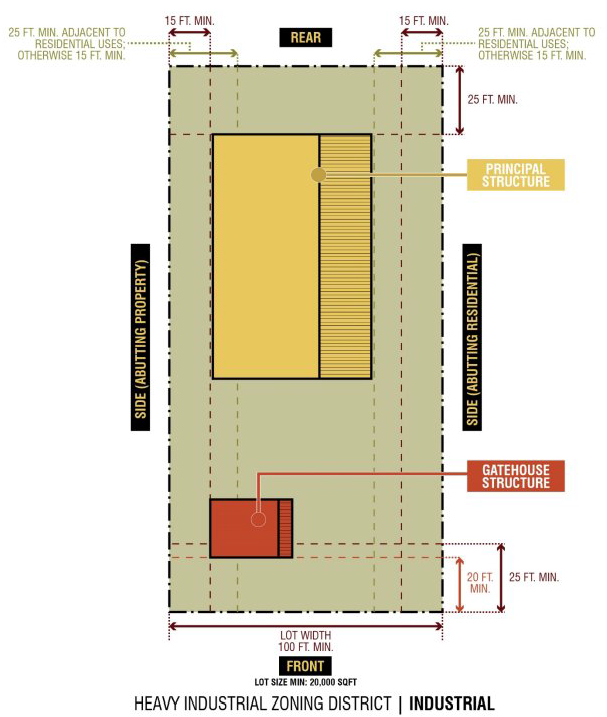
Sec. 3-2.10. - Heavy Industrial Zoning District (HI).
The Heavy Industrial zoning district is intended to accommodate manufacturing businesses and activities which may substantially impact adjacent uses, together with complementary commercial activities. Allowable uses in this zoning district include intensive production uses, such as extraction, batching or mixing plants, which create noise, smoke, vibration or dust; or which utilize or store hazardous materials. Accessory commercial is allowed (see Use Table in Division 3 of this chapter for additional details and specific uses).
Intensity: Maximum floor area ratio for Heavy Industrial is 3.0, residential uses are not permitted in this zoning district. This zoning district enables the Heavy Industrial Future Land Use Designation.
Height in Heavy Industrial: Structures taller than 50 feet or over four stories may be permitted administratively where the applicant for the project can show the following:
1.
The proposed additional height of the building or structure will not increase the noise, vibration, smoke or dust generated by the use;
2.
The building or structure will not create a danger to air traffic;
3.
The building or structure is set back an adequate distance from any property line to ensure that collapse of the structure will not impact surrounding properties; and
4.
The proposed building or structure meets all other code requirements.
Performance Standards: It is the intent of these regulations to prevent development that creates noxious or hazardous conditions. Any use permitted in the Heavy Industrial zoning district must also comply with section 3-6.9, industrial performance standards. The Village Manager or designee may require a signed and sealed report from an appropriately qualified certified engineer stating that all performance standards will be met.
Uses Not Permitted: Hydraulic fracturing, commonly referred to as fracking, is not a permitted use in the Heavy Industrial zoning district.
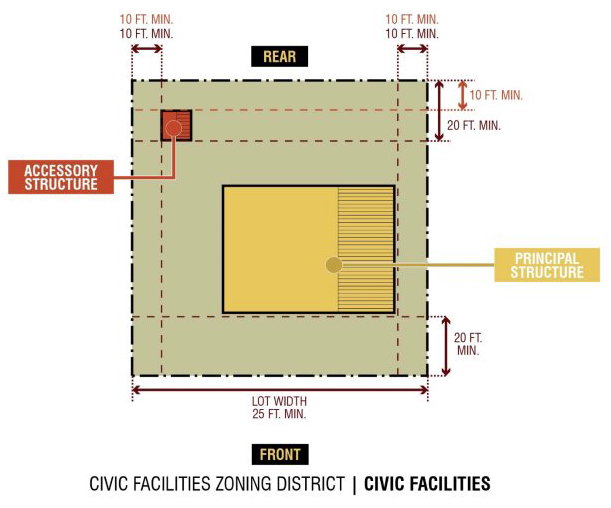
Sec. 3-2.11. - Civic Facilities Zoning District (CF).
Civic Facilities zoning district is intended to accommodate public and semi-public uses, facilities and services necessary to a complete community. This zoning district allows schools, libraries, community centers, fire stations, police stations, governmental facilities, not including any facilities of the Village, religious facilities and accessory facilities associated with these uses (see Use Table in Division 3 of this chapter, for additional details and specific uses).
Intensity: The Civic Facilities zoning district allows development up to a floor area ratio of 0.75, it is not intended for residential development beyond residences for caretakers or employees as necessary. This zoning district enables the Institutional and Educational Future Land Use Designation.
Sec. 3-2.12. - Parks and Open Space Zoning District (P).
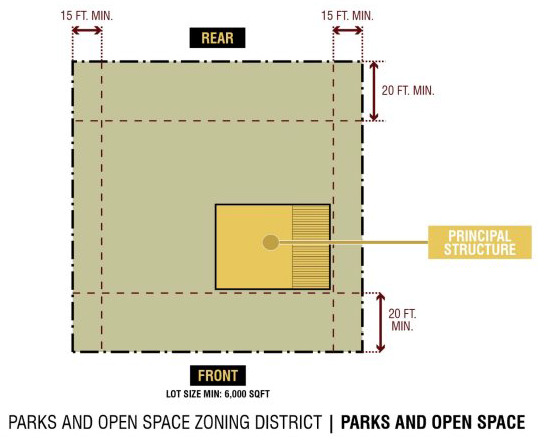
Parks and Open Space zoning district is intended to designate and preserve publicly and privately-owned recreational and open space property and facilities. This zoning district allows passive and active parks and recreational facilities, including historic sites, cemeteries and publicly-owned stormwater facilities (see Use Table, in Division 3 of this chapter for additional details and specific uses).
Intensity: The Parks and Open Space zoning district allows development up to a floor area ratio of 0.5, it is not intended for residential development beyond residences for caretakers as necessary. This zoning district enables the Institutional and Recreational Future Land Use Designation.
Development Standards: Traditional neighborhood, local and regional parks shall comply with the above development standards. However, these standards shall not limit the creation of linear parks, pocket parks, tot lots, greenway trails and other nontraditional parks which create engaging outdoor space for the community.
Development within this zoning district shall minimize impervious surfaces. Unimproved parking areas are permitted where environmental degradation will not occur.
Existing uses and structures listed on the local or national historic register shall be considered conforming.
Sec. 3-2.13. - Conservation Zoning District (C).
The Conservation zoning district is intended to facilitate the conservation of environmentally sensitive public and private lands. This zoning district may include wilderness and wildlife management areas, forests, wetlands and other natural resource protection areas. Lands zoned Conservation must be protected and maintained in a natural state in perpetuity.
Intensity:The Conservation zoning district allows a maximum of ten percent impervious coverage. This zoning district enables the Conservation Future Land Use Designation.
Criteria for Conservation Zoning: No development criteria are applicable to conservation zoned property. The Conservation zoning district will apply to property encumbered by an irrevocable conservation easement. Land should be considered for conservation when the property meets one or more of the following criteria:
1.
Contains a natural sinkhole, spring or unique geological feature;
2.
Located within a significant strategic habitat conservation area;
3.
Provides habitat for endangered, threatened or imperiled species;
4.
Contributes to a significant landscape, landscape linkage or conservation corridor;
5.
Contains an underrepresented native ecosystem;
6.
Protects natural floodplain functions;
7.
Protects surface waters of the state;
8.
Protects functional wetlands;
9.
Provides groundwater recharge critical to springs, sinks, aquifers or other natural systems;
10.
Provides retention of natural open space within densely built-up or urban areas; or
11.
Meets other local or state conservation criteria.
Sec. 3-2.14. - Planned Unit Development (PUD).
(1)
Existing Planned Unit Developments. Prior to November 12, 2020, several PUD's were approved that are within the municipal boundaries of the Village. All binding written documents and associated development plans shall remain valid for the length of term of the PUD. After the expiration of the PUD terms, all new development within the PUD boundary shall conform to the Future Land Use Map, underlying Zoning and, these LDRs.
(2)
New Planned Unit Developments, purpose and intent. The planned development approach is an option that may be used by the private sector and Village to achieve redevelopment and economic development, environmental reparation and enhancement, and social and cultural enrichment. The intent and purpose of the planned development (PUD) district is to accomplish a more desirable environment and efficient land use pattern than would be possible through the application of conventional zoning, while adhering to the provisions of the comprehensive plan and applicable state regulations. The purpose of the PUD is further defined to:
(a)
Allow a more flexible management structure for the efficient, orderly, cohesive, and sustainable integration of uses, consistent with and complementary to their context within the community;
(b)
Achieve higher quality urban design amenities;
(c)
Promote a mix of residential, commercial, retail, professional, and/or light industrial uses, with positive interactions among and between these uses;
(d)
Promote innovative site planning techniques to development;
(e)
Create a greater sense of place, community, and neighborhood identity, through superlative urban design and innovation;
(f)
Provide a master site plan that is compatible with and complements the surrounding community, creating a safe inviting environment, a sense of place, and neighborhood cohesiveness;
(g)
Maintain, enhance, and preserve salient or otherwise significant existing natural features, by identifying these features and designing the project to incorporate them as view-sheds, terminating vistas, focal points, and/or other scenic or natural amenities;
(h)
Provide a mix of safe, functional, interconnected, and convenient pedestrian, bicycle and multi-modal transportation options within the PUD and surrounding areas;
(i)
Limit urban sprawl, greenhouse gas emissions, stormwater runoff, and vehicle miles traveled;
(j)
Provide economically efficient means for delivery of government services and increased infrastructure stability;
(k)
Provide a mix of housing types designed in pedestrian scale neighborhood unit increments;
(l)
Incorporate energy and water efficient land use patterns and technologies beyond the minimums required by state law or the Florida Building Code;
(m)
Incorporate crime prevention through environmental design (CPTED) principles compatible with the pedestrian-oriented design; and
(n)
Further the goals, objectives and policies of the comprehensive plan.
(3)
Development agreement and master site plan required.
(a)
Development agreement. All development agreements shall comply with Chapter 9, Development Agreements, section 12-11, development agreements and amendments, and F.S. § 163.3227 et seq.
1.
The PUD zoning designation requires the review, approval, execution and recording of a development agreement between the applicant and Village Council.
2.
No site work, other than that normally associated with surveying and soil boring, may be initiated prior to recordation of such development agreement.
3.
Demolition of structures, wells, and/or septic systems or hazardous material cleanups may be permitted if not otherwise prohibited by this Code.
(b)
Master site plan. The PUD district requires the review and approval of a master plan, which shall be approved as an exhibit to or by reference in the development agreement.
(4)
General guidelines and standards for planned developments. In addition to the requirements in section 9-4, final development agreement, all applications for rezoning to the PUD zoning district shall comply with the following general guidelines and standards for planned developments.
(a)
Unified ownership. All land within the PUD shall be under the ownership of the applicant, be it an individual, partnership or corporation, or groups of individuals, partnerships, or corporations.
1.
At the time of application for rezoning to PUD, the applicant shall present evidence of unified ownership of the entire area within the proposed PUD.
2.
These documents shall be reviewed for and are subject to a determination of legal sufficiency by the Village attorney.
(b)
Minimum size. The minimum size for a PUD created after November 12, 2020, is 50 acres.
(c)
Land use. The planned unit development/PUD master site plan option is available within all future land use designations except those lands designated recreational, conservation, and heavy industrial.
(d)
Permissible and prohibited uses.
1.
Permissible uses within the planned unit development/PUD master site plan shall be established within the development agreement, consistent with the underlying future land use designation(s):
i.
Densities and intensities (floor area ratio) shall be consistent with the corresponding future land use designation of the Indiantown comprehensive plan.
ii.
A planned unit development/PUD master site plan can be comprised of a single use, such as residential, or a mixture of residential and nonresidential uses.
2.
Prohibited uses are those uses not enumerated in the development agreement.
(e)
Master site plan. At a minimum, the master site plan shall depict: The maximum development density and/or intensity for the property expressed in appropriate units of measurement (e.g., dwelling units for residential uses, square footage for commercial and office uses, etc.);
1.
The general location of all areas proposed to be developed for residential and nonresidential uses (i.e. development "modules" or "pods"); and
2.
The general size, configuration, and location of each development phase, unless the development is to be constructed in a single phase; and
3.
The minimum width and composition of any proposed buffers and/or setbacks along the perimeter of the subject property; and
4.
An overall circulation plan that shows:
(i)
the location of all points of vehicular ingress and egress from existing easements or rights-of-way into the development; and
(ii)
location and right-of-way widths for proposed collector and arterial streets within the PUD, including those that connect directly with streets outside of the PUD;
(iii)
right-of-way widths for major pedestrian, bicycle and other nonmotor vehicle circulation ways; and,
(iv)
whether the roads that serve the lots will be publicly or privately maintained.
5.
The general location of area set aside for open space and recreational features; and
6.
The location of proposed community or public uses, such as recreation areas, clubhouses, schools, houses of worship and the like; and
7.
Access and facilities for public transit, where applicable; and,
8.
Areas to be set aside for preservation of environmentally sensitive lands, wetlands or other natural features;
9.
Generalized location of stormwater management, potable water and wastewater systems; and,
10.
Typical lot details; and,
11.
Typical sections for all proposed streets and right of ways, including sidewalks, trails, landscaping, furnishing/utility zones and bike lanes, shall be included with the master site plan; and,
12.
Typical landscape buffer sections including planting details and specifications for all perimeter buffers and any internal buffers between uses and,
13.
Typical details for furnishings, fixtures, lighting, bike racks, trash enclosures and other amenities.
(f)
Perimeter transition.
1.
General. The transition between existing development and PUD shall provide a progression of complementary uses to the greatest extent reasonably possible. The goal is to encourage interconnectivity, to avoid the need for or use of walls, earthen berms, or other obstacles, and to encourage access and positive interaction and synergy among and between uses.
2.
Landscape buffers. All required buffers shall be dedicated on the plat, if applicable, and shall be held in common ownership to ensure adequate and uniform maintenance.
(g)
Maximum height of structures. No structure in an approved PUD shall exceed the maximum height established in the equivalent standard zoning district for the proposed uses.
(h)
Conflicts. Upon any conflicts between this section of the Village LDR and other sections of the LDR, this section shall apply.
(Ord. No. 09-2022, § 2(Exh. A), 7-28-2022)
Sec. 3-3.1. - Permitted uses.
Footnotes to Permitted Use Table:
1
To ensure consistency with Policy L6.1.14 (Commercial Waterfront Future Land Use) of the Indiantown Comprehensive Plan, the specified use shall be permissible within the Canal Mixed-Use zoning district where such use is a marina or water-related use, or such use is integrated into and serves a multi-use project that has an overall marina or water- related use.
(Ord. No. 02-2022, § 2(Exh. A), 4-14-2022)
Sec. 3-3.2. - Uses not listed.
Any proposed use not listed in this table shall be evaluated by the Village to determine compatibility and impacts. Uses may be compared to similar listed uses found in the North American Industrial Classification System (NAICS) as deemed appropriate by the Village. A determination must be made regarding whether the listed use and the proposed use impacts are not materially different than the listed use. Decision criteria shall be based on:
(1)
Parking demand and trip generation (daily and peak hour);
(2)
Impervious surface;
(3)
Noise;
(4)
Lighting;
(5)
Dust;
(6)
Odors;
(7)
Potentially hazardous conditions such as use and storage of hazardous materials;
(8)
Character of buildings and structures;
(9)
Character of operation; and
(10)
Hours of operation.
Any proposed use with no comparable listed use may require a Land Development Regulation text amendment.
Sec. 3-3.3. - Existing only uses.
Any existing only use as identified in the Permitted Use Table may be considered for expansion or intensification subject to the requirements found in Division 7.
Sec. 3-4.1. - Purpose and applicability.
This section of Code is applicable to all physical features and structures which may be desired or necessary on a parcel. It is the purpose of this section to ensure that any adverse impacts created are minimal both aesthetically and physically to residents and surrounding properties. These standards shall not apply to land development projects undertaken by the Village.
Sec. 3-4.2. - Setbacks generally.
No principal building or structure shall be located within any required setback, recorded easement or in any required buffer or area used for screening.
1.
Notwithstanding other provisions of this section, architectural and entrance features, such as, but not limited to, cornices, eaves, awnings, steps, gutters, porches, unroofed balconies etc., may project up to three feet into an established or required yard, provided that where the yard is less than five feet in width such projection shall not exceed one-half (.5) the width of the yard.
2.
Aboveground backflow preventers are prohibited in front setbacks where underground backflow preventers or a location outside of the front setback is technically feasible. Where there is no reasonable alternative, the structure shall be covered in a non-reflective material and surrounded on all sides visible from public right-of-way and abutting properties, by an opaque landscaped screen.
3.
Fences, walls and hedges are permitted in required yards, subject to the provisions of this chapter.
4.
At-grade walkways and yard lights are permitted within the setback but no closer than two feet to a property line.
5.
New mechanical and solar equipment must meet the required setbacks.
6.
Mechanical and solar equipment may be replaced in the same location that it already exists, encroaching up to four feet into side yard setbacks but not more than half of the setback width.
7.
Nothing in these Land Development Regulations shall prohibit the following:
(a)
Rain barrels. Rain barrels shall be permitted within side and rear setbacks.
(b)
Clotheslines. Clotheslines may be located within the rear yard.
(c)
Permanent play equipment. Playground equipment that is anchored into the ground may be located within the rear yard.
8.
No structure shall be allowed in a recorded easement without first having obtained the approval of the easement holder.
Sec. 3-4.3. - Accessory structures generally.
Accessory structures are permitted in every zoning district in compliance with the following requirements and restrictions:
1.
An accessory structure shall be considered incidental to the principal structure and must be in full compliance with all standards and requirements of these LDRs and all other regulations of the Village.
2.
Accessory setbacks shall be the same as the primary structure setback unless a different setback is provided within the zoning district's Dimensional Regulations Table.
3.
Accessory structure height may not exceed the height of the principal structure or the maximum building height in the zoning district, whichever is less.
4.
Accessory structures shall be included in all calculations of impervious coverage and stormwater runoff.
5.
Accessory structures shall be shown on all development plans with full supporting documentation as required by the LDRs and the Florida Building Code.
6.
All accessory structures shall obtain a building permit and/or any other permit as required.
7.
Accessory structures may not be closer to the right-of-way than the principal structure except on rear yards of through lots and when specifically allowed by this chapter.
8.
No accessory structure, except fences in single-family residential zoning districts in accordance with section 3-4.7(7), may be constructed prior to a principal building on the parcel; however, an accessory structure may be maintained on a site where the principal structure has been demolished.
9.
All accessory buildings shall comply with the following regulations:
(a)
Shall be at least ten feet from any other building;
(b)
Detached garages and carports may be built closer to the right-of-way than the principal structure through an administrative variance when the following criteria are met:
1.
When in compliance with all principal structure setbacks and all other regulations;
2.
When the garage or carport will be less than 45 percent of the width of the principal structure; and
3.
When there is no other reasonable location for the garage or carport, due to access, natural features of the land or the inability to meet setbacks in any other location on the property.
10.
Accessory structures include but are not limited to: swimming pools, spas/hot tubs, tennis courts, fences, decks, patios, sheds, greenhouses, garages, carports, tiki or chickee huts, pool cabanas, satellite dishes/antennas, boathouses, docks, photovoltaic equipment and other renewable energy systems.
11.
For the purposes of this LDR, accessory structures do not include: public utility equipment, onsite stormwater, wastewater or drinking water equipment, landscaping, parking and signage.
(Ord. No. 14-2022, § 2(Exh. A), 12-8-2022)
Sec. 3-4.4. - Accessory dwelling units.
a.
Accessory apartments may be allowed in conjunction with single-family homes provided that all of the following standards are met:
(1)
No more than one accessory apartment shall be permitted per residential lot.
(2)
The accessory apartment shall be designed, constructed, and located so as not to interfere with the appearance of the principal structure.
b.
Minimum useable floor area for an accessory apartment shall not be less than 400 square feet.
c.
Maximum useable floor area for an accessory apartment shall not exceed 50 percent of the total residence square footage except to meet the minimum useable floor area.
d.
An accessory apartment, whether attached or detached from the primary structure, must meet the primary structure setbacks.
e.
A minimum of one additional parking space must be provided for an accessory apartment.
Sec. 3-4.5. - Decks, patios, balconies and porches.
Decks, patios and porches shall be in compliance with section 3-4.3, accessory structures generally, and the following requirements:
(1)
Decks, patios and porches, which are unroofed and have a walking surface not exceeding four feet above grade, shall be considered an accessory structure.
(2)
Any deck, patio or porch, which is roofed or has a walking surface exceeding four feet above grade must meet principal structure setbacks.
(3)
Wooden decks, patios or porches which are constructed with gaps to allow water to infiltrate may be considered pervious if they are not constructed over concrete, asphalt or pavers.
Sec. 3-4.6. - Docks.
These regulations shall apply to docks located over any public waterway and shall not apply to any dock constructed completely within private property and meeting side setbacks.
(1)
On waterfront lots located on waterways which are 100 feet or greater in width the combination of a boat docking facility and moored vessel(s) shall not protrude more than 30 feet into the waterway, provided the combination of a boat docking facility and moored vessel(s) does not protrude more than 25 percent of the width of the waterway, measured from the mean high water line, in order to ensure reasonable width for navigation.
(2)
On waterfront lots located on waterways which are less than 100 feet in width the combination of a boat docking facility and moored vessel(s) shall not protrude more than 20 percent of the platted width of the waterway, the dock and moored vessel(s) shall not exceed 25 percent of the platted width of the waterway or 25 feet, whichever is more restrictive.
(3)
Side setbacks of a dock shall be the same as the principal structure side setback.
Sec. 3-4.7. - Fences, walls and hedges.
All fences and walls and any structure built in such a manner as to create a fence or wall shall comply with the following regulations:
1.
Prior to construction of a fence or wall, a permit shall be obtained from the Village.
2.
For the purposes of this section:
(a)
Corner lots shall have one primary right-of-way yard, which the principal structure fronts on, and one secondary right-of-way yard, that runs beside the principal structure. The full right-of-way setback will apply to the primary yard and half of the right-of-way setback will apply to the secondary yard. See Figure 1 Corner Lot Diagram.
(b)
Through lots shall have a one primary right-of-way yard, which the principal structure fronts on, and one secondary right-of-way yard, that runs behind the principal structure. The full right-of-way setback will apply to the primary yard and the secondary right-of-way yard shall be treated as a rear yard where a fence or wall is permitted to be six feet tall.
Figure 1. Corner Lot Diagram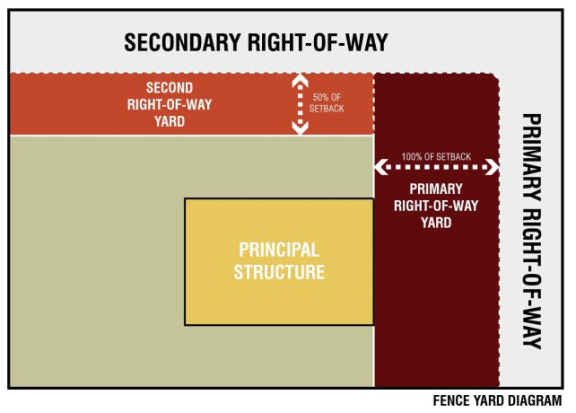
3.
Height. Fence and wall heights shall be in compliance with the following:
(a)
Within primary and secondary right-of-way yard setbacks: Four feet;
(b)
Outside required primary and secondary right-of-way yard setbacks: Six feet;
(c)
In Heavy and Light Industrial zoning districts, and within the Canal Mixed-Use zoning district in conjunction with Marina, Maritime Activities, or industrial-category uses, within the area of the lot meeting all principal building setbacks: Eight feet.
4.
Materials.
(a)
All fences and walls shall be constructed of standard building materials.
(b)
Posts or any portion of each fence which contacts the ground shall be of a material or chemical treatment that is resistant to decay, corrosion, and termite infestation. The posts, if wooden, must also be pressure treated for strength and endurance.
(c)
Barbed wire shall not be used except:
1.
In the Rural Residential zoning district associated with conforming livestock uses;
2.
In Heavy and Light Industrial zoning districts, and within the Canal Mixed-Use zoning district in conjunction with Marina, Maritime Activities, or industrial category uses, provided that barbed wire may only be used on the top of a fence, and the fence height, including barbed wire, shall be no more and no less than eight feet.
a.
The use of spiral barbed wire is prohibited.
b.
Barbed wire may not exceed two feet in vertical length; and, is limited to adherence on top of the fence.
(d)
Chain link in front yards shall be vinyl coated.
(e)
The finished side of the fence shall face the outside of the property.
(f)
The fence shall be maintained in good condition.
5.
Location.
(a)
Fences and walls may be placed on the property line but no part of the construction may extend over the property line.
(b)
Fences and walls shall not be constructed or installed in a manner which interferes with drainage.
(c)
Fences and walls installed in an easement, with approval of the holder of the easement, may be removed or relocated at the expense of the owner.
(d)
Tennis court fences taller than four feet in height may be permitted within the required front yard setback pursuant to a variance.
6.
Hedges.
(a)
Hedges may not encroach into or over rights-of-way or sidewalks.
(b)
Hedges may not encroach into the sight visibility triangle (see section 3-6.4).
7.
Fences on vacant lots in single-family residential zoning districts. Fences may be constructed on vacant lots with no principal structure located in a single-family residential zoning district. Such fence shall be chain-link, rail, or other permissible fencing material that permits clear visibility of the fenced-in area. The maximum height of such fence shall be six feet in all setback areas.
(Ord. No. 10-2022, § 2(Exh. A), 7-28-2022; Ord. No. 14-2022, § 2(Exh. A), 12-8-2022)
Sec. 3-4.8. - Flagpoles.
Flagpoles are permitted accessory structures in all zoning districts in compliance with the following regulations:
1.
The maximum height of a flagpole shall be the maximum building height in the zoning district which it is located.
2.
A vertical flagpole shall be set back ten feet from any property boundary.
Sec. 3-4.9. - Home-based businesses and live/work unit.
A.
Standards. The following specific standards shall apply to all home-based businesses:
(1)
Home-based businesses may operate in any area of the village zoned for residential use. The home-based business shall have no more than two employees or independent contractors who do not reside at the residential dwelling. The business may have additional remote employees or contractors who do not work at the residential dwelling.
(2)
Parking related to the business activities shall be provided which is sufficient off-street parking on an improved surface and otherwise conform to the requirements of section 3-4.11, of the Indiantown Land Development Regulations.
(3)
The use of the dwelling unit for the home-based business shall be secondary to the residential use and shall under no circumstances change the residential character of the dwelling.
(4)
As viewed from the street, the use of the residential property is consistent with the uses of the residential areas that surround the property. External modifications made to a residential dwelling to accommodate a home-based business must conform to the residential character and architectural aesthetics of the neighborhood.
(5)
There shall be no use of utilities or community facilities beyond what is typically associated with a residential use.
(6)
No equipment shall be used in the home-based business which creates fire hazards, electrical interference, noise, vibration, glare, fumes, or odors detectable to the normal senses outside the dwelling unit. In the case of electrical interference, no equipment or process shall be used which creates visual or audible interference in any radio or television receivers off the premises or causes fluctuations in line voltage off the premises.
(7)
Vehicles and trailers used in connection with the business must be parked in legal parking spaces that are not located within the right-of-way, on or over a sidewalk, or on any unimproved surfaces at the residence.
(8)
The home-based business shall not generate pedestrian or vehicular traffic in greater volume than would normally be expected for the residence.
(9)
The use qualifies for, and obtains all local, state, and federal licenses, certificates and permits required by law.
(10)
Any violation of these regulations may result in the revocation of any local business tax receipt, and a fine or other legal remedy provided in the village code.
(11)
The issuance of a business tax receipt to engage in a home-based business in accordance with this ordinance shall not be deemed to be a change in zoning nor an official expression of opinion as to the proper zoning for the particular property.
(12)
The home-based business shall otherwise completely comply with the requirements of § 559.955, Florida Statutes, as amended from time to time.
(13)
Other than one sign, which meets section 3-4.15, no exterior evidence of the business activity shall be visible from the street or surrounding residential areas.
B.
[Compliance.] Live/work units shall be in compliance with the following:
(1)
The minimum size for each live/work unit is 800 square feet; and
(2)
Up to two employees or contractors other than members of the immediate family residing in the dwelling may work in a live/work unit; and
(3)
Required parking spaces shall be in accordance with general residential parking standards, plus one space per employee; and
(4)
Commercial uses in live/work units are limited to office, small retail, personal services and studio for art. However, due to the residential nature of live/work units, visits from customers, clients, and suppliers shall average no more than a total of 30 visits per week.
(Ord. No. 03-2022, § 1, 4-28-2022)
Sec. 3.4-10. - Commercial amusement facilities.
The additional conditional use standards in this section will apply when there is a need for a conditional use approval. Conditional uses are approved after a public hearing by the Village Council.
1.
Outdoor amusement lots shall be separated by an opaque hedge screen at least six feet in height from any abutting property located in a residential or mixed-use district.
2.
No amusement facilities, such as miniature golf courses, skateboard courses, or mechanical rides, shall be located within 200 feet of any abutting property located in a residential district.
3.
Hours of operation shall be no earlier than 8:00 a.m. and no later than 11:00 p.m.
Sec. 3-4.11. - Parking, loading and driveways.
All new and substantially improved development shall be required to provide adequate access to the site from the street, parking and loading spaces. Provision of these site features shall be consistent with the regulations found in this section.
(1)
Driveways:
(a)
A permit is required for construction, replacement or alteration of any driveway.
(b)
Driveways may be no closer than three feet from a stormwater inlet structure and five feet from a side property line.
(c)
All driveways shall be paved to the edge of the road pavement.
(d)
On roads with curb and gutters, valley gutters shall be required in driveways and shall be placed in line with the gutter line.
(e)
The driveways shall be designed to accommodate and improve drainage facilities at the site in accordance with the approved site plans.
(f)
When possible, shared driveways are preferred to individual driveways.
(g)
Driveways shall not be permitted within 25 feet of the nearest corner of an intersection.
(h)
Driveway widths and design shall be in compliance with Table 15.
(2)
Parking:
(a)
A permit is required for any additions, reductions, alterations and restriping of parking areas.
(b)
Off-street parking and loading areas shall be designed to provide maneuvering and access aisle areas sufficient to permit a vehicle to enter and leave in a forward manner. Where off-street parking is used for access to the building, sufficient area shall be provided and designated for fire apparatus to be positioned as deemed necessary by the Village for the building's fire protection.
(c)
Ingress and Egress. Adequate provisions for ingress and egress shall be provided to all parking areas. Where a parking area does not abut a public right-of-way, private alley or access easement, an access drive shall be provided into the parking area which shall consist of one drive per lane of traffic and shall not be less than 24 feet in width. Where the off-street parking area is used for ingress to the building, there shall be sufficient area to allow for additional fire apparatus ingress, and a safe egress from the building without lengthy backing of the fire apparatus, as deemed necessary by the Village.
(d)
Grading and Material. New off-street parking spaces and access aisles shall be graded for proper drainage and shall be surfaced with asphalt or concrete. For redevelopment sites, off-street parking spaces and access isles shall be graded for proper drainage and shall be surfaced with a durable surface such as, but not limited to, gravel, concrete, or bituminous material. Grassed overflow parking may also be permitted if designated on an approved site plan.
(e)
Lighting. All parking area lighting shall be arranged so as to direct the light away from adjoining properties and rights-of-way and shall be consistent with section 3-6.3, exterior lighting.
(f)
Parking space types:
1.
A typical parking stall shall be 9 feet by 19 feet.
2.
Handicap stalls shall meet the applicable ADA Design Guide dimensions.
a.
The number of handicap parking spaces shall be in compliance with Table 17, Handicap Parking Space Requirements.
3.
Compact car spaces shall be eight feet by 15 feet.
a.
Compact car parking may account for a maximum of ten percent of the required parking spaces.
4.
Golf cart spaces shall be eight feet by 11 feet.
a.
Golf cart parking may account for a maximum of ten percent of the required parking.
5.
Motorcycle spaces shall be four and one-half feet by eight feet.
a.
Motorcycle parking may account for a maximum of three percent of the required parking spaces in lots with more than 30 spaces.
(g)
The Director may require wheel stops or curbs for demarcation and pedestrian safety. The minimum aisle width shall be in compliance with Table 16, Parking Aisle Dimensions.
(h)
Bicycle parking. A location for bicycles to be stored and locked shall be provided in compliance with the requirements of section 3-6.8, Green and Sustainable Standards. Single-family, two-family and townhomes are exempt from this requirement.
(i)
Handicap parking. Parking facilities used by the public shall provide parking spaces that are accessible to persons with disabilities.
1.
The number, design and location of these spaces shall be in accordance with state statutes, the ADA Design Guidelines, and as listed below, whichever is greater.
2.
Parallel parking spaces for persons with disabilities shall be located either at the beginning or end of a block or adjacent to alley entrance. Each such parking space shall be conspicuously marked with blue and shall be posted with a permanent, above-grade sign bearing the symbol of "PARKING BY DISABLED PERMIT ONLY".
3.
The minimum parking spaces required for persons with disabilities are provided in Table 17 Handicap Parking Space Requirements.
(j)
Parking calculations. The minimum number of parking spaces for land uses are included in Table 18 Minimum Parking Requirements. Developments providing off-street parking in excess of 200 percent of the requirements of this section shall request a variance in accordance with the LDR and provide substantial additional landscaping. Developers requesting fewer parking spaces or proposing a use not listed shall provide the Village with examples of similar existing developments and their parking calculations.
(k)
Mixed-use parking reduction. Non-residential development in the mixed-use districts may decrease their parking requirements based on available on-street parking and because the mix of uses encourages visitors to park once and walk within the district.
1.
Downtown, Village Mixed-Use, and Neighborhood Mixed-Use zoning districts may provide 50 percent of the required parking; and
2.
Canal Mixed-Use zoning districts may provide 65 percent of the required parking.
(l)
Joint and shared usage of parking.
1.
Joint usage. Two or more structures or uses may collectively provide their required off-street parking, provided that the total number of parking spaces provided shall not be less than the sum of the requirements for the several individual uses if computed separately.
2.
Shared usage. Required parking spaces may be permitted by the Director to be utilized for meeting the parking requirements of two separate permitted uses when it is clearly established by the applicant that these two uses will primarily utilize these spaces at different times of the day, week, month or year, such as a church sharing spaces with a retail store. Recordable covenants, with correct legal descriptions, shall be submitted by the owners of the property and the businesses, in form acceptable to the Village Attorney; and these covenants shall be recorded by the Village at the applicant's expense, and shall run with the land. These covenants shall provide that the use, or portion of a use, that requires the shared parking in order to obtain the necessary permits or licenses shall cease and terminate upon any change in their respective schedules of operation that results in conflicting or overlapping usage of the parking facilities; and no nonresidential use may be made of that portion of the property until the required parking facilities are available and provided. The covenant shall also provide that the Village may collect attorney fees if litigation is necessary.
(m)
On-street parking. On-street parking along the corresponding frontage of a development shall count 100 percent towards the parking requirements in the Downtown Zoning District provided that:
1.
The developer constructs the on-street parking spaces to County specifications along the length of the lot directly abutting the parcel generating the parking requirements, in a manner that does not infringe upon the ability of neighboring parcels to access the street.
2.
In no case shall other on-street parking spaces, such as previously existing spaces or spaces constructed to satisfy the requirements for other developments, be eligible to count towards the fulfillment of on-site parking requirements.
3.
On-street parking spaces developed within the public right-of-way shall be available for general public use and shall not be reserved for the use of any particular business or residence.
4.
Such on-street parking must be constructed and found to be in compliance with Village standards prior to issuance of a Certificate of Occupancy for the particular development.
(n)
Off-site parking.
1.
The required parking may be provided off-site, provided the site is Approved during the site plan approval process.
Sec. 3-4.12. - Renewable energy systems.
Renewable energy systems for production of on-site power usage are permitted accessory structures in every zoning district. Renewable energy systems shall be in compliance with section 3-4.3, Accessory structures generally, and the following:
(1)
Height of any renewable energy system component may be up to ten feet above the maximum building height.
(a)
Photovoltaic arrays attached to sloped rooftops shall generally follow the angles of the roof.
(b)
Arrays located on flat roofs shall be shielded by parapet walls or architectural features, when possible, to minimize visibility from adjacent rights-of-way and properties.
(2)
Noise generated by any renewable energy component shall not exceed 40 decibels at any property line.
(3)
No renewable energy system may create a hazard.
(4)
For the purposes of this section, renewable energy systems do not include biofuel production.
Sec. 3-4.13. - Satellite dishes and antennas.
These regulations apply to radio and television receiving equipment for domestic use. They do not apply to amateur radio stations operating under a license issued by the Federal Communications Commission or to commercial dishes and antennas.
(1)
Any mast-type antenna less than 30 feet of extended height must receive all required administrative permits. Any antenna exceeding 30 feet of extended height shall require a special exception permit.
(2)
No mast-type antennas shall be placed within any required (setback) or closer to the right-of-way than any principal structure except in the Industrial zoning districts.
(3)
All dish antenna installations over two feet in diameter shall require a permit and shall meet the following criteria:
(a)
All dish antennas shall conform to setbacks required in the district in which such dishes are located.
(b)
Dish antennas that are roof mounted shall be mounted so that they will not be visible from the street and shall be certified by a state registered architect or engineer as to wind and roof load.
(c)
Dish antennas shall be adequately screened from view by either a vegetative hedge, shrubbery or fencing to prohibit their visibility from any street or adjacent property.
(d)
Advertising or identification on the dish shall be limited to the manufacturer's nameplate, not to exceed six square inches in area.
(e)
Size:
1.
Accessory to a residential use, no dish may exceed three and one-half feet.
2.
Accessory to a commercial use, no dish may exceed 13 feet in diameter
3.
Accessory to an industrial use, size is not limited.
4.
Any commercial or industrial dish shall have detailed installation plans, sealed by an architect or engineer registered in the state, and only a state licensed contractor with appropriate licenses shall erect such antenna.
Sec. 3-4.14. - Seawalls and riprap.
Seawalls or riprap may be replaced in compliance with the following:
(1)
Land or fill shall not be extended into any waterway beyond the original toe stones or existing seawall.
(2)
The existing contour of the shoreline shall not be altered by excavation or construction; however, deteriorated riprap can be restored. Any proposed placement of fill beyond the existing toe of the riprap is considered a dredge and fill activity and it requires permits from the Stormwater Management District, the State Department of Environmental Protection and the U.S. Army Corps of Engineers and approval by the Village.
(3)
On vacant or redeveloping lots the restoration shall be at a slope not to exceed one foot vertically for every two feet horizontally (1:2). On developed lots the restoration can be at the existing slope.
(4)
Riprap repair permits must be accompanied by a scaled survey showing the existing toe stones and plotted lot line, top of riprap and mean high water line. An as-built scaled survey must be submitted prior to final building inspection.
(5)
Seawall tops or top of riprap shall be a minimum of five and one-half feet above mean low water.
Sec. 3-4.15. - Signage.
These regulations shall apply to the erection and maintenance of signs while preserving the right of free speech and expression. The regulations within this chapter shall apply to all construction, relocation, enlargement, alteration and modification of signs within the Village of Indiantown. Generally, signs are approved by issuance of a sign permit. However, there are some signs that do not require a permit, these signs are listed in section 3-4.15(2).
Noncommercial signs are allowed in all districts and may be substituted for any sign expressly allowed under this ordinance, and any sign permitted by this ordinance may display a noncommercial message. Noncommercial signs are subject to the same permit requirements, restrictions on size and type and other conditions and specifications as apply to the sign for which they are being substituted.
Nothing contained in this section shall be construed to permit the display of signs when otherwise prohibited or restricted by private restrictions or covenants not enforced by the Village.
(1)
The following regulations apply generally to all signs and are in addition to the regulations contained elsewhere in this chapter:
(a)
Required application and inspection of signs. No sign, other than signs not requiring a permit, found in section 3-4.15(2), shall be erected, constructed, structurally altered or relocated until a permit has been issued by the Village.
(b)
Electrical permit. All signs which require electricity or are electrically illuminated shall require a separate electrical permit and an inspection.
(c)
Construction standards. In addition to complying with the requirements of this chapter, all signs must meet the structural and other standards regarding sign construction, erection, electrical wiring, etc., set forth in the Florida Building Code. Plans for any or monument sign exceeding 32 square feet in area or eight feet in height shall be accompanied by foundation drawings signed and sealed by a licensed engineer.
(2)
Signs not requiring a permit. The following signs do not require a sign permit but may require a building permit or electrical permit (if subject to building or electrical codes). Signs listed in this section do not require permits but shall still comply with the standards found in section 3-4.15(7), General design and maintenance standards. All signs not requiring a permit shall comply with the associated size, timing and location standards listed or shall require a permit.
(a)
Addresses, shall be located at all primary building entrances and on the mailbox. Numbers and letters shall be of a size visible from the street, between four and 14 inches in height.
(b)
Decorative signs, signs commonly associated with a holiday, provided that such signs shall be displayed for a period of not more than 60 consecutive days or more than 60 total days in any one year.
(c)
Directional signs or symbols with no advertising, such as entrance, exit, caution, slow, etc. located on and pertaining to a parcel or development and not to exceed four square feet in area.
(d)
Flags, that are not larger than 30 square feet in area and are affixed to a permanent flagpole or building mounted flagpole. Flagpoles may require building permits.
(e)
Interior signs, signs that are not visible from abutting property or public rights-of-way.
(f)
Menu boards, display of a restaurant's fare not to exceed three square feet and containing only a menu of a font size that is legible to a pedestrian.
(g)
Official and legal notice signs, that are issued by any court, public body, person or officer in performance of a public duty, or in giving any legal notice, including signs that are required to be posted to give notice of a pending action pursuant to this LDR.
(h)
Parking signs, including those in compliance with the Americans with Disabilities Act and other parking signs including but not limited to: reserved parking, compact car spaces, expectant mother parking and parking for pickup orders. Not to exceed two and one-half square feet per parking space.
(g)
Sandwich boards, located within the mixed-use zoning districts only. One sandwich board sign, not exceeding 36 inches in height and 24 inches in width, may be located in front of each non-residential property or tenant space. Any sandwich board signs on a public sidewalk may not be closer than one foot to the curb and a minimum of 36 inches of clear sidewalk must be maintained for pedestrian traffic.
(h)
Signs of minimal area.
1.
Signs, on a building or structure, which do not exceed one square foot in area. Only one per side of building facing a right-of-way or adjacent property.
2.
Signs on machines, equipment, fences, gates, walls, gasoline pumps, public telephones or utility cabinets which do not exceed a total of 0.75 square feet in area.
(i)
Single-family residential signs. Single-family residential properties are allowed one non-illuminated ground or wall sign, not to exceed six square feet in area or four (4) feet in height.
(j)
Temporary real estate signs. Where real property is being offered for sale, lease or an open house, one temporary, on-premises nonilluminated sign for each street frontage is permitted. Signs may not exceed six square feet in area or more than five feet in height.
(k)
Temporary construction signs. Where a valid building permit has been issued for a structure, one nonilluminated project information sign, not more than ten square feet in area, one such sign for each parcel.
(l)
Traffic signs and street signs.
(m)
Warning or prohibitory signs (e.g., no parking, no trespassing, no dumping, caution or danger), on a building, fence, equipment, or ground mounted may not exceed three square feet in size and no more than six feet in height unless mounted to a building. One of each type of sign is permitted for 250 feet of frontage or portion thereof on a public right-of-way.
(n)
Window signs, on commercial properties, when they do not exceed 25 percent of the area of a window.
(o)
Wireless communication facilities (WCF) signs on the main access gate to a tower site, not exceeding six square feet. The sign must include the owner or operator of the facility and an emergency phone number.
Any signs which appear to be out of compliance with these above regulations may be required to submit an application for the sign in question. If the sign is in compliance with the above regulations for signs not requiring a permit, section 3-4.15(2), the sign will be allowed to remain and no permit fee charged. If the sign is found to be out of compliance with section 3-4.15(2), it will be reviewed per the appropriate regulations.
(3)
Prohibited signs. The following types of signs are not allowed within the Village of Indiantown:
(a)
Signs that extend above the roof of the building.
(b)
Signs that may be confused with or hide a public safety, directional or traffic control signs.
(c)
Animated signs, this does not include signs with electronic displays which change intermittently, not more often than every ten seconds.
(d)
Signs that emit sound, odor, visible smoke or vapor.
(e)
Snipe signs.
(f)
Parasitic signs.
(g)
Signs that obstruct any window, door, fire escape, stairway or opening intended to provide light, air, ingress or egress that would cause a violation of the state building code.
(h)
Pole signs.
(4)
Measuring sign area. Sign area shall be calculated in the following way:
(a)
Sign within a framework or background shall be calculated as the area within a parallelogram, triangle, circle, semicircle or other regular geometric figure that includes all letters, figures, graphics or other elements of the sign, together with the framework or background of the sign. The support for the sign background, whether it be columns, a pylon, or a building or part thereof, shall not be included in a sign area.
(b)
For wall signs, canopy signs or any other type of sign without a frame, the sign area shall be the area within a regular geometric shape that includes all letters, figures, graphics or other elements of the sign.
(c)
For double-face or sandwich board signs, the area of the sign shall be calculated based on one sign face.
(5)
Permitted signs in commercial districts. For the purposes of this section, commercial districts shall mean a property in Downtown, Village Mixed-Use, Neighborhood Mixed-Use, Canal Mixed-Use, Light Industrial and Heavy Industrial zoning districts.
(a)
Freestanding signs. Each business, or group of businesses on a single parcel, fronting on a right-of-way is allowed a freestanding sign per right-of-way frontage. A corner lot may have two freestanding signs.
1.
Square footage. The sign area shall be based on the width of the right-of-way frontage where the sign is located:
a.
A maximum sign square footage of 32 square feet is permitted for parcels with less than 125 linear feet of frontage
b.
A maximum sign square footage of 50 square feet is permitted for parcels with between 125 and 250 linear feet of frontage.
c.
A maximum single sign square footage of 80 square feet is permitted for lots with greater than 250 feet of frontage. Where two signs are permitted, the maximum combined sign area shall not exceed 120 square feet in area.
2.
Location.
a.
The sign must be located on the same parcel as the business it identifies and be visible from the right-of-way.
b.
The sign may be within any right-of-way, with appropriate right-of-way authorization, and shall be outside of the visibility triangle.
c.
The sign may be no closer than eight feet to any side property line.
3.
Height. The total height of a freestanding sign may not exceed eight feet above finished grade, not including berms or raised landscaping beds.
(b)
Wall signs, blade/bracket signs, canopy signs and any other signs attached to the building.
1.
Square footage. Each business is allowed any combination of signs, attached to the building, that do not exceed a total of one square foot per linear foot of the building's facade width.
i.
For a building located 150 feet or less from the right-of-way, the size may not exceed 60 square feet.
ii.
For a building located more than 150 feet from the right-of-way the square footage maximum shall increase to 100 square feet.
iii.
Additional signs for buildings in excess of 40,000 square feet. If the footprint of an individual store exceeds 40,000 square feet in size and contains a store within a store (e.g., bakery, restaurant, pharmacy, etc.), up to four building face signs, in addition to the main sign, may be permitted. The size of these individual sign(s) shall not exceed one square foot of sign area for each linear foot of the retail department's interior façade or 75 percent of the size of the main building face sign, whichever is smaller.
2.
Location. Signs shall be visible from the right-of-way on which the building fronts. When a building fronts on more than one right-of-way or parking lot on the rear or side of the building, an additional wall sign may be placed at the public entrance on that side. The square footage of additional signs shall not exceed one square foot of sign area for each linear foot of the building's side upon which the sign is placed or 60 square feet, whichever is smaller.
(c)
Multiple tenant developments. Where more than one business is located on a parcel.
1.
Each tenant is allowed any combination of wall, blade/bracket or canopy signs not to exceed one square foot of sign area for each linear foot of the unit's front façade or 60 square feet, whichever is smaller. The front façade of the building shall be considered the side that has the main public entrance.
2.
No individual wall sign shall exceed 80 percent of the width of the space occupied by a business, with a minimum of ten percent clear area on each outer edge of the tenant space.
3.
Signs proposed for a multiple tenant development shall be consistent in color, scale, materials and design.
(d)
Drive-thru menu boards. Where a drive-thru lane is permitted, a menu sign will also be permitted in compliance with the following:
1.
The menu board may not exceed 24 square feet and eight feet in height;
2.
One electronic sign, with changing text or symbols, may not exceed three square feet.
(e)
Temporary banners. A banner, not exceeding 20 square feet, may be permitted on any property with an approved special or temporary event.
(6)
Permitted signs in non-commercial districts. For the purposes of this section, non-commercial districts shall mean a property in Limited Residential, Single-Family Residential, Rural Residential, Civic Facilities, Utilities, Parks and Open Space and Conservation zoning districts. No sign intended to be read from any public right-of-way adjoining the district shall be permitted except:
(a)
Identification entrance sign. One or two monument-style identification signs for each principal entrance to a development, civic facility, park or utility shall be permitted, in compliance with the following:
1.
Each sign shall not exceed 32 square feet in area.
2.
Freestanding signs shall not exceed a height of:
i.
Six feet above finished grade, not including berms or raised landscaping beds, if two signs are proposed;
ii.
Eight feet above finished grade, not including berms or raised landscaping beds, if one sign is proposed;
3.
If illuminated, ground-mounted lights shall be concealed by landscaping;
4.
Signs may be placed no closer than ten feet to the right-of-way property line.
(b)
Civic facility and utility buildings are permitted wall signs in compliance with the following:
1.
Total signage square footage shall not exceed 35 square feet;
2.
Illuminated signs shall not cause light trespass onto residential properties.
(c)
Amenities interior to a residential community intended primarily to serve a residential community are allowed to have amenity signs. In compliance with the following:
1.
Signs shall be located interior to the development and shall not be visible from external roadways. In the event of a conflict between this provision and a planned development ordinance, the planned development language shall control. The following amenity signs are allowed:
a.
No more than one ground sign with a height of six feet and a sign area of no more than 12 square feet.
b.
Signs shall be located at the main entrance to the facility and set ten feet from the property line or right-of-way.
c.
No more than one wall sign with a maximum square footage of 20 feet.
d.
Illuminated signs shall not cause light trespass onto adjacent properties.
(d)
Signs for commercial uses within residential zoning districts:
1.
Such signs shall follow the requirements for signs within commercial districts, except as follows:
a.
Illuminated signs shall not cause light trespass onto residential properties;
b.
When a commercial development is approved through the special exception process, conditions of the approval should include appropriate sign requirements for the location.
(e)
Temporary banners. A banner, not exceeding 20 square feet, may be permitted on any property for a period not exceeding 30 days in a single year.
(7)
General design and maintenance standards.
(a)
[Blade/bracket signs.] Blade/bracket signs are permitted in mixed-use districts. Blade signs shall be in compliance with the following:
1.
There shall be no more than one sign per public entrance to any given building;
2.
The sign(s) shall be positioned at the public entrance(s) of the building;
3.
An individual blade/bracket sign shall be no more than 12 square feet in area;
4.
The sign shall be mounted so the bottom edge of the sign is not less than eight feet from the finished grade directly underneath it;
5.
Blade/bracket signs that extend over a public right-of-way are subject to the prior approval of the controlling public entity and require liability insurance, see section 3-4.15(8), liability insurance required.
(b)
Canopy signs.
1.
The bottom of the sign or canopy shall not be less than eight feet from the finished grade directly underneath it;
2.
Canopy signs that extend over a public right-of-way are subject to the prior approval of the controlling public entity and require liability insurance, see section 3-4.15(8), liability insurance required.
(c)
Lighting. Signs may be illuminated in compliance with the following:
1.
Internally illuminated or backlit signs may only allow light to be visible through the letters and symbols which make up the sign. The background of the sign may not transmit light.
2.
Externally illuminated signs may not cause glare to passing motorists, pedestrians or adjacent properties. Bulbs, lenses, or globes shall not be visible from outside of the property where the sign is located or from any right-of-way.
3.
Sign lighting shall be in compliance with the lighting regulations found in section 3-6.3.
(d)
Maintenance. All visible portions of a sign and its supporting structure shall be maintained in a safe condition and neat appearance. If the sign is a lighted sign, all lights shall be maintained in working order and functioning in a safe manner. If the sign is a painted sign, the paint shall be kept in good condition. All signs will be kept in such manner as to constitute a complete sign at all times. The area immediately surrounding ground signs shall be kept clear of all unsightly vegetation or debris.
(8)
Liability insurance required. No permitted sign located on or projecting over a Village right-of-way shall be erected unless an insurance policy shall have been filed for public liability with a limit determined by the Village.
Such policy shall be issued by an insurance company authorized to do business in the State of Florida and acceptable to the Village Manager. The policy shall name the Village as a co-insured and shall require 30 days' written notice to the Village before modification or cancellation. Such policy shall protect and hold the Village harmless from any and all claims or demands for damages by reason of any negligence of the sign hanger, contractor, property owner or occupants or their respective agents; or by reason of defects in the construction, or damages resulting from the collapse, failure or combustion of the sign or parts thereof. The policy shall be maintained so long as the sign in question remains erected.
Sec. 3-4.16. - Solid waste and dumpsters.
Every property within the Village shall maintain trash and garbage within a solid waste container or trash room.
(1)
Each residential property shall have a solid waste standard container;
(2)
Each commercial, multifamily or industrial property shall have a solid waste bulk container of adequate size to accommodate all solid waste produced on site.
(3)
Containers may not be stored closer to the right-of-way than the principal structure and must meet principal structure side and rear setbacks.
(4)
Solid waste bulk containers shall be screened from the right-of-way and adjacent properties by an enclosure with gates which are to be kept closed.
(5)
Solid waste containers and solid waste container storage areas shall be maintained neat, clean and free of refuse at all times.
Sec. 3-4.17. - Swimming pools, swimming pool decks and spas.
Swimming pools, swimming pool decks, spas and all related equipment shall be permitted in compliance with section 3-4.3, accessory structures generally, and the following:
(1)
Swimming pools, swimming pool decks and spas, which are not covered by a solid roof and have a walking surface not exceeding four feet above grade, shall be considered an accessory structure.
(2)
Above ground swimming pools without deck surrounds shall be considered accessory structures.
(3)
Swimming pools, swimming pool decks and spas, which is roofed or has a walking surface exceeding four feet above grade must meet principal structure setbacks.
(4)
Swimming pools shall be required to have a safety barrier meeting the Florida Building Code requirements. No swimming pool permit shall be issued unless a permit for the safety barrier is also issued. If the area is already enclosed, a permit for the safety barrier will not be required if an inspection of the premises proves the existing barrier to be satisfactory. The safety barrier shall be constructed prior to final inspection and approval by the Village.
(5)
A temporary fence, not less than four feet in height, shall completely enclose a pool under construction. The swimming pool need not be completely enclosed when an adult person is present on the site and actual construction is in process.
(6)
The pool, pool deck, spa and any related equipment must comply with all setback requirements and the impervious coverage of the site.
Sec. 3-5.1. - Purpose and applicability.
The purpose of this Code section is to provide criteria through which certain uses shall be evaluated for permit approval and operated to reduce impacts on adjacent properties and the public. The criteria shall apply to the specific uses contained within this section.
Sec. 3-5.2. - Animals and livestock.
(a)
It is in the best interest of the Village and its citizens to restrict the number, type and location of animals harbored on a residential parcel. Numbers of animals in excess of those provided in this section shall not be deemed to be a reasonable, customary, incidental or accessory use to any residence on a residential parcel regardless of zoning classification.
(1)
Dogs and cats. The keeping of dogs and cats is permitted on any residential parcel. Specific regulations can be found in Table 20.
(2)
Livestock.The keeping of livestock is only permitted in the Rural Residential zoning district. Specific regulations can be found in Table 20.
(3)
Fowl. The keeping of fowl is only permitted in the Rural Residential zoning district. Specific regulations can be found in Table 20.
(4)
Reptiles, birds, fish and other animals. The number and types of reptiles, birds and other animals not specifically listed in this section are not regulated by this section provided they are harbored within the residence, properly caged or confined so as not to cause either a nuisance or endanger the health and safety of the public or minors residing within the residence and are not being harbored or raised for commercial purposes. The harboring of reptiles, birds and other animals not specifically listed in this section, outside of the residence on a residential parcel is prohibited. Fish are not regulated by this section provided they are not being harbored or raised for commercial purposes. Commercial purposes shall be deemed to include "for profit" and "not for profit" activities.
(5)
Agricultural operations. Nothing contained in this section shall be deemed to permit commercial agricultural operations within a residential parcel, including the raising of animals for sale or slaughter.
(6)
Wildlife. Any captive wildlife under the exclusive jurisdiction of the Florida Fish and Wildlife Conservation Commission (FWC) which are harbored within a residential parcel, shall reduce on a one-to-one basis the otherwise allowable number of other animals permitted by this section; provided that this subsection shall not result in less than two, dogs and cats, in combination, from being harbored on the property.
(b)
Standards. All animals kept on property within the Village shall conform to the following regulations:
(1)
Fencing. Fences shall be erected and maintained to contain livestock kept on premises. Failure to erect and maintain the fence in reasonably good condition shall be deemed a violation of this chapter. The owner of the property shall, within 24 hours of initial contact from the Village, repair or erect a fence or make arrangements for the placement of livestock so as to have the livestock confined. If the fence is not repaired or erected, or arrangements have not been made for the placement of livestock within the 24-hour period, the owner may receive a citation or notice of violation.
(2)
Covered enclosures for any animals in the Rural Residential zoning district must meet the dimensional standards of permitted structures, and shall not be placed within 15 feet to any property line of an adjacent property or within 30 feet of any residential structure on adjacent property;
(3)
Odors from animals, animal manure or other animal related substances shall be minimally detectable at the property boundaries. Enclosures shall be adequately ventilated, kept in neat condition, including provision of clean, dry bedding materials and regular removal of waste materials. All manure not used for composting or fertilizing shall be removed promptly, and shall not be allowed to accumulate and cause a hazard or nuisance to the health, welfare or safety of humans or animals;
(c)
Exemptions from this section may be granted by the Village in compliance with the following:
(1)
Any person keeping animals on their property, as of the date of the adoption of this Code November 12, 2020, may request an exemption.
(2)
The owner of the animals shall notify the Village, on or before November 12, 2020, of the number of animals kept on the property and the size of the property.
(3)
This right to continue to possess animals within the Village is a personal right granted in recognition of the bond that develops between humans and animals and is not transferable to any future owner of the property.
(d)
Any student with a 4-H or FFA project may request an exemption.
(1)
The request must be accompanied by a letter from the appropriate school official or the 4-H Program Leader.
(2)
A plan for the keeping of the animal shall be submitted. The plan will include:
a.
The location of all structures used for 4-H or FFA project.
b.
The location, height and material of proposed fencing.
c.
All accessory structures must be in compliance with these LDRs.
Sec. 3-5.3. - Outdoor dining.
A permitted restaurant may provide outdoor dining for customers, in compliance with the following criteria:
(1)
Permitted hours of operation for outdoor dining are from 6:00 a.m. to 12:00 a.m.
(2)
Outdoor dining facilities shall maintain at least a four-foot clear and unobstructed pathway between the seating area and any obstructions on the sidewalk, including, but not limited to, street trees, bike racks, lampposts, sign posts, and other existing fixtures. When located at a street corner, the site visibility triangle (see section 3-6.4) shall be maintained.
(3)
No portion of an umbrella shall be less than seven feet above the sidewalk or extend into or over the four-foot pedestrian passageway.
(4)
Individual tables and chairs shall be utilized to allow for removal in the case of the right-of-way being used for public events, construction activity, repair or any other purpose.
(5)
An outdoor dining area shall not extend into the area in front of an adjoining structure without the written consent of the adjoining property owner.
(6)
The outdoor dining area shall be completely surrounded by an architecturally compatible enclosure at least three feet in height which may include plants. No enclosures shall be required if the applicant proposes to limit the seating area to one row of tables and chairs abutting the wall of the establishment.
(7)
The operator shall provide proof of liability insurance coverage in the amount of at least $1,000,000.00 with the Village named as an additional insured, if located within the public right-of-way.
(8)
Existing restaurants requesting new outdoor seating which is less than 15 percent of the existing interior seating shall be exempt from providing additional parking for the new outdoor seating.
Sec. 3-5.4. - Outdoor display of merchandise.
Outdoor display of merchandise refers to the items which are exhibited outside for sale or rent at a location which is permitted to sell or rent those goods, not to the storage of equipment or materials. (See section 3-5.5, outdoor storage).
(1)
Outdoor display areas that are attached to a principal building are allowed when in compliance with the following criteria:
(a)
Adjacent to a wall of a principal structure, and configured as a walled or decoratively fenced area;
(b)
Within the area of the lot meeting all principal building setbacks;
(c)
Not located in areas that are required or used for parking or vehicular circulation; and
(d)
Not larger than the area set out in Table 21 Outdoor Display Area.
(2)
Sidewalk displays, that abut the principal building, are allowed when in compliance with the following criteria:
(a)
Merchandise is displayed to a height of eight feet or less;
(b)
There is at least five feet of clear width on the sidewalk for use by pedestrian traffic; and
(c)
All sidewalk merchandise displays are within 40 feet of an entrance to the principal use, or located in the area defined by the forward projection of the side walls of the use, whichever is a smaller display area.
(3)
Display of vehicles sales and rental is a permitted conditional use. See section 3-7.5, automotive/boat/truck sales, rental, service and repair, for conditions.
(4)
Nurseries, and greenhouses, may display merchandise outside on any part of the lot that meets the principal structure setbacks. Display areas shall be indicated on the site plan and shall not interfere with parking and vehicular circulation areas.
Sec. 3-5.5. - Outdoor storage.
Outdoor storage refers to the outside storage of materials or equipment used in production or other course of business, and does not refer to the outdoor display of merchandise (See section 3-5.4, outdoor display of merchandise). Outdoor storage is permitted as an accessory use to buildings in the Rural Residential (only for lots over two acres), Village Mixed-Use, Canal Mixed-Use and Industrial zoning districts, only in compliance with the following criteria or as a primary use:
(1)
Outdoor storage areas shall not be used to dispose of inoperable machines or wastes, store or dispose of hazardous materials, or store or dispose of materials that will create windblown dust or debris or storm water contaminants.
(2)
Rural Residential District, lots over two acres. Outdoor storage areas for agricultural equipment or materials shall be set back 100 feet from public rights-of-way or behind the principal structure and shielded by vegetation or a solid fence from adjacent properties.
(3)
Village Mixed-Use District. Outdoor storage areas are permitted when the outdoor storage area:
(a)
Is not larger than ten percent of the floor area of the principal building; and
(b)
Is screened in one of the following ways:
1.
Enclosed by a wall that is designed as part of the principal building's façade and composed of the same materials as the principal building; or
2.
Located behind the principal building in relation to the closest public right-of-way and enclosed by a wall or opaque fence of sufficient height to completely screen the stored materials from public view.
a.
The exterior of the wall or fence shall be landscaped with a continuous hedge around the periphery, except at points of access. The hedges are not required to be the height of the fence but must be a minimum of four [feet] in height.
b.
The location of outdoor storage areas may be limited by the application of the fence height and setback standards found in section 3-4.7, fences, walls and hedges, if the fence heights that are allowed in yard areas are not sufficient to completely screen the stored materials from view.
(4)
Industrial Districts. Outdoor storage areas are permitted if it is demonstrated that the outdoor storage areas are:
(a)
Located in the buildable area, rear yard, and/or side yard; and
(b)
Screened in one of the following ways:
1.
Views from public rights-of-way are blocked by the principal building; or
2.
The area is enclosed by a wall or opaque fence of sufficient height to screen the stored materials from public view.
(5)
Canal Mixed-Use District. Outdoor storage areas are permitted if it is demonstrated that the outdoor storage areas are:
(a)
Located in the buildable area, rear yard, and/or side yard; and
(b)
Screened in one of the following ways:
1.
Views from public rights-of-way are blocked by the principal building; or
2.
The area is enclosed by a wall or opaque fence of sufficient height to screen the stored materials from public view.
Sec. 3-5.6. - Sales within public right-of-way.
The sale and marketing of merchandise or goods within the right-of-way is prohibited except for fruits and/or plants grown on the owner's private residential property when the right-of-way is contiguous with the owner's property and traffic is not impeded.
Sec. 3-5.7. - Temporary uses and special events.
Except for construction-related uses permitted under the temporary use permit section, no temporary building or structure shall be permitted in the Village unless specifically approved by the Village Council.
(1)
Temporary uses:
(a)
A temporary use permit must be obtained for the following uses in compliance with these requirements:
1.
Christmas tree sales lots for up to 45 days prior to the holiday;
2.
All other holiday and seasonal related goods sale lots up to 30 days prior to the holiday or for 30 days during a season;
3.
Temporary promotional activities involving the sale and promotion of goods and services available at a business on the premises, subject to the following:
a.
Activities that obstruct private parking or are held on the adjacent public sidewalk may be held for up to three consecutive days up to three times per calendar year.
b.
Activities that do not obstruct parking and are held on private property may be held for up to ten consecutive days up to three times per calendar year.
c.
Outdoor display of merchandise, not associated with a temporary promotional activity shall be in compliance with section 3-5.4, outdoor display of merchandise.
d.
Live animal sales are prohibited.
4.
Garage sales or yard sales, with a maximum of two permits per parcel per year for a maximum of three consecutive days each. Garage sale permits will be free of charge.
5.
Other similar uses of a temporary nature.
6.
Construction projects which require storage, parking areas, construction trailers, site screening and/or any other temporary activities during construction of the project and which terminate upon completion of the project.
(b)
Application for a temporary use permit shall include:
1.
A completed application on a form provided by the Village;
2.
The required fee;
3.
A plan indicating the area and the proposed temporary uses;
4.
A complete description of the activities which will occur and the time for which the permit is requested; and
5.
A sign permit application and fee, if a banner is proposed.
(c)
The Director or designee may grant a temporary use permit upon finding that the applicant has complied with the following:
1.
Any nuisance or hazardous feature is suitably separated from adjacent uses;
2.
Excessive vehicle traffic will not be generated; and
3.
A parking problem will not be created.
(d)
Each temporary use permit shall be granted for a specific period of time, at the end of which, if the use permitted as a temporary use has not been discontinued, it shall be deemed a violation of the zoning ordinance. A temporary use permit may be cancelled by the Village at any time if the terms of the permit are violated.
(2)
Special events:
(a)
A special event permit must be obtained for the following uses in compliance with these requirements:
1.
Air shows;
2.
Art shows;
3.
Parades;
4.
Carnivals;
5.
Concerts;
6.
Festivals;
7.
Fireworks;
8.
Musical presentations
9.
Running, walking or bicycling events;
10.
Triathlons;
11.
Other similar event requiring off-site parking, street closures, sound amplification or use of Village personnel or public property or extended events and sales beyond the time limits provided under a temporary use permit.
(b)
Application for a special event permit must be submitted to the Village 60 days prior to the proposed event. This may be waived upon a showing of good cause. The application shall include:
1.
A completed application on a form provided by the Village;
2.
The required fee;
3.
A plan showing the proposed layout of the site including tents, sanitation, parking and any other important features of the event and any proposed off-site facilities;
4.
An estimate of the number of attendees;
5.
The location of any amplified music and proposed sound levels;
6.
The timeline for the event;
7.
Any roadways or sidewalks that will need to be closed; and
8.
A sign permit application and fee, if a banner is proposed.
(c)
Each application will be reviewed and approved or denied by the Director based on the following criteria:
1.
The applicant has complied with all required criteria outlined on the permit application form.
2.
Sufficient Village support personnel are available to assist in the conduct of the event.
3.
Adequate support facilities are available for the event with the support facilities including, but not being limited to, parking, refuse collection, sanitation, lighting and security.
4.
No conflict exists with the requested event and other approved and previously scheduled events.
5.
The event will not result in the over-utilization of Village facilities.
6.
No outstanding balances are due the Village for assistance from previous activities from the applicant.
7.
Proposed music or sound is at an acceptable level as specified in the Code of Ordinances.
8.
Crowd size has been determined to be a manageable size for the proposed event and site.
9.
The event is generally compatible with the character of the Village.
10.
The applicant complied with terms and conditions of any previously granted permits.
(d)
Village Council approval at a public hearing is required for any event which necessitates street closings, off-site parking, amplified entertainment, Village co-sponsorship, crowd attendance in excess of 1,500 or fireworks display.
(e)
Signage associated with a special event shall be included for review and approval with the special event application and may be installed one day prior to the event and shall be removed at the conclusion of the event. Signage is limited to the site of the event. Directional signs may be permitted in the right-of-way adjacent to event site or associated parking area(s) on the day(s) of the event subject to approval.
(f)
Where an event restricts access to public parking or generates the need for additional parking, Village Council may allow the owners of properties, within 0.5 miles of the event, to charge for parking on their private property subject to the following limitations:
1.
Signage shall be limited to one sign, not exceeding six square feet, at the entrance to the parking lot for the duration of the event.
2.
The property owner cannot charge for or block parking in the right-of-way.
3.
The property owner assumes all liability for parking on their private property.
4.
Parking must be available, at no charge during the event, for employees or patrons of the businesses or establishments that are on the property or have a legal right to use the private parking on the property.
5.
A permit shall be obtained from the Village for each property that chooses to charge for parking. The permit shall authorize the property owner to charge for parking during approved events when the subject property is within 0.5 miles of the limits of the event site. The permit shall be made available for review in a conspicuous place on-site during the event for inspection by enforcement officials.
6.
The approval to charge for parking during events is limited as above and shall not be considered a vested right. The Village reserves the right to discontinue this allowance at any time and to enforce against property owners that do not comply with the LDRs.
(g)
Each special event permit shall be valid for a specific period of time and for a specific purpose as indicated on each permit application form. If the applicant fails to fulfill the requirements as set forth in the permit, or if at any time the event does not comply with the specific terms and conditions of the permit and specifications approved by the Village Manager, including but not limited to time and activities, the permit may be cancelled by the Village Manager, or designee, and the activity shall cease immediately.
Sec. 3-5.8. - Storage of recreational vehicles (RVs) and boats.
RV and boat storage is allowed as a permitted primary use in Light and Heavy Industrial zoning districts. Boat storage is allowed as a permitted primary use in Canal Mixed-Use zoning district.
Storage of one RV and one boat on a property with a single-family or two-family residence is permitted in compliance with the following regulations:
(1)
An RV or boat may be parked in a driveway for up to two weeks in a year, for maintenance, cleaning or preparation for a trip.
(2)
An RV or boat shall be stored to the rear of the front building line from any right-of-way. The RV or boat shall be visually buffered by a privacy fence, masonry wall, trees or shrubs maintained to a height of six feet.
(3)
No more than one RV and one boat shall be parked on any given site.
(4)
Only RVs or boats owned or leased by the occupant or owner of the parcel, or owned or leased by a house guest of the occupant or owner of the parcel may be parked on the site.
(5)
Vehicles and the parking area shall be maintained in a clean, neat and presentable manner and the equipment shall be in a usable condition at all times.
(6)
Such equipment shall, at all times, have attached a current vehicle registration license plate.
(7)
No major repairs or overhaul work on such equipment shall be made or performed on the site (or any other work performed thereon which would constitute a nuisance).
(8)
When parked on the site, such equipment shall not be used for living or sleeping quarters, or for housekeeping or storage purposes and shall not have any service connections lines attached, except as may be required to maintain the equipment and appliances.
(9)
Such equipment shall not exceed the maximum length, width, height and weight permitted under applicable provisions of the motor vehicle laws of the state; provided, however, the maximum length shall not exceed 30 feet.
(10)
Such equipment shall be secured so that it will not be a hazard during high winds or hurricane.
Sec. 3-5.9. - Vehicles for sale, noncommercial.
(a)
Vehicles (including automobiles, motorcycles, recreational vehicles, boats, jet skis, utility or transporter trailers) shall not be displayed for sale in a zoning district that does not allow sale or rental of vehicles as a use, except in compliance with the following:
(1)
The vehicle displays a valid proof of registration or state license plate easily readable by law enforcement and code enforcement officials.
(2)
No more than one vehicle may be displayed for sale at any time on any premises and no more than two vehicles may be displayed for sale at any premises for any calendar year, and
(3)
Vehicles may only be displayed for sale at the current address of the registered owner of the vehicle offered for sale.
(b)
Any vehicle in violation of this section shall be towed if not removed immediately by the owner. Vehicle owners will be responsible for all fines, towing fees, storage fees, and any administrative and enforcement fees that result from the enforcement of this section.
Sec. 3-6.1. - Purpose and applicability.
The purpose of this division is to provide additional criteria for development within the Village. Some standards are general in nature and applicable to all development within the Village, other standards are intended for specific types of development. All of the criteria is designed to reduce any negative impacts that development may have on neighboring properties and the Village.
Sec. 3-6.2. - Crime Prevention Through Environmental Design (CPTED).
All new development shall be designed to be consistent with the principles of Crime Prevention Through Environmental Design (CPTED).
Sec. 3-6.3. - Exterior lighting standards.
Exterior lighting intensities shall be controlled to ensure that light spillage and glare are not directed onto adjacent properties or streets and all direct illumination is kept within property boundaries.
(1)
Exterior lighting shall be controlled to not adversely affect adjacent properties, neighboring areas and motorists.
(2)
Fixtures. Exterior lighting shall be architecturally integrated with the character of the building. Full cut-off type lighting fixtures shall be used to illuminate all site areas, including pedestrian, parking, and circulation.
(3)
Type and shielding standards. Exterior lighting shall be fully-shielded to prevent glare. Any bright light shining onto adjacent property or streets which results in nuisance glare or disabling glare shall not be permitted. The shield or hood must mask the direct horizontal surface of the light source. The light must be aimed to ensure the illumination is only pointing downward onto the ground surface, without any upward light permitted that contributes to sky glow.
(4)
Height. Exterior lighting not attached to structures shall be designed, located and mounted at heights no greater than 25 feet above grade.
(5)
Illumination levels:
(a)
Nonresidential. Maximum illumination at the property line shall not exceed 0.3 footcandles and 0.01 footcandles, ten feet beyond the property line. The intensity of illumination for exterior lighting across the site shall not exceed an average of six footcandles measured at grade.
(b)
Fixtures shall be placed to provide uniform distribution of light and to avoid excessive glare. Lighting fixtures in scale with pedestrian activities shall provide for uniform distribution of lighting to produce minimal shadows.
(6)
Multi-family residential.
(a)
Open parking lots and access thereto shall be provided with a maintained minimum of 1.0 footcandle on the parking surface from dusk until dawn. The uniformity ratio shall not exceed a 12:1 ratio maximum to minimum footcandles.
(b)
Alleys shall be provided with a maintained minimum of 0.3 footcandle on the alley surface from dusk to dawn.
(7)
Parking and unenclosed areas under or within buildings shall be provided with a maintained minimum of 1.0 footcandle of light on the walking and parking surfaces from dusk until dawn, and the ratio of maximum to minimum illumination in footcandles shall not exceed 12:1.
(8)
Flood or spot lamps. Flood or spot lamps shall be aimed no higher than 45 degrees from the point directly below it, when the source is visible from any off-site residential property or public roadway. Depending upon the fixture selected, these flood or spot lamps shall be required to include a glare shield to prevent glare. Any lamp installed on a residential property must be fully shielded such that the lamp itself is not directly visible from any other residential property.
(9)
Security lighting. Exterior lighting for nonresidential areas shall be a maximum of 1.0 footcandle from dusk until dawn. This level may be reduced to 0.5 footcandle on non-business days.
(10)
Landscape and accent lighting. Uplighting may be utilized for landscape lighting so long as direct light emissions shall not be visible above the roofline or beyond the building edge. Accent lighting shall be directed downward onto the building or object and not toward the sky or onto adjacent properties.
(11)
Prohibitions. The use of laser source light or any similar high intensity light for point of sale or entertainment and the operation of searchlights for advertising purposes are prohibited.
(12)
Exemptions. Outdoor lighting fixtures on, in or in connection with the following facilities and land use types are exempt from the standards of this section, but voluntary compliance with the intent and provisions is encouraged:
(a)
Land owned or operated by the government of the United States of America, the state, the county or the Village.
(b)
Lights used by police, firefighting, or medical personnel.
(c)
Residential and commercial seasonal decorations using typical unshielded low-wattage incandescent lamps shall be allowed.
(d)
Flag poles.
(e)
Lighting of radio, communication and navigation towers, provided that the owner or occupant demonstrates that the Federal Aviation Administration (FAA) regulations can only be met through the use of lighting that does not comply with this section.
(f)
Publicly owned sports field lighting.
Sec. 3-6.4. - Sight view triangle.
The sight view triangle is the area adjacent to the intersection of two rights-of-way or the intersection of a driveway and a right-of-way that must be visually clear between two and one-half feet and eight feet above the right-of-way grade (see Figure 2).
(1)
Right-of-way intersection triangles shall be measured 35 feet from the nearest corner of the intersection (see Figure 3).
(2)
Intersection of a driveway and right-of-way site triangles shall be measured 13 feet from each corner of the point of intersection (see Figure 3).
Figure 2. Sight View Triangle, Clear Height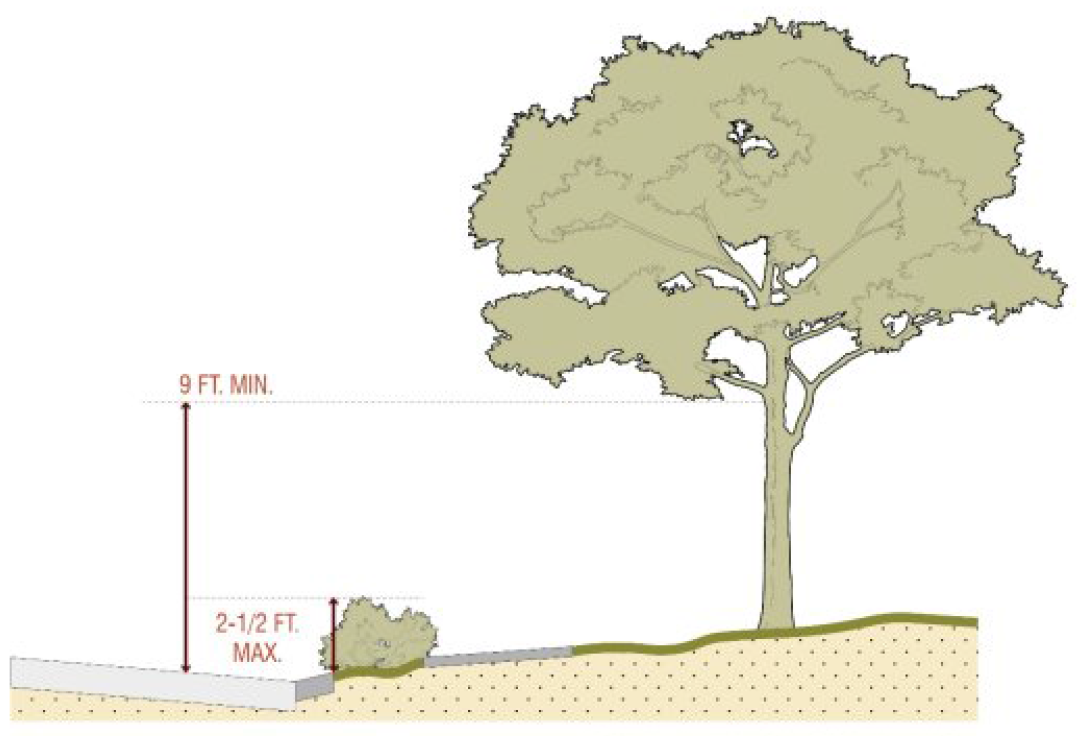
Figure 3. Sight View Triangle, Clear Area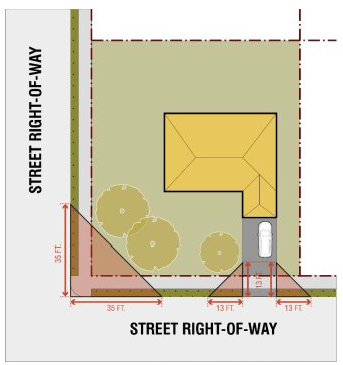
Sec. 3-6.5. - Buffers and landscaping.
Buffer and landscaping requirements can be found in Chapter 4 of this LDR.
Sec. 3-6.6. - Design standards in certain zoning districts.
Proposed development or substantial redevelopment shall comply with the Design Standards found in this section when the development or redevelopment is in the following zoning districts: Downtown, Neighborhood Mixed-Use, Village Mixed-Use and Canal Mixed-Use. Development in those zoning districts is intended to encourage walkability and street level activity, and a cohesive visual character.
(1)
The following design standards shall apply to development of mixed-use, commercial, or multi-family properties in the above listed zoning districts:
(a)
Architectural Styles: Permitted architectural styles include Florida Vernacular or Mediterranean Revival (permitted variations of Mediterranean Revival include Mission, Santa Fe or Pueblo.
(b)
Entrances: The main entrance and any minor entrances must be clearly identifiable and have distinct, architectural enhancement.
(c)
Façade: A minimum of 50 percent of a building frontage must consist of an arcade, porch, canopies or second story balconies. Mixed-use and non-residential development shall encroach over the sidewalk a minimum of 50 percent of the length of the building to provide a covered walkway for pedestrians a minimum height of ten feet and minimum depth of eight feet.
(d)
Roofs: Multi-pitched roofs, a maximum of 20 percent of the roof allowed to be a visible flat roof. A parapet or cornice is required on flat or shed roofs that face a street. Permitted materials include standing seem, barrel tiles and concrete tiles.
(e)
Materials: A predominant building material is required. Stuccoed masonry is preferred for Mediterranean Revival architecture and lap siding is preferred for the Florida vernacular. The two materials can be used together. Trim accents are permitted.
(f)
Color: Buildings are to have one predominant color which should be light. Pastels are acceptable, dark or bold colors are prohibited. Colors shall be limited to no more than three colors and shall coordinate with neighboring properties.
(g)
Site Elements: Site features such as signs, lighting, benches, trash receptacles, bicycle racks and other furnishings must be similar in design and cohesive with the building style. All site elements must be located so as to allow passage of pedestrians.
(h)
Vehicle Areas: Parking lots, loading spaces and garage doors must be located to the side or rear of buildings.
(i)
360° Design: Where an exterior wall is not directly abutting another exterior wall, architectural features and design components shall be required on all sides.
(j)
Civic Open Space: New development within the urban core shall provide and maintain publicly accessible civic open space and associated features to enrich the urban environment.
(2)
The following design standards shall apply to development of single-family detached and single-family attached (townhouse, duplex and zero lot line houses) residences in the Downtown, Neighborhood Mixed-Use, Village Mixed-Use and Canal Mixed-Use zoning districts:
(a)
Architectural Styles: Permitted architectural styles include Florida Vernacular, Florida Bungalow, Caribbean, and Mediterranean Revival (permitted variations of Mediterranean Revival include Mission, Santa Fe or Pueblo).
(b)
A front or side porch, a minimum of six feet deep and ten feet wide, is required.
(c)
Garages must be at least five feet behind the front of the house, not including the porch.
(d)
Balconies and porches must have railings and balustrades to match the architectural style.
Sec. 3-6.7. - Mixed-use development standards.
Mixed-use development is permitted in Downtown, Village Mixed-Use, Canal Mixed-Use, Neighborhood Mixed-Use and Light Industrial zoning districts. The following are requirements for mixed-use projects:
(1)
Mixed-use projects shall be comprised of a minimum of 20 percent and a maximum of 75 percent residential.
(2)
Density and intensity of mixed-use developments within these zoning districts shall not exceed, in total, the maximum number of permitted residential units per acre for the zoning district, plus the maximum FAR for the zoning district.
Sec. 3-6.8. - Green and sustainable development standards.
These standards are intended to minimize the negative environmental impacts of development and create a more sustainable living environment in the Village.
(1)
All new construction must comply with the following green building requirements:
(a)
Bicycle parking/storage.
1.
Nonresidential development shall provide a minimum of five secure bicycle parking/storage spaces for each 10,000 square feet of floor area or part thereof. Plus, one per every 5,000 square feet after.
2.
Multifamily development shall provide secure bicycle parking/storage spaces at a ratio of one parking space for each four residential units, rounded up. The spaces shall be indicated on the site plan and located near the main entrance of each building or the development.
(b)
Exchange of off-street parking for bicycle parking.
1.
Nonresidential and multifamily development may reduce the amount of required parking in exchange for additional bicycle parking/storage on a one parking space to six bicycle parking/storage space ratio.
2.
No more than five percent of required parking shall be eligible for exchange.
3.
The bicycle parking/storage shall be in addition to required bicycle parking/storage space.
(c)
Hybrid electric vehicles and inherently low emission vehicle parking.
1.
Nonresidential and multifamily development requiring 20 or more parking spaces shall provide an area for parking hybrid electric vehicles (HEV), inherently low emission vehicles (ILEV), and golf carts equal to five percent of the off-street parking required for the site.
2.
HEV, ILEV and golf cart spaces shall be clearly marked and reserved for such vehicles and shall be located close to the handicapped parking spaces.
3.
Vehicles parking in these spaces must display a current state division of motor vehicles issued decal.
(d)
Low emitting materials.
1.
Nonresidential and/or multifamily development shall incorporate low emitting building or construction materials and substances containing minimal or no levels of volatile organic compounds (low-VOC or no-VOC) for paints, coatings, adhesives, sealants, composite wood and agrifiber products.
2.
Alternate products and technologies may be permitted upon written approval by the Director.
(e)
Water conservation.
1.
New residential and nonresidential developments, as well as substantial improvements, must meet the requirements of the South Florida Water Management District, Florida Water Star Program, as may be amended from time to time. Details of the Florida Water Star Water Conservation Program can be obtained through the South Florida Water Management District.
(f)
Paving materials.
1.
Nonresidential, multifamily and mixed-use development shall use paving materials for sidewalks, courtyards and non-covered parking lots with a minimum solar reflective index (SRI) of 29.
2.
As an alternate solution, open grid paver blocks may be used if it the open cells are at least 50 percent of the block area and are vegetated.
(g)
Roof finishes.
1.
Roof finishes for residential and nonresidential developments shall have a minimum solar reflective index (SRI) of 65 for slopes up to a 2:12 and 25 for slopes greater than 2:12.
2.
The minimum SRI shall apply to 75 percent of the roof surface.
(h)
Storage and collection of recyclables.
1.
Every building shall dedicate an accessible area, serving the entire building, for the collection and storage of non-hazardous recycling materials. Space shall be made available for all materials which are accepted by recyclers, which may include paper, corrugated cardboard, glass, plastic and metals.
2.
Such areas shall be a sufficient size to be able to store recyclables for at least one week.
3.
Such areas shall be excluded from floor area ratio calculation.
(i)
Shower facilities.
1.
Nonresidential development may provide one accessible and private indoor shower facility for each building, greater than 10,000 square feet in area, to accommodate employees traveling on bicycles.
2.
Such areas shall be excluded from floor area ratio calculation.
(2)
Green and sustainable development incentives are available to new development and redevelopment proposed in Downtown, Village Mixed-Use, Canal Mixed-Use, Neighborhood Mixed-Use, and Light Industrial zoning districts that obtain third party green building certification in compliance with the procedures described in [section] 3-6.8(2)(j). No incentives provided under this section may exceed the development density or intensity limitations of the applicable Future Land Use Designation in the Comprehensive Plan for a parcel.
(a)
Increased gross area per floor. Projects achieving a minimum LEED Silver or other equivalent third party certification, up to ten percent increase in gross area per floor; projects achieving a minimum LEED Gold or other equivalent third party certification, up to 15 percent increase in gross area per floor; projects achieving a minimum LEED Platinum or other equivalent third party certification, up to 20 percent increase in gross area per floor. The bonus floor area shall not exceed the maximum floor area ratio permitted by the underlying Comprehensive Plan designation.
(b)
Increased height and number of stories. Additional building height of one additional up to 12 additional feet may be permitted within the Neighborhood Mixed-Use, Canal Mixed-Use, Village Mixed-Use, Downtown, or Light Industrial zoning districts.
(c)
Reduction in parking. The applicant may receive a reduction in overall required parking of up to ten percent. In no instance shall a combination of reductions in parking obtained either via a shared parking agreement or via other applicable sections of the Land Development Regulations allow reductions in parking exceed 20 percent of the required parking for each individual use on the site.
(d)
Expedited site and building plan review. The Director shall implement a program to expedite the review and approval of site plan and building permit applications for green buildings.
(e)
Expedited building inspections. Building inspections for projects participating in the green building incentive program shall be given priority over non-program participants.
(f)
Reduced site plan review fee. The applicable site plan review fee shall be reduced by ten percent for a program participant.
(g)
Eligibility for green building award granted by the Village. For the purpose of publicly recognizing outstanding commitment to "green building," the Village shall provide for an award called the "Village of Indiantown Green Building Award" to be awarded annually to a development(s) that participated within the program.
(h)
Prior to award. The applicant shall be required to attend a pre-application meeting with the Director for the purpose of a review of the proposed certification checklist and detail of proposed credits for certification. The checklist and certification details shall be confirmed through a development agreement or other agreement between the applicant and the Village that the minimum required by the program guidelines, policies and procedures will be incorporated into the development and maintained in perpetuity. The applicant will provide a performance bond in conformance with the requirements set forth herein.
(i)
Reduction in parking for shower facilities. Nonresidential development providing one accessible and private indoor shower facility in each building may receive an overall reduction in the parking requirement of up to ten percent or a maximum of one parking space or whichever is greater.
(j)
Green and sustainable development process. The green and sustainable development incentives, listed in [section] 3-6.8(2), are available to new development and redevelopment proposed in Downtown, Village Mixed-Use, Canal Mixed-Use, Neighborhood Mixed-Use, and Light Industrial zoning districts. To receive these incentives, applicants shall comply with the following procedures:
1.
During the site plan approval process the applicant shall do the following in order to be considered for the green and sustainable development incentives:
a.
The applicant must successfully register the project with the Green Building Certification Institute or the state green building coalition, or other third-party certifying agency as approved by the Village Manager, and provide evidence of the registration.
b.
The applicant shall have a minimum of one LEED accredited professional, or other similarly accredited professional, on the design team. The applicant shall provide a copy of the LEED accreditation certificate or similar certification and describe the role of the LEED accredited professional on the design team.
c.
The applicant must provide a copy of the pertinent credit checklist indicating which credits the project will achieve along with a description, detailed drawings and plans illustrating the applicant's intent to meet the prerequisites as described in the applicable LEED rating system or FGBC designation for the specific building type.
d.
Prior to the issuance of the first principal building permit the applicant shall post a performance bond, provide an irrevocable letter of credit from a financial institution authorized to do business in the state or provide evidence of cash deposited in an escrow account in a financial institution in the state in the name of the applicant and the Village in an amount equal to five percent of the total cost of the construction in order to secure performance and fulfillment of the applicant's obligation to obtain the applicable level of certification. If the project fails to meet the criteria required for certification by the Green Building Certification Institute or other nationally recognized certifying agency within one year after receiving the Village's certificate of occupancy, the applicant shall either request an extension or forfeit 100 percent of the bond. The applicant, for good cause shown, may request an extension of time of up to one additional year to achieve certification. Such extension may be granted at the sole discretion of the Village Council after having considered the factors and improvements necessary to achieve the requisite certification. If certification is not achieved within two years after receiving the Village's certificate of occupancy, the applicant shall forfeit 100 percent of the bond. Funds that become available to the Village from the forfeiture of the performance bonds shall be deposited in a green building fund established by the Village.
(3)
Green building fund. Funds that become available to the Village from the forfeiture of green performance bond shall be deposited in a green building fund established by the Village. The Village shall use the funds for any of the following: education and training of Village staff; education and outreach for the public; energy efficient improvements to municipally owned properties, including weatherization, lighting upgrades, heating, ventilation and air conditioning upgrades; open space/green space improvements such as rights-of-way tree plantings; traffic calming, pollution mitigation, low impact drainage and sanitary sewer improvements; and any other additional improvements consistent with green building initiatives as deemed appropriate by the Village Council.
Sec. 3-6.9. - Industrial performance standards.
(a)
Any permitted use may be undertaken and maintained if it conforms to all district regulations including these performance standards. No site plan for an industrial use in the Industrial zoning districts shall be approved without a signed and sealed report from an appropriately qualified certified engineer stating that all performance standards will be met. All uses shall operate in conformance with the limitations as set forth in below:
(1)
Vibration. No vibration shall be produced which is transmitted through the ground and is discernable without the aid of instruments at any point beyond the lot line. No vibration shall exceed 0.0028g peak measured at or beyond the lot line using seismic or electronic vibration measuring equipment.
(2)
Noise. Sound level measurements shall be taken at the boundary line of the zoning district using a sound level meter and an octave band analyzer to measure the intensity and frequency of the sound or noise levels encountered. The sound pressure level of noise radiated continuously from a facility at nighttime shall not exceed the values listed in Table 22, below. The values in the second column shall apply where the boundary line is adjacent to any nonindustrial zoning district, the values in the third column shall apply where the district boundary line adjoins or lies within 25 feet of the boundary of a residential district.
a.
If the noise is not smooth and continuous and is not produced between the hours of 9:00 p.m. and 7:00 a.m., one or more of the corrections in Table 23, below, shall be added to or subtracted from each of the decibel levels given above in Table 22.
(3)
Air pollution. No air pollution, from any source, shall exceed the limitations of federal and/or state emissions standards or regulations.
(4)
Water pollution. All wastewater and runoff from an industrial site shall meet all state and federal standards for effluent and discharge. Stormwater runoff from an industrial site may not be directed to wetlands or waterways.
(5)
Odors. Any condition of operation which results in the creation of odors of such intensity and character as to be detrimental to the health and welfare of the public or which interferes unreasonably with the comfort of the public shall be stopped or modified to remove the odor.
(6)
Electromagnetic radiation. It shall be unlawful to operate any intentional source of electromagnetic radiation which does not comply with the regulations of the Federal Communications Commission except that for those generated by governmental agencies and government owned plants. Operation in compliance with the Federal Communications Commission regulations shall be unlawful if radiation causes electromagnetic interference or an abnormal degradation in performance of other electromagnetic radiators or electromagnetic receptors of quality and proper design. The determination of "abnormal degradation in performance" and "of quality and proper design" shall be made in accordance with good engineering practices as defined in the latest principles and standards of the American Institute of Electrical Engineers, the Institute of Radio Engineers and the Electronic Industries Association.
(7)
Fire and explosion. All activities and storage of flammable and explosive materials shall be provided with adequate safety and firefighting devices in accordance with the Fire Prevention Code and other technical codes adopted by the Martin County Fire and Rescue Department, State of Florida and other appropriate governmental agencies.
(8)
Radioactive materials. The handling, discharge into air or water and the disposal of radioactive wastes, shall be in conformance with the regulations of the United States Nuclear Regulatory Commission as set forth in the Title 10 Code of Federal Regulations, Part 20, Standards for Protection Against Radiation, as amended, from time to time, and all applicable regulations of the State of Florida, and other appropriate governmental agencies.
(9)
Glare and heat. No direct or sky-reflected glare, whether from lights or processes, shall be visible at the lot line. There shall be no emission or transmission of heat or heated air so as to be discernible at the lot line and shall not exceed applicable governmental agency standards.
Sec. 3-7.1. - Purpose.
There are certain uses which may be constructed, continued or expanded, provided they meet certain mitigating conditions specific to their design and operation. The purpose of these conditions is to ensure the common impacts of certain uses are ameliorated. The use standards are intended to apply to by-right development. Each conditional use shall be permitted in compliance with the conditions listed in this chapter. If the applicant is unable or unwilling to meet all of the criteria of a conditional use, the use may be approved through the special exception process.
In evaluating a request for a conditional use, the following evaluation criteria and section 12-15 are to apply. It is the applicant's responsibility to justify that each one of the criteria is met. For the purposes of this division, all measurements of distances shall be measured from the nearest point of the proposed conditional use to the nearest point of the existing use or zoning district that the conditional use must be separated from unless specified otherwise within the conditions.
Sec. 3-7.3. - Adult business establishments.
(a)
No adult business shall be permitted except in the Light Industrial zoning district with a conditional use permit.
(b)
Exemptions. This section shall not apply to accredited universities, colleges or other educational institutions, art galleries, museums, art exhibits and galleries open to the public; arts and cultural performance theaters and playhouses; or commercial professional photography and portrait studios which may use nude subjects for their photographs or portraits. Such uses shall not be considered adult businesses.
(c)
Location. Adult businesses shall be permitted only within the Light Industrial zoning district.
(1)
No person shall cause or permit the operation of any proposed adult business use within the following minimum distances from any existing uses specified below:
a.
Places of worship, 500 feet;
b.
School, 500 feet (For purposes of this section the term "school" shall be defined as any premises or site upon which there is a day care center, nursery school, pre-kindergarten, elementary school, middle school, high school or library);
c.
RR, LR, SR, P, CF, D, VMU or NMU zoning districts, 500 feet;
d.
Another adult use, 500 feet.
(2)
No more than one adult business establishment use may be located on any one parcel.
(3)
Variances to the location standards of this section shall not be allowed.
(4)
Certified survey. For purposes of establishing the distance between the adult use and incompatible uses, as set forth above, the applicant requesting the regulated use shall furnish a certified survey from a registered surveyor indicating the distance from the adult use and any incompatible use as set forth above. In case of any dispute, a measurement scaled by the Director shall govern.
Sec. 3-7.4. - Alcoholic beverage sales.
(a)
Alcoholic beverage sales for consumption on-site or off-site shall not be permitted upon premises closer than 300 feet from any place of worship or school without approval by the Village Council, with the following exceptions:
(1)
When served in the dining room of a restaurant serving cooked full-course meals;
(2)
When served in a cocktail bar or lounge as an accessory use in a restaurant serving cooked full-course meals. The bar shall not have a separate entrance than the restaurant and shall be no larger than 25 percent of the gross square footage of the restaurant;
(3)
When beer and wine is sold from a grocery store, for consumption off the premises.
(b)
Construction or establishment of a place of worship or school within 300 feet of an existing business which sells alcohol shall not cause the business to become nonconforming.
Sec. 3-7.5. - Automotive/boat/truck sales, rental, service and repair.
(a)
Large surface parking/display lots shall be visually and functionally segmented into several smaller lots. The size of any single lot shall be limited to one and one-half acres, unless divided by a street, principal building, or 15-foot landscape buffer area. All areas shall be connected internally with sidewalks and landscaping following the requirements of this Code.
(b)
No outdoor public address system shall be permitted which can be heard beyond the boundaries of the property.
(c)
Service and repair activities shall operate during regular business hours, no earlier than 7:00 a.m. and no later than 8:00 p.m.
(d)
Service and repair activities are not permitted outdoors within 200 feet of a RR, SR or LR zoned property.
(e)
Parking, display and storage of vehicles is limited to paved areas.
(f)
In the Canal Mixed-Use zoning district, RV sales, service, and repair shall be permitted as an accessory use to Recreational Vehicle Storage (where permitted as an Existing Only use).
(Ord. No. 02-2022, § 2(Exh. A), 4-14-2022)
Sec. 3-7.6. - Community residential home (with seven to 14 residents).
(a)
When a community residential home location has been selected by a sponsoring agency in an area zoned to allow multifamily uses, the agency shall notify the Village Manager, in writing, and include in such notice:
(1)
The specific address of the site;
(2)
The residential licensing category;
(3)
The number of residents;
(4)
The community support requirements of the program; and
(5)
A statement from the district administrator of the license issuing state department indicating:
a.
The need for and the licensing status of the proposed community residential home
b.
How the home meets applicable licensing criteria for the safe care and supervision of the clients in the home; and
c.
The most recently published data compiled that identifies all community residential homes in the district in which the proposed site is to be located.
(b)
Review of the use shall be limited to:
(1)
The proposed location must be in a zoning district that allows multifamily residential uses;
(2)
The home shall be licensed by the Department of Children and Family Services;
(3)
The home may not be located within a radius of 1,200 feet of an existing community residential home, 1,000 feet of a home with six or fewer residents which otherwise meets the definition of a community residential home or within 500 feet of a single-family zoning district.
Sec. 3-7.7. - Day care, commercial.
(a)
Child or adult-care centers shall be required to provide a designated drop-off and pickup area, which is not part of the permanent parking for the site. Pickup and drop-off stacking areas may not impact the right-of-way. Paved areas shall not be considered as play areas.
(b)
Child day-care centers shall provide a minimum of 20 square feet of usable floor space per child. Usable floor space refers to that space available for indoor play, classroom, work area or nap space.
(c)
Child-care centers shall provide securely fenced outdoor play area consisting of at least 400 square feet or 45 square feet per child in any group using the play area at one time, whichever is greater. A minimum play area shall be provided for one-half the permitted capacity, but in no case less than 400 square feet. No outdoor play area shall be located in any required front yard. All required play areas should be grassed or mulched. Where the edge of any such outdoor play area is closer than 30 feet to any side or rear lot line, an intervening masonry wall not less than five feet in height shall be maintained along such edge.
(d)
Child-care centers established as accessory uses to another permitted commercial establishment for short-term care of children need not provide outdoor play area.
Sec. 3-7.8. - Drive-thru lane.
(a)
Vehicle stacking area for drive-thru windows shall be located outside of and physically separated from right-of-way of any street. The area shall not interfere with efficient internal circulation of traffic on the site, adjacent property or adjacent street right-of-way.
(b)
Drive-thru window facilities shall be screened from any residential property by a landscape buffer with a minimum width of ten feet, extending along the entire length of the drive-thru queuing or stacking area. A permanent porte-cochere may be constructed over the drive-thru at the service window area. It shall be a minimum of ten feet in width, extend the width of the drive, be integrated structurally into the building, and match the architecture of the building. The porte-cochere may not encroach into the side setback.
(c)
The volume of the customer service speaker, in the drive-thru line, may not exceed 55 decibels at any property line.
(d)
The drive-thru window may not be located on the primary frontage of the building.
Sec. 3-7.9. - Existing only uses.
(a)
Unified control. All land included for the purpose of development that expands or intensifies existing only uses shall be under the control of the applicant (an individual, partnership or corporation, or group of individuals, partnerships or corporations). The applicant shall present satisfactory legal documents to constitute evidence of the unified control of the entire area within the proposed development which, shall be certified by the Village Attorney. The applicant shall agree in the site plan application for expansion to the following:
(1)
To proceed with the proposed development according to the provisions of this chapter and the approved plan;
(2)
To provide, subsequent to site plan approval and prior to the issuance of a building permit, any agreements, contracts, covenants, deed restrictions or sureties as reasonably deemed necessary by the Village, in a form acceptable to the Village, to ensure that the development proceeds in accordance with prior approvals and to further provide for continuing operation and maintenance of such areas, functions and facilities which are not proposed to be provided, operated, or maintained at public expense;
(3)
To bind their successors in title to any commitments made as set forth in this subsection; and
(4)
If the developer elects to administer common open space through an association or nonprofit corporation, the organization shall conform to the applicable laws of the state.
(b)
Expansion and intensification site plan approval.
(1)
Review agreement required. In cases whereby a property has no existing development agreement, any further development or redevelopment shall require major site plan approval and a development agreement with the Village.
(2)
Guidelines. Design standards for existing only uses are set forth in section 3-6.6 of this Code.
Sec. 3-7.10. - Group home/neighborhood assisted residences with six or fewer residents.
Group homes/neighborhood assisted residences are limited to six resident clients on the premises. These shall be allowed in all zoning districts which allow single-family or multifamily residences
(a)
The Village must be notified of the issuance of a state license to operate pursuant to F.S. § 419.001(2).
(b)
The structure used for the group home shall not be located within 1,000 feet of another existing, legally established group home with six or fewer residents or within 1,200 feet of another community residential home with seven to 14 residents. To make this determination, the sponsoring agency shall provide the Village with the most recently published data compiled from the licensing entities that identifies all community residential or group homes within the Village.
(c)
Care services, such as, but not limited to, meals, nursing, or counseling services, shall be provided only to persons living in the home.
Editor's note— Ord. No. 03-2022, § 2, adopted April 28, 2022, repealed duplicate § 3-7.10, which pertained to home occupation or live/work unit and derived from the Land Development Regulations adopted on November 12, 2020. The user's attention is directed to § 3-4.9.
Sec. 3-7.11. - Kennel/doggy daycare.
Kennels and doggy daycares may be permitted as a conditional use in the Light Industrial and Village Mixed-Use districts subject to the following conditions:
(1)
For kennels where all facilities are 300 feet or more from property that is zoned or used for residential purposes:
(a)
There are no outdoor dog runs on parcels that are less than one acre in area.
(b)
Dog runs will be used only during daylight hours.
(c)
Fences that enclose dog runs are not less than six feet in height.
(2)
For kennels where the facilities are within 300 feet of property that is zoned or used for residential purposes:
(a)
There are no outdoor dog runs; and
(b)
The building is soundproofed such that noise generated by the use is not perceptible from the property line.
(3)
Kennel facilities include any structure where animals are kept and any fenced areas where animals are off leash. Measurement shall be from any facility to a property line for a property zoned RR, SR, LR or NMU.
Sec. 3-7.12. - Medical marijuana dispensing facility.
Medical marijuana dispensing facilities shall be allowed in any zoning district that permits pharmacies and is in compliance with the following condition:
(1)
The facility shall be located no closer than 500 feet from any public or private school. The distance between school property and licensed premises shall be measured by a straight line connecting the nearest point of the school property to the nearest point of the building of the licensed premises, as documented by a survey prepared by a licensed surveyor and mapper.
Sec. 3-7.13. - Mobile food vendors/food trucks.
(a)
Mobile food vendors (MFV) may be allowed as part of a permitted special event or in compliance with the following regulations.
(1)
MFV may be a conditional use within any zoning district which allows a restaurant.
(2)
MFV shall not operate within two blocks of a school on weekdays from 7:30 a.m. to 5:00 p.m.
(3)
MFV shall not be operated later than 10:00 p.m. on weekdays and 11:00 p.m. on weekends. Shorter hours may be approved based on location.
(4)
MFV shall not be permitted to sell alcoholic beverages.
(5)
MFV may operate in the same location for no more than eight hours unless it is part of a special event.
(6)
The name and contact information of the person responsible for the maintenance, placement and operation of the MFV shall be posted in a conspicuous place in a part of the vehicle to which the public has access by sight.
(7)
A notarized letter, from property owner of record, authorizing the use of the property by the MFV, shall be posted in a conspicuous place in a part of the vehicle to which the public has access by sight.
(b)
Operational requirements. The following requirements shall apply during the operation of a MFV in the Village:
(1)
Vehicles shall comply with all applicable health and sanitary laws of the Village, county and state.
(2)
The MFV shall be responsible for keeping the operational area clean. The refuse receptacle shall be adjacent to, but not an integral part of, the mobile food service vehicle.
(3)
License posting. Every license shall be posted in a conspicuous place in a part of the vehicle to which the public has access by sight.
(c)
Violation of this section shall result in a daily fine, per violation.
Sec. 3-7.14. - Non-chartered financial institutions (pay-day lenders, check cashing businesses).
Any business which has a primary function of cashing checks and providing loans or cash advances, this does not include banks whose primary functions include accepting and safeguarding monetary deposits, will be subject to the following:
(1)
May not be closer than 1,000 feet from any similar business.
(2)
May not have bars on the exterior of windows.
Sec. 3-7.15. - Pawn shops and gold buying business.
Any business that operates exclusively to buy goods and gold from the public, and is not a retail jewelry store, will be subject to the following:
(1)
Must be a minimum of 500 feet from SR, LR and RR Zoning Districts.
(2)
May not be closer than 1,000 feet from any similar business.
Sec. 3-7.16. - Peddlers and itinerant merchants.
Any business location for an itinerant merchant or peddler shall meet the following criteria:
(1)
The property is zoned NMU, D, VMU, LI.
(2)
The owner of the property has provided written permission for the applicant to use the location.
(3)
The site shall have at least one parking space for the merchant and two parking spaces for customers that are not required for another use on the property.
(4)
Peddlers or itinerant merchants shall not be located on publicly-owned land or on public right-of-way unless authorized by the Village Manager.
(5)
Peddlers and itinerant merchants shall be prohibited from offering for sale, for trade, for free or otherwise offering for exchange any animal(s).
(6)
A restroom facility must be available for use by the merchant and customers.
(7)
The peddler or itinerant merchant must submit a use permit application and a site plan showing the proposed location where goods will be displayed, parking and the restroom. Proposed locations may not be within required setbacks.
Sec. 3-7.17. - Shooting ranges.
The purpose of this section is to specify standards for shooting ranges for indoor and outdoor facilities. Such uses shall be permitted only if they comply with the following:
(1)
General Standards:
(a)
Noise shall not exceed 65 decibels at the property line. If contained within a multi-tenant building, the sound shall not exceed 65 decibels along a common wall unless specific authorization is provided from the owner of the building waiving the requirement.
(b)
The facility shall be designed to meet and comply with applicable federal and state laws, county, and local ordinances and guidelines, such as but not limited to, the Environmental Protection Agency (EPA), Occupational Safety & Health Administration (OSHA), and National Rifle Association (NRA) Range Source Book (current edition), the Bureau of Alcohol, Tobacco, Firearm and Explosives (ATF) registration requirements, local health department and building code requirements.
(c)
The range facility shall not be within 1,000 feet of a school, church, residential home or childcare facility. For the purposes of this subsection, all measurements of distances shall be from the property line of the proposed use to the nearest point on the property line of the existing school, church, home or childcare facility.
(d)
The range owner/operator shall submit to the Village prior to operation, and maintain as a condition for operation, a range safety plan that addresses the following items at a minimum and all rules and regulations must be complied with:
1.
Firearm handling rules:
i.
How firearms will be handled on site in a safe manner.
ii.
Guns shall be stored where they are not accessible to unauthorized persons.
2.
General range rules:
i.
Range commands.
ii.
Designated range officer.
iii.
Downrange safety measures.
(e)
No sport shooting range shall create a nuisance that interferes with others' rights to safety and enjoyment of their own property.
(f)
The Martin County Sheriff's Office shall be entitled to perform an inspection of the facility a minimum of two times a year.
(2)
Indoor sport shooting ranges when conducted within a permanent, fully enclosed building:
(a)
Indoor ranges must be designed so projectiles cannot penetrate the walls, floor or ceiling, and ricochets cannot harm range users. Lead exposure shall follow EPA and OSHA guidelines to make sure that the facility is properly ventilated.
(b)
Walls and partitions shall be designed to stop all projectiles fired on the range by containing or redirecting bullets to the backstop.
(c)
Floors, walls, backstops and ceilings must be able to contain the sound in addition to the bullet fired and be made of an acceptable engineering standard compliant with all standards of this section.
(d)
Fully automatic firearms are prohibited. Firearm use shall be limited to .45 caliber or less, provided that the facility is designed to meet all standards listed in this section.
(3)
Outdoor sport shooting ranges are permitted in compliance with the following conditions:
(a)
Activities are limited to archery use only.
(b)
The facility may only be open for archery practice during daylight hours.
(c)
A minimum of 48 square feet shall be provided for each shooting station with a dimension of eight feet wide by six feet deep.
(d)
Target areas and shooting line areas shall be identified on a site plan for target archery.
(e)
Spectator areas shall be separated from the range to prevent anyone from entering the down range area and shall be placed behind the shooting line.
(f)
Backstops shall be placed immediately behind targets and shall consist of materials to keep arrows on-site.
(g)
Restrooms shall be provided within enclosed buildings.
(h)
Berms shall be placed downrange from the target area along with dense vegetation near the property line.
(i)
Target areas shall be setback at least 300 feet from the property line and must be at least 1,500 feet from dwellings downrange. Indoor archery may be permitted as an ancillary use to the outdoor facilities.
(j)
Fencing and gates shall be provided around the shooting range facility to maintain a level of security at the range with a minimum height of eight feet to prevent unauthorized access. Signage must be maintained and be posted at a minimum of 200-foot intervals by durable, weather proof signs not less than two square feet in size with a minimum of two-inch lettering, containing the following in large print: DANGER SHOOTING RANGE
(k)
Specific land area requirements:
1.
For target archery ranges, a site shall be at a minimum of ten acres in size.
2.
For field archery ranges, a site shall be at a minimum 30 acres in size. One acre shall be provided per target.
Sec. 3-7.18. - Wireless communication (WC) facilities and towers.
(a)
WC facilities and towers are permitted in compliance with the following requirements:
(1)
Adequate documentation that co-location on an existing approved tower or on an existing building or structure, has been attempted and is not feasible. Such documentation shall include:
a.
The results of a designed service study demonstrating to the satisfaction of the Village that the equipment planned for a proposed communication tower cannot be accommodated on an existing or approved and un-built structure.
b.
The designed service study analysis shall be based upon a search area radius of three-quarters of a mile minimum distance from the location of the intended WC facilities or tower, including areas outside the Village. At the discretion of the Village, based on the Village's knowledge of existing co-location opportunities, the applicant may provide an affidavit from a professional radio frequency engineer which establishes the search area diameter for the proposed WC facilities or tower location and identifies all other alternatives in the area. Further information may be required by the Village on the ability of the WC facility or tower to be accommodated on specific sites within three-quarters of a mile of the proposed WC facility or tower.
(2)
Any determination that co-location is infeasible shall be based upon the results of a designed service study and other evidence from an appropriate licensed professional, provided by the applicant and, with one or more of the following reasons:
a.
Structural limitation. The proposed equipment would exceed the structural capacity of the existing or approved structure and the existing or approved structure cannot be reinforced, modified, or replaced to accommodate the planned or equivalent equipment at a reasonable cost.
b.
Interference. The proposed equipment would cause interference or obstruction materially impacting the usability of other existing or planned equipment at the tower or building and the interference or obstruction cannot be prevented at a reasonable cost.
c.
Insufficient height. Existing or approved towers and buildings within the search radius cannot accommodate the planned equipment at a height necessary to function reasonably.
d.
Lack of space. Existing towers or other structures within the search radius do not have adequate space to accommodate the proposed facility.
e.
Other factors. Other reasons that make it unfeasible to locate the planned equipment upon an existing or approved tower or building.
(3)
Technical consultants. The Village shall have the right to retain independent technical consultants and experts that it deems necessary to properly evaluate applications for wireless telecommunications facilities or towers and to charge the applicant reasonable fees as necessary to offset the cost of such evaluations.
(4)
WC tower design standards. In addition to any other applicable requirements provided elsewhere in these LDRs, an application for a communication tower shall include the following:
a.
Fall zone. In the event of a catastrophic failure or collapse, towers shall be designed to collapse within an engineered fall zone lying wholly within the lot lines of the parent parcel containing the tower. Such fall zone shall be certified by a professional engineer, licensed in the State of Florida.
b.
Setback. A tower may be no closer than 25 feet to any adjacent commercial or industrial zoned parcel and no closer than 50 feet to any adjacent residential zoned parcel.
c.
Tower design for co-location. A proposed tower shall be designed to allow for future arrangement of antennas, to provide space for antennas to be mounted at varying elevations, and to accommodate co-location.
d.
Monopoles or stealth. All towers shall be monopoles or stealth design.
e.
Illumination. A tower shall not be artificially lighted except as may be required by federal or state regulations.
f.
Surface or finish color. All towers shall be painted or have a non-contrasting finish that minimizes the visibility of the facility from public view, except where contrasting color is required by federal or state regulation.
g.
Sign. The main access gate in the tower shall have affixed to it a sign not to exceed two feet by three feet in size which displays the owner's or permittee's name and an emergency telephone number.
h.
Maximum height. The maximum height of towers shall be 100 feet if the tower is designed for one service provider, 120 feet if the tower is designed to accommodate two service providers, or 140 feet if the tower is designed to accommodate three or more service providers.
i.
Landscape screening. The accessory components to the tower shall be screened from view by shrubs maintained at a height of six feet, immediately adjacent to the fence surrounding the facility and minimum of eight trees planted outside of the shrub buffer.
j.
Obsolete, unused or abandoned towers and associated facilities shall be removed within 12 months of obsolescence, cessation of use or abandonment. A bond may be required to cover removal of the structure.
(b)
Small wireless facilities (SWF) may be installed on or attached to existing structures, such as wireless or water towers, buildings, light or power poles or other freestanding structures in all zoning districts (inclusive of rights-of-way) except; Single Family Residential (SR), Limited Residential (LR) and Conservation (C). No wireless facilities will be permitted in the SR, LR or C zoning districts unless such placement is compelled by the requirements of the Advanced Wireless Infrastructure Deployment Act or other state regulation.
(1)
SWF may be installed on or attached to Village property if the provider or facility owner obtains a lease or license agreement with the Village.
(2)
Small wireless facilities (SWF) may be installed on or attached to existing structures in the rights-of-way, with a right-of-way permit, if the provider or facility owner complies with all provisions of this section.
a.
Equipment cabinets to service SWF in a right-of-way shall be located underground. The placement of equipment cabinets shall not conflict with other public and private utilities in the right-of-way. The location of any above-ground access to such equipment shall not conflict with pedestrian and handicapped accessibility of sidewalks and shall not be located within the visibility triangle.
b.
SWF shall require no personnel on the premises except as necessary for maintenance and repair.
c.
A SWF proposed to be located on a historic landmark or in a designated historic district may be denied if the small wireless facility creates a detrimental impact on the historic character of the historic landmark or the applicable district.
d.
A SWF may not be placed on the following structures: street signs, street lights and lamps, sign poles, pedestrian crossings, traffic signals, traffic signal poles, traffic signal arms, or on any pole or structure that is less than 15 feet in height.
e.
A SWF antenna shall not extend more than ten feet above the utility pole or structure upon which the antenna is mounted.
f.
New poles in rights-of-way must meet the following locational criteria:
1.
Shall meet distance requirements as specified by the Public Works Director, the Building Official, the Director of Community and Economic Development or the Fire and Rescue Department for intersections, drives, sidewalks (existing and future), handicapped access in accordance with the Americans with Disabilities Act, protected trees, traffic light poles, energized electric lines, hydrants, and other structures or features that have the potential to affect life and safety with new poles.
2.
In RR, SR and LR districts, location is restricted to where the shared property line between two residential parcels intersects the right-of-way, or otherwise in a manner that demonstrates the least impact to access to private property. Where the residential use occupies only one side of the street, the poles shall be placed on the opposite side of the street.
3.
In districts other than RR, SR and LR, location is restricted to the area between tenant spaces or adjoining properties where the shared property lines intersect the right-of-way, or otherwise in a manner that demonstrates the least impact to access to private property.

