
Indiantown City Zoning Code
CHAPTER 8
- IMPACT FEES AND MOBILITY FEES
Sec. 8-2.1. - Short title and authority.
(a)
This article shall be known and may be cited as the "Indiantown Mobility Fee Ordinance."
(b)
The Village of Indiantown has the authority to adopt this division pursuant to its home rule powers under its Village Charter granted by Article VIII of the Constitution of the State of Florida and Chapter 166, Florida Statutes, and pursuant to Chapters 163 and 380, Florida Statutes, and Florida case law.
(c)
The Village of Indiantown has the power and responsibility to provide a multimodal circulation system comprised of bicycle lanes and ways, multimodal lanes and ways, transit lanes and ways, hardscape, high-visibility crosswalks, landscape, lighting, intersections, mid-block crossings, mobility hubs, multi-use paths, overpasses, pedestrian and vehicle signals, roads, roundabouts, mobility programs, services and studies, sidewalks, stormwater management facilities, safety enhancements, streets, streetscape, traffic control devices, trails, transit circulators and transit facilities, water taxi service and stops, in the Village.
(Ord. No. 07-2023, § 2(Exh. A), 11-16-2023)
Sec. 8-2.2. - General provisions and applicability.
(a)
New development, redevelopment, infill development, change of use, and alterations or changes of use in land, including submerged land, within the Village (collectively known as "new development activity"), that generates an increase in person travel demand above that generated by the existing use of land, will therefore generate a need for mobility projects in the Village to serve the increase in person travel demand.
(b)
Development of a Mobility Plan that identifies mobility projects that will provide the multimodal capacity needed to serve new development activity that generates additional person travel demand for improvements, programs, services, and studies, and the subsequent implementation of a Mobility Plan, is a responsibility of the Village.
(c)
Development of a Mobility Plan by the Village, based on projected growth in person miles of travel and the increase in person travel demand, shall serve as the basis for development of a mobility fee to fund mobility projects and provide the multimodal capacity needed to serve increases in person travel, and is in the best interests of the health, safety, and welfare of the citizens of the Village.
(Ord. No. 07-2023, § 2(Exh. A), 11-16-2023)
Sec. 8-2.3. - Definitions.
For the purpose of this division, the following definitions shall apply unless the context clearly indicates or requires a different meaning, and shall control over any similar definition in the Technical Report:
Administrative Manual shall mean a document that guides administration and implementation of mobility fees and addressed in further detail that applicable sections of the mobility fee ordinance. The administrative manual may either be a formal document or administrative procedures that is developed over time to meet the special and unique needs and reflect the development patterns of the Village.
Applicant shall mean a person, persons, companies, corporations, developers, developments, or new development activity that applies for a building permit, development order approval, submits an application, requests a credit, interpretation, off-set, refund, or special use determination, or files an appeal, or submits an agreement.
Assessment area shall mean a geographic area or a unique development pattern such as mixed-use in the Village where mobility fees are assessed on new development activity that generates an increase in person travel over and above the current use of land. Until the Village establishes a program to define mixed-use, and an applicant receives formal designation as mixed-use by the Village for purposes of mobility fees, the mobility fee rates under the mixed-use assessment area would not be applicable.
Autonomous transit shuttle shall mean a vehicle that uses artificial intelligence, sensors, and global positioning system coordinates to drive itself with or without the active intervention of an operator.
Benefit district shall mean a geographic area where fees that are paid by new development activity are expended on multimodal projects within the district to provide a mobility benefit to the new development activity that paid the fees.
Capacity shall mean the maximum sustainable flow rate, at a service standard, at which persons or vehicles reasonably can be expected to traverse a point or a uniform section of a bicycle facility, pedestrian facility, roadway, or shared-use multimodal facility during a given time-period under prevailing conditions. For transit, the capacity is the maximum number of persons reasonably accommodated riding a transit vehicle, along with the frequency and duration of transit service.
Commercial and retail uses shall mean those commercial and entertainment activities which provide for sale, lease, or rent of products, services, accommodations, or use of space to individuals, businesses, or groups and which include those uses specified in the ITE Trip Generation Manual under Land Use Code Series 400, 800 and 900.
Commercial storage shall mean mini warehouses for the storage of goods and items for either personal use or business use or buildings and structures for wholesale nurseries. Areas used for outdoor storage would be assessed the applicable mobility fee for outdoor storage per acre.
Community serving shall mean those uses that are operated by non-profit civic originations, governmental entities, foundations, or fraternal organizations, including places of assembly and worship. Community serving also includes uses such as YMCA, museum, art studio, gallery, cultural center, community meeting spaces, community theater, library, or a fraternal or masonic lodge or club, or any community and civic based uses that do not sell retail goods or services for profit and that participates in community and public activities. Food, beverages, goods, and services maybe offered for ancillary fundraising and sales to support the community serving use.
Complete streets shall mean a transportation policy and design approach that requires multimodal transportation improvements to be planned, designed, operated, and maintained to enable safe, convenient and comfortable travel and access for users of all ages and abilities regardless of their mode of transportation and to allow for safe travel by those walking, bicycling or using other forms of non-motorized travel, riding public transportation or driving motor vehicles or low speed electric vehicles. Separate and defined spaces are provided for the various modes of travel planned within the cross-section.
Fast food or quick service restaurant drive-thru shall mean a quick service restaurant where an order for food is placed in a drive-thru lane or a pick-up/delivery lane where an order is picked-up by either a customer that placed an online order or a delivery service. Quick service restaurants are establishments serving beverages, food, or both with higher turnover, quick service, and may feature either counter service or selection of items from a counter and would fall under the descriptions of ITE Trip Generation Manual Land Use Codes 930, 933, 934, 935, 936, 937, and 938. The vehicle will proceed to one or more common pick-up windows, lockers, stations, or functional equivalent after the order has been placed. Quick service restaurant with drive-thru maybe located in multi-tenant retail or free-standing retail buildings. This use also includes any quick service restaurants that do not offer indoor seating and are intended to primarily be served by vehicle delivery services or pick-up or drive-thru only orders placed online. These uses may provide a walk-up order window.
Free-standing bank drive-thru lane or ATM shall mean bank drive-thru lanes or ATMs that are not physically attached to a financial institution and that are free-standing and accessed either by motor vehicle, on foot, or on wheels for mobility impaired persons or a person on a bicycle or electric device. Drive-thru lanes and ATMs are typically used for banking purposes such as deposits, withdrawals, balance inquires, or bill pay. An ATM inside or attached to a building that has a use open to the public or end user is not assessed a separate fee as a stand-alone ATM. Credit Unions and Savings and Loans are also considered to be banks for purposes of this definition and the applicable mobility fees. The mobility fee shall be based upon the total number of drive-thru lanes or accessible ATMs.
Free-standing discount retail shall mean, retail uses in a single building where any single use under common ownership exceeds 75 percent of the total square footage of the building. Discount retail includes retail uses selling discounted goods and merchandise, dollar and variety stores, superstores, and wholesale clubs. Discount retail includes superstores specializing in a specific category of goods such as books, home repair and remodeling, house goods, electronics, pet food and supplies, and sporting goods.
Indoor commercial recreation shall mean land uses that primarily focus on individual or group fitness, exercise, training or provide recreational activities. The uses typically provide exercise, dance or cheerleading classes, weightlifting, yoga, Pilates, cross-fit training, fitness, and gymnastics equipment. Indoor commercial recreation also includes uses such as bowling, pool, darts, arcades, video games, batting cages, trampolines, laser tag, bounce houses, skating, climbing walls, movie theaters, and performance centers. Food, beverages, equipment, and services maybe offered for ancillary sales.
Industrial shall mean those activities which are predominantly engaged in building and construction trades, the finishing, packaging, or distribution of goods or products, utilities, recycling, waste management and uses that include brewing and distilling that may have taps, sampling or tasting rooms, and include those uses specified in the ITE Trip Generation Manual under Land Use Code Series 000 and 100 but excluding governmental uses. Industrial uses typically have ancillary office space and may have display or merchandise display areas for various trades and industries that are not open to the public. Industrial uses are also located in land uses and zoning districts intended for industrial uses.
Industrial uses shall mean those activities which are predominantly engaged in the assembly, finishing, processing, packaging, and/or storage, warehousing, or distribution of products and which include those uses specified in the ITE Trip Generation Manual under Land Use Code Series 000 and 100 but excluding governmental uses.
Institutional uses shall mean those quasi-public uses that serve one or more community's social, educational, health, cultural, and religious needs and which include those uses specified in the ITE Trip Generation Manual under the Land Use Code Series 500, and includes Land Use Codes 253, 254, 255, and 620. Land Use Codes 540 and 550 are included in office uses and 580 and 590 falls under community serving. Federal, state, and local government institutional uses are exempt from payment of mobility fees, unless specifically authorized by law.
Internal capture shall mean an internal trip made between two distinct on-site land-uses at a mixed-use development without using the external off-site transportation system.
ITE Trip Generation Manual shall mean and refer to the latest edition of the report entitled "Trip Generation" produced by the Institute of Transportation Engineers (ITE), and any official updates hereto, as approved by Public Works.
Level of service (LOS) shall mean a quantitative stratification of the quality of service to a typical person of a facility, roadway, or service into six letter grade levels, with "A" describing the highest quality and "F" describing the lowest quality; a discrete stratification of a quality-of-service continuum.
Long term care shall mean land uses designed for long term care of on-site residents, such as assisted living facilities, congregate care facilities, and nursing homes with common dining and on-site health facilities for residents that is not a general retail or commercial use open to the public. This use includes ITE Trip Generation Manual Land Use Codes 253, 254, 255, and 620.
Low speed streets shall mean a multimodal transportation facility based on either the Dutch Woonerf concept that treats all modes equally with no defined spaces for any mode or bicycle boulevards which deprioritize vehicles and feature pavement markings, signage and posted speed limits. Low speed streets also include shared streets which typically do not have raised curbs, distinct pavement markings, traffic control devices, defined parking spaces, or vehicular speed limit signs or have posted speed limits 15 mph or less. A low-speed street often features signage and sometimes a speed limit that indicates there are multiple users of the shared street.
Manufacturing shall mean those activities which are predominantly engaged in assembly, fabrication, manufacturing and processing of goods or products.
Marina shall mean facilities that provide docks and berths for boats, including yacht clubs. Any buildings for shops, retail, or restaurants accessible to the public would fall under retail land use and pay the mobility fee rate for retail uses.
Medical office shall mean a building or buildings that provide medical, dental, or veterinary services and care. Medical office shall also include any clinics or emergency care uses, and any uses specified in the ITE Trip Generation Manual under Land Use Code Series 600, including Land Use Code 720. Land Use Code 610 is included under office land uses and 620 is included under long term care land uses.
Micromobility shall mean electric powered personal mobility devices such as electric bicycles, electric scooters, hoverboards, one-wheel, unicycle, electric skateboards, and other electric assisted personal mobility devices. Low speed vehicles such as golf carts or mopeds are not considered personal micromobility devices.
Microtransit shall mean low speed vehicles such as autonomous transit shuttles, golf carts neighborhood electric vehicles, or trolleys subject to requirements established by a governmental entity responsible for approval, permitting or regulating said vehicles.
Mixed-use shall mean: (1) vertically mixed buildings with retail uses on the 1st floor and office and or residential uses on floors above the 1st floor; (2) approved special area plans that have conditions requiring a mixture of retail, office, and residential uses and that requires Form Based Code Design; (3) compact developments of ¼-mile or less in radius measured from the center of the development that feature a mixture of retail, office, and residential uses, a gridded street network with speed limits of 25 mph or less, sidewalks along both sides of streets, and no roads functionally classified as an arterial or major collector internal to the development; or (4) Mixed-Use Developments (MXDs), Multimodal Oriented Developments (MODs), or similar mixed-use and multimodal supportive developments that meet criteria established by the Village of Indiantown.
Mobility shall mean the ability to move people and goods from an origin to a destination by multiple modes of travel in a timely (speed) manner.
Mobility fee shall mean a monetary exaction imposed on new development activity to fund multimodal projects identified in a mobility plan.
Mobility fee off-set shall mean the equivalent amount of a mobility fee associated with an existing use of land or building that is being redeveloped or where a change of occupancy is requested. The equivalent mobility fee shall be based on the current use of the land or building, or the most recent use of the land or building for vacant land or building. Upon demolition of a building or discontinuation of a use of land, offsets shall be available for up to four years from the date of demolition or discontinuation of use of land, unless otherwise provided for in a written agreement with the Village or specified in the implementing ordinance.
Mobility hub shall mean a centralized location with a covered shelter designed to accommodate micromobility devices, bicycle sharing, car-sharing, and provide a safe and convenient location for drop-off and pick-up of people riding transit, microtransit and ride-hailing services.
Mobility plan shall mean the identification of mobility projects consisting of improvements, programs, services, and studies within and adjacent to Indiantown to meet future person travel demand between 2022 and 2045 and shall serve as the basis for development of Indiantown's Mobility Fee.
Mobility Plan and Mobility Fee Technical Report shall mean the Village of Indiantown Mobility Plan and Mobility Fee Technical Report dated December 2022 and prepared by NUE Urban Concepts, LLC and adopted pursuant to an implementing ordinance which authorizes imposition of the mobility fee.
Mobility plan projects shall mean improvements such as sidewalks, bike lanes, trails, paths, protected bike lanes, transit facilities, streetscape, landscape, roundabouts, raised medians, crosswalks, and high visibility crosswalks. Improvements can include new or additional travel lanes and turn lanes, new or upgraded traffic signals, low speed, shared, or upgraded streets, bridges, overpasses, traffic synchronization, mobilization, maintenance of traffic, survey, geotechnical and engineering, utilities, construction, engineering and inspection, utility relocation, right-of-way, easements, stormwater facilities. Projects may include programs, services, and studies for mobility, shared mobility, funding, traffic calming, mobility equity and transit circulation. Projects may also include the repayment of bonds, local match for federal, state and county funded projects, repayment of loans from the State of Florida Infrastructure Bank used to front-end the design and/or construction of multimodal improvements. Mobility Plan projects may also be referenced as mobility projects, multimodal projects or projects.
Mobility plan project expenses shall mean expenditures for mobility plan projects, along with: (a) reasonable costs of planning, design, engineering and construction, including mobilization, maintenance of traffic during construction and construction engineering and inspection (CEI) services of related mobility projects, (b) bike lanes and ways, crosswalks, multimodal lanes and ways, sidewalks, shared-use paths, multi-use trails, roads, streets, low speed streets, intersection and roundabout improvements, traffic control and crossing warning devices, landscape, trees, way finding, irrigation, hardscape, streetscape, and lighting related to projects; (c) reasonable expenses for planning, design and engineering studies, stormwater reports, soil borings, tests, surveys, construction plans, and legal and other professional advice or financial analysis relating to projects; (d) the acquisition of right-of-way and easements for the improvements, including the costs incurred in connection with the exercise of eminent domain; (e) the clearance and preparation of any site, including the demolition of structures on the site and relocation of utilities; (f) floodplain compensation, wetland mitigation and stormwater management facilities; (g) transit facilities, shuttles and vehicles; (h) the repayment of principal and interest or any redemption premium for loans, advances, bonds, bond anticipation notes, and any other form of indebtedness then outstanding consistent with statutory allowances; (i) reasonable administrative and overhead expenses necessary or incidental to expanding and improving projects; (j) micromobility devices, programs and services, (k) all expenses incidental to or connected with the issuance, sale, redemption, retirement, or purchase of bonds, bond anticipation notes, or other forms of indebtedness, including funding of any reserve, redemption, or other fund or account provided for in the ordinance or resolution authorizing such bonds, notes, or other form of indebtedness; (l) municipal initiated updates to the mobility plan and mobility fee, including any counts, data, funding request, plans, or studies needed for projects.
Mode shall mean the choice of travel that a person undertakes and can include walking, jogging, running, bicycling, paddling, scooting, flying, driving a vehicle, riding a boat, transit, taxi or using a new mobility technology.
Motor vehicle shall mean a car, SUV, truck, van, or motorcycle that is either electric powered, gasoline powered, a hybrid, or some other fuel source that propels the motor vehicle.
Motor vehicle & boat cleaning shall mean a building, stalls, stations or tunnels for the cleaning, detailing, polishing, washing, or waxing of motor vehicles or boats which fall under the description of ITE Trip Generation Manual Land Use Code Series 800 and 900. The mobility fee shall be based on the number of lanes for automated facilities. Finishing stations for vacuuming and detailing shall count as one station for every five vehicle positions accommodated.
Motor vehicle charging or fueling shall mean the total number of vehicles that can be charged or fueled at one time (fueling positions). Increasingly, land uses such as superstores, (i.e., super Wal-Mart), variety stores, (i.e., Dollar General), and wholesale clubs (i.e., Costco) are also offering vehicle fueling with or with/out small convenience stores. Outside of Florida, several grocery store chains are also starting to sell fuel. The mobility fee rate per fueling position would be in addition to any mobility fee per square foot under the applicable retail land use with vehicle fueling. Motor vehicle charging stations that do not require a customer to pay for charging are exempt from payment of the mobility fee. For land uses that charge for vehicle charging stations, but the charging or fueling of vehicles is provided as an ancillary service and not the primary use of land shall not be required to pay a mobility fee.
Multimodal shall mean multiple modes of travel including, but not limited to walking, bicycling, jogging, rollerblading, skating, scootering, riding transit, driving a golf cart, low speed electric vehicle or motor vehicle.
Multimodal circulation system shall mean the roads, streets, sidewalks, bike lanes, paths, trails, and transit facilities that allow for the movement of people via multiple modes of travel.
New development activity shall mean any new residential and commercial construction, any new land development or site preparation activity, any new construction of buildings or structures, any modification, reconstruction, redevelopment, or upgrade of buildings or structures, any change of use of a building, land, or structure, and any special exception approval or special use permit that results in an increase in person travel demand above the existing use of property.
Non-residential square feet shall mean the sum of the gross floor area (in square feet) of the area of each floor level under cover, including cellars, basements, mezzanines, penthouses, corridors, lobbies, stores, and offices, that are within the principal outside faces of exterior walls, not including architectural setbacks or projections. Included are all areas that have floor surfaces with clear standing head room (six feet six inches, minimum) and are used as part of primary use of the property. If an area within or adjacent to the principal outside faces of the exterior walls is not enclosed, such as outdoor restaurant seating, areas used for storage of goods and materials, or merchandise display, and is determined to be a part of the primary use of property, this gross floor area is considered part of the overall square footage of the building. Areas for parking, circulation, ingress, egress, buffers, conservation, walkways, landscape, stormwater management, and easements or areas granted for transit stops or multimodal parking are not included in the calculation of square feet.
Office shall mean general office, higher education such as colleges, trade schools, and universities, hospitals, and professional activities primarily involving the provision of professional or skilled services, including but not limited to accounting, legal, real estate, insurance, financial, engineering, architecture, accounting, and technology.
Office uses shall mean those businesses which provide professional services to individuals, businesses, or groups and which include those uses in the ITE Trip Generation Manual under Land Use Code Series 600 and 700 and includes Land Use Codes 540, 550, 911 and 912. Land Use Code 620 is included under institutional uses.
Off-site improvement shall mean improvements located outside of the boundaries of the parcel proposed for development. Access improvements required to provide ingress and egress to the development parcel, which may include rights-of-way, easements, paving of adjacent or connecting roadways, turn lanes and deceleration/acceleration lanes, sidewalks, bike lanes, trails, paths, transit stops along with required traffic control devices, signage, and markings, and drainage and utilities, shall be considered on-site improvements.
Outdoor commercial recreation shall mean means outdoor recreational activity including land uses with archery, miniature golf, golf, batting cages, video arcade, bumper boats, go-carts, golf driving ranges, tennis, racquet or basketball courts, soccer, baseball and softball fields, paint-ball, skating, volleyball, shooting range, target practice, skeet shooting, cycling or biking that require paid admittance, membership or some other type of fee for use. Buildings for refreshments, bathrooms, changing and retail may be included. The fee shall be based upon the total acreage of the facility for active uses outside of buildings and all buildings used to carry out a primary function of the land use activity. Areas for parking, buffers and stormwater that are not active features of the land use are excluded from the fee acreage. The use would generally fall under the ITE Land Use Code 400 series.
Outdoor storage shall mean areas that are commercial in nature that charge the public for the storage of boats, construction equipment, RVs, vehicle trailers, and other physical items that are larger than what is typically stored within an enclosed structure. charge the public for storage of considered commercial storage. Building and construction materials, sometimes referred to as lumber yards or construction depots, and wholesale nurseries that are accessible only to contractors or developers would be considered as outdoor storage. Outdoor storage of good for sale to the public associated with a retail land uses would be assessed the mobility fee applicable to the associated retail use. The acreage for outdoor storage excludes drive aisles, buffers, and stormwater management areas for purposes of calculating the mobility fee. Outdoor storage does not include an individual's personal property or a designated area within a residential development where items such as boats or RVs are stored by the owner of the land or residents of the development and not for commercial purposes, subject to allowance by land development and zoning regulations. The storage of boats in dry slips are not included outdoor storage and have their own mobility fee category. The storage of construction equipment at an active construction site or on private property associated with a contractor, developer, or trade as part of a permitted business use and owned or rented by the entity are not considered outdoor storage.
Overnight lodging shall mean places of accommodations, such as bed and breakfast, inns, motels, hotels and resorts that provide places for sleeping and bathing and may include supporting facilities such as restaurants, cocktail lounges, meeting and banquet rooms or convention facilities, and limited recreational facilities (pool, fitness room) intended for primary use by guest, and which include those uses specified in the ITE Trip Generation Manual under the Land Use Code Series 300.
Person miles of capacity (PMC) shall mean the number of persons "capacity" that can be accommodated, at a determined standard, on a facility while walking, bicycling, riding transit, driving or using a mobility assisted device over a defined distance.
Person miles of travel (PMT) shall mean a unit to measure person travel made by one person where each mile traveled is counted as one person mile. PMT is calculated by multiplying person trip length by the number of person trips. Increase in future person miles of travel are used to plan infrastructure needs that form the basis for a mobility fee.
Person travel demand (PTD) shall mean travel demand from new development activity that results in an increase in travel over the existing use of land based on trip generation, internal capture, pass-by trips, person trips, person trip length, external travel, and both the origin and destination of trips. The resulting mobility fees are roughly proportional to the person travel demand per use and assessment area provided on the mobility fee schedule.
Person trip shall mean a trip by one person by one or more modes of travel including, but not limited to, driving a motor vehicle or low speed electric vehicle, riding transit, walking, bicycling or form of person powered, electric powered or gasoline powered device.
Person trip factor shall mean the number of persons making a person trip that varies by trip purpose and is used to convert vehicle trips to person trips.
Person trip length shall mean the length of a person trip per trip purpose.
Private education shall mean a building or buildings used for pre-school, private school, childcare, or day care. Private School (Pre-K to 12) shall mean students who are educated by a non-governmental entity with grades ranging from pre-kindergarten to 12th grade. Private schools do not include Charter Schools, which are exempt from payment of mobility fees, unless specifically authorized by law. Childcare and day care shall mean a facility where care for young children is provided, normally during the daytime hours. Day care facilities generally include classrooms, offices, eating areas and playgrounds. Higher education uses such private trade schools, colleges, and universities are not considered private education and fall under office. These uses are included in the ITE Trip Generation Manual under Land Use Code Series 500.
Quality of service (QOS) shall mean a quantitative stratification of the quality of service of personal mobility stratified into six letter grade levels, with "A" describing the highest quality and "F" describing the lowest quality: a discrete stratification of a quality-of-service continuum.
Residential shall mean a dwelling unit and shall include those uses specified in the ITE Trip Generation Manual under the Land Use Code Series 200, except for Land Use Codes 240, 253, 254, and 255. Residential includes accessory dwelling units, dormitories, and tiny homes.
Residential or lodging uses means a dwelling unit or room in overnight accommodations or mobile home or RV park and shall include those uses specified in the ITE Trip Generation Manual under the Land Use Code Series 200 and 300 and land use code 416. Land use codes 253, 254, and 255 are considered institutional uses.
Residential square feet shall mean the sum of the area (in square feet) of each dwelling unit measured from the exterior surface of the exterior walls or walls adjoining public spaces such as multifamily or dormitory hallways, or the centerline of common walls shared with other dwelling units. Square feet include all livable, habitable, and temperature controlled enclosed spaces (enclosed by doors, windows, or walls). This square footage does not include unconditioned garages or unenclosed areas under roof. For multifamily and dormitory uses, common hallways, lobbies, leasing offices, and residential amenities not accessible to the public are not included in the square feet calculation, unless that space is leased to a third-party use and provides drinks, food, goods, or services to the public or paid memberships available to individuals that do not reside in a residential dwelling unit.
Service standard shall mean the adopted or desired quality or level of service for a bicycle facility, pedestrian facility, roadway, shared-use multimodal facility, or transit.
Shell building shall mean the foundational and structural elements that separate interior and exterior space and includes the roof, walls, windows, doors, mechanical systems, and rough plumbing and electric. Common areas are typically finished. Interior spaces are designed to be finished by the tenant with wall coverings, ceiling, flooring, lighting, electrical and plumbing finishes, and furnishings. The floor may or may not be finished with concrete to allow for flexibility in the location of plumbing service lines.
Streetscape shall mean hardscape elements such as pavers, benches, lighting, trash and recycling receptacles, fountains, seating, shade structure, crosswalks, landscape elements such as canopy and understory trees, shrubs, bushes, grasses and flowers, green infrastructure and architectural structures and projections that provide shade and protection from various weather conditions.
Trip shall mean travel between locations, often times between an origin, such as a home, to a destination, such as a business, but the trip can end and begin at the same location, such as walking a dog in the neighborhood where the home is both the origin and destination.
Trip purpose shall mean the primary purpose at the destination of a trip such as travel to buy goods, services, or meals, entertainment, recreation, school, work, places of assembly, errands, medical, day care, or work related. Trip purposes maybe either home based meaning the trip originates at a residence or non-home based meaning the trip originates at a use other than a residence.
Vehicle miles of travel (VMT) shall mean a unit to measure vehicle travel made by a motor vehicle where each mile traveled is counted as one vehicle mile regardless of the number of persons in the vehicle. VMT is calculated by multiplying the length of a road segment by the total number of vehicles on that road segment.
Vehicle occupancy shall mean the total number of persons in a single motor vehicle making a trip.
Vehicle trip shall mean a trip by a single motor vehicle, regardless of the number of persons in the motor vehicle.
Village Manager shall mean a the official responsible for administration of the mobility plan and mobility fee. The Village Manager may appoint a Village official to be responsible for administration and implementation of the mobility plan and mobility fee.
Warehouse shall mean those industrial activities related to the storage of goods, materials, parcels, products, and wholesale building and construction materials to be distributed or sold to end users and are commonly referred to as warehouses. Nurseries that sell landscape materials, plants, trees, and accessory products and supplies direct to consumers are included under warehouses.
(Ord. No. 07-2023, § 2(Exh. A), 11-16-2023)
Sec. 8-2.4. - Purpose, intent and findings.
(a)
This division is intended to implement and be consistent with the goals, objectives, and policies of the Village of Indiantown Comprehensive Plan.
(b)
It is the purpose of this division is to ensure new development activity mitigates its impact to the Village's multimodal circulation system through payment of the Village's mobility fee, so that new development activity may occur in a manner consistent with the comprehensive plan and state law.
(c)
The purpose of this division is to regulate the use and development of land so as to assure that new development activity bears its attributable share of the cost of mobility projects that will be needed to provide multimodal capacity to adequately serve the projected growth in person miles of travel and the increase in person travel demand within the Village and to implement the comprehensive plan.
(d)
The Florida Legislature, through the enactment of the Community Planning Act, F.S. § 163.3201 and 163.3202, and the Environmental Land and Water Management Act, F.S. § 380.06(5), and the entirety of Chapters 163 and 380, respectively, encourages local governments to enact mobility fee systems as a part of their land development regulations to implement their comprehensive plans.
(e)
The Council hereby finds and declares that the mobility fees imposed pursuant to this division comply with the requirements of F.S. § 163.3180 and F.S. § 163.31801. All expenditures of mobility fees shall be consistent with the principles set forth in Florida case law on fees, including, but not limited to, Board of County Commissioners v. Home Builders Association of West Florida, Inc., 325 So. 3d 981 (Fla. 1st DCA 2021), Contractors and Builders Association v. City of Dunedin, 329 So. 2nd 606 (Fla. 1976), Hollywood, Inc., v. Broward County, 446 So. 2nd 606 (Fla. 4th DCA 1983), and Home Builders and Contractors Association of Palm Beach County, Inc. v. Board of County Commissioners of Palm Beach County, 446 So. 2nd 140 (Fla. 4th DCA 1984), cert. denied, 451 So. 2nd 848 (Fla. 1984).
(f)
It is the policy of the Village to provide for a multimodal circulation system on a Village-wide basis. The Council hereby finds that new development activity in the Village requires additional mobility projects to address its travel demands.
(g)
The Council finds that it is in the best interests of the Village to replace its transportation concurrency system with a mobility fee system.
(h)
The Council finds that the Florida Department of Economic Opportunity's Community Planning, Development and Services Division encourages the adoption of mobility fees in lieu of transportation concurrency.
(i)
The Council has determined herein to account for and provide for a separate accounting fund for the collection of mobility fees, and to separately account for expenditure of such mobility fees to address its mobility project needs.
(j)
The Council has determined herein to limit administrative charges for mobility fee collection to actual costs.
(k)
The Council has determined not to require the payment of the mobility fee earlier than the date of issuance of the building permit for the property that is subject to the mobility fee.
(l)
The Council has determined to specifically earmark the mobility fees collected for use in funding mobility projects to provide a mobility benefit to new development activity that pays the mobility fees.
(m)
The Council has determined that the revenues generated by the mobility fee will not be used in whole or in part to pay existing debt service for previously approved projects unless the expenditure is reasonably connected to, or has a rational nexus with, the increased person travel demand generated by new development activity.
(n)
Any contribution, whether identified in a proportionate share agreement or other form of exaction, related to mobility projects, including land dedication, planning and design, or construction that is included in the calculation of mobility fees will be credited against the collection of the mobility fee, on a dollar-for-dollar basis at fair market value.
(o)
The Village may enter into an interlocal agreement with the County to address the collection of County transportation impact fees.
(p)
The Village shall annually comply with the affidavit submittal requirements of F.S. § 163.31801(8).
(Ord. No. 07-2023, § 2(Exh. A), 11-16-2023)
Sec. 8-2.5. - Rules of construction.
(a)
The provisions of this division shall be liberally construed so as to effectively carry out its purpose in the interest of the public health, safety and welfare.
(b)
For the purposes of administration and enforcement of this division, unless otherwise stated in this division, the following rules of construction shall apply to the text of this division:
(1)
In case of any difference of meaning or implication between the text of this ordinance and any caption, illustration, summary table, or illustrative table, the text shall control.
(2)
The word "shall" is always mandatory and not discretionary; the word "may" is permissive.
(3)
Words used in the present tense shall include the future; and words used in the singular number shall include the plural, and the plural the singular, unless the context clearly indicates the contrary.
(4)
Words expressed in the feminine gender shall include the masculine and words expressed in the masculine gender shall include the feminine.
(5)
The phrase "used for" includes "arranged for," "designed for," "maintained for," or "occupied for."
(6)
The word "person" includes an individual, a corporation, a partnership, an incorporated association, or any other similar entity.
(7)
Unless the context clearly indicates the contrary, where a regulation involves two or more items, conditions, provisions, or events connected by the conjunction "and," "or" or "either…or," the conjunction shall be interpreted as follows:
a.
"And" indicates that all the connected terms, conditions, provisions or events shall apply.
b.
"Or" indicates that the connected items, conditions, provisions or events may apply singly or in any combination.
c.
"Either … or" indicates that the connected items, conditions, provisions or events shall apply singly but not in combination.
(8)
The word "includes" shall not limit a term to the specific example but is intended to extend its meaning to all other instances or circumstances of like kind or character.
(9)
All terms relating to types of development shall have the same meaning as established in the Village of Indiantown Land Development Code.
(Ord. No. 07-2023, § 2(Exh. A), 11-16-2023)
Sec. 8-2.6. - Adoption of technical report.
(a)
The mobility plan and mobility fee report entitled "The Village of Indiantown Mobility Plan and Mobility Fee Technical Report" dated December 2022 and prepared by NUE Urban Concepts, LLC is hereby adopted.
(b)
The Council finds that the Technical Report provides that the mobility fee is proportional and reasonably connected to or has a rational nexus with the need for additional mobility projects and the increased person travel demand generated by the new development activity.
(c)
The Council finds that the Technical Report provides that the mobility fee is proportional and reasonably connected to or has a rational nexus with the expenditure of funds for such mobility projects and the benefits accruing to the new development activity.
(d)
The adoption includes, but is not limited to, the following: the mobility projects included in the mobility plan, the basis of the assumptions, conclusions and findings in such report as to the basis of the mobility fee, the methodology for calculating the mobility fee, the person miles of capacity assigned to mobility projects and the person travel demand assigned to various land use categories.
(e)
The Technical Report presents the analysis and detailed methodology supporting the mobility fees consistent with the mobility projects included in the Mobility Plan. The Technical Report shall be maintained and made available by the Village upon request.
(Ord. No. 07-2023, § 2(Exh. A), 11-16-2023)
Sec. 8-2.7. - Imposition of the mobility fee.
(a)
The mobility fee imposed by this division shall apply to applications for building permit or functional equivalent for new development activity not requiring a building permit submitted on or after the effective date of this division, February 1, 2024.
1.
There is hereby imposed upon all new development activity a mobility fee assessed at the time of application for a building permit or functional equivalent for development activity not requiring a building permit. Mobility fees are assessed at the mobility fee rate in effect at the time of application. The mobility fee shall be assessed for the new development activity covered by the building permit or development activity application.
2.
The mobility fee shall be paid no later than the date of issuance the building permit or the date of approval of the new development activity. No building permit or new development activity approval shall be issued until said mobility fee has been paid except as otherwise herein provided. The obligations for payment of mobility fees shall run with the land.
3.
The Village Manager, in limited instances, such as request for credit, dispute, or a unique land use, may allow payment of the mobility fee prior to issuance of a certificate of occupancy, or other development activity approval established in writing that specifies the type of approval and timing. A letter shall be issued by the Village, upon payment of the assessed mobility fee, that states payment of the mobility fee to the Village, and or use of credit, has satisfied the assessed mobility fee for the new development activity.
4.
If mobility fees are owed, no new development activity approvals of any type or certificates of occupancy may be issued for the building or structure in question while the mobility fee remains unpaid. The Village Manager may authorize the initiation of any action as permitted by law or equity to collect the unpaid fees.
5.
A violation of this division is punishable as an ordinance violation as provided in the Village Code. In addition to or in lieu of any criminal prosecution, the Village has the power to sue for relief in civil court to enforce the provisions of this division. Knowingly furnishing false information to the Village Manager or any village official who is charged with the administration of this division on any matter relating to the administration of this division constitutes a violation hereof.
6.
The mobility fee shall be calculated based on the person travel demand generated from the new development activity. If the person travel demand increases due to a change in size or use, the mobility fee due shall be the incremental difference resulting from the alteration, expansion or replacement as determined by the Mobility Fee Schedule, less the mobility fee that would be imposed under the applicable rate prior to the alteration, expansion or replacement.
7.
If there is a change in use that results in a decrease in person travel demand generated by the previously allowed use, the applicant shall not be entitled to a refund or credit.
8.
A structure or use of land that in inactive and has been abandoned for a period of more than four years shall not be considered an existing or active use for purposes of calculating mobility fee off-sets. The mobility plan and mobility fee are to be updated every four years and person travel demand is measured on a yearly basis. Therefore, person travel associated with the use is no longer captured in collected data travel demand which is used to plan for future needed mobility projects. The burden of demonstrating the existence of a use or structure shall be upon the new development activity where an off-set request is made.
9.
For uses and structures considered to be active, any previous payment of proportionate share or mobility fees under this division may be credited against the appropriate mobility fees owed as a result of a change of use or reestablishing a use of land or structure that has been vacant but not considered abandoned.
10.
Any request for credit or offsets of a mobility fee shall be made prior to submittal of an application for building permit or new development activity and shall be resolved prior to issuance of a building permit or new development activity approval, unless otherwise stated in a written agreement per the new development activity and the Village. Any off-sets or credits not so claimed shall be deemed waived by the fee payer.
11.
The Village Manager, in consultation with the Village Attorney, shall have the ability to act regarding the imposition of the fee, payment of the fee, determination of credit or off-set utilization, or other such action to ensure that the mobility fee meets all legal and statutory requirements and to address unique circumstances that may arise from time to time that are not expressly addressed herein.
(b)
The following shall be exempt from payment of the mobility fee:
1.
Room additions, remodeling, rehabilitation or other improvements to an existing structure, provided there is no increase in person travel demand and no increase in square footage for non-residential uses and no increase in the number of dwelling units for residential uses; or
2.
Room additions, remodeling, rehabilitation or other improvements to an existing structure, provided there is a demonstration the changes are needed to an existing residence to accommodate a mobility impaired person or home care that requires additional space to live or recover for medical reasons; or
3.
Rebuilding of a damaged or destroyed structure, whether voluntary or involuntary, provided there is no increase in the intensity of use or no increase in square footage for non-residential uses and no increase in the number of dwelling units for residential uses; or
4.
A change in occupancy that does not generate additional person travel demand or any increase in square footage for non-residential uses or increase in the number of dwelling units for residential uses.
5.
Accessory buildings that do not result in an increase in person travel demand will be exempt from the fee (e.g. detached garage, sheds, parking structures, covered parking).
6.
Development amenities that are not open to the public, are not accessible through payment of a membership fee for non-residents of the development, and used exclusively by residents, their family or visitors that do not result in an increase in person travel demand will be exempt from the fee (e.g. clubhouse, pool, recreation facilities, parking structures).
7.
Any claim of exemption must be made no later than the time of application for a building permit for construction or new development activity approval.
8.
The Village Manager, in consultation with the Village Attorney, shall have the ability to act regarding declaring or revoking an exemption of the fee to ensure that the exemption or denial of an exemption meets all legal and statutory requirements and to address unique circumstances that may arise from time to time that are not expressly addressed herein. Any request for exemptions shall be supported by convincing and competent evidence provided by the new development activity at the time of the request.
(c)
New development activity, except as otherwise provided for herein, shall pay a mobility fee as set forth in the following Indiantown Mobility Fee Schedule:
(Ord. No. 07-2023, § 2(Exh. A), 11-16-2023)
Sec. 8-2.8. - Mobility fee determination.
(a)
The mobility fee shall be determined using the land use categories in the Mobility Fee Schedule per section 8-2.7(c).
(b)
In the event a project involves a land use not contemplated under the mobility fee land use categories adopted in section 8-2.7(c), the Village Manager shall determine the mobility fee utilizing the closest land use category in the Mobility Plan and Mobility Fee Technical Report adopted in section 8-2.6 and the Mobility Fee Administrative Manual.
(c)
In the event of a development that involves a mixed-use project, the Village Manager shall determine the mobility fee based on each separate mobility fee land use classification included in the proposed mixed-use project.
(d)
The mobility fee will be determined using the appropriate use category, land use classification, unit of measure, and mobility fee rate per assessment are established in section 8-2.7(c). For land uses with a unit of measure per 1,000 square feet, the square footage of the land use shall be divided by 1,000 then multiplied by the applicable mobility fee rate per assessment area. For land uses with a unit of measure other than per 1,000 square feet, the mobility fee shall be determined by multiplying the total units by the mobility fee rate per assessment area.
(e)
Alternative mobility fee or special mobility fee determinations authorized. In the event an applicant believes that the cost to mitigate the impact of the development of improvements needed to serve the applicant's proposed development activity is less than the mobility fee established in this division, the applicant may request consideration of and submit an alternative mobility fee or special mobility fee determination request, along with an application and review fee as determined by the Village, and support materials to substantiate the request to the Village Manager pursuant to the provisions of this section. If the Village Manager finds that the data, information, assumptions, formulae and methodology used by the applicant to calculate the alternative mobility fee or special mobility fee satisfy the requirements of this Section, the alternative mobility fee or special mobility fee shall be deemed the mobility fee due and owing for the proposed development.
(1)
The Village Manager is responsible for calculating mobility fees in accordance with the provisions of this section. If an applicant believes project impacts are lower than justified by the findings of this section, or believes the proposed use is incorrectly assigned as identified in the mobility fee schedule, or that the assumptions that derive the mobility fee are not applicable to a specific proposed land use, an adjustment to the fees may be requested along with an application and review fee. The Village Manager shall determine whether the request shall be reviewed as either an alternative mobility fee determination or a special mobility fee determination, based upon the impact of the proposed land use. The process for reviewing alternative mobility fee determinations is listed below in section 8-2.8(e)2. The process for special mobility fee determinations for minor projects with significantly less impacts is found in section 8-2.8(f).
(2)
Alternative mobility fee determination.
a.
The alternative mobility fee determination shall be based on data, information, assumptions, formulae and methodology contained in this division and the Technical Report referred to in section 8-2.6 herein, or independent sources, provided that:
1.
The independent source is an accepted standard source of transportation engineering or planning data or information; or
2.
The independent source is a local study carried out by a qualified planner or engineer pursuant to an accepted methodology of planning or engineering; or
3.
Where different data, information, assumptions, formulae or methodology are employed such differences shall be specially identified and justified.
b.
An alternative mobility fee calculation shall be undertaken through the submission of an application for review of an alternative mobility fee determination for the mobility fee component for which an alternative mobility fee calculation is requested. The application shall be submitted prior to submittal of a building or special use permit application or as otherwise agreed to in a mobility fee agreement. The Village may submit such an application for any new development activity for which it concludes the nature, timing or location of the proposed development makes it likely to generate impacts costing substantially more to remedy than the amount of the fee that would be generated by the use of the mobility fee schedule included in this Section.
c.
Within 20 days of receipt of an application for review of an alternative mobility fee determination, the Village Manger, shall determine if the application is complete. If the Village Manager determines that the application is not complete, a written statement specifying the deficiencies shall be sent to the applicant. The application shall be deemed complete if no deficiencies are specified. The Village Manager shall take no further action on the application until it is deemed complete.
d.
When the Village Manager determines the application is complete, the application shall be reviewed and a written decision shall be render in 30 days on whether the mobility fee should be modified, and if so, what the amount should be.
e.
If the Village Manager finds that the data, information, assumptions, formulae and methodology used by the applicant to compute the alternative mobility fee calculation satisfies the requirements of this article, the re-determined mobility fee shall be deemed the mobility fee due and owing for the proposed new development activity. This adjustment in the fee shall be set forth in a mobility fee agreement which shall be entered into pursuant to section 8-2.18.
f.
A determination by the Village Manager that the alternative mobility fee re-determination does not satisfy the requirements of this division may be appealed to the Village Council.
g.
The applicant shall be responsible for the full costs that the Village may incur to review the alternative mobility fee data and methodology which may include consultant and legal costs. Payment will be due at the time of the request for the alternative calculations.
h.
An applicant who submits a proposed alternative mobility fee pursuant to this section and desires the issuance of a building permit or special use permit prior to the resolution of the pending alternative mobility fee shall pay the applicable mobility fee prior to, or at the time said applicant desires the building permit. Said payment shall be deemed paid "under protest" and shall not be construed as a waiver of any rights. Any difference in the amount of the mobility fee after the determination of the pending alternative mobility fee shall be refunded to the applicant.
(f)
An applicant may request a special mobility fee determination for smaller, less intense projects when data and information are presented that substantiates that a project has unique characteristics other than those upon which the mobility fee calculation was based. It is the applicant's responsibility to submit adequate justification and support data to substantiate a lower impact to the Village Manager. The Village Manager may review the request and ask for additional information. The applicant is responsible for additional costs that the Village may incur to review these special requests, including consultant and legal costs. Payment will be due at the time of request for the determination.
(g)
The Village Manager, in consultation with the Village Attorney, shall have the ability to act regarding determination of use, request to reconsider determinations, use of credit or off-sets, acceptance of alternative studies, payment of the fee, timing of payment, updates of the fee and to address unique circumstances that may arise for time to time that are not expressly addressed herein, consistent with legal and statutory requirements.
(h)
Initial Cap on Mobility Fees in Relation to Martin County Transportation (Roads) Impact Fees. It is the legislative intent of this division that the mobility fees assessed on new development activity pursuant to section 8-2.7(c) as of the initial effective date of this division (February 1, 2024) not exceed an amount equal to 70 percent of the Martin County Transportation (Roads) Impact Fee that would be applicable to the same new development activity in the unincorporated County as of the initial effective date of this division. Accordingly, in the event the mobility fees assessed on new development activity pursuant to section 8-2.7(c), as adjusted for inflation pursuant to section 8-2.17(d), exceed an amount equal to 70 percent of the Martin County Transportation (Roads) Impact Fees that would have been applicable to the same new development activity in the unincorporated County as of the initial effective date of this division, as adjusted for inflation in the manner set forth in section 8-2.17(d), then the latter amount shall be the mobility fee assessed on such new development activity. This subsection shall apply only to the mobility fees as assessed pursuant to section 8-2.7(c) as of the initial effective date of this division, and as adjusted for inflation pursuant to section 8-2.17(d). This subsection shall not apply to mobility fees revised pursuant to sections 8-2.17(a) or 8-2.17(b), or by any other means, unless the ordinance adopting such revised fees so specifies, subject to such modifications as set forth in the ordinance.
(Ord. No. 07-2023, § 2(Exh. A), 11-16-2023)
Sec. 8-2.9. - Presumptions, agreements and security requirements.
(a)
A proposed development shall be presumed to generate the maximum impact generated by the most intensive use permitted under the applicable land development regulations such as the Comprehensive Plan or zoning regulations or under applicable deed or plat restrictions.
(b)
In lieu of the payment of fees as calculated in sections 8-2.7(c), 8-2.8(e), or 8-2.8(h), any applicant may propose to enter into a mobility fee agreement with the Village designed to establish just and equitable fees or their equivalent and standards of service appropriate to the circumstances of the specific development proposed. Such an agreement may include, but shall not be limited to, provisions which:
(1)
Modify the presumption of maximum impact set forth in subsection (a) of this section and provide a mobility fee which may differ from that set forth in sections 8-2.7(c), 8-2.8(e), or 8-2.8(h) by specifying the nature of the proposed development for purposes of computing actual impact, provided that the agreement shall establish legally enforceable means for ensuring that the impact will not exceed the impact generated by the agreed upon development.
(2)
Permit the construction of specific improvements in lieu of or with a credit against the mobility fees assessable and/or pursuant to a payback schedule, allow the developer to recover the actual cost of such improvements in excess of the amount which would have been assessed by this division as subsequent users of such improvements obtained building permits and pay mobility fees.
(3)
Permit a schedule and method for payment of the mobility fees in a manner appropriate to the particular circumstances of the proposed development in lieu of the requirements for payment of the fees as set forth in section 8-2.7(c), provided that security is posted ensuring payment of the fees, in a form acceptable to the Village, which security may be in the form of a cash bond, surety bond, irrevocable letter of credit, negotiable certificate of deposit or escrow account, or lien or mortgage on lands to be covered by the building permit.
(c)
Any agreement proposed by an applicant pursuant to this section shall be presented to and approved by the Village Council prior to the issuance of a building permit. Any such agreement may provide for execution by mortgages, lienholders or contract purchasers in addition to the landowner, and may permit any party to record such agreement in the official records of Martin County, whichever applicable. The Village Council shall approve such an agreement only if it finds that the agreement will apportion the burden of expenditure for new facilities in a just and equitable manner.
(Ord. No. 07-2023, § 2(Exh. A), 11-16-2023)
Sec. 8-2.10. - Mobility fee credits.
(a)
Only mobility projects included in the capital improvements program are eligible for mobility fee credits. An applicant may request that the Village Council add mobility projects to the capital improvements program. The mobility projects requested for inclusion in the capital improvements program shall be based upon the mobility plan. The Administrative Manual shall detail the information required to request mobility projects be added to the capital improvements program for purposes of establishing mobility fee credits. Mobility projects identified as needs or for future consideration as part of the mobility plan are not eligible for mobility fee.
(b)
An applicant may request credit against any mobility fee assessed pursuant to this division in an amount equal to the cost of off-site mobility projects or contributions of land, money or services for mobility projects contributed, paid for or committed to by the applicant or his predecessor in interest. The credit is subject to the multimodal project being included in the capital improvements program or the Village Council amending capital improvements program to include the multimodal project. For off-site mobility projects that are a condition of any development order issued by the Village Council for the same development or for excess capacity created by the applicant or his predecessor in interest where such excess capacity is provided at the request of the Village Engineer or through a development order, the off-site mobility projects shall be required to be included in the capital improvements program to receive credit.
(c)
Mobility projects required to meet minimum Comprehensive Plan and Land Development Regulations requirements are not eligible for any credit. Site access improvements for turn lanes, sidewalks, bike lanes, paths, trails, mobility hubs, round-a-bouts or traffic signals internal to the development, along the adjacent boundary of the development, at development entrances, or immediately adjacent to the development and considered site-related are not eligible for any credit.
(d)
The amount of developer contribution credit to be applied to the mobility fee shall be determined according to the following standards of valuation:
(1)
The appraised fair market land value of the contributed parcel as of the date of building permit, agreement to contribute, or contribution, whichever is earlier, as determined by an M.A.I. appraiser selected and paid for by the applicant. In the event the mobility fee administrator disagrees with the appraised value, he may engage another appraiser and the value shall be an amount equal to the average of the two appraisals. No credit may be granted pursuant to this section unless the cost of the improvements were paid for and the contributions made within the last five years; and
(2)
The cost of off-site mobility projects shall be based upon documentation certified by a professional engineer or registered planner, and such documentation shall be reviewed and approved by the Village engineer. The Village reserves the right to require the developer to competitively bid in accordance with the Village Code, in which case the credit shall be limited to the actual cost or 100 percent of the lowest responsible bid amount, whichever is less. All bidders shall be qualified to construct the off-site mobility projects. The Administrative Manual shall provide additional detail on the types of documentation to be provided and detail the cost components of mobility projects that may be eligible for credit; and
(3)
The Administrative Manual shall detail additional requirements for credit documentation and the options available and process for any excess mobility fee credit.
(e)
Previous development orders or agreements prior to adoption of the mobility fee ordinance wherein proportionate share mitigation was specified and paid or improvements where constructed may receive credit towards payment of a mobility fee. Applicants that have made proportionate share mitigation payments or constructed may request credits for such mitigation. To receive credit, payments or constructed improvements shall meet one of the following three options:
1.
Subsection 8-2.10(a); or
2.
Are included in a developer agreement with the Village; or
3.
Meet the requirements and provide documentation detailed in the Administrative Manual; and
4.
Any request for credit for proportionate share shall meet the requirements and provide documentation detailed in the Administrative Manual.
(f)
Credit for contributions, payments, construction or dedications of a mobility fee shall not be transferable to another property where a mobility fee is imposed, unless provided for in a developer agreement with the Village. Credit shall first be used for the full development activity potential of the project for which the development was approved, before any excess credit can be considered for transfer to another property. The establishment, tracking and agreement to allow credit transfer shall be consistent with the processes and requirements detailed in the Administrative Manual or as specified in a developer agreement.
(Ord. No. 07-2023, § 2(Exh. A), 11-16-2023)
Sec. 8-2.11. - Mobility Fee Benefit Districts.
(a)
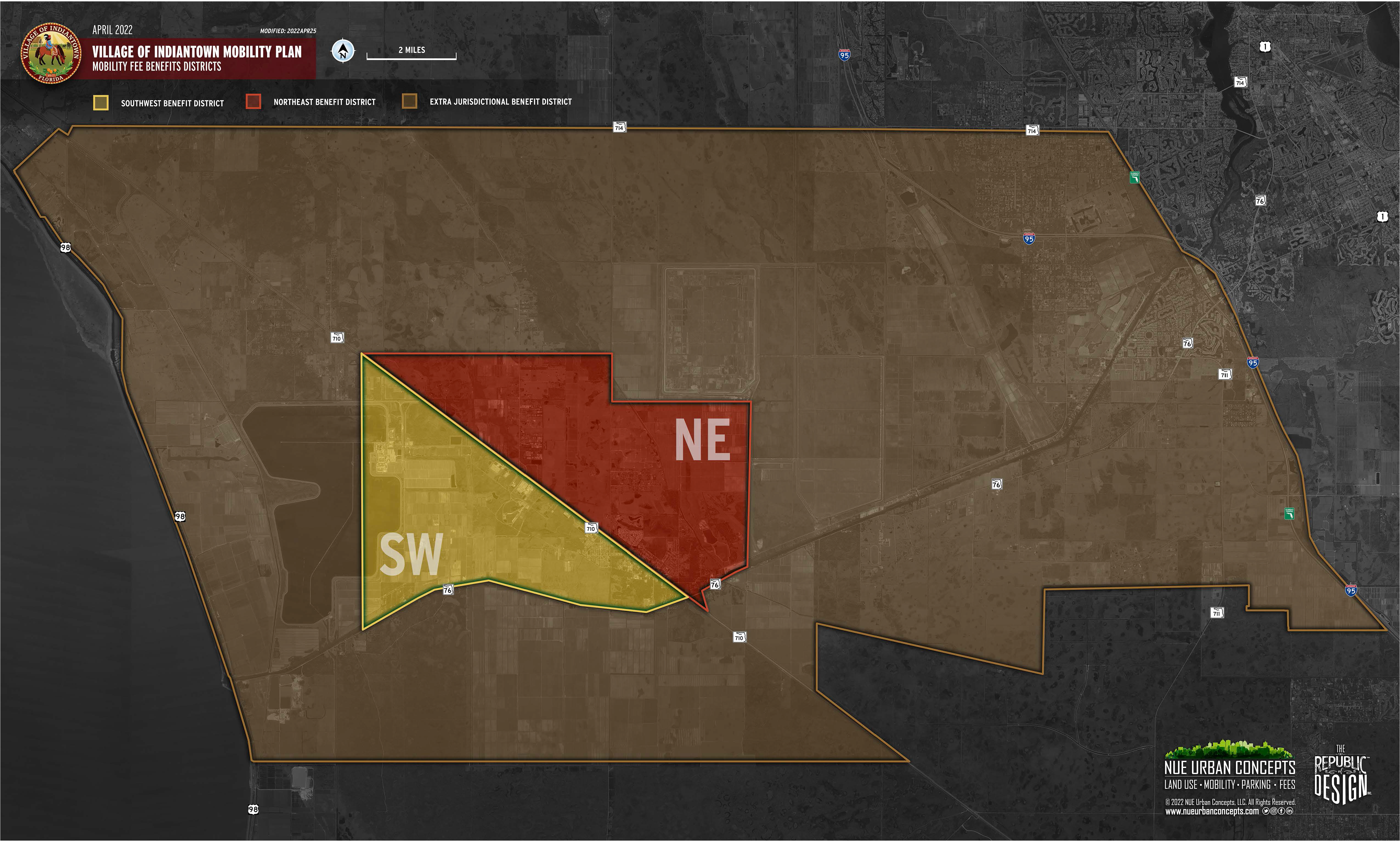
The establishment of mobility fee benefit districts is the best method of ensuring that the mobility fees paid by new development activity provide a benefit to the development activity which paid the mobility fees as required in the benefits test of the dual rational nexus test.
(b)
Mobility fee benefit districts provide a clearly defined boundary for the expenditure of mobility fee revenue. Using the mobility fee benefit districts ensures that funds paid by new development activity are spent on mobility projects to accommodate person travel demand within the benefit district, providing a reasonable nexus between the expenditure of mobility fee revenue and the new development activity for which the mobility fees are paid.
(c)
Mobility fee benefit districts are established northeast and southwest of SR 710 and shall extend to municipal boundaries on either side of SR 710. Geographic boundaries of the mobility fee benefit districts may expand or contract due to annexation or de-annexations.
(d)
An extra-jurisdictional mobility fee benefit district is also established to allow for the expenditure of mobility fees on mobility projects that are established in the mobility plan but are located outside of current municipal limits.
(e)
The mobility fee benefit districts and the extra jurisdictional benefit district are illustrated in the following Mobility Fee Benefit Districts map:
(f)
In recognition that person travel demand along certain corridors provides a mobility benefit beyond the limits of a mobility fee benefit district, the following are instances in which mobility fees may be expended from multiple benefit districts:
1.
The Village may spend mobility fees for mobility projects on SR 710 from adjacent benefit districts.
2.
The Village may spend mobility fees from adjacent benefit districts on mobility projects that run either run parallel to SR 710 to that provide an alternative to SR 710.
3.
The Village may spend mobility fees from adjacent benefit districts on mobility projects that provide access to or traverse SR 710.
4.
Multimodal crossings (overpass and underpass), new bridges or interchanges over SR 710 or the CR 44 canal may utilize funds from either benefit districts.
5.
Mobility projects that connect to the existing multimodal circulation system that will facilitate mobility across multiple district boundaries may utilize funds from benefit districts that receive a mobility benefit.
6.
Mobility projects that extend outside Village limits that facilitate regional travel consistent with the mobility plan may utilize funds from benefit districts that receive a mobility benefit.
7.
The Village shall be permitted to make a finding that a mobility project identified in the mobility plan provides a mobility benefit to new development activity within multiple benefit districts and that, due to circumstances documented in the finding, there is a need to utilize mobility fees from multiple benefit districts to fund the mobility plan. The finding shall be required to demonstrate how the use of funds from one benefit district on a mobility project in another benefit district meets the benefits requirement of the dual rational nexus test.
8.
The Village Attorney shall review and advise on a finding that a mobility fee may be expended in a different benefit district than the one from which it was collected, before review and approval by the Village Manager of the finding.
(g)
A mobility fee benefit district that is specific to new development activity maybe established as part of a developer agreement where a mobility project consistent with the mobility plan is to be constructed by the new development activity that provides a mobility benefit to the larger community. The agreement shall address mobility fee credit or reimbursement of mobility fees paid by new development activity within the benefit district.
(Ord. No. 07-2023, § 2(Exh. A), 11-16-2023)
Sec. 8-2.12. - Mobility fee expenditures.
(a)
Mobility fee special fund accounts shall be established for both benefit districts that are separate and distinct from general revenue funds.
(b)
Amounts on deposit in the mobility fee special fund accounts shall be used by the Village for mobility projects or for financing directly, or as a pledge against bonds, revenue certificates and other obligations of indebtedness, the costs of mobility projects, or portions thereof, that are located in the mobility fee benefit district from which the mobility fee funds were collected, or as otherwise provided in section 8-2.11.
(c)
Mobility fees collected shall be used for the mobility projects identified in a mobility plan or the Village's capital improvement program that provide a mobility benefit to new development activity that paid the mobility fees.
(d)
The amounts on deposit in the mobility fee special funds shall not be used for periodic or routine maintenance as defined in F.S. § 334.03(18) and (23).
(e)
Funds withdrawn from these accounts must be used solely in accordance with the provisions of this division.
(f)
Any mobility fee funds on deposit not immediately necessary for expenditure shall be invested in interest-bearing accounts. Funds may be pooled for investment provided all income derived from the fund's assets shall be deposited in the applicable fund account.
(g)
The Village shall annually comply with the affidavit submittal requirements of F.S. § 163.31801(8).
(Ord. No. 07-2023, § 2(Exh. A), 11-16-2023)
Sec. 8-2.13. - Mobility fee refunds.
(a)
The mobility fees collected pursuant to this division shall be returned to the then present owner of the new development activity if the fees have not been encumbered or spent by the end of the calendar quarter immediately following seven years from the date the fees were collected, or if the new development activity for which the fees were paid was never begun.
(b)
For purposes of this section, mobility fees collected shall be deemed to be encumbered or expended on a "first in-first out" basis (i.e., the first money placed in a fee fund shall deemed to be the first money expended or encumbered). The following procedure will apply for requests for eligible refunds:
(1)
The then present owner must petition the Village Council for the refund within one year following the end of the calendar quarter immediately following seven years from the date on which the fee was received.
(2)
The petition must be submitted to the Village Council and must contain:
a.
A notarized sworn statement that the petitioner is the current owner of the property or his authorized agent; and
b.
A copy of the dated receipt issued for payment of the fee or other competent evidence of payment; and
c.
A certificate of title or attorney's title opinion showing the petitioner to be the current owner of the property or his authorized agent; and
d.
A copy of the most recent ad valorem tax bill; and
e.
A copy of the building permit or development agreement pursuant to which the mobility fees were paid.
(3)
Within 60 days from the date of receipt of petition for refund, the Village Manager shall advise the petitioner and the Village Council of the status of the fee requested for refund. For the purposes of determining whether fees have been spent or encumbered, the first money placed in a special fund account shall be deemed to be the first money taken out of that special fund account when withdrawals have been made in accordance with section 8-2.12.
(4)
When the money requested is still in the special fund account and has not been spent or encumbered by the end of the calendar quarter immediately following ten years from the date of the fees were paid, the money shall be returned with interest at the rate of one percent per annum.
(5)
When a refund is requested because construction was never begun, all development order approvals shall have expired, and the applicant shall execute an agreement acknowledging the expiration of development order approval.
(6)
A request for a refund of mobility fees must be made one year from the issuance of the building permit or special use permit or six months from the expiration of the permit whichever is later only if no new development activity has commenced. The refund amount will be less ten percent of the fees that were ultimately to have been paid, regardless of the amount actually paid, to cover administrative cost. If the applicant does not apply within the time limits stated above, there will be no refund.
(Ord. No. 07-2023, § 2(Exh. A), 11-16-2023)
Sec. 8-2.14. - Effect on Land Development Regulations.
(a)
The payment of mobility fees does not ensure nor grant compliance with the Village's land development regulations, including regulations relating to transportation corridor management, access management, substandard roads, secondary access, timing and phasing, and, where applicable, development of regional impact review. However, if such regulations require transportation mitigation for the same impacts addressed through the payment of mobility fees, such regulations shall be deemed to provide for mobility fee credit against imposed mobility fees consistent with state and federal law and this division.
(b)
The listing of a land use in the mobility fee schedule is solely for purposes of establishing the applicable mobility fee schedule for such use, and such listing does not mean that the land use is permitted or available under applicable zoning and Comprehensive Plan requirements. In addition, the listing of the land use in the mobility fee schedule shall not be considered evidence that the land use is appropriate in any land use classification or zoning district.
(Ord. No. 07-2023, § 2(Exh. A), 11-16-2023)
Sec. 8-2.15. - Administrative manual and service charges.
(a)
The Village shall prepare and periodically update a mobility fee administrative manual or administrative procedures that addresses day to day administration and the implementation and update of the mobility plan and fee. The administrative manual shall address assessments, credit and off-set request, fee and land use determinations, special studies, fee expenditures and monitoring.
(b)
The administrative manual or administrative procedures shall be accepted by resolution of the Village Council. Until such time as an administrative manual or administrative procedures are developed, this division, case law, and Florida Statutes shall guide the Village Manager and the Village Attorney in the administration of the mobility fees.
(c)
The Village may elect to prepare and periodically update mobility fee service charges to ensure that the Village's general fund does not bear the full burden of administering and implementing the mobility fees, provided that the service charges does not exceed the Village's actual costs of administration and implementation of the mobility fee system per F.S. § 163.31801.
(d)
Mobility fee service charges would be in addition to the imposed mobility fee and shall account for future updates of the mobility plan and mobility fee in the service charge determination, along with any required application fees for special studies or credit request. The mobility fee service charge shall be based on a service charge study and accepted by resolution of the Village Council.
(e)
The administration of mobility fees may be paid from mobility fee funds collected until such time as a service charge study is completed. The use of mobility fee funds to cover administrative shall not exceed the actual costs of administration of the mobility fee system per F.S. § 163.31801.
(Ord. No. 07-2023, § 2(Exh. A), 11-16-2023)
Sec. 8-2.16. - Annual report.
The Village shall comply with all audit requirements of F.S. § 218.39. The Village shall include in its annual Capital Improvements Plan the mobility projects funded by mobility fees. The annual budget shall indicate mobility fee revenues and expenditures. The Village shall annually comply with the affidavit submittal requirements of F.S. § 163.31801(8).
(Ord. No. 07-2023, § 2(Exh. A), 11-16-2023)
Sec. 8-2.17. - Review and update.
(a)
The mobility plan and mobility fee shall be updated by the Village no sooner than every four years and no later than five years from the date of last adoption. The update should commence no later than 12 months prior to the projected adoption date of the update.
(b)
The mobility plan and mobility fee shall be reviewed annually during either the capital improvements budget process or the preparation of the mobility fee annual report. The review shall include a recommendation regarding the need to update the mobility plan and mobility fee earlier than the four-year schedule due to extraordinary circumstances. Factors that would form the basis for extraordinary circumstances include, but are not limited to:
(1)
Inflation that increases cost by more that ten percent in a given year,
(2)
Amendments to the Future Land Use Element and Map that result in the need for additional mobility projects,
(3)
The addition or subtraction of mobility projects to the Mobility Plan and Capital Improvements Program with a cumulative cost that is 20 percent of the attributable mobility plan cost, or
(4)
Update of professional technical reports such as the ITE Trip Generation Manual or Highway Capacity Manual or plans and surveys such as the Long-Range Transportation Plan or the National Household Travel Survey.
(c)
If a full re-evaluation and updates are not complete within the required five-year period, the last adopted mobility fee shall remain in effect until the update is complete.
(d)
To ensure that mobility fees keep pace with inflation, on January 1st of each calendar year, starting in 2025, the mobility fees in section 8-2.7(c) shall increase by the projected rate of inflation for the upcoming calendar year as determined by the most recent FDOT Transportation Cost Report Construction Cost Inflation Factors released on or about August of each calendar year, or if discontinued, a successor or substantially similar report.
(e)
Starting in 2024, on or before September 30th of each calendar year, the Village shall calculate the inflation-adjusted mobility fees in accordance with section 8-2.17(d) and provide notice of such inflation-adjusted mobility fees by posting them on the Village website, with such inflation-adjusted mobility fees to become effective on January 1 in accordance with section 8-2.17(d).
(f)
Updates to the mobility plan and mobility fee that result in an increase in mobility fees, other than the inflation adjustments in section 8-2.17(d) and (e), shall be required to provide at least 90 days' notice before the increased mobility fees are assessed on development activity per F.S. § 163.31801.
(g)
The Village Manager may authorize updates of the mobility plan, the mobility fees, or a mobility fee for a specific use to ensure that mobility fees meet legal and statutory requirements. Any increase in mobility fees may require a finding of extraordinary circumstances per F.S. § 163.31801. Updates to one or more land uses on the mobility fee schedule may be required due to updates of technical documents such as the ITE Trip Generation Manual that results in a change in person travel demand of more than ten percent compared to the person travel demand calculations for a given land use in the Technical Report.
(Ord. No. 07-2023, § 2(Exh. A), 11-16-2023)
Sec. 8-2.18. - Mobility fee or developer agreements.
(a)
An applicant for new development activity may enter into a mobility fee agreement or a developer agreement with the Village to establish mobility fees or to provide equivalent mobility projects necessary to mitigate the impact of new development activity as a development order condition.
(b)
Any agreement proposed by an applicant pursuant to this Section shall be presented to and approved by the Village Council prior to the issuance of a building permit or equivalent. Any such agreement shall provide for execution by any mortgagees, lienholders, or contract purchasers in addition to the landowner, and shall require the applicant to record such agreement in the public records of Martin County. The Village Council shall approve such an agreement only if it finds that the new agreement will apportion the burden of expenditure for mobility projects in a just and equitable manner, consistent with applicable Florida Statutes, case law and this division.
(Ord. No. 07-2023, § 2(Exh. A), 11-16-2023)
Sec. 8-2.19. - Appeals.
(a)
Any decision made by a village official or the mobility fee administrator, other than the Village Manager, while administering the provisions of this division may be appealed to the Village Manger by filing a petition of appeal with the Village Clerk within 30 calendar days of the date of the rendition of the decision by the official or administrator.
(b)
Any decision made by the Village Manager while administering the provisions of this division may be appealed to the Village Council by filing a petition of appeal with the Village Clerk within 30 calendar days of the date of the rendition of the decision by the Village Manager.
(c)
The Village Council shall review the petition within 30 calendar days from the date of filing the appeal. The petitioner shall be provided reasonable notice of the time, date, and place of the public meeting by certified mail, return receipt requested, and invited to attend. The Council decision shall be final for the purpose of administrative appeals. The Council shall revoke the decision of the Village Manager only if there is no competent and substantial evidence in the record that supports the decision of the Village Manager or if there is no adequate legal basis for the decision of the Village Manager or was a failure to substantially comply with this division.
(d)
The administrative manual shall provide additional processes to appeal decisions that include required documentation in support of the original request and appeals of a decision.
(Ord. No. 07-2023, § 2(Exh. A), 11-16-2023)
Sec. 8-2.20. - Vested rights.
(a)
It is not the intent of this division to abrogate, diminish or modify the rights of any persons that have vested rights pursuant to a valid governmental act of the Village. An applicant may petition the Village Council for a vested rights determination which would exempt the applicant from the provisions of the division. The Village Manager shall evaluate the petition and submit a recommendation to the Village Council based upon the following criteria:
1.
A valid, unexpired governmental act of the Village, authorizing the building for which applicants seeks a certificate of occupancy, exists.
2.
Expenditures or obligations made or incurred in reliance upon the authorizing act are reasonably equivalent to the mobility fee schedule per section 8-2.7(c).
3.
That it would be inequitable to deny the applicant the opportunity to occupy a previously approved building under the conditions of the previous approval by requiring the applicant to comply with the provisions of this division.
(b)
If an applicant has previously entered into an agreement with the Village with conditions regarding off-site mobility projects, the applicant or applicant's successor in interest may request an amendment of the prior agreement in order to bring the conditions into consistency with this division. An applicant must file a request for such modification with the Village Manager within one year of the effective date of this division.
(Ord. No. 07-2023, § 2(Exh. A), 11-16-2023)

